EP1227094B1 - Isocyanurate compound and method for producing the same - Google Patents
Isocyanurate compound and method for producing the same Download PDFInfo
- Publication number
- EP1227094B1 EP1227094B1 EP02001508A EP02001508A EP1227094B1 EP 1227094 B1 EP1227094 B1 EP 1227094B1 EP 02001508 A EP02001508 A EP 02001508A EP 02001508 A EP02001508 A EP 02001508A EP 1227094 B1 EP1227094 B1 EP 1227094B1
- Authority
- EP
- European Patent Office
- Prior art keywords
- group
- isocyanurate
- isocyanurate compound
- compound
- tris
- Prior art date
- Legal status (The legal status is an assumption and is not a legal conclusion. Google has not performed a legal analysis and makes no representation as to the accuracy of the status listed.)
- Expired - Lifetime
Links
- -1 Isocyanurate compound Chemical class 0.000 title claims description 212
- 238000004519 manufacturing process Methods 0.000 title claims description 38
- 239000007983 Tris buffer Substances 0.000 claims description 87
- 150000001875 compounds Chemical class 0.000 claims description 80
- ZFSLODLOARCGLH-UHFFFAOYSA-N isocyanuric acid Chemical compound OC1=NC(O)=NC(O)=N1 ZFSLODLOARCGLH-UHFFFAOYSA-N 0.000 claims description 79
- 238000006243 chemical reaction Methods 0.000 claims description 68
- QGJOPFRUJISHPQ-UHFFFAOYSA-N Carbon disulfide Chemical compound S=C=S QGJOPFRUJISHPQ-UHFFFAOYSA-N 0.000 claims description 36
- 239000003054 catalyst Substances 0.000 claims description 30
- 125000003277 amino group Chemical group 0.000 claims description 26
- WGQKYBSKWIADBV-UHFFFAOYSA-N benzylamine Chemical compound NCC1=CC=CC=C1 WGQKYBSKWIADBV-UHFFFAOYSA-N 0.000 claims description 26
- 150000003839 salts Chemical class 0.000 claims description 24
- 125000003396 thiol group Chemical group [H]S* 0.000 claims description 22
- 125000004435 hydrogen atom Chemical group [H]* 0.000 claims description 20
- 125000001841 imino group Chemical group [H]N=* 0.000 claims description 20
- 125000002496 methyl group Chemical group [H]C([H])([H])* 0.000 claims description 19
- 125000002887 hydroxy group Chemical group [H]O* 0.000 claims description 16
- 125000000524 functional group Chemical group 0.000 claims description 15
- 150000007530 organic bases Chemical class 0.000 claims description 15
- 125000004169 (C1-C6) alkyl group Chemical group 0.000 claims description 12
- 125000001424 substituent group Chemical group 0.000 claims description 12
- 229910001508 alkali metal halide Inorganic materials 0.000 claims description 10
- 150000008045 alkali metal halides Chemical class 0.000 claims description 10
- 150000008044 alkali metal hydroxides Chemical class 0.000 claims description 10
- 229910052784 alkaline earth metal Inorganic materials 0.000 claims description 10
- 150000005309 metal halides Chemical class 0.000 claims description 10
- 150000003141 primary amines Chemical class 0.000 claims description 10
- 238000002156 mixing Methods 0.000 claims description 8
- 125000000229 (C1-C4)alkoxy group Chemical group 0.000 claims description 7
- 125000006727 (C1-C6) alkenyl group Chemical group 0.000 claims description 7
- 125000004663 dialkyl amino group Chemical group 0.000 claims description 7
- 125000001797 benzyl group Chemical group [H]C1=C([H])C([H])=C(C([H])=C1[H])C([H])([H])* 0.000 claims description 4
- 125000000217 alkyl group Chemical group 0.000 claims description 3
- LENZDBCJOHFCAS-UHFFFAOYSA-N tris Chemical compound OCC(N)(CO)CO LENZDBCJOHFCAS-UHFFFAOYSA-N 0.000 claims 2
- 239000002904 solvent Substances 0.000 description 55
- WYURNTSHIVDZCO-UHFFFAOYSA-N Tetrahydrofuran Chemical compound C1CCOC1 WYURNTSHIVDZCO-UHFFFAOYSA-N 0.000 description 46
- OKKJLVBELUTLKV-UHFFFAOYSA-N Methanol Chemical compound OC OKKJLVBELUTLKV-UHFFFAOYSA-N 0.000 description 45
- 239000000463 material Substances 0.000 description 31
- 239000000047 product Substances 0.000 description 24
- 239000011369 resultant mixture Substances 0.000 description 24
- HEDRZPFGACZZDS-MICDWDOJSA-N Trichloro(2H)methane Chemical compound [2H]C(Cl)(Cl)Cl HEDRZPFGACZZDS-MICDWDOJSA-N 0.000 description 22
- WEVYAHXRMPXWCK-UHFFFAOYSA-N Acetonitrile Chemical compound CC#N WEVYAHXRMPXWCK-UHFFFAOYSA-N 0.000 description 21
- YLQBMQCUIZJEEH-UHFFFAOYSA-N tetrahydrofuran Natural products C=1C=COC=1 YLQBMQCUIZJEEH-UHFFFAOYSA-N 0.000 description 21
- 238000002844 melting Methods 0.000 description 19
- 230000008018 melting Effects 0.000 description 19
- 238000005160 1H NMR spectroscopy Methods 0.000 description 18
- ZWEHNKRNPOVVGH-UHFFFAOYSA-N 2-Butanone Chemical compound CCC(C)=O ZWEHNKRNPOVVGH-UHFFFAOYSA-N 0.000 description 18
- HEDRZPFGACZZDS-UHFFFAOYSA-N Chloroform Chemical compound ClC(Cl)Cl HEDRZPFGACZZDS-UHFFFAOYSA-N 0.000 description 18
- LFQSCWFLJHTTHZ-UHFFFAOYSA-N Ethanol Chemical compound CCO LFQSCWFLJHTTHZ-UHFFFAOYSA-N 0.000 description 18
- ZMANZCXQSJIPKH-UHFFFAOYSA-N Triethylamine Chemical compound CCN(CC)CC ZMANZCXQSJIPKH-UHFFFAOYSA-N 0.000 description 18
- 239000007858 starting material Substances 0.000 description 18
- OUPZKGBUJRBPGC-UHFFFAOYSA-N 1,3,5-tris(oxiran-2-ylmethyl)-1,3,5-triazinane-2,4,6-trione Chemical compound O=C1N(CC2OC2)C(=O)N(CC2OC2)C(=O)N1CC1CO1 OUPZKGBUJRBPGC-UHFFFAOYSA-N 0.000 description 17
- ZMXDDKWLCZADIW-UHFFFAOYSA-N N,N-Dimethylformamide Chemical compound CN(C)C=O ZMXDDKWLCZADIW-UHFFFAOYSA-N 0.000 description 17
- JUJWROOIHBZHMG-UHFFFAOYSA-N Pyridine Chemical compound C1=CC=NC=C1 JUJWROOIHBZHMG-UHFFFAOYSA-N 0.000 description 16
- AMXOYNBUYSYVKV-UHFFFAOYSA-M lithium bromide Chemical compound [Li+].[Br-] AMXOYNBUYSYVKV-UHFFFAOYSA-M 0.000 description 16
- 239000000126 substance Substances 0.000 description 16
- XLYOFNOQVPJJNP-UHFFFAOYSA-N water Chemical class O XLYOFNOQVPJJNP-UHFFFAOYSA-N 0.000 description 16
- CSCPPACGZOOCGX-UHFFFAOYSA-N Acetone Chemical compound CC(C)=O CSCPPACGZOOCGX-UHFFFAOYSA-N 0.000 description 15
- HEMHJVSKTPXQMS-UHFFFAOYSA-M Sodium hydroxide Chemical compound [OH-].[Na+] HEMHJVSKTPXQMS-UHFFFAOYSA-M 0.000 description 15
- BAVYZALUXZFZLV-UHFFFAOYSA-N Methylamine Chemical compound NC BAVYZALUXZFZLV-UHFFFAOYSA-N 0.000 description 14
- JHIVVAPYMSGYDF-UHFFFAOYSA-N cyclohexanone Chemical compound O=C1CCCCC1 JHIVVAPYMSGYDF-UHFFFAOYSA-N 0.000 description 14
- IAZDPXIOMUYVGZ-WFGJKAKNSA-N Dimethyl sulfoxide Chemical compound [2H]C([2H])([2H])S(=O)C([2H])([2H])[2H] IAZDPXIOMUYVGZ-WFGJKAKNSA-N 0.000 description 13
- 238000000034 method Methods 0.000 description 13
- XEKOWRVHYACXOJ-UHFFFAOYSA-N Ethyl acetate Chemical compound CCOC(C)=O XEKOWRVHYACXOJ-UHFFFAOYSA-N 0.000 description 12
- SECXISVLQFMRJM-UHFFFAOYSA-N N-Methylpyrrolidone Chemical compound CN1CCCC1=O SECXISVLQFMRJM-UHFFFAOYSA-N 0.000 description 12
- YXFVVABEGXRONW-UHFFFAOYSA-N Toluene Chemical compound CC1=CC=CC=C1 YXFVVABEGXRONW-UHFFFAOYSA-N 0.000 description 12
- 150000004820 halides Chemical class 0.000 description 12
- 150000004714 phosphonium salts Chemical class 0.000 description 12
- QGJOPFRUJISHPQ-NJFSPNSNSA-N carbon disulfide-14c Chemical compound S=[14C]=S QGJOPFRUJISHPQ-NJFSPNSNSA-N 0.000 description 11
- 239000012299 nitrogen atmosphere Substances 0.000 description 11
- IAZDPXIOMUYVGZ-UHFFFAOYSA-N Dimethylsulphoxide Chemical compound CS(C)=O IAZDPXIOMUYVGZ-UHFFFAOYSA-N 0.000 description 10
- 125000003118 aryl group Chemical group 0.000 description 10
- 230000015572 biosynthetic process Effects 0.000 description 10
- 239000013078 crystal Substances 0.000 description 10
- 239000000203 mixture Substances 0.000 description 10
- 238000003786 synthesis reaction Methods 0.000 description 10
- RAXXELZNTBOGNW-UHFFFAOYSA-N imidazole Natural products C1=CNC=N1 RAXXELZNTBOGNW-UHFFFAOYSA-N 0.000 description 9
- 150000003242 quaternary ammonium salts Chemical class 0.000 description 9
- 239000011541 reaction mixture Substances 0.000 description 9
- HXOYEKUNPUDUPM-UHFFFAOYSA-N 1,3-oxathiolane-2-thione Chemical group S=C1OCCS1 HXOYEKUNPUDUPM-UHFFFAOYSA-N 0.000 description 8
- KFZMGEQAYNKOFK-UHFFFAOYSA-N Isopropanol Chemical compound CC(C)O KFZMGEQAYNKOFK-UHFFFAOYSA-N 0.000 description 8
- HQABUPZFAYXKJW-UHFFFAOYSA-N butan-1-amine Chemical compound CCCCN HQABUPZFAYXKJW-UHFFFAOYSA-N 0.000 description 8
- 239000007795 chemical reaction product Substances 0.000 description 8
- MVPPADPHJFYWMZ-UHFFFAOYSA-N chlorobenzene Chemical compound ClC1=CC=CC=C1 MVPPADPHJFYWMZ-UHFFFAOYSA-N 0.000 description 8
- VKYKSIONXSXAKP-UHFFFAOYSA-N hexamethylenetetramine Chemical compound C1N(C2)CN3CN1CN2C3 VKYKSIONXSXAKP-UHFFFAOYSA-N 0.000 description 8
- LQNUZADURLCDLV-UHFFFAOYSA-N nitrobenzene Chemical compound [O-][N+](=O)C1=CC=CC=C1 LQNUZADURLCDLV-UHFFFAOYSA-N 0.000 description 8
- 230000003287 optical effect Effects 0.000 description 8
- 238000002360 preparation method Methods 0.000 description 8
- UMJSCPRVCHMLSP-UHFFFAOYSA-N pyridine Natural products COC1=CC=CN=C1 UMJSCPRVCHMLSP-UHFFFAOYSA-N 0.000 description 8
- 239000003795 chemical substances by application Substances 0.000 description 7
- 239000012043 crude product Substances 0.000 description 7
- 238000004128 high performance liquid chromatography Methods 0.000 description 7
- 0 *C1(CN(C(N(CC(*)(CS2)OC2=S)C(N2CC([*+])(CS3)OC3=S)O)=O)C2=O)OC(S)SC1 Chemical compound *C1(CN(C(N(CC(*)(CS2)OC2=S)C(N2CC([*+])(CS3)OC3=S)O)=O)C2=O)OC(S)SC1 0.000 description 6
- RXYPXQSKLGGKOL-UHFFFAOYSA-N 1,4-dimethylpiperazine Chemical compound CN1CCN(C)CC1 RXYPXQSKLGGKOL-UHFFFAOYSA-N 0.000 description 6
- PAMIQIKDUOTOBW-UHFFFAOYSA-N 1-methylpiperidine Chemical compound CN1CCCCC1 PAMIQIKDUOTOBW-UHFFFAOYSA-N 0.000 description 6
- VHYFNPMBLIVWCW-UHFFFAOYSA-N 4-Dimethylaminopyridine Chemical compound CN(C)C1=CC=NC=C1 VHYFNPMBLIVWCW-UHFFFAOYSA-N 0.000 description 6
- VVJKKWFAADXIJK-UHFFFAOYSA-N Allylamine Chemical compound NCC=C VVJKKWFAADXIJK-UHFFFAOYSA-N 0.000 description 6
- RWSOTUBLDIXVET-UHFFFAOYSA-N Dihydrogen sulfide Chemical class S RWSOTUBLDIXVET-UHFFFAOYSA-N 0.000 description 6
- UFHFLCQGNIYNRP-UHFFFAOYSA-N Hydrogen Chemical compound [H][H] UFHFLCQGNIYNRP-UHFFFAOYSA-N 0.000 description 6
- WMFOQBRAJBCJND-UHFFFAOYSA-M Lithium hydroxide Chemical compound [Li+].[OH-] WMFOQBRAJBCJND-UHFFFAOYSA-M 0.000 description 6
- GLUUGHFHXGJENI-UHFFFAOYSA-N Piperazine Chemical compound C1CNCCN1 GLUUGHFHXGJENI-UHFFFAOYSA-N 0.000 description 6
- NQRYJNQNLNOLGT-UHFFFAOYSA-N Piperidine Chemical compound C1CCNCC1 NQRYJNQNLNOLGT-UHFFFAOYSA-N 0.000 description 6
- KWYUFKZDYYNOTN-UHFFFAOYSA-M Potassium hydroxide Chemical compound [OH-].[K+] KWYUFKZDYYNOTN-UHFFFAOYSA-M 0.000 description 6
- WQDUMFSSJAZKTM-UHFFFAOYSA-N Sodium methoxide Chemical compound [Na+].[O-]C WQDUMFSSJAZKTM-UHFFFAOYSA-N 0.000 description 6
- 150000003863 ammonium salts Chemical class 0.000 description 6
- VUEDNLCYHKSELL-UHFFFAOYSA-N arsonium Chemical class [AsH4+] VUEDNLCYHKSELL-UHFFFAOYSA-N 0.000 description 6
- 238000000354 decomposition reaction Methods 0.000 description 6
- 239000001257 hydrogen Substances 0.000 description 6
- 229910052739 hydrogen Inorganic materials 0.000 description 6
- XMBWDFGMSWQBCA-UHFFFAOYSA-N hydrogen iodide Chemical class I XMBWDFGMSWQBCA-UHFFFAOYSA-N 0.000 description 6
- 150000002576 ketones Chemical class 0.000 description 6
- KWGKDLIKAYFUFQ-UHFFFAOYSA-M lithium chloride Chemical compound [Li+].[Cl-] KWGKDLIKAYFUFQ-UHFFFAOYSA-M 0.000 description 6
- NLKNQRATVPKPDG-UHFFFAOYSA-M potassium iodide Chemical compound [K+].[I-] NLKNQRATVPKPDG-UHFFFAOYSA-M 0.000 description 6
- 239000002244 precipitate Substances 0.000 description 6
- 238000000746 purification Methods 0.000 description 6
- 239000011347 resin Substances 0.000 description 6
- 229920005989 resin Polymers 0.000 description 6
- SPVXKVOXSXTJOY-UHFFFAOYSA-O selenonium Chemical class [SeH3+] SPVXKVOXSXTJOY-UHFFFAOYSA-O 0.000 description 6
- NDVLTYZPCACLMA-UHFFFAOYSA-N silver oxide Chemical compound [O-2].[Ag+].[Ag+] NDVLTYZPCACLMA-UHFFFAOYSA-N 0.000 description 6
- FVAUCKIRQBBSSJ-UHFFFAOYSA-M sodium iodide Chemical compound [Na+].[I-] FVAUCKIRQBBSSJ-UHFFFAOYSA-M 0.000 description 6
- HISNRBVYBOVKMB-UHFFFAOYSA-N stibonium Chemical class [SbH4+] HISNRBVYBOVKMB-UHFFFAOYSA-N 0.000 description 6
- RYHBNJHYFVUHQT-UHFFFAOYSA-N 1,4-Dioxane Chemical compound C1COCCO1 RYHBNJHYFVUHQT-UHFFFAOYSA-N 0.000 description 5
- RTZKZFJDLAIYFH-UHFFFAOYSA-N Diethyl ether Chemical compound CCOCC RTZKZFJDLAIYFH-UHFFFAOYSA-N 0.000 description 5
- LYCAIKOWRPUZTN-UHFFFAOYSA-N Ethylene glycol Chemical compound OCCO LYCAIKOWRPUZTN-UHFFFAOYSA-N 0.000 description 5
- NINIDFKCEFEMDL-UHFFFAOYSA-N Sulfur Chemical compound [S] NINIDFKCEFEMDL-UHFFFAOYSA-N 0.000 description 5
- 239000000654 additive Substances 0.000 description 5
- 230000000996 additive effect Effects 0.000 description 5
- 150000001298 alcohols Chemical class 0.000 description 5
- 238000004132 cross linking Methods 0.000 description 5
- 150000002148 esters Chemical class 0.000 description 5
- 150000002170 ethers Chemical class 0.000 description 5
- 229910052736 halogen Inorganic materials 0.000 description 5
- 239000011368 organic material Substances 0.000 description 5
- 239000002798 polar solvent Substances 0.000 description 5
- 229910052717 sulfur Inorganic materials 0.000 description 5
- 239000011593 sulfur Substances 0.000 description 5
- SCYULBFZEHDVBN-UHFFFAOYSA-N 1,1-Dichloroethane Chemical compound CC(Cl)Cl SCYULBFZEHDVBN-UHFFFAOYSA-N 0.000 description 4
- XNWFRZJHXBZDAG-UHFFFAOYSA-N 2-METHOXYETHANOL Chemical compound COCCO XNWFRZJHXBZDAG-UHFFFAOYSA-N 0.000 description 4
- ZNQVEEAIQZEUHB-UHFFFAOYSA-N 2-ethoxyethanol Chemical compound CCOCCO ZNQVEEAIQZEUHB-UHFFFAOYSA-N 0.000 description 4
- 229940093475 2-ethoxyethanol Drugs 0.000 description 4
- CURLTUGMZLYLDI-UHFFFAOYSA-N Carbon dioxide Chemical compound O=C=O CURLTUGMZLYLDI-UHFFFAOYSA-N 0.000 description 4
- XTHFKEDIFFGKHM-UHFFFAOYSA-N Dimethoxyethane Chemical compound COCCOC XTHFKEDIFFGKHM-UHFFFAOYSA-N 0.000 description 4
- ROSDSFDQCJNGOL-UHFFFAOYSA-N Dimethylamine Chemical compound CNC ROSDSFDQCJNGOL-UHFFFAOYSA-N 0.000 description 4
- TWRXJAOTZQYOKJ-UHFFFAOYSA-L Magnesium chloride Chemical compound [Mg+2].[Cl-].[Cl-] TWRXJAOTZQYOKJ-UHFFFAOYSA-L 0.000 description 4
- FXHOOIRPVKKKFG-UHFFFAOYSA-N N,N-Dimethylacetamide Chemical compound CN(C)C(C)=O FXHOOIRPVKKKFG-UHFFFAOYSA-N 0.000 description 4
- WCUXLLCKKVVCTQ-UHFFFAOYSA-M Potassium chloride Chemical compound [Cl-].[K+] WCUXLLCKKVVCTQ-UHFFFAOYSA-M 0.000 description 4
- FAPWRFPIFSIZLT-UHFFFAOYSA-M Sodium chloride Chemical compound [Na+].[Cl-] FAPWRFPIFSIZLT-UHFFFAOYSA-M 0.000 description 4
- 125000001931 aliphatic group Chemical group 0.000 description 4
- 150000003973 alkyl amines Chemical class 0.000 description 4
- 150000001408 amides Chemical class 0.000 description 4
- 150000001412 amines Chemical group 0.000 description 4
- 150000004945 aromatic hydrocarbons Chemical class 0.000 description 4
- 239000003431 cross linking reagent Substances 0.000 description 4
- 150000008282 halocarbons Chemical class 0.000 description 4
- 239000004312 hexamethylene tetramine Substances 0.000 description 4
- 235000010299 hexamethylene tetramine Nutrition 0.000 description 4
- 150000007529 inorganic bases Chemical class 0.000 description 4
- 238000005259 measurement Methods 0.000 description 4
- 229960004011 methenamine Drugs 0.000 description 4
- 150000002825 nitriles Chemical class 0.000 description 4
- 150000002828 nitro derivatives Chemical class 0.000 description 4
- MCSAJNNLRCFZED-UHFFFAOYSA-N nitroethane Chemical compound CC[N+]([O-])=O MCSAJNNLRCFZED-UHFFFAOYSA-N 0.000 description 4
- 238000007254 oxidation reaction Methods 0.000 description 4
- 229920000642 polymer Polymers 0.000 description 4
- IOLCXVTUBQKXJR-UHFFFAOYSA-M potassium bromide Chemical compound [K+].[Br-] IOLCXVTUBQKXJR-UHFFFAOYSA-M 0.000 description 4
- BWHMMNNQKKPAPP-UHFFFAOYSA-L potassium carbonate Chemical compound [K+].[K+].[O-]C([O-])=O BWHMMNNQKKPAPP-UHFFFAOYSA-L 0.000 description 4
- JHJLBTNAGRQEKS-UHFFFAOYSA-M sodium bromide Chemical compound [Na+].[Br-] JHJLBTNAGRQEKS-UHFFFAOYSA-M 0.000 description 4
- 239000000243 solution Substances 0.000 description 4
- 150000003464 sulfur compounds Chemical class 0.000 description 4
- BPGIOCZAQDIBPI-UHFFFAOYSA-N 2-ethoxyethanamine Chemical compound CCOCCN BPGIOCZAQDIBPI-UHFFFAOYSA-N 0.000 description 3
- WFDIJRYMOXRFFG-UHFFFAOYSA-N Acetic anhydride Chemical compound CC(=O)OC(C)=O WFDIJRYMOXRFFG-UHFFFAOYSA-N 0.000 description 3
- 239000005057 Hexamethylene diisocyanate Substances 0.000 description 3
- LSDPWZHWYPCBBB-UHFFFAOYSA-N Methanethiol Chemical compound SC LSDPWZHWYPCBBB-UHFFFAOYSA-N 0.000 description 3
- DNIAPMSPPWPWGF-UHFFFAOYSA-N Propylene glycol Chemical compound CC(O)CO DNIAPMSPPWPWGF-UHFFFAOYSA-N 0.000 description 3
- 229910052783 alkali metal Inorganic materials 0.000 description 3
- 230000004075 alteration Effects 0.000 description 3
- 239000003957 anion exchange resin Substances 0.000 description 3
- QVGXLLKOCUKJST-UHFFFAOYSA-N atomic oxygen Chemical compound [O] QVGXLLKOCUKJST-UHFFFAOYSA-N 0.000 description 3
- 239000002585 base Substances 0.000 description 3
- 238000009835 boiling Methods 0.000 description 3
- 238000004364 calculation method Methods 0.000 description 3
- XXBDWLFCJWSEKW-UHFFFAOYSA-N dimethylbenzylamine Chemical compound CN(C)CC1=CC=CC=C1 XXBDWLFCJWSEKW-UHFFFAOYSA-N 0.000 description 3
- RRAMGCGOFNQTLD-UHFFFAOYSA-N hexamethylene diisocyanate Chemical compound O=C=NCCCCCCN=C=O RRAMGCGOFNQTLD-UHFFFAOYSA-N 0.000 description 3
- XLYOFNOQVPJJNP-UHFFFAOYSA-M hydroxide Chemical compound [OH-] XLYOFNOQVPJJNP-UHFFFAOYSA-M 0.000 description 3
- 239000012535 impurity Substances 0.000 description 3
- 150000002500 ions Chemical class 0.000 description 3
- DILRJUIACXKSQE-UHFFFAOYSA-N n',n'-dimethylethane-1,2-diamine Chemical compound CN(C)CCN DILRJUIACXKSQE-UHFFFAOYSA-N 0.000 description 3
- ULWOJODHECIZAU-UHFFFAOYSA-N n,n-diethylpropan-2-amine Chemical compound CCN(CC)C(C)C ULWOJODHECIZAU-UHFFFAOYSA-N 0.000 description 3
- RIWRFSMVIUAEBX-UHFFFAOYSA-N n-methyl-1-phenylmethanamine Chemical compound CNCC1=CC=CC=C1 RIWRFSMVIUAEBX-UHFFFAOYSA-N 0.000 description 3
- 150000002894 organic compounds Chemical class 0.000 description 3
- 239000003960 organic solvent Substances 0.000 description 3
- 239000001301 oxygen Substances 0.000 description 3
- 229910052760 oxygen Inorganic materials 0.000 description 3
- RPDAUEIUDPHABB-UHFFFAOYSA-N potassium ethoxide Chemical compound [K+].CC[O-] RPDAUEIUDPHABB-UHFFFAOYSA-N 0.000 description 3
- BDAWXSQJJCIFIK-UHFFFAOYSA-N potassium methoxide Chemical compound [K+].[O-]C BDAWXSQJJCIFIK-UHFFFAOYSA-N 0.000 description 3
- LPNYRYFBWFDTMA-UHFFFAOYSA-N potassium tert-butoxide Chemical compound [K+].CC(C)(C)[O-] LPNYRYFBWFDTMA-UHFFFAOYSA-N 0.000 description 3
- 125000001453 quaternary ammonium group Chemical group 0.000 description 3
- 150000003335 secondary amines Chemical class 0.000 description 3
- 229910001923 silver oxide Inorganic materials 0.000 description 3
- QDRKDTQENPPHOJ-UHFFFAOYSA-N sodium ethoxide Chemical compound [Na+].CC[O-] QDRKDTQENPPHOJ-UHFFFAOYSA-N 0.000 description 3
- 239000007787 solid Substances 0.000 description 3
- 238000002076 thermal analysis method Methods 0.000 description 3
- RMVRSNDYEFQCLF-UHFFFAOYSA-N thiophenol Chemical compound SC1=CC=CC=C1 RMVRSNDYEFQCLF-UHFFFAOYSA-N 0.000 description 3
- PMBXCGGQNSVESQ-UHFFFAOYSA-N 1-Hexanethiol Chemical compound CCCCCCS PMBXCGGQNSVESQ-UHFFFAOYSA-N 0.000 description 2
- YIWUKEYIRIRTPP-UHFFFAOYSA-N 2-ethylhexan-1-ol Chemical compound CCCCC(CC)CO YIWUKEYIRIRTPP-UHFFFAOYSA-N 0.000 description 2
- 239000004925 Acrylic resin Substances 0.000 description 2
- 229920000178 Acrylic resin Polymers 0.000 description 2
- PAYRUJLWNCNPSJ-UHFFFAOYSA-N Aniline Chemical compound NC1=CC=CC=C1 PAYRUJLWNCNPSJ-UHFFFAOYSA-N 0.000 description 2
- XKRFYHLGVUSROY-UHFFFAOYSA-N Argon Chemical compound [Ar] XKRFYHLGVUSROY-UHFFFAOYSA-N 0.000 description 2
- IJGRMHOSHXDMSA-UHFFFAOYSA-N Atomic nitrogen Chemical compound N#N IJGRMHOSHXDMSA-UHFFFAOYSA-N 0.000 description 2
- KZMGYPLQYOPHEL-UHFFFAOYSA-N Boron trifluoride etherate Chemical compound FB(F)F.CCOCC KZMGYPLQYOPHEL-UHFFFAOYSA-N 0.000 description 2
- UXVMQQNJUSDDNG-UHFFFAOYSA-L Calcium chloride Chemical compound [Cl-].[Cl-].[Ca+2] UXVMQQNJUSDDNG-UHFFFAOYSA-L 0.000 description 2
- BWGNESOTFCXPMA-UHFFFAOYSA-N Dihydrogen disulfide Chemical compound SS BWGNESOTFCXPMA-UHFFFAOYSA-N 0.000 description 2
- QUSNBJAOOMFDIB-UHFFFAOYSA-N Ethylamine Chemical compound CCN QUSNBJAOOMFDIB-UHFFFAOYSA-N 0.000 description 2
- PEDCQBHIVMGVHV-UHFFFAOYSA-N Glycerine Chemical compound OCC(O)CO PEDCQBHIVMGVHV-UHFFFAOYSA-N 0.000 description 2
- 239000002841 Lewis acid Substances 0.000 description 2
- CTQNGGLPUBDAKN-UHFFFAOYSA-N O-Xylene Chemical compound CC1=CC=CC=C1C CTQNGGLPUBDAKN-UHFFFAOYSA-N 0.000 description 2
- 238000010521 absorption reaction Methods 0.000 description 2
- 239000013543 active substance Substances 0.000 description 2
- 230000001070 adhesive effect Effects 0.000 description 2
- 229910000102 alkali metal hydride Inorganic materials 0.000 description 2
- 150000008046 alkali metal hydrides Chemical class 0.000 description 2
- 150000001350 alkyl halides Chemical class 0.000 description 2
- VSCWAEJMTAWNJL-UHFFFAOYSA-K aluminium trichloride Chemical compound Cl[Al](Cl)Cl VSCWAEJMTAWNJL-UHFFFAOYSA-K 0.000 description 2
- FJDQFPXHSGXQBY-UHFFFAOYSA-L caesium carbonate Chemical compound [Cs+].[Cs+].[O-]C([O-])=O FJDQFPXHSGXQBY-UHFFFAOYSA-L 0.000 description 2
- 229910000024 caesium carbonate Inorganic materials 0.000 description 2
- 239000011575 calcium Substances 0.000 description 2
- 229910052791 calcium Inorganic materials 0.000 description 2
- 229910001622 calcium bromide Inorganic materials 0.000 description 2
- 239000001110 calcium chloride Substances 0.000 description 2
- 229910001628 calcium chloride Inorganic materials 0.000 description 2
- WGEFECGEFUFIQW-UHFFFAOYSA-L calcium dibromide Chemical compound [Ca+2].[Br-].[Br-] WGEFECGEFUFIQW-UHFFFAOYSA-L 0.000 description 2
- 239000001569 carbon dioxide Substances 0.000 description 2
- 229910002092 carbon dioxide Inorganic materials 0.000 description 2
- PAFZNILMFXTMIY-UHFFFAOYSA-N cyclohexylamine Chemical compound NC1CCCCC1 PAFZNILMFXTMIY-UHFFFAOYSA-N 0.000 description 2
- JQVDAXLFBXTEQA-UHFFFAOYSA-N dibutylamine Chemical compound CCCCNCCCC JQVDAXLFBXTEQA-UHFFFAOYSA-N 0.000 description 2
- DMBHHRLKUKUOEG-UHFFFAOYSA-N diphenylamine Chemical compound C=1C=CC=CC=1NC1=CC=CC=C1 DMBHHRLKUKUOEG-UHFFFAOYSA-N 0.000 description 2
- DNJIEGIFACGWOD-UHFFFAOYSA-N ethanethiol Chemical compound CCS DNJIEGIFACGWOD-UHFFFAOYSA-N 0.000 description 2
- 238000005227 gel permeation chromatography Methods 0.000 description 2
- 150000002367 halogens Chemical class 0.000 description 2
- ZSIAUFGUXNUGDI-UHFFFAOYSA-N hexan-1-ol Chemical compound CCCCCCO ZSIAUFGUXNUGDI-UHFFFAOYSA-N 0.000 description 2
- NAQMVNRVTILPCV-UHFFFAOYSA-N hexane-1,6-diamine Chemical compound NCCCCCCN NAQMVNRVTILPCV-UHFFFAOYSA-N 0.000 description 2
- 239000012948 isocyanate Substances 0.000 description 2
- 150000002513 isocyanates Chemical class 0.000 description 2
- 150000007517 lewis acids Chemical class 0.000 description 2
- 238000004811 liquid chromatography Methods 0.000 description 2
- 229910052744 lithium Inorganic materials 0.000 description 2
- 229910052749 magnesium Inorganic materials 0.000 description 2
- 239000011777 magnesium Substances 0.000 description 2
- OTCKOJUMXQWKQG-UHFFFAOYSA-L magnesium bromide Chemical compound [Mg+2].[Br-].[Br-] OTCKOJUMXQWKQG-UHFFFAOYSA-L 0.000 description 2
- 229910001623 magnesium bromide Inorganic materials 0.000 description 2
- 229910001629 magnesium chloride Inorganic materials 0.000 description 2
- 238000001819 mass spectrum Methods 0.000 description 2
- 239000013307 optical fiber Substances 0.000 description 2
- 230000003647 oxidation Effects 0.000 description 2
- DPBLXKKOBLCELK-UHFFFAOYSA-N pentan-1-amine Chemical compound CCCCCN DPBLXKKOBLCELK-UHFFFAOYSA-N 0.000 description 2
- DGTNSSLYPYDJGL-UHFFFAOYSA-N phenyl isocyanate Chemical compound O=C=NC1=CC=CC=C1 DGTNSSLYPYDJGL-UHFFFAOYSA-N 0.000 description 2
- 239000004033 plastic Substances 0.000 description 2
- 229920003023 plastic Polymers 0.000 description 2
- 229920000768 polyamine Polymers 0.000 description 2
- 229920001225 polyester resin Polymers 0.000 description 2
- 239000004645 polyester resin Substances 0.000 description 2
- 238000006116 polymerization reaction Methods 0.000 description 2
- 239000004800 polyvinyl chloride Substances 0.000 description 2
- 229920000915 polyvinyl chloride Polymers 0.000 description 2
- 229910052700 potassium Inorganic materials 0.000 description 2
- 229960003975 potassium Drugs 0.000 description 2
- 239000011591 potassium Substances 0.000 description 2
- 235000015497 potassium bicarbonate Nutrition 0.000 description 2
- 229910000028 potassium bicarbonate Inorganic materials 0.000 description 2
- 239000011736 potassium bicarbonate Substances 0.000 description 2
- 229910000027 potassium carbonate Inorganic materials 0.000 description 2
- 235000011181 potassium carbonates Nutrition 0.000 description 2
- 239000001103 potassium chloride Substances 0.000 description 2
- 235000011164 potassium chloride Nutrition 0.000 description 2
- TYJJADVDDVDEDZ-UHFFFAOYSA-M potassium hydrogencarbonate Chemical compound [K+].OC([O-])=O TYJJADVDDVDEDZ-UHFFFAOYSA-M 0.000 description 2
- 229940086066 potassium hydrogencarbonate Drugs 0.000 description 2
- 238000000197 pyrolysis Methods 0.000 description 2
- 230000009257 reactivity Effects 0.000 description 2
- 238000001226 reprecipitation Methods 0.000 description 2
- 238000007086 side reaction Methods 0.000 description 2
- 239000011734 sodium Substances 0.000 description 2
- 229910052708 sodium Inorganic materials 0.000 description 2
- 239000011780 sodium chloride Substances 0.000 description 2
- 235000009518 sodium iodide Nutrition 0.000 description 2
- 150000003573 thiols Chemical class 0.000 description 2
- 238000005406 washing Methods 0.000 description 2
- 239000008096 xylene Substances 0.000 description 2
- CHGDTKXIBWRKIM-UHFFFAOYSA-N (2-sulfanylidene-1,3-oxathiolan-5-yl)methyl 2-methylprop-2-enoate Chemical compound CC(=C)C(=O)OCC1CSC(=S)O1 CHGDTKXIBWRKIM-UHFFFAOYSA-N 0.000 description 1
- VYMPLPIFKRHAAC-UHFFFAOYSA-N 1,2-ethanedithiol Chemical compound SCCS VYMPLPIFKRHAAC-UHFFFAOYSA-N 0.000 description 1
- GEYOCULIXLDCMW-UHFFFAOYSA-N 1,2-phenylenediamine Chemical compound NC1=CC=CC=C1N GEYOCULIXLDCMW-UHFFFAOYSA-N 0.000 description 1
- YGKHJWTVMIMEPQ-UHFFFAOYSA-N 1,2-propanedithiol Chemical compound CC(S)CS YGKHJWTVMIMEPQ-UHFFFAOYSA-N 0.000 description 1
- VZXTWGWHSMCWGA-UHFFFAOYSA-N 1,3,5-triazine-2,4-diamine Chemical compound NC1=NC=NC(N)=N1 VZXTWGWHSMCWGA-UHFFFAOYSA-N 0.000 description 1
- BMVXCPBXGZKUPN-UHFFFAOYSA-N 1-hexanamine Chemical compound CCCCCCN BMVXCPBXGZKUPN-UHFFFAOYSA-N 0.000 description 1
- KJCVRFUGPWSIIH-UHFFFAOYSA-N 1-naphthol Chemical compound C1=CC=C2C(O)=CC=CC2=C1 KJCVRFUGPWSIIH-UHFFFAOYSA-N 0.000 description 1
- QCWXDVFBZVHKLV-UHFFFAOYSA-N 1-tert-butyl-4-methylbenzene Chemical compound CC1=CC=C(C(C)(C)C)C=C1 QCWXDVFBZVHKLV-UHFFFAOYSA-N 0.000 description 1
- VILCJCGEZXAXTO-UHFFFAOYSA-N 2,2,2-tetramine Chemical compound NCCNCCNCCN VILCJCGEZXAXTO-UHFFFAOYSA-N 0.000 description 1
- HZAXFHJVJLSVMW-UHFFFAOYSA-N 2-Aminoethan-1-ol Chemical compound NCCO HZAXFHJVJLSVMW-UHFFFAOYSA-N 0.000 description 1
- UCJMHYXRQZYNNL-UHFFFAOYSA-N 2-Ethyl-1-hexanethiol Chemical compound CCCCC(CC)CS UCJMHYXRQZYNNL-UHFFFAOYSA-N 0.000 description 1
- NGNBDVOYPDDBFK-UHFFFAOYSA-N 2-[2,4-di(pentan-2-yl)phenoxy]acetyl chloride Chemical compound CCCC(C)C1=CC=C(OCC(Cl)=O)C(C(C)CCC)=C1 NGNBDVOYPDDBFK-UHFFFAOYSA-N 0.000 description 1
- TXBCBTDQIULDIA-UHFFFAOYSA-N 2-[[3-hydroxy-2,2-bis(hydroxymethyl)propoxy]methyl]-2-(hydroxymethyl)propane-1,3-diol Chemical compound OCC(CO)(CO)COCC(CO)(CO)CO TXBCBTDQIULDIA-UHFFFAOYSA-N 0.000 description 1
- ASUDFOJKTJLAIK-UHFFFAOYSA-N 2-methoxyethanamine Chemical compound COCCN ASUDFOJKTJLAIK-UHFFFAOYSA-N 0.000 description 1
- WWODABHVADEIOS-UHFFFAOYSA-N 3-(2,2-dimethylpropyl)-3h-dithiole Chemical compound CC(C)(C)CC1SSC=C1 WWODABHVADEIOS-UHFFFAOYSA-N 0.000 description 1
- SOYBEXQHNURCGE-UHFFFAOYSA-N 3-ethoxypropan-1-amine Chemical compound CCOCCCN SOYBEXQHNURCGE-UHFFFAOYSA-N 0.000 description 1
- FAXDZWQIWUSWJH-UHFFFAOYSA-N 3-methoxypropan-1-amine Chemical compound COCCCN FAXDZWQIWUSWJH-UHFFFAOYSA-N 0.000 description 1
- UPMLOUAZCHDJJD-UHFFFAOYSA-N 4,4'-Diphenylmethane Diisocyanate Chemical compound C1=CC(N=C=O)=CC=C1CC1=CC=C(N=C=O)C=C1 UPMLOUAZCHDJJD-UHFFFAOYSA-N 0.000 description 1
- QURCMYXVFCYIGG-UHFFFAOYSA-N 5-[(2-sulfanylidene-1,3-oxathiolan-5-yl)methoxymethyl]-1,3-oxathiolane-2-thione Chemical compound O1C(SCC1COCC1CSC(O1)=S)=S QURCMYXVFCYIGG-UHFFFAOYSA-N 0.000 description 1
- LCFVJGUPQDGYKZ-UHFFFAOYSA-N Bisphenol A diglycidyl ether Chemical compound C=1C=C(OCC2OC2)C=CC=1C(C)(C)C(C=C1)=CC=C1OCC1CO1 LCFVJGUPQDGYKZ-UHFFFAOYSA-N 0.000 description 1
- BWLUMTFWVZZZND-UHFFFAOYSA-N Dibenzylamine Chemical compound C=1C=CC=CC=1CNCC1=CC=CC=C1 BWLUMTFWVZZZND-UHFFFAOYSA-N 0.000 description 1
- XBPCUCUWBYBCDP-UHFFFAOYSA-N Dicyclohexylamine Chemical compound C1CCCCC1NC1CCCCC1 XBPCUCUWBYBCDP-UHFFFAOYSA-N 0.000 description 1
- RPNUMPOLZDHAAY-UHFFFAOYSA-N Diethylenetriamine Chemical compound NCCNCCN RPNUMPOLZDHAAY-UHFFFAOYSA-N 0.000 description 1
- PIICEJLVQHRZGT-UHFFFAOYSA-N Ethylenediamine Chemical compound NCCN PIICEJLVQHRZGT-UHFFFAOYSA-N 0.000 description 1
- 239000005058 Isophorone diisocyanate Substances 0.000 description 1
- 229920000877 Melamine resin Polymers 0.000 description 1
- NTIZESTWPVYFNL-UHFFFAOYSA-N Methyl isobutyl ketone Chemical compound CC(C)CC(C)=O NTIZESTWPVYFNL-UHFFFAOYSA-N 0.000 description 1
- UIHCLUNTQKBZGK-UHFFFAOYSA-N Methyl isobutyl ketone Natural products CCC(C)C(C)=O UIHCLUNTQKBZGK-UHFFFAOYSA-N 0.000 description 1
- ISWSIDIOOBJBQZ-UHFFFAOYSA-N Phenol Chemical compound OC1=CC=CC=C1 ISWSIDIOOBJBQZ-UHFFFAOYSA-N 0.000 description 1
- 239000002202 Polyethylene glycol Substances 0.000 description 1
- 239000004793 Polystyrene Substances 0.000 description 1
- XUIMIQQOPSSXEZ-UHFFFAOYSA-N Silicon Chemical compound [Si] XUIMIQQOPSSXEZ-UHFFFAOYSA-N 0.000 description 1
- KEAYESYHFKHZAL-UHFFFAOYSA-N Sodium Chemical compound [Na] KEAYESYHFKHZAL-UHFFFAOYSA-N 0.000 description 1
- UCKMPCXJQFINFW-UHFFFAOYSA-N Sulphide Chemical compound [S-2] UCKMPCXJQFINFW-UHFFFAOYSA-N 0.000 description 1
- GNVMUORYQLCPJZ-UHFFFAOYSA-M Thiocarbamate Chemical compound NC([S-])=O GNVMUORYQLCPJZ-UHFFFAOYSA-M 0.000 description 1
- ZJCCRDAZUWHFQH-UHFFFAOYSA-N Trimethylolpropane Chemical compound CCC(CO)(CO)CO ZJCCRDAZUWHFQH-UHFFFAOYSA-N 0.000 description 1
- 229910052769 Ytterbium Inorganic materials 0.000 description 1
- GKXVJHDEWHKBFH-UHFFFAOYSA-N [2-(aminomethyl)phenyl]methanamine Chemical compound NCC1=CC=CC=C1CN GKXVJHDEWHKBFH-UHFFFAOYSA-N 0.000 description 1
- 230000002159 abnormal effect Effects 0.000 description 1
- 230000021736 acetylation Effects 0.000 description 1
- 238000006640 acetylation reaction Methods 0.000 description 1
- 239000002253 acid Substances 0.000 description 1
- 150000008065 acid anhydrides Chemical class 0.000 description 1
- 238000007259 addition reaction Methods 0.000 description 1
- 239000000853 adhesive Substances 0.000 description 1
- 150000001340 alkali metals Chemical class 0.000 description 1
- 150000004703 alkoxides Chemical class 0.000 description 1
- 125000002947 alkylene group Chemical group 0.000 description 1
- SMZOGRDCAXLAAR-UHFFFAOYSA-N aluminium isopropoxide Chemical compound [Al+3].CC(C)[O-].CC(C)[O-].CC(C)[O-] SMZOGRDCAXLAAR-UHFFFAOYSA-N 0.000 description 1
- 150000001414 amino alcohols Chemical class 0.000 description 1
- 238000004458 analytical method Methods 0.000 description 1
- 229910052786 argon Inorganic materials 0.000 description 1
- 150000004984 aromatic diamines Chemical class 0.000 description 1
- 239000012298 atmosphere Substances 0.000 description 1
- PASDCCFISLVPSO-UHFFFAOYSA-N benzoyl chloride Chemical compound ClC(=O)C1=CC=CC=C1 PASDCCFISLVPSO-UHFFFAOYSA-N 0.000 description 1
- 238000006480 benzoylation reaction Methods 0.000 description 1
- AGEZXYOZHKGVCM-UHFFFAOYSA-N benzyl bromide Chemical compound BrCC1=CC=CC=C1 AGEZXYOZHKGVCM-UHFFFAOYSA-N 0.000 description 1
- 238000005574 benzylation reaction Methods 0.000 description 1
- NEPKLUNSRVEBIX-UHFFFAOYSA-N bis(oxiran-2-ylmethyl) benzene-1,4-dicarboxylate Chemical compound C=1C=C(C(=O)OCC2OC2)C=CC=1C(=O)OCC1CO1 NEPKLUNSRVEBIX-UHFFFAOYSA-N 0.000 description 1
- 239000006227 byproduct Substances 0.000 description 1
- 230000003197 catalytic effect Effects 0.000 description 1
- 150000001805 chlorine compounds Chemical class 0.000 description 1
- 125000004122 cyclic group Chemical group 0.000 description 1
- 230000000593 degrading effect Effects 0.000 description 1
- 238000003795 desorption Methods 0.000 description 1
- 238000001514 detection method Methods 0.000 description 1
- 150000004985 diamines Chemical class 0.000 description 1
- ZBCBWPMODOFKDW-UHFFFAOYSA-N diethanolamine Chemical compound OCCNCCO ZBCBWPMODOFKDW-UHFFFAOYSA-N 0.000 description 1
- HPNMFZURTQLUMO-UHFFFAOYSA-N diethylamine Chemical compound CCNCC HPNMFZURTQLUMO-UHFFFAOYSA-N 0.000 description 1
- WEHWNAOGRSTTBQ-UHFFFAOYSA-N dipropylamine Chemical compound CCCNCCC WEHWNAOGRSTTBQ-UHFFFAOYSA-N 0.000 description 1
- 230000008034 disappearance Effects 0.000 description 1
- 239000006185 dispersion Substances 0.000 description 1
- 125000002228 disulfide group Chemical group 0.000 description 1
- 150000004662 dithiols Chemical class 0.000 description 1
- 125000003700 epoxy group Chemical group 0.000 description 1
- 235000011187 glycerol Nutrition 0.000 description 1
- 125000003055 glycidyl group Chemical group C(C1CO1)* 0.000 description 1
- 150000002334 glycols Chemical class 0.000 description 1
- 125000005842 heteroatom Chemical group 0.000 description 1
- WGCNASOHLSPBMP-UHFFFAOYSA-N hydroxyacetaldehyde Natural products OCC=O WGCNASOHLSPBMP-UHFFFAOYSA-N 0.000 description 1
- 150000002460 imidazoles Chemical class 0.000 description 1
- 125000005462 imide group Chemical group 0.000 description 1
- 239000011261 inert gas Substances 0.000 description 1
- 238000002329 infrared spectrum Methods 0.000 description 1
- 239000010422 internal standard material Substances 0.000 description 1
- NONOKGVFTBWRLD-UHFFFAOYSA-N isocyanatosulfanylimino(oxo)methane Chemical compound O=C=NSN=C=O NONOKGVFTBWRLD-UHFFFAOYSA-N 0.000 description 1
- NIMLQBUJDJZYEJ-UHFFFAOYSA-N isophorone diisocyanate Chemical compound CC1(C)CC(N=C=O)CC(C)(CN=C=O)C1 NIMLQBUJDJZYEJ-UHFFFAOYSA-N 0.000 description 1
- 125000005647 linker group Chemical group 0.000 description 1
- 239000007788 liquid Substances 0.000 description 1
- 238000004949 mass spectrometry Methods 0.000 description 1
- 238000000691 measurement method Methods 0.000 description 1
- JDSHMPZPIAZGSV-UHFFFAOYSA-N melamine Chemical compound NC1=NC(N)=NC(N)=N1 JDSHMPZPIAZGSV-UHFFFAOYSA-N 0.000 description 1
- CEAJFNBWKBTRQE-UHFFFAOYSA-N methanamine;methanol Chemical compound NC.OC CEAJFNBWKBTRQE-UHFFFAOYSA-N 0.000 description 1
- 239000003607 modifier Substances 0.000 description 1
- 239000000178 monomer Substances 0.000 description 1
- KYCGURZGBKFEQB-UHFFFAOYSA-N n',n'-dibutylpropane-1,3-diamine Chemical compound CCCCN(CCCC)CCCN KYCGURZGBKFEQB-UHFFFAOYSA-N 0.000 description 1
- QOHMWDJIBGVPIF-UHFFFAOYSA-N n',n'-diethylpropane-1,3-diamine Chemical compound CCN(CC)CCCN QOHMWDJIBGVPIF-UHFFFAOYSA-N 0.000 description 1
- JAYXSROKFZAHRQ-UHFFFAOYSA-N n,n-bis(oxiran-2-ylmethyl)aniline Chemical compound C1OC1CN(C=1C=CC=CC=1)CC1CO1 JAYXSROKFZAHRQ-UHFFFAOYSA-N 0.000 description 1
- HIPXPABRMMYVQD-UHFFFAOYSA-N n-benzylbutan-1-amine Chemical compound CCCCNCC1=CC=CC=C1 HIPXPABRMMYVQD-UHFFFAOYSA-N 0.000 description 1
- HVAAHUDGWQAAOJ-UHFFFAOYSA-N n-benzylethanamine Chemical compound CCNCC1=CC=CC=C1 HVAAHUDGWQAAOJ-UHFFFAOYSA-N 0.000 description 1
- VFZWCTYGZWDQGK-UHFFFAOYSA-N n-benzylhexan-1-amine Chemical compound CCCCCCNCC1=CC=CC=C1 VFZWCTYGZWDQGK-UHFFFAOYSA-N 0.000 description 1
- GSSNBCHDTWIOLI-UHFFFAOYSA-N n-benzylpentan-1-amine Chemical compound CCCCCNCC1=CC=CC=C1 GSSNBCHDTWIOLI-UHFFFAOYSA-N 0.000 description 1
- PXSXRABJBXYMFT-UHFFFAOYSA-N n-hexylhexan-1-amine Chemical compound CCCCCCNCCCCCC PXSXRABJBXYMFT-UHFFFAOYSA-N 0.000 description 1
- SEXOVMIIVBKGGM-UHFFFAOYSA-N naphthalene-1-thiol Chemical compound C1=CC=C2C(S)=CC=CC2=C1 SEXOVMIIVBKGGM-UHFFFAOYSA-N 0.000 description 1
- SLCVBVWXLSEKPL-UHFFFAOYSA-N neopentyl glycol Chemical compound OCC(C)(C)CO SLCVBVWXLSEKPL-UHFFFAOYSA-N 0.000 description 1
- 125000000449 nitro group Chemical group [O-][N+](*)=O 0.000 description 1
- 229910052757 nitrogen Inorganic materials 0.000 description 1
- 238000001225 nuclear magnetic resonance method Methods 0.000 description 1
- 150000007524 organic acids Chemical class 0.000 description 1
- WXZMFSXDPGVJKK-UHFFFAOYSA-N pentaerythritol Chemical compound OCC(CO)(CO)CO WXZMFSXDPGVJKK-UHFFFAOYSA-N 0.000 description 1
- 229940100684 pentylamine Drugs 0.000 description 1
- 125000001997 phenyl group Chemical group [H]C1=C([H])C([H])=C(*)C([H])=C1[H] 0.000 description 1
- 230000000704 physical effect Effects 0.000 description 1
- 229920001223 polyethylene glycol Polymers 0.000 description 1
- 239000005056 polyisocyanate Substances 0.000 description 1
- 229920001228 polyisocyanate Polymers 0.000 description 1
- 229920005862 polyol Polymers 0.000 description 1
- 150000003077 polyols Chemical class 0.000 description 1
- 229920001451 polypropylene glycol Polymers 0.000 description 1
- 229920002223 polystyrene Polymers 0.000 description 1
- 229920006295 polythiol Polymers 0.000 description 1
- NTTOTNSKUYCDAV-UHFFFAOYSA-N potassium hydride Chemical compound [KH] NTTOTNSKUYCDAV-UHFFFAOYSA-N 0.000 description 1
- 229910000105 potassium hydride Inorganic materials 0.000 description 1
- 239000000843 powder Substances 0.000 description 1
- 230000008569 process Effects 0.000 description 1
- 150000003254 radicals Chemical class 0.000 description 1
- 239000000376 reactant Substances 0.000 description 1
- 230000009467 reduction Effects 0.000 description 1
- 238000007789 sealing Methods 0.000 description 1
- 229910052710 silicon Inorganic materials 0.000 description 1
- 239000010703 silicon Substances 0.000 description 1
- 239000012312 sodium hydride Substances 0.000 description 1
- 229910000104 sodium hydride Inorganic materials 0.000 description 1
- SUBJHSREKVAVAR-UHFFFAOYSA-N sodium;methanol;methanolate Chemical compound [Na+].OC.[O-]C SUBJHSREKVAVAR-UHFFFAOYSA-N 0.000 description 1
- 238000000638 solvent extraction Methods 0.000 description 1
- 239000010421 standard material Substances 0.000 description 1
- 238000003860 storage Methods 0.000 description 1
- LXEJRKJRKIFVNY-UHFFFAOYSA-N terephthaloyl chloride Chemical compound ClC(=O)C1=CC=C(C(Cl)=O)C=C1 LXEJRKJRKIFVNY-UHFFFAOYSA-N 0.000 description 1
- CZDYPVPMEAXLPK-UHFFFAOYSA-N tetramethylsilane Chemical compound C[Si](C)(C)C CZDYPVPMEAXLPK-UHFFFAOYSA-N 0.000 description 1
- HPGGPRDJHPYFRM-UHFFFAOYSA-J tin(iv) chloride Chemical compound Cl[Sn](Cl)(Cl)Cl HPGGPRDJHPYFRM-UHFFFAOYSA-J 0.000 description 1
- XJDNKRIXUMDJCW-UHFFFAOYSA-J titanium tetrachloride Chemical compound Cl[Ti](Cl)(Cl)Cl XJDNKRIXUMDJCW-UHFFFAOYSA-J 0.000 description 1
- 229960001124 trientine Drugs 0.000 description 1
- QZQIWEZRSIPYCU-UHFFFAOYSA-N trithiole Chemical compound S1SC=CS1 QZQIWEZRSIPYCU-UHFFFAOYSA-N 0.000 description 1
- NAWDYIZEMPQZHO-UHFFFAOYSA-N ytterbium Chemical compound [Yb] NAWDYIZEMPQZHO-UHFFFAOYSA-N 0.000 description 1
Classifications
-
- C—CHEMISTRY; METALLURGY
- C07—ORGANIC CHEMISTRY
- C07D—HETEROCYCLIC COMPOUNDS
- C07D411/00—Heterocyclic compounds containing two or more hetero rings, at least one ring having oxygen and sulfur atoms as the only ring hetero atoms
- C07D411/14—Heterocyclic compounds containing two or more hetero rings, at least one ring having oxygen and sulfur atoms as the only ring hetero atoms containing three or more hetero rings
-
- C—CHEMISTRY; METALLURGY
- C08—ORGANIC MACROMOLECULAR COMPOUNDS; THEIR PREPARATION OR CHEMICAL WORKING-UP; COMPOSITIONS BASED THEREON
- C08G—MACROMOLECULAR COMPOUNDS OBTAINED OTHERWISE THAN BY REACTIONS ONLY INVOLVING UNSATURATED CARBON-TO-CARBON BONDS
- C08G18/00—Polymeric products of isocyanates or isothiocyanates
- C08G18/06—Polymeric products of isocyanates or isothiocyanates with compounds having active hydrogen
- C08G18/28—Polymeric products of isocyanates or isothiocyanates with compounds having active hydrogen characterised by the compounds used containing active hydrogen
- C08G18/30—Low-molecular-weight compounds
- C08G18/38—Low-molecular-weight compounds having heteroatoms other than oxygen
- C08G18/3855—Low-molecular-weight compounds having heteroatoms other than oxygen having sulfur
- C08G18/3874—Low-molecular-weight compounds having heteroatoms other than oxygen having sulfur containing heterocyclic rings having at least one sulfur atom in the ring
Definitions
- the present invention relates to a compound useful as a crosslinking agent for reactive molecules or reactive high polymer molecules, or an additive, and particularly the present invention relates to an isocyanurate compound having three 1,3-oxathiolane-2-thione rings in a molecule, which is suitably usable as an optical material having a high refractive index such as a plastic lens, an optical fiber or a functional film, and a starting material for a vulcanizing agent of rubber, an ink, a building sealing agent, a sealer or an adhesive agent, and also relates to a method for producing the same, and the present invention further relates to a trithiol isocyanurate compound obtained from the isocyanurate compound and a method for producing the same.
- JP-A-07-145164 Patent Abstract of Japan vol. 1995, no. 9, 31 October 1995
- JP 07 145164 A describes cyclic dithiocarbonate derivatives like alkylene glycol bis(1,3-oxathiolane-2-thion-5-ylmethyl)ether as cross-linking agents.
- Kihara et al. J. of polymer science, Polymer Chemistry edition, 33 (1995) 1005-1010) describe cyclic dithiocarbonate derivatives like 5-(methacryloyloxy)methyl-1,3-oxathiolane-2-thione. Radical polymerisation affords the corresponding polymetharylate which reacts with butylamine or dipropylamine to afford the corresponding polymetharylate bearing thiol groups. The latter turned to an insoluble gel by auto-oxidation of the thiol groups.
- EP 0 937 717 A1 describes fluorinated triallyl isocyanurates.
- An organic high molecular material is light and easily processible, and therefore has been recently widely used as an optical material such as a plastic lens, an optical fiber or a functional film.
- an inorganic high molecular material it has a low refractive index, which is one of important optical properties, and has a large chromatic aberration expressed by an Abbe number, and therefore it has a disadvantage that its use is limited.
- an inorganic high molecular material has satisfactory performances in respect of heat resistance, mechanical property or chemical resistance and has a high refractive index, as compared with an organic high molecular material, but it has disadvantages that it is heavy and is not easily processible.
- an inorganic high molecular material generally has a refractive index of from 1.46 to 1.92 and an Abbe number of from 25 to 80 in a wide range, but there is not known an organic high refractive index material having a refractive index of around 1.65 and having a large Abbe number of exceeding 40.
- An organic high refractive index material is desired to be designed so as to provide satisfactory properties by an appropriate combination in respect of an Abbe number and a refractive index, but there is a problem that a material having wide various optical properties is not available at present. Under the circumstances, it is desired to provide an organic high refractive index material having various optical properties in respect of a refractive index and an Abbe number, and it is therefore demanded by a market to provide a novel organic high refractive index material or its starting material.
- the present invention provides a starting material for an organic high refractive index material having a high Abbe number without degrading a transparency, and a compound useful as a curing agent or a high molecular modifier.
- the present invention provides a novel isocyanurate compound having three 1,3-oxathiolane-2-thione rings in a molecule and its production method as a first invention, and also provides a trithiol isocyanurate compound obtained from the isocyanurate compound and its production method as a second invention.
- the first embodiment resides in an isocyanurate compound of the formula (1), wherein R is a hydrogen atom or a methyl group.
- the second embodiment resides in tris(1,3-oxathiolane-2-thion-5-ylmethyl)isocyanurate according to the first embodiment, wherein R in the formula (1) is a hydrogen atom.
- the third embodiment resides in tris(5-methyl-1,3-oxathiolane-2-thion-5-ylmethyl)isocyanurate according to the first embodiment, wherein R in the formula (1) is a methyl group.
- the fourth embodiment resides in a method for producing an isocyanurate compound of the formula (1), wherein R is a hydrogen atom or a methyl group, which comprises reacting carbon disulfide with a triglycidyl isocyanurate compound of the formula (2), wherein R is a hydrogen atom or a methyl group.
- the fifth embodiment resides in the method for producing an isocyanurate compound according to the fourth embodiment, wherein the reaction of carbon disulfide with a triglycidyl isocyanurate compound is carried out in the presence of a catalyst of at least one compound selected from the group consisting of an alkali metal halide, an alkali earth metal halide, an organic base, an alkali metal hydroxide and an onium salt.
- the sixth embodiment resides in the method for producing an isocyanurate compound according to the fourth or fifth embodiment, wherein the reaction of carbon disulfide with a triglycidyl isocyanurate compound is carried out by previously mixing carbon disulfide with a catalyst of at least one compound selected from the group consisting of an alkali metal halide, an alkali earth metal halide, an organic base, an alkali metal hydroxide and an onium salt and then adding the triglycidyl isocyanurate compound thereto.
- the seventh embodiment resides in a trithiol isocyanurate compound obtained by reacting an isocyanurate compound of the formula (1), wherein R is a hydrogen atom or a methyl group, with a compound having at least one functional group selected from the group consisting of an amino group, an imino group, a hydroxyl group and a thiol group.
- the eighth embodiment resides in the trithiol isocyanurate compound according to the seventh embodiment, which is obtained by reacting an isocyanurate compound with a compound having at least one amino group.
- the ninth embodiment resides in the trithiol isocyanurate compound according to the seventh or eighth embodiment, which is obtained by reacting an isocyanurate compound with a primary amine having a C 1 -C 6 alkyl group wherein the alkyl group may be substituted optionally with at least one different or same substituent selected from the group consisting of a C 1 -C 4 alkoxy group and a C 2 -C 8 dialkylamino group.
- the tenth embodiment resides in the trithiol isocyanurate compound according to the seventh or eighth embodiment, which is obtained by reacting an isocyanurate compound with a benzylamine.
- the eleventh embodiment resides in the trithiol isocyanurate compound according to the seventh or eighth embodiment, which is obtained by reacting an isocyanurate compound with a secondary benzylamine having a C 1 -C 6 alkyl group.
- the twelfth embodiment resides in the trithiol isocyanurate compound according to the seventh or eighth embodiment, which is obtained by reacting an isocyanurate compound with a primary amine having a C 1 -C 6 alkenyl group.
- the thirteenth embodiment resides in a method for producing a trithiol isocyanurate compound, which comprises reacting an isocyanurate compound of the formula (1), wherein R is a hydrogen atom or a methyl group, with a compound having at least one functional group selected from the group consisting of an amino group, an imino group, a hydroxyl group and a thiol group.
- the fourteenth embodiment resides in the method for producing a trithiol isocyanurate compound according to the thirteenth embodiment, which comprises reacting an isocyanurate compound with a compound having at least one amino group.
- the fifteenth embodiment resides in the method for producing a trithiol isocyanurate compound according to the thirteenth or fourteenth embodiment, which comprises reacting an isocyanurate compound with a primary amine having a C 1 -C 6 alkyl group wherein the alkyl group may be substituted optionally with at least one different or same substituent selected from the group consisting of C 1 -C 4 alkoxy group and a C 2 -C 8 dialkylamino group.
- the sixteenth embodiment resides in the method for producing a trithiol isocyanurate compound according to the thirteenth or fourteenth embodiment, which comprises reacting an isocyanurate compound with a benzylamine.
- the seventeenth embodiment resides in the method for producing a trithiol isocyanurate compound according to the thirteenth or fourteenth embodiment, which comprises reacting an isocyanurate compound with a secondary benzylamine having a C 1 -C 6 alkyl group.
- the eighteenth embodiment resides in the method for producing a trithiol isocyanurate compound according to the thirteenth or fourteenth embodiment, which comprises reacting an isocyanurate compound with a primary amine having a C 1 -C 6 alkenyl group.
- An isocyanurate compound having three 1,3-oxathiolane-2-thione rings of the first invention is expressed by the following formula (1), (wherein R is a hydrogen atom or a methyl group).
- the formula (1) when R is a hydrogen atom, the formula (1) expresses tris(1,3-oxathiolane-2-thion-5-ylmethyl)isocyanurate, and when R is a methyl group, the formula (1) expresses tris(5-methyl-1,3-oxathiolane-2-thion-5-ylmethyl)isocyanurate.
- the above isocyanurate compound of the first invention is produced by reacting at least 3 mol, preferably from 3 to 10 mol, more preferably from 3 to 5 mol of carbon disulfide with one mol of a triglycidyl isocyanurate compound.
- the triglycidyl isocyanurate compound used herein is expressed by the following formula (2), (wherein R is a hydrogen atom or a methyl group).
- the obtained isocyanurate compound is tris(1,3-oxathiolane-2-thion-5-ylmethyl)isocyanurate [1,3,5-tris(1,3-oxathiolane-2-thion-5-ylmethyl)-1,3,5-triazine-2,4-6-trione].
- the obtained isocyanurate compound is tris(5-methyl-1,3-oxathiolane-2-thion-5-ylmethyl)isocyanurate[1,3,5-tris(5-methyl-1,3-oxathiolane-2-thion-5-ylmethyl)-1,3,5-triazine-2,4-6-trione].
- a triglycidyl isocyanurate compound used as a starting material may be produced by any method, but tris(2,3-epoxypropyl)isocyanurate is commercially easily available as TEPIC (tradename) manufactured by Nissan Chemical Industries, Ltd. Further, by using TEPIC-S (tradename) commercially available as a high purity product and manufactured by Nissan Chemical Industries, Ltd., a side reaction can be inhibited and tris(1,3-oxathiolane-2-thion-5-ylmethyl)isocyanurate having a high purity can be obtained at a high yield.
- TEPIC-H (tradename) commercially available as a high melting point type product, tris(1,3-oxathiolane-2-thion-5-ylmethyl)isocyanurate having a high pyrolysis temperature can be preferably obtained.
- the TEPIC-H used as a starting material is a compound providing a highly crystalline ⁇ type crystal having a high melting point which comprises a pair of optically active substances of triglycidyl isocyanurate, i.e.
- (2R,2'R,2"R)-tris(2,3-epoxypropyl)isocyanurate and (2S,2'S,2"S)-tris(2,3-epoxypropyl)isocyanurate can be produced, for example, as described in EP 0952155 Al (corresponding to Japanese Patent publication: JP 2000007672 A).
- the tris(1,3-oxathiolane-2-thion-5-ylmethyl)isocyanurate derived from the ⁇ type tris(2,3-epoxypropyl)isocyanurate has a low solubility to various organic solvents as compared with other isomers, and provides an excellent storage stability when made into a one-pack type composition since its reaction-proceeding speed is low during storing.
- a high melting point type crystal of tris(2,3-epoxypropyl)isocyanurate i.e.
- optically active tris(2,3-epoxypropyl)isocyanurate described in EP 1061080A1 (corresponding to Japanese Patent Publication: JP 11315078 A) as a starting material
- its corresponding optically active tris(1,3-oxathiolane-2-thion-5-ylmethyl)isocyanurate can be produced.
- (2R,2'R,2"R)-tris(2,3-epoxypropyl)isocyanurate as a starting material
- (1R,1'R,1"R)-tris(1,3-oxathiolane-2-thion-5-ylmethyl)isocyanurate can be obtained.
- tris(5-methyl-1-3-oxathiolane-2-thion-5-ylmethyl)isocyanurate obtained by using tris(2-methyl-2,3-epoxypropyl)isocyanurate as a starting material there is present the same optically active substance as described above.
- (2R,2'R,2"R)-tris(2-methyl-2,3-epoxypropyl)isocyanurate as a starting material
- (1R,1'R,2"R)-tris(5-methyl-1,3-oxathiolane-2-thion-5-ylmethyl)isocyanurate can be obtained.
- 1,3-oxathiolane-2-thione or its compound can be used as a compound equivalent to carbon dioxide.
- carbon dioxide is generated in the system by equilibrium reaction, and it is considered to provide an aimed product by reacting the carbon disulfide with an isocyanurate compound.
- the reaction between a triglycidyl isocyanurate compound and carbon disulfide is carried out efficiently in the presence of a catalyst of at least one compound selected from the group consisting of an alkali metal halide, an alkali earth metal halide, an organic base, an alkali metal hydroxide and an onium salt to produce an isocyanurate compound having three 1,3-oxathiolane-2-thione rings in a molecule.
- alkali metal halide examples include a lithium halide such as lithium chloride or lithium bromide, a sodium halide such as sodium chloride, sodium bromide or sodium iodide, a potassium halide such as potassium chloride, potassium bromide or potassium iodide, and the like.
- alkali earth metal halide examples include a magnesium halide such as magnesium chloride or magnesium bromide, a calcium halide such as calcium chloride or calcium bromide, and the like.
- organic base examples include any of generally basic organic compounds which do not participate in the reaction, for example, alkylamines such as triethylamine, diethylisopropylamine or dimethylbenzylamine, cyclic amines such as hexamethylenetetramine, pyridine, 4-dimethylaminopyridine, piperidine, piperazine, N-methylpiperidine, N,N'-dimethylpiperazine, pyridine or imidazole, and an alkali metal alkoxide such as sodium methoxide, sodium ethoxide, potassium methoxide, potassium ethoxide or potassium t-butoxide.
- alkylamines such as triethylamine, diethylisopropylamine or dimethylbenzylamine
- cyclic amines such as hexamethylenetetramine
- pyridine 4-dimethylaminopyridine
- piperidine piperazine, N-methylpiperidine, N,N'-
- alkali metal hydroxide examples include sodium hydroxide, potassium hydroxide or lithium hydroxide.
- Examples of the onium salt include an ammonium salt, a phosphonium salt, an arsonium salt, a stibonium salt, an oxonium salt, a sulfonium salt, a selenonium salt, a stannonium salt or a iodonium salt.
- examples of the onium salt used in the first invention include an ammonium salt, a phosphonium salt, an arsonium salt, a stibonium salt, an oxonium salt, a sulfonium salt, a selenonium salt, a stannonium salt or a iodonium salt.
- Examples of typical compounds include a quaternary ammonium salt such as trimethylbenzylammonium halide, triethylbenzylammonium halide, trioctylmethylammonium halide, tributylbenzylammonium halide or trimethylbenzylammonium halide.
- a quaternary ammonium salt such as trimethylbenzylammonium halide, triethylbenzylammonium halide, trioctylmethylammonium halide, tributylbenzylammonium halide or trimethylbenzylammonium halide.
- examples of a quaternary phosphonium salt include a tetraalkylphosphonium halide such as tetra n-butylphosphonium halide or tetra n-propylphosphonium halide, a trialkylbenzylphosphonium halide such as triethylbenzylphosphonium halide, a triphenylmonoalkylphosphonium halide such as triphenylmethylphosphonium halide or triphenylethylphosphonium halide, a triphenylbenzylphosphonium halide, a tetraphenylphosphonium halide, a tritolylmonoarylphosphonium halide, or a tritolylmonoalkylphosphonium halide.
- a tetraalkylphosphonium halide such as tetra n-butylphosphonium halide or tetra n-propy
- a quaternary ammonium salt or a quaternary phosphonium salt is particularly preferable.
- a quaternary ammonium salt is known to form a highly basic quaternary ammonium base by being treated with wet silver oxide or sodium hydroxide or with an anion exchange resin to substitute a counter ion (such as a halogen ion) with a hydroxyl ion (OH-), but these compounds also can be used as a preferable organic base.
- the catalyst may be used in a combination of two or more, and is used in a total catalyst amount of from 0.001 to 0.3 mol, preferably from 0.01 to 0.15 mol, to 1 mol of a triglycidyl isocyanurate compound.
- a solvent used in the production of an isocyanurate compound of the first invention may be any solvent so long as it is inert, typical examples of which include amides such as N,N-dimethylformamide, N,N-dimethylacetamide or N-methyl-2-pyrrolidone, which is known as an aprotic polar solvent, a sulfur compound such as dimethylsulfoxide, or cyclohexanone.
- amides such as N,N-dimethylformamide, N,N-dimethylacetamide or N-methyl-2-pyrrolidone, which is known as an aprotic polar solvent, a sulfur compound such as dimethylsulfoxide, or cyclohexanone.
- solvents examples include aromatic hydrocarbons such as toluene or chlorobenzene, ethers such as dioxane, dimethoxyethane or tetrahydrofuran, halogenated hydrocarbons such as dichloroethane or chloroform, ketones such as acetone or methyl ethyl ketone, nitriles such as acetonitrile, nitro compounds such as nitroethane or nitrobenzene, esters such as ethyl acetate, or their mixtures.
- other solvents such as alcohols including methanol, ethanol, isopropanol, 2-methoxyethanol or 2-ethoxyethanol, can be used, provided that they do not participate in the reaction.
- the reaction using a solvent in the production of an isocyanurate compound of the first invention is carried out at a reaction temperature of from -78°C to a boiling point of a solvent used, preferably in a range of from 0°C to 100°C.
- An isocyanurate compound of the first invention can be produced by mixing a triglycidyl isocyanurate compound, carbon disulfide, a catalyst and optionally a solvent in a reactor at the same time, but may be produced by previously placing a triglycidyl isocyanurate compound, a catalyst and optionally a solvent in a reactor and then dropwise adding carbon disulfide thereto.
- a more preferable production method comprises previously mixing carbon disulfide, at least one catalyst compound selected from the group consisting of an alkali metal halide, an alkali earth metal halide, an organic base, an alkali metal hydroxide and an onium salt, and optionally a solvent, and then adding a triglycidyl isocyanurate compound thereto.
- the isocyanurate compound thus obtained in the above production method can be purified by washing, recrystallizing or reprecipitating to remove impurities including a starting material, a catalyst or a by-product.
- a solvent for the washing step in the purification process which has a low solubility to the isocyanurate compound product and has a power of dissolving impurities
- examples of such a preferable solvent include water, alcohols such as methanol or ethanol, ethers such as diethyl ether, tetrahydrofuran or dioxane, and the like.
- the isocyanurate compound product is once dissolved in a polar solvent such as dimethylsulfoxide, cyclohexanone, N-methyl-2-pyrrolidone or dimethylformamide, and the resultant solution is placed in an alcohol such as methanol to precipitate a crystal which is then filtrated out, thereby removing impurities.
- a polar solvent such as dimethylsulfoxide, cyclohexanone, N-methyl-2-pyrrolidone or dimethylformamide
- an alcohol such as methanol
- the isocyanurate compound obtained in the first invention has a large sulfur content to its molecular weight, and consequently has a high refractive index, and it is accordingly used as an additive for other materials to provide an organic material having a high refractive index.
- the isocyanurate compound thus obtained can be mixed with a transparent resin such as acrylic resin, polyester resin or polyvinyl chloride to provide a material having a high refractive index.
- the isocyanurate compound of the first invention can be preferably used not only by physically mixing with the above-mentioned resins or other monomer compounds but also by chemically reacting with other materials to provide materials excellent in adhesive properties or optical properties.
- This can be effected by using an active hydrogen-containing reactive compound having a reactivity to a functional group such as a 1,3-oxathiolane-2-thion-5-ylmethyl group or a 5-methyl-1,3-oxathiolane-2-thion-5-ylmethyl group in the isocyanurate compound.
- an active hydrogen-containing functional group include an amino group, an imino group, a hydroxyl group, a thiol group and the like.
- the isocyanurate compound of the first invention works as a crosslinking agent to provide a material excellent in adhesive properties and optical properties.
- a resin used in this case include the above-mentioned transparent resins such as acrylic resin, polyester resin or polyvinyl chloride, having an amino group, an imino group, a hydroxyl group or a thiol group introduced therein.
- a trithiol isocyanurate compound of the second invention is provided by reacting an active hydrogen-containing reactive compound with a functional group such as a 1,3-oxathiolane-2-thion-5-ylmethyl group or a 5-methyl-1,3-oxathiolane-2-thion-5-ylmethyl group in an isocyanurate compound of the first invention.
- the above reaction may be carried out in the presence of a catalyst such as an alkali metal halide, an alkali earth metal halide, an organic base, an alkali metal hydroxide or an onium salt used in the above production of tris(1,3-oxathiolane-2-thion-5-ylmethyl)isocyanurate.
- a catalyst such as an alkali metal halide, an alkali earth metal halide, an organic base, an alkali metal hydroxide or an onium salt used in the above production of tris(1,3-oxathiolane-2-thion-5-ylmethyl)isocyanurate.
- a catalyst such as an alkali metal halide, an alkali earth metal halide, an organic base, an alkali metal hydroxide or an onium salt used in the above production of tris(1,3-oxathiolane-2-thion-5-ylmethyl)isocyanurate.
- Examples of a trithiol isocyanurate compound obtained by reacting with a reactive compound having at least one functional group selected from the group consisting of an amino group, an imino group, a hydroxyl group and a thiol group include a compound of the following formula (3), (wherein R 1 is a hydrogen atom or a methyl group, and X is an NHR 2 group, an NR 3 R 4 group, an OR 5 group or an SR 6 group, in which R 2 , R 3 , R 4 , R 5 and R 6 are respectively a hydrogen atom, a C 1 -C 6 alkyl group (which may be substituted optionally with at least one different or same substituent selected from the group consisting of a C 1 -C 4 alkoxy group and a C 2 -C 8 dialkylamino group), a C 1 -C 6 alkenyl group or a benzyl group).
- a trithiolisocyanurate compound obtained from tris(1,3-oxathiolane-2-thion-5-ylmethyl)isocyanurate and a compound having an amino group is expressed by the following formula (4).
- a reaction product obtained from tris(1,3-oxathiolane-2-thion-5-ylmethyl)isocyanurate and a compound having an imino group is expressed by the following formula (5).
- a reaction product obtained from tris(1,3-oxathiolane-2-thion-5-ylmethyl)isocyanurate and a compound having a hydroxyl group is expressed by the following formula (6).
- a reaction product obtained from tris(1,3-oxathiolane-2-thion-5-ylmethyl)isocyanurate and a compound having a thiol group is expressed by the following formula (7).
- each of R 2 , R 3 , R 4 , R 5 and R 6 corresponds to that of a compound having at least one functional group selected from the group consisting of an amino group, an imino group, a hydroxyl group and a thiol group to be reacted, and when each of R 2 , R 3 , R 4 , R 5 and R 6 is a methyl group, each of corresponding starting materials is methylamine in case of a compound having an amino group, dimethylamine in case of a compound having an imino group, methyl alcohol in case of a compound having a hydroxyl group and methylthiol in case of a compound having a thiol group.
- a tris(1,3-oxathiolane-2-thion-5-ylmethyl)isocyanurate compound used as a starting material may be prepared by any method, and can be easily prepared from tris(2,3-epoxypropyl)isocyanurate (easily commercially available as TEPIC (tradename) manufactured by Nissan Chemical Industries, Ltd.) as described below. Also, it is preferable to use tris(1,3-oxathiolane-2-thion-5-ylmethyl)isocyanurate having a high purity, which is prepared from TEPIC-S (tradename) commercially available as a high purity product manufactured by Nissan Chemical Industries, Ltd.
- tris(1,3-oxathiolane-2-thion-5-ylmethyl)isocyanurate prepared from TEPIC-H (tradename) commercially available as a high melting point type product.
- optically active tris(1,3-oxathiolane-2-thion-5-ylmethyl)isocyanurate as a starting material, which is prepared from optically active tris(2,3-epoxypropyl)isocyanurate, as described in JP-A-11-315078.
- (2R,2'R,2"R)-tris(2,3-epoxypropyl)isocyanurate produces tris(1,3-oxathiolane-2-thion-5-ylmethyl)isocyanurate having all of three asymmetric carbons composed of steric configuration of R, and a trithiol isocyanurate obtained therefrom also has all of three asymmetric carbons composed of steric configuration of R.
- Examples of a compound having at least one functional group selected from the group consisting of an amino group, an imino group, a hydroxyl group and a thiol group, which is used as a reactive compound having an active hydrogen atom in the second invention, are illustrated below.
- Examples of a compound having an amino group include a primary amine.
- a primary amine having a C 1 -C 6 alkyl group (which may be substituted optionally with at least one different or same substituent selected from the group consisting of a C 1 -C 4 alkoxy group and a C 2 -C 8 dialkylamino group) include aliphatic monoamines such as methylamine, ethylamine, butylamine, pentylamine, hexylamine, aminocyclohexane, methoxyethylamine, ethoxyethylamine, 3-methoxypropylamine, 3-ethoxypropylamine, N,N-dimethylethylenediamine, 3-(diethylamino)propylamine, 3-(dibutylamino)propylamine or the like, and examples of a primary amine having a C 1 -C 6 alkenyl group include unsaturated alkylamines such as allylamine,
- Examples of a compound having an imide group include a secondary amine.
- the secondary amine include aliphatic monoamines such as dimethylamine, diethylamine, dibutylamine, dihexylamine or dicyclohexylamine, aromatic monoamines such as diphenylamine or dibenzylamine, and concrete examples of a secondary benzylamine having a C 1 -C 6 alkyl group include N-methylbenzylamine, N-ethylbenzylamine, N-butylbenzylamine, N-pentylbenzylamine or N-hexylbenzylamine.
- amines or amines substituted with a hetero ring may also be used, and for example, melamine, guanamine, imidazoles or the like may be used.
- isocyanuric acid included in amines may be used as an active hydrogen-containing reactive compound having a reactivity to a 1,3-oxathiolane-2-thione ring.
- Examples of a compound having a hydroxyl group include aliphatic monoalcohols such as methanol, ethanol, hexanol or 2-ethyl-hexanol, aromatic monoalcohols such as phenol or naphthol, glycols such as ethylene glycol, polyethylene glycol, propylene glycol, polypropylene glycol or neopentyl glycol, and examples of three or more functional compounds include glycerin, trimethylolpropane, pentaerythritol or dipentaerythritol.
- Examples of a compound having a thiol group include aliphatic monothiols such as methanethiol, ethanethiol, hexanethiol or 2-ethyl-hexanethiol, aromatic monothiols such as benzenethiol or naphthalenethiol, and dithiols such as ethylenedithiol, propylenedithiol or neopentyldithiol.
- aliphatic monothiols such as methanethiol, ethanethiol, hexanethiol or 2-ethyl-hexanethiol
- aromatic monothiols such as benzenethiol or naphthalenethiol
- dithiols such as ethylenedithiol, propylenedithiol or neopentyldithiol.
- a compound having at least two or more of an amino group, an imino group, a hydroxyl group and a thiol group in combination in a molecule examples of which include amino alcohols such as monoethanolamine or diethanolamine, and polyamines such as diethylene triamine, triethylene tetramine or hexamethylene tetramine.
- the second invention is not limited to the above illustrated compounds, and these compounds may have a substituent such as a halogen or a nitro group to such an extent as not to participate in the reaction, and may have a bonding group such as ester, ether or sulfide (-S-) in a molecule.
- a crosslinking reaction is caused to form a gel insoluble in a solvent.
- the above crosslinking reaction produces a reactive crosslinked gel having a thiol group therein, and the reactive crosslinked gel thus produced has an ability of modifying various functions by reacting with a compound reactive with the thiol group in the crosslinked gel.
- the reaction of an isocyanurate compound with an amino group, an imino group, a hydroxyl group or a thiol group to produce a trithiol isocyanurate compound is carried out optionally in the presence of a catalyst such as a Lewis acid, an onium salt, an inorganic base, an organic base, an alkali metal hydride, an alkali metal hydroxide, an alkali metal halide, an alkali earth metal halide, an organic acid or the like.
- a catalyst such as a Lewis acid, an onium salt, an inorganic base, an organic base, an alkali metal hydride, an alkali metal hydroxide, an alkali metal halide, an alkali earth metal halide, an organic acid or the like.
- Examples of the Lewis acid include aluminum chloride, tin chloride, titanium tetrachloride, boron trifluoride-etherate, triisopropoxy aluminum, ytterbium trifrate, and the like.
- Examples of the alkali metal halide include a lithium halide such as lithium chloride or lithium bromide, a sodium halide such as sodium chloride, sodium bromide or sodium iodide, a potassium halide such as potassium chloride, potassium bromide or potassium iodide, and the like.
- alkali earth metal halide examples include a magnesium halide such as magnesium chloride or magnesium bromide, a calcium halide such as calcium chloride or calcium bromide, and the like.
- the organic base may be any organic compound generally having a basic property and not participating in the reaction, examples of which include alkylamines such as triethylamine, diethylisopropylamine or dimethylbenzylamine, cyclic amines such as hexamethylenetetramine, pyridine, 4-dimethylaminopyridine, piperidine, piperazine, N-methylpiperidine, N,N'-dimethylpiperazine, pyridine or imidazole, and alkali metal alkoxides such as sodium methoxide, sodium ethoxide, potassium methoxide, potassium ethoxide or potassium t-butoxide, and the like.
- alkali metal hydroxide examples include sodium hydroxide, potassium hydroxide or lithium hydroxide.
- alkali metal hydride examples include sodium hydride or potassium hydride.
- Examples of the inorganic base include potassium carbonate, cesium carbonate or potassium hydrogencarbonate.
- Examples of the onium salt include an ammonium salt, a phosphonium salt, an arsonium salt, a stibonium salt, an oxonium salt, a sulfonium salt, a selenonium salt, a stannonium salt and a iodonium salt.
- Examples of the onium salt used in the present invention include an ammonium salt, a phosphonium salt, an arsonium salt, a stibonium salt, an oxonium salt, a sulfonium salt, a selenonium salt, a stannonium salt and a iodonium salt.
- Typical examples of these compounds include a quaternary ammonium salt such as trimethylbenzylammonium halide, triethylbenzylammonium halide, trioctylmethylammonium halide, tributylbenzylammonium halide or trimethylbenzylammonium halide.
- a quaternary phosphonium salt include a tetraalkylphosphonium halide such as tetra n-butylphosphonium halide or tetra n-propylphosphonium halide, a trialkylbenzylphosphonium halide such as triethylbenzylphosphonium halide, a triphenylmonoalkylphosphonium halide such as triphenylmethylphosphonium halide or triphenylethylphosphonium halide, a triphenylbenzylphosphonium halide, a tetraphenylphosphonium halide, a tritolylmonoarylphosphonium halide, or a tritolylmonoalkylphosphonium halide.
- a tetraalkylphosphonium halide such as tetra n-butylphosphonium halide or tetra n-propylphospho
- a quaternary ammonium salt or a quaternary phosphonium salt is particularly preferable.
- the quaternary ammonium salt is known to provide a strongly basic quaternary ammonium base by being treated with wet silver oxide or sodium hydroxide or an anion exchange resin to have a halogen ion as a counter ion substituted with a hydroxyl ion (OH-), and this can be used also as a preferable organic base.
- the catalyst may be used in a combination of two or more, and is used in a total catalyst amount of from 0.001 to 0.3 mol, preferably from 0.01 to 0.15 mol, to 1 mol of an isocyanurate compound obtained in the first invention.
- the compound having an amino group or an imino group when reacting with a compound having an amino group or an imino group, is used preferably in an excess amount to accelerate the reaction. It is preferable to use the compound having an amino group or an imino group in an amount of at least 3 mol, preferably from 3 to 20 mol, more preferably from 3 to 10 mol, to 1 mol of an isocyanurate compound.
- a solvent used in the production of a trithiol isocyanurate compound of the second invention may be any solvent so long as it is inert, typical examples of which include amides such as N,N-dimethylformamide, N,N-dimethylacetamide or N-methyl-2-pyrrolidone, which is known as an aprotic polar solvent, a sulfur compound such as dimethylsulfoxide, or cyclohexanone.
- the solvent include aromatic hydrocarbons such as toluene or chlorobenzene, ethers such as dioxane, dimethoxyethane or tetrahydrofuran, halogenated hydrocarbons such as dichloroethane or chloroform, ketones such as acetone or methyl ethyl ketone, nitriles such as acetonitrile, nitro compounds such as nitroethane or nitrobenzene, esters such as ethyl acetate, or their mixtures.
- a solvent such as alcohols including methanol, ethanol, isopropanol, 2-methoxyethanol or 2-ethoxyethanol may be used, provided that they do not participate in the reaction.
- the reaction is carried out at a reaction temperature of from -78°C to a boiling point of a solvent used, preferably in a range of from 0°C to 100°C.
- an oxidation reaction from the obtained thiol into disulfide also proceeds, it is preferable to carry out the reaction in an inert gas such as nitrogen or argon.
- a solvent may not be used for carrying out these reactions, but it is preferable to carry out the reaction by dispersing or dissolving in an organic solvent.
- a trithiol isocyanurate compound of the second invention such as reaction products illustrated by the above formulae (4) to (7) easily forms a cured product having a disulfide (-S-S-) bond by oxidation polymerization due to oxygen in an oxygen atmosphere or air.
- An isocyanurate compound forms a thiol in the compounds as illustrated by the above formulae (3) to (8) by reacting with the above-mentioned active hydrogen-containing reactive compound.
- a solvent used in the production of a trithiol isocyanurate compound of the second invention may be any solvent, provided that it is inert, typical examples of which include amides such as N,N-dimethylformamide, N,N-dimethylacetamide or N-methyl-2-pyrrolidone, known as an aprotic polar solvent, sulfur compounds such as dimethylsulfoxide, or cyclohexanone.
- solvents examples include aromatic hydrocarbons such as toluene or chlorobenzene, ethers such as dioxane, dimethoxyethane or tetrahydrofuran, halogenated hydrocarbons such as dichloroethane or chloroform, ketones such as acetone or methyl ethyl ketone, nitriles such as acetonitrile, nitro compounds such as nitroethane or nitrobenzene, esters such as ethyl acetate, or their mixtures.
- a solvent such as alcohols including methanol, ethanol, isopropanol, 2-methoxyethanol or 2-ethoxyethanol, may be used, provided that it does not participate in the reaction.
- the reaction of the second invention is carried out at a reaction temperature of from -78°C to a boiling of the solvent, preferably in a range of from 0°C to 100°C.
- a trithiol isocyanurate compound obtained in the second invention forms a cured product by a crosslinking reaction by mixing with a compound having at least two functional groups in a molecule, which are reactive with a thiol group in the compound.
- isocyanates such as hexamethylene diisocyanate, toluyl diisocyanate, isophorone diisocyanate or diphenylmethane diisocyanate
- acid chlorides such as terephthalic acid dichloride
- alkyl halides such as xylene dichloride or xylene dibromide
- glycidyl compounds such as bisphenol A diglycidyl ether, terephthalic acid diglycidyl ester or N,N-diglycidylaniline, and the like.
- the crosslinking reaction of a trithiol isocyanurate compound is carried out optionally in the presence of a catalyst such as an onium salt, an inorganic base or an organic base.
- a catalyst such as an onium salt, an inorganic base or an organic base.
- the organic base may be any compound such as generally basic organic compounds, provided that it does not participate in the reaction, examples of which include alkylamines such as triethylamine, diethylisopropylamine or dimethylbenzylamine, cyclic amines such as hexamethylenetetramine, pyridine, 4-dimethylaminopyridine, piperidine, piperazine, N-methylpiperidine, N,N'-dimethylpiperazine, pyridine or imidazole, alkali metal alkoxides such as sodium methoxide, sodium ethoxide, potassium methoxide, potassium ethoxide or potassium t-butoxide, and the like.
- alkylamines such as triethylamine, diethylisopropylamine or dimethylbenzylamine
- cyclic amines such as hexamethylenetetramine
- pyridine 4-dimethylaminopyridine
- piperidine piperazine, N-
- Examples of the inorganic base include potassium carbonate, cesium carbonate, potassium hydrogencarbonate, and the like.
- Examples of the onium salt include an ammonium salt, a phosphonium salt, an arsonium salt, a stibonium salt, an oxonium salt, a sulfonium salt, a selenonium salt, a stannonium salt, an iodonium salt, and the like.
- examples of the onium salt used in the present invention include an ammonium salt, a phosphonium salt, an arsonium salt, a stibonium salt, an oxonium salt, a sulfonium salt, a selenonium salt, a stannonium salt, a iodonium salt, and the like.
- quaternary ammonium salt examples include trimethylbenzylammonium halide, triethylbenzylammonium halide, trioctylmethylammonium halide, tributylbenzylammonium halide, trimethylbenzylammonium halide, and the like.
- examples of a quaternary phosphonium salt include a tetraalkylphosphonium halide such as tetra n-butylphosphonium halide or tetra n-propylphosphonium halide, a trialkylbenzylphosphonium halide such as triethylbenzylphosphonium halide, a triphenylmonoalkylphosphonium halide such as triphenylmethylphosphonium halide or triphenylethylphosphonium halide, a triphenylbenzylphosphonium halide, a tetraphenylphosphonium halide, a tritolylmonoarylphosphonium halide, or a tritolylmonoalkylphosphonium halide.
- a tetraalkylphosphonium halide such as tetra n-butylphosphonium halide or tetra n-propy
- quaternary ammonium salt and a quaternary phosphonium salt are particularly preferable.
- the quaternary ammonium salt is known to form a strongly basic quaternary ammonium base by being treated with wet silver oxide or sodium hydroxide, or an anion exchange resin to substitute a halogen ion as a counter ion with a hydroxyl ion (OH-), and these can be used also as a preferable organic base.
- the catalyst may be used in a combination of two or more, and is used in a total catalyst amount of from 0.001 to 0.3 mol, preferably from 0.01 to 0.15 mol, to 1 mol of an isocyanurate compound obtained in the first invention.
- the crosslinking reaction of a trithiol isocyanurate compound is carried out preferably in the absence of a solvent, but it may be carried out in the presence of a solvent, if necessary.
- the solvent to be used may be any solvent, provided that it is inert to the reaction, typical examples of which include amides such as N,N-dimethylformamide, N,N-dimethylacetamide or N-methyl-2-pyrrolidone, known as an aprotic polar solvent, sulfur compounds such as dimethylsulfoxide, aromatic hydrocarbons such as toluene or chlorobenzene, ethers such as dioxane, dimethoxyethane or tetrahydrofuran, halogenated hydrocarbons such as dichloroethane or chloroform, ketones such as acetone, methyl ethyl ketone or cyclohexanone, nitriles such as acetonitrile, nitro compounds such as nitroethane or
- solvents such as alcohols including methanol, ethanol, isopropanol, 2-methoxyethanol or 2-ethoxyethanol, and amines including triethylamine or pyridine, may be used, provided that they do not participate in the reaction.
- an isocyanurate compound of the first invention or a trithiol isocyanurate compound of the second invention is characterized by providing a material having a high refractive index due to a high sulfur content to a molecular weight of the compound itself when it is used as a composition or as a curing agent or an additive. Further, the isocyanurate compound alone can be polymerized in the presence of a basic material as a catalyst.
- the isocyanurate compound of the first invention or the trithiol isocyanurate compound of the second invention does not have a benzene ring in its structure, and consequently less absorbs ultraviolet light in a long wavelength zone so that it can be used as a starting material for providing an excellent optical material having a relatively large Abbe number and a small chromatic aberration. Further, when it is used as a curing agent, it provides a tri-dimensional crosslinked structure excellent in isotropy, and consequently its double refraction is small, thus providing an excellent transparency.
- tris(1,3-oxathiolane-2-thion-5-ylmethyl)isocyanurate is characterized by having a relatively low solubility to a solvent, and consequently it is possible to provide a one-pack type reactive mixture liquid together with a high molecular compound having a reactive substituent, which can be stored for a long time.
- tris(1,3-oxathiolane-2-thion-5-ylmethyl)isocyanurate obtained from TEPIC-H (tradename: ⁇ type tris(2,3-epoxypropyl)-isocyanurate) manufactured by Nissan Chemical Industries, Ltd. is characterized by its low solubility to a solvent as compared with other isomers.
- a method employed in the Examples was an FD method (field desorption method).
- An FD method apparatus employed was SX-102 manufactured by JEOL Ltd.
- a melting point measuring method in each of the Examples employed TG/DTA320U manufactured by Seiko Instruments Inc., as a thermal analysis apparatus, and an endothermic temperature was defined as a melting point.
- Each Example was employed a liquid chromatography (HPLC) as a purity measuring condition.
- An apparatus employed was a liquid chromatography apparatus manufactured by JASCO Corporation and detection was carried out at UV280 nm by using a UV detector (model No. UV-1575) as a detector.
- a gel permeation chromatography was employed for the molecular weight measuring conditions in each Example.
- An apparatus employed was SSC-7200 manufactured by Senshu Scientific Co., Ltd. and calculation was carried out in terms of polystyrene conversion. The measurement was carried out by using DMF as an eluate.
- a refractive index measurement method in Examples 9 to 10 employed DUV-VASE manufactured by J.A. Woollam Japan Corp. as a multi-incident spectroellipsometry, and a refractive index (N D ) was measured by 589 nm, and an Abbe number ( ⁇ D ) was calculated in accordance with the following calculation formula.
- ⁇ D (n D -1)/(n F -n C )
- n C represents a refraction index at 656 nm
- n D represents a refraction index at 589 nm
- n F represents a refraction index at 486 nm.
- the colorless transparent reaction solution thus obtained was filtrated by 0.2 ⁇ m diameter filter, and was spin-coated on a 4 inch silicon wafer at 2,500 rounds per minute for 1 minute, and was then heat-cured on a hot plate at 120°C for 5 minutes.
- the film thus obtained had a film thickness of about 800 ⁇ , a refraction index (n D ) of 1.62 and an Abbe number ( ⁇ D ) of 33.
- trithiol isocyanurate compound methylamine adduct of high melting point type tris(1,3-oxathiolane-2-thion-5-ylmethyl)isocyanurate
- synthesis of polydisulfide film of oxidized cured material methylamine adduct of high melting point type tris(1,3-oxathiolane-2-thion-5-ylmethyl)isocyanurate
- Example 9 The same procedure as in Example 9 was repeated, except that the high melting point type tris(1,3-oxathiolane-2-thion-5-ylmethyl)isocyanurate compound obtained in Example 8 was used as tris(1,3-oxathiolane-2-thion-5-ylmethyl)isocyanurate starting material.
- the resultant reaction product was analyzed by mass spectrum, and it was recognized that methylamine 3 mol adduct of high melting point type tris(1,3-oxathiolane-2-thion-5-ylmethyl)isocyanurate of 618(C18H30N6O6S6,M + ) was formed.
- Example 9 Thereafter, in the same manner as in Example 9, a polydisulfide film was synthesized, and its physical properties were measured.
- the film thus obtained had a film thickness of about 800 ⁇ , a refraction index (n D ) of 1.63 and an Abbe number of ( ⁇ D ) of 24.
- Example 2 1 g of the tris(1,3-oxathiolane-2-thion-5-ylmethyl)isocyanurate obtained in Example 1 was suspended in 10 g of tetrahydrofuran, and 0.5 g of butylamine was added thereto, and the resultant mixture was stirred at room temperature for 1 night in a nitrogen atmosphere. After finishing the reaction, the solvent was distilled off to obtain 1.45 g of a colorless foam-like compound.
- Example 2 2.1 g of the tris(1,3-oxathiolane-2-thion-5-ylmethyl)isocyanurate obtained in Example 1 was suspended in 5 ml of tetrahydrofuran, and 0.77 g of allylamine was added thereto, and the resultant mixture was stirred at room temperature for 1 night in a nitrogen atmosphere. After finishing the reaction, the solvent was distilled off to obtain 2.78 g of a colorless foam-like compound.
- an isocyanurate compound having three 1,3-oxathiolane-2-thione rings in a molecule could be obtained, and a method for producing this isocyanurate compound was discovered.
- the isocyanurate compound having three 1,3-oxathiolane-2-thione rings in a molecule itself can be used as an additive to other material system to obtain an organic material having a high refractive index.
- the isocyanurate compound of the present invention can be used as a crosslinking agent for polyamine, polyol, polythiol or the like, which is a reactive compound containing active hydrogen reactive with a 1,3-oxathiolane-2-thion-5-ylmethyl group or a 5-methyl-1,3-oxathiolane-2-thion-5-ylmethyl group which is a substituent site of the isocyanurate compound, and in this case also, an organic material having a high refractive index can be obtained. Further, not only by using the properties of this compound itself but also by using this compound as a curing agent or an additive, a material having a high refractive index can be provided since this compound has a large sulfur content to its molecular weight.
- the isocyanurate compound of the first invention provides a trithiol isocyanurate compound by reacting with a compound having at least one functional group selected from the group consisting of a primary amine, a secondary amine, a hydroxyl group and a thiol group.
- the trithiol isocyanurate compound of the second invention is a compound having a thiol group in a side chain, and this compound can be used as a curing agent for a polyepoxy compound or a polyisocyanate compound.
- a cured film having a polydisulfide structure can be obtained. It has been discovered that this cured product provides an optically excellent material having a relatively high refractive index and a satisfactory Abbe number.
Landscapes
- Chemical & Material Sciences (AREA)
- Organic Chemistry (AREA)
- Health & Medical Sciences (AREA)
- Chemical Kinetics & Catalysis (AREA)
- Medicinal Chemistry (AREA)
- Polymers & Plastics (AREA)
- Plural Heterocyclic Compounds (AREA)
Description


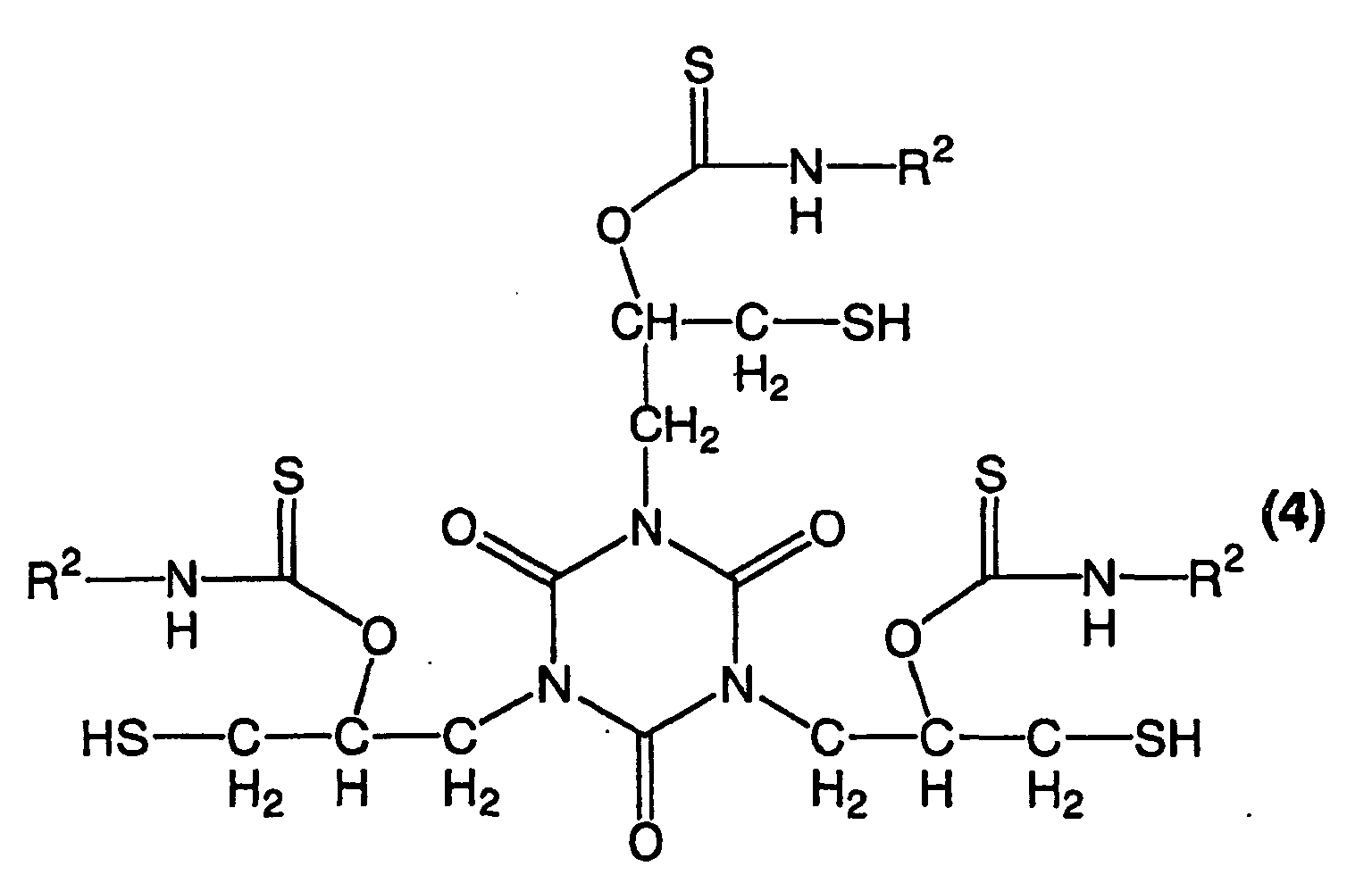


MASS (M+) : 525 (C15H15N3O6S6)
1H-NMR (ppm, DMSO-d6):3.7~4.0 (m, 6H), 4.2~4.4 (m, 6H), 5.3~5.5 (m, 3H)
Melting point (°C): 196 (decomposition)
MASS (M+) : 525 (C15H15N3O6S6)
1H-NMR (ppm, DMSO-d6):3.7~4.0 (m, 6H), 4.2~4.4 (m, 6H), 5.3~5.5 (m, 3H)
Melting point (°C): 197 (decomposition)
MASS (M+) : 525(C15H15N3O6S6)
1H-NMR (ppm, DMSO-d6) : 3.7~4.0 (m, 6H), 4.2~4.4 (m, 6H), 5.3~5.5 (m, 3H)
Melting point (°C): 197 (decomposition)
MASS (M+) : 525 (C15H15N3O6S6)
1H-NMR (ppm, DMSO-d6):3.7~4.0 (m, 6H), 4.2~4.4 (m, 6H), 5.3~5.5 (m, 3H)
Melting point (°C): 197 (decomposition)
MASS (M+) : 525 (C15H15N3O6S6)
1H-NMR (ppm, DMSO-d6):3.7~4.0 (m, 6H), 4.2~4.4 (m, 6H), 5.3~5.5 (m, 3H)
Melting point (°C): 197 (decomposition)
MASS (M+):567(C18H21N3O6S6)
MASS (M+) : 567 (C18H21N3O6S6)
1H-NMR (ppm, DMSO-d6):1.6 (s, 9H), 3.7~4.0 (m, 6H), 4.2~4.4 (m, 6H)
MASS(M+):525(C15H15N3O6S6)
Melting point (°C): 223 (decomposition)
MASS (M+) : 744 (C27H48N6O6S6)
1H-NMR (ppm, CDCl3):0.8~1.0 (t, 9H), 1.3~1.7 (m, 12H), 1.86 (bs, 3H), 2.7~3.0 (m, 6H), 3.0~3.6 (m, 6H), 4.0~4.5 (m, 6H), 5.5~6.1 (m, 3H), 6.8~7.1 (m, 3H)
MASS (M+) : 846 (C36H42N6O6S6)
1H-NMR (ppm, CDCl3) : 1.71 (bs, 3H), 2.6~2.9 (m, 6H), 3.9~4.9 (m, 12H), 5.6~5.9 (m, 3H), 7.2~7.6 (m, 18H)
MASS (M+) : 888 (C39H48N6O6S6)
1H-NMR (ppm, CDCl3) : 1.62 (bs, 3H), 2.7~3.4 (m, 15H), 3.8~4.5 (m, 6H), 4.5~5.2 (m, 6H), 5.7~6.11 (m, 3H), 7.1~7.5 (m, 15H)
MASS (M+) : 696 (C24H36N6O6S6)
1H-NMR (ppm, CDCl3):1.65 (bs, 3H), 2.7~3.1 (m, 6H), 3.7~4.6 (m, 12H), 5.1~5.4 (m, 6H), 5.6~6.1 (m, 6H), 6.6~7.4 (m, 3H)
MASS (M+) : 792 (C27H48N6O9S6)
1H-NMR (ppm, CDCl3) : 1.20 (t, 9H), 1.79 (bs , 3H), 2.7~3.0 (m, 6H), 4~3.9 (m, 18H), 4.0~4.5 (m, 6H), 5.6~6.1 (m, 3H), 6.9~7.6 (m, 3H)
MASS (M+) : 789 (C27H51N9O6S6)
1H-NMR (ppm,CDCl3) : 1.86 (bs, 3H), 2.1~2.6 (m, 24H), 2.7~3.1 (m, 6H), 3.1~3.9 (m, 6H), 3.9~4.6 (m, 6H), 5.7~6.1 (m, 3H), 7.7~8.4 (m, 3H)
MASS (M+) : 972 (C42H48N6O9S6)
1H-NMR (ppm, CDCl3) : 1.65 (bs, 3H), 2.2~2.4 (m, 9H), 3.0~3.5 (m, 6H), 3.8~4.9 (m, 12H), 5.6~6.1 (m, 3H), 7.2~7.4 (m, 15H)
MASS (M+) : 972 (C42H48N6O9S6)
1H-NMR (ppm, CDCl3) : 2.5~2.9 (m, 6H), 3.6~3.9 (m, 6H), 3.9~4.8 (m, 12H), 5.7~6.1 (m, 3H), 7.1~7.6 (m, 33H)
MASS (M+): 1158 (C57H54N6O9S6)
1H-NMR (ppm, CDCl3): 3.2~3.7 (m, 6H), 3.8~4.9 (m, 12H), 5.8~6.1 (m, 3H), 7.1~7.7 (m, 27H), 7.7~8.1 (m, 6H)
MASS (M+) : 1203 (C57H57N9O9S6)
1H-NMR (ppm, CDCl3) : 3.1~3.5 (m, 6H), 3.9~4.8 (m, 12H), 5.8~6.1 (m, 3H), 7.0~7.6 (m, 36H)
Tg: 60°C, decomposition-initiation temperature: 203°C (reduction of 5 wt%)
Number average molecular weight (Mn): 2200
Weight average molecular weight (Mw): 5900
Polydispersity (Mw/Mn): 2.66
Claims (18)
- An isocyanurate compound of the formula (1),wherein R is a hydrogen atom or a methyl group.

- Tris(1,3-oxathiolane-2-thion-5-ylmethyl)isocyanurate according to Claim 1, wherein R in the formula (1) is a hydrogen atom.
- Tris(5-methyl-1,3-oxathiolane-2-thion-5-ylmethyl)isocyanurate according to Claim 1, wherein R in the formula (1) is a methyl group.
- A method for producing an isocyanurate compound of the formula (1),wherein R is a hydrogen atom or a methyl group, which comprises reacting carbon disulfide with a triglycidyl isocyanurate compound of the formula (2),
 wherein R is a hydrogen atom or a methyl group.
- The method for producing an isocyanurate compound according to Claim 4, wherein the reaction of carbon disulfide with a triglycidyl isocyanurate compound is carried out in the presence of a catalyst of at least one compound selected from the group consisting of an alkali metal halide, an alkali earth metal halide, an organic base, an alkali metal hydroxide and an onium salt.
- The method for producing an isocyanurate compound according to Claim 4 or 5, wherein the reaction of carbon disulfide with a triglycidyl isocyanurate compound is carried out by previously mixing carbon disulfide with a catalyst of at least one compound selected from the group consisting of an alkali metal halide, an alkali earth metal halide, an organic base, an alkali metal hydroxide and an onium salt and then adding the triglycidyl isocyanurate compound thereto.
- A trithiol isocyanurate compound of the following formula (3)(wherein R1 is a hydrogen atom or a methyl group, and X is an NHR2 group, an NR3R4 group, an OR5 group or an SR6 group, in which R2, R3, R4, R5 and R6 are respectively a hydrogen atom, a C1-C6 alkyl group (which may be substituted with at least one substituent selected from the group consisting of a C1-C4 alkoxy group and a C2-C8 dialkylamino group, whereby these substituents may be the same or may be different), a C1-C6 alkenyl group or a benzyl group).

- The trithiol isocyanurate compound according to claim 7, wherein X is an NHR2 group.
- The trithiol isocyanurate compound according to claim 7 or 8, wherein X is an NHR2 group and R2 is a C1-C6 alkyl group which may be substitued with at least one substituent selected from the group consisting of a C1-C4 alkoxy group and a C2-C8 dialkylamino group, whereby said substituents may be the same or different.
- The trithiol isocyanurate compound according to claim 7 or 8, wherein X is an NHR2 group and R2 is a benzyl group.
- The trithiol isocyanurate compound according to claim 7 or 8, wherein X is an NR3 R4group, wherein one of R3 and R4 is a C1-C6 alkylgroup and the other is a benzyl group.
- The trithiol isocyanurate compound according to claim 7 or 8, wherein X is an NHR2 group and R2 is a C1-C6 alkenyl group.
- A method for producing a trithiol isocyanurate compound, which comprises reacting an isocyanurate compound of the formula (1),wherein R is a hydrogen atom or a methyl group, with a compound having at least one functional group selected from the group consisting of an amino group, an imino group, a hydroxyl group and a thiol group.

- The method for producing a trithiol isocyanurate compound according to Claim 13, which comprises reacting an isocyanurate compound with a compound having at least one amino group.
- The method for producing a trithiol isocyanurate compound according to Claim 13 or 14, which comprises reacting an isocyanurate compound with a primary amine having a C1-C6 alkyl group wherein the alkyl group may be substituted optionally with at least one different or same substituent selected from the group consisting of a C1-C4 alkoxy group and a C2-C8 dialkylamino group.
- The method for producing a trithiol isocyanurate compound according to Claim 13 or 14, which comprises reacting an isocyanurate compound with a benzylamine.
- The method for producing a trithiol isocyanurate compound according to Claim 13 or 14, which comprises reacting an isocyanurate compound with a secondary benzylamine having a C1-C6 alkyl group.
- The method for producing a trithiol isocyanurate compound according to Claim 13 or 14, which comprises reacting an isocyanurate compound with a primary amine having a C1-C6 alkenyl group.
Applications Claiming Priority (4)
| Application Number | Priority Date | Filing Date | Title |
|---|---|---|---|
| JP2001020907 | 2001-01-30 | ||
| JP2001020907 | 2001-01-30 | ||
| JP2001237387 | 2001-08-06 | ||
| JP2001237387 | 2001-08-06 |
Publications (2)
| Publication Number | Publication Date |
|---|---|
| EP1227094A1 EP1227094A1 (en) | 2002-07-31 |
| EP1227094B1 true EP1227094B1 (en) | 2005-12-14 |
Family
ID=26608481
Family Applications (1)
| Application Number | Title | Priority Date | Filing Date |
|---|---|---|---|
| EP02001508A Expired - Lifetime EP1227094B1 (en) | 2001-01-30 | 2002-01-22 | Isocyanurate compound and method for producing the same |
Country Status (3)
| Country | Link |
|---|---|
| US (2) | US6414146B1 (en) |
| EP (1) | EP1227094B1 (en) |
| DE (1) | DE60207902T2 (en) |
Families Citing this family (10)
| Publication number | Priority date | Publication date | Assignee | Title |
|---|---|---|---|---|
| US6624275B2 (en) * | 2001-11-02 | 2003-09-23 | Basf Corporation | Water- and organic-soluble carbamate material |
| US6985719B2 (en) * | 2000-12-21 | 2006-01-10 | Nokia, Inc. | Secure wireless backup mechanism |
| KR101710415B1 (en) * | 2009-09-14 | 2017-02-27 | 주식회사 동진쎄미켐 | Isocyanurate compound for forming organic anti-reflective coating layer and composition including the same |
| US8647897B2 (en) * | 2011-03-21 | 2014-02-11 | The Board Of Trustees Of The Leland Stanford Junior University | Air-stable ink for scalable, high-throughput layer deposition |
| EP2762517A4 (en) * | 2011-09-29 | 2015-05-06 | Nissan Chemical Ind Ltd | Light-curing resin composition |
| KR101602467B1 (en) | 2015-08-24 | 2016-03-15 | 로움하이텍 주식회사 | Novel polyurethane compounds and anti-reflective coating composition containing the same |
| KR102516390B1 (en) | 2016-01-05 | 2023-03-31 | 에스케이이노베이션 주식회사 | Novel thiobarbituric acid derivatives, polymer including repeating unit derived therefrom, bottom anti-reflection coating composition containing the same and process for forming resist pattern using the composition |
| US20180371245A1 (en) * | 2017-05-22 | 2018-12-27 | Abeam Technology, Inc. | Polydisulfide Polymer |
| KR102414150B1 (en) | 2017-10-17 | 2022-06-29 | 에스케이이노베이션 주식회사 | Polymer for organic bottom anti-reflective coating, bottom anti-reflective coating composition containing the same and process for forming organic bottom anti-reflective coating using the composition |
| KR102264693B1 (en) * | 2018-06-11 | 2021-06-11 | 삼성에스디아이 주식회사 | Resist underlayer composition, and method of forming patterns using the composition |
Family Cites Families (45)
| Publication number | Priority date | Publication date | Assignee | Title |
|---|---|---|---|---|
| US4313434A (en) * | 1980-10-17 | 1982-02-02 | David Segal | Fracture fixation |
| US4772287A (en) * | 1987-08-20 | 1988-09-20 | Cedar Surgical, Inc. | Prosthetic disc and method of implanting |
| US4969888A (en) * | 1989-02-09 | 1990-11-13 | Arie Scholten | Surgical protocol for fixation of osteoporotic bone using inflatable device |
| US5163949A (en) * | 1990-03-02 | 1992-11-17 | Bonutti Peter M | Fluid operated retractors |
| US5345927A (en) * | 1990-03-02 | 1994-09-13 | Bonutti Peter M | Arthroscopic retractors |
| US5454365A (en) * | 1990-11-05 | 1995-10-03 | Bonutti; Peter M. | Mechanically expandable arthroscopic retractors |
| US5331975A (en) * | 1990-03-02 | 1994-07-26 | Bonutti Peter M | Fluid operated retractors |
| US5514153A (en) * | 1990-03-02 | 1996-05-07 | General Surgical Innovations, Inc. | Method of dissecting tissue layers |
| US5954739A (en) * | 1990-03-02 | 1999-09-21 | General Surgical Innovations, Inc. | Method of dissecting tissue layers |
| US5344439A (en) * | 1992-10-30 | 1994-09-06 | Medtronic, Inc. | Catheter with retractable anchor mechanism |
| JPH07145164A (en) * | 1993-09-30 | 1995-06-06 | Nippon Zeon Co Ltd | Dithiocarbonate derivative and crosslinking method using the same |
| ATE293395T1 (en) * | 1994-01-26 | 2005-05-15 | Kyphon Inc | IMPROVED INFLATABLE DEVICE FOR USE IN SURGICAL PROTOCOLS RELATING TO BONE FIXATION |
| US6248131B1 (en) * | 1994-05-06 | 2001-06-19 | Advanced Bio Surfaces, Inc. | Articulating joint repair |
| US5888220A (en) * | 1994-05-06 | 1999-03-30 | Advanced Bio Surfaces, Inc. | Articulating joint repair |
| US6187048B1 (en) * | 1994-05-24 | 2001-02-13 | Surgical Dynamics, Inc. | Intervertebral disc implant |
| US5562736A (en) * | 1994-10-17 | 1996-10-08 | Raymedica, Inc. | Method for surgical implantation of a prosthetic spinal disc nucleus |
| US5817303A (en) * | 1995-05-05 | 1998-10-06 | Protein Polymer Technologies, Inc. | Bonding together tissue with adhesive containing polyfunctional crosslinking agent and protein polymer |
| DE69715442T2 (en) * | 1996-07-01 | 2003-07-31 | Daikin Industries, Ltd. | FLUORINE TRIALLYLISOCYANURATE, VOLCANIZABLE ELASTOMER COMPOSITIONS CONTAINING THEM, AND VOLCANIZATION PROCEDURE |
| EP0873145A2 (en) * | 1996-11-15 | 1998-10-28 | Advanced Bio Surfaces, Inc. | Biomaterial system for in situ tissue repair |
| JP4990427B2 (en) | 1998-03-02 | 2012-08-01 | 日産化学工業株式会社 | Optically active β-type tris- (2,3-epoxypropyl) -isocyanurate and high melting point type tris- (2,3-epoxypropyl) -isocyanurate |
| TWI243169B (en) | 1998-03-02 | 2005-11-11 | Nissan Chemical Ind Ltd | Optically active epoxy compound |
| TWI225059B (en) | 1998-04-20 | 2004-12-11 | Nissan Chemical Ind Ltd | beta-form tris-(2,3-epoxypropyl)-isocyanurate crystals and process for their production |
| US6224630B1 (en) * | 1998-05-29 | 2001-05-01 | Advanced Bio Surfaces, Inc. | Implantable tissue repair device |
| US6370420B1 (en) * | 1998-11-17 | 2002-04-09 | Mark Kraft | System and method for objectively verifying an internal disc disruption |
| US6436143B1 (en) * | 1999-02-22 | 2002-08-20 | Anthony C. Ross | Method and apparatus for treating intervertebral disks |
| US6245107B1 (en) * | 1999-05-28 | 2001-06-12 | Bret A. Ferree | Methods and apparatus for treating disc herniation |
| US6371990B1 (en) * | 1999-10-08 | 2002-04-16 | Bret A. Ferree | Annulus fibrosis augmentation methods and apparatus |
| US6883520B2 (en) * | 1999-08-18 | 2005-04-26 | Intrinsic Therapeutics, Inc. | Methods and apparatus for dynamically stable spinal implant |
| US6083202A (en) * | 1999-10-14 | 2000-07-04 | Syntheon, Llc | Endoscopic needle injection device |
| US6558390B2 (en) * | 2000-02-16 | 2003-05-06 | Axiamed, Inc. | Methods and apparatus for performing therapeutic procedures in the spine |
| US6805695B2 (en) * | 2000-04-04 | 2004-10-19 | Spinalabs, Llc | Devices and methods for annular repair of intervertebral discs |
| US6579291B1 (en) * | 2000-10-10 | 2003-06-17 | Spinalabs, Llc | Devices and methods for the treatment of spinal disorders |
| US20020045942A1 (en) * | 2000-10-16 | 2002-04-18 | Ham Michael J. | Procedure for repairing damaged discs |
| ATE494014T1 (en) * | 2000-10-24 | 2011-01-15 | Cryolife Inc | BIOPROSTHETIC FILLERS AND METHODS, IN PARTICULAR FOR THE FORMATION OF INTERVERTAL DISC BIOPROStheses IN SITU |
| US20020147479A1 (en) * | 2001-04-06 | 2002-10-10 | Integrated Vascular Systems, Inc. | Apparatus and methods for sealing openings through tissue |
| WO2003002021A2 (en) * | 2001-06-29 | 2003-01-09 | The Regents Of The University Of California | Biodegradable/bioactive nucleus pulposus implant and method for treating degenerated intervertebral discs |
| US7429258B2 (en) * | 2001-10-26 | 2008-09-30 | Massachusetts Institute Of Technology | Microneedle transport device |
| US7004945B2 (en) * | 2001-11-01 | 2006-02-28 | Spinewave, Inc. | Devices and methods for the restoration of a spinal disc |
| JP4125234B2 (en) * | 2001-11-01 | 2008-07-30 | スパイン・ウェイブ・インコーポレーテッド | Apparatus and method for pretreatment of endplates between discs |
| US7488337B2 (en) * | 2002-09-30 | 2009-02-10 | Saab Mark A | Apparatus and methods for bone, tissue and duct dilatation |
| US7320686B2 (en) * | 2002-10-09 | 2008-01-22 | Depuy Acromed, Inc. | Device for distracting vertebrae and delivering a flowable material into a disc space |
| US20040186471A1 (en) * | 2002-12-07 | 2004-09-23 | Sdgi Holdings, Inc. | Method and apparatus for intervertebral disc expansion |
| WO2005034781A1 (en) * | 2003-09-29 | 2005-04-21 | Promethean Surgical Devices Llc | Devices and methods for spine repair |
| US20050209555A1 (en) * | 2004-03-18 | 2005-09-22 | Lance Middleton | Systems and methods for mixing fluids |
| US7452351B2 (en) * | 2004-04-16 | 2008-11-18 | Kyphon Sarl | Spinal diagnostic methods and apparatus |
-
2002
- 2002-01-22 EP EP02001508A patent/EP1227094B1/en not_active Expired - Lifetime
- 2002-01-22 DE DE60207902T patent/DE60207902T2/en not_active Expired - Lifetime
- 2002-01-29 US US10/057,939 patent/US6414146B1/en not_active Expired - Lifetime
- 2002-06-14 US US10/170,382 patent/US20020161223A1/en not_active Abandoned
Also Published As
| Publication number | Publication date |
|---|---|
| US6414146B1 (en) | 2002-07-02 |
| US20020161223A1 (en) | 2002-10-31 |
| DE60207902T2 (en) | 2006-06-14 |
| EP1227094A1 (en) | 2002-07-31 |
| DE60207902D1 (en) | 2006-01-19 |
Similar Documents
| Publication | Publication Date | Title |
|---|---|---|
| JP6698095B2 (en) | Method for synthesizing polyoxazolidinone compound having high stability | |
| EP1227094B1 (en) | Isocyanurate compound and method for producing the same | |
| US20120228567A1 (en) | Urethane (meth) acrylate monomer and production process thereof | |
| WO2020025805A1 (en) | Catalysts for the synthesis of oxazolidinones | |
| JP4243822B2 (en) | Isocyanurate compound and process for producing the same | |
| US12466913B2 (en) | Method for the production of a thermoplastic polyoxazolidinone | |
| EP4200353B1 (en) | Method for the production of a thermoplastic polyoxazolidinone | |
| JP3403592B2 (en) | Sulfur-containing epoxy compound and sulfur-containing epoxy resin | |
| KR20020063284A (en) | Organic Polymer and Novel Polymerizable Compound | |
| EP4200351A1 (en) | Method for the production of a thermoplastic polyoxazolidinone | |
| JP7594368B2 (en) | Method for producing bifunctional cyclic carbonate having a spiro structure and method for producing polyhydroxyurethane | |
| US20180258226A1 (en) | Method for producing or curing polymers using thiol-ene polyaddition reactions | |
| US12509547B2 (en) | Synthesis of linear polyoxazolidinones using uretdiones as diisocyanate component | |
| EP4255947B1 (en) | Method for the production of thermoplastic polyoxazolidinone polymers | |
| US20240117113A1 (en) | Method for producing polycarbonate | |
| JPH11100435A (en) | Composition for optical material and plastic lens | |
| TWI880345B (en) | Epoxy resin, preparation method, and composite material thereof | |
| EP3960785A1 (en) | Method for the production of thermoplastic polyoxazolidinone polymers | |
| KR20090131184A (en) | Non-halogen high refractive index epoxy resin and its manufacturing method | |
| JP2023066125A (en) | Compound and method for producing polycarbonate | |
| EP2548861A1 (en) | Novel diaryl sulfone compound, and manufacturing method for same | |
| JP2002308873A (en) | Isocyanuric ester having epithiopropyl group and its production method | |
| JP2015199679A (en) | Production method of oligofluorene diaryl ester | |
| JP2003081956A (en) | Curable carbamate and method for producing the same |
Legal Events
| Date | Code | Title | Description |
|---|---|---|---|
| PUAI | Public reference made under article 153(3) epc to a published international application that has entered the european phase |
Free format text: ORIGINAL CODE: 0009012 |
|
| AK | Designated contracting states |
Kind code of ref document: A1 Designated state(s): AT BE CH CY DE DK ES FI FR GB GR IE IT LI LU MC NL PT SE TR |
|
| AX | Request for extension of the european patent |
Free format text: AL;LT;LV;MK;RO;SI |
|
| 17P | Request for examination filed |
Effective date: 20020709 |
|
| AKX | Designation fees paid |
Designated state(s): DE FR GB |
|
| 17Q | First examination report despatched |
Effective date: 20031204 |
|
| GRAP | Despatch of communication of intention to grant a patent |
Free format text: ORIGINAL CODE: EPIDOSNIGR1 |
|
| GRAS | Grant fee paid |
Free format text: ORIGINAL CODE: EPIDOSNIGR3 |
|
| GRAA | (expected) grant |
Free format text: ORIGINAL CODE: 0009210 |
|
| RIN1 | Information on inventor provided before grant (corrected) |
Inventor name: TAKEYAMA, TOSHIAKI,C/O NISSAN CHEMICAL IND. LTD. Inventor name: HIDAKA, MOTOHIKO,C/O NISSAN CHEMICAL IND. LTD. Inventor name: AKIMOTO, KAZUHIKO,C/O NISSAN CHEMICAL IND. LTD. |
|
| AK | Designated contracting states |
Kind code of ref document: B1 Designated state(s): DE FR GB |
|
| REG | Reference to a national code |
Ref country code: GB Ref legal event code: FG4D |
|
| REF | Corresponds to: |
Ref document number: 60207902 Country of ref document: DE Date of ref document: 20060119 Kind code of ref document: P |
|
| PLBE | No opposition filed within time limit |
Free format text: ORIGINAL CODE: 0009261 |
|
| STAA | Information on the status of an ep patent application or granted ep patent |
Free format text: STATUS: NO OPPOSITION FILED WITHIN TIME LIMIT |
|
| 26N | No opposition filed |
Effective date: 20060915 |
|
| EN | Fr: translation not filed | ||
| PG25 | Lapsed in a contracting state [announced via postgrant information from national office to epo] |
Ref country code: FR Free format text: LAPSE BECAUSE OF FAILURE TO SUBMIT A TRANSLATION OF THE DESCRIPTION OR TO PAY THE FEE WITHIN THE PRESCRIBED TIME-LIMIT Effective date: 20070202 |
|
| PG25 | Lapsed in a contracting state [announced via postgrant information from national office to epo] |
Ref country code: FR Free format text: LAPSE BECAUSE OF FAILURE TO SUBMIT A TRANSLATION OF THE DESCRIPTION OR TO PAY THE FEE WITHIN THE PRESCRIBED TIME-LIMIT Effective date: 20060131 |
|
| PG25 | Lapsed in a contracting state [announced via postgrant information from national office to epo] |
Ref country code: FR Free format text: LAPSE BECAUSE OF FAILURE TO SUBMIT A TRANSLATION OF THE DESCRIPTION OR TO PAY THE FEE WITHIN THE PRESCRIBED TIME-LIMIT Effective date: 20051214 |
|
| PGFP | Annual fee paid to national office [announced via postgrant information from national office to epo] |
Ref country code: GB Payment date: 20130116 Year of fee payment: 12 |
|
| GBPC | Gb: european patent ceased through non-payment of renewal fee |
Effective date: 20140122 |
|
| PG25 | Lapsed in a contracting state [announced via postgrant information from national office to epo] |
Ref country code: GB Free format text: LAPSE BECAUSE OF NON-PAYMENT OF DUE FEES Effective date: 20140122 |
|
| PGFP | Annual fee paid to national office [announced via postgrant information from national office to epo] |
Ref country code: DE Payment date: 20160119 Year of fee payment: 15 |
|
| REG | Reference to a national code |
Ref country code: DE Ref legal event code: R119 Ref document number: 60207902 Country of ref document: DE |
|
| PG25 | Lapsed in a contracting state [announced via postgrant information from national office to epo] |
Ref country code: DE Free format text: LAPSE BECAUSE OF NON-PAYMENT OF DUE FEES Effective date: 20170801 |