-
The present invention relates to novel vaccine formulations, to methods of their
production and to their use in medicine. In particular, the present invention relates to
a malaria antigen known as Liver Stage Antigen 3 in association with an oil in water
emulsion. Such emulsions comprise tocopherol, squalene, Tween 80, Span 85 and
Lecithin and have useful adjuvant properties. Vaccines containing QS21, an Hplc
purified non-toxic fraction derived from the bark of Quillaja Saponaria Molina, and/or
3 De-O-acylated monophosphoryl lipid A (3 D-MPL), together with such oil in water
emulsions also form part of the invention. Other aspects of the invention are
described hereinbelow.
-
It has long been known that enterobacterial lipopolysaccharide (LPS) is a potent
stimulator of the immune system, although its use in adjuvants has been curtailed by
its toxic effects. A non-toxic derivative of LPS, monophosphoryl lipid A (MPL),
produced by removal of the core carbohydrate group and the phosphate from the
reducing-end glucosamine, has been described by Ribi et al (1986, Immunology and
Immunopharmacology of bacterial endotoxins, Plenum Publ. Corp., NY, p407-419).
-
A further detoxified version of MPL results from the removal of the acyl chain from
the 3-position of the disaccharide backbone, and is called 3-O-Deacylated
monophosphoryl lipid A (3D-MPL). 3 De-O-acylated monophosphoryl lipid A is
known from GB2 220 211 (Ribi). Chemically it is a mixture of 3 De-O-acylated
monophosphoryl lipid A with 4, 5 or 6 acylated chains and is manufactured by Ribi
Immunochem Montana. GB 2122204B also discloses the preparation of diphosphoryl
lipid A, and 3-O-deacylated variants thereof. Other purified and synthetic
lipopolysaccharides have been described (US 6,005,099 and EP 0 729 473 B1;
Hilgers et al., 1986, Int.Arch.Allergy.Immunol., 79(4):392-6; Hilgers et al., 1987,
Immunology, 60(1):141-6; and EP 0 549 074 B1).
-
A preferred form of 3 De-O-acylated monophosphoryl lipid A (3D-MPL) is in the
form of an emulsion having a small particle size less than 0.2µm in diameter,
disclosed in International Patent Application No. WO 92/116556 (SmithKline
Beecham Biologicals s.a.). See also WO 94/21292.
-
Aqueous formulations comprising monophosphoryl lipid A and a surfactant have been
described in WO98/43670A2.
-
Saponins are taught in: Lacaille-Dubois, M and Wagner H. (1996. A review of the
biological and pharmacological activities of saponins. Phytomedicine vol 2 pp 363-386).
Saponins are steroid or triterpene glycosides widely distributed in the plant and
marine animal kingdoms. Saponins are noted for forming colloidal solutions in water
which foam on shaking, and for precipitating cholesterol. When saponins are near cell
membranes they create pore-like structures in the membrane which cause the
membrane to burst. Haemolysis of erythrocytes is an example of this phenomenon,
which is a property of certain, but not all, saponins.
-
Saponins are known as adjuvants in vaccines for systemic administration. The
adjuvant and haemolytic activity of individual saponins has been extensively studied
in the art (Lacaille-Dubois and Wagner, supra). For example, Quil A (derived from
the bark of the South American tree Quillaja Saponaria Molina), and fractions thereof,
are described in US 5,057,540 and "Saponins as vaccine adjuvants", Kensil, C. R.,
Crit Rev Ther Drug Carrier Syst, 1996, 12 (1-2):1-55; and EP 0 362 279 B1.
Particulate structures, termed Immune Stimulating Complexes (ISCOMS), comprising
fractions of Quil A are haemolytic and have been used in the manufacture of vaccines
(Morein, B., EP 0 109 942 B1; WO 96/11711; WO 96/33739). The haemolytic
saponins QS21 and QS17 (HPLC purified fractions of Quil A) have been described as
potent systemic adjuvants, and the method of their production is disclosed in US
Patent No.5,057,540 and EP 0 362 279 B1. Other saponins which have been used in
systemic vaccination studies include those derived from other plant species such as
Gypsophila and Saponaria (Bomford et al., Vaccine, 10(9):572-577, 1992).
-
QS21 is a Hplc purified non toxic fraction of a saponin from the bark of the South
American tree Quillaja Saponaria Molina and its method of its production is disclosed
(as QA21) in US patent No. 5,057,540.
-
Oil emulsion adjuvants have been known for many years, including work on Freund's
complete and incomplete mineral oil emulsion adjuvants. Since that time much work
has been performed to design stable and well tolerated alternatives to these potent, but
reactogenic, adjuvant formulations.
-
Many single or multiphase emulsion systems have been described. Oil in water
emulsion adjuvants per se have been suggested to be useful as adjuvant compositions
(EP O 399 843B), also combinations of oil in water emulsions and other active agents
have been described as adjuvants for vaccines (WO 95/17210). Other oil emulsion
adjuvants have been described, such as water in oil emulsions (US 5,422,109; EP 0
480 982 B2) and water in oil in water emulsions (US 5,424,067; EP 0 480 981 B).
-
In order for any oil in water composition to be suitable for human administration, the
oil phase of the emulsion system preferably comprises a metabolisable oil. The
meaning of the term metabolisable oil is well known in the art. Metabolisable can be
defined as "being capable of being transformed by metabolism" (Dorland's Illustrated
Medical Dictionary, W.B. Sanders Company, 25th edition (1974)). The oil may be
any vegetable oil, fish oil, animal oil or synthetic oil, which is not toxic to the
recipient and is capable of being transformed by metabolism. Nuts (such as peanut
oil), seeds, and grains are common sources of vegetable oils. Synthetic oils are also
part of this invention and can include commercially available oils such as NEOBEE®
and others. Squalene (2,6,10,15,19,23-Hexamethyl-2,6,10,14,18,22-tetracosahexaene)
is an unsaturated oil which is found in large quantities in shark-liver oil, and in lower
quantities in olive oil, wheat germ oil, rice bran oil, and yeast, and is a particularly
preferred oil for use in this invention. Squalene is a metabolisable oil virtue of the fact
that it is an intermediate in the biosynthesis of cholesterol (Merck index, 10th Edition,
entry no.8619).
-
The oil in water emulsions which form part of the present invention when formulated
with 3 D-MPL and QS21 are preferential stimulators of IgG2a production and TH1
cell response. This is advantageous, because of the known implication of TH1
response in cell mediated response. Indeed in mice induction of IgG2a is correlated
with such an immune response.
-
The observation that it is possible to induce strong cytolytic T lymphocyte responses
is significant as these responses, in certain animal models have been shown to induce
protection against disease.
-
The present inventors have shown that the combination of the adjuvants QS21 and
3D-MPL together with an oil in water emulsion with an antigen results in a powerful
induction of CS protein specific CTL in the spleen. QS21 also enhances induction of
CTL on its own, while 3D-MPL does not.
-
Induction of CTL is easily seen when the target antigen is synthesised intracellularly
(e.g. in infections by viruses, intracellular bacteria, or in tumours), because peptides
generated by proteolytic breakdown of the antigen can enter the appropriate
processing pathway, leading to presentation in association with class I molecules on
the cell membrane. However, in general, pre-formed soluble antigen does not reach
this processing and presentation pathway, and does not elicit class I restricted CTL.
Therefore conventional non-living vaccines, while eliciting antibody and T helper
responses, do not generally induce CTL mediated Immunity. The combination of the
two adjuvants QS21 and 3D-MPL together with an oil in water emulsion can
overcome this serious limitation of vaccines based or recombinant proteins, and
induce a wider spectrum of immune responses.
-
CTL specific for CS protein have been shown to protect from malaria in mouse model
systems (Romero et al. Nature 341:323 (1989)). In human trials where volunteers
were immunised using irradiated sporozoites of P. falciparum, and shown to be
protected against subsequent malaria challenge, induction of CTL specific for CS
epitopes was demonstrated (Malik et al. Proc. Natl. Acad. Sci. USA 88:3300 (1991)).
-
The ability to induce CTL specific for an antigen administered as a recombinant
molecules is relevant to malaria vaccine development, since the use of irradiated
sporozoites would be impractical, on the grounds of production and the nature of the
immune response.
-
In certain systems, the combination of 3D-MPL and QS21 together with an oil in
water emulsion have been able to synergistically enhance interferon γ production.
-
IFN-γ secretion is associated with protective responses against intracellular pathogens,
including parasites, bacteria and viruses. Activation of macrophages by IFN-γ
enhances intracellular killing of microbes and increases expression of Fc receptors.
Direct cytotoxicity may also occur, especially in synergism with lymphotoxin
(another product of TH1 cells). IFN-γ is also both an inducer and a product of NK
cells, which are major innate effectors of protection. TH1 type responses, either
through IFN-γ or other mechanisms, provide preferential help for IgG2a
immunoglobulin isotypes.
-
RTS is a hybrid protein comprising substantially all the C-terminal portion of the
circumsporozoite (CS) protein of P.falciparum linked via four amino acids of the
preS2 portion of Hepatitis B surface antigen to the surface (S) antigen of hepatitis B
virus (HBV). The structure of RTS and the molecules from which it is derived is
disclosed in International Patent Application Publication Number WO 93/10152.
When expressed in yeast RTS is produced as a lipoprotein particle, and when it is co-expressed
with the S antigen from HBV it produces a mixed particle known as RTS,S.
-
Liver Stage Antigens are described in Malaria, Parasite Biology, Pathogenesis and
Protection (1998 ASM Press, Washington D.C., edited by Irwin W. Sherman),
especially Chapter 34 (P. Druilhe et al.).
-
A 26-amino acid synthetic peptide based on Plasmodium falciparum liver stage
antigen 3 (LSA-3) is described in Eur J. Immunol., 1997, 27, 1242-1253 (L.
BenMohamed et al).
-
The immunogenicity of 12 synthetic peptides derived from four new Plasmodium
falciparum molecules expressed at pre-erythrocytic stages of the human malaria
parasite was reported in Vaccine 18 (2000), pages 2843-2855 (L BenMohamed et al).
In these studies the adjuvant Montanide ISA-51 (SEPPIC, Quai D'Orsay, France) was
used. There is no report, however, of such peptides being combined with other
adjuvants. The present invention is based on the surprising discovery that a Th-1
inducing adjuvant especially an oil in water emulsion which preferably comprises
tocopherol, as such or in combination with QS21 and/or 3 D-MPL (or related
molecules), enhances immune responses to a defined malaria antigen. Such
enhancement available affords better immunological responses than hitherto before.
-
According to the present invention there is provided a vaccine composition
comprising a Th1-inducing adjuvant in combination with a protecting Liver Stage
Antigen or immunological fragment thereof of a human malaria parasite with the
proviso that when the immunological fragment is an immunological fragment of LSA-3,
the Th1-inducing adjuvant is not Montanide.
-
In a preferred aspect of the invention the Th1-inducing adjuvant comprises QS21, De-O-acylated
monophosphoryl lipid A (3D-MPL) and an oil in water emulsion wherein
the oil in water emulsion has the following composition: a metabolisible oil, such a
squalene, alpha tocopherol and tween 80.
-
It will be appreciated that variants or derivatives of QS21 and 3-DMPL as described
above may also be used without departing from the spirit of the invention.
-
The bacterial lipopolysaccharide derived adjuvants to be formulated in the
adjuvant combinations of the present invention may be purified and processed from
bacterial sources, or alternatively they may be synthetic. Accordingly, the LPS
derivatives that may be used in the present invention are those immunostimulants that
are similar in structure to that of LPS or MPL or 3D-MPL. In another aspect of the
present invention the LPS derivatives may be an acylated monosaccharide, which is a
sub-portion of MPL. In a preferred aspect the 3-DMPL is small particle 3-DMPL as
described in WO 92/116556.
-
The oil emulsion adjuvants for use in the present invention may be natural or
synthetic, and may be mineral or organic. Examples of mineral and organic oils will
be readily apparent to the man skilled in the art based on the description hereinabove.
-
Particularly preferred oil emulsions are oil in water emulsions, and in particular
squalene in water emulsions.
-
In addition, the most preferred oil emulsion adjuvants of the present invention
comprise an antioxidant, which is preferably the oil α-tocopherol (vitamin E, EP 0
382 271 B1).
-
WO 95/17210 discloses emulsion adjuvants based on squalene, α-tocopherol, and
TWEEN 80, optionally formulated with the immunostimulants QS21 and/or 3D-MPL.
-
The size of the oil droplets found within the stable oil in water emulsion are
preferably less than 1 micron, may be in the range of substantially 30-600nm,
preferably substantially around 30-500nm in diameter, and most preferably
substantially 150-500nm in diameter, and in particular about 150 nm in diameter as
measured by photon correlation spectroscopy. In this regard, 80% of the oil droplets
by number should be within the preferred ranges, more preferably more than 90% and
most preferably more than 95% of the oil droplets by number are within the defined
size ranges. The amounts of the components present in the oil emulsions of the
present invention are conventionally in the range of from 2 to 10% oil, such as
squalene; and when present, from 2 to 10% alpha tocopherol; and from 0.3 to 3%
surfactant, such as polyoxyethylene sorbitan monooleate. Preferably the ratio of oil:
alpha tocopherol is equal or less than 1 as this provides a more stable emulsion. Span
85 may also be present at a level of about 1%. In some cases it may be advantageous
that the vaccines of the present invention will further contain a stabiliser. Preferably
the oil emulsion contains a surfactant such as polyoxyethylene sorbitan monooleate
(TWEEN80™), but it will be clear to the man skilled in the art that other surfactants
may be used, preferred examples of which are the SPAN series (especially SPAN85)
and or lecithin.
-
The method of producing oil in water emulsions is well known to the man skilled in
the art. Commonly, the method comprises the mixing the oil phase with a surfactant
such as a PBS/TWEEN80™ solution, followed by homogenisation using a
homogenizer, it would be clear to a man skilled in the art that a method comprising
passing the mixture twice through a syringe needle would be suitable for
homogenising small volumes of liquid. Equally, the emulsification process in
microfluidiser (M110S microfluidics machine, maximum of 50 passes, for a period of
2 minutes at maximum pressure imput of 6 bar (output pressure of about 850 bar))
could be adapted by the man skilled in the art to produce smaller or larger volumes of
emulsion. This adaptation could be achieved by routine experimentation comprising
the measurement of the resultant emulsion until a preparation was achieved with oil
droplets of the required diameter.
-
In a preferred aspect of the invention the human malaria parasite is Plasmodium
falciparum.
-
In a particular aspect of the invention the said protecting Liver Stage Antigen is the
Liver Stage Antigen 3 (LSA-3) or immunological fragment thereof.
-
However other Liver Stage Antigens may also be used, for example LSA-1 and LSA-2
as described in Malaria, Parasite Biology, Pathogenesis and Protection (1998 ASM
Press, Washington D.C., edited by Irwin W. Sherman), especially Chapter 34 (P.
Druilhe et al.).
-
By immunological fragment is meant herein a molecule which has a related or similar
sequence to the reference antigen in terms of % homology and which can induce a
similar immune response, cellular or humoral, in vivo.
-
The LSA-3 antigen and polypeptide molecules containing at least 10 consecutive
amino acids of the amino acid sequence representing LSA-3 are described in WO
96/41877. LSA-3 for use in the present invention may suitably be prepared as
described in the examples section of the present specification. Reference may also be
made to C Marchand and P Druilhe, Bulletin of the World Health Organisation,
Volume 68 (Suppl.) 158-164 (1990) and US Patent Number 6,100,067.
-
In a further aspect there is provided a vaccine composition according to the invention
comprising in addition at least one other protecting antigen or an immunological
fragment thereof, of a malaria parasite, in particular LSA-3.
-
In particular, the other malaria antigen may be selected from the following group:
- a) a hybrid protein comprising substantially all the C-terminal portion of the CS
protein, four or more tandem repeats of the immunodominant region, and the
surface antigen from hepatitis B virus (HBsAg), in particular RTS,S, or an
immunogenic derivative including fragments thereof;
- b) the TRAP protein of the T9/96 isolate of Plasmodium falciparum and proteins
having at least 80% homology thereto and immunogenic derivatives including
fragments thereof (see European Patent Application No 91903249.0);
- c) the MSP-1 of Plasmodium falciparum or Plasmodium vivax and proteins
having at least 80% homology thereto and immunogenic derivatives including
fragments thereof; and
- d) the MSP-3 of Plasmodium falciparum or Plasmodium vivax and proteins
having at least 70% homology with the C-terminal region thereof, and
immunogenic derivatives including fragments thereof.
-
-
MSP-1 of P.falciparum or P.vivax is described in US Patent No. 4,837,016.
Immunogenic derivatives include fragments thereof such as the C-terminal 42 KDa
antigen (p42).
-
The MSP-3 antigen is described in US Patent Number 6,017,538.
-
Homology in sequence analysis may be established by the use of Blast 2.0 and Fasta
default settings of the algorithms used by these programs. The comparison of LSA-3
sequences in various isolates or stocks can be done using a calculation manual.
-
By C-terminal region of MSP-3 is meant a 185 amino acid region from positions 193
to 381. It contains a leucine zipper on its extremity (C-terminus part) and is rich in
acidic amino acids. The three-dimensional structure is coil-coiled. The clone DG 210
(amino acids 193-257) corresponds to a globular region of high complexity and is
followed by the coil-coiled region.
-
Normally the vaccine composition according to any aspect of the invention invokes a
T cell response in a mammal to the antigen or antigenic composition and is preferably
capable of stimulating interferon γ production.The oil in water emulsion used in the
present invention may be utilised on its own or with other adjuvants or immunostimulants
and therefore an important embodiment of the invention is an oil in water
formulation comprising squalene or another metabolisable oil, alpha tocopherol, and
tween 80. The oil in water emulsion may also contain span 85 and/or Lecithin.
-
The combination of the two adjuvants QS21 and 3D-MPL together with an oil in
water emulsion is particularly preferred. This is known and referred to herein as
SBAS2.
-
The ratio of QS21 : 3D-MPL will typically be in the order of 1 : 10 to 10 : 1;
preferably 1 : 5 to 5 : 1 and often substantially 1 : 1. The preferred range for optimal
synergy is 2.5:1 to 1:1 3D MPL: QS21. Typically for human administration QS21
and 3D MPL will be present in a vaccine in the range 1 µg - 100 µg, preferably 10 µg
- 50 µg per dose. Typically the oil in water will comprise from 2 to 10% squalene,
from 2 to 10% alpha tocopherol and from 0.3 to 3% tween 80. Preferably the ratio of
squalene: alpha tocopherol is equal or less than 1 as this provides a more stable
emulsion. Span 85 may also be present at a level of 1%. In some cases it may be
advantageous that the vaccines of the present invention will further contain a
stabiliser.
-
In a further aspect of the present invention there is provided a vaccine as herein
described for use in medicine.
-
In yet a further aspect the invention provides a process for making a vaccine
composition according to any aspect of the present invention by mixing the required
components using standard techniques. Vaccine preparation is generally described
in New Trends and Developments in Vaccines, edited by Voller et al., University Park
Press, Baltimore, Maryland, U.S.A. 1978.
-
Preferably the process comprises admixing QS21, 3D-MPL and the oil in water
emulsion with a protecting Liver Stage Antigen of a human malaria parasite as
hereinabove defined, optionally with an additional malaria antigen.
-
The amount of protein in each vaccine dose is selected as an amount which induces an
immunoprotective response without significant, adverse side effects in typical
vaccinees. Such amount will vary depending upon which specific immunogen is
employed and how it is presented. Generally, it is expected that each dose will
comprise 1-1000ug of protein, preferably 2-100 ug, most preferably 4-40 ug. An
optimal amount for a particular vaccine can be ascertained by standard studies
involving observation of appropriate immune responses in subjects. Following an
initial vaccination, subjects may receive one or several booster immunisation
adequately spaced.
-
The formulations of the present invention maybe used for both prophylactic and
therapeutic purposes.
-
Accordingly in one aspect, the invention provides a method of treatment comprising
administering an effective amount of a vaccine of the present invention to a patient.
-
The following examples illustrate the invention.
Examples
Example 1
-
Two adjuvant formulations were made each comprising the following oil in water
emulsion component.
-
SB26: 5% squalene 5% tocopherol 0.4% tween 80; the particle size was 500 nm size
SB62: 5% Squalene 5% tocopherol 2.0% tween 80; the particle size was 180 nm
1(a) Preparation of emulsion SB62 (2 fold concentrate)
-
Tween 80 is dissolved in phosphate buffered saline (PBS) to give a 2% solution in the
PBS. To provide 100 ml two fold concentrate emulsion 5g of DL alpha tocopherol
and 5ml of squalene are vortexed to mix thoroughly. 90ml of PBS/Tween solution is
added and mixed thoroughly. The resulting emulsion is then passed through a syringe
and finally microfluidised by using an M110S microfluidics machine. The resulting
oil droplets have a size of approximately 180 nm.
1(b) Preparation of emulsion SB26
-
This emulsion was prepared in an analogous manner utilising 0.4% tween 80.
-
To the emulsion of 1 a) or b) an appropriate amount of LSA-3 (for example 2µg
to 100µg) may be added and mixed. This may be combined with, for example,
50µg/ml of 3D-MPL and 20µg/ml of QS21 (or related molecules) to give the final
formulation.
Example 2
Protection against Plasmodium falciparum malaria in chimpanzees by
immunisation with a conserved pre-erythrocytic antigen, LSA-3
-
The basis of the strong immunological protection induced in humans by vaccination
with radiation-attenuated pre-erythrocytic malaria parasites is poorly understood.
However it is now suspected that the transformation of the irradiated sporozoites into
live but developmentally arrested intra-hepatic liver trophozoites is required to induce
protection9. This occurs at low (15-20 krad) but not at high (23-30 krad) irradiation
doses9,10. We reasoned that the differential response of hosts immunised with such
irradiated sporozoites could provide a screen for molecules relevant to protection. We
proceeded to screen 120 phage lambda clones previously identified as expressing P.
falciparum polypeptides that are expressed during pre-erythrocytic stage parasite
development6,7 and which derive from ca. 20 distinct genes6,7,11,12. A clone
corresponding to each of these putative genes was screened using eight sera from
human volunteers (4/6 protected) and from chimpanzees (1/2 protected) immunised
with sporozoites irradiated at low or high doses. A single clone (DG729) reacted only
with sera from protected humans and chimpanzees. This differential reactivity was
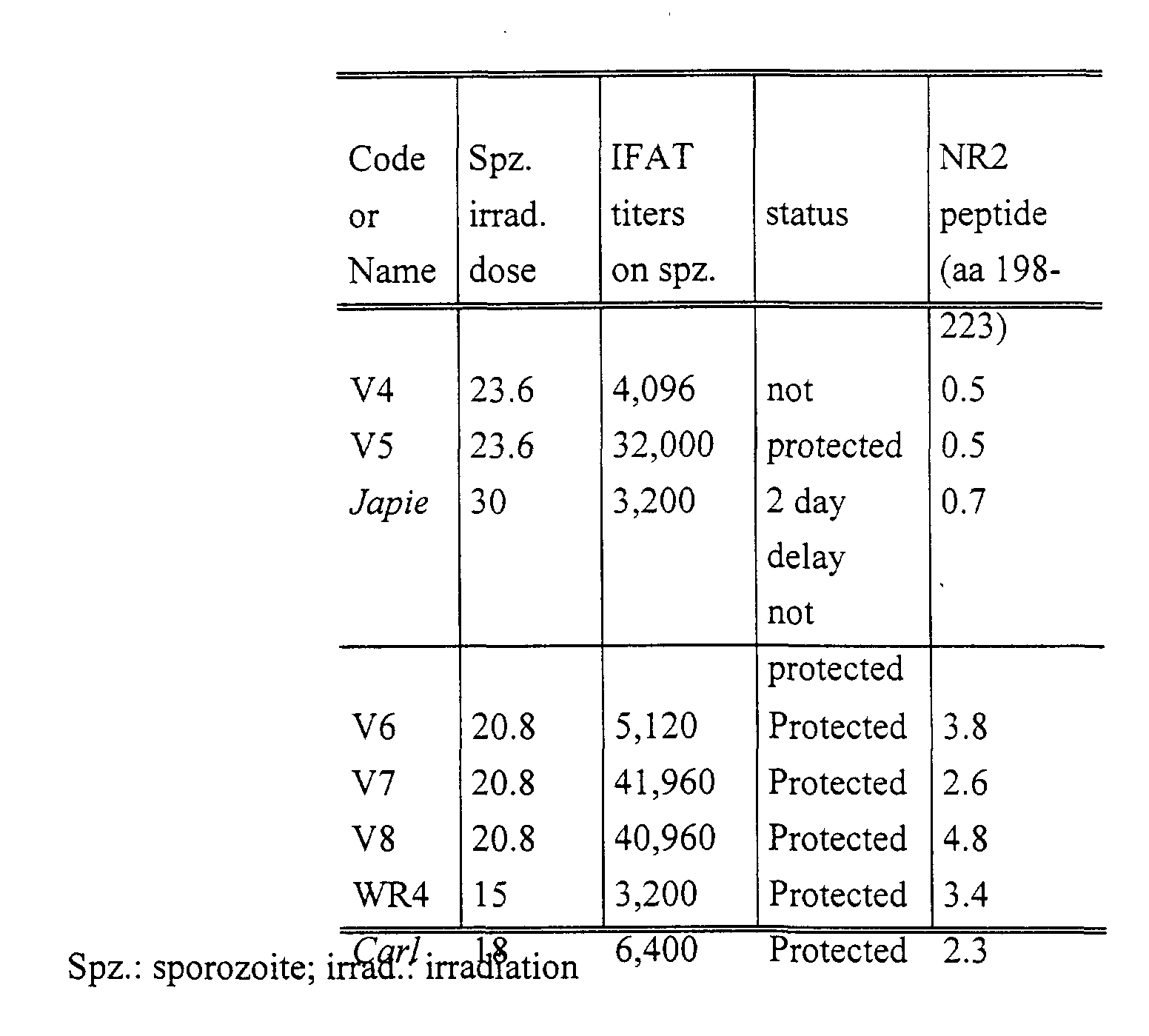
further confirmed with a peptide derived from this fragment (Table I). This led us to
select this clone for further investigation.
-
DG729 was used to probe a P. falciparum (K1) genomic library. One clone
was found to contain the whole gene corresponding to DG729, and which was named
Liver Stage Antigen-3 (LSA-3). Full description of the sequence, expression, location
and conservation of the lsa-3 gene is provided in the Supplementary Information (S.I.)
and is summarised below and in Figures 1-3. Briefly we identified a single-copy gene
which comprises a mini-exon 1, a mini-intron, and a large exon 2 (Fig. 1a), a structure
similar to that of other surface antigens of P. falciparum 13. It was recently confirmed
that lsa-3 is located on chromosome 214, where the gene was annotated as « RESA-H3
» gene (Acc. Number AE001424). LSA-3, with a predicted molecular weight of
200 kDa (in K1), is made up of large non-repeated sequences flanking three glutamic
acid-rich repeated regions, a feature that extends the known P. falciparum Glu-rich
antigen network15 to include a pre-erythrocytic component. The location of the
original fragment (DG729) and of the peptides corresponding to the repeat region R2
and to the non-repetitive regions NR-A and NR-B are shown in Fig. 1b. Naturally- or
artificially- induced antibodies against the non-repeated peptides and the recombinant
protein GST-PC were not cross-reactive with the repeated Glu-rich regions, and were
used for further studies.
-
Pre-erythrocytic expression of LSA-3 (see Fig. 2-3 and see S.I.) was confirmed
a) by RT-PCR (primers i1 and i2) of total RNA and Western blotting of protein
extracts, isolated in both cases from sporozoites, and b) by immunofluorescence
antibody test (IFAT) on infected liver sections and dry or wet sporozoite preparations,
using antibodies to a non-crossreactive portion of the protein. In the five and six day-old
liver schizonts, LSA-3 was located in the parasitophorous vacuole and at the
periphery of maturing hepatic merozoites. This location is consistent with the
molecular structure of this protein, which contains two hydrophobic regions (Fig. 1a).
In our hands, mRNA from lsa-3 could not be detected in Northern blotted RNA from
erythrocytic stages. Western blottings and IFAT of infected red blood cells were also
consistently negative with non cross-reactive antibodies. Reactivity was however
obtained when antibodies to the Glu-rich repeat region were used. This might explain
in part the detection of a putatively homologous antigen (D260) previously described
in intra-erythrocytic parasites, and which was identified solely using antibodies which
cross-react extensively with Glu-rich epitopes16.
-
Polymorphism of many malaria vaccine candidate molecules is of recognised
concern, we therefore investigated naturally occurring sequence variation in LSA-3
(see S.I.). The gene was consistently detected by PCR amplification of the NR-A
region (primers S1 and S2) in a total of 111 P. falciparum isolates, strains or clones of
various geographical origin. Using LSA-3 specific antibodies in IFAT assays, the
expression of LSA-3 was also detected in liver schizonts of two distinct strains and in
all the sporozoites from 30 wild isolates which developed in mosquitoes fed in vitro
on Thai gametocytes. The repeat regions R1 and R3 are highly conserved, but
variation in the number and order of the repeat units of R2 was found to occur
amongst different parasite lines. This did not however affect the predicted conserved
?-helical organisation, a secondary structure considered to be important in defining
major B-cell epitopes since antibodies which recognise R2 did indeed react positively
by IFAT with all the parasites tested. The non-repeated portions of exon 2, where
numerous Th and CTL epitopes are found17-19, displayed a remarkable degree of amino
acid (aa) sequence conservation between different parasites (>95.5% homology). The
sequence of NR2 peptide was fully conserved amongst K1 and T9/96 parasites, the
source of the immunising proteins, the NF54 parasites used for sporozoite challenges,
and 27 P. falciparum samples of various geographical origin17. An HLA-B53
restricted epitope identified in the NR-B region of LSA-3 (present in GST-PC
recombinant protein) was also found to be free of variation in clone 3D7 and in 18
Gambian isolates19. This conservation of immunologically important epitopes
contrasts with substantial polymorphism in current pre-erythrocytic vaccine
candidates.
-
We selected the chimpanzee to investigate the protective capacity of LSA-3
immunisation for the following reasons. The chimpanzee is the only non-human
primate fully susceptible to complete intra-hepatic development of P. falciparum,
with a comparable rate of sporozoite transformation to liver forms to that seen in
humans9. The chimpanzee is also the most closely related animal to humans (98.4 %
homology at the DNA level 8), and one in which detailed investigations of immune
responses can be performed and legitimately compared with those of humans 17,18.
The fact that parasitological and immunological events can be directly examined in
the liver biopsies, a possibility excluded for infected humans, is clearly of
considerable significance. A number of preliminary stringent tests were conducted in
control animals in order to validate the suitability of this model for vaccine
evaluation. Since cost and ethical considerations preclude the use of large number of
animals, high reproducibility of the infection in this model system is critical. In a
preliminary experiment (Group I, Table II), we confirmed that in the chimpanzee
protection by immunisation with irradiated sporozoite is radiation dose-dependent,
and we validated the detection of the infected red blood cells as an assay of protection.
The results allowed us to define a number of important parameters: a) as in humans,
chimpanzees develop a powerful protective response following immunisation with
irradiated sporozoite, b) chimpanzees, like humans, remain broadly susceptible to at
least five successive challenges, in contrast to lower primates or rodents which
become refractory after the first challenge20, and c) as a result of the high dose of
inoculated sporozoites detection of erythrocytic parasites corresponded to the first
invasion of red cells by merozoites released from intra-hepatocytic schizonts. Positive
blood smears were reproducibly obtained in non-protected chimpanzees on days six or
seven, In the chimpanzee erythrocytic infections normally remain sub-clinical and
self-limiting which was in fact observed despite the high dose challenges. These
results have been recently confirmed in two further chimpanzees (Langermans J. et al,
manuscript in preparation).
-
Having established the suitability of the chimpanzee, we proceeded to assay
the protective value of LSA-3 immunisation by challenge with viable P. falciparum
sporozoites. In preliminary experiments, two animals were immunised with a mixture
of LSA-3 and LSA-1 recombinant proteins. Full protection against three challenges
over several months was only seen in the animal which responded to LSA-3 (both
responded to LSA-1). In liver biopsies performed on this animal on day five, only one
liver schizont of unhealthy appearance and infiltrated by leukocytes could be detected
in the 300 liver sections screened (Dirk, Fig. 3). By contrast 2500 and 750 hepatic
schizonts of healthy appearance were observed in the two non-protected controls.
-
These results led us to focus further immunisation and challenge experiments
on LSA-3 alone. Two groups of chimpanzees were used to evaluate lipopeptide and
recombinant protein formulations (Table II, Groups II-III). In Group II, one animal
(Gerda) was initially immunised solely with the NR2 lipopeptide of LSA-3, and
boosted by recombinant LSA-3 molecules in Montanide ISA 51. Gerda was fully
protected when challenged with 107 sporozoites, whereas the control receiving
Montanide ISA 51 was not (Fig. 4a).
-
In Gerda boosting with the recombinant LSA-3 formulation was not found to
induce any detectable increase in the strong B-cell, T-helper cell and CTL responses
already evoked by the initial lipopeptide/peptide injections17,18. We were therefore
interested to see whether the simple and well-tolerated peptidic formulation alone
could induce protection. Two chimpanzees, Mopia and Mgbado were immunised with
LSA-3 lipopeptides/peptides alone (Table II, Group III). Protection against a first
challenge with 2 x 10⁴ sporozoites was obtained in both. The same group included an
investigation of the effects of microbead presentation of recombinant proteins without
adjuvant in one animal (Judy) which resulted in a one-day delay to patency (Fig. 4b).
Following a subsequent high dose sporozoite challenge (5 x 10⁶ sporozoites), both
Mopia and Mgbado demonstrated a clear two-day delay to patency and a low transient
parasitaemia, whilst no protection was found for Judy (Fig. 4c). The delay to patency
suggests that the immune responses had caused a reduction exceeding 90% of intra-hepatocytic
schizont load21 (Fig. 4).
-
In chimpanzees from groups IV and V, we investigated the efficacy of a less
complex lipopeptide mixture alone, or of recombinants adjuvated by SBAS2, a novel
adjuvant whose efficacy has been recently established in humans4,5. Since
immunogenicity studies17,18 and analysis of previous chimpanzee data had indicated
that peptide CT1 was poorly immunogenic and thus might not be critical, chimpanzee
Patty was immunised by a mix of three instead of four peptides. This animal showed
protection upon challenge. Among four animals receiving SBAS2 adjuvated LSA-3
proteins, two showed full, sterile protection against a medium dose challenge. One
showed a delay in patency which may be indicative of partial protection, whereas
neither the fourth nor the control receiving SBAS2 adjuvant alone were protected.
One of the two fully protected chimpanzees was further challenged with a high dose
three months later and still showed full protection.
-
We present here the first description of protective vaccination against human
malaria in the chimpanzee. This model provided us with convincing evidence that
LSA-3 of P. falciparum is a valuable candidate for effective vaccination against pre-erythrocytic
stages. A total of nine animals were immunised using lipopeptides in
saline or polypeptides in either Montanide or SBAS2 adjuvants. Full sterile protection
was induced in six of these nine chimpanzees on first challenge. If the significant
delay as compared to controls is taken in consideration, a protective effect induced by
LSA-3 was shown in eight of nine animals. Out of the 14 challenges which were
performed, complete protection was obtained in seven, and partial protection in an
additional four challenges. All seven control animals employed in these studies
showed a consistent pattern in the appearance and the course of the blood-stage
parasitaemiae following each of the 12 challenges with viable parasites.
Demonstration of this reproducibility in controls, in animals immunised by over-irradiated
sporozoites, and in an additional 26 challenges performed in other
experiments (not shown), is an essential point in the interpretation of our data.
-
It is encouraging that protection was induced against a heterologous challenge
(NF54) in outbred animals immunised with LSA-3 molecules whose sequences were
derived from K1 and T9/96 parasites. A variety of immunisation strategies were
investigated in the course of this work. The data underpin the value of the SBAS2
adjuvant. The results with Gerda, Mopia, Mgbado and Patty are also particularly
encouraging since they are based on simple peptide and lipopeptide formulations
which are relatively easy to produce under GMP conditions22. In our animals no local
or general reactions was detected following lipopeptide injections, an observation
consistent with previous experience with similar formulations derived from SIV in
macaques23 and HbS24 or HIV22 in humans. This bodes well for future clinical trials.
METHODS
-
Selection of clone DG729. Dot blot analysis of the β-galactosidase-fused recombinant
proteins encoded by the pre-erythrocytic clones was performed on nitrocellulose as
previously described7, using 1/100 diluted human and chimpanzee sera. ELISA was
performed in duplicate as previously described25 on 1/100 diluted sera using coating
solutions of 0.3, 3 and 10 µg/ml ofNR1, NR2 and RE peptides respectively, in PBS.
LSA-3 cloning and characterisation. Detailed description of molecular methods,
gene cloning, sequence data, protein characteristics and description of the
recombinant proteins and of the peptides are provided in the S.I. The primers used for
PCR: S1 (nucl.161-184)/S2 (nucl.454-432) and for RT-PCR: i1 (nucl.695-722)/i2
(nucl.824-799), numbering refers to the lsa-3 sequence of K1 (Accession Nber
AJ007010). All mouse sera used for the Western blot (at dilution 1/100) presented in
Fig. 2 were obtained following 3 subcutaneous injections of the immunogen (100 µg)
emulsified in SBAS2 adjuvant4. Long synthetic peptides GP5, GP6, GP8 and GP11
were synthesised as described in ref. 26 (see Fig. 1 for position).
Immunogens injected in chimpanzees. Sequences of the various immunogens
evaluated here consisted of clone DG729 and inserts NN and PC, as well as peptides
(pep.) NR1, NR2, RE and CT1; their location is shown in Fig. 1 and described in
more details in the S.I. Clone DG729, as well as inserts NN and PC were expressed as
glutathione-S-transferase-fused recombinants and purified according to manufacturer
recommendations (Invitrogen, The Netherlands). Recombinants GST-DG729, -NN
and -PC were designed so as to cover 95% of the LSA-3 antigen and were used as a
mixture mentioned as LSA-3 GST-rec. Peptides NR1, NR2 and CT1, were also
synthesised as palmitoyl-conjugated lipopeptides (lipopep.), as described in ref. 17.
Combination of synthetic compounds (mentioned as (lipo)pep.) consisted in a mixture
of NR1, NR2 and CT1 lipopeptides and of RE peptide. All peptides and lipopeptides
were purified to >90% purity by reversed-phase chromatography, and the impurities
consisted essentially of related peptides of shorter sequences17.
Chimpanzee immunisations and challenges. None of the chimpanzees included in
this study had previously been exposed to malaria infections or malarial antigens.
Recombinant and synthetic compounds were injected subcutaneously, at a dose of 100
µg for each peptide and/or lipopeptides, and/or 50 µg for each protein. Lipopeptides
were always injected in PBS and, except when mentioned, peptides and recombinants
were emulsified in Montanide ISA51. Group I animals (Carl and Japie) were
immunised by five intra-venous injections of 5 x 10⁶ gamma-irradiated sporozoites at
day 0 and weeks 8, 24, 44 and 65, and received three challenges at weeks 71, 97 and
123 (challenge doses are given in Table II). One year after the three challenges
reported here, these chimpanzees were re-immunised once, and received one low and
one high dose challenges, which revealed the same pattern of protection (not shown,
Langermans J. et al., manuscript in preparation). In Group II, Gerda received NR2
lipopeptide at day 0 and weeks 3, 13 and 31 as described in ref. 17. She was then
boosted with the mixture of LSA-3 GST-rec. at weeks 40, 45, 48 and 50. Control
animal Lianne received Montanide ISA51. Challenges were performed at week 60.
Group III animals were immunised at day 0 and weeks 3 and 6. Mopia and Mgbado
received LSA-3 (lipo)peptides whereas Judy was injected with LSA-3 GST-rec.
adsorbed to latex microbeads. Challenges LD and HD were performed at weeks 21
and 29. In Group IV, Patty received LSA-3 (lipo)peptides, but without lipopeptide
CT1, whereas Wendy and Willy were injected with LSA-3 GST-rec in SBAS2
adjuvant4,5. Control animal Helen received SBAS2 adjuvant only. All animals were
immunized at weeks 0, 4 and 8 and were challenged with 20,000 sporozoites at week
13. In Group V, Cindy and Marty were both immunised at weeks 0, 4, 8 and 26 with
LSA-3 GST-rec in SBAS2 adjuvant (as in Group IV) and negative control animal
Fauzi received over-irradiated sporozoites similarly to Japie (Group I) at weeks 5, 8,
11 and 26. Challenges LD and HD were performed at weeks 33 and 46 in all three
animals.
NF54 sporozoites were obtained from dissected salivary glands of infected Anopheles
gambiae as previously described27. Sporozoites were pooled, resuspended in PBS
and injected intravenously. All animals in each group were challenged with the same
pool of sporozoites. For cost reasons, extensive evaluation of the Minimal Infective
Dose has not been undertaken, however challenge with 5 x 10³ sporozoites, the
lowest dose used to date, has proven infective in four other animals (Thomas, A.W.,
unpublished data).
Determination of the protective status. For Groups I, II, IV and V, animals blood
was taken on days five to nine, and evaluated by thick and thin film Giemsa-stained
preparations, and confirmed in all cases by in vitro culture (not shown), as described
in ref. 21. For Group III chimpanzees blood taken every day from day five up to day
18, then every other day up to day 30, was used to prepare thin and thick smears
which were Giemsa-stained and examined by two separate microscopists. A
chimpanzee was considered a) totally protected when no parasites could be detected in
the circulation blood, by direct microscopical observation and by long term culture, or
b) partially protected when time to patency was delayed by one or more days as
compared to that observed in control animals. In mice, these delays correspond to a
protection of 80% (24h) or 96% (48h) against sporozoite challenges. In humans, a 12
hour delay was calculated to correspond to a 92% reduction of liver forms following
sporozoite challenges21. In a limited number of animals a liver biopsy was performed
under anaesthesia by a veterinary doctor on day five following a high dose challenge.
Material was fixed and 4 µm sections were made and stained by Giemsa-collophonium28
before complete microscopic enumeration of the liver forms in 300
sections (average area 0.8 cm2). All animals were curatively treated with chloroquine
immediately after the period of observation, and irrespective of their protective status.
References to Example 2
-
- 1. Herrington, D., et al. Successful immunization of humans with irradiated malaria
sporozoites: humoral and cellular responses of the protected vaccinees. Am. J Trap.
Med. Hyg. 45, 539-547 (1991).
- 2. Egan, J.E., et al. Humoral immune responses in volunteers immunized with irradiated
Plasmodium falciparum sporozoites. Am. J. Trop. Med. Hyg. 49, 166-73
(1993).
- 3. Facer, C.A. & M., Tanner. Clinical trials of malaria vaccines: progress and prospects.
Adv. Parasitol. 39, 1-68 (1997).
- 4. Stoute, J.A., et al. A preliminary evaluation of a recombinant circumsporozoite
protein vaccine against Plasmodium falciparum malaria. New Engl. J. Med. 336, 86-91
(1997).
- 5. Stoute, J.A., et al. Long-term efficacy and immune responses following immunization
with the RTS,S malaria vaccine. J Infect. Dis. 178, 1139-44 (1998).
- 6. Guérin-Marchand, C., et al. A liver stage-specific antigen of Plasmodium falciparum
characterized by gene cloning. Nature. 329, 164-167 (1987).
- 7. Marchand, C. & Druilhe, P. How to select Plasmodium falciparum pre-erythrocytic
antigens in an expression library without defined probe. Bull. WHO. 68 (suppl.), 158-164
(1990).
- 8. Miyamoto, M.M., Koop, B. F., Slightom, J. L., Goodman, M. and M.R., Tennant.
Molecular systematics of higher primates: genealogical relations and
classification. Proc. Nat. Acad. Sci. U.S.A. 85, 7627-31 (1988).
- 9. Druilhe, P., et al. in "Malaria. Parasite Biology, Pathogenesis and Protection" (eds.
Irwin W. Sherman), p.513-543 (American Society for Microbiology, Washington
D.C., 1998).
- 10. Mellouk, S., Lunel, F., Sedegah, M., Beaudoin, R.L. and P., Druilhe. Protection
against malaria induced by irradiated sporozoites. Lancet. 335, 721 (1990).
- 11. Fidock, D.A., et al. Cloning and characterization of a Plasmodium falciparum
sporozoite surface antigen - STARP. Mol. Biochem. Parasitol. 64, 219-232
(1994).
- 12. Bottius, E., et al. A novel Plasmodium falciparum sporozoite and liver stage antigen
(SALSA) defines major B, T helper, and CTL epitopes. J. Immunol. 156, 2874-2884
(1996).
- 13. Kemp, D.J., Cowman, A.F. and D., Walliker. Genetic diversity in Plasmodium
falciparum. Adv. Parasitol. 29, 75-149 (1990).
- 14. Gardner, M.J., et al. Chromosome 2 sequence of the human malaria parasite
Plasmodium falciparum. Science, 282, 1126-1132 (1998).
- 15 Moelans, I.I.M.D. & J.G.G., Schoenmakers. Crossreactive antigens between life cycle
stages of Plasmodium falciparum. Parasitol. Today. 8, 118-123 (1992).
- 16. Barnes, D. A., Wollish, W., Nelson, R.G., Leech, J.H. and C., Petersen. Plasmodium
falciparum: D260, an intraerythrocytic parasite protein, is a member of the glutamic
acid dipeptide-repeat family of proteins. Exp. Parasitol., 81, 79-89 (1995).
- 17. Ben Mohamed, L., et al. Lipopeptide immunization without adjuvant induces potent
and long-lasting B, T helper, and cytotoxic T lymphocyte responses against a malaria
liver stage antigen in mice and chimpanzees. Eur. J. Immunol. 27, 1242-1253 (1997).
- 18. Ben Mohamed, L. et al. High immunogenicity in chimpanzees of peptides and
lipopeptides derived from four new Plasmodium falciparum pre-erythrocytic
molecules. Vaccine, 18, 2843-2855 (2000).
- 19 Aidoo, M., et al. CTL epitopes for HLA-B53 and other HLA types in the malaria
vaccine candidate Liver Stage Antigen-3. Infect. Immun. 68, 227-232 (2000).
- 20. Nüssler, A.K., et al. In vivo induction of the nitric oxide pathway in hepatocytes after
injection with irradiated malaria sporozoites, malaria blood parasites or adjuvants.
Eur. J. Immunol. 23, 882-887 (1993).
- 21. Murphy, J.R., Baqar, S., Davis, J.R., Herrington, D.A. and D.F., Clyde. Evidence for a
6.5-day minimum exoerythrocytic cycle for Plasmodium falciparum in humans and
confirmation that immunization with a synthetic peptide representative of a region of
the circumsporozoite protein retards infection. J. Clin. Microbiol. 27, 1434-1437
(1989).
- 22. Gahery-Segard, H., et al. Multiepitopic B- and T-cell responses induced in humans by
a Human Immunodeficiency Virus type 1 lipopeptide vaccine. J. Virol. 4, 1694-703
(2000).
- 23. Bourgault, I., et al. Simian immunodeficiency virus as a model for vaccination against
HIV: induction in rhesus macaques of GAG or NEF specific cytotoxic T lymphocytes
by lipopeptides. J Immunol. 152, 2530-2537 (1994).
- 24. Vitiello, A., et al. Development of a lipopeptide-based therapeutic vaccine to treat
chronic HBV infection. Induction of a primary cytotoxic T lymphocyte response in
humans. J. Clin. Invest. 95, 341-349 (1995).
- 25. Londoño, J.A., Gras-Masse, H., Dubeaux, C., Tartar, A. and P., Druilhe. Secondary
structure and immunogenicity of hybrid synthetic peptides derived from two
Plasmodium falciparum pre-erythrocytic antigens. J. Immunol. 145, 1557-1563
(1990).
- 26. Roggero, M.A., et al. Synthesis and immunological characterization of 104-mer and
102-mer peptides corresponding to the N- and C-terminal regions of the Plasmodium
falciparum CS Protein. Mol. Immunol. 32, 1301-1309 (1995).
- 27. Ponnudurai, T., et al. Sporozoite load of mosquitoes infected with Plasmodium
falciparum. Trans. Roy Soc. Trop. Med. Hyg. 83, 67-70 (1989).
- 28. Druilhe, P., Puebla, R.M., Miltgen, F., Perrin, L. and M., Gentilini. Species- and
stage-specific antigens in exoerythrocytic stages of Plasmodium falciparum. Am. J
Trop. Med. Hyg. 33, 336-341 (1984).
- 29. Meis, J.F.G.M., et al. Plasmodium falciparum: studies on mature exoerythrocytic
forms in the liver of the chimpanzee, Pan troglodytes. Exp. Parasitol. 70, 1-11 (1990).
-
-
Table I. Differential reactivity of sera from protected or non-protected humans
or chimpanzees with peptide NR2. IgG-specific antibodies against peptide NR2
were measured by ELISA in sera from human volunteers (codes) and chimpanzees
(names in italic) immunised with sporozoites irradiated at low or high dose (in krad).
Codes, immunisation schemes, sporozoite IFAT titres and protective status
determination for human volunteers V4-V8 and WR4 are detailed in ref. 1 and 2,
respectively. Chimpanzees Carl and Japie were immunised and challenged as
described in the text and the Methods (Group I). ELISA titres are expressed in
arbitrary units representing the ratio of the mean ODs from test sera to the mean OD
plus three standard deviations from 10 controls studied in parallel in the same plate.
Results are taken as positive for ratios above one (in bold). Similar experiments
performed with peptides NR1 and RE (see Fig. 1) yielded negative results with these
sera (not shown).
-
Table II. Immunisation and challenge experiments in the chimpanzees.
Challenges were performed with either 2x10⁴ (low dose) or 107 (high dose) NF54 P.
falciparum sporozoites ("Protection" column). Immunisation schedules (in brackets
under the bar) and of challenges (indicated by arrows above the bar) are expressed in
weeks from first immunisation. Shading highlights protected animals. Complete
protection is indicated with (+); a delay to patency (in days) as compared to controls
and non-protected animals is indicated by d1 or d2 (determination of the protective
status is detailed in the Methods).
LEGENDS FOR FIGURES
-
Figure 1: Schematic representation of the LSA-3 gene, recombinant proteins and
peptides. a) 6.2 Kb Eco RI-insert isolated from K1 parasite genomic DNA library that
hybridised with DG729. The 5.53 Kb gene comprises a 198 bp exon 1, a 168 bp
intron (i) and a 5.16 Kb exon 2. Regions NR-A, -B and -C correspond to non-repeated
sequences whereas R1 to R3 designate the three repeat blocks. The two hydrophobic
regions potentially corresponding to the NH2-terminal signal peptide and the anchor
region are indicated by HR1 and HR2 respectively. b) Location of the sequences
encoding for LSA-3 in the recombinant fusion proteins (first line) and the synthetic
peptides (strokes) used in this study (see Supplementary Information for aa
numbering). For the immunisations, CT1 and NR2 were also used as palmitoyl-conjugated
lipopeptides17 (indicated by *).
-
Figure 2: LSA-3 expression in P. falciparum sporozoites. Western blot analysis
was performed on protein extracts from NF54 sporozoites and control uninfected
mosquito salivary glands using mouse antisera directed against: C) control GST, 1)
GST-PC, 2) peptides GP5, GP6, GP8 or GP11, 3) GST-729 (see Fig. 1, Methods and
S.I.). LSA-3 is visualised as a 175 kDa protein (*), in agreement with the theoretical
molecular weight of LSA-3 in this parasite strain.
-
Figure 3: Immunostaining of P. falciparum pre-erythrocytic stages with anti-LSA-3
antibodies. a) sporozoites stained by IFAT with human antibodies affinity
purified on recombinant ßga1-DG729. b) staining by IFAT of day six post-challenge
liver stages29 from a chimpanzee, using the antibodies induced by lipopeptide NR2
injection17 in chimpanzee Gerda (see S.I. for additional pictures). c) The single
residual liver schizont detected in a chimpanzee Dirk (day five post-challenge)
appeared infiltrated by lymphomononuclear cells, as compared in d) to one of the
numerous healthy schizonts observed in the control chimpanzee Peer (total of ca 2500
schizonts/300 liver sections, Giemsa-collophonium staining28) (see text). Bars
correspond to 5 µm in panel a) and 20 µm in panels b) to d).
-
Figure 4: Blood parasitaemia courses in Groups II and III. a) chimpanzees from
Group II and b-c) animals in Group III, following high dose (HD) or low dose (LD)
challenges with NF54 sporozoites. Names of totally or partially protected animals are
in bold. Hatched patterns correspond to control chimpanzees. Parasitaemia scales are
different for each challenge, as expected from challenges with different numbers of
sporozoites. Note that the day of patency in control and non-protected animals was the
same for a given challenge inoculum within each group (in the above and in other
groups not shown here).
Example 3
Sequence data and supplementary information
-
The following further information exemplifying the invention is supplied:
- Sequence Data - Gene: full Sequence (K1 parasite)
- Protein: full Sequence (K1 parasite)
- Clones DG729 / DG679 (T9/96 parasite)
- Note on LSA-3 sequence in parasite 3D7
- Gene & Protein - Structure . Restriction map . Hydrophobicity
- Oligonucleotides employed
- Organisation
- Regions & Comments - NR-A . R1 . R2 . NR-B . R3 . NR-C
- Conservation - of the gene
- of the sequence
- of repeat region R2
- comparaison of immunising and challenging sequences
-
Stage Specificity & Subcellular Location
Homologies - Intraspecies
-
Synthetic Peptides & Recombinant Proteins used for Chimpanzee
Immunisations
-
- Peptides CT1 . NR1 . NR2 . RE
- Recombinant proteins β-729. GST-729. GST-NN. GST-PC
Methods
References to Example 3
-
METHODS
1. Parasites
-
Blood stages of P. falciparum T9/96 clone (Thaithong et al., 1984), NF54 (Ponnudurai et al., 19881) and
K1 (Thaithong and Beale, 1981) strains were cultured as described by Trager and Jensen (1976). P.
falciparum sporozoites were obtained from NF54 strain as described in Ponnodurai et al. (1989) and
from mosquitoes fed with gametocytes produced in vitro from Thai patient isolates (Galey et al., 1990).
P. falciparum liver schizonts were identified in liver biopsies of a Sapajou monkey (Cebus apella, in day
5 post-sporozoite challenge) infected with the African isolate 730XI (Druilhe et al., 1984), and of a
chimpanzee (Pan troglodytes, in day 6 post-sporozoite challenge) infected with NF54 strain (Meis et al.,
1990).
2. Nucleic acid isolation and hybridisation
-
Parasite genomic DNA was purified from saponin-lysed infected erythrocytes (Robson et al., 1991).
Total RNA from sporozoites and parasite blood stages were extracted according to Chomczynski et al.
(1987). DNA probes were randomly [32P]-radiolabelled according to the manufacturer's
recommendations (Amersham, UK). Southern and Northern blottings, probe hybridisations and washes
were performed on 5-10 µg of material by standard methods (Sambrook et al., 1989).
Low stringency cross-species hybridisations were performed overnight at 54°C in: 5x Denhardt's
solution, 6x SSC buffer, 0.1 % SDS, 0.1 mg/ml sonicated salmon sperm DNA. Membranes were
washed 30 min. at 54°C in 0.2X or 0.1X SSC buffer before autoradiography.
3. Cloning and sequencing protocols
-
A size-selected (0.5-1.5 Kb) genomic expression library was prepared in the phage λgt11 from P.
falciparum T9/96 DNA and differentially screened with various stage-restricted sera as previously
described (Guérin-Marchand et al., 1987). λgt11-DG729 and -DG679 DNA were prepared from a liquid
phage lysate. The gel-purified EcoRI inserts were cloned into plasmid pUC18 and sequenced. The
DG729 insert was randomly radiolabelled and used as a probe to screen an EcoRI-digested genomic
DNA library prepared from the K1 strain in the phage λgt10 (generously provided by G. Langsley,
Pasteur Institute). Five positive clones were isolated and analysed. One of them, clone k1.2, was found to
contain the largest EcoRI insert and was therefore chosen for subcloning and complete sequence analysis.
This 6.7 Kb EcoRI fragment and subclones derived from it (spanning the entire insert) were cloned into
pUC18. A series of Exonuclease III-digested subclones from the 1.8 Kb repeated regions R1-R2 of
clone k1.2 was obtained using the Erase-a-Base Kit (Promega, U.S.A.). All clones and subclones
described above were sequenced on both strands with insert flanking or internal oligonucleotidic primers
using the dideoxy method (Sanger et al., 1977) and the Sequenase enzyme system (United States
Biochemicals Corp.).
4. PCR and RT-PCR amplifications
-
RT-PCR experiments were performed on 300-500 ng of total RNA (for blood stage parasites) or on the
RNA pellet obtained from 106-107 NF54 sporozoites. cDNA were synthesized from 30 pmoles of
primers S2(-) by the MMLV-reverse transcriptase in a final volume of 20 µl according to the
manufacturer 's recommendations (Gibco-BRL). PCR reactions were carried out on 10 µl of cDNA
synthesis reaction or on 1 µg of genomic DNA, according to the manufacturer 's recommendations
(Amersham, UK).
For lsa-3 amplification in human blood samples and P. falciparum detection in challenged chimpanzees,
PCR was performed as described in Bottius et al. (1996) where primers described within for clone
DG157 correspond to primers S1 and S2 reported here.
5. Peptides synthesis and production of recombinant proteins
-
Peptides and lipopeptides used for chimpanzee immunisations were synthesized as described in Ben
Mohamed et al. (1997). All peptides and lipopeptides were purified over 90% by reversed-phase
chromatography, the impurities essentially consisting in shorter sequences. Long synthetic peptides GP5
(aa 1241-1346), GP6 (aa 1143-1255), GP8 (aa 1026-1095) and GP11 (aa 840-907) were synthesized as
described in Roggero et al. (1995); they are all located in region NR-B (strain K1), i.e. the non-repeated
region of PC insert.
Recombinant protein β-729 was prepared from a liquide lysate as described in Guérin-Marchand et al.
(1987). Control GST protein and GST-fused recombinant proteins were prepared according to the
manufacturer 's recommendations (Invitrogen) except for GST-PC which was prepared from 20 liter
cultures due to poor production yields. This large scale culture was incubated until OD600= 8.0; bacteria
were then pelleted, lysed using a French Press and filtered before standard purification.
6. Antibodies and antisera
-
Human antibodies were immunopurified on recombinant proteins and peptides as previously described in
Marchand & Druilhe (1990) and Brahimi et al. (1993), respectively. Mouse and chimpanzee anti-NR2
peptide antibodies were induced respectively in mice and in chimpanzee Gerda by lipopeptide NR2
injections as described in Ben Mohamed et al. (1997). Mouse antisera against GST-PC recombinant
protein and long peptides GP5-6-8-11 (used for Western blotting) were obtained following 3
subcutaneous injections of the immunogen (100 µg) emulsified in SBAS2 adjuvant (Stoute et al., 1997).
7. Western blot analysis
-
Proteins from intraerythrocytic parasites and sporozoites were solubilized in sodium dodecyl sulphate
(SDS)-containing sample buffer, subjected to 5% SDS-polyacrylamide gel electrophoresis under
reducing conditions, electroblotted onto nitrocellulose membrane and detected as described previously
(Bouharoun-Tayoun & Druilhe, 1992), using mouse antibodies (at dilution 1/100). Visualisation was
performed by peroxidase-conjugated goat anti-human IgG and chemoluminescence (ECL Western
blotting reagents, Amersham).
8. Immunofluorescence Antibody Test (IFAT)
-
IFAT were performed as described previously (Druilhe
et al., 1986) on asynchronous erythrocytic
cultures of
P. falciparum NF54 strain, on freshly dissected live sporozoites labelled in suspension, on wet
sporozoites deposited on poly-L-lysine-coated slides and on glutaraldehyde-fixed sporozoites, as well as
on Carnoy-fixed liver schizonts. Positive IFAT on liver schizonts were verified by phase contrast
microscopy and subsequent Giemsa staining of the sections (Druilhe
et al., 1984).
- Ahlborg, N., et al. Definition of the epitope recognized by the Plasmodium falciparum-reactive human monoclonal antibody
33G2. Mol. Biochem. Parasitol., 46, 89-95 (1991).
- Aidoo, M., et al. CTL epitopes for HLA-B53 and other HLA types in the malaria vaccine candidate Liver Stage Antigen-3.
Infect. Immun., 68, 227-232 (2000).
- Barnes, D. A., et al. Plasmodium falciparum. D260, an intraerythrocytic parasite protein, is a member of the glutamic acid
dipeptide-repeat family of proteins. Experim. Parasitol., 81, 79-89 (1995).
- Ben Mohamed, L., et al. Lipopeptide immunization without adjuvant induces potent and long-lasting B, T helper, and cytotoxic
T lymphocyte responses against a malaria liver stage antigen in mice and chimpanzees. Eur. J. Immunol., 27, 1242-1253
(1997).
- Bottius, E., et al. Malaria - even more chronic in nature than previously thought - evidence for subpatent parasitaemia
detectable by the polymerase chain reaction. Trans. Roy. Soc. Trop. Med. Hyg., 90, 15-19 (1996).
- Bouharoun-Tayoun, H. & Druilhe, P. Plasmodium falciparum malaria: evidence for an isotype imbalance which may be
responsible for delayed acquisition of protective immunity. Infect. Immun., 60, 1473-1481 (1992).
- Brahimi, K., et al. Fast immunopurification of small amounts of specific antibodies on peptides bound to ELISA plates. J.
Immunol. Methods, 162, 69-75 (1993).
- Chomczynski, P. & Sacchi, N. Single step method of RNA isolation by acid guanidinium thiocyanate-phenol-chloroform
extraction. Anal. Biochem., 162, 156-161 (1987).
- Druilhe, P., et al. Species- and stage-specific antigens in exoerythrocytic stages of Plasmodium falciparum. Am. J. Trop. Med.
Hyg., 33, 336-341 (1984).
- Druilhe, P., et al. Levels of antibodies to Plasmodium falciparum sporozoite surface antigens reflect malaria transmission
rates and are persistent in the absence of reinfections. Infect. Immun., 53, 393-397 (1986).
- Druilhe, P., et al. A primary malaria infection is composed of a very wide range of genetically diverse but related parasites. J.
Clin. Invest., 101, 1-9 (1998).
- Gaboriaud, C., et al. Hydrophobic cluster analysis: an efficient new way to compare and analyse amino acid sequences.
FEBS Lett., 224, 149-155 (1987).
- Galey, B., et al. Evidence for diversity of Plasmodium falciparum sporozoite surface antigens derived from analysis of
antibodies elicited in humans. Infect. Immun., 58, 2995-3001 (1990).
- Gardner, M. J., et al. Chromosome 2 sequence of the human malaria parasite Plasmodium falciparum. Science, 282, 1126-1132
(1998).
- Guérin-Marchand, C., et al. A liver stage-specific antigen of Plasmodium falciparum characterized by gene cloning. Nature
(London), 329, 164-167 (1987).
- Hernandez-Rivas, R., et al. Compartmentalization of genes coding for immunodominant antigens to fragile chromosome ends
leads to dispersed subtelomeric gene families and rapid gene evolution in Plasmodium falciparum. Mol. Biochem. Parasitol.,
78, 137-48 (1996).
- Meis, J. F. G. M., et al. Plasmodium falciparum. studies on mature exoerythrocytic forms in the liver of the chimpanzee, Pan
troglodytes. Exp. Parasitol., 70, 1-11 (1990).
- Moelans, I. I. M. D. & Schoenmakers, J. G. G. Crossreactive antigens between life cycle stages of Plasmodium falciparum.
Parasitol. Today, 8, 118-123 (1992).
- Nielsen, H., et al. Identification of prokaryotic and eukaryotic signal peptides and prediction of their clivage sites. Prot.
Engineering, 10, 1-6 (1997).
- Ponnudurai, T., et al. Chloroquine sensitivity of isolates of Plasmodium falciparum adapted to in vitro culture. Trop. Geo. Med.,
33, 50-4 (1981).
- Ponnudurai, T., et al. Sporozoite load of mosquitoes infected with Plasmodium falciparum. Trans. Roy. Soc. Trop. Med. Hyg.,
83, 67-70 (1989).
- Robson, K. J. H. & Jennings, M. W. The structure of the calmodulin gene of Plasmodium falciparum. Mol. Biochem. Parasitol.,
46, 19-34 (1991).
- Roggero, M.A., et al. Synthesis and immunological characterization of 104-mer and 102-mer peptides corresponding to the N-and
C-terminal regions of the Plasmodium falciparum CS Protein. Mol. Immunol., 32, 1301-1309 (1995).
- Sambrook, J., et al. Molecular cloning. A laboratory manual-2nd edition. Cold Spring Harbor, New York, Cold Spring Harbor
Laboratory Press (1989).
- Sanger, F., et al. DNA sequencing with chain-terminating inhibitors. Proc. Natl. Acad. Sci. U.S.A., 74, 5463-5467 (1977).
- Stoute, J.A., et al. A preliminary evaluation of a recombinant Circumsporozoite Protein vaccine against Plasmodium
falciparum malaria. New Engl. J. Med., 336, 86-91 (1997).
- Thaithong, S. & Beale, G. H. Resistance of ten Thai isolates of Plasmodium falciparum to chloroquine and pyrimethamine by
in vitro tests. Trans. Roy. Soc. Trop. Med. Hyg., 75, 271-3 (1981).
- Thaithong, S., et al. Clonal diversity in a single isolate of the malaria parasite Plasmodium falciparum. Trans. Roy. Soc. Trop.
Med. Hyg., 78, 242-5 (1984).
- Trager, W. & Jensen, J. B. Human malaria parasites in continuous culture. Science, 193, 673-675 (1976).
- Wilkins, M.R. et al. Detailed peptide characterisation using PEPTIDEMASS - a World Wide Web accessible tool.
Electrophoresis, 18, 403-408 (1997).
-
Annex to the application documents - subsequently filed sequences listing
-


