EP1188854A1 - Fiber structure having deodorizing or antibacterial property - Google Patents
Fiber structure having deodorizing or antibacterial property Download PDFInfo
- Publication number
- EP1188854A1 EP1188854A1 EP00901893A EP00901893A EP1188854A1 EP 1188854 A1 EP1188854 A1 EP 1188854A1 EP 00901893 A EP00901893 A EP 00901893A EP 00901893 A EP00901893 A EP 00901893A EP 1188854 A1 EP1188854 A1 EP 1188854A1
- Authority
- EP
- European Patent Office
- Prior art keywords
- fibre
- deodorant
- fibre structure
- antimicrobial properties
- properties according
- Prior art date
- Legal status (The legal status is an assumption and is not a legal conclusion. Google has not performed a legal analysis and makes no representation as to the accuracy of the status listed.)
- Granted
Links
Images

Classifications
-
- D—TEXTILES; PAPER
- D06—TREATMENT OF TEXTILES OR THE LIKE; LAUNDERING; FLEXIBLE MATERIALS NOT OTHERWISE PROVIDED FOR
- D06M—TREATMENT, NOT PROVIDED FOR ELSEWHERE IN CLASS D06, OF FIBRES, THREADS, YARNS, FABRICS, FEATHERS OR FIBROUS GOODS MADE FROM SUCH MATERIALS
- D06M16/00—Biochemical treatment of fibres, threads, yarns, fabrics, or fibrous goods made from such materials, e.g. enzymatic
-
- A—HUMAN NECESSITIES
- A01—AGRICULTURE; FORESTRY; ANIMAL HUSBANDRY; HUNTING; TRAPPING; FISHING
- A01N—PRESERVATION OF BODIES OF HUMANS OR ANIMALS OR PLANTS OR PARTS THEREOF; BIOCIDES, e.g. AS DISINFECTANTS, AS PESTICIDES OR AS HERBICIDES; PEST REPELLANTS OR ATTRACTANTS; PLANT GROWTH REGULATORS
- A01N25/00—Biocides, pest repellants or attractants, or plant growth regulators, characterised by their forms, or by their non-active ingredients or by their methods of application, e.g. seed treatment or sequential application; Substances for reducing the noxious effect of the active ingredients to organisms other than pests
- A01N25/34—Shaped forms, e.g. sheets, not provided for in any other sub-group of this main group
-
- A—HUMAN NECESSITIES
- A01—AGRICULTURE; FORESTRY; ANIMAL HUSBANDRY; HUNTING; TRAPPING; FISHING
- A01N—PRESERVATION OF BODIES OF HUMANS OR ANIMALS OR PLANTS OR PARTS THEREOF; BIOCIDES, e.g. AS DISINFECTANTS, AS PESTICIDES OR AS HERBICIDES; PEST REPELLANTS OR ATTRACTANTS; PLANT GROWTH REGULATORS
- A01N59/00—Biocides, pest repellants or attractants, or plant growth regulators containing elements or inorganic compounds
- A01N59/16—Heavy metals; Compounds thereof
-
- A—HUMAN NECESSITIES
- A61—MEDICAL OR VETERINARY SCIENCE; HYGIENE
- A61L—METHODS OR APPARATUS FOR STERILISING MATERIALS OR OBJECTS IN GENERAL; DISINFECTION, STERILISATION OR DEODORISATION OF AIR; CHEMICAL ASPECTS OF BANDAGES, DRESSINGS, ABSORBENT PADS OR SURGICAL ARTICLES; MATERIALS FOR BANDAGES, DRESSINGS, ABSORBENT PADS OR SURGICAL ARTICLES
- A61L9/00—Disinfection, sterilisation or deodorisation of air
- A61L9/01—Deodorant compositions
-
- D—TEXTILES; PAPER
- D06—TREATMENT OF TEXTILES OR THE LIKE; LAUNDERING; FLEXIBLE MATERIALS NOT OTHERWISE PROVIDED FOR
- D06M—TREATMENT, NOT PROVIDED FOR ELSEWHERE IN CLASS D06, OF FIBRES, THREADS, YARNS, FABRICS, FEATHERS OR FIBROUS GOODS MADE FROM SUCH MATERIALS
- D06M11/00—Treating fibres, threads, yarns, fabrics or fibrous goods made from such materials, with inorganic substances or complexes thereof; Such treatment combined with mechanical treatment, e.g. mercerising
- D06M11/32—Treating fibres, threads, yarns, fabrics or fibrous goods made from such materials, with inorganic substances or complexes thereof; Such treatment combined with mechanical treatment, e.g. mercerising with oxygen, ozone, ozonides, oxides, hydroxides or percompounds; Salts derived from anions with an amphoteric element-oxygen bond
- D06M11/36—Treating fibres, threads, yarns, fabrics or fibrous goods made from such materials, with inorganic substances or complexes thereof; Such treatment combined with mechanical treatment, e.g. mercerising with oxygen, ozone, ozonides, oxides, hydroxides or percompounds; Salts derived from anions with an amphoteric element-oxygen bond with oxides, hydroxides or mixed oxides; with salts derived from anions with an amphoteric element-oxygen bond
- D06M11/46—Oxides or hydroxides of elements of Groups 4 or 14 of the Periodic Table; Titanates; Zirconates; Stannates; Plumbates
-
- D—TEXTILES; PAPER
- D06—TREATMENT OF TEXTILES OR THE LIKE; LAUNDERING; FLEXIBLE MATERIALS NOT OTHERWISE PROVIDED FOR
- D06M—TREATMENT, NOT PROVIDED FOR ELSEWHERE IN CLASS D06, OF FIBRES, THREADS, YARNS, FABRICS, FEATHERS OR FIBROUS GOODS MADE FROM SUCH MATERIALS
- D06M11/00—Treating fibres, threads, yarns, fabrics or fibrous goods made from such materials, with inorganic substances or complexes thereof; Such treatment combined with mechanical treatment, e.g. mercerising
- D06M11/77—Treating fibres, threads, yarns, fabrics or fibrous goods made from such materials, with inorganic substances or complexes thereof; Such treatment combined with mechanical treatment, e.g. mercerising with silicon or compounds thereof
-
- D—TEXTILES; PAPER
- D06—TREATMENT OF TEXTILES OR THE LIKE; LAUNDERING; FLEXIBLE MATERIALS NOT OTHERWISE PROVIDED FOR
- D06M—TREATMENT, NOT PROVIDED FOR ELSEWHERE IN CLASS D06, OF FIBRES, THREADS, YARNS, FABRICS, FEATHERS OR FIBROUS GOODS MADE FROM SUCH MATERIALS
- D06M11/00—Treating fibres, threads, yarns, fabrics or fibrous goods made from such materials, with inorganic substances or complexes thereof; Such treatment combined with mechanical treatment, e.g. mercerising
- D06M11/77—Treating fibres, threads, yarns, fabrics or fibrous goods made from such materials, with inorganic substances or complexes thereof; Such treatment combined with mechanical treatment, e.g. mercerising with silicon or compounds thereof
- D06M11/79—Treating fibres, threads, yarns, fabrics or fibrous goods made from such materials, with inorganic substances or complexes thereof; Such treatment combined with mechanical treatment, e.g. mercerising with silicon or compounds thereof with silicon dioxide, silicic acids or their salts
-
- D—TEXTILES; PAPER
- D06—TREATMENT OF TEXTILES OR THE LIKE; LAUNDERING; FLEXIBLE MATERIALS NOT OTHERWISE PROVIDED FOR
- D06M—TREATMENT, NOT PROVIDED FOR ELSEWHERE IN CLASS D06, OF FIBRES, THREADS, YARNS, FABRICS, FEATHERS OR FIBROUS GOODS MADE FROM SUCH MATERIALS
- D06M13/00—Treating fibres, threads, yarns, fabrics or fibrous goods made from such materials, with non-macromolecular organic compounds; Such treatment combined with mechanical treatment
- D06M13/005—Compositions containing perfumes; Compositions containing deodorants
-
- D—TEXTILES; PAPER
- D06—TREATMENT OF TEXTILES OR THE LIKE; LAUNDERING; FLEXIBLE MATERIALS NOT OTHERWISE PROVIDED FOR
- D06M—TREATMENT, NOT PROVIDED FOR ELSEWHERE IN CLASS D06, OF FIBRES, THREADS, YARNS, FABRICS, FEATHERS OR FIBROUS GOODS MADE FROM SUCH MATERIALS
- D06M13/00—Treating fibres, threads, yarns, fabrics or fibrous goods made from such materials, with non-macromolecular organic compounds; Such treatment combined with mechanical treatment
- D06M13/50—Treating fibres, threads, yarns, fabrics or fibrous goods made from such materials, with non-macromolecular organic compounds; Such treatment combined with mechanical treatment with organometallic compounds; with organic compounds containing boron, silicon, selenium or tellurium atoms
- D06M13/51—Compounds with at least one carbon-metal or carbon-boron, carbon-silicon, carbon-selenium, or carbon-tellurium bond
- D06M13/513—Compounds with at least one carbon-metal or carbon-boron, carbon-silicon, carbon-selenium, or carbon-tellurium bond with at least one carbon-silicon bond
-
- D—TEXTILES; PAPER
- D06—TREATMENT OF TEXTILES OR THE LIKE; LAUNDERING; FLEXIBLE MATERIALS NOT OTHERWISE PROVIDED FOR
- D06M—TREATMENT, NOT PROVIDED FOR ELSEWHERE IN CLASS D06, OF FIBRES, THREADS, YARNS, FABRICS, FEATHERS OR FIBROUS GOODS MADE FROM SUCH MATERIALS
- D06M15/00—Treating fibres, threads, yarns, fabrics, or fibrous goods made from such materials, with macromolecular compounds; Such treatment combined with mechanical treatment
- D06M15/19—Treating fibres, threads, yarns, fabrics, or fibrous goods made from such materials, with macromolecular compounds; Such treatment combined with mechanical treatment with synthetic macromolecular compounds
- D06M15/37—Macromolecular compounds obtained otherwise than by reactions only involving carbon-to-carbon unsaturated bonds
- D06M15/643—Macromolecular compounds obtained otherwise than by reactions only involving carbon-to-carbon unsaturated bonds containing silicon in the main chain
-
- D—TEXTILES; PAPER
- D06—TREATMENT OF TEXTILES OR THE LIKE; LAUNDERING; FLEXIBLE MATERIALS NOT OTHERWISE PROVIDED FOR
- D06M—TREATMENT, NOT PROVIDED FOR ELSEWHERE IN CLASS D06, OF FIBRES, THREADS, YARNS, FABRICS, FEATHERS OR FIBROUS GOODS MADE FROM SUCH MATERIALS
- D06M15/00—Treating fibres, threads, yarns, fabrics, or fibrous goods made from such materials, with macromolecular compounds; Such treatment combined with mechanical treatment
- D06M15/19—Treating fibres, threads, yarns, fabrics, or fibrous goods made from such materials, with macromolecular compounds; Such treatment combined with mechanical treatment with synthetic macromolecular compounds
- D06M15/37—Macromolecular compounds obtained otherwise than by reactions only involving carbon-to-carbon unsaturated bonds
- D06M15/643—Macromolecular compounds obtained otherwise than by reactions only involving carbon-to-carbon unsaturated bonds containing silicon in the main chain
- D06M15/6433—Macromolecular compounds obtained otherwise than by reactions only involving carbon-to-carbon unsaturated bonds containing silicon in the main chain containing carboxylic groups
-
- D—TEXTILES; PAPER
- D10—INDEXING SCHEME ASSOCIATED WITH SUBLASSES OF SECTION D, RELATING TO TEXTILES
- D10B—INDEXING SCHEME ASSOCIATED WITH SUBLASSES OF SECTION D, RELATING TO TEXTILES
- D10B2401/00—Physical properties
- D10B2401/13—Physical properties anti-allergenic or anti-bacterial
-
- D—TEXTILES; PAPER
- D10—INDEXING SCHEME ASSOCIATED WITH SUBLASSES OF SECTION D, RELATING TO TEXTILES
- D10B—INDEXING SCHEME ASSOCIATED WITH SUBLASSES OF SECTION D, RELATING TO TEXTILES
- D10B2503/00—Domestic or personal
- D10B2503/02—Curtains
-
- D—TEXTILES; PAPER
- D10—INDEXING SCHEME ASSOCIATED WITH SUBLASSES OF SECTION D, RELATING TO TEXTILES
- D10B—INDEXING SCHEME ASSOCIATED WITH SUBLASSES OF SECTION D, RELATING TO TEXTILES
- D10B2503/00—Domestic or personal
- D10B2503/04—Floor or wall coverings; Carpets
-
- D—TEXTILES; PAPER
- D10—INDEXING SCHEME ASSOCIATED WITH SUBLASSES OF SECTION D, RELATING TO TEXTILES
- D10B—INDEXING SCHEME ASSOCIATED WITH SUBLASSES OF SECTION D, RELATING TO TEXTILES
- D10B2503/00—Domestic or personal
- D10B2503/06—Bed linen
-
- D—TEXTILES; PAPER
- D10—INDEXING SCHEME ASSOCIATED WITH SUBLASSES OF SECTION D, RELATING TO TEXTILES
- D10B—INDEXING SCHEME ASSOCIATED WITH SUBLASSES OF SECTION D, RELATING TO TEXTILES
- D10B2505/00—Industrial
- D10B2505/12—Vehicles
-
- Y—GENERAL TAGGING OF NEW TECHNOLOGICAL DEVELOPMENTS; GENERAL TAGGING OF CROSS-SECTIONAL TECHNOLOGIES SPANNING OVER SEVERAL SECTIONS OF THE IPC; TECHNICAL SUBJECTS COVERED BY FORMER USPC CROSS-REFERENCE ART COLLECTIONS [XRACs] AND DIGESTS
- Y10—TECHNICAL SUBJECTS COVERED BY FORMER USPC
- Y10T—TECHNICAL SUBJECTS COVERED BY FORMER US CLASSIFICATION
- Y10T428/00—Stock material or miscellaneous articles
- Y10T428/23907—Pile or nap type surface or component
- Y10T428/23986—With coating, impregnation, or bond
-
- Y—GENERAL TAGGING OF NEW TECHNOLOGICAL DEVELOPMENTS; GENERAL TAGGING OF CROSS-SECTIONAL TECHNOLOGIES SPANNING OVER SEVERAL SECTIONS OF THE IPC; TECHNICAL SUBJECTS COVERED BY FORMER USPC CROSS-REFERENCE ART COLLECTIONS [XRACs] AND DIGESTS
- Y10—TECHNICAL SUBJECTS COVERED BY FORMER USPC
- Y10T—TECHNICAL SUBJECTS COVERED BY FORMER US CLASSIFICATION
- Y10T428/00—Stock material or miscellaneous articles
- Y10T428/29—Coated or structually defined flake, particle, cell, strand, strand portion, rod, filament, macroscopic fiber or mass thereof
Definitions
- the present invention relates to a fibre structure with outstanding deodorant properties, residual-odour prevention properties, antibacterial properties and/or antifungal properties, etc, of durability not found hitherto.
- a fibre structure can be applied widely to, for example, clothing, curtains, wall covering materials, sheet materials, bedding and other such interior materials, and the interior trim materials of automobiles and other vehicles.
- photocatalysts employed immobilized on the surface of an inorganic material such as a ceramic or glass are effective in terms of their deodorant properties, antibacterial properties, antifungal properties and antisoiling properties but, in order to fix photocatalysts to fibres, acrylic or urethane binders have hitherto been used and, since these are organic materials, the binders are themselves decomposed by the powerful oxidative decomposition capacity of the photocatalysts, causing problems such as discoloration and bad odours.
- deodorant chiefly comprise those based on a neutralizing action, and few of these can exhibit a sustained deodorant function.
- acidic titanium oxide, aluminium sulphate and the like do show an effect in terms of deodorizing ammonia and other alkaline malodours, they are ineffective against bad smells which are neutral.
- zinc oxide where the deodorant itself is a base material, while this will neutralize acidic malodours such methyl mercaptan and hydrogen sulphide and convert them into odourless materials, it is ineffective against neutral malodours.
- these deodorizing methods based on a neutralizing action no further effect is exhibited once the deodorant becomes saturated, and so a treatment of some kind, such as washing, is required to restore function.
- deodorants which utilise physical adsorption, such as active carbon and silica.
- the malodorous components are adsorbed and not decomposed, so they do not fundamentally resolve the situation.
- iron-phthalocyanine there is iron-phthalocyanine, and this material, which carries out oxidative degradation enzymically, has been incorporated into rayon fibre and used for example as a futon filler, and it has been confirmed that the odour of ammonia is thereby eliminated.
- the present invention aims to offer a fibre structure with the outstanding functions of providing sustained deodorant, antibacterial, antifungal and antisoiling properties, without discoloration or degradation at the time of use.
- the present invention adopts the following means.
- the fibre structure of the present invention is characterized in that it has, on the fibre surface, a complex oxide comprising titanium and silicon, plus a binder.
- the invention relates to a fibre structure with outstanding deodorant, antibacterial and other properties which preferably has, on the fibre surface, a complex oxide comprising titanium and silicon, plus at least one type of binder selected from alkyl silicate resins, other silicone resins and fluororesins.
- Figure 1 shows the cross-sectional shape of fibre employed in Example 1.
- photocatalyst refers to a substance with the property of being excited by ultraviolet light and oxidatively-degrading organic materials by means of its powerful oxidative capacity, and specific examples include those with a crystal structure referred to as being of the anatase type or rutile type.
- the photocatalyst of the present invention has, on account of its oxidizing capability, a germicidal capacity in terms of, for example, methicillin-resistant Staphyloccus aureus (MRSA), Escherichia coli and Staphyloccus aureus, it is also possible to achieve antimicrobial and antifungal processing effects.
- MRSA methicillin-resistant Staphyloccus aureus
- Escherichia coli Escherichia coli
- Staphyloccus aureus it is also possible to achieve antimicrobial and antifungal processing effects.
- the particle diameter of the photocatalyst is too great or if its specific surface area is too small, there is a tendency for the degradation rate of organic materials, in particular the degradation rate of bacteria, to decrease. Furthermore, it is thought that the deodorant reaction involves a process in which the malodorous components are adsorbed onto the catalyst and are then subjected to ultraviolet oxidative degradation, and since the ease or difficulty of malodorous component adsorption is thought to greatly influence the deodorant efficiency, the use of particles of primary particle diameter no more than 20 nm and having a specific surface area of 100-300 m 2 /g is preferred.
- the amount of photocatalyst affixed to the fibre structure is preferably 0.03 to 10 wt% and more preferably 0.05 to 5 wt%, with the range 0.08 to 3 wt% being still further preferred.
- complex oxide of titanium and silicon As said complex oxide, there may be used the catalyst produced by the method described in JP-B-5-55184.
- binary complex oxides comprising titanium and silicon are known as solid acids, as described by, for example, K. Tanabe ( Shokubai ⁇ Catalysts ⁇ , Vol.17, No.3, page 72 1975), and they exhibit marked acidity not observed in the respective oxides from which they are composed. Moreover, they have a high surface area.
- the complex oxides of titanium and silicon are not simple mixtures of titanium oxide and silicon oxide, but are recognized as exhibiting characteristic properties due to the fact that the titanium and silicon form a so-called binary oxide.
- this composite oxide has a non-crystalline or essentially non-crystalline microstructure.
- the proportions of the titanium and silicon by conversion to the oxide preferred results are shown when the titanium oxide lies in the range 20-95 mol% and the silicon oxide lies in the range 5-80 mol%. If the proportion of the silicon oxide is too great, there is a tendency for the photocatalytic activity capacity of the titanium oxide to be weakened, and so the optimum proportions should be determined according to the usage objectives.
- titanium tetrachloride is mixed with a silica sol, then aqueous ammonia added dropwise, to produce a precipitate, and this precipitate is filtered off, washed and dried, after which it is calcined at 300-650°C.
- this catalyst is characterized in that its organic material oxidative degradation characteristics are not excessively strong, its antibacterial, deodorant, residual-odour-prevention and antisoiling properties are excellent as described above and, furthermore, the reduction in effect, the generation of a bad smell and discoloration, etc, which accompany decomposition of the binder are all suppressed.
- the photocatalysts be applied onto the fibre surface along with at least one type of binder selected from alkyl silicate resins, other silicone resins and fluororesins.
- the complex oxide of titanium and silicon has a strong oxidative capacity and brings about decomposition of organic materials by irradiation of ultraviolet light, and it may bring about degradative discoloration of the fibre structure and binder resin, etc, so if for example a urethane resin or acrylic resin is present along with the photocatalyst, and ultraviolet irradiation takes place, there is discoloration or generation of a bad smell due to decomposition of this organic material.
- the present invention by using at least one type of binder selected from alkyl silicate resins, other silicone resins and fluororesins for the purposes of affixing the photocatalyst comprising a complex oxide of titanium and silicon to the fibre structure, it is possible to prevent the decomposition, discoloration or generation of a smell characteristic of organic resin oxidation by the photocatalyst. Furthermore, in order to protect the fibre from decomposition due to oxidation by the photocatalyst, there may be provided an intermediate layer of an inorganic material such as titanium peroxide between the fibre and the binder containing the photocatalyst.
- the alkyl silicates employed in the present invention are characterized in that they comprise primarily Si-O bonding regions and linear or branched saturated alkyls, and they have OH groups at the two ends. They include structures of the following kind. OH-(Si-O) n -R-OH
- R is a linear or branched saturated alkyl group with 1 to 10 carbons
- n is an integer of value at least 1 and preferably a value in the range 1,000 to 10,000 in order to raise the inorganic character.
- the alkyl group is a linear or branched saturated alkyl such as methyl, ethyl, propyl or isopropyl.
- alkyl silicates are water soluble and, following immersion of the fibre structure in a solution thereof, the fibre structure may be mangled and then treated at no more than 200°C to produce a thin coating on the fibre surface.
- the photocatalyst may also be affixed by the mixing of a binder comprising a silicone resin or fluororesin.
- a binder comprising a silicone resin or fluororesin.
- these binders are excellent in their heat resistance, light resistance and chemical resistance, and they possess outstanding durability in terms of the oxidative capacity of the photocatalyst semiconductor.
- crosslinking type resins belonging to the categories known as silicone resins or silicone varnishes, and said resins include those which can be obtained by condensation of a single crosslinking type resin like tetraethoxysilane or methyltrimethoxysilane, or a mixture of a number thereof. These form a resin of three-dimensional structure and, from amongst the silicone resins, they are the most outstanding in their heat and chemical resistance. Furthermore, there is the feature that, if the silicon oxide sol obtained by subjecting tetraisopropoxysilane or tetraethoxysilane to hydrolysis by means of strong acid in an alcohol/water mixed solvent is then dried, a glassy coating is formed. The structure obtained by such a sol/gel method is close to being inorganic, and is a further preferred structure in the present invention.
- the fluoroolefin polymers and the copolymers of fluoroolefins and vinyl ethers and/or vinyl esters have excellent properties, and so these are preferably employed.
- polyvinyl fluoride, polytetrafluoroethylene, tetrafluoroethylene/perfluoroalkyl vinyl ester copolymers and vinyl ester/fluoroolefin copolymers show little decomposition and degradation, and are preferably used.
- silicone resins and fluororesins for the most part do not contain the hydrocarbon groups which are readily decomposed by the action of heat or chemicals.
- the silicone resins are composed primarily of Si-O bonds and the fluororesins are composed primarily of F-C bonds, and they contain just a small amount of hydrocarbon groups in the form of methyl groups or phenyl groups at the chain terminals or in side chains.
- a method for conferring water-absorption properties on this binder, or on the entire fibre structure containing photocatalyst on which said binder has been applied there can be adopted the method of mixing with the binder, or applying to the fabric as a whole, a water-absorbing silicone resin with at least one type of group selected from hydrophilic hydroxyl groups (-OH), carboxyl groups (-COOH), amino groups (-NH 2 ) and amido groups (-CONH 2 ) or a water-absorbing silicone resin with a plurality of ethylene glycols, or a hydrophilicizing processing agent such as a compound containing polyethylene oxide groups or a cellulose compound.
- a hydrophilicizing processing agent such as a compound containing polyethylene oxide groups or a cellulose compound.
- hydrophilicizing processing agents it is preferred that there be used a hydrophilic polyester resin in which the chief component is a polyalkylene glycol/polyester block copolymer.
- the water-absorbing silicone resins of the former category may themselves be used as binders.
- hydrophilicizing processing agents as a water-absorbing agent, there can be obtained a photocatalyst-containing fibre structure which can be used in sportswear applications and the like, where water absorption properties are required.
- an organic water-absorbing agent resin or hydrophilicizing agent it is preferred that it be used within a range such that no decomposition, discoloration or malodour production occurs due to oxidation by the photocatalyst semiconductor.
- zeolite enhances the adsorption capacity in terms of odour components and raises the inorganic component content of the structure, and there is an effect in suppressing decomposition due to the photocatalyst.
- zeolite on which there has been supported 0.01 to 5 wt% of a noble metal such as gold, platinum, silver, palladium or the like. In this way, the antibacterial effect is further enhanced.
- Synthetic fibre or natural fibre can be used for the fibre structure of the present invention and there are no particular restrictions thereon, but it is preferred that the fibre structure be composed of fibre which contains at least 50 wt% polyester fibre.
- the polyester fibre here is preferably polyethylene terephthalate, polypropylene terephthalate, polybutylene terephthalate, polyhexamethylene terephthalate or the like.
- the polyester from which the polyester fibre is composed may be polyester in which a third component has been copolymerized, and as preferred examples of such a third component employed in the copolymerization there are isophthalic acid, 5-sodiumsulphoisophthalic acid, methoxypolyoxyethylene glycol and the like.
- the functional characteristics of the present invention are displayed with outstanding effect in the case where the fibre structure is composed of at least 50 wt% polyester fibre, more preferably at least 70% and still more preferably 100%.
- polyester fibre there can be included synthetic fibre such as for example polyamide or polyacrylic, semi-synthetics such as acetate or rayon, or natural fibres such as wool, silk, cotton or flax.
- the fibre structure referred to in the present invention encompasses not just fabric-form materials but also items composed of fibres like belt-form materials, string-form materials, yarn-form materials and the like.
- the structure and shape may be of any kind but a fabric-form chiefly comprising synthetic fibre is preferred, that is to say a woven material, knitted material or nonwoven material, and it may also be a composite material.
- the polyester fibre may contain inert titanium oxide.
- this inert titanium oxide there can be used for example the titanium oxide normally employed as a delustrant in the production of polyester synthetic fibre.
- Said inert titanium oxide is normally added at the time of the polymerization of the polyester fibre, and from the point of view of spinnability and the yarn properties it is preferred that the average particle diameter be 0.1 to 0.7 ⁇ m and more preferably 0.2 to 0.4 ⁇ m.
- the amount of said inert titanium oxide added is preferably 0 to 5 wt%, and where required 0.5 to 4 wt%, in terms of fibre weight. If there is more than 5 wt%, the spinnability and the yarn properties are affected.
- the cross-sectional aspect ratio of the polyester fibre in the present invention refers to a comparison of the outer circumferential length of fibre of non-circular cross-section to the outer circumferential length of circular cross-section fibre of the same cross-sectional area, or put another way, of the same denier, and specifically it denotes the value of the outer circumference of the fibre of non-circular cross-section divided by the outer circumference of the circular cross-section fibre.
- This invention may often be applied to fibre of circular cross-section but the greater the cross-sectional aspect ratio the greater the surface area per weight of fibre, and with it the greater the area of the photocatalyst layer, so that the effect thereof is proportionally increased.
- the cross-sectional aspect ratio of the fibre used will lie in the range 1.2 to 2, and preferably 1.3 to 1.8. Where the value is greater than 2, there is the disadvantage that fibre production is difficult.
- fine zeolite particles added to the binder, in particular zeolite on which 0.01 to 5 wt% of a noble metal such as gold is supported, and still more preferably with a coupling agent also added to the binder, there is mixed therewith an aqueous dispersion of a complex oxide of titanium and silicon, and this is used as the processing liquid.
- the fibre structure is immersed in this processing liquid, after which it is mangled and passed through a dry-cure stage.
- the processing liquid is prepared to a suitable viscosity, then applied by means of a knife coater or gravure coater or by printing, etc, after which it is dried and fixed at a temperature not exceeding 200°C.
- washing was carried out by strong agitation for 5 minutes at a bath ratio of 1 : 50, using 0.2% commercial detergent at 40 ⁇ 2°C, after which there was repeated two times the steps of water discharge and rinsing in flowing water for two minutes. This comprised one wash.
- the residual gas concentration was measured in the case of 200 ppm of acetaldehyde after 1 hour, and in the case of 60 ppm of methyl mercaptan after 3 hours, and the percentage deodorizing of the gas calculated in each case.
- the flask After inverting a 500 ml glass conical flask and leaving a smoke-producing lighted cigarette under the flask mouth for 5 seconds, the flask was quickly turned on its side, 3 g of sample introduced and the flask closed with a glass stopper. After leaving to stand for 1 hour, the stopper was removed and sensory evaluation of the remaining smell performed by 10 individuals. The odour at that time was evaluated on the following points basis, and mean values determined.
- a 10 cm x 10 cm sample was spread out at the bottom of a 500 ml glass conical flask container, and then this was closed with a glass stopper and left for 48 hours indoors at a west-facing glass window. Thereafter, the glass stopper was removed and sensory evaluation of the odour in the flask was carried out by 10 individuals. The odour was evaluated on the same basis as the points evaluation in the case of the tobacco odour, and the mean determined.
- test method was employed as the evaluation method and a clinically isolated strain of Staphylococcus aureus was used as the test micro-organism.
- the test method comprised adding this test microorganism to sterilized test fabric, measuring the viable count after 18 hours of culturing, determining the number of organisms in terms of the increase in number of organisms, and then applying the following evaluation criterion.
- log (B/C) is taken as a measure of the difference in microbial propagation, and this should be at least 2.2.
- 'A' denotes the number of dispersed/recovered microorganisms directly after inoculation of the unprocessed item
- 'B' denotes the number of dispersed/recovered microorganisms after culturing the unprocessed item for 18 hours
- 'C' denotes the number of dispersed/recovered microorganisms after culturing the processed item for 18 hours.
- the water absorption time was measured in accordance with Method A (dropwise method) in JIS L-1018. The smaller the value the better the water absorption.
- a fibre fabric of weight per unit area 180 g/m 2 comprising 35wt% cotton and 65% polyester of single filament average fineness 3.3 dtex and circular cross-section, and which contained 0.35 wt% of inert titanium oxide of average particle diameter 0.3 ⁇ m, was subjected to scouring, drying, intermediate-setting and dyeing under the usual processing conditions.
- a photocatalyst there was used a 20% aqueous dispersion of complex oxide of titanium and silicon of average primary particle diameter 7 nm and average specific surface area 150 m 2 /g. The average particle diameter at this time was 0.3 ⁇ m.
- an aqueous solution of processing liquid comprising the following components was employed in Example 1.
- titanium and silicon complex oxide (conc. 20%) 1.0 wt% (TR-T2, produced by the Daikyo Chemical Co.) alkyl silicate resin (conc. 20%) 1.0 wt% (CLG-520, produced by the Kyoeisha Chemical Co.) silicone resin (conc.
- the aforesaid dyed fibre fabric was immersed in this processing liquid, then mangled to a pick-up of 80 wt% and dried for 2 minutes at 120°C, after which heat treatment was carried out for 1 minute at 180°C, and a structure containing photocatalyst at the fibre surface was obtained.
- Processing Liquid 2 was produced by further adding 0.5 wt% of fluororesin (concentration 20%) [DIC Guard F-90, produced by Dainippon Ink & Chemicals] to the processing liquid in Example 1. Processing was carried out in the same way as in Example 1 using Processing Liquid 2 and a treated fabric with photocatalyst obtained. Evaluation of the deodorant, antibacterial, antisoiling and other properties of this fibre fabric was carried out. The results are shown in the table below.
- Processing Liquid 3 was produced by omitting the silane coupling agent in the processing liquid of Example 1. Processing was carried out in the same way as in Example 1 using Processing Liquid 3 and a treated fabric with photocatalyst obtained. Evaluation of the deodorant, antibacterial, antisoiling and other properties of this fibre fabric was carried out.
- Processing Liquid 4 was produced by omitting the silane coupling agent and the noble metal-supported zeolite in the processing liquid of Example 1. Processing was carried out in the same way as in Example 1 using Processing Liquid 4 and a treated fabric with photocatalyst obtained. Evaluation of the deodorant, antibacterial, antisoiling and other properties of this fibre fabric was carried out. The results are shown in the table below.
- Processing Liquid 5 was produced by adding 1.0 wt% of a hydrophilic polyester resin chiefly comprising polyalkylene glycol/polyester block copolymer (Nicepore PR-99, produced by the Nicca Chemical Co.) to the processing liquid of Example 1. Processing was carried out in the same way as in Example 1 using Processing Liquid 5 and a treated fabric with photocatalyst obtained. Evaluation of the deodorant, antibacterial, antisoiling, water absorption and other properties of this fibre fabric was carried out. The results are shown in the table below.
- Example 1 5 wt% of sodium hydroxide NaOH was added to a 30 wt% solution of titanium tetrachloride TiCl 4 , then the mixture left for a while, and titanium hydroxide Ti(OH) 4 obtained. This was treated with 25 wt% hydrogen peroxide and Processing Liquid 6 comprising non-crystalline titanium peroxide obtained.
- the dyed fibre fabric employed in Example 1 was immersed in Processing Liquid 6, then mangled to a pick-up of 80 wt% and dried for 2 minutes at 120°C, after which heat treating was carried out for 1 minute at 180°C, and there was obtained a fibre fabric with a non-crystalline titanium peroxide particle layer on the fibre surface.
- This fibre fabric was then processed with Processing Liquid 1 in the same way as in Example 1, and a treated fabric with photocatalyst obtained. Evaluation of the deodorant, antibacterial, antisoiling and other properties of this fibre fabric was carried out. The results are shown in the table below.
- a processing liquid comprising alkyl silicate resin (conc. 20%) 20.5 wt% (MS51, produced by the Mitsubishi Chemical Corp.) methanol 8.5 wt% pure water 70.0 wt% sulphuric acid (conc. 20%) 1.0 wt% was employed as Processing Liquid 8.
- 5 g/m 2 (dry basis) of this Processing Liquid 8 was applied with a gravure roller onto the dyed fibre fabric surface of an artificial suede leather comprising a nonwoven material. Thereafter, processing of this fibre fabric surface was carried out with Processing Liquid 1 using a gravure roller in the same way, so that 7g/m 2 was applied (dry basis) and a treated fabric with photocatalyst obtained. Evaluation of the deodorant, antibacterial, antisoiling and other properties of this fibre fabric was carried out. The results are shown in the table below.
- a fibre fabric of weight per unit area 180 g/m 2 comprising 35wt% cotton and 65% polyester of single filament average fineness 3.3 dtex, having a flattened cross-shaped fibre section as shown in Figure 1, and a cross-sectional aspect ratio of 1.5, and which contained 0.35 wt% of inert titanium oxide of mean particle diameter 0.3 ⁇ m, was subjected to scouring, drying, intermediate-setting and dyeing under the usual processing conditions.
- This dyed fibre fabric was immersed in Processing Liquid 1, then mangled to a pick-up of 80 wt% and dried for 2 minutes at 120°C, after which heat treating was carried out for 1 minute at 180°C, and there was obtained a structure with photocatalyst on the fibre surface. Evaluation of the deodorant, antibacterial, antisoiling, water absorption and other properties of this fibre fabric was carried out. The results are shown in the table below.
- the dyed fabric in Example 1 was processed in the same way as in Example 1 using a processing liquid comprising the following components, and employing as the photocatalyst a 40% aqueous dispersion of a simple TiO 2 composition.
- the average primary particle size of the photocatalyst was 20 nm and the average specific surface area was 50 m 2 /g.
- titanium oxide photocatalyst (conc. 40%) 0.5 wt% (STS-21, produced by Ishihara Sangyo Kaisha Ltd) alkyl silicate resin (conc. 20%) 1.0 wt% (CLG-520, produced by the Kyoeisha Chemical Co.) silicone resin (conc.
- Example 1 was repeated, except that no photocatalyst was added to the processing liquid.
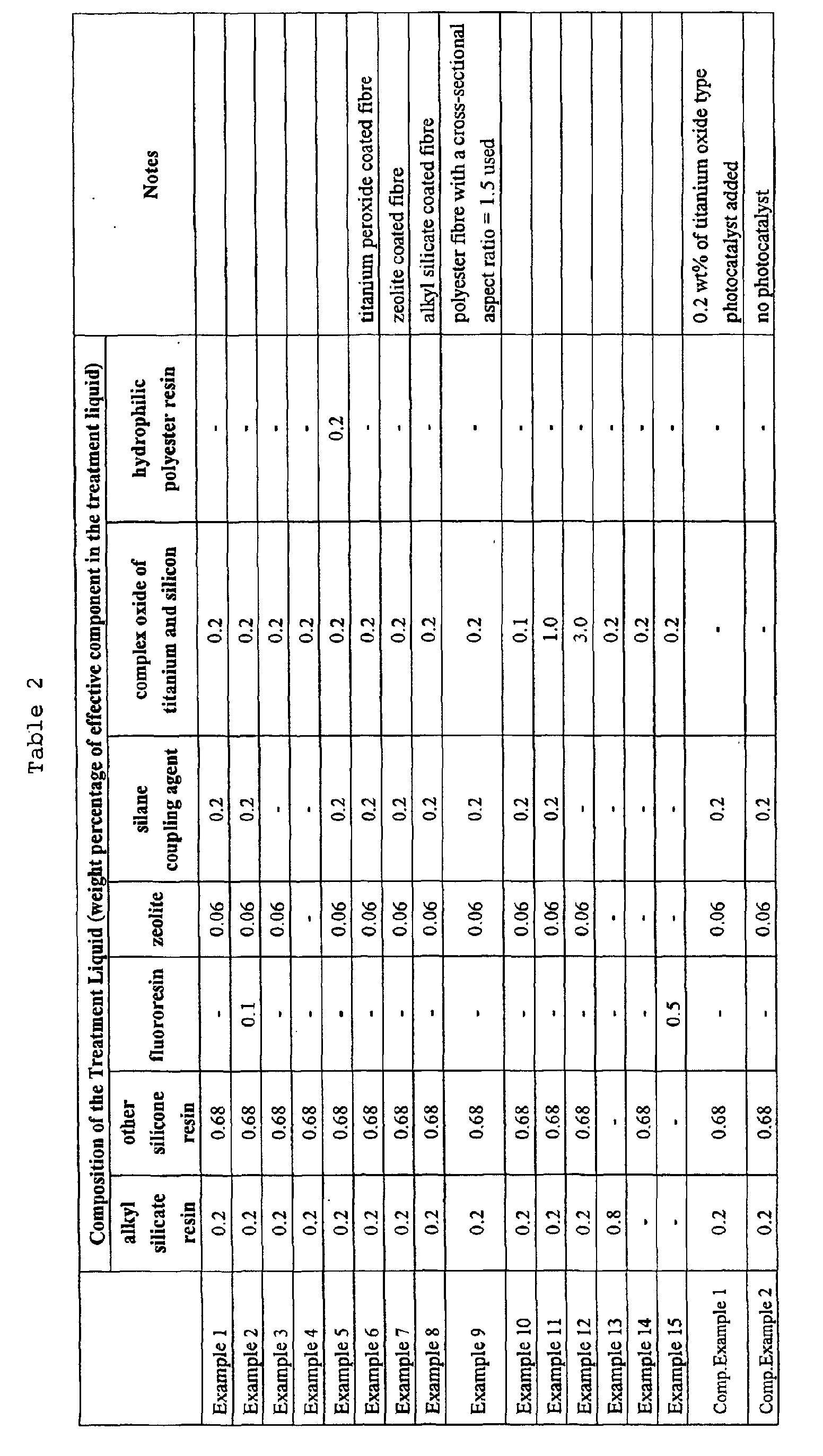
- Tables 2 and 3 show the conditions and results for the various Examples and Comparative Examples. It will be clear from these tables that, when contrasted with the Comparative Examples, Examples 1 to 9 show a good balance of deodorant properties at an outstanding level. Furthermore, Examples 1, 2 and 5 are outstanding in their deodorant, antibacterial and antisoiling properties and in their durability. Of these, when Example 1 and Example 9 are compared, it can be seen that Example 1, which has the greater cross-sectional aspect ratio, has more outstanding deodorant, antibacterial and antisoiling properties, so the effect of the difference in cross-sectional aspect ratio is apparent. Moreover, it is clear that Example 5 is outstanding in its water absorption when compared to Example 1 and Comparative Example 1. The results are shown in the table below
Landscapes
- Engineering & Computer Science (AREA)
- Textile Engineering (AREA)
- Life Sciences & Earth Sciences (AREA)
- Health & Medical Sciences (AREA)
- Chemical & Material Sciences (AREA)
- General Health & Medical Sciences (AREA)
- Chemical Kinetics & Catalysis (AREA)
- Inorganic Chemistry (AREA)
- Agronomy & Crop Science (AREA)
- Dentistry (AREA)
- Wood Science & Technology (AREA)
- Zoology (AREA)
- Environmental Sciences (AREA)
- Plant Pathology (AREA)
- Pest Control & Pesticides (AREA)
- General Chemical & Material Sciences (AREA)
- Public Health (AREA)
- Organic Chemistry (AREA)
- Toxicology (AREA)
- Microbiology (AREA)
- Epidemiology (AREA)
- Animal Behavior & Ethology (AREA)
- Biochemistry (AREA)
- Veterinary Medicine (AREA)
- Chemical Or Physical Treatment Of Fibers (AREA)
- Catalysts (AREA)
- Treatments For Attaching Organic Compounds To Fibrous Goods (AREA)
- Exhaust Gas Treatment By Means Of Catalyst (AREA)
- Artificial Filaments (AREA)
Abstract
Description
| Chemical Name | Weight % | Specification |
| clay | 55.00 | Shiragaki clay pounded in mortar |
| Portland cement | 17.00 | JIS R5210 |
| silicon dioxide | 17.00 | JIS K8885 |
| ferric oxide | 0.50 | reagent CP grade |
| n-decane | 8.75 | reagent EP grade |
| carbon black | 1.75 | Tamagawa carbon black |
| titanium and silicon complex oxide (conc. 20%) | 1.0 wt% |
| (TR-T2, produced by the Daikyo Chemical Co.) | |
| alkyl silicate resin (conc. 20%) | 1.0 wt% |
| (CLG-520, produced by the Kyoeisha Chemical Co.) | |
| silicone resin (conc. 45%) | 1.5 wt% |
| (BY22-826, produced by Dow Corning Toray Silicone Co.) | |
| silane coupling agent (conc. 100%) | 0.2 wt% |
| (TSL-8350, produced by the Toshiba Silicone Co.) | |
| noble metal-supported type zeolite (conc. 20%) | 0.3 wt% |
| (Zeomic AW10N, produced by the Sinanen Zeomic Co.) |
| alkyl silicate resin (conc. 20%) | 20.5 wt% |
| (MS51, produced by the Mitsubishi Chemical Corp.) | |
| methanol | 8.5 wt% |
| pure water | 70.0 wt% |
| sulphuric acid (conc. 20%) | 1.0 wt% |
| titanium oxide photocatalyst (conc. 40%) | 0.5 wt% |
| (STS-21, produced by Ishihara Sangyo Kaisha Ltd) | |
| alkyl silicate resin (conc. 20%) | 1.0 wt% |
| (CLG-520, produced by the Kyoeisha Chemical Co.) | |
| silicone resin (conc. 45%) | 1.5 wt% |
| (BY22-826, produced by Toray-Dow Corning Silicone Co.) | |
| silane coupling agent (conc. 100%) | 0.2 wt% |
| (TSL-8350, produced by the Toshiba Silicone Co.) | |
| noble metal-supported type zeolite (conc. 20%) | 0.3 wt% |
| (Zeomic AW10N, produced by Sinanen Zeomic) |

Claims (14)
- A fibre structure with deodorant or antimicrobial properties which is characterized in that it has, on the fibre surface, a complex oxide comprising titanium and silicon, plus a binder.
- A fibre structure with deodorant or antimicrobial properties according to Claim 1 where the binder chiefly comprises resin selected from alkyl silicate resins, other silicone resins and fluororesins.
- A fibre structure with deodorant or antimicrobial properties according to Claim 1 which also has zeolite on the fibre surface.
- A fibre structure with deodorant or antimicrobial properties according to Claim 1 which also has a coupling agent on the fibre surface.
- A fibre structure with deodorant or antimicrobial properties according to Claim 1 which also has a water-absorbing agent on the fibre surface.
- A fibre structure with deodorant or antimicrobial properties which has on the fibre surface, as an intermediate layer, at least one layer selected from a titanium peroxide particle layer, a zeolite layer and an alkyl silicate layer, and, furthermore, which has a structure according to Claim 1 as an upper layer region.
- A fibre structure with deodorant or antimicrobial properties according to Claim 1 where the complex oxide comprises fine particles of specific surface area 100-300 m2/g.
- A fibre structure with deodorant or antimicrobial properties according to Claim 1 where the complex oxide comprises fine particles of average primary particle diameter in the range 1 to 20 nm.
- A fibre structure with deodorant or antimicrobial properties according to Claim 1 where the amount of affixed complex oxide is 0.03 to 10 wt% in terms of the fibre structure.
- A fibre structure with deodorant or antimicrobial properties according to Claim 9 where the amount of affixed complex oxide is 0.05 to 5 wt% in terms of the fibre structure.
- A fibre structure with deodorant or antimicrobial properties according to Claim 10 where the amount of affixed complex oxide is 0.08 to 3 wt% in terms of the fibre structure.
- A fibre structure with deodorant or antimicrobial properties according to Claim 1 which contains at least 50 wt% polyester fibre.
- A fibre structure with deodorant or antimicrobial properties according to Claim 12 where the polyester fibre contains 0.3 to 5 wt% of inert titanium oxide.
- A fibre structure with deodorant or antimicrobial properties according to Claim 12 where the polyester fibre has a cross-sectional aspect ratio of 1.2 to 2.
Applications Claiming Priority (1)
| Application Number | Priority Date | Filing Date | Title |
|---|---|---|---|
| PCT/JP2000/000371 WO2001055498A1 (en) | 2000-01-26 | 2000-01-26 | Fiber structure having deodorizing or antibacterial property |
Publications (3)
| Publication Number | Publication Date |
|---|---|
| EP1188854A1 true EP1188854A1 (en) | 2002-03-20 |
| EP1188854A4 EP1188854A4 (en) | 2002-08-14 |
| EP1188854B1 EP1188854B1 (en) | 2004-05-26 |
Family
ID=11735617
Family Applications (1)
| Application Number | Title | Priority Date | Filing Date |
|---|---|---|---|
| EP00901893A Expired - Lifetime EP1188854B1 (en) | 2000-01-26 | 2000-01-26 | Fiber structure having deodorizing or antibacterial property |
Country Status (9)
| Country | Link |
|---|---|
| US (1) | US6592858B1 (en) |
| EP (1) | EP1188854B1 (en) |
| KR (1) | KR100648428B1 (en) |
| CN (1) | CN1167844C (en) |
| AT (1) | ATE267907T1 (en) |
| CA (1) | CA2365600A1 (en) |
| DE (1) | DE60011079T2 (en) |
| ES (1) | ES2220391T3 (en) |
| WO (1) | WO2001055498A1 (en) |
Cited By (22)
| Publication number | Priority date | Publication date | Assignee | Title |
|---|---|---|---|---|
| WO2005039655A1 (en) * | 2003-10-16 | 2005-05-06 | Kimberly-Clark Worldwide, Inc. | Method for reducing odor using metal-modified silica particles |
| DE10346387A1 (en) * | 2003-10-07 | 2005-06-09 | Henkel Kgaa | Antimicrobial equipment of bathroom and toilet articles |
| US7141518B2 (en) | 2003-10-16 | 2006-11-28 | Kimberly-Clark Worldwide, Inc. | Durable charged particle coatings and materials |
| US7488520B2 (en) | 2003-10-16 | 2009-02-10 | Kimberly-Clark Worldwide, Inc. | High surface area material blends for odor reduction, articles utilizing such blends and methods of using same |
| FR2923500A1 (en) * | 2007-11-14 | 2009-05-15 | Porcher Ind Sa | FLEXIBLE, FLAME RETARDANT WITH PHOTOCATALYTIC COATING, AND PROCESS FOR PRODUCING THE SAME |
| US7582485B2 (en) | 2003-10-16 | 2009-09-01 | Kimberly-Clark Worldride, Inc. | Method and device for detecting ammonia odors and helicobacter pylori urease infection |
| US7582308B2 (en) | 2002-12-23 | 2009-09-01 | Kimberly-Clark Worldwide, Inc. | Odor control composition |
| US7619131B2 (en) | 2005-12-02 | 2009-11-17 | Kimberly-Clark Worldwide, Inc. | Articles comprising transparent/translucent polymer composition |
| US7655829B2 (en) | 2005-07-29 | 2010-02-02 | Kimberly-Clark Worldwide, Inc. | Absorbent pad with activated carbon ink for odor control |
| US7666410B2 (en) | 2002-12-20 | 2010-02-23 | Kimberly-Clark Worldwide, Inc. | Delivery system for functional compounds |
| US7678367B2 (en) | 2003-10-16 | 2010-03-16 | Kimberly-Clark Worldwide, Inc. | Method for reducing odor using metal-modified particles |
| US7745685B2 (en) | 2005-10-31 | 2010-06-29 | Kimberly-Clark Worldwide, Inc. | Absorbent articles with improved odor control |
| US7754197B2 (en) | 2003-10-16 | 2010-07-13 | Kimberly-Clark Worldwide, Inc. | Method for reducing odor using coordinated polydentate compounds |
| US7794737B2 (en) | 2003-10-16 | 2010-09-14 | Kimberly-Clark Worldwide, Inc. | Odor absorbing extrudates |
| US7816285B2 (en) | 2004-12-23 | 2010-10-19 | Kimberly-Clark Worldwide, Inc. | Patterned application of activated carbon ink |
| US7837663B2 (en) | 2003-10-16 | 2010-11-23 | Kimberly-Clark Worldwide, Inc. | Odor controlling article including a visual indicating device for monitoring odor absorption |
| US7879350B2 (en) | 2003-10-16 | 2011-02-01 | Kimberly-Clark Worldwide, Inc. | Method for reducing odor using colloidal nanoparticles |
| US8168852B2 (en) | 2004-12-23 | 2012-05-01 | Kimberly-Clark Worldwide, Inc. | Activated carbon substrates |
| US8221328B2 (en) | 2003-10-16 | 2012-07-17 | Kimberly-Clark Worldwide, Inc. | Visual indicating device for bad breath |
| WO2015011723A3 (en) * | 2013-07-22 | 2015-04-09 | Reliance Industries Limited | A fiber suitable for packaging and storing plant produce |
| WO2015011725A3 (en) * | 2013-07-22 | 2015-04-09 | Reliance Industries Limited | A fiber suitable for packaging and storing plant produce |
| CN106687631A (en) * | 2014-05-29 | 2017-05-17 | 东丽奥培隆特士株式会社 | Deodorant fabric |
Families Citing this family (15)
| Publication number | Priority date | Publication date | Assignee | Title |
|---|---|---|---|---|
| KR20020072253A (en) * | 2002-03-30 | 2002-09-14 | (주)성호바이오텍 | Multi-Functional Coating Compositions and Textiles Coated with the Same |
| GB2408516A (en) * | 2003-11-28 | 2005-06-01 | Avecia Ltd | Fibres treated with antimicrobial agents |
| CN100507143C (en) * | 2004-04-27 | 2009-07-01 | 可乐丽股份有限公司 | Deodorant suede-tone-leather-like sheet |
| KR100618399B1 (en) * | 2004-10-06 | 2006-08-30 | 주식회사 효성 | Functional processing method of polytrimethylene terephthalate carpet |
| KR20070069165A (en) * | 2004-10-27 | 2007-07-02 | 스미노에오리모노가부시끼가이샤 | Textile fabric with VOC removal |
| JP2008537029A (en) * | 2005-04-21 | 2008-09-11 | シチェム インダストリアーレ ソチエタ ペル アツィオーニ | Method and composition for obtaining an odor-inhibiting textile product, and the textile product thus obtained, i.e. garment |
| US7772141B2 (en) * | 2005-12-05 | 2010-08-10 | Milliken & Company | Coatings for airbag fabrics, coated airbag fabrics, and methods for making the same |
| US20070141319A1 (en) * | 2005-12-21 | 2007-06-21 | Shulong Li | Photocatalytic substrate and process for producing the same |
| WO2008096917A1 (en) * | 2007-02-09 | 2008-08-14 | Kolon Industries, Inc | Reactive antibiotics and antibacterial fiber treated thereby |
| US8079578B2 (en) * | 2007-09-05 | 2011-12-20 | Hgs Aerospace, Inc. | Universal holding fixture |
| US8137957B2 (en) * | 2008-10-22 | 2012-03-20 | Milliken & Company | Non-woven cover for containing and abating odiferous organic emanations |
| CN102389636A (en) * | 2011-08-31 | 2012-03-28 | 吴江兰瑞特纺织品有限公司 | Antibacterial composite fiber fuzz |
| US11788210B1 (en) * | 2018-09-10 | 2023-10-17 | Under Armour, Inc. | Athletic apparel |
| CN109487369A (en) * | 2018-12-19 | 2019-03-19 | 肖晖 | A kind of Khotan jade fiber and preparation method thereof |
| WO2022029298A1 (en) | 2020-08-06 | 2022-02-10 | Sms Group Gmbh | Casting nozzle or casting distributor, assembly and method for heating and/or preheating a casting nozzle |
Family Cites Families (14)
| Publication number | Priority date | Publication date | Assignee | Title |
|---|---|---|---|---|
| JPH0733639B2 (en) | 1990-11-02 | 1995-04-12 | 鹿児島大学長 | Increased amount of silk thread and dyeing method |
| JPH0555184A (en) | 1991-08-27 | 1993-03-05 | Fujitsu Ltd | Cleaning method |
| KR100246595B1 (en) * | 1993-02-04 | 2000-04-01 | 히라이 가쯔히꼬 | Blended composite twisted yarn, its manufacturing method and knitted fabric using the thread |
| JP3022192B2 (en) * | 1994-09-01 | 2000-03-15 | 小松精練株式会社 | Fiber fabric having deodorant, antibacterial and antifouling functions |
| US5492883A (en) | 1994-11-21 | 1996-02-20 | Corning Incorporated | Molecular sieve structures using aqueous emulsions |
| AU692049B2 (en) * | 1995-02-15 | 1998-05-28 | Japan Envirochemicals, Ltd. | Deodorizable fibers and method of producing the same |
| JPH0984860A (en) | 1995-09-27 | 1997-03-31 | Catalysts & Chem Ind Co Ltd | Antibacterial working method for fiber |
| JP3761248B2 (en) * | 1996-06-13 | 2006-03-29 | 小松精練株式会社 | Fiber fabric having deodorant, antibacterial and antifouling functions |
| JPH10292267A (en) | 1997-04-14 | 1998-11-04 | Teijin Ltd | Deodorant polyester fiber structure |
| JPH10292268A (en) | 1997-04-14 | 1998-11-04 | Teijin Ltd | Deodorant polyester fiber structure |
| JP4067177B2 (en) | 1998-05-21 | 2008-03-26 | 小松精練株式会社 | Fiber fabric having deodorant, antibacterial and antifouling functions and method for producing the same |
| JP2000110064A (en) | 1998-07-31 | 2000-04-18 | Toray Ind Inc | Functional fiber structure |
| JP2000192368A (en) | 1998-12-24 | 2000-07-11 | Toray Ind Inc | Fiber structure |
| US6540792B1 (en) | 1999-04-14 | 2003-04-01 | Toray Industries, Inc. | Cellulose fiber-containing structure |
-
2000
- 2000-01-26 WO PCT/JP2000/000371 patent/WO2001055498A1/en not_active Ceased
- 2000-01-26 ES ES00901893T patent/ES2220391T3/en not_active Expired - Lifetime
- 2000-01-26 CN CNB008055807A patent/CN1167844C/en not_active Expired - Fee Related
- 2000-01-26 AT AT00901893T patent/ATE267907T1/en not_active IP Right Cessation
- 2000-01-26 KR KR1020017012289A patent/KR100648428B1/en not_active Expired - Fee Related
- 2000-01-26 US US09/937,423 patent/US6592858B1/en not_active Expired - Fee Related
- 2000-01-26 DE DE60011079T patent/DE60011079T2/en not_active Expired - Fee Related
- 2000-01-26 EP EP00901893A patent/EP1188854B1/en not_active Expired - Lifetime
- 2000-01-26 CA CA002365600A patent/CA2365600A1/en not_active Abandoned
Cited By (32)
| Publication number | Priority date | Publication date | Assignee | Title |
|---|---|---|---|---|
| US7666410B2 (en) | 2002-12-20 | 2010-02-23 | Kimberly-Clark Worldwide, Inc. | Delivery system for functional compounds |
| US7582308B2 (en) | 2002-12-23 | 2009-09-01 | Kimberly-Clark Worldwide, Inc. | Odor control composition |
| DE10346387A1 (en) * | 2003-10-07 | 2005-06-09 | Henkel Kgaa | Antimicrobial equipment of bathroom and toilet articles |
| US8702618B2 (en) | 2003-10-16 | 2014-04-22 | Kimberly-Clark Worldwide, Inc. | Visual indicating device for bad breath |
| US8221328B2 (en) | 2003-10-16 | 2012-07-17 | Kimberly-Clark Worldwide, Inc. | Visual indicating device for bad breath |
| WO2005039655A1 (en) * | 2003-10-16 | 2005-05-06 | Kimberly-Clark Worldwide, Inc. | Method for reducing odor using metal-modified silica particles |
| US7879350B2 (en) | 2003-10-16 | 2011-02-01 | Kimberly-Clark Worldwide, Inc. | Method for reducing odor using colloidal nanoparticles |
| US7582485B2 (en) | 2003-10-16 | 2009-09-01 | Kimberly-Clark Worldride, Inc. | Method and device for detecting ammonia odors and helicobacter pylori urease infection |
| US7438875B2 (en) | 2003-10-16 | 2008-10-21 | Kimberly-Clark Worldwide, Inc. | Method for reducing odor using metal-modified silica particles |
| US8211369B2 (en) | 2003-10-16 | 2012-07-03 | Kimberly-Clark Worldwide, Inc. | High surface area material blends for odor reduction, articles utilizing such blends and methods of using same |
| US8168563B2 (en) | 2003-10-16 | 2012-05-01 | Kimberly-Clark Worldwide, Inc. | Metal-modified silica particles for reducing odor |
| US7141518B2 (en) | 2003-10-16 | 2006-11-28 | Kimberly-Clark Worldwide, Inc. | Durable charged particle coatings and materials |
| US7678367B2 (en) | 2003-10-16 | 2010-03-16 | Kimberly-Clark Worldwide, Inc. | Method for reducing odor using metal-modified particles |
| US7837663B2 (en) | 2003-10-16 | 2010-11-23 | Kimberly-Clark Worldwide, Inc. | Odor controlling article including a visual indicating device for monitoring odor absorption |
| US7754197B2 (en) | 2003-10-16 | 2010-07-13 | Kimberly-Clark Worldwide, Inc. | Method for reducing odor using coordinated polydentate compounds |
| US7794737B2 (en) | 2003-10-16 | 2010-09-14 | Kimberly-Clark Worldwide, Inc. | Odor absorbing extrudates |
| US7488520B2 (en) | 2003-10-16 | 2009-02-10 | Kimberly-Clark Worldwide, Inc. | High surface area material blends for odor reduction, articles utilizing such blends and methods of using same |
| US8168852B2 (en) | 2004-12-23 | 2012-05-01 | Kimberly-Clark Worldwide, Inc. | Activated carbon substrates |
| US7816285B2 (en) | 2004-12-23 | 2010-10-19 | Kimberly-Clark Worldwide, Inc. | Patterned application of activated carbon ink |
| US8287510B2 (en) | 2004-12-23 | 2012-10-16 | Kimberly-Clark Worldwide, Inc. | Patterned application of activated carbon ink |
| US7655829B2 (en) | 2005-07-29 | 2010-02-02 | Kimberly-Clark Worldwide, Inc. | Absorbent pad with activated carbon ink for odor control |
| US9012716B2 (en) | 2005-10-31 | 2015-04-21 | Kimberly-Clark Worldwide, Inc. | Absorbent articles with improved odor control |
| US7745685B2 (en) | 2005-10-31 | 2010-06-29 | Kimberly-Clark Worldwide, Inc. | Absorbent articles with improved odor control |
| US7619131B2 (en) | 2005-12-02 | 2009-11-17 | Kimberly-Clark Worldwide, Inc. | Articles comprising transparent/translucent polymer composition |
| WO2009068833A1 (en) * | 2007-11-14 | 2009-06-04 | Porcher Industries | Flexible fireproof member with photocatalytic coating, use thereof in an inner space, and method for making same |
| FR2923500A1 (en) * | 2007-11-14 | 2009-05-15 | Porcher Ind Sa | FLEXIBLE, FLAME RETARDANT WITH PHOTOCATALYTIC COATING, AND PROCESS FOR PRODUCING THE SAME |
| WO2015011723A3 (en) * | 2013-07-22 | 2015-04-09 | Reliance Industries Limited | A fiber suitable for packaging and storing plant produce |
| WO2015011725A3 (en) * | 2013-07-22 | 2015-04-09 | Reliance Industries Limited | A fiber suitable for packaging and storing plant produce |
| US20160194136A1 (en) * | 2013-07-22 | 2016-07-07 | Reliance Industries Limited | Fiber Suitable For Packaging And Storing Plant Produce |
| US9938658B2 (en) | 2013-07-22 | 2018-04-10 | Reliance Industries Limited | Fiber suitable for packaging and storing plant produce |
| US9944450B2 (en) * | 2013-07-22 | 2018-04-17 | Reliance Industries Limited | Fiber suitable for packaging and storing plant produce |
| CN106687631A (en) * | 2014-05-29 | 2017-05-17 | 东丽奥培隆特士株式会社 | Deodorant fabric |
Also Published As
| Publication number | Publication date |
|---|---|
| CN1167844C (en) | 2004-09-22 |
| CN1345390A (en) | 2002-04-17 |
| WO2001055498A1 (en) | 2001-08-02 |
| DE60011079T2 (en) | 2005-06-16 |
| US6592858B1 (en) | 2003-07-15 |
| ATE267907T1 (en) | 2004-06-15 |
| CA2365600A1 (en) | 2001-08-02 |
| ES2220391T3 (en) | 2004-12-16 |
| EP1188854B1 (en) | 2004-05-26 |
| KR20020003220A (en) | 2002-01-10 |
| EP1188854A4 (en) | 2002-08-14 |
| KR100648428B1 (en) | 2006-11-24 |
| DE60011079D1 (en) | 2004-07-01 |
Similar Documents
| Publication | Publication Date | Title |
|---|---|---|
| EP1188854B1 (en) | Fiber structure having deodorizing or antibacterial property | |
| JP3761248B2 (en) | Fiber fabric having deodorant, antibacterial and antifouling functions | |
| KR20070069165A (en) | Textile fabric with VOC removal | |
| JP2000119958A (en) | Functional fiber structure | |
| JP2002194642A (en) | Paper yarn woven/knitted fabric | |
| JP2006116449A (en) | Photocatalyst fiber and porous photocatalyst fiber derived therefrom | |
| JP3952602B2 (en) | Functional fiber structure | |
| JP2004162245A (en) | Functional rayon fiber and method for producing the same | |
| JP2001181964A (en) | Structural fiber product | |
| JP2008156771A (en) | Textile structure | |
| JP2002263044A (en) | Wiping cloth | |
| JPH0949170A (en) | Antimicrobial textile product and its production | |
| JP2001245781A (en) | Curtains | |
| JP2001254267A (en) | Interior material for vehicle | |
| JP2001254263A (en) | Cellulosic fiber-containing fabric | |
| JP2001247175A (en) | Bags | |
| JP2001288678A (en) | Functional woven fabric and knitted fabric | |
| JP2002069839A (en) | Polyester fiber structure material | |
| JP2004360084A (en) | Fiber structure | |
| JP2004283514A (en) | Wiping cloth and manufacturing method thereof | |
| JP2000110064A (en) | Functional fiber structure | |
| JP2001248077A (en) | Hat material | |
| JP2001254266A (en) | Wiping cloth | |
| JP2001258929A (en) | Liquid absorbing and holding material | |
| JP2001245778A (en) | Carpet or the like |
Legal Events
| Date | Code | Title | Description |
|---|---|---|---|
| PUAI | Public reference made under article 153(3) epc to a published international application that has entered the european phase |
Free format text: ORIGINAL CODE: 0009012 |
|
| 17P | Request for examination filed |
Effective date: 20011015 |
|
| AK | Designated contracting states |
Kind code of ref document: A1 Designated state(s): AT BE CH CY DE DK ES FI FR GB GR IE IT LI LU MC NL PT SE |
|
| A4 | Supplementary search report drawn up and despatched |
Effective date: 20020628 |
|
| AK | Designated contracting states |
Kind code of ref document: A4 Designated state(s): AT BE CH CY DE DK ES FI FR GB GR IE IT LI LU MC NL PT SE |
|
| 17Q | First examination report despatched |
Effective date: 20030127 |
|
| GRAP | Despatch of communication of intention to grant a patent |
Free format text: ORIGINAL CODE: EPIDOSNIGR1 |
|
| GRAS | Grant fee paid |
Free format text: ORIGINAL CODE: EPIDOSNIGR3 |
|
| GRAA | (expected) grant |
Free format text: ORIGINAL CODE: 0009210 |
|
| AK | Designated contracting states |
Kind code of ref document: B1 Designated state(s): AT BE CH CY DE DK ES FI FR GB GR IE IT LI LU MC NL PT SE |
|
| PG25 | Lapsed in a contracting state [announced via postgrant information from national office to epo] |
Ref country code: AT Free format text: LAPSE BECAUSE OF FAILURE TO SUBMIT A TRANSLATION OF THE DESCRIPTION OR TO PAY THE FEE WITHIN THE PRESCRIBED TIME-LIMIT Effective date: 20040526 Ref country code: NL Free format text: LAPSE BECAUSE OF FAILURE TO SUBMIT A TRANSLATION OF THE DESCRIPTION OR TO PAY THE FEE WITHIN THE PRESCRIBED TIME-LIMIT Effective date: 20040526 Ref country code: FI Free format text: LAPSE BECAUSE OF FAILURE TO SUBMIT A TRANSLATION OF THE DESCRIPTION OR TO PAY THE FEE WITHIN THE PRESCRIBED TIME-LIMIT Effective date: 20040526 Ref country code: BE Free format text: LAPSE BECAUSE OF FAILURE TO SUBMIT A TRANSLATION OF THE DESCRIPTION OR TO PAY THE FEE WITHIN THE PRESCRIBED TIME-LIMIT Effective date: 20040526 |
|
| REG | Reference to a national code |
Ref country code: GB Ref legal event code: FG4D |
|
| REG | Reference to a national code |
Ref country code: CH Ref legal event code: EP |
|
| REG | Reference to a national code |
Ref country code: IE Ref legal event code: FG4D |
|
| REF | Corresponds to: |
Ref document number: 60011079 Country of ref document: DE Date of ref document: 20040701 Kind code of ref document: P |
|
| PG25 | Lapsed in a contracting state [announced via postgrant information from national office to epo] |
Ref country code: GR Free format text: LAPSE BECAUSE OF FAILURE TO SUBMIT A TRANSLATION OF THE DESCRIPTION OR TO PAY THE FEE WITHIN THE PRESCRIBED TIME-LIMIT Effective date: 20040826 Ref country code: DK Free format text: LAPSE BECAUSE OF FAILURE TO SUBMIT A TRANSLATION OF THE DESCRIPTION OR TO PAY THE FEE WITHIN THE PRESCRIBED TIME-LIMIT Effective date: 20040826 Ref country code: SE Free format text: LAPSE BECAUSE OF FAILURE TO SUBMIT A TRANSLATION OF THE DESCRIPTION OR TO PAY THE FEE WITHIN THE PRESCRIBED TIME-LIMIT Effective date: 20040826 |
|
| NLV1 | Nl: lapsed or annulled due to failure to fulfill the requirements of art. 29p and 29m of the patents act | ||
| REG | Reference to a national code |
Ref country code: ES Ref legal event code: FG2A Ref document number: 2220391 Country of ref document: ES Kind code of ref document: T3 |
|
| PG25 | Lapsed in a contracting state [announced via postgrant information from national office to epo] |
Ref country code: LU Free format text: LAPSE BECAUSE OF NON-PAYMENT OF DUE FEES Effective date: 20050126 Ref country code: CY Free format text: LAPSE BECAUSE OF FAILURE TO SUBMIT A TRANSLATION OF THE DESCRIPTION OR TO PAY THE FEE WITHIN THE PRESCRIBED TIME-LIMIT Effective date: 20050126 Ref country code: IE Free format text: LAPSE BECAUSE OF NON-PAYMENT OF DUE FEES Effective date: 20050126 |
|
| PG25 | Lapsed in a contracting state [announced via postgrant information from national office to epo] |
Ref country code: MC Free format text: LAPSE BECAUSE OF NON-PAYMENT OF DUE FEES Effective date: 20050131 |
|
| ET | Fr: translation filed | ||
| PLBE | No opposition filed within time limit |
Free format text: ORIGINAL CODE: 0009261 |
|
| STAA | Information on the status of an ep patent application or granted ep patent |
Free format text: STATUS: NO OPPOSITION FILED WITHIN TIME LIMIT |
|
| 26N | No opposition filed |
Effective date: 20050301 |
|
| REG | Reference to a national code |
Ref country code: IE Ref legal event code: MM4A |
|
| PG25 | Lapsed in a contracting state [announced via postgrant information from national office to epo] |
Ref country code: PT Free format text: LAPSE BECAUSE OF NON-PAYMENT OF DUE FEES Effective date: 20041026 |
|
| PGFP | Annual fee paid to national office [announced via postgrant information from national office to epo] |
Ref country code: ES Payment date: 20090203 Year of fee payment: 10 |
|
| PGFP | Annual fee paid to national office [announced via postgrant information from national office to epo] |
Ref country code: DE Payment date: 20090123 Year of fee payment: 10 |
|
| PGFP | Annual fee paid to national office [announced via postgrant information from national office to epo] |
Ref country code: CH Payment date: 20090126 Year of fee payment: 10 Ref country code: GB Payment date: 20090121 Year of fee payment: 10 |
|
| PGFP | Annual fee paid to national office [announced via postgrant information from national office to epo] |
Ref country code: IT Payment date: 20090129 Year of fee payment: 10 |
|
| PGFP | Annual fee paid to national office [announced via postgrant information from national office to epo] |
Ref country code: FR Payment date: 20090113 Year of fee payment: 10 |
|
| REG | Reference to a national code |
Ref country code: CH Ref legal event code: PL |
|
| GBPC | Gb: european patent ceased through non-payment of renewal fee |
Effective date: 20100126 |
|
| REG | Reference to a national code |
Ref country code: FR Ref legal event code: ST Effective date: 20100930 |
|
| PG25 | Lapsed in a contracting state [announced via postgrant information from national office to epo] |
Ref country code: LI Free format text: LAPSE BECAUSE OF NON-PAYMENT OF DUE FEES Effective date: 20100131 Ref country code: CH Free format text: LAPSE BECAUSE OF NON-PAYMENT OF DUE FEES Effective date: 20100131 Ref country code: FR Free format text: LAPSE BECAUSE OF NON-PAYMENT OF DUE FEES Effective date: 20100201 |
|
| PG25 | Lapsed in a contracting state [announced via postgrant information from national office to epo] |
Ref country code: DE Free format text: LAPSE BECAUSE OF NON-PAYMENT OF DUE FEES Effective date: 20100803 |
|
| PG25 | Lapsed in a contracting state [announced via postgrant information from national office to epo] |
Ref country code: GB Free format text: LAPSE BECAUSE OF NON-PAYMENT OF DUE FEES Effective date: 20100126 |
|
| PG25 | Lapsed in a contracting state [announced via postgrant information from national office to epo] |
Ref country code: IT Free format text: LAPSE BECAUSE OF NON-PAYMENT OF DUE FEES Effective date: 20100126 |
|
| REG | Reference to a national code |
Ref country code: ES Ref legal event code: FD2A Effective date: 20110411 |
|
| PG25 | Lapsed in a contracting state [announced via postgrant information from national office to epo] |
Ref country code: ES Free format text: LAPSE BECAUSE OF NON-PAYMENT OF DUE FEES Effective date: 20110329 |
|
| PG25 | Lapsed in a contracting state [announced via postgrant information from national office to epo] |
Ref country code: ES Free format text: LAPSE BECAUSE OF NON-PAYMENT OF DUE FEES Effective date: 20100127 |