EP1183340B1 - Subtilase enzymes of the i-s1 and i-s2 sub-groups having at least one additional amino acid residue between positions 126 and 127 - Google Patents
Subtilase enzymes of the i-s1 and i-s2 sub-groups having at least one additional amino acid residue between positions 126 and 127 Download PDFInfo
- Publication number
- EP1183340B1 EP1183340B1 EP00925090A EP00925090A EP1183340B1 EP 1183340 B1 EP1183340 B1 EP 1183340B1 EP 00925090 A EP00925090 A EP 00925090A EP 00925090 A EP00925090 A EP 00925090A EP 1183340 B1 EP1183340 B1 EP 1183340B1
- Authority
- EP
- European Patent Office
- Prior art keywords
- subtilase
- enzyme
- amino acid
- variant
- group
- Prior art date
- Legal status (The legal status is an assumption and is not a legal conclusion. Google has not performed a legal analysis and makes no representation as to the accuracy of the status listed.)
- Revoked
Links
- 101710135785 Subtilisin-like protease Proteins 0.000 title claims abstract description 176
- 102000004190 Enzymes Human genes 0.000 title claims abstract description 115
- 108090000790 Enzymes Proteins 0.000 title claims abstract description 115
- 125000000539 amino acid group Chemical group 0.000 title abstract description 45
- 239000003599 detergent Substances 0.000 claims abstract description 59
- 229940088598 enzyme Drugs 0.000 claims description 109
- 239000000203 mixture Substances 0.000 claims description 48
- 108091005804 Peptidases Proteins 0.000 claims description 42
- 239000004365 Protease Substances 0.000 claims description 39
- 238000012986 modification Methods 0.000 claims description 36
- 230000004048 modification Effects 0.000 claims description 35
- 238000003780 insertion Methods 0.000 claims description 33
- 230000037431 insertion Effects 0.000 claims description 31
- 108091028043 Nucleic acid sequence Proteins 0.000 claims description 25
- 238000006467 substitution reaction Methods 0.000 claims description 15
- 238000012217 deletion Methods 0.000 claims description 12
- 230000037430 deletion Effects 0.000 claims description 12
- 108090001060 Lipase Proteins 0.000 claims description 11
- 102000004882 Lipase Human genes 0.000 claims description 11
- 239000013604 expression vector Substances 0.000 claims description 11
- 241000193830 Bacillus <bacterium> Species 0.000 claims description 10
- 239000004367 Lipase Substances 0.000 claims description 10
- 235000019421 lipase Nutrition 0.000 claims description 10
- 230000000813 microbial effect Effects 0.000 claims description 10
- 108010065511 Amylases Proteins 0.000 claims description 8
- 102000013142 Amylases Human genes 0.000 claims description 8
- 235000019418 amylase Nutrition 0.000 claims description 8
- 102200089422 rs2634041 Human genes 0.000 claims description 8
- 102200025035 rs786203989 Human genes 0.000 claims description 8
- 238000004519 manufacturing process Methods 0.000 claims description 7
- 241000193422 Bacillus lentus Species 0.000 claims description 6
- 102220468791 Inositol 1,4,5-trisphosphate receptor type 2_Y167A_mutation Human genes 0.000 claims description 6
- 102220350531 c.80A>G Human genes 0.000 claims description 6
- 102220113656 rs886039149 Human genes 0.000 claims description 6
- 241000894006 Bacteria Species 0.000 claims description 5
- 241000233866 Fungi Species 0.000 claims description 4
- 102220475366 Iduronate 2-sulfatase_S87N_mutation Human genes 0.000 claims description 4
- 102000004316 Oxidoreductases Human genes 0.000 claims description 4
- 108090000854 Oxidoreductases Proteins 0.000 claims description 4
- 230000035772 mutation Effects 0.000 claims description 4
- 108010059892 Cellulase Proteins 0.000 claims description 3
- 229940106157 cellulase Drugs 0.000 claims description 3
- 102220053671 rs373954823 Human genes 0.000 claims description 3
- 230000028327 secretion Effects 0.000 claims description 3
- 239000004382 Amylase Substances 0.000 claims description 2
- 102220489310 Melanoma-associated antigen 11_S57P_mutation Human genes 0.000 claims description 2
- 240000004808 Saccharomyces cerevisiae Species 0.000 claims description 2
- 102220613710 Semaphorin-3D_G97N_mutation Human genes 0.000 claims description 2
- 108010005400 cutinase Proteins 0.000 claims description 2
- 102220291414 rs200480915 Human genes 0.000 claims description 2
- 241000228212 Aspergillus Species 0.000 claims 1
- 102100037486 Reverse transcriptase/ribonuclease H Human genes 0.000 claims 1
- 102000035195 Peptidases Human genes 0.000 description 42
- 108090000623 proteins and genes Proteins 0.000 description 41
- 235000001014 amino acid Nutrition 0.000 description 35
- 210000004027 cell Anatomy 0.000 description 33
- 102000005158 Subtilisins Human genes 0.000 description 32
- 108010056079 Subtilisins Proteins 0.000 description 32
- 108010020132 microbial serine proteinases Proteins 0.000 description 32
- 150000001413 amino acids Chemical class 0.000 description 30
- 229940024606 amino acid Drugs 0.000 description 29
- 235000018102 proteins Nutrition 0.000 description 26
- DHMQDGOQFOQNFH-UHFFFAOYSA-N Glycine Chemical compound NCC(O)=O DHMQDGOQFOQNFH-UHFFFAOYSA-N 0.000 description 25
- 102000004169 proteins and genes Human genes 0.000 description 25
- 238000000034 method Methods 0.000 description 22
- 235000019419 proteases Nutrition 0.000 description 22
- 108020004414 DNA Proteins 0.000 description 19
- -1 ammonium sulfate Chemical class 0.000 description 16
- 125000003275 alpha amino acid group Chemical group 0.000 description 14
- 108090000787 Subtilisin Proteins 0.000 description 13
- 239000013598 vector Substances 0.000 description 13
- 235000014469 Bacillus subtilis Nutrition 0.000 description 12
- 239000004471 Glycine Substances 0.000 description 12
- 108010084185 Cellulases Proteins 0.000 description 11
- 102000005575 Cellulases Human genes 0.000 description 11
- 239000002609 medium Substances 0.000 description 11
- MTCFGRXMJLQNBG-REOHCLBHSA-N (2S)-2-Amino-3-hydroxypropansäure Chemical compound OC[C@H](N)C(O)=O MTCFGRXMJLQNBG-REOHCLBHSA-N 0.000 description 10
- 239000000047 product Substances 0.000 description 10
- 102000012479 Serine Proteases Human genes 0.000 description 9
- 108010022999 Serine Proteases Proteins 0.000 description 9
- 239000000654 additive Substances 0.000 description 9
- 230000001580 bacterial effect Effects 0.000 description 9
- 238000004140 cleaning Methods 0.000 description 9
- 239000000463 material Substances 0.000 description 9
- AYFVYJQAPQTCCC-GBXIJSLDSA-N L-threonine Chemical compound C[C@@H](O)[C@H](N)C(O)=O AYFVYJQAPQTCCC-GBXIJSLDSA-N 0.000 description 8
- 230000000996 additive effect Effects 0.000 description 8
- 239000000758 substrate Substances 0.000 description 8
- 239000008187 granular material Substances 0.000 description 7
- 239000012535 impurity Substances 0.000 description 7
- 230000003248 secreting effect Effects 0.000 description 7
- 238000012360 testing method Methods 0.000 description 7
- WHUUTDBJXJRKMK-UHFFFAOYSA-N Glutamic acid Natural products OC(=O)C(N)CCC(O)=O WHUUTDBJXJRKMK-UHFFFAOYSA-N 0.000 description 6
- 102000003992 Peroxidases Human genes 0.000 description 6
- DNIAPMSPPWPWGF-UHFFFAOYSA-N Propylene glycol Chemical compound CC(O)CO DNIAPMSPPWPWGF-UHFFFAOYSA-N 0.000 description 6
- 108010076504 Protein Sorting Signals Proteins 0.000 description 6
- FAPWRFPIFSIZLT-UHFFFAOYSA-M Sodium chloride Chemical compound [Na+].[Cl-] FAPWRFPIFSIZLT-UHFFFAOYSA-M 0.000 description 6
- 229940025131 amylases Drugs 0.000 description 6
- KGBXLFKZBHKPEV-UHFFFAOYSA-N boric acid Chemical compound OB(O)O KGBXLFKZBHKPEV-UHFFFAOYSA-N 0.000 description 6
- 230000000694 effects Effects 0.000 description 6
- 239000007788 liquid Substances 0.000 description 6
- 108090000765 processed proteins & peptides Proteins 0.000 description 6
- 238000000746 purification Methods 0.000 description 6
- 102220222656 rs1060502796 Human genes 0.000 description 6
- 102220466243 Acyl-coenzyme A thioesterase MBLAC2_R170A_mutation Human genes 0.000 description 5
- 241000588724 Escherichia coli Species 0.000 description 5
- 125000000998 L-alanino group Chemical group [H]N([*])[C@](C([H])([H])[H])([H])C(=O)O[H] 0.000 description 5
- KDXKERNSBIXSRK-UHFFFAOYSA-N Lysine Natural products NCCCCC(N)C(O)=O KDXKERNSBIXSRK-UHFFFAOYSA-N 0.000 description 5
- 108700020962 Peroxidase Proteins 0.000 description 5
- MTCFGRXMJLQNBG-UHFFFAOYSA-N Serine Natural products OCC(N)C(O)=O MTCFGRXMJLQNBG-UHFFFAOYSA-N 0.000 description 5
- 239000004327 boric acid Substances 0.000 description 5
- 235000014113 dietary fatty acids Nutrition 0.000 description 5
- 229930195729 fatty acid Natural products 0.000 description 5
- 239000000194 fatty acid Substances 0.000 description 5
- 238000000855 fermentation Methods 0.000 description 5
- 230000004151 fermentation Effects 0.000 description 5
- 230000002538 fungal effect Effects 0.000 description 5
- 235000013922 glutamic acid Nutrition 0.000 description 5
- 239000004220 glutamic acid Substances 0.000 description 5
- 125000003630 glycyl group Chemical group [H]N([H])C([H])([H])C(*)=O 0.000 description 5
- 239000013612 plasmid Substances 0.000 description 5
- 229920001184 polypeptide Polymers 0.000 description 5
- 102000004196 processed proteins & peptides Human genes 0.000 description 5
- 102220052102 rs35524245 Human genes 0.000 description 5
- 102220087235 rs864622622 Human genes 0.000 description 5
- 102220281548 rs898765598 Human genes 0.000 description 5
- 230000009466 transformation Effects 0.000 description 5
- CKLJMWTZIZZHCS-REOHCLBHSA-N L-aspartic acid Chemical compound OC(=O)[C@@H](N)CC(O)=O CKLJMWTZIZZHCS-REOHCLBHSA-N 0.000 description 4
- WHUUTDBJXJRKMK-VKHMYHEASA-N L-glutamic acid Chemical compound OC(=O)[C@@H](N)CCC(O)=O WHUUTDBJXJRKMK-VKHMYHEASA-N 0.000 description 4
- ROHFNLRQFUQHCH-YFKPBYRVSA-N L-leucine Chemical compound CC(C)C[C@H](N)C(O)=O ROHFNLRQFUQHCH-YFKPBYRVSA-N 0.000 description 4
- 238000010367 cloning Methods 0.000 description 4
- 230000001747 exhibiting effect Effects 0.000 description 4
- 150000004665 fatty acids Chemical class 0.000 description 4
- 238000009472 formulation Methods 0.000 description 4
- 239000012634 fragment Substances 0.000 description 4
- 238000006460 hydrolysis reaction Methods 0.000 description 4
- JVTAAEKCZFNVCJ-UHFFFAOYSA-N lactic acid Chemical compound CC(O)C(O)=O JVTAAEKCZFNVCJ-UHFFFAOYSA-N 0.000 description 4
- 231100000219 mutagenic Toxicity 0.000 description 4
- 230000003505 mutagenic effect Effects 0.000 description 4
- 230000000717 retained effect Effects 0.000 description 4
- 102220343127 rs778638155 Human genes 0.000 description 4
- 238000002741 site-directed mutagenesis Methods 0.000 description 4
- 238000010561 standard procedure Methods 0.000 description 4
- OUYCCCASQSFEME-UHFFFAOYSA-N tyrosine Natural products OC(=O)C(N)CC1=CC=C(O)C=C1 OUYCCCASQSFEME-UHFFFAOYSA-N 0.000 description 4
- BTUDGPVTCYNYLK-UHFFFAOYSA-N 2,2-dimethylglutaric acid Chemical compound OC(=O)C(C)(C)CCC(O)=O BTUDGPVTCYNYLK-UHFFFAOYSA-N 0.000 description 3
- QTBSBXVTEAMEQO-UHFFFAOYSA-N Acetic acid Chemical compound CC(O)=O QTBSBXVTEAMEQO-UHFFFAOYSA-N 0.000 description 3
- 239000004475 Arginine Substances 0.000 description 3
- 241000194108 Bacillus licheniformis Species 0.000 description 3
- 108010001478 Bacitracin Proteins 0.000 description 3
- 108091005658 Basic proteases Proteins 0.000 description 3
- UXVMQQNJUSDDNG-UHFFFAOYSA-L Calcium chloride Chemical compound [Cl-].[Cl-].[Ca+2] UXVMQQNJUSDDNG-UHFFFAOYSA-L 0.000 description 3
- LFQSCWFLJHTTHZ-UHFFFAOYSA-N Ethanol Chemical compound CCO LFQSCWFLJHTTHZ-UHFFFAOYSA-N 0.000 description 3
- 241000192125 Firmicutes Species 0.000 description 3
- 241000193385 Geobacillus stearothermophilus Species 0.000 description 3
- PEDCQBHIVMGVHV-UHFFFAOYSA-N Glycerine Chemical compound OCC(O)CO PEDCQBHIVMGVHV-UHFFFAOYSA-N 0.000 description 3
- KFZMGEQAYNKOFK-UHFFFAOYSA-N Isopropanol Chemical compound CC(C)O KFZMGEQAYNKOFK-UHFFFAOYSA-N 0.000 description 3
- QNAYBMKLOCPYGJ-REOHCLBHSA-N L-alanine Chemical compound C[C@H](N)C(O)=O QNAYBMKLOCPYGJ-REOHCLBHSA-N 0.000 description 3
- DCXYFEDJOCDNAF-REOHCLBHSA-N L-asparagine Chemical compound OC(=O)[C@@H](N)CC(N)=O DCXYFEDJOCDNAF-REOHCLBHSA-N 0.000 description 3
- AGPKZVBTJJNPAG-WHFBIAKZSA-N L-isoleucine Chemical compound CC[C@H](C)[C@H](N)C(O)=O AGPKZVBTJJNPAG-WHFBIAKZSA-N 0.000 description 3
- COLNVLDHVKWLRT-QMMMGPOBSA-N L-phenylalanine Chemical compound OC(=O)[C@@H](N)CC1=CC=CC=C1 COLNVLDHVKWLRT-QMMMGPOBSA-N 0.000 description 3
- OUYCCCASQSFEME-QMMMGPOBSA-N L-tyrosine Chemical compound OC(=O)[C@@H](N)CC1=CC=C(O)C=C1 OUYCCCASQSFEME-QMMMGPOBSA-N 0.000 description 3
- ROHFNLRQFUQHCH-UHFFFAOYSA-N Leucine Natural products CC(C)CC(N)C(O)=O ROHFNLRQFUQHCH-UHFFFAOYSA-N 0.000 description 3
- 239000004472 Lysine Substances 0.000 description 3
- AYFVYJQAPQTCCC-UHFFFAOYSA-N Threonine Natural products CC(O)C(N)C(O)=O AYFVYJQAPQTCCC-UHFFFAOYSA-N 0.000 description 3
- 239000004473 Threonine Substances 0.000 description 3
- 239000002253 acid Substances 0.000 description 3
- 235000004279 alanine Nutrition 0.000 description 3
- ODKSFYDXXFIFQN-UHFFFAOYSA-N arginine Natural products OC(=O)C(N)CCCNC(N)=N ODKSFYDXXFIFQN-UHFFFAOYSA-N 0.000 description 3
- 235000003704 aspartic acid Nutrition 0.000 description 3
- 238000003556 assay Methods 0.000 description 3
- 229960003071 bacitracin Drugs 0.000 description 3
- 229930184125 bacitracin Natural products 0.000 description 3
- CLKOFPXJLQSYAH-ABRJDSQDSA-N bacitracin A Chemical compound C1SC([C@@H](N)[C@@H](C)CC)=N[C@@H]1C(=O)N[C@@H](CC(C)C)C(=O)N[C@H](CCC(O)=O)C(=O)N[C@@H]([C@@H](C)CC)C(=O)N[C@@H]1C(=O)N[C@H](CCCN)C(=O)N[C@@H]([C@@H](C)CC)C(=O)N[C@H](CC=2C=CC=CC=2)C(=O)N[C@@H](CC=2N=CNC=2)C(=O)N[C@H](CC(O)=O)C(=O)N[C@@H](CC(N)=O)C(=O)NCCCC1 CLKOFPXJLQSYAH-ABRJDSQDSA-N 0.000 description 3
- OQFSQFPPLPISGP-UHFFFAOYSA-N beta-carboxyaspartic acid Natural products OC(=O)C(N)C(C(O)=O)C(O)=O OQFSQFPPLPISGP-UHFFFAOYSA-N 0.000 description 3
- 239000000872 buffer Substances 0.000 description 3
- 239000001110 calcium chloride Substances 0.000 description 3
- 229910001628 calcium chloride Inorganic materials 0.000 description 3
- 230000008859 change Effects 0.000 description 3
- 239000003795 chemical substances by application Substances 0.000 description 3
- 229960005091 chloramphenicol Drugs 0.000 description 3
- WIIZWVCIJKGZOK-RKDXNWHRSA-N chloramphenicol Chemical compound ClC(Cl)C(=O)N[C@H](CO)[C@H](O)C1=CC=C([N+]([O-])=O)C=C1 WIIZWVCIJKGZOK-RKDXNWHRSA-N 0.000 description 3
- 238000010276 construction Methods 0.000 description 3
- 230000002255 enzymatic effect Effects 0.000 description 3
- 230000006872 improvement Effects 0.000 description 3
- 244000005700 microbiome Species 0.000 description 3
- 238000010369 molecular cloning Methods 0.000 description 3
- 210000001322 periplasm Anatomy 0.000 description 3
- 229920001223 polyethylene glycol Polymers 0.000 description 3
- 230000002797 proteolythic effect Effects 0.000 description 3
- 238000002708 random mutagenesis Methods 0.000 description 3
- 230000010076 replication Effects 0.000 description 3
- 125000003607 serino group Chemical class [H]N([H])[C@]([H])(C(=O)[*])C(O[H])([H])[H] 0.000 description 3
- 239000013605 shuttle vector Substances 0.000 description 3
- 239000011780 sodium chloride Substances 0.000 description 3
- 239000004753 textile Substances 0.000 description 3
- 238000005406 washing Methods 0.000 description 3
- 210000002268 wool Anatomy 0.000 description 3
- UHPMCKVQTMMPCG-UHFFFAOYSA-N 5,8-dihydroxy-2-methoxy-6-methyl-7-(2-oxopropyl)naphthalene-1,4-dione Chemical compound CC1=C(CC(C)=O)C(O)=C2C(=O)C(OC)=CC(=O)C2=C1O UHPMCKVQTMMPCG-UHFFFAOYSA-N 0.000 description 2
- 229920002126 Acrylic acid copolymer Polymers 0.000 description 2
- DCXYFEDJOCDNAF-UHFFFAOYSA-N Asparagine Natural products OC(=O)C(N)CC(N)=O DCXYFEDJOCDNAF-UHFFFAOYSA-N 0.000 description 2
- 241000194103 Bacillus pumilus Species 0.000 description 2
- 108010076119 Caseins Proteins 0.000 description 2
- 102000011632 Caseins Human genes 0.000 description 2
- 241000196324 Embryophyta Species 0.000 description 2
- 102000004533 Endonucleases Human genes 0.000 description 2
- 108010042407 Endonucleases Proteins 0.000 description 2
- ULGZDMOVFRHVEP-RWJQBGPGSA-N Erythromycin Chemical compound O([C@@H]1[C@@H](C)C(=O)O[C@@H]([C@@]([C@H](O)[C@@H](C)C(=O)[C@H](C)C[C@@](C)(O)[C@H](O[C@H]2[C@@H]([C@H](C[C@@H](C)O2)N(C)C)O)[C@H]1C)(C)O)CC)[C@H]1C[C@@](C)(OC)[C@@H](O)[C@H](C)O1 ULGZDMOVFRHVEP-RWJQBGPGSA-N 0.000 description 2
- 241001522878 Escherichia coli B Species 0.000 description 2
- IAYPIBMASNFSPL-UHFFFAOYSA-N Ethylene oxide Chemical group C1CO1 IAYPIBMASNFSPL-UHFFFAOYSA-N 0.000 description 2
- 241000223218 Fusarium Species 0.000 description 2
- 241000223198 Humicola Species 0.000 description 2
- 241001480714 Humicola insolens Species 0.000 description 2
- 102100027612 Kallikrein-11 Human genes 0.000 description 2
- ONIBWKKTOPOVIA-BYPYZUCNSA-N L-Proline Chemical compound OC(=O)[C@@H]1CCCN1 ONIBWKKTOPOVIA-BYPYZUCNSA-N 0.000 description 2
- 108010049190 N,N-dimethylcasein Proteins 0.000 description 2
- 108091034117 Oligonucleotide Proteins 0.000 description 2
- ONIBWKKTOPOVIA-UHFFFAOYSA-N Proline Natural products OC(=O)C1CCCN1 ONIBWKKTOPOVIA-UHFFFAOYSA-N 0.000 description 2
- 241000589516 Pseudomonas Species 0.000 description 2
- 229920005654 Sephadex Polymers 0.000 description 2
- 239000012507 Sephadex™ Substances 0.000 description 2
- 229920002684 Sepharose Polymers 0.000 description 2
- UIIMBOGNXHQVGW-UHFFFAOYSA-M Sodium bicarbonate Chemical compound [Na+].OC([O-])=O UIIMBOGNXHQVGW-UHFFFAOYSA-M 0.000 description 2
- 241000187747 Streptomyces Species 0.000 description 2
- 241000223258 Thermomyces lanuginosus Species 0.000 description 2
- 101710152431 Trypsin-like protease Proteins 0.000 description 2
- QIVBCDIJIAJPQS-UHFFFAOYSA-N Tryptophan Natural products C1=CC=C2C(CC(N)C(O)=O)=CNC2=C1 QIVBCDIJIAJPQS-UHFFFAOYSA-N 0.000 description 2
- ISAKRJDGNUQOIC-UHFFFAOYSA-N Uracil Chemical compound O=C1C=CNC(=O)N1 ISAKRJDGNUQOIC-UHFFFAOYSA-N 0.000 description 2
- KZSNJWFQEVHDMF-UHFFFAOYSA-N Valine Chemical compound CC(C)C(N)C(O)=O KZSNJWFQEVHDMF-UHFFFAOYSA-N 0.000 description 2
- 108090000637 alpha-Amylases Proteins 0.000 description 2
- 102000004139 alpha-Amylases Human genes 0.000 description 2
- 150000001408 amides Chemical class 0.000 description 2
- 235000009582 asparagine Nutrition 0.000 description 2
- 229960001230 asparagine Drugs 0.000 description 2
- 238000004061 bleaching Methods 0.000 description 2
- 238000006243 chemical reaction Methods 0.000 description 2
- 239000011248 coating agent Substances 0.000 description 2
- 238000000576 coating method Methods 0.000 description 2
- 210000000805 cytoplasm Anatomy 0.000 description 2
- OPTASPLRGRRNAP-UHFFFAOYSA-N cytosine Chemical compound NC=1C=CNC(=O)N=1 OPTASPLRGRRNAP-UHFFFAOYSA-N 0.000 description 2
- 230000029087 digestion Effects 0.000 description 2
- 238000010410 dusting Methods 0.000 description 2
- 238000006911 enzymatic reaction Methods 0.000 description 2
- 238000011156 evaluation Methods 0.000 description 2
- 239000002979 fabric softener Substances 0.000 description 2
- 150000002191 fatty alcohols Chemical class 0.000 description 2
- 239000011521 glass Substances 0.000 description 2
- 125000000291 glutamic acid group Chemical class N[C@@H](CCC(O)=O)C(=O)* 0.000 description 2
- ZDXPYRJPNDTMRX-UHFFFAOYSA-N glutamine Natural products OC(=O)C(N)CCC(N)=O ZDXPYRJPNDTMRX-UHFFFAOYSA-N 0.000 description 2
- UYTPUPDQBNUYGX-UHFFFAOYSA-N guanine Chemical compound O=C1NC(N)=NC2=C1N=CN2 UYTPUPDQBNUYGX-UHFFFAOYSA-N 0.000 description 2
- HNDVDQJCIGZPNO-UHFFFAOYSA-N histidine Natural products OC(=O)C(N)CC1=CN=CN1 HNDVDQJCIGZPNO-UHFFFAOYSA-N 0.000 description 2
- 230000007062 hydrolysis Effects 0.000 description 2
- 230000002209 hydrophobic effect Effects 0.000 description 2
- 239000004615 ingredient Substances 0.000 description 2
- 238000002955 isolation Methods 0.000 description 2
- AGPKZVBTJJNPAG-UHFFFAOYSA-N isoleucine Natural products CCC(C)C(N)C(O)=O AGPKZVBTJJNPAG-UHFFFAOYSA-N 0.000 description 2
- 229960000310 isoleucine Drugs 0.000 description 2
- 239000004310 lactic acid Substances 0.000 description 2
- 235000014655 lactic acid Nutrition 0.000 description 2
- 239000010985 leather Substances 0.000 description 2
- 238000005259 measurement Methods 0.000 description 2
- 229930182817 methionine Natural products 0.000 description 2
- 125000001360 methionine group Chemical group N[C@@H](CCSC)C(=O)* 0.000 description 2
- 229920000847 nonoxynol Polymers 0.000 description 2
- COLNVLDHVKWLRT-UHFFFAOYSA-N phenylalanine Natural products OC(=O)C(N)CC1=CC=CC=C1 COLNVLDHVKWLRT-UHFFFAOYSA-N 0.000 description 2
- 229920005862 polyol Polymers 0.000 description 2
- 150000003077 polyols Chemical class 0.000 description 2
- 230000004044 response Effects 0.000 description 2
- 108091008146 restriction endonucleases Proteins 0.000 description 2
- 150000004760 silicates Chemical class 0.000 description 2
- 239000002002 slurry Substances 0.000 description 2
- 238000002415 sodium dodecyl sulfate polyacrylamide gel electrophoresis Methods 0.000 description 2
- 238000003756 stirring Methods 0.000 description 2
- 150000005846 sugar alcohols Chemical class 0.000 description 2
- 239000004094 surface-active agent Substances 0.000 description 2
- RWQNBRDOKXIBIV-UHFFFAOYSA-N thymine Chemical compound CC1=CNC(=O)NC1=O RWQNBRDOKXIBIV-UHFFFAOYSA-N 0.000 description 2
- 238000013518 transcription Methods 0.000 description 2
- 230000035897 transcription Effects 0.000 description 2
- 125000001493 tyrosinyl group Chemical group [H]OC1=C([H])C([H])=C(C([H])=C1[H])C([H])([H])C([H])(N([H])[H])C(*)=O 0.000 description 2
- XLYOFNOQVPJJNP-UHFFFAOYSA-N water Substances O XLYOFNOQVPJJNP-UHFFFAOYSA-N 0.000 description 2
- VXWBQOJISHAKKM-UHFFFAOYSA-N (4-formylphenyl)boronic acid Chemical compound OB(O)C1=CC=C(C=O)C=C1 VXWBQOJISHAKKM-UHFFFAOYSA-N 0.000 description 1
- 108091032973 (ribonucleotides)n+m Proteins 0.000 description 1
- IEORSVTYLWZQJQ-UHFFFAOYSA-N 2-(2-nonylphenoxy)ethanol Chemical compound CCCCCCCCCC1=CC=CC=C1OCCO IEORSVTYLWZQJQ-UHFFFAOYSA-N 0.000 description 1
- 102220556665 Acetylcholinesterase_G97S_mutation Human genes 0.000 description 1
- 241001019659 Acremonium <Plectosphaerellaceae> Species 0.000 description 1
- 229930024421 Adenine Natural products 0.000 description 1
- GFFGJBXGBJISGV-UHFFFAOYSA-N Adenine Chemical compound NC1=NC=NC2=C1N=CN2 GFFGJBXGBJISGV-UHFFFAOYSA-N 0.000 description 1
- 102220495809 Alkaline ceramidase 3_S99A_mutation Human genes 0.000 description 1
- 101710152845 Arabinogalactan endo-beta-1,4-galactanase Proteins 0.000 description 1
- 241000193744 Bacillus amyloliquefaciens Species 0.000 description 1
- 101000775727 Bacillus amyloliquefaciens Alpha-amylase Proteins 0.000 description 1
- 241000193752 Bacillus circulans Species 0.000 description 1
- 241000193749 Bacillus coagulans Species 0.000 description 1
- 108010029675 Bacillus licheniformis alpha-amylase Proteins 0.000 description 1
- 241000194107 Bacillus megaterium Species 0.000 description 1
- 244000063299 Bacillus subtilis Species 0.000 description 1
- 241000193388 Bacillus thuringiensis Species 0.000 description 1
- 102100032487 Beta-mannosidase Human genes 0.000 description 1
- 241000283690 Bos taurus Species 0.000 description 1
- 241000149420 Bothrometopus brevis Species 0.000 description 1
- 241000589513 Burkholderia cepacia Species 0.000 description 1
- BVKZGUZCCUSVTD-UHFFFAOYSA-L Carbonate Chemical compound [O-]C([O-])=O BVKZGUZCCUSVTD-UHFFFAOYSA-L 0.000 description 1
- 229920002134 Carboxymethyl cellulose Polymers 0.000 description 1
- 108090000317 Chymotrypsin Proteins 0.000 description 1
- KRKNYBCHXYNGOX-UHFFFAOYSA-K Citrate Chemical compound [O-]C(=O)CC(O)(CC([O-])=O)C([O-])=O KRKNYBCHXYNGOX-UHFFFAOYSA-K 0.000 description 1
- 241000222511 Coprinus Species 0.000 description 1
- 244000251987 Coprinus macrorhizus Species 0.000 description 1
- 238000001712 DNA sequencing Methods 0.000 description 1
- 108010083608 Durazym Proteins 0.000 description 1
- KCXVZYZYPLLWCC-UHFFFAOYSA-N EDTA Chemical compound OC(=O)CN(CC(O)=O)CCN(CC(O)=O)CC(O)=O KCXVZYZYPLLWCC-UHFFFAOYSA-N 0.000 description 1
- 101710121765 Endo-1,4-beta-xylanase Proteins 0.000 description 1
- 101710147028 Endo-beta-1,4-galactanase Proteins 0.000 description 1
- 241000701959 Escherichia virus Lambda Species 0.000 description 1
- 241000223221 Fusarium oxysporum Species 0.000 description 1
- 108700007698 Genetic Terminator Regions Proteins 0.000 description 1
- 244000068988 Glycine max Species 0.000 description 1
- 235000010469 Glycine max Nutrition 0.000 description 1
- 240000005979 Hordeum vulgare Species 0.000 description 1
- 235000007340 Hordeum vulgare Nutrition 0.000 description 1
- ODKSFYDXXFIFQN-BYPYZUCNSA-P L-argininium(2+) Chemical compound NC(=[NH2+])NCCC[C@H]([NH3+])C(O)=O ODKSFYDXXFIFQN-BYPYZUCNSA-P 0.000 description 1
- FFEARJCKVFRZRR-BYPYZUCNSA-N L-methionine Chemical compound CSCC[C@H](N)C(O)=O FFEARJCKVFRZRR-BYPYZUCNSA-N 0.000 description 1
- QIVBCDIJIAJPQS-VIFPVBQESA-N L-tryptophane Chemical compound C1=CC=C2C(C[C@H](N)C(O)=O)=CNC2=C1 QIVBCDIJIAJPQS-VIFPVBQESA-N 0.000 description 1
- 108010029541 Laccase Proteins 0.000 description 1
- 108091026898 Leader sequence (mRNA) Proteins 0.000 description 1
- 102000003960 Ligases Human genes 0.000 description 1
- 108090000364 Ligases Proteins 0.000 description 1
- 102000005741 Metalloproteases Human genes 0.000 description 1
- 108010006035 Metalloproteases Proteins 0.000 description 1
- 241001465754 Metazoa Species 0.000 description 1
- QPCDCPDFJACHGM-UHFFFAOYSA-N N,N-bis{2-[bis(carboxymethyl)amino]ethyl}glycine Chemical compound OC(=O)CN(CC(O)=O)CCN(CC(=O)O)CCN(CC(O)=O)CC(O)=O QPCDCPDFJACHGM-UHFFFAOYSA-N 0.000 description 1
- 238000012408 PCR amplification Methods 0.000 description 1
- 241000194109 Paenibacillus lautus Species 0.000 description 1
- 229920003171 Poly (ethylene oxide) Polymers 0.000 description 1
- 229920002504 Poly(2-vinylpyridine-N-oxide) Polymers 0.000 description 1
- 239000002202 Polyethylene glycol Substances 0.000 description 1
- 108010059820 Polygalacturonase Proteins 0.000 description 1
- 102100038946 Proprotein convertase subtilisin/kexin type 6 Human genes 0.000 description 1
- 241000168225 Pseudomonas alcaligenes Species 0.000 description 1
- 241000589540 Pseudomonas fluorescens Species 0.000 description 1
- 241000589630 Pseudomonas pseudoalcaligenes Species 0.000 description 1
- 241000589774 Pseudomonas sp. Species 0.000 description 1
- 241000589614 Pseudomonas stutzeri Species 0.000 description 1
- 241000577556 Pseudomonas wisconsinensis Species 0.000 description 1
- 108020004511 Recombinant DNA Proteins 0.000 description 1
- 229920002472 Starch Polymers 0.000 description 1
- 241000187398 Streptomyces lividans Species 0.000 description 1
- 241001468239 Streptomyces murinus Species 0.000 description 1
- 101710173945 Subtilisin Savinase Proteins 0.000 description 1
- 108700037663 Subtilisin-like proteases Proteins 0.000 description 1
- 108700005078 Synthetic Genes Proteins 0.000 description 1
- BGRWYDHXPHLNKA-UHFFFAOYSA-N Tetraacetylethylenediamine Chemical compound CC(=O)N(C(C)=O)CCN(C(C)=O)C(C)=O BGRWYDHXPHLNKA-UHFFFAOYSA-N 0.000 description 1
- 239000004098 Tetracycline Substances 0.000 description 1
- 241000223257 Thermomyces Species 0.000 description 1
- 241001313536 Thermothelomyces thermophila Species 0.000 description 1
- 241001494489 Thielavia Species 0.000 description 1
- 108091036066 Three prime untranslated region Proteins 0.000 description 1
- 108090000631 Trypsin Proteins 0.000 description 1
- 102000004142 Trypsin Human genes 0.000 description 1
- 108020005202 Viral DNA Proteins 0.000 description 1
- 229910021536 Zeolite Inorganic materials 0.000 description 1
- 238000010521 absorption reaction Methods 0.000 description 1
- 230000002378 acidificating effect Effects 0.000 description 1
- 239000012190 activator Substances 0.000 description 1
- 229960000643 adenine Drugs 0.000 description 1
- 238000001042 affinity chromatography Methods 0.000 description 1
- 108010082503 alkaline elastase YaB Proteins 0.000 description 1
- 150000008051 alkyl sulfates Chemical class 0.000 description 1
- 229940024171 alpha-amylase Drugs 0.000 description 1
- BFNBIHQBYMNNAN-UHFFFAOYSA-N ammonium sulfate Chemical compound N.N.OS(O)(=O)=O BFNBIHQBYMNNAN-UHFFFAOYSA-N 0.000 description 1
- 229910052921 ammonium sulfate Inorganic materials 0.000 description 1
- 235000011130 ammonium sulphate Nutrition 0.000 description 1
- 238000004458 analytical method Methods 0.000 description 1
- 125000000129 anionic group Chemical group 0.000 description 1
- 239000003945 anionic surfactant Substances 0.000 description 1
- 239000003242 anti bacterial agent Substances 0.000 description 1
- 230000000844 anti-bacterial effect Effects 0.000 description 1
- 230000000692 anti-sense effect Effects 0.000 description 1
- 229940088710 antibiotic agent Drugs 0.000 description 1
- 125000000637 arginyl group Chemical group N[C@@H](CCCNC(N)=N)C(=O)* 0.000 description 1
- 125000003118 aryl group Chemical group 0.000 description 1
- 239000003899 bactericide agent Substances 0.000 description 1
- 230000000721 bacterilogical effect Effects 0.000 description 1
- MSWZFWKMSRAUBD-UHFFFAOYSA-N beta-D-galactosamine Natural products NC1C(O)OC(CO)C(O)C1O MSWZFWKMSRAUBD-UHFFFAOYSA-N 0.000 description 1
- 108010055059 beta-Mannosidase Proteins 0.000 description 1
- 239000007844 bleaching agent Substances 0.000 description 1
- 239000007853 buffer solution Substances 0.000 description 1
- 239000011575 calcium Substances 0.000 description 1
- 238000004364 calculation method Methods 0.000 description 1
- 108010089934 carbohydrase Proteins 0.000 description 1
- 229910052799 carbon Inorganic materials 0.000 description 1
- 125000004432 carbon atom Chemical group C* 0.000 description 1
- 239000001768 carboxy methyl cellulose Substances 0.000 description 1
- 235000010948 carboxy methyl cellulose Nutrition 0.000 description 1
- 239000008112 carboxymethyl-cellulose Substances 0.000 description 1
- 239000005018 casein Substances 0.000 description 1
- 235000021240 caseins Nutrition 0.000 description 1
- 230000015556 catabolic process Effects 0.000 description 1
- 238000005341 cation exchange Methods 0.000 description 1
- 125000002091 cationic group Chemical group 0.000 description 1
- 238000005119 centrifugation Methods 0.000 description 1
- 238000007385 chemical modification Methods 0.000 description 1
- 230000002759 chromosomal effect Effects 0.000 description 1
- 210000000349 chromosome Anatomy 0.000 description 1
- 229960002376 chymotrypsin Drugs 0.000 description 1
- 239000002299 complementary DNA Substances 0.000 description 1
- 239000008139 complexing agent Substances 0.000 description 1
- 150000001875 compounds Chemical class 0.000 description 1
- 239000012141 concentrate Substances 0.000 description 1
- 230000021615 conjugation Effects 0.000 description 1
- 238000007796 conventional method Methods 0.000 description 1
- 238000005260 corrosion Methods 0.000 description 1
- 235000018417 cysteine Nutrition 0.000 description 1
- XUJNEKJLAYXESH-UHFFFAOYSA-N cysteine Natural products SCC(N)C(O)=O XUJNEKJLAYXESH-UHFFFAOYSA-N 0.000 description 1
- 229940104302 cytosine Drugs 0.000 description 1
- 230000007547 defect Effects 0.000 description 1
- 238000006731 degradation reaction Methods 0.000 description 1
- 230000035617 depilation Effects 0.000 description 1
- GSPKZYJPUDYKPI-UHFFFAOYSA-N diethoxy sulfate Chemical compound CCOOS(=O)(=O)OOCC GSPKZYJPUDYKPI-UHFFFAOYSA-N 0.000 description 1
- 229940079919 digestives enzyme preparation Drugs 0.000 description 1
- MUCZHBLJLSDCSD-UHFFFAOYSA-N diisopropyl fluorophosphate Chemical compound CC(C)OP(F)(=O)OC(C)C MUCZHBLJLSDCSD-UHFFFAOYSA-N 0.000 description 1
- 238000007865 diluting Methods 0.000 description 1
- HNPSIPDUKPIQMN-UHFFFAOYSA-N dioxosilane;oxo(oxoalumanyloxy)alumane Chemical compound O=[Si]=O.O=[Al]O[Al]=O HNPSIPDUKPIQMN-UHFFFAOYSA-N 0.000 description 1
- 239000001177 diphosphate Substances 0.000 description 1
- XPPKVPWEQAFLFU-UHFFFAOYSA-J diphosphate(4-) Chemical compound [O-]P([O-])(=O)OP([O-])([O-])=O XPPKVPWEQAFLFU-UHFFFAOYSA-J 0.000 description 1
- 235000011180 diphosphates Nutrition 0.000 description 1
- 238000004851 dishwashing Methods 0.000 description 1
- BNIILDVGGAEEIG-UHFFFAOYSA-L disodium hydrogen phosphate Chemical compound [Na+].[Na+].OP([O-])([O-])=O BNIILDVGGAEEIG-UHFFFAOYSA-L 0.000 description 1
- 229910000397 disodium phosphate Inorganic materials 0.000 description 1
- GMSCBRSQMRDRCD-UHFFFAOYSA-N dodecyl 2-methylprop-2-enoate Chemical compound CCCCCCCCCCCCOC(=O)C(C)=C GMSCBRSQMRDRCD-UHFFFAOYSA-N 0.000 description 1
- 239000000975 dye Substances 0.000 description 1
- 238000004453 electron probe microanalysis Methods 0.000 description 1
- 238000004520 electroporation Methods 0.000 description 1
- 229960003276 erythromycin Drugs 0.000 description 1
- 150000002148 esters Chemical group 0.000 description 1
- 210000003527 eukaryotic cell Anatomy 0.000 description 1
- 108010093305 exopolygalacturonase Proteins 0.000 description 1
- 239000013613 expression plasmid Substances 0.000 description 1
- 239000004744 fabric Substances 0.000 description 1
- 235000019387 fatty acid methyl ester Nutrition 0.000 description 1
- 238000011049 filling Methods 0.000 description 1
- 239000000706 filtrate Substances 0.000 description 1
- 238000001914 filtration Methods 0.000 description 1
- 235000013312 flour Nutrition 0.000 description 1
- 239000012530 fluid Substances 0.000 description 1
- 229960005051 fluostigmine Drugs 0.000 description 1
- 239000006260 foam Substances 0.000 description 1
- 201000011243 gastrointestinal stromal tumor Diseases 0.000 description 1
- 230000002068 genetic effect Effects 0.000 description 1
- 238000010353 genetic engineering Methods 0.000 description 1
- 108010061330 glucan 1,4-alpha-maltohydrolase Proteins 0.000 description 1
- 229960002442 glucosamine Drugs 0.000 description 1
- 125000000404 glutamine group Chemical group N[C@@H](CCC(N)=O)C(=O)* 0.000 description 1
- 150000002332 glycine derivatives Chemical class 0.000 description 1
- 239000001963 growth medium Substances 0.000 description 1
- 238000010438 heat treatment Methods 0.000 description 1
- 229910001385 heavy metal Inorganic materials 0.000 description 1
- 239000004009 herbicide Substances 0.000 description 1
- 239000003752 hydrotrope Substances 0.000 description 1
- 150000003949 imides Chemical class 0.000 description 1
- 210000003000 inclusion body Anatomy 0.000 description 1
- 238000011534 incubation Methods 0.000 description 1
- 239000003112 inhibitor Substances 0.000 description 1
- 230000010354 integration Effects 0.000 description 1
- 238000004255 ion exchange chromatography Methods 0.000 description 1
- 229960000318 kanamycin Drugs 0.000 description 1
- SBUJHOSQTJFQJX-NOAMYHISSA-N kanamycin Chemical compound O[C@@H]1[C@@H](O)[C@H](O)[C@@H](CN)O[C@@H]1O[C@H]1[C@H](O)[C@@H](O[C@@H]2[C@@H]([C@@H](N)[C@H](O)[C@@H](CO)O2)O)[C@H](N)C[C@@H]1N SBUJHOSQTJFQJX-NOAMYHISSA-N 0.000 description 1
- 229930027917 kanamycin Natural products 0.000 description 1
- 229930182823 kanamycin A Natural products 0.000 description 1
- 125000003588 lysine group Chemical group [H]N([H])C([H])([H])C([H])([H])C([H])([H])C([H])([H])C([H])(N([H])[H])C(*)=O 0.000 description 1
- 239000003550 marker Substances 0.000 description 1
- 230000007246 mechanism Effects 0.000 description 1
- 239000013028 medium composition Substances 0.000 description 1
- 239000012528 membrane Substances 0.000 description 1
- 108010003855 mesentericopeptidase Proteins 0.000 description 1
- 238000002703 mutagenesis Methods 0.000 description 1
- 231100000350 mutagenesis Toxicity 0.000 description 1
- KJPHTXTWFHVJIG-UHFFFAOYSA-N n-ethyl-2-[(6-methoxypyridin-3-yl)-(2-methylphenyl)sulfonylamino]-n-(pyridin-3-ylmethyl)acetamide Chemical compound C=1C=C(OC)N=CC=1N(S(=O)(=O)C=1C(=CC=CC=1)C)CC(=O)N(CC)CC1=CC=CN=C1 KJPHTXTWFHVJIG-UHFFFAOYSA-N 0.000 description 1
- 230000007935 neutral effect Effects 0.000 description 1
- MGFYIUFZLHCRTH-UHFFFAOYSA-N nitrilotriacetic acid Chemical compound OC(=O)CN(CC(O)=O)CC(O)=O MGFYIUFZLHCRTH-UHFFFAOYSA-N 0.000 description 1
- 239000002736 nonionic surfactant Substances 0.000 description 1
- SNQQPOLDUKLAAF-UHFFFAOYSA-N nonylphenol Chemical class CCCCCCCCCC1=CC=CC=C1O SNQQPOLDUKLAAF-UHFFFAOYSA-N 0.000 description 1
- 102000039446 nucleic acids Human genes 0.000 description 1
- 108020004707 nucleic acids Proteins 0.000 description 1
- 150000007523 nucleic acids Chemical class 0.000 description 1
- 230000003287 optical effect Effects 0.000 description 1
- 239000003960 organic solvent Substances 0.000 description 1
- 230000003204 osmotic effect Effects 0.000 description 1
- 230000003647 oxidation Effects 0.000 description 1
- 238000007254 oxidation reaction Methods 0.000 description 1
- 230000037361 pathway Effects 0.000 description 1
- 229960003330 pentetic acid Drugs 0.000 description 1
- 239000002304 perfume Substances 0.000 description 1
- 108040007629 peroxidase activity proteins Proteins 0.000 description 1
- 150000004965 peroxy acids Chemical class 0.000 description 1
- HXITXNWTGFUOAU-UHFFFAOYSA-N phenylboronic acid Chemical class OB(O)C1=CC=CC=C1 HXITXNWTGFUOAU-UHFFFAOYSA-N 0.000 description 1
- UEZVMMHDMIWARA-UHFFFAOYSA-M phosphonate Chemical compound [O-]P(=O)=O UEZVMMHDMIWARA-UHFFFAOYSA-M 0.000 description 1
- 229920001983 poloxamer Polymers 0.000 description 1
- 229920002006 poly(N-vinylimidazole) polymer Polymers 0.000 description 1
- 229920000196 poly(lauryl methacrylate) Polymers 0.000 description 1
- 229920000058 polyacrylate Polymers 0.000 description 1
- 229920005646 polycarboxylate Polymers 0.000 description 1
- 229920000642 polymer Polymers 0.000 description 1
- 102000040430 polynucleotide Human genes 0.000 description 1
- 108091033319 polynucleotide Proteins 0.000 description 1
- 239000002157 polynucleotide Substances 0.000 description 1
- 229920005996 polystyrene-poly(ethylene-butylene)-polystyrene Polymers 0.000 description 1
- 229920002451 polyvinyl alcohol Polymers 0.000 description 1
- 229920001592 potato starch Polymers 0.000 description 1
- 239000000843 powder Substances 0.000 description 1
- 230000001376 precipitating effect Effects 0.000 description 1
- 238000002203 pretreatment Methods 0.000 description 1
- 235000019833 protease Nutrition 0.000 description 1
- 210000001938 protoplast Anatomy 0.000 description 1
- 230000035484 reaction time Effects 0.000 description 1
- 238000003259 recombinant expression Methods 0.000 description 1
- 230000003362 replicative effect Effects 0.000 description 1
- 238000012552 review Methods 0.000 description 1
- 102200131574 rs11556620 Human genes 0.000 description 1
- 102220036452 rs137882485 Human genes 0.000 description 1
- 102220285757 rs747302288 Human genes 0.000 description 1
- 150000003839 salts Chemical class 0.000 description 1
- 238000012216 screening Methods 0.000 description 1
- 230000035939 shock Effects 0.000 description 1
- 102000030938 small GTPase Human genes 0.000 description 1
- 108060007624 small GTPase Proteins 0.000 description 1
- 239000000344 soap Substances 0.000 description 1
- 229910000030 sodium bicarbonate Inorganic materials 0.000 description 1
- 229940080237 sodium caseinate Drugs 0.000 description 1
- MWNQXXOSWHCCOZ-UHFFFAOYSA-L sodium;oxido carbonate Chemical compound [Na+].[O-]OC([O-])=O MWNQXXOSWHCCOZ-UHFFFAOYSA-L 0.000 description 1
- 239000002689 soil Substances 0.000 description 1
- 239000000243 solution Substances 0.000 description 1
- 238000000527 sonication Methods 0.000 description 1
- UNFWWIHTNXNPBV-WXKVUWSESA-N spectinomycin Chemical compound O([C@@H]1[C@@H](NC)[C@@H](O)[C@H]([C@@H]([C@H]1O1)O)NC)[C@]2(O)[C@H]1O[C@H](C)CC2=O UNFWWIHTNXNPBV-WXKVUWSESA-N 0.000 description 1
- 239000003381 stabilizer Substances 0.000 description 1
- 230000000087 stabilizing effect Effects 0.000 description 1
- 235000019698 starch Nutrition 0.000 description 1
- 239000008107 starch Substances 0.000 description 1
- 230000001954 sterilising effect Effects 0.000 description 1
- 238000004659 sterilization and disinfection Methods 0.000 description 1
- 150000003457 sulfones Chemical class 0.000 description 1
- 239000006228 supernatant Substances 0.000 description 1
- 239000000375 suspending agent Substances 0.000 description 1
- 229960002180 tetracycline Drugs 0.000 description 1
- 229930101283 tetracycline Natural products 0.000 description 1
- 235000019364 tetracycline Nutrition 0.000 description 1
- 150000003522 tetracyclines Chemical class 0.000 description 1
- 125000000341 threoninyl group Chemical group [H]OC([H])(C([H])([H])[H])C([H])(N([H])[H])C(*)=O 0.000 description 1
- 229940113082 thymine Drugs 0.000 description 1
- 230000002103 transcriptional effect Effects 0.000 description 1
- 238000000844 transformation Methods 0.000 description 1
- 230000014616 translation Effects 0.000 description 1
- 150000003626 triacylglycerols Chemical class 0.000 description 1
- 239000001226 triphosphate Substances 0.000 description 1
- 235000011178 triphosphate Nutrition 0.000 description 1
- UNXRWKVEANCORM-UHFFFAOYSA-N triphosphoric acid Chemical compound OP(O)(=O)OP(O)(=O)OP(O)(O)=O UNXRWKVEANCORM-UHFFFAOYSA-N 0.000 description 1
- 239000012588 trypsin Substances 0.000 description 1
- 125000000430 tryptophan group Chemical group [H]N([H])C(C(=O)O*)C([H])([H])C1=C([H])N([H])C2=C([H])C([H])=C([H])C([H])=C12 0.000 description 1
- 238000000108 ultra-filtration Methods 0.000 description 1
- 238000011144 upstream manufacturing Methods 0.000 description 1
- 229940035893 uracil Drugs 0.000 description 1
- 239000004474 valine Substances 0.000 description 1
- 125000002987 valine group Chemical group [H]N([H])C([H])(C(*)=O)C([H])(C([H])([H])[H])C([H])([H])[H] 0.000 description 1
- 235000013311 vegetables Nutrition 0.000 description 1
- 239000010457 zeolite Substances 0.000 description 1
Images


Classifications
-
- C—CHEMISTRY; METALLURGY
- C11—ANIMAL OR VEGETABLE OILS, FATS, FATTY SUBSTANCES OR WAXES; FATTY ACIDS THEREFROM; DETERGENTS; CANDLES
- C11D—DETERGENT COMPOSITIONS; USE OF SINGLE SUBSTANCES AS DETERGENTS; SOAP OR SOAP-MAKING; RESIN SOAPS; RECOVERY OF GLYCEROL
- C11D3/00—Other compounding ingredients of detergent compositions covered in group C11D1/00
- C11D3/16—Organic compounds
- C11D3/38—Products with no well-defined composition, e.g. natural products
- C11D3/386—Preparations containing enzymes, e.g. protease or amylase
-
- C—CHEMISTRY; METALLURGY
- C12—BIOCHEMISTRY; BEER; SPIRITS; WINE; VINEGAR; MICROBIOLOGY; ENZYMOLOGY; MUTATION OR GENETIC ENGINEERING
- C12N—MICROORGANISMS OR ENZYMES; COMPOSITIONS THEREOF; PROPAGATING, PRESERVING, OR MAINTAINING MICROORGANISMS; MUTATION OR GENETIC ENGINEERING; CULTURE MEDIA
- C12N9/00—Enzymes; Proenzymes; Compositions thereof; Processes for preparing, activating, inhibiting, separating or purifying enzymes
- C12N9/14—Hydrolases (3)
- C12N9/48—Hydrolases (3) acting on peptide bonds (3.4)
- C12N9/50—Proteinases, e.g. Endopeptidases (3.4.21-3.4.25)
- C12N9/52—Proteinases, e.g. Endopeptidases (3.4.21-3.4.25) derived from bacteria or Archaea
- C12N9/54—Proteinases, e.g. Endopeptidases (3.4.21-3.4.25) derived from bacteria or Archaea bacteria being Bacillus
Definitions
- This invention relates to novel subtilase enzymes of the I-S1 and I-S2 sub-groups having an insertion selected from the group consisting of L126LT, L126LS, L126LD, L126LE, L126LP, L126LG and L126LH. These proteases are useful exhibiting excellent or improved wash performance when used in detergents; cleaning and detergent compositions.
- the invention further relates to genes coding for the expression of said enzymes when inserted into a suitable host cell or organism; and such host cells transformed therewith and capable of expressing said enzyme variants, and methods for producing the novel enzymes.
- Enzymes used in such formulations comprise proteases, lipases, amylases, cellulases, as well as other enzymes, or mixtures thereof. Commercially most important enzymes are proteases.
- proteases protein engineered variants of naturally occurring wild type proteases, e.g. DURAZYM ® (Novo Nordisk A/S), RELASE ® (Novo Nordisk A/S), MAXAPEM ® (Gist-Brocades N.V.), PURAFECT ® (Genencor International, Inc.).
- protease variants are described in the art, such as in EP 130756 (GENENTECH)(corresponding to US Reissue Patent No. 34,606 (GENENCOR)); EP 214435 (HENKEL); WO 87/04461 (AMGEN); WO 87/05050 (GENEX); EP 260105 (GENENCOR); Thomas, Russell, and Fersht (1985) Nature 318 375-376 ; Thomas, Russell, and Fersht (1987) J. Mol. Biol.
- an object of the present invention is to provide improved proteases or protein engineered protease variants, especially for use in the detergent industry.
- subtilisins wherein at least one of the active site loops are longer than those presently known, exhibit improved wash performance properties in detergent compositions.
- the identification thereof was done in constructing subtilisin variants, especially of the subtilisin 309 (BLSAVI or Savinase ® ), exhibiting improved wash performance properties in detergent compositions relative to the parent wild type enzyme. This has been described in our earlier application DK1332/97 (now published as WO 99/27082 ).
- the improved proteases according to the invention may be obtained by isolation from natural resources or by the introduction of an insertion selected from the group consisting of L126LT, L126LS, L126LD, L126LE, L126LP, L126LG and L126LH in a wild type subtilase (for a definition of the active site loops and the numbering of positions see below).
- subtilisin 309 it is predicted that it will be possible to produce or isolate similar advantageous subtilases or subtilase variants.
- subtilisin 309 which subtilases can be considered to have an insertion selected from the group consisting of L126LT, L126LS, L126LD, L126LE, L126LP, L126LG and L126LH, and exhibiting excellent wash performance in a detergent, in comparison to their closest related known subtilisin, such as subtilisin 309.
- FIGs. 1 , 1a , 2 and 2a showing alignments between subtilisin BPN'(a) (BASBPN) and subtilisin 309 (BLSAVI)(b), and alignments between subtilisin BPN'(a) (BASBPN) and subtilisin Carlsberg (g). These alignments are in this patent application used as a reference for numbering the residues.
- the seven active site loops (a) to (g) are here defined to encompass the amino acid residues in the segments given below (a) the region between amino acid residue 33 and 43; (b) the region between amino acid residue 95 and 103; (c) the region between amino acid residue 125 and 132; (d) the region between amino acid residue 153 and 173; (e) the region between amino acid residue 181 and 195; (f) the region between amino acid residue 202 and 204; (g) the region between amino acid residue 218 and 219.
- the invention relates to an isolated (i.e. greater than 10 % pure) subtilase enzyme of the I-S1 and I-S2 sub-groups having one additional amino acid residue in position 126 of the active site loop (c) region from positions 125 to 132, whereby said additional amino acid residue correspond to an insertion selected from the group consisting of L126LT, L126LS, L126LD, L126LE, L126LP, L126LG and L126LH.
- the invention in a second aspect relates to an isolated DNA sequence encoding a subtilase variant of the invention.
- the invention in a third aspect relates to an expression vector comprising an isolated DNA sequence encoding a subtilase variant of the invention.
- the invention relates to a microbial host cell transformed with an expression vector according to the third aspect.
- the invention relates to the production of the subtilisin enzymes of the invention.
- the enzymes of the invention can generally be produced by either cultivation of a microbial strain from which the enzyme was isolated and recovering the enzyme in substantially pure form; or by inserting an expression vector according to the third aspect of the invention into a suitable microbial host, cultivating the host to express the desired subtilase enzyme, and recovering the enzyme product.
- the invention relates to a composition comprising a subtilase or subtilase variant of the invention.
- the invention relates to the use of the enzymes of the invention for a number of industrial relevant uses, in particular for use in cleaning compositions and cleaning compositions comprising the enzymes, especially detergent compositions comprising the subtilisin enzymes of the invention.
- U Uracil (only in RNA)
- a frame of reference is first defined by aligning the isolated or parent wild type enzyme with subtilisin BPN' (BASBPN).
- Another method is to use known recognised alignments between subtilases, such as the alignment indicated in WO 91/00345 . In most cases the differences will not be of any importance.
- subtilisin BPN' subtilisin BPN
- subtilisin 309 subtilisin 309
- BLSCAR subtilisin Carlsberg
- the notation G195E thus means a substitution of a glycine in position 195 with a glutamic acid.
- the original amino acid residue may be any amino acid residue
- a short hand notation may at times be used indicating only the position and substituted amino acid
- This notation can be used when the amino acid residue(s) replacing a specific amino acid in a position is immaterial.
- both the original amino acid(s) and substituted amino acid(s) may comprise any amino acid, then only the position is indicated, e.g.: 170.
- the original amino acid(s) and/or substituted amino acid(s) may comprise more than one, but not all amino acid(s), then the selected amino acids are indicated inside brackets ⁇ ⁇ ,
- the specific three or one letter codes are used, including the codes Xaa and X to indicate any amino acid residue.
- 170Ser is thus meant to comprise e.g. both a Lys170Ser modification in BASBPN and an Arg170Ser modification in BLSAVI (cf. Fig. 1 ) .
- amino acid(s) and/or substituted amino acid(s) may comprise more than one, but not all amino acid(s)
- substitution of glycine, alanine, serine or threonine for arginine in position 170 would be indicated by
- a deletion of glycine in position 195 will be indicated by:
- deletion of more than one amino acid residue such as the deletion of glycine and leucine in positions 195 and 196 will be designated
- the inserted amino acid residue(s) are numbered by the addition of lower case letters to the position number of the amino acid residue preceding the inserted amino acid residue(s).
- sequences 194 to 196 would thus be:
- S130TP indicatets that the serine in position 130 has been replaced by a tyrosine and a proline has been inserted between positions 130 and 131.
- a more cumbersome way of describing such a variant would be: S130SP+S130T.
- subtilase BPN subtilase BPN' (BASBPN) sequence.
- BPN' sequence see Figs. 1 and 2 , or Siezen et al., Protein Engng. 4 (1991) 719-737 .
- Enzymes cleaving the amide linkages in protein substrates are classified as proteases, or (interchangeably) peptidases (see Walsh, 1979, Enzymatic Reaction Mechanisms. W.H. Freeman and Company, San Francisco, Chapter 3 ).
- a serine protease is an enzyme which catalyzes the hydrolysis of peptide bonds, and in which there is an essential serine residue at the active site ( White, Handler and Smith, 1973 "Principles of Biochemistry,” Fifth Edition, McGraw-Hill Book Company, NY, pp. 271-272 ).
- the bacterial serine proteases have molecular weights in the 20,000 to 45,000 Dalton range. They are inhibited by diisopropylfluorophosphate. They hydrolyze simple terminal esters and are similar in activity to eukaryotic chymotrypsin, also a serine protease.
- subtilases A sub-group of the serine proteases tentatively designated subtilases has been proposed by Siezen et al., Protein Engng. 4 (1991) 719-737 and Siezen et al. Protein Science 6 (1997) 501-523 . They are defined by homology analysis of more than 170 amino acid sequences of serine proteases previously referred to as subtilisin-like proteases. A subtilisin was previously often defined as a serine protease produced by Gram-positive bacteria or fungi, and according to Siezen et al. now is a subgroup of the subtilases. A wide variety of subtilases have been identified, and the amino acid sequence of a number of subtilases has been determined. For a more detailed description of such subtilases and their amino acid sequences reference is made to Siezen et al.(1997).
- subtilisin 168 subtilisin 168
- subtilisin BPN subtilisin BPN'
- subtilisin Carlsberg ALCALASE ®
- NOVO NORDISK A/S subtilisin Carlsberg
- subtilisin DY subtilisin DY
- subtilases I-S2 or high alkaline subtilisins
- Sub-group I-S2 proteases are described as highly alkaline subtilisins and comprises enzymes such as subtilisin PB92 (BAALKP) (MAXACAL ® , Gist-Brocades NV), subtilisin 309 (SAVINASE ® , NOVO NORDISK A/S), subtilisin 147 (BLS147) (ESPERASE ® , NOVO NORDISK A/S), and alkaline elastase YaB (BSEYAB).
- SAVINASE ® is marketed by NOVO NORDISK A/S. It is subtilisin 309 from B. Lentus and differs from BAALKP only in one position (N87S, see Fig. 1 herein). SAVINASE ® has the amino acid sequence designated b) in Fig. 1 .
- parent subtilase describes a subtilase defined according to Siezen et al. (1991 and 1997). For further details see description of "SUBTILASES" immediately above.
- a parent subtilase may also be a subtilase isolated from a natural source, wherein subsequent modification have been made while retaining the characteristic of a subtilase.
- parent subtilase may be termed "wild type subtilase”.
- modification(s) used herein is defined to include chemical modification of a subtilase as well as genetic manipulation of the DNA encoding a subtilase.
- the modification(s) can be replacement(s) of the amino acid side chain(s), substitution(s), deletion(s) and/or insertions in or at the amino acid(s) of interest.
- subtilase variant or mutated subtilase means a subtilase that has been produced by an organism which is expressing a mutant gene derived from a parent microorganism which possessed an original or parent gene and which produced a corresponding parent enzyme, the parent gene having been mutated in order to produce the mutant gene from which said mutated subtilase protease is produced when expressed in a suitable host.
- subtilase SAVINASE ® Specific active site loop regions, and amino acid insertions in said loops of the subtilase SAVINASE ® are identified for modification herein to obtain a subtilase variant of the invention.
- subtilase subtilase
- other parent subtilases which have a homologous primary structure to that of SAVINASE ® .
- the homology between two amino acid sequences is in this context described by the parameter "identity”.
- the GAP routine of the GCG package version 9.1 can be applied using the same settings as indicated above.
- the output from the routine is besides the amino acid alignment the calculation of the "Percent Identity" between the two sequences.
- wash performance The ability of an enzyme to catalyze the degradation of various naturally occurring substrates present on the objects to be cleaned during e.g. wash or hard surface cleaning is often referred to as its washing ability, wash-ability, detergency, or wash performance. Throughout this application the term wash performance will be used to encompass this property.
- isolated when applied to a DNA sequence molecule, denotes that the DNA sequence has been removed from its natural genetic milieu and is thus free of other extraneous or unwanted coding sequences, and is in a form suitable for use within genetically engineered protein production systems. Such isolated molecules are those that are separated from their natural environment and include cDNA and genomic clones. Isolated DNA molecules of the present invention are free of other genes with which they are ordinarily associated, but may include naturally occurring 5' and 3' untranslated regions such as promoters and terminators. The identification of associated regions will be evident to one of ordinary skill in the art (see for example, Dynan and Tijan, Nature 316:774-78, 1985 ). The term “an isolated DNA sequence” may alternatively be termed "a cloned DNA sequence".
- isolated indicates that the protein has been removed from its native environment.
- the isolated protein is substantially free of other proteins, particularly other homologous proteins (i.e. "homologous impurities” (see below)).
- An isolated protein is greater than 10 % pure, preferably greater than 20 % pure, more preferably greater than 30 % pure, as determined by SDS-PAGE. Further it is preferred to provide the protein in a highly purified form, i.e., greater than 40% pure, greater than 60% pure, greater than 80% pure, more preferably greater than 95% pure, and even more preferably greater than 99% pure, as determined by SDS-PAGE.
- isolated protein may alternatively be termed “purified protein”.
- homologous impurities means any impurity (e.g. another polypeptide than the polypeptide of the invention) which originate from the homologous cell where the polypeptide of the invention is originally obtained from.
- polynucleotide and/or polypeptide is produced by the specific source, or by a cell in which a gene from the source has been inserted.
- Substrate used in connection with a substrate for a protease should be interpreted in its broadest form as comprising a compound containing at least one peptide bond susceptible to hydrolysis by a subtilisin protease.
- product used in connection with a product derived from a protease enzymatic reaction should in the context of this invention be interpreted to include the products of a hydrolysis reaction involving a subtilase protease.
- a product may be the substrate in a subsequent hydrolysis reaction.
- the subtilases of the invention in a first aspect relates to an isolated (i.e. greater than 10 % pure) subtilase enzyme of the I-S1 and I-S2 sub-groups having an insertion selected from the group consisting of L126LT, L126LS, L126LD, L126LE, L126LP, L126LG and L126LH.
- subtilases of the invention are characterized by comprising an active site loop (c) region of more than 8 amino acid residue and wherein the additional amino acid residue is or can be considered as being inserted between positions 126 and 127 as compared to the parent or a known wild type subtilase.
- a subtilase of the first aspect of the invention may be a parent or wildtype subtilase identified and isolated from nature.
- Such a parent wildtype subtilase may be specifically screened for by standard techniques known in the art.
- One preferred way of doing this may be by specifically PCR amplify DNA regions known to encode active site loops in subtilases from numerous different microorganism, preferably different Bacillus strains.
- Subtilases are a group of conserved enzymes, in the sense that their DNA and amino acid sequences are homologous. Accordingly it is possible to construct relatively specific primers flanking active site loops.
- subtilase enzyme of the invention predominantly is a variant of a parent subtilase.
- the invention relates to an isolated subtilase enzyme according to the first aspect of the invention, wherein said subtilase enzyme is a constructed variant having an insertion selected from the group consisting of L126LT, L126LS, L126LD, L126LE, L126LP, L126LG and L126LH.
- subtilases of the invention exhibit excellent wash performance in a detergent, and if the enzyme is a constructed variant an improved wash performance in a detergent in comparison to its closest related subtilase, such as subtilisin 309.
- subtilase of the invention has improved wash performance, as compared to its closest relative in a majority of such different types of detergent compositions.
- a subtilase enzyme of the invention has improved wash performance, as compared to its closest relative in the detergent compositions indicated in Example 3 herein.
- subtilase amino acid sequence irrelevant whether said subtilase sequence is a parent wildtype subtilase sequence or a subtilase variant sequence produced by any other method than by site directed mutagenesis
- the following procedure may be used:
- subtilase investigated is a subtilase within the scope of the present invention.
- step i) above is performed as described above by using the GAP routine.
- subtilase subtilase
- c active site loop
- a subtilase variant of the invention may be constructed by standard techniques known in the art such as by site-directed/random mutagenesis or by DNA shuffling of different subtilase sequences. See sections "PRODUCING A SUBTILASE VARIANT” and “Materials and methods” for further details.
- the invention relates to an isolated subtilase enzyme comprising at least one insertion, chosen from the group comprising (in BASBPN numbering):
- subtilases comprising multiple insertions in position 126, or any of the following combinations
- subtilase variants comprising conservative substitutions, such as G97A+A98AS+S99G, G97S+A98AT+S99A are expected to exhibit characteristics that are not drastically different from each other.
- subtilase variants Based on the disclosed and/or exemplified subtilase variants herein, it is routine work for a person skilled in the art to identify suitable conservative modification(s) to these variants in order to obtain other subtilase variants exhibiting similarly improved wash-performance.
- subtilases of the invention belong to the subgroups I-S1 and I-S2, especially subgroup I-S2, both for isolating novel enzymes of the invention from nature or from the artificial creation of diversity, and for designing and producing variants from a parent subtilase.
- subtilase from the group comprising BSS168 (BSSAS, BSAPRJ, BSAPRN, BMSAMP), BASBPN, BSSDY, BLSCAR (BLKERA, BLSCA1, BLSCA2, BLSCA3), BSSPRC, and BSSPRD, or functional variants thereof having retained the characteristic of sub-group I-S1.
- subtilase from the group comprising BSAPRQ, BLS147 (BSAPRM, BAH101), BLSAVI (BSKSMK, BAALKP, BLSUBL), BYSYAB, and BSAPRS, or functional variants thereof having retained the characteristic of sub-group I-S2.
- subtilase is BLSAVI (SAVINASE ® NOVO NORDISK A/S), and a preferred subtilase variant of the invention is accordingly a variant of SAVINASE ® .
- the present invention also comprises any of the above mentioned subtilases of the invention in combination with any other modification to the amino acid sequence thereof. Especially combinations with other modifications known in the art to provide improved properties to the enzyme are envisaged.
- the art describe a number of subtilase variants with different improved properties and a number of those are mentioned in the "Background of the invention" section herein (vide supra). Those references are disclosed here as references to identify a subtilase variant, which advantageously can be combined with a subtilase variant of the invention.
- Such combinations comprise the positions: 222 (improve oxidation stability), 218 (improves thermal stability), substitutions in the Ca-binding sites stabilizing the enzyme, e.g. position 76, and many other apparent from the prior art.
- a subtilase variant of the invention may advantageously be combined with one or more modification(s) in any of the positions: 27, 36, 57, 76, 87, 97, 101, 104, 120, 123, 167, 170, 206, 218, 222, 224, 235 and 274.
- BLSAVI BLSUBL
- BSKSMK BSKSMK
- BAALKP variants are considered appropriate for combination: K27R, *36D, S57P, N76D, S87N, G97N, S101G, S103A, V104A, V104I, V104N, V104Y, H120D, N123S, Y167, R170, Q206E, N218S, M222S, M222A, T224S, K235L and T274A.
- variants comprising any of the variants S101G+V104N, S87N+S101G+V104N, K27R+V104Y+N123S+T274A, N76D+S103A+V104I or N76D+V104A or other combinations of these mutations (V104N, S101G, K27R, V104Y, N123S, T274A, N76D, V104A) in combination with any one or more of the modification(s) mentioned above exhibit improved properties.
- subtilase variants of the main aspect(s) of the invention are preferably combined with one or more modification(s) in any of the positions 129, 131, 133 and 194, preferably as 129K, 131H, 133P, 133D and 194P modifications, and most preferably as P129K, P131H, A133P, A133D and A194P modifications. Any of those modification(s) are expected to provide a higher expression level of a subtilase variant of the invention in the production thereof.
- subtilase genes Many methods for cloning a subtilase of the invention and for introducing insertions into genes (e.g. subtilase genes) are well known in the art, cf. the references cited in the "BACKGROUND OF THE INVENTION" section.
- subtilase variant of the invention In general standard procedures for cloning of genes and introducing insertions (random and/or site directed) into said genes may be used in order to obtain a subtilase variant of the invention.
- suitable techniques reference is made to Examples herein and Sambrook et al. (1989) Molecular cloning: A laboratory manual, Cold Spring Harbor lab., Cold Spring Harbor, NY ; Ausubel, F. M. et al. (eds.) "Current protocols in Molecular Biology”. John Wiley and Sons, 1995 ; Harwood, C. R., and Cutting, S. M. (eds.) "Molecular Biological Methods for Bacillus”. John Wiley and Sons, 1990 ); and WO 96/34946 .
- subtilase variant of the invention may be constructed by standard techniques for artificial creation of diversity, such as by DNA shuffling of different subtilase genes ( WO 95/22625 ; Stemmer WPC, Nature 370:389-91 (1994 )). DNA shuffling of e.g. the gene encoding Savinase ® with one or more partial subtilase sequences identified in nature to comprise an active site loop (c) regions longer than the active site loop (c) of Savinase ® , will after subsequent screening for improved wash performance variants, provide subtilase variants according to the invention.
- a recombinant expression vector comprising a DNA construct encoding the enzyme of the invention may be any vector which may conveniently be subjected to recombinant DNA procedures.
- the vector may be an autonomously replicating vector, i.e. a vector which exists as an extrachromosomal entity, the replication of which is independent of chromosomal replication, e.g. a plasmid.
- the vector may be one that on introduction into a host cell is integrated into the host cell genome in part or in its entirety and replicated together with the chromosome(s) into which it has been integrated.
- the vector is preferably an expression vector in which the DNA sequence encoding the enzyme of the invention is operably linked to additional segments required for transcription of the DNA.
- the expression vector is derived from plasmid or viral DNA, or may contain elements of both.
- operably linked indicates that the segments are arranged so that they function in concert for their intended purposes, e.g. transcription initiates in a promoter and proceeds through the DNA sequence coding for the enzyme.
- the promoter may be any DNA sequence which shows transcriptional activity in the host cell of choice and may be derived from genes encoding proteins either homologous or heterologous to the host cell.
- suitable promoters for use in bacterial host cells include the promoter of the Bacillus stearothermophilus maltogenic amylase gene, the Bacillus licheniformis alpha-amylase gene, the Bacillus amyloliquefaciens alpha-amylase gene, the Bacillus subtilis alkaline protease gene, or the Bacillus pumilus xylosidase gene, or the phage Lambda P R or P L promoters or the E. coli lac, trp or tac promoters.
- the DNA sequence encoding the enzyme of the invention may also, if necessary, be operably connected to a suitable terminator.
- the recombinant vector of the invention may further comprise a DNA sequence enabling the vector to replicate in the host cell in question.
- the vector may also comprise a selectable marker, e.g. a gene the product of which complements a defect in the host cell, or a gene encoding resistance to e.g. antibiotics like kanamycin, chloramphenicol, erythromycin, tetracycline, spectinomycine, or the like, or resistance to heavy metals or herbicides.
- a selectable marker e.g. a gene the product of which complements a defect in the host cell, or a gene encoding resistance to e.g. antibiotics like kanamycin, chloramphenicol, erythromycin, tetracycline, spectinomycine, or the like, or resistance to heavy metals or herbicides.
- a secretory signal sequence (also known as a leader sequence, prepro sequence or pre sequence) may be provided in the recombinant vector.
- the secretory signal sequence is joined to the DNA sequence encoding the enzyme in the correct reading frame.
- Secretory signal sequences are commonly positioned 5' to the DNA sequence encoding the enzyme.
- the secretory signal sequence may be that normally associated with the enzyme or may be from a gene encoding another secreted protein.
- the DNA sequence encoding the present enzyme introduced into the host cell may be either homologous or heterologous to the host in question. If homologous to the host cell, i.e. produced by the host cell in nature, it will typically be operably connected to another promoter sequence or, if applicable, another secretory signal sequence and/or terminator sequence than in its natural environment.
- the term "homologous” is intended to include a DNA sequence encoding an enzyme native to the host organism in question.
- heterologous is intended to include a DNA sequence not expressed by the host cell in nature.
- the DNA sequence may be from another organism, or it may be a synthetic sequence.
- the host cell into which the DNA construct or the recombinant vector of the invention is introduced may be any cell which is capable of producing the present enzyme and includes bacteria, yeast, fungi and higher eukaryotic cells including plants.
- Examples of bacterial host cells which, on cultivation, are capable of producing the enzyme of the invention are gram-positive bacteria such as strains of Bacillus, such as strains of B. subtilis, B. licheniformis, B. lentus, B. brevis, B. stearothermophilus, B. alkalophilus, B. amyloliquefaciens, B. coagulans, B. circulans, B. lautus, B. megatherium or B . thuringiensis, or strains of Streptomyces, such as S. lividans or S. murinus, or gram-negative bacteria such as Echerichia coli .
- Bacillus such as strains of B. subtilis, B. licheniformis, B. lentus, B. brevis, B. stearothermophilus, B. alkalophilus, B. amyloliquefaciens, B. coagulans, B. circulans, B. lautus, B. megatherium or
- the transformation of the bacteria may be effected by protoplast transformation, electroporation, conjugation, or by using competent cells in a manner known per se (cf. Sambrook et al., supra ) .
- the enzyme When expressing the enzyme in bacteria such as E. coli, the enzyme may be retained in the cytoplasm, typically as insoluble granules (known as inclusion bodies), or may be directed to the periplasmic space by a bacterial secretion sequence. In the former case, the cells are lysed and the granules are recovered and denatured after which the enzyme is refolded by diluting the denaturing agent. In the latter case, the enzyme may be recovered from the periplasmic space by disrupting the cells, e.g. by sonication or osmotic shock, to release the contents of the periplasmic space and recovering the enzyme.
- the enzyme When expressing the enzyme in gram-positive bacteria such as Bacillus or Streptomyces strains, the enzyme may be retained in the cytoplasm, or may be directed to the extracellular medium by a bacterial secretion sequence. In the latter case, the enzyme may be recovered from the medium as described below.
- the present invention provides a method of producing an isolated enzyme according to the invention, wherein a suitable host cell, which has been transformed with a DNA sequence encoding the enzyme, is cultured under conditions permitting the production of the enzyme, and the resulting enzyme is recovered from the culture.
- subtilase composition characterized in being free from homologous impurities.
- homologous impurities means any impurities (e.g. other polypeptides than the enzyme of the invention) which originate from the homologous cell where the enzyme of the invention is originally obtained from.
- the medium used to culture the transformed host cells may be any conventional medium suitable for growing the host cells in question.
- the expressed subtilase may conveniently be secreted into the culture medium and may be recovered therefrom by well-known procedures including separating the cells from the medium by centrifugation or filtration, precipitating proteinaceous components of the medium by means of a salt such as ammonium sulfate, followed by chromatographic procedures such as ion exchange chromatography, affinity chromatography, or the like.
- a subtilase protease variant of the invention may be used for a number of industrial applications, in particular within the detergent industry.
- the invention relates to an enzyme composition, which comprises a subtilase variant of the invention.
- subtilase variants of the invention may be used in other industrial applications known in the art to include the use of a protease, in particular a subtilase.
- the present invention comprises the use of the mutant enzymes of the invention in cleaning and detergent compositions and such compositions comprising the mutant subtilisin enzymes.
- cleaning and detergent compositions are well described in the art and reference is made to WO 96/34946 ; WO 97/07202 ; WO 95/30011 for further description of suitable cleaning and detergent compositions.
- the enzyme of the invention may be added to and thus become a component of a detergent composition.
- the detergent composition of the invention may for example be formulated as a hand or machine laundry detergent composition including a laundry additive composition suitable for pre-treatment of stained fabrics and a rinse added fabric softener composition, or be formulated as a detergent composition for use in general household hard surface cleaning operations, or be formulated for hand or machine dishwashing operations.
- the invention provides a detergent additive comprising the enzyme of the invention.
- the detergent additive as well as the detergent composition may comprise one or more other enzymes such as a protease, a lipase, a cutinase, an amylase, a carbohydrase, a cellulase, a pectinase, a man-nanase, an arabinase, a galactanase, a xylanase, an oxidase, e.g., a laccase, and/or a peroxidase.
- enzymes such as a protease, a lipase, a cutinase, an amylase, a carbohydrase, a cellulase, a pectinase, a man-nanase, an arabinase, a galactanase, a xylanase, an oxid
- the properties of the chosen enzyme(s) should be compatible with the selected detergent, (i.e. pH-optimum, compatibility with other enzymatic and non-enzymatic ingredients, etc.), and the enzyme(s) should be present in effective amounts.
- Proteases include those of animal, vegetable or microbial origin. Microbial origin is preferred. Chemically modified or protein engineered mutants are included.
- the protease may be a serine protease or a metallo protease, preferably an alkaline microbial protease or a trypsin-like protease.
- alkaline proteases are subtilisins, especially those derived from Bacillus, e.g., subtilisin Novo, subtilisin Carlsberg, subtilisin 309, subtilisin 147 and subtilisin 168 (described in WO 89/06279 ).
- trypsin-like proteases are trypsin (e.g. of porcine or bovine origin) and the Fusarium protease described in WO 89/06270 and WO 94/25583 .
- Examples of useful proteases are the variants described in WO 92/19729 , WO 98/20115 , WO 98/20116 , and WO 98/34946 , especially the variants with substitutions in one or more of the following positions: 27, 36, 57, 76, 87, 97, 101, 104, 120, 123, 167, 170, 194, 206, 218, 222, 224, 235 and 274.
- Preferred commercially available protease enzymes include Alcalase TM , Savinase TM , Primase TM , Duralase TM , Esperase TM , and Kannase TM (Novo Nordisk A/S), Maxatase TM , Maxacal TM , Maxapem TM , Properase TM , Purafect TM , Purafect OxP TM , FN2 TM , and FN3 TM (Genencor International Inc.).
- Lipases Suitable lipases include those of bacterial or fungal origin. Chemically modified or protein engineered mutants are included.
- lipases examples include lipases from Humicola (synonym Thermomyces), e.g. from H. lanuginosa (T. lanuginosus) as described in EP 258 068 and EP 305 216 or from H. insolens as described in WO 96/13580 , a Pseudomonas lipase, e.g. from P. alcaligenes or P. pseudoalcaligenes ( EP 218 272 ), P. cepacia ( EP 331 376 ), P. stutzeri ( GB 1,372,034 ), P. fluorescens, Pseudomonas sp.
- Humicola semomyces
- H. lanuginosa T. lanuginosus
- P. insolens examples include lipases from Humicola (synonym Thermomyces), e.g. from H. lanuginosa (T. lanuginosus) as described
- strain SD 705 ( WO 95/06720 and WO 96/27002 ), P. wisconsinensis ( WO 96/12012 ), a Bacillus lipase, e.g. from B. subtilis ( Dartois et al. (1993), Biochemica et Biophysica Acta, 1131, 253-360 ), B. stearothermophilus ( JP 64/744992 ) or B. pumilus ( WO 91/16422 ).
- lipase variants such as those described in WO 92/05249 , WO 94/01541 , EP 407 225 , EP 260 105 , WO 95/35381 , WO 96/00292 , WO 95/30744 , WO 94/25578 , WO 95/14783 , WO 95/22615 , WO 97/04079 and WO 97/07202 .
- Preferred commercially available lipase enzymes include Lipolase TM and Lipolase Ultra TM (Novo Nordisk A/S).
- Amylases Suitable amylases ( ⁇ and/or ⁇ ) include those of bacterial or fungal origin. Chemically modified or protein engineered mutants are included. Amylases include, for example, ⁇ -amylases obtained from Bacillus, e.g. a special strain of B. licheniformis, described in more detail in GB 1,296,839 .
- Examples of useful amylases are the variants described in WO 94/02597 , WO 94/18314 , WO 96/23873 , and WO 97/43424 , especially the variants with substitutions in one or more of the following positions: 15, 23, 105, 106, 124, 128, 133, 154, 156, 181, 188, 190, 197, 202, 208, 209, 243, 264, 304, 305, 391, 408, and 444.
- Suitable cellulases include those of bacterial or fungal origin. Chemically modified or protein engineered mutants are included. Suitable cellulases include cellulases from the genera Bacillus, Pseudomonas, Humicola, Fusarium, Thielavia, Acremonium, e.g.
- cellulases are the alkaline or neutral cellulases having colour care benefits.
- Examples of such cellulases are cellulases described in EP 0 495 257 , EP 0 531 372 , WO 96/11262 , WO 96/29397 , WO 98/08940 .
- Other examples are cellulase variants such as those described in WO 94/07998 , EP 0 531 315 , US 5,457,046 , US 5,686,593 , US 5,763,254 , WO 95/24471 , WO 98/12307 and PCT / DK98/00299 .
- Peroxidases/Oxidases include those of plant, bacterial or fungal origin. Chemically modified or protein engineered mutants are included. Examples of useful peroxidases include peroxidases from Coprinus, e.g. from C. cinereus, and variants thereof as those described in WO 93/24618 , WO 95/10602 , and WO 98/15257 .
- peroxidases include Guardzyme TM (Novo Nordisk A/S).
- the detergent enzyme(s) may be included in a detergent composition by adding separate additives containing one or more enzymes, or by adding a combined additive comprising all of these enzymes.
- a detergent additive of the invention i.e. a separate additive or a combined additive, can be formulated e.g. as a granulate, a liquid, a slurry, etc.
- Preferred detergent additive formulations are granulates, in particular non-dusting granulates, liquids, in particular stabilized liquids, or slurries.
- Non-dusting granulates may be produced, e.g., as disclosed in US 4,106,991 and 4,661,452 and may optionally be coated by methods known in the art.
- waxy coating materials are poly(ethylene oxide) products (polyethyleneglycol, PEG) with mean molar weights of 1000 to 20000; ethoxylated nonylphenols having from 16 to 50 ethylene oxide units; ethoxylated fatty alcohols in which the alcohol contains from 12 to 20 carbon atoms and in which there are 15 to 80 ethylene oxide units; fatty alcohols; fatty acids; and mono- and di- and triglycerides of fatty acids.
- film-forming coating materials suitable for application by fluid bed techniques are given in GB 1483591 .
- Liquid enzyme preparations may, for instance, be stabilized by adding a polyol such as propylene glycol, a sugar or sugar alcohol, lactic acid or boric acid according to established methods.
- Protected enzymes may be prepared according to the method disclosed in EP 238,216 .
- the detergent composition of the invention may be in any convenient form, e.g., a bar, a tablet, a powder, a granule, a paste or a liquid.
- a liquid detergent may be aqueous, typically containing up to 70 % water and 0-30 % organic solvent, or nonaqueous.
- the detergent composition comprises one or more surfactants, which may be non-ionic including semi-polar and/or anionic and/or cationic and/or zwitterionic.
- the surfactants are typically present at a level of from 0.1% to 60% by weight.
- the detergent When included therein the detergent will usually contain from about 1% to about 40% of an anionic surfactant such as linear alkylbenzenesulfonate, alpha-olefinsulfonate, alkyl sulfate (fatty alcohol sulfate), alcohol ethoxysulfate, secondary alkanesulfonate, alpha-sulfo fatty acid methyl ester, alkyl- or alkenylsuccinic acid or soap.
- an anionic surfactant such as linear alkylbenzenesulfonate, alpha-olefinsulfonate, alkyl sulfate (fatty alcohol sulfate), alcohol ethoxysulfate, secondary alkanesulfonate, alpha-sulfo fatty acid methyl ester, alkyl- or alkenylsuccinic acid or soap.
- the detergent When included therein the detergent will usually contain from about 0.2% to about 40% of a non-ionic surfactant such as alcohol ethoxylate, nonylphenol ethoxylate, alkylpolyglycoside, alkyldimethylamineoxide, ethoxylated fatty acid monoethanolamide, fatty acid monoethanolamide, polyhydroxy alkyl fatty acid amide, or N-acyl N-alkyl derivatives of glucosamine (“glucamides").
- a non-ionic surfactant such as alcohol ethoxylate, nonylphenol ethoxylate, alkylpolyglycoside, alkyldimethylamineoxide, ethoxylated fatty acid monoethanolamide, fatty acid monoethanolamide, polyhydroxy alkyl fatty acid amide, or N-acyl N-alkyl derivatives of glucosamine (“glucamides”).
- glucamides N-acyl N-alkyl derivatives of glucosamine
- the detergent may contain 0-65 % of a detergent builder or complexing agent such as zeolite, diphosphate, triphosphate, phosphonate, carbonate, citrate, nitrilotriacetic acid, ethylenediaminetetraacetic acid, diethylenetriaminepentaacetic acid, alkyl- or alkenylsuccinic acid, soluble silicates or layered silicates (e.g. SKS-6 from Hoechst).
- a detergent builder or complexing agent such as zeolite, diphosphate, triphosphate, phosphonate, carbonate, citrate, nitrilotriacetic acid, ethylenediaminetetraacetic acid, diethylenetriaminepentaacetic acid, alkyl- or alkenylsuccinic acid, soluble silicates or layered silicates (e.g. SKS-6 from Hoechst).
- the detergent may comprise one or more polymers.
- examples are carboxymethylcellulose, poly(vinylpyrrolidone), poly (ethylene glycol), poly(vinyl alcohol), poly(vinylpyridine-N-oxide), poly(vinylimidazole), polycarboxylates such as polyacrylates, maleic/acrylic acid copolymers and lauryl methacrylate/acrylic acid copolymers.
- the detergent may contain a bleaching system which may comprise a H 2 O 2 source such as perborate or percarbonate which may be combined with a peracid-forming bleach activator such as tetraacetylethylenediamine or nonanoyloxybenzenesulfonate.
- a bleaching system may comprise peroxyacids of e.g. the amide, imide, or sulfone type.
- the enzyme(s) of the detergent composition of the invention may be stabilized using conventional stabilizing agents, e.g., a polyol such as propylene glycol or glycerol, a sugar or sugar alcohol, lactic acid, boric acid, or a boric acid derivative, e.g., an aromatic borate ester, or a phenyl boronic acid derivative such as 4-formylphenyl boronic acid, and the composition may be formulated as described in e.g. WO 92/19709 and WO 92/19708 .
- a polyol such as propylene glycol or glycerol
- a sugar or sugar alcohol lactic acid, boric acid, or a boric acid derivative, e.g., an aromatic borate ester, or a phenyl boronic acid derivative such as 4-formylphenyl boronic acid
- the detergent may also contain other conventional detergent ingredients such as e.g. fabric conditioners including clays, foam boosters, suds suppressors, anti-corrosion agents, soil-suspending agents, anti-soil redeposition agents, dyes, bactericides, optical brighteners, hydrotropes, tarnish inhibitors, or perfumes.
- fabric conditioners including clays, foam boosters, suds suppressors, anti-corrosion agents, soil-suspending agents, anti-soil redeposition agents, dyes, bactericides, optical brighteners, hydrotropes, tarnish inhibitors, or perfumes.
- any enzyme in particular the enzyme of the invention, may be added in an amount corresponding to 0.01-100 mg of enzyme protein per liter of wash liquor, preferably 0.05-5 mg of enzyme protein per liter of wash liquor, in particular 0.1-1 mg of enzyme protein per liter of wash liquor.
- the enzyme of the invention may additionally be incorporated in the detergent formulations disclosed in WO 97/07202 which is hereby incorporated as reference.
- a subtilase of the invention may be used in the leather industry, in particular for use in depilation of skins.
- subtilase variant of the invention is preferably used in an enzyme composition which further comprises another protease.
- a subtilase of the invention may be used in the wool industry, in particular for use in cleaning of clothes comprising wool.
- subtilase variant of the invention is preferably used in an enzyme composition which further comprises another protease.
- B. lentus 309 and 147 are specific strains of Bacillus lentus, deposited with the NCIB and accorded the accession numbers NCIB 10309 and 10147, and described in US Patent No. 3,723,250 incorporated by reference herein.
- E. coli MC 1000 ( M.J. Casadaban and S.N. Cohen (1980); J. Mol. Biol. 138 179-207 ), was made r - ,m + by conventional methods and is also described in US Patent Application Serial No. 039,298 .
- pJS3 E. coli - B. subtilis shuttle vector containing a synthetic gene encoding for subtilase 309. (Described by Jacob Schi ⁇ dt et al. in Protein and Peptide letters 3:39-44 (1996 )).
- pSX222 B. subtilis expression vector (Described in WO 96/34946 ).
- Enzymes for DNA manipulations are used according to the specifications of the suppliers.
- proteolytic activity is expressed in Kilo NOVO Protease Units (KNPU).
- KNPU Kilo NOVO Protease Units
- the activity is determined relatively to an enzyme standard (SAVINASE ® ), and the determination is based on the digestion of a dimethyl casein (DMC) solution by the proteolytic enzyme at standard conditions, i.e. 50°C, pH 8.3, 9 min. reaction time, 3 min. measuring time.
- DMC dimethyl casein
- a folder AF 220/1 is available upon request to Novo Nordisk A/S, Denmark, which folder is hereby included by reference.
- a GU is a Glycine Unit, defined as the proteolytic enzyme activity which, under standard conditions, during a 15 minutes' incubation at 40°C, with N-acetyl casein as substrate, produces an amount of NH 2 -group equivalent to 1 mmole of glycine.
- Protease activity can also be measured using the PNA assay with succinyl-alanine-alanine-proline-phenylalanine-paranitroanilide as a substrate.
- the principle of the PNA assay is described in Rothgeb, T.M., Goodlander, B.D., Garrison, P.H., and Smith, L.A., Journal of the American Oil Chemists' Society, Vol. 65 (5) pp. 806-810 (1988 ).
- Fermentations for the production of subtilase enzymes are performed at 30°C on a rotary shaking table (300 r.p.m.) in 500 ml baffled Erlenmeyer flasks containing 100 ml BPX medium for 5 days.
- BPX Medium Composition (per liter) Potato starch 100 g Ground barley 50 g Soybean flour 20 g Na 2 HPO 4 x 12 H 2 O 9 g Pluronic 0.1 g Sodium caseinate 10 g
- the starch in the medium is liquefied with ⁇ -amylase and the medium is sterilized by heating at 120°C for 45 minutes. After sterilization the pH of the medium is adjusted to 9 by addition of NaHCO 3 to 0.1 M.
- Subtilase 309 site-directed variants of the invention comprising specific insertions in the active site loop (c) between positions 126 and 127 are made by traditional cloning of DNA fragments ( Sambrook et al., Molecular Cloning: A Laboratory Manual, 2nd Ed., Cold Spring Harbor, 1989 ) produced by PCR of oligos containing the desired insertions (see below).
- the template plasmid DNA is pJS3, or an analogue of this containing a variant of Subtilase 309.
- the Subtilase 309 variants are transformed into E . coli .
- DNA purified from an over night culture of these transformants were transformed into B. subtilis by restriction endonuclease digestion, purification of DNA fragments, ligation, transformation of B. subtilis. Transformation of B. subtilis is performed as described by Dubnau et al., 1971, J. Mol. Biol. 56, pp. 209-221 .
- a mutagenic primer (oligonucleotide) is synthesized corresponding to the DNA sequence flanking the sites of insertion, separated by the DNA base pairs defining the insertion.
- the resulting mutagenic primer is used in a PCR reaction with a suitable opposite primer.
- the resulting PCR fragment was purified and digested by endonucleases and cloned into the E. coli - B. subtilis shuttle vector (see below) .
- the mutagenic primer (5' C AGC TTG CTC GAG TGT GGC ACT TGG CGA AGG GCT TCC SNN TAA ACT CAA ATT AGC AAC GTG CAT G 3' (anti-sense)) containing the Xho I site in pJS3 was used in a PCR reaction with a suitable sense opposite primer, situated upstream the Hind III site in pJS3 (e.g.
- the random library was transformed into E. coli by well known techniques.
- the library prepared contained approximately 100,000 individual clones/library.
- the B. subtilis pJS3 expression plasmid comprising a variant of the invention was transformed into a competent B. subtilis strain and was fermented as described above in a medium containing 10 ⁇ g/ml Chloramphenicol (CAM).
- CAM Chloramphenicol
- This procedure relates to purification of a 2 liter scale fermentation for the production of the subtilases of the invention in a Bacillus host cell.
- the filtrates are concentrated to approximately 400 ml using an Amicon CH2A UF unit equipped with an Amicon S1Y10 UF cartridge.
- the UF concentrate is centrifuged and filtered prior to absorption at room temperature on a Bacitracin affinity column at pH 7.
- the protease is eluted from the Bacitracin column at room temperature using 25% 2-propanol and 1 M sodium chloride in a buffer solution with 0.01 dimethylglutaric acid, 0.1 M boric acid and 0.002 M calcium chloride adjusted to pH 7.
- fractions with protease activity from the Bacitracin purification step are combined and applied to a 750 ml Sephadex G25 column (5 cm dia.) equilibrated with a buffer containing 0.01 dimethylglutaric acid, 0.2 M boric acid and 0.002 m calcium chloride adjusted to pH 6.5.
- Fractions with proteolytic activity from the Sephadex G25 column are combined and applied to a 150 ml CM Sepharose CL 6B cation exchange column (5 cm dia.) equilibrated with a buffer containing 0.01 M dimethylglutaric acid, 0.2 M boric acid, and 0.002 M calcium chloride adjusted to pH 6.5.
- protease is eluted using a linear gradient of 0-0.1 M sodium chloride in 2 litres of the same buffer (0-0.2 M sodium chloride in case of Subtilisin 147).
- protease containing fractions from the CM Sepharose column are combined and concentrated in an Amicon ultrafiltration cell equipped with a GR81PP membrane (from the Danish Sugar Factories Inc.).
- subtilisin 309 variants were produced and isolated:
- the detergents used are obtained from supermarkets in Denmark (OMO, datasheet ED-9745105) and the USA (Wisk, datasheet ED-9711893), respectively. Prior to use all enzymatic activity in the detergents is inactivated by micro wave treatment.
- the swatches used are EMPA116 and EMPA117, obtained from EMPA Testmaterialen, Movenstrasse 12, CH-9015 St. Gall, Switzerland.
- Measurement of reflectance (R) on the test material is done at 460 nm using a Macbeth ColorEye 7000 photometer. The measurements are done according to the manufacturers protocol.
- the evaluation of the wash performance of a subtilase is determined by either the improvement factor or the performance factor for the subtilase iinvestigated.
- R is the wash performance in reflectance units
- R 0 is the intercept of the fitted curve with y-axis (blind)
- a is the slope of the fitted curve as c ⁇ 0
- c is the enzyme concentration
- ⁇ R max is the theoretical maximal wash effect as c ⁇ ⁇ .
Landscapes
- Chemical & Material Sciences (AREA)
- Life Sciences & Earth Sciences (AREA)
- Organic Chemistry (AREA)
- Engineering & Computer Science (AREA)
- Health & Medical Sciences (AREA)
- Wood Science & Technology (AREA)
- Bioinformatics & Cheminformatics (AREA)
- Genetics & Genomics (AREA)
- Zoology (AREA)
- Chemical Kinetics & Catalysis (AREA)
- Oil, Petroleum & Natural Gas (AREA)
- Biomedical Technology (AREA)
- Biotechnology (AREA)
- Molecular Biology (AREA)
- Microbiology (AREA)
- Medicinal Chemistry (AREA)
- Biochemistry (AREA)
- General Engineering & Computer Science (AREA)
- General Health & Medical Sciences (AREA)
- Detergent Compositions (AREA)
- Enzymes And Modification Thereof (AREA)
Abstract
Description
- This invention relates to novel subtilase enzymes of the I-S1 and I-S2 sub-groups having an insertion selected from the group consisting of L126LT, L126LS, L126LD, L126LE, L126LP, L126LG and L126LH. These proteases are useful exhibiting excellent or improved wash performance when used in detergents; cleaning and detergent compositions. The invention further relates to genes coding for the expression of said enzymes when inserted into a suitable host cell or organism; and such host cells transformed therewith and capable of expressing said enzyme variants, and methods for producing the novel enzymes.
- In the detergent industry enzymes have for more than 30 years been implemented in washing formulations. Enzymes used in such formulations comprise proteases, lipases, amylases, cellulases, as well as other enzymes, or mixtures thereof. Commercially most important enzymes are proteases.
- An increasing number of commercially used proteases are protein engineered variants of naturally occurring wild type proteases, e.g. DURAZYM® (Novo Nordisk A/S), RELASE® (Novo Nordisk A/S), MAXAPEM® (Gist-Brocades N.V.), PURAFECT® (Genencor International, Inc.).
- Further a number of protease variants are described in the art, such as in
EP 130756 US Reissue Patent No. 34,606 (GENENCOR));EP 214435 WO 87/04461 WO 87/05050 EP 260105 WO 88/08028 WO 88/08033 WO 95/27049 WO 95/30011 WO 95/30010 WO 95/29979 US 5.543.302 (SOLVAY S.A.);EP 251 446 WO 89/06279 WO 91/00345 EP 525 610 A1 WO 94/02618 - However, even though a number of useful protease variants have been described, there is still a need for new improved proteases or protease variants for a number of industrial uses.
- Therefore, an object of the present invention, is to provide improved proteases or protein engineered protease variants, especially for use in the detergent industry.
- The present inventors have found that subtilisins wherein at least one of the active site loops are longer than those presently known, exhibit improved wash performance properties in detergent compositions. The identification thereof was done in constructing subtilisin variants, especially of the subtilisin 309 (BLSAVI or Savinase®), exhibiting improved wash performance properties in detergent compositions relative to the parent wild type enzyme. This has been described in our earlier application
DK1332/97 WO 99/27082 - It has now been found that certain subtilases or variants thereof of the I-S1 (true "subtilisins,") and I-S2 (high alkaline subtilisins) sub-groups having an insertion selected from the group consisting of L126LT, L126LS, L126LD, L126LE, L126LP, L126LG and L126LH of the active site loop (c) region from positions 125 to 132, exhibit surprisingly improved wash performance in comparison to those presently known and those described in said application.
- The improved proteases according to the invention may be obtained by isolation from natural resources or by the introduction of an insertion selected from the group consisting of L126LT, L126LS, L126LD, L126LE, L126LP, L126LG and L126LH in a wild type subtilase (for a definition of the active site loops and the numbering of positions see below).
- Although this finding was done in subtilisin 309 it is predicted that it will be possible to produce or isolate similar advantageous subtilases or subtilase variants.
- Furthermore it will be possible to specifically screen natural isolates to identify novel wild type subtilases comprising an active site loop (c) which is longer than the corresponding active site loop in known wild type subtilases, such as subtilisin 309, which subtilases can be considered to have an insertion selected from the group consisting of L126LT, L126LS, L126LD, L126LE, L126LP, L126LG and L126LH, and exhibiting excellent wash performance in a detergent, in comparison to their closest related known subtilisin, such as subtilisin 309.
- Concerning alignment and numbering reference is made to
Figs. 1 ,1a ,2 and2a below showing alignments between subtilisin BPN'(a) (BASBPN) and subtilisin 309 (BLSAVI)(b), and alignments between subtilisin BPN'(a) (BASBPN) and subtilisin Carlsberg (g). These alignments are in this patent application used as a reference for numbering the residues. - The seven active site loops (a) to (g) (including both the end amino acid residues indicated) are here defined to encompass the amino acid residues in the segments given below
(a) the region between amino acid residue 33 and 43; (b) the region between amino acid residue 95 and 103; (c) the region between amino acid residue 125 and 132; (d) the region between amino acid residue 153 and 173; (e) the region between amino acid residue 181 and 195; (f) the region between amino acid residue 202 and 204; (g) the region between amino acid residue 218 and 219. - Accordingly, in a first aspect the invention relates to an isolated (i.e. greater than 10 % pure) subtilase enzyme of the I-S1 and I-S2 sub-groups having one additional amino acid residue in position 126 of the active site loop (c) region from positions 125 to 132, whereby said additional amino acid residue correspond to an insertion selected from the group consisting of L126LT, L126LS, L126LD, L126LE, L126LP, L126LG and L126LH.
- In a second aspect the invention relates to an isolated DNA sequence encoding a subtilase variant of the invention.
- In a third aspect the invention relates to an expression vector comprising an isolated DNA sequence encoding a subtilase variant of the invention.
- In a fourth aspect the invention relates to a microbial host cell transformed with an expression vector according to the third aspect.
- In a further aspect the invention relates to the production of the subtilisin enzymes of the invention.
- The enzymes of the invention can generally be produced by either cultivation of a microbial strain from which the enzyme was isolated and recovering the enzyme in substantially pure form; or by inserting an expression vector according to the third aspect of the invention into a suitable microbial host, cultivating the host to express the desired subtilase enzyme, and recovering the enzyme product.
- Further the invention relates to a composition comprising a subtilase or subtilase variant of the invention.
- Even further the invention relates to the use of the enzymes of the invention for a number of industrial relevant uses, in particular for use in cleaning compositions and cleaning compositions comprising the enzymes, especially detergent compositions comprising the subtilisin enzymes of the invention.
- Prior to discussing this invention in further detail, the following terms and conventions will first be defined.
-
A = Ala = Alanine V = Val = Valine L = Leu = Leucine I = Ile = Isoleucine P = Pro = Proline F = Phe = Phenylalanine W = Trp = Tryptophan M = Met = Methionine G = Gly = Glycine S = Ser = Serine T = Thr = Threonine C = Cys = Cysteine Y = Tyr = Tyrosine N = Asn = Asparagine Q = Gln = Glutamine D = Asp = Aspartic Acid E = Glu = Glutamic Acid K = Lys = Lysine R = Arg = Arginine H = His = Histidine X = Xaa = Any amino acid -
A = Adenine G = Guanine C = Cytosine T = Thymine (only in DNA) U = Uracil (only in RNA) - In describing the various enzyme variants produced or contemplated according to the invention, the following nomenclatures and conventions have been adapted for ease of reference:
- A frame of reference is first defined by aligning the isolated or parent wild type enzyme with subtilisin BPN' (BASBPN).
- The alignment can be obtained by the GAP routine of the GCG package version 9.1 to number the variants using the following parameters: gap creation penalty = 8 and gap extension penalty = 8 and all other parameters kept at their default values.
- Another method is to use known recognised alignments between subtilases, such as the alignment indicated in
WO 91/00345 - Such alignments between subtilisin BPN' (BASBPN) and subtilisin 309 (BLSAVI) and subtilisin Carlsberg (BLSCAR), respectively are indicated in
Figs. 1 ,1a ,2 , and2a . By this a number of deletions and insertions will be defined in relation to BASBPN. InFig. 1 subtilisin 309 has 6 deletions in positions 36, 58, 158, 162, 163, and 164 in comparison to BASBPN, whereas inFig. 1a subtilisin 309 has the same deletions in positions 36, 56, 159, 164, 165, and 166 in comparison to BASBPN. InFig. 2 subtilisin Carlsberg has one deletion in position 58 in comparison to BASBPN, whereas inFig. 2a subtilisin Carlsberg has the one deletion in position 56 in comparison to BASBPN. These deletions are inFigs. 1 ,1a ,2 , and2a indicated by asterixes (*). - The various modifications performed in a wild type enzyme is indicated in general using three elements as follows:
- The notation G195E thus means a substitution of a glycine in position 195 with a glutamic acid.
- In the case when the original amino acid residue may be any amino acid residue, a short hand notation may at times be used indicating only the position and substituted amino acid,
- Such a notation is particular relevant in connection with modification(s) in homologous subtilases.
- This notation can be used when the amino acid residue(s) replacing a specific amino acid in a position is immaterial.
- When both the original amino acid(s) and substituted amino acid(s) may comprise any amino acid, then only the position is indicated, e.g.: 170.
- When the original amino acid(s) and/or substituted amino acid(s) may comprise more than one, but not all amino acid(s), then the selected amino acids are indicated inside brackets { },
- For specific variants the specific three or one letter codes are used, including the codes Xaa and X to indicate any amino acid residue.
- The substitution of Glutamic acid for glycine in position 195 is designated as:
- Gly195Glu or G195E
- Gly195Xaa or G195X
or - Gly195 or G195
- The substitution of serine for any amino acid residue in
position 170 would thus be designated - Xaa170Ser or X170S.
or - 170Ser or 170S
- Such a notation is particular relevant in connection with modification(s) in homologous subtilases (vide infra). 170Ser is thus meant to comprise e.g. both a Lys170Ser modification in BASBPN and an Arg170Ser modification in BLSAVI (cf.
Fig. 1 ) . - For a modification where the original amino acid(s) and/or substituted amino acid(s) may comprise more than one, but not all amino acid(s), the substitution of glycine, alanine, serine or threonine for arginine in
position 170 would be indicated by - Arg170 {Gly, Ala, Ser, Thr} or R170{G,A,S,T}
- R170G, R170A, R170S, and R170T.
- A deletion of glycine in position 195 will be indicated by:
- Gly195* or G195*
- Correspondingly the deletion of more than one amino acid residue, such as the deletion of glycine and leucine in positions 195 and 196 will be designated
- Gly195*+Leu196* or G195*+L196*
- The insertion of an additional amino acid residue such as e.g. a lysine after G195 is :
- Gly195GlyLys or G195GK; or
- Gly195GlyLysAlaSer or G195GKAS
- In such cases the inserted amino acid residue(s) are numbered by the addition of lower case letters to the position number of the amino acid residue preceding the inserted amino acid residue(s). In the above example the sequences 194 to 196 would thus be:


- In cases where an amino acid residue identical to the existing amino acid residue is inserted it is clear that a degeneracy in the nomenclature arises. If for example a glycine is inserted after the glycine in the above example this would be indicated by G195GG. The same actual change could just as well be indicated as A194AG for the change fromto


- Such instances will be apparent to the skilled person, and the indication G195GG and corresponding indications for this type of insertions are thus meant to comprise such equivalent degenerate indications.
- Some times it is desired to both perform a modification and an insertion at the same time. This situation is also covered by the present definitions. Thus S130TP indicatets that the serine in
position 130 has been replaced by a tyrosine and a proline has been inserted betweenpositions 130 and 131. A more cumbersome way of describing such a variant would be: S130SP+S130T. - Where a deletion in an enzyme exists in the reference comparison with the subtilisin BPN' sequence used for the numbering, an insertion in such a position is indicated as:
- * 36Asp or *36D
- Variants comprising multiple modifications are separated by pluses, e.g.:
- Arg170Tyr+Gly195Glu or R170Y+G195E
- Tyr167Gly+Arg170Gly, Tyr167Gly+Arg170Ala,
- Tyr167Gly+Arg170Ser, Tyr167Gly+Arg170Thr,
- Tyr167Ala+Arg170Gly, Tyr167Ala+Arg170Ala,
- Tyr167Ala+Arg170Ser, Tyr167Ala+Arg170Thr,
- Tyr167Ser+Arg170Gly, Tyr167Ser+Arg170Ala,
- Tyr167Ser+Arg170Ser, Tyr167Ser+Arg170Thr,
- Tyr167Thr+Arg170Gly, Tyr167Thr+Arg170Ala,
- Tyr167Thr+Arg170Ser, and Tyr167Thr+Arg170Thr.
- This nomenclature is particular relevant relating to modifications aimed at substituting, replacing, inserting or deleting amino acid residues having specific common properties, such as residues of positive charge (K, R, H), negative charge (D, E), or conservative amino acid modification(s) of e.g. Tyr167{Gly,Ala,Ser,Thr}+Arg170{Gly,Ala,Ser,Thr}, which signifies substituting a small amino acid for another small amino acid. See section "Detailed description of the invention" for further details.
- If nothing else is mentioned the amino acid numbering used herein corresponds to that of the subtilase BPN' (BASBPN) sequence. For further description of the BPN' sequence see
Figs. 1 and2 , or Siezen et al., Protein Engng. 4 (1991) 719-737. - Enzymes cleaving the amide linkages in protein substrates are classified as proteases, or (interchangeably) peptidases (see Walsh, 1979, Enzymatic Reaction Mechanisms. W.H. Freeman and Company, San Francisco, Chapter 3).
- A serine protease is an enzyme which catalyzes the hydrolysis of peptide bonds, and in which there is an essential serine residue at the active site (White, Handler and Smith, 1973 "Principles of Biochemistry," Fifth Edition, McGraw-Hill Book Company, NY, pp. 271-272).
- The bacterial serine proteases have molecular weights in the 20,000 to 45,000 Dalton range. They are inhibited by diisopropylfluorophosphate. They hydrolyze simple terminal esters and are similar in activity to eukaryotic chymotrypsin, also a serine protease. A more narrow term, alkaline protease, covering a sub-group, reflects the high pH optimum of some of the serine proteases, from pH 9.0 to 11.0 (for review, see Priest (1977) Bacteriological Rev. 41 711-753).
- A sub-group of the serine proteases tentatively designated subtilases has been proposed by Siezen et al., Protein Engng. 4 (1991) 719-737 and Siezen et al. Protein Science 6 (1997) 501-523. They are defined by homology analysis of more than 170 amino acid sequences of serine proteases previously referred to as subtilisin-like proteases. A subtilisin was previously often defined as a serine protease produced by Gram-positive bacteria or fungi, and according to Siezen et al. now is a subgroup of the subtilases. A wide variety of subtilases have been identified, and the amino acid sequence of a number of subtilases has been determined. For a more detailed description of such subtilases and their amino acid sequences reference is made to Siezen et al.(1997).
- One subgroup of the subtilases, I-S1 or "true" subtilisins, comprises the "classical" subtilisins, such as subtilisin 168 (BSS168), subtilisin BPN', subtilisin Carlsberg (ALCALASE®, NOVO NORDISK A/S), and subtilisin DY (BSSDY).
- A further subgroup of the subtilases, I-S2 or high alkaline subtilisins, is recognised by Siezen et al. Sub-group I-S2 proteases are described as highly alkaline subtilisins and comprises enzymes such as subtilisin PB92 (BAALKP) (MAXACAL®, Gist-Brocades NV), subtilisin 309 (SAVINASE®, NOVO NORDISK A/S), subtilisin 147 (BLS147) (ESPERASE®, NOVO NORDISK A/S), and alkaline elastase YaB (BSEYAB).
- SAVINASE® is marketed by NOVO NORDISK A/S. It is subtilisin 309 from B. Lentus and differs from BAALKP only in one position (N87S, see
Fig. 1 herein). SAVINASE® has the amino acid sequence designated b) inFig. 1 . - The term "parent subtilase" describes a subtilase defined according to Siezen et al. (1991 and 1997). For further details see description of "SUBTILASES" immediately above. A parent subtilase may also be a subtilase isolated from a natural source, wherein subsequent modification have been made while retaining the characteristic of a subtilase. Alternatively the term "parent subtilase" may be termed "wild type subtilase".
- The term "modification(s)" used herein is defined to include chemical modification of a subtilase as well as genetic manipulation of the DNA encoding a subtilase. The modification(s) can be replacement(s) of the amino acid side chain(s), substitution(s), deletion(s) and/or insertions in or at the amino acid(s) of interest.
- In the context of this invention, the term subtilase variant or mutated subtilase means a subtilase that has been produced by an organism which is expressing a mutant gene derived from a parent microorganism which possessed an original or parent gene and which produced a corresponding parent enzyme, the parent gene having been mutated in order to produce the mutant gene from which said mutated subtilase protease is produced when expressed in a suitable host.
- Specific active site loop regions, and amino acid insertions in said loops of the subtilase SAVINASE® are identified for modification herein to obtain a subtilase variant of the invention.
- However, the invention is not limited to modifications of this particular subtilase, but extends to other parent (wild-type) subtilases, which have a homologous primary structure to that of SAVINASE®. The homology between two amino acid sequences is in this context described by the parameter "identity".
- In order to determine the degree of identity between two subtilases the GAP routine of the GCG package version 9.1 can be applied using the same settings as indicated above. The output from the routine is besides the amino acid alignment the calculation of the "Percent Identity" between the two sequences.
- Based on this description it is routine for a person skilled in the art to identify suitable homologous subtilases and corresponding homologous active site loop regions, which can be modified according to the invention.
- The ability of an enzyme to catalyze the degradation of various naturally occurring substrates present on the objects to be cleaned during e.g. wash or hard surface cleaning is often referred to as its washing ability, wash-ability, detergency, or wash performance. Throughout this application the term wash performance will be used to encompass this property.
- The term "isolated", when applied to a DNA sequence molecule, denotes that the DNA sequence has been removed from its natural genetic milieu and is thus free of other extraneous or unwanted coding sequences, and is in a form suitable for use within genetically engineered protein production systems. Such isolated molecules are those that are separated from their natural environment and include cDNA and genomic clones. Isolated DNA molecules of the present invention are free of other genes with which they are ordinarily associated, but may include naturally occurring 5' and 3' untranslated regions such as promoters and terminators. The identification of associated regions will be evident to one of ordinary skill in the art (see for example, Dynan and Tijan, Nature 316:774-78, 1985). The term "an isolated DNA sequence" may alternatively be termed "a cloned DNA sequence".
- When applied to a protein, the term "isolated" indicates that the protein has been removed from its native environment.
- In a preferred form, the isolated protein is substantially free of other proteins, particularly other homologous proteins (i.e. "homologous impurities" (see below)).
- An isolated protein is greater than 10 % pure, preferably greater than 20 % pure, more preferably greater than 30 % pure, as determined by SDS-PAGE. Further it is preferred to provide the protein in a highly purified form, i.e., greater than 40% pure, greater than 60% pure, greater than 80% pure, more preferably greater than 95% pure, and even more preferably greater than 99% pure, as determined by SDS-PAGE.
- The term "isolated protein" may alternatively be termed "purified protein".
- The term "homologous impurities" means any impurity (e.g. another polypeptide than the polypeptide of the invention) which originate from the homologous cell where the polypeptide of the invention is originally obtained from.
- The term "obtained from" as used herein in connection with a specific microbial source, means that the polynucleotide and/or polypeptide is produced by the specific source, or by a cell in which a gene from the source has been inserted.
- The term "Substrate" used in connection with a substrate for a protease should be interpreted in its broadest form as comprising a compound containing at least one peptide bond susceptible to hydrolysis by a subtilisin protease.
- The term "product" used in connection with a product derived from a protease enzymatic reaction should in the context of this invention be interpreted to include the products of a hydrolysis reaction involving a subtilase protease. A product may be the substrate in a subsequent hydrolysis reaction.
-
-
Fig. 1 shows an alignment between subtilisin BPN' (a) and Savinase®(b) using the GAP routine mentioned above. -
Fig. 1a shows the alignment between subtilisin BPN' and Savinase® as taken fromWO 91/00345 -
Fig. 2 shows an alignment between subtilisin BPN' and subtilisin Carlsberg using the GAP routine mentioned above. -
Fig. 2a shows the alignment between subtilisin BPN' and subtilisin Carlsberg as taken fromWO 91/00345 -
Fig. 3 shows the three dimensional structure of Savinase (Protein data bank (PDB) entry 1SVN). In the Figure the active site loop (c) is indicated. - The subtilases of the invention in a first aspect relates to an isolated (i.e. greater than 10 % pure) subtilase enzyme of the I-S1 and I-S2 sub-groups having an insertion selected from the group consisting of L126LT, L126LS, L126LD, L126LE, L126LP, L126LG and L126LH.
- In other words the subtilases of the invention are characterized by comprising an active site loop (c) region of more than 8 amino acid residue and wherein the additional amino acid residue is or can be considered as being inserted between positions 126 and 127 as compared to the parent or a known wild type subtilase.
- A subtilase of the first aspect of the invention may be a parent or wildtype subtilase identified and isolated from nature.
- Such a parent wildtype subtilase may be specifically screened for by standard techniques known in the art.
- One preferred way of doing this may be by specifically PCR amplify DNA regions known to encode active site loops in subtilases from numerous different microorganism, preferably different Bacillus strains.
- Subtilases are a group of conserved enzymes, in the sense that their DNA and amino acid sequences are homologous. Accordingly it is possible to construct relatively specific primers flanking active site loops.
- One way of doing this is by investigating an alignment of different subtilases (see e.g. Siezen et al. Protein Science 6 (1997) 501-523). It is from this routine work for a person skilled in the art to construct PCR primers flanking the active site loop corresponding to the active site loop (c) between amino acid residue 125 to 132 in any of the groups I-S1 or IS2, such as from BLSAVI. Using such PCR primers to amplify DNA from a number of different microorganism, preferably different Bacillus strains, followed by DNA sequencing of said amplified PCR fragments, it will be possible to identify strains which produce subtilases of these groups comprising a longer, as compared to e.g. BLSAVI, active site region corresponding to the active site loop region from positions 125 to 132, and where an insertion can be considered to exist between positions 126 and 127. Having identified the strain and a partial DNA sequence of such a subtilase of interest, it is routine work for a person skilled in the art to complete cloning, expression and purification of such a subtilase of the invention.
- However, it is envisaged that a subtilase enzyme of the invention predominantly is a variant of a parent subtilase.
- Accordingly, in one embodiment the invention relates to an isolated subtilase enzyme according to the first aspect of the invention, wherein said subtilase enzyme is a constructed variant having an insertion selected from the group consisting of L126LT, L126LS, L126LD, L126LE, L126LP, L126LG and L126LH.
- The subtilases of the invention exhibit excellent wash performance in a detergent, and if the enzyme is a constructed variant an improved wash performance in a detergent in comparison to its closest related subtilase, such as subtilisin 309.
- Different subtilase products will exhibit a different wash performance in different types of detergent compositions. A subtilase of the invention has improved wash performance, as compared to its closest relative in a majority of such different types of detergent compositions.
- Preferably a subtilase enzyme of the invention has improved wash performance, as compared to its closest relative in the detergent compositions indicated in Example 3 herein.
- In order to determine if a given subtilase amino acid sequence (irrelevant whether said subtilase sequence is a parent wildtype subtilase sequence or a subtilase variant sequence produced by any other method than by site directed mutagenesis) is within the scope of the invention, the following procedure may be used:
- i) align said subtilase sequence to the amino acid sequence of subtilisin BPN';
- ii) based on the alignment performed in step i) identify the active site loop (c), in said subtilase sequence corresponding to the active site loop (c) region of subtilisin BPN' comprising the region (both of the end amino acids included) between amino acid residue from 125 to 132;
- iii) determine if the active site loop (c) in said subtilase sequence, identified in step ii) is longer than the corresponding active site loop in subtilisin BPN' and if said prolongation corresponds to an insertion selected from the group consisting of L126LT, L126LS, L126LD, L126LE, L126LP, L126LG and L126LH.
- If this is the case the subtilase investigated is a subtilase within the scope of the present invention.
- The alignment performed in step i) above is performed as described above by using the GAP routine.
- Based on this description it is routine for a person skilled in the art to identify the active site loop (c) in a subtilase and determine if the subtilase in question is within the scope of the invention. If a variant is constructed by site directed mutagenesis, it is of course known beforehand if the subtilase variant is within the scope of the invention.
- A subtilase variant of the invention may be constructed by standard techniques known in the art such as by site-directed/random mutagenesis or by DNA shuffling of different subtilase sequences. See sections "PRODUCING A SUBTILASE VARIANT" and "Materials and methods" for further details.
- In further embodiments the invention relates to
- 1. an isolated subtilase enzyme according to the invention, wherein said inserted amino acid residue is chosen from the group comprising: T,G, and S;
- 2.an isolated subtilase enzyme according to the invention, wherein said inserted amino acid residue is chosen from the group of charged amino acid residues comprising: D,E, and H, more preferably D and E ;
- 3.an isolated subtilase enzyme according to the invention, wherein said inserted amino acid residue is chosen from the group of hydrophilic amino acid residues comprising: S and T, ;
- 4.an isolated subtilase enzyme according to the invention, wherein said inserted amino acid residue is chosen from the group of small hydrophobic amino acid residues comprising: ; or
- 5.an isolated subtilase enzyme according to the invention, wherein said inserted amino acid residue is chosen from the group of large hydrophilic amino acid residues comprising:
- In further embodiments the invention relates to an isolated subtilase enzyme comprising at least one insertion, chosen from the group comprising (in BASBPN numbering):
- X126X{T,G,S}
- X126X{D,E,}
- X126X{H,}
- X126X{}
- L126LT
- L126LG
- L126LS
- L126LD
- L126LE
- L126LH
- L126LP
- Furthermore the invention relates to subtilases comprising multiple insertions in position 126, or any of the following combinations
- P129S+ L126LA
- It is well known in the art that a so-called conservative substitution of one amino acid residue to a similar amino acid residue is expected to produce only a minor change in the characteristic of the enzyme.
- Table III below list groups of conservative amino acid substitutions.
Table III Conservative amino acid substitutions Common Property Amino Acid Basic (positive charge) K = lysine H = histidine Acidic (negative charge) E = glutamic acid D = aspartic acid Polar Q = glutamine N = asparagine Hydrophobic L = leucine I = isoleucine V = valine M = methionine Aromatic F = phenylalanine W = tryptophan Y = tyrosine Small G = glycine A = alanine S = serine T = threonine - According to this principle subtilase variants comprising conservative substitutions, such as G97A+A98AS+S99G, G97S+A98AT+S99A are expected to exhibit characteristics that are not drastically different from each other.
- Based on the disclosed and/or exemplified subtilase variants herein, it is routine work for a person skilled in the art to identify suitable conservative modification(s) to these variants in order to obtain other subtilase variants exhibiting similarly improved wash-performance.
- According to the invention it the subtilases of the invention belong to the subgroups I-S1 and I-S2, especially subgroup I-S2, both for isolating novel enzymes of the invention from nature or from the artificial creation of diversity, and for designing and producing variants from a parent subtilase.
- In relation to variants from subgroup I-S1, it is preferred to choose a parent subtilase from the group comprising BSS168 (BSSAS, BSAPRJ, BSAPRN, BMSAMP), BASBPN, BSSDY, BLSCAR (BLKERA, BLSCA1, BLSCA2, BLSCA3), BSSPRC, and BSSPRD, or functional variants thereof having retained the characteristic of sub-group I-S1.
- In relation to variants from subgroup I-S2 it is preferred to choose a parent subtilase from the group comprising BSAPRQ, BLS147 (BSAPRM, BAH101), BLSAVI (BSKSMK, BAALKP, BLSUBL), BYSYAB, and BSAPRS, or functional variants thereof having retained the characteristic of sub-group I-S2.
- In particular said parent subtilase is BLSAVI (SAVINASE® NOVO NORDISK A/S), and a preferred subtilase variant of the invention is accordingly a variant of SAVINASE®.
- The present invention also comprises any of the above mentioned subtilases of the invention in combination with any other modification to the amino acid sequence thereof. Especially combinations with other modifications known in the art to provide improved properties to the enzyme are envisaged. The art describe a number of subtilase variants with different improved properties and a number of those are mentioned in the "Background of the invention" section herein (vide supra). Those references are disclosed here as references to identify a subtilase variant, which advantageously can be combined with a subtilase variant of the invention.
- Such combinations comprise the positions: 222 (improve oxidation stability), 218 (improves thermal stability), substitutions in the Ca-binding sites stabilizing the enzyme, e.g. position 76, and many other apparent from the prior art.
- In further embodiments a subtilase variant of the invention may advantageously be combined with one or more modification(s) in any of the positions: 27, 36, 57, 76, 87, 97, 101, 104, 120, 123, 167, 170, 206, 218, 222, 224, 235 and 274.
- Specifically the following BLSAVI, BLSUBL, BSKSMK, and BAALKP variants are considered appropriate for combination: K27R, *36D, S57P, N76D, S87N, G97N, S101G, S103A, V104A, V104I, V104N, V104Y, H120D, N123S, Y167, R170, Q206E, N218S, M222S, M222A, T224S, K235L and T274A.
- Furthermore variants comprising any of the variants S101G+V104N, S87N+S101G+V104N, K27R+V104Y+N123S+T274A, N76D+S103A+V104I or N76D+V104A or other combinations of these mutations (V104N, S101G, K27R, V104Y, N123S, T274A, N76D, V104A) in combination with any one or more of the modification(s) mentioned above exhibit improved properties.
- Even further subtilase variants of the main aspect(s) of the invention are preferably combined with one or more modification(s) in any of the positions 129, 131, 133 and 194, preferably as 129K, 131H, 133P, 133D and 194P modifications, and most preferably as P129K, P131H, A133P, A133D and A194P modifications. Any of those modification(s) are expected to provide a higher expression level of a subtilase variant of the invention in the production thereof.
- Accordingly, an even further embodiment of the invention relates to a variant according to the invention, wherein said modification is chosen from the group comprising:
- L126LT
- L126LG
- L126LS
- L126LD
- L126LE
- L126LH
- L126LP
- P129S+ L126LA
- Many methods for cloning a subtilase of the invention and for introducing insertions into genes (e.g. subtilase genes) are well known in the art, cf. the references cited in the "BACKGROUND OF THE INVENTION" section.
- In general standard procedures for cloning of genes and introducing insertions (random and/or site directed) into said genes may be used in order to obtain a subtilase variant of the invention. For further description of suitable techniques reference is made to Examples herein and Sambrook et al. (1989) Molecular cloning: A laboratory manual, Cold Spring Harbor lab., Cold Spring Harbor, NY; Ausubel, F. M. et al. (eds.) "Current protocols in Molecular Biology". John Wiley and Sons, 1995; Harwood, C. R., and Cutting, S. M. (eds.) "Molecular Biological Methods for Bacillus". John Wiley and Sons, 1990); and
WO 96/34946 - Further a subtilase variant of the invention may be constructed by standard techniques for artificial creation of diversity, such as by DNA shuffling of different subtilase genes (
WO 95/22625 - A recombinant expression vector comprising a DNA construct encoding the enzyme of the invention may be any vector which may conveniently be subjected to recombinant DNA procedures.
- The choice of vector will often depend on the host cell into which it is to be introduced. Thus, the vector may be an autonomously replicating vector, i.e. a vector which exists as an extrachromosomal entity, the replication of which is independent of chromosomal replication, e.g. a plasmid. Alternatively, the vector may be one that on introduction into a host cell is integrated into the host cell genome in part or in its entirety and replicated together with the chromosome(s) into which it has been integrated.
- The vector is preferably an expression vector in which the DNA sequence encoding the enzyme of the invention is operably linked to additional segments required for transcription of the DNA. In general, the expression vector is derived from plasmid or viral DNA, or may contain elements of both. The term, "operably linked" indicates that the segments are arranged so that they function in concert for their intended purposes, e.g. transcription initiates in a promoter and proceeds through the DNA sequence coding for the enzyme.
- The promoter may be any DNA sequence which shows transcriptional activity in the host cell of choice and may be derived from genes encoding proteins either homologous or heterologous to the host cell.
- Examples of suitable promoters for use in bacterial host cells include the promoter of the Bacillus stearothermophilus maltogenic amylase gene, the Bacillus licheniformis alpha-amylase gene, the Bacillus amyloliquefaciens alpha-amylase gene, the Bacillus subtilis alkaline protease gene, or the Bacillus pumilus xylosidase gene, or the phage Lambda PR or PL promoters or the E. coli lac, trp or tac promoters.
- The DNA sequence encoding the enzyme of the invention may also, if necessary, be operably connected to a suitable terminator.
- The recombinant vector of the invention may further comprise a DNA sequence enabling the vector to replicate in the host cell in question.
- The vector may also comprise a selectable marker, e.g. a gene the product of which complements a defect in the host cell, or a gene encoding resistance to e.g. antibiotics like kanamycin, chloramphenicol, erythromycin, tetracycline, spectinomycine, or the like, or resistance to heavy metals or herbicides.
- To direct an enzyme of the present invention into the secretory pathway of the host cells, a secretory signal sequence (also known as a leader sequence, prepro sequence or pre sequence) may be provided in the recombinant vector. The secretory signal sequence is joined to the DNA sequence encoding the enzyme in the correct reading frame. Secretory signal sequences are commonly positioned 5' to the DNA sequence encoding the enzyme. The secretory signal sequence may be that normally associated with the enzyme or may be from a gene encoding another secreted protein.
- The procedures used to ligate the DNA sequences coding for the present enzyme, the promoter and optionally the terminator and/or secretory signal sequence, respectively, or to assemble these sequences by suitable PCR amplification schemes, and to insert them into suitable vectors containing the information necessary for replication or integration, are well known to persons skilled in the art (cf., for instance, Sambrook et al., op.cit.).
- The DNA sequence encoding the present enzyme introduced into the host cell may be either homologous or heterologous to the host in question. If homologous to the host cell, i.e. produced by the host cell in nature, it will typically be operably connected to another promoter sequence or, if applicable, another secretory signal sequence and/or terminator sequence than in its natural environment. The term "homologous" is intended to include a DNA sequence encoding an enzyme native to the host organism in question. The term "heterologous" is intended to include a DNA sequence not expressed by the host cell in nature. Thus, the DNA sequence may be from another organism, or it may be a synthetic sequence.
- The host cell into which the DNA construct or the recombinant vector of the invention is introduced may be any cell which is capable of producing the present enzyme and includes bacteria, yeast, fungi and higher eukaryotic cells including plants.
- Examples of bacterial host cells which, on cultivation, are capable of producing the enzyme of the invention are gram-positive bacteria such as strains of Bacillus, such as strains of B. subtilis, B. licheniformis, B. lentus, B. brevis, B. stearothermophilus, B. alkalophilus, B. amyloliquefaciens, B. coagulans, B. circulans, B. lautus, B. megatherium or B. thuringiensis, or strains of Streptomyces, such as S. lividans or S. murinus, or gram-negative bacteria such as Echerichia coli.
- The transformation of the bacteria may be effected by protoplast transformation, electroporation, conjugation, or by using competent cells in a manner known per se (cf. Sambrook et al., supra) .
- When expressing the enzyme in bacteria such as E. coli, the enzyme may be retained in the cytoplasm, typically as insoluble granules (known as inclusion bodies), or may be directed to the periplasmic space by a bacterial secretion sequence. In the former case, the cells are lysed and the granules are recovered and denatured after which the enzyme is refolded by diluting the denaturing agent. In the latter case, the enzyme may be recovered from the periplasmic space by disrupting the cells, e.g. by sonication or osmotic shock, to release the contents of the periplasmic space and recovering the enzyme.
- When expressing the enzyme in gram-positive bacteria such as Bacillus or Streptomyces strains, the enzyme may be retained in the cytoplasm, or may be directed to the extracellular medium by a bacterial secretion sequence. In the latter case, the enzyme may be recovered from the medium as described below.
- The present invention provides a method of producing an isolated enzyme according to the invention, wherein a suitable host cell, which has been transformed with a DNA sequence encoding the enzyme, is cultured under conditions permitting the production of the enzyme, and the resulting enzyme is recovered from the culture.
- When an expression vector comprising a DNA sequence encoding the enzyme is transformed into a heterologous host cell it is possible to enable heterologous recombinant production of the enzyme of the invention.
- Thereby it is possible to make a highly purified subtilase composition, characterized in being free from homologous impurities.
- In this context homologous impurities means any impurities (e.g. other polypeptides than the enzyme of the invention) which originate from the homologous cell where the enzyme of the invention is originally obtained from.
- The medium used to culture the transformed host cells may be any conventional medium suitable for growing the host cells in question. The expressed subtilase may conveniently be secreted into the culture medium and may be recovered therefrom by well-known procedures including separating the cells from the medium by centrifugation or filtration, precipitating proteinaceous components of the medium by means of a salt such as ammonium sulfate, followed by chromatographic procedures such as ion exchange chromatography, affinity chromatography, or the like.
- A subtilase protease variant of the invention may be used for a number of industrial applications, in particular within the detergent industry.
- Further the invention relates to an enzyme composition, which comprises a subtilase variant of the invention.
- A summary of preferred industrial applications and corresponding preferred enzyme compositions is provided below.
- This summary is not in any way intended to be a complete list of suitable applications of a subtilase variant of the invention. A subtilase variants of the invention may be used in other industrial applications known in the art to include the use of a protease, in particular a subtilase.
- The present invention comprises the use of the mutant enzymes of the invention in cleaning and detergent compositions and such compositions comprising the mutant subtilisin enzymes. Such cleaning and detergent compositions are well described in the art and reference is made to
WO 96/34946 WO 97/07202 WO 95/30011 - Furthermore the example(s) below demonstrate the improvements in wash performance for a number of subtilase variants of the invention.
- The enzyme of the invention may be added to and thus become a component of a detergent composition.
- The detergent composition of the invention may for example be formulated as a hand or machine laundry detergent composition including a laundry additive composition suitable for pre-treatment of stained fabrics and a rinse added fabric softener composition, or be formulated as a detergent composition for use in general household hard surface cleaning operations, or be formulated for hand or machine dishwashing operations.
- In a specific aspect, the invention provides a detergent additive comprising the enzyme of the invention. The detergent additive as well as the detergent composition may comprise one or more other enzymes such as a protease, a lipase, a cutinase, an amylase, a carbohydrase, a cellulase, a pectinase, a man-nanase, an arabinase, a galactanase, a xylanase, an oxidase, e.g., a laccase, and/or a peroxidase.
- In general the properties of the chosen enzyme(s) should be compatible with the selected detergent, (i.e. pH-optimum, compatibility with other enzymatic and non-enzymatic ingredients, etc.), and the enzyme(s) should be present in effective amounts.
Proteases: Suitable proteases include those of animal, vegetable or microbial origin. Microbial origin is preferred. Chemically modified or protein engineered mutants are included. The protease may be a serine protease or a metallo protease, preferably an alkaline microbial protease or a trypsin-like protease. Examples of alkaline proteases are subtilisins, especially those derived from Bacillus, e.g., subtilisin Novo, subtilisin Carlsberg, subtilisin 309, subtilisin 147 and subtilisin 168 (described inWO 89/06279 WO 89/06270 WO 94/25583 - Examples of useful proteases are the variants described in
WO 92/19729 WO 98/20115 WO 98/20116 WO 98/34946 - Preferred commercially available protease enzymes include Alcalase™, Savinase™, Primase™, Duralase™, Esperase™, and Kannase™ (Novo Nordisk A/S), Maxatase™, Maxacal™, Maxapem™, Properase™, Purafect™, Purafect OxP™, FN2™, and FN3™ (Genencor International Inc.).
Lipases: Suitable lipases include those of bacterial or fungal origin. Chemically modified or protein engineered mutants are included. Examples of useful lipases include lipases from Humicola (synonym Thermomyces), e.g. from H. lanuginosa (T. lanuginosus) as described inEP 258 068 EP 305 216 WO 96/13580 EP 218 272 EP 331 376 GB 1,372,034 WO 95/06720 WO 96/27002 WO 96/12012 JP 64/744992 WO 91/16422 - Other examples are lipase variants such as those described in
WO 92/05249 WO 94/01541 EP 407 225 EP 260 105WO 95/35381 WO 96/00292 WO 95/30744 WO 94/25578 WO 95/14783 WO 95/22615 WO 97/04079 WO 97/07202 - Preferred commercially available lipase enzymes include Lipolase™ and Lipolase Ultra™ (Novo Nordisk A/S).
Amylases: Suitable amylases (α and/or β) include those of bacterial or fungal origin. Chemically modified or protein engineered mutants are included. Amylases include, for example, α-amylases obtained from Bacillus, e.g. a special strain of B. licheniformis, described in more detail inGB 1,296,839 - Examples of useful amylases are the variants described in
WO 94/02597 WO 94/18314 WO 96/23873 WO 97/43424 - Commercially available amylases are Duramyl™, Termamyl™, Fungamyl™ and BAN™ (Novo Nordisk A/S), Rapidase™ and Purastar™ (from Genencor International Inc.).
Cellulases: Suitable cellulases include those of bacterial or fungal origin. Chemically modified or protein engineered mutants are included. Suitable cellulases include cellulases from the genera Bacillus, Pseudomonas, Humicola, Fusarium, Thielavia, Acremonium, e.g. the fungal cellulases produced from Humicola insolens, Myceliophthora thermophila and Fusarium oxysporum disclosed inUS 4,435,307 ,US 5,648,263 ,US 5,691,178 ,US 5,776,757 andWO 89/09259 - Especially suitable cellulases are the alkaline or neutral cellulases having colour care benefits. Examples of such cellulases are cellulases described in
EP 0 495 257 ,EP 0 531 372 ,WO 96/11262 WO 96/29397 WO 98/08940 WO 94/07998 EP 0 531 315 ,US 5,457,046 ,US 5,686,593 ,US 5,763,254 ,WO 95/24471 WO 98/12307 PCT DK98/00299 - Commercially available cellulases include Celluzyme™, and Carezyme™ (Novo Nordisk A/S), Clazinase™, and Puradax HA™ (Genencor International Inc.), and KAC-500(B)™ (Kao Corporation).
Peroxidases/Oxidases: Suitable peroxidases/oxidases include those of plant, bacterial or fungal origin. Chemically modified or protein engineered mutants are included. Examples of useful peroxidases include peroxidases from Coprinus, e.g. from C. cinereus, and variants thereof as those described inWO 93/24618 WO 95/10602 WO 98/15257 - Commercially available peroxidases include Guardzyme™ (Novo Nordisk A/S).
- The detergent enzyme(s) may be included in a detergent composition by adding separate additives containing one or more enzymes, or by adding a combined additive comprising all of these enzymes. A detergent additive of the invention, i.e. a separate additive or a combined additive, can be formulated e.g. as a granulate, a liquid, a slurry, etc. Preferred detergent additive formulations are granulates, in particular non-dusting granulates, liquids, in particular stabilized liquids, or slurries.
- Non-dusting granulates may be produced, e.g., as disclosed in
US 4,106,991 and4,661,452 and may optionally be coated by methods known in the art. Examples of waxy coating materials are poly(ethylene oxide) products (polyethyleneglycol, PEG) with mean molar weights of 1000 to 20000; ethoxylated nonylphenols having from 16 to 50 ethylene oxide units; ethoxylated fatty alcohols in which the alcohol contains from 12 to 20 carbon atoms and in which there are 15 to 80 ethylene oxide units; fatty alcohols; fatty acids; and mono- and di- and triglycerides of fatty acids. Examples of film-forming coating materials suitable for application by fluid bed techniques are given inGB 1483591 EP 238,216 - The detergent composition of the invention may be in any convenient form, e.g., a bar, a tablet, a powder, a granule, a paste or a liquid. A liquid detergent may be aqueous, typically containing up to 70 % water and 0-30 % organic solvent, or nonaqueous.
- The detergent composition comprises one or more surfactants, which may be non-ionic including semi-polar and/or anionic and/or cationic and/or zwitterionic. The surfactants are typically present at a level of from 0.1% to 60% by weight.
- When included therein the detergent will usually contain from about 1% to about 40% of an anionic surfactant such as linear alkylbenzenesulfonate, alpha-olefinsulfonate, alkyl sulfate (fatty alcohol sulfate), alcohol ethoxysulfate, secondary alkanesulfonate, alpha-sulfo fatty acid methyl ester, alkyl- or alkenylsuccinic acid or soap.
- When included therein the detergent will usually contain from about 0.2% to about 40% of a non-ionic surfactant such as alcohol ethoxylate, nonylphenol ethoxylate, alkylpolyglycoside, alkyldimethylamineoxide, ethoxylated fatty acid monoethanolamide, fatty acid monoethanolamide, polyhydroxy alkyl fatty acid amide, or N-acyl N-alkyl derivatives of glucosamine ("glucamides").
- The detergent may contain 0-65 % of a detergent builder or complexing agent such as zeolite, diphosphate, triphosphate, phosphonate, carbonate, citrate, nitrilotriacetic acid, ethylenediaminetetraacetic acid, diethylenetriaminepentaacetic acid, alkyl- or alkenylsuccinic acid, soluble silicates or layered silicates (e.g. SKS-6 from Hoechst).
- The detergent may comprise one or more polymers. Examples are carboxymethylcellulose, poly(vinylpyrrolidone), poly (ethylene glycol), poly(vinyl alcohol), poly(vinylpyridine-N-oxide), poly(vinylimidazole), polycarboxylates such as polyacrylates, maleic/acrylic acid copolymers and lauryl methacrylate/acrylic acid copolymers.
- The detergent may contain a bleaching system which may comprise a H2O2 source such as perborate or percarbonate which may be combined with a peracid-forming bleach activator such as tetraacetylethylenediamine or nonanoyloxybenzenesulfonate. Alternatively, the bleaching system may comprise peroxyacids of e.g. the amide, imide, or sulfone type.
- The enzyme(s) of the detergent composition of the invention may be stabilized using conventional stabilizing agents, e.g., a polyol such as propylene glycol or glycerol, a sugar or sugar alcohol, lactic acid, boric acid, or a boric acid derivative, e.g., an aromatic borate ester, or a phenyl boronic acid derivative such as 4-formylphenyl boronic acid, and the composition may be formulated as described in e.g.
WO 92/19709 WO 92/19708 - The detergent may also contain other conventional detergent ingredients such as e.g. fabric conditioners including clays, foam boosters, suds suppressors, anti-corrosion agents, soil-suspending agents, anti-soil redeposition agents, dyes, bactericides, optical brighteners, hydrotropes, tarnish inhibitors, or perfumes.
- It is at present contemplated that in the detergent compositions any enzyme, in particular the enzyme of the invention, may be added in an amount corresponding to 0.01-100 mg of enzyme protein per liter of wash liquor, preferably 0.05-5 mg of enzyme protein per liter of wash liquor, in particular 0.1-1 mg of enzyme protein per liter of wash liquor.
- The enzyme of the invention may additionally be incorporated in the detergent formulations disclosed in
WO 97/07202 - A subtilase of the invention may be used in the leather industry, in particular for use in depilation of skins.
- In said application a subtilase variant of the invention is preferably used in an enzyme composition which further comprises another protease.
- For a more detailed description of suitable other proteases see section relating to suitable enzymes for use in a detergent composition (vide supra).
- A subtilase of the invention may be used in the wool industry, in particular for use in cleaning of clothes comprising wool.
- In said application a subtilase variant of the invention is preferably used in an enzyme composition which further comprises another protease.
- For a more detailed description of suitable other proteases see section relating to suitable enzymes for use in a detergent composition (vide supra).
- The invention is described in further detail in the following examples which are not in any way intended to limit the scope of the invention as claimed.
- B. subtilis DN1885 (Diderichsen et al., 1990).
- B. lentus 309 and 147 are specific strains of Bacillus lentus, deposited with the NCIB and accorded the accession numbers NCIB 10309 and 10147, and described in
US Patent No. 3,723,250 incorporated by reference herein. - E. coli MC 1000 (M.J. Casadaban and S.N. Cohen (1980); J. Mol. Biol. 138 179-207), was made r-,m+ by conventional methods and is also described in
US Patent Application Serial No. 039,298 . - pJS3: E. coli - B. subtilis shuttle vector containing a synthetic gene encoding for subtilase 309. (Described by Jacob Schiødt et al. in Protein and Peptide letters 3:39-44 (1996)).
- pSX222: B. subtilis expression vector (Described in
WO 96/34946 - Unless otherwise mentioned the DNA manipulations and transformations are performed using standard methods of molecular biology (Sambrook et al. (1989) Molecular cloning: A laboratory manual, Cold Spring Harbor lab., Cold Spring Harbor, NY; Ausubel, F. M. et al. (eds.) "Current protocols in Molecular Biology". John Wiley and Sons, 1995; Harwood, C. R., and Cutting, S. M. (eds.) "Molecular Biological Methods for Bacillus". John Wiley and Sons, 1990).
- Enzymes for DNA manipulations are used according to the specifications of the suppliers.
- Unless otherwise mentioned all enzymes for DNA manipulations, such as e.g. restiction endonucleases, ligases etc., are obtained from New England Biolabs, Inc.
- In the context of this invention proteolytic activity is expressed in Kilo NOVO Protease Units (KNPU). The activity is determined relatively to an enzyme standard (SAVINASE®), and the determination is based on the digestion of a dimethyl casein (DMC) solution by the proteolytic enzyme at standard conditions, i.e. 50°C, pH 8.3, 9 min. reaction time, 3 min. measuring time. A
folder AF 220/1 is available upon request to Novo Nordisk A/S, Denmark, which folder is hereby included by reference. - A GU is a Glycine Unit, defined as the proteolytic enzyme activity which, under standard conditions, during a 15 minutes' incubation at 40°C, with N-acetyl casein as substrate, produces an amount of NH2-group equivalent to 1 mmole of glycine.
- Protease activity can also be measured using the PNA assay with succinyl-alanine-alanine-proline-phenylalanine-paranitroanilide as a substrate. The principle of the PNA assay is described in Rothgeb, T.M., Goodlander, B.D., Garrison, P.H., and Smith, L.A., Journal of the American Oil Chemists' Society, Vol. 65 (5) pp. 806-810 (1988).
- Fermentations for the production of subtilase enzymes are performed at 30°C on a rotary shaking table (300 r.p.m.) in 500 ml baffled Erlenmeyer flasks containing 100 ml BPX medium for 5 days.
- Consequently in order to make an e.g. 2
liter broth 20 Erlenmeyer flasks are fermented simultaneously. -
BPX Medium Composition (per liter) Potato starch 100 g Ground barley 50 g Soybean flour 20 g Na2HPO4 x 12 H2O 9 g Pluronic 0.1 g Sodium caseinate 10 g - The starch in the medium is liquefied with α-amylase and the medium is sterilized by heating at 120°C for 45 minutes. After sterilization the pH of the medium is adjusted to 9 by addition of NaHCO3 to 0.1 M.
- Subtilase 309 site-directed variants of the invention comprising specific insertions in the active site loop (c) between positions 126 and 127 are made by traditional cloning of DNA fragments (Sambrook et al., Molecular Cloning: A Laboratory Manual, 2nd Ed., Cold Spring Harbor, 1989) produced by PCR of oligos containing the desired insertions (see below).
- The template plasmid DNA is pJS3, or an analogue of this containing a variant of Subtilase 309.
- Insertions are introduced by oligo directed mutagenesis to the construction of L126LX insertion variants (X = any amino acid residue inserted between positions 126 and 127) resulting in L126LX Subtilase 309 variants.
- The Subtilase 309 variants are transformed into E. coli. DNA purified from an over night culture of these transformants were transformed into B. subtilis by restriction endonuclease digestion, purification of DNA fragments, ligation, transformation of B. subtilis. Transformation of B. subtilis is performed as described by Dubnau et al., 1971, J. Mol. Biol. 56, pp. 209-221.
- The overall strategy used to perform localized random mutagenesis is:
- A mutagenic primer (oligonucleotide) is synthesized corresponding to the DNA sequence flanking the sites of insertion, separated by the DNA base pairs defining the insertion.
- Subsequently, the resulting mutagenic primer is used in a PCR reaction with a suitable opposite primer. The resulting PCR fragment was purified and digested by endonucleases and cloned into the E. coli - B. subtilis shuttle vector (see below) .
- Following this strategy a localized random library was constructed in SAVINASE wherein insertions were introduced in the active site loop region between positions 126 and 127.
- The mutations were introduced by mutagenic primers (see below), so that all 20 amino acids are represented (N = 25% of A, T, C, and G; whereas S = 50% C and G. The mutagenic primer (5' C AGC TTG CTC GAG TGT GGC ACT TGG CGA AGG GCT TCC SNN TAA ACT CAA ATT AGC AAC GTG CAT G 3'(anti-sense)) containing the Xho I site in pJS3 was used in a PCR reaction with a suitable sense opposite primer, situated upstream the Hind III site in pJS3 (e.g. 5' GTT GCT GTC CTC GAT ACA GGG ATA TCC ACT CAT CCA GAT CT -3' (sense)) with the plasmid pJS3 as template. This resulting PCR product was cloned into the pJS3 shuttle vector by using the restriction enzymes Xho I and Hind III.
- The random library was transformed into E. coli by well known techniques.
- The library prepared contained approximately 100,000 individual clones/library.
- Ten randomly chosen colonies were sequenced to confirm the mutations designed.
- In order to purify a subtilase variant of the invention, the B. subtilis pJS3 expression plasmid comprising a variant of the invention was transformed into a competent B. subtilis strain and was fermented as described above in a medium containing 10 µg/ml Chloramphenicol (CAM).
- This procedure relates to purification of a 2 liter scale fermentation for the production of the subtilases of the invention in a Bacillus host cell.
- Approximately 1.6 liters of fermentation broth are centrifuged at 5000 rpm for 35 minutes in 1 liter beakers. The supernatants are adjusted to pH 6.5 using 10% acetic acid and filtered on Seitz Supra S100 filter plates.
- The filtrates are concentrated to approximately 400 ml using an Amicon CH2A UF unit equipped with an Amicon S1Y10 UF cartridge. The UF concentrate is centrifuged and filtered prior to absorption at room temperature on a Bacitracin affinity column at pH 7. The protease is eluted from the Bacitracin column at room temperature using 25% 2-propanol and 1 M sodium chloride in a buffer solution with 0.01 dimethylglutaric acid, 0.1 M boric acid and 0.002 M calcium chloride adjusted to pH 7.
- The fractions with protease activity from the Bacitracin purification step are combined and applied to a 750 ml Sephadex G25 column (5 cm dia.) equilibrated with a buffer containing 0.01 dimethylglutaric acid, 0.2 M boric acid and 0.002 m calcium chloride adjusted to pH 6.5.
- Fractions with proteolytic activity from the Sephadex G25 column are combined and applied to a 150 ml CM Sepharose CL 6B cation exchange column (5 cm dia.) equilibrated with a buffer containing 0.01 M dimethylglutaric acid, 0.2 M boric acid, and 0.002 M calcium chloride adjusted to pH 6.5.
- The protease is eluted using a linear gradient of 0-0.1 M sodium chloride in 2 litres of the same buffer (0-0.2 M sodium chloride in case of Subtilisin 147).
- In a final purification step protease containing fractions from the CM Sepharose column are combined and concentrated in an Amicon ultrafiltration cell equipped with a GR81PP membrane (from the Danish Sugar Factories Inc.).
- By using the techniques of Example 1 for the construction and fermentation, and the above isolation procedure the following subtilisin 309 variants were produced and isolated:
- L126LT
- L126LS
- L126LD
- L126LE
- L126LP
- L126LG
- L126LH
- L126LI
- L126LT+Y167A
- L126LA+P129S
- The following examples provide results from a number of washing tests that were conducted under the conditions indicated
-
Europe US Detergent Dosage 4g/l 1g/ l Wash Temp 30°C 25°C Wash Time 30min 10min Water hardness 18°dH (Ca2+ /Mg2+ = 5:1) 6°dH (Ca2+ /Mg2+ = 2:1) pH Not adjusted Not adjusted Enzyme conc. 1, 2, 5, 10, 30 nM 1, 2, 5, 10, 30 nM Test system 150 ml glass beakers with a stirring rod 150 ml glass beakers with a stirring rod Textile/volume 5 textile pieces (Ø 2.5 cm) in 50 ml detergent 5 textile pieces (Ø 2.5 cm) in 50 ml detergent Test Material EMPA116 EMPA117 - The detergents used are obtained from supermarkets in Denmark (OMO, datasheet ED-9745105) and the USA (Wisk, datasheet ED-9711893), respectively. Prior to use all enzymatic activity in the detergents is inactivated by micro wave treatment.
- The swatches used are EMPA116 and EMPA117, obtained from EMPA Testmaterialen, Movenstrasse 12, CH-9015 St. Gall, Switzerland.
- Measurement of reflectance (R) on the test material is done at 460 nm using a Macbeth ColorEye 7000 photometer. The measurements are done according to the manufacturers protocol.
- The evaluation of the wash performance of a subtilase is determined by either the improvement factor or the performance factor for the subtilase iinvestigated.
- The improvement factor, IEDose/response, is defined as the ratio between the slopes of the wash performance curves for a detergent containing the subtilase investigated and the same detergent containing a reference subtilase at the asymptotic concentration of the subtilase goes to zero

- The wash performance is calculated according to the formula I:

where
R is the wash performance in reflectance units; R0 is the intercept of the fitted curve with y-axis (blind); a is the slope of the fitted curve as c → 0; c is the enzyme concentration; and ΔRmax is the theoretical maximal wash effect as c → ∞. - The performance factor, P, is calculated according to the formula II

where
Rvariant is the reflectance of test material washed with 10nM variant; Rsavinase is the reflectance of test material washed with 10nM Savinase; Rblank is the reflectance of test material washed with no enzyme. -
- <110> Novo Nordisk A/S
- <120> Subtilase enzymes of the I-S1 and I-S2 sub-groups having at least one additional amino acid residue between positions 126 and 127
- <130> 5918.204
- <140>
<141> - <160> 2
- <170> PatentIn Ver. 2.1
- <210> 1
<211> 275
<212> PRT
<213> Bacillus licheniformis - <400> 1

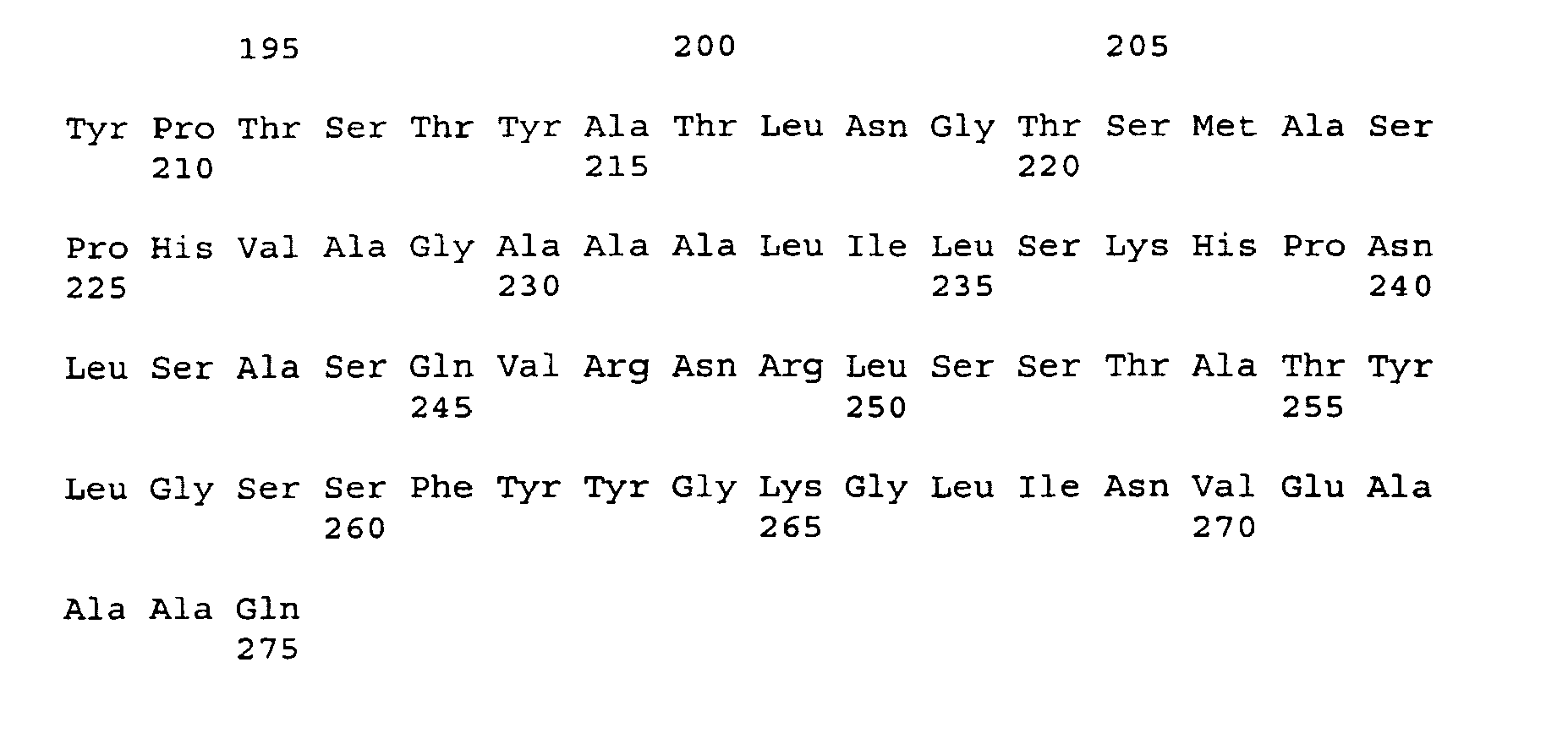
- <210> 2
<211> 270
<212> PRT
<213> Bacillus lentus - <400> 2

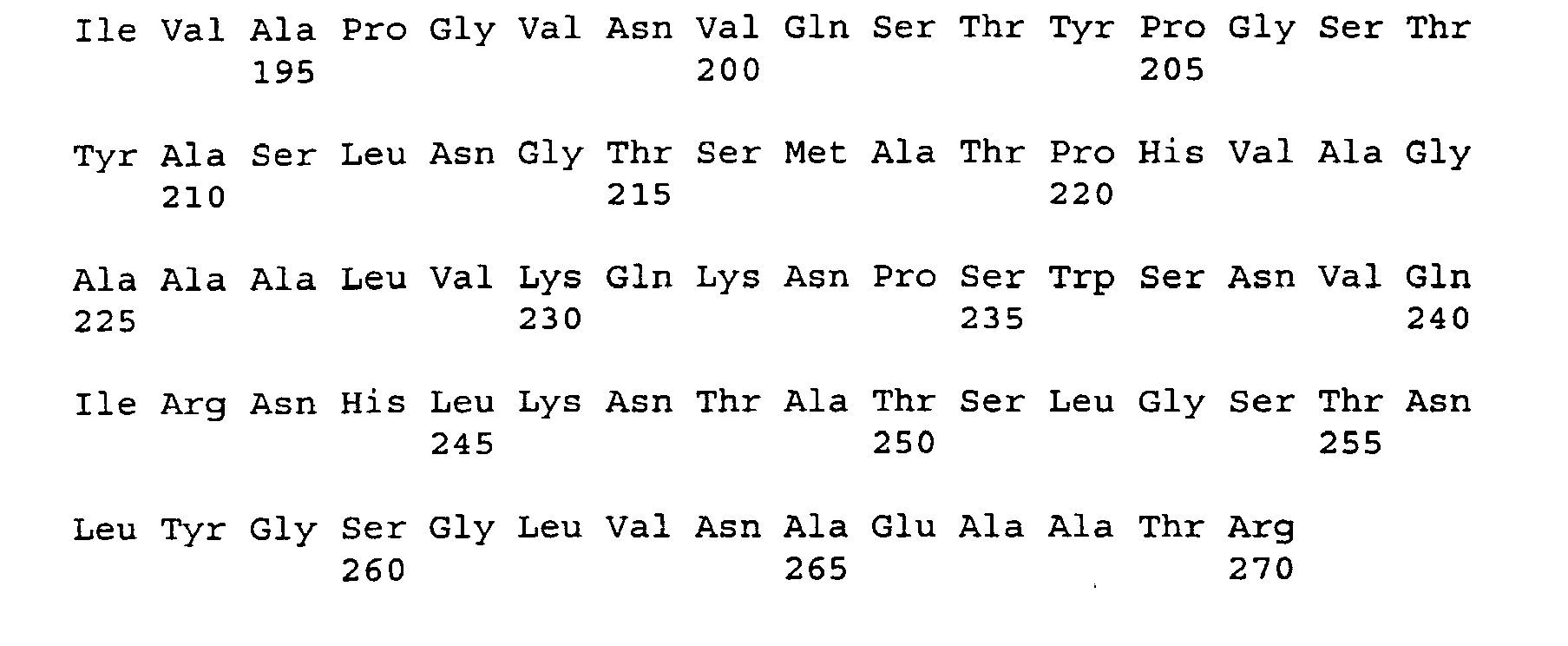
or e.g. Tyr167{Gly,Ala,Ser,Thr}+Arg170{Gly,Ala,Ser,Thr} designates the variants
Claims (22)
- A subtilase enzyme of the I-S1 or I-S2 sub-group having an insertion selected from the group consisting of L126LT, L126LS, L126LD, L126LE, L126LP, L126LG and L126LH.
- The subtilase enzyme of claim 1, wherein said insertion is combined with one or more further modification(s) in any other position (s) .
- The subtilase enzyme of claim 2, wherein said further modification(s) are in one or more of the positions 27, 36, 57, 76, 87, 97, 101, 104, 120, 123, 167, 170, 206, 218, 222, 224, 235 and 274.
- The subtilase enzyme of claim 2 or 3 wherein said modification(s) is/are combined with modification(s) in one or more of the positions 129, 131, 133 and 194.
- The subtilase of any of the preceding claims, wherein the subtilase, or if the subtilase is a variant, the parent subtilase, belongs to the sub-group I-S1.
- The subtilase of claim 5, wherein the parent subtilase is selected from the group consisting of BSS168, BASBPN, BSSDY and BLSCAR.
- The subtilase according to any of claims 1-6, wherein the subtilase, or if the subtilase is a variant, the parent subtilase, belongs to the sub-group I-S2.
- The subtilase of claim 7, wherein the parent subtilase is selected from the group consisting of BLS147, BLS309, BAPB92 and BYSYAB.
- The subtilase of claim 7 or 8, wherein said further modification(s) are selected from the group consisting of K27R, *36D, S57P, N76D, S87N, G97N, S101G, V104A, V104N, V104Y, H120D, N123S, Y167X, R170X, Q206E, N218S, M222S, M222A, T224S, K235L and T274A.
- The subtilase of claim 7 or 8, wherein said further modification(s) are selected from the group consisting of S101G+V104N, S87N+S101G+V104N, K27R+V104Y+N123S+T274A, N76D+S103A+V104I or N76D+V104A, or other combinations of these mutations (V104N, S101G, K27R, V104Y, N123S, T274A, N76D, V104A), in combination with any one or more of the substitutions, deletions and/or insertions mentioned in any of claims 2 to 4.
- The subtilase of claim 7 or 8, wherein said further modification(s) are selected from the group consisting of P129K, P131H, A133P, A133D and A194P.
- The subtilase according to any of the preceding claims comprising the modification L126LT+Y167A.
- An isolated DNA sequence encoding a subtilase or a subtilase variant of any of the claims 1 to 12.
- An expression vector comprising an isolated DNA sequence of claim 13.
- A microbial host cell transformed with an expression vector of claim 14.
- The microbial host of claim 15, which is a bacterium, preferably a Bacillus, especially B. lentus.
- The microbial host of claim 16, which is a fungus or yeast, preferably a filamentous fungus, especially an Aspergillus.
- A method for producing a subtilase or a subtilase variant of any of claims 1 to 12, wherein a host of any of claims 15-17 is cultured under conditions conducive to the expression and secretion of said variant, and the variant is recovered.
- A composition comprising a subtilase or a subtilase variant according to any of claims 1 to 12.
- The composition according to claim 19, which additionally comprises a cellulase, lipase, cutinase, oxidoreductase, another protease, or an amylase.
- The composition according to claim 19 or 20, wherein the composition is a detergent composition.
- Use of a subtilase or a subtilase variant according to any of claims 1 to 12 or an enzyme composition according to claims 19 or 20 in a laundry and/or a dishwash detergent.
Applications Claiming Priority (3)
| Application Number | Priority Date | Filing Date | Title |
|---|---|---|---|
| DKPA199900708 | 1999-05-20 | ||
| DK70899 | 1999-05-20 | ||
| PCT/DK2000/000239 WO2000071688A1 (en) | 1999-05-20 | 2000-05-10 | Subtilase enzymes of the i-s1 and i-s2 sub-groups having at least one additional amino acid residue between positions 126 and 127 |
Publications (2)
| Publication Number | Publication Date |
|---|---|
| EP1183340A1 EP1183340A1 (en) | 2002-03-06 |
| EP1183340B1 true EP1183340B1 (en) | 2008-09-03 |
Family
ID=8096632
Family Applications (1)
| Application Number | Title | Priority Date | Filing Date |
|---|---|---|---|
| EP00925090A Revoked EP1183340B1 (en) | 1999-05-20 | 2000-05-10 | Subtilase enzymes of the i-s1 and i-s2 sub-groups having at least one additional amino acid residue between positions 126 and 127 |
Country Status (5)
| Country | Link |
|---|---|
| EP (1) | EP1183340B1 (en) |
| AT (1) | ATE407201T1 (en) |
| AU (1) | AU4392800A (en) |
| DE (1) | DE60040149D1 (en) |
| WO (1) | WO2000071688A1 (en) |
Families Citing this family (1)
| Publication number | Priority date | Publication date | Assignee | Title |
|---|---|---|---|---|
| EP4525615A2 (en) | 2022-05-14 | 2025-03-26 | Novozymes A/S | Compositions and methods for preventing, treating, supressing and/or eliminating phytopathogenic infestations and infections |
Family Cites Families (81)
| Publication number | Priority date | Publication date | Assignee | Title |
|---|---|---|---|---|
| GB1234445A (en) | 1967-10-03 | 1971-06-03 | ||
| GB1296839A (en) | 1969-05-29 | 1972-11-22 | ||
| GB1372034A (en) | 1970-12-31 | 1974-10-30 | Unilever Ltd | Detergent compositions |
| GB1483591A (en) | 1973-07-23 | 1977-08-24 | Novo Industri As | Process for coating water soluble or water dispersible particles by means of the fluid bed technique |
| GB1590432A (en) | 1976-07-07 | 1981-06-03 | Novo Industri As | Process for the production of an enzyme granulate and the enzyme granuate thus produced |
| DK187280A (en) | 1980-04-30 | 1981-10-31 | Novo Industri As | RUIT REDUCING AGENT FOR A COMPLETE LAUNDRY |
| IE81141B1 (en) | 1983-06-24 | 2000-04-05 | Genencor Int | Procaryotic carbonyl hydrolases |
| US4760025A (en) | 1984-05-29 | 1988-07-26 | Genencor, Inc. | Modified enzymes and methods for making same |
| DK263584D0 (en) | 1984-05-29 | 1984-05-29 | Novo Industri As | ENZYMOUS GRANULATES USED AS DETERGENT ADDITIVES |
| DE3527913A1 (en) | 1985-08-03 | 1987-02-12 | Henkel Kgaa | ALKALINE PROTEASE, METHOD FOR PRODUCING HYBRID VECTORS AND GENETICALLY TRANSFORMED MICROORGANISMS |
| JPH0697997B2 (en) | 1985-08-09 | 1994-12-07 | ギスト ブロカデス ナ−ムロ−ゼ フエンノ−トチヤツプ | New enzymatic detergent additive |
| WO1987004461A1 (en) | 1986-01-15 | 1987-07-30 | Amgen | THERMALLY STABLE AND pH STABLE SUBTILISIN ANALOGS AND METHOD FOR PRODUCTION THEREOF |
| JPS63502959A (en) | 1986-02-12 | 1988-11-02 | ジェネックス、コ−ポレ−ション | Mutagenesis and screening methods and products |
| EG18543A (en) | 1986-02-20 | 1993-07-30 | Albright & Wilson | Protected enzyme systems |
| DK160947C (en) | 1986-04-17 | 1991-10-21 | Novo Industri As | GEN-expression system |
| SG30639G (en) | 1986-04-30 | 1995-09-01 | Genencor Int | Non-human carbonyl hydrolase mutants DNA sequences and vectors encoding same and hosts transformed with said vectors |
| ES2058119T3 (en) | 1986-08-29 | 1994-11-01 | Novo Nordisk As | ENZYMATIC DETERGENT ADDITIVE. |
| NZ221627A (en) | 1986-09-09 | 1993-04-28 | Genencor Inc | Preparation of enzymes, modifications, catalytic triads to alter ratios or transesterification/hydrolysis ratios |
| JP3155984B2 (en) | 1987-04-06 | 2001-04-16 | ノヴォザイムズ・アクティーゼルスカブ | Manipulating electrostatic interactions at metal ion binding sites for protein stabilization |
| US4914031A (en) | 1987-04-10 | 1990-04-03 | Amgen, Inc. | Subtilisin analogs |
| DE3854249T2 (en) | 1987-08-28 | 1996-02-29 | Novonordisk As | Recombinant Humicola Lipase and Process for the Production of Recombinant Humicola Lipases. |
| JPH01144992A (en) | 1987-11-30 | 1989-06-07 | Agency Of Ind Science & Technol | Production of fused protein |
| WO1989006270A1 (en) | 1988-01-07 | 1989-07-13 | Novo-Nordisk A/S | Enzymatic detergent |
| DK6488D0 (en) | 1988-01-07 | 1988-01-07 | Novo Industri As | ENZYMES |
| WO1994002618A1 (en) | 1992-07-17 | 1994-02-03 | Gist-Brocades N.V. | High alkaline serine proteases |
| JP3079276B2 (en) | 1988-02-28 | 2000-08-21 | 天野製薬株式会社 | Recombinant DNA, Pseudomonas sp. Containing the same, and method for producing lipase using the same |
| US5776757A (en) | 1988-03-24 | 1998-07-07 | Novo Nordisk A/S | Fungal cellulase composition containing alkaline CMC-endoglucanase and essentially no cellobiohydrolase and method of making thereof |
| EP0406314B1 (en) | 1988-03-24 | 1993-12-01 | Novo Nordisk A/S | A cellulase preparation |
| US5543302A (en) | 1988-05-27 | 1996-08-06 | Solvay Enzymes, Inc. | Proteases of altered stability to autolytic degradation |
| ES2227508T3 (en) * | 1989-06-26 | 2005-04-01 | Unilever N.V. | ENZYMATIC DETERGENT COMPOSITIONS. |
| DK316989D0 (en) | 1989-06-26 | 1989-06-26 | Novo Nordisk As | ENZYMES |
| GB8915658D0 (en) | 1989-07-07 | 1989-08-23 | Unilever Plc | Enzymes,their production and use |
| KR100236540B1 (en) | 1990-04-14 | 2000-01-15 | 레클로우크스 라우에르 | Alkaline bacillus lipases, coding dna sequences thereof and bacilli which produce these lipases |
| DK115890D0 (en) | 1990-05-09 | 1990-05-09 | Novo Nordisk As | ENZYME |
| AU639570B2 (en) | 1990-05-09 | 1993-07-29 | Novozymes A/S | A cellulase preparation comprising an endoglucanase enzyme |
| DK0548228T3 (en) | 1990-09-13 | 1999-05-10 | Novo Nordisk As | lipase variants |
| SG52693A1 (en) | 1991-01-16 | 1998-09-28 | Procter & Gamble | Detergent compositions with high activity cellulase and softening clays |
| EP0511456A1 (en) | 1991-04-30 | 1992-11-04 | The Procter & Gamble Company | Liquid detergents with aromatic borate ester to inhibit proteolytic enzyme |
| ES2085024T3 (en) | 1991-04-30 | 1996-05-16 | Procter & Gamble | LIQUID DETERGENTS REINFORCED WITH BORICO-POLYOL ACID COMPLEX TO INHIBIT THE PROTEOLYTIC ENZYME. |
| ES2121014T3 (en) | 1991-05-01 | 1998-11-16 | Novo Nordisk As | STABILIZED ENZYMES AND DETERGENT COMPOSITIONS. |
| EP0525610A3 (en) | 1991-07-27 | 1993-03-24 | Solvay Enzymes Gmbh & Co. Kg | Process for increasing the stability of enzymes and stabilized enzymes |
| DK72992D0 (en) | 1992-06-01 | 1992-06-01 | Novo Nordisk As | ENZYME |
| DK88892D0 (en) | 1992-07-06 | 1992-07-06 | Novo Nordisk As | CONNECTION |
| DE69334295D1 (en) | 1992-07-23 | 2009-11-12 | Novo Nordisk As | MUTIER -g (a) -AMYLASE, DETERGENT AND DISHWASHER |
| EP1431389A3 (en) | 1992-10-06 | 2004-06-30 | Novozymes A/S | Cellulase variants |
| ATE175235T1 (en) | 1993-02-11 | 1999-01-15 | Genencor Int | OXIDATIVELY STABLE ALPHA-AMYLASE |
| AU673078B2 (en) | 1993-04-27 | 1996-10-24 | Genencor International, Inc. | New lipase variants for use in detergent applications |
| DK52393D0 (en) | 1993-05-05 | 1993-05-05 | Novo Nordisk As | |
| JP2859520B2 (en) | 1993-08-30 | 1999-02-17 | ノボ ノルディスク アクティーゼルスカブ | Lipase, microorganism producing the same, method for producing lipase, and detergent composition containing lipase |
| US6436690B1 (en) | 1993-09-15 | 2002-08-20 | The Procter & Gamble Company | BPN′ variants having decreased adsorption and increased hydrolysis wherein one or more loop regions are substituted |
| US5817495A (en) | 1993-10-13 | 1998-10-06 | Novo Nordisk A/S | H2 O2 -stable peroxidase variants |
| AU1253695A (en) * | 1993-10-14 | 1995-05-04 | Procter & Gamble Company, The | Bleaching compositions comprising protease enzymes |
| JPH07143883A (en) | 1993-11-24 | 1995-06-06 | Showa Denko Kk | Lipase gene and mutant lipase |
| US5605793A (en) | 1994-02-17 | 1997-02-25 | Affymax Technologies N.V. | Methods for in vitro recombination |
| ATE222604T1 (en) | 1994-02-22 | 2002-09-15 | Novozymes As | METHOD FOR PRODUCING A VARIANT OF A LIPOLYTIC ENZYME |
| DE69536145D1 (en) | 1994-03-08 | 2011-04-07 | Novozymes As | Novel alkaline cellulases |
| DE4411223A1 (en) | 1994-03-31 | 1995-10-05 | Solvay Enzymes Gmbh & Co Kg | Use of alkaline proteases in commercial textile washing processes |
| US6599730B1 (en) | 1994-05-02 | 2003-07-29 | Procter & Gamble Company | Subtilisin 309 variants having decreased adsorption and increased hydrolysis |
| ZA952220B (en) | 1994-05-02 | 1995-12-14 | Procter & Gamble | Bpn' variants having decreased adsorption and increased hydrolysis wherein one or more loop regions are substituted |
| WO1995030744A2 (en) | 1994-05-04 | 1995-11-16 | Genencor International Inc. | Lipases with improved surfactant resistance |
| WO1995035381A1 (en) | 1994-06-20 | 1995-12-28 | Unilever N.V. | Modified pseudomonas lipases and their use |
| WO1996000292A1 (en) | 1994-06-23 | 1996-01-04 | Unilever N.V. | Modified pseudomonas lipases and their use |
| EP1995303A3 (en) | 1994-10-06 | 2008-12-31 | Novozymes A/S | Enzyme preparation with endoglucanase activity |
| BE1008998A3 (en) | 1994-10-14 | 1996-10-01 | Solvay | Lipase, microorganism producing the preparation process for the lipase and uses thereof. |
| AU3697995A (en) | 1994-10-26 | 1996-05-23 | Novo Nordisk A/S | An enzyme with lipolytic activity |
| AR000862A1 (en) | 1995-02-03 | 1997-08-06 | Novozymes As | VARIANTS OF A MOTHER-AMYLASE, A METHOD TO PRODUCE THE SAME, A DNA STRUCTURE AND A VECTOR OF EXPRESSION, A CELL TRANSFORMED BY SUCH A DNA STRUCTURE AND VECTOR, A DETERGENT ADDITIVE, DETERGENT COMPOSITION, A COMPOSITION FOR AND A COMPOSITION FOR THE ELIMINATION OF |
| JPH08228778A (en) | 1995-02-27 | 1996-09-10 | Showa Denko Kk | Novel lipase gene and method for producing lipase using the same |
| CN1182451A (en) | 1995-03-17 | 1998-05-20 | 诺沃挪第克公司 | Novel endoglucanases |
| BR9608149B1 (en) | 1995-05-05 | 2012-01-24 | processes for effecting mutation in DNA encoding a subtilase enzyme or its pre- or pre-enzyme and for the manufacture of a mutant subtilase enzyme. | |
| AU5646596A (en) * | 1995-05-05 | 1996-11-21 | Unilever Plc | Subtilisin variants |
| WO1997007202A1 (en) | 1995-08-11 | 1997-02-27 | Novo Nordisk A/S | Novel lipolytic enzymes |
| WO1997004078A1 (en) | 1995-07-14 | 1997-02-06 | Novo Nordisk A/S | A modified enzyme with lipolytic activity |
| US5763385A (en) | 1996-05-14 | 1998-06-09 | Genencor International, Inc. | Modified α-amylases having altered calcium binding properties |
| WO1998008940A1 (en) | 1996-08-26 | 1998-03-05 | Novo Nordisk A/S | A novel endoglucanase |
| DE69735767T2 (en) | 1996-09-17 | 2007-04-05 | Novozymes A/S | cellulase |
| WO1998015257A1 (en) | 1996-10-08 | 1998-04-16 | Novo Nordisk A/S | Diaminobenzoic acid derivatives as dye precursors |
| CN1530443A (en) | 1996-11-04 | 2004-09-22 | ŵ����÷������˾ | subtilase variants and compositions |
| AU4772697A (en) | 1996-11-04 | 1998-05-29 | Novo Nordisk A/S | Subtilase variants and compositions |
| US6159731A (en) | 1997-02-12 | 2000-12-12 | Massachusetts Institute Of Technology | Daxx, a Fas-binding protein that activates JNK and apoptosis |
| EP1002061A1 (en) | 1997-07-04 | 2000-05-24 | Novo Nordisk A/S | FAMILY 6 ENDO-1,4-$g(b)-GLUCANASE VARIANTS AND CLEANING COMPOSIT IONS CONTAINING THEM |
| BR9814236A (en) | 1997-11-21 | 2000-10-03 | Novo Nordisk As | Subtilase enzyme, its variant, isolated DNA sequence, expression vector, host microbial cell, process to produce a subtilase or a subtilase variant, composition, and use of a subtilase or a subtilase variant. |
-
2000
- 2000-05-10 WO PCT/DK2000/000239 patent/WO2000071688A1/en not_active Ceased
- 2000-05-10 EP EP00925090A patent/EP1183340B1/en not_active Revoked
- 2000-05-10 AU AU43928/00A patent/AU4392800A/en not_active Abandoned
- 2000-05-10 DE DE60040149T patent/DE60040149D1/en not_active Expired - Lifetime
- 2000-05-10 AT AT00925090T patent/ATE407201T1/en not_active IP Right Cessation
Also Published As
| Publication number | Publication date |
|---|---|
| DE60040149D1 (en) | 2008-10-16 |
| ATE407201T1 (en) | 2008-09-15 |
| WO2000071688A1 (en) | 2000-11-30 |
| AU4392800A (en) | 2000-12-12 |
| EP1183340A1 (en) | 2002-03-06 |
Similar Documents
| Publication | Publication Date | Title |
|---|---|---|
| EP1141262B1 (en) | Subtilase enzymes of the i-s2 sub-group having an additional amino acid residue in an active site loop region | |
| EP1141205B1 (en) | Subtilase enzymes of the i-s1 and i-s2 sub-groups having an additional amino acid residue in the active site loop region | |
| US6773907B2 (en) | Subtilase enzymes | |
| EP1141256B1 (en) | Subtilase enzymes of the i-s1 and i-s2 sub-groups having an additional amino acid residue in an active site loop region | |
| US6780629B2 (en) | Subtilase enzymes | |
| EP1183343B1 (en) | Subtilase enzymes of the i-s1 and i-s2 sub-groups having at least one additional amino acid residue between positions 125 and 126 | |
| EP1183338B1 (en) | Subtilase enzymes of the i-s1 and i-s2 sub-groups having at least one additional amino acid residue between positions 97 and 98 | |
| EP1183335B1 (en) | Subtilase enzymes of the i-s1 and i-s2 sub-groups having at least one additional amino acid residue between positions 130 and 131 | |
| EP1141257B1 (en) | Subtilase enzymes of the i-s1 and i-s2 sub-groups having an additional amino acid residue in an active site loop region | |
| EP1141258B1 (en) | Subtilase enzymes of the i-s1 and i-s2 sub-groups having an additional amino acid residue in an active site loop region | |
| EP1141260B1 (en) | Subtilase enzymes of the i-s1 and i-s2 sub-groups having an additional amino acid residue in an active site loop region | |
| EP1183342B1 (en) | Subtilase enzymes of the i-s1 and i-s2 sub-groups having at least one additional amino acid residue between positions 128 and 129 | |
| EP1141261B1 (en) | Subtilase enzymes of the i-s1 and i-s2 sub-groups having an additional amino acid residue in an active site loop region | |
| EP1183340B1 (en) | Subtilase enzymes of the i-s1 and i-s2 sub-groups having at least one additional amino acid residue between positions 126 and 127 | |
| EP1183339B1 (en) | Subtilase enzymes of the i-s1 and i-s2 sub-groups having at least one additional amino acid residue between positions 129 and 130 | |
| EP1183341B1 (en) | Subtilase enzymes of the i-s1 and i-s2 sub-groups having at least one additional amino acid residue between positions 127 and 128 | |
| EP1183337B1 (en) | Subtilase enzymes of the i-s1 and i-s2 sub-groups having at least one additional amino acid residue between positions 132 and 133 | |
| EP1183336B1 (en) | Subtilase enzymes of the i-s1 and i-s2 sub-groups having at least one additional amino acid residue between positions 131 and 132 | |
| EP1141259B1 (en) | Subtilase enzymes of the i-s1 and i-s2 sub-groups having an additional amino acid residue in an active site loop region | |
| EP1803817B1 (en) | Subtilase enzymes of the I-S1 and I-S2 sub-groups having an additional amino acid residue in an active site loop region | |
| AU771154B2 (en) | Subtilase enzymes of the I-S1 and I-S2 sub-groups having at least one additional amino acid residue between positions 97 and 98 |
Legal Events
| Date | Code | Title | Description |
|---|---|---|---|
| PUAI | Public reference made under article 153(3) epc to a published international application that has entered the european phase |
Free format text: ORIGINAL CODE: 0009012 |
|
| 17P | Request for examination filed |
Effective date: 20011220 |
|
| AK | Designated contracting states |
Kind code of ref document: A1 Designated state(s): AT BE CH CY DE DK ES FI FR GB GR IE IT LI LU MC NL PT SE |
|
| AX | Request for extension of the european patent |
Free format text: AL;LT;LV;MK;RO;SI |
|
| 17Q | First examination report despatched |
Effective date: 20031202 |
|
| 17Q | First examination report despatched |
Effective date: 20031202 |
|
| GRAP | Despatch of communication of intention to grant a patent |
Free format text: ORIGINAL CODE: EPIDOSNIGR1 |
|
| RIC1 | Information provided on ipc code assigned before grant |
Ipc: C12N 9/58 20060101ALI20080306BHEP Ipc: C12N 9/54 20060101AFI20080306BHEP |
|
| GRAS | Grant fee paid |
Free format text: ORIGINAL CODE: EPIDOSNIGR3 |
|
| GRAA | (expected) grant |
Free format text: ORIGINAL CODE: 0009210 |
|
| AK | Designated contracting states |
Kind code of ref document: B1 Designated state(s): AT BE CH CY DE DK ES FI FR GB GR IE IT LI LU MC NL PT SE |
|
| REG | Reference to a national code |
Ref country code: GB Ref legal event code: FG4D |
|
| REG | Reference to a national code |
Ref country code: CH Ref legal event code: EP |
|
| REG | Reference to a national code |
Ref country code: IE Ref legal event code: FG4D |
|
| REF | Corresponds to: |
Ref document number: 60040149 Country of ref document: DE Date of ref document: 20081016 Kind code of ref document: P |
|
| PG25 | Lapsed in a contracting state [announced via postgrant information from national office to epo] |
Ref country code: NL Free format text: LAPSE BECAUSE OF FAILURE TO SUBMIT A TRANSLATION OF THE DESCRIPTION OR TO PAY THE FEE WITHIN THE PRESCRIBED TIME-LIMIT Effective date: 20080903 Ref country code: ES Free format text: LAPSE BECAUSE OF FAILURE TO SUBMIT A TRANSLATION OF THE DESCRIPTION OR TO PAY THE FEE WITHIN THE PRESCRIBED TIME-LIMIT Effective date: 20081214 |
|
| PG25 | Lapsed in a contracting state [announced via postgrant information from national office to epo] |
Ref country code: AT Free format text: LAPSE BECAUSE OF FAILURE TO SUBMIT A TRANSLATION OF THE DESCRIPTION OR TO PAY THE FEE WITHIN THE PRESCRIBED TIME-LIMIT Effective date: 20080903 Ref country code: FI Free format text: LAPSE BECAUSE OF FAILURE TO SUBMIT A TRANSLATION OF THE DESCRIPTION OR TO PAY THE FEE WITHIN THE PRESCRIBED TIME-LIMIT Effective date: 20080903 |
|
| NLV1 | Nl: lapsed or annulled due to failure to fulfill the requirements of art. 29p and 29m of the patents act | ||
| PG25 | Lapsed in a contracting state [announced via postgrant information from national office to epo] |
Ref country code: BE Free format text: LAPSE BECAUSE OF FAILURE TO SUBMIT A TRANSLATION OF THE DESCRIPTION OR TO PAY THE FEE WITHIN THE PRESCRIBED TIME-LIMIT Effective date: 20080903 |
|
| PG25 | Lapsed in a contracting state [announced via postgrant information from national office to epo] |
Ref country code: PT Free format text: LAPSE BECAUSE OF FAILURE TO SUBMIT A TRANSLATION OF THE DESCRIPTION OR TO PAY THE FEE WITHIN THE PRESCRIBED TIME-LIMIT Effective date: 20090203 |
|
| PLBI | Opposition filed |
Free format text: ORIGINAL CODE: 0009260 |
|
| PLAX | Notice of opposition and request to file observation + time limit sent |
Free format text: ORIGINAL CODE: EPIDOSNOBS2 |
|
| 26 | Opposition filed |
Opponent name: DANISCO US INC Effective date: 20090603 |
|
| PG25 | Lapsed in a contracting state [announced via postgrant information from national office to epo] |
Ref country code: DK Free format text: LAPSE BECAUSE OF FAILURE TO SUBMIT A TRANSLATION OF THE DESCRIPTION OR TO PAY THE FEE WITHIN THE PRESCRIBED TIME-LIMIT Effective date: 20080903 |
|
| PG25 | Lapsed in a contracting state [announced via postgrant information from national office to epo] |
Ref country code: IT Free format text: LAPSE BECAUSE OF FAILURE TO SUBMIT A TRANSLATION OF THE DESCRIPTION OR TO PAY THE FEE WITHIN THE PRESCRIBED TIME-LIMIT Effective date: 20080903 |
|
| PLAF | Information modified related to communication of a notice of opposition and request to file observations + time limit |
Free format text: ORIGINAL CODE: EPIDOSCOBS2 |
|
| PG25 | Lapsed in a contracting state [announced via postgrant information from national office to epo] |
Ref country code: MC Free format text: LAPSE BECAUSE OF NON-PAYMENT OF DUE FEES Effective date: 20090531 |
|
| REG | Reference to a national code |
Ref country code: CH Ref legal event code: PL |
|
| PLAF | Information modified related to communication of a notice of opposition and request to file observations + time limit |
Free format text: ORIGINAL CODE: EPIDOSCOBS2 |
|
| PG25 | Lapsed in a contracting state [announced via postgrant information from national office to epo] |
Ref country code: LI Free format text: LAPSE BECAUSE OF NON-PAYMENT OF DUE FEES Effective date: 20090531 Ref country code: CH Free format text: LAPSE BECAUSE OF NON-PAYMENT OF DUE FEES Effective date: 20090531 Ref country code: SE Free format text: LAPSE BECAUSE OF FAILURE TO SUBMIT A TRANSLATION OF THE DESCRIPTION OR TO PAY THE FEE WITHIN THE PRESCRIBED TIME-LIMIT Effective date: 20081203 |
|
| REG | Reference to a national code |
Ref country code: IE Ref legal event code: MM4A |
|
| PLBB | Reply of patent proprietor to notice(s) of opposition received |
Free format text: ORIGINAL CODE: EPIDOSNOBS3 |
|
| PG25 | Lapsed in a contracting state [announced via postgrant information from national office to epo] |
Ref country code: IE Free format text: LAPSE BECAUSE OF NON-PAYMENT OF DUE FEES Effective date: 20090510 |
|
| PG25 | Lapsed in a contracting state [announced via postgrant information from national office to epo] |
Ref country code: GR Free format text: LAPSE BECAUSE OF FAILURE TO SUBMIT A TRANSLATION OF THE DESCRIPTION OR TO PAY THE FEE WITHIN THE PRESCRIBED TIME-LIMIT Effective date: 20081204 |
|
| PG25 | Lapsed in a contracting state [announced via postgrant information from national office to epo] |
Ref country code: LU Free format text: LAPSE BECAUSE OF NON-PAYMENT OF DUE FEES Effective date: 20090510 |
|
| RDAF | Communication despatched that patent is revoked |
Free format text: ORIGINAL CODE: EPIDOSNREV1 |
|
| REG | Reference to a national code |
Ref country code: DE Ref legal event code: R064 Ref document number: 60040149 Country of ref document: DE Ref country code: DE Ref legal event code: R103 Ref document number: 60040149 Country of ref document: DE |
|
| PGFP | Annual fee paid to national office [announced via postgrant information from national office to epo] |
Ref country code: FR Payment date: 20110610 Year of fee payment: 12 |
|
| PGFP | Annual fee paid to national office [announced via postgrant information from national office to epo] |
Ref country code: GB Payment date: 20110504 Year of fee payment: 12 |
|
| PG25 | Lapsed in a contracting state [announced via postgrant information from national office to epo] |
Ref country code: CY Free format text: LAPSE BECAUSE OF FAILURE TO SUBMIT A TRANSLATION OF THE DESCRIPTION OR TO PAY THE FEE WITHIN THE PRESCRIBED TIME-LIMIT Effective date: 20080903 |
|
| RDAG | Patent revoked |
Free format text: ORIGINAL CODE: 0009271 |
|
| STAA | Information on the status of an ep patent application or granted ep patent |
Free format text: STATUS: PATENT REVOKED |
|
| 27W | Patent revoked |
Effective date: 20110702 |
|
| GBPR | Gb: patent revoked under art. 102 of the ep convention designating the uk as contracting state |
Effective date: 20110702 |
|
| PGFP | Annual fee paid to national office [announced via postgrant information from national office to epo] |
Ref country code: DE Payment date: 20110729 Year of fee payment: 12 |
|
| REG | Reference to a national code |
Ref country code: DE Ref legal event code: R107 Ref document number: 60040149 Country of ref document: DE Effective date: 20120105 |