EP1178041A1 - Process for preparing anhydrous and hydrate forms of antihistaminic piperidine derivatives - Google Patents
Process for preparing anhydrous and hydrate forms of antihistaminic piperidine derivatives Download PDFInfo
- Publication number
- EP1178041A1 EP1178041A1 EP01124314A EP01124314A EP1178041A1 EP 1178041 A1 EP1178041 A1 EP 1178041A1 EP 01124314 A EP01124314 A EP 01124314A EP 01124314 A EP01124314 A EP 01124314A EP 1178041 A1 EP1178041 A1 EP 1178041A1
- Authority
- EP
- European Patent Office
- Prior art keywords
- hydroxydiphenylmethyl
- piperidinyl
- hydroxybutyl
- acid hydrochloride
- water
- Prior art date
- Legal status (The legal status is an assumption and is not a legal conclusion. Google has not performed a legal analysis and makes no representation as to the accuracy of the status listed.)
- Withdrawn
Links
Classifications
-
- A—HUMAN NECESSITIES
- A61—MEDICAL OR VETERINARY SCIENCE; HYGIENE
- A61K—PREPARATIONS FOR MEDICAL, DENTAL OR TOILETRY PURPOSES
- A61K31/00—Medicinal preparations containing organic active ingredients
- A61K31/33—Heterocyclic compounds
- A61K31/395—Heterocyclic compounds having nitrogen as a ring hetero atom, e.g. guanethidine or rifamycins
- A61K31/435—Heterocyclic compounds having nitrogen as a ring hetero atom, e.g. guanethidine or rifamycins having six-membered rings with one nitrogen as the only ring hetero atom
- A61K31/44—Non condensed pyridines; Hydrogenated derivatives thereof
- A61K31/445—Non condensed piperidines, e.g. piperocaine
-
- A—HUMAN NECESSITIES
- A61—MEDICAL OR VETERINARY SCIENCE; HYGIENE
- A61P—SPECIFIC THERAPEUTIC ACTIVITY OF CHEMICAL COMPOUNDS OR MEDICINAL PREPARATIONS
- A61P11/00—Drugs for disorders of the respiratory system
-
- A—HUMAN NECESSITIES
- A61—MEDICAL OR VETERINARY SCIENCE; HYGIENE
- A61P—SPECIFIC THERAPEUTIC ACTIVITY OF CHEMICAL COMPOUNDS OR MEDICINAL PREPARATIONS
- A61P11/00—Drugs for disorders of the respiratory system
- A61P11/08—Bronchodilators
-
- A—HUMAN NECESSITIES
- A61—MEDICAL OR VETERINARY SCIENCE; HYGIENE
- A61P—SPECIFIC THERAPEUTIC ACTIVITY OF CHEMICAL COMPOUNDS OR MEDICINAL PREPARATIONS
- A61P37/00—Drugs for immunological or allergic disorders
- A61P37/08—Antiallergic agents
-
- A—HUMAN NECESSITIES
- A61—MEDICAL OR VETERINARY SCIENCE; HYGIENE
- A61P—SPECIFIC THERAPEUTIC ACTIVITY OF CHEMICAL COMPOUNDS OR MEDICINAL PREPARATIONS
- A61P43/00—Drugs for specific purposes, not provided for in groups A61P1/00-A61P41/00
-
- C—CHEMISTRY; METALLURGY
- C07—ORGANIC CHEMISTRY
- C07D—HETEROCYCLIC COMPOUNDS
- C07D211/00—Heterocyclic compounds containing hydrogenated pyridine rings, not condensed with other rings
- C07D211/04—Heterocyclic compounds containing hydrogenated pyridine rings, not condensed with other rings with only hydrogen or carbon atoms directly attached to the ring nitrogen atom
- C07D211/06—Heterocyclic compounds containing hydrogenated pyridine rings, not condensed with other rings with only hydrogen or carbon atoms directly attached to the ring nitrogen atom having no double bonds between ring members or between ring members and non-ring members
- C07D211/08—Heterocyclic compounds containing hydrogenated pyridine rings, not condensed with other rings with only hydrogen or carbon atoms directly attached to the ring nitrogen atom having no double bonds between ring members or between ring members and non-ring members with hydrocarbon or substituted hydrocarbon radicals directly attached to ring carbon atoms
- C07D211/18—Heterocyclic compounds containing hydrogenated pyridine rings, not condensed with other rings with only hydrogen or carbon atoms directly attached to the ring nitrogen atom having no double bonds between ring members or between ring members and non-ring members with hydrocarbon or substituted hydrocarbon radicals directly attached to ring carbon atoms with substituted hydrocarbon radicals attached to ring carbon atoms
- C07D211/20—Heterocyclic compounds containing hydrogenated pyridine rings, not condensed with other rings with only hydrogen or carbon atoms directly attached to the ring nitrogen atom having no double bonds between ring members or between ring members and non-ring members with hydrocarbon or substituted hydrocarbon radicals directly attached to ring carbon atoms with substituted hydrocarbon radicals attached to ring carbon atoms with hydrocarbon radicals, substituted by singly bound oxygen or sulphur atoms
- C07D211/22—Heterocyclic compounds containing hydrogenated pyridine rings, not condensed with other rings with only hydrogen or carbon atoms directly attached to the ring nitrogen atom having no double bonds between ring members or between ring members and non-ring members with hydrocarbon or substituted hydrocarbon radicals directly attached to ring carbon atoms with substituted hydrocarbon radicals attached to ring carbon atoms with hydrocarbon radicals, substituted by singly bound oxygen or sulphur atoms by oxygen atoms
Definitions
- the present invention is related to novel processes for preparing anhydrous and hydrated forms of piperidine derivatives, polymorphs and pseudomorphs thereof which are useful as antihistamines, antiallergic agents and bronchodilators [United States Patent No. 4,254,129, March 3, 1981, United States Patent No. 4,254,130, March 3, 1981 and United States Patent No. 4,285,958, April 25, 1981].
- the present invention provides a process for preparing anhydrous, pharmaceutically acceptable acid addition salts of piperidine derivatives of the formulas wherein
- the present invention also provides a process for preparing anhydrous, pharmaceutically acceptable acid addition salts of piperidine derivatives of the formula wherein
- the present invention provides a process for preparing the hydrated, pharmaceutically acceptable acid addition salts of piperidine derivatives of the formula wherein
- the present invention provides processes for preparing polymorphs of anhydrous 4-[4-[4-(Hydroxydiphenylmethyl)-1-piperidinyl]-1-hydroxybutyl]- ⁇ , ⁇ -dimethylbenzeneacetic acid hydrochloride designated herein as Form I and Form III and processes for preparing psuedomorphs of hydrated 4-[4-[4-(Hydroxydiphenylmethyl)-1-piperidinyl]-1-hydroxybutyl]- ⁇ , ⁇ -dimethylbenzeneacetic acid hydrochloride designated herein as Form II and Form IV.
- the Form I polymorph may be identified by the following characteristics: a visual melting point (capillary tube) in the range of about 196-201°C; a melt endotherm with extrapolated onset in the range of about 195-199°C as determined by differential scanning calorimetry; and an X-ray powder diffraction pattern essentially as shown in Table 1 wherein the XRPD patterns were measured using a powder diffractometer equipped with a Co X-ray tube source. The sample was illuminated with Co K ⁇ 1 radiation and XRPD data were collected from 5 to 55° 2 ⁇ . (intensities may vary radically due to preferred orientation). D-Space, Angstroms Intensity, I/I o , % 11.8 30 7.3 30 6.3 65 5.9 35 5.0 45 4.8 100 4.4 45 3.9 60 3.8 75 3.7 30
- the Form III polymorph may be identified by the following characteristics: a visual melting point (capillary tube) in the range of about 166-171°C; a broad endotherm below about 90°C, a melt endotherm with an extrapolated onset of about 166°C as determined by differential scanning calorimetry; and an X-ray powder diffraction pattern essentially as shown in Table 2 wherein the XRPD patterns were measured using a powder diffractometer equipped with a Co X-ray tube source. The sample was illuminated with Co K ⁇ 1 radiation and XRPD data were collected from 5 to 55° 2 ⁇ . (intensities may vary radically due to preferred orientation). D-Space, Angstroms Intensity, I/I o , % 9.0 95 4.9 100 4.8 35 4.6 25 4.5 25 3.7 25
- the Form II pseudomorph may be identified by the following characteristics: a visual melting point (capillary tube) in the range of about 100-105°C; a large broad endotherm below about 100°C and a small endothermic peak (about 2 joules/gram) with extrapolated onsets in the range of about 124-126°C as determined by differential scanning calorimetry; and an X-ray powder diffraction pattern essentially as shown in Table 3 wherein the XRPD patterns were measured using a powder diffractometer equipped with a Co X-ray tube source. The sample was illuminated with Co K ⁇ 1 radiation and XRPD data were collected from 5 to 55° 2 ⁇ (intensities may vary radically due to preferred orientation). D-Space, Angstroms Intensity, I/I o , % 7.8 45 6.4 44 5.2 85 4.9 60 4.7 80 4.4 55 4.2 50 4.1 60 3.7 75 3.6 60 3.5 50
- the Form IV pseudomorph may be identified by the following characteristics: a visual melting point (capillary tube) in the range of about 113-118°C; two broad overlapping endotherms below about 100°C and an additional endotherm with an extrapolated onset at approximately 146°C as determined by differential scanning calorimetry and an X-ray powder diffraction pattern essentially as shown in Table 4 wherein the XRPD patterns were measured using a powder diffractometer equipped with a Co X-ray tube source. The sample was illuminated with Co K ⁇ 1 radiation and XRPD data were collected from 5 to 55° 2 ⁇ . (intensities may vary radically due to preferred orientation). D-Space, Angstroms Intensity, I/I o , % 10.4 60 7.0 45 6.4 50 5.3 100 5.2 55 4.3 75 4.1 50 4.0 45 3.8 60 3.5 55
- Pharmaceutically acceptable acid addition salts of the compounds of formula (I) and (II), both anhydrous and hydrated, are those of any suitable inorganic or organic acid.
- suitable inorganic acids are, for example, hydrochloric, hydrobromic, sulfuric, and phosphoric acids.
- Suitable organic acids include carboxylic acids, such as, acetic, propionic, glycolic, lactic, pyruvic, malonic, succinic, fumaric, malic, tartaric, citric, cyclamic, ascorbic, maleic, hydroxymaleic, and dihydroxymaleic, benzoic, phenylacetic, 4-aminobenzoic, 4-hydroxybenzoic, anthranilic, cinnamic, salicylic, 4-aminosalicylic, 2-phenoxybenzoic, 2-acetoxybenzoic, and mandelic acid, sulfonic acids, such as, methanesulfonic, ethanesulfonic and ⁇ -hydroxyethanesulfonic acid.
- carboxylic acids such as, acetic, propionic, glycolic, lactic, pyruvic, malonic, succinic, fumaric, malic, tartaric, citric, cyclamic, ascorbic, maleic, hydroxymaleic, and dihydroxy
- hydrate refers to a combination of water with a compound of formula (I) or (II) wherein the water retains its molecular state as water and is either absorbed, adsorbed or contained within a crystal lattice of the substrate molecule of formula (I) or (II).
- the term "adsorped” refers to the physical state wherein the water molecule in the hydrated, pharmaceutically acceptable acid addition salts of piperidine derivatives of the formula (I) and (II) is distributed over the surface of the solid hydrated, pharmaceutically acceptable acid addition salts of piperidine derivatives of the formula (I) and (II).
- the term "absorbed" refers to the physical state wherein the water molecule in the hydrated, pharmaceutically acceptable acid addition salts of piperidine derivatives of the formula (I) and (II) is distributed throughout the body of the solid hydrated, pharmaceutically acceptable acid addition salts of piperidine derivatives of the formula (I) and (II).
- Hydrated, pharmaceutically acceptable acid addition salts of the compounds of formula (I) and (II) are those hydrates ranging from essentially 0.10 to 5 molecules of water per molecule of substrate salt of formula (I) or (II).
- azeotropic mixture refers to a liquid mixture of two or more substances which behaves like a single substance in that the vapor produced by partial evaporation of liquid has the same composition as the liquid.
- the constant boiling mixture exhibits either a maximum or minimum boiling point as compared with that of other mixtures of the same substance.
- azeotropic distillation refers to a type of distillation in which a substance is added to the mixture to be separated in order to form an azeotropic mixture with one or more of the constituents of the original mixture.
- the azeotrope or azeotropes thus formed will have boiling points different from the boiling points of the original mixture.
- azeotropic distillation also refers to co-distillation.
- water-minimizing recrystallization refers to a recrystallization wherein the ratio of anhydrous solvent to substrate hydrate is such that the percentage of water present is minimized, thereby inducing precipitation of the anhydrous form of the substrate.
- aqueous recrystallization refers to those processes wherein either 1) a solid material is dissolved in a volume of water or a water/organic solvent mixture sufficient to cause dissolution and the solid material recovered by evaporation of the solvent; 2) a solid material is treated with a minimal amount of water or a water/organic solvent mixture which is not sufficient to cause dissolution, heated to obtain dissolution and cooled to induce crystallization or 3) a solid material is dissolved in a volume of water or a water/organic solvent mixture sufficient to cause dissolution and then the solvent is partially evaporated to form a saturated solution which induces crystallization.
- crystal digestion refers to that process wherein a solid material is treated with a minimal amount of water or water/organic solvent mixture which is not sufficient to cause dissolution and either heating or stirring at ambient temperature until the desired transformation has taken place.
- antisolvent refers to a poor solvent for the substance in question which when added to a solution of the substance, causes the substance to precipitate.
- suitable temperature refers to that temperature which is sufficient to cause dissolution and to permit the precipitation of the desired substance either upon addition of an antisolvent or upon removal of the co-solvent by azeotropic distillation.
- the anhydrous, pharmaceutically acceptable acid addition salts of piperidine derivatives of the formula (I) and (II) may be prepared from the corresponding hydrated, pharmaceutically acceptable acid addition salts of piperidine derivatives of the formula (I) and (II) by subjecting the corresponding hydrated, pharmaceutically acceptable acid addition salts of piperidine derivatives of the formula (I) and (II) to an azeotropic distillation.
- the appropriate hydrated, pharmaceutically acceptable acid addition salt of piperidine derivatives of the formula (I) and (II) is first dissolved in a volume of a suitable solvent or solvent mixture which is sufficient to cause dissolution.
- suitable solvent or solvent mixture which is sufficient to cause dissolution.
- solvents are water, C 1 -C 5 alkanols such as methanol, ethanol and the like; ketone solvents such as acetone, methyl ethyl ketone and the like; aliphatic ester solvents such as ethyl acetate, methyl acetate, methyl formate, ethyl formate, isopropyl acetate and the like and aqueous'mixtures of these solvents, such as acetone/water, methyl ethyl ketone/water, water/acetone and water/acetone/ethyl acetate.
- Suitable anhydrous antisolvents for use in the azeotropic distillation are, for example, ketone solvents such as acetone, methyl ethyl ketone and the like; aliphatic ester solvents such as ethyl acetate, methyl acetate, methyl formate, ethyl formate, isopropyl acetate and the like; C 5 -C 8 aliphatic solvents such as pentane, hexane and the like; aliphatic nitriles, such as acetonitrile and mixtures of these solvents such as acetone/ethyl acetate and the like.
- the azeotropic mixture of water and solvent is removed by distillation until the temperature changes, indicating that the azeotropic mixture is completely removed.
- the reaction mixture is cooled and the corresponding anhydrous, pharmaceutically acceptable acid addition salts of piperidine derivatives of the formula (I) and (II) is recovered from the reaction zone by, for example filtration.
- anhydrous, pharmaceutically acceptable acid addition salts of piperidine derivatives of the formula (I) and (II) may be prepared from the corresponding hydrated, pharmaceutically acceptable acid addition salts of piperidine derivatives of the formula (I) and (II) by subjecting the corresponding hydrated, pharmaceutically acceptable acid addition salts of piperidine derivatives of the formula (I) and (II) to a water-minimizing recrystallization.
- the appropriate hydrated, pharmaceutically acceptable acid addition salt of piperidine derivatives of the formula (I) and (II) is dissolved in a volume of a suitable anhydrous solvent or solvent mixture which is sufficient to cause dissolution and heated to reflux.
- suitable anhydrous solvent or solvent mixture which is sufficient to cause dissolution and heated to reflux.
- solvents are water, C 1 -C 5 alkanols such as methanol, ethanol and the like; ketone solvents such as acetone, methyl ethyl ketone and the like; aliphatic ester solvents such as ethyl acetate, methyl acetate, methyl formate, ethyl formate, isopropyl acetate and the like and aqueous mixtures of these solvents, such as acetone/water, methyl ethyl ketone/water, water/acetone and water/acetone/ethyl acetate.
- Suitable anhydrous antisolvents are, for example, ketone solvents such as acetone, methyl ethyl ketone and the like; aliphatic ester solvents such as ethyl acetate, methyl acetate, methyl formate, ethyl formate, isopropyl acetate and the like; mixtures-of ketone solvents and aliphatic ester solvents such as acetone/ethyl acetate and the like; C 5 -C 8 aliphatic solvents such as pentane, hexane and the like; aliphatic nitriles, such as acetonitrile and mixtures of these solvents such as acetone/ethyl acetate and the like
- Polymorphic forms of anhydrous 4-[4-[4-(Hydroxydiphenylmethyl)-1-piperidinyl]-1-hydroxybutyl]- ⁇ , ⁇ -dimethylbenzeneacetic acid hydrochloride may be prepared by a variety of methods as detailed below.
- anhydrous 4-[4-[4-(Hydroxydiphenylmethyl)-1-piperidinyl]-1-hydroxybutyl]- ⁇ , ⁇ -dimethylbenzeneacetic acid hydrochloride (Form I) may be prepared from anhydrous 4-[4-[4-(Hydroxydiphenylmethyl)-1-piperidinyl]-1-hydroxybutyl]- ⁇ , ⁇ -dimethylbenzeneacetic acid hydrochloride (Form III), by subjecting the anhydrous 4-[4-[4-(Hydroxydiphenylmethyl)-1-piperidinyl]-1-hydroxybutyl]- ⁇ , ⁇ -dimethylbenzeneacetic acid hydrochloride (Form III) to a crystal digestion as described above.
- anhydrous 4-[4-[4-(Hydroxydiphenylmethyl)-1-piperidinyl]-l-hydroxybutyl]- ⁇ , ⁇ -dimethylbenzeneacetic acid hydrochloride may be prepared from hydrated 4-[4-[4-(Hydroxydiphenylmethyl)-1-piperidinyl]-1-hydroxybutyl]- ⁇ , ⁇ -dimethylbenzeneacetic acid hydrochloride (Form II), by subjecting the hydrated 4-[4-[4-(Hydroxydiphenylmethyl)-1-piperidinyl]-1-hydroxybutyl]- ⁇ , ⁇ -dimethylbenzeneacetic acid hydrochloride (Form II) to water-minimizing recrystallization as described above.
- anhydrous 4-[4-[4-(Hydroxydiphenylmethyl)-1-piperidinyl]-l-hydroxybutyl]- ⁇ , ⁇ -dimethylbenzeneacetic acid hydrochloride may be prepared from hydrated 4-[4-[4-(Hydroxydiphenylmethyl)-1-piperidinyl]-1-hydroxybutyl]- ⁇ , ⁇ -dimethylbenzeneacetic acid hydrochloride (Form II), by subjecting the hydrated 4-[4-[4-(Hydroxydiphenylmethyl)-1-piperidinyl]-1-hydroxybutyl]- ⁇ , ⁇ -dimethylbenzeneacetic acid hydrochloride (Form II) to water-minimizing recrystallization as described above or by subjecting the hydrated 4-[4-[4-[4-(Hydroxydiphenylmethyl)-1-piperidinyl]-1-hydroxybutyl]- ⁇ , ⁇ -dimethylbenzeneacetic acid hydrochlor
- anhydrous 4-[4-[4-(Hydroxydiphenylmethyl)-1-piperidinyl]-1-hydroxybutyl]- ⁇ , ⁇ -dimethylbenzeneacetic acid hydrochloride may be prepared from hydrated 4-[4-[4-(Hydroxydiphenylmethyl)-1-piperidinyl]-1-hydroxybutyl]- ⁇ , ⁇ -dimethylbenzeneacetic acid hydrochloride (Form IV), by subjecting the hydrated 4-[4-[4-(Hydroxydiphenylmethyl)-1-piperidinyl]-1-hydroxybutyl]- ⁇ , ⁇ -dimethylbenzeneacetic acid hydrochloride (Form IV) to water-minimizing recrystallization or to an azeotropic distillation as described above.
- the hydrated, pharmaceutically acceptable acid addition salts of piperidine derivatives of the formula (I) may be prepared from the corresponding compound of the formula (II) wherein R 3 is -COOalkyl by subjecting the corresponding compound of the formula (II) wherein R 3 is -COOalkyl to a reduction using an appropriate reducing agent, such as sodium borohyride, potassium borohydride, sodium cyanoborohydride, or tetramethylammonium borohydride in a suitable solvent, such as, methanol, ethanol, isopropyl alcohol or n-butanol, aqeuous mixtures thereof or basic solutions thereof, at temperatures ranging from about 0°C to the reflux temperature of the solvent, and the reaction time varies from about 1/2 hour to 8 hours. After quenching and acidifying with an suitable acid, such as hydrochloric acid, the hydrated, pharmaceutically acceptable acid addition salts of piperidine derivatives of the formula (I) are recovered from the reaction zone by crystallization and
- the hydrated, pharmaceutically acceptable acid addition salts of piperidine derivatives of the formula (I) and (II) may be prepared from the corresponding anhydrous, pharmaceutically acceptable acid addition salts of the formula (I) and (II) by subjecting the corresponding anhydrous, pharmaceutically acceptable acid addition salts of formula (I) and (II) to an aqueous recrystallization.
- the appropriate anhydrous, pharmaceutically acceptable acid addition salt of piperidine derivatives of the formula (I) and (II) is treated with a minimal volume of water or suitable water/organic solvent mixture which is insufficient to cause dissolution and heated to reflux.
- the reaction mixture is cooled and the corresponding hydrated, pharmaceutically acceptable acid addition salt of piperidine derivatives of the formula (I) and (II) is recovered from the reaction zone by, for example filtration.
- the appropriate anhydrous, pharmaceutically acceptable acid addition salt of piperidine derivatives of the formula (I) and (II) is treated with a volume of water or a suitable water/organic solvent mixture which is sufficient to cause dissolution and the water or water/organic solvent is partially or completely evaporated to a volume which induces crystallization of the hydrated, pharmaceutically acceptable acid addition salts of piperidine derivatives of the formula (I) and (II).
- Suitable solvents for use in the above recrystallization are water, acetone/water, ethanol/water, methyl ethyl ketone/aqueous methanol, methyl ethyl ketone/water and the like.
- Hydrated 4-[4-[4-(Hydroxydiphenylmethyl)-1-piperidinyl]-1-hydroxybutyl]- ⁇ , ⁇ -dimethylbenzeneacetic acid hydrochloride may be prepared from ethyl 4-[4-[4-(hydroxydiphenylmethyl)-1-piperidinyl]-1-oxobutyl]- ⁇ , ⁇ -dimethylbenzeneacetate, hydrochloride or free base as described above for the general preparation of the hydrated, pharmaceutically acceptable acid addition salts of piperidine derivatives of the formula (I) from the corresponding compound of the formula (II) wherein R 3 is-COOalkyl, but rapdily adding water over a period of time ranging from 1 minute to 45 minutes at a temperature range of about -20°C to 50°C to precipitate the hydrated 4-[4-[4-(Hydroxydiphenylmethyl)-1-piperidinyl]-1-hydroxybutyl]- ⁇ ,
- Hydrated 4-[4-[4-(Hydroxydiphenylmethyl)-1-piperidinyl]-1-hydroxybutyl]- ⁇ , ⁇ -dimethylbenzeneacetic acid hydrochloride may be prepared from ethyl 4-[4-[4-(hydroxydiphenylmethyl)-1-piperidinyl]-1-oxobutyl]- ⁇ , ⁇ -dimethylbenzeneacetate, hydrochloride or free base as described above for the general preparation of the hydrated, pharmaceutically acceptable acid addition salts of piperidine derivatives of the formula (I) from the corresponding compound of the formula (II) wherein R 3 is -COOalkyl, but slowly adding water over a period of time ranging from about 30 minutes to 24 hours and at a temperature range of about 0°C to 50°C, optionally with seeding, to precipitate the hydrated 4-[4-[4-(Hydroxydiphenylmethyl)-1-piperidinyl]-1-hydroxy
- Hydrated 4-[4-[4-(Hydroxydiphenylmethyl)-1-piperidinyl]-1-hydroxybutyl]- ⁇ , ⁇ -dimethylbenzeneacetic acid hydrochloride (Form II) may be prepared from anhydrous 4-[4-[4-(Hydroxydiphenylmethyl)-1-piperidinyl]-1-hydroxybutyl]- ⁇ , ⁇ -dimethylbenzeneacetic acid hydrochloride (Form I) by subjecting hydrated 4-[4-[4-(Hydroxydiphenylmethyl)-1-piperidinyl]-1-hydroxybutyl]- ⁇ , ⁇ -dimethylbenzeneacetic acid hydrochloride (Form II) to an aqueous recrystallization as defined above.
- g refers to grams; “mol” refers to mole; “mmol” refers to millimoles; “mL” refers to milliliters; “bp” refers to boiling point; “mp” refers to melting point; “°C” refers to degrees Celsius; “mm Hg” refers to millimeters of mercury; “ ⁇ L” refers to microliters; “ ⁇ g” refers to micrograms; and “ ⁇ M” refers to micromolar.
- Differential Scanning Calorimetry analysis were performed using a TA 2910 DSC with open aluminum pans. The samples were heated to 240°C at 5°C/minute with a 50mL/minute nitrogen purge.
- the samples were loaded into a quartz (zero scatter) sample holder for the XRPD pattern measurement.
- the XRPD patterns were measured using a powder diffractometer equipped with a Co X-ray tube source, primary beam monochromator, and position sensitive detector (PSD). The incident beam was collimated using a 1° divergence slit. The active area on the PSD subtended approximately 5°2 ⁇ .
- the source was operated at 35 kV and 30 mA and the sample was illuminated with Co K ⁇ 1 radiation.
- XRPD data were collected from 5 to 55° 2 ⁇ at a rate of 0.25°2 ⁇ /minute and a step width of 0.02°2 ⁇ .
- the XRPD patterns were measured without the addition of an internal calibrant.
- Peak positions and intensities for the most prominent features were measured using a double-derivative peak picking method. X-ray peaks with I/I o greater than 20% were reported. The cutoff was chosen arbitrarily. The intensities are rounded to the nearest 5%. Certain peaks appear sensitive to preferred orientation that is caused by changes in crystallite morphology. This results in large changes in the I/I o value.
- polymorphic and pseudomorphic 4-[4-[4-(hydroxydiphenylmethyl)-1-piperidinyl]-1-hydroxybutyl]- ⁇ , ⁇ -dimethylbenzeneacetic acid hydrochloride compounds of this invention are useful as antihistamines, antiallergy agents and bronchodilators and may be administered alone or with suitable pharmaceutical carriers, and can be in solid or liquid form such as, tablets, capsules, powders, solutions, suspensions or emulsions.
- polymorphic and pseudomorphic 4-[4-[4-(hydroxydiphenylmethyl)-1-piperidinyl]-1-hydroxybutyl]- ⁇ , ⁇ -dimethylbenzeneacetic acid hydrochloride compounds of this invention can be administered orally, parenterally, for example, subcutaneously, intravenously, intramuscularly, intraperitoneally, by intranasal instillation or by application to mucous membranes, such as, that of the nose, throat and bronchial tubes, for example, in an aerosol spray containing small particles of a compound of this invention in a spray or dry powder form.
- the quantity of polymorphic or pseudomorphic 4-[4-[4-(hydroxydiphenylmethyl)-1-piperidinyl]-1-hydroxybutyl]- ⁇ , ⁇ -dimethylbenzeneacetic acid hydrochloride compound administered will vary depending on the patient and the mode of administration and can be any effective amount.
- the quantity of polymorphic or pseudomorphic 4-[4-[4-(hydroxydiphenylmethyl)-1-piperidinyl]-l-hydroxybutyl]- ⁇ , ⁇ -dimethylbenzeneacetic acid hydrochloride compound administered may vary over a wide range to provide in a unit dosage an effective amount of from about 0.01 to 20 mg/kg of body weight of the patient per day to achieve the desired effect.
- the desired antihistamine, antiallergy and bronchodilator effects can be obtained by consumption of a unit dosage form such as a tablet containing 1 to 500 mg of a polymorphic or pseudomorphic 4-[4-[4-(hydroxydiphenylmethyl)-1-piperidinyl]-1-hydroxybutyl]- ⁇ , ⁇ -dimethylbenzeneacetic acid hydrochloride compound of this invention taken 1 to 4 times daily.
- a unit dosage form such as a tablet containing 1 to 500 mg of a polymorphic or pseudomorphic 4-[4-[4-(hydroxydiphenylmethyl)-1-piperidinyl]-1-hydroxybutyl]- ⁇ , ⁇ -dimethylbenzeneacetic acid hydrochloride compound of this invention taken 1 to 4 times daily.
- the solid unit dosage forms can be of the conventional type.
- the solid form can be a capsule which can be the ordinary gelatin type containing a polymorphic or pseudomorphic 4-[4-[4-(hydroxydiphenylmethyl)-1-piperidinyl]-1-hydroxybutyl]- ⁇ , ⁇ -dimethylbenzeneacetic acid hydrochloride compound of this invention and a carrier, for example, lubricants and inert fillers such as lactose, sucrose or cornstarch.
- polymorphic or pseudomorphic 4-[4-[4-(hydroxydiphenylmethyl)-1-piperidinyl]-1-hydroxybutyl]- ⁇ , ⁇ -dimethylbenzeneacetic acid hydrochloride compound is tableted with conventional tablet bases such as lactose, sucrose or cornstarch or gelatin, disintegrating agents such as cornstarch, potato starch or alginic acid, and a lubricant such as stearic acid or magnesium stearate.
- the polymorphic or pseudomorphic 4-[4-[4-(hydroxydiphenylmethyl)-1-piperidinyl]-1-hydroxybutyl]- ⁇ , ⁇ -dimethylbenzeneacetic acid hydrochloride compounds of this invention may also be administered in injectable dosages by solution or suspension of the compounds in a physiologically acceptable diluent with a pharmaceutical carrier which can be a sterile liquid such as water and oils, with or without the addition of a surfactant and other pharmaceutically acceptable adjuvants.
- oils there can be mentioned those of petroleum, animal, vegatable or synthetic origin, for example, peanut oil, soybean oil or mineral oil.
- water, saline, aqueous dextrose and related sugar solutions and glycols such as propylene glycol or polyethylene glycol are preferred liquid carriers, particularly for injectable solutions.
- the compounds of this invention in solution or suspension may be packaged in a pressurized aerosol container together with suitable propellants, for example, hydrocarbon propellants such as, propane, butane or isobutane with the usual adjuvants as may be administered in a non-pressurized form such as in a nebulizer or atomizer.
- suitable propellants for example, hydrocarbon propellants such as, propane, butane or isobutane with the usual adjuvants as may be administered in a non-pressurized form such as in a nebulizer or atomizer.
- patient as used herein is taken to mean warm blooded animals, birds, mammals, for example, humans, cats, dogs, horses, sheep, bovine cows, pigs, lambs, rats, mice and guinea pigs.
Landscapes
- Health & Medical Sciences (AREA)
- Chemical & Material Sciences (AREA)
- Organic Chemistry (AREA)
- Veterinary Medicine (AREA)
- Public Health (AREA)
- General Health & Medical Sciences (AREA)
- Animal Behavior & Ethology (AREA)
- Life Sciences & Earth Sciences (AREA)
- Medicinal Chemistry (AREA)
- Pharmacology & Pharmacy (AREA)
- Chemical Kinetics & Catalysis (AREA)
- General Chemical & Material Sciences (AREA)
- Nuclear Medicine, Radiotherapy & Molecular Imaging (AREA)
- Bioinformatics & Cheminformatics (AREA)
- Engineering & Computer Science (AREA)
- Pulmonology (AREA)
- Epidemiology (AREA)
- Immunology (AREA)
- Pharmaceuticals Containing Other Organic And Inorganic Compounds (AREA)
- Hydrogenated Pyridines (AREA)
- Plural Heterocyclic Compounds (AREA)
- Medicines That Contain Protein Lipid Enzymes And Other Medicines (AREA)
- Addition Polymer Or Copolymer, Post-Treatments, Or Chemical Modifications (AREA)
- Peptides Or Proteins (AREA)
Abstract
Description
- The present invention is related to novel processes for preparing anhydrous and hydrated forms of piperidine derivatives, polymorphs and pseudomorphs thereof which are useful as antihistamines, antiallergic agents and bronchodilators [United States Patent No. 4,254,129, March 3, 1981, United States Patent No. 4,254,130, March 3, 1981 and United States Patent No. 4,285,958, April 25, 1981].
- The present invention provides a process for preparing anhydrous, pharmaceutically acceptable acid addition salts of piperidine derivatives of the formulaswherein
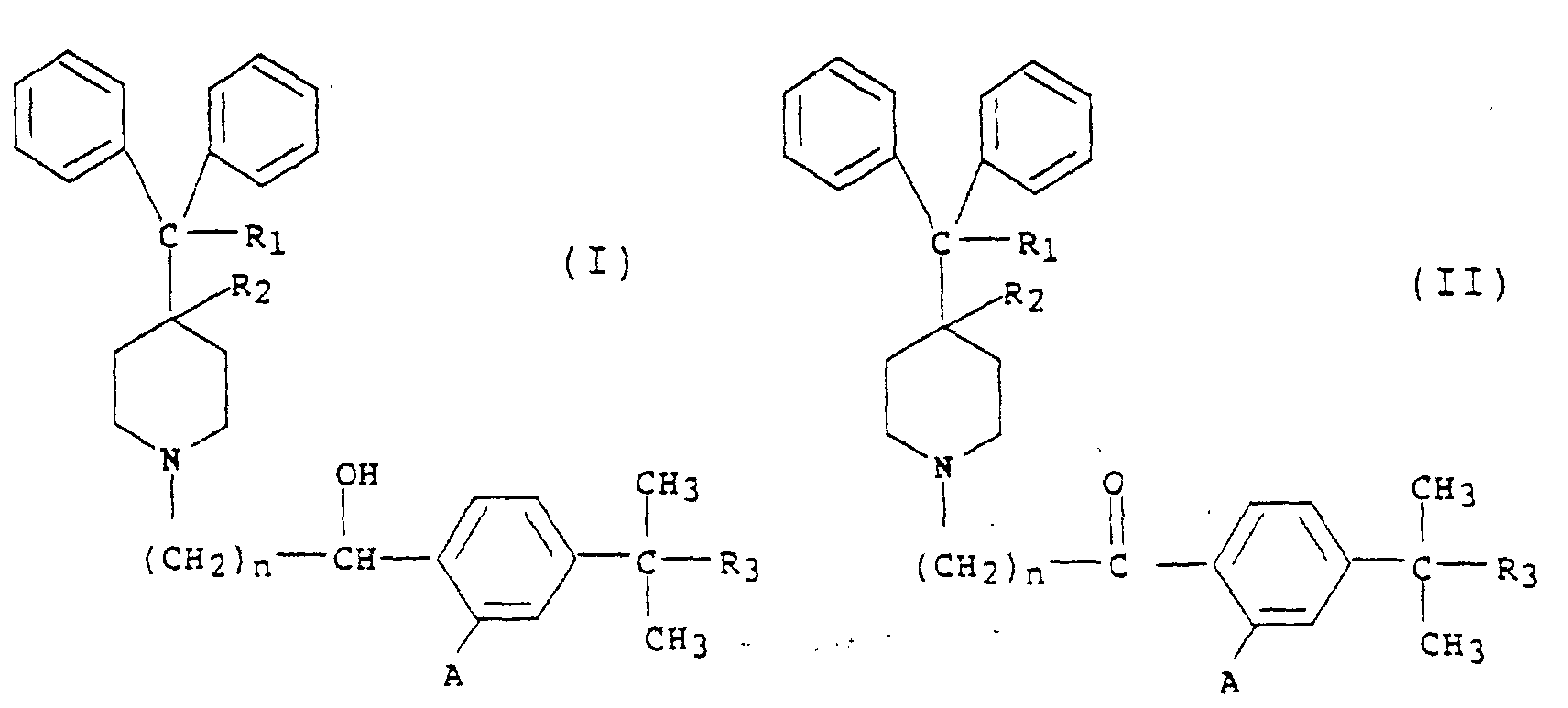
- R1 represents hydrogen or hydroxy;
- R2 represents hydrogen; or
- R1 and R2 taken together form a second bond between the carbon atoms bearing R1 and R2;
- n is an integer of from 1 to 5;
- R3 is -CH2OH, -COOH or -COOalkyl wherein the alkyl moiety has from 1 to 6 carbon atoms and is straight or branched;
- each of A is hydrogen or hydroxy; and
- pharmaceutically acceptable salts and individual optical isomers thereof, comprising subjecting the corresponding hydrated, pharmaceutically acceptable acid addition salt to an azeotropic distillation.
-
- In addition, the present invention also provides a process for preparing anhydrous, pharmaceutically acceptable acid addition salts of piperidine derivatives of the formulawherein
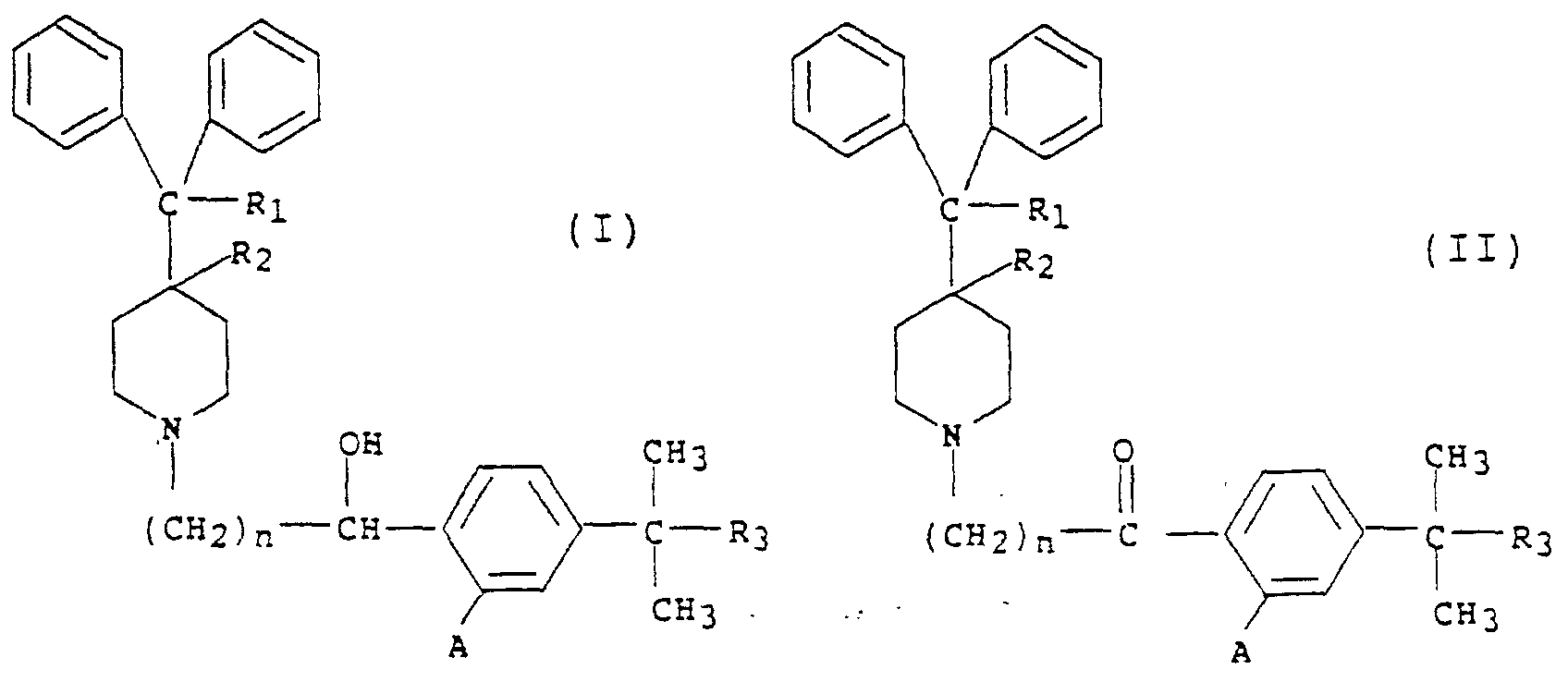
- R1 represents hydrogen or hydroxy;
- R2 represents hydrogen; or
- R1 and R2 taken together form a second bond between the carbon atoms bearing R1 and R2;
- n is an integer of from 1 to 5;
- R3 is -CH2OH, -COOH or -COOalkyl wherein the alkyl moiety has from 1 to 6 carbon atoms and is straight or branched;
- each of A is hydrogen or hydroxy; and
- pharmaceutically acceptable salts and individual optical isomers thereof, comprising subjecting the corresponding hydrated, pharmaceutically acceptable acid addition salt to a water-minimizing recrystallization.
-
- In addition, the present invention provides a process for preparing the hydrated, pharmaceutically acceptable acid addition salts of piperidine derivatives of the formulawherein
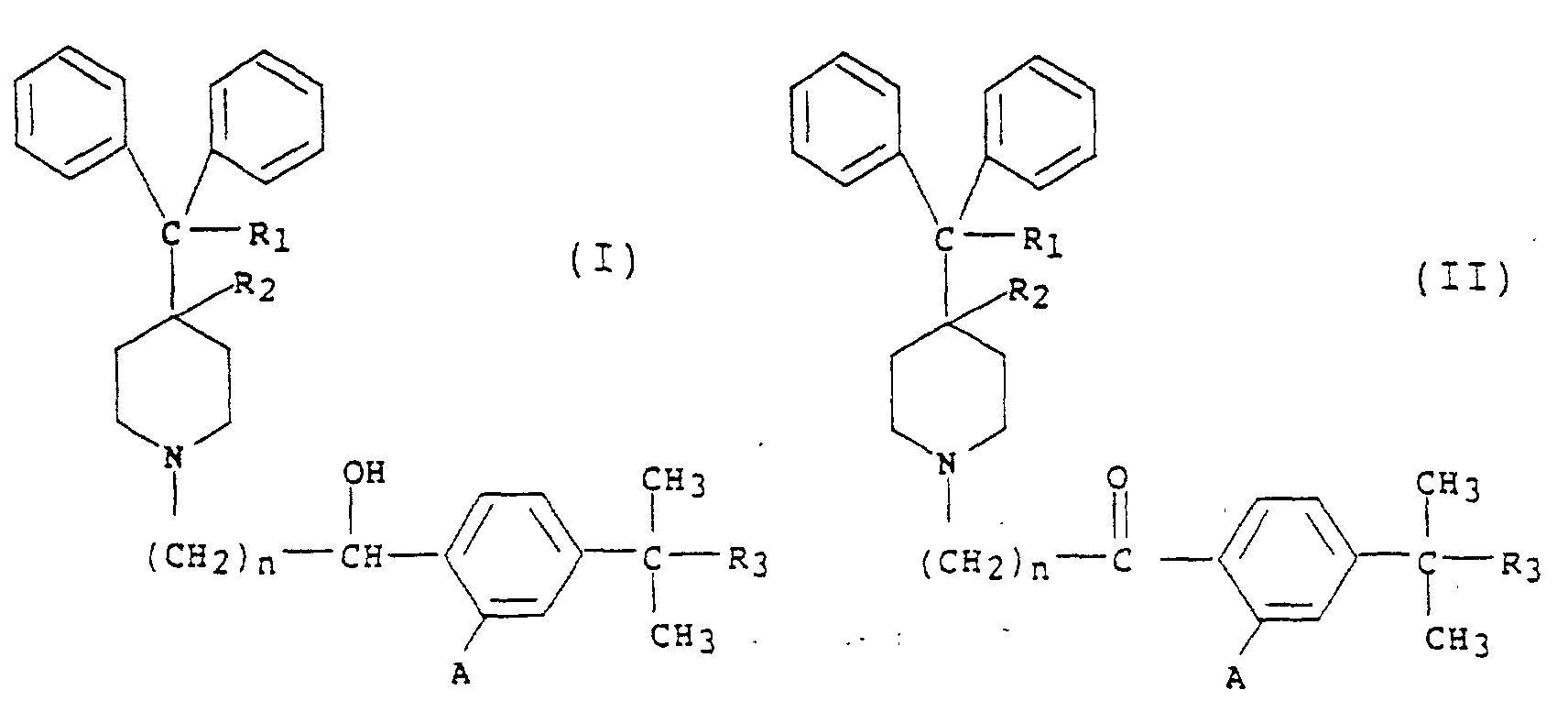
- R1 represents hydrogen or hydroxy;
- R2 represents hydrogen; or
- R1 and R2 taken together form a second bond between the carbon atoms bearing R1 and R2;
- n is an integer of from 1 to 5;
- R3 is -CH2OH, -COOH or -COOalkyl wherein the alkyl moiety has from 1 to 6 carbon atoms and is straight or branched;
- each of A is hydrogen or hydroxy; and
- pharmaceutically acceptable salts and individual optical isomers thereof, comprising subjecting the corresponding anhydrous, pharmaceutically acceptable acid addition salts to an aqueous recrystallization.
-
- In addition, the present invention provides processes for preparing polymorphs of anhydrous 4-[4-[4-(Hydroxydiphenylmethyl)-1-piperidinyl]-1-hydroxybutyl]-α,α-dimethylbenzeneacetic acid hydrochloride designated herein as Form I and Form III and processes for preparing psuedomorphs of hydrated 4-[4-[4-(Hydroxydiphenylmethyl)-1-piperidinyl]-1-hydroxybutyl]-α,α-dimethylbenzeneacetic acid hydrochloride designated herein as Form II and Form IV.
- The Form I polymorph may be identified by the following characteristics: a visual melting point (capillary tube) in the range of about 196-201°C; a melt endotherm with extrapolated onset in the range of about 195-199°C as determined by differential scanning calorimetry; and an X-ray powder diffraction pattern essentially as shown in Table 1 wherein the XRPD patterns were measured using a powder diffractometer equipped with a Co X-ray tube source. The sample was illuminated with Co Kα1 radiation and XRPD data were collected from 5 to 55° 2. (intensities may vary radically due to preferred orientation).
D-Space, Angstroms Intensity, I/Io, % 11.8 30 7.3 30 6.3 65 5.9 35 5.0 45 4.8 100 4.4 45 3.9 60 3.8 75 3.7 30 - The Form III polymorph may be identified by the following characteristics: a visual melting point (capillary tube) in the range of about 166-171°C; a broad endotherm below about 90°C, a melt endotherm with an extrapolated onset of about 166°C as determined by differential scanning calorimetry; and an X-ray powder diffraction pattern essentially as shown in Table 2 wherein the XRPD patterns were measured using a powder diffractometer equipped with a Co X-ray tube source. The sample was illuminated with Co Kα1 radiation and XRPD data were collected from 5 to 55° 2. (intensities may vary radically due to preferred orientation).
D-Space, Angstroms Intensity, I/Io, % 9.0 95 4.9 100 4.8 35 4.6 25 4.5 25 3.7 25 - The Form II pseudomorph may be identified by the following characteristics: a visual melting point (capillary tube) in the range of about 100-105°C; a large broad endotherm below about 100°C and a small endothermic peak (about 2 joules/gram) with extrapolated onsets in the range of about 124-126°C as determined by differential scanning calorimetry; and an X-ray powder diffraction pattern essentially as shown in Table 3 wherein the XRPD patterns were measured using a powder diffractometer equipped with a Co X-ray tube source. The sample was illuminated with Co Kα1 radiation and XRPD data were collected from 5 to 55° 2 (intensities may vary radically due to preferred orientation).
D-Space, Angstroms Intensity, I/Io, % 7.8 45 6.4 44 5.2 85 4.9 60 4.7 80 4.4 55 4.2 50 4.1 60 3.7 75 3.6 60 3.5 50 - The Form IV pseudomorph may be identified by the following characteristics: a visual melting point (capillary tube) in the range of about 113-118°C; two broad overlapping endotherms below about 100°C and an additional endotherm with an extrapolated onset at approximately 146°C as determined by differential scanning calorimetry and an X-ray powder diffraction pattern essentially as shown in Table 4 wherein the XRPD patterns were measured using a powder diffractometer equipped with a Co X-ray tube source. The sample was illuminated with Co Kα1 radiation and XRPD data were collected from 5 to 55° 2. (intensities may vary radically due to preferred orientation).
D-Space, Angstroms Intensity, I/Io, % 10.4 60 7.0 45 6.4 50 5.3 100 5.2 55 4.3 75 4.1 50 4.0 45 3.8 60 3.5 55 - Pharmaceutically acceptable acid addition salts of the compounds of formula (I) and (II), both anhydrous and hydrated, are those of any suitable inorganic or organic acid. Suitable inorganic acids are, for example, hydrochloric, hydrobromic, sulfuric, and phosphoric acids. Suitable organic acids include carboxylic acids, such as, acetic, propionic, glycolic, lactic, pyruvic, malonic, succinic, fumaric, malic, tartaric, citric, cyclamic, ascorbic, maleic, hydroxymaleic, and dihydroxymaleic, benzoic, phenylacetic, 4-aminobenzoic, 4-hydroxybenzoic, anthranilic, cinnamic, salicylic, 4-aminosalicylic, 2-phenoxybenzoic, 2-acetoxybenzoic, and mandelic acid, sulfonic acids, such as, methanesulfonic, ethanesulfonic and β-hydroxyethanesulfonic acid.
- As used herein, the term "hydrate" refers to a combination of water with a compound of formula (I) or (II) wherein the water retains its molecular state as water and is either absorbed, adsorbed or contained within a crystal lattice of the substrate molecule of formula (I) or (II).
- As used herein, the term "adsorped" refers to the physical state wherein the water molecule in the hydrated, pharmaceutically acceptable acid addition salts of piperidine derivatives of the formula (I) and (II) is distributed over the surface of the solid hydrated, pharmaceutically acceptable acid addition salts of piperidine derivatives of the formula (I) and (II).
- As used herein, the term "absorbed" refers to the physical state wherein the water molecule in the hydrated, pharmaceutically acceptable acid addition salts of piperidine derivatives of the formula (I) and (II) is distributed throughout the body of the solid hydrated, pharmaceutically acceptable acid addition salts of piperidine derivatives of the formula (I) and (II).
- Hydrated, pharmaceutically acceptable acid addition salts of the compounds of formula (I) and (II) are those hydrates ranging from essentially 0.10 to 5 molecules of water per molecule of substrate salt of formula (I) or (II).
- As used herein, the term "azeotropic mixture" refers to a liquid mixture of two or more substances which behaves like a single substance in that the vapor produced by partial evaporation of liquid has the same composition as the liquid. The constant boiling mixture exhibits either a maximum or minimum boiling point as compared with that of other mixtures of the same substance.
- As used herein, the term "azeotropic distillation" refers to a type of distillation in which a substance is added to the mixture to be separated in order to form an azeotropic mixture with one or more of the constituents of the original mixture. The azeotrope or azeotropes thus formed will have boiling points different from the boiling points of the original mixture. As used herein, the term "azeotropic distillation" also refers to co-distillation.
- As used herein, the term "water-minimizing recrystallization" refers to a recrystallization wherein the ratio of anhydrous solvent to substrate hydrate is such that the percentage of water present is minimized, thereby inducing precipitation of the anhydrous form of the substrate.
- As used herein, the term "aqueous recrystallization" refers to those processes wherein either 1) a solid material is dissolved in a volume of water or a water/organic solvent mixture sufficient to cause dissolution and the solid material recovered by evaporation of the solvent; 2) a solid material is treated with a minimal amount of water or a water/organic solvent mixture which is not sufficient to cause dissolution, heated to obtain dissolution and cooled to induce crystallization or 3) a solid material is dissolved in a volume of water or a water/organic solvent mixture sufficient to cause dissolution and then the solvent is partially evaporated to form a saturated solution which induces crystallization.
- As used herein, the term "crystal digestion" refers to that process wherein a solid material is treated with a minimal amount of water or water/organic solvent mixture which is not sufficient to cause dissolution and either heating or stirring at ambient temperature until the desired transformation has taken place.
- As used herein, the term "antisolvent" refers to a poor solvent for the substance in question which when added to a solution of the substance, causes the substance to precipitate.
- As used herein, the term "suitable temperature" refers to that temperature which is sufficient to cause dissolution and to permit the precipitation of the desired substance either upon addition of an antisolvent or upon removal of the co-solvent by azeotropic distillation.
- The anhydrous, pharmaceutically acceptable acid addition salts of piperidine derivatives of the formula (I) and (II) may be prepared from the corresponding hydrated, pharmaceutically acceptable acid addition salts of piperidine derivatives of the formula (I) and (II) by subjecting the corresponding hydrated, pharmaceutically acceptable acid addition salts of piperidine derivatives of the formula (I) and (II) to an azeotropic distillation.
- For example, the appropriate hydrated, pharmaceutically acceptable acid addition salt of piperidine derivatives of the formula (I) and (II) is first dissolved in a volume of a suitable solvent or solvent mixture which is sufficient to cause dissolution. Examples of such solvents are water, C1-C5 alkanols such as methanol, ethanol and the like; ketone solvents such as acetone, methyl ethyl ketone and the like; aliphatic ester solvents such as ethyl acetate, methyl acetate, methyl formate, ethyl formate, isopropyl acetate and the like and aqueous'mixtures of these solvents, such as acetone/water, methyl ethyl ketone/water, water/acetone and water/acetone/ethyl acetate. An additional volume of the same solvent used to effect dissolution or second suitable anhydrous antisolvent is then added to this solution, which is then heated to a boiling point which is suitable to azeotropically remove water and other low boiling components. Suitable anhydrous antisolvents for use in the azeotropic distillation are, for example, ketone solvents such as acetone, methyl ethyl ketone and the like; aliphatic ester solvents such as ethyl acetate, methyl acetate, methyl formate, ethyl formate, isopropyl acetate and the like; C5-C8 aliphatic solvents such as pentane, hexane and the like; aliphatic nitriles, such as acetonitrile and mixtures of these solvents such as acetone/ethyl acetate and the like. The azeotropic mixture of water and solvent is removed by distillation until the temperature changes, indicating that the azeotropic mixture is completely removed. The reaction mixture is cooled and the corresponding anhydrous, pharmaceutically acceptable acid addition salts of piperidine derivatives of the formula (I) and (II) is recovered from the reaction zone by, for example filtration.
- In addition, the anhydrous, pharmaceutically acceptable acid addition salts of piperidine derivatives of the formula (I) and (II) may be prepared from the corresponding hydrated, pharmaceutically acceptable acid addition salts of piperidine derivatives of the formula (I) and (II) by subjecting the corresponding hydrated, pharmaceutically acceptable acid addition salts of piperidine derivatives of the formula (I) and (II) to a water-minimizing recrystallization.
- For example, the appropriate hydrated, pharmaceutically acceptable acid addition salt of piperidine derivatives of the formula (I) and (II) is dissolved in a volume of a suitable anhydrous solvent or solvent mixture which is sufficient to cause dissolution and heated to reflux. Examples of such solvents are water, C1-C5 alkanols such as methanol, ethanol and the like; ketone solvents such as acetone, methyl ethyl ketone and the like; aliphatic ester solvents such as ethyl acetate, methyl acetate, methyl formate, ethyl formate, isopropyl acetate and the like and aqueous mixtures of these solvents, such as acetone/water, methyl ethyl ketone/water, water/acetone and water/acetone/ethyl acetate. An additional volume of the same solvent used to effect dissolution or second suitable anhydrous antisolvent is then added in a quantity sufficient to initiate precipitation of the anhydrous, pharmaceutically acceptable acid addition salt of piperidine derivatives of the formula (I) and (II). Suitable anhydrous antisolvents are, for example, ketone solvents such as acetone, methyl ethyl ketone and the like; aliphatic ester solvents such as ethyl acetate, methyl acetate, methyl formate, ethyl formate, isopropyl acetate and the like; mixtures-of ketone solvents and aliphatic ester solvents such as acetone/ethyl acetate and the like; C5-C8 aliphatic solvents such as pentane, hexane and the like; aliphatic nitriles, such as acetonitrile and mixtures of these solvents such as acetone/ethyl acetate and the like as well as mixtures of water and ketone solvents such as acetone/water and the like; and mixtures of water, ketone solvents and aliphatic ester solvents such as acetone/water/ethyl acetate. The reaction mixture is cooled and the corresponding anhydrous, pharmaceutically acceptable acid addition salt of piperidine derivatives of the formula (I) and (II) is recovered from the reaction zone by, for example filtration.
- Polymorphic forms of anhydrous 4-[4-[4-(Hydroxydiphenylmethyl)-1-piperidinyl]-1-hydroxybutyl]-α,α-dimethylbenzeneacetic acid hydrochloride (Forms I and III) may be prepared by a variety of methods as detailed below.
- For example, anhydrous 4-[4-[4-(Hydroxydiphenylmethyl)-1-piperidinyl]-1-hydroxybutyl]-α,α-dimethylbenzeneacetic acid hydrochloride (Form I) may be prepared from anhydrous 4-[4-[4-(Hydroxydiphenylmethyl)-1-piperidinyl]-1-hydroxybutyl]-α,α-dimethylbenzeneacetic acid hydrochloride (Form III), by subjecting the anhydrous 4-[4-[4-(Hydroxydiphenylmethyl)-1-piperidinyl]-1-hydroxybutyl]-α,α-dimethylbenzeneacetic acid hydrochloride (Form III) to a crystal digestion as described above.
- In addition, anhydrous 4-[4-[4-(Hydroxydiphenylmethyl)-1-piperidinyl]-l-hydroxybutyl]-α,α-dimethylbenzeneacetic acid hydrochloride (Form III) may be prepared from hydrated 4-[4-[4-(Hydroxydiphenylmethyl)-1-piperidinyl]-1-hydroxybutyl]-α,α-dimethylbenzeneacetic acid hydrochloride (Form II), by subjecting the hydrated 4-[4-[4-(Hydroxydiphenylmethyl)-1-piperidinyl]-1-hydroxybutyl]-α,α-dimethylbenzeneacetic acid hydrochloride (Form II) to water-minimizing recrystallization as described above.
- In addition, anhydrous 4-[4-[4-(Hydroxydiphenylmethyl)-1-piperidinyl]-l-hydroxybutyl]-α,α-dimethylbenzeneacetic acid hydrochloride (Form I) may be prepared from hydrated 4-[4-[4-(Hydroxydiphenylmethyl)-1-piperidinyl]-1-hydroxybutyl]-α,α-dimethylbenzeneacetic acid hydrochloride (Form II), by subjecting the hydrated 4-[4-[4-(Hydroxydiphenylmethyl)-1-piperidinyl]-1-hydroxybutyl]-α,α-dimethylbenzeneacetic acid hydrochloride (Form II) to water-minimizing recrystallization as described above or by subjecting the hydrated 4-[4-[4-(Hydroxydiphenylmethyl)-1-piperidinyl]-1-hydroxybutyl]-α,α-dimethylbenzeneacetic acid hydrochloride (Form II) to an azeotropic distillation.
- In addition, anhydrous 4-[4-[4-(Hydroxydiphenylmethyl)-1-piperidinyl]-1-hydroxybutyl]-α,α-dimethylbenzeneacetic acid hydrochloride (Form I) may be prepared from hydrated 4-[4-[4-(Hydroxydiphenylmethyl)-1-piperidinyl]-1-hydroxybutyl]-α,α-dimethylbenzeneacetic acid hydrochloride (Form IV), by subjecting the hydrated 4-[4-[4-(Hydroxydiphenylmethyl)-1-piperidinyl]-1-hydroxybutyl]-α,α-dimethylbenzeneacetic acid hydrochloride (Form IV) to water-minimizing recrystallization or to an azeotropic distillation as described above.
- The hydrated, pharmaceutically acceptable acid addition salts of piperidine derivatives of the formula (I) may be prepared from the corresponding compound of the formula (II) wherein R3 is -COOalkyl by subjecting the corresponding compound of the formula (II) wherein R3 is -COOalkyl to a reduction using an appropriate reducing agent, such as sodium borohyride, potassium borohydride, sodium cyanoborohydride, or tetramethylammonium borohydride in a suitable solvent, such as, methanol, ethanol, isopropyl alcohol or n-butanol, aqeuous mixtures thereof or basic solutions thereof, at temperatures ranging from about 0°C to the reflux temperature of the solvent, and the reaction time varies from about 1/2 hour to 8 hours. After quenching and acidifying with an suitable acid, such as hydrochloric acid, the hydrated, pharmaceutically acceptable acid addition salts of piperidine derivatives of the formula (I) are recovered from the reaction zone by crystallization and filtration.
- In addition, the hydrated, pharmaceutically acceptable acid addition salts of piperidine derivatives of the formula (I) and (II) may be prepared from the corresponding anhydrous, pharmaceutically acceptable acid addition salts of the formula (I) and (II) by subjecting the corresponding anhydrous, pharmaceutically acceptable acid addition salts of formula (I) and (II) to an aqueous recrystallization.
- For example, the appropriate anhydrous, pharmaceutically acceptable acid addition salt of piperidine derivatives of the formula (I) and (II) is treated with a minimal volume of water or suitable water/organic solvent mixture which is insufficient to cause dissolution and heated to reflux. The reaction mixture is cooled and the corresponding hydrated, pharmaceutically acceptable acid addition salt of piperidine derivatives of the formula (I) and (II) is recovered from the reaction zone by, for example filtration. Alternatively, the appropriate anhydrous, pharmaceutically acceptable acid addition salt of piperidine derivatives of the formula (I) and (II) is treated with a volume of water or a suitable water/organic solvent mixture which is sufficient to cause dissolution and the water or water/organic solvent is partially or completely evaporated to a volume which induces crystallization of the hydrated, pharmaceutically acceptable acid addition salts of piperidine derivatives of the formula (I) and (II). Suitable solvents for use in the above recrystallization are water, acetone/water, ethanol/water, methyl ethyl ketone/aqueous methanol, methyl ethyl ketone/water and the like.
- The pseudomorphic forms of hydrated 4-[4-[4-(Hydroxydiphenylmethyl)-1-piperidinyl]-1-hydroxybutyl]-α,α-dimethylbenzeneacetic acid hydrochloride (Forms II and IV) may be prepared by a variety of methods as detailed below.
- Hydrated 4-[4-[4-(Hydroxydiphenylmethyl)-1-piperidinyl]-1-hydroxybutyl]-α,α-dimethylbenzeneacetic acid hydrochloride (Form IV) may be prepared from ethyl 4-[4-[4-(hydroxydiphenylmethyl)-1-piperidinyl]-1-oxobutyl]-α,α-dimethylbenzeneacetate, hydrochloride or free base as described above for the general preparation of the hydrated, pharmaceutically acceptable acid addition salts of piperidine derivatives of the formula (I) from the corresponding compound of the formula (II) wherein R3 is-COOalkyl, but rapdily adding water over a period of time ranging from 1 minute to 45 minutes at a temperature range of about -20°C to 50°C to precipitate the hydrated 4-[4-[4-(Hydroxydiphenylmethyl)-1-piperidinyl]-1-hydroxybutyl]-α,α-dimethylbenzeneacetic acid hydrochloride (Form II).
- Hydrated 4-[4-[4-(Hydroxydiphenylmethyl)-1-piperidinyl]-1-hydroxybutyl]-α,α-dimethylbenzeneacetic acid hydrochloride (Form IV) may be prepared from ethyl 4-[4-[4-(hydroxydiphenylmethyl)-1-piperidinyl]-1-oxobutyl]-α,α-dimethylbenzeneacetate, hydrochloride or free base as described above for the general preparation of the hydrated, pharmaceutically acceptable acid addition salts of piperidine derivatives of the formula (I) from the corresponding compound of the formula (II) wherein R3 is -COOalkyl, but slowly adding water over a period of time ranging from about 30 minutes to 24 hours and at a temperature range of about 0°C to 50°C, optionally with seeding, to precipitate the hydrated 4-[4-[4-(Hydroxydiphenylmethyl)-1-piperidinyl]-1-hydroxybutyl]-α,α-dimethylbenzeneacetic acid hydrochloride (Form IV).
- Hydrated 4-[4-[4-(Hydroxydiphenylmethyl)-1-piperidinyl]-1-hydroxybutyl]-α,α-dimethylbenzeneacetic acid hydrochloride (Form II) may be prepared from anhydrous 4-[4-[4-(Hydroxydiphenylmethyl)-1-piperidinyl]-1-hydroxybutyl]-α,α-dimethylbenzeneacetic acid hydrochloride (Form I) by subjecting hydrated 4-[4-[4-(Hydroxydiphenylmethyl)-1-piperidinyl]-1-hydroxybutyl]-α,α-dimethylbenzeneacetic acid hydrochloride (Form II) to an aqueous recrystallization as defined above.
- Starting materials for use in the present invention are readily available to one of ordinary skill in the art. For example, ethyl 4-[4-[4-(Hydroxydiphenylmethyl)-1-piperidinyl]-1-oxobutyl]-α,α-dimethylbenzeneacetate, hydrochloride is described in U.S. Patent 4,254,129, March 3, 1981.
- The following examples present typical processes for preparing the anhydrous and hydrated, pharmaceutically acceptable acid addition salts of piperidine derivatives of the formula (I) and (II), polymorphs and pseudomorphs therof. These examples are understood to be illustrative only and are not intended to limit the scope of the present invention in any way. As used herein, the following terms have the indicated meanings: "g" refers to grams; "mol" refers to mole; "mmol" refers to millimoles; "mL" refers to milliliters; "bp" refers to boiling point; "mp" refers to melting point; "°C" refers to degrees Celsius; "mm Hg" refers to millimeters of mercury; "µL" refers to microliters; "µg" refers to micrograms; and "µM" refers to micromolar.
- Differential Scanning Calorimetry analysis were performed using a TA 2910 DSC with open aluminum pans. The samples were heated to 240°C at 5°C/minute with a 50mL/minute nitrogen purge.
- X-Ray Powder Diffraction analyses were performed as follows:
- The samples were loaded into a quartz (zero scatter) sample holder for the XRPD pattern measurement. The XRPD patterns were measured using a powder diffractometer equipped with a Co X-ray tube source, primary beam monochromator, and position sensitive detector (PSD). The incident beam was collimated using a 1° divergence slit. The active area on the PSD subtended approximately 5°2. The source was operated at 35 kV and 30 mA and the sample was illuminated with Co Kα1 radiation. XRPD data were collected from 5 to 55° 2 at a rate of 0.25°2/minute and a step width of 0.02°2. The XRPD patterns were measured without the addition of an internal calibrant.
- Peak positions and intensities for the most prominent features were measured using a double-derivative peak picking method. X-ray peaks with I/Io greater than 20% were reported. The cutoff was chosen arbitrarily. The intensities are rounded to the nearest 5%. Certain peaks appear sensitive to preferred orientation that is caused by changes in crystallite morphology. This results in large changes in the I/Io value.
- Mix ethyl 4-[4-[4-(hydroxydiphenylmethyl)-1-piperidinyl]-1-oxobutyl]-α,α-dimethylbenzeneacetate, hydrochloride (101.92g, 0.1807mol) and methanol (510mL) and stir. Rapidly add 50% sodium hydroxide (72.27g, 0.903mol) and wash in with water (61mL). Heat to reflux for 2 hours, allow to cool to 35°C and treat with sodium borohydride (3.42g, 0.0903mol). Add water (100mL) and maintain at 35°C for 10 hours. Add 37% hydrochloric acid (53.0g) to adjust pH to 11.5. Add acetone (26.5mL) and water (102mL). Hold at 35°C for 2 hours and adjust to pH 2.5 with 37% hydrochloric acid (44.69g). Dilute with water (408mL), cool to -15°C, stir for 1.5 hours and collect the precipitate by vacuum filtration. Wash the filtercake with deionized water (3X100mL) and vacuum dry to give 4-[4-[4-(hydroxydiphenylmethyl)-1-piperidinyl]-1-hydroxybutyl]-α,α-dimethylbenzeneacetic acid hydrochloride hydrate (97.10g).
- Place ethyl 4-[4-[4-(hydroxydiphenylmethyl)-1-piperidinyl]-1-oxobutyl]-α,α-dimethylbenzeneacetate, hydrochloride (60.01g, 0.106mol) in a 1-L three necked round-bottom flask and fit the flask with a mechanical stirrer, a Claisen head, a thermometer and a reflux condenser with a nitrogen bubbler on top. Add methanol (300mL) and turn the stirrer on. Dilute the slurry with water (60mL) and heat to 52-54°C over 15-20 minutes. Hold at 52°C for 2 hours and then add 50% sodium hydroxide (42.54g, 0.532mol). Heat at 73°C for approximately 1 hour, 45 minutes, cool to less than 35°C using a water bath and then add sodium borohydride (2.02g, 0.0534mol). Stir overnight at 35°C, treat with acetone (15.5 mL) and stir for 2 hours at 35°C. Acidify the mixture to a pH of 1.85 with 28% hydrochloric acid (75.72g), dilute with water (282 mL), stir for about 30 minutes and cool over about 2 hours to -15°C. Filter the solids off and wash with water (2X75mL) and ethyl acetate (2X75mL). Vacuum dry the solid and allow to stand for 2 days to give 4-[4-[4-(hydroxydiphenylmethyl)-1-piperidinyl]-1-hydroxybutyl]-α,α-dimethylbenzeneacetic acid hydrochloride hydrate (Form II) (57.97g, 91.5%) as a fine powder.
- Place ethyl 4-[4-[4-(hydroxydiphenylmethyl)-1-piperidinyl]-1-oxobutyl]-α,α-dimethylbenzeneacetate (56.12g, 0.1064mol) in a 1-L three necked round-bottom flask and fit the flask with a mechanical stirrer, a Claisen head, a thermometer and a reflux condenser with a nitrogen bubbler on top. Add methanol (300mL) and turn the stirrer on. Dilute the slurry with water (60mL) and heat to reflux using a heating mantle controlled by a Therm-O-Watch. When the mixture reaches about 35°C, treat with 50% sodium hydroxide (34.05g, 0.42.56mol) and rinse in with water (42mL). Stir at reflux for 2 hours, 15 minutes, cool over 1 hour to 35°C and then treat with sodium borohydride (2.02g, 0.0534mol). Stir for 7.5 hours and allow to stand at room temperature without stirring for 1.75 days. Warm the mixture to 35°C and quench with acetone (15.5mL, 0.21mol) and stir for 2 hours. Add water (60mL) and adjust the pH to 2.5 with 32% hydrochloric acid (65.22g). Cool to 40°C and rinse the pH probe with water (25mL). Add water over about 30 minutes (192mL), hold the temperature at 33°C for 10 minutes and add a few seed crystals. Cool the slurry to -12°C over about 45 minutes and isolate the solid by filtration (586.2g). Wash with water (2X100mL) and then with ethyl acetate (100mL, prechilled to about -10°C). Vacuum dry overnight (1 mmHg, 50°C) to give 4-[4-[4-(hydroxydiphenylmethyl)-1-piperidinyl]-l-hydroxybutyl]-α,α-dimethylbenzeneacetic acid hydrochloride hydrate (Form II) (58.86g, 98%) as a white solid.
- Place ethyl 4-[4-[4-(hydroxydiphenylmethyl)-1-piperidinyl]-1-oxobutyl]-α,α-dimethylbenzeneacetate (56.12g, 0.1064mol) in a 1-L three necked round-bottom flask and fit the flask with a mechanical stirrer, a Claisen head, a thermometer and a reflux condenser with a nitrogen bubbler on top. Add methanol (300mL) and turn the stirrer on. Dilute the slurry with water (60mL) and heat to reflux using a heating mantle controlled by a Therm-O-Watch. When the mixture reaches about 35°C, treat with 50% sodium hydroxide (34.05g, 0.4256mol) and rinse in with water (42mL). Stir at reflux for 2 hours, 15 minutes, cool over 1 hour to 35°C and then treat with sodium borohydride (2.02g, 0.0534mol). Stir for 7.5 hours and allow to stand at room temperature without stirring for 1.75 days. Warm the mixture to 35°C and quench with acetone (15.5mL, 0.21mol) and stir for 2 hours. Add water (60mL) and adjust the pH to 2.5 with 32% hydrochloric acid (65.22g). Cool to 40°C and rinse the pH probe with water (25mL). Hold the temperature at 33°C for 10 minutes, add a few seed crystals and add water over about 4 hours (192mL) at 35°C. Cool the slurry to -12°C over about 45 minutes and isolate the solid by filtration (586.2g). Wash with water (2X100mL) and then with ethyl acetate (100mL, prechilled to about -10°C). Vacuum dry overnight (1 mmHg, 50°C) to give 4-[4-[4-(hydroxydiphenylmethyl)-1-piperidinyl]-1-hydroxybutyl]-α,α-dimethylbenzeneacetic acid hydrochloride hydrate (Form IV); mp 115-116°C (dec).
-
D-Space, Angstroms Intensity, I/Io, % 10.38 60 6.97 45 6.41 50 5.55 30 5.32 100 5.23 55 5.11 35 4.98 25 4.64 30 4.32 35 4.28 75 4.12 50 4.02 45 3.83 60 3.65 20 3.51 55 3.46 25 2.83 20 - Treat 4-[4-[4-(hydroxydiphenylmethyl)-1-piperidinyl]-1-hydroxybutyl]-α,α-dimethylbenzeneacetic acid hydrochloride hydrate (Form II) (20.0g, 0.0355mol) with deionized water (2g) and add acetone (60mL) in small portions over several minutes with stirring. Filter through filter aid and wash the filter cake with acetone (30mL). Wash the filtercake with acetone (22mL), reflux filtrate and then slowly add ethyl acetate (32mL over 15 minutes) keeping the mixture at reflux. Reflux for 10 minutes, then slowly add additional ethyl acetate (23mL over 10 minutes) and reflux for an additional 15 minutes. Add additional ethyl acetate (60mL over 5-10 minutes) and continue refluxing for 15 minutes. Cool to approximately 8°C in an ice bath, filter the solid and wash with ethyl acetate (85mL). Vacuum dry at 55°C for 1.5 hours to give the title compound (18.16g, 95%).
- Treat 4-[4-[4-(hydroxydiphenylmethyl)-1-piperidinyl]-1-hydroxybutyl]-α,α-dimethylbenzeneacetic acid hydrochloride hydrate (Form II) (5.00g, 0.0083mol) with methylethyl ketone (130mL). Slowly add water (0.4mL), filter through filter aid and wash the filter cake with methylethyl ketone (20mL). Heat to reflux and distill off 75mL of solvent, cool to -15°C and collect by vacuum filtration. Wash with methylethyl ketone (2X10mL) and vacuum dry at 60°C to give the title compound (4.33g, 97%); mp 196-198°C.
- Treat 4-[4-[4-(hydroxydiphenylmethyl)-1-piperidinyl]-1-hydroxybutyl]-α,α-dimethylbenzeneacetic acid hydrochloride hydrate (Form II) (1.4g) with acetone (60mL) and heat to reflux. Reduce the volume to approximately 35mL to remove all water which boils off as an azeotrope (88/12:acetone/water). Cool the solution and collect the title compound as a crystalline solid.
- Mix 4-[4-[4-(hydroxydiphenylmethyl)-1-piperidinyl]-1-hydroxybutyl]-α,α-dimethylbenzeneacetic acid hydrochloride hydrate (Form II) (53.88g, 0.100mol) and add water (4.79g) and methyl ethyl ketone (240mL). Stir until the solid is slurried up and add additional methyl ethyl ketone (1L). Stir for 0.5 hours, filter through a pad of filter aid, wash the filtercake with methyl ethyl ketone (100mL) and transfer the filtrate and wash to a 2L, 3-necked flask fitted with a thermometer, mechanical stirrer and distillation head. Distill off a total of 721mL of methyl ethyl ketone, cool and stir over 1 hour to 40°C. Cool to -15°C and hold for 10 minutes. Collect the solid by vacuum filtration and wash the filtercake with methyl ethyl ketone (2X65mL) and vacuum dry at 55°C overnight to give the title compound (52.76g, 97.9%); mp 197.5-200°C.
- Treat 4-[4-[4-(hydroxydiphenylmethyl)-1-piperidinyl]-1-hydroxybutyl]-α,α-dimethylbenzeneacetic acid hydrochloride hydrate (Form II) (40.0g, 0.0696mol, assayed at 93.6% purity, having 0.89g water present and 35.1g, 0.0575mol, assayed at 88.0% purity, having 2.47g water present) with water (8.30g; the amount calculated to bring the weight of water present to 17% of the anhydrous weight of 4-[4-[4-(hydroxydiphenylmethyl)-1-piperidinyl]-1-hydroxybutyl]-α,α-dimethylbenzeneacetic acid hydrochloride hydrate, taking into account the water in the hydrated salt). Add methyl ethyl ketone (approximately 500mL) and stir until most of the solids dissolve. Add additional methyl ethyl ketone (700mL) in portions over approximately 10 minutes and continue stirring for 1/2 hour. Filter through a thin pad of filter aid, wash the filtercake and flask with additional methyl ethyl ketone (100mL) and transfer to a boiling flask fitted with a thermometer, mechanical stirrer, heating mantle, a 12-plate Oldershaw (vacuum-jacketed) distillation column and a distillation head with the capability of regulating the reflux ratio in a rough fashion, washing in with additional methyl ethyl ketone (100mL). Distill off 450 mL of solvent, cool to -15°C and filter the solid. Wash with methyl ethyl ketone (2X100mL) and dry to give the title compound (68.3g, 99.9%); mp 197-199°C.
- Bring methyl ethyl ketone (4mL) to a boil and add 4-[4-[4-(hydroxydiphenylmethyl)-1-piperidinyl]-1-hydroxybutyl]-α,α-dimethylbenzeneacetic acid hydrochloride (500mg). Decant the top layer and add methyl ethyl ketone (3mL) to the aqeuous layer. Boil the solution until the temperature reached 79°C, reduce the volume by 25%, remove from heat and cover with aluminum foil. Allow the solution to cool, filter the resulting crystals and air dry to give the title compound.
- Treat 4-[4-[4-(hydroxydiphenylmethyl)-1-piperidinyl]-1-hydroxybutyl]-α,α-dimethylbenzeneacetic acid hydrochloride (Form I) (2.0g) with ethanol (4mL) and deionized water (20mL). Heat at 80°C until a solution is formed and then stir at room temperature for 23 hours. Filter the resulting slurry, wash with water (2X10mL) and dry under vacuum at 35°C overnight to give the title compound (1.88g); mp 100-105°C.
-
D-Space, Angstroms Intensity, I/Io, % 11.41 20 7.98 20 7.83 45 6.58 45 6.42 60 5.66 20 5.52 45 5.39 30 5.23 65 5.14 45 4.86 65 4.72 100 4.45 65 4.40 45 4.32 45 4.18 45 4.06 65 4.02 55 3.85 25 3.79 75 3.74 95 3.61 80 3.56 25 3.47 65 3.41 20 2.74 20 - Mix water (35.5mL), methanol (26.3mL) and sodium chloride (2.59g). Add 4-[4-[4-(hydroxydiphenylmethyl)-1-piperidinyl]-1-hydroxybutyl]-α,α-dimethylbenzeneacetic acid hydrochloride (Form I) (4.77g). Heat to reflux on a steam bath until dissolution and cool to -10°C. Filter the resulting solid, wash with water (2X25mL) and vacuum dry overnight to give the title compound (4.80g).
- Place 4-[4-[4-(Hydroxydiphenylmethyl)-1-piperidinyl]-1-hydroxybutyl]-α,α-dimethylbenzeneacetic acid hydrochloride hydrate (Form II) (55.56g, 0.0929mol having 10% water) in a pressure bottle along with water (2.96g) and acetone (38.1g). Seal the bottle tightly and heat to approximately 80°C. Cool to about 50°C, filter through filter aid in a coarse sintered glass funnel and dilute with acetone (90g). Transfer to a 1L flask fitted with a mechanical stirrer, thermometer and a reflux condenser. Heat the mixture to reflux and allow to cool and stir over the weekend. Cool to -15°C and filter on a coarse sintered glass funnel, wash with ethyl acetate (2X50mL) and vacuum dry at 50°C.
- Place a majority of the solid obtained (45.24g) in a 500 mL three necked flask fitted with a mechanical stirrer, thermometer and a reflux condenser. Add acetone (240mL) and water (4.82g) and reflux the mixture overnight. Allow the slurry to cool to 35°C and place in an ice water bath and cool to less then 5°C. Filter the solid off on a coarse sintered glass funnel, wash with ethyl acetate (50mL) and vacuum dry at 50C for several hours to give the title compound as a white crystalline powder (43.83g, 97%); mp 166.5-170.5°C.
-
D-Space, Angstroms Intensity, I/Io, % 8.95 95 4.99 20 4.88 100 4.75 35 4.57 25 4.47 25 4.46 20 3.67 20 3.65 25 - Place 4-[4-[4-(Hydroxydiphenylmethyl)-1-piperidinyl]-1-hydroxybutyl]-α,α-dimethylbenzeneacetic acid hydrochloride (Form III) (40.0g as an ethyl acetate wetcake-27.9g dry basis) in a 1L three necked flask fitted with a mechanical stirrer, thermometer and a reflux condenser. Add acetone (240mL) and heat the mixture to reflux for about 20 hours. Cool the slurry to -15°C and isolate the solids by filtration on a coarse sintered glass frit funnel. Wash with ethyl acetate (50mL) and vacuum dry overnight to give the title compound (26.1g, 93.7%); mp 197.5-199.5°C.
-
D-Space, Angstroms Intensity, I/Io, % 11.75 35 7.23 35 6.24 60 5.89 40 5.02 20 4.94 30 4.83 100 4.44 30 3.93 75 3.83 20 3.77 85 3.71 25 3.62 30 3.32 25 3.31 20 - Place 4-[4-[4-(hydroxydiphenylmethyl)-1-piperidinyl]-1-hydroxybutyl]-α,α-dimethylbenzeneacetic acid hydrochloride hydrate (Form IV) (54.35g, 0.0970mol, having 4% water present) in a pressure bottle along with water (4.16g) and acetone (38.1g). Seal the bottle tightly and heat to approximately 80°C. Cool to less then 60°C, filter through filter aid in a coarse sintered glass funnel and rinse the filter cake with acetone (32.4g). Place acetone (215g) in a 1L three necked flask fitted with a mechanical stirrer, thermometer, a reflux condenser and containing a small amount of Form I crystals and heat to reflux. Add a portion of the acetone/water solution of 4-[4-[4-(hydroxydiphenylmethyl)-1-piperidinyl]-1-hydroxybutyl]-α,α-dimethylbenzeneacetic acid hydrochloride hydrate (Form IV) (47.65g) to the refluxing acetone over about 10 minutes. Slowly add ethyl acetate (157.5g) over 45 minutes then add the remaining portion of the acetone/water solution of 4-[4-[4-(hydroxydiphenylmethyl)-1-piperidinyl]-1-hydroxybutyl]-α,α-dimethylbenzeneacetic acid hydrochloride hydrate (Form IV), rinsed in with about 20mL of acetone. Add additional ethyl acetate (157.5g) over 45 minutes to 1 hour, maintaining the slurry at reflux. Stir for 15 minutes, cool to -15°C and vacuum filter the white solid on a 350mL coarse sintered glass funnel. Wash the solids with ethyl acetate (2X50mL) and vacuum dry overnight to give the title compound (50.36g, 97%); mp 198-199.5°C.
-
D-Space, Angstroms Intensity, I/Io, % 14.89 20 11.85 20 7.30 20 6.28 70 5.91 25 5.55 20 5.05 25 4.96 55 4.85 100 4.57 45 4.45 55 3.94 45 3.89 20 3.84 20 3.78 60 3.72 35 3.63 20 3.07 20 3.04 20 2.45 20 - The polymorphic and pseudomorphic 4-[4-[4-(hydroxydiphenylmethyl)-1-piperidinyl]-1-hydroxybutyl]-α,α-dimethylbenzeneacetic acid hydrochloride compounds of this invention are useful as antihistamines, antiallergy agents and bronchodilators and may be administered alone or with suitable pharmaceutical carriers, and can be in solid or liquid form such as, tablets, capsules, powders, solutions, suspensions or emulsions.
- The polymorphic and pseudomorphic 4-[4-[4-(hydroxydiphenylmethyl)-1-piperidinyl]-1-hydroxybutyl]-α,α-dimethylbenzeneacetic acid hydrochloride compounds of this invention can be administered orally, parenterally, for example, subcutaneously, intravenously, intramuscularly, intraperitoneally, by intranasal instillation or by application to mucous membranes, such as, that of the nose, throat and bronchial tubes, for example, in an aerosol spray containing small particles of a compound of this invention in a spray or dry powder form.
- The quantity of polymorphic or pseudomorphic 4-[4-[4-(hydroxydiphenylmethyl)-1-piperidinyl]-1-hydroxybutyl]-α,α-dimethylbenzeneacetic acid hydrochloride compound administered will vary depending on the patient and the mode of administration and can be any effective amount. The quantity of polymorphic or pseudomorphic 4-[4-[4-(hydroxydiphenylmethyl)-1-piperidinyl]-l-hydroxybutyl]-α,α-dimethylbenzeneacetic acid hydrochloride compound administered may vary over a wide range to provide in a unit dosage an effective amount of from about 0.01 to 20 mg/kg of body weight of the patient per day to achieve the desired effect. For example, the desired antihistamine, antiallergy and bronchodilator effects can be obtained by consumption of a unit dosage form such as a tablet containing 1 to 500 mg of a polymorphic or pseudomorphic 4-[4-[4-(hydroxydiphenylmethyl)-1-piperidinyl]-1-hydroxybutyl]-α,α-dimethylbenzeneacetic acid hydrochloride compound of this invention taken 1 to 4 times daily.
- The solid unit dosage forms can be of the conventional type. Thus, the solid form can be a capsule which can be the ordinary gelatin type containing a polymorphic or pseudomorphic 4-[4-[4-(hydroxydiphenylmethyl)-1-piperidinyl]-1-hydroxybutyl]-α,α-dimethylbenzeneacetic acid hydrochloride compound of this invention and a carrier, for example, lubricants and inert fillers such as lactose, sucrose or cornstarch. In another embodiment the polymorphic or pseudomorphic 4-[4-[4-(hydroxydiphenylmethyl)-1-piperidinyl]-1-hydroxybutyl]-α,α-dimethylbenzeneacetic acid hydrochloride compound is tableted with conventional tablet bases such as lactose, sucrose or cornstarch or gelatin, disintegrating agents such as cornstarch, potato starch or alginic acid, and a lubricant such as stearic acid or magnesium stearate.
- The polymorphic or pseudomorphic 4-[4-[4-(hydroxydiphenylmethyl)-1-piperidinyl]-1-hydroxybutyl]-α,α-dimethylbenzeneacetic acid hydrochloride compounds of this invention may also be administered in injectable dosages by solution or suspension of the compounds in a physiologically acceptable diluent with a pharmaceutical carrier which can be a sterile liquid such as water and oils, with or without the addition of a surfactant and other pharmaceutically acceptable adjuvants. Illustrative of oils there can be mentioned those of petroleum, animal, vegatable or synthetic origin, for example, peanut oil, soybean oil or mineral oil. In general, water, saline, aqueous dextrose and related sugar solutions and glycols such as propylene glycol or polyethylene glycol are preferred liquid carriers, particularly for injectable solutions.
- For use as aerosols the compounds of this invention in solution or suspension may be packaged in a pressurized aerosol container together with suitable propellants, for example, hydrocarbon propellants such as, propane, butane or isobutane with the usual adjuvants as may be administered in a non-pressurized form such as in a nebulizer or atomizer.
- The term patient as used herein is taken to mean warm blooded animals, birds, mammals, for example, humans, cats, dogs, horses, sheep, bovine cows, pigs, lambs, rats, mice and guinea pigs.
Claims (24)
- A process for preparing a compound of the formulawherein
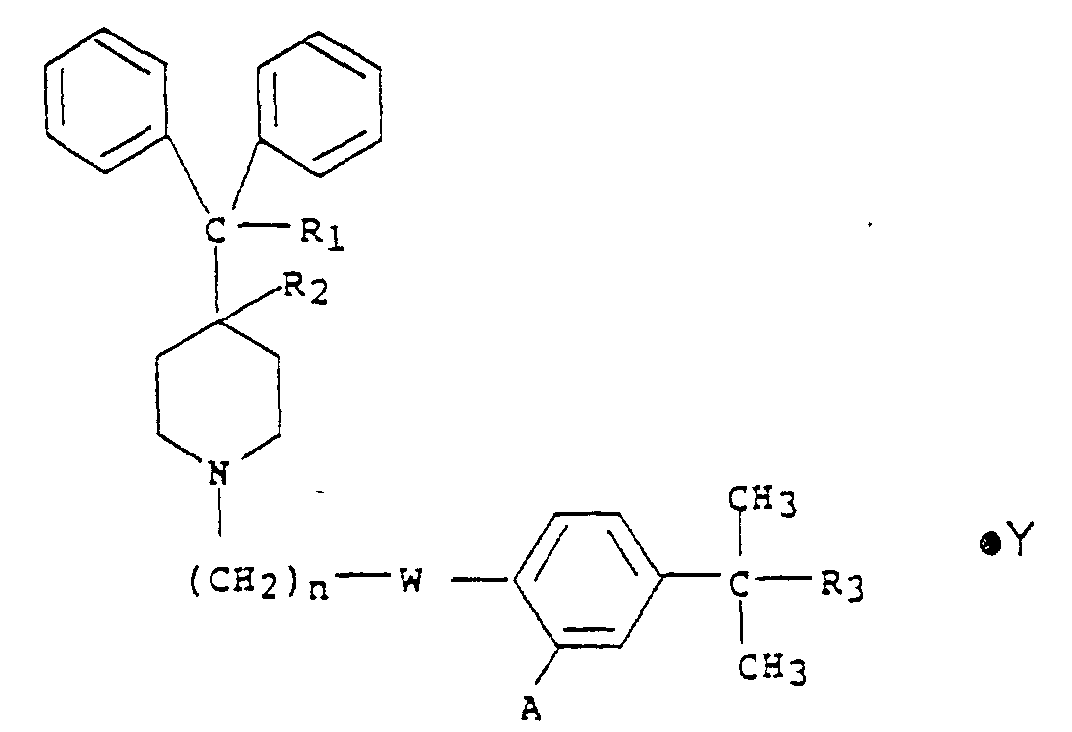 the individual optical isomers thereof,R1 represents hydrogen or hydroxy;R2 represents hydrogen; orR1 and R2 taken together form a second bond between the carbon atoms bearing R1 and R2;n is an integer of from 1 to 5;R3 is -CH2OH, -COOH or -COOalkyl wherein the alkyl moiety has from 1 to 6 carbon atoms and is straight or branched;W is -CH(OH)- or -C(=O)-;A is hydrogen or hydroxy;Y is a pharmaceutically acceptable acid; and
comprising subjecting a compound of the formulaand the individual optical isomers thereof, wherein R1, R2, R3, n, W, A and Y are defined above and X is a number ranging essentially from 0.10 to 5 to an azeotropic distillation.
- A process for preparing a compound of the formulawherein
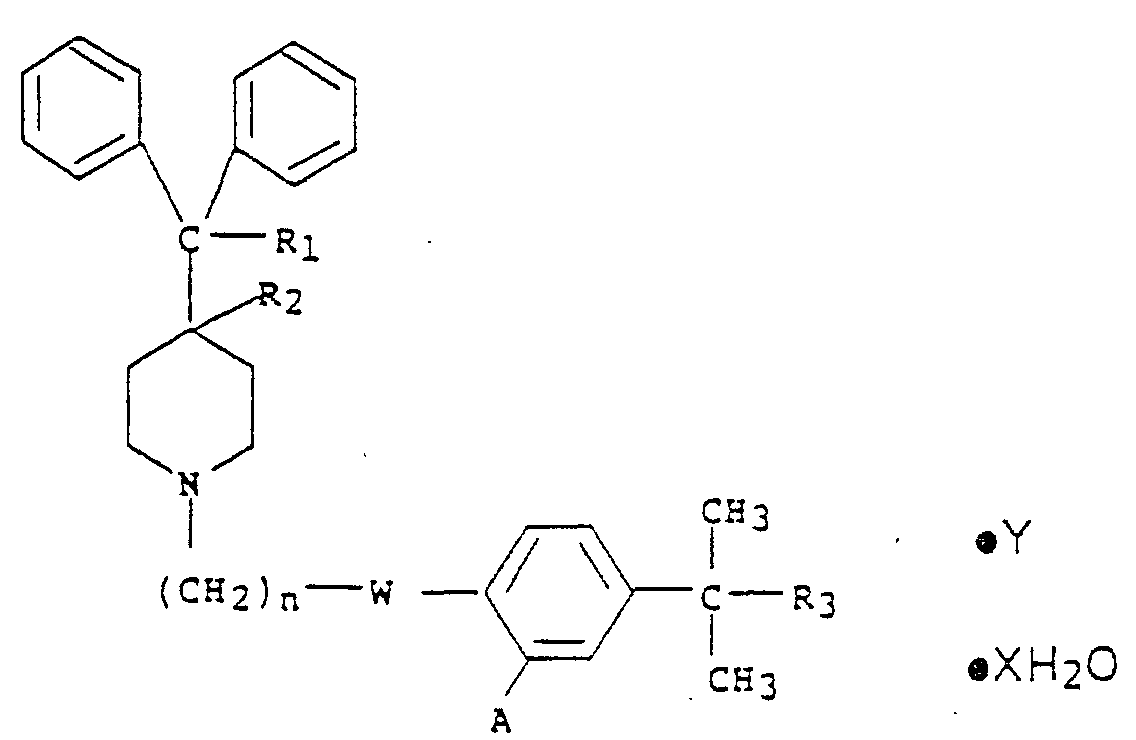 comprising subjecting a compound of the formulaR1 represents hydrogen or hydroxy;R2 represents hydrogen; orR1 and R2 taken together form a second bond between the carbon atoms bearing R1 and R2;n is an integer of from 1 to 5;R3 is -CH2OH, -COOH or -COOalkyl wherein the alkyl moiety has from 1 to 6 carbon atoms and is straight or branched;W is -CH(OH)- or -C(=O)-;A is hydrogen or hydroxy;Y is a pharmaceutically acceptable acid;X is a number ranging essentially from 0.1 to 5; andthe individual optical isomers thereof,and the individual optical isomers thereof wherein R1, R2, R3, n, A, W and Y are as defined above, to an aqueous recrystallization.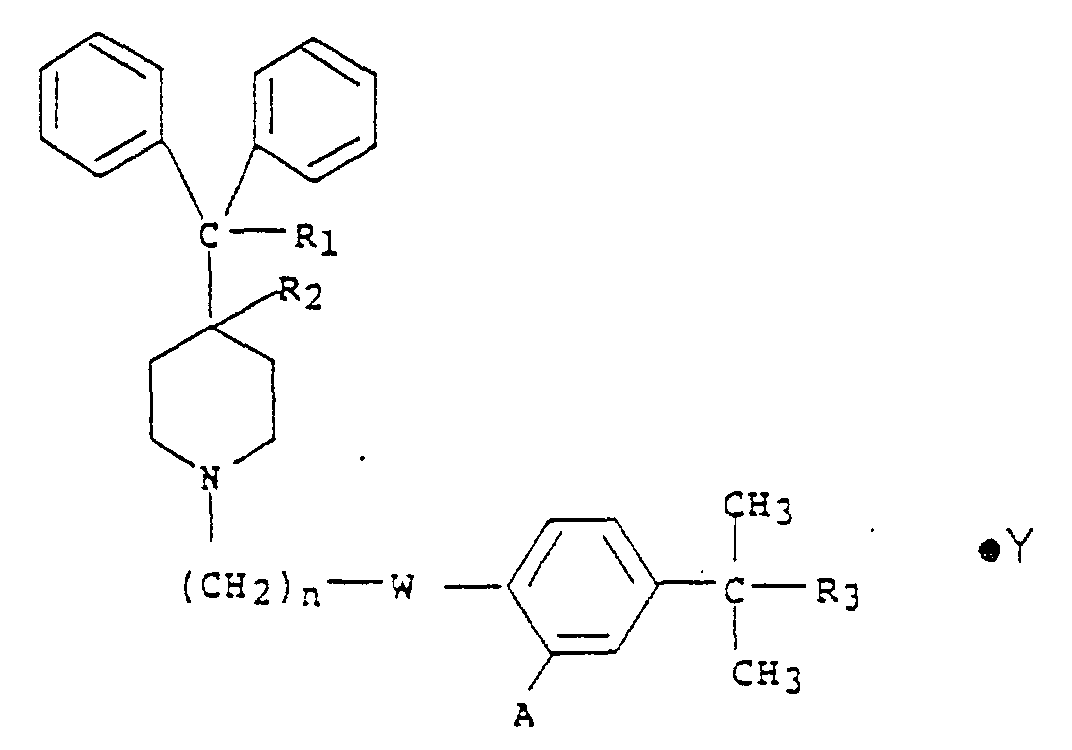
- A process for preparing a compound of the formulaand the individual optical isomers thereof, wherein Y is a pharmaceutically acceptable acid, comprising subjecting a compound of the formula
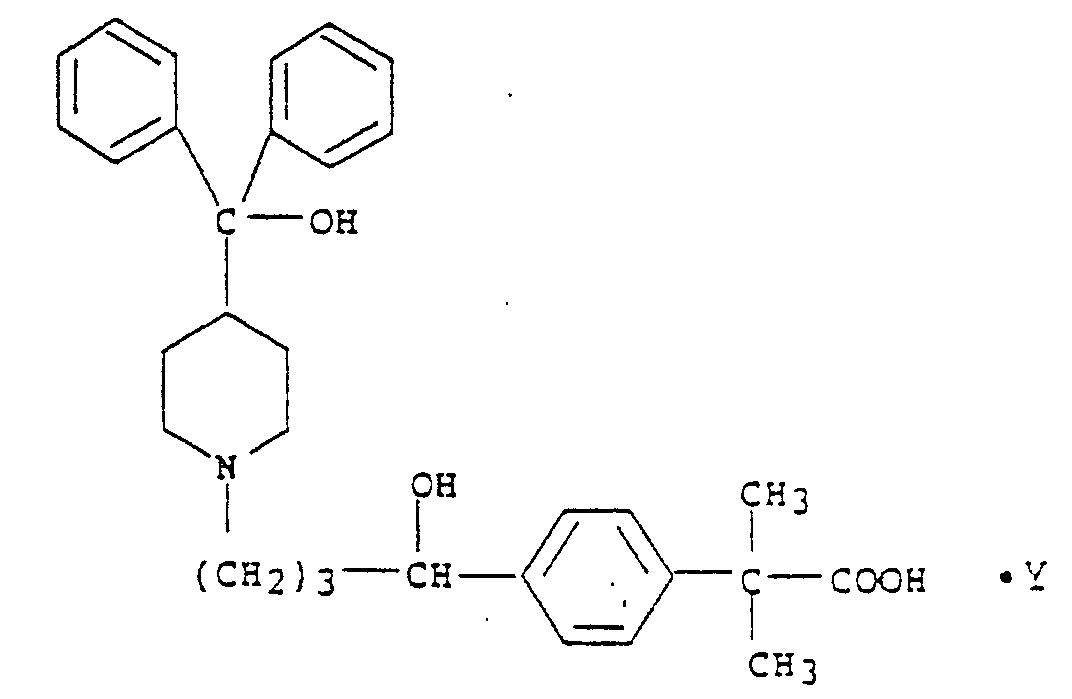 wherein Y is as defined above and X is a number ranging essentially from 0.10 to 5 to an azeotropic distillation.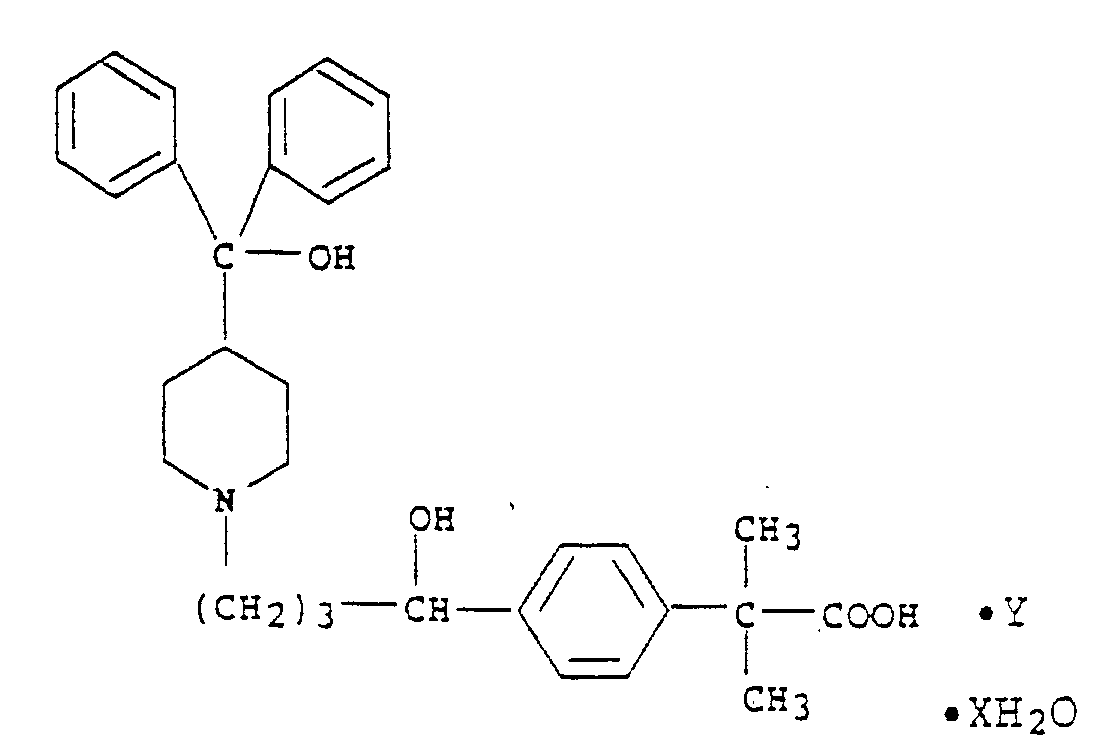
- A process for preparing a compound of the formulaand the individual optical isomers thereof, wherein Y is a pharmaceutically acceptable acid and X is a number ranging essentially from 0.10 to 5, comprising subjecting a compound of the formula
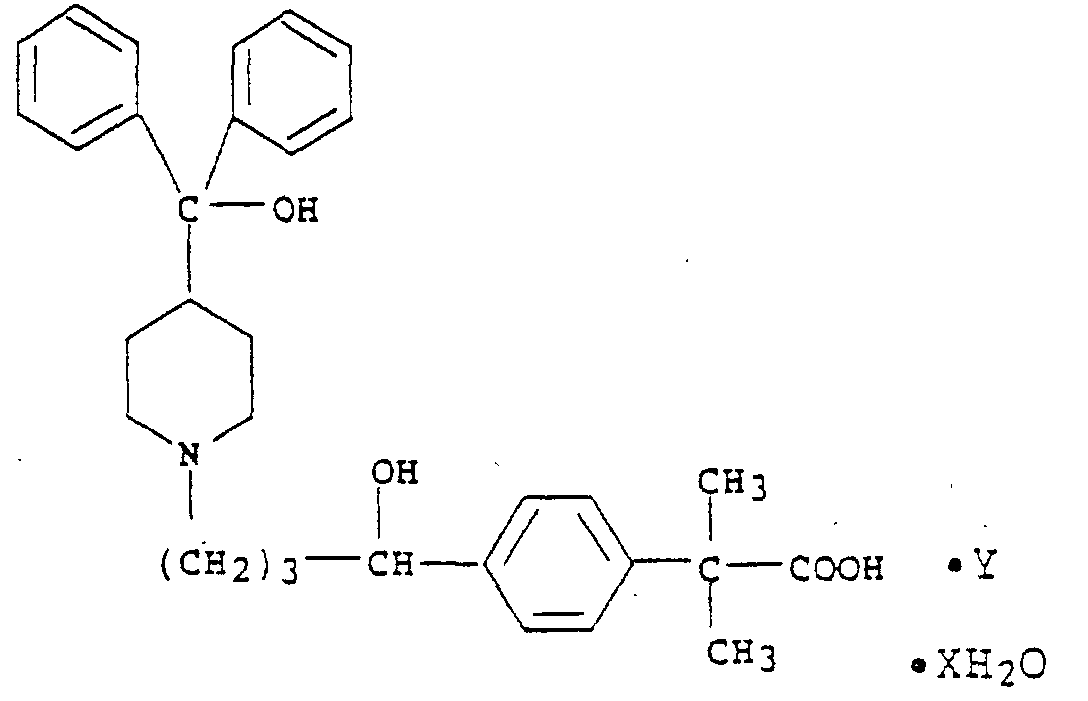 wherein Y is as defined above to an aqueous recrystallization.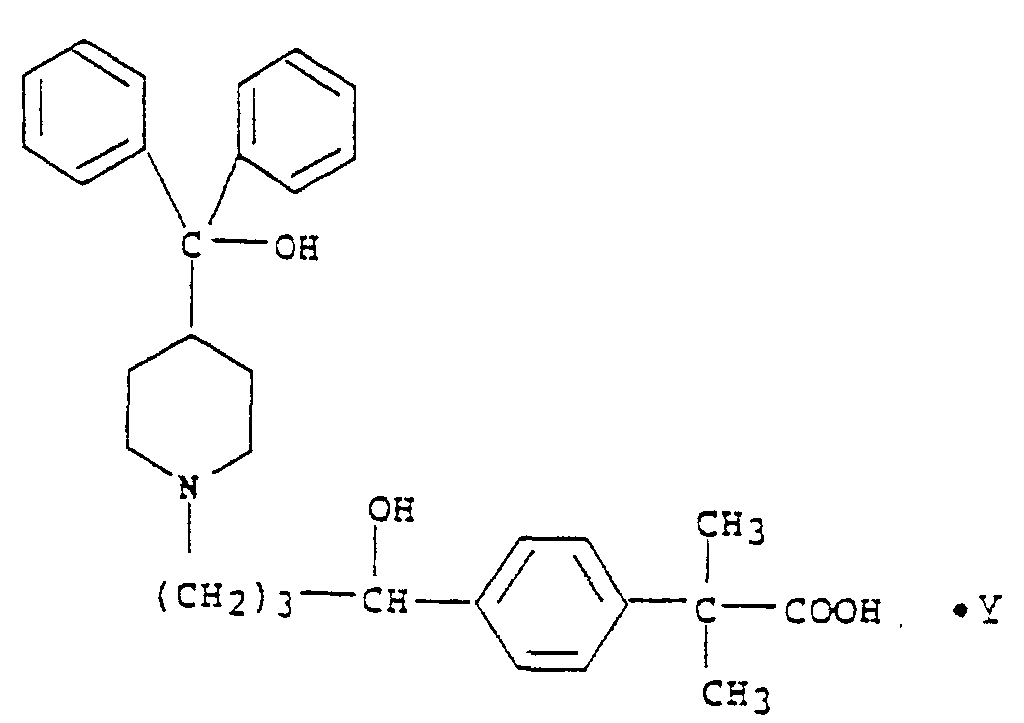
- A process according to Claim 3 or 4 wherein Y is HCl.
- A process according to Claim 5 wherein x is a number ranging from 1 to 4.
- A process according to Claim 6 wherein x is a number ranging from 2 to 3.
- A compound of the formulawherein X is a number ranging from 0.1 to 5 and the individual optical isomers thereof, preparable by the process comprising the steps of:
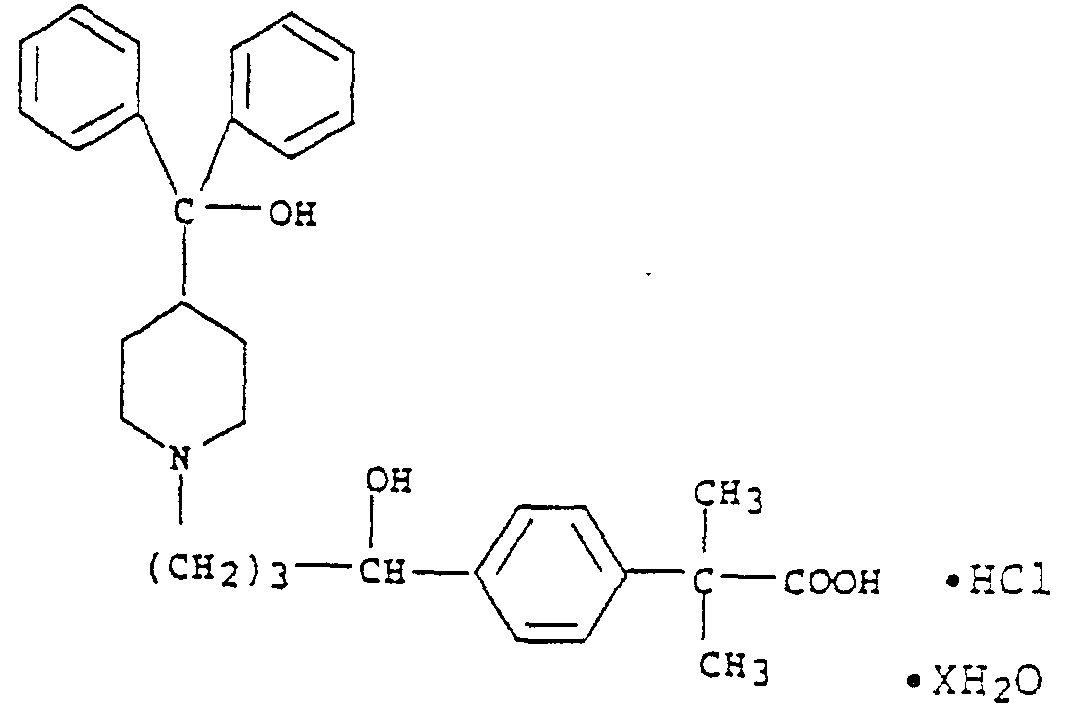 a) treating a compound of the formulaand the individual optical isomers thereof with a suitable solvent;
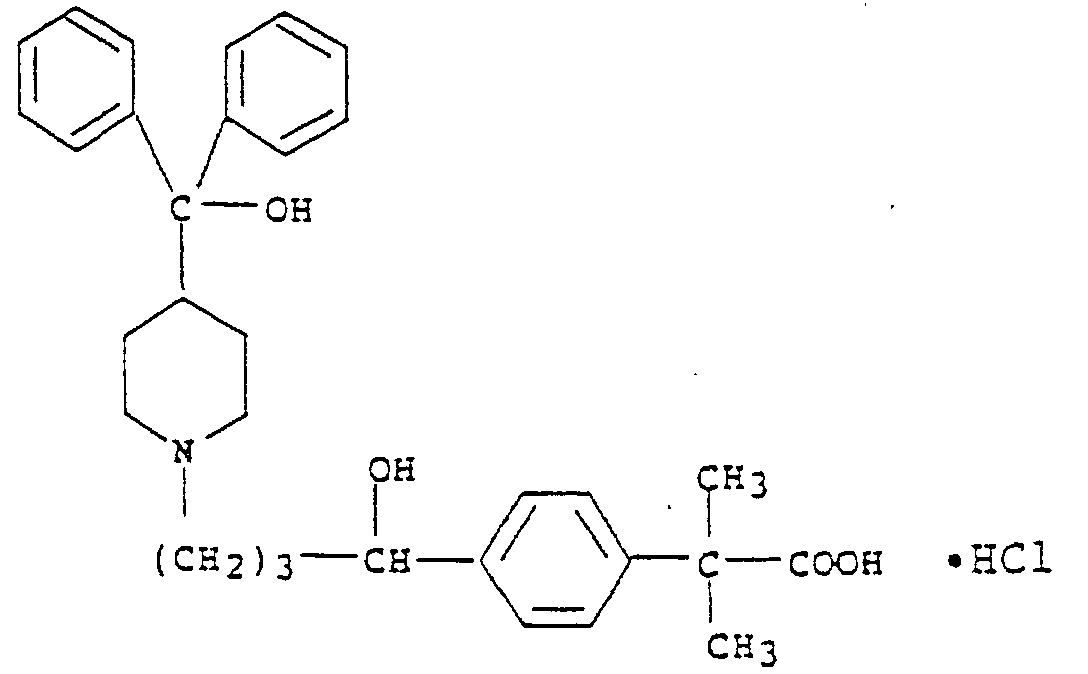 b) heating the mixture to a suitable temperature; andc) cooling the mixture to initiate crystallization.
 - Form I anhydrous 4-[4-[4-(Hydroxydiphenylmethyl)-1-piperidinyl]-1-hydroxybutyl]-α,α-dimethylbenzeneacetic acid hydrochloride,Form II hydrated 4-[4-[4-(Hydroxydiphenylmethyl)-1-piperidinyl]-1-hydroxybutyl]-α,α-dimethylbenzeneacetic acid hydrochloride,Form III anhydrous 4-[4-[4-(Hydroxydiphenylmethyl)-1-piperidinyl]-1-hydroxybutyl]-α,α-dimethylbenzeneacetic acid hydrochloride andForm IV hydrated 4-[4-[4-(Hydroxydiphenylmethyl)-1-piperidinyl]-1-hydroxybutyl]-α,α-dimethylbenzeneacetic acid hydrochloride.
- A pharmaceutical composition comprising an a compound of Claim 9 in admixture or otherwise in association with an inert carrier.
- Use of a compound as defined in claim 9 for the preparation of a pharmaceutical composition for treating allergic reactions.
- A process for preparing the Form I anhydrous 4-[4-[4-(Hydroxydiphenylmethyl)-1-piperidinyl]-1-hydroxybutyl]-α,α-dimethylbenzeneacetic acid hydrochloride which comprises subjecting Form II hydrated 4-[4-[4-(Hydroxydiphenylmethyl)-1-piperidinyl]-1-hydroxybutyl]-α,α-dimethylbenzeneacetic acid hydrochloride to an azeotropic distillation.
- A process for preparing the Form I anhydrous 4-[4-[4-(Hydroxydiphenylmethyl)-1-piperidinyl]-1-hydroxybutyl]-α,α-dimethylbenzeneacetic acid hydrochloride which comprises subjecting Form III anhydrous 4-[4-[4-(Hydroxydiphenylmethyl)-l-piperidinyl]-l-hydroxybutyl]-α,α-dimethylbenzeneacetic acid hydrochloride to a crystal digestion.
- A process for preparing the Form I anhydrous 4-[4-[4-(Hydroxydiphenylmethyl)-1-piperidinyl]-1-hydroxybutyl]-α,α-dimethylbenzeneacetic acid hydrochloride which comprises subjecting Form IV hydrated 4-[4-[4-(Hydroxydiphenylmethyl)-1-piperidinyl]-1-hydroxybutyl]-α,α-dimethylbenzeneacetic acid hydrochloride to an azeotropic distillation.
- A process according to claim 14 wherein suitable solvents or solvent mixtures which are sufficient to cause dissolution are methanol, acteone/water and methyl ethyl ketone/water and a suitable anhydrous antisolvent is methyl ethyl ketone.
- A process for preparing the Form II hydrated 4-[4-[4-(Hydroxydiphenylmethyl)-1-piperidinyl]-1-hydroxybutyl]-α,α-dimethylbenzeneacetic acid hydrochloride which comprises:a) reacting ethyl 4-[4-[4-(hydroxydiphenylmethyl)-1-piperidinyl]-1-oxobutyl]-α,α-dimethylbenzeneacetate hydrochloride with an appropriate reducing agent in a suitable solvent;b) acidifying with hydrochloric acid; andc) adding water over a period of time ranging from 1 minute to 45 minutes at a temperature range of about -20°C to 50°C.
- A process for preparing the Form II hydrated 4-[4-[4-(Hydroxydiphenylmethyl)-1-piperidinyl]-1-hydroxybutyl]-α,α-dimethylbenzeneacetic acid hydrochloride which comprises:a) reacting ethyl 4-[4-[4-(hydroxydiphenylmethyl)-1-piperidinyl]-1-oxobutyl]-α,α-dimethylbenzeneacetate with an appropriate reducing agent in a suitable solvent;b) acidifying with hydrochloric acid; andc) adding water over a period of time ranging from 1 minute to 45 minutes at a temperature range of about -20°C to 50°C.
- A process according to claim 17 wherein the water is added over a period of time ranging from 10 minutes to 30 minutes at a temperature range of about 0°C to 40°C.
- A process according to claim 18 wherein the water is added over a period of time ranging from 10 minutes to 30 minutes at a temperature range of about 20°C to 40°C.
- A process for preparing the Form II hydrated 4-[4-[4-(Hydroxydiphenylmethyl)-1-piperidinyl]-1-hydroxybutyl]-α,α-dimethylbenzeneacetic acid hydrochloride which comprises subjecting Form I anhydrous 4-[4-[4-(Hydroxydiphenylmethyl)-1-piperidinyl]-1-hydroxybutyl]-α,α-dimethylbenzeneacetic acid hydrochloride to an aqueous recrystallization.
- A process for preparing the Form IV hydrated 4-[4-[4-(Hydroxydiphenylmethyl)-1-piperidinyl]-1-hydroxybutyl]-α,α-dimethylbenzeneacetic acid hydrochloride which comprises:a) reacting ethyl 4-[4-[4-(hydroxydiphenylmethyl)-1-piperidinyl]-l-oxobutyl]-α,α-dimethylbenzeneacetate hydrochloride with an appropriate reducing agent in a suitable solvent;b) acidifying with hydrochloric acid; and
- A process for preparing the Form IV hydrated 4-[4-[4-(Hydroxydiphenylmethyl)-1-piperidinyl]-1-hydroxybutyl]-α,α-dimethylbenzeneacetic acid hydrochloride which comprises:a) reacting ethyl 4-[4-[4-(hydroxydiphenylmethyl)-1-piperidinyl]-1-oxobutyl]-α,α-dimethylbenzeneacetate with an appropriate reducing agent in a suitable solvent;b) acidifying with hydrochloric acid; andc) adding water over a period of time ranging from 30 minutes to 24 hours at a temperature range of about 0°C to 50°C.
- A process according to claim 22 wherein the water is added over a period of time ranging from 1 hour to 12 hours at a temperature range of about 10°C to 40°C.
- A process according to claim 23 wherein the water is added over a period of time ranging from 2 hours to 8 hours at a temperature range of about 20°C to 40°C.
Priority Applications (1)
| Application Number | Priority Date | Filing Date | Title |
|---|---|---|---|
| EP10180285A EP2354125A1 (en) | 1994-05-18 | 1995-04-28 | Anhydrous and hydrate polymorphic forms of antihistaminic piperidine derivatives |
Applications Claiming Priority (5)
| Application Number | Priority Date | Filing Date | Title |
|---|---|---|---|
| US24573194A | 1994-05-18 | 1994-05-18 | |
| US245731 | 1994-05-18 | ||
| US41716195A | 1995-04-11 | 1995-04-11 | |
| US417161 | 1995-04-11 | ||
| EP95918278A EP0766668B1 (en) | 1994-05-18 | 1995-04-28 | Processes for preparing anhydrous and hydrate forms of antihistaminic piperidine derivatives, polymorphs and pseudormophs thereof |
Related Parent Applications (1)
| Application Number | Title | Priority Date | Filing Date |
|---|---|---|---|
| EP95918278A Division EP0766668B1 (en) | 1994-05-18 | 1995-04-28 | Processes for preparing anhydrous and hydrate forms of antihistaminic piperidine derivatives, polymorphs and pseudormophs thereof |
Publications (1)
| Publication Number | Publication Date |
|---|---|
| EP1178041A1 true EP1178041A1 (en) | 2002-02-06 |
Family
ID=26937420
Family Applications (3)
| Application Number | Title | Priority Date | Filing Date |
|---|---|---|---|
| EP01124314A Withdrawn EP1178041A1 (en) | 1994-05-18 | 1995-04-28 | Process for preparing anhydrous and hydrate forms of antihistaminic piperidine derivatives |
| EP95918278A Expired - Lifetime EP0766668B1 (en) | 1994-05-18 | 1995-04-28 | Processes for preparing anhydrous and hydrate forms of antihistaminic piperidine derivatives, polymorphs and pseudormophs thereof |
| EP10180285A Withdrawn EP2354125A1 (en) | 1994-05-18 | 1995-04-28 | Anhydrous and hydrate polymorphic forms of antihistaminic piperidine derivatives |
Family Applications After (2)
| Application Number | Title | Priority Date | Filing Date |
|---|---|---|---|
| EP95918278A Expired - Lifetime EP0766668B1 (en) | 1994-05-18 | 1995-04-28 | Processes for preparing anhydrous and hydrate forms of antihistaminic piperidine derivatives, polymorphs and pseudormophs thereof |
| EP10180285A Withdrawn EP2354125A1 (en) | 1994-05-18 | 1995-04-28 | Anhydrous and hydrate polymorphic forms of antihistaminic piperidine derivatives |
Country Status (17)
| Country | Link |
|---|---|
| US (12) | US20010014741A1 (en) |
| EP (3) | EP1178041A1 (en) |
| JP (7) | JPH10500134A (en) |
| CN (3) | CN1907967B (en) |
| AT (1) | ATE220667T1 (en) |
| AU (1) | AU693892B2 (en) |
| CA (3) | CA2585705C (en) |
| DE (1) | DE69527429T2 (en) |
| DK (1) | DK0766668T3 (en) |
| ES (1) | ES2176329T3 (en) |
| FI (1) | FI964565A0 (en) |
| HU (1) | HU227676B1 (en) |
| IL (3) | IL113747A (en) |
| MX (1) | MX9605613A (en) |
| NO (1) | NO315319B1 (en) |
| PT (1) | PT766668E (en) |
| WO (1) | WO1995031437A1 (en) |
Cited By (2)
| Publication number | Priority date | Publication date | Assignee | Title |
|---|---|---|---|---|
| WO2005019175A1 (en) * | 2003-08-26 | 2005-03-03 | Cipla Limited | Fexofenadine polymorphs and processes of preparing the same |
| EP1616861A3 (en) * | 2004-06-15 | 2006-02-08 | Dipharma S.p.A. | A process for the preparation of keto compounds |
Families Citing this family (31)
| Publication number | Priority date | Publication date | Assignee | Title |
|---|---|---|---|---|
| GB9400555D0 (en) * | 1994-01-13 | 1994-03-09 | Short Brothers Plc | Boundery layer control in aerodynamic low drag structures |
| EP1178041A1 (en) | 1994-05-18 | 2002-02-06 | Aventis Pharmaceuticals Inc. | Process for preparing anhydrous and hydrate forms of antihistaminic piperidine derivatives |
| KR100405116B1 (en) | 1995-02-28 | 2004-02-05 | 아벤티스 파마슈티칼스 인크. | Pharmaceutical compositions for piperidino alkanol compounds |
| PT998272E (en) * | 1997-08-26 | 2003-09-30 | Aventis Pharma Inc | PHARMACEUTICAL COMPOSITION FOR COMBINATION OF PIPERIDINOALCANOL DECONGESTIONANT |
| IN191492B (en) * | 1999-05-25 | 2003-12-06 | Ranbaxy Lab Ltd | |
| US6613906B1 (en) | 2000-06-06 | 2003-09-02 | Geneva Pharmaceuticals, Inc. | Crystal modification |
| CH695216A5 (en) * | 2001-02-23 | 2006-01-31 | Cilag Ag | A method for manufacturing a non-hydrated salt of a piperidine derivative and a novel crystalline form thus obtainable of such a salt. |
| AU2002305162A1 (en) * | 2001-04-09 | 2002-10-21 | Teva Pharmaceutical Industries Ltd. | Polymorphs of fexofenadine hydrochloride |
| US20030021849A1 (en) * | 2001-04-09 | 2003-01-30 | Ben-Zion Dolitzky | Polymorphs of fexofenadine hydrochloride |
| IL159266A0 (en) | 2001-06-18 | 2004-06-01 | Reddys Lab Ltd Dr | Crystalline forms of fexofenadine and processes for the preparation thereof |
| US7700779B2 (en) | 2001-06-18 | 2010-04-20 | Dr. Reddy's Laboratories Limited | Crystalline forms of fexofenadine and its hydrochloride |
| US20040248935A1 (en) * | 2001-07-31 | 2004-12-09 | Milla Frederico Junquera | Fexofenadine polymorph |
| US20030158227A1 (en) * | 2001-11-08 | 2003-08-21 | Barnaba Krochmal | Polymorphs of fexofenadine base |
| AU2003248657A1 (en) * | 2002-06-10 | 2003-12-22 | Teva Pharmaceutical Industries Ltd. | Polymorphic form xvi of fexofenadine hydrochloride |
| JP3910907B2 (en) * | 2002-10-29 | 2007-04-25 | 新光電気工業株式会社 | Capacitor element and manufacturing method thereof, substrate for semiconductor device, and semiconductor device |
| EP1612212A1 (en) * | 2003-07-03 | 2006-01-04 | Teva Pharmaceutical Industries Ltd | Zoledronic acid crystal forms, zoledronate sodium salt crystal forms, amorphous zoledronate sodium salt, and processes for their preparation |
| MXPA06012281A (en) * | 2004-04-26 | 2007-07-18 | Teva Pharma | Crystalline forms of fexofenadine hydrochloride and processes for their preparation. |
| ITMI20041143A1 (en) * | 2004-06-08 | 2004-09-08 | Dipharma Spa | FEXOFENADINA POLYMORPHS AND PROCEDURE FOR THEIR PREPARATION |
| ITMI20041568A1 (en) * | 2004-07-30 | 2004-10-30 | Dipharma Spa | "BASE FEXOFENADINA POLYMORPHS" |
| JP2008514641A (en) * | 2004-09-28 | 2008-05-08 | テバ ファーマシューティカル インダストリーズ リミティド | Crystalline fexofenadine and method for its preparation |
| DOP2006000274A (en) * | 2005-12-14 | 2007-10-15 | Sanofi Aventis Us Llc | FEXOFENADINE SUSPENSION FORMULATION |
| MX2009000320A (en) * | 2006-07-11 | 2009-06-05 | Mutual Pharmaceutical Co | Controlled-release formulations. |
| US20090076080A1 (en) * | 2007-09-19 | 2009-03-19 | Protia, Llc | Deuterium-enriched fexofenadine |
| US20090306135A1 (en) | 2008-03-24 | 2009-12-10 | Mukesh Kumar Sharma | Stable amorphous fexofenadine hydrochloride |
| US20100183717A1 (en) * | 2009-01-16 | 2010-07-22 | Kristin Arnold | Controlled-release formulations |
| KR20120115492A (en) | 2009-11-06 | 2012-10-18 | 바스프 에스이 | Crystalline complexes of 4-hydroxy benzoic acid and selected pesticides |
| IT1400965B1 (en) | 2010-06-15 | 2013-07-05 | Dipharma Francis Srl | POLYMORFI OF FEXOFENADINA |
| US9216955B2 (en) | 2010-06-15 | 2015-12-22 | Chemelectiva S.R.L. | Polymorphic form of Fexofenadine hydrochloride, intermediates and process for its preparation |
| US9420872B2 (en) * | 2010-08-23 | 2016-08-23 | Jason Bird | Apparatus and system for holding game-calling devices |
| JP2012087100A (en) * | 2010-10-21 | 2012-05-10 | Sumitomo Chemical Co Ltd | Method for producing fexofenadine monohydrochloride of form i |
| CN104072402B (en) * | 2014-07-16 | 2016-08-17 | 昆山龙灯瑞迪制药有限公司 | A kind of fexofenadine hydrochloride compound of new crystalline form and preparation method thereof |
Citations (5)
| Publication number | Priority date | Publication date | Assignee | Title |
|---|---|---|---|---|
| US4254129A (en) * | 1979-04-10 | 1981-03-03 | Richardson-Merrell Inc. | Piperidine derivatives |
| US4285957A (en) * | 1979-04-10 | 1981-08-25 | Richardson-Merrell Inc. | 1-Piperidine-alkanol derivatives, pharmaceutical compositions thereof, and method of use thereof |
| WO1993021156A1 (en) * | 1992-04-10 | 1993-10-28 | Merrell Dow Pharmaceuticals Inc. | 4-diphenylmethyl piperidine derivatives and process for their preparation |
| EP0705245A1 (en) | 1993-06-25 | 1996-04-10 | Merrell Pharmaceuticals Inc. | Novel intermediates for the preparation of antihistaminic 4-diphenylmethyl/diphenylmethoxy piperidine derivatives |
| WO1996026726A1 (en) * | 1995-02-28 | 1996-09-06 | Hoechst Marion Roussel, Inc. | Pharmaceutical composition for piperidinoalkanol compounds |
Family Cites Families (31)
| Publication number | Priority date | Publication date | Assignee | Title |
|---|---|---|---|---|
| US631375A (en) * | 1899-04-12 | 1899-08-22 | Ephraim Musselman | Face-protector. |
| US3448152A (en) * | 1966-11-03 | 1969-06-03 | Jefferson Chem Co Inc | Amine recovery |
| US3878217A (en) * | 1972-01-28 | 1975-04-15 | Richardson Merrell Inc | Alpha-aryl-4-substituted piperidinoalkanol derivatives |
| BE794598A (en) | 1972-01-28 | 1973-05-16 | Richardson Merrell Inc | NEW OLEFINIC DERIVATIVES OF PIPERIDINES SUBSTITUTED IN 4 AND THEIR PREPARATION PROCESS |
| US3965257A (en) | 1972-01-28 | 1976-06-22 | Richardson-Merrell Inc. | Compositions and methods for the treatment of the symptoms of histamine induced allergic reactions |
| US4254130A (en) | 1979-04-10 | 1981-03-03 | Richardson-Merrell Inc. | Piperidine derivatives |
| US4285958A (en) | 1979-04-10 | 1981-08-25 | Richardson-Merrell Inc. | 1-Piperidine-alkylene ketones, pharmaceutical compositions thereof and method of use thereof |
| IL63968A (en) | 1980-10-01 | 1985-10-31 | Glaxo Group Ltd | Form 2 ranitidine hydrochloride,its preparation and pharmaceutical compositions containing it |
| US4742175A (en) | 1986-05-07 | 1988-05-03 | Merrell Dow Pharmaceuticals Inc. | Preparation of polymorphically pure terfenadine |
| JPH02213431A (en) * | 1989-02-13 | 1990-08-24 | Kobe Steel Ltd | Sic whisker reinforced al alloy composite material |
| DE4034218A1 (en) | 1990-10-27 | 1992-04-30 | Merck Patent Gmbh | METHOD FOR PRODUCING CAREBASTIN |
| TW198008B (en) | 1991-04-08 | 1993-01-11 | Green Cross Corp | |
| US5631375A (en) | 1992-04-10 | 1997-05-20 | Merrell Pharmaceuticals, Inc. | Process for piperidine derivatives |
| CA2134211C (en) * | 1992-05-11 | 1999-06-29 | James K. Woodward | Use of terfenadine derivatives as antihistaminics in a hepatically impaired patient |
| DK0701443T4 (en) | 1992-08-03 | 2000-12-18 | Sepracor Inc | Terfenadine metabolites and their optically pure isomers for the treatment of allergic disorders |
| US5315016A (en) | 1992-10-13 | 1994-05-24 | Nycomed Dak A/S | Process for preparing pure podophyllotoxin |
| DK1369409T3 (en) | 1993-06-24 | 2006-08-14 | Amr Technology Inc | Process for the preparation of compounds useful as intermediates |
| CA2181089C (en) | 1993-06-24 | 2000-05-23 | Thomas E. D'ambra | Piperidine derivatives and process for their production |
| US6147216A (en) | 1993-06-25 | 2000-11-14 | Merrell Pharmaceuticals Inc. | Intermediates useful for the preparation of antihistaminic piperidine derivatives |
| EP1178041A1 (en) | 1994-05-18 | 2002-02-06 | Aventis Pharmaceuticals Inc. | Process for preparing anhydrous and hydrate forms of antihistaminic piperidine derivatives |
| US5576610A (en) | 1994-07-05 | 1996-11-19 | Motorola, Inc. | Method and apparatus for determining battery characteristics |
| IL134772A (en) | 1995-02-28 | 2002-02-10 | Aventis Pharma Inc | Pharmaceutical compositions of piperidinoalkanol compounds in solid unit dosage form |
| US5574045A (en) | 1995-06-06 | 1996-11-12 | Hoechst Marion Roussel, Inc. | Oral pharmaceutical composition of piperidinoalkanol compounds in solution form |
| PT998272E (en) * | 1997-08-26 | 2003-09-30 | Aventis Pharma Inc | PHARMACEUTICAL COMPOSITION FOR COMBINATION OF PIPERIDINOALCANOL DECONGESTIONANT |
| US6214427B1 (en) * | 1998-08-28 | 2001-04-10 | General Electric Company | Method of making an electronic device having a single crystal substrate formed by solid state crystal conversion |
| US6613906B1 (en) | 2000-06-06 | 2003-09-02 | Geneva Pharmaceuticals, Inc. | Crystal modification |
| US20020177680A1 (en) * | 2000-08-23 | 2002-11-28 | Hubbell Jeffrey A. | Novel polymer compounds |
| US6475942B1 (en) * | 2000-09-05 | 2002-11-05 | General Electric Company | Conversion of polycrystalline alumina to single crystal sapphire using molybdenum doping |
| AU2002305162A1 (en) * | 2001-04-09 | 2002-10-21 | Teva Pharmaceutical Industries Ltd. | Polymorphs of fexofenadine hydrochloride |
| US7700779B2 (en) * | 2001-06-18 | 2010-04-20 | Dr. Reddy's Laboratories Limited | Crystalline forms of fexofenadine and its hydrochloride |
| US20090211514A1 (en) * | 2008-02-26 | 2009-08-27 | Lehigh University | Single crystal conversion process |
-
1995
- 1995-04-28 EP EP01124314A patent/EP1178041A1/en not_active Withdrawn
- 1995-04-28 JP JP7529654A patent/JPH10500134A/en not_active Withdrawn
- 1995-04-28 CA CA2585705A patent/CA2585705C/en not_active Expired - Lifetime
- 1995-04-28 CN CN2006101031426A patent/CN1907967B/en not_active Expired - Lifetime
- 1995-04-28 DK DK95918278T patent/DK0766668T3/en active
- 1995-04-28 CN CN95193122A patent/CN1148849A/en active Pending
- 1995-04-28 HU HU9603167A patent/HU227676B1/en unknown
- 1995-04-28 EP EP95918278A patent/EP0766668B1/en not_active Expired - Lifetime
- 1995-04-28 MX MX9605613A patent/MX9605613A/en unknown
- 1995-04-28 AT AT95918278T patent/ATE220667T1/en active
- 1995-04-28 EP EP10180285A patent/EP2354125A1/en not_active Withdrawn
- 1995-04-28 CA CA2449419A patent/CA2449419C/en not_active Expired - Lifetime
- 1995-04-28 FI FI964565A patent/FI964565A0/en unknown
- 1995-04-28 PT PT95918278T patent/PT766668E/en unknown
- 1995-04-28 DE DE69527429T patent/DE69527429T2/en not_active Expired - Lifetime
- 1995-04-28 CN CNA2003101007654A patent/CN1623985A/en active Pending
- 1995-04-28 ES ES95918278T patent/ES2176329T3/en not_active Expired - Lifetime
- 1995-04-28 AU AU24265/95A patent/AU693892B2/en not_active Expired
- 1995-04-28 CA CA002189007A patent/CA2189007C/en not_active Expired - Lifetime
- 1995-04-28 WO PCT/US1995/004942 patent/WO1995031437A1/en not_active Ceased
- 1995-05-16 IL IL11374795A patent/IL113747A/en not_active IP Right Cessation
- 1995-05-16 IL IL13491795A patent/IL134917A/en not_active IP Right Cessation
-
1996
- 1996-11-15 NO NO19964859A patent/NO315319B1/en not_active IP Right Cessation
-
2000
- 2000-03-07 IL IL13491700A patent/IL134917A0/en unknown
-
2001
- 2001-03-09 US US09/803,390 patent/US20010014741A1/en not_active Abandoned
- 2001-03-09 US US09/803,476 patent/US20010025106A1/en not_active Abandoned
- 2001-03-09 US US09/803,389 patent/US20010012896A1/en not_active Abandoned
-
2002
- 2002-03-01 JP JP2002055435A patent/JP2002316978A/en not_active Withdrawn
- 2002-03-01 JP JP2002055434A patent/JP4503909B2/en not_active Expired - Lifetime
- 2002-03-01 JP JP2002055433A patent/JP4503908B2/en not_active Expired - Lifetime
- 2002-03-01 JP JP2002055431A patent/JP2002308849A/en active Pending
- 2002-03-01 JP JP2002055432A patent/JP4503907B2/en not_active Expired - Lifetime
- 2002-04-24 US US10/128,926 patent/US20020193600A1/en not_active Abandoned
- 2002-06-03 US US10/160,883 patent/US7135571B2/en not_active Expired - Fee Related
- 2002-06-03 US US10/162,011 patent/US7138524B2/en not_active Expired - Fee Related
- 2002-08-07 US US10/214,262 patent/US20030045721A1/en not_active Abandoned
-
2003
- 2003-03-10 US US10/386,812 patent/US20040014976A1/en not_active Abandoned
-
2006
- 2006-09-25 US US11/534,839 patent/US7662835B2/en not_active Expired - Fee Related
- 2006-09-25 US US11/534,828 patent/US7666881B2/en not_active Expired - Fee Related
-
2007
- 2007-10-30 US US11/978,670 patent/US20080167471A1/en not_active Abandoned
- 2007-10-30 US US11/978,669 patent/US20080167469A1/en not_active Abandoned
-
2010
- 2010-02-24 JP JP2010038971A patent/JP2010120969A/en active Pending
Patent Citations (5)
| Publication number | Priority date | Publication date | Assignee | Title |
|---|---|---|---|---|
| US4254129A (en) * | 1979-04-10 | 1981-03-03 | Richardson-Merrell Inc. | Piperidine derivatives |
| US4285957A (en) * | 1979-04-10 | 1981-08-25 | Richardson-Merrell Inc. | 1-Piperidine-alkanol derivatives, pharmaceutical compositions thereof, and method of use thereof |
| WO1993021156A1 (en) * | 1992-04-10 | 1993-10-28 | Merrell Dow Pharmaceuticals Inc. | 4-diphenylmethyl piperidine derivatives and process for their preparation |
| EP0705245A1 (en) | 1993-06-25 | 1996-04-10 | Merrell Pharmaceuticals Inc. | Novel intermediates for the preparation of antihistaminic 4-diphenylmethyl/diphenylmethoxy piperidine derivatives |
| WO1996026726A1 (en) * | 1995-02-28 | 1996-09-06 | Hoechst Marion Roussel, Inc. | Pharmaceutical composition for piperidinoalkanol compounds |
Non-Patent Citations (3)
| Title |
|---|
| "The Merck index, 12th ed.", article "Fexofenadine", pages: 4110, XP003000116 |
| BERNSTEIN J: "POLYMORPHISM IN DRUG DESIGN AND DELIVERY", PROGRESS IN CLINICAL AND BIOLOGICAL RESEARCH, NEW YORK, NY, US, vol. 289, 1 January 1989 (1989-01-01), pages 203 - 215, XP009031923, ISSN: 0361-7742 * |
| BORKA L ET AL: "CRYSTAL POLYMORPHISM OF PHARMACEUTICALS", ACTA PHARMACEUTICA JUGOSLAVICA, SAVEZ FARMACEUTSKIH DRUSTAVA JUGOSLAVIJE, ZAGREB, YU, vol. 40, 1 January 1990 (1990-01-01), pages 71 - 94, XP009031944, ISSN: 0001-6667 * |
Cited By (5)
| Publication number | Priority date | Publication date | Assignee | Title |
|---|---|---|---|---|
| WO2005019175A1 (en) * | 2003-08-26 | 2005-03-03 | Cipla Limited | Fexofenadine polymorphs and processes of preparing the same |
| US7470789B2 (en) | 2003-08-26 | 2008-12-30 | Cipla Limited | Fexofenadine polymorphs and processes of preparing the same |
| RU2352561C2 (en) * | 2003-08-26 | 2009-04-20 | Сипла Лимитед | Fexofenadine polymorphs and methods of obtaining them |
| US8247434B2 (en) | 2003-08-26 | 2012-08-21 | Cipla Limited | Fexofenadine polymorphs and processes of preparing the same |
| EP1616861A3 (en) * | 2004-06-15 | 2006-02-08 | Dipharma S.p.A. | A process for the preparation of keto compounds |
Also Published As
Similar Documents
| Publication | Publication Date | Title |
|---|---|---|
| EP0766668B1 (en) | Processes for preparing anhydrous and hydrate forms of antihistaminic piperidine derivatives, polymorphs and pseudormophs thereof | |
| US20030045722A1 (en) | Processes for preparing anhydrous and hydrate forms of antihistaminic piperidine derivatives, polymorphs and pseudomorphs thereof | |
| NZ285229A (en) | 4-(biphenylmethyl)piperdine derivatives in anhydrous and hydrated forms, their preparation and medicaments thereof | |
| CN101337922A (en) | Anhydrous and hydrated forms of antihistaminic piperidine derivatives, polymorphs and pseudomorphs thereof | |
| HK1137742B (en) | Processes for preparing anhydrous and hydrate forms of antihstaminic piperidine derivatives, polymorphs and pseudormophs thereof | |
| HK1129097A (en) | Processes for preparing anhydrous and hydrate forms of antihstaminic piperidine derivatives, polymorphs and pseudormophs thereof | |
| HK1098467B (en) | Processes for preparing anhydrous and hydrate forms of antihstaminic piperidine derivatives, polymorphs and pseudormophs thereof | |
| IL134771A (en) | Pharmaceutical compositions of piperidinoalkanol compounds in solid unit dosage form |
Legal Events
| Date | Code | Title | Description |
|---|---|---|---|
| PUAI | Public reference made under article 153(3) epc to a published international application that has entered the european phase |
Free format text: ORIGINAL CODE: 0009012 |
|
| 17P | Request for examination filed |
Effective date: 20011115 |
|
| AC | Divisional application: reference to earlier application |
Ref document number: 766668 Country of ref document: EP |
|
| AK | Designated contracting states |
Kind code of ref document: A1 Designated state(s): AT BE CH DE DK ES FR GB GR IE IT LI LU MC NL PT SE |
|
| RIN1 | Information on inventor provided before grant (corrected) |
Inventor name: DEWITT, JILL ELIZABETH Inventor name: TRIPP, SUSAN IRENE Inventor name: MCCARTY, FREDERICK JOSEPH Inventor name: HENTON, DANIEL RANDOLPH |
|
| RIN1 | Information on inventor provided before grant (corrected) |
Inventor name: DEWITT, JILL ELIZABETH Inventor name: TRIPP, SUSAN IRENE Inventor name: MCCARTY, FREDERICK JOSEPH Inventor name: HENTON, DANIEL RANDOLPH |
|
| AKX | Designation fees paid |
Free format text: AT BE CH DE DK ES FR GB GR IE IT LI LU MC NL PT SE |
|
| 17Q | First examination report despatched |
Effective date: 20040415 |
|
| TPAC | Observations filed by third parties |
Free format text: ORIGINAL CODE: EPIDOSNTIPA |
|
| RAP1 | Party data changed (applicant data changed or rights of an application transferred) |
Owner name: AVENTIS PHARMACEUTICALS, INC. |
|
| RAP1 | Party data changed (applicant data changed or rights of an application transferred) |
Owner name: AVENTIS HOLDINGS INC |
|
| RAP1 | Party data changed (applicant data changed or rights of an application transferred) |
Owner name: AVENTISUB II INC. |
|
| STAA | Information on the status of an ep patent application or granted ep patent |
Free format text: STATUS: THE APPLICATION IS DEEMED TO BE WITHDRAWN |
|
| 18D | Application deemed to be withdrawn |
Effective date: 20110921 |