EP1159230B1 - Glaskeramik und verfahren zu dessen herstellung - Google Patents
Glaskeramik und verfahren zu dessen herstellung Download PDFInfo
- Publication number
- EP1159230B1 EP1159230B1 EP00905176A EP00905176A EP1159230B1 EP 1159230 B1 EP1159230 B1 EP 1159230B1 EP 00905176 A EP00905176 A EP 00905176A EP 00905176 A EP00905176 A EP 00905176A EP 1159230 B1 EP1159230 B1 EP 1159230B1
- Authority
- EP
- European Patent Office
- Prior art keywords
- glass
- ceramic
- minute
- heating
- sio
- Prior art date
- Legal status (The legal status is an assumption and is not a legal conclusion. Google has not performed a legal analysis and makes no representation as to the accuracy of the status listed.)
- Expired - Lifetime
Links
- 239000006112 glass ceramic composition Substances 0.000 title claims abstract description 26
- 238000000034 method Methods 0.000 title claims description 27
- 238000004519 manufacturing process Methods 0.000 title claims description 6
- GWEVSGVZZGPLCZ-UHFFFAOYSA-N Titan oxide Chemical compound O=[Ti]=O GWEVSGVZZGPLCZ-UHFFFAOYSA-N 0.000 claims abstract description 69
- VYPSYNLAJGMNEJ-UHFFFAOYSA-N Silicium dioxide Chemical compound O=[Si]=O VYPSYNLAJGMNEJ-UHFFFAOYSA-N 0.000 claims abstract description 67
- 239000000203 mixture Substances 0.000 claims abstract description 65
- 238000010438 heat treatment Methods 0.000 claims abstract description 47
- 239000006132 parent glass Substances 0.000 claims abstract description 46
- 239000002241 glass-ceramic Substances 0.000 claims abstract description 38
- 229910052681 coesite Inorganic materials 0.000 claims abstract description 33
- 229910052906 cristobalite Inorganic materials 0.000 claims abstract description 33
- 239000000377 silicon dioxide Substances 0.000 claims abstract description 33
- 229910052682 stishovite Inorganic materials 0.000 claims abstract description 33
- 229910052905 tridymite Inorganic materials 0.000 claims abstract description 33
- KKCBUQHMOMHUOY-UHFFFAOYSA-N Na2O Inorganic materials [O-2].[Na+].[Na+] KKCBUQHMOMHUOY-UHFFFAOYSA-N 0.000 claims abstract description 26
- 229910052634 enstatite Inorganic materials 0.000 claims abstract description 21
- BBCCCLINBSELLX-UHFFFAOYSA-N magnesium;dihydroxy(oxo)silane Chemical compound [Mg+2].O[Si](O)=O BBCCCLINBSELLX-UHFFFAOYSA-N 0.000 claims abstract description 13
- CPLXHLVBOLITMK-UHFFFAOYSA-N Magnesium oxide Chemical compound [Mg]=O CPLXHLVBOLITMK-UHFFFAOYSA-N 0.000 claims abstract description 12
- 210000001145 finger joint Anatomy 0.000 claims abstract description 5
- 229910052839 forsterite Inorganic materials 0.000 claims abstract description 4
- 239000000463 material Substances 0.000 claims description 18
- 238000002425 crystallisation Methods 0.000 claims description 13
- 239000002243 precursor Substances 0.000 claims description 10
- 230000008025 crystallization Effects 0.000 claims description 9
- 239000000843 powder Substances 0.000 claims description 9
- CDBYLPFSWZWCQE-UHFFFAOYSA-L Sodium Carbonate Chemical compound [Na+].[Na+].[O-]C([O-])=O CDBYLPFSWZWCQE-UHFFFAOYSA-L 0.000 claims description 8
- 210000000988 bone and bone Anatomy 0.000 claims description 8
- 238000001816 cooling Methods 0.000 claims description 8
- PNEYBMLMFCGWSK-UHFFFAOYSA-N aluminium oxide Inorganic materials [O-2].[O-2].[O-2].[Al+3].[Al+3] PNEYBMLMFCGWSK-UHFFFAOYSA-N 0.000 claims description 4
- 239000007943 implant Substances 0.000 claims description 4
- 229910000029 sodium carbonate Inorganic materials 0.000 claims description 4
- FUJCRWPEOMXPAD-UHFFFAOYSA-N Li2O Inorganic materials [Li+].[Li+].[O-2] FUJCRWPEOMXPAD-UHFFFAOYSA-N 0.000 claims description 3
- 229910052593 corundum Inorganic materials 0.000 claims description 3
- XUCJHNOBJLKZNU-UHFFFAOYSA-M dilithium;hydroxide Chemical compound [Li+].[Li+].[OH-] XUCJHNOBJLKZNU-UHFFFAOYSA-M 0.000 claims description 3
- MRELNEQAGSRDBK-UHFFFAOYSA-N lanthanum oxide Inorganic materials [O-2].[O-2].[O-2].[La+3].[La+3] MRELNEQAGSRDBK-UHFFFAOYSA-N 0.000 claims description 3
- 239000001095 magnesium carbonate Substances 0.000 claims description 3
- ZLNQQNXFFQJAID-UHFFFAOYSA-L magnesium carbonate Chemical compound [Mg+2].[O-]C([O-])=O ZLNQQNXFFQJAID-UHFFFAOYSA-L 0.000 claims description 3
- 229910000021 magnesium carbonate Inorganic materials 0.000 claims description 3
- KTUFCUMIWABKDW-UHFFFAOYSA-N oxo(oxolanthaniooxy)lanthanum Chemical compound O=[La]O[La]=O KTUFCUMIWABKDW-UHFFFAOYSA-N 0.000 claims description 3
- 229910001845 yogo sapphire Inorganic materials 0.000 claims description 3
- RUDFQVOCFDJEEF-UHFFFAOYSA-N yttrium(III) oxide Inorganic materials [O-2].[O-2].[O-2].[Y+3].[Y+3] RUDFQVOCFDJEEF-UHFFFAOYSA-N 0.000 claims description 3
- 239000003085 diluting agent Substances 0.000 claims description 2
- 239000000945 filler Substances 0.000 claims description 2
- 239000012535 impurity Substances 0.000 claims description 2
- 239000004568 cement Substances 0.000 claims 1
- -1 prosthesis Substances 0.000 claims 1
- 238000001356 surgical procedure Methods 0.000 claims 1
- 238000002560 therapeutic procedure Methods 0.000 claims 1
- 235000012239 silicon dioxide Nutrition 0.000 abstract 2
- 239000011521 glass Substances 0.000 description 11
- 239000013078 crystal Substances 0.000 description 9
- 238000001878 scanning electron micrograph Methods 0.000 description 9
- 239000011734 sodium Substances 0.000 description 7
- 238000002441 X-ray diffraction Methods 0.000 description 6
- 239000011777 magnesium Substances 0.000 description 6
- 238000004455 differential thermal analysis Methods 0.000 description 5
- 230000006911 nucleation Effects 0.000 description 5
- 238000010899 nucleation Methods 0.000 description 5
- 238000004626 scanning electron microscopy Methods 0.000 description 5
- 238000009826 distribution Methods 0.000 description 4
- 238000002360 preparation method Methods 0.000 description 4
- FKHIFSZMMVMEQY-UHFFFAOYSA-N talc Chemical compound [Mg+2].[O-][Si]([O-])=O FKHIFSZMMVMEQY-UHFFFAOYSA-N 0.000 description 4
- 238000005336 cracking Methods 0.000 description 3
- 238000002149 energy-dispersive X-ray emission spectroscopy Methods 0.000 description 3
- VEXZGXHMUGYJMC-UHFFFAOYSA-N Hydrochloric acid Chemical compound Cl VEXZGXHMUGYJMC-UHFFFAOYSA-N 0.000 description 2
- FYYHWMGAXLPEAU-UHFFFAOYSA-N Magnesium Chemical compound [Mg] FYYHWMGAXLPEAU-UHFFFAOYSA-N 0.000 description 2
- XUIMIQQOPSSXEZ-UHFFFAOYSA-N Silicon Chemical compound [Si] XUIMIQQOPSSXEZ-UHFFFAOYSA-N 0.000 description 2
- RTAQQCXQSZGOHL-UHFFFAOYSA-N Titanium Chemical compound [Ti] RTAQQCXQSZGOHL-UHFFFAOYSA-N 0.000 description 2
- 238000000137 annealing Methods 0.000 description 2
- 238000005266 casting Methods 0.000 description 2
- 239000000919 ceramic Substances 0.000 description 2
- 238000006243 chemical reaction Methods 0.000 description 2
- 239000000470 constituent Substances 0.000 description 2
- 230000003247 decreasing effect Effects 0.000 description 2
- 229910003460 diamond Inorganic materials 0.000 description 2
- 239000010432 diamond Substances 0.000 description 2
- 239000006185 dispersion Substances 0.000 description 2
- 239000003822 epoxy resin Substances 0.000 description 2
- 238000007656 fracture toughness test Methods 0.000 description 2
- 238000007373 indentation Methods 0.000 description 2
- 229910052749 magnesium Inorganic materials 0.000 description 2
- 239000011159 matrix material Substances 0.000 description 2
- 238000002844 melting Methods 0.000 description 2
- 230000008018 melting Effects 0.000 description 2
- 229920000647 polyepoxide Polymers 0.000 description 2
- 239000010703 silicon Substances 0.000 description 2
- 229910052710 silicon Inorganic materials 0.000 description 2
- 239000012890 simulated body fluid Substances 0.000 description 2
- 239000000126 substance Substances 0.000 description 2
- 238000012360 testing method Methods 0.000 description 2
- 239000010936 titanium Substances 0.000 description 2
- 229910052719 titanium Inorganic materials 0.000 description 2
- OKTJSMMVPCPJKN-UHFFFAOYSA-N Carbon Chemical compound [C] OKTJSMMVPCPJKN-UHFFFAOYSA-N 0.000 description 1
- DGAQECJNVWCQMB-PUAWFVPOSA-M Ilexoside XXIX Chemical compound C[C@@H]1CC[C@@]2(CC[C@@]3(C(=CC[C@H]4[C@]3(CC[C@@H]5[C@@]4(CC[C@@H](C5(C)C)OS(=O)(=O)[O-])C)C)[C@@H]2[C@]1(C)O)C)C(=O)O[C@H]6[C@@H]([C@H]([C@@H]([C@H](O6)CO)O)O)O.[Na+] DGAQECJNVWCQMB-PUAWFVPOSA-M 0.000 description 1
- 231100000002 MTT assay Toxicity 0.000 description 1
- 238000000134 MTT assay Methods 0.000 description 1
- 238000006124 Pilkington process Methods 0.000 description 1
- 229910020442 SiO2—TiO2 Inorganic materials 0.000 description 1
- 229910052586 apatite Inorganic materials 0.000 description 1
- QVQLCTNNEUAWMS-UHFFFAOYSA-N barium oxide Inorganic materials [Ba]=O QVQLCTNNEUAWMS-UHFFFAOYSA-N 0.000 description 1
- 238000007677 biaxial-flexure test Methods 0.000 description 1
- 238000000071 blow moulding Methods 0.000 description 1
- 239000000316 bone substitute Substances 0.000 description 1
- ODINCKMPIJJUCX-UHFFFAOYSA-N calcium oxide Inorganic materials [Ca]=O ODINCKMPIJJUCX-UHFFFAOYSA-N 0.000 description 1
- 150000004649 carbonic acid derivatives Chemical class 0.000 description 1
- 239000003054 catalyst Substances 0.000 description 1
- 238000009750 centrifugal casting Methods 0.000 description 1
- 229910010293 ceramic material Inorganic materials 0.000 description 1
- 239000003795 chemical substances by application Substances 0.000 description 1
- 239000000084 colloidal system Substances 0.000 description 1
- 238000004031 devitrification Methods 0.000 description 1
- 238000005530 etching Methods 0.000 description 1
- 238000010304 firing Methods 0.000 description 1
- 238000007527 glass casting Methods 0.000 description 1
- 238000007496 glass forming Methods 0.000 description 1
- PCHJSUWPFVWCPO-UHFFFAOYSA-N gold Chemical compound [Au] PCHJSUWPFVWCPO-UHFFFAOYSA-N 0.000 description 1
- 239000010931 gold Substances 0.000 description 1
- 229910052737 gold Inorganic materials 0.000 description 1
- 229910002804 graphite Inorganic materials 0.000 description 1
- 239000010439 graphite Substances 0.000 description 1
- 238000000265 homogenisation Methods 0.000 description 1
- 229910052588 hydroxylapatite Inorganic materials 0.000 description 1
- 238000001746 injection moulding Methods 0.000 description 1
- HCWCAKKEBCNQJP-UHFFFAOYSA-N magnesium orthosilicate Chemical compound [Mg+2].[Mg+2].[O-][Si]([O-])([O-])[O-] HCWCAKKEBCNQJP-UHFFFAOYSA-N 0.000 description 1
- 239000000391 magnesium silicate Substances 0.000 description 1
- 229960002366 magnesium silicate Drugs 0.000 description 1
- 229910052919 magnesium silicate Inorganic materials 0.000 description 1
- 235000019792 magnesium silicate Nutrition 0.000 description 1
- 238000001000 micrograph Methods 0.000 description 1
- 238000002156 mixing Methods 0.000 description 1
- 239000006060 molten glass Substances 0.000 description 1
- 239000012768 molten material Substances 0.000 description 1
- 239000004570 mortar (masonry) Substances 0.000 description 1
- 239000000615 nonconductor Substances 0.000 description 1
- 231100000065 noncytotoxic Toxicity 0.000 description 1
- 230000002020 noncytotoxic effect Effects 0.000 description 1
- 239000002245 particle Substances 0.000 description 1
- VSIIXMUUUJUKCM-UHFFFAOYSA-D pentacalcium;fluoride;triphosphate Chemical compound [F-].[Ca+2].[Ca+2].[Ca+2].[Ca+2].[Ca+2].[O-]P([O-])([O-])=O.[O-]P([O-])([O-])=O.[O-]P([O-])([O-])=O VSIIXMUUUJUKCM-UHFFFAOYSA-D 0.000 description 1
- XYJRXVWERLGGKC-UHFFFAOYSA-D pentacalcium;hydroxide;triphosphate Chemical compound [OH-].[Ca+2].[Ca+2].[Ca+2].[Ca+2].[Ca+2].[O-]P([O-])([O-])=O.[O-]P([O-])([O-])=O.[O-]P([O-])([O-])=O XYJRXVWERLGGKC-UHFFFAOYSA-D 0.000 description 1
- PXXKQOPKNFECSZ-UHFFFAOYSA-N platinum rhodium Chemical compound [Rh].[Pt] PXXKQOPKNFECSZ-UHFFFAOYSA-N 0.000 description 1
- NOTVAPJNGZMVSD-UHFFFAOYSA-N potassium monoxide Inorganic materials [K]O[K] NOTVAPJNGZMVSD-UHFFFAOYSA-N 0.000 description 1
- 238000001556 precipitation Methods 0.000 description 1
- 239000006064 precursor glass Substances 0.000 description 1
- 238000007670 refining Methods 0.000 description 1
- 238000007493 shaping process Methods 0.000 description 1
- 230000035939 shock Effects 0.000 description 1
- 238000005245 sintering Methods 0.000 description 1
- 229910052708 sodium Inorganic materials 0.000 description 1
- 230000003019 stabilising effect Effects 0.000 description 1
- IATRAKWUXMZMIY-UHFFFAOYSA-N strontium oxide Inorganic materials [O-2].[Sr+2] IATRAKWUXMZMIY-UHFFFAOYSA-N 0.000 description 1
- 239000000725 suspension Substances 0.000 description 1
- 239000011800 void material Substances 0.000 description 1
Images


Classifications
-
- A—HUMAN NECESSITIES
- A61—MEDICAL OR VETERINARY SCIENCE; HYGIENE
- A61L—METHODS OR APPARATUS FOR STERILISING MATERIALS OR OBJECTS IN GENERAL; DISINFECTION, STERILISATION OR DEODORISATION OF AIR; CHEMICAL ASPECTS OF BANDAGES, DRESSINGS, ABSORBENT PADS OR SURGICAL ARTICLES; MATERIALS FOR BANDAGES, DRESSINGS, ABSORBENT PADS OR SURGICAL ARTICLES
- A61L27/00—Materials for grafts or prostheses or for coating grafts or prostheses
- A61L27/02—Inorganic materials
- A61L27/10—Ceramics or glasses
-
- C—CHEMISTRY; METALLURGY
- C03—GLASS; MINERAL OR SLAG WOOL
- C03C—CHEMICAL COMPOSITION OF GLASSES, GLAZES OR VITREOUS ENAMELS; SURFACE TREATMENT OF GLASS; SURFACE TREATMENT OF FIBRES OR FILAMENTS MADE FROM GLASS, MINERALS OR SLAGS; JOINING GLASS TO GLASS OR OTHER MATERIALS
- C03C10/00—Devitrified glass ceramics, i.e. glass ceramics having a crystalline phase dispersed in a glassy phase and constituting at least 50% by weight of the total composition
- C03C10/0009—Devitrified glass ceramics, i.e. glass ceramics having a crystalline phase dispersed in a glassy phase and constituting at least 50% by weight of the total composition containing silica as main constituent
-
- C—CHEMISTRY; METALLURGY
- C03—GLASS; MINERAL OR SLAG WOOL
- C03C—CHEMICAL COMPOSITION OF GLASSES, GLAZES OR VITREOUS ENAMELS; SURFACE TREATMENT OF GLASS; SURFACE TREATMENT OF FIBRES OR FILAMENTS MADE FROM GLASS, MINERALS OR SLAGS; JOINING GLASS TO GLASS OR OTHER MATERIALS
- C03C4/00—Compositions for glass with special properties
- C03C4/0007—Compositions for glass with special properties for biologically-compatible glass
Definitions
- the present invention relates to glass-ceramic materials and, in particular, to glass-ceramic materials for biomedical applications, such as finger joint prostheses.
- a glass-ceramic may be defined as a ceramic which is processed into its final shape as a glass, and is then induced to crystallize by a controlled heat-treatment. Accordingly, glass-ceramics are polycrystalline materials formed by the controlled devitrification of a parent glass. Glass-ceramics generally have improved mechanical properties over the parent glass and are commonly used in the manufacture of kitchenware.
- Enstatite is a naturally-occurring magnesium-silicate ceramic whose chemical formula is MgSiO 3 .
- the main commercial application of synthetic enstatite to date has been in the electrical insulator field.
- Enstatites exhibit relatively high fracture toughness for ceramic materials, thought to be due to the high aspect ratio of the crystallites effectively raising the energy required per unit length to propagate a crack.
- US-4,687,749 relates to the production of glass-ceramic articles in which enstatite constitutes the predominant crystal phase.
- the present invention aims to provide a glass-ceramic material having improved mechanical properties and which is suitable for use in biomedical applications.
- the present invention provides a glass-ceramic material having a fracture toughness greater than or equal to 3.6 MNm -3/2 and comprising:
- the chemical composition of the residual glassy phase is difficult to characterise, but it is possible that it comprises one or more of Na 2 O, SiO 2 , Na 2 O-SiO 2 and Na 2 O-SiO 2 -TiO 2 .
- the glass-ceramic is preferably obtainable by heating a parent glass composition comprising in the range of from 20 to 35 wt.% MgO, from 50 to 65 wt.% SiO 2 , from 4 to 15 wt.% TiO 2 (preferably from 5 to 15 wt.% TiO 2 ) and from 1 to 12 wt.% Na 2 O.
- the glass-ceramic is obtainable by heating a parent glass composition comprising in the range of from 24 to 30 wt.% MgO, from 54 to 62 wt.% SiO 2 (preferably from 54 to 61 wt.% SiO 2 ), from 4 to 15 wt.% TiO 2 (preferably from 5 to 15 wt.% TiO 2 ) and from 1 to 10 wt.% Na 2 O.
- the weight ratio of MgO to SiO 2 is preferably in the range of from 25:75 to 40:60, more preferably from 32:68 to 38:62.
- Preferred TiO 2 and Na 2 O levels range from 5 to 10 wt.% and 1 to 6 wt.% Na 2 O respectively (preferably from 6 to 8 wt.% TiO 2 and 1 to 5 wt.% Na 2 O) based on the total weight of the parent glass composition.
- the parent glass composition may also comprise a small amount of MnO, for example from 1 to 2 wt.% MnO, for the purpose of stabilising one or more of the polymorphs of enstatite (protoenstatite) in some systems.
- MnO polymorphs of enstatite
- the parent glass composition may include other constituents, the presence of Al 2 O 3 and/or at least one of Li 2 O, CaO, SrO, La 2 O 3 , Y 2 O 3 , K 2 O and BaO are not essential to the performance of the final material, in contrast to compositions disclosed in US-4,687,749.
- the glass-ceramic material consists essentially of the recited phases (a), (b) and (c), together with unavoidable impurities.
- the glass-ceramic according to the present invention has a fracture toughness greater than or equal to 3.6 MNm -3/2 , although a fracture toughness greater than or equal to 3.8 MNm -3/2 , preferably 4 MNm -3/2 , more preferably 4.5 MNm -3/2 , still more preferably 5 MNm -3/2 , can be achieved.
- the glass-ceramic according to the present invention typically has a flexural strength greater than or equal to 300 MPa, more typically greater than or equal to 325 MPa, still more typically greater than or equal to 350 MPa.
- the glass-ceramic according to the present invention typically has a Vickers hardness of 600 or more for a 20 kg load.
- the glass-ceramic according to the present invention typically has an average grain size in the range of from 5 to 15 ⁇ m, more typically from 8 to 12 ⁇ m, still more typically approximately 10 ⁇ m.
- the microstructure is characterised by the high aspect ratio of the enstatite crystals.
- the degree of crystallinity in the glass-ceramic according to the present invention is typically up to 50% by volume, more preferably from 50 to 70% by volume.
- the present invention also provides a bone replacement material which comprises a glass-ceramic as herein described.
- the present invention also provides a composition which comprises a glass-ceramic or a synthetic bone material as herein described, together with a pharmaceutically acceptable diluent or carrier.
- the glass-ceramic, synthetic bone material or composition as herein described may be used in a bone implant, joint implant, prosthesis, such as a finger joint prosthesis, or a filler.
- the present invention provides a process for the production of a glass-ceramic material, which process comprises:
- a glass-ceramic component may be formed by first shaping the parent glass, followed by heating to induce crystallization.
- the parent glass may be formed into the desired shape by any of the glass forming techniques conventional in the art. For example, casting by pouring the molten material into a suitable mould, blow-moulding, a float process, sintering finely divided parent glass particles, centrifugal casting and injection moulding.
- a particular feature of the process according to the present invention is that cracking is less frequent during casting compared with the prior art parent glass materials.
- the parent glass composition preferably comprises in the range of from 20 to 35 wt.% MgO, from 50 to 65 wt.% SiO 2 , from 4 to 15 wt.% TiO 2 (preferably from 5 to 15 wt.% TiO 2 ) and from 1 to 12 wt.% Na 2 O. More preferably, the parent glass composition comprises in the range of from 24 to 30 wt.% MgO, from 54 to 62 wt.% SiO 2 (preferably from 54 to 61 wt.% SiO 2 ), from 4 to 15 wt.% TiO 2 (preferably from 5 to 15 wt.% TiO 2 ) and from 1 to 10 wt.% Na 2 O.
- the weight ratio of MgO to SiO 2 is preferably in the range of from 25:75 to 40:60, more preferably from 32:68 to 38:62.
- Preferred TiO 2 and Na 2 O levels range from 5 to 10 wt.% and 1 to 6 wt.% Na 2 O respectively (preferably from 6 to 8 wt.% TiO 2 and preferably from 1 to 5 wt.% Na 2 O) based on the total weight of the parent glass composition.
- the parent glass composition is typically heated at a temperature in the range of from 600 to 1300°C, preferably from 600 to 1200°C, more preferably from 1000 to 1200°C. Heating is typically carried out at a rate of up to 15°C/minute, preferably up to 10°C/minute, more preferably up to 7.5°C/minute, still more preferably up to 5°C/minute, still more preferably up to 2°C/minute, still more preferably up to 1°C/minute.
- a two-stage heat-treatment will be utilised in which the glass is first annealed, followed by controlled heating to produce a large number of nuclei for crystallization and subsequent crystal growth.
- the annealing step is also preferably carried out at a heating rate of up to 5°C/minute, more preferably up to 2°C/minute, still more preferably up to 1°C/minute. If desired the material may be cooled to room temperature after the annealing step.
- a preferred heat-treatment comprises heating the annealed parent composition from room temperature to the peak crystallization temperature (T c ), which typically lies in the range of from 750 to 1200°C. Heating is preferably performed at a controlled heating rate of up to 15°C/minute, more preferably up to 10°C/minute, still more preferably up to 5°C/minute, still more preferably up to 2°C/minute, still more preferably up to 1°C/minute. As the glass is heated to the final temperature a large number of dispersed nuclei are produced. Once the final temperature has been reached, the glass is held at that temperature for a time sufficient to produce the desired size of crystallites, typically for 30 minutes or more, more typically for 2 hours or more, still more typically for 10 hours or more.
- T c peak crystallization temperature
- Cooling may be carried out in air.
- T n is the temperature at which the maximum number of nuclei are produced in the shortest time within the glass.
- T n typically lies in the range of from 650 to 900°C, more typically from 700 to 840°C, still more typically from 700 to 750°C.
- the annealed sample can be raised to T n at a relatively high heating rate, for example up to 20°C/minute, more preferably up to 15°C/minute, still more preferably up to 10°C/minute and held at the temperature for a time sufficient to achieve the desired number of nuclei.
- the time will generally be from 1 to 5 hours.
- T c The material is then heated to T c , again at a relatively high heating rate, for example up to 15°C/minute, more preferably up to 10°C/minute, still more preferably up to 7.5°C/minute.
- T c typically lies in the range of from 750 to 1200°C.
- the glass is held at that temperature for a time sufficient to produce the desired size of crystallites. This will typically be for 30 minutes or more, more typically for 2 hours or more, still more typically for 10 hours or more.
- gentle cooling to room temperature preferably at a rate of up to 20°C/minute, more preferably up to 10°C/minute, still more preferably up to 5°C/minute, still more preferably up to 2°C/minute.
- Cooling may be carried out in air. In this manner the rate at which the sample can be heated to or cooled from the two critical temperatures T n and T c depends only on the thermal shock resistance of the sample. T n and T c may be determined in a conventional manner by, for example, differential thermal analysis (DTA).
- DTA differential thermal analysis
- the parent glass composition may be formed by heating mixed precursor powders comprising oxides and/or carbonates of sodium, silicon, titanium and magnesium, for example Na 2 CO 3 , SiO 2 , TiO 2 and MgCO 3 , at a temperature and for a time sufficient to form the parent glass. Heating of the precursor powders will generally involve the conventional steps of melting and homogenisation and optionally refining (or firing).
- the mixed precursor powders undergo a two-stage heat-treatment comprising: a first step of heating at a temperature in the range of from 800 to 1200°C, preferably 900 to 1100°C, for a time sufficient to reduce the volume of the precursor powders and to initiate the reaction; followed by a second step of heating at a temperature in the range of from 1450 to 1650°C, for a time sufficient to form the parent glass.
- the present invention provides a high fracture toughness ( ⁇ 3.6 MNm -3/2 ) glass-ceramic, castable to near-net shape, intended for use as a joint replacement material in small, non-major load bearing joints, such as finger joints.
- composition and heat-treatment allow controlled crystallization of the desired phases.
- the initial production step is to mix the precursor powders consisting of Na 2 CO 3 , SiO 2 , TiO 2 , and MgCO 3 in the appropriate ratios in a pestle and mortar.
- the Na 2 CO 3 is included to reduce the melting temperature and glass viscosity and the TiO 2 is used as a nucleation catalyst.
- the design composition in weight percents for Examples 1 and 2 are given in Table 1 below.
- the mixed batch is then transferred to alumina crucibles where the precursor powder is fired at approximately 1000°C for about 3 hours to reduce the volume and initiate the reaction.
- the 'presintered' precursor is then transferred to a Platinum-Rhodium crucible in an electric furnace at 1550°C in order to form the parent glass.
- a hot mould comprising a two-way split cylinder with a retaining ring, coated with a release agent (Colloidal) graphite suspension, Ascheson Colloids Ltd) and is heated to 600°C.
- the hot mould is withdrawn from a second electric furnace prior to being filled with the molten glass.
- the filled mould is then reintroduced into the second furnace and maintained at approximately 600°C for about 1 hour before being cooled at a rate of approximately 1°C/min or less to room temperature.
- the resulting cylinder of glass is sliced into disks approximately 3mm thick and crystallized by being heated in a third furnace at approximately 1°C/min to 1000°C, where they are held for 3 hours (Example 1) and 10 hours (Example 2) before being cooled, again at approximately 1°C/min, to room temperature.
- Differential thermal analysis has been performed in order to determine the crystallization behaviour, and shows that there are two crystallization events, whose exotherm maximas occur at approximately 840 and 880°C.
- X-ray diffraction for the glass-ceramic produced from the composition according to Example 1 shows that there are two main phases precipitated, clinoenstatite (MgSiO 3 ) and crystobalite (SiO 2 ) . This implies that there is a residual glassy phase consisting of Na 2 O-rich silica glass between the crystallites.
- Figure 2 is a SEM micrograph of the final microstructure for the glass-ceramic material produced from the composition according to Example 1. The material was quenched after approximately 90 minutes and etched in 48% HF and the micrograph shows acicular surfaces. The crystallite size is approximately 10 ⁇ m.
- Flexural testing has been performed on polished samples using the ring-on-ring biaxial flexure test, and shows that the material has a mean flexural strength of 352 MPa with a Weibull modulus of 5.7.
- MTT assays have shown that the material is non-cytotoxic and behaves similarly to hydroxyapatite.
- Testing using simulated body fluid (SBF) shows the precipitation of an apatite layer when held at 37°C for 1 week.
- parent glasses were prepared in the same way as in Example 1 above.
- Weight % and Mole % compositions are shown in Table 2 below. All compositions showed X-ray diffraction patterns consistent with materials containing either proto- or clinoenstatite (MgSiO 3 ) as major phases, followed by rutile (TiO 2 ) as a secondary phase and quartz (SiO 2 ) as a ternary phase when crystallised. There appeared to be a small degree of amorphous scattering indicative of a residual glassy phase in all of the crystallised compositions.
- the parent glass was prepared according to the method described previously and the composition described in Table 2.
- the glass casting was cut into slices approximately 3 mm thick and then crystallised at a heating rate of 10°C/min to 1200°C.
- the resulting glass-ceramic was then cooled at 10°C/min to room temperature.
- Specimens were embedded in epoxy resin, and were polished to ⁇ 1 mm diamond finish and then examined using scanning electron microscopy (SEM).
- SEM scanning electron microscopy
- the structure of the glass ceramic was composed of large, > 1mm in diameter spherulitic crystals with interstitial voids. A SEM micrograph of part of the spherulites and a void is shown in Figure 4.
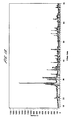
- the parent glass was prepared in the same fashion as previously described, but was heated at a rate of 2.5°C/min to a level of 1200°C before being cooled to room temperature at 10°C/min in order to crystallise it. Subsequently, samples were embedded in epoxy resin, sectioned and polished to ⁇ 1 mm prior to etching for 15 seconds in a mixture of 1% Hydrofluoric / 5% Hydrochloric acid. The specimens were then gold-coated and examined using SEM. The Example showed that the microstructure consisted of large crystals of enstatite (shown via XRD, Figure 8), frequently > 10 mm in diameter, and that the remaining glassy matrix surrounding them was severely cracked (Figure 9).
- the preparation conditions were the same as before except that the heating rate for crystallisation was 7.5°C/min to 1200°C before cooling. Examination of the crystalline microstructure showed that the enstatite crystals ( Figure 10) were much smaller than those in Example 7, and that there was no cracking in the surrounding residual glass matrix. The final degree of crystallinity appeared to be in the order of 50% by volume, and the ratio of proto:clino-enstatite measured via XRD ( Figure 11) had decreased in comparison to Example 7.
Landscapes
- Chemical & Material Sciences (AREA)
- Life Sciences & Earth Sciences (AREA)
- Engineering & Computer Science (AREA)
- Health & Medical Sciences (AREA)
- Ceramic Engineering (AREA)
- Organic Chemistry (AREA)
- Materials Engineering (AREA)
- Geochemistry & Mineralogy (AREA)
- General Chemical & Material Sciences (AREA)
- Chemical Kinetics & Catalysis (AREA)
- Medicinal Chemistry (AREA)
- Dermatology (AREA)
- General Health & Medical Sciences (AREA)
- Public Health (AREA)
- Veterinary Medicine (AREA)
- Molecular Biology (AREA)
- Epidemiology (AREA)
- Transplantation (AREA)
- Oral & Maxillofacial Surgery (AREA)
- Animal Behavior & Ethology (AREA)
- Inorganic Chemistry (AREA)
- Crystallography & Structural Chemistry (AREA)
- Dispersion Chemistry (AREA)
- Glass Compositions (AREA)
- Materials For Medical Uses (AREA)
- Compositions Of Oxide Ceramics (AREA)
- Re-Forming, After-Treatment, Cutting And Transporting Of Glass Products (AREA)
Claims (36)
- Glaskeramik-Material, das eine Bruchzähigkeit von größer als oder gleich 3,6 MNm-3/2 aufweist und umfasst:wobei die Glaskeramik erhältlich ist, indem eine Ausgangsglaszusammensetzung, die im Bereich von 20 bis 60 Gew.-% MgO, von 35 bis 65 Gew.-% SiO2, von 1 bis 20 Gew.-% TiO2 und von 1 bis 15 Gew.-% Na2O umfasst, erhitzt wird.(a) eine kristalline Hauptphase, umfassend Enstatit (MgSiO3) oder eine oder mehrere polymorphe Formen davon;(b) eine oder mehrere kristalline Nebenphasen, umfassend mindestens eine von Mg2SiO4, SiO2, TiO2, MgO, Na4Mg2Si3O10 und/oder Na2Mg6F2(Si4O11)2; und(c) eine restliche glasartige Phase;
- Glaskeramik nach Anspruch 1, die erhältlich ist, indem eine Ausgangsglaszusammensetzung, die im Bereich von 20 bis 35 Gew.-% MgO, von 50 bis 65 Gew.-% SiO2, von 4 bis 15 Gew.-% TiO2 und von 1 bis 12 Gew.-% Na2O umfasst, erhitzt wird.
- Glaskeramik nach Anspruch 1 oder Anspruch 2, wobei das Gewichtsverhältnis von MgO zu SiO2 im Bereich von 25:75 bis 40:60 liegt.
- Glaskeramik nach einem der vorhergehenden Ansprüche, wobei das Gewichtsverhältnis von MgO zu SiO2 im Bereich von 32:68 bis 38:62 liegt.
- Glaskeramik nach einem der vorhergehenden Ansprüche, die eine Bruchzähigkeit von größer als oder gleich 3,8 MNm-3/2 aufweist.
- Glaskeramik nach Anspruch 5, die eine Bruchzähigkeit von größer als oder gleich 4 MNm-3/2 aufweist.
- Glaskeramik nach Anspruch 6, die eine Bruchzähigkeit von größer als oder gleich 4,5 MNm-3/2 aufweist.
- Glaskeramik nach Anspruch 7, die eine Bruchzähigkeit von größer als oder gleich 5 MNm-3/2 aufweist.
- Glaskeramik nach einem der vorhergehenden Ansprüche, die eine Biegefestigkeit von größer als oder gleich 300 MPa aufweist.
- Glaskeramik nach Anspruch 9, die eine Biegefestigkeit von größer als oder gleich 325 MPa aufweist.
- Glaskeramik nach Anspruch 10, die eine Biegefestigkeit von größer als oder gleich 350 MPa aufweist.
- Glaskeramik nach einem der vorhergehenden Ansprüche, die eine Vickershärte (20 kg Last) von 600 oder mehr aufweist.
- Glaskeramik nach einem der vorhergehenden Ansprüche, wobei die Zusammensetzung frei oder im Wesentlichen frei ist von einer oder mehreren von Al2O3, Li2O, CaO, SrO, La2O3, Y2O3, K2O und BaO.
- Synthetisches Knochenmaterial, das eine Glaskeramik nach einem der vorhergehenden Ansprüche umfasst.
- Zusammensetzung, die eine Glaskeramik nach einem der Ansprüche 1 bis 13 oder ein synthetisches Knochenmaterial nach Anspruch 14 zusammen mit einem pharmazeutisch annehmbaren Verdünnungsmittel oder Träger umfasst.
- Knochenimplantat, Gelenkimplantat, Prothese, Füllmittel oder Zement, umfassend eine Glaskeramik nach einem der Ansprüche 1 bis 13, ein synthetisches Knochenmaterial nach Anspruch 14 oder eine Zusammensetzung nach Anspruch 15.
- Prothese nach Anspruch 16, die eine Fingergelenkprothese ist.
- Glaskeramik nach einem der Ansprüche 1 bis 13, synthetisches Knochenmaterial nach Anspruch 14 oder Zusammensetzung nach Anspruch 15 zur Verwendung in einem Verfahren zur Behandlung des menschlichen oder tierischen Körpers durch Operation oder Therapie.
- Verfahren zur Herstellung eines Glaskeramik-Materials, wobei das Verfahren umfasst:(i) Bereitstellen einer Ausgangsglaszusammensetzung, umfassend im Bereich von 20 bis 60 Gew.-% MgO, von 35 bis 65 Gew.-% SiO2, von 1 bis 20 Gew.-% TiO2 und von 1 bis 15 Gew.-% Na2O;(ii) Erhitzen der Ausgangsglaszusammensetzung bei einer Temperatur und für eine Zeitdauer, die ausreichen, um (a) eine kristalline Hauptphase, umfassend MgSiO3 oder eine oder mehrere polymorphe Formen davon, (b) eine oder mehrere kristalline Nebenphasen, umfassend mindestens eine von Mg2SiO4, SiO2, MgO, TiO2 Na4Mg2Si3O10 und/oder Na2Mg6F2(Si4O11)2, und (c) eine restliche glasartige Phase abzuscheiden.
- Verfahren nach Anspruch 19, wobei die Ausgangsglaszusammensetzung im Bereich von 20 bis 35 Gew.-% MgO, von 50 bis 65 Gew.-% SiO2, von 4 bis 15 Gew.-% TiO2 und von 1 bis 12 Gew.-% Na2O umfasst.
- Verfahren nach Anspruch 19 oder Anspruch 20, wobei die Ausgangsglaszusammensetzung im Bereich von 24 bis 30 Gew.-% MgO, von 54 bis 62 Gew.-% SiO2, von 5 bis 10 Gew.-% TiO2 und von 1 bis 10 Gew.-% Na2O umfasst.
- Verfahren nach einem der Ansprüche 19 bis 21, wobei die Ausgangsglaszusammensetzung auf eine Temperatur im Bereich von 750 bis 1200°C erhitzt wird, um die Phasen abzuscheiden.
- Verfahren nach Anspruch 22, wobei die Ausgangsglaszusammensetzung auf eine Temperatur im Bereich von 800 bis 1100°C erhitzt wird, um die Phasen abzuscheiden.
- Verfahren nach einem der Ansprüche 19 bis 23, wobei die Ausgangsglaszusammensetzung mit einer Aufheizgeschwindigkeit von bis zu 20°C/Minute, vorzugsweise bis zu 15°C/Minute, mehr bevorzugt bis zu 10°C/Minute, noch mehr bevorzugt bis zu 5°C/Minute erhitzt wird.
- Verfahren nach einem der Ansprüche 19 bis 24, wobei die Ausgangsglaszusammensetzung nach dem Schritt des Erhitzens zur Abscheidung der Phasen mit einer Kühlgeschwindigkeit von bis zu 20°C/Minute, vorzugsweise bis zu 15°C/Minute, mehr bevorzugt bis zu 10°C/Minute, noch mehr bevorzugt bis zu 5°C/Minute gekühlt wird.
- Verfahren nach einem der Ansprüche 19 bis 21, wobei der Schritt des Erhitzens der Ausgangsglaszusammensetzung die folgenden Schritte umfasst:(a) Erhitzen auf Tn mit einer Geschwindigkeit von bis zu 20°C/Minute, vorzugsweise bis zu 15°C/Minute, mehr bevorzugt bis zu 10°C/Minute, wobei Tn die Temperatur ist, bei der in der kürzesten Zeitdauer die maximale Menge an Kristallisationskernen innerhalb der Ausgangsglaszusammensetzung erzeugt werden;(b) Halten der Zusammensetzung bei Tn für eine Zeitdauer, bis die gewünschte Menge an Kristallisationskernen erhalten wurde;(c) Erhitzen auf Tc mit einer Geschwindigkeit von bis zu 15°C/Minute, mehr bevorzugt bis zu 10°C/Minute, noch mehr bevorzugt bis zu 7,5°C/Minute, wobei Tc die Kristallisationspeaktemperatur ist;(d) Halten der Zusammensetzung bei Tc für eine Zeitdauer, bis die gewünschte Kristallitgröße erhalten wurde; und(e) Kühlen des resultierenden Glaskeramik-Materials.
- Verfahren nach Anspruch 26, wobei Tn im Bereich von 700 bis 840°C, vorzugsweise 700 bis 750°C, mehr bevorzugt 700 bis 730°C, noch mehr bevorzugt 705 bis 715°C liegt.
- Verfahren nach Anspruch 26 oder Anspruch 27, wobei Tc im Bereich von 750 bis 1200°C liegt.
- Verfahren nach einem der Ansprüche 26 bis 28, wobei das Erhitzen auf Tc mit einer Geschwindigkeit von 2,5 bis 10°C/Minute, vorzugsweise von 5 bis 10°C/Minute, mehr bevorzugt von 7,5 bis 10°C/Minute durchgeführt wird.
- Verfahren nach einem der Ansprüche 19 bis 29, wobei die Ausgangsglaszusammensetzung vor dem Schritt des Erhitzens zur Abscheidung der Phasen getempert wird.
- Verfahren nach einem der Ansprüche 19 bis 30, wobei die Ausgangsglaszusammensetzung gebildet wird, indem gemischte Vorläufer-Pulver umfassend Na2CO3, SiO2, TiO2 und MgCO3 bei einer Temperatur und für eine Zeitdauer erhitzt werden, die ausreichen, damit das Ausgangsglas gebildet wird.
- Verfahren nach Anspruch 31, wobei die gemischten Vorläufer-Pulver eine Hitzebehandlung durchlaufen, die das Erhitzen bei einer Temperatur im Bereich von 1450 bis 1650°C für eine Zeitdauer umfasst, die ausreicht, damit das Ausgangsglas gebildet wird.
- Verfahren nach Anspruch 31, wobei die gemischten Vorläufer-Pulver eine zweistufige Hitzebehandlung durchlaufen, die einen ersten Schritt des Erhitzens bei einer Temperatur im Bereich von 800 bis 1200°C, gefolgt von einer zweiten Stufe des Erhitzens bei einer Temperatur im Bereich von 1450 bis 1650°C umfasst.
- Verfahren nach einem der Ansprüche 19 bis 33, wobei geschmolzenes Ausgangsglas vor den Schritten des Erhitzens zur Abscheidung der verschiedenen Phasen in eine gewünschte Form gegossen wird.
- Verfahren nach einem der Ansprüche 19 bis 34, wobei das Ausgangsglas frei oder im Wesentlichen frei ist von einer oder mehreren von Al2O3, Li2O, CaO, SrO, La2O3, Y2O3, K2O und BaO.
- Verfahren nach einem der Ansprüche 19 bis 35, wobei das Ausgangsglas im Wesentlichen aus MgO, SiO2, TiO2 und Na2O, zusammen mit unvermeidbaren Verunreinigungen, besteht.
Applications Claiming Priority (3)
| Application Number | Priority Date | Filing Date | Title |
|---|---|---|---|
| GB9904023 | 1999-02-22 | ||
| GBGB9904023.0A GB9904023D0 (en) | 1999-02-22 | 1999-02-22 | Glass-ceramic material and process for the production therof |
| PCT/GB2000/000618 WO2000050353A1 (en) | 1999-02-22 | 2000-02-22 | Glass-ceramic material and process for the production thereof |
Publications (2)
| Publication Number | Publication Date |
|---|---|
| EP1159230A1 EP1159230A1 (de) | 2001-12-05 |
| EP1159230B1 true EP1159230B1 (de) | 2003-10-01 |
Family
ID=10848254
Family Applications (1)
| Application Number | Title | Priority Date | Filing Date |
|---|---|---|---|
| EP00905176A Expired - Lifetime EP1159230B1 (de) | 1999-02-22 | 2000-02-22 | Glaskeramik und verfahren zu dessen herstellung |
Country Status (7)
| Country | Link |
|---|---|
| EP (1) | EP1159230B1 (de) |
| JP (1) | JP2002537214A (de) |
| AT (1) | ATE251092T1 (de) |
| AU (1) | AU2680500A (de) |
| DE (1) | DE60005647D1 (de) |
| GB (1) | GB9904023D0 (de) |
| WO (1) | WO2000050353A1 (de) |
Families Citing this family (1)
| Publication number | Priority date | Publication date | Assignee | Title |
|---|---|---|---|---|
| EP2314550A1 (de) * | 2009-10-26 | 2011-04-27 | AGC Glass Europe | Glaskeramik aus Kalk-Natron-Glas |
Family Cites Families (3)
| Publication number | Priority date | Publication date | Assignee | Title |
|---|---|---|---|---|
| DE1007231B (de) * | 1953-05-20 | 1957-04-25 | Dr Fritz Albrecht | Verwendung von SiO-armen Glasfluessen als Hartstoffe |
| US3997352A (en) * | 1975-09-29 | 1976-12-14 | Corning Glass Works | Mica-spodumene glass-ceramic articles |
| JP2807752B2 (ja) * | 1993-05-17 | 1998-10-08 | ティーディーケイ株式会社 | 結晶化ガラス材 |
-
1999
- 1999-02-22 GB GBGB9904023.0A patent/GB9904023D0/en not_active Ceased
-
2000
- 2000-02-22 AU AU26805/00A patent/AU2680500A/en not_active Abandoned
- 2000-02-22 WO PCT/GB2000/000618 patent/WO2000050353A1/en not_active Ceased
- 2000-02-22 EP EP00905176A patent/EP1159230B1/de not_active Expired - Lifetime
- 2000-02-22 AT AT00905176T patent/ATE251092T1/de not_active IP Right Cessation
- 2000-02-22 DE DE60005647T patent/DE60005647D1/de not_active Expired - Lifetime
- 2000-02-22 JP JP2000600939A patent/JP2002537214A/ja active Pending
Also Published As
| Publication number | Publication date |
|---|---|
| JP2002537214A (ja) | 2002-11-05 |
| ATE251092T1 (de) | 2003-10-15 |
| DE60005647D1 (de) | 2003-11-06 |
| WO2000050353A1 (en) | 2000-08-31 |
| AU2680500A (en) | 2000-09-14 |
| GB9904023D0 (en) | 1999-04-14 |
| EP1159230A1 (de) | 2001-12-05 |
Similar Documents
| Publication | Publication Date | Title |
|---|---|---|
| US20240026296A1 (en) | Lithium disilicate glass-ceramic compositions and methods thereof | |
| US6130178A (en) | Strong miserite glass-ceramics | |
| JP2648673B2 (ja) | ガラスセラミック製品 | |
| US4652534A (en) | High-strength glass ceramic containing apatite crystals and a large quantity of wollastonite crystals and process for producing same | |
| US20230265009A1 (en) | Glass-ceramics with high elastic modulus and hardness | |
| US5352638A (en) | Nickel aluminosilicate glass-ceramics | |
| EP0641556A1 (de) | Canasit-Apatit Glaskeramiken | |
| KR101474588B1 (ko) | 내화성 유리 세라믹 | |
| US4960733A (en) | Inorganic biomaterial and process for producing the same | |
| EP3475235A1 (de) | Zirkoniumgehärtete glaskeramiken | |
| KR100465985B1 (ko) | 인공골용 생체활성 복합 세라믹스 조성물 및 그의 제조방법 | |
| KR20050053693A (ko) | 결정화 가능한 글라스와, 용이하게 연마된 표면을 갖는매우 단단한 브레이크-저항성의 글라스 세라믹을 생산하기위한 이들의 용도 | |
| US20240150220A1 (en) | Novel glass and glass-ceramic compositions | |
| EP3013762B1 (de) | Leukit-glaskeramiken | |
| Zhang et al. | Effect of added mullite whisker on properties of lithium aluminosilicate (LAS) glass-ceramics prepared for dental restoration | |
| Hench et al. | Bioactive glasses | |
| JPH0269335A (ja) | アルカリ土類金属アルミノホウ酸塩ガラスセラミックおよびその製造方法 | |
| EP1159230B1 (de) | Glaskeramik und verfahren zu dessen herstellung | |
| US20230227350A1 (en) | Glass-ceramic compositions and methods of making thereof | |
| EP4234503A1 (de) | Transparente combeit-glaskeramik | |
| JP2020532483A (ja) | ガラスフリットから得られる吉岡石ガラスセラミック | |
| JP2006001828A (ja) | 結晶化ガラス | |
| WO2023125004A1 (zh) | 玻璃陶瓷模具及其制备方法 | |
| KR920000150B1 (ko) | 생체재료용 결정화 유리 및 그 제조방법 | |
| KR940003461B1 (ko) | 고강도 생체재료용 결정화유리 및 그 제조방법 |
Legal Events
| Date | Code | Title | Description |
|---|---|---|---|
| PUAI | Public reference made under article 153(3) epc to a published international application that has entered the european phase |
Free format text: ORIGINAL CODE: 0009012 |
|
| 17P | Request for examination filed |
Effective date: 20010921 |
|
| AK | Designated contracting states |
Kind code of ref document: A1 Designated state(s): AT BE CH CY DE DK ES FI FR GB GR IE IT LI LU MC NL PT SE |
|
| AX | Request for extension of the european patent |
Free format text: AL;LT;LV;MK;RO;SI |
|
| GRAH | Despatch of communication of intention to grant a patent |
Free format text: ORIGINAL CODE: EPIDOS IGRA |
|
| GRAS | Grant fee paid |
Free format text: ORIGINAL CODE: EPIDOSNIGR3 |
|
| GRAA | (expected) grant |
Free format text: ORIGINAL CODE: 0009210 |
|
| AK | Designated contracting states |
Kind code of ref document: B1 Designated state(s): AT BE CH CY DE DK ES FI FR GB GR IE IT LI LU MC NL PT SE |
|
| PG25 | Lapsed in a contracting state [announced via postgrant information from national office to epo] |
Ref country code: FI Free format text: LAPSE BECAUSE OF FAILURE TO SUBMIT A TRANSLATION OF THE DESCRIPTION OR TO PAY THE FEE WITHIN THE PRESCRIBED TIME-LIMIT Effective date: 20031001 Ref country code: FR Free format text: LAPSE BECAUSE OF FAILURE TO SUBMIT A TRANSLATION OF THE DESCRIPTION OR TO PAY THE FEE WITHIN THE PRESCRIBED TIME-LIMIT Effective date: 20031001 Ref country code: NL Free format text: LAPSE BECAUSE OF FAILURE TO SUBMIT A TRANSLATION OF THE DESCRIPTION OR TO PAY THE FEE WITHIN THE PRESCRIBED TIME-LIMIT Effective date: 20031001 Ref country code: CH Free format text: LAPSE BECAUSE OF FAILURE TO SUBMIT A TRANSLATION OF THE DESCRIPTION OR TO PAY THE FEE WITHIN THE PRESCRIBED TIME-LIMIT Effective date: 20031001 Ref country code: LI Free format text: LAPSE BECAUSE OF FAILURE TO SUBMIT A TRANSLATION OF THE DESCRIPTION OR TO PAY THE FEE WITHIN THE PRESCRIBED TIME-LIMIT Effective date: 20031001 Ref country code: AT Free format text: LAPSE BECAUSE OF FAILURE TO SUBMIT A TRANSLATION OF THE DESCRIPTION OR TO PAY THE FEE WITHIN THE PRESCRIBED TIME-LIMIT Effective date: 20031001 Ref country code: CY Free format text: LAPSE BECAUSE OF FAILURE TO SUBMIT A TRANSLATION OF THE DESCRIPTION OR TO PAY THE FEE WITHIN THE PRESCRIBED TIME-LIMIT Effective date: 20031001 Ref country code: BE Free format text: LAPSE BECAUSE OF FAILURE TO SUBMIT A TRANSLATION OF THE DESCRIPTION OR TO PAY THE FEE WITHIN THE PRESCRIBED TIME-LIMIT Effective date: 20031001 Ref country code: IT Free format text: LAPSE BECAUSE OF FAILURE TO SUBMIT A TRANSLATION OF THE DESCRIPTION OR TO PAY THE FEE WITHIN THE PRESCRIBED TIME-LIMIT;WARNING: LAPSES OF ITALIAN PATENTS WITH EFFECTIVE DATE BEFORE 2007 MAY HAVE OCCURRED AT ANY TIME BEFORE 2007. THE CORRECT EFFECTIVE DATE MAY BE DIFFERENT FROM THE ONE RECORDED. Effective date: 20031001 |
|
| REG | Reference to a national code |
Ref country code: GB Ref legal event code: FG4D |
|
| RAP2 | Party data changed (patent owner data changed or rights of a patent transferred) |
Owner name: DE PUY INTERNATIONAL LIMITED Owner name: ABONETICS 2000 LIMITED |
|
| REG | Reference to a national code |
Ref country code: CH Ref legal event code: EP |
|
| REG | Reference to a national code |
Ref country code: IE Ref legal event code: FG4D |
|
| REF | Corresponds to: |
Ref document number: 60005647 Country of ref document: DE Date of ref document: 20031106 Kind code of ref document: P |
|
| NLT2 | Nl: modifications (of names), taken from the european patent patent bulletin |
Owner name: ABONETICS 2000 LIMITED EN DE PUY INTERNATIONAL LIM |
|
| PG25 | Lapsed in a contracting state [announced via postgrant information from national office to epo] |
Ref country code: SE Free format text: LAPSE BECAUSE OF FAILURE TO SUBMIT A TRANSLATION OF THE DESCRIPTION OR TO PAY THE FEE WITHIN THE PRESCRIBED TIME-LIMIT Effective date: 20040101 Ref country code: GR Free format text: LAPSE BECAUSE OF FAILURE TO SUBMIT A TRANSLATION OF THE DESCRIPTION OR TO PAY THE FEE WITHIN THE PRESCRIBED TIME-LIMIT Effective date: 20040101 Ref country code: DK Free format text: LAPSE BECAUSE OF FAILURE TO SUBMIT A TRANSLATION OF THE DESCRIPTION OR TO PAY THE FEE WITHIN THE PRESCRIBED TIME-LIMIT Effective date: 20040101 |
|
| PG25 | Lapsed in a contracting state [announced via postgrant information from national office to epo] |
Ref country code: DE Free format text: LAPSE BECAUSE OF FAILURE TO SUBMIT A TRANSLATION OF THE DESCRIPTION OR TO PAY THE FEE WITHIN THE PRESCRIBED TIME-LIMIT Effective date: 20040103 |
|
| PG25 | Lapsed in a contracting state [announced via postgrant information from national office to epo] |
Ref country code: ES Free format text: LAPSE BECAUSE OF FAILURE TO SUBMIT A TRANSLATION OF THE DESCRIPTION OR TO PAY THE FEE WITHIN THE PRESCRIBED TIME-LIMIT Effective date: 20040112 |
|
| PG25 | Lapsed in a contracting state [announced via postgrant information from national office to epo] |
Ref country code: GB Free format text: LAPSE BECAUSE OF NON-PAYMENT OF DUE FEES Effective date: 20040222 Ref country code: LU Free format text: LAPSE BECAUSE OF NON-PAYMENT OF DUE FEES Effective date: 20040222 |
|
| PG25 | Lapsed in a contracting state [announced via postgrant information from national office to epo] |
Ref country code: IE Free format text: LAPSE BECAUSE OF NON-PAYMENT OF DUE FEES Effective date: 20040223 |
|
| PG25 | Lapsed in a contracting state [announced via postgrant information from national office to epo] |
Ref country code: MC Free format text: LAPSE BECAUSE OF NON-PAYMENT OF DUE FEES Effective date: 20040228 |
|
| NLV1 | Nl: lapsed or annulled due to failure to fulfill the requirements of art. 29p and 29m of the patents act | ||
| LTIE | Lt: invalidation of european patent or patent extension |
Effective date: 20031001 |
|
| REG | Reference to a national code |
Ref country code: CH Ref legal event code: PL |
|
| PLBE | No opposition filed within time limit |
Free format text: ORIGINAL CODE: 0009261 |
|
| STAA | Information on the status of an ep patent application or granted ep patent |
Free format text: STATUS: NO OPPOSITION FILED WITHIN TIME LIMIT |
|
| 26N | No opposition filed |
Effective date: 20040702 |
|
| GBPC | Gb: european patent ceased through non-payment of renewal fee |
Effective date: 20040222 |
|
| EN | Fr: translation not filed | ||
| REG | Reference to a national code |
Ref country code: IE Ref legal event code: MM4A |
|
| PG25 | Lapsed in a contracting state [announced via postgrant information from national office to epo] |
Ref country code: PT Free format text: LAPSE BECAUSE OF NON-PAYMENT OF DUE FEES Effective date: 20040301 |