EP1145745A2 - Video game device, character action setting method in video game, and computer-readable recording medium storing character action setting program - Google Patents
Video game device, character action setting method in video game, and computer-readable recording medium storing character action setting program Download PDFInfo
- Publication number
- EP1145745A2 EP1145745A2 EP01101172A EP01101172A EP1145745A2 EP 1145745 A2 EP1145745 A2 EP 1145745A2 EP 01101172 A EP01101172 A EP 01101172A EP 01101172 A EP01101172 A EP 01101172A EP 1145745 A2 EP1145745 A2 EP 1145745A2
- Authority
- EP
- European Patent Office
- Prior art keywords
- image data
- action
- data group
- frame
- character
- Prior art date
- Legal status (The legal status is an assumption and is not a legal conclusion. Google has not performed a legal analysis and makes no representation as to the accuracy of the status listed.)
- Granted
Links
- 230000009471 action Effects 0.000 title claims abstract description 137
- 238000000034 method Methods 0.000 title claims description 14
- 230000033001 locomotion Effects 0.000 claims abstract description 27
- 238000003860 storage Methods 0.000 claims description 7
- 238000004519 manufacturing process Methods 0.000 abstract description 6
- 210000002414 leg Anatomy 0.000 description 16
- 238000010586 diagram Methods 0.000 description 14
- 230000008859 change Effects 0.000 description 12
- 230000015654 memory Effects 0.000 description 8
- 230000006870 function Effects 0.000 description 5
- 101000760620 Homo sapiens Cell adhesion molecule 1 Proteins 0.000 description 3
- 101000911772 Homo sapiens Hsc70-interacting protein Proteins 0.000 description 3
- 101000710013 Homo sapiens Reversion-inducing cysteine-rich protein with Kazal motifs Proteins 0.000 description 3
- 238000010276 construction Methods 0.000 description 3
- 239000004065 semiconductor Substances 0.000 description 3
- 230000009182 swimming Effects 0.000 description 3
- 102100035353 Cyclin-dependent kinase 2-associated protein 1 Human genes 0.000 description 2
- 101000737813 Homo sapiens Cyclin-dependent kinase 2-associated protein 1 Proteins 0.000 description 2
- 239000003086 colorant Substances 0.000 description 2
- 238000004040 coloring Methods 0.000 description 2
- 230000003287 optical effect Effects 0.000 description 2
- 230000009467 reduction Effects 0.000 description 2
- 238000004891 communication Methods 0.000 description 1
- 230000000694 effects Effects 0.000 description 1
- 210000003127 knee Anatomy 0.000 description 1
- 239000004973 liquid crystal related substance Substances 0.000 description 1
- 230000005236 sound signal Effects 0.000 description 1
- 229920003002 synthetic resin Polymers 0.000 description 1
- 239000000057 synthetic resin Substances 0.000 description 1
- 230000001131 transforming effect Effects 0.000 description 1
Images




Classifications
-
- A63F13/10—
-
- A—HUMAN NECESSITIES
- A63—SPORTS; GAMES; AMUSEMENTS
- A63F—CARD, BOARD, OR ROULETTE GAMES; INDOOR GAMES USING SMALL MOVING PLAYING BODIES; VIDEO GAMES; GAMES NOT OTHERWISE PROVIDED FOR
- A63F13/00—Video games, i.e. games using an electronically generated display having two or more dimensions
- A63F13/50—Controlling the output signals based on the game progress
- A63F13/52—Controlling the output signals based on the game progress involving aspects of the displayed game scene
-
- A—HUMAN NECESSITIES
- A63—SPORTS; GAMES; AMUSEMENTS
- A63F—CARD, BOARD, OR ROULETTE GAMES; INDOOR GAMES USING SMALL MOVING PLAYING BODIES; VIDEO GAMES; GAMES NOT OTHERWISE PROVIDED FOR
- A63F13/00—Video games, i.e. games using an electronically generated display having two or more dimensions
- A63F13/45—Controlling the progress of the video game
-
- A—HUMAN NECESSITIES
- A63—SPORTS; GAMES; AMUSEMENTS
- A63F—CARD, BOARD, OR ROULETTE GAMES; INDOOR GAMES USING SMALL MOVING PLAYING BODIES; VIDEO GAMES; GAMES NOT OTHERWISE PROVIDED FOR
- A63F13/00—Video games, i.e. games using an electronically generated display having two or more dimensions
- A63F13/80—Special adaptations for executing a specific game genre or game mode
- A63F13/816—Athletics, e.g. track-and-field sports
-
- A—HUMAN NECESSITIES
- A63—SPORTS; GAMES; AMUSEMENTS
- A63F—CARD, BOARD, OR ROULETTE GAMES; INDOOR GAMES USING SMALL MOVING PLAYING BODIES; VIDEO GAMES; GAMES NOT OTHERWISE PROVIDED FOR
- A63F13/00—Video games, i.e. games using an electronically generated display having two or more dimensions
- A63F13/50—Controlling the output signals based on the game progress
- A63F13/53—Controlling the output signals based on the game progress involving additional visual information provided to the game scene, e.g. by overlay to simulate a head-up display [HUD] or displaying a laser sight in a shooting game
- A63F13/537—Controlling the output signals based on the game progress involving additional visual information provided to the game scene, e.g. by overlay to simulate a head-up display [HUD] or displaying a laser sight in a shooting game using indicators, e.g. showing the condition of a game character on screen
-
- A—HUMAN NECESSITIES
- A63—SPORTS; GAMES; AMUSEMENTS
- A63F—CARD, BOARD, OR ROULETTE GAMES; INDOOR GAMES USING SMALL MOVING PLAYING BODIES; VIDEO GAMES; GAMES NOT OTHERWISE PROVIDED FOR
- A63F13/00—Video games, i.e. games using an electronically generated display having two or more dimensions
- A63F13/90—Constructional details or arrangements of video game devices not provided for in groups A63F13/20 or A63F13/25, e.g. housing, wiring, connections or cabinets
- A63F13/95—Storage media specially adapted for storing game information, e.g. video game cartridges
-
- A—HUMAN NECESSITIES
- A63—SPORTS; GAMES; AMUSEMENTS
- A63F—CARD, BOARD, OR ROULETTE GAMES; INDOOR GAMES USING SMALL MOVING PLAYING BODIES; VIDEO GAMES; GAMES NOT OTHERWISE PROVIDED FOR
- A63F2300/00—Features of games using an electronically generated display having two or more dimensions, e.g. on a television screen, showing representations related to the game
- A63F2300/30—Features of games using an electronically generated display having two or more dimensions, e.g. on a television screen, showing representations related to the game characterized by output arrangements for receiving control signals generated by the game device
- A63F2300/303—Features of games using an electronically generated display having two or more dimensions, e.g. on a television screen, showing representations related to the game characterized by output arrangements for receiving control signals generated by the game device for displaying additional data, e.g. simulating a Head Up Display
-
- A—HUMAN NECESSITIES
- A63—SPORTS; GAMES; AMUSEMENTS
- A63F—CARD, BOARD, OR ROULETTE GAMES; INDOOR GAMES USING SMALL MOVING PLAYING BODIES; VIDEO GAMES; GAMES NOT OTHERWISE PROVIDED FOR
- A63F2300/00—Features of games using an electronically generated display having two or more dimensions, e.g. on a television screen, showing representations related to the game
- A63F2300/60—Methods for processing data by generating or executing the game program
- A63F2300/66—Methods for processing data by generating or executing the game program for rendering three dimensional images
- A63F2300/6607—Methods for processing data by generating or executing the game program for rendering three dimensional images for animating game characters, e.g. skeleton kinematics
-
- A—HUMAN NECESSITIES
- A63—SPORTS; GAMES; AMUSEMENTS
- A63F—CARD, BOARD, OR ROULETTE GAMES; INDOOR GAMES USING SMALL MOVING PLAYING BODIES; VIDEO GAMES; GAMES NOT OTHERWISE PROVIDED FOR
- A63F2300/00—Features of games using an electronically generated display having two or more dimensions, e.g. on a television screen, showing representations related to the game
- A63F2300/80—Features of games using an electronically generated display having two or more dimensions, e.g. on a television screen, showing representations related to the game specially adapted for executing a specific type of game
- A63F2300/8005—Athletics
Definitions
- the present invention relates to a video game device using an optical disk, a magnetic disk, a semiconductor memory or a cassette-type recording medium storing program data, a character action setting method in a video game and a computer-readable recording medium storing a character action setting program.
- a huge number of video game systems have been proposed. These systems include, for example, systems comprised of a special device for home use and a television monitor and systems comprised of a special device for business use, a personal computer or a workstation, a display and a sound output device. Any one of these systems includes a controller used by a game player for operation, a recording medium storing game program data, a CPU for executing controls to generate images and sounds based on the game program data, a processor for generating images, a processor for generating sounds, a CRT or like monitor for displaying images, and a loudspeaker for outputting sounds.
- CD-ROMs, semiconductor memories, cassette-type recording mediums having a built-in semiconductor memory are frequently used as the above recording medium.
- a running competition such as a 100M dash in a game space as one kind of the game executed by such a game system.
- a plurality of play characters may be caused to appear on a track displayed on a monitor, the play character(s) whose running action is controlled by game player(s) and the other play characters whose running action is automatically controlled may be caused to compete with each other, ranking may be determined based on an order in which they reach a goal.
- a multitude of frames of image data may be prepared between a starting pint to a goal point, and the play characters may be caused to make a series of running actions by successively displaying images based on the image data on the monitor.
- an object of the present invention is to provide a video game device which can effectively suppress an increase in production costs and execute a video game without causing a game player to have a feeling of incongruity upon viewing displayed images, a character action setting method in the video game and a computer-readable recording medium storing a character action setting program.
- a video game device for displaying a play character on a game screen displayed on a monitor and moving the play character from a reference position to a predetermined position in a game space by operating an operation unit, comprising:
- FIG. 1 is a diagram showing the schematic construction of a video game system (video game device) 10 to which a character action setting method according to one embodiment of the present invention is applied.
- the video game system 10 is provided with a memory unit 12, an image display unit 14, a sound output unit 16, an operation input unit 18 and a control unit 20.
- the units 12, 14, 16 and 18 are connected with each other via a bus 22 including address buses, data buses and control buses connected with a CPU 201 of the control unit 20 to be described later.
- the memory unit 12 includes a recording medium (also referred to as a recording medium) 122 connected with the bus 22 via an interface circuit 121 and a RAM 123 for temporarily storing the game data read from the recording medium 122.
- the recording medium 122 is, for example, a so-called ROM cassette in which a ROM or like recording medium storing game data and program data of an operating system is accommodated in a plastic casing, an optical disk, or a flexible disk.
- the image display unit 14 is adapted to display various game images in accordance with the progress of the game and includes a digital-to-analog (D/A) converter 142 connected with the bus 22 via an interface circuit 141 and a television monitor (video monitor) 143 including a CRT, a liquid crystal display or the like connected with the D/A converter 142.
- D/A digital-to-analog
- video monitor video monitor
- the sound output device 16 is adapted to output a game music, sound effects, etc. in accordance with the progress of the game and is provided with a D/A converter 162 connected with the bus 22 via an interface circuit 161, an amplifying circuit 163 connected with the D/A converter 162, and a loudspeaker 164 for outputting sounds in accordance with an output signal from the amplifying circuit 163.
- the operation input unit 18 is adapted to output operation signals to the control unit 20 and is provided with an operational information interface circuit 182 connected with a bus 22 via an interface circuit 181, and a controller 183 connected with the operational information interface circuit 182.
- the controller 183 includes a start button 183a, an A-button 183b, a B-button 183c, a cross-shaped key 183d, a stick-shaped controller 183e, a C1-button 183h, a C2-button 183i, a C3-button 183j and a C4-button 183k provided on the front surface of a casing CA, a left trigger button 183f and a right trigger button 183g provided on the upper surface of the casing CA, and a Z-button 183m provided on the rear surface of the casing CA.
- the stick-shaped controller 183e has substantially the same construction as a joystick. Specifically, the controller 183e has a standing stick (operation bar), which can be inclined to front, back, left, right or in any direction in a 360° range about a specified point of the stick as a supporting point. According to the direction and angle of inclination of the stick, an X-coordinate along transverse direction and a Y-direction along forward/backward direction in coordinate systems having the standing position of the stick as an origin are sent to the control unit 20 via the interface circuits 182 and 182.
- a standing stick operation bar
- an X-coordinate along transverse direction and a Y-direction along forward/backward direction in coordinate systems having the standing position of the stick as an origin are sent to the control unit 20 via the interface circuits 182 and 182.
- the control unit 20 is adapted to control the progress of the game, and is comprised of the CPU 201 connected with the bus 22, a signal processor 202 and an image processor 203.
- the signal processor 202 mainly performs calculation of image data in a three-dimensional (3D) space, calculation for transforming a position in the 3D space to a position in a simulated 3D space, alight source calculation, and generation and processing of sound data.
- the image processor 203 writes an image data to be displayed in the RAM 123 based on the calculation results in the signal processor 202. For example, the image processor 202 writes a texture data in an area of the RAM 123 specified by a polygon.
- the video game system 10 thus constructed takes different modes according to its application. Specifically, in the case that the video game system 10 is constructed for business use, all the elements shown in FIG. 1 are, for example, contained in one casing. In the case that the video game system 10 is constructed for home use, the television monitor 143, the amplifying circuit 163 and the loudspeaker 164 are separate from a main game unit.
- the main game unit is, for example, comprised of the interface circuit 121 connected with the CPU 201, the RAM 123, the interface circuit 141, the D/A converter 142, the interface circuit 161, the D/A converter 162, the interface circuit 181, the operational information interface circuit 182, the controller 183, the signal processor 202 and the image processor 203.
- This main game unit is constructed by accommodating the respective elements in a casing made of a synthetic resin, and the recording medium 122 is detachably mounted in a mounting portion formed in this casing.
- the controller 183 is connected with a connector provided in the casing via a communication cable or the like.
- the television monitor 143 corresponds a computer display
- the image processor 203 corresponds to part of the game program data stored in the recording medium 122 or hardware on an extension board mounted on an extension slot of the computer
- the interface circuits 121, 141, 161, 181, the D/A converters 142, 162, and the operational information interface circuit 182 correspond to hardware on the extension board mounted on the extension slot of the computer.
- the operation of the video game system 10 is summarily described.
- the CPU 201 reads image data, sound data and game program data from the recording medium 122 in accordance with the operating system stored in the recording medium 122, and all or part of the read image data, sound data and game program data are stored in the RAM 123.
- a specified game is proceeded by the CPU 201 in acoordance with the game program data stored in the RAM 123 and contents of instructions given by a game player via the controller 183.
- commands as tasks for forming images and outputting sounds are generated in accordance with contents of instructions given by a game player via the controller 183.
- the signal processor 202 performs calculation of display positions of characters in the 3D space (of course the same applies for a two-dimensional space), a light source calculation, generation and processing of sound data, etc. in accordance with these commands.
- Data of images to be formed are written in the RAM 123 by the image processor 203 based on the calculation results.
- the image data written in the RAM 123 are fed to the D/A converter 142 via the interface circuit 141, and fed to the television monitor 143 after being converted into analog video signals in the D/A converter 142, thereby being displayed as game images on a display surface of the television monitor 143.
- the sound data outputted from the signal processor 202 are fed to the D/A converter 162 via the interface circuit 161 and outputted as sounds from the loudspeaker 164 via the amplifying circuit 163 after being converted into analog sound signals in the D/A converter 162.
- one game can be selected from a plurality of competition games by operating the start button 183a.
- a 100M dash game which is a field and track game in which six play characters as runners compete a 100M dash on a track for competition.
- this 100M dash game is played by one to four game players; the running speeds of the number of the play characters corresponding to that of the game players are controlled by operation of the game players; the motions of the remaining play characters are controlled based on data set in advance and ranking is determined based on the order of reaching the finishing line.
- the game screen shown in FIG. 2 is one screen at an intermediate stage of the actual 100M dash game. Specifically, in this game screen, six play characters MA running on the respective courses of a track TR are displayed in the middle, and runner columns KS for introducing the play characters MA operated by the game players are displayed at the bottom end of the game screen.
- the runner columns KS are set in correspondence with four game players, and as many runner columns KS as the game participants are displayed.
- “1P” representing the first play character MA and "national flag of the USA” representing the nation to which the play character MA belongs are displayed at the upper part of the runner column KS at the left end, and "Blade” as the name of the player character MA is displayed at the lower part.
- the play character MA is generated as one animated model including all motions including those of a head, a trunk, legs and arms; its motions (poses) are displayed by giving an animation display timing; and movements of its position are displayed by giving a transport data.
- the animated model is a model generated by polygons and displayed in the game space, and includes motion data (animation data) along a time axis. Specifically, by giving an arbitrary time (animation display timing) to the animated model, a motion in conformity with the animation display timing is displayed, and a series of animation is configured by successively increasing motions.
- the transport data is a relative position information of XYZ-coordinates given to the animated model.
- the animated model can be displayed in any arbitrary position of the game space by giving this transport data to the animated model.
- a power display column (power meter) PD for displaying "running power” is so displayed as to extend obliquely upward to the right from the right end of the runner column KS.
- the "running power” is increased when the game player alternately and continuously turns on two operable members of the controller 183 such as the C1-button 183h and the C2-button 183i (continuous hitting).
- the higher the displayed level of the running power the faster the play character MA can run.
- the level of the running power is displayed by coloring the power display column PD in chromatic colors, and the colored area is increased as the level increases.
- the power display column PK is first colored in a cold color (e.g. blue), and the color tone changes toward a warm color (e.g. red) as the running power increases. In the already colored area as well, the color tone gradually changes toward a warm color.
- the level of the running power is displayed in dots.
- FIG. 3 is a diagram showing an image of the play character MA posing a start on the game screen, in which both hands and the right knee are on the ground.
- FIGS. 4 to 20 are diagrams showing images of the running action of the play character MA on the game screen after a series of motions made to stand up from the starting pose.
- a looped running animation is shown in FIGS. 4 through 20.
- the looped animation is an animation which returns to the starting motion by resetting the animation display timing to 0 upon reaching the end.
- a smooth and continuous animation can be obtained by repeatedly reproducing the looped animation.
- FIG. 4 shows a state where the right leg is brought forward by kicking the ground by the left leg, the left arm is pushed upward to the front while being bent substantially at 90°, and the right arm is pulled back.
- FIG. 5 shows a state following the state of FIG. 4, where the right leg brought forward touches the ground, and the left arm is pushed further upward to the front.
- FIG. 6 shows a state following the state of FIG. 5, where the right leg brought forward touches the ground while substantially stretched out, and the left arm is pushed even further upward to the front.
- FIG. 7 shows a state following the state of FIG. 6;
- FIG. 8 shows a state following the state of FIG. 7;
- FIG. 9 shows a state following the state of FIG. 8:
- FIG. 10 shows a state following the state of FIG. 9;
- FIG. 11 shows a state following the state of FIG. 10;
- FIG. 12 shows a state following the state of FIG. 11.
- FIG. 13 shows a state following the state of FIG. 12.
- the left leg is brought forward while being bent by kicking the ground by the right leg, the left arm is pulled down to the back, and the right arm is pushed up forward while being bent substantially at 90°.
- FIG. 14 shows a state following the state of FIG. 13, where the left leg brought forward touches the ground, and the right arm is pushed further upward to the front.
- FIG. 15 shows a state following the state of FIG. 14, where the left leg brought forward touches the ground while substantially stretched out, and the right arm is pushed even further upward to the front.
- FIG. 16 shows a state following the state of FIG. 15, and FIG. 17 shows a state following the state of FIG. 16.
- FIG. 18 shows a state following the state of FIG. 17, and FIG. 19 shows a state following the state of FIG. 18.
- FIG. 20 shows a state following the state of FIG. 19. where the left leg kicks the ground, the right leg brought forward is almost touching the ground, and the left arm is pushed forward while being bent substantially at 90°.
- a series of running motions can be displayed by returning to the state of FIG. 4 from the state of FIG. 20.
- a running action corresponding to an arbitrary distance can be displayed by repeatedly displaying a group of images (looped running animation) as one unit comprised of 17 frames of images.
- a running distance (moved amount) of the play character MA reached when 17 frames of images are displayed once is set at a constant value regardless of the running speed.
- FIGS. 21 through 39 are diagrams showing a goal finishing action which follows the running action shown in FIGS. 4 through 20.
- a series of motions for the goal finishing action are constituted by 19 frames of images.
- a goal finishing animation is constituted by images of FIGS. 21 through 39.
- FIG. 21 shows a state following the state of FIG. 4, where the right leg is almost touching the ground, and the raised left arm starts moving downward.
- FIG. 22 shows a state where the right leg touches the ground, the left arm is being moved downward, and the right arm is pulled back.
- FIG. 23 shows a state following the state of FIG. 22
- FIG. 24 shows a state following the state of FIG. 23
- FIG. 25 shows a state following the state of FIG. 24, where the right leg kicks the ground, the left arm is pushed slightly forward, and the right arm is pulled back.
- FIG. 26 shows a state following the state of FIG. 25,
- FIG. 27 shows a state following the state of FIG. 26, where the left leg touches the ground, and both arms are pulled back to be raised.
- FIG. 28 shows a state following the state of FIG. 27, where the pulled-back arms start being raised.
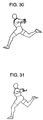
- FIG. 29 shows a state following the state of FIG. 28, and FIG. 30 shows a state following the state of FIG. 29, where the both arms are gradually raised.
- FIG. 31 shows a state following the state of FIG. 30, where the chest starts being stuck out forward while the arms are further being raised.
- FIG. 32 shows a state following the state of FIG. 31, where the chest is further stuck out forward immediately before the play character MA reaches the goal.
- FIG. 33 shows a state following the state of FIG. 32, where the goal is reached with the chest stuck out, and both arms are further raised.
- FIG. 34 shows a state following the state of FIG. 33, where the play character MA stretches both hands sideways and raises slightly up after passing the goal.
- FIG. 35 shows a state following the state of FIG. 34;
- FIG. 36 shows a state following the state of FIG. 35;
- FIG. 37 shows a state following the state of FIG. 36; and
- FIG. 38 shows a state following the state of FIG. 37.
- FIG. 39 shows a state following the state of FIG 38 and corresponding to the final frame of the goal finishing action.
- the play character M shows a victory pose by raising his hands up.
- Image data for displaying images showing the starting action shown in FIG. 3 and the running action shown in FIGS. 4 through 20 (looped running animation) and the goal finishing action shown in FIGS. 21 through 39 are stored in the recording medium 122.
- FIG. 40 is a block diagram showing function realizing means of the CPU 201 when the 100M dash game is executed, the recording medium 122, the RAM 123, the television monitor 143 and the controller 183 (start button 183a, A-button 183b, C1-button 183h and C2-button 183i).
- start button 183a start button 183a, A-button 183b, C1-button 183h and C2-button 183i.
- the interface circuits and buses are not shown in order to facilitate the description.
- the CPU 201 is provided with the respective function realizing means as a start button operation detecting unit 201a, an A-button operation detecting unit 201b, a C1-button operation detecting unit 201c, a C2-button operation detecting unit 201d, a character display control unit 201e, a runner column display unit 201f, a running power display unit 201g and a switch control unit 201h.
- a start button operation detecting unit 201a an A-button operation detecting unit 201b, a C1-button operation detecting unit 201c, a C2-button operation detecting unit 201d, a character display control unit 201e, a runner column display unit 201f, a running power display unit 201g and a switch control unit 201h.
- the switch control unit 201h is provided with respective function realizing means as a character speed detecting unit 201i, a ⁇ a calculating unit 201j, a ⁇ v calculating unit 201k, an animation display timing setting unit 201m, a transport data setting unit 201n, an arrival detecting unit 201p, an end animation detecting unit 201q, an animation display timing subtracting unit 201r and an animation switching unit 201s.
- the start button detecting unit 201a discriminates whether the start button 183a has been turned on or off in accordance with an operation signal from the start button 183a. A specified game is selected when the start button 183a is turned on.
- the A-button operation detecting unit 201b discriminates whether the A-button 183b has been turned on or off in accordance with an operation signal from the A-button 183b. The start of the game is enabled when the A-button 183b is turned on.
- the C1-button operation detecting unit 201c discriminates whether the C1-button 183h has been turned on or off in accordance with an operation signal from the C1-button 183h.
- the C2-button operation detecting unit 201d discriminates whether the C2-button 183i has been turned on or off in accordance with an operation signal from the C2-button 183i. In other words, every time the C1-button 183h and the C2-button 183i are alternately and continuously turned on/off, the running power changes according to an operation amount per unit time.
- the character display control unit 201e controls the display of the play character MA as the game is proceeded, and reads game screens corresponding to the game content from the RAM 123 and outputs them to the television monitor 143.
- the character display control unit 201e is also provided with functions of generating new image data for interpolating successive frames using image data (used to display images shown in FIGS. 4 through 20) prepared beforehand and constituting the looped running animation if necessary, and displaying the images based on the generated image data.
- the runner column display unit 201f displays contents corresponding to the play character in the runner column KS.
- the power display unit 201g displays the running power generated according to the operated amounts of the C1-button 183h and the C2-button 183i every time these buttons are alternately and continuously turned on and off by coloring the power display column PD in chromatic colors.
- the switch control unit 201h switches a first image data group (looped running animation) to a second image data group (goal finishing animation) such that the running action (first action) and the goal finishing action (second action) are successively displayed without any discontinuity (i.e. the running action is smoothly transitioned to the goal finishing action) when the play character MA reaches a specified position set beforehand. Specifically, if the play character MA is a first runner when arriving the predetermined position before the goal (e.g. 2 m before the goal), he is displayed to start taking a victory pose by raising both hands.
- the switch control unit 201h executes such a switch control that the motions of the legs and arms of the play character MA are continuous when the running action is transitioned to the goal finishing action.
- the character speed detecting unit 201i discriminates the running speed of the play character MA in accordance with the number of signals outputted from the controller 183 since the running speed changes according to the operated amount of the controller 183 by the game player (the less operated amount, the slower, whereas the more operated amount, the faster).
- the ⁇ a calculating unit 201j calculates a change amount of animation " ⁇ a" defined as how much an animation data of the motion along the time axis of the play character MA (animated model) advances within a predetermined period (1/60 sec.).
- the delta animation " ⁇ a” can be defined as an amount of change of animations from a previous animation frame at a certain time (t) to an animation to be shown at a given time incremented with a predetermined time (t + ⁇ t).
- " ⁇ t” can be any given set time period such as 1/60 seconds but not limited thereto.
- the running speed (moving speed) of the play character MA changes according to the operated amount of the controller 183 by the game player.
- the delta animation ⁇ a is used to generate new image data by interpolation based on the image data (image data used for displaying the images of FIGS. 4 through 20) prepared beforehand.
- This delta animation ⁇ a is calculated by multiplying the level of the running power given according to the operated amount of the controller 183 by a predetermined coefficient (this coefficient is set when the game is designed).
- the running action of the play character MA is executed at a basic speed set in advance even if the operated amount of the controller 183 is zero.
- a running speed corresponding to the operated amount is added to the basic speed and the running action of the play character MA is executed at the resulting speed.
- the coefficient ⁇ av is set as follows.
- A denotes the last animation display timing of the looped running animation
- L denotes a distance over which the looped running animation is repeated (i.e. a distance from a reference position which is a position where the first frame of the looped running animation is displayed to the predetermined position before the goal)
- n integer denotes the number of times the looped running animation is repeated over the distance L
- a distance 1 i.e. unit moved distance
- This distance 1 is obtained by multiplying A by a certain coefficient, which is set at ⁇ av.
- the distance 1 (unit moved distance) is set at a constant value regardless of the running speed of the play character MA, and the distance between the reference position and the predetermined position (e.g. 2m before the goal) is set at a multiple of the distance 1 (unit moved distance).
- the animation display timing setting unit 201m adds ⁇ a calculated by the ⁇ s calculating unit 201j to the initially set animation display timing, and saves the thus obtained value in the RAM 123 as a new animation display timing. Specifically, if the initially set animation display timing is, for example, "15" and the newly calculated ⁇ a is "0.3", "15.3” is used as the new animation display timing. In this way, an image data is generated to, for example, display a new image corresponding to the (15.3) th frame between the image data representing the 15 th frame and the image data representing the 16 th frame based on these image data.
- This image data can be obtained by, for example, storing apex coordinate data, angle data and like data of a plurality of polygons whose movements are linked with the movements of the respective skeletons forming the play character MA (animation) in a table in correspondence with the respective skeletons and calculating the positions and orientations of the polygons in the space coordinate systems as the space coordinate systems and amounts of rotation of the respective skeletons are determined.
- the transport data setting unit 201n adds the newly calculated ⁇ v to the transport data when ⁇ v is calculated by the ⁇ v calculating unit 201k, and saves the thus obtained value in the RAM 123 as a new transport data. In this way, coordinate data for the new image, e.g., corresponding to the (15.3) th frame are given.
- the animation display timing setting unit 201m and the transport data setting unit 201n construct an image data generating unit for generating an image data newly required by changing the running speed.
- the arrival detecting unit 201p discriminates whether the play character MA has reached the predetermined position away from the starting position by a specified distance, i.e. whether the play character MA has reached a position immediately before the goal of the 100M dash (e.g. 2 m before the goal) where he starts taking a victory pose. This discrimination is made to determine a timing at which the image data group (looped running animation) displaying the running action is switched to the image data group (goal finishing animation) displaying the goal finishing action.
- the end animation detecting unit 201q discriminates whether the presently displayed image is an animation display timing corresponding to the image at the end of the looped running animation. In other words, it is discriminated whether the image of the play character MA presently displayed is the last image of the image data group (looped running animation) displaying the running action.
- the animation display timing subtracting unit 201r subtracts the animation display timing corresponding to the last image from the present animation display timing in a series of images (looped running animation) displaying the running action. Specifically, in the case that the animation display timing (present animation display timing) of the image presently displayed exceeds the animation display timing (last animation display timing) of the last image in the looped running animation (i.e. in the case that the last image becomes, for example, (17.3) th frame by changing the running speed of the play character MA when the last one of the initially set images is, for example, the 17 th frame), an animation display timing for an image to be displayed next is calculated (i.e. 0.3 obtained by subtracting 17 from 17.3 is an animation time for the image to be displayed next).
- Figs. 45A, 45B, and 45C are prepared.
- the terms used to describe the movement of the playing character MA according to the embodiments of the present application, but not limited thereto, are as follows:
- Fig. 45A is an explanatory diagram illustrating a series of change of frames along a time line when the operation controller 183 is not operated. As can be seen, each of all the frames “f1" through “fn” is sequentially displayed at a time interval ⁇ t. Noted with “dl” through “dn” are respective positions of the play character in each of the frames, “f1” through “fn”. along a distance line (d). It should be noted that the moved amount of the play character MA in a single running loop, i.e., an amount corresponding to "dn - dl' is set at a constant value.
- Fig. 45B is also an explanatory diagram illustrating a single segment of the change of succeeding frames along a time line (t) when the operation controller 183 is operated.
- the 15 th frame “f15” is displayed at a time “t” ; however, 16 th frame “f16” is no longer displayed at time “t + ⁇ t” because of the operation of the operation controller 183. Instead, 15.3th frame needs to be displayed at time "t + ⁇ t”.
- This small change, "15.3th frame” - "15 th frame” is called delta animation ⁇ a.
- Fig. 45C is also an explanatory diagram illustrating a moved amount (transport data) ⁇ v of the play character MA within the time period corresponding to the time period during which the change of delta animation ⁇ a takes place.
- a small change between d15 position and d15.3 position along a line (distance) d corresponds to ⁇ v of the play character MA.
- the animation switching unit 201s switches the image data group (looped running animation) for displaying the images representing the running action to the image data group (goal finishing animation) for displaying the images representing the goal finishing action.
- Step ST1 when the 100M dash game is selected by turning the start button 183a on, a demonstration screen is displayed (Step ST1).
- the A-button operation detecting unit 201b then discriminates whether the A-button 183b has been turned on (Step ST3).
- the game is started (Step ST5) if the discrimination result in Step ST3 is affirmative, and six play characters MA get ready at the starting line to initiate the starting action.
- "SET" is displayed in the middle of the game screen.
- "SET” disappears and "GO” is displayed instead, thereby entering a state where the operation signals from the C1-button 183h and the C2-button 183i can be received.
- This routine waits on standby until the A-button 183b is turned on if the discrimination in Step ST3 is negative. It should be noted that the game may be started by turning the start button 183a on again.
- the C1-button and C2-button operation discrimination unit 201d, 201e discriminate whether the C1-button 183h and the C2-button 183i are being continuously hit (Step ST7). If the discrimination in Step ST7 is affirmative, the respective play characters MA dash off from the starting line to start running at once. Specifically, a continuos animation (not shown) from the starting animation displaying a series of motions at the time of the start to the looped running animation displaying a series of running motions is displayed (Step ST9). The running power is generated by continuously hitting the C1-button 183h and the C2-button 183i, and the generated running power is displayed in the power display column PD by the running power display unit 201g.
- the looped running animation i.e. a series of images shown in FIGS. 4 through 20 are successively displayed, for example, every 1/60 sec. by the character display control unit 201e (Step ST11) and simultaneously the delta animation ⁇ a and the transport data ⁇ v are calculated by the ⁇ a calculating unit 201j and the ⁇ v calculating unit 201h and saved in the RAM 123 by the animation display timing setting unit 201m and the transport data setting unit 201n, respectively (Step ST13).
- the images of the looped running animation are successively displayed, e.g. every 1/60 sec.
- the arrival detecting unit 201p discriminates whether the play character MA has reached the predetermined position immediately before the goal (Step ST15).
- the end animation detecting unit 201q discriminates whether the animation display timing corresponding to the last image has been exceeded (Step ST17) if the discrimination result in Step ST15 is negative. If the discrimination result in Step ST17 is affirmative, the animation display timing subtracting unit 201r subtracts the last animation display timing corresponding to the last image from the present animation display timing corresponding to the presently displayed image (Step ST19). In this way. an animation display timing for an image to be displayed next is obtained.
- Step ST11 This routine then returns to Step ST11 to repeat the subsequent operations.
- the last image corresponding to the last animation display timing or an image corresponding to an animation display timing approximate to the last animation display timing i.e. an image newly generated between the first image and the succeeding image
- the action can be smoothly switched from the looped running animation to the goal finishing animation without any discontinuity.
- Step ST17 When the discrimination result in Step ST17 is negative, this routine returns to Step ST11 to repeat the subsequent operations. Further, if the discrimination result in Step ST15 is affirmative, the end animation detecting unit 201q discriminates whether the last animation display timing has been exceeded (Step ST21). If the discrimination result in Step ST21 is affirmative, the animation switching unit 201s switches the looped running animation to the goal finishing animation to display the goal finishing action (Step ST23).
- FIG. 43 shows a state immediately after the first runner passed a goal line GL
- FIG. 44 shows a state where the first runner raises both hands to pose for victory. The motions for this victory pose are started at the predetermined position immediately before the goal as described above.
- Step ST21 If the discrimination result in Step ST21 is negative, the images of the looped running animation (a series of images shown in FIGS. 4 through 20 and the images newly generated between successive frames) are then successively displayed by the character display control unit 201e (Step ST25) and simultaneously the delta animation ⁇ a and the transport data ⁇ v are calculated by the ⁇ a calculating unit 201j and the ⁇ v calculating unit 201h as in Step ST13 (Step ST27). Then, this routine returns to Step ST21 to repeat the subsequent operations.
- the operations after Step ST25 in the case that the discrimination result in Step ST21 is negative are mainly executed to correct calculation errors in Step ST13 and other Steps.
- the first image data group (looped running animation) comprised of a plurality of frames of image data for displaying the running action as the first action and the second image data group (goal finishing animation) comprised of a plurality of frames of image data for displaying the goal finishing action as the second action are prepared, and the first image data group is so switched to the second image data group that the goal finishing action smoothly successively follows the running action without any discontinuity when the player character reaches the predetermined position by repeatedly displaying the first action.
- the play character can be moved by a desired distance by the running action as the first action only by repeatedly displaying the first image data group (looped running animation), and images displayed on the game screen cause the game player to have no feeling of incongruity since the running action and the goal finishing action are smoothly successively displayed to switch without any discontinuity.
- a memory capacity can be saved, and a time required for the development of a program can also be saved, thereby effectively suppressing an increase in production costs.
- the present invention is not limited to the foregoing embodiment, and may take various embodiments as described below.
- the first image data group comprised of a plurality of frames of image data for displaying the first action relating to the moving action and the second image data group comprised of a plurality of frames of image data for displaying the second action are prepared, and the first image data group is so switched to the second image data group that the second action successively follows the first action without any discontinuity when the player character reaches the predetermined position by repeatedly executing the first action.
- the play character can be moved by a desired distance through repeated execution of the first action by repeatedly displaying the images based on the plurality of frames of image data, and the images displayed on the game screen cause the game player to have no feeling of incongruity since the first action relating to the moving action and the second action are smoothly successively displayed without any discontinuity.
- a memory capacity can be saved, and a time required for the development -of a program can also be saved, thereby effectively suppressing an increase in production costs.
- a specified frame of image data of the first image data group may be switched to a frame of image data of the second image data relating the specified frame when the play character reaches the predetermined position.
- the specified frame may be the last frame of the first image data group or a frame relating to the last frame
- the frame of the second image data group relating to the specified frame may be the first frame thereof.
- the first image data group may include image data generated between successive frames using the image data prepared beforehand. Then, minimally necessary image data can be set for displaying the first action, which enables a further reduction of the memory capacity. As a result, an increase in production costs can be effectively suppressed.
- the moving speed of the play character by the first action may vary according to the operated amount of the operation member
- the unit moved amount of the play character by the first action may be set at a constant value regardless of the moving speed of the play character
- the distance of the predetermined position from the reference position may be a multiple of the unit moved amount
- the switching position of the first and second actions can be set beforehand. This results in easier designing of the game and reduction of burdens on the CPU by reducing calculation steps.
Landscapes
- Engineering & Computer Science (AREA)
- Multimedia (AREA)
- Processing Or Creating Images (AREA)
Abstract
Description
Claims (24)
- A video game device for displaying a play character on a game screen displayed on a monitor and moving the play character from a reference position to a predetermined position in a game space by operating an operation member, comprising:a storage unit for storing a first image data group including a plurality of frames of image data for displaying a first action relating to the moving action of the play character and a second image data group including a plurality of frames of image data for displaying a second action,a display control unit for reading the first and second image data group from the storage unit and displaying the action of the play character based on the read image data, anda switch control unit for switching the first image data group to the second image data group such that the first action and the second action are smoothly successively displayed without any discontinuity when the play character reaches the predetermined position by repeatedly displaying the first action.
- A video game device according to claim 1, wherein a specified frame of image data of the first image data group is switched to a frame of image data of the second image data relating the specified frame when the play character reaches the predetermined position.
- A video game device according to claim 1, wherein the specified frame is the last frame of the first image data group or a frame relating to the last frame, and the frame of the second image data group relating to the specified frame is the first frame thereof.
- A video game device according to any one of claims 1 through 3, wherein the first image data group includes image data generated between successive frames using the image data prepared beforehand.
- A video game device according to any one of claims 1 through 4, wherein the display control unit controls the movement of the play character displayed on the monitor in accordance with the operational state of the operation member.
- A video game device according to any one of claims 1 through 4, wherein the display control unit generates an image data between successive frames stored in the storage unit when the operation state of the operation member is changed.
- A video device according to claim 6, wherein said image data generated by the display control unit is generated by interpolation between the successive frames.
- A video game device according to claim 1, wherein the moving speed of the play character displayed on the monitor by the first action varies according to the operated amount of the operation member, the unit moved amount of the play character by the first action is set at a constant value regardless of the moving speed of the play character, and the distance of the predetermined position from the reference position is a multiple of the unit moved amount.
- A character action setting method in a video game in which a play character is displayed on a game screen on a monitor and moved from a reference position to a predetermined position in a game space by operating an operation member, the method comprising the steps of:preparing a first image data group including a plurality of frames of image data for displaying a first action relating to the moving action of the play character and a second image data group including a plurality of frames of image data for displaying a second action; andswitching the first image data group to the second image data group such that the first action and the second action are smoothly successively displayed without any discontinuity when the play character reaches the predetermined position by repeatedly displaying the first action.
- A character action setting method according to claim 9, wherein a specified frame of image data of the first image data group is switched to a frame of image data of the second image data relating the specified frame when the play character reaches the predetermined position.
- A character action setting method according to claim 9, wherein the specified frame is the last frame of the first image data group or a frame relating to the last frame, and the frame of the second image data group relating to the specified frame is the first frame thereof.
- A character action setting method according to any one of claims 9 through 11, wherein the first image data group includes image data generated between successive frames using the image data prepared beforehand.
- A character action setting method according to any one of claims 9 through 12, wherein the display control unit controls the movement of the play character displayed on the monitor in accordance with the operational state of the operation member.
- A character action setting method according to any one of claims 9 through 12, wherein the display control unit generates an image data between successive frames stored in the storage unit when the operation state of the operation member is changed.
- A character action setting method according to claim 14, wherein said image data generated by the display control unit is generated by interpolation between the successive frames.
- A character action setting method according to claim 14, wherein the moving speed of the play character displayed on the monitor by the first action varies according to the operated amount of the operation member, the unit moved amount of the play character by the first action is set at a constant value regardless of the moving speed of the play character, and the distance of the predetermined position from the reference position is a multiple of the unit moved amount.
- A computer-readable recording medium storing a character action setting program in a video game in which a play character is displayed on a game screen on a monitor and moved from a reference position to a predetermined position within a game space by operating an operation member, the character action setting program comprising the steps of:preparing a first image data group including a plurality of frames of image data for displaying a first action relating to the moving action of the play character and a second image data group including a plurality of frames of image data for displaying a second action; andswitching the first image data group to the second image data group such that the first action and the second action are smoothly successively displayed without any discontinuity when the play character reaches the predetermined position by repeatedly displaying the first action.
- A computer-readable recording medium according to claim 17, wherein a specified frame of image data of the first image data group is switched to a frame of image data of the second image data relating the specified frame when the play character reaches the predetermined position.
- A computer-readable recording medium according to claim 17, wherein the specified frame is the last frame of the first image data group or a frame relating to the last frame, and the frame of the second image data group relating to the specified frame is the first frame thereof.
- A computer-readable recording medium according to any one of claims 17 through 19, wherein the first image data group includes image data generated between successive frames using the image data prepared beforehand.
- A computer-readable recording medium according to any one of claims 17 through 20, wherein the display control unit controls the movement of the play character displayed on the monitor in accordance with the operational state of the operation member.
- A computer-readable recording medium according to any one of claims 17 through 20, wherein the display control unit generates an image data between successive frames stored in the storage unit when the operation state of the operation member is changed.
- A computer-readable recording medium according to claim 22, wherein said image data generated by the display control unit is generated by interpolation between the successive frames.
- A computer-readable recording medium according to claim 17, wherein the moving speed of the play character displayed on the monitor by the first action varies according to the operated amount of the operation member, the unit moved amount of the play character by the first action is set at a constant value regardless of the moving speed of the play character, and the distance of the predetermined position from the reference position is a multiple of the unit moved amount.
Applications Claiming Priority (2)
| Application Number | Priority Date | Filing Date | Title |
|---|---|---|---|
| JP2000015103A JP3561456B2 (en) | 2000-01-24 | 2000-01-24 | VIDEO GAME DEVICE, CHARACTER OPERATION SETTING METHOD IN VIDEO GAME, AND COMPUTER-READABLE RECORDING MEDIUM CONTAINING CHARACTER OPERATION SETTING PROGRAM |
| JP2000015103 | 2000-01-24 |
Publications (3)
| Publication Number | Publication Date |
|---|---|
| EP1145745A2 true EP1145745A2 (en) | 2001-10-17 |
| EP1145745A3 EP1145745A3 (en) | 2002-08-28 |
| EP1145745B1 EP1145745B1 (en) | 2004-10-20 |
Family
ID=18542450
Family Applications (1)
| Application Number | Title | Priority Date | Filing Date |
|---|---|---|---|
| EP01101172A Expired - Lifetime EP1145745B1 (en) | 2000-01-24 | 2001-01-23 | Video game device, character action setting method in video game, and computer-readable recording medium storing character action setting program |
Country Status (4)
| Country | Link |
|---|---|
| US (1) | US6976918B2 (en) |
| EP (1) | EP1145745B1 (en) |
| JP (1) | JP3561456B2 (en) |
| DE (1) | DE60106506T2 (en) |
Cited By (13)
| Publication number | Priority date | Publication date | Assignee | Title |
|---|---|---|---|---|
| US8439733B2 (en) | 2007-06-14 | 2013-05-14 | Harmonix Music Systems, Inc. | Systems and methods for reinstating a player within a rhythm-action game |
| US8444464B2 (en) | 2010-06-11 | 2013-05-21 | Harmonix Music Systems, Inc. | Prompting a player of a dance game |
| US8449360B2 (en) | 2009-05-29 | 2013-05-28 | Harmonix Music Systems, Inc. | Displaying song lyrics and vocal cues |
| US8465366B2 (en) | 2009-05-29 | 2013-06-18 | Harmonix Music Systems, Inc. | Biasing a musical performance input to a part |
| US8550908B2 (en) | 2010-03-16 | 2013-10-08 | Harmonix Music Systems, Inc. | Simulating musical instruments |
| US8663013B2 (en) | 2008-07-08 | 2014-03-04 | Harmonix Music Systems, Inc. | Systems and methods for simulating a rock band experience |
| US8678896B2 (en) | 2007-06-14 | 2014-03-25 | Harmonix Music Systems, Inc. | Systems and methods for asynchronous band interaction in a rhythm action game |
| US8686269B2 (en) | 2006-03-29 | 2014-04-01 | Harmonix Music Systems, Inc. | Providing realistic interaction to a player of a music-based video game |
| US8702485B2 (en) | 2010-06-11 | 2014-04-22 | Harmonix Music Systems, Inc. | Dance game and tutorial |
| US9024166B2 (en) | 2010-09-09 | 2015-05-05 | Harmonix Music Systems, Inc. | Preventing subtractive track separation |
| US9358456B1 (en) | 2010-06-11 | 2016-06-07 | Harmonix Music Systems, Inc. | Dance competition game |
| US9981193B2 (en) | 2009-10-27 | 2018-05-29 | Harmonix Music Systems, Inc. | Movement based recognition and evaluation |
| US10357714B2 (en) | 2009-10-27 | 2019-07-23 | Harmonix Music Systems, Inc. | Gesture-based user interface for navigating a menu |
Families Citing this family (47)
| Publication number | Priority date | Publication date | Assignee | Title |
|---|---|---|---|---|
| JP4656622B2 (en) * | 2001-08-23 | 2011-03-23 | 株式会社バンダイナムコゲームス | Image generation system, program, and information storage medium |
| US20060262119A1 (en) * | 2005-05-20 | 2006-11-23 | Michael Isner | Transfer of motion between animated characters |
| CA2553508A1 (en) * | 2005-07-29 | 2007-01-29 | Avid Technology, Inc. | Transfer of attributes between geometric surfaces of arbitrary topologies with distortion reduction and discontinuity preservation |
| US7859538B2 (en) * | 2006-07-31 | 2010-12-28 | Autodesk, Inc | Converting deformation data for a mesh to animation data for a skeleton, skinning and shading in a runtime computer graphics animation engine |
| US8094156B2 (en) * | 2006-07-31 | 2012-01-10 | Autodesk Inc. | Rigless retargeting for character animation |
| US8608560B1 (en) * | 2006-09-12 | 2013-12-17 | Tournament One, Corp. | Non-deterministic animations with predetermined result |
| JP4519883B2 (en) * | 2007-06-01 | 2010-08-04 | 株式会社コナミデジタルエンタテインメント | Character display device, character display method, and program |
| US20090310027A1 (en) * | 2008-06-16 | 2009-12-17 | James Fleming | Systems and methods for separate audio and video lag calibration in a video game |
| US20100118033A1 (en) * | 2008-11-10 | 2010-05-13 | Vistaprint Technologies Limited | Synchronizing animation to a repetitive beat source |
| JP5293124B2 (en) * | 2008-12-01 | 2013-09-18 | 株式会社日立製作所 | Video processing apparatus and video processing method |
| KR101515859B1 (en) * | 2008-12-05 | 2015-05-06 | 삼성전자 주식회사 | Display apparatus and display method of contents list thereof |
| USD658679S1 (en) * | 2010-08-31 | 2012-05-01 | Apple Inc. | Graphical user interface for a display screen or portion thereof |
| USD662514S1 (en) * | 2011-08-31 | 2012-06-26 | Nike, Inc. | Display screen with icon |
| USD661318S1 (en) * | 2011-08-31 | 2012-06-05 | Nike, Inc. | Display screen with icon |
| USD661319S1 (en) * | 2011-08-31 | 2012-06-05 | Nike, Inc. | Display screen with animated icon |
| USD660316S1 (en) * | 2011-08-31 | 2012-05-22 | Nike, Inc. | Display screen with icon |
| USD662947S1 (en) * | 2011-08-31 | 2012-07-03 | Nike, Inc. | Display screen with animated icon |
| USD712924S1 (en) * | 2012-04-30 | 2014-09-09 | Promethean Limited | Display panel with computer-generated icon |
| USD692441S1 (en) * | 2013-02-28 | 2013-10-29 | Nike, Inc. | Display screen with graphical user interface |
| USD690715S1 (en) * | 2013-02-28 | 2013-10-01 | Nike, Inc. | Display screen with graphical user interface |
| USD690716S1 (en) * | 2013-02-28 | 2013-10-01 | Nike, Inc. | Display screen with graphical user interface |
| USD692442S1 (en) * | 2013-02-28 | 2013-10-29 | Nike, Inc. | Display screen with graphical user interface |
| CL2013001377S1 (en) * | 2013-04-08 | 2013-12-06 | Samsung Electronics Co Ltd | Industrial drawing of ornamental image settings applied to a screen display |
| USD819649S1 (en) | 2013-06-09 | 2018-06-05 | Apple Inc. | Display screen or portion thereof with graphical user interface |
| USD744529S1 (en) | 2013-06-09 | 2015-12-01 | Apple Inc. | Display screen or portion thereof with icon |
| USD750130S1 (en) | 2013-06-10 | 2016-02-23 | Apple Inc. | Display screen or portion thereof with graphical user interface |
| USD760784S1 (en) * | 2014-01-03 | 2016-07-05 | Samsung Electronics Co., Ltd. | Display screen or portion thereof with icon |
| USD755848S1 (en) | 2014-06-01 | 2016-05-10 | Apple Inc. | Display screen or portion thereof with icon |
| USD763316S1 (en) * | 2014-06-20 | 2016-08-09 | Samsung Electronics Co., Ltd. | Display screen or portion thereof with icon |
| USD735754S1 (en) | 2014-09-02 | 2015-08-04 | Apple Inc. | Display screen or portion thereof with graphical user interface |
| USD761845S1 (en) * | 2014-11-26 | 2016-07-19 | Amazon Technologies, Inc. | Display screen or portion thereof with an animated graphical user interface |
| USD786931S1 (en) * | 2014-12-30 | 2017-05-16 | Sony Corporation | Portion of a display panel or screen with graphical user interface |
| USD761321S1 (en) * | 2015-01-05 | 2016-07-12 | Nike, Inc. | Display screen with graphical user interface |
| US10438395B2 (en) * | 2015-03-25 | 2019-10-08 | Naver Corporation | Apparatus, method and computer program for displaying cartoon content |
| KR101730114B1 (en) * | 2015-03-25 | 2017-04-25 | 네이버 주식회사 | Apparatus, method, and computer program for viewing catoon data |
| USD781344S1 (en) * | 2015-10-08 | 2017-03-14 | Naver Corporation | Display panel with animated icon |
| US10432559B2 (en) | 2016-10-24 | 2019-10-01 | Snap Inc. | Generating and displaying customized avatars in electronic messages |
| US10454857B1 (en) * | 2017-01-23 | 2019-10-22 | Snap Inc. | Customized digital avatar accessories |
| USD870774S1 (en) | 2017-09-29 | 2019-12-24 | Apple Inc. | Wearable device with animated graphical user interface |
| USD902249S1 (en) | 2018-01-05 | 2020-11-17 | Peloton Interactive, Inc. | Display screen or portion thereof having a graphical user interface |
| USD863337S1 (en) | 2018-06-03 | 2019-10-15 | Apple Inc. | Electronic device with animated graphical user interface |
| USD954732S1 (en) | 2020-06-20 | 2022-06-14 | Apple Inc. | Display screen or portion thereof with graphical user interface |
| CN112587919B (en) * | 2020-12-29 | 2023-08-22 | 珠海金山数字网络科技有限公司 | Game instruction processing method and device |
| CN113018855B (en) * | 2021-03-26 | 2022-07-01 | 完美世界(北京)软件科技发展有限公司 | Action switching method and device for virtual role |
| CN113633970B (en) * | 2021-08-18 | 2024-03-08 | 腾讯科技(成都)有限公司 | Display methods, devices, equipment and media for action effects |
| USD1039560S1 (en) * | 2021-11-18 | 2024-08-20 | Nike, Inc. | Display screen with virtual three-dimensional shoe icon or display system with virtual three-dimensional shoe icon |
| CN114632326B (en) * | 2022-03-17 | 2025-10-10 | 网易(杭州)网络有限公司 | Screen display method, device, electronic device and readable storage medium |
Family Cites Families (13)
| Publication number | Priority date | Publication date | Assignee | Title |
|---|---|---|---|---|
| US3809395A (en) * | 1972-09-28 | 1974-05-07 | Magnavox Co | Television combat game |
| US5214758A (en) * | 1989-11-14 | 1993-05-25 | Sony Corporation | Animation producing apparatus |
| US5261041A (en) * | 1990-12-28 | 1993-11-09 | Apple Computer, Inc. | Computer controlled animation system based on definitional animated objects and methods of manipulating same |
| US5411272A (en) * | 1992-11-20 | 1995-05-02 | Sega Of America, Inc. | Video game with spiral loop graphics |
| JPH07289736A (en) * | 1994-04-25 | 1995-11-07 | Namco Ltd | Game system and method of entry into game system |
| JP3168244B2 (en) * | 1996-02-13 | 2001-05-21 | 株式会社セガ | Image generating apparatus and method |
| US6414685B1 (en) * | 1997-01-29 | 2002-07-02 | Sharp Kabushiki Kaisha | Method of processing animation by interpolation between key frames with small data quantity |
| JP3472065B2 (en) * | 1997-03-17 | 2003-12-02 | 株式会社東芝 | Animation generation apparatus and animation generation method |
| US5999195A (en) * | 1997-03-28 | 1999-12-07 | Silicon Graphics, Inc. | Automatic generation of transitions between motion cycles in an animation |
| JPH10319957A (en) | 1997-05-23 | 1998-12-04 | Enix:Kk | Character dance operation display device, method and recording medium |
| JP2000011199A (en) | 1998-06-18 | 2000-01-14 | Sony Corp | Automatic animation generation method |
| JP3645716B2 (en) * | 1998-07-31 | 2005-05-11 | シャープ株式会社 | Animation creating method, animation creating apparatus, and computer-readable recording medium recording animation creating program |
| JP2999455B1 (en) | 1998-08-03 | 2000-01-17 | コナミ株式会社 | Animation display method in video game, video game device using the same, and computer-readable medium recording animation display program in video game |
-
2000
- 2000-01-24 JP JP2000015103A patent/JP3561456B2/en not_active Expired - Fee Related
-
2001
- 2001-01-23 DE DE60106506T patent/DE60106506T2/en not_active Expired - Lifetime
- 2001-01-23 US US09/767,458 patent/US6976918B2/en not_active Expired - Fee Related
- 2001-01-23 EP EP01101172A patent/EP1145745B1/en not_active Expired - Lifetime
Cited By (22)
| Publication number | Priority date | Publication date | Assignee | Title |
|---|---|---|---|---|
| US8686269B2 (en) | 2006-03-29 | 2014-04-01 | Harmonix Music Systems, Inc. | Providing realistic interaction to a player of a music-based video game |
| US8444486B2 (en) | 2007-06-14 | 2013-05-21 | Harmonix Music Systems, Inc. | Systems and methods for indicating input actions in a rhythm-action game |
| US8439733B2 (en) | 2007-06-14 | 2013-05-14 | Harmonix Music Systems, Inc. | Systems and methods for reinstating a player within a rhythm-action game |
| US8690670B2 (en) | 2007-06-14 | 2014-04-08 | Harmonix Music Systems, Inc. | Systems and methods for simulating a rock band experience |
| US8678896B2 (en) | 2007-06-14 | 2014-03-25 | Harmonix Music Systems, Inc. | Systems and methods for asynchronous band interaction in a rhythm action game |
| US8678895B2 (en) | 2007-06-14 | 2014-03-25 | Harmonix Music Systems, Inc. | Systems and methods for online band matching in a rhythm action game |
| US8663013B2 (en) | 2008-07-08 | 2014-03-04 | Harmonix Music Systems, Inc. | Systems and methods for simulating a rock band experience |
| US8449360B2 (en) | 2009-05-29 | 2013-05-28 | Harmonix Music Systems, Inc. | Displaying song lyrics and vocal cues |
| US8465366B2 (en) | 2009-05-29 | 2013-06-18 | Harmonix Music Systems, Inc. | Biasing a musical performance input to a part |
| US10421013B2 (en) | 2009-10-27 | 2019-09-24 | Harmonix Music Systems, Inc. | Gesture-based user interface |
| US10357714B2 (en) | 2009-10-27 | 2019-07-23 | Harmonix Music Systems, Inc. | Gesture-based user interface for navigating a menu |
| US9981193B2 (en) | 2009-10-27 | 2018-05-29 | Harmonix Music Systems, Inc. | Movement based recognition and evaluation |
| US8550908B2 (en) | 2010-03-16 | 2013-10-08 | Harmonix Music Systems, Inc. | Simulating musical instruments |
| US8636572B2 (en) | 2010-03-16 | 2014-01-28 | Harmonix Music Systems, Inc. | Simulating musical instruments |
| US8874243B2 (en) | 2010-03-16 | 2014-10-28 | Harmonix Music Systems, Inc. | Simulating musical instruments |
| US9278286B2 (en) | 2010-03-16 | 2016-03-08 | Harmonix Music Systems, Inc. | Simulating musical instruments |
| US8568234B2 (en) | 2010-03-16 | 2013-10-29 | Harmonix Music Systems, Inc. | Simulating musical instruments |
| US8702485B2 (en) | 2010-06-11 | 2014-04-22 | Harmonix Music Systems, Inc. | Dance game and tutorial |
| US9358456B1 (en) | 2010-06-11 | 2016-06-07 | Harmonix Music Systems, Inc. | Dance competition game |
| US8562403B2 (en) | 2010-06-11 | 2013-10-22 | Harmonix Music Systems, Inc. | Prompting a player of a dance game |
| US8444464B2 (en) | 2010-06-11 | 2013-05-21 | Harmonix Music Systems, Inc. | Prompting a player of a dance game |
| US9024166B2 (en) | 2010-09-09 | 2015-05-05 | Harmonix Music Systems, Inc. | Preventing subtractive track separation |
Also Published As
| Publication number | Publication date |
|---|---|
| US6976918B2 (en) | 2005-12-20 |
| EP1145745A3 (en) | 2002-08-28 |
| DE60106506T2 (en) | 2006-02-02 |
| US20030045334A1 (en) | 2003-03-06 |
| JP3561456B2 (en) | 2004-09-02 |
| JP2001198352A (en) | 2001-07-24 |
| DE60106506D1 (en) | 2004-11-25 |
| EP1145745B1 (en) | 2004-10-20 |
Similar Documents
| Publication | Publication Date | Title |
|---|---|---|
| EP1145745B1 (en) | Video game device, character action setting method in video game, and computer-readable recording medium storing character action setting program | |
| EP1125613B1 (en) | Video game device, background sound output method in video game, and readable storage medium storing background sound output program | |
| US6558257B1 (en) | Imaging processing apparatus and image processing method | |
| JP3529138B2 (en) | Image processing apparatus, image processing method, game apparatus using the same, and storage medium | |
| US6398647B1 (en) | Method for displaying a reproduced image of a game | |
| US6676518B1 (en) | Image generating device, an image generating method, a readable storage medium storing an image generating program and a video game system | |
| JP3119608B2 (en) | Competitive video game device, character movement control method in competitive video game, and recording medium storing character movement control program | |
| JP3767094B2 (en) | Display control method for a plurality of characters operated by a player in a video game apparatus | |
| EP2209093A1 (en) | Image generating device, image generating method, information recording medium, and program | |
| US20110300948A1 (en) | Game device, game processing method, information recording medium, and program | |
| JP2001038049A (en) | Game equipment | |
| JP2001283241A (en) | Motion display method, game device and recording medium | |
| JPH1099541A (en) | Game device and information storage medium | |
| JP2001300132A (en) | Entertainment system, entertainment device, recording medium and program | |
| US6793576B2 (en) | Methods and apparatus for causing a character object to overcome an obstacle object | |
| JP7144931B2 (en) | Program and game system | |
| JP4974321B2 (en) | Program, information storage medium, server, and game system | |
| JP3111174B2 (en) | VIDEO GAME DEVICE, CHARACTER OPERATION INSTRUCTION METHOD IN VIDEO GAME, AND RECORDING MEDIUM RECORDING CHARACTER OPERATION INSTRUCTION PROGRAM | |
| JP3594181B2 (en) | GAME DEVICE, GAME CONTROL METHOD, RECORDING MEDIUM | |
| JP4974320B2 (en) | Program, information storage medium, server, and network system | |
| JP4473688B2 (en) | GAME PROGRAM AND GAME DEVICE | |
| JP2004148111A (en) | Image generation system, program, and information storage medium | |
| JP4826923B2 (en) | Game device | |
| JP3344555B2 (en) | Video game device, screen display control method in video game, and recording medium storing screen display control program | |
| JP2004148110A (en) | Image generation system, program, and information storage medium |
Legal Events
| Date | Code | Title | Description |
|---|---|---|---|
| PUAI | Public reference made under article 153(3) epc to a published international application that has entered the european phase |
Free format text: ORIGINAL CODE: 0009012 |
|
| AK | Designated contracting states |
Kind code of ref document: A2 Designated state(s): AT BE CH CY DE DK ES FI FR GB GR IE IT LI LU MC NL PT SE TR |
|
| AX | Request for extension of the european patent |
Free format text: AL;LT;LV;MK;RO;SI |
|
| PUAL | Search report despatched |
Free format text: ORIGINAL CODE: 0009013 |
|
| RIC1 | Information provided on ipc code assigned before grant |
Free format text: 7A 63F 13/00 A, 7A 63F 13/10 B, 7G 06T 15/70 B |
|
| AK | Designated contracting states |
Kind code of ref document: A3 Designated state(s): AT BE CH CY DE DK ES FI FR GB GR IE IT LI LU MC NL PT SE TR |
|
| AX | Request for extension of the european patent |
Free format text: AL;LT;LV;MK;RO;SI |
|
| 17P | Request for examination filed |
Effective date: 20021002 |
|
| 17Q | First examination report despatched |
Effective date: 20030326 |
|
| AKX | Designation fees paid |
Designated state(s): DE FR GB |
|
| GRAP | Despatch of communication of intention to grant a patent |
Free format text: ORIGINAL CODE: EPIDOSNIGR1 |
|
| GRAS | Grant fee paid |
Free format text: ORIGINAL CODE: EPIDOSNIGR3 |
|
| GRAA | (expected) grant |
Free format text: ORIGINAL CODE: 0009210 |
|
| AK | Designated contracting states |
Kind code of ref document: B1 Designated state(s): DE FR GB |
|
| REG | Reference to a national code |
Ref country code: GB Ref legal event code: FG4D |
|
| REG | Reference to a national code |
Ref country code: IE Ref legal event code: FG4D |
|
| REF | Corresponds to: |
Ref document number: 60106506 Country of ref document: DE Date of ref document: 20041125 Kind code of ref document: P |
|
| ET | Fr: translation filed | ||
| PLBE | No opposition filed within time limit |
Free format text: ORIGINAL CODE: 0009261 |
|
| STAA | Information on the status of an ep patent application or granted ep patent |
Free format text: STATUS: NO OPPOSITION FILED WITHIN TIME LIMIT |
|
| 26N | No opposition filed |
Effective date: 20050721 |
|
| REG | Reference to a national code |
Ref country code: GB Ref legal event code: 732E Free format text: REGISTERED BETWEEN 20090514 AND 20090520 |
|
| REG | Reference to a national code |
Ref country code: FR Ref legal event code: TP |
|
| PGFP | Annual fee paid to national office [announced via postgrant information from national office to epo] |
Ref country code: DE Payment date: 20130122 Year of fee payment: 13 Ref country code: GB Payment date: 20130122 Year of fee payment: 13 Ref country code: FR Payment date: 20130213 Year of fee payment: 13 |
|
| REG | Reference to a national code |
Ref country code: DE Ref legal event code: R119 Ref document number: 60106506 Country of ref document: DE |
|
| GBPC | Gb: european patent ceased through non-payment of renewal fee |
Effective date: 20140123 |
|
| PG25 | Lapsed in a contracting state [announced via postgrant information from national office to epo] |
Ref country code: DE Free format text: LAPSE BECAUSE OF NON-PAYMENT OF DUE FEES Effective date: 20140801 |
|
| REG | Reference to a national code |
Ref country code: FR Ref legal event code: ST Effective date: 20140930 |
|
| REG | Reference to a national code |
Ref country code: DE Ref legal event code: R119 Ref document number: 60106506 Country of ref document: DE Effective date: 20140801 |
|
| PG25 | Lapsed in a contracting state [announced via postgrant information from national office to epo] |
Ref country code: FR Free format text: LAPSE BECAUSE OF NON-PAYMENT OF DUE FEES Effective date: 20140131 Ref country code: GB Free format text: LAPSE BECAUSE OF NON-PAYMENT OF DUE FEES Effective date: 20140123 |