EP1142891B1 - Salts and amides of (-)cis 5-Fluoro-2'-deoxy-3'-thiacytidine useful for the treatment of hepatitis B - Google Patents
Salts and amides of (-)cis 5-Fluoro-2'-deoxy-3'-thiacytidine useful for the treatment of hepatitis B Download PDFInfo
- Publication number
- EP1142891B1 EP1142891B1 EP01202860A EP01202860A EP1142891B1 EP 1142891 B1 EP1142891 B1 EP 1142891B1 EP 01202860 A EP01202860 A EP 01202860A EP 01202860 A EP01202860 A EP 01202860A EP 1142891 B1 EP1142891 B1 EP 1142891B1
- Authority
- EP
- European Patent Office
- Prior art keywords
- cis
- compound
- treatment
- hepatitis
- formula
- Prior art date
- Legal status (The legal status is an assumption and is not a legal conclusion. Google has not performed a legal analysis and makes no representation as to the accuracy of the status listed.)
- Expired - Lifetime
Links
- 150000003839 salts Chemical class 0.000 title claims description 16
- 150000001408 amides Chemical class 0.000 title claims description 12
- 238000011282 treatment Methods 0.000 title abstract description 15
- 208000002672 hepatitis B Diseases 0.000 title abstract description 4
- GISFIDQLCPINER-YQVBYRJQSA-O NC(C(F)=CN1[C@@H](C2)O[C@H](CO)[S+]2O)=NC1=O Chemical compound NC(C(F)=CN1[C@@H](C2)O[C@H](CO)[S+]2O)=NC1=O GISFIDQLCPINER-YQVBYRJQSA-O 0.000 title 1
- 229960004413 flucytosine Drugs 0.000 claims description 7
- 229940127073 nucleoside analogue Drugs 0.000 abstract description 2
- WJJSZTJGFCFNKI-UHFFFAOYSA-N 1,3-oxathiolane Chemical compound C1CSCO1 WJJSZTJGFCFNKI-UHFFFAOYSA-N 0.000 abstract 1
- 239000008194 pharmaceutical composition Substances 0.000 abstract 1
- 150000001875 compounds Chemical class 0.000 description 40
- 239000000203 mixture Substances 0.000 description 23
- 241000700721 Hepatitis B virus Species 0.000 description 20
- 239000004480 active ingredient Substances 0.000 description 19
- OKKJLVBELUTLKV-UHFFFAOYSA-N Methanol Chemical compound OC OKKJLVBELUTLKV-UHFFFAOYSA-N 0.000 description 18
- 238000000034 method Methods 0.000 description 17
- 238000009472 formulation Methods 0.000 description 16
- 239000002585 base Substances 0.000 description 9
- -1 sodium) Chemical class 0.000 description 9
- HEDRZPFGACZZDS-UHFFFAOYSA-N Chloroform Chemical compound ClC(Cl)Cl HEDRZPFGACZZDS-UHFFFAOYSA-N 0.000 description 8
- XEKOWRVHYACXOJ-UHFFFAOYSA-N Ethyl acetate Chemical compound CCOC(C)=O XEKOWRVHYACXOJ-UHFFFAOYSA-N 0.000 description 8
- 238000006243 chemical reaction Methods 0.000 description 8
- 239000007788 liquid Substances 0.000 description 7
- WEVYAHXRMPXWCK-UHFFFAOYSA-N Acetonitrile Chemical compound CC#N WEVYAHXRMPXWCK-UHFFFAOYSA-N 0.000 description 6
- 125000002252 acyl group Chemical group 0.000 description 6
- 230000000840 anti-viral effect Effects 0.000 description 6
- 239000000969 carrier Substances 0.000 description 6
- 208000015181 infectious disease Diseases 0.000 description 6
- 230000003834 intracellular effect Effects 0.000 description 6
- 125000006239 protecting group Chemical group 0.000 description 6
- XQSPYNMVSIKCOC-UHFFFAOYSA-N 4-amino-5-fluoro-1-[2-(hydroxymethyl)-1,3-oxathiolan-5-yl]pyrimidin-2-one Chemical compound C1=C(F)C(N)=NC(=O)N1C1OC(CO)SC1 XQSPYNMVSIKCOC-UHFFFAOYSA-N 0.000 description 5
- 239000002253 acid Substances 0.000 description 5
- 210000004027 cell Anatomy 0.000 description 5
- 239000003795 chemical substances by application Substances 0.000 description 5
- 239000003814 drug Substances 0.000 description 5
- 230000000694 effects Effects 0.000 description 5
- 230000008569 process Effects 0.000 description 5
- 239000003826 tablet Substances 0.000 description 5
- 241000725303 Human immunodeficiency virus Species 0.000 description 4
- JUJWROOIHBZHMG-UHFFFAOYSA-N Pyridine Chemical compound C1=CC=NC=C1 JUJWROOIHBZHMG-UHFFFAOYSA-N 0.000 description 4
- 150000007523 nucleic acids Chemical class 0.000 description 4
- 102000039446 nucleic acids Human genes 0.000 description 4
- 108020004707 nucleic acids Proteins 0.000 description 4
- 239000000243 solution Substances 0.000 description 4
- VNDYJBBGRKZCSX-UHFFFAOYSA-L zinc bromide Chemical compound Br[Zn]Br VNDYJBBGRKZCSX-UHFFFAOYSA-L 0.000 description 4
- HBAQYPYDRFILMT-UHFFFAOYSA-N 8-[3-(1-cyclopropylpyrazol-4-yl)-1H-pyrazolo[4,3-d]pyrimidin-5-yl]-3-methyl-3,8-diazabicyclo[3.2.1]octan-2-one Chemical class C1(CC1)N1N=CC(=C1)C1=NNC2=C1N=C(N=C2)N1C2C(N(CC1CC2)C)=O HBAQYPYDRFILMT-UHFFFAOYSA-N 0.000 description 3
- QTBSBXVTEAMEQO-UHFFFAOYSA-N Acetic acid Chemical compound CC(O)=O QTBSBXVTEAMEQO-UHFFFAOYSA-N 0.000 description 3
- WFDIJRYMOXRFFG-UHFFFAOYSA-N Acetic anhydride Chemical compound CC(=O)OC(C)=O WFDIJRYMOXRFFG-UHFFFAOYSA-N 0.000 description 3
- YMWUJEATGCHHMB-UHFFFAOYSA-N Dichloromethane Chemical compound ClCCl YMWUJEATGCHHMB-UHFFFAOYSA-N 0.000 description 3
- LFQSCWFLJHTTHZ-UHFFFAOYSA-N Ethanol Chemical compound CCO LFQSCWFLJHTTHZ-UHFFFAOYSA-N 0.000 description 3
- 208000036142 Viral infection Diseases 0.000 description 3
- 241000700605 Viruses Species 0.000 description 3
- VJMAITQRABEEKP-UHFFFAOYSA-N [6-(phenylmethoxymethyl)-1,4-dioxan-2-yl]methyl acetate Chemical compound O1C(COC(=O)C)COCC1COCC1=CC=CC=C1 VJMAITQRABEEKP-UHFFFAOYSA-N 0.000 description 3
- 125000003545 alkoxy group Chemical group 0.000 description 3
- 125000003236 benzoyl group Chemical group [H]C1=C([H])C([H])=C(C([H])=C1[H])C(*)=O 0.000 description 3
- 125000001797 benzyl group Chemical group [H]C1=C([H])C([H])=C(C([H])=C1[H])C([H])([H])* 0.000 description 3
- 230000037396 body weight Effects 0.000 description 3
- 201000010099 disease Diseases 0.000 description 3
- 208000037265 diseases, disorders, signs and symptoms Diseases 0.000 description 3
- 239000002552 dosage form Substances 0.000 description 3
- 235000019439 ethyl acetate Nutrition 0.000 description 3
- 239000008187 granular material Substances 0.000 description 3
- 229910052736 halogen Inorganic materials 0.000 description 3
- 150000002367 halogens Chemical group 0.000 description 3
- 125000002887 hydroxy group Chemical group [H]O* 0.000 description 3
- 239000004615 ingredient Substances 0.000 description 3
- 239000000543 intermediate Substances 0.000 description 3
- VLKZOEOYAKHREP-UHFFFAOYSA-N n-Hexane Chemical compound CCCCCC VLKZOEOYAKHREP-UHFFFAOYSA-N 0.000 description 3
- 239000002245 particle Substances 0.000 description 3
- 239000000843 powder Substances 0.000 description 3
- 239000000047 product Substances 0.000 description 3
- 230000003362 replicative effect Effects 0.000 description 3
- 239000000725 suspension Substances 0.000 description 3
- 230000009385 viral infection Effects 0.000 description 3
- 125000004178 (C1-C4) alkyl group Chemical group 0.000 description 2
- 125000000229 (C1-C4)alkoxy group Chemical group 0.000 description 2
- DYLIWHYUXAJDOJ-OWOJBTEDSA-N (e)-4-(6-aminopurin-9-yl)but-2-en-1-ol Chemical compound NC1=NC=NC2=C1N=CN2C\C=C\CO DYLIWHYUXAJDOJ-OWOJBTEDSA-N 0.000 description 2
- CCZMQYGSXWZFKI-UHFFFAOYSA-N 1-chloro-4-dichlorophosphoryloxybenzene Chemical compound ClC1=CC=C(OP(Cl)(Cl)=O)C=C1 CCZMQYGSXWZFKI-UHFFFAOYSA-N 0.000 description 2
- NSPMIYGKQJPBQR-UHFFFAOYSA-N 4H-1,2,4-triazole Chemical compound C=1N=CNN=1 NSPMIYGKQJPBQR-UHFFFAOYSA-N 0.000 description 2
- 241000220479 Acacia Species 0.000 description 2
- QGZKDVFQNNGYKY-UHFFFAOYSA-N Ammonia Chemical compound N QGZKDVFQNNGYKY-UHFFFAOYSA-N 0.000 description 2
- USFZMSVCRYTOJT-UHFFFAOYSA-N Ammonium acetate Chemical compound N.CC(O)=O USFZMSVCRYTOJT-UHFFFAOYSA-N 0.000 description 2
- 239000005695 Ammonium acetate Substances 0.000 description 2
- ROSDSFDQCJNGOL-UHFFFAOYSA-N Dimethylamine Chemical compound CNC ROSDSFDQCJNGOL-UHFFFAOYSA-N 0.000 description 2
- XQSPYNMVSIKCOC-NTSWFWBYSA-N Emtricitabine Chemical compound C1=C(F)C(N)=NC(=O)N1[C@H]1O[C@@H](CO)SC1 XQSPYNMVSIKCOC-NTSWFWBYSA-N 0.000 description 2
- 108090000371 Esterases Proteins 0.000 description 2
- 206010016654 Fibrosis Diseases 0.000 description 2
- GHASVSINZRGABV-UHFFFAOYSA-N Fluorouracil Chemical compound FC1=CNC(=O)NC1=O GHASVSINZRGABV-UHFFFAOYSA-N 0.000 description 2
- 108010010803 Gelatin Proteins 0.000 description 2
- PEDCQBHIVMGVHV-UHFFFAOYSA-N Glycerine Chemical compound OCC(O)CO PEDCQBHIVMGVHV-UHFFFAOYSA-N 0.000 description 2
- WGCNASOHLSPBMP-UHFFFAOYSA-N Glycolaldehyde Chemical compound OCC=O WGCNASOHLSPBMP-UHFFFAOYSA-N 0.000 description 2
- 241000282412 Homo Species 0.000 description 2
- 235000010643 Leucaena leucocephala Nutrition 0.000 description 2
- 239000002841 Lewis acid Substances 0.000 description 2
- HSHXDCVZWHOWCS-UHFFFAOYSA-N N'-hexadecylthiophene-2-carbohydrazide Chemical compound CCCCCCCCCCCCCCCCNNC(=O)c1cccs1 HSHXDCVZWHOWCS-UHFFFAOYSA-N 0.000 description 2
- WHNWPMSKXPGLAX-UHFFFAOYSA-N N-Vinyl-2-pyrrolidone Chemical compound C=CN1CCCC1=O WHNWPMSKXPGLAX-UHFFFAOYSA-N 0.000 description 2
- ISWSIDIOOBJBQZ-UHFFFAOYSA-N Phenol Chemical compound OC1=CC=CC=C1 ISWSIDIOOBJBQZ-UHFFFAOYSA-N 0.000 description 2
- VYPSYNLAJGMNEJ-UHFFFAOYSA-N Silicium dioxide Chemical compound O=[Si]=O VYPSYNLAJGMNEJ-UHFFFAOYSA-N 0.000 description 2
- UIIMBOGNXHQVGW-UHFFFAOYSA-M Sodium bicarbonate Chemical compound [Na+].OC([O-])=O UIIMBOGNXHQVGW-UHFFFAOYSA-M 0.000 description 2
- WQDUMFSSJAZKTM-UHFFFAOYSA-N Sodium methoxide Chemical compound [Na+].[O-]C WQDUMFSSJAZKTM-UHFFFAOYSA-N 0.000 description 2
- 229930006000 Sucrose Natural products 0.000 description 2
- CZMRCDWAGMRECN-UGDNZRGBSA-N Sucrose Chemical compound O[C@H]1[C@H](O)[C@@H](CO)O[C@@]1(CO)O[C@@H]1[C@H](O)[C@@H](O)[C@H](O)[C@@H](CO)O1 CZMRCDWAGMRECN-UGDNZRGBSA-N 0.000 description 2
- 125000002777 acetyl group Chemical group [H]C([H])([H])C(*)=O 0.000 description 2
- 229940043376 ammonium acetate Drugs 0.000 description 2
- 235000019257 ammonium acetate Nutrition 0.000 description 2
- 239000000872 buffer Substances 0.000 description 2
- 230000007882 cirrhosis Effects 0.000 description 2
- 208000019425 cirrhosis of liver Diseases 0.000 description 2
- OPTASPLRGRRNAP-UHFFFAOYSA-N cytosine Natural products NC=1C=CNC(=O)N=1 OPTASPLRGRRNAP-UHFFFAOYSA-N 0.000 description 2
- 229940104302 cytosine Drugs 0.000 description 2
- 229940079593 drug Drugs 0.000 description 2
- 239000000839 emulsion Substances 0.000 description 2
- 125000001301 ethoxy group Chemical group [H]C([H])([H])C([H])([H])O* 0.000 description 2
- 229940093499 ethyl acetate Drugs 0.000 description 2
- XRECTZIEBJDKEO-UHFFFAOYSA-N flucytosine Chemical compound NC1=NC(=O)NC=C1F XRECTZIEBJDKEO-UHFFFAOYSA-N 0.000 description 2
- 239000012025 fluorinating agent Substances 0.000 description 2
- 239000008273 gelatin Substances 0.000 description 2
- 229920000159 gelatin Polymers 0.000 description 2
- 235000019322 gelatine Nutrition 0.000 description 2
- 235000011852 gelatine desserts Nutrition 0.000 description 2
- 206010073071 hepatocellular carcinoma Diseases 0.000 description 2
- 231100000844 hepatocellular carcinoma Toxicity 0.000 description 2
- 230000007062 hydrolysis Effects 0.000 description 2
- 238000006460 hydrolysis reaction Methods 0.000 description 2
- 239000001866 hydroxypropyl methyl cellulose Substances 0.000 description 2
- 235000010979 hydroxypropyl methyl cellulose Nutrition 0.000 description 2
- 229920003088 hydroxypropyl methyl cellulose Polymers 0.000 description 2
- 230000002458 infectious effect Effects 0.000 description 2
- 238000001802 infusion Methods 0.000 description 2
- 238000002347 injection Methods 0.000 description 2
- 239000007924 injection Substances 0.000 description 2
- 150000007517 lewis acids Chemical class 0.000 description 2
- 201000007270 liver cancer Diseases 0.000 description 2
- 208000019423 liver disease Diseases 0.000 description 2
- 208000014018 liver neoplasm Diseases 0.000 description 2
- 238000004519 manufacturing process Methods 0.000 description 2
- BDAGIHXWWSANSR-UHFFFAOYSA-N methanoic acid Natural products OC=O BDAGIHXWWSANSR-UHFFFAOYSA-N 0.000 description 2
- 125000000956 methoxy group Chemical group [H]C([H])([H])O* 0.000 description 2
- 238000000465 moulding Methods 0.000 description 2
- 239000002777 nucleoside Substances 0.000 description 2
- 230000003287 optical effect Effects 0.000 description 2
- 239000003960 organic solvent Substances 0.000 description 2
- 125000001181 organosilyl group Chemical group [SiH3]* 0.000 description 2
- 239000006072 paste Substances 0.000 description 2
- 229920000036 polyvinylpyrrolidone Polymers 0.000 description 2
- 235000013855 polyvinylpyrrolidone Nutrition 0.000 description 2
- 229940069328 povidone Drugs 0.000 description 2
- 239000002244 precipitate Substances 0.000 description 2
- BDERNNFJNOPAEC-UHFFFAOYSA-N propan-1-ol Chemical compound CCCO BDERNNFJNOPAEC-UHFFFAOYSA-N 0.000 description 2
- UMJSCPRVCHMLSP-UHFFFAOYSA-N pyridine Natural products COC1=CC=CN=C1 UMJSCPRVCHMLSP-UHFFFAOYSA-N 0.000 description 2
- 239000000741 silica gel Substances 0.000 description 2
- 229910002027 silica gel Inorganic materials 0.000 description 2
- 210000002784 stomach Anatomy 0.000 description 2
- 239000005720 sucrose Substances 0.000 description 2
- 239000002562 thickening agent Substances 0.000 description 2
- CYRMSUTZVYGINF-UHFFFAOYSA-N trichlorofluoromethane Chemical compound FC(Cl)(Cl)Cl CYRMSUTZVYGINF-UHFFFAOYSA-N 0.000 description 2
- 125000002221 trityl group Chemical group [H]C1=C([H])C([H])=C([H])C([H])=C1C([*])(C1=C(C(=C(C(=C1[H])[H])[H])[H])[H])C1=C([H])C([H])=C([H])C([H])=C1[H] 0.000 description 2
- XLYOFNOQVPJJNP-UHFFFAOYSA-N water Substances O XLYOFNOQVPJJNP-UHFFFAOYSA-N 0.000 description 2
- 229940102001 zinc bromide Drugs 0.000 description 2
- 125000004169 (C1-C6) alkyl group Chemical group 0.000 description 1
- ODIGIKRIUKFKHP-UHFFFAOYSA-N (n-propan-2-yloxycarbonylanilino) acetate Chemical compound CC(C)OC(=O)N(OC(C)=O)C1=CC=CC=C1 ODIGIKRIUKFKHP-UHFFFAOYSA-N 0.000 description 1
- WSLDOOZREJYCGB-UHFFFAOYSA-N 1,2-Dichloroethane Chemical compound ClCCCl WSLDOOZREJYCGB-UHFFFAOYSA-N 0.000 description 1
- GUTQTHVYODVCQP-UHFFFAOYSA-N 2,2-diethoxyethanethiol Chemical compound CCOC(CS)OCC GUTQTHVYODVCQP-UHFFFAOYSA-N 0.000 description 1
- OSWFIVFLDKOXQC-UHFFFAOYSA-N 4-(3-methoxyphenyl)aniline Chemical compound COC1=CC=CC(C=2C=CC(N)=CC=2)=C1 OSWFIVFLDKOXQC-UHFFFAOYSA-N 0.000 description 1
- JTEGQNOMFQHVDC-UHFFFAOYSA-N 4-amino-1-[2-(hydroxymethyl)-1,3-oxathiolan-5-yl]pyrimidin-2-one Chemical class O=C1N=C(N)C=CN1C1OC(CO)SC1 JTEGQNOMFQHVDC-UHFFFAOYSA-N 0.000 description 1
- HBYORZQNJPQOQI-UHFFFAOYSA-N 5-[[3-[(3,4-dichlorophenyl)methylsulfanyl]thiophene-2-carbonyl]sulfamoyl]-2-methoxybenzoic acid Chemical compound C1=C(C(O)=O)C(OC)=CC=C1S(=O)(=O)NC(=O)C1=C(SCC=2C=C(Cl)C(Cl)=CC=2)C=CS1 HBYORZQNJPQOQI-UHFFFAOYSA-N 0.000 description 1
- 208000004998 Abdominal Pain Diseases 0.000 description 1
- QGZKDVFQNNGYKY-UHFFFAOYSA-O Ammonium Chemical compound [NH4+] QGZKDVFQNNGYKY-UHFFFAOYSA-O 0.000 description 1
- 241000416162 Astragalus gummifer Species 0.000 description 1
- WKBOTKDWSSQWDR-UHFFFAOYSA-N Bromine atom Chemical compound [Br] WKBOTKDWSSQWDR-UHFFFAOYSA-N 0.000 description 1
- COVZYZSDYWQREU-UHFFFAOYSA-N Busulfan Chemical compound CS(=O)(=O)OCCCCOS(C)(=O)=O COVZYZSDYWQREU-UHFFFAOYSA-N 0.000 description 1
- ZAMOUSCENKQFHK-UHFFFAOYSA-N Chlorine atom Chemical compound [Cl] ZAMOUSCENKQFHK-UHFFFAOYSA-N 0.000 description 1
- 206010008909 Chronic Hepatitis Diseases 0.000 description 1
- 229920002785 Croscarmellose sodium Polymers 0.000 description 1
- 241000725618 Duck hepatitis B virus Species 0.000 description 1
- 108010067770 Endopeptidase K Proteins 0.000 description 1
- 206010019233 Headaches Diseases 0.000 description 1
- 206010019755 Hepatitis chronic active Diseases 0.000 description 1
- 206010019799 Hepatitis viral Diseases 0.000 description 1
- DGAQECJNVWCQMB-PUAWFVPOSA-M Ilexoside XXIX Chemical compound C[C@@H]1CC[C@@]2(CC[C@@]3(C(=CC[C@H]4[C@]3(CC[C@@H]5[C@@]4(CC[C@@H](C5(C)C)OS(=O)(=O)[O-])C)C)[C@@H]2[C@]1(C)O)C)C(=O)O[C@H]6[C@@H]([C@H]([C@@H]([C@H](O6)CO)O)O)O.[Na+] DGAQECJNVWCQMB-PUAWFVPOSA-M 0.000 description 1
- 108090001060 Lipase Proteins 0.000 description 1
- 102000004882 Lipase Human genes 0.000 description 1
- 241000124008 Mammalia Species 0.000 description 1
- 206010028813 Nausea Diseases 0.000 description 1
- 239000000020 Nitrocellulose Substances 0.000 description 1
- 241000282579 Pan Species 0.000 description 1
- 108050006759 Pancreatic lipases Proteins 0.000 description 1
- 102000019280 Pancreatic lipases Human genes 0.000 description 1
- 208000037581 Persistent Infection Diseases 0.000 description 1
- 206010037660 Pyrexia Diseases 0.000 description 1
- FAPWRFPIFSIZLT-UHFFFAOYSA-M Sodium chloride Chemical compound [Na+].[Cl-] FAPWRFPIFSIZLT-UHFFFAOYSA-M 0.000 description 1
- DBMJMQXJHONAFJ-UHFFFAOYSA-M Sodium laurylsulphate Chemical compound [Na+].CCCCCCCCCCCCOS([O-])(=O)=O DBMJMQXJHONAFJ-UHFFFAOYSA-M 0.000 description 1
- 229910021627 Tin(IV) chloride Inorganic materials 0.000 description 1
- 229920001615 Tragacanth Polymers 0.000 description 1
- ISAKRJDGNUQOIC-UHFFFAOYSA-N Uracil Chemical group O=C1C=CNC(=O)N1 ISAKRJDGNUQOIC-UHFFFAOYSA-N 0.000 description 1
- 206010047700 Vomiting Diseases 0.000 description 1
- WREGKURFCTUGRC-POYBYMJQSA-N Zalcitabine Chemical compound O=C1N=C(N)C=CN1[C@@H]1O[C@H](CO)CC1 WREGKURFCTUGRC-POYBYMJQSA-N 0.000 description 1
- QYKULYCDZYBCJJ-CHWSQXEVSA-N [(2r,5r)-5-(2,4-dioxopyrimidin-1-yl)-1,3-oxathiolan-2-yl]methyl benzoate Chemical compound N1([C@@H]2O[C@H](SC2)COC(=O)C=2C=CC=CC=2)C=CC(=O)NC1=O QYKULYCDZYBCJJ-CHWSQXEVSA-N 0.000 description 1
- MKSGJSLVQHXINJ-HUUCEWRRSA-N [(2r,5r)-5-(4-acetamido-2-oxopyrimidin-1-yl)-1,3-oxathiolan-2-yl]methyl benzoate Chemical compound O=C1N=C(NC(=O)C)C=CN1[C@@H]1O[C@@H](COC(=O)C=2C=CC=CC=2)SC1 MKSGJSLVQHXINJ-HUUCEWRRSA-N 0.000 description 1
- 230000002378 acidificating effect Effects 0.000 description 1
- 150000007513 acids Chemical class 0.000 description 1
- 239000011543 agarose gel Substances 0.000 description 1
- 125000003158 alcohol group Chemical group 0.000 description 1
- 229910052783 alkali metal Inorganic materials 0.000 description 1
- 150000001340 alkali metals Chemical class 0.000 description 1
- 229910052784 alkaline earth metal Inorganic materials 0.000 description 1
- 150000001342 alkaline earth metals Chemical class 0.000 description 1
- 125000003277 amino group Chemical group 0.000 description 1
- 229910021529 ammonia Inorganic materials 0.000 description 1
- 239000003708 ampul Substances 0.000 description 1
- 238000004458 analytical method Methods 0.000 description 1
- 150000008064 anhydrides Chemical class 0.000 description 1
- 208000022531 anorexia Diseases 0.000 description 1
- 239000003963 antioxidant agent Substances 0.000 description 1
- 235000006708 antioxidants Nutrition 0.000 description 1
- 239000003443 antiviral agent Substances 0.000 description 1
- 125000005251 aryl acyl group Chemical group 0.000 description 1
- 125000003118 aryl group Chemical group 0.000 description 1
- CBHOOMGKXCMKIR-UHFFFAOYSA-N azane;methanol Chemical class N.OC CBHOOMGKXCMKIR-UHFFFAOYSA-N 0.000 description 1
- 230000008901 benefit Effects 0.000 description 1
- 239000011230 binding agent Substances 0.000 description 1
- 239000008280 blood Substances 0.000 description 1
- 210000004369 blood Anatomy 0.000 description 1
- 239000012503 blood component Substances 0.000 description 1
- 230000036765 blood level Effects 0.000 description 1
- GDTBXPJZTBHREO-UHFFFAOYSA-N bromine Substances BrBr GDTBXPJZTBHREO-UHFFFAOYSA-N 0.000 description 1
- 229910052794 bromium Inorganic materials 0.000 description 1
- 239000006172 buffering agent Substances 0.000 description 1
- 239000002775 capsule Substances 0.000 description 1
- 150000001720 carbohydrates Chemical class 0.000 description 1
- 235000014633 carbohydrates Nutrition 0.000 description 1
- 150000001735 carboxylic acids Chemical class 0.000 description 1
- 238000004113 cell culture Methods 0.000 description 1
- 230000006037 cell lysis Effects 0.000 description 1
- 239000003153 chemical reaction reagent Substances 0.000 description 1
- 229910052801 chlorine Inorganic materials 0.000 description 1
- 239000000460 chlorine Substances 0.000 description 1
- 238000004587 chromatography analysis Methods 0.000 description 1
- 230000007012 clinical effect Effects 0.000 description 1
- 229940110456 cocoa butter Drugs 0.000 description 1
- 235000019868 cocoa butter Nutrition 0.000 description 1
- 230000000052 comparative effect Effects 0.000 description 1
- 239000007891 compressed tablet Substances 0.000 description 1
- 238000007906 compression Methods 0.000 description 1
- 230000006835 compression Effects 0.000 description 1
- 238000013270 controlled release Methods 0.000 description 1
- 239000006071 cream Substances 0.000 description 1
- 239000001767 crosslinked sodium carboxy methyl cellulose Substances 0.000 description 1
- 235000010947 crosslinked sodium carboxy methyl cellulose Nutrition 0.000 description 1
- 206010061428 decreased appetite Diseases 0.000 description 1
- 238000010511 deprotection reaction Methods 0.000 description 1
- 239000003085 diluting agent Substances 0.000 description 1
- 239000007884 disintegrant Substances 0.000 description 1
- 239000002270 dispersing agent Substances 0.000 description 1
- 239000003937 drug carrier Substances 0.000 description 1
- 239000002702 enteric coating Substances 0.000 description 1
- 238000009505 enteric coating Methods 0.000 description 1
- 150000002148 esters Chemical class 0.000 description 1
- 239000000796 flavoring agent Substances 0.000 description 1
- 229910052731 fluorine Inorganic materials 0.000 description 1
- 125000001153 fluoro group Chemical group F* 0.000 description 1
- 229960002949 fluorouracil Drugs 0.000 description 1
- 239000006260 foam Substances 0.000 description 1
- 235000013355 food flavoring agent Nutrition 0.000 description 1
- 235000003599 food sweetener Nutrition 0.000 description 1
- 235000019253 formic acid Nutrition 0.000 description 1
- 210000001035 gastrointestinal tract Anatomy 0.000 description 1
- 239000000499 gel Substances 0.000 description 1
- 235000011187 glycerol Nutrition 0.000 description 1
- 239000001963 growth medium Substances 0.000 description 1
- YQOKLYTXVFAUCW-UHFFFAOYSA-N guanidine;isothiocyanic acid Chemical compound N=C=S.NC(N)=N YQOKLYTXVFAUCW-UHFFFAOYSA-N 0.000 description 1
- 150000004820 halides Chemical class 0.000 description 1
- 231100000869 headache Toxicity 0.000 description 1
- 210000003494 hepatocyte Anatomy 0.000 description 1
- 230000000652 homosexual effect Effects 0.000 description 1
- 229910052739 hydrogen Inorganic materials 0.000 description 1
- 239000001257 hydrogen Substances 0.000 description 1
- 125000004435 hydrogen atom Chemical group [H]* 0.000 description 1
- 230000028993 immune response Effects 0.000 description 1
- 238000000338 in vitro Methods 0.000 description 1
- 239000003701 inert diluent Substances 0.000 description 1
- 238000007918 intramuscular administration Methods 0.000 description 1
- 238000001990 intravenous administration Methods 0.000 description 1
- 238000010253 intravenous injection Methods 0.000 description 1
- 125000000654 isopropylidene group Chemical group C(C)(C)=* 0.000 description 1
- 230000002045 lasting effect Effects 0.000 description 1
- 239000002502 liposome Substances 0.000 description 1
- 210000004185 liver Anatomy 0.000 description 1
- 239000007937 lozenge Substances 0.000 description 1
- 239000000314 lubricant Substances 0.000 description 1
- 150000002680 magnesium Chemical class 0.000 description 1
- 206010025482 malaise Diseases 0.000 description 1
- 239000002609 medium Substances 0.000 description 1
- 239000002207 metabolite Substances 0.000 description 1
- 150000007522 mineralic acids Chemical class 0.000 description 1
- 239000007932 molded tablet Substances 0.000 description 1
- 238000004264 monolayer culture Methods 0.000 description 1
- 239000002324 mouth wash Substances 0.000 description 1
- 230000008693 nausea Effects 0.000 description 1
- 125000000449 nitro group Chemical group [O-][N+](*)=O 0.000 description 1
- 229920001220 nitrocellulos Polymers 0.000 description 1
- 150000003833 nucleoside derivatives Chemical class 0.000 description 1
- 210000000056 organ Anatomy 0.000 description 1
- 239000012044 organic layer Substances 0.000 description 1
- 230000003647 oxidation Effects 0.000 description 1
- 238000007254 oxidation reaction Methods 0.000 description 1
- 125000004043 oxo group Chemical group O=* 0.000 description 1
- 125000005489 p-toluenesulfonic acid group Chemical class 0.000 description 1
- 229940116369 pancreatic lipase Drugs 0.000 description 1
- 238000007911 parenteral administration Methods 0.000 description 1
- 235000010603 pastilles Nutrition 0.000 description 1
- KHIWWQKSHDUIBK-UHFFFAOYSA-N periodic acid Chemical compound OI(=O)(=O)=O KHIWWQKSHDUIBK-UHFFFAOYSA-N 0.000 description 1
- 230000002085 persistent effect Effects 0.000 description 1
- 239000000546 pharmaceutical excipient Substances 0.000 description 1
- 125000001997 phenyl group Chemical group [H]C1=C([H])C([H])=C(*)C([H])=C1[H] 0.000 description 1
- 230000036470 plasma concentration Effects 0.000 description 1
- 230000003389 potentiating effect Effects 0.000 description 1
- 238000001556 precipitation Methods 0.000 description 1
- 238000002360 preparation method Methods 0.000 description 1
- 239000003755 preservative agent Substances 0.000 description 1
- 230000002335 preservative effect Effects 0.000 description 1
- 125000002924 primary amino group Chemical group [H]N([H])* 0.000 description 1
- 238000011321 prophylaxis Methods 0.000 description 1
- 238000011084 recovery Methods 0.000 description 1
- 230000009467 reduction Effects 0.000 description 1
- 230000010076 replication Effects 0.000 description 1
- 108091008146 restriction endonucleases Proteins 0.000 description 1
- YGSDEFSMJLZEOE-UHFFFAOYSA-M salicylate Chemical compound OC1=CC=CC=C1C([O-])=O YGSDEFSMJLZEOE-UHFFFAOYSA-M 0.000 description 1
- 229960001860 salicylate Drugs 0.000 description 1
- 229920006395 saturated elastomer Polymers 0.000 description 1
- 230000035945 sensitivity Effects 0.000 description 1
- 238000000926 separation method Methods 0.000 description 1
- 238000007493 shaping process Methods 0.000 description 1
- 229910052708 sodium Inorganic materials 0.000 description 1
- 239000011734 sodium Substances 0.000 description 1
- 235000017557 sodium bicarbonate Nutrition 0.000 description 1
- 229910000030 sodium bicarbonate Inorganic materials 0.000 description 1
- 239000011780 sodium chloride Substances 0.000 description 1
- 229940080313 sodium starch Drugs 0.000 description 1
- 239000007787 solid Substances 0.000 description 1
- 239000002904 solvent Substances 0.000 description 1
- 239000007921 spray Substances 0.000 description 1
- 239000007858 starting material Substances 0.000 description 1
- 238000007920 subcutaneous administration Methods 0.000 description 1
- 235000011044 succinic acid Nutrition 0.000 description 1
- 150000003444 succinic acids Chemical class 0.000 description 1
- IIACRCGMVDHOTQ-UHFFFAOYSA-N sulfamic acid group Chemical class S(N)(O)(=O)=O IIACRCGMVDHOTQ-UHFFFAOYSA-N 0.000 description 1
- 150000003460 sulfonic acids Chemical class 0.000 description 1
- 239000006228 supernatant Substances 0.000 description 1
- 239000000829 suppository Substances 0.000 description 1
- 239000004094 surface-active agent Substances 0.000 description 1
- 239000000375 suspending agent Substances 0.000 description 1
- 239000003765 sweetening agent Substances 0.000 description 1
- 229940124597 therapeutic agent Drugs 0.000 description 1
- HPGGPRDJHPYFRM-UHFFFAOYSA-J tin(iv) chloride Chemical compound Cl[Sn](Cl)(Cl)Cl HPGGPRDJHPYFRM-UHFFFAOYSA-J 0.000 description 1
- 238000011200 topical administration Methods 0.000 description 1
- 230000000699 topical effect Effects 0.000 description 1
- 239000000196 tragacanth Substances 0.000 description 1
- 235000010487 tragacanth Nutrition 0.000 description 1
- 229940116362 tragacanth Drugs 0.000 description 1
- 125000004665 trialkylsilyl group Chemical group 0.000 description 1
- SMBZJSVIKJMSFP-UHFFFAOYSA-N trifluoromethyl hypofluorite Chemical compound FOC(F)(F)F SMBZJSVIKJMSFP-UHFFFAOYSA-N 0.000 description 1
- 125000000026 trimethylsilyl group Chemical group [H]C([H])([H])[Si]([*])(C([H])([H])[H])C([H])([H])[H] 0.000 description 1
- FTVLMFQEYACZNP-UHFFFAOYSA-N trimethylsilyl trifluoromethanesulfonate Chemical compound C[Si](C)(C)OS(=O)(=O)C(F)(F)F FTVLMFQEYACZNP-UHFFFAOYSA-N 0.000 description 1
- 238000002255 vaccination Methods 0.000 description 1
- 229960005486 vaccine Drugs 0.000 description 1
- 201000001862 viral hepatitis Diseases 0.000 description 1
- 244000052613 viral pathogen Species 0.000 description 1
- 210000002845 virion Anatomy 0.000 description 1
- 230000008673 vomiting Effects 0.000 description 1
- 239000008215 water for injection Substances 0.000 description 1
Classifications
-
- A—HUMAN NECESSITIES
- A61—MEDICAL OR VETERINARY SCIENCE; HYGIENE
- A61K—PREPARATIONS FOR MEDICAL, DENTAL OR TOILETRY PURPOSES
- A61K31/00—Medicinal preparations containing organic active ingredients
- A61K31/70—Carbohydrates; Sugars; Derivatives thereof
-
- A—HUMAN NECESSITIES
- A61—MEDICAL OR VETERINARY SCIENCE; HYGIENE
- A61K—PREPARATIONS FOR MEDICAL, DENTAL OR TOILETRY PURPOSES
- A61K31/00—Medicinal preparations containing organic active ingredients
- A61K31/33—Heterocyclic compounds
- A61K31/395—Heterocyclic compounds having nitrogen as a ring hetero atom, e.g. guanethidine or rifamycins
- A61K31/495—Heterocyclic compounds having nitrogen as a ring hetero atom, e.g. guanethidine or rifamycins having six-membered rings with two or more nitrogen atoms as the only ring heteroatoms, e.g. piperazine or tetrazines
- A61K31/505—Pyrimidines; Hydrogenated pyrimidines, e.g. trimethoprim
-
- A—HUMAN NECESSITIES
- A61—MEDICAL OR VETERINARY SCIENCE; HYGIENE
- A61P—SPECIFIC THERAPEUTIC ACTIVITY OF CHEMICAL COMPOUNDS OR MEDICINAL PREPARATIONS
- A61P1/00—Drugs for disorders of the alimentary tract or the digestive system
- A61P1/16—Drugs for disorders of the alimentary tract or the digestive system for liver or gallbladder disorders, e.g. hepatoprotective agents, cholagogues, litholytics
-
- A—HUMAN NECESSITIES
- A61—MEDICAL OR VETERINARY SCIENCE; HYGIENE
- A61P—SPECIFIC THERAPEUTIC ACTIVITY OF CHEMICAL COMPOUNDS OR MEDICINAL PREPARATIONS
- A61P31/00—Antiinfectives, i.e. antibiotics, antiseptics, chemotherapeutics
-
- A—HUMAN NECESSITIES
- A61—MEDICAL OR VETERINARY SCIENCE; HYGIENE
- A61P—SPECIFIC THERAPEUTIC ACTIVITY OF CHEMICAL COMPOUNDS OR MEDICINAL PREPARATIONS
- A61P31/00—Antiinfectives, i.e. antibiotics, antiseptics, chemotherapeutics
- A61P31/12—Antivirals
-
- A—HUMAN NECESSITIES
- A61—MEDICAL OR VETERINARY SCIENCE; HYGIENE
- A61P—SPECIFIC THERAPEUTIC ACTIVITY OF CHEMICAL COMPOUNDS OR MEDICINAL PREPARATIONS
- A61P31/00—Antiinfectives, i.e. antibiotics, antiseptics, chemotherapeutics
- A61P31/12—Antivirals
- A61P31/14—Antivirals for RNA viruses
-
- A—HUMAN NECESSITIES
- A61—MEDICAL OR VETERINARY SCIENCE; HYGIENE
- A61P—SPECIFIC THERAPEUTIC ACTIVITY OF CHEMICAL COMPOUNDS OR MEDICINAL PREPARATIONS
- A61P31/00—Antiinfectives, i.e. antibiotics, antiseptics, chemotherapeutics
- A61P31/12—Antivirals
- A61P31/20—Antivirals for DNA viruses
-
- C—CHEMISTRY; METALLURGY
- C07—ORGANIC CHEMISTRY
- C07D—HETEROCYCLIC COMPOUNDS
- C07D411/00—Heterocyclic compounds containing two or more hetero rings, at least one ring having oxygen and sulfur atoms as the only ring hetero atoms
- C07D411/02—Heterocyclic compounds containing two or more hetero rings, at least one ring having oxygen and sulfur atoms as the only ring hetero atoms containing two hetero rings
- C07D411/04—Heterocyclic compounds containing two or more hetero rings, at least one ring having oxygen and sulfur atoms as the only ring hetero atoms containing two hetero rings directly linked by a ring-member-to-ring-member bond
Definitions
- the present invention relates to the use of a 1-(2-(hydroxymethyl)-1,3-oxathiolan-5-yl)-cytosine derivative and physiologically functional derivatives thereof for the treatment of hepatitis B viral infections.
- Hepatitis B virus is a viral pathogen of major worldwide importance. HBV is most common in Asian countries, and prevalent in sub-Saharan Africa. The virus is etiologically associated with primary hepatocellular carcinoma and is thought to cause 80% of the world's liver cancer. In the United States more than ten thousand people are hospitalized for HBV illness each year, an average of 250 die with fulminant disease. The United States currently contains an estimated pool of 500,000 - 1 million infectious carriers. Chronic active hepatitis will develop in over 25% of carriers and often progresses to cirrhosis. It is estimated that 5000 people die from HBV-related cirrhosis each year in the U.S.A. and that perhaps 1000 die from HBV-related liver cancer.
- the compound 2-hydroxymethyl-5 (5-fluorocytosin-1-yl)-1,3-oxathiolane is perhaps generically disclosed, but not specifically disclosed, in this specification, and is generically disclosed for the treatment of HIV, not hepatitis B virus.
- EP-A-0 206 497 discloses a 2,6-diaminopurine-9-beta-D-2',3'-dideoxyribofuranoside for the treatment of a viral infection, and in particular HIV.
- Gastroenterology, Vol. 94, no. 5, part 2, 1988, A552 discloses the effect of 2',3'-dideoxycytidine on duck hepatitis B virus.
- WO92/14743 describes the use of 2-hydroxymethyl-5(5-fluorocytosin-1-yl)- 1,3-oxathiolane and its enantiomers in the treatment of HIV and HBV.
- EP-A-0382526 discloses substituted 1,3-oxathiolans with antiviral properties.
- WO-A-91/11186 discloses nucleoside analogues which encompass the compound 2-hydroxymethyl-5(5-fluorocytosin-1-yl)-1,3-oxathiolane and its antiviral activity.
- WO-A-92/14743 discloses the compound 2-hydroxymethyl-5(5-fluorocytosin-1-yl)-1,3-oxathiolane.
- a cis-1- (2-(hydroxymethyl)-1,3-oxathiolan-5-yl)-cytosine derivative of formula I namely a pharmaceutically acceptable salt or amide of the (-) enantiomer of cis-1-(2-(hydroxymethyl)-1,3-oxathiolan-5-yl)-5-fluorocytosine, have potent activity against HBV.
- the compound of formula (I) contains two chiral centers and therefore exists in the form of two pairs of optical isomers (i.e. enantiomers) and mixtures thereof including racemic mixtures.
- the compound of formula (I) may be either a cis or a trans isomer or mixtures thereof. Each cis and trans isomer can exist as one of two enantiomers or mixtures thereof including racemic mixtures. Only a pharmaceutically acceptable salt or amide of the (-) enantiomer of cis-1-(2-(hydroxymethyl)-1,3-oxathiolan-5-yl)-5-fluorocytosine is within the scope of the invention.
- a medicament containing a pharmaceutically acceptable salt or amide of the (-) enantiomer of the cis compound of formula (I) may be used for the treatment or prophylaxis of a hepatitis B virus infection in a host, for example, a mammal such as a human by treating the host with a therapeutically effective amount of a pharmaceutically acceptable salt or amide of the (-) enantiomer of the cis compound of formula (I).
- pharmaceutically acceptable salt or amide of the compound of formula (I) is meant a compound which upon administration to the recipient, is capable of providing (directly or indirectly) the said cis compound of formula (I) or an active metabolite or residue thereof.
- Suitable pharmaceutically acceptable amides include those derivatives wherein the cytosine amino group is present in the form of an amide, e.g. -NHCOR where R is C 1-6 alkyl or aryl (e.g. phenyl optionally substituted by halogen, C 1-4 alkyl, C 1-4 alkoxy, nitro or hydroxyl).
- Examples of pharmaceutically acceptable salts according to the invention include base salts, e.g. derived from an appropriate base, such as alkali metal (e.g. sodium), alkaline earth metal (e.g. magnesium) salts, ammonium and NX 4 + (wherein X is C 1-4 alkyl).
- alkali metal e.g. sodium
- alkaline earth metal e.g. magnesium
- ammonium e.g. calcium
- NX 4 + wherein X is C 1-4 alkyl
- Pharmaceutically acceptable acid addition salts include salts of organic carboxylic acids such as acetic, lactic, tartaric, malic, isethionic, lactobionic and succinic acids; organic sulfonic acids such as methanesulfonic, ethanesulfonic, benzenesulfonic and p-toluenesulfonic acids and inorganic acids such as hydrochloric, sulfuric, phosphoric and sulfamic acids.
- organic carboxylic acids such as acetic, lactic, tartaric, malic, isethionic, lactobionic and succinic acids
- organic sulfonic acids such as methanesulfonic, ethanesulfonic, benzenesulfonic and p-toluenesulfonic acids
- inorganic acids such as hydrochloric, sulfuric, phosphoric and sulfamic acids.
- the amount of the pharmaceutically acceptable salt or amide of the (-) enantiomer of the cis compound of formula (I) (hereinafter also referred to as the "active ingredient") which is required in a medication to achieve the desired effect will depend on a number of factors, in particular the specific application, the nature of the particular compound used, the mode of administration and the condition of the patient.
- a suitable dose will be in the range of 3.0 to 120 mg per kilogram body weight of the recipient per day, preferably in the range of 6 to 90 mg per kilogram body weight per day and most preferably in the range 15 to 60 mg per kilogram body weight per day.
- the desired dose is preferably presented as two, three, four, five, six or more sub-doses administered at appropriate intervals throughout the day. These sub-doses may be administered in unit dosage forms, for example, containing 10 to 1500 mg, preferably 20 to 1000 mg, and most preferably 50 to 700 mg of active ingredient per unit dosage form.
- the active ingredient should be administered to achieve peak plasma concentrations of the active ingredient of from about 1 to about 75 ⁇ M, preferably about 2 to 50 ⁇ M, most preferably about 3 to about 30 ⁇ M. This may be achieved, for example, by the intravenous injection of a 0.1 to 5% solution of the active ingredient, optionally in saline, or orally administered as a bolus containing about 1 to about 100 mg/kg of the active ingredient. Desirable blood levels may be maintained by a continuous infusion to provide about 0.01 to about 5.0 mg/kg/hour or by intermittent infusions containing about 0.4 to about 15 mg/kg of the active ingredient.
- the pharmaceutically acceptable salt or amide of the cis compound of formula (I), herein referred to as “active ingredient” is typically admixed with, inter alia , one or more pharmaceutically acceptable carriers or excipients and optionally other therapeutic agents.
- the formulations include those suitable for oral, rectal, nasal, topical (including transdermal, buccal and sublingual), vaginal or parenteral (including subcutaneous, intramuscular, intravenous and intradermal) administration.
- the formulations may conveniently be presented in unit dosage form and may be prepared by any methods well known in the art of pharmacy. Such methods include the step of bringing into association the active ingredient with the carrier which constitutes one or more accessory ingredients.
- the formulations are prepared by uniformly and intimately bringing into association the active ingredient with liquid carriers or finely divided solid carriers or both, and then if necessary shaping the product.
- Formulations of the present invention suitable for oral administration may be presented as discrete units such as capsules, cachets or tablets each containing a predetermined amount of the active ingredient; as a powder or granules; as a solution or suspension in an aqueous or non-aqueous liquid; or as an oil-in-water liquid emulsion or a water-in-oil liquid emulsion.
- the active ingredient may also be presented as a bolus, electuary or paste.
- a tablet may be made by compression or molding, optionally with one or more accessory ingredients.
- Compressed tablets may be prepared by compressing in a suitable machine the active ingredient in a free-flowing form such as a powder or granules, optionally mixed with a binder (e.g. povidone, gelatin, hydroxypropylmethyl cellulose), lubricant, inert diluent, preservative, disintegrant (e.g. sodium starch glycollate, cross-linked povidone, cross-linked sodium carboxymethyl cellulose) surface-active or dispersing agent.
- Molded tablets may be made by molding in a suitable machine a mixture of the powdered compound moistened with an inert liquid diluent.
- the tablets may optionally be coated or scored and may be formulated so as to provide slow or controlled release of the active ingredient therein using, for example hydroxypropylmethyl cellulose in varying proportions to provide the desired release profile. Tablets may optionally be provided with an enteric coating, to provide release in parts of the gut other than the stomach.
- Formulations suitable for oral use as described above may also include buffering agents designed to neutralize stomach acidity.
- buffers may be chosen from a variety of organic or inorganic agents such as weak acids or bases admixed with their conjugated salts.
- Formulations suitable for topical administration in the mouth include lozenges comprising the active ingredient in a flavored basis, usually sucrose and acacia or tragacanth; pastilles comprising the active ingredient in an inert basis such as gelatin and glycerin, or sucrose and acacia; and mouthwashes comprising the active ingredient in a suitable liquid carrier.
- Formulations for rectal administration may be presented as a suppository with a suitable base comprising for example cocoa butter or a salicylate.
- Formulations suitable for vaginal administration may be presented as pessaries, tampons, creams, gels pastes, foams or spray formulations containing in addition to the active ingredient such carriers as are known in the art to be appropriate.
- Formulations suitable for parenteral administration include aqueous and non-aqueous isotonic sterile injections solutions which may contain anti-oxidants, buffers, bacteriostats and solutes which render the formulation isotonic with the blood of the intended recipient; and aqueous and non-aqueous sterile suspensions which may include suspending agents and thickening agents, as liposomes or other microparticulate systems which are designed to target the compounds to blood components or one or more organs.
- the formulations may be presented in unit-dose or multi-dose sealed containers, for example, ampules and vials, and may be stored in a freeze-dried (lyophilized) condition requiring only the addition of the sterile liquid carrier, for example water for injections, immediately prior to use.
- sterile liquid carrier for example water for injections, immediately prior to use.
- Extemporaneous injection solutions and suspensions may be prepared from sterile powders, granules and tablets of the kind previously described.
- Preferred unit dosage formulations are those containing a daily dose or unit, daily sub-dose, as herein above recited, or an appropriate fraction thereof, of an active ingredient.
- formulations of this invention may include other agents conventional in the art having regard to the type of formulation in question, for example, those suitable for oral administration may include such further agents as sweeteners, thickeners and flavoring agents.
- the compound of formula I may be prepared for example by:
- the hydroxy protecting group includes protecting groups such as acyl (e.g. acetyl), arylacyl (e.g. benzoyl or substituted benzoyl), trityl or monomethoxytrityl, benzyl or substituted benzyl, trialkylsilyl (e.g. dimethyl- t -butylsilyl) or diphenylmethylsilyl.
- the 5-R-cytosine compound may be optionally protected with silyl, e.g. trimethyl silyl groups. Such groups may be removed in conventional manner.
- the leaving group L is a leaving group typical of those known in the art of nucleoside chemistry e.g. halogen such as chlorine or bromine, alkoxy such as methoxy or ethoxy or acyl such as acetyl or benzoyl.
- the reaction in process a) may be effected in an organic solvent (e.g. 1,2-dichloroethane or acetonitrile) in the presence of a Lewis acid such as stannic chloride or trimethylsilyl triflate.
- organic solvent e.g. 1,2-dichloroethane or acetonitrile
- Lewis acid such as stannic chloride or trimethylsilyl triflate.
- Compounds of formula III may be prepared from 1,2-0-isopropylidene glycerol by introduction of R 1 (e.g. trisubstituted silyl, benzyl or trityl) and removal of the isopropylidene group with mild acid (e.g. aqueous formic or acetic acid) or zinc bromide in acetonitrile, followed by oxidation of the alcohol group with aqueous periodate.
- R 1 e.g. trisubstituted silyl, benzyl or trityl
- mild acid e.g. aqueous formic or acetic acid
- zinc bromide e.g. aqueous formic or acetic acid
- the 5-fluoro substituent may be introduced by methods known in the art (M.J. Robins, et al., in Nucleic Acid Chemistry, Part 2, L.B. Townsend and R.S. Tipson, editors, J. Wiley and Sons, New York, 895-900 (1978) and references therein; R. Duschinsky in Nucleic Acid Chemistry, Part 1, L.B. Townsend and R.S. Tipson, editors, J. Wiley and Sons, New York, 43-46 (1978) and references therein).
- the fluorinating agent may be, for example, trimethylhypofluorite in fluorotrichloromethane.
- the compound of formula IIC is advantageously treated with 1,2,4-triazole, advantageously together with 4-chlorophenyl dichlorophosphate, to form the corresponding 4-(1,2,4-triazolyl) compound which is then converted to the desired 4-amino (cytidine) compound by reaction with for example methanol.
- the starting materials of formula IIB and IIC may be prepared for example by reaction of an appropriate (optionally protected) base with a compound of formula IIA in an analogous manner to that described in process a).
- 5-Fluorouracil and 5-fluorocytosine are commercially available from Aldrich Chemical Co., Milwaukee, WI 53233, USA.
- Separation of the ( ⁇ )- cis and ( ⁇ )- trans isomers for example in a protected form may be accomplished by chromatography on silica gel with mixtures of organic solvents such as ethyl acetate/methanol, ethylacetate/hexane or dichloromethane/methanol. Any protecting group may then be removed using the appropriate reagent for each group.
- the compound of formula (I) may be converted into a pharmaceutically acceptable amides by reaction with an appropriate acylating agent, for example, an acid halide or anhydride serving to acylate the 5'-OH and 4-NH 2 groups.
- the acyl group may then be removed selectively from one or other of the 5'-OH and 4-NH 2 groups.
- an appropriate acylating agent for example, an acid halide or anhydride serving to acylate the 5'-OH and 4-NH 2 groups.
- the acyl group may then be removed selectively from one or other of the 5'-OH and 4-NH 2 groups.
- treatment of the diacylated compound under acidic conditions eg. a Lewis acid such as zinc bromide in methanol, removes the 4N-acyl group to yield the corresponding 5'-OH ester
- treatment of the diacylated compound under alkaline conditions eg. with sodium methoxide removes the 5'-OH acyl group to yield the corresponding 4N-amide.
- the acyl groups can also be removed selectively by treatment with commercially avialable esterase or lipase enzymes, eg. pig liver esterase or pancreatic lipase, or by treatment in accordance with methods described in U.S. Patent Specification No. 5071983.
- the compound of formula (I) may be converted into a pharmaceutically acceptable salt thereof in a conventional manner, for example, by treatment with an appropriate base.
- a salt of a compound of formula (I) may be converted into the parent compound, for example, by hydrolysis.
- Method A ( ⁇ )- cis and ( ⁇ )- trans 2-benzoyloxymethyl-5-(N 4 -acetyl-cytosin-1-yl)-1,3-oxathiolane are prepared and separated to the ( ⁇ )- cis and ( ⁇ ) trans isomers as described in European Patent (EP) Specification 0 382 526.
- the ( ⁇ )- cis isomer is fluorinated with trifluoromethyl hypofluorite in fluorotrichloromethane (CCI 3 F) and chloroform at -78°C, according to the method of Robins, et al. Nucleic Acid Chemistry, Part 2, 895-900, 1978.
- Method B ( ⁇ )- cis and ( ⁇ )- trans -2-benzoyloxymethyl-5-(uracil-1-yl)-1,3-oxathiolane are prepared as described in EP 0 382 526. After deprotection of the 2-hydroxyl group with saturated methanolic ammonia, the isomers are separated on silica gel using EtOAc/MeOH as eluant (EP 0 382 526). The ( ⁇ )- cis isomer is reacted with acetic anhydride in pyridine at room temperature to give the 2-acetate. Solvent is removed in vacuo at ⁇ 30°C. The 2-acetate is then dissolved in CHCl 3 and washed with aqueous sodium bicarbonate.
- HBV Hepatitis B Virus
Landscapes
- Health & Medical Sciences (AREA)
- Life Sciences & Earth Sciences (AREA)
- Chemical & Material Sciences (AREA)
- Organic Chemistry (AREA)
- Veterinary Medicine (AREA)
- Public Health (AREA)
- General Health & Medical Sciences (AREA)
- Animal Behavior & Ethology (AREA)
- Medicinal Chemistry (AREA)
- Pharmacology & Pharmacy (AREA)
- General Chemical & Material Sciences (AREA)
- Nuclear Medicine, Radiotherapy & Molecular Imaging (AREA)
- Chemical Kinetics & Catalysis (AREA)
- Virology (AREA)
- Oncology (AREA)
- Communicable Diseases (AREA)
- Molecular Biology (AREA)
- Epidemiology (AREA)
- Engineering & Computer Science (AREA)
- Biotechnology (AREA)
- Gastroenterology & Hepatology (AREA)
- Bioinformatics & Cheminformatics (AREA)
- Pharmaceuticals Containing Other Organic And Inorganic Compounds (AREA)
- Plural Heterocyclic Compounds (AREA)
- Saccharide Compounds (AREA)
- Solid-Sorbent Or Filter-Aiding Compositions (AREA)
- Medicinal Preparation (AREA)
- Organic Low-Molecular-Weight Compounds And Preparation Thereof (AREA)
Abstract
Description
- The present invention relates to the use of a 1-(2-(hydroxymethyl)-1,3-oxathiolan-5-yl)-cytosine derivative and physiologically functional derivatives thereof for the treatment of hepatitis B viral infections.
- Hepatitis B virus (HBV) is a viral pathogen of major worldwide importance. HBV is most common in Asian Countries, and prevalent in sub-Saharan Africa. The virus is etiologically associated with primary hepatocellular carcinoma and is thought to cause 80% of the world's liver cancer. In the United States more than ten thousand people are hospitalized for HBV illness each year, an average of 250 die with fulminant disease. The United States currently contains an estimated pool of 500,000 - 1 million infectious carriers. Chronic active hepatitis will develop in over 25% of carriers and often progresses to cirrhosis. It is estimated that 5000 people die from HBV-related cirrhosis each year in the U.S.A. and that perhaps 1000 die from HBV-related liver cancer. Even when a universal HBV vaccine is in place, the need for effective anti-HBV compounds will continue. The large reservoir of persistently infected carriers, estimated at 220 million worldwide, will receive no benefit from vaccination and will continue at high risk for HBV-induced liver disease. This carrier population serves as the source of infection of susceptible individuals perpetuating the instance of disease particularly in endemic areas or high risk groups such as i.v. drug abusers and homosexuals. Thus, there is a great need for effective antiviral agents, both to control the chronic infection and reduce progression to hepatocellular carcinoma.
- Clinical effects of infection with HBV range from headache, fever, malaise, nausea, vomiting, anorexia and abdominal pains. Replication of the virus is usually controlled by the immune response, with a course of recovery lasting weeks or months in humans, but infection may be more severe leading to persistent chronic liver disease as outlined above. In "Viral Infections of Humans" (second edition, Ed. Evans, A.S. (1982) Plenum Publishing Corporation, New York), Chapter 12 describes the etiology of viral hepatitis infections. EP 0 382 526 discloses of a group of 1,3-oxathiolane nucleosides for the treatment of viruses, and particularly, HIV. The compound 2-hydroxymethyl-5 (5-fluorocytosin-1-yl)-1,3-oxathiolane is perhaps generically disclosed, but not specifically disclosed, in this specification, and is generically disclosed for the treatment of HIV, not hepatitis B virus. EP-A-0 206 497 discloses a 2,6-diaminopurine-9-beta-D-2',3'-dideoxyribofuranoside for the treatment of a viral infection, and in particular HIV. Gastroenterology, Vol. 94, no. 5, part 2, 1988, A552 discloses the effect of 2',3'-dideoxycytidine on duck hepatitis B virus. WO92/14743 describes the use of 2-hydroxymethyl-5(5-fluorocytosin-1-yl)- 1,3-oxathiolane and its enantiomers in the treatment of HIV and HBV.
- EP-A-0382526 discloses substituted 1,3-oxathiolans with antiviral properties.
- WO-A-91/11186 discloses nucleoside analogues which encompass the compound 2-hydroxymethyl-5(5-fluorocytosin-1-yl)-1,3-oxathiolane and its antiviral activity.
- WO-A-92/14743 discloses the compound 2-hydroxymethyl-5(5-fluorocytosin-1-yl)-1,3-oxathiolane.
- Proc. Netl. Acad. Sci. USA, vol. 88, ppp.8495-8499, October 1991 discloses the compound 2-hydroxymethyl-5(5-fluorocytosin-1-yl)-1,3-oxathiolane and its antiviral activity against HBV.
- We have now surprisingly found that a cis-1- (2-(hydroxymethyl)-1,3-oxathiolan-5-yl)-cytosine derivative of formula I
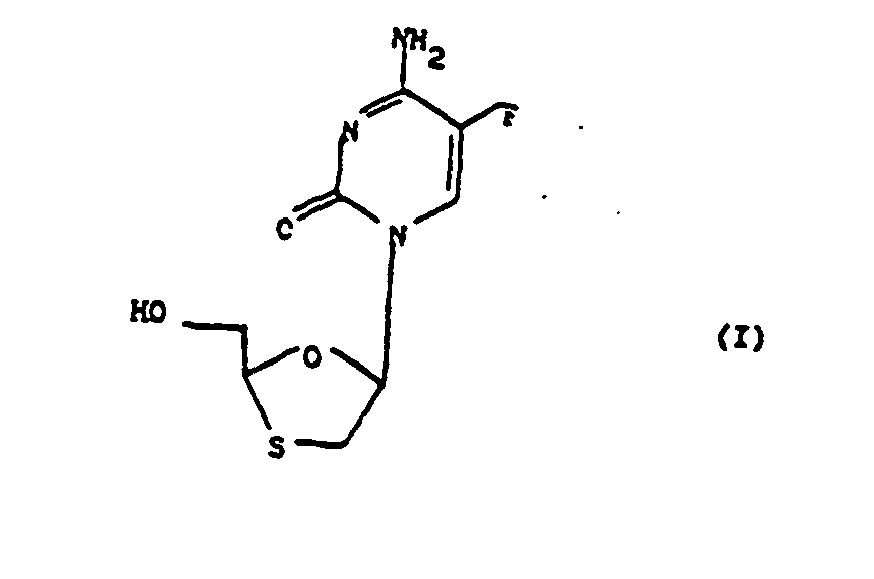
- It should be noted that the compound of formula (I) contains two chiral centers and therefore exists in the form of two pairs of optical isomers (i.e. enantiomers) and mixtures thereof including racemic mixtures. Thus, the compound of formula (I) may be either a cis or a trans isomer or mixtures thereof. Each cis and trans isomer can exist as one of two enantiomers or mixtures thereof including racemic mixtures. Only a pharmaceutically acceptable salt or amide of the (-) enantiomer of cis-1-(2-(hydroxymethyl)-1,3-oxathiolan-5-yl)-5-fluorocytosine is within the scope of the invention.
- A medicament containing a pharmaceutically acceptable salt or amide of the (-) enantiomer of the cis compound of formula (I) may be used for the treatment or prophylaxis of a hepatitis B virus infection in a host, for example, a mammal such as a human by treating the host with a therapeutically effective amount of a pharmaceutically acceptable salt or amide of the (-) enantiomer of the cis compound of formula (I).
- By "pharmaceutically acceptable" salt or amide of the compound of formula (I) is meant a compound which upon administration to the recipient, is capable of providing (directly or indirectly) the said cis compound of formula (I) or an active metabolite or residue thereof.
- The above-mentioned pharmaceutically acceptable amides include those derivatives wherein the cytosine amino group is present in the form of an amide, e.g. -NHCOR where R is C1-6 alkyl or aryl (e.g. phenyl optionally substituted by halogen, C1-4 alkyl, C1-4 alkoxy, nitro or hydroxyl).
- Examples of pharmaceutically acceptable salts according to the invention include base salts, e.g. derived from an appropriate base, such as alkali metal (e.g. sodium), alkaline earth metal (e.g. magnesium) salts, ammonium and NX4 + (wherein X is C1-4 alkyl). Pharmaceutically acceptable acid addition salts include salts of organic carboxylic acids such as acetic, lactic, tartaric, malic, isethionic, lactobionic and succinic acids; organic sulfonic acids such as methanesulfonic, ethanesulfonic, benzenesulfonic and p-toluenesulfonic acids and inorganic acids such as hydrochloric, sulfuric, phosphoric and sulfamic acids.
- The amount of the pharmaceutically acceptable salt or amide of the (-) enantiomer of the cis compound of formula (I) (hereinafter also referred to as the "active ingredient") which is required in a medication to achieve the desired effect will depend on a number of factors, in particular the specific application, the nature of the particular compound used, the mode of administration and the condition of the patient. In general a suitable dose will be in the range of 3.0 to 120 mg per kilogram body weight of the recipient per day, preferably in the range of 6 to 90 mg per kilogram body weight per day and most preferably in the range 15 to 60 mg per kilogram body weight per day. The desired dose is preferably presented as two, three, four, five, six or more sub-doses administered at appropriate intervals throughout the day. These sub-doses may be administered in unit dosage forms, for example, containing 10 to 1500 mg, preferably 20 to 1000 mg, and most preferably 50 to 700 mg of active ingredient per unit dosage form.
- Ideally, the active ingredient should be administered to achieve peak plasma concentrations of the active ingredient of from about 1 to about 75µM, preferably about 2 to 50µM, most preferably about 3 to about 30µM. This may be achieved, for example, by the intravenous injection of a 0.1 to 5% solution of the active ingredient, optionally in saline, or orally administered as a bolus containing about 1 to about 100 mg/kg of the active ingredient. Desirable blood levels may be maintained by a continuous infusion to provide about 0.01 to about 5.0 mg/kg/hour or by intermittent infusions containing about 0.4 to about 15 mg/kg of the active ingredient.
- In the manufacture of a medicament according to the invention, hereinafter referred to as a "formulation", the pharmaceutically acceptable salt or amide of the cis compound of formula (I), herein referred to as "active ingredient", is typically admixed with, inter alia, one or more pharmaceutically acceptable carriers or excipients and optionally other therapeutic agents.
- The formulations include those suitable for oral, rectal, nasal, topical (including transdermal, buccal and sublingual), vaginal or parenteral (including subcutaneous, intramuscular, intravenous and intradermal) administration. The formulations may conveniently be presented in unit dosage form and may be prepared by any methods well known in the art of pharmacy. Such methods include the step of bringing into association the active ingredient with the carrier which constitutes one or more accessory ingredients. In general, the formulations are prepared by uniformly and intimately bringing into association the active ingredient with liquid carriers or finely divided solid carriers or both, and then if necessary shaping the product.
- Formulations of the present invention suitable for oral administration may be presented as discrete units such as capsules, cachets or tablets each containing a predetermined amount of the active ingredient; as a powder or granules; as a solution or suspension in an aqueous or non-aqueous liquid; or as an oil-in-water liquid emulsion or a water-in-oil liquid emulsion. The active ingredient may also be presented as a bolus, electuary or paste.
- A tablet may be made by compression or molding, optionally with one or more accessory ingredients. Compressed tablets may be prepared by compressing in a suitable machine the active ingredient in a free-flowing form such as a powder or granules, optionally mixed with a binder (e.g. povidone, gelatin, hydroxypropylmethyl cellulose), lubricant, inert diluent, preservative, disintegrant (e.g. sodium starch glycollate, cross-linked povidone, cross-linked sodium carboxymethyl cellulose) surface-active or dispersing agent. Molded tablets may be made by molding in a suitable machine a mixture of the powdered compound moistened with an inert liquid diluent. The tablets may optionally be coated or scored and may be formulated so as to provide slow or controlled release of the active ingredient therein using, for example hydroxypropylmethyl cellulose in varying proportions to provide the desired release profile. Tablets may optionally be provided with an enteric coating, to provide release in parts of the gut other than the stomach.
- Formulations suitable for oral use as described above may also include buffering agents designed to neutralize stomach acidity. Such buffers may be chosen from a variety of organic or inorganic agents such as weak acids or bases admixed with their conjugated salts.
- Formulations suitable for topical administration in the mouth include lozenges comprising the active ingredient in a flavored basis, usually sucrose and acacia or tragacanth; pastilles comprising the active ingredient in an inert basis such as gelatin and glycerin, or sucrose and acacia; and mouthwashes comprising the active ingredient in a suitable liquid carrier.
- Formulations for rectal administration may be presented as a suppository with a suitable base comprising for example cocoa butter or a salicylate.
- Formulations suitable for vaginal administration may be presented as pessaries, tampons, creams, gels pastes, foams or spray formulations containing in addition to the active ingredient such carriers as are known in the art to be appropriate.
- Formulations suitable for parenteral administration include aqueous and non-aqueous isotonic sterile injections solutions which may contain anti-oxidants, buffers, bacteriostats and solutes which render the formulation isotonic with the blood of the intended recipient; and aqueous and non-aqueous sterile suspensions which may include suspending agents and thickening agents, as liposomes or other microparticulate systems which are designed to target the compounds to blood components or one or more organs. The formulations may be presented in unit-dose or multi-dose sealed containers, for example, ampules and vials, and may be stored in a freeze-dried (lyophilized) condition requiring only the addition of the sterile liquid carrier, for example water for injections, immediately prior to use. Extemporaneous injection solutions and suspensions may be prepared from sterile powders, granules and tablets of the kind previously described.
- Preferred unit dosage formulations are those containing a daily dose or unit, daily sub-dose, as herein above recited, or an appropriate fraction thereof, of an active ingredient.
- It should be understood that in addition to the ingredients particularly mentioned above the formulations of this invention may include other agents conventional in the art having regard to the type of formulation in question, for example, those suitable for oral administration may include such further agents as sweeteners, thickeners and flavoring agents.
- The compound of formula I may be prepared for example by:
- a) reacting an optionally protected 5-F-cytosine compound with a 1,3-oxachiolane of formula IIA

- b) reacting a compound of formula IIB

- c) reacting a compound of formula IIC
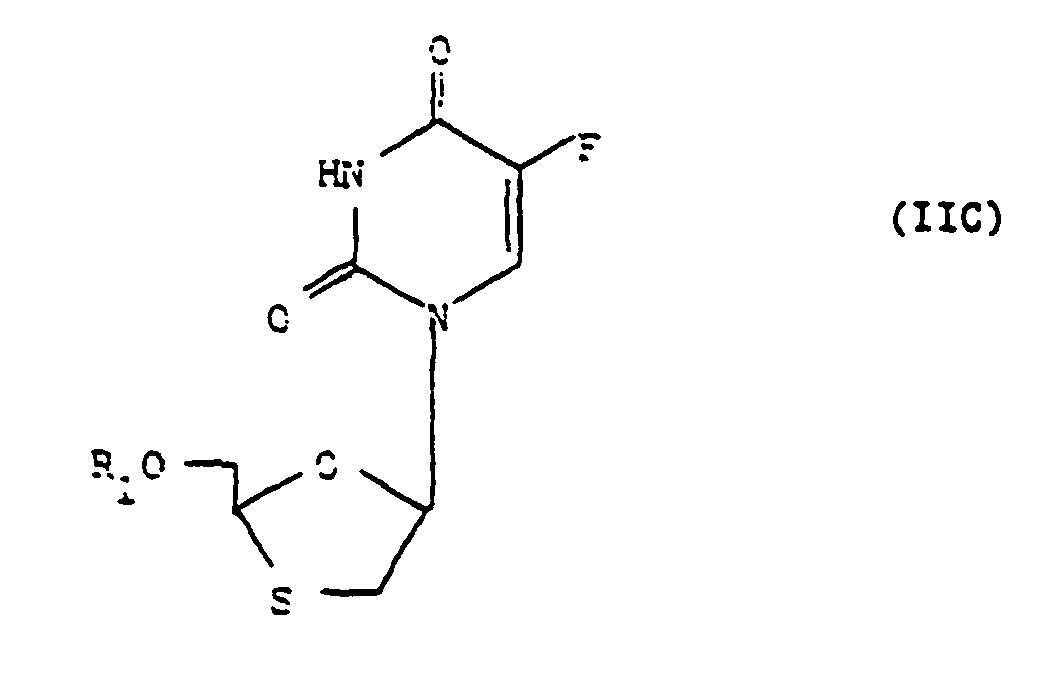
- With regard to process a), the hydroxy protecting group includes protecting groups such as acyl (e.g. acetyl), arylacyl (e.g. benzoyl or substituted benzoyl), trityl or monomethoxytrityl, benzyl or substituted benzyl, trialkylsilyl (e.g. dimethyl-t-butylsilyl) or diphenylmethylsilyl. The 5-R-cytosine compound may be optionally protected with silyl, e.g. trimethyl silyl groups. Such groups may be removed in conventional manner. The leaving group L is a leaving group typical of those known in the art of nucleoside chemistry e.g. halogen such as chlorine or bromine, alkoxy such as methoxy or ethoxy or acyl such as acetyl or benzoyl.
- The reaction in process a) may be effected in an organic solvent (e.g. 1,2-dichloroethane or acetonitrile) in the presence of a Lewis acid such as stannic chloride or trimethylsilyl triflate.
- Compounds of formula IIA may be obtained from a suitably protected 2-hydroxyacetaldehyde of formula III,
R1OCH2CHO (III)
wherein R1 is defined above, as described in Can. J. Research, 8, 129 (1933) and European Patent Specification 0 382 526. Reaction of compounds of formula III with a mercaptoacetal HSCH2CH(OR)2, wherein R is C1-4 alkoxy such as HSCH2CH(OC2H5)2, known in the art (Chem. Ber. 85:924-932, 1952), yields compounds of formula IIA wherein L is OR (alkoxy) e.g. methoxy or ethoxy. Alternatively, compounds of formula IIA, wherein L is alkoxy, may be converted to compounds of formula IIA wherein L is halogen or acyl by methods known in the art of carbohydrate chemistry. - Compounds of formula III may be prepared from 1,2-0-isopropylidene glycerol by introduction of R1 (e.g. trisubstituted silyl, benzyl or trityl) and removal of the isopropylidene group with mild acid (e.g. aqueous formic or acetic acid) or zinc bromide in acetonitrile, followed by oxidation of the alcohol group with aqueous periodate.
- With regard to process b), the 5-fluoro substituent may be introduced by methods known in the art (M.J. Robins, et al., in Nucleic Acid Chemistry, Part 2, L.B. Townsend and R.S. Tipson, editors, J. Wiley and Sons, New York, 895-900 (1978) and references therein; R. Duschinsky in Nucleic Acid Chemistry, Part 1, L.B. Townsend and R.S. Tipson, editors, J. Wiley and Sons, New York, 43-46 (1978) and references therein). The fluorinating agent may be, for example, trimethylhypofluorite in fluorotrichloromethane.
- With regard to process c), the compound of formula IIC is advantageously treated with 1,2,4-triazole, advantageously together with 4-chlorophenyl dichlorophosphate, to form the corresponding 4-(1,2,4-triazolyl) compound which is then converted to the desired 4-amino (cytidine) compound by reaction with for example methanol.
- The starting materials of formula IIB and IIC may be prepared for example by reaction of an appropriate (optionally protected) base with a compound of formula IIA in an analogous manner to that described in process a). 5-Fluorouracil and 5-fluorocytosine are commercially available from Aldrich Chemical Co., Milwaukee, WI 53233, USA.
- Separation of the (±)-cis and (±)-trans isomers for example in a protected form, may be accomplished by chromatography on silica gel with mixtures of organic solvents such as ethyl acetate/methanol, ethylacetate/hexane or dichloromethane/methanol. Any protecting group may then be removed using the appropriate reagent for each group.
- The compound of formula (I) may be converted into a pharmaceutically acceptable amides by reaction with an appropriate acylating agent, for example, an acid halide or anhydride serving to acylate the 5'-OH and 4-NH2 groups. The acyl group may then be removed selectively from one or other of the 5'-OH and 4-NH2 groups. For, example, treatment of the diacylated compound under acidic conditions, eg. a Lewis acid such as zinc bromide in methanol, removes the 4N-acyl group to yield the corresponding 5'-OH ester where treatment of the diacylated compound under alkaline conditions, eg. with sodium methoxide removes the 5'-OH acyl group to yield the corresponding 4N-amide. The acyl groups can also be removed selectively by treatment with commercially avialable esterase or lipase enzymes, eg. pig liver esterase or pancreatic lipase, or by treatment in accordance with methods described in U.S. Patent Specification No. 5071983. The compound of formula (I) may be converted into a pharmaceutically acceptable salt thereof in a conventional manner, for example, by treatment with an appropriate base. A salt of a compound of formula (I) may be converted into the parent compound, for example, by hydrolysis.
- For a better understanding of the invention, the following Examples are given by way of illustration.
- Method A: (±)-cis and (±)-trans 2-benzoyloxymethyl-5-(N4-acetyl-cytosin-1-yl)-1,3-oxathiolane are prepared and separated to the (±)-cis and (±) trans isomers as described in European Patent (EP) Specification 0 382 526. The (±)-cis isomer is fluorinated with trifluoromethyl hypofluorite in fluorotrichloromethane (CCI3F) and chloroform at -78°C, according to the method of Robins, et al. Nucleic Acid Chemistry, Part 2, 895-900, 1978. The N4-acetyl and 2-benzoyl groups are removed with dimethylamine in ethanol, and the product, (±)-cis-1-(2-(hydroxymethyl)-1,3-oxathiolan-5-yl)-5-fluorocytosin is isolated.
- Method B: (±)-cis and (±)-trans-2-benzoyloxymethyl-5-(uracil-1-yl)-1,3-oxathiolane are prepared as described in EP 0 382 526. After deprotection of the 2-hydroxyl group with saturated methanolic ammonia, the isomers are separated on silica gel using EtOAc/MeOH as eluant (EP 0 382 526). The (±)-cis isomer is reacted with acetic anhydride in pyridine at room temperature to give the 2-acetate. Solvent is removed in vacuo at <30°C. The 2-acetate is then dissolved in CHCl3 and washed with aqueous sodium bicarbonate. The separated organic layer is dried, and CHCl3 is evaporated in vacuo. (t)-cis-2-acetyloxymethyl-5-(uracil-1-yl)-1,3-oxathiolane is fluorinated as described above (Method A) by the method of Robins et al. Conversion of the 5-F-uracil base to the 5-F-cytosine base is carried out by preparation of the 4-(1,2,4-triazol-1-yl) derivative according to the methods of C.B. Reese, J. Chem. Soc., Perkins I, 1171, 1984 and W.L. Sung, Nucleic Acids Res. 9:6139, 1981, using 1,2,4-triazole and 2 equivalents of 4-chlorophenyldichlorophosphate in dry pyridine at ambient temperature. This conversion is followed by reaction with methanol previously saturated with ammonia at 0°C, and the 2-acetate is hydrolyzed to give (±)-cis-1-(2-(hydroxymethyl)-1,3-oxathiolan-5-yl)-5-fluorocytosine.
- The compound cis-1-(2-(hydroxymethyl)-1,3-oxathiolan-5-yl)-5-fluorocytosine, was tested as described below.
- The human HBV producer cell line of HepG2, 2.2.15, described and characterized by Sells et al., PNAS 84:1005, 1987 and J. Virol. 62:2836, 1988, has been shown to share many characteristics of the HBV chronically infected hepatocyte. It is infectious as demonstrated by the ability to cause disease in chimpanzees. This cell line was utilized in vitro to identify compounds with anti-HBV activity.
- To test compounds for antiviral activity, monolayer cultures were treated with compound, 50-200µM for ten days. Supernatant media containing extracellular virion DNA (Dane particles) were harvested on days three, six and ten, treated with proteinase K (1 mg/mL) and sodium dodecyl sulfate (1%), and incubated at 50°C for one hour. DNA was extracted with equal volumes of phenol followed by chloroform and then precipitated by ammonium acetate and propanol. The DNA precipitate was dissolved and collected on nitrocellulose using the procedure of Schleicher and Schuell (S & S, 10 Optical Ave., Keene, NH 03431, Publication No. 700, 1987), and treated as described by Southern, J. Mol. Biol. 98:503, 1975. Cells were harvested, and the intracellular DNA was obtained after cell lysis with guanidine isothiocyanate. The intracellular DNA was handled in the same manner as the extracellular DNA. After precipitation by ammonium acetate and propanol, the intracellular DNA precipitate was dissolved, cut by restriction endonuclease, Hind III, applied to agarose gel and then treated as described by Southern to determine the quantity of replicative intermediate forms. The antiviral effect of the compound was determined by measuring at least a 100-fold reduction of the amount of Dane particles extruded into the culture medium and a similar decrease in the intracellular replicative intermediates.
- The results are given below:
Effect of cis-1-(2-(Hydroxymethyl)-1,3-oxathiolan-5-yl)-5-fluorocytosine on HBV Production in 2.2.15 Cell Cultures Intracellular HBV DNA* Treatment Compound (µm) Integrated Mono-mer- Replicative intermediate HBV DNA in Culture (pg/mL)‡ Medium Day 0 Day 3 Day 6 Day 10 A. untreated 1.1 2.0 81 58 67 93 77 cells 0.9 2.3 77 89 110 100 88 100 1.9 0.8 2 64 11 3 0 1.5 1.9 1 34 19 2 0 B. untreated 1.5 1.9 110 65 44 86 71 cells 1.0 2.3 67 90 120 80 82 100 1.6 0.8 1 90 16 0 0 1.0 0.7 1 74 10 0 0 * Analysis of intracellular HBV DNA (Dane particles) was 24 hours following the 10th day of treatment.
‡ A "zero" indicates an undetectable level of HBV DNA, sensitivity cutoff was 0.1pg/mL
Claims (1)
- A pharmaceutically acceptable salt or amide of the (-) enantiomer of cis-1-(2-(hydroxymethyl)-1,3-oxathiolan-5-yl)-5-fluorocytosine.
Priority Applications (1)
| Application Number | Priority Date | Filing Date | Title |
|---|---|---|---|
| EP07008774A EP1808434A3 (en) | 1991-03-06 | 1992-03-05 | Use of 5-fluoro-2'-deoxy-3'-thiacytidine fo the treatment of hepatitis B |
Applications Claiming Priority (5)
| Application Number | Priority Date | Filing Date | Title |
|---|---|---|---|
| GB9104741 | 1991-03-06 | ||
| GB919104741A GB9104741D0 (en) | 1991-03-06 | 1991-03-06 | Therapeutic nucleosides |
| GB9109505 | 1991-05-02 | ||
| GB919109505A GB9109505D0 (en) | 1991-05-02 | 1991-05-02 | Therapeutic nucleosides |
| EP92906520A EP0574487B1 (en) | 1991-03-06 | 1992-03-05 | Use of 5-fluoro-2'-deoxy-3'-thiacytidine for the treatment of hepatitis b |
Related Parent Applications (1)
| Application Number | Title | Priority Date | Filing Date |
|---|---|---|---|
| EP92906520A Division EP0574487B1 (en) | 1991-03-06 | 1992-03-05 | Use of 5-fluoro-2'-deoxy-3'-thiacytidine for the treatment of hepatitis b |
Related Child Applications (1)
| Application Number | Title | Priority Date | Filing Date |
|---|---|---|---|
| EP07008774A Division EP1808434A3 (en) | 1991-03-06 | 1992-03-05 | Use of 5-fluoro-2'-deoxy-3'-thiacytidine fo the treatment of hepatitis B |
Publications (2)
| Publication Number | Publication Date |
|---|---|
| EP1142891A1 EP1142891A1 (en) | 2001-10-10 |
| EP1142891B1 true EP1142891B1 (en) | 2007-05-02 |
Family
ID=26298535
Family Applications (3)
| Application Number | Title | Priority Date | Filing Date |
|---|---|---|---|
| EP01202860A Expired - Lifetime EP1142891B1 (en) | 1991-03-06 | 1992-03-05 | Salts and amides of (-)cis 5-Fluoro-2'-deoxy-3'-thiacytidine useful for the treatment of hepatitis B |
| EP92906520A Expired - Lifetime EP0574487B1 (en) | 1991-03-06 | 1992-03-05 | Use of 5-fluoro-2'-deoxy-3'-thiacytidine for the treatment of hepatitis b |
| EP07008774A Withdrawn EP1808434A3 (en) | 1991-03-06 | 1992-03-05 | Use of 5-fluoro-2'-deoxy-3'-thiacytidine fo the treatment of hepatitis B |
Family Applications After (2)
| Application Number | Title | Priority Date | Filing Date |
|---|---|---|---|
| EP92906520A Expired - Lifetime EP0574487B1 (en) | 1991-03-06 | 1992-03-05 | Use of 5-fluoro-2'-deoxy-3'-thiacytidine for the treatment of hepatitis b |
| EP07008774A Withdrawn EP1808434A3 (en) | 1991-03-06 | 1992-03-05 | Use of 5-fluoro-2'-deoxy-3'-thiacytidine fo the treatment of hepatitis B |
Country Status (21)
| Country | Link |
|---|---|
| EP (3) | EP1142891B1 (en) |
| JP (5) | JP3479068B2 (en) |
| KR (1) | KR100270806B1 (en) |
| AT (2) | ATE219366T1 (en) |
| AU (1) | AU662130B2 (en) |
| CA (1) | CA2105486C (en) |
| CZ (1) | CZ282747B6 (en) |
| DE (2) | DE69233693T2 (en) |
| DK (2) | DK1142891T3 (en) |
| ES (2) | ES2179040T3 (en) |
| HU (1) | HUT64844A (en) |
| IE (1) | IE920701A1 (en) |
| IL (1) | IL101144A (en) |
| MX (1) | MX9203213A (en) |
| NZ (1) | NZ264621A (en) |
| PT (1) | PT100198B (en) |
| RU (1) | RU2116789C1 (en) |
| SK (1) | SK279542B6 (en) |
| TW (1) | TW201268B (en) |
| UA (1) | UA54364C2 (en) |
| WO (1) | WO1992015308A1 (en) |
Families Citing this family (43)
| Publication number | Priority date | Publication date | Assignee | Title |
|---|---|---|---|---|
| DE69233014T2 (en) * | 1989-02-08 | 2004-01-08 | Biochem Pharma Inc., Laval | METHOD FOR THE PRODUCTION OF ANTIVIRAL SUBSTITUTED 1, 3-OXATHIOLANS |
| US5276151A (en) * | 1990-02-01 | 1994-01-04 | Emory University | Method of synthesis of 1,3-dioxolane nucleosides |
| US5728575A (en) * | 1990-02-01 | 1998-03-17 | Emory University | Method of resolution of 1,3-oxathiolane nucleoside enantiomers |
| US5204466A (en) * | 1990-02-01 | 1993-04-20 | Emory University | Method and compositions for the synthesis of bch-189 and related compounds |
| US6703396B1 (en) | 1990-02-01 | 2004-03-09 | Emory University | Method of resolution and antiviral activity of 1,3-oxathiolane nuclesoside enantiomers |
| US6642245B1 (en) | 1990-02-01 | 2003-11-04 | Emory University | Antiviral activity and resolution of 2-hydroxymethyl-5-(5-fluorocytosin-1-yl)-1,3-oxathiolane |
| US5925643A (en) * | 1990-12-05 | 1999-07-20 | Emory University | Enantiomerically pure β-D-dioxolane-nucleosides |
| US5444063A (en) * | 1990-12-05 | 1995-08-22 | Emory University | Enantiomerically pure β-D-dioxolane nucleosides with selective anti-Hepatitis B virus activity |
| IL100502A (en) * | 1991-01-03 | 1995-12-08 | Iaf Biochem Int | Pharmaceutical compositions containing cis-4-amino-1(hydroxymethyl-1,3-oxathiolan-5-yl)-1H-pyrimid-2-one nucleoside or its derivatives |
| NZ250842A (en) | 1991-02-22 | 1996-03-26 | Univ Emory | Resolution of a racemic mixture of nucleoside enantiomers such as 2-hydroxymethyl-5-(5-fluorocytosin-1-yl)-1,3-oxathiolane (ftc) |
| EP1142891B1 (en) * | 1991-03-06 | 2007-05-02 | Emory University | Salts and amides of (-)cis 5-Fluoro-2'-deoxy-3'-thiacytidine useful for the treatment of hepatitis B |
| US5817667A (en) * | 1991-04-17 | 1998-10-06 | University Of Georgia Research Foudation | Compounds and methods for the treatment of cancer |
| GB9110874D0 (en) * | 1991-05-20 | 1991-07-10 | Iaf Biochem Int | Medicaments |
| GB9116601D0 (en) * | 1991-08-01 | 1991-09-18 | Iaf Biochem Int | 1,3-oxathiolane nucleoside analogues |
| GB9226927D0 (en) * | 1992-12-24 | 1993-02-17 | Iaf Biochem Int | Dideoxy nucleoside analogues |
| AU7954694A (en) * | 1993-09-10 | 1995-03-27 | Centre National De La Recherche Scientifique (Cnrs) | Nucleosides with anti-hepatitis b virus activity |
| US20020120130A1 (en) | 1993-09-10 | 2002-08-29 | Gilles Gosselin | 2' or 3' -deoxy and 2', 3' -dideoxy-beta-L-pentofuranonucleo-side compounds, method of preparation and application in therapy, especially as anti- viral agents |
| US5587362A (en) * | 1994-01-28 | 1996-12-24 | Univ. Of Ga Research Foundation | L-nucleosides |
| IL115156A (en) * | 1994-09-06 | 2000-07-16 | Univ Georgia | Pharmaceutical compositions for the treatment of cancer comprising 1-(2-hydroxymethyl-1,3-dioxolan-4-yl) cytosines |
| US6391859B1 (en) | 1995-01-27 | 2002-05-21 | Emory University | [5-Carboxamido or 5-fluoro]-[2′,3′-unsaturated or 3′-modified]-pyrimidine nucleosides |
| US5703058A (en) | 1995-01-27 | 1997-12-30 | Emory University | Compositions containing 5-fluoro-2',3'-didehydro-2',3'-dideoxycytidine or a mono-, di-, or triphosphate thereof and a second antiviral agent |
| US5808040A (en) * | 1995-01-30 | 1998-09-15 | Yale University | L-nucleosides incorporated into polymeric structure for stabilization of oligonucleotides |
| DE69636734T2 (en) | 1995-06-07 | 2007-10-18 | Emory University | NUCLEOSIDE WITH ANTI-HEPATITIS B VIRUS EFFICACY |
| US5753789A (en) * | 1996-07-26 | 1998-05-19 | Yale University | Oligonucleotides containing L-nucleosides |
| WO1998041522A1 (en) | 1997-03-19 | 1998-09-24 | Emory University | Synthesis, anti-human immunodeficiency virus and anti-hepatitis b virus activities of 1,3-oxaselenolane nucleosides |
| US6444652B1 (en) | 1998-08-10 | 2002-09-03 | Novirio Pharmaceuticals Limited | β-L-2'-deoxy-nucleosides for the treatment of hepatitis B |
| ES2579903T3 (en) | 1998-08-10 | 2016-08-17 | Centre National De La Recherche Scientifique (Cnrs) | Beta-L-2'-deoxy-nucleosides for the treatment of hepatitis B |
| ATE282034T1 (en) | 1998-08-12 | 2004-11-15 | Gilead Sciences Inc | METHOD FOR PRODUCING 1,3-OXATHIOLANNE NUCLEOSIDE |
| US6979561B1 (en) | 1998-10-09 | 2005-12-27 | Gilead Sciences, Inc. | Non-homogeneous systems for the resolution of enantiomeric mixtures |
| RU2237479C2 (en) * | 1998-11-05 | 2004-10-10 | Сантр Насьональ Де Ля Решерш Сьентифик | Nucleosides with activity against hepatitis b virus |
| US6436948B1 (en) | 2000-03-03 | 2002-08-20 | University Of Georgia Research Foundation Inc. | Method for the treatment of psoriasis and genital warts |
| MY164523A (en) | 2000-05-23 | 2017-12-29 | Univ Degli Studi Cagliari | Methods and compositions for treating hepatitis c virus |
| US6787526B1 (en) | 2000-05-26 | 2004-09-07 | Idenix Pharmaceuticals, Inc. | Methods of treating hepatitis delta virus infection with β-L-2′-deoxy-nucleosides |
| MXPA02011691A (en) | 2000-05-26 | 2004-05-17 | Idenix Cayman Ltd | Methods and compositions for treating flaviviruses and pestiviruses. |
| US6875751B2 (en) | 2000-06-15 | 2005-04-05 | Idenix Pharmaceuticals, Inc. | 3′-prodrugs of 2′-deoxy-β-L-nucleosides |
| CA2446620C (en) | 2001-05-18 | 2013-11-19 | Rakesh Kumar | Antiviral nucleosides |
| CN101172993A (en) | 2002-06-28 | 2008-05-07 | 埃迪尼克斯(开曼)有限公司 | 2'-c-methyl-3'-o-l-valine ester ribofuranosyl cytidine for treatment of flaviviridae infections |
| TWI244393B (en) | 2002-08-06 | 2005-12-01 | Idenix Pharmaceuticals Inc | Crystalline and amorphous forms of beta-L-2'-deoxythymidine |
| US7186700B2 (en) | 2002-09-13 | 2007-03-06 | Idenix Pharmaceuticals, Inc. | β-L-2′-deoxynucleosides for the treatment of resistant HBV strains and combination therapies |
| PL377342A1 (en) | 2002-11-15 | 2006-01-23 | Idenix (Cayman) Limited | 2'-branched nucleosides and flaviviridae mutation |
| AU2003300901A1 (en) | 2002-12-12 | 2004-06-30 | Idenix (Cayman) Limited | Process for the production of 2'-branched nucleosides |
| MX337213B (en) | 2008-06-30 | 2016-02-17 | Tocagen Inc | Formulations of 5-fluorocytosine and uses thereof. |
| WO2013004658A1 (en) * | 2011-07-01 | 2013-01-10 | Transgene Sa | Formulations of 5-fluorocytosine and uses thereof. |
Family Cites Families (6)
| Publication number | Priority date | Publication date | Assignee | Title |
|---|---|---|---|---|
| PT82580B (en) * | 1985-05-15 | 1989-01-17 | Wellcome Found | Process for the preparation of 2 ', 3'-DIDESOXINUCLEOSIDOS AND OF PHARMACEUTICAL COMPOSITIONS THAT CONTAIN THEM |
| US5047407A (en) * | 1989-02-08 | 1991-09-10 | Iaf Biochem International, Inc. | 2-substituted-5-substituted-1,3-oxathiolanes with antiviral properties |
| WO1990014079A1 (en) | 1989-05-15 | 1990-11-29 | The United States Of America, Represented By The Secretary, United States Department Of Commerce | Method of treatment of hepatitis |
| US5204466A (en) * | 1990-02-01 | 1993-04-20 | Emory University | Method and compositions for the synthesis of bch-189 and related compounds |
| NZ250842A (en) * | 1991-02-22 | 1996-03-26 | Univ Emory | Resolution of a racemic mixture of nucleoside enantiomers such as 2-hydroxymethyl-5-(5-fluorocytosin-1-yl)-1,3-oxathiolane (ftc) |
| EP1142891B1 (en) * | 1991-03-06 | 2007-05-02 | Emory University | Salts and amides of (-)cis 5-Fluoro-2'-deoxy-3'-thiacytidine useful for the treatment of hepatitis B |
-
1992
- 1992-03-05 EP EP01202860A patent/EP1142891B1/en not_active Expired - Lifetime
- 1992-03-05 ES ES92906520T patent/ES2179040T3/en not_active Expired - Lifetime
- 1992-03-05 EP EP92906520A patent/EP0574487B1/en not_active Expired - Lifetime
- 1992-03-05 CA CA002105486A patent/CA2105486C/en not_active Expired - Lifetime
- 1992-03-05 WO PCT/GB1992/000388 patent/WO1992015308A1/en not_active Ceased
- 1992-03-05 HU HU9302493A patent/HUT64844A/en not_active Application Discontinuation
- 1992-03-05 TW TW081101693A patent/TW201268B/zh active
- 1992-03-05 DE DE69233693T patent/DE69233693T2/en not_active Expired - Lifetime
- 1992-03-05 RU RU93043875A patent/RU2116789C1/en active
- 1992-03-05 AT AT92906520T patent/ATE219366T1/en active
- 1992-03-05 IE IE070192A patent/IE920701A1/en not_active IP Right Cessation
- 1992-03-05 SK SK950-93A patent/SK279542B6/en not_active IP Right Cessation
- 1992-03-05 DE DE69232649T patent/DE69232649T2/en not_active Expired - Lifetime
- 1992-03-05 NZ NZ264621A patent/NZ264621A/en not_active IP Right Cessation
- 1992-03-05 DK DK01202860T patent/DK1142891T3/en active
- 1992-03-05 IL IL10114492A patent/IL101144A/en not_active IP Right Cessation
- 1992-03-05 KR KR1019930702639A patent/KR100270806B1/en not_active Expired - Lifetime
- 1992-03-05 EP EP07008774A patent/EP1808434A3/en not_active Withdrawn
- 1992-03-05 AT AT01202860T patent/ATE361293T1/en active
- 1992-03-05 DK DK92906520T patent/DK0574487T3/en active
- 1992-03-05 AU AU13676/92A patent/AU662130B2/en not_active Expired
- 1992-03-05 ES ES01202860T patent/ES2286072T3/en not_active Expired - Lifetime
- 1992-03-05 CZ CS931835A patent/CZ282747B6/en not_active IP Right Cessation
- 1992-03-05 PT PT100198A patent/PT100198B/en not_active IP Right Cessation
- 1992-03-05 JP JP50582592A patent/JP3479068B2/en not_active Expired - Lifetime
- 1992-05-03 UA UA94051484A patent/UA54364C2/en unknown
- 1992-06-24 MX MX9203213A patent/MX9203213A/en unknown
-
2001
- 2001-12-12 JP JP2001378640A patent/JP3987335B2/en not_active Expired - Lifetime
-
2007
- 2007-05-08 JP JP2007123881A patent/JP4399478B2/en not_active Expired - Lifetime
-
2009
- 2009-09-03 JP JP2009204044A patent/JP2010013466A/en not_active Withdrawn
-
2010
- 2010-12-27 JP JP2010290612A patent/JP4891435B2/en active Active
Also Published As
Similar Documents
| Publication | Publication Date | Title |
|---|---|---|
| EP1142891B1 (en) | Salts and amides of (-)cis 5-Fluoro-2'-deoxy-3'-thiacytidine useful for the treatment of hepatitis B | |
| IE84129B1 (en) | Therapeutic nucleosides | |
| KR100225986B1 (en) | Antiviral Nucleoside Combination | |
| US20080187580A1 (en) | Therapeutic nucleosides | |
| RU2104700C1 (en) | Method of hepatitis b treatment | |
| US5637574A (en) | Therapeutic nucleosides | |
| IE85820B1 (en) | Use of 5 - fluoro -2'deoxy-3' thiacytidine for the treatment of hepatitis B | |
| CA2439322A1 (en) | Therapeutic nucleosides | |
| NZ264990A (en) | Use of 1-(2-(hydroxymethyl))-1,3-oxathiolan-5-yl)cytosine derivatives to prepare medicaments and methods of treatment of hepatitas b virus infections | |
| HK1004189B (en) | Antiviral nucleoside combination |
Legal Events
| Date | Code | Title | Description |
|---|---|---|---|
| PUAI | Public reference made under article 153(3) epc to a published international application that has entered the european phase |
Free format text: ORIGINAL CODE: 0009012 |
|
| AC | Divisional application: reference to earlier application |
Ref document number: 574487 Country of ref document: EP |
|
| AK | Designated contracting states |
Kind code of ref document: A1 Designated state(s): AT BE CH DE DK ES FR GB GR IT LI LU MC NL SE |
|
| 17P | Request for examination filed |
Effective date: 20020402 |
|
| AKX | Designation fees paid |
Free format text: AT BE CH DE DK ES FR GB GR IT LI LU MC NL SE |
|
| 17Q | First examination report despatched |
Effective date: 20030808 |
|
| GRAP | Despatch of communication of intention to grant a patent |
Free format text: ORIGINAL CODE: EPIDOSNIGR1 |
|
| RTI1 | Title (correction) |
Free format text: SALTS AND AMIDES OF (-)CIS 5-FLUORO-2'-DEOXY-3'-THIACYTIDINE USEFUL FOR THE TREATMENT OF HEPATITIS B |
|
| GRAS | Grant fee paid |
Free format text: ORIGINAL CODE: EPIDOSNIGR3 |
|
| GRAA | (expected) grant |
Free format text: ORIGINAL CODE: 0009210 |
|
| AC | Divisional application: reference to earlier application |
Ref document number: 0574487 Country of ref document: EP Kind code of ref document: P |
|
| AK | Designated contracting states |
Kind code of ref document: B1 Designated state(s): AT BE CH DE DK ES FR GB GR IT LI LU MC NL SE |
|
| REG | Reference to a national code |
Ref country code: GB Ref legal event code: FG4D |
|
| REG | Reference to a national code |
Ref country code: CH Ref legal event code: EP |
|
| REF | Corresponds to: |
Ref document number: 69233693 Country of ref document: DE Date of ref document: 20070614 Kind code of ref document: P |
|
| REG | Reference to a national code |
Ref country code: SE Ref legal event code: TRGR |
|
| REG | Reference to a national code |
Ref country code: DK Ref legal event code: T3 |
|
| REG | Reference to a national code |
Ref country code: GR Ref legal event code: EP Ref document number: 20070402082 Country of ref document: GR |
|
| REG | Reference to a national code |
Ref country code: CH Ref legal event code: NV Representative=s name: PATENTANWAELTE SCHAAD, BALASS, MENZL & PARTNER AG |
|
| ET | Fr: translation filed | ||
| REG | Reference to a national code |
Ref country code: ES Ref legal event code: FG2A Ref document number: 2286072 Country of ref document: ES Kind code of ref document: T3 |
|
| PLBE | No opposition filed within time limit |
Free format text: ORIGINAL CODE: 0009261 |
|
| STAA | Information on the status of an ep patent application or granted ep patent |
Free format text: STATUS: NO OPPOSITION FILED WITHIN TIME LIMIT |
|
| 26N | No opposition filed |
Effective date: 20080205 |
|
| PGFP | Annual fee paid to national office [announced via postgrant information from national office to epo] |
Ref country code: MC Payment date: 20110310 Year of fee payment: 20 Ref country code: DK Payment date: 20110310 Year of fee payment: 20 |
|
| PGFP | Annual fee paid to national office [announced via postgrant information from national office to epo] |
Ref country code: SE Payment date: 20110311 Year of fee payment: 20 Ref country code: LU Payment date: 20110415 Year of fee payment: 20 Ref country code: FR Payment date: 20110317 Year of fee payment: 20 Ref country code: NL Payment date: 20110317 Year of fee payment: 20 Ref country code: IT Payment date: 20110315 Year of fee payment: 20 Ref country code: AT Payment date: 20110328 Year of fee payment: 20 Ref country code: CH Payment date: 20110314 Year of fee payment: 20 |
|
| PGFP | Annual fee paid to national office [announced via postgrant information from national office to epo] |
Ref country code: GR Payment date: 20110310 Year of fee payment: 20 |
|
| PGFP | Annual fee paid to national office [announced via postgrant information from national office to epo] |
Ref country code: GB Payment date: 20110302 Year of fee payment: 20 Ref country code: DE Payment date: 20110316 Year of fee payment: 20 Ref country code: ES Payment date: 20110414 Year of fee payment: 20 Ref country code: BE Payment date: 20110311 Year of fee payment: 20 |
|
| REG | Reference to a national code |
Ref country code: DE Ref legal event code: R071 Ref document number: 69233693 Country of ref document: DE |
|
| REG | Reference to a national code |
Ref country code: DE Ref legal event code: R071 Ref document number: 69233693 Country of ref document: DE |
|
| REG | Reference to a national code |
Ref country code: NL Ref legal event code: V4 Effective date: 20120305 |
|
| REG | Reference to a national code |
Ref country code: CH Ref legal event code: PL |
|
| REG | Reference to a national code |
Ref country code: DK Ref legal event code: EUP |
|
| REG | Reference to a national code |
Ref country code: GB Ref legal event code: PE20 Expiry date: 20120304 |
|
| BE20 | Be: patent expired |
Owner name: EMORY UNIVERSITY Effective date: 20120305 |
|
| PG25 | Lapsed in a contracting state [announced via postgrant information from national office to epo] |
Ref country code: DE Free format text: LAPSE BECAUSE OF EXPIRATION OF PROTECTION Effective date: 20120306 |
|
| REG | Reference to a national code |
Ref country code: GR Ref legal event code: MA Ref document number: 20070402082 Country of ref document: GR Effective date: 20120306 |
|
| REG | Reference to a national code |
Ref country code: ES Ref legal event code: FD2A Effective date: 20120604 |
|
| PG25 | Lapsed in a contracting state [announced via postgrant information from national office to epo] |
Ref country code: GB Free format text: LAPSE BECAUSE OF EXPIRATION OF PROTECTION Effective date: 20120304 |
|
| REG | Reference to a national code |
Ref country code: SE Ref legal event code: EUG |
|
| PG25 | Lapsed in a contracting state [announced via postgrant information from national office to epo] |
Ref country code: ES Free format text: LAPSE BECAUSE OF EXPIRATION OF PROTECTION Effective date: 20120306 |
|
| REG | Reference to a national code |
Ref country code: AT Ref legal event code: MK07 Ref document number: 361293 Country of ref document: AT Kind code of ref document: T Effective date: 20120305 |