EP1134191A1 - Process to eliminate organic substances from water - Google Patents
Process to eliminate organic substances from water Download PDFInfo
- Publication number
- EP1134191A1 EP1134191A1 EP00105532A EP00105532A EP1134191A1 EP 1134191 A1 EP1134191 A1 EP 1134191A1 EP 00105532 A EP00105532 A EP 00105532A EP 00105532 A EP00105532 A EP 00105532A EP 1134191 A1 EP1134191 A1 EP 1134191A1
- Authority
- EP
- European Patent Office
- Prior art keywords
- water
- zeolites
- adsorbent
- titanium dioxide
- zeolite
- Prior art date
- Legal status (The legal status is an assumption and is not a legal conclusion. Google has not performed a legal analysis and makes no representation as to the accuracy of the status listed.)
- Withdrawn
Links
- XLYOFNOQVPJJNP-UHFFFAOYSA-N water Substances O XLYOFNOQVPJJNP-UHFFFAOYSA-N 0.000 title claims abstract description 41
- 238000000034 method Methods 0.000 title claims description 25
- 239000000126 substance Substances 0.000 title claims description 14
- 239000003463 adsorbent Substances 0.000 claims abstract description 16
- GWEVSGVZZGPLCZ-UHFFFAOYSA-N Titan oxide Chemical compound O=[Ti]=O GWEVSGVZZGPLCZ-UHFFFAOYSA-N 0.000 claims description 38
- 239000010457 zeolite Substances 0.000 claims description 38
- KDLHZDBZIXYQEI-UHFFFAOYSA-N Palladium Chemical compound [Pd] KDLHZDBZIXYQEI-UHFFFAOYSA-N 0.000 claims description 27
- 239000004408 titanium dioxide Substances 0.000 claims description 18
- 229910052763 palladium Inorganic materials 0.000 claims description 12
- 239000003054 catalyst Substances 0.000 claims description 9
- 239000010970 precious metal Substances 0.000 claims description 8
- 230000002209 hydrophobic effect Effects 0.000 claims description 5
- 239000008186 active pharmaceutical agent Substances 0.000 claims description 4
- XUIMIQQOPSSXEZ-UHFFFAOYSA-N Silicon Chemical compound [Si] XUIMIQQOPSSXEZ-UHFFFAOYSA-N 0.000 claims description 3
- 229910052751 metal Inorganic materials 0.000 claims description 3
- 239000002184 metal Substances 0.000 claims description 3
- 229910000510 noble metal Inorganic materials 0.000 claims description 3
- 229910052710 silicon Inorganic materials 0.000 claims description 3
- 239000010703 silicon Substances 0.000 claims description 3
- 230000001076 estrogenic effect Effects 0.000 claims description 2
- 150000002894 organic compounds Chemical class 0.000 claims description 2
- 230000001698 pyrogenic effect Effects 0.000 claims description 2
- 239000011814 protection agent Substances 0.000 claims 1
- 230000001678 irradiating effect Effects 0.000 abstract description 2
- 239000011368 organic material Substances 0.000 abstract 1
- 239000011941 photocatalyst Substances 0.000 abstract 1
- 229910021536 Zeolite Inorganic materials 0.000 description 21
- HNPSIPDUKPIQMN-UHFFFAOYSA-N dioxosilane;oxo(oxoalumanyloxy)alumane Chemical compound O=[Si]=O.O=[Al]O[Al]=O HNPSIPDUKPIQMN-UHFFFAOYSA-N 0.000 description 21
- 238000004140 cleaning Methods 0.000 description 17
- ISWSIDIOOBJBQZ-UHFFFAOYSA-N Phenol Chemical compound OC1=CC=CC=C1 ISWSIDIOOBJBQZ-UHFFFAOYSA-N 0.000 description 15
- 235000020188 drinking water Nutrition 0.000 description 15
- 239000003651 drinking water Substances 0.000 description 15
- 239000003344 environmental pollutant Substances 0.000 description 14
- 231100000719 pollutant Toxicity 0.000 description 14
- 230000015556 catabolic process Effects 0.000 description 11
- 238000006731 degradation reaction Methods 0.000 description 11
- 229910010413 TiO 2 Inorganic materials 0.000 description 9
- 239000004009 herbicide Substances 0.000 description 8
- 150000003254 radicals Chemical class 0.000 description 8
- OKTJSMMVPCPJKN-UHFFFAOYSA-N Carbon Chemical compound [C] OKTJSMMVPCPJKN-UHFFFAOYSA-N 0.000 description 7
- 239000003814 drug Substances 0.000 description 7
- 238000011835 investigation Methods 0.000 description 7
- 239000000575 pesticide Substances 0.000 description 7
- 230000005855 radiation Effects 0.000 description 7
- 238000012360 testing method Methods 0.000 description 7
- OKKJLVBELUTLKV-UHFFFAOYSA-N Methanol Chemical compound OC OKKJLVBELUTLKV-UHFFFAOYSA-N 0.000 description 6
- 230000000694 effects Effects 0.000 description 5
- 239000003673 groundwater Substances 0.000 description 5
- 230000003647 oxidation Effects 0.000 description 5
- 238000007254 oxidation reaction Methods 0.000 description 5
- 238000004458 analytical method Methods 0.000 description 4
- 238000005515 capillary zone electrophoresis Methods 0.000 description 4
- 238000006243 chemical reaction Methods 0.000 description 4
- 239000000460 chlorine Substances 0.000 description 4
- 238000011109 contamination Methods 0.000 description 4
- 238000002474 experimental method Methods 0.000 description 4
- BDAGIHXWWSANSR-UHFFFAOYSA-N methanoic acid Natural products OC=O BDAGIHXWWSANSR-UHFFFAOYSA-N 0.000 description 4
- 239000004065 semiconductor Substances 0.000 description 4
- 239000000243 solution Substances 0.000 description 4
- 238000001179 sorption measurement Methods 0.000 description 4
- 239000002351 wastewater Substances 0.000 description 4
- ZAMOUSCENKQFHK-UHFFFAOYSA-N Chlorine atom Chemical compound [Cl] ZAMOUSCENKQFHK-UHFFFAOYSA-N 0.000 description 3
- 239000004480 active ingredient Substances 0.000 description 3
- 239000013543 active substance Substances 0.000 description 3
- QVGXLLKOCUKJST-UHFFFAOYSA-N atomic oxygen Chemical compound [O] QVGXLLKOCUKJST-UHFFFAOYSA-N 0.000 description 3
- 230000008901 benefit Effects 0.000 description 3
- 229910052801 chlorine Inorganic materials 0.000 description 3
- 230000006378 damage Effects 0.000 description 3
- 238000005202 decontamination Methods 0.000 description 3
- 230000003588 decontaminative effect Effects 0.000 description 3
- 238000011049 filling Methods 0.000 description 3
- 230000002363 herbicidal effect Effects 0.000 description 3
- 239000000463 material Substances 0.000 description 3
- 239000000203 mixture Substances 0.000 description 3
- 230000001590 oxidative effect Effects 0.000 description 3
- 239000001301 oxygen Substances 0.000 description 3
- 229910052760 oxygen Inorganic materials 0.000 description 3
- 239000011148 porous material Substances 0.000 description 3
- 238000004065 wastewater treatment Methods 0.000 description 3
- OSWFIVFLDKOXQC-UHFFFAOYSA-N 4-(3-methoxyphenyl)aniline Chemical compound COC1=CC=CC(C=2C=CC(N)=CC=2)=C1 OSWFIVFLDKOXQC-UHFFFAOYSA-N 0.000 description 2
- MHAJPDPJQMAIIY-UHFFFAOYSA-N Hydrogen peroxide Chemical compound OO MHAJPDPJQMAIIY-UHFFFAOYSA-N 0.000 description 2
- HEFNNWSXXWATRW-UHFFFAOYSA-N Ibuprofen Chemical compound CC(C)CC1=CC=C(C(C)C(O)=O)C=C1 HEFNNWSXXWATRW-UHFFFAOYSA-N 0.000 description 2
- OUUQCZGPVNCOIJ-UHFFFAOYSA-M Superoxide Chemical compound [O-][O] OUUQCZGPVNCOIJ-UHFFFAOYSA-M 0.000 description 2
- 230000000274 adsorptive effect Effects 0.000 description 2
- 150000001299 aldehydes Chemical class 0.000 description 2
- 230000003197 catalytic effect Effects 0.000 description 2
- 150000008280 chlorinated hydrocarbons Chemical class 0.000 description 2
- 239000000356 contaminant Substances 0.000 description 2
- 238000011161 development Methods 0.000 description 2
- IWEDIXLBFLAXBO-UHFFFAOYSA-N dicamba Chemical compound COC1=C(Cl)C=CC(Cl)=C1C(O)=O IWEDIXLBFLAXBO-UHFFFAOYSA-N 0.000 description 2
- DCOPUUMXTXDBNB-UHFFFAOYSA-N diclofenac Chemical compound OC(=O)CC1=CC=CC=C1NC1=C(Cl)C=CC=C1Cl DCOPUUMXTXDBNB-UHFFFAOYSA-N 0.000 description 2
- 229960001259 diclofenac Drugs 0.000 description 2
- 229940079593 drug Drugs 0.000 description 2
- 238000001035 drying Methods 0.000 description 2
- 235000019253 formic acid Nutrition 0.000 description 2
- 229960001680 ibuprofen Drugs 0.000 description 2
- 238000005470 impregnation Methods 0.000 description 2
- QSHDDOUJBYECFT-UHFFFAOYSA-N mercury Chemical compound [Hg] QSHDDOUJBYECFT-UHFFFAOYSA-N 0.000 description 2
- 229910052753 mercury Inorganic materials 0.000 description 2
- 238000002414 normal-phase solid-phase extraction Methods 0.000 description 2
- 238000010525 oxidative degradation reaction Methods 0.000 description 2
- 239000002957 persistent organic pollutant Substances 0.000 description 2
- 230000001699 photocatalysis Effects 0.000 description 2
- BASFCYQUMIYNBI-UHFFFAOYSA-N platinum Chemical compound [Pt] BASFCYQUMIYNBI-UHFFFAOYSA-N 0.000 description 2
- 230000009467 reduction Effects 0.000 description 2
- 238000005067 remediation Methods 0.000 description 2
- 239000010865 sewage Substances 0.000 description 2
- 239000008399 tap water Substances 0.000 description 2
- 235000020679 tap water Nutrition 0.000 description 2
- -1 (Otto Klee Substances 0.000 description 1
- FOWBVCAYACZZQO-UHFFFAOYSA-N COc(c(C(O)=[O-2])c(cc1)Cl)c1Cl Chemical compound COc(c(C(O)=[O-2])c(cc1)Cl)c1Cl FOWBVCAYACZZQO-UHFFFAOYSA-N 0.000 description 1
- 239000005504 Dicamba Substances 0.000 description 1
- 206010049290 Feminisation acquired Diseases 0.000 description 1
- 208000034793 Feminization Diseases 0.000 description 1
- 239000005574 MCPA Substances 0.000 description 1
- 206010067572 Oestrogenic effect Diseases 0.000 description 1
- 101150003085 Pdcl gene Proteins 0.000 description 1
- RTAQQCXQSZGOHL-UHFFFAOYSA-N Titanium Chemical compound [Ti] RTAQQCXQSZGOHL-UHFFFAOYSA-N 0.000 description 1
- WHKUVVPPKQRRBV-UHFFFAOYSA-N Trasan Chemical compound CC1=CC(Cl)=CC=C1OCC(O)=O WHKUVVPPKQRRBV-UHFFFAOYSA-N 0.000 description 1
- 241000607479 Yersinia pestis Species 0.000 description 1
- 230000001154 acute effect Effects 0.000 description 1
- 150000001298 alcohols Chemical class 0.000 description 1
- 230000003356 anti-rheumatic effect Effects 0.000 description 1
- 239000003435 antirheumatic agent Substances 0.000 description 1
- MXWJVTOOROXGIU-UHFFFAOYSA-N atrazine Chemical compound CCNC1=NC(Cl)=NC(NC(C)C)=N1 MXWJVTOOROXGIU-UHFFFAOYSA-N 0.000 description 1
- TZCXTZWJZNENPQ-UHFFFAOYSA-L barium sulfate Chemical compound [Ba+2].[O-]S([O-])(=O)=O TZCXTZWJZNENPQ-UHFFFAOYSA-L 0.000 description 1
- 239000010428 baryte Substances 0.000 description 1
- 229910052601 baryte Inorganic materials 0.000 description 1
- 239000011230 binding agent Substances 0.000 description 1
- 230000015572 biosynthetic process Effects 0.000 description 1
- 238000001354 calcination Methods 0.000 description 1
- 238000004364 calculation method Methods 0.000 description 1
- 150000001735 carboxylic acids Chemical class 0.000 description 1
- 239000000969 carrier Substances 0.000 description 1
- 239000007795 chemical reaction product Substances 0.000 description 1
- 239000003638 chemical reducing agent Substances 0.000 description 1
- 238000004440 column chromatography Methods 0.000 description 1
- 150000001875 compounds Chemical class 0.000 description 1
- 239000000470 constituent Substances 0.000 description 1
- 238000007796 conventional method Methods 0.000 description 1
- 239000013078 crystal Substances 0.000 description 1
- 238000006114 decarboxylation reaction Methods 0.000 description 1
- 239000007857 degradation product Substances 0.000 description 1
- 230000000593 degrading effect Effects 0.000 description 1
- 230000018044 dehydration Effects 0.000 description 1
- 238000006297 dehydration reaction Methods 0.000 description 1
- 238000003795 desorption Methods 0.000 description 1
- 238000001514 detection method Methods 0.000 description 1
- 238000009792 diffusion process Methods 0.000 description 1
- 239000003640 drug residue Substances 0.000 description 1
- 230000008030 elimination Effects 0.000 description 1
- 238000003379 elimination reaction Methods 0.000 description 1
- 238000005516 engineering process Methods 0.000 description 1
- 238000003912 environmental pollution Methods 0.000 description 1
- 238000011156 evaluation Methods 0.000 description 1
- 238000013213 extrapolation Methods 0.000 description 1
- 230000002349 favourable effect Effects 0.000 description 1
- 238000001914 filtration Methods 0.000 description 1
- 230000037406 food intake Effects 0.000 description 1
- 238000004817 gas chromatography Methods 0.000 description 1
- 239000011521 glass Substances 0.000 description 1
- 229910052736 halogen Inorganic materials 0.000 description 1
- 150000002367 halogens Chemical class 0.000 description 1
- 230000003054 hormonal effect Effects 0.000 description 1
- 238000007654 immersion Methods 0.000 description 1
- 230000006872 improvement Effects 0.000 description 1
- 239000003317 industrial substance Substances 0.000 description 1
- 208000000509 infertility Diseases 0.000 description 1
- 230000036512 infertility Effects 0.000 description 1
- 231100000535 infertility Toxicity 0.000 description 1
- 239000002917 insecticide Substances 0.000 description 1
- 239000007788 liquid Substances 0.000 description 1
- 238000011068 loading method Methods 0.000 description 1
- 230000007774 longterm Effects 0.000 description 1
- 238000005259 measurement Methods 0.000 description 1
- 230000007246 mechanism Effects 0.000 description 1
- 239000002207 metabolite Substances 0.000 description 1
- 150000002739 metals Chemical class 0.000 description 1
- 239000002480 mineral oil Substances 0.000 description 1
- 238000002156 mixing Methods 0.000 description 1
- 238000012986 modification Methods 0.000 description 1
- 230000004048 modification Effects 0.000 description 1
- 239000010841 municipal wastewater Substances 0.000 description 1
- 239000003539 oral contraceptive agent Substances 0.000 description 1
- 239000007800 oxidant agent Substances 0.000 description 1
- PIBWKRNGBLPSSY-UHFFFAOYSA-L palladium(II) chloride Chemical compound Cl[Pd]Cl PIBWKRNGBLPSSY-UHFFFAOYSA-L 0.000 description 1
- 239000002245 particle Substances 0.000 description 1
- 238000007146 photocatalysis Methods 0.000 description 1
- 238000013033 photocatalytic degradation reaction Methods 0.000 description 1
- 238000005375 photometry Methods 0.000 description 1
- 238000007747 plating Methods 0.000 description 1
- 229910052697 platinum Inorganic materials 0.000 description 1
- 239000002574 poison Substances 0.000 description 1
- 231100000614 poison Toxicity 0.000 description 1
- 231100000572 poisoning Toxicity 0.000 description 1
- 230000000607 poisoning effect Effects 0.000 description 1
- 239000000843 powder Substances 0.000 description 1
- 238000000746 purification Methods 0.000 description 1
- 238000000275 quality assurance Methods 0.000 description 1
- 238000006479 redox reaction Methods 0.000 description 1
- 238000011160 research Methods 0.000 description 1
- 239000012266 salt solution Substances 0.000 description 1
- 230000001235 sensitizing effect Effects 0.000 description 1
- 238000000926 separation method Methods 0.000 description 1
- 229910052709 silver Inorganic materials 0.000 description 1
- 239000004332 silver Substances 0.000 description 1
- 150000003384 small molecules Chemical class 0.000 description 1
- 239000007787 solid Substances 0.000 description 1
- 229910001220 stainless steel Inorganic materials 0.000 description 1
- 239000010935 stainless steel Substances 0.000 description 1
- 239000007858 starting material Substances 0.000 description 1
- 238000010025 steaming Methods 0.000 description 1
- 238000003756 stirring Methods 0.000 description 1
- 239000000758 substrate Substances 0.000 description 1
- 239000010936 titanium Substances 0.000 description 1
- 229910052719 titanium Inorganic materials 0.000 description 1
- 238000004454 trace mineral analysis Methods 0.000 description 1
- 238000005406 washing Methods 0.000 description 1
Images


Classifications
-
- C—CHEMISTRY; METALLURGY
- C02—TREATMENT OF WATER, WASTE WATER, SEWAGE, OR SLUDGE
- C02F—TREATMENT OF WATER, WASTE WATER, SEWAGE, OR SLUDGE
- C02F1/00—Treatment of water, waste water, or sewage
- C02F1/72—Treatment of water, waste water, or sewage by oxidation
- C02F1/725—Treatment of water, waste water, or sewage by oxidation by catalytic oxidation
-
- C—CHEMISTRY; METALLURGY
- C02—TREATMENT OF WATER, WASTE WATER, SEWAGE, OR SLUDGE
- C02F—TREATMENT OF WATER, WASTE WATER, SEWAGE, OR SLUDGE
- C02F1/00—Treatment of water, waste water, or sewage
- C02F1/28—Treatment of water, waste water, or sewage by sorption
- C02F1/281—Treatment of water, waste water, or sewage by sorption using inorganic sorbents
-
- C—CHEMISTRY; METALLURGY
- C02—TREATMENT OF WATER, WASTE WATER, SEWAGE, OR SLUDGE
- C02F—TREATMENT OF WATER, WASTE WATER, SEWAGE, OR SLUDGE
- C02F1/00—Treatment of water, waste water, or sewage
- C02F1/30—Treatment of water, waste water, or sewage by irradiation
- C02F1/32—Treatment of water, waste water, or sewage by irradiation with ultraviolet light
-
- C—CHEMISTRY; METALLURGY
- C02—TREATMENT OF WATER, WASTE WATER, SEWAGE, OR SLUDGE
- C02F—TREATMENT OF WATER, WASTE WATER, SEWAGE, OR SLUDGE
- C02F2305/00—Use of specific compounds during water treatment
- C02F2305/10—Photocatalysts
Definitions
- the invention relates to a method for removing organic Substances from water and / or aqueous systems.
- a limit value of 25 ⁇ m ⁇ l -1 applies to volatile chlorinated hydrocarbons, for pesticides it is 0.1 ⁇ g ⁇ l -1 for the individual substance, and 0.5 ⁇ g ⁇ l -1 in total (Drinking Water Ordinance of May 22, 1996, Federal Law Gazette Part I, p. 760) (R. Weinland, HV Kiele, remediation of water damage, chemistry in our time, 4/1989, p. 130ff).
- the object of the invention is a method for removing organic substances from water and / or aqueous systems to develop that prevents drinking water consumers take up medicinally effective organic substances.
- the present invention aims at a reactor for a continuous cleaning stage, the the photochemical, titanium dioxide-catalyzed degradation of organic Wastewater contamination tracked in the milligram range.
- different organic Pollutant parameters as model components but also pesticides and active pharmaceutical ingredients are used.
- There activated carbon has worked perfectly so far. The question asks if they are facing the new pharmaceutical challenge Active substances has grown.
- the invention relates to a method for removal of organic substances from water and / or aqueous systems, which is characterized in that the Water or the aqueous system via a combination of a photoactive catalyst and / or an adsorbent conducts and, if necessary, simultaneously with US light irradiated.
- Titanium dioxide can be used as the photoactive catalyst.
- the titanium dioxide can have anatase structure. It can be a pyrogenic titanium dioxide.
- Hydrophobic zeolites can be used as the adsorbent.
- the Zeolites can have a hydrophobicity factor of greater than 1.
- silicon-rich zeolites such as dealiminated Y zeolites and / or ZSM-5 zeolites and / or mordenites are used.
- the adsorbent can can be used as a fixed bed.
- Metal-doped zeolites can also be used as the adsorbent become.
- the metal doping can consist of one or more precious metals consist.
- the metal doping can be ionic or elemental as a precious metal Use palladium.
- the method according to the invention can then in particular be carried out when the organic substances are pesticides and / or active pharmaceutical ingredients and / or substances with estrogenic effects.
- the next stage of development of the experimental equipment leads to a circulation reactor. It is a double-walled one Stainless steel reaction vessel with a capacity of 500 ml and a separate water tank. With the help of a submersible pump located in the water tank, becomes a liquid volume of 2.4 l continuously flushed through the apparatus. The pump has been pumped at 10-12 l / min. Is located inside the reaction space using a high pressure mercury lamp in an immersion tube a power of 150 W. It is surrounded by the analyzer bed.
- the titanium dioxide should serve as a semiconductor material which, when irradiated, gives OH radicals with a strongly oxidizing effect, while the zeolite could take on the task of adsorbing the organic pollutant in order to extend the residence time of the pollutant in the radiation area.
- a hydrophobic zeolite of the DAY type is used. In terms of structure, it resembles the Y zeolite. It has regular pores with a diameter of 0.8 nm, so that it can also accommodate larger organic molecules. Its large specific surface area of 800 m 2 / g and its micropore volume of 0.3 cm 3 / g are also favorable for adsorption. Small press cylinders containing 10% binder are used from this DAY zeolite.
- the zeolites are vaccinated with precious metals. This happens in that the catalyst material in the salt solutions the metals stir, then add them in the drying cabinet Dries 200 ° C to finally add it to the Simon Müller oven To calcine 750 ° C.
- Palladium and / or platinum can be used as noble metals become.
- COD chemical oxygen demand
- the reactive OH radicals can in turn generate organic radicals with organic molecules, which in turn initiate reactions for the oxidation of the organic substrate.
- OH radicals are formed (T. Oppenators, vacuum UV oxidation as a method for wastewater treatment, chemistry in our time 30 1996 5, p 244ff).
- Superoxide radical anions can react further to hydrogen peroxide, which can deliver OH radicals in various ways TiO 2 + hv ⁇ TiO 2 (e - + h + ) TiO 2 (h + ) + H 2 O ad ⁇ TiO 2 + (OH) ad • + H + TiO 2 (e - ) + O 2 ⁇ TiO 2 + (O) 2 • -
- UV light is required to excite the binding electrons into the conductive state. This causes a charge separation on the titanium dioxide surface into positively charged holes (h + ) in the valence band (VB) and negatively charged electrons (e - ) in the conduction band LB (conduction band, CB), since electrons from the valence band into the Conveyor belt are transported (1).
- the electron holes and the electrons can be found in the titanium dioxide particle move and worry independently of each other so for conductivity. In addition, lie in semiconductors also "traps" for holes and electrons. they kick particularly often on the surface of the titanium dioxide on. The load carriers can emerge from these detention points be transferred to reducing and oxidizing agents.
- the mechanism is shown schematically in FIG. 4.
- Both the electrons and the holes can also be solved Components in the water undergo redox reactions (2), (3).
- the oxygen dissolved in water acts as Electron acceptor.
- the electrons in the conduction band get, but other compounds in the solution reduce while the positive holes in the valence band react with water and the strongly oxidizing OH radicals form.
- the LCK 314 series with approx. 100 mg O 2 / l COD initial load ( ⁇ 42 mg Pheno 1/1) makes it clear that the phenolic water practically reaches drinking water quality after an exposure time of two hours (COD value of the Hösbach tap water: 3 mg O 2 / l).
- COD value of the Hösbach tap water 3 mg O 2 / l.
- the COD value of the unirradiated DAY zeolite is reduced from 100 to approx. 60 mg O 2 / l and then remains largely constant. As expected, this finding reflects the adsorptive properties of the reactor bed. With UV light, the value is reduced again by almost 100%.
- the solids volume is 30 g with simple, respectively 60 g at twice the length. Initially, 100 ml, later also 1000 ml, contaminated water.
- the The DAY zeolite was doped by approximately two hours Stand in palladium (II) chloride solution, corresponding Concentration, followed by drying and calcining.
- Table 1 shows the better cleaning performance of the doped zeolites compared to the noble metal-free material (9-16%). The question arises whether the doping improves the already astonishing adsorption performance of the unloaded DAY zeolite or whether other phenomena play a role in addition to the addition effects. Decontamination in single burette EB and double burette DB DAY undoped DAY / Pd 0.1% COD 100 / EB 60% 71% COD 60 / EB 58% 67% CSB 60 / DB 78% 94%
- the results of the temperature series also point in this direction.
- the undoped DAY has an optimum at approx. 20 ° C and reduces its cleaning performance at 70 ° C by more than 20%.
- the degradation performance drops with the temperature increase from 94.4% (20 ° C) to 88% (50 ° C) to approx. 76% (70 ° C).
- the undoped DAY zeolite is also slightly catalytically active.
- Chlorine pesticides and drug residues like in their Risk potential for the water drinker is probably even higher can be assessed as the organic cargo of water, which is of natural origin.
Landscapes
- Chemical & Material Sciences (AREA)
- Chemical Kinetics & Catalysis (AREA)
- Life Sciences & Earth Sciences (AREA)
- Hydrology & Water Resources (AREA)
- Engineering & Computer Science (AREA)
- Environmental & Geological Engineering (AREA)
- Water Supply & Treatment (AREA)
- Organic Chemistry (AREA)
- Catalysts (AREA)
- Treatment Of Water By Oxidation Or Reduction (AREA)
Abstract
Description
Die Erfindung betrifft ein Verfahren zur Entfernung von organischen Stoffen aus Wasser und/oder wässrigen Systemen.The invention relates to a method for removing organic Substances from water and / or aqueous systems.
Es mag parodox klingen, wenn man feststellt, daß ausgerechnet die moderne Spurenanalytik, die den Nachweis von Schadstoffen im Wasser im Pikogramm-Bereich (10-12 g/l) gestattet, zur Sensibilisierung vieler Bürger für Umweltbelastung beiträgt. Im Bereich der Grundwasserschäden sind neben den Mineralölen vor allem auch chlorierte Kohlenwasserstoffe, Chlorherbizide und in jüngster Zeit auch Arzneimittelrückstände von Bedeutung.It may sound parodox if one realizes that modern trace analysis, which allows the detection of pollutants in the water in the picogram range (10 -12 g / l), contributes to sensitizing many citizens to environmental pollution. In the area of groundwater damage, in addition to mineral oils, chlorinated hydrocarbons, chlorine herbicides and, more recently, pharmaceutical residues are of particular importance.
Die Trinkwasserverordnung verlangt, daß Leitungswasser für Privathaushalte frei von Schadstoffen ist. Wasser, Lebensmittel Nummer eins und Lebenselexier ist für viele Manschen gerade zu ein Symbol für Reinheit. Wir alle nutzen seine Reinigungskraft beim Waschen, Spülen, Putzen und Duschen, denn der Allzweckstoff H2O nimmt fast jeden Dreck auf, den Menschen von sich geben. Neueste Meldungen rauben nur die Illusion, daß das Grundwasser die letzte saubere Ressource sei. "Wasser - Schluck für Schluck ein Kunstprodukt", so titelt die Zeitschrift GEO im Februar 2000. Auch der Spiegel schockierte Anfang 1999 mit der Veröffentlichung einer breit angelegten Studie zur Trinkwasserreinheit. Nicht nur natürliche Abbauprodukte und Industriechemikalien bedrohen das Grundwasser. Wir alle tragen durch Ausscheidung von Humanpharmaka zur "Brunnenvergiftung" bei. Unter Fachleuten gilt die schleichende "Verweiblichung" der Welt mit erhöhter Unfruchtbarkeit bei Männern durch massiven Eintrag hormoneller Wirkstoffe der Antibabypille ins Wasser als gesicherte Tatsache. Für die Chemiker der Wasserwerke sind die Pharmaka "Worst-case-Substancen": Sie sind mit "herkömmlichen Methoden nicht messbar, kaum abbaubar, ohne sofort erkennbare Wirkung aber mit unbekanntem Langzeit-Potential". The Drinking Water Ordinance requires that tap water for private households be free of pollutants. Water, food number one and elixir of life is too symbolic for purity for many people. We all use its cleaning power when washing, rinsing, cleaning and showering, because the all-purpose substance H 2 O absorbs almost every dirt that people give off. The latest reports only rob the illusion that groundwater is the last clean resource. "Water - sip by sip an artifact" is the title of the magazine GEO in February 2000. The mirror also shocked in early 1999 with the publication of a large-scale study on drinking water purity. It is not only natural degradation products and industrial chemicals that threaten groundwater. We all contribute to "well poisoning" by excreting human pharmaceuticals. The creeping "feminization" of the world with increased infertility in men due to the massive introduction of hormonal active ingredients of the contraceptive pill into the water is considered a certainty among experts. For the chemists at the waterworks, the pharmaceuticals are "worst-case substances": "They cannot be measured using conventional methods, are hardly biodegradable, but have no immediately recognizable effect, but have unknown long-term potential".
Die Wirkstoffe im Wasser konfrontieren Analytiker und Sanierer mit einer Welle ungelöster Probleme. Klar ist, daß neue "Gifte" neue Strategien erfordern und so ist der Druck, neue Sanierungsverfahren zu entwickeln, immens.The active substances in the water confront analysts and renovators with a wave of unsolved problems. It is clear that new "poisons" require new strategies and so is that The pressure to develop new remediation methods is immense.
"Selbst Regen ist inzwischen so mit Pestiziden belastet, daß er bei den Trinkwasserrecourcen durchfiele", schreibt GEO im jüngsten Heft vom Februar 2000, Torsten Engelhart, "Trinkwasser-Tropfen für Tropfen High Tech" in GEO 2.2000."Even rain is now so polluted with pesticides, that he would fail the drinking water resources, "writes GEO in the latest issue from February 2000, Torsten Engelhart, "Drinking water drop by drop high tech" in GEO 2.2000.
Für leichtflüchtige Chlorkohlenwasserstoffe gilt nach der Trinkwasserverordnung ein Grenzwert von 25 µm·l-1, bei Pflanzenschutzmitteln liegt er bei 0,1 µg·l-1 für den Einzelstoff, und bei 0,5 µg·l-1 in der Summe (TrinkwV vom 22.5.96, Bundesgesetzblatt Teil I, S. 760) (R. Weinland, H.V. Kiele, Sanierung von Gewässerschäden, Chemie in unserer Zeit, 4/1989, S. 130ff).According to the Drinking Water Ordinance, a limit value of 25 µm · l -1 applies to volatile chlorinated hydrocarbons, for pesticides it is 0.1 µg · l -1 for the individual substance, and 0.5 µg · l -1 in total (Drinking Water Ordinance of May 22, 1996, Federal Law Gazette Part I, p. 760) (R. Weinland, HV Kiele, remediation of water damage, chemistry in our time, 4/1989, p. 130ff).
Für Arzneimittel im Trinkwasser sind offensichtlich noch keine Grenzwerte definiert Karl Höll, Wasser, de Gryter-Verlag, Berlin, 1979, Leonard Hütter, Wasser und Wasseruntersuchungen, Salle-Sauerland, Frankfurt am Main, 1992.For drugs in drinking water are obviously still Karl Höll, Wasser, de Gryter-Verlag, does not define any limit values, Berlin, 1979, Leonard Hütter, water and water investigations, Salle-Sauerland, Frankfurt am Main, 1992.
Nimmt man die Pestizidnorm zum Maßstab, dann wird ersichtlich, daß sie mit 0,38 µg·l-1 für Ibuprofen (Antirheumatike) (M. Brendel, "Großräumige Verteilung", in DER SPIEGEL Nr. 7 15.2.1999) im Grundwasserbrunnen deutlich überschritten sind. Diclofenac wurde in komunalen Abwässern aus Kläranlagen im Großraum Stuttgart immerhin mit 6,2 µg/l nachgewiesen (Möhle, Merz, Metzger, "Bestimmung von schwer abbaubaren organischen Verbindungen im Abwässer-Identifizierung von Arzneimittelrückständen", Vom Wasser 92 S.207-223, 1999). Noch kann eine akute Gefahr für den Verbraucher ausgeschlossen werden, denn die Dosierungen gelten als nicht therapeutisch wirksam. Es wird aber die Frage aufwerfen, wie Organismen auf lebenslange Einnahme kleinster Mengen von Medikamenten-Cocktails reagieren. If the pesticide standard is used as a benchmark, it becomes clear that it is clear in the groundwater well with 0.38 µg · l -1 for ibuprofen (anti-rheumatic) (M. Brendel, "Large-scale distribution", in DER SPIEGEL No. 7, February 15, 1999) are exceeded. Diclofenac has been detected in municipal wastewater from sewage treatment plants in the greater Stuttgart area with at least 6.2 µg / l (Möhle, Merz, Metzger, "Determination of poorly degradable organic compounds in the wastewater identification of pharmaceutical residues", Vom Wasser 92 p.207-223, 1999). An acute danger for the consumer can still be ruled out because the doses are not considered to be therapeutically effective. However, it will raise the question of how organisms react to lifelong ingestion of the smallest quantities of drug cocktails.
Aufgabe der Erfindung ist ein Verfahren zur Entfernung vom organischen Stoffen aus Wasser und/oder wässrigen Systemen zu entwickeln, das verhindert, daß Trinkwasserverbraucher medikamentös wirksame organische Stoffe aufnehmen.The object of the invention is a method for removing organic substances from water and / or aqueous systems to develop that prevents drinking water consumers take up medicinally effective organic substances.
Die vorliegende Erfindung zielt darauf ab, einen Reaktor für eine kontinuirliche Reinigungsstuffe zu entwickeln, der den fotochemischen, titandioxidkatalysierten Abbau organischer Abwasserkontaminationen im Milligrammbereich verfolgt. Dabei sollten einerseits verschiedene organische Schadstoffparameter als Modellkomponenten aber auch Pestizide und Arzneimittel-Wirkstoffe zum Einsatz kommen. Andererseits war es von großem Interesse, die fotokatalytisch aktiven Komponenten durch Mischung mit metalldotierten Adsorbentien weiter zu optimieren. Die Ergebnisse im Bereich der fotoinduzierten Abwasserreinigung führen uns schließlich zu belichtungsfreien Reinigungsmethoden, die vor allem für die Trinkwasseraufbereitung relevant sein könnten. Dort hat die Aktivkohle bislang bestens funktioniert. Die Frage stellt sich, ob sie der neuen Herausforderung durch pharmazeutische Wirkstoffe gewachsen ist.The present invention aims at a reactor for a continuous cleaning stage, the the photochemical, titanium dioxide-catalyzed degradation of organic Wastewater contamination tracked in the milligram range. On the one hand, different organic Pollutant parameters as model components but also pesticides and active pharmaceutical ingredients are used. On the other hand it was of great interest to be the photocatalytic active components by mixing with metal-doped adsorbents further optimize. The results in the area the photo-induced wastewater treatment ultimately lead us to exposure-free cleaning methods, most of all could be relevant for drinking water treatment. There activated carbon has worked perfectly so far. The question asks if they are facing the new pharmaceutical challenge Active substances has grown.
Gegenstand der Erfindung ist ein Verfahren zur Entferung von organischen Stoffen aus Wasser und/oder wässrigen Systemen, welches dadurch gekennzeichnet ist, daß man das Wasser oder das wässrige System über eine Kombination aus einem photoaktiven Katalysator und/oder einem Adsorbens leitet und gegebenenfalls dabei gleichzeitig mit US-Licht bestrahlt.The invention relates to a method for removal of organic substances from water and / or aqueous systems, which is characterized in that the Water or the aqueous system via a combination of a photoactive catalyst and / or an adsorbent conducts and, if necessary, simultaneously with US light irradiated.
Als photoaktiven Katalysator kann man Titandioxod verwenden. Das Titandioxid kann Anatasstruktur aufweisen. Es kann ein pyrogenes Titandioxid sein.Titanium dioxide can be used as the photoactive catalyst. The titanium dioxide can have anatase structure. It can be a pyrogenic titanium dioxide.
Als Adsorbens kann man hydrophobe Zeolithe einsetzen. Die Zeolithe können einen Hydrophobie-Faktor von größer 1 aufweisen. Hydrophobic zeolites can be used as the adsorbent. The Zeolites can have a hydrophobicity factor of greater than 1.
Als Adsorbens können siliciumreiche Zeolithe wie zum Beispiel dealiminierte Y-Zeolithe und/oder ZSM-5-Zeolithe und/oder Mordenite eingesetzt werden. Das Adsorbens kann als Festbett eingesetzt werden.As an adsorbent, silicon-rich zeolites such as dealiminated Y zeolites and / or ZSM-5 zeolites and / or mordenites are used. The adsorbent can can be used as a fixed bed.
Als Adsorbens können weiterhin metalldotierte Zeolithe eingesetzt werden.Metal-doped zeolites can also be used as the adsorbent become.
Die Metalldotierung kann aus einem oder mehreren Edelmetallen bestehen. In einer besonderen Ausführungsform der Erfindung kann mann als Edelmetall ionisches oder elementares Palladium verwenden.The metal doping can consist of one or more precious metals consist. In a special embodiment of the invention can be ionic or elemental as a precious metal Use palladium.
In einer Ausführungsform der Erfindung kann man die Bestrahlung mit einem UV-Licht der Wellenlänge kleiner/gleich 400 nm durchführen.In one embodiment of the invention, one can use the radiation with a UV light of the same wavelength or less Carry out 400 nm.
Das erfindungsgemäße Verfahren kann insbesondere dann durchgeführt werden, wenn die organischen Stoffe Pflanzenschutzmittel und/oder Arzneimittelwirkstoffe und/oder Stoffe mit östrogener Wirkung sind.The method according to the invention can then in particular be carried out when the organic substances are pesticides and / or active pharmaceutical ingredients and / or substances with estrogenic effects.
Mit dem erfindungsgemäßen Verfahren ist es möglich, Phenol-Kontaminationen im ppm-Bereich fotokatalytisch so weit abzubauen, daß Trinkwasserqualität erreicht wird. Unter UV-Belichtung lassen sich auch Herbizide und Arzneimittel-Wirksoffe, wie Diclofenac und Ibuprofen, zu 90 % mineralisieren. Die Dekontamination ist dann besonders effektiv, wenn das Katalysatorbett nicht nur den Fotohalbleiter Titandioxid, sondern auch eine hydrophoben Zeolithen enthält. Der Einsatz edelmetalldotierter Zeolithe ermöglicht die Reinigung ohne Bestrahlung. Durch Festphasenextraktion in zeolithgepackten Säulen werden im Eluat Reinigungsleistungen von 93 % bis 96 % erreicht. Eine Palladiumdotierung des Adsorbens führt zu einer weiteren Steigerung der Filtrationsleistung.With the method according to the invention it is possible to avoid phenol contamination degrading photocatalytically so far in the ppm range, that drinking water quality is achieved. Under UV exposure herbicides and active pharmaceutical ingredients, such as diclofenac and ibuprofen, mineralize 90%. The decontamination is particularly effective if the catalyst bed not only the photo semiconductor titanium dioxide, but also contains a hydrophobic zeolite. The use of zeolites doped with precious metals enables this Cleaning without radiation. By solid phase extraction in Zeolite-packed columns in the eluate are cleaning services achieved from 93% to 96%. Palladium doping of the Adsorbent leads to a further increase in filtration performance.
Erste Versuch in einem 250ml Standzylinder mit einem Quecksilber-Niederdruckstrahler (Strahlungsmaximum bei 254nm) bestätigten die Erkenntniss, daß signifikante Schadstoffentlastungen weder durch reine UV-Bestrahlung noch durch Schadstoff-Adsorption am unbestrahlen Titandioxid zu verzeichnen sind.First try in a 250ml standing cylinder with a low pressure mercury lamp (Radiation maximum at 254nm) confirmed the finding that significant pollution relief neither by pure UV radiation nor by Pollutant adsorption on unexposed titanium dioxide are.
Die nächste Entwicklungsstufe der Versuchsapparatur führt zu einem Umlaufreaktor. Es handelt sich hierbei um ein doppelwandiges Reaktionsgefäß aus Edelstahl mit einem Fassungsvermögen von 500 ml und einem separaten Wassertank. Mit Hilfe einer Tauchpumpe, die sich im Wassertank befindet, wird ein Flüssigkeitsvolumen von 2,4 l kontinuierlich durch die Apparatur gespült. Die Förderung der Pumpe liegt bei 10-12 l/min. Im Inneren des Reaktionraums befindet sich ein Quecksilber-Hochdruckstrahler in einem Tauchrohr mit einer Leistung vom 150 W. Er ist vom Karalysatorbett umgeben.The next stage of development of the experimental equipment leads to a circulation reactor. It is a double-walled one Stainless steel reaction vessel with a capacity of 500 ml and a separate water tank. With the help of a submersible pump located in the water tank, becomes a liquid volume of 2.4 l continuously flushed through the apparatus. The pump has been pumped at 10-12 l / min. Is located inside the reaction space using a high pressure mercury lamp in an immersion tube a power of 150 W. It is surrounded by the analyzer bed.
Gute Reinigungsleistungen edelmetalldotierter Zeolith--Schüttungen führten zu belichtungsfreien Methoden der Schadstoffbeseitigung, bei denen - wie aus der Säulenchromatogragie bekannt - das belastete Wasser eine Glasröhre durchläuft, die mit verschiedenen Adsorbentien befüllt werden kann. Das Schüttungsvolument beträgt 120 ml. (Skizzen der Apparaturen siehe Figuren 1,2 und 3).Good cleaning performance of precious metal doped zeolite fillings led to exposure free methods of Pollutant removal, in which - as from column chromatography known - the contaminated water a glass tube passes through, which are filled with various adsorbents can. The filling volume is 120 ml. (Sketches of the apparatus see Figures 1, 2 and 3).
Es wird gemäß Literatur Dr. M.A. Malati, Entfernung von Wasserverschmutzungen durch Photokatalyse, CLB Chemie im Labor und Technik, 45 Heft 3 1994 S.126, der Degussa-Katalysator P 25-Anatal/Aerolyst eingesetzt. Aus praktischen Gründen kam Titandioxid-Pulver nicht in Frage. Somit wurde TiO2 im Form von extrudierten und gepressten 2-mm-Vollzylindern eingesetzt.According to Dr. MA Malati, removal of water contamination by photocatalysis, CLB chemistry in the laboratory and technology, 45 issue 3 1994 p.126, the Degussa catalyst P 25-Anatal / Aerolyst used. For practical reasons, titanium dioxide powder was out of the question. Thus, TiO 2 was used in the form of extruded and pressed 2 mm full cylinders.
Es ist bekannt, daß die katalytische Aktivität des Titandioxides von der Kristallstruktur, der Oberfläche und von der Vorbehandlung abhängt. It is known that the catalytic activity of titanium dioxide of the crystal structure, the surface and the Pretreatment depends.
Es werden auch Kombinationen des Titandioxides mit Zeolithen eingesetzt.There are also combinations of titanium dioxide with zeolites used.
Das Titandioxid sollte dabei als Halbleitermaterial'dienen, das durch Bestrahlung stark oxidierend wirkende OH-Radikale liefert, während der Zeolith die Aufgabe übernehmen könnte, die organischen Schadstoff zunächst zu adsorbieren, um damit die Verweildauer des Schadstoffes im Strahlungsbereich zu verlängern. Es wird ein hydrophober Zeolith vom Typ DAY eingesetzt. Von der Struktur her gleicht er dem Y-Zeolithen. Er hat regelmäßige Poren mit einem Durchmesser vom 0,8 nm, so daß er auch größere organische Moleküle aufnehmen kann. Für die Adsorption ist auch seine große spezifische Oberfläche von 800 m2/g und sein Mikroporenvolumen von 0,3 cm3/g günstig. Von diesem DAY-Zeolithen werden kleine Presszylinder, die 10 % Bindemittel enthalten, eingesetzt.The titanium dioxide should serve as a semiconductor material which, when irradiated, gives OH radicals with a strongly oxidizing effect, while the zeolite could take on the task of adsorbing the organic pollutant in order to extend the residence time of the pollutant in the radiation area. A hydrophobic zeolite of the DAY type is used. In terms of structure, it resembles the Y zeolite. It has regular pores with a diameter of 0.8 nm, so that it can also accommodate larger organic molecules. Its large specific surface area of 800 m 2 / g and its micropore volume of 0.3 cm 3 / g are also favorable for adsorption. Small press cylinders containing 10% binder are used from this DAY zeolite.
Die Zeolithe werden mit Eelmetallen geimpft. Dies geschieht
dadurch, daß man das Katalystormaterial in den Salzlösungen
der Metalle rührt, es anschließend im Trockenschrank bei
200 °C trocknet, um es schließlich im Simon-Müller-Ofen bei
750 °C zu calcinieren.The zeolites are vaccinated with precious metals. this happens
in that the catalyst material in the salt solutions
the metals stir, then add them in the drying
Als Edelmetalle können Palladium und/oder Platin eingesetzt werden.Palladium and / or platinum can be used as noble metals become.
Der chemische Sauerstoff Bedarf (CSB) gehört zu den wichtigsten Parametern für die Bewertung gewerblicher und kommunaler Abwässe, ( Otto Klee, Wasser untersuchungen, Quelle & Meyer Verlag, Berlin 1990).The chemical oxygen demand (COD) is one of the most important Parameters for the evaluation of commercial and municipal Sewage, (Otto Klee, water investigations, source & Meyer Verlag, Berlin 1990).
Auf der Suche nach einem geeigneten analytischen Verfahren
zur Bestimmung der organischen Schmutzfracht in Abwässern
wird erkannt, daß die CSB-Messung aussagekräftige Ergebnisse
als Summenparamenter für organische Verschmutzung liefern
kann. Zur Messung des CSB-Wertes wird das Küvettentest-
und das Fotometer-System von Dr. LANGE verwendet. Es
werden Küvettentestsätze mit folgenden Messbereichen eingesetzt:
Dadurch kann auf dem Umweg über die Fotometrie die zur
quantitativen Oxidation benötigte, volumenbezogene Masse an
Sauerstoff ermittelt werden. Zur Abschätzung des CSB-Wertes
beim Schadstoffeintrag in das Wasser unter Laborbedingungen
wird die in der Literatur beschrieben Formel herangezogen
(U. Baumann, Untersuchungen der biologischen Abbaubarkein
organischer Stoffe mit einfachen Mitteln, Chemie in unserer
Zeit 28 1994 5 S. 253ff), die die SCB-Berechnung bei organischen
Stoffen bekannter Summenformel gestatte:
Ihr liegt die allgemeine Formel CcHhClclNnNanaOoPpSs zugrunde. "Mm" steht für Molekülmasse. Weitere Untersuchungen werden mit Kapilarzonen-Elektrophorese und der GC/MS-Methode durchgeführt. Die dabei verwendeten Massinstrumente stammen von Hewlett Packrd.It is based on the general formula C c H h Cl cl N n Na na O o P p S s . "Mm" stands for molecular mass. Further investigations are carried out with capillary zone electrophoresis and the GC / MS method. The measuring instruments used come from Hewlett Packrd.
Um die Abbaureaktion in Gang zu setzen werden OH-Radikale
benötigt, die aufgrund ihres hohen Oxidationspotentials von
E°=2,80 V den oxidativen Abbau von organischen Wasserinhaltsstoffen
durch Radikalkettenraktionen einleiten. Dabei
können die reaktiven OH-Radikale mit organischen Molekülen
wiederum organische Radikale erzeugen, die ihrerseits Reaktionen
zur Oxidation des organischen Substrates einleiten.
Durch Bestrahlung des Fotohalbleiters Titandioxid mit energiereichem
UV-Licht werden, neben Superoxid-Radikal-Anionen
(O2), OH-Radikale gebildet (T. Oppenländer, Vakuum UV-Oxidation
als Methode zur Abwasserreinigung, Chemie in unserer
Zeit 30 1996 5, S. 244ff). Superoxid-Radikal-Anionen
können zu Wasserstoffperoxid weiterreagieren, das auf verschiedenen
Wegen OH-Radikale liefern kann
Zur Anregung der Bindungselektronen in den leitfähigen Zustand benötigt man UV-Licht. Dieses bewirkt an der Titandioxid-Oberfläche eine Ladungstrennung in positiv geladene Löcher (h+) im Valenzband (valence band,VB) und negativ geladene Elektronen (e-) im Leitungsband LB (conduction band, CB), da Elektronen aus dem Valenzband in das Leitungsband befördert werden (1).UV light is required to excite the binding electrons into the conductive state. This causes a charge separation on the titanium dioxide surface into positively charged holes (h + ) in the valence band (VB) and negatively charged electrons (e - ) in the conduction band LB (conduction band, CB), since electrons from the valence band into the Conveyor belt are transported (1).
Die Elektronenlöcher und die Elektronen können sich im Titandioxid-Partikel unabhängig von einander bewegen und sorgen so für Leitfähigkeit. Daneben liegen in Halbleitern auch "Haftstellen" für Löcher und Elektronen vor. Sie treten besonders häufig an der Oberfläche des Titandioxids auf. Aus diesen Haftstellen heraus können die Ladungsträger auf Reduktions- und Oxidationsmittel übertragen werden.The electron holes and the electrons can be found in the titanium dioxide particle move and worry independently of each other so for conductivity. In addition, lie in semiconductors also "traps" for holes and electrons. they kick particularly often on the surface of the titanium dioxide on. The load carriers can emerge from these detention points be transferred to reducing and oxidizing agents.
Der Mechanismus ist schematisch in der Figur 4 dargestellt.The mechanism is shown schematically in FIG. 4.
Sowohl die Elektronen als auch die Löcher können mit gelösten Bestandteilen im Wasser Redoxreaktionen eingehen (2), (3). Der in Wasser gelöste Sauerstoff wirkt hierbei als Elektronenakzeptor. Die Elektronen, die in das Leitungsband gelangen, können aber auch andere Verbindungen in der Lösung reduzieren, während die positiven Löcher im Valenzband mit Wasser reagieren und die stark oxidierend wirkenden OH-Radikale bilden.Both the electrons and the holes can also be solved Components in the water undergo redox reactions (2), (3). The oxygen dissolved in water acts as Electron acceptor. The electrons in the conduction band get, but other compounds in the solution reduce while the positive holes in the valence band react with water and the strongly oxidizing OH radicals form.
Die LCK 314-Reihe mit ca. 100 mg O2/l CSB-Ausgangsbelastung
(≙ 42 mg Pheno 1/1) macht deutlich, daß das phenolhaltige
Wasser nach zweitstündiger Belichtungszeit praktisch Trinkwasserqualität
erreicht (CSB-Wert des Hösbacher Leitungswasser:
3 mg O2/l). Sie ermöglicht aber auch einen direkten
Vergleich des dealuminierten Y-Zeolithen mit und ohne UV-Bestrahlung
hinsichtlich der schadstoffabbauenden Aktivität.
Der CSB-Wert des unbestrahlten DAY-Zeolithen reduziert
sich von 100 auf ca. 60 mg O2/l und bleibt dann weitgehend
konstant. Dieser Befund spiegelt in erwarteter Weise die
adsorptiven Eigenschaften des Reaktorbettes. Mit UV-Licht
reduziert sich der Wert nochmals um fast 100 %. Diese erstaunliche
Feststellung lässt eigentlich nur den Schluss
zu, daß die Schadstoffe durch die UV-Strahlen in kleiner
Moleküle zerlegt werden, die leichter in der porösen Struktur
des Zeolithen aufgenommen werden können. Im niedrigen
Belastungsbereich ist die Abbauleistung des reinen Titandioxides
auch durch TiO2/DAY-Mischungen nicht zu übertreffen
(siehe Figur 5).The LCK 314 series with approx. 100 mg O 2 / l COD initial load (≙ 42
Bei hoher Phenolkontamination (LCK) hat jedoch das Gemisch Vorteile gegenüber dem Einkomponenten-System (siehe Figur 6). Versuche zeigen, daß Gemische im Bereich von 4:1 bis 3:2 TiO2/DAY die besten Abbauwerte liefern. Die Dotierung der Zeolith-Komponente mit dem Edelmetall Palladium zeigt interessante neue Perspektiven auf.With high phenol contamination (LCK), however, the mixture has advantages over the one-component system (see FIG. 6). Experiments show that mixtures in the range from 4: 1 to 3: 2 TiO 2 / DAY provide the best degradation values. The doping of the zeolite component with the noble metal palladium shows interesting new perspectives.
Untersuchungen des Phenolabbaus mit Hilfe der Gaschromatographie und der Kapillarzonen-Elektrophorese (CZE), die in 5 Minuten-Abständen nach Belichtungsbeginn vorgenommen werden, korrelieren mit den Befunden der CSB-Analyse. Die Phenolkonzentration sinkt in den ersten 5 Minuten um 49,4 %. Nach weiteren 5 min liegt die Minderung bei 67,97 %, dann bei 75,32 %, bis nach 20 Minuten 81,44 % des Phenols abgebaut sind. Diese sehr empfindlichen, analytischen Methoden nachen aber auch deutlich, daß offenbar Metabolite in keinem nennenswertem Umfang auftreten (siehe Figur 7).Investigation of phenol degradation using gas chromatography and capillary zone electrophoresis (CZE) described in 5 minute intervals after the start of exposure, correlate with the findings of the COD analysis. The phenol concentration drops by 49.4% in the first 5 minutes. After a further 5 minutes, the reduction is 67.97%, then at 75.32%, until after 20 minutes 81.44% of the phenol is broken down are. These very sensitive, analytical methods but also clearly that metabolites apparently in none significant extent occur (see Figure 7).
Von alarmierenden Interesse im Bereich der Abwasser- und Trinkwasserreinhaltung ist die Belastung durch Pestizide, Herbizide und Insektizide, die in der Agrarwirtschaft zur Schädlingsbekämfung eingesetzt werden. Das Problem brannte auf den Nägeln, als man in den letzten Jahren Atrazin in solchen Mengen im Grundwasser nachweisen konnte, dass nur ein Ausbringungs-Verbot Abhilfe schffen konnte.Of alarming interest in the field of wastewater and Keeping drinking water clean is the exposure to pesticides, Herbicides and insecticides used in agriculture Pest control can be used. The problem was burning on the nails, when in recent years atrazine in such quantities in the groundwater could prove that only an application ban could remedy the situation.
Wir wählen für unsere Untersuchungen ein Herbizid, das auch
für Kleingärtner käuflich zu erwerben ist. Es trägt den
Handelsmanem BANVEL® M und enthält mit den Wirkstoffen MCPA
und Dicamba halogenhaltige Kontaminate (siehe die Formeln I
und II).

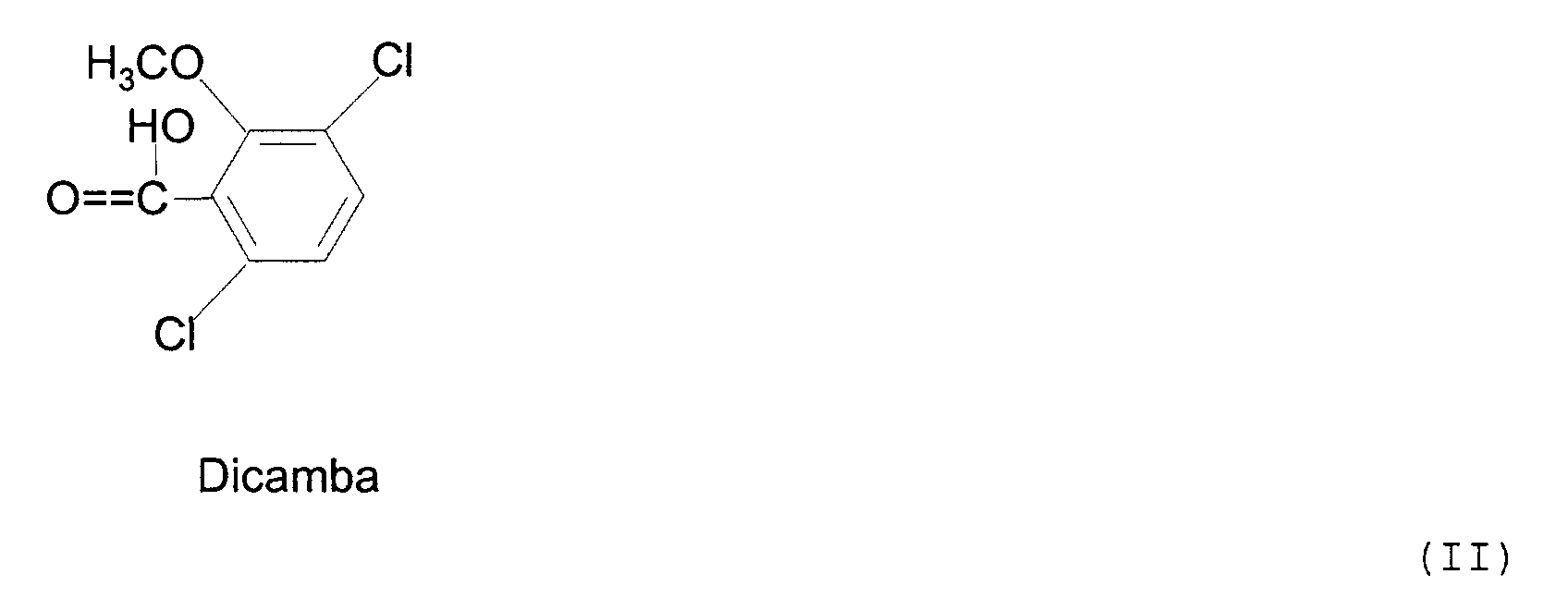
Die Ergebnisse des photokatalytischen Abbaus sind in der Figur 8 graphisch dargestellt.The results of the photocatalytic degradation are in the Figure 8 graphically represented.
Bei den Arzneimitteln werden frappierende Abbauleistungen erreicht: weit über 90 % der Wirkstoffe können bei einstündiger Belichtungszeit mineralisiert werden. Die Experimente unterstreichen die Vorzüge der zeolithhaltigen Schüttung (siehe Figuren 9 und 10).In the case of pharmaceuticals, there are striking degradation benefits achieved: well over 90% of the active ingredients can be at one hour Exposure time can be mineralized. The experiments emphasize the advantages of the zeolite-containing bed (see Figures 9 and 10).
Die hervorragenden adsorbtiven Eigenschaften des DAY-Zeolithen und seine Schadstoffabbau-Leistungen bei Palladium-Imprägnierung lenkten mein ursprüngliches Forschungsvorhaben in eine völlig neue Richtung, die den apparativen Aufwand zur Wasserreinhaltung in ganz erheblichem Maße reduziert. Von dem Fotoreaktor mit energiereicher UV-Bestrahlung blieb nur noch eine Säule in Form einer Bürette mit Zeolith-Füllung übrig, die mit einer äußerst geringen Kontaktzeit von ca. 2 Minuten vom kontaminierten Wasser durchströmt wird. Mit der Modifikation der Apparatur änderte sich auch der Themenschwerpunkt dieser Arbeit von der Abwasserreinigung mit Schadstoffgehalten im ppm-Bereich hin zur Trinkwasser-Qualitätssicherung im ppb-Bereich. Als Reinigungsstufe wird eine 50 ml-Bürette (EB) mit Katalysatorfestbett, beziehungsweise eine Doppelbürette (DB), bestehend aus zwei hintereinander "geschalteten" Büretten, eingesetzt.The excellent adsorbing properties of the DAY zeolite and its pollution reduction performance in palladium impregnation directed my original research project in a completely new direction, that of the apparatus Water purification efforts reduced to a considerable extent. From the photoreactor with high-energy UV radiation there was only one column in the form of a burette with zeolite filling left with an extremely low one Contact time of about 2 minutes from the contaminated water is flowed through. With the modification of the equipment changed also the main focus of this work from the Wastewater treatment with pollutant levels in the ppm range for drinking water quality assurance in the ppb area. As a cleaning level a 50 ml burette (EB) with fixed catalyst bed, or a double burette (DB) consisting of two "connected" burettes.
Das Feststoffvolumen beträgt dabei 30 g bei einfacher, beziehungsweise 60 g bei doppelter Länge. Zunächst wurden 100 ml, später auch 1000 ml, kontaminiertes Wasser euliert. Die Dotierung des DAY-Zeolithen erfolgte durch ca. zweistündiges Stehen in Palladium (II)-chlorid-Lösung, entsprechender Konzentration, mit anschließendem Trocknen und Calcinieren.The solids volume is 30 g with simple, respectively 60 g at twice the length. Initially, 100 ml, later also 1000 ml, contaminated water. The The DAY zeolite was doped by approximately two hours Stand in palladium (II) chloride solution, corresponding Concentration, followed by drying and calcining.
Aus Tabelle 1 ist die bessere Reinigungsleistung der dotierten
Zeolithe gegenüber dem edelmetallfreien Material
ersichtlich (9-16 %). Es stellt sich die Frage, ob durch
die Dotierung die ohnehin erstaunliche Adsorptionsleistung
des unbeladenen DAY-Zeolithen noch verbessert wird, oder ob
neben den Anlagerungseffekten auch noch andere Phänomene
eine Rolle spielen.
Die Ergebnisse zeigen, dass die Palladinierung von DAY-Zeolith mit 0,1 %iger PdCl2-Lösung bei Phenolkontaminiertem Wasser eine Reinigungsleistung von 71 % im CSB-100-Messbereich erbringt, während die reine DAY-Schüttung das Phenol zu 60 % beseitigt. Analoge Befunde ergeben sich im CSB-60-Test für Phenol.The results show that palladination of DAY zeolite with 0.1% PdCl 2 solution with phenol-contaminated water provides a cleaning performance of 71% in the COD-100 measuring range, while the pure DAY bed removes 60% of the phenol. Analogous results are found in the COD-60 test for phenol.
Aus Figur 11 geht hervor, dass die Erhöhung der Beladung des Zeolithen mit Palladium nicht zwangsläufig zu einer Steigerung der Schadstoffeliminierung führt. Die besten Ergebnisse liefert die Imprägnierung mit 0,1-0,2 %iger Edelmetall-Lösung. Diese Erkenntnis deckt sich mit den Befunden der Patentschrift (B. Unger, R. Thome, G. Öhlmann, H-G. Jerschklewitz, Europäische Patentanmeldung vom 21.12.92, EP 054509 A1) "Bei einer höheren Pd-Beladung als 0,15 % werden die Diffusionsvorgänge von Edukten und Reaktionsprodukten im Porensystem durch Ausbildung von Pd-Clustern, was zu einer teilweisen oder vollständigen Blockierung des Porensystems führt, gehindert. Nur bei einer hohen Dispersität der Aktivkomponente ist die Zugänglichkeit und damit die Katalysatoraktivität gewährleistet". From Figure 11 it can be seen that the increase in loading of the zeolite with palladium does not necessarily become one Leads to an increase in pollutant elimination. The best results provides the impregnation with 0.1-0.2% precious metal solution. This finding coincides with the findings the patent specification (B. Unger, R. Thome, G. Öhlmann, H-G. Jerschklewitz, European patent application dated December 21, 1992, EP 054509 A1) "If the Pd load is higher than 0.15% the diffusion processes of starting materials and reaction products in the pore system through the formation of Pd clusters, resulting in a partial or complete blockage of the pore system leads, hindered. Only if the dispersity is high The active component is the accessibility and thus the catalyst activity guaranteed ".
Ausgehend von dieser Versuchsreihe wird vermutet, dass die Palladium-Dotierung zur Entfaltung abbaukatalytischer Aktivitäten führt. Offenbar kommt es neben der reinen adsorptiven Schadstoffbeseitigung zusätzlich zu einer oxidativen Zerstörung des organischen Kontaminats.Based on this series of experiments, it is assumed that the Palladium doping for the development of catalytic degradation activities leads. Apparently it comes alongside the pure adsorptive Pollutant removal in addition to an oxidative Destruction of the organic contaminant.
Weitere Versuche zeigen, das es neben einer adsorbtiven Schadstoffbeseitigung zusätzlich zu einem oxidativen Abbau der organischen Komponenten kommt. So ergibt Methanol mit Palladium beladenem DAY-Zeolithen bei Raumtemperatur eine positive Schiffsche-Probe. Auch das Durchleiten von Methanol- und Ameisensäure-Dämpfen durch ein mit dotiertem DAY beschichtetes U-Rohr liefert eine feine Trübung im Barytwasser. In den Lehrbüchern für Organische Chemie finden sich Hinweise, dass die Dehydrierung von Alkoholen zu Aldehyden sowie die Oxidation von Aldehyden zu Carbonsäuren durch Edelmetalle, wie zum Beispiel Silber, katalysiert wird. Auch die Decarboxylierung von Ameisensäure am Palladium-Kontakt ist bekannt. Es ist jedoch überraschend, dass bei so kurzen Kontaktzeiten und noch dazu bei Raumtemperatur offenbar sauerstoffhaltige organische Stoffe zerstört werden können (siehe Figur 12).Further experiments show that there is an adsorbent Pollutant removal in addition to oxidative degradation of the organic components comes. So methanol also gives Palladium-loaded DAY zeolite at room temperature positive Schiff test. Passing methanol and formic acid steaming by means of a DAY doped coated U-tube provides a fine turbidity in the barite water. Find in the textbooks for organic chemistry there are indications that the dehydration of alcohols to aldehydes and the oxidation of aldehydes to carboxylic acids catalyzed by precious metals such as silver becomes. Also the decarboxylation of formic acid at the palladium contact is known. However, it is surprising that with such short contact times and at room temperature apparently oxygenated organic substances destroyed can be (see Figure 12).
Auch die Ergebnisse der Temperaturreihe weisen in diese
Richtung.
Der undotierte DAY hat bei ca. 20 °C ein Optimum und vermindert
seine Reinigungsleistung bei 70 °C um mehr als 20
%. Bei Palladinierung sinkt die Abbauleistung mit der Temperaturerhöhung
von 94,4 % (20 °C) über 88 % (50 °C) auf
ca. 76 % (70 °C). Ein eindeutiger Trend ergibt sich beim
Abbau des Chlorherbizids. Es kann spekuliert werden, dass
auch der undotierte DAY-Zeolith in geringem Maße katalytisch
aktiv wird.The results of the temperature series also point in this direction.
The undoped DAY has an optimum at approx. 20 ° C and reduces its cleaning performance at 70 ° C by more than 20%. In the case of palladium plating, the degradation performance drops with the temperature increase from 94.4% (20 ° C) to 88% (50 ° C) to approx. 76% (70 ° C). There is a clear trend in the degradation of chlorine herbicide. It can be speculated that the undoped DAY zeolite is also slightly catalytically active.
In einer weiteren Versuchsreihe wird die Phenol-Belastung des Festbettes sukzessive erhöht, indem fünfmal je 100 ml Wasser mit einem Phenolgehalt von je 0,025 g/l auf die Säule gegeben wird. Die Reinigungsleistung vermindert sich dabei schrittweise von 94 % im ersten Durchlauf auf 62,5 % im fünften. Bei Zugabe eines Liters in einem Guss beträgt sie noch 55 %. Wird diese Menge phenolhaltigen Wassers aufgefangen und immer wieder durch die Säule geschickt, so stellt sich im Mittel eine Abbaurate von 43 % ein. Dieser Befund macht deutlich, dass zwar eine starke Reinigungsleistung im ersten Schritt erzielt wird, dass es aber bei den nachfolgenden Reinigungsschritten mit demselben Eluat wieder zu Desorptionen kommt, die die CSB-Werte leicht ansteigen lassen.In another series of tests, the phenol exposure of the fixed bed successively increased by five times each 100 ml Water with a phenol content of 0.025 g / l each on the column is given. The cleaning performance is reduced gradually from 94% in the first run to 62.5% in fifth. When adding a liter in one pour, it is still 55%. This amount of water containing phenol is collected and sent through the column again and again, like this the average breakdown rate is 43%. This Findings make it clear that a strong cleaning performance is achieved in the first step, but that in the subsequent cleaning steps with the same eluate again desorption occurs, which increases the COD values slightly to let.
Die bisher beschriebenen Untersuchungen beziehen sich auf
100 ml Eluat, das einmalig die Säule passiert. Nun galt es
einen Dauerbetrieb zu installieren und die Adsorptionskapazität
zu bestimmen. Dabei ist zu beachten, dass bei einem
CSB-Wert 100 entsprechend 4,2 mg Phenol/100 ml Wasser ca. 3
mg von der Schüttung adsorbiert werden. Auch wenn dies im
diskontinuierlichen Betrieb geschieht, so handelt es sich
doch für die Trinkwasseraufbereitung um unrealistisch hohe
Schadstoffkonzentrationen. Man erhält eine Vorstellung davon,
was eine solche Säule bei geringer Belastung, wie sie
in Rohrwassersystemen vorkommt, im kontinuierlichen Betrieb
leisten kann.The investigations described so far refer to
100 ml of eluate that passes through the column once. Now it was important
to install a continuous operation and the adsorption capacity
to determine. It should be noted that with a
Auf dem Weg zum Dauerbetrieb wurde dieselbe Säule fünfmal mit 100 ml phenolhaltigem Wasser (25 mg/l) belastet. Die Reinigungsleistung zwischen 600 ml und 900 ml wurde durch Extrapolation bestimmt. Bei 10 Reinigungsschritten mit jeweils konstanter Ausgangsbelastung verbleiben immerhin 16,5 mg Schadstoff auf 60 g Säulenfüllung. Daß die Dekontamination mit zunehmender Belastung rückläufig ist, war zu erwarten (siehe Figur 13).The same pillar was used five times on the way to continuous operation loaded with 100 ml phenolic water (25 mg / l). The Cleaning performance between 600 ml and 900 ml was achieved by Extrapolation determined. With 10 cleaning steps each constant output load remains 16.5 mg pollutant per 60 g column filling. That decontamination was expected to decrease with increasing load (see Figure 13).
Chlorpestizide und Arzneimittelrückstände mögen in ihrem Gefährdungspotential für den Wassertrinker wohl noch höher einzuschätzen sein, als die organische Fracht des Wassers, die natürlichen Ursprungs ist.Chlorine pesticides and drug residues like in their Risk potential for the water drinker is probably even higher can be assessed as the organic cargo of water, which is of natural origin.
Die Ergebnisse sind sowohl auf der Grundlage der CSB-Analytik, als auch in Bezug auf GC/MS- und CZE-Untersuchungen beeindruckend, vor allem wenn man den Standard der Trinkwasseraufbereitung, nämlich Aktivkohle damit vergleicht. Die Abbauleistungen des palladinierten DAY-Zeolithen übertrifft die der Aktivkohle bei allen Versuchsreihen. Beim Herbizidabbau ist eine Verbesserung der Reinigungsleistung mit zunehmender Säulentemperatur zu verzeichnen. Dies gilt sowohl für die imprägnierte als auch für die nichtdotierte Zeolith-Schüttung. Solche Befunde stützen wiederum die Annahme von katalytisch aktiven Zentren in beiden Fällen (siehe Figur 14).The results are both based on the COD analysis, as well as in relation to GC / MS and CZE tests impressive, especially considering the standard drinking water treatment, namely activated carbon compares. The degradation performance of the palladium-coated DAY zeolite exceeds that of activated carbon in all test series. Herbicide degradation is an improvement in cleaning performance with increasing column temperature. This applies to both the impregnated and the undoped zeolite fill. Support such findings again the assumption of catalytically active centers in both cases (see Figure 14).
Claims (14)
Priority Applications (2)
| Application Number | Priority Date | Filing Date | Title |
|---|---|---|---|
| EP00105532A EP1134191A1 (en) | 2000-03-15 | 2000-03-15 | Process to eliminate organic substances from water |
| PCT/EP2000/009716 WO2001025155A1 (en) | 1999-10-06 | 2000-10-05 | Method for removing organic substances from water and/or aqueous systems |
Applications Claiming Priority (1)
| Application Number | Priority Date | Filing Date | Title |
|---|---|---|---|
| EP00105532A EP1134191A1 (en) | 2000-03-15 | 2000-03-15 | Process to eliminate organic substances from water |
Publications (1)
| Publication Number | Publication Date |
|---|---|
| EP1134191A1 true EP1134191A1 (en) | 2001-09-19 |
Family
ID=8168113
Family Applications (1)
| Application Number | Title | Priority Date | Filing Date |
|---|---|---|---|
| EP00105532A Withdrawn EP1134191A1 (en) | 1999-10-06 | 2000-03-15 | Process to eliminate organic substances from water |
Country Status (1)
| Country | Link |
|---|---|
| EP (1) | EP1134191A1 (en) |
Cited By (1)
| Publication number | Priority date | Publication date | Assignee | Title |
|---|---|---|---|---|
| CN104324745A (en) * | 2014-10-14 | 2015-02-04 | 沈阳理工大学 | Preparation method of composite molecular sieve material with photocatalysis performance |
Citations (6)
| Publication number | Priority date | Publication date | Assignee | Title |
|---|---|---|---|---|
| SU1043154A1 (en) * | 1981-07-21 | 1983-09-23 | Черновицкий Ордена Трудового Красного Знамени Государственный Университет | Process for producing finely comminuted titanium dioxide |
| US5182030A (en) * | 1991-09-27 | 1993-01-26 | Board Of Control Of Michigan Technological University | Regeneration of adsorbents using advanced oxidation |
| US5234883A (en) * | 1991-03-22 | 1993-08-10 | Degussa Aktiengesellschaft | Catalyst for hardening fatty acids and process for its preparation |
| EP0804877A1 (en) * | 1994-10-05 | 1997-11-05 | Toto Ltd. | Antibacterial solid, process for producing the same, and method of utilizing the same |
| US5981426A (en) * | 1995-03-02 | 1999-11-09 | University Technologies International Inc. | Photocatalyst having an x-ray diffraction pattern which is substanially free of characteristic reflections associated with crystalline TiO2 |
| DE29917615U1 (en) * | 1999-10-06 | 2000-01-20 | Fischer, Ivonne, 63776 Mömbris | Device for cleaning water contaminated with organic pollutants |
-
2000
- 2000-03-15 EP EP00105532A patent/EP1134191A1/en not_active Withdrawn
Patent Citations (6)
| Publication number | Priority date | Publication date | Assignee | Title |
|---|---|---|---|---|
| SU1043154A1 (en) * | 1981-07-21 | 1983-09-23 | Черновицкий Ордена Трудового Красного Знамени Государственный Университет | Process for producing finely comminuted titanium dioxide |
| US5234883A (en) * | 1991-03-22 | 1993-08-10 | Degussa Aktiengesellschaft | Catalyst for hardening fatty acids and process for its preparation |
| US5182030A (en) * | 1991-09-27 | 1993-01-26 | Board Of Control Of Michigan Technological University | Regeneration of adsorbents using advanced oxidation |
| EP0804877A1 (en) * | 1994-10-05 | 1997-11-05 | Toto Ltd. | Antibacterial solid, process for producing the same, and method of utilizing the same |
| US5981426A (en) * | 1995-03-02 | 1999-11-09 | University Technologies International Inc. | Photocatalyst having an x-ray diffraction pattern which is substanially free of characteristic reflections associated with crystalline TiO2 |
| DE29917615U1 (en) * | 1999-10-06 | 2000-01-20 | Fischer, Ivonne, 63776 Mömbris | Device for cleaning water contaminated with organic pollutants |
Non-Patent Citations (1)
| Title |
|---|
| DATABASE WPI Section Ch Week 198423, Derwent World Patents Index; Class E32, AN 1984-145645, XP002144132 * |
Cited By (1)
| Publication number | Priority date | Publication date | Assignee | Title |
|---|---|---|---|---|
| CN104324745A (en) * | 2014-10-14 | 2015-02-04 | 沈阳理工大学 | Preparation method of composite molecular sieve material with photocatalysis performance |
Similar Documents
| Publication | Publication Date | Title |
|---|---|---|
| Ye et al. | Trace analysis of trimethoprim and sulfonamide, macrolide, quinolone, and tetracycline antibiotics in chlorinated drinking water using liquid chromatography electrospray tandem mass spectrometry | |
| Acero et al. | Degradation of neonicotinoids by UV irradiation: Kinetics and effect of real water constituents | |
| Bandala et al. | Solar photocatalytic degradation of Aldrin | |
| Wang et al. | Evaluating the removal of per-and polyfluoroalkyl substances from contaminated groundwater with different adsorbents using a suspect screening approach | |
| Kundu et al. | UV induced degradation of herbicide 2, 4-D: kinetics, mechanism and effect of various conditions on the degradation | |
| Santoke et al. | Free-radical-induced oxidative and reductive degradation of fluoroquinolone pharmaceuticals: kinetic studies and degradation mechanism | |
| Evgenidou et al. | Photodegradation of triazine herbicides in aqueous solutions and natural waters | |
| Ambuludi et al. | Kinetic behavior of anti-inflammatory drug ibuprofen in aqueous medium during its degradation by electrochemical advanced oxidation | |
| Shankar et al. | Novel thin‐film reactor for photocatalytic degradation of pesticides in an aqueous solution | |
| Meftaul et al. | Movement and fate of 2, 4-D in urban soils: A potential environmental health concern | |
| Pereira et al. | Integration of nanofiltration, UV photolysis, and advanced oxidation processes for the removal of hormones from surface water sources | |
| Prieto-Rodríguez et al. | Solar photo-Fenton optimization for the treatment of MWTP effluents containing emerging contaminants | |
| Ormad et al. | Photocatalytic degradation of concentrated solutions of 2, 4-dichlorophenol using low energy light: identification of intermediates | |
| Ito et al. | Adsorptive removal and photocatalytic decomposition of sulfamethazine in secondary effluent using TiO2–zeolite composites | |
| Garrido et al. | Solar reclamation of agro-wastewater polluted with eight pesticides by heterogeneous photocatalysis using a modular facility. A case study | |
| DE19530086A1 (en) | Treatment of surface or waste water | |
| DE3108991A1 (en) | METHOD FOR SEPARATING AND COLLECTING IODINE | |
| Zúñiga-Benítez et al. | Methylparaben removal using heterogeneous photocatalysis: effect of operational parameters and mineralization/biodegradability studies | |
| Bui et al. | Visible-light activation of a dissolved organic matter–TiO2 complex mediated via ligand-to-metal charge transfer | |
| Sun et al. | Fate of naturally dissolved organic matter and synthetic organic compounds subjected to drinking water treatment using membrane, activated carbon, and UV/H2O2 technologies | |
| Guelfi et al. | Antituberculosis drug isoniazid degraded by electro-Fenton and photoelectro-Fenton processes using a boron-doped diamond anode and a carbon-PTFE air-diffusion cathode | |
| DE60104605T2 (en) | Photolytic process for the purification of contaminated water | |
| Baranda et al. | Static and continuous flow-through pulsed light technology for pesticide abatement in water | |
| Cocozza et al. | Use of constructed wetlands to prevent overloading of wastewater treatment plants | |
| Komorowska-Kaufman et al. | Application of oxidation processes in wastewater quaternary treatment for organic compounds, antibiotics and nonsteroidal anti-inflammatory drugs removal and disinfection |
Legal Events
| Date | Code | Title | Description |
|---|---|---|---|
| PUAI | Public reference made under article 153(3) epc to a published international application that has entered the european phase |
Free format text: ORIGINAL CODE: 0009012 |
|
| AK | Designated contracting states |
Kind code of ref document: A1 Designated state(s): AT BE CH CY DE DK ES FI FR GB GR IE IT LI LU MC NL PT SE |
|
| AX | Request for extension of the european patent |
Free format text: AL;LT;LV;MK;RO;SI |
|
| AKX | Designation fees paid |
Free format text: AT BE CH CY DE DK ES FI FR GB GR IE IT LI LU MC NL PT SE |
|
| STAA | Information on the status of an ep patent application or granted ep patent |
Free format text: STATUS: THE APPLICATION IS DEEMED TO BE WITHDRAWN |
|
| 18D | Application deemed to be withdrawn |
Effective date: 20020723 |