EP1132393B1 - L-Ribavirin and uses thereof - Google Patents
L-Ribavirin and uses thereof Download PDFInfo
- Publication number
- EP1132393B1 EP1132393B1 EP01108303A EP01108303A EP1132393B1 EP 1132393 B1 EP1132393 B1 EP 1132393B1 EP 01108303 A EP01108303 A EP 01108303A EP 01108303 A EP01108303 A EP 01108303A EP 1132393 B1 EP1132393 B1 EP 1132393B1
- Authority
- EP
- European Patent Office
- Prior art keywords
- ribavirin
- nucleosides
- nucleoside
- compound
- cells
- Prior art date
- Legal status (The legal status is an assumption and is not a legal conclusion. Google has not performed a legal analysis and makes no representation as to the accuracy of the status listed.)
- Expired - Lifetime
Links
- IWUCXVSUMQZMFG-RGDLXGNYSA-N 1-[(2s,3s,4r,5s)-3,4-dihydroxy-5-(hydroxymethyl)oxolan-2-yl]-1,2,4-triazole-3-carboxamide Chemical compound N1=C(C(=O)N)N=CN1[C@@H]1[C@@H](O)[C@@H](O)[C@H](CO)O1 IWUCXVSUMQZMFG-RGDLXGNYSA-N 0.000 title claims description 53
- 239000002777 nucleoside Substances 0.000 claims description 56
- 150000001875 compounds Chemical class 0.000 claims description 18
- 239000000203 mixture Substances 0.000 claims description 17
- 230000000694 effects Effects 0.000 claims description 15
- 206010028980 Neoplasm Diseases 0.000 claims description 9
- 208000015181 infectious disease Diseases 0.000 claims description 8
- 239000008194 pharmaceutical composition Substances 0.000 claims description 8
- 150000003839 salts Chemical class 0.000 claims description 7
- 206010061217 Infestation Diseases 0.000 claims description 6
- 239000003937 drug carrier Substances 0.000 claims description 5
- 208000023275 Autoimmune disease Diseases 0.000 claims description 3
- 230000002757 inflammatory effect Effects 0.000 claims description 3
- 150000002148 esters Chemical class 0.000 claims description 2
- 208000035269 cancer or benign tumor Diseases 0.000 claims 1
- 238000004519 manufacturing process Methods 0.000 claims 1
- 238000000034 method Methods 0.000 description 18
- 210000004027 cell Anatomy 0.000 description 17
- 235000000346 sugar Nutrition 0.000 description 17
- 238000003786 synthesis reaction Methods 0.000 description 15
- XLYOFNOQVPJJNP-UHFFFAOYSA-N water Substances O XLYOFNOQVPJJNP-UHFFFAOYSA-N 0.000 description 14
- OLQDKJGHMNCLOH-MNXVOIDGSA-N methyl 1-[(2s,3s,4s,5s)-3,4-diacetyloxy-5-(acetyloxymethyl)oxolan-2-yl]-1,2,4-triazole-3-carboxylate Chemical compound N1=C(C(=O)OC)N=CN1[C@@H]1[C@@H](OC(C)=O)[C@@H](OC(C)=O)[C@H](COC(C)=O)O1 OLQDKJGHMNCLOH-MNXVOIDGSA-N 0.000 description 13
- NYHBQMYGNKIUIF-UUOKFMHZSA-N Guanosine Chemical class C1=NC=2C(=O)NC(N)=NC=2N1[C@@H]1O[C@H](CO)[C@@H](O)[C@H]1O NYHBQMYGNKIUIF-UUOKFMHZSA-N 0.000 description 11
- 210000001744 T-lymphocyte Anatomy 0.000 description 11
- 230000015572 biosynthetic process Effects 0.000 description 11
- 125000003835 nucleoside group Chemical group 0.000 description 11
- 229960000329 ribavirin Drugs 0.000 description 11
- OKKJLVBELUTLKV-UHFFFAOYSA-N Methanol Chemical compound OC OKKJLVBELUTLKV-UHFFFAOYSA-N 0.000 description 10
- 239000003795 chemical substances by application Substances 0.000 description 10
- 108010002350 Interleukin-2 Proteins 0.000 description 9
- 102000000588 Interleukin-2 Human genes 0.000 description 9
- PYMYPHUHKUWMLA-LMVFSUKVSA-N aldehydo-D-ribose Chemical compound OC[C@@H](O)[C@@H](O)[C@@H](O)C=O PYMYPHUHKUWMLA-LMVFSUKVSA-N 0.000 description 9
- -1 8-bromo- Chemical class 0.000 description 8
- XEKOWRVHYACXOJ-UHFFFAOYSA-N Ethyl acetate Chemical compound CCOC(C)=O XEKOWRVHYACXOJ-UHFFFAOYSA-N 0.000 description 8
- IWUCXVSUMQZMFG-AFCXAGJDSA-N Ribavirin Chemical compound N1=C(C(=O)N)N=CN1[C@H]1[C@H](O)[C@H](O)[C@@H](CO)O1 IWUCXVSUMQZMFG-AFCXAGJDSA-N 0.000 description 8
- 210000000987 immune system Anatomy 0.000 description 8
- 125000003729 nucleotide group Chemical group 0.000 description 8
- HZCAHMRRMINHDJ-DBRKOABJSA-N ribavirin Natural products O[C@@H]1[C@H](O)[C@@H](CO)O[C@H]1N1N=CN=C1 HZCAHMRRMINHDJ-DBRKOABJSA-N 0.000 description 8
- 108060008682 Tumor Necrosis Factor Proteins 0.000 description 7
- HMFHBZSHGGEWLO-UHFFFAOYSA-N alpha-D-Furanose-Ribose Natural products OCC1OC(O)C(O)C1O HMFHBZSHGGEWLO-UHFFFAOYSA-N 0.000 description 7
- 230000000840 anti-viral effect Effects 0.000 description 7
- 125000000623 heterocyclic group Chemical group 0.000 description 7
- 150000003833 nucleoside derivatives Chemical class 0.000 description 7
- 239000002773 nucleotide Substances 0.000 description 7
- 238000002360 preparation method Methods 0.000 description 7
- KDCGOANMDULRCW-UHFFFAOYSA-N 7H-purine Chemical compound N1=CNC2=NC=NC2=C1 KDCGOANMDULRCW-UHFFFAOYSA-N 0.000 description 6
- IJGRMHOSHXDMSA-UHFFFAOYSA-N Atomic nitrogen Chemical compound N#N IJGRMHOSHXDMSA-UHFFFAOYSA-N 0.000 description 6
- LFQSCWFLJHTTHZ-UHFFFAOYSA-N Ethanol Chemical compound CCO LFQSCWFLJHTTHZ-UHFFFAOYSA-N 0.000 description 6
- 108010074328 Interferon-gamma Proteins 0.000 description 6
- JUJWROOIHBZHMG-UHFFFAOYSA-N Pyridine Chemical compound C1=CC=NC=C1 JUJWROOIHBZHMG-UHFFFAOYSA-N 0.000 description 6
- UIIMBOGNXHQVGW-UHFFFAOYSA-M Sodium bicarbonate Chemical compound [Na+].OC([O-])=O UIIMBOGNXHQVGW-UHFFFAOYSA-M 0.000 description 6
- 238000009472 formulation Methods 0.000 description 6
- 229910052760 oxygen Inorganic materials 0.000 description 6
- 230000001629 suppression Effects 0.000 description 6
- NYHBQMYGNKIUIF-UHFFFAOYSA-N D-guanosine Natural products C1=2NC(N)=NC(=O)C=2N=CN1C1OC(CO)C(O)C1O NYHBQMYGNKIUIF-UHFFFAOYSA-N 0.000 description 5
- 102000004388 Interleukin-4 Human genes 0.000 description 5
- 108090000978 Interleukin-4 Proteins 0.000 description 5
- IQFYYKKMVGJFEH-XLPZGREQSA-N Thymidine Chemical compound O=C1NC(=O)C(C)=CN1[C@@H]1O[C@H](CO)[C@@H](O)C1 IQFYYKKMVGJFEH-XLPZGREQSA-N 0.000 description 5
- 102000000852 Tumor Necrosis Factor-alpha Human genes 0.000 description 5
- 241000700605 Viruses Species 0.000 description 5
- 229910052799 carbon Inorganic materials 0.000 description 5
- 239000000969 carrier Substances 0.000 description 5
- 201000010099 disease Diseases 0.000 description 5
- 208000037265 diseases, disorders, signs and symptoms Diseases 0.000 description 5
- 238000002474 experimental method Methods 0.000 description 5
- 125000002887 hydroxy group Chemical group [H]O* 0.000 description 5
- 238000001727 in vivo Methods 0.000 description 5
- 229910052757 nitrogen Inorganic materials 0.000 description 5
- 230000004044 response Effects 0.000 description 5
- 239000000243 solution Substances 0.000 description 5
- 230000000638 stimulation Effects 0.000 description 5
- OKTJSMMVPCPJKN-UHFFFAOYSA-N Carbon Chemical compound [C] OKTJSMMVPCPJKN-UHFFFAOYSA-N 0.000 description 4
- HEDRZPFGACZZDS-UHFFFAOYSA-N Chloroform Chemical compound ClC(Cl)Cl HEDRZPFGACZZDS-UHFFFAOYSA-N 0.000 description 4
- 102000004127 Cytokines Human genes 0.000 description 4
- 108090000695 Cytokines Proteins 0.000 description 4
- YMWUJEATGCHHMB-UHFFFAOYSA-N Dichloromethane Chemical compound ClCCl YMWUJEATGCHHMB-UHFFFAOYSA-N 0.000 description 4
- 102000008072 Lymphokines Human genes 0.000 description 4
- 108010074338 Lymphokines Proteins 0.000 description 4
- DRTQHJPVMGBUCF-XVFCMESISA-N Uridine Chemical compound O[C@@H]1[C@H](O)[C@@H](CO)O[C@H]1N1C(=O)NC(=O)C=C1 DRTQHJPVMGBUCF-XVFCMESISA-N 0.000 description 4
- IHNHAHWGVLXCCI-CYDGBPFRSA-N [(2s,3s,4s,5r)-3,4,5-triacetyloxyoxolan-2-yl]methyl acetate Chemical compound CC(=O)OC[C@@H]1O[C@H](OC(C)=O)[C@@H](OC(C)=O)[C@H]1OC(C)=O IHNHAHWGVLXCCI-CYDGBPFRSA-N 0.000 description 4
- 230000004913 activation Effects 0.000 description 4
- OIRDTQYFTABQOQ-KQYNXXCUSA-N adenosine Chemical compound C1=NC=2C(N)=NC=NC=2N1[C@@H]1O[C@H](CO)[C@@H](O)[C@H]1O OIRDTQYFTABQOQ-KQYNXXCUSA-N 0.000 description 4
- PYMYPHUHKUWMLA-UHFFFAOYSA-N arabinose Natural products OCC(O)C(O)C(O)C=O PYMYPHUHKUWMLA-UHFFFAOYSA-N 0.000 description 4
- 201000011510 cancer Diseases 0.000 description 4
- 238000006243 chemical reaction Methods 0.000 description 4
- 125000001309 chloro group Chemical group Cl* 0.000 description 4
- 239000013078 crystal Substances 0.000 description 4
- 125000004093 cyano group Chemical group *C#N 0.000 description 4
- 239000003814 drug Substances 0.000 description 4
- 235000019439 ethyl acetate Nutrition 0.000 description 4
- 230000001965 increasing effect Effects 0.000 description 4
- 229940028885 interleukin-4 Drugs 0.000 description 4
- 239000003921 oil Substances 0.000 description 4
- 239000000047 product Substances 0.000 description 4
- 238000011160 research Methods 0.000 description 4
- 125000000548 ribosyl group Chemical group C1([C@H](O)[C@H](O)[C@H](O1)CO)* 0.000 description 4
- 239000007787 solid Substances 0.000 description 4
- 239000000126 substance Substances 0.000 description 4
- 125000001424 substituent group Chemical class 0.000 description 4
- 238000011282 treatment Methods 0.000 description 4
- WFDIJRYMOXRFFG-UHFFFAOYSA-N Acetic anhydride Chemical compound CC(=O)OC(C)=O WFDIJRYMOXRFFG-UHFFFAOYSA-N 0.000 description 3
- PHEDXBVPIONUQT-UHFFFAOYSA-N Cocarcinogen A1 Natural products CCCCCCCCCCCCCC(=O)OC1C(C)C2(O)C3C=C(C)C(=O)C3(O)CC(CO)=CC2C2C1(OC(C)=O)C2(C)C PHEDXBVPIONUQT-UHFFFAOYSA-N 0.000 description 3
- MIKUYHXYGGJMLM-GIMIYPNGSA-N Crotonoside Natural products C1=NC2=C(N)NC(=O)N=C2N1[C@H]1O[C@@H](CO)[C@H](O)[C@@H]1O MIKUYHXYGGJMLM-GIMIYPNGSA-N 0.000 description 3
- HMFHBZSHGGEWLO-SOOFDHNKSA-N D-ribofuranose Chemical compound OC[C@H]1OC(O)[C@H](O)[C@@H]1O HMFHBZSHGGEWLO-SOOFDHNKSA-N 0.000 description 3
- 241000711549 Hepacivirus C Species 0.000 description 3
- 241000700721 Hepatitis B virus Species 0.000 description 3
- 241000725303 Human immunodeficiency virus Species 0.000 description 3
- 102100037850 Interferon gamma Human genes 0.000 description 3
- 102000008070 Interferon-gamma Human genes 0.000 description 3
- 108010002616 Interleukin-5 Proteins 0.000 description 3
- 102000000743 Interleukin-5 Human genes 0.000 description 3
- 241000124008 Mammalia Species 0.000 description 3
- HEMHJVSKTPXQMS-UHFFFAOYSA-M Sodium hydroxide Chemical compound [OH-].[Na+] HEMHJVSKTPXQMS-UHFFFAOYSA-M 0.000 description 3
- YXFVVABEGXRONW-UHFFFAOYSA-N Toluene Chemical compound CC1=CC=CC=C1 YXFVVABEGXRONW-UHFFFAOYSA-N 0.000 description 3
- 239000004480 active ingredient Substances 0.000 description 3
- 125000000217 alkyl group Chemical group 0.000 description 3
- 230000000259 anti-tumor effect Effects 0.000 description 3
- 239000003443 antiviral agent Substances 0.000 description 3
- 239000012300 argon atmosphere Substances 0.000 description 3
- 239000012267 brine Substances 0.000 description 3
- 125000001246 bromo group Chemical group Br* 0.000 description 3
- 229940029575 guanosine Drugs 0.000 description 3
- 125000005842 heteroatom Chemical group 0.000 description 3
- 230000002519 immonomodulatory effect Effects 0.000 description 3
- 238000001990 intravenous administration Methods 0.000 description 3
- 239000001301 oxygen Substances 0.000 description 3
- 210000003819 peripheral blood mononuclear cell Anatomy 0.000 description 3
- PHEDXBVPIONUQT-RGYGYFBISA-N phorbol 13-acetate 12-myristate Chemical compound C([C@]1(O)C(=O)C(C)=C[C@H]1[C@@]1(O)[C@H](C)[C@H]2OC(=O)CCCCCCCCCCCCC)C(CO)=C[C@H]1[C@H]1[C@]2(OC(C)=O)C1(C)C PHEDXBVPIONUQT-RGYGYFBISA-N 0.000 description 3
- 230000003389 potentiating effect Effects 0.000 description 3
- 239000000651 prodrug Substances 0.000 description 3
- 229940002612 prodrug Drugs 0.000 description 3
- UMJSCPRVCHMLSP-UHFFFAOYSA-N pyridine Natural products COC1=CC=CN=C1 UMJSCPRVCHMLSP-UHFFFAOYSA-N 0.000 description 3
- 239000011541 reaction mixture Substances 0.000 description 3
- 230000002829 reductive effect Effects 0.000 description 3
- 229910000030 sodium bicarbonate Inorganic materials 0.000 description 3
- HPALAKNZSZLMCH-UHFFFAOYSA-M sodium;chloride;hydrate Chemical compound O.[Na+].[Cl-] HPALAKNZSZLMCH-UHFFFAOYSA-M 0.000 description 3
- 150000008163 sugars Chemical class 0.000 description 3
- 229910052717 sulfur Inorganic materials 0.000 description 3
- 239000006228 supernatant Substances 0.000 description 3
- 239000006188 syrup Substances 0.000 description 3
- 235000020357 syrup Nutrition 0.000 description 3
- 229940124597 therapeutic agent Drugs 0.000 description 3
- LOTKRQAVGJMPNV-UHFFFAOYSA-N 1-fluoro-2,4-dinitrobenzene Chemical compound [O-][N+](=O)C1=CC=C(F)C([N+]([O-])=O)=C1 LOTKRQAVGJMPNV-UHFFFAOYSA-N 0.000 description 2
- 238000005160 1H NMR spectroscopy Methods 0.000 description 2
- XEDONBRPTABQFB-UHFFFAOYSA-N 4-[(2-formyl-3-hydroxyphenoxy)methyl]benzoic acid Chemical compound C1=CC(C(=O)O)=CC=C1COC1=CC=CC(O)=C1C=O XEDONBRPTABQFB-UHFFFAOYSA-N 0.000 description 2
- TZYVRXZQAWPIAB-FCLHUMLKSA-N 5-amino-3-[(2r,3r,4s,5r)-3,4-dihydroxy-5-(hydroxymethyl)oxolan-2-yl]-4h-[1,3]thiazolo[4,5-d]pyrimidine-2,7-dione Chemical compound O=C1SC=2C(=O)NC(N)=NC=2N1[C@@H]1O[C@H](CO)[C@@H](O)[C@H]1O TZYVRXZQAWPIAB-FCLHUMLKSA-N 0.000 description 2
- HBAQYPYDRFILMT-UHFFFAOYSA-N 8-[3-(1-cyclopropylpyrazol-4-yl)-1H-pyrazolo[4,3-d]pyrimidin-5-yl]-3-methyl-3,8-diazabicyclo[3.2.1]octan-2-one Chemical class C1(CC1)N1N=CC(=C1)C1=NNC2=C1N=C(N=C2)N1C2C(N(CC1CC2)C)=O HBAQYPYDRFILMT-UHFFFAOYSA-N 0.000 description 2
- QTBSBXVTEAMEQO-UHFFFAOYSA-N Acetic acid Chemical compound CC(O)=O QTBSBXVTEAMEQO-UHFFFAOYSA-N 0.000 description 2
- DWRXFEITVBNRMK-UHFFFAOYSA-N Beta-D-1-Arabinofuranosylthymine Natural products O=C1NC(=O)C(C)=CN1C1C(O)C(O)C(CO)O1 DWRXFEITVBNRMK-UHFFFAOYSA-N 0.000 description 2
- 239000002126 C01EB10 - Adenosine Substances 0.000 description 2
- 238000008157 ELISA kit Methods 0.000 description 2
- 102000004190 Enzymes Human genes 0.000 description 2
- 108090000790 Enzymes Proteins 0.000 description 2
- 201000005569 Gout Diseases 0.000 description 2
- 241000701806 Human papillomavirus Species 0.000 description 2
- 108090001005 Interleukin-6 Proteins 0.000 description 2
- 102000004889 Interleukin-6 Human genes 0.000 description 2
- 102000004890 Interleukin-8 Human genes 0.000 description 2
- 108090001007 Interleukin-8 Proteins 0.000 description 2
- HLFSDGLLUJUHTE-SNVBAGLBSA-N Levamisole Chemical compound C1([C@H]2CN3CCSC3=N2)=CC=CC=C1 HLFSDGLLUJUHTE-SNVBAGLBSA-N 0.000 description 2
- 229910019142 PO4 Inorganic materials 0.000 description 2
- CZPWVGJYEJSRLH-UHFFFAOYSA-N Pyrimidine Chemical compound C1=CN=CN=C1 CZPWVGJYEJSRLH-UHFFFAOYSA-N 0.000 description 2
- 241000725643 Respiratory syncytial virus Species 0.000 description 2
- VYPSYNLAJGMNEJ-UHFFFAOYSA-N Silicium dioxide Chemical compound O=[Si]=O VYPSYNLAJGMNEJ-UHFFFAOYSA-N 0.000 description 2
- FAPWRFPIFSIZLT-UHFFFAOYSA-M Sodium chloride Chemical compound [Na+].[Cl-] FAPWRFPIFSIZLT-UHFFFAOYSA-M 0.000 description 2
- 229910000831 Steel Inorganic materials 0.000 description 2
- QAOWNCQODCNURD-UHFFFAOYSA-N Sulfuric acid Chemical compound OS(O)(=O)=O QAOWNCQODCNURD-UHFFFAOYSA-N 0.000 description 2
- HEDRZPFGACZZDS-MICDWDOJSA-N Trichloro(2H)methane Chemical compound [2H]C(Cl)(Cl)Cl HEDRZPFGACZZDS-MICDWDOJSA-N 0.000 description 2
- 239000013543 active substance Substances 0.000 description 2
- 239000000654 additive Substances 0.000 description 2
- 229960005305 adenosine Drugs 0.000 description 2
- PYMYPHUHKUWMLA-MROZADKFSA-N aldehydo-L-ribose Chemical compound OC[C@H](O)[C@H](O)[C@H](O)C=O PYMYPHUHKUWMLA-MROZADKFSA-N 0.000 description 2
- 238000004458 analytical method Methods 0.000 description 2
- 239000002246 antineoplastic agent Substances 0.000 description 2
- QVGXLLKOCUKJST-UHFFFAOYSA-N atomic oxygen Chemical compound [O] QVGXLLKOCUKJST-UHFFFAOYSA-N 0.000 description 2
- SRBFZHDQGSBBOR-UHFFFAOYSA-N beta-D-Pyranose-Lyxose Natural products OC1COC(O)C(O)C1O SRBFZHDQGSBBOR-UHFFFAOYSA-N 0.000 description 2
- IQFYYKKMVGJFEH-UHFFFAOYSA-N beta-L-thymidine Natural products O=C1NC(=O)C(C)=CN1C1OC(CO)C(O)C1 IQFYYKKMVGJFEH-UHFFFAOYSA-N 0.000 description 2
- DRTQHJPVMGBUCF-PSQAKQOGSA-N beta-L-uridine Natural products O[C@H]1[C@@H](O)[C@H](CO)O[C@@H]1N1C(=O)NC(=O)C=C1 DRTQHJPVMGBUCF-PSQAKQOGSA-N 0.000 description 2
- 238000004166 bioassay Methods 0.000 description 2
- 230000004071 biological effect Effects 0.000 description 2
- MHSVUSZEHNVFKW-UHFFFAOYSA-N bis-4-nitrophenyl phosphate Chemical compound C=1C=C([N+]([O-])=O)C=CC=1OP(=O)(O)OC1=CC=C([N+]([O-])=O)C=C1 MHSVUSZEHNVFKW-UHFFFAOYSA-N 0.000 description 2
- 210000004369 blood Anatomy 0.000 description 2
- 239000008280 blood Substances 0.000 description 2
- 230000037396 body weight Effects 0.000 description 2
- 239000002775 capsule Substances 0.000 description 2
- GBBJCSTXCAQSSJ-XQXXSGGOSA-N clevudine Chemical compound O=C1NC(=O)C(C)=CN1[C@@H]1[C@H](F)[C@@H](O)[C@H](CO)O1 GBBJCSTXCAQSSJ-XQXXSGGOSA-N 0.000 description 2
- 238000002648 combination therapy Methods 0.000 description 2
- 238000002425 crystallisation Methods 0.000 description 2
- 230000008025 crystallization Effects 0.000 description 2
- OPTASPLRGRRNAP-UHFFFAOYSA-N cytosine Chemical compound NC=1C=CNC(=O)N=1 OPTASPLRGRRNAP-UHFFFAOYSA-N 0.000 description 2
- 230000001419 dependent effect Effects 0.000 description 2
- 238000010511 deprotection reaction Methods 0.000 description 2
- 239000002552 dosage form Substances 0.000 description 2
- 239000000706 filtrate Substances 0.000 description 2
- 125000000524 functional group Chemical group 0.000 description 2
- 230000036737 immune function Effects 0.000 description 2
- 239000002955 immunomodulating agent Substances 0.000 description 2
- 229960001438 immunostimulant agent Drugs 0.000 description 2
- 239000003022 immunostimulating agent Substances 0.000 description 2
- 230000003308 immunostimulating effect Effects 0.000 description 2
- 238000000338 in vitro Methods 0.000 description 2
- 230000002401 inhibitory effect Effects 0.000 description 2
- 229960003130 interferon gamma Drugs 0.000 description 2
- 229940096397 interleukin-8 Drugs 0.000 description 2
- XKTZWUACRZHVAN-VADRZIEHSA-N interleukin-8 Chemical compound C([C@H](NC(=O)[C@H](CC(O)=O)NC(=O)[C@H](CC=1C2=CC=CC=C2NC=1)NC(=O)[C@@H](NC(C)=O)CCSC)C(=O)N[C@@H](CC(O)=O)C(=O)N[C@@H](CC(O)=O)C(=O)N[C@@H](CC(C)C)C(=O)N[C@@H](CC(N)=O)C(=O)N[C@@H](CC=1C=CC=CC=1)C(=O)N[C@@H]([C@@H](C)O)C(=O)NCC(=O)N[C@@H](CCSC)C(=O)N1[C@H](CCC1)C(=O)N1[C@H](CCC1)C(=O)N[C@@H](C)C(=O)N[C@H](CC(O)=O)C(=O)N[C@H](CCC(O)=O)C(=O)N[C@H](CC(O)=O)C(=O)N[C@H](CC=1C=CC(O)=CC=1)C(=O)N[C@H](CO)C(=O)N1[C@H](CCC1)C(N)=O)C1=CC=CC=C1 XKTZWUACRZHVAN-VADRZIEHSA-N 0.000 description 2
- PGHMRUGBZOYCAA-ADZNBVRBSA-N ionomycin Chemical compound O1[C@H](C[C@H](O)[C@H](C)[C@H](O)[C@H](C)/C=C/C[C@@H](C)C[C@@H](C)C(/O)=C/C(=O)[C@@H](C)C[C@@H](C)C[C@@H](CCC(O)=O)C)CC[C@@]1(C)[C@@H]1O[C@](C)([C@@H](C)O)CC1 PGHMRUGBZOYCAA-ADZNBVRBSA-N 0.000 description 2
- PGHMRUGBZOYCAA-UHFFFAOYSA-N ionomycin Natural products O1C(CC(O)C(C)C(O)C(C)C=CCC(C)CC(C)C(O)=CC(=O)C(C)CC(C)CC(CCC(O)=O)C)CCC1(C)C1OC(C)(C(C)O)CC1 PGHMRUGBZOYCAA-UHFFFAOYSA-N 0.000 description 2
- 229960001614 levamisole Drugs 0.000 description 2
- 230000000670 limiting effect Effects 0.000 description 2
- 239000007788 liquid Substances 0.000 description 2
- 230000004048 modification Effects 0.000 description 2
- 238000012986 modification Methods 0.000 description 2
- 125000002950 monocyclic group Chemical group 0.000 description 2
- 150000007523 nucleic acids Chemical class 0.000 description 2
- 102000039446 nucleic acids Human genes 0.000 description 2
- 108020004707 nucleic acids Proteins 0.000 description 2
- 125000004043 oxo group Chemical group O=* 0.000 description 2
- 150000002972 pentoses Chemical class 0.000 description 2
- 235000021317 phosphate Nutrition 0.000 description 2
- 229910052698 phosphorus Inorganic materials 0.000 description 2
- 239000002243 precursor Substances 0.000 description 2
- 239000002212 purine nucleoside Substances 0.000 description 2
- 239000002718 pyrimidine nucleoside Substances 0.000 description 2
- 229920006395 saturated elastomer Polymers 0.000 description 2
- 229910052711 selenium Inorganic materials 0.000 description 2
- 239000000741 silica gel Substances 0.000 description 2
- 229910002027 silica gel Inorganic materials 0.000 description 2
- 239000010959 steel Substances 0.000 description 2
- 239000008223 sterile water Substances 0.000 description 2
- 238000003756 stirring Methods 0.000 description 2
- UCSJYZPVAKXKNQ-HZYVHMACSA-N streptomycin Chemical compound CN[C@H]1[C@H](O)[C@@H](O)[C@H](CO)O[C@H]1O[C@@H]1[C@](C=O)(O)[C@H](C)O[C@H]1O[C@@H]1[C@@H](NC(N)=N)[C@H](O)[C@@H](NC(N)=N)[C@H](O)[C@H]1O UCSJYZPVAKXKNQ-HZYVHMACSA-N 0.000 description 2
- 238000006467 substitution reaction Methods 0.000 description 2
- 239000000829 suppository Substances 0.000 description 2
- 239000000725 suspension Substances 0.000 description 2
- 239000003826 tablet Substances 0.000 description 2
- 238000012360 testing method Methods 0.000 description 2
- 230000001225 therapeutic effect Effects 0.000 description 2
- 229940104230 thymidine Drugs 0.000 description 2
- RWQNBRDOKXIBIV-UHFFFAOYSA-N thymine Chemical compound CC1=CNC(=O)NC1=O RWQNBRDOKXIBIV-UHFFFAOYSA-N 0.000 description 2
- 150000003852 triazoles Chemical class 0.000 description 2
- 229950009795 tucaresol Drugs 0.000 description 2
- 102000003390 tumor necrosis factor Human genes 0.000 description 2
- DRTQHJPVMGBUCF-UHFFFAOYSA-N uracil arabinoside Natural products OC1C(O)C(CO)OC1N1C(=O)NC(=O)C=C1 DRTQHJPVMGBUCF-UHFFFAOYSA-N 0.000 description 2
- 229940045145 uridine Drugs 0.000 description 2
- 239000003981 vehicle Substances 0.000 description 2
- DGVVWUTYPXICAM-UHFFFAOYSA-N β‐Mercaptoethanol Chemical compound OCCS DGVVWUTYPXICAM-UHFFFAOYSA-N 0.000 description 2
- OIRDTQYFTABQOQ-DEGSGYPDSA-N (2S,3S,4R,5S)-2-(6-aminopurin-9-yl)-5-(hydroxymethyl)oxolane-3,4-diol Chemical compound [C@H]1([C@@H](O)[C@@H](O)[C@@H](O1)CO)N1C2=NC=NC(=C2N=C1)N OIRDTQYFTABQOQ-DEGSGYPDSA-N 0.000 description 1
- DBZQFUNLCALWDY-PNHWDRBUSA-N (2r,3r,4s,5r)-2-(4-aminoimidazo[4,5-c]pyridin-1-yl)-5-(hydroxymethyl)oxolane-3,4-diol Chemical compound C1=NC=2C(N)=NC=CC=2N1[C@@H]1O[C@H](CO)[C@@H](O)[C@H]1O DBZQFUNLCALWDY-PNHWDRBUSA-N 0.000 description 1
- IHNHAHWGVLXCCI-UHFFFAOYSA-N (3,4,5-triacetyloxyoxolan-2-yl)methyl acetate Chemical compound CC(=O)OCC1OC(OC(C)=O)C(OC(C)=O)C1OC(C)=O IHNHAHWGVLXCCI-UHFFFAOYSA-N 0.000 description 1
- UHDGCWIWMRVCDJ-UHFFFAOYSA-N 1-beta-D-Xylofuranosyl-NH-Cytosine Natural products O=C1N=C(N)C=CN1C1C(O)C(O)C(CO)O1 UHDGCWIWMRVCDJ-UHFFFAOYSA-N 0.000 description 1
- MXHRCPNRJAMMIM-SHYZEUOFSA-N 2'-deoxyuridine Chemical class C1[C@H](O)[C@@H](CO)O[C@H]1N1C(=O)NC(=O)C=C1 MXHRCPNRJAMMIM-SHYZEUOFSA-N 0.000 description 1
- JKMHFZQWWAIEOD-UHFFFAOYSA-N 2-[4-(2-hydroxyethyl)piperazin-1-yl]ethanesulfonic acid Chemical compound OCC[NH+]1CCN(CCS([O-])(=O)=O)CC1 JKMHFZQWWAIEOD-UHFFFAOYSA-N 0.000 description 1
- HPKQEMIXSLRGJU-UUOKFMHZSA-N 2-amino-9-[(2r,3r,4s,5r)-3,4-dihydroxy-5-(hydroxymethyl)oxolan-2-yl]-7-methyl-3h-purine-6,8-dione Chemical compound O=C1N(C)C(C(NC(N)=N2)=O)=C2N1[C@@H]1O[C@H](CO)[C@@H](O)[C@H]1O HPKQEMIXSLRGJU-UUOKFMHZSA-N 0.000 description 1
- YLDCUKJMEKGGFI-QCSRICIXSA-N 4-acetamidobenzoic acid;9-[(2r,3r,4s,5r)-3,4-dihydroxy-5-(hydroxymethyl)oxolan-2-yl]-3h-purin-6-one;1-(dimethylamino)propan-2-ol Chemical compound CC(O)CN(C)C.CC(O)CN(C)C.CC(O)CN(C)C.CC(=O)NC1=CC=C(C(O)=O)C=C1.CC(=O)NC1=CC=C(C(O)=O)C=C1.CC(=O)NC1=CC=C(C(O)=O)C=C1.O[C@@H]1[C@H](O)[C@@H](CO)O[C@H]1N1C(NC=NC2=O)=C2N=C1 YLDCUKJMEKGGFI-QCSRICIXSA-N 0.000 description 1
- QBEIABZPRBJOFU-VDTYLAMSSA-N 4-amino-5-fluoro-1-[(2s,5r)-5-(hydroxymethyl)oxolan-2-yl]pyrimidin-2-one Chemical compound C1=C(F)C(N)=NC(=O)N1[C@H]1O[C@@H](CO)CC1 QBEIABZPRBJOFU-VDTYLAMSSA-N 0.000 description 1
- GUBGYTABKSRVRQ-XLOQQCSPSA-N Alpha-Lactose Chemical compound O[C@@H]1[C@@H](O)[C@@H](O)[C@@H](CO)O[C@H]1O[C@@H]1[C@@H](CO)O[C@H](O)[C@H](O)[C@H]1O GUBGYTABKSRVRQ-XLOQQCSPSA-N 0.000 description 1
- BVKZGUZCCUSVTD-UHFFFAOYSA-M Bicarbonate Chemical class OC([O-])=O BVKZGUZCCUSVTD-UHFFFAOYSA-M 0.000 description 1
- UHDGCWIWMRVCDJ-PSQAKQOGSA-N Cytidine Natural products O=C1N=C(N)C=CN1[C@@H]1[C@@H](O)[C@@H](O)[C@H](CO)O1 UHDGCWIWMRVCDJ-PSQAKQOGSA-N 0.000 description 1
- FBPFZTCFMRRESA-KVTDHHQDSA-N D-Mannitol Chemical compound OC[C@@H](O)[C@@H](O)[C@H](O)[C@H](O)CO FBPFZTCFMRRESA-KVTDHHQDSA-N 0.000 description 1
- MYMOFIZGZYHOMD-UHFFFAOYSA-N Dioxygen Chemical compound O=O MYMOFIZGZYHOMD-UHFFFAOYSA-N 0.000 description 1
- 238000002965 ELISA Methods 0.000 description 1
- 239000004150 EU approved colour Substances 0.000 description 1
- 241000196324 Embryophyta Species 0.000 description 1
- 241000233866 Fungi Species 0.000 description 1
- WQZGKKKJIJFFOK-GASJEMHNSA-N Glucose Natural products OC[C@H]1OC(O)[C@H](O)[C@@H](O)[C@@H]1O WQZGKKKJIJFFOK-GASJEMHNSA-N 0.000 description 1
- 206010018634 Gouty Arthritis Diseases 0.000 description 1
- 239000007995 HEPES buffer Substances 0.000 description 1
- 108010078851 HIV Reverse Transcriptase Proteins 0.000 description 1
- 206010061192 Haemorrhagic fever Diseases 0.000 description 1
- 108010034145 Helminth Proteins Proteins 0.000 description 1
- 208000001688 Herpes Genitalis Diseases 0.000 description 1
- 208000009889 Herpes Simplex Diseases 0.000 description 1
- 208000000903 Herpes simplex encephalitis Diseases 0.000 description 1
- 208000007514 Herpes zoster Diseases 0.000 description 1
- 206010020751 Hypersensitivity Diseases 0.000 description 1
- XQFRJNBWHJMXHO-RRKCRQDMSA-N IDUR Chemical compound C1[C@H](O)[C@@H](CO)O[C@H]1N1C(=O)NC(=O)C(I)=C1 XQFRJNBWHJMXHO-RRKCRQDMSA-N 0.000 description 1
- 206010061598 Immunodeficiency Diseases 0.000 description 1
- 208000029462 Immunodeficiency disease Diseases 0.000 description 1
- 241000712431 Influenza A virus Species 0.000 description 1
- 102000006992 Interferon-alpha Human genes 0.000 description 1
- 108010047761 Interferon-alpha Proteins 0.000 description 1
- 108010050904 Interferons Proteins 0.000 description 1
- 102000014150 Interferons Human genes 0.000 description 1
- 108010002352 Interleukin-1 Proteins 0.000 description 1
- 102000003814 Interleukin-10 Human genes 0.000 description 1
- 108090000174 Interleukin-10 Proteins 0.000 description 1
- 102000003816 Interleukin-13 Human genes 0.000 description 1
- 108090000176 Interleukin-13 Proteins 0.000 description 1
- 108010002335 Interleukin-9 Proteins 0.000 description 1
- 102000000585 Interleukin-9 Human genes 0.000 description 1
- 102000015696 Interleukins Human genes 0.000 description 1
- 108010063738 Interleukins Proteins 0.000 description 1
- ZDXPYRJPNDTMRX-VKHMYHEASA-N L-glutamine Chemical compound OC(=O)[C@@H](N)CCC(N)=O ZDXPYRJPNDTMRX-VKHMYHEASA-N 0.000 description 1
- 229930182816 L-glutamine Natural products 0.000 description 1
- 125000003376 L-ribosyl group Chemical group C1([C@@H](O)[C@@H](O)[C@@H](O1)CO)* 0.000 description 1
- GUBGYTABKSRVRQ-QKKXKWKRSA-N Lactose Natural products OC[C@H]1O[C@@H](O[C@H]2[C@H](O)[C@@H](O)C(O)O[C@@H]2CO)[C@H](O)[C@@H](O)[C@H]1O GUBGYTABKSRVRQ-QKKXKWKRSA-N 0.000 description 1
- 229930195725 Mannitol Natural products 0.000 description 1
- 201000005505 Measles Diseases 0.000 description 1
- 206010027476 Metastases Diseases 0.000 description 1
- 241001465754 Metazoa Species 0.000 description 1
- 239000007832 Na2SO4 Substances 0.000 description 1
- 229930182555 Penicillin Natural products 0.000 description 1
- JGSARLDLIJGVTE-MBNYWOFBSA-N Penicillin G Chemical compound N([C@H]1[C@H]2SC([C@@H](N2C1=O)C(O)=O)(C)C)C(=O)CC1=CC=CC=C1 JGSARLDLIJGVTE-MBNYWOFBSA-N 0.000 description 1
- 201000004681 Psoriasis Diseases 0.000 description 1
- 235000014443 Pyrus communis Nutrition 0.000 description 1
- 239000012980 RPMI-1640 medium Substances 0.000 description 1
- 241000700584 Simplexvirus Species 0.000 description 1
- PMZURENOXWZQFD-UHFFFAOYSA-L Sodium Sulfate Chemical compound [Na+].[Na+].[O-]S([O-])(=O)=O PMZURENOXWZQFD-UHFFFAOYSA-L 0.000 description 1
- 229920002472 Starch Polymers 0.000 description 1
- 230000024932 T cell mediated immunity Effects 0.000 description 1
- 230000005867 T cell response Effects 0.000 description 1
- 229940122760 T cell stimulant Drugs 0.000 description 1
- 241000287433 Turdus Species 0.000 description 1
- 206010067584 Type 1 diabetes mellitus Diseases 0.000 description 1
- 206010053613 Type IV hypersensitivity reaction Diseases 0.000 description 1
- 208000036142 Viral infection Diseases 0.000 description 1
- 238000002441 X-ray diffraction Methods 0.000 description 1
- 230000001594 aberrant effect Effects 0.000 description 1
- 229960000583 acetic acid Drugs 0.000 description 1
- 239000002253 acid Substances 0.000 description 1
- 150000003835 adenosine derivatives Chemical class 0.000 description 1
- 230000001464 adherent effect Effects 0.000 description 1
- 239000002671 adjuvant Substances 0.000 description 1
- 230000002411 adverse Effects 0.000 description 1
- 150000001298 alcohols Chemical class 0.000 description 1
- 239000013566 allergen Substances 0.000 description 1
- 208000026935 allergic disease Diseases 0.000 description 1
- 230000007815 allergy Effects 0.000 description 1
- 125000003277 amino group Chemical group 0.000 description 1
- 230000003110 anti-inflammatory effect Effects 0.000 description 1
- OIRDTQYFTABQOQ-UHFFFAOYSA-N ara-adenosine Natural products Nc1ncnc2n(cnc12)C1OC(CO)C(O)C1O OIRDTQYFTABQOQ-UHFFFAOYSA-N 0.000 description 1
- 206010003246 arthritis Diseases 0.000 description 1
- 125000003118 aryl group Chemical group 0.000 description 1
- 208000006673 asthma Diseases 0.000 description 1
- 125000004429 atom Chemical group 0.000 description 1
- 230000001363 autoimmune Effects 0.000 description 1
- 230000009286 beneficial effect Effects 0.000 description 1
- 230000008901 benefit Effects 0.000 description 1
- WQZGKKKJIJFFOK-VFUOTHLCSA-N beta-D-glucose Chemical compound OC[C@H]1O[C@@H](O)[C@H](O)[C@@H](O)[C@@H]1O WQZGKKKJIJFFOK-VFUOTHLCSA-N 0.000 description 1
- 230000002902 bimodal effect Effects 0.000 description 1
- 239000011230 binding agent Substances 0.000 description 1
- 230000036765 blood level Effects 0.000 description 1
- 239000000872 buffer Substances 0.000 description 1
- 150000001721 carbon Chemical group 0.000 description 1
- 125000004432 carbon atom Chemical group C* 0.000 description 1
- 230000003197 catalytic effect Effects 0.000 description 1
- 230000001413 cellular effect Effects 0.000 description 1
- PBAYDYUZOSNJGU-UHFFFAOYSA-N chelidonic acid Natural products OC(=O)C1=CC(=O)C=C(C(O)=O)O1 PBAYDYUZOSNJGU-UHFFFAOYSA-N 0.000 description 1
- 125000003636 chemical group Chemical group 0.000 description 1
- 239000003153 chemical reaction reagent Substances 0.000 description 1
- 150000001860 citric acid derivatives Chemical class 0.000 description 1
- 238000003776 cleavage reaction Methods 0.000 description 1
- 238000013329 compounding Methods 0.000 description 1
- 125000004122 cyclic group Chemical group 0.000 description 1
- UHDGCWIWMRVCDJ-ZAKLUEHWSA-N cytidine Chemical compound O=C1N=C(N)C=CN1[C@H]1[C@H](O)[C@@H](O)[C@H](CO)O1 UHDGCWIWMRVCDJ-ZAKLUEHWSA-N 0.000 description 1
- 230000016396 cytokine production Effects 0.000 description 1
- 102000003675 cytokine receptors Human genes 0.000 description 1
- 108010057085 cytokine receptors Proteins 0.000 description 1
- 229940104302 cytosine Drugs 0.000 description 1
- 231100000433 cytotoxic Toxicity 0.000 description 1
- 229940127089 cytotoxic agent Drugs 0.000 description 1
- 230000001472 cytotoxic effect Effects 0.000 description 1
- 238000000432 density-gradient centrifugation Methods 0.000 description 1
- 238000001212 derivatisation Methods 0.000 description 1
- 239000008121 dextrose Substances 0.000 description 1
- 239000003085 diluting agent Substances 0.000 description 1
- 239000006185 dispersion Substances 0.000 description 1
- 229940079593 drug Drugs 0.000 description 1
- 235000013399 edible fruits Nutrition 0.000 description 1
- 239000003480 eluent Substances 0.000 description 1
- 230000002708 enhancing effect Effects 0.000 description 1
- 230000032050 esterification Effects 0.000 description 1
- 238000005886 esterification reaction Methods 0.000 description 1
- 125000001495 ethyl group Chemical group [H]C([H])([H])C([H])([H])* 0.000 description 1
- 238000011156 evaluation Methods 0.000 description 1
- 230000002349 favourable effect Effects 0.000 description 1
- 238000001914 filtration Methods 0.000 description 1
- 239000000796 flavoring agent Substances 0.000 description 1
- 229960004413 flucytosine Drugs 0.000 description 1
- 235000013355 food flavoring agent Nutrition 0.000 description 1
- 230000004927 fusion Effects 0.000 description 1
- 229940044627 gamma-interferon Drugs 0.000 description 1
- 201000004946 genital herpes Diseases 0.000 description 1
- 239000012362 glacial acetic acid Substances 0.000 description 1
- 150000002334 glycols Chemical class 0.000 description 1
- 238000006206 glycosylation reaction Methods 0.000 description 1
- 239000003979 granulating agent Substances 0.000 description 1
- 229940093915 gynecological organic acid Drugs 0.000 description 1
- 244000000013 helminth Species 0.000 description 1
- 150000002391 heterocyclic compounds Chemical class 0.000 description 1
- 230000028996 humoral immune response Effects 0.000 description 1
- 230000036039 immunity Effects 0.000 description 1
- 230000007813 immunodeficiency Effects 0.000 description 1
- 230000002766 immunoenhancing effect Effects 0.000 description 1
- 238000010166 immunofluorescence Methods 0.000 description 1
- 238000010185 immunofluorescence analysis Methods 0.000 description 1
- 229940121354 immunomodulator Drugs 0.000 description 1
- 230000001861 immunosuppressant effect Effects 0.000 description 1
- 230000002779 inactivation Effects 0.000 description 1
- 238000010348 incorporation Methods 0.000 description 1
- 238000001802 infusion Methods 0.000 description 1
- 239000004615 ingredient Substances 0.000 description 1
- 239000003112 inhibitor Substances 0.000 description 1
- 239000007924 injection Substances 0.000 description 1
- 238000002347 injection Methods 0.000 description 1
- 229940079322 interferon Drugs 0.000 description 1
- 229940047124 interferons Drugs 0.000 description 1
- 229940047122 interleukins Drugs 0.000 description 1
- 239000000543 intermediate Substances 0.000 description 1
- 230000003834 intracellular effect Effects 0.000 description 1
- 238000007918 intramuscular administration Methods 0.000 description 1
- 125000000959 isobutyl group Chemical group [H]C([H])([H])C([H])(C([H])([H])[H])C([H])([H])* 0.000 description 1
- 238000002955 isolation Methods 0.000 description 1
- 125000001449 isopropyl group Chemical group [H]C([H])([H])C([H])(*)C([H])([H])[H] 0.000 description 1
- 206010023332 keratitis Diseases 0.000 description 1
- 239000008101 lactose Substances 0.000 description 1
- 239000000314 lubricant Substances 0.000 description 1
- 206010025135 lupus erythematosus Diseases 0.000 description 1
- 210000004698 lymphocyte Anatomy 0.000 description 1
- 239000000594 mannitol Substances 0.000 description 1
- 235000010355 mannitol Nutrition 0.000 description 1
- 238000005259 measurement Methods 0.000 description 1
- 230000002503 metabolic effect Effects 0.000 description 1
- 230000004060 metabolic process Effects 0.000 description 1
- 230000009401 metastasis Effects 0.000 description 1
- 125000000956 methoxy group Chemical group [H]C([H])([H])O* 0.000 description 1
- QMPFMODFBNEYJH-UHFFFAOYSA-N methyl 1h-1,2,4-triazole-5-carboxylate Chemical compound COC(=O)C1=NC=NN1 QMPFMODFBNEYJH-UHFFFAOYSA-N 0.000 description 1
- 125000002496 methyl group Chemical group [H]C([H])([H])* 0.000 description 1
- 150000007522 mineralic acids Chemical class 0.000 description 1
- 125000002911 monocyclic heterocycle group Chemical group 0.000 description 1
- 201000006417 multiple sclerosis Diseases 0.000 description 1
- 125000004108 n-butyl group Chemical group [H]C([H])([H])C([H])([H])C([H])([H])C([H])([H])* 0.000 description 1
- 125000001280 n-hexyl group Chemical group C(CCCCC)* 0.000 description 1
- 125000004123 n-propyl group Chemical group [H]C([H])([H])C([H])([H])C([H])([H])* 0.000 description 1
- 125000001624 naphthyl group Chemical group 0.000 description 1
- 230000001613 neoplastic effect Effects 0.000 description 1
- 125000004433 nitrogen atom Chemical group N* 0.000 description 1
- QJGQUHMNIGDVPM-UHFFFAOYSA-N nitrogen group Chemical group [N] QJGQUHMNIGDVPM-UHFFFAOYSA-N 0.000 description 1
- 231100000252 nontoxic Toxicity 0.000 description 1
- 230000003000 nontoxic effect Effects 0.000 description 1
- 229940006093 opthalmologic coloring agent diagnostic Drugs 0.000 description 1
- 230000003287 optical effect Effects 0.000 description 1
- 239000006186 oral dosage form Substances 0.000 description 1
- 150000007524 organic acids Chemical class 0.000 description 1
- 235000005985 organic acids Nutrition 0.000 description 1
- 230000003071 parasitic effect Effects 0.000 description 1
- 230000035515 penetration Effects 0.000 description 1
- 229940049954 penicillin Drugs 0.000 description 1
- 125000001997 phenyl group Chemical group [H]C1=C([H])C([H])=C(*)C([H])=C1[H] 0.000 description 1
- 239000010452 phosphate Substances 0.000 description 1
- 150000003013 phosphoric acid derivatives Chemical class 0.000 description 1
- 239000002504 physiological saline solution Substances 0.000 description 1
- 239000000843 powder Substances 0.000 description 1
- 239000003755 preservative agent Substances 0.000 description 1
- 230000008569 process Effects 0.000 description 1
- 125000006239 protecting group Chemical group 0.000 description 1
- 150000003212 purines Chemical class 0.000 description 1
- 150000003222 pyridines Chemical class 0.000 description 1
- 150000003230 pyrimidines Chemical class 0.000 description 1
- 238000009877 rendering Methods 0.000 description 1
- 206010039073 rheumatoid arthritis Diseases 0.000 description 1
- 239000003419 rna directed dna polymerase inhibitor Substances 0.000 description 1
- 230000007017 scission Effects 0.000 description 1
- 150000003384 small molecules Chemical class 0.000 description 1
- 239000011780 sodium chloride Substances 0.000 description 1
- 229910052938 sodium sulfate Inorganic materials 0.000 description 1
- 239000007921 spray Substances 0.000 description 1
- 238000010561 standard procedure Methods 0.000 description 1
- 235000019698 starch Nutrition 0.000 description 1
- 229960005322 streptomycin Drugs 0.000 description 1
- 238000007920 subcutaneous administration Methods 0.000 description 1
- 239000007929 subcutaneous injection Substances 0.000 description 1
- 238000010254 subcutaneous injection Methods 0.000 description 1
- 239000000758 substrate Substances 0.000 description 1
- 239000000375 suspending agent Substances 0.000 description 1
- 238000013268 sustained release Methods 0.000 description 1
- 239000012730 sustained-release form Substances 0.000 description 1
- 238000010189 synthetic method Methods 0.000 description 1
- 125000000999 tert-butyl group Chemical group [H]C([H])([H])C(*)(C([H])([H])[H])C([H])([H])[H] 0.000 description 1
- 229940113082 thymine Drugs 0.000 description 1
- 230000000892 thymomimetic effect Effects 0.000 description 1
- 239000000724 thymus hormone Substances 0.000 description 1
- 230000000699 topical effect Effects 0.000 description 1
- 231100000419 toxicity Toxicity 0.000 description 1
- 230000001988 toxicity Effects 0.000 description 1
- 231100000440 toxicity profile Toxicity 0.000 description 1
- 230000009466 transformation Effects 0.000 description 1
- 238000002054 transplantation Methods 0.000 description 1
- 238000011269 treatment regimen Methods 0.000 description 1
- 230000005951 type IV hypersensitivity Effects 0.000 description 1
- 208000027930 type IV hypersensitivity disease Diseases 0.000 description 1
- 230000009385 viral infection Effects 0.000 description 1
- 230000003612 virological effect Effects 0.000 description 1
Images


Classifications
-
- C—CHEMISTRY; METALLURGY
- C07—ORGANIC CHEMISTRY
- C07H—SUGARS; DERIVATIVES THEREOF; NUCLEOSIDES; NUCLEOTIDES; NUCLEIC ACIDS
- C07H19/00—Compounds containing a hetero ring sharing one ring hetero atom with a saccharide radical; Nucleosides; Mononucleotides; Anhydro-derivatives thereof
- C07H19/02—Compounds containing a hetero ring sharing one ring hetero atom with a saccharide radical; Nucleosides; Mononucleotides; Anhydro-derivatives thereof sharing nitrogen
- C07H19/04—Heterocyclic radicals containing only nitrogen atoms as ring hetero atom
- C07H19/056—Triazole or tetrazole radicals
Definitions
- the present invention relates to the field of L-nucleosides.
- nucleoside analogs are currently being marketed as antiviral drugs, including the HIV reverse transcriptase inhibitors (AZT, ddI, ddC, d4T, and 3TC).
- Nucleoside analogs have also been investigated for use as immune system modulators, (Bennet, P. A. et al., J . Med . Chem ., 36 , 635, 1993 ), but again with less than completely satisfactory results.
- guanosine analogs such as 8-bromo-, 8-mercapto-, 7-methyl-8-oxoguanosine (Goodman, M. G. Immunopharmacology , 21 , 51-68, 1991 ) and 7-thia-8-oxoguanosine (Nagahara, K. J . Med . Chem ., 33 , 407-415, 1990; U.S, Pat. No.
- 6-substituted purine linker amino acid Zacharie et al, J. Med. Che., 40, 2883-2894, 1997) has been described as a promising immunostimulant which may be targeted for those disease states which require an increased CTL or Th1 type response.
- Type I (Th1) cells produce interleukin 2 (IL-2), tumor necrosis factor (TNF ⁇ ) and interferon gamma (IFN ⁇ ) and they are responsible primarily for cell-mediated immunity such as delayed type hypersensitivity and antiviral immunity.
- Type 2 (Th2) cells produce interleukins, IL4, IL-5, IL-6, IL-9, IL-10 and IL-13 and are primarily involved in assisting humoral immune responses such as those seen in response to allergens, e.g. IgE and lgG4 antibody isotype switching (Mosmann, 1989, Annu Rev Immunol , 7:145-173).
- D-guanosine analogs have been shown to elicit various effects on lymphokines IL-1, IL-6, IFN ⁇ and TNF ⁇ (indirectly) in vitro (Goodman, 1988, Int J Immunopharmacol , 10, 579-88) and in vivo (Smee et al., 1991, Antiviral Res 15: 229 ) .
- the ability of the D-guanosine analogs such as 7- thio-8-oxoguanosine to modulate Type I or Type 2 cytokines directly in T cells was ineffective or has not been described.
- nucleosides with the unnatural L-configuration were reported as having potent chemotherapeutic agents against immunodeficiency virus (HIV), hepatitis B virus (HBV), and certain forms of cancer. These include (-)- ⁇ -L-1-[2-(hydroxymethyl)-1,3-oxathiolan-4-yl]-5-fluorocytosine (FTC; Furman, P. A., et al, Antimicrob .
- 5,559,101 describes the synthesis of ⁇ - and ⁇ -L-ribofuranosyl nucleosides, processes for their preparation, pharmaceutical composition containing them, and method of using them to treat various diseases in mammals.
- a German patent (De 195 18 216) describes the synthesis of 2'-fluoro-2'-deoxy-L- ⁇ -arabinofuranosyl pyrimidine nucleosides.
- U.S. Pat. Nos. 5,565,438 and 5,567,688 describe the synthesis and utility of L-FMAU.
- WO Patent 95/20595 describes the synthesis of 2'-deoxy-2'-fluoro-L- ⁇ -arbinofuranosyl purine and pyrimidine nucleosides and method of treating HBV or EBV.
- U.S. Pat. No. 5,567,689 describes methods for increasing uridine levels with L-nucleosides.
- WO patent 96/28170 describes a method of reducing the toxicity of D-nucleosides by co-administering an effective amount of L-nucleoside compounds.
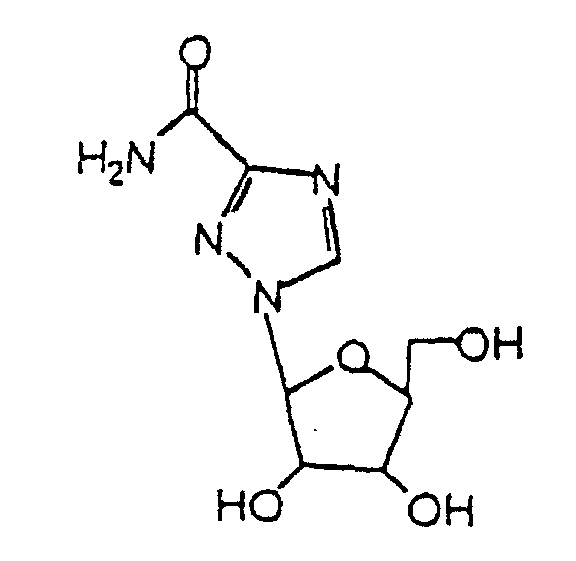
- the present invention is directed to 1- ⁇ -L-ribofuranosyl-1,2,4-triazole-3-carboxamide (L-Ribavirin), having the following structure:
- a pharmaceutical composition comprises a therapeutically effective amount of L-Ribavirin, or a pharmaceutically acceptable ester or salt thereof admixed with at least one pharmaceutically acceptable carrier.
- L-Ribavirin is used in the treatment of any condition which responds positively to administration of the compound, and according to any formulation protocol which achieves the positive response.
- L-Ribavirin may be used to treat an infection, an infestation, a cancer or tumor or an autoimmune disease.
- Figure 1 is a schematic representation of synthetic chemical steps which may be used to prepare L-Ribavirin as in the examples section below.
- Figures 2-3 are graphical representations of the effect of D-Ribavirin and L-Ribavirin on IL-2 TNF ⁇ , IFN- ⁇ , IL-4 and IL-5 levels of activated T-cells.
- Figure 4 is a graphical representation depicting another set of experiments the effects of L-Ribavirin on the inflammatory ear response to dinitrofluorobenzene were determined.
- nucleoside refers to a compound composed of any pentose or modified pentose moiety attached to a specific position of a heterocycle or to the natural position of a purine (9-position) or pyrimidine (1-position) or to the equivalent position in an analog.
- nucleotide refers to a phosphate ester substituted on the 5'-position of a nucleoside.
- heterocycle refers to a monovalent saturated or unsaturated carbocyclic radical having at least one hetero atom, such as N, O or S, within the ring each available position of which can be optionally substituted, independently, with, e.g., hydroxy, oxo, amino, imino, lower alkyl, bromo, chloro and/or cyano. Included within this class of substituents are purines, pyrimidines.
- purine refers to nitrogenous bicyclic heterocycles.
- pyrimidine refers to nitrogenous monocyclic heterocycles.
- D-nucleosides that is used in the present invention describes to the nucleoside compounds that have a D-ribose sugar moiety (e.g., Adenosine).
- L-nucleosides that is used in the present invention describes to the nucleoside compounds that have an L-ribose sugar moiety.
- L-configuration is used throughout the present invention to describe the chemical configuration of the ribofuranosyl moiety of the compounds that is linked to the nucleobases.
- the L-configuration of the sugar moiety of compounds of the present invention contrasts with the D-configuration of ribose sugar moieties of the naturally occurring nucleosides such as cytidine, adenosine, thymidine, guanosine and uridine.
- C-nucleosides is used throughout the specification to describe the linkage type that formed between the ribose sugar moiety and the heterocyclic base.
- the linkage originates from the C-1 position of the ribose sugar moiety and joins the carbon of the heterocyclic base.
- the linkage that forms in C-nucleosides are carbon to carbon type.
- N-nucleosides is used throughout the specification to describe the linkage type that formed between the ribose sugar moiety and the heterocyclic base.
- the linkage originates from the C-1 position of the ribose sugar moiety and joins the nitrogen of the heterocyclic base.
- the linkage that forms in N-nucleosides are carbon to nitrogen type.
- protecting group refers to a chemical group that is added to, oxygen or nitrogen atom to prevent its further reaction during the course of derivatization of other moieties in the molecule in which the oxygen or nitrogen is located.
- oxygen and nitrogen protecting groups are known to those skilled in the art of organic synthesis.
- lower alkyl refers to methyl, ethyl, n-propyl, isopropyl, n-butyl, t-butyl, i-butyl or n-hexyl. This term is further exemplified to a cyclic, branched or straight chain from one to six carbon atoms.
- aryl refers to a monovalent unsaturated aromatic carbocyclic radical having a single ring (e.g., phenyl) or two condensed rings (e.g., naphthyl), which can optionally be substituted with hydroxyl, lower alky, chloro, and/or cyano.
- heterocycle refers to a monovalent saturated or unsaturated carbocyclic radical having at least one hetero atom, such as N, O, S, Se or P, within the ring, each available position of which can be optionally substituted or unsubstituted, independently, with e.g., hydroxy, oxo, amino, imino, lower alkyl, bromo, chloro, and/or cyano.
- monocyclic refers to a monovalent saturated carbocyclic radical having at least one hetero atom, such as O, N, S, Se or P, within the ring, each available position of which can be optionally substituted, independently, with a sugar moiety or any other groups like bromo, chloro and/or cyano, so that the monocyclic ring system eventually aromatized [e.g., Thymidine; 1-(2'-deoxy- -D-erythro-pentofuranosyl)thymine].
- hetero atom such as O, N, S, Se or P
- immunomodulators refers to natural or synthetic products capable of modifying the normal or aberrant immune system through stimulation or suppression.
- an effective amount refers to the amount of L-Ribavirin which will restore immune function to normal levels, or increase immune function above normal levels in order to eliminate infection.
- L-Ribavirin has multiple asymmetric centers. Accordingly, it may be prepared in either optically active form or as a racemic mixture.
- the scope of the invention as described and claimed encompasses the individual optical isomers and non-racemic mixtures thereof as well as the racemic forms of L-Ribavirin.
- ⁇ and ⁇ indicate the specific stereochemical configuration of a substituent at an asymmetric carbon atom in a chemical structure as drawn.
- L-Ribavirin described herein is in the L-furanosyl configuration.
- enantiomers refers to a pair of stereoisomers that are non-superimposable mirror images of each other.
- a mixture of a pair of enantiomers, in a 1:1 ratio, is a “racemic" mixture.
- isomers refers to different compounds that have the same formula. “Stereoisomers” are isomers that differ only in the way the atoms are arranged in space.
- a “pharmaceutically acceptable salts” may be any salts derived from inorganic and organic acids or bases.
- Ribavirin (1- ⁇ -D-ribafuranosyl-1,2,4-triazole-3-carboxamide) is a monocyclic synthetic D-nucleoside that has been demonstrated activity against variety of viral diseases (Huffman et al, Antimicrob . Agents Chemother., 3, 235, 1975; Sidwell et al, Science, 177, 705, 1972 ) and currently undergoing clinical trials in combination with ⁇ -interferon for the treatment of Hepatitis C virus. In the past two decades, a variety of Ribavirin D-nucleoside analogs have been explored and many of them exhibit the exceptional antiviral and antitumor activities.
- Ribavirin resemble structurally to guanosine (Prusiner et al., Nature , 244 , 166, 1973 ). Because of the resemblance of Ribavirin to guanosine, we expected that Ribavirin nucleoside analogs should show similar or superior immuno-modulating activity than guanosine analogs (Robins et al, US 5,041,426) in addition to the antiviral activity.
- the L-Ribavirin of the present invention will used to treat a wide variety of conditions, and in fact any condition which responds positively to administration of L-Ribavirin.
- the L-Ribavirin of the invention may be used to treat an infection, an infestation, a cancer or tumor or an autoimmune disease.
- Infections contemplated to be treated with the L-Ribavirin of the present invention include respiratory syncytial virus (RSV), hepatitis B virus (HBV), hepatitis C virus (HCV), herpes simplex type I and 2, herpes genitalis, herpes keratitis, herpes encephalitis, herpes zoster, human immunodeficiency virus (HIV), influenza A virus, hantann virus (hemorrhagic fever), human papilloma virus (HPV), measles and fungus.
- RSV respiratory syncytial virus
- HBV hepatitis B virus
- HCV hepatitis C virus
- herpes simplex type I and 2 herpes simplex type I and 2
- herpes genitalis herpes keratitis
- herpes encephalitis herpes zoster
- human immunodeficiency virus HAV
- influenza A virus han
- Infestations contemplated to be treated with the L-Ribavirin of the present invention include protozoan infestations, as well as helminth and other parasitic infestations.
- Cancers or tumors contemplated to be treated include those caused by a virus, and the effect may involve inhibiting the transformation of virus-infected cells to a neoplastic state, inhibiting the spread of viruses from transformed cells to other normal cells and/or arresting the growth of virus-transformed cells.
- Autoimmune and other diseases contemplated to be treated include arthritis, psoriasis, bowel disease, juvenile diabetes, lupus, multiple sclerosis, gout and gouty arthritis), rheumatoid arthritis, rejection of transplantation, allergy and asthma.
- a method of treating a mammal comprises administering a therapeutically and/or prophylactically effective amount of a pharmaceutical containing the L-Ribavirin of the present invention.
- the effect may relate to modulation of some portion of the mammal's immune system, especially modulation of lymphokines profiles of Th1 and Th2.
- the modulation may include stimulation of both Th1 and Th2, suppression of both Th1 and Th2, stimulation of either Th1 or Th2 and suppression of the other, or a bimodal modulation in which one effect on Th1/Th2 levels (such as generalized suppression) occurs at a low concentration, while another effect (such as stimulation of either Th1 or Th2 and suppression of the other) occurs at a higher concentration.
- the most preferred uses according to the present invention are those in which the L-Ribavirin is relatively less cytotoxic to the non-target host cells and relatively more active against the target.
- L-nucleosides may have increased stability over D-nucleosides, which could lead to better pharmacokinetics. This result may attain because L-nucleosides may not be recognized by enzymes, and therefore may have longer half-lives.
- L-Ribavirin according to the present invention will be administered in any appropriate pharmaceutical formulation, and under any appropriate protocol.
- administration may take place orally, parenterally (including subcutaneous injections, intravenous, intramuscularly, by intrasternal injection or infusion techniques), by inhalation spray, or rectally, topically and so forth, and in dosage unit formulations containing conventional non-toxic pharmaceutically acceptable carriers, adjuvants and vehicles.
- L-Ribavirin according to the present invention can be formulated in admixture with a pharmaceutically acceptable carrier.
- the L-Ribavirin of the present invention can be administered orally as pharmacologically acceptable salts.
- physiological saline solution e.g., buffered to a pH of about 7.2 to 7.5.
- physiological saline solution e.g., buffered to a pH of about 7.2 to 7.5.
- physiological saline solution e.g., buffered to a pH of about 7.2 to 7.5.
- Conventional buffers such as phosphates, bicarbonates or citrates can be used for this purpose.
- the pro-drug form of L-Ribavirin especially including acylated (acetylated or other) derivatives, pyridine esters and various salt forms of L-Ribavirin are preferred.
- acylated (acetylated or other) derivatives especially including acylated (acetylated or other) derivatives, pyridine esters and various salt forms of L-Ribavirin are preferred.
- One of ordinary skill in the art will recognize how to readily modify L-Ribavirin to pro-drug forms to facilitate delivery of active compounds to a target site within the host organism or patient.
- One of ordinary skill in the art will also take advantage of favorable pharmacokinetic parameters of the pro-drug forms, where applicable, in delivering the L-Ribavirin to a targeted site within the host organism or patient to maximize its intended effect.
- L-Ribavirin according to the present invention may be administered alone or in combination with other agents for the treatment of the above infections or conditions.
- Combination therapies according to the present invention comprise, the administration of L-Ribavirin, or a functional derivative thereof, and at least one other pharmaceutically active ingredient.
- the active ingredient(s) and pharmaceutically active agents may be administered separately or together and when administered separately this may occur simultaneously of separately in any order.
- the amounts of the active ingredient(s) and pharmaceutically active agent(s) and the relative timings of administration will be selected in order to achieve the desired combined therapeutic effect.
- the combination therapy involves the administration of the L-Ribavirin of the present invention or a physiologically functional derivative thereof and one of the agents mentioned herein below.
- Such further therapeutic agents include agents that are effective for the modulation of immune system or associated conditions such as AZT, 3TC, 8-substituted guanosine analogs, 2',3'-dideoxynucleosides, interleukin II, interferons such as Y-interferon, tucaresol, levamisole, isoprinosine and cyclolignans.
- the L-Ribavirin according to the present invention may be effective for enhancing the biological activity of certain agents according to the present invention by reducing the metabolism or inactivation of other compounds and as such, are co-administered for this intended effect.
- a therapeutically effective amount will vary with the infection or condition to be treated, its severity, the treatment regimen to be employed, the pharmacokinetics of the agent used, as well as the patient (animal or human) treated.
- Effective dosages may range from 1 mg/kg of body weight, or less, to 25 mg/kg of body weight or more.
- a therapeutically effective amount of the present compound in dosage form usually ranges from slightly less than about I mg./kg. to about 25 mg./kg. of the patient, depending upon the condition or infection treated and the route of administration.
- This dosage range generally produces effective blood level concentrations of active compound ranging from about 0.04 to about 100 micrograms/cc of blood in the patient. It is contemplated, however, that an appropriate regimen will be developed by administering a small amount, and then increasing the amount until either the side effects become unduly adverse, or the intended effect is achieved.
- Administration of the active compound may range from continuous (intravenous drip) to several oral administrations per day (for example, Q.I.D.) and may include oral, topical, parenteral, intramuscular, intravenous, sub-cutaneous, transdermal (which may include a penetration enhancement agent), buccal and suppository administration, among other routes of administration.
- a therapeutically effective amount of the L-Ribavirin according to the present invention is preferably intimately admixed with a pharmaceutically acceptable carrier according to conventional pharmaceutical compounding techniques to produce a dose.
- a carrier may take a wide variety of forms depending on the form of preparation desired for administration, e.g., oral or parenteral.
- any of the usual pharmaceutical media may be used.
- suitable carriers and additives including water, glycols, oils, alcohols, flavouring agents, preservatives, colouring agents and the like may be used.
- suitable carriers and additives including starches, sugar carrier, such as dextrose, mannitol, lactose and related carriers, diluents, granulating agents, lubricants, binders, disintegrating agents and the like may be used.
- the tablets or capsules may be enteric-coated or sustained release by standard techniques.
- the carrier will usually comprise sterile water or aqueous sodium chloride solution, though other ingredients including those which aid dispersion may be included.
- sterile water is to be used and maintained as sterile, the compositions and carriers must also be sterilized.
- injectable suspensions may also be prepared, in which case appropriate liquid carriers, suspending agents and the like may be employed.
- peripheral blood mononuclear cells PBMCs
- PBMCs peripheral blood mononuclear cells
- T-cells were then incubated overnight at 37 °C in 20 - 30 ml RPMI-AP5 (RPMI-1640 medium (ICN, Costa Mesa, CA) containing 20 mM HEPES buffer, pH 7.4, 5 % autologous plasma, 1 % L-glutamine, 1 % penicillin/streptomycin and 0.05 % 2-mercaptoethanol) to remove any contaminating adherent cells.
- RPMI-AP5 RPMI-1640 medium (ICN, Costa Mesa, CA) containing 20 mM HEPES buffer, pH 7.4, 5 % autologous plasma, 1 % L-glutamine, 1 % penicillin/streptomycin and 0.05 % 2-mercaptoethanol
- the T-cells were activated by the addition of 500 ng ionomycin and 10 ng phorbol 12-myristate 13-acetate (PMA) (Calbiochem, La Jolla, CA) and incubated for 48 - 72h at 37 °C.
- PMA/ionomycin-activated T-cells were treated with 0.5 - 50 ⁇ M of either Ribavirin (D-Ribavirin) or L-Ribavirin, or with 250 - 10000 U/ml of a control antiviral, interferon-alpha (Accurate, Westbury, NY) immediately following activation and re-treated 24 h later.
- T-cells from each plate were used for immunofluorescence analysis and the supernatants used for extracellular cytokine measurements. Following activation, 900 ⁇ l cell supernatant from each microplate was transferred to another microplate for analysis of cell-derived cytokine production. The cells are then used in immunofluorescence analyses for intracellular cytokine levels and cytokine receptor expression.
- IL-2 interleukin-2
- IL-4 interleukin-4
- TNF ⁇ tumor necrosis factor
- IL-8 interleukin-8
- IFN- ⁇ interferon-gamma
- L-Ribavirin according to the present invention may be produced according to synthetic methods which are individually readily known to those of ordinary skill in the art.
- L-Ribavirin according to the present invention are synthesized by condensing appropriate nucleoside base with the necessary sugar synthon to give the protected L-nucleoside which on further manipulation and deprotection of the sugar hydroxyl protecting groups will ultimately give rise to nucleoside analog having the desired ribofuranosyl moiety of the L-configuration.
- the L-Ribavirin of the present invention may be prepared in accordance with well known procedures in the art. Particularly useful is the following synthetic scheme.
- the required 1,2,3,5-tetra-O-acetyl-L-ribose was prepared as shown in Example 2.
- the hetero monocyclic bases are commercially available from Aldrich, Fluka, ICN, Acros, Alfa, Lancaster and TCI America or were prepared by following the reported procedure that are available in the literature articles (Robins, R.K., et al, Nucleosides & Nucleotides, 13, 17-76, 1994).
- substituted sugars such as 1-bromo-2-deoxy-2-fluoro-3,6- O -benzoyl-L-arabinofuranose (Ma, T., et al, J . Med . Chem ., 39 , 2835-2843, 1996 ) and other modified sugars of L-configuration are known in U.S. Pat. No. 5,473,063; WO 96/13512; WO 96/13498; WO 96/22778; WO 95/20595; U.S. 5,473,063; U.S. 5,567,688; WalczaK, K., et al, Monatsh.
- the L-Ribavirin of the invention can be synthesized using the teachings of the schematics provided herein, as well as the specific examples and other schemes set forth below.
- the skilled artisan will readily understand how to make the L-Ribavirin of the present invention by applying well known techniques such as those described in Nucleic Acid Chemistry, Improved and New Synthetic Procedures, Methods and Techniques, Edited by Leroy B. Townsend and R. Stuart Tipson, John Wiley & Sons, New York (1978-1991); Chemistry of Nucleosides and Nucleotides, Edited by Leroy B.
- the substrate ( 5 ) (1.1 g) was dissolved in CH 3 OH/NH 3 at 0 °C and place in a steel bomb. The bomb was closed and stirred at room temperature for 18 h. The steel bomb was cooled, opened and evaporated to dryness. The residue was tried to crystallization with little ethanol. The product crystallized, but on filtration, the crystals re-absorbed water and became a paste. The crystallization repeated several times. Finally it crystallized from Methanol/Ethanol mixture. The colorless crystals was filtered, washed with methanol and dried in vacuo . The filtrate was evaporated again which on standing gave further crystals.
Landscapes
- Chemical & Material Sciences (AREA)
- Organic Chemistry (AREA)
- Health & Medical Sciences (AREA)
- Life Sciences & Earth Sciences (AREA)
- Engineering & Computer Science (AREA)
- Biochemistry (AREA)
- Biotechnology (AREA)
- General Health & Medical Sciences (AREA)
- Genetics & Genomics (AREA)
- Molecular Biology (AREA)
- Pharmaceuticals Containing Other Organic And Inorganic Compounds (AREA)
- Saccharide Compounds (AREA)
Description
- The present invention relates to the field of L-nucleosides.
- The last few decades have seen significant efforts expended in exploring possible uses of D-nucleoside analogs as antiviral agents. Some of this work has borne fruit, and a number of nucleoside analogs are currently being marketed as antiviral drugs, including the HIV reverse transcriptase inhibitors (AZT, ddI, ddC, d4T, and 3TC).
- Nucleoside analogs have also been investigated for use as immune system modulators, (Bennet, P. A. et al., J. Med. Chem., 36, 635, 1993), but again with less than completely satisfactory results. For example, guanosine analogs such as 8-bromo-, 8-mercapto-, 7-methyl-8-oxoguanosine (Goodman, M. G. Immunopharmacology, 21, 51-68, 1991) and 7-thia-8-oxoguanosine (Nagahara, K. J. Med. Chem., 33, 407-415, 1990; U.S, Pat. No. 5,041,426) have been studied over the years for their ability to activate the immune system. These guanosine derivatives show excellent antiviral and/or antitumor activity in vivo. But, these C8-substituted guanosines were unable to activate T-cells (Sharma, B. S. et al., Clin. Exp. Metastasis, 9, 429-439, 1991). The same was found to be true with 6-arylpyrimidinones (Wierenga, W. Ann. N. Y. Acad. Sci., 685, 296-300, 1993). In other research, a series of 3-deazapurine nucleosides were synthesized and evaluated as immuno-modulating agents. U.S. Patent No. 4,309,419 describes the use of 3-deazaadenosine as being an inhibitor of the immune system. The β-D-nucleoside, β-2'-deoxy-3-deazaguanosine (U.S. Pat. No. 4,950,647) displayed the most potent immunoenhancing potency on activated T-cell response. Antiinflamatory and immunosuppressant activity has also been disclosed for certain 2'-deoxynucleosides (
EPO Application 0 038 569). However, these compounds undergo facile in vivo metabolic cleavage of their glycosyl bond, which effectively inactivates their biological potency. Adenosine derivatives disclosed in U.S. Pat. No. 4,148,888 are also catabolized in vivo by deaminase enzymes. In still other research, Levamisole, a thymomimetic immunostimulant (Hadden et al, Immunol. Today, 14, 275-280, 1993), appears to act on the T-cell lineage in a manner similar to thymic hormones. Tucaresol (Reitz et al, Nature, 377, 71-75,1995), another T-cell stimulant, is now undergoing clinical trials. More recently, 6-substituted purine linker amino acid (Zacharie et al, J. Med. Che., 40, 2883-2894, 1997) has been described as a promising immunostimulant which may be targeted for those disease states which require an increased CTL or Th1 type response. - One possible target of immunomodulation involves stimulation or suppression of Th1 and Th2 lymphokines. Type I (Th1) cells produce interleukin 2 (IL-2), tumor necrosis factor (TNFα) and interferon gamma (IFNγ) and they are responsible primarily for cell-mediated immunity such as delayed type hypersensitivity and antiviral immunity. Type 2 (Th2) cells produce interleukins, IL4, IL-5, IL-6, IL-9, IL-10 and IL-13 and are primarily involved in assisting humoral immune responses such as those seen in response to allergens, e.g. IgE and lgG4 antibody isotype switching (Mosmann, 1989, Annu Rev Immunol, 7:145-173). D-guanosine analogs have been shown to elicit various effects on lymphokines IL-1, IL-6, IFNα and TNFα (indirectly) in vitro (Goodman, 1988, Int J Immunopharmacol, 10, 579-88) and in vivo (Smee et al., 1991, Antiviral Res 15: 229). However, the ability of the D-guanosine analogs such as 7- thio-8-oxoguanosine to modulate Type I or
Type 2 cytokines directly in T cells was ineffective or has not been described. - Significantly, most of the small molecule research has focused on the synthesis and evaluation of D-nucleosides. This includes Ribavirin (Witkowski, J. T. et al., J. Med. Chem., 15, 1150, 1972), AZT (De Clercq, E. Adv. Drug Res., 17, 1, 1988), DDI (Yarchoan, R. et al., Science (Washington, D. C.), 245, 412, 1989), DDC (Mitsuya, H. et al., Proc. Natl. Acad. Sci. U. S. A., 83, 1911, 1986), d4T (Mansuri, M. M. et al., J. Med. Chem., 32, 461, 1989) and 3TC (Doong, S. L. et al., Proc. Natl. Acad. Sci. U.S.A., 88, 8495-8599, 1991). In this handful of therapeutic agents, only 3TC which contains an unnatural modified L-ribose moiety, the enantiomer of natural D-ribose.
- After the approval of 3TC by the FDA, a number of nucleosides with the unnatural L-configuration were reported as having potent chemotherapeutic agents against immunodeficiency virus (HIV), hepatitis B virus (HBV), and certain forms of cancer. These include (-)-□-L-1-[2-(hydroxymethyl)-1,3-oxathiolan-4-yl]-5-fluorocytosine (FTC; Furman, P. A., et al, Antimicrob. Agents Chemother., 36, 2686-2692, 1992), (-)-□-L-2',3'-dideoxypentofuranosyl-5-flurocytosine (L-FddC; Gosselin, G., et al, Antimicrob. Agents Chemother., 38, 1292-1297, 1994), (-)-□-L-1-[2-(hydroxymethyl)-1,3-oxathiolan-4-yl]cytosine [(-)-OddC; Grove, K. L., et al, Cancer Res., 55, 3008-3011, 1995], 2',3'-dideoxy-□-L-cystidine (□-L-ddC; Lin, T.S., et al, J. Med. Chem., 37, 798-803, 1994), 2'fluoro-5-methyl-□-L-arabinofuranosyluracil (L-FMAU; U.S. Pat. No. 5,567,688), 2',3'-dideoxy-2',3'-didehydro-□-L-cystidine (□-L-d4C; Lin, T.S., et al, J. Med. Chem., 39, 1757-1759, 1996), 2',3'-dideoxy-2',3'-didehydro-□-L-5-fluorocystidine (□-L-Fd4C; Lin, T.S., et al, J. Med. Chem., 39, 1757-1759, 1996), L-cyclopentyl carbocyclic nucleosides (Wang, P., et al, Tetrahedron Letts., 38, 4207-4210, 1997) and variety of 9-(2'-deoxy-2'-fluoro-□-L-arabinofuranosyl)purine nucleosides (Ma, T.' et al, J. Med. Chem., 40, 2750-2754, 1997).
- Other research on L-nucleosides has also been reported. U.S. Pat. No. 5,009,698, for example, describes the synthesis and use of L-adenosine to stimulate the growth of a plant. WO 92/08727 describes certain L-2'-deoxyuridines and their use for treating viruses. Spadari, S., et al, J. Med. Chem., 35, 4214-4220, 1992, describes the synthesis of certain L-β-nucleosides useful for treating viral infections including Herpes Simplex Virus Type I. U.S. Pat. No. 5,559,101 describes the synthesis of α- and β-L-ribofuranosyl nucleosides, processes for their preparation, pharmaceutical composition containing them, and method of using them to treat various diseases in mammals. A German patent (De 195 18 216) describes the synthesis of 2'-fluoro-2'-deoxy-L-β-arabinofuranosyl pyrimidine nucleosides. U.S. Pat. Nos. 5,565,438 and 5,567,688 describe the synthesis and utility of L-FMAU. WO Patent 95/20595 describes the synthesis of 2'-deoxy-2'-fluoro-L-β-arbinofuranosyl purine and pyrimidine nucleosides and method of treating HBV or EBV. U.S. Pat. No. 5,567,689 describes methods for increasing uridine levels with L-nucleosides. WO patent 96/28170 describes a method of reducing the toxicity of D-nucleosides by co-administering an effective amount of L-nucleoside compounds.
- Significantly, while some of the known L-nucleosides have shown potent antiviral activity with lower toxicity profiles than their D-counterparts, none of these L-nucleoside compounds have been shown to posses immunomodulatory properties. Moreover, at present there is no effective treatment for the modulation of the immune system where lymphokine profiles (Th1 and Th2 subsets) have been implicated. Thus, there remains a need for novel L-nucleoside analogs, especially a need for L-nucleoside analogs which modulate the immune system, and most especially L-nucleoside analogs which specifically modulate Th1 and Th2
- The present invention is directed to 1-β-L-ribofuranosyl-1,2,4-triazole-3-carboxamide (L-Ribavirin), having the following structure:
- In another aspect of the invention, a pharmaceutical composition comprises a therapeutically effective amount of L-Ribavirin, or a pharmaceutically acceptable ester or salt thereof admixed with at least one pharmaceutically acceptable carrier.
- In yet another aspect of the invention, L-Ribavirin is used in the treatment of any condition which responds positively to administration of the compound, and according to any formulation protocol which achieves the positive response. Among other things it is contemplated that L-Ribavirin may be used to treat an infection, an infestation, a cancer or tumor or an autoimmune disease.
- Figure 1 is a schematic representation of synthetic chemical steps which may be used to prepare L-Ribavirin as in the examples section below.
- Figures 2-3 are graphical representations of the effect of D-Ribavirin and L-Ribavirin on IL-2 TNFα, IFN-γ, IL-4 and IL-5 levels of activated T-cells.
- Figure 4 is a graphical representation depicting another set of experiments the effects of L-Ribavirin on the inflammatory ear response to dinitrofluorobenzene were determined.
- Where the following terms are used in this specification, they are used as defined below.
- The term "nucleoside" refers to a compound composed of any pentose or modified pentose moiety attached to a specific position of a heterocycle or to the natural position of a purine (9-position) or pyrimidine (1-position) or to the equivalent position in an analog.
- The term "nucleotide" refers to a phosphate ester substituted on the 5'-position of a nucleoside.
- The term "heterocycle" refers to a monovalent saturated or unsaturated carbocyclic radical having at least one hetero atom, such as N, O or S, within the ring each available position of which can be optionally substituted, independently, with, e.g., hydroxy, oxo, amino, imino, lower alkyl, bromo, chloro and/or cyano. Included within this class of substituents are purines, pyrimidines.
- The term "purine" refers to nitrogenous bicyclic heterocycles.
- The term "pyrimidine" refers to nitrogenous monocyclic heterocycles.
- The term "D-nucleosides" that is used in the present invention describes to the nucleoside compounds that have a D-ribose sugar moiety (e.g., Adenosine).
- The term "L-nucleosides" that is used in the present invention describes to the nucleoside compounds that have an L-ribose sugar moiety.
- The term "L-configuration" is used throughout the present invention to describe the chemical configuration of the ribofuranosyl moiety of the compounds that is linked to the nucleobases. The L-configuration of the sugar moiety of compounds of the present invention contrasts with the D-configuration of ribose sugar moieties of the naturally occurring nucleosides such as cytidine, adenosine, thymidine, guanosine and uridine.
- The term "C-nucleosides" is used throughout the specification to describe the linkage type that formed between the ribose sugar moiety and the heterocyclic base. In C-nucleosides, the linkage originates from the C-1 position of the ribose sugar moiety and joins the carbon of the heterocyclic base. The linkage that forms in C-nucleosides are carbon to carbon type.
- The term "N-nucleosides" is used throughout the specification to describe the linkage type that formed between the ribose sugar moiety and the heterocyclic base. In N-nucleosides, the linkage originates from the C-1 position of the ribose sugar moiety and joins the nitrogen of the heterocyclic base. The linkage that forms in N-nucleosides are carbon to nitrogen type.
- The term "protecting group" refers to a chemical group that is added to, oxygen or nitrogen atom to prevent its further reaction during the course of derivatization of other moieties in the molecule in which the oxygen or nitrogen is located. A wide variety of oxygen and nitrogen protecting groups are known to those skilled in the art of organic synthesis.
- The term "lower alkyl" refers to methyl, ethyl, n-propyl, isopropyl, n-butyl, t-butyl, i-butyl or n-hexyl. This term is further exemplified to a cyclic, branched or straight chain from one to six carbon atoms.
- The term "aryl" refers to a monovalent unsaturated aromatic carbocyclic radical having a single ring (e.g., phenyl) or two condensed rings (e.g., naphthyl), which can optionally be substituted with hydroxyl, lower alky, chloro, and/or cyano.
- The term "heterocycle" refers to a monovalent saturated or unsaturated carbocyclic radical having at least one hetero atom, such as N, O, S, Se or P, within the ring, each available position of which can be optionally substituted or unsubstituted, independently, with e.g., hydroxy, oxo, amino, imino, lower alkyl, bromo, chloro, and/or cyano.
- The term "monocyclic" refers to a monovalent saturated carbocyclic radical having at least one hetero atom, such as O, N, S, Se or P, within the ring, each available position of which can be optionally substituted, independently, with a sugar moiety or any other groups like bromo, chloro and/or cyano, so that the monocyclic ring system eventually aromatized [e.g., Thymidine; 1-(2'-deoxy- -D-erythro-pentofuranosyl)thymine].
- The term "immunomodulators" refers to natural or synthetic products capable of modifying the normal or aberrant immune system through stimulation or suppression.
- The term "effective amount" refers to the amount of L-Ribavirin which will restore immune function to normal levels, or increase immune function above normal levels in order to eliminate infection.
- L-Ribavirin has multiple asymmetric centers. Accordingly, it may be prepared in either optically active form or as a racemic mixture. The scope of the invention as described and claimed encompasses the individual optical isomers and non-racemic mixtures thereof as well as the racemic forms of L-Ribavirin.
- The terms "α" and "β" indicate the specific stereochemical configuration of a substituent at an asymmetric carbon atom in a chemical structure as drawn. L-Ribavirin described herein is in the L-furanosyl configuration.
- The term "enantiomers" refers to a pair of stereoisomers that are non-superimposable mirror images of each other. A mixture of a pair of enantiomers, in a 1:1 ratio, is a "racemic" mixture.
- The term "isomers" refers to different compounds that have the same formula. "Stereoisomers" are isomers that differ only in the way the atoms are arranged in space.
- A "pharmaceutically acceptable salts" may be any salts derived from inorganic and organic acids or bases.
- Ribavirin (1-β-D-ribafuranosyl-1,2,4-triazole-3-carboxamide) is a monocyclic synthetic D-nucleoside that has been demonstrated activity against variety of viral diseases (Huffman et al, Antimicrob. Agents Chemother., 3, 235, 1975; Sidwell et al, Science, 177, 705, 1972) and currently undergoing clinical trials in combination with γ-interferon for the treatment of Hepatitis C virus. In the past two decades, a variety of Ribavirin D-nucleoside analogs have been explored and many of them exhibit the exceptional antiviral and antitumor activities. However, no work has been reported on the synthesis of L-isomer of Ribavirin analogs and their biological activity. In single crystal X-ray analysis Ribavirin resemble structurally to guanosine (Prusiner et al., Nature, 244, 166, 1973). Because of the resemblance of Ribavirin to guanosine, we expected that Ribavirin nucleoside analogs should show similar or superior immuno-modulating activity than guanosine analogs (Robins et al, US 5,041,426) in addition to the antiviral activity.
- It is contemplated that the L-Ribavirin of the present invention will used to treat a wide variety of conditions, and in fact any condition which responds positively to administration of L-Ribavirin. Among other things it is specifically contemplated that the L-Ribavirin of the invention may be used to treat an infection, an infestation, a cancer or tumor or an autoimmune disease.
- Infections contemplated to be treated with the L-Ribavirin of the present invention include respiratory syncytial virus (RSV), hepatitis B virus (HBV), hepatitis C virus (HCV), herpes simplex type I and 2, herpes genitalis, herpes keratitis, herpes encephalitis, herpes zoster, human immunodeficiency virus (HIV), influenza A virus, hantann virus (hemorrhagic fever), human papilloma virus (HPV), measles and fungus.
- Infestations contemplated to be treated with the L-Ribavirin of the present invention include protozoan infestations, as well as helminth and other parasitic infestations.
- Cancers or tumors contemplated to be treated include those caused by a virus, and the effect may involve inhibiting the transformation of virus-infected cells to a neoplastic state, inhibiting the spread of viruses from transformed cells to other normal cells and/or arresting the growth of virus-transformed cells.
- Autoimmune and other diseases contemplated to be treated include arthritis, psoriasis, bowel disease, juvenile diabetes, lupus, multiple sclerosis, gout and gouty arthritis), rheumatoid arthritis, rejection of transplantation, allergy and asthma.
- Still other contemplated uses of the L-Ribavirin according to the present invention include use as intermediates in the chemical synthesis of other nucleoside or nucleotide analogs which are, in turn, useful as therapeutic agents or for other purposes.
- In yet another aspect, a method of treating a mammal comprises administering a therapeutically and/or prophylactically effective amount of a pharmaceutical containing the L-Ribavirin of the present invention. In this aspect the effect may relate to modulation of some portion of the mammal's immune system, especially modulation of lymphokines profiles of Th1 and Th2. Where modulation of Th1 and Th2 lymphokines occurs, it is contemplated that the modulation may include stimulation of both Th1 and Th2, suppression of both Th1 and Th2, stimulation of either Th1 or Th2 and suppression of the other, or a bimodal modulation in which one effect on Th1/Th2 levels (such as generalized suppression) occurs at a low concentration, while another effect (such as stimulation of either Th1 or Th2 and suppression of the other) occurs at a higher concentration.
- In general, the most preferred uses according to the present invention are those in which the L-Ribavirin is relatively less cytotoxic to the non-target host cells and relatively more active against the target. In this respect, it may also be advantageous that L-nucleosides may have increased stability over D-nucleosides, which could lead to better pharmacokinetics. This result may attain because L-nucleosides may not be recognized by enzymes, and therefore may have longer half-lives.
- It is contemplated that the L-Ribavirin according to the present invention will be administered in any appropriate pharmaceutical formulation, and under any appropriate protocol. Thus, administration may take place orally, parenterally (including subcutaneous injections, intravenous, intramuscularly, by intrasternal injection or infusion techniques), by inhalation spray, or rectally, topically and so forth, and in dosage unit formulations containing conventional non-toxic pharmaceutically acceptable carriers, adjuvants and vehicles.
- By way of example, it is contemplated that L-Ribavirin according to the present invention can be formulated in admixture with a pharmaceutically acceptable carrier. For example, the L-Ribavirin of the present invention can be administered orally as pharmacologically acceptable salts. Because the L-Ribavirin of the present invention is water soluble, it can be administered intravenously in physiological saline solution (e.g., buffered to a pH of about 7.2 to 7.5). Conventional buffers such as phosphates, bicarbonates or citrates can be used for this purpose. Of course, one of ordinary skill in the art may modify the formulations within the teachings of the specification to provide numerous formulations for a particular route of administration without rendering the compositions of the present invention unstable or compromising their therapeutic activity. In particular, the modification of L-Ribavirin to render it more soluble in water or other vehicle, for example, may be easily accomplished by minor modifications (salt formulation, esterification, etc.) which are well within the ordinary skill in the art. It is also well within the ordinary skill of the art to modify the route of administration and dosage regimen of L-Ribavirin in order to manage its pharmacokinetics for maximum beneficial effect in patients.
- In certain pharmaceutical dosage forms, the pro-drug form of L-Ribavirin, especially including acylated (acetylated or other) derivatives, pyridine esters and various salt forms of L-Ribavirin are preferred. One of ordinary skill in the art will recognize how to readily modify L-Ribavirin to pro-drug forms to facilitate delivery of active compounds to a target site within the host organism or patient. One of ordinary skill in the art will also take advantage of favorable pharmacokinetic parameters of the pro-drug forms, where applicable, in delivering the L-Ribavirin to a targeted site within the host organism or patient to maximize its intended effect.
- In addition, L-Ribavirin according to the present invention may be administered alone or in combination with other agents for the treatment of the above infections or conditions. Combination therapies according to the present invention comprise, the administration of L-Ribavirin, or a functional derivative thereof, and at least one other pharmaceutically active ingredient. The active ingredient(s) and pharmaceutically active agents may be administered separately or together and when administered separately this may occur simultaneously of separately in any order. The amounts of the active ingredient(s) and pharmaceutically active agent(s) and the relative timings of administration will be selected in order to achieve the desired combined therapeutic effect. Preferably the combination therapy involves the administration of the L-Ribavirin of the present invention or a physiologically functional derivative thereof and one of the agents mentioned herein below.
- Examples of such further therapeutic agents include agents that are effective for the modulation of immune system or associated conditions such as AZT, 3TC, 8-substituted guanosine analogs, 2',3'-dideoxynucleosides, interleukin II, interferons such as Y-interferon, tucaresol, levamisole, isoprinosine and cyclolignans. The L-Ribavirin according to the present invention may be effective for enhancing the biological activity of certain agents according to the present invention by reducing the metabolism or inactivation of other compounds and as such, are co-administered for this intended effect.
- With respect to dosage, one of ordinary skill in the art will recognize that a therapeutically effective amount will vary with the infection or condition to be treated, its severity, the treatment regimen to be employed, the pharmacokinetics of the agent used, as well as the patient (animal or human) treated. Effective dosages may range from 1 mg/kg of body weight, or less, to 25 mg/kg of body weight or more. In general a therapeutically effective amount of the present compound in dosage form usually ranges from slightly less than about I mg./kg. to about 25 mg./kg. of the patient, depending upon the condition or infection treated and the route of administration. This dosage range generally produces effective blood level concentrations of active compound ranging from about 0.04 to about 100 micrograms/cc of blood in the patient. It is contemplated, however, that an appropriate regimen will be developed by administering a small amount, and then increasing the amount until either the side effects become unduly adverse, or the intended effect is achieved.
- Administration of the active compound may range from continuous (intravenous drip) to several oral administrations per day (for example, Q.I.D.) and may include oral, topical, parenteral, intramuscular, intravenous, sub-cutaneous, transdermal (which may include a penetration enhancement agent), buccal and suppository administration, among other routes of administration.
- To prepare the pharmaceutical compositions according to the present invention, a therapeutically effective amount of the L-Ribavirin according to the present invention is preferably intimately admixed with a pharmaceutically acceptable carrier according to conventional pharmaceutical compounding techniques to produce a dose. A carrier may take a wide variety of forms depending on the form of preparation desired for administration, e.g., oral or parenteral. In preparing pharmaceutical compositions in oral dosage form, any of the usual pharmaceutical media may be used. Thus, for liquid oral preparations such as suspensions, elixirs and solutions, suitable carriers and additives including water, glycols, oils, alcohols, flavouring agents, preservatives, colouring agents and the like may be used. For solid oral preparations such as powders, tablets, capsules, and for solid preparations such as suppositories, suitable carriers and additives including starches, sugar carrier, such as dextrose, mannitol, lactose and related carriers, diluents, granulating agents, lubricants, binders, disintegrating agents and the like may be used. If desired, the tablets or capsules may be enteric-coated or sustained release by standard techniques.
- For parenteral formulations, the carrier will usually comprise sterile water or aqueous sodium chloride solution, though other ingredients including those which aid dispersion may be included. Of course, where sterile water is to be used and maintained as sterile, the compositions and carriers must also be sterilized. Injectable suspensions may also be prepared, in which case appropriate liquid carriers, suspending agents and the like may be employed.
- In vitro and in vivo tests on L-Ribavirin, were performed, and the results are described below.
- In a first series of experiments, peripheral blood mononuclear cells (PBMCs) were isolated from the buffy coat following Ficoll-Hypaque density gradient centrifugation of 60 ml blood from healthy donors. T-cells were then purified from the PBMCs using Lymphokwik lymphocyte isolation reagent specific for T-cells (LK-25T, One Lambda, Canoga Park CA). An average yield of 40 - 60 x 106 T-cells were then incubated overnight at 37 °C in 20 - 30 ml RPMI-AP5 (RPMI-1640 medium (ICN, Costa Mesa, CA) containing 20 mM HEPES buffer, pH 7.4, 5 % autologous plasma, 1 % L-glutamine, 1 % penicillin/streptomycin and 0.05 % 2-mercaptoethanol) to remove any contaminating adherent cells. In all experiments, T-cells were washed with RPMI-AP5 and then plated on 96-well microtitre plates at a cell concentration of I x 106 cells/ml.
- The T-cells were activated by the addition of 500 ng ionomycin and 10 ng phorbol 12-myristate 13-acetate (PMA) (Calbiochem, La Jolla, CA) and incubated for 48 - 72h at 37 °C. PMA/ionomycin-activated T-cells were treated with 0.5 - 50 µM of either Ribavirin (D-Ribavirin) or L-Ribavirin, or with 250 - 10000 U/ml of a control antiviral, interferon-alpha (Accurate, Westbury, NY) immediately following activation and re-treated 24 h later. T-cells from each plate were used for immunofluorescence analysis and the supernatants used for extracellular cytokine measurements. Following activation, 900 µl cell supernatant from each microplate was transferred to another microplate for analysis of cell-derived cytokine production. The cells are then used in immunofluorescence analyses for intracellular cytokine levels and cytokine receptor expression.
- Cell-derived human cytokine concentrations were determined in cell supernatants from each microplate. Activation-induced changes in interleukin-2 (IL-2) levels were determined using a commercially available ELISA kit (R & D systems Quantikine kit, Minneapolis, MN) or by.bioassay using the IL-2-dependent cell line, CTLL-2 (ATCC, Rockville, MD). Activation -induced changes in interleukin-4 (IL-4), tumor necrosis factor (TNFα) interleukin-8 (IL-8) (R & D systems (Quantikine kit, Minneapolis, MN) and interferon-gamma (IFN-γ) (Endogen (Cambridge, MA) levels were determined using ELISA kits. All ELISA results were expressed as pg/ml and the CTLL-2 bioassay as counts per minute representing the IL-2-dependent cellular incorporation of 3H-thymidine (ICN, Costa Mesa, CA) by CTLL-2 cells.
- Comparison of the effects of D-Ribavirin and L-Ribavirin (expressed as a percentage of activated control) on IL-2 TNFα, IFN-γ, IL-4 and IL-5 levels are presented in Figures 2 and 3.
- In another set of experiments the effects of L-Ribavirin on the inflammatory ear response to dinitrofluorobenzene were determined. The results of those experiments are shown in Figure 4.
- The L-Ribavirin according to the present invention may be produced according to synthetic methods which are individually readily known to those of ordinary skill in the art. In general, L-Ribavirin according to the present invention are synthesized by condensing appropriate nucleoside base with the necessary sugar synthon to give the protected L-nucleoside which on further manipulation and deprotection of the sugar hydroxyl protecting groups will ultimately give rise to nucleoside analog having the desired ribofuranosyl moiety of the L-configuration.
- During chemical synthesis of the L-Ribavirin according to the present invention, one of ordinary skill in the art will be able to practice the present invention, without undue experimentation. In particular, one of ordinary skill in the art will recognize the various steps that should be performed to introduce a particular substituent at the desired position of the base or a substituent at the desired position on the sugar moiety. In addition, chemical steps which are taken to protect functional groups such as hydroxyl or amino groups, among others, as well as de-protected these same functional groups, will be recognized as appropriate within the circumstances of the syntheses.
- The invention is further defined by reference to the following examples, which are intended to be illustrative and not limiting. It will be understood by one of ordinary skill in the art that these examples are in no way limiting and that variations of detail can be made without departing from the spirit and scope of the present invention.
- The L-Ribavirin of the present invention may be prepared in accordance with well known procedures in the art. Particularly useful is the following synthetic scheme.
- Scheme 1: Synthesis of L-Ribavirin precursors: Triazole L-ribofuranosyl nucleosides were prepared by the acid catalyzed fusion procedure (Sato, T., et al, Nippon Kagaku Zasshi, 81, 1440, 1960). Accordingly, the triazoles ( 1 ) were mixed with 1,2,3,5-tetra-O-acetyl-L-ribose ( 2 ) and a catalytic amount of bis(p-nitrophenyl)phosphate and heated at 160-165 C for 30 min under reduced pressure to provide the required nucleosides which on further deprotection furnished the L-Ribavirin precursor ( 3 ).The required 1,2,3,5-tetra-O-acetyl-L-ribose was prepared as shown in Example 2. The hetero monocyclic bases are commercially available from Aldrich, Fluka, ICN, Acros, Alfa, Lancaster and TCI America or were prepared by following the reported procedure that are available in the literature articles (Robins, R.K., et al, Nucleosides & Nucleotides, 13, 17-76, 1994).

- Furthermore, substituted sugars such as 1-bromo-2-deoxy-2-fluoro-3,6-O-benzoyl-L-arabinofuranose (Ma, T., et al, J. Med. Chem., 39, 2835-2843, 1996) and other modified sugars of L-configuration are known in U.S. Pat. No. 5,473,063; WO 96/13512; WO 96/13498; WO 96/22778; WO 95/20595; U.S. 5,473,063; U.S. 5,567,688; WalczaK, K., et al, Monatsh. fur Chemie, 123, 349-354(1992); Wengel, J., et al, J. Org. Chem., 56, 3591-3594 (1991); Genu-Dellac, C., et al, Tetrahedron Letts., 32, 79-82 (1991) and Czernecki, S., et al, Synthesis, 783 (1991). In addition, preparation of modified sugars and nucleosides of D-configuration are described in U.S. Pat. No. 5,192,749; WO 94/22890; Uteza, V., et al, Tetrahedron, 49, 8579-8588 (1993); Thrane, H., et al, Tetrahedron, 51, 10389-10403 (1995); Yoshimura, Y., et al, Nucleosides & Nucleotides, 14,427-429 (1993; Lawrence, A. J., et al, J. Org. Chem., 61, 9213-9222 (1996); Ichikawa, S., et al, J. Org. Chem., 62, 1368-1375 (1997);
EP 0 457 326 Al; U.S. Pat. No. 3,910,885; WO 96/13498 and Karpeisky, M,Y., et al, Nucleic Acids Res. Symposium Series, 9, 157 (1981). By applying the synthetic procedures (schemes) that has been described in these articles for the preparation of D-nucleosides, the corresponding modified L-nucleosides could also be achieved. - The L-Ribavirin of the invention can be synthesized using the teachings of the schematics provided herein, as well as the specific examples and other schemes set forth below. In addition to the teachings provided herein, the skilled artisan will readily understand how to make the L-Ribavirin of the present invention by applying well known techniques such as those described in Nucleic Acid Chemistry, Improved and New Synthetic Procedures, Methods and Techniques, Edited by Leroy B. Townsend and R. Stuart Tipson, John Wiley & Sons, New York (1978-1991); Chemistry of Nucleosides and Nucleotides, Edited by Leroy B. Townsend, New York, Plenum Press (1988-1994) and Nucleosides and Nucleotides as Antitumor and Antiviral Agents, Edited by Chung K. Chu and David C. Baker, New York, Plenum Press (1993). Suitable methods for making substitution within the sugar moiety of the presently claimed L-Ribavirin are known to those skilled in the art and are described in various publications including: U.S. Pat. No. 5,559,101; U.S. Pat. No. 5,192,749; U.S. Pat. No. 5,473,063; U.S. Pat. No. 5,565,438. Suitable methods for making various heterocyclic compounds and substitution on them are provided in Chemistry of Nucleosides and Nucleotides, Edited by Leroy B. Townsend, New York, Plenum Press, 2, 161-398 (1991) and Chemistry of Nucleosides and in Nucleotides, Edited by Leroy B. Townsend, New York, Plenum Press, 3, 1-535 (1994).
- The invention can be further understood by referring to the following examples below, wherein the compound numerals in bold correspond to like numbered numerals in Figure 1.
- L-Ribose (15.0 g, 100 mmol) was dissolved in dry methanol (200 mL) and cooled to 0 °C. To this cold stirred solution H2SO4 (2 mL) was added slowly and the reaction mixture stirred at below 20 °C for 12 h under argon atmosphere. Dry pyridine (75 mL) was added and evaporated to dryness. Dry pyridine (100 mL) was added and evaporated under reduced pressure to an oily residue. This residue was dissolved in dry pyridine (150 mL) and treated with acetic anhydride (50 mL) at 0 °C under argon atmosphere, TEA (41 mL) was added, the reaction stirred at 0 °C for 1 h and at room temperature for 36 h, evaporated to dryness. The residue was dissolved in water (200 mL), solid NaHCO3 was added slowly to adjust the pH of the solution to 7. The aqueous mixture was extracted in CH2Cl2 (250 mL), washed with water (150 mL) and brine (100 mL), dried and concentrated. The oily residue was filtered on a bed of silica gel (200 g), washed with CH2Cl2:EtOAc (8:2, 1000 mL). The filtrate was evaporated and the oil was used as such for the next reaction.
- The syrup (4) (29.0 g, 100 mmol) from the above reaction was co-evaporated with dry toluene (2x100 mL) and dried overnight under solid NaOH at room temperature in vacuo. The dried syrup was dissolved in glacial acetic acid (150 mL) and cooled to 0 °C under argon atmosphere. To this cold solution was added acetic anthydride (35 mL) followed by H2SO4 (10 mL) very slowly during 15 minute period. The reaction mixture was stirred at room temperature overnight and poured into ice (200 g) with stirring. The mixture was extracted with CHCl3 (2x200 mL) and the organic extract was washed with water (200 mL), sat. NaHCO3 (200 mL) and brine (150 mL), dried over anhydrous Na2SO4 and evaporated to dryness. The syrup 30 g (94%) that obtained was found to be pure enough for glycosylation reactions.
- A mixture of
methyl - The substrate (5) (1.1 g) was dissolved in CH3OH/NH3 at 0 °C and place in a steel bomb. The bomb was closed and stirred at room temperature for 18 h. The steel bomb was cooled, opened and evaporated to dryness. The residue was tried to crystallization with little ethanol. The product crystallized, but on filtration, the crystals re-absorbed water and became a paste. The crystallization repeated several times. Finally it crystallized from Methanol/Ethanol mixture. The colorless crystals was filtered, washed with methanol and dried in vacuo. The filtrate was evaporated again which on standing gave further crystals. Total yield 0.5 g (72%); mp: 177.179 °C; [a]D= +38.33 (c 3 mg/mL H2O); D form of Ribavirin [a]D= -36.0 (c 3.0 mg/mL H2O); 1H NMR (Me2SO-d 6) δ 3.46 (m, 1H, C5'H), 3.60 (m, 1H, C5,H), 3.92 (q, 1H, C4,H), 4.12 (q, 1H), 4.34 (q, 1H), 4.88 (t, 1H, C5'OH), 5.20 (d, 1H), 5.58 (d, 1H), 5.80 (d, 1H, C1'H), 7.60 (bs, 1H, NH), and 8.82 (s, 1H, C3H). Anal.Calc. for C8H12N4O5 (244.20): C, 39.34; H, 4.95; N, 22.94. Found: C, 39.23; H, 4.97; N,22.91.
Claims (6)
- The compound of L-Ribavirin (1-β-L-ribofuranosyl-1,2,4-triazole-3-carboxamide), having the structural formula:

- The compound of claim 1, wherein the compound comprises an α-nucleoside and β-nucleoside.
- A pharmaceutical composition comprising the compound of claim 1 or 2, or a pharmaceutically acceptable ester or salt thereof, admixed with at least one pharmaceutically acceptable carrier.
- Use of a compound of any of claims 1 to 2 for preparing a pharmaceutical composition for treating an inflammatory medical condition which responds positively to administration of said composition.
- The use of claim 4, wherein the medical condition is selected from the group consisting of an infection, an infestation, a neoplasm and an autoimmune disease.
- Use of the compound of claim 1 or 2 for the manufacture of a pharmaceutical composition for modulating Th1 and Th2 activities in a patient.
Applications Claiming Priority (3)
| Application Number | Priority Date | Filing Date | Title |
|---|---|---|---|
| US2858596P | 1996-10-16 | 1996-10-16 | |
| US28585P | 1996-10-16 | ||
| EP97912762A EP1027359B9 (en) | 1996-10-16 | 1997-10-15 | Monocyclic l-nucleosides, analogs and uses thereof |
Related Parent Applications (1)
| Application Number | Title | Priority Date | Filing Date |
|---|---|---|---|
| EP97912762A Division EP1027359B9 (en) | 1996-10-16 | 1997-10-15 | Monocyclic l-nucleosides, analogs and uses thereof |
Publications (2)
| Publication Number | Publication Date |
|---|---|
| EP1132393A1 EP1132393A1 (en) | 2001-09-12 |
| EP1132393B1 true EP1132393B1 (en) | 2003-04-09 |
Family
ID=26148524
Family Applications (3)
| Application Number | Title | Priority Date | Filing Date |
|---|---|---|---|
| EP02021991A Withdrawn EP1302474A1 (en) | 1996-10-16 | 1997-10-15 | Monocyclic L-nucleosides, analogs and uses thereof |
| EP01108303A Expired - Lifetime EP1132393B1 (en) | 1996-10-16 | 1997-10-15 | L-Ribavirin and uses thereof |
| EP02007191A Withdrawn EP1254911A1 (en) | 1996-10-16 | 1997-10-15 | Monocyclic L-nucleosides, analogs and uses thereof |
Family Applications Before (1)
| Application Number | Title | Priority Date | Filing Date |
|---|---|---|---|
| EP02021991A Withdrawn EP1302474A1 (en) | 1996-10-16 | 1997-10-15 | Monocyclic L-nucleosides, analogs and uses thereof |
Family Applications After (1)
| Application Number | Title | Priority Date | Filing Date |
|---|---|---|---|
| EP02007191A Withdrawn EP1254911A1 (en) | 1996-10-16 | 1997-10-15 | Monocyclic L-nucleosides, analogs and uses thereof |
Country Status (1)
| Country | Link |
|---|---|
| EP (3) | EP1302474A1 (en) |
Cited By (2)
| Publication number | Priority date | Publication date | Assignee | Title |
|---|---|---|---|---|
| US9814721B2 (en) | 2010-06-03 | 2017-11-14 | Pharmacyclics Llc | Use of inhibitors of bruton'S tyrosine kinase (BTK) |
| US9885086B2 (en) | 2014-03-20 | 2018-02-06 | Pharmacyclics Llc | Phospholipase C gamma 2 and resistance associated mutations |
Families Citing this family (5)
| Publication number | Priority date | Publication date | Assignee | Title |
|---|---|---|---|---|
| ES2208540T3 (en) * | 2001-07-30 | 2004-06-16 | Clariant Life Science Molecules (Italia) Spa | PROCEDURE FOR THE PREPARATION OF RIBAVIRINE. |
| BRPI0407781A (en) * | 2003-02-25 | 2006-02-14 | Applied Research Systems | combined application of ribavirin and interferon beta in demyelinating diseases |
| WO2008153385A1 (en) * | 2007-06-11 | 2008-12-18 | Valletta Health B.V. | Urocanic acid derivatives useful for the treatment of immune-related and inflammatory diseases |
| MX2015001081A (en) | 2012-07-24 | 2015-10-14 | Pharmacyclics Inc | Mutations associated with resistance to inhibitors of bruton's tyrosine kinase (btk). |
| EP2914263A4 (en) | 2012-11-02 | 2016-04-27 | Pharmacyclics Inc | ADJUVANT THERAPY BY KINASE INHIBITOR OF THE TEC FAMILY |
Family Cites Families (12)
| Publication number | Priority date | Publication date | Assignee | Title |
|---|---|---|---|---|
| EP0054432B1 (en) * | 1980-12-15 | 1990-01-31 | Viratek, Inc. | Use of 2-beta-d-ribofuranosylthiazole-4-carboxamides for the manufacture of medicaments inhibiting malignant tumors |
| JPS60193997A (en) * | 1984-03-14 | 1985-10-02 | Sumitomo Chem Co Ltd | New cyanoimidazole ribonucleoside derivative and its preparation |
| EP0331080A3 (en) * | 1988-02-29 | 1990-11-22 | Yamasa Shoyu Kabushiki Kaisha | Imidazole derivatives, process for production thereof, and use thereof |
| IT1246983B (en) * | 1990-11-13 | 1994-12-12 | Consiglio Nazionale Ricerche | L-2'-DESOXYURIDINE AND PHARMACEUTICAL COMPOSITIONS THAT CONTAIN IT. |
| WO1994021658A1 (en) * | 1993-03-15 | 1994-09-29 | Kalman Thomas I | Antiviral imidazolinone nucleoside derivatives |
| US5627160A (en) * | 1993-05-25 | 1997-05-06 | Yale University | L-2',3'-dideoxy nucleoside analogs as anti-hepatitis B (HBV) and anti-HIV agents |
| US5587362A (en) * | 1994-01-28 | 1996-12-24 | Univ. Of Ga Research Foundation | L-nucleosides |
| DE19518216A1 (en) * | 1994-10-07 | 1996-04-11 | Max Delbrueck Centrum | New β-L nucleosides and their use |
| US5559101A (en) * | 1994-10-24 | 1996-09-24 | Genencor International, Inc. | L-ribofuranosyl nucleosides |
| US5672594A (en) * | 1994-10-24 | 1997-09-30 | Genencor International, Inc. | L-erythrosyl nucleosides |
| IT1281498B1 (en) * | 1995-06-07 | 1998-02-18 | Sardinian Antiviral Research C | PYRAZOLE - DERIVATIVES WITH ANTI-CANCER ACTIVITY, PROCESS FOR THEIR PREPARATION AND PHARMACEUTICAL COMPOSITIONS THAT CONTAIN THEM, AND |
| SK283342B6 (en) * | 1996-01-23 | 2003-06-03 | Icn Pharmaceuticals | Use of ribavirin for preparation of pharmaceutical composition |
-
1997
- 1997-10-15 EP EP02021991A patent/EP1302474A1/en not_active Withdrawn
- 1997-10-15 EP EP01108303A patent/EP1132393B1/en not_active Expired - Lifetime
- 1997-10-15 EP EP02007191A patent/EP1254911A1/en not_active Withdrawn
Cited By (9)
| Publication number | Priority date | Publication date | Assignee | Title |
|---|---|---|---|---|
| US9814721B2 (en) | 2010-06-03 | 2017-11-14 | Pharmacyclics Llc | Use of inhibitors of bruton'S tyrosine kinase (BTK) |
| US10004746B2 (en) | 2010-06-03 | 2018-06-26 | Pharmacyclics Llc | Use of inhibitors of Bruton's tyrosine kinase (Btk) |
| US10004745B2 (en) | 2010-06-03 | 2018-06-26 | Pharmacyclics Llc | Use of inhibitors of Bruton'S tyrosine kinase (Btk) |
| US10016435B2 (en) | 2010-06-03 | 2018-07-10 | Pharmacyclics Llc | Use of inhibitors of Bruton's tyrosine kinase (Btk) |
| US10478439B2 (en) | 2010-06-03 | 2019-11-19 | Pharmacyclics Llc | Use of inhibitors of bruton's tyrosine kinase (Btk) |
| US10653696B2 (en) | 2010-06-03 | 2020-05-19 | Pharmacyclics Llc | Use of inhibitors of bruton's tyrosine kinase (BTK) |
| US10751342B2 (en) | 2010-06-03 | 2020-08-25 | Pharmacyclics Llc | Use of inhibitors of Bruton's tyrosine kinase (Btk) |
| US11672803B2 (en) | 2010-06-03 | 2023-06-13 | Pharmacyclics Llc | Use of inhibitors of Brutons tyrosine kinase (Btk) |
| US9885086B2 (en) | 2014-03-20 | 2018-02-06 | Pharmacyclics Llc | Phospholipase C gamma 2 and resistance associated mutations |
Also Published As
| Publication number | Publication date |
|---|---|
| EP1132393A1 (en) | 2001-09-12 |
| EP1302474A1 (en) | 2003-04-16 |
| EP1254911A1 (en) | 2002-11-06 |
Similar Documents
| Publication | Publication Date | Title |
|---|---|---|
| EP1027359B9 (en) | Monocyclic l-nucleosides, analogs and uses thereof | |
| US6509320B1 (en) | Purine L-nucleosides, analogs and uses thereof | |
| KR100412480B1 (en) | Purine l-nucleosides, analogs and uses thereof | |
| KR20030032917A (en) | Nucleoside analogs with carboxamidine modified monocyclic base | |
| EP1132393B1 (en) | L-Ribavirin and uses thereof | |
| EP1072607A2 (en) | Purine L-nucleosides, analogs and uses therof | |
| HK1038365B (en) | L-ribavirin and uses thereof | |
| RU2183639C2 (en) | Purine l-nucleosides, their analogues and using | |
| AU751742B2 (en) | Purine L-nucleosides, analogs and uses thereof | |
| HK1028977B (en) | Monocyclic l-nucleosides, analogs and uses thereof | |
| HK1032972A (en) | Purine l-nucleosides, analogs and uses thereof | |
| HK1050901A (en) | Monocyclic l-nucleosides, analogs and uses thereof | |
| HK1053841A (en) | Monocyclic l-nucleosides, analogs and uses thereof | |
| CA2323791A1 (en) | Purine l-nucleosides, analogs and uses thereof | |
| NZ505553A (en) | 8-substituted alpha or beta L-guanosine analogs and uses thereof | |
| HRP20000420A2 (en) | Purine l-nucleosides, analogs and uses thereof | |
| HK1021738B (en) | Purine l-nucleosides, analogs and uses thereof |
Legal Events
| Date | Code | Title | Description |
|---|---|---|---|
| PUAI | Public reference made under article 153(3) epc to a published international application that has entered the european phase |
Free format text: ORIGINAL CODE: 0009012 |
|
| AC | Divisional application: reference to earlier application |
Ref document number: 1027359 Country of ref document: EP |
|
| AK | Designated contracting states |
Kind code of ref document: A1 Designated state(s): AT BE CH DE DK ES FI FR GB GR IE IT LI LU MC NL PT SE |
|
| 17P | Request for examination filed |
Effective date: 20020312 |
|
| AKX | Designation fees paid |
Free format text: AT BE CH DE DK ES FI FR GB GR IE IT LI LU MC NL PT SE |
|
| GRAH | Despatch of communication of intention to grant a patent |
Free format text: ORIGINAL CODE: EPIDOS IGRA |
|
| GRAH | Despatch of communication of intention to grant a patent |
Free format text: ORIGINAL CODE: EPIDOS IGRA |
|
| GRAA | (expected) grant |
Free format text: ORIGINAL CODE: 0009210 |
|
| AC | Divisional application: reference to earlier application |
Ref document number: 1027359 Country of ref document: EP Kind code of ref document: P |
|
| AK | Designated contracting states |
Designated state(s): AT BE CH DE DK ES FI FR GB GR IE IT LI LU MC NL PT SE |
|
| REG | Reference to a national code |
Ref country code: GB Ref legal event code: FG4D |
|
| REG | Reference to a national code |
Ref country code: CH Ref legal event code: EP |
|
| REG | Reference to a national code |
Ref country code: IE Ref legal event code: FG4D |
|
| RAP2 | Party data changed (patent owner data changed or rights of a patent transferred) |
Owner name: RIBAPHARM, INC. |
|
| REG | Reference to a national code |
Ref country code: SE Ref legal event code: TRGR |
|
| REG | Reference to a national code |
Ref country code: GR Ref legal event code: EP Ref document number: 20030402262 Country of ref document: GR |
|
| REG | Reference to a national code |
Ref country code: DK Ref legal event code: T3 |
|
| REG | Reference to a national code |
Ref country code: CH Ref legal event code: NV Representative=s name: PATENTANWAELTE SCHAAD, BALASS, MENZL & PARTNER AG |
|
| NLS | Nl: assignments of ep-patents |
Owner name: RIBAPHARM, INC. |
|
| NLT2 | Nl: modifications (of names), taken from the european patent patent bulletin |
Owner name: RIBAPHARM, INC. |
|
| ET | Fr: translation filed | ||
| REG | Reference to a national code |
Ref country code: ES Ref legal event code: FG2A Ref document number: 2195970 Country of ref document: ES Kind code of ref document: T3 |
|
| PLBE | No opposition filed within time limit |
Free format text: ORIGINAL CODE: 0009261 |
|
| STAA | Information on the status of an ep patent application or granted ep patent |
Free format text: STATUS: NO OPPOSITION FILED WITHIN TIME LIMIT |
|
| 26N | No opposition filed |
Effective date: 20040112 |
|
| REG | Reference to a national code |
Ref country code: GB Ref legal event code: 732E |
|
| PGFP | Annual fee paid to national office [announced via postgrant information from national office to epo] |
Ref country code: NL Payment date: 20041103 Year of fee payment: 8 |
|
| PGFP | Annual fee paid to national office [announced via postgrant information from national office to epo] |
Ref country code: DE Payment date: 20041104 Year of fee payment: 8 Ref country code: GB Payment date: 20041104 Year of fee payment: 8 |
|
| PGFP | Annual fee paid to national office [announced via postgrant information from national office to epo] |
Ref country code: SE Payment date: 20041105 Year of fee payment: 8 |
|
| PGFP | Annual fee paid to national office [announced via postgrant information from national office to epo] |
Ref country code: FR Payment date: 20041109 Year of fee payment: 8 Ref country code: PT Payment date: 20041109 Year of fee payment: 8 |
|
| PGFP | Annual fee paid to national office [announced via postgrant information from national office to epo] |
Ref country code: MC Payment date: 20041110 Year of fee payment: 8 |
|
| PGFP | Annual fee paid to national office [announced via postgrant information from national office to epo] |
Ref country code: AT Payment date: 20041111 Year of fee payment: 8 Ref country code: IE Payment date: 20041111 Year of fee payment: 8 |
|
| PGFP | Annual fee paid to national office [announced via postgrant information from national office to epo] |
Ref country code: FI Payment date: 20041112 Year of fee payment: 8 |
|
| PGFP | Annual fee paid to national office [announced via postgrant information from national office to epo] |
Ref country code: DK Payment date: 20041116 Year of fee payment: 8 Ref country code: LU Payment date: 20041116 Year of fee payment: 8 |
|
| PGFP | Annual fee paid to national office [announced via postgrant information from national office to epo] |
Ref country code: CH Payment date: 20041117 Year of fee payment: 8 |
|
| PGFP | Annual fee paid to national office [announced via postgrant information from national office to epo] |
Ref country code: GR Payment date: 20041126 Year of fee payment: 8 |
|
| PGFP | Annual fee paid to national office [announced via postgrant information from national office to epo] |
Ref country code: ES Payment date: 20041129 Year of fee payment: 8 |
|
| PGFP | Annual fee paid to national office [announced via postgrant information from national office to epo] |
Ref country code: BE Payment date: 20041216 Year of fee payment: 8 |
|
| PG25 | Lapsed in a contracting state [announced via postgrant information from national office to epo] |
Ref country code: IT Free format text: LAPSE BECAUSE OF NON-PAYMENT OF DUE FEES Effective date: 20051015 Ref country code: AT Free format text: LAPSE BECAUSE OF NON-PAYMENT OF DUE FEES Effective date: 20051015 Ref country code: GB Free format text: LAPSE BECAUSE OF NON-PAYMENT OF DUE FEES Effective date: 20051015 |
|
| PG25 | Lapsed in a contracting state [announced via postgrant information from national office to epo] |
Ref country code: SE Free format text: LAPSE BECAUSE OF NON-PAYMENT OF DUE FEES Effective date: 20051016 |
|
| PG25 | Lapsed in a contracting state [announced via postgrant information from national office to epo] |
Ref country code: IE Free format text: LAPSE BECAUSE OF NON-PAYMENT OF DUE FEES Effective date: 20051017 Ref country code: ES Free format text: LAPSE BECAUSE OF NON-PAYMENT OF DUE FEES Effective date: 20051017 |
|
| PG25 | Lapsed in a contracting state [announced via postgrant information from national office to epo] |
Ref country code: BE Free format text: LAPSE BECAUSE OF NON-PAYMENT OF DUE FEES Effective date: 20051031 Ref country code: LI Free format text: LAPSE BECAUSE OF NON-PAYMENT OF DUE FEES Effective date: 20051031 Ref country code: DK Free format text: LAPSE BECAUSE OF NON-PAYMENT OF DUE FEES Effective date: 20051031 Ref country code: CH Free format text: LAPSE BECAUSE OF NON-PAYMENT OF DUE FEES Effective date: 20051031 Ref country code: LU Free format text: LAPSE BECAUSE OF NON-PAYMENT OF DUE FEES Effective date: 20051031 |
|
| PG25 | Lapsed in a contracting state [announced via postgrant information from national office to epo] |
Ref country code: PT Free format text: LAPSE BECAUSE OF NON-PAYMENT OF DUE FEES Effective date: 20060417 |
|
| PG25 | Lapsed in a contracting state [announced via postgrant information from national office to epo] |
Ref country code: NL Free format text: LAPSE BECAUSE OF NON-PAYMENT OF DUE FEES Effective date: 20060501 |
|
| PG25 | Lapsed in a contracting state [announced via postgrant information from national office to epo] |
Ref country code: DE Free format text: LAPSE BECAUSE OF NON-PAYMENT OF DUE FEES Effective date: 20060503 |
|
| REG | Reference to a national code |
Ref country code: DK Ref legal event code: EBP |
|
| REG | Reference to a national code |
Ref country code: CH Ref legal event code: PL |
|
| EUG | Se: european patent has lapsed | ||
| GBPC | Gb: european patent ceased through non-payment of renewal fee |
Effective date: 20051015 |
|
| PG25 | Lapsed in a contracting state [announced via postgrant information from national office to epo] |
Ref country code: FR Free format text: LAPSE BECAUSE OF NON-PAYMENT OF DUE FEES Effective date: 20060630 |
|
| REG | Reference to a national code |
Ref country code: PT Ref legal event code: MM4A Effective date: 20060417 |
|
| NLV4 | Nl: lapsed or anulled due to non-payment of the annual fee |
Effective date: 20060501 |
|
| REG | Reference to a national code |
Ref country code: IE Ref legal event code: MM4A |
|
| REG | Reference to a national code |
Ref country code: FR Ref legal event code: ST Effective date: 20060630 |
|
| REG | Reference to a national code |
Ref country code: ES Ref legal event code: FD2A Effective date: 20051017 |
|
| PG25 | Lapsed in a contracting state [announced via postgrant information from national office to epo] |
Ref country code: MC Free format text: LAPSE BECAUSE OF NON-PAYMENT OF DUE FEES Effective date: 20050101 |
|
| BERE | Be: lapsed |
Owner name: *RIBAPHARM INC. (A CORP. OF THE STADE OF DELAWARE) Effective date: 20051031 |
|
| PG25 | Lapsed in a contracting state [announced via postgrant information from national office to epo] |
Ref country code: GR Free format text: LAPSE BECAUSE OF NON-PAYMENT OF DUE FEES Effective date: 20030409 |