EP1103589A1 - Drilling fluids comprising oil emulsions in water - Google Patents
Drilling fluids comprising oil emulsions in water Download PDFInfo
- Publication number
- EP1103589A1 EP1103589A1 EP00204155A EP00204155A EP1103589A1 EP 1103589 A1 EP1103589 A1 EP 1103589A1 EP 00204155 A EP00204155 A EP 00204155A EP 00204155 A EP00204155 A EP 00204155A EP 1103589 A1 EP1103589 A1 EP 1103589A1
- Authority
- EP
- European Patent Office
- Prior art keywords
- water
- pressure
- mud
- drilling fluids
- composition according
- Prior art date
- Legal status (The legal status is an assumption and is not a legal conclusion. Google has not performed a legal analysis and makes no representation as to the accuracy of the status listed.)
- Withdrawn
Links
- 239000012530 fluid Substances 0.000 title claims abstract description 35
- 238000005553 drilling Methods 0.000 title claims abstract description 22
- XLYOFNOQVPJJNP-UHFFFAOYSA-N water Substances O XLYOFNOQVPJJNP-UHFFFAOYSA-N 0.000 title claims abstract description 14
- 239000000839 emulsion Substances 0.000 title claims description 6
- 239000000203 mixture Substances 0.000 claims abstract description 15
- 239000007764 o/w emulsion Substances 0.000 claims abstract description 5
- 235000015076 Shorea robusta Nutrition 0.000 claims description 7
- 244000166071 Shorea robusta Species 0.000 claims description 7
- 230000000903 blocking effect Effects 0.000 claims description 6
- 238000000034 method Methods 0.000 claims description 6
- 239000004094 surface-active agent Substances 0.000 claims description 4
- 239000004215 Carbon black (E152) Substances 0.000 claims description 3
- 239000003995 emulsifying agent Substances 0.000 claims description 3
- 229930195733 hydrocarbon Natural products 0.000 claims description 3
- 150000002430 hydrocarbons Chemical class 0.000 claims description 3
- 239000000244 polyoxyethylene sorbitan monooleate Substances 0.000 claims description 2
- 235000010482 polyoxyethylene sorbitan monooleate Nutrition 0.000 claims description 2
- 239000011148 porous material Substances 0.000 description 18
- 230000005540 biological transmission Effects 0.000 description 12
- 238000012360 testing method Methods 0.000 description 9
- LYCAIKOWRPUZTN-UHFFFAOYSA-N Ethylene glycol Chemical compound OCCO LYCAIKOWRPUZTN-UHFFFAOYSA-N 0.000 description 8
- 230000015572 biosynthetic process Effects 0.000 description 8
- 150000003839 salts Chemical class 0.000 description 5
- WCUXLLCKKVVCTQ-UHFFFAOYSA-M Potassium chloride Chemical compound [Cl-].[K+] WCUXLLCKKVVCTQ-UHFFFAOYSA-M 0.000 description 4
- WGCNASOHLSPBMP-UHFFFAOYSA-N hydroxyacetaldehyde Natural products OCC=O WGCNASOHLSPBMP-UHFFFAOYSA-N 0.000 description 4
- 239000008398 formation water Substances 0.000 description 3
- 238000009472 formulation Methods 0.000 description 3
- 239000003921 oil Substances 0.000 description 3
- 239000000654 additive Substances 0.000 description 2
- 239000004927 clay Substances 0.000 description 2
- 238000002474 experimental method Methods 0.000 description 2
- 230000003204 osmotic effect Effects 0.000 description 2
- 239000001103 potassium chloride Substances 0.000 description 2
- 235000011164 potassium chloride Nutrition 0.000 description 2
- 239000000243 solution Substances 0.000 description 2
- DGAQECJNVWCQMB-PUAWFVPOSA-M Ilexoside XXIX Chemical compound C[C@@H]1CC[C@@]2(CC[C@@]3(C(=CC[C@H]4[C@]3(CC[C@@H]5[C@@]4(CC[C@@H](C5(C)C)OS(=O)(=O)[O-])C)C)[C@@H]2[C@]1(C)O)C)C(=O)O[C@H]6[C@@H]([C@H]([C@@H]([C@H](O6)CO)O)O)O.[Na+] DGAQECJNVWCQMB-PUAWFVPOSA-M 0.000 description 1
- 241000277275 Oncorhynchus mykiss Species 0.000 description 1
- ZLMJMSJWJFRBEC-UHFFFAOYSA-N Potassium Chemical compound [K] ZLMJMSJWJFRBEC-UHFFFAOYSA-N 0.000 description 1
- 239000004411 aluminium Substances 0.000 description 1
- 229910052782 aluminium Inorganic materials 0.000 description 1
- XAGFODPZIPBFFR-UHFFFAOYSA-N aluminium Chemical compound [Al] XAGFODPZIPBFFR-UHFFFAOYSA-N 0.000 description 1
- 239000007864 aqueous solution Substances 0.000 description 1
- 239000003139 biocide Substances 0.000 description 1
- 159000000007 calcium salts Chemical class 0.000 description 1
- 239000003638 chemical reducing agent Substances 0.000 description 1
- 230000000052 comparative effect Effects 0.000 description 1
- 230000000295 complement effect Effects 0.000 description 1
- 238000007596 consolidation process Methods 0.000 description 1
- 230000007613 environmental effect Effects 0.000 description 1
- 238000011156 evaluation Methods 0.000 description 1
- 239000000706 filtrate Substances 0.000 description 1
- 125000005842 heteroatom Chemical group 0.000 description 1
- 239000003112 inhibitor Substances 0.000 description 1
- 238000011835 investigation Methods 0.000 description 1
- 239000000314 lubricant Substances 0.000 description 1
- 238000005259 measurement Methods 0.000 description 1
- 229910000000 metal hydroxide Inorganic materials 0.000 description 1
- 150000004692 metal hydroxides Chemical class 0.000 description 1
- 239000003129 oil well Substances 0.000 description 1
- 239000010690 paraffinic oil Substances 0.000 description 1
- 229920000151 polyglycol Polymers 0.000 description 1
- 239000010695 polyglycol Substances 0.000 description 1
- 229920000642 polymer Polymers 0.000 description 1
- 229920000136 polysorbate Polymers 0.000 description 1
- 229910052700 potassium Inorganic materials 0.000 description 1
- 239000011591 potassium Substances 0.000 description 1
- 239000002244 precipitate Substances 0.000 description 1
- 230000009257 reactivity Effects 0.000 description 1
- 239000011435 rock Substances 0.000 description 1
- 229910052708 sodium Inorganic materials 0.000 description 1
- 239000011734 sodium Substances 0.000 description 1
- 230000006641 stabilisation Effects 0.000 description 1
- 230000000087 stabilizing effect Effects 0.000 description 1
- 230000003068 static effect Effects 0.000 description 1
Images



Classifications
-
- C—CHEMISTRY; METALLURGY
- C09—DYES; PAINTS; POLISHES; NATURAL RESINS; ADHESIVES; COMPOSITIONS NOT OTHERWISE PROVIDED FOR; APPLICATIONS OF MATERIALS NOT OTHERWISE PROVIDED FOR
- C09K—MATERIALS FOR MISCELLANEOUS APPLICATIONS, NOT PROVIDED FOR ELSEWHERE
- C09K8/00—Compositions for drilling of boreholes or wells; Compositions for treating boreholes or wells, e.g. for completion or for remedial operations
- C09K8/02—Well-drilling compositions
- C09K8/04—Aqueous well-drilling compositions
- C09K8/26—Oil-in-water emulsions
- C09K8/28—Oil-in-water emulsions containing organic additives
Definitions
- the present invention relates to drilling fluids comprising oil in water emulsions.
- a composition of drilling fluids has now been found, which is particularly effective in preventing pressure transmission from the mud column to the formation.
- the present invention relates to a composition of water-based drilling fluids characterized in that they comprise an oil in water emulsion.
- a non-ionic emulsifying agent is used, with an HLB ranging from 8 to 15, preferably polyoxyethylene-sorbitan mono-oleate.
- the emulsion comprises (a) an oil insoluble in water, essentially hydrocarbon, optionally containing heteroatoms, preferably paraffinic, in a quantity ranging from 5 to 25% by weight, preferably from 8 to 15% by weight, (b) a non-ionic surface-active agent in a quantity ranging from 2 to 10% by weight, preferably from 3 to 7% by weight, the complement to 100 being water.
- the emulsion may optionally also contain inorganic salts for example potassium chloride.
- composition of drilling fluids of the present invention may comprise other additives, such as viscosifiers, pH regulators, biocides, lubricants, filtrate reducers.
- a further object of the present invention relates to a process for blocking the micropores of shales by means of a drilling fluid, characterized in that the fluid comprises an oil in water emulsion.
- the pressure transmission test (PTT), which is briefly described below, is used to verify the capacity of this fluid to prevent pressure transmission from the mud column to the formation.
- the sample of claystone is inserted in a rubber sheath, closed at the ends by two steel heads and is placed in the cell where it is pressurized and heated.
- the two heads are connected to two independent hydraulic circuits which operate under high pressure conditions; one of these (mud circuit which simulates the drilling well with mud) is an open circuit where a solution (which can be pore water or a drilling fluid) is pumped and laps against one of the two sides of the cylindrical sample.
- the pressure of the mud is kept constant by a "back pressure regulator"; the volume of the part of the circuit under pressure during the test is 22 cc.
- a piezoresistive transducer continuously measures the internal pressure of the circuit, just before the fluid enters the cell.
- the other circuit (pore circuit which simulates the shale) has an internal volume of 22 cc, with an additional tank of 38 cc for a total of 60 cc. This contains a fluid having a composition similar to the pore fluid whose pressure is measured by a piezoresistive transducer.
- a computer records the cell temperature (T), the pressure of the pore circuit (Ppore) and of the mud circuit (Pmud), by means of an acquisition interface.
- the sample of claystone is brought to the desired temperature and pressure conditions; in our case, this is maintained for 2 days at a temperature of 80°C, a confinement pressure of 200 bars, a pressure in the pore circuit, containing simulated pore fluid, of 100 bars under static conditions and a pressure in the drilling fluid circuit, which in this phase contains simulated pore fluid, of 100 bars under flow conditions.
- test fluid formulated with salts or with salts and clay inhibitor additives.
- test fluid formulated with salts or with salts and clay inhibitor additives.
- the pressure in the mud circuit is raised and is maintained constant for the whole duration of the test.
- the effectiveness of the test fluid in preventing pressure transmission from the mud to the shale is evaluated by the pressure trend in the pore circuit over a period of time and in particular by its equilibrium value.
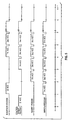
- FIG. 1 indicates a pressure transmission experiment with an emulsion consisting of a paraffinic oil (Soltrol) at 10% w/w, a surface-active agent (Tween 85) at 5% w/w and potassium chloride at 5% w/w. Starting from equilibrium conditions between the pore and mud pressure, the pressure of the mud was increased three times with a pressure increase of 20 bars each time.
- Soltrol paraffinic oil
- Tween 85 surface-active agent
- the first pressure increase of the mud does not cause any pressure increase of the pores
- the last pressure increase causes an increase in the pore pressure until a pressure difference between mud and pores equal to about 35 bars, is reached.
- Figure 1 demonstrates how, with a considerable increase in the mud pressure, there is only a slight increase in the pressure of the formation fluids.
- An aqueous solution was prepared at 5% by weight of commercial glycol with a cloud point equal to about 50°C. The test was carried out ensuring that the internal temperature of the pressurization cell of the test-sample was higher than the cloud-point.
Landscapes
- Chemical & Material Sciences (AREA)
- Oil, Petroleum & Natural Gas (AREA)
- Life Sciences & Earth Sciences (AREA)
- General Life Sciences & Earth Sciences (AREA)
- Engineering & Computer Science (AREA)
- Materials Engineering (AREA)
- Organic Chemistry (AREA)
- Lubricants (AREA)
- Colloid Chemistry (AREA)
- Excavating Of Shafts Or Tunnels (AREA)
Abstract
Description
- The present invention relates to drilling fluids comprising oil in water emulsions.
- In the drilling of oil wells with water-based fluids, instability problems arising in shales must be frequently solved. These are due to two main factors: 1) the reactivity of claystone to water and 2) the transmission of the pressure from the mud column to the inside of the formation which modifies the stress within the rock causing it to break.
- With respect to the second point (formulations which prevent pressure transmission from the mud column to the formation), two procedures are adopted:
- 2a) blocking the micropores of the shales, by means of inorganic salts which precipitate when they come into contact with the formation water [Clark, D.E. and Benaissa, S.: "Aluminium Chemistry Provides Increased Shale Stability with Environmental Acceptability", paper SPE 25312 presented at the 1993 SPE Asia Pacific Oil and Gas Conference and Exhibition, Feb. 8-10]; [Felixberger, J.: "Mixed Metal Hydroxide (MMH). A novel and unique inorganic viscosifier for drilling fluids". Ed. Royal Society of Chemistry, 1994]; [van Oort, E.: "A novel technique for the investigation of drilling fluid induced borehole instability in shales", Eurock'94, Balkema, Rotterdam, 1994, pages 293-308] or with micro-drops of a phase immiscible in water which may be a polymer with Cloud Point [Bland, R.G.., Smith, G.L. and Eagark, P.: "Low Salinity Polyglycol Water-Based Drilling Fluids as Alternatives to Oil-Based Muds", paper SPE/IADC 29378, presented at the 1995 SPE/IADC Drilling Conference, Amsterdam, The Netherlands, Feb. 28-Mar. 2];
- 2b) preparing drilling fluids with high concentrations of salt (sodium, potassium or calcium salts) in order to extract the formation water from the clay layers as a result of osmotic effect [O'Brien, D.E. and Chenevert, M.: "Stabilizing Sensitive Shales with Inhibited, Potassium-Based Drilling Fluids", JPT, (Sept. 1973), 1089-1100]. In this way the pressure of the formation water is reduced and the stability of the well walls improved [van Oort, E., Hale, A.H. and Mody, F.K.: "Manipulation of Coupled Osmotic Flows for Stabilisation of Shales Exposed to Water-Based Drilling Fluids", paper SPE 30499 presented at the 1995 SPE Annual Technical Conference and Exhibition, Dallas, Texas, U.S.A., Oct. 22-25].
-
- All these processes of the prior art however have the disadvantage of not being very effective.
- A composition of drilling fluids has now been found, which is particularly effective in preventing pressure transmission from the mud column to the formation.
- In accordance with this, the present invention relates to a composition of water-based drilling fluids characterized in that they comprise an oil in water emulsion. In the preferred embodiment, a non-ionic emulsifying agent is used, with an HLB ranging from 8 to 15, preferably polyoxyethylene-sorbitan mono-oleate.
- The emulsion comprises (a) an oil insoluble in water, essentially hydrocarbon, optionally containing heteroatoms, preferably paraffinic, in a quantity ranging from 5 to 25% by weight, preferably from 8 to 15% by weight, (b) a non-ionic surface-active agent in a quantity ranging from 2 to 10% by weight, preferably from 3 to 7% by weight, the complement to 100 being water. The emulsion may optionally also contain inorganic salts for example potassium chloride.
- As is known to experts in the field, the composition of drilling fluids of the present invention may comprise other additives, such as viscosifiers, pH regulators, biocides, lubricants, filtrate reducers.
- A further object of the present invention relates to a process for blocking the micropores of shales by means of a drilling fluid, characterized in that the fluid comprises an oil in water emulsion.
- The pressure transmission test (PTT), which is briefly described below, is used to verify the capacity of this fluid to prevent pressure transmission from the mud column to the formation.
- The sample of claystone is inserted in a rubber sheath, closed at the ends by two steel heads and is placed in the cell where it is pressurized and heated. The two heads are connected to two independent hydraulic circuits which operate under high pressure conditions; one of these (mud circuit which simulates the drilling well with mud) is an open circuit where a solution (which can be pore water or a drilling fluid) is pumped and laps against one of the two sides of the cylindrical sample. The pressure of the mud is kept constant by a "back pressure regulator"; the volume of the part of the circuit under pressure during the test is 22 cc. A piezoresistive transducer continuously measures the internal pressure of the circuit, just before the fluid enters the cell. The other circuit (pore circuit which simulates the shale) has an internal volume of 22 cc, with an additional tank of 38 cc for a total of 60 cc. This contains a fluid having a composition similar to the pore fluid whose pressure is measured by a piezoresistive transducer. A computer records the cell temperature (T), the pressure of the pore circuit (Ppore) and of the mud circuit (Pmud), by means of an acquisition interface.
- Measurement procedure. The experiments are carried out according to the following phases:
- The sample of claystone is brought to the desired temperature and pressure conditions; in our case, this is maintained for 2 days at a temperature of 80°C, a confinement pressure of 200 bars, a pressure in the pore circuit, containing simulated pore fluid, of 100 bars under static conditions and a pressure in the drilling fluid circuit, which in this phase contains simulated pore fluid, of 100 bars under flow conditions.
- The pore fluid, circulating in the mud circuit, is changed over with test fluid (formulated with salts or with salts and clay inhibitor additives). When all the pore fluid circulating in the mud circuit has been replaced by test fluid, the pressure in the mud circuit is raised and is maintained constant for the whole duration of the test. The effectiveness of the test fluid in preventing pressure transmission from the mud to the shale, is evaluated by the pressure trend in the pore circuit over a period of time and in particular by its equilibrium value.
- The following examples are provided for a better understanding of the present invention.
- A formulation for a water-based fluid was evaluated, which was produced with the intention of preparing a formulation capable of blocking the shale pores (oil in water emulsion) and thus limiting pressure transmission from the mud to the formation. Figure 1 indicates a pressure transmission experiment with an emulsion consisting of a paraffinic oil (Soltrol) at 10% w/w, a surface-active agent (Tween 85) at 5% w/w and potassium chloride at 5% w/w. Starting from equilibrium conditions between the pore and mud pressure, the pressure of the mud was increased three times with a pressure increase of 20 bars each time. It was observed that the first pressure increase of the mud does not cause any pressure increase of the pores, the second pressure increase of a further 20 bars causes an increase of about 5 bars in the pore pressure (ΔP = 35 bars) and finally the last pressure increase, for a total of 60 bars difference, causes an increase in the pore pressure until a pressure difference between mud and pores equal to about 35 bars, is reached.
- Figure 1 demonstrates how, with a considerable increase in the mud pressure, there is only a slight increase in the pressure of the formation fluids.
- The result is given of a pressure transmission test obtained with a commercial glycol with cloud point. According to literature, the glycol in question is soluble in the water-based drilling fluid below cloud point, whereas it separates forming micro-drops at a higher temperature. These micro-drops should be capable of blocking claystone pores, thus preventing pressure transmission from the mud column to the formation.
- An aqueous solution was prepared at 5% by weight of commercial glycol with a cloud point equal to about 50°C. The test was carried out ensuring that the internal temperature of the pressurization cell of the test-sample was higher than the cloud-point.
- From figure 2, it can be observed that the solution of glycol with cloud point was not capable of blocking the pressure transmission from the mud to the formation; after about 10 hours the pressure of the pore fluid reached the mud pressure.
Claims (8)
- A composition of water-based drilling fluids characterized in that they comprise an oil in water emulsion.
- The composition according to claim 1, wherein the emulsion is prepared by means of a non-ionic emulsifying agent with an HLB from 8 to 15.
- The composition according to claim 2, wherein the emulsifying agent is polyoxyethylene-sorbitan mono-oleate.
- The composition according to claim 1, characterized in that it comprises an essentially hydrocarbon oil insoluble in water in a quantity from 5% to 25%.
- The composition according to claim 4, wherein the hydrocarbon oil is present in a quantity from 8% to 15% by weight.
- The composition according to claim 1, wherein the non-ionic surface-active agent is present in a quantity from 2 to 10% by weight.
- The composition according to claim 6, wherein the non-ionic surface-active agent is present in a quantity from 3 to 7% by weight.
- A process for blocking the micropores of shales by means of the drilling fluid according to claim 1.
Applications Claiming Priority (2)
| Application Number | Priority Date | Filing Date | Title |
|---|---|---|---|
| IT1999MI002475A IT1313692B1 (en) | 1999-11-26 | 1999-11-26 | PERFORATION FLUIDS INCLUDING OIL EMULSIONS IN WATER. |
| ITMI992475 | 1999-11-26 |
Publications (2)
| Publication Number | Publication Date |
|---|---|
| EP1103589A1 true EP1103589A1 (en) | 2001-05-30 |
| EP1103589A9 EP1103589A9 (en) | 2001-08-16 |
Family
ID=11384032
Family Applications (1)
| Application Number | Title | Priority Date | Filing Date |
|---|---|---|---|
| EP00204155A Withdrawn EP1103589A1 (en) | 1999-11-26 | 2000-11-23 | Drilling fluids comprising oil emulsions in water |
Country Status (4)
| Country | Link |
|---|---|
| US (1) | US6632777B1 (en) |
| EP (1) | EP1103589A1 (en) |
| IT (1) | IT1313692B1 (en) |
| NO (1) | NO20005970L (en) |
Cited By (2)
| Publication number | Priority date | Publication date | Assignee | Title |
|---|---|---|---|---|
| WO2004050790A1 (en) * | 2002-12-02 | 2004-06-17 | Marquis Fluids Inc. | Emulsified polymer drilling fluid and methods of preparation and use thereof |
| US7951755B2 (en) | 2002-12-02 | 2011-05-31 | An-Ming Wu | Emulsified polymer drilling fluid and methods of preparation |
Citations (5)
| Publication number | Priority date | Publication date | Assignee | Title |
|---|---|---|---|---|
| USH1000H (en) * | 1990-03-30 | 1991-12-03 | M-I Drilling Fluids Company | Water based synthetic hydrocarbon drilling fluid and spotting fluid |
| WO1995009900A1 (en) * | 1993-10-01 | 1995-04-13 | Imperial Chemical Industries Plc | Defoamers |
| WO1998018882A1 (en) * | 1996-10-30 | 1998-05-07 | Henkel Kommanditgesellschaft Auf Aktien | Process for the facilitated waste disposal of working substances based on water-in-oil invert emulsions |
| US5783525A (en) * | 1997-04-24 | 1998-07-21 | Intevep, S.A. | Oil in water emulsion well servicing fluids |
| US6165946A (en) * | 1996-10-30 | 2000-12-26 | Henkel Kommanditgesellschaft Auf Aktien | Process for the facilitated waste disposal of working substances based on water-in-oil invert emulsions |
Family Cites Families (6)
| Publication number | Priority date | Publication date | Assignee | Title |
|---|---|---|---|---|
| US2805722A (en) * | 1956-02-24 | 1957-09-10 | Exxon Research Engineering Co | Perforation wells |
| US3150085A (en) * | 1956-06-14 | 1964-09-22 | Great Western Drilling Company | Method of drilling a well through a subsurface formation employing an oil-in-water emulsion drilling fluid |
| US3710865A (en) * | 1971-05-24 | 1973-01-16 | Exxon Research Engineering Co | Method of fracturing subterranean formations using oil-in-water emulsions |
| US3852234A (en) * | 1972-02-28 | 1974-12-03 | Nalco Chemical Co | Process and apparatus for dissolving water soluble polymers and gums in water involving inversion of water-in-oil emulsions |
| US4411801A (en) * | 1981-09-17 | 1983-10-25 | Nl Industries, Inc. | Low solids well servicing fluids |
| US5007489A (en) * | 1990-04-27 | 1991-04-16 | Baker Hughes Incorporated | Drilling fluid methods and composition |
-
1999
- 1999-11-26 IT IT1999MI002475A patent/IT1313692B1/en active
-
2000
- 2000-11-23 EP EP00204155A patent/EP1103589A1/en not_active Withdrawn
- 2000-11-24 NO NO20005970A patent/NO20005970L/en unknown
- 2000-11-27 US US09/721,765 patent/US6632777B1/en not_active Expired - Fee Related
Patent Citations (5)
| Publication number | Priority date | Publication date | Assignee | Title |
|---|---|---|---|---|
| USH1000H (en) * | 1990-03-30 | 1991-12-03 | M-I Drilling Fluids Company | Water based synthetic hydrocarbon drilling fluid and spotting fluid |
| WO1995009900A1 (en) * | 1993-10-01 | 1995-04-13 | Imperial Chemical Industries Plc | Defoamers |
| WO1998018882A1 (en) * | 1996-10-30 | 1998-05-07 | Henkel Kommanditgesellschaft Auf Aktien | Process for the facilitated waste disposal of working substances based on water-in-oil invert emulsions |
| US6165946A (en) * | 1996-10-30 | 2000-12-26 | Henkel Kommanditgesellschaft Auf Aktien | Process for the facilitated waste disposal of working substances based on water-in-oil invert emulsions |
| US5783525A (en) * | 1997-04-24 | 1998-07-21 | Intevep, S.A. | Oil in water emulsion well servicing fluids |
Cited By (3)
| Publication number | Priority date | Publication date | Assignee | Title |
|---|---|---|---|---|
| WO2004050790A1 (en) * | 2002-12-02 | 2004-06-17 | Marquis Fluids Inc. | Emulsified polymer drilling fluid and methods of preparation and use thereof |
| US7951755B2 (en) | 2002-12-02 | 2011-05-31 | An-Ming Wu | Emulsified polymer drilling fluid and methods of preparation |
| US8293686B2 (en) | 2002-12-02 | 2012-10-23 | Marquis Alliance Energy Group Inc. | Emulsified polymer drilling fluid and methods of preparation |
Also Published As
| Publication number | Publication date |
|---|---|
| NO20005970D0 (en) | 2000-11-24 |
| US6632777B1 (en) | 2003-10-14 |
| EP1103589A9 (en) | 2001-08-16 |
| ITMI992475A0 (en) | 1999-11-26 |
| NO20005970L (en) | 2001-05-28 |
| IT1313692B1 (en) | 2002-09-09 |
| ITMI992475A1 (en) | 2001-05-26 |
Similar Documents
| Publication | Publication Date | Title |
|---|---|---|
| EP2158287B1 (en) | Water-based fluid for preventing the formation of w/o emulsions or for resolving w/o emulsions already formed in porous matrices | |
| EP2892973B1 (en) | Salt-free invert emulsion drilling fluids and methods of drilling boreholes | |
| US6422325B1 (en) | Method for reducing borehole erosion in shale formations | |
| US6435276B1 (en) | Spotting fluid for differential sticking | |
| DK2864440T3 (en) | REOLOGY MODIFIER FOR DRILLING AND WELL TREATMENT LIQUIDS | |
| US20200385626A1 (en) | Invert-emulsion oil based mud formulation using calcium salt of fatty acid as primary emulsifier | |
| DK1740671T3 (en) | Inhibitivt, water-based drilling fluid system | |
| DE60212975T2 (en) | THERMALLY STABLE SOURCE LIQUID HIGH DENSITY | |
| US6632777B1 (en) | Drilling fluids comprising oil emulsions in water | |
| Simpson | Drilling fluid filtration under stimulated downhole conditions | |
| EP1103588B1 (en) | Water-based drilling fluid containing anions with a high hydrodynamic radius | |
| MX2014008490A (en) | Methods relating to predicting subterranean formation damage from deformable additives. | |
| WO2009127589A1 (en) | Drilling and well treatment fluids | |
| Igwilo et al. | Evaluation of Pleurotus as Fluid Loss Control Agent in Synthetic Base Mud for Oil and Gas Drilling Operations | |
| WO1997019145A1 (en) | Well fluid | |
| RU2737753C1 (en) | Well killing fluid | |
| WO2022046746A1 (en) | An invert-emulsion oil based mud formulation using calcium salt of fatty acid as primary emulsifier | |
| El-Sayed et al. | Alteration of Saudi Reservoir Rocks Wettability Due to Drilling Fluids Contamination |
Legal Events
| Date | Code | Title | Description |
|---|---|---|---|
| PUAI | Public reference made under article 153(3) epc to a published international application that has entered the european phase |
Free format text: ORIGINAL CODE: 0009012 |
|
| AK | Designated contracting states |
Kind code of ref document: A1 Designated state(s): AT BE CH CY DE DK ES FI FR GB GR IE IT LI LU MC NL PT SE TR |
|
| AX | Request for extension of the european patent |
Free format text: AL PAYMENT 20001123;LT PAYMENT 20001123;LV PAYMENT 20001123;MK PAYMENT 20001123;RO PAYMENT 20001123;SI PAYMENT 20001123 |
|
| 17P | Request for examination filed |
Effective date: 20010717 |
|
| AKX | Designation fees paid |
Free format text: AT BE CH CY DE DK ES FI FR GB GR IE IT LI LU MC NL PT SE TR |
|
| AXX | Extension fees paid |
Free format text: AL PAYMENT 20001123;LT PAYMENT 20001123;LV PAYMENT 20001123;MK PAYMENT 20001123;RO PAYMENT 20001123;SI PAYMENT 20001123 |
|
| 17Q | First examination report despatched |
Effective date: 20021212 |
|
| STAA | Information on the status of an ep patent application or granted ep patent |
Free format text: STATUS: THE APPLICATION IS DEEMED TO BE WITHDRAWN |
|
| 18D | Application deemed to be withdrawn |
Effective date: 20080327 |