EP1018555A2 - Chimeric papilomavirus-like particles - Google Patents
Chimeric papilomavirus-like particles Download PDFInfo
- Publication number
- EP1018555A2 EP1018555A2 EP00103738A EP00103738A EP1018555A2 EP 1018555 A2 EP1018555 A2 EP 1018555A2 EP 00103738 A EP00103738 A EP 00103738A EP 00103738 A EP00103738 A EP 00103738A EP 1018555 A2 EP1018555 A2 EP 1018555A2
- Authority
- EP
- European Patent Office
- Prior art keywords
- papillomavirus
- product
- particle
- fusion
- fusion product
- Prior art date
- Legal status (The legal status is an assumption and is not a legal conclusion. Google has not performed a legal analysis and makes no representation as to the accuracy of the status listed.)
- Ceased
Links
Classifications
-
- C—CHEMISTRY; METALLURGY
- C12—BIOCHEMISTRY; BEER; SPIRITS; WINE; VINEGAR; MICROBIOLOGY; ENZYMOLOGY; MUTATION OR GENETIC ENGINEERING
- C12N—MICROORGANISMS OR ENZYMES; COMPOSITIONS THEREOF; PROPAGATING, PRESERVING, OR MAINTAINING MICROORGANISMS; MUTATION OR GENETIC ENGINEERING; CULTURE MEDIA
- C12N7/00—Viruses; Bacteriophages; Compositions thereof; Preparation or purification thereof
-
- A—HUMAN NECESSITIES
- A61—MEDICAL OR VETERINARY SCIENCE; HYGIENE
- A61P—SPECIFIC THERAPEUTIC ACTIVITY OF CHEMICAL COMPOUNDS OR MEDICINAL PREPARATIONS
- A61P17/00—Drugs for dermatological disorders
- A61P17/12—Keratolytics, e.g. wart or anti-corn preparations
-
- A—HUMAN NECESSITIES
- A61—MEDICAL OR VETERINARY SCIENCE; HYGIENE
- A61P—SPECIFIC THERAPEUTIC ACTIVITY OF CHEMICAL COMPOUNDS OR MEDICINAL PREPARATIONS
- A61P31/00—Antiinfectives, i.e. antibiotics, antiseptics, chemotherapeutics
- A61P31/12—Antivirals
-
- A—HUMAN NECESSITIES
- A61—MEDICAL OR VETERINARY SCIENCE; HYGIENE
- A61P—SPECIFIC THERAPEUTIC ACTIVITY OF CHEMICAL COMPOUNDS OR MEDICINAL PREPARATIONS
- A61P31/00—Antiinfectives, i.e. antibiotics, antiseptics, chemotherapeutics
- A61P31/12—Antivirals
- A61P31/20—Antivirals for DNA viruses
-
- A—HUMAN NECESSITIES
- A61—MEDICAL OR VETERINARY SCIENCE; HYGIENE
- A61P—SPECIFIC THERAPEUTIC ACTIVITY OF CHEMICAL COMPOUNDS OR MEDICINAL PREPARATIONS
- A61P35/00—Antineoplastic agents
-
- C—CHEMISTRY; METALLURGY
- C07—ORGANIC CHEMISTRY
- C07K—PEPTIDES
- C07K14/00—Peptides having more than 20 amino acids; Gastrins; Somatostatins; Melanotropins; Derivatives thereof
- C07K14/005—Peptides having more than 20 amino acids; Gastrins; Somatostatins; Melanotropins; Derivatives thereof from viruses
-
- A—HUMAN NECESSITIES
- A01—AGRICULTURE; FORESTRY; ANIMAL HUSBANDRY; HUNTING; TRAPPING; FISHING
- A01K—ANIMAL HUSBANDRY; AVICULTURE; APICULTURE; PISCICULTURE; FISHING; REARING OR BREEDING ANIMALS, NOT OTHERWISE PROVIDED FOR; NEW BREEDS OF ANIMALS
- A01K2227/00—Animals characterised by species
- A01K2227/10—Mammal
-
- A—HUMAN NECESSITIES
- A61—MEDICAL OR VETERINARY SCIENCE; HYGIENE
- A61K—PREPARATIONS FOR MEDICAL, DENTAL OR TOILETRY PURPOSES
- A61K39/00—Medicinal preparations containing antigens or antibodies
- A61K2039/51—Medicinal preparations containing antigens or antibodies comprising whole cells, viruses or DNA/RNA
- A61K2039/525—Virus
-
- A—HUMAN NECESSITIES
- A61—MEDICAL OR VETERINARY SCIENCE; HYGIENE
- A61K—PREPARATIONS FOR MEDICAL, DENTAL OR TOILETRY PURPOSES
- A61K39/00—Medicinal preparations containing antigens or antibodies
- A61K2039/51—Medicinal preparations containing antigens or antibodies comprising whole cells, viruses or DNA/RNA
- A61K2039/525—Virus
- A61K2039/5258—Virus-like particles
-
- A—HUMAN NECESSITIES
- A61—MEDICAL OR VETERINARY SCIENCE; HYGIENE
- A61K—PREPARATIONS FOR MEDICAL, DENTAL OR TOILETRY PURPOSES
- A61K39/00—Medicinal preparations containing antigens or antibodies
-
- C—CHEMISTRY; METALLURGY
- C07—ORGANIC CHEMISTRY
- C07K—PEPTIDES
- C07K2319/00—Fusion polypeptide
-
- C—CHEMISTRY; METALLURGY
- C12—BIOCHEMISTRY; BEER; SPIRITS; WINE; VINEGAR; MICROBIOLOGY; ENZYMOLOGY; MUTATION OR GENETIC ENGINEERING
- C12N—MICROORGANISMS OR ENZYMES; COMPOSITIONS THEREOF; PROPAGATING, PRESERVING, OR MAINTAINING MICROORGANISMS; MUTATION OR GENETIC ENGINEERING; CULTURE MEDIA
- C12N2710/00—MICROORGANISMS OR ENZYMES; COMPOSITIONS THEREOF; PROPAGATING, PRESERVING, OR MAINTAINING MICROORGANISMS; MUTATION OR GENETIC ENGINEERING; CULTURE MEDIA dsDNA viruses
- C12N2710/00011—Details
- C12N2710/14011—Baculoviridae
- C12N2710/14111—Nucleopolyhedrovirus, e.g. autographa californica nucleopolyhedrovirus
- C12N2710/14141—Use of virus, viral particle or viral elements as a vector
- C12N2710/14143—Use of virus, viral particle or viral elements as a vector viral genome or elements thereof as genetic vector
-
- C—CHEMISTRY; METALLURGY
- C12—BIOCHEMISTRY; BEER; SPIRITS; WINE; VINEGAR; MICROBIOLOGY; ENZYMOLOGY; MUTATION OR GENETIC ENGINEERING
- C12N—MICROORGANISMS OR ENZYMES; COMPOSITIONS THEREOF; PROPAGATING, PRESERVING, OR MAINTAINING MICROORGANISMS; MUTATION OR GENETIC ENGINEERING; CULTURE MEDIA
- C12N2710/00—MICROORGANISMS OR ENZYMES; COMPOSITIONS THEREOF; PROPAGATING, PRESERVING, OR MAINTAINING MICROORGANISMS; MUTATION OR GENETIC ENGINEERING; CULTURE MEDIA dsDNA viruses
- C12N2710/00011—Details
- C12N2710/20011—Papillomaviridae
- C12N2710/20022—New viral proteins or individual genes, new structural or functional aspects of known viral proteins or genes
-
- C—CHEMISTRY; METALLURGY
- C12—BIOCHEMISTRY; BEER; SPIRITS; WINE; VINEGAR; MICROBIOLOGY; ENZYMOLOGY; MUTATION OR GENETIC ENGINEERING
- C12N—MICROORGANISMS OR ENZYMES; COMPOSITIONS THEREOF; PROPAGATING, PRESERVING, OR MAINTAINING MICROORGANISMS; MUTATION OR GENETIC ENGINEERING; CULTURE MEDIA
- C12N2710/00—MICROORGANISMS OR ENZYMES; COMPOSITIONS THEREOF; PROPAGATING, PRESERVING, OR MAINTAINING MICROORGANISMS; MUTATION OR GENETIC ENGINEERING; CULTURE MEDIA dsDNA viruses
- C12N2710/00011—Details
- C12N2710/20011—Papillomaviridae
- C12N2710/20023—Virus like particles [VLP]
-
- C—CHEMISTRY; METALLURGY
- C12—BIOCHEMISTRY; BEER; SPIRITS; WINE; VINEGAR; MICROBIOLOGY; ENZYMOLOGY; MUTATION OR GENETIC ENGINEERING
- C12N—MICROORGANISMS OR ENZYMES; COMPOSITIONS THEREOF; PROPAGATING, PRESERVING, OR MAINTAINING MICROORGANISMS; MUTATION OR GENETIC ENGINEERING; CULTURE MEDIA
- C12N2710/00—MICROORGANISMS OR ENZYMES; COMPOSITIONS THEREOF; PROPAGATING, PRESERVING, OR MAINTAINING MICROORGANISMS; MUTATION OR GENETIC ENGINEERING; CULTURE MEDIA dsDNA viruses
- C12N2710/00011—Details
- C12N2710/20011—Papillomaviridae
- C12N2710/20034—Use of virus or viral component as vaccine, e.g. live-attenuated or inactivated virus, VLP, viral protein
-
- C—CHEMISTRY; METALLURGY
- C12—BIOCHEMISTRY; BEER; SPIRITS; WINE; VINEGAR; MICROBIOLOGY; ENZYMOLOGY; MUTATION OR GENETIC ENGINEERING
- C12N—MICROORGANISMS OR ENZYMES; COMPOSITIONS THEREOF; PROPAGATING, PRESERVING, OR MAINTAINING MICROORGANISMS; MUTATION OR GENETIC ENGINEERING; CULTURE MEDIA
- C12N2800/00—Nucleic acids vectors
- C12N2800/30—Vector systems comprising sequences for excision in presence of a recombinase, e.g. loxP or FRT
-
- Y—GENERAL TAGGING OF NEW TECHNOLOGICAL DEVELOPMENTS; GENERAL TAGGING OF CROSS-SECTIONAL TECHNOLOGIES SPANNING OVER SEVERAL SECTIONS OF THE IPC; TECHNICAL SUBJECTS COVERED BY FORMER USPC CROSS-REFERENCE ART COLLECTIONS [XRACs] AND DIGESTS
- Y10—TECHNICAL SUBJECTS COVERED BY FORMER USPC
- Y10S—TECHNICAL SUBJECTS COVERED BY FORMER USPC CROSS-REFERENCE ART COLLECTIONS [XRACs] AND DIGESTS
- Y10S977/00—Nanotechnology
- Y10S977/70—Nanostructure
- Y10S977/788—Of specified organic or carbon-based composition
- Y10S977/802—Virus-based particle
- Y10S977/803—Containing biological material in its interior
-
- Y—GENERAL TAGGING OF NEW TECHNOLOGICAL DEVELOPMENTS; GENERAL TAGGING OF CROSS-SECTIONAL TECHNOLOGIES SPANNING OVER SEVERAL SECTIONS OF THE IPC; TECHNICAL SUBJECTS COVERED BY FORMER USPC CROSS-REFERENCE ART COLLECTIONS [XRACs] AND DIGESTS
- Y10—TECHNICAL SUBJECTS COVERED BY FORMER USPC
- Y10S—TECHNICAL SUBJECTS COVERED BY FORMER USPC CROSS-REFERENCE ART COLLECTIONS [XRACs] AND DIGESTS
- Y10S977/00—Nanotechnology
- Y10S977/902—Specified use of nanostructure
- Y10S977/904—Specified use of nanostructure for medical, immunological, body treatment, or diagnosis
- Y10S977/918—Immunological
Definitions
- the present invention relates to chimeric papillomavirus-like particles and related synthetic DNA molecules, host cells, methods and vaccines.
- Papillomaviruses infect the epithelia of humans and a wide variety of animals, where they generally induce benign proliferation at the site of infection. However, in some cases the lesions induced by certain papillomaviruses undergo malignant progression. There is a strong association between malignant progression of human genital lesions and certain human papillomavirus (HPV) types, such us HPV16. Infection by one of these types is considered the most significant risk factor in the development of cervical cancer, one of the most common cancers of women worldwide (zur Hausen, H., Science 254:1167 (1991); Schiffman, M.H., J. Natl. Cancer Inst. 84:394 (1992)).
- HPV human papillomavirus
- cervical carcinomas contain and express HPV early genes, such as E6 and E7, and these genes have been shown to have potent transforming and immortalizing activity in cultured cells (Werness, BA., Munger, K. & Howley, P.M. (1991) Advances in Oncology, eds. DeVita V.T., Hellman, S. Rosenberg, S.A. (Lipponcott, Philadelphia) pp.3-18).
- Papillomaviruses are non-enveloped double-stranded DNA viruses about 55 mm in diameter with an approximately 8 kb genome in the nucleohistone core (Baker, et al., Biophys J 60:1445 (1991)).
- the capsids are composed of two virally-encoded proteins, L1 and L2, that migrate on SDS-PAGE gels at approximately 55 kDa and 75 kDa, respectively (Mose Larson et al., J. Virol. 61:3596 (1987)).
- L1 which is the major capsid protein, is arranged in 72 pentameters which associate with T-7 icosahedral symmetry. The function and position within the virion of L2 are unclear (Baker, et al, Biophys J 60:1445 (1991)).
- the L1 protein has the capacity to self-assemble so that large amounts of virus-like particles (VLPs) may be generated by expression of the L1 protein from a number of species of papillomavirus in a variety of recombinant expression systems (Hagensee et al., J Virol 67:315 (1993); Kirnbauer et al., Proc Natl Acad Sci USA 89:12180 (1993); Kirnbauer et at., J Virol 67:6929 (1993); Rose et al., J Virol 67:1936 (1993)).
- L2 is incorporated into VLPs when co-expressed with L1 (L1/L2 VLPs) in cells.
- Neutralizing antibodies generated against VLPs also recognize conformationally dependent epitopes.
- infectious BPV1 which can be readily obtained from bovine lesions, and a quantitative in vitro to BPV1 infectivity assay (Dvoretzky et al., Virology 103:369 (1980)
- workers showed VLPs from bovine papillomavirus induced high levels of neutralizing antibodies (Kirnbauer at al., Proc Natl Acad Sci USA 89:12180 (1992)).
- the neutralizing antibodies were directed against conformationally dependent epitopes, in that denaturation of the particles prior to immunization abolished the ability of the preparation to induce neutralizing activity ( id .)
- L1 gene of a HPV16 isolate derived from a nonprogressed lesion was used to express the L1 major capsid protein in insect cells via recombinant baculoviruses
- L1 self-assembled into VLPs at a yield 3 orders of magnitude higher than what had been obtained using L1 derived from the prototype HPV16 (originally isolated from a cancerous lesion), and formed VLPs that were morphologically similar to native virions (Kirnbauer et al., J Virol 67:6929 (1993)).
- DNA sequence comparison identified a single nonconserved amino acid change to be responsible for the inefficient self-assembly of the prototype L1 ( id .).
- the L1 of the assembly-competent clone is thus considered to be the wild-type gene, and the prototype L1 of the assembly-defective clone a mutant.
- HPV16 VLPs of the wild-type L1 protein as antigens, an ELISA was developed that detected serum antibodies in patients infected with HPV16 (Kirnbauer et al., J. Natl. Cancer Inst. 86:494 (1994)). In contrast, neither denatured HPV16 particles nor preparations of the prototype L1 protein could detect these antibodies ( id .). These results demonstrate that the prototype L1 protein does not present conformational epitopes.
- VLPs composed of capsid proteins are attractive candidates for prophylactic vaccines to prevent papillomavirus infection. However, it is unlikely that these VLP vaccines would have therapeutic effects against established papillomavirus infections.
- the capsid proteins unlike E6 and E7, are not detectably expressed in progressed lesions or in infected basal epithelial cells, which are the presumed targets in immune regression of papillomas.
- foreign peptides can be incorporated into viral capsid-like structures and these chimeric particles can be used to present foreign antigens to the immune system.
- Published examples include hepatitis B core antigen particle presentation of human rhinovirus type 2 epitopes (Francis et al., Proc. Natl. Acad. Sci. USA 87:2545 (1990)), gp41 of HIV (Borisova et al., FEBS Lett. 259:121 (1989)), and B19 parvovirus particle presentation of peptides from herpes simplex virus 1 and murine hepatitis virus (Brown et al., Virology 198:477 (1994)).
- the parvovirus chimeras protected mice from experimental challenge with the corresponding virus.
- foreign sequences have been inserted in proteins integral to the capsid structure and have been limited to less than 20 amino acids.
- a recent study (Miyamura et al., Proc. Natl. Acad. Sci. USA 91:8507 (1994)) has demonstrated that the entire 147 aa hen egg white lysozyme protein can be incorporated into B19 parvovirus particles when fused to the parvovirus L1 minor capsid protein.
- the lysozyme remained biologically active and elicited an immune response when injected into rabbits.
- hepatitis B virus surface antigen particles which are lipid membrane structures
- yeast Ty virus-like particles containing a portion of HIV-1 V3 loop
- Chimeric particles based on self-assembled papillomavirus L1 have not been reported, nor has the use of L2 as a viral fusion partner for purposes of generating chimeric VLPs been described.
- the chimeric particle studies cited above involve viruses that are unrelated to papillomaviruses and thus cannot predict the results of chimeric particle studies involving papillomaviruses.
- chimeric papillomavirus-like particles may function as platforms for multivalent antigen presentation. Or they may serve for delivery into cells of proteins for processing into peptides and subsequent presentation of these peptides within the context of MHC molecules to elicit a cell-mediated immune response
- the chimeric particles represent a cost effective way to generate an effective papillomavirus vaccine with a broad spectrum of utility.
- the chimeric papillomavius-like particles may hi applied to VIP audio, fusion partner purification.
- the particles may operate to deliver into cells intact and active proteins, for example, enzymes, or toxins or drugs.
- a papillomavirus-like particle characterized as having conformational epitopes, comprising a papillomavirus L1 product and a papillomavirus L2 fusion product.
- the papillomavirus L2 fusion product may be characterized as being a human papillomavirus L2 fusion product or a bovine papillomavirus L2 fusion product.
- the human papillomavirus L2 fusion product may be characterized as being a HPV16 L2 fusion product and the bovine papillomavirus L2 fusion product may be characterized as being a BPV1 L2 fusion product.
- the papillomavirus L2 fusion product may comprise a fusion partner characterized as being a peptide or a full-length protein 1 or may comprise fusion partners that include peptides or full-length proteins or combinations thereof linked in tandem.
- the fusion partner may be a papillomavirus E6 or E7 product.
- the papillomavirus L2 fusion product may be characterized as being fused at its 5' or 3'end to a fusion partner.
- the papillomavirus L2 fusion product may be characterized as having a fusion partner inserted between L2 amino acids.
- the papillomavirus L1 product may be characterized as being a human papillomavirus L1 product or a bovine papillomavirus L1 product.
- the human papillomavirus L1 product my be characterized as being a HPV16 L1 product and the bovine papillomavirus L1 product may be characterized as being a BPV1 L1 product.
- the papillomavirus-like particle may consist essentially of HPV16L1 and HPV16L2-HPV16E7 (full-length), where HPV16E7 is fused to the 3'end of HPV16L2, BPVL1 and BPVL2-HPV16E7 (full-length), where HPV16E7 is fused to the 3'end of BPVL2, or BPVL1 and BPVL2-HPV16E7 (amino acids 1-30), where HPV16E7 is fused to BPVL2 between L2 amino acids 274 and 275.
- one or more synthetic DNA molecule or molecules characterized as singly or doubly encoding a papillomavirus L1 product and a papillomavirus L2 fusion product where the molecule or molecules direct expression in a transformed host cell of a papillomavirus-like particle, characterized as having conformational epitopes, comprising the papillomavirus L1 product and the papillomavirus L2 fusion product.
- the transformed host cell may be an insect host cell (such as S19 insect host cell) and the DNA molecule or molecules may further comprise an insect cell vector (such as a baculovirus vector), or the transformed host cell may be a mammalian host cell and the DNA molecule or molecules may further comprise a mammalian cell vector (such as a vaccinia virus vector), or the transformed host cell may be a yeast host cell and the DNA molecule or molecules may further comprise a yeast cell vector.
- insect host cell such as S19 insect host cell
- the DNA molecule or molecules may further comprise an insect cell vector (such as a baculovirus vector)
- the transformed host cell may be a mammalian host cell and the DNA molecule or molecules may further comprise a mammalian cell vector (such as a vaccinia virus vector)
- the transformed host cell may be a yeast host cell and the DNA molecule or molecules may further comprise a yeast cell vector.
- a host cell transformed with the DNA molecule or molecules of above.
- a method for using the DNA molecule or molecules of above comprising the steps of: providing conditions for the molecule or molecules of above to direct the above expression; and recovering the papillomavirus-like particle from the above transformed host cell.
- a method for producing a papillomavirus-like particle characterized as having conformational epitopes, comprising a papillomavirus L1 product and a papillomavirus L2 fusion product, which method comprises the step of providing conditions for the DNA molecule or molecules of above to direct the above expression in the above transformed host cell of the papillomavirus-like particle.
- the invention also provides a method of purification of the papillomavirus-like particle of above comprising the step of exposing the papillomavirus-like particle to an affinity chromatography column, comprising antibodies that bind to a fusion partner of the papillomavirus L2 fusion product of the papillomavirus-like particle, resulting in the purification of the particle.
- the invention further provides a method of purification of a fusion partner of the papillomavirus L2 fusion product of the papillomavirus-like particle of above comprising the step of isolating the papillomavirus-like particle of above resulting in the purification of the fusion partner.
- the invention additionally provides a method of delivery into a cell of a fusion partner of the papillomavirus L2 fusion product of the papillomavirus-like particle of above comprising the step of administering the papillomavirus-like particle of above to the cell resulting in the delivery into the cell of the fusion partner.
- the invention moreover provides a vaccine comprising the papillomavirus-like particle of above.
- This invention arises from the result that a papillomavirus L2 fusion product can become incorporated into a papillomavirus L1 product-based papillomavirus-like particle that presents conformational epitopes.
- a papillomavirus L2 fusion product is meant to include a chain of amino acids in which part of the chain comes from a L2 protein sequence and part of the chain comes from another protein sequence (or other protein sequences).
- L2 fusion products are produced by splicing (in frame) an open reading frame for one protein (or a number of proteins) next to or into an open reading frame for L2.
- Protein engineering is used to determine the structure of the L2 fusion product. In a routine exercise for protein engineers, they generate variants of the natural protein L2. The changes they make can be educated guesses based on detailed knowledge of the structure of L2; alternatively, changes can be made on a purely random basis. Or a combination of structural information with random mutagenesis and selection can have dramatic results.
- L2 amino acids between which to insert a fusion peptide or protein can be made on this basis.
- the existence of a region where amino acid sequence and length vary between papillomaviruses suggests that this region represents a structure that is nonessential for the integrity of L2 and/or its incorporation into particles.
- the observed ability to insert a fusion peptide or protein within L2 implies that such a region exists.
- Determination of a structure for the L2 fusion product is performed on the basis of the ability of the L2 fusion product to become incorporated into a papillomavirus L1 product-based paplliomavirus-like particle that presents conformational epitopes.
- Preferred means of determining a structure include assays that measure the efficiency and/or authenticity of incorporation of an L2 fusion product into a papillomavirus L1 product-based papillomavirus-like particle.
- L1/L2 VLPs The efficiency and/or authenticity of formation of L1/L2 VLPs is related to the presentation of conformational epitopes ( supra ).
- the chimeric L2 will thus become incorporated into L1-based VLPs with an efficiency and/or authenticity-similar to that of incorporation of wild-type L2.
- determining a structure for the L2 fusion product include assays that measure the induction and/or detection of neutralizing antibodies.
- the induction and/or detection of neutralizing antibodies is related to the presentation of conformational epitopes, because neutralizing antibodies are directed against conformationally dependent epitopes ( supra ).
- the incorporation of the chimeric L2 will thus not inhibit the induction and/or detection of neutralizing antibodies by chimeric papillomavirus-like particles as compared to L1 or L1/L2 VLPs.
- a chimeric L2 fusion product is capable of becoming incorporated into a papillomavirus L1 product-based papillomavirus-like particle that presents conformational epitopes, whether identified by the above means or any other means known in the art.
- L2 and its fusion partner is meant to include a full-length L2 protein (and L1 protein) and a full-length fusion partner protein, and their peptide fragments, whether 5' fragments, 3' fragments, or internal fragments, having at least about 20 amino acid residues, advantageously at least about 10 amino acid residues, and preferably at least about 5 amino acid residues.
- Type, subgroup and strain variations of L2 (and L1), and human allelic and species variations of the fusion partner protein are expressly contemplated as falling within the scope of the invention.
- the invention also includes conservative variants of the full-length L2 protein (and L1 protein) and the full-length fusion partner protein, and their peptide fragments, where conservative amino acids are substituted for amino acid residues of wild-type L2 (and L1) and the fusion partner protein.
- the invention also includes DNA coding for the same amino acid residues as does the DNA of the L2 (and L1) and fusion partner gene.
- the chimeric papillomavirus-like particle itself is envisioned as incorporating any L2 fusion product with any L1 product from any papillomavirus, whether the genomes are closely related, or are distantly related, so long as incorporation into particles occurs.
- a L2 fusion product for example, related to any of BPV-1, BPV-2, BPV-4, CRPV, DPV, EEPV, HPV-1, HPV-5, HPV-6, HPV-8, HPV-11, HPV-16, HPV-18, HPV-31 or HPV-33, can be incorporated into particles with any L1 product, for example, from any of the above virus, or any type, subgroup or strain variation of papillomavirus.
- VLPs present conformationally dependent epitopes required for the induction of high titer neutralizing serum antibodies
- VLP chimeras containing L2 fusion products can operate prophylactically as optimized subunit vaccines for the stimulation of humoral immunity to prevent papillomavirus infection and thereby preclude the development of papillomavirus associated cancers and other papillomavirus associated pathologies.
- VLPs Because it is unlikely VLPs will prove effective as therapeutic vaccines to induce regression of existing papillomavirus proliferative lesions, as discussed above, chimeric VLPs can function to address this long-felt and heretofore unsatisfied need to develop a therapeutic vaccine.
- Chimeric VLPs are expected to bind specific cell surface receptors, get internalized and be released into the cytoplasm, and thus be more likely to promote the presentation of peptides in conjunction with class I MHC molecules for display to cytotoxic T cab for the generation of cell-mediated immunity. This is in contrast to uncomplexed proteins that would not be expected to specifically enter cells, or to promote the presentation of peptides in the context of Class I MHC molecules to elicit a cytotoxic T cell response (being more likely, if at all, to promote the presentation of peptides to be linked to Class II MHC molecules and displayed to helper T cells).
- the fusion partner my be selected from the list consisting of those fusion partners that would provide a method for expanding the potential targets of a VLP-based vaccine, for example, E6 or E7 peptide or full-length E6 or E7, other papillomavirus peptides or proteins, or peptides or proteins of other STD or infectious agents, e.g ., Herpes simplex, HIV, Chlamydia trachomatis, Neisseria gonorrhoeae, and Treponema pallidum.
- the L2 fusion product is not limited to a single fusion partner per L2 molecule, and may include additional fusion partners, for example, additional peptides or full-length proteins or combinations thereof derived from the same or different proteins linked in tandem. Also, more than one L2 fusion product may be co-assembled into a single VLP.
- a L2 fusion product or chimeric VLP containing a viral target epitope may also be engineered to contain a binding domain of a co-stimulatory protein or an accessory receptor or ligand involved in immune reactivity, e.g ., B7 (which interacts with CD28 on T cells), an intercellular adhesion molecule (ICAM), a lymphocyte functional antigen (LFA), a vascular cell adhesion molecule (VCAM-1), and a heat stable antigen (HSA).
- B7 intercellular adhesion molecule
- LFA lymphocyte functional antigen
- VCAM-1 vascular cell adhesion molecule
- HSA heat stable antigen
- chimeric papillomavirus-like particles as vaccines in the prevention and/or treatment of disease will vary according to the specific compositions formulated, the mode of application, the particular situs and the organism being treated. Dosages for a given host can be determined using conventional considerations, e.g ., by means of an appropriate, conventional vaccination protocol.
- VLPs can be used in a method of purification of VLPs.
- VLPs are useful per se as prophylactic vaccines and in immunodiagnostics ( supra ). Briefly, antibodies to the fusion partner a generated using standard immunological techniques, an affinity chromatography column is constructed using the antibodies, and the VLPs are subsequently purified in an affinity chromatography step.
- chimeric VLPs can be used in a method of purification of a fusion partner.
- VLPs containing a L2-E7 fusion product may be useful as a means of obtaining correctly folded E7. It has been reported that a greater percentage of cervical cancer patients are seropositive for conformationally correct E7 than for denatured E7, as isolated from bacteria (Viscidi et al., Int. J. Cancer 55:780 (1993)). The in vitro transcription-translation system used to generate E7 in this report is laborious and expensive, and uses radio-labeled E7. It would be advantageous to purify chimeric E7 VLPs and use the material in an E7 ELISA.
- BPV-based particles could be used.
- Monitoring E7 seroreactivity, which correlates with cancer as opposed to premalignant disease, has been proposed to be useful to follow the course of disease in cervical cancer patients and to screen for reoccurrences ( id .).
- chimeric VLPs can be used in a method of delivery of an intact and active protein into cells.
- This protein may be, for example, an enzyme, or a toxin or a drug.
- the chimeric VLPs are administered to the cells, either in vitro, in vivo, in situ, or ex vivo, and the protein is subsequently delivered into the cell where it functions for its intended purpose, for example, as an enzyme, or a toxin or a drug.
- BPV L1/L2-E7 virus-like particles were found to induce neutralizing antibodies as effectively as BPV L1/L2 particles. Chimeric particles were observed to elicit humoral immunity specific for fusion partner epitopes in that rabbits immunized with L2-E7 chimeric particles generated antibodies directed against E7.
- chimeric VLPs by generating L2-E7 fusion proteins and expressing these proteins along with L1 via recombinant baculoviruses in insect cells.
- BPV L2 was fused at its 3' end to HPV16 E7.
- HPV16 L2 was fused at its 3' end to HPV16 E7. Additionally, the first 30 codons of HPV16 E7 were inserted between codons 274 and 275 of BPV L2.
- BPV1 neutralization assays demonstrated that the BPV L1-containing chimeric VLPs were capable of inducing neutralizing antisera. Titers were comparable to those obtained using BPV L1/L2 VLPs. Equivalent neutralizing titers of 30,000 were obtained for both BPVL1/L2 VLPs and BPVL1/L2-HPV16E7 (full-length) chimeric VLPs.
- chimeric recombinant baculoviruses can be generated.
- Genes for the chimeras may be obtained from genomic sources or cDNAs, by direct synthesis, or by any combination thereof.
- L2 and its fusion partner genes can be amplified by recombinant PCR techniques, for example, with oligos containing restriction enzyme sites and complementarities that facilitate fusion and cloning into expression, transfer and/or cloning vectors, e.g ., plasmids.
- Fused genes can be cloned into a baculovirus expression vector.
- Another baculovirus expression vector containing L1 can be generated.
- the fused genes can be cloned into a baculovirus double expression vector that already contains L1.
- Example 2 sets forth a typical procedure for selection of recombinant baculoviruses.
- CsCl-purified (or equivalent) recombinant plasmid can be cotransfected with baculovirus DNA into Sf9 insect cells by using Lipofectin (or equivalent).
- the recombinant baculoviruses can then be plaque-purified (for example) using conventional baculovirus vector and insect cell culture procedures.
- chimeric VLPs can be produced by infecting Sf9 cells with two recombinant baculoviruses, one encoding a L1 product and the other encoding the L2 fusion product. Locating the genes on different vectors facilitates manipulation of the amount of L1 product and L2 fusion product produced. This approach permits one to change the ratio of L2 fusion product to L1 product in a VLP.
- L2 is the minor component as compared to L1, we can achieve greater incorporation of L2 fusion product into VLPs using two single expression vectors.
- chimeric particles can be purified by banding in cesium chloride (or equivalent).
- Sf9 insect cells can be infected, for example, at a multiplicity of infection of 10 with recombinant baculoviruses. After 72 hours (or so), cells can be harvested and sonicated in a phosphate-buffered saline (or equivalent) for 60 sec (or so). After low speed clarification (or equivalent), the lysates can be subjected to centrifugation. for example, at 110,000 x g for 2.5 h through a 40% (wt/vol) sucrose/PBS cushion (SW-28 rotor).
- the resuspended pellets can be centrifuged to equilibrium, for example, at 141,000 x g for 20 h at room temperature in a 10-40% (wt/wt) CsCl/PBS gradient.
- the visible band can be harvested, centrifuged to equilibrium again by using the identical conditions, dialyzed extensively against PBS, and stored at 4°C (for example).
- co-sedimentation of chimeric complexes can be established, for example, by analytical gradient centrifugation.
- a 12 to 45% sucrose step gradient can be allowed to linearize overnight at 4°C, dialyzed samples can be layered on top, and the gradient can be centrifuged at 41,000 rpm (288,000 x g) for 2 h in a SW-41 rotor.
- Fractions can be harvested and analyzed for co-sedimentation, for example, by Western blotting or co-immunoprecipitation.
- co-sedimentation can be established, for example, by co-immunoprecipitation.
- antisera can be produced. This can be done to conduct a BPV1 neutralization assay (or equivalent) as is described in Dvoretsky et al., Virology 103:369 (1980).
- antisera can be produced as follows. Rabbits can be immunized by subcutaneous injection of 330 ⁇ l of CsCl gradient-purified particles in PBS at a concentration of 1 mg/ml. Rabbits can then be boosted with the same amount of particles two weeks and four weeks after the primary injection.
- a BPV1 neutralization assay (or equivalent) can be performed to test whether BPV chimeric particles present conformational epitopes.
- serial dilutions of sera obtained 3 weeks after the second booster injection can be incubated with ⁇ 500 focus-forming units of BPV1 virus for 30 min, the virus can be adsorbed to C127 cells for 1 h, and the cells can be cultured for 3 weeks.
- Foci can then be stained with 0.5% methylene blue/0.25% carbol fuchsin in methanol.
- Neutralizing titers can he obtained for chimeric VLPs and control BPVL1-L2 VLPs. Equivalent neutralizing titers will indicate proper folding of the chimeric particles effective to present conformational epitopes.
- chimeric particles can be assayed, for example, by transmission electron microscopy.
- purified particles can be adsorbed to carbon-coated grids, stained with 1% uranyl acetate, and examined with a Philips electron microscope model EM 400T at x36,000 magnification.
- Efficiency of incorporation and morphology of chimeric particles and L1 or L1/L2 VLPs can be compared and contrasted. Indistinguishable efficiency of incorporation and morphology will indicate proper self-assembly of the chimeric particles.
- chimeric particles can be assayed, for example, for induction of humoral immunity specific for fusion partner epitopes.
- E.g ., rabbits can be inoculated with chimeric VLPs.
- the sera can be analyzed for antibodies, for example, by subjecting a sample of the fusion partner antigen to SDS-PAGE and then Western blotting. Immune and preimmune (control) sera can be applied at an appropriate dilution. Detection of the fusion partner band in the Western blot by serum from the immune rabbit indicates the induction of antibodies specific for fusion partner epitopes.
- chimeric particles can be assayed, for example, for induction of cell-mediated immunity specific for fusion peptides, for instance, by injecting chimeric VLPs into mice, and measuring antigen-specific T cell proliferation.
- chimeric particles can be assayed, for example, for induction of prophylactic immunity against challenge infection, for instance, by immunizing rabbits with chimeric CRPV VLPs and nonchimeric CRPV VLPs (control), and subsequently challenging with infectious CRPV, to demonstrate that L2 fusions do not abrogate prophylactic immunity; or by immunizing experimental animals with chimeric VLPs containing an STD agent, subsequently challenging with the STD agent, and measuring increased survival against lethal challenge or decreased infection following sub-lethal challenge.
- chimeric particles can be assayed, for example, for induction of therapeutic immunity against pre-existing papillomas, for instance, by immunizing rabbits (that have pie-existing papillomas) using chimeric CRPV VLPs and nonchimeric CRPV VLPs (control), and measuring regression of the pre-existing papillomas.
- chimeric particles can be assayed, for example, for immunotherapy and immunoprevention of tumors.
- HPV16L2-HPV16E7 contained the full-length HPV16E7 fused to the C-terminus (aa 473) of HPV16L2.
- BPVL2-HPV16E7 contained the full-length HPV16E7 fused to the C-terminus of BPVL2 (aa 469).
- BPVL2-HPV16E7 (aa 1-30) contained the first 30 amino acids of HPV16E7 fused to the middle of BPVL2 between amino acids 274 and 275.
- L2-E7 chimeric genes were generated via recombinant PCR techniques (Higuchi, R. (1990) in PCR Protocols; A Guide to Methods and Applications, ed. Innis, MA, Gelfand, DH, Sninsky, JJ, and White, TJ. (Academic, New York), pp. 177-180).
- L2 was amplified with a 5' oligo containing a restriction enzyme site, and a 3' oligo which was complementary to the E7 5' oligo.
- E7 was amplified with a 5' oligo complementary to the L2 3' oligo and a 3' oligo containing a restriction enzyme site.
- the L2 and E7 genes were then fused in a second primer extension reaction using only the outside (L2 5', and E7 3') oligos.
- the "internal" primers encoded the first 30 aa of HPV16E7.
- the fused genes were then cloned into the baculovirus double expression vector pSynwtVI-, (which already contained L1 cloned under the polyhedrin promoter (Kirnbauer et al., Virol. 67:6929 (1993)) immediately downstream of the pSyn promoter.
- the BPVL2-HPV16E7 chimeras were cloned as 5' Bglll to 3'Bglll fragments.
- the HPV16L2-HPV16E7 chimera was cloned as a 5' Sstll to 3' Sstll fragment.
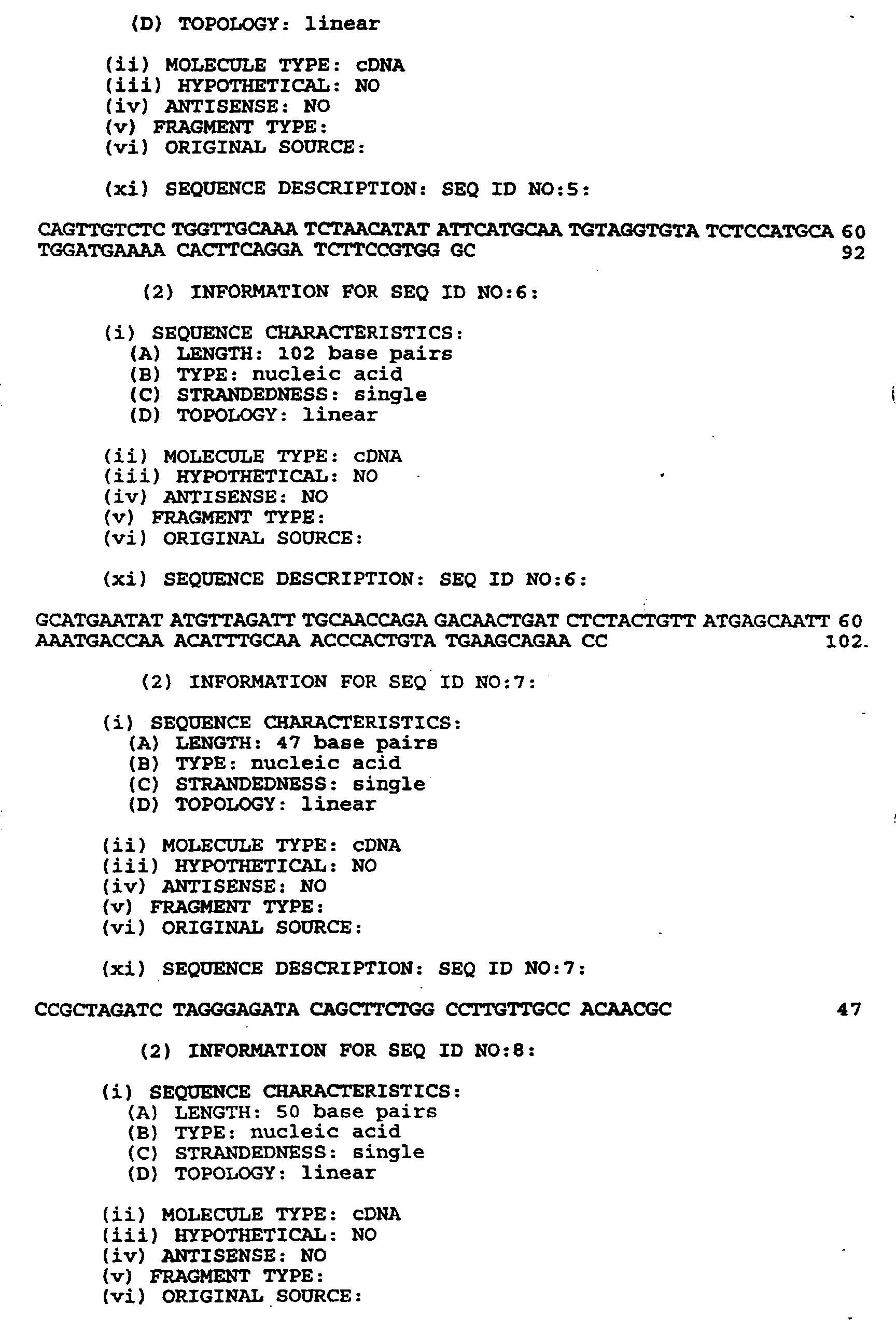
- the primers used for BPVL2-HPV16E7 (full-length) were:
- CsCl-purified recombinant plasmid was cotransfected with baculovirus DNA (Baculo-Gold; PharMingen, San Diego, CA) into Sf9 insect cells (ATCC, CRL 1711) by using Lipofectin (GIBCO/BRL, Gaithersburg, MD) (Hartig, P.C. Biotechniques 11:310 (1991)).
- the recombinant baculoviruses were plaque-purified as described (Summers, M.D. & Smith, G.E. (1987) A Manual of Methods for Baculovirus Vectors and Insect Cell Culture Procedures, Texas Agricultural Experiment Station Bulletin (Tex. Agric. Exp. Stn., College Station, TX), Vol 1555).
- Sf9 insect cells were infected at a multiplicity of infection of 10 with recombinant baculoviruses. After 72 h, the harvested cells were sonicated in phosphate-buffered saline (PBS) for 60 sec. After low-speed clarification, the lysates were subjected to centrifugation at 110,000 x g for 2.5 h through a 40% (wt/vol) sucrose/PBS cushion (SW-28 rotor). The resuspended pellets were centrifuged to equilibrium at 141,000 x g for 20 h at room temperature in a 10-40% (wt/wt) CsCl/PBS gradient. The visible band was harvested, centrifuged to equilibrium again by using the identical conditions, dialyzed extensively against PBS, and stored at 4°C.
- PBS phosphate-buffered saline
- BPVL1/L2-HPV16E7 full-length
- BPVL1/L2-HPV16E7 full-length
- BPVL1/L2-HPV16E7 aa 1-30 VLP preparations were immunoprecipitated in PBS, 1% Triton® X-100 with anti-L1 Mab 5B6 (Roden et al., J. Virol., in press, (November, 1994)), an anti-L1 polyclonal Ab, pre-immune serum or an irrelevant Ab (anti-E1A Mab) and protein A-Sepharose and subjected to SDS-PAGE. Proteins were immunoblotted and probed with anti-BPVL2, or anti-HPV16E7 sera, or an anti-HPV16E7 Mab (Triton Diagnostics, Alameda, CA).
- Rabbits were immunized by subcutaneous injection of 330 ul of CsCl gradient-purified particles in PBS at a concentration of 1 mg/ml. Rabbits were boosted with the same amount of particles two weeks and four weeks after the primary injection.
- purified particles were adsorbed to carbon-coated grids, stained with 1% uranyl acetate, and examined with a Philips electron microscope model EM 400T at x36,000 magnification.
- Particles containing the L2-E7 fusion protein were found to be indistinguishable from L1 or L1/L2 VLPs in terms of morphology and efficiency of incorporation.
- Serum from the immune rabbit specifically detected the HPV16E7 protein band in the Western blot, indicating the induction of antibodies specific for E7 epitopes.
- Chimeric particles are assayed for induction of cell-mediated immunity specific for E7 peptides, for example, by injecting chimeric VLPs into mice, and measuring antigen-specific T cell proliferation.
- Chimeric particles are assayed for induction of prophylactic immunity against challenge infection, for example, by immunizing rabbits with E7 chimeric CRPV VLPs and nonchimeric CRPV VLPs (control), and subsequently challenging with infectious CRPV, to demonstrate that L2-E7 fusions do not abrogate prophylactic immunity; or by immunizing experimental animals with chimeric VLPs containing an STD agent, subsequently challenging with the STD agent, and measuring increased survival against lethal challenge or decreased infection following sub-lethal challenge.
- Chimeric particles are assayed for induction of therapeutic immunity against pre-existing papillomas, for example, by immunizing rabbits (that have pre-existing papillomas) using E7 chimeric CRPV VLPs and nonchimeric CRPV VLPs (control), and measuring regression of the pre-existing papillomas.
- Chimeric particles are assayed for the ability to prevent tumor development or to treat existing tumors, for example, in experimental animals such as mice using tumor cells expressing, e.g ., E7.
- Animals are immunized with, e.g ., L2-E7 chimeric VLPs and tested for growth of inoculated tumorigenic cells that express, e.g ., E7.
- This approach has been shown to work for animals immunized with noncomplexed E7 and a co-stimulatory protein (Chen et al., Proc. Natl. Acad. Sci. USA 88:110 (1991)).
Landscapes
- Health & Medical Sciences (AREA)
- Life Sciences & Earth Sciences (AREA)
- Chemical & Material Sciences (AREA)
- Organic Chemistry (AREA)
- Medicinal Chemistry (AREA)
- General Health & Medical Sciences (AREA)
- Virology (AREA)
- Engineering & Computer Science (AREA)
- Genetics & Genomics (AREA)
- Bioinformatics & Cheminformatics (AREA)
- Veterinary Medicine (AREA)
- Nuclear Medicine, Radiotherapy & Molecular Imaging (AREA)
- Chemical Kinetics & Catalysis (AREA)
- Pharmacology & Pharmacy (AREA)
- Animal Behavior & Ethology (AREA)
- Biochemistry (AREA)
- Public Health (AREA)
- Zoology (AREA)
- Wood Science & Technology (AREA)
- General Chemical & Material Sciences (AREA)
- Biotechnology (AREA)
- Molecular Biology (AREA)
- Microbiology (AREA)
- Biophysics (AREA)
- Immunology (AREA)
- Communicable Diseases (AREA)
- Oncology (AREA)
- General Engineering & Computer Science (AREA)
- Gastroenterology & Hepatology (AREA)
- Biomedical Technology (AREA)
- Proteomics, Peptides & Aminoacids (AREA)
- Dermatology (AREA)
- Peptides Or Proteins (AREA)
- Medicines Containing Antibodies Or Antigens For Use As Internal Diagnostic Agents (AREA)
- Micro-Organisms Or Cultivation Processes Thereof (AREA)
- Medicines Containing Material From Animals Or Micro-Organisms (AREA)
- Preparation Of Compounds By Using Micro-Organisms (AREA)
Abstract
Description




Claims (37)
- A papillomavirus-like particle having conformational epitopes comprising a papillomavirus L1 fusion product.
- A papillomavirus-like particle as claimed in claim 1, wherein said papillomavirus L1 fusion product is a human papillomavirus L1 fusion product or a bovine papillomavirus L1 fusion product.
- A papillomavirus-like particle as claimed in claim 1 or claim 2, wherein said human papillomavirus L1 fusion product is a HPV16 L1 fusion product and said bovine papillomavirus L1 fusion product is a BPV1 L1 fusion product.
- A papillomavirus-like particle as claimed in any of claims 1 to 3, wherein said papillomavirus L1 fusion product comprises a fusion partner that is a peptide or a full-length protein, or comprises fusion partners that include peptides or full-length proteins or combinations thereof linked in tandem.
- A papillomavirus-like particle as claimed in any of claims 1 to 4, wherein said fusion partner is a papillomavirus E6 or E7 product.
- A papillomavirus-like particle as claimed in any of claims 1 to 5, wherein said papillomavirus L1 fusion product is fused at its N-terminus or C-terminus to a fusion partner.
- A papillomavirus-like particle as claimed in any of claims 1 to 5, wherein said papillomavirus L1 fusion product has a fusion partner inserted between L1 amino acids.
- A papillomavirus-like particle as claimed in any of claims 1 to 7 further comprising a papillomavirus L2 product.
- A papillomavirus-like particle as claimed in claim 8, wherein said papillomavirus L2 product is a HPV16 L2 product or a BPV1 L2 product.
- A composition comprising a papillomavirus-like particle as claimed in any of claims 1 to 9.
- A papillomavirus-like particle characterized as having conformational epitopes, comprising a papillomavirus L1 product and a papillomavirus L2 fusion product.
- A papillomavirus-like particle as claimed in claim 11, wherein said papillomavirus L2 fusion product is characterized as being a human papillomavirus L2 fusion product or a bovine papillomavirus L2 fusion product.
- A papillomavirus-like particle as claimed in claim 12, wherein said human papillomavirus L2 fusion product is characterized as being a HPV16 L2 fusion product and said bovine papillomavirus L2 fusion product is characterized as being a BPV1 L2 fusion product.
- A papillomavirus-like particle as claimed in any of claims 11 to 13, wherein said papillomavirus L2 fusion product comprises a fusion partner characterized as being a peptide or a full-length protein, or comprises fusion partners that include peptides or full-length proteins or combinations thereof linked in tandem.
- A papillomavirus-like particle as claimed in claim 14, wherein said fusion partner is a papillomavirus E6 or E7 product.
- A papillomavirus-like particle as claimed in any of claims 11 to 15, wherein said papillomavirus L2 fusion product is characterized as being fused at its N-terminus or C-terminus to a fusion partner.
- A papillomavirus-like particle as claimed in any of claims 11 to 16, wherein said papillomavirus L2 fusion product is characterized as having a fusion partner inserted between L2 amino acids.
- A papillomavirus-like particle as claimed in any of claims 11 to 17, wherein said papillomavirus L1 product is characterized as being a human papillomavirus L1 product or a bovine papillomavirus L1 product.
- A papillomavirus-like particle as claimed in claim 18, wherein said human papillomavirus L1 product is characterized as being a HPV16 L1 product and said bovine papillomavirus L1 product is characterized as being a BPV1 L1 product.
- A papillomavirus-like particle as claimed in any of claims 11 to 19, wherein the particle consists of L1 product and L2 fusion product, and is selected from the group consisting of (1) HPV16L1 and HPV16L2-HPV16E7 (full-length), optionally wherein HPV16E7 is fused to the C-terminus of HPV16L2, (2) BPVL1 and BPVL2-HPV16E7 (full-length), optionally wherein HPV16E7 is fused to the C-terminus of BPVL2, and (3) BPVL1 and BPVL2-HPV16E7 (amino acids 1 - 30), optionally wherein amino acids 1 - 30 of HPV16E7 are fused to BPVL2 between amino acids 274 and 275.
- A method of purification of a papillomavirus-like particle of any of claims 11 to 20 comprising the step of exposing the papillomavirus-like particle of any of claims 11 to 20 to an affinity chromatography column comprising antibodies that bind to a fusion partner of the papillomavirus L2 fusion product of the papillomavirus-like particle resulting in the purification of said particle.
- A method of purification of a fusion partner of the papillomavirus L2 fusion product of the papillomavirus-like particle of any of claims 11 to 20 comprising the step of isolating the papillomavirus-like particle of any of claims 11 to 20 resulting in the purification of said fusion partner.
- A method of delivery into a cell of a fusion partner of the papillomavirus L2 fusion product as part of the papillomavirus-like particle of any of claims 11 to 20 comprising the step of administering the papillomavirus-like particle to said cell in vitro or ex vivo resulting in the delivery into said cell of said fusion partner.
- An immunogenic composition comprising the papillomavirus like particle of any of claims 11 to 20.
- A papillomavirus-like particle of any of claims 11 to 20 for use as a pharmaceutical.
- The use of a papillomavirus-like particle of any of claims 11 to 20 for the manufacture of a medicament for stimulating an immune response in a host mammal.
- A synthetic DNA molecule characterized as encoding a papillomavirus L1 product and papillomavirus L2 fusion product, wherein said molecule is capable of directing expression in a transformed cell of papillomavirus-like particles characterized as having conformational epitopes, wherein said particles comprise said papillomavirus L1 product and papillomavirus L2 fusion product.
- A DNA molecule as claimed in claim 27 wherein the DNA molecule is capable of directing expression in a transformed insect cell and the DNA further comprises an insect cell vector, or wherein the DNA molecule is capable of directing expression in a transformed mammalian cell and the DNA further comprises a mammalian cell vector, or wherein the DNA molecule is capable of directing expression in a transformed yeast cell and the DNA further comprises a yeast cell vector.
- A host cell transformed with one or more DNA molecules which together encode a papillomavirus L1 product and a papillomavirus L2 fusion product, wherein said molecule(s) direct(s) expression of papillomavirus-like particles characterized as having conformational epitopes, wherein said particles comprise said papillomavirus L1 product and papillomavirus L2 fusion product.
- A host cell as claimed in claim 29, wherein the papillomavirus L1 product and the papillomavirus L2 fusion product are encoded on the same DNA molecule.
- A host cell as claimed in claim 29, wherein the papillomavirus L1 product and the papillomavirus L2 fusion product are encoded on different DNA molecules.
- A method for producing a papillomavirus-like particle, characterized as having conformational epitopes, comprising a papillomavirus L1 product and a papillomavirus L2 fusion product, which method comprises providing conditions for the host cell of any of claims 29 to 31 to express said DNA, thereby producing said particle.
- A method as claimed in claim 32 further comprising recovering said particle from said host cell.
- A composition comprising a first synthetic DNA molecule characterised as encoding a papillomavirus L1 product and a second synthetic DNA molecule characterized as encoding a papillomavirus L2 fusion product, wherein said molecules are capable of directing expression in a transformed cell of papillomavirus-like particles characterized as having conformational epitopes, wherein said particles comprise said papillomavirus L1 product and papillomavirus L2 fusion product.
- A composition as claimed in claim 34, wherein the DNA molecules are capable of directing expression in a transformed insect cell and the DNA of each said molecule further comprises an insect cell vector, or wherein the DNA molecules are capable of directing expression in a transformed mammalian cell and the DNA of each said molecule further comprises a mammalian cell vector, or wherein the DNA molecules are capable of directing expression in a transformed yeast cell and the DNA of each said molecule further comprises a yeast cell vector.
- The use of a papillomavirus-like particle of any of claims 11 to 20 as a platform for multivalent antigen presentation.
- The use of a papillomavirus-like particle of any of claims 11 to 20 for delivery into cells of proteins for processing into peptides and subsequent presentation of these peptides within the context of MHC molecules to elicit a cell-mediated immune response.
Applications Claiming Priority (3)
| Application Number | Priority Date | Filing Date | Title |
|---|---|---|---|
| US08/319,467 US5618536A (en) | 1992-09-03 | 1994-10-06 | Chimeric papillomavirus-like particles |
| US319467 | 1994-10-06 | ||
| EP95936278A EP0789766B1 (en) | 1994-10-06 | 1995-10-06 | Chimeric papillomavirus-like particles |
Related Parent Applications (1)
| Application Number | Title | Priority Date | Filing Date |
|---|---|---|---|
| EP95936278A Division EP0789766B1 (en) | 1994-10-06 | 1995-10-06 | Chimeric papillomavirus-like particles |
Publications (2)
| Publication Number | Publication Date |
|---|---|
| EP1018555A2 true EP1018555A2 (en) | 2000-07-12 |
| EP1018555A3 EP1018555A3 (en) | 2000-10-11 |
Family
ID=23242365
Family Applications (2)
| Application Number | Title | Priority Date | Filing Date |
|---|---|---|---|
| EP95936278A Expired - Lifetime EP0789766B1 (en) | 1994-10-06 | 1995-10-06 | Chimeric papillomavirus-like particles |
| EP00103738A Ceased EP1018555A3 (en) | 1994-10-06 | 1995-10-06 | Chimeric papilomavirus-like particles |
Family Applications Before (1)
| Application Number | Title | Priority Date | Filing Date |
|---|---|---|---|
| EP95936278A Expired - Lifetime EP0789766B1 (en) | 1994-10-06 | 1995-10-06 | Chimeric papillomavirus-like particles |
Country Status (10)
| Country | Link |
|---|---|
| US (2) | US5618536A (en) |
| EP (2) | EP0789766B1 (en) |
| JP (3) | JP3343912B2 (en) |
| AT (1) | ATE258985T1 (en) |
| AU (1) | AU3828495A (en) |
| DE (1) | DE69532532T8 (en) |
| DK (1) | DK0789766T3 (en) |
| ES (1) | ES2213754T3 (en) |
| PT (1) | PT789766E (en) |
| WO (1) | WO1996011274A1 (en) |
Cited By (2)
| Publication number | Priority date | Publication date | Assignee | Title |
|---|---|---|---|---|
| WO2004052395A1 (en) * | 2002-12-09 | 2004-06-24 | Glaxosmithkline Biologicals Sa | L2-peptide of the human papillomavirus associated with virus-like particles |
| US7354719B2 (en) | 2004-12-08 | 2008-04-08 | Gen-Probe Incorporated | Detection of nucleic acids from multiple types of human papillomaviruses |
Families Citing this family (68)
| Publication number | Priority date | Publication date | Assignee | Title |
|---|---|---|---|---|
| US20020164350A1 (en) * | 1992-09-03 | 2002-11-07 | Lowy Douglas R. | Chimeric papillomavirus-like particles |
| US5437951A (en) * | 1992-09-03 | 1995-08-01 | The United States Of America As Represented By The Department Of Health And Human Services | Self-assembling recombinant papillomavirus capsid proteins |
| US5888516A (en) * | 1994-05-16 | 1999-03-30 | Merck & Co. Inc. | Recombinant papillomavirus vaccines |
| AUPM566794A0 (en) * | 1994-05-17 | 1994-06-09 | University Of Queensland, The | Process and product |
| GB9420146D0 (en) * | 1994-10-06 | 1994-11-23 | Cancer Res Campaign Tech | Papillomavirus vaccine |
| PT809700E (en) * | 1994-10-07 | 2006-09-29 | Univ Loyola Chicago | PARTICLES SIMILAR TO PAPILLOMAVIRUS AND FUSEOUS PROTEINS, AND METHODS FOR THEIR PRODUCTION |
| CA2211995A1 (en) * | 1995-02-24 | 1996-08-29 | Cantab Pharmaceuticals Research Limited | Polypeptides useful as immunotherapeutic agents and methods of polypeptide preparation |
| FR2749323B1 (en) * | 1996-06-04 | 1998-07-10 | Pasteur Merieux Serums Vacc | PSEUDO-PARTICLES VIRALES USEFUL AS A VECTOR OF NUCLEIC ACID DELIVERY |
| DE69734829D1 (en) | 1996-07-17 | 2006-01-12 | Us Health | INFECTIOUS PSEUDOVIRAL PAPILLOMAVIRUS PARTICLES |
| CZ28899A3 (en) * | 1996-07-29 | 1999-07-14 | Cantab Pharmaceuticals Research Limited | Polypeptides usable as immunotherapeutic agents and processes for preparing polypeptides |
| US7118754B1 (en) * | 1996-07-30 | 2006-10-10 | Transgene S.A. | Pharmaceutical composition for treating papillomavirus tumors and infection |
| FR2751879B1 (en) * | 1996-07-30 | 1998-10-30 | Transgene Sa | PHARMACEUTICAL COMPOSITION AGAINST TUMORS AND PAPILLOMAVIRUS INFECTIONS |
| AU781653B2 (en) * | 1996-07-30 | 2005-06-02 | Transgene S.A. | Pharmaceutical composition for treating papollomavirus tumour and infection |
| AU4258297A (en) * | 1996-09-11 | 1998-04-02 | Merck & Co., Inc. | Papillomavirus vaccine formulation |
| GB9621091D0 (en) | 1996-10-09 | 1996-11-27 | Fondation Pour Le Perfectionem | Attenuated microorganisms strains and their uses |
| JP2002508748A (en) * | 1997-05-01 | 2002-03-19 | カイロン コーポレイション | Use of virus-like particles as adjuvants |
| US6228368B1 (en) * | 1997-10-06 | 2001-05-08 | Loyola University Of Chicago | Papilloma virus capsomere formulations and method of use |
| US7494658B2 (en) * | 1998-02-20 | 2009-02-24 | Medigene Ag | Papilloma virus truncated L1 protein and fusion protein constructs |
| CA2229955C (en) | 1998-02-20 | 2003-12-09 | Medigene Gmbh | Papilloma virus capsomere vaccine formulations and methods of use |
| US20020039584A1 (en) | 1998-02-20 | 2002-04-04 | Medigene Ag | Papilloma virus capsomere vaccine formulations and methods of use |
| US7182947B2 (en) * | 1998-02-20 | 2007-02-27 | Medigene Ag | Papillomavirus truncated L1 protein and fusion protein constructs |
| US6926897B1 (en) * | 1998-03-24 | 2005-08-09 | Medigene Aktiengesellschaft | Medicament for the avoidance or treatment of papillomavirus-specific tumour |
| EP1105157B1 (en) * | 1998-08-14 | 2006-11-02 | Merck & Co., Inc. | Protein delivery system using human papillomavirus virus-like particles |
| US6991795B1 (en) | 1998-08-14 | 2006-01-31 | Merck & Co., Inc. | Protein delivery system using human papillomavirus virus-like particles |
| US7112330B1 (en) | 1998-08-14 | 2006-09-26 | Chiron Corporation | Method for producing yeast expressed HPV types 6 and 16 capsid proteins |
| CN100406060C (en) | 1998-10-16 | 2008-07-30 | 史密丝克莱恩比彻姆生物有限公司 | Adjuvant composition |
| ES2258869T3 (en) * | 1998-10-21 | 2006-09-01 | The United States Government As Represented By The Department Of Health And Human Services | VIRUS SIMILAR PARTICLES FOR THE INDUCTION OF AUTO ANTIBODIES. |
| US6380364B1 (en) * | 1998-11-23 | 2002-04-30 | Loyola University Of Chicago | Chimeric biotin-binding papillomavirus protein |
| CU22871A1 (en) * | 1998-12-02 | 2003-10-21 | Ct Ingenieria Genetica Biotech | FORMULATIONS CONTAINING PARTICULARS SIMILAR TO VIRUS AS IMMUNOPOTENCERS BY MUCOSAL ROUTE |
| US6689366B1 (en) | 1998-12-17 | 2004-02-10 | Merck & Co., Inc. | Synthetic virus like particles with heterologous epitopes |
| DE69930960T2 (en) * | 1998-12-17 | 2007-04-19 | Merck & Co., Inc. | SYNTHETIC VIRUS-RELATED PARTICLES WITH HETEROLOGIC EPITOPES. |
| DE19905883C2 (en) * | 1999-02-11 | 2001-05-23 | Deutsches Krebsforsch | Chimeric virus-like particles or chimeric capsomeres from BPV |
| DE19916224C1 (en) * | 1999-04-10 | 2000-06-21 | November Ag Molekulare Medizin | Synthetic molecule for delivering active ingredient to cell, used e.g. to treat human immune deficiency virus infection, comprises the ingredient linked to VP2 or 3 peptide from polyoma virus |
| GB9921146D0 (en) * | 1999-09-07 | 1999-11-10 | Smithkline Beecham Biolog | Novel composition |
| US8128922B2 (en) | 1999-10-20 | 2012-03-06 | Johns Hopkins University | Superior molecular vaccine linking the translocation domain of a bacterial toxin to an antigen |
| US7026443B1 (en) * | 1999-12-10 | 2006-04-11 | Epimmune Inc. | Inducing cellular immune responses to human Papillomavirus using peptide and nucleic acid compositions |
| US6908613B2 (en) * | 2000-06-21 | 2005-06-21 | Medimmune, Inc. | Chimeric human papillomavirus (HPV) L1 molecules and uses therefor |
| DE60124725T2 (en) * | 2000-07-07 | 2007-10-04 | Merck & Co., Inc. | PREPARATION OF A CHIMERIC PAPILLOMA VIRUS |
| GB0018050D0 (en) * | 2000-07-21 | 2000-09-13 | Norchip As | Detection of human papillomavirus mRNA |
| AU2001290520A1 (en) * | 2000-08-01 | 2002-02-13 | The Johns Hokpins University | Intercellular transport protein linked to an antigen as a molecular vaccine |
| ES2454640T3 (en) * | 2000-08-03 | 2014-04-11 | Johns Hopkins University | Molecular vaccine that carries a chaperone polypeptide from the endoplasmic reticulum to an antigen |
| AU2002255532A1 (en) * | 2001-02-13 | 2002-10-15 | Joseph D. Mosca | Biological carriers for induction of immune responses |
| CA2457804C (en) | 2001-08-13 | 2012-10-16 | University Of Rochester | Transcutaneous immunization against papillomavirus with papillomavirus virus-like particles |
| GB0206360D0 (en) | 2002-03-18 | 2002-05-01 | Glaxosmithkline Biolog Sa | Viral antigens |
| US20060088909A1 (en) * | 2002-05-17 | 2006-04-27 | Compans Richard W | Virus-like particles, methods of preparation, and immunogenic compositions |
| US9045727B2 (en) * | 2002-05-17 | 2015-06-02 | Emory University | Virus-like particles, methods of preparation, and immunogenic compositions |
| DK1506222T3 (en) * | 2002-05-17 | 2009-07-06 | Univ Cape Town | Chimeric human papillomavirus16 L1 proteins comprising an L2 peptide, virus-like particles made therefrom, and a method for producing the particles |
| US7858098B2 (en) | 2002-12-20 | 2010-12-28 | Glaxosmithkline Biologicals, S.A. | Vaccine |
| WO2004098526A2 (en) * | 2003-05-05 | 2004-11-18 | Johns Hopkins University | Anti-cancer dna vaccine employing plasmids encoding signal sequence, mutant oncoprotein antigen, and heat shock protein |
| AU2005222776A1 (en) * | 2003-12-31 | 2005-09-29 | Genimmune N.V. | Inducing cellular immune responses to human papillomavirus using peptide and nucleic acid compositions |
| US7758866B2 (en) | 2004-06-16 | 2010-07-20 | Glaxosmithkline Biologicals, S.A. | Vaccine against HPV16 and HPV18 and at least another HPV type selected from HPV 31, 45 or 52 |
| CA2594040A1 (en) * | 2005-01-06 | 2006-07-13 | The Johns Hopkins University | Rna interference that blocks expression of pro-apoptotic proteins potentiates immunity induced by dna and transfected dendritic cell vaccines |
| US7314630B2 (en) * | 2005-01-07 | 2008-01-01 | Yao-Xiong Hu | Compounds and methods of early diagnosis of cervical cancer and genital condyloma with HPV, CHSP60 tumor suppressor H-Ras, K-Ras and PTEN derived peptides modified |
| EP1846026A4 (en) * | 2005-01-26 | 2008-07-02 | Univ Johns Hopkins | ANTICANCER DNA VACCINE USING PLASMID CODING ANTIGEN AND CALRETICULIN SUCH AS MUTANT ONCOPROTEINS |
| AU2006210792B2 (en) * | 2005-02-01 | 2012-07-26 | The Government Of The United States Of America, As Represented By The Secretary, Department Of Health And Human Services | Papillomavirus L2 N-terminal peptides for the induction of broadly cross-neutralizing antibodies |
| TWI321350B (en) * | 2006-04-18 | 2010-03-01 | Advanced Semiconductor Eng | Heatsink and heatsink positioning system |
| WO2008024844A2 (en) * | 2006-08-22 | 2008-02-28 | The Johns Hopkins University | Anticancer combination therapies |
| WO2008082719A2 (en) * | 2006-08-30 | 2008-07-10 | University Of Rochester | Combined human papillomavirus vlp/gene delivery system and use thereof as a vaccine for prophylaxis and immunotherapy of infectious diseases and tumors |
| US9085638B2 (en) | 2007-03-07 | 2015-07-21 | The Johns Hopkins University | DNA vaccine enhancement with MHC class II activators |
| US20080260765A1 (en) * | 2007-03-15 | 2008-10-23 | Johns Hopkins University | HPV DNA Vaccines and Methods of Use Thereof |
| EP2217699A4 (en) * | 2007-10-22 | 2012-11-28 | Univ Rochester | RESPIRATORY SYNCYTIAL VIRUS VACCINE BASED ON CHIMERIC PAPILLOMAVIRUS-SIMILAR PARTICLES OR CAPSOMERS |
| CN101896194A (en) * | 2007-11-02 | 2010-11-24 | 约翰霍普金斯大学 | Compositions and methods for treating or preventing human papillomavirus infection with HPV peptides of multiple types |
| US20090285861A1 (en) * | 2008-04-17 | 2009-11-19 | Tzyy-Choou Wu | Tumor cell-based cancer immunotherapeutic compositions and methods |
| AU2009348078B2 (en) | 2009-06-19 | 2013-03-14 | Eyegene Inc. | Vaccine for cervical cancer |
| SG11201912480SA (en) * | 2017-06-23 | 2020-01-30 | Pathovax Llc | Chimeric virus-like particles and uses thereof as antigen-specific redirectors of immune responses |
| WO2020139978A1 (en) | 2018-12-27 | 2020-07-02 | Verimmune Llc | Conjugated virus-like particles and uses thereof as anti-tumor immune redirectors |
| KR102767403B1 (en) | 2019-07-19 | 2025-02-14 | 사이노셀테크 엘티디. | Chimeric papillomavirus l1 protein |
| JP7017811B2 (en) * | 2020-02-13 | 2022-02-09 | 国立研究開発法人農業・食品産業技術総合研究機構 | Virus-like particles and their use |
Family Cites Families (3)
| Publication number | Priority date | Publication date | Assignee | Title |
|---|---|---|---|---|
| GB9113809D0 (en) * | 1991-06-26 | 1991-08-14 | Cancer Res Campaign Tech | Papillomavirus l2 protein |
| EP1471147A3 (en) * | 1991-07-19 | 2007-03-21 | The University Of Queensland | Method of making a recombinant molecule for the expression of HPV-16 L1 protein |
| US5437951A (en) * | 1992-09-03 | 1995-08-01 | The United States Of America As Represented By The Department Of Health And Human Services | Self-assembling recombinant papillomavirus capsid proteins |
-
1994
- 1994-10-06 US US08/319,467 patent/US5618536A/en not_active Expired - Lifetime
-
1995
- 1995-10-06 DE DE69532532T patent/DE69532532T8/en active Active
- 1995-10-06 EP EP95936278A patent/EP0789766B1/en not_active Expired - Lifetime
- 1995-10-06 ES ES95936278T patent/ES2213754T3/en not_active Expired - Lifetime
- 1995-10-06 AT AT95936278T patent/ATE258985T1/en active
- 1995-10-06 EP EP00103738A patent/EP1018555A3/en not_active Ceased
- 1995-10-06 DK DK95936278T patent/DK0789766T3/en active
- 1995-10-06 PT PT95936278T patent/PT789766E/en unknown
- 1995-10-06 WO PCT/US1995/012914 patent/WO1996011274A1/en not_active Ceased
- 1995-10-06 JP JP51266796A patent/JP3343912B2/en not_active Expired - Lifetime
- 1995-10-06 AU AU38284/95A patent/AU3828495A/en not_active Abandoned
-
1997
- 1997-01-09 US US08/781,084 patent/US5855891A/en not_active Expired - Lifetime
-
2001
- 2001-04-03 JP JP2001104294A patent/JP2002053597A/en active Pending
-
2007
- 2007-02-27 JP JP2007047248A patent/JP2007143560A/en active Pending
Cited By (19)
| Publication number | Priority date | Publication date | Assignee | Title |
|---|---|---|---|---|
| WO2004052395A1 (en) * | 2002-12-09 | 2004-06-24 | Glaxosmithkline Biologicals Sa | L2-peptide of the human papillomavirus associated with virus-like particles |
| US7354719B2 (en) | 2004-12-08 | 2008-04-08 | Gen-Probe Incorporated | Detection of nucleic acids from multiple types of human papillomaviruses |
| US7682792B2 (en) | 2004-12-08 | 2010-03-23 | Gen-Probe Incorporated | Detection of nucleic acids from multiple types of human papillomaviruses |
| US8026066B2 (en) | 2004-12-08 | 2011-09-27 | Gen-Probe Incorporated | Detection of nucleic acids from multiple types of human papillomaviruses |
| US8334098B2 (en) | 2004-12-08 | 2012-12-18 | Gen-Probe Incorporated | Detection of nucleic acids from multiple types of human papillomaviruses |
| US8574841B2 (en) | 2004-12-08 | 2013-11-05 | Gen-Probe Incorporated | Compositions, reaction mixtures and methods for detecting nucleic acids from type A1 and/or type C1 human papillomavirus |
| US8785125B2 (en) | 2004-12-08 | 2014-07-22 | Gen-Probe Incorporated | Compositions, reaction mixtures and methods for detecting nucleic acids from type A1 and/or type C1 human papillomavirus |
| US8828660B2 (en) | 2004-12-08 | 2014-09-09 | Gen-Probe Incorporated | Compositions, reaction mixtures and methods for detecting nucleic acids from multiple types of human papillomavirus |
| US8835114B2 (en) | 2004-12-08 | 2014-09-16 | Gen-Probe Incorporated | Compositions, reaction mixtures and methods for detecting nucleic acids from multiple types of human papillomavirus |
| US9074263B2 (en) | 2004-12-08 | 2015-07-07 | Gen-Probe Incorporated | Compositions and reaction mixtures for the detection of nucleic acids from multiple types of human papillomavirus |
| US9328392B2 (en) | 2004-12-08 | 2016-05-03 | Gen-Probe Incorporated | Compositions and reaction mixtures for the detection of nucleic acids from multiple types of human papillomavirus |
| US9765407B2 (en) | 2004-12-08 | 2017-09-19 | Gen-Probe Incorporated | Detection of nucleic acids from multiple types of human papillomavirus |
| US10047407B2 (en) | 2004-12-08 | 2018-08-14 | Gen-Probe Incorporated | Detection of nucleic acids from multiple types of human papillomavirus |
| US10465255B2 (en) | 2004-12-08 | 2019-11-05 | Gen-Probe Incorporated | Detection of nucleic acids from multiple types of human papillomavirus |
| US10640836B2 (en) | 2004-12-08 | 2020-05-05 | Gen-Probe Incorporated | Separation of human papillomavirus nucleic acids from biological samples |
| US10711317B2 (en) | 2004-12-08 | 2020-07-14 | Gen-Probe Incorporated | Detection of nucleic acids from multiple types of human papillomavirus |
| US10968494B2 (en) | 2004-12-08 | 2021-04-06 | Gen-Probe Incorporated | Detection of nucleic acids from multiple types of human papillomavirus |
| US11359252B2 (en) | 2004-12-08 | 2022-06-14 | Gen-Probe Incorporated | Detection of nucleic acids from multiple types of human papillomavirus |
| US11624096B2 (en) | 2004-12-08 | 2023-04-11 | Gen-Probe Incorporated | Detection of nucleic acids from multiple types of human papillomavirus |
Also Published As
| Publication number | Publication date |
|---|---|
| US5618536A (en) | 1997-04-08 |
| EP0789766B1 (en) | 2004-02-04 |
| EP0789766A1 (en) | 1997-08-20 |
| PT789766E (en) | 2004-05-31 |
| US5855891A (en) | 1999-01-05 |
| DE69532532T8 (en) | 2005-05-25 |
| JPH10506796A (en) | 1998-07-07 |
| DE69532532T2 (en) | 2005-01-05 |
| JP3343912B2 (en) | 2002-11-11 |
| DK0789766T3 (en) | 2004-05-24 |
| AU3828495A (en) | 1996-05-02 |
| DE69532532D1 (en) | 2004-03-11 |
| JP2007143560A (en) | 2007-06-14 |
| ES2213754T3 (en) | 2004-09-01 |
| WO1996011274A1 (en) | 1996-04-18 |
| EP1018555A3 (en) | 2000-10-11 |
| ATE258985T1 (en) | 2004-02-15 |
| JP2002053597A (en) | 2002-02-19 |
Similar Documents
| Publication | Publication Date | Title |
|---|---|---|
| EP0789766B1 (en) | Chimeric papillomavirus-like particles | |
| US6228368B1 (en) | Papilloma virus capsomere formulations and method of use | |
| JP4486257B2 (en) | Virus-like particles for induction of autoantibodies | |
| US7691386B2 (en) | Chimeric papillomavirus-like particles | |
| EP1305039B1 (en) | Stable (fixed) forms of viral l1 capsid proteins, fusion proteins and uses thereof | |
| US6352696B1 (en) | Papillomavirus truncated L1 protein and fusion protein constructs | |
| US6649167B2 (en) | Papillomavirus truncated L1 protein and fusion protein constructs | |
| US7182947B2 (en) | Papillomavirus truncated L1 protein and fusion protein constructs | |
| AU717647B2 (en) | Chimeric papillomavirus-like particles | |
| AU717932B2 (en) | Chimeric papillomavirus-like particles | |
| CA2201601C (en) | Chimeric papillomavirus-like particles | |
| US7494658B2 (en) | Papilloma virus truncated L1 protein and fusion protein constructs | |
| HK1094340A (en) | Papilloma virus capsomere vaccine formulations and methods of use |
Legal Events
| Date | Code | Title | Description |
|---|---|---|---|
| PUAI | Public reference made under article 153(3) epc to a published international application that has entered the european phase |
Free format text: ORIGINAL CODE: 0009012 |
|
| 17P | Request for examination filed |
Effective date: 20000217 |
|
| AC | Divisional application: reference to earlier application |
Ref document number: 789766 Country of ref document: EP |
|
| AK | Designated contracting states |
Kind code of ref document: A2 Designated state(s): AT BE CH DE DK ES FR GB GR IE IT LI LU MC NL PT SE |
|
| PUAL | Search report despatched |
Free format text: ORIGINAL CODE: 0009013 |
|
| AK | Designated contracting states |
Kind code of ref document: A3 Designated state(s): AT BE CH DE DK ES FR GB GR IE IT LI LU MC NL PT SE |
|
| 17Q | First examination report despatched |
Effective date: 20010327 |
|
| AKX | Designation fees paid |
Free format text: AT BE CH DE DK ES FR GB GR IE IT LI LU MC NL PT SE |
|
| STAA | Information on the status of an ep patent application or granted ep patent |
Free format text: STATUS: THE APPLICATION HAS BEEN REFUSED |
|
| 18R | Application refused |
Effective date: 20080219 |