EP0949695A2 - Electroluminescent structure using blend systems - Google Patents
Electroluminescent structure using blend systems Download PDFInfo
- Publication number
- EP0949695A2 EP0949695A2 EP99104958A EP99104958A EP0949695A2 EP 0949695 A2 EP0949695 A2 EP 0949695A2 EP 99104958 A EP99104958 A EP 99104958A EP 99104958 A EP99104958 A EP 99104958A EP 0949695 A2 EP0949695 A2 EP 0949695A2
- Authority
- EP
- European Patent Office
- Prior art keywords
- alkyl
- zone
- electroluminescent
- hole
- arrangements according
- Prior art date
- Legal status (The legal status is an assumption and is not a legal conclusion. Google has not performed a legal analysis and makes no representation as to the accuracy of the status listed.)
- Granted
Links
- 0 CCCc(cc1)ccc1N(C(CC1)=CC=C1c1cc(-c(cc2)ccc2N(c2ccc(C)cc2)c2ccc(CCC)cc2)cc(-c(cc2)ccc2N(c2ccc(*)cc2)c2ccc(CCC)cc2)c1)c1ccc(CCC)cc1 Chemical compound CCCc(cc1)ccc1N(C(CC1)=CC=C1c1cc(-c(cc2)ccc2N(c2ccc(C)cc2)c2ccc(CCC)cc2)cc(-c(cc2)ccc2N(c2ccc(*)cc2)c2ccc(CCC)cc2)c1)c1ccc(CCC)cc1 0.000 description 5
- UBYVVWXEMDLJHR-UHFFFAOYSA-N CC(CC(c(cc1)ccc1N(C)C)=C1)(C=C1c(cc1)ccc1N(C)C)c(cc1)ccc1N(C)C Chemical compound CC(CC(c(cc1)ccc1N(C)C)=C1)(C=C1c(cc1)ccc1N(C)C)c(cc1)ccc1N(C)C UBYVVWXEMDLJHR-UHFFFAOYSA-N 0.000 description 1
- FQNVFRPAQRVHKO-UHFFFAOYSA-N Cc(cc1)ccc1N(c1ccccc1)c(cc1)ccc1N(c1ccccc1)c1ccc(C)cc1 Chemical compound Cc(cc1)ccc1N(c1ccccc1)c(cc1)ccc1N(c1ccccc1)c1ccc(C)cc1 FQNVFRPAQRVHKO-UHFFFAOYSA-N 0.000 description 1
Classifications
-
- C—CHEMISTRY; METALLURGY
- C08—ORGANIC MACROMOLECULAR COMPOUNDS; THEIR PREPARATION OR CHEMICAL WORKING-UP; COMPOSITIONS BASED THEREON
- C08G—MACROMOLECULAR COMPOUNDS OBTAINED OTHERWISE THAN BY REACTIONS ONLY INVOLVING UNSATURATED CARBON-TO-CARBON BONDS
- C08G61/00—Macromolecular compounds obtained by reactions forming a carbon-to-carbon link in the main chain of the macromolecule
- C08G61/12—Macromolecular compounds containing atoms other than carbon in the main chain of the macromolecule
- C08G61/122—Macromolecular compounds containing atoms other than carbon in the main chain of the macromolecule derived from five- or six-membered heterocyclic compounds, other than imides
- C08G61/123—Macromolecular compounds containing atoms other than carbon in the main chain of the macromolecule derived from five- or six-membered heterocyclic compounds, other than imides derived from five-membered heterocyclic compounds
- C08G61/126—Macromolecular compounds containing atoms other than carbon in the main chain of the macromolecule derived from five- or six-membered heterocyclic compounds, other than imides derived from five-membered heterocyclic compounds with a five-membered ring containing one sulfur atom in the ring
-
- H—ELECTRICITY
- H10—SEMICONDUCTOR DEVICES; ELECTRIC SOLID-STATE DEVICES NOT OTHERWISE PROVIDED FOR
- H10K—ORGANIC ELECTRIC SOLID-STATE DEVICES
- H10K85/00—Organic materials used in the body or electrodes of devices covered by this subclass
- H10K85/10—Organic polymers or oligomers
- H10K85/111—Organic polymers or oligomers comprising aromatic, heteroaromatic, or aryl chains, e.g. polyaniline, polyphenylene or polyphenylene vinylene
- H10K85/113—Heteroaromatic compounds comprising sulfur or selene, e.g. polythiophene
- H10K85/1135—Polyethylene dioxythiophene [PEDOT]; Derivatives thereof
-
- C—CHEMISTRY; METALLURGY
- C07—ORGANIC CHEMISTRY
- C07C—ACYCLIC OR CARBOCYCLIC COMPOUNDS
- C07C211/00—Compounds containing amino groups bound to a carbon skeleton
- C07C211/43—Compounds containing amino groups bound to a carbon skeleton having amino groups bound to carbon atoms of six-membered aromatic rings of the carbon skeleton
- C07C211/54—Compounds containing amino groups bound to a carbon skeleton having amino groups bound to carbon atoms of six-membered aromatic rings of the carbon skeleton having amino groups bound to two or three six-membered aromatic rings
-
- C—CHEMISTRY; METALLURGY
- C07—ORGANIC CHEMISTRY
- C07C—ACYCLIC OR CARBOCYCLIC COMPOUNDS
- C07C217/00—Compounds containing amino and etherified hydroxy groups bound to the same carbon skeleton
- C07C217/78—Compounds containing amino and etherified hydroxy groups bound to the same carbon skeleton having amino groups and etherified hydroxy groups bound to carbon atoms of six-membered aromatic rings of the same carbon skeleton
- C07C217/94—Compounds containing amino and etherified hydroxy groups bound to the same carbon skeleton having amino groups and etherified hydroxy groups bound to carbon atoms of six-membered aromatic rings of the same carbon skeleton having amino groups bound to carbon atoms of six-membered aromatic rings being part of condensed ring systems and etherified hydroxy groups bound to carbon atoms of six-membered aromatic rings of the same carbon skeleton
-
- H—ELECTRICITY
- H10—SEMICONDUCTOR DEVICES; ELECTRIC SOLID-STATE DEVICES NOT OTHERWISE PROVIDED FOR
- H10K—ORGANIC ELECTRIC SOLID-STATE DEVICES
- H10K50/00—Organic light-emitting devices
- H10K50/10—OLEDs or polymer light-emitting diodes [PLED]
- H10K50/14—Carrier transporting layers
- H10K50/15—Hole transporting layers
-
- H—ELECTRICITY
- H10—SEMICONDUCTOR DEVICES; ELECTRIC SOLID-STATE DEVICES NOT OTHERWISE PROVIDED FOR
- H10K—ORGANIC ELECTRIC SOLID-STATE DEVICES
- H10K50/00—Organic light-emitting devices
- H10K50/10—OLEDs or polymer light-emitting diodes [PLED]
- H10K50/17—Carrier injection layers
-
- H—ELECTRICITY
- H10—SEMICONDUCTOR DEVICES; ELECTRIC SOLID-STATE DEVICES NOT OTHERWISE PROVIDED FOR
- H10K—ORGANIC ELECTRIC SOLID-STATE DEVICES
- H10K85/00—Organic materials used in the body or electrodes of devices covered by this subclass
- H10K85/30—Coordination compounds
- H10K85/321—Metal complexes comprising a group IIIA element, e.g. Tris (8-hydroxyquinoline) gallium [Gaq3]
- H10K85/326—Metal complexes comprising a group IIIA element, e.g. Tris (8-hydroxyquinoline) gallium [Gaq3] comprising gallium
-
- H—ELECTRICITY
- H10—SEMICONDUCTOR DEVICES; ELECTRIC SOLID-STATE DEVICES NOT OTHERWISE PROVIDED FOR
- H10K—ORGANIC ELECTRIC SOLID-STATE DEVICES
- H10K85/00—Organic materials used in the body or electrodes of devices covered by this subclass
- H10K85/60—Organic compounds having low molecular weight
- H10K85/631—Amine compounds having at least two aryl rest on at least one amine-nitrogen atom, e.g. triphenylamine
Definitions
- An electroluminescent (EL) arrangement is characterized in that it emits light under the application of an electrical voltage under current flow.
- LEDs light emitting diodes
- LEDs light emitting diodes
- polymers such as poly- (p-phenylene) and poly- (p-phenylene vinylene (PPV)) as electroluminescent polymers: G. Leising et al., Adv. Mater. 4 (1992) No. 1; Friend et al., J. Chem. Soc., Chem. Commun. 32 (1992); Saito et al., Polymer, 1990, vol. 31, 1137; Friend et al., Physical Review B, Vol. 42, No. 18, 11670 or WO-A 90/13148. More examples of PPV in electroluminescent displays are described in EP-A 443 861, WO-A 92/03490 and WO-A 92/003491.
- EP-A 0 294 061 presents an optical modulator based on polyacetylene.
- Layers 3 to 7 represent the electroluminescent element.
- an EL arrangement consists of two electrodes, between which there is an organic layer that includes all functions - including that of the emission of light.
- Such systems are e.g. in the registration WO-A 90/13148 based on poly (p-phenylene vinylene).
- the construction of multilayer systems can be carried out by vapor deposition processes, in which the Layers can be applied successively from the gas phase or by casting processes respectively. Casting processes are due to the higher process speeds prefers. However, the process of dissolving can already be applied Layer when layering with the next layer in certain cases Represent difficulty.
- the object of the present invention is to provide electroluminescent Arrangements with high luminance, the one to be applied Mixable pourable can be applied.
- Zone can also be equated with a layer.
- the present invention therefore relates to electroluminescent arrangements, containing a substrate, an anode, an electroluminescent element and a cathode, at least one of the two electrodes being visible Spectral range is transparent or semi-transparent and the electroluminescent Element in turn can contain:
- the zones or zone located between the hole-injecting zone and the cathode can also take on several functions, i.e. that a zone e.g. hole transporting, electroluminescent, electron transporting, electron injecting and / or contain substances.
- a zone e.g. hole transporting, electroluminescent, electron transporting, electron injecting and / or contain substances.
- the electroluminescent element can furthermore one or more transparent contain polymeric binder B.
- R 3 and R 4 are particularly preferably independently of one another unsubstituted phenyl or naphthyl or in each case monosubstituted to triple by methyl, ethyl, n-, isopropyl, methoxy, ethoxy, n- and / or isopropoxy substituted phenyl or naphthyl.
- R 2 preferably represents hydrogen, (C 1 -C 6 ) -alkyl, such as, for example, methyl, ethyl, n- or iso-propyl, n-, iso-, sec- or tert-butyl, or halogen.
- the tris-nitrophenyl compound can, for example, be converted into the tris-aminophenyl compound by generally known catalytic hydrogenation, for example in the presence of Raney nickel (Houben-Weyl 4 / 1C, 14-102, Ullmann (4) 13 , 135-148 ).
- the amino compound is reacted in a generally known manner with substituted halogenobenzenes.
- further hole conductors e.g. in shape a mixture with component A, to build up the electroluminescent Element can be used.
- this can be one or more Compounds of formula (II), which also include mixtures of isomers, on the other hand also mixtures of hole-transporting compounds with compounds act from A - with the general formula (II) - with different structure.
- Anthracene compounds for example 2,6,9,10-tetraisopropoxyanthracene
- Oxadiazole compounds for example 2,5-bis (4-diethylaminophenyl) -1,3,4-oxadiazole, triphenylamine compounds, for example N, N'-diphenyl-N, N'-di (3-methylphenyl) -1, 1'-biphenyl-4,4'-diamine
- aromatic tertiary amines for example N-phenylcarbazole, N-isopropyl-carbazole and compounds which can be used in hole-transporting layers, as described in Japanese Patent Application JP-A 62-264 692
- further pyrazoline compounds for example 1-phenyl-3- (p-diethylaminostyryl) -5- (p-diethylaminophenyl) -2-pyrazoline
- Styryl compounds for example 9- (p-diethylaminostyryl)
- enamine compounds e.g. 1,1- (4,4'-diethoxyphenyl) -N, N- (4,4'-dimethoxyphenyl) enamine; Metal or non-metal phthalocyanines and porphyrin compounds.
- Triphenylamine compounds and / or aromatic tertiary amines are preferred, the compounds mentioned by way of example being particularly preferred.
- Materials which have hole-conducting properties and can be used in pure form or as a mixing partner for component A are, for example, the following compounds, where X 1 to X 6 independently of one another are H, halogen, alkyl, aryl, alkoxy, aryloxy.
- X 1 to X 6 independently of one another preferably represent hydrogen, fluorine, chlorine, bromine, (C 1 -C 10 ) -, in particular (C 1 -C 4 ) -alkyl or -alkoxy, phenyl, naphthyl, phenoxy and / or naphthyloxy .
- the aromatic rings can be substituted one, two, three or four times, identically or differently, by at least one radical X 1 to X 6 .
- polythiophenes of the repeating structural unit of the formula (I) are known (see EP-A 440 958 and 339 340).
- the preparation of the dispersions according to the invention or solutions is described in EP-A 440 957 and DE-A 4 211 459.
- the polythiophenes are preferably cationic in the dispersion or solution Shape as e.g. by treating the neutral thiophenes with oxidizing agents be used. Common oxidizing agents such as potassium peroxodisulfate are used for the oxidation. The oxidation gives the polythiophenes positive charges that are not shown in the formulas because of their number and their Position can not be determined correctly. According to the information in EP-A 339 340 they can be made directly on supports.
- polymeric carboxylic acids such as Polyacrylic acids, polymethacrylic acid or polymaleic acids and polymers Sulphonic acids such as polystyrene sulphonic acids and polyvinyl sulphonic acids.
- Sulphonic acids such as polystyrene sulphonic acids and polyvinyl sulphonic acids.
- This Polycarbonate and sulfonic acids can also be copolymers of vinylcarbonate and Vinyl sulfonic acids with other polymerizable monomers such as acrylic acid esters and styrene.
- the anion of the polystyrene sulfonic acid is particularly preferred as the counter ion.
- the molecular weight of the polyacids providing the polyanions is preferably 1,000 to 2,000,000, particularly preferably 2,000 to 500,000.
- the polyacids or their alkali salts are commercially available, e.g. Polystyrene sulfonic acids and Polyacrylic acids, or can be prepared by known processes (see e.g. Houben-Weyl, Methods of Organic Chemistry, Vol. E 20 Macromolecular Fabrics, Part 2 (1987), p. 1141 f).
- the electroluminescent element can optionally be a further functionalized one Connection from the group of hole-injecting and / or hole-transporting Materials, a luminescent material C and optionally Contain electron transport materials, with the hole transport zone next to component A
- one or more further hole-transporting, electroluminescent, electron transporting and / or electron injecting compounds may contain, with at least one zone, individual Zones can be omitted and the existing zone (s) several Can take on tasks.
- luminescent material component C
- component C luminescent material that show photoluminescence, i.e. Fluorescent and laser dyes, however also metal complexes and chelates or inorganic nanoparticles.
- fluorescent and laser dyes are stilbenes, distilbenes, methine dyes, Coumarins, naphthalimides, perylenes, rubrene, quinacridones, phenanthrene, Anthracenes, phthalocyamines etc. Further examples are described in EP-A 532 798.
- one, two or three-valent metals can generally be used which are known to form chelates.
- the metal can be a mono-, di- or trivalent metal, for example Lithium, sodium, potassium, magnesium, calcium, boron, aluminum, gallium, indium, Rare earth.
- Semiconductors for example, are suitable as inorganic nanoparticles such as CdS, CdSe, ZnS or ZnO.
- Suitable examples of component C) are the oxine complexes (8-hydroxyquinoline complexes) of Al 3+ , Mg 2+ , In 3+ , Ga 3+ , Zn 2+ , Be 2+ , Li + , Ca 2+ , Na + or aluminum tris (5-methyloxin) and gallium tris (5-chloro-quinoline). Complexes with rare earth metals can also be used.
- metal complexes are Inq 3 , Gaq 3 , Znq 2 , Beq 2 , Mgq 2 , or Al (qa) 3 , Ga (qa) 3 , In (qa) 3 , Zn (qa) 2 , Be (qa) 2 , Mg (qa) 2 where (qa) for stands.
- Metal complexes with different residues can also be used.
- Examples of such compounds are Alq 2 OR, Gaq 2 OR, Al (qa) 2 OR, Ga (qa) 2 OR, Alqa 2 OCOR, Ga (qa) 2 OCOR, Alq 2 X and Gaq 2 X and Al (qa) 2 X and Ga (qa) 2 X where X is halogen and where R is in each case optionally substituted alkyl, aryl, arylalkyl and cycloalkyl, preferably in each case optionally substituted by halogen and / or cyano (C 1 -C 12 ) -alkyl , in particular (C 1 -C 8 ) alkyl, (C 4 -C 8 ) cycloalkyl, in particular cyclopentyl or cyclohexyl, aryl having 6 to 20 C atoms, in particular phenyl, naphthyl, phenyl (C 1 -C 4
- the carbon chains are straight or branched.
- EP-A 525 739 A compilation of suitable metal complexes and electron-conducting Compounds is in EP-A 525 739, EP-A 579 151 and EP-A 757 088 reproduced. Manufacturing processes are described, for example, in US-A 4,769,292 described.
- Mixtures of different metal complexes can also be used.
- Binder B can be polymers and / or copolymers such as polycarbonates, polyester carbonates, polystyrene, poly- ⁇ -methylstyrene, copolymers of styrene such as SAN or styrene acrylates, polysulfones, polymers based on monomers containing vinyl groups such as poly (meth) acrylates, Polyvinyl pyrrolidone, polyvinyl carbazole, vinyl acetate and vinyl alcohol polymers and copolymers, polyolefins, cyclic olefin copolymers, phenoxy resins, etc. can be used. Mixtures of different polymers can also be used.
- the polymeric binders B) have molecular weights of 1,000 to 200,000 g / mol, are soluble and film-forming and are transparent in the visible spectral range. They are described, for example, in Encyclopedia of Polymer Science and Engineering, 2 nd Ed. with A. Wiley-Intersciencepublication.
- the components can also be arranged in separate layers.
- the individual zones of the electroluminescent element can either be made of a solution or by deposition from the gas phase or a combination of both Procedures are deposited.
- a suitable Solvent for example, in a suitable Solvent and dissolved by pouring, knife coating, printing or spin coating on a suitable pad applied. It can e.g. around glass or a Trade plastic material with an optionally transparent electrode is provided.
- a plastic material e.g. a film made of polycarbonate, polyester such as polyethylene terephthalate or polyethylene naphthalate, polysulfone or polyimide be used.
- the metal oxide and semi-transparent metal film electrodes are made by techniques such as vapor deposition, sputtering, platinum coating, etc., in a thin layer upset.
- the conductive polymer films are made by techniques such as spin coating, Casting, squeegees, printing etc. applied from the solution.
- the thickness of the transparent or semi-transparent electrode is 3 nm to about several ⁇ m, preferably 10 nm to 500 nm.
- the electroluminescent element is applied directly applied the anode.
- the electroluminescent Element applied to the support provided with a cathode become.
- the thickness of the electroluminescent element is generally 10 nm to 5 ⁇ m, preferably 20 nm to 1 ⁇ m, particularly preferably 50 nm to 600 nm.
- the content of low molecular weight compounds - hole injecting, hole transporting, electroluminescent, electron-conducting and electron-injecting Substances - in a polymeric binder is generally in the range of 2 to 97% by weight variable; the content is preferably 5 to 95% by weight, particularly preferably 10 to 90% by weight, in particular 10 to 85% by weight.
- Film-forming low-molecular compounds can also be used in pure form (100%) be used.
- Blends that consist exclusively of low molecular weight compounds can be separated from the gas phase by deposition; soluble and film-forming Blends which, in addition to low molecular weight compounds, also contain a binder B) can (not necessarily), from a solution e.g. by means of spin coating, Watering, knife coating, printing can be deposited.
- An emitting substance can also contain the compound A Doped layer ("Dopant") and additionally an electron-conducting substance applied become.
- An electroluminescent substance can also electron-injecting or electron-conducting layer are added.
- the content of low molecular weight electron conductors in the polymeric binder is in the Range can be varied from 2 to 95% by weight; the content is preferably 5 to 90 % By weight, particularly preferably 10 to 85% by weight. Film-forming electron conductors can also be used in pure form (100%).
- the counter electrode to the electrode located on the carrier consists of a conductive substance, which is optionally transparent, preferably contains Metals, e.g. Ca, Al, Au, Ag, Mg, In, etc. or alloys and metal oxides, conductive Polymers by techniques such as. B. vapor deposition, sputtering, platinum plating, Printing, casting or knife coating can be applied.
- Metals e.g. Ca, Al, Au, Ag, Mg, In, etc. or alloys and metal oxides, conductive Polymers by techniques such as. B. vapor deposition, sputtering, platinum plating, Printing, casting or knife coating can be applied.
- the arrangement according to the invention is implemented by two electrical leads (e.g. Metal wires) brought into contact with the two electrodes.
- two electrical leads e.g. Metal wires
- the devices emit in the range of 0.1 when a DC voltage is applied up to 100 volts of light with a wavelength of 200 to 2,000 nm.
- the arrangements according to the invention are for the production of units for lighting and suitable for displaying information.
- the two electrodes of the organic LED are connected via electrical leads connected to a voltage source.
- the positive pole is with the ITO electrode, the negative pole is connected to the MgAg electrode.
- Electroluminescence can be detected with a photodiode (EG & G C30809E) from a voltage of 3 volts. At a voltage of 10 volts, an area current of 35 mA / cm 2 flows and the electroluminescence is clearly visible. The color of the electroluminescence is green-blue.
- EG & G C30809E photodiode
- a photodiode (EG & G C30809E) can detect electroluminescence.
- an area current of 180 mA / cm 2 flows and the electroluminescence is clearly visible.
- the color of the electroluminescence is green-blue.
- a photodiode (EG & G C30809E) can detect electroluminescence.
- an area current of 100 mA / cm 2 flows and the electroluminescence is clearly visible.
- the color of the electroluminescence is green-blue.
- Fluorescent dye F Fluorescent dye F:
- Substrate Baltracon 255 (Balzers company)
- Substrate Baltracon 255 (Balzers company)
- Substrate Baltracon 255 (Balzers company)
- Substrate Baltracon 255 (Balzers company)
- Substrate Baltracon 255 (Balzers company)
- Substrate Baltracon 255 (Balzers company)
- Substrate Baltracon 255 (Balzers company)
Landscapes
- Chemical & Material Sciences (AREA)
- Organic Chemistry (AREA)
- Materials Engineering (AREA)
- Engineering & Computer Science (AREA)
- Physics & Mathematics (AREA)
- Health & Medical Sciences (AREA)
- Chemical Kinetics & Catalysis (AREA)
- Medicinal Chemistry (AREA)
- Polymers & Plastics (AREA)
- Optics & Photonics (AREA)
- Inorganic Chemistry (AREA)
- Spectroscopy & Molecular Physics (AREA)
- Electroluminescent Light Sources (AREA)
Abstract
Elektrolumineszierende Anordnungen, enthaltend ein Substrat, eine Anode, ein elektrolumineszierendes Element und eine Kathode, wobei wenigstens eine der beiden Elektroden im sichtbaren Spektralbereich transparent bzw. semitransparent ist und das elektrolumineszierende Element der Reihe nach enthalten kann:Electroluminescent arrangements comprising a substrate, an anode, an electroluminescent Element and a cathode, at least one of the two Electrodes in the visible spectral range is transparent or semi-transparent and the electroluminescent element can contain in sequence:
Eine lochinjizierende Zone, lochtransportierende Zone, elektrolumineszierende Zone,
elektronentransportierende Zone und eine elektroneninjizierende Zone, dadurch gekennzeichnet,
daß die lochinjizierende Zone ein neutrales oder kationisches Polythiophen
der Formel (I) enthält,

- Q1 und Q2
- unabhängig voneinander für Wasserstoff, gegebenenfalls substituiertes (C1-C20)-Alkyl, CH2OH oder (C6-C14)-Aryl stehen oder
- Q1 und Q2
- zusammen -(CH2)m-CH2- mit m = 0 bis 12, vorzugsweise 1 bis 5, (C6-C14)-Arylen bedeuten, und
- n
- für eine ganze Zahl von 2 bis 10 000, vorzugsweise 5 bis 5 000 steht,
- Q 1 and Q 2
- independently represent hydrogen, optionally substituted (C 1 -C 20 ) alkyl, CH 2 OH or (C 6 -C 14 ) aryl or
- Q 1 and Q 2
- together mean - (CH 2 ) m -CH 2 - with m = 0 to 12, preferably 1 to 5, (C 6 -C 14 ) arylene, and
- n
- represents an integer from 2 to 10,000, preferably 5 to 5,000,
Description
Eine elektrolumineszierende (EL) Anordnung ist dadurch charakterisiert, daß sie unter Anlegung einer elektrischen Spannung unter Stromfluß Licht aussendet. Derartige Anordnungen sind unter der Bezeichnung "Leuchtdioden" (LEDs = light emitting diodes) seit langem in der Technik bekannt. Die Emission von Licht kommt dadurch zustande, daß positive Ladungen ("Löcher", holes) und negative Ladungen ("Elektronen", electrons) unter Aussendung von Licht rekombinieren.An electroluminescent (EL) arrangement is characterized in that it emits light under the application of an electrical voltage under current flow. Such Arrangements are called "light emitting diodes" (LEDs = light emitting diodes) has long been known in the art. The emission of light is coming in that positive charges ("holes", holes) and negative charges ("Electrons", electrons) recombine emitting light.
Bei der Entwicklung lichtemittierender Bauteile für Elektronik oder Photonik kommen heute hauptsächlich anorganische Halbleiter, wie Galliumarsenid, zum Einsatz. Auf Basis derartiger Substanzen können punktförmige Anzeigeelemente hergestellt werden. Großflächige Anordnungen sind nicht möglich.When developing light-emitting components for electronics or photonics come Today mainly inorganic semiconductors such as gallium arsenide are used. Point-like display elements can be produced on the basis of such substances become. Large-scale arrangements are not possible.
Neben den Halbleiterleuchtdioden sind elektrolumineszierende Anordnungen auf Basis aufgedampfter niedermolekularer organischer Verbindungen bekannt (US-A 4 539 507, US-A 4 769 262, US-A 5 077 142, EP-A 406 762, EP-A 278 758, EP-A 278 757).In addition to the semiconductor light-emitting diodes, there are electroluminescent arrangements Based on evaporated low molecular weight organic compounds known (US-A 4,539,507, US-A 4,769,262, US-A 5,077,142, EP-A 406,762, EP-A 278,758, EP-A 278 757).
Weiterhin werden Polymere, wie Poly-(p-phenylene) und Poly-(p-phenylenvinylene (PPV)) als elektrolumineszierende Polymere beschrieben: G. Leising et al., Adv. Mater. 4 (1992) No. 1; Friend et al., J. Chem. Soc., Chem. Commun. 32 (1992); Saito et al., Polymer, 1990, Vol. 31, 1137; Friend et al., Physical Review B, Vol. 42, No. 18, 11670 oder WO-A 90/13148. Weitere Beispiele für PPV in Elektrolumineszenzanzeigen werden in EP-A 443 861, WO-A 92/03490 und WO-A 92/003491 beschrieben.Furthermore, polymers such as poly- (p-phenylene) and poly- (p-phenylene vinylene (PPV)) as electroluminescent polymers: G. Leising et al., Adv. Mater. 4 (1992) No. 1; Friend et al., J. Chem. Soc., Chem. Commun. 32 (1992); Saito et al., Polymer, 1990, vol. 31, 1137; Friend et al., Physical Review B, Vol. 42, No. 18, 11670 or WO-A 90/13148. More examples of PPV in electroluminescent displays are described in EP-A 443 861, WO-A 92/03490 and WO-A 92/003491.
EP-A 0 294 061 stellt einen optischen Modulator auf Basis von Polyacetylen vor. EP-A 0 294 061 presents an optical modulator based on polyacetylene.
Zur Herstellung flexibler Polymer-LEDs haben Heeger at al. lösliche konjugierte PPV-Derivate vorgeschlagen (WO-A 92/16023).For the production of flexible polymer LEDs, Heeger at al. soluble conjugated PPV derivatives proposed (WO-A 92/16023).
Polymerblends unterschiedlicher Zusammensetzung sind ebenfalls bekannt: M. Stolka et al., Pure & Appt. Chem., Vol. 67, No. 1, pp 175-182, 1995; H. Bässler et al., Adv. Mater. 1995, 7, No. 6, 551; K. Nagai et al., Appl. Phys. Lett. 67 (16), 1995, 2281; EP-A 532 798.Polymer blends of different compositions are also known: M. Stolka et al., Pure & Appt. Chem., Vol. 67, No. 1, pp 175-182, 1995; H. Bässler et al., Adv. Mater. 1995, 7, No. 6, 551; K. Nagai et al., Appl. Phys. Lett. 67 (16), 1995, 2281; EP-A 532 798.
Die organischen EL-Anordnungen enthalten in der Regel eine oder mehrere Schichten aus organischen Ladungstransportverbindungen. Der prinzipielle Aufbau in der Reihenfolge der Schichten ist wie folgt:
- 1
- Träger, Substrat
- 2
- Basiselektrode / Anode
- 3
- Löcher-injizierende Schicht
- 4
- Löcher-transportierende Schicht
- 5
- Licht-emittierende Schicht
- 6
- Elektronen-transportierende Schicht
- 7
- Elektronen-injizierende Schicht
- 8
- Topelektrode / Katiode
- 9
- Kontakte
- 10
- Umhüllung, Verkapselung.
- 1
- Carrier, substrate
- 2nd
- Base electrode / anode
- 3rd
- Hole-injecting layer
- 4th
- Hole-transporting layer
- 5
- Light-emitting layer
- 6
- Electron transport layer
- 7
- Electron injecting layer
- 8th
- Top electrode / cathode
- 9
- contacts
- 10th
- Wrapping, encapsulation.
Die Schichten 3 bis 7 stellen das elektrolumineszierende Element dar.Layers 3 to 7 represent the electroluminescent element.
Dieser Aufbau stellt den allgemeinsten Fall dar und kann vereinfacht werden, indem einzelne Schichten weggelassen werden, so daß eine Schicht mehrere Aufgaben übernimmt. Im einfachsten Fall besteht eine EL-Anordung aus zwei Elektroden, zwischen denen sich eine organische Schicht befindet, die alle Funktionen - inklusive der der Emission von Licht - erfüllt. Derartige Systeme sind z.B. in der Anmeldung WO-A 90/13148 auf der Basis von Poly-(p-phenylenvinylen) beschrieben. This structure represents the most general case and can be simplified by individual layers can be omitted, making a layer multiple tasks takes over. In the simplest case, an EL arrangement consists of two electrodes, between which there is an organic layer that includes all functions - including that of the emission of light. Such systems are e.g. in the registration WO-A 90/13148 based on poly (p-phenylene vinylene).
Der Aufbau von Mehrschichtsystemen kann durch Aufdampfverfahren, bei denen die Schichten sukzessive aus der Gasphase aufgebracht werden oder durch Gießverfahren erfolgen. Gießverfahren sind aufgrund der höheren Prozeßgeschwindigkeiten bevorzugt. Allerdings kann der Anlöseprozeß einer bereits aufgebrachten Schicht beim Überschichten mit der nächsten Schicht in bestimmten Fällen eine Schwierigkeit darstellen.The construction of multilayer systems can be carried out by vapor deposition processes, in which the Layers can be applied successively from the gas phase or by casting processes respectively. Casting processes are due to the higher process speeds prefers. However, the process of dissolving can already be applied Layer when layering with the next layer in certain cases Represent difficulty.
Die Aufgabe der vorliegenden Erfindung ist die Bereitstellung von elektrolumineszierenden Anordnungen mit hoher Leuchtdichte, wobei die aufzubringende Mischung gießbar aufgebracht werden kann.The object of the present invention is to provide electroluminescent Arrangements with high luminance, the one to be applied Mixable pourable can be applied.
Es wurde gefunden, daß elektrolumineszierende Anordnungen, die untengenanntes Blendsystem enthalten, diese Anforderungen erfüllen. Im folgenden ist der Begriff Zone auch mit Schicht gleichzusetzen.It has been found that electroluminescent devices, the below Glare system included, meet these requirements. The following is the term Zone can also be equated with a layer.
Gegenstand der vorliegenden Erfindung sind daher elektrolumineszierende Anordnungen, enthaltend ein Substrat, eine Anode, ein elektrolumineszierendes Element und eine Kathode, wobei wenigstens eine der beiden Elektroden im sichtbaren Spektralbereich transparent bzw. semitransparent ist und das elektrolumineszierende Element der Reihe nach enthalten kann:The present invention therefore relates to electroluminescent arrangements, containing a substrate, an anode, an electroluminescent element and a cathode, at least one of the two electrodes being visible Spectral range is transparent or semi-transparent and the electroluminescent Element in turn can contain:
Eine lochinjizierende Zone, lochtransportierende Zone, elektrolumineszierende Zone,
elektronentransportierende Zone und eine elektroneninjizierende Zone, dadurch gekennzeichnet,
daß die lochinjizierende Zone ein neutrales oder kationisches Polythiophen
der Formel (I) enthält,

- Q1 und Q2
- unabhängig voneinander für Wasserstoff, gegebenenfalls substituiertes (C1-C20)-Alkyl, CH2OH oder (C6-C14)-Aryl stehen oder
- Q1 und Q2
- zusammen -(CH2)m-CH2- mit m = 0 bis 12, vorzugsweise 1 bis 5, (C6-C14)-Arylen bedeuten, und
- n
- für eine ganze Zahl von 2 bis 10 000, vorzugsweise 5 bis 5 000 steht,
- Q 1 and Q 2
- independently represent hydrogen, optionally substituted (C 1 -C 20 ) alkyl, CH 2 OH or (C 6 -C 14 ) aryl or
- Q 1 and Q 2
- together mean - (CH 2 ) m -CH 2 - with m = 0 to 12, preferably 1 to 5, (C 6 -C 14 ) arylene, and
- n
- represents an integer from 2 to 10,000, preferably 5 to 5,000,
Die sich zwischen lochinjizierender Zone und Katiode befindlichen Zonen oder Zone können auch mehrere Funktionen übernehmen, d.h. daß eine Zone z.B. lochtransportierende, elektrolumineszierende, elektronentransportierende, elektroneninjizierende und/oder Substanzen enthalten kann.The zones or zone located between the hole-injecting zone and the cathode can also take on several functions, i.e. that a zone e.g. hole transporting, electroluminescent, electron transporting, electron injecting and / or contain substances.
Das elektrolumineszierende Element kann ferner einen oder mehrere transparente polymere Binder B enthalten. The electroluminescent element can furthermore one or more transparent contain polymeric binder B.
Die gegebenenfalls substituierte Tris-1,3,5-(aminophenyl)benzol-Verbindung A steht
für eine aromatische tertiäre Aminoverbindung der allgemeinen Formel (II)

- R2
- für Wasserstoff gegebenenfalls substituiertes Alkyl oder Halogen steht,
- R3 und R4
- unabhängig voneinander für gegebenenfalls substituiertes (C1-C10)-Alkyl, Alkoxycarbonyl-substituiertes (C1-C10)-Alkyl, jeweils gegebenenfalls substituiertes Aryl, Aralkyl oder Cycloalkyl stehen.
- R3 und R4
- stehen unabhängig voneinander bevorzugt für (C1-C6)-Alkyl, insbesondere Methyl, Ethyl, n- oder iso-Propyl, n-, iso-, sec.- oder tert.-Butyl, (C1-C4)Alkoxycarbonyl-(C1-C6)alkyl, wie beispielsweise Methoxy-, Ethoxy-, Propoxy-, Butoxycarbonyl-(C1-C4)alkyl, jeweils gegebenenfalls durch (C1-C4)-Alkyl und/oder (C1-C4)-Alkoxy substituiertes Phenyl(C1-C4)-alkyl, Naphthyl-(C1-C4)-alkyl, Cyclopentyl, Cyclohexyl, Phenyl, Naphthyl oder Anthracyl.
- R 2
- represents hydrogen optionally substituted alkyl or halogen,
- R 3 and R 4
- independently represent optionally substituted (C 1 -C 10 ) alkyl, alkoxycarbonyl-substituted (C 1 -C 10 ) alkyl, each optionally substituted aryl, aralkyl or cycloalkyl.
- R 3 and R 4
- independently of one another are preferably (C 1 -C 6 ) -alkyl, in particular methyl, ethyl, n- or isopropyl, n-, iso-, sec- or tert-butyl, (C 1 -C 4 ) alkoxycarbonyl - (C 1 -C 6 ) alkyl, such as, for example, methoxy, ethoxy, propoxy, butoxycarbonyl (C 1 -C 4 ) alkyl, each optionally with (C 1 -C 4 ) alkyl and / or (C 1 -C 4 ) alkoxy substituted phenyl (C 1 -C 4 ) alkyl, naphthyl- (C 1 -C 4 ) alkyl, cyclopentyl, cyclohexyl, phenyl, naphthyl or anthracyl.
Besonders bevorzugt stehen R3 und R4 unabhängig voneinander für unsubstituiertes Phenyl oder Naphthyl oder jeweils einfach bis dreifach durch Methyl, Ethyl, n-, iso-Propyl, Methoxy, Ethoxy, n- und/oder iso-Propoxy substituiertes Phenyl oder Naphthyl. R 3 and R 4 are particularly preferably independently of one another unsubstituted phenyl or naphthyl or in each case monosubstituted to triple by methyl, ethyl, n-, isopropyl, methoxy, ethoxy, n- and / or isopropoxy substituted phenyl or naphthyl.
R2 steht vorzugsweise für Wasserstoff, (C1-C6)-Alkyl, wie beispielsweise Methyl, Ethyl, n- oder iso-Propyl, n-, iso-, sec.- oder tert.-Butyl, oder Halogen.R 2 preferably represents hydrogen, (C 1 -C 6 ) -alkyl, such as, for example, methyl, ethyl, n- or iso-propyl, n-, iso-, sec- or tert-butyl, or halogen.
Derartige Verbindungen und deren Herstellung sind in US-A 4 923 774 für den Einsatz in der Elektrophotographie beschrieben, welche hiermit ausdrücklich als Bestandteil der Beschreibung aufgenommen wird ("incorporated by reference"). Die Tris-Nitrophenyl-Verbindung kann beispielsweise durch allgemein bekannte katalytische Hydrierung beispielweise in Gegenwart von Raney-Nickel in die Tris-aminophenyl-Verbindung überführt werden (Houben-Weyl 4/1C, 14-102, Ullmann (4) 13, 135-148). Die Aminoverbindung wird in allgemein bekannter Weise mit substituierten Halogenbenzolen umgesetzt.Such compounds and their preparation are described in US Pat. No. 4,923,774 for use in electrophotography, which is hereby expressly incorporated as part of the description ("incorporated by reference"). The tris-nitrophenyl compound can, for example, be converted into the tris-aminophenyl compound by generally known catalytic hydrogenation, for example in the presence of Raney nickel (Houben-Weyl 4 / 1C, 14-102, Ullmann (4) 13 , 135-148 ). The amino compound is reacted in a generally known manner with substituted halogenobenzenes.
Beispielhaft seien die folgenden Verbindungen genannt, wobei die Substitution am
Phenylring sowohl in ortho, meta und/oder para zum Aminstickstoff erfolgen kann:


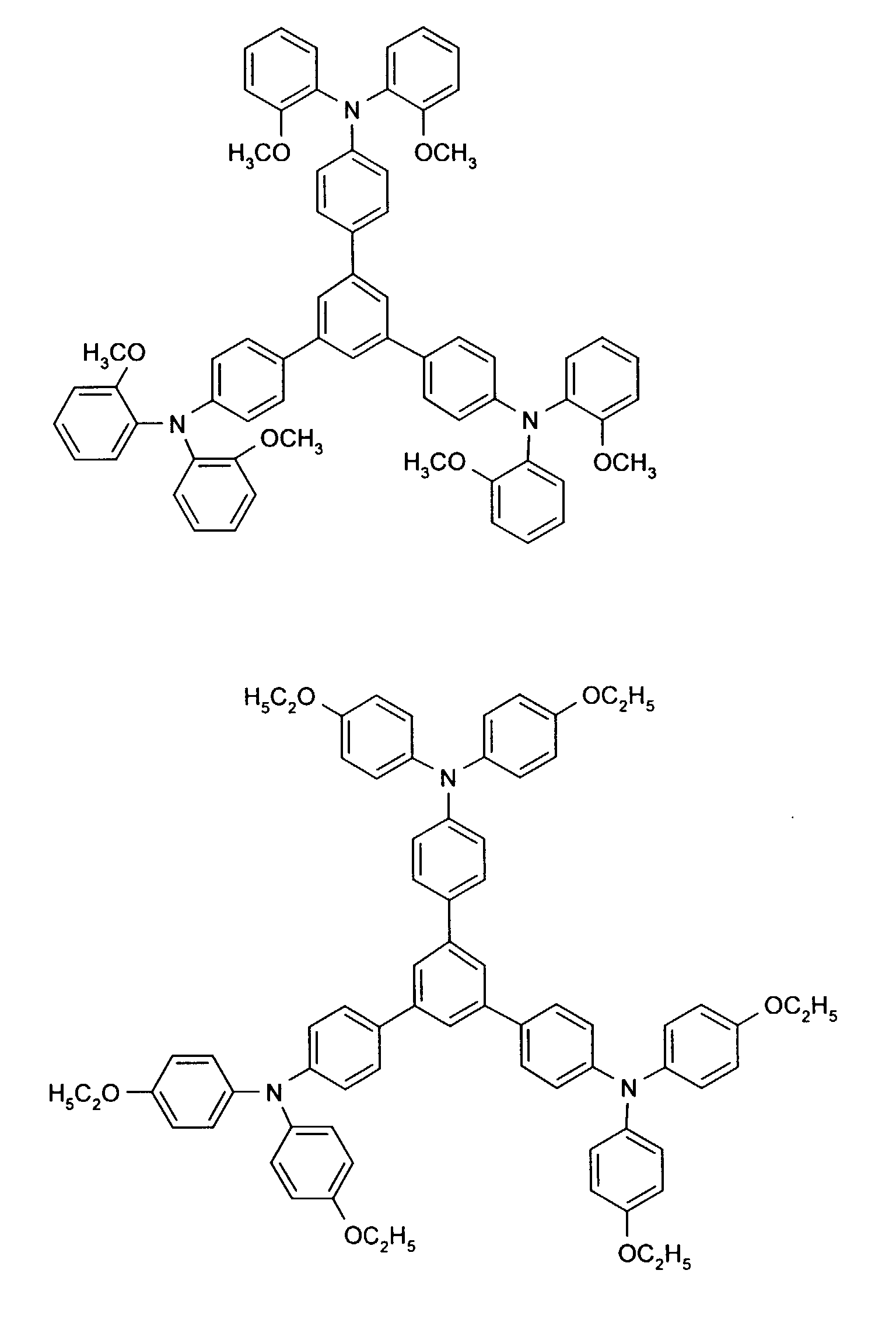


Neben der Komponente A können gegebenenfalls weitere Lochleiter, z.B. in Form einer Mischung mit der Komponente A, zum Aufbau des elektrolumineszierenden Elementes eingesetzt werden. Dabei kann es sich einerseits um eine oder mehrere Verbindungen der Formel (II), wobei auch Gemische von Isomeren umfaßt werden, andererseits auch um Mischungen von lochtransportierenden Verbindungen mit Verbindungen von A - mit der allgemeinen Formel (II) - mit verschiedener Struktur handeln.In addition to component A, further hole conductors, e.g. in shape a mixture with component A, to build up the electroluminescent Element can be used. On the one hand, this can be one or more Compounds of formula (II), which also include mixtures of isomers, on the other hand also mixtures of hole-transporting compounds with compounds act from A - with the general formula (II) - with different structure.
Eine Zusammenstellung möglicher weiterer lochleitender Materialien ist in EP-A 532 798 angegeben.A compilation of possible further hole-conducting materials is in EP-A 532 798.
Im Falle von Mischungen der aromatischen Amine können die Verbindungen in einem beliebigen Verhältnis eingesetzt werden.In the case of mixtures of the aromatic amines, the compounds in any ratio.
Beispielhaft seien genannt:
Anthracen-Verbindungen, z.B. 2,6,9,10-Tetraisopropoxyanthracen; Oxadiazol-Verbindungen,
z.B. 2,5-Bis(4-diethylaminophenyl)-1,3,4-oxadiazol, Triphenylamin-Verbindungen,
z.B. N,N'-Diphenyl-N,N'-di(3-methylphenyl)-1,1'-biphenyl-4,4'-diamin;
aromatische tertiäre Amine, z.B. N-Phenylcarbazol, N-Isopropyl-carbazol und Verbindungen,
die in lochtransportierenden Schichten einsetzbar sind, wie sie in der
japanischen Patentanmeldung JP-A 62-264 692 beschrieben sind; ferner Pyrazolin-Verbindungen,
z.B. 1-Phenyl-3-(p-diethylaminostyryl)-5-(p-diethylaminophenyl)-2-pyrazolin;
Styryl-Verbindungen, z.B. 9-(p-Diethylaminostyryl)-anthrazen; Hydrazon-Verbindungen,
z.B. Bis-(4-dimethylamino-2-methylphenyl)-phenyl-methan; Stilben-Verbindungen,
z.B. -(4-Methoxyphenyl)-4-N,N-diphenylamino-(4'-methoxy)stilben,
Enamin-Verbindungen, z.B. 1,1-(4,4'-diethoxyphenyl)-N,N-(4,4'-dimethoxyphenyl)enamin;
Metall- oder Nichtmetall-Phthalocyanine und Porphyrin-Verbindungen.Examples include:
Anthracene compounds, for example 2,6,9,10-tetraisopropoxyanthracene; Oxadiazole compounds, for example 2,5-bis (4-diethylaminophenyl) -1,3,4-oxadiazole, triphenylamine compounds, for example N, N'-diphenyl-N, N'-di (3-methylphenyl) -1, 1'-biphenyl-4,4'-diamine; aromatic tertiary amines, for example N-phenylcarbazole, N-isopropyl-carbazole and compounds which can be used in hole-transporting layers, as described in Japanese Patent Application JP-A 62-264 692; further pyrazoline compounds, for example 1-phenyl-3- (p-diethylaminostyryl) -5- (p-diethylaminophenyl) -2-pyrazoline; Styryl compounds, for example 9- (p-diethylaminostyryl) anthracene; Hydrazone compounds, for example bis (4-dimethylamino-2-methylphenyl) phenyl methane; Stilbene compounds, e.g. - (4-methoxyphenyl) -4-N, N-diphenylamino- (4'-methoxy) stilbene, enamine compounds, e.g. 1,1- (4,4'-diethoxyphenyl) -N, N- (4,4'-dimethoxyphenyl) enamine; Metal or non-metal phthalocyanines and porphyrin compounds.
Bevorzugt sind Triphenylamin-Verbindungen und/oder aromatische tertiäre Amine, wobei die beispielhaft genannten Verbindungen besonders bevorzugt sind.Triphenylamine compounds and / or aromatic tertiary amines are preferred, the compounds mentioned by way of example being particularly preferred.
Materialien, die lochleitende Eigenschaften aufweisen und in reiner Form oder als
Mischpartner zur Komponente A eingesetzt werden können, sind beispielsweise die
folgenden Verbindungen, wobei X1 bis X6 unabhängig voneinander für H, Halogen,
Alkyl, Aryl, Alkoxy, Aryloxy stehen.


Diese und weitere Beispiele sind beschrieben in J. Phys. Chem. 1993, 97, 6240-6248 und Appl. Phys. Lett., Vol. 66, No. 20, 2679-2681.These and other examples are described in J. Phys. Chem. 1993, 97, 6240-6248 and appl. Phys. Lett., Vol. 66, No. 20, 2679-2681.
Generell können verschiedene Amine mit unterschiedlicher Grundstruktur und/oder unterschiedlichen Substitutionsmustern gemischt werden.In general, different amines with different basic structures and / or different substitution patterns can be mixed.
X1 bis X6 stehen unabhängig voneinander vorzugsweise für Wasserstoff, Fluor, Chlor, Brom, (C1-C10)-, insbesondere (C1-C4)-Alkyl oder -Alkoxy, Phenyl, Naphthyl, Phenoxy und/oder Naphthyloxy. Die aromatischen Ringe können ein-, zwei drei- oder vierfach, gleich oder verschieden durch mindestens einen Rest X1 bis X6 substituiert sein. X 1 to X 6 independently of one another preferably represent hydrogen, fluorine, chlorine, bromine, (C 1 -C 10 ) -, in particular (C 1 -C 4 ) -alkyl or -alkoxy, phenyl, naphthyl, phenoxy and / or naphthyloxy . The aromatic rings can be substituted one, two, three or four times, identically or differently, by at least one radical X 1 to X 6 .
Die Polythiophene der wiederkehrenden Struktureinheit der Formel (I) sind bekannt (vgl. EP-A 440 958 und 339 340). Die Herstellung der erfindungsgemäßen Dispersionen bzw. Lösungen ist in EP-A 440 957 und DE-A 4 211 459 beschrieben.The polythiophenes of the repeating structural unit of the formula (I) are known (see EP-A 440 958 and 339 340). The preparation of the dispersions according to the invention or solutions is described in EP-A 440 957 and DE-A 4 211 459.
Die Polythiophene werden in der Dispersion bzw. Lösung bevorzugt in kationischer Form, wie sie z.B. durch Behandlung der neutralen Thiophene mit Oxidationsmitteln erhalten werden, eingesetzt. Übliche Oxidationsmittel wie Kaliumperoxodisulfat werden für die Oxidation verwendet. Durch die Oxidation erhalten die Polythiophene positive Ladungen, die in den Formeln nicht dargestellt sind, da ihre Zahl und ihre Position nicht einwandfrei feststellbar sind. Gemäß den Angaben in EP-A 339 340 können sie direkt auf Trägern hergestellt werden.The polythiophenes are preferably cationic in the dispersion or solution Shape as e.g. by treating the neutral thiophenes with oxidizing agents be used. Common oxidizing agents such as potassium peroxodisulfate are used for the oxidation. The oxidation gives the polythiophenes positive charges that are not shown in the formulas because of their number and their Position can not be determined correctly. According to the information in EP-A 339 340 they can be made directly on supports.
Vorzugsweise stehen Q1 und Q2 in Formel (I) für -(CH2)m-CH2- mit m = 1 bis 4, ganz besonders bevorzugt für Ethylen.Q 1 and Q 2 in formula (I) are preferably - (CH 2 ) m -CH 2 - with m = 1 to 4, very particularly preferably ethylene.
Bevorzugte kationische oder neutrale Polydioxythiophene sind aus Struktureinheiten
der Formel (Ia) oder (Ib) aufgebaut

- Q3 und Q4
- unabhängig voneinander für Wasserstoff, gegebenenfalls substituiertes (C1-C18)-Alkyl, vorzugsweise (C1-C10)-, insbesondere (C1-C6)-Alkyl, (C2-C12)-Alkenyl, vorzugsweise (C2-C8)-Alkenyl, (C3-C7)-Cycloalkyl, vorzugsweise Cyclopentyl, Cyclohexyl, (C7-C15)-Aralkyl, vorzugsweise Phenyl-(C1-C4)-alkyl, (C6-C10)-Aryl, vorzugsweise Phenyl, Naphthyl, (C1-C18)-Alkoxy, vorzugsweise (C1-C10)-Alkoxy, beispielsweise Methoxy, Ethoxy, n-oder iso-Propoxy oder (C2-C18)-Alkyloxyester steht und
- Q5 und Q6
- unabhängig voneinander für Wasserstoff, jedoch nicht beide gleichzeitig, mit jeweils mindestens einer Sulfonatgruppe substituiertes (C1-C18)-Alkyl, vorzugsweise (C1-C10)-, insbesondere (C1-C6)-Alkyl, (C2-C12)-Alkenyl, vorzugsweise (C2-C8)-Alkenyl, (C3-C7)-Cycloalkyl, vorzugsweise Cyclopentyl, Cyclohexyl, (C7-C15)-Aralkyl, vorzugsweise Phenyl-(C1-C4)-alkyl, (C6-C10)-Aryl, vorzugsweise Phenyl, Naphthyl, (C1-C18)-Alkoxy, vorzugsweise (C1-C10)-Alkoxy, beispielsweise Methoxy, Ethoxy, n-oder iso-Propoxy oder (C2-C18)-Alkyloxyester steht, wobei falls Q5 für Wasserstoff steht, Q6 verschieden von Wasserstoff ist und umgekehrt.
- n
- für eine ganze Zahl von 2 bis 10 000, vorzugsweise 5 bis 5 000 steht.
- Q 3 and Q 4
- independently of one another for hydrogen, optionally substituted (C 1 -C 18 ) alkyl, preferably (C 1 -C 10 ), in particular (C 1 -C 6 ) alkyl, (C 2 -C 12 ) alkenyl, preferably ( C 2 -C 8 ) alkenyl, (C 3 -C 7 ) cycloalkyl, preferably cyclopentyl, cyclohexyl, (C 7 -C 15 ) aralkyl, preferably phenyl (C 1 -C 4 ) alkyl, (C 6 -C 10 ) aryl, preferably phenyl, naphthyl, (C 1 -C 18 ) alkoxy, preferably (C 1 -C 10 ) alkoxy, for example methoxy, ethoxy, n- or iso-propoxy or (C 2 -C 18 ) alkyloxy ester and
- Q 5 and Q 6
- independently of one another for hydrogen, but not both at the same time, each with at least one sulfonate group substituted (C 1 -C 18 ) -alkyl, preferably (C 1 -C 10 ) -, in particular (C 1 -C 6 ) -alkyl, (C 2 -C 12 ) alkenyl, preferably (C 2 -C 8 ) alkenyl, (C 3 -C 7 ) cycloalkyl, preferably cyclopentyl, cyclohexyl, (C 7 -C 15 ) aralkyl, preferably phenyl- (C 1 - C 4 ) alkyl, (C 6 -C 10 ) aryl, preferably phenyl, naphthyl, (C 1 -C 18 ) alkoxy, preferably (C 1 -C 10 ) alkoxy, for example methoxy, ethoxy, n- or iso-propoxy or (C 2 -C 18 ) alkyloxy ester, where if Q 5 is hydrogen, Q 6 is different from hydrogen and vice versa.
- n
- represents an integer from 2 to 10,000, preferably 5 to 5,000.
Besonders bevorzugt sind kationische bzw. neutrale Polythiophene der Formeln (Ia-1)
und (Ib-1)


Als Polyanionen dienen die Anionen von polymeren Carbonsäuren, wie Polyacrylsäuren, Polymethacrylsäure oder Polymaleinsäuren und polymeren Sulfonsäuren, wie Polystyrolsulfonsäuren und Polyvinylsulfonsäuren. Diese Polycarbon- und -sulfonsäuren können auch Copolymere von Vinylcarbon- und Vinylsulfonsäuren mit anderen polymerisierbaren Monomeren, wie Acrylsäureestern und Styrol, sein.The anions of polymeric carboxylic acids, such as Polyacrylic acids, polymethacrylic acid or polymaleic acids and polymers Sulphonic acids such as polystyrene sulphonic acids and polyvinyl sulphonic acids. This Polycarbonate and sulfonic acids can also be copolymers of vinylcarbonate and Vinyl sulfonic acids with other polymerizable monomers such as acrylic acid esters and styrene.
Besonders bevorzugt ist das Anion der Polystyrolsulfonsäure als Gegenion.The anion of the polystyrene sulfonic acid is particularly preferred as the counter ion.
Das Molekulargewicht der die Polyanionen liefernden Polysäuren beträgt vorzugsweise 1 000 bis 2 000 000, besonders bevorzugt 2 000 bis 500 000. Die Polysäuren oder ihre Alkalisalze sind im Handel erhältlich, z.B. Polystyrolsulfonsäuren und Polyacrylsäuren, oder aber nach bekannten Verfahren herstellbar (siehe z.B. Houben-Weyl, Methoden der organischen Chemie, Bd. E 20 Makromolekulare Stoffe, Teil 2 (1987), S. 1141 f).The molecular weight of the polyacids providing the polyanions is preferably 1,000 to 2,000,000, particularly preferably 2,000 to 500,000. The polyacids or their alkali salts are commercially available, e.g. Polystyrene sulfonic acids and Polyacrylic acids, or can be prepared by known processes (see e.g. Houben-Weyl, Methods of Organic Chemistry, Vol. E 20 Macromolecular Fabrics, Part 2 (1987), p. 1141 f).
Anstelle der für die Bildung der Dispersionen aus Polydioxythiophenen und Polyanionen erforderlichen freien Polysäuren, kann man auch Gemische aus Alkalisalzen der Polysäuren und entsprechenden Mengen an Monosäuren einsetzen. Instead of that for the formation of the dispersions from polydioxythiophenes and Free polyacids required for polyanions, one can also make mixtures Use alkali salts of the polyacids and corresponding amounts of monoacids.
Im Falle der Formel (Ib) und (Ib-1) tragen die Polydioxythiophene positive und negative Ladung in der Monomereinheit selbst.In the case of the formula (Ib) and (Ib-1), the polydioxythiophenes bear positive and negative charge in the monomer unit itself.
Das elektrolumineszierende Element kann gegebenenfalls eine weitere funktionalisierte Verbindung aus der Gruppe der lochinjizierenden und/oder lochtransportierenden Materialien, ein lumineszierendes Material C und gegebenenfalls Elektronentransportmaterialien enthalten, wobei die lochtransportierende Zone neben der Komponente A eine oder mehrere weitere lochtransportierende, elektrolumineszierende, elektronenptransportierende und/oder elektroneninjizierende Verbindungen enthalten kann, wobei mindestens eine Zone vorhanden ist, einzelne Zonen weggelassen werden können und die vorhandene(n) Zone(n) mehrere Aufgaben übernehmen kann.The electroluminescent element can optionally be a further functionalized one Connection from the group of hole-injecting and / or hole-transporting Materials, a luminescent material C and optionally Contain electron transport materials, with the hole transport zone next to component A one or more further hole-transporting, electroluminescent, electron transporting and / or electron injecting compounds may contain, with at least one zone, individual Zones can be omitted and the existing zone (s) several Can take on tasks.
Als lumineszierendes Material (Komponente C) können solche Substanzen eingesetzt werden, die Photolumineszenz zeigen, d.h. Fluoreszenz- und Laserfarbstoffe, aber auch Metallkomplexe und Chelate oder anorganische Nanoteilchen.Such substances can be used as the luminescent material (component C) that show photoluminescence, i.e. Fluorescent and laser dyes, however also metal complexes and chelates or inorganic nanoparticles.
Beispiele für Fluoreszenz- und Laserfarbstoffe sind Stilbene, Distilbene, Methinfarbstoffe, Cumarine, Naphthalimide, Perylene, Rubren, Chinacridone, Phenanthrene, Anthracene, Phthalocyamine usw. Weitere Beispiele sind in EP-A 532 798 beschrieben.Examples of fluorescent and laser dyes are stilbenes, distilbenes, methine dyes, Coumarins, naphthalimides, perylenes, rubrene, quinacridones, phenanthrene, Anthracenes, phthalocyamines etc. Further examples are described in EP-A 532 798.
Bei den Metallkomplexen können generell ein-, zwei- oder dreiwertige Metalle benutzt werden, von denen bekannt ist, daß sie Chelate bilden.In the metal complexes, one, two or three-valent metals can generally be used which are known to form chelates.
Das Metall kann ein ein-, zwei- oder dreiwertiges Metall sein, beispielsweise Lithium, Natrium, Kalium, Magnesium, Calcium, Bor, Aluminium, Gallium, Indium, Seltende Erden. Als anorganische Nanoteilchen eignen sich beispielsweise Halbleiter wie CdS, CdSe, ZnS oder ZnO. The metal can be a mono-, di- or trivalent metal, for example Lithium, sodium, potassium, magnesium, calcium, boron, aluminum, gallium, indium, Rare earth. Semiconductors, for example, are suitable as inorganic nanoparticles such as CdS, CdSe, ZnS or ZnO.
Geeignete Beispiele für die Komponente C) sind die Oxin-Komplexe (8-Hydroxychinolin-Komplexe) von Al3+, Mg2+, In3+, Ga3+, Zn2+, Be2+, Li+, Ca2+, Na+ oder Aluminiumtris(5-methyloxin) und Galliumtris(5-chloro-chinolin). Auch Komplexe mit Seltenenerd-Metallen sind einsetzbar.Suitable examples of component C) are the oxine complexes (8-hydroxyquinoline complexes) of Al 3+ , Mg 2+ , In 3+ , Ga 3+ , Zn 2+ , Be 2+ , Li + , Ca 2+ , Na + or aluminum tris (5-methyloxin) and gallium tris (5-chloro-quinoline). Complexes with rare earth metals can also be used.
Beispiele für Metallkomplexe sind

oder Al(qa)3, Ga(qa)3, In(qa)3, Zn(qa)2, Be(qa)2, Mg(qa)2 wobei
(qa) für

or Al (qa) 3 , Ga (qa) 3 , In (qa) 3 , Zn (qa) 2 , Be (qa) 2 , Mg (qa) 2 where
(qa) for
Es können auch Metallkomplexe eingesetzt werden, die über unterschiedliche Reste verfügen. Beispiele für derartige Verbindungen sind Alq2 OR, Gaq2 OR, Al(qa)2 OR, Ga(qa)2 OR, Alqa2 OCOR, Ga(qa)2 OCOR, Alq2X und Gaq2X sowie Al(qa)2X und Ga(qa)2X wobei X für Halogen steht und wobei R für jeweils gegebenenfalls substituiertes Alkyl, Aryl, Arylalkyl und Cycloalkyl stehen, vorzugsweise für jeweils gegebenenfalls durch Halogen und/oder Cyano substituiertes (C1-C12)-Alkyl, insbesondere (C1-C8)-Alkyl, (C4-C8)-Cycloalkyl, insbesondere Cyclopentyl oder Cyclohexyl, Aryl mit 6 bis 20 C-Atomen, insbesondere Phenyl, Naphthyl, Phenyl-(C1-C4)-alkyl, wobei die cyclischen und aromatischen Reste auch (C1-C4)-alkylsubstituiert sein können.Metal complexes with different residues can also be used. Examples of such compounds are Alq 2 OR, Gaq 2 OR, Al (qa) 2 OR, Ga (qa) 2 OR, Alqa 2 OCOR, Ga (qa) 2 OCOR, Alq 2 X and Gaq 2 X and Al (qa) 2 X and Ga (qa) 2 X where X is halogen and where R is in each case optionally substituted alkyl, aryl, arylalkyl and cycloalkyl, preferably in each case optionally substituted by halogen and / or cyano (C 1 -C 12 ) -alkyl , in particular (C 1 -C 8 ) alkyl, (C 4 -C 8 ) cycloalkyl, in particular cyclopentyl or cyclohexyl, aryl having 6 to 20 C atoms, in particular phenyl, naphthyl, phenyl (C 1 -C 4 ) -alkyl, where the cyclic and aromatic radicals can also be (C 1 -C 4 ) -alkyl substituted.
Die Kohlenstoffketten sind jeweils geradkettig oder verzweigt. The carbon chains are straight or branched.
Eine Zusammenstellung geeigneter Metallkomplexe und elektronenleitender Verbindungen ist in EP-A 525 739, EP-A 579 151 und EP-A 757 088 wiedergegeben. Herstellungsverfahren sind beispielsweise in US-A 4 769 292 beschrieben.A compilation of suitable metal complexes and electron-conducting Compounds is in EP-A 525 739, EP-A 579 151 and EP-A 757 088 reproduced. Manufacturing processes are described, for example, in US-A 4,769,292 described.
Es können auch Mischungen unterschielicher Metallkomplexe eingesetzt werden.Mixtures of different metal complexes can also be used.
Als Binder B) können Polymere und/oder Copolymere wie z.B. Polycarbonate, Polyestercarbonate, Polystyrol, Poly-α-methylstyrol,Copolymere des Styrols wie SAN oder Styrolacrylate, Polysulfone, Polymerisate auf Basis von Vinylgruppen-haltigen Monomeren wie z.B. Poly(meth)acrylate, Polyvinylpyrrolidon, Polyvinylcarbazol, Vinylacetat- und Vinylalkoholpolymere und -copolymere, Polyolefine, cyclische Olelfincopolymere, Phenoxyharze usw. eingesetzt werden. Es können auch Mischungen verschiedener Polymere eingesetzt werden. Die polymeren Binder B) weisen Molekulargewichte von 1 000 bis 200 000 g/mol auf, sind löslich und filmbildend und sind im sichtbaren Spektralbereich transparent. Sie sind z.B. beschrieben in Encyclopedia of Polymer Science and Engineering, 2nd Ed. bei A. Wiley-Intersciencepublication.Binder B) can be polymers and / or copolymers such as polycarbonates, polyester carbonates, polystyrene, poly-α-methylstyrene, copolymers of styrene such as SAN or styrene acrylates, polysulfones, polymers based on monomers containing vinyl groups such as poly (meth) acrylates, Polyvinyl pyrrolidone, polyvinyl carbazole, vinyl acetate and vinyl alcohol polymers and copolymers, polyolefins, cyclic olefin copolymers, phenoxy resins, etc. can be used. Mixtures of different polymers can also be used. The polymeric binders B) have molecular weights of 1,000 to 200,000 g / mol, are soluble and film-forming and are transparent in the visible spectral range. They are described, for example, in Encyclopedia of Polymer Science and Engineering, 2 nd Ed. with A. Wiley-Intersciencepublication.
Die Komponenten können aber auch in separaten Schichten angeordnet sein.However, the components can also be arranged in separate layers.
Die einzelnen Zonen des elektrolumineszierenden Elements können entweder aus einer Lösung oder durch Deposition aus der Gasphase oder einer Kombination beider Verfahren abgeschieden werden.The individual zones of the electroluminescent element can either be made of a solution or by deposition from the gas phase or a combination of both Procedures are deposited.
Zur Herstellung des Schichtaufbaus werden beispielsweise in einem geeigneten Lösemittel gelöst und durch Gießen, Rakeln, Drucken oder spincoating auf eine geeignete Unterlage aufgebracht. Dabei kann es sich z.B. um Glas oder ein Kunststoffmaterial handeln, das mit einer gegebenenfalls transparenten Elektrode versehen ist. Als Kunststoffmaterial kann z.B. eine Folie aus Polycarbonat, Polyester wie Polyethylenterephthalat oder Polyethylennaphthalat, Polysulfon oder Polyimid eingesetzt werden.To produce the layer structure, for example, in a suitable Solvent and dissolved by pouring, knife coating, printing or spin coating on a suitable pad applied. It can e.g. around glass or a Trade plastic material with an optionally transparent electrode is provided. As a plastic material e.g. a film made of polycarbonate, polyester such as polyethylene terephthalate or polyethylene naphthalate, polysulfone or polyimide be used.
Als transparente und semitransparente Elektroden sind geeignet
Die Metalloxid- und die semitransparenten Metallfilmelektroden werden durch Techniken wie Aufdampfen, Aufsputtern, Platinierung, etc., in dünner Schicht aufgebracht. Die leitfähigen Polymerfilme werden durch Techniken wie Spincoaten, Casting, Rakeln, Drucken etc. aus der Lösung aufgebracht.The metal oxide and semi-transparent metal film electrodes are made by techniques such as vapor deposition, sputtering, platinum coating, etc., in a thin layer upset. The conductive polymer films are made by techniques such as spin coating, Casting, squeegees, printing etc. applied from the solution.
Die Dicke der transparenten bzw. semitransparenten Elektrode beträgt 3 nm bis etwa mehrere µm, vorzugsweise 10 nm bis 500 nm.The thickness of the transparent or semi-transparent electrode is 3 nm to about several µm, preferably 10 nm to 500 nm.
In einer bevorzugten Anordnung wird das elektrolumineszierende Element direkt auf die Anode aufgebracht. In einer alternativen Ausführungsform kann das elektrolumineszierende Element auf den mit einer Katiode versehenen Träger aufgebracht werden.In a preferred arrangement, the electroluminescent element is applied directly applied the anode. In an alternative embodiment, the electroluminescent Element applied to the support provided with a cathode become.
Die Dicke des elektrolumineszierenden Elements beträgt im allgemeinen 10 nm bis 5 µm, vorzugsweise 20 nmbis 1µm, besonders bevorzugt 50 nm bis 600nm.The thickness of the electroluminescent element is generally 10 nm to 5 µm, preferably 20 nm to 1 µm, particularly preferably 50 nm to 600 nm.
Eine Zusammenstellung von geeigneten ladungstransportierenden Zwischenschichten, bei denen es sich um loch- und/oder elektronenleitenden Materialien handeln kann, die in polymerer oder niedermolekularer Form gegebenenfalls als Blend vorliegen können, ist in EP-A 532 798 aufgeführt.A compilation of suitable charge carriers Intermediate layers, which are hole- and / or electron-conducting Materials can act in polymeric or low molecular weight form can optionally be present as a blend is listed in EP-A 532 798.
Der Gehalt an niedermolekularen Verbindungen - lochinjizierende, lochtransportierende, elektrolumineszierende, elektronenleitende und elektroneninjizierende Substanzen - in einem polymeren Binder ist im allgemeinen im Bereich von 2 bis 97 Gew.-% variierbar; bevorzugt beträgt der Gehalt 5 bis 95 Gew.-%, besonders bevorzugt 10 bis 90 Gew.-%, insbesondere 10 bis 85 Gew.-%.The content of low molecular weight compounds - hole injecting, hole transporting, electroluminescent, electron-conducting and electron-injecting Substances - in a polymeric binder is generally in the range of 2 to 97% by weight variable; the content is preferably 5 to 95% by weight, particularly preferably 10 to 90% by weight, in particular 10 to 85% by weight.
Filmbildende niedermolekulare Verbindungen können auch in reiner Form (100 %ig) eingesetzt werden.Film-forming low-molecular compounds can also be used in pure form (100%) be used.
Blends, die ausschließlich aus niedermolekularen Verbindungen bestehen, können durch Deposition aus der Gasphase abgeschieden werden; lösliche und filmbildende Blends, die neben niedermolekularen Verbindungen auch einen Binder B) enthalten können (nicht notwendigerweise), können aus einer Lösung z.B. mittels Spin-Coating, Gießen, Rakeln, Drucken deponiert werden.Blends that consist exclusively of low molecular weight compounds can be separated from the gas phase by deposition; soluble and film-forming Blends which, in addition to low molecular weight compounds, also contain a binder B) can (not necessarily), from a solution e.g. by means of spin coating, Watering, knife coating, printing can be deposited.
Es ist auch möglich, emittierende und/oder elektronenleitende Substanzen in einer separaten Schicht auf die lochleitende Schicht mit der Komponente A aufzubringen. Dabei kann eine emittierende Substanz auch der die Verbindung A enthaltenden Schicht zudotiert ("Dopant") und zusätzlich eine elektronenleitende Substanz aufgebracht werden. Eine elektrolumineszierende Substanz kann auch der elektroneninjizierenden bzw. elektronenleitenden Schicht zugesetzt werden.It is also possible to emit and / or electron-conductive substances in one apply a separate layer to the hole-conducting layer with component A. An emitting substance can also contain the compound A Doped layer ("Dopant") and additionally an electron-conducting substance applied become. An electroluminescent substance can also electron-injecting or electron-conducting layer are added.
Der Gehalt an niedermolekularen Elektronenleitern im polymeren Binder ist im Bereich von 2 bis 95 Gew.-% variierbar; bevorzugt beträgt der Gehalt 5 bis 90 Gew.-%, besonders bevorzugt 10 bis 85 Gew.-%. Filmbildende Elektronenleiter können auch in reiner Form (100 %ig) eingesetzt werden. The content of low molecular weight electron conductors in the polymeric binder is in the Range can be varied from 2 to 95% by weight; the content is preferably 5 to 90 % By weight, particularly preferably 10 to 85% by weight. Film-forming electron conductors can also be used in pure form (100%).
Die Gegenelektrode zu der sich auf dem Träger befindlichen Elektrode besteht aus einer leitfähigen Substanz, die gegebenenfalls transparent ist, enthält vorzugsweise Metalle, z.B. Ca, Al, Au, Ag, Mg, In, etc. oder Legierungen und Metalloxide, leitfähige Polymere die durch Techniken wie z. B. Aufdampfen, Aufsputtern, Platinierung, Drucken, Gießen oder Rakeln aufgebracht werden können.The counter electrode to the electrode located on the carrier consists of a conductive substance, which is optionally transparent, preferably contains Metals, e.g. Ca, Al, Au, Ag, Mg, In, etc. or alloys and metal oxides, conductive Polymers by techniques such as. B. vapor deposition, sputtering, platinum plating, Printing, casting or knife coating can be applied.
Die erfindungsgemäße Anordnung wird durch zwei elektrische Zuführungen (z.B. Metalldrähte) mit den beiden Elektroden in Kontakt gebracht.The arrangement according to the invention is implemented by two electrical leads (e.g. Metal wires) brought into contact with the two electrodes.
Die Anordnungen emittieren beim Anlegen einer Gleichspannung im Bereich von 0,1 bis 100 Volt Licht der Wellenlänge von 200 bis 2 000 nm.The devices emit in the range of 0.1 when a DC voltage is applied up to 100 volts of light with a wavelength of 200 to 2,000 nm.
Die erfindungsgemäßen Anordnungen sind zur Herstellung von Einheiten zur Beleuchtung und zur Informationsdarstellung geeignet. The arrangements according to the invention are for the production of units for lighting and suitable for displaying information.
Beim erfindungsgemäßen Aufbau einer organischen Leuchtdiode (OLED) wird folgendermaßen
vorgegangen:
Die beiden Elektroden der organischen LED werden über elektrische Zuführungen mit einer Spannungsquelle verbunden. Der positive Pol ist mit der ITO-Elektrode, der negative Pol ist mit der MgAg-Elektrode verbunden.The two electrodes of the organic LED are connected via electrical leads connected to a voltage source. The positive pole is with the ITO electrode, the negative pole is connected to the MgAg electrode.
Bereits ab einer Spannung von 3 Volt läßt sich mit einer Photodiode (EG & G C30809E) Elektrolumineszenz nachweisen. Bei einer Spannung von 10 Volt fließt ein Flächenstrom von 35 mA/cm2 und die Elektrolumineszenz ist gut sichtgar. Die Farbe der Elektrolumineszenz ist grün-blau. Electroluminescence can be detected with a photodiode (EG & G C30809E) from a voltage of 3 volts. At a voltage of 10 volts, an area current of 35 mA / cm 2 flows and the electroluminescence is clearly visible. The color of the electroluminescence is green-blue.
Vorgehen beim erfindungsgemäßen Aufbau einer OLED wie in Beispiel 1, mit folgendem Unterschied:
- 5 ml einer 1,0 %igen Methanollösung bestehend aus 1 Gew.-Teil Metallkomplex 1 und 0,02 Gew.-Teile Fluoreszenzfarbstoff F werden filtriert (Millipore HV, 0,45 µm) und auf der getrockneten lochleitenden Schicht verteilt. Anschließend wird die überstehende Lösung durch Rotation des Tellers bei 400 U/min 30 sec lang abgeschleudert. Danach wird das so beschichtete Substrat 5 min lang bei 110°C auf einer Heizplatte getrocknet.
- 5 ml of a 1.0% strength methanol solution consisting of 1 part by weight of metal complex 1 and 0.02 part by weight of fluorescent dye F are filtered (Millipore HV, 0.45 μm) and distributed over the dried hole-conducting layer. The supernatant solution is then spun off by rotating the plate at 400 rpm for 30 seconds. The substrate coated in this way is then dried on a hot plate at 110 ° C. for 5 minutes.
Ab einer Spannung von 3 Volt laßt sich mit einer Photodiode (EG & G C30809E) Elektrolumineszenz nachweisen. Bei einer Spannung von 10 Volt fließt ein Flächenstrom von 180 mA/cm2 und die Elektrolumineszenz ist gut sichtbar. Die Farbe der Elektrolumineszenz ist grün-blau.From a voltage of 3 volts, a photodiode (EG & G C30809E) can detect electroluminescence. At a voltage of 10 volts, an area current of 180 mA / cm 2 flows and the electroluminescence is clearly visible. The color of the electroluminescence is green-blue.
Vorgehen beim erfindungsgemäßen Aufbau einer OLED wie in Beispiel 1, mit folgendem Unterschied:
- 5 ml einer 1,0 %igen Methanollösung Metallkomplex 2 werden filtriert (Millipore HV, 0,45 µm) und auf der getrockneten lochleitenden Schicht verteilt. Anschließend wird die überstehende Lösung durch Rotation des Tellers bei 250 U/min 40 sec lang abgeschleudert. Danach wird das so beschichtete Substrat 5 min lang bei 110°C auf einer Heizplatte getrocknet.
- 5 ml of a 1.0% methanol solution of metal complex 2 are filtered (Millipore HV, 0.45 µm) and distributed over the dried hole-conducting layer. The supernatant solution is then spun off by rotating the plate at 250 rpm for 40 seconds. The substrate coated in this way is then dried on a hot plate at 110 ° C. for 5 minutes.
Ab einer Spannung von 3 Volt laßt sich mit einer Photodiode (EG & G C30809E) Elektrolumineszenz nachweisen. Bei einer Spannung von 10 Volt fließt ein Flächenstrom von 100 mA/cm2 und die Elektrolumineszenz ist gut sichtbar. Die Farbe der Elektrolumineszenz ist grün-blau.From a voltage of 3 volts, a photodiode (EG & G C30809E) can detect electroluminescence. At a voltage of 10 volts, an area current of 100 mA / cm 2 flows and the electroluminescence is clearly visible. The color of the electroluminescence is green-blue.


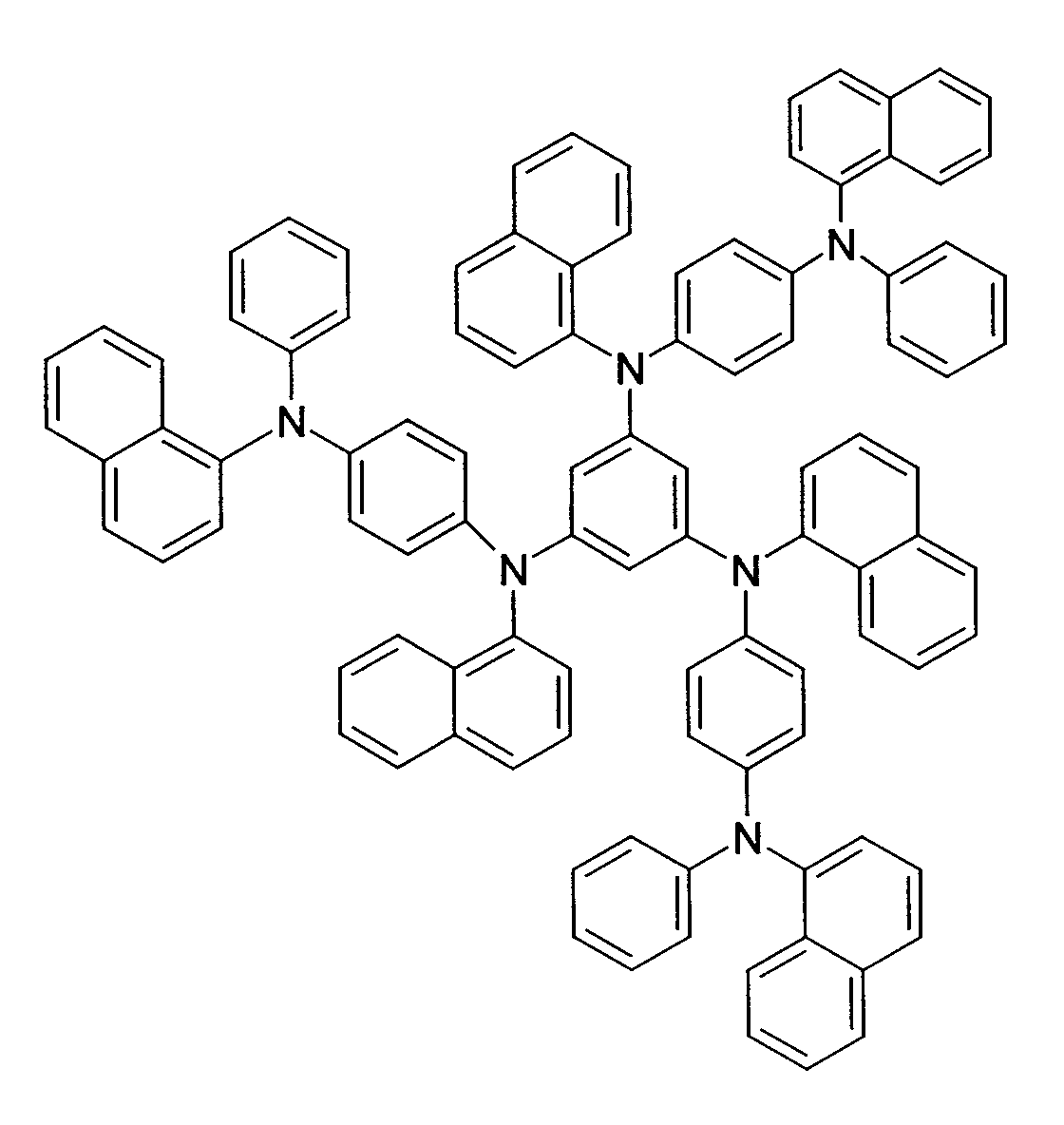
Claims (16)

- Q1 und Q2
- unabhängig voneinander für Wasserstoff, gegebenenfalls substituiertes (C1-C20)-Alkyl, CH2OH oder (C6-C14)-Aryl stehen oder
- Q1 und Q2
- zusammen -(CH2)m-CH2- mit m = 0 bis 12, vorzugsweise 1 bis 5, (C6-C14)-Arylen bedeuten, und
- n
- für eine ganze Zahl von 2 bis 10 000, vorzugsweise 5 bis 5 000 steht,
- Q 1 and Q 2
- independently represent hydrogen, optionally substituted (C 1 -C 20 ) alkyl, CH 2 OH or (C 6 -C 14 ) aryl or
- Q 1 and Q 2
- together mean - (CH 2 ) m -CH 2 - with m = 0 to 12, preferably 1 to 5, (C 6 -C 14 ) arylene, and
- n
- represents an integer from 2 to 10,000, preferably 5 to 5,000,

- R2
- für Wasserstoff, gegebenenfalls substituiertes Alkyl oder Halogen steht,
- R3 und R4
- unabhängig voneinander für gegebenenfalls substituiertes (C1-C10)-Alkyl, Alkoxycarbonyl-substituiertes (C1-C10)-Alkyl, jeweils gegebenenfalls substituiertes Aryl, Aralkyl oder Cycloalkyl stehen.
- R 2
- represents hydrogen, optionally substituted alkyl or halogen,
- R 3 and R 4
- independently represent optionally substituted (C 1 -C 10 ) alkyl, alkoxycarbonyl-substituted (C 1 -C 10 ) alkyl, each optionally substituted aryl, aralkyl or cycloalkyl.
- R3 und R4
- unabhängig voneinander für (C1-C6)-Alkyl, (C1-C4)-Alkoxycarbonyl-(C1-C6)-alkyl, jeweils gegebenenfalls durch (C1-C4)-Alkyl und/oder (C1-C4)-Alkoxy substituiertes Phenyl-(C1-C4)-alkyl, Naphthyl-(C1-C4)-alkyl, Cyclopentyl, Cyclohexyl, Phenyl, Naphthyl oder Anthracyl stehen und
- R2
- für Wasserstoff, (C1-C6)-Alkyl oder Halogen steht.
- R 3 and R 4
- independently of one another for (C 1 -C 6 ) alkyl, (C 1 -C 4 ) alkoxycarbonyl- (C 1 -C 6 ) alkyl, in each case optionally through (C 1 -C 4 ) alkyl and / or (C 1 -C 4 ) -alkoxy-substituted phenyl- (C 1 -C 4 ) -alkyl, naphthyl- (C 1 -C 4 ) -alkyl, cyclopentyl, cyclohexyl, phenyl, naphthyl or anthracyl and
- R 2
- represents hydrogen, (C 1 -C 6 ) alkyl or halogen.


- Q3 und Q4
- unabhängig voneinander für Wasserstoff, gegebenenfalls substituiertes (C1-C18)-Alkyl, (C2-C12)-Alkenyl, (C3-C7)-Cycloalkyl, (C7-C15)Aralkyl, (C6-C10)-Aryl, (C1-C18)-Alkoxy, oder (C2-C18)-Alkyloxyester steht und
- Q5 und Q6
- unabhängig voneinander für Wasserstoff, jedoch nicht beide gleichzeitig, mit jeweils mindestens einer Sulfonatgruppe substituiertes (C1-C18)-Alkyl, (C2-C12)-Alkenyl, (C3-C7)-Cycloalkyl, (C7-C15)-Aralkyl, (C6-C10)-Aryl, (C1-C18)-Alkoxy, oder (C2-C18)-Alkyloxyester steht,
- n
- für eine ganze Zahl von 2 bis 10 000 steht.
- Q 3 and Q 4
- independently of one another for hydrogen, optionally substituted (C 1 -C 18 ) alkyl, (C 2 -C 12 ) alkenyl, (C 3 -C 7 ) cycloalkyl, (C 7 -C 15 ) aralkyl, (C 6 - C 10 ) aryl, (C 1 -C 18 ) alkoxy, or (C 2 -C 18 ) alkyloxy ester and
- Q 5 and Q 6
- independently of one another for hydrogen, but not both at the same time, each with (C 1 -C 18 ) alkyl substituted with at least one sulfonate group, (C 2 -C 12 ) alkenyl, (C 3 -C 7 ) cycloalkyl, (C 7 - C 15 ) aralkyl, (C 6 -C 10 ) aryl, (C 1 -C 18 ) alkoxy, or (C 2 -C 18 ) alkyloxy ester,
- n
- represents an integer from 2 to 10,000.


oder Al(qa)3, Ga(qa)3, In(qa)3, Zn(qa)2, Be(qa)2, Mg(qa)2 enthalten ist, wobei
(qa) für

or Al (qa) 3 , Ga (qa) 3 , In (qa) 3 , Zn (qa) 2 , Be (qa) 2 , Mg (qa) 2 , where
(qa) for
Applications Claiming Priority (2)
| Application Number | Priority Date | Filing Date | Title |
|---|---|---|---|
| DE19812258 | 1998-03-20 | ||
| DE19812258A DE19812258A1 (en) | 1998-03-20 | 1998-03-20 | Electroluminescent system for use in illumination and display devices, e.g. light-emitting diodes |
Publications (3)
| Publication Number | Publication Date |
|---|---|
| EP0949695A2 true EP0949695A2 (en) | 1999-10-13 |
| EP0949695A3 EP0949695A3 (en) | 2000-02-23 |
| EP0949695B1 EP0949695B1 (en) | 2009-06-17 |
Family
ID=7861665
Family Applications (1)
| Application Number | Title | Priority Date | Filing Date |
|---|---|---|---|
| EP99104958A Revoked EP0949695B1 (en) | 1998-03-20 | 1999-03-12 | Electroluminescent structure using blend systems |
Country Status (8)
| Country | Link |
|---|---|
| US (1) | US20020110701A1 (en) |
| EP (1) | EP0949695B1 (en) |
| JP (1) | JPH11329738A (en) |
| KR (1) | KR100712151B1 (en) |
| AT (1) | ATE434270T1 (en) |
| CA (1) | CA2266095A1 (en) |
| DE (2) | DE19812258A1 (en) |
| TW (1) | TW408557B (en) |
Cited By (5)
| Publication number | Priority date | Publication date | Assignee | Title |
|---|---|---|---|---|
| EP1297060A4 (en) * | 2000-06-12 | 2005-04-20 | Maxdem Inc | ELECTROLUMINESCENT DEVICES AND MATERIALS WITH POLYMERIC MATRIX |
| EP1285957A3 (en) * | 2001-08-20 | 2005-12-21 | TDK Corporation | Organic electroluminescent device and method of its preparation |
| EP1826837A4 (en) * | 2004-11-05 | 2009-03-04 | Bando Chemical Ind | Organic electronic functional material and use thereof |
| EP2371810A1 (en) * | 2005-01-05 | 2011-10-05 | Idemitsu Kosan Co., Ltd. | Aromatic amine derivative and organic electroluminescent device using same |
| US8206838B2 (en) | 2000-06-12 | 2012-06-26 | Sumitomo Chemical Co., Ltd. | Polymer matrix electroluminescent materials and devices |
Families Citing this family (19)
| Publication number | Priority date | Publication date | Assignee | Title |
|---|---|---|---|---|
| JP4827294B2 (en) * | 1999-11-29 | 2011-11-30 | 株式会社半導体エネルギー研究所 | Film forming apparatus and method for manufacturing light emitting apparatus |
| JP4796685B2 (en) * | 2000-05-12 | 2011-10-19 | ケミプロ化成株式会社 | Novel polymer buffer and electroluminescent device using the same |
| EP1231249A1 (en) * | 2001-02-07 | 2002-08-14 | Agfa-Gevaert | Manufacturing of a thin film inorganic light emitting diode |
| EP1231251A1 (en) * | 2001-02-07 | 2002-08-14 | Agfa-Gevaert | Thin film inorganic light emitting diode |
| US6737293B2 (en) | 2001-02-07 | 2004-05-18 | Agfa-Gevaert | Manufacturing of a thin film inorganic light emitting diode |
| US6706551B2 (en) | 2001-02-07 | 2004-03-16 | Agfa-Gevaert | Thin film inorganic light emitting diode |
| DE10225826C1 (en) * | 2002-06-11 | 2003-07-03 | Bayer Ag | New penta-coordinated gallium carboxylate complexes, used in laser, phosphorescent display, light-emitting diode or solar cell or as emitter or fluorescent dye, are based on unsaturated carboxylate and e.g. 8-hydroxyquinoline compound |
| JP4096877B2 (en) * | 2003-02-07 | 2008-06-04 | 松下電器産業株式会社 | Information reading element and information reading device using the same |
| DE102004003784B4 (en) | 2004-01-23 | 2011-01-13 | Ormecon Gmbh | Dispersion of intrinsically conductive polyaniline and their use |
| US20090154059A1 (en) * | 2004-03-18 | 2009-06-18 | Ormecon Gmbh | Composition comprising a conductive polymer in colloidal form and carbon |
| DE102004030388A1 (en) * | 2004-06-23 | 2006-01-26 | Ormecon Gmbh | An article with a coating of electrically conductive polymer and process for its preparation |
| US20060196375A1 (en) * | 2004-10-22 | 2006-09-07 | Seth Coe-Sullivan | Method and system for transferring a patterned material |
| DE102005010162B4 (en) | 2005-03-02 | 2007-06-14 | Ormecon Gmbh | Conductive polymers of particles with anisotropic morphology |
| DE102005039608A1 (en) | 2005-08-19 | 2007-03-01 | Ormecon Gmbh | Composition with intrinsically conductive polymer |
| KR101422529B1 (en) | 2006-09-13 | 2014-07-24 | 엔쏜 인코포레이티드 | Article with a coating of electrically conductive polymer and precious/semiprecious metal and process for production thereof |
| JP2008063340A (en) * | 2007-11-06 | 2008-03-21 | Mitsubishi Chemicals Corp | Asymmetric 1,4-phenylenediamine derivative and organic electroluminescence device using the same |
| JP5766483B2 (en) * | 2011-03-30 | 2015-08-19 | 株式会社Joled | Ink composition for reversal printing, printing method using the same, and method for producing display device |
| CN103890990A (en) * | 2011-09-28 | 2014-06-25 | 凸版印刷株式会社 | Organic EL element and method for producing organic EL element |
| CN119804583A (en) * | 2025-03-13 | 2025-04-11 | 吉林大学 | A lipoarabinomannan molecular imprinted electrochemiluminescence sensor and its preparation method and application |
Family Cites Families (10)
| Publication number | Priority date | Publication date | Assignee | Title |
|---|---|---|---|---|
| DE59010247D1 (en) * | 1990-02-08 | 1996-05-02 | Bayer Ag | New polythiophene dispersions, their preparation and their use |
| JP3534445B2 (en) * | 1993-09-09 | 2004-06-07 | 隆一 山本 | EL device using polythiophene |
| ATE228545T1 (en) * | 1994-05-06 | 2002-12-15 | Bayer Ag | CONDUCTIVE COATINGS |
| US5609970A (en) * | 1995-01-12 | 1997-03-11 | Polaroid Corporation | Electroluminescent device with polymeric charge injection layer |
| JPH08279626A (en) * | 1995-04-05 | 1996-10-22 | Casio Comput Co Ltd | Electroluminescent device and method of manufacturing the same |
| JPH09274990A (en) * | 1996-04-08 | 1997-10-21 | Mitsubishi Chem Corp | Organic electroluminescent device and method of manufacturing the same |
| DE19627071A1 (en) * | 1996-07-05 | 1998-01-08 | Bayer Ag | Electroluminescent devices |
| DE19627070A1 (en) * | 1996-07-05 | 1998-01-08 | Bayer Ag | Electroluminescent devices using glare systems |
| JP3651135B2 (en) * | 1996-08-29 | 2005-05-25 | 双葉電子工業株式会社 | Dope material for organic electroluminescence device and organic electroluminescence device |
| KR19990009297A (en) * | 1997-07-09 | 1999-02-05 | 윤종용 | LCD Display Module Structure |
-
1998
- 1998-03-20 DE DE19812258A patent/DE19812258A1/en not_active Withdrawn
-
1999
- 1999-03-12 US US09/267,441 patent/US20020110701A1/en not_active Abandoned
- 1999-03-12 AT AT99104958T patent/ATE434270T1/en active
- 1999-03-12 DE DE59915037T patent/DE59915037D1/en not_active Expired - Lifetime
- 1999-03-12 EP EP99104958A patent/EP0949695B1/en not_active Revoked
- 1999-03-16 JP JP11070773A patent/JPH11329738A/en active Pending
- 1999-03-17 CA CA002266095A patent/CA2266095A1/en not_active Abandoned
- 1999-03-19 KR KR1019990009297A patent/KR100712151B1/en not_active Expired - Fee Related
- 1999-04-02 TW TW088104451A patent/TW408557B/en not_active IP Right Cessation
Cited By (8)
| Publication number | Priority date | Publication date | Assignee | Title |
|---|---|---|---|---|
| EP1297060A4 (en) * | 2000-06-12 | 2005-04-20 | Maxdem Inc | ELECTROLUMINESCENT DEVICES AND MATERIALS WITH POLYMERIC MATRIX |
| EP1862497A3 (en) * | 2000-06-12 | 2007-12-12 | Sumation Co., Ltd. | Polymer matrix electroluminescent materials and devices |
| US8206838B2 (en) | 2000-06-12 | 2012-06-26 | Sumitomo Chemical Co., Ltd. | Polymer matrix electroluminescent materials and devices |
| US8308978B2 (en) | 2000-06-12 | 2012-11-13 | Sumitomo Chemical Co., Ltd. | Polymer matrix electroluminescent materials and devices |
| EP1285957A3 (en) * | 2001-08-20 | 2005-12-21 | TDK Corporation | Organic electroluminescent device and method of its preparation |
| EP1826837A4 (en) * | 2004-11-05 | 2009-03-04 | Bando Chemical Ind | Organic electronic functional material and use thereof |
| EP2371810A1 (en) * | 2005-01-05 | 2011-10-05 | Idemitsu Kosan Co., Ltd. | Aromatic amine derivative and organic electroluminescent device using same |
| US8883324B2 (en) | 2005-01-05 | 2014-11-11 | Idemitsu Kosan Co., Ltd. | Aromatic amine derivative and organic electroluminescent device using same |
Also Published As
| Publication number | Publication date |
|---|---|
| EP0949695B1 (en) | 2009-06-17 |
| KR19990078047A (en) | 1999-10-25 |
| DE19812258A1 (en) | 1999-09-23 |
| TW408557B (en) | 2000-10-11 |
| KR100712151B1 (en) | 2007-05-02 |
| JPH11329738A (en) | 1999-11-30 |
| DE59915037D1 (en) | 2009-07-30 |
| EP0949695A3 (en) | 2000-02-23 |
| CA2266095A1 (en) | 1999-09-20 |
| ATE434270T1 (en) | 2009-07-15 |
| US20020110701A1 (en) | 2002-08-15 |
Similar Documents
| Publication | Publication Date | Title |
|---|---|---|
| EP0949695B1 (en) | Electroluminescent structure using blend systems | |
| EP0969531A2 (en) | Electroluminescent devices comprising boron chelates | |
| JP4417836B2 (en) | Phosphorescent and luminescent conjugated polymers and methods for their use in electroluminescent assemblies | |
| EP0969532A2 (en) | Electroluminescent devices using metal complexes of azomethine | |
| EP0910930A1 (en) | Electroluminescent arrangements using blend systems | |
| EP0933972A2 (en) | Electroluminescent arrangements using doped blend systems | |
| DE19825737A1 (en) | Electroluminescent devices with N-alkyl-2,2'-imino-bis (8-hydroxyquinoline) metal complexes | |
| EP0949312A1 (en) | EL device comprising a tertiary amine, alcohol soluble Alq3 derivatives or mixtures and a polymeric binder | |
| DE19839947A1 (en) | Electroluminescent devices with thiophene carboxylate metal complexes | |
| DE69838865T2 (en) | Polymer-based light-emitting device | |
| US20020006528A1 (en) | Electroluminescent assemblies using boron chelates of 8-aminoquinoline derivatives | |
| DE19839946A1 (en) | Electroluminescent devices with multinuclear metal complexes | |
| DE19839948A1 (en) | Electroluminescent devices with metal complexes with attached fluorescent dyes | |
| EP1074602A1 (en) | Electroluminescent devices using boron chelates of 8-aminoquinoline derivatives | |
| DE10224617A1 (en) | Conjugated phosphorescent and luminescent polymers containing covalently-bonded metal complexes, useful as emitters in light-emitting systems such as diodes and displays | |
| DE10311767A1 (en) | Conjugated phosphorescent and luminescent polymers containing covalently-bonded metal complexes, useful as emitters in light-emitting systems such as diodes and displays |
Legal Events
| Date | Code | Title | Description |
|---|---|---|---|
| PUAI | Public reference made under article 153(3) epc to a published international application that has entered the european phase |
Free format text: ORIGINAL CODE: 0009012 |
|
| AK | Designated contracting states |
Kind code of ref document: A2 Designated state(s): AT BE CH DE DK ES FI FR GB IE IT LI NL PT SE |
|
| AX | Request for extension of the european patent |
Free format text: AL;LT;LV;MK;RO;SI |
|
| PUAL | Search report despatched |
Free format text: ORIGINAL CODE: 0009013 |
|
| AK | Designated contracting states |
Kind code of ref document: A3 Designated state(s): AT BE CH CY DE DK ES FI FR GB GR IE IT LI LU MC NL PT SE |
|
| AX | Request for extension of the european patent |
Free format text: AL;LT;LV;MK;RO;SI |
|
| RIC1 | Information provided on ipc code assigned before grant |
Free format text: 7H 01L 51/20 A, 7C 08G 61/12 B |
|
| 17P | Request for examination filed |
Effective date: 20000823 |
|
| AKX | Designation fees paid |
Free format text: AT BE CH DE DK ES FI FR GB IE IT LI NL PT SE |
|
| RAP1 | Party data changed (applicant data changed or rights of an application transferred) |
Owner name: ROBERT BOSCH GMBH Owner name: H.C. STARCK GMBH |
|
| RAP1 | Party data changed (applicant data changed or rights of an application transferred) |
Owner name: H.C. STARCK GMBH |
|
| RAP1 | Party data changed (applicant data changed or rights of an application transferred) |
Owner name: H.C. STARCK GMBH & CO. KG |
|
| 17Q | First examination report despatched |
Effective date: 20060412 |
|
| RAP1 | Party data changed (applicant data changed or rights of an application transferred) |
Owner name: H.C. STARCK GMBH |
|
| GRAP | Despatch of communication of intention to grant a patent |
Free format text: ORIGINAL CODE: EPIDOSNIGR1 |
|
| GRAS | Grant fee paid |
Free format text: ORIGINAL CODE: EPIDOSNIGR3 |
|
| GRAA | (expected) grant |
Free format text: ORIGINAL CODE: 0009210 |
|
| RIC1 | Information provided on ipc code assigned before grant |
Ipc: C08G 61/12 20060101ALI20090415BHEP Ipc: H01L 51/54 20060101AFI20090415BHEP |
|
| AK | Designated contracting states |
Kind code of ref document: B1 Designated state(s): AT BE CH DE DK ES FI FR GB IE IT LI NL PT SE |
|
| REG | Reference to a national code |
Ref country code: GB Ref legal event code: FG4D Free format text: NOT ENGLISH |
|
| REG | Reference to a national code |
Ref country code: CH Ref legal event code: EP |
|
| REG | Reference to a national code |
Ref country code: IE Ref legal event code: FG4D Free format text: LANGUAGE OF EP DOCUMENT: GERMAN |
|
| REF | Corresponds to: |
Ref document number: 59915037 Country of ref document: DE Date of ref document: 20090730 Kind code of ref document: P |
|
| REG | Reference to a national code |
Ref country code: SE Ref legal event code: TRGR |
|
| RAP2 | Party data changed (patent owner data changed or rights of a patent transferred) |
Owner name: BAYER MATERIALSCIENCE AG |
|
| PG25 | Lapsed in a contracting state [announced via postgrant information from national office to epo] |
Ref country code: FI Free format text: LAPSE BECAUSE OF FAILURE TO SUBMIT A TRANSLATION OF THE DESCRIPTION OR TO PAY THE FEE WITHIN THE PRESCRIBED TIME-LIMIT Effective date: 20090617 |
|
| REG | Reference to a national code |
Ref country code: CH Ref legal event code: PUE Owner name: BAYER MATERIALSCIENCE AG Free format text: H.C. STARCK GMBH#IM SCHLEEKE 78-91#38642 GOSLAR (DE) -TRANSFER TO- BAYER MATERIALSCIENCE AG# #51368 LEVERKUSEN (DE) Ref country code: CH Ref legal event code: NV Representative=s name: E. BLUM & CO. AG PATENT- UND MARKENANWAELTE VSP |
|
| NLV1 | Nl: lapsed or annulled due to failure to fulfill the requirements of art. 29p and 29m of the patents act | ||
| REG | Reference to a national code |
Ref country code: IE Ref legal event code: FD4D |
|
| PG25 | Lapsed in a contracting state [announced via postgrant information from national office to epo] |
Ref country code: IE Free format text: LAPSE BECAUSE OF FAILURE TO SUBMIT A TRANSLATION OF THE DESCRIPTION OR TO PAY THE FEE WITHIN THE PRESCRIBED TIME-LIMIT Effective date: 20090617 Ref country code: ES Free format text: LAPSE BECAUSE OF FAILURE TO SUBMIT A TRANSLATION OF THE DESCRIPTION OR TO PAY THE FEE WITHIN THE PRESCRIBED TIME-LIMIT Effective date: 20090928 |
|
| REG | Reference to a national code |
Ref country code: GB Ref legal event code: 732E Free format text: REGISTERED BETWEEN 20100121 AND 20100127 |
|
| PG25 | Lapsed in a contracting state [announced via postgrant information from national office to epo] |
Ref country code: NL Free format text: LAPSE BECAUSE OF FAILURE TO SUBMIT A TRANSLATION OF THE DESCRIPTION OR TO PAY THE FEE WITHIN THE PRESCRIBED TIME-LIMIT Effective date: 20090617 |
|
| PLBI | Opposition filed |
Free format text: ORIGINAL CODE: 0009260 |
|
| PG25 | Lapsed in a contracting state [announced via postgrant information from national office to epo] |
Ref country code: PT Free format text: LAPSE BECAUSE OF FAILURE TO SUBMIT A TRANSLATION OF THE DESCRIPTION OR TO PAY THE FEE WITHIN THE PRESCRIBED TIME-LIMIT Effective date: 20091017 |
|
| PLAX | Notice of opposition and request to file observation + time limit sent |
Free format text: ORIGINAL CODE: EPIDOSNOBS2 |
|
| 26 | Opposition filed |
Opponent name: CABOT CORPORATION Effective date: 20100317 |
|
| PG25 | Lapsed in a contracting state [announced via postgrant information from national office to epo] |
Ref country code: DK Free format text: LAPSE BECAUSE OF FAILURE TO SUBMIT A TRANSLATION OF THE DESCRIPTION OR TO PAY THE FEE WITHIN THE PRESCRIBED TIME-LIMIT Effective date: 20090617 |
|
| PLAF | Information modified related to communication of a notice of opposition and request to file observations + time limit |
Free format text: ORIGINAL CODE: EPIDOSCOBS2 |
|
| BERE | Be: lapsed |
Owner name: H.C. STARCK G.M.B.H. Effective date: 20100331 |
|
| PLBB | Reply of patent proprietor to notice(s) of opposition received |
Free format text: ORIGINAL CODE: EPIDOSNOBS3 |
|
| PG25 | Lapsed in a contracting state [announced via postgrant information from national office to epo] |
Ref country code: BE Free format text: LAPSE BECAUSE OF NON-PAYMENT OF DUE FEES Effective date: 20100331 |
|
| PG25 | Lapsed in a contracting state [announced via postgrant information from national office to epo] |
Ref country code: IT Free format text: LAPSE BECAUSE OF FAILURE TO SUBMIT A TRANSLATION OF THE DESCRIPTION OR TO PAY THE FEE WITHIN THE PRESCRIBED TIME-LIMIT Effective date: 20090617 |
|
| PGFP | Annual fee paid to national office [announced via postgrant information from national office to epo] |
Ref country code: FR Payment date: 20120319 Year of fee payment: 14 |
|
| RDAF | Communication despatched that patent is revoked |
Free format text: ORIGINAL CODE: EPIDOSNREV1 |
|
| REG | Reference to a national code |
Ref country code: DE Ref legal event code: R103 Ref document number: 59915037 Country of ref document: DE Ref country code: DE Ref legal event code: R064 Ref document number: 59915037 Country of ref document: DE |
|
| RDAG | Patent revoked |
Free format text: ORIGINAL CODE: 0009271 |
|
| STAA | Information on the status of an ep patent application or granted ep patent |
Free format text: STATUS: PATENT REVOKED |
|
| REG | Reference to a national code |
Ref country code: CH Ref legal event code: PL |
|
| 27W | Patent revoked |
Effective date: 20121207 |
|
| GBPR | Gb: patent revoked under art. 102 of the ep convention designating the uk as contracting state |
Effective date: 20121207 |
|
| PGFP | Annual fee paid to national office [announced via postgrant information from national office to epo] |
Ref country code: DE Payment date: 20130306 Year of fee payment: 15 Ref country code: GB Payment date: 20130306 Year of fee payment: 15 Ref country code: SE Payment date: 20130312 Year of fee payment: 15 Ref country code: CH Payment date: 20130312 Year of fee payment: 15 |
|
| PGFP | Annual fee paid to national office [announced via postgrant information from national office to epo] |
Ref country code: AT Payment date: 20130226 Year of fee payment: 15 |
|
| REG | Reference to a national code |
Ref country code: AT Ref legal event code: MA03 Ref document number: 434270 Country of ref document: AT Kind code of ref document: T Effective date: 20121207 |
|
| REG | Reference to a national code |
Ref country code: DE Ref legal event code: R107 Ref document number: 59915037 Country of ref document: DE Effective date: 20130926 |
|
| REG | Reference to a national code |
Ref country code: SE Ref legal event code: ECNC |