EP0919233B1 - Therapeutic agent for kidney diseases - Google Patents
Therapeutic agent for kidney diseases Download PDFInfo
- Publication number
- EP0919233B1 EP0919233B1 EP97904570A EP97904570A EP0919233B1 EP 0919233 B1 EP0919233 B1 EP 0919233B1 EP 97904570 A EP97904570 A EP 97904570A EP 97904570 A EP97904570 A EP 97904570A EP 0919233 B1 EP0919233 B1 EP 0919233B1
- Authority
- EP
- European Patent Office
- Prior art keywords
- compound
- quinazolinyl
- tetrahydro
- piperidinyl
- dioxoquinazoline
- Prior art date
- Legal status (The legal status is an assumption and is not a legal conclusion. Google has not performed a legal analysis and makes no representation as to the accuracy of the status listed.)
- Expired - Lifetime
Links
Classifications
-
- C—CHEMISTRY; METALLURGY
- C07—ORGANIC CHEMISTRY
- C07D—HETEROCYCLIC COMPOUNDS
- C07D401/00—Heterocyclic compounds containing two or more hetero rings, having nitrogen atoms as the only ring hetero atoms, at least one ring being a six-membered ring with only one nitrogen atom
- C07D401/14—Heterocyclic compounds containing two or more hetero rings, having nitrogen atoms as the only ring hetero atoms, at least one ring being a six-membered ring with only one nitrogen atom containing three or more hetero rings
-
- A—HUMAN NECESSITIES
- A61—MEDICAL OR VETERINARY SCIENCE; HYGIENE
- A61K—PREPARATIONS FOR MEDICAL, DENTAL OR TOILETRY PURPOSES
- A61K31/00—Medicinal preparations containing organic active ingredients
- A61K31/33—Heterocyclic compounds
- A61K31/395—Heterocyclic compounds having nitrogen as a ring hetero atom, e.g. guanethidine or rifamycins
- A61K31/495—Heterocyclic compounds having nitrogen as a ring hetero atom, e.g. guanethidine or rifamycins having six-membered rings with two or more nitrogen atoms as the only ring heteroatoms, e.g. piperazine or tetrazines
- A61K31/505—Pyrimidines; Hydrogenated pyrimidines, e.g. trimethoprim
- A61K31/517—Pyrimidines; Hydrogenated pyrimidines, e.g. trimethoprim ortho- or peri-condensed with carbocyclic ring systems, e.g. quinazoline, perimidine
-
- A—HUMAN NECESSITIES
- A61—MEDICAL OR VETERINARY SCIENCE; HYGIENE
- A61K—PREPARATIONS FOR MEDICAL, DENTAL OR TOILETRY PURPOSES
- A61K31/00—Medicinal preparations containing organic active ingredients
- A61K31/33—Heterocyclic compounds
- A61K31/395—Heterocyclic compounds having nitrogen as a ring hetero atom, e.g. guanethidine or rifamycins
- A61K31/535—Heterocyclic compounds having nitrogen as a ring hetero atom, e.g. guanethidine or rifamycins having six-membered rings with at least one nitrogen and one oxygen as the ring hetero atoms, e.g. 1,2-oxazines
- A61K31/5375—1,4-Oxazines, e.g. morpholine
- A61K31/5377—1,4-Oxazines, e.g. morpholine not condensed and containing further heterocyclic rings, e.g. timolol
-
- A—HUMAN NECESSITIES
- A61—MEDICAL OR VETERINARY SCIENCE; HYGIENE
- A61K—PREPARATIONS FOR MEDICAL, DENTAL OR TOILETRY PURPOSES
- A61K31/00—Medicinal preparations containing organic active ingredients
- A61K31/33—Heterocyclic compounds
- A61K31/395—Heterocyclic compounds having nitrogen as a ring hetero atom, e.g. guanethidine or rifamycins
- A61K31/54—Heterocyclic compounds having nitrogen as a ring hetero atom, e.g. guanethidine or rifamycins having six-membered rings with at least one nitrogen and one sulfur as the ring hetero atoms, e.g. sulthiame
- A61K31/541—Non-condensed thiazines containing further heterocyclic rings
-
- A—HUMAN NECESSITIES
- A61—MEDICAL OR VETERINARY SCIENCE; HYGIENE
- A61K—PREPARATIONS FOR MEDICAL, DENTAL OR TOILETRY PURPOSES
- A61K31/00—Medicinal preparations containing organic active ingredients
- A61K31/33—Heterocyclic compounds
- A61K31/395—Heterocyclic compounds having nitrogen as a ring hetero atom, e.g. guanethidine or rifamycins
- A61K31/55—Heterocyclic compounds having nitrogen as a ring hetero atom, e.g. guanethidine or rifamycins having seven-membered rings, e.g. azelastine, pentylenetetrazole
-
- A—HUMAN NECESSITIES
- A61—MEDICAL OR VETERINARY SCIENCE; HYGIENE
- A61P—SPECIFIC THERAPEUTIC ACTIVITY OF CHEMICAL COMPOUNDS OR MEDICINAL PREPARATIONS
- A61P13/00—Drugs for disorders of the urinary system
- A61P13/12—Drugs for disorders of the urinary system of the kidneys
Definitions
- the present invention relates to a preventive or therapeutic agent for renal disease such as nephritis and diabetic nephropathy containing a quinazoline derivatives or pharmaceutically acceptable salts thereof as an active ingredient.
- 1,2,3,4-tetrahydro-2,4-dioxoquinazoline derivatives having a 1-(6,7-dimethoxy-4-quinazolinyl)-4-piper-idinyl group at the 3-position those having a hydrogen atom, a chlorine atom or a nitro group at the 6-position are described in Chem. Pharm. Bull., 38 , 1591-1595 (1990).
- WO 94/19342 1,2,3,4-tetrahydro-2,4-dioxoquinazoline derivatives having other substituents are described.
- anti-platelet agents corticosteroids, immunosuppressive agents, anticoagulants, etc. are useful as therapeutic agents for nephritis [Medical Practice, 9 , 376-386 (1992); Modern Physician, 15 , 1273-1275 (1995)]. Further, angiotensin converting enzyme inhibitors are known to be effective against diabetic nephropathy [Sogo Rinsho (Clinic All-Round), 41 , 2784-2789 (1992); Jin To Toseki (Kidney and Dialysis), 37 , 735-739 (1994)].
- the present invention relates to the use of a quinazoline derivative for the manufacture of a medicament for the prevention or treatment of renal disease, wherein the quinazoline derivative is represented by formula (I): (wherein R 1 represents hydrogen, substituted or unsubstituted C 1 -C 8 alkyl, alkenyl, or substituted or unsubstituted aralkyl; R 2 , R 3 , R 4 , and R 5 are the same or different and independently represent hydrogen, halogen, amino, mono- or di (C 1 -C 8 alkyl) amino, C 1 -C 8 alkanoylamino, nitro, cyano, substituted or unsubstituted C 1 -C 8 alkyl, hydroxy, C 1 -C 8 alkoxy, C 1 -C 8 alkylthio, carboxy, C 1 -C 8 alkoxycarbonyl, alkanoyl, aralkyloxy, or C 1 -C 8 alkanoyloxy; R 6
- the C 1 -C 8 alkyl and the C 1 -C 8 alkyl moiety of the mono- or di(C 1 -C 8 alkyl)amino, the C 1 -C 8 alkanoylamino, the C 1 -C 8 alkoxy, the C 1 -C 8 alkylthio, the C 1 -C 8 alkoxycarbonyl, the C 1 -C 8 alkanoyl and the C 1 -C 8 alkanoyloxy mean a straight-chain or branched alkyl group having 1 to 8 carbon atoms, such as methyl, ethyl, propyl, isopropyl, butyl, isobutyl, sec-butyl, tert-butyl, pentyl, isopentyl, hexyl, heptyl, and octyl.
- the alkenyl means a straight-chain or branched alkenyl group having 2 to 6 carbon atoms, such as vinyl, allyl, methacryl, crotyl, 3-butenyl, 2-pentenyl, 4-pentenyl, 2-hexenyl, and 5-hexenyl.
- the cycloalkyl means a cycloalkyl group having 3 to 8 carbon atoms, such as cyclopropyl, cyclobutyl, cyclopentyl, cyclohexyl, cycloheptyl, and cyclooctyl.
- the aralkyl and the aralkyl moiety of the aralkyloxy mean an aralkyl group having 7 to 13 carbon atoms, such as benzyl, phenethyl, benzhydryl, and naphthylmethyl.
- the heterocyclic group containing nitrogen atom includes pyrrolidinyl, piperidino, piperazinyl, morpholino, thiomorpholino, and homopiperazinyl.
- the halogen includes fluorine, chlorine, bromine, and iodine.
- the substituted C 1 -C 8 alkyl and the substituted C 1 -C 8 alkoxy each has the same or different 1 to 3 substituents such as halogen, nitro, cyano, hydroxy, C 1 -C 8 alkoxy, carboxy, C 1 -C 8 alkoxycarbonyl, alkanoyl, cycloalkyl, amino, mono- or di (C 1 -C 8 alkyl)amino, phthalimido, and CONR 13 R 14 (wherein R 13 and R 14 are the same or different and mean hydrogen or C 1 -C 8 alkyl or R 13 and R 14 are combined together to form heterocyclic group containing nitrogen atom).
- the substituted phenyl and the benzene ring of the substituted aralkyl each has the same or different 1 to 3 substituents such as halogen, C 1 -C 8 alkyl, nitro, cyano, amino, mono- or di(C 1 -C 8 alkyl)amino, hydroxyl C 1 -C 8 alkoxy, carboxy, C 1 -C 8 alkoxycarbonyl, C 1 -C 8 alkanoyl, methylenedioxy, and trifluoromethyl.
- substituents such as halogen, C 1 -C 8 alkyl, nitro, cyano, amino, mono- or di(C 1 -C 8 alkyl)amino, hydroxyl C 1 -C 8 alkoxy, carboxy, C 1 -C 8 alkoxycarbonyl, C 1 -C 8 alkanoyl, methylenedioxy, and trifluoromethyl.
- the substituted heterocyclic group containing nitrogen atom has the same or different 1 to 3 substituents such as halogen, C 1 -C 8 alkyl, amino, mono- or di(C 1 -C 8 alkyl)amino, hydroxy, C 1 -C 8 alkoxy, carboxy, C 1 -C 8 alkoxycarbonyl, C 1 -C 8 alkanoyl, trifluoromethyl, phenyl, and aralkyl.
- substituents such as halogen, C 1 -C 8 alkyl, amino, mono- or di(C 1 -C 8 alkyl)amino, hydroxy, C 1 -C 8 alkoxy, carboxy, C 1 -C 8 alkoxycarbonyl, C 1 -C 8 alkanoyl, trifluoromethyl, phenyl, and aralkyl.
- the halogen, the C 1 -C 8 alkoxy, the C 1 -C 8 alkoxycarbonyl, the C 1 -C 8 alkanoyl, the cycloalkyl, the mono- or di(C 1 -C 8 alkyl)amino, the C 1 -C 8 alkyl, aralkyl, and heterocyclic group containing nitrogen atom have the same meanings as defined above.
- the pharmaceutically acceptable salts of Compounds (I) include pharmaceutically acceptable acid addition salts, metal salts, ammonium salts, organic amine addition salts, and amino acid addition salts.
- the pharmaceutically acceptable acid addition salts of Compounds (I) include inorganic acid addition salts such as hydrochloride, sulfate, and phosphate C 1 -C 8 , and organic acid addition salts such as acetate, maleate, fumarate, tartrate, citrate, and methanesulfonate etc.
- the pharmaceutically acceptable metal salts of Compounds (I) include alkali metal salts such as sodium salt and potassium salt C 1 -C 8 ., alkaline earth metal salts such as magnesium salt and calcium salt C 1 -C 8 ., aluminum salt, and zinc salt C 1 -C 8 .
- the pharmaceutically acceptable ammonium salts of Compounds (I) include ammonium salt and tetramethylammonium salt C 1 -C 8 .
- the pharmaceutically acceptable organic amine addition salts include morpholine addition salt and piperidine addition salt C 1 -C 8 .
- the pharmaceutically acceptable amino acid addition salts includes lysine addition salt, glycine addition salt, and phenylalanine addition salt etc.
- Process 1 Process for preparing Compound (I)
- Compound (I) can be prepared according to the following reaction step: (In the formulae, X a represents chlorine, bromine, iodine, methanesulfonyloxy, benzenesulfonyloxy, or toluenesulfonyloxy; end R 1 , R 2 , R 3 , R 4 , R 5 , R 6 , R 7 , R 8 , R 9 , R 10 , R 11 , R 12 ' and n have the same meanings as defined above.)
- Compound (I) can be obtained by reaction of Compound (II) with one equivalent to a solvent volume of Compound (III) in an appropriate solvent, such as a lower alcohol, e.g., methanol, ethanol, or isopropanol, a cyclic ether, e.g., tetrahydrofuran (THF) or 1,4-dioxane, dimethylformamide (DMF), dimethylacetamide (DMA), N-methylpyrrolidinone, dimethyl sulfoxide (DMSO), or a mixture thereof, if necessary using tertiary amine such as triethylamine or pyridine, or an alkali metal carbonate such as sodium carbonate or potassium carbonate at a temperature between room temperature and the boiling point of the solvent used for 10 minutes to 48 hours.
- an appropriate solvent such as a lower alcohol, e.g., methanol, ethanol, or isopropanol, a cyclic ether, e.g.,
- Process 2 Process for preparing Compound (II-a), i.e., Compound (II) wherein R 1 is hydrogen
- Compound (II-a) can be prepared according to the following reaction steps: (In the formulae, X 3 , R 2 , R 3 , R 4 , R 5 , R 6 , R 7 , R 8 , R 9 , R 10 , and n have the same meanings as defined above.)
- the starting Compound (IV) can be obtained according to the method described in Chem. Pharm. Bull., 34 , 1907-1916 (1986).
- Compound (II-a) After the ethoxycarbonyl group of Compound (IV) is hydrolyzed in the presence of an acid, such as sulfuric acid, hydrochloric acid, or hydrobromic acid, in an appropriate solvent, such as water, a lower alcohol, e.g., methanol, ethanol, or isopropanol, a cyclic ether, e.g., THF or 1,4-dioxane, or a mixture thereof, at a temperature between room temperature and the boiling point of the solvent used for 10 minutes to 48 hours, Compound (II-a) can be obtained by reaction of the hydrolized product with Compound (V) [J. Med.
- a base such as a tertiary amine, e.g., triethylamine or pyridine, or an alkali metal carbonate, e.g. , sodium carbonate or potassium carbonate
- an appropriate solvent such as a lower alcohol, e.g., methanol, ethanol or isopropanol, a cyclic ether, e.g., THF or 1,4-dioxane. DMF, DMSO, or a mixture thereof, at a temperature between room temperature and the boiling point of the solvent used for 10 minutes to 48 hours according to the method described in Chem. Pharm. Bull., 38 , 1591-1595 (1990).
- a base such as a tertiary amine, e.g., triethylamine or pyridine, or an alkali metal carbonate, e.g. , sodium carbonate or potassium carbonate
- an appropriate solvent such as a lower alcohol, e.g., methanol, ethanol
- Process 3 Process for preparing Compound (II-b), i.e., Compound (II) wherein R 1 is substituted or unsubstituted C 1 -C 8 alkyl, alkenyl, or substituted or unsubstituted aralkyl
- Compound (II-b) can be prepared according to the following reaction step.
- R 1a represents substituted or unsubstituted C 1 -C 8 alkyl, alkenyl, or substituted or unsubstituted aralkyl
- X b represents chlorine, bromine, iodine, methanesulfonyloxy, benzenesulfonyloxy, or toluenesulfonyloxy
- X a , R 2 , R 3 , R 4 , R 5 , R 6 , R 7 , R8, R 9 , R 10 , and n have the same meanings as defined above.
- Compound (II-b) can be obtained by reaction of Compound (II-a) with 1 to 2 equivalents of Compound (VI) in the presence of 1 to 2 equivalents of a base, such as sodium hydride, potassium carbonate, or cesium carbonate, in an inert solvent, such as THF, DMF, acetone, or methyl ethyl ketone, at a temperature of 0°C to the boiling point of the solvent used for 10 minutes to 24 hours.
- a base such as sodium hydride, potassium carbonate, or cesium carbonate
- an inert solvent such as THF, DMF, acetone, or methyl ethyl ketone
- Compound (II-b) can also be prepared according to the following reaction steps: (In the formulae, X a , X b , R 1a , R 2 , R 3 , R 4 , R 5 , R 6 , R 7 , R 8 , R 9 , R 10 , and n have the same meanings as defined above.)
- Compound (II-b) can be obtained by preparing Compound (VII) from Compound (IV) and Compound (VI) according to the same method as in Step 3 and then treating Compound (VII) in the same manner as in Step 2.
- Process 4 Process for preparing Compound (I-b), i.e., Compound (I) wherein R 1 is substituted or unsubstituted C 1 -C 8 alkyl, alkenyl, or substituted or unsubstituted aralkyl
- Compound (I-b) can also be prepared according to the following reaction step.
- Compound (I-b) can be prepared from Compound (I-a), i.e., Compound (I) wherein R 1 is hydrogen, according to the same method as in Step 3.
- Compound (I-a) can also be prepared according to the following reaction steps. (In the formulae, X a , R 2 , R 3 , R 4 , R 5 , R 6 , R 7 , R 8 , R 9 , R 10 , R 11 , and R 12 have the same meanings as defined above.)
- the catalytic reduction is usually carried out in the presence of a catalyst, such as Raney nickel, palladium on carbon, or platinum oxide, in an appropriate solvent, such as methanol, ethanol, ethyl acetate, dioxane, THF, or acetic acid, at room temperature under an atmospheric pressure for 10 minutes to 48 hours.
- a catalyst such as Raney nickel, palladium on carbon, or platinum oxide
- an appropriate solvent such as methanol, ethanol, ethyl acetate, dioxane, THF, or acetic acid
- the reduction using a metal can be carried out in a zinc-acetic acid system, an iron-acetic acid system, an iron-ferric chloride-ethanol-water system, an iron-hydrochloric acid system, a tin-hydrochloric acid system, or the like, at a temperature between room temperature and the boiling point of the solvent used for 10 minutes to 48 hours.
- Compound (I-a) can be obtained by subjecting Compound (X) to ring closure reaction according to the method described in Chem. Pharm. Bull., 34 , 1907-1916 (1986).
- Compound (I) wherein at least one of R 2 , R 3 , R 4 and R 5 is amino, mono- or di (C 1 -C 8 alkyl)amino, or C 1 -C 8 alkanoylamino can also be prepared by reducing Compound (I) wherein the corresponding member(s) of R 2 , R 3 , R 4 and R 5 is nitro, and if necessary, alkylating or acylating the product.
- the reduction can be carried out in a conventional manner, for example, by catalytic reduction or reduction using a metal.
- the catalytic reduction is usually carried out in the presence of a catalyst, such as Raney nickel, palladium on carbon, or platinum oxide, in an appropriate solvent, such as methanol, ethanol, ethyl acetate, dioxane, THF, or acetic acid, at room temperature under an atmospheric pressure for 10 minutes to 48 hours.
- a catalyst such as Raney nickel, palladium on carbon, or platinum oxide
- an appropriate solvent such as methanol, ethanol, ethyl acetate, dioxane, THF, or acetic acid
- the reduction using a metal can be carried out in a zinc-acetic acid system, an iron-acetic acid system, an iron-ferric chloride-ethanol-water system, an iron-hydrochloric acid system, a tin-hydrochloric acid system, or the like, at a temperature between room temperature and the boiling point of the solvent used for 10 minutes to 48 hours.
- the alkylation or acylation of the reduction product is carried out by using a common alkylating agent (such as an alkyl halide, e.g., methyl iodide) or acylating agent (such as an acid anhydride, e.g., acetic anhydride, or an acid halide, e.g., acetyl chloride), if necessary in the presence of a base, such as pyridine, triethylamine, an alkyl metal hydroxide, or an alkyl metal carbonate, and/or a solvent, such as chloroform, dichloromethane, THF, or 1,4-dioxane or the like, at a temperature of 0°C to the boiling point of the solvent used for 10 minutes to 48 hours.
- a base such as pyridine, triethylamine, an alkyl metal hydroxide, or an alkyl metal carbonate
- a solvent such as chloroform, dichloromethane, T
- Compound (I) wherein at least one of R 2 , R 3 , R 4 and R 5 is hydroxy-substituted alkyl can also be prepared by reducing or alkylating Compound (I) wherein the corresponding member(s) of R 2 , R 3 , R 4 and R 5 is alkanoyl-substituted alkyl.
- the reduction can be carried out by using a reducing agent, such as lithium aluminum hydride or sodium borohydride, in an appropriate solvent, such as methanol, ethanol, ethyl acetate, dioxane or THF, usually at a temperature of -78°C to room temperature for 10 minutes to 48 hours.
- the alkylation is carried out by using a common organometallic reagent, such as a Grignard reagent, e.g., methylmagnesium bromide or ethylmagnesium chloride, or an organolithium reagent, e.g., methyl lithium or butyl lithium, in an appropriate solvent, such as dioxane, ether, or THF, usually at a temperature of -78°C to room temperature for 10 minutes to 48 hours.
- a common organometallic reagent such as a Grignard reagent, e.g., methylmagnesium bromide or ethylmagnesium chloride
- organolithium reagent e.g., methyl lithium or butyl lithium
- Compound (I) wherein at least one of R 2 , R 3 , R 4 and R 5 is carboxy can also be prepared by subjecting Compound (I) wherein the corresponding member(s) of R 2 , R 3 , R 4 and R 5 is acetyl to haloform reaction.
- the haloform reaction can be carried out by using a solution of sodium hypohalogenite prepared from chlorine or bromine and an aqueous solution of sodium hydroxide, according to the method described in J. Am. Chem. Soc., 72 , 1642 (1950) or the like.
- Compound (I) wherein at least one of R 6 , R 7 , R 8 and R 9 is hydroxyl can also be prepared by subjecting Compound (I) wherein the corresponding member(s) of R 6 , R 7 , R 8 and R 9 is benzyloxy to the above-mentioned catalytic reduction.
- Compound (I) wherein at least one of R 2 , R 3 , R 4 , R 5 , R 6 , R 7 , R 8 and R 9 is hydroxyl can also be prepared by dealkylating Compound (I) wherein the corresponding member(s) of R 2 , R 3 , R 4 , R 5 , R 6 , R 7 , R 8 and R 9 is C 1 -C 8 alkoxy.
- the dealkylation can be carried out in the presence of an acid, such as hydrobromic acid or hydroiodic acid, with or without a solvent, such as water, acetic acid, or a lower alcohol, e.g., methanol or ethanol; or in the presence of more than 1 equivalent amount of an alkali metal salt (e.g., a sodium salt or a potassium salt) of a thiol compound, e.g., ethanethiol or thiophenol, in a solvent, such as DMF or DMSO; or in the presence of a Lewis acid, such as boron trichloride, boron tribromide, or aluminum trichloride, in a solvent, such as dichloromethane.
- the reaction is carried out at a temperature between room temperature and the boiling point of the solvent used and is completed in 30 minutes to 48 hours.
- Compound (I) wherein at least one of R 2 , R 3 , R 4 , R 5 , R 6 , R 7 , R 8 and R 9 is a substituted or unsubstituted C 1 -C 8 alkoxy can also be prepared from Compound (I) wherein the corresponding member(s) of R 2 , R 3 , R 4 , R 5 , R 6 , R 7 , R 8 and R 9 is hydroxyl according to the same method as in Step 3.
- Compound (I) wherein at least one of R 2 , R 3 , R 4 and R 5 is carboxyl can also be prepared by hydrolyzing Compound (I) wherein the corresponding member(s) of R 2 , R 3 , R 4 and R 5 is C 1 -C 8 alkoxycarbonyl.
- the hydrolysis can be carried out in the presence of an acid, such as sulfuric acid, hydrochloric acid, or hydrobromic acid, or a base, such as sodium hydroxide or potassium hydroxide, in an appropriate solvent, such as water, a lower alcohol, e.g., methanol, ethanol or isopropanol, a cyclic ether, e.g., THF or 1,4-dioxane, or a mixture thereof.
- an acid such as sulfuric acid, hydrochloric acid, or hydrobromic acid
- a base such as sodium hydroxide or potassium hydroxide
- an appropriate solvent such as water, a lower alcohol, e.g., methanol, ethanol or isopropanol, a cyclic ether, e.g., THF or 1,4-dioxane, or a mixture thereof.
- an appropriate solvent such as water, a lower alcohol, e.g., methanol, ethanol or isopropanol,
- Compound (I) wherein at least one of R 6 , R 7 , R 8 and R 9 is CONR 13 R 14 -substituted C 1 -C 8 alkoxy (in the formulae, R 13 and R 14 have the same meanings as defined above) can also be prepared by condensation of Compound (I) wherein the corresponding member(s) of R 6 , R 7 , R 8 and R 9 is carboxy-substituted C 1 -C 8 alkoxy with R 13 R 14 NH (in the formulae, R 13 and R 14 have the same meanings as defined above). Condensation reaction was carrired out by using conventional method in peptide synthesis.
- Compound (I) wherein R 10 is hydrogen can also be prepared by subjecting Compound (I) wherein R 10 is halogen to the above-mentioned catalytic reduction.
- the intermediates and desired compounds in the above-described processes can be isolated and purified by purification methods conventionally used in organic synthetic chemistry, for example, neutralization, filtration, extraction, drying, concentration, recrystallization, and various kinds of chromatography.
- the intermediates may be subjected to the subsequent reaction without being purified.
- Compounds (I) and pharmaceutically acceptable salts thereof may be in the form of adducts with water or various solvents, which are also within the scope of the present invention.
- a test compound was orally or intraperitoneally administered to groups of dd-strain male mice weighing 20 ⁇ 1 g, each group consisting of three mice. Seven days after the administration, the mortality was observed to determine a minimum lethal dose (MLD) of the compound.
- MLD lethal dose
- the MLD was >1000 mg/kg for oral administration of Compound 10 and was >100 mg/kg for intraperitoneal administration of Compound 10.
- NT Mouse nephrotoxin
- GBM glomerular basement membrane
- the lyophile product was intracutaneously injected as an antigen into four foot pads of a rabbit together with Freund's complete adjuvant (Iatron; hereinafter referred to as FCA) once a week for 4 weeks for immunization.
- FCA Freund's complete adjuvant
- the whole blood was drawn from the immunized rabbit, and serum was separated and inactivated at 56°C for 30 minutes to prepare NT.
- mice ddY-strain male mice weighing 29-36 g were used.
- 0.25 ml of an FCA emulsion containing 0.25 mg of rabbit immunoglobulin-globulin (IgG, Sigma) was intraperitoneally injected into mice.
- Nephritis was induced by intravenous injection of 0.075 ml of NT through the tail vein 4 and 11 days after the previous immunization.
- Four weeks after the second NT injection each mouse was put into a metabolic cage and received oral administration of 0.5 ml/10 g of distilled water twice at an interval of 12 hours.
- Urine was collected for 24 hours, and after measurement of the volume, the urine was centrifuged under cooling (3000 rpm, 4°C) for 5 minutes. The supernatant was analyzed for urinary albumin content using an autoanalyzer (Olympus).
- a test compound was orally administered at a dose of 1 mg/kg once a day, starting on the day of the previous immunization.
- the normal group and the control group received oral administration of a solvent (5% methyl cellulose solution) at the same time.
- each mouse was put into a metabolic cage and received oral administration of 0.5 ml/10 g of distilled water twice at an interval of 12 hours.
- Urine was collected for 24 hours, and after measurement of the volume, the urine was centrifuged under cooling (3000 rpm, 4°C) for 5 minutes. The supernatant was analyzed for urinary albumin content using an autoanalyzer (Olympus).
- a test compound was orally administered once a day for 11 weeks, starting on the fifth day after the STZ administration.
- the normal group and the control group received oral administration of a solvent (5% methyl cellulose solution).
- Compounds (I) and pharmaceutically acceptable salts thereof can be formulated into generally employed dose forms, such as tablets, capsules, syrups, injections, drips, and suppositories and the like, and administered orally or non-orally through intramuscular injection, intravenous injection, intra-arterial injection, drip infusion, or rectal administration in the form of suppositories.
- dose forms for oral or non-oral administration, generally known methods are applied.
- the preparations may be formulated to contain various excipients, lubricants, binders, disintegrators, suspending agents, isotonizing agents, and emulsifiers,
- Examples of the carriers which can be used are water, injectable distilled water, physiological saline, glucose, fructose, sucrose, mannitol, lactose, starch, cellulose, methyl cellulose, carboxymethyl cellulose, hydroxypropyl cellulose, alginic acid, talc, sodium citrate, calcium carbonate, calcium hydrogenphosphate, magnesium stearate, urea, silicone resins, sorbitan fatty acid esters, and glycerin fatty acid esters.
- the dose varies depending upon the mode of administration, the age, body weight, and symptoms of a patient, etc. However, it is generally appropriate to administer Compound (I) or a pharmaceutically acceptable salt thereof in a dose of 1 to 900 mg/60 kg/day either orally or non-orally.
- Example 2 The same procedure as in Example 1 was repeated, except that 300 mg (0.63 mmol) of Compound a was used and 0.4 ml (3.25 mmol) of N-methylpiperazine was used in place of morpholine, to give 97.3 mg (yield: 27%) of Compound 2 as white crystals.
- Example 2 The same procedure as in Example 1 was repeated, except that 600 mg (1.25 mmol) of Compound a was used, N-methylpyrrolidinone was used as the solvent in place of dimethylformamide, and 1.9 ml (12.5 mmol) of ethyl isonipecotate was used in place of morpholine, to give 760.0 mg (yield: 99%) of Compound 3 as white crystals.
- Example 2 The same procedure as in Example 1 was repeated, except that 300 mg (0.63 mmol) of Compound a was used and 0.3 ml (3.25 mmol) of propylamine was used in place of morpholine, to give 143.0 mg (yield: 42.4%) of Compound 5 as white crystals.
- Example 2 The same procedure as in Example 1 was repeated, except that 500 mg (1.04 mmol) of Compound a was used, N-methylpyrrolidinone was used as the solvent in place of dimethylformamide, and 1.0 ml (10 mmol) of diethanolamine was used in place of morpholine, to give 163.5 mg (yield: 28%) of Compound 6 as white crystals.
- Example 2 The same procedure as in Example 1 was repeated, except that 300 mg (0.63 mmol) of Compound a was used and 0.4 ml (3.2 mmol) of N,N,N'-trimethylethylenediamine was used in place of morpholine, to give 86.3 mg (yield: 24%) of Compound 7 as an amorphous solid.
- Example 2 The same procedure as in Example 1 was repeated, except that 300 mg (0.63 mmol) of Compound a was used, N-methylpyrrolidinone was used as the solvent in place of dimethylformamide, and 0.3 ml (3.2 mmol) of propylamine was used in place of morpholine, to give 124.5 mg (yield: 37%) of Compound 8 as white crystals.
- Example 2 The same procedure as in Example 1 was repeated, except that 500 mg (1.04 mmol) of Compound a was used, N-methylpyrrolidinone was used as the solvent in place of dimethylformamide, and 0.5 ml (5.2 mmol) of benzylamine was used in place of morpholine, to give 31.8 mg (yield: 5.7%) of Compound 9 as white crystals.
- Example 29 The same procedure as in Example 29 was repeated, except that 4-[2-(2-amino-5-methylbenzoylamino)ethyl]-1-[2-bis(2-hydroxyethyl)amino-6,7-dimethoxy-4-quinazolinyl]piperidine (Compound i ) obtained in Reference Example 14 was used in place of Compound i , to give Compound 31 as white crystals.
- Example 48 The same procedure as in Example 48 was repeated, using 335 mg (0.61 mmol) of Compound 47 obtained in Example 47, except that propyl iodide was used in place of methyl iodide, to give 164 mg (yield: 46%) of Compound 49 as white crystals.
- Example 48 The same procedure as in Example 48 was repeated, using 335 mg (0.61 mmol) of Compound 47 obtained in Example 47, except that isopropyl iodide was used in place of methyl iodide, to give 112 mg (yield: 31%) of Compound 50 as white crystals.
- Example 48 The same procedure as in Example 48 was repeated, using 335 mg (0.61 mmol) of Compound 47 obtained in Example 47, except that butyl iodide was used in place of methyl iodide, to give 144 mg (yield: 39%) of Compound 51 as white crystals.
- Example 48 The same procedure as in Example 48 was repeated, using 360 mg (0.66 mmol) of Compound 47 obtained in Example 47 and 2 equivalents of sodium hydride (60% in oil), except that 2-dimethylaminoethyl chloride hydrochloride was used in place of methyl iodide and the reaction temperature was 60°C in place of room temperature, to give 127 mg (yield: 31%) of Compound 53 as white crystals.
- Example 48 The same procedure as in Example 48 was repeated, using 3.90 g (7.13 mmol) of Compound 47 obtained in Example 47, except that ethyl bromoacetate was used in place of methyl iodide, to give 2.81 g (yield: 62%) of Compound 54 as white crystals.
- Example 57 The same procedure as in Example 57 was repeated, using 300 mg (0.50 mmol) of Compound 56 obtained in Example 56, except that pyrrolidine was used in place of isopropylamine, to give 48 mg (yield: 15%) of Compound 58 as white crystals.
- Example 48 The same procedure as in Example 48 was repeated, except that 290 mg (0.53 mmol) of Compound 59 obtained in Example 59 was used in place of Compound 47 obtained in Example 47, and ethyl bromoacetate was used in place of methyl iodide, to give 216 mg (yield: 64%) of Compound 60 as white crystals.
- Example 55 The same procedure as in Example 55 was repeated, except that 175 mg (0.28 mmol) of Compound 60 obtained in Example 60 was used in place of Compound 54 obtained in Example 54, to give 101 mg (yield: 62%) of Compound 61 as white crystals.
- Tablets having the following composition were prepared in a conventional manner.
- Compound 10 (40 g) was mixed with 286.8 g of lactose and 60 g of potato starch, followed by addition of 120 g of a 10% aqueous solution of hydroxypropyl cellullose. The resulting mixture was kneaded, granulated, and then dried by a conventional method. The granules were refined to give granules to be tabletted. After mixing the granules with 1.2 g of magnesium stearate, the mixture was formed into tablets each containing 20 mg of the active ingredient by using a tablet maker (Model RT-15, Kikusui) having pestles of 8 mm diameter. Composition of One Tablet Compound 10 20 mg Lactose 143.4mg Potato Starch 30 mg Hydroxypropyl Cellulose 6 mg Magnesium Stearate 0.6mg 200 mg
- Capsules having the following composition were prepared in a conventional manner.
- Compound 10 (200 g) was mixed with 995 g of Avicel and 5 g of magnesium stearate. The mixture was put in hard capsules No. 4 each having a capacity of 120 mg by using a capsule filler (Model LZ-64, Zanasi) to give capsules each containing 20 mg of the active ingredient.
- Composition of One Capsule Compound 10 20 mg Avicel 99.5mg Magnesium Stearate 0.5mg 120 mg
- Injections having the following composition were prepared in a conventional manner.
- Compound 10 (1 g) was dissolved in 100 g of purified soybean oil, followed by addition of 12 g of purified egg yolk lecithin and 25 g of glycerine for injection. The resulting mixture was made up to 1,000 ml with distilled water for injection, thoroughly mixed, and emulsified by a conventional method. The resulting dispersion was subjected to aseptic filtration by using 0.2 ⁇ m disposable membrane filters, and then aseptically put into glass vials in 2 ml portions to give injections containing 2 mg of the active ingredient per vial.
- Composition of One Injection Vial Compound 10 2 mg Purified Soybean Oil 200 mg Purified Egg Yolk Lecithin 24 mg Glycerine for Injection 50 mg Distilled Water for Injection 1.72ml total 2.00ml .
- Witepsol TM H15 (678.8 g, Dynamit Nobel) and Witepsol TM E75 (290.9 g, Dynamit Nobel) were melted at 40-50°C. In the melt were uniformly dispersed 2.5 g of Compound 10, 13.6 g of potassium primary phosphate and 14.2 g of sodium secondary phosphate. The resulting dispersion was put into plastic molds and gradually cooled to give suppositories for rectal administration each containing 2.5 mg of the active ingredient. Composition of One Suppository Preparation Compound 10 2.5 mg Witepsol TM H15 678.8 mg WitepsolTME75 290.9 mg Potassium Primary Phosphate 13.6 mg Sodium Secondary Phosphate 14.2 mg 1,000 mg
- Example 30 The same procedure as in Example 30 was repeated using 1.0 g (3.02 mmol) of 3-(1-ethoxycarbonyl-4-piperidinyl)-1,2,3,4-tetrahydro-6-methyl-2,4-dioxoquinazoline obtained by the method described in Chem. Pharm. Bull., 34 , 1907-1916 (1986) to give 745.6 mg (yield: 72%) of Compound g as white crystals.
- Example 2 The same procedure as in Example 1 was repeated, except that 2.5 g (4.87 mmol) of Compound m obtained in Reference Example 10 was used, and N-methylpyrrolidinone was used as the solvent in place of dimethylformamide, to give 2.29 g (yield: 83%) of Compound n as white crystals.
- a preventive or therapeutic agent for renal disease such as nephritis and diabetic nephropathy containing a quinazoline derivatives or pharmaceutically acceptable salts thereof as an active ingredient.
Landscapes
- Health & Medical Sciences (AREA)
- Chemical & Material Sciences (AREA)
- Veterinary Medicine (AREA)
- Life Sciences & Earth Sciences (AREA)
- Public Health (AREA)
- General Health & Medical Sciences (AREA)
- Animal Behavior & Ethology (AREA)
- Medicinal Chemistry (AREA)
- Pharmacology & Pharmacy (AREA)
- Organic Chemistry (AREA)
- Epidemiology (AREA)
- Nuclear Medicine, Radiotherapy & Molecular Imaging (AREA)
- Urology & Nephrology (AREA)
- General Chemical & Material Sciences (AREA)
- Chemical Kinetics & Catalysis (AREA)
- Bioinformatics & Cheminformatics (AREA)
- Engineering & Computer Science (AREA)
- Pharmaceuticals Containing Other Organic And Inorganic Compounds (AREA)
- Plural Heterocyclic Compounds (AREA)
- Acyclic And Carbocyclic Compounds In Medicinal Compositions (AREA)
Abstract
Description
- The present invention relates to a preventive or therapeutic agent for renal disease such as nephritis and diabetic nephropathy containing a quinazoline derivatives or pharmaceutically acceptable salts thereof as an active ingredient.
- With respect to 1,2,3,4-tetrahydro-2,4-dioxoquinazoline derivatives having a 1-(6,7-dimethoxy-4-quinazolinyl)-4-piper-idinyl group at the 3-position, those having a hydrogen atom, a chlorine atom or a nitro group at the 6-position are described in Chem. Pharm. Bull., 38, 1591-1595 (1990). In WO 94/19342, 1,2,3,4-tetrahydro-2,4-dioxoquinazoline derivatives having other substituents are described.
- It is known that anti-platelet agents, corticosteroids, immunosuppressive agents, anticoagulants, etc. are useful as therapeutic agents for nephritis [Medical Practice, 9, 376-386 (1992); Modern Physician, 15, 1273-1275 (1995)]. Further, angiotensin converting enzyme inhibitors are known to be effective against diabetic nephropathy [Sogo Rinsho (Clinic All-Round), 41, 2784-2789 (1992); Jin To Toseki (Kidney and Dialysis), 37, 735-739 (1994)].
- The present invention relates to the use of a quinazoline derivative for the manufacture of a medicament for the prevention or treatment of renal disease, wherein the quinazoline derivative is represented by formula (I):(wherein R1 represents hydrogen, substituted or unsubstituted C1-C8 alkyl, alkenyl, or substituted or unsubstituted aralkyl; R2, R3, R4, and R5 are the same or different and independently represent hydrogen, halogen, amino, mono- or di (C1-C8 alkyl) amino, C1-C8 alkanoylamino, nitro, cyano, substituted or unsubstituted C1-C8 alkyl, hydroxy, C1-C8 alkoxy, C1-C8 alkylthio, carboxy, C1-C8 alkoxycarbonyl, alkanoyl, aralkyloxy, or C1-C8 alkanoyloxy; R6, R7, R8, and R9 are the same or different and independently represent hydrogen, C1-C8 alkyl, hydroxy, substituted or unsubstituted C1-C8 alkoxy, or aralkyloxy, or C1-C8 alkanoyloxy, or any adjoining two of them are combined to form methylenedioxy or ethylenedioxy; R10 represents hydrogen, C1-C8 alkyl, or halogen; R11 and R12 are the same or different and independently represent hydrogen, substituted or unsubstituted C1-C8 alkyl, cycloalkyl, substituted or unsubstituted phenyl, or substituted or unsubstituted aralkyl, or R11 and R12 are combined together to form a substituted or unsubstituted heterocyclic group containing nitrogen atom; and n represents 0, 1 or 2) and pharmaceutically acceptable salts thereof.

In particular, the present invention relates to the use of a quinazoline derivative represented by formula (I) in the manufacture of a medicament for the treatment of renal disease such as nephritis and diabetic nephropathy. - The compounds represented by formula (I) are hereinafter referred to as Compounds (I). The same applies to the compounds of other formula numbers.
- In the definitions of the groups in formula (I), the C1-C8 alkyl and the C1-C8 alkyl moiety of the mono- or di(C1-C8 alkyl)amino, the C1-C8 alkanoylamino, the C1-C8 alkoxy, the C1-C8 alkylthio, the C1-C8 alkoxycarbonyl, the C1-C8 alkanoyl and the C1-C8 alkanoyloxy mean a straight-chain or branched alkyl group having 1 to 8 carbon atoms, such as methyl, ethyl, propyl, isopropyl, butyl, isobutyl, sec-butyl, tert-butyl, pentyl, isopentyl, hexyl, heptyl, and octyl. The alkenyl means a straight-chain or branched alkenyl group having 2 to 6 carbon atoms, such as vinyl, allyl, methacryl, crotyl, 3-butenyl, 2-pentenyl, 4-pentenyl, 2-hexenyl, and 5-hexenyl. The cycloalkyl means a cycloalkyl group having 3 to 8 carbon atoms, such as cyclopropyl, cyclobutyl, cyclopentyl, cyclohexyl, cycloheptyl, and cyclooctyl. The aralkyl and the aralkyl moiety of the aralkyloxy mean an aralkyl group having 7 to 13 carbon atoms, such as benzyl, phenethyl, benzhydryl, and naphthylmethyl. The heterocyclic group containing nitrogen atom includes pyrrolidinyl, piperidino, piperazinyl, morpholino, thiomorpholino, and homopiperazinyl. The halogen includes fluorine, chlorine, bromine, and iodine.
- The substituted C1-C8 alkyl and the substituted C1-C8 alkoxy each has the same or different 1 to 3 substituents such as halogen, nitro, cyano, hydroxy, C1-C8 alkoxy, carboxy, C1-C8 alkoxycarbonyl, alkanoyl, cycloalkyl, amino, mono- or di (C1-C8 alkyl)amino, phthalimido, and CONR13R14 (wherein R13 and R14 are the same or different and mean hydrogen or C1-C8 alkyl or R13 and R14 are combined together to form heterocyclic group containing nitrogen atom). The substituted phenyl and the benzene ring of the substituted aralkyl each has the same or different 1 to 3 substituents such as halogen, C1-C8 alkyl, nitro, cyano, amino, mono- or di(C1-C8 alkyl)amino, hydroxyl C1-C8 alkoxy, carboxy, C1-C8 alkoxycarbonyl, C1-C8 alkanoyl, methylenedioxy, and trifluoromethyl. The substituted heterocyclic group containing nitrogen atom has the same or different 1 to 3 substituents such as halogen, C1-C8 alkyl, amino, mono- or di(C1-C8 alkyl)amino, hydroxy, C1-C8 alkoxy, carboxy, C1-C8 alkoxycarbonyl, C1-C8 alkanoyl, trifluoromethyl, phenyl, and aralkyl.
- In the definitions of the substituents, the halogen, the C1-C8 alkoxy, the C1-C8 alkoxycarbonyl, the C1-C8 alkanoyl, the cycloalkyl, the mono- or di(C1-C8 alkyl)amino, the C1-C8 alkyl, aralkyl, and heterocyclic group containing nitrogen atom have the same meanings as defined above.
- The pharmaceutically acceptable salts of Compounds (I) include pharmaceutically acceptable acid addition salts, metal salts, ammonium salts, organic amine addition salts, and amino acid addition salts.
- The pharmaceutically acceptable acid addition salts of Compounds (I) include inorganic acid addition salts such as hydrochloride, sulfate, and phosphate C1-C8, and organic acid addition salts such as acetate, maleate, fumarate, tartrate, citrate, and methanesulfonate etc. The pharmaceutically acceptable metal salts of Compounds (I) include alkali metal salts such as sodium salt and potassium salt C1-C8., alkaline earth metal salts such as magnesium salt and calcium salt C1-C8., aluminum salt, and zinc salt C1-C8. The pharmaceutically acceptable ammonium salts of Compounds (I) include ammonium salt and tetramethylammonium salt C1-C8. The pharmaceutically acceptable organic amine addition salts include morpholine addition salt and piperidine addition salt C1-C8. The pharmaceutically acceptable amino acid addition salts includes lysine addition salt, glycine addition salt, and phenylalanine addition salt etc.
- The processes for preparing Compounds (I) and the intermediates are described below.
- Compound (I) can be prepared according to the following reaction step:(In the formulae, Xa represents chlorine, bromine, iodine, methanesulfonyloxy, benzenesulfonyloxy, or toluenesulfonyloxy; end R1, R2, R3, R4, R5, R6, R7, R8, R9, R10, R11, R12 ' and n have the same meanings as defined above.)

- Compound (I) can be obtained by reaction of Compound (II) with one equivalent to a solvent volume of Compound (III) in an appropriate solvent, such as a lower alcohol, e.g., methanol, ethanol, or isopropanol, a cyclic ether, e.g., tetrahydrofuran (THF) or 1,4-dioxane, dimethylformamide (DMF), dimethylacetamide (DMA), N-methylpyrrolidinone, dimethyl sulfoxide (DMSO), or a mixture thereof, if necessary using tertiary amine such as triethylamine or pyridine, or an alkali metal carbonate such as sodium carbonate or potassium carbonate at a temperature between room temperature and the boiling point of the solvent used for 10 minutes to 48 hours. Further, potassium iodide, sodium iodide, or the like may be added during the reaction as the case may be. By the use of a primary amine as Compound (III) and DMF as the solvent, Compound (I) wherein R11 and R12 are both methyl can be obtained.
- Compound (II-a) can be prepared according to the following reaction steps:(In the formulae, X3, R2, R3, R4, R5, R6, R7, R8, R9, R10, and n have the same meanings as defined above.)

- The starting Compound (IV) can be obtained according to the method described in Chem. Pharm. Bull., 34, 1907-1916 (1986).
- After the ethoxycarbonyl group of Compound (IV) is hydrolyzed in the presence of an acid, such as sulfuric acid, hydrochloric acid, or hydrobromic acid, in an appropriate solvent, such as water, a lower alcohol, e.g., methanol, ethanol, or isopropanol, a cyclic ether, e.g., THF or 1,4-dioxane, or a mixture thereof, at a temperature between room temperature and the boiling point of the solvent used for 10 minutes to 48 hours, Compound (II-a) can be obtained by reaction of the hydrolized product with Compound (V) [J. Med. Chem., 11, 130-139 (1968), etc.] in the presence of a base, such as a tertiary amine, e.g., triethylamine or pyridine, or an alkali metal carbonate, e.g. , sodium carbonate or potassium carbonate, in an appropriate solvent, such as a lower alcohol, e.g., methanol, ethanol or isopropanol, a cyclic ether, e.g., THF or 1,4-dioxane. DMF, DMSO, or a mixture thereof, at a temperature between room temperature and the boiling point of the solvent used for 10 minutes to 48 hours according to the method described in Chem. Pharm. Bull., 38, 1591-1595 (1990).
- Compound (II-b) can be prepared according to the following reaction step.(In the formulae, R1a represents substituted or unsubstituted C1-C8 alkyl, alkenyl, or substituted or unsubstituted aralkyl; Xb represents chlorine, bromine, iodine, methanesulfonyloxy, benzenesulfonyloxy, or toluenesulfonyloxy; and Xa, R2, R3, R4, R5, R6, R7, R8, R9, R10, and n have the same meanings as defined above.)

- Compound (II-b) can be obtained by reaction of Compound (II-a) with 1 to 2 equivalents of Compound (VI) in the presence of 1 to 2 equivalents of a base, such as sodium hydride, potassium carbonate, or cesium carbonate, in an inert solvent, such as THF, DMF, acetone, or methyl ethyl ketone, at a temperature of 0°C to the boiling point of the solvent used for 10 minutes to 24 hours.
- Compound (II-b) can also be prepared according to the following reaction steps:(In the formulae, Xa, Xb, R1a, R2, R3, R4, R5, R6, R7, R8, R9, R10, and n have the same meanings as defined above.)

- Compound (II-b) can be obtained by preparing Compound (VII) from Compound (IV) and Compound (VI) according to the same method as in Step 3 and then treating Compound (VII) in the same manner as in Step 2.
- Compound (I-b) can also be prepared according to the following reaction step.

- Compound (I-b) can be prepared from Compound (I-a), i.e., Compound (I) wherein R1 is hydrogen, according to the same method as in Step 3.
- Compound (I-a) can also be prepared according to the following reaction steps.(In the formulae, Xa, R2, R3, R4, R5, R6, R7, R8, R9, R10, R11, and R12 have the same meanings as defined above.)

- After Compound (VIII) is subjected to reaction with Compound (IX) which is obtained by the method described in Chem. Pharm. Bull., 38, 3014-3019 (1990) and the literature cited therein in the presence of 1 to 10 equivalents of a base, such as triethylamine, pyridine, potassium carbonate, or cesium carbonate, in a solvent such as a halogenated hydrocarbon, e.g., chloroform or dichloromethane, an aromatic hydrocarbon, e.g., benzene or toluene, or an ether, e.g., THF, at a temperature of 0°C to the boiling point of the solvent used for 10 minutes to 24 hours, the reaction product is subjected to reaction with Compound (III) in the same manner as in Step 1, followed by reduction of the nitro group by catalytic reduction or reduction using a metal to give Compound (X). The catalytic reduction is usually carried out in the presence of a catalyst, such as Raney nickel, palladium on carbon, or platinum oxide, in an appropriate solvent, such as methanol, ethanol, ethyl acetate, dioxane, THF, or acetic acid, at room temperature under an atmospheric pressure for 10 minutes to 48 hours. The reduction using a metal can be carried out in a zinc-acetic acid system, an iron-acetic acid system, an iron-ferric chloride-ethanol-water system, an iron-hydrochloric acid system, a tin-hydrochloric acid system, or the like, at a temperature between room temperature and the boiling point of the solvent used for 10 minutes to 48 hours.
- Then, Compound (I-a) can be obtained by subjecting Compound (X) to ring closure reaction according to the method described in Chem. Pharm. Bull., 34, 1907-1916 (1986). Compound (I) wherein at least one of R2, R3, R4 and R5 is amino, mono- or di (C1-C8 alkyl)amino, or C1-C8 alkanoylamino can also be prepared by reducing Compound (I) wherein the corresponding member(s) of R2, R3, R4 and R5 is nitro, and if necessary, alkylating or acylating the product. The reduction can be carried out in a conventional manner, for example, by catalytic reduction or reduction using a metal. The catalytic reduction is usually carried out in the presence of a catalyst, such as Raney nickel, palladium on carbon, or platinum oxide, in an appropriate solvent, such as methanol, ethanol, ethyl acetate, dioxane, THF, or acetic acid, at room temperature under an atmospheric pressure for 10 minutes to 48 hours. The reduction using a metal can be carried out in a zinc-acetic acid system, an iron-acetic acid system, an iron-ferric chloride-ethanol-water system, an iron-hydrochloric acid system, a tin-hydrochloric acid system, or the like, at a temperature between room temperature and the boiling point of the solvent used for 10 minutes to 48 hours. The alkylation or acylation of the reduction product is carried out by using a common alkylating agent (such as an alkyl halide, e.g., methyl iodide) or acylating agent (such as an acid anhydride, e.g., acetic anhydride, or an acid halide, e.g., acetyl chloride), if necessary in the presence of a base, such as pyridine, triethylamine, an alkyl metal hydroxide, or an alkyl metal carbonate, and/or a solvent, such as chloroform, dichloromethane, THF, or 1,4-dioxane or the like, at a temperature of 0°C to the boiling point of the solvent used for 10 minutes to 48 hours.
- Compound (I) wherein at least one of R2, R3, R4 and R5 is hydroxy-substituted alkyl can also be prepared by reducing or alkylating Compound (I) wherein the corresponding member(s) of R2, R3, R4 and R5 is alkanoyl-substituted alkyl. The reduction can be carried out by using a reducing agent, such as lithium aluminum hydride or sodium borohydride, in an appropriate solvent, such as methanol, ethanol, ethyl acetate, dioxane or THF, usually at a temperature of -78°C to room temperature for 10 minutes to 48 hours. The alkylation is carried out by using a common organometallic reagent, such as a Grignard reagent, e.g., methylmagnesium bromide or ethylmagnesium chloride, or an organolithium reagent, e.g., methyl lithium or butyl lithium, in an appropriate solvent, such as dioxane, ether, or THF, usually at a temperature of -78°C to room temperature for 10 minutes to 48 hours.
- Compound (I) wherein at least one of R2, R3, R4 and R5 is carboxy can also be prepared by subjecting Compound (I) wherein the corresponding member(s) of R2, R3, R4 and R5 is acetyl to haloform reaction. The haloform reaction can be carried out by using a solution of sodium hypohalogenite prepared from chlorine or bromine and an aqueous solution of sodium hydroxide, according to the method described in J. Am. Chem. Soc., 72, 1642 (1950) or the like.
- Compound (I) wherein at least one of R6, R7, R8 and R9 is hydroxyl can also be prepared by subjecting Compound (I) wherein the corresponding member(s) of R6, R7, R8 and R9 is benzyloxy to the above-mentioned catalytic reduction.
- Compound (I) wherein at least one of R2, R3, R4, R5, R6, R7, R8 and R9 is hydroxyl can also be prepared by dealkylating Compound (I) wherein the corresponding member(s) of R2, R3, R4, R5, R6, R7, R8 and R9 is C1-C8 alkoxy. The dealkylation can be carried out in the presence of an acid, such as hydrobromic acid or hydroiodic acid, with or without a solvent, such as water, acetic acid, or a lower alcohol, e.g., methanol or ethanol; or in the presence of more than 1 equivalent amount of an alkali metal salt (e.g., a sodium salt or a potassium salt) of a thiol compound, e.g., ethanethiol or thiophenol, in a solvent, such as DMF or DMSO; or in the presence of a Lewis acid, such as boron trichloride, boron tribromide, or aluminum trichloride, in a solvent, such as dichloromethane. The reaction is carried out at a temperature between room temperature and the boiling point of the solvent used and is completed in 30 minutes to 48 hours.
- Compound (I) wherein at least one of R2, R3, R4, R5, R6, R7, R8 and R9 is a substituted or unsubstituted C1-C8 alkoxy can also be prepared from Compound (I) wherein the corresponding member(s) of R2, R3, R4, R5, R6, R7, R8 and R9 is hydroxyl according to the same method as in Step 3.
- Compound (I) wherein at least one of R2, R3, R4 and R5 is carboxyl can also be prepared by hydrolyzing Compound (I) wherein the corresponding member(s) of R2, R3, R4 and R5 is C1-C8 alkoxycarbonyl. The hydrolysis can be carried out in the presence of an acid, such as sulfuric acid, hydrochloric acid, or hydrobromic acid, or a base, such as sodium hydroxide or potassium hydroxide, in an appropriate solvent, such as water, a lower alcohol, e.g., methanol, ethanol or isopropanol, a cyclic ether, e.g., THF or 1,4-dioxane, or a mixture thereof. The reaction is carried out between room temperature and the boiling point of the solvent used and is completed in 10 minutes to 48 hours.
- Compound (I) wherein at least one of R6, R7, R8 and R9 is CONR13R14-substituted C1-C8 alkoxy (in the formulae, R13 and R14 have the same meanings as defined above) can also be prepared by condensation of Compound (I) wherein the corresponding member(s) of R6, R7, R8 and R9 is carboxy-substituted C1-C8 alkoxy with R13R14NH (in the formulae, R13 and R14 have the same meanings as defined above). Condensation reaction was carrired out by using conventional method in peptide synthesis.
- Compound (I) wherein R10 is hydrogen can also be prepared by subjecting Compound (I) wherein R10 is halogen to the above-mentioned catalytic reduction.
- The intermediates and desired compounds in the above-described processes can be isolated and purified by purification methods conventionally used in organic synthetic chemistry, for example, neutralization, filtration, extraction, drying, concentration, recrystallization, and various kinds of chromatography. The intermediates may be subjected to the subsequent reaction without being purified.
- In the case where a salt of Compound (I) is desired and it is produced in the form of the desired salt, it can be subjected to purification as such. In the case where Compound (I) is produced in the free state and its salt is desired, Compound (I) is dissolved or suspended in a suitable organic solvent, followed by addition of an acid or a base to form a salt.
- Compounds (I) and pharmaceutically acceptable salts thereof may be in the form of adducts with water or various solvents, which are also within the scope of the present invention.
- Examples of Compounds (I) obtained by the above-described processes are shown in Tables 1, 2, 3 and 4.

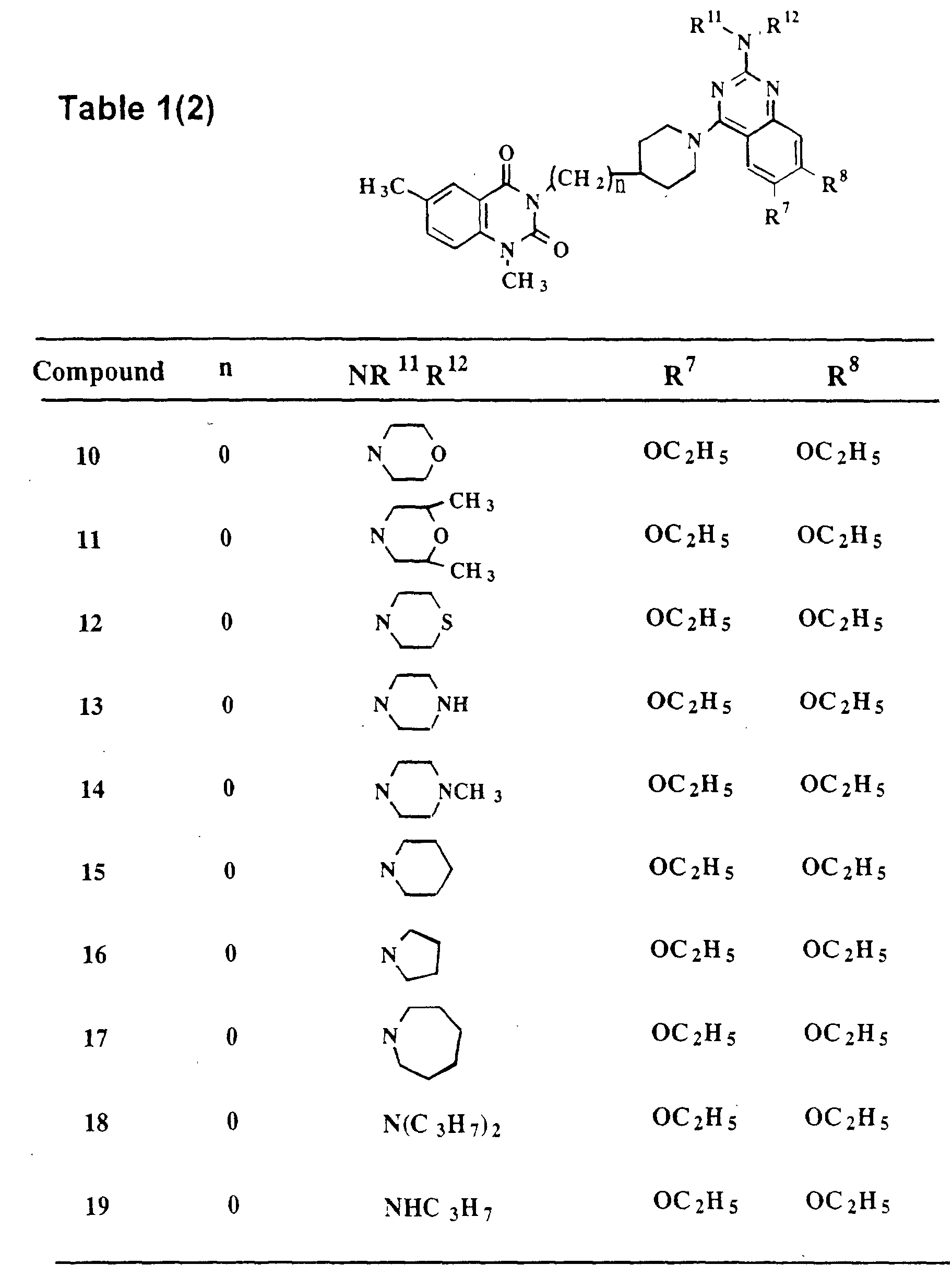


- The pharmacological activities of typical Compounds (I) are shown below by Test Examples.
- A test compound was orally or intraperitoneally administered to groups of dd-strain male mice weighing 20 ± 1 g, each group consisting of three mice. Seven days after the administration, the mortality was observed to determine a minimum lethal dose (MLD) of the compound. The MLD was >1000 mg/kg for oral administration of Compound 10 and was >100 mg/kg for intraperitoneal administration of Compound 10.
- Mouse nephrotoxin (hereinafter referred to as NT) was prepared according to the method of Ito, et al. [The Japanese Journal of Nephrology, 23, 25-36 (1981)]. That is, glomerular basement membrane (hereinafter referred to as GBM) was isolated from mouse kidney and digested with trypsin (Sigma). The digested GBM was subjected to ultracentrifugation under cooling, and the supernatant was dialyzed against distilled water, followed by lyophilization. The lyophile product was intracutaneously injected as an antigen into four foot pads of a rabbit together with Freund's complete adjuvant (Iatron; hereinafter referred to as FCA) once a week for 4 weeks for immunization. The whole blood was drawn from the immunized rabbit, and serum was separated and inactivated at 56°C for 30 minutes to prepare NT.
- In this test, ddY-strain male mice weighing 29-36 g were used. For previous immunization, 0.25 ml of an FCA emulsion containing 0.25 mg of rabbit immunoglobulin-globulin (IgG, Sigma) was intraperitoneally injected into mice. Nephritis was induced by intravenous injection of 0.075 ml of NT through the tail vein 4 and 11 days after the previous immunization. Four weeks after the second NT injection, each mouse was put into a metabolic cage and received oral administration of 0.5 ml/10 g of distilled water twice at an interval of 12 hours. Urine was collected for 24 hours, and after measurement of the volume, the urine was centrifuged under cooling (3000 rpm, 4°C) for 5 minutes. The supernatant was analyzed for urinary albumin content using an autoanalyzer (Olympus). A test compound was orally administered at a dose of 1 mg/kg once a day, starting on the day of the previous immunization. The normal group and the control group received oral administration of a solvent (5% methyl cellulose solution) at the same time.
- The results are shown in Table 5 as the means ± standard error of each group consisting of 11 mice. Statistical significance was evaluated by Student's t-test.
Test Group Urinary Albumin Content (mg/kg/24 hr) Normal group 85 ± 5 Control group 134 ± 9 Compound 10-administered group 96 ± 7 - It is apparent from the above test results that Compound 10 inhibits the increase of urinary albumin in nephritis and thus is useful for the treatment of nephritis.
- In this test, ddY-strain male mice weighing 25-28 g were used. Diabetes was induced according to the method of Tsuchida, et al. [Jin To Toseki (Kidney and Dialysis), 31, 363-366 (1991)]. That is, streptozotocin (5 mg/ml, Sigma; hereinafter referred to as STZ) dissolved in 0.05 M citrate buffer was intravenously injected into mice through the tail vein at a dose of 10 ml/kg. On the fourth day after the STZ administration, 30 µl of blood was collected from the tail vein of the mice and the blood glucose was determined using Glutestsensor (Sanwa Kagaku). The animals were divided into three groups based on the blood glucose level. Twelve weeks after the STZ administration, each mouse was put into a metabolic cage and received oral administration of 0.5 ml/10 g of distilled water twice at an interval of 12 hours. Urine was collected for 24 hours, and after measurement of the volume, the urine was centrifuged under cooling (3000 rpm, 4°C) for 5 minutes. The supernatant was analyzed for urinary albumin content using an autoanalyzer (Olympus). A test compound was orally administered once a day for 11 weeks, starting on the fifth day after the STZ administration. The normal group and the control group received oral administration of a solvent (5% methyl cellulose solution).
- The results are shown in Table 6 as the means ± standard error of each group. Statistical significance was evaluated by Aspin-Welch's test for the difference between the control group and the normal group and by Steel's test for the difference between the control group and the test compound-administered group.
Test Group Number of Animals Urinary Albumin Content (mg/kg/24 hr) Normal group 10 80 ± 3 Control group 8 333 ± 30 Compound 10-administered group ( 1 mg/kg) 10 244 ± 16 (10 mg/kg) 9 200 ± 13 - It is apparent from the above test results that Compound 10 inhibits the increase of urinary albumin in diabetic nephropathy and thus is useful for the treatment of diabetic nephropathy.
- Compounds (I) and pharmaceutically acceptable salts thereof can be formulated into generally employed dose forms, such as tablets, capsules, syrups, injections, drips, and suppositories and the like, and administered orally or non-orally through intramuscular injection, intravenous injection, intra-arterial injection, drip infusion, or rectal administration in the form of suppositories. For preparing these dose forms for oral or non-oral administration, generally known methods are applied. For example, the preparations may be formulated to contain various excipients, lubricants, binders, disintegrators, suspending agents, isotonizing agents, and emulsifiers,
- Examples of the carriers which can be used are water, injectable distilled water, physiological saline, glucose, fructose, sucrose, mannitol, lactose, starch, cellulose, methyl cellulose, carboxymethyl cellulose, hydroxypropyl cellulose, alginic acid, talc, sodium citrate, calcium carbonate, calcium hydrogenphosphate, magnesium stearate, urea, silicone resins, sorbitan fatty acid esters, and glycerin fatty acid esters.
- The dose varies depending upon the mode of administration, the age, body weight, and symptoms of a patient, etc. However, it is generally appropriate to administer Compound (I) or a pharmaceutically acceptable salt thereof in a dose of 1 to 900 mg/60 kg/day either orally or non-orally.
- Certain embodiments of the present invention are illustrated in the following Examples and Reference Examples.
- In 15 ml of dimethylformamide was dissolved 200 mg (0.40 mmol) of 3-[1-(2-chloro-6,7-dimethoxy-4-quinazolinyl)-4-piperidinyl]-1,2,3,4-tetrahydro-1,6-dimethyl-2,4-dioxoquinazoline (Compound a) obtained in Reference Example 1, and 0.18 ml (2.0 mmol) of morpholine and 0.17 ml (1.2 mmol) of triethylamine were added to the solution. The mixture was heated under reflux at 130°C for 5 hours. After the solvent was evaporated, water was added to the residue, followed by extraction with chloroform. The organic layer was washed and dried, and the solvent was evaporated. The residue was purified by silica gel column chromatography (solvent: chloroform/methanol = 50/1) and recrystallization from ethyl acetate and ether to give 75.6 mg (yield: 35%) of Compound 1 as white crystals.
1H-NMR (CDCl3) δ: 8.01 (d, 1H, J=2.0Hz), 7.48 (dd, 1H, J=8.6, 2.0HZ), 7.09 (d, 1H, J=8.6Hz), 7.08 (s, 1H), 6.96 (s, 1H), 5.30-5.15 (m, 1H), 4.27-4.24 (br.- d, 2H), 3.98 (s, 3H), 3.93 (s, 3H), 3.83-3.81 (m, 8H), 3.58 (s, 3H), 3.15-3.00 (m, 4H), 2.42 (s, 3H), 1.81-1.78 (br.-d, 2H).
IR (KBr tab.)(cm-1): 1702, 1653, 1482, 1232, 1207.
Melting Point (ethyl acetate-ether): 256-257°C - The same procedure as in Example 1 was repeated, except that 300 mg (0.63 mmol) of Compound a was used and 0.4 ml (3.25 mmol) of N-methylpiperazine was used in place of morpholine, to give 97.3 mg (yield: 27%) of Compound 2 as white crystals.
1H-NMR (CDCl3) δ: 8.02 (d, 1H, J=2.0Hz), 7.48 (dd, 1H, J=8.6, 2.0Hz), 7.08 (d, 1H, J=8.6Hz), 7.07 (s, 1H), 6.94 (s, 1H), 5.30-5.15 (m, 1H), 4.26-4.23 (br.- d, 2H), 3.97 (s, 3H), 3.93 (s, 3H), 3.93-3.90 (m, 4H), 3.58 (s, 3H), 3.10-3.02 (m, 4H), 2.52-2.49 (m, 4H), 2.42 (s, 3H), 2.36 (s, 3H), 1.82-1.79 (br.- d, 2H).
IR (KBr tab.)(cm-1): 1704, 1656, 1509.
Melting Point: (ethyl acetate-ether-hexane): 168-171°C - The same procedure as in Example 1 was repeated, except that 600 mg (1.25 mmol) of Compound a was used, N-methylpyrrolidinone was used as the solvent in place of dimethylformamide, and 1.9 ml (12.5 mmol) of ethyl isonipecotate was used in place of morpholine, to give 760.0 mg (yield: 99%) of Compound 3 as white crystals.
1H-NMR (CDCl3) δ: 8.02 (d, 1H, J=2.0Hz), 7.48 (dd, 1H, J=8.3, 2.0Hz), 7.08 (d, 1H, J=8.3Hz), 7.06 (s, 1H), 6.93 (s, 1H), 5.30-5.15 (m, 1H), 4.80-4.74 (br.- d, 2H), 4.25-4.21 (br.-d, 2H), 4.15 (q, 2H, J=7.3Hz), 3.98 (s, 3H), 3.93 (s, 3H), 3.58 (s, 3H), 3.09-2.85 (m, 6H), 2.60-2.45 (m, 1H), 2.42 (s, 3H), 2.02-1.98 (br.-d, 2H), 1.82-1.63 (m, 4H), 1.27 (t, 3H, J=7.3Hz).
IR (KBr tab.)(cm-1): 1699, 1656, 1459.
Melting Point: (methanol-water): 103-105°C - In 10 ml of methanol was dissolved 400 mg (0.65 mmol) of Compound 3 obtained in Example 3, and 5 ml of 2 N aqueous solution of sodium hydroxide was added to the solution, followed by heating under reflux for one hour. After cooling, the solvent was evaporated, and water and concentrated hydrochloric acid were added to the residue. The precipitated crystals were collected by filtration, and then washed with water and methanol to give 308.0 mg (yield: 81%) of Compound 4 as white crystals.
1H-NMR (CDCl3) δ: 7.98 (d, 1H, J=1.0Hz), 7.45 (dd, 1H, J=7.0, 1.0Hz), 7.06 (s, 1H), 7.04 (d, 1H, J=7.0Hz), 7.01 (s, 1H), 5.30-5.15 (m, 1H), 4.71-4.67 (br.- d, 2H), 4.29-4.25 (br.-d, 2H), 3.95 (s, 3H), 3.90 (s, 3H), 3.55 (s, 3H), 3.10-3.01 (m, 6H), 2.60-2.40 (m, 1H), 2.40 (s, 3H), 2.05-1.99 (br.-d, 2H), 1.85-1.65 (m, 4H).
IR (KBr tab.)(cm-1): 3400 (br), 1700, 1654, 1639, 1521.
Melting Point (methanol-water): 189-190°C - The same procedure as in Example 1 was repeated, except that 300 mg (0.63 mmol) of Compound a was used and 0.3 ml (3.25 mmol) of propylamine was used in place of morpholine, to give 143.0 mg (yield: 42.4%) of Compound 5 as white crystals.
1H-NMR (CDCl3) δ: 8.01 (d, 1H, J=2.0Hz), 7.48 (dd, 1H, J=8.3, 2.0Hz), 7.08 (d, 1H, J=8.3Hz), 7.07 (s, 1H), 6.95 (s, 1H), 5.30-5.15 (m, 1H), 4.26-4.23 (br.- d, 2H), 3.97 (s, 3H), 3.93 (s, 3H), 3.57 (s, 3H), 3.24 (s, 6H), 3.10-3.01 (m, 4H), 2.42 (s, 3H), 1.81-1.78 (br.-d, 2H).
IR (KBr tab.)(cm-1): 1695, 1656, 1553, 1512, 1503.
Melting Point (ethyl acetate-ether): 220-221°C - The same procedure as in Example 1 was repeated, except that 500 mg (1.04 mmol) of Compound a was used, N-methylpyrrolidinone was used as the solvent in place of dimethylformamide, and 1.0 ml (10 mmol) of diethanolamine was used in place of morpholine, to give 163.5 mg (yield: 28%) of Compound 6 as white crystals.
1H-NMR (CDCl3) δ: 8.01 (d, 1H, J=2.0Hz), 7.48 (dd, 1H, J=8.3, 2.0Hz), 7.09 (d, 1H, J=8.3Hz), 7.04 (s, 1H), 6.84 (s, 1H), 5.30-5.15 (m, 1H), 4.25-4.20 (br.- d, 2H), 3.96 (s, 3H), 3.92 (s, 3H), 3.92-3.84 (m, 8H), 3.56 (s, 3H),3.19-3.00 (m, 4H), 2.42 (s, 3H), 1.84-1.80 (br.-d, 2H).
IR (KBr tab.)(cm-1): 3400 (br), 1698, 1656, 1498.
Melting Point (ethyl acetate-ether): 157-161°C - The same procedure as in Example 1 was repeated, except that 300 mg (0.63 mmol) of Compound a was used and 0.4 ml (3.2 mmol) of N,N,N'-trimethylethylenediamine was used in place of morpholine, to give 86.3 mg (yield: 24%) of Compound 7 as an amorphous solid.
1H-NMR (CDCl3) δ: 8.01 (d, 1H, J=2.0Hz), 7.48 (dd, 1H, J=8.2, 2.0Hz), 7.08 (d, 1H, J=8.2Hz), 7.06 (s, 1H), 6.97 (s, 1H), 5.30-5.15 (m, 1H), 4.26-4.22 (br.- d, 2H), 3.98 (s, 3H), 3.93 (s, 3H), 3.86 (t, 2H, J=7.3Hz), 3.58 (s, 3H), 3.25 (s, 3H), 3.11-3.00 (m, 4H), 2.63 (t, 2H, J=7.3Hz), 2.42 (s, 3H), 2.37 (s, 6H), 1.80-1.77 (br.-d, 2H).
IR (KBr tab.)(cm-1): 1700, 1656, 1509. - The same procedure as in Example 1 was repeated, except that 300 mg (0.63 mmol) of Compound a was used, N-methylpyrrolidinone was used as the solvent in place of dimethylformamide, and 0.3 ml (3.2 mmol) of propylamine was used in place of morpholine, to give 124.5 mg (yield: 37%) of Compound 8 as white crystals.
1H-NMR (CDCl3) δ: 8.02 (d, 1H, J=2.0Hz), 7.49 (dd, 1H, J=8.6, 2.0Hz), 7.09 (d, 1H, J=8.6Hz), 7.08 (s, 1H), 6.94 (s, 1H), 5.32-5.23 (m, 1H), 4.38-4.34 (br.- d, 2H), 3.98 (s, 3H), 3.92 (s, 3H), 3.58 (s, 3H), 3.52-3.38 (m, 2H), 3.21-3.00 (m, 4H), 2.42 (s, 3H), 1.86-1.82 (br.-d, 2H), 1.67 (sext, 2H, J=7.4Hz), 1.01 (t, 3H, J=7.4Hz).
IR (KBr tab.)(cm-1): 1703, 1654, 1508.
Melting Point (ethyl acetate-ether): 156-160°C - The same procedure as in Example 1 was repeated, except that 500 mg (1.04 mmol) of Compound a was used, N-methylpyrrolidinone was used as the solvent in place of dimethylformamide, and 0.5 ml (5.2 mmol) of benzylamine was used in place of morpholine, to give 31.8 mg (yield: 5.7%) of Compound 9 as white crystals.
1H-NMR (CDCl3) δ: 8.01 (d, 1H, J=1.5Hz), 7.51-7.22 (m, 6H), 7.09 (d, 1H, J=8.5Hz), 7.08 (s, 1H), 6.96 (s, 1H), 5.30-5.15 (m, 1H), 4.71 (d, 2H, J=6.6Hz), 4.34-4.29 (br.-d, 2H), 3.99 (s, 3H), 3.93 (s, 3H), 3.58 (s, 3H), 3.13-2.97 (m,4H), 2.42 (s, 3H), 1.82-1.78 (br.-d, 2H).
IR (KBr tab.)(cm-1): 1703, 1659, 1560, 1511.
Melting Point (ethyl acetate-ether): 136-139°C - The same procedure as in Example 1 was repeated, except that 3.60 g (7.09 mmol) of 3-[1-(2-chloro-6,7-diethoxy-4-quinazolinyl)-4-piperidinyl]-1,2,3,4-tetrahydro-1,6-dimethyl-2,4-dioxoquinazoline (Compound b) obtained in Reference Example 2 was used in place of Compound a, and N-methylpyrrolidinone was used as the solvent in place of dimethylformamide, to give 3.47 g (yield: 85%) of the free base of Compound 10 as white crystals.
1H-NMR (CDCl3) δ; 8.01 (d, 1H, J=1.5Hz), 7.49 (dd, 1H, J=8.5, 1.5Hz), 7.11 (s, 1H), 7.08 (d, 1H, J=8.5Hz), 6.97 (s, 1H), 5.30-5.20 (m, 1H), 4.28-4.24 (br.- d, 2H), 4.20 (q, 2H, J=7.0Hz), 4.12 (q, 2H, J=7.0Hz), 3.84-3.81 (m, 8H), 3.58 (s, 3H), 3.20-2.95 (m, 4H), 2.42 (s, 3H), 1.85-1.81 (br.-d, 2H), 1.51 (t, 3H, J=7.0Hz), 1.49 (t, 3H, J=7.0Hz).
IR (KBr tab.)(cm-1): 1699, 1656, 1563, 1459, 1237, 1180, 1109.
Melting Point (ether): 228-229°C - In 20 ml of ethyl acetate was dissolved 1.0 g (1.74 mmol) of the free base obtained in Step 1, and an excess of a saturated solution of hydrogen chloride in ethyl acetate was added dropwise to the solution at room temperature, followed by stirring for 10 minutes. The precipitated crystals were collected by filtration, and washed with ethyl acetate to give 0.87 g (yield: 82%) of Compound 10 as white crystals.
1H-NMR (CDCl3) δ: 8.49 (br-s, 1H), 8.00 (s, 1H), 7.50 (d, 1H, J=8.5Hz), 7.11 (d, 1H, J=8.5Hz), 7.07 (s, 1H), 5.45-5.30 (m, 1H), 4.66-4.61(br.-d, 2H), 4.34-4.32 (br.-d, 2H), 4.13-4.08 (m, 6H), 3.84 (br.-s, 4H), 3.57 (s, 3H), 3.57 (s, 3H), 3.40-3.31 (br.-t, 2H), 3.01-2.89 (m, 2H), 2.43 (s, 3H), 1.92-1.88 (br.- d, 2H), 1.50 (t, 3H, J=7.0Hz), 1.48 (t, 3H, J=7.0Hz).
Melting Point (ethyl acetate): 193-195°C - The same procedure as in Example 10 was repeated, except that 2,6-dimethylmorpholine (trans-cis mixture) was used in place of morpholine, to give Compound 11 as white crystals.
1H-NMR (CDCl3) δ: 8.01 (d, 1H, J=1.5Hz), 7.48 (dd, 1H, J=8.5, 1.5Hz), 7.10 (s, 1H), 7.08 (d, 1H, J=8.5Hz), 6.92 (s 1H), 5.30-5.15 (m, 1H), 4.66-4.61 (br.-d, 2H), 4.21-4.07 (m, 6H), 3.70-3.69 (m, 2H), 3.58 (s, 3H), 3.10-2.99 (m, 4H), 2.65-2.55 (br.-t, 2H), 2.42 (s, 3H), 1.82-1.76 (br.-d, 2H), 1.51 (t, 3H, J=7.0Hz), 1.49 (t, 3H, J=7.0Hz), 1.28 (d, 6H, J=6.0Hz). (as the free base)
IR (KBr tab.)(cm-1): 1702, 1658, 1591, 1460, 1262.
Melting Point (ether): 241-242°C - The same procedure as in Example 10 was repeated, except that thiomorpholine was used in place of morpholine, to give Compound 12 as white crystals.
1H-NMR (CDCl3) δ: 8.01 (d, 1H, J=1.5Hz), 7.49 (dd, 1H, J=8.5, 1.5Hz), 7.09 (s, 1H), 7.09 (d, 1H, J=8.5Hz), 6.90 (s, 1H), 5.25-5.10 (m, 1H), 4.25-4.08 (m, 10H), 3.58 (s, 3H), 3.10-2.99 (m, 4H), 2.80-2.60 (m, 4H), 2.42 (s, 3H), 1.81-1.77 (br.-d, 2H), 1.51 (t, 3H, J=7.0Hz), 1.49 (t, 3H, J=7.0Hz). (as the free base)
IR (KBr tab.)(cm-1): 1698, 1657, 1587, 1458, 1270.
Melting Point (ether): 179-182°C - The same procedure as in Example 10 was repeated, except that piperazine was used in place of morpholine, to give Compound 13 as a colorless amorphous solid.
1H-NMR (CDCl3) δ: 8.02 (d, 1H, J=1.5Hz), 7.48 (dd, 1H, J=8.5, 1.5Hz), 7.10 (s, 1H), 7.09 (d, 1H, J=8.5Hz), 7.00 (s, 1H), 5.35-5.10 (m, 1H), 4.29-4.24 (br.- d, 2H), 4.20 (q, 2H, J=7.0Hz), 4.13 (q, 2H, J=7.0Hz), 4.10-4.00 (m, 4H), 3.58 (s, 3H), 3.17-2.99 (m, 8H), 2.42 (s, 3H), 1.81-1.76 (br.-d, 2H), 1.52 (t, 3H, J=7.0Hz), 1.49 (t, 3H, J=7.0Hz). (as the free base)
IR (KBr tab.)(cm-1): 1701, 1656, 1651, 1626, 1585, 1459, 1257. - The same procedure as in Example 10 was repeated, except that N-methylpiperazine was used in place of morpholine in Step 1 and methanesulfonic acid was used in place of a saturated solution of hydrogen chloride in Step 2, to give Compound 14 as white crystals.
1H-NMR (CDCl3) δ: 8.01 (d, 1H, J=1.5Hz), 7.48 (dd, 1H, J=8.3. 1.5HZ). 7.10 (s, 1H), 7.08 (d, 1H, J=8.3Hz), 6.92 (s, 1H), 5.30-5.15 (m, 1H), 4.25-4.23 (br.- d, 2H), 4.19 (q, 2H, J=7.0Hz), 4.12 (q, 2H, J=7.0Hz), 3.89-3.83 (m, 4H), 3.58 (s, 3H), 3.08-2.96 (m, 4H), 2.51-2.48 (m, 4H), 2.41 (s, 3H), 2.34 (s, 3H), 1.81-1.78 (br.-d, 2H), 1.51 (t, 3H, J=7.0Hz), 1.48 (t, 3H, J=7.0Hz). (as the free base)
IR (KBr tab.)(cm-1): 1705, 1658, 1637, 1195.
Melting Point (ethyl acetate-ether): 187-189°C - The same procedure as in Example 10 was repeated, except that piperidine was used in place of morpholine, to give Compound 15 as white crystals.
1H-NMR (CDCl3) δ: 8.02 (d, 1H, J=1.5Hz), 7.48 (dd, 1H, J=8.5, 1.5Hz), 7.09 (s, 1H), 7.09 (d, 1H, J=8.5Hz), 6.90 (br.-s, 1H), 5.30-5.15 (m, 1H), 4.30-4.05 (m, 6H), 3.90-3.75 (m, 4H), 3.58 (s, 3H), 3.15-2.95 (m, 4H), 2.42 (s, 3H), 1.81-1.75 (br.-d, 2H), 1.64-1.53 (m, 6H), 1.51 (t, 3H, J=7.0Hz), 1.48 (t, 3H, J=7.0Hz). (as the free base)
IR (KBr tab.)(cm-1): 1706, 1648, 1586, 1459, 1271.
Melting Point (ethanol-ether): 189-191°C - The same procedure as in Example 10 was repeated, except that pyrrolidine was used in place of morpholine, to give Compound 16 as white crystals.
1H-NMR (CDCl3) δ: 8.02 (d, 1H, J=1.5Hz), 7.48 (dd, 1H, J=8.5, 1.5Hz), 7.10 (s, 1H), 7.08 (d, 1H, J=8.5Hz), 6.95 (br.-s, 1H), 5.30-5.15 (m, 1H), 4.40-4.24 (m, 2H), 4.20 (q, 2H, J=7.0Hz), 4.11 (q, 2H, J=7.0Hz), 3.70-3.50 (m, 4H), 3.58 (s, 3H), 3.08-2.99 (m, 4H), 2.42 (s, 3H), 2.00-1.96 (m, 4H), 1.80-1.77 (br.-d, 2H), 1.50 (t, 3H, J=7.0Hz), 1.48 (t, 3H, J=7.0Hz). (as the free base)
IR (KBr tab.)(cm-1): 1706, 1648, 1626, 1601, 1538, 1462, 1270.
Melting Point (ether): 220-222°C - The same procedure as in Example 10 was repeated, except that hexamethyleneimine was used in place of morpholine, to give Compound 17 as white crystals.
1H-NMR (CDCl3) δ: 8.01 (d, 1H, J=2.0Hz), 7.48 (dd, 1H, J=8.6, 2.0Hz), 7.10 (s, 1H), 7.08 (d, 1H, J=8.6Hz), 6.90 (br.-s, 1H), 5.30-5.10 (m, 1H), 4.21-4.14 (m, 4H), 4.10 (q, 2H, J=7.0Hz), 3.90-3.70 (m, 4H), 3.58 (s, 3H), 3.07-2.95 (m, 4H), 2.42 (s, 3H), 1.95-1.80 (m, 6H), 1 . 56-1.40 (m, 4H), 1.50 (t, 3H, J=7.0Hz), 1.47 (t, 3H, J=7.0Hz). (as the free base)
IR (KBr tab.)(cm-1): 1700, 1660, 1650, 1592.
Melting Point (ether): 154-163°C - The same procedure as in Example 10 was repeated, except that dipropylamine was used in place of morpholine, to give Compound 18 as white crystals.
1H-NMR (CDCl3) δ: 8.02 (d, 1H, J=1.5Hz), 7.48 (dd, 1H, J=8.5, 1.5Hz), 7.09 (s, 1H), 7.09 (d, 1H, J=8.5Hz), 6.88 (s, 1H), 5.30-5.15 (m, 1H), 4.21-4.18 (br.- d, 2H), 4.18 (q, 2H, J=7.0Hz), 4.10 (q, 2H, J=7.0Hz), 3.65-3.50 (m, 4H), 3.57 (s, 3H), 3.10-2.95 (m, 4H), 2.42 (s, 3H), 1.80-1.66 (m, 6H), 1.50 (t, 3H, J=7.0Hz), 1.48 (t, 3H, J=7.0Hz), 0.95-0.91 (dist.-t, 6H). (as the free base)
IR (KBr tab.)(cm-1): 1708, 1659, 1627, 1593, 1543, 1361.
Melting Point (ether): 240-242°C - The same procedure as in Example 10 was repeated, except that propylamine was used in place of morpholine, to give Compound 19 as white crystals.
1H-NMR (CDCl3) δ: 8.01 (d, 1H, J=1.5Hz), 7.49 (dd, 1H, J=8.3, 1.5Hz), 7.10 (d, 1H, J=8.3Hz), 7.09 (s, 1H), 6.93 (s, 1H), 5.40-5.20 (m, 1H), 4.52-4.48 (br.- d, 2H), 4.20 (q, 2H, J=7.0Hz), 4.09 (q, 2H, J=7.0Hz), 3.58 (s, 3H), 3.47-3.40 (m, 2H), 3.29-3.19 (br.-t, 2H), 3.04-2.97 (m, 2H), 2.42 (s, 3H), 1.88-1.84 (br.-d, 2H), 1.67 (sext, 2H, J=7.0Hz), 1.50 (t, 3H, J=7.0Hz), 1.48 (t, 3H, J=7.0Hz), 1.00 (t, 3H, J=7.0Hz). (as the free base)
IR (KBr tab.)(cm-1): 1702, 1657, 1524.
Melting Point (ether): 225-227°C - The same procedure as in Example 10 was repeated, except that isopropylamine was used in place of morpholine, to give Compound 20 as white crystals.
1H-NMR (CDCl3) δ: 8.00 (d, 1H, J=1.5Hz), 7.50 (dd, 1H, J=8.5, 1.5Hz), 7.10 (d, 1H, J=8.5Hz), 7.08 (s, 1H), 6.99 (br.-s, 1H), 5.40-5.20 (m, 1H), 4.70-4.65 (br.-d, 2H), 4.22-4.06 (m, 5H), 3.57 (s, 3H), 3.39-3.31 (br.-t, 2H), 2.97-2.93 (m, 2H), 2.42 (s, 3H), 1.87-1.84 (br.-d, 2H), 1.49 (t, 3H, J=7.0Hz), 1.47 (t, 3H, J=7.0Hz), 1.32 (d, 6H, J=6.0Hz). (as the free base)
IR (KBr tab.)(cm-1): 1699, 1659, 1634, 1542, 1518.
Melting Point (ethanol-ethyl acetate-ether): 170-172°C - The same procedure as in Example 10 was repeated, except that cyclohexylamine was used in place of morpholine, to give Compound 21 as white crystals.
1H-NMR (CDCl3) δ: 8.01 (d, 1H, J=1.5Hz), 7.49 (dd, 1H, J=8.5, 1.5Hz), 7.09 (d, 1H, J=8.5Hz), 7.09 (s, 1H), 6.91 (s, 1H), 5.40-5.20 (m, 1H), 4.37-4.23 (br.- d, 2H), 4.19 (q, 2H, J=7.0Hz), 4.10 (q, 2H, J=7.0Hz), 4.00-3.80 (m, 1H), 3.58 (s, 3H), 3.22-3.13 (br.-t, 2H), 3.05-2.97 (m, 2H), 2.42 (s, 3H), 2.06-2.03 (m, 2H), 1.85-1.75 (m, 4H), 1.50 (t, 3H, J=7.0Hz), 1.48 (t, 3H, J=7.0Hz), 1.38-1.27 (m, 6H). (as the free base)
IR (KBr tab.)(cm-1): 1702, 1654, 1635, 1599, 1542.
Melting Point (ethyl acetate): 170-173°C - The same procedure as in Example 10 was repeated, except that cyclooctylamine was used in place of morpholine, to give Compound 22 as white crystals.
1H-NMR (CDCl3) δ: 8.15 (br.-d, 1H, NH), 8.01 (d, 1H, J=1.5Hz), 7.50 (dd, 1H, J=8.5, 1.5Hz), 7.10 (d, 1H, J=8.5Hz), 7.08 (s, 1H), 6.92 (s, 1H), 5.40-5.20 (m, 1H), 4.69-4.64 (br.-d, 2H), 4.20 (q, 2H, J=7.0Hz), 4.07 (q, 2H, J=7.0Hz), 4.20-4.00 (m, 1H), 3.58 (s, 3H), 3.40-3.31 (br.-t, 2H), 3.02-2.94 (m, 2H), 2.43 (s, 3H), 2.00-1.50 (m, 16H), 1.50 (t, 3H, J=7.0Hz), 1.47 (t, 3H, J=7.0Hz). (as the hydrochloride)
IR (KBr tab.)(cm-1): 1704, 1699, 1657, 1636, 1359.
Melting Point (ether): 231-234°C - The same procedure as in Example 10 was repeated, except that 3-[1-(2-chloro-6,7-methylenedioxy-4-quinazolinyl)-4-piperidinyl]-1,2,3,4-tetrahydro-1,6-dimethyl-2,4-dioxoquinazoline (Compound c) obtained in Reference Example 3 was used in place of Compound b, to give Compound 23 as white crystals.
1H-NMR (CDCl3) δ: 8.02 (d, 1H, J=2.0Hz), 7.49 (dd, 1H, J=8.6, 2.0Hz), 7.09 (s, 1H), 7.09 (d, 1H, J=8.6Hz), 6.90 (s, 1H), 6.01 (s, 2H), 5.30-5.10 (m, 1H), 4.20-4.10 (br.-d, 2H), 3.90-3.70 (m, 8H), 3.58 (s, 3H), 3.10-2.95 (m, 4H), 2.42 (s, 3H), 1.86-1.75 (br.-d, 2H). (as the free base)
IR (KBr tab.)(cm-1): 1702, 1654, 1649, 1510.
Melting Point (ethanol-ether): 278-280°C - The same procedure as in Example 10 was repeated, except that 3-[1-(2-chloro-6,7-dipropoxy-4-quinazolinyl)-4-piperidinyl]-1,2,3,4-tetrahydro-1,6-dimethyl-2,4-dioxoquinazoline (Compound d) obtained in Reference Example 4 was used in place of Compound b, to give Compound 24 as white crystals.
1H-NMR (CDCl3) δ: 8.02 (d, 1H, J=1.5Hz), 7.48 (dd, 1H, J=8.3, 1.5Hz), 7.10 (s, 1H), 7.08 (d, 1H, J=8.3Hz), 6.91 (s, 1H), 5.30-5.25 (m, 1H), 4.30-4.20 (br.- d, 2H), 4.07 (t, 2H, J=6.5Hz), 4.00 (t, 2H, J=6.5Hz), 3.90-3.81 (m, 8H), 3.58 (s, 3H), 3.09-2.99 (m, 4H), 2.42 (s, 3H), 1.94-1.80 (m, 6H), 1.07 (t, 6H, J=6.5Hz). (as the free base)
IR (KBr tab.)(cm-1): 1704, 1656, 1631, 1596, 1511.
Melting Point (ethanol-ether-hexane): 160-163°C - The same procedure as in Example 10 was repeated, except that 3-[1-(2-chloro-6,7-diisopropoxy-4-quinazolinyl)-4-piperidinyl]-1,2,3,4-tetrahydro-1,6-dimethyl-2,4-dioxoquinazoline (Compound e) obtained in Reference Example 5 was used in place of Compound b, to give Compound 25 as white crystals.
1H-NMR (CDCl3) δ: 8.02 (d, 1H, J=1.5Hz), 7.58 (dd, 1H, J=8.5, 1.5Hz), 7.22 (s, 1H), 7.08 (d, 1H, J=8.5Hz), 6.92 (s, 1H), 5.30-5.10 (m, 1H), 4.69 (sept, 1H, J=6.0Hz), 4.41 (sept, 1H, J=6.0Hz), 4.29-4.26 (br.-d, 2H), 3.90-3.75 (m, 8H), 3.58 (s, 3H), 3.09-2.98 (m, 4H), 2.42 (s, 3H), 1.82-1.79 (br.- d, 2H), 1.42 (d, 3H, J=6.0Hz), 1.34 (d, 3H, J=6.0Hz). (as the free base)
IR (KBr tab.)(cm-1): 1704, 1652, 1543, 1510.
Melting Point (ethanol-ethyl acetate-ether): 189-192°C - The same procedure as in Example 10 was repeated, except that 3-[1-(7-benzyloxy-2-chloro-6-methoxy-4-quinazolinyl)-4-piperidinyl]-1,2,3,4-tetrahydro-1,6-dimethyl-2,4-dioxoquinazoline (Compound f) obtained in Reference Example 6 was used in place of Compound b, to give Compound 26 as white crystals.
1H-NMR (CDCl3) δ: 8.02 (d, 1H, J=1.5Hz), 7.51-7.26 (m, 6H), 7.10 (s, 1H), 7.08 (d, 1H, J=8.5Hz), 6.99 (s, 1H), 5.40-5.20 (m, 3H), 4.30-4.20 (br.-d, 2H), 3.92 (s, 3H), 3.90-3.60 (m, 8H), 3.58 (s, 3H), 3.21-2.95 (m, 4H), 2.42 (s,3H), 1.83-1.75 (br.-d, 2H). (as the free base)
IR (KBr tab.)(cm-1): 1704, 1657, 1649, 1540, 1273.
Melting Point (ether): 176-178°C - The same procedure as in Example 1 was repeated, except that 300 mg (0.59 mmol) of 3-[1-(2-chloro-6,7-dimethoxy-4-quinazolinyl)-4-piperidinyl]methyl-1,2,3,4-tetrahydro-1,6-dimethyl-2,4-dioxoquinazoline (Compound h) obtained in Reference Example 9 was used in place of Compound a, and N-methylpyrrolidinone was used as the solvent in place of dimethylformamide, to give 250 mg (yield: 76%) of Compound 27 as white crystals.
1H-NMR (CDCl3) δ: 8.02 (s, 1H), 7.48 (d, 1H, J=8.4Hz), 7.12 (d, 1H, J=8.4Hz), 6.98 (s, 1H), 6.92 (br.-s, 1H), 4.16-4.04 (br.-d, 4H), 3.97 (s, 3H), 3.92 (s, 3H), 3.80 (br.-s, 8H), 3.65 (s, 3H), 3.07-2.98 (m, 2H), 2.42 (s, 3H), 2.28-2.10 (m, 1H), 1.83-1.59 (m, 4H).
Melting Point (methanol-water): 255-256°C - The same procedure as in Example 27 was repeated, except that diethanolamine was used in place of morpholine, to give Compound 28 as white crystals.
1H-NMR (CDCl3) δ: 8.02 (s, 1H), 7.50 (d, 1H, J=8.6Hz), 7.12 (d, 1H, J=8.6Hz), 6.96 (s, 1H), 6.87 (br.-s, 1H), 4.17-4.04 (br.-d, 4H), 3.98 (s, 3H), 3.91 (s, 3H), 3.91-3.82 (m, 8H), 3.60 (s, 3H), 3.04-2.95 (br.-t, 2H), 2.42 (s, 3H), 2.31-2.13 (m, 1H), 1.88-1.77 (br.-d, 2H), 1.71-1.57 (m, 2H).
Melting Point (methanol-water): 223-224°C - Ethyl chlorocarbonate (10 ml) was added to 540 mg (1.01 mmol) of 4-[2-(2-amino-5-methylbenzoylamino)ethyl]-1-(6,7-dimethoxy-2-morpholino-4-quinazolinyl)piperidine (Compound i) obtained in Reference Example 13 , and the mixture was heated under reflux for 10 hours. After cooling to room temperature, the solvent was evaporated under reduced pressure, followed by addition of hexane and ether to the residue. The precipitated crystals were collected by filtration to give 430 mg of crude 4-[2-(2-ethoxycarbonylamino-5-methylbenzoylamino)ethyl]-1-(6,7-dimethoxy-2-morpholino-4-quinazolinyl)piperidine, which was then dissolved in 10 ml of ethanol. To the solution was added 210 mg of potassium hydroxide, and the mixture was heated under reflux for one hour. After evaporation of the solvent under reduced pressure, water was added to the residue, followed by extraction with chloroform. The organic layer was washed and dried, and the solvent was evaporated to give 360 mg (overall yield: 64%) of Compound 29 as white crystals.
1H-NMR (CDCl3) δ: 8.95 (br.-s, 1H, NH), 7.92 (s, 1H), 7.42 (d, 1H, J=8.3Hz), 6.99-6.96 (m, 3H), 4.20-4.12 (m, 4H), 4.00 (s, 3H), 3.92 (s, 3H), 3.80 (br.-s, 8H), 3.14-3.00 (br.-t, 2H), 2.40 (s, 3H), 2.01-1.97 (br.-d, 2H), 1.74-1.54 (m, 5H).
Melting Point (methanol-water): 185-188°C - In 5 ml of dimethylformamide was suspended 350 mg (0.7 mmol) of Compound 29 obtained in Example 29, and 42 mg (1.05 mmol) of 60% sodium hydride and 0.1 ml (1.54 mmol) of methyl iodide were added to the suspension, and the mixture was stirred at room temperature for one hour. After a saturated aqueous solution of ammonium chloride was added thereto to stop the reaction, the reaction mixture was extracted with ethyl acetate, and the organic layer was washed and dried. The solvent was evaporated under reduced pressure, and the resulting crude crystals were washed with a solvent mixture of ethanol and ether to give 190 mg (yield: 48%) of Compound 30 as white crystals.
1H-NMR (CDCl3) δ: 8.02 (s, 1H), 7.50 (d, 1H, J=8.6Hz), 7.11 (d, 1H, J=8.6Hz), 6.98 (s, 1H), 6.95 (br.-s, 1H), 4.18-4.06 (m, 4H), 3.99 (s, 3H), 3.92 (s, 3H), 3.81 (br.-s, 8H), 3.59 (s, 3H), 3.12-2.95 (m, 2H), 2.42 (s, 3H), 2.05-1.91 (m, 2H), 1.80-1.42 (m, 5H).
Melting Point (ethanol-ether): 138°C - The same procedure as in Example 29 was repeated, except that 4-[2-(2-amino-5-methylbenzoylamino)ethyl]-1-[2-bis(2-hydroxyethyl)amino-6,7-dimethoxy-4-quinazolinyl]piperidine (Compound i) obtained in Reference Example 14 was used in place of Compound i, to give Compound 31 as white crystals.
1H-NMR (CDCl3) δ: 7.91 (s, 1H), 7.40 (d, 1H, J=8.6Hz), 6.99-6.95 (m, 3H), 4.16-4.11 (m, 4H), 3.96 (s, 3H), 3.91 (s, 3H), 3.94-3.84 (m, 8H), 3.09-3.00 (br.- t, 2H), 2.40 (s, 3H), 2.02-1.97 (br.-d, 2H), 1.80-1.49 (m, 5H).
Melting Point (methanol-water): 167-169°C - The same procedure as in Example 10, Step 1 was repeated, except that 3-(1-(2-chloro-6,7-diethoxy-4-quinazolinyl)-4-piperidinyl]-1,2,3,4-tetrahydro-2,4-dioxoquinazoline (Compound p) obtained in Reference Example 15 was used in place of Compound b, to give Compound 32 as white crystals.
1H-NMR (CDCl3) δ: 9.67 (br.-s, 1H, NH), 8.13 (dd, 1H, J=6.9, 1.8Hz), 7.59 (ddd, 1H, J=6.9, 6.9, 1.8Hz), 7.23 (ddd, 1H, J=6.9, 6.9, 1.8Hz), 7.11 (s, 1H), 7.00 (dd, 1H, J=6.9, 1.8Hz), 6.95 (br.-s, 1H), 5.30-5.15 (m, 1H), 4.32-4.27 (br.-d, 2H), 4.21 (q, 2H, J=7.0Hz), 4.11 (q, 2H, J=7.0Hz), 3.83-3.77 (m, 8H), 3.19-2.98 (m, 4H), 1.84-1.80 (br.-d, 2H), 1.51 (t, 3H, J=7.0Hz), 1.46 (t, 3H, J=7.0Hz).
IR (KBr tab.)(cm-1): 1705, 1656, 1560, 1441, 1234, 764.
Melting Point (ether): 193-194°C - The same procedure as in Example 10, Step 1 was repeated, except that 3-[1-(2-chloro -6,7-diethoxy-4-quinazolinyl)-4-piperidinyl]-1,2,3,4-tetrahydro-1-methyl-2,4-dioxoquinazoline (Compound g) obtained in Reference Example 16 was used in place of Compound b, to give Compound 33 as white crystals.
1H-NMR (CDCl3) δ: 8.30 (dd, 1H, J=7.9, 1.0Hz), 7.68 (ddd, 1H, J=7.9, 7.9, 1.0Hz), 7.26 (ddd, 1H, J=7.9, 7.9, 1.0Hz), 7.19 (dd, 1H, J=7.9, 1.0Hz), 7.11 (s, 1H), 6.92 (br.-s, 1H), 5.30-5.15 (m, 1H), 4.30-4.25 (br.-d, 2H), 4.20 (q, 2H, J=7.0Hz), 4.12 (q, 2H, J=7.0Hz), 3.84-3.81 (m, 8H), 3.60 (s, 3H), 3.15-2.96 (m, 4H), 1.82-1.79 (br.-d, 2H), 1.51 (t, 3H, J=7.0Hz), 1.49 (t, 3H, J=7.0Hz).
IR (KBr tab.)(cm-1): 1702, 1658, 1562, 1510, 1238.
Melting Point (ether): 238-241°C - The same procedure as in Example 10, Step 1 was repeated, except that 3-[1-(2-chloro-6,7-diethoxy-4-quinazolinyl)-4-piperidinyl]-1,2,3,4-tetrahydro-6-methyl-2,4-dioxoquinazoline (Compound r) obtained in Reference Example 17 was used in place of Compound b, to give Compound 34 as white crystals.
1H-NMR (CDCl3) δ: 9.05 (br.-s, 1H, NH), 7.92 (d, 1H, J=2.0Hz), 7.40 (dd, 1H, J=8.0, 2.0Hz), 7.10 (s, 1H), 6.92 (br.-s, 1H), 6.90 (d, 1H, J=8.0Hz), 5.25-5.15 (m, 1H), 4.30-4.15 (m, 4H), 4.10 (q, 2H, J=7.0Hz), 3.83-3.80 (m, 8H), 3.13-2.99 (m, 4H), 2.40 (s, 3H), 1.83-1.80 (br.-d, 2H), 1.52 (t, 3H, J=7.0Hz), 1.47 (t, 3H, J=7.0Hz).
IR (KBr tab.)(cm-1): 1710, 1659, 1560, 1433.
Melting Point (ether): 229-232°C - The same procedure as in Example 10, Step 1 was repeated, except that 3-[1-(2-chloro-6,7-diethoxy-4-quinazolinyl)-4-piperidinyl]-1-ethyl-1,2,3,4-tetrahydro-6-methyl-2,4-dioxoquinazoline (Compound s) obtained in Reference Example 18 was used in place of Compound b, to give Compound 35 as white crystals.
1H-NMR (CDCl3) δ: 8.02 (d, 1H, J=2.0Hz), 7.48 (dd, 1H, J=8.3, 2.0Hz), 7.10 (s, 1H), 7.09 (d, 1H, J=8.3Hz), 6.92 (br.-s, 1H), 5.30-5.10 (m, 1H), 4.40-4.20 (m, 4H), 4.16 (q, 2H, J=7.0Hz), 4.12 (q, 2H, J=7.0Hz), 3.95-3.81 (m, 8H), 3.20-2.96 (m, 4H), 2.41 (s, 3H), 1.82-1.79 (br.-d, 2H), 1.51 (t, 3H, J=7.0Hz), 1.49 (t, 3H, J=7.0Hz), 1.35 (t, 3H, J=7.0Hz).
IR (KBr tab.)(cm-1): 1707, 1653, 1542, 1457.
Melting Point (ether): 227-230°C - The same procedure as in Example 10, Step 1 was repeated, except that 3-[1-(2-chloro-6,7-diethoxy-4-quinazolinyl)-4-piperidinyl]-1,2,3,4-tetrahydro-6-methyl-2,4-dioxo-1-propylquinazoline (Compound t) obtained in Reference Example 19 was used in place of Compound b, to give Compound 36 as white crystals.
1H-NMR (CDCl3) δ: 8.02 (d, 1H, J=2.0Hz), 7.46 (dd, 1H, J=8.3, 2.0Hz), 7.10 (s, 1H), 7.06 (d, 1H, J=8.3Hz), 6.92 (br.-s, 1H), 5.25-5.10 (m, 1H), 4.22-4.19 (br.-d, 2H), 4.17 (q, 2H, J=7.0Hz), 4.12 (q, 2H, J=7.0Hz), 4.08-4.02 (br.-t, 2H), 3.90-3.81 (m, 8H), 3.07-2.99 (m, 4H), 2.41 (s, 3H), 1.81-1.78 (br.- d, 2H), 1.51 (t, 3H, J=7.0Hz), 1.49 (t, 3H, J=7.0Hz), 1.04 (t, 3H, J=7.0Hz).
IR (KBr tab.)(cm-1): 1701, 1658, 1573, 1509, 1460, 1238.
Melting Point (ether): 162-163°C - The same procedure as in Example 10, Step 1 was repeated, except that 3-[1-(2-chloro-6,7-diethoxy-4-quinazolinyl)-4-piperidinyl]-1,2,3,4-tetrahydro-5-methyl-2,4-dioxoquinazoline (Compound u) obtained in Reference Example 20 was used in place of Compound b, to give Compound 37 as white crystals.
1H-NMR (CDCl3) δ: 9.43 (br.-s, 1H, NH), 7.40 (dd, 1H, J=7.9, 7.9Hz), 7.11 (s, 1H) , 6.99 (d, 1H, J=7.9Hz), 6.95 (br.-s, 1H), 6.82 (d, 1H, J=7.9Hz), 5.25-5.10 (m, 1H), 4.27-4.15 (br.-d, 2H), 4.21 (q, 2H, J=7.0Hz), 4.11 (q, 2H, J=7.0Hz), 3.83-3.71 (m, 8H), 3.18-2.97 (m, 4H), 2.79 (s, 3H), 1.83-1.79 (br.- d, 2H), 1.52 (t, 3H, J=7.0Hz), 1.47 (t, 3H, J=7.0Hz).
IR (KBr tab.)(cm-1): 1710, 1653, 1469, 1433, 1233.
Melting Point (ether): 261-263°C - The same procedure as in Example 10, Step 1 was repeated, except that 3-[1-(2-chloro-6,7-diethoxy-4-quinazolinyl)-4-piperidinyl]-1,2,3,4-tetrahydro-1,5-dimethyl-2,4-dioxoquinazoline (Compound v) obtained in Reference Example 21 was used in place of Compound b, to give Compound 38 as white crystals.
1H-NMR (CDCl3) δ: 7.51 (dd, 1H, J=7.6, 7.6Hz), 7.11 (s, 1H), 7.05 (d, 2H, J=7.6Hz), 6.93 (br.-s, 1H), 5.25-5.10 (m, 1H), 4.28-4.24 (br.-d, 2H), 4.20 (q, 2H, J=7.0Hz), 4.13 (q, 2H, J=7.0Hz), 3.84-3.80 (m, 8H), 3.58 (s, 3H), 3.14-2.98 (m, 4H), 2.82 (s, 3H), 1.81-1.78 (br.-d, 2H), 1.51 (t, 3H, J=7.0Hz), 1.49 (t, 3H, J=7.0Hz).
IR (KBr tab.)(cm-1): 1699, 1655, 1560, 1236.
Melting Point (ether): 170-172°C - The same procedure as in Example 10, Step 1 was repeated, except that 3-[1-(2-chloro-6,7-diethoxy-4-quinazolinyl)-4-piperidinyl]-1,2,3,4-tetrahydro-8-methyl-2,4-dioxoquinazoline (Compound w) obtained in Reference Example 22 was used in place of Compound b, to give Compound 39 as white crystals.
1H-NMR (CDCl3) δ: 9.12 (br.-s, 1H, NH), 8.00 (d, 1H, J=7.6Hz), 7.40 (d, 1H, J=7.6Hz), 7.13 (dd, 1H, J=7.6, 7.6Hz), 7.10 (s, 1H), 6.95 (br.-s, 1H), 5.30-5.15 (m, 1H), 4.32-4.28 (br.-d, 2H), 4.22 (q, 2H, J=7.0Hz), 4.10 (q, 2H, J=7.0Hz), 3.83-3.78 (m, 8H), 3.18-2.99 (m, 4H), 2.35 (s, 3H), 1.84-1.80 (br.-d, 2H), 1.52 (t, 3H, J=7.0Hz), 1.46 (t, 3H, J=7.0Hz).
IR (KBr tab.)(cm-1): 1720, 1659, 1649, 1510, 1235, 756.
Melting Point (ether): 222-226°C - The same procedure as in Example 10, Step 1 was repeated, except that 3-[1-(2-chloro-6,7-diethoxy-4-quinazolinyl)-4-piperidinyl]-1,2,3,4-tetrahydro-1,8-dimethyl-2,4-dioxoquinazoline (Compound x) obtained in Reference Example 23 was used in place of Compound b, to give Compound 40 as white crystals.
1H-NMR (CDCl3) δ: 8.06 (d, 1H, J=7.0Hz), 7.45 (d, 1H, J=7.0Hz), 7.18 (dd, 1H, J=7.0, 7.0Hz), 7.10 (s, 1H) , 6.93 (br.-s, 1H), 5.20-5.00 (m, 1H), 4.30-4.20 (br.-d, 2H), 4.20 (q, 2H, J=7.0Hz), 4.12 (q, 2H, J=7.0Hz), 3.85-3.80 (m, 8H), 3.67 (s, 3H), 3.09-2.97 (m, 4H), 2.61 (s, 3H), 1.83-1.80 (br.-d, 2H), 1.51 (t, 3H, J=7.0Hz), 1.49 (t, 3H, J=7.0Hz).
IR (KBr tab.)(cm-1): 1722, 1675, 1580, 1466, 1257.
Melting Point (ethyl acetate-ether): 141-143°C - The same procedure as in Example 10, Step 1 was repeated, except that 6-chloro-3-[1-(2-chloro-6,7-diethoxy-4-quinazolinyl)-4-piperidinyl] -1,2,3,4-tetrahydro-2,4-dioxoquinazoline (Compound y) obtained in Reference Example 24 was used in place of Compound b, to give Compound 41 as white crystals.
1H-NMR (CDCl3) δ: 10.00 (br.-s, 1H, NH), 8.09 (d, 1H, J=2.0Hz), 7.55 (dd, 1H, J=8.5, 2.0Hz), 7.10 (s, 1H), 6.97 (s, 1H), 6.94 (d, 1H, J=8.5Hz), 5.30-5.15 (m, 1H), 4.32-4.27 (br.-d, 2H), 4.21 (q, 2H, J=7.0Hz), 4.11 (q, 2H, J=7.0Hz), 3.82-3.78 (m, 8H), 3.19-2.99 (m, 4H), 1.81-1.77 (br.-d, 2H), 1.52 (t, 3H, J=7.0Hz), 1.48 (t, 3H, J=7.0Hz).
IR (KBr tab.)(cm-1): 1715, 1658, 1562, 1471, 1342, 1235.
Melting Point (ether): 126-129°C - The same procedure as in Example 10, Step 1 was repeated, except that 6-chloro-3-[1-(2-chloro-6,7-diethoxy-4-quinazolinyl) -4-piperidinyl] -1,2,3, 4-tetrahydro-1-methyl-2,4-dioxoquinazoline (Compound z) obtained in Reference Example 25 was used in place of Compound b, to give Compound 42 as white crystals.
1H-NMR (CDCl3) δ: 8.18 (d, 1H, J=2.6Hz), 7.62 (dd, 1H, J=8.9, 2.6Hz), 7.14 (d, 1H, 3=8.9Hz), 7.09 (s, 1H), 6.93 (br.-s, 1H), 5.30-5.10 (m, 1H), 4.30-4.20 (br.-d, 2H), 4.19 (q, 2H, J=7.0Hz), 4.12 (q, 2H, J=7.0Hz), 3.84-3.80 (m, 8H), 3.58 (s, 3H), 3.10-2.93 (m, 4H), 1.81-1.77 (br.-d, 2H), 1.52 (t, 3H, J=7.0Hz), 1.49 (t, 3H, J=7.0Hz).
IR (KBr tab.)(cm-1): 1705, 1699, 1667, 1543, 1422, 1231.
Melting Point (ether): 213-215°C - The same procedure as in Example 10, Step 1 was repeated, except that 6-bromo-3-[1-(2-chloro-6,7-diethoxy-4-quinazolinyl)-4-piperidinyl]-1,2,3,4-tetrahydro-1-methyl-2,4-dioxoquinazoline (Compound aa) obtained in Reference Example 26 was used in place of Compound b, to give Compound 43 as white crystals.
1H-NMR (CDCl3) δ: 8.33 (d, 1H, J=2.3Hz), 7.75 (dd, 1H, J=8.9, 2.3Hz), 7.09 (s, 1H) , 7.07 (d, 1H, J=8.9Hz), 6.93 (br.-s, 1H), 5.30-5.15 (m, 1H), 4.30-4.20 (br.-d, 2H), 4.19 (q, 2H, J=7.0Hz), 4.12 (q, 2H, J=7.0Hz), 3.90-3.80 (m, 8H), 3.58 (s, 3H), 3.10-2.96 (m, 4H), 1.81-1.77 (br.-d, 2H), 1.52 (t, 3H, J=7.0Hz), 1.49 (t, 3H, J=7.0Hz).
IR (KBr tab.)(cm-1): 1726, 1682, 1462, 1256.
Melting Point (ether-hexane): 206-207°C - The same procedure as in Example 10, Step 1 was repeated, except that 3-[1-(2-chloro-6,7-diethoxy-4-quinazolinyl)-4-piperidinyl]-1,2,3,4-tetrahydro-6-nitro-2,4-dioxoquinazoline (Compound bb) obtained in Reference Example 27 was used in place of Compound b, to give Compound 44 as white crystals.
1H-NMR (CDCl3) δ: 9.01 (d, 1H, J=2.0Hz). 8.48 (dd, 1H, J=8.5, 2.0Hz), 7.09 (s, 1H), 7.03 (d, 1H, J=8.5Hz), 7.00 (s, 1H), 5.30-5.15 (m, 1H), 4.34-4.30 (br.- d, 2H), 4.22 (q, 2H, J=7.0Hz). 4.12 (q, 2H, J=7.0Hz), 3.81-3.77 (m, 8H), 3.23-3.14 (br.-t, 2H), 3.01-2.97 (m, 2H), 1.81-1.78 (br.-d, 2H), 1.52 (t, 3H, J=7.0Hz), 1.48 (t, 3H, J=7.0Hz).
IR (KBr tab.)(cm-1): 1719, 1659, 1648, 1561, 1337, 1233.
Melting Point (ether): 154-156°C - The same procedure as in Example 10, Step 1 was repeated, except that 3-[1-(2-chloro-6,7-diethoxy-4-quinazolinyl)-4-piperidinyl]-1,2,3,4-tetrahydro-1-methyl-6-nitro-2,4-dioxoquinazoline (Compound cc) obtained in Reference Example 28 was used in place of Compound b, to give Compound 45 as white crystals.
1H-NMR (CDCl3) δ: 9.09 (d, 1H, J=2.6Hz), 8.51 (dd, 1H, J=9.2, 2.6Hz), 7.31 (d, 1H, J=9.2Hz), 7.09 (s, 1H), 6.94 (br.-s, 1H), 5.30-5.15 (m, 1H), 4.30-4.15 (br.-d, 2H), 4.18 (q, 2H, J=7.0Hz), 4.12 (q, 2H, J=7.0Hz), 3.90-3.80 (m, 8H), 3.67 (s, 3H), 3.10-2.96 (m, 4H), 1.83-1.79 (br.-d, 2H), 1.52 (t, 3H, J=7.0Hz), 1.49 (t, 3H, J=7.0Hz).
IR (KBr tab.)(cm-1): 1720, 1672, 1331, 1234.
Melting Point (ether): 158-160°C - The same procedure as in Example 10, Step 1 was repeated, except that 6-acetyl-3-[1-(2-chloro-6,7-diethoxy-4-quinazolinyl)-4-piperidinyl]-1,2,3,4-tetrahydro-1-methyl-2,4-dioxoquinazoline (Compound dd) obtained in Reference Example 29 was used in place of Compound b, to give Compound 46 as white crystals.
1H-NMR (CDCl3) δ: 8.77 (d, 1H, J=2.0Hz), 8.31 (dd, 1H, J=8.9, 2.0Hz), 7.27 (d, 1H, J=8.9Hz), 7.10 (s, 1H), 6.93 (br.-s, 1H), 5.30-5.10 (m, 1H), 4.30-4.20 (br.-d, 2H), 4.21 (q, 2H, J=7.0Hz), 4.13 (q, 2H, J=7.0Hz), 3.84-3.82 (m, 8H), 3.64 (s, 3H), 3.12-2.98 (m, 4H), 2.67 (s, 3H), 1.83-1.79 (br.-d, 2H), 1.52 (t, 3H, J=7.0Hz), 1.49 (t, 3H, J=7.0Hz)
IR (KBr tab.)(cm-1): 1707, 1685, 1649, 1510.
Melting Point (ether): 153-154°C - In 10 ml of DMF was suspended 1.19 g (30.0 mmol) of 60% sodium hydride, and 3.07 ml (30.0 mmol) of thiophenol in 20 ml of DMF was dropwised under ice-cooling. After the mixture was stirred at ice-cooling for 10 minutes, 5.74 g (10.0 mmol) of Compound 10 obtained in Example 10 in DMF (50 ml) was added at ice-cooling, then the reaction mixture was stirred at 150 °C for 20 hours. After the reaction mixture was cooled to room temperature, water was added, pH of the reaction mixture was adjusted at 5 by concentrated hydrochloric acid and was subjected to extraction with chloroform. The organic layer was washed with sodium chloride solution and dried, concentrated to give a residue which was purified by silica gel column chromatography (eluent: chloroform/methanol=50/1). The more polar product obtained was recrystallized from ethanol/ether to give 2.67 g (yield: 49%) of Compound 47 as white crystals.
1H-NMR (CDCl3) δ: 8.02 (d, 1H, J=2.0Hz), 7.49 (dd, 1H, J=8.9, 2.0Hz), 7.09 (d, 1H, J=8.9Hz), 7.07(s, 2H), 5.29-5.20(m, 1H), 4.23-4.13(m, 4H), 3.84-3.79(m, 8H), 3.58 (s, 3H), 3.14-2.96 (m, 4H), 2.42 (s, 3H), 1.81-1.78 (br.-d, 2H), 1.50 (t, 3H, J=7.0Hz).
IR (KBr tab.)(cm-1): 1709, 1657, 1513, 1440, 1242.
Melting Point (ethanol-ether): 202-203°C - In 2.2 ml of DMF was dissolved 335 mg (0.61 mmol) of Compound 47 obtained in Example 47, 25 mg (0.61 mmol) of 60% sodium hydride was added at ice-cooling, and stirred at the same temperature for 20 minutes . 0 . 042 ml (0.67 mmol) of methyl iodide was added to the above reaction mixture and stirred at room tempareture for 2 hours. Saturated ammonium chloride solution was added and the resulting precipitate was collected by filteration, washed with water, dried at heating, purified by silica gel column chromatography(eluent: chloroform/methanol =100/1) and recrystallized from ethanol/ether to give 168 mg (yield: 49%) of Compound 48 as white crystals.
1H-NMR (CDCl3) δ: 8.02 (d, 1H, J=1.5Hz), 7.49 (dd, 1H, J=8.5, 1.5Hz), 7.09 (d, 1H, J=8.5Hz), 7.09 (s, 1H), 6.95 (s, 1H), 5.26-5.18 (m, 1H), 4.27-4.24 (br.- d, 2H), 4.13 (q, 2H, J=7.0Hz), 3.97 (s, 3H), 3.89-3.82 (m, 8H), 3.58 (s, 3H), 3.15-2.96 (m, 4H), 2.42 (s, 3H), 1.81-1.78 (br.-d, 2H), 1.51 (t, 3H, J=7.0Hz).
IR (KBr tab.)(cm-1): 1701, 1655, 1564, 1485, 1439, 1238.
Melting Point (ethanol-ether): 226-227°C - The same procedure as in Example 48 was repeated, using 335 mg (0.61 mmol) of Compound 47 obtained in Example 47, except that propyl iodide was used in place of methyl iodide, to give 164 mg (yield: 46%) of Compound 49 as white crystals.
1H-NMR (CDCl3) δ: 8.02 (d, 1H, J=2.0Hz), 7.49 (dd, 1H, J=8.6, 2.0Hz), 7.11 (s, 1H), 7.09(d, 1H, J=8.6Hz), 6.92 (s, 1H), 5.26-5.19 (m, 1H), 4.28-4.25 (br.- d, 2H), 4.15-4.05(m, 4H), 3.83-3.81 (m, 8H), 3.58 (s, 3H), 3.14-2.95 (m, 4H), 2.42 (s, 3H), 1.96-1.85 (m, 2H), 1.82-1.78 (br.-d, 2H), 1.48 (t, 3H, J=7.0Hz), 1.06(t, 3H, J=7.0Hz).
IR (KBr tab.)(cm-1): 1701, 1657, 1560, 1437, 1238.
Melting Point (ethanol-ether): 210-211°C - The same procedure as in Example 48 was repeated, using 335 mg (0.61 mmol) of Compound 47 obtained in Example 47, except that isopropyl iodide was used in place of methyl iodide, to give 112 mg (yield: 31%) of Compound 50 as white crystals.
1H-NMR (CDCl3) δ: 8.02 (d, 1H, J=1.7Hz), 7.49 (dd, 1H, J=8.6, 1.7Hz), 7.12 (s, 1H), 7.09 (d, 1H, J=8.6Hz), 6.92 (s, 1H), 5.26-5.19 (m, 1H), 4.74-4.68 (m, 1H) , 4.27-4.24(br.-d, 2H), 4.10 (q, 2H, J=7.0Hz), 3.83-3.81 (m, 8H), 3.58 (s, 3H), 3.09-2.99 (m, 4H), 2.42 (s, 3H), 1.81-1.77 (br.-d, 2H), 1.46(t, 3H, J=7.0Hz), 1.44 (d, 6H, J=6.0Hz).
IR (KBr tab.)(cm-1): 1701, 1659, 1556, 1481, 1441, 1236.
Melting Point (ethanol-ether): 194-195°C - The same procedure as in Example 48 was repeated, using 335 mg (0.61 mmol) of Compound 47 obtained in Example 47, except that butyl iodide was used in place of methyl iodide, to give 144 mg (yield: 39%) of Compound 51 as white crystals.
1H-NMR (CDCl3) δ: 8.02 (d, 1H, J=2.0Hz), 7.49 (dd, 1H, J=8.6, 2.0Hz), 7.11 (s, 1H), 7.09 (d, 1H, J=8.6Hz), 6.92 (s, 1H), 5.26-5.19 (m, 1H), 4.27-4.25 (br.- d, 2H), 4.23-4.07(m, 4H), 3.83-3.81 (m, 8H), 3.58 (s, 3H), 3.14-2.99 (m, 4H), 2.42 (s, 3H), 1.93-1.81 (m, 2H), 1.81-1.78(br.-d, 2H), 1.56-1.51(m, 2H), 1.47(t, 3H, J=7.0Hz). 0.99 (t, 3H, J=7.0Hz).
IR (KBr tab.)(cm-1) : 1701, 1659, 1558, 1485, 1441, 1238.
Melting Point (ethanol-ether): 195-196°C - In 3 ml of pyridine was dissolved 360 mg (0.66 mmol) of Compound 47 obtained in Example 47, 0.12 ml (1.32 mmol) of acetic anhydride was added, and the mixture was stirred at room temperature for 4 hours. The solvent was removed under reduced pressure and water was added to the residue. The resulting precipitate was collected by filteration, washed with water, dried at heating and recrystallized from ethanol to give 205 mg (yield: 53%) of Compound 52 as white crystals.
1H-NMR (CDCl3) δ: 8.01 (d, 1H, J=2.0Hz), 7.49 (dd, 1H, J=8.6, 2.0Hz), 7.22 (s, 1H), 7.17(s, 1H), 7.09 (d, 1H, J=8.6Hz), 5.29-5.21 (m, 1H), 4.30-4.26 (br.- d, 2H), 4.08 (q, 2H, J=7.0Hz), 3.83-3.79 (m, 8H), 3.58 (s, 3H), 3.16-2.99 (m, 4H), 2.42 (s, 3H), 2.34(s, 3H), 1.82-1.78 (br.-d, 2H), 1.42 (t, 3H, J=7.0Hz).
IR (KBr tab:)(cm-1): 1767, 1699, 1657, 1558, 1483, 1434, 1236.
Melting Point (ethanol): 228-227°C - The same procedure as in Example 48 was repeated, using 360 mg (0.66 mmol) of Compound 47 obtained in Example 47 and 2 equivalents of sodium hydride (60% in oil), except that 2-dimethylaminoethyl chloride hydrochloride was used in place of methyl iodide and the reaction temperature was 60°C in place of room temperature, to give 127 mg (yield: 31%) of Compound 53 as white crystals.
1H-NMR (CDCl3) δ: 8.02 (d, 1H, J=2.0Hz), 7.49 (dd, 1H, J=8.6, 2.0Hz), 7.09 (d, 1H, J=8.6Hz), 7.09(s, 1H), 6.97 (s, 1H), 5.28-5.21 (m, 1H), 4.28-4.21 (m, 4H), 4.10 (q, 2H, J=7.0Hz), 3.85-3.80 (m, 8H), 3.58 (s, 3H), 3.15-2.99 (m, 4H), 2.91-2.87 (m, 2H), 2.42 (s, 3H), 2.40(s, 6H), 1.82-1.78 (br.-d, 2H), 1.48(t, 3H, J=7.0Hz).
IR (KBr tab.)(cm-1): 1699, 1657, 1562, 1483, 1439, 1238.
Melting Point (ethanol-ether): 197-199°C - The same procedure as in Example 48 was repeated, using 3.90 g (7.13 mmol) of Compound 47 obtained in Example 47, except that ethyl bromoacetate was used in place of methyl iodide, to give 2.81 g (yield: 62%) of Compound 54 as white crystals.
1H-NMR (CDCl3) δ: 8.02 (d, 1H, J=2.0Hz), 7.49 (dd, 1H, J=8.6, 2.0Hz), 7.13 (s, 1H), 7.09 (d, 1H, J=8.6Hz), 6.81 (s, 1H), 5.27-5.18 (m, 1H), 4.78(s, 2H), 4.33-4.24 (m, 4H), 4.15 (q, 2H, J=7.0Hz). 3.83-3.80 (m, 8H), 3.58 (s, 3H), 3.14-2.96 (m, 4H), 2.42 (s, 3H), 1.81-1.77 (br.-d, 2H), 1.50 (t, 3H, J=7.0Hz), 1.31 (t, 3H, J=7.0Hz).
IR (KBr tab.)(cm-1): 1762, 1699, 1654, 1560, 1439, 1240.
Melting Point (ethanol-ether): 179-180°C - In 20 ml of ethanol was dissolved 2.10 g (3.32 mmol) of Compound 54 obtained in Example 54, excess sodium borohydride was added, and the mixture was stirred under heating at reflux for 1 hour. After cooling, the solvent was removed, water was added and the mixture was subjected to extraction with ethyl acetate. The organic layer was washed with sodium chloride solution, dried and concentrated to give a residue. The residue was purified by silica gel column chromatography(eluent: chloroform/methanol=100/1) and recrystallized from ethanol to give 1.29 g (yield: 66%) of Compond 55 as white crystals.
1H-NMR (CDCl3) δ: 8.01 (d, 1H, J=2.0Hz), 7.49 (dd, 1H, J=8.3, 2.0Hz), 7.11 (s, 1H), 7.09 (d, 1H, J=8.3Hz), 6.96 (s, 1H), 5.28-5.21 (m, 1H), 4.27-4.20 (m, 4H), 4.12 (q, 2H, J=7.0Hz), 4.05-4.02 (m, 2H), 3.84-3.79 (m, 8H), 3.58 (s, 3H), 3.15-2.96 (m, 4H), 2.42 (s, 3H), 1.82-1.78 (br.-d, 2H), 1.49 (t, 3H, J=7.0Hz).
IR (KBr tab.)(cm-1) : 1701, 1655, 1560, 1483, 1439, 1238.
Melting Point (ethanol): 236-237°C - In 30 ml of methanol was dissolved 900 mg (1.42 mmol) of Compound 54 obtained in Example 54, 15 ml of 2N-sodium hydroxide was added, and the mixture was stirred under heating at reflux for 4 hour. After cooling, 4N-hydrochloric acid was added to the reaction mixture and the mixture was neutralized and subjected to extraction with chloroform. The organic layer was washed, dried and concentrated to give the residue. Ether was added to the above residue to give a precipitate which was collected by filteration and dried to give 870 mg (yield: 100%) of Compound 56 as white crystals.
1H-NMR (CDCl3) δ: 8.10 (s, 1H), 7.99(d, 1H, J=1.7Hz), 7.51 (dd, 1H, J=8.6, 1.7Hz), 7.11 (d, 1H, J=8.6Hz), 7.11(s, 1H), 5.42-5.34 (m, 1H), 4.91(s, 2H), 4.68-4.63(br.-d, 2H), 4.16-4.06 (m, 6H), 3.85-3.82 (m, 4H), 3.58 (s, 3H), 3.44-3.35 (br.-t, 3H), 2.99-2.87(m, 2H), 2.42 (s, 3H), 1.93-1.90 (br.-d, 2H), 1.48 (t, 3H, J=7.0Hz).
IR (KBr tab.)(cm-1): 3600(br), 1699, 1653, 1593, 1458, 1270.
Melting Point (ether): 218-220°C - In 2 . 2 ml of methylene chloride was dissolved 300 mg (0.50 mmol) of Compound 56 obtained in Example 56, and 0.11 ml (1.51 mmol) of thionyl chloride was dropwise added at ice-cooling. The mixture was stirred at 40°C for 1 hour, and the solvent was removed at reduced pressure to give the corresponding acid chloride derivatives. In 3 ml of methylene chloride were dissolved 0.05 ml (0.60 mmol) of isopropylamine and 0.35 ml(2.51 mmol) of triethylamine, and the above acid chloride derivatives in 3 ml of methylene chloride was dropwise added at ice-cooling. The reaction mixture was stirred at room temperature for 2 hours, and poured into ice-cooling water and the mixture was subjected to extraction with methylene chloride. The organic layer was washed with sodium chloride solution, dried, and concentrated to give a residue. The residue was purified by silica gel column chromatography(eluent: chloroform/methanol =50/1) and recrystallized from ethanol/ether to give 57 mg (yield: 18%) of Compond 57 as white crystals.
1H-NMR (CDCl3) δ: 8.02 (d, 1H, J=2.0Hz), 7.49 (dd, 1H, J=8.6, 2.0Hz), 7.12(s, 1H), 7.09 (d, 1H, J=8.6Hz), 6.92 (s, 1H), 5.29-5.21 (m, 1H), 4.56(s, 2H), 4.26-4.22(br.-d, 2H), 4.19-4.03 (m, 3H), 3.83-3.78 (m, 8H), 3.59 (s, 3H), 3.21-3.00 (m, 4H), 2.43 (s, 3H), 1.83-1.79 (br.-d, 2H), 1.52 (t, 3H, J=7.0Hz), 1.22(d, 6H, J=6.0Hz).
IR (KBr tab.)(cm-1): 1701, 1655, 1560, 1483, 1439, 1236.
Melting Point (ethanol-ether): 160-163°C - The same procedure as in Example 57 was repeated, using 300 mg (0.50 mmol) of Compound 56 obtained in Example 56, except that pyrrolidine was used in place of isopropylamine, to give 48 mg (yield: 15%) of Compound 58 as white crystals.
1H-NMR (CDCl3) δ: 8.02 (d, 1H, J=2.0Hz), 7.49 (dd, 1H, J=8.6, 2.0Hz), 7.12 (s, 1H), 7.09(d, 1H, J=8.6Hz), 6.91 (s, 1H), 5.28-5.20 (m, 1H), 4.77(s, 2H), 4.28-4.24(br.-d, 2H), 4.13 (q, 2H, J=7.0Hz), 3.83-3.80 (m, 10H) , 3.60-3.53(m, 2H), 3.58 (s, 3H), 3.10-2.99 (m, 4H), 2.42 (s, 3H), 2.02-1.85 (m, 4H), 1.82-1.78 (br.-d, 2H), 1.48(t, 3H, J=7.0Hz).
IR (KBr tab.)(cm-1): 1703, 1659, 1556, 1479, 1441, 1236.
Melting Point (ethanol-ether): 145-147°C - A less polar product eluted from silica gel column chromatography(eluent: chloroform/methanol=50/1) in Example 47 was recrystallized from ethanol/ether to give 380 mg (yield: 7%) of Compound 59 as white crystals.
1H-NMR (CDCl3) δ: 8.02 (d, 1H, J=2.0Hz), 7.49 (dd, 1H, J=8.6, 2.0Hz), 7.23 (s, 1H), 7.09(d, 1H, J=8.6Hz), 6.95 (s, 1H), 5.28-5.21(m, 1H), 4.32-4.19(m, 4H), 3.83-3.81 (m, 8H), 3.58 (s, 3H), 3.14-3.00 (m, 4H), 2.42 (s, 3H), 1.80-1.77 (br.-d, 2H), 1.50 (t, 3H, J=7.0Hz).
IR (KBr tab.)(cm-1): 1701, 1655, 1514, 1475, 1441, 1238.
Melting Point (ethanol-ether): 198-200°C - The same procedure as in Example 48 was repeated, except that 290 mg (0.53 mmol) of Compound 59 obtained in Example 59 was used in place of Compound 47 obtained in Example 47, and ethyl bromoacetate was used in place of methyl iodide, to give 216 mg (yield: 64%) of Compound 60 as white crystals.
1H-NMR (CDCl3) δ: 8.01 (d, 1H, J=2.0Hz), 7.49 (dd, 1H, J=8.6, 2.0Hz), 7.16 (s, 1H), 7.09 (d, 1H, J=8.6Hz), 6.93 (s, 1H), 5.28-5.22 (m, 1H), 4.70(s, 2H), 4.31-4.16 (m, 6H), 3.84-3.79 (m, 8H), 3.57 (s, 3H), 3.14-2.97 (m, 4H), 2.42 (s, 3H), 1.79-1.75 (br.- d, 2H), 1.51 (t, 3H, J=7.0Hz). 1.29 (t, 3H, J=7.0Hz).
IR (KBr tab.)(cm-1): 1757, 1701, 1657, 1556, 1473, 1444, 1236.
Melting Point (ethanol-ether): 134-136°C - The same procedure as in Example 55 was repeated, except that 175 mg (0.28 mmol) of Compound 60 obtained in Example 60 was used in place of Compound 54 obtained in Example 54, to give 101 mg (yield: 62%) of Compound 61 as white crystals.
1H-NMR (CDCl3) δ: 8.01 (d, 1H, J=2.0Hz), 7.49 (dd, 1H, J=8.6, 2.0Hz), 7.22 (s, 1H), 7.09 (d, 1H, J=8.6Hz), 6.94 (s, 1H), 5.28-5.21 (m, 1H) , 4.27-4.15 (m, 6H) , 3.96-3.93 (m, 2H), 3.84-3.80 (m, 8H), 3.58 (s, 3H), 3.15-2.99 (m, 4H), 2.42 (s, 3H), 1.82-1.78 (br.- d, 2H), 1.51 (t, 3H, J=7.0Hz).
IR (KBr tab.)(cm-1) : 1699, 1655, 1560, 1473, 1437, 1238.
Melting Point (ethanol): 210-211°C - Tablets having the following composition were prepared in a conventional manner.
- Compound 10 (40 g) was mixed with 286.8 g of lactose and 60 g of potato starch, followed by addition of 120 g of a 10% aqueous solution of hydroxypropyl cellullose. The resulting mixture was kneaded, granulated, and then dried by a conventional method. The granules were refined to give granules to be tabletted. After mixing the granules with 1.2 g of magnesium stearate, the mixture was formed into tablets each containing 20 mg of the active ingredient by using a tablet maker (Model RT-15, Kikusui) having pestles of 8 mm diameter.
Composition of One Tablet Compound 10 20 mg Lactose 143.4mg Potato Starch 30 mg Hydroxypropyl Cellulose 6 mg Magnesium Stearate 0.6mg 200 mg - Capsules having the following composition were prepared in a conventional manner.
- Compound 10 (200 g) was mixed with 995 g of Avicel and 5 g of magnesium stearate. The mixture was put in hard capsules No. 4 each having a capacity of 120 mg by using a capsule filler (Model LZ-64, Zanasi) to give capsules each containing 20 mg of the active ingredient.
Composition of One Capsule Compound 10 20 mg Avicel 99.5mg Magnesium Stearate 0.5mg 120 mg - Injections having the following composition were prepared in a conventional manner.
- Compound 10 (1 g) was dissolved in 100 g of purified soybean oil, followed by addition of 12 g of purified egg yolk lecithin and 25 g of glycerine for injection. The resulting mixture was made up to 1,000 ml with distilled water for injection, thoroughly mixed, and emulsified by a conventional method. The resulting dispersion was subjected to aseptic filtration by using 0.2 µm disposable membrane filters, and then aseptically put into glass vials in 2 ml portions to give injections containing 2 mg of the active ingredient per vial.
Composition of One Injection Vial Compound 10 2 mg Purified Soybean Oil 200 mg Purified Egg Yolk Lecithin 24 mg Glycerine for Injection 50 mg Distilled Water for Injection 1.72ml total 2.00ml . - Preparations for rectal administration having the following composition were prepared in a conventional manner.
- WitepsolTMH15 (678.8 g, Dynamit Nobel) and WitepsolTME75 (290.9 g, Dynamit Nobel) were melted at 40-50°C. In the melt were uniformly dispersed 2.5 g of Compound 10, 13.6 g of potassium primary phosphate and 14.2 g of sodium secondary phosphate. The resulting dispersion was put into plastic molds and gradually cooled to give suppositories for rectal administration each containing 2.5 mg of the active ingredient.
Composition of One Suppository Preparation Compound 10 2.5 mg WitepsolTMH15 678.8 mg Witepsol™E75 290.9 mg Potassium Primary Phosphate 13.6 mg Sodium Secondary Phosphate 14.2 mg 1,000 mg - In 50 ml of 48% hydrobromic acid was dissolved 5.0 g (14.5 mmol) of 3-(1-ethoxycarbonyl-4-piperidinyl)-1,2,3,4-tetorahydro-1,6-dimethyl-2,4-dioxoquinazoline(Compound g) obtained in Reference Example 7, and the solution was heated under reflux for 1.5 hours. After evaporation of the solvent, ethanol was added to the residue. The precipitated crystals were collected by filtration to give 5.04 g (yield: 99%) of 1,2,3,4-tetrahydro-1,6-dimethyl-2,4-dioxo-3-(4-piperidinyl)quinazoline hydrobromide as white crystals.
1H-NMR (DMSO-d6) δ: 7.85 (d, 1H, J=2.0Hz), 7.60 (dd, 1H, J=8.6, 2.0Hz), 7.35 (d, 1H, J=8.6Hz), 5.16-5.07 (m, 1H), 3.49 (s, 3H), 3.41-3.36 (br.-d, 2H), 3.13-3.05 (m, 2H), 2.86-2.73 (m, 2H), 2.38 (s, 3H), 1.81-1.77( br.-d, 2H).
IR (KBr tab.)(cm-1): 1696, 1627, 1512.
Melting Point (ethanol): >300°C - In 40 ml of methanol were suspended 2.0 g (5.65 mmol) of the hydrobromide obtained in Step 1 and 1.47 g (5.65 mmol) of 2,4-dichloro-6,7-dimethoxyquinazoline, and 2.0 ml (14.1 mmol) of triethylamine was added to the suspension, followed by heating under reflux for 2 hours. After cooling, the solvent was evaporated and water was added to the residue. The precipitated crystals were collected by filtration and washed with water and methanol to give 2.27 g (yield: 81%) of Compound a as white crystals.
1H-NMR (CDCl3) δ: 8.01 (d, 1H, J=1.0Hz), 7.49 (dd, 1H, J=8.5, 1.0Hz), 7.26 (s, 1H), 7.14 (s, 1H), 7.10 (d, 1H, J=8.5Hz), 5.38-5.26 (m, 1H), 4.50-4.45 (br.- d, 2H), 4.01 (s, 3H), 3.99 (s, 3H), 3.58 (s, 3H), 3.29-3.20 (br.-t, 2H), 3.11-2.96 (m, 2H), 2.42 (s, 3H), 1.90-1.85 (br.-d, 2H).
IR (KBr tab.)(cm-1): 1706, 1655, 1512, 1480, 1218.
Melting Point (ether): 234-236°C - The same procedure as in Reference Example 1 was repeated, except that 2,4-dichloro-6,7-diethoxyquinazoline was used in place of 2,4-dichloro-6,7-dimethoxyquinazoline, to give Compound b as pale yellow crystals.
1H-NMR (CDCl3) δ: 8.01 (d, 1H, J=1.3Hz), 7.49 (dd, 1H, J=8.6, 1.3Hz), 7.16 (s, 1H), 7.15 (s, 1H), 7.09 (d, 1H, J=8.6Hz), 5.31-5.25 (m, 1H), 4.46-4.39 (br.- d, 2H), 4.22 (q, 2H, J=7.0Hz), 4.17 (q, 2H, J=7.0Hz), 3.58 (s, 3H), 3.25-3.16 (br.-t, 2H), 3.10-2.99 (m, 2H), 2.42 (s, 3H), 1.88-1.83 (br.- d, 2H), 1.53 (t, 3H, J=7.0Hz), 1.52 (t, 3H, J=7.0Hz).
IR (KBr tab.)(cm-1): 1694, 1657, 1511, 1336, 1033.
Melting Point (methanol-water): 209-210°C - The same procedure as in Reference Example 1 was repeated, except that 2,4-dichloro-6,7-methylenedioxyquinazoline was used in place of 2,4-dichloro-6,7-dimethoxyquinazoline, to give Compound c as white crystals.
1H-NMR (CDCl3) δ: 8.01 (d, 1H, J=1.5Hz), 7.49 (dd, 1H, J=8.6, 1.5Hz), 7.18 (s, 1H), 7.15 (s, 1H) , 7.09 (d, 1H, J=8.6Hz), 6.12 (s, 2H), 5.34-5.24 (m, 1H), 4.37-4.32 (br.-d, 2H), 3.58 (s, 3H), 3.22-2.96 (m, 4H), 2.42 (s, 3H), 1.86-1.82 (br.-d, 2H).
IR (KBr tab.)(cm-1): 1703, 1649, 1620, 1509, 1464.
Melting Point (ethyl acetate-ether): 278-280°C - The same procedure as in Reference Example 1 was repeated, except that 2,4-dichloro-6,7-dipropoxyquinazoline was used in place of 2,4-dichloro-6,7-dimethoxyquinazoline, to give Compound d as white crystals.
1H-NMR (CDCl3) δ: 8.02 (d, 1H, J=2.0Hz), 7.49 (dd, 1H, J=8.6, 2.0Hz), 7.16 (s, 1H) , 7.14 (s, 1H) , 7.09 (d, 1H, J=8.6Hz), 5.35-5.10 (m, 1H), 4.46-4.40 (br.- d, 2H), 4.09 (t, 2H, J=6.5Hz), 4.05 (t, 2H, J=6.5Hz), 3.58 (s, 3H), 3.25-3.16 (br.-t, 2H), 3.08-2.99 (m, 2H), 2.42 (s, 3H), 1.95-1.84 (m, 6H), 1.09 (t, 3H, J=6.5Hz), 1.08 (t, 3H, J=6.5Hz).
IR (KBr tab.)(cm-1): 1700, 1665, 1655, 1510.
Melting Point (ether): 171-173°C - The same procedure as in Reference Example 1 was repeated, except that 2,4-dichloro-6,7-diisopropoxyquinazoline was used in place of 2,4-dichloro-6,7-dimethoxyquinazoline, to give Compound e as white crystals.
1H-NMR (CDCl3) δ: 8.01 (d, 1H, J=1.5Hz), 7.49 (dd, 1H, J=8.5, 1.5Hz), 7.26 (s, 1H), 7.18 (s, 1H) , 7.09 (d, 1H, J=8.5Hz), 5.32-5.24 (m, 1H), 4.69 (sept, 1H, J=6.0Hz), 4.55 (sept, 1H, J=6.0Hz), 4.52-4.50 (br.-d, 2H), 3.58 (s, 3H), 3.26-3.18 (br.-t, 2H), 3.09-2.94 (m, 2H), 2.42 (s, 3H), 1.87-1.83 (br.- d, 2H), 1.44 (d, 3H, J=6.0Hz), 1.38 (d, 3H, J=6.0Hz).
IR (KBr tab.)(cm-1): 1699, 1657, 1479, 1460, 1246.
Melting Point (ether): 130-132°C - The same procedure as in Reference Example 1 was repeated, except that 7-benzyloxy-2,4-dichloro-6-methoxyquinazoline was used in place of 2,4-dichloro-6,7-dimethoxyquinazoline, to give Compound f as white crystals.
1H-NMR (CDCl3) δ: 8.01 (d, 1H, J=1.5Hz), 7.51-7.32 (m, 6H), 7.21 (s, 1H), 7.16 (s, 1H), 7.09 (d, 1H, J=8.3Hz), 5.40-5.20 (m, 1H), 5.27 (s, 2H), 4.45-4.41 (br.-d, 2H), 3.98 (s, 3H), 3.58 (s, 3H), 3.26-3.17 (br.-t, 2H), 3.10-3.00 (m, 2H), 2.42 (s, 3H), 1.88-1.85 (br.-d, 2H).
IR (KBr tab.)(cm-1): 1701, 1645, 1503, 1429.
Melting Point (ethyl acetate-ether): 146-150°C - The same procedure as in Example 30 was repeated using 1.0 g (3.02 mmol) of 3-(1-ethoxycarbonyl-4-piperidinyl)-1,2,3,4-tetrahydro-6-methyl-2,4-dioxoquinazoline obtained by the method described in Chem. Pharm. Bull., 34, 1907-1916 (1986) to give 745.6 mg (yield: 72%) of Compound g as white crystals.
1H-NMR (CDCl3) δ: 7.99 (d, 1H, J=2.0Hz), 7.45 (dd, 1H, J=8.6, 2.0Hz), 7.07 (d, 1H, J=8.6Hz), 5.17-5.06 (m, 1H), 4.40-4.20 (m, 2H), 4.14 (q, 2H, J=7.3Hz), 3.55 (s, 3H), 2.96-2.82 (br.-t, 2H), 2.77-2.64 (m, 2H), 2.41 (s, 3H), 1.66-1.61 (br.-d, 2H), 1.27 (t, 3H, J=7.3Hz).
IR (KBr tab.)(cm-1): 1702, 1680, 1658, 1240.
Melting Point (ether): 156-157°C - The same procedure as in Reference Example 7 was repeated, except that 2.74 g (7.94 mmol) of 3-(1-ethoxycarbonyl-4-piperidinyl)methyl-1,2,3,4-tetrahydro-6-methyl-2,4-dioxoquinazoline was used in place of 3-(1-ethoxycarbonyl-4-piperidinyl)-1,2,3,4-tetrahydro-6-methyl-2,4-dioxoquinazoline, to give 2.40 g (yield: 84%) of Compound k as white crystals.
1H-NMR (CDCl3) δ: 8.01 (s, 1H), 7.50 (d, 1H, J=8.6Hz), 7.11 (d, 1H, J=8.6Hz), 4.28-4.07 (m, 4H), 4.02 (d, 2H, J=7.3Hz), 3.59 (s, 3H), 2.74-2.65 (br.-t, 2H), 2.42 (s, 3H), 2.10-1.96 (m, 1H), 1.66-1.62 (br.- d, 2H), 1.39-1.16 (m, 5H). - The same procedure as in Reference Example 1 was repeated, except that Compound k obtained in Reference Example 8 was used in place of Compound g, to give Compound h as white crystals (overall yield: 64%).
1H-NMR (CDCl3) δ: 8.03 (s, 1H), 7.51 (d, 1H, J=8.6Hz), 7.16 (s, 1H), 7.13 (d, 1H, J=8.6Hz), 7.05 (s, 1H), 4.29-4.24 (br.-d, 2H), 4.12 (d, 2H, J=6.9Hz), 3.99 (s, 3H), 3.97 (s, 3H), 3.61 (s, 3H), 3.12-3.04 (br.-t, 2H), 2.43 (s, 3H), 2.38-2.24 (m ,1H), 1.89-1.85 (br.-d, 2H), 1.71-1.64 (m, 2H).
Melting Point (methanol-water): 270-271°C - To 2.5 g (11.8 mmol) of 5-methyl-2-nitrobenzoic acid was added 10 ml of thionyl chloride, followed by heating at 100°C for 1.5 hours. The solvent was evaporated under reduced pressure, and 50 ml of dichloromethane was added to the residue to prepare Solution A. In dichloroethane was dissolved 2.5 g of 4-(2-aminoethyl)-1-(2-chloro-6,7-dimethoxy-4-quinazolinyl)piperidine obtained by the method described in Chem. Pharm. Bull., 38, 3014-3019 (1990) and the literature cited therein. To this solution was added 9.7 ml of triethylamine, and after stirring at room temperature,
Solution A was dropwise added to the mixture. The resulting mixture was subjected to reaction at room temperature for 30 minutes and then was added dropwise to water, followed by extraction with dichloromethane. The organic layer was washed and dried, and the solvent was evaporated under reduced pressure. The residue was washed with a solvent mixture of ethanol and ether to give 5.0 g (yield: 83%) of Compound m as white crystals.
1H-NMR (CDCl3) δ: 7.99 (d, 1H, J=8.2Hz), 7.35 (d, 1H, J=8.2Hz), 7.30 (s, 1H), 7.16 (s, 1H), 7.06 (s, 1H) , 5.82 (br.-s, 1H, NH), 4.34-4.29 (br.-d, 2H), 3.99 (s, 3H), 3.98 (s, 3H), 3.61-3.54 (m, 2H), 3.20-3.10 (m, 2H), 2.46 (s, 3H), 1.99-1.94 (br.-d, 2H), 1.79-1.47 (m, 5H). - The same procedure as in Example 1 was repeated, except that 2.5 g (4.87 mmol) of Compound m obtained in Reference Example 10 was used, and N-methylpyrrolidinone was used as the solvent in place of dimethylformamide, to give 2.29 g (yield: 83%) of Compound n as white crystals.
1H-NMR (CDCl3) δ: 8.00 (d, 1H, J=8.2Hz), 7.35 (d, 1H, J=8.2Hz), 7.30 (s, 1H), 6.99 (s, 1H), 6.93 (br.- s, 1H), 5.74 (br.-s, 1H, NH), 4.17-4.12 (br.-d, 2H) , 3.98 (s, 3H), 3.93 (s, 3H), 3.81 (br.-s, 8H), 3.61-3.48 (m, 2H), 3.07-2.99 (br.-t, 2H), 2.46 (s, 3H), 1.94-1.89 (br.-d, 2H), 1.70-1.32 (m, 5H). - The same procedure as in Reference Example 11 was repeated, except that 4.0 g (7.80 mmol) of Compound m was used, and diethanolamine was used in place of morpholine, to give 3.24 g (yield: 71%) of Compound o as white crystals.
1H-NMR (CDCl3) δ: 7.99 (d, 1H, J=8.6Hz), 7.35 (d, 1H, J=8.6Hz), 7.30 (s, 1H), 7.02 (br.-s, 1H), 6.95 (s, 1H), 5.86 (br.-s, 1H, NH), 4.21-4.16 (br.-d, 2H), 3.97 (s, 3H), 3.92 (s, 3H), 3.92-3.84 (m, 8H), 3.60-3.52 (m, 2H), 3.13-3.04 (br.-t, 2H), 2.47 (s, 3H), 1.98-1.93 (br.-d, 2H), 1.85-1.45 (m, 5H). - In 60 ml of ethanol was suspended 2.06 g (3.65 mmol) of Compound n obtained in Reference Example 11, and 500 mg of 10% palladium/carbon was added to the suspension, followed by stirring at room temperature for 20 hours in an atmosphere of hydrogen. The reaction mixture was filtered using a filter aid, and the filtrate was evaporated under reduced pressure to give 1.60 g (yield: 82%) of Compound i as white crystals.
1H-NMR (CDCl3) δ: 7.10 (s, 1H). 7.03 (d, 1H, J=8.2Hz), 6.98 (s, 2H), 6.62 (d, 1H, J=8.2Hz), 6.10 (br.-s, 1H), 4.18-4.14 (br.-d, 2H), 3.98 (s, 3H), 3.92 (s, 3H), 3.84-3.79 (m, 8H), 3.54-3.47 (m, 2H), 3.07-2.98 (br.-t, 2H), 2.24 (s, 3H), 1.93-1.89 (br.-d, 2H), 1.80-1.47 (m, 5H). - The same procedure as in Reference Example 13 was repeated, except that 2.87 g (4.93 mmol) of Compound o obtained in Reference Example 12 was used, to give 2.12 g (yield: 78%) of Compound i as white crystals.
1H-NNR (CDCl3) δ: 7.10 (s, 1H), 7.04 (d, 1H, J=8.2Hz), 6.94 (s, 2H), 6.62 (d, 1H, J=8.2Hz), 6.10 (br.-s, 1H), 4.15-4.10 (br.-d, 2H); 3.96 (s, 3H), 3.91 (s, 3H), 3.90-3.83 (m, 8H), 3.54-3.47 (m, 2H), 3.07-2.98 (br.-t, 2H), 2.24 (s, 3H), 1.96-1.91 (br.-d, 2H), 1.79-1.46 (m, 5H). - The same procedure as in Reference Example 2 was repeated using 3-(1-ethoxycarbonyl-4-piperidinyl)-1,2,3,4-tetrahydro-2,4-dioxoquinazoline obtained by the method described in Chem. Pharm. Bull., 34, 1907-1916 (1986) to give Compound p as white crystals.
1H-NMR (CDCl3) δ: 9.78 (br.-s, 1H, NH), 8.12 (dd, 1H, J=6.9, 1.8Hz), 7.63 (ddd, 1H, J=6.9, 6.9, 1.8Hz), 7.24 (ddd, 1H, J=6.9, 6.9, 1.8Hz), 7.19 (s, 1H), 7.15 (s, 1H), 7.03 (dd, 1H, J=6.9, 1.8Hz), 5.33-5.24 (m, 1H), 4.49-4.44 (br.-d, 2H), 4.23 (q, 2H, J=7.0Hz), 4.16 (q, 2H, J=7.0Hz), 3.31-3.22 (br.- t, 2H), 3.09-2.97 (m, 2H), 1.89-1.86 (br.-d, 2H), 1.53 (t, 3H, J=7.0Hz), 1.50 (t, 3H, J=7.0Hz).
IR (KBr tab.)(cm-1): 1708, 1659, 1560, 776.
Melting Point (ethyl acetate-ether): 248-250°C - Compounds g-dd (Reference Examples 16-29) which are used in Examples 33-46 are obtained as white crystals according to the same procedure as in Reference Example 1, using the corresponding compounds obtained by the methods described in Chem. Pharm. Bull, 34, 1907-1916 (1986) and WO 94/19342 in place of 3-(1-ethoxycarbonyl-4-piperidinyl)-1,2,3,4-tetrahydro-1,6-dimethyl-2,4-dioxoquinazoline and using 2,4-dichloro-6,7-diethoxyquinazoline in place of 2,4-dichloro-6,7-dimethoxyquinazoline.
- 1H-NMR (CDCl3) δ: 8.23 (dd, 1H, J=7.9, 1.3Hz), 7.69 (ddd, 1H, J=7.9, 7.9, 1.3Hz), 7.26 (ddd, 1H, J=7.9, 7.9, 1.3Hz), 7.20 (dd, 1H, J=7.9, 1.3Hz), 7.17 (s, 1H), 7.15 (s, 1H), 5.34-5.25 (m, 1H), 4.45-4.40 (br.- d, 2H), 4.22 (q, 2H, J=7.0Hz), 4.17 (q, 2H, J=7.0Hz), 3.60 (s, 3H), 3.25-3.16 (br.-t, 2H), 3.10-3.00 (m, 2H), 1.89-1.84 (br.-d, 2H), 1.53 (t, 3H, J=7.0Hz), 1.52 (t, 3H, J=7.0Hz).
IR (KBr tab.)(cm-1): 1704, 1657, 1508, 1148, 754.
Melting Point (ethyl acetate-ether): 191-193°C - 1H-NMR (CDCl3) δ: 9.39 (br.-s, 1H, NH), 7.92 (d, 1H, J=2.0Hz), 7.42 (dd, 1H, J=8.0, 2.0Hz), 7.17 (s, 1H), 7.15 (s, 1H), 6.93 (d, 1H, J=8.0Hz), 5.26-5.10 (m, 1H), 4.47-4.42 (br.-d, 2H), 4.22 (q, 2H, J=7.0Hz), 4.17 (q, 2H, J=7.0Hz). 3.29-3.20 (br.-t, 2H), 3.09-2.97 (m, 2H), 2.41 (s, 3H), 1.89-1.85 (br.- d, 2H), 1.53 (t, 3H, J=7.0Hz), 1.51 (t, 3H, J=7.0Hz).
IR (KBr tab.)(cm-1): 1705, 1655, 1560, 1458.
Melting Point (ethyl acetate-ether): 187-190°C - 1H-NMR (CDCl3) δ: 8.02 (d, 1H, J=2.0Hz), 7.47 (dd, 1H, J=8.6, 2.0Hz), 7.15 (s, 2H), 7.10 (d, 1H, J=8.6Hz), 5.32-5.24 (m, 1H), 4.44-4.40 (br.-d, 2H), 4.21 (q, 2H, J=7.0Hz), 4.17 (q, 2H, J=7.0Hz), 4.16 (q, 2H, J=7.0Hz), 3.25-3.16 (br.-t, 2H), 3.10-2.97 (m, 2H), 2.41 (s, 3H), 1.88-1.83 (br.-d, 2H), 1.53 (t, 3H, J=7.0Hz), 1.52 (t, 3H, J=7.0Hz), 1.35 (t, 3H, J=7.0Hz).
IR (KBr tab.)(cm-1): 1702, 1655, 1526, 1459.
Melting Point (methanol-water): 202-203°C - 1H-NMR (CDCl3) δ: 8.02 (d, 1H, J=2.0Hz), 7.47 (dd, 1H, J=8.3, 2.0Hz), 7.15 (s, 2H), 7.07 (d, 1H, J=8.3Hz), 5.33-5.24 (m, 1H), 4.45-4.40 (br.-d, 2H), 4.22 (q, 2H, J=7.0Hz), 4.17 (q, 2H, J=7.0Hz), 4.08-4.02 (br.-t, 2H), 3.25-3.16 (br.-t, 2H), 3.09-2.97 (m, 2H), 2.41 (s, 3H), 1.88-1.83 (br.-d, 2H), 1.81-1.72 (m, 2H), 1.53 (t, 3H, J=7.0Hz), 1.52 (t, 3H, J=7.0HZ), 1.04 (t, 3H, J=7.0Hz).
IR (KBr tab.)(cm-1) ; 1699, 1655, 1511, 1507, 1249.
Melting Point (ether): 227-230°C - 1H-NMR (CDCl3) δ: 9.22 (br.-s, 1H, NH), 7.44 (dd, 1H, J=7.5, 7.5Hz), 7.18 (s, 1H), 7.15 (s, 1H) , 7.00 (d, 1H, J=7.5Hz), 6.85 (d, 1H, J=7.5Hz). 5.28-5.18 (m, 1H), 4.48-4.43 (br.-d, 2H), 4.24 (q, 2H, J=7.0Hz), 4.16 (q, 2H, J=7.0Hz), 3.28-3.18 (br.-t, 2H), 3.10-2.94 (m, 2H), 2.79 (s, 3H), 1.88-1.84 (br.- d, 2H), 1.54 (t, 3H, J=7.0Hz), 1.52 (t, 3H, J=7.0Hz).
IR (KBr tab.)(cm-1): 1717, 1654, 1252, 794. - Melting Point (methanol-water): 259-261°C
- 1H-NMR (CDCl3) δ: 7.51 (dd, 1H, J=7.6, 7.6Hz), 7.16 (s, 2H), 7.07 (d, 2H, J=7.6Hz), 5.31-5.22 (m, 1H) , 4.46-4.41 (br.-d, 2H), 4.20 (q, 2H, J=7.0Hz), 4.17 (q, 2H, J=7.0Hz), 3.58 (s, 3H), 3.25-3.16 (br.-t, 2H), 3.05-2.99 (m, 2H), 2.82 (s, 3H), 1.88-1.83 (br.-d, 2H), 1.53 (t, 3H, J=7.0Hz), 1.52 (t, 3H, J=7.0Hz).
IR (KBr tab.)(cm-1): 1704, 1698, 1659, 1649, 1573, 1475, 755.
Melting Point (methanol-water): 199-201°C - 1H-NMR (CDCl3) δ: 8.63 (br.-s, 1H, NH), 8.01 (d, 1H, J=8.0Hz), 7.43 (d, 1H, J=8.0Hz). 7.19 (s, 1H) , 7.14 (dd, 2H, J=8.0, 8.0Hz), 7.14 (s, 1H) . 5.30-5.20 (m, 1H), 4.48-4.43 (br.-d, 2H), 4.23 (q, 2H, J=7.0Hz), 4.16 (q, 2H, J=7.0Hz), 3.25-3.21 (br.-t, 2H), 3.07-2.99 (m, 2H), 2.35 (s, 3H), 1.89-1.85 (br.- d, 2H), 1.53 (t, 3H, J=7.0Hz), 1.51 (t, 3H, J=7.0Hz).
IR (KBr tab.)(cm-1): 1707, 1656, 1650, 755.
Melting Point (methanol-water): 246-248°C - 1H-NMR (CDCl3) δ: 8.06 (d, 1H, J=7.0Hz), 7.46 (d, 1H, J=7.0Hz), 7.17 (dd, 1H, J=7.0, 7.0Hz), 7.15 (s, 1H), 7.14 (s, 1H), 5.20-5.05 (m, 1H), 4.43-4.39 (br.- d, 2H), 4.22 (q, 2H, J=7.0Hz), 4.18 (q, 2H, J=7.0Hz), 3.67 (s, 3H), 3.24-2.99 (m, 4H), 2.61 (s, 3H), 1.89-1.85 (br.-d, 2H), 1.53 (t, 3H, J=7.0Hz), 1.52 (t, 3H, J=7.0Hz).
IR (KBr tab.)(cm-1): 1726, 1674, 1514, 1269.
Melting Point (methanol-water): 206-207°C - 1H-NMR (CDCl3) δ: 9.50 (br.-s, 1H, NH), 7.92 (d, 1H, J=2.0Hz), 7.43 (dd, 1H, J=8.5, 2.0Hz), 7.19 (s, 1H), 7.15 (s, 1H), 6.94 (d, 1H, J=8.0Hz), 5.31-5.23 (m, 1H), 4.48-4.43 (br.-d, 2H), 4.23 (q, 2H, J=7.0Hz), 4.16 (q, 2H, J=7.0Hz), 3.29-3.20 (br.-t, 2H), 3.09-2.97 (m, 2H), 1.89-1.85 (br.-d, 2H), 1.53 (t, 3H, J=7.0Hz), 1.50 (t, 3H, J=7.0Hz).
IR (KBr tab.)(cm-1): 1709, 1667, 1431, 1247.
Melting Point (ether): 236-239°C - 1H-NMR (CDCl3) δ: 8.18 (d, 1H, J=2.5Hz), 7.62 (dd, 1H, J=8.9, 2.5Hz), 7.16 (s, 1H), 7.14 (s, 1H), 7.14 (d, 1H, J=8.9Hz), 5.40-5.20 (m, 1H), 4.44-4.39 (br.- d, 2H), 4.22 (q, 2H, J=7.0Hz), 4.17 (q, 2H, J=7.0Hz), 3.58 (s, 3H), 3.25-3.16 (br.-t, 2H), 3.02-2.96 (m, 2H), 1.87-1.83 (br.-d, 2H), 1.53 (t, 3H, J=7.0Hz), 1.52 (t, 3H, J=7.0Hz).
IR (KBr tab.)(cm-1): 1705, 1659, 1573, 1511, 1493, 754.
Melting Point (methanol-water): 227-228°C - 1H-NMR (CDCl3) δ: 8.33 (d, 1H, J=2.6Hz), 7.76 (dd, 1H, J=8.9, 2.6Hz), 7.18 (s, 1H), 7.14 (s, 1H), 7.08 (d, 1H, J=8.9Hz), 5.30-5.20 (m, 1H), 4.45-4.40 (br.- d, 2H), 4.22 (q, 2H, J=7.0Hz), 4.17 (q, 2H, J=7.0Hz), 3.58 (s, 3H), 3.25-3.16 (br.-t, 2H), 3.06-2.93 (m, 2H), 1.86-1.82 (br.-d, 2H), 1.53 (t, 3H, J=7.0Hz), 1.52 (t, 3H, J=7.0Hz).
IR (KBr tab.)(cm-1): 1727, 1683, 1594, 1514, 1270.
Melting Point (methanol-water): 247-248°C - 1H-NMR (CDCl3) δ: 11.86 (br.-s, 1H, NH), 8.92 (d, 1H, J=2.0Hz), 8.36 (dd, 1H, J=8.5, 2.0Hz), 7.31 (d, 1H, J=8.5Hz), 7.19 (s, 1H), 7.15 (s, 1H), 5.30-5.20 (m, 1H), 4.51-4.46 (br.-d, 2H), 4.23 (q, 2H, J=7.0Hz), 4.18 (q, 2H, J=7.0Hz), 3.30-3.21 (br.-t, 2H), 3.04-2.95 (m, 2H), 1.90-1.85 (br.-d, 2H), 1.53 (t, 3H, J=7.0Hz), 1.53 (t, 3H, J=7.0Hz).
IR (KBr tab.)(cm-1): 1721, 1691, 1675, 1334.
Melting Point (ether): 177-180°C - 1H-NMR (CDCl3) δ: 9.08 (d, 1H, J=2.6Hz), 8.51 (dd, 1H, 3=9.0, 2.6Hz), 7.32 (d, 1H, J=9.0Hz), 7.17 (s, 1H), 7.14 (s, 1H), 5.31-5.23 (m, 1H), 4.46-4.41 (br.- d, 2H), 4.22 (q, 2H, J=7.0Hz), 4.18 (q, 2H, J=7.0Hz), 3.67 (s, 3H), 3.27-3.18 (br.-t, 2H), 3.06-2.92 (m, 2H), 1.88-1.85 (br.-d, 2H), 1.53 (t, 3H, J=7.0Hz), 1.53 (t, 3H, J=7.0Hz).
IR (KBr tab.)(cm-1): 1710, 1665, 1616, 1334, 1230, 1025.
Melting Point (methanol-water): 239-241°C - 1H-NMR (CDCl3) δ: 8.76 (d, 1H, J=2.0Hz), 8.31 (dd, 1H, J=8.9, 2.0Hz), 7.29 (d, 1H, J=9.0Hz), 7.17 (s, 1H), 7.15 (s, 1H), 5.30-5.10 (m, 1H), 4.45-4.41 (br.- d, 2H), 4.22 (q, 2H, J=7.0Hz), 4.18 (q, 2H, J=7.0Hz), 3.64 (s, 3H), 3.27-3.18 (br.-t, 2H), 3.07-3.00 (m, 2H), 2.67 (s, 3H), 1.89-1.85 (br.- d, 2H), 1.53 (t, 6H, J=7.0Hz).
IR (KBr tab.)(cm-1): 1708, 1685, 1655, 1615, 1543, 1512, 1235.
Melting Point (methanol-water): 204-206°C - According to the present invention, there are provided a preventive or therapeutic agent for renal disease such as nephritis and diabetic nephropathy containing a quinazoline derivatives or pharmaceutically acceptable salts thereof as an active ingredient.
Claims (7)
- Use of a quinazoline derivative for the manufacture of a medicament for the prevention or treatment of renal disease, wherein the quinazoline derivative is represented by formula (I):wherein R1 represents hydrogen, substituted or unsubstituted C1-C8 alkyl, alkenyl, or substituted or unsubstituted aralkyl; R2, R3, R4, and R5 are the same or different and independently represent hydrogen, halogen, amino, mono- or di(C1-C8 alkyl)amino, C1-C8 alkanoylamino, nitro, cyano, substituted or unsubstituted C1-C8 alkyl, hydroxy, C1-C8 alkoxy, C1-C8 alkylthio, carboxy, C1-C8 alkoxycarbonyl, C1-C8 alkanoyl, aralkyloxy, or C1-C8 alkanoyloxy; R6, R7, R8, and R9 are the same or different and independently represent hydrogen, C1-C8 alkyl, hydroxy, substituted or unsubstituted C1-C8 alkoxy, or aralkyloxy, or C1-C8 alkanoyloxy, or any adjoining two of them are combined to form methylenedioxy or ethylenedioxy; R10 represents hydrogen, C1-C8 alkyl, or halogen; R11 and R12 are the same or different and independently represent hydrogen, substituted or unsubstituted C1-C8 alkyl, cycloalkyl, substituted or unsubstituted phenyl, or substituted or unsubstituted aralkyl, or R11 and R12 are combined together to form a substituted or unsubstituted heterocyclic group containing nitrogen atom; and n represents 0, 1 or 2, or a pharmaceutically acceptable salt thereof,

- The use according to claim 1 wherein R1 represents hydrogen or C1-C8 alkyl.
- The use according to claim 1 wherein R2, R3, R4, and R5 are the same or different and independently represent hydrogen, halogen, nitro, C1-C8 alkyl, or C1-C8 alkanoyl.
- The use according to claim 1 wherein R6, R7, R9 and R9 are the same or different and independently represent hydrogen or substituted or unsubstituted C1-C8 alkoxy, or any adjoining two of them are combined to form methylenedioxy.
- The use according to claim 1 wherein R11 and R12 are the same or different and independently represent hydrogen, substituted or unsubstituted C1-C8 alkyl, or aralkyl, or R11 and R12 are combined together to form a substituted or unsubstituted heterocyclic group containing nitrogen atom.
- The use according to claim 1 wherein n represents 0.
- The use according to claim 5 wherein said heterocyclic group containing nitrogen atom formed by R11 and R12 combined together is morpholino.
Applications Claiming Priority (4)
| Application Number | Priority Date | Filing Date | Title |
|---|---|---|---|
| JP3041196 | 1996-02-19 | ||
| JP3041196 | 1996-02-19 | ||
| JP30411/96 | 1996-02-19 | ||
| PCT/JP1997/000439 WO1997029749A1 (en) | 1996-02-19 | 1997-02-19 | Therapeutic agent for kidney diseases |
Publications (4)
| Publication Number | Publication Date |
|---|---|
| EP0919233A1 EP0919233A1 (en) | 1999-06-02 |
| EP0919233A4 EP0919233A4 (en) | 2000-05-10 |
| EP0919233B1 true EP0919233B1 (en) | 2003-06-04 |
| EP0919233B8 EP0919233B8 (en) | 2003-08-13 |
Family
ID=12303214
Family Applications (1)
| Application Number | Title | Priority Date | Filing Date |
|---|---|---|---|
| EP97904570A Expired - Lifetime EP0919233B8 (en) | 1996-02-19 | 1997-02-19 | Therapeutic agent for kidney diseases |
Country Status (6)
| Country | Link |
|---|---|
| EP (1) | EP0919233B8 (en) |
| AT (1) | ATE241985T1 (en) |
| AU (1) | AU1732697A (en) |
| CA (1) | CA2245896C (en) |
| DE (1) | DE69722630T2 (en) |
| WO (1) | WO1997029749A1 (en) |
Families Citing this family (2)
| Publication number | Priority date | Publication date | Assignee | Title |
|---|---|---|---|---|
| WO2014102592A2 (en) | 2012-12-27 | 2014-07-03 | Purdue Pharma L.P. | Oxime/substituted quinoxaline-type piperidine compounds and uses thereof |
| EP3028703B1 (en) * | 2013-07-29 | 2019-12-04 | Kyowa Kirin Co., Ltd. | Piperidine derivatives as wnt signaling inhibitor |
Family Cites Families (2)
| Publication number | Priority date | Publication date | Assignee | Title |
|---|---|---|---|---|
| EP0638567A4 (en) * | 1993-02-18 | 1995-05-10 | Kyowa Hakko Kogyo Kk | INHIBITOR OF ADENOSINE INCORPORATION. |
| JPH09165385A (en) * | 1994-08-26 | 1997-06-24 | Kyowa Hakko Kogyo Co Ltd | Quinazoline derivatives |
-
1997
- 1997-02-19 WO PCT/JP1997/000439 patent/WO1997029749A1/en not_active Ceased
- 1997-02-19 DE DE69722630T patent/DE69722630T2/en not_active Expired - Fee Related
- 1997-02-19 EP EP97904570A patent/EP0919233B8/en not_active Expired - Lifetime
- 1997-02-19 AT AT97904570T patent/ATE241985T1/en not_active IP Right Cessation
- 1997-02-19 CA CA002245896A patent/CA2245896C/en not_active Expired - Fee Related
- 1997-02-19 AU AU17326/97A patent/AU1732697A/en not_active Abandoned
Also Published As
| Publication number | Publication date |
|---|---|
| CA2245896C (en) | 2003-06-10 |
| EP0919233B8 (en) | 2003-08-13 |
| DE69722630D1 (en) | 2003-07-10 |
| EP0919233A1 (en) | 1999-06-02 |
| AU1732697A (en) | 1997-09-02 |
| ATE241985T1 (en) | 2003-06-15 |
| EP0919233A4 (en) | 2000-05-10 |
| DE69722630T2 (en) | 2004-04-29 |
| CA2245896A1 (en) | 1997-08-21 |
| WO1997029749A1 (en) | 1997-08-21 |
Similar Documents
| Publication | Publication Date | Title |
|---|---|---|
| US5948784A (en) | Quinazoline derivatives | |
| US5624926A (en) | Piperidinyl-dioxoquinazolines as adenosine reuptake inhibitors | |
| WO2021168074A1 (en) | Macrocyclic compounds and uses thereof | |
| JP5143916B2 (en) | New bicyclic heterocyclic compounds | |
| BR112016020566B1 (en) | NOVEL HETEROARYL-DIHYDRO-PYRIMIDINES FUSED IN POSITION 6 FOR THE TREATMENT AND PROPHYLAXIS OF HEPATITIS B VIRUS INFECTION | |
| EP1806347A1 (en) | Aromatic-ring-fused pyrimidine derivative | |
| NZ204996A (en) | 4-amino-6,7-dimethoxyquinoline derivatives | |
| JP2020505399A (en) | Compound | |
| JP5667934B2 (en) | Pharmaceuticals comprising novel bicyclic heterocyclic compounds | |
| EP4444708B1 (en) | Melanocortin 4 receptor antagonists and uses thereof | |
| EP0621271A1 (en) | Benzoxazole derivatives and their use as serotonin 5-HT3 receptor antagonists | |
| EP0919233B1 (en) | Therapeutic agent for kidney diseases | |
| KR950010073B1 (en) | Substituted pyrido [2,3-b] [1,4] benzodiazepin-6-one, preparation method thereof and medicament containing same | |
| WO1993003031A1 (en) | Pyrroloazepine derivative | |
| JP2025526433A (en) | Targeted proteolysis of parp14 for therapeutic uses - Patent Application 20070122999 | |
| JPH0240381A (en) | Novel condensed diazepinones, methods for their production and pharmaceutical compositions containing these compounds | |
| JPWO1997029749A1 (en) | Kidney disease treatment | |
| JP2810795B2 (en) | Quinazoline derivatives | |
| EP0299663A2 (en) | Antihistaminic aromatic tetrahydroazepinones (and thiones) | |
| HK1000710A (en) | Quinazoline derivative | |
| JPWO1996006841A1 (en) | Quinazoline Derivatives | |
| CN119019399A (en) | A novel tetrahydropteridine derivative and its synthesis method and use | |
| WO2024073507A1 (en) | Macrocyclic compounds and uses thereof | |
| KR20250086775A (en) | Patatin-like phospholipase domain-containing protein 3 (PNPLA3) modifier | |
| WO2021190502A1 (en) | Pyridopyrimidinone compound |
Legal Events
| Date | Code | Title | Description |
|---|---|---|---|
| PUAI | Public reference made under article 153(3) epc to a published international application that has entered the european phase |
Free format text: ORIGINAL CODE: 0009012 |
|
| 17P | Request for examination filed |
Effective date: 19980826 |
|
| AK | Designated contracting states |
Kind code of ref document: A1 Designated state(s): AT BE CH DE DK ES FI FR GB GR IE IT LI LU MC NL PT SE |
|
| A4 | Supplementary search report drawn up and despatched |
Effective date: 20000324 |
|
| AK | Designated contracting states |
Kind code of ref document: A4 Designated state(s): AT BE CH DE DK ES FI FR GB GR IE IT LI LU MC NL PT SE |
|
| 17Q | First examination report despatched |
Effective date: 20020307 |
|
| GRAH | Despatch of communication of intention to grant a patent |
Free format text: ORIGINAL CODE: EPIDOS IGRA |
|
| RIC1 | Information provided on ipc code assigned before grant |
Free format text: 7A 61K 31/505 A, 7A 61K 31/535 B, 7A 61K 31/54 B, 7A 61K 31/55 B, 7A 61P 13/12 B, 7C 07D 401/14 -, 7C 07D 405/14 -, 7C 07D 413/14 - |
|
| RIC1 | Information provided on ipc code assigned before grant |
Free format text: 7A 61K 31/505 A, 7A 61K 31/535 B, 7A 61K 31/54 B, 7A 61K 31/55 B, 7A 61P 13/12 B, 7C 07D 401/14 -, 7C 07D 405/14 -, 7C 07D 413/14 - |
|
| GRAH | Despatch of communication of intention to grant a patent |
Free format text: ORIGINAL CODE: EPIDOS IGRA |
|
| GRAH | Despatch of communication of intention to grant a patent |
Free format text: ORIGINAL CODE: EPIDOS IGRA |
|
| RAP1 | Party data changed (applicant data changed or rights of an application transferred) |
Owner name: KYOWA HAKKO KOGYO CO., LTD. |
|
| GRAA | (expected) grant |
Free format text: ORIGINAL CODE: 0009210 |
|
| AK | Designated contracting states |
Designated state(s): AT BE CH DE DK ES FI FR GB GR IE IT LI LU MC NL PT SE |
|
| PG25 | Lapsed in a contracting state [announced via postgrant information from national office to epo] |
Ref country code: NL Free format text: LAPSE BECAUSE OF FAILURE TO SUBMIT A TRANSLATION OF THE DESCRIPTION OR TO PAY THE FEE WITHIN THE PRESCRIBED TIME-LIMIT Effective date: 20030604 Ref country code: LI Free format text: LAPSE BECAUSE OF FAILURE TO SUBMIT A TRANSLATION OF THE DESCRIPTION OR TO PAY THE FEE WITHIN THE PRESCRIBED TIME-LIMIT Effective date: 20030604 Ref country code: FI Free format text: LAPSE BECAUSE OF FAILURE TO SUBMIT A TRANSLATION OF THE DESCRIPTION OR TO PAY THE FEE WITHIN THE PRESCRIBED TIME-LIMIT Effective date: 20030604 Ref country code: CH Free format text: LAPSE BECAUSE OF FAILURE TO SUBMIT A TRANSLATION OF THE DESCRIPTION OR TO PAY THE FEE WITHIN THE PRESCRIBED TIME-LIMIT Effective date: 20030604 Ref country code: BE Free format text: LAPSE BECAUSE OF FAILURE TO SUBMIT A TRANSLATION OF THE DESCRIPTION OR TO PAY THE FEE WITHIN THE PRESCRIBED TIME-LIMIT Effective date: 20030604 Ref country code: AT Free format text: LAPSE BECAUSE OF FAILURE TO SUBMIT A TRANSLATION OF THE DESCRIPTION OR TO PAY THE FEE WITHIN THE PRESCRIBED TIME-LIMIT Effective date: 20030604 |
|
| REG | Reference to a national code |
Ref country code: GB Ref legal event code: FG4D |
|
| REG | Reference to a national code |
Ref country code: CH Ref legal event code: EP |
|
| REG | Reference to a national code |
Ref country code: IE Ref legal event code: FG4D |
|
| REF | Corresponds to: |
Ref document number: 69722630 Country of ref document: DE Date of ref document: 20030710 Kind code of ref document: P |
|
| RIN2 | Information on inventor provided after grant (corrected) |
Inventor name: KARASAWA, AKIRA Inventor name: YAO, KOZO Inventor name: MORIYAMA, TAKAHIRO Inventor name: NONAKA, HIROMI Inventor name: TAKAI, HARUKI Inventor name: OKAMURA, YUKO Inventor name: FUJIWARA, SHIGEKI |
|
| PG25 | Lapsed in a contracting state [announced via postgrant information from national office to epo] |
Ref country code: SE Free format text: LAPSE BECAUSE OF FAILURE TO SUBMIT A TRANSLATION OF THE DESCRIPTION OR TO PAY THE FEE WITHIN THE PRESCRIBED TIME-LIMIT Effective date: 20030904 Ref country code: PT Free format text: LAPSE BECAUSE OF FAILURE TO SUBMIT A TRANSLATION OF THE DESCRIPTION OR TO PAY THE FEE WITHIN THE PRESCRIBED TIME-LIMIT Effective date: 20030904 Ref country code: GR Free format text: LAPSE BECAUSE OF FAILURE TO SUBMIT A TRANSLATION OF THE DESCRIPTION OR TO PAY THE FEE WITHIN THE PRESCRIBED TIME-LIMIT Effective date: 20030904 Ref country code: DK Free format text: LAPSE BECAUSE OF FAILURE TO SUBMIT A TRANSLATION OF THE DESCRIPTION OR TO PAY THE FEE WITHIN THE PRESCRIBED TIME-LIMIT Effective date: 20030904 |
|
| PG25 | Lapsed in a contracting state [announced via postgrant information from national office to epo] |
Ref country code: ES Free format text: LAPSE BECAUSE OF FAILURE TO SUBMIT A TRANSLATION OF THE DESCRIPTION OR TO PAY THE FEE WITHIN THE PRESCRIBED TIME-LIMIT Effective date: 20030915 |
|
| NLV1 | Nl: lapsed or annulled due to failure to fulfill the requirements of art. 29p and 29m of the patents act | ||
| RIN2 | Information on inventor provided after grant (corrected) |
Inventor name: KARASAWA, AKIRA Inventor name: YAO, KOZO Inventor name: MORIYAMA, TAKAHIRO Inventor name: NONAKA, HIROMI Inventor name: TAKAI, HARUKI Inventor name: OKAMURA, YUKO Inventor name: FUJIWARA, SHIGEKI |
|
| REG | Reference to a national code |
Ref country code: CH Ref legal event code: PL |
|
| PG25 | Lapsed in a contracting state [announced via postgrant information from national office to epo] |
Ref country code: LU Free format text: LAPSE BECAUSE OF NON-PAYMENT OF DUE FEES Effective date: 20040219 Ref country code: IE Free format text: LAPSE BECAUSE OF NON-PAYMENT OF DUE FEES Effective date: 20040219 |
|
| PG25 | Lapsed in a contracting state [announced via postgrant information from national office to epo] |
Ref country code: MC Free format text: LAPSE BECAUSE OF NON-PAYMENT OF DUE FEES Effective date: 20040228 |
|
| ET | Fr: translation filed | ||
| PLBE | No opposition filed within time limit |
Free format text: ORIGINAL CODE: 0009261 |
|
| STAA | Information on the status of an ep patent application or granted ep patent |
Free format text: STATUS: NO OPPOSITION FILED WITHIN TIME LIMIT |
|
| REG | Reference to a national code |
Ref country code: FR Ref legal event code: RM |
|
| 26N | No opposition filed |
Effective date: 20040305 |
|
| REG | Reference to a national code |
Ref country code: IE Ref legal event code: MM4A |
|
| PGFP | Annual fee paid to national office [announced via postgrant information from national office to epo] |
Ref country code: FR Payment date: 20041130 Year of fee payment: 9 |
|
| PGFP | Annual fee paid to national office [announced via postgrant information from national office to epo] |
Ref country code: GB Payment date: 20050215 Year of fee payment: 9 |
|
| PGFP | Annual fee paid to national office [announced via postgrant information from national office to epo] |
Ref country code: DE Payment date: 20050331 Year of fee payment: 9 |
|
| PG25 | Lapsed in a contracting state [announced via postgrant information from national office to epo] |
Ref country code: GB Free format text: LAPSE BECAUSE OF NON-PAYMENT OF DUE FEES Effective date: 20060219 |
|
| PGFP | Annual fee paid to national office [announced via postgrant information from national office to epo] |
Ref country code: IT Payment date: 20060228 Year of fee payment: 10 |
|
| PG25 | Lapsed in a contracting state [announced via postgrant information from national office to epo] |
Ref country code: DE Free format text: LAPSE BECAUSE OF NON-PAYMENT OF DUE FEES Effective date: 20060901 |
|
| GBPC | Gb: european patent ceased through non-payment of renewal fee |
Effective date: 20060219 |
|
| REG | Reference to a national code |
Ref country code: FR Ref legal event code: ST Effective date: 20061031 |
|
| PG25 | Lapsed in a contracting state [announced via postgrant information from national office to epo] |
Ref country code: FR Free format text: LAPSE BECAUSE OF NON-PAYMENT OF DUE FEES Effective date: 20060228 |
|
| PG25 | Lapsed in a contracting state [announced via postgrant information from national office to epo] |
Ref country code: IT Free format text: LAPSE BECAUSE OF NON-PAYMENT OF DUE FEES Effective date: 20070219 |