EP0908482A1 - Aliphatic polyesters of trimethylene carbonate Epsilon-caprolactone and glycolide - Google Patents
Aliphatic polyesters of trimethylene carbonate Epsilon-caprolactone and glycolide Download PDFInfo
- Publication number
- EP0908482A1 EP0908482A1 EP98308074A EP98308074A EP0908482A1 EP 0908482 A1 EP0908482 A1 EP 0908482A1 EP 98308074 A EP98308074 A EP 98308074A EP 98308074 A EP98308074 A EP 98308074A EP 0908482 A1 EP0908482 A1 EP 0908482A1
- Authority
- EP
- European Patent Office
- Prior art keywords
- mole percent
- glycolide
- range
- caprolactone
- trimethylene carbonate
- Prior art date
- Legal status (The legal status is an assumption and is not a legal conclusion. Google has not performed a legal analysis and makes no representation as to the accuracy of the status listed.)
- Withdrawn
Links
- RKDVKSZUMVYZHH-UHFFFAOYSA-N 1,4-dioxane-2,5-dione Chemical compound O=C1COC(=O)CO1 RKDVKSZUMVYZHH-UHFFFAOYSA-N 0.000 title claims abstract description 82
- PAPBSGBWRJIAAV-UHFFFAOYSA-N ε-Caprolactone Chemical compound O=C1CCCCCO1 PAPBSGBWRJIAAV-UHFFFAOYSA-N 0.000 title claims abstract description 44
- YFHICDDUDORKJB-UHFFFAOYSA-N trimethylene carbonate Chemical compound O=C1OCCCO1 YFHICDDUDORKJB-UHFFFAOYSA-N 0.000 title claims abstract description 40
- 229920003232 aliphatic polyester Polymers 0.000 title abstract description 3
- 229920001577 copolymer Polymers 0.000 claims abstract description 47
- 239000000178 monomer Substances 0.000 claims abstract description 28
- 229920000642 polymer Polymers 0.000 claims description 72
- 239000003814 drug Substances 0.000 claims description 17
- 210000001519 tissue Anatomy 0.000 claims description 13
- 229940079593 drug Drugs 0.000 claims description 11
- 239000011159 matrix material Substances 0.000 claims description 8
- 230000004888 barrier function Effects 0.000 claims description 5
- 230000007547 defect Effects 0.000 claims description 4
- 238000012377 drug delivery Methods 0.000 claims description 4
- 239000000945 filler Substances 0.000 claims description 4
- 230000002439 hemostatic effect Effects 0.000 claims description 4
- 239000000316 bone substitute Substances 0.000 claims description 3
- 239000002407 tissue scaffold Substances 0.000 claims description 3
- 230000002792 vascular Effects 0.000 claims description 3
- 206010019909 Hernia Diseases 0.000 claims description 2
- 210000000988 bone and bone Anatomy 0.000 claims description 2
- 210000000845 cartilage Anatomy 0.000 claims description 2
- 239000004744 fabric Substances 0.000 claims description 2
- 230000023597 hemostasis Effects 0.000 claims description 2
- 239000007943 implant Substances 0.000 claims description 2
- 210000004185 liver Anatomy 0.000 claims description 2
- 239000000565 sealant Substances 0.000 claims description 2
- 239000003106 tissue adhesive Substances 0.000 claims description 2
- 229940075469 tissue adhesives Drugs 0.000 claims description 2
- 239000001993 wax Substances 0.000 claims description 2
- 238000002316 cosmetic surgery Methods 0.000 abstract description 5
- 238000010521 absorption reaction Methods 0.000 abstract description 3
- 238000001727 in vivo Methods 0.000 abstract description 2
- 150000002596 lactones Chemical class 0.000 abstract description 2
- 239000000203 mixture Substances 0.000 description 28
- IJGRMHOSHXDMSA-UHFFFAOYSA-N Atomic nitrogen Chemical compound N#N IJGRMHOSHXDMSA-UHFFFAOYSA-N 0.000 description 18
- 238000010438 heat treatment Methods 0.000 description 16
- 239000002609 medium Substances 0.000 description 16
- 239000000835 fiber Substances 0.000 description 15
- 238000006243 chemical reaction Methods 0.000 description 14
- MTHSVFCYNBDYFN-UHFFFAOYSA-N diethylene glycol Chemical compound OCCOCCO MTHSVFCYNBDYFN-UHFFFAOYSA-N 0.000 description 13
- YXFVVABEGXRONW-UHFFFAOYSA-N Toluene Chemical compound CC1=CC=CC=C1 YXFVVABEGXRONW-UHFFFAOYSA-N 0.000 description 12
- 125000003630 glycyl group Chemical group [H]N([H])C([H])([H])C(*)=O 0.000 description 12
- 238000000034 method Methods 0.000 description 12
- 238000006116 polymerization reaction Methods 0.000 description 11
- 238000000576 coating method Methods 0.000 description 10
- 239000011248 coating agent Substances 0.000 description 9
- 229910052757 nitrogen Inorganic materials 0.000 description 9
- 229920000954 Polyglycolide Polymers 0.000 description 8
- 239000005457 ice water Substances 0.000 description 8
- 239000000463 material Substances 0.000 description 8
- 239000000243 solution Substances 0.000 description 8
- 238000001125 extrusion Methods 0.000 description 7
- -1 aliphatic lactone Chemical class 0.000 description 6
- 229940124597 therapeutic agent Drugs 0.000 description 6
- 238000005481 NMR spectroscopy Methods 0.000 description 5
- 230000015572 biosynthetic process Effects 0.000 description 5
- 238000001035 drying Methods 0.000 description 5
- 238000002360 preparation method Methods 0.000 description 5
- 238000003786 synthesis reaction Methods 0.000 description 5
- KSBAEPSJVUENNK-UHFFFAOYSA-L tin(ii) 2-ethylhexanoate Chemical compound [Sn+2].CCCCC(CC)C([O-])=O.CCCCC(CC)C([O-])=O KSBAEPSJVUENNK-UHFFFAOYSA-L 0.000 description 5
- AEMRFAOFKBGASW-UHFFFAOYSA-N Glycolic acid Chemical compound OCC(O)=O AEMRFAOFKBGASW-UHFFFAOYSA-N 0.000 description 4
- 238000001816 cooling Methods 0.000 description 4
- 150000002148 esters Chemical class 0.000 description 4
- 238000009472 formulation Methods 0.000 description 4
- JJTUDXZGHPGLLC-UHFFFAOYSA-N lactide Chemical compound CC1OC(=O)C(C)OC1=O JJTUDXZGHPGLLC-UHFFFAOYSA-N 0.000 description 4
- 229920001610 polycaprolactone Polymers 0.000 description 4
- 238000012360 testing method Methods 0.000 description 4
- BYEAHWXPCBROCE-UHFFFAOYSA-N 1,1,1,3,3,3-hexafluoropropan-2-ol Chemical compound FC(F)(F)C(O)C(F)(F)F BYEAHWXPCBROCE-UHFFFAOYSA-N 0.000 description 3
- KKGSHHDRPRINNY-UHFFFAOYSA-N 1,4-dioxan-2-one Chemical compound O=C1COCCO1.O=C1COCCO1 KKGSHHDRPRINNY-UHFFFAOYSA-N 0.000 description 3
- VPVXHAANQNHFSF-UHFFFAOYSA-N 1,4-dioxan-2-one Chemical compound O=C1COCCO1 VPVXHAANQNHFSF-UHFFFAOYSA-N 0.000 description 3
- JJTUDXZGHPGLLC-IMJSIDKUSA-N 4511-42-6 Chemical compound C[C@@H]1OC(=O)[C@H](C)OC1=O JJTUDXZGHPGLLC-IMJSIDKUSA-N 0.000 description 3
- 239000003054 catalyst Substances 0.000 description 3
- 239000006260 foam Substances 0.000 description 3
- 229920001519 homopolymer Polymers 0.000 description 3
- 239000003999 initiator Substances 0.000 description 3
- 238000012856 packing Methods 0.000 description 3
- SJDLIJNQXLJBBE-UHFFFAOYSA-N 1,4-dioxepan-2-one Chemical compound O=C1COCCCO1 SJDLIJNQXLJBBE-UHFFFAOYSA-N 0.000 description 2
- AOLNDUQWRUPYGE-UHFFFAOYSA-N 1,4-dioxepan-5-one Chemical compound O=C1CCOCCO1 AOLNDUQWRUPYGE-UHFFFAOYSA-N 0.000 description 2
- YEJRWHAVMIAJKC-UHFFFAOYSA-N 4-Butyrolactone Chemical compound O=C1CCCO1 YEJRWHAVMIAJKC-UHFFFAOYSA-N 0.000 description 2
- OZJPLYNZGCXSJM-UHFFFAOYSA-N 5-valerolactone Chemical compound O=C1CCCCO1 OZJPLYNZGCXSJM-UHFFFAOYSA-N 0.000 description 2
- LYCAIKOWRPUZTN-UHFFFAOYSA-N Ethylene glycol Chemical compound OCCO LYCAIKOWRPUZTN-UHFFFAOYSA-N 0.000 description 2
- 238000005299 abrasion Methods 0.000 description 2
- 238000007792 addition Methods 0.000 description 2
- 229920000249 biocompatible polymer Polymers 0.000 description 2
- 229920001400 block copolymer Polymers 0.000 description 2
- 239000000812 cholinergic antagonist Substances 0.000 description 2
- 238000000338 in vitro Methods 0.000 description 2
- 239000007924 injection Substances 0.000 description 2
- 208000014674 injury Diseases 0.000 description 2
- JVTAAEKCZFNVCJ-UHFFFAOYSA-N lactic acid Chemical compound CC(O)C(O)=O JVTAAEKCZFNVCJ-UHFFFAOYSA-N 0.000 description 2
- 238000002156 mixing Methods 0.000 description 2
- 125000002524 organometallic group Chemical group 0.000 description 2
- 230000002265 prevention Effects 0.000 description 2
- 229920001897 terpolymer Polymers 0.000 description 2
- 230000008733 trauma Effects 0.000 description 2
- UJGHGRGFKZWGMS-UHFFFAOYSA-N 1,3-dioxan-2-one Chemical compound O=C1OCCCO1.O=C1OCCCO1 UJGHGRGFKZWGMS-UHFFFAOYSA-N 0.000 description 1
- ZNLAHAOCFKBYRH-UHFFFAOYSA-N 1,4-dioxane-2,3-dione Chemical compound O=C1OCCOC1=O ZNLAHAOCFKBYRH-UHFFFAOYSA-N 0.000 description 1
- VOXZDWNPVJITMN-ZBRFXRBCSA-N 17β-estradiol Chemical compound OC1=CC=C2[C@H]3CC[C@](C)([C@H](CC4)O)[C@@H]4[C@@H]3CCC2=C1 VOXZDWNPVJITMN-ZBRFXRBCSA-N 0.000 description 1
- QMDUQRDPJXKZAO-UHFFFAOYSA-N 3,3-diethyl-1,4-dioxane-2,5-dione Chemical compound CCC1(CC)OC(=O)COC1=O QMDUQRDPJXKZAO-UHFFFAOYSA-N 0.000 description 1
- ULKFLOVGORAZDI-UHFFFAOYSA-N 3,3-dimethyloxetan-2-one Chemical compound CC1(C)COC1=O ULKFLOVGORAZDI-UHFFFAOYSA-N 0.000 description 1
- MVXNGTMKSZHHCO-UHFFFAOYSA-N 3-methyl-1,4-dioxane-2,5-dione Chemical compound CC1OC(=O)COC1=O MVXNGTMKSZHHCO-UHFFFAOYSA-N 0.000 description 1
- YCHXNMPJFFEIJG-UHFFFAOYSA-N 3-methyloxiran-2-one Chemical compound CC1OC1=O YCHXNMPJFFEIJG-UHFFFAOYSA-N 0.000 description 1
- YKVIWISPFDZYOW-UHFFFAOYSA-N 6-Decanolide Chemical compound CCCCC1CCCCC(=O)O1 YKVIWISPFDZYOW-UHFFFAOYSA-N 0.000 description 1
- LRFVTYWOQMYALW-UHFFFAOYSA-N 9H-xanthine Chemical class O=C1NC(=O)NC2=C1NC=N2 LRFVTYWOQMYALW-UHFFFAOYSA-N 0.000 description 1
- 229940127291 Calcium channel antagonist Drugs 0.000 description 1
- 102000008186 Collagen Human genes 0.000 description 1
- 108010035532 Collagen Proteins 0.000 description 1
- 229920000742 Cotton Polymers 0.000 description 1
- KMTRUDSVKNLOMY-UHFFFAOYSA-N Ethylene carbonate Chemical compound O=C1OCCO1 KMTRUDSVKNLOMY-UHFFFAOYSA-N 0.000 description 1
- 102000003886 Glycoproteins Human genes 0.000 description 1
- 108090000288 Glycoproteins Proteins 0.000 description 1
- 102000004895 Lipoproteins Human genes 0.000 description 1
- 108090001030 Lipoproteins Proteins 0.000 description 1
- 239000004677 Nylon Substances 0.000 description 1
- 229920002292 Nylon 6 Polymers 0.000 description 1
- 229920002302 Nylon 6,6 Polymers 0.000 description 1
- 239000004952 Polyamide Substances 0.000 description 1
- 239000004698 Polyethylene Substances 0.000 description 1
- 239000004743 Polypropylene Substances 0.000 description 1
- 239000000150 Sympathomimetic Substances 0.000 description 1
- ATJFFYVFTNAWJD-UHFFFAOYSA-N Tin Chemical compound [Sn] ATJFFYVFTNAWJD-UHFFFAOYSA-N 0.000 description 1
- 208000027418 Wounds and injury Diseases 0.000 description 1
- 239000000654 additive Substances 0.000 description 1
- 150000001412 amines Chemical class 0.000 description 1
- 239000002269 analeptic agent Substances 0.000 description 1
- 230000000202 analgesic effect Effects 0.000 description 1
- 229940035676 analgesics Drugs 0.000 description 1
- 238000000137 annealing Methods 0.000 description 1
- 230000000578 anorexic effect Effects 0.000 description 1
- 239000000730 antalgic agent Substances 0.000 description 1
- 230000000507 anthelmentic effect Effects 0.000 description 1
- 239000000921 anthelmintic agent Substances 0.000 description 1
- 230000003288 anthiarrhythmic effect Effects 0.000 description 1
- 239000003242 anti bacterial agent Substances 0.000 description 1
- 230000002456 anti-arthritic effect Effects 0.000 description 1
- 230000001142 anti-diarrhea Effects 0.000 description 1
- 230000002924 anti-infective effect Effects 0.000 description 1
- 229940121363 anti-inflammatory agent Drugs 0.000 description 1
- 239000002260 anti-inflammatory agent Substances 0.000 description 1
- 230000000118 anti-neoplastic effect Effects 0.000 description 1
- 229940035678 anti-parkinson drug Drugs 0.000 description 1
- 230000001139 anti-pruritic effect Effects 0.000 description 1
- 230000001754 anti-pyretic effect Effects 0.000 description 1
- 230000002921 anti-spasmodic effect Effects 0.000 description 1
- 239000003416 antiarrhythmic agent Substances 0.000 description 1
- 229940124346 antiarthritic agent Drugs 0.000 description 1
- 239000000924 antiasthmatic agent Substances 0.000 description 1
- 229940088710 antibiotic agent Drugs 0.000 description 1
- 229940065524 anticholinergics inhalants for obstructive airway diseases Drugs 0.000 description 1
- 229940125681 anticonvulsant agent Drugs 0.000 description 1
- 239000001961 anticonvulsive agent Substances 0.000 description 1
- 239000000935 antidepressant agent Substances 0.000 description 1
- 229940005513 antidepressants Drugs 0.000 description 1
- 229940125714 antidiarrheal agent Drugs 0.000 description 1
- 239000003793 antidiarrheal agent Substances 0.000 description 1
- 229940124538 antidiuretic agent Drugs 0.000 description 1
- 239000003160 antidiuretic agent Substances 0.000 description 1
- 229940125715 antihistaminic agent Drugs 0.000 description 1
- 239000000739 antihistaminic agent Substances 0.000 description 1
- 229940030600 antihypertensive agent Drugs 0.000 description 1
- 239000002220 antihypertensive agent Substances 0.000 description 1
- 229960005475 antiinfective agent Drugs 0.000 description 1
- 229940005486 antimigraine preparations Drugs 0.000 description 1
- 239000002579 antinauseant Substances 0.000 description 1
- 239000002246 antineoplastic agent Substances 0.000 description 1
- 229940034982 antineoplastic agent Drugs 0.000 description 1
- 239000003908 antipruritic agent Substances 0.000 description 1
- 239000000164 antipsychotic agent Substances 0.000 description 1
- 229940005529 antipsychotics Drugs 0.000 description 1
- 239000002221 antipyretic Substances 0.000 description 1
- 229940125716 antipyretic agent Drugs 0.000 description 1
- 229940124575 antispasmodic agent Drugs 0.000 description 1
- 239000003443 antiviral agent Substances 0.000 description 1
- 210000001367 artery Anatomy 0.000 description 1
- 239000002876 beta blocker Substances 0.000 description 1
- 229940097320 beta blocking agent Drugs 0.000 description 1
- GSCLMSFRWBPUSK-UHFFFAOYSA-N beta-Butyrolactone Chemical compound CC1CC(=O)O1 GSCLMSFRWBPUSK-UHFFFAOYSA-N 0.000 description 1
- 239000008280 blood Substances 0.000 description 1
- 210000004369 blood Anatomy 0.000 description 1
- 210000001124 body fluid Anatomy 0.000 description 1
- 239000010839 body fluid Substances 0.000 description 1
- 239000000480 calcium channel blocker Substances 0.000 description 1
- 239000000969 carrier Substances 0.000 description 1
- 230000015556 catabolic process Effects 0.000 description 1
- 239000002729 catgut Substances 0.000 description 1
- 230000002490 cerebral effect Effects 0.000 description 1
- 239000011247 coating layer Substances 0.000 description 1
- 229920001436 collagen Polymers 0.000 description 1
- 150000001875 compounds Chemical class 0.000 description 1
- 238000007906 compression Methods 0.000 description 1
- 230000006835 compression Effects 0.000 description 1
- 238000007796 conventional method Methods 0.000 description 1
- 239000003246 corticosteroid Substances 0.000 description 1
- 229960001334 corticosteroids Drugs 0.000 description 1
- 229940037530 cough and cold preparations Drugs 0.000 description 1
- 239000002178 crystalline material Substances 0.000 description 1
- 239000000850 decongestant Substances 0.000 description 1
- 229940124581 decongestants Drugs 0.000 description 1
- 206010061428 decreased appetite Diseases 0.000 description 1
- 238000006731 degradation reaction Methods 0.000 description 1
- 239000003085 diluting agent Substances 0.000 description 1
- 150000002009 diols Chemical class 0.000 description 1
- 239000002934 diuretic Substances 0.000 description 1
- 229940030606 diuretics Drugs 0.000 description 1
- 239000002552 dosage form Substances 0.000 description 1
- 230000002526 effect on cardiovascular system Effects 0.000 description 1
- 230000000694 effects Effects 0.000 description 1
- 229960005309 estradiol Drugs 0.000 description 1
- 229930182833 estradiol Natural products 0.000 description 1
- 230000004927 fusion Effects 0.000 description 1
- 150000004676 glycans Chemical class 0.000 description 1
- 239000005556 hormone Substances 0.000 description 1
- 229940088597 hormone Drugs 0.000 description 1
- 230000007062 hydrolysis Effects 0.000 description 1
- 238000006460 hydrolysis reaction Methods 0.000 description 1
- 150000001261 hydroxy acids Chemical class 0.000 description 1
- WGCNASOHLSPBMP-UHFFFAOYSA-N hydroxyacetaldehyde Natural products OCC=O WGCNASOHLSPBMP-UHFFFAOYSA-N 0.000 description 1
- 239000003326 hypnotic agent Substances 0.000 description 1
- 230000000147 hypnotic effect Effects 0.000 description 1
- 229940125721 immunosuppressive agent Drugs 0.000 description 1
- 238000002347 injection Methods 0.000 description 1
- 238000001746 injection moulding Methods 0.000 description 1
- 230000000968 intestinal effect Effects 0.000 description 1
- 210000003734 kidney Anatomy 0.000 description 1
- 235000014655 lactic acid Nutrition 0.000 description 1
- 239000004310 lactic acid Substances 0.000 description 1
- 239000010410 layer Substances 0.000 description 1
- 239000007788 liquid Substances 0.000 description 1
- 229940083747 low-ceiling diuretics xanthine derivative Drugs 0.000 description 1
- 230000014759 maintenance of location Effects 0.000 description 1
- 238000004519 manufacturing process Methods 0.000 description 1
- 238000002844 melting Methods 0.000 description 1
- 230000008018 melting Effects 0.000 description 1
- 238000000386 microscopy Methods 0.000 description 1
- JMRZMIFDYMSZCB-UHFFFAOYSA-N morpholine-2,5-dione Chemical compound O=C1COC(=O)CN1 JMRZMIFDYMSZCB-UHFFFAOYSA-N 0.000 description 1
- 229940035363 muscle relaxants Drugs 0.000 description 1
- 239000003158 myorelaxant agent Substances 0.000 description 1
- 210000005036 nerve Anatomy 0.000 description 1
- 229920001778 nylon Polymers 0.000 description 1
- 230000000399 orthopedic effect Effects 0.000 description 1
- 239000006174 pH buffer Substances 0.000 description 1
- 230000002445 parasympatholytic effect Effects 0.000 description 1
- 230000002093 peripheral effect Effects 0.000 description 1
- 239000008194 pharmaceutical composition Substances 0.000 description 1
- 239000000546 pharmaceutical excipient Substances 0.000 description 1
- PHUTUTUABXHXLW-UHFFFAOYSA-N pindolol Chemical compound CC(C)NCC(O)COC1=CC=CC2=NC=C[C]12 PHUTUTUABXHXLW-UHFFFAOYSA-N 0.000 description 1
- 229960002508 pindolol Drugs 0.000 description 1
- 229920003023 plastic Polymers 0.000 description 1
- 239000004033 plastic Substances 0.000 description 1
- 229920002647 polyamide Polymers 0.000 description 1
- 229920000728 polyester Polymers 0.000 description 1
- 229920000573 polyethylene Polymers 0.000 description 1
- 229920005862 polyol Polymers 0.000 description 1
- 229920000098 polyolefin Polymers 0.000 description 1
- 150000003077 polyols Chemical class 0.000 description 1
- 229920001155 polypropylene Polymers 0.000 description 1
- 229920001282 polysaccharide Polymers 0.000 description 1
- 239000005017 polysaccharide Substances 0.000 description 1
- 229920000166 polytrimethylene carbonate Polymers 0.000 description 1
- 230000002035 prolonged effect Effects 0.000 description 1
- 108090000623 proteins and genes Proteins 0.000 description 1
- 102000004169 proteins and genes Human genes 0.000 description 1
- 239000003368 psychostimulant agent Substances 0.000 description 1
- 238000007151 ring opening polymerisation reaction Methods 0.000 description 1
- 229940125723 sedative agent Drugs 0.000 description 1
- 239000000932 sedative agent Substances 0.000 description 1
- 239000007787 solid Substances 0.000 description 1
- 239000003381 stabilizer Substances 0.000 description 1
- 150000003431 steroids Chemical class 0.000 description 1
- 230000002459 sustained effect Effects 0.000 description 1
- 230000001975 sympathomimetic effect Effects 0.000 description 1
- 229940064707 sympathomimetics Drugs 0.000 description 1
- 210000002435 tendon Anatomy 0.000 description 1
- 238000010998 test method Methods 0.000 description 1
- 230000000451 tissue damage Effects 0.000 description 1
- 231100000827 tissue damage Toxicity 0.000 description 1
- 239000003204 tranquilizing agent Substances 0.000 description 1
- 230000002936 tranquilizing effect Effects 0.000 description 1
- 125000003258 trimethylene group Chemical group [H]C([H])([*:2])C([H])([H])C([H])([H])[*:1] 0.000 description 1
- 229940124549 vasodilator Drugs 0.000 description 1
- 239000003071 vasodilator agent Substances 0.000 description 1
- 210000003462 vein Anatomy 0.000 description 1
Classifications
-
- C—CHEMISTRY; METALLURGY
- C08—ORGANIC MACROMOLECULAR COMPOUNDS; THEIR PREPARATION OR CHEMICAL WORKING-UP; COMPOSITIONS BASED THEREON
- C08G—MACROMOLECULAR COMPOUNDS OBTAINED OTHERWISE THAN BY REACTIONS ONLY INVOLVING UNSATURATED CARBON-TO-CARBON BONDS
- C08G63/00—Macromolecular compounds obtained by reactions forming a carboxylic ester link in the main chain of the macromolecule
- C08G63/64—Polyesters containing both carboxylic ester groups and carbonate groups
-
- A—HUMAN NECESSITIES
- A61—MEDICAL OR VETERINARY SCIENCE; HYGIENE
- A61K—PREPARATIONS FOR MEDICAL, DENTAL OR TOILETRY PURPOSES
- A61K9/00—Medicinal preparations characterised by special physical form
- A61K9/20—Pills, tablets, discs, rods
- A61K9/2004—Excipients; Inactive ingredients
- A61K9/2022—Organic macromolecular compounds
- A61K9/2031—Organic macromolecular compounds obtained otherwise than by reactions only involving carbon-to-carbon unsaturated bonds, e.g. polyethylene glycol, polyethylene oxide, poloxamers
- A61K9/204—Polyesters, e.g. poly(lactide-co-glycolide)
-
- A—HUMAN NECESSITIES
- A61—MEDICAL OR VETERINARY SCIENCE; HYGIENE
- A61L—METHODS OR APPARATUS FOR STERILISING MATERIALS OR OBJECTS IN GENERAL; DISINFECTION, STERILISATION OR DEODORISATION OF AIR; CHEMICAL ASPECTS OF BANDAGES, DRESSINGS, ABSORBENT PADS OR SURGICAL ARTICLES; MATERIALS FOR BANDAGES, DRESSINGS, ABSORBENT PADS OR SURGICAL ARTICLES
- A61L15/00—Chemical aspects of, or use of materials for, bandages, dressings or absorbent pads
- A61L15/16—Bandages, dressings or absorbent pads for physiological fluids such as urine or blood, e.g. sanitary towels, tampons
- A61L15/22—Bandages, dressings or absorbent pads for physiological fluids such as urine or blood, e.g. sanitary towels, tampons containing macromolecular materials
- A61L15/26—Macromolecular compounds obtained otherwise than by reactions only involving carbon-to-carbon unsaturated bonds; Derivatives thereof
-
- A—HUMAN NECESSITIES
- A61—MEDICAL OR VETERINARY SCIENCE; HYGIENE
- A61L—METHODS OR APPARATUS FOR STERILISING MATERIALS OR OBJECTS IN GENERAL; DISINFECTION, STERILISATION OR DEODORISATION OF AIR; CHEMICAL ASPECTS OF BANDAGES, DRESSINGS, ABSORBENT PADS OR SURGICAL ARTICLES; MATERIALS FOR BANDAGES, DRESSINGS, ABSORBENT PADS OR SURGICAL ARTICLES
- A61L17/00—Materials for surgical sutures or for ligaturing blood vessels ; Materials for prostheses or catheters
- A61L17/06—At least partially resorbable materials
- A61L17/10—At least partially resorbable materials containing macromolecular materials
- A61L17/12—Homopolymers or copolymers of glycolic acid or lactic acid
-
- A—HUMAN NECESSITIES
- A61—MEDICAL OR VETERINARY SCIENCE; HYGIENE
- A61L—METHODS OR APPARATUS FOR STERILISING MATERIALS OR OBJECTS IN GENERAL; DISINFECTION, STERILISATION OR DEODORISATION OF AIR; CHEMICAL ASPECTS OF BANDAGES, DRESSINGS, ABSORBENT PADS OR SURGICAL ARTICLES; MATERIALS FOR BANDAGES, DRESSINGS, ABSORBENT PADS OR SURGICAL ARTICLES
- A61L17/00—Materials for surgical sutures or for ligaturing blood vessels ; Materials for prostheses or catheters
- A61L17/14—Post-treatment to improve physical properties
- A61L17/145—Coating
-
- A—HUMAN NECESSITIES
- A61—MEDICAL OR VETERINARY SCIENCE; HYGIENE
- A61L—METHODS OR APPARATUS FOR STERILISING MATERIALS OR OBJECTS IN GENERAL; DISINFECTION, STERILISATION OR DEODORISATION OF AIR; CHEMICAL ASPECTS OF BANDAGES, DRESSINGS, ABSORBENT PADS OR SURGICAL ARTICLES; MATERIALS FOR BANDAGES, DRESSINGS, ABSORBENT PADS OR SURGICAL ARTICLES
- A61L24/00—Surgical adhesives or cements; Adhesives for colostomy devices
- A61L24/04—Surgical adhesives or cements; Adhesives for colostomy devices containing macromolecular materials
- A61L24/046—Surgical adhesives or cements; Adhesives for colostomy devices containing macromolecular materials obtained otherwise than by reactions only involving carbon-to-carbon unsaturated bonds
-
- A—HUMAN NECESSITIES
- A61—MEDICAL OR VETERINARY SCIENCE; HYGIENE
- A61L—METHODS OR APPARATUS FOR STERILISING MATERIALS OR OBJECTS IN GENERAL; DISINFECTION, STERILISATION OR DEODORISATION OF AIR; CHEMICAL ASPECTS OF BANDAGES, DRESSINGS, ABSORBENT PADS OR SURGICAL ARTICLES; MATERIALS FOR BANDAGES, DRESSINGS, ABSORBENT PADS OR SURGICAL ARTICLES
- A61L27/00—Materials for grafts or prostheses or for coating grafts or prostheses
- A61L27/14—Macromolecular materials
- A61L27/18—Macromolecular materials obtained otherwise than by reactions only involving carbon-to-carbon unsaturated bonds
-
- A—HUMAN NECESSITIES
- A61—MEDICAL OR VETERINARY SCIENCE; HYGIENE
- A61L—METHODS OR APPARATUS FOR STERILISING MATERIALS OR OBJECTS IN GENERAL; DISINFECTION, STERILISATION OR DEODORISATION OF AIR; CHEMICAL ASPECTS OF BANDAGES, DRESSINGS, ABSORBENT PADS OR SURGICAL ARTICLES; MATERIALS FOR BANDAGES, DRESSINGS, ABSORBENT PADS OR SURGICAL ARTICLES
- A61L27/00—Materials for grafts or prostheses or for coating grafts or prostheses
- A61L27/28—Materials for coating prostheses
- A61L27/34—Macromolecular materials
-
- A—HUMAN NECESSITIES
- A61—MEDICAL OR VETERINARY SCIENCE; HYGIENE
- A61L—METHODS OR APPARATUS FOR STERILISING MATERIALS OR OBJECTS IN GENERAL; DISINFECTION, STERILISATION OR DEODORISATION OF AIR; CHEMICAL ASPECTS OF BANDAGES, DRESSINGS, ABSORBENT PADS OR SURGICAL ARTICLES; MATERIALS FOR BANDAGES, DRESSINGS, ABSORBENT PADS OR SURGICAL ARTICLES
- A61L31/00—Materials for other surgical articles, e.g. stents, stent-grafts, shunts, surgical drapes, guide wires, materials for adhesion prevention, occluding devices, surgical gloves, tissue fixation devices
- A61L31/04—Macromolecular materials
- A61L31/06—Macromolecular materials obtained otherwise than by reactions only involving carbon-to-carbon unsaturated bonds
-
- A—HUMAN NECESSITIES
- A61—MEDICAL OR VETERINARY SCIENCE; HYGIENE
- A61L—METHODS OR APPARATUS FOR STERILISING MATERIALS OR OBJECTS IN GENERAL; DISINFECTION, STERILISATION OR DEODORISATION OF AIR; CHEMICAL ASPECTS OF BANDAGES, DRESSINGS, ABSORBENT PADS OR SURGICAL ARTICLES; MATERIALS FOR BANDAGES, DRESSINGS, ABSORBENT PADS OR SURGICAL ARTICLES
- A61L31/00—Materials for other surgical articles, e.g. stents, stent-grafts, shunts, surgical drapes, guide wires, materials for adhesion prevention, occluding devices, surgical gloves, tissue fixation devices
- A61L31/08—Materials for coatings
- A61L31/10—Macromolecular materials
-
- C—CHEMISTRY; METALLURGY
- C08—ORGANIC MACROMOLECULAR COMPOUNDS; THEIR PREPARATION OR CHEMICAL WORKING-UP; COMPOSITIONS BASED THEREON
- C08G—MACROMOLECULAR COMPOUNDS OBTAINED OTHERWISE THAN BY REACTIONS ONLY INVOLVING UNSATURATED CARBON-TO-CARBON BONDS
- C08G63/00—Macromolecular compounds obtained by reactions forming a carboxylic ester link in the main chain of the macromolecule
- C08G63/02—Polyesters derived from hydroxycarboxylic acids or from polycarboxylic acids and polyhydroxy compounds
- C08G63/06—Polyesters derived from hydroxycarboxylic acids or from polycarboxylic acids and polyhydroxy compounds derived from hydroxycarboxylic acids
- C08G63/08—Lactones or lactides
Definitions
- This invention relates to polymers; in particular, polymers of aliphatic polyesters of trimethylene carbonate, ⁇ -caprolactone, and glycolide, which are biocompatible, absorbable and well suited for the preparation of sutures.
- Synthetic absorbable biocompatible polymers are well known in the art. Such polymers are typically used to manufacture medical devices, which are implanted in body tissue and absorb over time. Synthetic absorbable biocompatible polymers include homopolymers, copolymers (random, block, segmented and graft) of monomers such as glycolic acid, glycolide, lactic acid, lactide, (d, l, meso and mixtures thereof), ⁇ -caprolactone, trimethylene carbonate and p-dioxanone. Numerous U.S. Patents describe these polymers including 5,431,679; 5,403,347; 5,314,989; 5,431,679; 5,403,347; and 5,502,159.
- U.S. Patent No. 5,252,701 (Jarrett et al.) describes copolymers composed of at least two different types of ester linkages. Jarrett suggests that ⁇ -caprolactone or trimethylene carbonate plus a minor amount glycolide or lactide may be polymerized in the first stage of polymerization followed in a second stage polymerization comprised mostly of glycolide or lactide provides a segmented polymer architecture with a controllable and well defined segment length. These polymers are described as being suitable for a variety of medical or surgical devices.
- U.S. Patent No. 5,403,347 also describes a glycolide based block copolymer.
- the copolymer described in this patent consist of: 1) an A block of at least 50 mole percent glycolide which may be copolymerized with lactide, trimethylene carbonate, p-dioxanone and epsilon-caprolactone; and 2) a B block of p-dioxanone (1,4-dioxan-2-one) and trimethylene carbonate (1,3-dioxan-2-one).
- U.S. Patent No. 5,431,679 describes block copolymers of from about 50 to about 65 weight percent of a first block predominately consisting of glycolic acid ester units and another block which is of caprolactone and 1,3-dioxan-2-one.
- the polymers are composed of about 10 mole percent to about 80 mole percent of glycolic ester repeating units which have been copolymerized with a prepolymer of about 95 mole percent to about 30 mole percent of trimethylene carbonate, ⁇ -caprolactone and glycolide wherein the weight percentage of trimethylene carbonate to E-caprolactone to glycolide are respectively about 2 to about 40, about 2 to about 40 and about 2 to about 40 mole percent (based on the total mole of the polymer equaling 100 percent).
- Still yet a further aspect of the present invention is the polymer of the present invention which is a product of the process of the present invention.
- the polymers of the present invention have sequences or arrangements of repeating units.
- each repeating segment is composed of several monomers, the polymer has very few crystalline domains and consequently the degree of crystallinity (i.e., percent) of the polymer is low. This yields a structure where a few crystalline domains act as physical crosslinks between the amorphous regions of the polymer, yielding low modulus and high strength.
- the polymers of the present invention have low modulus, when formed into a monofilament suture their handling and tissue pass through is better than absorbable braided sutures. Block polymers would have a much greater degree of crystallinity, creating a highly crystalline material, thereby yielding very stiff, high modulus devices, especially sutures, limiting their usefulness. In applications that require pliable monofilament sutures to reduce tissue damage, such as plastic surgery, the present polymers are far superior to the polymers disclosed in the prior art.
- the process of the present invention is a multi-step, one-reaction vessel, two-temperature process in which a prepolymer of ⁇ -caprolactone-co-trimethylene carbonate-co-glycolide, formed at low temperatures of from about 100°C to about 195°C, preferably 180°C for about 2 to about 8 hours, then reacted with glycolide at temperatures from about 160°C to about 230°C to form polymers in which segments or sequences are composed of ⁇ -caprolactone, trimethylene carbonate and glycolide, with additional glycolide repeating units at the end of the chain (Figs 1). These segmented polymers are soft, pliable materials with low Young's modulus.
- the Young's modulus of these polymers will be less than 200,000 psi, preferably the modulus of these polymers will be less than 185,000 psi and more preferably the modulus will be in the range of from about 150,000 psi to about 50,000 psi.
- the segmented polymers composed of glycolide, ⁇ -caprolactone, and trimethylene carbonate of the present invention are prepared by a process in which trimethylene carbonate, ⁇ -caprolactone and glycolide monomers in the initial monomer feed of the polymer are reacted at low temperatures from about 100°C to about 195°C, preferably about 160°C to 190°C, for a sufficient time effective to cause polymerization, preferably about 1.5 to about 8 hours, followed by reaction with glycolide for about one-half to about 8 hours at higher temperatures of about 160°C to about 230°C for a sufficient time effective to cause polymerization, preferably about one-half hour to about 4 hours.
- segmented polymers composed of glycolide, trimethylene carbonate, and ⁇ -caprolactone of the present invention will typically consist of about 10 mole percent to about 80 mole percent of repeating units of glycolide (including equivalent amounts of glycolic ester repeating units), more preferably about 40 mole percent to about 65 mole percent of repeating units of glycolide.
- mole percentages of trimethylene carbonate to ⁇ -caprolactone to glycolide are respectively about 2 to about 40; 2 to about 40 and about 2 to about 35, preferably about 10 to about 30, about 10 to about 30 and about 5 to about 15 mole percent.
- the prepolymer of trimethylene carbonate, ⁇ -caprolactone and glycolide generally should have an inherent viscosity in the range of from about 0.6 dL/g to about 2 dL/g and preferably will have an inherent viscosity in the range of from about 0.8 dL/g to about 1.9 dL/g.
- the polymers of the present invention will typically be synthesized in a ring opening polymerization. That is, the aliphatic lactone monomers are polymerized in the presence of an organometallic catalyst and an initiator at elevated temperatures.
- the organometallic catalyst is preferably tin based, e.g., stannous octoate, and is present in the monomer mixture at a molar ratio of monomer to catalyst ranging from about 10,000/1 to about 100,000/1.
- the initiator is typically an alkanol (including diols and polyols), a glycol, a hydroxyacid, or an amine, and is present in the monomer mixture at a molar ratio of monomer to initiator ranging from about 100/1 to about 5000/1.
- the polymerization is typically carried out at a temperature range from about 80°C to about 240°C, preferably from about 100°C to about 220°C, until the desired molecular weight and viscosity are achieved.
- the prepolymer of trimethylene carbonate, glycolide and ⁇ -caprolactone is polymerized in a first polymerization.
- the polymerization is typically carried out at a temperature range from about 100°C to about 190°C, preferably 180°C, for about 1.5 to about 8 hours, preferably 3 to 6 hours, yielding a trimethylene carbonate-co- ⁇ -caprolactone-co-glycolide prepolymer.
- glycolide monomer is added to the prepolymer and the temperature is raised to about 160°C to about 230°C, preferably from about 180°C to about 210°C for about one-half hour to about 4 hours until the desired molecular weight and viscosity are achieved.
- the glycolide could be added slowly on in discrete multiple additions to the prepolymer to improve the mixing of the monomer with the prepolymer.
- the segmented polymers composed of glycolide, ⁇ -caprolactone, and trimethylene carbonate will typically have a weight average molecular weight of about 20,000 grams per mole to about 300,000 grams per mole, more typically about 40,000 grams per mole to about 200,000 grams per mole, and preferably about 60,000 grams per mole to about 150,000 grams per mole.
- molecular weights provide an inherent viscosity between about 0.7 to about 4.0 deciliters per gram (dL/g), more typically about 1 to about 3.5 dL/g, and most preferably about 1 to about 3.0 dL/g as measured in a 0.1 g/dL solution of hexafluoroisopropanol (HFIP) at 25°C. Also, it should be noted that under the above described conditions, the residual monomer content will be less than about 5 weight percent.
- dL/g deciliters per gram
- HFIP hexafluoroisopropanol
- the segmented polymers composed of glycolide, ⁇ -caprolactone, and trimethylene carbonate will typically consist of about 10 mole percent to about 80 mole percent, more preferably about 40 mole percent to about 65 mole percent of glycolide repeating units.
- the limits lead to polymers with a desirable range of strength, stiffness and absorption profiles for use in a variety of biomedical applications.
- the lower limit yields polymers with a low degree of crystallinity, imparting a low modulus to fibers produced from these materials, and hence, excellent tissue pass through with less scaring (Table 4).
- the upper limit is the cut-off between forming a single phase polymer and a two phase blend of the terpolymer of the present invention and a homopolymer of poly(glycolide) as well as imparting a BSR profile conducive to use in plastic surgery (i.e., BSR less than 25 percent at 3 weeks).
- Articles such as medical devices are molded from the segmented polymers of the present invention by use of various injection and extrusion molding equipment equipped with dry nitrogen atmospheric chamber(s) at temperatures ranging from about 140°C to about 220°C, more preferably 180°C to about 220°C, with residence times of about 2 to about 30 minutes, more preferably about 2 to about 10 minutes.
- the polymers of the present invention can be melt processed by numerous methods to prepare a vast array of useful devices. These materials can be injection or compression molded to make implantable medical and surgical devices, including wound closure devices.
- the preferred devices are suture anchor devices, adhesion prevention films and hemostatic foam barriers.
- the segmented polymers can be extruded to prepare fibers.
- the filaments thus produced may be fabricated into sutures or ligatures, attached to surgical needles, packaged, and sterilized by known techniques.
- the materials of the present invention may be spun as multifilament yarn and woven or knitted to form sponges or gauze, (or non-woven sheets may be prepared) or used in conjunction with other molded compressive structures such as prosthetic devices within the body of a human or animal where it is desirable that the structure have high tensile strength and desirable levels of compliance and/or ductility.
- Useful embodiments include tubes, including branched tubes, for artery, vein or intestinal repair, nerve splicing, tendon splicing, sheets for tying up and supporting damaged surface abrasions, particularly major abrasions, or areas where the skin and underlying tissues are damaged or surgically removed. Most especially, suture applications where monofilament suture with less tissue drag, lower modulus and short BSR profiles are needed. Most especially in plastic surgery applications, where shorter absorption times and better tissue pass through would lead to better tissue fixation and less scaring.
- segmented polymers can be molded to form films which, when sterilized, are useful as adhesion prevention barriers.
- the inventive polymers may also be used as coatings for sutures and the like to improve the knot strengths and the tiedown properties, as well as to reduce the tissue drag of sutures.
- Conventional coating procedures can be used to apply the coating to sutures.
- a preferred method of applying the coating is to continuously pull the suture to be coated through a solution containing in the range of from about 1 to about 20 weight percent polymer. The suture is pulled through the coating solution in a vertical direction to insure uniform drainage. The freshly coated fiber would then be pulled continuously through a drying tunnel, taken up on a wind-up wheel and vacuum dried overnight at room temperature.
- This coating is ideally suited for applying to braided sutures, since braided sutures generally have chattery or rough tie-down properties.
- the coating may be applied to monofilament or braided absorbable or nonabsorbable sutures.
- Suitable absorbable sutures may be made from naturally derived materials including but not limited to catgut and collagen, or from synthetic absorbable materials including but not limited to homopolymers of glycolide, L-lactide, ⁇ -caprolactone, and 1,4-dioxan-2-one and copolymers of glycolide, L-lactide, D,L-lactide, e-caprolactone, 1,3-dioxan-2-one, 1,4-dioxan-2-one, 1,5-dioxepan-2-one and 1,4-dioxepan-2-one.
- Suitable nonabsorbable sutures may be made from naturally occurring, nonabsorbable materials including but not limited to silk, cotton, and linen or synthetic nonabsorbable materials including but not limited to polyesters, polyamides (e.g., nylon, nylon 6, nylon 66 etc.), and polyolefins (e.g., polyethylene and polypropylene).
- nonabsorbable materials including but not limited to silk, cotton, and linen or synthetic nonabsorbable materials including but not limited to polyesters, polyamides (e.g., nylon, nylon 6, nylon 66 etc.), and polyolefins (e.g., polyethylene and polypropylene).
- Sutures coated with the polymers of this invention are desirable because they have a more slippery feel, thus making it easier for the surgeon to slide a knot down the suture to the site of surgical trauma.
- the suture can be passed more easily through body tissue thereby reducing tissue trauma.
- the polymers can be used to coat surgical needles in order to facilitate passage through tissue.
- the amount of coating applied to the surface of the needle is an amount which creates a layer with a thickness ranging preferably between about 2 to about 20 microns, more preferably between about 4 to about 8 microns. If the amount of coating on the needle were such that the thickness of the coating layer was greater than about 20 microns, or if the thickness was less than about 2 microns, then the desired performance of the needle as it is passed through tissue may not be achieved.
- the polymers can be used as a drug delivery matrix.
- the polymer would be mixed with a therapeutic agent.
- therapeutic agents which may be administered via the pharmaceutical compositions of the invention include, without limitation: antiinfectives such as antibiotics and antiviral agents; analgesics and analgesic combinations; anorexics; antihelmintics; antiarthritics; antiasthmatic agents; anticonvulsants; antidepressants; antidiuretic agents; antidiarrheals; antihistamines; antiinflammatory agents; antimigraine preparations; antinauseants; antineoplastics; antiparkinsonism drugs; antipruritics; antipsychotics; antipyretics, antispasmodics; anticholinergics; sympathomimetics; xanthine derivatives; cardiovascular preparations including calcium channel blockers and beta-blockers such as pind
- the drug delivery matrix may be administered orally, parenterally, subcutaneously, vaginally or anally.
- Matrix formulations may be formulated by mixing one or more therapeutic agents with the polymer.
- the therapeutic agent may be present as a liquid, a finely divided solid, or any other appropriate physical form.
- the matrix will include one or more additives, such as diluents, carriers, excipients, stabilizers or the like.
- the amount of therapeutic agent will depend on the particular drug being employed and medical condition being treated. Typically, the amount of drug represents about 0.001% to about 70%, more typically about 0.001% to about 50%, most typically about 0.001% to about 20% by weight of the matrix.
- the quantity and type of polymer incorporated into the drug delivery matrix will vary depending on the release profile desired and the amount of drug employed.
- the product may contain blends of polymer to provide the required release profile or consistency to a given formulation.
- the polymer Upon contact with body fluids, the polymer undergoes gradual degradation (mainly through hydrolysis) with concomitant release of the dispersed drug for a sustained or extended period. This can result in prolonged delivery (over, say 1 to 5,000 hours, preferably 2 to 800 hours) of effective amounts (say, 0.0001 mg/kg/hour to 10 mg/kg/hour) of the drug.
- This dosage form can be administered as is necessary depending on the subject being treated, the severity of the affliction, the judgment of the prescribing physician, and the like.
- a drug may be formulated with a polymer and orally administered to an animal.
- the drug release profile could then be monitored by appropriate means such as, by taking blood samples at specific times and assaying the samples for drug concentration. Following this or similar procedures, those skilled in the art will be able to prepare a variety of formulations.
- segmented polymers of the present invention can be processed by conventional techniques to form foams, which are useful as hemostatic barriers, bone substitutes, and tissue scaffolds.
- the surgical and medical uses of the filaments, films, foams and molded articles of the present invention include, but are not necessarily limited to knitted products, woven or non-woven, and molded products including:
- glycolide will be abbreviated as "Gly”
- ⁇ -caprolactone as “Cap”
- trimethylene carbonate as "TMC”
- PGA polyglycolide
- PCL poly ⁇ -caprolactone
- PTMC poly trimethylene carbonate
- This example describes the synthesis of a "triblock" copolymer of caprolactone/trimethylene carbonate and glycolide.
- the prepolymer was (Cap/TMC/Gly) and additional glycolide which is believed to provide end blocks of glycolide repeat units.
- Sample 1 was made using the following monomer charges (in mole percent) in a sequential polymerization:
- the polymer structure is believed to be substantially: (based on the mole percent of monomer charged into the reactor).
- the heating medium temperature is then raised to 195°C and it its kept for two hours, 775.44 grams (6.68 moles) of molten glycolide are added and the reaction is continued for 35 minutes. Then 2,067.84 grams (17.815 moles) of molten glycolide are added and the heating medium temperature is increased to 204°C.
- the reaction is exothermic and the batch temperature surpasses the heating medium temperature. This event is designated as the exotherm crossover.
- the reaction is terminated 55 minutes after the exotherm crossover.
- the copolymer is discharged, and upon cooling it is ground and dried. The drying is done under vacuum for 18 hours at room temperature and then for 24 hours at 110°C.
- the mole percent composition of the polymer by H NMR analysis was: PGA Glycolide PTMC TMC PCL Cap 61.5 ⁇ 0.1 23.9 ⁇ 0.1 14.5 ⁇ 0.1
- the molecular weight Mw of the polymer was 59,000.
- the melting point by DSC was 213°C.
- the heat of fusion was 28 J/g; hot stage microscopy revealed that the majority of the sample crystallized at 170-174°C.
- This Example describes the preparation of a copolymer which contains no glycolide in the prepolymer.
- the polymer structure is believed to be substantially: (based on the mole percent of monomer charged into the reactor).
- the molecular weight Mw of the polymer was 64,000.
- copolymers from Examples 1 and 2 were extruded into monofilament under the following conditions to compare copolymer properties.
- the copolymers were extruded into a monofilament suture generally as follows : Extrusion Sample No. 1 2A 2B/C Ram Speed, cm/min 2 2 2 Shear Rate, (1/sec) 212.6 212.6 212.6 Packing Temp., °C 150 160 160 Run Temperature 220 230 230 App Visc., Poise 3,653 3,975 3,008 Residence Time, sec. 660 700 700 Bath conditions ice water ice water ice water ice water Take Up (ft/min) 24 24 24 24 24 24 24 24 24 24 24
- the characteristic properties of the sutures of the invention are readily determined by conventional test procedures.
- the tensile properties i.e., straight and knot tensile strengths and elongation
- the tensile properties displayed herein were determined with an INSTRON tensile tester.
- the settings used to determine the straight tensile, knot tensile and break elongation were the following: GAUGE LENGTH (cm) CHART SPEED (cm/min) CROSSHEAD SPEED (cm/min) STRAIGHT TENSILE 12.7 30.5 30.5 KNOT TENSILE 12.7 30.5 30.5 BREAK ELONGATION 12.7 30.5 30.5
- the straight tensile strength is calculated by dividing the force to break by the initial cross-sectional area of the suture.
- the elongation at break is read directly from the stress-strain curve of the sample.
- the knot tensile strength of a suture is determined in separate tests.
- the surgeon's knot is a square knot in which the free end is first passed twice, instead of once, though the loop, and the ends drawn taut so that a single knot is superimposed upon a compound knot.
- the first knot is started with the left end over the right end and sufficient tension is exerted to tie the knot securely.
- the specimen is placed in the INSTRON tensile tester with the knot approximately midway between the clamps.
- the knot tensile strength is calculated by dividing the force required to break by the initial cross-sectional area of the fiber.
- the higher draw ratios for Sample 2A produced a more oriented fiber with a higher Young's modulus and a lower percent elongation (relative to the other Sample 2 fibers).
- the lower draw ratios used in Sample 2C produced a less oriented fiber with a lower Young's Modulus and lower tensile strength and higher percent elongation (again relative to the other Sample 2 fibers).
- Sample 1 however, provides a significantly reduced Young's Modulus when compared to all the Sample 2 fibers produced using the different drawing conditions.
- This Example describes the preparation of a copolymer which contains no ⁇ -caprolactone in the prepolymer.
- Sample 3 was made using the following monomer charges (in mole percent) in a sequential polymerization:
- the polymer structure is believed to be substantially: (based on the mole percent of monomer charged into the reactor).
- This Example describes the preparation of a copolymer which contains no trimethylene carbonate in the prepolymer.
- Sample 4 was made using the following monomer charges (in mole percent) in a sequential polymerization:
- the polymer structure is believed to be substantially: (based on the mole percent of monomer charged into the reactor).
- the reaction is exothermic and the batch temperature surpasses the heating medium temperature. This event is designated as the exotherm crossover.
- the reaction is terminated 55 minutes after the exotherm crossover.
- the copolymer is discharged, and upon cooling it is ground and dried. The drying is done under vacuum for 18 hours at room temperature and then for 24 hours at 110°C.
- the mole percent composition of the polymer by NMR was: PGA 60.5%, PCL 39.5%
- copolymers from Examples 4 and 5 were extruded into monofilament under the following conditions to compare copolymer properties. The testing of the copolymers from Example 4 and 5 were performed as described in Example 3.
- the polymers were extruded into size 4-0 sutures using a two step extrusion/orientation process as described in Table IX. They exhibit outstanding properties.
Landscapes
- Health & Medical Sciences (AREA)
- Chemical & Material Sciences (AREA)
- Epidemiology (AREA)
- Life Sciences & Earth Sciences (AREA)
- Animal Behavior & Ethology (AREA)
- General Health & Medical Sciences (AREA)
- Public Health (AREA)
- Veterinary Medicine (AREA)
- Chemical Kinetics & Catalysis (AREA)
- Surgery (AREA)
- Medicinal Chemistry (AREA)
- Vascular Medicine (AREA)
- Engineering & Computer Science (AREA)
- Materials Engineering (AREA)
- Polymers & Plastics (AREA)
- Organic Chemistry (AREA)
- Heart & Thoracic Surgery (AREA)
- Dermatology (AREA)
- Oral & Maxillofacial Surgery (AREA)
- Transplantation (AREA)
- Hematology (AREA)
- Pharmacology & Pharmacy (AREA)
- Materials For Medical Uses (AREA)
Abstract
Absorbable, segmented copolymers of aliphatic polyesters based on lactone monomers glycolide, trimethylene carbonate and ε-caprolactone are described. The segmented copolymers exhibit a broad range of properties, especially high strength, low modulus and fast in vivo absorption, useful in a variety of medical devices. The copolymers of the present invention have such properties, making them useful in medical devices for plastic surgery indications.
Description
- This invention relates to polymers; in particular, polymers of aliphatic polyesters of trimethylene carbonate, ε-caprolactone, and glycolide, which are biocompatible, absorbable and well suited for the preparation of sutures.
- Synthetic absorbable biocompatible polymers are well known in the art. Such polymers are typically used to manufacture medical devices, which are implanted in body tissue and absorb over time. Synthetic absorbable biocompatible polymers include homopolymers, copolymers (random, block, segmented and graft) of monomers such as glycolic acid, glycolide, lactic acid, lactide, (d, l, meso and mixtures thereof), ε-caprolactone, trimethylene carbonate and p-dioxanone. Numerous U.S. Patents describe these polymers including 5,431,679; 5,403,347; 5,314,989; 5,431,679; 5,403,347; and 5,502,159.
- U.S. Patent No. 5,252,701 (Jarrett et al.) describes copolymers composed of at least two different types of ester linkages. Jarrett suggests that ε-caprolactone or trimethylene carbonate plus a minor amount glycolide or lactide may be polymerized in the first stage of polymerization followed in a second stage polymerization comprised mostly of glycolide or lactide provides a segmented polymer architecture with a controllable and well defined segment length. These polymers are described as being suitable for a variety of medical or surgical devices.
- U.S. Patent No. 5,403,347 also describes a glycolide based block copolymer. The copolymer described in this patent consist of: 1) an A block of at least 50 mole percent glycolide which may be copolymerized with lactide, trimethylene carbonate, p-dioxanone and epsilon-caprolactone; and 2) a B block of p-dioxanone (1,4-dioxan-2-one) and trimethylene carbonate (1,3-dioxan-2-one).
- U.S. Patent No. 5,431,679 describes block copolymers of from about 50 to about 65 weight percent of a first block predominately consisting of glycolic acid ester units and another block which is of caprolactone and 1,3-dioxan-2-one.
- Unfortunately, these patents do not recognize that especially flexible sutures could be manufactured from a copolymer of glycolic repeating units copolymerized with a random prepolymer predominately of trimethylene carbonate, glycolide and ε-caprolactone repeating units.
- Accordingly, what is needed in this art are novel polymer compositions which have high tensile strength but low modulus, useful as, for example, sutures in plastic surgical indications.
- We have discovered absorbable, biocompatible, segmented polymers of trimethylene carbonate, ε-caprolactone and glycolide which provides a desirable combination of tensile strength and flexibility (low modulus) . The polymers are composed of about 10 mole percent to about 80 mole percent of glycolic ester repeating units which have been copolymerized with a prepolymer of about 95 mole percent to about 30 mole percent of trimethylene carbonate, ε-caprolactone and glycolide wherein the weight percentage of trimethylene carbonate to E-caprolactone to glycolide are respectively about 2 to about 40, about 2 to about 40 and about 2 to about 40 mole percent (based on the total mole of the polymer equaling 100 percent).
- We have additionally discovered that by preparing segmented polymers of E-caprolactone, trimethylene carbonate and glycolide by a process in which trimethylene carbonate, ε-caprolactone and glycolide monomers are reacted at low temperatures from about 100°C to about 195°C followed by reaction with glycolide at temperatures of about 160°C to about 230°C, polymers of trimethylene carbonate,
ε-caprolactone and glycolide can be formed with high tensile and knot fiber strength, which are extremely pliable (characterized by having a low Young's modulus). These polymers are especially well suited for making monofilaments sutures for plastic surgery indications. - Still yet a further aspect of the present invention is the polymer of the present invention which is a product of the process of the present invention.
- The foregoing and other features and advantages of the invention will become more apparent from the following description and accompanying examples.
- The polymers of the present invention have sequences or arrangements of repeating units.
- Since each repeating segment is composed of several monomers, the polymer has very few crystalline domains and consequently the degree of crystallinity (i.e., percent) of the polymer is low. This yields a structure where a few crystalline domains act as physical crosslinks between the amorphous regions of the polymer, yielding low modulus and high strength. In addition, since the polymers of the present invention have low modulus, when formed into a monofilament suture their handling and tissue pass through is better than absorbable braided sutures. Block polymers would have a much greater degree of crystallinity, creating a highly crystalline material, thereby yielding very stiff, high modulus devices, especially sutures, limiting their usefulness. In applications that require pliable monofilament sutures to reduce tissue damage, such as plastic surgery, the present polymers are far superior to the polymers disclosed in the prior art.
- The process of the present invention is a multi-step, one-reaction vessel, two-temperature process in which a prepolymer of ε-caprolactone-co-trimethylene carbonate-co-glycolide, formed at low temperatures of from about 100°C to about 195°C, preferably 180°C for about 2 to about 8 hours, then reacted with glycolide at temperatures from about 160°C to about 230°C to form polymers in which segments or sequences are composed of ε-caprolactone, trimethylene carbonate and glycolide, with additional glycolide repeating units at the end of the chain (Figs 1). These segmented polymers are soft, pliable materials with low Young's modulus. Generally the Young's modulus of these polymers will be less than 200,000 psi, preferably the modulus of these polymers will be less than 185,000 psi and more preferably the modulus will be in the range of from about 150,000 psi to about 50,000 psi.
- More specifically, the segmented polymers composed of glycolide, ε-caprolactone, and trimethylene carbonate of the present invention are prepared by a process in which trimethylene carbonate, ε-caprolactone and glycolide monomers in the initial monomer feed of the polymer are reacted at low temperatures from about 100°C to about 195°C, preferably about 160°C to 190°C, for a sufficient time effective to cause polymerization, preferably about 1.5 to about 8 hours, followed by reaction with glycolide for about one-half to about 8 hours at higher temperatures of about 160°C to about 230°C for a sufficient time effective to cause polymerization, preferably about one-half hour to about 4 hours.
- Furthermore, the segmented polymers composed of glycolide, trimethylene carbonate, and ε-caprolactone of the present invention will typically consist of about 10 mole percent to about 80 mole percent of repeating units of glycolide (including equivalent amounts of glycolic ester repeating units), more preferably about 40 mole percent to about 65 mole percent of repeating units of glycolide. In addition, the mole percentages of trimethylene carbonate to ε-caprolactone to glycolide are respectively about 2 to about 40; 2 to about 40 and about 2 to about 35, preferably about 10 to about 30, about 10 to about 30 and about 5 to about 15 mole percent. The prepolymer of trimethylene carbonate, ε-caprolactone and glycolide generally should have an inherent viscosity in the range of from about 0.6 dL/g to about 2 dL/g and preferably will have an inherent viscosity in the range of from about 0.8 dL/g to about 1.9 dL/g.
- The polymers of the present invention will typically be synthesized in a ring opening polymerization. That is, the aliphatic lactone monomers are polymerized in the presence of an organometallic catalyst and an initiator at elevated temperatures. The organometallic catalyst is preferably tin based, e.g., stannous octoate, and is present in the monomer mixture at a molar ratio of monomer to catalyst ranging from about 10,000/1 to about 100,000/1. The initiator is typically an alkanol (including diols and polyols), a glycol, a hydroxyacid, or an amine, and is present in the monomer mixture at a molar ratio of monomer to initiator ranging from about 100/1 to about 5000/1. The polymerization is typically carried out at a temperature range from about 80°C to about 240°C, preferably from about 100°C to about 220°C, until the desired molecular weight and viscosity are achieved.
- Additionally, a minor amount (less than 5, preferably less than 3 weight percent weight percent) of additional lactone monomers selected from the group consisting of p-dioxanone, delta-valerolactone, beta-butyrolactone, epsilon-decalactone, 2,5-diketomorpholine, pivalolactone, alpha-propiolactone, alpha-diethylpropiolactone, ethylene carbonate, ethylene oxalate, 3-methyl-1,4-dioxane-2, 5-dione, 3,3-diethyl-1,4-dioxan-2,5-dione, gamma-butyrolactone, 1,4-dioxepan-2-one, 1,5-dioxepan-2-one, 6,6-dimethyl-dioxepan-2-one, 6,8-dioxabicycloctane-7-one and combinations of two or more thereof may be added to the either the prepolymer or with the addition of the glycolic ester repeating units of the polymer.
- In one embodiment of the present invention the prepolymer of trimethylene carbonate, glycolide and ε-caprolactone is polymerized in a first polymerization. The polymerization is typically carried out at a temperature range from about 100°C to about 190°C, preferably 180°C, for about 1.5 to about 8 hours, preferably 3 to 6 hours, yielding a trimethylene carbonate-co-ε-caprolactone-co-glycolide prepolymer. Then, glycolide monomer is added to the prepolymer and the temperature is raised to about 160°C to about 230°C, preferably from about 180°C to about 210°C for about one-half hour to about 4 hours until the desired molecular weight and viscosity are achieved. Alternatively, the glycolide could be added slowly on in discrete multiple additions to the prepolymer to improve the mixing of the monomer with the prepolymer.
- Under the above described conditions, the segmented polymers composed of glycolide, ε-caprolactone, and trimethylene carbonate, will typically have a weight average molecular weight of about 20,000 grams per mole to about 300,000 grams per mole, more typically about 40,000 grams per mole to about 200,000 grams per mole, and preferably about 60,000 grams per mole to about 150,000 grams per mole. These molecular weights provide an inherent viscosity between about 0.7 to about 4.0 deciliters per gram (dL/g), more typically about 1 to about 3.5 dL/g, and most preferably about 1 to about 3.0 dL/g as measured in a 0.1 g/dL solution of hexafluoroisopropanol (HFIP) at 25°C. Also, it should be noted that under the above described conditions, the residual monomer content will be less than about 5 weight percent.
- The segmented polymers composed of glycolide, ε-caprolactone, and trimethylene carbonate will typically consist of about 10 mole percent to about 80 mole percent, more preferably about 40 mole percent to about 65 mole percent of glycolide repeating units. The limits lead to polymers with a desirable range of strength, stiffness and absorption profiles for use in a variety of biomedical applications. The lower limit yields polymers with a low degree of crystallinity, imparting a low modulus to fibers produced from these materials, and hence, excellent tissue pass through with less scaring (Table 4). The upper limit is the cut-off between forming a single phase polymer and a two phase blend of the terpolymer of the present invention and a homopolymer of poly(glycolide) as well as imparting a BSR profile conducive to use in plastic surgery (i.e., BSR less than 25 percent at 3 weeks).
- Articles such as medical devices are molded from the segmented polymers of the present invention by use of various injection and extrusion molding equipment equipped with dry nitrogen atmospheric chamber(s) at temperatures ranging from about 140°C to about 220°C, more preferably 180°C to about 220°C, with residence times of about 2 to about 30 minutes, more preferably about 2 to about 10 minutes.
- The polymers of the present invention can be melt processed by numerous methods to prepare a vast array of useful devices. These materials can be injection or compression molded to make implantable medical and surgical devices, including wound closure devices. The preferred devices are suture anchor devices, adhesion prevention films and hemostatic foam barriers.
- Alternatively, the segmented polymers can be extruded to prepare fibers. The filaments thus produced may be fabricated into sutures or ligatures, attached to surgical needles, packaged, and sterilized by known techniques. The materials of the present invention may be spun as multifilament yarn and woven or knitted to form sponges or gauze, (or non-woven sheets may be prepared) or used in conjunction with other molded compressive structures such as prosthetic devices within the body of a human or animal where it is desirable that the structure have high tensile strength and desirable levels of compliance and/or ductility. Useful embodiments include tubes, including branched tubes, for artery, vein or intestinal repair, nerve splicing, tendon splicing, sheets for tying up and supporting damaged surface abrasions, particularly major abrasions, or areas where the skin and underlying tissues are damaged or surgically removed. Most especially, suture applications where monofilament suture with less tissue drag, lower modulus and short BSR profiles are needed. Most especially in plastic surgery applications, where shorter absorption times and better tissue pass through would lead to better tissue fixation and less scaring.
- Additionally, the segmented polymers can be molded to form films which, when sterilized, are useful as adhesion prevention barriers.
- In another embodiment of the present invention, the inventive polymers may also be used as coatings for sutures and the like to improve the knot strengths and the tiedown properties, as well as to reduce the tissue drag of sutures. Conventional coating procedures can be used to apply the coating to sutures. A preferred method of applying the coating is to continuously pull the suture to be coated through a solution containing in the range of from about 1 to about 20 weight percent polymer. The suture is pulled through the coating solution in a vertical direction to insure uniform drainage. The freshly coated fiber would then be pulled continuously through a drying tunnel, taken up on a wind-up wheel and vacuum dried overnight at room temperature.
- This coating is ideally suited for applying to braided sutures, since braided sutures generally have chattery or rough tie-down properties. The coating may be applied to monofilament or braided absorbable or nonabsorbable sutures. Suitable absorbable sutures may be made from naturally derived materials including but not limited to catgut and collagen, or from synthetic absorbable materials including but not limited to homopolymers of glycolide, L-lactide, ε-caprolactone, and 1,4-dioxan-2-one and copolymers of glycolide, L-lactide, D,L-lactide, e-caprolactone, 1,3-dioxan-2-one, 1,4-dioxan-2-one, 1,5-dioxepan-2-one and 1,4-dioxepan-2-one. Suitable nonabsorbable sutures may be made from naturally occurring, nonabsorbable materials including but not limited to silk, cotton, and linen or synthetic nonabsorbable materials including but not limited to polyesters, polyamides (e.g., nylon, nylon 6, nylon 66 etc.), and polyolefins (e.g., polyethylene and polypropylene).
- Sutures coated with the polymers of this invention are desirable because they have a more slippery feel, thus making it easier for the surgeon to slide a knot down the suture to the site of surgical trauma. In addition, the suture can be passed more easily through body tissue thereby reducing tissue trauma. These advantages are exhibited in comparison to sutures which do not have their surfaces coated with the polymer of this invention. In this particular application (suture coating), it may be advantageous to use polymers with low molecular weights including copolymers having inherent viscosities in the range of 0.15 dL/g to 0.75 dL/g in a 0.1 g/dL solution of HFIP at 25°C.
- In another embodiment of the present invention, the polymers can be used to coat surgical needles in order to facilitate passage through tissue. The amount of coating applied to the surface of the needle is an amount which creates a layer with a thickness ranging preferably between about 2 to about 20 microns, more preferably between about 4 to about 8 microns. If the amount of coating on the needle were such that the thickness of the coating layer was greater than about 20 microns, or if the thickness was less than about 2 microns, then the desired performance of the needle as it is passed through tissue may not be achieved.
- In another embodiment of the present invention, the polymers can be used as a drug delivery matrix. To form this matrix, the polymer would be mixed with a therapeutic agent. The variety of different therapeutic agents which can be used in conjunction with the polymers of the present invention is vast. In general, therapeutic agents which may be administered via the pharmaceutical compositions of the invention include, without limitation: antiinfectives such as antibiotics and antiviral agents; analgesics and analgesic combinations; anorexics; antihelmintics; antiarthritics; antiasthmatic agents; anticonvulsants; antidepressants; antidiuretic agents; antidiarrheals; antihistamines; antiinflammatory agents; antimigraine preparations; antinauseants; antineoplastics; antiparkinsonism drugs; antipruritics; antipsychotics; antipyretics, antispasmodics; anticholinergics; sympathomimetics; xanthine derivatives; cardiovascular preparations including calcium channel blockers and beta-blockers such as pindolol and antiarrhythmics; antihypertensives; diuretics; vasodilators including general coronary, peripheral and cerebral; central nervous system stimulants; cough and cold preparations, including decongestants; hormones such as estradiol and other steroids, including corticosteroids; hypnotics; immunosuppressives; muscle relaxants; parasympatholytics; psychostimulants; sedatives; and tranquilizers; and naturally derived or genetically engineered proteins, polysaccharides, glycoproteins, or lipoproteins.
- The drug delivery matrix may be administered orally, parenterally, subcutaneously, vaginally or anally. Matrix formulations may be formulated by mixing one or more therapeutic agents with the polymer. The therapeutic agent, may be present as a liquid, a finely divided solid, or any other appropriate physical form. Typically, but optionally, the matrix will include one or more additives, such as diluents, carriers, excipients, stabilizers or the like.
- The amount of therapeutic agent will depend on the particular drug being employed and medical condition being treated. Typically, the amount of drug represents about 0.001% to about 70%, more typically about 0.001% to about 50%, most typically about 0.001% to about 20% by weight of the matrix.
- The quantity and type of polymer incorporated into the drug delivery matrix will vary depending on the release profile desired and the amount of drug employed. The product may contain blends of polymer to provide the required release profile or consistency to a given formulation.
- Upon contact with body fluids, the polymer undergoes gradual degradation (mainly through hydrolysis) with concomitant release of the dispersed drug for a sustained or extended period. This can result in prolonged delivery (over, say 1 to 5,000 hours, preferably 2 to 800 hours) of effective amounts (say, 0.0001 mg/kg/hour to 10 mg/kg/hour) of the drug. This dosage form can be administered as is necessary depending on the subject being treated, the severity of the affliction, the judgment of the prescribing physician, and the like.
- Individual formulations of drug and polymer may be tested in appropriate in vitro and in vivo models to achieve the desired drug release profile. For example, a drug could be formulated with a polymer and orally administered to an animal. The drug release profile could then be monitored by appropriate means such as, by taking blood samples at specific times and assaying the samples for drug concentration. Following this or similar procedures, those skilled in the art will be able to prepare a variety of formulations.
- Furthermore, the segmented polymers of the present invention can be processed by conventional techniques to form foams, which are useful as hemostatic barriers, bone substitutes, and tissue scaffolds.
- In more detail, the surgical and medical uses of the filaments, films, foams and molded articles of the present invention include, but are not necessarily limited to knitted products, woven or non-woven, and molded products including:
- a. burn dressings
- b. hernia patches
- c. medicated dressings
- d. fascial substitutes
- e. gauze, fabric, sheet, felt or sponge for liver hemostasis
- f. gauze bandages
- g. arterial graft or substitutes
- h. bandages for skin surfaces
- i. burn dressings
- j. bone substitutes
- k. needles
- l. intrauterine devices
- m. draining or testing tubes or capillaries
- n. surgical instruments
- o. vascular implants or supports
- p. vertebral discs
- q. extracorporeal tubing for kidney and heart-lung machines
- r. artificial skin and others
- s. stents
- t. suture anchors
- u. injectable defect fillers
- v. preformed defect fillers
- w. tissue adhesives and sealants
- x. bone waxes
- y. cartilage replacements
- z. hemostatic barriers
- aa. tissue scaffolds
- bb. monofilament and braided sutures.
- cc. suture knot clips
- dd. orthopedic pins, clamps, screws, and plates
- ee. clips (e.g., for vena cava)
- ff. staples
- gg. hooks, buttons, and snaps
-
- The following non-limiting examples are illustrative of the principles and practice of this invention. Numerous additional embodiments within the scope and spirit of the invention will become apparent to those skilled in the art.
- The examples describe new segmented polymers composed of glycolide, ε-caprolactone, and trimethylene carbonate, potentially useful as biomedical devices. In these examples glycolide will be abbreviated as "Gly", ε-caprolactone as "Cap", trimethylene carbonate as "TMC", polyglycolide as "PGA", poly ε-caprolactone as "PCL" and poly trimethylene carbonate as "PTMC".
- This example describes the synthesis of a "triblock" copolymer of caprolactone/trimethylene carbonate and glycolide. The prepolymer was (Cap/TMC/Gly) and additional glycolide which is believed to provide end blocks of glycolide repeat units.
- Copolymer synthesis:
Sample 1 was made using the following monomer charges (in mole percent) in a sequential polymerization: - 1st stage (15/25/5) (Cap/TMC/Gly)
- 2nd stage 7.5 + 7.5 = 15 glycolide
- 3rd stage 20 + 20 = 40 glycolide
-
- Overall composition:
- Cap/TMC/Gly
15/25/60 - The polymer structure is believed to be substantially:(based on the mole percent of monomer charged into the reactor).
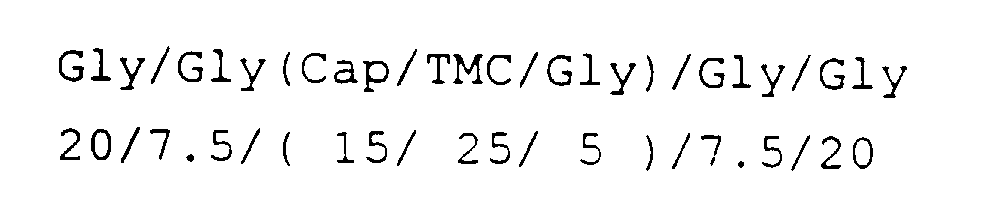
- Into a reactor provided with stirrer and jacket with heating medium is charged 258.48 grams (2.226 moles) of glycolide, 1,135.71 grams (11.13 moles) of trimethylene carbonate, 762.53 grams (6.68 moles) of epsilon caprolactone, 3.13 mls. (0.0329 moles) of diethylene glycol and 2.08 mls of a 0.33 molar solution of stannous octoate in toluene. The reactor is put under vacuum and the vacuum is broken with nitrogen; the vacuum and nitrogen vacuum breaking step is repeated once more. The heating medium temperature is then raised to 195°C and it its kept for two hours, 775.44 grams (6.68 moles) of molten glycolide are added and the reaction is continued for 35 minutes. Then 2,067.84 grams (17.815 moles) of molten glycolide are added and the heating medium temperature is increased to 204°C. The reaction is exothermic and the batch temperature surpasses the heating medium temperature. This event is designated as the exotherm crossover. The reaction is terminated 55 minutes after the exotherm crossover. The copolymer is discharged, and upon cooling it is ground and dried. The drying is done under vacuum for 18 hours at room temperature and then for 24 hours at 110°C. The mole percent composition of the polymer by H NMR analysis was:
PGA Glycolide PTMC TMC PCL Cap 61.5 <0.1 23.9 <0.1 14.5 <0.1 - The molecular weight Mw of the polymer was 59,000. The melting point by DSC was 213°C. The heat of fusion was 28 J/g; hot stage microscopy revealed that the majority of the sample crystallized at 170-174°C.
- This Example describes the preparation of a copolymer which contains no glycolide in the prepolymer.
- Copolymer synthesis:
Sample 2 was made using the following monomer charges (in mole percent) in a sequential polymerization: - 1st stage (15/25) (Cap/TMC)
- 2nd stage 15 glycolide
- 3rd stage 45 glycolide
-
- Overall composition:
- Cap/TMC/Gly
15/25/60 - The polymer structure is believed to be substantially:(based on the mole percent of monomer charged into the reactor).
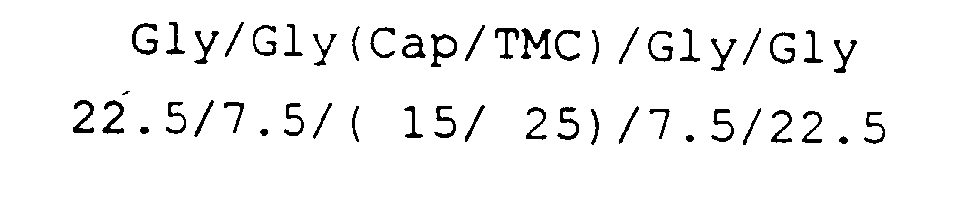
- Into a reactor provided with stirrer and jacket with heating medium is charged 1,135.71 grams (11.13 moles) of trimethylene carbonate, 762.53 grams (6.68 moles) of epsilon caprolactone, 3.13 mls. (0.0329 moles) of diethylene glycol and 2.08 mls of a 0.33 molar solution of stannous octoate in toluene. The reactor is put under vacuum and the vacuum is broken with nitrogen; the vacuum and nitrogen vacuum breaking step is repeated once more. The heating medium temperature is raised to 195°C and it is kept for two hours, 775.44 grams (6.68 moles) of molten glycolide are added and reaction is continued for 35 minutes. Then 2,326.32 grams of molten glycolide are added and the heating medium temperature is increased to 204°C. The reaction is exothermic and the batch temperature surpasses the heating medium temperature. This event is designated as the exotherm crossover. The reaction is terminated 55 minutes after the exotherm crossover. The copolymer is discharged, and upon cooling it is ground and dried. The drying is done under vacuum for 18 hours at room temperature and then for 24 hours at 110°C. The mole percent composition of the polymer by H NMR analysis was:
PGA Glycolide PTMC TMC PCL Cap 61.7 0.8 23.6 0.0 13.9 <0.1 - The molecular weight Mw of the polymer was 64,000.
- The copolymers from Examples 1 and 2 were extruded into monofilament under the following conditions to compare copolymer properties.
- Effect of center segment glycolide content

- The copolymers were extruded into a monofilament suture generally as follows :
Extrusion Sample No. 1 2A 2B/C Ram Speed, cm/min 2 2 2 Shear Rate, (1/sec) 212.6 212.6 212.6 Packing Temp., °C 150 160 160 Run Temperature 220 230 230 App Visc., Poise 3,653 3,975 3,008 Residence Time, sec. 660 700 700 Bath conditions ice water ice water ice water Take Up (ft/min) 24 24 24 - The copolymers were then drawn under the conditions described below.
Orientation Sample No. 1 2A 2B 2C Draw Input speed, ft/min 4 4 4 4 1st Draw Ratio/temp.°C. 5/56 5/55 5/55 5 Output speed, ft/min 20 20 20 20 2nd Draw Ratio/temp.°C 1.3/75 1.5/75 1.2/75 1.1/75 Overall Draw Ratio 6.5 7.5 6 5.5 - The characteristic properties of the sutures of the invention are readily determined by conventional test procedures. The tensile properties (i.e., straight and knot tensile strengths and elongation) displayed herein were determined with an INSTRON tensile tester. The settings used to determine the straight tensile, knot tensile and break elongation were the following:
GAUGE LENGTH (cm) CHART SPEED (cm/min) CROSSHEAD SPEED (cm/min) STRAIGHT TENSILE 12.7 30.5 30.5 KNOT TENSILE 12.7 30.5 30.5 BREAK ELONGATION 12.7 30.5 30.5 - The straight tensile strength is calculated by dividing the force to break by the initial cross-sectional area of the suture. The elongation at break is read directly from the stress-strain curve of the sample.
- The knot tensile strength of a suture is determined in separate tests. The surgeon's knot is a square knot in which the free end is first passed twice, instead of once, though the loop, and the ends drawn taut so that a single knot is superimposed upon a compound knot. The first knot is started with the left end over the right end and sufficient tension is exerted to tie the knot securely.
- The specimen is placed in the INSTRON tensile tester with the knot approximately midway between the clamps. The knot tensile strength is calculated by dividing the force required to break by the initial cross-sectional area of the fiber. The tensile strength values are reported as KPSI (1KPSI = 1,000PSI).
- The results of testing Samples 1 and 2 that were produced by the process described above are provided below. As can be seen from the data although Sample 1 and Sample 2 may have similar tensile and knot strengths, the Young's Modulus values for the Samples are very different.
Sample No. 1 2A 2B 2C Av. Diameter, mils 7.6 6.4 7.7 7.9 Straight tens, lbs 4.66 3.2 3.18 3.31 Knot tens. lbs 2.74 2.2 3.12 2.99 Str. tensile, kpsi 102.72 99.5 67.98 67.17 Knot tensile, kpsi 60.39 63.9 66.69 60.77 Percent elongation 58 11.8 41 55.5 Modulus, Kpsi 144 1,712 1,027 942 - The higher draw ratios for Sample 2A produced a more oriented fiber with a higher Young's modulus and a lower percent elongation (relative to the other Sample 2 fibers). The lower draw ratios used in Sample 2C produced a less oriented fiber with a lower Young's Modulus and lower tensile strength and higher percent elongation (again relative to the other Sample 2 fibers). Sample 1 however, provides a significantly reduced Young's Modulus when compared to all the Sample 2 fibers produced using the different drawing conditions.
- This Example describes the preparation of a copolymer which contains no ε-caprolactone in the prepolymer.
- Sample 3 was made using the following monomer charges (in mole percent) in a sequential polymerization:
- 1st stage (39.23/5.77) (TMC/Gly)
- 2nd stage 55 glycolide
-
- Overall composition:
- (TMC/Gly)Gly
(39.23/5.77)55 - The polymer structure is believed to be substantially:(based on the mole percent of monomer charged into the reactor).

- Into a reactor provided with stirrer and jacket with heating medium is charged 1,809.83 grams (17.743 moles) of trimethylene carbonate, 302.86 grams (2.609 moles) of glycolide, 3.18 mls. of diethylene glycol and 2.11 mls of a 0.33 molar solution of stannous octoate in toluene. The reactor is put under vacuum and the vacuum is broken with nitrogen; the vacuum and nitrogen vacuum breaking step is repeated once more. The heating medium temperature is raised to 185°C and it is kept for three hours, 2,887.31 grams (24.875 moles) of molten glycolide are added and the heating medium temperature is increased to 202°C. The reaction is exothermic and the batch temperature surpasses the heating medium temperature. This event is designated as the exotherm crossover. The reaction is terminated 55 minutes after the exotherm crossover. The copolymer is discharged, and upon cooling it is ground and dried. The drying is done under vacuum for 18 hours at room temperature and then for 24 hours at 110°C. The mole percent composition of the polymer by NMR analysis was:
61.6% PGA and 38.4% PTMC - This Example describes the preparation of a copolymer which contains no trimethylene carbonate in the prepolymer.
- Sample 4 was made using the following monomer charges (in mole percent) in a sequential polymerization:
- 1st stage (39.23/5.77) (Cap/Gly)
- 2nd stage 55 glycolide
-
- Overall composition:
- (Cap/Gly)Gly
(39.28/5.72)55 - The polymer structure is believed to be substantially:(based on the mole percent of monomer charged into the reactor).

- Into a reactor provided with stirrer and jacket with heating medium is charged 1,943.85 grams (17.03 moles) of epsilon caprolactone, 288.05 grams (2.4816 moles) of glycolide, 3.05 mls. of diethylene glycol and 2.02 mls of a 0.33 molar solution of stannous octoate in toluene. The reactor is put under vacuum and the vacuum is broken with nitrogen; the vacuum and nitrogen vacuum breaking step is repeated once more. The heating medium temperature is raised to 185°C and it is kept for three hours, 2,768.1 grams (23.848 moles) of molten glycolide are added and the heating medium temperature is increased to 202°C. The reaction is exothermic and the batch temperature surpasses the heating medium temperature. This event is designated as the exotherm crossover. The reaction is terminated 55 minutes after the exotherm crossover. The copolymer is discharged, and upon cooling it is ground and dried. The drying is done under vacuum for 18 hours at room temperature and then for 24 hours at 110°C. The mole percent composition of the polymer by NMR was:
PGA 60.5%, PCL 39.5% - The copolymers from Examples 4 and 5 were extruded into monofilament under the following conditions to compare copolymer properties. The testing of the copolymers from Example 4 and 5 were performed as described in Example 3.
- Extrusion and orientation details for the two polymers are given below:
Sample No. 3 4 Composition (TMC/Gly)Gly (Cap/Gly)Gly m% (39.23/5.11/77)55 (39.2735/5.7235)55 Extrusion Sample No. 3 4 Ram Speed, cm/min 2 2 Shear Rate, (1/sec) 212.6 212.6 Packing Temp., °C 150 150 Run Temperature 200 225 App Visc., Poise 6178 Residence Time, sec. 550 750 Bath conditions ice water ice water Take Up (ft/min) 24 24 Orientation Sample No. 3A 3B 3C Draw Input speed, ft/min 4 4 4 1st Draw Ratio/temp.C. 5/55 5/55 5/55 Output speed, ft/min 20 20 20 2nd Draw Ratio/temp.°C 1.2/75 1.5/75 1.4/75 Overall Draw Ratio 6.5 7.5 7 Fiber Properties Sample No. 3A 3B 3C Av. Diameter, mils 6.98 7.14 7.38 Straight tens, lbs 0.765 0.719 0.944 Knot tens, lbs 0.473 0.392 0.544 Str. tensile, kpsi 20.028 17.97 22.1 Knot tensile, kpsi 12.37 9.8 12.72 % elongation 14.74 14.42 17.64 - The above examples clearly show the advantage of the copolymers prepared with center block composition consisting of the terpolymer of Caprolactone/TMC and Glycolide with tail ends of PGA. The fibers produced unexpectedly superior properties than those obtained with the copolymers with center block of caprolactone/TMC or those with center block of TMC/glycolide or center block of Caprolactone/glycolide.
- The following example provides additional Samples of the inventive polymer made as described in Example 1 with the following compositions:
-
- Composition:
- Gly/Gly/(Cap/TMC/Gly)/Gly/Gly
20/6/(26/10/12)/6/20 - 1st stage (26/10/12) (Cap/TMC/Gly)
- 2nd stage 12 glycolide
- 3rd stage 40 glycolide
-
- Composition:
- Gly/Gly/(Cap/TMC/Gly)/Gly/Gly
20/6/(16/20/12)/6/20 - 1st stage (16/20/12) (Cap/TMC/Gly)
- 2nd stage 12 glycolide
- 3rd stage 40 glycolide
-
- Composition:
- Gly/Gly/(Cap/TMC/Gly)/Gly/Gly
20/7.5/(20/10/15)/7.5/20 - 1st stage (20/10/15) (Cap/TMC/Gly)
- 2nd stage 15 glycolide
- 3rd stage 40 glycolide
- Reaction conditions for the three polymers are summarized in Table I:
Sample No. 5 6 7 Composition (Cap/TMC/Gly) Gly/Gly (Cap/TMC/Gly) Gly/Gly (Cap/TMC/Gly) Gly/Gly Composition mole percent (26/10/12) 12/40 (16/20/12) 12/40 (20/10/15) 15/40 Overall Composition Cap/TMC/Gly 26/10/64 Cap/TMC/Gly 16/20/64 Cap/TMC/Gly 20/10/70 Cap grams 1,169.77 845.6 978.81 TMC grams 402.06 944.61 437.35 1st Gly, g. 549.03 644.96 746.54 2nd Gly, g. 549.03 644.96 746.54 3rd Gly, g. 1830.11 2149.85 1990.76 DEG, mls 2.77 3.26 3.01 cat. mls 1.84 2.16 2.0 1st stage hrs/Deg.C. 3/180 3/180 2.5/180 2nd stage min/deg.C. 20/180 20/180 20/180 3rd stage Exo+min./C. 50/205 50/202 35/203 - The overall mole percent composition of the dried copolymers as determined by H NMR are given in Table II:
Sample No PGA GL PCL CAP PTMC TMC Sample 5 64.4 0.0 26 .1 9.6 0.0 Sample 6 63.8 0.6 16 <0.1. 19.4 0.2 Sample 7 69.4 0.6 19.7 <0.1 10.1 0.1 Sample No. Mw Mn Tm, °C. H, J/g. IV,dl/g Sample 5 86, 000 24,000 208 37 1.56 Sample 6 89,000 26, 000 191 33 1.5 Sample 7 89, 000 24, 000 1.82 - The polymers were extruded into size 4-0 sutures using a two step extrusion/orientation process as described in Table IX. They exhibit outstanding properties.
- The in vitro strength retention of unannealed and annealed size 4-0 sutures with annealing conditions designated with notation (percent relaxation/degrees C./hours) are given in Table X the bath was at 40.9°C and pH buffer of 7.0.
Extrusion Sanple No. 5 6 7 Ram Speed, cm/min 2 2 2 Shear Rate, (1/sec) 212.6 212.6 212.6 Packing Temp., °C 170 160 170 Run Temperature 230 220 235 App Visc., Poise 4,942 5,479 5,533 Residence Time, sec. 600 615 630 Bath conditions ice water ice water ice water Take Up (ft/min) 24 24 24 The copolymers were then drawn under the conditions described below. Orientation Sample No. 5 6 7 Draw Input Speed, ft/min 4 4 4 1st Draw Ratio/temp. °C 5/45 5/45 5/45 Output Speed, ft/min 20 20 20 2nd Draw Ratio/temp °C 1.3/65 1.3/65 1.3/65 Overall Draw Ratio 6.5 6.5 6.5 Fiber Properties Diameter mils 7.6 7.8 7.9 Straight Break Strength, lbs. 4.8 5.1 5.2 Knot Break Strength, lbs 3.9 3.5 4.1 Straight Tensile, Kpsi 99.7 107.8 106.0 Knot Tensile, Kpsi 85.3 74.1 83.1 w/o Elongation 45.0 49.8 48.2 Modulus, Kpsi 84.7 33.7 74.4 fibers from copolymers 0 day straight tensile. lbs 12 day straight tens. lbs BSR% Sample 5 unannealed 3.939 2.18 55 annealed (5/90/6) 4.53 Sample 6 unannealed 4.68 3.36 71.8 Sample 7 unannealed 4.93 3.01 61 annealed (0/90/6) 5.46 3.3 60
Claims (10)
- An absorbable, biocompatible segmented copolymer comprising:a prepolymer containing repeating units obtained from trimethylene carbonate, glycolide and ε-caprolactone monomers, wherein the mole percent of trimethylene carbonate is in the range of from about 2 to about 40; the mole percent of glycolide is in the range of from about 2 to about 55 mole percent and the mole percent of ε-caprolactone is in the range of from about 2 to about 40 mole percent;copolymerized with in the range of from about 10 mole percent to about 80 mole percent of repeating units of glycolide; wherein the mole percentages are based on the total moles of monomer in the segmented copolymer.
- The segmented copolymer of claim 1 wherein the copolymer has an inherent viscosity is from about 1.0 dL/g to about 3.0 dL/g as measured in HFIP at a concentration of 0.1 g/dL.
- The segmented copolymer of claim 1 wherein the segmented copolymer contains about 40 mole percent to about 80 mole percent of glycolide.
- The segmented copolymer of claim 1 wherein the prepolymer contains in the range of from about 10 to about 30 mole percent, trimethylene carbonate repeating units.
- The segmented copolymer of claim 1 wherein the prepolymer contains in the range of from about 5 to about 15 mole percent glycolide repeating units.
- The segmented copolymer of claim 5 wherein the repeating units of ε-caprolactone in the prepolymer comprise in the range of from about 10 mole percent to about 30 mole percent of the segmented copolymer.
- An absorbable medical device formed from an absorbable, biocompatible segmented copolymer comprising:a prepolymer containing repeating units obtained from trimethylene carbonate, glycolide and ε-caprolactone monomers, wherein the mole percent of trimethylene carbonate is in the range of from about 2 to about 40; the mole percent of glycolide is in the range of from about 2 to about 55 mole percent and the mole percent of ε-caprolactone is in the range of from about 2 to about 40 mole percent;copolymerized with in the range of from about 10 mole percent to about 80 mole percent of repeatinq units of glycolide; wherein the mole percentages are based on the total moles.
- The absorbable medical device of claim 7 wherein the medical device is selected from the group consisting of burn dressings, hernia patches, medicated dressings, fascial substitutes, gauze, fabric, sheet, felt, sponge for liver hemostasis, gauze bandages, arterial graft or substitutes, bandages for skin surfaces, burn dressings, bone substitutes, needles, intrauterine devices, tubes, surgical instruments, vascular implants, vascular supports, vertebraL discs, extracorporeal tubing, artificial skin, stents, suture anchors, injectable defect fillers, preformed defect fillers, tissue adhesives, tissue sealants, bone waxes, cartilage replacements, hemostatic barriers, tissue scaffolds, monofilament sutures and braided sutures.
- A medical device coated with a segmented copolymer comprising:a prepolymer containing repeating units of trimethylene carbonate, glycolide and E-caprolactone, wherein the mole percent of trimethylene carbonate is in the range of from about 2 to about 40; the mole percent of glycolide is in the range of from about 2 to about 55 mole percent and the mole percent of ε-caprolactone is in the range of from about 2 to about 40 mole percent;copolymerized with in the range of from about 10 mole percent to about 80 mole percent of glycolide; wherein the mole percentages are based on the total moles of monomer in the segmented copolymer.
- A drug delivery matrix comprising a drug and a segmented polymer formed from:a prepolymer containing repeating units of trimethylene carbonate, glycolide and E-caprolactone, wherein the mole percent of trimethylene carbonate is in the range of from about 2 to about 40; the mole percent of glycolide is in the range of from about 2 to about 55 mole percent and the mole percent of ε-caprolactone is in the range of from about 2 to about 40 mole percent;copolymerized with in the range of from about 10 mole percent to about 80 mole percent of glycolide; wherein the mole percentages are based on the total moles of monomer in the segmented copolymer.
Applications Claiming Priority (2)
| Application Number | Priority Date | Filing Date | Title |
|---|---|---|---|
| US944792 | 1997-10-06 | ||
| US08/944,792 US5854383A (en) | 1997-10-06 | 1997-10-06 | Aliphatic polyesters of trimethylene carbonate epsilon-caprolactone and glycolide |
Publications (1)
| Publication Number | Publication Date |
|---|---|
| EP0908482A1 true EP0908482A1 (en) | 1999-04-14 |
Family
ID=25482086
Family Applications (1)
| Application Number | Title | Priority Date | Filing Date |
|---|---|---|---|
| EP98308074A Withdrawn EP0908482A1 (en) | 1997-10-06 | 1998-10-05 | Aliphatic polyesters of trimethylene carbonate Epsilon-caprolactone and glycolide |
Country Status (2)
| Country | Link |
|---|---|
| US (1) | US5854383A (en) |
| EP (1) | EP0908482A1 (en) |
Cited By (20)
| Publication number | Priority date | Publication date | Assignee | Title |
|---|---|---|---|---|
| US6048947A (en) * | 1996-08-10 | 2000-04-11 | Deutsche Institute Fuer Textil- Und Faserforschung Stuttgart Stiftung Des Oeffentlichen Rechts | Triblock terpolymer, its use for surgical suture material and process for its production |
| DE10041684A1 (en) * | 2000-08-24 | 2002-03-07 | Inst Textil & Faserforschung | Coating material for medical treatment from resorbable synthetic material, process for its production and use in medicine |
| DE10062881A1 (en) * | 2000-12-16 | 2002-07-11 | Inst Textil & Faserforschung | Suture material for surgery, process for its manufacture and use |
| EP1374921A1 (en) * | 2002-06-28 | 2004-01-02 | Ethicon, Inc. | Crystallizable polylactone copolymers prepared from mono- and di-functional polymerization initiators |
| WO2007025729A3 (en) * | 2005-09-01 | 2008-02-14 | Polymedics Innovations Gmbh | Moulded body for medically treating wounds |
| DE102006053752A1 (en) * | 2006-11-13 | 2008-05-15 | Aesculap Ag & Co. Kg | Textile vascular prosthesis with coating |
| US8317808B2 (en) | 2008-02-18 | 2012-11-27 | Covidien Lp | Device and method for rolling and inserting a prosthetic patch into a body cavity |
| US8753359B2 (en) | 2008-02-18 | 2014-06-17 | Covidien Lp | Device and method for deploying and attaching an implant to a biological tissue |
| US8808314B2 (en) | 2008-02-18 | 2014-08-19 | Covidien Lp | Device and method for deploying and attaching an implant to a biological tissue |
| US8888811B2 (en) | 2008-10-20 | 2014-11-18 | Covidien Lp | Device and method for attaching an implant to biological tissue |
| US8906045B2 (en) | 2009-08-17 | 2014-12-09 | Covidien Lp | Articulating patch deployment device and method of use |
| US9005241B2 (en) | 2008-02-18 | 2015-04-14 | Covidien Lp | Means and method for reversibly connecting a patch to a patch deployment device |
| US9034002B2 (en) | 2008-02-18 | 2015-05-19 | Covidien Lp | Lock bar spring and clip for implant deployment device |
| US9044235B2 (en) | 2008-02-18 | 2015-06-02 | Covidien Lp | Magnetic clip for implant deployment device |
| US9301826B2 (en) | 2008-02-18 | 2016-04-05 | Covidien Lp | Lock bar spring and clip for implant deployment device |
| US9393093B2 (en) | 2008-02-18 | 2016-07-19 | Covidien Lp | Clip for implant deployment device |
| US9393002B2 (en) | 2008-02-18 | 2016-07-19 | Covidien Lp | Clip for implant deployment device |
| US9398944B2 (en) | 2008-02-18 | 2016-07-26 | Covidien Lp | Lock bar spring and clip for implant deployment device |
| US9833240B2 (en) | 2008-02-18 | 2017-12-05 | Covidien Lp | Lock bar spring and clip for implant deployment device |
| US9999424B2 (en) | 2009-08-17 | 2018-06-19 | Covidien Lp | Means and method for reversibly connecting an implant to a deployment device |
Families Citing this family (28)
| Publication number | Priority date | Publication date | Assignee | Title |
|---|---|---|---|---|
| DE19641334A1 (en) * | 1996-10-08 | 1998-04-09 | Inst Textil & Faserforschung | Triblock terpolymer, its use in medical products and manufacturing processes |
| US6165202A (en) * | 1998-07-06 | 2000-12-26 | United States Surgical Corporation | Absorbable polymers and surgical articles fabricated therefrom |
| US6235869B1 (en) | 1998-10-20 | 2001-05-22 | United States Surgical Corporation | Absorbable polymers and surgical articles fabricated therefrom |
| US6342065B1 (en) * | 1999-03-17 | 2002-01-29 | Poly-Med, Inc. | High strength fibers of L-lactide copolymers ε-caprolactone and trimethylene carbonate and absorbable medical constructs thereof |
| US6462169B1 (en) * | 1999-11-30 | 2002-10-08 | Poly-Med, Inc. | Amorphous polymeric polyaxial initiators and compliant crystalline copolymers therefrom |
| EP1582547B1 (en) * | 1999-11-30 | 2007-07-25 | Poly-Med, Inc. | Vascular graft |
| US20060222756A1 (en) * | 2000-09-29 | 2006-10-05 | Cordis Corporation | Medical devices, drug coatings and methods of maintaining the drug coatings thereon |
| US20020161168A1 (en) * | 2000-10-27 | 2002-10-31 | Shalaby Shalaby W. | Amorphous polymeric polyaxial initiators and compliant crystalline copolymers therefrom |
| WO2002092054A2 (en) * | 2001-05-11 | 2002-11-21 | Ortho-Mcneil Pharmaceutical, Inc. | Immune modulation device for use in animals |
| US6498229B1 (en) * | 2001-09-05 | 2002-12-24 | Poly-Med, Inc. | Direct synthesis of segmented glycolide copolymers and crystalline materials therefrom |
| US7713272B2 (en) | 2001-12-20 | 2010-05-11 | Ethicon, Inc. | Bioabsorbable coatings of surgical devices |
| US20030236319A1 (en) * | 2002-06-25 | 2003-12-25 | Hye-Sung Yoon | Block copolymers for surgical articles |
| US7148315B2 (en) * | 2002-10-23 | 2006-12-12 | Ethicon, Inc. | Monomer addition techniques to control manufacturing of bioabsorbable copolymers |
| JP4977600B2 (en) | 2004-04-20 | 2012-07-18 | ジェンザイム・コーポレーション | Surgical mesh implant |
| US7862552B2 (en) | 2005-05-09 | 2011-01-04 | Boston Scientific Scimed, Inc. | Medical devices for treating urological and uterine conditions |
| US20070036842A1 (en) * | 2005-08-15 | 2007-02-15 | Concordia Manufacturing Llc | Non-woven scaffold for tissue engineering |
| US7897168B2 (en) * | 2007-04-13 | 2011-03-01 | Medtronic Vascular, Inc. | Degradable polymers incorporating gamma-butyrolactone |
| US8551511B2 (en) * | 2008-10-11 | 2013-10-08 | Rutgers, The State University Of New Jersey | Phase-separated biocompatible polymer compositions for medical uses |
| WO2011014860A1 (en) | 2009-07-31 | 2011-02-03 | Rutgers, The State University Of New Jersey | Monomers and phase-separated biocompatible polymer compositions prepared therefrom for medical uses |
| WO2011044567A1 (en) | 2009-10-11 | 2011-04-14 | Rutgers, The State University Of New Jersey | Biocompatible polymers for medial devices |
| US9416090B2 (en) | 2012-02-03 | 2016-08-16 | Rutgers, The State University Of New Jersey | Polymeric biomaterials derived from phenolic monomers and their medical uses |
| US11472918B2 (en) | 2012-02-03 | 2022-10-18 | Rutgers, The State University Of New Jersey | Polymeric biomaterials derived from phenolic monomers and their medical uses |
| US10774030B2 (en) | 2014-12-23 | 2020-09-15 | Rutgers, The State University Of New Jersey | Polymeric biomaterials derived from phenolic monomers and their medical uses |
| EP3237487B1 (en) | 2014-12-23 | 2021-02-17 | Rutgers, the State University of New Jersey | Biocompatible iodinated diphenol monomers and polymers |
| US9896560B2 (en) | 2015-06-02 | 2018-02-20 | Ethicon, Inc. | Lyophilized foams of end block containing absorbable polymers |
| WO2017049308A1 (en) * | 2015-09-17 | 2017-03-23 | The Arizona Board Of Regents On Behalf Of The University Of Arizona | Biostable segmented elastomers and thermoplastics and methods of making and using thereof |
| WO2020181236A1 (en) * | 2019-03-06 | 2020-09-10 | Poly-Med, Inc. | Polymer suitable for additive manufacturing |
| CN115232297B (en) * | 2022-06-30 | 2023-06-27 | 中国神华煤制油化工有限公司 | Polyglycolic acid/aliphatic polycarbonate triblock copolymer and preparation method thereof |
Citations (3)
| Publication number | Priority date | Publication date | Assignee | Title |
|---|---|---|---|---|
| WO1994011441A1 (en) * | 1992-11-06 | 1994-05-26 | Rijksuniversiteit Te Groningen | Rubber-modified polylactide and/or glycolide composition |
| EP0835895A2 (en) * | 1996-10-08 | 1998-04-15 | DEUTSCHE INSTITUTE FÜR TEXTIL- UND FASERFORSCHUNG STUTTGART Stiftung des öffentlichen Rechts | Triblock terpolymer, its use for surgical suture material and process for its preparation |
| EP0835894A2 (en) * | 1996-10-08 | 1998-04-15 | DEUTSCHE INSTITUTE FÜR TEXTIL- UND FASERFORSCHUNG STUTTGART Stiftung des öffentlichen Rechts | Triblock terpolymer, its use for medical products and process for its preparation |
Family Cites Families (5)
| Publication number | Priority date | Publication date | Assignee | Title |
|---|---|---|---|---|
| US4300565A (en) * | 1977-05-23 | 1981-11-17 | American Cyanamid Company | Synthetic polyester surgical articles |
| US5252701A (en) * | 1990-07-06 | 1993-10-12 | American Cyanamid Company | Segmented absorbable copolymer |
| US5502159A (en) * | 1991-04-17 | 1996-03-26 | United States Surgical Corporation | Absorbable composition |
| US5403347A (en) * | 1993-05-27 | 1995-04-04 | United States Surgical Corporation | Absorbable block copolymers and surgical articles fabricated therefrom |
| US5431679A (en) * | 1994-03-10 | 1995-07-11 | United States Surgical Corporation | Absorbable block copolymers and surgical articles fabricated therefrom |
-
1997
- 1997-10-06 US US08/944,792 patent/US5854383A/en not_active Expired - Lifetime
-
1998
- 1998-10-05 EP EP98308074A patent/EP0908482A1/en not_active Withdrawn
Patent Citations (3)
| Publication number | Priority date | Publication date | Assignee | Title |
|---|---|---|---|---|
| WO1994011441A1 (en) * | 1992-11-06 | 1994-05-26 | Rijksuniversiteit Te Groningen | Rubber-modified polylactide and/or glycolide composition |
| EP0835895A2 (en) * | 1996-10-08 | 1998-04-15 | DEUTSCHE INSTITUTE FÜR TEXTIL- UND FASERFORSCHUNG STUTTGART Stiftung des öffentlichen Rechts | Triblock terpolymer, its use for surgical suture material and process for its preparation |
| EP0835894A2 (en) * | 1996-10-08 | 1998-04-15 | DEUTSCHE INSTITUTE FÜR TEXTIL- UND FASERFORSCHUNG STUTTGART Stiftung des öffentlichen Rechts | Triblock terpolymer, its use for medical products and process for its preparation |
Cited By (29)
| Publication number | Priority date | Publication date | Assignee | Title |
|---|---|---|---|---|
| US6048947A (en) * | 1996-08-10 | 2000-04-11 | Deutsche Institute Fuer Textil- Und Faserforschung Stuttgart Stiftung Des Oeffentlichen Rechts | Triblock terpolymer, its use for surgical suture material and process for its production |
| DE10041684A1 (en) * | 2000-08-24 | 2002-03-07 | Inst Textil & Faserforschung | Coating material for medical treatment from resorbable synthetic material, process for its production and use in medicine |
| EP1181941A3 (en) * | 2000-08-24 | 2003-01-15 | DEUTSCHE INSTITUTE FÜR TEXTIL- UND FASERFORSCHUNG STUTTGART Stiftung des öffentlichen Rechts | Absorbable medical coating material and method for its manufacture |
| US6706058B2 (en) | 2000-08-24 | 2004-03-16 | Deutsche Institute Fur Textil- Und Faserforschung Stuttgart Stiftung Des Offentlichen Rechts | Resorbable, synthetic, medical coating material, method for its manufacture and its use in medicine |
| DE10062881A1 (en) * | 2000-12-16 | 2002-07-11 | Inst Textil & Faserforschung | Suture material for surgery, process for its manufacture and use |
| US7141302B2 (en) | 2000-12-16 | 2006-11-28 | Deutsche Institute Fur Textil-Und Faserforschung Stuttgart Stiftung . . . | Suture material for surgery, processes for its production and the use thereof |
| EP1374921A1 (en) * | 2002-06-28 | 2004-01-02 | Ethicon, Inc. | Crystallizable polylactone copolymers prepared from mono- and di-functional polymerization initiators |
| WO2007025729A3 (en) * | 2005-09-01 | 2008-02-14 | Polymedics Innovations Gmbh | Moulded body for medically treating wounds |
| DE102006053752A1 (en) * | 2006-11-13 | 2008-05-15 | Aesculap Ag & Co. Kg | Textile vascular prosthesis with coating |
| US8075612B2 (en) | 2006-11-13 | 2011-12-13 | Aesculap Ag | Textile vascular prosthesis with a coating |
| US9393093B2 (en) | 2008-02-18 | 2016-07-19 | Covidien Lp | Clip for implant deployment device |
| US9398944B2 (en) | 2008-02-18 | 2016-07-26 | Covidien Lp | Lock bar spring and clip for implant deployment device |
| US8753359B2 (en) | 2008-02-18 | 2014-06-17 | Covidien Lp | Device and method for deploying and attaching an implant to a biological tissue |
| US8808314B2 (en) | 2008-02-18 | 2014-08-19 | Covidien Lp | Device and method for deploying and attaching an implant to a biological tissue |
| US10695155B2 (en) | 2008-02-18 | 2020-06-30 | Covidien Lp | Device and method for deploying and attaching an implant to a biological tissue |
| US10182898B2 (en) | 2008-02-18 | 2019-01-22 | Covidien Lp | Clip for implant deployment device |
| US9005241B2 (en) | 2008-02-18 | 2015-04-14 | Covidien Lp | Means and method for reversibly connecting a patch to a patch deployment device |
| US9034002B2 (en) | 2008-02-18 | 2015-05-19 | Covidien Lp | Lock bar spring and clip for implant deployment device |
| US9044235B2 (en) | 2008-02-18 | 2015-06-02 | Covidien Lp | Magnetic clip for implant deployment device |
| US9107726B2 (en) | 2008-02-18 | 2015-08-18 | Covidien Lp | Device and method for deploying and attaching an implant to a biological tissue |
| US9301826B2 (en) | 2008-02-18 | 2016-04-05 | Covidien Lp | Lock bar spring and clip for implant deployment device |
| US8317808B2 (en) | 2008-02-18 | 2012-11-27 | Covidien Lp | Device and method for rolling and inserting a prosthetic patch into a body cavity |
| US9393002B2 (en) | 2008-02-18 | 2016-07-19 | Covidien Lp | Clip for implant deployment device |
| US10159554B2 (en) | 2008-02-18 | 2018-12-25 | Covidien Lp | Clip for implant deployment device |
| US9833240B2 (en) | 2008-02-18 | 2017-12-05 | Covidien Lp | Lock bar spring and clip for implant deployment device |
| US8888811B2 (en) | 2008-10-20 | 2014-11-18 | Covidien Lp | Device and method for attaching an implant to biological tissue |
| US8734473B2 (en) | 2009-02-18 | 2014-05-27 | Covidien Lp | Device and method for rolling and inserting a prosthetic patch into a body cavity |
| US9999424B2 (en) | 2009-08-17 | 2018-06-19 | Covidien Lp | Means and method for reversibly connecting an implant to a deployment device |
| US8906045B2 (en) | 2009-08-17 | 2014-12-09 | Covidien Lp | Articulating patch deployment device and method of use |
Also Published As
| Publication number | Publication date |
|---|---|
| US5854383A (en) | 1998-12-29 |
Similar Documents
| Publication | Publication Date | Title |
|---|---|---|
| US5854383A (en) | Aliphatic polyesters of trimethylene carbonate epsilon-caprolactone and glycolide | |
| US5951997A (en) | Aliphatic polyesters of ε-caprolactone, p-dioxanone and gycolide | |
| AU708214B2 (en) | Absorbable copolymers and blends of 6,6-dialkyl-1,4- dioxepan-2-one and its cyclic dimer | |
| US5868788A (en) | High-strength, melt-processable, lactade-rich, poly(lactade-co-p-dioxanone) copolymers | |
| EP0707044B1 (en) | Absorbable polymer blends | |
| US5633343A (en) | High strength, fast absorbing, melt processable, gycolide-rich, poly(glycolide-co-p-dioxanone) copolymers | |
| US6113624A (en) | Absorbable elastomeric polymer | |
| EP0636639B1 (en) | Copolymers of an aromatic anhydride and aliphatic ester | |
| JP3251768B2 (en) | Absorbable block copolymers and surgical articles made therefrom | |
| US5486593A (en) | Medical devices fabricated from copolymers having recurring carbonate units | |
| US5859150A (en) | Prepolymers of absorbable polyoxaesters | |
| EP0295055A2 (en) | Biodegradable polymeric materials based on polyether glycols, processes for the preparation thereof and surgical articles made therefrom | |
| JP2007525601A (en) | Polyhydroxyalkanoate medical fabric and medical fiber | |
| JP2003517352A (en) | Method of preventing adhesion by absorbable polyoxaester | |
| US6332884B1 (en) | Two phase thermally deformable biocompatible absorbable polymer matrix for use in medical devices | |
| CN108472416A (en) | Segmented p-dioxanone-rich poly(p-dioxanone-co-ε-caprolactone) copolymers for medical applications and devices made therefrom | |
| MXPA97001991A (en) | Copolymer and absorbable mixes of 6,6-dialquil-1,4-dioxepan-2-ona and its dimero cicl | |
| MXPA97001689A (en) | Absorbib polioxaesters |
Legal Events
| Date | Code | Title | Description |
|---|---|---|---|
| PUAI | Public reference made under article 153(3) epc to a published international application that has entered the european phase |
Free format text: ORIGINAL CODE: 0009012 |
|
| AK | Designated contracting states |
Kind code of ref document: A1 Designated state(s): AT BE CH CY DE DK ES FI FR GB GR IE IT LI LU MC NL PT SE |
|
| AX | Request for extension of the european patent |
Free format text: AL;LT;LV;MK;RO;SI |
|
| AKX | Designation fees paid | ||
| STAA | Information on the status of an ep patent application or granted ep patent |
Free format text: STATUS: THE APPLICATION IS DEEMED TO BE WITHDRAWN |
|
| 18D | Application deemed to be withdrawn |
Effective date: 19991015 |
|
| REG | Reference to a national code |
Ref country code: DE Ref legal event code: 8566 |