EP0822200A1 - Synthesis of analogs of PTH and PTrP - Google Patents
Synthesis of analogs of PTH and PTrP Download PDFInfo
- Publication number
- EP0822200A1 EP0822200A1 EP97112595A EP97112595A EP0822200A1 EP 0822200 A1 EP0822200 A1 EP 0822200A1 EP 97112595 A EP97112595 A EP 97112595A EP 97112595 A EP97112595 A EP 97112595A EP 0822200 A1 EP0822200 A1 EP 0822200A1
- Authority
- EP
- European Patent Office
- Prior art keywords
- xaa
- leu
- arg
- ala
- glu
- Prior art date
- Legal status (The legal status is an assumption and is not a legal conclusion. Google has not performed a legal analysis and makes no representation as to the accuracy of the status listed.)
- Granted
Links
Classifications
-
- C—CHEMISTRY; METALLURGY
- C07—ORGANIC CHEMISTRY
- C07K—PEPTIDES
- C07K14/00—Peptides having more than 20 amino acids; Gastrins; Somatostatins; Melanotropins; Derivatives thereof
- C07K14/435—Peptides having more than 20 amino acids; Gastrins; Somatostatins; Melanotropins; Derivatives thereof from animals; from humans
- C07K14/575—Hormones
- C07K14/635—Parathyroid hormone, i.e. parathormone; Parathyroid hormone-related peptides
-
- A—HUMAN NECESSITIES
- A61—MEDICAL OR VETERINARY SCIENCE; HYGIENE
- A61P—SPECIFIC THERAPEUTIC ACTIVITY OF CHEMICAL COMPOUNDS OR MEDICINAL PREPARATIONS
- A61P43/00—Drugs for specific purposes, not provided for in groups A61P1/00-A61P41/00
-
- A—HUMAN NECESSITIES
- A61—MEDICAL OR VETERINARY SCIENCE; HYGIENE
- A61P—SPECIFIC THERAPEUTIC ACTIVITY OF CHEMICAL COMPOUNDS OR MEDICINAL PREPARATIONS
- A61P5/00—Drugs for disorders of the endocrine system
- A61P5/10—Drugs for disorders of the endocrine system of the posterior pituitary hormones, e.g. oxytocin, ADH
- A61P5/12—Drugs for disorders of the endocrine system of the posterior pituitary hormones, e.g. oxytocin, ADH for decreasing, blocking or antagonising the activity of the posterior pituitary hormones
-
- A—HUMAN NECESSITIES
- A61—MEDICAL OR VETERINARY SCIENCE; HYGIENE
- A61P—SPECIFIC THERAPEUTIC ACTIVITY OF CHEMICAL COMPOUNDS OR MEDICINAL PREPARATIONS
- A61P5/00—Drugs for disorders of the endocrine system
- A61P5/18—Drugs for disorders of the endocrine system of the parathyroid hormones
-
- C—CHEMISTRY; METALLURGY
- C07—ORGANIC CHEMISTRY
- C07K—PEPTIDES
- C07K1/00—General methods for the preparation of peptides, i.e. processes for the organic chemical preparation of peptides or proteins of any length
- C07K1/02—General methods for the preparation of peptides, i.e. processes for the organic chemical preparation of peptides or proteins of any length in solution
- C07K1/026—General methods for the preparation of peptides, i.e. processes for the organic chemical preparation of peptides or proteins of any length in solution by fragment condensation in solution
-
- C—CHEMISTRY; METALLURGY
- C07—ORGANIC CHEMISTRY
- C07K—PEPTIDES
- C07K1/00—General methods for the preparation of peptides, i.e. processes for the organic chemical preparation of peptides or proteins of any length
- C07K1/06—General methods for the preparation of peptides, i.e. processes for the organic chemical preparation of peptides or proteins of any length using protecting groups or activating agents
- C07K1/061—General methods for the preparation of peptides, i.e. processes for the organic chemical preparation of peptides or proteins of any length using protecting groups or activating agents using protecting groups
-
- C—CHEMISTRY; METALLURGY
- C07—ORGANIC CHEMISTRY
- C07K—PEPTIDES
- C07K7/00—Peptides having 5 to 20 amino acids in a fully defined sequence; Derivatives thereof
- C07K7/04—Linear peptides containing only normal peptide links
- C07K7/06—Linear peptides containing only normal peptide links having 5 to 11 amino acids
-
- C—CHEMISTRY; METALLURGY
- C07—ORGANIC CHEMISTRY
- C07K—PEPTIDES
- C07K7/00—Peptides having 5 to 20 amino acids in a fully defined sequence; Derivatives thereof
- C07K7/04—Linear peptides containing only normal peptide links
- C07K7/08—Linear peptides containing only normal peptide links having 12 to 20 amino acids
-
- A—HUMAN NECESSITIES
- A61—MEDICAL OR VETERINARY SCIENCE; HYGIENE
- A61K—PREPARATIONS FOR MEDICAL, DENTAL OR TOILETRY PURPOSES
- A61K38/00—Medicinal preparations containing peptides
-
- Y—GENERAL TAGGING OF NEW TECHNOLOGICAL DEVELOPMENTS; GENERAL TAGGING OF CROSS-SECTIONAL TECHNOLOGIES SPANNING OVER SEVERAL SECTIONS OF THE IPC; TECHNICAL SUBJECTS COVERED BY FORMER USPC CROSS-REFERENCE ART COLLECTIONS [XRACs] AND DIGESTS
- Y02—TECHNOLOGIES OR APPLICATIONS FOR MITIGATION OR ADAPTATION AGAINST CLIMATE CHANGE
- Y02P—CLIMATE CHANGE MITIGATION TECHNOLOGIES IN THE PRODUCTION OR PROCESSING OF GOODS
- Y02P20/00—Technologies relating to chemical industry
- Y02P20/50—Improvements relating to the production of bulk chemicals
- Y02P20/55—Design of synthesis routes, e.g. reducing the use of auxiliary or protecting groups
Definitions
- This invention relates to a method for the synthesis of certain novel analogs of parathyroid hormone and parathyroid hormone related peptide useful for the treatment of osteoporosis.
- Osteoporosis is the most common form of metabolic bone disease and may be considered the symptomatic, fracture stage of bone loss (osteopenia). Although osteoporosis may occur secondary to a number of underlying diseases, 90% of all cases appear to be idiopathic. Postmenopausal women are particularly at risk for idiopathic osteoporosis (postmenopausal or Type I osteoporosis). Another high risk group for idiopathic osteoporosis is the elderly of either sex (senile or Type II osteoporosis).
- Osteoporosis has also been related to corticosteroid use, immobilization or extended bed rest, alcoholism, diabetes, gonadotoxic chemotherapy, hyperprolactinemia, anorexia nervosa, primary and secondary amenorrhea, and oophorectomy.
- osteoporosis In the various forms of osteoporosis, bone fractures, which are the result of bone loss that has reached the point of mechanical failure, frequently occur. Postmenopausal osteoporosis is characterized by fractures of the wrist and spine, while femoral neck fractures seem to be the dominant feature of senile osteoporosis.
- osteoporotics The mechanism by which bone is lost in osteoporotics is believed to involve an imbalance in the process by which the skeleton renews itself. This process has been termed bone remodeling. It occurs in a series of discrete pockets of activity. These pockets appear spontaneously within the bone matrix on a given bone surface as a site of bone resorption. Osteoclasts (bone dissolving or resorbing cells) are responsible for the resorption of a portion of bone of generally constant dimension. This resorption process is followed by the appearance of osteoblasts (bone forming cells) which then refill with new bone the cavity left by the osteoclasts.
- bone remodeling It occurs in a series of discrete pockets of activity. These pockets appear spontaneously within the bone matrix on a given bone surface as a site of bone resorption. Osteoclasts (bone dissolving or resorbing cells) are responsible for the resorption of a portion of bone of generally constant dimension. This resorption process is followed by the appearance of osteoblasts (bone forming cells)
- osteoporotics In a healthy adult subject, the rate at which osteoclasts and osteoblasts are formed is such that bone formation and bone resorption are in balance. However, in osteoporotics an imbalance in the bone remodeling process develops which results in bone being lost at a rate faster than it is being made. Although this imbalance occurs to some extent in most individuals as they age, it is much more severe and occurs at a younger age in postmenopausal osteoporotics or following oophorectomy.
- the mammalian parathyroid hormones e.g. human (hPTH), bovine (bPTH), and porcine (pPTH) are single polypeptide chains of 84 amino acid residues, with molecular weights of approximately 9500. Biological activity is associated with the N-terminal portion, with residues (1-34) apparently the minimum required.
- the N-terminal segment of human PTH differs from the N-terminal segment of the bovine and porcine hormones by only three and two amino acid residues, respectively:
- PTH The primary function of PTH is to elicit the adaptive changes that serve to maintain a constant concentration of Ca 2+ in the extracellular fluid.
- PTH acts on the kidneys to increase tubular reabsorption of Ca 2+ from the urine, as well as stimulating the conversion of calcifediol to calcitriol, which is responsible for absorption of Ca 2+ from the intestines.
- One prominent effect is to promote the mobilization of Ca 2+ from bone.
- PTH acts on bone to increase the rate of resorption of Ca 2+ and phosphate.
- PTH stimulates the rate of bone resorption by osteoclasts, increases the rate of differentiation of mesenchymal cells to osteoclasts, and prolongs the half life of these latter cells. With prolonged action of PTH the number of bone forming osteoblasts is also increased; thus, the rate of bone turnover and remodeling is enhanced. However, individual osteoblasts appear to be less active than normal.
- PTHrp Parathyroid hormone-related peptide
- a 140+ amino acid protein and fragments thereof, reproduce the major biological actions of PTH.
- PTHrp is elaborated by a number of human and animal tumors and other tissues and may play a role in hypercalcemia of malignancy.
- the sequence of hPTHrp (1-34) is as follows:
- hPTH and hPTHrp are largely limited to the 13 N-terminal residues, 8 of which are identical; only 1 of 10 amino acids in the (25-34) receptor binding region of hPTH is conserved in hPTHrp. Conformational similarity may underlie the common activity. Cohen, et al. in J. Biol. Chem . 266 , 3, 1997-2004 (1991) have suggested that much of the sequence of PTH(1-34) and PTHrp(1-34), in particular regions (5-18) and (21-34), assumes an a-helical configuration, while noting that there is some question whether this configuration prevails for the carboxyl terminal end under physiological conditions. Such a secondary structure may be important for lipid interaction, receptor interaction, and/or structural stabilization.
- PTH parathyroid hormone
- PTHrP parathyroid hormone related peptide
- this invention provides such an improved method comprising a) independently synthesizing precursor peptide fragments of the polypeptide on resin supports, b) cleaving the fragments of the polypeptide from their respective resin supports, c) sequentially condensing said fragments to form the desired polypeptide product, and d) removing amino acid protecting groups.
- all but the C-terminal fragment of the polypeptide are cleaved from their respective resin supports, c) said fragments are sequentially condensed with the resin bound C-terminal fragment to form the desired polypeptide product, d) the amino acid protecting groups are removed and the polypeptide product is cleaved from the resin support.
- the process is practiced with three precursor peptide fragments: an N-terminus fragment, a middle fragment, and a C-terminus fragment.
- the fragments have a glutamic acid, glycine, or leucine residue at their C-termini when consistent with the sequence of the desired final polypeptide.
- the polypeptide product is prepared from three precursor peptide fragments, N-terminal, middle, and C-terminal, in which the N-terminal fragment has a Gly as its C-terminus, the middle peptide fragment has a Leu as its C-terminus, and the C-terminal fragment has a Leu as its N-terminus.
- the middle peptide fragment has a C-terminal Glu and the C-terminal fragment has an N-terminal Leu.
- Physiologically active truncated analog of PTH or PTHrp refers to a polypeptide having a sequence comprising less than the full complement of amino acids found in PTH or PTHrp which, however, elicits a similar physiological response.
- the truncated PTH or PTHrp need not be fully homologous with PTH or PTHrp to elicit a similar physiological response.
- PTH(1-34) and PTHrp(1-34) are preferred, but not exclusive, representatives of this group.
- Amphipathic ⁇ -helix refers to the secondary structure exhibited by certain polypeptides in which the amino acids assume an ⁇ -helical configuration having opposing polar and nonpolar faces oriented along the long axis of the helix.
- the possibility of ⁇ -helical structure in the polypeptide of interest may be explored to some extent by the construction of a "Schiffer-Edmundson wheel” [M. Schiffer and A. B. Edmundson, Biophys. J . 7 , 121 (1967)], of the appropriate pitch and noting the segregation of the hydrophilic and lipophilic residues on opposite faces of the cylinder circumscribing the helix.
- the hydrophobic moment may be expressed as the mean hydrophobic moment per residue by dividing ⁇ H by N to obtain ⁇ H ⁇ .
- a value of ⁇ H ⁇ at 100° ⁇ 20° of about 0.20 or greater is suggestive of amphipathic helix formation.
- the ⁇ H ⁇ values at 100° for hPTHrp (22-31) and hPTH (22-31) are 0.19 and 0.37, respectively.
- a substitute amphipathic ⁇ -helical amino acid sequence may lack homology with the sequence of a given segment of a naturally occurring polypeptide but elicits a similar secondary structure, i. e. an ⁇ -helix having opposing polar and nonpolar faces, in the physiological environment.
- Replacement of the naturally occurring amino acid sequence with an alternative sequence may beneficially affect the physiological activity, stability, or other properties of the altered parent polypeptide.
- Guidance as to the design and selection of such sequences is provided in J. L. Krstenansky, et al., FEBS Letters 242 , 2, 409-413 (1989), and J. P. Segrest, et al. Proteins: Structure, Function, and Genetics 8 ,103-117 (1990) among others.
- a convenient method for determining if a sequence is sufficiently amphipathic to be a sequence of this invention is to calculate the mean hydrophobic moment, as defined above. If the peak mean moment per residue at 100° ⁇ 20° exceeds about 0.20, then the sequence will form an amphipathic helix and is a sequence of this invention.
- the mean peak hydrophobic moment occurs at 92° and has a value of 0.48.
- this invention provides processes for the synthesis of PTH, PTHrP, and the physiologically active analogs of PTH and PTHrp, or salts thereof, in which amino acid residues (22-31) form an amphipathic ⁇ -helix, the sequence of said residues (22-31) selected from:
- this invention provides processes for the synthesis of PTH, PTHrP, and the physiologically active analogs of PTH and PTHrp, or salts thereof, of the formula:
- this invention includes processes for the synthesis of polypeptide analogs of the physiologically active truncated homolog hPTHrp(1-34), as shown in Formula (I):
- a more specific aspect of the invention includes the synthesis of those polypeptides of Formula (I) wherein Xaa 22-31 is (SEQ ID NO:26), for which ⁇ H ⁇ at 100° exceeds 0.45.
- a still more specific aspect of the invention includes those Formula (I) polypeptides wherein Xaa 22-31 is (SEQ ID NO:26); Xaa 11 and Xaa 13 are both Lys; and Xaa 19 and Xaa 21 are both Arg.
- Representative polypeptides which may be prepared by the processes disclosed herein include, but are not limited to:
- Another aspect of this invention includes the synthesis of those polypeptides of Formula (I) wherein Xaa 22-31 is (SEQ ID NO:26); Xaa 11 and Xaa 13 are both Lys; and one of Xaa 19 and Xaa 21 is Arg and the other is Ala.
- Representative polypeptides of this subgenus which may be prepared by the processes disclosed herein include, but are not limited to:
- this invention includes the synthesis of those polypeptides of Formula (I) wherein Xaa 22-31 is (SEQ ID NO:26); one of Xaa 11 and Xaa 13 is Leu and the other is Lys; and Xaa 19 and Xaa 21 are both Arg.
- Representative polypeptides of this subgenus which may be prepared by the processes of this invention include, but are not limited to:
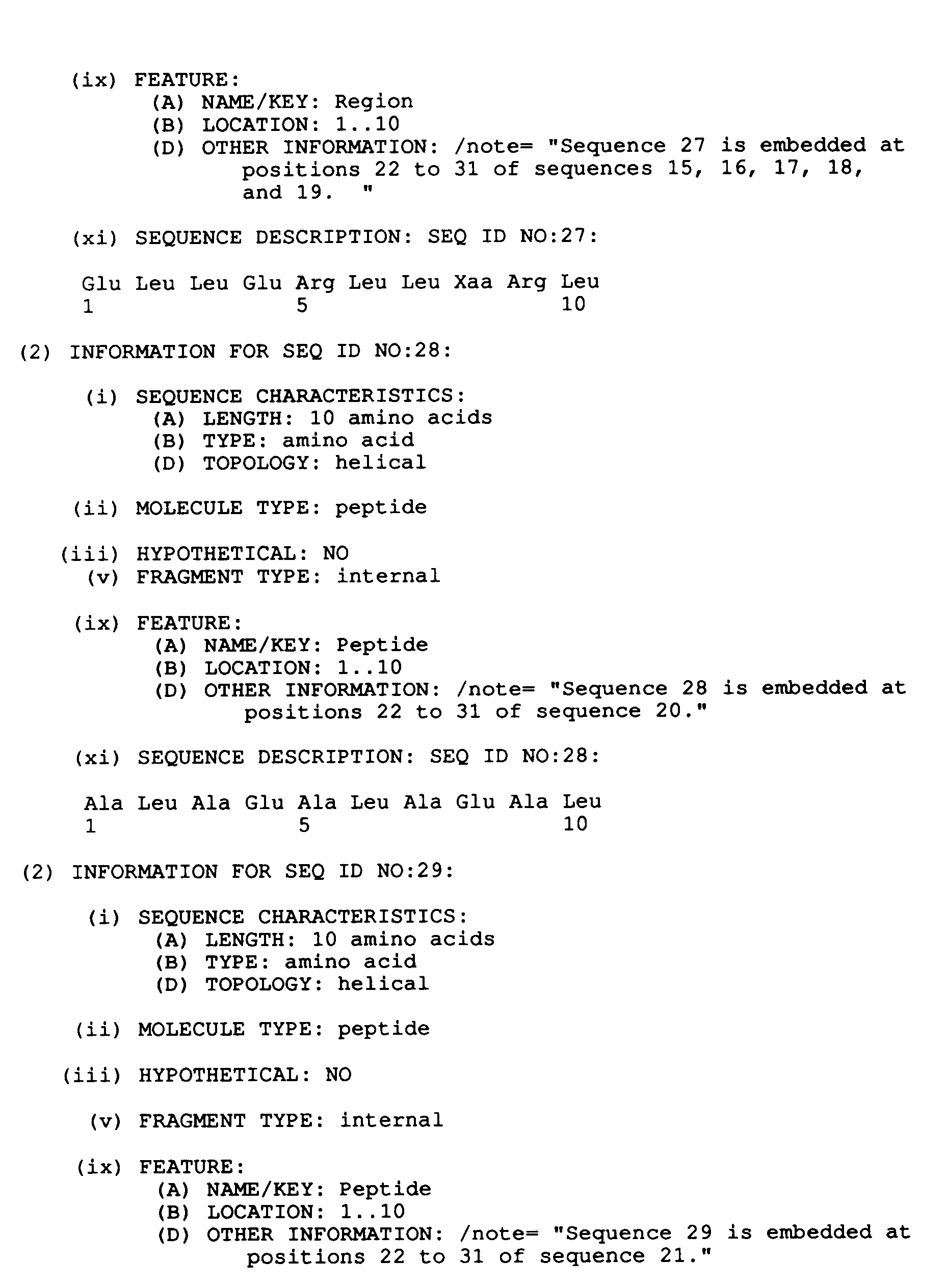
- this invention includes the synthesis of those polypeptides of Formula (I) wherein Xaa 22-31 is (SEQ ID NO:27), for which ⁇ H ⁇ at 100° exceeds 0.50.
- a further aspect of this invention includes the synthesis of those Formula (I) polypeptides wherein Xaa 22-31 is (SEQ ID NO:27); Xaa 11 and Xaa 13 are both Lys or both Arg; and Xaa 19 and Xaa 21 are both Arg.
- Representative polypeptides of this subgenus which may be prepared by the processes of this invention include, but are not limited to:
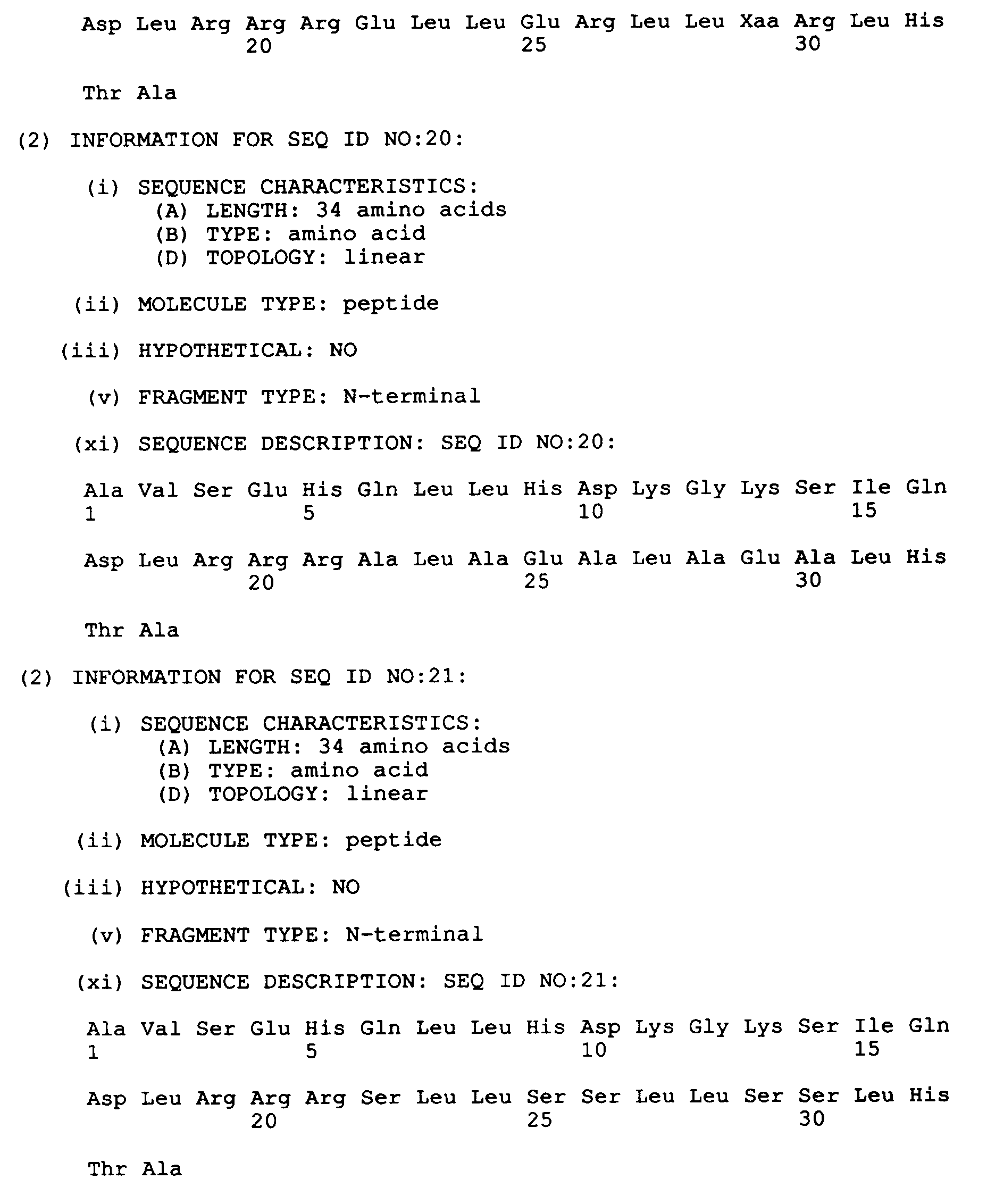
- this invention includes the synthesis of polypeptides of Formula (I) wherein Xaa 22-31 is (SEQ ID NO:28), for which ⁇ H ⁇ at 100° is about 0.25.
- Representative polypeptides of this subgenus which may be prepared by the processes of this invention include, but are not limited to:
- this invention includes the synthesis of polypeptides of Formula (I) wherein Xaa 22-31 is (SEQ ID NO:29), for which ⁇ H ⁇ at 100° is about 0.28.
- Representative polypeptides of this subgenus which may be prepared by the processes of this invention include, but are not limited to:
- this invention includes the synthesis of polypeptides of Formula (I) wherein Xaa 22-31 is (SEQ ID NO:30), for which ⁇ H ⁇ at 100° is about 0.29.
- Representative polypeptides of this subgenus which may be synthesized by the processes of this invention include, but are not limited to:
- Still another aspect of this invention includes the synthesis of polypeptide analogs of the physiologically active homologs of bPTH(1-34), as shown in Formula (II):
- polypeptides which may be synthesized by the processes of this invention include, but are not limited to:
- polypeptides which may be prepared by the processes of this invention include, but are not limited to:
- polypeptide analogs may be synthesized which will possess the desirable attributes of those described herein provided that an amino acid sequence having a mean hydrophobic moment per residue at 100° ⁇ 20° greater than about 0.20 is inserted at positions (22-31).
- polypeptide fragments of the instant invention may be synthesized by methods such as those set forth by G. Barany, R.B. Merrifield in The Peptides , E. Gross and J. Meienhofer eds., Academic Press, New York (1979), Vol. 2, pp. 1-284; J.M. Stewart and J.D. Young, Solid Phase Peptide Synthesis , 2nd ed., Pierce Chemical Co., Rockford, Illinois (1984) and J. Meienhofer, Hormonal Proteins and Peptides , Vol. 2, Academic Press, New York, (l973) for solid phase synthesis and E. Schroder and K. Lubke, The Peptides , Vol. l, Academic Press, New York, (l965) for solution synthesis.
- these methods involve the sequential addition of protected amino acids to a growing peptide chain. Normally, either the amino or carboxyl group of the first amino acid and any reactive side chain group are protected. This protected amino acid is then either attached to an inert solid support, or utilized in solution, and the next amino acid in the sequence, also suitably protected, is added under conditions amenable to formation of the amide linkage. After all the desired amino acids have been linked in the proper sequence, protecting groups and any solid support are removed to afford the crude polypeptide. The polypeptide is desalted and purified, preferably chromatographically, to yield the final product.
- the precursor peptide fragments may be prepared by either solution or solid phase techniques, or any combination thereof.
- some of the fragments may be prepared in solution, and then condensed to a resin bound C-terminal fragment, or the fragments may each be prepared by a solid phase method, cleaved from the resin, and condensed in solution, or a mixed protocol of solution and solid phase syntheses may be employed.
- a preferred method of preparing the PTH and PTHrP analogs of this invention involves solid phase fragment condensation peptide synthesis.
- the ultimate product results from the condensation of several peptide precursor fragments.
- any combination of fragments may be used.
- a 34 amino acid product may be prepared from two 17 amino acid peptide precursor fragments, three peptide precursor fragments, of varying lengths, four precursor fragments, etc. See P. LLoyd-Williams et al., "Convergent Solid Phase Peptide Synthesis," in Tetrahedron , 49 ,11065-11133, (1993) for illustrative discussion.
- ⁇ -amino (N ⁇ ) functions and any reactive side chains are protected by acid- or base-sensitive groups.
- the protecting group should be stable to the conditions of peptide linkage formation, while being readily removable without affecting the extant polypeptide chain.
- Suitable ⁇ -amino protecting groups include, but are not limited to t -butoxycarbonyl (Boc), benzyloxycarbonyl (Cbz), o-chlorobenzyloxycarbonyl, biphenylisopropyloxycarbonyl, t -amyloxycarbonyl (Amoc), isobornyloxycarbonyl, ⁇ , ⁇ -dimethyl-3,5-dimethoxybenzyloxycarbonyl, o -nitrophenylsulfenyl, 2-cyano- t -butoxycarbonyl, preferably 9-fluorenylmethoxycarbonyl (Fmoc).
- Suitable side chain protecting groups include, but are not limited to: acetyl, benzyl (Bzl), benzyloxymethyl (Bom), t-butyl, cyclohexyl, o -bromobenzyloxycarbonyl, t-butyldimethylsilyl, 2-chlorobenzyl (Cl-z), 2,6-dichlorobenzyl, 2,4-dinitrophenyl, cyclopentyl, isopropyl, pivalyl, tetrahydropyran-2-yl, tosyl (Tos), trimethylsilyl, methyltrityl, mesitylene sulfonyl (Mts), 4-methoxy-2,3,6-trimethylbenzenesulfonyl (Mtr), 2,2,4,6,7-pentamethyldihydrobenzofuran-5-sulfonyl (Pbf), 2,2,5,7,8-pentamethylchroman
- Suitable resin supports are those materials which are inert to the reagents and reaction conditions of the stepwise condensation and deprotection reactions, as well as being insoluble in the media used.
- Suitable resin supports include styrene/divinylbenzene resins modified with a reactive group, e.g., chloromethylated co-poly(styrene-divinylbenzene), hydroxymethylated co-poly(styrene-divinylbenzene), and benzylated, hydroxymethylated phenylacetamidomethyl (PAM) resins.
- Wang resin may be used.
- a preferred resin is p-methylbenzhydrylamino-co-poly(styrene-divinylbenzene) resin (MBHA).
- all fragments except the C-terminus fragment are prepared on an acid sensitive resin such as Sasrin (2-methoxy-4-alkoxybenzylalcohol) or 4-hydroxymethyl-3-methoxyphenoxybutyric acid 4-methylbenzhydrylamine (HMPB-MBHA).
- HMPA-MBHA, HMPB-BHA and HMPA-BHA resins are also suitable for the carboxy terminated peptides.
- the C-terminal fragment is prepared using a Knorr handle-MBHA resin.
- Sieber amide resins, Rink linker-MBHA or BHA resins, and Ramage linker-MBHA or BHA resins are all suitable for amide terminated peptides.
- HMPB-MBHA and Knorr handle resins are commercially available with the first amino acid already bound or the first amino acid may be attached to the linker.
- the HMPB-MBHA and Knorr handle resins may be prepared as described in Examples 1, 2, and 3 below from MBHA resin.
- the successive coupling of the remaining protected amino acids may be carried out by methods well known in the art.
- Each protected amino acid is preferably introduced in approximately 1.5 to 2.5 fold molar excess and the coupling carried out in an inert, nonaqueous, polar solvent such as N-methyl pyrrolidinone (NMP), dichloromethane, dimethylformamide (DMF), dimethyl sulfoxide (DMSO), or mixtures thereof, preferably at ambient temperature.
- NMP N-methyl pyrrolidinone
- DMF dimethylformamide
- DMSO dimethyl sulfoxide
- Representative coupling agents are N,N'-dicyclohexylcarbodiimide (DCC), N,N'-diisopropylcarbodiimide (DIC) or other carbodiimide, either alone or in the presence of 1-hydroxybenzotriazole (HOBt), O-acyl ureas, benzotriazol-1-yl-oxytris(pyrroiidino)phosphonium hexafluorophosphate (PyBop), N-hydroxysuccinimide, other N-hydroxyimides, or oximes.
- protected amino acid active esters e.g. p-nitrophenyl, pentafluorophenyl and the like
- symmetrical anhydrides may be used.
- Successive coupling of Fmoc-protected amino acids is conducted using a solution of a secondary amine, such as pyridine, to remove the Fmoc group.
- the peptide resin may be checked for completed coupling by the Kaiser test after each coupling step.
- the fully protected peptide is removed from the resin using conditions which do not induce premature deprotection of side chain protecting groups.
- the peptides may be cleaved by saponification or transesterification or a mildly acidic deprotection regimen, employing for example 1% trifluoroacetic acid (TFA).
- TFA trifluoroacetic acid
- the protected peptide may be purified by silica gel chromatography.
- the solution may be desalted (e.g. with BioRad AG-3® anion exchange resin) and the peptide purified by a sequence of chromatographic steps employing any or all of the following types: hydrophobic adsorption chromatography on underivatized co-poly(styrene-divinylbenzene), e.g. Amberlite® XAD; silica gel adsorption chromatography; cation exchange chromatography on carboxymethylcellulose; partition chromatography, e.g.
- the middle and N-terminal fragments are isolated and successively condensed to the C-terminal fragment.
- the polypeptide product is deprotected and cleaved from the resin, and further purified.
- the purification sequence is generally a comprehensive series of chromatographic separations. HPLC analysis determines the sequence and choice of purification. A typical sequence involves cation exchange, reverse phase HPLC, and reverse phase concentration column. The final solution is subjected to lyophilization and the drug product stored in amber bottles.
- the protected amino acids were obtained from Genzyme (Cambridge, MA, USA), Propeptide (Princeton, NJ, USA), or Synthetec (Albany, OR, USA).
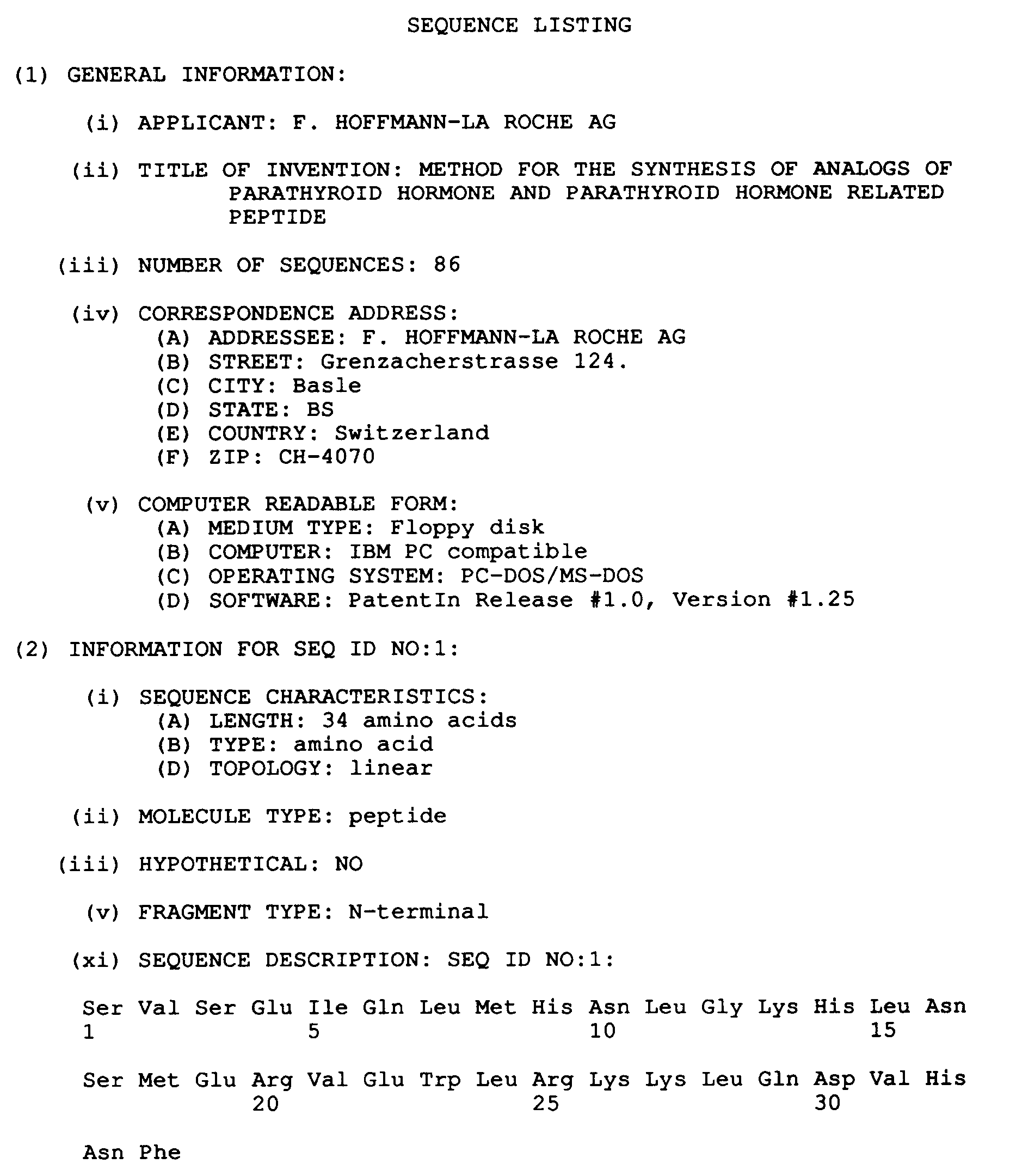
- the polypeptide of SEQ ID NO:7, a 34-amino acid peptide, AVSEHQLLHDKGKSIQDLRRRELLEKLLEKLHTA-NH 2 was prepared using a three-fragment condensation procedure.
- the N-terminus fragment consisted of amino acids 1 to 12, the middle fragment amino acids 13 to 23, and the C-terminus fragment amino acids 24 to 34.
- Each fragment was prepared by the solid phase method on a Vega 296 Automated Peptide Synthesizer. The automated mode was used for cleavage of the N ⁇ -protecting groups and for washes after coupling. Coupling reagents and solvents were added manually to the reaction vessel in the coupling step.
- the middle and N-terminus fragments were purified by HPLC and successively condensed to the C-terminus fragment.
- the final polypeptide was deprotected, cleaved from the resin, and purified.
- HMPB-MBHA 4-hydroxymethyl-3-methoxyphenoxy-butyric acid 4-methylbenzhydrylamine
- This resin was prepared from MBHA resin (Novabiochem) as follows: STEP EVENT TIME (MINS) REPETITIONS 1. CH 2 Cl 2 /DMF (1/1) wash 60 1 2. 10% Et 3 N in CH 2 Cl 2 5 2 3. CH 2 Cl 2 /DMF (1/1) 5 3 4. HMPB linker (1.15 eqs)/PyBOP/DIPEA in CH 2 Cl 2 /DMF(1/1) 300 @40C 1 500 @ RT 5. CH 2 Cl 2 wash 1.5 2 6. DMF wash 1.5 2 7. CH 2 Cl 2 wash 1.5 1 8. i-PrOH wash 1.5 2 9. CH 2 Cl 2 wash 1.5 3
- the protected peptide was loaded on the column in 65 -70% CH 3 CN. A gradient was run increasing the proportion of CH 3 CN to 85%. Fractions were combined, concentrated, and the product isolated by CH 2 Cl 2 extraction. The organic phase was washed with a dilute solution of sodium bicarbonate or water, dried over sodium sulfate, filtered, and evaporated.
- the middle fragment consisting of amino acids 13 to 23, KSIQDLRRREL, was prepared on a 230 mmole scale on an acid sensitive resin, 4-hydroxymethyl-3-methoxyphenoxybutyric acid 4-methylbenzhydrylamine (HMPB-MBHA).
- HMPB-MBHA 4-hydroxymethyl-3-methoxyphenoxybutyric acid 4-methylbenzhydrylamine
- This resin was prepared from MBHA resin as described above for Example 1.
- the first amino acid (aa24) was incorporated as shown using Fmoc-L-leucine.
- the remaining amino acids were attached to the resin in successive coupling cycles using the procedure of Example 1:
- the peptide was cleaved from the resin as the free acid, the organics extracted, dried and evaporated as taught for Example 1.
- the residue may be precipitated by dissolving in dichloromethane and adding to t-butyl methyl ether (t-BuOMe). After filtering, washing with t-BuOMe and vacuum drying, the product was purified by HPLC on a Zorbax column, described above, run isocratically with 75% CH 3 CN; the detector wavelength was 267 nm.
- DMF/CH 2 Cl 2 wash 1.5 3 8. Coupling 240 1 9. CH 2 Cl 2 wash 1.5 2 10. DMF wash 1.5 2 11. i-PrOH wash 1.5- 2.5 2 12. DMF/CH 2 Cl 2 wash 1.5 2 13. iPrOH wash 2.5 2 14. CH 2 Cl 2 wash 1.5 3 Kaiser test 15. DMF 2.5- 15 1 16. Ac 2 O/DIPEA/CH 2 Cl 2 /DMF 30- 35 1 17. CH 2 Cl 2 wash 1.5 2 18. DMF wash 1.5 2 19. i-PrOH wash 1.5 2 20. DMF/CH 2 Cl 2 wash 1.5 1 21. CH 2 Cl 2 wash 1.5 3
- N-terminus fragment A as the Na salt, (153 g, 62.4 mmole), HOBt (59.2 mmole), HOAt ( 3.7 mmole), PyBOP (62.5 mmole) and DIPEA (125.15 mmole) were added to the resin in NMP (900 mL) and CH 2 Cl 2 . The mixture was stirred at room temperature for 24 hours, filtered and washed (Example 3, steps 9-13). The Kaiser test showed less than 1% uncoupled remaining. The resin was acetylated (Example 3, steps 14 to 20), removed from the reactor, and dried under vacuum.
- the crude peptide was filtered, washed with t-butyl methyl ether, toluene, and t-butyl methyl ether (2x250 mL each) and reprecipitated by dissolving in methanol (500 mL) and adding to t-butyl methyl ether (7L).
- the crude was filtered, washed with t-butyl methyl ether, and dried under vacuum to yield 33g of peptide.
- [Met 34 , Ala 35 ] (SEQ ID NO:25), AVSEHQLLHDKGKSIQDLRRRELLEKLLEKLHTMA-NH 2 , (SEQ ID NO:25), may be prepared and purified following the procedures above.
- This polypeptide may be converted to the homoserine lactone as follows.
- the purified peptide is dissolved in 44% formic acid.
- This solution is combined with a premixed solution of cyanogen bromide (700 mgs) and phenol (1.6 mgs) in 44% formic acid at 0°C.
- the solution is stirred at 0°C for 2 hr and at room temperature for 2 hrs.
- the formation of the product may be monitored by HPLC (Vydac® C-18, 300 A°, 4.6 x 250 mm, flow of 1.2 mL/min, gradient 25-45% acetonitrile in 0.1% TFA over 10 min).
- HPLC Voltac® C-18, 300 A°, 4.6 x 250 mm, flow of 1.2 mL/min, gradient 25-45% acetonitrile in 0.1% TFA over 10 min).
- the sample is concentrated and purified by preparative RP-HPLC (Vydac® C-18, gradient 25-45% acetonitrile in 0.1% TFA) to yield (SEC ID NO:9).
- (SEQ ID NO:79) may be prepared in accordance with this procedure.
- the crude hSerlactone analog, Compound 4 is concentrated and treated with 25 mL saturated NH 3 in methanol. The solution is stirred at 0°C for 2 hr and at room temperature for 16 hr. The reaction may be monitored by HPLC (Vydac® C-18, 300 A°, 4.6 x 250 mm, flow of 1.2 mL/min, gradient 20-45% acetonitrile in 0.1% TFA). The solution is concentrated and purified by preparative RP-HPLC (Vydac® C-18, gradient of 25-45% acetonitrile in 0.1% TFA).
- the homoserine amide peptide fractions are pooled and lyophilized to give (SEQ ID NO:8).
- Compounds 22, 23 and 28 may be prepared following this procedure, using methionine as C-terminus.
- AVSEIQFLHN KGKHLSSLRR RELLEKLLEK LHNX-NH 2 (SEQ ID NO:37)
- X homoserine
- the homoserine alkylamides are similarly prepared from the homoserine lactone by dissolving it in DMF containing an excess of the corresponding alkylamine. After stirring at room temperature for several days (the reaction may be monitored by analytical HPLC) the mixture is evaporated to dryness and the peptide purified by preparative HPLC.
- aqueous solution of the homoserine lactone analog above may be treated with porcine liver esterase (Sigma Chemical Company, St. Louis, MO).
- porcine liver esterase Sigma Chemical Company, St. Louis, MO.
- the hydrolysis of the lactone to the C-terminal homoserine may be monitored by analytical HPLC.
- the hydrolysis is judged to be complete the material may be purified by preparative HPLC as above.
- AVSEHQLLHD KGKSIQDLRR RELLEKLLEK LHTX-OH SEQ ID NO:51
- X homoserine
- the four amino acid fragment may be prepared, by either solution or solid phase techniques, and condensed with itself to provide fragment 24-31.
- the four amino acid fragment 23-26 LLEK may be prepared and self-condensed to provide the 23-30 fragment. The ease of purification is enhanced with the use of smaller fragments, which readily crystallize; however, an increase in the number of fragments requires more fragment condensation steps.
Landscapes
- Health & Medical Sciences (AREA)
- Chemical & Material Sciences (AREA)
- Organic Chemistry (AREA)
- Life Sciences & Earth Sciences (AREA)
- Medicinal Chemistry (AREA)
- General Health & Medical Sciences (AREA)
- Endocrinology (AREA)
- Biophysics (AREA)
- Biochemistry (AREA)
- Proteomics, Peptides & Aminoacids (AREA)
- Molecular Biology (AREA)
- Genetics & Genomics (AREA)
- Animal Behavior & Ethology (AREA)
- Engineering & Computer Science (AREA)
- Bioinformatics & Cheminformatics (AREA)
- Public Health (AREA)
- Veterinary Medicine (AREA)
- Toxicology (AREA)
- Zoology (AREA)
- Gastroenterology & Hepatology (AREA)
- Nuclear Medicine, Radiotherapy & Molecular Imaging (AREA)
- General Chemical & Material Sciences (AREA)
- Pharmacology & Pharmacy (AREA)
- Chemical Kinetics & Catalysis (AREA)
- Diabetes (AREA)
- Analytical Chemistry (AREA)
- Peptides Or Proteins (AREA)
- Medicines That Contain Protein Lipid Enzymes And Other Medicines (AREA)
- Pharmaceuticals Containing Other Organic And Inorganic Compounds (AREA)
Abstract
Description
Osteoporosis is the most common form of metabolic bone disease and may be considered the symptomatic, fracture stage of bone loss (osteopenia). Although osteoporosis may occur secondary to a number of underlying diseases, 90% of all cases appear to be idiopathic. Postmenopausal women are particularly at risk for idiopathic osteoporosis (postmenopausal or Type I osteoporosis). Another high risk group for idiopathic osteoporosis is the elderly of either sex (senile or Type II osteoporosis). Osteoporosis has also been related to corticosteroid use, immobilization or extended bed rest, alcoholism, diabetes, gonadotoxic chemotherapy, hyperprolactinemia, anorexia nervosa, primary and secondary amenorrhea, and oophorectomy.


| Amino Acid | Three-letter Symbol | One-letter Symbol |
| Alanine | Ala | A |
| Arginine | Arg | R |
| Asparagine | Asn | N |
| Aspartic Acid | Asp | D |
| Asn + Asp | Asx | B |
| Cysteine | Cys | C |
| Glutamine | Gln | Q |
| Glutamic Acid | Glu | E |
| Gln + Glu | Glx | Z |
| Glycine | Gly | G |
| Histidine | His | H |
| Isoleucine | Ile | I |
| Leucine | Leu | L |
| Lysine | Lys | K |
| Methionine | Met | M |
| Phenylalanine | Phe | F |
| Proline | Pro | P |
| Serine | Ser | S |
| Threonine | Thr | T |
| Tryptophan | Trp | W |
| Tyrosine | Tyr | Y |
| Valine | Val | V |
| Other amino acid | Xaa | X |
- hSer
- homoserine
- hSerlac
- homoserine lactone
- Nle
- norleucine

- Xaa is Glu or Arg (SEQ ID NO:26);
- Xaa is Glu or Lys (SEQ ID NO:27);


| STEP | EVENT | TIME (MINS) | REPETITIONS |
| 1. | CH2Cl2/DMF (1/1) wash | 60 | 1 |
| 2. | 10% Et3N in CH2Cl2 | 5 | 2 |
| 3. | CH2Cl2/DMF (1/1) | 5 | 3 |
| 4. | HMPB linker (1.15 eqs)/PyBOP/DIPEA in CH2Cl2/DMF(1/1) | 300 @40C | 1 |
| 500 @ RT | |||
| 5. | CH2Cl2 wash | 1.5 | 2 |
| 6. | DMF wash | 1.5 | 2 |
| 7. | CH2Cl2 wash | 1.5 | 1 |
| 8. | i-PrOH wash | 1.5 | 2 |
| 9. | CH2Cl2 wash | 1.5 | 3 |
| STEP | EVENT | TIME (MINS) | REPETITIONS |
| 1. | DMF/CH2Cl2 (1/1) | 60 | 1 |
| 2. | Fmoc-X-OH (2 eq.)/DIC-DMAP (0.05eq.) in CH2Cl2/DMF (1/1) | 900 | 1 |
| 3. | CH2Cl2 wash | 1.5 | 2 |
| 4. | DMF wash | 1.5 | 2 |
| 5. | i-PrOH wash | 1.5 | 2 |
| 6. | DMF/CH2Cl2 (1/1) | 1.5 | 2 |
| 7. | i-PrOH | 1.5 | 2 |
| 8. | CH2Cl2 wash | 1.5 | 3 |
| STEP | EVENT | TIME (MINS) | REPETITIONS |
| 9. | DMF | 15 | 1 |
| 10. | PhCOCl(0.18M)/pyridine(0.36M) in DMF/CH2Cl2 | 30-180 | 1 |
| 11. | CH2Cl2 wash | 1.5 | 2 |
| 12. | DMF wash | 1.5 | 2 |
| 13. | i-PrOH wash | 1.5 | 2 |
| 14. | DMF/CH2Cl2 (1/1) wash | 1.5 | 1 |
| 15. | CH2Cl2 wash | 1.5 | 3 |
| STEP | EVENT | TIME (MINS) | REPETITIONS |
| 1. | DMF wash | 2.5- 30 | 1 |
| 2. | 20% piperidine in NMP | 3 | 1 |
| 3. | 20% piperidine in NMP | 14 | 1 |
| 4. | DMF wash | 1.5 | 2 |
| 5. | CH2Cl2 wash | 1.5 | 2 |
| 6. | i-PrOH wash | 1.5- 2.5 | 2- 5 |
| 7. | DMF/CH2Cl2 (1/1) wash | 1.5 | 2- 3 |
| 8. | Coupling | 240 | 1 |
| 9. | CH2Cl2 wash | 1.5 | 2 |
| 10. | DMF wash | 1.5 | 2 |
| 11. | i-PrOH wash | 1.5 | 2 |
| 12. | DMF/CH2Cl2 wash | 1.5 | 2 |
| 13. | i-PrOH | 1.5 | 1 |
| 14. | CH2Cl2 wash | 1.5 | 3 |
| STEP | EVENT | TIME (MINS) | REPETITIONS |
| 1. | CH2Cl2 wash | 60 | 1 |
| 2. | 10% DIPEA in CH2Cl2 | 5 | 2 |
| 3. | CH2Cl2 | 5 | 3 |
| 4. | DMF | 5 | 3 |
| 5. | Linker/HOBt/DIC (1.5 eq) in CH2Cl2/DMF (1/1) | 300- 420 | 1 |
| 6. | CH2Cl2 | 1.5 | 2 |
| 7. | DMF | 1.5 | 2 |
| 8. | iPrOH | 2.5 | 2 |
| 9. | CH2Cl2/DMF | 1.5 | 2 |
| 10. | iPrOH | 2.5 | 2 |
| 11. | CH2Cl2 | 1.5 | 3 |
| 12. | DMF in DMF/CH2Cl2 | 10 | 1 |
| 13. | Ac2O, DIPEA in DMF/CH2Cl2 | 30- 35 | 1 |
| 14. | CH2Cl2 wash | 1.5 | 2 |
| 15. | DMF wash | 1.5 | 2 |
| 16. | i-PrOH wash | 1.5 | 2 |
| 17. | DMF / CH2Cl2 wash | 1.5 | 1 |
| 18. | CH2Cl2 wash | 1.5 | 3 |
| STEP | EVENT | TIME (MINS) | REPETITIONS |
| 1. | DMF wash | 2.5- 30 | 1 |
| 2. | 20% piperidine in NMP | 3 | 1 |
| 3. | 20% piperidine in NMP | 14 | 1 |
| 4. | DMF wash | 1.5 | 3 |
| 5. | CH2Cl2 wash | 1.5 | 2 |
| 6. | i-PrOH wash | 1.5- 2.5 | 2- 6 |
| 7. | DMF/CH2Cl2 wash | 1.5 | 3 |
| 8. | Coupling | 240 | 1 |
| 9. | CH2Cl2 wash | 1.5 | 2 |
| 10. | DMF wash | 1.5 | 2 |
| 11. | i-PrOH wash | 1.5- 2.5 | 2 |
| 12. | DMF/CH2Cl2 wash | 1.5 | 2 |
| 13. | iPrOH wash | 2.5 | 2 |
| 14. | CH2Cl2 wash | 1.5 | 3 |
| Kaiser test | |||
| 15. | DMF | 2.5- 15 | 1 |
| 16. | Ac2O/DIPEA/CH2Cl2/DMF | 30- 35 | 1 |
| 17. | CH2Cl2 wash | 1.5 | 2 |
| 18. | DMF wash | 1.5 | 2 |
| 19. | i-PrOH wash | 1.5 | 2 |
| 20. | DMF/CH2Cl2 wash | 1.5 | 1 |
| 21. | CH2Cl2 wash | 1.5 | 3 |


AVSEHQLLHDKGKSIQDLRRRELLEKLLEKLHTX (X=hSerlac, SEQ ID NO:9)
AVSEIQFX1HN KGKHLSSX1ER VEWLRKKLQD VHNX2 (SEQ ID NO:79)
(X1 = L-norleucine; X2 = homoserine lactone)
AVSEHQLLHDKGKSIQDLRRRELLEKLLEKLHTX-NH2 (X=hSer, SEQ ID NO:8)
AVSEIQFLHN LGKHLSSLRR RELLEKLLEK LHNX-NH2 (SEQ ID NO:36)
(X = homoserine)
AVSEIQFLHN KGKHLSSLRR RELLEKLLEK LHNX-NH2 (SEQ ID NO:37)
(X = homoserine)
AVSEHQLLHD KGKSIQDLRR RELLERLLER LHTAGRRX-NH2 (SEQ ID NO:42)
(X = homoserine)
AVSEHQLLHD KGKSIQDLRR RELLEKLLEK LHTX-NHCH2CH3 (SEQ ID NO:69)
(X = homoserine)
AVSEHQLLHD KGKSIQDLRR RELLEKLLEK LHTX-NHCH2CH2C6H5 (SEQ ID NO:70)(X = homoserine)
AVSEHQLLHD KGKSIQDLRR RELLEKLLEK LHTX-OH (SEQ ID NO:51)
(X = homoserine)






Claims (19)
- A process for the synthesis of a synthetic polypeptide analog of parathyroid hormone (PTH) or parathyroid hormone related peptide (PTHrP), or a salt thereof, in which amino acid residues (22-31)selected from (SEQ ID NOS: 85, 86, 26, 27, 28, 29, and 30) form an amphipathic α-helix, which process comprises:a) independently synthesizing precursor peptide fragments of the polypeptide, by solution or solid phase techniques;b) condensing said fragments with each other to form the desired polypeptide product; andc) removing the amino acid protecting groups.
- A process of claim 1 which comprises:a) independently synthesizing precursor peptide fragments of the polypeptide on resin supports;b) cleaving the fragments of the polypeptide from their respective resin supports;c) sequentially condensing said fragments to form the desired polypeptide product; andd) removing any amino acid protecting groups.
- A process of claim 1 or 2 which comprises:a) independently synthesizing precursor peptide fragments of the desired polypeptide on a solid resin support;b) cleaving all but the intended ultimate C-terminal precursor peptide fragment of the desired polypeptide from their respective resin supports;c) sequentially condensing said cleaved precursor peptide fragments with the resin bound C-terminal peptide fragment to form the desired polypeptide product;d) removing side chain protecting groups; ande) cleaving the polypeptide product from the resin support.
- A process as claimed in any one of claims 1 to 3 in which the polypeptide product is prepared from three precursor peptide fragments: an N-terminus, a middle, and a C-terminus fragment.
- A process of claim 4 in which the N-terminus fragment has a C-terminal glycine, the middle fragment has a C-terminal leucine, and the C-terminus fragment has an N-terminal leucine.
- A process as claimed in any one of claims 1 to 5 in which the final polypeptide product comprises a PTH or PTHrP analog of the formula:Xaa1 Xaa2 Xaa3 Xaa4 Xaa5 Xaa6 Xaa7 Leu His Asp Xaa11 Gly Xaa13 Ser Ile Gln Asp Leu Xaa19 Xaa20 Xaa21 Xaa22-31 Xaa32 Xaa33 Xaa34 Xaa35 Xaa36 Xaa37 Xaa38 Term, wherein:and Term is OR or NR2 where each R is independently H, (C1-C4)alkyl or phenyl(C1-C4)alkyl;Xaa1 is absent or is Ala;Xaa2 is absent or is Val;Xaa3 is absent or is Ser;Xaa4 is absent or is Glu or Glu(OCH3);Xaa5 is absent or is His or Ala;Xaa6 is absent or is Gln;Xaa7 is absent or is Leu;Xaa11 is Lys, Arg, or Leu;Xaa13 is Lys, Arg, Tyr, Cys, Leu,
Cys(CH2CONH(CH2)2NH(biotinyl)), Lys(7-dimethylamino-2-oxo-2H-1-benxopyran-4-acetyl), or Lys(dihydrocinnamoyl);Xaa20 is Arg or Leu;Xaa19 and Xaa21 are independently Lys, Ala, or Arg;Xaa22-31 is selected from (SEQ ID NOS:85, 86, 26, 27, 28, 29, or 30);Xaa32 is His, Pro, or Lys;Xaa33 is absent, or is Pro, Thr, Glu, or Ala;Xaa34 is absent, or is Pro, Arg, Met, Ala, hSer, hSer lactone, Tyr, or Leu;Xaa35 is absent or is Pro, Glu, Ser, Ala, or Gly;Xaa36 is absent or is Ala, Arg, or Ile;Xaa37 is absent or is Arg, Trp, or 3-(-2-naphthyl)-L-alanine;Xaa38 is absent or is Ala or hSer or Xaa38-42 is Thr Arg Ser Ala Trp;
and the pharmaceutically acceptable salts thereof. - A process as claimed in any one of claims 1 to 5 in which the polypeptide analog of PTH or PTHrP comprises the formula:Xaa1 Val Ser Glu Ile Gln Xaa7 Xaa8 His Asn Xaa11 Gly Lys His Leu Xaa16 Ser Xaa18 Xaa19 Arg Xaa21 Xaa22-31 His Asn Xaa34 Term, wherein:Term is OR or NR2, where R is H or a (C1-C4)alkyl;Xaa1 is Ser or Ala;Xaa7 is Leu or Phe;Xaa8 is Leu, Met, or Nle;Xaa11 is Leu or Lys;Xaa16 is Asn or Ser;Xaa18 is Leu, Met, or Nle;Xaa19 is Glu, Thr, or Arg;Xaa21 is Val, Ser, or Arg;Xaa22-31 is selected from (SEQ ID NOS: 26, 27, 28, 29, or 30);Xaa34 is Phe, hSer, or Tyr;
and the pharmaceutically acceptable salts thereof. - A process as claimed in any one of claims 1 to 5 in which the PTH or PTHrP analog is selected from the group consisting of:


- A process as claimed in any one of claims 1 to 5 in which the PTH or PTHrP analog is the polypeptide of SEQ ID NO:7, AVSEHQLLHDKGKSIQDLRRRELLEKLLEKLHTA-NH2.
- A process of claim 9 wherein said first fragment comprises AVSEHQLLHDKG, said second fragment comprises KSIQDLRRREL, and said third fragment comprises LEKLLEKLHTA.
- A process of claim 10 wherein said third fragment is formed by the condensation of LEKL, LEKL, and HTA.
- The synthetic polypeptide of the sequence AVSEHQLLHDKG.
- The synthetic polypeptide of the sequence KSIQDLRRREL.
- The synthetic polypeptide of the sequence LEKLLEKLHTA.
- A process of claim 9 wherein said first fragment comprises AVSEHQLLHDKG, said second fragment comprises KSIQDLRRRE, and said third fragment comprises LLEKLLEKLHTA.
- A process of claim 15 wherein said third fragment is formed by the condensation of LLEK, LLEK, and LHTA.
- The synthetic polypeptide of the formula KSIQDLRRRE.
- The synthetic polypeptide of the formula LLEKLLEKLHTA.
- A process for the preparation of a pharmaceutical composition characterized therein that a process as claimed in any one of claims 1 to 11 and 15 and 16 for the preparation of a PTH or PTHrP analog is effected and the PTHrP analog obtained is mixed with one or more pharmaceutically acceptable additives.
Priority Applications (1)
| Application Number | Priority Date | Filing Date | Title |
|---|---|---|---|
| DK97112595T DK0822200T3 (en) | 1996-07-30 | 1997-07-23 | Synthesis of analogs for PTH and PTrP |
Applications Claiming Priority (2)
| Application Number | Priority Date | Filing Date | Title |
|---|---|---|---|
| US2332296P | 1996-07-30 | 1996-07-30 | |
| US23322P | 1996-07-30 |
Publications (2)
| Publication Number | Publication Date |
|---|---|
| EP0822200A1 true EP0822200A1 (en) | 1998-02-04 |
| EP0822200B1 EP0822200B1 (en) | 2004-09-22 |
Family
ID=21814418
Family Applications (1)
| Application Number | Title | Priority Date | Filing Date |
|---|---|---|---|
| EP97112595A Expired - Lifetime EP0822200B1 (en) | 1996-07-30 | 1997-07-23 | Synthesis of analogs of PTH and PTrP |
Country Status (30)
| Country | Link |
|---|---|
| US (1) | US6849710B1 (en) |
| EP (1) | EP0822200B1 (en) |
| JP (1) | JP4229992B2 (en) |
| KR (1) | KR100518982B1 (en) |
| CN (1) | CN1293096C (en) |
| AR (2) | AR008094A1 (en) |
| AT (1) | ATE277080T1 (en) |
| AU (1) | AU731160B2 (en) |
| BR (1) | BR9704138A (en) |
| CA (1) | CA2206008C (en) |
| CO (1) | CO4650046A1 (en) |
| CZ (1) | CZ239697A3 (en) |
| DE (1) | DE69730787T2 (en) |
| DK (1) | DK0822200T3 (en) |
| ES (1) | ES2227639T3 (en) |
| HR (1) | HRP970416A2 (en) |
| HU (1) | HUP9701277A3 (en) |
| IL (1) | IL121391A0 (en) |
| MA (1) | MA24353A1 (en) |
| MX (1) | MX9705719A (en) |
| NO (1) | NO973482L (en) |
| NZ (1) | NZ328411A (en) |
| PE (1) | PE91998A1 (en) |
| PL (1) | PL321391A1 (en) |
| SG (1) | SG67408A1 (en) |
| TR (1) | TR199700714A2 (en) |
| TW (1) | TW505654B (en) |
| UY (1) | UY24651A1 (en) |
| YU (1) | YU32197A (en) |
| ZA (1) | ZA976555B (en) |
Cited By (9)
| Publication number | Priority date | Publication date | Assignee | Title |
|---|---|---|---|---|
| US7378495B2 (en) * | 2002-10-21 | 2008-05-27 | Pevion Biotech, Ltd. | PTH-rP related peptide cancer therapeutics |
| US7384912B2 (en) | 2002-01-10 | 2008-06-10 | Osteotrophin, Llc | Treatment of bone disorders with skeletal anabolic drugs |
| US7803770B2 (en) | 2006-10-03 | 2010-09-28 | Radius Health, Inc. | Method of treating osteoporosis comprising administration of PTHrP analog |
| US8148333B2 (en) | 2006-10-03 | 2012-04-03 | Radius Health, Inc. | Stable composition comprising a PTHrP analogue |
| US8563513B2 (en) | 2009-03-27 | 2013-10-22 | Van Andel Research Institute | Parathyroid hormone peptides and parathyroid hormone-related protein peptides and methods of use |
| US10385008B2 (en) | 2017-01-05 | 2019-08-20 | Radius Pharmaceuticals, Inc. | Polymorphic forms of RAD1901-2HCL |
| WO2019175173A1 (en) * | 2018-03-12 | 2019-09-19 | Fresenius Kabi Ipsum S.R.L. | Process for the manufacture of pthrp analogue |
| USRE49444E1 (en) | 2006-10-03 | 2023-03-07 | Radius Health, Inc. | Method of treating osteoporosis comprising administration of PTHrP analog |
| US11782041B2 (en) | 2017-04-28 | 2023-10-10 | Radius Health, Inc. | Abaloparatide formulations and methods of testing, storing, modifying, and using same |
Families Citing this family (13)
| Publication number | Priority date | Publication date | Assignee | Title |
|---|---|---|---|---|
| CA2628945A1 (en) * | 2005-11-10 | 2007-05-24 | Board Of Control Of Michigan Technological University | Black bear parathyroid hormone and methods of using black bear parathyroid hormone |
| DK1979370T3 (en) * | 2006-01-17 | 2010-06-28 | Organon Nv | Selective enzymatic hydrolysis of C-terminal tert-butyl ester peptides |
| JP2013512688A (en) | 2009-12-07 | 2013-04-18 | ミシガン テクノロジカル ユニバーシティ | Methods of using black bear parathyroid hormone and black bear parathyroid hormone |
| CN102731643A (en) * | 2012-06-26 | 2012-10-17 | 深圳翰宇药业股份有限公司 | Method for preparing polypeptide used for treating osteoporosis |
| CN102993293B (en) * | 2012-12-05 | 2014-05-07 | 深圳翰宇药业股份有限公司 | Method for purifying teriparatide acetate |
| MX363522B (en) | 2013-03-21 | 2019-03-26 | Sanofi Aventis Deutschland | Synthesis of hydantoin containing peptide products. |
| MX365465B (en) | 2013-03-21 | 2019-06-04 | Sanofi Aventis Deutschland | Synthesis of cyclic imide containing peptide products. |
| CA2943611A1 (en) | 2014-03-28 | 2015-10-01 | Duke University | Method of treating cancer using selective estrogen receptor modulators |
| CN104530198B (en) * | 2014-12-09 | 2017-09-15 | 兰州大学 | A kind of method that fragment condensation prepares desmopressin acetate |
| CA2984357A1 (en) | 2015-04-29 | 2016-11-03 | Radius Pharmaceuticals, Inc. | Methods for treating cancer |
| IL279853B2 (en) | 2018-07-04 | 2025-01-01 | Radius Pharmaceuticals Inc | Polymorphic forms of rad 1901-2hcl |
| CN111057139B (en) * | 2018-10-17 | 2023-12-22 | 南京华威医药科技集团有限公司 | Novel process for preparing teriparatide |
| CN119390714A (en) | 2019-02-12 | 2025-02-07 | 雷迪厄斯制药公司 | Methods and compounds |
Citations (7)
| Publication number | Priority date | Publication date | Assignee | Title |
|---|---|---|---|---|
| US3886132A (en) * | 1972-12-21 | 1975-05-27 | Us Health | Human parathyroid hormone |
| FR2550204A1 (en) * | 1983-08-05 | 1985-02-08 | Toyo Jozo Kk | PEPTIDE DERIVATIVES OF (NLE8, NLE1B, TYR34) -H-PTH |
| WO1992000753A1 (en) * | 1990-07-13 | 1992-01-23 | The Regents Of The University Of California | PARATHYROID HORMONE ANALOGUES MODIFIED AT POSITIONS 3, 6 or 9 |
| EP0490806A2 (en) * | 1990-09-20 | 1992-06-17 | Sandoz Ltd. | Nasal pharmaceutical compositions |
| WO1994001460A1 (en) * | 1992-07-14 | 1994-01-20 | Syntex (U.S.A.) Inc. | Analogs of pth and pthrp, their synthesis and use for the treatment of osteoporosis |
| WO1995002610A1 (en) * | 1993-07-13 | 1995-01-26 | Syntex (U.S.A.) Inc. | Analogs of parathyroid hormone and parathyroid hormone related peptide: synthesis and use for the treatment of osteoporosis |
| WO1996003437A1 (en) * | 1994-07-28 | 1996-02-08 | Sandoz Ltd. | PTH OR PTHrP ANTAGONISTS |
-
1997
- 1997-07-10 TW TW086109753A patent/TW505654B/en active
- 1997-07-18 CA CA002206008A patent/CA2206008C/en not_active Expired - Lifetime
- 1997-07-21 PE PE1997000645A patent/PE91998A1/en not_active Application Discontinuation
- 1997-07-23 ES ES97112595T patent/ES2227639T3/en not_active Expired - Lifetime
- 1997-07-23 DK DK97112595T patent/DK0822200T3/en active
- 1997-07-23 HU HU9701277A patent/HUP9701277A3/en unknown
- 1997-07-23 DE DE69730787T patent/DE69730787T2/en not_active Expired - Lifetime
- 1997-07-23 AT AT97112595T patent/ATE277080T1/en active
- 1997-07-23 SG SG1997002618A patent/SG67408A1/en unknown
- 1997-07-23 ZA ZA9706555A patent/ZA976555B/en unknown
- 1997-07-23 EP EP97112595A patent/EP0822200B1/en not_active Expired - Lifetime
- 1997-07-24 NZ NZ328411A patent/NZ328411A/en unknown
- 1997-07-24 IL IL12139197A patent/IL121391A0/en unknown
- 1997-07-24 JP JP19807297A patent/JP4229992B2/en not_active Expired - Lifetime
- 1997-07-25 YU YU32197A patent/YU32197A/en unknown
- 1997-07-25 HR HR60/023,322A patent/HRP970416A2/en not_active Application Discontinuation
- 1997-07-28 CO CO97042932A patent/CO4650046A1/en unknown
- 1997-07-28 AR ARP970103413A patent/AR008094A1/en not_active Application Discontinuation
- 1997-07-28 CZ CZ972396A patent/CZ239697A3/en unknown
- 1997-07-29 MA MA24742A patent/MA24353A1/en unknown
- 1997-07-29 NO NO973482A patent/NO973482L/en not_active Application Discontinuation
- 1997-07-29 KR KR1019970035861A patent/KR100518982B1/en not_active Expired - Lifetime
- 1997-07-29 PL PL97321391A patent/PL321391A1/en unknown
- 1997-07-29 MX MX9705719A patent/MX9705719A/en active IP Right Grant
- 1997-07-29 AU AU32362/97A patent/AU731160B2/en not_active Ceased
- 1997-07-29 CN CNB971154686A patent/CN1293096C/en not_active Expired - Lifetime
- 1997-07-29 UY UY24651A patent/UY24651A1/en not_active Application Discontinuation
- 1997-07-30 US US08/903,124 patent/US6849710B1/en not_active Expired - Lifetime
- 1997-07-30 TR TR97/00714A patent/TR199700714A2/en unknown
- 1997-07-30 BR BR9704138A patent/BR9704138A/en active Search and Examination
-
1999
- 1999-02-16 AR ARP990100625A patent/AR016981A2/en not_active Application Discontinuation
Patent Citations (7)
| Publication number | Priority date | Publication date | Assignee | Title |
|---|---|---|---|---|
| US3886132A (en) * | 1972-12-21 | 1975-05-27 | Us Health | Human parathyroid hormone |
| FR2550204A1 (en) * | 1983-08-05 | 1985-02-08 | Toyo Jozo Kk | PEPTIDE DERIVATIVES OF (NLE8, NLE1B, TYR34) -H-PTH |
| WO1992000753A1 (en) * | 1990-07-13 | 1992-01-23 | The Regents Of The University Of California | PARATHYROID HORMONE ANALOGUES MODIFIED AT POSITIONS 3, 6 or 9 |
| EP0490806A2 (en) * | 1990-09-20 | 1992-06-17 | Sandoz Ltd. | Nasal pharmaceutical compositions |
| WO1994001460A1 (en) * | 1992-07-14 | 1994-01-20 | Syntex (U.S.A.) Inc. | Analogs of pth and pthrp, their synthesis and use for the treatment of osteoporosis |
| WO1995002610A1 (en) * | 1993-07-13 | 1995-01-26 | Syntex (U.S.A.) Inc. | Analogs of parathyroid hormone and parathyroid hormone related peptide: synthesis and use for the treatment of osteoporosis |
| WO1996003437A1 (en) * | 1994-07-28 | 1996-02-08 | Sandoz Ltd. | PTH OR PTHrP ANTAGONISTS |
Non-Patent Citations (6)
| Title |
|---|
| CHEMICAL ABSTRACTS, vol. 93, no. 9, 1 September 1980, Columbus, Ohio, US; abstract no. 95635, TAKAI ET AL: "A solution synthesis of a biologically active fragment (1-34) of human PTH" XP002047669 * |
| FUNAKOSHI S ET AL: "STUDIES ON PEPTIDES. CIX.1,2) SYNTHESIS OF THE OCTATRIACONTAPEPTIDE CORRESPONDING TO POSITIONS 1 TO 38 OF HUMAN PARATHYROID HORMONE", CHEMICAL AND PHARMACEUTICAL BULLETIN, vol. 30, no. 5, 1982, pages 1706 - 1717, XP000615407 * |
| FUNAKOSHI S ET AL: "STUDIES ON PEPTIDES. CVIII.1,2) SYNTHESIS OF THE PROTECTED EICOSAPEPTIDE CORRESPONDING TO POSITIONS 19 TO 38 OF HUMAN PARATHYROID HORMONE", CHEMICAL AND PHARMACEUTICAL BULLETIN, vol. 30, no. 5, 1982, pages 1697 - 1705, XP000615406 * |
| HISAYA KURODA ET AL: "POWERFUL SOLVENT SYSTEMS USEFUL FOR SYNTHESIS OF SPARINGLY-SOLUBLE PEPTIDES IN SOLUTION", INTERNATIONAL JOURNAL OF PEPTIDE AND PROTEIN RESEARCH, vol. 40, no. 3 / 04, 1 September 1992 (1992-09-01), pages 294 - 299, XP000311239 * |
| P.L. WILLIAMS ET AL: "CONVERGENT SOLID-PHASE PEPTIDE SYNTHESIS", TETRAHEDRON, XP002047668 * |
| PEPT. CHEM. (17TH), 1980, pages 187 - 92 * |
Cited By (12)
| Publication number | Priority date | Publication date | Assignee | Title |
|---|---|---|---|---|
| US7384912B2 (en) | 2002-01-10 | 2008-06-10 | Osteotrophin, Llc | Treatment of bone disorders with skeletal anabolic drugs |
| US7378495B2 (en) * | 2002-10-21 | 2008-05-27 | Pevion Biotech, Ltd. | PTH-rP related peptide cancer therapeutics |
| US7803770B2 (en) | 2006-10-03 | 2010-09-28 | Radius Health, Inc. | Method of treating osteoporosis comprising administration of PTHrP analog |
| US8148333B2 (en) | 2006-10-03 | 2012-04-03 | Radius Health, Inc. | Stable composition comprising a PTHrP analogue |
| US8748382B2 (en) | 2006-10-03 | 2014-06-10 | Radius Health, Inc. | Method of drug delivery for bone anabolic protein |
| USRE49444E1 (en) | 2006-10-03 | 2023-03-07 | Radius Health, Inc. | Method of treating osteoporosis comprising administration of PTHrP analog |
| US8563513B2 (en) | 2009-03-27 | 2013-10-22 | Van Andel Research Institute | Parathyroid hormone peptides and parathyroid hormone-related protein peptides and methods of use |
| US10385008B2 (en) | 2017-01-05 | 2019-08-20 | Radius Pharmaceuticals, Inc. | Polymorphic forms of RAD1901-2HCL |
| US11782041B2 (en) | 2017-04-28 | 2023-10-10 | Radius Health, Inc. | Abaloparatide formulations and methods of testing, storing, modifying, and using same |
| US11835506B2 (en) | 2017-04-28 | 2023-12-05 | Radius Health, Inc. | Abaloparatide formulations and methods of testing, storing, modifying, and using same |
| US11977067B2 (en) | 2017-04-28 | 2024-05-07 | Radius Health, Inc. | Abaloparatide formulations and methods of testing, storing, modifying, and using same |
| WO2019175173A1 (en) * | 2018-03-12 | 2019-09-19 | Fresenius Kabi Ipsum S.R.L. | Process for the manufacture of pthrp analogue |
Also Published As
Similar Documents
| Publication | Publication Date | Title |
|---|---|---|
| US6849710B1 (en) | Method for the synthesis of analogs of parathyroid hormone and parathyroid hormone related peptide | |
| US5849695A (en) | Parathyroid hormone analogues useful for treatment of osteoporosis and disorders of calcium meatabolism in mammals | |
| RU2198182C2 (en) | Analogs of parathyroid gland hormone | |
| EP1094073A2 (en) | Analogs of PTH and PTHRP, their synthesis and use for the treatment of osteoporosis | |
| EP2611825B1 (en) | Solid phase synthesis of h(gly2)glp-2 | |
| JP3135122B2 (en) | hPTH fragment (1-37) and derivatives thereof | |
| AU667662B2 (en) | Parathyroid hormone analogues modified at positions 3, 6 or 9 | |
| JPH0532696A (en) | Parathyroid hormone derivative | |
| JP2008534628A (en) | Process for the production of peptide derivatives | |
| JPH0674279B2 (en) | Growth hormone releasing factor analog and method for producing the same | |
| JP4122061B2 (en) | Parathyroid hormone analogues for osteoporosis dormitories | |
| CA2859675C (en) | Novel gh-rh analogs with potent agonistic effects | |
| AU2010245642A1 (en) | Short-chain peptides as parathyroid hormone (PTH) receptor agonist | |
| JP2002511067A (en) | Cyclic CRF agonist | |
| US5814610A (en) | Osteogenic growth oligopeptides and pharmaceutical compositions containing them | |
| US5744444A (en) | HPTH-fragment-(1-37), the preparation thereof, medicaments containing same and the use thereof | |
| US5087562A (en) | Humoral hypercalcemic factor antagonists with modification at position 13 . . . | |
| HK1008533A (en) | Synthesis of analogs of pth and ptrp | |
| US4959352A (en) | Cyclic growth hormone releasing factor analogs and method for the manufacture thereof | |
| US5087561A (en) | Humoral hypercalcemic factor antagonists modified at position 13 by biotin | |
| Nussbaum et al. | Design of analogues of parathyroid hormone: a conformational approach | |
| JPH08505393A (en) | Derivatized calcitonin | |
| HK1187354B (en) | Solid phase synthesis of h(gly2)glp-2 |
Legal Events
| Date | Code | Title | Description |
|---|---|---|---|
| PUAI | Public reference made under article 153(3) epc to a published international application that has entered the european phase |
Free format text: ORIGINAL CODE: 0009012 |
|
| AK | Designated contracting states |
Kind code of ref document: A1 Designated state(s): AT BE CH DE DK ES FI FR GB GR IE IT LI LU MC NL PT SE |
|
| 17P | Request for examination filed |
Effective date: 19980720 |
|
| AKX | Designation fees paid |
Free format text: AT BE CH DE DK ES FI FR GB GR IE IT LI LU MC NL PT SE |
|
| RBV | Designated contracting states (corrected) |
Designated state(s): AT BE CH DE DK ES FI FR GB GR IE IT LI LU MC NL PT SE |
|
| 17Q | First examination report despatched |
Effective date: 20020426 |
|
| GRAP | Despatch of communication of intention to grant a patent |
Free format text: ORIGINAL CODE: EPIDOSNIGR1 |
|
| GRAS | Grant fee paid |
Free format text: ORIGINAL CODE: EPIDOSNIGR3 |
|
| GRAA | (expected) grant |
Free format text: ORIGINAL CODE: 0009210 |
|
| AK | Designated contracting states |
Kind code of ref document: B1 Designated state(s): AT BE CH DE DK ES FI FR GB GR IE IT LI LU MC NL PT SE |
|
| PG25 | Lapsed in a contracting state [announced via postgrant information from national office to epo] |
Ref country code: FI Free format text: LAPSE BECAUSE OF FAILURE TO SUBMIT A TRANSLATION OF THE DESCRIPTION OR TO PAY THE FEE WITHIN THE PRESCRIBED TIME-LIMIT Effective date: 20040922 |
|
| REG | Reference to a national code |
Ref country code: GB Ref legal event code: FG4D |
|
| REG | Reference to a national code |
Ref country code: CH Ref legal event code: EP |
|
| REG | Reference to a national code |
Ref country code: IE Ref legal event code: FG4D |
|
| REF | Corresponds to: |
Ref document number: 69730787 Country of ref document: DE Date of ref document: 20041028 Kind code of ref document: P |
|
| PG25 | Lapsed in a contracting state [announced via postgrant information from national office to epo] |
Ref country code: SE Free format text: LAPSE BECAUSE OF FAILURE TO SUBMIT A TRANSLATION OF THE DESCRIPTION OR TO PAY THE FEE WITHIN THE PRESCRIBED TIME-LIMIT Effective date: 20041222 Ref country code: GR Free format text: LAPSE BECAUSE OF FAILURE TO SUBMIT A TRANSLATION OF THE DESCRIPTION OR TO PAY THE FEE WITHIN THE PRESCRIBED TIME-LIMIT Effective date: 20041222 |
|
| REG | Reference to a national code |
Ref country code: DK Ref legal event code: T3 |
|
| REG | Reference to a national code |
Ref country code: HK Ref legal event code: WD Ref document number: 1008533 Country of ref document: HK |
|
| REG | Reference to a national code |
Ref country code: ES Ref legal event code: FG2A Ref document number: 2227639 Country of ref document: ES Kind code of ref document: T3 |
|
| PG25 | Lapsed in a contracting state [announced via postgrant information from national office to epo] |
Ref country code: LU Free format text: LAPSE BECAUSE OF NON-PAYMENT OF DUE FEES Effective date: 20050723 |
|
| PLBE | No opposition filed within time limit |
Free format text: ORIGINAL CODE: 0009261 |
|
| STAA | Information on the status of an ep patent application or granted ep patent |
Free format text: STATUS: NO OPPOSITION FILED WITHIN TIME LIMIT |
|
| PG25 | Lapsed in a contracting state [announced via postgrant information from national office to epo] |
Ref country code: MC Free format text: LAPSE BECAUSE OF NON-PAYMENT OF DUE FEES Effective date: 20050731 |
|
| ET | Fr: translation filed | ||
| 26N | No opposition filed |
Effective date: 20050623 |
|
| PG25 | Lapsed in a contracting state [announced via postgrant information from national office to epo] |
Ref country code: PT Free format text: LAPSE BECAUSE OF NON-PAYMENT OF DUE FEES Effective date: 20050222 |
|
| REG | Reference to a national code |
Ref country code: FR Ref legal event code: PLFP Year of fee payment: 19 |
|
| REG | Reference to a national code |
Ref country code: FR Ref legal event code: PLFP Year of fee payment: 20 |
|
| PGFP | Annual fee paid to national office [announced via postgrant information from national office to epo] |
Ref country code: GB Payment date: 20160624 Year of fee payment: 20 Ref country code: IE Payment date: 20160627 Year of fee payment: 20 |
|
| PGFP | Annual fee paid to national office [announced via postgrant information from national office to epo] |
Ref country code: DK Payment date: 20160627 Year of fee payment: 20 Ref country code: FR Payment date: 20160621 Year of fee payment: 20 |
|
| PGFP | Annual fee paid to national office [announced via postgrant information from national office to epo] |
Ref country code: NL Payment date: 20160708 Year of fee payment: 20 |
|
| PGFP | Annual fee paid to national office [announced via postgrant information from national office to epo] |
Ref country code: DE Payment date: 20160801 Year of fee payment: 20 Ref country code: IT Payment date: 20160720 Year of fee payment: 20 Ref country code: CH Payment date: 20160725 Year of fee payment: 20 |
|
| PGFP | Annual fee paid to national office [announced via postgrant information from national office to epo] |
Ref country code: AT Payment date: 20160627 Year of fee payment: 20 |
|
| PGFP | Annual fee paid to national office [announced via postgrant information from national office to epo] |
Ref country code: BE Payment date: 20160714 Year of fee payment: 20 Ref country code: ES Payment date: 20160708 Year of fee payment: 20 |
|
| REG | Reference to a national code |
Ref country code: DE Ref legal event code: R071 Ref document number: 69730787 Country of ref document: DE |
|
| REG | Reference to a national code |
Ref country code: DK Ref legal event code: EUP Effective date: 20170723 |
|
| REG | Reference to a national code |
Ref country code: NL Ref legal event code: MK Effective date: 20170722 |
|
| REG | Reference to a national code |
Ref country code: CH Ref legal event code: PL |
|
| REG | Reference to a national code |
Ref country code: GB Ref legal event code: PE20 Expiry date: 20170722 |
|
| REG | Reference to a national code |
Ref country code: IE Ref legal event code: MK9A |
|
| REG | Reference to a national code |
Ref country code: AT Ref legal event code: MK07 Ref document number: 277080 Country of ref document: AT Kind code of ref document: T Effective date: 20170723 |
|
| REG | Reference to a national code |
Ref country code: BE Ref legal event code: MK Effective date: 20170723 |
|
| PG25 | Lapsed in a contracting state [announced via postgrant information from national office to epo] |
Ref country code: GB Free format text: LAPSE BECAUSE OF EXPIRATION OF PROTECTION Effective date: 20170722 Ref country code: IE Free format text: LAPSE BECAUSE OF EXPIRATION OF PROTECTION Effective date: 20170723 |
|
| REG | Reference to a national code |
Ref country code: ES Ref legal event code: FD2A Effective date: 20180508 |
|
| PG25 | Lapsed in a contracting state [announced via postgrant information from national office to epo] |
Ref country code: ES Free format text: LAPSE BECAUSE OF EXPIRATION OF PROTECTION Effective date: 20170724 |