EP0803505A1 - Inhibitors of metalloproteases, process for their preparation and pharmaceutical compositions containing them - Google Patents
Inhibitors of metalloproteases, process for their preparation and pharmaceutical compositions containing them Download PDFInfo
- Publication number
- EP0803505A1 EP0803505A1 EP97400913A EP97400913A EP0803505A1 EP 0803505 A1 EP0803505 A1 EP 0803505A1 EP 97400913 A EP97400913 A EP 97400913A EP 97400913 A EP97400913 A EP 97400913A EP 0803505 A1 EP0803505 A1 EP 0803505A1
- Authority
- EP
- European Patent Office
- Prior art keywords
- formula
- compound
- compounds
- hydroxy
- same meaning
- Prior art date
- Legal status (The legal status is an assumption and is not a legal conclusion. Google has not performed a legal analysis and makes no representation as to the accuracy of the status listed.)
- Withdrawn
Links
- 0 CC(*=C1CC1)c1cc(CC(C(O)=O)NC2)c2[s]1 Chemical compound CC(*=C1CC1)c1cc(CC(C(O)=O)NC2)c2[s]1 0.000 description 1
Classifications
-
- C—CHEMISTRY; METALLURGY
- C07—ORGANIC CHEMISTRY
- C07D—HETEROCYCLIC COMPOUNDS
- C07D471/00—Heterocyclic compounds containing nitrogen atoms as the only ring hetero atoms in the condensed system, at least one ring being a six-membered ring with one nitrogen atom, not provided for by groups C07D451/00 - C07D463/00
- C07D471/02—Heterocyclic compounds containing nitrogen atoms as the only ring hetero atoms in the condensed system, at least one ring being a six-membered ring with one nitrogen atom, not provided for by groups C07D451/00 - C07D463/00 in which the condensed system contains two hetero rings
- C07D471/04—Ortho-condensed systems
-
- A—HUMAN NECESSITIES
- A61—MEDICAL OR VETERINARY SCIENCE; HYGIENE
- A61P—SPECIFIC THERAPEUTIC ACTIVITY OF CHEMICAL COMPOUNDS OR MEDICINAL PREPARATIONS
- A61P29/00—Non-central analgesic, antipyretic or antiinflammatory agents, e.g. antirheumatic agents; Non-steroidal antiinflammatory drugs [NSAID]
-
- A—HUMAN NECESSITIES
- A61—MEDICAL OR VETERINARY SCIENCE; HYGIENE
- A61P—SPECIFIC THERAPEUTIC ACTIVITY OF CHEMICAL COMPOUNDS OR MEDICINAL PREPARATIONS
- A61P35/00—Antineoplastic agents
-
- A—HUMAN NECESSITIES
- A61—MEDICAL OR VETERINARY SCIENCE; HYGIENE
- A61P—SPECIFIC THERAPEUTIC ACTIVITY OF CHEMICAL COMPOUNDS OR MEDICINAL PREPARATIONS
- A61P43/00—Drugs for specific purposes, not provided for in groups A61P1/00-A61P41/00
-
- A—HUMAN NECESSITIES
- A61—MEDICAL OR VETERINARY SCIENCE; HYGIENE
- A61P—SPECIFIC THERAPEUTIC ACTIVITY OF CHEMICAL COMPOUNDS OR MEDICINAL PREPARATIONS
- A61P9/00—Drugs for disorders of the cardiovascular system
- A61P9/10—Drugs for disorders of the cardiovascular system for treating ischaemic or atherosclerotic diseases, e.g. antianginal drugs, coronary vasodilators, drugs for myocardial infarction, retinopathy, cerebrovascula insufficiency, renal arteriosclerosis
-
- C—CHEMISTRY; METALLURGY
- C07—ORGANIC CHEMISTRY
- C07D—HETEROCYCLIC COMPOUNDS
- C07D209/00—Heterocyclic compounds containing five-membered rings, condensed with other rings, with one nitrogen atom as the only ring hetero atom
- C07D209/02—Heterocyclic compounds containing five-membered rings, condensed with other rings, with one nitrogen atom as the only ring hetero atom condensed with one carbocyclic ring
- C07D209/04—Indoles; Hydrogenated indoles
- C07D209/30—Indoles; Hydrogenated indoles with hetero atoms or with carbon atoms having three bonds to hetero atoms with at the most one bond to halogen, directly attached to carbon atoms of the hetero ring
- C07D209/42—Carbon atoms having three bonds to hetero atoms with at the most one bond to halogen, e.g. ester or nitrile radicals
-
- C—CHEMISTRY; METALLURGY
- C07—ORGANIC CHEMISTRY
- C07D—HETEROCYCLIC COMPOUNDS
- C07D217/00—Heterocyclic compounds containing isoquinoline or hydrogenated isoquinoline ring systems
- C07D217/22—Heterocyclic compounds containing isoquinoline or hydrogenated isoquinoline ring systems with hetero atoms or with carbon atoms having three bonds to hetero atoms with at the most one bond to halogen, e.g. ester or nitrile radicals, directly attached to carbon atoms of the nitrogen-containing ring
- C07D217/26—Carbon atoms having three bonds to hetero atoms with at the most one bond to halogen
-
- C—CHEMISTRY; METALLURGY
- C07—ORGANIC CHEMISTRY
- C07D—HETEROCYCLIC COMPOUNDS
- C07D221/00—Heterocyclic compounds containing six-membered rings having one nitrogen atom as the only ring hetero atom, not provided for by groups C07D211/00 - C07D219/00
- C07D221/02—Heterocyclic compounds containing six-membered rings having one nitrogen atom as the only ring hetero atom, not provided for by groups C07D211/00 - C07D219/00 condensed with carbocyclic rings or ring systems
- C07D221/04—Ortho- or peri-condensed ring systems
- C07D221/06—Ring systems of three rings
- C07D221/10—Aza-phenanthrenes
-
- C—CHEMISTRY; METALLURGY
- C07—ORGANIC CHEMISTRY
- C07D—HETEROCYCLIC COMPOUNDS
- C07D491/00—Heterocyclic compounds containing in the condensed ring system both one or more rings having oxygen atoms as the only ring hetero atoms and one or more rings having nitrogen atoms as the only ring hetero atoms, not provided for by groups C07D451/00 - C07D459/00, C07D463/00, C07D477/00 or C07D489/00
- C07D491/02—Heterocyclic compounds containing in the condensed ring system both one or more rings having oxygen atoms as the only ring hetero atoms and one or more rings having nitrogen atoms as the only ring hetero atoms, not provided for by groups C07D451/00 - C07D459/00, C07D463/00, C07D477/00 or C07D489/00 in which the condensed system contains two hetero rings
- C07D491/04—Ortho-condensed systems
-
- C—CHEMISTRY; METALLURGY
- C07—ORGANIC CHEMISTRY
- C07D—HETEROCYCLIC COMPOUNDS
- C07D495/00—Heterocyclic compounds containing in the condensed system at least one hetero ring having sulfur atoms as the only ring hetero atoms
- C07D495/02—Heterocyclic compounds containing in the condensed system at least one hetero ring having sulfur atoms as the only ring hetero atoms in which the condensed system contains two hetero rings
- C07D495/04—Ortho-condensed systems
Definitions
- the present invention relates to new metalloprotease inhibitors, their preparation process and the pharmaceutical compositions containing them.
- MMP-1 collagenases
- MMP-2 gelatinases
- MMP-9 collagenases of type IV
- MMP-3 stromelysins
- these catabolic enzymes are regulated at the level of their synthesis and their secretion, as well as at the level of their extracellular enzymatic activity by natural inhibitors, such as ⁇ 2 -macroglobulin or TIMP (Tissue Inhibitor of MetalloProteinase) which form inactive complexes with metalloproteases.
- natural inhibitors such as ⁇ 2 -macroglobulin or TIMP (Tissue Inhibitor of MetalloProteinase) which form inactive complexes with metalloproteases.
- the uncontrolled and accelerated degradation of membranes by the resorption of the extracellular matrix catalyzed by metalloproteases is a parameter common to several pathological conditions such as rheumatoid arthritis, osteoarthritis, invasion and tumor growth, including malignant spread and metastasis, ulcerations, atherosclerosis, etc.
- the metalloprotease inhibitor BB94 has shown anti-tumor activity in the clinic where it has been shown to be active in ovarian cancer (Becket et al., DDT 1996, 1 (1), 16).
- the compounds of the present invention in addition to being new, have been shown to be more potent metalloprotease inhibitors than those described in the literature, which therefore makes them potentially useful for the treatment of cancers, rheumatic diseases such as and rheumatoid arthritis, atherosclerosis, etc.
- hydrochloric hydrobromic, sulfuric, phosphonic, acetic, trifluoroacetic, lactic, pyruvic, malonic, succinic, glutaric, fumaric, tartaric, maleic, citric acids. ascorbic, oxalic, methane sulfonic, camphoric, etc ...
- aryl group is understood to mean phenyl, naphthyl, tetrahydronaphthyl, each of these groups being optionally substituted by one or more halogen atoms or linear or branched (C 1 -C 6 ) alkyl, linear (C 1 -C 6 ) trihaloalkyl group.
- cycloalkyl C 3 -C 7 ), bicycloalkyl (C 5 -C 10 ), optionally substituted phenyl, optionally substituted pyridyl, optionally substituted pyrimidyl, linear or branched (C 1 -C 6 ) alkoxy (optionally substituted by a group) amino, itself optionally substituted by one or two alkyl groups), trihaloalkoxy (C 1 -C 6 ) linear or branched, hydroxy, cyano or amino (optionally substituted by one or more alkyl groups (C 1 -C 6 ) linear or branched).
- heterocycle is meant a mono or bicyclic group, saturated or unsaturated, of 5 to 16 members containing one, two or three heteroatoms chosen from oxygen, nitrogen or sulfur, it being understood that the heterocycle can be optionally substituted by one or more atoms of halogen or linear or branched (C 1 -C 6 ) alkyl groups (optionally substituted by an aryl group), linear or branched (C 1 -C 6 ) alkoxy, hydroxy, trihalomethyl or amino (optionally substituted by one or more groups linear or branched (C 1 -C 6 ) alkyl).
- A represents an aryl ring chosen from phenyl or naphthyl, substituted or not, or a heterocycle chosen from the thiophene, indole, furan, benzo [b] thiophene, imidazole, pyridine, benzofuran, pyrrole, quinoline, substituted or unsubstituted rings.
- the preferred substituents R 4 according to the invention are the groups -CO-NR 6 -OR ′ 6 .
- the preferred substituents R 5 are the aryl groups or the heterocyclic groups and more preferably the substituted or unsubstituted phenyl groups, substituted naphthyls or unsubstituted or substituted or unsubstituted pyridyls.
- the invention also extends to pharmaceutical compositions containing as active principle at least one compound of formula (I) with one or more inert, non-toxic and suitable excipients.
- pharmaceutical compositions according to the invention mention may be made more particularly of those which are suitable for oral, parenteral (intravenous or subcutaneous), nasal administration, simple or coated tablets, sublingual tablets, capsules, tablets, suppositories, creams, ointments, dermal gels, injections, oral suspensions, etc.
- the useful dosage is adaptable according to the nature and severity of the disease, the route of administration as well as according to the age and weight of the patient. This dosage varies from 0.01 to 2 g per day in one or more doses.
- the starting materials used are known products or prepared according to known procedures.
- the expected product is synthesized according to the method described by L. TILSTRA et al., (J. Am. Chem. Soc., 112, 9176-9182, 1990) from (D) -tryptophan.
- the expected product is obtained according to the process described in preparation A from ⁇ -3-benzo [b] thienyl-D-alanine Melting point : > 260 ° C
- the expected product is obtained according to the process described in preparation A from ⁇ -2-naphthyl-D-alanine using concentrated hydrochloric acid instead of 1N hydrochloric acid. Melting point :> 260 ° C
- the expected product is obtained according to the process described in preparation A from ⁇ -1-naphthyl-D-alanine using concentrated hydrochloric acid instead of 1N hydrochloric acid. Melting point : 174 ° C
- the expected product is synthesized according to the process described in preparation B from (L) -tryptophan.
- the expected product is synthesized according to the process described in preparation A from (D) - (N ⁇ -methyl) histidine.
- the expected product is obtained according to the process described in preparation A from (D) - (N ⁇ -methyl) histidine.
- the expected product is prepared according to the method described in preparation A from ⁇ -3-thienylalanine synthesized according to the method described by M.S. Allen (Synth. Comm., 22 (14), 2077-2102, 1992).
- the expected product is prepared according to the method described in preparation A from ⁇ -3-furoalanine synthesized according to the method described by M.S. Allen (Synth. Comm., 22 (14), 2077-2102, 1992).
- the expected product is obtained according to the method described in stage A of Example 1 using as starting material the compound described in preparation B. Melting point : 154 ° C
- Stage B 2- (4-Methoxybenzenesulfonyl) -1,2,3,4-tetrahydro- ⁇ -carboline- (3R) - (N-allyloxy) carboxamide
- the expected product is obtained according to the method described in Stage B of Example 1 from the compound described in the preceding stage.
- the expected product is obtained according to the process described in Example 1, using in Stage A the product described in Preparation C.
- Stage B 2 - (4-Methoxybenzenesulfonyl) -1,2,3,4-tetrahydrobenzo [b] thieno [2,3-c] pyridine- (3R) - (N-allyloxy) carboxamide
- the expected product is obtained according to the process described in Example 1 using in Stage A the product described in Preparation D.
- Stage B 2- (4-Methoxybenzenesulfonyl) -1,2,3,4-tetrahydrobenzo [h] isoquinoline- (3R) - (N-allyloxy) carboxamide
- Stage B 2- (4-Methoxybenzenesulfonyl) -1,2,3,4-tetrahydrobenzo [f] isoquinoline- (3R) - (N-allyloxy) carboxamide
- the expected product is obtained according to the process described in Example 1, using in Stage A the product described in Preparation F.
- the expected product is obtained according to the process described in Example 1 using in stage A the product described in preparation G.
- the expected product is obtained according to the process described in Example 1, using in Stage A the product described in Preparation H.
- Stage B 2- (4-Methoxybenzenesulfonyl) -1,2,3,4-tetrahydro- ⁇ -carboline- (3S) - (N-benzyloxy) carboxamide
- the expected product is obtained according to the process described in Example 1, using in stage A indoline- (2R) -carboxylic acid.
- the expected product is obtained according to the process described in Stage A of Example 1 from 1,2,3,4-tetrahydroisoquinoline- (3R) -carboxylic acid and (4-methoxy) benzoic acid chloride . Melting point : 198 ° C
- Stage B 2- (4-Methoxybenzoyl) -1,2,3,4-tetrahydroisoquinoline- (3R) - (N-benzyloxy) carboxamide
- the expected product is obtained according to the method described in Stage B of Example 1 from the compound described in the preceding stage and O-benzylhydroxylamine.
- the expected product is obtained according to the process described in Example 1, using in Stage A the product described in Preparation 1.
- Stage B 1-Methyl-5- (4-methoxybenzenesulfonyl) -4,5,6,7-tetrahydroimidazo [4,5-c] pyridine- (6R) - (N-allyloxy) carboxamide
- the expected product is obtained according to the process described in Example 1, using in Stage A the product described in Preparation J.
- Stage B 3-Methyl-5- (4-methoxybenzenesulfonyl) -4,5,6,7-tetrahydroimidazo [4,5-c] pyridine- (6R) - (N-allyloxy) carboxamide
- the expected product is obtained according to the process described in Example 10, using in stage A 3-phenylpropylsulfonic acid chloride.
- Stage B 2 - [(3-Phenyl) propulsulfonyl] -1,2,3,4-tetrahydroisoquinoline- (3R) - (N-benzyloxy) carboxamide
- the expected product is obtained according to the process described in Example 10, using in stage A the chloride of 4-methoxybenzeneaminosulfonic acid.
- Stage B 2 - [(4-Methoxybenzene) aminosulfonyl] -1,2,3,4-tetrahydroisoquinoline- (3R) - (N-benzyloxy) carboxamide
- the expected product is obtained according to the process described in Example 1, from the compound described in Preparation K and 4-trifluoromethoxybenzenesulfonic acid chloride. Melting point : 136-138 ° C
- the expected product is obtained by reacting the compound described in stage A of Example 3 with N-methoxyamine in the presence of the DCC-HOBT coupling reagent. Melting point : 202 ° C
- Elementary microanalysis : VS % H% NOT % S% calculated 55.52 4.66 6.48 14.83 find 55.89 4.78 6.47 15.05
- the expected product is obtained by reacting the compound described in Stage A of Example 3 with (N-methyl) hydroxylamine in the presence of the DCC-HOBT coupling reagent. Melting point : 224 ° C
- Elementary microanalysis : VS % H% NOT % S% calculated 55.54 4.66 6.48 14.83 find 55.86 4.78 6.39 14.60
- the expected product is obtained by reacting the compound described in Stage A of Example 3 with N-methoxy-N-methylamine in the presence of the HOBT-TBTU coupling reagent.
- Elementary microanalysis VS % H% NOT % S% calculated 56.49 4.97 6.27 14.36 find 56.47 5.09 6.32 14.06
- the expected product is obtained according to the process described in Example 1 from 9-methyl-1,2,3,4-tetrahydro- ⁇ -carboline- (3R) -carboxylic acid. Melting point : 214 ° C
- Elementary microanalysis : VS % H% NOT % S% calculated 57.82 5.09 10.11 7.72 find 57.35 5.28 9.57 7.74
- the expected product is obtained according to the process described in Example 1 from 9-benzyl-1,2,3,4-tetrahydro- ⁇ -carboline- (3R) -carboxylic acid and the acid chloride 4-pentylbenzenesulfonic. Melting point : 94 ° C
- Elementary microanalysis : VS % H% NOT % S% calculated 67.77 6.26 7.90 6.03 find 67.96 6.29 7.62 5.92
- the expected product is obtained according to the process described in Stage A of Example 1 from 1,2,3,4-tetrahydroisoquinoline- (3R) -carboxylic acid and chloride of 4-methoxybenzenesulfonic acid.
- the expected product is obtained by reacting the compound described in the preceding stage with ethyl chloroformate in a tetrahydrofuran / triethylamine medium and then with ammonia.
- the expected product is obtained by reacting the compound described in the preceding stage in pyridine in the presence of POCl 3 .
- the expected product is obtained according to the process described in Example 1 from 7-hydroxy-4,5,6,7-tetrahydrothieno acid [3,2-c] pyridine- (6R) -carboxylic.
- the expected product is obtained according to the process described in Example 1 from 1-methyl-4,5,6,7-tetrahydropyrrolo [3,2-c] pyridine- (6R) -carboxylic acid.
- the expected product is obtained according to the process described in Example 1 from 4,5,6,7-tetrahydropyrrolo [2,3-c] -pyridine (5R) -carboxylic acid.
- the expected product is obtained according to the process described in Example 1 from 5,6,7,8-tetrahydropyrido [3,2-c] pyridine- (7R) -carboxylic acid.
- the expected product is obtained according to the process described in Example 1 from 5,6,7,8-tetrahydropyrido [2,3-c] pyridine- (7R) -carboxylic acid.
- the expected product is obtained according to the process described in Example 1 from Spinacin and 4-trifluoromethoxyphenylsulfonic acid chloride.
- the expected product is obtained according to the process described in Example 1 from Spinacin and 4-phenylbenzenesulfonic acid chloride.
- the expected product is obtained according to the process described in Example 1 from the compound described in Preparation L.
- the expected product is obtained according to the process described in Example 1 from the compound described in Preparation L.
- the expected product is obtained according to the process described in Example 1 from the compound described in Preparation L.
- the expected product is obtained according to the process described in Example 1 from the compound described in Preparation L.
- the expected product is obtained according to the process described in Example 1 from the compound described in Preparation L.
- the expected product is obtained according to the process described in Example 1 from the compound described in Preparation L.
- the expected product is obtained according to the process described in Example 1 from the compound described in Preparation L.
- the expected product is obtained according to the process described in Example 1 from the compound described in Preparation L.
- the expected product is obtained according to the method described in Example 1 from Spinacin.
- the expected product is obtained according to the method described in Example 1 from Spinacin.
- the expected product is obtained according to the method described in Example 1 from Spinacin.
- the expected product is obtained according to the method described in Example 1 from Spinacin.
- MMP-1 interstitial collagenase
- MMP-2 gelatinase A of 72kda
- MMP-3 stromelysin 1
- MMP-9 gelatinase B of 92kda
- AMPA 4-aminophenylmercuric acetate
- the enzymatic tests are carried out with a peptido-mimetic substrate: cleaved between Glycine and Cysteine to produce a fluorescent derivative described by DM BICKETT et al. (Anal. Biochem., 212, 58-64, 1993).
- EXAMPLE 51 Degradation of the cartilage matrix in vivo
- the compounds of the invention were studied by adding to the culture medium during the 3 days of the test. For concentrations between 10-7 and 10-4M, they strongly opposed the degradation of collagen and proteoglycans.
- the activities exercised by certain compounds of the invention are the following: collagen proteoglycans % protection at 10 -6 M % protection at 3.10 -5 M example 1 98% 45% example 7 47% 100% example 15 98% 60% example 23 88% 24% example 28 79% 34%
- Chest aorta sections of 8 to 12 week old male Fischer 344 rats are immersed in a type I collagen gel according to the method of Nicosia and Ottinetti (1990). After five days of culture in a serum-free medium, the preparations are examined under a microscope and the formation of pseudo-vessels quantified in terms of vascular density after digitalization and image analysis. By way of example, during this test, at 100 nM, the compound of example 1 led to 87% inhibition and the compound of example 28 to 85% inhibition.
- LLC murine Lewis carcinoma
- the invasion tests are carried out according to the following procedure: murine Lewis carcinoma (LLC) cells are deposited on the upper face of a Transwell filter covered with an artificial extracellular matrix and cultured in medium with serum for 24 h. The cells are then placed in the presence of the vital dye 3- [4,5-dimethylthiazol-2-yl] -2,5-diphenyltetrazolium bromide and eliminated from the upper face of the filter.
- the Formazan crystals present under the filter are dissolved in a concentrated mixture of sodium dodecyl sulphate and dimethylformamide. The absorption at 540 mm of the corresponding colored mixture is then used to indirectly quantify the cell invasion.
- Preparation formula for 1000 tablets dosed at 10 mg Composed of Example 1 10 g Hydroxypropylcellulose 2 g Wheat starch 10 g Lactose 100g Magnesium stearate 3 g Talc 3 g
Landscapes
- Organic Chemistry (AREA)
- Chemical & Material Sciences (AREA)
- Health & Medical Sciences (AREA)
- Veterinary Medicine (AREA)
- Medicinal Chemistry (AREA)
- Nuclear Medicine, Radiotherapy & Molecular Imaging (AREA)
- General Chemical & Material Sciences (AREA)
- Pharmacology & Pharmacy (AREA)
- Life Sciences & Earth Sciences (AREA)
- Animal Behavior & Ethology (AREA)
- General Health & Medical Sciences (AREA)
- Public Health (AREA)
- Chemical Kinetics & Catalysis (AREA)
- Bioinformatics & Cheminformatics (AREA)
- Engineering & Computer Science (AREA)
- Urology & Nephrology (AREA)
- Vascular Medicine (AREA)
- Cardiology (AREA)
- Heart & Thoracic Surgery (AREA)
- Pain & Pain Management (AREA)
- Rheumatology (AREA)
- Pharmaceuticals Containing Other Organic And Inorganic Compounds (AREA)
- Nitrogen Condensed Heterocyclic Rings (AREA)
- Other In-Based Heterocyclic Compounds (AREA)
- Heterocyclic Carbon Compounds Containing A Hetero Ring Having Oxygen Or Sulfur (AREA)
- Indole Compounds (AREA)
Abstract
Composé de formule (I) : <IMAGE> dans laquelle : m, n,: identiques ou différents, représentent 0, 1 ou 2, R1, R2,: identiques ou différents, représentent un atome d'hydrogène, un groupement alkyle éventuellement substitué, un groupement aryle, ou forment avec l'atome de carbone qui les porte un groupement carbonyle ou un groupement cycloalkyle (C3-C7), R3: représente un atome d'hydrogène, un groupement alkyle, hydroxy ou un groupement aryle, R4: représente l'un quelconque des groupements suivants : <IMAGE> X: représente -SO2-, -CO- ou -SO2NH-, R5: représente un groupement alkyle, éventuellement substitué, cycloalkyle (C3-C7), aryle ou hétérocyclique, A: représente un cycle aryle ou un hétérocycle, leurs isomères ainsi que leurs sels d'addition à un acide ou à une base pharmaceutiquement acceptable.Compound of formula (I): <IMAGE> in which: m, n ,: identical or different, represent 0, 1 or 2, R1, R2 ,: identical or different, represent a hydrogen atom, an optionally substituted alkyl group , an aryl group, or form, with the carbon atom which bears them, a carbonyl group or a cycloalkyl group (C3-C7), R3: represents a hydrogen atom, an alkyl, hydroxy group or an aryl group, R4: represents any one of the following groups: <IMAGE> X: represents -SO2-, -CO- or -SO2NH-, R5: represents an alkyl group, optionally substituted, cycloalkyl (C3-C7), aryl or heterocyclic, A: represents an aryl ring or a heterocycle, their isomers as well as their addition salts with a pharmaceutically acceptable acid or base.
Description
La présente invention concerne de nouveaux inhibiteurs de métalloprotéases, leur procédé de préparation et les compositions pharmaceutiques qui les contiennent.The present invention relates to new metalloprotease inhibitors, their preparation process and the pharmaceutical compositions containing them.
A l'état physiologique, la synthèse des tissus connectifs est en équilibre dynamique avec la dégradation de la matrice extracellulaire. Cette dégradation est dûe à des protéases à zinc (métalloprotéases) secrétées par les cellules de la matrice existante : ce sont de façon non limitative les collagénases (MMP-1), les gélatinases ou collagénases de type IV (MMP-2, MMP-9) et les stromélysines (MMP-3).In the physiological state, the synthesis of connective tissues is in dynamic equilibrium with the degradation of the extracellular matrix. This degradation is due to zinc proteases (metalloproteases) secreted by the cells of the existing matrix: these are, without limitation, collagenases (MMP-1), gelatinases or collagenases of type IV (MMP-2, MMP-9 ) and stromelysins (MMP-3).
A l'état normal, ces enzymes cataboliques sont régulées au niveau de leur synthèse et de leur sécrétion, ainsi qu'au niveau de leur activité enzymatique extracellulaire par des inhibiteurs naturels, comme l'α2-macroglobuline ou les TIMP (Tissue Inhibitor of MetalloProteinase) qui forment des complexes inactifs avec les métalloprotéases.In their normal state, these catabolic enzymes are regulated at the level of their synthesis and their secretion, as well as at the level of their extracellular enzymatic activity by natural inhibitors, such as α 2 -macroglobulin or TIMP (Tissue Inhibitor of MetalloProteinase) which form inactive complexes with metalloproteases.
Le point commun aux pathologies impliquant ces enzymes est un déséquilibre entre l'activité des enzymes activées et celle de leurs inhibiteurs naturels, avec pour conséquence une dégradation excessive des tissus.The common point in pathologies involving these enzymes is an imbalance between the activity of activated enzymes and that of their natural inhibitors, with the consequence of excessive tissue degradation.
La dégradation incontrôlée et accélérée des membranes par la résorption de la matrice extracellulaire catalysée par les métalloprotéases est un paramètre commun à plusieurs conditions pathologiques comme l'arthrite rhumatoïde, l'arthrose, l'invasion et la croissance tumorale, y compris la dissémination maligne et la formation de métastases, les ulcérations, l'athérosclérose, etc...The uncontrolled and accelerated degradation of membranes by the resorption of the extracellular matrix catalyzed by metalloproteases is a parameter common to several pathological conditions such as rheumatoid arthritis, osteoarthritis, invasion and tumor growth, including malignant spread and metastasis, ulcerations, atherosclerosis, etc.
Récemment, le BB94, inhibiteur de métalloprotéases a montré une activité antitumorale en clinique où il s'est révélé actif sur les cancers de l'ovaire (Becket et al., DDT 1996, 1 (1), 16).Recently, the metalloprotease inhibitor BB94 has shown anti-tumor activity in the clinic where it has been shown to be active in ovarian cancer (Becket et al., DDT 1996, 1 (1), 16).
On peut donc attendre d'un inhibiteur de métalloprotéases qu'il restaure l'équilibre entre protéase et inhibiteur et de ce fait modifie de façon favorable l'évolution de ces pathologies.We can therefore expect a metalloprotease inhibitor to restore the balance between protease and inhibitor and therefore favorably modify the course of these pathologies.
Un certain nombre d'inhibiteurs de métalloprotéases ont été décrits dans la littérature. C'est le cas, plus particulièrement, des composés décrits dans les brevets WO 95/35275, WO 95/35276, EP 606046 ou WO 96/00214.A number of metalloprotease inhibitors have been described in the literature. This is the case, more particularly, of the compounds described in patents WO 95/35275, WO 95/35276, EP 606046 or WO 96/00214.
Les composés de la présente invention, outre le fait qu'ils soient nouveaux, se sont révélés être des inhibiteurs de métalloprotéases plus puissants que ceux décrits dans la littérature ce qui les rend donc potentiellement utiles pour le traitement des cancers, des maladies rhumatismales comme l'arthrose et l'arthrite rhumatoïde, de l'athérosclérose, etc...The compounds of the present invention, in addition to being new, have been shown to be more potent metalloprotease inhibitors than those described in the literature, which therefore makes them potentially useful for the treatment of cancers, rheumatic diseases such as and rheumatoid arthritis, atherosclerosis, etc.
Plus spécifiquement, la présente invention concerne les composés de formule (I) :
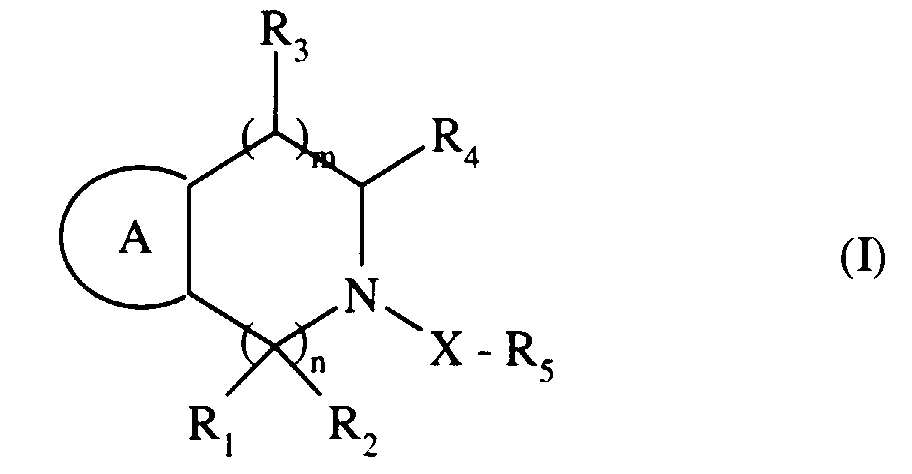
- m, n,
- identiques ou différents, représentent 0, 1 ou 2,
- R1, R2,
- identiques ou différents, représentent un atome d'hydrogène, un groupement alkyle (C1-C6) linéaire ou ramifié (éventuellement substitué par un groupement aryle), un groupement aryle, ou forment avec l'atome de carbone qui les porte un groupement carbonyle ou un groupement cycloalkyle (C3-C7),
- R3
- représente un atome d'hydrogène, un groupement alkyle (C1-C6) linéaire ou ramifié, hydroxy, alkoxy (C1-C6) linéaire ou ramifié ou un groupement aryle,
- R4
- représente l'un quelconque des groupements suivants :
- ■ -CO-NR6-OR'6
- ■ -CS-NR6-OR'6
- ■

R6 et R'6, identiques ou différents, représentent un atome d'hydrogène ou un groupement alkyle (C1-C6) linéaire ou ramifié, - ■ -CO2R7
- ■ -NH-CO-NH-OH
- ■ -NH-CH2-CO2R7
- ■

- ■

R7, R'7, identiques ou différents, représentent un atome d'hydrogène ou un groupement alkyle (C1-C6) linéaire ou ramifié (éventuellement substitué par un groupement aryle),
- X
- représente -SO2-, -CO- ou -SO2NH-,
- R5
- représente :
- un groupement alkyle (C1-C6) linéaire ou ramifié, éventuellement substitué par un ou plusieurs atomes d'halogène ou groupements hydroxy, alkoxy (C1-C6) linéaire ou ramifié, aryle ou -CO2R7 (dans lequel R7 a la même signification que précédemment),
- un groupement cycloalkyle (C3-C7),
- un groupement aryle,
- ou, un groupement hétérocyclique,
- A
- représente un cycle aryle (à la condition que ce cycle aryle soit différent d'un cycle phényle lorsque X représente SO2, m et n représentent simultanément le nombre 1, R4 représente -CO-NHOH, et R5 représente un groupement aryle ou un groupement hétérocyclique), ou un hétérocycle,
- m, n,
- identical or different, represent 0, 1 or 2,
- R 1 , R 2 ,
- identical or different, represent a hydrogen atom, a linear or branched (C 1 -C 6 ) alkyl group (optionally substituted by an aryl group), an aryl group, or form with the carbon atom which carries them a group carbonyl or a cycloalkyl group (C 3 -C 7 ),
- R 3
- represents a hydrogen atom, an alkyl group (C 1 -C 6) linear or branched, hydroxy, alkoxy (C 1 -C 6) linear or branched alkyl or aryl,
- R 4
- represents any of the following groupings:
- ■ -CO-NR 6 -OR ' 6
- ■ -CS-NR 6 -OR ' 6
- ■
R 6 and R ′ 6 , identical or different, represent a hydrogen atom or a linear or branched (C 1 -C 6 ) alkyl group, - ■ -CO 2 R 7
- ■ -NH-CO-NH-OH
- ■ -NH-CH 2 -CO 2 R 7
- ■
- ■
R 7 , R ' 7 , identical or different, represent a hydrogen atom or a linear or branched (C 1 -C 6 ) alkyl group (optionally substituted by an aryl group),
- X
- represents -SO 2 -, -CO- or -SO 2 NH-,
- R 5
- represented :
- a linear or branched (C 1 -C 6 ) alkyl group, optionally substituted by one or more halogen atoms or hydroxy, linear or branched (C 1 -C 6 ) alkoxy, aryl or -CO 2 R 7 groups (in which R 7 has the same meaning as above),
- a cycloalkyl group (C 3 -C 7 ),
- an aryl group,
- or, a heterocyclic group,
- AT
- represents an aryl ring (provided that this aryl ring is different from a phenyl ring when X represents SO 2 , m and n simultaneously represent the number 1, R 4 represents -CO-NHOH, and R 5 represents an aryl group or a heterocyclic group), or a heterocycle,
Parmi les acides pharmaceutiquement acceptables, on peut citer à titre non limitatif les acides chlorhydrique, bromhydrique, sulfurique, phosphonique, acétique, trifluoroacétique, lactique, pyruvique, malonique, succinique, glutarique, fumarique, tartrique, maléïque, citrique, ascorbique, oxalique, méthane sulfonique, camphorique, etc...Among the pharmaceutically acceptable acids, non-limiting mention may be made of hydrochloric, hydrobromic, sulfuric, phosphonic, acetic, trifluoroacetic, lactic, pyruvic, malonic, succinic, glutaric, fumaric, tartaric, maleic, citric acids. ascorbic, oxalic, methane sulfonic, camphoric, etc ...
Parmi les bases pharmaceutiquement acceptables, on peut citer à titre non limitatif l'hydroxyde de sodium, l'hydroxyde de potassium, la triéthylamine, la tertbutylamine, etc...Among the pharmaceutically acceptable bases, non-limiting mention may be made of sodium hydroxide, potassium hydroxide, triethylamine, tert-butylamine, etc.
Par groupement aryle, on entend phényle, naphtyle, tétrahydronaphtyle, chacun de ces groupements étant éventuellement substitué par un ou plusieurs atomes d'halogène ou groupement alkyle (C1-C6) linéaire ou ramifié, trihalogénoalkyle (C1-C6) linéaire ou ramifié, cycloalkyle (C3-C7), bicycloalkyle (C5-C10), phényle éventuellement substitué, pyridyle éventuellement substitué, pyrimidyle éventuellement substitué, alkoxy (C1-C6) linéaire ou ramifié (éventuellement substitué par un groupement amino, lui-même éventuellement substitué par un ou deux groupements alkyle), trihalogénoalkoxy (C1-C6) linéaire ou ramifié, hydroxy, cyano ou amino (substitué éventuellement par un ou plusieurs groupements alkyle (C1-C6) linéaire ou ramifié).The term “aryl group” is understood to mean phenyl, naphthyl, tetrahydronaphthyl, each of these groups being optionally substituted by one or more halogen atoms or linear or branched (C 1 -C 6 ) alkyl, linear (C 1 -C 6 ) trihaloalkyl group. or branched, cycloalkyl (C 3 -C 7 ), bicycloalkyl (C 5 -C 10 ), optionally substituted phenyl, optionally substituted pyridyl, optionally substituted pyrimidyl, linear or branched (C 1 -C 6 ) alkoxy (optionally substituted by a group) amino, itself optionally substituted by one or two alkyl groups), trihaloalkoxy (C 1 -C 6 ) linear or branched, hydroxy, cyano or amino (optionally substituted by one or more alkyl groups (C 1 -C 6 ) linear or branched).
Par hétérocycle, on entend un groupement mono ou bicyclique, saturé ou insaturé, de 5 à 16 chaînons contenant un, deux ou trois hétéroatomes choisis parmi oxygène, azote ou soufre, étant entendu que l'hétérocycle peut être éventuellement substitué par un ou plusieurs atomes d'halogène ou groupements alkyle (C1-C6) linéaire ou ramifié (éventuellement substitué par un groupement aryle), alkoxy (C1-C6) linéaire ou ramifié, hydroxy, trihalogénométhyle ou amino (substitué éventuellement par un ou plusieurs groupements alkyle (C1-C6) linéaire ou ramifié).By heterocycle is meant a mono or bicyclic group, saturated or unsaturated, of 5 to 16 members containing one, two or three heteroatoms chosen from oxygen, nitrogen or sulfur, it being understood that the heterocycle can be optionally substituted by one or more atoms of halogen or linear or branched (C 1 -C 6 ) alkyl groups (optionally substituted by an aryl group), linear or branched (C 1 -C 6 ) alkoxy, hydroxy, trihalomethyl or amino (optionally substituted by one or more groups linear or branched (C 1 -C 6 ) alkyl).
Les composés préférés selon l'invention sont ceux pour lesquels :
A représente un cycle aryle choisi parmi phényle ou naphtyle, substitués ou non, ou un hétérocycle choisi parmi les cycles thiophène, indole, furane, benzo[b]thiophène, imidazole, pyridine, benzofurane, pyrrole, quinoléine, substitués ou non.The preferred compounds according to the invention are those for which:
A represents an aryl ring chosen from phenyl or naphthyl, substituted or not, or a heterocycle chosen from the thiophene, indole, furan, benzo [b] thiophene, imidazole, pyridine, benzofuran, pyrrole, quinoline, substituted or unsubstituted rings.
Les composés préférés de l'invention sont ceux pour lesquels X représente SO2, m = 1, n = 1, R1, R2, R3 représentent simultanément un atome d'hydrogène.The preferred compounds of the invention are those for which X represents SO 2 , m = 1, n = 1, R 1 , R 2 , R 3 simultaneously represent a hydrogen atom.
Les substituants R4 préférés selon l'invention sont les groupements -CO-NR6-OR'6.The preferred substituents R 4 according to the invention are the groups -CO-NR 6 -OR ′ 6 .
Les substituants R5 préférés sont les groupements aryle ou les groupements hétérocycliques et plus préférentiellement les groupements phényles substitués ou non, naphtyles substitués ou non ou pyridyles substitués ou non.The preferred substituents R 5 are the aryl groups or the heterocyclic groups and more preferably the substituted or unsubstituted phenyl groups, substituted naphthyls or unsubstituted or substituted or unsubstituted pyridyls.
L'invention s'étend également au procédé de préparation des composés de formule (I), caractérisé en ce que l'on utilise comme produit de départ un acide de formule (II), sous forme racémique ou d'isomère défini :

R5 - X- Hal (III)
dans laquelle X et R5 ont la même signification que dans la formule (I) et Hal représente un atome d'halogène,
pour conduire au composé de formule (I/a), cas particulier des composés de formule (I) :

composé de formule (I/a):
- (a) dont on transforme, si on le souhaite, la fonction acide en fonction ester correspondante,
- (b) ou, que l'on met en réaction avec une hydroxylamine-O- substituée
pour conduire, après déprotection de la fonction hydroxylamine et substitution éventuelle de la fonction hydroxylamine, au composé de formule (I/b), cas particulier des composés de formule (I) :
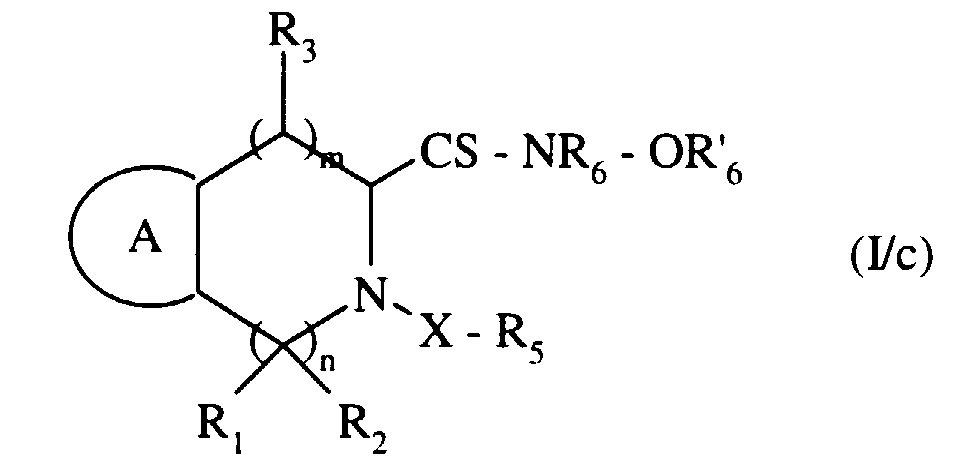
- composé de formule (I/b) que l'on soumet, si on le désire, à l'action du réactif de Lawesson dans l'orthoxylène,
pour conduire au composé de formule (I/c), cas particulier des composés de formule (I) :
- composé de formule (I/c), que l'on soumet, si on le souhaite, à l'action de l'ammoniaque, pour conduire au composé de formule (I/d), cas particulier des composés de formule (I) :

- composé de formule (I/b) que l'on soumet, si on le désire, à l'action du réactif de Lawesson dans l'orthoxylène,
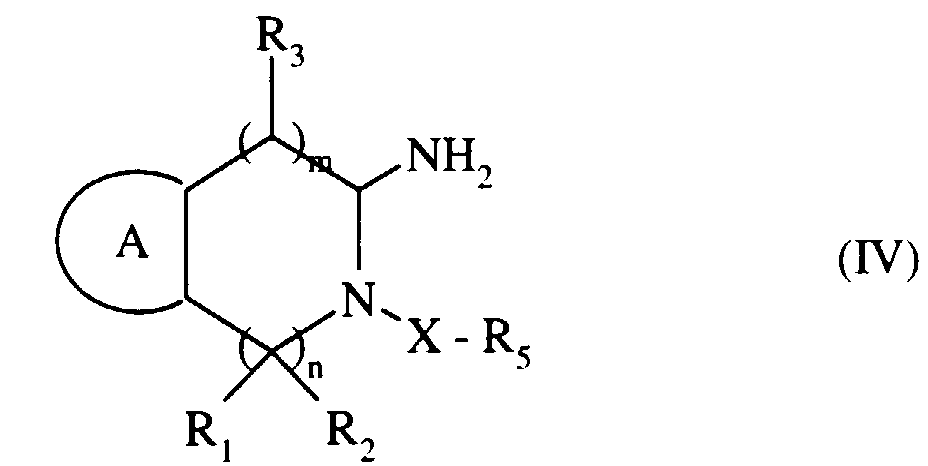
- (c) que l'on transforme en amine primaire de formule (IV) :

- soit avec le carbonyldiimidazole et une hydroxylamine protégée,
pour conduire au composé de formule (I/e), cas particulier des composés de formule (I) :
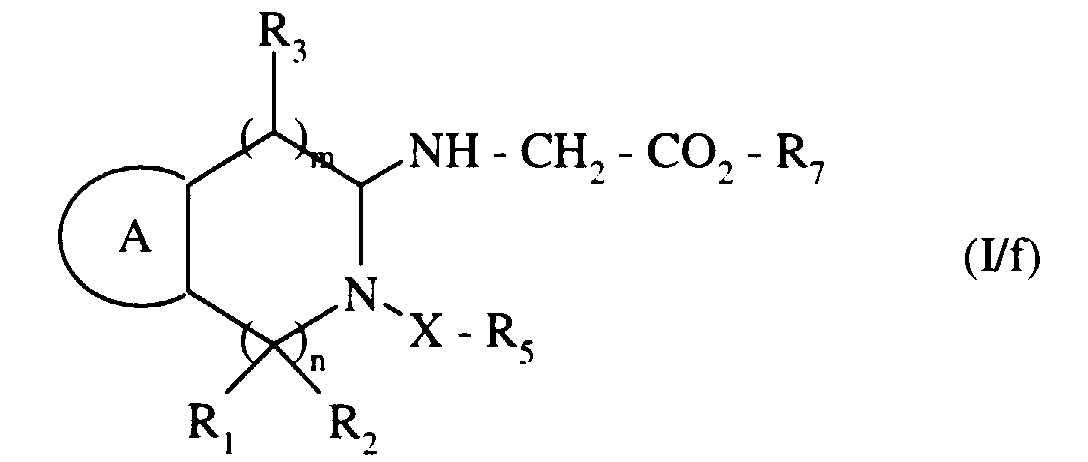
- soit avec un bromoacétate, pour conduire au composé de formule (I/f), cas particulier des composés de formule (I) :
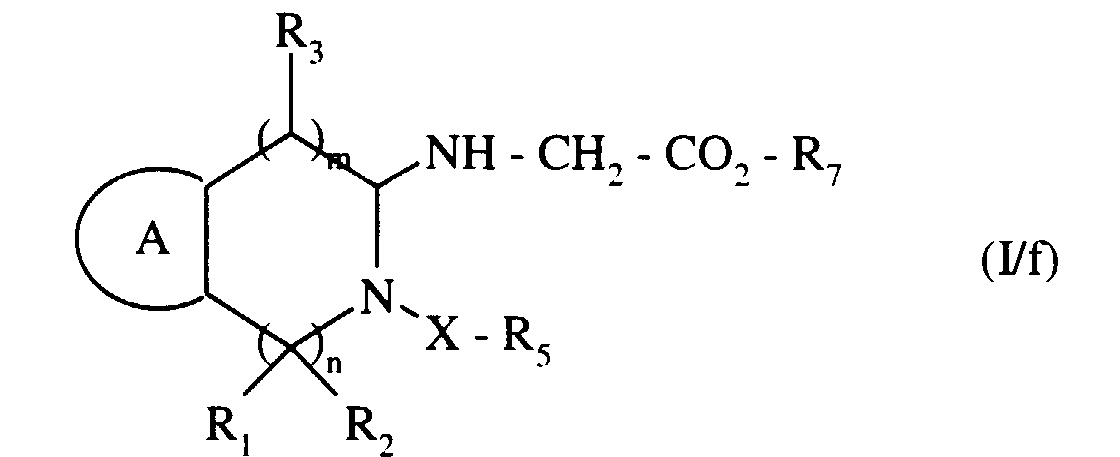
- soit avec le carbonyldiimidazole et une hydroxylamine protégée,
- (d) dont on réduit l'acide en forme alcool correspondante, puis que l'on transforme en dérivé bromé par action de PBr3 dans l'éther,
pour conduire au composé de formule (V) :
- soit avec un malonate d'alkyle,
pour conduire, après saponification éventuelle, au composé de formule (I/g) :
- soit avec une glycine protégée,
pour conduire, après déprotection éventuelle, au composé de formule (I/h) :
- soit avec un malonate d'alkyle,
R 5 - X- Hal (III)
in which X and R 5 have the same meaning as in formula (I) and Hal represents a halogen atom,
to lead to the compound of formula (I / a), special case of the compounds of formula (I):
compound of formula (I / a):
- (a) whose acid function, if desired, is transformed into a corresponding ester function,
- (b) or, which is reacted with a substituted hydroxylamine-O-
to lead, after deprotection of the hydroxylamine function and possible substitution of the hydroxylamine function, to the compound of formula (I / b), special case of the compounds of formula (I):- compound of formula (I / b) which is subjected, if desired, to the action of the Lawesson reagent in orthoxylene,
to lead to the compound of formula (I / c), special case of the compounds of formula (I): - compound of formula (I / c), which is subjected, if desired, to the action of ammonia, to lead to the compound of formula (I / d), special case of the compounds of formula (I) :
- compound of formula (I / b) which is subjected, if desired, to the action of the Lawesson reagent in orthoxylene,
- (c) which is transformed into a primary amine of formula (IV):
- either with carbonyldiimidazole and a protected hydroxylamine,
to lead to the compound of formula (I / e), special case of the compounds of formula (I): - either with a bromoacetate, to yield the compound of formula (I / f), special case of the compounds of formula (I):
- either with carbonyldiimidazole and a protected hydroxylamine,
- (d) the acid of which is reduced to the corresponding alcohol form, and which is then converted into a brominated derivative by the action of PBr 3 in ether,
to lead to the compound of formula (V):- either with an alkyl malonate,
to lead, after optional saponification, to the compound of formula (I / g): - either with a protected wisteria,
to lead, after possible deprotection, to the compound of formula (I / h):
- either with an alkyl malonate,
Les composés de formule (II) sont, soit des composés commerciaux, soit obtenus, lorsque n = 1, par cyclisation d'un acide aminé libre de formule (VI) :

L'invention s'étend aussi aux compositions pharmaceutiques renfermant comme principe actif au moins un composé de formule (I) avec un ou plusieurs excipients inertes, non toxiques et appropriés. Parmi les compositions pharmaceutiques selon l'invention, on pourra citer plus particulièrement celles qui conviennent pour l'administration orale, parentérale (intraveineuse ou sous-cutanée), nasale, les comprimés simples ou dragéifiés, les comprimés sublinguaux, les gélules, les tablettes, les suppositoires, les crèmes, les pommades, les gels dermiques, les préparations injectables, les suspensions buvables, etc...The invention also extends to pharmaceutical compositions containing as active principle at least one compound of formula (I) with one or more inert, non-toxic and suitable excipients. Among the pharmaceutical compositions according to the invention, mention may be made more particularly of those which are suitable for oral, parenteral (intravenous or subcutaneous), nasal administration, simple or coated tablets, sublingual tablets, capsules, tablets, suppositories, creams, ointments, dermal gels, injections, oral suspensions, etc.
La posologie utile est adaptable selon la nature et la sévérité de l'affection, la voie d'administration ainsi que selon l'âge et le poids du patient. Cette posologie varie de 0,01 à 2 g par jour en une ou plusieurs prises.The useful dosage is adaptable according to the nature and severity of the disease, the route of administration as well as according to the age and weight of the patient. This dosage varies from 0.01 to 2 g per day in one or more doses.
Les exemples suivants illustrent l'invention mais ne la limitent en aucune façon.The following examples illustrate the invention but do not limit it in any way.
Les produits de départ utilisés sont des produits connus ou préparés selon des modes opératoires connus.The starting materials used are known products or prepared according to known procedures.
Les préparations conduisent à des intermédiaires de synthèse, utiles pour la préparation des composés de l'invention.The preparations lead to synthesis intermediates, useful for the preparation of the compounds of the invention.
Les structures des composés décrits dans les exemples et les préparations ont été déterminées selon les techniques spectrophotométriques usuelles (infrarouge, RMN, spectrométrie de masse, ...).The structures of the compounds described in the examples and the preparations were determined according to the usual spectrophotometric techniques (infrared, NMR, mass spectrometry, etc.).

Un mélange contenant 87 mmoles de β-2-thiényl-D-alanine, 11 ml de formaldéhyde à 40 % en milieu aqueux, et 88 ml d'acide chlorhydrique 1N est chauffé 2 h 30 à 110°C sous agitation, puis à 60°C pendant une nuit. Après évaporation, le résidu est repris à l'éthanol puis évaporé et le produit attendu est récupéré sous forme solide dans de l'éther diéthylique.
Point de fusion : 260°C
Microanalyse élémentaire :
Melting point : 260 ° C
Elementary microanalysis :

Le produit attendu est synthétisé selon le procédé décrit par L. TILSTRA et coll., (J. Am. Chem. Soc., 112, 9176-9182, 1990) à partir de (D)-tryptophane.The expected product is synthesized according to the method described by L. TILSTRA et al., (J. Am. Chem. Soc., 112, 9176-9182, 1990) from (D) -tryptophan.

Le produit attendu est obtenu selon le procédé décrit dans la préparation A à partir de β-3-benzo[b]thiényl-D-alanine
Point de fusion : > 260°C The expected product is obtained according to the process described in preparation A from β-3-benzo [b] thienyl-D-alanine
Melting point : > 260 ° C

Le produit attendu est obtenu selon le procédé décrit dans la préparation A à partir de β-2-naphtyl-D-alanine en utilisant de l'acide chlorhydrique concentré au lieu de l'acide chlorhydrique 1N.
Point de fusion : > 260°C The expected product is obtained according to the process described in preparation A from β-2-naphthyl-D-alanine using concentrated hydrochloric acid instead of 1N hydrochloric acid.
Melting point :> 260 ° C

Le produit attendu est obtenu selon le procédé décrit dans la préparation A à partir de β-1-naphtyl-D-alanine en utilisant de l'acide chlorhydrique concentré au lieu de l'acide chlorhydrique 1N.
Point de fusion : 174°CThe expected product is obtained according to the process described in preparation A from β-1-naphthyl-D-alanine using concentrated hydrochloric acid instead of 1N hydrochloric acid.
Melting point : 174 ° C
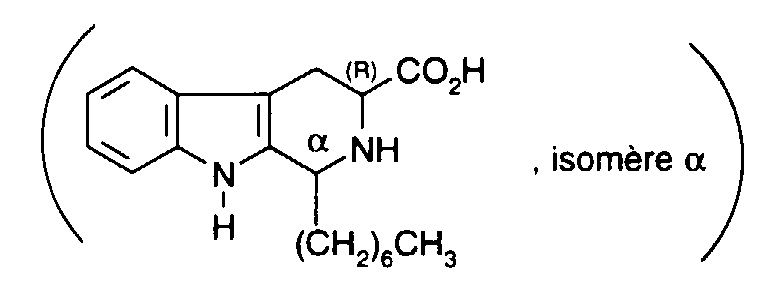

Un mélange contenant 147 mmoles de D-tryptophane, 294 ml d'acide sulfurique 1N, 300 ml d'éthanol et 294 mmoles d'octanal est agité à 45°C pendant 72 heures. La solution est concentrée et le résidu est repris par un mélange eau/méthanol/ammoniaque. Le méthanol est évaporé à 45°C et le précipité est filtré, lavé à l'eau et séché. Le solide obtenu est solubilisé à chaud dans du méthanol. Après refroidissement, le composé de la préparation F cristallise. II est alors filtré et séché.
Préparation F: Point de fusion : 206°C
Le jus de filtration est alors concentré à 45°C et le résidu obtenu est purifié par chromatographie sur gel de silice en utilisant comme éluant un mélange dichlorométhane/méthanol/acide acétique (90/10/1). On obtient alors le composé de la préparation G.
Préparation G : Point de fusion : 170°C A mixture containing 147 mmol of D-tryptophan, 294 ml of 1N sulfuric acid, 300 ml of ethanol and 294 mmol of octanal is stirred at 45 ° C for 72 hours. The solution is concentrated and the residue is taken up in a water / methanol / ammonia mixture. The methanol is evaporated at 45 ° C and the precipitate is filtered, washed with water and dried. The solid obtained is dissolved hot in methanol. After cooling, the compound of preparation F crystallizes. It is then filtered and dried.
Preparation F: Melting point : 206 ° C
The filtration juice is then concentrated at 45 ° C. and the residue obtained is purified by chromatography on silica gel using a dichloromethane / methanol / acetic acid mixture (90/10/1) as eluent. The compound of preparation G is then obtained.
Preparation G: Melting point : 170 ° C
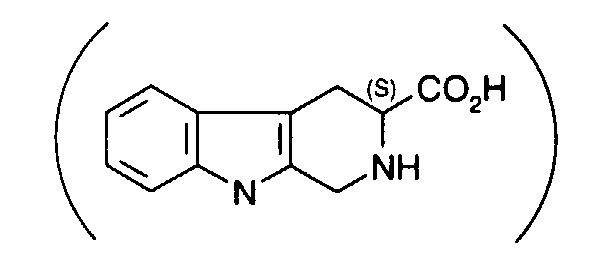
Le produit attendu est synthétisé selon le procédé décrit dans la préparation B à partir de (L)-tryptophane.The expected product is synthesized according to the process described in preparation B from (L) -tryptophan.

Le produit attendu est synthétisé selon le procédé décrit dans la préparation A à partir de (D)-(Nπ-méthyl)histidine.The expected product is synthesized according to the process described in preparation A from (D) - (N π -methyl) histidine.
Le produit attendu est obtenu selon le procédé décrit dans la préparation A à partir du (D)-(Nτ-méthyl)histidine.The expected product is obtained according to the process described in preparation A from (D) - (N τ -methyl) histidine.

Le produit attendu est préparé selon le procédé décrit dans la préparation A à partir de β-3-thiénylalanine synthétisé selon la méthode décrite par M.S. Allen (Synth. Comm., 22 (14), 2077-2102, 1992).The expected product is prepared according to the method described in preparation A from β-3-thienylalanine synthesized according to the method described by M.S. Allen (Synth. Comm., 22 (14), 2077-2102, 1992).

Le produit attendu est préparé selon le procédé décrit dans la préparation A à partir de β-3-furoalanine synthétisé selon la méthode décrite par M.S. Allen (Synth. Comm., 22 (14), 2077-2102, 1992).The expected product is prepared according to the method described in preparation A from β-3-furoalanine synthesized according to the method described by M.S. Allen (Synth. Comm., 22 (14), 2077-2102, 1992).
Un mélange contenant 36 mmoles du composé décrit dans la préparation A, 54 mmoles de triéthylamine, 43 mmoles de chlorure de l'acide 4-méthoxybenzène sulfonique dans 100 ml de dioxane et 80 ml d'eau, est agité une nuit à 20°C. Le mélange est alors versé dans 500 ml d'eau glacée et 500 ml d'acide chlorhydrique 4N. Après 15 minutes d'agitation, le précipité est filtré, rincé à l'eau, séché et conduit au produit attendu.
Point de fusion : 110°C A mixture containing 36 mmol of the compound described in Preparation A, 54 mmol of triethylamine, 43 mmol of 4-methoxybenzene sulfonic acid chloride in 100 ml of dioxane and 80 ml of water, is stirred overnight at 20 ° C. . The mixture is then poured into 500 ml of ice water and 500 ml of 4N hydrochloric acid. After 15 minutes of stirring, the precipitate is filtered, rinsed with water, dried and leads to the expected product.
Melting point : 110 ° C
10 mmoles du composé obtenu au stade précédent, 30 mmoles de chlorhydrate de 0-allylhydroxylamine, 17 ml de diisopropyléthylamine, 10 mmoles d'hydroxybenzotriazole et 12 mmoles de 0-(Benzotriazol-1-yl)-N,N,N',N'-tétraméthyluronium tétrafluoroborate (TBTU) sont agités 5 heures à 20°C. Le mélange est alors lavé à l'eau, à l'acide chlorhydrique puis par une solution aqueuse saturée d'hydrogénocarbonate de sodium. Après séchage puis évaporation, le résidu est repris puis purifié par chromatographie sur gel de silice en utilisant comme éluant un mélange dichlorométhane/acétate d'éthyle (95/5 puis 70/30). Après séchage et évaporation, on obtient le produit attendu.10 mmol of the compound obtained in the preceding stage, 30 mmol of 0-allylhydroxylamine hydrochloride, 17 ml of diisopropylethylamine, 10 mmol of hydroxybenzotriazole and 12 mmol of 0- (Benzotriazol-1-yl) -N, N, N ', N '-tetramethyluronium tetrafluoroborate (TBTU) are stirred for 5 hours at 20 ° C. The mixture is then washed with water, hydrochloric acid and then with a saturated aqueous solution of sodium hydrogencarbonate. After drying and then evaporation, the residue is taken up and then purified by chromatography on silica gel using a dichloromethane / ethyl acetate mixture (95/5 then 70/30) as eluent. After drying and evaporation, the expected product is obtained.
3,9 mmoles du composé obtenu au stade précédent, 140 mg de (Ph3P)2PdCl2, 0,7 ml d'acide acétique dans 50 ml de dichlorométhane sont agités 10 minutes à 20°C. 2,2 ml d'hydrure de tributylétain sont alors ajoutés et l'ensemble est maintenu 15 minutes sous agitation à 20°C. Le milieu réactionnel est alors lavé à l'eau puis le solvant est évaporé. Le résidu est repris au dichlorométhane. La phase organique est lavée à l'acide chlorhydrique 1N puis par une solution saturée d'hydrogénocarbonate de sodium. Après séchage et évaporation, le résidu est purifié par chromatographie sur gel de silice en utilisant comme éluant un mélange dichlorométhane/méthanol (95/5). On obtient alors le produit attendu.
Microanalyse élémentaire :
Elementary microanalysis :
Le produit attendu est obtenu selon le procédé décrit au stade A de l'exemple 1 en utilisant comme produit de départ le composé décrit dans la préparation B.
Point fe fusion : 154°C The expected product is obtained according to the method described in stage A of Example 1 using as starting material the compound described in preparation B.
Melting point : 154 ° C
Le produit attendu est obtenu selon le procédé décrit au stade B de l'exemple 1 à partir du composé décrit au stade précédent.The expected product is obtained according to the method described in Stage B of Example 1 from the compound described in the preceding stage.
Le produit attendu est obtenu selon le procédé décrit au stade C de l'exemple 1 en utilisant le composé décrit au stade précédent.
Point de fusion : 122°C
Microanalyse élémentaire :
Melting point : 122 ° C
Elementary microanalysis :
Le produit attendu est obtenu selon le procédé décrit dans l'exemple 1 en utilisant au stade A le produit décrit dans la préparation C.The expected product is obtained according to the process described in Example 1, using in Stage A the product described in Preparation C.
Point de fusion : ≈ 118°C Melting point : ≈ 118 ° C
Spectre de masse : FAB [M+Na Mass spectrum : FAB [M + Na
++
] = 441] = 441
Le produit attendu est obtenu selon le procédé décrit dans l'exemple 1 en utilisant au stade A le produit décrit dans la préparation D.The expected product is obtained according to the process described in Example 1 using in Stage A the product described in Preparation D.
Le produit attendu est obtenu selon le procédé décrit dans l'exemple 1 en utilisant au stade A le produit décrit dans la préparation F.The expected product is obtained according to the process described in Example 1, using in Stage A the product described in Preparation F.
Le produit attendu est obtenu selon le procédé décrit dans l'exemple 1 en utilisant au stade A le produit décrit dans la préparation G.The expected product is obtained according to the process described in Example 1 using in stage A the product described in preparation G.
Le produit attendu est obtenu selon le procédé décrit dans l'exemple 1 en utilisant au stade A le produit décrit dans la préparation H.The expected product is obtained according to the process described in Example 1, using in Stage A the product described in Preparation H.
A ce stade, l'O-allylhydroxylamine a été remplacé par l'O-benzylhydroxylamine.At this stage, O-allylhydroxylamine has been replaced by O-benzylhydroxylamine.
Le produit attendu est obtenu selon le procédé décrit dans l'exemple 1 en utilisant au stade A l'acide indoline-(2R)-carboxylique.The expected product is obtained according to the process described in Example 1, using in stage A indoline- (2R) -carboxylic acid.
A ce stade, l'O-allylhydroxylamine a été remplacé par l'O-benzylhydroxylamine.At this stage, O-allylhydroxylamine has been replaced by O-benzylhydroxylamine.
A ce stade, la déprotection est réalisée dans du méthanol, à pression atmosphérique en utilisant Pd(OH)2 comme catalyseur.
Microanalyse élémentaire :
Elementary microanalysis :
Le produit attendu est obtenu selon le procédé décrit au stade A de l'exemple 1 à partir d'acide 1,2,3,4-tétrahydroisoquinoléine-(3R)-carboxylique et du chlorure de l'acide (4-méthoxy)benzoïque.
Point de fusion : 198°C The expected product is obtained according to the process described in Stage A of Example 1 from 1,2,3,4-tetrahydroisoquinoline- (3R) -carboxylic acid and (4-methoxy) benzoic acid chloride .
Melting point : 198 ° C
Le produit attendu est obtenu selon le procédé décrit au stade B de l'exemple 1 à partir du composé décrit au stade précédent et de l'O-benzylhydroxylamine.The expected product is obtained according to the method described in Stage B of Example 1 from the compound described in the preceding stage and O-benzylhydroxylamine.
Le produit attendu est obtenu selon le procédé décrit au stade C de l'exemple 1 à partir du composé décrit au stade précédent.
Microanalyse élémentaire :
Elementary microanalysis :
Le produit attendu est obtenu selon le procédé décrit dans l'exemple 1 en utilisant au stade A le produit décrit dans la préparation 1.The expected product is obtained according to the process described in Example 1, using in Stage A the product described in Preparation 1.
Microanalyse élémentaire :Elementary microanalysis:
Le produit attendu est obtenu selon le procédé décrit dans l'exemple 1 en utilisant au stade A le produit décrit dans la préparation J.The expected product is obtained according to the process described in Example 1, using in Stage A the product described in Preparation J.
Microanalyse élémentaire :Elementary microanalysis:
Le produit attendu est obtenu selon le procédé décrit dans l'exemple 10 en utilisant au stade A le chlorure de l'acide 3-phénylpropylsulfonique.The expected product is obtained according to the process described in Example 10, using in stage A 3-phenylpropylsulfonic acid chloride.
Microanalyse élémentaire : Elementary microanalysis :
Le produit attendu est obtenu selon le procédé décrit dans l'exemple 10 en utilisant au stade A le chlorure de l'acide 4-méthoxybenzèneaminosulfonique.The expected product is obtained according to the process described in Example 10, using in stage A the chloride of 4-methoxybenzeneaminosulfonic acid.
Microanalyse élémentaire :Elementary microanalysis:
Le produit attendu est obtenu selon le procédé décrit dans l'exemple 1 à partir du composé décrit dans la préparation K.
Microanalyse élémentaire :
Elementary microanalysis :
Le produit attendu est obtenu selon le procédé décrit dans l'exemple 1, à partir du composé décrit dans la préparation K et du chlorure de l'acide 4-trifluorométhoxybenzènesulfonique.
Point de fusion : 136-138°C
Microanalyse élémentaire :
Melting point : 136-138 ° C
Elementary microanalysis :
Le produit attendu est obtenu selon le procédé décrit dans l'exemple 1 à partir du composé décrit dans la préparation A et du chlorure de l'acide 4-phénylbenzènesulfonique.
Microanalyse élémentaire :
Elementary microanalysis :
Le produit attendu est obtenu selon le procédé décrit dans l'exemple 1 à partir du composé décrit dans la préparation A et du chlorure de l'acide 4-trifluorométhoxybenzènesulfonique.
Spectre de masse : FAB + : [M+H] + : m/z = 423 The expected product is obtained according to the process described in Example 1 from the compound described in Preparation A and 4-trifluoromethoxybenzenesulfonic acid chloride.
Mass spectrum : FAB + : [M + H] + : m / z = 423
Le produit attendu est obtenu selon le procédé décrit dans l'exemple 1 à partir du composé décrit dans la préparation A et du chlorure de l'acide 2-naphtalènesulfonique.
Spectre de masse : FAB + : [M+H]+: m/z = 389 The expected product is obtained according to the process described in Example 1 from the compound described in Preparation A and 2-naphthalenesulfonic acid chloride.
Mass spectrum : FAB + : [M + H] +: m / z = 389
Le produit attendu est obtenu en faisant réagir le composé décrit au stade A de l'exemple 3 avec la N-méthoxyamine en présence du réactif du couplage DCC-HOBT.
Point de fusion : 202°C
Microanalyse élémentaire :
Melting point : 202 ° C
Elementary microanalysis :
Le produit attendu est obtenu en faisant réagir le composé décrit au stade A de l'exemple 3 avec la (N-méthyl)hydroxylamine en présence du réactif de couplage DCC-HOBT.
Point de fusion : 224°C
Microanalyse élémentaire :
Melting point : 224 ° C
Elementary microanalysis :
Le produit attendu est obtenu en faisant réagir le composé décrit au stade A de l'exemple 3 avec la N-méthoxy-N-méthylamine en présence du réactif de couplage HOBT-TBTU.
Microanalyse élémentaire :
Elementary microanalysis :
Le produit attendu est obtenu selon le procédé décrit dans l'exemple 1 à partir de la Spinacine et transformé en chlorhydrate correspondant.
Microanalyse élémentaire :
Elementary microanalysis :
Le produit attendu est obtenu selon le procédé décrit dans l'exemple 1 à partir de l'acide 9-méthyl- 1,2,3,4-tétrahydro-β-carboline-(3R)-carboxylique.
Point de fusion : 214°C
Microanalyse élémentaire :
Melting point : 214 ° C
Elementary microanalysis :
Le produit attendu est obtenu selon le procédé décrit dans l'exemple 1 à partir de l'acide 9-benzyl-1,2,3,4-tétrahydro-β-carboline-(3R)-carboxylique.
Microanalyse élémentaire :
Elementary microanalysis :
Le produit attendu est obtenu selon le procédé décrit dans l'exemple 1 à partir de l'acide 9-benzyl-1,2,3,4-tétrahydro-β-carboline-(3R)-carboxylique et du chlorure de l'acide 4-phénylbenzènesulfonique.
Spectre de masse : FAB + : [M+H] + : m/z = 538 The expected product is obtained according to the process described in Example 1 from 9-benzyl-1,2,3,4-tetrahydro-β-carboline- (3R) -carboxylic acid and the acid chloride 4-phenylbenzenesulfonic.
Mass spectrum : FAB + : [M + H] + : m / z = 538
Le produit attendu est obtenu selon le procédé décrit dans l'exemple 1 à partir de l'acide 9-benzyl- 1,2,3,4-tétrahydro-β-carboline-(3R)-carboxylique et du chlorure de l'acide 4-pentylbenzènesulfonique.
Point de fusion : 94°C
Microanalyse élémentaire :
Melting point : 94 ° C
Elementary microanalysis :
Le produit attendu est obtenu selon le procédé décrit dans l'exemple 1 à partir du composé décrit dans la préparation L.
Point de fusion : 149°C
Microanalyse élémentaire :
Melting point : 149 ° C
Elementary microanalysis :
Le produit attendu est obtenu selon le procédé décrit au stade A de l'exemple 1 à partir de l'acide 1,2,3,4-tétrahydroisoquinoléine-(3R)-carboxylique et du chlorure de l'acide 4-méthoxybenzènesulfonique.The expected product is obtained according to the process described in Stage A of Example 1 from 1,2,3,4-tetrahydroisoquinoline- (3R) -carboxylic acid and chloride of 4-methoxybenzenesulfonic acid.
Le produit attendu est obtenu en faisant réagir le composé décrit au stade précédent avec du chloroformiate d'éthyle en milieu tétrahydrofurane/triéthylamine puis avec de l'ammoniaque.The expected product is obtained by reacting the compound described in the preceding stage with ethyl chloroformate in a tetrahydrofuran / triethylamine medium and then with ammonia.
Le produit attendu est obtenu en faisant réagir le composé décrit au stade précédent dans de la pyridine en présence de POCl3.The expected product is obtained by reacting the compound described in the preceding stage in pyridine in the presence of POCl 3 .
Le produit attendu est obtenu en faisant réagir le composé décrit au stade précédent avec de l'hydroxylamine.
Microanalyse élémentaire :
Elementary microanalysis :
Le produit attendu est obtenu selon le procédé décrit dans l'exemple 21 à partir du composé décrit au stade A de l'exemple 1.
Microanalyse élémentaire :
Elementary microanalysis :
Le produit attendu est obtenu selon le procédé décrit dans l'exemple 1 à partir d'acide 7-hydroxy-4,5,6,7-tétrahydrothiéno [3,2-c]pyridine-(6R)-carboxylique.The expected product is obtained according to the process described in Example 1 from 7-hydroxy-4,5,6,7-tetrahydrothieno acid [3,2-c] pyridine- (6R) -carboxylic.
Le produit attendu est obtenu selon le procédé décrit dans l'exemple 1 à partir de l'acide 1-méthyl-4,5,6,7-tétrahydropyrrolo[3,2-c]pyridine-(6R)-carboxylique.The expected product is obtained according to the process described in Example 1 from 1-methyl-4,5,6,7-tetrahydropyrrolo [3,2-c] pyridine- (6R) -carboxylic acid.
Le produit attendu est obtenu selon le procédé décrit dans l'exemple 1 à partir de l'acide 4,5,6,7-tétrahydropyrrolo[2,3-c]-pyridine(5R)-carboxylique.The expected product is obtained according to the process described in Example 1 from 4,5,6,7-tetrahydropyrrolo [2,3-c] -pyridine (5R) -carboxylic acid.
Le produit attendu est obtenu selon le procédé décrit dans l'exemple 1 à partir de l'acide 5,6,7,8-tétrahydropyrido[3,2-c]pyridine-(7R)-carboxylique.The expected product is obtained according to the process described in Example 1 from 5,6,7,8-tetrahydropyrido [3,2-c] pyridine- (7R) -carboxylic acid.
Le produit attendu est obtenu selon le procédé décrit dans l'exemple 1 à partir de l'acide 5,6,7,8-tétrahydropyrido[2,3-c]pyridine-(7R)-carboxylique.The expected product is obtained according to the process described in Example 1 from 5,6,7,8-tetrahydropyrido [2,3-c] pyridine- (7R) -carboxylic acid.
Le produit attendu est obtenu selon le procédé décrit dans l'exemple 1 à partir de Spinacine et du chlorure de l'acide 4-trifluorométhoxyphénylsulfonique.The expected product is obtained according to the process described in Example 1 from Spinacin and 4-trifluoromethoxyphenylsulfonic acid chloride.
Le produit attendu est obtenu selon le procédé décrit dans l'exemple 1 à partir de Spinacine et du chlorure de l'acide 4-phénylbenzènesulfonique.The expected product is obtained according to the process described in Example 1 from Spinacin and 4-phenylbenzenesulfonic acid chloride.
Le produit attendu est obtenu selon le procédé décrit dans l'exemple 1 à partir du composé décrit dans la préparation L.The expected product is obtained according to the process described in Example 1 from the compound described in Preparation L.
Le produit attendu est obtenu selon le procédé décrit dans l'exemple 1 à partir du composé décrit dans la préparation L.The expected product is obtained according to the process described in Example 1 from the compound described in Preparation L.
Le produit attendu est obtenu selon le procédé décrit dans l'exemple 1 à partir du composé décrit dans la préparation L.The expected product is obtained according to the process described in Example 1 from the compound described in Preparation L.
Le produit attendu est obtenu selon le procédé décrit dans l'exemple 1 à partir du composé décrit dans la préparation L.The expected product is obtained according to the process described in Example 1 from the compound described in Preparation L.
Le produit attendu est obtenu selon le procédé décrit dans l'exemple 1 à partir du composé décrit dans la préparation L.The expected product is obtained according to the process described in Example 1 from the compound described in Preparation L.
Le produit attendu est obtenu selon le procédé décrit dans l'exemple 1 à partir du composé décrit dans la préparation L.The expected product is obtained according to the process described in Example 1 from the compound described in Preparation L.
Le produit attendu est obtenu selon le procédé décrit dans l'exemple 1 à partir du composé décrit dans la préparation L.The expected product is obtained according to the process described in Example 1 from the compound described in Preparation L.
Le produit attendu est obtenu selon le procédé décrit dans l'exemple 1 à partir du composé décrit dans la préparation L.The expected product is obtained according to the process described in Example 1 from the compound described in Preparation L.
Le produit attendu est obtenu selon le procédé décrit dans l'exemple 1 à partir de la Spinacine.The expected product is obtained according to the method described in Example 1 from Spinacin.
Le produit attendu est obtenu selon le procédé décrit dans l'exemple 1 à partir de la Spinacine.The expected product is obtained according to the method described in Example 1 from Spinacin.
Le produit attendu est obtenu selon le procédé décrit dans l'exemple 1 à partir de la Spinacine.The expected product is obtained according to the method described in Example 1 from Spinacin.
Le produit attendu est obtenu selon le procédé décrit dans l'exemple 1 à partir de la Spinacine.The expected product is obtained according to the method described in Example 1 from Spinacin.
Les quatre enzymes humaines recombinantes MMP-1 (collagénase interstitielle), MMP-2 (gélatinase A de 72kda), MMP-3 (stromélysine 1) et MMP-9 (gélatinase B de 92kda) sont activées à l'AMPA (4-aminophénylmercuric acétate).
Les tests enzymatiques sont effectués avec un substrat peptido-mimétique :
Les réactions conduites dans un tampon 50 mM Tris, 200 mM NaCl, 5 mM CaCl2, 0,1 % Brij 35 à pH 7.7 sont initiées avec 20 µM de substrat dans un volume total de 100 µl à 37°C.
La fluorescence obtenue après six heures est lue en plaque 96-puits dans un fluorimètre équipé avec une combinaison de filtres de 340 nm et 440 nm pour l'excitation et l'émission.
Lors de ce test, la plupart des composés de l'invention ont présenté des IC50 comprises entre 10 et 500 nM pour l'enzyme MMP-1, entre 0,01 et 50 nM pour les enzymes MMP-2, MMP-3 et MMP-9.The four recombinant human enzymes MMP-1 (interstitial collagenase), MMP-2 (gelatinase A of 72kda), MMP-3 (stromelysin 1) and MMP-9 (gelatinase B of 92kda) are activated at AMPA (4-aminophenylmercuric acetate).
The enzymatic tests are carried out with a peptido-mimetic substrate:
The reactions carried out in a 50 mM Tris buffer, 200 mM NaCl, 5 mM CaCl 2 , 0.1% Brij 35 at pH 7.7 are initiated with 20 μM of substrate in a total volume of 100 μl at 37 ° C.
The fluorescence obtained after six hours is read in a 96-well plate in a fluorimeter equipped with a combination of 340 nm and 440 nm filters for excitation and emission.
During this test, most of the compounds of the invention exhibited IC 50 values of between 10 and 500 nM for the enzyme MMP-1, between 0.01 and 50 nM for the enzymes MMP-2, MMP-3 and MMP-9.
Les composés de l'invention ont été étudiés sur un modèle de destruction de la matrice cartilagineuse induite par l'IL-1β. Les essais réalisés sur cartilage de cobaye concernent :
- d'une part la dégradation du collagène : dosage colorimétrique selon la technique de Grant (GRANT R.A. Estimation of OH-proline by the autoanalyser, J. Clin. Path. 1964, 17, 685) de la fraction d'OH-proline relarguée par le tissu mis en contact pendant 3 jours avec l'IL-1β (10 mg/ml) et du plasminogène (30 µg/ml),
- d'autre part la dégradation des protéoglycanes : mesure radio-isotopique de la fraction de glycosaminoglycanes relargés par le tissu au cours des 3 jours de contact avec l'IL-1β (10 mg/ml), le cartilage ayant été préalablement marqué au 3SSO4.
- on the one hand the degradation of collagen: colorimetric assay according to the Grant technique (GRANT RA Estimation of OH-proline by the autoanalyser, J. Clin. Path. 1964, 17, 685) of the fraction of OH-proline released by the tissue brought into contact for 3 days with IL-1β (10 mg / ml) and plasminogen (30 μg / ml),
- secondly, the degradation of proteoglycans: radioisotopic measurement of the fraction of glycosaminoglycans released by the tissue during the 3 days of contact with IL-1β (10 mg / ml), the cartilage having been previously marked with 3S SO 4 .
Les composés de l'invention ont été étudiés par adjonction au milieu de cultures pendant les 3 jours de l'essai. Pour des concentrations comprises entre 10-7 et 10-4M, ils se sont fortement opposés à la dégradation du collagène et des protéoglycanes. A titre d'exemple, les activités excercées par certains composés de l'invention sont les suivantes :
Des tronçons d'aorte thoracique de rats mâles Fischer 344 âgés de 8 à 12 semaines sont immergés dans un gel de collagène de type I selon la méthode de Nicosia et Ottinetti (1990). Après cinq jours de culture en milieu sans sérum, les préparations sont examinées au microscope et la formation de pseudo-vaisseaux quantifiée en terme de densité vasculaire après digitalisation et analyse d'image.
A titre d'exemple, lors de ce test, à 100 nM, le composé de l'exemple 1 a conduit à 87 % d'inhibition et le composé de l'exemple 28 à 85 % d'inhibition.Chest aorta sections of 8 to 12 week old male Fischer 344 rats are immersed in a type I collagen gel according to the method of Nicosia and Ottinetti (1990). After five days of culture in a serum-free medium, the preparations are examined under a microscope and the formation of pseudo-vessels quantified in terms of vascular density after digitalization and image analysis.
By way of example, during this test, at 100 nM, the compound of example 1 led to 87% inhibition and the compound of example 28 to 85% inhibition.
Les tests d'invasion sont réalisés selon la procédure suivante : des cellules murines de carcinome de Lewis (LLC) sont déposées sur la face supérieure d'un filtre Transwell recouvert d'une matrice extracellulaire artificielle et cultivées en milieu avec sérum pendant 24 h. Les cellules sont ensuite mises en présence du colorant vital 3-[4,5-diméthylthiazol-2-yl]-2,5-diphényltétrazolium bromide et éliminées de la face supérieure du filtre. Les cristaux de Formazan présents sous le filtre sont solubilisés dans un mélange concentré de sodium dodécyl sulphate et de diméthylformamide. L'absorption à 540 mm du mélange coloré correspondant est alors utilisée pour quantifier indirectement l'invasion cellulaire.The invasion tests are carried out according to the following procedure: murine Lewis carcinoma (LLC) cells are deposited on the upper face of a Transwell filter covered with an artificial extracellular matrix and cultured in medium with serum for 24 h. The cells are then placed in the presence of the vital dye 3- [4,5-dimethylthiazol-2-yl] -2,5-diphenyltetrazolium bromide and eliminated from the upper face of the filter. The Formazan crystals present under the filter are dissolved in a concentrated mixture of sodium dodecyl sulphate and dimethylformamide. The absorption at 540 mm of the corresponding colored mixture is then used to indirectly quantify the cell invasion.
A titre d'exemple, lors de ce test, à 1 µM, le composé de l'exemple 1 a conduit à 45 % d'inhibition et le composé de l'exemple 28 à 44 % d'inhibition.By way of example, during this test, at 1 μM, the compound of example 1 led to 45% inhibition and the compound of example 28 to 44% inhibition.
Formule de préparation pour 1000 comprimés dosés à 10 mg :
Claims (15)

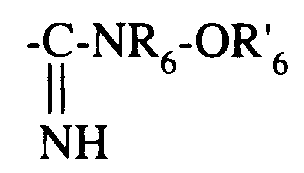
R6 et R'6, identiques ou différents, représentent un atome d'hydrogène ou un groupement alkyle (C1-C6) linéaire ou ramifié,


R7, R'7, identiques ou différents, représentent un atome d'hydrogène ou un groupement alkyle (C1-C6) linéaire ou ramifié (éventuellement substitué par un groupement aryle),
R 6 and R ′ 6 , identical or different, represent a hydrogen atom or a linear or branched (C 1 -C 6 ) alkyl group,
R 7 , R ' 7 , identical or different, represent a hydrogen atom or a linear or branched (C 1 -C 6 ) alkyl group (optionally substituted by an aryl group),

R5 - X- Hal (III)
dans laquelle X et R5 ont la même signification que dans la formule (I) et Hal représente un atome d'halogène,
pour conduire au composé de formule (I/a), cas particulier des composés de formule (I) :

composé de formule (I/a):
pour conduire, après déprotection de la fonction hydroxylamine et substitution éventuelle de la fonction hydroxylamine, au composé de formule (I/b), cas particulier des composés de formule (I) :

pour conduire au composé de formule (I/c), cas particulier des composés de formule (I) :
pour conduire au composé de formule (I/d), cas particulier des composés de formule (I) :

pour conduire au composé de formule (I/e), cas particulier des composés de formule (I) :

pour conduire au composé de formule (V):

pour conduire, après saponification éventuelle, au composé de formule (I/g) :

pour conduire, après déprotection éventuelle, au composé de formule (I/h) :
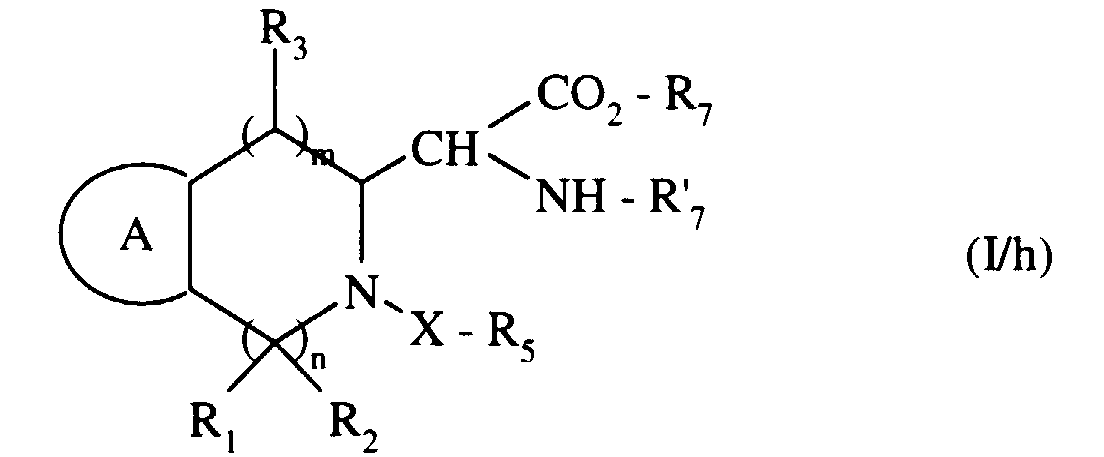
R 5 - X- Hal (III)
in which X and R 5 have the same meaning as in formula (I) and Hal represents a halogen atom,
to lead to the compound of formula (I / a), special case of the compounds of formula (I):
compound of formula (I / a):
to lead, after deprotection of the hydroxylamine function and possible substitution of the hydroxylamine function, to the compound of formula (I / b), special case of the compounds of formula (I):
to lead to the compound of formula (I / c), special case of the compounds of formula (I):
to lead to the compound of formula (I / d), special case of the compounds of formula (I):
to lead to the compound of formula (I / e), special case of the compounds of formula (I):
to lead to the compound of formula (V):
to lead, after optional saponification, to the compound of formula (I / g):
to lead, after possible deprotection, to the compound of formula (I / h):
Applications Claiming Priority (2)
| Application Number | Priority Date | Filing Date | Title |
|---|---|---|---|
| FR9605321 | 1996-04-26 | ||
| FR9605321A FR2748026B1 (en) | 1996-04-26 | 1996-04-26 | NOVEL METALLOPROTEASE INHIBITORS, PROCESS FOR THEIR PREPARATION AND THE PHARMACEUTICAL COMPOSITIONS CONTAINING THEM |
Publications (1)
| Publication Number | Publication Date |
|---|---|
| EP0803505A1 true EP0803505A1 (en) | 1997-10-29 |
Family
ID=9491643
Family Applications (1)
| Application Number | Title | Priority Date | Filing Date |
|---|---|---|---|
| EP97400913A Withdrawn EP0803505A1 (en) | 1996-04-26 | 1997-04-23 | Inhibitors of metalloproteases, process for their preparation and pharmaceutical compositions containing them |
Country Status (12)
| Country | Link |
|---|---|
| US (1) | US5866587A (en) |
| EP (1) | EP0803505A1 (en) |
| JP (1) | JPH1059936A (en) |
| CN (1) | CN1165817A (en) |
| AU (1) | AU713680B2 (en) |
| CA (1) | CA2203618C (en) |
| FR (1) | FR2748026B1 (en) |
| HU (1) | HUP9700811A3 (en) |
| NO (1) | NO971862L (en) |
| NZ (1) | NZ314679A (en) |
| PL (1) | PL319684A1 (en) |
| ZA (1) | ZA973647B (en) |
Cited By (22)
| Publication number | Priority date | Publication date | Assignee | Title |
|---|---|---|---|---|
| GB2321641A (en) * | 1997-01-23 | 1998-08-05 | Hoffmann La Roche | Amino-sulphonamides as Metalloprotease inhibitors |
| WO1998047877A1 (en) * | 1997-04-22 | 1998-10-29 | Glaxo Group Limited | 2-benzoyl-1,2,3,4-tetrahydroisoquinoline-3-carboxamide derivatives and their use as inhibitors of hepatic production of apob-100 |
| WO1999006410A1 (en) * | 1997-08-04 | 1999-02-11 | Amgen Inc. | Hydroxamic acid substituted fused heterocyclic metalloproteinase inhibitors |
| WO1999018076A1 (en) * | 1997-10-06 | 1999-04-15 | American Cyanamid Company | The preparation and use of ortho-sulfonamido bicyclic heteroaryl hydroxamic acids as matrix metalloproteinase and tace inhibitors |
| EP0916671A1 (en) * | 1997-11-14 | 1999-05-19 | Adir Et Compagnie | Metalloprotease inhibitors, process for their preparation and pharmaceutical compositions containing them |
| WO1999032451A1 (en) * | 1997-12-19 | 1999-07-01 | Amgen Inc. | Azepine or larger medium ring derivatives and their use as pharmaceuticals |
| EP1065209A1 (en) * | 1999-07-01 | 2001-01-03 | Adir Et Compagnie | Metalloprotease inhibitors, process for their preparation and pharmaceutical compositions containing them |
| US6200996B1 (en) | 1999-01-27 | 2001-03-13 | American Cyanamid Company | Heteroaryl acetylenic sulfonamide and phosphinic acid amide hydroxamic acid tace inhibitors |
| US6225311B1 (en) | 1999-01-27 | 2001-05-01 | American Cyanamid Company | Acetylenic α-amino acid-based sulfonamide hydroxamic acid tace inhibitors |
| US6277885B1 (en) | 1999-01-27 | 2001-08-21 | American Cyanamid Company | Acetylenic aryl sulfonamide and phosphinic acid amide hydroxamic acid TACE inhibitors |
| US6291450B1 (en) | 1997-12-19 | 2001-09-18 | Amgen Inc. | Carboxylic acid substituted heterocycles, derivatives thereof and methods of use |
| US6313123B1 (en) | 1999-01-27 | 2001-11-06 | American Cyanamid Company | Acetylenic sulfonamide thiol tace inhibitors |
| WO2001085721A1 (en) * | 2000-05-11 | 2001-11-15 | Smithkline Beecham P.L.C. | N-sulfonyl hydroxamic acid derivatives as inhibitors of cd 23 |
| US6326516B1 (en) | 1999-01-27 | 2001-12-04 | American Cyanamid Company | Acetylenic β-sulfonamido and phosphinic acid amide hydroxamic acid TACE inhibitors |
| US6340691B1 (en) | 1999-01-27 | 2002-01-22 | American Cyanamid Company | Alkynyl containing hydroxamic acid compounds as matrix metalloproteinase and tace inhibitors |
| US6358980B1 (en) | 1999-01-27 | 2002-03-19 | American Cyanamid Company | Alkynyl containing hydroxamic acid compounds as matrix metalloproteinase/tace inhibitors |
| US6753337B2 (en) | 1999-01-27 | 2004-06-22 | Wyeth Holdings Corporation | Alkynyl containing hydroxamic acid compounds as matrix metalloproteinase/tace inhibitors |
| US6762178B2 (en) | 1999-01-27 | 2004-07-13 | Wyeth Holdings Corporation | Acetylenic aryl sulfonamide and phosphinic acid amide hydroxamic acid TACE inhibitors |
| US6946473B2 (en) | 1999-01-27 | 2005-09-20 | Wyeth Holdings Corporation | Preparation and use of acetylenic ortho-sulfonamido and phosphinic acid amido bicyclic heteroaryl hydroxamic acids as TACE inhibitors |
| WO2006077013A1 (en) | 2005-01-19 | 2006-07-27 | Sanofi-Aventis | Tetrahydrofurane derivatives for use as inhibitors of matrix metalloproteinases |
| US7199155B2 (en) | 2002-12-23 | 2007-04-03 | Wyeth Holdings Corporation | Acetylenic aryl sulfonate hydroxamic acid TACE and matrix metalloproteinase inhibitors |
| US7282496B2 (en) | 2001-11-01 | 2007-10-16 | Wyeth Holdings Corporation | Allenic aryl sulfonamide hydroxamic acids as matrix metalloproteinase and TACE inhibitors |
Families Citing this family (17)
| Publication number | Priority date | Publication date | Assignee | Title |
|---|---|---|---|---|
| UA74826C2 (en) | 2000-05-17 | 2006-02-15 | Ortho Mcneil Pharm Inc | ?-carboline derivatives as phosphodiesterase inhibitors |
| FR2818643B1 (en) * | 2000-12-22 | 2003-02-07 | Servier Lab | NOVEL METALLOPROTEASE INHIBITORS, PROCESS FOR THEIR PREPARATION AND THE PHARMACEUTICAL COMPOSITIONS CONTAINING THEM |
| AU2002324716A1 (en) * | 2001-08-17 | 2003-03-03 | Bristol-Myers Squibb Company Patent Department | Bicyclic hydroxamates as inhibitors of matrix metalloproteinases and/or tnf-$g(a) converting enzyme (tace) |
| DE60236605D1 (en) * | 2001-09-05 | 2010-07-15 | Minerva Biotechnologies Corp | COMPOSITIONS AND ITS USE FOR THE TREATMENT OF CANCER |
| CA2459584A1 (en) * | 2001-09-05 | 2003-03-13 | Cynthia C. Bamdad | Compositions and use thereof in the treatment of cancer |
| DE102004004974A1 (en) * | 2004-01-31 | 2005-08-18 | Aventis Pharma Deutschland Gmbh | Thieno-imino acid derivatives as inhibitors of matrix metalloproteinases |
| EP1737461B1 (en) * | 2004-03-15 | 2012-12-12 | PTC Therapeutics, Inc. | Carboline derivatives useful in the inhibition of angiogenesis |
| US7767689B2 (en) | 2004-03-15 | 2010-08-03 | Ptc Therapeutics, Inc. | Carboline derivatives useful in the treatment of cancer |
| AU2005263762C1 (en) * | 2004-07-21 | 2012-03-01 | Merck Serono Sa | Octahydropyrrolo[2, 3, c]pyridine derivatives and pharmaceutical use thereof |
| EP2225250A2 (en) * | 2007-11-30 | 2010-09-08 | Biota Scientific Management Pty Ltd | Bicyclic ppat inhibitors as antibacterial agents |
| EP2318361B1 (en) | 2008-07-14 | 2015-09-23 | Novartis AG | Selective hydroxamic acid based mmp-12 and mmp-13 inhibitors |
| CA3184380A1 (en) | 2009-05-27 | 2010-12-02 | Ptc Therapeutics, Inc. | Methods for treating cancer and non-neoplastic conditions |
| WO2010138652A1 (en) | 2009-05-27 | 2010-12-02 | Ptc Therapeutics, Inc. | Methods for treating kaposi sarcoma |
| US8703726B2 (en) | 2009-05-27 | 2014-04-22 | Ptc Therapeutics, Inc. | Methods for treating prostate conditions |
| CN107849042B (en) | 2015-07-31 | 2021-04-13 | 默克专利股份公司 | Bicyclic Heterocycle Derivatives |
| WO2019028171A1 (en) | 2017-08-01 | 2019-02-07 | Ptc Therapeutics, Inc. | Dhodh inhibitor for use in treating hematologic cancers |
| WO2019080882A1 (en) * | 2017-10-25 | 2019-05-02 | 成都先导药物开发有限公司 | HDAC INHIBITOR, PREPARATION METHOD AND USE THEREOF |
Citations (5)
| Publication number | Priority date | Publication date | Assignee | Title |
|---|---|---|---|---|
| FR2554446A1 (en) * | 1983-11-04 | 1985-05-10 | Adir | Azabicycloalkane-derived diamides, their preparation and pharmaceutical compositions containing them |
| FR2681864A1 (en) * | 1991-09-27 | 1993-04-02 | Adir | New nitrogenous bicyclic derivatives, process for their preparation and the pharmaceutical compositions which contain them |
| EP0606046A1 (en) * | 1993-01-06 | 1994-07-13 | Ciba-Geigy Ag | Arylsulfonamido-substituted hydroxamic acids |
| EP0618193A1 (en) * | 1993-03-24 | 1994-10-05 | Adir Et Compagnie | Nitrogen containing bicyclic derivatives as prolyl-endopeptidase inhibitors |
| WO1995035275A1 (en) * | 1994-06-22 | 1995-12-28 | British Biotech Pharmaceuticals Limited | Metalloproteinase inhibitors |
Family Cites Families (3)
| Publication number | Priority date | Publication date | Assignee | Title |
|---|---|---|---|---|
| GB1576511A (en) * | 1977-03-29 | 1980-10-08 | Parcor | Thieno(2,3 - c) and (3,2 - c) pyridines process for their preparation and therapeutic applications thereof |
| US5552419A (en) * | 1993-01-06 | 1996-09-03 | Ciba-Geigy Corporation | Arylsulfonamido-substituted hydroxamic acids |
| EP0861236B2 (en) * | 1995-11-13 | 2006-08-16 | Sanofi-Aventis Deutschland GmbH | Cyclic and heterocyclic n-substituted alpha-iminohydroxamic and carboxylic acids |
-
1996
- 1996-04-26 FR FR9605321A patent/FR2748026B1/en not_active Expired - Fee Related
-
1997
- 1997-04-23 EP EP97400913A patent/EP0803505A1/en not_active Withdrawn
- 1997-04-23 NO NO971862A patent/NO971862L/en not_active Application Discontinuation
- 1997-04-24 AU AU19121/97A patent/AU713680B2/en not_active Ceased
- 1997-04-24 CA CA002203618A patent/CA2203618C/en not_active Expired - Fee Related
- 1997-04-24 NZ NZ314679A patent/NZ314679A/en unknown
- 1997-04-25 JP JP9108954A patent/JPH1059936A/en active Pending
- 1997-04-25 CN CN97109728A patent/CN1165817A/en active Pending
- 1997-04-25 HU HU9700811A patent/HUP9700811A3/en unknown
- 1997-04-25 PL PL97319684A patent/PL319684A1/en unknown
- 1997-04-25 US US08/842,982 patent/US5866587A/en not_active Expired - Fee Related
- 1997-04-25 ZA ZA9703647A patent/ZA973647B/en unknown
Patent Citations (5)
| Publication number | Priority date | Publication date | Assignee | Title |
|---|---|---|---|---|
| FR2554446A1 (en) * | 1983-11-04 | 1985-05-10 | Adir | Azabicycloalkane-derived diamides, their preparation and pharmaceutical compositions containing them |
| FR2681864A1 (en) * | 1991-09-27 | 1993-04-02 | Adir | New nitrogenous bicyclic derivatives, process for their preparation and the pharmaceutical compositions which contain them |
| EP0606046A1 (en) * | 1993-01-06 | 1994-07-13 | Ciba-Geigy Ag | Arylsulfonamido-substituted hydroxamic acids |
| EP0618193A1 (en) * | 1993-03-24 | 1994-10-05 | Adir Et Compagnie | Nitrogen containing bicyclic derivatives as prolyl-endopeptidase inhibitors |
| WO1995035275A1 (en) * | 1994-06-22 | 1995-12-28 | British Biotech Pharmaceuticals Limited | Metalloproteinase inhibitors |
Cited By (35)
| Publication number | Priority date | Publication date | Assignee | Title |
|---|---|---|---|---|
| GB2321641A (en) * | 1997-01-23 | 1998-08-05 | Hoffmann La Roche | Amino-sulphonamides as Metalloprotease inhibitors |
| GB2321641B (en) * | 1997-01-23 | 2001-04-04 | Hoffmann La Roche | Sulfamide-metalloprotease inhibitors |
| WO1998047877A1 (en) * | 1997-04-22 | 1998-10-29 | Glaxo Group Limited | 2-benzoyl-1,2,3,4-tetrahydroisoquinoline-3-carboxamide derivatives and their use as inhibitors of hepatic production of apob-100 |
| WO1999006410A1 (en) * | 1997-08-04 | 1999-02-11 | Amgen Inc. | Hydroxamic acid substituted fused heterocyclic metalloproteinase inhibitors |
| WO1999018076A1 (en) * | 1997-10-06 | 1999-04-15 | American Cyanamid Company | The preparation and use of ortho-sulfonamido bicyclic heteroaryl hydroxamic acids as matrix metalloproteinase and tace inhibitors |
| EP0916671A1 (en) * | 1997-11-14 | 1999-05-19 | Adir Et Compagnie | Metalloprotease inhibitors, process for their preparation and pharmaceutical compositions containing them |
| FR2771095A1 (en) * | 1997-11-14 | 1999-05-21 | Adir | NOVEL METALLOPROTEASE INHIBITORS, PROCESS FOR THEIR PREPARATION AND THE PHARMACEUTICAL COMPOSITIONS CONTAINING THEM |
| AU740313B2 (en) * | 1997-11-14 | 2001-11-01 | Les Laboratoires Servier | New metalloproteinase inhibitors, a process for their preparation and pharmaceutical compositions containing them |
| WO1999032451A1 (en) * | 1997-12-19 | 1999-07-01 | Amgen Inc. | Azepine or larger medium ring derivatives and their use as pharmaceuticals |
| US6838454B2 (en) | 1997-12-19 | 2005-01-04 | Amgen Inc. | Carboxylic acid substituted heterocycles, derivatives thereof and methods of use |
| US7022690B2 (en) | 1997-12-19 | 2006-04-04 | Amgen Inc. | Carboxylic acid substituted heterocycles, derivatives thereof and methods of use |
| US6107291A (en) * | 1997-12-19 | 2000-08-22 | Amgen Inc. | Azepine or larger medium ring derivatives and methods of use |
| US6593351B2 (en) | 1997-12-19 | 2003-07-15 | Amgen Inc. | Carboxylic acid substituted heterocycles, derivatives thereof and methods of use |
| US6335329B1 (en) | 1997-12-19 | 2002-01-01 | Amgen Inc. | Carboxylic acid substituted heterocycles, derivatives thereof and methods of use |
| US6291450B1 (en) | 1997-12-19 | 2001-09-18 | Amgen Inc. | Carboxylic acid substituted heterocycles, derivatives thereof and methods of use |
| US6753337B2 (en) | 1999-01-27 | 2004-06-22 | Wyeth Holdings Corporation | Alkynyl containing hydroxamic acid compounds as matrix metalloproteinase/tace inhibitors |
| US6200996B1 (en) | 1999-01-27 | 2001-03-13 | American Cyanamid Company | Heteroaryl acetylenic sulfonamide and phosphinic acid amide hydroxamic acid tace inhibitors |
| US6946473B2 (en) | 1999-01-27 | 2005-09-20 | Wyeth Holdings Corporation | Preparation and use of acetylenic ortho-sulfonamido and phosphinic acid amido bicyclic heteroaryl hydroxamic acids as TACE inhibitors |
| US6326516B1 (en) | 1999-01-27 | 2001-12-04 | American Cyanamid Company | Acetylenic β-sulfonamido and phosphinic acid amide hydroxamic acid TACE inhibitors |
| US6277885B1 (en) | 1999-01-27 | 2001-08-21 | American Cyanamid Company | Acetylenic aryl sulfonamide and phosphinic acid amide hydroxamic acid TACE inhibitors |
| US6340691B1 (en) | 1999-01-27 | 2002-01-22 | American Cyanamid Company | Alkynyl containing hydroxamic acid compounds as matrix metalloproteinase and tace inhibitors |
| US6358980B1 (en) | 1999-01-27 | 2002-03-19 | American Cyanamid Company | Alkynyl containing hydroxamic acid compounds as matrix metalloproteinase/tace inhibitors |
| US6225311B1 (en) | 1999-01-27 | 2001-05-01 | American Cyanamid Company | Acetylenic α-amino acid-based sulfonamide hydroxamic acid tace inhibitors |
| US6716833B2 (en) | 1999-01-27 | 2004-04-06 | Wyeth Holdings Corporation | Acetylenic α-amino acid-based sulfonamide hydroxamic acid tace inhibitors |
| US6313123B1 (en) | 1999-01-27 | 2001-11-06 | American Cyanamid Company | Acetylenic sulfonamide thiol tace inhibitors |
| US6762178B2 (en) | 1999-01-27 | 2004-07-13 | Wyeth Holdings Corporation | Acetylenic aryl sulfonamide and phosphinic acid amide hydroxamic acid TACE inhibitors |
| US6812227B2 (en) | 1999-01-27 | 2004-11-02 | Wyeth Holdings Corporation | Acetylenic α-amino acid-based sulfonamide hydroxamic acid tace inhibitors |
| US6825354B2 (en) | 1999-01-27 | 2004-11-30 | Wyeth Holdings Corporation | Alkynyl containing hydroxamic acid compounds as matrix metalloproteinase and TACE inhibitors |
| FR2795730A1 (en) * | 1999-07-01 | 2001-01-05 | Adir | NOVEL METALLOPROTEASE INHIBITORS, PROCESS FOR THEIR PREPARATION AND PHARMACEUTICAL COMPOSITIONS CONTAINING THEM |
| EP1065209A1 (en) * | 1999-07-01 | 2001-01-03 | Adir Et Compagnie | Metalloprotease inhibitors, process for their preparation and pharmaceutical compositions containing them |
| WO2001085721A1 (en) * | 2000-05-11 | 2001-11-15 | Smithkline Beecham P.L.C. | N-sulfonyl hydroxamic acid derivatives as inhibitors of cd 23 |
| US7282496B2 (en) | 2001-11-01 | 2007-10-16 | Wyeth Holdings Corporation | Allenic aryl sulfonamide hydroxamic acids as matrix metalloproteinase and TACE inhibitors |
| US7199155B2 (en) | 2002-12-23 | 2007-04-03 | Wyeth Holdings Corporation | Acetylenic aryl sulfonate hydroxamic acid TACE and matrix metalloproteinase inhibitors |
| US7485667B2 (en) | 2002-12-23 | 2009-02-03 | Wyeth Holdings Corporation | Acetylenic aryl sulfonate hydroxamic acid tace and matrix metalloproteinase inhibitors |
| WO2006077013A1 (en) | 2005-01-19 | 2006-07-27 | Sanofi-Aventis | Tetrahydrofurane derivatives for use as inhibitors of matrix metalloproteinases |
Also Published As
| Publication number | Publication date |
|---|---|
| AU713680B2 (en) | 1999-12-09 |
| CA2203618A1 (en) | 1997-10-26 |
| NO971862L (en) | 1997-10-27 |
| JPH1059936A (en) | 1998-03-03 |
| AU1912197A (en) | 1997-10-30 |
| HU9700811D0 (en) | 1997-06-30 |
| FR2748026B1 (en) | 1998-06-05 |
| CA2203618C (en) | 2002-05-28 |
| US5866587A (en) | 1999-02-02 |
| CN1165817A (en) | 1997-11-26 |
| FR2748026A1 (en) | 1997-10-31 |
| ZA973647B (en) | 1997-11-19 |
| NO971862D0 (en) | 1997-04-23 |
| PL319684A1 (en) | 1997-10-27 |
| HUP9700811A2 (en) | 1998-10-28 |
| NZ314679A (en) | 1998-12-23 |
| HUP9700811A3 (en) | 1999-08-30 |
Similar Documents
| Publication | Publication Date | Title |
|---|---|---|
| EP0803505A1 (en) | Inhibitors of metalloproteases, process for their preparation and pharmaceutical compositions containing them | |
| US5861404A (en) | 2,9-disubstituted purin-6-ones | |
| EP1560826B1 (en) | Pyridopyrimidinone compounds, method for production thereof and medicaments comprising the same | |
| WO1995032190A2 (en) | Pharmaceutical diketopiperazine compounds | |
| EP0955299A1 (en) | Benzothiophene, benzofurane and indole derivatives, process for their preparation and pharmaceutical compositions containing them | |
| EP0421861A1 (en) | 2-Hydroxy thiophene- and furan derivatives condensed with a nitrogen containing ring, process for their preparation and their therapeutical application | |
| EP0839149B9 (en) | Galanthamine derivatives, preparation method therefor, use thereof as drugs, and pharmaceutical compositions containing such derivatives | |
| EP1217002B1 (en) | 2-(4-pyridinyl)-benzofurans as metalloprotease inhibitors | |
| EP0820990A2 (en) | Novel benzimidazole, benzoxazole, and benzothiazole derivatives useful as interleukin 1beta inhibitors | |
| JP4733648B2 (en) | Thieno-imino acid derivatives for use as matrix metalloproteinase inhibitors | |
| FR2758329A1 (en) | New imidazole-4-butane-boronic acid derivatives | |
| EP0916671B1 (en) | Metalloprotease inhibitors, process for their preparation and pharmaceutical compositions containing them | |
| EP1065209B1 (en) | Metalloprotease inhibitors, process for their preparation and pharmaceutical compositions containing them | |
| EP1069132B1 (en) | Bicyclic derivatives of amino-pyrazinones, process of preparation and pharmaceutical compositions comprising them | |
| JP4861179B2 (en) | Bicyclic imino acid derivatives used as inhibitors of matrix metalloproteinases | |
| FR2711992A1 (en) | New heterocyclic derivatives, process of preparation and pharmaceutical composition containing them | |
| EP1593682B1 (en) | Derivatives of 4-oxo-4,6,7,8-tetrahydropyrrolo¬1,2-a pyrazine-6-carboxamides, process for their preparation and pharmaceutical compositions thereof | |
| EP1091937A1 (en) | Carboxylic and hydroxamic acid compounds inhibiting metalloproteases, method for preparing same and pharmaceutical compositions containing them | |
| EP1256583B1 (en) | Pyrimidine-4-one derivatives, process for their preparation and pharmaceutical compositions containing them | |
| FR2639944A1 (en) | NOVEL INDOLE DERIVATIVES, PROCESS FOR PREPARING THEM AND PHARMACEUTICAL COMPOSITIONS CONTAINING SAME | |
| JP2002161036A (en) | Phosphodiesterase inhibitors |
Legal Events
| Date | Code | Title | Description |
|---|---|---|---|
| PUAI | Public reference made under article 153(3) epc to a published international application that has entered the european phase |
Free format text: ORIGINAL CODE: 0009012 |
|
| 17P | Request for examination filed |
Effective date: 19970428 |
|
| AK | Designated contracting states |
Kind code of ref document: A1 Designated state(s): AT BE CH DE DK ES FI FR GB GR IE IT LI LU NL PT SE |
|
| 17Q | First examination report despatched |
Effective date: 20011004 |
|
| RAP1 | Party data changed (applicant data changed or rights of an application transferred) |
Owner name: LES LABORATOIRES SERVIER |
|
| GRAH | Despatch of communication of intention to grant a patent |
Free format text: ORIGINAL CODE: EPIDOS IGRA |
|
| STAA | Information on the status of an ep patent application or granted ep patent |
Free format text: STATUS: THE APPLICATION IS DEEMED TO BE WITHDRAWN |
|
| 18D | Application deemed to be withdrawn |
Effective date: 20030621 |