EP0801327A1 - Positive resist composition - Google Patents
Positive resist composition Download PDFInfo
- Publication number
- EP0801327A1 EP0801327A1 EP95904030A EP95904030A EP0801327A1 EP 0801327 A1 EP0801327 A1 EP 0801327A1 EP 95904030 A EP95904030 A EP 95904030A EP 95904030 A EP95904030 A EP 95904030A EP 0801327 A1 EP0801327 A1 EP 0801327A1
- Authority
- EP
- European Patent Office
- Prior art keywords
- positive resist
- independently
- resist composition
- same
- different
- Prior art date
- Legal status (The legal status is an assumption and is not a legal conclusion. Google has not performed a legal analysis and makes no representation as to the accuracy of the status listed.)
- Granted
Links
Classifications
-
- G—PHYSICS
- G03—PHOTOGRAPHY; CINEMATOGRAPHY; ANALOGOUS TECHNIQUES USING WAVES OTHER THAN OPTICAL WAVES; ELECTROGRAPHY; HOLOGRAPHY
- G03F—PHOTOMECHANICAL PRODUCTION OF TEXTURED OR PATTERNED SURFACES, e.g. FOR PRINTING, FOR PROCESSING OF SEMICONDUCTOR DEVICES; MATERIALS THEREFOR; ORIGINALS THEREFOR; APPARATUS SPECIALLY ADAPTED THEREFOR
- G03F7/00—Photomechanical, e.g. photolithographic, production of textured or patterned surfaces, e.g. printing surfaces; Materials therefor, e.g. comprising photoresists; Apparatus specially adapted therefor
- G03F7/004—Photosensitive materials
- G03F7/022—Quinonediazides
- G03F7/0226—Quinonediazides characterised by the non-macromolecular additives
-
- G—PHYSICS
- G03—PHOTOGRAPHY; CINEMATOGRAPHY; ANALOGOUS TECHNIQUES USING WAVES OTHER THAN OPTICAL WAVES; ELECTROGRAPHY; HOLOGRAPHY
- G03F—PHOTOMECHANICAL PRODUCTION OF TEXTURED OR PATTERNED SURFACES, e.g. FOR PRINTING, FOR PROCESSING OF SEMICONDUCTOR DEVICES; MATERIALS THEREFOR; ORIGINALS THEREFOR; APPARATUS SPECIALLY ADAPTED THEREFOR
- G03F7/00—Photomechanical, e.g. photolithographic, production of textured or patterned surfaces, e.g. printing surfaces; Materials therefor, e.g. comprising photoresists; Apparatus specially adapted therefor
- G03F7/004—Photosensitive materials
- G03F7/022—Quinonediazides
Definitions
- the present invention relates to a positive resist composition, and more particularly to a positive resist composition suitable for use in minute processing required for the fabrication of semiconductor devices, magnetic bubble memory devices, integrated circuits and the like.
- a solution containing a photosensitive material (a resist composition) is applied to a substrate and dried to form a photosensitive film, and the film is then exposed to active rays to form a latent image.
- the latent image is then developed to form a negative or positive image.
- a silicon wafer is used as a substrate to form an image (pattern) thereon by the above-described lithography technique. After etching the silicon wafer by using, as a protective film, the resist remaining on the substrate, the remaining resist film is removed.
- the solubility of an exposed part of a photosensitive film formed from the resist in a developer increases compared with that of an unexposed part to give a positive image.
- the solubility of an exposed part of a photosensitive film formed from it decreases to give a negative image.
- a negative resist composed of cyclized polyisoprene and a bisdiazide compound has heretofore been known as a resist composition for the fabrication of semiconductor devices.
- this negative resist involves a drawback that it cannot be accommodated to the fabrication of semiconductors integrated to a high degree because the resist is developed with an organic solvent, so that it swells to a significant extent and there is hence a limit to its resolution.
- a negative resist comprising poly(glycidyl methacrylate) has high sensitivity, but is poor in resolution and resistance to dry etching.
- positive resist compositions are believed that they can be satisfactorily accommodated to the integration of semiconductors to a high degree because they are excellent in resolution in contrast with the negative resist compositions.
- Positive resist compositions composed of an alkali-soluble resin such as a novolak resin, and a quinonediazide compound are in common use in this field at present. These positive resist compositions can be developed with an aqueous solution of an alkali and have excellent resolution. Further, the resolution of such a positive resist composition has been enhanced by improvement in its own performance and the development of a higher-performance aligner, so that formation of a minute pattern having a line width of 1 ⁇ m or smaller has come to be feasible.
- a photosensitive material comprising in combination (a) an alkali-soluble phenol resin, (b) a quinonediazide sulfonate of a specific polyhydroxy compound as a photosensitive agent and (c) an aromatic compound having at least one phenolic hydroxyl group.
- the photosensitive material according to the present invention i.e., a positive resist composition
- a positive resist composition is excellent in balance among various properties such as sensitivity, film loss after development, resolution and pattern profile and is also good in exposure margin, thermal-flow resistance, storage stability and resistance to dry etching.
- the present invention has been led to completion on the basis of these findings.
- a positive resist composition comprising in combination (a) an alkali-soluble phenol resin, (b) a photosensitive agent composed of a quinonediazide sulfonate of a polyhydroxy compound represented by the following general formula (I), and (c) an aromatic compound having at least one phenolic hydroxyl group: wherein
- alkali-soluble phenol resin examples include condensation products of a phenol and an aldehyde, condensation products of a phenol and a ketone, vinylphenol polymers, isopropenylphenol polymers, and hydrogenation products of these phenol resins.
- phenol used herein include monohydric phenols such as phenol, cresol, xylenol, ethylphenol, propylphenol, butylphenol and phenylphenol, and polyhydric phenols such as resorcinol, pyrocatechol, hydroquione, bisphenol A, phloroglucinol and pyrogallol.
- phenols include cresol and xylenol, with m-cresol, p-cresol and 3,5-xylenol being particularly preferred. These phenols may be used either singly or in any combination thereof.
- a combination of m-cresol and p-cresol and a combination of m-cresol, p-cresol and 3,5-xylenol are preferable examples.
- aldehyde examples include formaldehyde, acetoaldehyde, benzaldehyde and terephthalaldehyde.
- ketone examples include acetone, methyl ethyl ketone, diethyl ketone and diphenyl ketone.
- the vinylphenol polymer is selected from among a homopolymer of vinylphenol and copolymers of vinylphenol and a component copolymerizable therewith.
- Specific examples of the copolymerizable component include acrylic acid, methacrylic acid, styrene, maleic anhydride, maleinimide, vinyl acetate, acrylonitrile and derivatives thereof.
- the isopropenylphenol polymer is selected from among a homopolymer of isopropenylphenol and copolymers of isopropenylphenol and a component copolymerizable therewith.
- Specific examples of the copolymerizable component include acrylic acid, methacrylic acid, styrene, maleic anhydride, maleinimide, vinyl acetate, acrylonitrile and derivatives thereof.
- a hydrogenation product of a phenol resin when used herein, it can be prepared by any optional known method.
- the hydrogenated product can be obtained by dissolving the phenol resin in an organic solvent and then introducing hydrogen into the solution in the presence of a homogeneous or heterogeneous hydrogenation catalyst.
- alkali-soluble phenol resins may be used either singly or in any combination thereof.
- the alkali-soluble phenol resin may be used as it is, but may be fractionated by a known means to control its molecular weight and molecular weight distribution before use.
- Methods of fractionating the phenol resin with a view toward controlling its molecular weight and molecular weight distribution include a method in which the resin is ground and subjected to solid-liquid extraction with an organic solvent having a suitable solubility, and a method the resin is dissolved in a good solvent, and the solution is added dropwise to a poor solvent, or the poor solvent is added dropwise to the solution, thereby conducting solid-liquid extraction or liquid-liquid extraction.
- Examples of the quinonediazide sulfonate include the 1,2-benzoquinonediazide-4-sulfonate, 1,2-naphthoquinonediazide-4-sulfonate, 1,2-naphthoquinonediazide-5-sulfonate, 2,1-naphthoquinonediazide-4-sulfonate, 2,1-naphthoquinonediazide-5-sulfonates and esters of other quinonediazide sulfonic acid derivatives.
- the photosensitive agent useful in the practice of the present invention can be synthesized by the esterification reaction of the phenolic compound of the general formula (I) with a quinonediazide sulfonic compound.
- the quinonediazide sulfonic compound include o-quinonediazide sulfonic compounds such as 1,2-benzoquinonediazide-4-sulfonic acid, 1,2-naphthoquinonediazide-4-sulfonic acid, 1,2-naphthoquinonediazide-5-sulfonic acid, 2,1-naphthoquinonediazide-4-sulfonic acid and 2,1-naphthoquinonediazide-5-sulfonic acid, and other quinonediazide sulfonic acid derivatives.
- the quinonediazide sulfonate useful in the practice of the present invention is obtained by reacting the quinonediazide sulfonic compound with chlorosulfonic acid in accordance with a method known per se in the art to form a sulfonyl chloride and subjecting the thus-obtained quinonediazide sulfonyl chloride and the polyhydroxy compound represented by the general formula (I) to a esterification reaction.
- the quinonediazide sulfonate can be prepared, for example, by dissolving predetermined amounts of the polyhydroxy compound and 1,2-naphthoquinonediazide-5-sulfonyl chloride in a solvent such as dioxane, acetone or tetrahydrofuran, adding a basic catalyst such as triethylamine, pyridine, sodium carbonate, sodium hydrogencarbonate, sodium hydroxide or potassium hydroxide to the solution to conduct the reaction, washing the resultant product with water and drying it.
- a solvent such as dioxane, acetone or tetrahydrofuran
- a basic catalyst such as triethylamine, pyridine, sodium carbonate, sodium hydrogencarbonate, sodium hydroxide or potassium hydroxide
- the polyhydroxy compound serving as a back bone of the photosensitive agent used in the present invention is a compound represented by the general formula (I).
- chlorine and bromine are preferred as the halogen atoms.
- Alkyl groups having 1-4 carbon atoms are preferred as the alkyl groups.
- Alkenyl groups having 2-5 carbon atoms are preferred as the alkenyl groups.
- Alkoxy groups having 1-6 carbon atoms are preferred as the alkoxy groups.
- Aryl groups having 6-15 carbon atoms are preferred as the aryl groups.
- Aryl groups substituted by an alkyl group having 1-4 carbon atoms or a halogen atom are preferred as the substituted aryl groups.
- Preferred polyhydroxy compounds represented by the general formula (I) include compounds represented by the following general formula (II): wherein R 21 and R 22 are independently a hydrogen atom or an alkyl group and may be the same or different from each other. As described above, the alkyl groups are preferably alkyl groups having 1-4 carbon atoms.
- polyhydroxy compound serving as a back bone of the photosensitive agent used in the present invention may be mentioned the following Compounds (b-1) to (b-34):
- esterification degree average esterification degree of the quinonediazide sulfonic compound to the polyhydroxy compound represented by the general formula (I), but it generally falls within a range of 20-100%, preferably 40-95%, more preferably 65-90% (as expressed in terms of mol% of the quinonediazide sulfonic compound to the OH groups) of the OH groups of the polyhydroxy compound.
- Any esterification degree too low may possibly bring about the deterioration in pattern profile and resolution.
- any esterification degrees too high may possibly bring about the deterioration of sensitivity.
- the concentration of the photosensitive agent used in the present invention is generally 1-100 parts by weight, preferably 3-50 parts by weight, more preferably 10-40 parts by weight per 100 parts by weight of the alkali-soluble phenol resin. Any concentration too low will make it impossible to form any pattern having a sufficient film loss after development and bring about the deterioration of resolution. On the other hand, any concentration too high will bring about the deterioration of thermal-flow resistance. It is hence not preferable to use the photosensitive agent in any amount outside the above range.
- the photosensitive agents useful in the practice of the present invention may be used either singly or in any combination thereof.
- the photosensitive agents may also be used in combination with a small amount (generally, at most 30 wt.% based on the total weight of the photosensitive agents) of at least one photosensitive agent of a different kind within limits not impeding the object of the present invention. No particular limitation is imposed on the combining photosensitive agent so far as it is a known quinonediazide sulfonate.
- an aromatic compound having at least one phenolic hydroxyl group (hereinafter may called "the phenolic compound” merely) is incorporated.
- the phenolic compound By incorporating the phenolic compound, the alkali-solubility of the alkali-soluble phenol resin is facilitated, so that the performance of the resulting positive resist composition, for example, the sensitivity, film loss after development, resolution and thermal-flow resistance, can be enhanced.
- chlorine and bromine are preferred as the halogen atoms.
- Alkyl groups having 1-4 carbon atoms are preferred as the alkyl groups.
- Alkenyl groups having 2-5 carbon atoms are preferred as the alkenyl groups.
- Alkoxy groups having 1-6 carbon atoms are preferred as the alkoxy groups.
- Aryl groups having 6-15 carbon atoms are preferred as the aryl groups.
- Aryl groups substituted by an alkyl group having 1-4 carbon atoms or a halogen atom are preferred as the substituted aryl groups.
- aromatic compounds represented by the general formula (IV) may be mentioned the following Compounds (c-63) to (c-66):
- the concentration of these phenolic compounds to be incorporated is generally 1-100 parts by weight per 100 parts by weight of the alkali-soluble phenol resin.
- the preferable concentration of the phenolic compounds to be incorporated varies according to the composition, molecular weight and molecular weight distribution of the alkali-soluble phenol resin to be used, or the kind and concentration of the photosensitive agent to be incorporated, but is generally 3-60 parts by weight.
- These phenolic compounds may be used either singly or in any combination thereof.
- the positive resist composition according to the present invention is generally used in a state that it is dissolved in a solvent, in order to coat a substrate with the solution to form a resist film.
- the solvent examples include ketones such as acetone, methyl ethyl ketone, cyclohexanone, cyclopentanone and 2-heptanone; alcohols such as n-propyl alcohol, isopropyl alcohol, n-butyl alcohol and cyclohexanol; ethers such as ethylene glycol dimethyl ether, ethylene glycol diethyl ether and dioxane; alcohol ethers such as ethylene glycol monomethyl ether and ethylene glycol monoethyl ether; esters such as propyl formate, butyl formate, propyl acetate, butyl acetate, methyl propionate, ethyl propionate, methyl butyrate and ethyl butyrate; monohydroxycarboxylic acid esters such as methyl 2-hydroxypropionate, ethyl 2-hydroxypropionate, methyl 2-methoxypropionate, ethyl 2-methoxypropionate, methyl 2-
- a copolymer of styrene and acrylic acid, methacrylic acid or maleic anhydride, a copolymer of an alkene and maleic anhydride, a polymer of vinyl alcohol, a polymer of vinylpyrrolidone, rosin and/or shellac may be added to the positive resist composition as needed.
- the amount of these components to be added is 0-50 parts by weight, preferably 5-20 parts by weight per 100 parts by weight of the alkali-soluble phenol resin.
- the positive resist composition according to the present invention may be contained one or more of compatible additives such as dyes, surfactants, storage stabilizers, sensitizers, anti-striation agents and plasticizers as needed.
- compatible additives such as dyes, surfactants, storage stabilizers, sensitizers, anti-striation agents and plasticizers as needed.
- an aqueous solution of an alkali is used as a developer for the positive resist composition of the present invention.
- the alkali include inorganic alkalis such as sodium hydroxide, potassium hydroxide, sodium silicate and ammonia; primary amines such as ethylamine and propylamine; secondary amines such as diethylamine and dipropylamine; tertiary amines such as trimethylamine and triethylamine; alcohol amines such as dimethylmethanolamine and triethanolamine; and quaternary ammonium salts such as tetramethylammonium hydroxide, tetraethylammonium hydroxide, trimethylhydroxymethylammonium hydroxide, triethylhydroxymethylammonium hydroxide and trimethylhydroxyethylammonium hydroxide.
- a water-soluble organic solvent such as methanol, ethanol, propanol or ethylene glycol
- a surfactant such as methanol, ethanol, propanol or ethylene glycol
- a storage stabilizer such as a sodium sulfate
- a dissolution inhibitor for the resin may be further added to the aqueous alkali solution as needed.
- a ratio (%) of a resist film remaining after development to the resist film before the development was expressed.
- a wafer on which a resist pattern had been formed was cut in a direction perpendicular to the line pattern, and the pattern was observed through an electron microscope from the sectional direction.
- the result thereof was ranked as “Good” where the side wall of the pattern rose at an angle of at least 80 degrees, without film loss, "Tapered” where the side wall of the pattern rose at an angle smaller than 80 degrees, “Small reduction in film thickness” where film loss of the resist pattern was observed to a small extent, or "Great reduction in film thickness” where film loss of the resist pattern was observed to a great extent.
- a relationship between an amount of exposure energy and dimensions of a line and space pattern at intervals 0.50 ⁇ m was diagrammed to determine a range of the exposure energy in which a variation of the pattern dimensions could be maintained within a range of from 0.475 to 0.525 ⁇ m (within ⁇ 5% of the designed dimensions).
- the exposure margin is a value obtained by dividing this range by sensitivity. The greater value indicates that a dimensional change with the amount of the exposure energy is smaller.
- a flask equipped with a condenser and a stirrer was charged with 385 g of m-cresol, 315 g of p-cresol, 360 g of 37% formalin and 2.49 g of oxalic acid dihydrate. While holding the contents at 95-100°C, a reaction was conducted for 2 hours. Thereafter, water was distilled off over 2 hours at 100-105°C, and the pressure within the flask was reduced to 10-30 mmHg while further heating the reaction mixture up to 180°C, thereby removing unreacted monomers and water. The resulting molten resin was then cooled down to room temperature to collect it, thereby obtaining 515 g of Novolak Resin (A-1). The weight average molecular weight of this novolak resin was 7,000 in terms of polystyrene by gel permeation chromatography (GPC).
- the resultant mixture was heated to 100°C under 100 mmHg to remove residual toluene, thereby obtaining a solution of Novolak Resin (A-2) in ethyl lactate.
- the weight average molecular weight of this novolak resin was 12,100 in terms of polystyrene by GPC.
- a flask equipped with a condenser and a stirrer was charged with 420 g of m-cresol, 140 g of p-cresol, 158 g of 3,5-xylenol, 421 g of 37% formalin and 2.45 g of oxalic acid dihydrate. While holding the contents at 95-100°C, a reaction was conducted for 40 minutes. Thereafter, water was distilled off over 2 hours at 100-105°C, and the pressure within the flask was reduced to 10-30 mmHg while further heating the reaction mixture up to 180°C, thereby removing unreacted monomers and water. The resulting molten resin was then cooled down to room temperature to collect it, thereby obtaining 630 g of novolak resin.
- this novolak resin was 70 g of ethylcellosolve acetate to dissolve the resin in a 3-liter flask equipped with a dropping funnel.
- 650 g of toluene were added dropwise from the dropping funnel in the state that the temperature of the solution was controlled to 80-85°C.
- the mixture was further heated at 80°C for 1 hour.
- the mixture was slowly cooled to room temperature and left at rest further for 1 hour. After a supernatant of a resin deposited was removed by decantation, 750 g of ethyl lactate (ethyl 2-hydroxypropionate) were added.
- the resultant mixture was heated to 100°C under 100 mmHg to remove residual toluene, thereby obtaining a solution of Novolak Resin (A-3) in ethyl lactate.
- the weight average molecular weight of this novolak resin was 5,700 in terms of polystyrene by GPC.
- a compound of the formula (b-7) was used as a polyhydroxy compound, and 1,2-naphthoquinonediazide-5-sulfonyl chloride in an amount corresponding to 70 mol% of the OH groups in the polyhydroxy compound was dissolved in dioxane to prepare a 10% solution. While controlling the temperature to 20-25°C, triethylamine in an amount corresponding to 1.2 equivalents of 1,2-naphthoquinonediazide-5-sulfonyl chloride was added dropwise over 30 minutes. The mixture was held further for 2 hours to complete a reaction. Solids deposited were collected by filtration, washed with ion-exchanged water and dried to obtain Photosensitive Agent (B-1).
- Photosensitive Agents (B-2) to (B-8) were synthesized in accordance with the same process as in Synthesis Example 4 except that the kind of the polyhydroxy compound or the charged molar ratio of 1,2-naphthoquinonediazide-5-sulfonyl chloride to the OH groups of the polyhydroxy compound was changed.
- the kinds of the polyhydroxy compounds used and the charged molar ratios are shown in Table 1.
- Photosensitive Agent (B-9) was synthesized in accordance with the same process as in Synthesis Example 4 except that 2,3,4,4'-tetrahydroxybenzophenone was used as the polyhydroxy compound, and the charged molar ratio of 1,2-naphthoquinonediazide-5-sulfonyl chloride to the OH groups of this compound was changed to 85%.
- Photosensitive Agent (B-10) was synthesized in accordance with the same process as in Synthesis Example 4 except that Compound (d-1) represented by the following chemical formula was used as the polyhydroxy compound, and the charged molar ratio of 1,2-naphthoquinonediazide-5-sulfonyl chloride to the OH groups of this compound was changed to 80%.
- the resist solution was prebaked for 90 seconds on a hot plate heated to 90°C, thereby forming a resist film having a thickness of 1.17 ⁇ m.
- the thus-exposed wafer was then subjected to PEB (post-exposure baking) for 60 seconds on a hot plate heated to 110°C, followed by its development by the puddle process for 1 minute at 23°C in a 2.38% aqueous solution of tetramethylammonium hydroxide to form a positive pattern.
- PEB post-exposure baking
- the wafer on which the pattern had been formed was taken out of the aqueous solution to observe through an electron microscope, thereby evaluating it as to sensitivity, resolution and pattern profile.
- a film loss after development was determined by measuring the film thickness of the resist film before and after the development.
- a resist solution was prepared in the same manner as in Example 1 except that the phenolic compound was not used, and the resist was evaluated under the same conditions as those in Example 1. The results are shown in Table 2.
- a resist solution was prepared in the same manner as in Example 1 except that Photosensitive Agent B-9, which was a photosensitive agent outside the scope of the present invention, was used, and the phenolic compound was not used, and the resist was evaluated under the same conditions as those in Example 1. The results are shown in Table 2.
- a resist solution was prepared in the same manner as in Example 1 except that Photosensitive Agent B-10, which was a photosensitive agent outside the scope of the present invention, was used, and the phenolic compound was not used, and the resist was evaluated under the same conditions as those in Example 1. The results are shown in Table 2.
- positive resist compositions which are excellent in various properties such as sensitivity, film loss after development, resolution, exposure margin and pattern profile.
- the positive resist compositions according to the present invention can be used as positive resists for minute processing required for the fabrication of semiconductor devices, magnetic bubble memory devices, integrated circuits and the like and are suitable for use in, particularly, minute processing to 1 ⁇ m or smaller in line width.
Landscapes
- Physics & Mathematics (AREA)
- General Physics & Mathematics (AREA)
- Spectroscopy & Molecular Physics (AREA)
- Materials For Photolithography (AREA)
- Exposure And Positioning Against Photoresist Photosensitive Materials (AREA)
Abstract
Description
- The present invention relates to a positive resist composition, and more particularly to a positive resist composition suitable for use in minute processing required for the fabrication of semiconductor devices, magnetic bubble memory devices, integrated circuits and the like.
- In order to form a minute pattern using a resist, a solution containing a photosensitive material (a resist composition) is applied to a substrate and dried to form a photosensitive film, and the film is then exposed to active rays to form a latent image. The latent image is then developed to form a negative or positive image. Upon fabrication of a semiconductor device by minute processing making use of a resist, in general, a silicon wafer is used as a substrate to form an image (pattern) thereon by the above-described lithography technique. After etching the silicon wafer by using, as a protective film, the resist remaining on the substrate, the remaining resist film is removed. According to a positive resist, the solubility of an exposed part of a photosensitive film formed from the resist in a developer increases compared with that of an unexposed part to give a positive image. According to a negative resist on the other hand, the solubility of an exposed part of a photosensitive film formed from it decreases to give a negative image.
- For example, a negative resist composed of cyclized polyisoprene and a bisdiazide compound has heretofore been known as a resist composition for the fabrication of semiconductor devices. However, this negative resist involves a drawback that it cannot be accommodated to the fabrication of semiconductors integrated to a high degree because the resist is developed with an organic solvent, so that it swells to a significant extent and there is hence a limit to its resolution. Besides, a negative resist comprising poly(glycidyl methacrylate) has high sensitivity, but is poor in resolution and resistance to dry etching.
- On the other hand, positive resist compositions are believed that they can be satisfactorily accommodated to the integration of semiconductors to a high degree because they are excellent in resolution in contrast with the negative resist compositions. Positive resist compositions composed of an alkali-soluble resin such as a novolak resin, and a quinonediazide compound are in common use in this field at present. These positive resist compositions can be developed with an aqueous solution of an alkali and have excellent resolution. Further, the resolution of such a positive resist composition has been enhanced by improvement in its own performance and the development of a higher-performance aligner, so that formation of a minute pattern having a line width of 1 µm or smaller has come to be feasible.
- With respect to various properties such as sensitivity, film loss after development, resolution, thermal-flow resistance and storage stability, however, satisfactory results are not necessarily obtained from the conventional positive resist compositions. It is thus desired that the performance of the positive resist compositions be further enhanced.
- In the formation of a minute pattern having a line width of 1 µm or smaller, particularly 0.8 µm or smaller, it is necessary to more strictly control dimensions of a resist pattern. There is accordingly a strong demand for development of a positive resist composition having higher dimensional accuracy.
- It has recently been proposed to use, as a photosensitive agent, a quinonediazide sulfonate of each of various phenolic compounds (for example, Japanese Patent Application Laid-Open Nos. 296248/1990 and 296249/1990). However, the positive resist compositions specifically disclosed in these documents are somewhat insufficient in sensitivity, resolution, film loss after development, exposure margin or pattern profile. There is thus a demand for development of a further improved positive resist composition.
- It is an object of the present invention to provide a positive resist composition excellent in balance among various properties such as sensitivity, film loss after development, resolution, exposure margin and pattern profile and suitable for use in minute processing to 1 µm or smaller in line width.
- The present inventors have carried out an extensive investigation with a view toward overcoming the above-described problems involved in the prior art. As a result, it has been found that the above object can be achieved by using a photosensitive material comprising in combination (a) an alkali-soluble phenol resin, (b) a quinonediazide sulfonate of a specific polyhydroxy compound as a photosensitive agent and (c) an aromatic compound having at least one phenolic hydroxyl group.
- The photosensitive material according to the present invention, i.e., a positive resist composition, is excellent in balance among various properties such as sensitivity, film loss after development, resolution and pattern profile and is also good in exposure margin, thermal-flow resistance, storage stability and resistance to dry etching. The present invention has been led to completion on the basis of these findings.
- According to the present invention, there is thus provided to a positive resist composition comprising in combination (a) an alkali-soluble phenol resin, (b) a photosensitive agent composed of a quinonediazide sulfonate of a polyhydroxy compound represented by the following general formula (I), and (c) an aromatic compound having at least one phenolic hydroxyl group:

- k is 1 or 2;
- m is 1 or 2;
- R1 to R4 are independently a halogen atom, or an alkyl, alkenyl, alkoxy, aryl or acyl group and may be the same or different from one another;
- R5 to R10 are independently a hydrogen or halogen atom, or an alkyl, alkenyl, alkoxy, aryl or acyl group and may be the same or different from one another; and
- X is a single bond, or a linking group composed of -O-, -S-, -SO-, -SO2-, -CO-, -CO2-, cyclopentylidene, cyclohexylidene, phenylene,


- The present invention will hereinafter be described in detail.
- Examples of the alkali-soluble phenol resin useful in the practice of the present invention include condensation products of a phenol and an aldehyde, condensation products of a phenol and a ketone, vinylphenol polymers, isopropenylphenol polymers, and hydrogenation products of these phenol resins.
- Specific examples of the phenol used herein include monohydric phenols such as phenol, cresol, xylenol, ethylphenol, propylphenol, butylphenol and phenylphenol, and polyhydric phenols such as resorcinol, pyrocatechol, hydroquione, bisphenol A, phloroglucinol and pyrogallol. Preferable examples of the phenols include cresol and xylenol, with m-cresol, p-cresol and 3,5-xylenol being particularly preferred. These phenols may be used either singly or in any combination thereof. A combination of m-cresol and p-cresol and a combination of m-cresol, p-cresol and 3,5-xylenol are preferable examples.
- Specific examples of the aldehyde include formaldehyde, acetoaldehyde, benzaldehyde and terephthalaldehyde. Specific examples of the ketone include acetone, methyl ethyl ketone, diethyl ketone and diphenyl ketone. The condensation reactions of their corresponding compounds mentioned above can be performed in accordance with a method known per se in the art.
- The vinylphenol polymer is selected from among a homopolymer of vinylphenol and copolymers of vinylphenol and a component copolymerizable therewith. Specific examples of the copolymerizable component include acrylic acid, methacrylic acid, styrene, maleic anhydride, maleinimide, vinyl acetate, acrylonitrile and derivatives thereof.
- The isopropenylphenol polymer is selected from among a homopolymer of isopropenylphenol and copolymers of isopropenylphenol and a component copolymerizable therewith. Specific examples of the copolymerizable component include acrylic acid, methacrylic acid, styrene, maleic anhydride, maleinimide, vinyl acetate, acrylonitrile and derivatives thereof.
- When a hydrogenation product of a phenol resin is used herein, it can be prepared by any optional known method. For example, the hydrogenated product can be obtained by dissolving the phenol resin in an organic solvent and then introducing hydrogen into the solution in the presence of a homogeneous or heterogeneous hydrogenation catalyst.
- These alkali-soluble phenol resins may be used either singly or in any combination thereof. The alkali-soluble phenol resin may be used as it is, but may be fractionated by a known means to control its molecular weight and molecular weight distribution before use. Methods of fractionating the phenol resin with a view toward controlling its molecular weight and molecular weight distribution include a method in which the resin is ground and subjected to solid-liquid extraction with an organic solvent having a suitable solubility, and a method the resin is dissolved in a good solvent, and the solution is added dropwise to a poor solvent, or the poor solvent is added dropwise to the solution, thereby conducting solid-liquid extraction or liquid-liquid extraction.
- No particular limitation is imposed on the photosensitive agent useful in the practice of the present invention so far as it is the quinonediazide sulfonate of the polyhydroxy compound represented by the general formula (I).
- Examples of the quinonediazide sulfonate include the 1,2-benzoquinonediazide-4-sulfonate, 1,2-naphthoquinonediazide-4-sulfonate, 1,2-naphthoquinonediazide-5-sulfonate, 2,1-naphthoquinonediazide-4-sulfonate, 2,1-naphthoquinonediazide-5-sulfonates and esters of other quinonediazide sulfonic acid derivatives.
- The photosensitive agent useful in the practice of the present invention can be synthesized by the esterification reaction of the phenolic compound of the general formula (I) with a quinonediazide sulfonic compound. Examples of the quinonediazide sulfonic compound include o-quinonediazide sulfonic compounds such as 1,2-benzoquinonediazide-4-sulfonic acid, 1,2-naphthoquinonediazide-4-sulfonic acid, 1,2-naphthoquinonediazide-5-sulfonic acid, 2,1-naphthoquinonediazide-4-sulfonic acid and 2,1-naphthoquinonediazide-5-sulfonic acid, and other quinonediazide sulfonic acid derivatives.
- The quinonediazide sulfonate useful in the practice of the present invention is obtained by reacting the quinonediazide sulfonic compound with chlorosulfonic acid in accordance with a method known per se in the art to form a sulfonyl chloride and subjecting the thus-obtained quinonediazide sulfonyl chloride and the polyhydroxy compound represented by the general formula (I) to a esterification reaction. The quinonediazide sulfonate can be prepared, for example, by dissolving predetermined amounts of the polyhydroxy compound and 1,2-naphthoquinonediazide-5-sulfonyl chloride in a solvent such as dioxane, acetone or tetrahydrofuran, adding a basic catalyst such as triethylamine, pyridine, sodium carbonate, sodium hydrogencarbonate, sodium hydroxide or potassium hydroxide to the solution to conduct the reaction, washing the resultant product with water and drying it.
- The polyhydroxy compound serving as a back bone of the photosensitive agent used in the present invention is a compound represented by the general formula (I).
- In the general formula (I), chlorine and bromine are preferred as the halogen atoms. Alkyl groups having 1-4 carbon atoms are preferred as the alkyl groups. Alkenyl groups having 2-5 carbon atoms are preferred as the alkenyl groups. Alkoxy groups having 1-6 carbon atoms are preferred as the alkoxy groups. Aryl groups having 6-15 carbon atoms are preferred as the aryl groups. Aryl groups substituted by an alkyl group having 1-4 carbon atoms or a halogen atom are preferred as the substituted aryl groups.
- Preferred polyhydroxy compounds represented by the general formula (I) include compounds represented by the following general formula (II):

- As specific examples of the polyhydroxy compound serving as a back bone of the photosensitive agent used in the present invention and represented by the general formula (I), may be mentioned the following Compounds (b-1) to (b-34):


- In the photosensitive agent useful in the practice of the present invention, no particular limitation is imposed on the esterification degree (average esterification degree) of the quinonediazide sulfonic compound to the polyhydroxy compound represented by the general formula (I), but it generally falls within a range of 20-100%, preferably 40-95%, more preferably 65-90% (as expressed in terms of mol% of the quinonediazide sulfonic compound to the OH groups) of the OH groups of the polyhydroxy compound. Any esterification degree too low may possibly bring about the deterioration in pattern profile and resolution. On the other hand, any esterification degrees too high may possibly bring about the deterioration of sensitivity.
- No particular limitation is imposed on the concentration of the photosensitive agent used in the present invention to be incorporated. However, the concentration is generally 1-100 parts by weight, preferably 3-50 parts by weight, more preferably 10-40 parts by weight per 100 parts by weight of the alkali-soluble phenol resin. Any concentration too low will make it impossible to form any pattern having a sufficient film loss after development and bring about the deterioration of resolution. On the other hand, any concentration too high will bring about the deterioration of thermal-flow resistance. It is hence not preferable to use the photosensitive agent in any amount outside the above range.
- The photosensitive agents useful in the practice of the present invention may be used either singly or in any combination thereof. The photosensitive agents may also be used in combination with a small amount (generally, at most 30 wt.% based on the total weight of the photosensitive agents) of at least one photosensitive agent of a different kind within limits not impeding the object of the present invention. No particular limitation is imposed on the combining photosensitive agent so far as it is a known quinonediazide sulfonate.
- In the positive resist composition according to the present invention, an aromatic compound having at least one phenolic hydroxyl group (hereinafter may called "the phenolic compound" merely) is incorporated. By incorporating the phenolic compound, the alkali-solubility of the alkali-soluble phenol resin is facilitated, so that the performance of the resulting positive resist composition, for example, the sensitivity, film loss after development, resolution and thermal-flow resistance, can be enhanced.
- No particular limitation is imposed on the phenolic compound useful in the practice of the present invention. However, aromatic compounds represented by the following general formula (III) and/or general formula (IV) are preferred.

- R23 to R26 are independently a hydrogen or halogen atom, or a hydroxyl, alkyl, alkenyl, aryl or alkoxy group and may be the same or different from one another; and
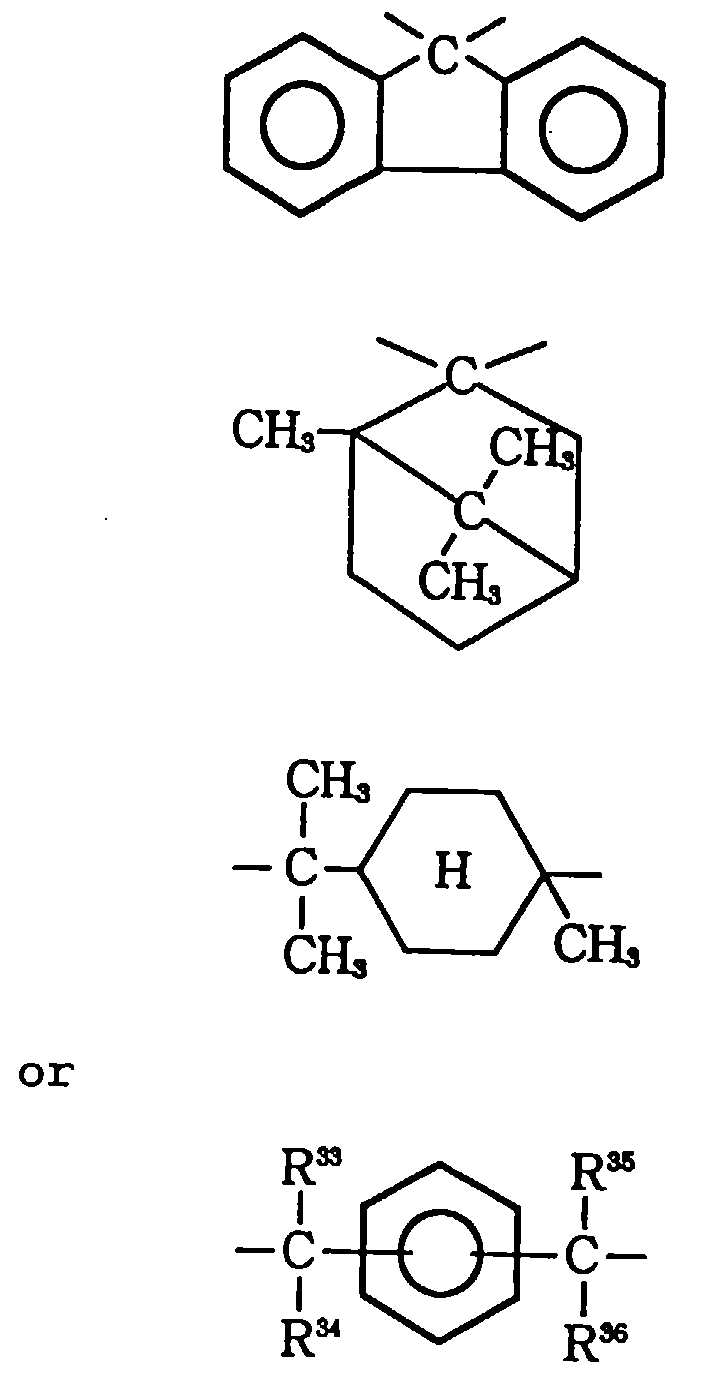
- Y is a single bond, or a linking group composed of -O-, -S-, -SO-, -SO2-, -CO-, -CO2-, cyclopentylidene, cyclohexylidene, phenylene,


- R37 to R42 are independently a hydrogen or halogen atom, or a hydroxyl, alkyl, alkenyl, aryl or alkoxy group and may be the same or different from each other;
- R43 and R44 are independently a hydrogen or halogen atom, or an alkyl group and may be the same or different from each other; and
- R45 to R47 are independently a hydrogen atom or an alkyl group and may be the same or different from one another.
- In the general formulae (III) and (IV), chlorine and bromine are preferred as the halogen atoms. Alkyl groups having 1-4 carbon atoms are preferred as the alkyl groups. Alkenyl groups having 2-5 carbon atoms are preferred as the alkenyl groups. Alkoxy groups having 1-6 carbon atoms are preferred as the alkoxy groups. Aryl groups having 6-15 carbon atoms are preferred as the aryl groups. Aryl groups substituted by an alkyl group having 1-4 carbon atoms or a halogen atom are preferred as the substituted aryl groups.
- As specific examples of the aromatic compounds represented by the general formula (III), may be mentioned the following Compounds (c-1) to (c-62):

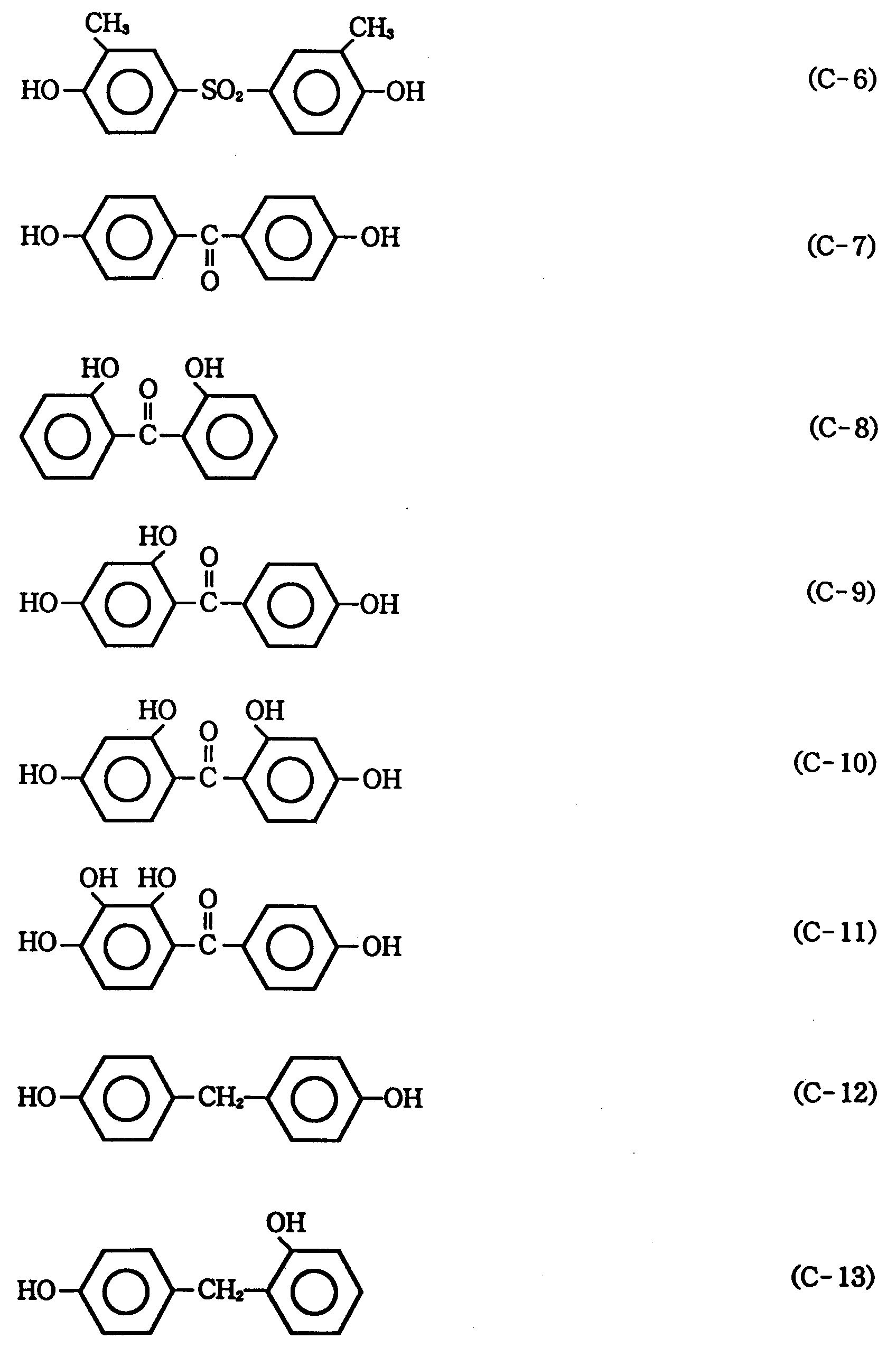


- As specific examples of the aromatic compounds represented by the general formula (IV), may be mentioned the following Compounds (c-63) to (c-66):


- Among these phenolic compounds, Compounds c-1, c-12, c-13, c-14, c-49, c-52, c-56, c-60 and c-64 are particularly preferred.
- The concentration of these phenolic compounds to be incorporated is generally 1-100 parts by weight per 100 parts by weight of the alkali-soluble phenol resin. The preferable concentration of the phenolic compounds to be incorporated varies according to the composition, molecular weight and molecular weight distribution of the alkali-soluble phenol resin to be used, or the kind and concentration of the photosensitive agent to be incorporated, but is generally 3-60 parts by weight. These phenolic compounds may be used either singly or in any combination thereof.
- The positive resist composition according to the present invention is generally used in a state that it is dissolved in a solvent, in order to coat a substrate with the solution to form a resist film.
- Examples of the solvent include ketones such as acetone, methyl ethyl ketone, cyclohexanone, cyclopentanone and 2-heptanone; alcohols such as n-propyl alcohol, isopropyl alcohol, n-butyl alcohol and cyclohexanol; ethers such as ethylene glycol dimethyl ether, ethylene glycol diethyl ether and dioxane; alcohol ethers such as ethylene glycol monomethyl ether and ethylene glycol monoethyl ether; esters such as propyl formate, butyl formate, propyl acetate, butyl acetate, methyl propionate, ethyl propionate, methyl butyrate and ethyl butyrate; monohydroxycarboxylic acid esters such as methyl 2-hydroxypropionate, ethyl 2-hydroxypropionate, methyl 2-methoxypropionate, ethyl 2-methoxypropionate, methyl 2-ethoxypropionte and ethyl 2-ethoxypropionte; cellosolve esters such as cellosolve acetate, methylcellosolve acetate, ethylcellosolve acetate, propylcellosolve acetate and butylcellosolve acetate; propylene glycols such as propylene glycol, propylene glycol monomethyl ether, propylene glycol monomethyl ether acetate, propylene glycol monoethyl ether acetate and propylene glycol monobutyl ether; diethylene glycols such as diethylene glycol monomethyl ether, diethylene glycol monoethyl ether, diethylene glycol dimethyl ether, diethylene glycol diethyl ether and diethylene glycol methyl ethyl ether; halogenated hydrocarbons such as trichloroethylene; aromatic hydrocarbons such as toluene and xylene; and polar solvents such as dimethylacetamide, dimethylformamide and N-methylacetamide. These solvents may be used either singly or in any combination thereof. These solvents are used in a sufficient amount to evenly dissolve the individual components therein.
- In order to improve the developability, storage stability and thermal-flow resistance of the positive resist composition according to the present invention, for example, a copolymer of styrene and acrylic acid, methacrylic acid or maleic anhydride, a copolymer of an alkene and maleic anhydride, a polymer of vinyl alcohol, a polymer of vinylpyrrolidone, rosin and/or shellac may be added to the positive resist composition as needed. The amount of these components to be added is 0-50 parts by weight, preferably 5-20 parts by weight per 100 parts by weight of the alkali-soluble phenol resin.
- In the positive resist composition according to the present invention, may be contained one or more of compatible additives such as dyes, surfactants, storage stabilizers, sensitizers, anti-striation agents and plasticizers as needed.
- An aqueous solution of an alkali is used as a developer for the positive resist composition of the present invention. Specific examples of the alkali include inorganic alkalis such as sodium hydroxide, potassium hydroxide, sodium silicate and ammonia; primary amines such as ethylamine and propylamine; secondary amines such as diethylamine and dipropylamine; tertiary amines such as trimethylamine and triethylamine; alcohol amines such as dimethylmethanolamine and triethanolamine; and quaternary ammonium salts such as tetramethylammonium hydroxide, tetraethylammonium hydroxide, trimethylhydroxymethylammonium hydroxide, triethylhydroxymethylammonium hydroxide and trimethylhydroxyethylammonium hydroxide.
- Proper amounts of a water-soluble organic solvent such as methanol, ethanol, propanol or ethylene glycol, a surfactant, a storage stabilizer and a dissolution inhibitor for the resin may be further added to the aqueous alkali solution as needed.
- The present invention will hereinafter be described more specifically by the following Examples and Comparative Examples. Incidentally, all designations of "part" or "parts" and "%" as will be used in the following examples mean part or parts by weight and wt.% unless expressly noted.
- In the following Examples and Comparative Examples, the resulting resists were evaluated in accordance with the following methods:
- An amount of exposure energy by which a 1:1 line and space pattern at intervals of 0.60 µm could be formed to designed dimensions was expressed in terms of exposure time (msec).
- A critical resolution (µm) under the above exposure conditions was expressed.
- A ratio (%) of a resist film remaining after development to the resist film before the development was expressed.
- A wafer on which a resist pattern had been formed was cut in a direction perpendicular to the line pattern, and the pattern was observed through an electron microscope from the sectional direction. The result thereof was ranked as "Good" where the side wall of the pattern rose at an angle of at least 80 degrees, without film loss, "Tapered" where the side wall of the pattern rose at an angle smaller than 80 degrees, "Small reduction in film thickness" where film loss of the resist pattern was observed to a small extent, or "Great reduction in film thickness" where film loss of the resist pattern was observed to a great extent.
- A relationship between an amount of exposure energy and dimensions of a line and space pattern at intervals 0.50 µm was diagrammed to determine a range of the exposure energy in which a variation of the pattern dimensions could be maintained within a range of from 0.475 to 0.525 µm (within ±5% of the designed dimensions). The exposure margin is a value obtained by dividing this range by sensitivity. The greater value indicates that a dimensional change with the amount of the exposure energy is smaller.
- A flask equipped with a condenser and a stirrer was charged with 385 g of m-cresol, 315 g of p-cresol, 360 g of 37% formalin and 2.49 g of oxalic acid dihydrate. While holding the contents at 95-100°C, a reaction was conducted for 2 hours. Thereafter, water was distilled off over 2 hours at 100-105°C, and the pressure within the flask was reduced to 10-30 mmHg while further heating the reaction mixture up to 180°C, thereby removing unreacted monomers and water. The resulting molten resin was then cooled down to room temperature to collect it, thereby obtaining 515 g of Novolak Resin (A-1). The weight average molecular weight of this novolak resin was 7,000 in terms of polystyrene by gel permeation chromatography (GPC).
- Added to 380 g of the novolak resin obtained in Synthesis Example 1 were 360 g of ethylcellosolve acetate to dissolve the resin. A flask was equipped with a dropping funnel, and 950 g of toluene were added dropwise to the flask from the dropping funnel in the state that the temperature of the solution in the flask was controlled to 80-85°C. The mixture was further heated at 80°C for 1 hour. The mixture was slowly cooled to room temperature and left at rest further for 1 hour. After a supernatant of a resin deposited was removed by decantation, 570 g of ethyl lactate (ethyl 2-hydroxypropionate) were added. The resultant mixture was heated to 100°C under 100 mmHg to remove residual toluene, thereby obtaining a solution of Novolak Resin (A-2) in ethyl lactate. The weight average molecular weight of this novolak resin was 12,100 in terms of polystyrene by GPC.
- A flask equipped with a condenser and a stirrer was charged with 420 g of m-cresol, 140 g of p-cresol, 158 g of 3,5-xylenol, 421 g of 37% formalin and 2.45 g of oxalic acid dihydrate. While holding the contents at 95-100°C, a reaction was conducted for 40 minutes. Thereafter, water was distilled off over 2 hours at 100-105°C, and the pressure within the flask was reduced to 10-30 mmHg while further heating the reaction mixture up to 180°C, thereby removing unreacted monomers and water. The resulting molten resin was then cooled down to room temperature to collect it, thereby obtaining 630 g of novolak resin. Added to 100 g of this novolak resin were 70 g of ethylcellosolve acetate to dissolve the resin in a 3-liter flask equipped with a dropping funnel. To the flask, 650 g of toluene were added dropwise from the dropping funnel in the state that the temperature of the solution was controlled to 80-85°C. The mixture was further heated at 80°C for 1 hour. The mixture was slowly cooled to room temperature and left at rest further for 1 hour. After a supernatant of a resin deposited was removed by decantation, 750 g of ethyl lactate (ethyl 2-hydroxypropionate) were added. The resultant mixture was heated to 100°C under 100 mmHg to remove residual toluene, thereby obtaining a solution of Novolak Resin (A-3) in ethyl lactate. The weight average molecular weight of this novolak resin was 5,700 in terms of polystyrene by GPC.
- A compound of the formula (b-7) was used as a polyhydroxy compound, and 1,2-naphthoquinonediazide-5-sulfonyl chloride in an amount corresponding to 70 mol% of the OH groups in the polyhydroxy compound was dissolved in dioxane to prepare a 10% solution. While controlling the temperature to 20-25°C, triethylamine in an amount corresponding to 1.2 equivalents of 1,2-naphthoquinonediazide-5-sulfonyl chloride was added dropwise over 30 minutes. The mixture was held further for 2 hours to complete a reaction. Solids deposited were collected by filtration, washed with ion-exchanged water and dried to obtain Photosensitive Agent (B-1).
- Photosensitive Agents (B-2) to (B-8) were synthesized in accordance with the same process as in Synthesis Example 4 except that the kind of the polyhydroxy compound or the charged molar ratio of 1,2-naphthoquinonediazide-5-sulfonyl chloride to the OH groups of the polyhydroxy compound was changed. The kinds of the polyhydroxy compounds used and the charged molar ratios are shown in Table 1.
- Photosensitive Agent (B-9) was synthesized in accordance with the same process as in Synthesis Example 4 except that 2,3,4,4'-tetrahydroxybenzophenone was used as the polyhydroxy compound, and the charged molar ratio of 1,2-naphthoquinonediazide-5-sulfonyl chloride to the OH groups of this compound was changed to 85%.
- Photosensitive Agent (B-10) was synthesized in accordance with the same process as in Synthesis Example 4 except that Compound (d-1) represented by the following chemical formula was used as the polyhydroxy compound, and the charged molar ratio of 1,2-naphthoquinonediazide-5-sulfonyl chloride to the OH groups of this compound was changed to 80%.

Table 1 Photosensitive agent Kind of polyhydroxy compound Charged molar ratio of 1,2-naphthoquinonediazide-5-sulfonyl chloride to hydroxyl groups of polyhydroxy compound (mol%) B-1 b-7 70 B-2 b-7 75 B-3 b-1 80 B-4 b-11 75 B-5 b-16 65 B-6 b-19 80 B-7 b-22 75 B-8 b-27 65 B-9 2,3,4,4'-Tetrahydroxybenzophenone 85 B-10 d-1 80 - Their corresponding alkali-soluble phenol resins (novolak resins), photosensitive agents and aromatic compounds having a phenolic hydroxyl group (phenolic compounds) of compositions shown in Table 2 were separately dissolved in an ethyl lactate (ethyl 2-hydroxypropionate) solvent, and amounts of the solvents in the solutions were controlled in such a manner that they could be coated to a film thickness of 1.17 µm. These solutions were filtered through a polytetrafluoroethylene filter (PTFE filter) having a pore size of 0.1 µm to prepare resist solutions.
- After coating a silicon wafer with each of the thus-prepared resist solutions by a spin coater, the resist solution was prebaked for 90 seconds on a hot plate heated to 90°C, thereby forming a resist film having a thickness of 1.17 µm. The silicon wafer on which the resist film had been formed was exposed with exposure time varied using a i-line stepper, "NSR-1755i7A" (manufactured by Nikon Corp., NA = 0.50) and a test reticle. The thus-exposed wafer was then subjected to PEB (post-exposure baking) for 60 seconds on a hot plate heated to 110°C, followed by its development by the puddle process for 1 minute at 23°C in a 2.38% aqueous solution of tetramethylammonium hydroxide to form a positive pattern.
- The wafer on which the pattern had been formed was taken out of the aqueous solution to observe through an electron microscope, thereby evaluating it as to sensitivity, resolution and pattern profile. A film loss after development was determined by measuring the film thickness of the resist film before and after the development. These evaluation results are shown in Table 2.
- A resist solution was prepared in the same manner as in Example 1 except that the phenolic compound was not used, and the resist was evaluated under the same conditions as those in Example 1. The results are shown in Table 2.
- A resist solution was prepared in the same manner as in Example 1 except that Photosensitive Agent B-9, which was a photosensitive agent outside the scope of the present invention, was used, and the phenolic compound was not used, and the resist was evaluated under the same conditions as those in Example 1. The results are shown in Table 2.
- A resist solution was prepared in the same manner as in Example 1 except that Photosensitive Agent B-10, which was a photosensitive agent outside the scope of the present invention, was used, and the phenolic compound was not used, and the resist was evaluated under the same conditions as those in Example 1. The results are shown in Table 2.

- According to the present invention, there can be provided positive resist compositions which are excellent in various properties such as sensitivity, film loss after development, resolution, exposure margin and pattern profile. The positive resist compositions according to the present invention can be used as positive resists for minute processing required for the fabrication of semiconductor devices, magnetic bubble memory devices, integrated circuits and the like and are suitable for use in, particularly, minute processing to 1 µm or smaller in line width.
Claims (12)
- A positive resist composition comprising in combination (a) an alkali-soluble phenol resin, (b) a photosensitive agent composed of a quinonediazide sulfonate of a polyhydroxy compound represented by the following general formula (I) and (c) an aromatic compound having at least one phenolic hydroxyl group:
 k is 1 or 2;m is 1 or 2;R1 to R4 are independently a halogen atom, or an alkyl, alkenyl, alkoxy, aryl or acyl group and may be the same or different from one another;R5 to R10 are independently a hydrogen or halogen atom, or an alkyl, alkenyl, alkoxy, aryl or acyl group and may be the same or different from one another; andX is a single bond, or a linking group composed of -O-, -S-, -SO-, -SO2-, -CO-, -CO2-, cyclopentylidene, cyclohexylidene, phenylene,


- The positive resist composition according to Claim 1, wherein the polyhydroxy compound represented by the general formula (I) is a compound represented by the following general formula (II):

- The positive resist composition according to Claim 1, wherein the aromatic compound (c) having at least one phenolic hydroxyl group is an aromatic compound represented by the following general formula (III):
 R23 to R26 are independently a hydrogen or halogen atom, or a hydroxyl, alkyl, alkenyl, aryl or alkoxy group and may be the same or different from one another; andY is a single bond, or a linking group composed of -O-, -S-, -SO-, -SO2-, -CO-, -CO2-, cyclopentylidene, cyclohexylidene, phenylene,

- The positive resist composition according to Claim 1, wherein the aromatic compound (c) having at least one phenolic hydroxyl group is an aromatic compound represented by the following general formula (IV):
 R37 to R42 are independently a hydrogen or halogen atom, or a hydroxyl, alkyl, alkenyl, aryl or alkoxy group and may be the same or different from each other;R43 and R44 are independently a hydrogen or halogen atom, or an alkyl group and may be the same or different from each other; andR45 to R47 are independently a hydrogen atom or an alkyl group and may be the same or different from one another.
 - The positive resist composition according to Claim 3, wherein the aromatic compound (c) represented by the general formula (III) is


- The positive resist composition according to Claim 4, wherein the aromatic compound (c) represented by the general formula (IV) is

- The positive resist composition according to Claim 1, wherein the alkali-soluble phenol resin (a) is a condensation product of a phenol and an aldehyde.
- The positive resist composition according to Claim 7, wherein the phenol is a mixture of m-cresol and p-cresol.
- The positive resist composition according to Claim 7, wherein the phenol is a mixture of m-cresol, p-cresol and 3,5-xylenol.
- The positive resist composition according to Claim 1, wherein the quinonediazide sulfonate of the polyhydroxy compound represented by the general formula (I) is an ester in which the OH groups of the polyhydroxy compound has been esterified with a quinonediazide sulfonic compound to an extent of 40-95%.
- The positive resist composition according to Claim 1, wherein the composition comprises 100 parts by weight of (a) the alkali-soluble phenol resin, 1-100 parts by weight of (b) the photosensitive agent composed of the quinonediazide sulfonate of the polyhydroxy compound represented by the general formula (I) and 1-100 parts by weight of (c) the aromatic compound having at least one phenolic hydroxyl group.
- The positive resist composition according to Claim 11, wherein the composition further comprises a solvent in a sufficient amount to evenly dissolve the components (a), (b) and (c) therein.
Applications Claiming Priority (1)
| Application Number | Priority Date | Filing Date | Title |
|---|---|---|---|
| PCT/JP1994/002301 WO1996020430A1 (en) | 1994-12-28 | 1994-12-28 | Positive resist composition |
Publications (3)
| Publication Number | Publication Date |
|---|---|
| EP0801327A1 true EP0801327A1 (en) | 1997-10-15 |
| EP0801327A4 EP0801327A4 (en) | 1998-04-29 |
| EP0801327B1 EP0801327B1 (en) | 2002-10-16 |
Family
ID=14098945
Family Applications (1)
| Application Number | Title | Priority Date | Filing Date |
|---|---|---|---|
| EP95904030A Expired - Lifetime EP0801327B1 (en) | 1994-12-28 | 1994-12-28 | Positive resist composition |
Country Status (5)
| Country | Link |
|---|---|
| US (1) | US5912102A (en) |
| EP (1) | EP0801327B1 (en) |
| KR (1) | KR100334484B1 (en) |
| DE (1) | DE69431570T2 (en) |
| WO (1) | WO1996020430A1 (en) |
Cited By (1)
| Publication number | Priority date | Publication date | Assignee | Title |
|---|---|---|---|---|
| EP0848291A1 (en) * | 1996-12-11 | 1998-06-17 | JSR Corporation | Radiation-sensitive resin composition |
Families Citing this family (22)
| Publication number | Priority date | Publication date | Assignee | Title |
|---|---|---|---|---|
| JP3209058B2 (en) | 1995-10-18 | 2001-09-17 | 住友化学工業株式会社 | Positive resist composition |
| EP0769485B1 (en) * | 1995-10-18 | 2002-03-13 | Sumitomo Chemical Company, Limited | Positive resist composition and photosensitizers |
| JP3473931B2 (en) * | 1996-11-11 | 2003-12-08 | 東京応化工業株式会社 | Positive photosensitive composition for lift-off and pattern forming method |
| US6177226B1 (en) * | 1997-05-01 | 2001-01-23 | Tokyo Ohka Kogyo Co., Ltd. | Positive photoresist composition and process for forming contact hole |
| JP3600713B2 (en) * | 1997-08-06 | 2004-12-15 | 東京応化工業株式会社 | Positive photoresist composition |
| US6051358A (en) * | 1997-11-04 | 2000-04-18 | Shipley Company, L.L.C. | Photoresist with novel photoactive compound |
| JP3369471B2 (en) * | 1998-05-29 | 2003-01-20 | 東京応化工業株式会社 | Positive photoresist composition and method for forming resist pattern |
| JP3688469B2 (en) * | 1998-06-04 | 2005-08-31 | 東京応化工業株式会社 | Positive photoresist composition and method for forming resist pattern using the same |
| KR100323831B1 (en) * | 1999-03-30 | 2002-02-07 | 윤종용 | Photoresist composition, preparation method thereof and method for forming pattern in semiconductor processing using the same |
| JP2001033957A (en) * | 1999-07-19 | 2001-02-09 | Tokyo Ohka Kogyo Co Ltd | Positive type photoresist composition |
| JP3901923B2 (en) * | 2000-09-12 | 2007-04-04 | 東京応化工業株式会社 | Positive photoresist composition |
| TWI263864B (en) * | 2001-01-17 | 2006-10-11 | Tokyo Ohka Kogyo Co Ltd | Positive photoresist composition |
| DE10135790B4 (en) * | 2001-07-23 | 2005-07-14 | Kennametal Inc. | Fine grained cemented carbide and its use |
| JP2003195495A (en) * | 2001-12-26 | 2003-07-09 | Tokyo Ohka Kogyo Co Ltd | Positive photoresist composition |
| JP3708049B2 (en) * | 2001-12-26 | 2005-10-19 | 東京応化工業株式会社 | Positive photoresist composition |
| JP4440600B2 (en) * | 2003-10-31 | 2010-03-24 | Azエレクトロニックマテリアルズ株式会社 | Chemically amplified photosensitive resin composition for thick and ultra-thick films |
| KR100596364B1 (en) * | 2004-05-31 | 2006-07-03 | 주식회사 엘지화학 | Photosensitive resin composition and liquid crystal display device manufactured using the same |
| KR101240643B1 (en) * | 2005-07-08 | 2013-03-08 | 삼성디스플레이 주식회사 | Photoresist composition, a method for forming a pattern using the same, and a method for manufacturing thin film transistor array panel using the same |
| KR101348607B1 (en) * | 2006-02-14 | 2014-01-07 | 주식회사 동진쎄미켐 | Photoresist composition, thin film patterning method using the same, and method of fabricating liquid crystal display using the same |
| KR20110023354A (en) * | 2009-08-31 | 2011-03-08 | 금호석유화학 주식회사 | Positive photosensitive composition |
| KR101200140B1 (en) * | 2009-08-31 | 2012-11-12 | 금호석유화학 주식회사 | Positive typed photosensitive composition |
| JP7427885B2 (en) * | 2019-09-05 | 2024-02-06 | Ube株式会社 | Phenolic resin composition for photoresist and photoresist composition |
Family Cites Families (22)
| Publication number | Priority date | Publication date | Assignee | Title |
|---|---|---|---|---|
| US4377631A (en) * | 1981-06-22 | 1983-03-22 | Philip A. Hunt Chemical Corporation | Positive novolak photoresist compositions |
| JPS5817112A (en) * | 1981-06-22 | 1983-02-01 | フイリツプ・エイ・ハント・ケミカル・コ−ポレイシヨン | Positive novolak photoresist composition and blend |
| JPS60176034A (en) * | 1984-02-23 | 1985-09-10 | Japan Synthetic Rubber Co Ltd | Positive photosensitive resin composition |
| JPS63184745A (en) * | 1987-01-27 | 1988-07-30 | Sumitomo Chem Co Ltd | Positive type photoresist composition |
| JPS63184757A (en) * | 1987-01-28 | 1988-07-30 | Konica Corp | Photosensitive material carrying device provided with shutter for opening/closing carrying route |
| JPH087433B2 (en) * | 1989-04-19 | 1996-01-29 | 日本ゼオン株式会社 | Positive resist composition |
| JP2631744B2 (en) * | 1989-05-11 | 1997-07-16 | 日本ゼオン株式会社 | Positive resist composition |
| JP2741243B2 (en) * | 1989-05-11 | 1998-04-15 | 日本ゼオン株式会社 | Positive resist composition |
| JPH061377B2 (en) * | 1989-12-28 | 1994-01-05 | 日本ゼオン株式会社 | Positive resist composition |
| JP2566169B2 (en) * | 1989-12-28 | 1996-12-25 | 日本ゼオン株式会社 | Positive resist composition |
| JP2566171B2 (en) * | 1989-12-28 | 1996-12-25 | 日本ゼオン株式会社 | Positive resist composition |
| DE69132694T2 (en) * | 1990-03-08 | 2002-06-20 | Fuji Photo Film Co., Ltd. | Positive working photoresist composition |
| JPH03259149A (en) * | 1990-03-08 | 1991-11-19 | Fuji Photo Film Co Ltd | Positive type photoresist composition |
| JP3052330B2 (en) * | 1990-04-17 | 2000-06-12 | ジェイエスアール株式会社 | Radiation-sensitive resin composition for semiconductor production |
| US5413896A (en) * | 1991-01-24 | 1995-05-09 | Japan Synthetic Rubber Co., Ltd. | I-ray sensitive positive resist composition |
| JP3028648B2 (en) * | 1991-07-17 | 2000-04-04 | ジェイエスアール株式会社 | Positive resist composition and pattern forming method |
| JP3466218B2 (en) * | 1992-06-04 | 2003-11-10 | 住友化学工業株式会社 | Positive resist composition |
| KR100277365B1 (en) * | 1992-11-11 | 2001-09-17 | 고사이 아끼오 | Positive type resist composition |
| DE69423858T2 (en) * | 1993-12-17 | 2000-07-27 | Fuji Photo Film Co., Ltd. | Positive-working photoresist composition |
| US5700620A (en) * | 1993-12-24 | 1997-12-23 | Fuji Photo Film Co., Ltd. | Radiation ray sensitive resin compostion containing at least two different naphthoquinonediazide sulfonic acid esters and an alkali-soluble low-molecular compound |
| JP3278306B2 (en) * | 1994-10-31 | 2002-04-30 | 富士写真フイルム株式会社 | Positive photoresist composition |
| US5541033A (en) * | 1995-02-01 | 1996-07-30 | Ocg Microelectronic Materials, Inc. | Selected o-quinonediazide sulfonic acid esters of phenolic compounds and their use in radiation-sensitive compositions |
-
1994
- 1994-12-28 KR KR1019970704465A patent/KR100334484B1/en not_active Expired - Fee Related
- 1994-12-28 EP EP95904030A patent/EP0801327B1/en not_active Expired - Lifetime
- 1994-12-28 DE DE69431570T patent/DE69431570T2/en not_active Expired - Fee Related
- 1994-12-28 US US08/860,365 patent/US5912102A/en not_active Expired - Fee Related
- 1994-12-28 WO PCT/JP1994/002301 patent/WO1996020430A1/en not_active Ceased
Cited By (1)
| Publication number | Priority date | Publication date | Assignee | Title |
|---|---|---|---|---|
| EP0848291A1 (en) * | 1996-12-11 | 1998-06-17 | JSR Corporation | Radiation-sensitive resin composition |
Also Published As
| Publication number | Publication date |
|---|---|
| KR987001100A (en) | 1998-04-30 |
| KR100334484B1 (en) | 2002-12-06 |
| US5912102A (en) | 1999-06-15 |
| DE69431570T2 (en) | 2003-06-12 |
| EP0801327B1 (en) | 2002-10-16 |
| EP0801327A4 (en) | 1998-04-29 |
| DE69431570D1 (en) | 2002-11-21 |
| WO1996020430A1 (en) | 1996-07-04 |
Similar Documents
| Publication | Publication Date | Title |
|---|---|---|
| EP0801327B1 (en) | Positive resist composition | |
| EP0435437B1 (en) | Positive resist composition | |
| US5532107A (en) | Positive resist composition | |
| US4837121A (en) | Thermally stable light-sensitive compositions with o-quinone diazide and phenolic resin | |
| JPH087435B2 (en) | Positive resist composition | |
| JPH03200251A (en) | Positive resist composition | |
| JPH03200253A (en) | Positive type resist composition | |
| US6013407A (en) | Positive resist composition | |
| JP3275505B2 (en) | Positive resist composition | |
| EP0907108B1 (en) | Radiation-sensitive resin composition | |
| EP0848291B1 (en) | Radiation-sensitive resin composition | |
| EP0421667B1 (en) | Positive resist composition | |
| JP2709507B2 (en) | Positive resist composition | |
| JP2626479B2 (en) | Positive resist composition | |
| JP2743697B2 (en) | Positive resist composition | |
| JPH07301916A (en) | Positive resist composition | |
| JPH08220750A (en) | Positive resist composition | |
| JP2640382B2 (en) | Positive resist composition | |
| JPH0659447A (en) | Positive resist composition | |
| JP2817439B2 (en) | Positive resist composition | |
| JP3275501B2 (en) | Positive resist composition | |
| JPH06324483A (en) | Positive photoresist composition | |
| JPH11255855A (en) | Alkali-soluble novolak resin | |
| JPH0829978A (en) | Positive resist composition | |
| JPH07134404A (en) | Positive resist composition |
Legal Events
| Date | Code | Title | Description |
|---|---|---|---|
| PUAI | Public reference made under article 153(3) epc to a published international application that has entered the european phase |
Free format text: ORIGINAL CODE: 0009012 |
|
| 17P | Request for examination filed |
Effective date: 19970718 |
|
| AK | Designated contracting states |
Kind code of ref document: A1 Designated state(s): DE FR GB |
|
| A4 | Supplementary search report drawn up and despatched | ||
| AK | Designated contracting states |
Kind code of ref document: A4 Designated state(s): DE FR GB |
|
| 17Q | First examination report despatched |
Effective date: 19990618 |
|
| GRAG | Despatch of communication of intention to grant |
Free format text: ORIGINAL CODE: EPIDOS AGRA |
|
| GRAG | Despatch of communication of intention to grant |
Free format text: ORIGINAL CODE: EPIDOS AGRA |
|
| GRAH | Despatch of communication of intention to grant a patent |
Free format text: ORIGINAL CODE: EPIDOS IGRA |
|
| GRAH | Despatch of communication of intention to grant a patent |
Free format text: ORIGINAL CODE: EPIDOS IGRA |
|
| GRAA | (expected) grant |
Free format text: ORIGINAL CODE: 0009210 |
|
| AK | Designated contracting states |
Kind code of ref document: B1 Designated state(s): DE FR GB |
|
| PG25 | Lapsed in a contracting state [announced via postgrant information from national office to epo] |
Ref country code: FR Free format text: LAPSE BECAUSE OF FAILURE TO SUBMIT A TRANSLATION OF THE DESCRIPTION OR TO PAY THE FEE WITHIN THE PRESCRIBED TIME-LIMIT Effective date: 20021016 |
|
| REG | Reference to a national code |
Ref country code: GB Ref legal event code: FG4D |
|
| REF | Corresponds to: |
Ref document number: 69431570 Country of ref document: DE Date of ref document: 20021121 |
|
| PG25 | Lapsed in a contracting state [announced via postgrant information from national office to epo] |
Ref country code: GB Free format text: LAPSE BECAUSE OF NON-PAYMENT OF DUE FEES Effective date: 20030116 |
|
| EN | Fr: translation not filed | ||
| PLBE | No opposition filed within time limit |
Free format text: ORIGINAL CODE: 0009261 |
|
| STAA | Information on the status of an ep patent application or granted ep patent |
Free format text: STATUS: NO OPPOSITION FILED WITHIN TIME LIMIT |
|
| GBPC | Gb: european patent ceased through non-payment of renewal fee | ||
| 26N | No opposition filed |
Effective date: 20030717 |
|
| PGFP | Annual fee paid to national office [announced via postgrant information from national office to epo] |
Ref country code: DE Payment date: 20061221 Year of fee payment: 13 |
|
| PG25 | Lapsed in a contracting state [announced via postgrant information from national office to epo] |
Ref country code: DE Free format text: LAPSE BECAUSE OF NON-PAYMENT OF DUE FEES Effective date: 20080701 |