EP0779367A1 - Test device comprising stable coupling dye for photometric determination of analytes - Google Patents
Test device comprising stable coupling dye for photometric determination of analytes Download PDFInfo
- Publication number
- EP0779367A1 EP0779367A1 EP96309124A EP96309124A EP0779367A1 EP 0779367 A1 EP0779367 A1 EP 0779367A1 EP 96309124 A EP96309124 A EP 96309124A EP 96309124 A EP96309124 A EP 96309124A EP 0779367 A1 EP0779367 A1 EP 0779367A1
- Authority
- EP
- European Patent Office
- Prior art keywords
- test device
- oxidase
- alkyl
- analyte
- sample
- Prior art date
- Legal status (The legal status is an assumption and is not a legal conclusion. Google has not performed a legal analysis and makes no representation as to the accuracy of the status listed.)
- Granted
Links
- 238000012360 testing method Methods 0.000 title claims abstract description 35
- 238000005859 coupling reaction Methods 0.000 title description 3
- 230000008878 coupling Effects 0.000 title 1
- 238000010168 coupling process Methods 0.000 title 1
- 102000004190 Enzymes Human genes 0.000 claims abstract description 26
- 108090000790 Enzymes Proteins 0.000 claims abstract description 26
- 239000012491 analyte Substances 0.000 claims abstract description 21
- 239000003153 chemical reaction reagent Substances 0.000 claims abstract description 20
- 150000001875 compounds Chemical class 0.000 claims abstract description 12
- 239000007800 oxidant agent Substances 0.000 claims abstract description 9
- LSMMRJUHLKJNLR-UHFFFAOYSA-N 3-methyl-1,3-benzothiazol-2-one Chemical compound C1=CC=C2SC(=O)N(C)C2=C1 LSMMRJUHLKJNLR-UHFFFAOYSA-N 0.000 claims abstract 2
- 229940088598 enzyme Drugs 0.000 claims description 25
- 125000000217 alkyl group Chemical group 0.000 claims description 12
- 150000001412 amines Chemical group 0.000 claims description 10
- 125000003118 aryl group Chemical group 0.000 claims description 9
- 108010015776 Glucose oxidase Proteins 0.000 claims description 8
- 108010001336 Horseradish Peroxidase Proteins 0.000 claims description 8
- 239000004366 Glucose oxidase Substances 0.000 claims description 7
- 229940116332 glucose oxidase Drugs 0.000 claims description 7
- 235000019420 glucose oxidase Nutrition 0.000 claims description 7
- 150000007942 carboxylates Chemical class 0.000 claims description 6
- 150000004820 halides Chemical class 0.000 claims description 6
- -1 thioalkoxide Chemical class 0.000 claims description 4
- NEGFNJRAUMCZMY-UHFFFAOYSA-N 3-(dimethylamino)benzoic acid Chemical compound CN(C)C1=CC=CC(C(O)=O)=C1 NEGFNJRAUMCZMY-UHFFFAOYSA-N 0.000 claims description 3
- 108010025188 Alcohol oxidase Proteins 0.000 claims description 3
- 108091023020 Aldehyde Oxidase Proteins 0.000 claims description 3
- 102000048262 Aldehyde oxidases Human genes 0.000 claims description 3
- 108010089254 Cholesterol oxidase Proteins 0.000 claims description 3
- 102000000587 Glycerolphosphate Dehydrogenase Human genes 0.000 claims description 3
- 108010041921 Glycerolphosphate Dehydrogenase Proteins 0.000 claims description 3
- 102000003992 Peroxidases Human genes 0.000 claims description 3
- 150000004703 alkoxides Chemical class 0.000 claims description 3
- 125000000623 heterocyclic group Chemical group 0.000 claims description 3
- XLYOFNOQVPJJNP-UHFFFAOYSA-M hydroxide Chemical compound [OH-] XLYOFNOQVPJJNP-UHFFFAOYSA-M 0.000 claims description 3
- 150000007524 organic acids Chemical group 0.000 claims description 3
- 125000001181 organosilyl group Chemical group [SiH3]* 0.000 claims description 3
- 108040007629 peroxidase activity proteins Proteins 0.000 claims description 3
- 125000000547 substituted alkyl group Chemical group 0.000 claims description 3
- 125000003107 substituted aryl group Chemical group 0.000 claims description 3
- LJCNDNBULVLKSG-UHFFFAOYSA-N 2-aminoacetic acid;butane Chemical compound CCCC.CCCC.NCC(O)=O LJCNDNBULVLKSG-UHFFFAOYSA-N 0.000 claims description 2
- 108010092464 Urate Oxidase Proteins 0.000 claims description 2
- 229910021432 inorganic complex Inorganic materials 0.000 claims description 2
- JXLHNMVSKXFWAO-UHFFFAOYSA-N azane;7-fluoro-2,1,3-benzoxadiazole-4-sulfonic acid Chemical compound N.OS(=O)(=O)C1=CC=C(F)C2=NON=C12 JXLHNMVSKXFWAO-UHFFFAOYSA-N 0.000 claims 2
- FWEOQOXTVHGIFQ-UHFFFAOYSA-M 8-anilinonaphthalene-1-sulfonate Chemical compound C=12C(S(=O)(=O)[O-])=CC=CC2=CC=CC=1NC1=CC=CC=C1 FWEOQOXTVHGIFQ-UHFFFAOYSA-M 0.000 claims 1
- 239000000975 dye Substances 0.000 description 24
- OEZPVSPULCMUQB-VRTOBVRTSA-N hydron;(e)-(3-methyl-1,3-benzothiazol-2-ylidene)hydrazine;chloride Chemical compound Cl.C1=CC=C2S\C(=N\N)N(C)C2=C1 OEZPVSPULCMUQB-VRTOBVRTSA-N 0.000 description 19
- WQZGKKKJIJFFOK-GASJEMHNSA-N Glucose Natural products OC[C@H]1OC(O)[C@H](O)[C@@H](O)[C@@H]1O WQZGKKKJIJFFOK-GASJEMHNSA-N 0.000 description 14
- MHAJPDPJQMAIIY-UHFFFAOYSA-N Hydrogen peroxide Chemical compound OO MHAJPDPJQMAIIY-UHFFFAOYSA-N 0.000 description 14
- 239000008103 glucose Substances 0.000 description 14
- 239000008280 blood Substances 0.000 description 12
- 210000004369 blood Anatomy 0.000 description 12
- 239000011159 matrix material Substances 0.000 description 11
- CSCPPACGZOOCGX-UHFFFAOYSA-N Acetone Chemical compound CC(C)=O CSCPPACGZOOCGX-UHFFFAOYSA-N 0.000 description 9
- 238000006243 chemical reaction Methods 0.000 description 9
- 239000000203 mixture Substances 0.000 description 9
- SECXISVLQFMRJM-UHFFFAOYSA-N N-Methylpyrrolidone Chemical compound CN1CCCC1=O SECXISVLQFMRJM-UHFFFAOYSA-N 0.000 description 8
- 239000000243 solution Substances 0.000 description 8
- XLYOFNOQVPJJNP-UHFFFAOYSA-N water Chemical compound O XLYOFNOQVPJJNP-UHFFFAOYSA-N 0.000 description 8
- 239000002253 acid Substances 0.000 description 7
- 239000007788 liquid Substances 0.000 description 7
- 238000007254 oxidation reaction Methods 0.000 description 7
- 239000000126 substance Substances 0.000 description 7
- UHOVQNZJYSORNB-UHFFFAOYSA-N Benzene Chemical compound C1=CC=CC=C1 UHOVQNZJYSORNB-UHFFFAOYSA-N 0.000 description 6
- YMWUJEATGCHHMB-UHFFFAOYSA-N Dichloromethane Chemical compound ClCCl YMWUJEATGCHHMB-UHFFFAOYSA-N 0.000 description 6
- WSFSSNUMVMOOMR-UHFFFAOYSA-N Formaldehyde Chemical compound O=C WSFSSNUMVMOOMR-UHFFFAOYSA-N 0.000 description 6
- ZMANZCXQSJIPKH-UHFFFAOYSA-N Triethylamine Chemical compound CCN(CC)CC ZMANZCXQSJIPKH-UHFFFAOYSA-N 0.000 description 6
- 230000000694 effects Effects 0.000 description 6
- 239000000047 product Substances 0.000 description 6
- LFQSCWFLJHTTHZ-UHFFFAOYSA-N Ethanol Chemical compound CCO LFQSCWFLJHTTHZ-UHFFFAOYSA-N 0.000 description 5
- 230000015572 biosynthetic process Effects 0.000 description 5
- 238000003786 synthesis reaction Methods 0.000 description 5
- PHOLIFLKGONSGY-CSKARUKUSA-N (e)-(3-methyl-1,3-benzothiazol-2-ylidene)hydrazine Chemical compound C1=CC=C2S\C(=N\N)N(C)C2=C1 PHOLIFLKGONSGY-CSKARUKUSA-N 0.000 description 4
- HVYWMOMLDIMFJA-DPAQBDIFSA-N cholesterol Chemical compound C1C=C2C[C@@H](O)CC[C@]2(C)[C@@H]2[C@@H]1[C@@H]1CC[C@H]([C@H](C)CCCC(C)C)[C@@]1(C)CC2 HVYWMOMLDIMFJA-DPAQBDIFSA-N 0.000 description 4
- 239000007787 solid Substances 0.000 description 4
- 238000003756 stirring Methods 0.000 description 4
- BDHFUVZGWQCTTF-UHFFFAOYSA-M sulfonate Chemical compound [O-]S(=O)=O BDHFUVZGWQCTTF-UHFFFAOYSA-M 0.000 description 4
- VDZOOKBUILJEDG-UHFFFAOYSA-M tetrabutylammonium hydroxide Chemical compound [OH-].CCCC[N+](CCCC)(CCCC)CCCC VDZOOKBUILJEDG-UHFFFAOYSA-M 0.000 description 4
- IAZDPXIOMUYVGZ-UHFFFAOYSA-N Dimethylsulphoxide Chemical compound CS(C)=O IAZDPXIOMUYVGZ-UHFFFAOYSA-N 0.000 description 3
- OKKJLVBELUTLKV-UHFFFAOYSA-N Methanol Chemical compound OC OKKJLVBELUTLKV-UHFFFAOYSA-N 0.000 description 3
- HEMHJVSKTPXQMS-UHFFFAOYSA-M Sodium hydroxide Chemical compound [OH-].[Na+] HEMHJVSKTPXQMS-UHFFFAOYSA-M 0.000 description 3
- 238000006555 catalytic reaction Methods 0.000 description 3
- KRKNYBCHXYNGOX-UHFFFAOYSA-N citric acid Chemical compound OC(=O)CC(O)(C(O)=O)CC(O)=O KRKNYBCHXYNGOX-UHFFFAOYSA-N 0.000 description 3
- 239000007819 coupling partner Substances 0.000 description 3
- 239000012530 fluid Substances 0.000 description 3
- 238000003760 magnetic stirring Methods 0.000 description 3
- 238000000034 method Methods 0.000 description 3
- 230000001590 oxidative effect Effects 0.000 description 3
- AZQWKYJCGOJGHM-UHFFFAOYSA-N 1,4-benzoquinone Chemical compound O=C1C=CC(=O)C=C1 AZQWKYJCGOJGHM-UHFFFAOYSA-N 0.000 description 2
- OKTJSMMVPCPJKN-UHFFFAOYSA-N Carbon Chemical compound [C] OKTJSMMVPCPJKN-UHFFFAOYSA-N 0.000 description 2
- KCXVZYZYPLLWCC-UHFFFAOYSA-N EDTA Chemical compound OC(=O)CN(CC(O)=O)CCN(CC(O)=O)CC(O)=O KCXVZYZYPLLWCC-UHFFFAOYSA-N 0.000 description 2
- ZMXDDKWLCZADIW-UHFFFAOYSA-N N,N-Dimethylformamide Chemical compound CN(C)C=O ZMXDDKWLCZADIW-UHFFFAOYSA-N 0.000 description 2
- 150000004982 aromatic amines Chemical class 0.000 description 2
- WPYMKLBDIGXBTP-UHFFFAOYSA-N benzoic acid Chemical compound OC(=O)C1=CC=CC=C1 WPYMKLBDIGXBTP-UHFFFAOYSA-N 0.000 description 2
- 239000013060 biological fluid Substances 0.000 description 2
- 235000012000 cholesterol Nutrition 0.000 description 2
- 230000007423 decrease Effects 0.000 description 2
- 239000008367 deionised water Substances 0.000 description 2
- 229910021641 deionized water Inorganic materials 0.000 description 2
- 238000001035 drying Methods 0.000 description 2
- 229960001484 edetic acid Drugs 0.000 description 2
- 238000009472 formulation Methods 0.000 description 2
- DKAGJZJALZXOOV-UHFFFAOYSA-N hydrate;hydrochloride Chemical compound O.Cl DKAGJZJALZXOOV-UHFFFAOYSA-N 0.000 description 2
- 229910052739 hydrogen Inorganic materials 0.000 description 2
- NOESYZHRGYRDHS-UHFFFAOYSA-N insulin Chemical compound N1C(=O)C(NC(=O)C(CCC(N)=O)NC(=O)C(CCC(O)=O)NC(=O)C(C(C)C)NC(=O)C(NC(=O)CN)C(C)CC)CSSCC(C(NC(CO)C(=O)NC(CC(C)C)C(=O)NC(CC=2C=CC(O)=CC=2)C(=O)NC(CCC(N)=O)C(=O)NC(CC(C)C)C(=O)NC(CCC(O)=O)C(=O)NC(CC(N)=O)C(=O)NC(CC=2C=CC(O)=CC=2)C(=O)NC(CSSCC(NC(=O)C(C(C)C)NC(=O)C(CC(C)C)NC(=O)C(CC=2C=CC(O)=CC=2)NC(=O)C(CC(C)C)NC(=O)C(C)NC(=O)C(CCC(O)=O)NC(=O)C(C(C)C)NC(=O)C(CC(C)C)NC(=O)C(CC=2NC=NC=2)NC(=O)C(CO)NC(=O)CNC2=O)C(=O)NCC(=O)NC(CCC(O)=O)C(=O)NC(CCCNC(N)=N)C(=O)NCC(=O)NC(CC=3C=CC=CC=3)C(=O)NC(CC=3C=CC=CC=3)C(=O)NC(CC=3C=CC(O)=CC=3)C(=O)NC(C(C)O)C(=O)N3C(CCC3)C(=O)NC(CCCCN)C(=O)NC(C)C(O)=O)C(=O)NC(CC(N)=O)C(O)=O)=O)NC(=O)C(C(C)CC)NC(=O)C(CO)NC(=O)C(C(C)O)NC(=O)C1CSSCC2NC(=O)C(CC(C)C)NC(=O)C(NC(=O)C(CCC(N)=O)NC(=O)C(CC(N)=O)NC(=O)C(NC(=O)C(N)CC=1C=CC=CC=1)C(C)C)CC1=CN=CN1 NOESYZHRGYRDHS-UHFFFAOYSA-N 0.000 description 2
- 239000000463 material Substances 0.000 description 2
- 238000005259 measurement Methods 0.000 description 2
- 230000003647 oxidation Effects 0.000 description 2
- 150000002978 peroxides Chemical class 0.000 description 2
- 150000002989 phenols Chemical class 0.000 description 2
- 238000011002 quantification Methods 0.000 description 2
- 229920006395 saturated elastomer Polymers 0.000 description 2
- 239000002002 slurry Substances 0.000 description 2
- AWUCVROLDVIAJX-GSVOUGTGSA-N sn-glycerol 3-phosphate Chemical compound OC[C@@H](O)COP(O)(O)=O AWUCVROLDVIAJX-GSVOUGTGSA-N 0.000 description 2
- FVAUCKIRQBBSSJ-UHFFFAOYSA-M sodium iodide Chemical compound [Na+].[I-] FVAUCKIRQBBSSJ-UHFFFAOYSA-M 0.000 description 2
- 239000000758 substrate Substances 0.000 description 2
- 238000003828 vacuum filtration Methods 0.000 description 2
- 238000005160 1H NMR spectroscopy Methods 0.000 description 1
- MFYSUUPKMDJYPF-UHFFFAOYSA-N 2-[(4-methyl-2-nitrophenyl)diazenyl]-3-oxo-n-phenylbutanamide Chemical compound C=1C=CC=CC=1NC(=O)C(C(=O)C)N=NC1=CC=C(C)C=C1[N+]([O-])=O MFYSUUPKMDJYPF-UHFFFAOYSA-N 0.000 description 1
- BMUDPLZKKRQECS-UHFFFAOYSA-K 3-[18-(2-carboxyethyl)-8,13-bis(ethenyl)-3,7,12,17-tetramethylporphyrin-21,24-diid-2-yl]propanoic acid iron(3+) hydroxide Chemical compound [OH-].[Fe+3].[N-]1C2=C(C)C(CCC(O)=O)=C1C=C([N-]1)C(CCC(O)=O)=C(C)C1=CC(C(C)=C1C=C)=NC1=CC(C(C)=C1C=C)=NC1=C2 BMUDPLZKKRQECS-UHFFFAOYSA-K 0.000 description 1
- FWEOQOXTVHGIFQ-UHFFFAOYSA-N 8-anilinonaphthalene-1-sulfonic acid Chemical class C=12C(S(=O)(=O)O)=CC=CC2=CC=CC=1NC1=CC=CC=C1 FWEOQOXTVHGIFQ-UHFFFAOYSA-N 0.000 description 1
- 235000011330 Armoracia rusticana Nutrition 0.000 description 1
- 240000003291 Armoracia rusticana Species 0.000 description 1
- 239000005711 Benzoic acid Substances 0.000 description 1
- 0 Cc1c(*)c(*)c(*)c(*)c1I Chemical compound Cc1c(*)c(*)c(*)c(*)c1I 0.000 description 1
- VEXZGXHMUGYJMC-UHFFFAOYSA-N Hydrochloric acid Chemical compound Cl VEXZGXHMUGYJMC-UHFFFAOYSA-N 0.000 description 1
- 102000004877 Insulin Human genes 0.000 description 1
- 108090001061 Insulin Proteins 0.000 description 1
- JLTDJTHDQAWBAV-UHFFFAOYSA-N N,N-dimethylaniline Chemical compound CN(C)C1=CC=CC=C1 JLTDJTHDQAWBAV-UHFFFAOYSA-N 0.000 description 1
- 102000004316 Oxidoreductases Human genes 0.000 description 1
- 108090000854 Oxidoreductases Proteins 0.000 description 1
- PMZURENOXWZQFD-UHFFFAOYSA-L Sodium Sulfate Chemical compound [Na+].[Na+].[O-]S([O-])(=O)=O PMZURENOXWZQFD-UHFFFAOYSA-L 0.000 description 1
- QAOWNCQODCNURD-UHFFFAOYSA-L Sulfate Chemical compound [O-]S([O-])(=O)=O QAOWNCQODCNURD-UHFFFAOYSA-L 0.000 description 1
- LEHOTFFKMJEONL-UHFFFAOYSA-N Uric Acid Chemical compound N1C(=O)NC(=O)C2=C1NC(=O)N2 LEHOTFFKMJEONL-UHFFFAOYSA-N 0.000 description 1
- TVWHNULVHGKJHS-UHFFFAOYSA-N Uric acid Natural products N1C(=O)NC(=O)C2NC(=O)NC21 TVWHNULVHGKJHS-UHFFFAOYSA-N 0.000 description 1
- IYXXQOGEFHAQGU-GPWRMYTLSA-N [(z)-(3-methyl-1,3-benzothiazol-2-ylidene)amino]azanium;chloride;hydrate Chemical compound O.Cl.C1=CC=C2S\C(=N/N)N(C)C2=C1 IYXXQOGEFHAQGU-GPWRMYTLSA-N 0.000 description 1
- 230000002378 acidificating effect Effects 0.000 description 1
- 239000007864 aqueous solution Substances 0.000 description 1
- 239000003637 basic solution Substances 0.000 description 1
- 235000010233 benzoic acid Nutrition 0.000 description 1
- WQZGKKKJIJFFOK-VFUOTHLCSA-N beta-D-glucose Chemical compound OC[C@H]1O[C@@H](O)[C@H](O)[C@@H](O)[C@@H]1O WQZGKKKJIJFFOK-VFUOTHLCSA-N 0.000 description 1
- 239000001045 blue dye Substances 0.000 description 1
- 238000011088 calibration curve Methods 0.000 description 1
- 239000007795 chemical reaction product Substances 0.000 description 1
- 239000003795 chemical substances by application Substances 0.000 description 1
- 230000003247 decreasing effect Effects 0.000 description 1
- 239000011928 denatured alcohol Substances 0.000 description 1
- 206010012601 diabetes mellitus Diseases 0.000 description 1
- 238000003745 diagnosis Methods 0.000 description 1
- 238000002405 diagnostic procedure Methods 0.000 description 1
- 230000037213 diet Effects 0.000 description 1
- 235000005911 diet Nutrition 0.000 description 1
- 201000010099 disease Diseases 0.000 description 1
- 208000037265 diseases, disorders, signs and symptoms Diseases 0.000 description 1
- 229920001971 elastomer Polymers 0.000 description 1
- 238000005562 fading Methods 0.000 description 1
- 238000001914 filtration Methods 0.000 description 1
- 239000012458 free base Substances 0.000 description 1
- UPBDXRPQPOWRKR-UHFFFAOYSA-N furan-2,5-dione;methoxyethene Chemical compound COC=C.O=C1OC(=O)C=C1 UPBDXRPQPOWRKR-UHFFFAOYSA-N 0.000 description 1
- 239000011521 glass Substances 0.000 description 1
- 230000005484 gravity Effects 0.000 description 1
- 239000000383 hazardous chemical Substances 0.000 description 1
- 238000010438 heat treatment Methods 0.000 description 1
- 229940109738 hematin Drugs 0.000 description 1
- BTIJJDXEELBZFS-QDUVMHSLSA-K hemin Chemical compound CC1=C(CCC(O)=O)C(C=C2C(CCC(O)=O)=C(C)\C(N2[Fe](Cl)N23)=C\4)=N\C1=C/C2=C(C)C(C=C)=C3\C=C/1C(C)=C(C=C)C/4=N\1 BTIJJDXEELBZFS-QDUVMHSLSA-K 0.000 description 1
- 229940025294 hemin Drugs 0.000 description 1
- 238000004128 high performance liquid chromatography Methods 0.000 description 1
- 229940125396 insulin Drugs 0.000 description 1
- UEGFHIJSQLPCPY-UHFFFAOYSA-N manganese 2-[10,15,20-tris(2-sulfophenyl)-21,23-dihydroporphyrin-5-yl]benzenesulfonic acid Chemical compound [Mn].S(=O)(=O)(O)C1=C(C=CC=C1)C1=C2C=CC(C(=C3C=CC(=C(C=4C=CC(=C(C5=CC=C1N5)C5=C(C=CC=C5)S(=O)(=O)O)N4)C4=C(C=CC=C4)S(=O)(=O)O)N3)C3=C(C=CC=C3)S(=O)(=O)O)=N2 UEGFHIJSQLPCPY-UHFFFAOYSA-N 0.000 description 1
- 238000004519 manufacturing process Methods 0.000 description 1
- 238000010339 medical test Methods 0.000 description 1
- 238000012986 modification Methods 0.000 description 1
- 230000004048 modification Effects 0.000 description 1
- 150000001451 organic peroxides Chemical class 0.000 description 1
- 239000003960 organic solvent Substances 0.000 description 1
- 238000005691 oxidative coupling reaction Methods 0.000 description 1
- 239000008188 pellet Substances 0.000 description 1
- 239000002798 polar solvent Substances 0.000 description 1
- 229920005597 polymer membrane Polymers 0.000 description 1
- 239000000843 powder Substances 0.000 description 1
- 238000001556 precipitation Methods 0.000 description 1
- 238000002360 preparation method Methods 0.000 description 1
- 230000002035 prolonged effect Effects 0.000 description 1
- 238000000746 purification Methods 0.000 description 1
- 150000003839 salts Chemical group 0.000 description 1
- 238000005070 sampling Methods 0.000 description 1
- 210000002966 serum Anatomy 0.000 description 1
- 238000001228 spectrum Methods 0.000 description 1
- 238000000859 sublimation Methods 0.000 description 1
- 230000008022 sublimation Effects 0.000 description 1
- 239000000725 suspension Substances 0.000 description 1
- 238000010998 test method Methods 0.000 description 1
- 229940126585 therapeutic drug Drugs 0.000 description 1
- 229940116269 uric acid Drugs 0.000 description 1
- 210000002700 urine Anatomy 0.000 description 1
Images

Classifications
-
- C—CHEMISTRY; METALLURGY
- C12—BIOCHEMISTRY; BEER; SPIRITS; WINE; VINEGAR; MICROBIOLOGY; ENZYMOLOGY; MUTATION OR GENETIC ENGINEERING
- C12Q—MEASURING OR TESTING PROCESSES INVOLVING ENZYMES, NUCLEIC ACIDS OR MICROORGANISMS; COMPOSITIONS OR TEST PAPERS THEREFOR; PROCESSES OF PREPARING SUCH COMPOSITIONS; CONDITION-RESPONSIVE CONTROL IN MICROBIOLOGICAL OR ENZYMOLOGICAL PROCESSES
- C12Q1/00—Measuring or testing processes involving enzymes, nucleic acids or microorganisms; Compositions therefor; Processes of preparing such compositions
- C12Q1/26—Measuring or testing processes involving enzymes, nucleic acids or microorganisms; Compositions therefor; Processes of preparing such compositions involving oxidoreductase
-
- Y—GENERAL TAGGING OF NEW TECHNOLOGICAL DEVELOPMENTS; GENERAL TAGGING OF CROSS-SECTIONAL TECHNOLOGIES SPANNING OVER SEVERAL SECTIONS OF THE IPC; TECHNICAL SUBJECTS COVERED BY FORMER USPC CROSS-REFERENCE ART COLLECTIONS [XRACs] AND DIGESTS
- Y10—TECHNICAL SUBJECTS COVERED BY FORMER USPC
- Y10T—TECHNICAL SUBJECTS COVERED BY FORMER US CLASSIFICATION
- Y10T436/00—Chemistry: analytical and immunological testing
- Y10T436/14—Heterocyclic carbon compound [i.e., O, S, N, Se, Te, as only ring hetero atom]
- Y10T436/142222—Hetero-O [e.g., ascorbic acid, etc.]
- Y10T436/143333—Saccharide [e.g., DNA, etc.]
Definitions
- the present invention relates to a test device and method for the colorimetric determination of chemical and biochemical components (analytes) in aqueous fluids, such as whole blood, and, more particularly, to a dye couple for use in such device and method.
- the method disclosed and claimed in these patents involves taking a reflectance reading from one surface of an inert porous matrix impregnated with a reagent that will interact with the analyte to produce a light-absorbing reaction product when the fluid being analyzed is applied to another surface and migrates through the matrix to the surface being read.
- the reagent includes glucose oxidase, an enzyme which consumes glucose in the sample to produce hydrogen peroxide which, in the presence of another enzyme, horseradish peroxidase, oxidizes a dye couple comprising 3-methyl-2-benzothiazolinone hydrazone hydrochloride (MBTH) and 3-dimethylaminobenzoic acid (DMAB) to yield a blue dye. Reflectance measurements are then made at two separate wavelengths. The concentration of the glucose in blood is determined based on the intensity of the dye color with the aid of a LED spectrophotometer.
- US-A-5 453 360 there is disclosed a dye couple comprising 3-methyl-2-benzothiazolinone hydrazone in free form or in acid form (MBTH) and 8-anilino-1-napthalenesulfonate, in acid or salt form (ANS) to be used in place of the MBTH-DMAB dye couple as described above.
- the MBTH-ANS dye couple is less soluble upon oxidation and, hence, provides a more stable endpoint, with minimal dye fading, as compared to the oxidized MBTH-DMAB dye couple.
- MBTH in practice MBTH must be used in large excesses and at low pH to minimize the effects of instability and inefficiency. Ideally, a pH of below 2.0 would be preferred from the point of view of low sublimation and high efficiency of the compound. Unfortunately, for the systems being considered herein such an ideal low pH cannot be employed. As described above, the reagent systems employed depend upon enzymes to act on the substrate analyte and generate oxidation agents in quantities indicative of the quantities of the analyte present in the sample being tested. The low pH, which would be ideal with respect to the MBTH reagent, is entirely unsuitable for enzymes such as, for example, glucose oxidase and horseradish peroxidase.
- a highly stable component of a dye couple is provided in a test device containing enzymes.
- the component in contrast to those employed in prior test devices, is capable of efficient oxidative coupling with a wide variety of coupling partners at the relatively high pH conditions compatible with high enzyme efficiency.
- the dye couple compound of this invention is to be used in a test device containing a reagent system for detecting the presence or quantity of an analyte in a sample wherein the reagent system comprises one or more enzymes which, in the presence of the analyte, produce an oxidizing agent in quantities indicative of the quantity of the analyte in the sample.
- the reagent system further comprises a dye couple capable of forming a chromophore upon being oxidized by the produced oxidizing agent;
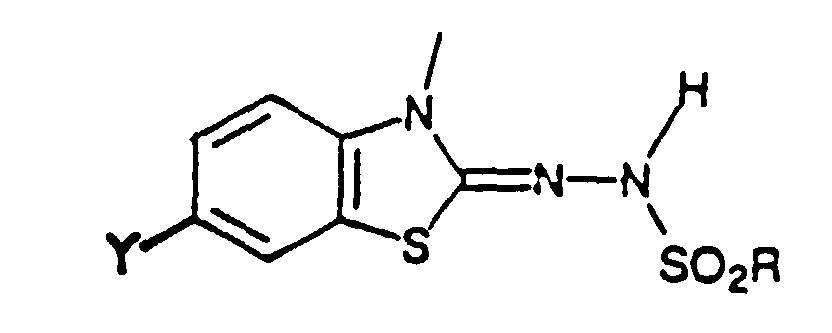
- the dye couple comprises the compound: wherein R is selected from the group consisting of alkyl, substituted alkyl, aryl, substituted aryl, heterocyclic, quaternary amine or organic acid moieties and Y is selected from the group consisting of NO 2 , SO 3 -,H, halide, alkyl or SiZ 3 wherein Z is either alkyl or aryl.
- Y is H.
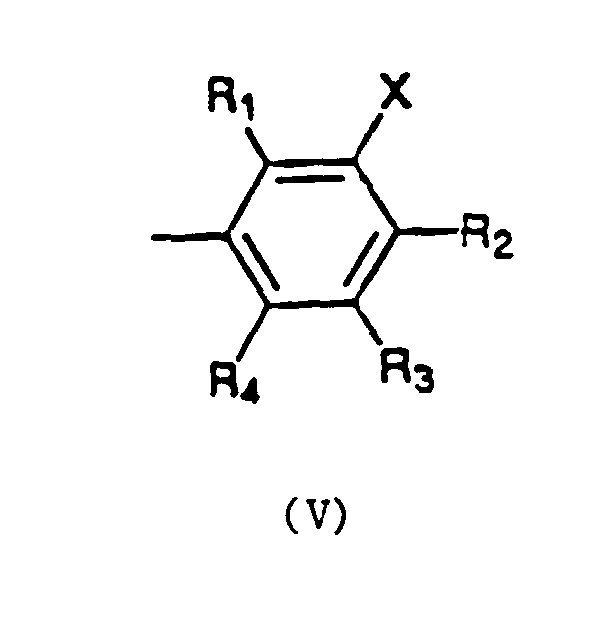
- R is: wherein any of R 1 , R 2 , R 3 , and R 4 are independently selected from the group consisting of H, alkyl, aryl, silyl, halide, hydroxide, mercaptide, alkoxide, thioalkoxide, amine, sulfonate or carboxylate; and X is selected from the group consisting of amine, sulfonate or carboxylate.
- the test device is provided to determine the presence or quantity of analytes such as glucose, cholesterol, alcohol, uric acid, formaldehyde or glycerol-3-phosphate, all commonly measured blood analytes.
- the enzyme system will comprise enzymes selected from the group consisting of glucose oxidase, cholesterol oxidase, alcohol oxidase, uricase, aldehyde oxidase, and glycerophosphate oxidase; together with peroxidase or inorganic complex which has peroxidase-like activity; e.g., hematin, hemin and tetrakis[sulphophenyl]porphyrin manganese.
- a peroxidase of choice is horseradish peroxidase.
- the invention involves an improved dye couple compound for use in a test device for determining the presence or quantity of an analyte in a liquid sample.
- the test device comprises a porous matrix 10 having incorporated therein a chemical reagent system and being adhered to a support 12.
- An aperture 16 is provided through the support whereby a liquid sample may be applied to a sample receiving surface 17 of the matrix 10.
- the chemical system is provided to react with any analyte present in the liquid sample and result in having a test surface 19 of the matrix manifest light reflectance properties indicative of the quantity of analyte present in the liquid sample.
- the test surface may be read with naked eye, but preferably is read by use of a spectra photo matrix device. Elements of such devices are shown schematically in Figure 1 and comprise a light source 18 such as a light emitting diode for directing preferably uniform wavelength light onto the test surface 19. Additionally provided is light detector 20 for detecting reflected light from surface 19 and producing a signal 22 indicative of the quantity of detected light, which signal may be processed by, for example, a microprocessor incorporated into the reading apparatus to calculate the quantity of analyte in the sample.
- a light source 18 such as a light emitting diode for directing preferably uniform wavelength light onto the test surface 19.
- light detector 20 for detecting reflected light from surface 19 and producing a signal 22 indicative of the quantity of detected light, which signal may be processed by, for example, a microprocessor incorporated into the reading apparatus to calculate the quantity of analyte in the sample.
- the reflectance properties of the testing surface varies with the analyte quantity in the sample by the operation of a series of chemical reactions between the analyte in the liquid sample and the chemical reagents present in the porous matrix.
- the matrix includes one or more enzymes which, together with the analyte-substitute, results in the production of hydrogen peroxide or other strong oxidizing agents.
- a dye couple is included in the matrix; i.e., two compounds which are capable of being oxidized to form a chromophore which absorbs light at specific wave lengths in proportion to the quantity of chromophore present.
- the oxidizing agent formed by the enzyme catalyzed reaction then reacts with the dye sample to produce the chromophore.
- an oxidase enzyme such as cholesterol oxidase may be employed.
- methanol or ethanol determination may employ alcohol oxidase; formaldehyde determinations may employ aldehyde oxidase; or glycerol-3-phosphate determinations may employ glycerophosphate oxidase.
- the hydrogen peroxide product of these enzyme catalyzed reactions may be further modified by a subsequently enzyme catalyzed reaction to produce an active oxidizing agent for reacting with the dye couple to form the chromophore.
- a subsequently enzyme catalyzed reaction to produce an active oxidizing agent for reacting with the dye couple to form the chromophore.
- the reaction of hydrogen peroxide to form an active oxidizing reagent may be catalyzed by the enzyme horseradish peroxidase.
- the analyte will be exemplified by glucose in a liquid sample of whole blood.
- the preferred chemical system will then be exemplified by the enzyme glucose oxidase which acts on the glucose substrate to form hydrogen peroxide.
- Hydrogen peroxide is converted into active oxidizing reagent by the reaction of another enzyme, horseradish peroxidase.
- the dye couple widely employed in a diagnostic test for glucose of the kind described above was the combination of 3-methyl-2-benzothiazolinone hydrazone, hydrochloride hydrate (MBTH hydrochloride hydrate) (Formula I) together with dimethylamino benzene (Formula II). These compounds undergo the following oxidization reaction to form a blue colored chromophore (Formula III):
- the MBTH even in the hydrochloride hydrate form, is relatively unstable under the action of heat and alkalinity. Furthermore, the above reaction is most efficient under highly acidic conditions; e.g., pH of 2 or less. Unfortunately, at these conditions, the enzymes employed in the test devices e.g., glucose oxidase and horseradish peroxidase, have little or no activity. Accordingly, commercial practice has dictated that in order to get a relatively stable system, an optimum pH is employed; e.g., about 4, and large quantities of both enzymes and the dye couple are used to make up for the decreased activity of the enzymes and the reduced efficiency of the oxidization of the coupling reaction.
- modified forms of MBTH may be provided which overcome the stability problem heretofore encountered and moreover are efficiently reactive in an environment more conducive to the activity of the enzymes employed in the test devices contemplated herein; e.g., at pH values ranging from about 4 to about 7.
- Certain preferred derivatives have, moreover, been found to be highly reactive with the desirable coupling partners the aromatic amines.
- R is selected from the group consisting of alkyl, substituted alkyl, aryl, substituted aryl, heterocyclic, quaternary amine or organic acid moieties
- Y is selected from the group consisting of NO 2 , SO 3 -,H, halide, alkyl or SiZ 3 , wherein Z is either alkyl or aryl.
- Y is H.
- R is: wherein any of R 1 , R 2, R 3, and R 4 are independently selected from the group consisting of H, alkyl, aryl, silyl, halide, hydroxide, mercaptide, alkoxide, thioalkoxide, amine, sulfonate or carboxylate; and X is selected from the group consisting of amine, sulfonate or carboxylate.
- the MBTH derivatives of this invention can undergo an oxidative reaction with a wide range of dye couple partners such as aromatic amines, phenols, and substituted phenols. Moreover, such reactions can proceed efficiently at room temperature and at pHs which may vary from 4 to 11.
- the oxidation reaction is optimal at pHs of from about 4 to about 7 and, hence, is particularly useful in conjunction with the amine dye couple partners of interest in diagnostic chemistry such as 3-dimethlyamino benzoic acid and 8-anilino-1-naphthalenesulfonates.
- these derivatives are remarkably stable even when heated at 100°C for as much as 16 hours.
- the peroxide catalyzing enzymes such as horseradish peroxide, are especially effective in turning over the oxidization coupling reaction.
- 3-methyl 2-benzothiazolinone hydrazone hydrochloride (MBTH.HCl), NaI, tetrabutylammonium hydroxide, methylene chloride and n-methyl-2-pyrrolidone were purchased from the Aldrich Company of Milwaukee, Wisconsin and used without purification.
- Triethylamine was obtained from Baker Chemicals and distributed by Baxter Company of Phillipsburg, New Jersey.
- the 1,3 disulfonylchloride benzene was purchased from Fluka Chemicals of Ronkonkoma, New York or Lancaster Chemicals of Windham, New Hampshire.
- Compound [1] is not very soluble in most of the common organic solvents and water. It is, however, soluble in basic solution and polar solvents, such as DMSO, NMP and DMF.
- a 2.0 gm sample of the crude [1] was suspended in 50 ml methylene chloride. 4 ml of 1M tetrabutylammonium hydroxide was added slowly, in a course of 2 min, to the stirring suspension; affording a light yellow solution. The solution was washed with 10 ml deionized water and dried over anhydrous sodium sulfate. The sulfate was removed via gravity filtration, and the resulting mixture was evaporated to dryness with a rotary-evaporator. A thick yellow oil was collected. The oil was taken up with 125 ml acetone, and 10 ml of 20% NaI in acetone was added in the course of 5 min. A white precipitant was apparent.
- Compound [2] is very soluble in water and in a water-alcohol mixture.
- the solid is stable in air and light, but its solution decomposes slowly to a light yellow hazy mixture when exposed to light for a prolonged period of time.
- a strip of polymer membrane (reaction matrix) is submerged into the aqueous dip in Table 1 until saturated. It is removed from the dip and the excess reagent is squeegeed off with a glass rod. The strip is then hung inside an air circulating over at 56°C for about 5-10 minutes to dry, after which time the strip is removed and dipped into the organic dip described in Table 1 until saturated. Again, it is then dried as in the previous step. The resulting strip is fashioned into a desired shape for testing.
- a glucose containing blood sample is applied onto the surface of the reagent impregnated strip.
- the sample is immediately absorbed into the matrix and a blue color is apparent.
- the intensity of color increases with time and is proportional to the concentration of analyte. Based on the color intensity, the glucose concentration is determined by comparing with a standard calibration curve.
- an aqueous solution of hydrogen peroxide (organic peroxides, ferric and quinone) also produces the desired blue color on the reagent impregnated strip.
- concentration of the analyte may be determined by the same means as above.
Landscapes
- Chemical & Material Sciences (AREA)
- Organic Chemistry (AREA)
- Life Sciences & Earth Sciences (AREA)
- Health & Medical Sciences (AREA)
- Wood Science & Technology (AREA)
- Proteomics, Peptides & Aminoacids (AREA)
- Zoology (AREA)
- Engineering & Computer Science (AREA)
- Immunology (AREA)
- Biochemistry (AREA)
- Microbiology (AREA)
- Molecular Biology (AREA)
- Analytical Chemistry (AREA)
- Biotechnology (AREA)
- Physics & Mathematics (AREA)
- Biophysics (AREA)
- Bioinformatics & Cheminformatics (AREA)
- General Engineering & Computer Science (AREA)
- General Health & Medical Sciences (AREA)
- Genetics & Genomics (AREA)
- Measuring Or Testing Involving Enzymes Or Micro-Organisms (AREA)
- Investigating Or Analysing Biological Materials (AREA)
- Investigating Or Analysing Materials By The Use Of Chemical Reactions (AREA)
- Investigating Or Analyzing Non-Biological Materials By The Use Of Chemical Means (AREA)
Abstract
Description
- The present invention relates to a test device and method for the colorimetric determination of chemical and biochemical components (analytes) in aqueous fluids, such as whole blood, and, more particularly, to a dye couple for use in such device and method.
- The quantification of chemical and biochemical components in colored aqueous fluids, in particular, colored biological fluids such as whole blood and urine and biological fluid derivatives such as serum and plasma, is of ever-increasing importance. Important applications exist in medical diagnosis and treatment and in the quantification of exposure to therapeutic drugs, intoxicants, hazardous chemicals, and the like. In some instances, the amounts of materials being determined are either so minuscule - in the range of a milligram or less per deciliter - or so difficult to precisely determine that the apparatus employed is complicated and useful only to skilled laboratory personnel. In this case, the results are generally not available for some hours or days after sampling. In other instances, there is often an emphasis on the ability of lay operators to perform the test routinely, quickly, and reproducibly outside a laboratory setting with rapid or immediate information display.
- One common medical test is the measurement of blood glucose levels of diabetics. Current teaching counsels diabetic patients to measure their blood glucose level from two to seven times a day, depending on the nature and severity of their particular cases. Based on the observed pattern in the measured glucose levels, the patient and physician together make adjustments in diet, exercise, and insulin intake to better manage the disease. Clearly, this information should be available to the patient immediately.
- Many blood glucose test methods and test articles are known in the art; these all suffer from a variety of limitations. A great improvement is disclosed and claimed in U.S. Patents 4,935,346, 5,049,487, 5,059,394 and 5,179,005 by R. Phillips et al. and as assigned to the same assignee as the present application.
- The method disclosed and claimed in these patents involves taking a reflectance reading from one surface of an inert porous matrix impregnated with a reagent that will interact with the analyte to produce a light-absorbing reaction product when the fluid being analyzed is applied to another surface and migrates through the matrix to the surface being read. The reagent includes glucose oxidase, an enzyme which consumes glucose in the sample to produce hydrogen peroxide which, in the presence of another enzyme, horseradish peroxidase, oxidizes a dye couple comprising 3-methyl-2-benzothiazolinone hydrazone hydrochloride (MBTH) and 3-dimethylaminobenzoic acid (DMAB) to yield a blue dye. Reflectance measurements are then made at two separate wavelengths. The concentration of the glucose in blood is determined based on the intensity of the dye color with the aid of a LED spectrophotometer.
- In US-A-5 453 360 there is disclosed a dye couple comprising 3-methyl-2-benzothiazolinone hydrazone in free form or in acid form (MBTH) and 8-anilino-1-napthalenesulfonate, in acid or salt form (ANS) to be used in place of the MBTH-DMAB dye couple as described above. The MBTH-ANS dye couple is less soluble upon oxidation and, hence, provides a more stable endpoint, with minimal dye fading, as compared to the oxidized MBTH-DMAB dye couple.
- While these prior systems have been effectively employed to produce useful test devices for the determination of the presence or quantity of glucose, several drawbacks have been noted. The test devices in which such dye couples are employed are designed for both home use and for professional use and as such are sold by the manufacturers and distributors with the expectations that they will remain in the inventory of the user for a substantial period of time and must, of course, remain effective over this period of time. This need for a substantial shelf life has caused difficulties in the formulation of products employing MBTH as one of the components of a dye couple.
- Firstly, it has been found that the stability of HBTH decreases with increasing temperature and alkalinity. The acid free form of MBTH is very labile and tends to sublime away. In an attempt to counter this, a preferred form is the acid hydrate of MBTH e.g., 3-methyl-2-benzothiazolinone hydrazone hydrochloride. Unfortunately, this hydrate is itself instable upon increasing temperature and readily dissociates into acid free MBTH and HCl upon heating. In additional to having low stability at high pH, the efficiency of MBTH to oxidatively react with its coupling partner greatly decreases with increasing alkalinities so that at high pH essentially little or no color is produced from the dye couple.
- In view of these relationships, in practice MBTH must be used in large excesses and at low pH to minimize the effects of instability and inefficiency. Ideally, a pH of below 2.0 would be preferred from the point of view of low sublimation and high efficiency of the compound. Unfortunately, for the systems being considered herein such an ideal low pH cannot be employed. As described above, the reagent systems employed depend upon enzymes to act on the substrate analyte and generate oxidation agents in quantities indicative of the quantities of the analyte present in the sample being tested. The low pH, which would be ideal with respect to the MBTH reagent, is entirely unsuitable for enzymes such as, for example, glucose oxidase and horseradish peroxidase. At such low pHs many of such commercially available enzymes have little or no activity. Accordingly, the art has been forced to comprise and chose a moderate pH e.g., 4, and a great excess of reagents to insure efficiency of their test devices for the required shelf life.
- In accordance with the teachings of this invention, a highly stable component of a dye couple is provided in a test device containing enzymes. The component, in contrast to those employed in prior test devices, is capable of efficient oxidative coupling with a wide variety of coupling partners at the relatively high pH conditions compatible with high enzyme efficiency.
- Specifically, the dye couple compound of this invention is to be used in a test device containing a reagent system for detecting the presence or quantity of an analyte in a sample wherein the reagent system comprises one or more enzymes which, in the presence of the analyte, produce an oxidizing agent in quantities indicative of the quantity of the analyte in the sample. In accordance with the teachings herein, the reagent system further comprises a dye couple capable of forming a chromophore upon being oxidized by the produced oxidizing agent; the dye couple comprises the compound:

A peroxidase of choice is horseradish peroxidase. -
- Fig. 1 is a perspective view of one embodiment of a test device containing a reaction pad to which the liquid sample being analyzed is applied; and
- Figure 2 is a perspective view of a second embodiment of the employment of the test device of Fig. 1.
- As described above, the invention involves an improved dye couple compound for use in a test device for determining the presence or quantity of an analyte in a liquid sample. Referring to Fig. 1, in a preferred embodiment of this invention, the test device comprises a porous matrix 10 having incorporated therein a chemical reagent system and being adhered to a
support 12. Anaperture 16 is provided through the support whereby a liquid sample may be applied to a sample receiving surface 17 of the matrix 10. The chemical system is provided to react with any analyte present in the liquid sample and result in having a test surface 19 of the matrix manifest light reflectance properties indicative of the quantity of analyte present in the liquid sample. The test surface may be read with naked eye, but preferably is read by use of a spectra photo matrix device. Elements of such devices are shown schematically in Figure 1 and comprise alight source 18 such as a light emitting diode for directing preferably uniform wavelength light onto the test surface 19. Additionally provided islight detector 20 for detecting reflected light from surface 19 and producing asignal 22 indicative of the quantity of detected light, which signal may be processed by, for example, a microprocessor incorporated into the reading apparatus to calculate the quantity of analyte in the sample. - Systems such as the one described above are now known in the art and are well described in U.S. Patents 4,935,346; 5,049,487; 5,059,394; and 5,179,005. Such systems contemplate that these test devices and will be inserted into a reading apparatus and then the sample, e.g., blood, will be applied to the sample receiving surface 17. Figure 2 represents an alternative to this, wherein blood is first applied to the sample receiving surface 17 and only then is testing surface 19 presented to the apparatus for reading. In all other respects, the numbered elements in Figure 2 are identical to those of Figure 1.
- The reflectance properties of the testing surface varies with the analyte quantity in the sample by the operation of a series of chemical reactions between the analyte in the liquid sample and the chemical reagents present in the porous matrix. In particular, the matrix includes one or more enzymes which, together with the analyte-substitute, results in the production of hydrogen peroxide or other strong oxidizing agents. A dye couple is included in the matrix; i.e., two compounds which are capable of being oxidized to form a chromophore which absorbs light at specific wave lengths in proportion to the quantity of chromophore present. The oxidizing agent formed by the enzyme catalyzed reaction then reacts with the dye sample to produce the chromophore.
- The choice of enzymes, the resulting oxidizing agent and the choice of dye couple vary widely in the art, and are, to a great measure, a function of which analyte is being determined. For example, in the case of determination of cholesterol as in a blood sample, an oxidase enzyme such as cholesterol oxidase may be employed. Similarly, methanol or ethanol determination may employ alcohol oxidase; formaldehyde determinations may employ aldehyde oxidase; or glycerol-3-phosphate determinations may employ glycerophosphate oxidase. The hydrogen peroxide product of these enzyme catalyzed reactions may be further modified by a subsequently enzyme catalyzed reaction to produce an active oxidizing agent for reacting with the dye couple to form the chromophore. Thus, for example, the reaction of hydrogen peroxide to form an active oxidizing reagent may be catalyzed by the enzyme horseradish peroxidase.
- Accordingly, while it will be understood that the teachings of this invention are widely applicable, for the purpose of the following discussion, the analyte will be exemplified by glucose in a liquid sample of whole blood. The preferred chemical system will then be exemplified by the enzyme glucose oxidase which acts on the glucose substrate to form hydrogen peroxide. Hydrogen peroxide, in turn, is converted into active oxidizing reagent by the reaction of another enzyme, horseradish peroxidase.
- Heretofore, the dye couple widely employed in a diagnostic test for glucose of the kind described above was the combination of 3-methyl-2-benzothiazolinone hydrazone, hydrochloride hydrate (MBTH hydrochloride hydrate) (Formula I) together with dimethylamino benzene (Formula II). These compounds undergo the following oxidization reaction to form a blue colored chromophore (Formula III):

- As described above, this system suffers from several drawbacks. The MBTH, even in the hydrochloride hydrate form, is relatively unstable under the action of heat and alkalinity. Furthermore, the above reaction is most efficient under highly acidic conditions; e.g., pH of 2 or less. Unfortunately, at these conditions, the enzymes employed in the test devices e.g., glucose oxidase and horseradish peroxidase, have little or no activity. Accordingly, commercial practice has dictated that in order to get a relatively stable system, an optimum pH is employed; e.g., about 4, and large quantities of both enzymes and the dye couple are used to make up for the decreased activity of the enzymes and the reduced efficiency of the oxidization of the coupling reaction.
- In accordance with this invention, it has now been discovered that modified forms of MBTH may be provided which overcome the stability problem heretofore encountered and moreover are efficiently reactive in an environment more conducive to the activity of the enzymes employed in the test devices contemplated herein; e.g., at pH values ranging from about 4 to about 7. Certain preferred derivatives have, moreover, been found to be highly reactive with the desirable coupling partners the aromatic amines. The derivatives of the invention have the general structure set out in Formula IV, below:

- The MBTH derivatives of this invention can undergo an oxidative reaction with a wide range of dye couple partners such as aromatic amines, phenols, and substituted phenols. Moreover, such reactions can proceed efficiently at room temperature and at pHs which may vary from 4 to 11. In the preferred form of the derivatives of this invention, the oxidation reaction is optimal at pHs of from about 4 to about 7 and, hence, is particularly useful in conjunction with the amine dye couple partners of interest in diagnostic chemistry such as 3-dimethlyamino benzoic acid and 8-anilino-1-naphthalenesulfonates.
- Unlike the MBTH, either in the acid free or in acid hydrate form, these derivatives are remarkably stable even when heated at 100°C for as much as 16 hours. Moreover, at the conditions of the oxidization reaction, the peroxide catalyzing enzymes, such as horseradish peroxide, are especially effective in turning over the oxidization coupling reaction.
- Synthesis of meta [3-methyl 2-benzothiazolinone hydrazone] N-sulfonyl benzenesulfonate monosodium, [2] Synthesis Scheme.

- 3-methyl 2-benzothiazolinone hydrazone hydrochloride (MBTH.HCl), NaI, tetrabutylammonium hydroxide, methylene chloride and n-methyl-2-pyrrolidone were purchased from the Aldrich Company of Milwaukee, Wisconsin and used without purification. Triethylamine was obtained from Baker Chemicals and distributed by Baxter Company of Phillipsburg, New Jersey. The 1,3 disulfonylchloride benzene was purchased from Fluka Chemicals of Ronkonkoma, New York or Lancaster Chemicals of Windham, New Hampshire.
- A 4 gm sample of HBTH.HCl was charged into a 150 ml Erlenmeyer flask equipped with a magnetic stirring bar, and 50ml of n-methyl-2-pyrrolidone and 5 ml of triethylamine were added. The flask was capped with a rubber septum and placed on a magnetic stirring hot plate. The mixture was heated to 60-70°C while stirring vigorously for 0.5 hr., yielding a yellow slurry. The flask was placed into an ice bath to cool.
- A 5 gm sample of 1,3 disulfonylchloride benzene was added to a 250 ml Erlenmeyer flask equipped with a magnetic stirring bar. The flask was lowered into an ice bath, and 20 ml of n-methyl-2-pyrrolidone was added. The mixture was stirred until all the solid was dissolved. (ca. 15 min.) The MBTH free-base slurry, which was obtained previously, was decanted into the solution. The resulting light-yellow mixture was allowed to react at an ice-bath temperature for 1.5 hr. After which time, the reaction was quenched with 10 ml of 2N HCl, and it was stirred for an additional 30 min. at room temperature. 50 mg of 12 mesh Norti (activated carbon pellets) was introduced to the solution, affording a light yellow solution after 10 min of stirring. It was then filtered through a fine graded frit with the aid of an aspirator. A yellow to light brown smooth solution was obtained. 300 ml of 2N HCl was added to the stirring yellow solution, resulting in precipitation of an off-white powder. The solid was collected via vacuum filtration and the product was washed 3 times with 25 ml deionized water. Upon drying at 110°C in vacuum for 2 hr. 5.6 gm of the off-white product was obtained. The product was analyzed with 1H NMR and HPLC to be 97% pure.
- Compound [1] is not very soluble in most of the common organic solvents and water. It is, however, soluble in basic solution and polar solvents, such as DMSO, NMP and DMF.
- A 2.0 gm sample of the crude [1] was suspended in 50 ml methylene chloride. 4 ml of 1M tetrabutylammonium hydroxide was added slowly, in a course of 2 min, to the stirring suspension; affording a light yellow solution. The solution was washed with 10 ml deionized water and dried over anhydrous sodium sulfate. The sulfate was removed via gravity filtration, and the resulting mixture was evaporated to dryness with a rotary-evaporator. A thick yellow oil was collected. The oil was taken up with 125 ml acetone, and 10 ml of 20% NaI in acetone was added in the course of 5 min. A white precipitant was apparent. The mixture was allowed to react for an additional 20 min., and the precipitant was collected via vacuum filtration with a fine-grade frit. The resulting off-white solid was washed 3 times with 20 ml acetone. Upon drying at 110°C for 45 min, 1.3 grm (65%) of the desired product was obtained.
- Compound [2] is very soluble in water and in a water-alcohol mixture. The solid is stable in air and light, but its solution decomposes slowly to a light yellow hazy mixture when exposed to light for a prolonged period of time.
- A strip of polymer membrane (reaction matrix) is submerged into the aqueous dip in Table 1 until saturated. It is removed from the dip and the excess reagent is squeegeed off with a glass rod. The strip is then hung inside an air circulating over at 56°C for about 5-10 minutes to dry, after which time the strip is removed and dipped into the organic dip described in Table 1 until saturated. Again, it is then dried as in the previous step. The resulting strip is fashioned into a desired shape for testing.
Table 1 - Formulation of Reagents Aqueous Dip (Adjust pH to 4.25 with NaOH) Organic Dip Water 20 ml Water 3 ml Citric acid 420 mg Denatured Alcohol 7 ml Ethylene diamine tetraacetic acid (EDTA) 16.7 mg Meta[3-methyl 2- benzothiazolinone hydrazone] N-sulfonyl benzenesulfonate monosodium [2] 10-60 mg Gantrez S95 (available from GAF, New York, New York 90 mg ANS 10-100- mg Crotein SPA (available from Croda Co., New York, New York 250 mg Glucose oxidase 20,500 units Horseradish peroxidase 16,200 units - A glucose containing blood sample is applied onto the surface of the reagent impregnated strip. The sample is immediately absorbed into the matrix and a blue color is apparent. The intensity of color increases with time and is proportional to the concentration of analyte. Based on the color intensity, the glucose concentration is determined by comparing with a standard calibration curve.
- Similarly, an aqueous solution of hydrogen peroxide (organic peroxides, ferric and quinone) also produces the desired blue color on the reagent impregnated strip. The concentration of the analyte may be determined by the same means as above.
- The invention now being fully described, it will be apparent to one of ordinary skill in the art that any modifications and changes may be made thereto without departing from the spirit and scope of the present invention.
Claims (9)
- A test device containing a reagent system for determining the presence or quantity of an analyte in a sample wherein said reagent system comprises: an enzyme to produce an oxidizing agent in quantities indicative of quantities of said analyte in said sample; and a dye couple forming a chromophore upon being oxidized by said oxidizing agent, said dye couple comprising a compound having the formula:

- The test device of claim 1 wherein R is:

- The test device of claim 1 or claim 2 wherein Y is H.
- The test device of any one of claims 1 to 3 wherein said enzymes are glucose oxidase, cholesterol oxidase, alcohol oxidase, uricase, aldehyde oxidase, or glycerophosphate oxidase.
- The test device of claim 4 wherein said enzymes further comprise peroxidase or inorganic complex having peroxidase-like properties.
- The test device of any one of claims 1 to 5 wherein said enzymes comprise glucose oxidase and horseradish peroxidase.
- The test device of any one of claims 1 to 6 wherein said dye couple further comprises 3-dimethylaminobenzoic acid.
- The test device of any one of claims 1 to 6 wherein said dye couple further comprises 8-anilino-1-naphthalenesulfonate.
- The test device of any one of claims 1 to 8 wherein said compound is meta[3-methyl 2-benzothiazolinone hydrozone]N-sulfonyl benzenesulfonate monosodium.
Applications Claiming Priority (2)
| Application Number | Priority Date | Filing Date | Title |
|---|---|---|---|
| US08/572,984 US5922530A (en) | 1994-09-08 | 1995-12-15 | Stable coupling dye for photometric determination of analytes |
| US572984 | 1995-12-15 |
Publications (2)
| Publication Number | Publication Date |
|---|---|
| EP0779367A1 true EP0779367A1 (en) | 1997-06-18 |
| EP0779367B1 EP0779367B1 (en) | 2001-10-24 |
Family
ID=24290164
Family Applications (1)
| Application Number | Title | Priority Date | Filing Date |
|---|---|---|---|
| EP96309124A Expired - Lifetime EP0779367B1 (en) | 1995-12-15 | 1996-12-13 | Test device comprising stable coupling dye for photometric determination of analytes |
Country Status (15)
| Country | Link |
|---|---|
| US (1) | US5922530A (en) |
| EP (1) | EP0779367B1 (en) |
| JP (1) | JP3878702B2 (en) |
| KR (1) | KR100433601B1 (en) |
| CN (1) | CN1113104C (en) |
| AT (1) | ATE207542T1 (en) |
| AU (1) | AU723150B2 (en) |
| CA (1) | CA2192744C (en) |
| DE (1) | DE69616243T2 (en) |
| DK (1) | DK0779367T3 (en) |
| ES (1) | ES2166429T3 (en) |
| MX (1) | MX9606509A (en) |
| NO (1) | NO323420B1 (en) |
| PT (1) | PT779367E (en) |
| TW (1) | TW508436B (en) |
Cited By (1)
| Publication number | Priority date | Publication date | Assignee | Title |
|---|---|---|---|---|
| CN103091314A (en) * | 2013-01-16 | 2013-05-08 | 深圳市计量质量检测研究院 | Rapid detection method for water-soluble azo dyes in foods |
Families Citing this family (90)
| Publication number | Priority date | Publication date | Assignee | Title |
|---|---|---|---|---|
| US7407811B2 (en) | 1997-12-22 | 2008-08-05 | Roche Diagnostics Operations, Inc. | System and method for analyte measurement using AC excitation |
| US7494816B2 (en) | 1997-12-22 | 2009-02-24 | Roche Diagnostic Operations, Inc. | System and method for determining a temperature during analyte measurement |
| US7390667B2 (en) | 1997-12-22 | 2008-06-24 | Roche Diagnostics Operations, Inc. | System and method for analyte measurement using AC phase angle measurements |
| US8071384B2 (en) | 1997-12-22 | 2011-12-06 | Roche Diagnostics Operations, Inc. | Control and calibration solutions and methods for their use |
| US6391005B1 (en) | 1998-03-30 | 2002-05-21 | Agilent Technologies, Inc. | Apparatus and method for penetration with shaft having a sensor for sensing penetration depth |
| ATE292280T1 (en) * | 1998-10-31 | 2005-04-15 | Yellow Springs Optical Sensor | CAPSULE FOR CO2 SENSOR |
| US6218571B1 (en) | 1999-10-27 | 2001-04-17 | Lifescan, Inc. | 8-(anilino)-1-naphthalenesulfonate analogs |
| US6458326B1 (en) | 1999-11-24 | 2002-10-01 | Home Diagnostics, Inc. | Protective test strip platform |
| US8641644B2 (en) | 2000-11-21 | 2014-02-04 | Sanofi-Aventis Deutschland Gmbh | Blood testing apparatus having a rotatable cartridge with multiple lancing elements and testing means |
| US6525330B2 (en) | 2001-02-28 | 2003-02-25 | Home Diagnostics, Inc. | Method of strip insertion detection |
| US6541266B2 (en) | 2001-02-28 | 2003-04-01 | Home Diagnostics, Inc. | Method for determining concentration of an analyte in a test strip |
| US6562625B2 (en) | 2001-02-28 | 2003-05-13 | Home Diagnostics, Inc. | Distinguishing test types through spectral analysis |
| US9427532B2 (en) | 2001-06-12 | 2016-08-30 | Sanofi-Aventis Deutschland Gmbh | Tissue penetration device |
| US7041068B2 (en) | 2001-06-12 | 2006-05-09 | Pelikan Technologies, Inc. | Sampling module device and method |
| WO2002100251A2 (en) | 2001-06-12 | 2002-12-19 | Pelikan Technologies, Inc. | Self optimizing lancing device with adaptation means to temporal variations in cutaneous properties |
| US8337419B2 (en) | 2002-04-19 | 2012-12-25 | Sanofi-Aventis Deutschland Gmbh | Tissue penetration device |
| EP1404235A4 (en) | 2001-06-12 | 2008-08-20 | Pelikan Technologies Inc | METHOD AND APPARATUS FOR INTEGRATED LANCET LAUNCH DEVICE ON BLOOD SAMPLING CARTRIDGE |
| US9795747B2 (en) | 2010-06-02 | 2017-10-24 | Sanofi-Aventis Deutschland Gmbh | Methods and apparatus for lancet actuation |
| US9226699B2 (en) | 2002-04-19 | 2016-01-05 | Sanofi-Aventis Deutschland Gmbh | Body fluid sampling module with a continuous compression tissue interface surface |
| WO2002100460A2 (en) | 2001-06-12 | 2002-12-19 | Pelikan Technologies, Inc. | Electric lancet actuator |
| US7981056B2 (en) | 2002-04-19 | 2011-07-19 | Pelikan Technologies, Inc. | Methods and apparatus for lancet actuation |
| US6844149B2 (en) | 2001-06-29 | 2005-01-18 | International Business Machines Corporation | Method, system, and apparatus for measurement and recording of blood chemistry and other physiological measurements |
| US8372016B2 (en) | 2002-04-19 | 2013-02-12 | Sanofi-Aventis Deutschland Gmbh | Method and apparatus for body fluid sampling and analyte sensing |
| US8702624B2 (en) | 2006-09-29 | 2014-04-22 | Sanofi-Aventis Deutschland Gmbh | Analyte measurement device with a single shot actuator |
| US7232451B2 (en) | 2002-04-19 | 2007-06-19 | Pelikan Technologies, Inc. | Method and apparatus for penetrating tissue |
| US7547287B2 (en) | 2002-04-19 | 2009-06-16 | Pelikan Technologies, Inc. | Method and apparatus for penetrating tissue |
| US7229458B2 (en) | 2002-04-19 | 2007-06-12 | Pelikan Technologies, Inc. | Method and apparatus for penetrating tissue |
| US9248267B2 (en) | 2002-04-19 | 2016-02-02 | Sanofi-Aventis Deustchland Gmbh | Tissue penetration device |
| US7976476B2 (en) | 2002-04-19 | 2011-07-12 | Pelikan Technologies, Inc. | Device and method for variable speed lancet |
| US7674232B2 (en) | 2002-04-19 | 2010-03-09 | Pelikan Technologies, Inc. | Method and apparatus for penetrating tissue |
| US9314194B2 (en) | 2002-04-19 | 2016-04-19 | Sanofi-Aventis Deutschland Gmbh | Tissue penetration device |
| US7491178B2 (en) | 2002-04-19 | 2009-02-17 | Pelikan Technologies, Inc. | Method and apparatus for penetrating tissue |
| US8221334B2 (en) | 2002-04-19 | 2012-07-17 | Sanofi-Aventis Deutschland Gmbh | Method and apparatus for penetrating tissue |
| US9795334B2 (en) | 2002-04-19 | 2017-10-24 | Sanofi-Aventis Deutschland Gmbh | Method and apparatus for penetrating tissue |
| US7297122B2 (en) | 2002-04-19 | 2007-11-20 | Pelikan Technologies, Inc. | Method and apparatus for penetrating tissue |
| US7713214B2 (en) | 2002-04-19 | 2010-05-11 | Pelikan Technologies, Inc. | Method and apparatus for a multi-use body fluid sampling device with optical analyte sensing |
| US7892183B2 (en) | 2002-04-19 | 2011-02-22 | Pelikan Technologies, Inc. | Method and apparatus for body fluid sampling and analyte sensing |
| US7175642B2 (en) | 2002-04-19 | 2007-02-13 | Pelikan Technologies, Inc. | Methods and apparatus for lancet actuation |
| US8579831B2 (en) | 2002-04-19 | 2013-11-12 | Sanofi-Aventis Deutschland Gmbh | Method and apparatus for penetrating tissue |
| US8784335B2 (en) | 2002-04-19 | 2014-07-22 | Sanofi-Aventis Deutschland Gmbh | Body fluid sampling device with a capacitive sensor |
| US8360992B2 (en) | 2002-04-19 | 2013-01-29 | Sanofi-Aventis Deutschland Gmbh | Method and apparatus for penetrating tissue |
| US7909778B2 (en) | 2002-04-19 | 2011-03-22 | Pelikan Technologies, Inc. | Method and apparatus for penetrating tissue |
| US8267870B2 (en) | 2002-04-19 | 2012-09-18 | Sanofi-Aventis Deutschland Gmbh | Method and apparatus for body fluid sampling with hybrid actuation |
| US7901362B2 (en) | 2002-04-19 | 2011-03-08 | Pelikan Technologies, Inc. | Method and apparatus for penetrating tissue |
| US7331931B2 (en) | 2002-04-19 | 2008-02-19 | Pelikan Technologies, Inc. | Method and apparatus for penetrating tissue |
| US8574895B2 (en) | 2002-12-30 | 2013-11-05 | Sanofi-Aventis Deutschland Gmbh | Method and apparatus using optical techniques to measure analyte levels |
| US6983177B2 (en) * | 2003-01-06 | 2006-01-03 | Optiscan Biomedical Corporation | Layered spectroscopic sample element with microporous membrane |
| US20040131088A1 (en) * | 2003-01-08 | 2004-07-08 | Adtran, Inc. | Shared T1/E1 signaling bit processor |
| DE602004028463D1 (en) | 2003-05-30 | 2010-09-16 | Pelikan Technologies Inc | METHOD AND DEVICE FOR INJECTING LIQUID |
| EP1633235B1 (en) | 2003-06-06 | 2014-05-21 | Sanofi-Aventis Deutschland GmbH | Apparatus for body fluid sampling and analyte sensing |
| WO2006001797A1 (en) | 2004-06-14 | 2006-01-05 | Pelikan Technologies, Inc. | Low pain penetrating |
| US7452457B2 (en) | 2003-06-20 | 2008-11-18 | Roche Diagnostics Operations, Inc. | System and method for analyte measurement using dose sufficiency electrodes |
| US7597793B2 (en) | 2003-06-20 | 2009-10-06 | Roche Operations Ltd. | System and method for analyte measurement employing maximum dosing time delay |
| US7718439B2 (en) | 2003-06-20 | 2010-05-18 | Roche Diagnostics Operations, Inc. | System and method for coding information on a biosensor test strip |
| US7604721B2 (en) | 2003-06-20 | 2009-10-20 | Roche Diagnostics Operations, Inc. | System and method for coding information on a biosensor test strip |
| US7645373B2 (en) | 2003-06-20 | 2010-01-12 | Roche Diagnostic Operations, Inc. | System and method for coding information on a biosensor test strip |
| US7488601B2 (en) | 2003-06-20 | 2009-02-10 | Roche Diagnostic Operations, Inc. | System and method for determining an abused sensor during analyte measurement |
| US8206565B2 (en) | 2003-06-20 | 2012-06-26 | Roche Diagnostics Operation, Inc. | System and method for coding information on a biosensor test strip |
| US8148164B2 (en) | 2003-06-20 | 2012-04-03 | Roche Diagnostics Operations, Inc. | System and method for determining the concentration of an analyte in a sample fluid |
| US8058077B2 (en) | 2003-06-20 | 2011-11-15 | Roche Diagnostics Operations, Inc. | Method for coding information on a biosensor test strip |
| US7645421B2 (en) | 2003-06-20 | 2010-01-12 | Roche Diagnostics Operations, Inc. | System and method for coding information on a biosensor test strip |
| US7220034B2 (en) * | 2003-07-11 | 2007-05-22 | Rudolph Technologies, Inc. | Fiber optic darkfield ring light |
| US7920906B2 (en) | 2005-03-10 | 2011-04-05 | Dexcom, Inc. | System and methods for processing analyte sensor data for sensor calibration |
| US8282576B2 (en) | 2003-09-29 | 2012-10-09 | Sanofi-Aventis Deutschland Gmbh | Method and apparatus for an improved sample capture device |
| US9351680B2 (en) | 2003-10-14 | 2016-05-31 | Sanofi-Aventis Deutschland Gmbh | Method and apparatus for a variable user interface |
| WO2005065414A2 (en) | 2003-12-31 | 2005-07-21 | Pelikan Technologies, Inc. | Method and apparatus for improving fluidic flow and sample capture |
| US7822454B1 (en) | 2005-01-03 | 2010-10-26 | Pelikan Technologies, Inc. | Fluid sampling device with improved analyte detecting member configuration |
| AU2005212396A1 (en) | 2004-02-06 | 2005-08-25 | Bayer Healthcare Llc | Oxidizable species as an internal reference for biosensors and method of use |
| EP1751546A2 (en) | 2004-05-20 | 2007-02-14 | Albatros Technologies GmbH & Co. KG | Printable hydrogel for biosensors |
| EP1765194A4 (en) | 2004-06-03 | 2010-09-29 | Pelikan Technologies Inc | METHOD AND APPARATUS FOR MANUFACTURING A DEVICE FOR SAMPLING LIQUIDS |
| US9775553B2 (en) | 2004-06-03 | 2017-10-03 | Sanofi-Aventis Deutschland Gmbh | Method and apparatus for a fluid sampling device |
| US7556723B2 (en) | 2004-06-18 | 2009-07-07 | Roche Diagnostics Operations, Inc. | Electrode design for biosensor |
| US7569126B2 (en) | 2004-06-18 | 2009-08-04 | Roche Diagnostics Operations, Inc. | System and method for quality assurance of a biosensor test strip |
| US8343074B2 (en) | 2004-06-30 | 2013-01-01 | Lifescan Scotland Limited | Fluid handling devices |
| US20060002817A1 (en) * | 2004-06-30 | 2006-01-05 | Sebastian Bohm | Flow modulation devices |
| US9044199B2 (en) | 2004-07-13 | 2015-06-02 | Dexcom, Inc. | Transcutaneous analyte sensor |
| US8886272B2 (en) | 2004-07-13 | 2014-11-11 | Dexcom, Inc. | Analyte sensor |
| US8652831B2 (en) | 2004-12-30 | 2014-02-18 | Sanofi-Aventis Deutschland Gmbh | Method and apparatus for analyte measurement test time |
| CN103558284B (en) | 2005-07-20 | 2017-04-12 | 安晟信医疗科技控股公司 | Gated amperometry |
| EP3483598B1 (en) | 2005-09-30 | 2024-11-06 | Ascensia Diabetes Care Holdings AG | Gated voltammetry |
| EP4282332B1 (en) | 2006-02-22 | 2024-05-15 | DexCom, Inc. | Analyte sensor |
| WO2007102842A2 (en) | 2006-03-09 | 2007-09-13 | Dexcom, Inc. | Systems and methods for processing analyte sensor data |
| EP4218548A1 (en) | 2006-03-09 | 2023-08-02 | Dexcom, Inc. | Systems and methods for processing analyte sensor data |
| US20070267513A1 (en) * | 2006-05-17 | 2007-11-22 | Taylor William A | Low profile fountain or water display |
| WO2009076302A1 (en) | 2007-12-10 | 2009-06-18 | Bayer Healthcare Llc | Control markers for auto-detection of control solution and methods of use |
| US11730407B2 (en) | 2008-03-28 | 2023-08-22 | Dexcom, Inc. | Polymer membranes for continuous analyte sensors |
| US9386944B2 (en) | 2008-04-11 | 2016-07-12 | Sanofi-Aventis Deutschland Gmbh | Method and apparatus for analyte detecting device |
| US9375169B2 (en) | 2009-01-30 | 2016-06-28 | Sanofi-Aventis Deutschland Gmbh | Cam drive for managing disposable penetrating member actions with a single motor and motor and control system |
| US8965476B2 (en) | 2010-04-16 | 2015-02-24 | Sanofi-Aventis Deutschland Gmbh | Tissue penetration device |
| CN108344706B (en) * | 2017-01-23 | 2021-10-22 | 中国石油化工股份有限公司 | Method for determining content of effective components in beta-naphthalenesulfonic acid formaldehyde condensate |
Citations (7)
| Publication number | Priority date | Publication date | Assignee | Title |
|---|---|---|---|---|
| EP0243126A2 (en) * | 1986-04-19 | 1987-10-28 | Sanwa Kagaku Kenkyusho Co., Ltd. | Method of measuring hydrogen peroxide or of measuring an enzyme or biochemical substrate liberating the peroxide |
| EP0248312A1 (en) * | 1986-06-04 | 1987-12-09 | Bayer Ag | 4,6-Dinitro benzothiazolone-2-hydrazones |
| EP0256806A2 (en) * | 1986-08-13 | 1988-02-24 | Lifescan, Inc. | Method for the determination of glucose in whole blood |
| US5049487A (en) | 1986-08-13 | 1991-09-17 | Lifescan, Inc. | Automated initiation of timing of reflectance readings |
| US5059394A (en) | 1986-08-13 | 1991-10-22 | Lifescan, Inc. | Analytical device for the automated determination of analytes in fluids |
| US5453360A (en) | 1992-02-03 | 1995-09-26 | Lifescan, Inc. | Oxidative coupling dye for spectrophotometric quantitive analysis of analytes |
| WO1996007757A1 (en) * | 1994-09-08 | 1996-03-14 | Lifescan, Inc. | Dye couple for spectrophotometric determination of analytes |
Family Cites Families (1)
| Publication number | Priority date | Publication date | Assignee | Title |
|---|---|---|---|---|
| NL268685A (en) * | 1960-09-01 |
-
1995
- 1995-12-15 US US08/572,984 patent/US5922530A/en not_active Expired - Lifetime
-
1996
- 1996-11-29 AU AU74068/96A patent/AU723150B2/en not_active Expired
- 1996-12-10 JP JP35185396A patent/JP3878702B2/en not_active Expired - Lifetime
- 1996-12-12 KR KR1019960064751A patent/KR100433601B1/en not_active Expired - Lifetime
- 1996-12-12 CA CA002192744A patent/CA2192744C/en not_active Expired - Lifetime
- 1996-12-13 AT AT96309124T patent/ATE207542T1/en active
- 1996-12-13 EP EP96309124A patent/EP0779367B1/en not_active Expired - Lifetime
- 1996-12-13 ES ES96309124T patent/ES2166429T3/en not_active Expired - Lifetime
- 1996-12-13 DE DE69616243T patent/DE69616243T2/en not_active Expired - Lifetime
- 1996-12-13 DK DK96309124T patent/DK0779367T3/en active
- 1996-12-13 MX MX9606509A patent/MX9606509A/en unknown
- 1996-12-13 NO NO19965369A patent/NO323420B1/en not_active IP Right Cessation
- 1996-12-13 PT PT96309124T patent/PT779367E/en unknown
- 1996-12-14 CN CN96121495A patent/CN1113104C/en not_active Expired - Lifetime
- 1996-12-26 TW TW085116042A patent/TW508436B/en not_active IP Right Cessation
Patent Citations (9)
| Publication number | Priority date | Publication date | Assignee | Title |
|---|---|---|---|---|
| EP0243126A2 (en) * | 1986-04-19 | 1987-10-28 | Sanwa Kagaku Kenkyusho Co., Ltd. | Method of measuring hydrogen peroxide or of measuring an enzyme or biochemical substrate liberating the peroxide |
| EP0248312A1 (en) * | 1986-06-04 | 1987-12-09 | Bayer Ag | 4,6-Dinitro benzothiazolone-2-hydrazones |
| EP0256806A2 (en) * | 1986-08-13 | 1988-02-24 | Lifescan, Inc. | Method for the determination of glucose in whole blood |
| US4935346A (en) | 1986-08-13 | 1990-06-19 | Lifescan, Inc. | Minimum procedure system for the determination of analytes |
| US5049487A (en) | 1986-08-13 | 1991-09-17 | Lifescan, Inc. | Automated initiation of timing of reflectance readings |
| US5059394A (en) | 1986-08-13 | 1991-10-22 | Lifescan, Inc. | Analytical device for the automated determination of analytes in fluids |
| US5179005A (en) | 1986-08-13 | 1993-01-12 | Lifescan, Inc. | Minimum procedure system for the determination of analytes |
| US5453360A (en) | 1992-02-03 | 1995-09-26 | Lifescan, Inc. | Oxidative coupling dye for spectrophotometric quantitive analysis of analytes |
| WO1996007757A1 (en) * | 1994-09-08 | 1996-03-14 | Lifescan, Inc. | Dye couple for spectrophotometric determination of analytes |
Non-Patent Citations (2)
| Title |
|---|
| LONERGAN, G. ET AL: "Comparative study of substrates of fungal laccase", LETT. APPL. MICROBIOL. (1995), VOLUME DATE 1995, 21(1), 31-3 CODEN: LAMIE7;ISSN: 0266-8254, 1995, XP000646301 * |
| NGO, T. T. ET AL: "A sensitive and versatile chromogenic assay for peroxidase and peroxidase-coupled reactions", ANAL. BIOCHEM. (1980), 105(2), 389-97 CODEN: ANBCA2;ISSN: 0003-2697, 1980, XP000646334 * |
Cited By (1)
| Publication number | Priority date | Publication date | Assignee | Title |
|---|---|---|---|---|
| CN103091314A (en) * | 2013-01-16 | 2013-05-08 | 深圳市计量质量检测研究院 | Rapid detection method for water-soluble azo dyes in foods |
Also Published As
| Publication number | Publication date |
|---|---|
| NO965369L (en) | 1997-06-16 |
| ES2166429T3 (en) | 2002-04-16 |
| TW508436B (en) | 2002-11-01 |
| EP0779367B1 (en) | 2001-10-24 |
| US5922530A (en) | 1999-07-13 |
| CA2192744A1 (en) | 1997-06-16 |
| JPH09184839A (en) | 1997-07-15 |
| DE69616243D1 (en) | 2001-11-29 |
| NO965369D0 (en) | 1996-12-13 |
| NO323420B1 (en) | 2007-04-30 |
| MX9606509A (en) | 1997-06-28 |
| AU723150B2 (en) | 2000-08-17 |
| DE69616243T2 (en) | 2002-05-23 |
| JP3878702B2 (en) | 2007-02-07 |
| KR970043068A (en) | 1997-07-26 |
| PT779367E (en) | 2002-02-28 |
| DK0779367T3 (en) | 2001-11-26 |
| AU7406896A (en) | 1997-06-19 |
| KR100433601B1 (en) | 2004-11-20 |
| CA2192744C (en) | 2009-05-12 |
| ATE207542T1 (en) | 2001-11-15 |
| CN1162739A (en) | 1997-10-22 |
| CN1113104C (en) | 2003-07-02 |
Similar Documents
| Publication | Publication Date | Title |
|---|---|---|
| EP0779367B1 (en) | Test device comprising stable coupling dye for photometric determination of analytes | |
| EP0781350B1 (en) | Highly stable oxidative coupling dye for spectrophotometric determination of analytes | |
| MXPA97001795A (en) | Coloring copuard for anali spectrophotometric determination | |
| MXPA96006509A (en) | Stainless coloring colorant for anali photometric determination | |
| CA2088652C (en) | Improved oxidative coupling dye for spectrophotometric quantitative analysis of analytes | |
| AU781213B2 (en) | 8-(anilino)-1-naphthalenesulfonate analogs and their use in analyte detection assays | |
| RU2050546C1 (en) | Method and composition for determining general glucose contents in the whole blood | |
| EP0463524B1 (en) | Composition and method of assaying for ketone bodies | |
| DK155052B (en) | REAGENT, TEST MATERIAL AND PROCEDURE FOR DETECTING THE PRESENCE AND / OR DETERMINING THE CONCENTRATION OF GLUCOSE IN A TEST SAMPLE | |
| EP2138483B1 (en) | Oxidative color-developing compounds, salts thereof, process for production of the same, reagent compositions and test tools made by using the same | |
| HK1043610B (en) | Dye couple for spectrophotometric determination of analytes | |
| JP2516381B2 (en) | Method for quantifying hydrogen peroxide and reagent for quantifying the same | |
| US4894472A (en) | Dicyanoethylaryl derivatives and process for their preparation | |
| JP2547375B2 (en) | Sulfoalkyl derivatives of 3,3 ', 5,5'-tetraalkylbenzidine | |
| EP0404526A1 (en) | Oxidizable color producing reagent | |
| EP0284951A2 (en) | New dicyanoethylaryl derivatives, processes for their preparation and their use as redox indicators |
Legal Events
| Date | Code | Title | Description |
|---|---|---|---|
| PUAI | Public reference made under article 153(3) epc to a published international application that has entered the european phase |
Free format text: ORIGINAL CODE: 0009012 |
|
| AK | Designated contracting states |
Kind code of ref document: A1 Designated state(s): AT BE CH DE DK ES FI FR GB GR IE IT LI LU NL PT SE |
|
| 17P | Request for examination filed |
Effective date: 19971124 |
|
| 17Q | First examination report despatched |
Effective date: 19991220 |
|
| GRAG | Despatch of communication of intention to grant |
Free format text: ORIGINAL CODE: EPIDOS AGRA |
|
| GRAG | Despatch of communication of intention to grant |
Free format text: ORIGINAL CODE: EPIDOS AGRA |
|
| GRAH | Despatch of communication of intention to grant a patent |
Free format text: ORIGINAL CODE: EPIDOS IGRA |
|
| GRAH | Despatch of communication of intention to grant a patent |
Free format text: ORIGINAL CODE: EPIDOS IGRA |
|
| GRAA | (expected) grant |
Free format text: ORIGINAL CODE: 0009210 |
|
| AK | Designated contracting states |
Kind code of ref document: B1 Designated state(s): AT BE CH DE DK ES FI FR GB GR IE IT LI LU NL PT SE |
|
| REF | Corresponds to: |
Ref document number: 207542 Country of ref document: AT Date of ref document: 20011115 Kind code of ref document: T |
|
| REG | Reference to a national code |
Ref country code: CH Ref legal event code: EP |
|
| REG | Reference to a national code |
Ref country code: IE Ref legal event code: FG4D |
|
| REG | Reference to a national code |
Ref country code: CH Ref legal event code: NV Representative=s name: E. BLUM & CO. PATENTANWAELTE |
|
| REG | Reference to a national code |
Ref country code: DK Ref legal event code: T3 |
|
| REF | Corresponds to: |
Ref document number: 69616243 Country of ref document: DE Date of ref document: 20011129 |
|
| REG | Reference to a national code |
Ref country code: GB Ref legal event code: IF02 |
|
| REG | Reference to a national code |
Ref country code: PT Ref legal event code: SC4A Free format text: AVAILABILITY OF NATIONAL TRANSLATION Effective date: 20011025 |
|
| ET | Fr: translation filed | ||
| REG | Reference to a national code |
Ref country code: ES Ref legal event code: FG2A Ref document number: 2166429 Country of ref document: ES Kind code of ref document: T3 |
|
| REG | Reference to a national code |
Ref country code: GR Ref legal event code: EP Ref document number: 20020400081 Country of ref document: GR |
|
| PLBE | No opposition filed within time limit |
Free format text: ORIGINAL CODE: 0009261 |
|
| STAA | Information on the status of an ep patent application or granted ep patent |
Free format text: STATUS: NO OPPOSITION FILED WITHIN TIME LIMIT |
|
| 26N | No opposition filed | ||
| REG | Reference to a national code |
Ref country code: CH Ref legal event code: PFA Owner name: LIFESCAN, INC. Free format text: LIFESCAN, INC.#1000 GIBRALTAR DRIVE#MILPITAS, CALIFORNIA 95035 (US) -TRANSFER TO- LIFESCAN, INC.#1000 GIBRALTAR DRIVE#MILPITAS, CALIFORNIA 95035 (US) |
|
| REG | Reference to a national code |
Ref country code: FR Ref legal event code: PLFP Year of fee payment: 20 |
|
| PGFP | Annual fee paid to national office [announced via postgrant information from national office to epo] |
Ref country code: FR Payment date: 20150629 Year of fee payment: 20 |
|
| PGFP | Annual fee paid to national office [announced via postgrant information from national office to epo] |
Ref country code: CH Payment date: 20151211 Year of fee payment: 20 Ref country code: GB Payment date: 20151209 Year of fee payment: 20 Ref country code: DK Payment date: 20151210 Year of fee payment: 20 Ref country code: FI Payment date: 20151209 Year of fee payment: 20 Ref country code: IE Payment date: 20151209 Year of fee payment: 20 Ref country code: GR Payment date: 20151112 Year of fee payment: 20 Ref country code: DE Payment date: 20151208 Year of fee payment: 20 |
|
| PGFP | Annual fee paid to national office [announced via postgrant information from national office to epo] |
Ref country code: ES Payment date: 20151112 Year of fee payment: 20 Ref country code: BE Payment date: 20151207 Year of fee payment: 20 Ref country code: NL Payment date: 20151210 Year of fee payment: 20 Ref country code: SE Payment date: 20151211 Year of fee payment: 20 Ref country code: AT Payment date: 20151125 Year of fee payment: 20 Ref country code: PT Payment date: 20151214 Year of fee payment: 20 |
|
| PGFP | Annual fee paid to national office [announced via postgrant information from national office to epo] |
Ref country code: LU Payment date: 20160106 Year of fee payment: 20 |
|
| PGFP | Annual fee paid to national office [announced via postgrant information from national office to epo] |
Ref country code: IT Payment date: 20151221 Year of fee payment: 20 |
|
| REG | Reference to a national code |
Ref country code: DE Ref legal event code: R071 Ref document number: 69616243 Country of ref document: DE |
|
| REG | Reference to a national code |
Ref country code: NL Ref legal event code: MK Effective date: 20161212 |
|
| REG | Reference to a national code |
Ref country code: DK Ref legal event code: EUP Effective date: 20161213 |
|
| REG | Reference to a national code |
Ref country code: CH Ref legal event code: PL |
|
| REG | Reference to a national code |
Ref country code: GB Ref legal event code: PE20 Expiry date: 20161212 |
|
| REG | Reference to a national code |
Ref country code: IE Ref legal event code: MK9A |
|
| PG25 | Lapsed in a contracting state [announced via postgrant information from national office to epo] |
Ref country code: GB Free format text: LAPSE BECAUSE OF EXPIRATION OF PROTECTION Effective date: 20161212 |
|
| REG | Reference to a national code |
Ref country code: SE Ref legal event code: EUG |
|
| REG | Reference to a national code |
Ref country code: AT Ref legal event code: MK07 Ref document number: 207542 Country of ref document: AT Kind code of ref document: T Effective date: 20161213 |
|
| REG | Reference to a national code |
Ref country code: GR Ref legal event code: MA Ref document number: 20020400081 Country of ref document: GR Effective date: 20161214 |
|
| PG25 | Lapsed in a contracting state [announced via postgrant information from national office to epo] |
Ref country code: ES Free format text: LAPSE BECAUSE OF EXPIRATION OF PROTECTION Effective date: 20161214 Ref country code: IE Free format text: LAPSE BECAUSE OF EXPIRATION OF PROTECTION Effective date: 20161213 |