EP0765304B2 - Method of preparing alpha-methoxyiminocarboxylic acid methylamides, and intermediates used in the method - Google Patents
Method of preparing alpha-methoxyiminocarboxylic acid methylamides, and intermediates used in the method Download PDFInfo
- Publication number
- EP0765304B2 EP0765304B2 EP95921761A EP95921761A EP0765304B2 EP 0765304 B2 EP0765304 B2 EP 0765304B2 EP 95921761 A EP95921761 A EP 95921761A EP 95921761 A EP95921761 A EP 95921761A EP 0765304 B2 EP0765304 B2 EP 0765304B2
- Authority
- EP
- European Patent Office
- Prior art keywords
- formula
- reaction
- methyl
- give
- methoxyimino
- Prior art date
- Legal status (The legal status is an assumption and is not a legal conclusion. Google has not performed a legal analysis and makes no representation as to the accuracy of the status listed.)
- Expired - Lifetime
Links
- BAVYZALUXZFZLV-UHFFFAOYSA-N Methylamine Chemical class NC BAVYZALUXZFZLV-UHFFFAOYSA-N 0.000 title claims abstract description 50
- 239000002253 acid Substances 0.000 title claims abstract description 44
- 238000000034 method Methods 0.000 title claims abstract description 33
- 239000000543 intermediate Substances 0.000 title abstract description 6
- LFQSCWFLJHTTHZ-UHFFFAOYSA-N Ethanol Chemical compound CCO LFQSCWFLJHTTHZ-UHFFFAOYSA-N 0.000 claims abstract description 60
- 238000006243 chemical reaction Methods 0.000 claims abstract description 36
- 238000003482 Pinner synthesis reaction Methods 0.000 claims abstract description 28
- 229910052736 halogen Inorganic materials 0.000 claims abstract description 26
- 150000002367 halogens Chemical group 0.000 claims abstract description 25
- SQDFHQJTAWCFIB-UHFFFAOYSA-N n-methylidenehydroxylamine Chemical compound ON=C SQDFHQJTAWCFIB-UHFFFAOYSA-N 0.000 claims abstract description 21
- 125000000449 nitro group Chemical group [O-][N+](*)=O 0.000 claims abstract description 16
- AVXURJPOCDRRFD-UHFFFAOYSA-N Hydroxylamine Chemical compound ON AVXURJPOCDRRFD-UHFFFAOYSA-N 0.000 claims abstract description 13
- 150000002923 oximes Chemical class 0.000 claims abstract description 13
- 150000002148 esters Chemical class 0.000 claims abstract description 12
- 125000002023 trifluoromethyl group Chemical group FC(F)(F)* 0.000 claims abstract description 11
- 125000003545 alkoxy group Chemical group 0.000 claims abstract description 10
- 230000011987 methylation Effects 0.000 claims abstract description 10
- 238000007069 methylation reaction Methods 0.000 claims abstract description 10
- -1 hetarylcarbonyl Chemical group 0.000 claims description 453
- 150000001875 compounds Chemical class 0.000 claims description 38
- 125000004432 carbon atom Chemical group C* 0.000 claims description 33
- 125000001072 heteroaryl group Chemical group 0.000 claims description 30
- 239000000203 mixture Substances 0.000 claims description 26
- 239000001257 hydrogen Substances 0.000 claims description 23
- 229910052739 hydrogen Inorganic materials 0.000 claims description 23
- 125000000623 heterocyclic group Chemical group 0.000 claims description 21
- 125000003118 aryl group Chemical group 0.000 claims description 18
- 125000004104 aryloxy group Chemical group 0.000 claims description 16
- 125000003342 alkenyl group Chemical group 0.000 claims description 15
- 125000000753 cycloalkyl group Chemical group 0.000 claims description 15
- GMPKIPWJBDOURN-UHFFFAOYSA-N Methoxyamine Chemical compound CON GMPKIPWJBDOURN-UHFFFAOYSA-N 0.000 claims description 12
- 150000001264 acyl cyanides Chemical class 0.000 claims description 12
- 125000004391 aryl sulfonyl group Chemical group 0.000 claims description 11
- 125000005110 aryl thio group Chemical group 0.000 claims description 11
- 238000009835 boiling Methods 0.000 claims description 11
- 125000001769 aryl amino group Chemical group 0.000 claims description 10
- 125000003282 alkyl amino group Chemical group 0.000 claims description 9
- 125000004414 alkyl thio group Chemical group 0.000 claims description 9
- 125000000392 cycloalkenyl group Chemical group 0.000 claims description 9
- 125000004663 dialkyl amino group Chemical group 0.000 claims description 9
- 125000000304 alkynyl group Chemical group 0.000 claims description 8
- 125000005279 aryl sulfonyloxy group Chemical group 0.000 claims description 8
- 125000004093 cyano group Chemical group *C#N 0.000 claims description 8
- 125000004178 (C1-C4) alkyl group Chemical group 0.000 claims description 7
- 125000000229 (C1-C4)alkoxy group Chemical group 0.000 claims description 7
- 125000005129 aryl carbonyl group Chemical group 0.000 claims description 7
- 125000006323 alkenyl amino group Chemical group 0.000 claims description 6
- 125000005090 alkenylcarbonyl group Chemical group 0.000 claims description 6
- 125000003302 alkenyloxy group Chemical group 0.000 claims description 6
- 125000005108 alkenylthio group Chemical group 0.000 claims description 6
- 125000004453 alkoxycarbonyl group Chemical group 0.000 claims description 6
- 125000004448 alkyl carbonyl group Chemical group 0.000 claims description 6
- 125000005278 alkyl sulfonyloxy group Chemical group 0.000 claims description 6
- 150000001408 amides Chemical class 0.000 claims description 6
- 125000004435 hydrogen atom Chemical group [H]* 0.000 claims description 6
- 125000004390 alkyl sulfonyl group Chemical group 0.000 claims description 5
- 125000004465 cycloalkenyloxy group Chemical group 0.000 claims description 5
- 125000000000 cycloalkoxy group Chemical group 0.000 claims description 5
- 125000006310 cycloalkyl amino group Chemical group 0.000 claims description 5
- 125000006254 cycloalkyl carbonyl group Chemical group 0.000 claims description 5
- 125000005844 heterocyclyloxy group Chemical group 0.000 claims description 5
- 125000004468 heterocyclylthio group Chemical group 0.000 claims description 5
- 125000001424 substituent group Chemical group 0.000 claims description 5
- 125000004767 (C1-C4) haloalkoxy group Chemical group 0.000 claims description 4
- 125000004765 (C1-C4) haloalkyl group Chemical group 0.000 claims description 4
- 125000006319 alkynyl amino group Chemical group 0.000 claims description 4
- 125000005087 alkynylcarbonyl group Chemical group 0.000 claims description 4
- 125000005133 alkynyloxy group Chemical group 0.000 claims description 4
- 125000005109 alkynylthio group Chemical group 0.000 claims description 4
- 125000005366 cycloalkylthio group Chemical group 0.000 claims description 3
- 125000005241 heteroarylamino group Chemical group 0.000 claims description 3
- 125000005553 heteroaryloxy group Chemical group 0.000 claims description 3
- 125000005368 heteroarylthio group Chemical group 0.000 claims description 3
- 125000006517 heterocyclyl carbonyl group Chemical group 0.000 claims description 3
- 125000002837 carbocyclic group Chemical group 0.000 claims description 2
- 238000004519 manufacturing process Methods 0.000 claims 8
- 125000002887 hydroxy group Chemical group [H]O* 0.000 claims 3
- 125000000547 substituted alkyl group Chemical group 0.000 claims 3
- AYECMWOISZFKSO-UHFFFAOYSA-N 2,2-dimethylpropyl 2-[2-(chloromethyl)phenyl]-2-methoxyiminoacetate Chemical compound CC(C)(C)COC(=O)C(=NOC)C1=CC=CC=C1CCl AYECMWOISZFKSO-UHFFFAOYSA-N 0.000 claims 1
- LOQPHIKIKSPCEE-UHFFFAOYSA-N 2-methylbutan-2-yl 2-[2-(chloromethyl)phenyl]-2-methoxyiminoacetate Chemical compound CCC(C)(C)OC(=O)C(=NOC)C1=CC=CC=C1CCl LOQPHIKIKSPCEE-UHFFFAOYSA-N 0.000 claims 1
- GHILMQJCUOKVJX-UHFFFAOYSA-N 2-methylbutyl 2-[2-(chloromethyl)phenyl]-2-methoxyiminoacetate Chemical compound CCC(C)COC(=O)C(=NOC)C1=CC=CC=C1CCl GHILMQJCUOKVJX-UHFFFAOYSA-N 0.000 claims 1
- KHIPZEFKGMZCBH-UHFFFAOYSA-N 2-methylpropyl 2-[2-(chloromethyl)phenyl]-2-methoxyiminoacetate Chemical compound CC(C)COC(=O)C(=NOC)C1=CC=CC=C1CCl KHIPZEFKGMZCBH-UHFFFAOYSA-N 0.000 claims 1
- TVTPRXZYINSSJQ-UHFFFAOYSA-N 3-methylbutan-2-yl 2-[2-(chloromethyl)phenyl]-2-methoxyiminoacetate Chemical compound CC(C)C(C)OC(=O)C(=NOC)C1=CC=CC=C1CCl TVTPRXZYINSSJQ-UHFFFAOYSA-N 0.000 claims 1
- JTDIOOXEHZQBHR-UHFFFAOYSA-N 3-methylbutyl 2-[2-(chloromethyl)phenyl]-2-methoxyiminoacetate Chemical compound CC(C)CCOC(=O)C(=NOC)C1=CC=CC=C1CCl JTDIOOXEHZQBHR-UHFFFAOYSA-N 0.000 claims 1
- XAAJXRROCBOOSN-UHFFFAOYSA-N butyl 2-[2-(chloromethyl)phenyl]-2-methoxyiminoacetate Chemical compound CCCCOC(=O)C(=NOC)C1=CC=CC=C1CCl XAAJXRROCBOOSN-UHFFFAOYSA-N 0.000 claims 1
- IKRPKFILUIBSBL-UHFFFAOYSA-N ethyl 2-[2-(chloromethyl)phenyl]-2-methoxyiminoacetate Chemical compound CCOC(=O)C(=NOC)C1=CC=CC=C1CCl IKRPKFILUIBSBL-UHFFFAOYSA-N 0.000 claims 1
- FVWFJSRFEUTPDW-UHFFFAOYSA-N pentan-2-yl 2-[2-(chloromethyl)phenyl]-2-methoxyiminoacetate Chemical compound CCCC(C)OC(=O)C(=NOC)C1=CC=CC=C1CCl FVWFJSRFEUTPDW-UHFFFAOYSA-N 0.000 claims 1
- TZUCQZZVBGLBTC-UHFFFAOYSA-N pentan-3-yl 2-[2-(chloromethyl)phenyl]-2-methoxyiminoacetate Chemical compound CCC(CC)OC(=O)C(=NOC)C1=CC=CC=C1CCl TZUCQZZVBGLBTC-UHFFFAOYSA-N 0.000 claims 1
- YVAHZTISWXCNAN-UHFFFAOYSA-N pentyl 2-[2-(chloromethyl)phenyl]-2-methoxyiminoacetate Chemical compound CCCCCOC(=O)C(=NOC)C1=CC=CC=C1CCl YVAHZTISWXCNAN-UHFFFAOYSA-N 0.000 claims 1
- HWISMQZHYZKDEU-UHFFFAOYSA-N propan-2-yl 2-[2-(chloromethyl)phenyl]-2-methoxyiminoacetate Chemical compound CC(C)OC(=O)C(=NOC)C1=CC=CC=C1CCl HWISMQZHYZKDEU-UHFFFAOYSA-N 0.000 claims 1
- VXXYJNFEVIPHCA-UHFFFAOYSA-N propyl 2-[2-(chloromethyl)phenyl]-2-methoxyiminoacetate Chemical compound CCCOC(=O)C(=NOC)C1=CC=CC=C1CCl VXXYJNFEVIPHCA-UHFFFAOYSA-N 0.000 claims 1
- 125000005415 substituted alkoxy group Chemical group 0.000 claims 1
- 125000005346 substituted cycloalkyl group Chemical group 0.000 claims 1
- 125000003396 thiol group Chemical group [H]S* 0.000 claims 1
- 125000000217 alkyl group Chemical group 0.000 abstract description 26
- GTBRTGPZZALPNS-MXHVRSFHSA-N cyanoketone Chemical compound C1C=C2C(C)(C)C(=O)[C@H](C#N)C[C@]2(C)[C@@H]2[C@@H]1[C@@H]1CC[C@](C)(O)[C@@]1(C)CC2 GTBRTGPZZALPNS-MXHVRSFHSA-N 0.000 abstract 2
- ZMXDDKWLCZADIW-UHFFFAOYSA-N N,N-Dimethylformamide Chemical compound CN(C)C=O ZMXDDKWLCZADIW-UHFFFAOYSA-N 0.000 description 45
- BZLVMXJERCGZMT-UHFFFAOYSA-N Methyl tert-butyl ether Chemical compound COC(C)(C)C BZLVMXJERCGZMT-UHFFFAOYSA-N 0.000 description 41
- OKKJLVBELUTLKV-UHFFFAOYSA-N Methanol Chemical compound OC OKKJLVBELUTLKV-UHFFFAOYSA-N 0.000 description 36
- YXFVVABEGXRONW-UHFFFAOYSA-N Toluene Chemical compound CC1=CC=CC=C1 YXFVVABEGXRONW-UHFFFAOYSA-N 0.000 description 36
- ZAMOUSCENKQFHK-UHFFFAOYSA-N Chlorine atom Chemical compound [Cl] ZAMOUSCENKQFHK-UHFFFAOYSA-N 0.000 description 29
- 229910052757 nitrogen Inorganic materials 0.000 description 29
- XLYOFNOQVPJJNP-UHFFFAOYSA-N water Substances O XLYOFNOQVPJJNP-UHFFFAOYSA-N 0.000 description 28
- IJGRMHOSHXDMSA-UHFFFAOYSA-N Atomic nitrogen Chemical compound N#N IJGRMHOSHXDMSA-UHFFFAOYSA-N 0.000 description 26
- VEXZGXHMUGYJMC-UHFFFAOYSA-N Hydrochloric acid Chemical compound Cl VEXZGXHMUGYJMC-UHFFFAOYSA-N 0.000 description 25
- AMQJEAYHLZJPGS-UHFFFAOYSA-N N-Pentanol Chemical compound CCCCCO AMQJEAYHLZJPGS-UHFFFAOYSA-N 0.000 description 23
- VLKZOEOYAKHREP-UHFFFAOYSA-N n-Hexane Chemical compound CCCCCC VLKZOEOYAKHREP-UHFFFAOYSA-N 0.000 description 23
- RTZKZFJDLAIYFH-UHFFFAOYSA-N Diethyl ether Chemical compound CCOCC RTZKZFJDLAIYFH-UHFFFAOYSA-N 0.000 description 22
- 229910052717 sulfur Inorganic materials 0.000 description 22
- 125000004433 nitrogen atom Chemical group N* 0.000 description 21
- WYURNTSHIVDZCO-UHFFFAOYSA-N Tetrahydrofuran Chemical compound C1CCOC1 WYURNTSHIVDZCO-UHFFFAOYSA-N 0.000 description 20
- QTBSBXVTEAMEQO-UHFFFAOYSA-N Acetic acid Chemical compound CC(O)=O QTBSBXVTEAMEQO-UHFFFAOYSA-N 0.000 description 19
- UFHFLCQGNIYNRP-UHFFFAOYSA-N Hydrogen Chemical compound [H][H] UFHFLCQGNIYNRP-UHFFFAOYSA-N 0.000 description 19
- 150000002431 hydrogen Chemical class 0.000 description 17
- 239000001301 oxygen Substances 0.000 description 17
- 229910052760 oxygen Inorganic materials 0.000 description 17
- 125000004434 sulfur atom Chemical group 0.000 description 17
- OKTJSMMVPCPJKN-UHFFFAOYSA-N Carbon Chemical group [C] OKTJSMMVPCPJKN-UHFFFAOYSA-N 0.000 description 16
- 239000000460 chlorine Substances 0.000 description 16
- 229910052801 chlorine Inorganic materials 0.000 description 16
- 238000005160 1H NMR spectroscopy Methods 0.000 description 15
- YMWUJEATGCHHMB-UHFFFAOYSA-N Dichloromethane Chemical compound ClCCl YMWUJEATGCHHMB-UHFFFAOYSA-N 0.000 description 15
- 150000007513 acids Chemical class 0.000 description 14
- BDERNNFJNOPAEC-UHFFFAOYSA-N propan-1-ol Chemical compound CCCO BDERNNFJNOPAEC-UHFFFAOYSA-N 0.000 description 13
- 238000000746 purification Methods 0.000 description 13
- UHOVQNZJYSORNB-UHFFFAOYSA-N Benzene Chemical compound C1=CC=CC=C1 UHOVQNZJYSORNB-UHFFFAOYSA-N 0.000 description 12
- QAOWNCQODCNURD-UHFFFAOYSA-N Sulfuric acid Chemical compound OS(O)(=O)=O QAOWNCQODCNURD-UHFFFAOYSA-N 0.000 description 12
- 239000012074 organic phase Substances 0.000 description 12
- 125000004430 oxygen atom Chemical group O* 0.000 description 12
- 150000003839 salts Chemical class 0.000 description 12
- 239000000243 solution Substances 0.000 description 12
- LRHPLDYGYMQRHN-UHFFFAOYSA-N N-Butanol Chemical compound CCCCO LRHPLDYGYMQRHN-UHFFFAOYSA-N 0.000 description 11
- NINIDFKCEFEMDL-UHFFFAOYSA-N Sulfur Chemical compound [S] NINIDFKCEFEMDL-UHFFFAOYSA-N 0.000 description 11
- 150000002430 hydrocarbons Chemical class 0.000 description 11
- 125000001997 phenyl group Chemical group [H]C1=C([H])C([H])=C(*)C([H])=C1[H] 0.000 description 11
- 239000002904 solvent Substances 0.000 description 11
- VYPSYNLAJGMNEJ-UHFFFAOYSA-N Silicium dioxide Chemical compound O=[Si]=O VYPSYNLAJGMNEJ-UHFFFAOYSA-N 0.000 description 10
- 125000003277 amino group Chemical group 0.000 description 10
- 238000004440 column chromatography Methods 0.000 description 10
- ZSIAUFGUXNUGDI-UHFFFAOYSA-N hexan-1-ol Chemical compound CCCCCCO ZSIAUFGUXNUGDI-UHFFFAOYSA-N 0.000 description 10
- 239000000741 silica gel Substances 0.000 description 10
- 229910002027 silica gel Inorganic materials 0.000 description 10
- YLQBMQCUIZJEEH-UHFFFAOYSA-N tetrahydrofuran Natural products C=1C=COC=1 YLQBMQCUIZJEEH-UHFFFAOYSA-N 0.000 description 10
- WEVYAHXRMPXWCK-UHFFFAOYSA-N Acetonitrile Chemical compound CC#N WEVYAHXRMPXWCK-UHFFFAOYSA-N 0.000 description 9
- PMZURENOXWZQFD-UHFFFAOYSA-L Sodium Sulfate Chemical compound [Na+].[Na+].[O-]S([O-])(=O)=O PMZURENOXWZQFD-UHFFFAOYSA-L 0.000 description 9
- QVGXLLKOCUKJST-UHFFFAOYSA-N atomic oxygen Chemical group [O] QVGXLLKOCUKJST-UHFFFAOYSA-N 0.000 description 9
- 239000002585 base Substances 0.000 description 9
- IXCSERBJSXMMFS-UHFFFAOYSA-N hydrogen chloride Substances Cl.Cl IXCSERBJSXMMFS-UHFFFAOYSA-N 0.000 description 9
- 229910000041 hydrogen chloride Inorganic materials 0.000 description 9
- 150000003254 radicals Chemical class 0.000 description 9
- 229920006395 saturated elastomer Polymers 0.000 description 9
- 229910052938 sodium sulfate Inorganic materials 0.000 description 9
- 235000011152 sodium sulphate Nutrition 0.000 description 9
- IAZDPXIOMUYVGZ-UHFFFAOYSA-N Dimethylsulphoxide Chemical compound CS(C)=O IAZDPXIOMUYVGZ-UHFFFAOYSA-N 0.000 description 8
- MYMOFIZGZYHOMD-UHFFFAOYSA-N Dioxygen Chemical compound O=O MYMOFIZGZYHOMD-UHFFFAOYSA-N 0.000 description 8
- URLKBWYHVLBVBO-UHFFFAOYSA-N Para-Xylene Chemical group CC1=CC=C(C)C=C1 URLKBWYHVLBVBO-UHFFFAOYSA-N 0.000 description 8
- 150000001298 alcohols Chemical class 0.000 description 8
- 230000015572 biosynthetic process Effects 0.000 description 8
- 125000002915 carbonyl group Chemical group [*:2]C([*:1])=O 0.000 description 8
- PHTQWCKDNZKARW-UHFFFAOYSA-N isoamylol Chemical compound CC(C)CCO PHTQWCKDNZKARW-UHFFFAOYSA-N 0.000 description 8
- 125000002950 monocyclic group Chemical group 0.000 description 8
- BWHMMNNQKKPAPP-UHFFFAOYSA-L potassium carbonate Chemical compound [K+].[K+].[O-]C([O-])=O BWHMMNNQKKPAPP-UHFFFAOYSA-L 0.000 description 8
- 238000002360 preparation method Methods 0.000 description 8
- 239000011541 reaction mixture Substances 0.000 description 8
- 239000003085 diluting agent Substances 0.000 description 7
- 125000002496 methyl group Chemical group [H]C([H])([H])* 0.000 description 7
- 239000000047 product Substances 0.000 description 7
- 239000007858 starting material Substances 0.000 description 7
- 239000011593 sulfur Chemical group 0.000 description 7
- RYHBNJHYFVUHQT-UHFFFAOYSA-N 1,4-Dioxane Chemical compound C1COCCO1 RYHBNJHYFVUHQT-UHFFFAOYSA-N 0.000 description 6
- 125000006163 5-membered heteroaryl group Chemical group 0.000 description 6
- CSCPPACGZOOCGX-UHFFFAOYSA-N Acetone Chemical compound CC(C)=O CSCPPACGZOOCGX-UHFFFAOYSA-N 0.000 description 6
- NBIIXXVUZAFLBC-UHFFFAOYSA-N Phosphoric acid Chemical compound OP(O)(O)=O NBIIXXVUZAFLBC-UHFFFAOYSA-N 0.000 description 6
- JFDZBHWFFUWGJE-UHFFFAOYSA-N benzonitrile Chemical compound N#CC1=CC=CC=C1 JFDZBHWFFUWGJE-UHFFFAOYSA-N 0.000 description 6
- 239000006227 byproduct Substances 0.000 description 6
- 150000001732 carboxylic acid derivatives Chemical class 0.000 description 6
- 229930195733 hydrocarbon Natural products 0.000 description 6
- 238000002844 melting Methods 0.000 description 6
- 230000008018 melting Effects 0.000 description 6
- 0 CCC*C(CC1)CC2C1C1(CC1)C2CC(C1)C1C(C1)C1C(C1CC1)C1C(C)C1 Chemical compound CCC*C(CC1)CC2C1C1(CC1)C2CC(C1)C1C(C1)C1C(C1CC1)C1C(C)C1 0.000 description 5
- KFZMGEQAYNKOFK-UHFFFAOYSA-N Isopropanol Chemical compound CC(C)O KFZMGEQAYNKOFK-UHFFFAOYSA-N 0.000 description 5
- SECXISVLQFMRJM-UHFFFAOYSA-N N-Methylpyrrolidone Chemical compound CN1CCCC1=O SECXISVLQFMRJM-UHFFFAOYSA-N 0.000 description 5
- BTANRVKWQNVYAZ-UHFFFAOYSA-N butan-2-ol Chemical compound CCC(C)O BTANRVKWQNVYAZ-UHFFFAOYSA-N 0.000 description 5
- 125000004218 chloromethyl group Chemical group [H]C([H])(Cl)* 0.000 description 5
- 239000012230 colorless oil Substances 0.000 description 5
- 239000012043 crude product Substances 0.000 description 5
- 239000000843 powder Substances 0.000 description 5
- 125000000472 sulfonyl group Chemical group *S(*)(=O)=O 0.000 description 5
- KBPLFHHGFOOTCA-UHFFFAOYSA-N 1-Octanol Chemical compound CCCCCCCCO KBPLFHHGFOOTCA-UHFFFAOYSA-N 0.000 description 4
- BBMCTIGTTCKYKF-UHFFFAOYSA-N 1-heptanol Chemical compound CCCCCCCO BBMCTIGTTCKYKF-UHFFFAOYSA-N 0.000 description 4
- SCLSKOXHUCZTEI-UHFFFAOYSA-N 2,3-dihydropyrazol-1-yl Chemical group C1C=[C]N=N1 SCLSKOXHUCZTEI-UHFFFAOYSA-N 0.000 description 4
- 125000000389 2-pyrrolyl group Chemical group [H]N1C([*])=C([H])C([H])=C1[H] 0.000 description 4
- 125000001397 3-pyrrolyl group Chemical group [H]N1C([H])=C([*])C([H])=C1[H] 0.000 description 4
- 239000004215 Carbon black (E152) Substances 0.000 description 4
- XDTMQSROBMDMFD-UHFFFAOYSA-N Cyclohexane Chemical compound C1CCCCC1 XDTMQSROBMDMFD-UHFFFAOYSA-N 0.000 description 4
- FXHOOIRPVKKKFG-UHFFFAOYSA-N N,N-Dimethylacetamide Chemical compound CN(C)C(C)=O FXHOOIRPVKKKFG-UHFFFAOYSA-N 0.000 description 4
- WQDUMFSSJAZKTM-UHFFFAOYSA-N Sodium methoxide Chemical compound [Na+].[O-]C WQDUMFSSJAZKTM-UHFFFAOYSA-N 0.000 description 4
- HEDRZPFGACZZDS-MICDWDOJSA-N Trichloro(2H)methane Chemical compound [2H]C(Cl)(Cl)Cl HEDRZPFGACZZDS-MICDWDOJSA-N 0.000 description 4
- DTQVDTLACAAQTR-UHFFFAOYSA-N Trifluoroacetic acid Chemical compound OC(=O)C(F)(F)F DTQVDTLACAAQTR-UHFFFAOYSA-N 0.000 description 4
- 125000006193 alkinyl group Chemical group 0.000 description 4
- 125000004682 aminothiocarbonyl group Chemical group NC(=S)* 0.000 description 4
- RDOXTESZEPMUJZ-UHFFFAOYSA-N anisole Chemical compound COC1=CC=CC=C1 RDOXTESZEPMUJZ-UHFFFAOYSA-N 0.000 description 4
- 125000003917 carbamoyl group Chemical group [H]N([H])C(*)=O 0.000 description 4
- 125000001511 cyclopentyl group Chemical group [H]C1([H])C([H])([H])C([H])([H])C([H])(*)C1([H])[H] 0.000 description 4
- 125000001495 ethyl group Chemical group [H]C([H])([H])C([H])([H])* 0.000 description 4
- 239000007789 gas Substances 0.000 description 4
- 125000005842 heteroatom Chemical group 0.000 description 4
- 125000004356 hydroxy functional group Chemical group O* 0.000 description 4
- 239000012442 inert solvent Substances 0.000 description 4
- 229910052500 inorganic mineral Inorganic materials 0.000 description 4
- AWJUIBRHMBBTKR-UHFFFAOYSA-N isoquinoline Chemical compound C1=NC=CC2=CC=CC=C21 AWJUIBRHMBBTKR-UHFFFAOYSA-N 0.000 description 4
- 239000011707 mineral Substances 0.000 description 4
- JBCOYDRQCPJFHJ-UHFFFAOYSA-N n,n-dimethylcyclohexanecarboxamide Chemical compound CN(C)C(=O)C1CCCCC1 JBCOYDRQCPJFHJ-UHFFFAOYSA-N 0.000 description 4
- 239000003921 oil Substances 0.000 description 4
- 125000003538 pentan-3-yl group Chemical group [H]C([H])([H])C([H])([H])C([H])(*)C([H])([H])C([H])([H])[H] 0.000 description 4
- 229910000027 potassium carbonate Inorganic materials 0.000 description 4
- 125000002914 sec-butyl group Chemical group [H]C([H])([H])C([H])([H])C([H])(*)C([H])([H])[H] 0.000 description 4
- 125000003548 sec-pentyl group Chemical group [H]C([H])([H])C([H])([H])C([H])([H])C([H])(*)C([H])([H])[H] 0.000 description 4
- HHVIBTZHLRERCL-UHFFFAOYSA-N sulfonyldimethane Chemical compound CS(C)(=O)=O HHVIBTZHLRERCL-UHFFFAOYSA-N 0.000 description 4
- VZGDMQKNWNREIO-UHFFFAOYSA-N tetrachloromethane Chemical compound ClC(Cl)(Cl)Cl VZGDMQKNWNREIO-UHFFFAOYSA-N 0.000 description 4
- JOXIMZWYDAKGHI-UHFFFAOYSA-N toluene-4-sulfonic acid Chemical compound CC1=CC=C(S(O)(=O)=O)C=C1 JOXIMZWYDAKGHI-UHFFFAOYSA-N 0.000 description 4
- 125000004890 (C1-C6) alkylamino group Chemical group 0.000 description 3
- LNTHQBNSXNQPPZ-UXBLZVDNSA-N (ne)-n-[[4-(methoxymethyl)cyclohexa-1,4-dien-1-yl]methylidene]hydroxylamine Chemical compound COCC1=CCC(\C=N\O)=CC1 LNTHQBNSXNQPPZ-UXBLZVDNSA-N 0.000 description 3
- 125000001305 1,2,4-triazol-3-yl group Chemical group [H]N1N=C([*])N=C1[H] 0.000 description 3
- MVJIUTPZBDDMPF-UHFFFAOYSA-N 2-(chloromethyl)benzoyl cyanide Chemical compound ClCC1=CC=CC=C1C(=O)C#N MVJIUTPZBDDMPF-UHFFFAOYSA-N 0.000 description 3
- 125000004493 2-methylbut-1-yl group Chemical group CC(C*)CC 0.000 description 3
- QPRQEDXDYOZYLA-UHFFFAOYSA-N 2-methylbutan-1-ol Chemical compound CCC(C)CO QPRQEDXDYOZYLA-UHFFFAOYSA-N 0.000 description 3
- 125000000882 C2-C6 alkenyl group Chemical group 0.000 description 3
- PXGOKWXKJXAPGV-UHFFFAOYSA-N Fluorine Chemical compound FF PXGOKWXKJXAPGV-UHFFFAOYSA-N 0.000 description 3
- KWYUFKZDYYNOTN-UHFFFAOYSA-M Potassium hydroxide Chemical compound [OH-].[K+] KWYUFKZDYYNOTN-UHFFFAOYSA-M 0.000 description 3
- SMWDFEZZVXVKRB-UHFFFAOYSA-N Quinoline Chemical compound N1=CC=CC2=CC=CC=C21 SMWDFEZZVXVKRB-UHFFFAOYSA-N 0.000 description 3
- HEMHJVSKTPXQMS-UHFFFAOYSA-M Sodium hydroxide Chemical compound [OH-].[Na+] HEMHJVSKTPXQMS-UHFFFAOYSA-M 0.000 description 3
- 239000002168 alkylating agent Substances 0.000 description 3
- 229940100198 alkylating agent Drugs 0.000 description 3
- 229910000147 aluminium phosphate Inorganic materials 0.000 description 3
- 150000004945 aromatic hydrocarbons Chemical class 0.000 description 3
- 229910052799 carbon Inorganic materials 0.000 description 3
- 150000008280 chlorinated hydrocarbons Chemical class 0.000 description 3
- MTHSVFCYNBDYFN-UHFFFAOYSA-N diethylene glycol Chemical compound OCCOCCO MTHSVFCYNBDYFN-UHFFFAOYSA-N 0.000 description 3
- 150000002170 ethers Chemical class 0.000 description 3
- 125000001188 haloalkyl group Chemical group 0.000 description 3
- 125000005843 halogen group Chemical group 0.000 description 3
- 125000000959 isobutyl group Chemical group [H]C([H])([H])C([H])(C([H])([H])[H])C([H])([H])* 0.000 description 3
- 125000001449 isopropyl group Chemical group [H]C([H])([H])C([H])(*)C([H])([H])[H] 0.000 description 3
- 125000000468 ketone group Chemical group 0.000 description 3
- 239000012022 methylating agents Substances 0.000 description 3
- SYSQUGFVNFXIIT-UHFFFAOYSA-N n-[4-(1,3-benzoxazol-2-yl)phenyl]-4-nitrobenzenesulfonamide Chemical class C1=CC([N+](=O)[O-])=CC=C1S(=O)(=O)NC1=CC=C(C=2OC3=CC=CC=C3N=2)C=C1 SYSQUGFVNFXIIT-UHFFFAOYSA-N 0.000 description 3
- AQIXEPGDORPWBJ-UHFFFAOYSA-N pentan-3-ol Chemical compound CCC(O)CC AQIXEPGDORPWBJ-UHFFFAOYSA-N 0.000 description 3
- NLKNQRATVPKPDG-UHFFFAOYSA-M potassium iodide Chemical compound [K+].[I-] NLKNQRATVPKPDG-UHFFFAOYSA-M 0.000 description 3
- XSCHRSMBECNVNS-UHFFFAOYSA-N quinoxaline Chemical compound N1=CC=NC2=CC=CC=C21 XSCHRSMBECNVNS-UHFFFAOYSA-N 0.000 description 3
- 238000000926 separation method Methods 0.000 description 3
- 239000011734 sodium Substances 0.000 description 3
- 238000003756 stirring Methods 0.000 description 3
- 125000000446 sulfanediyl group Chemical group *S* 0.000 description 3
- HXJUTPCZVOIRIF-UHFFFAOYSA-N sulfolane Chemical compound O=S1(=O)CCCC1 HXJUTPCZVOIRIF-UHFFFAOYSA-N 0.000 description 3
- 125000000999 tert-butyl group Chemical group [H]C([H])([H])C(*)(C([H])([H])[H])C([H])([H])[H] 0.000 description 3
- 125000001973 tert-pentyl group Chemical group [H]C([H])([H])C([H])([H])C(*)(C([H])([H])[H])C([H])([H])[H] 0.000 description 3
- 125000004454 (C1-C6) alkoxycarbonyl group Chemical group 0.000 description 2
- 125000004737 (C1-C6) haloalkoxy group Chemical group 0.000 description 2
- 125000005913 (C3-C6) cycloalkyl group Chemical group 0.000 description 2
- 125000006552 (C3-C8) cycloalkyl group Chemical group 0.000 description 2
- KAXTWDXRCMICEQ-POHAHGRESA-N (nz)-n-[1-(4-chlorophenyl)ethylidene]hydroxylamine Chemical compound O/N=C(/C)C1=CC=C(Cl)C=C1 KAXTWDXRCMICEQ-POHAHGRESA-N 0.000 description 2
- 125000006079 1,1,2-trimethyl-2-propenyl group Chemical group 0.000 description 2
- AVQQQNCBBIEMEU-UHFFFAOYSA-N 1,1,3,3-tetramethylurea Chemical compound CN(C)C(=O)N(C)C AVQQQNCBBIEMEU-UHFFFAOYSA-N 0.000 description 2
- 125000006059 1,1-dimethyl-2-butenyl group Chemical group 0.000 description 2
- 125000006033 1,1-dimethyl-2-propenyl group Chemical group 0.000 description 2
- 125000006060 1,1-dimethyl-3-butenyl group Chemical group 0.000 description 2
- 125000005919 1,2,2-trimethylpropyl group Chemical group 0.000 description 2
- 125000001766 1,2,4-oxadiazol-3-yl group Chemical group [H]C1=NC(*)=NO1 0.000 description 2
- 125000004505 1,2,4-oxadiazol-5-yl group Chemical group O1N=CN=C1* 0.000 description 2
- 125000004515 1,2,4-thiadiazol-3-yl group Chemical group S1N=C(N=C1)* 0.000 description 2
- 125000004516 1,2,4-thiadiazol-5-yl group Chemical group S1N=CN=C1* 0.000 description 2
- 125000003626 1,2,4-triazol-1-yl group Chemical group [*]N1N=C([H])N=C1[H] 0.000 description 2
- 125000006061 1,2-dimethyl-1-butenyl group Chemical group 0.000 description 2
- 125000006034 1,2-dimethyl-1-propenyl group Chemical group 0.000 description 2
- 125000006062 1,2-dimethyl-2-butenyl group Chemical group 0.000 description 2
- 125000006035 1,2-dimethyl-2-propenyl group Chemical group 0.000 description 2
- 125000006063 1,2-dimethyl-3-butenyl group Chemical group 0.000 description 2
- 125000005918 1,2-dimethylbutyl group Chemical group 0.000 description 2
- 125000004521 1,3,4-thiadiazol-2-yl group Chemical group S1C(=NN=C1)* 0.000 description 2
- 125000004317 1,3,5-triazin-2-yl group Chemical group [H]C1=NC(*)=NC([H])=N1 0.000 description 2
- 125000006064 1,3-dimethyl-1-butenyl group Chemical group 0.000 description 2
- 125000006065 1,3-dimethyl-2-butenyl group Chemical group 0.000 description 2
- 125000006066 1,3-dimethyl-3-butenyl group Chemical group 0.000 description 2
- ZFPGARUNNKGOBB-UHFFFAOYSA-N 1-Ethyl-2-pyrrolidinone Chemical compound CCN1CCCC1=O ZFPGARUNNKGOBB-UHFFFAOYSA-N 0.000 description 2
- 125000004973 1-butenyl group Chemical group C(=CCC)* 0.000 description 2
- BNXZHVUCNYMNOS-UHFFFAOYSA-N 1-butylpyrrolidin-2-one Chemical compound CCCCN1CCCC1=O BNXZHVUCNYMNOS-UHFFFAOYSA-N 0.000 description 2
- 125000006073 1-ethyl-1-butenyl group Chemical group 0.000 description 2
- 125000006080 1-ethyl-1-methyl-2-propenyl group Chemical group 0.000 description 2
- 125000006036 1-ethyl-1-propenyl group Chemical group 0.000 description 2
- 125000006074 1-ethyl-2-butenyl group Chemical group 0.000 description 2
- 125000006081 1-ethyl-2-methyl-1-propenyl group Chemical group 0.000 description 2
- 125000006082 1-ethyl-2-methyl-2-propenyl group Chemical group 0.000 description 2
- 125000006037 1-ethyl-2-propenyl group Chemical group 0.000 description 2
- 125000006075 1-ethyl-3-butenyl group Chemical group 0.000 description 2
- 125000006218 1-ethylbutyl group Chemical group [H]C([H])([H])C([H])([H])C([H])([H])C([H])(*)C([H])([H])C([H])([H])[H] 0.000 description 2
- MBDUIEKYVPVZJH-UHFFFAOYSA-N 1-ethylsulfonylethane Chemical compound CCS(=O)(=O)CC MBDUIEKYVPVZJH-UHFFFAOYSA-N 0.000 description 2
- 125000006039 1-hexenyl group Chemical group 0.000 description 2
- 125000006025 1-methyl-1-butenyl group Chemical group 0.000 description 2
- 125000006044 1-methyl-1-pentenyl group Chemical group 0.000 description 2
- 125000006019 1-methyl-1-propenyl group Chemical group 0.000 description 2
- 125000006028 1-methyl-2-butenyl group Chemical group 0.000 description 2
- 125000006048 1-methyl-2-pentenyl group Chemical group 0.000 description 2
- 125000006021 1-methyl-2-propenyl group Chemical group 0.000 description 2
- 125000006030 1-methyl-3-butenyl group Chemical group 0.000 description 2
- 125000006052 1-methyl-3-pentenyl group Chemical group 0.000 description 2
- 125000006055 1-methyl-4-pentenyl group Chemical group 0.000 description 2
- 125000006018 1-methyl-ethenyl group Chemical group 0.000 description 2
- YBJCDTIWNDBNTM-UHFFFAOYSA-N 1-methylsulfonylethane Chemical compound CCS(C)(=O)=O YBJCDTIWNDBNTM-UHFFFAOYSA-N 0.000 description 2
- 125000006023 1-pentenyl group Chemical group 0.000 description 2
- 125000006017 1-propenyl group Chemical group 0.000 description 2
- 125000004214 1-pyrrolidinyl group Chemical group [H]C1([H])N(*)C([H])([H])C([H])([H])C1([H])[H] 0.000 description 2
- 125000001462 1-pyrrolyl group Chemical group [*]N1C([H])=C([H])C([H])=C1[H] 0.000 description 2
- 125000006067 2,2-dimethyl-3-butenyl group Chemical group 0.000 description 2
- 125000006068 2,3-dimethyl-1-butenyl group Chemical group 0.000 description 2
- 125000006069 2,3-dimethyl-2-butenyl group Chemical group 0.000 description 2
- 125000006070 2,3-dimethyl-3-butenyl group Chemical group 0.000 description 2
- XNWFRZJHXBZDAG-UHFFFAOYSA-N 2-METHOXYETHANOL Chemical compound COCCO XNWFRZJHXBZDAG-UHFFFAOYSA-N 0.000 description 2
- WNZQDUSMALZDQF-UHFFFAOYSA-N 2-benzofuran-1(3H)-one Chemical compound C1=CC=C2C(=O)OCC2=C1 WNZQDUSMALZDQF-UHFFFAOYSA-N 0.000 description 2
- 125000004974 2-butenyl group Chemical group C(C=CC)* 0.000 description 2
- SZIFAVKTNFCBPC-UHFFFAOYSA-N 2-chloroethanol Chemical compound OCCCl SZIFAVKTNFCBPC-UHFFFAOYSA-N 0.000 description 2
- ZNQVEEAIQZEUHB-UHFFFAOYSA-N 2-ethoxyethanol Chemical compound CCOCCO ZNQVEEAIQZEUHB-UHFFFAOYSA-N 0.000 description 2
- 229940093475 2-ethoxyethanol Drugs 0.000 description 2
- 125000006076 2-ethyl-1-butenyl group Chemical group 0.000 description 2
- 125000006077 2-ethyl-2-butenyl group Chemical group 0.000 description 2
- 125000006078 2-ethyl-3-butenyl group Chemical group 0.000 description 2
- 125000006176 2-ethylbutyl group Chemical group [H]C([H])([H])C([H])([H])C([H])(C([H])([H])*)C([H])([H])C([H])([H])[H] 0.000 description 2
- YIWUKEYIRIRTPP-UHFFFAOYSA-N 2-ethylhexan-1-ol Chemical compound CCCCC(CC)CO YIWUKEYIRIRTPP-UHFFFAOYSA-N 0.000 description 2
- 125000002941 2-furyl group Chemical group O1C([*])=C([H])C([H])=C1[H] 0.000 description 2
- 125000006040 2-hexenyl group Chemical group 0.000 description 2
- 125000006026 2-methyl-1-butenyl group Chemical group 0.000 description 2
- 125000006045 2-methyl-1-pentenyl group Chemical group 0.000 description 2
- 125000006020 2-methyl-1-propenyl group Chemical group 0.000 description 2
- 125000006029 2-methyl-2-butenyl group Chemical group 0.000 description 2
- 125000006049 2-methyl-2-pentenyl group Chemical group 0.000 description 2
- 125000006022 2-methyl-2-propenyl group Chemical group 0.000 description 2
- 125000006031 2-methyl-3-butenyl group Chemical group 0.000 description 2
- 125000006053 2-methyl-3-pentenyl group Chemical group 0.000 description 2
- 125000006056 2-methyl-4-pentenyl group Chemical group 0.000 description 2
- 125000005916 2-methylpentyl group Chemical group 0.000 description 2
- 125000006024 2-pentenyl group Chemical group 0.000 description 2
- 125000003903 2-propenyl group Chemical group [H]C([*])([H])C([H])=C([H])[H] 0.000 description 2
- 125000004485 2-pyrrolidinyl group Chemical group [H]N1C([H])([H])C([H])([H])C([H])([H])C1([H])* 0.000 description 2
- 125000000175 2-thienyl group Chemical group S1C([*])=C([H])C([H])=C1[H] 0.000 description 2
- 125000006071 3,3-dimethyl-1-butenyl group Chemical group 0.000 description 2
- 125000006072 3,3-dimethyl-2-butenyl group Chemical group 0.000 description 2
- 125000004975 3-butenyl group Chemical group C(CC=C)* 0.000 description 2
- WBUOVKBZJOIOAE-UHFFFAOYSA-N 3-chlorobenzonitrile Chemical compound ClC1=CC=CC(C#N)=C1 WBUOVKBZJOIOAE-UHFFFAOYSA-N 0.000 description 2
- 125000003682 3-furyl group Chemical group O1C([H])=C([*])C([H])=C1[H] 0.000 description 2
- 125000006041 3-hexenyl group Chemical group 0.000 description 2
- 125000006027 3-methyl-1-butenyl group Chemical group 0.000 description 2
- 125000006046 3-methyl-1-pentenyl group Chemical group 0.000 description 2
- MXLMTQWGSQIYOW-UHFFFAOYSA-N 3-methyl-2-butanol Chemical compound CC(C)C(C)O MXLMTQWGSQIYOW-UHFFFAOYSA-N 0.000 description 2
- 125000006050 3-methyl-2-pentenyl group Chemical group 0.000 description 2
- 125000006032 3-methyl-3-butenyl group Chemical group 0.000 description 2
- 125000006054 3-methyl-3-pentenyl group Chemical group 0.000 description 2
- 125000006057 3-methyl-4-pentenyl group Chemical group 0.000 description 2
- 125000003542 3-methylbutan-2-yl group Chemical group [H]C([H])([H])C([H])(*)C([H])(C([H])([H])[H])C([H])([H])[H] 0.000 description 2
- 125000005917 3-methylpentyl group Chemical group 0.000 description 2
- 125000004575 3-pyrrolidinyl group Chemical group [H]N1C([H])([H])C([H])([H])C([H])(*)C1([H])[H] 0.000 description 2
- 125000001541 3-thienyl group Chemical group S1C([H])=C([*])C([H])=C1[H] 0.000 description 2
- 125000004581 4,5-dihydroimidazol-1-yl group Chemical group N1(C=NCC1)* 0.000 description 2
- 125000006042 4-hexenyl group Chemical group 0.000 description 2
- 125000006047 4-methyl-1-pentenyl group Chemical group 0.000 description 2
- 125000006051 4-methyl-2-pentenyl group Chemical group 0.000 description 2
- 125000006058 4-methyl-4-pentenyl group Chemical group 0.000 description 2
- 125000004487 4-tetrahydropyranyl group Chemical group [H]C1([H])OC([H])([H])C([H])([H])C([H])(*)C1([H])[H] 0.000 description 2
- KDDQRKBRJSGMQE-UHFFFAOYSA-N 4-thiazolyl Chemical group [C]1=CSC=N1 KDDQRKBRJSGMQE-UHFFFAOYSA-N 0.000 description 2
- 125000006043 5-hexenyl group Chemical group 0.000 description 2
- CWDWFSXUQODZGW-UHFFFAOYSA-N 5-thiazolyl Chemical group [C]1=CN=CS1 CWDWFSXUQODZGW-UHFFFAOYSA-N 0.000 description 2
- WKBOTKDWSSQWDR-UHFFFAOYSA-N Bromine atom Chemical compound [Br] WKBOTKDWSSQWDR-UHFFFAOYSA-N 0.000 description 2
- HEDRZPFGACZZDS-UHFFFAOYSA-N Chloroform Chemical compound ClC(Cl)Cl HEDRZPFGACZZDS-UHFFFAOYSA-N 0.000 description 2
- ZAFNJMIOTHYJRJ-UHFFFAOYSA-N Diisopropyl ether Chemical compound CC(C)OC(C)C ZAFNJMIOTHYJRJ-UHFFFAOYSA-N 0.000 description 2
- 241000233866 Fungi Species 0.000 description 2
- CTQNGGLPUBDAKN-UHFFFAOYSA-N O-Xylene Chemical compound CC1=CC=CC=C1C CTQNGGLPUBDAKN-UHFFFAOYSA-N 0.000 description 2
- OFBQJSOFQDEBGM-UHFFFAOYSA-N Pentane Chemical compound CCCCC OFBQJSOFQDEBGM-UHFFFAOYSA-N 0.000 description 2
- KEAYESYHFKHZAL-UHFFFAOYSA-N Sodium Chemical compound [Na] KEAYESYHFKHZAL-UHFFFAOYSA-N 0.000 description 2
- CDBYLPFSWZWCQE-UHFFFAOYSA-L Sodium Carbonate Chemical compound [Na+].[Na+].[O-]C([O-])=O CDBYLPFSWZWCQE-UHFFFAOYSA-L 0.000 description 2
- DKGAVHZHDRPRBM-UHFFFAOYSA-N Tert-Butanol Chemical compound CC(C)(C)O DKGAVHZHDRPRBM-UHFFFAOYSA-N 0.000 description 2
- KPCZJLGGXRGYIE-UHFFFAOYSA-N [C]1=CC=CN=C1 Chemical group [C]1=CC=CN=C1 KPCZJLGGXRGYIE-UHFFFAOYSA-N 0.000 description 2
- 239000004480 active ingredient Substances 0.000 description 2
- 125000003785 benzimidazolyl group Chemical group N1=C(NC2=C1C=CC=C2)* 0.000 description 2
- 125000004603 benzisoxazolyl group Chemical group O1N=C(C2=C1C=CC=C2)* 0.000 description 2
- 125000000499 benzofuranyl group Chemical group O1C(=CC2=C1C=CC=C2)* 0.000 description 2
- 125000001164 benzothiazolyl group Chemical group S1C(=NC2=C1C=CC=C2)* 0.000 description 2
- 125000004196 benzothienyl group Chemical group S1C(=CC2=C1C=CC=C2)* 0.000 description 2
- 125000004541 benzoxazolyl group Chemical group O1C(=NC2=C1C=CC=C2)* 0.000 description 2
- 239000004305 biphenyl Substances 0.000 description 2
- GDTBXPJZTBHREO-UHFFFAOYSA-N bromine Substances BrBr GDTBXPJZTBHREO-UHFFFAOYSA-N 0.000 description 2
- 229910052794 bromium Inorganic materials 0.000 description 2
- 125000000484 butyl group Chemical group [H]C([*])([H])C([H])([H])C([H])([H])C([H])([H])[H] 0.000 description 2
- KVNRLNFWIYMESJ-UHFFFAOYSA-N butyronitrile Chemical compound CCCC#N KVNRLNFWIYMESJ-UHFFFAOYSA-N 0.000 description 2
- 125000005521 carbonamide group Chemical group 0.000 description 2
- 239000007795 chemical reaction product Substances 0.000 description 2
- 239000003153 chemical reaction reagent Substances 0.000 description 2
- 239000003795 chemical substances by application Substances 0.000 description 2
- MVPPADPHJFYWMZ-UHFFFAOYSA-N chlorobenzene Chemical compound ClC1=CC=CC=C1 MVPPADPHJFYWMZ-UHFFFAOYSA-N 0.000 description 2
- 229960001701 chloroform Drugs 0.000 description 2
- NEHMKBQYUWJMIP-UHFFFAOYSA-N chloromethane Chemical compound ClC NEHMKBQYUWJMIP-UHFFFAOYSA-N 0.000 description 2
- 238000001816 cooling Methods 0.000 description 2
- 239000012045 crude solution Substances 0.000 description 2
- 125000001047 cyclobutenyl group Chemical group C1(=CCC1)* 0.000 description 2
- 125000001995 cyclobutyl group Chemical group [H]C1([H])C([H])([H])C([H])(*)C1([H])[H] 0.000 description 2
- 125000001162 cycloheptenyl group Chemical group C1(=CCCCCC1)* 0.000 description 2
- 125000000582 cycloheptyl group Chemical group [H]C1([H])C([H])([H])C([H])([H])C([H])([H])C([H])(*)C([H])([H])C1([H])[H] 0.000 description 2
- 125000003678 cyclohexadienyl group Chemical group C1(=CC=CCC1)* 0.000 description 2
- 125000000596 cyclohexenyl group Chemical group C1(=CCCCC1)* 0.000 description 2
- 125000000113 cyclohexyl group Chemical group [H]C1([H])C([H])([H])C([H])([H])C([H])(*)C([H])([H])C1([H])[H] 0.000 description 2
- 125000000522 cyclooctenyl group Chemical group C1(=CCCCCCC1)* 0.000 description 2
- 125000000640 cyclooctyl group Chemical group [H]C1([H])C([H])([H])C([H])([H])C([H])([H])C([H])(*)C([H])([H])C([H])([H])C1([H])[H] 0.000 description 2
- 125000000298 cyclopropenyl group Chemical group [H]C1=C([H])C1([H])* 0.000 description 2
- 125000001559 cyclopropyl group Chemical group [H]C1([H])C([H])([H])C1([H])* 0.000 description 2
- MWKFXSUHUHTGQN-UHFFFAOYSA-N decan-1-ol Chemical compound CCCCCCCCCCO MWKFXSUHUHTGQN-UHFFFAOYSA-N 0.000 description 2
- CCAFPWNGIUBUSD-UHFFFAOYSA-N diethyl sulfoxide Chemical compound CCS(=O)CC CCAFPWNGIUBUSD-UHFFFAOYSA-N 0.000 description 2
- 125000001028 difluoromethyl group Chemical group [H]C(F)(F)* 0.000 description 2
- IJKVHSBPTUYDLN-UHFFFAOYSA-N dihydroxy(oxo)silane Chemical compound O[Si](O)=O IJKVHSBPTUYDLN-UHFFFAOYSA-N 0.000 description 2
- 238000004821 distillation Methods 0.000 description 2
- 125000000219 ethylidene group Chemical group [H]C(=[*])C([H])([H])[H] 0.000 description 2
- 125000002534 ethynyl group Chemical group [H]C#C* 0.000 description 2
- 229910052731 fluorine Inorganic materials 0.000 description 2
- 239000011737 fluorine Substances 0.000 description 2
- 239000012458 free base Substances 0.000 description 2
- 125000004612 furopyridinyl group Chemical group O1C(=CC2=C1C=CC=N2)* 0.000 description 2
- 125000004438 haloalkoxy group Chemical group 0.000 description 2
- 150000008282 halocarbons Chemical class 0.000 description 2
- GNOIPBMMFNIUFM-UHFFFAOYSA-N hexamethylphosphoric triamide Chemical compound CN(C)P(=O)(N(C)C)N(C)C GNOIPBMMFNIUFM-UHFFFAOYSA-N 0.000 description 2
- 125000004051 hexyl group Chemical group [H]C([H])([H])C([H])([H])C([H])([H])C([H])([H])C([H])([H])C([H])([H])* 0.000 description 2
- 125000004857 imidazopyridinyl group Chemical group N1C(=NC2=C1C=CC=N2)* 0.000 description 2
- 125000003453 indazolyl group Chemical group N1N=C(C2=C1C=CC=C2)* 0.000 description 2
- 125000001041 indolyl group Chemical group 0.000 description 2
- 239000013067 intermediate product Substances 0.000 description 2
- 229910052740 iodine Inorganic materials 0.000 description 2
- 125000001977 isobenzofuranyl group Chemical group C=1(OC=C2C=CC=CC12)* 0.000 description 2
- 125000005990 isobenzothienyl group Chemical group 0.000 description 2
- ZXEKIIBDNHEJCQ-UHFFFAOYSA-N isobutanol Chemical compound CC(C)CO ZXEKIIBDNHEJCQ-UHFFFAOYSA-N 0.000 description 2
- LRDFRRGEGBBSRN-UHFFFAOYSA-N isobutyronitrile Chemical compound CC(C)C#N LRDFRRGEGBBSRN-UHFFFAOYSA-N 0.000 description 2
- 125000004491 isohexyl group Chemical group C(CCC(C)C)* 0.000 description 2
- 125000000904 isoindolyl group Chemical group C=1(NC=C2C=CC=CC12)* 0.000 description 2
- 238000002955 isolation Methods 0.000 description 2
- 238000006317 isomerization reaction Methods 0.000 description 2
- 125000001972 isopentyl group Chemical group [H]C([H])([H])C([H])(C([H])([H])[H])C([H])([H])C([H])([H])* 0.000 description 2
- IVSZLXZYQVIEFR-UHFFFAOYSA-N m-xylene Chemical compound CC1=CC=CC(C)=C1 IVSZLXZYQVIEFR-UHFFFAOYSA-N 0.000 description 2
- UZKWTJUDCOPSNM-UHFFFAOYSA-N methoxybenzene Substances CCCCOC=C UZKWTJUDCOPSNM-UHFFFAOYSA-N 0.000 description 2
- 239000002808 molecular sieve Substances 0.000 description 2
- 125000005322 morpholin-1-yl group Chemical group 0.000 description 2
- FHVMATOIMUHQRC-UHFFFAOYSA-N n,n-dimethyl-2-phenylacetamide Chemical compound CN(C)C(=O)CC1=CC=CC=C1 FHVMATOIMUHQRC-UHFFFAOYSA-N 0.000 description 2
- IMNDHOCGZLYMRO-UHFFFAOYSA-N n,n-dimethylbenzamide Chemical compound CN(C)C(=O)C1=CC=CC=C1 IMNDHOCGZLYMRO-UHFFFAOYSA-N 0.000 description 2
- MBHINSULENHCMF-UHFFFAOYSA-N n,n-dimethylpropanamide Chemical compound CCC(=O)N(C)C MBHINSULENHCMF-UHFFFAOYSA-N 0.000 description 2
- JIKUXBYRTXDNIY-UHFFFAOYSA-N n-methyl-n-phenylformamide Chemical compound O=CN(C)C1=CC=CC=C1 JIKUXBYRTXDNIY-UHFFFAOYSA-N 0.000 description 2
- 125000000740 n-pentyl group Chemical group [H]C([H])([H])C([H])([H])C([H])([H])C([H])([H])C([H])([H])* 0.000 description 2
- 125000001624 naphthyl group Chemical group 0.000 description 2
- 150000002825 nitriles Chemical class 0.000 description 2
- LQNUZADURLCDLV-UHFFFAOYSA-N nitrobenzene Chemical compound [O-][N+](=O)C1=CC=CC=C1 LQNUZADURLCDLV-UHFFFAOYSA-N 0.000 description 2
- ZWRUINPWMLAQRD-UHFFFAOYSA-N nonan-1-ol Chemical compound CCCCCCCCCO ZWRUINPWMLAQRD-UHFFFAOYSA-N 0.000 description 2
- NMRPBPVERJPACX-UHFFFAOYSA-N octan-3-ol Chemical compound CCCCCC(O)CC NMRPBPVERJPACX-UHFFFAOYSA-N 0.000 description 2
- 239000003960 organic solvent Substances 0.000 description 2
- JYVLIDXNZAXMDK-UHFFFAOYSA-N pentan-2-ol Chemical compound CCCC(C)O JYVLIDXNZAXMDK-UHFFFAOYSA-N 0.000 description 2
- 125000001147 pentyl group Chemical group C(CCCC)* 0.000 description 2
- VLTRZXGMWDSKGL-UHFFFAOYSA-N perchloric acid Chemical compound OCl(=O)(=O)=O VLTRZXGMWDSKGL-UHFFFAOYSA-N 0.000 description 2
- 125000001792 phenanthrenyl group Chemical group C1(=CC=CC=2C3=CC=CC=C3C=CC12)* 0.000 description 2
- 125000000587 piperidin-1-yl group Chemical group [H]C1([H])N(*)C([H])([H])C([H])([H])C([H])([H])C1([H])[H] 0.000 description 2
- 125000004483 piperidin-3-yl group Chemical group N1CC(CCC1)* 0.000 description 2
- 125000004482 piperidin-4-yl group Chemical group N1CCC(CC1)* 0.000 description 2
- 125000001844 prenyl group Chemical group [H]C([*])([H])C([H])=C(C([H])([H])[H])C([H])([H])[H] 0.000 description 2
- 125000002924 primary amino group Chemical group [H]N([H])* 0.000 description 2
- 125000001436 propyl group Chemical group [H]C([*])([H])C([H])([H])C([H])([H])[H] 0.000 description 2
- 125000004307 pyrazin-2-yl group Chemical group [H]C1=C([H])N=C(*)C([H])=N1 0.000 description 2
- 125000002206 pyridazin-3-yl group Chemical group [H]C1=C([H])C([H])=C(*)N=N1 0.000 description 2
- 125000004940 pyridazin-4-yl group Chemical group N1=NC=C(C=C1)* 0.000 description 2
- 125000000246 pyrimidin-2-yl group Chemical group [H]C1=NC(*)=NC([H])=C1[H] 0.000 description 2
- 125000004527 pyrimidin-4-yl group Chemical group N1=CN=C(C=C1)* 0.000 description 2
- 125000004528 pyrimidin-5-yl group Chemical group N1=CN=CC(=C1)* 0.000 description 2
- JWVCLYRUEFBMGU-UHFFFAOYSA-N quinazoline Chemical compound N1=CN=CC2=CC=CC=C21 JWVCLYRUEFBMGU-UHFFFAOYSA-N 0.000 description 2
- 230000008707 rearrangement Effects 0.000 description 2
- URGAHOPLAPQHLN-UHFFFAOYSA-N sodium aluminosilicate Chemical compound [Na+].[Al+3].[O-][Si]([O-])=O.[O-][Si]([O-])=O URGAHOPLAPQHLN-UHFFFAOYSA-N 0.000 description 2
- 239000012312 sodium hydride Substances 0.000 description 2
- 229910000104 sodium hydride Inorganic materials 0.000 description 2
- 150000003462 sulfoxides Chemical class 0.000 description 2
- 238000005809 transesterification reaction Methods 0.000 description 2
- 125000003866 trichloromethyl group Chemical group ClC(Cl)(Cl)* 0.000 description 2
- 125000000391 vinyl group Chemical group [H]C([*])=C([H])[H] 0.000 description 2
- 125000004844 (C1-C6) alkoxyimino group Chemical group 0.000 description 1
- 125000004169 (C1-C6) alkyl group Chemical group 0.000 description 1
- 125000004739 (C1-C6) alkylsulfonyl group Chemical group 0.000 description 1
- 125000006700 (C1-C6) alkylthio group Chemical group 0.000 description 1
- IRBYTYUGHOTGAB-GWPDKMJPSA-N (NE)-N-[(1E)-1-methoxyimino-1-phenylpropan-2-ylidene]hydroxylamine Chemical compound CO\N=C(\C(\C)=N\O)/C1=CC=CC=C1 IRBYTYUGHOTGAB-GWPDKMJPSA-N 0.000 description 1
- DURPTKYDGMDSBL-UHFFFAOYSA-N 1-butoxybutane Chemical compound CCCCOCCCC DURPTKYDGMDSBL-UHFFFAOYSA-N 0.000 description 1
- 125000004972 1-butynyl group Chemical group [H]C([H])([H])C([H])([H])C#C* 0.000 description 1
- 125000004776 1-fluoroethyl group Chemical group [H]C([H])([H])C([H])(F)* 0.000 description 1
- QCDMYEHBRNFUQG-UHFFFAOYSA-N 1-phenyl-1,2-dihydro-3H-1,2,4-triazol-3-one Chemical compound N1C(=O)N=CN1C1=CC=CC=C1 QCDMYEHBRNFUQG-UHFFFAOYSA-N 0.000 description 1
- 125000000530 1-propynyl group Chemical group [H]C([H])([H])C#C* 0.000 description 1
- 125000000453 2,2,2-trichloroethyl group Chemical group [H]C([H])(*)C(Cl)(Cl)Cl 0.000 description 1
- 125000004206 2,2,2-trifluoroethyl group Chemical group [H]C([H])(*)C(F)(F)F 0.000 description 1
- 125000004781 2,2-dichloro-2-fluoroethyl group Chemical group [H]C([H])(*)C(F)(Cl)Cl 0.000 description 1
- 125000004778 2,2-difluoroethyl group Chemical group [H]C([H])(*)C([H])(F)F 0.000 description 1
- TXZFBHYDQGYOIT-UHFFFAOYSA-N 2-(chloromethyl)benzoyl chloride Chemical compound ClCC1=CC=CC=C1C(Cl)=O TXZFBHYDQGYOIT-UHFFFAOYSA-N 0.000 description 1
- QSQXKGDDWIFOTQ-UHFFFAOYSA-N 2-[2-(chloromethyl)phenyl]-2-oxoacetamide Chemical compound NC(=O)C(=O)C1=CC=CC=C1CCl QSQXKGDDWIFOTQ-UHFFFAOYSA-N 0.000 description 1
- 125000000069 2-butynyl group Chemical group [H]C([H])([H])C#CC([H])([H])* 0.000 description 1
- 125000004780 2-chloro-2,2-difluoroethyl group Chemical group [H]C([H])(*)C(F)(F)Cl 0.000 description 1
- 125000004779 2-chloro-2-fluoroethyl group Chemical group [H]C([H])(*)C([H])(F)Cl 0.000 description 1
- 125000004777 2-fluoroethyl group Chemical group [H]C([H])(F)C([H])([H])* 0.000 description 1
- 125000001494 2-propynyl group Chemical group [H]C#CC([H])([H])* 0.000 description 1
- GXORHMWHEXWRDU-UHFFFAOYSA-N 3,4-dihydrooxazol-5-yl Chemical group C1[N-]C[O+]=C1 GXORHMWHEXWRDU-UHFFFAOYSA-N 0.000 description 1
- NMRPBPVERJPACX-QMMMGPOBSA-N 3-Octanol Natural products CCCCC[C@@H](O)CC NMRPBPVERJPACX-QMMMGPOBSA-N 0.000 description 1
- 125000000474 3-butynyl group Chemical group [H]C#CC([H])([H])C([H])([H])* 0.000 description 1
- LAMUXTNQCICZQX-UHFFFAOYSA-N 3-chloropropan-1-ol Chemical compound OCCCCl LAMUXTNQCICZQX-UHFFFAOYSA-N 0.000 description 1
- XHMWPVBQGARKQM-UHFFFAOYSA-N 3-ethoxy-1-propanol Chemical compound CCOCCCO XHMWPVBQGARKQM-UHFFFAOYSA-N 0.000 description 1
- JDFDHBSESGTDAL-UHFFFAOYSA-N 3-methoxypropan-1-ol Chemical compound COCCCO JDFDHBSESGTDAL-UHFFFAOYSA-N 0.000 description 1
- HXHGULXINZUGJX-UHFFFAOYSA-N 4-chlorobutanol Chemical compound OCCCCCl HXHGULXINZUGJX-UHFFFAOYSA-N 0.000 description 1
- 125000003119 4-methyl-3-pentenyl group Chemical group [H]\C(=C(/C([H])([H])[H])C([H])([H])[H])C([H])([H])C([H])([H])* 0.000 description 1
- DCBJCKDOZLTTDW-UHFFFAOYSA-N 5-chloropentan-1-ol Chemical compound OCCCCCCl DCBJCKDOZLTTDW-UHFFFAOYSA-N 0.000 description 1
- OZZBSXNMZWVYQU-UHFFFAOYSA-N 5-ethoxypentan-1-ol Chemical compound CCOCCCCCO OZZBSXNMZWVYQU-UHFFFAOYSA-N 0.000 description 1
- OMNKOGMRWWOOFR-UHFFFAOYSA-N 5-methoxypentan-1-ol Chemical compound COCCCCCO OMNKOGMRWWOOFR-UHFFFAOYSA-N 0.000 description 1
- JNTPTNNCGDAGEJ-UHFFFAOYSA-N 6-chlorohexan-1-ol Chemical compound OCCCCCCCl JNTPTNNCGDAGEJ-UHFFFAOYSA-N 0.000 description 1
- GTAZGFNDWFFGKW-UHFFFAOYSA-N 6-ethoxyhexan-1-ol Chemical compound CCOCCCCCCO GTAZGFNDWFFGKW-UHFFFAOYSA-N 0.000 description 1
- 125000006164 6-membered heteroaryl group Chemical group 0.000 description 1
- CROLBRYGLOVQCD-UHFFFAOYSA-N 6-methoxyhexan-1-ol Chemical compound COCCCCCCO CROLBRYGLOVQCD-UHFFFAOYSA-N 0.000 description 1
- DPNLUCKAZIFDLB-UHFFFAOYSA-N 7-chloroheptan-1-ol Chemical compound OCCCCCCCCl DPNLUCKAZIFDLB-UHFFFAOYSA-N 0.000 description 1
- GCMFFTSVQCHOAO-UHFFFAOYSA-N 7-ethoxyheptan-1-ol Chemical compound CCOCCCCCCCO GCMFFTSVQCHOAO-UHFFFAOYSA-N 0.000 description 1
- BVUXZXTZINAEML-UHFFFAOYSA-N 7-methoxyheptan-1-ol Chemical compound COCCCCCCCO BVUXZXTZINAEML-UHFFFAOYSA-N 0.000 description 1
- ZCYVEMRRCGMTRW-UHFFFAOYSA-N 7553-56-2 Chemical compound [I] ZCYVEMRRCGMTRW-UHFFFAOYSA-N 0.000 description 1
- YDFAJMDFCCJZSI-UHFFFAOYSA-N 8-chlorooctan-1-ol Chemical compound OCCCCCCCCCl YDFAJMDFCCJZSI-UHFFFAOYSA-N 0.000 description 1
- MWOSHTQWZMBEDU-UHFFFAOYSA-N 8-methoxyoctan-1-ol Chemical compound COCCCCCCCCO MWOSHTQWZMBEDU-UHFFFAOYSA-N 0.000 description 1
- XZWFEAMFGGBZOX-UHFFFAOYSA-N 9-chlorononan-1-ol Chemical compound OCCCCCCCCCCl XZWFEAMFGGBZOX-UHFFFAOYSA-N 0.000 description 1
- DLRBFMWQJUZVBA-UHFFFAOYSA-N 9-ethoxynonan-1-ol Chemical compound CCOCCCCCCCCCO DLRBFMWQJUZVBA-UHFFFAOYSA-N 0.000 description 1
- NMPAUWFFDKJTNR-UHFFFAOYSA-N 9-methoxynonan-1-ol Chemical compound COCCCCCCCCCO NMPAUWFFDKJTNR-UHFFFAOYSA-N 0.000 description 1
- 125000003601 C2-C6 alkynyl group Chemical group 0.000 description 1
- IFTRQJLVEBNKJK-UHFFFAOYSA-N CCC1CCCC1 Chemical compound CCC1CCCC1 IFTRQJLVEBNKJK-UHFFFAOYSA-N 0.000 description 1
- DGAQECJNVWCQMB-PUAWFVPOSA-M Ilexoside XXIX Chemical compound C[C@@H]1CC[C@@]2(CC[C@@]3(C(=CC[C@H]4[C@]3(CC[C@@H]5[C@@]4(CC[C@@H](C5(C)C)OS(=O)(=O)[O-])C)C)[C@@H]2[C@]1(C)O)C)C(=O)O[C@H]6[C@@H]([C@H]([C@@H]([C@H](O6)CO)O)O)O.[Na+] DGAQECJNVWCQMB-PUAWFVPOSA-M 0.000 description 1
- 238000005481 NMR spectroscopy Methods 0.000 description 1
- DHXVGJBLRPWPCS-UHFFFAOYSA-N Tetrahydropyran Chemical compound C1CCOCC1 DHXVGJBLRPWPCS-UHFFFAOYSA-N 0.000 description 1
- 230000002378 acidificating effect Effects 0.000 description 1
- 230000001476 alcoholic effect Effects 0.000 description 1
- 238000006136 alcoholysis reaction Methods 0.000 description 1
- HSFWRNGVRCDJHI-UHFFFAOYSA-N alpha-acetylene Natural products C#C HSFWRNGVRCDJHI-UHFFFAOYSA-N 0.000 description 1
- 150000001450 anions Chemical class 0.000 description 1
- 239000008346 aqueous phase Substances 0.000 description 1
- 239000007864 aqueous solution Substances 0.000 description 1
- 239000003849 aromatic solvent Substances 0.000 description 1
- 125000005161 aryl oxy carbonyl group Chemical group 0.000 description 1
- 239000011324 bead Substances 0.000 description 1
- 150000001558 benzoic acid derivatives Chemical class 0.000 description 1
- CODNYICXDISAEA-UHFFFAOYSA-N bromine monochloride Chemical compound BrCl CODNYICXDISAEA-UHFFFAOYSA-N 0.000 description 1
- 244000309464 bull Species 0.000 description 1
- 239000001273 butane Substances 0.000 description 1
- 150000001735 carboxylic acids Chemical class 0.000 description 1
- 239000003054 catalyst Substances 0.000 description 1
- 125000004775 chlorodifluoromethyl group Chemical group FC(F)(Cl)* 0.000 description 1
- 125000004773 chlorofluoromethyl group Chemical group [H]C(F)(Cl)* 0.000 description 1
- 238000004587 chromatography analysis Methods 0.000 description 1
- 238000011097 chromatography purification Methods 0.000 description 1
- 239000000470 constituent Substances 0.000 description 1
- 239000013078 crystal Substances 0.000 description 1
- 125000004774 dichlorofluoromethyl group Chemical group FC(Cl)(Cl)* 0.000 description 1
- 125000004772 dichloromethyl group Chemical group [H]C(Cl)(Cl)* 0.000 description 1
- 238000010790 dilution Methods 0.000 description 1
- 239000012895 dilution Substances 0.000 description 1
- 125000000118 dimethyl group Chemical group [H]C([H])([H])* 0.000 description 1
- VAYGXNSJCAHWJZ-UHFFFAOYSA-N dimethyl sulfate Chemical compound COS(=O)(=O)OC VAYGXNSJCAHWJZ-UHFFFAOYSA-N 0.000 description 1
- 238000007700 distillative separation Methods 0.000 description 1
- 238000001914 filtration Methods 0.000 description 1
- 238000003818 flash chromatography Methods 0.000 description 1
- 125000004216 fluoromethyl group Chemical group [H]C([H])(F)* 0.000 description 1
- 229940052308 general anesthetics halogenated hydrocarbons Drugs 0.000 description 1
- BICAGYDGRXJYGD-UHFFFAOYSA-N hydrobromide;hydrochloride Chemical compound Cl.Br BICAGYDGRXJYGD-UHFFFAOYSA-N 0.000 description 1
- 229910000039 hydrogen halide Inorganic materials 0.000 description 1
- 239000012433 hydrogen halide Substances 0.000 description 1
- XNXVOSBNFZWHBV-UHFFFAOYSA-N hydron;o-methylhydroxylamine;chloride Chemical compound Cl.CON XNXVOSBNFZWHBV-UHFFFAOYSA-N 0.000 description 1
- 239000011630 iodine Substances 0.000 description 1
- PNDPGZBMCMUPRI-UHFFFAOYSA-N iodine Chemical compound II PNDPGZBMCMUPRI-UHFFFAOYSA-N 0.000 description 1
- 229940050176 methyl chloride Drugs 0.000 description 1
- 150000004702 methyl esters Chemical class 0.000 description 1
- 230000001035 methylating effect Effects 0.000 description 1
- 150000007522 mineralic acids Chemical class 0.000 description 1
- 238000002156 mixing Methods 0.000 description 1
- 125000004123 n-propyl group Chemical group [H]C([H])([H])C([H])([H])C([H])([H])* 0.000 description 1
- KPSSIOMAKSHJJG-UHFFFAOYSA-N neopentyl alcohol Chemical compound CC(C)(C)CO KPSSIOMAKSHJJG-UHFFFAOYSA-N 0.000 description 1
- 125000001971 neopentyl group Chemical group [H]C([*])([H])C(C([H])([H])[H])(C([H])([H])[H])C([H])([H])[H] 0.000 description 1
- 230000007935 neutral effect Effects 0.000 description 1
- QJGQUHMNIGDVPM-UHFFFAOYSA-N nitrogen group Chemical group [N] QJGQUHMNIGDVPM-UHFFFAOYSA-N 0.000 description 1
- 150000007524 organic acids Chemical class 0.000 description 1
- 235000005985 organic acids Nutrition 0.000 description 1
- JSGHQDAEHDRLOI-UHFFFAOYSA-N oxomalononitrile Chemical class N#CC(=O)C#N JSGHQDAEHDRLOI-UHFFFAOYSA-N 0.000 description 1
- 125000006340 pentafluoro ethyl group Chemical group FC(F)(F)C(F)(F)* 0.000 description 1
- RBTXZCLIKPURDP-UHFFFAOYSA-N pentyl 2-(chloromethyl)benzoate Chemical compound CCCCCOC(=O)C1=CC=CC=C1CCl RBTXZCLIKPURDP-UHFFFAOYSA-N 0.000 description 1
- OSGTYBLAQJGDCI-UHFFFAOYSA-N pentyl 2-[2-(chloromethyl)phenyl]-2-oxoacetate Chemical compound CCCCCOC(=O)C(=O)C1=CC=CC=C1CCl OSGTYBLAQJGDCI-UHFFFAOYSA-N 0.000 description 1
- 239000003208 petroleum Substances 0.000 description 1
- 239000012071 phase Substances 0.000 description 1
- 125000005506 phthalide group Chemical group 0.000 description 1
- 230000000704 physical effect Effects 0.000 description 1
- LPNYRYFBWFDTMA-UHFFFAOYSA-N potassium tert-butoxide Chemical compound [K+].CC(C)(C)[O-] LPNYRYFBWFDTMA-UHFFFAOYSA-N 0.000 description 1
- 238000001953 recrystallisation Methods 0.000 description 1
- 238000002390 rotary evaporation Methods 0.000 description 1
- 229910052708 sodium Inorganic materials 0.000 description 1
- 229910000029 sodium carbonate Inorganic materials 0.000 description 1
- QDRKDTQENPPHOJ-UHFFFAOYSA-N sodium ethoxide Chemical compound [Na+].CC[O-] QDRKDTQENPPHOJ-UHFFFAOYSA-N 0.000 description 1
- 239000007787 solid Substances 0.000 description 1
- 239000000126 substance Substances 0.000 description 1
- 150000003460 sulfonic acids Chemical class 0.000 description 1
- 238000003786 synthesis reaction Methods 0.000 description 1
- ITMCEJHCFYSIIV-UHFFFAOYSA-N triflic acid Chemical compound OS(=O)(=O)C(F)(F)F ITMCEJHCFYSIIV-UHFFFAOYSA-N 0.000 description 1
- 238000001665 trituration Methods 0.000 description 1
Classifications
-
- C—CHEMISTRY; METALLURGY
- C07—ORGANIC CHEMISTRY
- C07D—HETEROCYCLIC COMPOUNDS
- C07D249/00—Heterocyclic compounds containing five-membered rings having three nitrogen atoms as the only ring hetero atoms
- C07D249/02—Heterocyclic compounds containing five-membered rings having three nitrogen atoms as the only ring hetero atoms not condensed with other rings
- C07D249/08—1,2,4-Triazoles; Hydrogenated 1,2,4-triazoles
- C07D249/10—1,2,4-Triazoles; Hydrogenated 1,2,4-triazoles with hetero atoms or with carbon atoms having three bonds to hetero atoms with at the most one bond to halogen, e.g. ester or nitrile radicals, directly attached to ring carbon atoms
- C07D249/12—Oxygen or sulfur atoms
-
- C—CHEMISTRY; METALLURGY
- C07—ORGANIC CHEMISTRY
- C07C—ACYCLIC OR CARBOCYCLIC COMPOUNDS
- C07C235/00—Carboxylic acid amides, the carbon skeleton of the acid part being further substituted by oxygen atoms
- C07C235/70—Carboxylic acid amides, the carbon skeleton of the acid part being further substituted by oxygen atoms having carbon atoms of carboxamide groups and doubly-bound oxygen atoms bound to the same carbon skeleton
- C07C235/72—Carboxylic acid amides, the carbon skeleton of the acid part being further substituted by oxygen atoms having carbon atoms of carboxamide groups and doubly-bound oxygen atoms bound to the same carbon skeleton with the carbon atoms of the carboxamide groups bound to acyclic carbon atoms
- C07C235/76—Carboxylic acid amides, the carbon skeleton of the acid part being further substituted by oxygen atoms having carbon atoms of carboxamide groups and doubly-bound oxygen atoms bound to the same carbon skeleton with the carbon atoms of the carboxamide groups bound to acyclic carbon atoms of an unsaturated carbon skeleton
- C07C235/78—Carboxylic acid amides, the carbon skeleton of the acid part being further substituted by oxygen atoms having carbon atoms of carboxamide groups and doubly-bound oxygen atoms bound to the same carbon skeleton with the carbon atoms of the carboxamide groups bound to acyclic carbon atoms of an unsaturated carbon skeleton the carbon skeleton containing rings
-
- C—CHEMISTRY; METALLURGY
- C07—ORGANIC CHEMISTRY
- C07C—ACYCLIC OR CARBOCYCLIC COMPOUNDS
- C07C249/00—Preparation of compounds containing nitrogen atoms doubly-bound to a carbon skeleton
- C07C249/04—Preparation of compounds containing nitrogen atoms doubly-bound to a carbon skeleton of oximes
- C07C249/08—Preparation of compounds containing nitrogen atoms doubly-bound to a carbon skeleton of oximes by reaction of hydroxylamines with carbonyl compounds
-
- C—CHEMISTRY; METALLURGY
- C07—ORGANIC CHEMISTRY
- C07C—ACYCLIC OR CARBOCYCLIC COMPOUNDS
- C07C249/00—Preparation of compounds containing nitrogen atoms doubly-bound to a carbon skeleton
- C07C249/04—Preparation of compounds containing nitrogen atoms doubly-bound to a carbon skeleton of oximes
- C07C249/12—Preparation of compounds containing nitrogen atoms doubly-bound to a carbon skeleton of oximes by reactions not involving the formation of oxyimino groups
-
- C—CHEMISTRY; METALLURGY
- C07—ORGANIC CHEMISTRY
- C07C—ACYCLIC OR CARBOCYCLIC COMPOUNDS
- C07C251/00—Compounds containing nitrogen atoms doubly-bound to a carbon skeleton
- C07C251/32—Oximes
- C07C251/34—Oximes with oxygen atoms of oxyimino groups bound to hydrogen atoms or to carbon atoms of unsubstituted hydrocarbon radicals
- C07C251/48—Oximes with oxygen atoms of oxyimino groups bound to hydrogen atoms or to carbon atoms of unsubstituted hydrocarbon radicals with the carbon atom of at least one of the oxyimino groups bound to a carbon atom of a six-membered aromatic ring
-
- C—CHEMISTRY; METALLURGY
- C07—ORGANIC CHEMISTRY
- C07C—ACYCLIC OR CARBOCYCLIC COMPOUNDS
- C07C251/00—Compounds containing nitrogen atoms doubly-bound to a carbon skeleton
- C07C251/32—Oximes
- C07C251/50—Oximes having oxygen atoms of oxyimino groups bound to carbon atoms of substituted hydrocarbon radicals
- C07C251/60—Oximes having oxygen atoms of oxyimino groups bound to carbon atoms of substituted hydrocarbon radicals of hydrocarbon radicals substituted by carboxyl groups
-
- C—CHEMISTRY; METALLURGY
- C07—ORGANIC CHEMISTRY
- C07C—ACYCLIC OR CARBOCYCLIC COMPOUNDS
- C07C67/00—Preparation of carboxylic acid esters
- C07C67/18—Preparation of carboxylic acid esters by conversion of a group containing nitrogen into an ester group
- C07C67/22—Preparation of carboxylic acid esters by conversion of a group containing nitrogen into an ester group from nitriles
Definitions
- keto esters obtainable by the known process leads to contaminated secondary products which are difficult to purify.
- the present invention was therefore based on the object of a simple and industrially applicable method for the preparation of ⁇ -Methoxyiminocarbonklareamiden, which should in particular be without expensive or questionable reagents and should also allow a purification of the desired intermediate and final products.
- the process is based in principle on the fact that the use of higher-boiling alcohols in the Pinner reaction ⁇ -keto esters are formed, which are also less volatile. This increases the boiling point interval between the desired product and the unwanted by-products, and a distillative separation becomes possible. In addition, with the use of higher boiling alcohols, the formation of by-products occurs, so that the desired product can be obtained more selectively and in better yields.
- the process according to the invention is generally carried out in such a way that a mixture of alcohol, acid and optionally inert solvent at temperatures of -10 ° C to 150 ° C. preferably 20 ° C to 130 ° C, in particular 50 ° C to 110 ° C, mixed with the acyl cyanide II.
- alcohols whose boiling point at atmospheric pressure is above 75 ° C. are suitable for the process according to the invention. preferably above 90 ° C, in particular above 120 ° C, is located.
- examples of such alcohols are ethanol, n-propanol, isopropanol, n-butanol, sec-butanol, isobutanol, tert-butanol, n-pentanol and its isomers, n-hexanol and its isomers, heptanol, octanol , Nonanol or decanol and the respective isomers, halogen alcohols such as 2-chloroethanol, 3-chloropropanol, 4-chlorobutanol, 5-chloropentanol, 6-chlorohexanol, 7-chloroheptanol, 8-chloro-octanol or 9-chlorononanol and the respective isomers, and
- ethanol 1-propanol, 2-propanol, 1-butanol, 2-butanol, 2-methyl-1-prapanol, 1-pentanol, 2-pentanol, 3-pentanol, 3-methyl-1-butanol, 2 , 2-Dimethyl-1-propanol, 1-methyl-2-butanol, 2-methyl-1-butanol, 3-methyl-2-butanol, 1-hexanol, 2-methoxyethanol, 2-ethoxyethanol, 3-octanol, 1 -Heptanol, 1-octanol and 2-chloroethanol. Very particular preference is given to n-pentanol.
- the amount of alcohol used is not critical to the process of the invention. In general, from 1 to 10 mol of III, preferably 1 to 5 mol of III, in particular 1 to 3 mol of III, per mole of acyl cyanide II used.
- the alcohol can also serve as a solvent. In this case, at least an excess of 20 mol, preferably at least 10 mol, in particular at least 5 mol, per mol of acyl cyanide II is used.
- any inorganic or organic acids usable in the literature for the Pinner reaction can be used.
- the acids are generally used in an excess of from 1 mol to 5 mol, preferably from 2 mol to 5 mol, in particular from 2.5 mol to 3.5 mol, per mole of acylcanide II.
- Suitable inert solvents are aprotic polar or nonpolar organic solvents, for example hydrocarbons (for example pentane, hexane, cyclohexane, petroleum ether), aromatic solvents (for example benzene, toluene, o-, m- or p-xylene, chlorobenzene, nitrobenzene and anisole), halogenated hydrocarbons (eg dichloromethane, trichloromethane, carbon tetrachloride and 2,2'-dichloroethane) and ethers (eg diethyl ether, diisopropyl ether, tert-butyl methyl ether, tetrahydrofuran, tetrahydropyran, dioxane or anisole), or mixtures of said solvents.
- hydrocarbons for example pentane, hexane, cyclohexane, petroleum ether
- aromatic solvents for example benzene
- the Pinner reaction is preferably carried out in the presence of water, with amounts of from 0.5 to 1.5 mol of water per mole of acyl cyanide usually being used.
- the amount of inert solvent is not critical to the process of this invention. In general, 2 wt .-% to 40 wt .-% of solvent based on the acyl cyanide II can be used.
- reaction is carried out at atmospheric pressure or at the autogenous pressure of the respective reaction mixture. Higher or lower pressure is also possible, but generally offers no additional benefit.
- the reaction mixtures are worked up in the usual way, e.g. by mixing with water, separation of the phases and optionally chromatographic purification of the crude products.
- the intermediate and end products are z.T. in the form of colorless or pale brownish, viscous oils, which are freed or purified under reduced pressure and at a moderately elevated temperature from volatile constituents (if appropriate by way of predistillation). If the intermediate and end products are obtained as solids, the purification can also be carried out by recrystallization or trituration.
- acyl cyanides II required for the reaction are obtainable, for example, from the corresponding phthalides by the methods described in DE-A 42 23 382, EP-A 493 711, EP-A 564 984 and DE-A 43 11 722. The disclosure of these documents is hereby incorporated.
- Ketocarbonkladerdialkylketale IV "but also under acidic conditions, for example by introducing hydrogen chloride in the presence of an inert solvent, are transferred to the ketoester IV.
- the alcoholysis of the ⁇ -KetocarbonTalkreamide IV 'can also be carried out in a separate process step, for example by treatment with acid and the alcohol R-OH, if desired in the presence of a diluent z.
- a hydrocarbon such as toluene, a halogenated hydrocarbon such as dichloromethane, trichloromethane or carbon tetrachloride or an ether such as diethyl ether, diethylene glycol, tetrahydrofuran or dioxane.
- acids examples include mineral acids such as hydrochloric acid, sulfuric acid or phosphoric acid, carboxylic acids such as acetic acid or trifluoroacetic acid or sulfonic acids such as p-toluenesulfonic acid.
- Preferred acids are sulfuric acid, in particular as a concentrated aqueous solution and hydrochloric acid, which is particularly preferably introduced in gaseous form.
- the formation of the oxime ethers VI can be carried out starting from the keto esters IV or the ⁇ -Ketocarbonklareamiden IV 'by reacting with O-methylhydroxylamine or one of its acid addition products.
- mixtures of these compounds are also suitable as starting materials, it also being possible for the crude product mixture obtained by the Pinner reaction to be reacted further without further purification.
- O-methylhydroxylamine is used either in the form of an acid addition salt or as a free base, wherein the unprotonated compound can be released by the addition of a strong base from the salt.
- Suitable salts of O-methylhydroxylamines are the salts with monohydric to trihydric acids, in particular hydrochloric acid and sulfuric acid. The use of acid addition salts is preferred.
- Suitable solvents are preferably aromatic hydrocarbons such as benzene, toluene and o-, m-, p-xylene, chlorinated hydrocarbons such as methylene chloride, alcohols such as methanol, ethanol, n-propanol, n-pentanol, n-butanol, 3-methyl-1 butanol, n-hexanol and ethers such as dioxane, tetrahydrofuran and diethyl ether. Particularly preferred are methanol, ethanol or n-pentanol.
- the quantitative ratios of the educts are not critical; It is expedient to use stoichiometric amounts of starting compounds, unless an excess of one or the other component, eg. B. 10 mol%, recommends.
- the reaction temperature is between 0 and 100 ° C, preferably between 20 and 80 ° C.
- the reaction should be carried out in the presence of the alcohol R-OH.
- a variant of the process consists in reacting the crude mixture obtained from the Pinner reaction without isolation from the reaction mixture with O-methylhydroxylamine or one of its acid addition salts.
- ketoester IV or the ⁇ -Ketocarbonklaamide IV 'or a mixture of compounds IV and IV' with hydroxylamine or one of its acid addition products to the oxime V and this then optionally in the presence of a base and a suitable solvent with to add a methylating agent.
- the hydroxylamine is used either in the form of an acid addition salt or as a free base, wherein the unprotonated compound can be released by the addition of a strong base from the salt.
- Suitable salts of hydroxylamine are the salts with monohydric to trihydric acids, in particular hydrochloric acid and sulfuric acid. The use of acid addition salts is preferred.
- Suitable solvents are preferably aromatic hydrocarbons such as benzene, toluene and o-, m-, p-xylene, chlorinated hydrocarbons such as methylene chloride, alcohols such as methanol, ethanol, n-propanol, n-petanol, n-butanol, 3-methyl-1 butanol and n-hexanol. Particularly preferred is methanol, ethanol or n-pentanol.
- the quantitative ratios of the starting materials are not critical; It is expedient to use stoichiometric amounts of starting compounds, unless an excess of one or the other component, eg. B. 10 mot-% recommends.
- reaction temperature is between 0 and 100 ° C, preferably between 20 and 80 ° C. If the amides IV 'are used as starting materials, the reaction must take place in the presence of the alcohol R-OH.
- a variant of the process comprises reacting the crude mixture obtained from the pinning reaction without isolation from the reaction mixture with hydroxylamine or one of its acid addition products.
- the methylation is carried out, for example, by converting the oximes V in the presence of a diluent with a base into the corresponding salt and reacting this with a methylating agent.
- the oximate can be isolated before the reaction with the methylating agent or else be further reacted directly.
- Preferred bases are potassium hydroxide, sodium hydroxide, potassium carbonate, sodium carbonate, sodium methylate, sodium ethylate, sodium n-pentylate and potassium tert-butoxide.
- Suitable methylating agents are methyl halides, especially methyl chloride or dimethyl sulfate.
- solvents such as acetone, dioxane, tetrahydrofuran, alcohols such as methanol, ethanol, n-propanol, n-pentanol;
- Sulfoxides such as dimethyl sulfoxide, diethyl sulfoxide, dimethyl sulfone, diethyl sulfone, methyl ethyl sulfone, tetramethylene sulfone;
- Nitriles such as acetonitrile, benzonitrile, butyronitrile, isobutyronitrile, m-chlorobenzonitrile;
- N, N-disubstituted carbonamides such as dimethylformamide, tetramethylurea, N, N-dimethylbenzamide, N, N-dimethylacetamide, N, N-dimethylphenylacetamide, N, N-dimethylcyclohexan
- the conversion of the oximes V into their anions and the subsequent methylation is generally carried out at a temperature of -20 to 100 ° C, preferably from 0 to 80 ° C, especially at 20 to 80 ° C.
- the oxime V, the base and the alkylating agent are used in a stoichiometric amount or an excess of the base and the alkylating agent, preferably 1.05 to 1.5 moles of alkylating agent and 1 to 1.5 moles of base per mole of oxime V is used.
- a process variant consists in that the oxime salt is further reacted without separation of the diluent.
- Suitable solvents are preferably acetone, aromatic hydrocarbons such as benzene, toluene and o-, m-, p-xylene, chlorinated hydrocarbons such as methylene chloride, alcohols such as methanol, ethanol, n-propanol, n-butanol, n-pentanol, 3-methyl 1-butanol and n-hexanol, ethers such as diethyl ether, dioxane, tetrahydrofuran, tert-butyl methyl ether and diisopropyl ether, sulfoxides such as dimethyl sulfoxide, diethyl sulfoxide, dimethyl sulfone, diethyl sulfone, methyl ethyl sulfone, tetramethylene sulfone; Nitriles such as acetonitrile, benzonitrile, butyronitrile, isobuty
- Suitable acids are, in particular, mineral acids, for example perchloric acid, sulfuric acid, phosphoric acid and hydrohalic acids such as hydrogen chloride, aliphatic sulfonic acids such as trifluoromethanesulfonic acid, aromatic sulfonic acids such as p-toluenesulfonic acid and halogenated alkanecarboxylic acids such as trifluoroacetic acid. Particularly preferred is hydrogen chloride gas.
- the reaction temperature for the isomerization is generally between (-20) and 100 ° C, in particular between 0 and 80 ° C.
- the rearrangement of the oxime ether takes some time, depending on the temperature and in particular the amount of acid about 1 to 90 hours, preferably 2 to 10 hours.
- the crude solution after the formation of the oxime ether VI can first be concentrated or further diluted prior to the possible isomerization step.
- a preferred variant consists in treating the crude solution obtained after the oxime ether formation directly with the acid without further concentration or dilution.
- the oxime ethers VI thus obtained can then be converted with methylamine into the corresponding ⁇ -methoximinocarboxylic acid methylamides I.
- the reaction is carried out in a manner known per se in an inert organic solvent at temperatures from 0 ° C to 100 ° C, preferably 10 ° C to 70 ° C.
- Particularly suitable solvents are acetonitrile, tetrahydrofuran, dioxane, methanol, ethanol, n-pentanol, N-methylpyrrolidone, dimethylformamide, dimethylacetamide and dimethyl sulfoxide.
- Methylamine is usually used in excess, wherein the methylamine is introduced either as a gas in the reaction mixture or the reaction mixture is mixed with an aqueous or alcoholic methylamine solution.
- the process according to the invention is also suitable for the preparation of ⁇ -methoxyiminocarboxylic acid methyl esters of the formula I ', when transesterifying the oxime ethers of the formula VI in a manner known per se (Houben-Weyl, Vol. E5, pp. 702-707, Tetrahedron 42, 6719 (1986)).
- the transesterification is generally carried out as follows:
- the crude product is taken up in an excess of methanol and subjected to transesterification in a known manner either by the addition of mineral acids or by the addition of bases (for example sodium methoxide).
- Such compounds are known from the literature cited above as active ingredients for controlling harmful fungi.
- the inventive method is also suitable for the preparation of ⁇ -Methoxyminocarbonklaremethyletsternder formula l'A in which the substituents and the index have the meaning given above for the compounds IA.
- Such compounds are known, for example, from EP-A 253 213, EP-A 254 426, EP-A 363 818, EP-A 378 308, EP-A 385 224, EP-A 386 561, EP-A 400 417, EP-A 407 873, EP-A 460, 575, EP-A 463 488, EP-A 472 300, WO-A 94/00436 and DE Appl. No. 44 21 180.5 for controlling harmful fungi known.
- R 1 is hydrogen, hydroxy, mercapto, cyano, nitro, optionally subst.
- Alkylsulfonyloxy optionally subst. Arylsulfonyloxy or halogen, or those in which R 1 is unsubstituted or substituted.
- Alkylsulfonyl optionally subst. Cycloalkyl, optionally subst. Aryloxy, optionally subst. Arylsulfonyl, optionally subst. Heterocyclyl or optionally subst.
- Hetaryloxy, a hydroxy phthalimido radical or an oxyimino residue stands.
- the radicals R 1 mentioned in the first group can preferably be converted to the substituents of the second group on stages IV and V and in particular on stages VI and I according to the processes described in the cited literature. The relevant details of the cited documents are hereby incorporated.
- alkyl, alkylcarbonyl, alkylsulfonyl, alkoxy, alkoxycarbonyl, alkylthio, alkylamino, dialkylamino, alkenyl, alkenyloxy, alkenylthio, alkenylamino, alkenylcarbonyl , Alkynyl, alkynyloxy, alkynylthio, alkynylamino and alkynylcarbonyl groups are intended to express that these groups may be partially or fully halogenated and / or may carry one to three, preferably one, of the following radicals: cyano, Nitro, hydroxy, mercapto, amino, carboxyl, aminocarbonyl, aminothiocarbonyl, halo, C 1 -C 6 -alkoxy, C 1 -C 6 -haloalkoxy, C 1 -C 6 -alkoxycarbonyl, C 3 -C 6 -cycl
- cycloalkyl cycloalkenyl, heterocyclyl, aryl and hetaryl groups (or the corresponding oxy, thio, carbonyl, sulfonyl and sulfonyloxy groups)
- these groups may be partially or completely halogenated and or one to four, preferably one or two, of the following radicals: cyano, nitro, hydroxy, mercapto, amino, carboxyl, aminocarbonyl, aminothiocarbonyl, halogen, C 1 -C 6 -alkyl, C 1 -C 6 -haloalkyl C 1 -C 6 -alkylcarbonyl, C 1 -C 6 -alkoxy, C 1 -C 6 -haloalkoxy, C 1 -C 6 -alkoxycarbonyl, C 1 -C 6 -alkylthio, C 3 -C 6 -cycloalky
- halogenated is intended to express that in the groups thus characterized, the hydrogen atoms bonded to C atoms are partly or completely replaced by identical or different halogen atoms as mentioned above, in particular fluorine, chlorine and / or bromine can.
- reaction mixture is heated to 60 ° C. with stirring within 2 h. After 8 h at this temperature is allowed to cool to room temperature and washed 1x with 50 ml of 15% hydrochloric acid and 3x with 50 ml of water.
Landscapes
- Chemical & Material Sciences (AREA)
- Organic Chemistry (AREA)
- Chemical Kinetics & Catalysis (AREA)
- Organic Low-Molecular-Weight Compounds And Preparation Thereof (AREA)
Abstract
Description
Die vorliegende Erfindung betrifft ein Verfahren zur Herstellung von α-Methoxyiminocarbonsäuremethylamiden der Formel I,

- X
- Nitro, Trifluormethyl, Halogen, C1-C4-Alkyl oder C1-C4-Alkoxy bedeutet,
- n
- 0 oder eine ganze Zahl von 1 bis 4 bedeutet, wobei die Reste X verschieden sein können, wenn n > 1 ist, und wobei
- Y
- für einen C-organischen Rest steht,
durch Pinner-Umsetzung eines Acylcyanids der Formel II


- a) mit Hydroxylamin zum Oxim der Formel V,


- b) mit O-Methylhydroxylamin zum Oximether der Formel VI
und anschließende Umsetzung von VI mit Methylamin.
- X
- Nitro, trifluoromethyl, halogen, C 1 -C 4 -alkyl or C 1 -C 4 -alkoxy,
- n
- 0 or an integer from 1 to 4, wherein the radicals X may be different when n> 1, and wherein
- Y
- is a C-organic radical,
by Pinner reaction of an acyl cyanide of the formula II
- a) with hydroxylamine to the oxime of the formula V,
- b) with O-methylhydroxylamine to the oxime ether of the formula VI
and subsequent reaction of VI with methylamine.
Aus der Literatur sind verschiedene Verfahren zur Herstellung von α-Methoxyiminocarbonsäuremethylamidenbekannt. Diese Verfahren sind aber entweder - infolge vieler benötigter Schritte - umständlich und/oder liefern keine befriedigenden Ausbeuten oder sie erfordern den Einsatz teurer oder in großtechnischen Verfahren schwer handhabbare Reagentien (vgl. EP-A 398 692, EP-A 463 488, EP-A 477 631, EP-A 579 124, EP-A 582 925, EP-A 585 751, EP-A 617 011, EP-A 617 014, WO-A 92/13,830, WO-A 93/07,116, WO-A 93/08,180, WO-A 94/08,948, WO-A 94/11,334, WO-A 94/14,322, WO-A 94/14,761, WO-A 94/19,331, WO-A 94/22,812, JP-A 04/182,461, JP-A 05/201,946, JP-A 05/255,012, DE Anm. Nr. 44 10 424.3 und DE Anm. Nr. 44 21 182.1).Various processes for the preparation of α-methoxyiminocarboxylic acid methylamides are known from the literature. However, these processes are either - as a result of many required steps - cumbersome and / or do not provide satisfactory yields or they require the use of expensive or difficult to handle in large-scale processes reagents (see EP-A 398 692, EP-A 463 488, EP-A 477 631, EP-A 579 124, EP-A 582 925, EP-A 585 751, EP-A 617,011, EP-A 617,014, WO-A 92 / 13,830, WO-A 93 / 07,116, WO-A 93 / 08,180, WO-A 94 / 08,948, WO-A 94 / 11,334, WO-A 94 / 14,322, WO-A 94 / 14,761, WO-A 94 / 19,331, WO-A 94 / 22,812, JP-A 04 / 182,461, JP-A 05 / 201,946, JP-A 05 / 255,012, DE Appl. No. 44 10 424.3 and DE Appl. No. 44 21 182.1).
Außerdem ist in der Literatur die Pinner-Reaktion von Cyanoketonen der Formel II mit Methanol und die anschließende Umsetzung zu den entsprechenden α-Methoxyiminocarbonsäuremethyletstern l' bekannt (EP-A 493 711). Dieses Verfahren hat jedoch den Nachteil, daß zum einen neben den gewünschten Ketoestern zu einem nicht unerheblichen Teil auch Benzoesäureester, Ketal-Ester und Amide gebildet werden.In addition, in the literature, the Pinner reaction of cyanoketones of formula II with methanol and the subsequent reaction to the corresponding α-Methoxyiminocarbonsäuremethyletstern l 'known (EP-A 493 711). However, this process has the disadvantage that on the one hand not only the desired ketoesters to a not inconsiderable part and benzoic acid esters, ketal esters and amides are formed.
Außerdem hat das bekannte Verfahren folgenden Nachteil:In addition, the known method has the following disadvantage:
Werden die besonders bevorzugten Verbindungen IIA' (y bedeutet Chlormethyl)


Demgemäß führt die Verwendung der nach dem bekannten Verfahren erhältlichen Ketoestern zu verunreinigten Folgeprodukten, die sich nur schwer aufreinigen lassen.Accordingly, the use of keto esters obtainable by the known process leads to contaminated secondary products which are difficult to purify.
Der vorliegenden Erfindung lag daher als Aufgabe ein einfaches und großtechnisch anwendbares Verfahren zur Herstellung von α-Methoxyiminocarbonsäureamiden zugrunde, welches insbesondere ohne teure oder bedenkliche Reagentien auskommen sollte und außerdem eine Reindarstellung der gewünschten Zwischen- und Endprodukte erlauben sollte.The present invention was therefore based on the object of a simple and industrially applicable method for the preparation of α-Methoxyiminocarbonsäureamiden, which should in particular be without expensive or questionable reagents and should also allow a purification of the desired intermediate and final products.
Demgemaß wurde ein Verfahren zur Herstellung von α-Methoxyiminocarbonsäuremethylamiden der Formel I,

- X
- Nitro. Trifluormethyl, Halogen, C1-C4-Alkyl oder C1-C4-Alkoxy bedeutet,
- n
- 0 oder eine ganze Zahl von 1 bis 4 bedeutet, wobei die Reste X verschieden sein können, wenn n > 1 ist, und wobei
- Y
- für einen C-organischen Rest steht,
durch Pinner-Umsetzung eines Acylcyanids der Formel II


- a) mit Hydroxylamin zum Oxim der Formel V,


- b) mit O-Methylhydroxylamin zum Oximether der Formel VI
und anschließende Umsetzung von VI mit Methylamin gefunden, welches dadurch gekennzeichnet ist, daß man bei der Pinner-Reaktion einen Alkohol der Formel III
R-OH (III)
verwendet, dessen Siedepunkt oberhalb von 75°C liegt.
- X
- Nitro. Trifluoromethyl, halogen, C 1 -C 4 -alkyl or C 1 -C 4 -alkoxy,
- n
- 0 or an integer from 1 to 4, wherein the radicals X may be different when n> 1, and wherein
- Y
- is a C-organic radical,
by Pinner reaction of an acyl cyanide of the formula II
- a) with hydroxylamine to the oxime of the formula V,
- b) with O-methylhydroxylamine to the oxime ether of the formula VI
and subsequent reaction of VI with methylamine found, which is characterized in that in the Pinner reaction, an alcohol of the formula III
R-OH (III)
used, whose boiling point is above 75 ° C.
Das Verfahren beruht im Prinzip darauf, daß durch die Verwendung höhersiedender Alkohole bei der Pinner-Reaktion α-Ketoester gebildet werden, die ebenfalls schwerer flüchtig sind. Dadurch steigt das Siedepunktsintervall zwischen dem gewünschten Produkt und den unerwünschten Nebenprodukten und eine destillative Trennung wird möglich. Bei der Verwendung von höhersiedenden Alkoholen tritt außerdem die Bildung der Nebenprodukte zurück, so daß das gewünschte Produkt selektiver und in besseren Ausbeuten erhalten werden kann.The process is based in principle on the fact that the use of higher-boiling alcohols in the Pinner reaction α-keto esters are formed, which are also less volatile. This increases the boiling point interval between the desired product and the unwanted by-products, and a distillative separation becomes possible. In addition, with the use of higher boiling alcohols, the formation of by-products occurs, so that the desired product can be obtained more selectively and in better yields.
Bei dem erfindungsgemäßen Verfahren geht man im allgemeinen so vor, daß man eine Mischung aus Alkohol, Säure und ggf. inertem Lösungsmittel bei Temperaturen von -10°C bis 150°C. vorzugsweise 20°C bis 130°C, insbesondere 50°C bis 110°C, mit dem Acylcyanid II versetzt.The process according to the invention is generally carried out in such a way that a mixture of alcohol, acid and optionally inert solvent at temperatures of -10 ° C to 150 ° C. preferably 20 ° C to 130 ° C, in particular 50 ° C to 110 ° C, mixed with the acyl cyanide II.
Für das erfindungsgemäße Verfahren eignen sich grundsätzlich alle Alkohole, deren Siedepunkt bei Normaldruck oberhalb von 75°C. vorzugsweise oberhalb von 90°C, insbesondere oberhalb von 120°C, liegt. Beispiele für derartige Alkohole sind Ethanol, n-Propanol, iso-Propanol, n-Butanol, sec. -Butanol, iso-Butanol, tert.-Butanol, n-Pentanol und seine Isomere, n-Hexanol und seine Isomere, Heptanol, Oktanol, Nonanol oder Dekanol und die jeweiligen Isomeren Halogenalkohole wie 2-Chlorethanol, 3-Chlorpropanol, 4-Chlorbutanol, 5-Chlorpentanol, 6-Chlorhexanol, 7-Chlorheptanol, 8-Chloroktanol oder 9-Chlornonanol und die jeweiligen Isomere sowie Alkoxyalkanole wie 2-Methoxyethanol, 2-Ethoxyethanol, 3-Methoxypropanol, 3-Ethoxypropanol, 4-Methoxybutano1 4-Ethoxybutanol, 5-Methoxypentanol, 5-Ethoxypentanol, 6-Methoxyhexanol, 6-Ethoxyhexanol, 7-Methoxyheptanol, 7-Ethoxyheptanol, 8-Methoxyoktanol, 8-Ethoxypktanol, 9-Methoxynonanol oder 9-Ethoxynonanol und die jeweiligen Isomeren.In principle, all alcohols whose boiling point at atmospheric pressure is above 75 ° C. are suitable for the process according to the invention. preferably above 90 ° C, in particular above 120 ° C, is located. Examples of such alcohols are ethanol, n-propanol, isopropanol, n-butanol, sec-butanol, isobutanol, tert-butanol, n-pentanol and its isomers, n-hexanol and its isomers, heptanol, octanol , Nonanol or decanol and the respective isomers, halogen alcohols such as 2-chloroethanol, 3-chloropropanol, 4-chlorobutanol, 5-chloropentanol, 6-chlorohexanol, 7-chloroheptanol, 8-chloro-octanol or 9-chlorononanol and the respective isomers, and also alkoxyalkanols such as 2-methoxyethanol, 2-ethoxyethanol, 3-methoxy-propanol, 3-ethoxy-propanol, 4-methoxybutano-1-ethoxybutanol, 5-methoxypentanol, 5-ethoxypentanol, 6-methoxyhexanol, 6 -Ethoxyhexanol, 7-methoxyheptanol, 7-ethoxyheptanol, 8-methoxyoctanol, 8-ethoxypktanol, 9-methoxynonanol or 9-ethoxynonanol and the respective isomers.
Besonders bevorzugt sind Ethanol, 1-Propanol, 2-Propanol, 1-Butanol, 2-Butanol, 2-Methyl-1-prapanol, 1-Pentanol, 2-Pentanol, 3-Pentanol, 3-Methyl-1-butanol, 2,2-Dimethyl-1-propanol, 1-Methyl-2-butanol, 2-Methyl-1-butanol, 3-Methyl-2-butanol, 1-Hexanol, 2-Methoxyethanol, 2-Ethoxyethanol, 3-Octanol, 1-Heptanol, 1-Octanol und 2-Chlorethanol. Ganz besonders bevorzugt ist n-Pentanol.Particularly preferred are ethanol, 1-propanol, 2-propanol, 1-butanol, 2-butanol, 2-methyl-1-prapanol, 1-pentanol, 2-pentanol, 3-pentanol, 3-methyl-1-butanol, 2 , 2-Dimethyl-1-propanol, 1-methyl-2-butanol, 2-methyl-1-butanol, 3-methyl-2-butanol, 1-hexanol, 2-methoxyethanol, 2-ethoxyethanol, 3-octanol, 1 -Heptanol, 1-octanol and 2-chloroethanol. Very particular preference is given to n-pentanol.
Die Menge an eingesetztem Alkohol ist für das erfindungsgemäße Verfahren nicht kritisch. Im allgemeinen verwendet man 1 bis 10 mol III, vorzugsweise 1 bis 5 mol III, insbesondere 1 bis 3 mol III, pro mol eingesetztes Acylcyanid II. Der Alkohol kann auch als Lösungsmittel dienen. In diesem Fall verwendet man mindestens einen Überschuß von 20 mol, vorzugsweise mindestens 10 mol, insbesondere mindestens 5 mol, pro mol Acylcyanid II.The amount of alcohol used is not critical to the process of the invention. In general, from 1 to 10 mol of III, preferably 1 to 5 mol of III, in particular 1 to 3 mol of III, per mole of acyl cyanide II used. The alcohol can also serve as a solvent. In this case, at least an excess of 20 mol, preferably at least 10 mol, in particular at least 5 mol, per mol of acyl cyanide II is used.
Als Säure können alle gemäß der Literatur für die Pinner Reaktion verwendbaren anorganischen oder organischen Säuren verwendet werden. Bevorzugt finden Mineralsäuren (z.B. Schwefelsäure und Phosphorsäure, insbesondere Halogenwasserstoffsäuren wie Chlorwasserstoff und Bromwasserstoff) Verwendung.As the acid, any inorganic or organic acids usable in the literature for the Pinner reaction can be used. Preference is given to using mineral acids (for example sulfuric acid and phosphoric acid, in particular hydrogen halide acids such as hydrogen chloride and hydrogen bromide).
Die Säuren werden im allgemeinen in einem Überschuß von 1 mol bis 5 mol, vorzugsweise 2 mol bis 5 mol, insbesondere 2,5 mol bis 3,5 mol, pro mol Acylcanid II eingesetzt.The acids are generally used in an excess of from 1 mol to 5 mol, preferably from 2 mol to 5 mol, in particular from 2.5 mol to 3.5 mol, per mole of acylcanide II.
Als inerte Lösungsmittel eingnen sich aprotische polare oder unpolare organische Lösungsmittel, beispielsweise Kohlenwasserstoffe (z.B. Pentan, Hexan, Cyclohexan, Petrolether), aromatische Lösungsmittel (z.B. Benzol, Toluol, o-, m- oder p-Xylol, Chlorbenzol, Nitrobenzol und Anisol), halogenierte Kohlenwasserstoffe (z. B. Dichlormethan, Trichlormethan, Tetrachlormethan und 2,2'-Dichlorethan) und Ether (z.B. Diethylether, Diisopropylether, tert.-Butylmethylether, Tetrahydrofuran, Tetrahydropyran, Dioxan oder Anisol), oder Gemische der genannten Lösungsmittel.Suitable inert solvents are aprotic polar or nonpolar organic solvents, for example hydrocarbons (for example pentane, hexane, cyclohexane, petroleum ether), aromatic solvents (for example benzene, toluene, o-, m- or p-xylene, chlorobenzene, nitrobenzene and anisole), halogenated hydrocarbons (eg dichloromethane, trichloromethane, carbon tetrachloride and 2,2'-dichloroethane) and ethers (eg diethyl ether, diisopropyl ether, tert-butyl methyl ether, tetrahydrofuran, tetrahydropyran, dioxane or anisole), or mixtures of said solvents.
Bevorzugt führt man die Pinner-Reaktion in Gegenwart von Wasser durch, wobei üblicherweise Mengen von 0,5 bis 1,5 mol Wasser pro mol Acylcyanid Verwendung finden.The Pinner reaction is preferably carried out in the presence of water, with amounts of from 0.5 to 1.5 mol of water per mole of acyl cyanide usually being used.
Die Menge an inertem Lösungsmittel ist für das erfindungsgemäße Verfahren nicht kritisch. In der Regel können 2 Gew.-% bis 40 Gew.-% an Lösungsmittel bezogen auf das Acylcyanid II eingesetzt werden.The amount of inert solvent is not critical to the process of this invention. In general, 2 wt .-% to 40 wt .-% of solvent based on the acyl cyanide II can be used.
In der Regel wird die Umsetzung bei Atmosphärendruck oder bei dem Eigendruck des jeweiligen Reaktionsgemisches durchgeführt. Höherer oder niederiger Druck ist auch möglich bietet aber im allgemeinen keinen zusätzlichen Vorteil.In general, the reaction is carried out at atmospheric pressure or at the autogenous pressure of the respective reaction mixture. Higher or lower pressure is also possible, but generally offers no additional benefit.
Die Reaktionsgemische werden in üblicher Weise aufgearbeitet, z.B. durch Mischen mit Wasser, Trennung der Phasen und gegebenenfalls chromatographische Reinigung der Rohprodukte. Die Zwischen- und Endprodukte fallen z.T. in Form farbloser oder schwach bräunlicher, zäher Öle an, die unter vermindertem Druck und bei mäßig erhöhter Temperatur von flüchtigen Anteilen befreit oder gereinigt werden (ggf. im Wege einer Vordestillation). Sofern die Zwischen- und Endprodukte als Feststoffe erhalten werden, kann die Reinigung auch durch Umkristallisieren oder Digerieren erfolgen.The reaction mixtures are worked up in the usual way, e.g. by mixing with water, separation of the phases and optionally chromatographic purification of the crude products. The intermediate and end products are z.T. in the form of colorless or pale brownish, viscous oils, which are freed or purified under reduced pressure and at a moderately elevated temperature from volatile constituents (if appropriate by way of predistillation). If the intermediate and end products are obtained as solids, the purification can also be carried out by recrystallization or trituration.
Die für die Umsetzung benötigten Acylcyanide II sind beispielsweise nach den in DE-A 42 23 382, EP-A 493 711, EP-A 564 984 und in DE-A 43 11 722 beschriebenen Methoden aus den entsprechenden Phathaliden erhältlich. Die Offenbarung dieser Schriften ist hiermit einbezogen.The acyl cyanides II required for the reaction are obtainable, for example, from the corresponding phthalides by the methods described in DE-A 42 23 382, EP-A 493 711, EP-A 564 984 and DE-A 43 11 722. The disclosure of these documents is hereby incorporated.
Bei dem erfindungsgemäßen Verfahren konnte die Bildung von Ketal-Estern der Formel IV"

Falls diese Ketale IV" doch einmal als Nebenprodukte auftreten sollten, so wären diese Nebenprodukte jedoch für die weitere Verwendung der Ketoester IV zur Synthese der Verbindungen I nicht störend, da sie unter den Reaktionsbedingungen der anschließenden Reaktion gespalten und mit umgesetzt werden würden. Gewünschtenfalls könnten die Ketocarbonsäureesterdialkylketale IV" aber auch unter sauren Bedingungen, beispielsweise durch Einleiten von Chlorwasserstoff in Gegenwart eines inerten Lösungsmittels, in die Ketoester IV überführt werden.However, if these ketals IV "were to occur as by-products, these by-products would not be troublesome for the further use of ketoester IV for the synthesis of the compounds I, since they would be cleaved under the reaction conditions of the subsequent reaction and reacted with them Ketocarbonsäureesterdialkylketale IV "but also under acidic conditions, for example by introducing hydrogen chloride in the presence of an inert solvent, are transferred to the ketoester IV.
Desweiteren können bei der Pinnerreaktion die entsprechenden α-Ketocarbonsäureamide IV' gebildet werden. Sind die α-Ketocarbonsäureamide IV' unerwünscht, so unterwirft man zweckmäßigerweise das Rohproduktgemisch erneut der Pinnerreaktion und zwar gegebenenfalls mehrmals, wodurch die α-Ketocarbonsäureamide IV' in die Ketoester IV überführt werden. Die Nebenprodukte der Formel IV' werden nach dem erfindungsgemäßen Verfahren in erheblich geringerem Ausmaß gebildet als dies in bekannten Verfahren der Fall ist.Furthermore, the corresponding α-Ketocarbonsäureamide IV 'can be formed in the Pinnerreaktion. If the .alpha.-ketocarboxamides IV 'are undesirable, the crude product mixture is expediently re-subjected to the pinning reaction, and if appropriate several times, whereby the .alpha.-ketocarboxamides IV' are added to the Ketoester IV be transferred. The by-products of the formula IV 'are formed by the novel process to a considerably lesser extent than is the case in known processes.
Die Alkoholyse der α-Ketocarbonsäureamide IV' kann aber auch in einem getrennten Verfahrensschritt erfolgen, beispielsweise durch Behandlung mit Säure und dem Alkohol R-OH, gewünschtenfalls in Gegenwart eines Verdünnungsmittels z. B. eines Kohlenwasserstoffs wie Toluol, eines Halogenkohlenwasserstoffs wie Dichlormethan, Trichlormethan oder Tetrachlorkohlenstoff oder eines Ethers wie Diethylether, Diethylenglycol, Tetrahydrofuran oder Dioxan. Als Säuren kommen beispielsweise Mineralsäuren wie Salzsäure, Schwefelsäure oder Phosphorsäure, Carbonsäuren wie Essigsäure oder Trifluoressigsäure oder Sulfonsäuren wie p-Toluolsuffonsäure in Betracht. Bevorzugte Säuren sind Schwefelsäure, insbesondere als konzentrierte wäßrige Lösung und Salzsäure, die besonders bevorzugt gasförmig eingeleitet wird.However, the alcoholysis of the α-Ketocarbonsäureamide IV 'can also be carried out in a separate process step, for example by treatment with acid and the alcohol R-OH, if desired in the presence of a diluent z. Example, a hydrocarbon such as toluene, a halogenated hydrocarbon such as dichloromethane, trichloromethane or carbon tetrachloride or an ether such as diethyl ether, diethylene glycol, tetrahydrofuran or dioxane. Examples of suitable acids are mineral acids such as hydrochloric acid, sulfuric acid or phosphoric acid, carboxylic acids such as acetic acid or trifluoroacetic acid or sulfonic acids such as p-toluenesulfonic acid. Preferred acids are sulfuric acid, in particular as a concentrated aqueous solution and hydrochloric acid, which is particularly preferably introduced in gaseous form.
Die Bildung der Oximether VI kann ausgehend von den Ketoestern IV oder den α-Ketocarbonsäureamiden IV' durch Umsetzen mit O-Methylhydroxylamin oder eines seiner Säureadditionsprodukte erfolgen. Darüberhinaus eignen sich auch Gemische dieser Verbindungen als Ausgangsstoffe, wobei auch das durch die Pinnerreaktion erhaltene Rohprodukt-Gemisch ohne weitere Reinigung weiter umgesetzt werden kann.The formation of the oxime ethers VI can be carried out starting from the keto esters IV or the α-Ketocarbonsäureamiden IV 'by reacting with O-methylhydroxylamine or one of its acid addition products. In addition, mixtures of these compounds are also suitable as starting materials, it also being possible for the crude product mixture obtained by the Pinner reaction to be reacted further without further purification.
Das O-Methylhydroxylamin wird entweder in Form eines Säureadditionssalzes oder als freie Base eingesetzt, wobei die unprotonierte Verbindung durch Zugabe einer starken Base aus dem Salz freigesetzt werden kann. Als Salze der O-Methylhydroxylamine kommen die Salze mit ein- bis dreiwertigen Säuren wie insbesondere Salzsäure und Schwefelsäure in Betracht. Die Verwendung von Säureadditionssalzen ist bevorzugt.The O-methylhydroxylamine is used either in the form of an acid addition salt or as a free base, wherein the unprotonated compound can be released by the addition of a strong base from the salt. Suitable salts of O-methylhydroxylamines are the salts with monohydric to trihydric acids, in particular hydrochloric acid and sulfuric acid. The use of acid addition salts is preferred.
Im allgemeinen nimmt man die Reaktion in Gegenwart eines Lösungs- oder Verdünnungsmittels vor. Geeignete Lösungsmittel sind vorzugsweise aromatische Kohlenwasserstoffe wie Benzol, Toluol und o-, m-, p-Xylol, chlorierte Kohlenwasserstoffe wie Methylenchlorid, Alkohole wie Methanol, Ethanol, n-Propanol, n-Pentanol, n-Butanol, 3-Methyl-1-butanol, n-Hexanol und Ether wie Dioxan, Tetrahydrofuran und Diethylether. Besonders bevorzugt sind Methanol, Ethanol oder n-Pentanol.In general, the reaction is carried out in the presence of a solvent or diluent. Suitable solvents are preferably aromatic hydrocarbons such as benzene, toluene and o-, m-, p-xylene, chlorinated hydrocarbons such as methylene chloride, alcohols such as methanol, ethanol, n-propanol, n-pentanol, n-butanol, 3-methyl-1 butanol, n-hexanol and ethers such as dioxane, tetrahydrofuran and diethyl ether. Particularly preferred are methanol, ethanol or n-pentanol.
Die Mengenverhältnisse der Edukte sind nicht kritisch; zweckmäßigerweise setzt man stöchiometrische Mengen an Ausgangsverbindungen ein, sofern sich nicht ein Überschuß der einen oder anderen Komponente, z. B. 10 mol-%, empfiehlt.The quantitative ratios of the educts are not critical; It is expedient to use stoichiometric amounts of starting compounds, unless an excess of one or the other component, eg. B. 10 mol%, recommends.
Normalerweise liegt die Reaktionstemperatur zwischen 0 und 100°C, vorzugsweise zwischen 20 und 80°C.Normally, the reaction temperature is between 0 and 100 ° C, preferably between 20 and 80 ° C.
Werden u.a. die Amide IV' als Edukte mit eingesetzt, so sollte die Reaktion in Gegenwart des Alkohols R-OH erfolgen.Will u.a. the amides IV 'used as starting materials, the reaction should be carried out in the presence of the alcohol R-OH.
Eine Verfahrensvariante besteht darin, das aus der Pinnerreaktion erhaltene Rohgemisch ohne Isolierung aus der Reaktionsmischung mit O-Methylhydroxylamin oder einem seiner Säureadditionssalze umzusetzen.A variant of the process consists in reacting the crude mixture obtained from the Pinner reaction without isolation from the reaction mixture with O-methylhydroxylamine or one of its acid addition salts.
Alternativ dazu ist es auch möglich, die Ketoester IV oder die α-Ketocarbonsäureamide IV' oder ein Gemisch der Verbindungen IV und IV' mit Hydroxylamin oder einem seiner Säureadditionsprodukte zum Oxim V umzusetzen und dieses anschließend ggf. in Gegenwart einer Base und eines geeigneten Lösemittels mit einem Methylierungsmittel zu versetzen.

Das Hydroxylamin wird dabei entweder in Form eines Säureadditionssalzes oder als freie Base eingesetzt, wobei die unprotonierte Verbindung durch Zugabe einer starken Base aus dem Salz freigesetzt werden kann. Als Salze des Hydroxylamins kommen die Salze mit ein- bis dreiwertigen Säuren, wie insbesondere Salzsäure und Schwefelsäure, in Betracht. Die Verwendung von Säureadditionssalzen ist bevorzugt.The hydroxylamine is used either in the form of an acid addition salt or as a free base, wherein the unprotonated compound can be released by the addition of a strong base from the salt. Suitable salts of hydroxylamine are the salts with monohydric to trihydric acids, in particular hydrochloric acid and sulfuric acid. The use of acid addition salts is preferred.
Beispielsweise nimmt man die Oximbildung in Gegenwart eines Lösungs- oder Verdünnungsmittels vor. Geeignete Lösungsmittel sind vorzugsweise aromatische Kohlenwasserstoffe wie Benzol, Toluol und o-, m-, p-Xylol, chlorierte Kohlenwasserstoffe wie Methylenchlorid, Alkohole wie Methanol, Ethanol, n-Propanol, n-Petnanol, n-Butanol, 3-Methyl-1-butanol und n-Hexanol. Besonders bevorzugt ist Methanol, Ethanol oder n-Pentanol.For example, one takes the oxime formation in the presence of a solvent or diluent. Suitable solvents are preferably aromatic hydrocarbons such as benzene, toluene and o-, m-, p-xylene, chlorinated hydrocarbons such as methylene chloride, alcohols such as methanol, ethanol, n-propanol, n-petanol, n-butanol, 3-methyl-1 butanol and n-hexanol. Particularly preferred is methanol, ethanol or n-pentanol.
Die Mengenverhältnisse der Ausgangsprodukte sind nicht kritisch; zweckmäßigerweise setzt man stöchiometrische Mengen an Ausgangsverbindungen ein, sofern sich nicht ein Überschuß der einen oder anderen Komponente, z. B. 10 mot-% empfiehlt.The quantitative ratios of the starting materials are not critical; It is expedient to use stoichiometric amounts of starting compounds, unless an excess of one or the other component, eg. B. 10 mot-% recommends.
Normalerweise liegt die Reaktionstemperatur zwischen 0 und 100°C, vorzugsweise zwischen 20 und 80°C. Werden die Amide IV' als Edukte mit eingesetzt, so muß die Reaktion in Gegenwart des Alkohols R-OH erfolgen. Eine Verfahrensvariante besteht darin, das aus der Pinnerreaktion erhaltene Rohgemisch ohne Isolierung aus der Reaktionsmischung mit Hydroxylamin oder einem seiner Säureadditionsprodukte umzusetzen.Normally, the reaction temperature is between 0 and 100 ° C, preferably between 20 and 80 ° C. If the amides IV 'are used as starting materials, the reaction must take place in the presence of the alcohol R-OH. A variant of the process comprises reacting the crude mixture obtained from the pinning reaction without isolation from the reaction mixture with hydroxylamine or one of its acid addition products.
Die Methylierung erfolgt beispielsweise so, daß man die Oxime V in Gegenwart eines Verdünnungsmittels mit einer Base in das entsprechende Salz überführt und dieses mit einem Methylierungsmittel umsetzt. Dabei kann das Oximat vor der Reaktion mit dem Methylierungsmittel isoliert werden oder aber auch direkt weiter umgesetzt werden.The methylation is carried out, for example, by converting the oximes V in the presence of a diluent with a base into the corresponding salt and reacting this with a methylating agent. In this case, the oximate can be isolated before the reaction with the methylating agent or else be further reacted directly.
Bevorzugte Basen sind Kaliumhydroxid, Natirumhydroxid, Kaliumcarbonat, Natriumcarbonat, Natriummethylat, Natriumethylat, Natrium-n-pentylat und Kalium-tert.-butylat.Preferred bases are potassium hydroxide, sodium hydroxide, potassium carbonate, sodium carbonate, sodium methylate, sodium ethylate, sodium n-pentylate and potassium tert-butoxide.
Als Methylierungsmittel eignen sich Methylhalogenide, insbesondere Methylchlorid oder aber Dimethylsulfat.Suitable methylating agents are methyl halides, especially methyl chloride or dimethyl sulfate.
Als organische Verdünnungsmittel sowohl für die Oximatbildung als auch für die Methylierung sind Lösungsmittel brauchbar, wie zum Beispiel Aceton, Dioxan, Tetrahydrofuran, Alkohole wie Methanol, Ethanol, n-Propanol, n-Pentanol; Sulfoxide wie Dimethylsulfoxid, Diäthylsulfoxid, Dimethylsulfon, Diäthylsulfon, Methyläthylsulfon, Tetramethylensulfon; Nitrile wie Acetonitril, Benzonitril, Butyronitril, lsobutyronitril, m-Chlorbenzonitril; N,N-disubstituierte Carbonamide wie Dimethylformamid, Tetramethylharnstoff, N,N-Dimethylbenzamid, N,N-Dimethylacetamid, N,N-Dimethylphenylacetamid, N,N-Dimethylcyclohexancarbonsäureamid, N,N-Dimethylpropionsäureamid und homologes Carbonsäurepiperidid, Carbonsäuremorpholid, Carbonsäurepyrrolidid; entsprechende N,N-Diäthyl-, N,N-Dipropyl-, N,N-Diisopropyl-, N,N-Diisobutyl-, N,N-Dibenzyl-, N,N-Diphenyl-, N-Methyl-N-phenyl-, N-Cyclohexyl-N-methyl-, N-Äthyl-N-tert.-butyl-verbindungen, N-Methyl-formanilid, N-Äthylpyrrolidon, N-Butylpyrrolidon, N-Äthyl-piperidon-(6), N-Methylpyrrolidon; Hexamethylphosphorsäuretriamid; und entsprechende Gemische. Bevorzugt sind Dimethylacetamid, N-Methylpyrrolidon, Dimethylformamid, Dimethylsulfoxid und Tetramethylensulfon. Besonders bevorzugt N-Methylpyrrolidon und Dimethylformamid.As organic diluents for both oxime formation and methylation, solvents such as acetone, dioxane, tetrahydrofuran, alcohols such as methanol, ethanol, n-propanol, n-pentanol; Sulfoxides such as dimethyl sulfoxide, diethyl sulfoxide, dimethyl sulfone, diethyl sulfone, methyl ethyl sulfone, tetramethylene sulfone; Nitriles such as acetonitrile, benzonitrile, butyronitrile, isobutyronitrile, m-chlorobenzonitrile; N, N-disubstituted carbonamides such as dimethylformamide, tetramethylurea, N, N-dimethylbenzamide, N, N-dimethylacetamide, N, N-dimethylphenylacetamide, N, N-dimethylcyclohexanecarboxamide, N, N-dimethylpropionamide and homologous carboxylic acid piperidide, carboxylic acid morpholide, carboxylic acid pyrrolidide; corresponding N, N-diethyl, N, N-dipropyl, N, N-diisopropyl, N, N-diisobutyl, N, N-dibenzyl, N, N-diphenyl, N-methyl-N-phenyl , N-cyclohexyl-N-methyl-, N-ethyl-N-tert-butyl-compounds, N-methyl-formanilide, N-ethylpyrrolidone, N-butylpyrrolidone, N-ethyl-piperidone- (6), N- methylpyrrolidone; hexamethylphosphoramide; and corresponding mixtures. Preference is given to dimethylacetamide, N-methylpyrrolidone, dimethylformamide, dimethyl sulfoxide and tetramethylene sulfone. Particularly preferably N-methylpyrrolidone and dimethylformamide.
Die Überführung der Oxime V in ihre Anionen und die anschließende Methylierung wird im allgemeinen bei einer Temperatur von -20 bis 100°C, vorzugsweise von 0 bis 80°C, insbesondere bei 20 bis 80°C durchgeführt.The conversion of the oximes V into their anions and the subsequent methylation is generally carried out at a temperature of -20 to 100 ° C, preferably from 0 to 80 ° C, especially at 20 to 80 ° C.
Das Oxim V, die Base und das Alkylierungsmittel werden in stöchiometrischer Menge eingesetzt oder es wird ein Überschuß der Base und des Alkylierungsmittels, bevorzugt 1,05 bis 1,5 Mol Alkylierungsmittel und 1 bis 1,5 Mol Base je Mol Oxim V verwendet.The oxime V, the base and the alkylating agent are used in a stoichiometric amount or an excess of the base and the alkylating agent, preferably 1.05 to 1.5 moles of alkylating agent and 1 to 1.5 moles of base per mole of oxime V is used.
Eine Verfahrensvariante besteht darin, daß das Oximsalz ohne Abtrennung des Verdünnungsmittels weiter umgesetzt wird.A process variant consists in that the oxime salt is further reacted without separation of the diluent.
Die Oximether VI werden in der Regel als Isomerengemische erhalten, wobei die Oximbindung (C=NOCH3) teilweise in der E- und teilweise in der Z-Konfiguration vorliegt. Eine Umlagerung der Oximether in die E-Konfiguration ist gewünschtenfalls möglich durch Behandlung des Isomerengemisches von VI in einem organischen Verdünnungsmittel mit einem Katalysator, bevorzugt einer Säure.The oxime ethers VI are generally obtained as mixtures of isomers, the oxime bond (C = NOCH 3 ) being present partly in the E and partly in the Z configuration. If desired, rearrangement of the oxime ethers into the E configuration is possible by treatment of the isomer mixture of VI in an organic diluent with a catalyst, preferably an acid.
Geeignete Lösungsmittel sind vorzugsweise Aceton, aromatische Kohlenwasserstoffe wie Benzol, Toluol und o-, m-, p-Xylol, chlorierte Kohlenwasserstoffe wie Methylenchlorid, Alkohole wie Methanol, Ethanol, n-Propanol, n-Butanol, n-Pentanol, 3-Methyl-1-butanol und n-Hexanol, Ether wie Diethylether, Dioxan, Tetrahydrofuran, tert.-Butylmethylether und Diisopropylether, Sulfoxide wie Dimethylsulfoxid, Diäthylsulfoxid, Dimethylsulfon, Diäthylsulfon, Methyläthylsulfon, Tetramethylensulfon; Nitrile wie Acetonitril, Benzonitril, Butyronitril, Isobutyronitril, m-Chlorbenzonitril; N,N-disübstituierte Carbonamide wie Dimethylformamid, Tetramethylharnstoff, N,N-Dimethylbenzamid, N,N-Dimethylacetamid, N,N-Dimethylphenylacetamid, N,N-Dimethylcyclohexancarbonsäureamid, N,N-Dimethylpropionsäureamid und homologes Carbonsäurepiperidid, Carbonsäuremorpholid, Carbonsäurepyrrolidid; entsprechende N,N-Diathyl-, N,N-Dipropyl-, N,N-Diisopropyl-, N,N-Diisobutyl-, N,N-Dibenzyl-, N,N-Diphenyl-, N-Methyl-N-phenyl-, N-Cyclohexyl-N-methyl-, N-Äthyl-N-tert-butyl-verbindungen, N-Methyl-formanilid, N-Äthylpyrrolidon, N-Butylpyrrolidon, N-Äthyl-piperidon-(6), N-Methylpyrrolidon; Hexamethylphosphorsäuretriamid; und entsprechende Gemische sowie Mischungen mit Wasser.Suitable solvents are preferably acetone, aromatic hydrocarbons such as benzene, toluene and o-, m-, p-xylene, chlorinated hydrocarbons such as methylene chloride, alcohols such as methanol, ethanol, n-propanol, n-butanol, n-pentanol, 3-methyl 1-butanol and n-hexanol, ethers such as diethyl ether, dioxane, tetrahydrofuran, tert-butyl methyl ether and diisopropyl ether, sulfoxides such as dimethyl sulfoxide, diethyl sulfoxide, dimethyl sulfone, diethyl sulfone, methyl ethyl sulfone, tetramethylene sulfone; Nitriles such as acetonitrile, benzonitrile, butyronitrile, isobutyronitrile, m-chlorobenzonitrile; N, N-disubstituted carbonamides such as dimethylformamide, tetramethylurea, N, N-dimethylbenzamide, N, N-dimethylacetamide, N, N-dimethylphenylacetamide, N, N-dimethylcyclohexanecarboxamide, N, N-dimethylpropionamide and homologous carboxylic acid piperidide, carboxylic acid morpholide, carboxylic acid pyrrolidide; corresponding N, N-diethyl, N, N-dipropyl, N, N-diisopropyl, N, N-diisobutyl, N, N-dibenzyl, N, N-diphenyl, N-methyl-N-phenyl , N-cyclohexyl-N-methyl, N-ethyl-N-tert-butyl compounds, N-methyl-formanilide, N-ethylpyrrolidone, N-butylpyrrolidone, N-ethyl-piperidone- (6), N-methylpyrrolidone ; hexamethylphosphoramide; and corresponding mixtures and mixtures with water.
Besonders bevorzugt sind Methanol, Ethanol, n-Pentanol, Toluol und Diethylether.Particularly preferred are methanol, ethanol, n-pentanol, toluene and diethyl ether.
Als Säuren eignen sich insbesondere Mineralsäuren, beispielsweise Perchlorsäure, Schwefelsäure, Phosphorsäure und Halogenwasserstoffsäuren wie Chlorwasserstoff, aliphatische Sulfonsäuren wie Trifluormethansulfonsäure, aromatische Sulfonsäuren wie p-Toluolsulfonsäure sowie halogenierte Alkancarbonsäuren wie Trifluoressigsäure. Besonders bevorzugt ist Chlorwasserstoff-Gas.Suitable acids are, in particular, mineral acids, for example perchloric acid, sulfuric acid, phosphoric acid and hydrohalic acids such as hydrogen chloride, aliphatic sulfonic acids such as trifluoromethanesulfonic acid, aromatic sulfonic acids such as p-toluenesulfonic acid and halogenated alkanecarboxylic acids such as trifluoroacetic acid. Particularly preferred is hydrogen chloride gas.
Üblicherweise verwendet man die 0,01fache bis 10fache, insbesondere die 0,01-bis 5fache, molare Menge an Säure, bezogen auf die Menge des Isomerengemisches VI.It is customary to use from 0.01 to 10 times, in particular from 0.01 to 5 times, the molar amount of acid, based on the amount of isomer mixture VI.
Die Reaktionstemperatur für die Isomerisierung liegt im allgemeinen zwischen (-20) und 100°C, insbesondere zwischen 0 und 80°C.The reaction temperature for the isomerization is generally between (-20) and 100 ° C, in particular between 0 and 80 ° C.
Die Umlagerung der Oximether benötigt eine gewisse Zeit und zwar abhängig von der Temperatur und insbesondere der Säuremenge etwa 1 bis 90 Stunden, vorzugsweise 2 bis 10 Stunden.The rearrangement of the oxime ether takes some time, depending on the temperature and in particular the amount of acid about 1 to 90 hours, preferably 2 to 10 hours.
Die Rohlösung nach der Bildung der Oximether VI kann vor dem möglichen Isomerisierungsschritt zunächst eingeengt oder weiterverdünnt werden. Eine bevorzugte Variante besteht darin, daß man die nach der Oximetherbildung erhaltene Rohlösung jedoch ohne weitere Aufkonzentration oder Verdünnung direkt mit der Säure behandelt.The crude solution after the formation of the oxime ether VI can first be concentrated or further diluted prior to the possible isomerization step. A preferred variant consists in treating the crude solution obtained after the oxime ether formation directly with the acid without further concentration or dilution.
Die so erhaltenen Oximether VI können anschließend mit Methylamin in die entsprechenden α-Methoximinocarbonsäuremethylamide I überführt werden.

Die Umsetzung erfolgt in an sich bekannter Weise in einem inerten organischen Lösungsmittel bei Temperaturen von 0°C bis 100°C, vorzugsweise 10°C bis 70°C.The reaction is carried out in a manner known per se in an inert organic solvent at temperatures from 0 ° C to 100 ° C, preferably 10 ° C to 70 ° C.
Als Lösungsmittel finden insbesondere Acetonitril, Tetrahydrofuran, Dioxan, Methanol, Ethanol, n-Pentanol, N-Methylpyrrolidon, Dimethylformamid, Dimethylacetamid und Dimethylsulfoxid Verwendung.Particularly suitable solvents are acetonitrile, tetrahydrofuran, dioxane, methanol, ethanol, n-pentanol, N-methylpyrrolidone, dimethylformamide, dimethylacetamide and dimethyl sulfoxide.
Methylamin wird üblicherweise in einem Überschuß verwendet, wobei das Methylamin entweder als Gas in die Reaktionsmischung eingeleitet wird oder die Reaktionsmischung mit einer wäßrigen oder alkoholischen Methylaminlösung versetzt wird.Methylamine is usually used in excess, wherein the methylamine is introduced either as a gas in the reaction mixture or the reaction mixture is mixed with an aqueous or alcoholic methylamine solution.
Für den Fall, daß die Amide 1 bei der Herstellung in Form von Isomerengemischen bezüglich der Doppelbindung der Gruppe C=NOCH3 gebildet werden, können diese gewünschtenfalls gemäß dem in Bezug auf die Oximether VI beschriebenen Verfahren durch Behandlung mit Säuren in die entsprechenden E-Isomere überführt werden.In the event that the amides 1 are formed in the form of mixtures of isomers with respect to the double bond of the group C = NOCH 3 , these may, if desired, according to the method described with respect to the oxime ether VI by treatment with acids in the corresponding E-isomers be transferred.
Das erfindungsgemäße Verfahren eignet sich außerdem zur Herstellung von α-Methoxyiminocarbonsäuremethyletstern der Formel I',

Die Umesterung wird im allgemeinen wie folgt durchgeführt:The transesterification is generally carried out as follows:
Das Rohprodukt wird in einem Überschuß an Methanol aufgenommen und in bekannter Weise entweder durch Zusatz von Mineralsäuren oder durch Zusatz von Basen (z.B. Natriummethanolat) einer Umesterung unterworfen.The crude product is taken up in an excess of methanol and subjected to transesterification in a known manner either by the addition of mineral acids or by the addition of bases (for example sodium methoxide).
Das erfindungsgemäße Verfahren eignet sich des weiteren insbesondere für die Herstellung von α-Methoxyiminocarbonsäuremethylamiden der Formel IA

- X
- Nitro, Trifluormethyl, Halogen, C1-C4-Alkyl oder C1-C4-Alkoxy,
- n
- 0 oder eine ganze Zahl von 1 bis 4, wobei die Reste X verschieden sein können, wenn n > 1 ist,
- R1
- Wasserstoff, Hydroxy, Mercapto, Cyano, Nitro, Halogen, ggf. subst. Alkylsulfonyl, ggf. subst. Alkylsulfonyloxy, ggf. subst. Cycloalkyl, ggf. subst. Aryloxy, ggf. subst. Arylsulfonyl, ggf. subst. Arylsulfonyloxy, ggf. subst. Heterocyclyl oder ggf. subst. Hetaryloxy,

- Ra
- Cyano, Nitro, Halogen, C1-C4-Alkyl, C1-C4-Halogenalkyl, C1-C4-Alkoxy oder C1-C4-Halogenalkoxy,
- m
- 0 oder eine ganze Zahl von 1 bis 4, wobei die Reste Ra verschieden sein können, wenn m > 1 ist,
- Rb
- Wasserstoff,
ggf. subst. Alkyl, Cycloalkyl, Alkenyl, Cycloalkenyl, Alkinyl, Heterocyclyl, Alkylcarbonyl, Cycloalkylcarbonyl, Alkenylcarbonyl, Alkinylcarbonyl, Heterocyclylcarbonyl, Alkoxycarbonyl, Aryl, Hetaryl, Arylcarbonyl, Hetarylcarbonyl, Arylsulfonyl, Hetarylsulfonyl oder eine Gruppe C(R')=NOR"; - R'
- Wasserstoff, Hydroxy, Cyano, Nitro, Amino, Halogen,
ggf. subst. Alkyl, Alkoxy, Alkylthio, Alkylamino, Dialkylamino, Alkenyl, Alkenyloxy, Alkenylthio, Alkenylamino, Alkinyl, Alkinyloxy, Alkinylthio, Alkinylamino, Cycloalkyl, Cycloalkoxy, Cycloalylthio, Cycloalkylamino, Cycloalkenyl, Cycloalkenyloxy, Cycloalkenylthio, Cycloalkenylamino, Heterocyclyl, Heterocyclyloxy, Heterocyclylthio, Heterocyclylamino, Aryl, Aryloxy, Arylthio, Arylamino, Heteroaryl, Heteroaryloxy, Heteroarylthio oder Heteroarylamino; - R"
- Wasserstoff,
ggf. sübst. Alkyl, Cycloalkyl, Alkenyl, Alkinyl, Heterocyclyl, Aryl oder Heteroaryl, - Rc
- die unter Rb genannten Gruppen oder
Hydroxy, Cyano, Nitro, Amino, Halogen,
ggf. subst. Alkoxy, Alkylthio, Alkylamino, Dialkylamino, Aryloxy, Arylthio, Arylamino, Hetaryloxy, Hetarylthio oder Hetarylamino;
- X
- Nitro, trifluoromethyl, halogen, C 1 -C 4 -alkyl or C 1 -C 4 -alkoxy,
- n
- 0 or an integer from 1 to 4, where the radicals X may be different if n> 1,
- R 1
- Hydrogen, hydroxy, mercapto, cyano, nitro, halogen, optionally subst. Alkylsulfonyl, optionally subst. Alkylsulfonyloxy, optionally subst. Cycloalkyl, optionally subst. Aryloxy, optionally subst. Arylsulfonyl, optionally subst. Arylsulfonyloxy, optionally subst. Heterocyclyl or optionally subst. hetaryloxy,
- R a
- Cyano, nitro, halogen, C 1 -C 4 -alkyl, C 1 -C 4 -haloalkyl, C 1 -C 4 -alkoxy or C 1 -C 4 -haloalkoxy,
- m
- 0 or an integer from 1 to 4, where the radicals R a may be different when m> 1,
- R b
- Hydrogen,
if necessary subst. Alkyl, cycloalkyl, alkenyl, cycloalkenyl, alkynyl, heterocyclyl, alkylcarbonyl, cycloalkylcarbonyl, alkenylcarbonyl, alkynylcarbonyl, heterocyclylcarbonyl, alkoxycarbonyl, aryl, hetaryl, arylcarbonyl, hetarylcarbonyl, arylsulfonyl, hetarylsulfonyl or a group C (R ') = NOR "; - R '
- Hydrogen, hydroxy, cyano, nitro, amino, halogen,
if necessary subst. Alkyl, alkoxy, alkylthio, alkylamino, dialkylamino, alkenyl, alkenyloxy, alkenylthio, alkenylamino, alkynyl, alkynyloxy, alkynylthio, alkynylamino, cycloalkyl, cycloalkoxy, cycloalylthio, cycloalkylamino, cycloalkenyl, cycloalkenyloxy, cycloalkenylthio, cycloalkenylamino, heterocyclyl, heterocyclyloxy, heterocyclylthio, heterocyclylamino, Aryl, aryloxy, arylthio, arylamino, heteroaryl, heteroaryloxy, heteroarylthio or heteroarylamino; - R "
- Hydrogen,
if necessary. Alkyl, cycloalkyl, alkenyl, alkynyl, heterocyclyl, aryl or heteroaryl, - R c
- the groups mentioned under R b or
Hydroxy, cyano, nitro, amino, halogen,
if necessary subst. Alkoxy, alkylthio, alkylamino, dialkylamino, aryloxy, arylthio, arylamino, hetaryloxy, hetarylthio or hetarylamino;
Derartige Verbindungen sind aus der eingangs zitierten Literatur als Wirkstoffe zur Bekämpfung von Schadpilzen bekannt.Such compounds are known from the literature cited above as active ingredients for controlling harmful fungi.
Das erfindungsgemäße Verfahren eignet sich außerdem zur Herstellung von α-Methoxyminocarbonsäuremethyletsternder Formel l'A
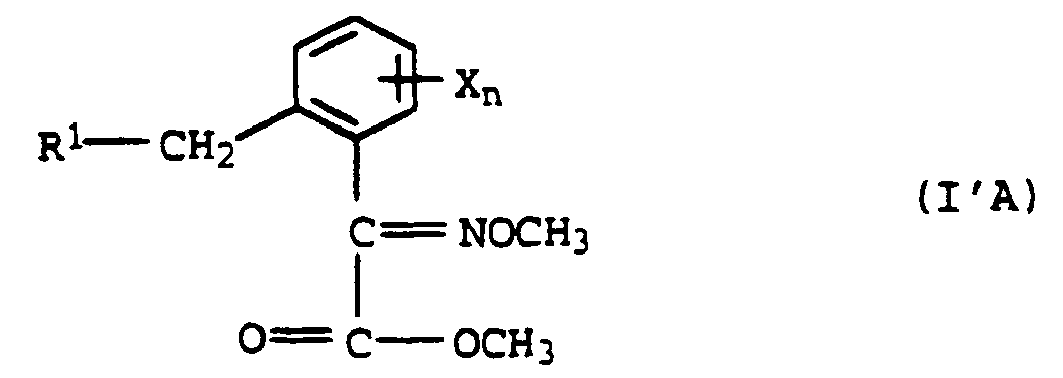
Demgemäß werden besonders Verbindungen der Formel IIA

Für die Herstellung der aus der Literatur bekannten Wirkstoffe ist es unerheblich, ob als Verbindungen IIA diejenigen Substanzen eingesetzt werden, in denen R1 Wasserstoff, Hydroxy, Mercapto, Cyano, Nitro, ggf. subst. Alkylsulfonyloxy, ggf. subst. Arylsulfonyloxy oder Halogen bedeutet, oder diejenigen, in denen R1 für ggf. subst. Alkylsulfonyl, ggf. subst. Cycloalkyl, ggf. subst. Aryloxy, ggf. subst. Arylsulfonyl, ggf. subst. Heterocyclyl oder ggf. subst. Hetaryloxy, einen Hydroxy-Phthalimidorest


Bei den in den vorstehenden Formeln angegebenen Definitionen der Symbole wurden Sammelbegriffe verwendet, die allgemein repräsentativ für die folgenden Substituenten stehen:
- Halogen: Fluor, Chlor, Brom und Jod;
- Alkyl: gesättigte, geradkettige oder verzweigte Kohlenwasserstoffreste mit 1 bis 4, 6 oder 10 Kohlenstoffatomen, z.B. C1-C6-Alkyl wie Methyl, Ethyl, Propyl, 1-Methylethyl, Butyl, 1-Methyl-propyl, 2-Methylpropyl, 1,1-Dimethylethyl, Pentyl, 1-Methylbutyl, 2-Methylbutyl, 3-Methylbutyl, 2,2-Di-methylpropyl, 1-Ethylpropyl, Hexyl, 1,1-Dimethylpropyl, 1,2-Dimethylpropyl, 1-Methylpentyl, 2-Methylpentyl, 3-Methylpentyl, 4-Methylpentyl, 1,1-Dimethylbutyl, 1,2-Dimethylbutyl, 1,3-Dimethylbutyl, 2,2-Dimethylbutyl, 2,3-Dimethylbutyl, 3,3-Dimethylbutyl, 1-Ethylbutyl, 2-Ethylbutyl, 1,1,2-Trimethylpropyl, 1,2,2-Trimethylpropyl, 1-Ethyl-1-methylpropyl und 1-Ethyl-2-methylpropyl;
- Alkylcarbonyl: geradkettige oder verzweigte Alkylgruppen mit 1 bis 10 Kohlenstoffatomen (wie vorstehend genannt), welche über eine Carbonylgruppe (-CO-) an das Gerüst gebunden sind;
- Alkylsulfonyloxy: geradkettige oder verzweigte Alkylgruppen mit 1 bis 10 Kohlenstoffatomen (wie vorstehend genannt), welche über eine Sulfonyloxygruppe (-SO2-O-) an das Gerüst gebunden sind;
- Halogenalkyl: geradkettige oder verzweigte Alkylgruppen mit 1 bis 4 Kohlenstoffatomen (wie vorstehend genannt), wobei in diesen Gruppen teilweise oder vollständig die Wasserstoffatome durch Halogenatome wie vorstehend genannt ersetzt sein können, z.B. C1-C2-Halogenalkyl wie Chlormethyl, Dichlormethyl, Trichlormethyl, Fluormethyl, Difluormethyl, Trifluormethyl, Chlorfluormethyl, Dichlorfluormethyl, Chlordifluormethyl, 1-Fluorethyl, 2-Fluorethyl, 2,2-Difluorethyl, 2,2,2-Trifluorethyl, 2-Chlor-2-fluorethyl, 2-Chlor-2,2-difluorethyl, 2,2-Dichlor-2-fluorethyl, 2,2,2-Trichlorethyl und Pentafluorethyl;
- Alkoxy: geradkettige oder verzweigte Alkylgruppen mit 1 bis 4 oder 10 Kohlenstoffatomen (wie vorstehend genannt), welche über ein Sauerstoffatom (-O-) an das Gerüst gebunden sind;
- Alkoxycarbonyl: geradkettige oder verzweigte Alkoxygruppen mit 1 bis 10 Kohlenstoffatomen (wie vorstehend genannt), welche über eine Carbonylgruppe (-CO-) an das Gerüst gebunden sind;
- Halogenalkoxy: geradkettige oder verzweigte Halogenalkylgruppen mit 1 bis 4 Kohlenstoffatomen (wie vorstehend genannt), welche über ein Sauerstoffatom (-O-) an das Gerüst gebunden sind;
- Alkylthio: geradkettige oder verzweigte Alkylgruppen mit 1 bis 10 Kohlenstoffatomen (wie vorstehend genannt), welche über ein Schwefelatom (-S-) an das Gerüst gebunden sind;
- Alkylamino: eine geradkettige oder verzweigte Alkylgruppe mit 1 bis 4 Kohlenstoffatomen (wie vorstehend genannt), welche über eine Aminogruppe (-NH-) an das Gerüst gebunden ist;
- Dialkylamino: zwei voneinander unabhängige geradkettige oder verzweigte Alkylgruppen mit 1 bis 4 Kohlenstoffatomen (wie vorstehend genannt), welche über ein Stickstoffatom (-N:) an das Gerüst gebunden sind;
- Alkenyl: ungesättigte, geradkettige oder verzweigte Kohlenwasserstoffreste mit 2 bis 10 Kohlenstoffatomen und einer Doppelbindung in einer beliebigen Position, z.B. C2-C6-Alkenyl wie Ethenyl, 1-Propenyl, 2-Propenyl, 1-Methylethenyl, 1-Butenyl, 2-Butenyl, 3-Butenyl, 1-Methyl-1-propenyl, 2-Methyl-1-propenyl, 1-Methyl-2-propenyl, 2-Methyl-2-propenyl, 1-Pentenyl, 2-Pentenyl, 3-Pentenyl, 4-Pentenyl, 1-Methyl-1-butenyl, 2-Methyl-1-butenyl, 3-Methyl-1-butenyl, 1-Methyl-2-butenyl, 2-Methyl-2-butenyl, 3-Methyl-2-butenyl, 1-Methyl-3-butenyl, 2-Methyl-3-butenyl, 3-Methyl-3-butenyl, 1,1-Dimethyl-2-propenyl, 1,2-Dimethyl-1-propenyl, 1,2-Dimethyl-2-propenyl, 1-Ethyl-1-propenyl, 1-Ethyl-2-propenyl, 1-Hexenyl, 2-Hexenyl, 3-Hexenyl, 4-Hexenyl, 5-Hexenyl, 1-Methyl-1-pentenyl, 2-Methyl-1-pentenyl, 3-Methyl-1-pentenyl, 4-Methyl-1-pentenyl, 1-Methyl-2-pentenyl, 2-Methyl-2-pentenyl, 3-Methyl-2-pentenyl, 4-Methyl-2-pentenyl, 1-Methyl-3-pentenyl, 2-Methyl-3-pentenyl, 3-Methyl-3-pentenyl, 4-Methyl-3-pentenyl, 1-Methyl-4-pentenyl, 2-Methyl-4-pentenyl, 3-Methyl-4-pentenyl, 4-Methyl-4-pentenyl, 1,1-Dimethyl-2-butenyl, 1,1-Dimethyl-3-butenyl, 1,2-Dimethyl-1-butenyl, 1,2-Dimethyl-2-butenyl, 1,2-Dimethyl-3-butenyl, 1,3-Dimethyl-1-butenyl, 1,3-Dimethyl-2-butenyl, 1,3-Dimethyl-3-butenyl, 2,2-Dimethyl-3-butenyl, 2,3-Dimethyl-1-butenyl, 2,3-Dimethyl-2-butenyl, 2,3-Dimethyl-3-butenyl, 3,3-Dimethyl-1-butenyl, 3,3-Dimethyl-2-butenyl, 1-Ethyl-1-butenyl, 1-Ethyl-2-butenyl, 1-Ethyl-3-butenyl, 2-Ethyl-1-butenyl, 2-Ethyl-2-butenyl, 2-Ethyl-3-butenyl, 1,1,2-Trimethyl-2-propenyl, 1-Ethyl-1-methyl-2-propenyl, 1-Ethyl-2-methyl-1-propenyl und 1-Ethyl-2-methyl-2-propenyl;
- Alkenyloxy: eine ungesättigte, geradkettige oder verzweigte Kohlenwasserstoffgruppe mit 2 oder 3 bis 6 oder 10 Kohlenstoffatomen und einer Doppelbindung in einer beliebigen Position (wie vorstehend genannt), welche über ein Sauerstoffatom (-O-) an das Gerüst gebunden ist;
- Alkenylthio: eine ungesättigte, geradkettige oder verzweigte Kohlenwasserstoffgruppe mit 2 oder 3 bis 6 oder 10 Kohlenstoffatomen und einer Doppelbindung in einer beliebigen Position (wie vorstehend genannt), welche über ein Schwefelatom (-S-) an das Gerüst gebunden ist;
- Alkenylamino: eine ungesättigte, geradkettige oder verzweigte Kohlenwasserstoffgruppe mit 2 oder 3 bis 6 oder 10 Kohlenstoffatomen und einer Doppelbindung in einer beliebigen Position (wie vorstehend genannt), welche über eine Aminogruppe (-NH-) an das Gerüst gebunden ist;
- Alkenylcarbonyl: ungesättigte, geradkettige oder verzweigte Kohlenwasserstoffgruppen mit 2 bis 10 Kohlenstoffatomen und einer Doppelbindung in einer beliebigen Position (wie vorstehend genannt), welche über eine Carbonylgruppe (-CO-) an das Gerüst gebunden sind;
- Alkinyl: geradkettige oder verzweigte Kohlenwasserstoffgruppen mit 2 bis 10 Kohlenstoffatomen und einer Dreifachbindung in einer beliebigen Position, z.B. C2-C6-Alkinyl wie Ethinyl, 1-Propinyl, 2-Propinyl, 1-Butinyl, 2-Butinyl, 3-Butinyl, 1-Methyl-2-propinyl, 1-Pentinyl, 2-Pentinyl, 3-Pentinyl, 4-Pentinyl, 1-Methyl-2-butinyl, 1-Methyl-3-butinyl, 2-Methyl-3-butinyl, 3-Methyl-1-butinyl, 1,1-Dimethyl-2-propinyl, 1-Ethyl-2-propinyl, 1-Hexinyl, 2-Hexinyl, 3-Hexinyl, 4-Hexinyl, 5-Hexinyl, 1-Methyl-2-pentinyl, 1-Methyl-3-pentinyl, 1-Methyl-4-pentinyl, 2-Methyl-3-pentinyl, 2-Methyl-4-pentinyl, 3-Methyl- 1-pentinyl, 3-Methyl-4-pentinyl, 4-Methyl-1-pentinyl, 4-Methyl-2-pentinyl, 1,1-Dimethyl-2-butinyl, 1,1-Di-methyl-3-butinyl, 1,2-Dimethyl-3-butinyl, 2,2-Dimethyl-3-butinyl, 3,3-Dimethyl-1-butinyl, 1-Ethyl-2-butinyl, 1-Ethyl-3-butinyl, 2-Ethyl-3-butinyl und 1-Ethyl-1-methyl-2-propinyl;
- Alkinyloxy: eine geradkettige oder verzweigte Kohlenwasserstoffgruppe mit 2 oder 3 bis 6 oder 10 Kohlenstoffatomen und einer Dreifachbindung in einer beliebigen Position (wie vorstehend genannt), welche über ein Sauerstoffatom (-O-) an das Gerüst gebunden ist;
- Alkinylthio: eine geradkettige oder verzweigte Kohlenwasserstoffgruppe mit 2 oder 3 bis 6 oder 10 Kohlenstoffatomen und einer Dreifachbindung in einer beliebigen Position (wie vorstehend genannt), welche über ein Schwefelatom (-S-) an das Gerüst gebunden ist;
- Alkinylamino: eine geradkettige oder verzweigte Kohlenwasserstoffgruppe mit 2 oder 3 bis 6 oder 10 Kohlenstoffatomen und einer Dreifachbindung in einer beliebigen Position (wie vorstehend genannt), welche über eine Aminogruppe (-NH-) an das Gerüst gebunden ist;
- Alkinylcarbonyl: geradkettige oder verzweigte Kohlenwasserstoffgruppen mit 2 bis 10 Kohlenstoffatomen und einer Dreifachbindung in einer beliebigen Position (wie vorstehend genannt), welche über eine Carbonylgruppe (-CO-) an das Gerüst gebunden sind;
- Cycloalkyl: monocyclische Alkylgruppen mit 3 bis 12 Kohlenstoffringgliedern, z.B. C3-C8-Cycloalkyl wie Cyclopropyl, Cyclobutyl, Cyclopentyl, Cyclohexyl, Cycloheptyl und Cyclooctyl;
- Cycloalkoxy: eine monocyclische Alkylgruppe mit 3 bis 6, 8 oder 12 Kohlenstoffringgliedern (wie vorstehend genannt), welche über ein Sauerstoffatom (-O-) an das Gerüst gebunden ist;
- Cycloalkylthio: eine monocyclische Alkylgruppe mit 3 bis 6, 8 oder 12 Kohlenstoffringgliedern (wie vorstehend genannt), welche über ein Schwefelatom (-S-) an das Gerüst gebunden ist;
- Cycloalkylamino: eine monocyclische Alkylgruppe mit 3 bis 6, 8 oder 12 Kohlenstoffringgliedern (wie vorstehend genannt), welche über eine Aminogruppe (-NH-) an das Gerüst gebunden ist;
- Cycloalkylcarbonyl: eine monocyclische Alkylgruppe mit 3 bis 6, 8 oder 12 Kohlenstoffringgliedern (wie vorstehend genannt), welche über eine Carbonylgruppe (-CO-) an das Gerüst gebunden ist;
- Cycloalkenyl: monocyclische Kohlenwasserstoffe mit 5 bis 12 Kohlenstoffringgliedern und einer oder zwei Doppelbindungen im Ring, z.B. C3-C8-Cycloalkenyl wie Cyclopropenyl, Cyclobutenyl, Cyclopentyl, Cyclohexenyl, Cycloheptenyl, Cyclooctenyl und Cyclohexadienyl;
- Cycloalkenyloxy: eine monocyclische Alkenylgruppe mit 5 bis 8 oder 12 Kohlenstoffringgliedern und einer oder zwei Doppelbindungen (wie vorstehend genannt), welche über ein Sauerstoffatom (-O-) an das Gerüst gebunden ist;
- Cycloalkenylthio: eine monocyclische Alkenylgruppe mit 5 bis 8 oder 12 Kohlenstoffringgliedern und einer oder zwei Doppelbindungen (wie vorstehend genannt), welche über ein Schwefelatom (-S-) an das Gerüst gebunden ist;
- Cycloalkenylamino: eine monocyclische Alkenylgruppe mit 3 bis 8 oder 12 Kohlenstoffringgliedern und einer oder zwei Doppelbindungen (wie vorstehend genannt), welche über eine Aminogruppe (-NH-) an das Gerüst gebunden ist;
- Heterocyclyl: ein gesättigter oder partiell ungesättigter cyclischer Rest, welcher neben Kohlenstoffatomen als Ringglieder Heteroatome aus der Gruppe Sauerstoff, Schwefel oder Stickstoff enthält: z.B. 5- oder 6-gliedrige Heterocyclen (Heterocyclyl) enthaltend neben Kohlenstoffringgliedern ein bis drei Stickstoffatome und/oder ein Sauerstoff- oder Schwefelatom oder ein oder zwei Sauerstoff- und/oder Schwefelatome, zwei Sauerstoffund/oder Schwefelatome, z.B. 2-Tetrahydrofuranyl, 3-Tetrahydrofuranyl, 2-Tetrahydrothienyl, 3-Tetrahydrothienyl, 2-Pyrrolidinyl, 3-Pyrrolidinyl, 3-Isoxazolidinyl, 4-Isoxazolidinyl, 5-Isoxazolidinyl, 3-Isothiazolidinyl, 4-Isothiazolidinyl, 5-Isothiazolidinyl, 3-Pyrazolidinyl, 4-Pyrazolidinyl, 5-Pyrazolidinyl, 2-Oxazolidinyl, 4-Oxazolidinyl, 5-Oxazolidinyl, 2-Thiazolidinyl, 4-Thiazolidinyl, 5-Thiazolidinyl, 2-Imidazolidinyl, 4-Imidazolidinyl, 1,2,4-Oxadiazolidin-3-yl, 1,2,4-Oxadiazolidin-5-yl, 1,2,4-Thiadiazolidin-3-yl, 1,2,4-Thiadiazolidin-5-yl,1,2,4-Triazolidin-3-yl, 1,3,4-Oxadiazolidin-2-yl, 1,3,4-Thiadiazolidin-2-yl, 1,3,4-Triazolidin-2-yl, 2,3-Dihydrofur-2-yl, 2,3-Dihydrofur-3-yl, 2,4-Dihydrofur-2-yl, 2,4-Dihydrofur-3-yl, 2,3-Dihydrothien-2-yl, 2,3-Dihydrothien-3-yl, 2,4-Dihydrothien-2-yl, 2,4-Dihydrothien-3-yl, 2,3-Pyrrolin-2-yl, 2,3-Pyrrolin-3-yl, 2,4-Pyrrolin-2-yl, 2,4-Pyrrolin-3-yl, 2,3-Isoxazolin-3-yl, 3,4-Isoxazolin-3-yl, 4,5-Isoxazolin-3-yl, 2,3-Isoxazo-lin-4-yl, 3,4-Isoxazolin-4-yl, 4,5-Isoxazolin-4-yl, 2,3-Isoxazolin-5-yl, 3,4-Isoxazolin-5-yl, 4,5-Isoxazolin-5-yl, 2,3-Isothiazolin-3-yl, 3,4-Isothiazolin-3-yl, 4,5-Isathiazolin-3-yl, 2,3-Isothiazolin-4-yl, 3,4-Isothiazolin-4-yl, 4,5-Isothiazolin-4-yl, 2,3-Isothiazolin-5-yl, 3,4-Isothiazolin-5-yl, 4,5-Isothiazolin-5-yl, 2,3-Dihydropyrazol-1-yl, 2,3-Dihydropyrazol-2-yl, 2,3-Dihydropyrazol-3-yl, 2,3-Dihydropyrazol-4-yl, 2,3-Dihydropyrazol-5-yl, 3,4-Dihydropyrazol-1-yl, 3,4-Dihydropyrazol-3-yl, 3,4-Dihydropyrazol-4-yl, 3,4-Dihydropyrazol-5-yl, 4,5-Dihydropyrazol-1-yl, 4,5-Dihydropyrazol-3-yl, 4,5-Dihydropyrazol-4-yl, 4,5-Dihydropyrazol-5-yl, 2,3-Dihydrooxazol-2-yl, 2,3-Dihydrooxazol-3-yl, 2,3-Dihydrooxazol-4-yl, 2,3-Dihydrooxazol-5-yl, 3,4-Dihydrooxazol-2-yl, 3,4-Dihydrooxazol-3-yl, 3,4-Dihydrooxazol-4-yl, 3,4-Dihydrooxazol-5-yl, 3,4-Dihydrooxazol-2-yl, 3,4-Dihydrooxazol-3-yl, 3,4-Di-hydrooxazol-4-yl, 2-Piperidinyl, 3-Piperidinyl, 4-Piperidinyl, 1,3-Dioxan-5-yl, 2-Tetrahydropyranyl, 4-Tetrahydropyranyl, 2-Tetrahydrothienyl, 3-Tetrahydropyridazinyl, 4-Tetrahydropyridazinyl, 2-Tetrahydropyrimidinyl, 4-Tetrahydropyrimidinyl, 5-Tetrahydropyrimidinyl, 2-Tetrahydropyrazinyl, 1,3,5-Tetrahydrotriazin-2-yl und 1,2,4-Tetrahydrotriazin-3-yl, besonders bevorzugt 1-Pyrrolidinyl, 1-Pyrazolidinyl, 1-Imidazolidinyl, 2-Isoxazolidinyl, 3-Oxazolidinyl, 2-Isothiazolidinyl, 3-Thiazolidinyl, 2,3-Dihydropyrrol-1-yl, 2,5-Dihydropyrrol-1-yl, 2,3-Dihydropyrazol-1-yl, 4,5-Dihydropyrazol-1-yl, 2,3-Dihydroimidazol-1-yl, 4,5-Dihydroimidazol-1-yl, 2,3-Dihydroisoxazol-2-yl, 2, 3-Dihydrooxazol-3-yl, 2,3-Dihydroisothiazol-2-yl, 2,3-Dihydrothiazol-3-yl, Piperidin-1-yl, Morpholin-1-yl und Pyrazin-1-yl;
- Heterocyclyloxy: ein gesättigter oder partiell ungesättigter cyclischer Rest, welcher neben Kohlenstoffatomen als Ringglieder Heteroatome aus der Gruppe Sauerstoff, Schwefel oder Stickstoff enthält (wie vorstehend genannt), welcher über ein Sauerstoffatom (-O-) an das Gerüst gebunden ist;
- Heterocyclylthio: ein gesättigter oder partiell ungesättigter cyclischer Rest, welcher neben Kohlenstoffatomen als Ringglieder Heteroatome aus der Gruppe Sauerstoff, Schwefel oder Stickstoff enthält (wie vorstehend genannt), welcher über ein Schwefelatom (-S-) an das Gerüst gebunden ist;
- Heterocyclylamino: ein gesättigter oder partiell ungesättigter cyclischer Rest, welcher neben Kohlenstoffatomen als Ringglieder Heteroatome aus der Gruppe Sauerstoff, Schwefel oder Stickstoff enthält (wie vorstehend genannt), welcher über eine Aminogruppe (-NH-) an das Gerüst gebunden ist;
- Aryl bzw. Aryloxy, Arylthio, Arylamino, Arylcarbonyl, Arylsulfonyl und Arylsulfonyloxy: aromatische mono- oder polycyclische Kohlenwasserstoffreste welche direkt bzw. (Aryloxy) über ein Sauerstoffatom (-O-) oder (Arylthio) ein Schwefelatom (-S-), (Arylamino) eine Aminogruppe (-NH-), (Arylcarbonyl) über eine Carbonylgruppe (-CO-), (Arylsulfonyl) über eine Sulfonylgruppe (-SO2-) oder (Arylsulfonyloxy) über eine Sulfonyloxygruppe (-SO2-O-) an das Gerüst gebunden sind, z. B. Phenyl, Naphthyl und Phenanthrenyl bzw. Phenyloxy, Naphthyloxy und Phenanthrenyloxy und die entsprechenden Thio-, Carbonyl-, Sulfonyl- und Sulfonyloxyreste;
- Hetaryl bzw. Hetaryloxy, Hetarylthio, Hetarylamino, Hetarylcarbonyl und Hetarylsulfonyl: aromatische mono- oder polycyclische Reste welche neben Kohlenstoffringgliedern zusätzlich ein bis vier Stickstoffatome oder ein bis drei Stickstoffatome und ein Sauerstoff- oder ein Schwefelatom oder ein Sauerstoff- oder ein Schwefelatom enthalten können und welche direkt bzw. (Hetaryloxy) über ein Sauerstoffatom (-O-) oder (Hetarylthio) ein Schwefelatom (-S-), (Hetarylamino) eine Aminogruppe (-NH-), (Hetarylcarbonyl) über eine Carbonylgruppe (-CO-) oder (Hetarylsulfonyl) über eine Sulfonylgruppe (-SO2-) an das Gerüst gebunden sind, z.B.
- 5-gliedriges Heteroaryl, enthaltend ein bis drei Stickstoffatome: 5-Ring Heteroarylgruppen, welche neben Kohlenstoffatomen ein bis drei Stickstoffatome als Ringglieder enthalten können, z. B. 2-Pyrrolyl, 3-Pyrrolyl, 3-Pyrazolyl, 4-Pyrazolyl, 5-Pyrazalyl, 2-Imidazolyl, 4-Imidazolyl, 1,2,4-Triazol-3-yl und 1,3,4-Triazol-2-yl;
- 5-gliedriges Heteroaryl, enthaltend ein bis vier Stickstoffatome oder ein bis drei Stickstoffatome und ein Schwefel-oder Sauerstoffatom oder ein Sauerstoff oder ein Schwefelatom: 5-Ring Heteroarylgruppen, welche neben Kohlenstoffatomen ein bis vier Stickstoffatome oder ein bis drei Stickstoffatome und ein Schwefel- oder Sauerstoffatom oder ein Sauerstoff- oder Schwefelatom als Ringglieder enthalten können, z. B. 2-Furyl, 3-Furyl, 2-Thienyl, 3-Thienyl, 2-Pyrrolyl, 3-Pyrrolyl, 3-Isoxazolyl, 4-Isoxazolyl, 5-Isoxazolyl, 3-Isothiazolyl, 4-Isothiazolyl, 5-Isothiazolyl, 3-Pyrazolyl, 4-Pyrazolyl, 5-Pyrazolyl, 2-Oxazolyl, 4-Oxazolyl, 5-Oxazolyl, 2-Thiazolyl, 4-Thiazolyl, 5-Thiazolyl, 2-Imidazolyl, 4-Imidazolyl, 1,2,4-Oxadiazol-3-yl, 1,2,4-Oxadiazol-5-yl, 1,2,4-Thiadiazol-3-yl, 1,2,4-Thiadiazol-5-yl, 1,2,4-Triazol-3-yl, 1,3,4-Okadiazol-2-yl, 1,3,4-Thiadiazol-2-yl, 1,3,4-Triazol-2-yl;
- kondensiertes 5-gliedriges Heteroaryl, enthaltend ein- bis vier Stickstoffatome oder ein bis drei Stickstoffatome und/oder ein Sauerstoff- oder Schwefelatom: 5-Ring Heteroarylgruppen, welche neben Kohlenstoffatomen ein bis vier Stickstoffatome oder ein bis drei Stickstoffatome und ein Schwefel- oder Sauerstoffatom oder ein Sauerstoff- oder ein Schwefelatom als Ringglieder enthalten können, und in welchen zwei benachbarte Kohlenstoffringglieder oder ein Stickstoff- und ein benachbartes Kohlenstoffringglied zu einem aromatischen oder heteroaromatischen Bi- oder Polycyclus verbruckt sein können, z.B. Benzofuranyl, Isobenzofuranyl, Benzothienyl, Isobenzothienyl, Indolyl, Isoindolyl, Benzisoxazolyl, Benzoxazolyl, Benzoisothiazolyl, Benzothiazolyl, Indazolyl, Benzimidazolyl, Pyrrolopyridinyl, Pyrrolopyridazinyl, Pyrrolopyrimidinyl, Pyrrolopyrazinyl, Pyrrolotriazinyl, Furopyridinyl, Furopyridazinyl, Furopyrimidyl, Furopyrazinyl, Furotriazinyl, Thienopyridinyl, Thienopyridazinyl, Thienopyrimidyl, Thienopyrazinyl, Thienotriazinyl, Imidazopyridinyl, Imidazopyridazinyl, Imidazopyrimidyl, Imidazopyrazinyl, Imidazotriazinyl, Pyrazolopyridinyl, Pyrazolopyridazinyl, Pyrazolopyrimidyl, Pyrazolopyrazinyl, Pyrazolotriazinyl, Isoxazolopyridinyl, Isoxazolopyridazinyl, Isoxazolopyrimidyl, Isoxazolopyrazinyl, Isoxazolotriazinyl, Oxazolopyridinyl, Oxazolopyridazinyl, Oxazolopyrimidyl, Oxazolopyrazinyl, Okazolotriazinyl, Isothiazolopyridinyl, Isothiazolopyridazinyl, Isothiazolopyrimidyl, Isothiazolopyrazinyl, Isothiazolotriazinyl, Thiazolopyridinyl, Thiazolopyridazinyl, Thiazolopyrimidyl, Thiazolopyrazinyl, Thiazolotriazinyl, Triazolopyridinyl, Triazolopyridazinyl, Triazolopyrimidyl, Triazolopyrazinyl und Triazolotriazinyl;
- über Stickstoff gebundenes 5-gliedriges Heteroaryl, enthaltend ein bis vier Stickstoffatome, oder über Stickstoff gebundenes benzokondensiertes 5-gliedriges Heteroaryl, enthaltend ein bis drei Stickstoffatome: 5-Ring Heteroarylgruppen, welche neben Kohlenstoffatomen ein bis vier Stickstoffatome bzw. ein bis drei Stickstoffatome als Ringglieder enthalten können, und in welchen zwei benachbarte Kohlenstoffringglieder oder ein Stickstoff- und ein benachbartes Kohlenstoffringglied durch eine Buta-1,3-dien-1,4-diylgruppe verbrückt sein können, wobei diese Ringe über eines der Stickstoffringglieder an das Gerüst gebunden sind, z.B. 1-Pyrrolyl, 1-imidazolyl, 1-Pyrazolyl und 1,2,4-Triazol-1-yl;
- 6-gliedriges Heteroaryl, enthaltend ein bis drei bzw. ein bis vier Stickstoffatome:
6-Ring Heteroarylgruppen, welche neben Kohlenstoffatomen ein bis drei bzw. ein bis vier Stickstoffatome als Ringglieder enthalten können, z. B. 2-Pyridinyl, 3-Pyridinyl, 4-Pyridinyl, 3-Pyridazinyl, 4-Pyridazinyl, 2-Pyrimidinyl, 4-Pyrimidinyl, 5-Pyrimidinyl, 2-Pyrazinyl, 1,3,5-Triazin-2-yl, 1,2,4-Triazin-3-yl und 1,2,4,5-Tetrazin-3-yl; - kondensiertes 6-gliedriges Heteroaryl, enthaltend ein_bis vier Stickstoffatome: 6-Ring Heteroarylgruppen in welchen zwei benachbarte Kohlenstoffringglieder zu einem aromatischen oder heteroaromatischen Bi- oder Polycyclus verbrückt sein können, z.B. Chinolin, Isochinolin, Chinazolin und Chinoxalin,
- Halogen: fluorine, chlorine, bromine and iodine;
- Alkyl: saturated, straight-chain or branched hydrocarbon radicals having 1 to 4, 6 or 10 carbon atoms, for example C 1 -C 6 -alkyl, such as methyl, ethyl, propyl, 1-methylethyl, butyl, 1-methyl-propyl, 2-methylpropyl, 1 , 1-dimethylethyl, pentyl, 1-methylbutyl, 2-methylbutyl, 3-methylbutyl, 2,2-dimethylpropyl, 1-ethylpropyl, hexyl, 1,1-dimethylpropyl, 1,2-dimethylpropyl, 1-methylpentyl, 2 Methylpentyl, 3-methylpentyl, 4-methylpentyl, 1,1-dimethylbutyl, 1,2-dimethylbutyl, 1,3-dimethylbutyl, 2,2-dimethylbutyl, 2,3-dimethylbutyl, 3,3-dimethylbutyl, 1-ethylbutyl , 2-ethylbutyl, 1,1,2-trimethylpropyl, 1,2,2-trimethylpropyl, 1-ethyl-1-methylpropyl and 1-ethyl-2-methylpropyl;
- Alkylcarbonyl: straight-chain or branched alkyl groups having 1 to 10 carbon atoms (as mentioned above) which are linked to the skeleton via a carbonyl group (-CO-);
- Alkylsulfonyloxy: straight-chain or branched alkyl groups having 1 to 10 carbon atoms (as mentioned above) which are linked to the skeleton via a sulphonyloxy group (-SO 2 -O-);
- Haloalkyl: straight-chain or branched alkyl groups having 1 to 4 carbon atoms (as mentioned above), in which groups the hydrogen atoms may be partially or completely replaced by halogen atoms as mentioned above, for example C 1 -C 2 -haloalkyl such as chloromethyl, dichloromethyl, trichloromethyl, Fluoromethyl, difluoromethyl, trifluoromethyl, chlorofluoromethyl, dichlorofluoromethyl, chlorodifluoromethyl, 1-fluoroethyl, 2-fluoroethyl, 2,2-difluoroethyl, 2,2,2-trifluoroethyl, 2-chloro-2-fluoroethyl, 2-chloro-2,2- difluoroethyl, 2,2-dichloro-2-fluoroethyl, 2,2,2-trichloroethyl and pentafluoroethyl;
- Alkoxy: straight-chain or branched alkyl groups having 1 to 4 or 10 carbon atoms (as mentioned above) which are bonded to the skeleton via an oxygen atom (-O-);
- Alkoxycarbonyl: straight-chain or branched alkoxy groups having 1 to 10 carbon atoms (as mentioned above) which are bonded to the skeleton via a carbonyl group (-CO-);
- Haloalkoxy: straight-chain or branched haloalkyl groups having 1 to 4 carbon atoms (as mentioned above) which are bonded to the skeleton via an oxygen atom (-O-);
- Alkylthio: straight-chain or branched alkyl groups having 1 to 10 carbon atoms (as mentioned above) which are linked to the skeleton via a sulfur atom (-S-);
- Alkylamino: a straight-chain or branched alkyl group having 1 to 4 carbon atoms (as mentioned above) which is bonded to the skeleton via an amino group (-NH-);
- Dialkylamino: two independent straight-chain or branched alkyl groups having 1 to 4 carbon atoms (as mentioned above), which are attached to the skeleton via a nitrogen atom (-N :);
- Alkenyl: unsaturated, straight-chain or branched hydrocarbon radicals having 2 to 10 carbon atoms and having one double bond in any position, for example C 2 -C 6 -alkenyl, such as ethenyl, 1-propenyl, 2-propenyl, 1-methylethenyl, 1-butenyl, 2 Butenyl, 3-butenyl, 1-methyl-1-propenyl, 2-methyl-1-propenyl, 1-methyl-2-propenyl, 2-methyl-2-propenyl, 1-pentenyl, 2-pentenyl, 3-pentenyl, 4-pentenyl, 1-methyl-1-butenyl, 2-methyl-1-butenyl, 3-methyl-1-butenyl, 1-methyl-2-butenyl, 2-methyl-2-butenyl, 3-methyl-2- butenyl, 1-methyl-3-butenyl, 2-methyl-3-butenyl, 3-methyl-3-butenyl, 1,1-dimethyl-2-propenyl, 1,2-dimethyl-1-propenyl, 1,2- Dimethyl 2-propenyl, 1-ethyl-1-propenyl, 1-ethyl-2-propenyl, 1-hexenyl, 2-hexenyl, 3-hexenyl, 4-hexenyl, 5-hexenyl, 1-methyl-1-pentenyl, 2-methyl-1-pentenyl, 3-methyl-1-pentenyl, 4-methyl-1-pentenyl, 1-methyl-2-pentenyl, 2-methyl-2-pentenyl, 3-methyl-2-pentenyl, 4- Methyl 2-pentenyl, 1-methyl-3-pentenyl, 2-methyl-3-pentenyl, 3-methyl-3-pentenyl, 4-methyl-3-penteny 1, 1-methyl-4-pentenyl, 2-methyl-4-pentenyl, 3-methyl-4-pentenyl, 4-methyl-4-pentenyl, 1,1-dimethyl-2-butenyl, 1,1-dimethyl 3-butenyl, 1,2-dimethyl-1-butenyl, 1,2-dimethyl-2-butenyl, 1,2-dimethyl-3-butenyl, 1,3-dimethyl-1-butenyl, 1,3-dimethyl 2-butenyl, 1,3-dimethyl-3-butenyl, 2,2-dimethyl-3-butenyl, 2,3-dimethyl-1-butenyl, 2,3-dimethyl-2-butenyl, 2,3-dimethyl 3-butenyl, 3,3-dimethyl-1-butenyl, 3,3-dimethyl-2-butenyl, 1-ethyl-1-butenyl, 1-ethyl-2-butenyl, 1-ethyl-3-butenyl, 2- Ethyl 1-butenyl, 2-ethyl-2-butenyl, 2-ethyl-3-butenyl, 1,1,2-trimethyl-2-propenyl, 1-ethyl-1-methyl-2-propenyl, 1-ethyl 2-methyl-1-propenyl and 1-ethyl-2-methyl-2-propenyl;
- Alkenyloxy: an unsaturated, straight-chain or branched hydrocarbon group having 2 or 3 to 6 or 10 carbon atoms and a double bond in any position (as mentioned above) which is bonded to the skeleton via an oxygen atom (-O-);
- Alkenylthio: an unsaturated, straight-chain or branched hydrocarbon group having 2 or 3 to 6 or 10 carbon atoms and a double bond in any position (as mentioned above) which is linked to the skeleton via a sulfur atom (-S-);
- Alkenylamino: an unsaturated, straight-chain or branched hydrocarbon group having 2 or 3 to 6 or 10 carbon atoms and a double bond in any position (as mentioned above) which is bonded to the skeleton via an amino group (-NH-);
- Alkenylcarbonyl: unsaturated, straight-chain or branched hydrocarbon groups having 2 to 10 carbon atoms and a double bond in any position (as mentioned above), which are linked to the skeleton via a carbonyl group (-CO-);
- Alkynyl: straight-chain or branched hydrocarbon groups having 2 to 10 carbon atoms and a triple bond in any position, for example C 2 -C 6 -alkynyl, such as ethynyl, 1-propynyl, 2-propynyl, 1-butynyl, 2-butynyl, 3-butynyl, 1-methyl-2-propynyl, 1-pentynyl, 2-pentynyl, 3-pentynyl, 4-pentynyl, 1-methyl-2-butynyl, 1-methyl-3-butynyl, 2-methyl-3-butynyl, 3 Methyl-1-butynyl, 1,1-dimethyl-2-propynyl, 1-ethyl-2-propynyl, 1-hexynyl, 2-hexynyl, 3-hexynyl, 4-hexynyl, 5-hexynyl, 1-methyl-2- pentynyl, 1-methyl-3-pentynyl, 1-methyl-4-pentynyl, 2-methyl-3-pentynyl, 2-methyl-4-pentynyl, 3-methyl-1-pentynyl, 3-methyl-4-pentynyl, 4-methyl-1-pentynyl, 4-methyl-2-pentynyl, 1,1-dimethyl-2-butynyl, 1,1-dimethyl-3-butynyl, 1,2-dimethyl-3-butynyl, 2, 2-dimethyl-3-butynyl, 3,3-dimethyl-1-butynyl, 1-ethyl-2-butynyl, 1-ethyl-3-butynyl, 2-ethyl-3-butynyl and 1-ethyl-1-methyl 2-propynyl;
- Alkynyloxy: a straight-chain or branched hydrocarbon group having 2 or 3 to 6 or 10 carbon atoms and a triple bond in any position (as mentioned above) which is bonded to the skeleton via an oxygen atom (-O-);
- Alkynylthio: a straight-chain or branched hydrocarbon group having 2 or 3 to 6 or 10 carbon atoms and a triple bond in any position (as mentioned above) which is linked to the skeleton via a sulfur atom (-S-);
- Alkynylamino: a straight-chain or branched hydrocarbon group having 2 or 3 to 6 or 10 carbon atoms and a triple bond in any position (as mentioned above) which is bonded to the skeleton via an amino group (-NH-);
- Alkynylcarbonyl: straight-chain or branched hydrocarbon groups having 2 to 10 carbon atoms and a triple bond in any position (as mentioned above), which are bonded to the skeleton via a carbonyl group (-CO-);
- Cycloalkyl: monocyclic alkyl groups having 3 to 12 carbon ring members, eg C 3 -C 8 cycloalkyl, such as cyclopropyl, cyclobutyl, cyclopentyl, cyclohexyl, cycloheptyl and cyclooctyl;
- Cycloalkoxy: a monocyclic alkyl group having 3 to 6, 8 or 12 carbon ring members (as mentioned above) which is bonded to the skeleton via an oxygen atom (-O-);
- Cycloalkylthio: a monocyclic alkyl group having 3 to 6, 8 or 12 carbon ring members (as mentioned above) which is linked to the skeleton via a sulfur atom (-S-);
- Cycloalkylamino: a monocyclic alkyl group having 3 to 6, 8 or 12 carbon ring members (as mentioned above) which is linked to the skeleton via an amino group (-NH-);
- Cycloalkylcarbonyl: a monocyclic alkyl group having 3 to 6, 8 or 12 carbon ring members (as mentioned above) which is linked to the skeleton via a carbonyl group (-CO-);
- Cycloalkenyl: monocyclic hydrocarbons having 5 to 12 carbon ring members and one or two double bonds in the ring, for example C 3 -C 8 -cycloalkenyl such as cyclopropenyl, cyclobutenyl, cyclopentyl, cyclohexenyl, cycloheptenyl, Cyclooctenyl and cyclohexadienyl;
- Cycloalkenyloxy: a monocyclic alkenyl group having 5 to 8 or 12 carbon ring members and one or two double bonds (as mentioned above) which is bonded to the skeleton via an oxygen atom (-O-);
- Cycloalkenylthio: a monocyclic alkenyl group having 5 to 8 or 12 carbon ring members and one or two double bonds (as mentioned above) which is linked to the skeleton via a sulfur atom (-S-);
- Cycloalkenylamino: a monocyclic alkenyl group having 3 to 8 or 12 carbon ring members and one or two double bonds (as mentioned above) which is bonded to the skeleton via an amino group (-NH-);
- Heterocyclyl: a saturated or partially unsaturated cyclic radical which contains, in addition to carbon atoms as ring members, heteroatoms from the group consisting of oxygen, sulfur or nitrogen: eg 5- or 6-membered heterocycles (heterocyclyl) containing, in addition to carbon ring members, one to three nitrogen atoms and / or one oxygen atom or sulfur atom or one or two oxygen and / or sulfur atoms, two oxygen and / or sulfur atoms, eg 2-tetrahydrofuranyl, 3-tetrahydrofuranyl, 2-tetrahydrothienyl, 3-tetrahydrothienyl, 2-pyrrolidinyl, 3-pyrrolidinyl, 3-isoxazolidinyl, 4- Isoxazolidinyl, 5-isoxazolidinyl, 3-isothiazolidinyl, 4-isothiazolidinyl, 5-isothiazolidinyl, 3-pyrazolidinyl, 4-pyrazolidinyl, 5-pyrazolidinyl, 2-oxazolidinyl, 4-oxazolidinyl, 5-oxazolidinyl, 2-thiazolidinyl, 4-thiazolidinyl, 5-thiazolidinyl, 2-imidazolidinyl, 4-imidazolidinyl, 1,2,4-oxadiazolidin-3-yl, 1,2,4-oxadiazolidin-5-yl, 1,2,4-thiadiazolidin-3-yl, 1, 2,4-thiadiazolidine-5-yl, 1,2,4-triazolidin-3 -yl, 1,3,4-oxadiazolidin-2-yl, 1,3,4-thiadiazolidin-2-yl, 1,3,4-triazolidin-2-yl, 2,3-dihydrofur-2-yl, 2 , 3-dihydrofur-3-yl, 2,4-dihydrofur-2-yl, 2,4-dihydrofur-3-yl, 2,3-dihydro-thien-2-yl, 2,3-dihydro-thien-3-yl, 2 , 4-dihydro-thien-2-yl, 2,4-dihydro-thien-3-yl, 2,3-pyrrolin-2-yl, 2,3-pyrrolin-3-yl, 2,4-pyrrolin-2-yl, 2 , 4-pyrrolin-3-yl, 2,3-isoxazolin-3-yl, 3,4-isoxazolin-3-yl, 4,5-isoxazolin-3-yl, 2,3-isoxazol-4-yl , 3,4-Isoxazolin-4-yl, 4,5-isoxazolin-4-yl, 2,3-isoxazolin-5-yl, 3,4-isoxazolin-5-yl, 4,5-isoxazolin-5-yl , 2,3-Isothiazolin-3-yl, 3,4-isothiazolin-3-yl, 4,5-isathiazolin-3-yl, 2,3-isothiazolin-4-yl, 3,4-isothiazolin-4-yl , 4,5-isothiazolin-4-yl, 2,3-isothiazolin-5-yl, 3,4-isothiazolin-5-yl, 4,5-isothiazolin-5-yl, 2,3-dihydropyrazol-1-yl , 2,3-dihydropyrazol-2-yl, 2,3-dihydropyrazol-3-yl, 2,3-dihydropyrazol-4-yl, 2,3-dihydropyrazol-5-yl, 3,4-dihydropyrazol-1-yl , 3,4-dihydropyrazol-3-yl, 3,4-dihydropyrazol-4-yl, 3,4-dihydropyrazol-5-yl, 4,5-dihydropyrazol-1-yl, 4,5-dihydropyrazole 3-yl, 4,5-dihydropyrazol-4-yl, 4,5-dihydropyrazol-5-yl, 2,3-dihydrooxazol-2-yl, 2,3-dihydrooxazol-3-yl, 2,3-dihydrooxazole 4-yl, 2,3-dihydrooxazol-5-yl, 3,4-dihydrooxazol-2-yl, 3,4-dihydrooxazol-3-yl, 3,4-dihydrooxazol-4-yl, 3,4-dihydrooxazole 5-yl, 3,4-dihydrooxazol-2-yl, 3,4-dihydrooxazol-3-yl, 3,4-dihydrooxazol-4-yl, 2-piperidinyl, 3-piperidinyl, 4-piperidinyl, 1, 3-dioxan-5-yl, 2-tetrahydropyranyl, 4-tetrahydropyranyl, 2-tetrahydrothienyl, 3-tetrahydropyridazinyl, 4-tetrahydropyridazinyl, 2-tetrahydropyrimidinyl, 4-tetrahydropyrimidinyl, 5-tetrahydropyrimidinyl, 2-tetrahydropyrazinyl, 1,3,5- Tetrahydrotriazin-2-yl and 1,2,4-tetrahydrotriazin-3-yl, more preferably 1-pyrrolidinyl, 1-pyrazolidinyl, 1-imidazolidinyl, 2-isoxazolidinyl, 3-oxazolidinyl, 2-isothiazolidinyl, 3-thiazolidinyl, 2, 3-dihydropyrrol-1-yl, 2,5-dihydropyrrol-1-yl, 2,3-dihydropyrazol-1-yl, 4,5-dihydropyrazol-1-yl, 2,3-dihydroimidazol-1-yl, 4, 5-dihydroimidazol-1-yl, 2,3-dihydroisoxazol-2-yl, 2,3-dihydrooxazol-3-yl, 2,3-dihydroisothiazol-2-yl, 2,3-dihydrothiazol-3-yl, piperidin-1-yl, morpholin-1-yl and pyrazine-1-yl;
- Heterocyclyloxy: a saturated or partially unsaturated cyclic radical containing in addition to carbon atoms as ring members heteroatoms from the group consisting of oxygen, sulfur or nitrogen (as mentioned above), which via an oxygen atom (-O-) is bonded to the skeleton;
- Heterocyclylthio: a saturated or partially unsaturated cyclic radical which, in addition to carbon atoms as ring members, contains heteroatoms from the group consisting of oxygen, sulfur or nitrogen (as mentioned above) which is bonded to the skeleton via a sulfur atom (-S-);
- Heterocyclylamino: a saturated or partially unsaturated cyclic radical which, in addition to carbon atoms as ring members, contains heteroatoms from the group consisting of oxygen, sulfur or nitrogen (as mentioned above) which is bonded to the skeleton via an amino group (-NH-);
- Aryl or aryloxy, arylthio, arylamino, arylcarbonyl, arylsulfonyl and arylsulfonyloxy: aromatic mono- or polycyclic hydrocarbon radicals which are directly or (aryloxy) via an oxygen atom (-O-) or (arylthio) a sulfur atom (-S-), (arylamino ) an amino group (-NH-), (arylcarbonyl) via a carbonyl group (-CO-), (arylsulfonyl) via a sulfonyl group (-SO 2 -) or (arylsulfonyloxy) via a sulphonyloxy group (-SO 2 -O-) to the Framework are bound, z. As phenyl, naphthyl and phenanthrenyl or phenyloxy, naphthyloxy and phenanthrenyloxy and the corresponding thio, carbonyl, sulfonyl and sulfonyloxy radicals;
- Hetaryl or hetaryloxy, hetarylthio, hetarylamino, hetarylcarbonyl and hetarylsulfonyl: aromatic mono- or polycyclic radicals which may contain in addition to carbon ring members in addition one to four nitrogen atoms or one to three nitrogen atoms and one oxygen or one sulfur atom or an oxygen or sulfur atom and which directly or (hetaryloxy) via an oxygen atom (-O-) or (hetarylthio) a sulfur atom (-S-), (hetarylamino) an amino group (-NH-), (hetarylcarbonyl) via a carbonyl group (-CO-) or ( Hetarylsulfonyl) via a sulfonyl group (-SO 2 -) are bonded to the skeleton, eg
- 5-membered heteroaryl containing one to three nitrogen atoms: 5-membered ring heteroaryl groups which may contain, in addition to carbon atoms, one to three nitrogen atoms as ring members, e.g. 2-pyrrolyl, 3-pyrrolyl, 3-pyrazolyl, 4-pyrazolyl, 5-pyrazalyl, 2-imidazolyl, 4-imidazolyl, 1,2,4-triazol-3-yl and 1,3,4-triazole 2-yl;
- 5-membered heteroaryl containing one to four nitrogen atoms or one to three nitrogen atoms and a sulfur or oxygen atom or an oxygen or a sulfur atom: 5-membered ring heteroaryl groups containing, in addition to carbon atoms, one to four nitrogen atoms or one to three nitrogen atoms and one sulfur or one nitrogen atom Oxygen atom or an oxygen or sulfur atom may contain as ring members, for. 2-furyl, 3-furyl, 2-thienyl, 3-thienyl, 2-pyrrolyl, 3-pyrrolyl, 3-isoxazolyl, 4-isoxazolyl, 5-isoxazolyl, 3-isothiazolyl, 4-isothiazolyl, 5-isothiazolyl, 3-pyrazolyl, 4-pyrazolyl, 5-pyrazolyl, 2-oxazolyl, 4-oxazolyl, 5-oxazolyl, 2-thiazolyl, 4-thiazolyl, 5-thiazolyl, 2-imidazolyl, 4-imidazolyl, 1,2,4- Oxadiazol-3-yl, 1,2,4-oxadiazol-5-yl, 1,2,4-thiadiazol-3-yl, 1,2,4-thiadiazol-5-yl, 1,2,4-triazole 3-yl, 1,3,4-okadiazol-2-yl, 1,3,4-thiadiazol-2-yl, 1,3,4-triazol-2-yl;
- fused 5-membered heteroaryl containing one to four nitrogen atoms or one to three nitrogen atoms and / or an oxygen or sulfur atom: 5-membered ring heteroaryl groups containing, besides carbon atoms, one to four nitrogen atoms or one to three nitrogen atoms and one sulfur or oxygen atom or may contain an oxygen or a sulfur atom as ring members, and in which two adjacent carbon ring members or a nitrogen and an adjacent carbon ring member may be linked to an aromatic or heteroaromatic bi- or polycycle, eg, benzofuranyl, isobenzofuranyl, benzothienyl, isobenzothienyl, indolyl, isoindolyl , Benzisoxazolyl, benzoxazolyl, benzoisothiazolyl, benzothiazolyl, indazolyl, benzimidazolyl, pyrrolopyridinyl, pyrrolopyridazinyl, pyrrolopyrimidinyl, pyrrolopyrazinyl, pyrrolotriazinyl, furopyridinyl, furopyridazinyl, furopyrimidyl, furopyrazinyl, furotriazinyl, thienopyridinyl, thienopyridazinyl, thienopyrimide yl, Thienopyrazinyl, Thienotriazinyl, imidazopyridinyl, Imidazopyridazinyl, Imidazopyrimidyl, Imidazopyrazinyl, Imidazotriazinyl, Pyrazolopyridinyl, Pyrazolopyridazinyl, Pyrazolopyrimidyl, Pyrazolopyrazinyl, Pyrazolotriazinyl, Isoxazolopyridinyl, Isoxazolopyridazinyl, Isoxazolopyrimidyl, Isoxazolopyrazinyl, Isoxazolotriazinyl, oxazolopyridinyl, Oxazolopyridazinyl, Oxazolopyrimidyl, Oxazolopyrazinyl, Okazolotriazinyl, Isothiazolopyridinyl, Isothiazolopyridazinyl, Isothiazolopyrimidyl, isothiazolopyrazinyl, isothiazolotriazinyl, thiazolopyridinyl, thiazolopyridazinyl, thiazolopyrimidyl, thiazolopyrazinyl, thiazolotriazinyl, triazolopyridinyl, triazolopyridazinyl, triazolopyrimidyl, triazolopyrazinyl and triazolotriazinyl;
- nitrogen-linked 5-membered heteroaryl containing one to four nitrogen atoms or nitrogen-bonded benzo-fused 5-membered heteroaryl containing one to three nitrogen atoms: 5-membered heteroaryl groups containing, besides carbon atoms, one to four nitrogen atoms or one to three nitrogen atoms as ring members and in which two adjacent carbon ring members or a nitrogen and an adjacent carbon ring member may be bridged by a buta-1,3-diene-1,4-diyl group, these rings being bonded to the skeleton via one of the nitrogen ring members, eg 1-pyrrolyl, 1-imidazolyl, 1-pyrazolyl and 1,2,4-triazol-1-yl;
- 6-membered heteroaryl containing one to three or one to four nitrogen atoms:
6-ring heteroaryl groups, which in addition to carbon atoms may contain one to three or one to four nitrogen atoms as ring members, for. 2-pyridinyl, 3-pyridinyl, 4-pyridinyl, 3-pyridazinyl, 4-pyridazinyl, 2-pyrimidinyl, 4-pyrimidinyl, 5-pyrimidinyl, 2-pyrazinyl, 1,3,5-triazin-2-yl, 1,2,4-triazin-3-yl and 1,2,4,5-tetrazine-3-yl; - fused 6-membered heteroaryl containing one to four nitrogen atoms: 6-membered heteroaryl groups in which two adjacent carbon ring members may be bridged to an aromatic or heteroaromatic bi- or polycycle, eg quinoline, isoquinoline, quinazoline and quinoxaline,
Der Zusatz "ggf. subst. "in Bezug auf Alkyl-, Alkylcarbonyl-, Alkylsulfonyl-, Alkoxy-, Alkoxycarbonyl-, Alkylthio-, Alkyl-amino-, Dialkylamino-, Alkenyl-, Alkenyloxy-, Alkenylthio-, Alkenylamino-, Alkenylcarbonyl-, Alkinyl-, Alkinyloxy-, Alkinylthio-, Alkinylamino- und Alkinylcarbonylgruppen soll zum Ausdruck bringen, daß diese Gruppen partiell oder voll- _ ständig halogeniert sein können und/oder einen bis drei, vorzugsweise einen, der folgenden Reste tragen können: Cyano, Nitro, Hydroxy, Merkapto, Amino, Carboxyl, Aminocarbonyl, Aminothiocarbonyl, Halogen, C1-C6-Alkoxy, C1-C6-Halogenalkoxy, C1-C6-Alkoxycarbonyl, C3-C6-Cycloalkyl, C1-C6-Alkylamino (eine NH-Gruppe, welche eine Alkylgruppe wie vorstehend genannt trägt), Di-C1-C6-alkylamino (eine Aminogruppe, welche zwei voneinander unabhängige Alkylgruppen wie vorstehend genannt trägt), Aryl, Aryloxy, Hetaryl oder Hetaryloxy, Arylthio oder Hetarylthio, wobei die letztgenannten aromatischen bzw. heteroaromatischen Gruppen ihrerseits partiell oder vollständig halogeniert sein können und/oder eine bis drei der folgenden Gruppen tragen können: Cyano. Nitro, Hydroxy, Amino, Carboxyl, Aminocarbonyl, Aminothiocarbonyl, C1-C4-Alkyl, C1-C4-halogenalkyl, C1-C4-Alkoxy, C1-C4-Halogenalkoxy, C1-C4-Alkylthio, C1-C4-Alkylamino, Di-C1-C4-alkylamino und C1-C4-Alkoxycarbonyl.The term "optionally substituted " in reference to alkyl, alkylcarbonyl, alkylsulfonyl, alkoxy, alkoxycarbonyl, alkylthio, alkylamino, dialkylamino, alkenyl, alkenyloxy, alkenylthio, alkenylamino, alkenylcarbonyl , Alkynyl, alkynyloxy, alkynylthio, alkynylamino and alkynylcarbonyl groups are intended to express that these groups may be partially or fully halogenated and / or may carry one to three, preferably one, of the following radicals: cyano, Nitro, hydroxy, mercapto, amino, carboxyl, aminocarbonyl, aminothiocarbonyl, halo, C 1 -C 6 -alkoxy, C 1 -C 6 -haloalkoxy, C 1 -C 6 -alkoxycarbonyl, C 3 -C 6 -cycloalkyl, C 1 -C 6 alkylamino (an NH group which carries an alkyl group as mentioned above), di-C 1 -C 6 alkylamino (an amino group which carries two independent alkyl groups as mentioned above), aryl, aryloxy, hetaryl or Hetaryloxy, arylthio or hetarylthio, the latter aromatic or heteroaroma groups may in turn be partially or completely halogenated and / or may carry one to three of the following groups: cyano. Nitro, hydroxy, amino, carboxyl, aminocarbonyl, aminothiocarbonyl, C 1 -C 4 -alkyl, C 1 -C 4 -haloalkyl, C 1 -C 4 -alkoxy, C 1 -C 4 -haloalkoxy, C 1 -C 4 - Alkylthio, C 1 -C 4 -alkylamino, di-C 1 -C 4 -alkylamino and C 1 -C 4 -alkoxycarbonyl.
Der Zusatz "ggf. subst." zu den genannten cycloalkyl-, Cycloalkenyl-, Heterocyclyl-, Aryl- und Hetarylgruppen (bzw. die entsprechenden Oxy-, Thio-, Carbonyl-, Sulfonyl- und Sulfonyloxygruppen) soll zum Ausdruck bringen, daß diese Gruppen partiell oder vollständig halogeniert sein können und/oder einen bis vier, vorzugsweise einen oder zwei, der folgenden Reste tragen können: Cyano, Nitro, Hydroxy, Merkapto, Amino, Carboxyl, Aminocarbonyl, Aminothiocarbonyl, Halogen, C1-C6-Alkyl, C1-C6-Halogenalkyl, C1-C6-Alkylcarbonyl, C1-C6-Alkoxy, C1-C6-Halogenalkoxy, C1-C6-Alkoxycarbonyl, C1-C6-Alkylthio, C3-C6-Cycloalkyl, C1-C6-Alkylamino (eine NH-Gruppe, welche eine Alkylgruppe wie vorstehend genannt trägt), Di-C1-C6-alkylamino (eine Aminogruppe, welche zwei voneinander unabhängige Alkylgruppen wie vorstehend genannt trägt), C1-C6-Alkylsulfonyl, C2-C6-Alkenyl, C2-C6-Alkenyoxy, Aryl, Aryl-C1-C4-alkyl, Aryloxycarbonyl, Aryloxy, Hetaryl, Hetaryloxy oder 1-(C1-C6-Alkoxyimino)-C1-C6-alkyl, wobei die aromatischen bzw. heteroaromatischen Gruppen partiell oder vollständig halogeniert sein können und/oder ein bis drei der folgenden Gruppen t ragen können: Cyano, Nitro, Hydroxy, Amino, Carboxyl, Aminocarbonyl, Aminothiocarbonyl, C1-C4-Alkyl, C1-C4-Halogenalkyl, C1-C4-Alkylcarbonyl, C1-C4-Alkoxy, C1-C4-Halogenalkoxy, C1-C4-Alkoxycarbonyl, C1-C4-Alkylthio, C1-C4-Alkylamino und Di-C2-C4-alkylamino.The addition "possibly subst." to the said cycloalkyl, cycloalkenyl, heterocyclyl, aryl and hetaryl groups (or the corresponding oxy, thio, carbonyl, sulfonyl and sulfonyloxy groups) is intended to express that these groups may be partially or completely halogenated and or one to four, preferably one or two, of the following radicals: cyano, nitro, hydroxy, mercapto, amino, carboxyl, aminocarbonyl, aminothiocarbonyl, halogen, C 1 -C 6 -alkyl, C 1 -C 6 -haloalkyl C 1 -C 6 -alkylcarbonyl, C 1 -C 6 -alkoxy, C 1 -C 6 -haloalkoxy, C 1 -C 6 -alkoxycarbonyl, C 1 -C 6 -alkylthio, C 3 -C 6 -cycloalkyl, C C 1 -C 6 -alkylamino (an NH group which carries an alkyl group as mentioned above), C 1 -C 6 -alkylamino (an amino group which carries two independent alkyl groups as mentioned above), C 1 -C 6 Alkylsulfonyl, C 2 -C 6 -alkenyl, C 2 -C 6 -alkenyoxy, aryl, aryl-C 1 -C 4 -alkyl, aryloxycarbonyl, aryloxy, hetaryl, hetaryloxy or 1- (C 1 -C 6- alkoxyimino) -C 1 -C 6 -alkyl, where the aromatic or heteroaromatic groups may be partially or completely halogenated and / or may have one to three of the following groups: cyano, nitro, hydroxy, amino, carboxyl, aminocarbonyl , Aminothiocarbonyl, C 1 -C 4 -alkyl, C 1 -C 4 -haloalkyl, C 1 -C 4 -alkylcarbonyl, C 1 -C 4 -alkoxy, C 1 -C 4 -haloalkoxy, C 1 -C 4 -alkoxycarbonyl , C 1 -C 4 -alkylthio, C 1 -C 4 -alkylamino and di-C 2 -C 4 -alkylamino.
Die Angabe "partiell oder vollständig halogeniert" soll zum Ausdruck bringen, daß in den derart charakterisierten Gruppen die an C-Atome gebundenen Wasserstoffatome zum Teil oder vollständig durch gleiche oder verschiedene Halogenatome wie vorstehend genannt, insbesondere Fluor, Chlor und/oder Brom, ersetzt sein können.The term "partially or completely halogenated" is intended to express that in the groups thus characterized, the hydrogen atoms bonded to C atoms are partly or completely replaced by identical or different halogen atoms as mentioned above, in particular fluorine, chlorine and / or bromine can.
Einzelne Zwischenprodukte der Formel IVA, in der R1 für Wasserstoff steht, sind aus der Literatur bekannt [vgl : Bull. Soc. Chim. Fr. Bd. 17, S. 363 ff (1897); ebd. Bd. 35, S. 202 (1924); Bull. Chem. Soc. Jp. Bd. 57, S. 810 ff. (1984)].Individual intermediates of the formula IVA in which R 1 is hydrogen are known from the literature [cf: Bull. Soc. Chim. Fr. Bd. 17, p. 363 ff (1897); ibid., Vol. 35, p. 202 (1924); Chem. Soc. Jp. Vol. 57, p. 810 ff. (1984)].
Insbesondere sind Zwischenprodukte der Formeln IVA, IV'A, VA und VIA bevorzugt, in denen R1 für Chlor steht.In particular, intermediates of the formulas IVA, IV'A, VA and VIA are preferred in which R 1 is chlorine.
Diese Verbindungen ermöglichen einen leichten Zugang zu den verschiedensten in der Vorliteratur beschriebenen Wirkstoffen.These compounds allow easy access to a variety of agents described in the prior art.
Stellvertreter der besonders bervorzugten Zwischenprodukte sind in den anschließenden Tabellen zusammengestellt.
- Tabelle 1
Verbindungen der Formel IVA, VA und VIA, in denen Xn für Wasserstoff steht. R CH2CH2CH3 bedeutet und R1 für Chlor steht. - Tabelle 2
Verbindungen der Formel IVA, VA und VIA. in denen Xn für Wasserstoff steht, R (CH2)3CH3 bedeutet und R1 für Chlor steht. - Tabelle 3
Verbindungen der Formel IVA, VA und VIA, in denen Xn für Wasserstoff steht, R CH2CH(CH3)2 bedeutet und R1 für Chlor steht. - Tabelle 4
Verbindungen der Formel IVA, VA und VIA, in denen Xn für Wasserstoff steht, R CH(CH3)CH2CH3 bedeutet und R1 für Chlor Steht. - Tabelle 5
Verbindungen der Formel IVA, VA und VIA, in denen Xn für Wasserstoff steht, R (CH2)4CH3 bedeutet und R1 für Chlor steht. - Tabelle 6
Verbindungen der Formel IVA, VA und VIA, in denen Xn für Wasserstoff steht, R CH2C(CH3)3 bedeutet und R1 für Chlor steht. - Tabelle 7
Verbindungen der Formel IVA, VA und VIA, in denen Xn für Wasserstoff steht, R C(CH3)2CH2CH3 bedeutet und R1 für Chlor steht. - Tabelle 8
Verbindungen der Formel IVA, VA und VIA, in denen Xn für Wasserstoff steht, R Pent-2-yl bedeutet und R1 für Chlor steht. - Tabelle 9
Verbindungen der Formel IVA, VA und VIA, in denen Xn für Wasserstoff steht, R Pent-3-yl bedeutet und R1 für Chlor steht. - Tabelle 10
Verbindungen der Formel IVA, VA und VIA, in denen Xn für Wasserstoff steht, R 2-Methylbut-1-yl bedeutet und R1 für Chlor steht. - Tabelle 11
Verbindungen der Formel IVA, VA und VIA, in denen Xn für Wasserstoff steht, R 3-Methylbut-2-yl bedeutet und R1 für Chlor steht. - Tabelle 12
Verbindungen der Formel IVA, VA und VIA, in denen Xn für Wasserstoff steht, R Ethyl bedeutet und R1 für Chlor steht. - Tabelle 13
Verbindungen der Formel IVA, VA und VIA. in denen Xn für Wasserstoff steht, R 1 -Methylethyl bedeutet und R1 für Chlor Steht.
- Table 1
Compounds of the formula IVA, VA and VIA in which X n is hydrogen. R is CH 2 CH 2 CH 3 and R 1 is chlorine. - Table 2
Compounds of the formula IVA, VA and VIA. in which X n is hydrogen, R (CH 2 ) 3 CH 3 and R 1 is chlorine. - Table 3
Compounds of the formula IVA, VA and VIA in which X n is hydrogen, R is CH 2 CH (CH 3 ) 2 and R 1 is chlorine. - Table 4
Compounds of the formula IVA, VA and VIA in which X n is hydrogen, R is CH (CH 3 ) CH 2 CH 3 and R 1 is chlorine. - Table 5
Compounds of the formula IVA, VA and VIA in which X n is hydrogen, R is (CH 2 ) 4 CH 3 and R 1 is chlorine. - Table 6
Compounds of the formula IVA, VA and VIA in which X n is hydrogen, R is CH 2 C (CH 3 ) 3 and R 1 is chlorine. - Table 7
Compounds of the formula IVA, VA and VIA in which X n is hydrogen, RC (CH 3 ) 2 CH 2 CH 3 and R 1 is chlorine. - Table 8
Compounds of the formula IVA, VA and VIA in which X n is hydrogen, R is pent-2-yl and R 1 is chlorine. - Table 9
Compounds of the formula IVA, VA and VIA in which X n is hydrogen, R is pent-3-yl and R 1 is chlorine. - Table 10
Compounds of the formula IVA, VA and VIA in which X n is hydrogen, R 2 is methylbut-1-yl and R 1 is chlorine. - Table 11
Compounds of the formula IVA, VA and VIA in which X n is hydrogen, R 3 is methylbut-2-yl and R 1 is chlorine. - Table 12
Compounds of the formula IVA, VA and VIA in which X n is hydrogen, R is ethyl and R 1 stands for chlorine. - Table 13
Compounds of the formula IVA, VA and VIA. in which X n is hydrogen, R 1 is methylethyl and R 1 is chlorine.

18 g Pentanol-1 (0,2 mol) werden mit 1,8 g Wasser in 80 g Toluol aufgenommen. Man gast nun 14,6 g (0,4 mol) Chlorwasserstoff ein (-0°C). Anschließend tropft man 16,2 g (0,09 mol) 2-(Chlormethyl)benzoylcyanid zu. Man läßt bei Raumtemperatur 2 h nachrühren und erwärmt 8 h bei 60°C.18 g of pentanol-1 (0.2 mol) are taken up with 1.8 g of water in 80 g of toluene. 14.6 g (0.4 mol) of hydrogen chloride are now introduced (-0 ° C.). Then added dropwise 16.2 g (0.09 mol) of 2- (chloromethyl) benzoyl cyanide. The mixture is stirred at room temperature for 2 h and heated at 60 ° C for 8 h.
Das Reaktionsgemisch läßt man abkühlen, extrahiert einmal mit 50 ml 15 %iger Salzsäure und 3mal mit 50 ml Wasser und engt zur Trockene ein.
Ausbeute: 23 g (95 % enthält 4,9 % 2-(Chlormethyl)benzoesäurepentylester)The reaction mixture is allowed to cool, extracted once with 50 ml of 15% hydrochloric acid and 3 times with 50 ml of water and concentrated to dryness.
Yield: 23 g (95% contains 4.9% of 2- (chloromethyl) benzoic acid pentyl ester)
Kleinere Mengen werden chromatographisch gereinigt, z. B. Cyclohexan : Toluol = 2 : 1 über Kieselgel 60 (Flash).Smaller quantities are purified by chromatography, z. For example, cyclohexane: toluene = 2: 1 over silica gel 60 (flash).
Größere Mengen werden destillativ gereinigt.
1H-NMR (CDCl3): δ = 0,92 (t, 3H); 1,28-1,48 (m, 4H); 1,67-1,84 (m, 2H); 4,39 (t, 2H); 5,03 (s, 2H); 7,45-7,78 (m, 4H) ppm.Larger quantities are purified by distillation.
1 H-NMR (CDCl 3): δ = 0.92 (t, 3H); 1.28-1.48 (m, 4H); 1.67-1.84 (m, 2H); 4.39 (t, 2H); 5.03 (s, 2H); 7.45-7.78 (m, 4H) ppm.

30 g 2-Ethyl-hexanol (0,23 mol) werden mit 2,0 g Wasser in 80 g Toluol gelöst. Man gast bei 0-5°C 14,6 g (0,4 mol) Chlorwasserstoff ein und tropft anschließend 18 g 2-(Chlormethyl)benzoylcyanid gelöst in 25 g Toluol bei 0°C hinzu.30 g of 2-ethyl-hexanol (0.23 mol) are dissolved with 2.0 g of water in 80 g of toluene. Is poured at 0-5 ° C 14.6 g (0.4 mol) of hydrogen chloride and then added dropwise 18 g of 2- (chloromethyl) benzoyl cyanide dissolved in 25 g of toluene at 0 ° C added.
Das Reaktionsgemisch wird innerhalb von 2 h unter Rühren auf 60°C erwärmt. Nach 8 h bei dieser Temperatur läßt man auf Raumtemperatur abkühlen und wäscht 1x mit 50 ml 15 %iger Salzsäure und 3x mit 50 ml Wasser.The reaction mixture is heated to 60 ° C. with stirring within 2 h. After 8 h at this temperature is allowed to cool to room temperature and washed 1x with 50 ml of 15% hydrochloric acid and 3x with 50 ml of water.
Flash-Chromatographie mit Cyclohexan (3) : Toluol (1) auf Kieselgel 60.
Ausbeute: 23 g (75 %, Reinheit > 99 %)Flash chromatography with cyclohexane (3): toluene (1) on silica gel 60.
Yield: 23 g (75%, purity> 99%)
Zur Lösung von 27 g (0,1 mol) 2-(Chlormethyl)phenylglyoxylsäure-n-pentylester in 50 ml Methanol gab man 33 g (0,4 mol) O-Methylhydroxylamin Hydrochlorid sowie 10g trockene Molekularsiebperlen (3 Ä) und ließ 16 Stunden bei Raumtemperatur stehen. Nach Abfiltrieren des Molekularsiebes wurde die Lösung eingeengt, der Rückstand zwischen Methyl-tert. -butylether und Wasser verteilt, die organische Phase mit Wasser gewaschen, über Natriumsulfat getrocknet und eingeengt. Man erhielt 30 g (100 %) der Titelverbindung als hellgelbes Öl, das als Isomerengemisch E:Z = 1:1 vorliegt. Die Trennung der Isomeren ist durch Säulenchromatographie an Kieselgel (Methyl-tert.-butylether/n-Hexan) möglich.
- E-Isomer: (farbloses Öl)
1H-NMR (CDCl3) : δ = 0,87 (t, 3H); 1,20-1,37 (m, 4H); 1,62-1,74 (m, 2H); 4,05 (s, 3H); 4,27 (t, 2H); 4,44 (s, 2H); 7,16 (dd, 1 H); 7,32-7,51 (m, 3H) ppm. - Z-Isomer: (farbloses Öl)
1H-NMR (CDCl3) : δ = 0,89 (t, 3H); 1,24-1,41 (m, 4H); 1,66-1,77 (m, 2H); 4,04 (s, 3H); 4,30 (t, 2H); 4,88 (s, 2H); 7,32-7,47 (m, 3H); 7,58 (d, 1 H) ppm.
- E-isomer: (colorless oil)
1 H-NMR (CDCl 3): δ = 0.87 (t, 3H); 1.20-1.37 (m, 4H); 1.62-1.74 (m, 2H); 4.05 (s, 3H); 4.27 (t, 2H); 4.44 (s, 2H); 7.16 (dd, 1H); 7.32-7.51 (m, 3H) ppm. - Z-isomer: (colorless oil)
1 H-NMR (CDCl 3): δ = 0.89 (t, 3H); 1.24-1.41 (m, 4H); 1.66-1.77 (m, 2H); 4.04 (s, 3H); 4.30 (t, 2H); 4.88 (s, 2H); 7.32-7.47 (m, 3H); 7.58 (d, 1H) ppm.
Eine Lösung von 30 g (0,1 mol) 2-Methoxyimino-2-[(2'-chlor-methyl)phenyl]essigsäure-n-pentylester (E:Z = 1:1) in 500 ml Diethylether wurde unter Eiskühlung mit Chlorwasserstoffgas gesättigt. Man ließ den Ansatz auf Raumtemperatur kommen und 16 Stunden bei Raumtemperatur rühren. Nach Einengen und säulenchromatographischer Reinigung an Kieselgel (Methyl-tert.-butyl-ether/n-Hexan) erhielt man 24,3 g (81 % Ausbeute) der gewünschten Titelverbindung als farbloses Öl.
1H-NMR: siehe Beispiel 1 (E-Isomer).A solution of 30 g (0.1 mol) of 2-methoxyimino-2 - [(2'-chloromethyl) phenyl] -acetic acid n-pentyl ester (E: Z = 1: 1) in 500 ml of diethyl ether was added under ice-cooling Hydrogen chloride gas saturated. The batch was allowed to come to room temperature and stirred for 16 hours at room temperature. After concentration and column chromatography Purification on silica gel (methyl tert-butyl ether / n-hexane) gave 24.3 g (81% yield) of the desired title compound as a colorless oil.
1 H NMR: see Example 1 (E isomer).
0,27 g (11 mmol) Natriumhydrid wurden in 50 ml Dimethylformamid vorgelegt. Man gab 1,7 g 4-Chloracetophenonoxim portionsweise zu und rührte 30 Minuten bei Raumtemperatur. Anschließend tropfte man 3,0 g (10 mmol) (E)-2-Methoxyimino-2-[(2'-chlormethyl)-phenyl]essigsäure-n-pentylester in 10 ml Dimethylformamid zu und ließ 2 Stunden bei Raumtemperatur rühren. Man goß auf kalte 2M Salzsäure und extrahierte mit Methyl-tert.-butyl-ether. Die vereinigten organischen Phasen wurden mit Wasser gewaschen, über Na2SO4 getrocknet und eingeengt. Nach säulenchromatographischer Reinigung an Kieselgel (Methyl-tert.-butylether/n-Hexan) erhielt man 3,5 g (80%) der Titelverbindung als farbloses Öl.
1H-NMR (CDCl3) : δ = 0,84 (t, 3H); 1,16-1,36 (m, 4H); 1,53-1,72 (m, 2H); 2,18 (s, 3H) ; 4,02 (s, 3H) ; 4,19 (t, 2H); 5,12 (s, 2H); 7,17-7,59 (m, 8H) ppm.0.27 g (11 mmol) of sodium hydride were placed in 50 ml of dimethylformamide. 1.7 g of 4-chloroacetophenone oxime were added in portions and stirred for 30 minutes at room temperature. Thereafter, 3.0 g (10 mmol) of (E) -2-methoxyimino-2 - [(2'-chloromethyl) -phenyl] -acetic acid n-pentyl ester in 10 ml of dimethylformamide were added dropwise and the mixture was stirred at room temperature for 2 hours. It was poured onto cold 2M hydrochloric acid and extracted with methyl tert-butyl ether. The combined organic phases were washed with water, dried over Na 2 SO 4 and concentrated. After purification by column chromatography on silica gel (methyl tert-butyl ether / n-hexane), 3.5 g (80%) of the title compound were obtained as a colorless oil.
1 H-NMR (CDCl 3): δ = 0.84 (t, 3H); 1.16-1.36 (m, 4H); 1.53-1.72 (m, 2H); 2.18 (s, 3H); 4.02 (s, 3H); 4.19 (t, 2H); 5.12 (s, 2H); 7.17-7.59 (m, 8H) ppm.
2,0 g (4,6 mmol) (E,E)-2-Methoxyimino-2-{[2'-(1"-(4"'-chlorphenyl)-1"-methyl)iminooxyethyl]pheny})essigsäure-n-pentylester wurden in 50 ml Tetrahydrofuran gelöst, mit 20 ml 40 %iger wäßriger Monomethylaminlösung versetzt und 3 Stunden bei Raumtemperatur gerührt. Anschließend wurde mit Wasser versetzt und mit Methyl-tert.-butylether extrahiert. Die vereinigten organischen Phasen wurden mit Wasser gewaschen, über Natriumsulfat getrocknet und eingeengt. Man erhielt so 1,6 g (92 %) der Titelverbindung als weißes Pulver vom Schmelzpunkt 117-119°C.
1H-NMR (CDCl3) : δ = 2,17 (s, 3H); 2,86 (d, 3H); 3,94 (s, 3H); 5,11 (s, 2H); 6,72 (s, br, 1 H); 7,19-7,55 (m, 8H) ppm.2.0 g (4.6 mmol) of (E, E) -2-methoxyimino-2 - {[2 '- (1 "- (4"' - chlorophenyl) -1 "-methyl) iminooxyethyl] phenyl}) acetic acid N-pentyl esters were dissolved in 50 ml of tetrahydrofuran, combined with 20 ml of 40% aqueous monomethylamine solution and stirred at room temperature for 3 hours, water was added and the mixture was extracted with methyl tert-butyl ether, and the combined organic phases were washed with water , dried over sodium sulfate and concentrated to give 1.6 g (92%) of the title compound as a white powder of melting point 117-119 ° C.
1 H-NMR (CDCl 3): δ = 2.17 (s, 3H); 2.86 (d, 3H); 3.94 (s, 3H); 5.11 (s, 2H); 6.72 (s, br, 1H); 7.19-7.55 (m, 8H) ppm.
0,09 g (3,7 mmol) Natriumhydrid wurden in 10 ml Dimethylformamid vorgelegt. Man gab 0,58 g 4-Chloracetophenonoxim protionsweise zu und rührte 30 Minuten bei Raumtemperatur. Anschließend tropfte man 1,0 g (3,4 mmol) (Z)-2-Methoxyimino-2-[(2'-chlormethyl)-phenyl]essigsäure-n-pentylester in 10 ml Dimethylformamid zu, ließ 30 Minuten bei Raumtemperatur rühren, versetzte mit 10 ml Tetrahydrofuran und 10 ml 40 %iger waßriger Monomethylaminlösung und ließ 16 Stunden bei Raumtemperatur rühren. Nach Versetzen mit Wasser wurde mit Methyl-tert.-butylether extrahiert. Die vereinigten organischen Phasen wurden mit Wasser gewaschen, über Natriumsulfat getrocknet und eingeengt. Nach säulenchromatographischer Reinigung an Kieselgel (Methyl-tert.-butyl-ether/n-Hexan) erhielt man 1,0 g (79% Ausbeute) der Titelverbindung als beigefarbenes Pulver vom Schmelzpunkt 111-113°C.
1H-NMR (CDCl3) : δ = 2,23 (s, 3H); 2,80 (d, 3H); 4,04 (s, 3H); 5,39 (s, 2H); 6,68 (s, br, 1 H); 7,30-7,55 (m, 8H) ppm.0.09 g (3.7 mmol) of sodium hydride were placed in 10 ml of dimethylformamide. 0.58 g of 4-chloroacetophenone oxime was added by reaction and stirred for 30 minutes at room temperature. Subsequently, 1.0 g (3.4 mmol) of (Z) -2-methoxyimino-2 - [(2'-chloromethyl) -phenyl] -acetic acid n-pentyl ester in 10 ml of dimethylformamide was added dropwise, and the mixture was stirred at room temperature for 30 minutes , added with 10 ml of tetrahydrofuran and 10 ml of 40% aqueous monomethylamine solution and allowed to stir for 16 hours at room temperature. After addition of water, it was extracted with methyl tert-butyl ether. The combined organic phases were washed with water, dried over sodium sulfate and concentrated. After purification by column chromatography on silica gel (methyl tert-butyl ether / n-hexane) gave 1.0 g (79% yield) of the title compound as a beige powder of melting point 111-113 ° C.
1 H-NMR (CDCl 3): δ = 2.23 (s, 3H); 2.80 (d, 3H); 4.04 (s, 3H); 5.39 (s, 2H); 6.68 (s, br, 1H); 7.30-7.55 (m, 8H) ppm.
Zu einer Lösung von 8,4 g (0,022 mol) (Z)-2-Methoxyimino-2-{[2'-(E)-(1"-(4"'-chlorphenyl)-1"-methyl)iminooxymethyl]phenyl}essigsäuremonomethylamid in 300 ml Toluol gab man 50 ml einer gesättigten etherischen Chlorwasserstofflösung und ließ bei Raumtemperatur 4 Stunden stehen. Nach Zusatz von Methyltert.-butylether wurde mit gesättigter NaHCO3-Lösung und anschließend mit Wasser neutralgewaschen, die organische Phase abgetrennt, über Na2SO4 getrocknet und eingeengt. Nach säulenchromatographischer Reinigung an Kieselgel (Methyl-tert.-butylether/n-Hexan) erhielt man 5,4 g (65 % Ausbeute) der Titelverbindung als farblose Kristalle vom Schmelzpunkt 117 bis 119°C.
1H-NMR (CDCl3) : δ = 2,17 (s, 3H); 2,86 (d, 3H); 3,94 (s, 3H); 5,11 (s, 2H); 6,71 (sbr, 1H): 7,19-7,55 (m, 8H) ppm.To a solution of 8.4 g (0.022 mol) of (Z) -2-methoxyimino-2 - {[2 '- (E) - (1 "- (4"' - chlorophenyl) -1 "-methyl) iminooxymethyl] phenyl} acetic acid monomethylamide in 300 ml of toluene was added 50 ml of a saturated ethereal hydrogen chloride solution and allowed to stand at room temperature for 4 hours After addition of methyl tert-butyl ether was washed neutral with saturated NaHCO 3 solution and then with water, the organic phase was separated, over Na 2 SO 4 dried and concentrated. purification by column chromatography on silica gel (methyl tert-butyl ether / n-hexane) gave 5.4 g (65% yield) of the title compound as colorless crystals of melting point 117 to 119 ° C.
1 H-NMR (CDCl 3): δ = 2.17 (s, 3H); 2.86 (d, 3H); 3.94 (s, 3H); 5.11 (s, 2H); 6.71 (sbr, 1H): 7.19-7.55 (m, 8H) ppm.
16,5 g (92 mmol) 2-(Chlormethyl)benzoylcyanid, 150 ml konzentrierte Salzsäure und 150 ml gesättigte etherische Chlorwasserstofflösung wurden zusammengegeben und 5 Stunden bei Raumtemperatur gerührt. Anschließend wurde auf Wasser gegossen, die organische Phase abgetrennt und die wäßrige Phase mit Methyl-tert.-butylether extrahiert. Die vereinigten organischen Phasen wurden mit Wasser gewaschen, über Natriumsulfat getrocknet und eingeengt. Nach säulenchromatographischer Reinigung an Kieselgel (Methyl-tert.-butylether/n-Hexan) erhielt man 13,4 g (74% Ausbeute) der Titelverbindung als beigefarbenes Pulver vom Schmelzpunkt 105-107°C.
1 H-NMR (CDCl3) : δ = 4,90 (s, 2H); 5,79 (s, br, 1H); 7,03 (s, br, 1 H); 7,46-7,69 (m, 3H); 8,02 (d, 1 H) ppm.16.5 g (92 mmol) of 2- (chloromethyl) benzoyl cyanide, 150 ml of concentrated hydrochloric acid and 150 ml of saturated ethereal hydrogen chloride solution were combined and stirred at room temperature for 5 hours. It was then poured into water, the organic phase separated and the aqueous phase extracted with methyl tert-butyl ether. The combined organic phases were washed with water, dried over sodium sulfate and concentrated. After purification by column chromatography on silica gel (methyl tert-butyl ether / n-hexane) gave 13.4 g (74% yield) of the title compound as a beige powder of melting point 105-107 ° C.
1 H-NMR (CDCl 3): δ = 4.90 (s, 2H); 5.79 (s, br, 1H); 7.03 (s, br, 1H); 7.46-7.69 (m, 3H); 8.02 (d, 1H) ppm.
1,5g (7,6 mmol) 2-(Chlormethyl)-phenylglyoxylsäureamid wurde in 200 ml n-Pentanol vorgelegt. Anschließend wurde Chlorwasserstoffgas bis zur Sättigung eingegast, wobei sich die Temperatur bis auf 80°C erwärmte. Anschließend wurde noch 3 Stunden nachgerührt. Man engte den Ansatz ein, versetzte den Rückstand mit Wasser und extrahierte mit Methyl-tert.-butylether. Die vereinigten organischen Phasen wurden mit Wasser gewaschen, über Natriumsulfat getrocknet und eingeengt. Nach säulenchromatographischer Reinigung an Kieselgel (Methyl-tert.-butylether/n-Hexan) erhielt man 1,1 g (54 % Ausbeute) der Titelverbindung als farbloses Öl.
1H-NMR (CDCl3) : δ = 0,92 (t, 3H); 1,28-1,48 (m, 4H); 1,67-1,84 (m, 2H); 4,39 (t, 2H); 5,03 (s, 2H); 7,45-7,78 (m, 4H) ppm.1.5 g (7.6 mmol) of 2- (chloromethyl) -phenylglyoxylic acid amide were initially charged in 200 ml of n-pentanol. Subsequently, hydrogen chloride gas was gasified to saturation, whereby the temperature warmed up to 80 ° C. The mixture was then stirred for a further 3 hours. The mixture was concentrated, the residue was combined with water and extracted with methyl tert-butyl ether. The combined organic phases were washed with water, dried over sodium sulfate and concentrated. After purification by column chromatography on silica gel (methyl tert-butyl ether / n-hexane), 1.1 g (54% yield) of the title compound were obtained as a colorless oil.
1 H-NMR (CDCl 3): δ = 0.92 (t, 3H); 1.28-1.48 (m, 4H); 1.67-1.84 (m, 2H); 4.39 (t, 2H); 5.03 (s, 2H); 7.45-7.78 (m, 4H) ppm.
Insgesamt 1,4 g (10 mmol) Kaliumcarbonat und 0,7 g (5,4 mmol) (E,E)-2-Hydraxyimino-3-methoxyimino-butan wurden in 15 ml Dimethylformamid vorgelegt und 1 h bei 50°C gerührt. Anschließend wurden 1,5 g (5,0 mmol) (E)-2-Methoxyimino-2-[2-chlormethyl)-phenyl]essigsäure-n-pentylester, gelöst in 5 ml Dimethylformamid zugegeben und insgesamt 48 h bei Raumtemperatur gerührt. Man gab nun 20 ml 40 %ige wäßrige Monomethylaminlosung zu und ließ 1 h bei Raumtemperatur nachrühren. Nach Versetzen mit Wasser wurde mit Methyl-tert.-butylether extrahiert. Die vereinigten organischen Phasen wurden mit Wasser gewaschen, über Natriumsulfat getrocknet und eingeengt. Nach säulenchromatographischer Reinigung an Kieselgel (Methyl-tert.-butyl-ether/n-Hexan) erhielt man 1,5 g (91 % Ausbeute) der Titelverbindung als weißes Pulver vom Schmelzpunkt 67 bis 69°C.
1H-NMR (CDCl3) : δ = 1,95 (s, 3H); 1,98 (s, 3H); 2,90 (d, 3H); 3,92 (s, 3H); 3,94 (s, 3H); 5,05 (s, 2H); 6,70 (s, br, 1 H); 7,13-7,45 (m, 4H) ppm.A total of 1.4 g (10 mmol) of potassium carbonate and 0.7 g (5.4 mmol) of (E, E) -2-hydraxyimino-3-methoxyimino-butane were introduced into 15 ml of dimethylformamide and stirred at 50 ° C for 1 h , Subsequently, 1.5 g (5.0 mmol) of (E) -2-methoxyimino-2- [2-chloromethyl) -phenyl] -acetic acid n-pentyl ester, dissolved in 5 ml of dimethylformamide, were added and the mixture was stirred at room temperature for a total of 48 h. 20 ml of 40% strength aqueous monomethylamine solution were then added and the mixture was stirred at room temperature for 1 h. After addition of water, it was extracted with methyl tert-butyl ether. The combined organic phases were washed with water, dried over sodium sulfate and concentrated. After purification by column chromatography on silica gel (methyl tert-butyl ether / n-hexane) gave 1.5 g (91% yield) of the title compound as a white powder of melting point 67 to 69 ° C.
1 H-NMR (CDCl 3): δ = 1.95 (s, 3H); 1.98 (s, 3H); 2.90 (d, 3H); 3.92 (s, 3H); 3.94 (s, 3H); 5.05 (s, 2H); 6.70 (s, br, 1H); 7.13-7.45 (m, 4H) ppm.
Insgesamt 2,2 g (16 mmol) Kaliumcarbonat und 0,65 g (3,4 mmol) (E,E)-1-Phenyl-1-methoxyimino-propan-2-on-2-oxim wurden in 30 ml Dimethylformamid vorgelegt und 1 Stunde bei 60°C gerührt Anschließend wurden 1,0 g (3,4 mmol) (E)-2-Methoxyimino-2-[(2-chlormethyl)phenyl]essigsäure-n-pentylester, gelöst in 20 ml Dimethylformamid, zugegeben und 28 Stunden bei Raumtemperatur sowie 17 Stunden bei 60°C gerührt. Nach dem Abkühlen gab man nun 50 ml Tetrahydrofuran sowie 15 ml 40 %ige wäßrige Monomethylaminlösung zu und ließ 24 Stunden bei Raumtemperatur nachrühren. Nach Versetzen mit Wasser wurde mit Methyl-tert.-butylether extrahiert. Die vereinigten organischen Phasen wurden mit Wasser gewaschen, über Natriumsulfat getrocknet und eingeengt. Nach säulenchromatographischer Reinigung an Kieselgel (Methyl-tert. -butylether/n-Hexan) erhielt man 1,0 g (75 % Ausbeute) der Titelverbindung als weißes Pulver vom Schmelzpunkt 127 bis 130°C.
1H-NMR (CDCl3) : δ = 2,10 (s, 3H); 2,84 (d, 3H); 3,87 (s, 3H); 3,89 (s, 3H) ; 4,91 (s, 2H) ; 6,62 (s, br, 1 H) ; 7,12-7,33 (m, 9H) ppm.A total of 2.2 g (16 mmol) of potassium carbonate and 0.65 g (3.4 mmol) of (E, E) -1-phenyl-1-methoxyimino-propan-2-one-2-oxime were initially charged in 30 ml of dimethylformamide and 1 hour at 60 ° C. Subsequently, 1.0 g (3.4 mmol) of (E) -2-methoxyimino-2 - [(2-chloromethyl) phenyl] -acetic acid n-pentyl ester, dissolved in 20 ml of dimethylformamide, added and stirred at room temperature for 28 hours and at 60 ° C for 17 hours. After cooling, 50 ml of tetrahydrofuran and 15 ml of 40% aqueous monomethylamine solution were added and stirring was continued for 24 hours at room temperature. After addition of water, it was extracted with methyl tert-butyl ether. The combined organic phases were washed with water, dried over sodium sulfate and concentrated. To column chromatography on silica gel (methyl tert-butyl ether / n-hexane) gave 1.0 g (75% yield) of the title compound as a white powder of melting point 127 to 130 ° C.
1 H-NMR (CDCl 3): δ = 2.10 (s, 3H); 2.84 (d, 3H); 3.87 (s, 3H); 3.89 (s, 3H); 4.91 (s, 2H); 6.62 (s, br, 1H); 7.12-7.33 (m, 9H) ppm.
0,80 g (5,0 mmol) 3-Hydroxy-1-Phenyl-1,2,4-triazol und 3,5 g (25 mmol) Kaliumcarbonat wurden in 40 ml Dimethylformamid vorgelegt und 10 Minuten bei Raumtemperatur gerührt. Anschließend gab man 1,5 g (5,0 mmol) (E)-2-Methoxyimino-2-[(2-chlormethyl)-phenyl]essigsäure-n-pentylester, gelöst in 10 ml Dimethylformamid, sowie eine Spatelspitze Kaliumiodid zu und erwärmte 6 Stunden auf 100°C. Nach Versetzen mit Wasser wurde mit Methyl-tert.butylether extrahiert. Die vereinigten organischen Phasen wurden mit Wasser gewaschen, über Natriumsulfat getrocknet und eingeengt. Nach säulenchromatographischer Reinigung an Kieselgel (Methyl-tert. -butyl-ether/n-Hexan) erhielt man 1,7 g (80 % Ausbeute) der Titelverbindung als gelbes Öl.
1H-NMR (CDCl3): δ = 0,83 (t, 3H); 1,21-1,32 (m, 4H); 1,60-1,71 (m, 2H); 4,04 (s, 3H); 4,23 (t, 2H); 5,26 (s, 2H); 7,17-7,70 (m, 9H); 8,25 (s, 1 H) ppm.0.80 g (5.0 mmol) of 3-hydroxy-1-phenyl-1,2,4-triazole and 3.5 g (25 mmol) of potassium carbonate were initially charged in 40 ml of dimethylformamide and stirred at room temperature for 10 minutes. Then, 1.5 g (5.0 mmol) of (E) -2-methoxyimino-2 - [(2-chloromethyl) -phenyl] -acetic acid n-pentyl ester dissolved in 10 ml of dimethylformamide and a spatula tip of potassium iodide were added and heated to 100 ° C for 6 hours. After addition of water, it was extracted with methyl tert-butyl ether. The combined organic phases were washed with water, dried over sodium sulfate and concentrated. After purification by column chromatography on silica gel (methyl tert-butyl ether / n-hexane), 1.7 g (80% yield) of the title compound were obtained as a yellow oil.
1 H-NMR (CDCl 3): δ = 0.83 (t, 3H); 1.21-1.32 (m, 4H); 1.60-1.71 (m, 2H); 4.04 (s, 3H); 4.23 (t, 2H); 5.26 (s, 2H); 7.17-7.70 (m, 9H); 8.25 (s, 1H) ppm.
1,5 g (3,6 mmol) des Pentylesters aus Beispiel 13 wurden in 50 ml Tetrahydrofuran gelöst, mit 10 ml 40 %iger wäßriger Monomethylaminlösung versetzt und 16 Stunden bei Raumtemperatur gerührt. Anschließend wurde mit Wasser versetzt, mit Methyl-tert. -butylether extrahiert, die organische Phase mit Wasser gewaschen, über Natriumsulfat getrocknet und einrotiert. Als Rückstand verblieben 1,1 g (86 % Ausbeute) der Titelverbindung als gelbes Öl.
1H-NMR (CDCl3): δ = 2,90 (d, 3H); 3,96 (s, 3H); 5,30 (s, 2H); 6,87 (s, br, 1 H); 7,25-7,68 (m, 9H); 8,21 (s, 1 H) ppm.1.5 g (3.6 mmol) of the pentyl ester from Example 13 were dissolved in 50 ml of tetrahydrofuran, admixed with 10 ml of 40% aqueous monomethylamine solution and stirred at room temperature for 16 hours. Subsequently, water was added, with methyl tert. Butyl ether extracted, the organic phase washed with water, dried over sodium sulfate and concentrated by rotary evaporation. The residue left as 1.1 g (86% yield) of the title compound as a yellow oil.
1 H-NMR (CDCl 3): δ = 2.90 (d, 3H); 3.96 (s, 3H); 5.30 (s, 2H); 6.87 (s, br, 1H); 7.25-7.68 (m, 9H); 8.21 (s, 1H) ppm.
Claims (11)
- Process for preparing α-methoxyiminocarboxylic acid methylamides of the formula I
 X is nitro, trifluoromethyl, halogen, C1-C4-alkyl or C1-C4-alkoxy,n is 0 or an integer of from 1 to 4, where the X radicals can be different if n > 1, and whereY is a C-organic radical,by Pinner reaction of an acyl cyanide of the formula II
 a) with hydroxylamine to give the oxime of the formula V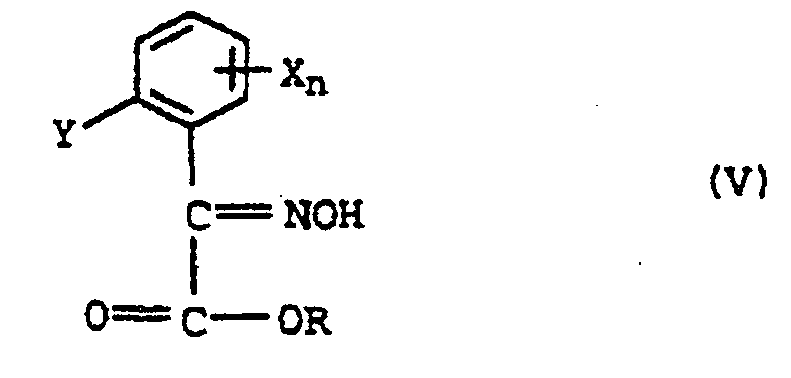
 b) with O-methylhydroxylamine to give the oxime ether of the formula VIand subsequent reaction of VI with methylamine, characterized in that it comprises using in the Pinner reaction an alcohol of the formula III
R-OH (III)
whose boiling point is above 75°C. - Process for preparing α-methoxyiminocarboxylic acid methylamides of the formula I according to claim 1, by Pinner reaction of an acyl cyanide of the formula II


 a) with hydroxylamine to give the oxime of the formula V
 b) with O-methylhydroxylamine to give the oxime ether of the formula VIand subsequent reaction of VI with methylamine, characterized in that it comprises using in the Pinner reaction an alcohol of the formula III
R-OH (III)
whose boiling point is above 75 °C. - Process for preparing α-methoxyiminocarboxylic acid methylamides of the formula I according to claim 1 or 2, characterized in that the reaction to give the oxime of the formula V is carried out in the presence of the alcohol III which was used in the Pinner reaction.
- Process for preparing α-methoxyiminocarboxylic acid methylamides of the formula I according to claim 1 or 2, characterized in that the reaction to give the oxime ether of the formula VI is carried out in the presence of the alcohol III which was used in the Pinner reaction.
- Process according to claims 1 to 4, characterized in that an alcohol III is used whose boiling point is above 90°C.
- Process for preparing α-methoxyiminocarboxylic acid methylamides of the formula IA
 X is nitro, trifluoromethyl, halogen, C1-C4-alkyl or C1-C4-alkoxy,n is 0 or an integer of from 1 to 4, where the X radicals can be different if n > 1,R1 is hydrogen, hydroxyl, mercapto, cyano, nitro, halogen, optionally substituted alkylsulfonyl, optionally substituted alkylsulfonyloxy, optionally substituted cycloalkyl, optionally substituted aryloxy, optionally substituted arylsulfonyl, optionally substituted arylsulfonyloxy, optionally substituted heterocyclyl or optionally substituted hetaryloxy,
 Ra is cyano, nitro, halogen, C1-C4-alkyl, C1-C4-haloalkyl, C1-C4-alkoxy or C1-C4-haloalkoxy,m is 0 or an integer of from 1 to 4, where the Ra radicals can be different if m > 1,Rb is hydrogen,
optionally substituted alkyl, cycloalkyl, alkenyl, cycloalkenyl, alkynyl, heterocyclyl, alkylcarbonyl, cycloalkylcarbonyl, alkenylcarbonyl, alkynylcarbonyl, heterocyclylcarbonyl, alkoxycarbonyl, aryl, hetaryl, arylcarbonyl, hetarylcarbonyl, arylsulfonyl, hetarylsulfonyl or a C(R')-NOR" group;R' is hydrogen, hydroxyl, cyano, nitro, amino, halogen,
optionally substituted alkyl, alkoxy, alkylthio, alkylamino, dialkylamino, alkenyl, alkenyloxy, alkenylthio, alkenylamino, alkynyl, alkynyloxy, alkynylthio, alkynylamino, cycloalkyl, cycloalkoxy, cycloalkylthio, cycloalkylamino, cycloalkenyl, cycloalkenyloxy, cycloalkenylthio, cycloalkenylamino, heterocyclyl, heterocyclyloxy, heterocyclylthio, heterocyclylamino, aryl, aryloxy, arylthio, arylamino, heteroaryl, heteroaryloxy, heteroarylthio or heteroarylamino;R" is hydrogen,
optionally substituted alkyl, cycloalkyl, alkenyl, alkynyl, heterocyclyl, aryl or heteroaryl,Rc is a group mentioned under Rb or hydroxyl, cyano, nitro, amino, halogen,
optionally substituted alkoxy, alkylthio, alkylamino, dialkylamino, aryloxy, arylthio, arylamino, hetaryloxy, hetarylthio or hetarylamino;
or
Rb and Rc, together with the C atom to which they are bonded, are a carbocyclic or heterocyclic ring, by Pinner reaction of an acyl cyanide of the formula IIA
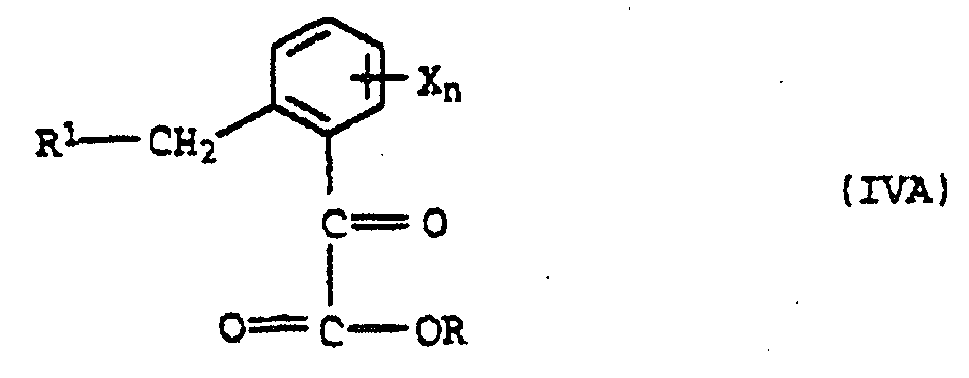 a) with hydroxylamine to give the oxime of the formula VA
 b) with O-methylhydroxylamine to give the oxime ether of the formula VIAand subsequent reaction of VIA with methylamine, characterized in that it comprises using in the Pinner reaction an alcohol of the formula III
R-OH (III)
whose boiling point is above 75°C. - Process for preparing α-methoxyiminocarboxylic acid methylamides of the formula IA according to claim 6 - by Pinner reaction of an acyl cyanide of the formula IIA

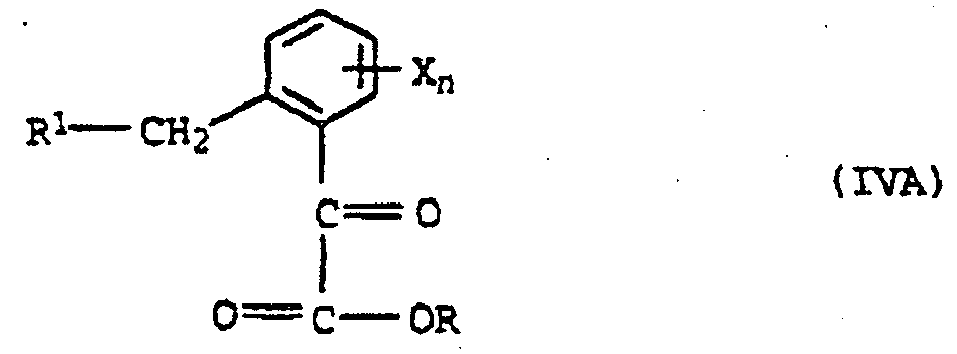
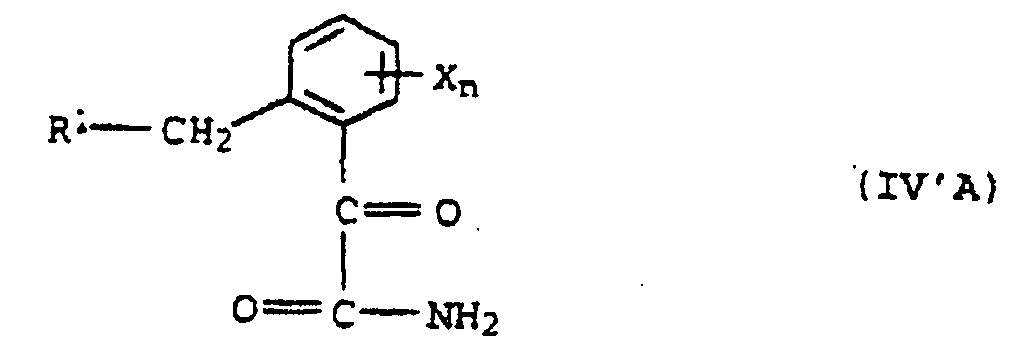 a) with hydroxylamine to give the oxime of the formula VA
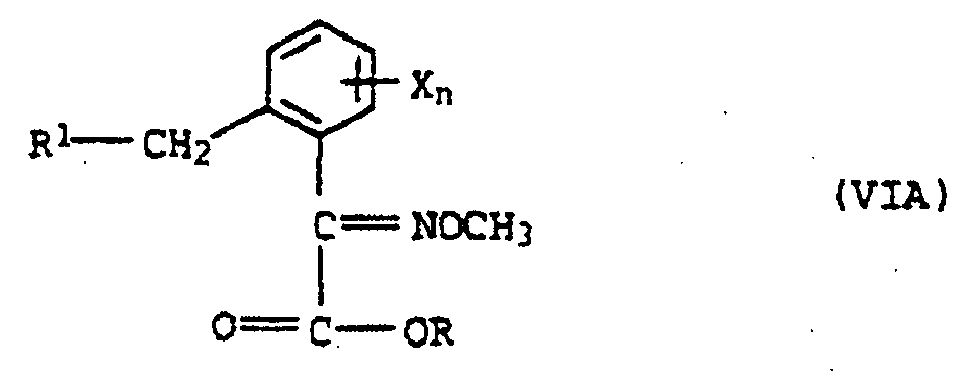 b) with O-methylhydroxylamine to give the oxime ether of the formula VIand subsequent reaction of VIA with methylamine, characterized in that it comprises using in the Pinner reaction an alcohol of the formula III
R-OH (III)
whose boiling point is above 75°C. - Process for preparing α-methoxyiminocarboxylic acid methylamides of the formula IA according to claim 6 or 7, characterized in that the reaction to give the oxime of the formula VA is carried out in the presence of the alcohol III which was used in the Pinner reaction.
- Process for preparing α-methoxyiminocarboxylic acid methylamides of the formula IA according to claim 6 or 7, characterized in that the reaction to give the oxime ether of the formula VIA is carried out in the presence of the alcohol III which was used in the Pinner reaction.
- Process according to claims 6 to 9, characterized in that an alcohol III is used whose boiling point is above 90°C.
- Compounds of the formulae IVA and VIA:ethyl (2-chloromethyl)phenylglyoxylate,n-propyl (2-chloromethyl)phenylglyoxylate,isopropyl (2-chloromethyl)phenylglyoxylate,n-butyl (2-chloromethyl)phenylglyoxylate,isobutyl (2-chloromethyl)phenylglyoxylate,but-2-yl (2-chloromethyl)phenylglyoxylate,n-pentyl (2-chloromethyl)phenylglyoxylate,3-methylbutyl (2-chloromethyl)phenylglyoxylate,2,2-dimethylpropyl (2-chloromethyl)phenylglyoxylate,1,1-dimethylpropyl (2-chloromethyl)phenylglyoxylate,pent-2-yl (2-chloromethyl)phenylglyoxylate,pent-3-yl (2-chloromethyl)phenylglyoxylate,2-methylbut-1-yl (2-chloromethyl)phenylglyoxylate,3-methylbut-2-yl (2-chloromethyl)phenylglyoxylate,ethyl 2-methoxyimino-2-(2'-chloromethylphenyl)acetate,n-propyl 2-methoxyimino-2-(2'-chloromethylphenyl)acetate,isopropyl 2-methoxyimino-2-(2'-chloromethylphenyl)acetate,n-butyl 2-methoxyimino-2-(2' -chloromethylphenyl)acetate,isobutyl 2-methoxyimino-2-(2'-chloromethylphenyl)acetate,but-2-yl 2-methoxyimino-2-(2'-chloromethylphenyl)acetate,n-pentyl 2-methoxyimino-2-(2'-chloromethylphenyl)acetate,3-methylbutyl 2-methoxyimino-2-(2'-chloromethylphenyl)acetate,2,2-dimethylpropyl 2-methoxyimino-2-(2'-chloromethylphenyl)acetate,1,1-dimethylpropyl 2-methoxyimino-2-(2'-chloromethylphenyl)acetate,pent-2-yl 2-methoxyimino-2-(2'-chloromethylphenyl)acetate,pent-3-yl 2-methoxyimino-2-(2'-chloromethylphenyl)acetate,2-methylbut-1-yl 2-methoxyimino-2-(2'-chloromethylphenyl)acetate, and3-methylbut-2-yl 2-methoxyimino-2-(2'-chloromethylphenyl)acetate.
Applications Claiming Priority (3)
| Application Number | Priority Date | Filing Date | Title |
|---|---|---|---|
| DE4420416 | 1994-06-10 | ||
| DE4420416 | 1994-06-10 | ||
| PCT/EP1995/002013 WO1995034526A1 (en) | 1994-06-10 | 1995-05-26 | METHOD OF PREPARING α-METHOXYIMINOCARBOXYLIC ACID METHYLAMIDES, AND INTERMEDIATES USED IN THE METHOD |
Publications (3)
| Publication Number | Publication Date |
|---|---|
| EP0765304A1 EP0765304A1 (en) | 1997-04-02 |
| EP0765304B1 EP0765304B1 (en) | 1999-08-11 |
| EP0765304B2 true EP0765304B2 (en) | 2007-08-22 |
Family
ID=6520340
Family Applications (1)
| Application Number | Title | Priority Date | Filing Date |
|---|---|---|---|
| EP95921761A Expired - Lifetime EP0765304B2 (en) | 1994-06-10 | 1995-05-26 | Method of preparing alpha-methoxyiminocarboxylic acid methylamides, and intermediates used in the method |
Country Status (28)
| Country | Link |
|---|---|
| US (1) | US5856560A (en) |
| EP (1) | EP0765304B2 (en) |
| JP (1) | JP4114948B2 (en) |
| KR (2) | KR100374949B1 (en) |
| CN (1) | CN1082503C (en) |
| AT (1) | ATE183176T1 (en) |
| AU (1) | AU686821B2 (en) |
| BG (1) | BG63115B1 (en) |
| BR (1) | BR9507979A (en) |
| CA (1) | CA2192594C (en) |
| CZ (1) | CZ297235B6 (en) |
| DE (1) | DE59506598D1 (en) |
| DK (1) | DK0765304T4 (en) |
| ES (1) | ES2135741T5 (en) |
| FI (1) | FI120583B (en) |
| GE (1) | GEP20012438B (en) |
| GR (1) | GR3031313T3 (en) |
| HU (1) | HU219195B (en) |
| IL (1) | IL114038A (en) |
| MX (1) | MX9606276A (en) |
| NO (1) | NO307333B1 (en) |
| NZ (1) | NZ287862A (en) |
| PL (1) | PL179861B1 (en) |
| RU (1) | RU2146247C1 (en) |
| SK (1) | SK283068B6 (en) |
| UA (1) | UA42776C2 (en) |
| WO (1) | WO1995034526A1 (en) |
| ZA (1) | ZA954825B (en) |
Families Citing this family (15)
| Publication number | Priority date | Publication date | Assignee | Title |
|---|---|---|---|---|
| DE4305502A1 (en) * | 1993-02-23 | 1994-08-25 | Basf Ag | Ortho-substituted 2-methoxyiminophenylacetic acid methylamides |
| SK88096A3 (en) * | 1994-01-05 | 1996-12-04 | Ciba Geigy Ag | Pesticidal compounds, preparation method thereof and intermediate products at this method and pesticidal agents containing them |
| JPH07238701A (en) * | 1994-02-28 | 1995-09-12 | Koji Sakata | Sky parking space |
| KR970705535A (en) * | 1994-09-06 | 1997-10-09 | 시오노 요시히코 | (PROCESS FOR PODUCING ALKOXYIMINOACETAMIDE DERIVATIVE) |
| DE19540361A1 (en) | 1995-10-30 | 1997-05-07 | Basf Ag | Phenylacetic acid derivatives, processes and intermediates for their preparation and their use for controlling harmful fungi and animal pests |
| CA2235587A1 (en) * | 1995-11-29 | 1997-06-05 | Werner Pfaff | Process for the preparation of methoxyminophenylglyoxylic acid derivatives |
| CN1238337C (en) | 1995-12-07 | 2006-01-25 | 拜尔公开股份有限公司 | Pesticide |
| EP0876333B1 (en) * | 1995-12-07 | 2002-03-27 | Bayer Aktiengesellschaft | Process for the preparation of pesticides |
| DK0782982T3 (en) * | 1996-01-03 | 2000-10-09 | Novartis Ag | Process for the preparation of o-chloromethyl-phenylglyoxylic acid derivatives |
| FR2773155B1 (en) * | 1997-12-29 | 2000-01-28 | Rhone Poulenc Agrochimie | NEW FUNGICIDAL COMPOUNDS |
| JP4416945B2 (en) * | 1998-03-26 | 2010-02-17 | バイエルクロップサイエンス株式会社 | Method for producing oxime compounds |
| US6313344B1 (en) | 1998-05-27 | 2001-11-06 | Bayer Aktiengesellschaft | Organic compounds |
| WO2009037230A2 (en) * | 2007-09-17 | 2009-03-26 | Dsm Fine Chemicals Austria Nfg Gmbh & Co Kg | Improved process for preparing (e)-2-(2-chloromethylphenyl)-2-alkoximinoacetic esters |
| CN102438980A (en) * | 2009-02-05 | 2012-05-02 | 巴斯夫欧洲公司 | Method for preparing 2-halomethylphenylacetic acid derivatives |
| CN109912417A (en) * | 2018-12-29 | 2019-06-21 | 京博农化科技有限公司 | A kind of 2-(2- methylenedioxy phenoxy methyl)-methyl benzoylformate synthetic method |
Citations (7)
| Publication number | Priority date | Publication date | Assignee | Title |
|---|---|---|---|---|
| EP0254426A2 (en) † | 1986-07-18 | 1988-01-27 | Zeneca Limited | Fungicides |
| EP0299694A2 (en) † | 1987-07-11 | 1989-01-18 | AgrEvo UK Limited | Acrylate fungicides |
| EP0354571A1 (en) † | 1988-08-12 | 1990-02-14 | BASF Aktiengesellschaft | Oximethers, method for their preparation and fungicides containing them |
| EP0374811A1 (en) † | 1988-12-23 | 1990-06-27 | BASF Aktiengesellschaft | Sulfur-bearing oxime ethers and fungicides containing them |
| EP0460575A1 (en) † | 1990-06-05 | 1991-12-11 | Ciba-Geigy Ag | Aromatic compounds |
| EP0463488A1 (en) † | 1990-06-27 | 1992-01-02 | BASF Aktiengesellschaft | O-Benzyl oxime ethers and fungicides containing them |
| WO1996037463A1 (en) † | 1995-05-23 | 1996-11-28 | Mitsubishi Chemical Corporation | Process for producing n-methylmethoxyiminoacetamide derivatives and intermediates therefor |
Family Cites Families (24)
| Publication number | Priority date | Publication date | Assignee | Title |
|---|---|---|---|---|
| DE68905765T3 (en) * | 1988-11-21 | 1998-03-26 | Zeneca Ltd | Fungicides. |
| US5185342A (en) * | 1989-05-17 | 1993-02-09 | Shionogi Seiyaku Kabushiki Kaisha | Alkoxyiminoacetamide derivatives and their use as fungicides |
| DE3933891A1 (en) * | 1989-10-11 | 1991-04-18 | Basf Ag | PHENYL ACETIC DERIVATIVES AND FUNGICIDES CONTAINING THEM |
| DE4009616A1 (en) * | 1990-03-26 | 1991-10-02 | Henkel Kgaa | LIQUID BODY CLEANER |
| DE4030038A1 (en) * | 1990-09-22 | 1992-03-26 | Basf Ag | New 2-substd. phenyl-acetamide derivs. - useful as fungicides, insecticides, acaricides and nematocides |
| DK0493711T3 (en) * | 1990-12-31 | 1996-11-11 | Basf Ag | Process for the preparation of E-oximeters of phenylglyoxylic esters |
| DE4042280A1 (en) * | 1990-12-31 | 1992-07-02 | Basf Ag | Prepn. of E-oxime ether(s) of phenyl-glyoxylic acid ester(s) |
| DE4042273A1 (en) * | 1990-12-31 | 1992-07-02 | Basf Ag | Prepn. of E-oxime ether(s) of phenyl-glyoxylic acid ester(s) |
| DE4042271A1 (en) * | 1990-12-31 | 1992-07-02 | Basf Ag | Prepn. of E-oxime ether(s) of phenyl-glyoxylic acid ester(s) |
| ATE139993T1 (en) * | 1991-01-30 | 1996-07-15 | Zeneca Ltd | FUNGICIDES |
| GB9218541D0 (en) * | 1991-09-30 | 1992-10-14 | Ici Plc | Fungicides |
| GB9122098D0 (en) * | 1991-10-17 | 1991-11-27 | Ici Plc | Fungicides |
| DE4203170A1 (en) * | 1992-02-05 | 1993-08-12 | Basf Ag | METHOD FOR PRODUCING E-OXIMETHERS OF PHENYLGLYOXYL ACID ESTERS |
| IL105191A (en) * | 1992-04-04 | 1998-08-16 | Basf Ag | 0-Iminooxymethylbenzoic acids and their preparation |
| DE59309100D1 (en) * | 1992-07-15 | 1998-12-03 | Basf Ag | Substituted oxime ethers and their use to control pests |
| IL106473A0 (en) * | 1992-08-11 | 1993-11-15 | Basf Ag | Acetylene derivatives and crop protection agents containing them |
| DE59304268D1 (en) * | 1992-08-29 | 1996-11-28 | Basf Ag | N-methylamides, processes and intermediates for their manufacture and processes for controlling pests |
| GB9221584D0 (en) * | 1992-10-14 | 1992-11-25 | Ici Plc | Chemical process |
| DE4238260A1 (en) * | 1992-11-12 | 1994-05-19 | Basf Ag | Substituted ortho-ethenylphenylacetic acid derivatives |
| GB9226734D0 (en) * | 1992-12-22 | 1993-02-17 | Ici Plc | Fungicides |
| DE4305502A1 (en) * | 1993-02-23 | 1994-08-25 | Basf Ag | Ortho-substituted 2-methoxyiminophenylacetic acid methylamides |
| US5506358A (en) * | 1993-03-16 | 1996-04-09 | Shionogi & Co., Ltd. | Process for producing alkoxyiminoacetamide compounds |
| EP0617014B1 (en) * | 1993-03-19 | 1997-10-29 | Ube Industries, Ltd. | Oxime ether compound, processes for preparing the same and fungicide containing the same |
| DE4310143A1 (en) * | 1993-03-29 | 1994-10-06 | Basf Ag | Imino-substituted phenylacetic acid amides, their preparation and fungicides containing them |
-
1995
- 1995-05-26 CZ CZ0357896A patent/CZ297235B6/en not_active IP Right Cessation
- 1995-05-26 SK SK1575-96A patent/SK283068B6/en not_active IP Right Cessation
- 1995-05-26 ES ES95921761T patent/ES2135741T5/en not_active Expired - Lifetime
- 1995-05-26 DE DE59506598T patent/DE59506598D1/en not_active Expired - Lifetime
- 1995-05-26 PL PL95317712A patent/PL179861B1/en not_active IP Right Cessation
- 1995-05-26 BR BR9507979A patent/BR9507979A/en not_active IP Right Cessation
- 1995-05-26 MX MX9606276A patent/MX9606276A/en unknown
- 1995-05-26 NZ NZ287862A patent/NZ287862A/en not_active IP Right Cessation
- 1995-05-26 WO PCT/EP1995/002013 patent/WO1995034526A1/en not_active Ceased
- 1995-05-26 DK DK95921761T patent/DK0765304T4/en active
- 1995-05-26 AT AT95921761T patent/ATE183176T1/en active
- 1995-05-26 JP JP50154296A patent/JP4114948B2/en not_active Expired - Lifetime
- 1995-05-26 EP EP95921761A patent/EP0765304B2/en not_active Expired - Lifetime
- 1995-05-26 UA UA97010107A patent/UA42776C2/en unknown
- 1995-05-26 CN CN95194276A patent/CN1082503C/en not_active Expired - Lifetime
- 1995-05-26 GE GE2653A patent/GEP20012438B/en unknown
- 1995-05-26 AU AU26710/95A patent/AU686821B2/en not_active Ceased
- 1995-05-26 HU HU9603401A patent/HU219195B/en not_active IP Right Cessation
- 1995-05-26 CA CA002192594A patent/CA2192594C/en not_active Expired - Fee Related
- 1995-05-26 KR KR1019960707049A patent/KR100374949B1/en not_active Expired - Lifetime
- 1995-05-26 RU RU97100673A patent/RU2146247C1/en not_active IP Right Cessation
- 1995-06-07 IL IL11403895A patent/IL114038A/en not_active IP Right Cessation
- 1995-06-12 ZA ZA954825A patent/ZA954825B/en unknown
-
1996
- 1996-12-05 FI FI964901A patent/FI120583B/en not_active IP Right Cessation
- 1996-12-09 NO NO965259A patent/NO307333B1/en not_active IP Right Cessation
- 1996-12-10 KR KR19967007049A patent/KR970703931A/en active Granted
- 1996-12-10 US US08/750,822 patent/US5856560A/en not_active Expired - Lifetime
- 1996-12-28 BG BG101079A patent/BG63115B1/en unknown
-
1999
- 1999-09-22 GR GR990402413T patent/GR3031313T3/en unknown
Patent Citations (8)
| Publication number | Priority date | Publication date | Assignee | Title |
|---|---|---|---|---|
| EP0254426A2 (en) † | 1986-07-18 | 1988-01-27 | Zeneca Limited | Fungicides |
| US5157144A (en) † | 1986-07-18 | 1992-10-20 | Imperial Chemical Industries Plc | 2-(halomethyl)-alpha-(methoxyimino) benzeneacetic acid methyl ester |
| EP0299694A2 (en) † | 1987-07-11 | 1989-01-18 | AgrEvo UK Limited | Acrylate fungicides |
| EP0354571A1 (en) † | 1988-08-12 | 1990-02-14 | BASF Aktiengesellschaft | Oximethers, method for their preparation and fungicides containing them |
| EP0374811A1 (en) † | 1988-12-23 | 1990-06-27 | BASF Aktiengesellschaft | Sulfur-bearing oxime ethers and fungicides containing them |
| EP0460575A1 (en) † | 1990-06-05 | 1991-12-11 | Ciba-Geigy Ag | Aromatic compounds |
| EP0463488A1 (en) † | 1990-06-27 | 1992-01-02 | BASF Aktiengesellschaft | O-Benzyl oxime ethers and fungicides containing them |
| WO1996037463A1 (en) † | 1995-05-23 | 1996-11-28 | Mitsubishi Chemical Corporation | Process for producing n-methylmethoxyiminoacetamide derivatives and intermediates therefor |
Non-Patent Citations (3)
| Title |
|---|
| Handbook of Chemistry and Physics, 53. Aufl., C-175, C-176, 1972/1973 † |
| Houben-Weyl, "Methoden der org. Chemie", Alkohole, Bd. 6/1a/1 † |
| J. March, "Advanced Organic Chemistry", McGraw-Hill, S. 813, 1977 † |
Also Published As
Similar Documents
| Publication | Publication Date | Title |
|---|---|---|
| EP0765304B2 (en) | Method of preparing alpha-methoxyiminocarboxylic acid methylamides, and intermediates used in the method | |
| KR100371071B1 (en) | Use of 2-[(dihydro) pyrazolyl-3'-oxymethylene] anilide as an insecticide and fungicide | |
| EP0624155B2 (en) | Carbamates and plant-protecting agents containing them | |
| EP2406205B1 (en) | Method for manufacturing chlorine and bromine aromatic compounds | |
| JP3217191B2 (en) | Heteroaromatic compounds and plant protective agents containing the same | |
| UA46737C2 (en) | 2- (1 ', 2', 4'-TRIAZOL-3'-ILOXYMETHYLENE) ANILIDES, INTERMEDIATES AND MEANS OF CONTROL AGAINST HARMFUL MUSHROOMS | |
| EP1616870A1 (en) | Fungicidal triazolopyrimidines, process for their preparation, their use for combatting fungi and agents comprising them | |
| EP1476453B1 (en) | Method for producing 6-alkoxy-(6h)-dibenz c,e| 1,2|-oxaphosphorines | |
| EP0581095A2 (en) | Substituted acrylic acid esters and plant-protecting agents containing them | |
| EP1644314B1 (en) | Method for producing difluoro-acetyl-acetic acid alkylesters | |
| EP0534216A1 (en) | Dihydropyran derivatives and plant protecting agents containing them | |
| EP1164126A1 (en) | Salicylic acid hydrazide derivatives, process and intermediates for their preparation, agents containing them and their use for combatting damaging fungi | |
| EP1606246B1 (en) | Method for producing 2-cyan-3-hydroxy-n-(phenyl)but-2-ene amides | |
| EP0703225B1 (en) | Process for the preparation of alkoxytriazolinones | |
| DE69619402T2 (en) | METHOD FOR PRODUCING METHOXIMINOPHENYLGLYOXYLIC ACID DERIVATIVES | |
| DE4234012A1 (en) | New N-phenyl-carbamate, urea or amide derivs. | |
| DE4234081A1 (en) | New N-phenyl-carbamate, urea or amide derivs. | |
| DE4234067A1 (en) | New N-phenyl-carbamate, urea or amide derivs. |
Legal Events
| Date | Code | Title | Description |
|---|---|---|---|
| PUAI | Public reference made under article 153(3) epc to a published international application that has entered the european phase |
Free format text: ORIGINAL CODE: 0009012 |
|
| 17P | Request for examination filed |
Effective date: 19961202 |
|
| AK | Designated contracting states |
Kind code of ref document: A1 Designated state(s): AT BE CH DE DK ES FR GB GR IE IT LI NL PT SE |
|
| 17Q | First examination report despatched |
Effective date: 19971121 |
|
| GRAG | Despatch of communication of intention to grant |
Free format text: ORIGINAL CODE: EPIDOS AGRA |
|
| GRAG | Despatch of communication of intention to grant |
Free format text: ORIGINAL CODE: EPIDOS AGRA |
|
| GRAG | Despatch of communication of intention to grant |
Free format text: ORIGINAL CODE: EPIDOS AGRA |
|
| GRAH | Despatch of communication of intention to grant a patent |
Free format text: ORIGINAL CODE: EPIDOS IGRA |
|
| GRAH | Despatch of communication of intention to grant a patent |
Free format text: ORIGINAL CODE: EPIDOS IGRA |
|
| GRAH | Despatch of communication of intention to grant a patent |
Free format text: ORIGINAL CODE: EPIDOS IGRA |
|
| GRAA | (expected) grant |
Free format text: ORIGINAL CODE: 0009210 |
|
| AK | Designated contracting states |
Kind code of ref document: B1 Designated state(s): AT BE CH DE DK ES FR GB GR IE IT LI NL PT SE |
|
| REF | Corresponds to: |
Ref document number: 183176 Country of ref document: AT Date of ref document: 19990815 Kind code of ref document: T |
|
| REG | Reference to a national code |
Ref country code: CH Ref legal event code: EP |
|
| REF | Corresponds to: |
Ref document number: 59506598 Country of ref document: DE Date of ref document: 19990916 |
|
| GBT | Gb: translation of ep patent filed (gb section 77(6)(a)/1977) |
Effective date: 19990922 |
|
| ITF | It: translation for a ep patent filed | ||
| REG | Reference to a national code |
Ref country code: IE Ref legal event code: FG4D Free format text: GERMAN |
|
| REG | Reference to a national code |
Ref country code: ES Ref legal event code: FG2A Ref document number: 2135741 Country of ref document: ES Kind code of ref document: T3 |
|
| ET | Fr: translation filed | ||
| REG | Reference to a national code |
Ref country code: DK Ref legal event code: T3 |
|
| REG | Reference to a national code |
Ref country code: PT Ref legal event code: SC4A Free format text: AVAILABILITY OF NATIONAL TRANSLATION Effective date: 19991110 |
|
| PLBQ | Unpublished change to opponent data |
Free format text: ORIGINAL CODE: EPIDOS OPPO |
|
| PLBI | Opposition filed |
Free format text: ORIGINAL CODE: 0009260 |
|
| PLBF | Reply of patent proprietor to notice(s) of opposition |
Free format text: ORIGINAL CODE: EPIDOS OBSO |
|
| 26 | Opposition filed |
Opponent name: NOVARTIS AG Effective date: 20000510 |
|
| NLR1 | Nl: opposition has been filed with the epo |
Opponent name: NOVARTIS AG |
|
| PLBF | Reply of patent proprietor to notice(s) of opposition |
Free format text: ORIGINAL CODE: EPIDOS OBSO |
|
| PLBQ | Unpublished change to opponent data |
Free format text: ORIGINAL CODE: EPIDOS OPPO |
|
| PLAB | Opposition data, opponent's data or that of the opponent's representative modified |
Free format text: ORIGINAL CODE: 0009299OPPO |
|
| PLBF | Reply of patent proprietor to notice(s) of opposition |
Free format text: ORIGINAL CODE: EPIDOS OBSO |
|
| R26 | Opposition filed (corrected) |
Opponent name: NOVARTIS AG Effective date: 20000510 |
|
| NLR1 | Nl: opposition has been filed with the epo |
Opponent name: NOVARTIS AG |
|
| PLAB | Opposition data, opponent's data or that of the opponent's representative modified |
Free format text: ORIGINAL CODE: 0009299OPPO |
|
| PLBQ | Unpublished change to opponent data |
Free format text: ORIGINAL CODE: EPIDOS OPPO |
|
| PLAB | Opposition data, opponent's data or that of the opponent's representative modified |
Free format text: ORIGINAL CODE: 0009299OPPO |
|
| R26 | Opposition filed (corrected) |
Opponent name: SYNGENTA PARTICIPATIONS AG Effective date: 20000510 |
|
| PLBQ | Unpublished change to opponent data |
Free format text: ORIGINAL CODE: EPIDOS OPPO |
|
| PLAB | Opposition data, opponent's data or that of the opponent's representative modified |
Free format text: ORIGINAL CODE: 0009299OPPO |
|
| R26 | Opposition filed (corrected) |
Opponent name: SYNGENTA PARTICIPATIONS AG Effective date: 20000510 |
|
| NLR1 | Nl: opposition has been filed with the epo |
Opponent name: SYNGENTA PARTICIPATIONS AG |
|
| NLR1 | Nl: opposition has been filed with the epo |
Opponent name: SYNGENTA PARTICIPATIONS AG |
|
| R26 | Opposition filed (corrected) |
Opponent name: SYNGENTA PARTICIPATIONS AG Effective date: 20000510 |
|
| NLR1 | Nl: opposition has been filed with the epo |
Opponent name: SYNGENTA PARTICIPATIONS AG |
|
| REG | Reference to a national code |
Ref country code: GB Ref legal event code: IF02 |
|
| PGFP | Annual fee paid to national office [announced via postgrant information from national office to epo] |
Ref country code: SE Payment date: 20020415 Year of fee payment: 8 |
|
| PGFP | Annual fee paid to national office [announced via postgrant information from national office to epo] |
Ref country code: GR Payment date: 20020429 Year of fee payment: 8 |
|
| RDAH | Patent revoked |
Free format text: ORIGINAL CODE: EPIDOS REVO |
|
| APAC | Appeal dossier modified |
Free format text: ORIGINAL CODE: EPIDOS NOAPO |
|
| APAC | Appeal dossier modified |
Free format text: ORIGINAL CODE: EPIDOS NOAPO |
|
| PG25 | Lapsed in a contracting state [announced via postgrant information from national office to epo] |
Ref country code: SE Free format text: LAPSE BECAUSE OF NON-PAYMENT OF DUE FEES Effective date: 20030527 |
|
| PG25 | Lapsed in a contracting state [announced via postgrant information from national office to epo] |
Ref country code: GR Free format text: LAPSE BECAUSE OF NON-PAYMENT OF DUE FEES Effective date: 20031203 |
|
| EUG | Se: european patent has lapsed | ||
| APAA | Appeal reference recorded |
Free format text: ORIGINAL CODE: EPIDOS REFN |
|
| APBU | Appeal procedure closed |
Free format text: ORIGINAL CODE: EPIDOSNNOA9O |
|
| APAH | Appeal reference modified |
Free format text: ORIGINAL CODE: EPIDOSCREFNO |
|
| RAP2 | Party data changed (patent owner data changed or rights of a patent transferred) |
Owner name: BAYER CROPSCIENCE AG |
|
| NLT2 | Nl: modifications (of names), taken from the european patent patent bulletin |
Owner name: BAYER CROPSCIENCE AG Effective date: 20060517 |
|
| PLAB | Opposition data, opponent's data or that of the opponent's representative modified |
Free format text: ORIGINAL CODE: 0009299OPPO |
|
| PLAY | Examination report in opposition despatched + time limit |
Free format text: ORIGINAL CODE: EPIDOSNORE2 |
|
| PLBP | Opposition withdrawn |
Free format text: ORIGINAL CODE: 0009264 |
|
| PLBC | Reply to examination report in opposition received |
Free format text: ORIGINAL CODE: EPIDOSNORE3 |
|
| PUAH | Patent maintained in amended form |
Free format text: ORIGINAL CODE: 0009272 |
|
| STAA | Information on the status of an ep patent application or granted ep patent |
Free format text: STATUS: PATENT MAINTAINED AS AMENDED |
|
| REG | Reference to a national code |
Ref country code: CH Ref legal event code: PUE Owner name: BAYER CROPSCIENCE AG Free format text: BASF AKTIENGESELLSCHAFT# #67056 LUDWIGSHAFEN (DE) -TRANSFER TO- BAYER CROPSCIENCE AG#ALFRED-NOBEL-STRASSE 50#40789 MONHEIM AM RHEIN (DE) |
|
| REG | Reference to a national code |
Ref country code: PT Ref legal event code: PC4A Owner name: BAYER CROPSCIENCE AG, DE Effective date: 20070730 |
|
| 27A | Patent maintained in amended form |
Effective date: 20070822 |
|
| AK | Designated contracting states |
Kind code of ref document: B2 Designated state(s): AT BE CH DE DK ES FR GB GR IE IT LI NL PT SE |
|
| REG | Reference to a national code |
Ref country code: CH Ref legal event code: AEN Free format text: AUFRECHTERHALTUNG DES PATENTES IN GEAENDERTER FORM |
|
| NLS | Nl: assignments of ep-patents |
Owner name: BAYER CROPSCIENCE AG Effective date: 20070731 |
|
| NLR2 | Nl: decision of opposition |
Effective date: 20070822 |
|
| REG | Reference to a national code |
Ref country code: GB Ref legal event code: 732E |
|
| NLR3 | Nl: receipt of modified translations in the netherlands language after an opposition procedure | ||
| REG | Reference to a national code |
Ref country code: DK Ref legal event code: T4 |
|
| GBTA | Gb: translation of amended ep patent filed (gb section 77(6)(b)/1977) | ||
| REG | Reference to a national code |
Ref country code: ES Ref legal event code: DC2A Date of ref document: 20071015 Kind code of ref document: T5 |
|
| PLAB | Opposition data, opponent's data or that of the opponent's representative modified |
Free format text: ORIGINAL CODE: 0009299OPPO |
|
| REG | Reference to a national code |
Ref country code: CH Ref legal event code: PK Free format text: DER VERTRETEREINTRAG GILT AB 03.07.2007 Ref country code: CH Ref legal event code: NV Representative=s name: SCHMAUDER & PARTNER AG PATENT- UND MARKENANWAELTE |
|
| PGFP | Annual fee paid to national office [announced via postgrant information from national office to epo] |
Ref country code: PT Payment date: 20110503 Year of fee payment: 17 Ref country code: IE Payment date: 20110517 Year of fee payment: 17 |
|
| PGFP | Annual fee paid to national office [announced via postgrant information from national office to epo] |
Ref country code: AT Payment date: 20110427 Year of fee payment: 17 |
|
| REG | Reference to a national code |
Ref country code: PT Ref legal event code: MM4A Free format text: LAPSE DUE TO NON-PAYMENT OF FEES Effective date: 20121126 |
|
| REG | Reference to a national code |
Ref country code: AT Ref legal event code: MM01 Ref document number: 183176 Country of ref document: AT Kind code of ref document: T Effective date: 20120526 |
|
| PG25 | Lapsed in a contracting state [announced via postgrant information from national office to epo] |
Ref country code: AT Free format text: LAPSE BECAUSE OF NON-PAYMENT OF DUE FEES Effective date: 20120526 |
|
| REG | Reference to a national code |
Ref country code: IE Ref legal event code: MM4A |
|
| PG25 | Lapsed in a contracting state [announced via postgrant information from national office to epo] |
Ref country code: PT Free format text: LAPSE BECAUSE OF NON-PAYMENT OF DUE FEES Effective date: 20121126 |
|
| PG25 | Lapsed in a contracting state [announced via postgrant information from national office to epo] |
Ref country code: IE Free format text: LAPSE BECAUSE OF NON-PAYMENT OF DUE FEES Effective date: 20120526 |
|
| PGFP | Annual fee paid to national office [announced via postgrant information from national office to epo] |
Ref country code: GB Payment date: 20140521 Year of fee payment: 20 |
|
| PGFP | Annual fee paid to national office [announced via postgrant information from national office to epo] |
Ref country code: ES Payment date: 20140429 Year of fee payment: 20 Ref country code: IT Payment date: 20140516 Year of fee payment: 20 Ref country code: NL Payment date: 20140426 Year of fee payment: 20 Ref country code: CH Payment date: 20140513 Year of fee payment: 20 Ref country code: FR Payment date: 20140509 Year of fee payment: 20 Ref country code: DE Payment date: 20140521 Year of fee payment: 20 |
|
| PGFP | Annual fee paid to national office [announced via postgrant information from national office to epo] |
Ref country code: BE Payment date: 20140513 Year of fee payment: 20 Ref country code: DK Payment date: 20140512 Year of fee payment: 20 |
|
| REG | Reference to a national code |
Ref country code: CH Ref legal event code: PUE Owner name: BAYER INTELLECTUAL PROPERTY GMBH, DE Free format text: FORMER OWNER: BAYER CROPSCIENCE AG, DE |
|
| REG | Reference to a national code |
Ref country code: DE Ref legal event code: R081 Ref document number: 59506598 Country of ref document: DE Owner name: BAYER INTELLECTUAL PROPERTY GMBH, DE Free format text: FORMER OWNER: BASF SE, 67063 LUDWIGSHAFEN, DE Effective date: 20150116 |
|
| REG | Reference to a national code |
Ref country code: ES Ref legal event code: PC2A Owner name: BAYER INTELLECTUAL PROPERTY GMBH Effective date: 20150303 |
|
| REG | Reference to a national code |
Ref country code: GB Ref legal event code: 732E Free format text: REGISTERED BETWEEN 20150220 AND 20150225 |
|
| REG | Reference to a national code |
Ref country code: DE Ref legal event code: R071 Ref document number: 59506598 Country of ref document: DE |
|
| REG | Reference to a national code |
Ref country code: NL Ref legal event code: V4 Effective date: 20150526 |
|
| REG | Reference to a national code |
Ref country code: DK Ref legal event code: EUP Effective date: 20150526 |
|
| REG | Reference to a national code |
Ref country code: CH Ref legal event code: PL |
|
| REG | Reference to a national code |
Ref country code: GB Ref legal event code: PE20 Expiry date: 20150525 |
|
| PG25 | Lapsed in a contracting state [announced via postgrant information from national office to epo] |
Ref country code: GB Free format text: LAPSE BECAUSE OF EXPIRATION OF PROTECTION Effective date: 20150525 |
|
| REG | Reference to a national code |
Ref country code: ES Ref legal event code: FD2A Effective date: 20150902 |
|
| PG25 | Lapsed in a contracting state [announced via postgrant information from national office to epo] |
Ref country code: ES Free format text: LAPSE BECAUSE OF EXPIRATION OF PROTECTION Effective date: 20150527 |