EP0750909A1 - The use of amino hydrogenated quinazoline compounds and derivatives thereof for abstaining from drug dependence - Google Patents
The use of amino hydrogenated quinazoline compounds and derivatives thereof for abstaining from drug dependence Download PDFInfo
- Publication number
- EP0750909A1 EP0750909A1 EP95911187A EP95911187A EP0750909A1 EP 0750909 A1 EP0750909 A1 EP 0750909A1 EP 95911187 A EP95911187 A EP 95911187A EP 95911187 A EP95911187 A EP 95911187A EP 0750909 A1 EP0750909 A1 EP 0750909A1
- Authority
- EP
- European Patent Office
- Prior art keywords
- group
- derivatives
- compounds
- charaterized
- use according
- Prior art date
- Legal status (The legal status is an assumption and is not a legal conclusion. Google has not performed a legal analysis and makes no representation as to the accuracy of the status listed.)
- Granted
Links
- -1 amino hydrogenated quinazoline compounds Chemical class 0.000 title claims abstract description 38
- 208000011117 substance-related disease Diseases 0.000 title claims abstract description 34
- 206010013663 drug dependence Diseases 0.000 title claims abstract description 30
- 150000001875 compounds Chemical class 0.000 claims abstract description 35
- 239000003814 drug Substances 0.000 claims abstract description 28
- 125000000217 alkyl group Chemical group 0.000 claims description 16
- 238000000034 method Methods 0.000 claims description 15
- 125000000896 monocarboxylic acid group Chemical group 0.000 claims description 12
- 150000001408 amides Chemical class 0.000 claims description 8
- 238000007918 intramuscular administration Methods 0.000 claims description 3
- 238000001990 intravenous administration Methods 0.000 claims description 3
- 239000008194 pharmaceutical composition Substances 0.000 claims description 3
- 238000002360 preparation method Methods 0.000 claims description 3
- 238000007920 subcutaneous administration Methods 0.000 claims description 3
- XLYOFNOQVPJJNP-UHFFFAOYSA-N water Substances O XLYOFNOQVPJJNP-UHFFFAOYSA-N 0.000 claims description 3
- VGGSQFUCUMXWEO-UHFFFAOYSA-N Ethene Chemical compound C=C VGGSQFUCUMXWEO-UHFFFAOYSA-N 0.000 claims description 2
- 239000005977 Ethylene Substances 0.000 claims description 2
- 239000002253 acid Substances 0.000 claims description 2
- 125000003545 alkoxy group Chemical group 0.000 claims description 2
- 125000002924 primary amino group Chemical group [H]N([H])* 0.000 claims 1
- 229940079593 drug Drugs 0.000 abstract description 25
- BQJCRHHNABKAKU-KBQPJGBKSA-N morphine Chemical compound O([C@H]1[C@H](C=C[C@H]23)O)C4=C5[C@@]12CCN(C)[C@@H]3CC5=CC=C4O BQJCRHHNABKAKU-KBQPJGBKSA-N 0.000 abstract description 16
- 230000000694 effects Effects 0.000 abstract description 15
- 239000008896 Opium Substances 0.000 abstract description 9
- 229960001027 opium Drugs 0.000 abstract description 9
- 229960005181 morphine Drugs 0.000 abstract description 8
- CFMYXEVWODSLAX-QOZOJKKESA-N tetrodotoxin Chemical compound O([C@@]([C@H]1O)(O)O[C@H]2[C@@]3(O)CO)[C@H]3[C@@H](O)[C@]11[C@H]2[C@@H](O)N=C(N)N1 CFMYXEVWODSLAX-QOZOJKKESA-N 0.000 abstract description 8
- 229950010357 tetrodotoxin Drugs 0.000 abstract description 8
- CFMYXEVWODSLAX-UHFFFAOYSA-N tetrodotoxin Natural products C12C(O)NC(=N)NC2(C2O)C(O)C3C(CO)(O)C1OC2(O)O3 CFMYXEVWODSLAX-UHFFFAOYSA-N 0.000 abstract description 8
- GVGLGOZIDCSQPN-PVHGPHFFSA-N Heroin Chemical compound O([C@H]1[C@H](C=C[C@H]23)OC(C)=O)C4=C5[C@@]12CCN(C)[C@@H]3CC5=CC=C4OC(C)=O GVGLGOZIDCSQPN-PVHGPHFFSA-N 0.000 abstract description 5
- 229930013930 alkaloid Natural products 0.000 abstract description 5
- 229960002069 diamorphine Drugs 0.000 abstract description 5
- 238000010254 subcutaneous injection Methods 0.000 abstract description 3
- 238000010255 intramuscular injection Methods 0.000 abstract description 2
- 238000010253 intravenous injection Methods 0.000 abstract description 2
- 231100000053 low toxicity Toxicity 0.000 abstract 1
- QJGQUHMNIGDVPM-UHFFFAOYSA-N nitrogen group Chemical group [N] QJGQUHMNIGDVPM-UHFFFAOYSA-N 0.000 abstract 1
- 208000011580 syndromic disease Diseases 0.000 description 26
- 238000002347 injection Methods 0.000 description 21
- 239000007924 injection Substances 0.000 description 21
- 206010012335 Dependence Diseases 0.000 description 19
- USSIQXCVUWKGNF-UHFFFAOYSA-N 6-(dimethylamino)-4,4-diphenylheptan-3-one Chemical compound C=1C=CC=CC=1C(CC(C)N(C)C)(C(=O)CC)C1=CC=CC=C1 USSIQXCVUWKGNF-UHFFFAOYSA-N 0.000 description 15
- 229960001797 methadone Drugs 0.000 description 15
- QTBSBXVTEAMEQO-UHFFFAOYSA-N Acetic acid Chemical compound CC(O)=O QTBSBXVTEAMEQO-UHFFFAOYSA-N 0.000 description 12
- WPYMKLBDIGXBTP-UHFFFAOYSA-N benzoic acid Chemical compound OC(=O)C1=CC=CC=C1 WPYMKLBDIGXBTP-UHFFFAOYSA-N 0.000 description 10
- AAOVKJBEBIDNHE-UHFFFAOYSA-N diazepam Chemical compound N=1CC(=O)N(C)C2=CC=C(Cl)C=C2C=1C1=CC=CC=C1 AAOVKJBEBIDNHE-UHFFFAOYSA-N 0.000 description 8
- 238000002474 experimental method Methods 0.000 description 8
- 239000000243 solution Substances 0.000 description 8
- 238000002560 therapeutic procedure Methods 0.000 description 8
- 208000007271 Substance Withdrawal Syndrome Diseases 0.000 description 7
- ZPUCINDJVBIVPJ-LJISPDSOSA-N cocaine Chemical compound O([C@H]1C[C@@H]2CC[C@@H](N2C)[C@H]1C(=O)OC)C(=O)C1=CC=CC=C1 ZPUCINDJVBIVPJ-LJISPDSOSA-N 0.000 description 6
- 230000001225 therapeutic effect Effects 0.000 description 6
- 239000005711 Benzoic acid Substances 0.000 description 5
- 206010013654 Drug abuse Diseases 0.000 description 5
- 208000002193 Pain Diseases 0.000 description 5
- 235000010233 benzoic acid Nutrition 0.000 description 5
- 230000005764 inhibitory process Effects 0.000 description 5
- 230000003340 mental effect Effects 0.000 description 5
- 230000036407 pain Effects 0.000 description 5
- 230000036772 blood pressure Effects 0.000 description 4
- 239000000872 buffer Substances 0.000 description 4
- ZPEIMTDSQAKGNT-UHFFFAOYSA-N chlorpromazine Chemical compound C1=C(Cl)C=C2N(CCCN(C)C)C3=CC=CC=C3SC2=C1 ZPEIMTDSQAKGNT-UHFFFAOYSA-N 0.000 description 4
- 230000002354 daily effect Effects 0.000 description 4
- 238000006731 degradation reaction Methods 0.000 description 4
- 230000009467 reduction Effects 0.000 description 4
- 238000012360 testing method Methods 0.000 description 4
- 210000002700 urine Anatomy 0.000 description 4
- KWTSXDURSIMDCE-QMMMGPOBSA-N (S)-amphetamine Chemical compound C[C@H](N)CC1=CC=CC=C1 KWTSXDURSIMDCE-QMMMGPOBSA-N 0.000 description 3
- LFXVBFTVUBWIQT-UHFFFAOYSA-N 3,4,4a,5,6,7,8,8a-octahydro-2h-quinazolin-1-amine Chemical compound C1CCCC2N(N)CNCC21 LFXVBFTVUBWIQT-UHFFFAOYSA-N 0.000 description 3
- 206010067484 Adverse reaction Diseases 0.000 description 3
- XADCESSVHJOZHK-UHFFFAOYSA-N Meperidine Chemical compound C=1C=CC=CC=1C1(C(=O)OCC)CCN(C)CC1 XADCESSVHJOZHK-UHFFFAOYSA-N 0.000 description 3
- 241001441724 Tetraodontidae Species 0.000 description 3
- 206010048010 Withdrawal syndrome Diseases 0.000 description 3
- 230000006838 adverse reaction Effects 0.000 description 3
- 229940025084 amphetamine Drugs 0.000 description 3
- 230000000202 analgesic effect Effects 0.000 description 3
- 229960003920 cocaine Drugs 0.000 description 3
- 238000001647 drug administration Methods 0.000 description 3
- 230000003203 everyday effect Effects 0.000 description 3
- 231100000862 numbness Toxicity 0.000 description 3
- 231100000331 toxic Toxicity 0.000 description 3
- 230000002588 toxic effect Effects 0.000 description 3
- 230000008673 vomiting Effects 0.000 description 3
- XXJGBENTLXFVFI-UHFFFAOYSA-N 1-amino-methylene Chemical compound N[CH2] XXJGBENTLXFVFI-UHFFFAOYSA-N 0.000 description 2
- MEKOFIRRDATTAG-UHFFFAOYSA-N 2,2,5,8-tetramethyl-3,4-dihydrochromen-6-ol Chemical compound C1CC(C)(C)OC2=C1C(C)=C(O)C=C2C MEKOFIRRDATTAG-UHFFFAOYSA-N 0.000 description 2
- 208000019901 Anxiety disease Diseases 0.000 description 2
- IJGRMHOSHXDMSA-UHFFFAOYSA-N Atomic nitrogen Chemical compound N#N IJGRMHOSHXDMSA-UHFFFAOYSA-N 0.000 description 2
- 206010012735 Diarrhoea Diseases 0.000 description 2
- 208000008967 Enuresis Diseases 0.000 description 2
- 208000003698 Heroin Dependence Diseases 0.000 description 2
- 206010020772 Hypertension Diseases 0.000 description 2
- 206010023644 Lacrimation increased Diseases 0.000 description 2
- 206010028813 Nausea Diseases 0.000 description 2
- 206010035039 Piloerection Diseases 0.000 description 2
- 206010038743 Restlessness Diseases 0.000 description 2
- 208000013738 Sleep Initiation and Maintenance disease Diseases 0.000 description 2
- 206010047700 Vomiting Diseases 0.000 description 2
- 206010048232 Yawning Diseases 0.000 description 2
- 239000000556 agonist Substances 0.000 description 2
- 230000002921 anti-spasmodic effect Effects 0.000 description 2
- 230000036506 anxiety Effects 0.000 description 2
- 239000008280 blood Substances 0.000 description 2
- 210000004369 blood Anatomy 0.000 description 2
- 230000037396 body weight Effects 0.000 description 2
- USXKBURXVCBLKJ-UHFFFAOYSA-N chiridquitoxin Chemical compound C12C(O)N=C(N)NC2(C2O)C(O)C3C(C(O)C(N)C(O)=O)(O)C1OC2(O)O3 USXKBURXVCBLKJ-UHFFFAOYSA-N 0.000 description 2
- 239000000812 cholinergic antagonist Substances 0.000 description 2
- 238000009535 clinical urine test Methods 0.000 description 2
- BRTSNYPDACNMIP-FAWZKKEFSA-N dihydroetorphine Chemical compound O([C@H]1[C@@]2(OC)CC[C@@]34C[C@@H]2[C@](C)(O)CCC)C2=C5[C@]41CCN(C)[C@@H]3CC5=CC=C2O BRTSNYPDACNMIP-FAWZKKEFSA-N 0.000 description 2
- 208000014674 injury Diseases 0.000 description 2
- 206010022437 insomnia Diseases 0.000 description 2
- 230000004317 lacrimation Effects 0.000 description 2
- 210000004185 liver Anatomy 0.000 description 2
- 239000003589 local anesthetic agent Substances 0.000 description 2
- AQIAIZBHFAKICS-UHFFFAOYSA-N methylaminomethyl Chemical compound [CH2]NC AQIAIZBHFAKICS-UHFFFAOYSA-N 0.000 description 2
- UZHSEJADLWPNLE-GRGSLBFTSA-N naloxone Chemical compound O=C([C@@H]1O2)CC[C@@]3(O)[C@H]4CC5=CC=C(O)C2=C5[C@@]13CCN4CC=C UZHSEJADLWPNLE-GRGSLBFTSA-N 0.000 description 2
- 229960004127 naloxone Drugs 0.000 description 2
- 230000008693 nausea Effects 0.000 description 2
- 231100000614 poison Toxicity 0.000 description 2
- 230000008569 process Effects 0.000 description 2
- 238000007086 side reaction Methods 0.000 description 2
- 241000894007 species Species 0.000 description 2
- 208000024891 symptom Diseases 0.000 description 2
- OOIBFPKQHULHSQ-UHFFFAOYSA-N (3-hydroxy-1-adamantyl) 2-methylprop-2-enoate Chemical compound C1C(C2)CC3CC2(O)CC1(OC(=O)C(=C)C)C3 OOIBFPKQHULHSQ-UHFFFAOYSA-N 0.000 description 1
- 241000251468 Actinopterygii Species 0.000 description 1
- 206010002869 Anxiety symptoms Diseases 0.000 description 1
- 208000006820 Arthralgia Diseases 0.000 description 1
- 241000238421 Arthropoda Species 0.000 description 1
- 241000258957 Asteroidea Species 0.000 description 1
- 241000894006 Bacteria Species 0.000 description 1
- 206010058019 Cancer Pain Diseases 0.000 description 1
- 208000024172 Cardiovascular disease Diseases 0.000 description 1
- 241000269333 Caudata Species 0.000 description 1
- 206010008531 Chills Diseases 0.000 description 1
- 239000003390 Chinese drug Substances 0.000 description 1
- 206010010071 Coma Diseases 0.000 description 1
- 208000035473 Communicable disease Diseases 0.000 description 1
- 208000034656 Contusions Diseases 0.000 description 1
- 241000238557 Decapoda Species 0.000 description 1
- 206010048768 Dermatosis Diseases 0.000 description 1
- 241001441721 Diodontidae Species 0.000 description 1
- 241000282326 Felis catus Species 0.000 description 1
- 241000237858 Gastropoda Species 0.000 description 1
- WQZGKKKJIJFFOK-GASJEMHNSA-N Glucose Natural products OC[C@H]1OC(O)[C@H](O)[C@@H](O)[C@@H]1O WQZGKKKJIJFFOK-GASJEMHNSA-N 0.000 description 1
- 241000239218 Limulus Species 0.000 description 1
- 206010026749 Mania Diseases 0.000 description 1
- 241001441728 Molidae Species 0.000 description 1
- 241000237852 Mollusca Species 0.000 description 1
- 208000007101 Muscle Cramp Diseases 0.000 description 1
- 208000000112 Myalgia Diseases 0.000 description 1
- 208000006550 Mydriasis Diseases 0.000 description 1
- 206010028980 Neoplasm Diseases 0.000 description 1
- 206010067482 No adverse event Diseases 0.000 description 1
- 241000238413 Octopus Species 0.000 description 1
- 206010037083 Prurigo Diseases 0.000 description 1
- 208000003251 Pruritus Diseases 0.000 description 1
- 208000001431 Psychomotor Agitation Diseases 0.000 description 1
- 208000028017 Psychotic disease Diseases 0.000 description 1
- 206010039424 Salivary hypersecretion Diseases 0.000 description 1
- 241000509427 Sarcoptes scabiei Species 0.000 description 1
- 206010039897 Sedation Diseases 0.000 description 1
- 208000005392 Spasm Diseases 0.000 description 1
- 241000187747 Streptomyces Species 0.000 description 1
- 241000906446 Theraps Species 0.000 description 1
- 206010044565 Tremor Diseases 0.000 description 1
- 241000857854 Triodontidae Species 0.000 description 1
- 206010047513 Vision blurred Diseases 0.000 description 1
- 208000027418 Wounds and injury Diseases 0.000 description 1
- JAWMENYCRQKKJY-UHFFFAOYSA-N [3-(2,4,6,7-tetrahydrotriazolo[4,5-c]pyridin-5-ylmethyl)-1-oxa-2,8-diazaspiro[4.5]dec-2-en-8-yl]-[2-[[3-(trifluoromethoxy)phenyl]methylamino]pyrimidin-5-yl]methanone Chemical compound N1N=NC=2CN(CCC=21)CC1=NOC2(C1)CCN(CC2)C(=O)C=1C=NC(=NC=1)NCC1=CC(=CC=C1)OC(F)(F)F JAWMENYCRQKKJY-UHFFFAOYSA-N 0.000 description 1
- 230000005856 abnormality Effects 0.000 description 1
- 230000009471 action Effects 0.000 description 1
- 239000000654 additive Substances 0.000 description 1
- 230000002411 adverse Effects 0.000 description 1
- 150000003797 alkaloid derivatives Chemical class 0.000 description 1
- 150000001413 amino acids Chemical class 0.000 description 1
- 230000036592 analgesia Effects 0.000 description 1
- 208000022531 anorexia Diseases 0.000 description 1
- 239000005557 antagonist Substances 0.000 description 1
- 230000001139 anti-pruritic effect Effects 0.000 description 1
- 239000003908 antipruritic agent Substances 0.000 description 1
- 230000004872 arterial blood pressure Effects 0.000 description 1
- 208000006673 asthma Diseases 0.000 description 1
- RMRJXGBAOAMLHD-IHFGGWKQSA-N buprenorphine Chemical compound C([C@]12[C@H]3OC=4C(O)=CC=C(C2=4)C[C@@H]2[C@]11CC[C@]3([C@H](C1)[C@](C)(O)C(C)(C)C)OC)CN2CC1CC1 RMRJXGBAOAMLHD-IHFGGWKQSA-N 0.000 description 1
- 229960001736 buprenorphine Drugs 0.000 description 1
- 201000011510 cancer Diseases 0.000 description 1
- 230000015556 catabolic process Effects 0.000 description 1
- 230000008859 change Effects 0.000 description 1
- KXZJHVJKXJLBKO-UHFFFAOYSA-N chembl1408157 Chemical compound N=1C2=CC=CC=C2C(C(=O)O)=CC=1C1=CC=C(O)C=C1 KXZJHVJKXJLBKO-UHFFFAOYSA-N 0.000 description 1
- 238000006243 chemical reaction Methods 0.000 description 1
- 229960001076 chlorpromazine Drugs 0.000 description 1
- 229940070400 clinidine Drugs 0.000 description 1
- QZUDBNBUXVUHMW-UHFFFAOYSA-N clozapine Chemical compound C1CN(C)CCN1C1=NC2=CC(Cl)=CC=C2NC2=CC=CC=C12 QZUDBNBUXVUHMW-UHFFFAOYSA-N 0.000 description 1
- 230000009519 contusion Effects 0.000 description 1
- 239000013078 crystal Substances 0.000 description 1
- 230000006378 damage Effects 0.000 description 1
- 206010061428 decreased appetite Diseases 0.000 description 1
- COVOMQKTVSVWBZ-CJCGOCGYSA-N deoxytetrodotoxin Chemical compound O1C(C2(O)CO)(O)OC3C(O)C1[C@@H]1CN=C(N)NC12C3O COVOMQKTVSVWBZ-CJCGOCGYSA-N 0.000 description 1
- 230000001419 dependent effect Effects 0.000 description 1
- 230000000881 depressing effect Effects 0.000 description 1
- LUZRJRNZXALNLM-JGRZULCMSA-N dihydroergotamine Chemical compound C([C@H]1C(=O)N2CCC[C@H]2[C@]2(O)O[C@@](C(N21)=O)(C)NC(=O)[C@H]1CN([C@H]2[C@@H](C=3C=CC=C4NC=C(C=34)C2)C1)C)C1=CC=CC=C1 LUZRJRNZXALNLM-JGRZULCMSA-N 0.000 description 1
- 201000010099 disease Diseases 0.000 description 1
- 208000037265 diseases, disorders, signs and symptoms Diseases 0.000 description 1
- 239000003937 drug carrier Substances 0.000 description 1
- 230000000857 drug effect Effects 0.000 description 1
- 238000001035 drying Methods 0.000 description 1
- 238000005516 engineering process Methods 0.000 description 1
- CDCHDCWJMGXXRH-UHFFFAOYSA-N estazolam Chemical compound C=1C(Cl)=CC=C(N2C=NN=C2CN=2)C=1C=2C1=CC=CC=C1 CDCHDCWJMGXXRH-UHFFFAOYSA-N 0.000 description 1
- 229960002336 estazolam Drugs 0.000 description 1
- 238000011156 evaluation Methods 0.000 description 1
- 230000006870 function Effects 0.000 description 1
- 230000002496 gastric effect Effects 0.000 description 1
- 239000008103 glucose Substances 0.000 description 1
- 230000036541 health Effects 0.000 description 1
- CBOIHMRHGLHBPB-UHFFFAOYSA-N hydroxymethyl Chemical compound O[CH2] CBOIHMRHGLHBPB-UHFFFAOYSA-N 0.000 description 1
- 230000002990 hypoglossal effect Effects 0.000 description 1
- 201000001881 impotence Diseases 0.000 description 1
- 230000003993 interaction Effects 0.000 description 1
- 230000003907 kidney function Effects 0.000 description 1
- 230000003908 liver function Effects 0.000 description 1
- 238000002690 local anesthesia Methods 0.000 description 1
- 229960005015 local anesthetics Drugs 0.000 description 1
- 210000004072 lung Anatomy 0.000 description 1
- 238000012423 maintenance Methods 0.000 description 1
- 239000000463 material Substances 0.000 description 1
- 239000000203 mixture Substances 0.000 description 1
- 230000003387 muscular Effects 0.000 description 1
- 239000004081 narcotic agent Substances 0.000 description 1
- 239000002547 new drug Substances 0.000 description 1
- 229910052757 nitrogen Inorganic materials 0.000 description 1
- 231100000957 no side effect Toxicity 0.000 description 1
- 210000001672 ovary Anatomy 0.000 description 1
- 239000000546 pharmaceutical excipient Substances 0.000 description 1
- 239000002574 poison Substances 0.000 description 1
- 230000003389 potentiating effect Effects 0.000 description 1
- 210000001747 pupil Anatomy 0.000 description 1
- JWVCLYRUEFBMGU-UHFFFAOYSA-N quinazoline Chemical compound N1=CN=CC2=CC=CC=C21 JWVCLYRUEFBMGU-UHFFFAOYSA-N 0.000 description 1
- 238000011084 recovery Methods 0.000 description 1
- 238000011160 research Methods 0.000 description 1
- 230000004044 response Effects 0.000 description 1
- 208000026451 salivation Diseases 0.000 description 1
- 230000036280 sedation Effects 0.000 description 1
- 235000015170 shellfish Nutrition 0.000 description 1
- 210000003491 skin Anatomy 0.000 description 1
- 208000017520 skin disease Diseases 0.000 description 1
- 238000011272 standard treatment Methods 0.000 description 1
- 238000007619 statistical method Methods 0.000 description 1
- 239000007929 subcutaneous injection Substances 0.000 description 1
- 239000000126 substance Substances 0.000 description 1
- 238000006467 substitution reaction Methods 0.000 description 1
- 238000002636 symptomatic treatment Methods 0.000 description 1
- 238000001308 synthesis method Methods 0.000 description 1
- 230000009897 systematic effect Effects 0.000 description 1
- 230000009885 systemic effect Effects 0.000 description 1
- 230000003867 tiredness Effects 0.000 description 1
- 208000016255 tiredness Diseases 0.000 description 1
- 239000003440 toxic substance Substances 0.000 description 1
- 231100000419 toxicity Toxicity 0.000 description 1
- 230000001988 toxicity Effects 0.000 description 1
- 230000008733 trauma Effects 0.000 description 1
- 210000004916 vomit Anatomy 0.000 description 1
Classifications
-
- A—HUMAN NECESSITIES
- A61—MEDICAL OR VETERINARY SCIENCE; HYGIENE
- A61K—PREPARATIONS FOR MEDICAL, DENTAL OR TOILETRY PURPOSES
- A61K31/00—Medicinal preparations containing organic active ingredients
- A61K31/33—Heterocyclic compounds
- A61K31/395—Heterocyclic compounds having nitrogen as a ring hetero atom, e.g. guanethidine or rifamycins
- A61K31/495—Heterocyclic compounds having nitrogen as a ring hetero atom, e.g. guanethidine or rifamycins having six-membered rings with two or more nitrogen atoms as the only ring heteroatoms, e.g. piperazine or tetrazines
- A61K31/505—Pyrimidines; Hydrogenated pyrimidines, e.g. trimethoprim
- A61K31/519—Pyrimidines; Hydrogenated pyrimidines, e.g. trimethoprim ortho- or peri-condensed with heterocyclic rings
-
- A—HUMAN NECESSITIES
- A61—MEDICAL OR VETERINARY SCIENCE; HYGIENE
- A61K—PREPARATIONS FOR MEDICAL, DENTAL OR TOILETRY PURPOSES
- A61K31/00—Medicinal preparations containing organic active ingredients
- A61K31/33—Heterocyclic compounds
- A61K31/395—Heterocyclic compounds having nitrogen as a ring hetero atom, e.g. guanethidine or rifamycins
- A61K31/495—Heterocyclic compounds having nitrogen as a ring hetero atom, e.g. guanethidine or rifamycins having six-membered rings with two or more nitrogen atoms as the only ring heteroatoms, e.g. piperazine or tetrazines
- A61K31/505—Pyrimidines; Hydrogenated pyrimidines, e.g. trimethoprim
-
- A—HUMAN NECESSITIES
- A61—MEDICAL OR VETERINARY SCIENCE; HYGIENE
- A61K—PREPARATIONS FOR MEDICAL, DENTAL OR TOILETRY PURPOSES
- A61K31/00—Medicinal preparations containing organic active ingredients
- A61K31/33—Heterocyclic compounds
- A61K31/395—Heterocyclic compounds having nitrogen as a ring hetero atom, e.g. guanethidine or rifamycins
- A61K31/495—Heterocyclic compounds having nitrogen as a ring hetero atom, e.g. guanethidine or rifamycins having six-membered rings with two or more nitrogen atoms as the only ring heteroatoms, e.g. piperazine or tetrazines
- A61K31/505—Pyrimidines; Hydrogenated pyrimidines, e.g. trimethoprim
- A61K31/529—Pyrimidines; Hydrogenated pyrimidines, e.g. trimethoprim forming part of bridged ring systems
-
- A—HUMAN NECESSITIES
- A61—MEDICAL OR VETERINARY SCIENCE; HYGIENE
- A61K—PREPARATIONS FOR MEDICAL, DENTAL OR TOILETRY PURPOSES
- A61K31/00—Medicinal preparations containing organic active ingredients
- A61K31/655—Azo (—N=N—), diazo (=N2), azoxy (>N—O—N< or N(=O)—N<), azido (—N3) or diazoamino (—N=N—N<) compounds
-
- A—HUMAN NECESSITIES
- A61—MEDICAL OR VETERINARY SCIENCE; HYGIENE
- A61P—SPECIFIC THERAPEUTIC ACTIVITY OF CHEMICAL COMPOUNDS OR MEDICINAL PREPARATIONS
- A61P11/00—Drugs for disorders of the respiratory system
-
- A—HUMAN NECESSITIES
- A61—MEDICAL OR VETERINARY SCIENCE; HYGIENE
- A61P—SPECIFIC THERAPEUTIC ACTIVITY OF CHEMICAL COMPOUNDS OR MEDICINAL PREPARATIONS
- A61P13/00—Drugs for disorders of the urinary system
- A61P13/02—Drugs for disorders of the urinary system of urine or of the urinary tract, e.g. urine acidifiers
-
- A—HUMAN NECESSITIES
- A61—MEDICAL OR VETERINARY SCIENCE; HYGIENE
- A61P—SPECIFIC THERAPEUTIC ACTIVITY OF CHEMICAL COMPOUNDS OR MEDICINAL PREPARATIONS
- A61P15/00—Drugs for genital or sexual disorders; Contraceptives
-
- A—HUMAN NECESSITIES
- A61—MEDICAL OR VETERINARY SCIENCE; HYGIENE
- A61P—SPECIFIC THERAPEUTIC ACTIVITY OF CHEMICAL COMPOUNDS OR MEDICINAL PREPARATIONS
- A61P23/00—Anaesthetics
-
- A—HUMAN NECESSITIES
- A61—MEDICAL OR VETERINARY SCIENCE; HYGIENE
- A61P—SPECIFIC THERAPEUTIC ACTIVITY OF CHEMICAL COMPOUNDS OR MEDICINAL PREPARATIONS
- A61P25/00—Drugs for disorders of the nervous system
- A61P25/02—Drugs for disorders of the nervous system for peripheral neuropathies
-
- A—HUMAN NECESSITIES
- A61—MEDICAL OR VETERINARY SCIENCE; HYGIENE
- A61P—SPECIFIC THERAPEUTIC ACTIVITY OF CHEMICAL COMPOUNDS OR MEDICINAL PREPARATIONS
- A61P25/00—Drugs for disorders of the nervous system
- A61P25/04—Centrally acting analgesics, e.g. opioids
-
- A—HUMAN NECESSITIES
- A61—MEDICAL OR VETERINARY SCIENCE; HYGIENE
- A61P—SPECIFIC THERAPEUTIC ACTIVITY OF CHEMICAL COMPOUNDS OR MEDICINAL PREPARATIONS
- A61P25/00—Drugs for disorders of the nervous system
- A61P25/20—Hypnotics; Sedatives
-
- A—HUMAN NECESSITIES
- A61—MEDICAL OR VETERINARY SCIENCE; HYGIENE
- A61P—SPECIFIC THERAPEUTIC ACTIVITY OF CHEMICAL COMPOUNDS OR MEDICINAL PREPARATIONS
- A61P25/00—Drugs for disorders of the nervous system
- A61P25/30—Drugs for disorders of the nervous system for treating abuse or dependence
-
- A—HUMAN NECESSITIES
- A61—MEDICAL OR VETERINARY SCIENCE; HYGIENE
- A61P—SPECIFIC THERAPEUTIC ACTIVITY OF CHEMICAL COMPOUNDS OR MEDICINAL PREPARATIONS
- A61P25/00—Drugs for disorders of the nervous system
- A61P25/30—Drugs for disorders of the nervous system for treating abuse or dependence
- A61P25/36—Opioid-abuse
-
- A—HUMAN NECESSITIES
- A61—MEDICAL OR VETERINARY SCIENCE; HYGIENE
- A61P—SPECIFIC THERAPEUTIC ACTIVITY OF CHEMICAL COMPOUNDS OR MEDICINAL PREPARATIONS
- A61P9/00—Drugs for disorders of the cardiovascular system
- A61P9/12—Antihypertensives
Definitions
- This invention is concerned to amino hydrogenated quinazoline compounds and derivatives thereof, particularly their new application for abstaining human's from drug dependence on alkaloids and synthetic non-amino acid nitrogen.
- TTX is a well-known amino-perhydro quinazoline with its molecular formula as C 11 H 17 N 3 O 8 and its molecular weight 319.27.
- the chemical structure for TTX is shown as following:
- TTX has been found in many puffers up to one hundred., such as tetrodontidae, diodontidae, molidae, triodontidae and other families of puffer. These puffers are classified as hard-fish sub-class, fish class. Tissues of these puffers rich in TTX include ovary, liver, skin, and gastrointestinal. Methods of TTX extracting from these tissues have been reported by T. Goto et al. (Tetrohedron,21,2059.1965) and E.F.Murtha (Expte.Therap.,122,246.1958).
- TTX For TTX synthesis method, see Y.Kishi,et al.,J.Am.Chem.Soc.,94(26),9217,9219.1972. Later study revealed that TTX and its derivatives could be detected in amphibians like salamanders, in molluscs like octopus, shellfish, and snails, in arthropods like crabs, limulus, starfish and in plants like red alga. Very recently, it was found that TTX was also produced by some geneses bacteria such as vibros, pseusdomona, streptomyces josamycetinus and etc. TTX is an extreme poison whose toxicity is 1,250 times more than that of sodium cyanide. It was estimated that dosage of TTX as little as 0.5mg could bring death of a person with 70 kg body weight. In another report, subcutaneous injection of 300 ⁇ g TTX was enough to put death of a man with 50 kg body weight.
- TTX has been long recognized, its clinical indications limit in following aspects:
- TTX is an effective antispasmodic for myospasm, gastrospasm and other kinds of spasms, particularly for tetanospasm.
- TTX produced strong depressing effect on blood pressure, for example, administration of 2-3 ⁇ g/kg TTX to the cat (i.v.) could abruptly lower its arterial pressure as much as two thirds of the normal value, and the duration of it action is fairly short, these characteristics possibly make it useful in first aid of hypertension crisis in the clinic.
- TTX amino hydrogenated quinazoline compounds and derivatives thereof in abstaining from drug dependence
- the conception of drug dependence refers to such a physical (or physiological) state of subjects as we call it, withdrawal syndrome which is produced by overlasting interaction between the body and drug, the symptoms include perspiration, lacrimation, yawn, rigor, goose flesh, mydriasis, vomiting, diarrhea, achycadia, hypertension, insomnia, mania, remor and etc.
- Subjects are obliged to use drugs continuously not for therapeutic aim but for abuse which occurs once drugtaking is stopped.
- Drugs here mentioned refer to alkaloids part of drugs, such as opium, morphine, cocaine, amphetamine, and other synthetic non-amino acid nitrocompounds, such as heroin, dolantin, dihydroetorphine, methadone, and etc.
- DHE DHE combined with methadone was used for heroin addiction [Sha Lijun et al. Xinyao he Linchuang (New Drugs and Clinical Remedies) 13(6),337-339,1994], and also small dose of DHE combined with anisodaminum possessed the same therapeutic effect for heroin dependence [Su Mujing et al.Chinese Drug Dependence Bulletin, 2(1): 48-51,1992].
- anisodaminum alone or plus chlorpromazine were also used for de-addiction therapy.
- methadone, and DHE are themselves addictive medicine if used for a long time.
- Anisodaminum though lack of addictive, can produce various side effects , such as blurred vision, airway secreta drying, thirsty, enuresis and etc.
- the object of the present invention is to provide a novel application of amino hydrogenated quinazoline compounds and derivatives thereof, including TTX, to abstain human's from drug dependence on alkaloids.
- the other object of the invention is to provide a pharmaceutical composition containing amino hydrogenated quinazoline compounds and derivatives thereof for the same therapeutic use as above.
- the further object of the invention is to provide methods of abstaining human's from alkaoids dependence by using admistrating amino hydrogenated quinazoline compounds and derivatives thereof.
- R 2 and R 5 can be selected from the group consisting of H, OH, OAC, respectively;
- R 1 can be H, or an alkyl with C 1 -C 4 , OH, OR, OC(O)R', NH 2 , NHR'', NR''R'', among them R can be an alkyl with C 1 -C 6 , R' can be an alkyl with C 1 -C 3 , and R'', R''' can be an alkyl with C 1 -C 4 , respectively;
- R 1 can be selected from the group consisting of OH, H, an alkyl or an alkoxy with C 1 -C 4 , NH 2 , NHR'', NR''R'', among them R'' and R''' can be an alkyl with C 1 -C 4 .
- Tetrodotoxin R 1 OH (1)
- deoxytetrodotoxin R 1 H (2)
- AAG-degradation Tetrodotoxin R 4 AAG (3)
- NMAG-degradation Tetrodotoxin R 4 NMAG (4)
- ANT-degradation Tetrodotoxin R 4 ANT (5)
- degradation Tetrodotoxin R 3 , R 4 O (6).
- R 4 can be selected from the group consisting of:
- the invention further involves any composition of medicines, which containing effective dosage of above-mentioned amino hydrogenated quinazoline compounds and their derivatives, to leave off drug dependence.
- the amino hydrogenated quinazoline compounds and their derivatives in this invention could be made by now available technologies with pharmaceutically acceptable carriers, excipients and other additives to various forms, such as injections (including subcutaneous, intramuscular or intravenous ) or oral form (including hypoglossal ), etc.
- injections including subcutaneous, intramuscular or intravenous
- oral form including hypoglossal
- injection is preferred. It preferentially dissolves the above-mentioned amino hydrogenated quinazoline compounds and their derivatives in weak acid water solution, such as benzoic acid or acetic acid solution with pH being 4 - 5.
- the effective dosage of above-mentioned amino hydrogenated quinazoline compounds with formula ⁇ and their derivatives is from 5 ⁇ g to 300 ⁇ g when injected by subcutaneous, intramuscular or intravenous.
- the invention also involves any method to clear off drug dependence which uses effective dosage of above-mentioned aminoperhydroquinazoline compounds and their derivatives through oral or subcutaneous, intramuscular or intravenous injections.
- the compounds of the invention use in clearing off drug dependence are all severely toxic substances, the using dosage of therapy is much lower than intravenously toxic dosage, such as the toxic dosage of TTX is 300 ⁇ g / person.
- Kinds of drug-abuse 831 cases taking Opium, 1570 cases taking Heroin, 41 cases taking Morphine; 50 cases taking DHE, 5 cases taking Dolantin, 2 cases taking Cocaine and 1 case taking Amphetamine.
- Drug-addiction degree were preliminary divided as: Light (Group A), 1050 cases, 50 cases drawing out, 1000 cases finished the treatment of de-addiction; Mediun (Group B), 1100 cases, 100 cases drawing out, 1000 cases finished the treatment of de-addiction; Serious(Group C), 568 cases,68 cases drawing out, 500 cases finished the treatment of de-addiction; Control(Group D), 60 cases randomly selected, 10 cases drawing out, 50 cases finished the treatment of de-addiction.
- TTX showed its effect was faster than control drug whatever the administration routes.
- the rate in Group A was about 5%, Group B 10%, Group C1 12%, Group C2 15%, Group D1 15%, Group D2 35%.
- Tab. 6 showed of the sex, drug-dependent species,drug-taking period and routes of typical case 1-20, and the treatment dosage and days of administration of the injections (Example 1-8) according to the present invention.
- Tab. 7 showed cases abstinence syndrome before treatment, including subjective and objective syndrome.
- Tab. 8 showed de-addiction situations after the compounds administration 5-15 min. and 4 days. It suggested that the compounds according to the present invention could get rid of addiction rapidly with less side effects.
Landscapes
- Health & Medical Sciences (AREA)
- Pharmacology & Pharmacy (AREA)
- Veterinary Medicine (AREA)
- Public Health (AREA)
- General Health & Medical Sciences (AREA)
- Animal Behavior & Ethology (AREA)
- Chemical & Material Sciences (AREA)
- Life Sciences & Earth Sciences (AREA)
- Medicinal Chemistry (AREA)
- General Chemical & Material Sciences (AREA)
- Nuclear Medicine, Radiotherapy & Molecular Imaging (AREA)
- Chemical Kinetics & Catalysis (AREA)
- Organic Chemistry (AREA)
- Bioinformatics & Cheminformatics (AREA)
- Engineering & Computer Science (AREA)
- Epidemiology (AREA)
- Biomedical Technology (AREA)
- Neurology (AREA)
- Neurosurgery (AREA)
- Addiction (AREA)
- Anesthesiology (AREA)
- Psychiatry (AREA)
- Pain & Pain Management (AREA)
- Cardiology (AREA)
- Pulmonology (AREA)
- Heart & Thoracic Surgery (AREA)
- Urology & Nephrology (AREA)
- Endocrinology (AREA)
- Reproductive Health (AREA)
- Pharmaceuticals Containing Other Organic And Inorganic Compounds (AREA)
- Nitrogen Condensed Heterocyclic Rings (AREA)
Abstract
Description
- This invention is concerned to amino hydrogenated quinazoline compounds and derivatives thereof, particularly their new application for abstaining human's from drug dependence on alkaloids and synthetic non-amino acid nitrogen.
- The research of amino-hydro quinazoline and its derivatives originated from the knowledge for crystal tetrodotoxin(TTX).
- TTX is a well-known amino-perhydro quinazoline with its molecular formula as C11H17N3O8 and its molecular weight 319.27. The chemical structure for TTX is shown as following:

- TTX has been found in many puffers up to one hundred., such as tetrodontidae, diodontidae, molidae, triodontidae and other families of puffer. These puffers are classified as hard-fish sub-class, fish class. Tissues of these puffers rich in TTX include ovary, liver, skin, and gastrointestinal. Methods of TTX extracting from these tissues have been reported by T. Goto et al. (Tetrohedron,21,2059.1965) and E.F.Murtha (Expte.Therap.,122,246.1958). For TTX synthesis method, see Y.Kishi,et al.,J.Am.Chem.Soc.,94(26),9217,9219.1972. Later study revealed that TTX and its derivatives could be detected in amphibians like salamanders, in molluscs like octopus, shellfish, and snails, in arthropods like crabs, limulus, starfish and in plants like red alga. Very recently, it was found that TTX was also produced by some geneses bacteria such as vibros, pseusdomona, streptomyces josamycetinus and etc. TTX is an extreme poison whose toxicity is 1,250 times more than that of sodium cyanide. It was estimated that dosage of TTX as little as 0.5mg could bring death of a person with 70 kg body weight. In another report, subcutaneous injection of 300 µg TTX was enough to put death of a man with 50 kg body weight.
- Although TTX has been long recognized, its clinical indications limit in following aspects:
-
- (1). TTX produces pronounced analgesic effect on various pains caused by burning, trauma, injuries from falls, fractions, contusions and strains, especially for neuragia,myalgia and arthralgia. Unless the diseases are inveterate, TTX is a powerful analgesic.
- (2). Local anesthesia TTX can be used as local anesthetic and is ten thousand-fold more powerful than those commonly used local narcotics (Kao CY and Fuhrman FA,J.Pharmacol.,140,31-40,1965).The combined preparations of TTX with widely-used local anesthetics have been published in US Pat.4022899 and US Pat.4029793.
- (3). As a potent analgesic for late cancer patients. TTX exerted satisfactory effect of pain relieving on cancer pain, and no drug addiction cases were reported [Kao C Y, Pharm. Rev. 18(2):997,1966]
-
- (1) As antipruritic for winter skin itch, prurigo, thylacitis, itch mite and sarcoptic mite. It also facilitated recovery from these dermatosises.
- (2) As asthma and pertusis abirritant.
- (3) As enuresis inhabitant.
- TTX is an effective antispasmodic for myospasm, gastrospasm and other kinds of spasms, particularly for tetanospasm.
- TTX produced strong depressing effect on blood pressure, for example, administration of 2-3 µg/kg TTX to the cat (i.v.) could abruptly lower its arterial pressure as much as two thirds of the normal value, and the duration of it action is fairly short, these characteristics possibly make it useful in first aid of hypertension crisis in the clinic.
-
- (1) TTX was reportedly effective on pain relieving for lepers (Nomiyama S: Fed. Proc.31:1117,1972)
- (2) Due to its function of congestion, TTX can elicit therapeutic effect on man's impotence and woman's asexuality.
- Up to now, no applications of TTX, amino hydrogenated quinazoline compounds and derivatives thereof in abstaining from drug dependence have been reported in prior art. Here, the conception of drug dependence refers to such a physical (or physiological) state of subjects as we call it, withdrawal syndrome which is produced by overlasting interaction between the body and drug, the symptoms include perspiration, lacrimation, yawn, rigor, goose flesh, mydriasis, vomiting, diarrhea, achycadia, hypertension, insomnia, mania, remor and etc. Subjects are obliged to use drugs continuously not for therapeutic aim but for abuse which occurs once drugtaking is stopped. Drugs here mentioned refer to alkaloids part of drugs, such as opium, morphine, cocaine, amphetamine, and other synthetic non-amino acid nitrocompounds, such as heroin, dolantin, dihydroetorphine, methadone, and etc.
- The frightening consequences of drug abuse make it desperately needed for the society to develope new de-addiction drugs which is highly effective, short of severe side reactions.
- So far, the methods for addiction therapy in the world mainly rely on substitutive drugs. Briefly, they can be summarized as follows:
- 1. Taking small dose of opium-containing drugs. During the therapy period,opium may be gradually reduced till no opium used in the end. This regimen lasts quite long(16 days),and its curative effect just so-so.
- 2. Taking methadone orally. Methadone is used as a substitution for abused drugs like opiums. This therapy is currently applied as a standard treatment for drug abuse, most patients can free themselves from drug dependence within 10 days.
- 3. Using dehydroetorphine(DHE). According to clinical trials, dose-reducing therapy of DHE could alleviate abstinence symptoms within 7 to 10 days, however, during the therapy period, DHE dependence usually occurred.
- 4. Administration of buprenorphine.
- 5. Other drugs, like clinidine.
- Recently, the combination of drugs above mentioned has been coming into use, for example, DHE combined with methadone was used for heroin addiction [Sha Lijun et al. Xinyao he Linchuang (New Drugs and Clinical Remedies) 13(6),337-339,1994], and also small dose of DHE combined with anisodaminum possessed the same therapeutic effect for heroin dependence [Su Mujing et al.Chinese Drug Dependence Bulletin, 2(1): 48-51,1992]. In addition, anisodaminum alone or plus chlorpromazine were also used for de-addiction therapy.
- Among above drugs, methadone, and DHE are themselves addictive medicine if used for a long time. Anisodaminum, though lack of addictive, can produce various side effects , such as blurred vision, airway secreta drying, thirsty, enuresis and etc.
- For these reasons, it is imperative to seek for new de-addiction drugs which is highly effective, lack of drug dependence and severe side reactions.
- The object of the present invention is to provide a novel application of amino hydrogenated quinazoline compounds and derivatives thereof, including TTX, to abstain human's from drug dependence on alkaloids.
- The other object of the invention is to provide a pharmaceutical composition containing amino hydrogenated quinazoline compounds and derivatives thereof for the same therapeutic use as above.
- The further object of the invention is to provide methods of abstaining human's from alkaoids dependence by using admistrating amino hydrogenated quinazoline compounds and derivatives thereof.
- The present invention relates to a use of amino hydrogenated quinazoline and derivatives thereof compounds having the genral formula I in the preparation of medicament for abstaining human's from drug-dependence,

R2 and R5 can be selected from the group consisting of H, OH, OAC, respectively;
R1 can be H, or an alkyl with C1-C4, OH, OR, OC(O)R', NH2, NHR'', NR''R''', among them R can be an alkyl with C1-C6, R' can be an alkyl with C1-C3, and R'', R''' can be an alkyl with C1-C4, respectively;
R3 and R4 can be =O, or
when R3 is H, R4 can be selectrd from the group consisting of: - ROH, and R is a branched or staight chain alkyl with C1-C7,
- CH(OH)NHOMe,
- NAP-gly,
- NAP-en,
- CH2NH2,
- CH2NHCH3,
- AAG,
- NMAG, and
- ANT;
- CHO,
- CH2-gly,
- CH2-β-Ala,
- CH2-Lys,
- CH2-en,
- CH2-NAP-Lys,
- CH2-NAP-en,
- CH(OH)CH(NH2)COOH;
- NH(CH2)nCOOH,
- NH(CH2)nNH2; and
- NH(CH2)nCH(NH2)COOH,
- n=1-6.
- en is ethylene;
- NAP is 4-triazo-2-nitrobenzoic amide , indicated as formula ( a );
- AAG is 2-triazo-O-aminobenzoic amide, indicated as formular ( b );
- NMAG is O-methylaminobenzoic amide , indicated as formula ( c );
- ANT is O-aminobenzoic amide, indicated as formula ( d );
- Among them, three kinds of compounds with the general formula II, III, IV are preferred.
- The amino hydrogenated quinazoline compounds and derivatives thereof are compounds having following general formula II,

R1 can be selected from the group consisting of OH, H, an alkyl or an alkoxy with C1-C4, NH2, NHR'', NR''R''', among them R'' and R''' can be an alkyl with C1-C4. - Among them, the more preferred compounds are:
Tetrodotoxin R1 = OH (1);
deoxytetrodotoxin R1 = H (2);
- The amino hydrogenated quinazoline compounds and derivatives thereof are compounds having following general formula III.

R3 , R4 are =O, or
when R3 is H, R4 is selected from the group consisting of: - CH2OH,
- CH(OH)NHOMe,
- NAP-gly,
- NAP-en,
- CH2NH2,
- CH2NHCH3,
- AAG,
- NMAG, and
- ANT.
- Among them, the more preferred compounds are:
AAG-degradation Tetrodotoxin R4 = AAG (3);
NMAG-degradation Tetrodotoxin R4 = NMAG (4);
ANT-degradation Tetrodotoxin R4 = ANT (5); and,
degradation Tetrodotoxin R3, R4 is =O (6).
- The amino hydrogenated quinazoline and their derivatives are compounds having following general formula IV,
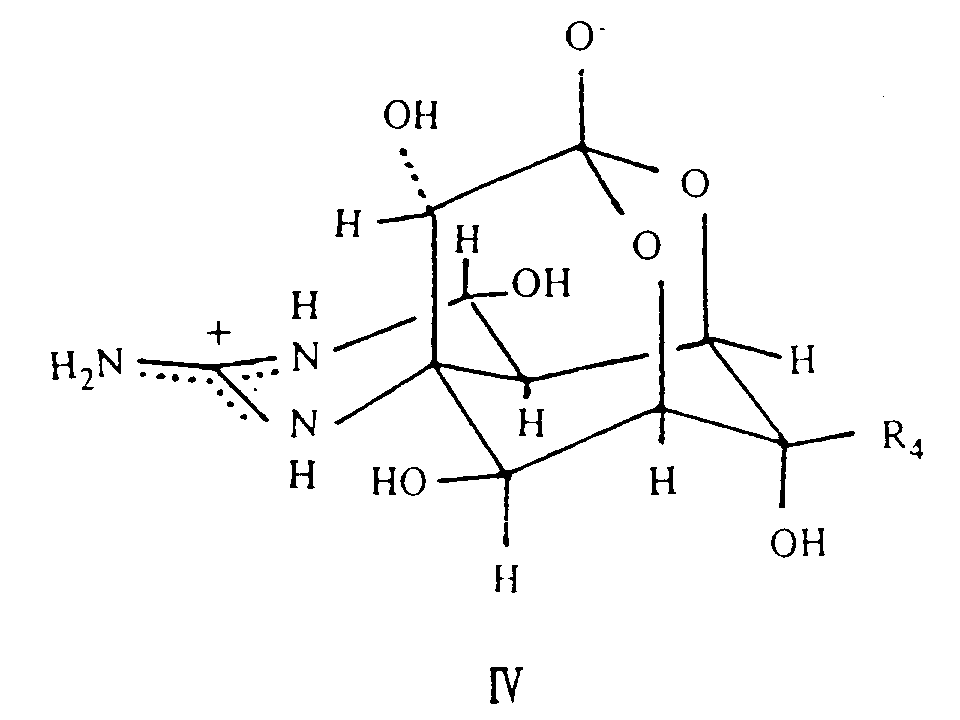
- CHO,
- CH2-Gly,
- CH2-β-Ala,
- CH2-Lys,
- CH2-en,
- CH2-NAP-Lys
- CH2-NAP-en,
- CH(OH)CH(NH2)COOH;
- NH(CH2)4CH(NH2)COOH;
- NHCH2COOH;
- NHCH2CH2COOH; and
- NHCH2CH2NH2.
- Among them, the more preferred compounds are:
oxytetrodotoxin R4 = CHO (7);
chiriquitoxin R4 = CH (OH) CH (NH2) COOH (8);
and the compounds with the substituted groups of R4:
-NH (CH2)4CH (NH2)COOH (9);
-NHCH2COOH (10);
-NHCH2CH2COOH (11); and,
-NHCH2CH2NH2 (12).
- The above-mentioned amino hydrogenated quinazoline compounds and derivatives thereof, including Tetrodotoxin, could inhibit the morphine's-dependence withdrawal symptoms, and it is not addicted by the antagonists. It could effectively and promptly inhibit and allay the withdrawal symptoms and could dispel the restless of patients as use this kind of compounds with adequate dosage when the withdrawal response upto the most severe. The withdrawal symptoms of patients were allayed and disappeared from 5 to 30 min after accepted the therapy. Patients could be quiet and almost feel numb in month, tongue and lips, however, no uneasy feeling. The numb counteracts the desire of patients to drugs, such as heroin. After several days maintenance ( 2-8 days, and generally 2-3 days), it reaches the clinical de-addiction which shows as the withdrawal symptoms disappeared completely and the test of morphine in urine transforms to negative. After halt using the above-mentioned amino hydrogenated quinazoline compounds and derivatives thereof, there is no dependence to them and no adverse and side effects. As using the above-mentioned amino hydrogenated quinazoline compounds and derivatives therof to treat patients, no case developed sicchasia, vomit, collapse or coma so as to use other medicines. It also has no side effects as in the treatment of methadone and DHE.
- The invention further involves any composition of medicines, which containing effective dosage of above-mentioned amino hydrogenated quinazoline compounds and their derivatives, to leave off drug dependence. The amino hydrogenated quinazoline compounds and their derivatives in this invention could be made by now available technologies with pharmaceutically acceptable carriers, excipients and other additives to various forms, such as injections ( including subcutaneous, intramuscular or intravenous ) or oral form ( including hypoglossal ), etc. However, because the orally effective dosage is much higher than (about 20 times) that of injections, injection is preferred. It preferentially dissolves the above-mentioned amino hydrogenated quinazoline compounds and their derivatives in weak acid water solution, such as benzoic acid or acetic acid solution with pH being 4 - 5.
- As using to clear off drug dependence, the effective dosage of above-mentioned amino hydrogenated quinazoline compounds with formula ¢ñ and their derivatives is from 5µg to 300 µg when injected by subcutaneous, intramuscular or intravenous.
- The invention also involves any method to clear off drug dependence which uses effective dosage of above-mentioned aminoperhydroquinazoline compounds and their derivatives through oral or subcutaneous, intramuscular or intravenous injections.
- Although the compounds of the invention use in clearing off drug dependence are all severely toxic substances, the using dosage of therapy is much lower than intravenously toxic dosage, such as the toxic dosage of TTX is 300 µg / person.
- It takes 3 - 5 days to clear off the drug dependence of opium, heroin, morphine, cocaine, amphetamine ( ice ), dolandin, dihydroetorphine and methadone and this kind of addictable alkaloid as use the aminoperhydroquinazoline compounds and their derivatives of this invention alone or co-use them with other anti-addiction medicines. They do not induce addiction themselves but could clear off drug dependence within a short time, with little toxic and side effects, and quick recovering of health ( 7 - 10 days ).
- 3 mg compound ( 1 ), TTX, was dissolved in 200 ml injection used water which containing 9.4 g benzoic acid ( pH = 4) and distributed it to 100 parts. Each contains compound ( 1 ) 30 µg and be made as injections ( 1 ).
- 15 mg compound ( 2 ), was dissolved in 200 ml pH 4 benzoic acid solution and distributed to 100 parts. Each contains compound ( 2 ) 150 µg and be made as injections ( 2 ).
- 10 mg compound (3)-(5) was dissolved in 200 ml pH 4 acetic acid individually, then divided the solution into 100 parts to prepare injections (3)-(5), so each injection contained 100 µg compound (3)-(5).
- 15 mg compound (6) was dissolved in 200 ml pH 4 benzoic acid, then divided the solution into 100 parts to prepare injection (6), so each injection contained 150 µg compound (6).
- 3 mg compound (7) was dissolved in 200 ml pH 5 benzoic acid, then divided the solution into 100 parts to prepare injection (7), so each injection contained 30 µg compound (7).
- 3 mg compound (8) was dissolved in 200 ml pH 4 acetic acid, then divided the solution into 100 parts to prepare injection (8), so each injection contained 30 µg compound (8).
- 6 mg compound (9)-(12) was dissloved in 200 ml pH 5 acetic acid individually, then divided the solution into 100 parts to prepare injections (9)-(12), so each injection contained 60 µg compound (9)-(12).
- 2768 cases with drug-dependence were collected in TTX de-addiction treatment, 2500 of them finished the whole process of treatment and 228 cases stopped the treatment because 206 cases could not tolerate the abstinence syndrome in the first 3 days and required to draw out this treatment, 17 cases were found in serious infectious diseases and other 5 cases were transferred to other hospitals.
- These 2500 patients described above were 45 - 13 years old, averaged 23.5. Their drug-use period were 20-0.25 years, averaged 1.8 years. 2125 (85%) of them were male and 375 (15%) were female.
- Kinds of drug-abuse: 831 cases taking Opium, 1570 cases taking Heroin, 41 cases taking Morphine; 50 cases taking DHE, 5 cases taking Dolantin, 2 cases taking Cocaine and 1 case taking Amphetamine.
- Abuse routes: iv. 930, inhalation 1570.
- Daily abuse amount were 5.0-0.1g. Drug-addiction degree were preliminary divided as: Light (Group A), 1050 cases, 50 cases drawing out, 1000 cases finished the treatment of de-addiction; Mediun (Group B), 1100 cases, 100 cases drawing out, 1000 cases finished the treatment of de-addiction; Serious(Group C), 568 cases,68 cases drawing out, 500 cases finished the treatment of de-addiction; Control(Group D), 60 cases randomly selected, 10 cases drawing out, 50 cases finished the treatment of de-addiction.
- Experiment places were Health-Recovering Hospital and De-Drug-Addiction Agency recognized by China government. Accepted cases were de-addiction volunteers of drug-dependence on Opium, Morphine, Dolantin, Heroin, DHE, etc. Treatment formalities were voluntarily carried out by themselves or their families. Cases were free except drug-abuse during the treatment period.
- According to WHO drug-dependence definition and U.S.A DSM-III-R Criterion, the cases were diagnosed. Both their urine test and Naloxone addiction-press test were positive and their addiction syndrome were significant before TTX treatment.
- The accepted cases were examined in detail, then according to their drug-taking period, amount, species, physical and mental conditions, they were divided into Light, Median and Serious 3 degrees and given general, intensive and special care.
-
- 4.1.1 According to clinical abstinence syndrome and intensity and literature criterion, the cases were divided into III grades generally.
- 4.1.2 Given marks by abstinence syndrome frequency before and after treatment. Grade I 2 × 5; Grade II 3 × 6; Grade III 4 × 8.
- 4.1.3 Given marks by adverse reactions (see the table)before and after treatment.
- "1" known by requiring;
- "2" could be tolerated by chief complaint;
- "3" could not be tolerated, drug amount needed reducing;
- "4" stopped treatment.
- 4.1.4 Inhibition effect was marked as the sum of the above 2 items marks. The lower the mark, the better the inhibition effect; or the worse.
- Accepted cases were systematically examined, included system examination. Abstinence syndrome was marked on chief complaint and physical syndrome appearance. Laboratory examinations included test of blood,urine routine, liver function, electrocardiogram, X-ray for heart and lung, and drug urine test. Physical complication, psychosis and cardiovascular diseases patients were excluded after the treatment beginning.. The treatment results were observed and recorded everyday and marked by a proper person. Everyday, after drug administration, cases were measured blood pressure, heart rate and marked on the adverse reactions. Each treatment period was set as 3-8 days. Treatment efficacy was evaluated as soon as the treatment finished, and the results were statistical analysis.
-
- Group A:
- TTX (from Case 1) treated;
- Group B:
- TTX + Diazepamum treated;
- Group C:
- TTX + Agonist treated;
- Group D:
- Control
- Among them:
- Group A: Cases of drug-taking less amount, shorter period, better physical conditions and stronger will, could be only treated by TTX i.m. 1 injection per day, for 3 days.
- Group B: Cases of drug-taking more amount, longer period, worse physical conditions and weaker will, could be treated by TTX with Diazepamum. In the first 3 days, i.m. or iv TTX 1-2 injections/day, bid., and iv. by drop Diazepamum 10-20 mg in 500 ml 5-10% glucose-normal saline after 4-6 hours of the first TTX administration, bid. Cases that still could not sleep were additionally administrated 50-100 mg Wintermin.
- Group C: Cases of drug-taking amount more than 2g daily, period longer than 2 years and had abuse experience of Opium, DHE, Diazepamum, Wintermin etc. Their physical and mental conditions were worst. Their aim was generally to reduce but not to get rid of drug-abuse. For their treatment 2 methods were designed.
- Method C1: On day 1 to 5, i.m. TTX bid and on day 1 to 3, add agonist such as Methadone; day 1, 30-40 mg, day 2, 20-30 mg, day 3-4, 20 mg, day 5, 10 mg p.o.. On day 6-8, symptomatic treatment.
- Methods C2: On day 1-5, i.m. TTX bid, 2 hours later p.o. Diazepamum 10 mg, Clozapinum 25 mg. More serious cases were iv. by drop 50-100 mg Wintermin in 5-10% glucose-normal saline after the first TTX 2 injections. It was also suggested that p.o. estazolam 3-4 mg /day, or p.o. Clonozepam 6-10 mg/day to sustain 3-4 days then the dosage gradually reduced till day 7.
- Group D: divided to 2 methods:
- D1:
- Methadone p.o.;
- D2:
- DHE iv. or p.o..
- In this program, all observations of therapeutic efficacy were recorded in time everyday and quantified in a table to give marks, which was also referred to chief complaints to certain the criterion of treatment effect.
- 1.1 Significantly effective: Physical syndrome disappeared, mental syndrome alleviated obviously. Marks were lower than 25 in 72 hours and lower than 10 at the end of the treatment.
- 1.2 Effective: Physical syndrome and mental syndrome reduced. Marks were lower than 60 in 72 hours and lower than 25 at the end of the treatment.
- 1.3 Not effective: Cases had no or just slight reduction of physical syndrome. Their mental syndrome was still obvious. Marks were more than 60 in 72 hours and more than 25 at the end of the treatment, or stopping drug administration during the treatment.
-
- 2.1 After drug administration the treatment groups showed significant inhibition effect on the generation and reaction intensity of abstinence syndrome . The therapeutic effects were highly significantly different from control group in 72 hours and at the end of the treatment (p<0.01). (see Tab.2.)
- 2.2 Inhibition Effect on Various Intensity of Abstinence Syndrome
See Tab.3. The total syndrome marks of 6 groups were not statistically different (p>0.05) before the treatment, while there were significant difference in mark reduction in 72 hours treatment (p<0.01), but there were no difference in total mark reduction in group A,B and C1,C2 after 72 hours treatment (p>0.05). - 2.3 Inhibition Effect on Various Abstinence Syndrome
Comparing the frequency of various abstinence syndrome before and after the treatment, treatment groups showed significant reduction in 15 min. and after 72 hours treatment, especially in Group A,B. Treatment results of various abstinence syndrome see Tab. 4. - All accepted cases were administrated drugs when various abstinence syndrome reached its peak (syndrome mark more than 20). Noticed the time point of abstinence syndrome significant alleviated or disappeared. The results are as fellows:
TTX i.m. 3-20 min. Mean: 8.00 ± 2.00 min. TTX iv. by drop 2-15 min. Mean: 5.40 ± 1.20 min. DHE i.m. 7-25 min. Mean: 10.54 ± 4.50 min DHE i.v. by drop 5-20 min Mean: 13.11 ± 4.12 min Methadone p.o. 50-90 min. Mean: 71.00 ±21.86 min. - TTX showed its effect was faster than control drug whatever the administration routes.
- Results see Tab. 5.
The change tendency of Hamilton anxiety was closely related to its abstinence syndrome in each group. Mark of 6 groups was all reduced after treatment, group A,B,C1,C2 was plateaued; on day 4,5, Group D2 elevated then reduced gradually; while Group D1 was elevated on day 8-10 after administration stopping. All of Group A,B and C showed significantly different from Group D (p<0.05 or p<0.01). - No adverse reactions were found in Group A,B,C1,C2,D1 andD2. No abnormality was found in blood , liver, kidney function and electrocardiogram before and after treatment. Urine drug amount and Naloxone addiction-press test were all negative after the treatment.
- Most cases in Group A treated with TTX had the feeling of numbness in tong tip and lips. So did small number of group B and only a few of group C.
- Some cases in Group D2, D1 treated with DHE and Methadone had the syndrome of dizzle, cardiopalmus, nausea and hidrosis etc.
- Almost every serious cases felt systematic pain, tiredness at the later phase of the de-abstinence treatment.
- Some cases drew out the experiment during the treatment process. The rate in Group A was about 5%, Group B 10%, Group C1 12%, Group C2 15%, Group D1 15%, Group D2 35%.
- Tab. 6 showed of the sex, drug-dependent species,drug-taking period and routes of typical case 1-20, and the treatment dosage and days of administration of the injections (Example 1-8) according to the present invention. Tab. 7 showed cases abstinence syndrome before treatment, including subjective and objective syndrome.
- Tab. 8 showed de-addiction situations after the compounds administration 5-15 min. and 4 days. It suggested that the compounds according to the present invention could get rid of addiction rapidly with less side effects.
- In this invention the discovery of new uses for the titled compounds suggests that this type of compounds can be used to prepare drugs for treatment human drug-dependence.
Table 1 Daily Dosage of TTX and Control Group Administration Days Group A Group B Group C Group D TTX,im,µg TTX,im, µg C1 C2 D1 D2 n=1000 n=1000 TTX,im/iv, µg TTX,im/iv, µg Methadong, po, mg DHE, µg d1 30 60 60+ Methadone 30 mg po 60+ Diazepamum 10 mg + Clorozapimum 25mg 30 400 iv d2 30 60+Diazepamum 10-20 mg in 500 ml Glucose + N.S. 60+ Methadone 30 mg po ibid 30 400 iv d3 30 ibid 60+ Methadone 20 mg po ibid 30 400 iv d4 60 ibid ibid 20 350 po d5 30 30+ Methadone 10 mg po ibid 15 300 po d6 30 ibid 30+ Diazepamum 10mg 15 200 po d7 30 ibid 10 150 po d8 5 100 po Table 2 Comparison of Curative Effect between Treatment Groups and Control Group Group Case Number Efficacy in 72h Final Efficacy Effective Significant effective Effective Not effective Significant effective Effective Not effective Rate (%) A 1000 970 30 0 950 50 0 100 B 1000 750 240 10 510 488 2 98.8 C1 250 100 125 25 75 170 5 98 C2 250 80 120 50 60 183 7 97.2 D1 20 10 8 2 5 14 1 95 D2 20 12 6 2 6 13 1 95 Table 3 Changes of Evaluating Maks on Withdrawal Syndrome Date Group A Group B Group C Group D C1 C2 D1 D2 before treatment 10.0±0 16.5±2.3 25.4±3.2 25.5±3.3 17.4±7.9 17.4±2.0 d1 5.0±1.5 11.6±1.4 16.8±4.2 12.7±2.9 11.0±3.0 5.1±3.2 d2 3.5±1.5 8.3±1.9 9.6±2.5 9.9±2.5 10.0±2.9 4.5±3.3 d3 1.9±1.3 6.0±2.0 9.5±2.3 8.0±2.7 8.1±2.6 3.3±2.5 d4 4.4±1.8 7.1±1.3 6.2±2.1 7.3±2.3 6.5±3.7 d5 1.6±1.5 5.1±1.7 5.2±1.8 5.5±2.1 5.5±2.9 d6 4.3±1.4 4.3±1.7 4.4±1.5 4.3±1.2 d7 1.6±1.4 1.6±1.5 2.1±1.6 3.1±1.5 d8 1.3±1.5 1.3±1.4 4.5±1.0 2.8±1.7 Table 4 Evaluating Marks on Withdrawal Syndrom before and after Treatment Withdrawal syndrome Group A Group B Group C1 Group C2 Group D1 Group D2 before (15min) after 72 hrs before (15min) after 72 hrs before (15min) after 72 hrs before (15min) after 72 hrs before (15min) after 72 hrs before (15min) after 72 hrs Lacrimation 983(81)1 985(180)120 246(210)171 245(208)71 19(20)17 18(3)19 Salivation 980(40)31 1000(112)101 250(167)198 250(200)77 20(20)18 19(3)20 Yawns 921(450)21 999(720)57 250(172)98 250(198)42 20(20)16 20(10)20 Insomnia 998(350)98 998(620)512 250(160)198 25(220)72 19(19)17 19(18)18 Gooseflesh 921(80)2 958(120)81 245(42)25 246(41)41 17(19)18 18(18)18 Vomiting 142(0)0 167(34)11 47(40)3 50(41)0 7(8)8 4(1)8 Nausea 640(0)0 941(100)20 236(41)7 225(40)3 15(17)15 14(7)11 Anorexia 945(400)41 958(801)122 241(202)51 240(240)230 18(19)20 19(17)19 Anxiet and restlessness 998(151)123 998(670)210 250(240)50 250(210)17 19(20)19 18(17)20 Systemic Pain 888(101)140 966(121)720 248(240)247 241(240)247 17(19)18 17(13)18 Abdominal-gia & diarrhea 850(32)21 900(401)120 247(128)33 235(131)17 15(16)14 16(16)17 Muscular tremors 683(121)90 590(252)257 130(60)57 150(48)12 11(11)13 10(13)17 Rapid pulse 830(71)3 835(307)123 213(200)35 215(147)35 10(14)18 10(14)19 Cold & hot 958(21)0 960(25)3 249(120)7 245(98)8 18(20)19 17(14)18 Pupil (mm) 2.8±0.3 2.9±0.8 2.3±0.5 2.8±0.5 2.5±0.4 2.4±0.7 1.4±0.8 1.8±0.5 1.3±0.7 1.9±1.0 1.9±1.1 1.7±0.7 Weakness 767(667)672 880(701)808 245(245)246 225(224)248 15(17)19 18(7)19 Thirsting for 999(450)720 1000(661)881 250(249)125 250(230)247 20(20)20 20(19)20 DSM-III-R Diagnostic Criterion Table 5 Changes of the Evaluating Marks (HAMA) on Anxiety Symptom Date Group A n=1000 Group B n=1000 Group C1 n=250 Group C2 n=250 Group D1 n=20 Group D2 n=20 X±S X±S X±S X±S X±S X±S before treatment 22±4 24±5 25±5 22±4 22±4 22±4 after treatment d1 11±5 13±6 11±5 18±5 11±5 3.3±2.5 d2 8±4 11±5 8±5 11±5 8±5 3.2±2.5 d3 7±3 10±4 5.1±2.8 10±4 5±3 2.3±1.5 d4 4±3 8±4 4.8±2.8 7±3 4.8±3 8±5 d5 3±2 4±2 4±3 5±7 4±3 6±3 d6 3±2 4±3 4±3 0±3 0.7±2.7 d7 6.4±2.2 3.5±2.5 5.3±2 4.9±2.6 d8 7.0±2.7 3±2.5 4±2.5 4.5±3.0 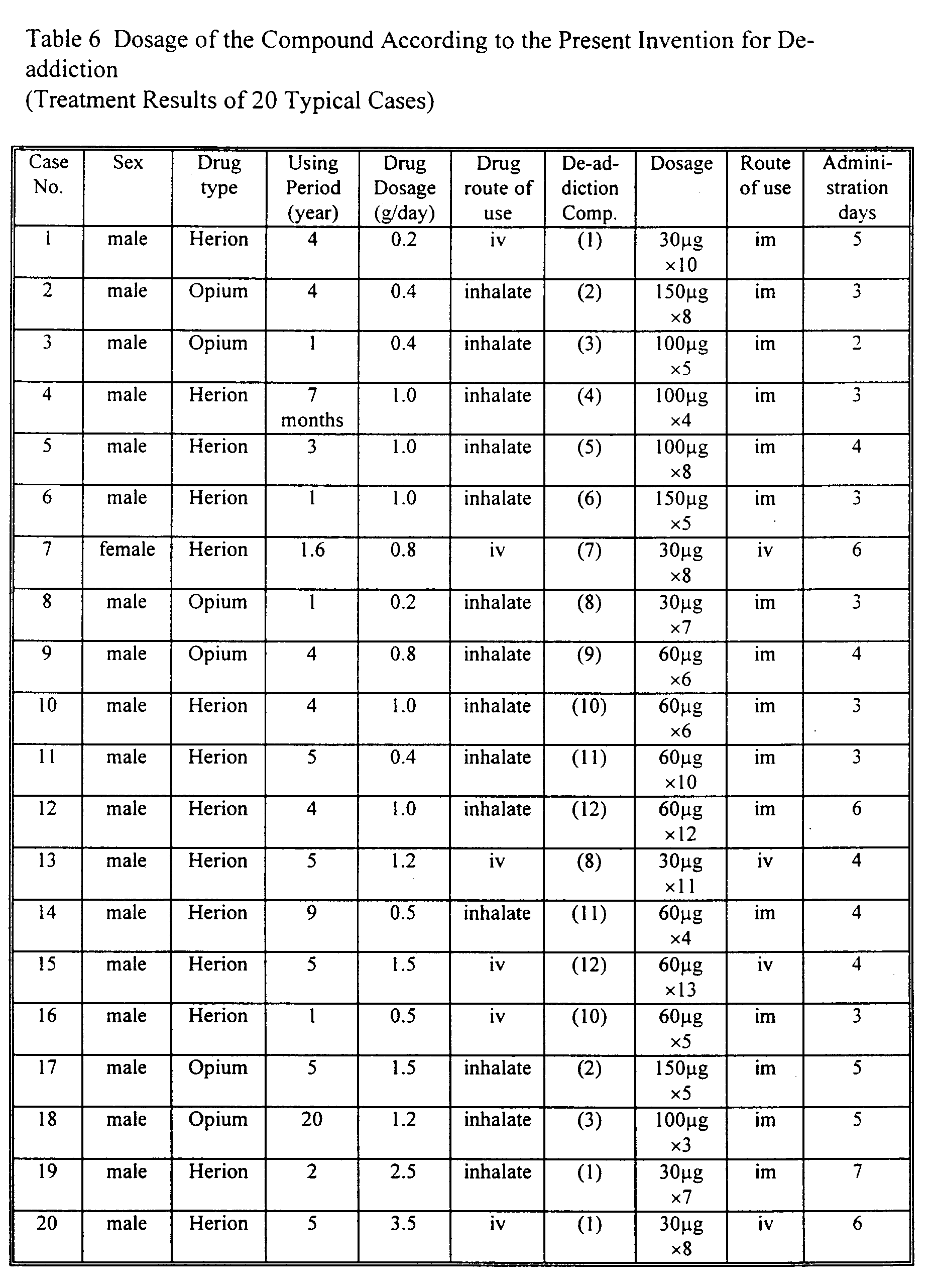

Table 8 Efficacy of De-addiction of the Patients after Using the Compounds of the Preseng Invention Case After injecting the Compound (5-15min) d4 Pure numbness in tongue, month and lips Pure numbness in arms and legs Subjective sense Pulse rate (no significant changes in blood pressure after injection) Morphine in urine 1 (+) fine 74 (-) 2 (+) (+) fine 78 (-) 3 (+) (+) fine 78 (-) 4 (+) not fine 86 (-) 5 (+) (+) fine 80 (-) 6 (+) fine 86 (-) 7 (+) fine 86 (-) 8 (+) fine 80 (-) 9 (+) fine 82 (-) 10 (+) (+) fine 80 (-) 11 (+) fine 76 (-) 12 (+) fine 70 (+) 13 (+) (+) fine 80 (-) 14 (+) fine 78 (-) 15 (+) fine 74 (+) 16 (+) (+) fine 86 (+) 17 (+) fine 84 (-) 18 (+) fine 80 (-) 19 (±) (±) fine 84 (-) 20 (+) fine 84 (+)

Claims (19)
- A use of amino hydrogenated quinazoline and derivatives thereof compounds having the genral formula I in the preparation of medicament for abstaining human's from drug-dependence,
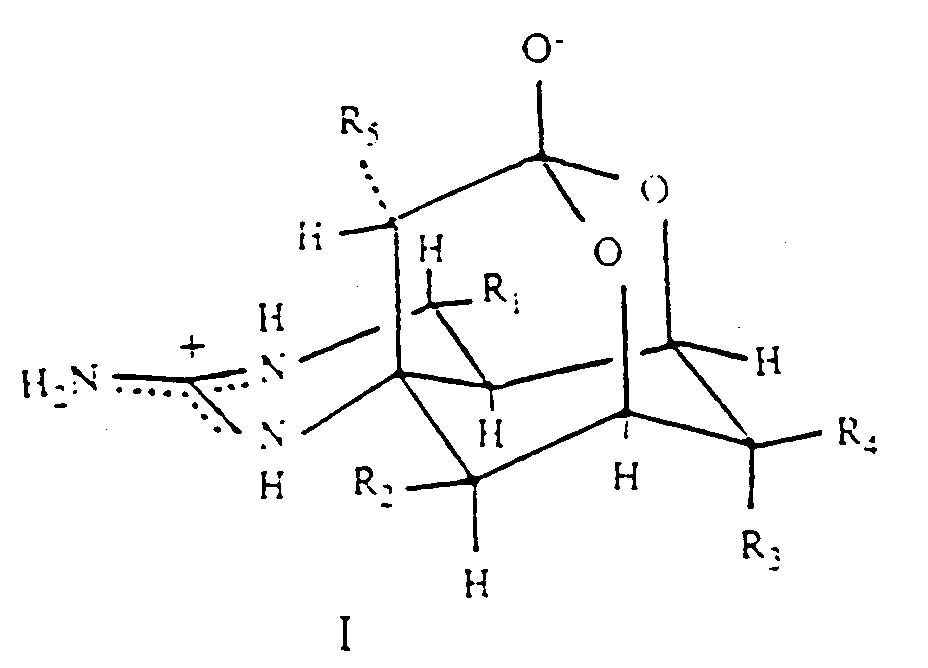
R2 and R5 can be selected from the group consisting of H, OH, OAC, respectively;
R1 can be H, or an alkyl with C1-C4, OH, OR, OC(O)R', NH2, NHR'', NR''R''', among them R can be an alkyl with C1-C6, R' can be an alkyl with C1-C3 , and R'', R''' can be an alkyl with C1-C4, respectively;
R3 and R4 can be =O, or
when R3 is H, R4 can be selected from the group consisting of:- ROH, and R is a branched or staight chain alkyl with C1-C7,- CH(OH)NHOMe,- NAP-gly,- NAP-en,- CH2NH2,- CH2NHCH3,- AAG,- NMAG, and- ANT;when R3 is OH or OC(O)R and R is an alkyl with C1-C3, R4 can be selected from the group consisting of:- CHO,- CH2-gly,- CH2-β-Ala,- CH2-Lys,- CH2-en,- CH2-NAP-Lys,- CH2-NAP-en,- CH(OH)CH(NH2)COOH;and,- NH(CH2)nCOOH,- NH(CH2)nNH2; and- NH(CH2)nCH(NH2)COOH,wherein :n=1-6.en is ethylene;NAP is 4-triazo-2-nitrberzioc amide.AAG is 2-triazo-O-aminobenzoic amide,NMAG is O-methylaminobenzoic amide,ANT is O-aminobenzoic amide. - The use according to claim 1, charaterized that the amino hydrogenated quinazoline compounds and derivatives thereof are compounds having following general formula II,

R1 can be selected from the group consisting of OH, H, an alkyl or an alkoxy with C1-C4, NH2, NHR'', NR''R''', among them R'' and R''' can be an alkyl with C1-C4. - The use according to claim 1, charaterized that the amino hydrogenated quinazoline compounds and derivatives thereof are compounds having following general formula III,

R3 , R4 are =O, or
when R3 is H, R4 is selected from the group consisting of:- CH2OH,- CH(OH)NHOMe,- NAP-gly,- NAP-en,- CH2NH2,- CH2NHCH3,- AAG,- NMAG, and- ANT;wherein, en, NAP, AAG, NMAG and ANT have the same definitions as stated above. - The use according to claim 1, charaterized that the amino hydrogenated quinazoline and their derivatives are compounds having following general formula IV,
 - CHO,- CH2-Gly,- CH2-β-Ala,- CH2-Lys,- CH2-en,- CH2-NAP-Lys- CH2-NAP-en,- CH(OH)CH(NH2)COOH;- NH(CH2)4CH(NH2)COOH;- NHCH2COOH;- NHCH2CH2COOH; and- NHCH2CH2NH2,wherein en and NAP have the same defination as stated above.
 - The use according to claim 2 , charaterized that group R1 of the amino hydrogenated quinazoline compounds and derivatives thereof is -OH.
- The use according to claim 2 , charaterized that group R1 of the amino hydrogenated quinazoline compounds and derivatives thereof is H.
- The use according to claim 3 , charaterized that group R3 of the amino hydrogenated quinazoline compounds and derivatives thereof is AAG.
- The use according to claim 3 , charaterized that group R4 of the amino hydrogenated quinazoline compounds and derivatives thereof is NMAG.
- The use according to claim 3 , charaterized that group R4 of the amino hydrogenated quinazoline compounds and derivatives thereof is ANT.
- The use according to claim 3 , charaterized that group R3, R4 of the amino hydrogenated quinazoline compounds and derivatives thereof is =O.
- The use according to claim 4 , charaterized that group R4 of the amino hydrogenated quinazoline compounds and derivatives thereof is -CHO.
- The use according to claim 2 , charaterized that group R4 of the amino hydrogenated quinazoline compounds and derivatives thereof is CH(OH)CH(NH2)COOH.
- The use according to claim 4 , charaterized that group R4 of the amino hydrogenated quinazoline compounds and derivatives thereof is NH(CH2)4-CH(NH2)COOH.
- The use according to claim 4 , charaterized that group R4 of the amino hydrogenated quinazoline compounds and derivatives thereof is NHCH2COOH.
- The use according to claim 4 , charaterized that group R4 of the amino hydrogenated quinazoline compounds and derivatives thereof is NHCH2CH2COOH.
- The use according to claim 4 , charaterized that group R4 of the amino hydrogenated quinazoline compounds and derivatives thereof is NHCH2CH2NH2.
- A pharmaceutical composition for human's abstaining drug dependence, wherein it contains desirable dose of amino hydrogenated quinzoline ad its derivatives as described in claim 1 to 16.
- The pharmaceutical composition according to claim 17, wherein the amino hydrogenated quinazoline and its derivatives can be dissolved in weak acid water.
- A method for abstaining human's from drug dependence, including administering by oral, subcutaneous, intramuscular and intravenous of the amino hydrogenated quinazoline and its derivatives as described in claim 1 to 16.
Applications Claiming Priority (3)
| Application Number | Priority Date | Filing Date | Title |
|---|---|---|---|
| CN94110873 | 1994-03-17 | ||
| CN94110873 | 1994-03-17 | ||
| PCT/CN1995/000016 WO1995024903A1 (en) | 1994-03-17 | 1995-03-11 | The use of amino hydrogenated quinazoline compounds and derivatives thereof for abstaining from drug dependence |
Publications (3)
| Publication Number | Publication Date |
|---|---|
| EP0750909A1 true EP0750909A1 (en) | 1997-01-02 |
| EP0750909A4 EP0750909A4 (en) | 2000-07-26 |
| EP0750909B1 EP0750909B1 (en) | 2002-12-11 |
Family
ID=5034790
Family Applications (1)
| Application Number | Title | Priority Date | Filing Date |
|---|---|---|---|
| EP95911187A Expired - Lifetime EP0750909B1 (en) | 1994-03-17 | 1995-03-11 | The use of amino hydrogenated quinazoline compounds and derivatives thereof for abstaining from drug dependence |
Country Status (7)
| Country | Link |
|---|---|
| US (1) | US5846975A (en) |
| EP (1) | EP0750909B1 (en) |
| JP (1) | JPH09510221A (en) |
| AU (1) | AU1888195A (en) |
| DE (1) | DE69529156T2 (en) |
| RU (1) | RU2168331C2 (en) |
| WO (1) | WO1995024903A1 (en) |
Cited By (12)
| Publication number | Priority date | Publication date | Assignee | Title |
|---|---|---|---|---|
| WO1998051290A3 (en) * | 1997-05-16 | 1999-02-11 | Childrens Medical Center | Local anesthetic formulations comprising a site 1 sodium channel blocker combined with a second active agent |
| EP1320369A4 (en) * | 2000-09-18 | 2003-07-02 | Wex Medical Ltd | A method of analgesia |
| WO2005123088A1 (en) * | 2004-06-22 | 2005-12-29 | Wex Pharmaceuticals Inc. | Solid orally ingestible formulations of tetrodotoxin |
| EP1690541A1 (en) * | 2005-02-11 | 2006-08-16 | Laboratorios Del Dr. Esteve, S.A. | Use of a sodium channel blocker and their analogues for the treatment of nicotine dependency |
| WO2006084765A1 (en) * | 2005-02-11 | 2006-08-17 | Wex Pharmaceuticals, Inc. | Use of sodium channel blockers and their analogues for the treatment of nicotine dependency |
| EP1714655A1 (en) * | 2005-04-22 | 2006-10-25 | Laboratorios Del Dr. Esteve, S.A. | Use of sodium channel blockers and their analogues for the treatment of nicotine dependency |
| EP1387685A4 (en) * | 2001-05-18 | 2007-05-23 | Wex Medical Ltd | Analgesic composition and method |
| EP1930027A3 (en) * | 2000-11-22 | 2008-06-18 | Nanning Maple Leaf Pharmaceutical Co., Ltd. | A composition of sodium channel blocking compound |
| EP1931349A4 (en) * | 2005-08-25 | 2009-08-05 | Wex Pharmaceuticals Inc | Use of sodium channel blockers for the management of musculoskeletal pain |
| US8952152B2 (en) | 2009-03-24 | 2015-02-10 | Proteus S.A. | Methods for purifying phycotoxins, pharmaceutical compositions containing purified phycotoxins, and methods of use thereof |
| US8975268B2 (en) | 2013-03-15 | 2015-03-10 | The Children's Medical Center Corporation | Neosaxitoxin combination formulations for prolonged local anesthesia |
| US9018222B2 (en) | 2006-03-27 | 2015-04-28 | Wex Medical Limited | Use of sodium channel blockers for the treatment of neuropathic pain developing as a consequence of chemotherapy |
Families Citing this family (12)
| Publication number | Priority date | Publication date | Assignee | Title |
|---|---|---|---|---|
| CN1072486C (en) * | 1996-09-24 | 2001-10-10 | 王维国 | Medicament for giving up narcotic drugs and stopping pain and its prepn. |
| DE19923551A1 (en) * | 1999-05-21 | 2000-11-30 | Lohmann Therapie Syst Lts | Pharmaceutical preparation with the active ingredient diamorphine and its use in a method for treating opiate addiction |
| CN1203857C (en) | 2000-09-18 | 2005-06-01 | 威克斯医药有限公司 | A New Approach to Local Anesthesia and Analgesia |
| AU2007200073B2 (en) * | 2000-09-18 | 2010-02-25 | Wex Medical Limited | A Method of Analgesia |
| RU2218173C1 (en) * | 2002-07-31 | 2003-12-10 | Матевосян Степан Нарбеевич | Method for alleviating abstinence syndrome, pathological attraction and preventing recidivation in the cases of cocaine narcotic addiction |
| CN1568999A (en) | 2003-07-14 | 2005-01-26 | 南宁枫叶药业有限公司 | Stable freeze dried formulation of spheroidine for medical use |
| WO2006032459A1 (en) * | 2004-09-22 | 2006-03-30 | Laboratorios Del Dr. Esteve S.A. | Tetrodotoxin and its derivatives for the treatment of peripheral-nervously derived neuropathic pain |
| EP1844781A1 (en) | 2006-02-22 | 2007-10-17 | Wex Pharmaceuticals Inc. | Use of sodium channel blockers for the treatment of preterm labor |
| CN100438873C (en) * | 2006-06-26 | 2008-12-03 | 黄致强 | Application of tetrodotoxin as analgesic tolerance inhibitor in preparation of compound pain relieving preparation |
| ES2351025B1 (en) | 2009-06-12 | 2011-10-05 | Consejo Superior De Investigaciones Cientificas (10 %) | SYNTHESIS OF INTERMEDIATES OF THE TTX. |
| CN110256453A (en) * | 2019-07-09 | 2019-09-20 | 江苏华豚药业有限公司 | A kind of preparation method of tetraodotoxin carboxylate |
| EP4326282A4 (en) | 2021-04-23 | 2025-02-26 | Wex Pharmaceuticals Inc. | TETRODOTOXIN LIQUID FORMULATIONS |
Family Cites Families (5)
| Publication number | Priority date | Publication date | Assignee | Title |
|---|---|---|---|---|
| GB1370905A (en) * | 1971-01-26 | 1974-10-16 | Astra Pharma Prod | Local anaesthetic composition |
| US3898339A (en) * | 1973-08-14 | 1975-08-05 | Astra Pharma Prod | Spinal anesthesia using small amounts of tetrodotoxin or desoxytetrodotoxin |
| JPS5594319A (en) * | 1979-01-09 | 1980-07-17 | Yoshio Otaka | Drug for external use consisting of liver oil of swellfish |
| US5871472A (en) * | 1987-11-17 | 1999-02-16 | Brown University Research Foundation | Planting devices for the focal release of neuroinhibitory compounds |
| JPH03153627A (en) * | 1989-11-11 | 1991-07-01 | ▲ゆ▼ 耀庭 | Medicament containing swellfish poison as pharmaceutically effective component, its preparation and extraction of said swellfish poison |
-
1995
- 1995-03-11 RU RU96121334/14A patent/RU2168331C2/en not_active IP Right Cessation
- 1995-03-11 EP EP95911187A patent/EP0750909B1/en not_active Expired - Lifetime
- 1995-03-11 DE DE69529156T patent/DE69529156T2/en not_active Expired - Lifetime
- 1995-03-11 US US08/640,781 patent/US5846975A/en not_active Expired - Lifetime
- 1995-03-11 AU AU18881/95A patent/AU1888195A/en not_active Abandoned
- 1995-03-11 JP JP7523758A patent/JPH09510221A/en active Pending
- 1995-03-11 WO PCT/CN1995/000016 patent/WO1995024903A1/en not_active Ceased
Non-Patent Citations (3)
| Title |
|---|
| DATABASE WPI Section Ch, Week 198035 Derwent Publications Ltd., London, GB; Class B02, AN 1980-61332C XP002138981 & JP 55 094319 A (ODAKA Y), 17 July 1980 (1980-07-17) * |
| DATABASE WPI Section Ch, Week 199132 Derwent Publications Ltd., London, GB; Class B04, AN 1991-234896 XP002138982 & JP 03 153627 A (MATSUDA Y), 1 July 1991 (1991-07-01) * |
| See also references of WO9524903A1 * |
Cited By (22)
| Publication number | Priority date | Publication date | Assignee | Title |
|---|---|---|---|---|
| US6326020B1 (en) | 1997-05-16 | 2001-12-04 | Children's Medical Center Corporation | Local anesthetic formulations |
| WO1998051290A3 (en) * | 1997-05-16 | 1999-02-11 | Childrens Medical Center | Local anesthetic formulations comprising a site 1 sodium channel blocker combined with a second active agent |
| EP1320369A4 (en) * | 2000-09-18 | 2003-07-02 | Wex Medical Ltd | A method of analgesia |
| EP1563839A1 (en) * | 2000-09-18 | 2005-08-17 | Wex Medical Limited | A method of analgesia |
| EP2298306A1 (en) * | 2000-09-18 | 2011-03-23 | Wex Medical Limited | A method of analgesia |
| KR100891568B1 (en) * | 2000-09-18 | 2009-04-03 | 웩스 메디컬 리미티드 | Method for Providing Painlessness of Tetrodotoxin, a Sodium Channel Blocking Compound |
| EP1930027A3 (en) * | 2000-11-22 | 2008-06-18 | Nanning Maple Leaf Pharmaceutical Co., Ltd. | A composition of sodium channel blocking compound |
| EP1387685A4 (en) * | 2001-05-18 | 2007-05-23 | Wex Medical Ltd | Analgesic composition and method |
| WO2005123088A1 (en) * | 2004-06-22 | 2005-12-29 | Wex Pharmaceuticals Inc. | Solid orally ingestible formulations of tetrodotoxin |
| EP1690541A1 (en) * | 2005-02-11 | 2006-08-16 | Laboratorios Del Dr. Esteve, S.A. | Use of a sodium channel blocker and their analogues for the treatment of nicotine dependency |
| WO2006084765A1 (en) * | 2005-02-11 | 2006-08-17 | Wex Pharmaceuticals, Inc. | Use of sodium channel blockers and their analogues for the treatment of nicotine dependency |
| EP1714655A1 (en) * | 2005-04-22 | 2006-10-25 | Laboratorios Del Dr. Esteve, S.A. | Use of sodium channel blockers and their analogues for the treatment of nicotine dependency |
| EP1931349A4 (en) * | 2005-08-25 | 2009-08-05 | Wex Pharmaceuticals Inc | Use of sodium channel blockers for the management of musculoskeletal pain |
| US9018222B2 (en) | 2006-03-27 | 2015-04-28 | Wex Medical Limited | Use of sodium channel blockers for the treatment of neuropathic pain developing as a consequence of chemotherapy |
| US8952152B2 (en) | 2009-03-24 | 2015-02-10 | Proteus S.A. | Methods for purifying phycotoxins, pharmaceutical compositions containing purified phycotoxins, and methods of use thereof |
| US8957207B2 (en) | 2009-03-24 | 2015-02-17 | Proteus S.A. | Methods for producing phycotoxins |
| US9249150B2 (en) | 2009-03-24 | 2016-02-02 | Proteus S.A. | Methods for purifying phycotoxins, pharmaceutical compositions containing purified phycotoxins, and methods of use thereof |
| US8975268B2 (en) | 2013-03-15 | 2015-03-10 | The Children's Medical Center Corporation | Neosaxitoxin combination formulations for prolonged local anesthesia |
| US8975281B2 (en) | 2013-03-15 | 2015-03-10 | The Children's Medical Center Corporation | Neosaxitoxin combination formulations for prolonged local anesthesia |
| RU2673081C1 (en) * | 2013-03-15 | 2018-11-22 | Дзе Чилдрен'З Медикал Сентер Корпорейшн | Combined preparations of neosaxitoxin for prolonged local anesthesia |
| US10314833B2 (en) | 2013-03-15 | 2019-06-11 | The Children's Medical Center Corporation | Neosaxitoxin combination formulations for prolonged local anesthesia |
| US10881647B2 (en) | 2013-03-15 | 2021-01-05 | The Children's Medical Center Corporation | Neosaxitoxin combination formulations for prolonged local anesthesia |
Also Published As
| Publication number | Publication date |
|---|---|
| DE69529156D1 (en) | 2003-01-23 |
| AU1888195A (en) | 1995-10-03 |
| WO1995024903A1 (en) | 1995-09-21 |
| EP0750909A4 (en) | 2000-07-26 |
| DE69529156T2 (en) | 2003-09-25 |
| RU2168331C2 (en) | 2001-06-10 |
| JPH09510221A (en) | 1997-10-14 |
| US5846975A (en) | 1998-12-08 |
| EP0750909B1 (en) | 2002-12-11 |
Similar Documents
| Publication | Publication Date | Title |
|---|---|---|
| EP0750909B1 (en) | The use of amino hydrogenated quinazoline compounds and derivatives thereof for abstaining from drug dependence | |
| Wetli et al. | Death caused by recreational cocaine use | |
| US4661492A (en) | Analgesic compositions | |
| US4582835A (en) | Analgesic compositions | |
| DE60009346T2 (en) | BUPRENORPHINE-CONTAINING ANALGETIC COMPOSITIONS | |
| JP5577101B2 (en) | Improved pharmaceutical composition comprising buprenorphine and naltrexone | |
| US20110046172A1 (en) | Medicinal Compositions | |
| DE60026146T2 (en) | Use of dapoxetine, A selective serotonin uptake inhibitor, for the treatment of sexual dysfunction | |
| US5426120A (en) | Pharmaceutical composition containing γ-hydroxybutyric acid or its lactone in the treatment of drug dependence and nutritional disorders | |
| WO2003018015A1 (en) | Pharmaceutical composition for preventing drug abuse by pproducing musous membrane irritation | |
| GB2271059A (en) | Pharmaceutical compositions comprising aconitane derivatives | |
| CN105944081A (en) | Treatment of multiple sclerosis with combination of laquinimod and glatiramer acetate | |
| EP0367533B1 (en) | Method of treatment for interstitial cystitis | |
| Weinbroum et al. | The use of flumazenil in the management of acute drug poisoning—a review | |
| KR19980014498A (en) | Rich-sulfur combination preparation | |
| DE69936186T2 (en) | Dihydroartemisinin formulation for the treatment of various types of malaria | |
| Hien et al. | Single dose artemisinin-mefloquine treatment for acute uncomplicated falciparum malaria | |
| WO1991016052A1 (en) | Use of minoxidil for treating erectile impotence | |
| JP3415643B2 (en) | Drugs for muscular dystrophy | |
| US5547956A (en) | Pharmaceutical composition and the method for treating drug addicts' withdrawal syndromes and detoxifying addicts by the same | |
| DE3821392A1 (en) | NEW PHARMACEUTICAL USE OF 2-PHENYL-1,2-BENZISOSELENAZOLE-3 (2H) -ONEONE (EBSELEN) | |
| Gillhespy et al. | Dipipanone Hydrochloride in the Treatment of Severe Pain | |
| JP2816499B2 (en) | Diabetes treatment | |
| EP1940376B1 (en) | Use of neboglamine in the treatment of toxicodependency | |
| Turner et al. | Drugs Handbook |
Legal Events
| Date | Code | Title | Description |
|---|---|---|---|
| PUAI | Public reference made under article 153(3) epc to a published international application that has entered the european phase |
Free format text: ORIGINAL CODE: 0009012 |
|
| 17P | Request for examination filed |
Effective date: 19960308 |
|
| AK | Designated contracting states |
Kind code of ref document: A1 Designated state(s): BE DE FR GB |
|
| A4 | Supplementary search report drawn up and despatched |
Effective date: 20000608 |
|
| AK | Designated contracting states |
Kind code of ref document: A4 Designated state(s): BE DE FR GB |
|
| 17Q | First examination report despatched |
Effective date: 20010405 |
|
| GRAG | Despatch of communication of intention to grant |
Free format text: ORIGINAL CODE: EPIDOS AGRA |
|
| GRAG | Despatch of communication of intention to grant |
Free format text: ORIGINAL CODE: EPIDOS AGRA |
|
| GRAH | Despatch of communication of intention to grant a patent |
Free format text: ORIGINAL CODE: EPIDOS IGRA |
|
| GRAH | Despatch of communication of intention to grant a patent |
Free format text: ORIGINAL CODE: EPIDOS IGRA |
|
| GRAA | (expected) grant |
Free format text: ORIGINAL CODE: 0009210 |
|
| AK | Designated contracting states |
Kind code of ref document: B1 Designated state(s): BE DE FR GB |
|
| REG | Reference to a national code |
Ref country code: GB Ref legal event code: FG4D |
|
| REF | Corresponds to: |
Ref document number: 69529156 Country of ref document: DE Date of ref document: 20030123 |
|
| ET | Fr: translation filed | ||
| PLBE | No opposition filed within time limit |
Free format text: ORIGINAL CODE: 0009261 |
|
| STAA | Information on the status of an ep patent application or granted ep patent |
Free format text: STATUS: NO OPPOSITION FILED WITHIN TIME LIMIT |
|
| 26N | No opposition filed |
Effective date: 20030912 |
|
| BECA | Be: change of holder's address |
Owner name: SHENZHEN HONGJINTIAN BIOLOGY SCIENCE AND TECHNOLOG Effective date: 20071012 |
|
| BECH | Be: change of holder |
Owner name: SHENZHEN HONGJINTIAN BIOLOGY SCIENCE AND TECHNOLOG Effective date: 20071012 |
|
| BECA | Be: change of holder's address |
Owner name: SHENZHEN HONGJINTIAN BIOLOGY SCIENCE AND TECHNOLOG Effective date: 20080307 |
|
| BECH | Be: change of holder |
Owner name: SHENZHEN HONGJINTIAN BIOLOGY SCIENCE AND TECHNOLOG Effective date: 20080307 |
|
| REG | Reference to a national code |
Ref country code: FR Ref legal event code: TQ Ref country code: FR Ref legal event code: TP |
|
| REG | Reference to a national code |
Ref country code: GB Ref legal event code: 732E Free format text: REGISTERED BETWEEN 20091126 AND 20091202 |
|
| REG | Reference to a national code |
Ref country code: GB Ref legal event code: 732E Free format text: REGISTERED BETWEEN 20100128 AND 20100203 |
|
| PGFP | Annual fee paid to national office [announced via postgrant information from national office to epo] |
Ref country code: FR Payment date: 20130402 Year of fee payment: 19 |
|
| PGFP | Annual fee paid to national office [announced via postgrant information from national office to epo] |
Ref country code: BE Payment date: 20130329 Year of fee payment: 19 |
|
| PGFP | Annual fee paid to national office [announced via postgrant information from national office to epo] |
Ref country code: DE Payment date: 20140320 Year of fee payment: 20 |
|
| PGFP | Annual fee paid to national office [announced via postgrant information from national office to epo] |
Ref country code: GB Payment date: 20140305 Year of fee payment: 20 |
|
| REG | Reference to a national code |
Ref country code: FR Ref legal event code: ST Effective date: 20141128 |
|
| PG25 | Lapsed in a contracting state [announced via postgrant information from national office to epo] |
Ref country code: FR Free format text: LAPSE BECAUSE OF NON-PAYMENT OF DUE FEES Effective date: 20140331 |
|
| REG | Reference to a national code |
Ref country code: DE Ref legal event code: R071 Ref document number: 69529156 Country of ref document: DE |
|
| REG | Reference to a national code |
Ref country code: GB Ref legal event code: PE20 Expiry date: 20150310 |
|
| PG25 | Lapsed in a contracting state [announced via postgrant information from national office to epo] |
Ref country code: GB Free format text: LAPSE BECAUSE OF EXPIRATION OF PROTECTION Effective date: 20150310 |
|
| PG25 | Lapsed in a contracting state [announced via postgrant information from national office to epo] |
Ref country code: BE Free format text: LAPSE BECAUSE OF NON-PAYMENT OF DUE FEES Effective date: 20140331 |