EP0668157B1 - Heat-sealable polyolefin multilayer films, method of their manufacture and use - Google Patents
Heat-sealable polyolefin multilayer films, method of their manufacture and use Download PDFInfo
- Publication number
- EP0668157B1 EP0668157B1 EP19950101921 EP95101921A EP0668157B1 EP 0668157 B1 EP0668157 B1 EP 0668157B1 EP 19950101921 EP19950101921 EP 19950101921 EP 95101921 A EP95101921 A EP 95101921A EP 0668157 B1 EP0668157 B1 EP 0668157B1
- Authority
- EP
- European Patent Office
- Prior art keywords
- multilayer film
- film
- copolymer
- weight
- propylene
- Prior art date
- Legal status (The legal status is an assumption and is not a legal conclusion. Google has not performed a legal analysis and makes no representation as to the accuracy of the status listed.)
- Expired - Lifetime
Links
- 238000000034 method Methods 0.000 title claims description 15
- 238000004519 manufacturing process Methods 0.000 title claims description 13
- 229920000098 polyolefin Polymers 0.000 title description 8
- VGGSQFUCUMXWEO-UHFFFAOYSA-N Ethene Chemical compound C=C VGGSQFUCUMXWEO-UHFFFAOYSA-N 0.000 claims description 52
- 229920001577 copolymer Polymers 0.000 claims description 52
- 239000005977 Ethylene Substances 0.000 claims description 40
- -1 polypropylenes Polymers 0.000 claims description 32
- 229920001155 polypropylene Polymers 0.000 claims description 26
- 229920005989 resin Polymers 0.000 claims description 21
- 239000011347 resin Substances 0.000 claims description 21
- 238000002844 melting Methods 0.000 claims description 20
- 230000008018 melting Effects 0.000 claims description 20
- QQONPFPTGQHPMA-UHFFFAOYSA-N propylene Natural products CC=C QQONPFPTGQHPMA-UHFFFAOYSA-N 0.000 claims description 18
- 125000004805 propylene group Chemical group [H]C([H])([H])C([H])([*:1])C([H])([H])[*:2] 0.000 claims description 14
- 239000004743 Polypropylene Substances 0.000 claims description 12
- 239000000155 melt Substances 0.000 claims description 11
- 239000012968 metallocene catalyst Substances 0.000 claims description 9
- 230000008569 process Effects 0.000 claims description 9
- 238000004806 packaging method and process Methods 0.000 claims description 7
- 229920001384 propylene homopolymer Polymers 0.000 claims description 5
- 229920000089 Cyclic olefin copolymer Polymers 0.000 claims description 3
- 229920005604 random copolymer Polymers 0.000 claims description 3
- 239000010954 inorganic particle Substances 0.000 claims description 2
- 239000011146 organic particle Substances 0.000 claims description 2
- 238000007711 solidification Methods 0.000 claims description 2
- 230000008023 solidification Effects 0.000 claims description 2
- 239000010410 layer Substances 0.000 description 96
- 238000007789 sealing Methods 0.000 description 58
- 238000003851 corona treatment Methods 0.000 description 34
- 229920000642 polymer Polymers 0.000 description 26
- 238000006116 polymerization reaction Methods 0.000 description 23
- 239000002585 base Substances 0.000 description 20
- 230000000052 comparative effect Effects 0.000 description 19
- 239000003054 catalyst Substances 0.000 description 18
- ZSWFCLXCOIISFI-UHFFFAOYSA-N cyclopentadiene Chemical compound C1C=CC=C1 ZSWFCLXCOIISFI-UHFFFAOYSA-N 0.000 description 14
- PPBRXRYQALVLMV-UHFFFAOYSA-N Styrene Chemical compound C=CC1=CC=CC=C1 PPBRXRYQALVLMV-UHFFFAOYSA-N 0.000 description 13
- VLKZOEOYAKHREP-UHFFFAOYSA-N n-Hexane Chemical compound CCCCCC VLKZOEOYAKHREP-UHFFFAOYSA-N 0.000 description 13
- 229910052751 metal Inorganic materials 0.000 description 12
- 239000002184 metal Substances 0.000 description 12
- VXNZUUAINFGPBY-UHFFFAOYSA-N 1-Butene Chemical compound CCC=C VXNZUUAINFGPBY-UHFFFAOYSA-N 0.000 description 11
- 239000003795 chemical substances by application Substances 0.000 description 11
- 238000005469 granulation Methods 0.000 description 11
- 230000003179 granulation Effects 0.000 description 11
- 239000002245 particle Substances 0.000 description 10
- 229920001897 terpolymer Polymers 0.000 description 10
- LIKMAJRDDDTEIG-UHFFFAOYSA-N 1-hexene Chemical compound CCCCC=C LIKMAJRDDDTEIG-UHFFFAOYSA-N 0.000 description 9
- VTYYLEPIZMXCLO-UHFFFAOYSA-L Calcium carbonate Chemical compound [Ca+2].[O-]C([O-])=O VTYYLEPIZMXCLO-UHFFFAOYSA-L 0.000 description 8
- 239000000654 additive Substances 0.000 description 8
- 239000000463 material Substances 0.000 description 8
- 239000000203 mixture Substances 0.000 description 8
- VYPSYNLAJGMNEJ-UHFFFAOYSA-N Silicium dioxide Chemical compound O=[Si]=O VYPSYNLAJGMNEJ-UHFFFAOYSA-N 0.000 description 7
- 239000000976 ink Substances 0.000 description 7
- 239000002994 raw material Substances 0.000 description 7
- 150000003505 terpenes Chemical class 0.000 description 7
- 235000007586 terpenes Nutrition 0.000 description 7
- 125000000027 (C1-C10) alkoxy group Chemical group 0.000 description 6
- 125000006374 C2-C10 alkenyl group Chemical group 0.000 description 6
- 239000013032 Hydrocarbon resin Substances 0.000 description 6
- UFHFLCQGNIYNRP-UHFFFAOYSA-N Hydrogen Chemical compound [H][H] UFHFLCQGNIYNRP-UHFFFAOYSA-N 0.000 description 6
- 125000002877 alkyl aryl group Chemical group 0.000 description 6
- 125000003710 aryl alkyl group Chemical group 0.000 description 6
- 125000004104 aryloxy group Chemical group 0.000 description 6
- 239000008187 granular material Substances 0.000 description 6
- 229920006270 hydrocarbon resin Polymers 0.000 description 6
- 239000004711 α-olefin Substances 0.000 description 6
- 125000004432 carbon atom Chemical group C* 0.000 description 5
- 239000011888 foil Substances 0.000 description 5
- 238000013508 migration Methods 0.000 description 5
- 230000005012 migration Effects 0.000 description 5
- 239000003208 petroleum Substances 0.000 description 5
- 125000000008 (C1-C10) alkyl group Chemical group 0.000 description 4
- 125000003837 (C1-C20) alkyl group Chemical group 0.000 description 4
- KAKZBPTYRLMSJV-UHFFFAOYSA-N Butadiene Chemical compound C=CC=C KAKZBPTYRLMSJV-UHFFFAOYSA-N 0.000 description 4
- 125000005915 C6-C14 aryl group Chemical group 0.000 description 4
- 125000004429 atom Chemical group 0.000 description 4
- 229910000019 calcium carbonate Inorganic materials 0.000 description 4
- CJZGTCYPCWQAJB-UHFFFAOYSA-L calcium stearate Chemical class [Ca+2].CCCCCCCCCCCCCCCCCC([O-])=O.CCCCCCCCCCCCCCCCCC([O-])=O CJZGTCYPCWQAJB-UHFFFAOYSA-L 0.000 description 4
- 230000015556 catabolic process Effects 0.000 description 4
- 239000012792 core layer Substances 0.000 description 4
- 238000006731 degradation reaction Methods 0.000 description 4
- 125000005843 halogen group Chemical group 0.000 description 4
- 229920001519 homopolymer Polymers 0.000 description 4
- XMGQYMWWDOXHJM-UHFFFAOYSA-N limonene Chemical compound CC(=C)C1CCC(C)=CC1 XMGQYMWWDOXHJM-UHFFFAOYSA-N 0.000 description 4
- 229920002959 polymer blend Polymers 0.000 description 4
- 238000002360 preparation method Methods 0.000 description 4
- 229920006301 statistical copolymer Polymers 0.000 description 4
- 238000012360 testing method Methods 0.000 description 4
- AFFLGGQVNFXPEV-UHFFFAOYSA-N 1-decene Chemical compound CCCCCCCCC=C AFFLGGQVNFXPEV-UHFFFAOYSA-N 0.000 description 3
- KWKAKUADMBZCLK-UHFFFAOYSA-N 1-octene Chemical compound CCCCCCC=C KWKAKUADMBZCLK-UHFFFAOYSA-N 0.000 description 3
- IMNFDUFMRHMDMM-UHFFFAOYSA-N N-Heptane Chemical compound CCCCCCC IMNFDUFMRHMDMM-UHFFFAOYSA-N 0.000 description 3
- 239000003513 alkali Substances 0.000 description 3
- 239000002216 antistatic agent Substances 0.000 description 3
- 230000008033 biological extinction Effects 0.000 description 3
- 235000013539 calcium stearate Nutrition 0.000 description 3
- 239000008116 calcium stearate Substances 0.000 description 3
- 238000000576 coating method Methods 0.000 description 3
- 235000013870 dimethyl polysiloxane Nutrition 0.000 description 3
- 229910052739 hydrogen Inorganic materials 0.000 description 3
- 239000001257 hydrogen Substances 0.000 description 3
- 230000000977 initiatory effect Effects 0.000 description 3
- 239000000314 lubricant Substances 0.000 description 3
- 238000012986 modification Methods 0.000 description 3
- 230000004048 modification Effects 0.000 description 3
- 239000000178 monomer Substances 0.000 description 3
- 230000003472 neutralizing effect Effects 0.000 description 3
- 230000003287 optical effect Effects 0.000 description 3
- 150000001451 organic peroxides Chemical class 0.000 description 3
- 239000012785 packaging film Substances 0.000 description 3
- 229920006280 packaging film Polymers 0.000 description 3
- 239000011236 particulate material Substances 0.000 description 3
- 229920000435 poly(dimethylsiloxane) Polymers 0.000 description 3
- 150000003254 radicals Chemical class 0.000 description 3
- 235000012239 silicon dioxide Nutrition 0.000 description 3
- 239000000377 silicon dioxide Substances 0.000 description 3
- 239000003381 stabilizer Substances 0.000 description 3
- CXWXQJXEFPUFDZ-UHFFFAOYSA-N tetralin Chemical compound C1=CC=C2CCCCC2=C1 CXWXQJXEFPUFDZ-UHFFFAOYSA-N 0.000 description 3
- 238000003466 welding Methods 0.000 description 3
- GRWFGVWFFZKLTI-IUCAKERBSA-N (-)-α-pinene Chemical compound CC1=CC[C@@H]2C(C)(C)[C@H]1C2 GRWFGVWFFZKLTI-IUCAKERBSA-N 0.000 description 2
- RFFLAFLAYFXFSW-UHFFFAOYSA-N 1,2-dichlorobenzene Chemical compound ClC1=CC=CC=C1Cl RFFLAFLAYFXFSW-UHFFFAOYSA-N 0.000 description 2
- YBYIRNPNPLQARY-UHFFFAOYSA-N 1H-indene Chemical compound C1=CC=C2CC=CC2=C1 YBYIRNPNPLQARY-UHFFFAOYSA-N 0.000 description 2
- JLBJTVDPSNHSKJ-UHFFFAOYSA-N 4-Methylstyrene Chemical compound CC1=CC=C(C=C)C=C1 JLBJTVDPSNHSKJ-UHFFFAOYSA-N 0.000 description 2
- 241001136792 Alle Species 0.000 description 2
- IJGRMHOSHXDMSA-UHFFFAOYSA-N Atomic nitrogen Chemical compound N#N IJGRMHOSHXDMSA-UHFFFAOYSA-N 0.000 description 2
- 125000000041 C6-C10 aryl group Chemical group 0.000 description 2
- DZETZMSAJDMAKS-UHFFFAOYSA-L Cl[Zr]Cl.[CH]1C(C)=CC2=C1C=CC=C2C1=CC=CC=C1 Chemical compound Cl[Zr]Cl.[CH]1C(C)=CC2=C1C=CC=C2C1=CC=CC=C1 DZETZMSAJDMAKS-UHFFFAOYSA-L 0.000 description 2
- 240000003517 Elaeocarpus dentatus Species 0.000 description 2
- RRHGJUQNOFWUDK-UHFFFAOYSA-N Isoprene Chemical compound CC(=C)C=C RRHGJUQNOFWUDK-UHFFFAOYSA-N 0.000 description 2
- KFZMGEQAYNKOFK-UHFFFAOYSA-N Isopropanol Chemical compound CC(C)O KFZMGEQAYNKOFK-UHFFFAOYSA-N 0.000 description 2
- 241000170793 Phalaris canariensis Species 0.000 description 2
- 239000004952 Polyamide Substances 0.000 description 2
- 239000004698 Polyethylene Substances 0.000 description 2
- XUIMIQQOPSSXEZ-UHFFFAOYSA-N Silicon Chemical compound [Si] XUIMIQQOPSSXEZ-UHFFFAOYSA-N 0.000 description 2
- ATJFFYVFTNAWJD-UHFFFAOYSA-N Tin Chemical compound [Sn] ATJFFYVFTNAWJD-UHFFFAOYSA-N 0.000 description 2
- GWEVSGVZZGPLCZ-UHFFFAOYSA-N Titan oxide Chemical compound O=[Ti]=O GWEVSGVZZGPLCZ-UHFFFAOYSA-N 0.000 description 2
- RTAQQCXQSZGOHL-UHFFFAOYSA-N Titanium Chemical compound [Ti] RTAQQCXQSZGOHL-UHFFFAOYSA-N 0.000 description 2
- BGYHLZZASRKEJE-UHFFFAOYSA-N [3-[3-(3,5-ditert-butyl-4-hydroxyphenyl)propanoyloxy]-2,2-bis[3-(3,5-ditert-butyl-4-hydroxyphenyl)propanoyloxymethyl]propyl] 3-(3,5-ditert-butyl-4-hydroxyphenyl)propanoate Chemical compound CC(C)(C)C1=C(O)C(C(C)(C)C)=CC(CCC(=O)OCC(COC(=O)CCC=2C=C(C(O)=C(C=2)C(C)(C)C)C(C)(C)C)(COC(=O)CCC=2C=C(C(O)=C(C=2)C(C)(C)C)C(C)(C)C)COC(=O)CCC=2C=C(C(O)=C(C=2)C(C)(C)C)C(C)(C)C)=C1 BGYHLZZASRKEJE-UHFFFAOYSA-N 0.000 description 2
- YKTSYUJCYHOUJP-UHFFFAOYSA-N [O--].[Al+3].[Al+3].[O-][Si]([O-])([O-])[O-] Chemical compound [O--].[Al+3].[Al+3].[O-][Si]([O-])([O-])[O-] YKTSYUJCYHOUJP-UHFFFAOYSA-N 0.000 description 2
- 239000002390 adhesive tape Substances 0.000 description 2
- 125000001931 aliphatic group Chemical group 0.000 description 2
- 150000001336 alkenes Chemical class 0.000 description 2
- 125000006193 alkinyl group Chemical group 0.000 description 2
- 125000000304 alkynyl group Chemical group 0.000 description 2
- 125000005018 aryl alkenyl group Chemical group 0.000 description 2
- UAHWPYUMFXYFJY-UHFFFAOYSA-N beta-myrcene Chemical compound CC(C)=CCCC(=C)C=C UAHWPYUMFXYFJY-UHFFFAOYSA-N 0.000 description 2
- 230000015572 biosynthetic process Effects 0.000 description 2
- IAQRGUVFOMOMEM-UHFFFAOYSA-N butene Natural products CC=CC IAQRGUVFOMOMEM-UHFFFAOYSA-N 0.000 description 2
- CRPUJAZIXJMDBK-UHFFFAOYSA-N camphene Chemical compound C1CC2C(=C)C(C)(C)C1C2 CRPUJAZIXJMDBK-UHFFFAOYSA-N 0.000 description 2
- 238000006243 chemical reaction Methods 0.000 description 2
- 239000011248 coating agent Substances 0.000 description 2
- 238000001816 cooling Methods 0.000 description 2
- 125000004122 cyclic group Chemical group 0.000 description 2
- 230000032798 delamination Effects 0.000 description 2
- 238000009826 distribution Methods 0.000 description 2
- 125000003709 fluoroalkyl group Chemical group 0.000 description 2
- 229910052732 germanium Inorganic materials 0.000 description 2
- GNPVGFCGXDBREM-UHFFFAOYSA-N germanium atom Chemical compound [Ge] GNPVGFCGXDBREM-UHFFFAOYSA-N 0.000 description 2
- 229910052735 hafnium Inorganic materials 0.000 description 2
- VBJZVLUMGGDVMO-UHFFFAOYSA-N hafnium atom Chemical compound [Hf] VBJZVLUMGGDVMO-UHFFFAOYSA-N 0.000 description 2
- 125000003106 haloaryl group Chemical group 0.000 description 2
- 229910052736 halogen Inorganic materials 0.000 description 2
- 150000002367 halogens Chemical class 0.000 description 2
- 238000010438 heat treatment Methods 0.000 description 2
- 125000005842 heteroatom Chemical group 0.000 description 2
- 238000005984 hydrogenation reaction Methods 0.000 description 2
- 125000004356 hydroxy functional group Chemical group O* 0.000 description 2
- 238000010348 incorporation Methods 0.000 description 2
- 239000007788 liquid Substances 0.000 description 2
- 239000011159 matrix material Substances 0.000 description 2
- 238000005259 measurement Methods 0.000 description 2
- GUCVJGMIXFAOAE-UHFFFAOYSA-N niobium atom Chemical compound [Nb] GUCVJGMIXFAOAE-UHFFFAOYSA-N 0.000 description 2
- 229910052757 nitrogen Inorganic materials 0.000 description 2
- 239000003973 paint Substances 0.000 description 2
- ISWSIDIOOBJBQZ-UHFFFAOYSA-N phenol group Chemical group C1(=CC=CC=C1)O ISWSIDIOOBJBQZ-UHFFFAOYSA-N 0.000 description 2
- 229920002647 polyamide Polymers 0.000 description 2
- 229920000728 polyester Polymers 0.000 description 2
- 229920005606 polypropylene copolymer Polymers 0.000 description 2
- HJWLCRVIBGQPNF-UHFFFAOYSA-N prop-2-enylbenzene Chemical compound C=CCC1=CC=CC=C1 HJWLCRVIBGQPNF-UHFFFAOYSA-N 0.000 description 2
- 239000007921 spray Substances 0.000 description 2
- 238000003756 stirring Methods 0.000 description 2
- 239000000126 substance Substances 0.000 description 2
- GUVRBAGPIYLISA-UHFFFAOYSA-N tantalum atom Chemical compound [Ta] GUVRBAGPIYLISA-UHFFFAOYSA-N 0.000 description 2
- 125000000383 tetramethylene group Chemical group [H]C([H])([*:1])C([H])([H])C([H])([H])C([H])([H])[*:2] 0.000 description 2
- 229910052718 tin Inorganic materials 0.000 description 2
- 229910052720 vanadium Inorganic materials 0.000 description 2
- GPPXJZIENCGNKB-UHFFFAOYSA-N vanadium Chemical compound [V]#[V] GPPXJZIENCGNKB-UHFFFAOYSA-N 0.000 description 2
- 125000004178 (C1-C4) alkyl group Chemical group 0.000 description 1
- PMJHHCWVYXUKFD-SNAWJCMRSA-N (E)-1,3-pentadiene Chemical group C\C=C\C=C PMJHHCWVYXUKFD-SNAWJCMRSA-N 0.000 description 1
- LRTOHSLOFCWHRF-UHFFFAOYSA-N 1-methyl-1h-indene Chemical compound C1=CC=C2C(C)C=CC2=C1 LRTOHSLOFCWHRF-UHFFFAOYSA-N 0.000 description 1
- 238000001644 13C nuclear magnetic resonance spectroscopy Methods 0.000 description 1
- DMWVYCCGCQPJEA-UHFFFAOYSA-N 2,5-bis(tert-butylperoxy)-2,5-dimethylhexane Chemical compound CC(C)(C)OOC(C)(C)CCC(C)(C)OOC(C)(C)C DMWVYCCGCQPJEA-UHFFFAOYSA-N 0.000 description 1
- 125000000954 2-hydroxyethyl group Chemical group [H]C([*])([H])C([H])([H])O[H] 0.000 description 1
- VSAWBBYYMBQKIK-UHFFFAOYSA-N 4-[[3,5-bis[(3,5-ditert-butyl-4-hydroxyphenyl)methyl]-2,4,6-trimethylphenyl]methyl]-2,6-ditert-butylphenol Chemical compound CC1=C(CC=2C=C(C(O)=C(C=2)C(C)(C)C)C(C)(C)C)C(C)=C(CC=2C=C(C(O)=C(C=2)C(C)(C)C)C(C)(C)C)C(C)=C1CC1=CC(C(C)(C)C)=C(O)C(C(C)(C)C)=C1 VSAWBBYYMBQKIK-UHFFFAOYSA-N 0.000 description 1
- WSSSPWUEQFSQQG-UHFFFAOYSA-N 4-methyl-1-pentene Chemical compound CC(C)CC=C WSSSPWUEQFSQQG-UHFFFAOYSA-N 0.000 description 1
- 229910018072 Al 2 O 3 Inorganic materials 0.000 description 1
- 241000196324 Embryophyta Species 0.000 description 1
- 238000004566 IR spectroscopy Methods 0.000 description 1
- CTQNGGLPUBDAKN-UHFFFAOYSA-N O-Xylene Chemical compound CC1=CC=CC=C1C CTQNGGLPUBDAKN-UHFFFAOYSA-N 0.000 description 1
- JKIJEFPNVSHHEI-UHFFFAOYSA-N Phenol, 2,4-bis(1,1-dimethylethyl)-, phosphite (3:1) Chemical compound CC(C)(C)C1=CC(C(C)(C)C)=CC=C1OP(OC=1C(=CC(=CC=1)C(C)(C)C)C(C)(C)C)OC1=CC=C(C(C)(C)C)C=C1C(C)(C)C JKIJEFPNVSHHEI-UHFFFAOYSA-N 0.000 description 1
- 239000004793 Polystyrene Substances 0.000 description 1
- PXRCIOIWVGAZEP-UHFFFAOYSA-N Primaeres Camphenhydrat Natural products C1CC2C(O)(C)C(C)(C)C1C2 PXRCIOIWVGAZEP-UHFFFAOYSA-N 0.000 description 1
- QCWXUUIWCKQGHC-UHFFFAOYSA-N Zirconium Chemical compound [Zr] QCWXUUIWCKQGHC-UHFFFAOYSA-N 0.000 description 1
- 230000001133 acceleration Effects 0.000 description 1
- 239000002253 acid Substances 0.000 description 1
- 230000000996 additive effect Effects 0.000 description 1
- 150000003973 alkyl amines Chemical class 0.000 description 1
- XCPQUQHBVVXMRQ-UHFFFAOYSA-N alpha-Fenchene Natural products C1CC2C(=C)CC1C2(C)C XCPQUQHBVVXMRQ-UHFFFAOYSA-N 0.000 description 1
- VYBREYKSZAROCT-UHFFFAOYSA-N alpha-myrcene Natural products CC(=C)CCCC(=C)C=C VYBREYKSZAROCT-UHFFFAOYSA-N 0.000 description 1
- MVNCAPSFBDBCGF-UHFFFAOYSA-N alpha-pinene Natural products CC1=CCC23C1CC2C3(C)C MVNCAPSFBDBCGF-UHFFFAOYSA-N 0.000 description 1
- 229910052782 aluminium Inorganic materials 0.000 description 1
- XAGFODPZIPBFFR-UHFFFAOYSA-N aluminium Chemical compound [Al] XAGFODPZIPBFFR-UHFFFAOYSA-N 0.000 description 1
- PNEYBMLMFCGWSK-UHFFFAOYSA-N aluminium oxide Inorganic materials [O-2].[O-2].[O-2].[Al+3].[Al+3] PNEYBMLMFCGWSK-UHFFFAOYSA-N 0.000 description 1
- 150000001450 anions Chemical class 0.000 description 1
- 238000013459 approach Methods 0.000 description 1
- 230000033228 biological regulation Effects 0.000 description 1
- 238000012662 bulk polymerization Methods 0.000 description 1
- 235000010216 calcium carbonate Nutrition 0.000 description 1
- 239000001506 calcium phosphate Substances 0.000 description 1
- 229910000389 calcium phosphate Inorganic materials 0.000 description 1
- 235000011010 calcium phosphates Nutrition 0.000 description 1
- 238000011088 calibration curve Methods 0.000 description 1
- 229930006739 camphene Natural products 0.000 description 1
- ZYPYEBYNXWUCEA-UHFFFAOYSA-N camphenilone Natural products C1CC2C(=O)C(C)(C)C1C2 ZYPYEBYNXWUCEA-UHFFFAOYSA-N 0.000 description 1
- 150000004649 carbonic acid derivatives Chemical class 0.000 description 1
- 239000000919 ceramic Substances 0.000 description 1
- 230000008859 change Effects 0.000 description 1
- 239000011280 coal tar Substances 0.000 description 1
- 150000001875 compounds Chemical class 0.000 description 1
- 239000004020 conductor Substances 0.000 description 1
- 238000010276 construction Methods 0.000 description 1
- 238000010924 continuous production Methods 0.000 description 1
- 229910052593 corundum Inorganic materials 0.000 description 1
- 238000005336 cracking Methods 0.000 description 1
- 230000007547 defect Effects 0.000 description 1
- 230000006735 deficit Effects 0.000 description 1
- LSXWFXONGKSEMY-UHFFFAOYSA-N di-tert-butyl peroxide Chemical compound CC(C)(C)OOC(C)(C)C LSXWFXONGKSEMY-UHFFFAOYSA-N 0.000 description 1
- 239000000539 dimer Substances 0.000 description 1
- 239000003480 eluent Substances 0.000 description 1
- 238000005516 engineering process Methods 0.000 description 1
- UAUDZVJPLUQNMU-KTKRTIGZSA-N erucamide Chemical group CCCCCCCC\C=C/CCCCCCCCCCCC(N)=O UAUDZVJPLUQNMU-KTKRTIGZSA-N 0.000 description 1
- 150000002148 esters Chemical class 0.000 description 1
- 238000001125 extrusion Methods 0.000 description 1
- MSYLJRIXVZCQHW-UHFFFAOYSA-N formaldehyde;6-phenyl-1,3,5-triazine-2,4-diamine Chemical compound O=C.NC1=NC(N)=NC(C=2C=CC=CC=2)=N1 MSYLJRIXVZCQHW-UHFFFAOYSA-N 0.000 description 1
- 238000010528 free radical solution polymerization reaction Methods 0.000 description 1
- 238000012685 gas phase polymerization Methods 0.000 description 1
- 238000005227 gel permeation chromatography Methods 0.000 description 1
- 239000003292 glue Substances 0.000 description 1
- 239000008202 granule composition Substances 0.000 description 1
- 238000009998 heat setting Methods 0.000 description 1
- 229920001903 high density polyethylene Polymers 0.000 description 1
- 239000004700 high-density polyethylene Substances 0.000 description 1
- 229930195733 hydrocarbon Natural products 0.000 description 1
- 150000002430 hydrocarbons Chemical class 0.000 description 1
- 230000001771 impaired effect Effects 0.000 description 1
- 125000003454 indenyl group Chemical group C1(C=CC2=CC=CC=C12)* 0.000 description 1
- 239000003701 inert diluent Substances 0.000 description 1
- 229910010272 inorganic material Inorganic materials 0.000 description 1
- 239000011147 inorganic material Substances 0.000 description 1
- 239000003446 ligand Substances 0.000 description 1
- 235000001510 limonene Nutrition 0.000 description 1
- 229940087305 limonene Drugs 0.000 description 1
- 229920000092 linear low density polyethylene Polymers 0.000 description 1
- 239000004707 linear low-density polyethylene Substances 0.000 description 1
- 230000007774 longterm Effects 0.000 description 1
- 229920001684 low density polyethylene Polymers 0.000 description 1
- 239000004702 low-density polyethylene Substances 0.000 description 1
- HCWCAKKEBCNQJP-UHFFFAOYSA-N magnesium orthosilicate Chemical compound [Mg+2].[Mg+2].[O-][Si]([O-])([O-])[O-] HCWCAKKEBCNQJP-UHFFFAOYSA-N 0.000 description 1
- 235000019792 magnesium silicate Nutrition 0.000 description 1
- 239000000391 magnesium silicate Substances 0.000 description 1
- 229910052919 magnesium silicate Inorganic materials 0.000 description 1
- 238000000691 measurement method Methods 0.000 description 1
- TVMXDCGIABBOFY-UHFFFAOYSA-N n-Octanol Natural products CCCCCCCC TVMXDCGIABBOFY-UHFFFAOYSA-N 0.000 description 1
- 229910052758 niobium Inorganic materials 0.000 description 1
- 239000010955 niobium Substances 0.000 description 1
- 229920006113 non-polar polymer Polymers 0.000 description 1
- 239000003921 oil Substances 0.000 description 1
- JRZJOMJEPLMPRA-UHFFFAOYSA-N olefin Natural products CCCCCCCC=C JRZJOMJEPLMPRA-UHFFFAOYSA-N 0.000 description 1
- 239000011368 organic material Substances 0.000 description 1
- 229920000620 organic polymer Polymers 0.000 description 1
- 125000004817 pentamethylene group Chemical group [H]C([H])([*:2])C([H])([H])C([H])([H])C([H])([H])C([H])([H])[*:1] 0.000 description 1
- 150000002978 peroxides Chemical class 0.000 description 1
- 239000003209 petroleum derivative Substances 0.000 description 1
- PMJHHCWVYXUKFD-UHFFFAOYSA-N piperylene Natural products CC=CC=C PMJHHCWVYXUKFD-UHFFFAOYSA-N 0.000 description 1
- 239000004033 plastic Substances 0.000 description 1
- 229920003023 plastic Polymers 0.000 description 1
- 229920001707 polybutylene terephthalate Polymers 0.000 description 1
- 229920000515 polycarbonate Polymers 0.000 description 1
- 239000004417 polycarbonate Substances 0.000 description 1
- 229920006294 polydialkylsiloxane Polymers 0.000 description 1
- 229920000573 polyethylene Polymers 0.000 description 1
- 229920000139 polyethylene terephthalate Polymers 0.000 description 1
- 239000005020 polyethylene terephthalate Substances 0.000 description 1
- 229920002223 polystyrene Polymers 0.000 description 1
- 239000000843 powder Substances 0.000 description 1
- 238000007639 printing Methods 0.000 description 1
- GRWFGVWFFZKLTI-UHFFFAOYSA-N rac-alpha-Pinene Natural products CC1=CCC2C(C)(C)C1C2 GRWFGVWFFZKLTI-UHFFFAOYSA-N 0.000 description 1
- 238000005096 rolling process Methods 0.000 description 1
- 229920006395 saturated elastomer Polymers 0.000 description 1
- 239000003566 sealing material Substances 0.000 description 1
- 238000000926 separation method Methods 0.000 description 1
- 229910052710 silicon Inorganic materials 0.000 description 1
- 239000010703 silicon Substances 0.000 description 1
- 229910052814 silicon oxide Inorganic materials 0.000 description 1
- 239000000344 soap Substances 0.000 description 1
- 239000000243 solution Substances 0.000 description 1
- 238000000638 solvent extraction Methods 0.000 description 1
- 230000006641 stabilisation Effects 0.000 description 1
- 238000011105 stabilization Methods 0.000 description 1
- 230000000087 stabilizing effect Effects 0.000 description 1
- 239000002344 surface layer Substances 0.000 description 1
- 238000010557 suspension polymerization reaction Methods 0.000 description 1
- 229910052715 tantalum Inorganic materials 0.000 description 1
- 238000009864 tensile test Methods 0.000 description 1
- 150000003512 tertiary amines Chemical class 0.000 description 1
- 229920001169 thermoplastic Polymers 0.000 description 1
- 239000004416 thermosoftening plastic Substances 0.000 description 1
- 229910052719 titanium Inorganic materials 0.000 description 1
- 239000010936 titanium Substances 0.000 description 1
- 239000004408 titanium dioxide Substances 0.000 description 1
- QORWJWZARLRLPR-UHFFFAOYSA-H tricalcium bis(phosphate) Chemical compound [Ca+2].[Ca+2].[Ca+2].[O-]P([O-])([O-])=O.[O-]P([O-])([O-])=O QORWJWZARLRLPR-UHFFFAOYSA-H 0.000 description 1
- 230000001960 triggered effect Effects 0.000 description 1
- MCULRUJILOGHCJ-UHFFFAOYSA-N triisobutylaluminium Chemical compound CC(C)C[Al](CC(C)C)CC(C)C MCULRUJILOGHCJ-UHFFFAOYSA-N 0.000 description 1
- 239000013638 trimer Substances 0.000 description 1
- 230000000007 visual effect Effects 0.000 description 1
- 239000000341 volatile oil Substances 0.000 description 1
- 239000001993 wax Substances 0.000 description 1
- 239000008096 xylene Substances 0.000 description 1
- 229910001845 yogo sapphire Inorganic materials 0.000 description 1
- 229910052726 zirconium Inorganic materials 0.000 description 1
- VPGLGRNSAYHXPY-UHFFFAOYSA-L zirconium(2+);dichloride Chemical compound Cl[Zr]Cl VPGLGRNSAYHXPY-UHFFFAOYSA-L 0.000 description 1
Classifications
-
- B—PERFORMING OPERATIONS; TRANSPORTING
- B32—LAYERED PRODUCTS
- B32B—LAYERED PRODUCTS, i.e. PRODUCTS BUILT-UP OF STRATA OF FLAT OR NON-FLAT, e.g. CELLULAR OR HONEYCOMB, FORM
- B32B27/00—Layered products comprising a layer of synthetic resin
- B32B27/06—Layered products comprising a layer of synthetic resin as the main or only constituent of a layer, which is next to another layer of the same or of a different material
- B32B27/08—Layered products comprising a layer of synthetic resin as the main or only constituent of a layer, which is next to another layer of the same or of a different material of synthetic resin
-
- B—PERFORMING OPERATIONS; TRANSPORTING
- B32—LAYERED PRODUCTS
- B32B—LAYERED PRODUCTS, i.e. PRODUCTS BUILT-UP OF STRATA OF FLAT OR NON-FLAT, e.g. CELLULAR OR HONEYCOMB, FORM
- B32B27/00—Layered products comprising a layer of synthetic resin
- B32B27/32—Layered products comprising a layer of synthetic resin comprising polyolefins
-
- B—PERFORMING OPERATIONS; TRANSPORTING
- B32—LAYERED PRODUCTS
- B32B—LAYERED PRODUCTS, i.e. PRODUCTS BUILT-UP OF STRATA OF FLAT OR NON-FLAT, e.g. CELLULAR OR HONEYCOMB, FORM
- B32B27/00—Layered products comprising a layer of synthetic resin
- B32B27/18—Layered products comprising a layer of synthetic resin characterised by the use of special additives
-
- B—PERFORMING OPERATIONS; TRANSPORTING
- B32—LAYERED PRODUCTS
- B32B—LAYERED PRODUCTS, i.e. PRODUCTS BUILT-UP OF STRATA OF FLAT OR NON-FLAT, e.g. CELLULAR OR HONEYCOMB, FORM
- B32B38/00—Ancillary operations in connection with laminating processes
- B32B38/0012—Mechanical treatment, e.g. roughening, deforming, stretching
-
- B—PERFORMING OPERATIONS; TRANSPORTING
- B32—LAYERED PRODUCTS
- B32B—LAYERED PRODUCTS, i.e. PRODUCTS BUILT-UP OF STRATA OF FLAT OR NON-FLAT, e.g. CELLULAR OR HONEYCOMB, FORM
- B32B38/00—Ancillary operations in connection with laminating processes
- B32B38/0012—Mechanical treatment, e.g. roughening, deforming, stretching
- B32B2038/0028—Stretching, elongating
-
- B—PERFORMING OPERATIONS; TRANSPORTING
- B32—LAYERED PRODUCTS
- B32B—LAYERED PRODUCTS, i.e. PRODUCTS BUILT-UP OF STRATA OF FLAT OR NON-FLAT, e.g. CELLULAR OR HONEYCOMB, FORM
- B32B2250/00—Layers arrangement
- B32B2250/03—3 layers
-
- B—PERFORMING OPERATIONS; TRANSPORTING
- B32—LAYERED PRODUCTS
- B32B—LAYERED PRODUCTS, i.e. PRODUCTS BUILT-UP OF STRATA OF FLAT OR NON-FLAT, e.g. CELLULAR OR HONEYCOMB, FORM
- B32B2307/00—Properties of the layers or laminate
- B32B2307/30—Properties of the layers or laminate having particular thermal properties
- B32B2307/31—Heat sealable
-
- B—PERFORMING OPERATIONS; TRANSPORTING
- B32—LAYERED PRODUCTS
- B32B—LAYERED PRODUCTS, i.e. PRODUCTS BUILT-UP OF STRATA OF FLAT OR NON-FLAT, e.g. CELLULAR OR HONEYCOMB, FORM
- B32B2307/00—Properties of the layers or laminate
- B32B2307/50—Properties of the layers or laminate having particular mechanical properties
- B32B2307/514—Oriented
- B32B2307/518—Oriented bi-axially
-
- B—PERFORMING OPERATIONS; TRANSPORTING
- B32—LAYERED PRODUCTS
- B32B—LAYERED PRODUCTS, i.e. PRODUCTS BUILT-UP OF STRATA OF FLAT OR NON-FLAT, e.g. CELLULAR OR HONEYCOMB, FORM
- B32B2307/00—Properties of the layers or laminate
- B32B2307/70—Other properties
- B32B2307/718—Weight, e.g. weight per square meter
-
- B—PERFORMING OPERATIONS; TRANSPORTING
- B32—LAYERED PRODUCTS
- B32B—LAYERED PRODUCTS, i.e. PRODUCTS BUILT-UP OF STRATA OF FLAT OR NON-FLAT, e.g. CELLULAR OR HONEYCOMB, FORM
- B32B2309/00—Parameters for the laminating or treatment process; Apparatus details
- B32B2309/08—Dimensions, e.g. volume
- B32B2309/10—Dimensions, e.g. volume linear, e.g. length, distance, width
- B32B2309/105—Thickness
-
- B—PERFORMING OPERATIONS; TRANSPORTING
- B32—LAYERED PRODUCTS
- B32B—LAYERED PRODUCTS, i.e. PRODUCTS BUILT-UP OF STRATA OF FLAT OR NON-FLAT, e.g. CELLULAR OR HONEYCOMB, FORM
- B32B2439/00—Containers; Receptacles
- B32B2439/70—Food packaging
-
- Y—GENERAL TAGGING OF NEW TECHNOLOGICAL DEVELOPMENTS; GENERAL TAGGING OF CROSS-SECTIONAL TECHNOLOGIES SPANNING OVER SEVERAL SECTIONS OF THE IPC; TECHNICAL SUBJECTS COVERED BY FORMER USPC CROSS-REFERENCE ART COLLECTIONS [XRACs] AND DIGESTS
- Y10—TECHNICAL SUBJECTS COVERED BY FORMER USPC
- Y10T—TECHNICAL SUBJECTS COVERED BY FORMER US CLASSIFICATION
- Y10T428/00—Stock material or miscellaneous articles
- Y10T428/24—Structurally defined web or sheet [e.g., overall dimension, etc.]
- Y10T428/24942—Structurally defined web or sheet [e.g., overall dimension, etc.] including components having same physical characteristic in differing degree
- Y10T428/2495—Thickness [relative or absolute]
- Y10T428/24967—Absolute thicknesses specified
-
- Y—GENERAL TAGGING OF NEW TECHNOLOGICAL DEVELOPMENTS; GENERAL TAGGING OF CROSS-SECTIONAL TECHNOLOGIES SPANNING OVER SEVERAL SECTIONS OF THE IPC; TECHNICAL SUBJECTS COVERED BY FORMER USPC CROSS-REFERENCE ART COLLECTIONS [XRACs] AND DIGESTS
- Y10—TECHNICAL SUBJECTS COVERED BY FORMER USPC
- Y10T—TECHNICAL SUBJECTS COVERED BY FORMER US CLASSIFICATION
- Y10T428/00—Stock material or miscellaneous articles
- Y10T428/31504—Composite [nonstructural laminate]
- Y10T428/31855—Of addition polymer from unsaturated monomers
- Y10T428/31909—Next to second addition polymer from unsaturated monomers
- Y10T428/31913—Monoolefin polymer
Definitions
- the present invention relates to a sealable multilayer film from a polyolefinic base layer and at least one top layer.
- the invention further relates to a method for producing the sealable multilayer film as well as their use.
- multilayer films which are made with sealing layers statistical copolymers or terpolymers made from propylene and other ⁇ -olefins or corresponding polymer blends are provided.
- packaging films are to be printed well and metallized well his. Additional requirements result from the new EC guidelines for Food packaging, which the migration of contained in the raw material Relate to oligomers or additives. Ultimately, there is a fundamental need To produce packaging films as inexpensively as possible.
- DE-A-16 94 694 describes heat-sealable laminates made from a polypropylene base film with a heat-sealable thermoplastic that adheres to it Layer.
- This layer consists of a copolymer from 98 to 94 % By weight of propylene and 2 to 6% by weight of ethylene.
- the film described has one compared to polypropylene films and also compared to known seal coatings such as PE, PVC or PVA significantly improved heat sealability.
- the sealing start temperature of these heat seal layers is according to the examples at over 126 ° C.
- EP-A-0 318 049 describes crystalline copolymers of propylene with ethylene and / or ⁇ -olefins containing 2 to 10 mol% of ethylene and / or ⁇ -olefins.
- the melting point of these copolymers is in the range from 110 to 140 ° C.
- the Solubility in xylene at 25 ° C is less than 10 wt .-%, and the intrinsic Viscosity in tetralin at 135 ° C is higher than 0.2 dl / g.
- the copolymers have improved mechanical properties and improved weldability on and are therefore suitable for the production of foils.
- EP-A-0 484 817 describes a propylene film with cover layers made of syndiotactic Polypropylene. These films are intended to have a balanced range of properties have, in particular good sealing properties and good optical Properties, but problems arise when stretching this material, for example by cracking in the syndiotactic cover layers or by delamination of the cover layers from the isotactic core layer, on. The problems mentioned are based on the poorer stretchability of syndiotactic polypropylene and the other on the lower Compatibility of syndiotactic and isotactic polypropylene.
- US 5,206,075 describes heat-sealable multilayer films with a polyolefinic Base layer and at least one heat-sealable cover layer, the Top layer of an ethylene-alpha-monoolefin copolymer with a comonomer content is in the range of 4 to 15 mol%, which is produced by means of metallocene catalysts has been.
- the object on which the invention is based is achieved by a multilayer film the genus mentioned above, its characteristic feature consists of the top layer containing a propylene-olefin copolymer, which by means of metallocene catalysts leading to isotactic polypropylenes is made that the copolymer is a random copolymer that the Ratio of block fraction to statistical fraction of the copolymer, measured as a random factor by means of IR, is in the range from 0.01 to 0.4 and that the statistical Comonomer content of the copolymer, measured by IR, 0.05 to Is 12% by weight.
- the film should be transparent, opaque, white or white-opaque.
- the base layer of the multilayer film according to the invention essentially contains a polyolefin, preferably a propylene polymer, and optionally additional additives in effective amounts.
- a polyolefin preferably a propylene polymer
- optionally additional additives in effective amounts.
- the base layer has at least 50% by weight, preferably 75 to 100% by weight, in particular 90 to 100 wt .-% of the propylene polymer.
- the propylene polymer generally contains 90 to 100% by weight, preferably 95 to 100% by weight, in particular 98 to 100% by weight, of propylene and generally has a melting point of 120 ° C. or higher, preferably 150 to 170 ° C and generally a melt flow index of 0.5 g / 10 min to 8 g / 10 min, preferably 2 g / 10 min to 5 g / 10 min, at 230 ° C and a force of 21.6 N (DIN 53 735 ).
- Isotactic propylene homopolymer with an atactic content of 15% by weight or less copolymers of ethylene and propylene with an ethylene content of 10% by weight or less, copolymers of propylene with C 4 -C 8 - ⁇ -olefins with an ⁇ -olefin content of 10% by weight or less, terpolymers of propylene, ethylene and butylene with an ethylene content of 10% by weight or less and with a butylene content of 15% by weight or less are preferred propylene polymers for the core layer, with isotactic propylene homopolymer is particularly preferred.
- the percentages by weight refer to the respective polymer.
- propylene homo- and / or copolymers and / or terpolymers and other polyolefins in particular from monomers with 2 to 6 carbon atoms, suitable, the mixture at least 50% by weight, in particular at least 75% by weight, of propylene polymer contains.
- Suitable other polyolefins in the polymer mixture are polyethylenes, especially HDPE, LDPE and LLDPE, the proportion of these polyolefins in each case not exceeding 15% by weight, based on the polymer mixture.
- the base layer can additionally up to 40 wt .-%, preferably up to 30 wt .-%, based on the total weight the base layer, inert particulate material with an average particle diameter in the range from 0.01 to 8 ⁇ m, preferably from 0.02 to 2.5 ⁇ m, contain.
- inert particulate material with a Particle size of 1 to 8 microns causes the stretch orientation of the Film at suitable temperatures between the polymer matrix and the inert Form micro cracks and micro voids, so-called voids, in the Area where the visible light is refracted.
- the film gets a opaque appearance, what they are for certain packaging purposes, especially the food sector.
- the inert particulate Material can be inorganic or organic in nature.
- inorganic Material are calcium carbonate, aluminum silicate, silicon dioxide or titanium dioxide, for organic material polyethylene terephthalate, polybutylene terephthalate, Polyesters, polyamides, polystyrenes are particularly suitable, including the combination of various inorganic and / or organic particles is possible.
- the core layer can be resins and / or contain antistatic agents.
- the corresponding resins and antistatic agents are described below along with other additives.
- the multilayer film according to the invention optionally comprises (one) more intermediate layer (s) applied between the base and cover layers.
- This intermediate layer (s) if any, contains / contain in the essential propylene polymers or polypropylene mixtures, as described above have been described for the base layer. Basically, they can Base layer and the intermediate layer / s of the same or different Propylene polymers or mixtures can be constructed.
- the melt flow indices of the Polymers for the core and intermediate layer (s) are preferably as identical as possible large. If necessary, the MFI of the intermediate layer (s) can be slightly higher, a difference of 20% should not be exceeded. Possibly can add additives to the intermediate layers in effective amounts become.
- the degradation factor A of the propylene polymer used is in a range from 3 to 15, preferably 6 to 10.
- Dialkyl peroxides are particularly preferred as organic peroxides, with below an alkyl radical the usual saturated straight-chain or branched lower Alkyl radicals with up to six carbon atoms can be understood.
- 2,5-dimethyl-2,5-di (t-butylperoxy) hexane or di-t-butyl peroxide are preferred.
- the cover layer of the multilayer film according to the invention contains a statistical one Propylene-olefin copolymer, which is produced using metallocene catalysts and the film has an excellent low sealing start temperature with other very good film properties.
- the film with the sealing layer according to the invention is characterized by a improved, d. H. lower, haze and a surprisingly good corona shelf life out.
- the global migration of the film is also significantly improved.
- the sealable copolymers are advantageously characterized by the specification of at least two parameters mentioned in Table 1 above, for example by the melting point and a further parameter or by the statistical comonomer content and a further parameter.
- the specification of the melting point, melt flow index and / or molar mass dispersity (M w / M n ) is advantageous.
- the film according to the invention has at least two layers and comprises the essential ones Layers always the base layer and at least one according to the invention Cover layer, preferably cover layers on both sides. If necessary, you can Additional intermediate layers are arranged between the base and top layers his. The choice of the number of layers depends primarily on that intended use, with three, four and five-layer embodiments are particularly preferred.
- the total thickness of the film can vary and vary within wide limits according to the intended purpose.
- the preferred embodiments of the film according to the invention have total thicknesses from 5 to 200 ⁇ m, with 10 to 100 ⁇ m, in particular 20 to 80 ⁇ m, are preferred.
- the thickness of the intermediate layer (s) which may be present is in each case independently of one another 2 to 12 ⁇ m, with intermediate layer thicknesses of 3 to 8 ⁇ m, in particular 3 to 6 ⁇ m, are preferred. Obtain the specified values each on an intermediate layer.
- the thickness of the top layer (s) according to the invention becomes independent of others Layers selected and is preferably in the range of 0.1 to 10 microns, in particular 0.3 to 5 microns, preferably 0.5 to 2 microns, with applied on both sides Cover layers with respect to thickness and composition the same or different could be.
- the thickness of the base layer results from the difference between the total thickness and the thickness of the applied top and intermediate layer (s) and can therefore vary within wide limits analogously to the total thickness.
- Both the base layer and the intermediate layer (s) can be further improved and the top layer / s additives in a respectively effective amount contain, preferably hydrocarbon resin and / or antistatic and / or Antiblocking agents and / or lubricants and / or stabilizers and / or neutralizing agents, those with the polymers of the core layer and the top layer / s are tolerated, with the exception of the generally incompatible antiblocking agents. All quantities in the following version in percent by weight (% by weight) each relate to the layer or layers of which the additive can be added.
- a low molecular weight resin is preferred for the base and / or intermediate layer (s) added.
- Hydrocarbon resins are low molecular weight polymers whose molecular weight is generally in the range from 300 to 8,000, preferably 400 to 5,000, preferably 500 to 2,000. That’s it Molecular weight of the resins significantly lower than that of the propylene polymers, which form the main component of the individual film layers and in generally have a molecular weight of over 100,000.
- the share of Resin is in the range of 1 to 30% by weight, preferably 2 to 10% by weight.
- the resin softening point is between 100 and 180 ° C (measured according to DIN 1995-U4, corresponds to ASTM E-28), preferably over 120 up to 160 ° C.
- hydrocarbon resins preferred, namely in the form of petroleum resins (petroleum resins), Styrene resins, cyclopentadiene resins and terpene resins (these resins are in UIImanns Encyclopedia of techn. Chemistry, 4th edition, volume 12, pages 525 to 555, described).
- the petroleum resins are those hydrocarbon resins produced by polymerization of deep-decomposed petroleum materials in the presence of a Catalyst are produced. These petroleum materials usually contain one Mixture of resin-forming substances such as styrene, methylstyrene, vinyltoluene, Indene, methylindene, butadiene, isoprene, piperylene and pentylene.
- the styrene resins are low molecular weight homopolymers of styrene or copolymers of styrene with other monomers such as methyl styrene, vinyl toluene and butadiene.
- the cyclopentadiene resins are cyclopentadiene homopolymers or cyclopentadiene copolymers, obtained from coal tar distillates and decomposed petroleum gas. These resins are made by the materials called cyclopentadiene included, kept at high temperature for a long time. In Depending on the reaction temperature, dimers, trimers or oligomers can be used be preserved.
- the terpene resins are polymers of terpenes, ie hydrocarbons of the formula C 10 H 16 , which are contained in almost all essential oils or oil-containing resins of plants, and phenol-modified terpene resins. Pinene, ⁇ -pinene, dipentene, limonene, myrcene, camphene and similar terpenes can be mentioned as special examples of the terpenes.
- the hydrocarbon resins can also be the so-called modified hydrocarbon resins. The modification is generally carried out by reacting the raw materials before the polymerization, by introducing special monomers or by reacting the polymerized product, in particular hydrogenations or partial hydrogenations being carried out.
- the cyclopentadiene polymers are very particularly preferred with a softening point of 140 ° C and above in the intermediate layers used.
- Preferred antistatic agents are alkali alkane sulfonates, polyether-modified, ie ethoxylated and / or propoxylated polydiorganosiloxanes (polydialkylsiloxanes, polyalkylphenylsiloxanes and the like) and / or the essentially straight-chain and saturated aliphatic, tertiary amines with an aliphatic radical with 10 to 20 carbon atoms Hydroxy- (C 1 -C 4 ) -alkyl groups are substituted, N, N-bis (2-hydroxyethyl) alkylamines having 10 to 20 carbon atoms, preferably 12 to 18 carbon atoms, being particularly suitable in the alkyl radical.
- the effective amount of antistatic is in the range of 0.05 to 0.3% by weight.
- Lubricants are higher aliphatic acid amides, higher aliphatic acid esters, waxes and metal soaps as well as polydimethylsiloxanes.
- the effective amount of lubricant is in the range of 0.1 to 3% by weight.
- the addition of higher aliphatic acid amides in the range from 0.15 to 0.25% by weight in the base layer and / or the top layers is particularly suitable.
- a particularly suitable aliphatic acid amide is erucic acid amide.
- the addition of polydimethylsiloxanes in the range from 0.3 to 2.0% by weight is preferred, in particular polydimethylsiloxanes with a viscosity of 10,000 to 1,000,000 mm 2 / s.
- the usual stabilizing compounds for Ethylene, propylene and other ⁇ -olefin polymers can be used. their The amount added is between 0.05 and 2% by weight.
- Phenolic are particularly suitable Stabilizers, alkali / alkaline earth stearates and / or alkali / alkaline earth carbonates.
- Phenolic stabilizers are used in an amount of 0.1 to 0.6 % By weight, in particular 0.15 to 0.3% by weight, and with a molecular weight of more preferred as 500 g / mol.
- Pentaerythrityl tetrakis-3- (3,5-di-tert-butyl-4-hydroxyphenyl) propionate or 1,3,5-trimethyl-2,4,6-tris (3,5-di-tertiary-butyl-4-hydroxybenzyl) benzene are particularly advantageous.
- the antiblocking agents are preferably added to the top layers.
- suitable Antiblocking agents are inorganic additives such as silicon dioxide, calcium carbonate, Magnesium silicate, aluminum silicate, calcium phosphate and the like and / or incompatible organic polymers such as polyamides, polyesters, Polycarbonates and the like, benzoguanamine-formaldehyde polymers are preferred, Silicon dioxide and calcium carbonate.
- the effective amount of antiblocking agent is in the range of 0.1 to 2% by weight, preferably 0.1 to 0.5 Wt .-%.
- the average particle size is between 1 and 6 ⁇ m, especially 2 and 5 ⁇ m, with particles having a spherical shape, as in EP-A-0 236 945 and DE-A-38 01 535, are particularly suitable.
- Neutralizing agents are preferably calcium stearate and / or calcium carbonate with an average particle size of at most 0.7 ⁇ m, an absolute particle size of less than 10 ⁇ m and a specific surface area of at least 40 m 2 / g.
- the invention further relates to a method for producing the invention Multi-layer film according to the known coextrusion process.
- the procedure is such that the individual Layers of the corresponding melt co-extruded through a flat die be, the film thus obtained for solidification on one or more Roller (s) is withdrawn, the film then optionally biaxially stretched (oriented), the optionally biaxially stretched film is heat-set and optionally accordingly on the surface layer intended for corona treatment is flame treated.
- Biaxial stretching (orientation) is preferred and can be simultaneous or be carried out successively, the successive biaxial Elongation, first along (in the machine direction) and then across (vertically to machine direction) is stretched, is particularly cheap.
- the polymer or the Polymer mixture of the individual layers in an extruder and compressed liquefied the additives optionally added already in the polymer can be included.
- the melts are then simultaneously through a Flat nozzle (slot die) pressed, and the pressed multilayer film is drawn off on one or more take-off rolls, cooling and solidifies.
- the film thus obtained is then preferably longitudinally and transversely to the direction of extrusion stretched, which leads to an orientation of the molecular chains.
- Longitudinal is preferably 4: 1 to 7: 1 and in the transverse direction preferably 6: 1 to 11: 1 stretched.
- the longitudinal stretching is expediently carried out with the help of two according to the desired stretching ratio of different speeds Carry out rolling and the transverse stretching with the help of an appropriate Tenter frame.
- the biaxial stretching of the film is followed by its heat setting (heat treatment) at, the film for about 0.5 to 10 at a temperature of Is kept 110 to 130 ° C. Then the film is in the usual way a winder wound up.
- take-off roller or rollers through which the pressed film is also cooled and solidified, at a To keep temperature of 10 to 90 ° C, preferably 20 to 60 ° C.
- the longitudinal stretching is advantageously carried out at one temperature of less than 140 ° C, preferably in the range of 125 to 135 ° C, and the Cross stretching at a temperature greater than 140 ° C, preferably at 145 to 160 ° C.
- one or both surface (s) of the film according to one of the known methods be corona or flame treated, for a flame treatment with polarized flame (see US-A-4,622,237) an electrical direct voltage between a burner (negative pole) and a cooling roller.
- the applied voltage is between 500 and 3,000 V, preferably it is in the range of 1,500 to 2,000 V. Due to the applied voltage the ionized atoms get increased acceleration and hit with them greater kinetic energy on the polymer surface. The chemical bonds within the polymer molecule are more easily broken up, and the Radical formation is faster.
- the thermal load on the polymer is far less than standard flame treatment, and it can be obtained films in which the sealing properties of the treated Side are even better than those of the untreated side.
- the foil between two is used as electrodes serving conductor elements is passed, wherein between the Electrodes such a high voltage, mostly alternating voltage (about 10,000 V and 10,000 Hz), is applied that spray or corona discharges take place can.
- the Electrodes such a high voltage, mostly alternating voltage (about 10,000 V and 10,000 Hz)
- spray or corona discharge the air above the Film surface ionizes and reacts with the molecules of the film surface, so that polar inclusions in the essentially non-polar polymer matrix arise.
- the treatment intensities are in the usual range, with 38 to 45 mN / m are preferred.
- the multilayer film according to the invention is distinguished by very good sealing properties, in particular by a very low sealing starting temperature with comparatively low comonomer contents and good sealing seam strength and good hot tack properties.
- the new top layer enables higher gloss values, and the disadvantageous by coating with conventional sealable copolymers or terpolymers Turbidity caused can be reduced more advantageously, unless one uses an opaque embodiment.
- the new cover layer material enables the production of sealable films with a longer shelf life and with lower global migration, whereby the known disadvantages of the usual cover layer materials from copolymers or terpolymers can be avoided (high price, Impairment of gloss and transparency, procedural aspects etc.).
- a three-layer boPP film with a total thickness of 20 ⁇ m and an ABA layer structure was produced by coextrusion and subsequent stepwise orientation in the longitudinal and transverse directions, ie the base layer B was surrounded on both sides by two type A cover layers.
- the film was corona-treated on the take-off roll side with a dose rate of 15 Wmin / m 2 .
- the surface tension on this side was 50 mN / m due to the corona treatment.
- All layers contained 0.1% by weight of pentaerythrithyltetrakis-4- (3,5-di-tert-butyl-4-hydroxyphenyl) propionate for stabilization (®Irganox 1010) and 0.05% by weight calcium stearate as neutralizing agent.
- the base layer consisted essentially of a propylene homopolymer with an n-heptane soluble content of 3.5 wt .-% and a Melting point of 162 ° C.
- the melt flow index of the propylene homopolymer was 3.3 g / 10 min at 230 ° C and 21.6 N load (DIN 53 735).
- the polyolefinic cover layers A consisted essentially of the Granule mixtures of Examples 1 to 6.
- the top layer A contained therefore 0.3% by weight of the antiblocking agent ®Sylobloc 44 with a medium one Particle diameter of 4 ⁇ m.
- the thickness of the cover layers A was 1.1 ⁇ m.
- a three-layer boPP film was produced analogously to the examples.
- the polyolefinic cover layers A essentially consisted of a random copolymer with a C 2 content of 3 to 4% by weight and a melting point of 135 ° C.
- the melt flow index of the copolymer was 7 g / 10 min, measured at 230 ° C. and 21.6 N load (DIN 53 735).
- the statistical copolymer also contained 0.3% by weight of the antiblocking agent ®Sylobloc 44 with an average particle diameter of 4 ⁇ m.
- the thickness of the cover layers was 1.0 ⁇ m.
- the polyolefinic cover layers A essentially consisted of a statistical C 2 -C 3 -C 4 terpolymer (C 2 content 1.5 to 2.5% by weight C 4 content 7 to 10% by weight) with a Melting point of approx. 133 ° C.
- the melt flow index of the terpolymer was 6 g / 10 min, measured at 230 ° C. and 21.6 N load (DIN 53 735).
- the statistical terpolymer contained 0.3% by weight of the antiblocking agent ®Sylobloc 44 with an average particle diameter of 4 ⁇ m.
- the thickness of the cover layers was 1.1 ⁇ m.
- the average molecular weights (M w , M n ) and the average molecular weight dispersity (M w / M n ) were determined in accordance with DIN 55 672, Part 1, by means of gel permeation chromatography. Instead of THF, orthodichlorobenzene was used as the eluent. Since the olefinic polymers to be examined are not soluble at room temperature, the entire measurement is carried out at elevated temperature ( ⁇ 135 ° C).
- the viscosity number is determined in accordance with DIN 53 728, sheet 4.
- the melt flow index was according to DIN 53 735 at 21.6 N load and 230 ° C measured.
- the haze of the film was measured according to ASTM-D 1003-52.
- the gloss was determined in accordance with DIN 67 530.
- the reflector value was measured as an optical parameter for the surface of a film. Based on the standards ASTM-D 523-78 and ISO 2813 the angle of incidence was 20 ° or 60 ° set. A light beam hits the at the set angle of incidence flat test surface and is reflected or scattered by it. The on the Light beams striking photoelectronic receivers are called proportional electrical size is displayed. The measured value is dimensionless and must be included the angle of incidence.
- Het tack denotes the strength of a still hot sealing seam immediately after opening the sealing tools.
- two film cuts of 5 x 30 mm are placed one above the other and fixed at the ends with a clamp weight G of 100 g.
- a flat spatula is inserted between the foil layers and the measuring strip is guided between the sealing jaws via two deflection rollers. The sealing is then triggered, the spatula being pulled out between the layers as soon as the sealing jaws are closed.
- 150 ° C for the sealing temperature, 0.5 s for the sealing time and 30 N / cm 2 for the contact pressure are set as sealing conditions.
- the sealing jaws (area: 20 cm 2 ) open automatically, and the sealed measuring strip is jerkily pulled up to the deflection roller by the load weight and split at a separation angle of 180 °.
- the depth of delamination of the sealed seam in mm is specified as a hot tack. which it experiences under the given force.
- the surface tension was measured using the so-called ink method (DIN 53 364).
- the corona-treated films were 14 days after their production (short-term assessment) or printed 6 months after their production (long-term assessment) or metallized.
- the paint or metal adhesion was tested using an adhesive tape test assessed. If no paint or metal could be removed using adhesive tape, so the adhesion was very good and with a clear detachment of color or metal judged poor.
- heat-sealed samples (sealing seam 20 mm x 100 mm) are produced by using a film at different temperatures with the help of two heated sealing jaws with a sealing pressure of 10 N / cm 2 and a sealing time of 0.5 s is sealed. Test strips 15 mm wide are cut from the sealed samples.
- the T-seal seam strength ie the force required to separate the test strips, is determined with a tensile testing machine at a take-off speed of 200 mm / min, the seal seam plane forming a right angle with the direction of pull.
- the seal start temperature (or minimum seal temperature) is the temperature at which a seal seam strength of at least 0.5 N / 15 mm is achieved.
- the statistical ethylene content of the copolymer was determined by means of IR spectroscopy.
- the extinctions per mm at 732 cm -1 were measured on approximately 350 ⁇ m thick press plates.
- the assignment of the extinctions per mm to the ethylene content was carried out using a calibration curve based on 13 C-NMR data.
- the random factor R is defined as the ratio of the extinctions per mm at 720 cm -1 and 732 cm -1 .
Landscapes
- Engineering & Computer Science (AREA)
- Mechanical Engineering (AREA)
- Laminated Bodies (AREA)
Description
Die vorliegende Erfindung betrifft eine siegelbare Mehrschichtfolie aus einer polyolefinischen Basisschicht und mindestens einer Deckschicht.The present invention relates to a sealable multilayer film from a polyolefinic base layer and at least one top layer.
Die Erfindung betrifft ferner ein Verfahren zur Herstellung der siegelbaren Mehrschichtfolie sowie ihre Verwendung.The invention further relates to a method for producing the sealable multilayer film as well as their use.
Polyolefinfolien haben in der Vergangenheit als Verpackungsfolien breite Anwendung gefunden. Der Erfolg dieser Materialien beruht auf den guten optischen und mechanischen Eigenschaften sowie auf der einfachen Verschweißbarkeit der Folien. Das einfache "Schweiß"-Verfahren zum Verschließen von Folienverpakkungen erfordert eine Heizvorrichtung, z. B. in Form eines Glühdrahtes, welche mit den Folienlagen in Kontakt gebracht wird und zum völligen Erweichen dieser Folienlagen führt. Beim Abkühlen des aufgeschmolzenen Bereiches bildet sich die sogenannte Schweißnaht. Zur Erzielung einer guten Verschweißung ist es erforderlich, daß die in der Schweißnaht aufeinandergepreßten Oberflächen die Temperatur des Kristallitschmelzpunktes des verwendeten Polyolefins erreichen.In the past, polyolefin films have been widely used as packaging films found. The success of these materials is based on the good visual appearance and mechanical properties as well as the easy weldability of the Films. The simple "welding" process for closing film packaging requires a heater, e.g. B. in the form of a filament, which is brought into contact with the film layers and to completely soften them Foil layers leads. When the melted area cools down, it forms the so-called weld seam. It is to achieve a good weld required that the surfaces pressed together in the weld seam the Reach temperature of the crystallite melting point of the polyolefin used.
Neben dem Verschweißen hat das Siegeln von Folien zunehmend an Bedeutung gewonnen. Dabei werden die Folienlagen übereinandergelegt und nur 10 bis 20 °C unter den Kristallitschmelzpunkt erwärmt, d. h. die Folien werden nicht vollständig aufgeschmolzen. Die erzielte Haftung ist wesentlich geringer als beim Verschweißen des gleichen Materials, jedoch für viele Anwendungen ausreichend (Kunststoff-Handbuch, Band IV, Carl Hanser Verlag München, 1969, Seiten 623 bis 640). In addition to welding, the sealing of foils is becoming increasingly important won. The film layers are placed on top of each other and only 10 to Heated 20 ° C below the crystallite melting point, d. H. the slides will not completely melted. The liability achieved is much lower than with Welding the same material, but sufficient for many applications (Plastic manual, volume IV, Carl Hanser Verlag Munich, 1969, pages 623 up to 640).
In der Literatur sind mehrschichtige Folien bekannt, die mit Siegelschichten aus statistischen Co- oder Terpolymerisaten aus Propylen und anderen α-Olefinen oder entsprechenden Polymerblends versehen sind.In the literature, multilayer films are known which are made with sealing layers statistical copolymers or terpolymers made from propylene and other α-olefins or corresponding polymer blends are provided.
Diese Siegelschichten ermöglichen die Verwendung der Folien auf modernen Verpackungsmaschinen. Die Laufgeschwindigkeiten dieser Maschinen wurden in der Vergangenheit ständig erhöht, wodurch auch die Anforderungen an die Folieneigenschaften immer höher werden. Insbesondere sind die Siegel- und Hot-Tack-Eigenschaften der Folie besonders kritisch, da bei kürzeren Siegelzeiten die Festigkeit der Siegelnaht nicht beeinträchtigt werden darf. Die Folie muß bei hohen Geschwindigkeiten gut über die Maschine laufen und darf nicht verblocken oder im Bereich der Siegelzone mit den Siegelbacken oder anderen Maschinenteilen verkleben.These sealing layers enable the films to be used on modern ones Packaging machines. The running speeds of these machines were in the past is constantly increasing, which also increases the demands on the Film properties are getting higher and higher. In particular, the seal and Hot-tack properties of the film are particularly critical because of shorter sealing times the strength of the sealed seam must not be impaired. The film must run well over the machine at high speeds and must not block or in the area of the sealing zone with the sealing jaws or others Glue machine parts.
Weiterhin sollen Verpackungsfolien gut zu bedrucken und gut zu metallisieren sein. Zusätzliche Anforderungen ergeben sich aus den neuen EG-Richtlinien für Lebensmittelverpackungen, welche die Migration von im Rohstoff enthaltenen Oligomeren bzw. Additiven betreffen. Letztlich besteht grundsätzlich das Bedürfnis, Verpackungsfolien so preiswert wie möglich herzustellen.Furthermore, packaging films are to be printed well and metallized well his. Additional requirements result from the new EC guidelines for Food packaging, which the migration of contained in the raw material Relate to oligomers or additives. Ultimately, there is a fundamental need To produce packaging films as inexpensively as possible.
Diese vielfältigen Anforderungen an Siegelmaterialien führten in der Vergangenheit immer wieder zu neuen verbesserten Siegelrohstoffen wie beispielsweise Ethylen- und/oder Propylenco- und -terpolymeren.These diverse requirements for sealing materials have resulted in the past again and again to new improved sealing raw materials such as Ethylene and / or propylene copolymers and terpolymers.
Es ist beispielsweise bekannt, die Siegelanspringtemperatur durch eine Erhöhung
des Comonomergehalts zu reduzieren. Dies ist jedoch aus mehreren
Gründen technisch aufwendig und teuer.
Die DE-A-16 94 694 beschreibt heißsiegelbare Schichtstoffe aus einer Polypropylengrundfolie mit einer darauf festhaftenden heißsiegelbaren thermoplastischen Schicht. Diese Schicht besteht aus einem Mischpolymerisat aus 98 bis 94 Gew.-% Propylen und 2 bis 6 Gew.-% Ethylen. Die beschriebene Folie hat eine gegenüber Polypropylenfolien und auch gegenüber bekannten Siegelbeschichtungen wie PE, PVC oder PVA bedeutend verbesserte Heißsiegelbarkeit. Die Siegelanspringtemperatur dieser Heißsiegelschichten liegt nach den Beispielen bei über 126 °C.DE-A-16 94 694 describes heat-sealable laminates made from a polypropylene base film with a heat-sealable thermoplastic that adheres to it Layer. This layer consists of a copolymer from 98 to 94 % By weight of propylene and 2 to 6% by weight of ethylene. The film described has one compared to polypropylene films and also compared to known seal coatings such as PE, PVC or PVA significantly improved heat sealability. The The sealing start temperature of these heat seal layers is according to the examples at over 126 ° C.
Die EP-A-0 318 049 beschreibt kristalline Copolymere des Propylens mit Ethylen und/oder α-Olefinen, die 2 bis 10 Mol-% Ethylen und/oder α-Olefine enthalten. Der Schmelzpunkt dieser Copolymeren liegt im Bereich von 110 bis 140 °C. Die Löslichkeit in Xylol beträgt bei 25 °C weniger als 10 Gew.-%, und die intrinsische Viskosität in Tetralin bei 135 °C ist höher als 0,2 dl/g. Die Copolymeren weisen verbesserte mechanische Eigenschaften und verbesserte Schweißbarkeit auf und sind daher für die Herstellung von Folien geeignet.EP-A-0 318 049 describes crystalline copolymers of propylene with ethylene and / or α-olefins containing 2 to 10 mol% of ethylene and / or α-olefins. The melting point of these copolymers is in the range from 110 to 140 ° C. The Solubility in xylene at 25 ° C is less than 10 wt .-%, and the intrinsic Viscosity in tetralin at 135 ° C is higher than 0.2 dl / g. The copolymers have improved mechanical properties and improved weldability on and are therefore suitable for the production of foils.
Die EP-A-0 484 817 beschreibt eine Propylenfolie mit Deckschichten aus syndiotaktischem Polypropylen. Diese Folien sollen ein ausgewogenes Eigenschaftsspektrum aufweisen, insbesondere gute Siegeleigenschaften und gute optische Eigenschaften, jedoch treten beim Verstrecken dieses Materials gehäuft Probleme, beispielsweise durch Rißbildung in den syndiotaktischen Deckschichten oder durch Delaminierung der Deckschichten von der isotaktischen Kernschicht, auf. Die genannten Probleme beruhen zum einen auf der schlechteren Streckbarkeit von syndiotaktischem Polypropylen und zum anderen auf der geringeren Verträglichkeit von syndiotaktischem und isotaktischem Polypropylen.EP-A-0 484 817 describes a propylene film with cover layers made of syndiotactic Polypropylene. These films are intended to have a balanced range of properties have, in particular good sealing properties and good optical Properties, but problems arise when stretching this material, for example by cracking in the syndiotactic cover layers or by delamination of the cover layers from the isotactic core layer, on. The problems mentioned are based on the poorer stretchability of syndiotactic polypropylene and the other on the lower Compatibility of syndiotactic and isotactic polypropylene.
Die US 5,206,075 beschreibt heißsiegelbare Mehrschichtfolien mit einer polyolefinischen Basisschicht und mindestens einer heißsiegelbaren Deckschicht, wobei die Deckschicht ein Ethylen-alpha-Monoolefin-Copolymer mit einem Comonomergehalt im Bereich von 4 bis 15 mol-% ist, das mittels Metallocenkatalysatoren hergestellt wurde.US 5,206,075 describes heat-sealable multilayer films with a polyolefinic Base layer and at least one heat-sealable cover layer, the Top layer of an ethylene-alpha-monoolefin copolymer with a comonomer content is in the range of 4 to 15 mol%, which is produced by means of metallocene catalysts has been.
Die Aufgabe der vorliegenden Erfindung bestand darin, die Nachteile der im Stand der Technik vorbeschriebenen Folien zu vermeiden. Insbesondere soll eine Mehrschichtfolie zur Verfügung gestellt werden, die sich durch eine Kombination der folgenden Eigenschaften auszeichnet:
- einen hohen Glanz
- eine niedrige Trübung
- eine niedrige Siegelanspringtemperatur
- gute Siegelnahtfestigkeit
- gute Hot-Tack-Eigenschaften
- niedrige Migrationswerte
- gute Coronahaltbarkeit
- niedrige Herstellungskosten
- a high gloss
- a low haze
- a low seal starting temperature
- good seal seam strength
- good hot tack properties
- low migration values
- good corona durability
- low manufacturing costs
Die der Erfindung zugrundeliegende Aufgabe wird gelöst durch eine Mehrschichtfolie der eingangs genannten Gattung, deren kennzeichnendes Merkmal darin besteht, daß die Deckschicht ein Propylen-Olefin-Copolymer enthält, welches mittels zu isotaktischen Polypropylenen führenden Metallocenkatalysatoren hergestellt ist, daß das Copolymer ein statistisches Copolymer ist, daß das Verhältnis von Blockanteil zu statistischem Anteil des Copolymeren, gemessen als Randomfaktor mittels IR, im Bereich von 0,01 bis 0,4 liegt und daß der statistische Comonomergehalt des Copolymeren, gemessen mittels IR, 0,05 bis 12 Gew.-% beträgt. The object on which the invention is based is achieved by a multilayer film the genus mentioned above, its characteristic feature consists of the top layer containing a propylene-olefin copolymer, which by means of metallocene catalysts leading to isotactic polypropylenes is made that the copolymer is a random copolymer that the Ratio of block fraction to statistical fraction of the copolymer, measured as a random factor by means of IR, is in the range from 0.01 to 0.4 and that the statistical Comonomer content of the copolymer, measured by IR, 0.05 to Is 12% by weight.
Je nach ihrem vorgesehenen Verwendungszweck kann die jeweilige Ausführungsform der Folie transparent, opak, weiß oder weiß-opak sein.Depending on its intended use, the respective embodiment can the film should be transparent, opaque, white or white-opaque.
Die Basisschicht der erfindungsgemäßen Mehrschichtfolie enthält im wesentlichen ein Polyolefin, vorzugsweise ein Propylenpolymer, und gegebenenfalls weitere zugesetzte Additive in jeweils wirksamen Mengen. Im allgemeinen enthält die Basisschicht mindestens 50 Gew.-%, vorzugsweise 75 bis 100 Gew.-%, insbesondere 90 bis 100 Gew.-%, des Propylenpolymeren.The base layer of the multilayer film according to the invention essentially contains a polyolefin, preferably a propylene polymer, and optionally additional additives in effective amounts. Generally contains the base layer has at least 50% by weight, preferably 75 to 100% by weight, in particular 90 to 100 wt .-% of the propylene polymer.
Das Propylenpolymere enthält im allgemeinen 90 bis 100 Gew.-%, vorzugsweise 95 bis 100 Gew.-%, insbesondere 98 bis 100 Gew.-%, Propylen und besitzt im allgemeinen einen Schmelzpunkt von 120 °C oder höher, vorzugsweise 150 bis 170 °C und im allgemeinen einen Schmelzflußindex von 0,5 g/10 min bis 8 g/10 min, vorzugsweise 2 g/10 min bis 5 g/10 min, bei 230 °C und einer Kraft von 21,6 N (DIN 53 735). Isotaktisches Propylenhomopolymer mit einem ataktischen Anteil von 15 Gew.-% und weniger, Copolymere von Ethylen und Propylen mit einem Ethylengehalt von 10 Gew.-% oder weniger, Copolymere von Propylen mit C4-C8-α-Olefinen mit einem α-Olefingehalt von 10 Gew.-% oder weniger, Terpolymere von Propylen, Ethylen und Butylen mit einem Ethylengehalt von 10 Gew.-% oder weniger und mit einem Butylengehalt von 15 Gew.-% oder weniger stellen bevorzugte Propylenpolymere für die Kernschicht dar, wobei isotaktisches Propylenhomopolymer besonders bevorzugt ist. Die angegebenen Gewichtsprozente beziehen sich auf das jeweilige Polymere.The propylene polymer generally contains 90 to 100% by weight, preferably 95 to 100% by weight, in particular 98 to 100% by weight, of propylene and generally has a melting point of 120 ° C. or higher, preferably 150 to 170 ° C and generally a melt flow index of 0.5 g / 10 min to 8 g / 10 min, preferably 2 g / 10 min to 5 g / 10 min, at 230 ° C and a force of 21.6 N (DIN 53 735 ). Isotactic propylene homopolymer with an atactic content of 15% by weight or less, copolymers of ethylene and propylene with an ethylene content of 10% by weight or less, copolymers of propylene with C 4 -C 8 -α-olefins with an α-olefin content of 10% by weight or less, terpolymers of propylene, ethylene and butylene with an ethylene content of 10% by weight or less and with a butylene content of 15% by weight or less are preferred propylene polymers for the core layer, with isotactic propylene homopolymer is particularly preferred. The percentages by weight refer to the respective polymer.
Des weiteren ist eine Mischung aus den genannten Propylenhomo- und/oder -copolymeren und/oder -terpolymeren und anderen Polyolefinen, insbesondere aus Monomeren mit 2 bis 6 C-Atomen, geeignet, wobei die Mischung mindestens 50 Gew.-%, insbesondere mindestens 75 Gew.-%, Propylenpolymerisat enthält. Geeignete andere Polyolefine in der Polymermischung sind Polyethylene, insbesondere HDPE, LDPE und LLDPE, wobei der Anteil dieser Polyolefine jeweils 15 Gew.-%, bezogen auf die Polymermischung, nicht übersteigt.Furthermore, there is a mixture of the propylene homo- and / or copolymers and / or terpolymers and other polyolefins, in particular from monomers with 2 to 6 carbon atoms, suitable, the mixture at least 50% by weight, in particular at least 75% by weight, of propylene polymer contains. Suitable other polyolefins in the polymer mixture are polyethylenes, especially HDPE, LDPE and LLDPE, the proportion of these polyolefins in each case not exceeding 15% by weight, based on the polymer mixture.
Die Basisschicht kann für opake, weiße oder weiß-opake Folien zusätzlich bis zu 40 Gew.-%, vorzugsweise bis zu 30 Gew.-%, bezogen auf das Gesamtgewicht der Basisschicht, inertes partikelförmiges Material mit einem mittleren Teilchendurchmesser im Bereich von 0,01 bis 8 µm, vorzugsweise von 0,02 bis 2,5 µm, enthalten. Die Anwesenheit des inerten partikelförmigen Materials mit einer Teilchengröße von 1 bis 8 µm bewirkt, daß sich bei der Streckorientierung der Folie bei geeigneten Temperaturen zwischen der Polymermatrix und dem inerten Material Mikrorisse und Mikrohohlräume, sogenannte Voids, ausbilden, im Bereich derer das sichtbare Licht gebrochen wird. Die Folie erhält dadurch ein opakes Aussehen, was sie für bestimmte Verpackungszwecke, insbesondere auf dem Lebensmittelsektor, besonders geeignet macht. Das inerte partikelförmige Material kann anorganischer oder organischer Natur sein. Bei anorganischem Material sind Calciumcarbonat, Aluminiumsilikat, Siliziumdioxid oder Titandioxid, bei organischem Material Polyethylenterephthalat, Polybutylenterephthalat, Polyester, Polyamide, Polystyrole besonders geeignet, wobei auch die Kombination von verschiedenen anorganischen und/oder organischen Partikeln möglich ist.For opaque, white or white-opaque films, the base layer can additionally up to 40 wt .-%, preferably up to 30 wt .-%, based on the total weight the base layer, inert particulate material with an average particle diameter in the range from 0.01 to 8 µm, preferably from 0.02 to 2.5 µm, contain. The presence of the inert particulate material with a Particle size of 1 to 8 microns causes the stretch orientation of the Film at suitable temperatures between the polymer matrix and the inert Form micro cracks and micro voids, so-called voids, in the Area where the visible light is refracted. The film gets a opaque appearance, what they are for certain packaging purposes, especially the food sector. The inert particulate Material can be inorganic or organic in nature. With inorganic Material are calcium carbonate, aluminum silicate, silicon dioxide or titanium dioxide, for organic material polyethylene terephthalate, polybutylene terephthalate, Polyesters, polyamides, polystyrenes are particularly suitable, including the combination of various inorganic and / or organic particles is possible.
Die Modifizierung der Basisschicht in der angegebenen Weise ist an sich bekannt und wird durchgeführt wie in der DE-A-43 11 422 beschrieben, auf welche hiermit ausdrücklich Bezug genommen wird. Dort werden Teilchenarten, deren eingesetzte Menge, Modifizierung durch Beschichtung etc. im einzelnen beschrieben.The modification of the base layer in the manner indicated is known per se and is carried out as described in DE-A-43 11 422, to which reference is hereby expressly made. There are particle types, their quantity used, modification by coating etc. described in detail.
Weiterhin kann die Kernschicht in einer bevorzugten Ausführungsform Harze und/oder Antistatika enthalten. Die entsprechenden Harze und Antistatika werden nachstehend zusammen mit weiteren Additiven beschrieben. Furthermore, in a preferred embodiment, the core layer can be resins and / or contain antistatic agents. The corresponding resins and antistatic agents are described below along with other additives.
Die erfindungsgemäße Mehrschichtfolie umfaßt gegebenenfalls (eine) weitere zwischen der Basis- und der Deckschicht aufgebrachte Zwischenschicht/en. Diese gegebenenfalls vorhandene/n Zwischenschicht/en enthält/enthalten im wesentlichen Propylenpolymere oder Polypropylenmischungen, wie sie vorstehend für die Basisschicht beschrieben wurden. Grundsätzlich können die Basisschicht und die Zwischenschicht/en aus gleichen oder verschiedenen Propylenpolymeren bzw. Mischungen aufgebaut sein. Die Schmelzflußindices der Polymeren für die Kern- und Zwischenschicht/en sind bevorzugt möglichst gleich groß. Gegebenenfalls kann der MFI der Zwischenschicht/en etwas höher liegen, wobei eine Differenz von 20 % nicht überschritten werden soll. Gegebenenfalls können den Zwischenschichten Additive in jeweils wirksamen Mengen zugesetzt werden.The multilayer film according to the invention optionally comprises (one) more intermediate layer (s) applied between the base and cover layers. This intermediate layer (s), if any, contains / contain in the essential propylene polymers or polypropylene mixtures, as described above have been described for the base layer. Basically, they can Base layer and the intermediate layer / s of the same or different Propylene polymers or mixtures can be constructed. The melt flow indices of the Polymers for the core and intermediate layer (s) are preferably as identical as possible large. If necessary, the MFI of the intermediate layer (s) can be slightly higher, a difference of 20% should not be exceeded. Possibly can add additives to the intermediate layers in effective amounts become.
In einer weiteren vorteilhaften Ausführungsform werden die in der Basisund/oder
Zwischenschicht eingesetzten Propylenpolymeren durch den Zusatz
von organischen Peroxiden teilabgebaut. Ein Maß für den Grad des Abbaus des
Polymeren ist der sogenannte Abbaufaktor A, welcher die relative Änderung des
Schmelzflußindex nach DIN 53 735 des Polypropylens, bezogen auf das Ausgangspolymere,
angibt.
- MFI1 =
- Schmelzflußindex des Propylenpolymers vor dem Zusatz des organischen Peroxids
- MFI2 =
- Schmelzflußindex des peroxidisch abgebauten Propylenpolymeren
- MFI 1 =
- Melt flow index of the propylene polymer before the addition of the organic peroxide
- MFI 2 =
- Melt flow index of the peroxidically degraded propylene polymer
Erfindungsgemäß liegt der Abbaufaktor A des eingesetzten Propylenpolymeren in einem Bereich von 3 bis 15, vorzugsweise 6 bis 10. According to the invention, the degradation factor A of the propylene polymer used is in a range from 3 to 15, preferably 6 to 10.
Als organische Peroxide sind Dialkylperoxide besonders bevorzugt, wobei unter einem Alkylrest die üblichen gesättigten geradkettigen oder verzweigten niederen Alkylreste mit bis zu sechs Kohlenstoffatomen verstanden werden. Insbesondere sind 2,5-Dimethyl-2,5-di(t-butylperoxy)-hexan oder Di-t-butylperoxid bevorzugt.Dialkyl peroxides are particularly preferred as organic peroxides, with below an alkyl radical the usual saturated straight-chain or branched lower Alkyl radicals with up to six carbon atoms can be understood. In particular 2,5-dimethyl-2,5-di (t-butylperoxy) hexane or di-t-butyl peroxide are preferred.
Die Deckschicht der erfindungsgemäßen Mehrschichtfolie enthält ein statistisches Propylen-Olefin-Copolymer, welches mittels Metallocen-Katalysatoren hergestellt ist und der Folie eine hervorragend niedrige Siegelanspringtemperatur in Verbindung mit weiteren sehr guten Folieneigenschaften verleiht. Insbesondere zeichnet sich die Folie mit der erfindungsgemässen Siegelschicht durch eine verbesserte, d. h. niedrigere, Trübung und eine überraschend gute Coronahaltbarkeit aus. Die Globalmigration der Folie ist ebenfalls deutlich verbessert.The cover layer of the multilayer film according to the invention contains a statistical one Propylene-olefin copolymer, which is produced using metallocene catalysts and the film has an excellent low sealing start temperature with other very good film properties. In particular the film with the sealing layer according to the invention is characterized by a improved, d. H. lower, haze and a surprisingly good corona shelf life out. The global migration of the film is also significantly improved.
Das Copolymere wird durch Copolymerisation des Propylens mit einem Olefin,
vorzugsweise 1-Olefin, insbesondere Ethylen, hergestellt, wobei die Polymerisation
in Gegenwart eines Katalysators aus einem Metallocen im allgemeinen in
Verbindung mit einem Cokatalysator durchgeführt wird. Die Herstellung dieser
Copolymeren selbst ist jedoch nicht Gegenstand der vorliegenden Erfindung. Die
entsprechenden Verfahren sind bereits in EP-A-0 302 424, EP-A-0 336 128 und
EP-A-0 336 127 beschrieben, auf welche hier ausdrücklich Bezug genommen
wird (dort sind auch die als Comonomere einsetzbaren Olefine genannt).
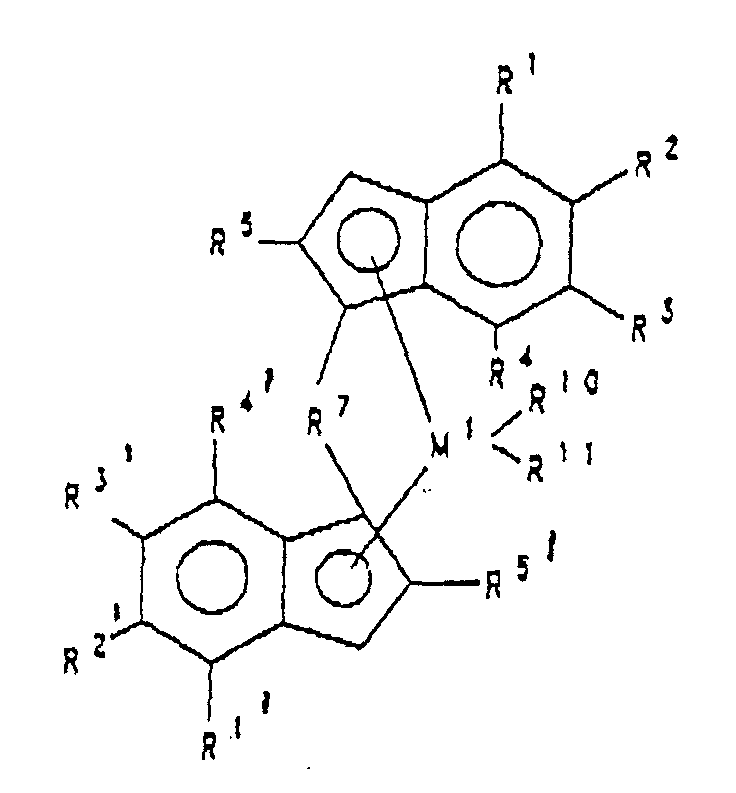
M1 Titan, Zirkon, Hafnium, Vanadium, Niob oder Tantal ist,
R1, R2, R3, R4 und R5 sowie R1', R2', R3', R4' und R5' gleich oder verschieden sind und
Wasserstoff, (C1-C20)Alkyl, (C6-C14)Aryl, (C1-C10)Alkoxy, (C2-C10)Alkenyl, (C7-C20)Arylalkyl, (C7-C20)Alkylaryl, (C6-C10)Aryloxy, (C1-C10)Fluoralkyl, (C6-C10)Halogenaryl, (C2-C10)Alkinyl, einen Rest -SiR6 3, wobei R6 für (C1-C10)Alkyl steht, ein Halogenatom oder einen heteroaromatischen Rest mit 5 oder 6 Ringgliedern, der ein oder mehrere Heteroatome enthalten kann, bedeuten, oder zumindest zwei benachbarte Reste R1-R4 bzw. R1'-R4' bilden mit den sie verbindenden Atomen ein Ringsystem,
R7 ein Rest

wobei
M2 Silicium, Germanium oder Zinn bedeutet,
R8 und R9 gleich oder verschieden sind und Wasserstoff, (C1-C20)Alkyl, (C6-C14)Aryl, (C1-C10)Alkoxy, (C2-C10)Alkenyl, (C7-C20)Arylalkyl, (C7-C20)Alkylaryl, (C6-C10)Aryloxy, (C1-C10)Fluoralkyl, (C6-C10)Halogenaryl, (C2-C10)Alkinyl oder Halogen bedeuten, oder R8 und R9 zusammen mit dem sie verbindenden Atom einen Ring bilden, p 0, 1, 2 oder 3 ist und R10 und R11 gleich oder verschieden sind und Wasserstoff, (C1-C10)Alkyl, (C1-C10)Alkoxy, (C6-C10)Aryl, (C6-C10)Aryloxy, (C2-C10)Alkenyl, (C7-C40)Arylalkyl, (C7-C40)Alkylaryl, (C8-C40)Arylalkenyl, Hydroxy oder ein Halogenatom bedeuten.
M 1 is titanium, zirconium, hafnium, vanadium, niobium or tantalum,
R 1 , R 2 , R 3 , R 4 and R 5 and R 1 ' , R 2' , R 3 ' , R 4' and R 5 'are the same or different and
Hydrogen, (C 1 -C 20 ) alkyl, (C 6 -C 14 ) aryl, (C 1 -C 10 ) alkoxy, (C 2 -C 10 ) alkenyl, (C 7 -C 20 ) arylalkyl, (C 7 -C 20 ) alkylaryl, (C 6 -C 10 ) aryloxy, (C 1 -C 10 ) fluoroalkyl, (C 6 -C 10 ) haloaryl, (C 2 -C 10 ) alkynyl, a radical -SiR 6 3 , where R 6 represents (C 1 -C 10 ) alkyl, a halogen atom or a heteroaromatic radical with 5 or 6 ring members which may contain one or more heteroatoms, or at least two adjacent radicals R 1 -R 4 or R 1 ' -R 4 ' form a ring system with the atoms connecting them,
R 7 is a remainder
in which
M 2 means silicon, germanium or tin,
R 8 and R 9 are identical or different and are hydrogen, (C 1 -C 20 ) alkyl, (C 6 -C 14 ) aryl, (C 1 -C 10 ) alkoxy, (C 2 -C 10 ) alkenyl, (C 7 -C 20 ) arylalkyl, (C 7 -C 20 ) alkylaryl, (C 6 -C 10 ) aryloxy, (C 1 -C 10 ) fluoroalkyl, (C 6 -C 10 ) haloaryl, (C 2 -C 10 ) Are alkynyl or halogen, or R 8 and R 9 together with the atom connecting them form a ring, p is 0, 1, 2 or 3 and R 10 and R 11 are identical or different and are hydrogen, (C 1 -C 10 ) Alkyl, (C 1 -C 10 ) alkoxy, (C 6 -C 10 ) aryl, (C 6 -C 10 ) aryloxy, (C 2 -C 10 ) alkenyl, (C 7 -C 40 ) arylalkyl, (C 7 -C 40 ) alkylaryl, (C 8 -C 40 ) arylalkenyl, hydroxy or a halogen atom.
Weitere zur Kennzeichnung des Copolymeren geeignete Parameter sind in der
nachstehenden Tabelle 1 zusammengefaßt.
Die siegelfähigen Copolymeren werden vorteilhaft durch die Angabe von mindestens zwei in der vorstehenden Tabelle 1 genannten Parameter charakterisiert, beispielsweise durch den Schmelzpunkt und einen weiteren Parameter oder durch den statistischen Comonomergehalt und einen weiteren Parameter. Vorteilhaft ist die Angabe von Schmelzpunkt, Schmelzflußindex und/oder Molmassendispersität (Mw/Mn). The sealable copolymers are advantageously characterized by the specification of at least two parameters mentioned in Table 1 above, for example by the melting point and a further parameter or by the statistical comonomer content and a further parameter. The specification of the melting point, melt flow index and / or molar mass dispersity (M w / M n ) is advantageous.
Die Verwendung der mittels Metallocen-Katalysatoren hergestellten Copolymeren
als Siegelschichtrohstoff bietet gegenüber konventionellen Siegelrohstoffen
überraschende Vorteile.
Die erfindungsgemäße Folie ist mindestens zweischichtig und umfaßt als wesentliche Schichten immer die Basisschicht und zumindest eine erfindungsgemäße Deckschicht, vorzugsweise beidseitig Deckschichten. Gegebenenfalls können zwischen Basis- und Deckschicht/en zusätzliche Zwischenschichten angeordnet sein. Die Auswahl der Anzahl der Schichten hängt in erster Linie von dem vorgesehenen Einsatzzweck ab, wobei drei-, vier- und fünfschichtige Ausführungsformen besonders bevorzugt sind.The film according to the invention has at least two layers and comprises the essential ones Layers always the base layer and at least one according to the invention Cover layer, preferably cover layers on both sides. If necessary, you can Additional intermediate layers are arranged between the base and top layers his. The choice of the number of layers depends primarily on that intended use, with three, four and five-layer embodiments are particularly preferred.
Die Gesamtdicke der Folie kann innerhalb weiter Grenzen variieren und richtet sich nach dem beabsichtigten Verwendungszweck.The total thickness of the film can vary and vary within wide limits according to the intended purpose.
Die bevorzugten Ausführungsformen der erfindungsgemäßen Folie haben Gesamtdicken von 5 bis 200 µm, wobei 10 bis 100 µm, insbesondere 20 bis 80 µm, bevorzugt sind.The preferred embodiments of the film according to the invention have total thicknesses from 5 to 200 µm, with 10 to 100 µm, in particular 20 to 80 µm, are preferred.
Die Dicke der gegebenenfalls vorhandenen Zwischenschicht/en beträgt jeweils unabhängig voneinander 2 bis 12 µm, wobei Zwischenschichtdicken von 3 bis 8 µm, insbesondere 3 bis 6 µm, bevorzugt sind. Die angegebenen Werte beziehen sich jeweils auf eine Zwischenschicht.The thickness of the intermediate layer (s) which may be present is in each case independently of one another 2 to 12 µm, with intermediate layer thicknesses of 3 to 8 μm, in particular 3 to 6 μm, are preferred. Obtain the specified values each on an intermediate layer.
Die Dicke der erfindungsgemäßen Deckschicht/en wird unabhängig von anderen Schichten gewählt und liegt bevorzugt im Bereich von 0,1 bis 10 µm, insbesondere 0,3 bis 5 µm, vorzugsweise 0,5 bis 2 µm, wobei beidseitig aufgebrachte Deckschichten bezüglich Dicke und Zusammensetzung gleich oder verschieden sein können.The thickness of the top layer (s) according to the invention becomes independent of others Layers selected and is preferably in the range of 0.1 to 10 microns, in particular 0.3 to 5 microns, preferably 0.5 to 2 microns, with applied on both sides Cover layers with respect to thickness and composition the same or different could be.
Die Dicke der Basisschicht ergibt sich entsprechend aus der Differenz von Gesamtdicke und der Dicke der aufgebrachten Deck- und Zwischenschicht/en und kann daher analog der Gesamtdicke innerhalb weiter Grenzen variieren. The thickness of the base layer results from the difference between the total thickness and the thickness of the applied top and intermediate layer (s) and can therefore vary within wide limits analogously to the total thickness.
Um bestimmte Eigenschaften der erfindungsgemäßen Polypropylenfolie noch weiter zu verbessern, können sowohl die Basisschicht als auch die Zwischenschicht/en und die Deckschicht/en Zusätze in einer jeweils wirksamen Menge enthalten, vorzugsweise Kohlenwasserstoffharz und/oder Antistatika und/oder Antiblockmittel und/oder Gleitmittel und/oder Stabilisatoren und/oder Neutralisationsmittel, die mit den Polymeren der Kernschicht und der Deckschicht/en verträglich sind, mit Ausnahme der in der Regel unverträglichen Antiblockmittel. Alle Mengenangaben in der folgenden Ausführung in Gewichtsprozent (Gew.-%) beziehen sich jeweils auf die Schicht oder Schichten, der oder denen das Additiv zugesetzt sein kann.To certain properties of the polypropylene film according to the invention Both the base layer and the intermediate layer (s) can be further improved and the top layer / s additives in a respectively effective amount contain, preferably hydrocarbon resin and / or antistatic and / or Antiblocking agents and / or lubricants and / or stabilizers and / or neutralizing agents, those with the polymers of the core layer and the top layer / s are tolerated, with the exception of the generally incompatible antiblocking agents. All quantities in the following version in percent by weight (% by weight) each relate to the layer or layers of which the additive can be added.
Ein niedermolekulares Harz wird bevorzugt der/den Basis- und/oder Zwischenschicht/en zugesetzt. Kohlenwasserstoffharze sind niedermolekulare Polymere, deren Molekulargewicht im allgemeinen in einem Bereich von 300 bis 8 000, vorzugsweise 400 bis 5 000, vorzugsweise 500 bis 2 000, liegt. Damit ist das Molekulargewicht der Harze deutlich niedriger als das der Propylenpolymeren, welche die Hauptkomponente der einzelnen Folienschichten bilden und im allgemeinen ein Molekulargewicht von über 100 000 haben. Der Anteil des Harzes liegt in einem Bereich von 1 bis 30 Gew.-%, vorzugsweise 2 bis 10 Gew.-%. Der Erweichungspunkt des Harzes liegt zwischen 100 und 180 °C (gemessen nach DIN 1995-U4, entspricht ASTM E-28), vorzugsweise über 120 bis 160 °C. Unter den zahlreichen niedrigmolekularen Harzen sind die Kohlenwasserstoffharze bevorzugt, und zwar in Form der Erdölharze (Petroleumharze), Styrolharze, Cyclopentadienharze und Terpenharze (diese Harze sind in UIImanns Encyklopädie der techn. Chemie, 4. Auflage, Band 12, Seiten 525 bis 555, beschrieben).A low molecular weight resin is preferred for the base and / or intermediate layer (s) added. Hydrocarbon resins are low molecular weight polymers whose molecular weight is generally in the range from 300 to 8,000, preferably 400 to 5,000, preferably 500 to 2,000. That’s it Molecular weight of the resins significantly lower than that of the propylene polymers, which form the main component of the individual film layers and in generally have a molecular weight of over 100,000. The share of Resin is in the range of 1 to 30% by weight, preferably 2 to 10% by weight. The resin softening point is between 100 and 180 ° C (measured according to DIN 1995-U4, corresponds to ASTM E-28), preferably over 120 up to 160 ° C. Among the numerous low molecular weight resins are the hydrocarbon resins preferred, namely in the form of petroleum resins (petroleum resins), Styrene resins, cyclopentadiene resins and terpene resins (these resins are in UIImanns Encyclopedia of techn. Chemistry, 4th edition, volume 12, pages 525 to 555, described).
Die Erdölharze sind solche Kohlenwasserstoffharze, die durch Polymerisation von tiefzersetzten (deep-decomposed) Erdölmaterialien in Gegenwart eines Katalysators hergestellt werden. Diese Erdölmaterialien enthalten gewöhnlich ein Gemisch von harzbildenden Substanzen wie Styrol, Methylstyrol, Vinyltoluol, Inden, Methylinden, Butadien, Isopren, Piperylen und Pentylen. Die Styrolharze sind niedrigmolekulare Homopolymere von Styrol oder Copolymere von Styrol mit anderen Monomeren wie Methylstyrol, Vinyltoluol und Butadien. Die Cyclopentadienharze sind Cyclopentadienhomopolymere oder Cyclopentadiencopolymere, die aus Kohlenteerdestillaten und zerlegtem Erdölgas erhalten werden. Diese Harze werden hergestellt, indem die Materialien, die Cyclopentadien enthalten, während einer langen Zeit bei hoher Temperatur gehalten werden. In Abhängigkeit von der Reaktionstemperatur können Dimere, Trimere oder Oligomere erhalten werden.The petroleum resins are those hydrocarbon resins produced by polymerization of deep-decomposed petroleum materials in the presence of a Catalyst are produced. These petroleum materials usually contain one Mixture of resin-forming substances such as styrene, methylstyrene, vinyltoluene, Indene, methylindene, butadiene, isoprene, piperylene and pentylene. The styrene resins are low molecular weight homopolymers of styrene or copolymers of styrene with other monomers such as methyl styrene, vinyl toluene and butadiene. The cyclopentadiene resins are cyclopentadiene homopolymers or cyclopentadiene copolymers, obtained from coal tar distillates and decomposed petroleum gas. These resins are made by the materials called cyclopentadiene included, kept at high temperature for a long time. In Depending on the reaction temperature, dimers, trimers or oligomers can be used be preserved.
Die Terpenharze sind Polymerisate von Terpenen, d. h. Kohlenwasserstoffen der Formel C10H16, die in fast allen etherischen Ölen oder ölhaltigen Harzen von Pflanzen enthalten sind, und phenolmodifizierte Terpenharze. Als spezielle Beispiele der Terpene sind Pinen, α-Pinen, Dipenten, Limonen, Myrcen, Camphen und ähnliche Terpene zu nennen. Bei den Kohlenwasserstoffharzen kann es sich auch um die sogenannten modifizierten Kohlenwasserstoffharze handeln. Die Modifizierung erfolgt im allgemeinen durch Reaktion der Rohstoffe vor der Polymerisation, durch Einführung spezieller Monomere oder durch Reaktion des polymerisierten Produkts, wobei insbesondere Hydrierungen oder Teilhydrierungen vorgenommen werden.The terpene resins are polymers of terpenes, ie hydrocarbons of the formula C 10 H 16 , which are contained in almost all essential oils or oil-containing resins of plants, and phenol-modified terpene resins. Pinene, α-pinene, dipentene, limonene, myrcene, camphene and similar terpenes can be mentioned as special examples of the terpenes. The hydrocarbon resins can also be the so-called modified hydrocarbon resins. The modification is generally carried out by reacting the raw materials before the polymerization, by introducing special monomers or by reacting the polymerized product, in particular hydrogenations or partial hydrogenations being carried out.
Als Kohlenwasserstoffharze werden außerdem Styrolhomopolymerisate, Styrolcopolymerisate, Cyclopentadienhomopolymerisate, Cyclopentadiencopolymerisate und/oder Terpenpolymerisate mit einem Erweichungspunkt von jeweils oberhalb 135 °C eingesetzt (bei den ungesättigten Polymerisaten ist das hydrierte Produkt bevorzugt). Ganz besonders bevorzugt werden die Cyclopentadienpolymerisate mit einem Erweichungspunkt von 140 °C und darüber in den Zwischenschichten eingesetzt. Styrene homopolymers, styrene copolymers, Cyclopentadiene homopolymers, cyclopentadiene copolymers and / or terpene polymers with a softening point of above each 135 ° C used (the unsaturated polymer is the hydrogenated product prefers). The cyclopentadiene polymers are very particularly preferred with a softening point of 140 ° C and above in the intermediate layers used.
Bevorzugte Antistatika sind Alkali-alkansulfonate, polyethermodifizierte, d. h. ethoxylierte und/oder propoxylierte Polydiorganosiloxane (Polydialkylsiloxane, Polyalkylphenylsiloxane und dergleichen) und/oder die im wesentlichen geradkettigen und gesättigten aliphatischen, tertiären Amine mit einem aliphatischen Rest mit 10 bis 20 Kohlenstoffatomen, die mit ω-Hydroxy-(C1-C4)-alkyl-Gruppen substituiert sind, wobei N,N-bis-(2-hydroxyethyl)-alkylamine mit 10 bis 20 Kohlenstoffatomen, vorzugsweise 12 bis 18 Kohlenstoffatomen, im Alkylrest besonders geeignet sind. Die wirksame Menge an Antistatikum liegt im Bereich von 0,05 bis 0,3 Gew.-%.Preferred antistatic agents are alkali alkane sulfonates, polyether-modified, ie ethoxylated and / or propoxylated polydiorganosiloxanes (polydialkylsiloxanes, polyalkylphenylsiloxanes and the like) and / or the essentially straight-chain and saturated aliphatic, tertiary amines with an aliphatic radical with 10 to 20 carbon atoms Hydroxy- (C 1 -C 4 ) -alkyl groups are substituted, N, N-bis (2-hydroxyethyl) alkylamines having 10 to 20 carbon atoms, preferably 12 to 18 carbon atoms, being particularly suitable in the alkyl radical. The effective amount of antistatic is in the range of 0.05 to 0.3% by weight.
Gleitmittel sind höhere aliphatische Säureamide, höhere aliphatische Säureester, Wachse und Metallseifen sowie Polydimethylsiloxane. Die wirksame Menge an Gleitmittel liegt im Bereich von 0,1 bis 3 Gew.-%. Besonders geeignet ist der Zusatz von höheren aliphatischen Säureamiden im Bereich von 0,15 bis 0,25 Gew.-% in der Basisschicht und/oder den Deckschichten. Ein insbesondere geeignetes aliphatisches Säureamid ist Erucasäureamid. Der Zusatz von Polydimethylsiloxanen ist im Bereich von 0,3 bis 2,0 Gew.-% bevorzugt, insbesondere Polydimethylsiloxane mit einer Viskosität von 10 000 bis 1 000 000 mm2/s.Lubricants are higher aliphatic acid amides, higher aliphatic acid esters, waxes and metal soaps as well as polydimethylsiloxanes. The effective amount of lubricant is in the range of 0.1 to 3% by weight. The addition of higher aliphatic acid amides in the range from 0.15 to 0.25% by weight in the base layer and / or the top layers is particularly suitable. A particularly suitable aliphatic acid amide is erucic acid amide. The addition of polydimethylsiloxanes in the range from 0.3 to 2.0% by weight is preferred, in particular polydimethylsiloxanes with a viscosity of 10,000 to 1,000,000 mm 2 / s.
Als Stabilisatoren können die üblichen stabilisierend wirkenden Verbindungen für Ethylen-, Propylen- und andere α-Olefinpolymere eingesetzt werden. Deren Zusatzmenge liegt zwischen 0,05 und 2 Gew.-%. Besonders geeignet sind phenolische Stabilisatoren, Alkali-/Erdalkalistearate und/oder Alkali-/Erdalkalicarbonate. Phenolische Stabilisatoren werden in einer Menge von 0,1 bis 0,6 Gew.-%, insbesondere 0,15 bis 0,3 Gew.-%, und mit einer Molmasse von mehr als500 g/molbevorzugt. Pentaerythrityl-Tetrakis-3-(3,5-di-Tertiärbutyl-4-Hydroxyphenyl)-Propionat oder 1,3,5-Trimethyl-2,4,6-tris(3,5-di-Tertiärbutyl-4-Hydroxybenzyl)benzol sind besonders vorteilhaft. The usual stabilizing compounds for Ethylene, propylene and other α-olefin polymers can be used. their The amount added is between 0.05 and 2% by weight. Phenolic are particularly suitable Stabilizers, alkali / alkaline earth stearates and / or alkali / alkaline earth carbonates. Phenolic stabilizers are used in an amount of 0.1 to 0.6 % By weight, in particular 0.15 to 0.3% by weight, and with a molecular weight of more preferred as 500 g / mol. Pentaerythrityl tetrakis-3- (3,5-di-tert-butyl-4-hydroxyphenyl) propionate or 1,3,5-trimethyl-2,4,6-tris (3,5-di-tertiary-butyl-4-hydroxybenzyl) benzene are particularly advantageous.
Die Antiblockmittel werden bevorzugt den Deckschichten zugesetzt. Geeignete Antiblockmittel sind anorganische Zusatzstoffe wie Siliciumdioxid, Calciumcarbonat, Magnesiumsilicat, Aluminiumsilicat, Calciumphosphat und dergleichen und/oder unverträgliche organische Polymerisate wie Polyamide, Polyester, Polycarbonate und dergleichen, bevorzugt werden Benzoguanamin-formaldehyd-Polymere, Siliciumdioxid und Calciumcarbonat. Die wirksame Menge an Antiblockmittel liegt im Bereich von 0,1 bis 2 Gew.-%, vorzugsweise 0,1 bis 0,5 Gew.-%. Die mittlere Teilchengröße liegt zwischen 1 und 6 µm, insbesondere 2 und 5 µm, wobei Teilchen mit einer kugelförmigen Gestalt, wie in der EP-A-0 236 945 und der DE-A-38 01 535 beschrieben, besonders geeignet sind.The antiblocking agents are preferably added to the top layers. suitable Antiblocking agents are inorganic additives such as silicon dioxide, calcium carbonate, Magnesium silicate, aluminum silicate, calcium phosphate and the like and / or incompatible organic polymers such as polyamides, polyesters, Polycarbonates and the like, benzoguanamine-formaldehyde polymers are preferred, Silicon dioxide and calcium carbonate. The effective amount of antiblocking agent is in the range of 0.1 to 2% by weight, preferably 0.1 to 0.5 Wt .-%. The average particle size is between 1 and 6 µm, especially 2 and 5 µm, with particles having a spherical shape, as in EP-A-0 236 945 and DE-A-38 01 535, are particularly suitable.
Neutralisationsmittel sind vorzugsweise Calciumstearat und/oder Calciumcarbonat einer mittleren Teilchengröße von höchstens 0,7 µm, einer absoluten Teilchengröße von kleiner 10 µm und einer spezifischen Oberfläche von mindestens 40 m2/g.Neutralizing agents are preferably calcium stearate and / or calcium carbonate with an average particle size of at most 0.7 µm, an absolute particle size of less than 10 µm and a specific surface area of at least 40 m 2 / g.
Die Erfindung betrifft weiterhin ein Verfahren zur Herstellung der erfindungsgemäßen Mehrschichtfolie nach dem an sich bekannten Coextrusionsverfahren. Im Rahmen dieses Verfahrens wird so vorgegangen, daß die den einzelnen Schichten der Folie entsprechenden Schmelzen durch eine Flachdüse coextrudiert werden, die so erhaltene Folie zur Verfestigung auf einer oder mehreren Walze/n abgezogen wird, die Folie anschließend gegebenenfalls biaxial gestreckt (orientiert), die gegebenenfalls biaxial gestreckte Folie thermofixiert und gegebenenfalls an der zur Coronabehandlung vorgesehenen Oberflächenschicht entsprechend flammbehandelt wird.The invention further relates to a method for producing the invention Multi-layer film according to the known coextrusion process. In this process, the procedure is such that the individual Layers of the corresponding melt co-extruded through a flat die be, the film thus obtained for solidification on one or more Roller (s) is withdrawn, the film then optionally biaxially stretched (oriented), the optionally biaxially stretched film is heat-set and optionally accordingly on the surface layer intended for corona treatment is flame treated.
Die biaxiale Streckung (Orientierung) ist bevorzugt und kann simultan oder aufeinanderfolgend durchgeführt werden, wobei die aufeinanderfolgende biaxiale Streckung, bei der zuerst längs (in Maschinenrichtung) und dann quer (senkrecht zur Maschinenrichtung) gestreckt wird, besonders günstig ist. Biaxial stretching (orientation) is preferred and can be simultaneous or be carried out successively, the successive biaxial Elongation, first along (in the machine direction) and then across (vertically to machine direction) is stretched, is particularly cheap.
Zunächst wird wie beim Coextrusionsverfahren üblich das Polymere oder die Polymermischung der einzelnen Schichten in einem Extruder komprimiert und verflüssigt, wobei die gegebenenfalls zugesetzten Additive bereits im Polymer enthalten sein können. Die Schmelzen werden dann gleichzeitig durch eine Flachdüse (Breitschlitzdüse) gepreßt, und die ausgepreßte mehrschichtige Folie wird auf einer oder mehreren Abzugswalzen abgezogen, wobei sie abkühlt und sich verfestigt.First, as is usual in the coextrusion process, the polymer or the Polymer mixture of the individual layers in an extruder and compressed liquefied, the additives optionally added already in the polymer can be included. The melts are then simultaneously through a Flat nozzle (slot die) pressed, and the pressed multilayer film is drawn off on one or more take-off rolls, cooling and solidifies.
Vorzugsweise wird die so erhaltene Folie dann längs und quer zur Extrusionsrichtung gestreckt, was zu einer Orientierung der Molekülketten führt. In Längsrichtung wird vorzugsweise 4:1 bis 7:1 und in Querrichtung vorzugsweise 6:1 bis 11:1 gestreckt. Das Längsstrecken wird man zweckmäßigerweise mit Hilfe zweier entsprechend dem angestrebten Streckverhältnis verschieden schnellaufender Walzen durchführen und das Querstrecken mit Hilfe eines entsprechenden Kluppenrahmens.The film thus obtained is then preferably longitudinally and transversely to the direction of extrusion stretched, which leads to an orientation of the molecular chains. Longitudinal is preferably 4: 1 to 7: 1 and in the transverse direction preferably 6: 1 to 11: 1 stretched. The longitudinal stretching is expediently carried out with the help of two according to the desired stretching ratio of different speeds Carry out rolling and the transverse stretching with the help of an appropriate Tenter frame.
An die biaxiale Streckung der Folie schließt sich ihre Thermofixierung (Wärmebehandlung) an, wobei die Folie etwa 0,5 bis 10 lang bei einer Temperatur von 110 bis 130 °C gehalten wird. Anschließend wird die Folie in üblicher Weise mit einer Aufwickeleinrichtung aufgewickelt.The biaxial stretching of the film is followed by its heat setting (heat treatment) at, the film for about 0.5 to 10 at a temperature of Is kept 110 to 130 ° C. Then the film is in the usual way a winder wound up.
Es hat sich als besonders günstig erwiesen, die Abzugswalze oder -walzen, durch die die ausgepreßte Folie auch abgekühlt und verfestigt wird, bei einer Temperatur von 10 bis 90 °C zu halten, bevorzugt 20 bis 60 °C.It has proven to be particularly advantageous to use the take-off roller or rollers, through which the pressed film is also cooled and solidified, at a To keep temperature of 10 to 90 ° C, preferably 20 to 60 ° C.
Darüber hinaus wird die Längsstreckung vorteilhafterweise bei einer Temperatur von weniger als 140 °C, vorzugsweise im Bereich von 125 bis 135 °C, und die Querstreckung bei einer Temperatur größer 140 °C, vorzugsweise bei 145 bis 160 °C, durchgeführt. In addition, the longitudinal stretching is advantageously carried out at one temperature of less than 140 ° C, preferably in the range of 125 to 135 ° C, and the Cross stretching at a temperature greater than 140 ° C, preferably at 145 to 160 ° C.
Gegebenenfalls kann/können wie oben erwähnt nach der biaxialen Streckung eine oder beide Oberfläche/n der Folie nach einer der bekannten Methoden corona- oder flammbehandelt werden, wobei für eine Flammbehandlung mit polarisierter Flamme (vgl. US-A-4,622,237) eine elektrische Gleichspannung zwischen einem Brenner (negativer Pol) und einer Kühlwalze angelegt wird. Die Höhe der angelegten Spannung beträgt zwischen 500 und 3 000 V, vorzugsweise liegt sie im Bereich von 1 500 bis 2 000 V. Durch die angelegte Spannung erhalten die ionisierten Atome eine erhöhte Beschleunigung und treffen mit größerer kinetischer Energie auf die Polymeroberfläche. Die chemischen Bindungen innerhalb des Polymermoleküls werden leichter aufgebrochen, und die Radikalbildung geht schneller vonstatten. Die thermische Belastung des Polymeren ist hierbei weitaus geringer als bei der Standardflammbehandlung, und es können Folien erhalten werden, bei denen die Siegeleigenschaften der behandelten Seite sogar besser sind als diejenigen der nicht behandelten Seite.If necessary, as mentioned above, after the biaxial stretching one or both surface (s) of the film according to one of the known methods be corona or flame treated, for a flame treatment with polarized flame (see US-A-4,622,237) an electrical direct voltage between a burner (negative pole) and a cooling roller. The The applied voltage is between 500 and 3,000 V, preferably it is in the range of 1,500 to 2,000 V. Due to the applied voltage the ionized atoms get increased acceleration and hit with them greater kinetic energy on the polymer surface. The chemical bonds within the polymer molecule are more easily broken up, and the Radical formation is faster. The thermal load on the polymer is far less than standard flame treatment, and it can be obtained films in which the sealing properties of the treated Side are even better than those of the untreated side.
Für die alternative Coronabehandlung wird die Folie zwischen zwei als Elektroden dienenden Leiterelementen hindurchgeführt wird, wobei zwischen den Elektroden eine so hohe Spannung, meist Wechselspannung (etwa 10 000 V und 10 000 Hz), angelegt ist, daß Sprüh- oder Coronaentladungen stattfinden können. Durch die Sprüh- oder Coronaentladung wird die Luft oberhalb der Folienoberfläche ionisiert und reagiert mit den Molekülen der Folienoberfläche, so daß polare Einlagerungen in der im wesentlichen unpolaren Polymermatrix entstehen. Die Behandlungsintensitäten liegen im üblichen Rahmen, wobei 38 bis 45 mN/m bevorzugt sind.For the alternative corona treatment, the foil between two is used as electrodes serving conductor elements is passed, wherein between the Electrodes such a high voltage, mostly alternating voltage (about 10,000 V and 10,000 Hz), is applied that spray or corona discharges take place can. By spray or corona discharge, the air above the Film surface ionizes and reacts with the molecules of the film surface, so that polar inclusions in the essentially non-polar polymer matrix arise. The treatment intensities are in the usual range, with 38 to 45 mN / m are preferred.
Die erfindungsgemäße Mehrschichtfolie zeichnet sich durch sehr gute Siegeleigenschaften,
insbesondere durch eine sehr niedrige Siegelanspringtemperatur
bei vergleichsweise niedrigen Comonomergehalten und eine gute Siegelnahtfestigkeit
und gute Hot-Tack-Eigenschaften aus. Die Siegeleigenschaften von
besonders vorteilhaften Ausführungsformen der Folie werden vorteilhaft durch
die Angabe der folgenden Gleichung charakterisiert, die die Siegelanspringtemperatur
der nicht coronabehandelten Folienseite in Abhängigkeit vom statistischen
Ethylengehalt (C2 in Gew.-%) charakterisiert:
Aus dieser Gleichung geht hervor, daß niedrige Siegelanspringtemperaturen auch bei einem sehr geringen Ethylengehalt im Copolymeren erzielt werden können. Gegebenenfalls kann bei Erhöhung des Ethylengehalts die Siegelanspringtemperatur noch weiter gesenkt werden und dabei Werte erreichen, die für C2/C3-Copolymere äußerst niedrig sind.This equation shows that low sealing initiation temperatures can be achieved even with a very low ethylene content in the copolymer. If necessary, when the ethylene content is increased, the starting temperature of the seal can be reduced even further and can reach values which are extremely low for C 2 / C 3 copolymers.
Gleichzeitig ermöglicht die neue Deckschicht höhere Glanzwerte, und die nachteilige, durch Beschichtung mit üblichen siegelfähigen Co- oder Terpolymeren verursachte Trübung läßt sich vorteilhafter reduzieren, es sei denn man verwendet eine opake Ausführungsform. Das neue Deckschichtmaterial ermöglicht die Herstellung von siegelfähigen Folien mit längerer Coronahaltbarkeit und mit niedriger Globalmigration, wobei die bekannten Nachteile der üblichen Deckschichtmaterialien aus Co- oder Terpolymeren vermieden werden (hoher Preis, Beeinträchtigung von Glanz und Transparenz, verfahrenstechnische Aspekte usw.).At the same time, the new top layer enables higher gloss values, and the disadvantageous by coating with conventional sealable copolymers or terpolymers Turbidity caused can be reduced more advantageously, unless one uses an opaque embodiment. The new cover layer material enables the production of sealable films with a longer shelf life and with lower global migration, whereby the known disadvantages of the usual cover layer materials from copolymers or terpolymers can be avoided (high price, Impairment of gloss and transparency, procedural aspects etc.).
Die Erfindung wird nunmehr durch Ausführungsbeispiele näher erläutert: The invention will now be explained in more detail by means of exemplary embodiments:
Die Herstellung des Copolymeren erfolgte analog Beispiel 1.
Die Herstellung des Copolymeren erfolgte analog Beispiel 1.
Die Herstellung des Copolymeren erfolgte analog Beispiel 1
Die Herstellung des Copolymeren erfolgte analog Beispiel 1.
Die Herstellung des Copolymeren erfolgte analog Beispiel 1.
Es wurde durch Coextrusion und anschließende stufenweise Orientierung in Längs- und Querrichtung eine dreischichtige boPP-Folie mit einer Gesamtdicke von 20 µm und einem ABA-Schichtaufbau hergestellt, d. h. die Basisschicht B war beidseitig von zwei Deckschichten vom Typ A umgeben. Vor der Aufrollung wurde die Folie auf der Abzugswalzenseite mit einer Dosisleistung von 15 Wmin/m2 coronabehandelt. Die Oberflächenspannung betrug auf dieser Seite infolge der Coronabehandlung 50 mN/m.A three-layer boPP film with a total thickness of 20 μm and an ABA layer structure was produced by coextrusion and subsequent stepwise orientation in the longitudinal and transverse directions, ie the base layer B was surrounded on both sides by two type A cover layers. Before being rolled up, the film was corona-treated on the take-off roll side with a dose rate of 15 Wmin / m 2 . The surface tension on this side was 50 mN / m due to the corona treatment.
Alle Schichten enthielten zur Stabilisierung 0,1 Gew.-% Pentaerythrithyltetrakis-4-(3,5-ditertiärbutyl-4-hydroxyphenyl)-propionat (®Irganox 1010) und als Neutralisationsmittel 0,05 Gew.-% Calciumstearat.All layers contained 0.1% by weight of pentaerythrithyltetrakis-4- (3,5-di-tert-butyl-4-hydroxyphenyl) propionate for stabilization (®Irganox 1010) and 0.05% by weight calcium stearate as neutralizing agent.
Die Basisschicht bestand im wesentlichen aus einem Propylenhomopolymeren mit einem n-heptanlöslichen Anteil von 3,5 Gew.-% und einem Schmelzpunkt von 162 °C. Der Schmelzflußindex des Propylenhomopolymeren betrug 3,3 g/10 min bei 230 °C und 21,6 N Belastung (DIN 53 735).The base layer consisted essentially of a propylene homopolymer with an n-heptane soluble content of 3.5 wt .-% and a Melting point of 162 ° C. The melt flow index of the propylene homopolymer was 3.3 g / 10 min at 230 ° C and 21.6 N load (DIN 53 735).
Die polyolefinischen Deckschichten A bestanden im wesentlichen aus den Granulatmischungen der Beispiele 1 bis 6. Die Deckschicht A enthielt daher 0,3 Gew.-% des Antiblockmittels ®Sylobloc 44 mit einem mittleren Teilchendurchmesser von 4 µm. Die Dicke der Deckschichten A betrug 1,1 µm.The polyolefinic cover layers A consisted essentially of the Granule mixtures of Examples 1 to 6. The top layer A contained therefore 0.3% by weight of the antiblocking agent ®Sylobloc 44 with a medium one Particle diameter of 4 µm. The thickness of the cover layers A was 1.1 µm.
Es wurde analog den Beispielen eine dreischichtige boPP-Folie hergestellt. Die polyolefinischen Deckschichten A bestanden im wesentlichen aus einem statistischen Copolymeren mit einem C2-Gehalt von 3 bis 4 Gew.-% und einem Schmelzpunkt von 135 °C. Der Schmelzflußindex des Copolymeren betrug 7 g/10 min, gemessen bei 230 °C und 21,6 N Belastung (DIN 53 735). Analog zu Beispiel 1 enthielt auch das statistische Copolymer 0,3 Gew.-% des Antiblockmittels ®Sylobloc 44 mit einem mittleren Teilchendurchmesser von 4 µm. Die Dicke der Deckschichten betrug 1,0 µm.A three-layer boPP film was produced analogously to the examples. The polyolefinic cover layers A essentially consisted of a random copolymer with a C 2 content of 3 to 4% by weight and a melting point of 135 ° C. The melt flow index of the copolymer was 7 g / 10 min, measured at 230 ° C. and 21.6 N load (DIN 53 735). Analogously to Example 1, the statistical copolymer also contained 0.3% by weight of the antiblocking agent ®Sylobloc 44 with an average particle diameter of 4 μm. The thickness of the cover layers was 1.0 µm.
Es wurde analog den Beispielen eine dreischichtige boPP-Folie hergestellt. Die polyolefinischen Deckschichten A bestanden im wesentlichen aus einem statistischen C2-C3-C4-Terpolymeren (C2-Gehalt 1,5 bis 2,5 Gew.-% C4-Gehalt 7 bis 10 Gew.-%) mit einem Schmelzpunkt von ca. 133 °C. Der Schmelzflußindex des Terpolymeren betrug 6 g/10 min, gemessen bei 230 °C und 21,6 N Belastung (DIN 53 735). Analog zu Vergleichsbeispiel 1 enthielt das statistische Terpolymer 0,3 Gew.-% des Antiblockmittels ®Sylobloc 44 mit einem mittleren Teilchendurchmesser von 4 µm. Die Dicke der Deckschichten betrug 1,1 µm.A three-layer boPP film was produced analogously to the examples. The polyolefinic cover layers A essentially consisted of a statistical C 2 -C 3 -C 4 terpolymer (C 2 content 1.5 to 2.5% by weight C 4 content 7 to 10% by weight) with a Melting point of approx. 133 ° C. The melt flow index of the terpolymer was 6 g / 10 min, measured at 230 ° C. and 21.6 N load (DIN 53 735). Analogous to Comparative Example 1, the statistical terpolymer contained 0.3% by weight of the antiblocking agent ®Sylobloc 44 with an average particle diameter of 4 μm. The thickness of the cover layers was 1.1 µm.
Die Eigenschaften der Folien sowie deren Aufbau und Zusammensetzung sind in den Tabellen 2 bis 14 zusammengestellt. The properties of the films as well as their structure and composition are compiled in Tables 2 to 14.
Zur Charakterisierung der Rohstoffe und der Folien wurden die folgenden Meßmethoden benutzt:The following measurement methods were used to characterize the raw materials and the films used:
Die mittleren Molmassen (Mw,Mn) und die mittlere Molmassen-Dispersität (Mw/Mn) wurden in Anlehnung an DIN 55 672, Teil 1, mittels Gelpermeationschromatographie bestimmt. Anstelle von THF wurde als Elutionsmittel Orthodichlorbenzol verwendet. Da die zu untersuchenden olefinischen Polymeren bei Raumtemperatur nicht löslich sind, wird die gesamte Messung bei erhöhter Temperatur (∼ 135 °C) durchgeführt.The average molecular weights (M w , M n ) and the average molecular weight dispersity (M w / M n ) were determined in accordance with DIN 55 672, Part 1, by means of gel permeation chromatography. Instead of THF, orthodichlorobenzene was used as the eluent. Since the olefinic polymers to be examined are not soluble at room temperature, the entire measurement is carried out at elevated temperature (∼ 135 ° C).
Die Bestimmung der Viskositätszahl wird nach DIN 53 728, Blatt 4, durchgeführt.The viscosity number is determined in accordance with DIN 53 728, sheet 4.
Der Schmelzflußindex wurde nach DIN 53 735 bei 21,6 N Belastung und 230 °C gemessen.The melt flow index was according to DIN 53 735 at 21.6 N load and 230 ° C measured.
DSC-Messung, Maximum der Schmelzkurve, Aufheizgeschwindigkeit 20 °K/min.DSC measurement, maximum of the melting curve, heating rate 20 ° K / min.
Die Trübung der Folie wurde nach ASTM-D 1003-52 gemessen.The haze of the film was measured according to ASTM-D 1003-52.
Der Glanz wurde nach DIN 67 530 bestimmt. Gemessen wurde der Reflektorwert als optische Kenngröße für die Oberfläche einer Folie. Angelehnt an die Normen ASTM-D 523-78 und ISO 2813 wurde der Einstrahlwinkel mit 20° oder 60° eingestellt. Ein Lichtstrahl trifft unter dem eingestellten Einstrahlwinkel auf die ebene Prüffläche und wird von dieser reflektiert bzw. gestreut. Die auf den photoelektronischen Empfänger auffallenden Lichtstrahlen werden als proportionale elektrische Größe angezeigt. Der Meßwert ist dimensionslos und muß mit dem Einstrahlwinkel angegeben werden.The gloss was determined in accordance with DIN 67 530. The reflector value was measured as an optical parameter for the surface of a film. Based on the standards ASTM-D 523-78 and ISO 2813 the angle of incidence was 20 ° or 60 ° set. A light beam hits the at the set angle of incidence flat test surface and is reflected or scattered by it. The on the Light beams striking photoelectronic receivers are called proportional electrical size is displayed. The measured value is dimensionless and must be included the angle of incidence.
Zur Bestimmung wurden zwei 15 mm breite Folienstreifen übereinandergelegt und bei 130 °C, einer Siegelzeit von 0,5 s und einem Siegeldruck von 10 N/mm2 (Gerät: Brugger Typ NDS, einseitig beheizte Siegelbacke) versiegelt. Die Siegelnahtfestigkeit wurde nach der T-Peel-Methode bestimmt.For the determination, two 15 mm wide strips of film were placed on top of one another and sealed at 130 ° C., a sealing time of 0.5 s and a sealing pressure of 10 N / mm 2 (device: Brugger type NDS, sealing jaw heated on one side). The seal seam strength was determined by the T-Peel method.
"Hot-Tack" bezeichnet die Festigkeit einer noch heißen Siegelnaht unmittelbar nach dem Öffnen der Siegelwerkzeuge. Zur Bestimmung werden zwei Folienzuschnitte von 5·30 mm übereinandergelegt und an den Enden mit einem Klammergewicht G von 100 g fixiert. Ein Flachspatel wird zwischen die Folienlagen gesteckt, und der Meßstreifen wird über zwei Umlenkrollen zwischen die Siegelbacken geführt. Anschließend wird die Siegelung ausgelöst, wobei der Spatel zwischen den Lagen herausgezogen wird, sobald die Siegelbacken geschlossen sind. Als Siegelbedingungen werden 150 °C für die Siegeltemperatur, 0,5 s für die Siegelzeit und 30 N/cm2 für den Anpreßdruck eingestellt. Nach Ende der Siegelzeit von 0,5 s öffnen sich die Siegelbacken (Fläche: 20 cm2) selbständig, und der gesiegelte Meßstreifen wird durch das Belastungsgewicht ruckartig bis zur Umlenkrolle vorgezogen und dabei unter einem Trennwinkel von 180° gespalten. Als Hot-Tack wird die Tiefe der Delaminierung der Siegelnaht in mm angegeben. die sie bei der vorgegebenen Krafteinwirkung erfährt."Hot tack" denotes the strength of a still hot sealing seam immediately after opening the sealing tools. For the determination, two film cuts of 5 x 30 mm are placed one above the other and fixed at the ends with a clamp weight G of 100 g. A flat spatula is inserted between the foil layers and the measuring strip is guided between the sealing jaws via two deflection rollers. The sealing is then triggered, the spatula being pulled out between the layers as soon as the sealing jaws are closed. 150 ° C for the sealing temperature, 0.5 s for the sealing time and 30 N / cm 2 for the contact pressure are set as sealing conditions. At the end of the sealing time of 0.5 s, the sealing jaws (area: 20 cm 2 ) open automatically, and the sealed measuring strip is jerkily pulled up to the deflection roller by the load weight and split at a separation angle of 180 °. The depth of delamination of the sealed seam in mm is specified as a hot tack. which it experiences under the given force.
Die Oberflächenspannung wurde mittels der sogenannten Tintenmethode (DIN 53 364) bestimmt. The surface tension was measured using the so-called ink method (DIN 53 364).
Die coronabehandelten Folien wurden 14 Tage nach ihrer Produktion (Kurzzeitbeurteilung) bzw. 6 Monate nach ihrer Produktion (Langzeitbeurteilung) bedruckt bzw. metallisiert. Die Farb- bzw. Metallhaftung wurde mittels Klebebandtest beurteilt. Konnte mittels Klebeband keine Farbe bzw. kein Metall abgelöst werden, so wurde die Haftung mit sehr gut und bei deutlicher Ablösung von Farbe bzw. Metall mit schlecht beurteilt.The corona-treated films were 14 days after their production (short-term assessment) or printed 6 months after their production (long-term assessment) or metallized. The paint or metal adhesion was tested using an adhesive tape test assessed. If no paint or metal could be removed using adhesive tape, so the adhesion was very good and with a clear detachment of color or metal judged poor.
Mit dem Siegelgerät HSG/ET der Firma Brugger werden heißgesiegelte Proben (Siegelnaht 20 mm x 100 mm) hergestellt, indem eine Folie bei unterschiedlichen Temperaturen mit Hilfe zweier beheizter Siegelbacken bei einem Siegeldruck von 10 N/cm2 und einer Siegeldauer von 0,5 s gesiegelt wird. Aus den gesiegelten Proben werden Prüfstreifen von 15 mm Breite geschnitten. Die T-Siegelnahtfestigkeit, d. h. die zur Trennung der Prüfstreifen erforderliche Kraft, wird mit einer Zugprüfmaschine bei 200 mm/min Abzugsgeschwindigkeit bestimmt, wobei die Siegelnahtebene einen rechten Winkel mit der Zugrichtung bildet. Die Siegelanspringtemperatur (oder minimale Siegeltemperatur) ist die Temperatur, bei der eine Siegelnahtfestigkeit von mindestens 0,5 N/15 mm erreicht wird.With the sealing device HSG / ET from Brugger, heat-sealed samples (sealing seam 20 mm x 100 mm) are produced by using a film at different temperatures with the help of two heated sealing jaws with a sealing pressure of 10 N / cm 2 and a sealing time of 0.5 s is sealed. Test strips 15 mm wide are cut from the sealed samples. The T-seal seam strength, ie the force required to separate the test strips, is determined with a tensile testing machine at a take-off speed of 200 mm / min, the seal seam plane forming a right angle with the direction of pull. The seal start temperature (or minimum seal temperature) is the temperature at which a seal seam strength of at least 0.5 N / 15 mm is achieved.
Der statistische Ethylengehalt des Copolymeren wurde mittels IR-Spektroskopie
bestimmt. Hierbei wurden an ca. 350 µm dicken Preßplatten die Extinktionen pro
mm bei 732 cm-1 gemessen. Die Zuordnung der Extinktionen pro mm zu Ethylengehalten
wurde mit Hilfe einer Eichkurve vorgenommen, welche auf 13C-NMR-Daten
basiert. Der Randomfaktor R ist definiert als das Verhältnis der Extinktionen
pro mm bei 720 cm-1 und 732 cm-1.


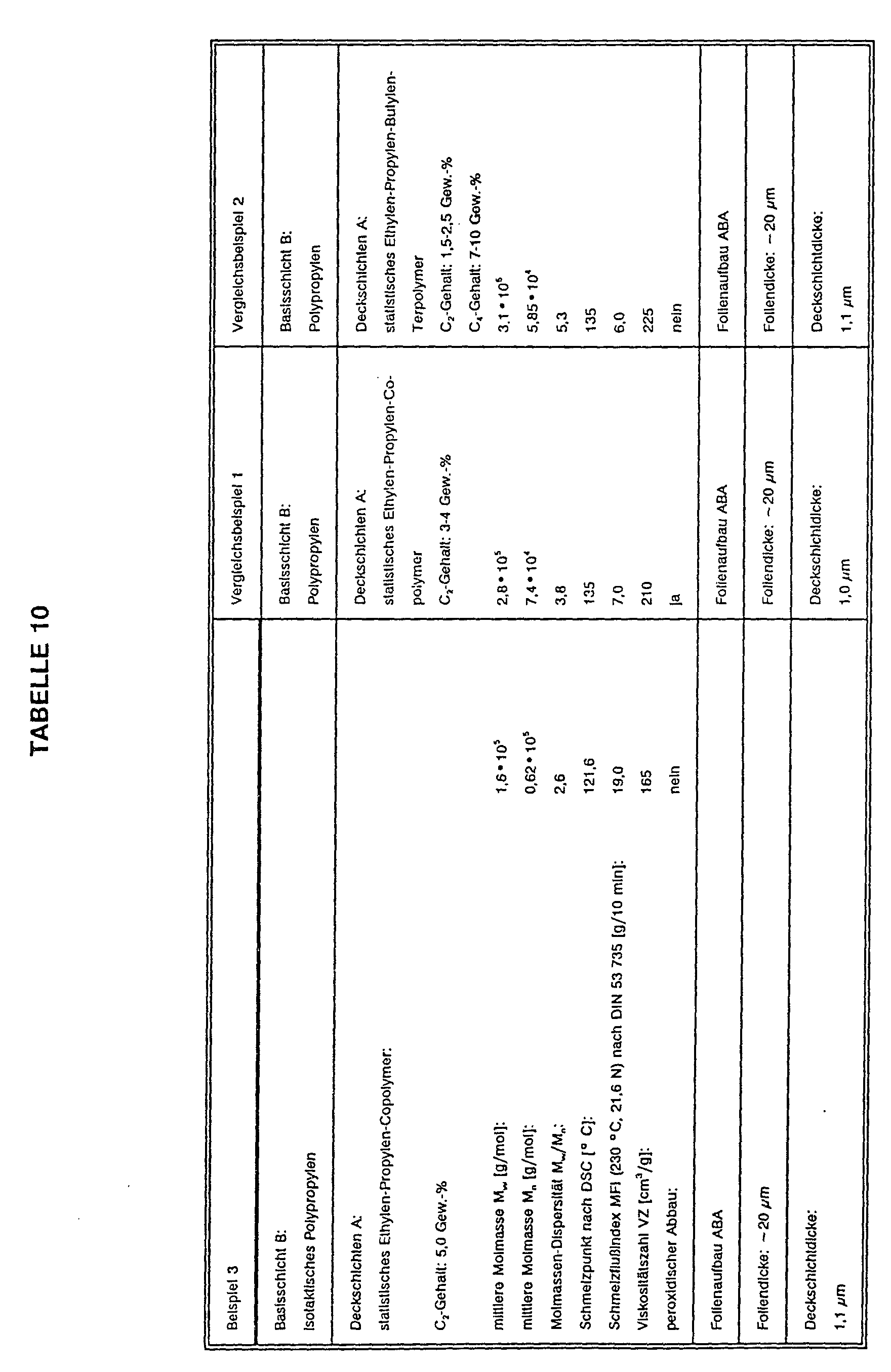


Claims (18)
- A heat-sealable multilayer film comprising a polyolefinic base layer and at least one outer layer, wherein the outer layer comprises a propylene-olefin copolymer prepared by means of metallocene catalyst which had to isotactic polypropylenes, the copolymer is a random copolymer, the ratio of block fraction to random fraction in the copolymer, measured by IR as random factor, is in the range from 0.01 to 0.4 and the random comonomer content of the copolymer, measured by IR, is from 0.05 to 12% by weight.
- A multilayer film as claimed in claim 1, wherein the comonomer content of the copolymer is from 0.1 to 10% by weight, preferably from 1 to 7% by weight.
- A multilayer film as claimed in claim 1, wherein the comonomer is ethylene.
- A multilayer film as claimed in claim 1, wherein the mean molecular weight Mw (weight average) of the copolymer is in the range from 5·104 to 2·106 g/mol.
- A multilayer film as claimed in claim 1, wherein the mean molecular weight Mn (number average) of the copolymer is in the range from 5·104 to 1·106 g/mol.
- A multilayer film as claimed in claim 1, wherein the molecular weight dispersity of the copolymer Mw/Mn is < 7.
- A multilayer film as claimed in claim 1, wherein the DSC melting point of the copolymer is from 100 to 145°C.
- A multilayer film as claimed in claim 1, wherein the melt flow index MFI, measured in accordance with DIN 53 735, is from 0.5 to 100 g/10 min (230°C, 21.6 N).
- A multilayer film as claimed in claim 1, wherein the n-hexane-extractable content (measured in accordance with FDA 1771520) of the copolymer is < 3% by weight.
- A multilayer film as claimed in claim 1, wherein the viscosity number VN is in the range from 50 to 1,000 cm3/g.
- A multilayer film as claimed in two or more of claims 1 to 10.
- A multilayer film as claimed in one or more of claims 1 to 11, wherein the propylene homopolymer of the base layer comprises at least 90% of propylene and has a melt flow index of from 0.5 g/10 min to 8 g/10 min, measured in accordance with DIN 53 735, and a melting point of from 150 to 170°C.
- A multilayer film as claimed in one or more of claims 1 to 12, wherein the base layer comprises inert inorganic and/or organic particles.
- A multilayer film as claimed in one or more of claims 1 to 13, wherein the base layer comprises resin.
- A multilayer film as claimed in one or more of claims 1 to 14, wherein the multilayer film has at least three layers.
- A multilayer film as claimed in one or more of claims 1 to 15, wherein the outer layer has a thickness of from 0.1 to 2.5 µm.
- A process for the production of a multilayer film as claimed in claim 1, in which the melts corresponding to the individual layers of the film are coextruded through a flat-film die, the coextruded film is cooled for solidification, the film is biaxially stretched at the longitudinal stretching ratio of from 4:1 to 7:1 and a transverse stretching ratio of from 8:1 to 10:1, the biaxially stretched film is heat-set, if desired corona-or flame-treated and subsequently wound up, which comprises taking off the coextruded film over a take-off roll whose temperature is between 10 and 90°C.
- Packaging containing a film as claimed in one or more of claims 1 to 16.
Applications Claiming Priority (4)
| Application Number | Priority Date | Filing Date | Title |
|---|---|---|---|
| DE4405429 | 1994-02-21 | ||
| DE4405429 | 1994-02-21 | ||
| DE4406931 | 1994-03-03 | ||
| DE4406931A DE4406931A1 (en) | 1994-02-21 | 1994-03-03 | Multi-layer heat sealable film useful in packaging - containing in the outer layers a propylene@!-olefin copolymer prepd. using a metallocene catalyst |
Publications (2)
| Publication Number | Publication Date |
|---|---|
| EP0668157A1 EP0668157A1 (en) | 1995-08-23 |
| EP0668157B1 true EP0668157B1 (en) | 2003-05-21 |
Family
ID=25933982
Family Applications (1)
| Application Number | Title | Priority Date | Filing Date |
|---|---|---|---|
| EP19950101921 Expired - Lifetime EP0668157B1 (en) | 1994-02-21 | 1995-02-13 | Heat-sealable polyolefin multilayer films, method of their manufacture and use |
Country Status (5)
| Country | Link |
|---|---|
| US (1) | US6558808B1 (en) |
| EP (1) | EP0668157B1 (en) |
| CA (1) | CA2142521C (en) |
| ES (1) | ES2199966T3 (en) |
| FI (1) | FI115619B (en) |
Cited By (1)
| Publication number | Priority date | Publication date | Assignee | Title |
|---|---|---|---|---|
| US7794849B2 (en) | 2002-12-03 | 2010-09-14 | Exxonmobil Oil Corporation | Thermoplastic film structures with a low melting point outer layer |
Families Citing this family (25)
| Publication number | Priority date | Publication date | Assignee | Title |
|---|---|---|---|---|
| DE69502851T2 (en) | 1994-02-25 | 1998-11-12 | Sumitomo Chemical Co | Statistical propylene copolymer and film laminate thereof |
| CN1076282C (en) | 1995-03-02 | 2001-12-19 | 三井化学株式会社 | Polypropylene composite film |
| DE19533336A1 (en) * | 1995-09-11 | 1997-03-13 | Basf Ag | Process for the preparation of propene / but-1-ene copolymers |
| DE19544709A1 (en) * | 1995-11-30 | 1997-06-05 | Basf Ag | Biaxially oriented polypropylene film made of metallocene polypropylene |
| DE19548788A1 (en) † | 1995-12-27 | 1997-07-03 | Hoechst Ag | Foils and layers |
| US6583227B2 (en) | 1996-09-04 | 2003-06-24 | Exxonmobil Chemical Patents Inc. | Propylene polymers for films |
| JP4195095B2 (en) | 1996-09-04 | 2008-12-10 | エクソンモービル・ケミカル・パテンツ・インク | Improved propylene polymer for drawn films. |
| US6576306B2 (en) | 1996-09-04 | 2003-06-10 | Exxonmobil Chemical Patents Inc. | Propylene polymers for films |
| JP3403044B2 (en) * | 1997-12-09 | 2003-05-06 | キヤノン株式会社 | Packaging container |
| DE19812229A1 (en) | 1998-03-20 | 1999-09-23 | Basf Ag | Polymers of propene |
| DE19827327A1 (en) | 1998-06-19 | 1999-12-30 | Targor Gmbh | Sealable multilayer film with a low sealing temperature and a low content of xylene-soluble material, useful in packaging applications |
| DE19827328A1 (en) | 1998-06-19 | 1999-12-23 | Targor Gmbh | Propene terpolymers with a low content of xylene-soluble material, useful for the production of film, fibers, molded products and sealing layer materials |
| US6713137B1 (en) | 1998-11-23 | 2004-03-30 | Fresenius Kabi Ab | Medical containers |
| US6458470B1 (en) | 1999-07-08 | 2002-10-01 | Exxonmobil Oil Corporation | High barrier multilayer film |
| KR100733187B1 (en) * | 1999-10-26 | 2007-06-27 | 이데미쓰 고산 가부시키가이샤 | Polypropylene-Based Films and Multilayer Laminate |
| US6641913B1 (en) | 1999-12-03 | 2003-11-04 | Fina Technology, Inc. | Heat-sealable films |
| US6869686B1 (en) | 2000-08-30 | 2005-03-22 | Curwood, Inc. | Irradiated biaxially oriented film |
| US20020155267A1 (en) * | 2001-02-22 | 2002-10-24 | Bader Michael John | Multi-layer hermetically sealable film |
| US7351478B2 (en) | 2001-03-16 | 2008-04-01 | Fina Technology, Inc. | Heat-seal films and method of manufacture |
| US20030211350A1 (en) * | 2002-05-10 | 2003-11-13 | Migliorini Robert A. | Multilayer heat sealable polyolefin film comprising skin layer and transition layer of differing melting points |
| US6773818B2 (en) * | 2002-09-06 | 2004-08-10 | Exxonmobil Oil Corporation | Metallized, metallocene-catalyzed, polypropylene films |
| US20040081842A1 (en) * | 2002-10-29 | 2004-04-29 | Peet Robert G. | Film with metallocene-catalyzed propylene copolymer heat-seal layer |
| SE0301102D0 (en) * | 2003-04-14 | 2003-04-14 | Tetra Laval Holdings & Finance | Method in connection with the production of an apckaging laminate thus produced and a packaging container manufactures from the packaging laminate |
| US20060147685A1 (en) * | 2004-12-30 | 2006-07-06 | Kimberly-Clark Worldwide, Inc. | Multilayer film structure with higher processability |
| US20150158985A1 (en) * | 2013-12-05 | 2015-06-11 | Toray Plastics (America), Inc. | Mineral oil barrier film with high oxygen diffusion properties |
Family Cites Families (22)
| Publication number | Priority date | Publication date | Assignee | Title |
|---|---|---|---|---|
| GB1145199A (en) | 1966-06-13 | 1969-03-12 | Nat Distillers Chem Corp | Heat-sealable oriented polypropylene film laminate |
| US4294889A (en) * | 1979-03-28 | 1981-10-13 | Mitsubishi Petrochemical Co., Ltd. | Resin compositions and heat-sealable composite biaxially-stretched films |
| IT1229054B (en) | 1984-06-22 | 1991-07-17 | Esseci S R L Societa Costruzio | PHYSICAL METHOD FOR TREATING THE SURFACES OF POLYOLEFINIC, POLYTETRAFLUORCETHYLENE PLASTIC LAMINATES, CARDBOARDS AND METAL SHEETS SUCH AS ALUMINUM AND WATERPROOF BAND, BY MEANS OF A FLAME PRODUCED BY COMBUSTION OF AN ALCOHOLIC HYDROGEN-BASED HYDROGEN-BASED OIL IONIZED |
| US5236622A (en) | 1986-03-07 | 1993-08-17 | Nippon Shokubai Kagaku Kogyo Co., Ltd. | Process for producing a monodispersed glycol suspension of fine inorganic oxide particles having excellent dispersion stability |
| JPS63182212A (en) | 1987-01-20 | 1988-07-27 | Mizusawa Ind Chem Ltd | Spherical particle of amorphous silica or silica-alumina and their production |
| IT1221653B (en) * | 1987-11-27 | 1990-07-12 | Ausimonti Spa | PROPYLENE CRYSTALLINE COPOLYMERS |
| US5175049A (en) * | 1989-04-27 | 1992-12-29 | The Dow Chemical Company | Polyolefin laminate cling films |
| DE4035343A1 (en) * | 1990-11-07 | 1992-05-14 | Hoechst Ag | HEAT-SEALED PACKAGING FOIL |
| DE59104869D1 (en) | 1990-11-12 | 1995-04-13 | Hoechst Ag | 2-Substituted bisindenyl metallocenes, process for their preparation and their use as catalysts in olefin polymerization. |
| ES2087339T3 (en) * | 1991-05-27 | 1996-07-16 | Hoechst Ag | PROCEDURE FOR THE PREPARATION OF POLYOLEFINS WITH WIDE DISTRIBUTION OF MOLECULAR MASSES. |
| TW300901B (en) | 1991-08-26 | 1997-03-21 | Hoechst Ag | |
| DE4135096A1 (en) * | 1991-10-24 | 1993-04-29 | Hoechst Ag | SEALABLE, MATTE BIAXIAL-ORIENTED POLYOLEFIN MULTILAYER FILM, METHOD FOR THEIR PRODUCTION AND THEIR USE |
| US5281679A (en) * | 1991-11-07 | 1994-01-25 | Exxon Chemical Patents Inc. | Catalyst and method of broadening polymer molecular weight distribution and increasing polymer tensile impact strength and products made thereof |
| TW309523B (en) | 1991-11-30 | 1997-07-01 | Hoechst Ag | |
| TW318184B (en) | 1991-11-30 | 1997-10-21 | Hoechst Ag | |
| DE59206948D1 (en) * | 1991-11-30 | 1996-09-26 | Hoechst Ag | Metallocenes with benzo-fused indenyl derivatives as ligands, processes for their preparation and their use as catalysts |
| US5206075A (en) * | 1991-12-19 | 1993-04-27 | Exxon Chemical Patents Inc. | Sealable polyolefin films containing very low density ethylene copolymers |
| EP0578838A1 (en) | 1992-04-29 | 1994-01-19 | Hoechst Aktiengesellschaft | Olefin polymerization catalyst, process for its preparation, and its use |
| TW294669B (en) | 1992-06-27 | 1997-01-01 | Hoechst Ag | |
| JP3326873B2 (en) * | 1992-07-22 | 2002-09-24 | 住友化学工業株式会社 | Packaging film |
| DE4311422A1 (en) | 1993-04-07 | 1994-10-13 | Hoechst Ag | Opaque, matt, biaxially oriented polypropylene multilayer film, process for its production and its use |
| US5468440B1 (en) * | 1994-05-06 | 1997-04-08 | Exxon Chemical Patents Inc | Process of making oriented film or structure |
-
1995
- 1995-02-13 ES ES95101921T patent/ES2199966T3/en not_active Expired - Lifetime
- 1995-02-13 EP EP19950101921 patent/EP0668157B1/en not_active Expired - Lifetime
- 1995-02-14 CA CA 2142521 patent/CA2142521C/en not_active Expired - Fee Related
- 1995-02-17 FI FI950739A patent/FI115619B/en not_active IP Right Cessation
- 1995-02-21 US US08/395,371 patent/US6558808B1/en not_active Expired - Lifetime
Cited By (1)
| Publication number | Priority date | Publication date | Assignee | Title |
|---|---|---|---|---|
| US7794849B2 (en) | 2002-12-03 | 2010-09-14 | Exxonmobil Oil Corporation | Thermoplastic film structures with a low melting point outer layer |
Also Published As
| Publication number | Publication date |
|---|---|
| CA2142521C (en) | 2007-04-10 |
| FI950739L (en) | 1995-08-22 |
| US6558808B1 (en) | 2003-05-06 |
| FI950739A0 (en) | 1995-02-17 |
| FI115619B (en) | 2005-06-15 |
| EP0668157A1 (en) | 1995-08-23 |
| ES2199966T3 (en) | 2004-03-01 |
| CA2142521A1 (en) | 1995-08-22 |
Similar Documents
| Publication | Publication Date | Title |
|---|---|---|
| EP0668157B1 (en) | Heat-sealable polyolefin multilayer films, method of their manufacture and use | |
| EP0589213B1 (en) | Sealable Polypropylene laminated film, process for its manufacture and its use | |
| EP0515969B1 (en) | Biaxially oriented opaque multilayer sealable polypropylene film, process of preparation and use thereof | |
| EP0692373B1 (en) | Peelable, sealable polyolefin laminate | |
| EP0578149B1 (en) | Low-temperature heat-sealable biaxially oriented and highly-shrinkable polyolefin multilayer film | |
| EP0765909B1 (en) | Polyolefin film containing cyclic olefin polymer, preparation method and use thereof | |
| DE69328007T2 (en) | Heat shrinkable films containing single site catalyzed copolymers with long chain branches | |
| EP0622185B1 (en) | Matt biaxially oriented polypropylene multilayered film, process for its manufacture and its use | |
| EP0618070B1 (en) | Oriented sealable polyolefin multilayer film, process for its manufacture and its use | |
| EP0611647B1 (en) | Low temperature-sealing, biaxially oriented polyolefin multilayer film, process for its manufacture and its use | |
| EP0781652A2 (en) | Peelable, sealable polyolefinic multilayered film, process for its manufacture and its use | |
| EP1053278B1 (en) | Sealable, biaxially oriented polypropylene film with improved barrier properties | |
| EP1089878B1 (en) | Sealable multilayer film made of a grafted terpolymer | |
| EP0622187B1 (en) | Matt, biaxially oriented and highly-shrinkable multilayered polypropylene film, process for its manufacture and its use | |
| EP0645417A1 (en) | Biaxially oriented film of polypropylene with improved mechanical and barrier properties | |
| EP0849073A2 (en) | Oriented polyolefin multilayer film, sealable on both sides, its manufacture and its use | |
| EP0695630A1 (en) | Biaxially orientated polyolefin laminate with low sealing-temperature, method of making it and its use | |
| EP0489373B1 (en) | Biaxially orientated shrinkable polyolefin laminate, sealable on both sides and with barrier properties | |
| EP0468333B1 (en) | Biaxially oriented heatsealable polypropylene film with improved barrier properties | |
| EP1117534B1 (en) | Multi-layer biaxially oriented polypropylene film having an improved barrier, a method for the production thereof, and the use thereof | |
| EP0665101B1 (en) | Biaxially oriented multilayer polypropylene film, process for its preparation and its use | |
| EP0732188B1 (en) | Method for treating a sealable film surface | |
| EP1615770B1 (en) | Biaxially oriented polypropylene film provided with a cold-seal adhesive coating and having excellent lubricating properties | |
| EP0687702B1 (en) | Biaxially highly oriented polypropylene film and process for its preparation | |
| DE4406931A1 (en) | Multi-layer heat sealable film useful in packaging - containing in the outer layers a propylene@!-olefin copolymer prepd. using a metallocene catalyst |
Legal Events
| Date | Code | Title | Description |
|---|---|---|---|
| PUAI | Public reference made under article 153(3) epc to a published international application that has entered the european phase |
Free format text: ORIGINAL CODE: 0009012 |
|
| AK | Designated contracting states |
Kind code of ref document: A1 Designated state(s): BE DE ES FR GB IT NL |
|
| 17P | Request for examination filed |
Effective date: 19960223 |
|
| 17Q | First examination report despatched |
Effective date: 19960725 |
|
| GRAH | Despatch of communication of intention to grant a patent |
Free format text: ORIGINAL CODE: EPIDOS IGRA |
|
| GRAH | Despatch of communication of intention to grant a patent |
Free format text: ORIGINAL CODE: EPIDOS IGRA |
|
| RAP1 | Party data changed (applicant data changed or rights of an application transferred) |
Owner name: BASELL POLYOLEFINE GMBH |
|
| GRAA | (expected) grant |
Free format text: ORIGINAL CODE: 0009210 |
|
| AK | Designated contracting states |
Designated state(s): BE DE ES FR GB IT NL |
|
| REG | Reference to a national code |
Ref country code: GB Ref legal event code: FG4D Free format text: NOT ENGLISH |
|
| REF | Corresponds to: |
Ref document number: 59510689 Country of ref document: DE Date of ref document: 20030626 Kind code of ref document: P |
|
| GBT | Gb: translation of ep patent filed (gb section 77(6)(a)/1977) | ||
| REG | Reference to a national code |
Ref country code: ES Ref legal event code: FG2A Ref document number: 2199966 Country of ref document: ES Kind code of ref document: T3 |
|
| PLBE | No opposition filed within time limit |
Free format text: ORIGINAL CODE: 0009261 |
|
| STAA | Information on the status of an ep patent application or granted ep patent |
Free format text: STATUS: NO OPPOSITION FILED WITHIN TIME LIMIT |
|
| ET | Fr: translation filed | ||
| 26N | No opposition filed |
Effective date: 20040224 |
|
| PGFP | Annual fee paid to national office [announced via postgrant information from national office to epo] |
Ref country code: DE Payment date: 20110225 Year of fee payment: 17 Ref country code: NL Payment date: 20110228 Year of fee payment: 17 Ref country code: IT Payment date: 20110225 Year of fee payment: 17 Ref country code: FR Payment date: 20110309 Year of fee payment: 17 |
|
| PGFP | Annual fee paid to national office [announced via postgrant information from national office to epo] |
Ref country code: GB Payment date: 20110223 Year of fee payment: 17 Ref country code: BE Payment date: 20110224 Year of fee payment: 17 |
|
| BERE | Be: lapsed |
Owner name: *BASELL POLYOLEFINE G.M.B.H. Effective date: 20120228 |
|
| REG | Reference to a national code |
Ref country code: NL Ref legal event code: V1 Effective date: 20120901 |
|
| GBPC | Gb: european patent ceased through non-payment of renewal fee |
Effective date: 20120213 |
|
| REG | Reference to a national code |
Ref country code: FR Ref legal event code: ST Effective date: 20121031 |
|
| PG25 | Lapsed in a contracting state [announced via postgrant information from national office to epo] |
Ref country code: IT Free format text: LAPSE BECAUSE OF NON-PAYMENT OF DUE FEES Effective date: 20120213 |
|
| REG | Reference to a national code |
Ref country code: DE Ref legal event code: R119 Ref document number: 59510689 Country of ref document: DE Effective date: 20120901 |
|
| PG25 | Lapsed in a contracting state [announced via postgrant information from national office to epo] |
Ref country code: BE Free format text: LAPSE BECAUSE OF NON-PAYMENT OF DUE FEES Effective date: 20120228 |
|
| PG25 | Lapsed in a contracting state [announced via postgrant information from national office to epo] |
Ref country code: GB Free format text: LAPSE BECAUSE OF NON-PAYMENT OF DUE FEES Effective date: 20120213 Ref country code: NL Free format text: LAPSE BECAUSE OF NON-PAYMENT OF DUE FEES Effective date: 20120901 Ref country code: FR Free format text: LAPSE BECAUSE OF NON-PAYMENT OF DUE FEES Effective date: 20120229 |
|
| PGFP | Annual fee paid to national office [announced via postgrant information from national office to epo] |
Ref country code: ES Payment date: 20130225 Year of fee payment: 19 |
|
| PG25 | Lapsed in a contracting state [announced via postgrant information from national office to epo] |
Ref country code: DE Free format text: LAPSE BECAUSE OF NON-PAYMENT OF DUE FEES Effective date: 20120901 |
|
| REG | Reference to a national code |
Ref country code: ES Ref legal event code: FD2A Effective date: 20150327 |
|
| PG25 | Lapsed in a contracting state [announced via postgrant information from national office to epo] |
Ref country code: ES Free format text: LAPSE BECAUSE OF NON-PAYMENT OF DUE FEES Effective date: 20140214 |