EP0652271A1 - Well fluid additive - Google Patents
Well fluid additive Download PDFInfo
- Publication number
- EP0652271A1 EP0652271A1 EP94308305A EP94308305A EP0652271A1 EP 0652271 A1 EP0652271 A1 EP 0652271A1 EP 94308305 A EP94308305 A EP 94308305A EP 94308305 A EP94308305 A EP 94308305A EP 0652271 A1 EP0652271 A1 EP 0652271A1
- Authority
- EP
- European Patent Office
- Prior art keywords
- cis
- derivative
- erucic acid
- erucic
- fatty acid
- Prior art date
- Legal status (The legal status is an assumption and is not a legal conclusion. Google has not performed a legal analysis and makes no representation as to the accuracy of the status listed.)
- Withdrawn
Links
- 239000012530 fluid Substances 0.000 title claims abstract description 79
- 239000000654 additive Substances 0.000 title claims abstract description 47
- 230000000996 additive effect Effects 0.000 title claims abstract description 43
- DPUOLQHDNGRHBS-KTKRTIGZSA-N erucic acid Chemical compound CCCCCCCC\C=C/CCCCCCCCCCCC(O)=O DPUOLQHDNGRHBS-KTKRTIGZSA-N 0.000 claims abstract description 65
- 235000014113 dietary fatty acids Nutrition 0.000 claims abstract description 60
- 239000000194 fatty acid Substances 0.000 claims abstract description 60
- 229930195729 fatty acid Natural products 0.000 claims abstract description 60
- 150000004665 fatty acids Chemical class 0.000 claims abstract description 59
- XLYOFNOQVPJJNP-UHFFFAOYSA-N water Substances O XLYOFNOQVPJJNP-UHFFFAOYSA-N 0.000 claims abstract description 53
- DPUOLQHDNGRHBS-UHFFFAOYSA-N Brassidinsaeure Natural products CCCCCCCCC=CCCCCCCCCCCCC(O)=O DPUOLQHDNGRHBS-UHFFFAOYSA-N 0.000 claims abstract description 42
- URXZXNYJPAJJOQ-UHFFFAOYSA-N Erucic acid Natural products CCCCCCC=CCCCCCCCCCCCC(O)=O URXZXNYJPAJJOQ-UHFFFAOYSA-N 0.000 claims abstract description 42
- 238000000034 method Methods 0.000 claims abstract description 29
- 239000003995 emulsifying agent Substances 0.000 claims abstract description 17
- 229920000151 polyglycol Polymers 0.000 claims abstract description 10
- 239000010695 polyglycol Substances 0.000 claims abstract description 10
- LFQSCWFLJHTTHZ-UHFFFAOYSA-N Ethanol Chemical compound CCO LFQSCWFLJHTTHZ-UHFFFAOYSA-N 0.000 claims abstract description 8
- 230000001050 lubricating effect Effects 0.000 claims abstract description 6
- 239000003208 petroleum Substances 0.000 claims abstract description 6
- 229920000223 polyglycerol Polymers 0.000 claims abstract description 4
- 239000000314 lubricant Substances 0.000 claims description 40
- 239000000203 mixture Substances 0.000 claims description 35
- 238000005553 drilling Methods 0.000 claims description 28
- 235000019484 Rapeseed oil Nutrition 0.000 claims description 16
- 150000002148 esters Chemical class 0.000 claims description 13
- PEDCQBHIVMGVHV-UHFFFAOYSA-N Glycerine Chemical class OCC(O)CO PEDCQBHIVMGVHV-UHFFFAOYSA-N 0.000 claims description 12
- QUCDWLYKDRVKMI-UHFFFAOYSA-M sodium;3,4-dimethylbenzenesulfonate Chemical compound [Na+].CC1=CC=C(S([O-])(=O)=O)C=C1C QUCDWLYKDRVKMI-UHFFFAOYSA-M 0.000 claims description 11
- 150000001298 alcohols Chemical class 0.000 claims description 10
- 239000003752 hydrotrope Substances 0.000 claims description 10
- 239000003795 chemical substances by application Substances 0.000 claims description 8
- OKTJSMMVPCPJKN-UHFFFAOYSA-N Carbon Chemical group [C] OKTJSMMVPCPJKN-UHFFFAOYSA-N 0.000 claims description 7
- 241001125048 Sardina Species 0.000 claims description 6
- 150000001412 amines Chemical class 0.000 claims description 6
- 235000011187 glycerol Nutrition 0.000 claims description 6
- -1 polypropylene glycerol Polymers 0.000 claims description 6
- 240000002791 Brassica napus Species 0.000 claims description 5
- 235000004977 Brassica sinapistrum Nutrition 0.000 claims description 5
- 235000004443 Ricinus communis Nutrition 0.000 claims description 5
- 239000002253 acid Substances 0.000 claims description 5
- 125000004432 carbon atom Chemical group C* 0.000 claims description 5
- 150000001875 compounds Chemical class 0.000 claims description 5
- 235000010356 sorbitol Nutrition 0.000 claims description 5
- 244000020551 Helianthus annuus Species 0.000 claims description 4
- 235000003222 Helianthus annuus Nutrition 0.000 claims description 4
- 229910052783 alkali metal Inorganic materials 0.000 claims description 4
- 150000001340 alkali metals Chemical class 0.000 claims description 4
- 235000012343 cottonseed oil Nutrition 0.000 claims description 4
- 229920001451 polypropylene glycol Polymers 0.000 claims description 4
- 229910052723 transition metal Inorganic materials 0.000 claims description 4
- 150000003624 transition metals Chemical class 0.000 claims description 4
- JNYAEWCLZODPBN-JGWLITMVSA-N (2r,3r,4s)-2-[(1r)-1,2-dihydroxyethyl]oxolane-3,4-diol Chemical class OC[C@@H](O)[C@H]1OC[C@H](O)[C@H]1O JNYAEWCLZODPBN-JGWLITMVSA-N 0.000 claims description 3
- 235000017060 Arachis glabrata Nutrition 0.000 claims description 3
- 244000105624 Arachis hypogaea Species 0.000 claims description 3
- 235000010777 Arachis hypogaea Nutrition 0.000 claims description 3
- 235000018262 Arachis monticola Nutrition 0.000 claims description 3
- 241000273930 Brevoortia tyrannus Species 0.000 claims description 3
- 244000020518 Carthamus tinctorius Species 0.000 claims description 3
- 235000003255 Carthamus tinctorius Nutrition 0.000 claims description 3
- 241000252203 Clupea harengus Species 0.000 claims description 3
- 244000060011 Cocos nucifera Species 0.000 claims description 3
- 235000013162 Cocos nucifera Nutrition 0.000 claims description 3
- FBPFZTCFMRRESA-FSIIMWSLSA-N D-Glucitol Natural products OC[C@H](O)[C@H](O)[C@@H](O)[C@H](O)CO FBPFZTCFMRRESA-FSIIMWSLSA-N 0.000 claims description 3
- FBPFZTCFMRRESA-JGWLITMVSA-N D-glucitol Chemical compound OC[C@H](O)[C@@H](O)[C@H](O)[C@H](O)CO FBPFZTCFMRRESA-JGWLITMVSA-N 0.000 claims description 3
- 244000068988 Glycine max Species 0.000 claims description 3
- 235000010469 Glycine max Nutrition 0.000 claims description 3
- 240000006240 Linum usitatissimum Species 0.000 claims description 3
- 235000004431 Linum usitatissimum Nutrition 0.000 claims description 3
- 240000007817 Olea europaea Species 0.000 claims description 3
- 240000002834 Paulownia tomentosa Species 0.000 claims description 3
- 235000010678 Paulownia tomentosa Nutrition 0.000 claims description 3
- 244000044822 Simmondsia californica Species 0.000 claims description 3
- 235000004433 Simmondsia californica Nutrition 0.000 claims description 3
- 240000008042 Zea mays Species 0.000 claims description 3
- 235000005824 Zea mays ssp. parviglumis Nutrition 0.000 claims description 3
- 235000002017 Zea mays subsp mays Nutrition 0.000 claims description 3
- 235000014121 butter Nutrition 0.000 claims description 3
- 235000005822 corn Nutrition 0.000 claims description 3
- 150000004985 diamines Chemical class 0.000 claims description 3
- 150000005690 diesters Chemical class 0.000 claims description 3
- 235000004426 flaxseed Nutrition 0.000 claims description 3
- 239000004519 grease Substances 0.000 claims description 3
- 235000019514 herring Nutrition 0.000 claims description 3
- 235000020232 peanut Nutrition 0.000 claims description 3
- 229920000233 poly(alkylene oxides) Polymers 0.000 claims description 3
- 229920001223 polyethylene glycol Polymers 0.000 claims description 3
- 235000019512 sardine Nutrition 0.000 claims description 3
- 239000000600 sorbitol Substances 0.000 claims description 3
- 235000012424 soybean oil Nutrition 0.000 claims description 3
- 239000003549 soybean oil Substances 0.000 claims description 3
- 239000003760 tallow Substances 0.000 claims description 3
- UAUDZVJPLUQNMU-UHFFFAOYSA-N Erucasaeureamid Natural products CCCCCCCCC=CCCCCCCCCCCCC(N)=O UAUDZVJPLUQNMU-UHFFFAOYSA-N 0.000 claims description 2
- UAUDZVJPLUQNMU-KTKRTIGZSA-N erucamide Chemical compound CCCCCCCC\C=C/CCCCCCCCCCCC(N)=O UAUDZVJPLUQNMU-KTKRTIGZSA-N 0.000 claims description 2
- 150000002314 glycerols Chemical class 0.000 claims description 2
- 150000007513 acids Chemical class 0.000 claims 2
- YUFFSWGQGVEMMI-JLNKQSITSA-N (7Z,10Z,13Z,16Z,19Z)-docosapentaenoic acid Chemical compound CC\C=C/C\C=C/C\C=C/C\C=C/C\C=C/CCCCCC(O)=O YUFFSWGQGVEMMI-JLNKQSITSA-N 0.000 claims 1
- 150000003738 xylenes Chemical class 0.000 claims 1
- BDHFUVZGWQCTTF-UHFFFAOYSA-M sulfonate Chemical compound [O-]S(=O)=O BDHFUVZGWQCTTF-UHFFFAOYSA-M 0.000 abstract 1
- 239000003921 oil Substances 0.000 description 17
- 235000019198 oils Nutrition 0.000 description 15
- 239000004094 surface-active agent Substances 0.000 description 15
- 230000015572 biosynthetic process Effects 0.000 description 12
- 238000005755 formation reaction Methods 0.000 description 12
- 238000012360 testing method Methods 0.000 description 12
- 239000000839 emulsion Substances 0.000 description 11
- 230000001804 emulsifying effect Effects 0.000 description 10
- 239000007787 solid Substances 0.000 description 7
- 238000005520 cutting process Methods 0.000 description 6
- 230000009467 reduction Effects 0.000 description 6
- 239000007788 liquid Substances 0.000 description 5
- 150000003839 salts Chemical class 0.000 description 5
- CJDPJFRMHVXWPT-UHFFFAOYSA-N barium sulfide Chemical compound [S-2].[Ba+2] CJDPJFRMHVXWPT-UHFFFAOYSA-N 0.000 description 4
- 239000000440 bentonite Substances 0.000 description 4
- 229910000278 bentonite Inorganic materials 0.000 description 4
- SVPXDRXYRYOSEX-UHFFFAOYSA-N bentoquatam Chemical compound O.O=[Si]=O.O=[Al]O[Al]=O SVPXDRXYRYOSEX-UHFFFAOYSA-N 0.000 description 4
- 239000012634 fragment Substances 0.000 description 4
- 239000013505 freshwater Substances 0.000 description 4
- 239000000499 gel Substances 0.000 description 4
- 239000004033 plastic Substances 0.000 description 4
- 229920003023 plastic Polymers 0.000 description 4
- 238000002360 preparation method Methods 0.000 description 4
- 239000000126 substance Substances 0.000 description 4
- YXFVVABEGXRONW-UHFFFAOYSA-N Toluene Chemical class CC1=CC=CC=C1 YXFVVABEGXRONW-UHFFFAOYSA-N 0.000 description 3
- 230000009471 action Effects 0.000 description 3
- 229940053200 antiepileptics fatty acid derivative Drugs 0.000 description 3
- TZCXTZWJZNENPQ-UHFFFAOYSA-L barium sulfate Chemical compound [Ba+2].[O-]S([O-])(=O)=O TZCXTZWJZNENPQ-UHFFFAOYSA-L 0.000 description 3
- 239000003925 fat Substances 0.000 description 3
- 238000005189 flocculation Methods 0.000 description 3
- 230000016615 flocculation Effects 0.000 description 3
- 150000002430 hydrocarbons Chemical class 0.000 description 3
- 238000010008 shearing Methods 0.000 description 3
- 238000009736 wetting Methods 0.000 description 3
- XEEYBQQBJWHFJM-UHFFFAOYSA-N Iron Chemical compound [Fe] XEEYBQQBJWHFJM-UHFFFAOYSA-N 0.000 description 2
- 229920001732 Lignosulfonate Polymers 0.000 description 2
- CTQNGGLPUBDAKN-UHFFFAOYSA-N O-Xylene Chemical group CC1=CC=CC=C1C CTQNGGLPUBDAKN-UHFFFAOYSA-N 0.000 description 2
- 244000166071 Shorea robusta Species 0.000 description 2
- 235000015076 Shorea robusta Nutrition 0.000 description 2
- FAPWRFPIFSIZLT-UHFFFAOYSA-M Sodium chloride Chemical compound [Na+].[Cl-] FAPWRFPIFSIZLT-UHFFFAOYSA-M 0.000 description 2
- 125000000129 anionic group Chemical group 0.000 description 2
- 239000008346 aqueous phase Substances 0.000 description 2
- 239000002585 base Substances 0.000 description 2
- 238000011088 calibration curve Methods 0.000 description 2
- 229910052799 carbon Inorganic materials 0.000 description 2
- 239000001913 cellulose Substances 0.000 description 2
- 229920002678 cellulose Polymers 0.000 description 2
- 239000004927 clay Substances 0.000 description 2
- RWGFKTVRMDUZSP-UHFFFAOYSA-N cumene Chemical class CC(C)C1=CC=CC=C1 RWGFKTVRMDUZSP-UHFFFAOYSA-N 0.000 description 2
- 239000000428 dust Substances 0.000 description 2
- 235000019197 fats Nutrition 0.000 description 2
- 239000006260 foam Substances 0.000 description 2
- 230000002209 hydrophobic effect Effects 0.000 description 2
- 238000011065 in-situ storage Methods 0.000 description 2
- 230000035515 penetration Effects 0.000 description 2
- 229920000642 polymer Polymers 0.000 description 2
- 239000013535 sea water Substances 0.000 description 2
- ZJVATSUMFCZSKA-QZOPMXJLSA-N (z)-docos-13-enoic acid Chemical compound CCCCCCCC\C=C/CCCCCCCCCCCC(O)=O.CCCCCCCC\C=C/CCCCCCCCCCCC(O)=O ZJVATSUMFCZSKA-QZOPMXJLSA-N 0.000 description 1
- YIWUKEYIRIRTPP-UHFFFAOYSA-N 2-ethylhexan-1-ol Chemical compound CCCCC(CC)CO YIWUKEYIRIRTPP-UHFFFAOYSA-N 0.000 description 1
- OYPRJOBELJOOCE-UHFFFAOYSA-N Calcium Chemical compound [Ca] OYPRJOBELJOOCE-UHFFFAOYSA-N 0.000 description 1
- VYZAMTAEIAYCRO-UHFFFAOYSA-N Chromium Chemical compound [Cr] VYZAMTAEIAYCRO-UHFFFAOYSA-N 0.000 description 1
- 229920000742 Cotton Polymers 0.000 description 1
- DGAQECJNVWCQMB-PUAWFVPOSA-M Ilexoside XXIX Chemical compound C[C@@H]1CC[C@@]2(CC[C@@]3(C(=CC[C@H]4[C@]3(CC[C@@H]5[C@@]4(CC[C@@H](C5(C)C)OS(=O)(=O)[O-])C)C)[C@@H]2[C@]1(C)O)C)C(=O)O[C@H]6[C@@H]([C@H]([C@@H]([C@H](O6)CO)O)O)O.[Na+] DGAQECJNVWCQMB-PUAWFVPOSA-M 0.000 description 1
- 239000004117 Lignosulphonate Substances 0.000 description 1
- 239000005662 Paraffin oil Substances 0.000 description 1
- 229910000831 Steel Inorganic materials 0.000 description 1
- 239000000853 adhesive Substances 0.000 description 1
- 230000001070 adhesive effect Effects 0.000 description 1
- 239000003513 alkali Substances 0.000 description 1
- 229910052784 alkaline earth metal Inorganic materials 0.000 description 1
- 150000001342 alkaline earth metals Chemical group 0.000 description 1
- 125000002877 alkyl aryl group Chemical group 0.000 description 1
- 150000004996 alkyl benzenes Chemical class 0.000 description 1
- 150000001408 amides Chemical class 0.000 description 1
- 238000004164 analytical calibration Methods 0.000 description 1
- 239000010775 animal oil Substances 0.000 description 1
- 239000003945 anionic surfactant Substances 0.000 description 1
- 230000003466 anti-cipated effect Effects 0.000 description 1
- 238000013459 approach Methods 0.000 description 1
- JXLHNMVSKXFWAO-UHFFFAOYSA-N azane;7-fluoro-2,1,3-benzoxadiazole-4-sulfonic acid Chemical compound N.OS(=O)(=O)C1=CC=C(F)C2=NON=C12 JXLHNMVSKXFWAO-UHFFFAOYSA-N 0.000 description 1
- 239000010428 baryte Substances 0.000 description 1
- 229910052601 baryte Inorganic materials 0.000 description 1
- 239000012267 brine Substances 0.000 description 1
- 229910052791 calcium Inorganic materials 0.000 description 1
- 239000011575 calcium Substances 0.000 description 1
- 229910000281 calcium bentonite Inorganic materials 0.000 description 1
- 150000001768 cations Chemical class 0.000 description 1
- 230000008859 change Effects 0.000 description 1
- 238000006243 chemical reaction Methods 0.000 description 1
- 238000005056 compaction Methods 0.000 description 1
- 238000013329 compounding Methods 0.000 description 1
- 239000012141 concentrate Substances 0.000 description 1
- 229920001577 copolymer Polymers 0.000 description 1
- 239000002385 cottonseed oil Substances 0.000 description 1
- 230000007423 decrease Effects 0.000 description 1
- 239000008367 deionised water Substances 0.000 description 1
- 229910021641 deionized water Inorganic materials 0.000 description 1
- 230000001419 dependent effect Effects 0.000 description 1
- ZBCBWPMODOFKDW-UHFFFAOYSA-N diethanolamine Chemical compound OCCNCCO ZBCBWPMODOFKDW-UHFFFAOYSA-N 0.000 description 1
- 238000004945 emulsification Methods 0.000 description 1
- 238000005516 engineering process Methods 0.000 description 1
- 230000007613 environmental effect Effects 0.000 description 1
- 231100000584 environmental toxicity Toxicity 0.000 description 1
- 238000002474 experimental method Methods 0.000 description 1
- 239000007789 gas Substances 0.000 description 1
- 150000002334 glycols Chemical class 0.000 description 1
- 238000000227 grinding Methods 0.000 description 1
- 238000005098 hot rolling Methods 0.000 description 1
- 229930195733 hydrocarbon Natural products 0.000 description 1
- 229910052739 hydrogen Inorganic materials 0.000 description 1
- 239000001257 hydrogen Substances 0.000 description 1
- 230000006872 improvement Effects 0.000 description 1
- 238000010348 incorporation Methods 0.000 description 1
- 229910052500 inorganic mineral Inorganic materials 0.000 description 1
- 230000002452 interceptive effect Effects 0.000 description 1
- 229910052742 iron Inorganic materials 0.000 description 1
- 239000010699 lard oil Substances 0.000 description 1
- 239000003077 lignite Substances 0.000 description 1
- 235000019357 lignosulphonate Nutrition 0.000 description 1
- 238000004519 manufacturing process Methods 0.000 description 1
- 239000000463 material Substances 0.000 description 1
- 230000007246 mechanism Effects 0.000 description 1
- 239000011707 mineral Substances 0.000 description 1
- 238000002156 mixing Methods 0.000 description 1
- 239000002736 nonionic surfactant Substances 0.000 description 1
- 235000014593 oils and fats Nutrition 0.000 description 1
- 239000002245 particle Substances 0.000 description 1
- 239000003415 peat Substances 0.000 description 1
- 230000000149 penetrating effect Effects 0.000 description 1
- 239000012071 phase Substances 0.000 description 1
- 229920001495 poly(sodium acrylate) polymer Polymers 0.000 description 1
- 229920002401 polyacrylamide Polymers 0.000 description 1
- 229920001281 polyalkylene Polymers 0.000 description 1
- 229920001515 polyalkylene glycol Polymers 0.000 description 1
- 230000002265 prevention Effects 0.000 description 1
- 238000000926 separation method Methods 0.000 description 1
- 239000002002 slurry Substances 0.000 description 1
- 229910052708 sodium Inorganic materials 0.000 description 1
- 239000011734 sodium Substances 0.000 description 1
- 239000011780 sodium chloride Substances 0.000 description 1
- NNMHYFLPFNGQFZ-UHFFFAOYSA-M sodium polyacrylate Chemical compound [Na+].[O-]C(=O)C=C NNMHYFLPFNGQFZ-UHFFFAOYSA-M 0.000 description 1
- 229940048842 sodium xylenesulfonate Drugs 0.000 description 1
- POZWVHISDXHZLV-KVVVOXFISA-M sodium;(z)-docos-13-enoate Chemical compound [Na+].CCCCCCCC\C=C/CCCCCCCCCCCC([O-])=O POZWVHISDXHZLV-KVVVOXFISA-M 0.000 description 1
- HPALAKNZSZLMCH-UHFFFAOYSA-M sodium;chloride;hydrate Chemical compound O.[Na+].[Cl-] HPALAKNZSZLMCH-UHFFFAOYSA-M 0.000 description 1
- 239000000243 solution Substances 0.000 description 1
- 238000003892 spreading Methods 0.000 description 1
- 230000007480 spreading Effects 0.000 description 1
- 239000003381 stabilizer Substances 0.000 description 1
- 230000003068 static effect Effects 0.000 description 1
- 239000010959 steel Substances 0.000 description 1
- 238000003756 stirring Methods 0.000 description 1
- 150000005846 sugar alcohols Polymers 0.000 description 1
- 150000003871 sulfonates Chemical class 0.000 description 1
- 239000000725 suspension Substances 0.000 description 1
- 239000008399 tap water Substances 0.000 description 1
- 235000020679 tap water Nutrition 0.000 description 1
- 238000012956 testing procedure Methods 0.000 description 1
- 230000008719 thickening Effects 0.000 description 1
- 235000015112 vegetable and seed oil Nutrition 0.000 description 1
- 235000019871 vegetable fat Nutrition 0.000 description 1
- 239000008158 vegetable oil Substances 0.000 description 1
- 229920003169 water-soluble polymer Polymers 0.000 description 1
- 238000005303 weighing Methods 0.000 description 1
- 239000002349 well water Substances 0.000 description 1
- 235000020681 well water Nutrition 0.000 description 1
- 239000000230 xanthan gum Substances 0.000 description 1
- 229920001285 xanthan gum Polymers 0.000 description 1
- 229940082509 xanthan gum Drugs 0.000 description 1
- 235000010493 xanthan gum Nutrition 0.000 description 1
Classifications
-
- C—CHEMISTRY; METALLURGY
- C09—DYES; PAINTS; POLISHES; NATURAL RESINS; ADHESIVES; COMPOSITIONS NOT OTHERWISE PROVIDED FOR; APPLICATIONS OF MATERIALS NOT OTHERWISE PROVIDED FOR
- C09K—MATERIALS FOR MISCELLANEOUS APPLICATIONS, NOT PROVIDED FOR ELSEWHERE
- C09K8/00—Compositions for drilling of boreholes or wells; Compositions for treating boreholes or wells, e.g. for completion or for remedial operations
- C09K8/02—Well-drilling compositions
- C09K8/04—Aqueous well-drilling compositions
- C09K8/06—Clay-free compositions
-
- C—CHEMISTRY; METALLURGY
- C09—DYES; PAINTS; POLISHES; NATURAL RESINS; ADHESIVES; COMPOSITIONS NOT OTHERWISE PROVIDED FOR; APPLICATIONS OF MATERIALS NOT OTHERWISE PROVIDED FOR
- C09K—MATERIALS FOR MISCELLANEOUS APPLICATIONS, NOT PROVIDED FOR ELSEWHERE
- C09K8/00—Compositions for drilling of boreholes or wells; Compositions for treating boreholes or wells, e.g. for completion or for remedial operations
- C09K8/02—Well-drilling compositions
- C09K8/03—Specific additives for general use in well-drilling compositions
- C09K8/035—Organic additives
-
- C—CHEMISTRY; METALLURGY
- C09—DYES; PAINTS; POLISHES; NATURAL RESINS; ADHESIVES; COMPOSITIONS NOT OTHERWISE PROVIDED FOR; APPLICATIONS OF MATERIALS NOT OTHERWISE PROVIDED FOR
- C09K—MATERIALS FOR MISCELLANEOUS APPLICATIONS, NOT PROVIDED FOR ELSEWHERE
- C09K8/00—Compositions for drilling of boreholes or wells; Compositions for treating boreholes or wells, e.g. for completion or for remedial operations
- C09K8/02—Well-drilling compositions
- C09K8/32—Non-aqueous well-drilling compositions, e.g. oil-based
-
- C—CHEMISTRY; METALLURGY
- C09—DYES; PAINTS; POLISHES; NATURAL RESINS; ADHESIVES; COMPOSITIONS NOT OTHERWISE PROVIDED FOR; APPLICATIONS OF MATERIALS NOT OTHERWISE PROVIDED FOR
- C09K—MATERIALS FOR MISCELLANEOUS APPLICATIONS, NOT PROVIDED FOR ELSEWHERE
- C09K2208/00—Aspects relating to compositions of drilling or well treatment fluids
- C09K2208/34—Lubricant additives
Definitions
- the present invention relates to a well fluid additive, to a method of treating a well fluid, to a well fluid and to a method of treating well equipment, e.g. drilling, completion or workover equipment.
- Hydrocarbons are found in subterranean formations and are produced through wells penetrating producing formations. Production of oil and gas is generally accomplished through the use of rotary drilling technology, which requires the drilling, completing and working over of wells.
- the formation is composed of both inorganic and organic substances, such as clays and other minerals as well as fossils, peat etc.
- drill chips are generated by the action of the bit. These drill chips are wetted by the drilling fluid which can produce sticky, plastic fragments. These fragments adhere to the bit surface and the force and weight of the bit extrudes the water from the plastic fragments forming a compacted mass of the formation on the bit surface that interferes with the cutting action of the bit teeth as evidenced by a reduction in penetration rate. Balling also occurs on drill collars and stabilizers, further interfering with drilling operations.
- Bit balling resulting in the compaction and adherence of drill chips to the face of the cutters and the bit, is a primary cause of reduction of penetration rate during drilling operations. Bit balling is believed to be the result of adhesive forces between shale and the bit surface which become significant when ductile shales deform and are forced into intimate contact with each other and the bit surface.
- W C the work of cohesion
- adhesion of the liquid to a solid occurs when the surface free energy of the solid surface exceeds that of the liquid and interface: F S > F L + F I
- Shales adhere to bits and drill collars if they are forced into intimate contact by the force and weight of the drill string.
- the mechanism of adhesion in this instance is probably hydrogen bonding extending from the molecular layers of water adsorbed on the shale surface to the layer of water adhering to the water-wet steel surface of the bit.
- the invention provides a method of increasing the lubricity of a well fluid, said method comprising contacting said fluid with a fatty acid or fatty acid derivative lubricating agent, with the proviso that where said agent does not comprise erucic acid or a derivative thereof said fluid is also contacted with an emulsifying agent.
- the invention provides a method of lubricating drilling equipment during drilling, completion or workover of a subterranean well, said method comprising contacting said equipment with a lubricating agent, characterised in that said agent comprises a fatty acid or derivative thereof, with the proviso that where said agent does not comprise erucic acid or a derivative thereof, said equipment is contacted with a composition comprising said lubricating agent and an emulsifying agent.
- the invention provides a well fluid additive composition
- a well fluid additive composition comprising a fatty acid or fatty acid derivative lubricating agent and an emulsifying agent, preferably an oil soluble emulsifying agent.
- the invention provides an aqueous well fluid composition characterised in that it comprises a fatty acid or fatty acid derivative lubricating agent and an emulsifying agent.
- the invention provides the use of a lubricating fatty acid (such as erucic acid) or derivative thereof as a well fluid additive.
- the present invention provides a method of reducing the lubricity coefficient of a well fluid.
- a lubricating amount of a fatty acid or fatty acid derivative lubricating agent preferably erucic acid or a derivative thereof
- an emulsifying agent e.g. a surfactant.
- the additive composition can optionally also include a non-water soluble alcohol and/or a hydrotrope.
- a non-water soluble alcohol will be included.
- One preferred fatty acid for use according to the invention is erucic acid (Z-13-docosenoic acid) or a derivative thereof. This too is conveniently used together with an emulsifying agent.
- Suitable erucic acid derivatives include high erucic acid rapeseed oil, oxidized high erucic acid rapeseed oil, sulfated high erucic acid rapeseed oil, sulfonated high erucic acid rapeseed oil, alkali metal erucates, alkaline earth erucates, transition metal erucates, glycerol and polyglycerol esters of erucic acid, sorbitol and sorbitan esters of erucic acid, erucic acid esters and diesters from polyethylene glycols, polyalkylene oxides and esters, erucic acid esters of water-insoluble and poorly water soluble alcohols, alkoxylated erucic acid, sulfurized high erucic acid rapeseed oil, phosphatized high erucic acid rapeseed oil, erucamides from alkanolamines, polyglycol amine and diamine e
- fatty acids may be used and the fatty acids or their derivatives will conveniently have a carbon chain length of 8 or more, e.g. in the range of about 8 to about 30 carbon atoms.
- Suitable fatty acids include octanoic, decanoic, dodecanoic, 9-dodecenoic(cis), tetradecanoic, 9-octadecenoic-12-hydroxy(cis), 9,12,15-octadecatrienoic (cis,cis,cis), 9,11,13-octadecatrienoic (cis,trans,trans), 9,11,13-octadecatrienoic-4-oxo(cis,trans,trans), octadecatetrenoic, eicosanoic, 11-eicosenoic(cis), eicosadienoic, eicosatrienoic, 5,8,11,14-eicosatetraenoic,
- Fatty acids suitable for use in the present invention may be derived from naturally occurring fats and oils, e.g. from such naturally occurring materials as butter, lard, tallow, grease, herring, menhaden, pilchard, sardine, castor, coconut, corn, cottonseed, jojoba, linseed, liticica, olive, palm, palm kernel, peanut, rapeseed, safflower, soya, sunflower, tall, tung, and mixtures and derivatives thereof.
- naturally occurring materials as butter, lard, tallow, grease, herring, menhaden, pilchard, sardine, castor, coconut, corn, cottonseed, jojoba, linseed, liticica, olive, palm, palm kernel, peanut, rapeseed, safflower, soya, sunflower, tall, tung, and mixtures and derivatives thereof.
- the well fluid additive generally comprises a fatty acid or derivative thereof, and an emulsifying surfactant.
- the well fluid additive may further include a non-water soluble component and/or a hydrotrope.
- the preferred well fluid additive of the present invention includes a fatty acid or derivative thereof, an emulsifying surfactant and a non-water soluble component
- the additive or the well drilling fluid of the present invention may further include a hydrotrope.
- the well fluid additive will comprise erucic acid or derivatives thereof.
- the fatty acids and derivatives thereof utilized in the present invention may be naturally occurring compounds, synthetic compounds, or derivatives thereof.
- the fatty acid or derivative thereof utilized in the present invention is generally selected to be compatible with the other components of the additive and the drilling fluid. It is also generally selected to provide a reduction in the balling of formation cuttings upon the surface of the drilling equipment and/or to impart lubricity to the drilling equipment.
- suitable fatty acids and derivatives thereof for use in the practice of the present invention include those having a carbon chain length of 8 or more.
- the fatty acids and derivatives thereof utilized in the present invention have a carbon chain length in the range of about 8 to about 30 carbon atoms.
- the fatty acids and derivatives thereof utilized in the present invention have a carbon chain length in the range of about 14 to about 22 carbon atoms, and most preferably in the range of about 18 to about 22 carbon atoms.
- the carbon length is generally selected to provide proper compatibility with the other components of the well fluid additive and with the well fluid.
- the carbon length is also generally selected to provide a desired reduction in the balling of formation cuttings upon the surface of the drilling equipment and/or to impart lubricity to the drilling equipment.
- the fatty acids suitable for use in the present invention may be derived from naturally occurring fats and oils including the following animal oils and fats: butter, lard, tallow, grease, herring, menhaden, pilchard and sardine; and including the following vegetable oils and fats: castor, coconut, corn, cottonseed, jojoba, linseed, liticica, olive, palm, palm kernel, peanut, rapeseed, safflower, soya, sunflower, tall and tung.
- Preferred naturally occurring sources for the fatty acids useful in the present invention include rapeseed, castor, cotton seed, palm kernel, sunflower and lard. Most preferred naturally occurring sources for the fatty acids useful in the present invention include rapeseed, castor and lard.
- the preferred rapeseed oil utilized in the present invention is a high erucic acid rapeseed oil.
- Selection of which naturally occurring fatty acid to utilize will generally depend upon compatibility with the other components of the additive and well fluid. Selection also is dependent upon the desired reduction in the balling of formation cuttings upon the surface of the drilling equipment and on the desired lubricity.
- fatty acids suitable for use in the present invention include octanoic, decanoic, dodecanoic, 9-dodecenoic(cis), tetradecanoic, 9-octadecenoic-12-hydroxy(cis), 9,12,15-octadecatrienoic (cis,cis,cis), 9,11,13-octadecatrienoic (cis,trans,trans), 9,11,13-octadecatrienoic-4-oxo (cis, trans,trans), octadecatetrenoic, eicosanoic, 11-eicosenoic(cis), eicosadienoic, eicosatrienoic, 5,8,11,14-eicosatetraenoic, eicosapentaenoic, docosanoic, 13-docosenoic(cis), docosatetraenoic, 4,8,12,15,
- fatty acids may also be utilized in the present invention.
- Such derivatives include alkali, alkaline earth, or transition metal substituted fatty acids; oxidized fatty acids; amides of fatty acids; salts of fatty acids; esters of fatty acids; sulfated fatty acids; sulfonated fatty acids; alkoxylated fatty acids; phosphatized fatty acids; and mixtures thereof.
- the fatty acid derivatives utilized in the present invention are oxidized fatty acids, esters of fatty acids, sulfated fatty acids and sulphonated fatty acids.
- the fatty acid derivatives utilized in the present invention are oxidized fatty acids and esters of fatty acids.
- erucic acid suitable for use in the present invention include high erucic acid rapeseed oil ("HEAR") ; oxidized HEAR oil; sulfated HEAR oil; sulfonated HEAR oil; alkali metal erucates, especially sodium erucate; alkaline earth erucates, especially calcium erucate; transition metal erucates, especially iron erucate; glycerol and polyglycerol esters of erucic acid (mono, di- and tri-); sorbitol and sorbitan esters of erucic acid (mono, di-, tri- and poly-); erucic acid esters and diesters from polyethylene glycols, polypropylene glycols and other polyalkylene oxides and/or esters; erucic acid esters of water-insoluble (or poorly water soluble) alcohols, especially 2-ethylhexyl alcohol; alkoxylated erucic acid, especially e
- HEAR
- the erucic acid derivatives utilized in the present invention are oxidized erucic acids, esters of erucic acids, sulfated erucic acids and sulphonated erucic acids.
- the fatty acid derivatives utilized in the present invention are oxidized erucic acids and esters of erucic acids.
- the well fluid additive comprises erucic acid or derivatives thereof
- the well fluid may comprise in the range of about 1 to about 100 volume percent erucic acid or derivatives thereof.
- the well fluid additive will comprise in the range of about 5 to about 95 volume percent erucic acid or derivative thereof. More preferably, the well fluid additive will comprise in the range of about 10 to about 70 volume percent erucic acid or derivative thereof, and even more preferably in the range of about 10 to about 50 volume percent.
- the well fluid additive will generally comprise in the range of about 1 to about 99 volume percent fatty acid or derivative thereof.
- the well fluid additive will comprise in the range of about 5 to about 95 volume percent fatty acid or derivative thereof. More preferably, the well fluid additive will comprise in the range of about 10 to about 70 volume percent fatty acid or derivative thereof, and even more preferably in the range of about 10 to about 50 volume percent.
- the non-water soluble component of the well fluid additive of the present invention is generally selected from among water-insoluble or poorly water soluble alcohols and derivatives thereof.
- water-insoluble or poorly water soluble alcohols include mono-, di-, tri- and poly-hydric alcohols.
- Non-limiting examples of classes of alcohols suitable for use in the present invention include glycols, glycerols, sorbitols, and derivatives thereof.
- Polyglycols suitable for use as the non-water soluble component of the present invention generally have a molecular weight that will render the polyglycol sufficiently non-water soluble and of proper viscosity so as not to inhibit preparation and handling.
- molecular weights above 10000 it is believed that difficulty in preparation and handling will be encountered.
- a certain polyglycol may have a molecular weight outside of the above range and still be suitable, it may certainly be utilized.
- the non-water soluble component of the present invention may be a di-hydroxy alcohol, such as a polyalkylene glycol, particularly polypropylene glycol.
- the non-water soluble component may also be a propoxylated tri-hydroxy alcohol such as a polyalkylene glycerol, particularly polypropylene glycerol.
- Ethylene oxide propylene oxide copolymers of di-hydroxy and trihydroxy alcohols may also be utilized as the non-water soluble component of the present invention.
- the well fluid additive will generally comprise in the range of about 1 to about 99 volume percent non-water soluble component.
- the well fluid additive will comprise in the range of about 5 to about 90 volume percent non-water soluble component. More preferably, the well fluid additive will comprise in the range of about 10 to about 80 volume percent, and most preferably in the range of about 30 to about 70 volume percent non-water soluble component.
- the emulsifying surfactant used in the present invention concentrates itself at the surface of the droplets of the non-water soluble component forming an interfacial film around the droplet, thus lowering the interfacial tension between the droplet and water. Accordingly, the surfactant stabilizes the droplet, i.e. decreases its need to interact with the other droplets (coalesce) in an effort to lower its surface free energy.
- the surfactant in the interface also promotes the wetting and spreading of the droplet on the bit surface.
- the surfactant orients itself so that the organic "tail" extends into the body of the droplet and the cation associated with it is projected toward the water phase thus producing a droplet which appears to be positively charged when in contact with the negatively charged bit and shale surfaces.
- the selected emulsifying agent is preferably oil soluble, preferably anionic and preferably has a hydrophilic/hydrophobic balance of about 4 or higher.
- HLB hydrophilic/hydrophobic balance
- the emulsifying surfactant is oil soluble and is a sulfated petroleum natural acid, or a sulfonated natural or synthetic substituted or unsubstituted hydrocarbon compound.
- Suitable sulfonated hydrocarbon compounds include sulfonated alkyl aryl compounds such as sulfonated alkyl benzenes or sulfonated alkyl naphthalenes.
- Other anionic or nonionic surfactants may be selected such as sulfated soybean oil, long chain alcohols, and complex amines.
- the selected emulsifying surfactant should not cause oil wetting of the weighing agent and solids in the aqueous system nor should the amount thereof produce a foam.
- the amount of the selected emulsifying surfactant normally will be in the range of about 1 to about 20 percent of the total volume of the composition used in the aqueous system.
- the amount of the surfactant will be in the range of about 5 to about 15 and more preferably in the range of about 5 to about 10 percent of the total volume of the composition used in the aqueous system.
- incorporation of the selected emulsifying surfactant for use in the present invention at this level will provide a comparatively tight emulsion, resulting in the formation of stable droplets of oil-like substance for adherence to the metallic surface of the drill bits and other drilling equipment.
- the relative amounts of the components of the well fluid additive of the present invention are generally selected to provide compatibility with each other and with the well fluid, and to provide a reduction in the balling of formation cuttings upon the surface of the drilling equipment and/or to impart lubricity to the drilling equipment.
- the well fluid additive may also include a hydrotrope, which is incorporated to make the surfactant and non-water soluble component more compatible with each other, and to make the additive more compatible with the aqueous phase of the well fluid.
- a hydrotrope which is incorporated to make the surfactant and non-water soluble component more compatible with each other, and to make the additive more compatible with the aqueous phase of the well fluid.
- any water soluble salt of a sulfonated xylene may be utilized as the selected hydrotrope.
- sodium xylene sulfonate may be utilized, but other water soluble salts selected from the class consisting of water soluble salts of sulfonated xylene, cumene and toluene may be selected as the hydrotrope for use in the present invention.
- composition of the present invention when utilized in the method does not form a satisfactory emulsion without shearing.
- shearing may be created by application of surface mixing equipment used in drilling mud compounding when prepared in, for example, a mud pit at the well site.
- the composition may be placed into a circulated aqueous system introduced into the subterranean well and the shearing action of the fluids by the pumps and jet nozzles will form a stable "oil"-in-water emulsion of the composition in the aqueous system.
- the small but stable droplets of the water-insoluble component will adhere to the drill bit or other metallic surface of the drilling equipment to provide a non-water wetting interface between such surface and the water-wet shale fragments in the aqueous system to prevent balling.
- the drilling fluid containing the aqueous system and the emulsified composition of the present invention As the drilling fluid containing the aqueous system and the emulsified composition of the present invention is circulated within the subterranean well, it will come in contact with the surfaces of the drill bit.
- the emulsified droplets of the composition will adhere and spread over the bit surface causing it to be wet with the non-water soluble component, thus resulting in an interruption of the water-to-water bonding which occurs between the water-wet bit surface and the water-wet shale which in turn eliminates the tendency for bit balling.
- Such contact will also impart lubricity to the surface of such equipment, reducing for example problems of differential sticking, torque and the like.
- such emulsion may be prepared in situ.
- the non-water soluble component may be added to the aqueous system which has therein satisfactory emulsifying surfactants and which may or may not contain a hydrotrope.
- the in situ preparation of the emulsion is contemplated.
- the well fluid additive of the present invention will generally constitute in the range of about 0.1 to about 25 volume percent of the final well fluid.
- the well fluid additive will constitute in the range of about 0.2 to about 15 volume percent of the final well fluid, and more preferably in the range of about 0.5 to about 10 volume percent, and most preferably in the range of about 0.5 to about 5 volume percent of the final well fluid.
- well fluid additive of the present invention will be commercially packaged in a 40 to 60 volume percent diluted form in a mixture of clay and water.
- the present invention is intended to be utilized with aqueous drilling fluids.
- the base fluid is water. It is well known to those of skill in the art that the source for the base fluid water is generally not important. In fact, water for such a system may be fresh water, well water, sea water, brine, or combinations thereof.
- the aqueous system may include any of the additives and components known to those of skill in the art, such as bentonite, barite, gums, water soluble polymers, viscosity modifying agents, breakers, emulsifiers, thinners, circulation control additives and the like.
- a drilling fluid in which the additive composition of the present invention has been emulsified has been found to have excellent lubricity characteristics.
- the units ppb are pounds per gallon equivalent, ie scaled down from a 42 gallon barrel to a 350ml laboratory barrel.
- compositions in accordance with the present invention were prepared using NEOPOL 13, a high erucic acid rapeseed oil (“HEAR") composed of about 45 to 50 percent C22 fatty acids.
- HEAR high erucic acid rapeseed oil
- Three polypropylene glycerols from Baker Performance Chemicals were utilized: (1) A-3460 (4000 MW); (2) MD-2756 (6000 MW); and (3) MD-3000 (3000 MW). Petroleum sulfonates H-50, available from Penreco, and SS 460-60, available from MDM Chemicals. These components were tested separately or in combination, with the results presented in Table I below.
- Experimental Lubricant A is a 50:40:10 volume ratio of Neopol 13:A-3480:H-50 (SS 460-60);
- Experimental Lubricant B is a 50:40:10 volume ratio of Neopol 13:MD-2756:H-50 (SS 460-60), and
- Experimental Lubricant C is a 50:40:10 volume ratio of Neopol 13: MD3000:H-50 (SS 460-60).
- PV plastic viscosity in centipoise
- YP yield point in lbs/100ft 2
- Gels is the gel strength (lbs/100ft2)at 3rpm after 10sec and 10 min.
Landscapes
- Chemical & Material Sciences (AREA)
- Life Sciences & Earth Sciences (AREA)
- General Life Sciences & Earth Sciences (AREA)
- Engineering & Computer Science (AREA)
- Materials Engineering (AREA)
- Organic Chemistry (AREA)
- Oil, Petroleum & Natural Gas (AREA)
- Lubricants (AREA)
Abstract
There is disclosed a well fluid additive comprising a fatty acid or derivative thereof, such as erucic acid, the additive being useful for reducing the lubricity of a well fluid. The additive can also include an emulsifying agent, such as a petroleum sulfonate. The additive can additionally include a non-water soluble alcohol component, such as a polyglycol or polyglycerol. Also disclosed is a method of reducing the lubricity of a well fluid by contacting the fluid with the above described additive. Also provided is a well fluid comprising water and the above described additive. Finally, there is disclosed a method of lubricating a well comprising contacting the well equipment with the above described well fluid.
Description
- The present invention relates to a well fluid additive, to a method of treating a well fluid, to a well fluid and to a method of treating well equipment, e.g. drilling, completion or workover equipment.
- Hydrocarbons are found in subterranean formations and are produced through wells penetrating producing formations. Production of oil and gas is generally accomplished through the use of rotary drilling technology, which requires the drilling, completing and working over of wells.
- The formation is composed of both inorganic and organic substances, such as clays and other minerals as well as fossils, peat etc. As the drill bit teeth penetrate the formation, drill chips are generated by the action of the bit. These drill chips are wetted by the drilling fluid which can produce sticky, plastic fragments. These fragments adhere to the bit surface and the force and weight of the bit extrudes the water from the plastic fragments forming a compacted mass of the formation on the bit surface that interferes with the cutting action of the bit teeth as evidenced by a reduction in penetration rate. Balling also occurs on drill collars and stabilizers, further interfering with drilling operations.
- Bit balling, resulting in the compaction and adherence of drill chips to the face of the cutters and the bit, is a primary cause of reduction of penetration rate during drilling operations. Bit balling is believed to be the result of adhesive forces between shale and the bit surface which become significant when ductile shales deform and are forced into intimate contact with each other and the bit surface.
- A liquid adheres to a solid surface if the attraction of the molecules to the solid surface is greater than their attraction to each other, i.e. the work of adhesion is greater than the work of cohesion. This criterion may be expressed thermodynamically as:

where WA is the work of adhesion; FS is the surface free energy of the solid; FL is the surface free energy of the liquid; and FI is the surface free energy of the newly formed interface. In terms of this expression, the work of cohesion, WC, is equal to xFL. - In order for adhesion to occur between the solid surface and a liquid, the work of adhesion must be greater than that of cohesion:

- Accordingly, adhesion of the liquid to a solid occurs when the surface free energy of the solid surface exceeds that of the liquid and interface:

- Shales adhere to bits and drill collars if they are forced into intimate contact by the force and weight of the drill string. The mechanism of adhesion in this instance is probably hydrogen bonding extending from the molecular layers of water adsorbed on the shale surface to the layer of water adhering to the water-wet steel surface of the bit.
- In the past, those skilled in the art have particularly relied upon use of oil-based or water-in-oil (invert emulsions) drilling fluids to eliminate or control bit balling, although several aqueous-based fluids and additives have been contemplated by those skilled in the art. The environmental problems and costs associated with the use of oil-based or invert emulsion systems have discouraged and/or prohibited their use on many wells.
- Applicants are aware of the following prior art relating to the general subject area of this invention:
U.S. Patent No. PATENTEE ,41,55 Garrison ,498, 301 Self 3,550,36 Fischer et al ,77,00 Rowe 3,047,494 Browning 3,19,580 Stratton 3,308,068 Jones 3,414,517 Mosier et al 3,575,855 Estes 3,76,485 Chesser et al 3,979,305 Fischer et al 4,040,866 Mondshine 4,063,603 Rayborn 4,064,056 Walker et al 4,140, 64 Kistler et al 4,17,800 Walker 4,1,794 Grodde et al 4,89,631 Luxenburg 4,409,108 Carney et al 4,45,41 Swanson 4,45,461 Turner et al 4,45,46 Turner et al 4,45,463 Walker et al 4,830,765 Perricone et al - US-A-5,007,489, issued April 16, 1991, and US-A-5,099,930 issued March 31, 1991, both to Enright et al, are both directed at overcoming the above described limitations of the prior art. Both of these patents disclose a method of lubricating well equipment and the prevention of balling of formation cuttings with the use of an additive comprising a non-water soluble polyglycol and an emulsifying surfactant.
- While the additive of these patents is a remarkable improvement over the prior art, there is still a need in the art for improved well fluid additives.
- Viewed from one aspect, the invention provides a method of increasing the lubricity of a well fluid, said method comprising contacting said fluid with a fatty acid or fatty acid derivative lubricating agent, with the proviso that where said agent does not comprise erucic acid or a derivative thereof said fluid is also contacted with an emulsifying agent.
- Viewed from a further aspect, the invention provides a method of lubricating drilling equipment during drilling, completion or workover of a subterranean well, said method comprising contacting said equipment with a lubricating agent, characterised in that said agent comprises a fatty acid or derivative thereof, with the proviso that where said agent does not comprise erucic acid or a derivative thereof, said equipment is contacted with a composition comprising said lubricating agent and an emulsifying agent.
- Viewed from a still further aspect, the invention provides a well fluid additive composition comprising a fatty acid or fatty acid derivative lubricating agent and an emulsifying agent, preferably an oil soluble emulsifying agent.
- Viewed from a yet further aspect, the invention provides an aqueous well fluid composition characterised in that it comprises a fatty acid or fatty acid derivative lubricating agent and an emulsifying agent.
- Viewed from a yet still further aspect, the invention provides the use of a lubricating fatty acid (such as erucic acid) or derivative thereof as a well fluid additive.
- Thus the present invention provides a method of reducing the lubricity coefficient of a well fluid.
- This may be achieved by contacting the drilling equipment with a lubricating amount of a fatty acid or fatty acid derivative lubricating agent, preferably erucic acid or a derivative thereof, and preferably also an emulsifying agent, e.g. a surfactant. This can conveniently be done by incorporating the lubricating agent and/or emulsifying agent into the well fluid, e.g. by the addition to the well fluid of an additive composition comprising these agents. The additive composition can optionally also include a non-water soluble alcohol and/or a hydrotrope. Preferably a non-water soluble alcohol will be included.
- One preferred fatty acid for use according to the invention is erucic acid (Z-13-docosenoic acid) or a derivative thereof. This too is conveniently used together with an emulsifying agent.
- Suitable erucic acid derivatives include high erucic acid rapeseed oil, oxidized high erucic acid rapeseed oil, sulfated high erucic acid rapeseed oil, sulfonated high erucic acid rapeseed oil, alkali metal erucates, alkaline earth erucates, transition metal erucates, glycerol and polyglycerol esters of erucic acid, sorbitol and sorbitan esters of erucic acid, erucic acid esters and diesters from polyethylene glycols, polyalkylene oxides and esters, erucic acid esters of water-insoluble and poorly water soluble alcohols, alkoxylated erucic acid, sulfurized high erucic acid rapeseed oil, phosphatized high erucic acid rapeseed oil, erucamides from alkanolamines, polyglycol amine and diamine erucamides, and mixtures thereof.
- Besides erucic acid, other fatty acids may be used and the fatty acids or their derivatives will conveniently have a carbon chain length of 8 or more, e.g. in the range of about 8 to about 30 carbon atoms. Suitable fatty acids include octanoic, decanoic, dodecanoic, 9-dodecenoic(cis), tetradecanoic, 9-octadecenoic-12-hydroxy(cis), 9,12,15-octadecatrienoic (cis,cis,cis), 9,11,13-octadecatrienoic (cis,trans,trans), 9,11,13-octadecatrienoic-4-oxo(cis,trans,trans), octadecatetrenoic, eicosanoic, 11-eicosenoic(cis), eicosadienoic, eicosatrienoic, 5,8,11,14-eicosatetraenoic, eicosapentaenoic, docosanoic, 13-docosenoic(cis), docosatetraenoic, 4,8,12,15,19-docosapentaenoic, docosahexaenoic, tetracosenoic, 4,8,12,15,18,21-tetracosahexaenoic, mixtures thereof, and derivatives thereof (e.g. as described for erucic acid above).
- Fatty acids suitable for use in the present invention may be derived from naturally occurring fats and oils, e.g. from such naturally occurring materials as butter, lard, tallow, grease, herring, menhaden, pilchard, sardine, castor, coconut, corn, cottonseed, jojoba, linseed, liticica, olive, palm, palm kernel, peanut, rapeseed, safflower, soya, sunflower, tall, tung, and mixtures and derivatives thereof.
- In one embodiment of the present invention, the well fluid additive generally comprises a fatty acid or derivative thereof, and an emulsifying surfactant. Optionally, the well fluid additive may further include a non-water soluble component and/or a hydrotrope. The preferred well fluid additive of the present invention includes a fatty acid or derivative thereof, an emulsifying surfactant and a non-water soluble component In those instances where it is necessary to make the well fluid additive more compatible with the aqueous phase of the drilling fluid, the additive or the well drilling fluid of the present invention may further include a hydrotrope.
- In a particular embodiment of the present invention the well fluid additive will comprise erucic acid or derivatives thereof.
- As mentioned above, the fatty acids and derivatives thereof utilized in the present invention may be naturally occurring compounds, synthetic compounds, or derivatives thereof. The fatty acid or derivative thereof utilized in the present invention is generally selected to be compatible with the other components of the additive and the drilling fluid. It is also generally selected to provide a reduction in the balling of formation cuttings upon the surface of the drilling equipment and/or to impart lubricity to the drilling equipment.
- Also as mentioned above, suitable fatty acids and derivatives thereof for use in the practice of the present invention include those having a carbon chain length of 8 or more. Generally, the fatty acids and derivatives thereof utilized in the present invention have a carbon chain length in the range of about 8 to about 30 carbon atoms. Preferably, the fatty acids and derivatives thereof utilized in the present invention have a carbon chain length in the range of about 14 to about 22 carbon atoms, and most preferably in the range of about 18 to about 22 carbon atoms. The carbon length is generally selected to provide proper compatibility with the other components of the well fluid additive and with the well fluid. The carbon length is also generally selected to provide a desired reduction in the balling of formation cuttings upon the surface of the drilling equipment and/or to impart lubricity to the drilling equipment.
- The fatty acids suitable for use in the present invention may be derived from naturally occurring fats and oils including the following animal oils and fats: butter, lard, tallow, grease, herring, menhaden, pilchard and sardine; and including the following vegetable oils and fats: castor, coconut, corn, cottonseed, jojoba, linseed, liticica, olive, palm, palm kernel, peanut, rapeseed, safflower, soya, sunflower, tall and tung. Preferred naturally occurring sources for the fatty acids useful in the present invention include rapeseed, castor, cotton seed, palm kernel, sunflower and lard. Most preferred naturally occurring sources for the fatty acids useful in the present invention include rapeseed, castor and lard. The preferred rapeseed oil utilized in the present invention is a high erucic acid rapeseed oil.
- Selection of which naturally occurring fatty acid to utilize will generally depend upon compatibility with the other components of the additive and well fluid. Selection also is dependent upon the desired reduction in the balling of formation cuttings upon the surface of the drilling equipment and on the desired lubricity.
- Specific nonlimiting examples of fatty acids suitable for use in the present invention include octanoic, decanoic, dodecanoic, 9-dodecenoic(cis), tetradecanoic, 9-octadecenoic-12-hydroxy(cis), 9,12,15-octadecatrienoic (cis,cis,cis), 9,11,13-octadecatrienoic (cis,trans,trans), 9,11,13-octadecatrienoic-4-oxo (cis, trans,trans), octadecatetrenoic, eicosanoic, 11-eicosenoic(cis), eicosadienoic, eicosatrienoic, 5,8,11,14-eicosatetraenoic, eicosapentaenoic, docosanoic, 13-docosenoic(cis), docosatetraenoic, 4,8,12,15,19-docosapentaenoic, docosahexaenoic, tetracosenoic, 4,8,12,15,18,21-tetracosahexaenoic.
- Derivatives of the above described fatty acids may also be utilized in the present invention. Such derivatives include alkali, alkaline earth, or transition metal substituted fatty acids; oxidized fatty acids; amides of fatty acids; salts of fatty acids; esters of fatty acids; sulfated fatty acids; sulfonated fatty acids; alkoxylated fatty acids; phosphatized fatty acids; and mixtures thereof. Preferably, the fatty acid derivatives utilized in the present invention are oxidized fatty acids, esters of fatty acids, sulfated fatty acids and sulphonated fatty acids. Most preferably, the fatty acid derivatives utilized in the present invention are oxidized fatty acids and esters of fatty acids.
- Derivatives of erucic acid suitable for use in the present invention include high erucic acid rapeseed oil ("HEAR") ; oxidized HEAR oil; sulfated HEAR oil; sulfonated HEAR oil; alkali metal erucates, especially sodium erucate; alkaline earth erucates, especially calcium erucate; transition metal erucates, especially iron erucate; glycerol and polyglycerol esters of erucic acid (mono, di- and tri-); sorbitol and sorbitan esters of erucic acid (mono, di-, tri- and poly-); erucic acid esters and diesters from polyethylene glycols, polypropylene glycols and other polyalkylene oxides and/or esters; erucic acid esters of water-insoluble (or poorly water soluble) alcohols, especially 2-ethylhexyl alcohol; alkoxylated erucic acid, especially ethoxylated or propoxylated erucic acid; sulfurized HEAR oil; phosphatized HEAR oil; erucamide from alkanolamines such as diethanolamine; polyglycol amine and diamine erucamides; and mixtures thereof. Preferably, the erucic acid derivatives utilized in the present invention are oxidized erucic acids, esters of erucic acids, sulfated erucic acids and sulphonated erucic acids. Most preferably, the fatty acid derivatives utilized in the present invention are oxidized erucic acids and esters of erucic acids.
- When the well fluid additive comprises erucic acid or derivatives thereof, the well fluid may comprise in the range of about 1 to about 100 volume percent erucic acid or derivatives thereof. Preferably, the well fluid additive will comprise in the range of about 5 to about 95 volume percent erucic acid or derivative thereof. More preferably, the well fluid additive will comprise in the range of about 10 to about 70 volume percent erucic acid or derivative thereof, and even more preferably in the range of about 10 to about 50 volume percent.
- In the practice of the present invention when the well fluid comprises multicomponents, the well fluid additive will generally comprise in the range of about 1 to about 99 volume percent fatty acid or derivative thereof. Preferably, the well fluid additive will comprise in the range of about 5 to about 95 volume percent fatty acid or derivative thereof. More preferably, the well fluid additive will comprise in the range of about 10 to about 70 volume percent fatty acid or derivative thereof, and even more preferably in the range of about 10 to about 50 volume percent.
- The non-water soluble component of the well fluid additive of the present invention is generally selected from among water-insoluble or poorly water soluble alcohols and derivatives thereof. Such water-insoluble or poorly water soluble alcohols include mono-, di-, tri- and poly-hydric alcohols. Non-limiting examples of classes of alcohols suitable for use in the present invention include glycols, glycerols, sorbitols, and derivatives thereof.
- Polyglycols suitable for use as the non-water soluble component of the present invention generally have a molecular weight that will render the polyglycol sufficiently non-water soluble and of proper viscosity so as not to inhibit preparation and handling. Generally for most polypropyleneglycols, this means a molecular weight in the range of about 1000 to about 10,000. Accordingly, it is believed that for most polyglycols, a molecular weight below 1000 will have a tendency to be water soluble or at least not sufficiently non-water soluble for use in the present invention. At molecular weights above 10000, it is believed that difficulty in preparation and handling will be encountered. Of course, in those instances where a certain polyglycol may have a molecular weight outside of the above range and still be suitable, it may certainly be utilized.
- The non-water soluble component of the present invention may be a di-hydroxy alcohol, such as a polyalkylene glycol, particularly polypropylene glycol. The non-water soluble component may also be a propoxylated tri-hydroxy alcohol such as a polyalkylene glycerol, particularly polypropylene glycerol. Ethylene oxide propylene oxide copolymers of di-hydroxy and trihydroxy alcohols may also be utilized as the non-water soluble component of the present invention.
- In the practice of the present invention when a nonwater soluble component is utilized, the well fluid additive will generally comprise in the range of about 1 to about 99 volume percent non-water soluble component. Preferably, the well fluid additive will comprise in the range of about 5 to about 90 volume percent non-water soluble component. More preferably, the well fluid additive will comprise in the range of about 10 to about 80 volume percent, and most preferably in the range of about 30 to about 70 volume percent non-water soluble component.
- The emulsifying surfactant used in the present invention concentrates itself at the surface of the droplets of the non-water soluble component forming an interfacial film around the droplet, thus lowering the interfacial tension between the droplet and water. Accordingly, the surfactant stabilizes the droplet, i.e. decreases its need to interact with the other droplets (coalesce) in an effort to lower its surface free energy. The surfactant in the interface also promotes the wetting and spreading of the droplet on the bit surface. In the interfacial film formation, the surfactant orients itself so that the organic "tail" extends into the body of the droplet and the cation associated with it is projected toward the water phase thus producing a droplet which appears to be positively charged when in contact with the negatively charged bit and shale surfaces.
- The selected emulsifying agent is preferably oil soluble, preferably anionic and preferably has a hydrophilic/hydrophobic balance of about 4 or higher. Those skilled in the art will recognize that the hydrophilic/hydrophobic balance (HLB) may be calculated from the structural groupings, the formula required depending upon the compound. It is also recognized that HLB values obtained by such calculations are not absolute and often times differ from the HLB value found by experimental determination and that HLB values are only a rough guide to emulsification solutions and that HLB values may change when the environment in which they are placed changes, e.g. with a temperature increase.
- Preferably, the emulsifying surfactant is oil soluble and is a sulfated petroleum natural acid, or a sulfonated natural or synthetic substituted or unsubstituted hydrocarbon compound. Suitable sulfonated hydrocarbon compounds include sulfonated alkyl aryl compounds such as sulfonated alkyl benzenes or sulfonated alkyl naphthalenes. Other anionic or nonionic surfactants may be selected such as sulfated soybean oil, long chain alcohols, and complex amines.
- The selected emulsifying surfactant should not cause oil wetting of the weighing agent and solids in the aqueous system nor should the amount thereof produce a foam. When utilized in the well fluid additive of the present invention, the amount of the selected emulsifying surfactant normally will be in the range of about 1 to about 20 percent of the total volume of the composition used in the aqueous system. Preferably, the amount of the surfactant will be in the range of about 5 to about 15 and more preferably in the range of about 5 to about 10 percent of the total volume of the composition used in the aqueous system. It has been found that incorporation of the selected emulsifying surfactant for use in the present invention at this level will provide a comparatively tight emulsion, resulting in the formation of stable droplets of oil-like substance for adherence to the metallic surface of the drill bits and other drilling equipment.
- The relative amounts of the components of the well fluid additive of the present invention are generally selected to provide compatibility with each other and with the well fluid, and to provide a reduction in the balling of formation cuttings upon the surface of the drilling equipment and/or to impart lubricity to the drilling equipment.
- Alternatively, in the practice of the present invention, the well fluid additive may also include a hydrotrope, which is incorporated to make the surfactant and non-water soluble component more compatible with each other, and to make the additive more compatible with the aqueous phase of the well fluid.
- In practising the present invention, any water soluble salt of a sulfonated xylene may be utilized as the selected hydrotrope. Preferably, sodium xylene sulfonate may be utilized, but other water soluble salts selected from the class consisting of water soluble salts of sulfonated xylene, cumene and toluene may be selected as the hydrotrope for use in the present invention.
- The composition of the present invention when utilized in the method does not form a satisfactory emulsion without shearing. Such shearing may be created by application of surface mixing equipment used in drilling mud compounding when prepared in, for example, a mud pit at the well site. Alternatively, the composition may be placed into a circulated aqueous system introduced into the subterranean well and the shearing action of the fluids by the pumps and jet nozzles will form a stable "oil"-in-water emulsion of the composition in the aqueous system.
- The small but stable droplets of the water-insoluble component will adhere to the drill bit or other metallic surface of the drilling equipment to provide a non-water wetting interface between such surface and the water-wet shale fragments in the aqueous system to prevent balling.
- As the drilling fluid containing the aqueous system and the emulsified composition of the present invention is circulated within the subterranean well, it will come in contact with the surfaces of the drill bit. The emulsified droplets of the composition will adhere and spread over the bit surface causing it to be wet with the non-water soluble component, thus resulting in an interruption of the water-to-water bonding which occurs between the water-wet bit surface and the water-wet shale which in turn eliminates the tendency for bit balling. Such contact will also impart lubricity to the surface of such equipment, reducing for example problems of differential sticking, torque and the like.
- As an alternative to preparation of the emulsion of the composition of the present invention as described above, such emulsion may be prepared in situ. For example, the non-water soluble component may be added to the aqueous system which has therein satisfactory emulsifying surfactants and which may or may not contain a hydrotrope. Thus, the in situ preparation of the emulsion is contemplated.
- The well fluid additive of the present invention will generally constitute in the range of about 0.1 to about 25 volume percent of the final well fluid. Preferably, the well fluid additive will constitute in the range of about 0.2 to about 15 volume percent of the final well fluid, and more preferably in the range of about 0.5 to about 10 volume percent, and most preferably in the range of about 0.5 to about 5 volume percent of the final well fluid.
- It is anticipated that the well fluid additive of the present invention will be commercially packaged in a 40 to 60 volume percent diluted form in a mixture of clay and water.
- The present invention is intended to be utilized with aqueous drilling fluids. In such aqueous systems the base fluid is water. It is well known to those of skill in the art that the source for the base fluid water is generally not important. In fact, water for such a system may be fresh water, well water, sea water, brine, or combinations thereof.
- It is understood that in the practice of the present invention, the aqueous system may include any of the additives and components known to those of skill in the art, such as bentonite, barite, gums, water soluble polymers, viscosity modifying agents, breakers, emulsifiers, thinners, circulation control additives and the like.
- The invention will now be described in further detail with reference to the following non-limiting Examples:
- A drilling fluid in which the additive composition of the present invention has been emulsified has been found to have excellent lubricity characteristics. For the purposes of determining lubricity, we have utilized in our testing the "Procedure for Determination of Lubricity Coefficient" (Tentative), a standardized testing procedure published by the American Petroleum Institute (1980), as follows:
- 1. Calibration of Instrument
- a. Prepare a calibration curve for conversion of ammeter reading to lubricity coefficient by using a Prony brake and procedure provided with the instrument.
- b. Recalibrate if the drive motor is altered or replaced.
- 2. Standardization of Test Ring and Block
- a. Wash the test ring and block with water and a household cleanser. Rinse thoroughly with water.
- b. Place the test ring on the tapered shoulder at the bottom of the shaft and secure with the lock nut.
- c. Place the test block in the holder, concave side face out, and align with the test ring.
- d. Fill the sample container with water (approximately 300cm³) and position it so that the test surfaces are covered.
- e. Attach a rheostat in series with the instrument and turn on the drive motor. Adjust the rheostat until the tachometer on the drive shaft reads 60 rpm.
- f. Apply 150in.-load (3.81m-load) with the torque arm. Maintain speed at 60 rpm.
- g. Observe meter reading in amperes and refer to the calibration chart for the lubricity coefficient. Run for several minutes or until the reading stabilizes. The lubricity coefficient for water should be between 0.33 and 0.36. If it is not in this range, the ring and block surfaces should be reconditioned using one of the following methods:
- (1)Continue to operate the instrument at a constant load of 150 in.-lb (172.8m-kg) with water in contact with the test surfaces. The ammeter reading should slowly approach the test range of 33 to 36 and then remain steady.
- (2)Operate the instrument using a slurry of about 25 lb per bbl (0.098 kg/L) of bentonite in fresh water and a load of 150 in.-lb (172.8m-kg). Repeat step (1).
- (3)Place a grinding compound on the contact surfaces and operate the instrument at a load of 150 in.-lb (172.8m-kg). Repeat step (1).
- 3. Determination of Mud Lubricity Coefficient
- a. Assemble the instrument and standardise the test ring and block to give a 0.33 to 0.36 lubricity coefficient for water.
- b. Stir the mud sample ten minutes on a Multimixer prior to testing.
- c. Place the mud sample in the container and position to cover the ring and block.
- d. Start the motor and adjust the rheostat to give 60 rpm with a load of 150 in.-lb (172.8m-kg).
- e. Operate the instrument until the ammeter reading stabilizes.
- f. Use the calibration curve to convert the ammeter reading to lubricity coefficient.
- In the working Examples the following commercial products were used:
- Mil-Gel
- a bentonite clay based product
- New Drill HP
- partially hydrolyzed polyacrylamide with KCl (30:70 wt ratio)
- Mil-Pac LV
- polyanionic cellulose
- Mil-Bar
- barium sulphate
- New Thin
- sodium polyacrylate
- Rev Dust
- calcium bentonite dust (small particles)
- Bio-Drill
- polyglycol based anti-bit balling agent
- Mil-Lube
- extreme pressure lubricant - cotton seed oil, sulphurized lard oil and sodium sulphonate (1:1:1 wt ratio)
- XC-Polymer
- xanthan gum
- Uni-Cal
- chrome lignosulphonate
- Ligco
- lignite
- Mil-Pac R
- polyanionic cellulose
- White oil
- paraffin oil
- The units ppb are pounds per gallon equivalent, ie scaled down from a 42 gallon barrel to a 350ml laboratory barrel.
- Using the procedure outlined above, several compositions in accordance with the present invention were prepared using NEOPOL 13, a high erucic acid rapeseed oil ("HEAR") composed of about 45 to 50 percent C₂₂ fatty acids. Three polypropylene glycerols from Baker Performance Chemicals were utilized: (1) A-3460 (4000 MW); (2) MD-2756 (6000 MW); and (3) MD-3000 (3000 MW). Petroleum sulfonates H-50, available from Penreco, and SS 460-60, available from MDM Chemicals. These components were tested separately or in combination, with the results presented in Table I below.


- The data from Table I indicate that various results for "sheen", "foam", "thickening" and "lubricity coefficient" can be obtained depending upon the components selected and their relative ratios. In Table II below, a medium density (12ppg = 1.44 kg/L) freshwater fluid was tested with lubricant No. 16 from Table I, at various component ratios as shown.


- Environmental toxicity tests were run on various lubricants of the present invention as well as a commercial lubricant, as shown in Table III below. In the following Examples, Experimental Lubricant A is a 50:40:10 volume ratio of Neopol 13:A-3480:H-50 (SS 460-60); Experimental Lubricant B is a 50:40:10 volume ratio of Neopol 13:MD-2756:H-50 (SS 460-60), and Experimental Lubricant C is a 50:40:10 volume ratio of Neopol 13: MD3000:H-50 (SS 460-60).

- The stability of emulsions formed with Experimental Lubricants A, B and C were measured by emulsifying 3 volume percent of the lubricant in tap water and allowing the suspension to remain static for 64 hours at 120°F (48.9°C). After 64 hours, the emulsion was stable with minimal separation. How emulsion stability affects the lubricative characteristics of Experimental Lubricants A, B and C was evaluated in freshwater and sea water, 12 ppg (1.44kg/L) New-Drill fluids, with the results presented in Table IV below.


- Using unweighted and 12 ppg (1.44kg/L) New Drill HP fluids, Experimental Lubricant B was added to these fluids to determine the concentration necessary to reduce the lubricity coefficient to less than 0.1. Results are shown in Table V.


- The effectiveness of the product in the absence of hardness, as well as the occurrence of flocculation, were evaluated in unweighted and 12 ppg(1.44kg/L) New-Drill HP fluids at 3, 6 and 30 volume percent sodium chloride and 10% KCl. In the KCl fluid, Mil-Gel and XC Polymer were substituted for one another to determine if the lubricant magnified the flocculation of bentonite in non-dispersed salt muds. Also, Experimental Lubricant C, which is about half the molecular weight of Experimental Lubricant B, was evaluated to determine if molecular weight was a function of the degree of flocculation. The results are shown in Table VI below.
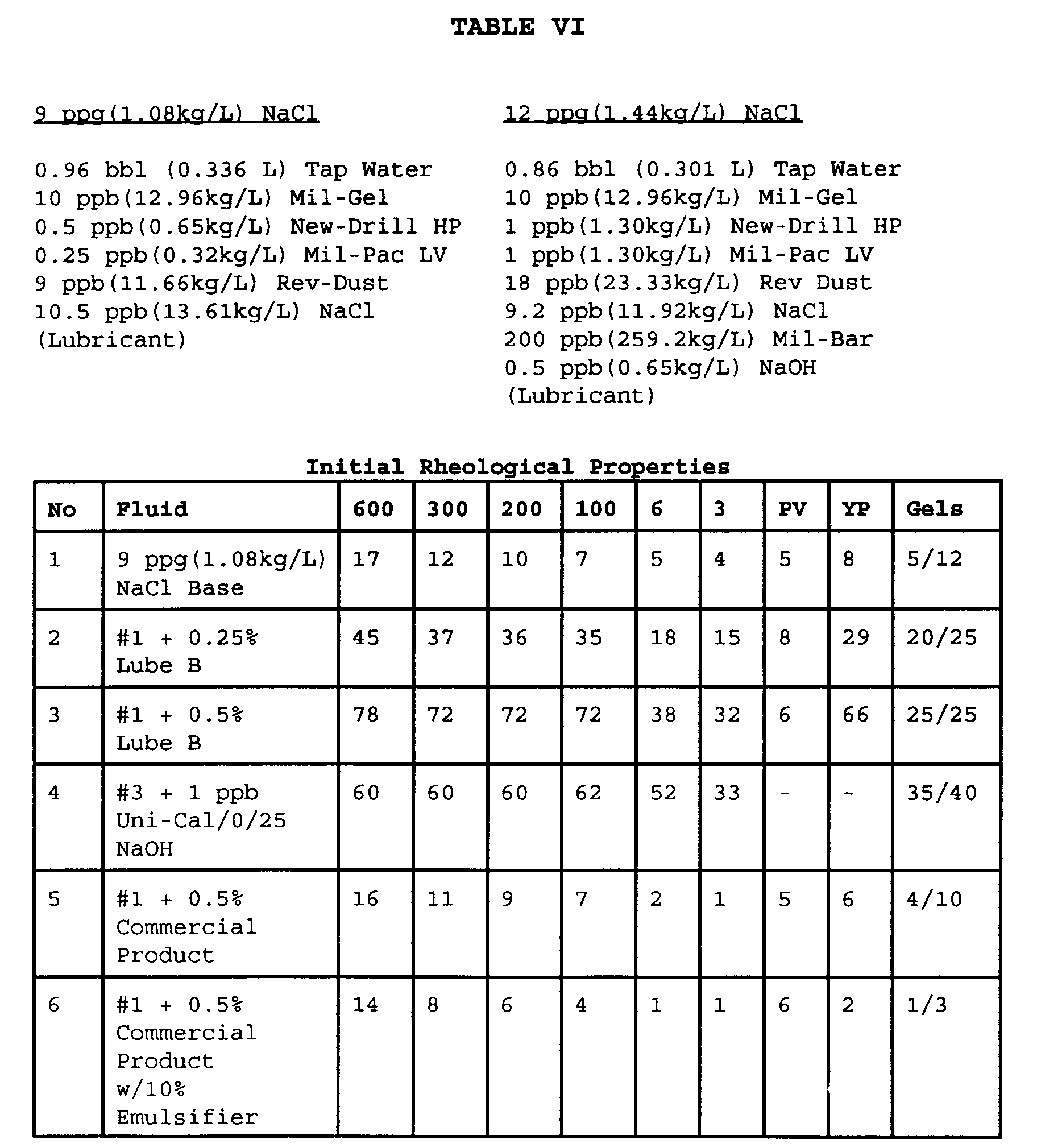
600, 300, etc are the rpm dial settings on the Fan 35 Rheometer, based on Bingham plastic model. PV is plastic viscosity in centipoise, YP is yield point in lbs/100ft2, and Gels is the gel strength (lbs/100ft²)at 3rpm after 10sec and 10 min.


- Experimental lubricant B was evaluated alongside commercial lubricants at a density of 15 ppg(1.80kg/L) in a lignosulfonate fluid. Additionally, lubricant B was evaluated with Mil-Lube in a 12 ppg(1.44kg/L) New-Drill fluid after hotrolling 16 hours at 250°F (121.1°C). Results are shown in Table VII below.


- This experiment compares the lubricity of erucic acid derivatives. As Table VIIIB shows, erucic acid derivatives reduce the lubricity coefficient as compared to deionized water.

The description given herein is intended to illustrate the preferred embodiments of the present invention. It is possible for one of ordinary skill in the art to make various changes to the details of the present invention, without departing from the spirit of this invention. Therefore, it is intended that all such variations be included within the scope of the present invention as claimed.
Claims (22)
- A method of increasing the lubricity of a well fluid, said method comprising contacting said fluid with a fatty acid or fatty acid derivative lubricating agent, with the proviso that where said lubricating agent does not comprise erucic acid or a derivative thereof said fluid is also contacted with an emulsifying agent.
- A method as claimed in Claim 1 wherein said fluid is also contacted with a non-water soluble alcohol.
- A method as claimed in either of Claims 1 and 2 wherein said fluid is also contacted with a hydrotrope.
- A method of lubricating drilling equipment during drilling, completion or workover of a subterranean well, said method comprising contacting said equipment with a lubricating agent, characterised in that said agent comprises a fatty acid or fatty acid derivative, with the proviso that where said lubricating agent does not comprise erucic acid or a derivative thereof said equipment is contacted with a composition comprising said lubricating agent and an emulsifying agent.
- A method as claimed in Claim 4 wherein said equipment is contacted with a lubricant composition comprising said lubricating agent and a non-water soluble alcohol.
- A method as claimed in either of Claims 4 and 5 wherein said equipment is contacted with a lubricant composition comprising said lubricating agent and a hydrotrope.
- A method as claimed in either of Claims 3 and 6 wherein said hydrotrope comprises a water-soluble sulfonated xylene salt.
- A method as claimed in any one of Claims 1 to 7 wherein said lubricating agent comprises erucic acid or a derivative thereof.
- A method as claimed in Claim 8 wherein said lubricating agent comprises at least one of the following:
erucic acid, high erucic acid rapeseed oil, oxidized high erucic acid rapeseed oil, sulfated high erucic acid rapeseed oil, sulfonated high erucic acid rapeseed oil, alkali metal erucates, alkaline earth erucates, transition metal erucates, glycerol and polyglycerol esters of erucic acid, sorbitol and sorbitan esters of erucic acid, erucic acid esters and diesters from polyethylene glycols, polyalkylene oxides and esters, erucic acid esters of water-insoluble and poorly water soluble alcohols, alkoxylated erucic acid, sulfurized high erucic acid rapeseed oil, phosphatized high erucic acid rapeseed oil, erucamide from alkanolamides, and polyglycol amine and diamine erucamides. - A method as claimed in Claim 9 wherein said lubricating agent is selected from the group of lubricating agents consisting of oxidized erucic acids, esters of erucic acids, sulfated erucic acids and sulphonated erucic acids.
- A method as claimed in Claim 9 wherein said lubricating agent is selected from the group of lubricating agents consisting of oxidized erucic acids and esters of erucic acids.
- A method as claimed in any one of Claims 1 to 9 wherein said fatty acid or derivative thereof is selected from octanoic, decanoic, dodecanoic, 9-dodecenoic(cis), tetradecanoic, 9-octadecenoic-12-hydroxy(cis), 9,12,15-octadecatrienoic(cis,cis,cis), 9,11,13-octadecatrienoic(cis,trans,trans), 9,11,13-octadecatrienoic-4-oxo(cis,trans,trans), octadecatetraenoic, eicosanoic, 11-eicosenoic(cis), eicosadienoic, eicosatrienoic, 5,8,11,14-eicosatetraenoic, eicosapentaenoic, docosanoic, 13-docosenoic(cis) docosatetraenoic, 4,8,12,15,19 docosapentaenoic, docosahexaenoic, tetracosenoic, 4,8,12,15,18,21-tetracosahexaenoic acids, mixtures thereof, and derivatives thereof.
- A well fluid additive composition comprising a fatty acid or derivative thereof and an emulsifying agent.
- An aqueous well fluid composition characterised in that it comprises a fatty acid or derivative thereof and an emulsifying agent.
- A composition as claimed in either of Claims 13 and 14 wherein said emulsifying agent is selected from the group consisting of sulfonated petroleum natural acid, sulfated soybean oil, long chain alcohols and complex amines.
- A composition as claimed in any one of Claims 13 to 15 wherein said fatty acid or derivative thereof is selected from the group consisting of octanoic, decanoic, dodecanoic, 9-dodecenoic(cis), tetradecanoic, 9-octadecenoic-12-hydroxy(cis), 9,12,15-octadecatrienoic(cis,cis,cis), 9,11,13-octadecatrienoic(cis,trans,trans), 9,11,13-octadecatrienoic-4-oxo(cis,trans,trans), octadecatetraenoic, eicosanoic, 11-eicosenoic(cis), eicosadienoic, eicosatrienoic, 5,8,11,14-eicosatetraenoic, eicosapentaenoic, docosanoic, 13-docosenoic(cis) docosatetraenoic, 4,8,12,15,19-docosapentaenoic, docosahexaenoic, tetracosenoic, 4,8,12,15,18,21-tetracosahexaenoic acids, mixtures thereof, and derivatives thereof.
- A composition as claimed in any one of Claims 13 to 16 wherein said fatty acid or derivative thereof is derived from the group of naturally occurring compounds comprising butter, lard, tallow, grease, herring, menhaden, pilchard, sardine, castor, coconut, corn, cottonseed, jojoba, linseed, liticica, olive, palm, palm kernel, peanut, rapeseed, safflower, soya, sunflower, tall, tung, mixtures thereof and derivatives thereof.
- A composition as claimed in any one of Claims 13 to 17 further comprising a water insoluble alcohol or derivative thereof.
- A composition as claimed in any one of Claims 13 to 18 comprising a said emulsifying agent selected from the group consisting of sulfonated petroleum natural acid, sulfated soybean oil, long chain alcohols and complex amines, and a said fatty acid or derivative thereof having a carbon chain length in the range of 8 to 30 carbon atoms, and further comprising a non-water soluble alcohol or derivative thereof selected from glyc3ols, glycerols, sorbitols or derivatives thereof.
- A composition as claimed in Claim 19 wherein said alcohol is selected from polypropylene glycol and polypropylene glycerol.
- The use of a lubricant fatty acid or fatty acid derivative as a well fluid additive.
- Use as claimed in Claim 21 of erucic acid or a derivative thereof.
Applications Claiming Priority (2)
| Application Number | Priority Date | Filing Date | Title |
|---|---|---|---|
| US15021793A | 1993-11-10 | 1993-11-10 | |
| US150217 | 1993-11-10 |
Publications (1)
| Publication Number | Publication Date |
|---|---|
| EP0652271A1 true EP0652271A1 (en) | 1995-05-10 |
Family
ID=22533551
Family Applications (1)
| Application Number | Title | Priority Date | Filing Date |
|---|---|---|---|
| EP94308305A Withdrawn EP0652271A1 (en) | 1993-11-10 | 1994-11-10 | Well fluid additive |
Country Status (3)
| Country | Link |
|---|---|
| EP (1) | EP0652271A1 (en) |
| AU (1) | AU7582494A (en) |
| NO (1) | NO943734L (en) |
Cited By (16)
| Publication number | Priority date | Publication date | Assignee | Title |
|---|---|---|---|---|
| WO1996040836A1 (en) * | 1995-06-07 | 1996-12-19 | Baker Hughes Incorporated | Method of making an anti-bit balling well fluid using a polyol having a cloud point, and method of drilling |
| WO1997010313A1 (en) * | 1995-09-11 | 1997-03-20 | M-I L.L.C. | Glycol based drilling fluid |
| US5977031A (en) * | 1996-08-02 | 1999-11-02 | M-I L.L.C. | Ester based invert emulsion drilling fluids and muds having negative alkalinity |
| GB2337067A (en) * | 1998-05-07 | 1999-11-10 | Baker Hughes Inc | Drilling, drill-in, or completion fluids |
| US5990050A (en) * | 1998-01-08 | 1999-11-23 | M-I L.L.C. | Water soluble invert emulsions |
| US6029755A (en) * | 1998-01-08 | 2000-02-29 | M-I L.L.C. | Conductive medium for openhole logging and logging while drilling |
| WO2000029502A1 (en) * | 1998-11-17 | 2000-05-25 | Cognis Deutschland Gmbh | Lubricants for drilling fluids |
| WO2001005916A1 (en) * | 1999-07-21 | 2001-01-25 | Dainippon Ink And Chemicals, Inc. | Extreme-pressure additive, process for producing the same, cutting fluid, and grinding fluid |
| US6308788B1 (en) | 1998-01-08 | 2001-10-30 | M-I Llc | Conductive medium for openhole logging and logging while drilling |
| US6405809B2 (en) | 1998-01-08 | 2002-06-18 | M-I Llc | Conductive medium for openhold logging and logging while drilling |
| US6589917B2 (en) | 1996-08-02 | 2003-07-08 | M-I Llc | Invert emulsion drilling fluids and muds having negative alkalinity and elastomer compatibility |
| US6793025B2 (en) | 1998-01-08 | 2004-09-21 | M-I L. L. C. | Double emulsion based drilling fluids |
| US6828279B2 (en) | 2001-08-10 | 2004-12-07 | M-I Llc | Biodegradable surfactant for invert emulsion drilling fluid |
| FR2953853A1 (en) * | 2009-12-15 | 2011-06-17 | Total Raffinage Marketing | BIODEGRADABLE LUBRICATING COMPOSITION AND ITS USE IN A DRILLING FLUID, IN PARTICULAR FOR VERY BURIED TANKS |
| WO2014102237A1 (en) * | 2012-12-28 | 2014-07-03 | Total Marketing Services | Biodegradable additive concentrate improving the lubricity of aqueous sludges, use thereof and aqueous sludge for drilling |
| CN118995177A (en) * | 2023-05-22 | 2024-11-22 | 中石化石油工程技术服务股份有限公司 | Suspension emulsion for fracturing fluid and preparation method thereof |
Citations (3)
| Publication number | Priority date | Publication date | Assignee | Title |
|---|---|---|---|---|
| GB2087952A (en) * | 1980-11-13 | 1982-06-03 | Fettchemie | An additive for drill flushing liquids |
| US4631136A (en) * | 1985-02-15 | 1986-12-23 | Jones Iii Reed W | Non-polluting non-toxic drilling fluid compositions and method of preparation |
| EP0453625A2 (en) * | 1990-04-27 | 1991-10-30 | Baker Hughes Incorporated | Drilling methods and composition of fluid therefor |
-
1994
- 1994-10-05 NO NO943734A patent/NO943734L/en unknown
- 1994-10-13 AU AU75824/94A patent/AU7582494A/en not_active Abandoned
- 1994-11-10 EP EP94308305A patent/EP0652271A1/en not_active Withdrawn
Patent Citations (3)
| Publication number | Priority date | Publication date | Assignee | Title |
|---|---|---|---|---|
| GB2087952A (en) * | 1980-11-13 | 1982-06-03 | Fettchemie | An additive for drill flushing liquids |
| US4631136A (en) * | 1985-02-15 | 1986-12-23 | Jones Iii Reed W | Non-polluting non-toxic drilling fluid compositions and method of preparation |
| EP0453625A2 (en) * | 1990-04-27 | 1991-10-30 | Baker Hughes Incorporated | Drilling methods and composition of fluid therefor |
Cited By (34)
| Publication number | Priority date | Publication date | Assignee | Title |
|---|---|---|---|---|
| GB2317633A (en) * | 1995-06-07 | 1998-04-01 | Baker Hughes Inc | Method of making an anti-bit balling well fluid using a polyol having a cloud point, and method of drilling |
| GB2317633B (en) * | 1995-06-07 | 1999-06-09 | Baker Hughes Inc | Method of making an anti-bit balling well fluid using a polyol having a cloud point, and method of drilling |
| WO1996040836A1 (en) * | 1995-06-07 | 1996-12-19 | Baker Hughes Incorporated | Method of making an anti-bit balling well fluid using a polyol having a cloud point, and method of drilling |
| WO1997010313A1 (en) * | 1995-09-11 | 1997-03-20 | M-I L.L.C. | Glycol based drilling fluid |
| US6291405B1 (en) | 1995-09-11 | 2001-09-18 | M-I Llc | Glycol based drilling fluid |
| US6589917B2 (en) | 1996-08-02 | 2003-07-08 | M-I Llc | Invert emulsion drilling fluids and muds having negative alkalinity and elastomer compatibility |
| US5977031A (en) * | 1996-08-02 | 1999-11-02 | M-I L.L.C. | Ester based invert emulsion drilling fluids and muds having negative alkalinity |
| US5990050A (en) * | 1998-01-08 | 1999-11-23 | M-I L.L.C. | Water soluble invert emulsions |
| US6793025B2 (en) | 1998-01-08 | 2004-09-21 | M-I L. L. C. | Double emulsion based drilling fluids |
| US6029755A (en) * | 1998-01-08 | 2000-02-29 | M-I L.L.C. | Conductive medium for openhole logging and logging while drilling |
| US6308788B1 (en) | 1998-01-08 | 2001-10-30 | M-I Llc | Conductive medium for openhole logging and logging while drilling |
| US6405809B2 (en) | 1998-01-08 | 2002-06-18 | M-I Llc | Conductive medium for openhold logging and logging while drilling |
| US6054416A (en) * | 1998-05-07 | 2000-04-25 | Baker Hughes Incorporated | Drilling fluids comprising biodegradable heteropolyglycols |
| GB2337067B (en) * | 1998-05-07 | 2000-12-06 | Baker Hughes Inc | Drilling, drill-in, or completion fluids |
| GB2337067A (en) * | 1998-05-07 | 1999-11-10 | Baker Hughes Inc | Drilling, drill-in, or completion fluids |
| AU756915B2 (en) * | 1998-11-17 | 2003-01-23 | Cognis Deutschland Gmbh & Co. Kg | Lubricants for drilling fluids |
| WO2000029502A1 (en) * | 1998-11-17 | 2000-05-25 | Cognis Deutschland Gmbh | Lubricants for drilling fluids |
| US6806235B1 (en) | 1998-11-17 | 2004-10-19 | Cognis Deutschland Gmbh & Co. Kg | Lubricants for drilling fluids |
| US6413917B1 (en) | 1999-07-21 | 2002-07-02 | Dainippon Ink And Chemicals, Inc. | Extreme-pressure additive, process for producing the same, cutting fluid, and grinding fluid |
| WO2001005916A1 (en) * | 1999-07-21 | 2001-01-25 | Dainippon Ink And Chemicals, Inc. | Extreme-pressure additive, process for producing the same, cutting fluid, and grinding fluid |
| US6828279B2 (en) | 2001-08-10 | 2004-12-07 | M-I Llc | Biodegradable surfactant for invert emulsion drilling fluid |
| AU2010331833B2 (en) * | 2009-12-15 | 2016-02-18 | Total Raffinage Marketing | Biodegradable lubricating composition and use thereof in a drilling fluid, in particular for very deep reservoirs |
| WO2011073893A1 (en) * | 2009-12-15 | 2011-06-23 | Total Raffinage Marketing | Biodegradable lubricating composition and use thereof in a drilling fluid, in particular for very deep reservoirs |
| US8846583B2 (en) | 2009-12-15 | 2014-09-30 | Total Marketing Services | Biodegradable lubricating composition and use thereof in a drilling fluid, in particular for very deep reservoirs |
| EA022187B1 (en) * | 2009-12-15 | 2015-11-30 | Тоталь Рафинаж Маркетинг | Biodegradable lubricating composition and use thereof in a drilling fluid, in particular for very deep reservoirs |
| FR2953853A1 (en) * | 2009-12-15 | 2011-06-17 | Total Raffinage Marketing | BIODEGRADABLE LUBRICATING COMPOSITION AND ITS USE IN A DRILLING FLUID, IN PARTICULAR FOR VERY BURIED TANKS |
| AP3605A (en) * | 2009-12-15 | 2016-02-25 | Total Raffinage Marketing | Biodegradable lubricating composition and use thereof in a drilling fluid, in particular for very deep reservoirs |
| WO2014102237A1 (en) * | 2012-12-28 | 2014-07-03 | Total Marketing Services | Biodegradable additive concentrate improving the lubricity of aqueous sludges, use thereof and aqueous sludge for drilling |
| FR3000497A1 (en) * | 2012-12-28 | 2014-07-04 | Total Raffinage Marketing | BIODEGRADABLE ADDITIVE CONCENTRATE IMPROVING THE SLUDGE OF WATER SLUDGE, ITS USE AND WATER SLUDGE FOR DRILLING |
| CN104884567A (en) * | 2012-12-28 | 2015-09-02 | 道达尔销售服务公司 | Biodegradable additive concentrate improving the lubricity of aqueous sludges, use thereof and aqueous sludge for drilling |
| US9719006B2 (en) | 2012-12-28 | 2017-08-01 | Total Marketing Services | Biodegradable additive concentrate improving the lubricity of aqueous sludges, use thereof and aqueous sludge for drilling |
| EA033636B1 (en) * | 2012-12-28 | 2019-11-12 | Total Marketing Services | Biodegradable additive concentrate improving the lubricity of aqueous sludges, use thereof and aqueous sludge for drilling |
| CN118995177A (en) * | 2023-05-22 | 2024-11-22 | 中石化石油工程技术服务股份有限公司 | Suspension emulsion for fracturing fluid and preparation method thereof |
| CN118995177B (en) * | 2023-05-22 | 2025-10-03 | 中石化石油工程技术服务股份有限公司 | A suspension emulsion for fracturing fluid and preparation method thereof |
Also Published As
| Publication number | Publication date |
|---|---|
| NO943734L (en) | 1995-05-11 |
| AU7582494A (en) | 1995-05-18 |
| NO943734D0 (en) | 1994-10-05 |
Similar Documents
| Publication | Publication Date | Title |
|---|---|---|
| EP0453625B1 (en) | Drilling methods and composition of fluid therefor | |
| EP0764711B1 (en) | Oil based synthetic hydrocarbon drilling fluid | |
| DK1346006T3 (en) | Thinners for drilling fluids with the inverse emulsion | |
| US5869434A (en) | Free-flowing borehole servicing preparations containing linear α-olefins, more patricularly corresponding drilling fluids | |
| US6806235B1 (en) | Lubricants for drilling fluids | |
| CA2767426C (en) | Emulsion stabilizing agents for drilling and completion fluids | |
| EP2207862B1 (en) | Drilling composition, process for its preparation, and applications thereof | |
| EP0652271A1 (en) | Well fluid additive | |
| AU2003277848B2 (en) | Borehole treatment agent containing low toxic oil phase | |
| US5099930A (en) | Drilling fluid methods and composition | |
| US5586608A (en) | Method of making an anti-bit balling well fluid using a polyol having a cloud point, and method of drilling | |
| GB2301853A (en) | Well fluid | |
| AU654007B2 (en) | Use of acetals | |
| CA2432520A1 (en) | Invert emulsion drilling fluids and muds having negative alkalinity and elastomer compatibility | |
| JPH04503966A (en) | Esters of medium chain length carboxylic acids as components of the oil phase in invert drilling muds | |
| EP0652272A1 (en) | Glycols as internal phase in oil well drilling fluids | |
| EP1846531B1 (en) | Spotting fluid compositions and associated methods | |
| EP3668942A1 (en) | Oil-based drilling fluids for high pressure and high temperature drilling operations | |
| EP2319895A1 (en) | Spotting fluid compositions and associated methods | |
| WO2009127589A1 (en) | Drilling and well treatment fluids | |
| AU704257B2 (en) | Use of acetal-containing mixtures | |
| EP3911712B1 (en) | Method of drilling a wellbore |
Legal Events
| Date | Code | Title | Description |
|---|---|---|---|
| PUAI | Public reference made under article 153(3) epc to a published international application that has entered the european phase |
Free format text: ORIGINAL CODE: 0009012 |
|
| AK | Designated contracting states |
Kind code of ref document: A1 Designated state(s): AT BE CH DE DK ES FR GB GR IE IT LI LU MC NL PT SE |
|
| RAX | Requested extension states of the european patent have changed |
Free format text: LT PAYMENT 941126;SI PAYMENT 941126 |
|
| 17P | Request for examination filed |
Effective date: 19951103 |
|
| STAA | Information on the status of an ep patent application or granted ep patent |
Free format text: STATUS: THE APPLICATION HAS BEEN WITHDRAWN |
|
| 18W | Application withdrawn |
Withdrawal date: 19961120 |