EP0623168B1 - T cell epitopes of the major allergens from dermatophagoides (house dust mite) - Google Patents
T cell epitopes of the major allergens from dermatophagoides (house dust mite) Download PDFInfo
- Publication number
- EP0623168B1 EP0623168B1 EP92922076A EP92922076A EP0623168B1 EP 0623168 B1 EP0623168 B1 EP 0623168B1 EP 92922076 A EP92922076 A EP 92922076A EP 92922076 A EP92922076 A EP 92922076A EP 0623168 B1 EP0623168 B1 EP 0623168B1
- Authority
- EP
- European Patent Office
- Prior art keywords
- seq
- peptide
- der
- amino acid
- peptides
- Prior art date
- Legal status (The legal status is an assumption and is not a legal conclusion. Google has not performed a legal analysis and makes no representation as to the accuracy of the status listed.)
- Expired - Lifetime
Links
- 210000001744 T-lymphocyte Anatomy 0.000 title claims abstract description 208
- 239000013566 allergen Substances 0.000 title claims abstract description 180
- 241000238710 Dermatophagoides Species 0.000 title claims abstract description 28
- 239000000428 dust Substances 0.000 title claims description 41
- 108090000765 processed proteins & peptides Proteins 0.000 claims abstract description 476
- 102000004196 processed proteins & peptides Human genes 0.000 claims abstract description 215
- 108090000623 proteins and genes Proteins 0.000 claims abstract description 141
- 102000004169 proteins and genes Human genes 0.000 claims abstract description 135
- 239000000203 mixture Substances 0.000 claims abstract description 35
- 238000000034 method Methods 0.000 claims abstract description 24
- 230000001225 therapeutic effect Effects 0.000 claims abstract description 21
- 150000007523 nucleic acids Chemical group 0.000 claims abstract description 16
- 230000035945 sensitivity Effects 0.000 claims abstract description 11
- 125000000539 amino acid group Chemical group 0.000 claims description 53
- 230000000638 stimulation Effects 0.000 claims description 45
- 125000003275 alpha amino acid group Chemical group 0.000 claims description 37
- 230000027455 binding Effects 0.000 claims description 32
- 208000026935 allergic disease Diseases 0.000 claims description 27
- 108060003951 Immunoglobulin Proteins 0.000 claims description 17
- 210000004027 cell Anatomy 0.000 claims description 17
- 102000018358 immunoglobulin Human genes 0.000 claims description 17
- 210000003651 basophil Anatomy 0.000 claims description 10
- 210000003630 histaminocyte Anatomy 0.000 claims description 10
- 108020004707 nucleic acids Proteins 0.000 claims description 10
- 102000039446 nucleic acids Human genes 0.000 claims description 10
- 238000004519 manufacturing process Methods 0.000 claims description 9
- 239000003085 diluting agent Substances 0.000 claims description 6
- 239000003814 drug Substances 0.000 claims description 6
- 239000003937 drug carrier Substances 0.000 claims description 5
- 230000006052 T cell proliferation Effects 0.000 claims description 3
- 108091008874 T cell receptors Proteins 0.000 claims description 2
- 102000016266 T-Cell Antigen Receptors Human genes 0.000 claims description 2
- 210000004369 blood Anatomy 0.000 claims description 2
- 239000008280 blood Substances 0.000 claims description 2
- 239000012503 blood component Substances 0.000 claims description 2
- 230000003915 cell function Effects 0.000 claims description 2
- 235000018102 proteins Nutrition 0.000 claims 22
- WHUUTDBJXJRKMK-UHFFFAOYSA-N Glutamic acid Chemical group OC(=O)C(N)CCC(O)=O WHUUTDBJXJRKMK-UHFFFAOYSA-N 0.000 claims 1
- WHUUTDBJXJRKMK-VKHMYHEASA-N L-glutamic acid Chemical group OC(=O)[C@@H](N)CCC(O)=O WHUUTDBJXJRKMK-VKHMYHEASA-N 0.000 claims 1
- 235000004279 alanine Nutrition 0.000 claims 1
- 125000003295 alanine group Chemical group N[C@@H](C)C(=O)* 0.000 claims 1
- 235000001014 amino acid Nutrition 0.000 claims 1
- 235000013922 glutamic acid Nutrition 0.000 claims 1
- 239000004220 glutamic acid Chemical group 0.000 claims 1
- 125000000250 methylamino group Chemical group [H]N(*)C([H])([H])[H] 0.000 claims 1
- 108010061629 Dermatophagoides pteronyssinus antigen p 1 Proteins 0.000 abstract description 126
- 108010061608 Dermatophagoides pteronyssinus antigen p 2 Proteins 0.000 abstract description 95
- 108010055622 Dermatophagoides farinae antigen f 1 Proteins 0.000 abstract description 92
- 229960004784 allergens Drugs 0.000 abstract description 72
- 108091005601 modified peptides Proteins 0.000 abstract description 6
- 230000002829 reductive effect Effects 0.000 abstract description 5
- 230000000694 effects Effects 0.000 abstract description 4
- 241000238711 Pyroglyphidae Species 0.000 abstract description 2
- 238000003745 diagnosis Methods 0.000 abstract description 2
- 229940046533 house dust mites Drugs 0.000 abstract description 2
- 238000011282 treatment Methods 0.000 abstract description 2
- 229940024606 amino acid Drugs 0.000 description 239
- 150000001413 amino acids Chemical class 0.000 description 239
- 239000012634 fragment Substances 0.000 description 124
- 230000004044 response Effects 0.000 description 120
- 238000000338 in vitro Methods 0.000 description 31
- 230000009257 reactivity Effects 0.000 description 26
- 238000002474 experimental method Methods 0.000 description 24
- 206010020751 Hypersensitivity Diseases 0.000 description 21
- 230000007815 allergy Effects 0.000 description 20
- 239000002299 complementary DNA Substances 0.000 description 20
- 230000014509 gene expression Effects 0.000 description 20
- 239000000427 antigen Substances 0.000 description 19
- 108091007433 antigens Proteins 0.000 description 19
- 102000036639 antigens Human genes 0.000 description 19
- WEVYAHXRMPXWCK-UHFFFAOYSA-N Acetonitrile Chemical compound CC#N WEVYAHXRMPXWCK-UHFFFAOYSA-N 0.000 description 15
- 210000003819 peripheral blood mononuclear cell Anatomy 0.000 description 15
- 230000005867 T cell response Effects 0.000 description 14
- 208000010668 atopic eczema Diseases 0.000 description 13
- 230000009260 cross reactivity Effects 0.000 description 12
- 239000013598 vector Substances 0.000 description 12
- 108020004635 Complementary DNA Proteins 0.000 description 10
- 210000000612 antigen-presenting cell Anatomy 0.000 description 10
- FAPWRFPIFSIZLT-UHFFFAOYSA-M Sodium chloride Chemical compound [Na+].[Cl-] FAPWRFPIFSIZLT-UHFFFAOYSA-M 0.000 description 9
- LOKCTEFSRHRXRJ-UHFFFAOYSA-I dipotassium trisodium dihydrogen phosphate hydrogen phosphate dichloride Chemical compound P(=O)(O)(O)[O-].[K+].P(=O)(O)([O-])[O-].[Na+].[Na+].[Cl-].[K+].[Cl-].[Na+] LOKCTEFSRHRXRJ-UHFFFAOYSA-I 0.000 description 9
- 239000002953 phosphate buffered saline Substances 0.000 description 9
- 230000004936 stimulating effect Effects 0.000 description 9
- 230000000172 allergic effect Effects 0.000 description 8
- 208000024891 symptom Diseases 0.000 description 8
- 241000894006 Bacteria Species 0.000 description 7
- 241000238713 Dermatophagoides farinae Species 0.000 description 7
- 241000238740 Dermatophagoides pteronyssinus Species 0.000 description 7
- 108091028043 Nucleic acid sequence Proteins 0.000 description 7
- 102000007056 Recombinant Fusion Proteins Human genes 0.000 description 7
- 108010008281 Recombinant Fusion Proteins Proteins 0.000 description 7
- 239000013612 plasmid Substances 0.000 description 7
- 108020004414 DNA Proteins 0.000 description 6
- 239000007983 Tris buffer Substances 0.000 description 6
- XSQUKJJJFZCRTK-UHFFFAOYSA-N Urea Chemical compound NC(N)=O XSQUKJJJFZCRTK-UHFFFAOYSA-N 0.000 description 6
- 238000003556 assay Methods 0.000 description 6
- 238000005119 centrifugation Methods 0.000 description 6
- 238000003776 cleavage reaction Methods 0.000 description 6
- 230000002255 enzymatic effect Effects 0.000 description 6
- 239000013604 expression vector Substances 0.000 description 6
- 238000000746 purification Methods 0.000 description 6
- 230000007017 scission Effects 0.000 description 6
- LENZDBCJOHFCAS-UHFFFAOYSA-N tris Chemical compound OCC(N)(CO)CO LENZDBCJOHFCAS-UHFFFAOYSA-N 0.000 description 6
- 108091034117 Oligonucleotide Proteins 0.000 description 5
- ISAKRJDGNUQOIC-UHFFFAOYSA-N Uracil Chemical compound O=C1C=CNC(=O)N1 ISAKRJDGNUQOIC-UHFFFAOYSA-N 0.000 description 5
- 210000003719 b-lymphocyte Anatomy 0.000 description 5
- 238000001516 cell proliferation assay Methods 0.000 description 5
- 238000013507 mapping Methods 0.000 description 5
- 239000002609 medium Substances 0.000 description 5
- 239000002773 nucleotide Substances 0.000 description 5
- 125000003729 nucleotide group Chemical group 0.000 description 5
- 239000000047 product Substances 0.000 description 5
- -1 promoters Substances 0.000 description 5
- 239000011780 sodium chloride Substances 0.000 description 5
- 239000000126 substance Substances 0.000 description 5
- 238000012286 ELISA Assay Methods 0.000 description 4
- 241000588724 Escherichia coli Species 0.000 description 4
- NTYJJOPFIAHURM-UHFFFAOYSA-N Histamine Chemical compound NCCC1=CN=CN1 NTYJJOPFIAHURM-UHFFFAOYSA-N 0.000 description 4
- 241000701044 Human gammaherpesvirus 4 Species 0.000 description 4
- 239000012980 RPMI-1640 medium Substances 0.000 description 4
- 230000017274 T cell anergy Effects 0.000 description 4
- IQFYYKKMVGJFEH-XLPZGREQSA-N Thymidine Chemical compound O=C1NC(=O)C(C)=CN1[C@@H]1O[C@H](CO)[C@@H](O)C1 IQFYYKKMVGJFEH-XLPZGREQSA-N 0.000 description 4
- AVKUERGKIZMTKX-NJBDSQKTSA-N ampicillin Chemical compound C1([C@@H](N)C(=O)N[C@H]2[C@H]3SC([C@@H](N3C2=O)C(O)=O)(C)C)=CC=CC=C1 AVKUERGKIZMTKX-NJBDSQKTSA-N 0.000 description 4
- 229960000723 ampicillin Drugs 0.000 description 4
- 238000004458 analytical method Methods 0.000 description 4
- 208000003455 anaphylaxis Diseases 0.000 description 4
- 239000011248 coating agent Substances 0.000 description 4
- 238000000576 coating method Methods 0.000 description 4
- 230000028993 immune response Effects 0.000 description 4
- 238000012986 modification Methods 0.000 description 4
- 230000004048 modification Effects 0.000 description 4
- 102000054765 polymorphisms of proteins Human genes 0.000 description 4
- 238000002360 preparation method Methods 0.000 description 4
- 230000035755 proliferation Effects 0.000 description 4
- 238000000159 protein binding assay Methods 0.000 description 4
- 238000004007 reversed phase HPLC Methods 0.000 description 4
- 230000028327 secretion Effects 0.000 description 4
- 210000002966 serum Anatomy 0.000 description 4
- 210000003491 skin Anatomy 0.000 description 4
- 238000012360 testing method Methods 0.000 description 4
- IQFYYKKMVGJFEH-OFKYTIFKSA-N 1-[(2r,4s,5r)-4-hydroxy-5-(tritiooxymethyl)oxolan-2-yl]-5-methylpyrimidine-2,4-dione Chemical compound C1[C@H](O)[C@@H](CO[3H])O[C@H]1N1C(=O)NC(=O)C(C)=C1 IQFYYKKMVGJFEH-OFKYTIFKSA-N 0.000 description 3
- 206010002198 Anaphylactic reaction Diseases 0.000 description 3
- 241000238631 Hexapoda Species 0.000 description 3
- 240000004808 Saccharomyces cerevisiae Species 0.000 description 3
- HEMHJVSKTPXQMS-UHFFFAOYSA-M Sodium hydroxide Chemical compound [OH-].[Na+] HEMHJVSKTPXQMS-UHFFFAOYSA-M 0.000 description 3
- 230000036783 anaphylactic response Effects 0.000 description 3
- 239000004202 carbamide Substances 0.000 description 3
- 238000010366 cell biology technique Methods 0.000 description 3
- 239000002131 composite material Substances 0.000 description 3
- 230000001186 cumulative effect Effects 0.000 description 3
- 238000010790 dilution Methods 0.000 description 3
- 239000012895 dilution Substances 0.000 description 3
- 229940079593 drug Drugs 0.000 description 3
- 108020001507 fusion proteins Proteins 0.000 description 3
- 102000037865 fusion proteins Human genes 0.000 description 3
- 239000001963 growth medium Substances 0.000 description 3
- 229960004198 guanidine Drugs 0.000 description 3
- PJJJBBJSCAKJQF-UHFFFAOYSA-N guanidinium chloride Chemical compound [Cl-].NC(N)=[NH2+] PJJJBBJSCAKJQF-UHFFFAOYSA-N 0.000 description 3
- 238000009169 immunotherapy Methods 0.000 description 3
- BPHPUYQFMNQIOC-NXRLNHOXSA-N isopropyl beta-D-thiogalactopyranoside Chemical compound CC(C)S[C@@H]1O[C@H](CO)[C@H](O)[C@H](O)[C@H]1O BPHPUYQFMNQIOC-NXRLNHOXSA-N 0.000 description 3
- 125000002924 primary amino group Chemical group [H]N([H])* 0.000 description 3
- 230000000284 resting effect Effects 0.000 description 3
- 239000000243 solution Substances 0.000 description 3
- 238000003786 synthesis reaction Methods 0.000 description 3
- 241000701447 unidentified baculovirus Species 0.000 description 3
- 241000238876 Acari Species 0.000 description 2
- 229920001817 Agar Polymers 0.000 description 2
- 229920000936 Agarose Polymers 0.000 description 2
- 244000036975 Ambrosia artemisiifolia Species 0.000 description 2
- 235000003129 Ambrosia artemisiifolia var elatior Nutrition 0.000 description 2
- 206010003645 Atopy Diseases 0.000 description 2
- 241000701867 Enterobacteria phage T7 Species 0.000 description 2
- DHMQDGOQFOQNFH-UHFFFAOYSA-N Glycine Chemical compound NCC(O)=O DHMQDGOQFOQNFH-UHFFFAOYSA-N 0.000 description 2
- 108010002350 Interleukin-2 Proteins 0.000 description 2
- 108090000978 Interleukin-4 Proteins 0.000 description 2
- 102000004388 Interleukin-4 Human genes 0.000 description 2
- 238000012408 PCR amplification Methods 0.000 description 2
- NBIIXXVUZAFLBC-UHFFFAOYSA-N Phosphoric acid Chemical compound OP(O)(O)=O NBIIXXVUZAFLBC-UHFFFAOYSA-N 0.000 description 2
- 229920001213 Polysorbate 20 Polymers 0.000 description 2
- 108020004511 Recombinant DNA Proteins 0.000 description 2
- 238000012300 Sequence Analysis Methods 0.000 description 2
- 108010022999 Serine Proteases Proteins 0.000 description 2
- 102000012479 Serine Proteases Human genes 0.000 description 2
- VMHLLURERBWHNL-UHFFFAOYSA-M Sodium acetate Chemical compound [Na+].CC([O-])=O VMHLLURERBWHNL-UHFFFAOYSA-M 0.000 description 2
- UIIMBOGNXHQVGW-UHFFFAOYSA-M Sodium bicarbonate Chemical compound [Na+].OC([O-])=O UIIMBOGNXHQVGW-UHFFFAOYSA-M 0.000 description 2
- 101710137500 T7 RNA polymerase Proteins 0.000 description 2
- JLCPHMBAVCMARE-UHFFFAOYSA-N [3-[[3-[[3-[[3-[[3-[[3-[[3-[[3-[[3-[[3-[[3-[[5-(2-amino-6-oxo-1H-purin-9-yl)-3-[[3-[[3-[[3-[[3-[[3-[[5-(2-amino-6-oxo-1H-purin-9-yl)-3-[[5-(2-amino-6-oxo-1H-purin-9-yl)-3-hydroxyoxolan-2-yl]methoxy-hydroxyphosphoryl]oxyoxolan-2-yl]methoxy-hydroxyphosphoryl]oxy-5-(5-methyl-2,4-dioxopyrimidin-1-yl)oxolan-2-yl]methoxy-hydroxyphosphoryl]oxy-5-(6-aminopurin-9-yl)oxolan-2-yl]methoxy-hydroxyphosphoryl]oxy-5-(6-aminopurin-9-yl)oxolan-2-yl]methoxy-hydroxyphosphoryl]oxy-5-(6-aminopurin-9-yl)oxolan-2-yl]methoxy-hydroxyphosphoryl]oxy-5-(6-aminopurin-9-yl)oxolan-2-yl]methoxy-hydroxyphosphoryl]oxyoxolan-2-yl]methoxy-hydroxyphosphoryl]oxy-5-(5-methyl-2,4-dioxopyrimidin-1-yl)oxolan-2-yl]methoxy-hydroxyphosphoryl]oxy-5-(4-amino-2-oxopyrimidin-1-yl)oxolan-2-yl]methoxy-hydroxyphosphoryl]oxy-5-(5-methyl-2,4-dioxopyrimidin-1-yl)oxolan-2-yl]methoxy-hydroxyphosphoryl]oxy-5-(5-methyl-2,4-dioxopyrimidin-1-yl)oxolan-2-yl]methoxy-hydroxyphosphoryl]oxy-5-(6-aminopurin-9-yl)oxolan-2-yl]methoxy-hydroxyphosphoryl]oxy-5-(6-aminopurin-9-yl)oxolan-2-yl]methoxy-hydroxyphosphoryl]oxy-5-(4-amino-2-oxopyrimidin-1-yl)oxolan-2-yl]methoxy-hydroxyphosphoryl]oxy-5-(4-amino-2-oxopyrimidin-1-yl)oxolan-2-yl]methoxy-hydroxyphosphoryl]oxy-5-(4-amino-2-oxopyrimidin-1-yl)oxolan-2-yl]methoxy-hydroxyphosphoryl]oxy-5-(6-aminopurin-9-yl)oxolan-2-yl]methoxy-hydroxyphosphoryl]oxy-5-(4-amino-2-oxopyrimidin-1-yl)oxolan-2-yl]methyl [5-(6-aminopurin-9-yl)-2-(hydroxymethyl)oxolan-3-yl] hydrogen phosphate Polymers Cc1cn(C2CC(OP(O)(=O)OCC3OC(CC3OP(O)(=O)OCC3OC(CC3O)n3cnc4c3nc(N)[nH]c4=O)n3cnc4c3nc(N)[nH]c4=O)C(COP(O)(=O)OC3CC(OC3COP(O)(=O)OC3CC(OC3COP(O)(=O)OC3CC(OC3COP(O)(=O)OC3CC(OC3COP(O)(=O)OC3CC(OC3COP(O)(=O)OC3CC(OC3COP(O)(=O)OC3CC(OC3COP(O)(=O)OC3CC(OC3COP(O)(=O)OC3CC(OC3COP(O)(=O)OC3CC(OC3COP(O)(=O)OC3CC(OC3COP(O)(=O)OC3CC(OC3COP(O)(=O)OC3CC(OC3COP(O)(=O)OC3CC(OC3COP(O)(=O)OC3CC(OC3COP(O)(=O)OC3CC(OC3COP(O)(=O)OC3CC(OC3CO)n3cnc4c(N)ncnc34)n3ccc(N)nc3=O)n3cnc4c(N)ncnc34)n3ccc(N)nc3=O)n3ccc(N)nc3=O)n3ccc(N)nc3=O)n3cnc4c(N)ncnc34)n3cnc4c(N)ncnc34)n3cc(C)c(=O)[nH]c3=O)n3cc(C)c(=O)[nH]c3=O)n3ccc(N)nc3=O)n3cc(C)c(=O)[nH]c3=O)n3cnc4c3nc(N)[nH]c4=O)n3cnc4c(N)ncnc34)n3cnc4c(N)ncnc34)n3cnc4c(N)ncnc34)n3cnc4c(N)ncnc34)O2)c(=O)[nH]c1=O JLCPHMBAVCMARE-UHFFFAOYSA-N 0.000 description 2
- 238000002835 absorbance Methods 0.000 description 2
- 239000002671 adjuvant Substances 0.000 description 2
- 239000008272 agar Substances 0.000 description 2
- 208000006673 asthma Diseases 0.000 description 2
- 230000015572 biosynthetic process Effects 0.000 description 2
- 210000004556 brain Anatomy 0.000 description 2
- 210000004899 c-terminal region Anatomy 0.000 description 2
- 238000006243 chemical reaction Methods 0.000 description 2
- 239000003153 chemical reaction reagent Substances 0.000 description 2
- 239000003795 chemical substances by application Substances 0.000 description 2
- 210000004978 chinese hamster ovary cell Anatomy 0.000 description 2
- 238000004587 chromatography analysis Methods 0.000 description 2
- 230000000295 complement effect Effects 0.000 description 2
- 238000012217 deletion Methods 0.000 description 2
- 230000037430 deletion Effects 0.000 description 2
- 238000000502 dialysis Methods 0.000 description 2
- 230000029087 digestion Effects 0.000 description 2
- 239000003623 enhancer Substances 0.000 description 2
- 230000004927 fusion Effects 0.000 description 2
- 239000003365 glass fiber Substances 0.000 description 2
- 210000002443 helper t lymphocyte Anatomy 0.000 description 2
- 229960001340 histamine Drugs 0.000 description 2
- 230000006698 induction Effects 0.000 description 2
- 230000001939 inductive effect Effects 0.000 description 2
- 238000001802 infusion Methods 0.000 description 2
- 238000005567 liquid scintillation counting Methods 0.000 description 2
- 238000012423 maintenance Methods 0.000 description 2
- 230000014759 maintenance of location Effects 0.000 description 2
- 210000004962 mammalian cell Anatomy 0.000 description 2
- 239000000463 material Substances 0.000 description 2
- 230000001404 mediated effect Effects 0.000 description 2
- 231100000219 mutagenic Toxicity 0.000 description 2
- 230000003505 mutagenic effect Effects 0.000 description 2
- 229940046166 oligodeoxynucleotide Drugs 0.000 description 2
- 238000010647 peptide synthesis reaction Methods 0.000 description 2
- 210000005259 peripheral blood Anatomy 0.000 description 2
- 239000011886 peripheral blood Substances 0.000 description 2
- 235000020030 perry Nutrition 0.000 description 2
- 239000000256 polyoxyethylene sorbitan monolaurate Substances 0.000 description 2
- 230000022532 regulation of transcription, DNA-dependent Effects 0.000 description 2
- 229920006395 saturated elastomer Polymers 0.000 description 2
- QZAYGJVTTNCVMB-UHFFFAOYSA-N serotonin Chemical compound C1=C(O)C=C2C(CCN)=CNC2=C1 QZAYGJVTTNCVMB-UHFFFAOYSA-N 0.000 description 2
- 238000002415 sodium dodecyl sulfate polyacrylamide gel electrophoresis Methods 0.000 description 2
- 241000894007 species Species 0.000 description 2
- UCSJYZPVAKXKNQ-HZYVHMACSA-N streptomycin Chemical compound CN[C@H]1[C@H](O)[C@@H](O)[C@H](CO)O[C@H]1O[C@@H]1[C@](C=O)(O)[C@H](C)O[C@H]1O[C@@H]1[C@@H](NC(N)=N)[C@H](O)[C@@H](NC(N)=N)[C@H](O)[C@H]1O UCSJYZPVAKXKNQ-HZYVHMACSA-N 0.000 description 2
- 239000006228 supernatant Substances 0.000 description 2
- 238000011285 therapeutic regimen Methods 0.000 description 2
- 229940035893 uracil Drugs 0.000 description 2
- DGVVWUTYPXICAM-UHFFFAOYSA-N β‐Mercaptoethanol Chemical compound OCCS DGVVWUTYPXICAM-UHFFFAOYSA-N 0.000 description 2
- 125000003088 (fluoren-9-ylmethoxy)carbonyl group Chemical group 0.000 description 1
- OWEGMIWEEQEYGQ-UHFFFAOYSA-N 100676-05-9 Natural products OC1C(O)C(O)C(CO)OC1OCC1C(O)C(O)C(O)C(OC2C(OC(O)C(O)C2O)CO)O1 OWEGMIWEEQEYGQ-UHFFFAOYSA-N 0.000 description 1
- JKMHFZQWWAIEOD-UHFFFAOYSA-N 2-[4-(2-hydroxyethyl)piperazin-1-yl]ethanesulfonic acid Chemical compound OCC[NH+]1CCN(CCS([O-])(=O)=O)CC1 JKMHFZQWWAIEOD-UHFFFAOYSA-N 0.000 description 1
- ZHQQRIUYLMXDPP-SSDOTTSWSA-N Actinidine Natural products C1=NC=C(C)C2=C1[C@H](C)CC2 ZHQQRIUYLMXDPP-SSDOTTSWSA-N 0.000 description 1
- 206010003445 Ascites Diseases 0.000 description 1
- 108010077805 Bacterial Proteins Proteins 0.000 description 1
- DWRXFEITVBNRMK-UHFFFAOYSA-N Beta-D-1-Arabinofuranosylthymine Natural products O=C1NC(=O)C(C)=CN1C1C(O)C(O)C(CO)O1 DWRXFEITVBNRMK-UHFFFAOYSA-N 0.000 description 1
- 241000283707 Capra Species 0.000 description 1
- 102000014914 Carrier Proteins Human genes 0.000 description 1
- 108010078791 Carrier Proteins Proteins 0.000 description 1
- 108091026890 Coding region Proteins 0.000 description 1
- 102000053602 DNA Human genes 0.000 description 1
- 102000012410 DNA Ligases Human genes 0.000 description 1
- 108010061982 DNA Ligases Proteins 0.000 description 1
- 230000004543 DNA replication Effects 0.000 description 1
- 238000001712 DNA sequencing Methods 0.000 description 1
- 102000016928 DNA-directed DNA polymerase Human genes 0.000 description 1
- 108010014303 DNA-directed DNA polymerase Proteins 0.000 description 1
- 206010011878 Deafness Diseases 0.000 description 1
- 201000004624 Dermatitis Diseases 0.000 description 1
- 238000002965 ELISA Methods 0.000 description 1
- 102000004190 Enzymes Human genes 0.000 description 1
- 108090000790 Enzymes Proteins 0.000 description 1
- 241000701959 Escherichia virus Lambda Species 0.000 description 1
- 108010010803 Gelatin Proteins 0.000 description 1
- 108700039691 Genetic Promoter Regions Proteins 0.000 description 1
- 102000005720 Glutathione transferase Human genes 0.000 description 1
- 108010070675 Glutathione transferase Proteins 0.000 description 1
- 239000004471 Glycine Substances 0.000 description 1
- 239000007995 HEPES buffer Substances 0.000 description 1
- 101001002657 Homo sapiens Interleukin-2 Proteins 0.000 description 1
- 101001002709 Homo sapiens Interleukin-4 Proteins 0.000 description 1
- 208000035533 House dust allergy Diseases 0.000 description 1
- 206010061218 Inflammation Diseases 0.000 description 1
- ZDXPYRJPNDTMRX-VKHMYHEASA-N L-glutamine Chemical compound OC(=O)[C@@H](N)CCC(N)=O ZDXPYRJPNDTMRX-VKHMYHEASA-N 0.000 description 1
- AGPKZVBTJJNPAG-WHFBIAKZSA-N L-isoleucine Chemical compound CC[C@H](C)[C@H](N)C(O)=O AGPKZVBTJJNPAG-WHFBIAKZSA-N 0.000 description 1
- 108010074338 Lymphokines Proteins 0.000 description 1
- 102000008072 Lymphokines Human genes 0.000 description 1
- GUBGYTABKSRVRQ-PICCSMPSSA-N Maltose Natural products O[C@@H]1[C@@H](O)[C@H](O)[C@@H](CO)O[C@@H]1O[C@@H]1[C@@H](CO)OC(O)[C@H](O)[C@H]1O GUBGYTABKSRVRQ-PICCSMPSSA-N 0.000 description 1
- 102000016943 Muramidase Human genes 0.000 description 1
- 108010014251 Muramidase Proteins 0.000 description 1
- 108010062010 N-Acetylmuramoyl-L-alanine Amidase Proteins 0.000 description 1
- 239000000020 Nitrocellulose Substances 0.000 description 1
- 108090000526 Papain Proteins 0.000 description 1
- 229930182555 Penicillin Natural products 0.000 description 1
- JGSARLDLIJGVTE-MBNYWOFBSA-N Penicillin G Chemical compound N([C@H]1[C@H]2SC([C@@H](N2C1=O)C(O)=O)(C)C)C(=O)CC1=CC=CC=C1 JGSARLDLIJGVTE-MBNYWOFBSA-N 0.000 description 1
- 102000003992 Peroxidases Human genes 0.000 description 1
- 239000002202 Polyethylene glycol Substances 0.000 description 1
- 239000004365 Protease Substances 0.000 description 1
- 101000702488 Rattus norvegicus High affinity cationic amino acid transporter 1 Proteins 0.000 description 1
- 229920002684 Sepharose Polymers 0.000 description 1
- 230000006044 T cell activation Effects 0.000 description 1
- 108090000190 Thrombin Proteins 0.000 description 1
- 241000307523 Xenostegia media Species 0.000 description 1
- 108090000350 actinidain Proteins 0.000 description 1
- 230000004913 activation Effects 0.000 description 1
- 229910000147 aluminium phosphate Inorganic materials 0.000 description 1
- BFNBIHQBYMNNAN-UHFFFAOYSA-N ammonium sulfate Chemical compound N.N.OS(O)(=O)=O BFNBIHQBYMNNAN-UHFFFAOYSA-N 0.000 description 1
- 229910052921 ammonium sulfate Inorganic materials 0.000 description 1
- 235000011130 ammonium sulphate Nutrition 0.000 description 1
- 230000003321 amplification Effects 0.000 description 1
- 235000003484 annual ragweed Nutrition 0.000 description 1
- 230000000692 anti-sense effect Effects 0.000 description 1
- 239000012062 aqueous buffer Substances 0.000 description 1
- 239000006286 aqueous extract Substances 0.000 description 1
- 230000001580 bacterial effect Effects 0.000 description 1
- IQFYYKKMVGJFEH-UHFFFAOYSA-N beta-L-thymidine Natural products O=C1NC(=O)C(C)=CN1C1OC(CO)C(O)C1 IQFYYKKMVGJFEH-UHFFFAOYSA-N 0.000 description 1
- 102000023732 binding proteins Human genes 0.000 description 1
- 108091008324 binding proteins Proteins 0.000 description 1
- JFIOVJDNOJYLKP-UHFFFAOYSA-N bithionol Chemical compound OC1=C(Cl)C=C(Cl)C=C1SC1=CC(Cl)=CC(Cl)=C1O JFIOVJDNOJYLKP-UHFFFAOYSA-N 0.000 description 1
- 239000003114 blood coagulation factor Substances 0.000 description 1
- 239000000872 buffer Substances 0.000 description 1
- 235000006263 bur ragweed Nutrition 0.000 description 1
- 238000010804 cDNA synthesis Methods 0.000 description 1
- 239000002775 capsule Substances 0.000 description 1
- 239000006143 cell culture medium Substances 0.000 description 1
- 230000001413 cellular effect Effects 0.000 description 1
- 230000004700 cellular uptake Effects 0.000 description 1
- 229920002301 cellulose acetate Polymers 0.000 description 1
- 230000008859 change Effects 0.000 description 1
- 239000012707 chemical precursor Substances 0.000 description 1
- 235000003488 common ragweed Nutrition 0.000 description 1
- 230000002153 concerted effect Effects 0.000 description 1
- 238000007796 conventional method Methods 0.000 description 1
- 238000004132 cross linking Methods 0.000 description 1
- 238000012258 culturing Methods 0.000 description 1
- ATDGTVJJHBUTRL-UHFFFAOYSA-N cyanogen bromide Chemical compound BrC#N ATDGTVJJHBUTRL-UHFFFAOYSA-N 0.000 description 1
- 238000013461 design Methods 0.000 description 1
- 239000003599 detergent Substances 0.000 description 1
- 238000011161 development Methods 0.000 description 1
- 201000010099 disease Diseases 0.000 description 1
- 208000037265 diseases, disorders, signs and symptoms Diseases 0.000 description 1
- 238000001962 electrophoresis Methods 0.000 description 1
- 229940088598 enzyme Drugs 0.000 description 1
- 210000003979 eosinophil Anatomy 0.000 description 1
- 238000011067 equilibration Methods 0.000 description 1
- 239000000284 extract Substances 0.000 description 1
- 238000001914 filtration Methods 0.000 description 1
- 239000012530 fluid Substances 0.000 description 1
- 230000006870 function Effects 0.000 description 1
- 238000001641 gel filtration chromatography Methods 0.000 description 1
- 239000008273 gelatin Substances 0.000 description 1
- 229920000159 gelatin Polymers 0.000 description 1
- 235000019322 gelatine Nutrition 0.000 description 1
- 235000011852 gelatine desserts Nutrition 0.000 description 1
- 238000012215 gene cloning Methods 0.000 description 1
- ZDXPYRJPNDTMRX-UHFFFAOYSA-N glutamine Natural products OC(=O)C(N)CCC(N)=O ZDXPYRJPNDTMRX-UHFFFAOYSA-N 0.000 description 1
- 229960002743 glutamine Drugs 0.000 description 1
- 230000013595 glycosylation Effects 0.000 description 1
- 238000006206 glycosylation reaction Methods 0.000 description 1
- 230000036541 health Effects 0.000 description 1
- 102000055229 human IL4 Human genes 0.000 description 1
- 210000002865 immune cell Anatomy 0.000 description 1
- 210000000987 immune system Anatomy 0.000 description 1
- 230000036039 immunity Effects 0.000 description 1
- 230000002163 immunogen Effects 0.000 description 1
- 230000001976 improved effect Effects 0.000 description 1
- 238000010348 incorporation Methods 0.000 description 1
- 238000011534 incubation Methods 0.000 description 1
- 230000004054 inflammatory process Effects 0.000 description 1
- 230000000977 initiatory effect Effects 0.000 description 1
- 238000002347 injection Methods 0.000 description 1
- 239000007924 injection Substances 0.000 description 1
- 239000002198 insoluble material Substances 0.000 description 1
- 230000017307 interleukin-4 production Effects 0.000 description 1
- 238000001990 intravenous administration Methods 0.000 description 1
- 238000004255 ion exchange chromatography Methods 0.000 description 1
- 238000002955 isolation Methods 0.000 description 1
- 229960000310 isoleucine Drugs 0.000 description 1
- AGPKZVBTJJNPAG-UHFFFAOYSA-N isoleucine Natural products CCC(C)C(N)C(O)=O AGPKZVBTJJNPAG-UHFFFAOYSA-N 0.000 description 1
- 238000005304 joining Methods 0.000 description 1
- 230000000670 limiting effect Effects 0.000 description 1
- 239000002502 liposome Substances 0.000 description 1
- 210000004072 lung Anatomy 0.000 description 1
- 239000012139 lysis buffer Substances 0.000 description 1
- 229960000274 lysozyme Drugs 0.000 description 1
- 239000004325 lysozyme Substances 0.000 description 1
- 235000010335 lysozyme Nutrition 0.000 description 1
- 210000004379 membrane Anatomy 0.000 description 1
- 239000012528 membrane Substances 0.000 description 1
- 230000003278 mimic effect Effects 0.000 description 1
- 229940062713 mite extract Drugs 0.000 description 1
- 238000010369 molecular cloning Methods 0.000 description 1
- 231100000350 mutagenesis Toxicity 0.000 description 1
- 238000002703 mutagenesis Methods 0.000 description 1
- 210000002850 nasal mucosa Anatomy 0.000 description 1
- 239000013642 negative control Substances 0.000 description 1
- 229920001220 nitrocellulos Polymers 0.000 description 1
- 238000003199 nucleic acid amplification method Methods 0.000 description 1
- 229940055729 papain Drugs 0.000 description 1
- 235000019834 papain Nutrition 0.000 description 1
- 230000036961 partial effect Effects 0.000 description 1
- 229940049954 penicillin Drugs 0.000 description 1
- 108040007629 peroxidase activity proteins Proteins 0.000 description 1
- 239000006069 physical mixture Substances 0.000 description 1
- 230000036470 plasma concentration Effects 0.000 description 1
- 229920001223 polyethylene glycol Polymers 0.000 description 1
- 235000010486 polyoxyethylene sorbitan monolaurate Nutrition 0.000 description 1
- 229920001184 polypeptide Polymers 0.000 description 1
- 229920000136 polysorbate Polymers 0.000 description 1
- 239000013641 positive control Substances 0.000 description 1
- 230000003389 potentiating effect Effects 0.000 description 1
- 210000004986 primary T-cell Anatomy 0.000 description 1
- 238000012545 processing Methods 0.000 description 1
- 235000009736 ragweed Nutrition 0.000 description 1
- 108020003175 receptors Proteins 0.000 description 1
- 238000010188 recombinant method Methods 0.000 description 1
- 230000007115 recruitment Effects 0.000 description 1
- 230000009467 reduction Effects 0.000 description 1
- 230000001105 regulatory effect Effects 0.000 description 1
- 238000011160 research Methods 0.000 description 1
- 230000004043 responsiveness Effects 0.000 description 1
- 238000012552 review Methods 0.000 description 1
- 206010039083 rhinitis Diseases 0.000 description 1
- 238000012163 sequencing technique Methods 0.000 description 1
- 229940076279 serotonin Drugs 0.000 description 1
- 238000002741 site-directed mutagenesis Methods 0.000 description 1
- 229910000030 sodium bicarbonate Inorganic materials 0.000 description 1
- 238000002943 spectrophotometric absorbance Methods 0.000 description 1
- 238000003756 stirring Methods 0.000 description 1
- 229960005322 streptomycin Drugs 0.000 description 1
- 238000007920 subcutaneous administration Methods 0.000 description 1
- 239000000758 substrate Substances 0.000 description 1
- 239000000725 suspension Substances 0.000 description 1
- 229940124597 therapeutic agent Drugs 0.000 description 1
- 125000000341 threoninyl group Chemical group [H]OC([H])(C([H])([H])[H])C([H])(N([H])[H])C(*)=O 0.000 description 1
- 229960004072 thrombin Drugs 0.000 description 1
- 229940104230 thymidine Drugs 0.000 description 1
- 238000004448 titration Methods 0.000 description 1
- 238000011269 treatment regimen Methods 0.000 description 1
- 238000000108 ultra-filtration Methods 0.000 description 1
- 210000005253 yeast cell Anatomy 0.000 description 1
Images


Classifications
-
- C—CHEMISTRY; METALLURGY
- C12—BIOCHEMISTRY; BEER; SPIRITS; WINE; VINEGAR; MICROBIOLOGY; ENZYMOLOGY; MUTATION OR GENETIC ENGINEERING
- C12N—MICROORGANISMS OR ENZYMES; COMPOSITIONS THEREOF; PROPAGATING, PRESERVING, OR MAINTAINING MICROORGANISMS; MUTATION OR GENETIC ENGINEERING; CULTURE MEDIA
- C12N15/00—Mutation or genetic engineering; DNA or RNA concerning genetic engineering, vectors, e.g. plasmids, or their isolation, preparation or purification; Use of hosts therefor
- C12N15/09—Recombinant DNA-technology
- C12N15/11—DNA or RNA fragments; Modified forms thereof; Non-coding nucleic acids having a biological activity
-
- C—CHEMISTRY; METALLURGY
- C07—ORGANIC CHEMISTRY
- C07K—PEPTIDES
- C07K14/00—Peptides having more than 20 amino acids; Gastrins; Somatostatins; Melanotropins; Derivatives thereof
- C07K14/435—Peptides having more than 20 amino acids; Gastrins; Somatostatins; Melanotropins; Derivatives thereof from animals; from humans
- C07K14/43504—Peptides having more than 20 amino acids; Gastrins; Somatostatins; Melanotropins; Derivatives thereof from animals; from humans from invertebrates
- C07K14/43513—Peptides having more than 20 amino acids; Gastrins; Somatostatins; Melanotropins; Derivatives thereof from animals; from humans from invertebrates from arachnidae
- C07K14/43531—Peptides having more than 20 amino acids; Gastrins; Somatostatins; Melanotropins; Derivatives thereof from animals; from humans from invertebrates from arachnidae from mites
-
- A—HUMAN NECESSITIES
- A61—MEDICAL OR VETERINARY SCIENCE; HYGIENE
- A61P—SPECIFIC THERAPEUTIC ACTIVITY OF CHEMICAL COMPOUNDS OR MEDICINAL PREPARATIONS
- A61P37/00—Drugs for immunological or allergic disorders
- A61P37/08—Antiallergic agents
-
- A—HUMAN NECESSITIES
- A61—MEDICAL OR VETERINARY SCIENCE; HYGIENE
- A61K—PREPARATIONS FOR MEDICAL, DENTAL OR TOILETRY PURPOSES
- A61K38/00—Medicinal preparations containing peptides
-
- C—CHEMISTRY; METALLURGY
- C07—ORGANIC CHEMISTRY
- C07K—PEPTIDES
- C07K2319/00—Fusion polypeptide
- C07K2319/01—Fusion polypeptide containing a localisation/targetting motif
- C07K2319/02—Fusion polypeptide containing a localisation/targetting motif containing a signal sequence
-
- C—CHEMISTRY; METALLURGY
- C07—ORGANIC CHEMISTRY
- C07K—PEPTIDES
- C07K2319/00—Fusion polypeptide
- C07K2319/40—Fusion polypeptide containing a tag for immunodetection, or an epitope for immunisation
Definitions
- the present invention provides isolated peptides of the Dermatophagoides group I or II protein allergens.
- Peptides within the scope of the invention comprise at least one T cell epitope, preferably at least two T cell epitopes of a protein allergen selected from the allergens Der p I, Der p II, Per f I, or Der f II.
- the invention further provides peptides comprising at least two regions, each region comprising at least one T cell epitope of a mite protein allergen. The regions are derived from the same or from different Dermatophagoides group I or II protein allergens.
- the invention also provides modified peptides having similar or enhanced therapeutic properties as the corresponding, naturally-occurring allergen or portion thereof, but having reduced side effects, as well as modified peptides having improved properties such as increased solubility and stability.
- Peptides of the invention are capable of modifying, in a house dust mite-sensitive individual to whom they are administered, the allergic response of the individual to a house dust mite allergen or an allergen immunologically corss-reactive with house dust mite allergen.
- Methods of treatment or of diagnosis of sensitivity to house dust mite in an individual and therapeutic compositions comprising one or more peptides of the invention are also provided.
- the present invention provides isolated peptides derived from the Dermatophagoides group I or II protein allergens.
- a peptide or fragment of a protein refers to an amino acid sequence having fewer amino acid residues than the entire amino acid sequence of the protein.
- Peptides of the invention include peptides derived from Der p I (SEQ ID NO: 1 and 2), Der p II (SEQ ID NO: 3 and 4), Der f I (SEQ ID NO: 5 and 6) and Der f II ( SEQ ID :7 (SEQ ID NO: 3 and 4), Der f I (SEQ ID NO: 5 and 6) and Der f II (SEQ ID NO: 7 and 8) which comprise at least one T cell epitope of the allergen.
- Peptides comprising at least two regions, each region comprising at least one T cell epitope of a Dermatophagoides groups I or II protein allergen within the scope of the invention. Each region of such peptides is derived from the same or from different mite allergens. Isolated peptides or regions of isolated peptides, each comprising at least two T cell epitopes of a mite protein allergen are particularly desirable for increased therapeutic effectiveness. Peptides which are immunologically related (e.g., by antibody or T cell cross-reactivity) to peptides of the present invention are also within the scope of the invention.
- Peptides immunologically related by antibody cross-reactivity are bound by antibodies specific for a peptide of a Dermatophagoides groups I or II protein allergen.
- Peptides immunologically related by T cell cross-reactivity are capable of reacting with the same T cells as a peptide of the invention.
- Isolated peptides of the invention can be produced by recombinant DNA techniques in a host cell transformed with a nucleic acid having a sequence encoding such peptide.
- the isolated peptides of the invention can also be produced by chemical synthesis. In certain limited situations, isolated peptides can be produced by chemical cleavage of the protein allergen.
- peptides When a peptide is produced by recombinant techniques, host cells transformed with a nucleic acid having a sequence encoding the peptide or the functional equivalent of the nucleic acid sequence are cultured in a medium suitable for the cells and peptides can be purified from cell culture medium, host cells, or both using techniques known in the art for purifying peptides and proteins including ion-exchange chromatography, gel filtration chromatography, ultrafiltration; electrophoresis or immunopurification with antibodies specific for the peptide, the Dermatophagoides groups I or II protein allergen from which the peptide is derived, or a portion thereof.
- Isolated peptides of the invention are substantially free of cellular material or culture medium when produced by recombinant DNA techniques, or substantially free of chemical precursors or other chemicals when synthesized chemically.
- the present invention provides expression vectors and host cells transformed to express the nucleic acid sequences of the invention.
- a nucleic acid sequence coding for a mite allergen, or at least one fragment thereof may be expressed in bacterial cells such as E. coli, insect cells (baculovirus), yeast, or mammalian cells such as Chinese hamster ovary cells (CHO).
- bacterial cells such as E. coli, insect cells (baculovirus), yeast, or mammalian cells such as Chinese hamster ovary cells (CHO).
- Suitable expression vectors, promoters, enhancers, and other expression control elements may be found in Sambrook et al. Molecular Cloning: A Laboratory Manual, second edition, Cold Spring Harbor Laboratory Press, Cold Spring Harbor, New York (1989 ).
- Other suitable expression vectors, promoters, enhancers, and other expression elements are known to those skilled in the art.
- yeast or insect cells leads to partial or complete glycosylation of the recombinant material and formation of any inter- or intra-chain disulfide bonds.
- Suitable vectors for expression in yeast include YepSec 1 ( Baldari et al. (1987) Embo J.6: 229-234 ); pMFa ( Kurjan and Herskowitz (1982) Cell 30: 933-943 ); JRY88 ( Schultz et al. (1987) Gene 54: 113-123 ) and pYES2 (Invitrogen Corporation, San Diego, CA). These vectors are freely available. Baculovirus and mammalian expression systems are also available.
- baculovirus system is commercially available (PharMingen, San Diego, CA) for expression in insect cells while the pMSG vector is commerically available (Pharmacia, Piscataway, NJ) for expression in mammalian cells.
- suitable expression vectors include, among others, pTRC ( Amann et al. (1988) Gene 69: 301-315 ); pGEX (Amrad Corp., Melbourne, Australia); pMAL (N.E. Biolabs, Beverly, MA); pRIT5 (Pharmacia, Piscataway, NJ); pET-11d (Novagen, Madison, WI) Jameel et al., (1990) J. Virol. 64:3963-3966 ; and pSEM ( Knapp et al. (1990) BioTechniques 8: 280-281 ).
- pTRC Amann et al. (1988) Gene 69: 301-315
- pGEX Amrad Corp., Melbourne, Australia
- pMAL N.E. Biolabs, Beverly, MA
- pRIT5 Pharmacia, Piscataway, NJ
- pET-11d Novagen, Madison, WI
- Jameel et al. (1990) J. Virol
- pMAL maltose E binding protein
- pRIT5 protein A
- PSEM protein A
- glutathione S-transferase glutathione S-transferase
- a mite protein allergen or fragment thereof may then be recovered from the fusion protein through enzymatic cleavage at the enzymatic site and biochemical purification using conventional techniques for purification of proteins and peptides.
- Suitable enzymatic cleavage sites include those for blood clotting Factor Xa or thrombin for which the appropriate enzymes and protocols for cleavage are commercially available from, for example, Sigma Chemical Company, St. Louis, MO and N.E. Biolabs, Beverly, MA.
- the different vectors also have different promoter regions allowing constitutive or inducible expression with, for example, IPTG induction (PRTC, Amann et al., (1988) supra; pET-11d, Novagen, Madison, WI) or temperature induction (pRIT5, Pharmacia. Piscataway, NJ).
- IPTG induction PRTC, Amann et al., (1988) supra
- pET-11d Novagen, Madison, WI
- temperature induction pRIT5, Pharmacia. Piscataway, NJ.
- a mite allergen is divided into non-overlapping peptides of desired length or overlapping peptides of desired lengths as discussed in Example III which can be produced recombinantly, synthetically, or in certain limited situations, by chemical cleavage of the allergen.
- Peptides comprising at least one T cell epitope are capable of eliciting a T cell response, such as stimulation (i.e. proliferation or lymphokine secretion) and/or are capable of inducing T cell anergy (i.e., tolerization).
- isolated peptides are tested by, for example, T cell biology techniques, to determine whether the peptides elicit a T cell response or induce T cell anergy. Those peptides found to elicit a T cell response or induce T cell anergy are defined as having T cell stimulating activity.
- human T cell stimulating activity can be tested by culturing T cells obtained from an individual sensitive to a mite allergen, (i.e., an individual who has an IgE mediated immune response to a mite allergen) with a peptide derived from the allergen and determining whether proliferation of T cells occurs in response to the peptide as measured, e.g., by cellular uptake of tritiated thymidine.
- Stimulation indices for responses by T cells to peptides can be calculated as the maximum CPM in response to a peptide divided by the control CPM.
- a T cell stimulation index (S.I.) equal to or greater than two times the background level is considered "positive.” Positive results are used to calculate the mean stimulation index for each peptide for the group of peptides tested.
- Preferred peptides of this invention comprise at least one T cell epitope and have a mean T cell stimulation index of greater than or equal to 2.0.
- a peptide having a T cell stimulation index of greater than or equal to 2.0 is considered useful as a therapeutic agent.
- Preferred peptides have a mean T cell stimulation index of at least 2.5, more preferably at least 3.5, even more preferably at least 4.0, and most preferably at least 5.0.
- preferred peptides have a positivity index (P.I.) of at least about 100, more preferably at least 150, even more preferably at least about 200 and most preferably at least about 250.
- the positivity index for a peptide is determined by multiplying the mean T cell stimulation index by the percent of individuals, in a population of individuals sensitive to house dust mite (e.g., preferably at least 9 individuals, more preferably at least 16 individuals or more, more preferably at least 29 individuals or more, or even more preferably at least 30 individuals or more), who have T cells that respond to the peptide.
- the positivity index represents both the strength of a T cell response to a peptide (S.I.) and the frequency of a T cell response to a peptide in a population of individuals sensitive to house dust mite.
- S.I. strength of a T cell response to a peptide
- peptide DP I-1 has a mean S.I. of 4.7 and 73% of positive responses in the group of individuals tested resulting in a positivity index of 343.1.
- Peptides of Der p I having a positivity index of at least about 150 and a mean T cell stimulation index of at least about 4 include: DP I-1 (SEQ ID NO: 9); DP I-21.1 (SEQ ID NO: 27); DP 1-21.2 (SEQ ID NO: 28); DP I-23.I (SEQ ID NO: 33): DP 1-23.2 (SEQ ID NO: 34); DP 1-25.2 (SEQ ID NO: 36); and DP I-26.1 (SEQ ID NO: 37).
- a peptide having T cell stimulating activity and thus comprising at least one T cell epitope as determined by T cell biology techniques is modified by addition or deletion of amino acid residues at either the amino or carboxy terminus of the peptide and tested to determine a change in T cell reactivity to the modified peptide. If two or more peptides which share an area of overlap in the native protein sequence are found to have human T cell stimulating activity, as determined by T cell biology techniques, additional peptides can be produced comprising all or a portion of such peptides and these additional peptides can be tested by a similar procedure. Following this technique, peptides are selected and produced recombinantly or synthetically.
- Peptides are selected based on various factors, including the strength of the T cell response to the peptide (e.g., stimulation index), the frequency of the T cell response to the peptide in a population of individuals sensitive to house dust mite, and the potential cross-reactivity of the peptide with other allergens of the genus Dermatophagoides .
- the physical and chemical properties of these selected peptides e.g., solubility, stability
- the ability of the selected peptides or selected modified peptides to stimulate human T cells e.g., induce proliferation, lymphokine secretion is determined.
- preferred peptides of the invention do not bind immunoglobulin E (IgE) or bind IgE to a substantially lesser extent than the protein allergen from which the peptide is derived binds IgE.
- IgE immunoglobulin E
- the major complications of standard immunotherapy are IgE-mediated responses such as anaphylaxis.
- Immunoglobulin E is a mediator of anaphylactic reactions which result from the binding and crosslinking of antigen to IgE on mast cells or basophils and the release of mediators (e.g., histamine, serotonin, eosinophil chemotacic factors).
- anaphylaxis in a substantial percentage of a population of individuals sensitive to house dust mite could be avoided by the use in immunotherapy of a peptide or peptides which do not bind IgE in a substantial percentage (e.g., at least about 75%) of a population of individuals sensitive to a house dust mite allergen, or if the peptide binds IgE, such binding does not result in the release of mediators from mast cells or basophils.
- the risk of anaphylaxis could be reduced by the use in immunotherapy of a peptide or peptides which have reduced IgE binding.
- peptides which have minimal IgE stimulating activity are desirable for therapeutic effectiveness.
- Minimal IgE stimulating activity refers to IgE production that is less than the amount of IgE production and/or IL-4 production stimulated by the native protein allergen (e.g., Der p I).
- a peptide of the invention when administered to a house-dust mite-sensitive individual, is capable of modifying the allergic response of the individual to the allergen.
- peptides of the invention comprising at least one T cell epitope of a mite allergen or at least two regions derived from a mite allergen, each comprising at least one T cell epitope, when administered to an individual sensitive to house dust mite are capable of modifying T cell response of the individual to the allergen.
- modification of the allergic response of an individual to a house dust mite allergen can be defined as non-responsiveness or diminution in symptoms upon exposure to a mite allergen, as determined by standard clinical procedures (see e.g., Varney et al., British Medical Journal 302: 265-269 (1990 )) including dimunition in mite protein allergen induced asthmatic symptoms.
- a diminunition in symptoms includes any reduction in allergic response of an individual to the allergen after the individual has completed a treatment regimen with a peptide or protein of the invention. This dimunition may be subjective (i.e. the patient feels more comfortable in the presence of the allergen). Dimunition in symptoms can be deterined clinically as well, using standard skin tests as is known in the art.
- T cell epitopes are believed to be involved in initiation and perpetuation of the immune responses to mite allergen(s) which are responsible for the clinical symptoms of mite allergy. These T cell epitopes are thought to trigger early events at the level of the T helper cell by binding to an appropriate HLA molecule on the surface of an antigen presenting cell and stimulating the relevant T cell subpopulation. These events lead to T cell proliferation, lymphokine secretion, local inflammatory reactions, the recruitment of additional immune cells to the site, and activation of the B cell cascade leading to production of antibodies.
- T cell epitope is the basic element or smallest unit of recognition by a T cell receptor where the epitope comprises amino acid residues essential to receptor recognition which may be contiguous and/or non-contiguous in the amino acid sequence of the protein.
- Amino acid sequences which mimic those of T cell epitopes and which modify the allergic response to protein allergens of the genus Der matophagoides are within the scope of this invention.
- Exposure of mite allergic patients to peptides of the present invention may tolerize or anergize appropriate T cell subpopulations such that they become unresponsive to mite allergen(s) and do not participate in mounting an immune response upon such exposure.
- administration of a peptide of the present invention may modify the lymphokine secretion profile as compared with exposure to the naturally-occurring mite protein allergen or portion thereof (e.g., result in a decrease of IL-4 and/or an increase in IL-2).
- exposure to a peptide of the invention may influence T cell subpopulations which normality participate in the response to mite allergen(s) such that these T cells are drawn away from the site(s) of normal exposure to the allergen (e.g., nasal mucosa, skin, and lung) towards the site(s) of therapeutic administration of the peptide.
- This redistribution of T cell subpopulations may ameliorate or reduce the ability of an individual's immune system to mount an immune response at the site of normal exposure to the mite allergen(s), resulting in a diminution in allergic symptoms.
- Isolated peptides of the invention comprise at least one T cell epitope of a Dermatophagoides groups I or II protein allergen and accordingly, the peptide comprises at least approximately seven amino acid residues of the protein allergen.
- therapeutic compositions of the invention preferably comprise at least two T cell epitopes of a mite allergen.
- isolated peptides of the invention preferably comprise at least two T cell epitopes and accordingly, the peptide comprises at least approximately eight amino acid residues, and preferably fifteen amino acid residues.
- compositions of the invention preferably comprise a sufficient percentage of the T cell epitopes of the entire protein allergen such that a therapeutic regimen of administration of the composition to an individual sensitive to house dust mite, results in T cells of the individual being tolerized to the protein allergen.
- Synthetically produced peptides of the invention comprising up to approximately forty-five amino acid residues in length, and most preferably up to approximately thirty amino acid residues in length are particularly desirable as increases in length may result in difficulty in peptide synthesis as well as retention of an undesirable property (e.g., immunoglobulin binding or enzymatic activity) due to maintenance of conformational similarity between the peptide and the protein allergen from which it is derived. All of the peptides shown in Fig. 3 and Fig. 4 were found to . have human T cell stimulating activity.
- Preferred peptides comprise the areas of major T cell reactivity within the Der p I, Der f I, Der p II and Der f II protein allergens, i.e., Region 1, Region 2, Region 3, Region 4, Region 5. Region 6a, Region 6b, Region 7, Region 8. Region 9 and Region 10.
- Region 1 comprises amino acid residues 1-28 of the Der p I and Der f I protein allergens
- Region 2 comprises amino acid residues 36-68 of the Der p I and Der f I protein allergens
- Region 3 comprises amino acid residues 74-109 of the Der p I and Der f I protein allergens
- Region 4 comprises amino acid residues 118-139 of the Der p I and Der f I protein allergens
- Region 5 comprises amino acid residues 141-166 of the Der p I and Der f I protein allergens
- Region 6a comprises amino acid residues 161-185 of the Der p I and Der f I protein allergens
- Region 6b comprises amino acid 173-201 of the Der p I and Der f I allergens
- Region 7 comprises amino acid residues 1-26 of the Der p II and Der f II protein allergens
- Region 8 comprises amino acid residues 33-67 of the Der p II and Der f II protein allergens
- Region 9 comprises amino acid residues 79-
- Preferred peptides derived from the Der p I protein comprise the following peptides: DP I-1 (SEQ ID NO: 9); DP I-2 (SEQ ID NO: 10); DP I-3 (SEQ ID NO: 11); DP I-4 (SEQ ID NO: 12); DP I-11.1 (SEQ ID NO: 13); DP I-12.1 (SEQ ID NO: 14); DP I-5 (SEQ ID NO: 15); DP I-13- (SEQ ID NO: 17); DP I-14 (SEQ ID NO: 18); DP I-15 (SEQ ID NO: 19); DP I-6.1 (SEQ ID NO: 20); DP I-7.I (SEQ ID NO: 21); DP I-8 (SEQ ID NO: 22); DP I-9 (SEQ ID NO: 23); DP I-16 (SEQ ID NO: 24); DP I-10 (SEQ ID NO: 25); DP I-17 (SEQ ID NO: 26); DP I-21.1 (SEQ ID NO: 27); DP I-21.2 (SEQ
- DPI-26.1, DPI-27.1 and DP I-28.1, and most preferably, peptides derived from the Der p I protein comprises DP I-21.2, DP I-23.1 and DP I-26.1.
- Preferred peptides derived from the Der f I, the Der p II and the Der f II proteins include: DF I-1 (SEQ ID NO: 72); DF I-2.1 (SEQ ID NO: 73); DF 1-3 (SEQ ID NO: 74); DF 1-4 (SEQ ID NO: 75); DF I-11 (SEQ ID NO: 76); DF I-12 (SEQ ID NO: 77); DF I-5 (SEQ ID NO: 78); DF I-13 (SEQ ID NO: 79); DF I-14 (SEQ ID NO: 80); DF 1-15 (SEQ ID NO: 81); DF 1-6 (SEQ ID NO: 82); DF 1-7 (SEQ ID NO: 83); DF I-8.1 (SEQ ID NO: 84); DF I-8 (SEQ ID NO: 85); DF I-9 (SEQ ID NO: 86); DF I-16 (SEQ ID NO: 87); DF I-10 (SEQ ID NO: 88); DF I-17 (S
- Another embodiment of the present invention provides peptides comprising at least two regions, each region comprising at least one T cell epitope of a Dermatophagoides group I or II protein allergen and accordingly, each region comprises at least approximately seven amino acid residues).
- These peptides comprising at least two regions can comprise as many amino acid residues as desired and preferably comprise at least about 14, even more preferably about 30, and most preferably at least about 40 amino acid residues: of a mite allergen.
- Each region of such peptide preferably comprises up to 45 amino acid residues in length, more preferably up to 40 residues in length and most preferably up to 30 amino acid residues in length as increases in length of a region may result in difficulty in peptide synthesis as well as retention of an undesirable property (e.g., immunoglobulin binding or enzymatic activity) due to maintenance of conformational similarity between the peptide and the protein allergen from which it is derived.
- the amino acid sequences of the regions can be produced and joined by a linker to increase sensitivity to processing by antigen-presenting cells.
- linker can be any non-epitope amino acid sequence or other appropriate linking or joining agent.
- the regions are arranged in a configuration different from a naturally-occurring configuration of the regions in the allergen or a combination of different mite protein allergens.
- the regions containing T cell epitope(s) can be arranged in a noncontiguous configuration and can preferably be derived from the same protein allergen or a combination of protein allergens.
- Noncontiguous is defined as an arrangement of regions containing T cell epitope(s) which is different than that of an amino acid sequence present in the protein allergen from which the regions are derived.
- noncontiguous regions containing T cell epitopes can be arranged in a nonsequential order (e.g., in an order different from the order of the amino acids of the native protein allergen from which the region containing T cell epitope(s) are derived in which amino acids are arranged from an amino terminus to a carboxy terminus).
- the individual peptide regions can be produced and tested to determine which regions bind immunoglobulin E specific for a mite allergen and which of such regions would cause the release of mediators (e.g., histamine) from mast cells or basophils.
- mediators e.g., histamine
- Those peptide regions found to bind immunoglobulin E and cause the release of mediators from mast cells or basophils in greater than approximately 10-15% of the allergic sera tested are preferably not included in the peptide regions arranged to form peptides of the invention.
- Preferred peptides of the invention comprise two or more regions derived from the same or from different mite allergens (e.g. Der p I, Der p II, Der f I and DEr f II).
- one region can be derived from Der _ p I and one region can be derived from Der p II; one region can be derived from Der p I and one region can be derived from Der f I; one region can be derived from Der p II and one region can be derived from Der f I; one region can be derived from Der p II and one region can be derived from Der f II; one region can be derived from Der p I and one region can be derived from Der f II; and one region can be derived from Der f I and one region can be derived from Der f II.
- the regions can be derived from the same protein allergen, e.g., Der p I and Der p I, etc.
- Regions of a peptide of the invention preferably comprise the above discussed preferred areas of major T cell reactivity within each mite allergen (i.e., Regions 1-6a-6b of Der p I and Der f I and Regions 7-10 of Der p II and Der f II).
- one region can comprise Region 1 (amino acid residues 1-28 of Der p I or Der f I) and one region can comprise Region 2 (amino acid residues 36-68 of Der p I or Der f I).
- Peptides of the invention can comprise two or more of these Regions (i.e., Regions 1-10) and preferred resulting peptides do not bind IgE and cause the release of mediators from mast cells or basophils.
- Preferred peptides derived from Der p I and Der f I comprise Region 1, Region 2, Region 3 and optionally Region 4.
- Preferred peptides derived from Der p II and Der f II comprise Region 7 and Region 8 and, Region 10. Further, if one of these Regions is found to bind IgE and cause the release of mediators from mast cells or basophils, then it is preferred that the peptide not comprise such Regions but rather comprises various Regions derived from such Regions which do not bind IgE or cause release of mediators from mast cells or basophils.
- Examples of preferred regions include following amino acid sequences: DP I 21.1 (SEQ ID NO: 27); DP I-21.2 (SEQ ID NO: 28); DP I-22.1 (SEQ ID NO: 29); DP I-22.2 (SEQ ID NO: 30); DP I-22.3 (SEQ ID NO: 31); DP I-22.4 (SEQ ID NO: 32); DP I-23.1 (SEQ ID NO: 33); DP 1-23.2 (SEQ ID NO: 34); DP I-25.1 (SEQ ID NO: 35); DP I-25.2 (SEQ ID NO: 36); DP I-26.1 (SEQ ID NO: 37); DP I-27.1 (SEQ ID NO: 38); DP I-28.1 (SEQ ID NO: 39); DP I-28.2 (SEQ ID NO: 40); DP I- 1 (SEQ ID NO: 9); DF I- 1 (SEQ ID NO: 72); DF I-21.1 (SEQ ID NO: 90); DF I-21.2 (SEQ ID NO: 91); DF I-22.1 (
- Preferred peptides comprise various combinations of two or more regions, each region comprising the above-discussed preferred areas of major T cell reactivity.
- Preferred peptides comprise a combination of two or more regions (each region having an amino acid sequence as shown in Fig. 3 and Fig.
- DP I-22.1 SEQ ID NO: 29
- DP 1-25.1 SEQ ID NO: 35
- DP I-21.1 SEQ ID NO: 27
- DP 1-25.2 SEQ ID NO: 36
- DP I-22.1 SEQ ID NO: 29
- DP I-1 SEQ ID NO: 9
- DP I-21.1 SEQ ID NO: 27
- DP I-22.1 SEQ ID NO: 29
- DP 1-25.2 SEQ ID NO: 36
- DP I-21.2 SEQ ID NO: 28
- DP I-22.1 SEQ ID NO: 29
- DP I-23.1 SEQ ID NO: 39
- DP I-1 SEQ ID NO: 9
- DP I-22.1 SEQ ID NO: 29
- DP I-23.1 SEQ ID NO: 33
- DP I-1 SEQ ID NO: 9
- DP I-22.1 SEQ ID NO: 29
- DP 1-25.2 SEQ ID NO: 36
- DP I-21.1 SEQ ID NO: 27
- DP I-22.1 SEQ ID NO:
- Additional preferred peptides comprising a combination of two or more Regions and including the following combinations: DP I-21.2, DP I-23.1, DP I-26.1, DP II-20.6, DP II-22, DP II-25.2 and DF II-22.2; DP I-21.2. DF II-22.2; DP I-21.2, DF I-22.2, DP I-23.1, DP I-25.2, DP I-26.1, DP I-27.1, DP II-20.6, DP II-22, DP II-24, and DP II-25.2; DP I-23.1, DP I-21.2, DP I-22. DF I-22.2, DP II-20.6, and DP II-25.2; DP I-23.1, DP I-21.2, DF I-22.2.
- DP II-20.6, and DP II-25.2 DP I-23.1, DF I-22 and DP II-20.6; DP I-26.1, DF I-22.2 and DP II-25.2; DP I-21.2, DF I-22.2 and DP II-22; and DP I-21.2 and DP II-22.
- the most preferred peptides comprise a combination of two or more regions (each region having an amino acid sequence as shown in Fig. 3 and Fig. 4 ) derived from mite allergens Der p I, Der p II, and Der f I each of said preferred peptides having the following specific sequential arrangement of amino acid sequences as shown in Figs.
- Peptides of Dermatophagoides group I or II protein allergens within the scope of the invention can be used in methods of treating and preventing allergic reactions to mite allergens.
- one aspect of the present invention provides therapeutic compositions comprising a peptide of Der p I, Der p II, Der f I, or Der f II including at least one T cell epitope, or preferably at least two T cell epitopes, and a pharmaceutically acceptable carrier or diluent.
- the therapeutic composition comprises a pharmaceutically acceptable carrier or diluent and a peptide comprising at least two regions, each region comprising at least one T cell epitope of a mite allergen and derived from the same or from different mite protein allergens.
- compositions comprise at least one peptide of at least one Dermatophagoides group I or II protein allergen.
- the composition comprises at least one T cell epitope of at least one protein allergen such that a therapeutic regimen of administration of the composition to an individual sensitive to a house dust mite allergen resulting in T cells of the individual being tolerized to the protein allergen.
- the composition comprises at least one T cell epitope of one or more protein allergens such that at least about 40%, and more preferably at least about 60% of the T cell reactivity of each protein is included in the composition.
- Such compositions can be administered to an individual to treat or prevent sensitivity to house dust mite or to an allergen which is immunologically cross-reactive with house dust mite.
- a peptide derived from a mite allergen comprising at least one T cell epitope can be administered in combination with an appropriate diluent, a carrier, and/or an adjuvant.
- the terapeutic composition is preferably administered in non-immunogenic form, e.g. it does not contain adjuvant.
- Pharmaceutically acceptable diluents include saline and aqueous buffer solutions.
- Pharmaceutically acceptable carriers include polyethylene glycol ( Wie et al.
- compositions will generally be administered by injection, (subcutaneous, intravenous, etc.) oral administration, (e.g. as in the form of a capsule), inhalation, transdermal application or rectal administration.
- the therapeutic compositions of the invention are administered to individuals sensitive to house dust mite at dosages and for lengths of time effective to reduce sensitivity (i.e., reduce the allergic response) of the individual to a house dust mite allergen.
- a therapeutically effective amount of one or more of the same or of different therapeutic compositions can be administered simultaneously or sequentially to an individual sensitive to house dust mite. Effective amounts of the therapeutic compositions will vary according to factors such as the degree of sensitivity of the individual to house dust mites, the age, sex, and weight of the individual, and the ability of the peptide to stimulate a T cell response in the individual.
- compositions comprising at least two peptides (e.g., a physical mixture of at least two peptides), each comprising at least one T cell epitope of a protein allergen of the genus Dermatophagoides .
- the peptides are derived from the same or from different mite allergens.
- Such compositions can be administered in the form of a therapeutic composition with a pharmaceutically acceptable carrier of diluent.
- a therapeutically effective amount of one or more of such compositions can be administered simultaneously or sequentially to an individual sensitive to house dust mite.
- compositions and preferred combinations of peptides which can be administered simultaneously or sequentially include the following combinations: DP I-22.1 (SEQ ID NO: 29) and DP I-25.1 (SEQ ID NO: 35); DP I-21.1 (SEQ ID NO: 27) and DP I-25.2 (SEQ ID NO: 36); DP I-22.1 (SEQ ID NO: 29) and DP I-1 I (SEQ ID NO: 9); DP 1-21.1 (SEQ ID NO: 27), DP I-22.1 (SEQ ID NO: 29), and DP 1-25.2 (SEQ ID NO: 36); DP I-21.2 (SEQ ID NO: 28), DP I-22.1 (SEQ ID NO: 29), and DP I-23.1 (SEQ ID NO: 39); DP I-1 (SEQ ID NO: 9), DP I-22.1 (SEQ ID NO: 29), and DP I-23.1 (SEQ ID NO: 33); DP I I-22.1 (SEQ ID NO: 29) and DP I-25.1 (SEQ ID NO: 35); DP I
- DP 11-20.6 SEQ ID NO: 56
- DP I-21.1 SEQ ID NO: 27
- DP I-22.1 SEQ ID NO: 29
- DP 1-25.2 SEQ ID NO: 36
- DP II-22 SEQ ID NO: 63
- DP II-25.2 SEQ ID NO: 71
- DP I-21.1 SEQ ID NO: 27
- DP I-22.1 SEQ ID NO: 29
- DP I-25.2 SEQ ID NO: 36
- DP II-22 SEQ ID NO: 63
- DP II-25.2 SEQ ID NO: 71
- DP 1-21.1 SEQ ID NO: 27
- DP 1-22.1 SEQ ID NO: 29
- DP I-23.1 SEQ ID NO: 33
- DP II-22 SEQ ID NO: 63
- DP II-25.2 SEQ LID NO: 71
- DP I-1 SEQ ID NO: 9
- DP I-22.1 SEQ ID NO: 29
- DF II-4.5 SEQ ID NO: 107
- the present invention also provides methods of detecting sensitivity in individuals to house dust mite allergens comprising combining a blood sample obtained from the individual with a peptide of the present invention, under conditions appropriate for binding of blood components with the peptide and determining the extent to which such binding occurs.
- the extent to which binding occurs is determined by assessing T cell function, T cell proliferation or a combination thereof.
- the present invention also provides nucleic acids having sequences encoding peptides of the invention.
- Nucleic acid sequences used in any embodiment of this invention can be cDNA as described herein, or alternatively, can be any oligodeoxynucleotide sequence having a sequence represented herein, or their functional equivalents. Such oligodeoxynucleotide sequences can be produced chemically or mechanically, using known techniques.
- a functional equivalent of an oligonucleotide sequence is one which is 1) a sequence capable of hybridizing to a complementary oligonucleotide to which the sequence (or corresponding sequence portions) of SEQ ID NO:1, SEQ IF7 NO: 3, SEQ ID NO: 5 and SEQ ID NO: 7, or fragments thereof hybridizes, or 2) the sequence (or corresponding sequence portion) complementary to SEQ ID NO: 1.
- SEQ ID NO: 3, SEQ ID NO: 5 and SEQ ID NO: 7 and/or 3 a sequence which encodes a product (e.g., a polypeptide or peptide) having the same functional characteristics of the product encoded by the sequence (or corresponding sequence portion) of SEQ ID NO: 1.
- SEQ ID NO: 3 SEQ ID NO: 5 and SEQ ID NO: 7.
- Whether a functional equivalent must meet one or more criteria will depend on its use (e.g., if it is to be used only as an oligoprobe, it need meet only the first or second criteria and if it is to be used to produce a peptide of the present invention, it need only meet the third criterion).
- Monoclonal antibodies 4C1 and 6D6 (University of Virginia, NC) were used for immunoaffinity purification of group I or group II mite allergens respectively ( Chapman et al., J. Allergy Clin. Immunol. 80: 1479-1484 (1987 ); Heymann et al., J. Allergy Clin. Immunol. 83: 1055-1067 (1989 )).
- the 4C1 monoclonal antibody reacts with an epitope shared by both the Der I and Der p I proteins; similarly, the 6D6 monoclonal antibody reacts with both the Der f II and Der p II proteins.
- ascites fluid was cut in 50% ammonium sulfate and the antibodies coupled to CNBr-activated Sepharose 4B (Pharmacia) in 100 mM NaHCO 3 , 500 mM NaCl, pH 8.3, overnight at 4°C.
- Monoclonal antibody columns were equilibrated in PBS and the filtered extracts loaded at 15 ml per hour. The column was then washed in 20 volumes of PBS, after which a more stringent wash of 20 column volumes was carried out with PBS supplemented with 500 mM NaCl. Proteins were eluted in 500 mM NaCl, 100 mM glycine pH 11.0, and fractions evaluated for protein content by spectrophotometric absorbance at 280 nm. Peak fractions were pooled and dialyzed extensively against PBS, concentrated with a negative pressure dialysis device (obtained from Amicon, Beverly MA) and were used in T-cell epitope mapping studies of the mite group I and group II allergens. Recovered proteins were obtained at purities ranging from 80% (group II) to 90% (group I).
- Reverse Phase HPLC chromatography was applied to further purify the immunoaffinity purified group II mite protein allergen according to the conditions in Heymann et al., J. Allergy Clin. Immunol. 83: 1055-1067 (1989 ). Briefly, immunoaffinity purified protein was applied to a 5 ⁇ m 300 A C-8 column (Applied Biosystems Inc.) in 0.1 % vol./vol. TFA/H 2 O. The flow rate for the column was 1 ml/min. with a gradient of 0-60% acetonitrile/0.1% TFA over 60 minutes. Group II proteins eluted around 45% acetonitrile/0.1 % TFA. Fractions were analyzed for purity by SDS-polyacrylamide gel electrophoresis followed by densitometric scanning. Those fractions with group II protein of purity greater than 90% were subsequently utilized for human T-cell mapping of the allergen.
- the cDNAs encoding the group I allergens from D . pteronyssinus and D. farinae were obtained from Dr. Wayne Thomas in plasmid form as subclones from ⁇ gt11 ( Chua et al., J. Exp. Med. 167:175-182 (1988 ); Dilworth et al., Clin. Exp. Allergy 21: 25-32 (1991 )).
- the Der p I cDNA had been subcloned from an M13 RF plasmid as an EcoRI fragment into puck18 by Dr. Roland Buelow at ImmuLogic (Palo Alto), while the Der f I cDNA was manipulated directly from the M13mp19 RF plasmid Df I(1).
- the leader sequence was used as a purification aid as described above, while the RRS was added to enhance recombinant message stability and thereby increase recombinant protein yield ( Skoglund et al., Gene 88: 1-5 (1990 )).
- an insert in this case an Amb a 1.1 cDNA encoding the major allergen of the short ragweed ( Rafnar et al., J. Biol. Chem. 226: 1229-1236 (1991 ) was subcloned in frame with the H 6 leader as an EcoRI to PstI fragment.
- the Amb a I.1 cDNA was excised by EcoRI/Hind III digestion and replaced by adaptors with ⁇ EcoRI/Hind III overhangs (composed of a pair of complimentary oligonucleotides).
- These adaptors encoded the first 5 amino acids, up to the Pst I site, of the mature Der p I NH 2 terminus, and the first 10 amino acids, up to the HpaI site, of the mature Der f INH2 terminus.
- the EcoRI site in the vector was destroyed, leaving the EcoRI site encoded internal to the adaptor as the sole EcoRI site in the intermediate constructs pTrc99A His 6 5' pI RRS and pTrc99A His 6 5' fl RRS.
- the Der p I cDNA was inserted as a PstI/EcoRI fragment into PstI/EcoRI digested pTrc99A His 6 5' pl RRS, while the Der f I cDNA was inserted as a HpaI/EcoRI fragment into Hpal/EcoRI digested pTrc99A His 6 5' fl RRS.
- Both the H 6 pl and H 6 fl coding cassettes were excised by Ncol/Nhel digestion (an NheI site existed at the 3' end of the RRS adaptor) and inserted into NcoI/NheI digested pET11d.
- These two constructs, pET11d His 6 pl RRS and pET11d His 6 fl RRS, were transformed into competent BL21 [DE3] bacteria for expression of the recombinant proteins.
- BL21 [DE3] contains a recombinant phage ⁇ lysogen, DE 3, with a phage T7 RNA polymerase gene under the transcriptional control of the lac UV5 promoter.
- T7 RNA polymerase gene expression is induced by the addition of IPTG (Isopropyl-B-D-thiogalactopyrano- side), which in turn leads to high level expression of the recombinant gene subcloned 3' of the pET vector's T7 gn 10 promoter.
- IPTG Isopropyl-B-D-thiogalactopyrano- side
- the cDNAs encoding the group II allergens from D . pteronyssinus and D . farinae were also obtained from Dr. Wayne Thomas in plasmid form as subclones from ⁇ gt11 ( Chua et al., Int Arch. Appl. Immun. 91:118-123 (1990 ); Trudinger et al., Clin. Exp. Allergy 21: 33-37 (1991 )).
- the original Der p II cDNA was subcloned from an M13RF plasmid into the pCA and pGEX vectors by Dr. Roland Buelow at ImmuLogic (Palo Alto). Dr.
- Thomas' group had supplied the Der f II cDNA as a subclone in pGEX.
- Both pGEX plasmids harboring group II cDNAs were used as templates for PCR amplification with the same 5' sense/3' antisense primer pair ( Fig. 2b ).
- the primers were designed to fuse an EcoRI site (GAATTC encoding the amino acids EF) in frame with the NH 2 terminus of the mature group II proteins and place a PstI site 3' of the group II coding region.
- An MJ Research Thermal Controller with a program of 30 X (94°C 1 min./55° 1 min.
- the Der f II cDNA possessed a sequence polymorphism at position 54 (i.e., threonine residue in place of isoleucine).
- site directed mutagenesis of the T 54 residue in the Der f II cDNA was performed using a Muta-Gene kit from Bio-Rad Laboratories, based on the method of Kunkel, Proc. Natl. Acad. Sci. USA. 82: 488-492 (1985 ).
- the original M13mp19RF with the T 54 Der f II cDNA was transformed into CJ236 bacteria, which tolerate the incorporation of uracil in place of thymidine during DNA replication, and single stranded phage DNA prepared as template.
- a mutagenic 17 base pair primer ( FIG. 2b ) was annealed to the phage template DNA.
- T4 DNA polymerase was used to copy the template DNA primed by the mutagenic oligonucleotide, and T4 DNA ligase served to seal gaps in the DNA strand.
- the reaction was transformed into MV 1190 bacteria, which are wild type for the editing of uracil residues from DNA and therefore selectively replicate the mutagenized (non-uracil containing) strand, and single stranded phage DNA prepared from recombinant (white) plaques.
- the two mite group II cDNAs were subcloned as H 6 fusion proteins into T7 vector.
- pTrc ppA His 6 f II RRS and pTrc99A His 6 p II RRS were Nco I/NheI digested, the cDNA inserts isolated, and subcloned into NcoI/NheI digested pET11d His 6 pl ( Fig. 1 ).
- Recombinant plasmids were transformed into BL 21 [DE3] bacteria for expression.
- BL21 DE3 host bacteria harboring the pET11d mite allergen expression constructs were freshly streaked onto a BHI agar plate (3.7% wt./vol. Difco Brain Heart Infusion; 1.5% wt./vol. Difco agar) supplemented with 200 ⁇ g/ml ampicillin and incubated overnight at 37°C.
- a single colony was innoculated into a 2 ml of 200 ⁇ g/ml ampicillin/BH1 media (3.7% wt./vol. Difco Brain Heart Infusion) and shaken at 300 rpm at 37°C until turbid but not saturated.
- the 2 ml culture was then added to 100 ml of 200 ⁇ g/ml ampicillin/BH1 media, shaken at 300 rpm at 37°C until turbid but not saturated, at which point the culture was divided into 18 X 500 ml (9 litres) of 200 ⁇ g/ml ampicillin/BH1 media and shaken at 300 rpm at 37°C.
- the OD 595 of the culture reached 1.0, expression of the recombinant molecules was induced by the addition of IPTG to 400 ⁇ M, and allowed to continue for two hours.
- Bacteria were harvested by centrifugation at 10,000 X g for 15 minutes, and resuspended in 1/20 th volume of lysis buffer (0.2 mg/ml lysozyme, 100 mM NaPO 4 pH 8.0, 50 mM NaCl), incubated on ice for 30 minutes, and frozen at -70°C.
- the frozen bacteria were fractured by a quick thaw at 37°C and then sonicated 5 times for 20 seconds at 30 second intervals.
- the sonicated samples were centrifuged at 15,000 X g to separate soluble and particulate bacterial proteins.
- the soluble proteins were poured off, and the pelleted protein resuspended in 6 M guanidine HCl, 100 mM 2-mercaptoethanol, 100 mM NaPO 4 , 10 mM Tris pH 8.0. This suspension was subjected to centrifugation at 15,000 X g, and the supernatant removed, adjusted to pH 8.0 with 10 N NaOH, and applied to an NTA agarose column that had been equilibrated in 6 M guanidine HCl, 100 mM NaPO 4 , 10 mM Tris pH 8.0.
- the column was washed in 6 M guanidine HCl, 100 mM NaPO 4 , 10 mM Tris pH 8.0 until the OD 280 of the effluent reached background.
- the column buffer was then switched to 8 M urea, 100 mM NaPO 4 , 10 mM Tris pH 8.0.
- 8 M urea 100 mM NaOAc, 10 mM Tris pH 6.3 until the OD 280 of the effluent reached background.
- Recombinant mite protein (as an H 6 fusion) was then eluted in 8 M urea, 100 mM NaOAc, 10 mM Tris pH 4.5 and collected in aliquots whose OD 280 profile was monitored.
- the protein peak was dialyzed 3 times into 500 volumes of PBS for human T-cell analysis. Yield ranged from 10 to 70 mg of recombinant protein per liter with purity (as determined by densitometric scanning) ranging from 80 ( Der f II) to 95%.
- Der p I, Der f I, Der p II, and Der f II overlapping peptides as shown in Figs. 3 and 4 were synthesized using standard Fmoc/tBoc synthetic chemistry and purified by dialysis or Reverse Phase HPLC.
- the amino acid residues of the synthesized peptides are in brackets by the peptide name and the amino acid sequence (in single letter code) is next to the peptide name.
- the peptide names are consistent throughout the Figures.
- the Der p I, Der f I, Der p II and Der f II proteins were divided into overlapping peptides in such a way that the overlapping peptides of Der p I and Der f I as well as for Der p II and Der f II have corresponding amino acid residue numbers, e.g. DP I-1 and DF I-1 both contain amino acid residues 1-20 of the Der p I and Der f I allergens, respectively.
- PBMC Peripheral blood mononuclear cells
- PBMC Peripheral blood mononuclear cells
- 5 X 10 4 PBMC were cultured in triplicate microwells for 7 days at 37°C in the presence of various concentrations of antigen in 200 ⁇ l RPMI-1640 containing 5% human AB serum. Each well then received 1 ⁇ Ci tritiated thymidine for 16 hours.
- the counts incorporated were collected onto glass fiber filters and processed for liquid scintillation counting. Table I shows the results of this assay. The CPM +/- standard deviation are shown.
- the stimulation index of each response is the ratio of the 3 H-thymidine CPM incorporated by the cells in response to antigen divided by the 3 H-thymidine CPM incorporated by cells in medium only.
- S.I. The stimulation index of each response
- the results indicate that this patient responds with an S.L of at least 2.0 to peptides DP I-1, DP 1-3, DP 1-8, DP I-10, DP 1-5.2, DP II-4 and DP II-9.
- these peptides contain Der p I or Der p II T cell epitopes recognized by T cells from this particular allergic patient.
- PBMC Peripheral blood mononuclear cells
- 10 7 PBMC from individual 543 were cultured in 10 ml RPMI-1640 containing 5% pooled human AB serum and supplemented vith glutamine, penicillin, streptomycin and HEPES buffer in the presence of 20 ⁇ g/ml purified native Der p I/ml at 37°C for 7 days. Viable cells were then purified by Ficoll-Hypaque centrifugation and cultured for 2 additional weeks in RPMI-1640/5% AB serum containing 5 units recombinant human IL-2/ml and 5 units recombinant human IL-4/ml. The resting T cells were then tested in a secondary proliferation assay to assess T cell responses to various house dust mite proteins and peptides.
- 2 X 10 4 resting T cells were cultured in 200 ⁇ l of RPMI-1640/5% AB serum for 3 days at 37°C in the presence of 2 X 10 4 autologous Epstein-Barr virus transformed B cells (20,000 Rads) as antigen presenting cells with various concentrations of purified native Der p I or synthetic Der p I peptides.
- Each well then received 1 ⁇ Ci tritiated thymidine for 16 hours.
- the counts incorporated were collected onto glass fiber filters and processed for liquid scintillation counting.
- Medium alone, acting as negative control contained no allergen or peptide. The results of this experiment indicate that this particular patient responds with an S.I.
- DP I-11 SEQ ID NO: 117
- DP I-12 SEQ ID NO: 118
- DP II-3 SEQ ID NO: 119
- Three additional peptides DP I-11.1 (SEQ ID NO: 13), DP I-12.1 (SEQ ID NO: 14) and DP II-3.1 (SEQ ID NO: 43) were synthesized with no changes from the native sequence.
- T cell stimulation index is calculated by: CPM of T cell + APC + Antigen CPM of T cell + APC + Control
- the bar represents the cumulative rank of the peptide response in the group of patients.
- the bar represents the cumulative rank of the peptide response in the group of patients.
- the 5 peptides with the highest S.L in each individual were determined and assigned a numerical rank in descending order, with 5 representing the strongest response.
- the ranks for each peptide were then summed in the group of patients to determine the cumulative rank for the peptide.
- each bar is the percent of positive responses with an S.I. of at least 2 to the peptide in the group of patients tested.
- the positivity index (P.I.) for each peptide can be calculated.
- the P.I. for each individual is determined by multiplying the mean S.I. by the percent of individuals, in a population of individuals sensitive to house dust mite (e.g.
- Fig. 5 demonstrates that peptides DP I-1, DP I-2, DP I-3, DP I-4, DP I-5, DP I-6.1, DP I-7.1, DP I-8, DP 1-9.
- DP I-16, and DP I-10 contain significant regions of T cell reactivity in this panel of patients.
- Example V Experiments similar to those of Example V were performed to determine the T cell-reactive areas of the Der f I protein.
- PBMC from house dust mite-allergic patient 783 were isolated as described in Example V and were stimulated in vitro with recombinant purified Der f I at 20 ⁇ g/ml.
- the results of the proliferation assay with Der f I peptides using x-irradiated (3500 Rads) autologous PBMC as antigen presenting cells indicate that T cells from this patient respond to the peptides DF I-8.1, DF 1-9, DF I-6, DF I-10, DF I-2.1, DF 1-3, DF I-11, DF 1-5, DF I-1, and DF I-17 (data not shown).
- T cell lines were primed with affinity purified Der f I at 20 ⁇ g/ml or at 10 ⁇ g/ml and x-irradiated (25,000 Rads) autologous Epstein-Barr virus transformed B cells were used as antigen presenting cells.
- affinity purified Der f I at 20 ⁇ g/ml or at 10 ⁇ g/ml
- x-irradiated 25,000 Rads
- autologous Epstein-Barr virus transformed B cells were used as antigen presenting cells.
- Fig. 6 The data was analyzed as described in Example V.
- the data indicate that significant areas of T cell reactivity in the Der f I protein are found in the peptides DF I-1, DF I-2, DF 1-3, DF I-4, DF I-11, DF I-5, DF I-6, DF I-7, DF I-14, DF I-15, DF I-8.1 and DF 1-9.
- the Der p I and Der f I proteins are very homologous (81 % identity).
- T cell lines were primed in vitro as described in Example V and tested for response to a set of substantially matching Der p I and Der f I peptides (e.g., DP I-1 (amino acid residues 1-20 of Der p I) or DF I-1 (amino acid residues 1-20 of Der f I).
- the data was analyzed as described in Example V except the highest and lowest S.I.
- the Der f I peptide was a more potent stimulator of Der p I-primed T cells than the corresponding Der p I peptide.
- Fig. 8 shows the results of inverse experiments in which T cells from a number of patients were primed in vitro to the Der I protein and analyzed for response to various Der p I peptides and a set of substantially matching Der f I peptides. The results of 8 positive experiments indicate that Der I primed T cells respond significantly to peptides DP I-1, DP I-3, DP I-4, DP I-11/11.1, DP I-14, DP I-5, DP I-15, and DP 1-8.
- Example V Experiments similar to those of Example V were performed to determine the T cell-reactive areas of the Der p II protein.
- PBMC from house dust mite-allergic patient 348 were isolated as described in Example V and were stimulated in vitro with 20 ⁇ g/ml purified native Der p II.
- the results of a proliferation assay using x-irradiated (25.000 Rads) Epstein-Barr virus transformed autologous B cells as antigen-presenting cells with various Der p II peptides demonstrate that this particular patient responds well to peptides DP II-1, DP II-7, DP II-8, DP II-2, and DP II-9 (data not shown).
- T cell lines were primed with recombinant Der p II at 20 ⁇ g/ml or at 3 ⁇ g/ml and x-irradiated (3500 Rads) autologous PBMC were used as antigen-presenting cells.
- Fig. 9 A summary of the results of 26 positive experiments is shown in Fig. 9 .
- the data was analyzed as described in Example V, except the ranked sum of peptide responses was analyzed assigning a value of 3, 2 or 1 to the three highest S. I. responses. Areas of significant T cell reactivity within the Der p II protein for this panel of patients are found in peptides DP II-1, DP II-2, DP II-3, DP II-4, DP II-7, DP II-8 and DP II-9.
- T cell-reactive areas of the Der f II protein were performed. For example, PBMC from house dust mite-allergic patient 384 were stimulated in vitro with purified recombinant Der f II and the T cell line was then challenged in the presence of x-irradiated (25,000 Rads) autologous Epstein-Barr virus transformed B cells as antigen presenting cells with various overlapping Der f II peptides. The results of this proliferation assay indicate that T cells from this particular patient respond well to peptides DF II-1, DF II-2, DF II-3.1, DF II-4.5, DF II-15, DF II-16. and DF II-19.1 (data not shown).
- T cell lines were primed by stimulating the patient PBMC with 20 ⁇ g/ml or 3 ⁇ g/ml purified native Der f II, and were assayed in the presence of x-irradiated (3500 Rads) autologous PBMC as antigen-presenting cells.
- x-irradiated 3500 Rads
- Fig. 10 A summary of the results of 10 positive experiments is shown in Fig. 10 .
- the data was analyzed as detailed in Example IX, except the highest and lowest S.I. values of the positive responses to each peptide were not omitted from the calculations.
- the data indicate that significant areas of T cell reactivity within the Der f II protein are found in peptides DF II-1, DF II-2, DF II-13.1, DF II-4.5, DF II-15, DF II-17, and DF II-19.1.
- T cells primed with the Der f II protein were challenged with various Der f II peptides and a set of substantially matching Der p II peptides.
- a summary of the results of 10 positive experiments is shown in Fig. 11 .
- the results indicate that Der f II primed T cells respond significantly to peptides DP II-1, DP II-3/3.1, DP II-4, and DP II-7.
- Fig. 12 shows the results of inverse experiments in which T cells from a number of patients were primed in vitro to the Der p II protein and analyzed for response to various Der f II peptides.
- the results of 26 positive experiments indicate that Der p II primed T cells respond significantly to peptides DF II-1, DF II-4.5, DF II-15, DF II-17, DF II-18 and DF II-19.1.
- Region 1 amino acid residues 1-28 of the Der p I and Der f I proteins; Region 2, amino acid residues 36-68 of the Der p I and Der f I proteins; Region 3, amino acid residues 74-109 of the Der p I and Der f I proteins; Region 4, amino acid residues 118-139 of the Der p I and Der f I proteins; Region 5, amino acid residues 141-166 of the Der p I and Der f I proteins; and Region 6a, amino acid residues 161-185 of the Der p I and Der f I proteins and Region 6b, amino acid residues 173-201 of the Der p I and Der f I proteins.
- Region 7 amino acid residues 1-26 of the Der p II and Der f II proteins
- Region 8 amino acid residues 33-67 of the Der p II and Der f II proteins
- Region 9 amino acid residues 79-104 of the Der p II and Der f II proteins
- Region 10 amino acid residues 107-129 of the Der p II and Der f II proteins.
- peptides derived from Der p I, Der f I, Der p II, and Der f II were selected and modified by addition or deletion of amino acid residues at either the 5' or 3' end of the peptide.
- various factors were considered, including the ranked sum of the overlapping peptides, the percentage of responses with an S.I. of at least 2.0 to the peptides, the potential cross-reactivity of the peptides, the difficulty of manufacture of the peptides, etc.
- T cell studies similar to those described in Examples V-X were performed using these selected peptides to more precisely define the major areas of T cell reactivity within Regions 1-6a and 6b of the Der p I and Der f I protein and Regions 7-10 of the Der p II and Der f II protein.
- Example VI the procedure described in Example VI was followed with T cell lines from 9 patients primed in vitro to the Der f I protein then analyzed for response to selected peptides derived from the protein.
- the data was analyzed as described in Example VL
- the results of the 9 patients shown in Fig. 14 demonstrate T cell reactivity to selected peptides from Der f I.
- the T cell lines from a number of patients were primed in vitro to the Der p I protein and analyzed for response to selected peptides derived from the Der p I protein and a set of substantially matching peptides derived from the Der f I protein.
- the data from 30 positive experiments was analyzed as described in Example V.
- the Der p I primed T cells respond significantly to peptides DF I-21.1, DF I-21.2, DF I-23.1, DF 1-22.2, DF 1-22.3, DF I-22.4, DF 1-23.2, DF I-25.1, DF I-26.1 and DF I-27.1.
- Fig. 15b is a subset of the data shown in Fig 15a and shows the response of Der p I primed T cells to peptides analyzed by ranked sum.
- Fig. 15b shows that DPI-23.1 has the highest ranked sum of this group of peptides in this study.
- Fig. 16a shows the results of the inverse experiment in which T cells from 9 patients were primed in vitro to the Der f I protein and challenged with selected Der f I peptides and a set of substantially matching Der p I peptides. The results indicate that Der f I primed T cells from 9 patients respond to selected peptides from Der p I.
- FIG. 16a shows that DF I-22.1 and DF I-25.1 have the highest stimulation indexes of this group of peptides.
- Fig. 16b is a subset of the same data as shown in Fig. 16a and shows the response of preferred Der f I and Der p I peptides is shown.
- Fig 16b shows that DF1-22.2 has the highest stimulation index of this group of preferred peptides in this experiment.
- FIG. 17a shows that Der p II primed T cells from one patient respond to selected peptides from Der p II.
- Fig. 17b shows the results from an experiment similar to that shown in Fig. 17a with a set of 30 patients and with the high and low omitted from the mean.
- Fig. 17b shows that DPII-20.6 has the highest ranked sum of this group of preferred peptides in this study.
- FIG. 18a shows the inverse experiment in which T cells from 1 patient were primed in vitro to the Der f II protein and challenged with selected peptides derived from the Der p II sequence.
- Fig. 18a shows that Der f II primed T cells from 10 patients respond to selected peptides from Der p II.
- DP II-25 has the highest stimulation index.
- Fig. 18b is a subset of the same data shown in Fig. 18a and shows the response of native Der f II primed T cell lines to preferred Der p II peptides analyzed by ranked sum.
- DPII-25.2 has the highest ranked sum of the preferred peptides in this study.
- Example VII A study similar to that described in Example VII was carried out with T cells from 4 matched patients primed in vitro with Group I proteins from Der f and Der p then analyzed for response to selected preferred peptides from Der p I and Der f I.
- the results in Fig. 18c demonstrate that T cell reactivity to a number of the selected preferred Der p I peptides was essentially equivalent for their Der f I counterpart and vice-versa.
- Fig. 18d shows the results of a similar study with T cells from 6 matched patients primed in vitro with Group II proteins from Der p and Der f , then analyzed for response to selected preferred Der p II and Der f II peptides. Similar to the results in Fig. 18c , T cell reactivity to a number of the selected preferred peptides of Der p II are essentially equivalent to their Der f II counterparts and vice-versa.
- Coming assay plates (#25882-96) were coated with 5 ⁇ g/ml of each coating antigen listed in Figs. 19 , 20 and 21 at 50 ⁇ l/100ml/well and incubated overnight at 4°C. The coating antigens were removed and the wells are blocked with 0.5% gelatin in PBS, 300 ⁇ l/well for 2 hours at room temperature. Pooled human plasma (a mix of plasma samples from 20 patients that were skin test positive for commerical mite extract) was serially diluted with PBS-Tween 20 (PBS with 0.05% nonionic detergent Tween-20 Sigma, St. Louis, MO) and 100 ⁇ l/well a ⁇ was added and incubated overnight at 4°C (plasma dilutions were tested in duplicate).
- PBS-Tween 20 PBS with 0.05% nonionic detergent Tween-20 Sigma, St. Louis, MO
- the second antibody (biotinylated goat anti-Human IgE, 1:1000, Kirkegaard & Perry Laboratories Inc, Gaithersburg, MD), was added at 100 ⁇ l/well for one hour at room temperature. This solution was removed and streptavidin-HRPO, 1:10000, (Southern Biotechnology Associates, Inc., Birmingham, AL) was then added at 100 ⁇ l/well for one hour at room temperature (all wells are washed three times with PBS-Tween between each incubation step). TMB Membrane Peroxidase Substrate system (Kirkegaard & Perry Laboratories) was freshly miced, and added at 100ml/well. The color was allowed to develop for 2-5 minutes.
- the reaction was stopped by the addition of 100ml/well of 1M phosphoric acid. Plates were read on a Microplate IL310 Autoreader (Biotech Instruments, Winooski, VT) with a 450 nm filter. The absorbance levels of duplicate wells were averaged. The graphed results (log of the dilution versus absorbance) of the ELISA assays are shown in Figs. 19a-b , 20a-b and 21a-h . The order of coating antigens listed vertically in these figure legends corresponds in order from left to right to the coating antigens listed for each histogram.
- the results of the ELISA assay shown in Fig. 19b demonstrate good binding of both biochemically purified Der p II and recombinant Der p II (r Der p II) with human IgE and no detectable binding to the Der p II peptides.
- the IgE binding to the Der p set of peptides and proteins shows the same pattern of reactivity as the Der f set. That is, no detectable binding to Der f I or Der f II peptides or recombinant Der f I with binding to only biochemically purified Der f I and recombinant and biochemically purified Der f II.
- the antigen preparation that was used as a positive control was a mixture of the four major biochemically purified mite allergens (term PMA for Purified Mite Allergen); Der f I, Der f II, Der p I and Der p II.
- the stock was generated at a concentration of 100 ⁇ gs of each protein per millimeter or 400 ⁇ gs total protein/ml. This preparation was used on each coated ELISA plate. The results from these ELISA assays are shown in Fig. 21a-h . There is clear binding to either the purified or recombinant protein or the PMA antigen preparation on each plate indicating good IgE reactivity.
- the PMA antigen preparation does exhibit a high degree of non-specific reactivity shown in the background dilution where no first antibody solution was added. This non-specific reactivity occurs between the PMA antigen and the biotinyulated second antibody and does not compromise the finding of specific IgE reactivity to the antigen. Using a quantitative value of two-fold over background at the highest plasma concentration as a positive reading, there is no detectable IgE reactivity to any one of the 56 peptides screened by this assay method.
Landscapes
- Health & Medical Sciences (AREA)
- Life Sciences & Earth Sciences (AREA)
- Chemical & Material Sciences (AREA)
- Genetics & Genomics (AREA)
- Engineering & Computer Science (AREA)
- Organic Chemistry (AREA)
- Biomedical Technology (AREA)
- Bioinformatics & Cheminformatics (AREA)
- Zoology (AREA)
- Molecular Biology (AREA)
- General Health & Medical Sciences (AREA)
- Wood Science & Technology (AREA)
- Medicinal Chemistry (AREA)
- Biophysics (AREA)
- Insects & Arthropods (AREA)
- Biochemistry (AREA)
- General Engineering & Computer Science (AREA)
- Biotechnology (AREA)
- Physics & Mathematics (AREA)
- Plant Pathology (AREA)
- Chemical Kinetics & Catalysis (AREA)
- General Chemical & Material Sciences (AREA)
- Nuclear Medicine, Radiotherapy & Molecular Imaging (AREA)
- Pharmacology & Pharmacy (AREA)
- Animal Behavior & Ethology (AREA)
- Public Health (AREA)
- Veterinary Medicine (AREA)
- Tropical Medicine & Parasitology (AREA)
- Toxicology (AREA)
- Gastroenterology & Hepatology (AREA)
- Pulmonology (AREA)
- Immunology (AREA)
- Microbiology (AREA)
- Proteomics, Peptides & Aminoacids (AREA)
- Peptides Or Proteins (AREA)
- Housing For Livestock And Birds (AREA)
- Micro-Organisms Or Cultivation Processes Thereof (AREA)
- Medicines Containing Material From Animals Or Micro-Organisms (AREA)
- Medicines That Contain Protein Lipid Enzymes And Other Medicines (AREA)
- Preparation Of Compounds By Using Micro-Organisms (AREA)
Abstract
Description
- This application is a continuation-in-part of
U.S.S.N. 07/881,396 entitled "T Cell Epitopes of the Major Allergens From Dermatophagoides (House Dust Mite), filed May 8, 1992, which is a continuation-in-part ofU.S.S.N. 07/777,859 entitled "T Cell Epitopes of the Major Allergens From Dermatophagoides (House Dust Mite)", filed October 16, 1991, the teachings of which are incorporated herein by reference. - Recent reports have documented the importance of responses to the Group I (e.g., Der p I and Der f I) and Group II (e.g., Der p II and Deaf II) protein allergens in house dust mite allergy. For example, it has been documented that over 60% of patients have at least 50% of their anti-mite antibodies directed towards these proteins (e.g., Lind, P. et al., Allergy. 39:259-274 (1984); van der Zee, J.S. et al.. Journal Allergy and Clinical Immunology, 81:884-896 (1988)). It is possible that children show a greater degree of reactivity to the Group I and Group II allergens (Thompson, P.J., et al., Immunology. 64:301-314 (1988)). Allergy to mites of the genus Dermatophagoides D.) is associated with conditions such as asthma, rhinitis and ectopic dermatitis. Two species, D. pteronyssinus and D. farinae, predominate and, as a result, considerable effort has been expended in trying to identify the allergens produced by these two species.
- A concerted effort has been made to characterize by gene cloning the major allergens from both D. pteronyssinus and D. farinae. Consequently, several publications have reported the complete nucleotide sequences of several allergens including Der p I (Thomas, W.R., et al., International Archives of Allergy and Applied Immunology, 85:127-129 (1988); and Chua, K.Y.. et al., Journal of Experimental Medicine, 167:175-182 (1988)), Der p II (Chua, K.Y., et al., International Archives of Allergy and Applied Immunology, 91:118-123 (1990)), Der f I (Dilworth, R.J., et al., Clinical and Experimental Allergy 21:25-32 (1891)), Der f II (Yuuki, T., et al., Japan Journal Allergol., 39:557-461 (1990); and Trudinger, M., et al., Clinical and Experimental Allergy, 21:33-37 (1991)) and a low molecular weight allergen (Ovey, E.R., et al, Journal of Experimental Medicine, 170:1457-1462 (1989)).
- The published nucleotide sequences of cDNAs encoding Der p I and Der f I demonstrate that these two proteins are highly homologous at the amino acid level (81% identity) and that the mature protein products are comprised of 222 and 223 residues, respectively (Chua, K.Y., et al., Journal of Experimental Medicine, 167: 175-182 (1988); and Dilworth, R.J., et al., supra)). The protein allergens Der p II and Der f II are both comprised of 129 residues, and are also highly homologous (88% identity) in amino acid sequence (Trudinger, M., et al. supra; Yuuki, T., et al. supra); Chua, KY., et al. International Archives of Allergy and Applied Immunology 91:118-123 (1990)).
- The isolation of cDNAs clones encoding Der p I and Der p II has permitted antibody binding studies on the recombinant antigens (Green. W.K., et al., International Archives of Allergy and Applied Immunology, 93:30-38 (1990); Chua, K.Y.. et al., International Archives of Allergy and Applied Immunology, 91:124-129 (1990)). Complementary DNA fragments of Der p I have been expressed in E. coli and IgE binding studies with pooled human mite allergic IgE sera have demonstrated binding and non-binding regions throughout the molecule (Thomas, W.R., et al., In: Epitopes of Atopic Allergens, Proceedings of Workshop from XIV Congress of the European Academy of Allergy and Clinical Immunology, Berlin, Sept 1989. pp 77-82). T cell epitopes of Der p I have been reported (O'Hehir, R.E., et aL, Annual Review Immunology, 9:67-95 (1991); Stewart, G.A., et al., In: Epitopes of Atopic Allergens, Proceedings of Workshop from XIV Congress of the European Academy of Allergy and Clinical Immunology. Berlin, Sept. 1989. pp 41-47; Yessel, H., et al, In: T cell Activation in Health and Disease: Discrimination Between Immunity and Tolerance, Conference 22-26 Sept, 1990, Trinity College, Oxford, U.K. and Hessel, H., et al., Journal of Immunology, 148 (3): 738-745 (Feb. 1, 1992).
- The present invention provides isolated peptides of the Dermatophagoides group I or II protein allergens. Peptides within the scope of the invention comprise at least one T cell epitope, preferably at least two T cell epitopes of a protein allergen selected from the allergens Der p I, Der p II, Per f I, or Der f II. The invention further provides peptides comprising at least two regions, each region comprising at least one T cell epitope of a mite protein allergen. The regions are derived from the same or from different Dermatophagoides group I or II protein allergens.
- The invention also provides modified peptides having similar or enhanced therapeutic properties as the corresponding, naturally-occurring allergen or portion thereof, but having reduced side effects, as well as modified peptides having improved properties such as increased solubility and stability. Peptides of the invention are capable of modifying, in a house dust mite-sensitive individual to whom they are administered, the allergic response of the individual to a house dust mite allergen or an allergen immunologically corss-reactive with house dust mite allergen. Methods of treatment or of diagnosis of sensitivity to house dust mite in an individual and therapeutic compositions comprising one or more peptides of the invention are also provided.
-
-
Fig. 1 shows the subcloning and expression of Group I and Group II allergens from D. pteronyssinus and D. farinae. -
Fig. 2a shows adaptors used in the expression of Der p I and Der f I andFig. 2b shows primers for amplification of Der f II and Der p II and a Der f II mutagenesis primer. -
Fig. 3 shows various peptides of desired lengths derived from the Der p I and Der p II protein allergens. -
Fig. 4 shows various peptides of desired lengths derived from the Der f I and Der f II protein allergens. -
Fig. 5 is a graphic representation depicting the responses of T cell lines from 33 patients primed in vitro to either purified native (N) or recombinant (R) Der p I protein and analyzed for response to various overlapping Der p I peptides by percent of responses with a T cell Stimulation Index (S.I.) of at least 2 within the individuals tested, the mean T cell stimulation index of positive responses for the peptide and the ranked sum of Peptide responses. -
Fig. 6 is a graphic representation depicting the responses of T cell lines from 16 patients primed in vitro to the Der f I protein and analyzed for response to various overlapping Der f I peptides by percent of responses with an (S.I.) of at least 2 within the individuals tested, the mean T cell stimulation index of positive responses for the peptide and the ranked sum of peptide. responses. -
Fig. 7 is a graphic representation depicting the responses of T cell lines from 14 patients primed in vitro to the Der p I protein and analyzed for response to various overlapping Der p I peptides and substantially matching Der f I peptides by percent of responses with an S.I. of at least 2 within the individuals tested, the mean T cell stimulation index of positive responses for the peptide and the ranked sum of peptide responses. -
Fig. 8 is a graphic representation depicting the responses of T cell lines from 8 patients primed in vitro to the Der f I protein and analyzed for response to various overlapping Der f I peptides and substantially matching Der p I peptides by percent of responses with an S.I. of at least 2 within the individuals tested, the mean T cell stimulation index of positive responses for the peptide and the ranked sum of peptide responses. -
Fig. 9 is a graphic representation depicting the responses of T cell lines from 29 patients primed in vitro to the Der p II protein and analyzed for response to various overlapping Der p II peptides by percent of responses with an S.I. of at least 2 within the individuals tested, the mean T cell stimulation index of positive responses for the peptide and the ranked sum of peptide responses. -
Fig. 10 is a graphic representation depicting the responses of T cell lines from 10 patients primed in vitro to the Der f II protein and analyzed for response to various overlapping Der f II peptides by percent of responses with an S.I. of at least 2 within the individuals tested, the mean T cell stimulation index of positive responses for the peptide and the ranked sum of peptide responses. -
Fig. 11 is a graphic representation depicting the responses of T cell lines from 10 patients primed in vitro to the Der f II protein and analyzed for response to various overlapping Der f II peptides and substantially matching Der p II peptides by percent of responses with an S.L of at least 2 within the individuals tested, the mean T cell stimulation index of positive responses for the peptide and the ranked sum of peptide responses. -
Fig. 12 is a graphic representation depicting the responses of T cell lines from 26 patients primed in vitro to the Der p II protein and analyzed for response to various overlapping Der f II peptides by percent of responses with an S.I. of at least 2 within the individuals tested, the mean T cell stimulation index of positive responses for the peptide and the ranked sum of peptide responses. -
Fig. 13 is a graphic representation depicting the responses of T cell lines from 33 patients primed in vitro to the Der p I protein and analyzed for response to selected peptides of desired lengths derived from the Der p I protein allergen by percent of responses with an S.I. of at least 2 within the individuals tested, the mean T cell stimulation index of positive responses for the peptide and the ranked sum of peptide responses. -
Fig. 14 is a graphic representation depicting the responses of T cell lines from 9 patients primed in vitro to the Der f I protein and analyzed for response to selected peptides of desired lengths derived from the Der f I protein allergen, by percent of responses with an S.I. of at least 2 within the individuals tested and the mean T cell stimulation index of positive responses for the peptide and the ranked sum of peptide responses. -
Fig. 15a is a graphic representation depicting the responses of T cell lines from 30 matched patients primed in vitro to the Der p I protein and analyzed for response to selected peptides of desired lengths derived from the Der p I and the Der f I protein allergens, by percent of responses with an S.I. of at least 2 within the individuals tested and the mean T cell stimulation index of positive responses for the peptide. -
Fig. 15b is a graphic representation derived from the same data shown inFig. 15a showing the response of Der p I primed T cells to preferred Der p I peptides analyzed by percent of response with an S.I. of at least two within the individuals tested (above each bar), the mean T cell stimulation index (above each bar in parenthesis) and the ranked sum of peptide responses. -
Fig. 16a is a graphic representation depicting the responses of T cell lines from 9 patients primed in vitro to the Der f I protein and analyzed for response to selected peptides of desired lengths derived from the Der f I and Der p I protein allergens, by percent of responses with an S.I. of at least 2 within the individuals tested and the mean T cell stimulation index of responses with an S.I. of at least 2 for the peptide. -
Fig. 16b is a graphic representation derived from the same data shown inFig. 16a showing the response of Der p I primed T cell lines to preferred Der f I and Der p I peptides by percent of responses with an S.I. of at least 2 within the individuals tested and the mean T cell stimulation index of responses with an S.I. of at least 2 for the peptide. -
Fig. 17a is a graphic representation depicting the response of T cells from 29 patients primed in vitro to the Der p II protein and analyzed for response to selected peptides of desired lengths derived from the Der p II protein, by the T cell stimulation index of a response with an S.I. of at least 2 for the peptide. -
Fig. 17b is a graphic representation depicting the response of 30 patients primed in vitro to the Der p II protein and analyzed for response to selected peptides derived from the Der p II protein by percent of responses with an S.I. of at least 2 within the individuals tested (above each bar), the mean T cell stimulation index (above each bar in parenthesis) and the ranked sum of peptide response (X-axis). -
Fig. 18a is a graphic representation depicting the response of T cells from 10 patients primed in vitro to the Der f II protein and analyzed for response to selected peptides of desired lengths derived from the Der p II and Der f II protein, by the T cell stimulation index of a response with an S.I. of at least 2 for the peptide. -
Fig. 18b is a graphic representation derived from the same data shown inFig. 18a showing the response of Der f II primed T cell lines to preferred Der p II peptides analyzed by percent responses with an S.I. of at least 2 within the individuals tested (above each bar), the mean T cell stimulation index (above each bar in parenthesis) and the ranked sum of peptide responses (X-axis). -
Fig. 18c is a graphic representation depicting the responses of T cell lines from 4 matched patients primed in vitro with mite group I allergen and analyzed for response to preferred Der p I and Der p I peptides by percent of responses with an S.I. of at least 2 within the individuals tested and the mean T cell stimulation index of positive responses for the peptide. -
Fig. 18d is a graphic representation depicting the responses of T cell lines from 6 matched patients primed in vitro with mite group II allergen and analyzed for response to preferred Der p II peptides by percent of responses with an S.I. of at least 2 within the individuals tested and the mean stimulation index of positive responses for the peptide. -
Fig. 19a-19b are graphic representations of the results of a direct binding assay of IgE to affinity purified and recombinant Der p I and Der p II proteins and certain Der p I and Der p II overlapping peptides. -
Fig. 20a-20b are graphic representations of the results of a direct binding assay of IgE to affinity purified and recombinant Der f I and Der f II proteins and certain Der f I and Der f II overlapping peptides. -
Fig. 21a-21h are graphic representations of the results of a direct binding assay of IgE to a mixture of biochemically purified mite allergens (PMA) and various peptides derived from Der p I, Der f I, Der p II and Der f II. -
Fig. 22 is a composite alignment of the amino acid sequences of five Der p I clones (a)-(e) which illustrates polymorphism in the Der p I protein. The numbering refers to the sequence of the Der p I(a) clone. The symbol (-) is used to indicate that the amino acid residue of a Der p I clone is identical to the corresponding amino acid sequences of Der p I(a) at that position. The amino acid sequences of these clones indicate that there may be significant variation in Der p I, with five polymorphic amino acid residues found in the five sequences. -
Fig. 23 is a composite alignment of the amino acid sequences of three Der p II clones (c), (1) and (2) which illustrates polymorphism in the Der p II protein. The numbering refers to the sequence of the Der p II(c) clone. The symbol (.) is used to indicate that the amino acid residue of a Der p II clone is identical to the corresponding amino acid residue of Der p II (c) at that position. -
Fig. 24 is a composite alignment of the amino acid sequences of six Der f II clones (i.e., pFL1, pFL2, MT3, MT5, MT18 and MT16) which illustrates polymorphism is the Der f II protein. The numbering refers to the sequences of the Der f pLF1 clone. The symbol (.) is used to indicate that the amino acid residue of a Der f II clone is identical to the corresponding amino acid residue of Der f II pFL1 at that position. -
Fig. 25 shows the nucleotide and amino acid sequences of a selected peptide which comprises various regions derived from Der p I, Der p II and Der f I protein allergens. -
Fig. 26 shows the nucleotide and amino acid sequences of a selected peptide which comprises various regions derived from Der p I, Der p II and Der f I protein allergens. -
Fig. 27 shows the nucleotide and amino acid sequences of a selected peptide which comprises various regions derived from Der p I, Der p II and Der f I protein allergens. -
Fig. 28 shows the amino acid sequences of modified peptides in accordance with the invention. - The present invention provides isolated peptides derived from the Dermatophagoides group I or II protein allergens. As used herein, a peptide or fragment of a protein refers to an amino acid sequence having fewer amino acid residues than the entire amino acid sequence of the protein. Peptides of the invention include peptides derived from Der p I (SEQ ID NO: 1 and 2), Der p II (SEQ ID NO: 3 and 4), Der f I (SEQ ID NO: 5 and 6) and Der f II ( SEQ ID :7 (SEQ ID NO: 3 and 4), Der f I (SEQ ID NO: 5 and 6) and Der f II (SEQ ID NO: 7 and 8) which comprise at least one T cell epitope of the allergen.
- Peptides comprising at least two regions, each region comprising at least one T cell epitope of a Dermatophagoides groups I or II protein allergen within the scope of the invention. Each region of such peptides is derived from the same or from different mite allergens. Isolated peptides or regions of isolated peptides, each comprising at least two T cell epitopes of a mite protein allergen are particularly desirable for increased therapeutic effectiveness. Peptides which are immunologically related (e.g., by antibody or T cell cross-reactivity) to peptides of the present invention are also within the scope of the invention. Peptides immunologically related by antibody cross-reactivity are bound by antibodies specific for a peptide of a Dermatophagoides groups I or II protein allergen. Peptides immunologically related by T cell cross-reactivity are capable of reacting with the same T cells as a peptide of the invention.
- Isolated peptides of the invention can be produced by recombinant DNA techniques in a host cell transformed with a nucleic acid having a sequence encoding such peptide. The isolated peptides of the invention can also be produced by chemical synthesis. In certain limited situations, isolated peptides can be produced by chemical cleavage of the protein allergen. When a peptide is produced by recombinant techniques, host cells transformed with a nucleic acid having a sequence encoding the peptide or the functional equivalent of the nucleic acid sequence are cultured in a medium suitable for the cells and peptides can be purified from cell culture medium, host cells, or both using techniques known in the art for purifying peptides and proteins including ion-exchange chromatography, gel filtration chromatography, ultrafiltration; electrophoresis or immunopurification with antibodies specific for the peptide, the Dermatophagoides groups I or II protein allergen from which the peptide is derived, or a portion thereof. Isolated peptides of the invention are substantially free of cellular material or culture medium when produced by recombinant DNA techniques, or substantially free of chemical precursors or other chemicals when synthesized chemically.
- The present invention provides expression vectors and host cells transformed to express the nucleic acid sequences of the invention. A nucleic acid sequence coding for a mite allergen, or at least one fragment thereof may be expressed in bacterial cells such as E. coli, insect cells (baculovirus), yeast, or mammalian cells such as Chinese hamster ovary cells (CHO). Suitable expression vectors, promoters, enhancers, and other expression control elements may be found in Sambrook et al. Molecular Cloning: A Laboratory Manual, second edition, Cold Spring Harbor Laboratory Press, Cold Spring Harbor, New York (1989). Other suitable expression vectors, promoters, enhancers, and other expression elements are known to those skilled in the art. Expression in mammalian, yeast or insect cells leads to partial or complete glycosylation of the recombinant material and formation of any inter- or intra-chain disulfide bonds. Suitable vectors for expression in yeast include YepSec 1 (Baldari et al. (1987) Embo J.6: 229-234); pMFa (Kurjan and Herskowitz (1982) Cell 30: 933-943); JRY88 (Schultz et al. (1987) Gene 54: 113-123) and pYES2 (Invitrogen Corporation, San Diego, CA). These vectors are freely available. Baculovirus and mammalian expression systems are also available. For example, a baculovirus system is commercially available (PharMingen, San Diego, CA) for expression in insect cells while the pMSG vector is commerically available (Pharmacia, Piscataway, NJ) for expression in mammalian cells.
- For expression in E. coli, suitable expression vectors include, among others, pTRC (Amann et al. (1988) Gene 69: 301-315); pGEX (Amrad Corp., Melbourne, Australia); pMAL (N.E. Biolabs, Beverly, MA); pRIT5 (Pharmacia, Piscataway, NJ); pET-11d (Novagen, Madison, WI) Jameel et al., (1990) J. Virol. 64:3963-3966; and pSEM (Knapp et al. (1990) BioTechniques 8: 280-281). The use of pTRC, and pET-11d, for example, will lead to the expression of unfused protein. The use of pMAL, pRIT5 pSEM and pGEX will lead to the expression of allergen fused to maltose E binding protein (pMAL), protein A (pRIT5), truncated B-galactosidase (PSEM), or glutathione S-transferase (pGEX). When a mite protein allergen, fragment, or fragments thereof is expressed as a fusion protein, it is particularly advantageous to introduce an enzymatic cleavage site at the fusion junction between the carrier protein and a mite protein allergen or fragment thereof. A mite protein allergen or fragment thereof may then be recovered from the fusion protein through enzymatic cleavage at the enzymatic site and biochemical purification using conventional techniques for purification of proteins and peptides. Suitable enzymatic cleavage sites include those for blood clotting Factor Xa or thrombin for which the appropriate enzymes and protocols for cleavage are commercially available from, for example, Sigma Chemical Company, St. Louis, MO and N.E. Biolabs, Beverly, MA. The different vectors also have different promoter regions allowing constitutive or inducible expression with, for example, IPTG induction (PRTC, Amann et al., (1988) supra; pET-11d, Novagen, Madison, WI) or temperature induction (pRIT5, Pharmacia. Piscataway, NJ).
- To obtain isolated peptides of the present invention, a mite allergen is divided into non-overlapping peptides of desired length or overlapping peptides of desired lengths as discussed in Example III which can be produced recombinantly, synthetically, or in certain limited situations, by chemical cleavage of the allergen. Peptides comprising at least one T cell epitope are capable of eliciting a T cell response, such as stimulation (i.e. proliferation or lymphokine secretion) and/or are capable of inducing T cell anergy (i.e., tolerization). To determine peptides comprising at least one T cell epitope, isolated peptides are tested by, for example, T cell biology techniques, to determine whether the peptides elicit a T cell response or induce T cell anergy. Those peptides found to elicit a T cell response or induce T cell anergy are defined as having T cell stimulating activity.
- As discussed in the Examples, human T cell stimulating activity can be tested by culturing T cells obtained from an individual sensitive to a mite allergen, (i.e., an individual who has an IgE mediated immune response to a mite allergen) with a peptide derived from the allergen and determining whether proliferation of T cells occurs in response to the peptide as measured, e.g., by cellular uptake of tritiated thymidine. Stimulation indices for responses by T cells to peptides can be calculated as the maximum CPM in response to a peptide divided by the control CPM. A T cell stimulation index (S.I.) equal to or greater than two times the background level is considered "positive." Positive results are used to calculate the mean stimulation index for each peptide for the group of peptides tested. Preferred peptides of this invention comprise at least one T cell epitope and have a mean T cell stimulation index of greater than or equal to 2.0. A peptide having a T cell stimulation index of greater than or equal to 2.0 is considered useful as a therapeutic agent. Preferred peptides have a mean T cell stimulation index of at least 2.5, more preferably at least 3.5, even more preferably at least 4.0, and most preferably at least 5.0.
- In addition, preferred peptides have a positivity index (P.I.) of at least about 100, more preferably at least 150, even more preferably at least about 200 and most preferably at least about 250. The positivity index for a peptide is determined by multiplying the mean T cell stimulation index by the percent of individuals, in a population of individuals sensitive to house dust mite (e.g., preferably at least 9 individuals, more preferably at least 16 individuals or more, more preferably at least 29 individuals or more, or even more preferably at least 30 individuals or more), who have T cells that respond to the peptide. Thus, the positivity index represents both the strength of a T cell response to a peptide (S.I.) and the frequency of a T cell response to a peptide in a population of individuals sensitive to house dust mite. For example, as shown in
Fig. 5 , peptide DP I-1 has a mean S.I. of 4.7 and 73% of positive responses in the group of individuals tested resulting in a positivity index of 343.1. Peptides of Der p I having a positivity index of at least about 150 and a mean T cell stimulation index of at least about 4 include: DP I-1 (SEQ ID NO: 9); DP I-21.1 (SEQ ID NO: 27); DP 1-21.2 (SEQ ID NO: 28); DP I-23.I (SEQ ID NO: 33): DP 1-23.2 (SEQ ID NO: 34); DP 1-25.2 (SEQ ID NO: 36); and DP I-26.1 (SEQ ID NO: 37). - In order to determine precise T cell epitopes by, for example, fine mapping techniques, a peptide having T cell stimulating activity and thus comprising at least one T cell epitope as determined by T cell biology techniques is modified by addition or deletion of amino acid residues at either the amino or carboxy terminus of the peptide and tested to determine a change in T cell reactivity to the modified peptide. If two or more peptides which share an area of overlap in the native protein sequence are found to have human T cell stimulating activity, as determined by T cell biology techniques, additional peptides can be produced comprising all or a portion of such peptides and these additional peptides can be tested by a similar procedure. Following this technique, peptides are selected and produced recombinantly or synthetically. Peptides are selected based on various factors, including the strength of the T cell response to the peptide (e.g., stimulation index), the frequency of the T cell response to the peptide in a population of individuals sensitive to house dust mite, and the potential cross-reactivity of the peptide with other allergens of the genus Dermatophagoides. The physical and chemical properties of these selected peptides (e.g., solubility, stability) are examined to determine whether the peptides are suitable for use in therapeutic compositions or whether the peptides require modification as described herein. The ability of the selected peptides or selected modified peptides to stimulate human T cells (e.g., induce proliferation, lymphokine secretion) is determined.
- Additionally, preferred peptides of the invention do not bind immunoglobulin E (IgE) or bind IgE to a substantially lesser extent than the protein allergen from which the peptide is derived binds IgE. The major complications of standard immunotherapy are IgE-mediated responses such as anaphylaxis. Immunoglobulin E is a mediator of anaphylactic reactions which result from the binding and crosslinking of antigen to IgE on mast cells or basophils and the release of mediators (e.g., histamine, serotonin, eosinophil chemotacic factors). Thus, anaphylaxis in a substantial percentage of a population of individuals sensitive to house dust mite could be avoided by the use in immunotherapy of a peptide or peptides which do not bind IgE in a substantial percentage (e.g., at least about 75%) of a population of individuals sensitive to a house dust mite allergen, or if the peptide binds IgE, such binding does not result in the release of mediators from mast cells or basophils. The risk of anaphylaxis could be reduced by the use in immunotherapy of a peptide or peptides which have reduced IgE binding. Moreover, peptides which have minimal IgE stimulating activity are desirable for therapeutic effectiveness. Minimal IgE stimulating activity refers to IgE production that is less than the amount of IgE production and/or IL-4 production stimulated by the native protein allergen (e.g., Der p I).
- A peptide of the invention, when administered to a house-dust mite-sensitive individual, is capable of modifying the allergic response of the individual to the allergen. Particularly, peptides of the invention comprising at least one T cell epitope of a mite allergen or at least two regions derived from a mite allergen, each comprising at least one T cell epitope, when administered to an individual sensitive to house dust mite are capable of modifying T cell response of the individual to the allergen. As used herein, modification of the allergic response of an individual to a house dust mite allergen can be defined as non-responsiveness or diminution in symptoms upon exposure to a mite allergen, as determined by standard clinical procedures (see e.g., Varney et al., British Medical Journal 302: 265-269 (1990)) including dimunition in mite protein allergen induced asthmatic symptoms. As referred to herein, a diminunition in symptoms includes any reduction in allergic response of an individual to the allergen after the individual has completed a treatment regimen with a peptide or protein of the invention. This dimunition may be subjective (i.e. the patient feels more comfortable in the presence of the allergen). Dimunition in symptoms can be deterined clinically as well, using standard skin tests as is known in the art.
- As a result of the work described herein, peptides derived from mite allergens comprising at least one T cell epitope have been produced. T cell epitopes are believed to be involved in initiation and perpetuation of the immune responses to mite allergen(s) which are responsible for the clinical symptoms of mite allergy. These T cell epitopes are thought to trigger early events at the level of the T helper cell by binding to an appropriate HLA molecule on the surface of an antigen presenting cell and stimulating the relevant T cell subpopulation. These events lead to T cell proliferation, lymphokine secretion, local inflammatory reactions, the recruitment of additional immune cells to the site, and activation of the B cell cascade leading to production of antibodies. One isotype of these antibodies, IgE, is fundamentally important in the development of allergic symptoms and its production is influenced early in the cascade of events, at the level of the T helper cell, by the nature of the lymphokines secreted. A T cell epitope is the basic element or smallest unit of recognition by a T cell receptor where the epitope comprises amino acid residues essential to receptor recognition which may be contiguous and/or non-contiguous in the amino acid sequence of the protein. Amino acid sequences which mimic those of T cell epitopes and which modify the allergic response to protein allergens of the genus Der matophagoides are within the scope of this invention.
- Exposure of mite allergic patients to peptides of the present invention may tolerize or anergize appropriate T cell subpopulations such that they become unresponsive to mite allergen(s) and do not participate in mounting an immune response upon such exposure. In addition, administration of a peptide of the present invention may modify the lymphokine secretion profile as compared with exposure to the naturally-occurring mite protein allergen or portion thereof (e.g., result in a decrease of IL-4 and/or an increase in IL-2). Furthermore, exposure to a peptide of the invention may influence T cell subpopulations which normality participate in the response to mite allergen(s) such that these T cells are drawn away from the site(s) of normal exposure to the allergen (e.g., nasal mucosa, skin, and lung) towards the site(s) of therapeutic administration of the peptide. This redistribution of T cell subpopulations may ameliorate or reduce the ability of an individual's immune system to mount an immune response at the site of normal exposure to the mite allergen(s), resulting in a diminution in allergic symptoms.
- Isolated peptides of the invention comprise at least one T cell epitope of a Dermatophagoides groups I or II protein allergen and accordingly, the peptide comprises at least approximately seven amino acid residues of the protein allergen. For purposes of therapeutic effectiveness, therapeutic compositions of the invention preferably comprise at least two T cell epitopes of a mite allergen. Accordingly, isolated peptides of the invention preferably comprise at least two T cell epitopes and accordingly, the peptide comprises at least approximately eight amino acid residues, and preferably fifteen amino acid residues. Additionally, therapeutic compositions of the invention preferably comprise a sufficient percentage of the T cell epitopes of the entire protein allergen such that a therapeutic regimen of administration of the composition to an individual sensitive to house dust mite, results in T cells of the individual being tolerized to the protein allergen. Synthetically produced peptides of the invention comprising up to approximately forty-five amino acid residues in length, and most preferably up to approximately thirty amino acid residues in length are particularly desirable as increases in length may result in difficulty in peptide synthesis as well as retention of an undesirable property (e.g., immunoglobulin binding or enzymatic activity) due to maintenance of conformational similarity between the peptide and the protein allergen from which it is derived. All of the peptides shown in
Fig. 3 andFig. 4 were found to . have human T cell stimulating activity. - Preferred peptides comprise the areas of major T cell reactivity within the Der p I, Der f I, Der p II and Der f II protein allergens, i.e.,
Region 1,Region 2,Region 3,Region 4,Region 5. Region 6a, Region 6b,Region 7,Region 8.Region 9 andRegion 10. Each area is defined as follows:Region 1 comprises amino acid residues 1-28 of the Der p I and Der f I protein allergens;Region 2 comprises amino acid residues 36-68 of the Der p I and Der f I protein allergens;Region 3 comprises amino acid residues 74-109 of the Der p I and Der f I protein allergens;Region 4 comprises amino acid residues 118-139 of the Der p I and Der f I protein allergens;Region 5 comprises amino acid residues 141-166 of the Der p I and Der f I protein allergens; Region 6a comprises amino acid residues 161-185 of the Der p I and Der f I protein allergens; Region 6b comprises amino acid 173-201 of the Der p I and Der f I allergens;Region 7 comprises amino acid residues 1-26 of the Der p II and Der f II protein allergens;Region 8 comprises amino acid residues 33-67 of the Der p II and Der f II protein allergens;Region 9 comprises amino acid residues 79-104 of the Der p II and Der f II protein allergens andRegion 10 comprises amino acid residues 107-129 of the Der p II and Der f II protein allergens. - Preferred peptides derived from the Der p I protein comprise the following peptides: DP I-1 (SEQ ID NO: 9); DP I-2 (SEQ ID NO: 10); DP I-3 (SEQ ID NO: 11); DP I-4 (SEQ ID NO: 12); DP I-11.1 (SEQ ID NO: 13); DP I-12.1 (SEQ ID NO: 14); DP I-5 (SEQ ID NO: 15); DP I-13- (SEQ ID NO: 17); DP I-14 (SEQ ID NO: 18); DP I-15 (SEQ ID NO: 19); DP I-6.1 (SEQ ID NO: 20); DP I-7.I (SEQ ID NO: 21); DP I-8 (SEQ ID NO: 22); DP I-9 (SEQ ID NO: 23); DP I-16 (SEQ ID NO: 24); DP I-10 (SEQ ID NO: 25); DP I-17 (SEQ ID NO: 26); DP I-21.1 (SEQ ID NO: 27); DP I-21.2 (SEQ ID NO: 28); DP I-22.1 (SEQ ID NO: 29); DP I-22.2 (SEQ ID NO: 30); DP I-22.3 (SEQ ID NO: 31); DP I-22.4 (SEQ ID NO: 32); DP I-23.1 (SEQ ID NO: 33); DP I-23.2 (SEQ ID NO: 34); DP I-25.1 (SEQ ID NO: 35); DP I-25.2 (SEQ ID NO: 36); DP I-26.1 (SEQ ID NO: 37); DP I-27.1 (SEQ ID NO: 38); DP I-28.1 (SEQ ID NO: 39); and DP I-28.2 (SEQ ID NO: 40), More preferably, peptides derived from the Der p I protein comprise the following peptides: DP I-212, DPI-22.2. DPI-23.1, DP 1-25.2. DPI-26.1, DPI-27.1 and DP I-28.1, and most preferably, peptides derived from the Der p I protein comprises DP I-21.2, DP I-23.1 and DP I-26.1.
- Preferred peptides derived from the Der f I, the Der p II and the Der f II proteins include: DF I-1 (SEQ ID NO: 72); DF I-2.1 (SEQ ID NO: 73); DF 1-3 (SEQ ID NO: 74); DF 1-4 (SEQ ID NO: 75); DF I-11 (SEQ ID NO: 76); DF I-12 (SEQ ID NO: 77); DF I-5 (SEQ ID NO: 78); DF I-13 (SEQ ID NO: 79); DF I-14 (SEQ ID NO: 80); DF 1-15 (SEQ ID NO: 81); DF 1-6 (SEQ ID NO: 82); DF 1-7 (SEQ ID NO: 83); DF I-8.1 (SEQ ID NO: 84); DF I-8 (SEQ ID NO: 85); DF I-9 (SEQ ID NO: 86); DF I-16 (SEQ ID NO: 87); DF I-10 (SEQ ID NO: 88); DF I-17 (SEQ ID NO: 89); DF I-21.1 (SEQ ID NO: 90); DF 1-21.2 (SEQ ID NO: 91); DF I-22.1 (SEQ ID NO: 92); DF 1-22.2 (SEQ ID NO: 93); DF 1-22.4 (SEQ ID NO: 94); DF I-23.1 (SEQ ID NO: 95); DF 1-23.2 (SEQ ID NO: 96); DF I-25.1 (SEQ ID NO: 97); DF 1-25.2 (SEQ ID NO: 98); DF I-26.1 (SEQ ID NO: 99); DF I-27.1 (SEQ ID NO: 100); DF I-28.1 (SEQ ID NO: 101); DF I-28.2 (SEQ ID NO: 102); DP II-20 (SEQ ID NO: 50); DP II-20.1 (SEQ ID NO: 51); DP II-20.2 (SEQ ID NO: 52); DP II-20.3 (SEQ ID NO: 53); DP II-20.4 (SEQ ID NO: 54); DP II-20.5 (SEQ ID NO: 55); DP II 20.6 (SEQ ID NO: 56); DP II-1 (SEQ ID NO: 41); DP II-2 (SEQ ID NO: 42); DP II-3.1 (SEQ ID NO: 43); DP II-4 (SEQ ID NO: 44); DP II-5 (SEQ ID NO: 45); DP II-6 (SEQ ID NO: 46); DP II-7 (SEQ ID NO: 47); DP II-8 (SEQ ID NO: 48); DP II-9 (SEQ ID NO: 49); DP II-1.1 (SEQ ID NO: 57); DP II-1.2 (SEQ ID NO: 58); DP II-2.1 (SEQ ID NO: 59); DP II-2.2 (SEQ ID NO: 60); DP II-2.3 (SEQ ID NO: 61); DP II-21 (SEQ ID NO: 62); DP II-22 (SEQ ID NO: 63); DP II-26 (SEQ ID NO: 64); DP II-26.1 (SEQ ID NO: 65); DP II-23 (SEQ ID NO: 66); DP II-23.1 (SEQ ID NO: 67); DP II-24 (SEQ ID NO: 68); DP II-25 (SEQ ID NO: 69); DP II-25.1 (SEQ ID NO: 70); DP II-25.2 (SEQ ID NO: 71); DF II-1 (SEQ ID NO: 103); DF II-2 (SEQ ID NO: 104); DF II-13.1 (SEQ ID NO: 105); DF II-3.1 (SEQ ID NO: 106); DF II-4.5 (SEQ ID NO: 107); DF II-4.3 (SEQ ID NO: 108); DF II-15 (SEQ ID NO: 109); DF II-16 (SEQ ID NO: 110); DF II-17 (SEQ ID NO: 111); DF II-18 (SEQ ID NO: 112); DF II-19 (SEQ ID NO: 113); DF II-19.1 (SEQ ID NO: 114); DF II-21 (SEQ ID NO: 115); and DF II-22 (SEQ ID NO: 116) comprising at least one T cell epitope. More preferably, peptides derived from the Der p II and Der f I proteins comprise of the following peptides: DF I-22.2, DP II-20.6, DP II-22, DP II-24 and DP II-25.2.
- Another embodiment of the present invention provides peptides comprising at least two regions, each region comprising at least one T cell epitope of a Dermatophagoides group I or II protein allergen and accordingly, each region comprises at least approximately seven amino acid residues). These peptides comprising at least two regions can comprise as many amino acid residues as desired and preferably comprise at least about 14, even more preferably about 30, and most preferably at least about 40 amino acid residues: of a mite allergen. Each region of such peptide preferably comprises up to 45 amino acid residues in length, more preferably up to 40 residues in length and most preferably up to 30 amino acid residues in length as increases in length of a region may result in difficulty in peptide synthesis as well as retention of an undesirable property (e.g., immunoglobulin binding or enzymatic activity) due to maintenance of conformational similarity between the peptide and the protein allergen from which it is derived. If desired, the amino acid sequences of the regions can be produced and joined by a linker to increase sensitivity to processing by antigen-presenting cells. Such linker can be any non-epitope amino acid sequence or other appropriate linking or joining agent. To obtain preferred peptides comprising at least two regions, each comprising at least one T cell epitope, the regions are arranged in a configuration different from a naturally-occurring configuration of the regions in the allergen or a combination of different mite protein allergens. For example, the regions containing T cell epitope(s) can be arranged in a noncontiguous configuration and can preferably be derived from the same protein allergen or a combination of protein allergens. Noncontiguous is defined as an arrangement of regions containing T cell epitope(s) which is different than that of an amino acid sequence present in the protein allergen from which the regions are derived. Furthermore, the noncontiguous regions containing T cell epitopes can be arranged in a nonsequential order (e.g., in an order different from the order of the amino acids of the native protein allergen from which the region containing T cell epitope(s) are derived in which amino acids are arranged from an amino terminus to a carboxy terminus).
- The individual peptide regions can be produced and tested to determine which regions bind immunoglobulin E specific for a mite allergen and which of such regions would cause the release of mediators (e.g., histamine) from mast cells or basophils. Those peptide regions found to bind immunoglobulin E and cause the release of mediators from mast cells or basophils in greater than approximately 10-15% of the allergic sera tested are preferably not included in the peptide regions arranged to form peptides of the invention.
- Preferred peptides of the invention comprise two or more regions derived from the same or from different mite allergens (e.g. Der p I, Der p II, Der f I and DEr f II). For example, one region can be derived from Der_p I and one region can be derived from Der p II; one region can be derived from Der p I and one region can be derived from Der f I; one region can be derived from Der p II and one region can be derived from Der f I; one region can be derived from Der p II and one region can be derived from Der f II; one region can be derived from Der p I and one region can be derived from Der f II; and one region can be derived from Der f I and one region can be derived from Der f II. In addition, the regions can be derived from the same protein allergen, e.g., Der p I and Der p I, etc.
- Regions of a peptide of the invention preferably comprise the above discussed preferred areas of major T cell reactivity within each mite allergen (i.e., Regions 1-6a-6b of Der p I and Der f I and Regions 7-10 of Der p II and Der f II). For example, one region can comprise Region 1 (amino acid residues 1-28 of Der p I or Der f I) and one region can comprise Region 2 (amino acid residues 36-68 of Der p I or Der f I). Peptides of the invention can comprise two or more of these Regions (i.e., Regions 1-10) and preferred resulting peptides do not bind IgE and cause the release of mediators from mast cells or basophils. Preferred peptides derived from Der p I and Der f I comprise
Region 1,Region 2,Region 3 andoptionally Region 4. Preferred peptides derived from Der p II and Der f II compriseRegion 7 andRegion 8 and,Region 10. Further, if one of these Regions is found to bind IgE and cause the release of mediators from mast cells or basophils, then it is preferred that the peptide not comprise such Regions but rather comprises various Regions derived from such Regions which do not bind IgE or cause release of mediators from mast cells or basophils. - Examples of preferred regions include following amino acid sequences: DP I 21.1 (SEQ ID NO: 27); DP I-21.2 (SEQ ID NO: 28); DP I-22.1 (SEQ ID NO: 29); DP I-22.2 (SEQ ID NO: 30); DP I-22.3 (SEQ ID NO: 31); DP I-22.4 (SEQ ID NO: 32); DP I-23.1 (SEQ ID NO: 33); DP 1-23.2 (SEQ ID NO: 34); DP I-25.1 (SEQ ID NO: 35); DP I-25.2 (SEQ ID NO: 36); DP I-26.1 (SEQ ID NO: 37); DP I-27.1 (SEQ ID NO: 38); DP I-28.1 (SEQ ID NO: 39); DP I-28.2 (SEQ ID NO: 40); DP I- 1 (SEQ ID NO: 9); DF I- 1 (SEQ ID NO: 72); DF I-21.1 (SEQ ID NO: 90); DF I-21.2 (SEQ ID NO: 91); DF I-22.1 (SEQ ID NO: 92); DF I-22.2 (SEQ ID NO: 93); DF I-22.4 (SEQ ID NO: 94); DF I-23.1 (SEQ ID NO: 95); DF I-23.2 (SEQ ID NO: 96); DF I-25.1 (SEQ ID NO: 97); DF I-25.2 (SEQ ID NO: 98); DF I-26.1 (SEQ ID NO: 99); DF I-27.1 (SEQ ID NO: 100); DF I-28.1 (SEQ ID NO: 101); DF I-28.2 (SEQ ID NO: 102); DP II-20 (SEQ ID NO: 50); DP II-20.1 (SEQ ID NO: 51); DP II-20.2 (SEQ ID NO: 52); DP II-20.3 (SEQ ID NO: 53); DP II-20.4 (SEQ ID NO: 54); DP II-20.5 (SEQ ID NO: 55); DP II 20.6 (SEQ ID NO: 56); DP II-1 (SEQ ID NO: 41); DP II-1.1 (SEQ ID NO: 57); DP II-1.2 (SEQ ID NO: 58); DP II-2.1 (SEQ ID NO: 59); DP II-2.2 (SEQ ID NO: 60); DP II-2.3 (SEQ ID NO: 61); DP II-21 (SEQ ID NO: 62); DP II-22 (SEQ ID NO: 63); DP II-26 (SEQ ID NO: 64); DP II-26.1 (SEQ ID NO: 65); DP II-23 (SEQ ID NO: 66); DP II-23.1 (SEQ ID NO: 67); DP II-24 (SEQ ID NO: 68); DP II-25 (SEQ ID NO: 69); DP II-25.1 (SEQ ID NO: 70); DP II-25.2 (SEQ ID NO: 71); DF II-1 (SEQ ID NO: 103) DF II-2 (SEQ ID NO: 104); DF II-13.1 (SEQ ID NO: 105); DF II-3.1 (SEQ ID NO: 106); DF II-4.5 (SEQ ID NO: 107); DF II-4.3 (SEQ ID NO: 108); DF II-15 (SEQ ID NO: 109); DF II-16 (SEQ ID NO: 110); DF II-17 (SEQ ID NO: 111): DF II-18 (SEQ ID NO: 112); DF II-19 (SEQ ID NO: 113); DF II-19.1 (SEQ ID NO: 114); DF II-21 (SEQ ID NO: 115); and DF II-22 (SEQ ID NO: 116), the amino acid sequences of such regions being shown in
Fig. 3 andFig. 4 , comprising at least one T cell epitopes. - Preferred peptides comprise various combinations of two or more regions, each region comprising the above-discussed preferred areas of major T cell reactivity. Preferred peptides comprise a combination of two or more regions (each region having an amino acid sequence as shown in
Fig. 3 andFig. 4 ) including: DP I-22.1 (SEQ ID NO: 29) and DP 1-25.1 (SEQ ID NO: 35); DP I-21.1 (SEQ ID NO: 27) and DP 1-25.2 (SEQ ID NO: 36); DP I-22.1 (SEQ ID NO: 29) and DP I-1 (SEQ ID NO: 9); DP I-21.1 (SEQ ID NO: 27), DP I-22.1 (SEQ ID NO: 29), and DP 1-25.2 (SEQ ID NO: 36); DP I-21.2 (SEQ ID NO: 28), DP I-22.1 (SEQ ID NO: 29), and DP I-23.1 (SEQ ID NO: 39); DP I-1 (SEQ ID NO: 9), DP I-22.1 (SEQ ID NO: 29), and DP I-23.1 (SEQ ID NO: 33); DP I-1 (SEQ ID NO: 9), DP I-22.1 (SEQ ID NO: 29), and DP 1-25.2 (SEQ ID NO: 36); DP I-21.1 (SEQ ID NO: 27), DP I-22.1 (SEQ ID NO: 29), DP I-23.1 (SEQ ID NO: 33), and DP 1-25.2 (SEQ ID NO: 36); DP 1-21.2 (SEQ ID NO: 28), DP I-22.1 (SEQ ID NO: 29), and DP 1-25.2 (SEQ ID NO: 36); DP I-21.2 (SEQ ID NO: 27), DP I-22.1 (SEQ ID NO: 29), DP 1-25.2 (SEQ ID NO: 36), and DP I-26.1 (SEQ ID NO: 37); DF I-21.2 (SEQ ID NO: 91) and DF I-22.1 (SEQ ID NO: 92); DF I-21.1 (SEQ ID NO: 90), DF I-22.1 (SEQ ID NO: 92), and DF I-25.1 (SEQ ID NO: 97); DF I-21.2 (SEQ ID NO: 91), DF I-22.1 (SEQ ID NO: 92), and DF I-25.1 (SEQ ID NO: 97); DF I-1 (SEQ ID NO: 72) and DF I-22.1 (SEQ ID NO: 92); DF I-1 (SEQ ID NO: 72), DF I-22.1 (SEQ ID NO: 92), and DF I-25.1 (SEQ ID NO: 97); DF I-22.1 (SEQ ID NO: 29), and DF I-25.1 (SEQ ID NO: 35); DF I-21.1 (SEQ ID NO: 90), DF I-22.1 (SEQ ID NO: 92), and DF I-23.1 (SEQ ID NO: 95); DP I-21.1 (SEQ ID NO: 27), and DF I-22.1 (SEQ ID NO: 92); DP I-1 (SEQ ID NO: 9), DP I-23.1 (SEQ ID NO: 33), DP I-25.1 (SEQ ID NO: 35), and DF I-1 (SEQ ID NO: 72); t) DP I-1 (SEQ ID NO: 9), DP I-25.1 (SEQ ID NO: 35), DP I-23.1 (SEQ ID NO: 33), and DF I-21.2 (SEQ ID NO: 91); DP I-1 (SEQ ID NO: 9), DP I-25.1 (SEQ ID NO: 35), DP I-23.1 (SEQ ID NO: 33), and DF I-21.1 (SEQ ID NO: 90); DP II-22 (SEQ ID NO: 63), and DP II-25.2 (SEQ ID NO: 71); DP II-22 (SEQ ID NO: 63), DP II-25.2 (SEQ ID NO: 71), and DP I-21.1 (SEQ ID NO: 27) and DP I-22.1 (SEQ ID NO: 29); DP II-22 (SEQ ID NO: 63), DP II-25.2 (SEQ ID NO: 71), DP II-20.6 (SEQ ID NO: 56), DP I-22.1 (SEQ ID NO: 29), DP I-21.1 (SEQ ID NO: 27), and DP I-23.1 (SEQ ID NO: 33); DP II-22 (SEQ ID NO: 63), DP II-25.2 (SEQ ID NO: 71), DP II-20.6 (SEQ ID NO: 56), DP I-21.1 (SEQ ID NO: 27), DP I-22.1 (SEQ ID NO: 29), and DP I-25.2 (SEQ ID NO: 36); DP II-22 (SEQ ID NO: 63), DP II-25.2 (SEQ ID NO: 71), DP I-21.1 (SEQ ID NO: 27), DP I-22.1 (SEQ ID NO: 29), and DP 1-25.2 (SEQ ID NO: 36); DP II-22 (SEQ ID NO: 63), DP II-25.2 (SEQ ID NO: 71), DP I-21.1 (SEQ ID NO: 27), DP I-22.1 (SEQ ID NO: 29), and DP I-23.1 (SEQ ID NO: 33); DP II-22 (SEQ ID NO: 63), DP II-25.2 (SEQ ID NO: 71), DP I-1 (SEQ ID NO: 9), and DP I-22.1 (SEQ ID NO: 29); DF II-4.5 (SEQ ID NO:107) and DF II-2 (SEQ ID NO: 104); DF II-4.5 (SEQ ID NO: 107) and DF II-19.1 (SEQ ID NO: 114); DF II-4.5 (SEQ ID NO: 107), DF II-2 (SEQ ID NO: 104), and DF II-19.1 (SEQ ID NO: 114); DF II 4.5 (SEQ ID NO: 107), DF II-2 (SEQ ID NO: 104), and DF II-9 (SEQ ID NO: 86); DF II-4.5 (SEQ ID NO:107); and DF I-21.1 (SEQ ID NO: 90); DF II-4.5 (SEQ ID NO: 107), DP II-22 (SEQ ID NO: 63), and DP II-25.2 (SEQ ID NO: 71); and i') DF II-4.5 (SEQ ID NO: 107), DF II-2 (SEQ ID NO: 104), and DP II-22 (SEQ ID NO: 63). - Additional preferred peptides comprising a combination of two or more Regions and including the following combinations: DP I-21.2, DP I-23.1, DP I-26.1, DP II-20.6, DP II-22, DP II-25.2 and DF II-22.2; DP I-21.2. DF II-22.2; DP I-21.2, DF I-22.2, DP I-23.1, DP I-25.2, DP I-26.1, DP I-27.1, DP II-20.6, DP II-22, DP II-24, and DP II-25.2; DP I-23.1, DP I-21.2, DP I-22. DF I-22.2, DP II-20.6, and DP II-25.2; DP I-23.1, DP I-21.2, DF I-22.2. DP II-20.6, and DP II-25.2; DP I-23.1, DF I-22 and DP II-20.6; DP I-26.1, DF I-22.2 and DP II-25.2; DP I-21.2, DF I-22.2 and DP II-22; and DP I-21.2 and DP II-22.
- The most preferred peptides comprise a combination of two or more regions (each region having an amino acid sequence as shown in
Fig. 3 andFig. 4 ) derived from mite allergens Der p I, Der p II, and Der f I each of said preferred peptides having the following specific sequential arrangement of amino acid sequences as shown inFigs. 25-27 : DPI-26.1, DPII-25.2, DFI-22, DPII-20.6 and DPI-21.2 respectively; DPII-25.2, DFI-22.2, DPI-23.1, DPII-22, DPI-21.2 and DPII-20.6 respectively; and DPII-25.2, DPI-21.2, DPI-23:1, DPI-26.1, DPII-22, DPII-20.6 and DFI-22.2 respectively. The nucleic acid and amino acid sequences of the above peptides are shown inFigs. 25 ,26 and27 respectively. - Peptides of Dermatophagoides group I or II protein allergens within the scope of the invention can be used in methods of treating and preventing allergic reactions to mite allergens. Thus, one aspect of the present invention provides therapeutic compositions comprising a peptide of Der p I, Der p II, Der f I, or Der f II including at least one T cell epitope, or preferably at least two T cell epitopes, and a pharmaceutically acceptable carrier or diluent. In another aspect, the therapeutic composition comprises a pharmaceutically acceptable carrier or diluent and a peptide comprising at least two regions, each region comprising at least one T cell epitope of a mite allergen and derived from the same or from different mite protein allergens.
- Preferred therapeutic compositions comprise at least one peptide of at least one Dermatophagoides group I or II protein allergen. The composition comprises at least one T cell epitope of at least one protein allergen such that a therapeutic regimen of administration of the composition to an individual sensitive to a house dust mite allergen resulting in T cells of the individual being tolerized to the protein allergen. Preferably, the composition comprises at least one T cell epitope of one or more protein allergens such that at least about 40%, and more preferably at least about 60% of the T cell reactivity of each protein is included in the composition. Such compositions can be administered to an individual to treat or prevent sensitivity to house dust mite or to an allergen which is immunologically cross-reactive with house dust mite.
- Administration of the therapeutic compositions of the present invention to desensitive an individual can be carried out using known techniques. For example, a peptide derived from a mite allergen comprising at least one T cell epitope can be administered in combination with an appropriate diluent, a carrier, and/or an adjuvant. To induce T cell anergy in an individual, the terapeutic composition is preferably administered in non-immunogenic form, e.g. it does not contain adjuvant Pharmaceutically acceptable diluents include saline and aqueous buffer solutions. Pharmaceutically acceptable carriers include polyethylene glycol (Wie et al. International Archives of Allergy and Applied Immunology 64: 84-99 (1981)) and liposomes (Strejan et al., Journal of Neuroimmunology 7: 27 (1984)). Such compositions will generally be administered by injection, (subcutaneous, intravenous, etc.) oral administration, (e.g. as in the form of a capsule), inhalation, transdermal application or rectal administration. The therapeutic compositions of the invention are administered to individuals sensitive to house dust mite at dosages and for lengths of time effective to reduce sensitivity (i.e., reduce the allergic response) of the individual to a house dust mite allergen. A therapeutically effective amount of one or more of the same or of different therapeutic compositions can be administered simultaneously or sequentially to an individual sensitive to house dust mite. Effective amounts of the therapeutic compositions will vary according to factors such as the degree of sensitivity of the individual to house dust mites, the age, sex, and weight of the individual, and the ability of the peptide to stimulate a T cell response in the individual.
- In yet another aspect of the present invention, a composition is provided comprising at least two peptides (e.g., a physical mixture of at least two peptides), each comprising at least one T cell epitope of a protein allergen of the genus Dermatophagoides. The peptides are derived from the same or from different mite allergens. Such compositions can be administered in the form of a therapeutic composition with a pharmaceutically acceptable carrier of diluent. A therapeutically effective amount of one or more of such compositions can be administered simultaneously or sequentially to an individual sensitive to house dust mite.
- Preferred compositions and preferred combinations of peptides which can be administered simultaneously or sequentially (comprising peptides having amino acid sequences shown in
Fig. 3 andFig. 4 ) include the following combinations: DP I-22.1 (SEQ ID NO: 29) and DP I-25.1 (SEQ ID NO: 35); DP I-21.1 (SEQ ID NO: 27) and DP I-25.2 (SEQ ID NO: 36); DP I-22.1 (SEQ ID NO: 29) and DP I-1 I (SEQ ID NO: 9); DP 1-21.1 (SEQ ID NO: 27), DP I-22.1 (SEQ ID NO: 29), and DP 1-25.2 (SEQ ID NO: 36); DP I-21.2 (SEQ ID NO: 28), DP I-22.1 (SEQ ID NO: 29), and DP I-23.1 (SEQ ID NO: 39); DP I-1 (SEQ ID NO: 9), DP I-22.1 (SEQ ID NO: 29), and DP I-23.1 (SEQ ID NO: 33); DP I-1 (SEQ ID NO: 9), DP I-22.1 (SEQ ID NO: 29), and DP 1-25.2 (SEQ ID NO: 36); DP I-21.1 (SEQ ID NO: 27), DP I-22.1 (SEQ ID NO: 29), DP I-23.1 (SEQ ID NO: 33), and DP 1-25.2 (SEQ ID NO: 36); DP I-21.2 (SEQ ID NO: 28), DP I-22.1 (SEQ ID NO: 29), and DP 1-25.2 (SEQ ID NO: 36); DP I-21.2 (SEQ ID NO: 27), DP I-22.1 (SEQ ID NO: 29), DP 1-25.2 (SEQ ID NO: 36), and DP I-26.1 (SEQ ID NO: 37); DF I-21.2 (SEQ ID NO: 91) and DF I-22.1 (SEQ ID NO: 92); DF I-21.1 (SEQ ID NO: 90), DF I-22.1 (SEQ ID NO: 92), and DF I-25.1 (SEQ ID NO: 97); DF I-21.2 (SEQ ID NO: 91), DF I-22.1 (SEQ ID NO: 92), and DF I-25.1 (SEQ ID NO: 97); DF I-1 (SEQ ID NO: 72) and DF I-22.1 (SEQ ID NO: 92); DF I-1 (SEQ ID NO: 72), DF I-22.1 (SEQ ID NO: 92), and DF I-25.1 (SEQ ID NO: 97); DF I-22.1 (SEQ ID NO: 29), and DF 1-25.1 (SEQ ID NO: 35); DF I-2I.1 (SEQ ID NO: 90), DF I-22.1 (SEQ ID NO: 92), and DF I-23.1 (SEQ ID NO: 95); DP I-21.1 (SEQ ID NO: 27), and DF I-22.1 (SEQ ID NO: 92); DP I-1 (SEQ ID NO: 9), DP I-23.1 (SEQ ID NO: 33), DP I-25.1 (SEQ ID NO: 35), and DF I-1 (SEQ ID NO: 72); DP I-1 (SEQ ID NO: 9), DP I-25.1 (SEQ ID NO: 35), DP I-23.1 (SEQ ID NO: 33), and DF I-21.2 (SEQ ID NO: 91); DP I-1 (SEQ ID NO: 9), DP I-25.1 (SEQ ID NO: 35), DP I-23.1 (SEQ ID NO: 33), and DF I-21.1 (SEQ ID NO: 90); DP II-22 (SEQ ID NO: 63), and DP II-25.2 (SEQ ID NO: 71); DP II.22 (SEQ ID NO: 63), DP II.25.2 (SEQ ID NO: 71), and DP I-21.1 (SEQ ID NO: 27) and DP I-22.1 (SEQ ID NO: 29); DP II-22 (SEQ ID NO: 63), DP II-25.2 (SEQ ID NO: 71), DP II-20.6 (SEQ ID NO: 56), DP I-22.1 (SEQ ID NO: 29), DP I-21.1 (SEQ ID NO: 27), and DP I-23.1 (SEQ ID NO: 33); DP II-22 (SEQ ID NO: 63), DP II-25.2 (SEQ ID NO: 71). DP 11-20.6 (SEQ ID NO: 56), DP I-21.1 (SEQ ID NO: 27), DP I-22.1 (SEQ ID NO: 29), and DP 1-25.2 (SEQ ID NO: 36); DP II-22 (SEQ ID NO: 63), DP II-25.2 (SEQ ID NO: 71), DP I-21.1 (SEQ ID NO: 27), DP I-22.1 (SEQ ID NO: 29), and DP I-25.2 (SEQ ID NO: 36); DP II-22 (SEQ ID NO: 63), DP II-25.2 (SEQ ID NO: 71), DP 1-21.1 (SEQ ID NO: 27), DP 1-22.1 (SEQ ID NO: 29), and DP I-23.1 (SEQ ID NO: 33); DP II-22 (SEQ ID NO: 63), DP II-25.2 (SEQ LID NO: 71), DP I-1 (SEQ ID NO: 9), and DP I-22.1 (SEQ ID NO: 29); DF II-4.5 (SEQ ID NO: 107) and DF II-2 (SEQ ID NO: 104); DF II-4.5 (SEQ ID NO: 107) and DF U-19.1 (SEQ ID NO: 114); DF II-4.5 (SEQ ID NO: 107), DF II-2 (SEQ ID NO: 104), and DF II-19.1 (SEQ ID NO: 114): DF II-4.5 (SEQ ID NO: 107), DF II.2 (SEQ ID NO: 104), and DF II-9 (SEQ ID NO: 86); DF II-4.5 (SEQ ID NO: 107); and DF I-21.1 (SEQ ID NO: 90); DF II-4.5 (SEQ ID NO: 107), DP II-22 (SEQ ID NO: 63), and DP II-25.2 (SEQ ID NO: 71); and DF II-4.5 (SEQ ID NO: 107), DF II-2 (SEQ ID NO: 104), and DP II-22 (SEQ ID NO: 63); and DP I-26.1, DP II-25.2, DF I-22, DP II-20.6 and DP I-21.2. - The present invention also provides methods of detecting sensitivity in individuals to house dust mite allergens comprising combining a blood sample obtained from the individual with a peptide of the present invention, under conditions appropriate for binding of blood components with the peptide and determining the extent to which such binding occurs. The extent to which binding occurs is determined by assessing T cell function, T cell proliferation or a combination thereof.
- The present invention also provides nucleic acids having sequences encoding peptides of the invention. Nucleic acid sequences used in any embodiment of this invention can be cDNA as described herein, or alternatively, can be any oligodeoxynucleotide sequence having a sequence represented herein, or their functional equivalents. Such oligodeoxynucleotide sequences can be produced chemically or mechanically, using known techniques. A functional equivalent of an oligonucleotide sequence is one which is 1) a sequence capable of hybridizing to a complementary oligonucleotide to which the sequence (or corresponding sequence portions) of SEQ ID NO:1, SEQ IF7 NO: 3, SEQ ID NO: 5 and SEQ ID NO: 7, or fragments thereof hybridizes, or 2) the sequence (or corresponding sequence portion) complementary to SEQ ID NO: 1. SEQ ID NO: 3, SEQ ID NO: 5 and SEQ ID NO: 7 and/or 3 a sequence which encodes a product (e.g., a polypeptide or peptide) having the same functional characteristics of the product encoded by the sequence (or corresponding sequence portion) of SEQ ID NO: 1. SEQ ID NO: 3, SEQ ID NO: 5 and SEQ ID NO: 7. Whether a functional equivalent must meet one or more criteria will depend on its use (e.g., if it is to be used only as an oligoprobe, it need meet only the first or second criteria and if it is to be used to produce a peptide of the present invention, it need only meet the third criterion).
- This invention is further illustrated by the following non-limiting examples.
- What follows is a description of the work done to purify the group I and group II allergens of the house dust mites Dermatophagoides pteronyssinus and Dermatophagoides farinae in their native form as primary antigens for human T-cell epitope mapping.
- All four protein allergens, Der f I, Der p I, Der f II, and Der p II, were immunoaffinity purified from spent mite culture media obtained from either Commonwealth Sera Laboratories Melbourne, Australia or Dr. Larry G. Arlian at Wright State University Dayton, Ohio. A 10% (wt./vol.) aqueous extract of dessicated spent mite culture media was prepared in PBS (phosphate Buffered Saline) with stirring overnight at 4°C. Insoluble material was removed by centrifugation at 10,000 X g for 1 hour at 4°C. The supernatant was then filtered on a vacuum manifold through
Whatman # 1 paper, and re-centrifuged at 15,000 X g for 1 hour at 4°C. A final filtration was carried out through a 0.45 m cellulose acetate filter. - Monoclonal antibodies 4C1 and 6D6 (University of Virginia, NC) were used for immunoaffinity purification of group I or group II mite allergens respectively (Chapman et al., J. Allergy Clin. Immunol. 80: 1479-1484 (1987); Heymann et al., J. Allergy Clin. Immunol. 83: 1055-1067 (1989)). The 4C1 monoclonal antibody reacts with an epitope shared by both the Der I and Der p I proteins; similarly, the 6D6 monoclonal antibody reacts with both the Der f II and Der p II proteins.
- For each monoclonal antibody, ascites fluid was cut in 50% ammonium sulfate and the antibodies coupled to CNBr-activated Sepharose 4B (Pharmacia) in 100 mM NaHCO3, 500 mM NaCl, pH 8.3, overnight at 4°C.
- Monoclonal antibody columns were equilibrated in PBS and the filtered extracts loaded at 15 ml per hour. The column was then washed in 20 volumes of PBS, after which a more stringent wash of 20 column volumes was carried out with PBS supplemented with 500 mM NaCl. Proteins were eluted in 500 mM NaCl, 100 mM glycine pH 11.0, and fractions evaluated for protein content by spectrophotometric absorbance at 280 nm. Peak fractions were pooled and dialyzed extensively against PBS, concentrated with a negative pressure dialysis device (obtained from Amicon, Beverly MA) and were used in T-cell epitope mapping studies of the mite group I and group II allergens. Recovered proteins were obtained at purities ranging from 80% (group II) to 90% (group I).
- Reverse Phase HPLC chromatography was applied to further purify the immunoaffinity purified group II mite protein allergen according to the conditions in Heymann et al., J. Allergy Clin. Immunol. 83: 1055-1067 (1989). Briefly, immunoaffinity purified protein was applied to a 5 µm 300 A C-8 column (Applied Biosystems Inc.) in 0.1 % vol./vol. TFA/H2O. The flow rate for the column was 1 ml/min. with a gradient of 0-60% acetonitrile/0.1% TFA over 60 minutes. Group II proteins eluted around 45% acetonitrile/0.1 % TFA. Fractions were analyzed for purity by SDS-polyacrylamide gel electrophoresis followed by densitometric scanning. Those fractions with group II protein of purity greater than 90% were subsequently utilized for human T-cell mapping of the allergen.
- What follows is a description of the work done to produce the group I and group II allergens of the house dust mites Dermatophagoides pteronyssinus and Dermatophagoides farinae as recombinant proteins in E.coli.
- All four protein allergens, Der f I, Der p I, Der f II, and Der p II, were fused at their mature amino termini with the leader sequence MGHHHHHHEF (where amino acids EF are encoded by the EcoR I restriction site GAATTC). Since the H6 stretch of amino acids coordinates Ni++ ions on NTA agarose columns (Diagen GmbH), this activity was exploited in the purification of the recombinant proteins (Hochuli et al., )). Ultimately, all four allergens were subcloned into the
expression vector pET 11d (Studier et al., Methods In Enzymology 185: 60-88 (1990)) under the transcriptional control of thephage T7 gn 10 promoter. - The cDNAs encoding the group I allergens from D. pteronyssinus and D. farinae were obtained from Dr. Wayne Thomas in plasmid form as subclones from λgt11 (Chua et al., J. Exp. Med. 167:175-182 (1988); Dilworth et al., Clin. Exp. Allergy 21: 25-32 (1991)). The Der p I cDNA had been subcloned from an M13 RF plasmid as an EcoRI fragment into puck18 by Dr. Roland Buelow at ImmuLogic (Palo Alto), while the Der f I cDNA was manipulated directly from the M13mp19 RF plasmid Df I(1).
- Initially the cDNAs were subcloned into the expression vector pTrc99A His6 Insert RRRS which is a modified version of pTrc99A (Amann et al., Gene 69: 301-315 (1988)). The original vector was modified by the addition of a synthetic adaptor (consisting of two complimentary oligonucleotides) encoding the leader sequence MGHHHHHHEF between its NcoI (MG) and EcoRI (EF) sites at the 5' end of the polylinker, and an RRS (Retro Regulatory Sequence) into its Hind III site at the polylinker's 3' end. The leader sequence was used as a purification aid as described above, while the RRS was added to enhance recombinant message stability and thereby increase recombinant protein yield (Skoglund et al., Gene 88: 1-5 (1990)). Lastly, an insert, in this case an Amb a 1.1 cDNA encoding the major allergen of the short ragweed (Rafnar et al., J. Biol. Chem. 226: 1229-1236 (1991)) was subcloned in frame with the H6 leader as an EcoRI to PstI fragment.
- To express the mite group I allergens, the Amb a I.1 cDNA was excised by EcoRI/Hind III digestion and replaced by adaptors with φEcoRI/Hind III overhangs (composed of a pair of complimentary oligonucleotides). These adaptors (
Fig. 2a ) encoded the first 5 amino acids, up to the Pst I site, of the mature Der p I NH2 terminus, and the first 10 amino acids, up to the HpaI site, of the mature Der f INH2 terminus. Upon ligation of the EcoRI site of the vector and the φEcoRI site in the adaptors, the EcoRI site in the vector was destroyed, leaving the EcoRI site encoded internal to the adaptor as the sole EcoRI site in the intermediate constructs pTrc99A His6 5' pI RRS and pTrc99A His6 5' fl RRS. The Der p I cDNA was inserted as a PstI/EcoRI fragment into PstI/EcoRI digested pTrc99A His6 5' pl RRS, while the Der f I cDNA was inserted as a HpaI/EcoRI fragment into Hpal/EcoRI digested pTrc99A His6 5' fl RRS. The sequence of the 5' end of each construct, pTrc99A His6 5' pl RRS and pTrc99A His6 fl RRS, was verified by dideoxy chain termination DNA sequencing using a Sequenase™ II kit (U.S. Biochemicals). Both the H6 pl and H6 fl coding cassettes were excised by Ncol/Nhel digestion (an NheI site existed at the 3' end of the RRS adaptor) and inserted into NcoI/NheI digested pET11d. These two constructs, pET11d His6 pl RRS and pET11d His6 fl RRS, were transformed into competent BL21 [DE3] bacteria for expression of the recombinant proteins. BL21 [DE3] contains a recombinant phage λ lysogen,DE 3, with a phage T7 RNA polymerase gene under the transcriptional control of the lac UV5 promoter. T7 RNA polymerase gene expression is induced by the addition of IPTG (Isopropyl-B-D-thiogalactopyrano- side), which in turn leads to high level expression of the recombinant gene subcloned 3' of the pET vector'sT7 gn 10 promoter. - The cDNAs encoding the group II allergens from D. pteronyssinus and D. farinae were also obtained from Dr. Wayne Thomas in plasmid form as subclones from λgt11 (Chua et al., Int Arch. Appl. Immun. 91:118-123 (1990); Trudinger et al., Clin. Exp. Allergy 21: 33-37 (1991)). The original Der p II cDNA was subcloned from an M13RF plasmid into the pCA and pGEX vectors by Dr. Roland Buelow at ImmuLogic (Palo Alto). Dr. Thomas' group had supplied the Der f II cDNA as a subclone in pGEX. Both pGEX plasmids harboring group II cDNAs were used as templates for PCR amplification with the same 5' sense/3' antisense primer pair (
Fig. 2b ). The primers were designed to fuse an EcoRI site (GAATTC encoding the amino acids EF) in frame with the NH2 terminus of the mature group II proteins and place a PstI site 3' of the group II coding region. An MJ Research Thermal Controller with a program of 30 X (94°C 1 min./55° 1 min. 30 sec./72°C 2 min.) was used in conjunction with reagents from a Perkin Elmer - Cetus Gene Amp kit for PCR amplification. The PCR products were EcoRI/PstI digested and subcloned into EcoRI/PstI digested M13mp19RF. DNA sequence analysis was performed to verify the sequence of the PCR products. Correct M 13RF were EcoRI/PstI digested, their group II cDNA inserts isolated, and subcloned into EcoRI/PstI digested pTrc99A His6 Amb a I.1 RRS (which served to exchange the group II cDNAs with the ragweed cDNA (Fig. 1 )). - The Der f II cDNA possessed a sequence polymorphism at position 54 (i.e., threonine residue in place of isoleucine). To alter this polymorphism, site directed mutagenesis of the T54 residue in the Der f II cDNA was performed using a Muta-Gene kit from Bio-Rad Laboratories, based on the method of Kunkel, Proc. Natl. Acad. Sci. USA. 82: 488-492 (1985). The original M13mp19RF with the T54 Der f II cDNA was transformed into CJ236 bacteria, which tolerate the incorporation of uracil in place of thymidine during DNA replication, and single stranded phage DNA prepared as template. A mutagenic 17 base pair primer (
Fig. 2b ) was annealed to the phage template DNA. T4 DNA polymerase was used to copy the template DNA primed by the mutagenic oligonucleotide, and T4 DNA ligase served to seal gaps in the DNA strand. The reaction was transformed into MV 1190 bacteria, which are wild type for the editing of uracil residues from DNA and therefore selectively replicate the mutagenized (non-uracil containing) strand, and single stranded phage DNA prepared from recombinant (white) plaques. Several recombinants were subjected to DNA sequence analysis and Der f II cDNAs with the corrected I54 sequence subcloned as EcoRI/PstI fragments into EcoRI/PstI digested pTrc99A His6 Amb a I.1 RRS. - Since one previous work had shown that the pET11d vector was, in most cases, capable of expressing recombinant proteins at higher levels than the pTrc99A vector, the two mite group II cDNAs were subcloned as H6 fusion proteins into T7 vector. pTrc ppA His6 f II RRS and pTrc99A His6 p II RRS were Nco I/NheI digested, the cDNA inserts isolated, and subcloned into NcoI/NheI digested pET11d His6 pl (
Fig. 1 ). Recombinant plasmids were transformed into BL 21 [DE3] bacteria for expression. - BL21 DE3 host bacteria harboring the pET11d mite allergen expression constructs were freshly streaked onto a BHI agar plate (3.7% wt./vol. Difco Brain Heart Infusion; 1.5% wt./vol. Difco agar) supplemented with 200 µg/ml ampicillin and incubated overnight at 37°C. A single colony was innoculated into a 2 ml of 200 µg/ml ampicillin/BH1 media (3.7% wt./vol. Difco Brain Heart Infusion) and shaken at 300 rpm at 37°C until turbid but not saturated. The 2 ml culture was then added to 100 ml of 200 µg/ml ampicillin/BH1 media, shaken at 300 rpm at 37°C until turbid but not saturated, at which point the culture was divided into 18 X 500 ml (9 litres) of 200 µg/ml ampicillin/BH1 media and shaken at 300 rpm at 37°C. When the OD595 of the culture reached 1.0, expression of the recombinant molecules was induced by the addition of IPTG to 400 µM, and allowed to continue for two hours.
- Bacteria were harvested by centrifugation at 10,000 X g for 15 minutes, and resuspended in 1/20th volume of lysis buffer (0.2 mg/ml lysozyme, 100 mM NaPO4 pH 8.0, 50 mM NaCl), incubated on ice for 30 minutes, and frozen at -70°C. The frozen bacteria were fractured by a quick thaw at 37°C and then sonicated 5 times for 20 seconds at 30 second intervals. The sonicated samples were centrifuged at 15,000 X g to separate soluble and particulate bacterial proteins. The soluble proteins were poured off, and the pelleted protein resuspended in 6 M guanidine HCl, 100 mM 2-mercaptoethanol, 100 mM NaPO4, 10 mM Tris pH 8.0. This suspension was subjected to centrifugation at 15,000 X g, and the supernatant removed, adjusted to pH 8.0 with 10 N NaOH, and applied to an NTA agarose column that had been equilibrated in 6 M guanidine HCl, 100 mM NaPO4, 10 mM Tris pH 8.0. The column was washed in 6 M guanidine HCl, 100 mM NaPO4, 10 mM Tris pH 8.0 until the OD280 of the effluent reached background. The column buffer was then switched to 8 M urea, 100 mM NaPO4, 10 mM Tris pH 8.0. After equilibration, a more stringent wash was performed in 8 M urea, 100 mM NaOAc, 10 mM Tris pH 6.3 until the OD280 of the effluent reached background. Recombinant mite protein (as an H6 fusion) was then eluted in 8 M urea, 100 mM NaOAc, 10 mM Tris pH 4.5 and collected in aliquots whose OD280 profile was monitored. The protein peak was dialyzed 3 times into 500 volumes of PBS for human T-cell analysis. Yield ranged from 10 to 70 mg of recombinant protein per liter with purity (as determined by densitometric scanning) ranging from 80 (Der f II) to 95%.
- To further purify the recombinant Der f II protein allergen, Reverse Phase HPLC chromatography was applied. Approximately 100 mg of His6-Der f II protein was reduced in 20 mM DTT at 36°C for 30 minutes and then applied to a Pharmacia
PRO RPC HR 10/10 column in 0.1 % vol./vol. TFA/H2O. The flow rate for the column was 1.5 ml/min. with a gradient of 0-70% acetonitrile in 0.1% TFA over 40 minutes, followed by a gradient of 70-100% acetonitrile in 0.1 % TFA. His6-Der f II protein eluted between 54-96% acetonitrile. Fractions detected at 214 nm and 280 nm were analyzed for purity by SDS-polyacrylamide gel electrophoresis/densitometric scanning. Those fractions with His6-Der f II protein of purity greater than 95% were subsequently utilized for human T-cell mapping of the allergen. Yield from the preparative Reverse Phase HPLC was approximately 69%. - It was expected that there were sequence polymorphisms in the nucleic acid sequence coding for Der p I, Der p II, Der f I and Der f II, due to natural allelic variation among individual mites. Several nucleotide and resulting amino acid sequence polymorphisms have been discovered during the sequencing of different Der p I, II and Der f II clones. The amino acid sequence polymorphisms are shown in
Figs. 22 ,23 and24 . - Der p I, Der f I, Der p II, and Der f II overlapping peptides as shown in
Figs. 3 and4 were synthesized using standard Fmoc/tBoc synthetic chemistry and purified by dialysis or Reverse Phase HPLC. The amino acid residues of the synthesized peptides are in brackets by the peptide name and the amino acid sequence (in single letter code) is next to the peptide name. The peptide names are consistent throughout the Figures. The Der p I, Der f I, Der p II and Der f II proteins were divided into overlapping peptides in such a way that the overlapping peptides of Der p I and Der f I as well as for Der p II and Der f II have corresponding amino acid residue numbers, e.g. DP I-1 and DF I-1 both contain amino acid residues 1-20 of the Der p I and Der f I allergens, respectively. This correspondence in amino acid position between the Der p and Der f peptides was done purposefully in order to best test for cross-reactivity of Der p and Der f T cell epitopes and, thus, determine peptides which, upon administration to an individual sensitive to dust mite, would treat sensitivity to both Der p and Der f allergens. In the design of the overlapping peptides the relationship of the Group I and Group II allergens at the level of T cell cross-reactivity was considered. In addition, the function of the Group I allergens as serine proteases was considered and the amino acid sequences of other known serine proteases, e.g., papain, actinidin, were examined to identify similar conserved and variable regions within the Group I allergens. It was expected that conserved regions within the Group I allergens would contain "shared" T cell epitopes. - Peripheral blood mononuclear cells (PBMC) were purified by Ficoll-Hypaque centrifugation of a peripheral blood specimen from mite-allergic patient RB. and were assayed for proliferation in response to various antigens, i.e., affinity-purified Der p I, affinity purified Der p II, various Der p I and Der p II peptides. For assay, 5
X 104 PBMC were cultured in triplicate microwells for 7 days at 37°C in the presence of various concentrations of antigen in 200 µl RPMI-1640 containing 5% human AB serum. Each well then received 1 µCi tritiated thymidine for 16 hours. The counts incorporated were collected onto glass fiber filters and processed for liquid scintillation counting. Table I shows the results of this assay. The CPM +/- standard deviation are shown. The stimulation index of each response (S.I.) is the ratio of the 3H-thymidine CPM incorporated by the cells in response to antigen divided by the 3H-thymidine CPM incorporated by cells in medium only. The results indicate that this patient responds with an S.L of at least 2.0 to peptides DP I-1, DP 1-3, DP 1-8, DP I-10, DP 1-5.2, DP II-4 and DP II-9. Thus, these peptides contain Der p I or Der p II T cell epitopes recognized by T cells from this particular allergic patient.TABLE I Antigen Concentration µg/ml CMP ± S.D. S.I. Medium -- 1071±30 -- Der p I 10 920±15 0.9 30 2122±93 2.0 100 1492±13 1.4 DP I-1 10 1099±48 1.0 30 3527±73 3.3 100 2746±81 2.6 DP 1-2 10 1395±47 1.3 30 1283±34 1.5 100 1486±38 1.4 DP 1-3 10 2608±52 2.4 30 1561±13 1.5 100 5252±67 4.9 DP 1-8 10 1439±32 1.3 30 1045±32 1.0 100 2272±40 2.1 DP 1-10 10 1936±50 1.8 30 3042±89 2.8 100 2644±63 2.5 DP 1-5.2 10 1374±20 1.3 30 2241±87 2.1 100 3132±111 2.9 Der p II 10 1113±35 1.0 30 2104±43 2.0 100 1057±27 1.0 DP II-4 10 2126±25 2.0 30 1979±94 1.8 100 2314±116 2.2 DP II-9 10 3970±87 3.7 30 4464±86 4.2 100 2237±53 2.1 - Peripheral blood mononuclear cells (PBMC) were purified by Ficoll-Hypaque centrifugation of 60 ml of heparinized peripheral blood from house dust mite-allergic individuals who exhibited clinical symptoms of mite allergy and who were skin test positive for house dust mite.
- 107 PBMC from individual 543 were cultured in 10 ml RPMI-1640 containing 5% pooled human AB serum and supplemented vith glutamine, penicillin, streptomycin and HEPES buffer in the presence of 20 µg/ml purified native Der p I/ml at 37°C for 7 days. Viable cells were then purified by Ficoll-Hypaque centrifugation and cultured for 2 additional weeks in RPMI-1640/5% AB serum containing 5 units recombinant human IL-2/ml and 5 units recombinant human IL-4/ml. The resting T cells were then tested in a secondary proliferation assay to assess T cell responses to various house dust mite proteins and peptides. For assay, 2
X 104 resting T cells were cultured in 200 µl of RPMI-1640/5% AB serum for 3 days at 37°C in the presence of 2 X 10⁴ autologous Epstein-Barr virus transformed B cells (20,000 Rads) as antigen presenting cells with various concentrations of purified native Der p I or synthetic Der p I peptides. Each well then received 1 µCi tritiated thymidine for 16 hours. The counts incorporated were collected onto glass fiber filters and processed for liquid scintillation counting. Medium alone, acting as negative control, contained no allergen or peptide. The results of this experiment indicate that this particular patient responds with an S.I. of at least 2.0 to several peptides derived from the Der p I protein, including DP I-1, DP I-2, DP I-4, DP I-11, DP I-5, DP I-13, DP I-15, DP I-6.1, DP I-8, DP I-9, DP I-16, DP I-10 and DP I-17 (data not shown). - The above procedure was followed with a number of other house dust mite allergic individuals except a) in individual cases, the length of time of cultivation with IL-2 and IL-4 varied; b) in individual cases, the T cells were primed with either purified native (N) or recombinant (R) Der p I protein at either 20 µg/ml or 10 µg/ml; and c) in individual cases, x-irradiated (3500 Rads) autologous PBMC were used as antigen presenting cells in the secondary proliferation assay. In addition, three peptides (DP I-11 (SEQ ID NO: 117), DP I-12 (SEQ ID NO: 118), and DP II-3 (SEQ ID NO: 119)) were found to contain a low number of conservative changes from the native sequence in their amino acid sequence. Three additional peptides (DP I-11.1 (SEQ ID NO: 13), DP I-12.1 (SEQ ID NO: 14) and DP II-3.1 (SEQ ID NO: 43) were synthesized with no changes from the native sequence. Some T cell analysis was done with the original peptides (i.e., DP I-11, DP I-12 and DP II-3). Following T cell analysis conducted with the additional peptides (i.e., DP I-11.1, DP I-12.1 and DP II-3.1) no significant difference in mean S.I. or percentage of positive responses between the original peptides and the additional peptides was detected. Thus, the data from both groups of peptides was pooled.
- Individual results were considered positive and used if the individual responded to the Der p I protein and at least one peptide derived from Der p I at an S.I. of 2.0 or greater. A summary of the results of 33 positive experiments is shown in
Fig. 5 . The resting T cell lines primed with recombinant or native Der p I-stimulated PBMC were tested for reactivity to synthetic Der p I peptides. The maximum response for each peptide in a titration of the antigen is expressed as the T cell stimulation index (S.I.). The S.I. is the counts-per-minute (CPM) incorporated by cells in response to the peptide divided by the CPM incorporated by cells in medium only. An S.I. value greater than the background level indicates that the peptide contains a T cell epitope. However, only individual S.I. values greater than or equal to 2.0 (a response two-fold or greater over background), referred to herein as "positive" results, were used in calculating mean T cell stimulation indices for each peptide for the patient or group of patients tested. In parentheses above each bar on the histogram are the mean T cell stimulation indices calculated after discarding the highest and lowest positive responses for each peptide to minimize the effect of extreme outliers. The T cell stimulation index is calculated by: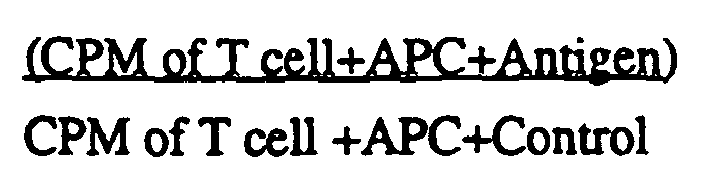
- The bar represents the cumulative rank of the peptide response in the group of patients. To determine the cumulative rank, the 5 peptides with the highest S.L in each individual were determined and assigned a numerical rank in descending order, with 5 representing the strongest response. The ranks for each peptide were then summed in the group of patients to determine the cumulative rank for the peptide. Above each bar is the percent of positive responses with an S.I. of at least 2 to the peptide in the group of patients tested. Given the percent positive and the mean T cell stimulation index, the positivity index (P.I.) for each peptide can be calculated. The P.I. for each individual is determined by multiplying the mean S.I. by the percent of individuals, in a population of individuals sensitive to house dust mite (e.g. preferably at least 15 individuals, more preferably at least 30 individuals or more) who responded with an S.I. of at least 2.0 to that peptide (e.g., for DP I-1 in
Fig. 5 , the P.I. would be about 343 (73% x 4.7). The P.I. therefore represents both the strength of a T cell response to a peptide (S.I.) and the frequency of a T cell response to a peptide in a population of individuals sensitive to house dust mite.Fig. 5 demonstrates that peptides DP I-1, DP I-2, DP I-3, DP I-4, DP I-5, DP I-6.1, DP I-7.1, DP I-8, DP 1-9. DP I-16, and DP I-10 contain significant regions of T cell reactivity in this panel of patients. - Experiments similar to those of Example V were performed to determine the T cell-reactive areas of the Der f I protein. For example, PBMC from house dust mite-allergic patient 783 were isolated as described in Example V and were stimulated in vitro with recombinant purified Der f I at 20 µg/ml. The results of the proliferation assay with Der f I peptides using x-irradiated (3500 Rads) autologous PBMC as antigen presenting cells indicate that T cells from this patient respond to the peptides DF I-8.1, DF 1-9, DF I-6, DF I-10, DF I-2.1, DF 1-3, DF I-11, DF 1-5, DF I-1, and DF I-17 (data not shown).
- The above procedure was followed in a number of patients except in individual cases, T cell lines were primed with affinity purified Der f I at 20µg/ml or at 10 µg/ml and x-irradiated (25,000 Rads) autologous Epstein-Barr virus transformed B cells were used as antigen presenting cells. A summary of the results of 16 positive experiments is shown in
Fig. 6 . The data was analyzed as described in Example V. The data indicate that significant areas of T cell reactivity in the Der f I protein are found in the peptides DF I-1, DF I-2, DF 1-3, DF I-4, DF I-11, DF I-5, DF I-6, DF I-7, DF I-14, DF I-15, DF I-8.1 and DF 1-9. - The Der p I and Der f I proteins are very homologous (81 % identity). Thus, experiments, similar to those of Example V, were carried out to determine the T cell responses of Der p I primed T cell lines when challenged with various Der p I peptides and substantially matching Der f II peptides. T cell lines were primed in vitro as described in Example V and tested for response to a set of substantially matching Der p I and Der f I peptides (e.g., DP I-1 (amino acid residues 1-20 of Der p I) or DF I-1 (amino acid residues 1-20 of Der f I). The data was analyzed as described in Example V except the highest and lowest S.I. values of the positive responses to each peptide were not omitted from the mean S.I. calculations. A summary of a number of such experiments is shown in
Fig. 7 . The results of 14 positive experiments indicate that Der p I-primed T cells respond to various Der f I peptides indicating cross-reactivity within the Group I allergens. Der p I primed T cells respond significantly to peptides DF I-1, DF I-2, DF I-3, DF I-4, DF I-11, DF I-12, DF I-15, DF 1-8, DF I-9, DF 1-15 and DF 1-6. In some patients, the Der f I peptide was a more potent stimulator of Der p I-primed T cells than the corresponding Der p I peptide.Fig. 8 shows the results of inverse experiments in which T cells from a number of patients were primed in vitro to the Der I protein and analyzed for response to various Der p I peptides and a set of substantially matching Der f I peptides. The results of 8 positive experiments indicate that Der I primed T cells respond significantly to peptides DP I-1, DP I-3, DP I-4, DP I-11/11.1, DP I-14, DP I-5, DP I-15, and DP 1-8. - Experiments similar to those of Example V were performed to determine the T cell-reactive areas of the Der p II protein. For example, PBMC from house dust mite-allergic patient 348 were isolated as described in Example V and were stimulated in vitro with 20 µg/ml purified native Der p II. The results of a proliferation assay using x-irradiated (25.000 Rads) Epstein-Barr virus transformed autologous B cells as antigen-presenting cells with various Der p II peptides demonstrate that this particular patient responds well to peptides DP II-1, DP II-7, DP II-8, DP II-2, and DP II-9 (data not shown).
- The above procedure was followed with a number of patients except in individual cases, T cell lines were primed with recombinant Der p II at 20 µg/ml or at 3 µg/ml and x-irradiated (3500 Rads) autologous PBMC were used as antigen-presenting cells. A summary of the results of 26 positive experiments is shown in
Fig. 9 . The data was analyzed as described in Example V, except the ranked sum of peptide responses was analyzed assigning a value of 3, 2 or 1 to the three highest S. I. responses. Areas of significant T cell reactivity within the Der p II protein for this panel of patients are found in peptides DP II-1, DP II-2, DP II-3, DP II-4, DP II-7, DP II-8 and DP II-9. - Experiments similar to those of Example V were performed to determine the T cell-reactive areas of the Der f II protein. For example, PBMC from house dust mite-allergic patient 384 were stimulated in vitro with purified recombinant Der f II and the T cell line was then challenged in the presence of x-irradiated (25,000 Rads) autologous Epstein-Barr virus transformed B cells as antigen presenting cells with various overlapping Der f II peptides. The results of this proliferation assay indicate that T cells from this particular patient respond well to peptides DF II-1, DF II-2, DF II-3.1, DF II-4.5, DF II-15, DF II-16. and DF II-19.1 (data not shown).
- The above procedure was followed with 10 patients, except in individual cases, T cell lines were primed by stimulating the patient PBMC with 20 µg/ml or 3 µg/ml purified native Der f II, and were assayed in the presence of x-irradiated (3500 Rads) autologous PBMC as antigen-presenting cells. A summary of the results of 10 positive experiments is shown in
Fig. 10 . The data was analyzed as detailed in Example IX, except the highest and lowest S.I. values of the positive responses to each peptide were not omitted from the calculations. The data indicate that significant areas of T cell reactivity within the Der f II protein are found in peptides DF II-1, DF II-2, DF II-13.1, DF II-4.5, DF II-15, DF II-17, and DF II-19.1. - A study similar to that described in Example VII was carried out to determine the T cell cross-reactivity of the Der p II and Der f II proteins. T cells primed with the Der f II protein were challenged with various Der f II peptides and a set of substantially matching Der p II peptides. A summary of the results of 10 positive experiments is shown in
Fig. 11 . The results indicate that Der f II primed T cells respond significantly to peptides DP II-1, DP II-3/3.1, DP II-4, and DP II-7.Fig. 12 shows the results of inverse experiments in which T cells from a number of patients were primed in vitro to the Der p II protein and analyzed for response to various Der f II peptides. The results of 26 positive experiments indicate that Der p II primed T cells respond significantly to peptides DF II-1, DF II-4.5, DF II-15, DF II-17, DF II-18 and DF II-19.1. - Based on the analyses described in Examples V-X, major areas of T cell reactivity within Der p I, Der p II, Der f I and Der f II were identified. In each study, all of the patients tested responded to the protein allergen (e.g., Der p I) and at least one peptide derived from a major area of T cell reactivity within the protein. Seven regions (
Region 1,Region 2,Region 3,Region 4,Region 5, Region 6a and Region 6b) of major T cell reactivity were identified in the Der p I and Der f I proteins. These regions are defined as follows:Region 1, amino acid residues 1-28 of the Der p I and Der f I proteins;Region 2, amino acid residues 36-68 of the Der p I and Der f I proteins;Region 3, amino acid residues 74-109 of the Der p I and Der f I proteins;Region 4, amino acid residues 118-139 of the Der p I and Der f I proteins;Region 5, amino acid residues 141-166 of the Der p I and Der f I proteins; and Region 6a, amino acid residues 161-185 of the Der p I and Der f I proteins and Region 6b, amino acid residues 173-201 of the Der p I and Der f I proteins. - Similarly, four regions of major T cell reactivity (
Region 7,Region 8,Region 9, and Region 10) were identified in the Der p II and Der f II proteins. These regions are defined as follows:Region 7, amino acid residues 1-26 of the Der p II and Der f II proteins;Region 8, amino acid residues 33-67 of the Der p II and Der f II proteins;Region 9, amino acid residues 79-104 of the Der p II and Der f II proteins; andRegion 10, amino acid residues 107-129 of the Der p II and Der f II proteins. Based in part on the T cell reactivity described in Examples V-X, peptides derived from Der p I, Der f I, Der p II, and Der f II were selected and modified by addition or deletion of amino acid residues at either the 5' or 3' end of the peptide. In designing these selected peptides, various factors were considered, including the ranked sum of the overlapping peptides, the percentage of responses with an S.I. of at least 2.0 to the peptides, the potential cross-reactivity of the peptides, the difficulty of manufacture of the peptides, etc. T cell studies similar to those described in Examples V-X were performed using these selected peptides to more precisely define the major areas of T cell reactivity within Regions 1-6a and 6b of the Der p I and Der f I protein and Regions 7-10 of the Der p II and Der f II protein. - The results of T cell studies using selected peptides derived from the Der p I, the Der f I, the Der p II and the Der f II proteins are shown in
Figs. 13-18a-d . The procedure described in Example V was followed with T cell lines from a number of patients primed in vitro to the Der p I protein then analyzed for response to selected peptides derived from the Der p I sequence. The results of 33 positive experiments shown inFig. 13 indicate that the Der p I primed T cells respond significantly to peptides found in peptides DP I-21.1, DP I-21.2, DP I-22.2, DP 1-25.2, DP I-22.1, DP I-23.1, DP 1-23.2, DP I-26.1, and DP I-28.1. - Similarly, the procedure described in Example VI was followed with T cell lines from 9 patients primed in vitro to the Der f I protein then analyzed for response to selected peptides derived from the protein. The data was analyzed as described in Example VL The results of the 9 patients shown in
Fig. 14 demonstrate T cell reactivity to selected peptides from Der f I. - In another experiment, the T cell lines from a number of patients were primed in vitro to the Der p I protein and analyzed for response to selected peptides derived from the Der p I protein and a set of substantially matching peptides derived from the Der f I protein. The data from 30 positive experiments was analyzed as described in Example V. As shown in
Fig. 15a , the Der p I primed T cells respond significantly to peptides DF I-21.1, DF I-21.2, DF I-23.1, DF 1-22.2, DF 1-22.3, DF I-22.4, DF 1-23.2, DF I-25.1, DF I-26.1 and DF I-27.1.Fig. 15b is a subset of the data shown inFig 15a and shows the response of Der p I primed T cells to peptides analyzed by ranked sum.Fig. 15b shows that DPI-23.1 has the highest ranked sum of this group of peptides in this study.Fig. 16a shows the results of the inverse experiment in which T cells from 9 patients were primed in vitro to the Der f I protein and challenged with selected Der f I peptides and a set of substantially matching Der p I peptides. The results indicate that Der f I primed T cells from 9 patients respond to selected peptides from Der p I.Fig. 16a shows that DF I-22.1 and DF I-25.1 have the highest stimulation indexes of this group of peptides.Fig. 16b is a subset of the same data as shown inFig. 16a and shows the response of preferred Der f I and Der p I peptides is shown.Fig 16b shows that DF1-22.2 has the highest stimulation index of this group of preferred peptides in this experiment. - Another experiment following the procedure described in Example VIII analyzed the response of 29 patients primed in vitro to the Der p II protein and challenged with selected peptides derived from the Der p II sequence.
Fig. 17a shows that Der p II primed T cells from one patient respond to selected peptides from Der p II.Fig. 17b shows the results from an experiment similar to that shown inFig. 17a with a set of 30 patients and with the high and low omitted from the mean.Fig. 17b shows that DPII-20.6 has the highest ranked sum of this group of preferred peptides in this study.Fig. 18a shows the inverse experiment in which T cells from 1 patient were primed in vitro to the Der f II protein and challenged with selected peptides derived from the Der p II sequence.Fig. 18a shows that Der f II primed T cells from 10 patients respond to selected peptides from Der p II. As shown inFig. 18a DP II-25 has the highest stimulation index.Fig. 18b is a subset of the same data shown inFig. 18a and shows the response of native Der f II primed T cell lines to preferred Der p II peptides analyzed by ranked sum. As is shown inFig. 18b , DPII-25.2 has the highest ranked sum of the preferred peptides in this study. - A study similar to that described in Example VII was carried out with T cells from 4 matched patients primed in vitro with Group I proteins from Der f and Der p then analyzed for response to selected preferred peptides from Der p I and Der f I. The results in
Fig. 18c demonstrate that T cell reactivity to a number of the selected preferred Der p I peptides was essentially equivalent for their Der f I counterpart and vice-versa. -
Fig. 18d shows the results of a similar study with T cells from 6 matched patients primed in vitro with Group II proteins from Der p and Der f, then analyzed for response to selected preferred Der p II and Der f II peptides. Similar to the results inFig. 18c , T cell reactivity to a number of the selected preferred peptides of Der p II are essentially equivalent to their Der f II counterparts and vice-versa. - Coming assay plates (#25882-96) were coated with 5 µg/ml of each coating antigen listed in
Figs. 19 ,20 and21 at 50 µl/100ml/well and incubated overnight at 4°C. The coating antigens were removed and the wells are blocked with 0.5% gelatin in PBS, 300 µl/well for 2 hours at room temperature. Pooled human plasma (a mix of plasma samples from 20 patients that were skin test positive for commerical mite extract) was serially diluted with PBS-Tween 20 (PBS with 0.05% nonionic detergent Tween-20 Sigma, St. Louis, MO) and 100 µl/well a\was added and incubated overnight at 4°C (plasma dilutions were tested in duplicate). The second antibody (biotinylated goat anti-Human IgE, 1:1000, Kirkegaard & Perry Laboratories Inc, Gaithersburg, MD), was added at 100 µl/well for one hour at room temperature. This solution was removed and streptavidin-HRPO, 1:10000, (Southern Biotechnology Associates, Inc., Birmingham, AL) was then added at 100 µl/well for one hour at room temperature (all wells are washed three times with PBS-Tween between each incubation step). TMB Membrane Peroxidase Substrate system (Kirkegaard & Perry Laboratories) was freshly miced, and added at 100ml/well. The color was allowed to develop for 2-5 minutes. The reaction was stopped by the addition of 100ml/well of 1M phosphoric acid. Plates were read on a Microplate IL310 Autoreader (Biotech Instruments, Winooski, VT) with a 450 nm filter. The absorbance levels of duplicate wells were averaged. The graphed results (log of the dilution versus absorbance) of the ELISA assays are shown inFigs. 19a-b ,20a-b and21a-h . The order of coating antigens listed vertically in these figure legends corresponds in order from left to right to the coating antigens listed for each histogram. - The results of the ELISA assay shown in
Fig. 19b demonstrate good binding of both biochemically purified Der p II and recombinant Der p II (rDer p II) with human IgE and no detectable binding to the Der p II peptides. The IgE binding to the Der p set of peptides and proteins (Figs. 20a and20b ) shows the same pattern of reactivity as the Der f set. That is, no detectable binding to Der f I or Der f II peptides or recombinant Der f I with binding to only biochemically purified Der f I and recombinant and biochemically purified Der f II. In both cases there appears to be better binding to recombinant Der p II or Der f II than to the biochemically purified forms. All the conclusions derived from the above ELISA assay data were corraborated by another assay method, dot blots on nitrocellulose paper, using the same set of antibody and antigen reagents. - The antigen preparation that was used as a positive control was a mixture of the four major biochemically purified mite allergens (term PMA for Purified Mite Allergen); Der f I, Der f II, Der p I and Der p II. The stock was generated at a concentration of 100 µgs of each protein per millimeter or 400 µgs total protein/ml. This preparation was used on each coated ELISA plate. The results from these ELISA assays are shown in
Fig. 21a-h . There is clear binding to either the purified or recombinant protein or the PMA antigen preparation on each plate indicating good IgE reactivity. However, the PMA antigen preparation, does exhibit a high degree of non-specific reactivity shown in the background dilution where no first antibody solution was added. This non-specific reactivity occurs between the PMA antigen and the biotinyulated second antibody and does not compromise the finding of specific IgE reactivity to the antigen. Using a quantitative value of two-fold over background at the highest plasma concentration as a positive reading, there is no detectable IgE reactivity to any one of the 56 peptides screened by this assay method. - Although the invention has been described with reference to its preferred embodiments, other embodiments can achieve the same results. Variations and modifications to the present invention will be obvious to those skilled in the art and is intended to cover in the appended claims all such modifications and equivalents that follow in the true spirit and scope of the invention.
-
- (1) GENERAL INFORMATION:
- (i) APPLICANT: Kuo, Mei-chang
Garman, Richard
Greenstein, Julia - (ii) TITLE OF INVENTION: T CELL EPITOPES OF THE MAJOR ALLERGENS FROM DERMATOPHAGOIDES (HOUSE DUST MITE)
- (iii) NUMBER OF SEQUENCES: 119
- (iv) CORRESPONDENCE ADDRESS:
- (A) ADDRESSEE: LAHIVE & COCKFIELD
- (B) STREET: 60
STATE STREET SUITE 510 - (C) CITY: BOSTON
- (D) STATE: MA
- (E) COUNTRY: USA
- (F) ZIP: 02109
- (v) COMPUTER READABLE FORM:
- (A) MEDIUM TYPE: Floppy disk
- (B) COMPUTER: IBM PC compatible
- (C) OPERATING SYSTEM: PC-DOS/MS-DOS
- (D) SOFTWARE: ASCII TEXT
- (vi) CURRENT APPLICATION DATA:
- (A) APPLICATION NUMBER: US 07/881,396
- (B) FILING DATE: 08-MAY-1992
- (C) CLASSIFICATION:
- (i) APPLICANT: Kuo, Mei-chang
- (viii) ATTORNEY/AGENT INFORMATION:
- (A) NAME: MANDRAGOURAS, AMY E.
- (B) REGISTRATION NUMBER: P36,207
- (C) REFERENCE/DOCKET NUMBER: IMI-012/IPC-017C
- (ix) TELECOMMUNICATION INFORMATION:
- (A) TELEPHONE: (617) 227-7400
- (B) TELEFAX: (617) 227-5941
- (2) INFORMATION FOR SEQ ID NO:1:
- (i) SEQUENCE CHARACTERISTICS:
- (A) LENGTH: 834 base pairs
- (B) TYPE: nucleic acid
- (C) STRANDEDNESS: single
- (D) TOPOLOGY: linear
- (ii) MOLECULE TYPE: cDNA
- (ix) FEATURE:
- (A) NAME/KEY: CDS
- (B) LOCATION: 1..738
- (xi) SEQUENCE DESCRIPTION: SEQ ID NO:1:


- (i) SEQUENCE CHARACTERISTICS:
- (2) INFORMATION FOR SEQ ID NO:2:
- (i) SEQUENCE CHARACTERISTICS:
- (A) LENGTH: 245 amino acids
- (B) TYPE: amino acid
- (D) TOPOLOGY: linear
- (ii) MOLECULE TYPE: protein
- (xi) SEQUENCE DESCRIPTION: SEQ ID NO:2:


- (i) SEQUENCE CHARACTERISTICS:
- (2) INFORMATION FOR SEQ ID NO:3:
- (i) SEQUENCE CHARACTERISTICS:
- (A) LENGTH: 588 base pairs
- (B) TYPE: nucleic acid
- (C) STRANDEDNESS: single
- (D) TOPOLOGY: linear
- (ii) MOLECULE TYPE: cDNA
- (ix) FEATURE:
- (A) NAME/KEY: CDS
- (B) LOCATION: 69..509
- (xi) SEQUENCE DESCRIPTION: SEQ ID NO:3:


- (i) SEQUENCE CHARACTERISTICS:
- (2) INFORMATION FOR SEQ ID NO:4:
- (i) SEQUENCE CHARACTERISTICS:
- (A) LENGTH: 146 amino acids
- (B) TYPE: amino acid
- (D) TOPOLOGY: linear
- (ii) MOLECULE TYPE: protein
- (xi) SEQUENCE DESCRIPTION: SEQ ID NO:4:
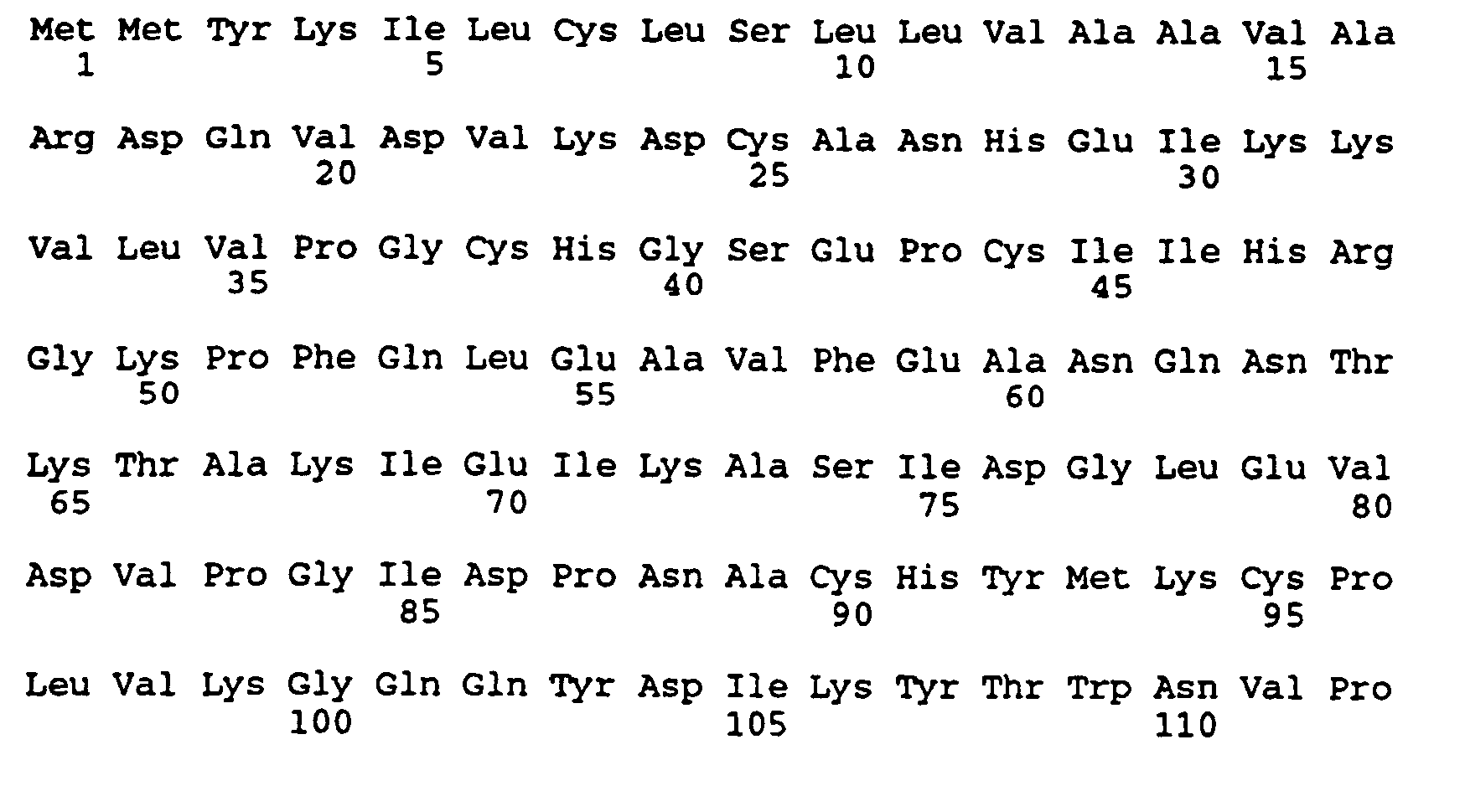

- (i) SEQUENCE CHARACTERISTICS:
- (2) INFORMATION FOR SEQ ID NO:5:
- (i) SEQUENCE CHARACTERISTICS:
- (A) LENGTH: 1072 base pairs
- (B) TYPE: nucleic acid
- (C) STRANDEDNESS: single
- (D) TOPOLOGY: linear
- (ii) MOLECULE TYPE: cDNA
- (ix) FEATURE:
- (A) NAME/KEY: CDS
- (B) LOCATION: 36..1001
- (xi) SEQUENCE DESCRIPTION: SEQ ID NO:5:


- (i) SEQUENCE CHARACTERISTICS:
- (2) INFORMATION FOR SEQ ID NO:6:
- (i) SEQUENCE CHARACTERISTICS:
- (A) LENGTH: 321 amino acids
- (B) TYPE: amino acid
- (D) TOPOLOGY: linear
- (ii) MOLECULE TYPE: protein
- (xi) SEQUENCE DESCRIPTION: SEQ ID NO:6:

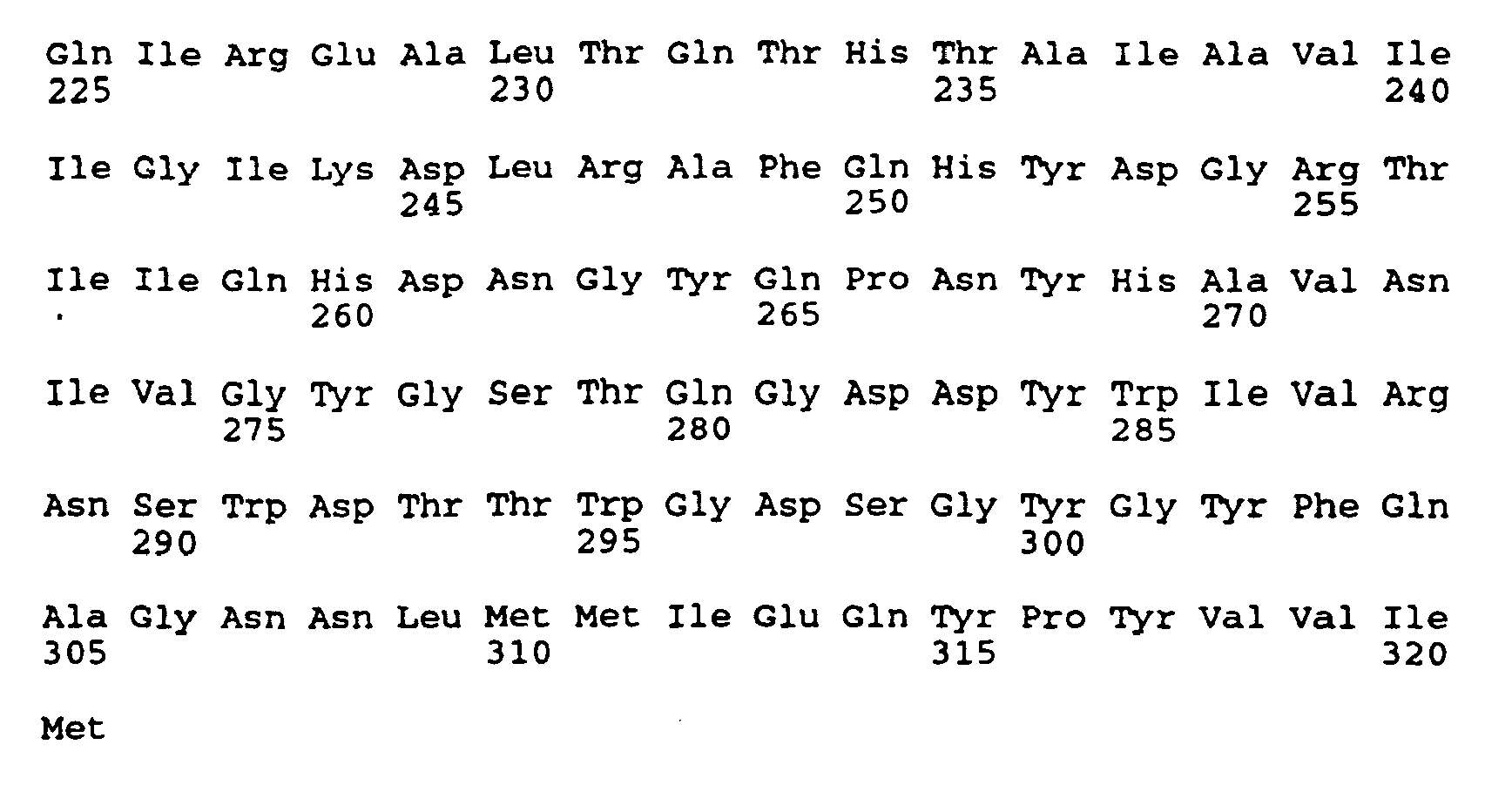
- (i) SEQUENCE CHARACTERISTICS:
- (2) INFORMATION FOR SEQ ID NO:7:
- (i) SEQUENCE CHARACTERISTICS:
- (A) LENGTH: 491 base pairs
- (B) TYPE: nucleic acid
- (C) STRANDEDNESS: single
- (D) TOPOLOGY: linear
- (ii) MOLECULE TYPE: cDNA
- (ix) FEATURE:
- (A) NAME/KEY: CDS
- (B) LOCATION: 1..390
- (xi) SEQUENCE DESCRIPTION: SEQ ID NO:7:

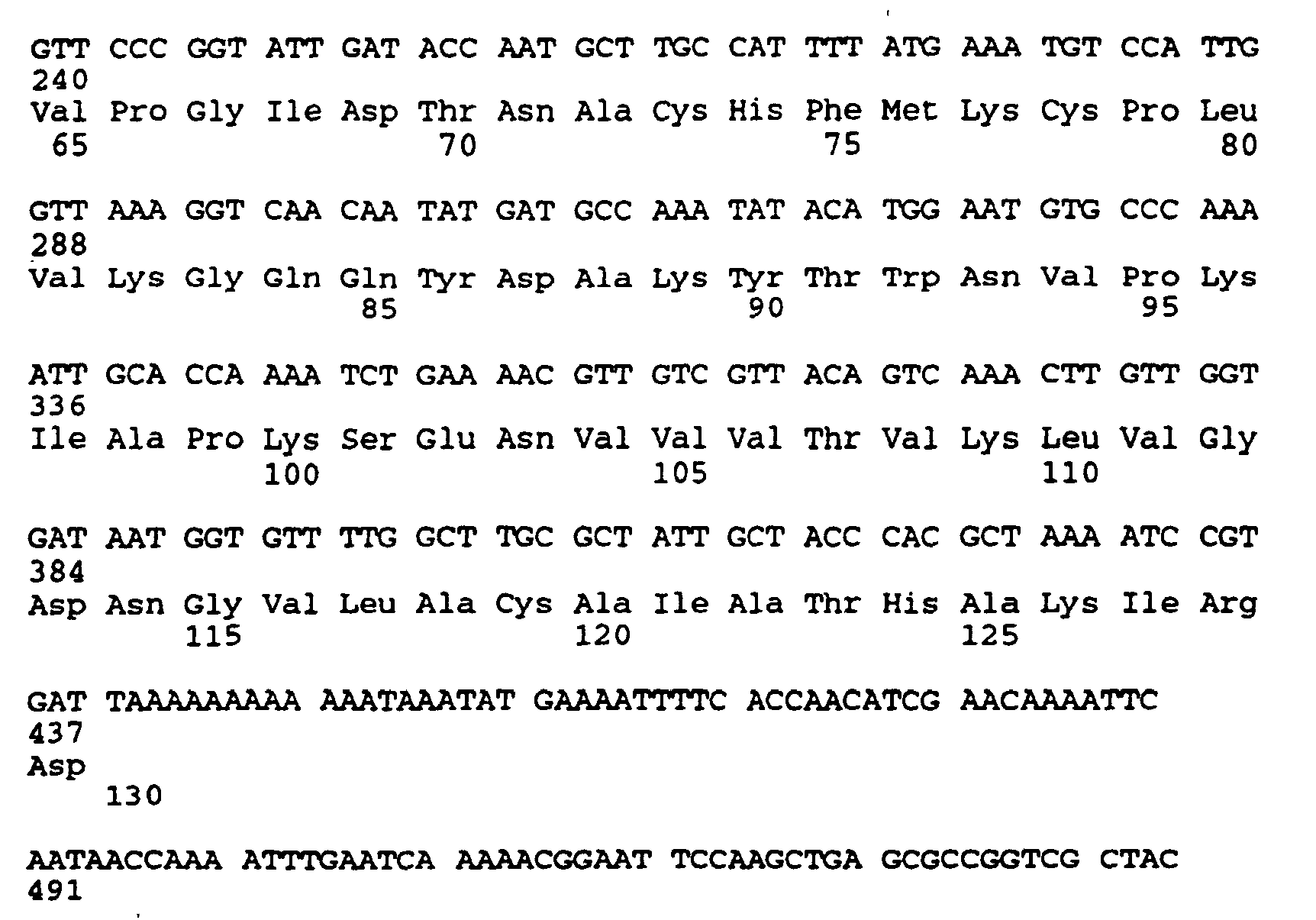
- (i) SEQUENCE CHARACTERISTICS:
- (2) INFORMATION FOR SEQ ID NO:8:
- (i) SEQUENCE CHARACTERISTICS:
- (A) LENGTH: 129 amino acids
- (B) TYPE: amino acid
- (D) TOPOLOGY: linear
- (ii) MOLECULE TYPE: protein
- (xi) SEQUENCE DESCRIPTION: SEQ ID NO:8:


- (i) SEQUENCE CHARACTERISTICS:
- (2) INFORMATION FOR SEQ ID NO:9:
- (i) SEQUENCE CHARACTERISTICS:
- (A) LENGTH: 20 amino acids
- (B) TYPE: amino acid
- (D) TOPOLOGY: linear
- (ii) MOLECULE TYPE: peptide
- (v) FRAGMENT TYPE: N-terminal
- (xi) SEQUENCE DESCRIPTION: SEQ ID NO:9:

- (i) SEQUENCE CHARACTERISTICS:
- (2) INFORMATION FOR SEQ ID NO:10:
- (i) SEQUENCE CHARACTERISTICS:
- (A) LENGTH: 27 amino acids
- (B) TYPE: amino acid
- (D) TOPOLOGY: linear
- (ii) MOLECULE TYPE: peptide
- (v) FRAGMENT TYPE: N-terminal
- (xi) SEQUENCE DESCRIPTION: SEQ ID NO:10:

- (i) SEQUENCE CHARACTERISTICS:
- (2) INFORMATION FOR SEQ ID NO:11:
- (i) SEQUENCE CHARACTERISTICS:
- (A) LENGTH: 29 amino acids
- (B) TYPE: amino acid
- (D) TOPOLOGY: linear
- (ii) MOLECULE TYPE: peptide
- (v) FRAGMENT TYPE: N-terminal
- (xi) SEQUENCE DESCRIPTION: SEQ ID NO:11:

- (i) SEQUENCE CHARACTERISTICS:
- (2) INFORMATION FOR SEQ ID NO:12:
- (i) SEQUENCE CHARACTERISTICS:
- (A) LENGTH: 21 amino acids
- (B) TYPE: amino acid
- (D) TOPOLOGY: linear
- (ii) MOLECULE TYPE: peptide
- (v) FRAGMENT TYPE: N-terminal
- (xi) SEQUENCE DESCRIPTION: SEQ ID NO:12:

- (i) SEQUENCE CHARACTERISTICS:
- (2) INFORMATION FOR SEQ ID NO:13:
- (i) SEQUENCE CHARACTERISTICS:
- (A) LENGTH: 22 amino acids
- (B) TYPE: amino acid
- (D) TOPOLOGY: linear
- (ii) MOLECULE TYPE: peptide
- (v) FRAGMENT TYPE: N-terminal
- (xi) SEQUENCE DESCRIPTION: SEQ ID NO:13:

- (i) SEQUENCE CHARACTERISTICS:
- (2) INFORMATION FOR SEQ ID NO:14:
- (i) SEQUENCE CHARACTERISTICS:
- (A) LENGTH: 21 amino acids
- (B) TYPE: amino acid
- (D) TOPOLOGY: linear
- (ii) MOLECULE TYPE: peptide
- (v) FRAGMENT TYPE: N-terminal
- (xi) SEQUENCE DESCRIPTION: SEQ ID NO:14:

- (i) SEQUENCE CHARACTERISTICS:
- (2) INFORMATION FOR SEQ ID NO:15:
- (i) SEQUENCE CHARACTERISTICS:
- (A) LENGTH: 28 amino acids
- (B) TYPE: amino acid
- (D) TOPOLOGY: linear
- (ii) MOLECULE TYPE: peptide
- (v) FRAGMENT TYPE: N-terminal
- (xi) SEQUENCE DESCRIPTION: SEQ ID NO:15:

- (i) SEQUENCE CHARACTERISTICS:
- (2) INFORMATION FOR SEQ ID NO:16:
- (i) SEQUENCE CHARACTERISTICS:
- (A) LENGTH: 20 amino acids
- (B) TYPE: amino acid
- (D) TOPOLOGY: linear
- (ii) MOLECULE TYPE: peptide
- (v) FRAGMENT TYPE: N-terminal
- (xi) SEQUENCE DESCRIPTION: SEQ ID NO:16:

- (i) SEQUENCE CHARACTERISTICS:
- (2) INFORMATION FOR SEQ ID NO:17:
- (i) SEQUENCE CHARACTERISTICS:
- (A) LENGTH: 25 amino acids
- (B) TYPE: amino acid
- (D) TOPOLOGY: linear
- (ii) MOLECULE TYPE: peptide
- (v) FRAGMENT TYPE: N-terminal
- (xi) SEQUENCE DESCRIPTION: SEQ ID NO:17:

- (i) SEQUENCE CHARACTERISTICS:
- (2) INFORMATION FOR SEQ ID NO:18:
- (i) SEQUENCE CHARACTERISTICS:
- (A) LENGTH: 19 amino acids
- (B) TYPE: amino acid
- (D) TOPOLOGY: linear
- (ii) MOLECULE TYPE: peptide
- (v) FRAGMENT TYPE: N-terminal
- (xi) SEQUENCE DESCRIPTION: SEQ ID NO:18:

- (i) SEQUENCE CHARACTERISTICS:
- (2) INFORMATION FOR SEQ ID NO:19:
- (i) SEQUENCE CHARACTERISTICS:
- (A) LENGTH: 22 amino acids
- (B) TYPE: amino acid
- (D) TOPOLOGY: linear
- (ii) MOLECULE TYPE: peptide
- (v) FRAGMENT TYPE: N-terminal
- (xi) SEQUENCE DESCRIPTION: SEQ ID NO:19:

- (i) SEQUENCE CHARACTERISTICS:
- (2) INFORMATION FOR SEQ ID NO:20:
- (i) SEQUENCE CHARACTERISTICS:
- (A) LENGTH: 24 amino acids
- (B) TYPE: amino acid
- (D) TOPOLOGY: linear
- (ii) MOLECULE TYPE: peptide
- (v) FRAGMENT TYPE: N-terminal
- (xi) SEQUENCE DESCRIPTION: SEQ ID NO:20:

- (i) SEQUENCE CHARACTERISTICS:
- (2) INFORMATION FOR SEQ ID NO:21:
- (i) SEQUENCE CHARACTERISTICS:
- (A) LENGTH: 26 amino acids
- (B) TYPE: amino acid
- (D) TOPOLOGY: linear
- (ii) MOLECULE TYPE: peptide
- (v) FRAGMENT TYPE: N-terminal
- (xi) SEQUENCE DESCRIPTION: SEQ ID NO:21:

- (i) SEQUENCE CHARACTERISTICS:
- (2) INFORMATION FOR SEQ ID NO:22:
- (i) SEQUENCE CHARACTERISTICS:
- (A) LENGTH: 26 amino acids
- (B) TYPE: amino acid
- (D) TOPOLOGY: linear
- (ii) MOLECULE TYPE: peptide
- (v) FRAGMENT TYPE: N-terminal
- (xi) SEQUENCE DESCRIPTION: SEQ ID NO:22:

- (i) SEQUENCE CHARACTERISTICS:
- (2) INFORMATION FOR SEQ ID NO:23:
- (i) SEQUENCE CHARACTERISTICS:
- (A) LENGTH: 23 amino acids
- (B) TYPE: amino acid
- (D) TOPOLOGY: linear
- (ii) MOLECULE TYPE: peptide
- (v) FRAGMENT TYPE: N-terminal
- (xi) SEQUENCE DESCRIPTION: SEQ ID NO:23:

- (i) SEQUENCE CHARACTERISTICS:
- (2) INFORMATION FOR SEQ ID NO:24:
- (i) SEQUENCE CHARACTERISTICS:
- (A) LENGTH: 22 amino acids
- (B) TYPE: amino acid
- (D) TOPOLOGY: linear
- (ii) MOLECULE TYPE: peptide
- (v) FRAGMENT TYPE: N-terminal
- (xi) SEQUENCE DESCRIPTION: SEQ ID NO:24:

- (i) SEQUENCE CHARACTERISTICS:
- (2) INFORMATION FOR SEQ ID NO:25:
- (i) SEQUENCE CHARACTERISTICS:
- (A) LENGTH: 24 amino acids
- (B) TYPE: amino acid
- (D) TOPOLOGY: linear
- (ii) MOLECULE TYPE: peptide
- (v) FRAGMENT TYPE: N-terminal
- (xi) SEQUENCE DESCRIPTION: SEQ ID NO:25:

- (i) SEQUENCE CHARACTERISTICS:
- (2) INFORMATION FOR SEQ ID NO:26:
- (i) SEQUENCE CHARACTERISTICS:
- (A) LENGTH: 26 amino acids
- (B) TYPE: amino acid
- (D) TOPOLOGY: linear
- (ii) MOLECULE TYPE: peptide
- (v) FRAGMENT TYPE: N-terminal

- (i) SEQUENCE CHARACTERISTICS:
- (2) INFORMATION FOR SEQ ID NO:27:
- (i) SEQUENCE CHARACTERISTICS:
- (A) LENGTH: 28 amino acids
- (B) TYPE: amino acid
- (D) TOPOLOGY: linear
- (ii) MOLECULE TYPE: peptide
- (v) FRAGMENT TYPE: N-terminal
- (xi) SEQUENCE DESCRIPTION: SEQ ID NO:27:

- (i) SEQUENCE CHARACTERISTICS:
- (2) INFORMATION FOR SEQ ID NO:28:
- (i) SEQUENCE CHARACTERISTICS:
- (A) LENGTH: 24 amino acids
- (B) TYPE: amino acid
- (D) TOPOLOGY: linear
- (ii) MOLECULE TYPE: peptide
- (v) FRAGMENT TYPE: N-terminal
- (xi) SEQUENCE DESCRIPTION: SEQ ID NO:28:

- (i) SEQUENCE CHARACTERISTICS:
- (2) INFORMATION FOR SEQ ID NO:29:
- (i) SEQUENCE CHARACTERISTICS:
- (A) LENGTH: 29 amino acids
- (B) TYPE: amino acid
- (D) TOPOLOGY: linear
- (ii) MOLECULE TYPE: peptide
- (v) FRAGMENT TYPE: N-terminal
- (xi) SEQUENCE DESCRIPTION: SEQ ID NO:29:

- (i) SEQUENCE CHARACTERISTICS:
- (2) INFORMATION FOR SEQ ID NO:30:
- (i) SEQUENCE CHARACTERISTICS:
- (A) LENGTH: 25 amino acids
- (B) TYPE: amino acid
- (D) TOPOLOGY: linear
- (ii) MOLECULE TYPE: peptide
- (v) FRAGMENT TYPE: N-terminal
- (xi) SEQUENCE DESCRIPTION: SEQ ID NO:30:

- (i) SEQUENCE CHARACTERISTICS:
- (2) INFORMATION FOR SEQ ID NO:31:
- (i) SEQUENCE CHARACTERISTICS:
- (A) LENGTH:- 25 amino acids
- (B) TYPE: amino acid
- (D) TOPOLOGY: linear
- (ii) MOLECULE TYPE: peptide
- (v) FRAGMENT TYPE: N-terminal
- (xi) SEQUENCE DESCRIPTION: SEQ ID NO:31:

- (i) SEQUENCE CHARACTERISTICS:
- (2) INFORMATION FOR SEQ ID NO:32:
- (i) SEQUENCE CHARACTERISTICS:
- (A) LENGTH: 29 amino acids
- (B) TYPE: amino acid
- (D) TOPOLOGY: linear
- (ii) MOLECULE TYPE: peptide
- (v) FRAGMENT TYPE: N-terminal
- (xi) SEQUENCE DESCRIPTION: SEQ ID NO:32:

- (i) SEQUENCE CHARACTERISTICS:
- (2) INFORMATION FOR SEQ ID NO:33:
- (i) SEQUENCE CHARACTERISTICS:
- (A) LENGTH: 28 amino acids
- (B) TYPE: amino acid
- (D) TOPOLOGY: linear
- (ii) MOLECULE TYPE: peptide
- (v) FRAGMENT TYPE: N-terminal
- (xi) SEQUENCE DESCRIPTION: SEQ ID NO:33:

- (i) SEQUENCE CHARACTERISTICS:
- (2) INFORMATION FOR SEQ ID NO:34:
- (i) SEQUENCE CHARACTERISTICS:
- (A) LENGTH: 29 amino acids
- (B) TYPE: amino acid
- (D) TOPOLOGY: linear
- (ii) MOLECULE TYPE: peptide
- (v) FRAGMENT TYPE: N-terminal
- (xi) SEQUENCE DESCRIPTION: SEQ ID NO:34:

- (i) SEQUENCE CHARACTERISTICS:
- (2) INFORMATION FOR SEQ ID NO:35:
- (i) SEQUENCE CHARACTERISTICS:
- (A) LENGTH: 29 amino acids
- (B) TYPE: amino acid
- (D) TOPOLOGY: linear
- (ii) MOLECULE TYPE: peptide
- (v) FRAGMENT TYPE: N-terminal
- (xi) SEQUENCE DESCRIPTION: SEQ ID NO:35:

- (i) SEQUENCE CHARACTERISTICS:
- (2) INFORMATION FOR SEQ ID NO:36:
- (i) SEQUENCE CHARACTERISTICS:
- (A) LENGTH: 22 amino acids
- (B) TYPE: amino acid
- (D) TOPOLOGY: linear
- (ii) MOLECULE TYPE: peptide
- (v) FRAGMENT TYPE: N-terminal
- (xi) SEQUENCE DESCRIPTION: SEQ ID NO:36:

- (i) SEQUENCE CHARACTERISTICS:
- (2) INFORMATION FOR SEQ ID NO:37:
- (i) SEQUENCE CHARACTERISTICS:
- (A) LENGTH: 26 amino acids
- (B) TYPE: amino acid
- (D) TOPOLOGY: linear
- (ii) MOLECULE TYPE: peptide
- (v) FRAGMENT TYPE: N-terminal
- (xi) SEQUENCE DESCRIPTION: SEQ ID NO:37:

- (i) SEQUENCE CHARACTERISTICS:
- (2) INFORMATION FOR SEQ ID NO:38:
- (i) SEQUENCE CHARACTERISTICS:
- (A) LENGTH: 25 amino acids
- (B) TYPE: amino acid
- (D) TOPOLOGY: linear
- (ii) MOLECULE TYPE: peptide
- (v) FRAGMENT TYPE: N-terminal
- (xi) SEQUENCE DESCRIPTION: SEQ ID NO:38:

- (i) SEQUENCE CHARACTERISTICS:
- (2) INFORMATION FOR SEQ ID NO:39:
- (i) SEQUENCE CHARACTERISTICS:
- (A) LENGTH: 29 amino acids
- (B) TYPE: amino acid
- (D) TOPOLOGY: linear
- (ii) MOLECULE TYPE: peptide
- (v) FRAGMENT TYPE: N-terminal
- (xi) SEQUENCE DESCRIPTION: SEQ ID NO:39:

- (i) SEQUENCE CHARACTERISTICS:
- (2) INFORMATION FOR SEQ ID NO:40:
- (i) SEQUENCE CHARACTERISTICS:
- (A) LENGTH: 23 amino acids
- (B) TYPE: amino acid
- (D) TOPOLOGY: linear
- (ii) MOLECULE TYPE: peptide
- (v) FRAGMENT TYPE: N-terminal
- (xi) SEQUENCE DESCRIPTION: SEQ ID NO:40:

- (i) SEQUENCE CHARACTERISTICS:
- (2) INFORMATION FOR SEQ ID NO:41:
- (i) SEQUENCE CHARACTERISTICS:
- (A) LENGTH: 20 amino acids
- (B) TYPE: amino acid
- (D) TOPOLOGY: linear
- (ii) MOLECULE TYPE: peptide
- (v) FRAGMENT TYPE: N-terminal
- (xi) SEQUENCE DESCRIPTION: SEQ ID NO:41:

- (i) SEQUENCE CHARACTERISTICS:
- (2) INFORMATION FOR SEQ ID NO:42:
- (i) SEQUENCE CHARACTERISTICS:
- (A) LENGTH: 25 amino acids
- (B) TYPE: amino acid
- (D) TOPOLOGY: linear
- (ii) MOLECULE TYPE: peptide
- (v) FRAGMENT TYPE: N-terminal
- (xi) SEQUENCE DESCRIPTION: SEQ ID NO:42:

- (i) SEQUENCE CHARACTERISTICS:
- (2) INFORMATION FOR SEQ ID NO:43:
- (i) SEQUENCE CHARACTERISTICS:
- (A) LENGTH: 29 amino acids
- (B) TYPE: amino acid
- (D) TOPOLOGY: linear
- (ii) MOLECULE TYPE: peptide
- (v) FRAGMENT TYPE: N-terminal
- (xi) SEQUENCE DESCRIPTION: SEQ ID NO:43:

- (i) SEQUENCE CHARACTERISTICS:
- (2) INFORMATION FOR SEQ ID NO:44:
- (i) SEQUENCE CHARACTERISTICS:
- (A) LENGTH: 25 amino acids
- (B) TYPE: amino acid
- (D) TOPOLOGY: linear
- (ii) MOLECULE TYPE: peptide
- (v) FRAGMENT TYPE: N-terminal
- (xi) SEQUENCE DESCRIPTION: SEQ ID NO:44:

- (i) SEQUENCE CHARACTERISTICS:
- (2) INFORMATION FOR SEQ ID NO:45:
- (i) SEQUENCE CHARACTERISTICS:
- (A) LENGTH: 27 amino acids
- (B) TYPE: amino acid
- (D) TOPOLOGY: linear
- (ii) MOLECULE TYPE: peptide
- (v) FRAGMENT TYPE: N-terminal
- (xi) SEQUENCE DESCRIPTION: SEQ ID NO:45:

- (i) SEQUENCE CHARACTERISTICS:
- (2) INFORMATION FOR SEQ ID NO:46:
- (i) SEQUENCE CHARACTERISTICS:
- (A) LENGTH: 26 amino acids
- (B) TYPE: amino acid
- (D) TOPOLOGY: linear
- (ii) MOLECULE TYPE: peptide
- (v) FRAGMENT TYPE: N-terminal
- (xi) SEQUENCE DESCRIPTION: SEQ ID NO:46:

- (i) SEQUENCE CHARACTERISTICS:
- (2) INFORMATION FOR SEQ ID NO:47:
- (i) SEQUENCE CHARACTERISTICS:
- (A) LENGTH: 27 amino acids
- (B) TYPE: amino acid
- (D) TOPOLOGY: linear '
- (ii) MOLECULE TYPE: peptide
- (v) FRAGMENT TYPE: N-terminal
- (xi) SEQUENCE DESCRIPTION: SEQ ID NO:47:

- (i) SEQUENCE CHARACTERISTICS:
- (2) INFORMATION FOR SEQ ID NO:48:
- (i) SEQUENCE CHARACTERISTICS:
- (A) LENGTH: 26 amino acids
- (B) TYPE: amino acid
- (D) TOPOLOGY: linear
- (ii) MOLECULE TYPE: peptide
- (v) FRAGMENT TYPE: N-terminal
- (xi) SEQUENCE DESCRIPTION: SEQ ID NO:48:

- (i) SEQUENCE CHARACTERISTICS:
- (2) INFORMATION FOR SEQ ID NO:49:
- (i) SEQUENCE CHARACTERISTICS:
- (A) LENGTH: 25 amino acids
- (B) TYPE: amino acid
- (D) TOPOLOGY: linear
- (ii) MOLECULE TYPE: peptide
- (v) FRAGMENT TYPE: N-terminal
- (xi) SEQUENCE DESCRIPTION: SEQ ID NO:49:

- (i) SEQUENCE CHARACTERISTICS:
- (2) INFORMATION FOR SEQ ID NO:50:
- (i) SEQUENCE CHARACTERISTICS:
- (A) LENGTH: 26 amino acids
- (B) TYPE: amino acid
- (D) TOPOLOGY: linear
- (ii) MOLECULE TYPE: peptide
- (v) FRAGMENT TYPE: N-terminal
- (xi) SEQUENCE DESCRIPTION: SEQ ID NO:50:

- (i) SEQUENCE CHARACTERISTICS:
- (2) INFORMATION FOR SEQ ID NO:51:
- (i) SEQUENCE CHARACTERISTICS:
- (A) LENGTH: 26 amino acids
- (B) TYPE: amino acid
- (D) TOPOLOGY: linear
- (ii) MOLECULE TYPE: peptide
- (v) FRAGMENT TYPE: N-terminal
- (xi) SEQUENCE DESCRIPTION: SEQ ID NO:51:

- (i) SEQUENCE CHARACTERISTICS:
- (2) INFORMATION FOR SEQ ID NO:52:
- (i) SEQUENCE CHARACTERISTICS:
- (A) LENGTH: 26 amino acids
- (B) TYPE: amino acid
- (D) TOPOLOGY: linear
- (ii) MOLECULE TYPE: peptide
- (v) FRAGMENT TYPE: N-terminal
- (xi) SEQUENCE DESCRIPTION: SEQ ID NO:52:

- (i) SEQUENCE CHARACTERISTICS:
- (2) INFORMATION FOR SEQ ID NO:53:
- (i) SEQUENCE CHARACTERISTICS:
- (A) LENGTH: 26 amino acids
- (B) TYPE: amino acid
- (D) TOPOLOGY: linear
- (ii) MOLECULE TYPE: peptide
- (v) FRAGMENT TYPE: N-terminal
- (xi) SEQUENCE DESCRIPTION: SEQ ID NO:53:

- (i) SEQUENCE CHARACTERISTICS:
- (2) INFORMATION FOR SEQ ID NO:54:
- (i) SEQUENCE CHARACTERISTICS:
- (A) LENGTH: 26 amino acids
- (B) TYPE: amino acid
- (D) TOPOLOGY: linear
- (ii) MOLECULE TYPE: peptide
- (v) FRAGMENT TYPE: N-terminal
- (xi) SEQUENCE DESCRIPTION: SEQ ID NO:54:

- (i) SEQUENCE CHARACTERISTICS:
- (2) INFORMATION FOR SEQ ID NO:55:
- (i) SEQUENCE CHARACTERISTICS:
- (A) LENGTH: 26 amino acids
- (B) TYPE: amino acid
- (D) TOPOLOGY: linear
- (ii) MOLECULE TYPE: peptide
- (v) FRAGMENT TYPE: N-terminal
- (xi) SEQUENCE DESCRIPTION: SEQ ID NO:55:

- (i) SEQUENCE CHARACTERISTICS:
- (2) INFORMATION FOR SEQ ID NO:56:
- (i) SEQUENCE CHARACTERISTICS:
- (A) LENGTH: 26 amino acids
- (B) TYPE: amino acid
- (D) TOPOLOGY: linear
- (ii) MOLECULE TYPE: peptide
- (v) FRAGMENT TYPE: N-terminal
- (xi) SEQUENCE DESCRIPTION: SEQ ID NO:56:

- (i) SEQUENCE CHARACTERISTICS:
- (2) INFORMATION FOR SEQ ID NO:57:
- (i) SEQUENCE CHARACTERISTICS:
- (A) LENGTH: 20 amino acids
- (B) TYPE: amino acid
- (D) TOPOLOGY: linear
- (ii) MOLECULE TYPE: peptide
- (v) FRAGMENT TYPE: N-terminal
- (xi) SEQUENCE DESCRIPTION: SEQ ID NO:57:

- (i) SEQUENCE CHARACTERISTICS:
- (2) INFORMATION FOR SEQ ID NO:58:
- (i) SEQUENCE CHARACTERISTICS:
- (A) LENGTH: 20 amino acids
- (B) TYPE: amino acid
- (D) TOPOLOGY: linear
- (ii) MOLECULE TYPE: peptide
- (v) FRAGMENT TYPE: N-terminal
- (xi) SEQUENCE DESCRIPTION: SEQ ID NO:58:

- (i) SEQUENCE CHARACTERISTICS:
- (2) INFORMATION FOR SEQ ID NO:59:
- (i) SEQUENCE CHARACTERISTICS:
- (A) LENGTH: 16 amino acids
- (B) TYPE: amino acid
- (D) TOPOLOGY: linear
- (ii) MOLECULE TYPE: peptide
- (v) FRAGMENT TYPE: N-terminal
- (xi) SEQUENCE DESCRIPTION: SEQ ID NO:59:

- (i) SEQUENCE CHARACTERISTICS:
- (2) INFORMATION FOR SEQ ID NO:60:
- (i) SEQUENCE CHARACTERISTICS:
- (A) LENGTH: 16 amino acids
- (B) TYPE: amino acid
- (D) TOPOLOGY: linear
- (ii) MOLECULE TYPE: peptide
- (v) FRAGMENT TYPE: N-terminal
- (xi) SEQUENCE DESCRIPTION: SEQ ID NO:60:

- (i) SEQUENCE CHARACTERISTICS:
- (2) INFORMATION FOR SEQ ID NO:61:
- (i) SEQUENCE CHARACTERISTICS:
- (A) LENGTH: 16 amino acids
- (B) TYPE: amino acid
- (D) TOPOLOGY: linear
- (ii) MOLECULE TYPE: peptide
- (v) FRAGMENT TYPE: N-terminal
- (xi) SEQUENCE DESCRIPTION: SEQ ID NO:61:

- (i) SEQUENCE CHARACTERISTICS:
- (2) INFORMATION FOR SEQ ID NO:62:
- (i) SEQUENCE CHARACTERISTICS:
- (A) LENGTH: 28 amino acids
- (B) TYPE: amino acid
- (D) TOPOLOGY: linear
- (ii) MOLECULE TYPE: peptide
- (v) FRAGMENT TYPE: N-terminal
- (xi) SEQUENCE DESCRIPTION: SEQ ID NO:62:

- (i) SEQUENCE CHARACTERISTICS:
- (2) INFORMATION FOR SEQ ID NO:63:
- (i) SEQUENCE CHARACTERISTICS:
- (A) LENGTH: 28 amino acids
- (B) TYPE: amino acid
- (D) TOPOLOGY: linear
- (ii) MOLECULE TYPE: peptide
- (v) FRAGMENT TYPE: N-terminal
- (xi) SEQUENCE DESCRIPTION: SEQ ID NO:63:

- (i) SEQUENCE CHARACTERISTICS:
- (2) INFORMATION FOR SEQ ID NO:64:
- (i) SEQUENCE CHARACTERISTICS:
- (A) LENGTH: 27 amino acids
- (B) TYPE: amino acid
- (D) TOPOLOGY: linear
- (ii) MOLECULE TYPE: peptide
- (v) FRAGMENT TYPE: N-terminal
- (xi) SEQUENCE DESCRIPTION: SEQ ID NO:64:

- (i) SEQUENCE CHARACTERISTICS:
- (2) INFORMATION FOR SEQ ID NO:65:
- (i) SEQUENCE CHARACTERISTICS:
- (A) LENGTH: 23 amino acids
- (B) TYPE: amino acid
- (D) TOPOLOGY: linear
- (ii) MOLECULE TYPE: peptide
- (v) FRAGMENT TYPE: N-terminal
- (xi) SEQUENCE DESCRIPTION: SEQ ID NO:65:

- (i) SEQUENCE CHARACTERISTICS:
- (2) INFORMATION FOR SEQ ID NO:66:
- (i) SEQUENCE CHARACTERISTICS:
- (A) LENGTH: 26 amino acids
- (B) TYPE: amino acid
- (D) TOPOLOGY: linear
- (ii) MOLECULE TYPE: peptide
- (v) FRAGMENT TYPE: N-terminal
- (xi) SEQUENCE DESCRIPTION: SEQ ID NO:66:

- (i) SEQUENCE CHARACTERISTICS:
- (2) INFORMATION FOR SEQ ID NO:67:
- (i) SEQUENCE CHARACTERISTICS:
- (A) LENGTH: 26 amino acids
- (B) TYPE: amino acid
- (D) TOPOLOGY: linear
- (ii) MOLECULE TYPE: peptide
- (v) FRAGMENT TYPE: N-terminal
- (xi) SEQUENCE DESCRIPTION: SEQ ID NO:67:

- (i) SEQUENCE CHARACTERISTICS:
- (2) INFORMATION FOR SEQ ID NO:68:
- (i) SEQUENCE CHARACTERISTICS:
- (A) LENGTH: 13 amino acids
- (B) TYPE: amino acid
- (D) TOPOLOGY: linear
- (ii) MOLECULE TYPE: peptide
- (v) FRAGMENT TYPE: N-terminal
- (xi) SEQUENCE DESCRIPTION: SEQ ID NO:68:

- (i) SEQUENCE CHARACTERISTICS:
- (2) INFORMATION FOR SEQ ID NO:69:
- (i) SEQUENCE CHARACTERISTICS:
- (A) LENGTH: 23 amino acids
- (B) TYPE: amino acid
- (D) TOPOLOGY: linear
- (ii) MOLECULE TYPE: peptide
- (v) FRAGMENT TYPE: N-terminal
- (xi) SEQUENCE DESCRIPTION: SEQ ID NO:69:

- (i) SEQUENCE CHARACTERISTICS:
- (2) INFORMATION FOR SEQ ID NO:70:
- (i) SEQUENCE CHARACTERISTICS:
- (A) LENGTH: 23 amino acids
- (B) TYPE: amino acid
- (D) TOPOLOGY: linear
- (ii) MOLECULE TYPE: peptide
- (v) FRAGMENT TYPE: N-terminal
- (xi) SEQUENCE DESCRIPTION: SEQ ID NO:70:

- (i) SEQUENCE CHARACTERISTICS:
- (2) INFORMATION FOR SEQ ID NO:71:
- (i) SEQUENCE CHARACTERISTICS:
- (A) LENGTH: 23 amino acids
- (B) TYPE: amino acid
- (D) TOPOLOGY: linear
- (ii) MOLECULE TYPE: peptide
- (v) FRAGMENT TYPE: N-terminal
- (xi) SEQUENCE DESCRIPTION: SEQ ID NO:71:

- (i) SEQUENCE CHARACTERISTICS:
- (2) INFORMATION FOR SEQ ID NO:72:
- (i) SEQUENCE CHARACTERISTICS:
- (A) LENGTH: 21 amino acids
- (B) TYPE: amino acid
- (D) TOPOLOGY: linear
- (ii) MOLECULE TYPE: peptide
- (v) FRAGMENT TYPE: N-terminal
- (xi) SEQUENCE DESCRIPTION: SEQ ID NO:72:

- (i) SEQUENCE CHARACTERISTICS:
- (2) INFORMATION FOR SEQ ID NO:73:
- (i) SEQUENCE CHARACTERISTICS:
- (A) LENGTH: 27 amino acids
- (B) TYPE: amino acid
- (D) TOPOLOGY: linear
- (ii) MOLECULE TYPE: peptide
- (v) FRAGMENT TYPE: N-terminal
- (xi) SEQUENCE DESCRIPTION: SEQ ID NO:73:

- (i) SEQUENCE CHARACTERISTICS:
- (2) INFORMATION FOR SEQ ID NO:74:
- (i) SEQUENCE CHARACTERISTICS:
- (A) LENGTH: 29 amino acids
- (B) TYPE: amino acid
- (D) TOPOLOGY: linear
- (ii) MOLECULE TYPE: peptide
- (v) FRAGMENT TYPE: N-terminal
- (xi) SEQUENCE DESCRIPTION: SEQ ID NO:74:

- (i) SEQUENCE CHARACTERISTICS:
- (2) INFORMATION FOR SEQ ID NO:75:
- (i) SEQUENCE CHARACTERISTICS:
- (A) LENGTH: 21 amino acids
- (B) TYPE: amino acid
- (D) TOPOLOGY: linear
- (ii) MOLECULE TYPE: peptide
- (v) FRAGMENT TYPE: N-terminal
- (xi) SEQUENCE DESCRIPTION: SEQ ID NO:75:

- (i) SEQUENCE CHARACTERISTICS:
- (2) INFORMATION FOR SEQ ID NO:76:
- (i) SEQUENCE CHARACTERISTICS:
- (A) LENGTH: 22 amino acids
- (B) TYPE: amino acid
- (D) TOPOLOGY: linear
- (ii) MOLECULE TYPE: peptide
- (v) FRAGMENT TYPE: N-terminal
- (xi) SEQUENCE DESCRIPTION: SEQ ID NO:76:

- (i) SEQUENCE CHARACTERISTICS:
- (2) INFORMATION FOR SEQ ID NO:77:
- (i) SEQUENCE CHARACTERISTICS:
- (A) LENGTH: 21 amino acids
- (B) TYPE: amino acid
- (D) TOPOLOGY: linear
- (ii) MOLECULE TYPE: peptide
- (v) FRAGMENT TYPE: N-terminal
- (xi) SEQUENCE DESCRIPTION: SEQ ID NO:77:

- (i) SEQUENCE CHARACTERISTICS:
- (2) INFORMATION FOR SEQ ID NO:78:
- (i) SEQUENCE CHARACTERISTICS:
- (A) LENGTH: 28 amino acids
- (B) TYPE: amino acid
- (D) TOPOLOGY: linear
- (ii) MOLECULE TYPE: peptide
- (v) FRAGMENT TYPE: N-terminal
- (xi) SEQUENCE DESCRIPTION: SEQ ID NO:78:

- (i) SEQUENCE CHARACTERISTICS:
- (2) INFORMATION FOR SEQ ID NO:79:
- (i) SEQUENCE CHARACTERISTICS:
- (A) LENGTH: 25 amino acids
- (B) TYPE: amino acid
- (D) TOPOLOGY: linear
- (ii) MOLECULE TYPE: peptide
- (v) FRAGMENT TYPE: N-terminal
- (xi) SEQUENCE DESCRIPTION: SEQ ID NO:79:

- (i) SEQUENCE CHARACTERISTICS:
- (2) INFORMATION FOR SEQ ID NO:80:
- (i) SEQUENCE CHARACTERISTICS:
- (A) LENGTH: 19 amino acids
- (B) TYPE: amino acid
- (D) TOPOLOGY: linear
- (ii) MOLECULE TYPE: peptide
- (v) FRAGMENT TYPE: N-terminal
- (xi) SEQUENCE DESCRIPTION: SEQ ID NO:80:

- (i) SEQUENCE CHARACTERISTICS:
- (2) INFORMATION FOR SEQ ID NO:81:
- (i) SEQUENCE CHARACTERISTICS:
- (A) LENGTH: 22 amino acids
- (B) TYPE: amino acid
- (D) TOPOLOGY: linear
- (ii) MOLECULE TYPE: peptide
- (v) FRAGMENT TYPE: N-terminal
- (xi) SEQUENCE DESCRIPTION: SEQ ID NO:81:

- (i) SEQUENCE CHARACTERISTICS:
- (2) INFORMATION FOR SEQ ID NO:82:
- (i) SEQUENCE CHARACTERISTICS:
- (A) LENGTH: 24 amino acids
- (B) TYPE: amino acid
- (D) TOPOLOGY: linear
- (ii) MOLECULE TYPE: peptide
- (v) FRAGMENT TYPE: N-terminal
- (xi) SEQUENCE DESCRIPTION: SEQ ID NO:82:

- (i) SEQUENCE CHARACTERISTICS:
- (2) INFORMATION FOR SEQ ID NO:83:
- (i) SEQUENCE CHARACTERISTICS:
- (A) LENGTH: 26 amino acids
- (B) TYPE: amino acid
- (D) TOPOLOGY: linear
- (ii) MOLECULE TYPE: peptide
- (v) FRAGMENT TYPE: N-terminal
- (xi) SEQUENCE DESCRIPTION: SEQ ID NO:83:

- (i) SEQUENCE CHARACTERISTICS:
- (2) INFORMATION FOR SEQ ID NO:84:
- (i) SEQUENCE CHARACTERISTICS:
- (A) LENGTH: 26 amino acids
- (B) TYPE: amino acid
- (D) TOPOLOGY: linear
- (ii) MOLECULE TYPE: peptide
- (v) FRAGMENT TYPE: N-terminal
- (xi) SEQUENCE DESCRIPTION: SEQ ID NO:84:

- (i) SEQUENCE CHARACTERISTICS:
- (2) INFORMATION FOR SEQ ID NO:85:
- (i) SEQUENCE CHARACTERISTICS:
- (A) LENGTH: 15 amino acids
- (B) TYPE: amino acid
- (D) TOPOLOGY: linear
- (ii) MOLECULE TYPE: peptide
- (v) FRAGMENT TYPE: N-terminal
- (xi) SEQUENCE DESCRIPTION: SEQ ID NO:85:

- (i) SEQUENCE CHARACTERISTICS:
- (2) INFORMATION FOR SEQ ID NO:86:
- (i) SEQUENCE CHARACTERISTICS:
- (A) LENGTH: 23 amino acids
- (B) TYPE: amino acid
- (D) TOPOLOGY: linear
- (ii) MOLECULE TYPE: peptide
- (v) FRAGMENT TYPE: N-terminal
- (xi) SEQUENCE DESCRIPTION: SEQ ID NO:86:

- (i) SEQUENCE CHARACTERISTICS:
- (2) INFORMATION FOR SEQ ID NO:87:
- (i) SEQUENCE CHARACTERISTICS:
- (A) LENGTH: 22 amino acids
- (B) TYPE: amino acid
- (D) TOPOLOGY: linear
- (ii) MOLECULE TYPE: peptide
- (v) FRAGMENT TYPE: N-terminal
- (xi) SEQUENCE DESCRIPTION: SEQ ID NO:87:

- (i) SEQUENCE CHARACTERISTICS:
- (2) INFORMATION FOR SEQ ID NO:88:
- (i) SEQUENCE CHARACTERISTICS:
- (A) LENGTH: 24 amino acids
- (B) TYPE: amino acid
- (D) TOPOLOGY: linear
- (ii) MOLECULE TYPE: peptide
- (v) FRAGMENT TYPE: N-terminal
- (xi) SEQUENCE DESCRIPTION: SEQ ID NO:88:

- (i) SEQUENCE CHARACTERISTICS:
- (2) INFORMATION FOR SEQ ID NO:89:
- (i) SEQUENCE CHARACTERISTICS:
- (A) LENGTH: 26 amino acids
- (B) TYPE: amino acid
- (D) TOPOLOGY: linear
- (ii) MOLECULE TYPE: peptide
- (v) FRAGMENT TYPE: N-terminal
- (xi) SEQUENCE DESCRIPTION: SEQ ID NO:89:

- (i) SEQUENCE CHARACTERISTICS:
- (2) INFORMATION FOR SEQ ID NO:90:
- (i) SEQUENCE CHARACTERISTICS:
- (A) LENGTH: 29 amino acids
- (B) TYPE: amino acid
- (D) TOPOLOGY: linear
- (ii) MOLECULE TYPE: peptide
- (v) FRAGMENT TYPE: N-terminal
- (xi) SEQUENCE DESCRIPTION: SEQ ID NO:90:

- (i) SEQUENCE CHARACTERISTICS:
- (2) INFORMATION FOR SEQ ID NO:91:
- (i) SEQUENCE CHARACTERISTICS:
- (A) LENGTH: 25 amino acids
- (B) TYPE: amino acid
- (D) TOPOLOGY: linear
- (ii) MOLECULE TYPE: peptide
- (v) FRAGMENT TYPE: N-terminal
- (xi) SEQUENCE DESCRIPTION: SEQ ID NO:91:

- (i) SEQUENCE CHARACTERISTICS:
- (2) INFORMATION FOR SEQ ID NO:92:
- (i) SEQUENCE CHARACTERISTICS:
- (A) LENGTH: 29 amino acids
- (B) TYPE: amino acid
- (D) TOPOLOGY: linear
- (ii) MOLECULE TYPE: peptide
- (v) FRAGMENT TYPE: N-terminal
- (xi) SEQUENCE DESCRIPTION: SEQ ID NO:92:

- (i) SEQUENCE CHARACTERISTICS:
- (2) INFORMATION FOR SEQ ID NO:93:
- (i) SEQUENCE CHARACTERISTICS:
- (A) LENGTH: 25 amino acids
- (B) TYPE: amino acid
- (D) TOPOLOGY: linear
- (ii) MOLECULE TYPE: peptide
- (v) FRAGMENT TYPE: N-terminal
- (xi) SEQUENCE DESCRIPTION: SEQ ID NO:93:

- (i) SEQUENCE CHARACTERISTICS:
- (2) INFORMATION FOR SEQ ID NO:94:
- (i) SEQUENCE CHARACTERISTICS:
- (A) LENGTH: 29 amino acids
- (B) TYPE: amino acid
- (D) TOPOLOGY: linear
- (ii) MOLECULE TYPE: peptide
- (v) FRAGMENT TYPE: N-terminal
- (xi) SEQUENCE DESCRIPTION: SEQ ID NO:94:

- (i) SEQUENCE CHARACTERISTICS:
- (2) INFORMATION FOR SEQ ID NO:95:
- (i) SEQUENCE CHARACTERISTICS:
- (A) LENGTH: 29 amino acids
- (B) TYPE: amino acid
- (D) TOPOLOGY: linear
- (ii) MOLECULE TYPE: peptide
- (v) FRAGMENT TYPE: N-terminal
- (xi) SEQUENCE DESCRIPTION: SEQ ID NO:95:

- (i) SEQUENCE CHARACTERISTICS:
- (2) INFORMATION FOR SEQ ID NO:96:
- (i) SEQUENCE CHARACTERISTICS:
- (A) LENGTH: 29 amino acids
- (B) TYPE: amino acid
- (D) TOPOLOGY: linear
- (ii) MOLECULE TYPE: peptide
- (v) FRAGMENT TYPE: N-terminal
- (xi) SEQUENCE DESCRIPTION: SEQ ID NO:96:

- (i) SEQUENCE CHARACTERISTICS:
- (2) INFORMATION FOR SEQ ID NO:97:
- (i) SEQUENCE CHARACTERISTICS:
- (A) LENGTH: 29 amino acids
- (B) TYPE: amino acid
- (D) TOPOLOGY: linear
- (ii) MOLECULE TYPE: peptide
- (v) FRAGMENT TYPE: N-terminal
- (xi) SEQUENCE DESCRIPTION: SEQ ID NO:97:

- (i) SEQUENCE CHARACTERISTICS:
- (2) INFORMATION FOR SEQ ID NO:98:
- (i) SEQUENCE CHARACTERISTICS:
- (A) LENGTH: 22 amino acids
- (B) TYPE: amino acid
- (D) TOPOLOGY: linear
- (ii) MOLECULE TYPE: peptide
- (v) FRAGMENT TYPE: N-terminal
- (xi) SEQUENCE DESCRIPTION: SEQ ID NO:98:

- (i) SEQUENCE CHARACTERISTICS:
- (2) INFORMATION FOR SEQ ID NO:99:
- (i) SEQUENCE CHARACTERISTICS:
- (A) LENGTH: 26 amino acids
- (B) TYPE: amino acid
- (D) TOPOLOGY: linear
- (ii) MOLECULE TYPE: peptide
- (v) FRAGMENT TYPE: N-terminal
- (xi) SEQUENCE DESCRIPTION: SEQ ID NO:99:

- (i) SEQUENCE CHARACTERISTICS:
- (2) INFORMATION FOR SEQ ID NO:100:
- (i) SEQUENCE CHARACTERISTICS:
- (A) LENGTH: 25 amino acids
- (B) TYPE: amino acid
- (D) TOPOLOGY: linear
- (ii) MOLECULE TYPE: peptide
- (v) FRAGMENT TYPE: N-terminal
- (xi) SEQUENCE DESCRIPTION: SEQ ID NO:100:

- (i) SEQUENCE CHARACTERISTICS:
- (2) INFORMATION FOR SEQ ID NO:101:
- (i) SEQUENCE CHARACTERISTICS:
- (A) LENGTH: 29 amino acids
- (B) TYPE: amino acid
- (D) TOPOLOGY: linear
- (ii) MOLECULE TYPE: peptide
- (v) FRAGMENT TYPE: N-terminal
- (xi) SEQUENCE DESCRIPTION: SEQ ID NO:101:

- (i) SEQUENCE CHARACTERISTICS:
- (2) INFORMATION FOR SEQ ID NO:102:
- (i) SEQUENCE CHARACTERISTICS:
- (A) LENGTH: 23 amino acids
- (B) TYPE: amino acid
- (D) TOPOLOGY: linear
- (ii) MOLECULE TYPE: peptide
- (v) FRAGMENT TYPE: N-terminal
- (xi) SEQUENCE DESCRIPTION: SEQ ID NO:102:

- (i) SEQUENCE CHARACTERISTICS:
- (2) INFORMATION FOR SEQ ID NO:103:
- (i) SEQUENCE CHARACTERISTICS:
- (A) LENGTH: 20 amino acids
- (B) TYPE: amino acid
- (D) TOPOLOGY: linear
- (ii) MOLECULE TYPE: peptide
- (v) FRAGMENT TYPE: N-terminal
- (xi) SEQUENCE DESCRIPTION: SEQ ID NO:103:

- (i) SEQUENCE CHARACTERISTICS:
- (2) INFORMATION FOR SEQ ID NO:104:
- (i) SEQUENCE CHARACTERISTICS:
- (A) LENGTH: 25 amino acids
- (B) TYPE: amino acid
- (D) TOPOLOGY: linear
- (ii) MOLECULE TYPE: peptide
- (v) FRAGMENT TYPE: N-terminal
- (xi) SEQUENCE DESCRIPTION: SEQ ID NO:104:

- (i) SEQUENCE CHARACTERISTICS:
- (2) INFORMATION FOR SEQ ID NO:105:
- (i) SEQUENCE CHARACTERISTICS:
- (A) LENGTH: 29 amino acids
- (B) TYPE: amino acid
- (D) TOPOLOGY: linear
- (ii) MOLECULE TYPE: peptide
- (v) FRAGMENT TYPE: N-terminal
- (xi) SEQUENCE DESCRIPTION: SEQ ID NO:105:

- (i) SEQUENCE CHARACTERISTICS:
- (2) INFORMATION FOR SEQ ID NO:106:
- (i) SEQUENCE CHARACTERISTICS:
- (A) LENGTH: 19 amino acids
- (B) TYPE: amino acid
- (D) TOPOLOGY: linear
- (ii) MOLECULE TYPE: peptide
- (v) FRAGMENT TYPE: N-terminal
- (xi) SEQUENCE DESCRIPTION: SEQ ID NO:106:

- (i) SEQUENCE CHARACTERISTICS:
- (2) INFORMATION FOR SEQ ID NO:107:
- (i) SEQUENCE CHARACTERISTICS:
- (A) LENGTH: 25 amino acids
- (B) TYPE: amino acid
- (D) TOPOLOGY: linear
- (ii) MOLECULE TYPE: peptide
- (v) FRAGMENT TYPE: N-terminal
- (xi) SEQUENCE DESCRIPTION: SEQ ID NO:107:

- (i) SEQUENCE CHARACTERISTICS:
- (2) INFORMATION FOR SEQ ID NO:108:
- (i) SEQUENCE CHARACTERISTICS:
- (A) LENGTH: 26 amino acids
- (B) TYPE: amino acid
- (D) TOPOLOGY: linear
- (ii) MOLECULE TYPE: peptide
- (v) FRAGMENT TYPE: N-terminal
- (xi) SEQUENCE DESCRIPTION: SEQ ID NO:108:

- (i) SEQUENCE CHARACTERISTICS:
- (2) INFORMATION FOR SEQ ID NO:109:
- (i) SEQUENCE CHARACTERISTICS:
- (A) LENGTH: 27 amino acids
- (B) TYPE: amino acid
- (D) TOPOLOGY: linear
- (ii) MOLECULE TYPE: peptide
- (v) FRAGMENT TYPE: N-terminal
- (xi) SEQUENCE DESCRIPTION: SEQ ID NO:109:

- (i) SEQUENCE CHARACTERISTICS:
- (2) INFORMATION FOR SEQ ID NO:110:
- (i) SEQUENCE CHARACTERISTICS:
- (A) LENGTH: 26 amino acids
- (B) TYPE: amino acid
- (D) TOPOLOGY: linear
- (ii) MOLECULE TYPE: peptide
- (v) FRAGMENT TYPE: N-terminal
- (xi) SEQUENCE DESCRIPTION: SEQ ID NO:110:

- (i) SEQUENCE CHARACTERISTICS:
- (2) INFORMATION FOR SEQ ID NO:111:
- (i) SEQUENCE CHARACTERISTICS:
- (A) LENGTH: 27 amino acids
- (B) TYPE: amino acid
- (D) TOPOLOGY: linear
- (ii) MOLECULE TYPE: peptide
- (v) FRAGMENT TYPE: N-terminal
- (xi) SEQUENCE DESCRIPTION: SEQ ID NO:111:

- (i) SEQUENCE CHARACTERISTICS:
- (2) INFORMATION FOR SEQ ID NO:112:
- (i) SEQUENCE CHARACTERISTICS:
- (A) LENGTH: 26 amino acids
- (B) TYPE: amino acid
- (D) TOPOLOGY: linear
- (ii) MOLECULE TYPE: peptide
- (v) FRAGMENT TYPE: N-terminal
- (xi) SEQUENCE DESCRIPTION: SEQ ID NO:112:

- (i) SEQUENCE CHARACTERISTICS:
- (2) INFORMATION FOR SEQ ID NO:113:
- (i) SEQUENCE CHARACTERISTICS:
- (A) LENGTH: 35 amino acids
- (B) TYPE: amino acid
- (D) TOPOLOGY: linear
- (ii) MOLECULE TYPE: peptide
- (v) FRAGMENT TYPE: N-terminal
- (xi) SEQUENCE DESCRIPTION: SEQ ID NO:113:

- (i) SEQUENCE CHARACTERISTICS:
- (2) INFORMATION FOR SEQ ID NO:114:
- (i) SEQUENCE CHARACTERISTICS:
- (A) LENGTH: 25 amino acids
- (B) TYPE: amino acid
- (D) TOPOLOGY: linear
- (ii) MOLECULE TYPE: peptide
- (v) FRAGMENT TYPE: N-terminal
- (xi) SEQUENCE DESCRIPTION: SEQ ID NO:114:

- (i) SEQUENCE CHARACTERISTICS:
- (2) INFORMATION FOR SEQ ID NO:115:
- (i) SEQUENCE CHARACTERISTICS:
- (A) LENGTH: 28 amino acids
- (B) TYPE: amino acid
- (D) TOPOLOGY: linear
- (ii) MOLECULE TYPE: peptide
- (v) FRAGMENT TYPE: N-terminal
- (xi) SEQUENCE DESCRIPTION: SEQ ID NO:115:

- (i) SEQUENCE CHARACTERISTICS:
- (2) INFORMATION FOR SEQ ID NO:116:
- (i) SEQUENCE CHARACTERISTICS:
- (A) LENGTH: 28 amino acids
- (B) TYPE: amino acid
- (D) TOPOLOGY: linear
- (ii) MOLECULE TYPE: peptide
- (v) FRAGMENT TYPE: N-terminal
- (xi) SEQUENCE DESCRIPTION: SEQ ID NO:116:

- (i) SEQUENCE CHARACTERISTICS:
- (2) INFORMATION FOR SEQ ID NO:117:
- (i) SEQUENCE CHARACTERISTICS:
- (A) LENGTH: 22 amino acids
- (B) TYPE: amino acid
- (D) TOPOLOGY: linear
- (ii) MOLECULE TYPE: peptide
- (v) FRAGMENT TYPE: N-terminal
- (xi) SEQUENCE DESCRIPTION: SEQ ID NO:117:

- (i) SEQUENCE CHARACTERISTICS:
- (2) INFORMATION FOR SEQ ID NO:118:
- (i) SEQUENCE CHARACTERISTICS:
- (A) LENGTH: 21 amino acids
- (B) TYPE: amino acid
- (D) TOPOLOGY: linear
- (ii) MOLECULE TYPE: peptide
- (v) FRAGMENT TYPE: N-terminal
- (xi) SEQUENCE DESCRIPTION: SEQ ID NO:118:

- (i) SEQUENCE CHARACTERISTICS:
- (2) INFORMATION FOR SEQ ID NO:119:
- (i) SEQUENCE CHARACTERISTICS:
- (A) LENGTH: 29 amino acids
- (B) TYPE: amino acid
- (D) TOPOLOGY: linear
- (ii) MOLECULE TYPE: peptide
- (v) FRAGMENT TYPE: N-terminal
- (xi) SEQUENCE DESCRIPTION: SEQ ID NO:119:

- (i) SEQUENCE CHARACTERISTICS:
Claims (27)
- An isolated peptide of a Dermatophagoides group I or II protein allergen, said peptide comprising at least one T cell epitope of said protein allergen, optionally at least two T cell epitopes, said peptide having a positivity index of at least about 100 and a mean T cell stimulation index of at least about 2.0 determined in a population of individuals sensitive to said protein allergen, optionally the population being at least 9 individuals, for example at least 29 individuals
- An isolated peptide of claim 1 which has a positivity index of at least about 150 and a mean T cell stimulation index of at least about 4.0 determined in a population of individuals sensitive to said protein allergen.
- An isolated peptide of claim 1 or 2 selected from either:(a) DP I-1 (SEQ ID NO: 9); DP I-21.1 (SEQ ID NO: 27); DP I-21.2 (SEQ ID NO: 28); DP I-23.1 (SEQ ID NO: 33); DP I-23.2 (SEQ ID NO: 34); DP I-25.2 (SEQ ID NO: 36); and DP I-26.1 (SEQ ID NO: 37); or(b) DP I-21.2, DP I-23.1, DP I-26.1, DP II-20.6, DP II-22, DP II-25.2 and DF I-22.2 as shown in Figs 3 and 4.
- An isolated peptide of any one of claim 1 to 3 which either:(a) does not bind immunoglobulin E specific for a protein allergen of the genus Dermatophagoides in at least 75 % of individuals sensitive to the protein allergen, or if binding of the peptide to said immunoglobulin E occurs, such binding does not result in release of mediators from mast cells or basophils in at least 75% of individuals sensitive to the protein allergen; or(b) binds immunoglobulin E to a lesser extent than the protein allergen from which the peptide is derived binds said immunoglobulin E.
- An isolated peptide of any one of claims 1 to 4, said peptide selected from:a) DP I-1 (SEQ ID NO: 9);b) DP I-2 (SEQ ID NO: 10);c) DP 1-3 (SEQ ID NO: 11);d) DP 1-4 (SEQ ID NO: 12):e) DP I-11.1 (SEQ ID NO: 13);f) DP I-12.1 (SEQ ID NO: 14);h) DP 1-13 (SEQ ID NO: 17);i) DP I-14 (SEQ ID NO: 18);j) DP I-15 (SEQ ID NO: 19);k) DP I-6.1 (SEQ ID NO: 20);l) DP I-7.1 (SEQ ID NO: 21);m) DP 1-8 (SEQ ID NO: 22);n) DP I-9 (SEQ ID NO: 23);o) DP I-16 (SEQ ID NO: 24);p) DP I-10 (SEQ ID NO: 25);q) DP I-17 (SEQ ID NO: 26);r) DP I-21.1 (SEQ ID NO: 27);s) DP I-21.2 (SEQ ID NO: 28);t) DP I-22.1 (SEQ ID NO: 29);u) DP I-22.2 (SEQ ID NO: 30);v) DP I-22.3 (SEQ ID NO: 31);w) DP 1-22.4 (SEQ ID NO: 32);x) DP 1-23.1 (SEQ ID NO:33);y) DP I-23.2 (SEQ ID NO: 34);z) DP I-25.1 (SEQ ID NO: 35);a') DP I-25.2 (SEQ ID NO: 36);b') DP I-26.1 (SEQ ID NO: 37);c') DP I-27.1 (SEQ ID NO: 38);d') DP I.28.1 (SEQ ID NO: 39): andc') DP I-28.2 (SEQ ID NO: 40),wherein said peptide has a mean T cell stimulation index equivalent to or greater than the mean T cell stimulation index of said peptide as shown in Fig 5 and Fig 13, optionally a mean T cell stimulation index of at least 4.0.
- An isolated peptide according to any one of claims 1 to 5 having an amino acid sequence corresponding to an amino acid sequence of a peptide selected from the following :a) DP I-1 (SEQ ID NO: 9);b) DP I-2 (SEQ ID NO: 10);c) DP 1-3 (SEQ ID NO: 11);d) DP 1-4 (SEQ ID NO: 12);e) DP I-11.1 (SEQ ID NO: 13);f) DP I-12.1 (SEQ ID NO: 14);g)h) DP I-13 (SEQ ID NO: 17);i) DP I-14 (SEQ ID NO: 18);j) DP I-15 (SEQ ID NO: 19);k) DP I-6.1 (SEQ ID NO: 20);l) DP I-7.1 (SEQ ID NO: 21);m) DP I-8 (SEQ ID NO: 22);n) DP I-9 (SEQ ID NO: 23);o) DP I-16 (SEQ ID NO: 24);p) DP I-10 (SEQ ID NO: 25);q) DP I-17 (SEQ ID NO: 26);r) DP I-21.1 (SEQ ID NO: 27);s) DP I-21.2 (SEQ ID NO: 28);t) DP I-22.1 (SEQ ID NO: 29);u) DP I-22.2 (SEQ ID NO: 30);v) DP 1-22.3 (SEQ ID NO: 31);w) DP I-22.4 (SEQ ID NO: 32);x) DP I-23.1 (SEQ ID NO: 33);y) DP I-23.2 (SEQ ID NO: 34);z) DP I.25.1 (SEQ ID NO: 35);a'), DP I-25.2 (SEQ ID NO: 36);b') DP I-26.1 (SEQ ID NO: 37):c') DP I-27.1 (SEQ ID NO: 38);d') DP I-28.1 (SEQ ID NO: 39);e') DP 1-28.2 (SEQ ID NO: 40);f') DP I-5.1 (SEQ ID NO: 16); andg') DP I-23 1.1,h') DP I-23 1.2;i') DP I-23. 1.3 ; andj') DP 1-23 1.4as shown in Fig 28.
- A peptide of any one of claims 1 to 6 which does not bind immunoglobulin E specific for Der pI in at least 75 % of individuals sensitive to Der pI, or if binding of the peptide to said immunoglobulin E occurs, such binding does not result in release of mediators from mast cells or basophils in at least 75% of individuals sensitive to Der pI.
- An isolated peptide of an one of claims 1 to 7 comprising at least two regions, each region comprising at least one T cell epitope of a Dermatophagoides group I or II protein allergen, said regions derived from the same or from different Dermatophagoides group I or II protein allergens, said regions each comprising an amino acid sequence selected from:a) DP I-21.1 (SEQ ID NO: 27);b) DP I-21.2 (SEQ ID NO: 28);c) DP I-22.1 (SEQ ID NO: 29);d) DP I-22.2 (SEQ ID NO: 30);e) DP 1-22.3 (SEQ ID NO: 31);f) DP 1-22.4 (SEQ ID NO: 32);g) DP I-23.1 (SEQ ID NO: 33);h) DP I-23.2 (SEQ ID NO: 34);i) DP I-25.1 (SEQ ID NO: 35);j) DP 1-25.2 (SEQ ID NO: 36);k) DP I-26.1 (SEQ ID NO: 37);l) DP I-27.1 (SEQ ID NO: 38);m) DP I-28.1 (SEQ ID NO: 39);n) DP I-28.2 (SEQ ID NO: 40);o) DP I-1 (SEQ ID NO: 9);p) DF I-1 (SEQ ID NO: 72);q) DF I-21.1 (SEQ ID NO: 90);r) DF I-21.2 (SEQ ID NO: 91);s) DF I-22.1 (SEQ ID NO: 92);t) DF 1-22.2 (SEQ ID NO: 93);u) DF I-23.4 (SEQ ID NO: 94);v) DF I-23.1 (SEQ ID NO: 95);w) DF I-23.2 (SEQ ID NO: 96);x) DF I-25.1 (SEQ ID NO: 97);y) DF I-25.2 (SEQ ID NO: 98);z) DF I-26.1 (SEQ ID NO: 99);a') DF I-27.1 (SEQ ID NO: 100);b') DF I-38.1 (SEQ ID NO: 101);c') DF I-21.2 (SEQ ID NO: 102);d') DP II-20 (SEQ ID NO: 50);e') DP II-20.1 (SEQ ID NO: 51);f') DP II-20.2 (SEQ ID NO: 52);g') DP II-20.3 (SEQ ID NO: 53);h') DP II-20.4 (SEQ ID NO: 54);i') DP II-20.5 (SEQ ID NO: 55);j') DP II 20.6 (SEQ ID NO: 56);k') DP II-1 (SEQ ID NO: 41);l') DP II-1.1 (SEQ ID NO: 57);m') DP II-1.2 (SEQ ID NO: 58);n') DP II-2.1 (SEQ ID NO: 59);o') DP II-2.2 (SEQ ID. NO: 60);p') DP II-2.3 (SEQ ID NO: 61);q') DP II-21 (SEQ ID NO: 62);r') DP II-22 (SEQ ID NO: 63);s') DP II-26 (SEQ ID NO: 64);t') DP II-26.1 (SEQ ID NO: 65);u') DP II-23 (SEQ ID NO: 66);v') DP II-23.1 (SEQ ID NO: 67);w') DP II-24 (SEQ ID NO: 68);x') DP II-25 (SEQ ID NO: 69);y') DP II-25.1 (SEQ ID NO: 70);z') DP II-25.2 (SEQ ID NO: 71);a") DF II-1 (SEQ ID NO: 103)b") DF II-2 (SEQ ID NO: 104);c") DF II-13.1 (SEQ ID NO: 105);d") DF II-3.1 (SEQ ID NO: 106);e") DF II-4.5 (SEQ ID NO: 107);f") DF II-4.3 (SEQ ID NO: 108);g") DF II-15 (SEQ ID NO: 109);h") DF II-16 (SEQ ID NO: 110);i") DF II-17 (SEQ ID NO: 111);j") DF II-18 (SEQ ID NO: 111);k") DF II-19 (SEQ ID NO: 113);l") DF II-19.1 (SEQ ID NO: 114);m") DF II-21 (SEQ ID NO: 115); andn") DF II-22 (SEQ ID NO: 116).
- An isolated peptide of claim 8 wherein either:(i) said regions comprise an amino acid sequence selected from:a) DP I-21.2 (SEQ ID NO: 27);b) DP I-23.1 (SEQ ID NO: 33);c) DP I-26.1 (SEQ ID NO: 37);d) DP II-20.6 (SEQ ID NO: 56);e) DP II-22 (SEQ ID NO: 63);f) DP II-25.2 (SEQ ID NO: 71); andg) DF 1-22.2 (SEQ ID NO: 93);
all as shown in Figs 3 and 4; or(ii) said peptide comprises a combination of regions selected from:a) DP I-22.1 (SEQ ID NO: 29) and DP I-25.1 (SEQ ID NO: 35);b) DP I-21.1 (SEQ ID NO: 27) and DP I-25.2 (SEQ ID NO: 36);c) DP I-22.1 (SEQ ID NO: 29) and DP I-1 (SEQ ID NO: 9);d) DP I-21.1 (SEQ ID NO: 27), DP I-22.1 (SEQ ID NO: 29), and DP I-25.2 (SEQ ID NO: 36):e) DP I-21.2 (SEQ ID NO: 28). DP I-22.1 (SEQ ID NO: 29), and DP I-23.1 (SEQ ID NO:39);f) DP I-1 (SEQ ID NO: 9), DP I-22.1 (SEQ ID NO: 29), and DP I-23.1 (SEQ ID NO: 33);g) DP I-1 (SEQ ID NO: 9), DP I-23.1 (SEQ ID NO: 29), and DP I-25.2 (SEQ ID NO: 36);h) DP I-21.1 (SEQ ID NO: 27). DP I-32.1 (SEQ ID NO: 29). DP I-23.1 (SEQ ID NO: 33), and DP I-25.2 (SEQ ID NO: 36):i) DP I-21.2 (SEQ ID NO: 28). DP I-22.1 (SEQ ID NO: 29), and DP I-25.2 (SEQ ID NO: 36):j) DP I-21.2 (SEQ ID NO: 27). DP I-22.1 (SEQ ID NO: 29). DP I-25.2 (SEQ ID NO: 36), and DP I-26. (SEQ ID NO: 37);k) DF I-21.2 (SEQ ID NO: 91) and DF I-22.1 (SEQ ID NO: 92);l) DF I.21.1 (SEQ ID NO: 90). DF I-22.1 (SEQ ID NO: 92), and DF I-25.1 (SEQ ID NO: 97);m) DF I-21.2 (SEQ ID NO: 91), DF I-22.1 (SEQ ID NO: 92), and DF I-25.1 (SEQ ID NO: 97);n) DF I-1 (SEQ ID NO: 72) and DF I-22.1 (SEQ ID NO: 92);o) DF I-1 (SEQ ID NO: 72), DF I-22.1 (SEQ ID NO: 92), and DF I-25.1 (SEQ ID NO: 97):p) DF I-22.1 (SEQ ID NO: 29), and DF I-25.1 (SEQ ID NO: 35):q) DF I-21.1 (SEQ ID NO: 90), DF I-22.1 (SEQ ID NO: 92), and DF I-23.1 (SEQ ID NO:95);r) DP I-21.1 (SEQ ID NO: 27), and DF I-22.1 (SEQ ID NO: 92);s) DP I-1 (SEQ ID NO: 9). DP I-23.1 (SEQ ID NO: 33), DP I-25.1 (SEQ ID NO: 35), and DF I-1 (SEQ ID NO: 72):t) DP I-1 (SEQ ID NO: 9), DP I-25.1 (SEQ ID NO: 35), DP I-23.1 (SEQ ID NO: 33), and DF I-31.2 (SEQ ID NO:91):u) DP I.1 (SEQ ID NO: 9). DP I-25.1 (SEQ ID NO: 35). DP I-23.1 (SEQ ID NO: 33), and DF I-21.1 (SEQ ID NO: 90);v) DP II-23 (SEQ ID NO: 63), and DP II-25.2 (SEQ ID NO:71):w) DP II-22 (SEQ ID NO: 63), DP II-25.2 (SEQ ID NO: 71), and DP I-21.1 (SEQ ID NO: 27) and DP I-22.1 (SEQ ID NO: 29);x) DP II-22 (SEQ ID NO: 63). DP II-25.2 (SEQ ID NO: 71), DP II-20.6 (SEQ ID NO: 56), DP I-22.1 (SEQ ID NO: 29), DP I-21.1 (SEQ ID NO: 27), and DP I-23.1 (SEQ ID NO: 33);y) DP II-22 (SEQ ID NO: 63), DP II-25.2 (SEQ ID NO: 71), DP II-20.6 (SEQ ID NO: 56), DP I-21.1 (SEQ ID NO: 27), DP I-22.1 (SEQ ID NO: 29), and DP I-25.2 (SEQ ID NO:36):z) DP II-22 (SEQ ID NO: 63), DP II-25.2 (SEQ ID NO: 71), DP I-21.1 (SEQ ID NO: 27), DP I-22.1 (SEQ ID NO: 29), and DP I-25.2 (SEQ ID NO: 36);a') DP II.22 (SEQ ID NO: 63), DP II-25.2 (SEQ ID NO: 71), DP I-21.1 (SEQ ID NO: 27), DP I-22.1 (SEQ ID NO: 29), and DP I-23.1 (SEQ ID NO: 33);b') DP II-22 (SEQ ID NO: 63), DP 11-25.2 (SEQ ID NO: 71), DP I-1 (SEQ ID NO: 9), and DP I-22.1 (SEQ ID NO: 29);c') DF II-4.5 (SEQ ID NO: 107) and DF II-2 (SEQ ID NO: 104);d') DF II-4.5 (SEQ ID NO: 107) and DF II-19.1 (SEQ ID NO: 114);e') DF II-4.5 (SEQ ID NO: 107), DF II-2 (SEQ ID NO: 104), and DF II-19.1 (SEQ ID NO: 114);f) DF II-4.5 (SEQ ID NO: 107). DF II-2 (SEQ ID NO: 104), and DF II-9 (SEQ ID NO: 86):g') DF II-4.5 (SEQ ID NO: 107); and DF I-21.1 (SEQ ID NO: 90);h') DF II-4.5 (SEQ ID NO: 107), DP II-22 (SEQ ID NO: 63), and DP II-25.2 (SEQ ID NO: 71); andi') DF II-4.5 (SEQ ID NO: 107), DF II-2 (SEQ ID NO: 104), and DP II-22 (SEQ ID NO: 63) ; or(iii) said peptide comprises the following combination of regions: DP I-21.2 (SEQ ID NO: 27); DP I-23.1 (SEQ ID NO: 33); DP I-26.1 (SEQ ID NO: 37); DP II-20.6 (SEQ ID NO: 56); DP II-22 (SEQ ID NO: 63); DP II-25.2 (SEQ ID NO: 71); and DF 1-22.2 (SEQ ID NO: 93); or(iv) said peptide has a specific sequential arrangement of amino acid sequences, said arrangement of amino acid sequences being selected from:a) DP I-26.1, DP II-25.2, DF I-22, DP II-20.6 and DP I-21.2 respectively as shown in Fig. 25;b) DP II-25.2, DF I-22.2, DP I-23.1, DP II-22, DP I-26.1, DP I-21.2 and DP II-20.6 respectively as shown in Fig. 26; andc) DP II-25.2, DP I-21.1, DP I-26.1, DP II-22, DP II-20.2 and DF 1-22.2 respectively as shown in Fig. 27. - An isolated peptide of a Dermatophagoides group I or II protein allergen said peptide comprising at least one T cell epitope of said protein allergen, said peptide comprising an amino acid sequence selected from one of the following :a) DF I-1 (SEQ ID NO: 72):b) DF I-2.1 (SEQ ID NO: 73):c) DF I-3 (SEQ ID NO: 74);d) DF I-4 (SEQ ID NO: 75);e) DF I-11 (SEQ ID NO: 76);f) DF I-12 (SEQ ID NO: 77):g) DF I-5 (SEQ ID NO: 78);h) DF I-13 (SEQ ID NO: 79);i) DF I-14 (SEQ ID NO: 80):j) DF I-15 (SEQ ID NO: 81):k) DF I-6 (SEQ ID NO: 82);l) DF I-7 (SEQ ID NO: 83);m) DF I-8.1 (SEQ ID NO: 84);n) DF I-8 (SEQ ID NO: 85);o) DF I-9 (SEQ ID NO: 86);p) DF I-16 (SEQ ID NO: 87);q) DF I-10 (SEQ ID NO: 88);r) DF I-17 (SEQ ID NO: 89);s) DF I-21.1 (SEQ ID NO: 90);t) DF I-21.2 (SEQ ID NO: 91);u) DF I-22.1 (SEQ ID NO: 92);v) DF I-22.2 (SEQ ID NO: 93);w) DF I-22.4 (SEQ ID NO: 94):x) DF I-23.1 (SEQ ID NO: 95);y) DF 1-23.2 (SEQ ID NO: 96);z) DF I-25.1 (SEQ ID NO: 97);a') DF I-25.2 (SEQ ID NO: 98);b') DF I-26.1 (SEQ ID NO: 99);c') DF I-27.1 (SEQ ID NO: 100);d') DF I-28.1 (SEQ ID NO: 101);e') DF I-28.2 (SEQ ID NO: 102);f') DP II-20 (SEQ ID NO: 50);g') DP II-20.1 (SEQ ID NO: 51);h') DP II-20.2 (SEQ ID NO: 52);i-) DP II-20.3 (SEQ ID NO: 53);j') DP II-20.4 (SEQ ID NO: 54);k') DP II-20.5 (SEQ ID NO: 55);l') DP II 20.6 (SEQ ID NO:56);m') DP II-1 (SEQ ID NO: 41);o') DP II-2 (SEQ ID NO: 42);p') DP II-3.1 (SEQ ID NO: 43);q') DP II-4 (SEQ ID NO: 44);r') DP II-5 (SEQ ID NO: 45);s') DP II-6 (SEQ ID NO: 46);t') DP II-7 (SEQ ID NO: 47);u') DP II-8 (SEQ ID NO: 48);v') DP II-9 (SEQ ID NO: 49);w') DP II-1.1 (SEQ ID NO: 57);x') DP II-1.2 (SEQ ID NO: 58);y') DP II-2.1 (SEQ ID NO: 59);z') DP II-2.2 (SEQ ID NO: 60);a") DP II-23 (SEQ ID NO: 61);b") DP II-21 (SEQ ID NO: 62);c") DP II-22 (SEQ ID NO: 63);d") DP II-25 (SEQ ID NO: 64);c") DP II-26.1 (SEQ ID NO: 65);f") DP II-23 (SEQ ID N.O: 66);g") DP II-23.1 (SEQ ID NO: 67);h") DP II-24 (SEQ ID NO: 68);i") DP II.25 (SEQ ID NO: 69);j") DP II-25.1 (SEQ ID NO: 70);k") DP II-25.2 (SEQ ID NO: 71):l") DF II-1 (SEQ ID NO: 103);m") DF II-2 (SEQ ID NO: 104);n") DF II-13.1 (SEQ ID NO: 105);o") DF II-3.1 (SEQ ID NO: 106);p") DF II-4.5 (SEQ ID NO: 107);q") DF II-4.3 (SEQ ID NO: 108);r") DF II-15 (SEQ ID NO: 109):s") DF II-16 (SEQ ID NO: 110);t") DF II-17 (SEQ ID NO: 111):u") DF II-18 (SEQ ID NO: 112);v") DF II-19 (SEQ ID NO: 113):w") DF II-19.1 (SEQ ID NO: 114);x") DF II-21 (SEQ ID NO: 115); andy") DF II-22 (SEQ ID NO: 116).optionally said peptide having immunoglobulin E production that is less than the amount of IgE production and/or IL/4 production stimulated by the native protein allergens.
- An isolated peptide which is immunologically reactive with antibodies specific for or T cells reactive with a peptide of claim 10.
- An isolated peptide of a Dermatophagoides group I or II protein allergen, said peptide selected from:(i)a) DF I-1 (SEQ ID NO: 72);b) DF I-21.1 (SEQ ID NO: 90);c) DF I-22.1 (SEQ ID NO: 92);d) DF I-25.1 (SEQ ID NO: 97);e) DF I-23.1 (SEQ ID NO: 95);f) DF I-9 (SEQ ID NO: 86);g) DF I-21.2 (SEQ ID NO: 91);h) DP II-1 (SEQ ID NO: 41);i) DP II-1.2 (SEQ ID NO: 58);j) DP II-22 (SEQ ID NO: 63);k) DP II-25.1 (SEQ ID NO: 70);l) DP II-21 (SEQ ID NO: 62);m) DP II-25 (SEQ ID NO: 69);n) DP II-20.6 (SEQ ID NO: 56);o) DP II-20 (SEQ ID NO: 50);p) DF II-4.5 (SEQ ID NO: 107);q) DF II-2 (SEQ ID NO: 104);r) DF II-19.1 (SEQ ID NO:114);s) DF II-17 (SEQ ID NO: 111);t) DF II-15 (SEQ ID NO: 109).u) DP II-35.2 (SEQ ID NO: 71); andv) DF I-22.2 (SEQ ID NO: 92)or (ii).a) DF I-1 (SEQ ID NO: 72);b) DF-I-2.1 (SEQ ID NO: 73);c) DF I.3 (SEQ ID NO: 74);d) DF I-4 (SEQ ID NO: 75);e) DF I-11 (SEQ ID NO: 76);f) DF I-12 (SEQ ID NO: 77);g) DF I-5 (SEQ ID NO: 78);h) DF I-13 (SEQ ID NO: 79);i) DF I-14 (SEQ ID NO: 80);j) DP I-15 (SEQ ID NO: 81);k) DF I-6 (SEQ ID NO: 82);l) DF I-7 (SEQ ID NO: 83);m) DF I-8.1 (SEQ ID NO: 84);n) DF I-8 (SEQ ID NO: 85);o) DF I-9 (SEQ ID NO: 86);p) DF I-16 (SEQ ID NO: 87);q) DF I-10 (SEQ ID NO: 88);r) DF I-17 (SEQ ID NO: 89);s) DF I-21.1 (SEQ ID NO:90);t) DF I-21.2 (SEQ ID NO: 91);u) DF I-22.1 (SEQ ID NO: 92);v) DF I-22.2 (SEQ ID NO: 93);w) DF I-22.4 (SEQ ID NO: 94);x) DF I-23. (SEQ ID NO: 95);y) DF I-23.2 (SEQ ID NO: 96);z) DF I-25.1 (SEQ ID NO: 97);a') DF I.25.2 (SEQ ID NO: 98);b') DF I-26.1 (SEQ ID NO: 99);c') DF I-27.1 (SEQ ID NO:100);d') DF I-28.1 (SEQ ID NO: 101);e') DF I-28.2 (SEQ ID NO: 102);f') DP II-20 (SEQ ID NO: 50);g') DP II-20.1 (SEQ ID NO: 51);h') DP II-20.2 (SEQ ID NO: 52);i') DP II-20.3 (SEQ ID NO: 53);j') DP II-20.4 (SEQ ID NO: 54);k') DP II-20.5 (SEQ ID NO: 55);l') DP II 20.6 (SEQ ID NO: 56);m') DP II-1 (SEQ ID NO: 41);o') DP II-2 (SEQ ID NO: 42);p') DP II-3.1 (SEQ ID NO: 43);q') DP II-4 (SEQ ID NO: 44);r') DP II-5 (SEQ ID NO: 45);s') DP II-6 (SEQ ID NO: 46);t') DP II-7 (SEQ ID NO: 47):u') DP II-8 (SEQ ID NO: 48);v') DP II-9 (SEQ ID NO: 49);w') DP II-1.1 (SEQ ID NO: 57);x') DP II-1.2 (SEQ ID NO: 58);y') DP II-2.1 (SEQ ID NO: 59):z') DP II-2.2 (SEQ ID NO: 60);a") DP II-2.3 (SEQ ID NO: 61):b") DP II-21 (SEQ ID NO: 62);c") DP II-22 (SEQ ID NO: 63);d") DP II-26 (SEQ ID NO: 64);e") DP II-26.1 (SEQ ID NO: 65);f") DP II-23 (SEQ ID NO: 66);g") DP II-23.1 (SEQ ID NO: 67);h") DP 11-24 (SEQ ID NO: 68);i") DP II-25 (SEQ ID NO: 69);j") DP II-25.1 (SEQ ID NO: 70);k") DP II-25.2 (SEQ ID NO: 71);l") DF II-1 (SEQ ID NO: 103);m") DF II-2 (SEQ ID NO: 104);n") DF II-13.1 (SEQ ID NO: 105);o") DF II-3.1 (SEQ ID NO: 106);p") DF II-4.5 (SEQ ID NO: 107);q") DF II-4.3 (SEQ ID NO: 108);r") DF II-15 (SEQ ID NO: 109);s") DF II-16 (SEQ ID NO: 110);t") DF II-17 (SEQ ID NO: 111);u") DF II-18 (SEQ ID NO: 112);v") DF II-19 (SEQ ID NO: 113);w") DF II-19.1 (SEQ ID NO: 114);x") DF II-21 (SEQ ID NO: 115); andy") DF II-22 (SEQ ID NO: 116).
- A peptide of any one of claims 8 to 10 which either:(a) does not bind immunoglobulin E specific for a protein allergen of the genus Dermatophagoides in at least 75% of individuals sensitive to the protein allergen, or if binding of the peptide to said immunoglobulin E occurs, such binding does not result in release of mediators from mast cells or basophils in a substantial percentage of individuals sensitive to the protein allergen; or(b) binds immunoglobulin E to a lesser extent than the protein allergen from which the peptide is derived binds said immunoglobulin E.
- A peptide of any one of claims 1 to 13, which modifies, in an individual sensitive to house dust mite to whom it is administered, the allergic response of the individual to a house dust mite allergen.
- A peptide of any one of claims 1 to 14 wherein at least one of the amino acid residues which bind the MHC protein complex but is not essential for such binding is substituted, optionally said amino acid residue(s) being substituted by alanine, glutamic acid, or a methyl amino acid.
- A peptide of claim 15 wherein at least one of the amino acid residues which is essential for binding to the MHC protein complex is substituted with a conservative amino acid residue.
- A peptide of any one of claims 1 to 14 wherein at least one of the amino acid residues which binds to the T cell receptor, but is not essential for such binding, is substituted.
- An isolated nucleic acid having a sequence encoding a peptide of any one of claims 1 to 17
- An isolated peptide produced in a host cell transformed with the nucleic acid of claim 18.
- A therapeutic composition comprising a peptide according to any one of claims 1 to 17, and a pharmaceutically acceptable carrier or diluent.
- A therapeutic composition according to claim 20 comprising at least two peptides, said peptides each comprising at least one T cell epitope of a Dermatophagoides group I or II protein allergen, said peptides derived from the same or from different Dermatophagoides group I or II protein allergens.
- A composition of claim 20 or 21 wherein either:(a) said peptides are selected from:a) DP I-21.1 (SEQ ID NO:27);b) DP I-21.2 (SEQ ID NO:28);c) DP I-22.1 (SEQ ID NO: 29);d) DP 1.22.2 (SEQ ID NO: 30);e) DP I-22.3 (SEQ ID NO: 31);f) DP I-22.4 (SEQ ID NO: 32);g) DP I-23.1 (SEQ ID NO: 33);h) DP I-23.2 (SEQ ID NO: 34);i) DP I-25.1 (SEQ ID NO: 35);j) DP I-25.2 (SEQ ID NO: 36);k) DP I-26.1 (SEQ ID NO: 37);l) DP I-27.1 (SEQ ID NO: 38);m) DP I-28.1 (SEQ ID NO: 39);n) DP I-28.2 (SEQ ID NO:40);o) DP I-1 (SEQ ID NO: 9);p) DF I-.1 (SEQ ID NO: 72);q) DF I-21.1 (SEQ ID NO: 90);r) DF I-212 (SEQ ID NO: 91);s) DF I-22.1 (SEQ ID NO: 92);t) DF I22.2 (SEQ ID NO: 93);u) DF 1-22.4 (SEQ ID NO: 94);v) DF I-23.1 (SEQ ID NO-95);w) DF 1-23.2 (SEQ ID NO: 96);x) DF I-25.1 (SEQ ID NO: 97);y) DF 1-25.2 (SEQ ID NO: 98);z) DF I-26.1 (SEQ.ID NO: 99);a') DF I-27.1 (SEQ ID NO: 100);b') DF 1-28.1 (SEQ ID NO: 101);c') DF I-28.2 (SEQ ID NO: 102);d') DP II-20 (SEQ ID NO: 50);e') DP II-20.1 (SEQ ID NO: 51);f') DP II-20.2 (SEQ ID NO: 52);g') DP II-20.3 (SEQ ID NO: 53);h') DP II-20.4 (SEQ ID NO: 54);i') DP II-20.5 (SEQ ID NO: 55);j') DP II 20.6 (SEQ ID NO: 56);k') DP II-1 (SEQ ID NO: 41);l') DP II-1.1 (SEQ ID NO: 57);m') DP II-1.2 (SEQ ID NO: 58);n') DP II-2.1 (SEQ ID NO: 59);o') DP II-2.2 (SEQ ID NO: 60):p') DP II-2.3 (SEQ ID NO: 61);q') DP II-21 (SEQ ID NO: 62);r') DP II-22 (SEQ ID NO: 63);s') DP II-26 (SEQ ID NO: 64);t') DP II-26.1 (SEQ ID NO: 65):u') DP II-23 (SEQ ID NO: 66);v') DP II-23.1 (SEQ ID NO: 67);w') DP II-24 (SEQ ID NO: 68);x') DP II-25 (SEQ ID NO: 69);y') DP II-25.1 (SEQ ID NO: 70);z') DP II-25.2 (SEQ ID NO: 71);a") DF II-1 (SEQ ID NO: 103)b") DF n-2 (SEQ ID NO: 104);c") DF II-13.1 (SEQ ID NO: 105);d") DF II-3.1 (SEQ ID NO: 106):c") DF II-4.5 (SEQ ID NO: 107);f") DF II-4.3 (SEQ ID NO: 108):g") DF II-15 (SEQ ID NO: 109);h") DF II-16 (SEQ ID NO: 110):i") DF II-17 (SEQ ID NO: 111);j") DF II-18 (SEQ ID NO: 112);k") DF II-19 (SEQ ID NO: 113);l") DF II-19.1 (SEQ ID NO: 114)m") DF II-21 (SEQ ID NO: 115); andn") DF II-22 (SEQ ID NO: 116).wherein said composition comprises a sufficient percentage of the T cell epitopes of at least one protein allergen such that upon administration of the composition to an individual sensitive to a house dust mite allergen, T cells of the individual are tolerized to said at least one protein allergen; or(b) said composition comprises a combination of peptides selected from:a) DP I-23.1 (SEQ ID NO: 29) and DP I-25.1 (SEQ ID NO: 35):b) DP I-21.1 (SEQ ID NO: 27) and DP I-25.2 (SEQ ID NO: 36);c) DP I-22.1 (SEQ ID NO: 29) and DP I-1 (SEQ ID NO: 9);d) DP I-21.1 (SEQ ID NO: 27). DP I-22.1 (SEQ ID NO: 29), and DP I-25.2 (SEQ ID NO: 36):e) DP I-21.2 (SEQ ID NO: 28). DP I-22.1 (SEQ ID NO: 29), and DP 1-23.1 (SEQ ID NO: 39):f) DP I-1 (SEQ ID NO: 9), DP I-22.1 (SEQ ID NO: 29), and DP I-23.1 (SEQ ID NO: 33);g) DP I-1 (SEQ ID NO: 9), DP I-22.1 (SEQ ID NO: 29), and DP I-25.2 (SEQ ID NO: 36);h) DP I-21.1 (SEQ ID NO: 27). DP I-22.1 (SEQ ID NO: 29), DP I-23.1 (SEQ ID NO: 33), and DP I-25.2 (SEQ ID NO: 36);i) DP I-21.2 (SEQ ID NO: 28), DP I-22.1 (SEQ ID NO: 29), and DP I-25.2 (SEQ ID NO: 36);j) DP I-21.2 (SEQ ID NO: 27), DP I-22.1 (SEQ ID NO: 29), DP I-25.2 (SEQ ID NO: 36), and DP I-26.1 (SEQ ID NO: 37);k) DF 1-21.2 (SEQ ID NO: 91) and DF I-22.1 (SEQ ID NO: 92):l) DF I-21.1 (SEQ ID NO: 90), DF I-22.1 (SEQ ID NO: 92), and DF I-25.1 (SEQ ID NO: 97);m) DF I-21.2 (SEQ ID NO: 91), DF I-22.1 (SEQ ID NO: 92), and DF I-25.1 (SEQ ID NO: 97);n) DF I-1 (SEQ ID NO: 72) and DF I-22.1 (SEQ ID NO: 92);o) DF I-1 (SEQ ID NO: 72), DF I-22.1 (SEQ ID NO: 92), and DF I-25.1 (SEQ ID NO: 97):p) DF I-22.1 (SEQ ID NO: 29), and DF I-25.1 (SEQ ID NO: 35);q) DF I-21.1 (SEQ ID NO: 90), DF I-22.1 (SEQ ID NO: 92), and DF I-23.1 (SEQ ID NO: 95);r) DP I-21.1 (SEQ ID NO: 27), and DF I-22.1 (SEQ ID NO: 92);s) DP I-1 (SEQ ID NO: 9). DP I-23.1 (SEQ ID NO: 33), DP I-25.1 (SEQ ID NO: 35), and DF I-1 (SEQ ID NO: 72):t) DP I-1 (SEQ ID NO: 9). DP I-25.1 (SEQ ID NO: 35), DP I-23.1 (SEQ ID NO: 33), and DF I-21.2 (SEQ ID NO: 91);u) DP I-1 (SEQ ID NO: 9), DP I-25.1 (SEQ ID NO: 35), DP I-23.1 (SEQ ID NO: 33), and DF I-21.1 (SEQ ID NO: 90);v) DP II-22 (SEQ ID NO: 63), and DP II-25.2 (SEQ ID NO: 71);w) DP II-22 (SEQ ID NO: 63), DP II-25.2 (SEQ ID NO: 71), and DP I-21.1 (SEQ ID NO: 27) and DP I-22.1 (SEQ ID NO: 29);x) DP II-22 (SEQ ID NO: 63), DP II-25.2 (SEQ ID NO: 71), DP II-20.6 (SEQ ID NO: 56), DP I-22.1 (SEQ ID NO: 29), DP I-21.1. (SEQ ID NO: 27), and DP I-23.1 (SEQ ID NO: 33);y) DP II-22 (SEQ ID NO: 63), DP II-25.2 (SEQ ID NO: 71), DP II.20.6 (SEQ ID NO: 56). DP I-21.1 (SEQ ID NO: 27), DP I-22.1 (SEQ ID NO: 29), and DP I-25.2 (SEQ ID NO:36);z) DP II-22 (SEQ ID NO: 63), DP II-25.2 (SEQ ID NO: 71). DP I-21.1 (SEQ ID NO: 27). DP I-22.1 (SEQ ID NO: 29), and DP I-25.2 (SEQ ID NO: 36);a') DP II-22 (SEQ ID NO: 63), DP II-25.2 (SEQ ID NO: 71), DP I-21.1 (SEQ ID NO: 27), DP I-22.1 (SEQ ID NO: 29), and DP I-23.1 (SEQ ID NO: 33);b') DP II-22 (SEQ ID NO: 63). DP II-25.2 (SEQ ID NO: 71). DP I-1 (SEQ ID NO: 9). and DP I-33.1 (SEQ ID NO: 29);c') DF II-4.5 (SEQ ID NO: 107) and DF II-2 (SEQ.ID NO: 104);d') DF II-4.5 (SEQ ID NO: 107) and DF II-19.1 (SEQ ID NO: 114):e') DF II-4.5 (SEQ ID NO: 107). DF II-2 (SEQ ID NO: 104), and DF II-19.1 (SEQ ID NO: 11.4):f') DF II-4.5 (SEQ ID NO: 107), DF II-2 (SEQ ID NO: 104), and DF II-9 (SEQ ID NO: 86):g') DF II-4.5 (SEQ ID NO: 107): and DF I-21.1 (SEQ ID NO:90);h') DF II-4.5 (SEQ ID NO: 107), DP II.22(SEQ ID NO: 63), and DP II-25.2 (SEQ ID NO: 71): andi') DF II-4.5 (SEQ ID NO: 107). DF II.2 (SEQ ID NO: 104), and DP II-22 (SEQ ID NO: 63).
- A composition of any one of claims 20 to 22 comprising the following combination of peptides:
DP I-21.2 (SEQ ID NO: 27); DP I-23.1 (SEQ ID NO: 33); DP I-26.1 (SEQ ID NO: 37); DP II-20.6 (SEQ ID NO: 56); DP 11-22 (SEQ ID NO: 63); DP II-25.2 (SEQ ID NO: 71); and DF 1-22.2 (SEQ ID NO: 93). - The use of a peptide according to any one of claims 1 to 17 in the manufacture of a medicament for treating sensitivity to house dust mite.
- The use of claim 24 in which said medicament is adapted for administering simultaneously or sequentially at least two different peptides/portions.
- A method of detecting sensitivity to house dust mite in an individual, comprising combining a blood sample obtained from the individual with at least one of a peptide according to any one of claims 1 to 17 under conditions appropriate for binding of blood components therewith, and determining the extent to which such binding occurs as indicative of sensitivity in the individual to house dust mite.
- A method of claim 26 wherein the extent to which binding occurs is determined by assessing T cell function, T cell proliferation or a combination thereof.
Applications Claiming Priority (5)
| Application Number | Priority Date | Filing Date | Title |
|---|---|---|---|
| US77785991A | 1991-10-16 | 1991-10-16 | |
| US777859 | 1991-10-16 | ||
| US88139692A | 1992-05-08 | 1992-05-08 | |
| US881396 | 1992-05-08 | ||
| PCT/US1992/008637 WO1993008279A1 (en) | 1991-10-16 | 1992-10-15 | T cell epitopes of the major allergens from dermatophagoides (house dust mite) |
Publications (2)
| Publication Number | Publication Date |
|---|---|
| EP0623168A1 EP0623168A1 (en) | 1994-11-09 |
| EP0623168B1 true EP0623168B1 (en) | 2009-09-30 |
Family
ID=27119374
Family Applications (1)
| Application Number | Title | Priority Date | Filing Date |
|---|---|---|---|
| EP92922076A Expired - Lifetime EP0623168B1 (en) | 1991-10-16 | 1992-10-15 | T cell epitopes of the major allergens from dermatophagoides (house dust mite) |
Country Status (15)
| Country | Link |
|---|---|
| EP (1) | EP0623168B1 (en) |
| JP (2) | JPH07502890A (en) |
| KR (1) | KR100260342B1 (en) |
| AT (1) | ATE444360T1 (en) |
| AU (1) | AU676668B2 (en) |
| DE (1) | DE69233772D1 (en) |
| ES (1) | ES2334179T3 (en) |
| FI (1) | FI110385B (en) |
| HU (1) | HU220462B1 (en) |
| IL (1) | IL103452A (en) |
| MX (1) | MX9205985A (en) |
| NO (1) | NO314586B1 (en) |
| NZ (1) | NZ244772A (en) |
| PT (1) | PT100979B (en) |
| WO (1) | WO1993008279A1 (en) |
Families Citing this family (37)
| Publication number | Priority date | Publication date | Assignee | Title |
|---|---|---|---|---|
| US5433948A (en) * | 1990-02-13 | 1995-07-18 | Thomas; Wayne R. | Cloning and sequencing of allergens of dermatophagoides (house dust mite) |
| WO1994024281A1 (en) * | 1993-04-14 | 1994-10-27 | Immulogic Pharmaceutical Corporation | T cell epitopes of the major allergens from dermatophagoides (house dust mite) |
| AU664920B2 (en) * | 1992-08-14 | 1995-12-07 | Asahi Breweries, Ltd. | Peptide having allergenicity |
| JPH09509135A (en) * | 1993-06-02 | 1997-09-16 | ティーヴィダブリュー テレソン インスティテュート フォー チャイルド ヘルス リサーチ | Cryptic peptides for use in inducing immune tolerance |
| AU7195194A (en) * | 1993-07-16 | 1995-02-13 | Meiji Milk Products Co., Ltd. | Antiallergic agent |
| US6180771B1 (en) | 1993-12-08 | 2001-01-30 | Immulogic Pharmaceutical Corp. | Nucleic acids encoding a house dust mite allergen, Der p III, and uses therefor |
| KR100733887B1 (en) * | 1993-12-08 | 2007-12-20 | 헤스카 코포레이션 | Isolated Nucleic Acids Encoding DerpIII Protein Allergens |
| WO1995017424A1 (en) * | 1993-12-22 | 1995-06-29 | Asahi Breweries, Ltd. | NOVEL RECOMBINANT DerI ALLERGENIC SUBSTANCE, PRECURSOR THEREOF, AND PROCESS FOR PRODUCING THEM |
| JPH07215996A (en) * | 1994-01-31 | 1995-08-15 | Torii Yakuhin Kk | B cell epitope of mite allergen |
| ATE359296T1 (en) * | 1994-04-14 | 2007-05-15 | Merck Patent Gmbh | PHARMACEUTICAL PEPTIDE FORMULATIONS FOR THE TREATMENT OF DUST MITE ALLERGY |
| SE9403526D0 (en) | 1994-10-14 | 1994-10-14 | Astra Ab | New Peptides |
| SE9501067D0 (en) | 1995-03-24 | 1995-03-24 | Astra Ab | New peptides |
| US6737406B1 (en) | 1996-03-21 | 2004-05-18 | Circassia, Ltd. | Cryptic peptides and method for their identification |
| CA2270877C (en) * | 1996-11-13 | 2011-08-23 | Meiji Milk Products Co., Ltd. | Peptide-based immunotherapeutic agent |
| AR020102A1 (en) * | 1998-07-30 | 2002-04-10 | Ucb Sa | COMPOSITE FOR THE PREVENTION AND / OR TREATMENT OF ALLERGY; PHARMACEUTICAL COMPOSITION, COSMETIC COMPOSITION, COMPOSITION IN THE FORM OF DRINK, FOOD AND / OR FOOD FOR DOMESTIC ANIMALS THAT INCLUDES IT AND USE OF SUCH COMPOUND OR SUCH PHARMACEUTICAL COMPOSITION FOR THE MANUFACTURE OF A FOOD |
| GB0006437D0 (en) | 2000-03-17 | 2000-05-10 | Leuven Res & Dev Vzw | Compounds for the modulation of allergen sensitivity by antigens sharing T cell epitopes with allergens |
| FR2809413B1 (en) * | 2000-05-29 | 2004-10-22 | Tabacs & Allumettes Ind | PRODUCTION OF RECOMBINANT ALLERGENS IN PLANT CELLS |
| GB0108752D0 (en) * | 2001-04-06 | 2001-05-30 | Isis Innovation | Peptide epitopes and uses thereof |
| CA2926004A1 (en) | 2006-08-11 | 2008-02-14 | Life Sciences Research Partners Vzw | Immunogenic peptides and their use in allergic and autoimmune disorders |
| GB0710529D0 (en) | 2007-06-01 | 2007-07-11 | Circassia Ltd | Vaccine |
| MX2010001779A (en) * | 2007-08-15 | 2010-07-06 | Circassia Ltd | Peptides for desensibilization against allergens. |
| EP2623124A1 (en) | 2008-02-14 | 2013-08-07 | Life Sciences Research Partners VZW | Elimination of immune responses to viral vectors |
| AU2009214041A1 (en) | 2008-02-14 | 2009-08-20 | Katholieke Universiteit Leuven | CD4+ T-cells with cytolytic properties |
| EP2247306B1 (en) | 2008-02-14 | 2018-04-18 | Life Sciences Research Partners VZW | Immunogenic control of tumours and tumour cells |
| US20120009678A1 (en) | 2008-02-14 | 2012-01-12 | Jean-Marie Saint-Remy | Immunotherapy targeting intracellular pathogens |
| WO2010018384A1 (en) | 2008-08-15 | 2010-02-18 | Circassia Limited | T-cell antigen peptide from allergen for stimulation of il-10 production |
| GB0821806D0 (en) | 2008-11-28 | 2009-01-07 | Circassia Ltd | Compositions with reduced dimer formation |
| ES2924027T3 (en) | 2010-11-25 | 2022-10-04 | Imcyse Sa | Immunogenic peptides for use in the prevention and/or treatment of infectious diseases, autoimmune diseases, immune responses to allofactors, allergic diseases, tumors, graft rejection and immune responses against viral vectors used for gene therapy or gene vaccination |
| GB201201511D0 (en) | 2012-01-30 | 2012-03-14 | Univ Leuven Kath | Modified epitopes for boosting CD4+ T-cell responses |
| GB201309469D0 (en) | 2013-05-28 | 2013-07-10 | Imcyse Sa | Detection of CD4+ T lymphocytes |
| CA2914037A1 (en) * | 2013-06-06 | 2014-12-11 | Anergis S.A. | Contiguous overlapping peptides for treatment of house dust mites allergy |
| US10729791B2 (en) | 2015-05-18 | 2020-08-04 | Imcyse Sa | Animal models for evaluating pharmaceutical compounds |
| EP3352782B1 (en) | 2015-09-25 | 2021-03-31 | ImCyse SA | Improved methods and compounds for eliminating immune responses to therapeutic agents |
| KR20240015731A (en) | 2016-04-19 | 2024-02-05 | 임시스 에스에이 | Novel immunogenic cd1d binding peptides |
| WO2018093932A2 (en) * | 2016-11-16 | 2018-05-24 | Immunomic Therapeutics, Inc. | Nucleic acids for treatment of allergies |
| KR102010436B1 (en) * | 2018-02-28 | 2019-08-13 | 을지대학교 산학협력단 | Novel composition for testing allergy response |
| GB202409214D0 (en) * | 2024-06-26 | 2024-08-07 | Univ Birmingham | tolerogenic peptides |
Family Cites Families (6)
| Publication number | Priority date | Publication date | Assignee | Title |
|---|---|---|---|---|
| US4234569A (en) * | 1978-10-04 | 1980-11-18 | The Johns Hopkins University | Production of aldehyde-treated allergen-containing substances |
| JP2993967B2 (en) * | 1987-06-17 | 1999-12-27 | インスティテュート・フォー・チャイルド・ヘルス・リサーチ | Cloning of mite allergen |
| FR2650181B1 (en) * | 1989-07-27 | 1993-12-03 | Laboratoire Stallergenes | PROCESS FOR COMBINING A MIXTURE OF HETEROGENEOUS SUBSTANCES WITH LIPOSOMES |
| JP3251012B2 (en) * | 1989-11-03 | 2002-01-28 | イミユロジク・フアーマシユーチカル・コーポレーシヨン | Human T cell reactive cat protein (TRFP) isolated from house dust and its use |
| JP2596466B2 (en) * | 1990-03-03 | 1997-04-02 | アサヒビール株式会社 | DNA having transfer information of major allergen of mite and method for producing the allergen |
| KR100274321B1 (en) * | 1990-09-11 | 2000-12-15 | 스미드 이. 그레이엄 | Cloning and Sequencing of Allergens of Dermatopagoidis (House Dust Mite) |
-
1992
- 1992-10-15 HU HU9401108A patent/HU220462B1/en unknown
- 1992-10-15 AT AT92922076T patent/ATE444360T1/en active
- 1992-10-15 AU AU28654/92A patent/AU676668B2/en not_active Expired
- 1992-10-15 DE DE69233772T patent/DE69233772D1/en not_active Expired - Lifetime
- 1992-10-15 WO PCT/US1992/008637 patent/WO1993008279A1/en not_active Ceased
- 1992-10-15 JP JP5507733A patent/JPH07502890A/en active Pending
- 1992-10-15 ES ES92922076T patent/ES2334179T3/en not_active Expired - Lifetime
- 1992-10-15 EP EP92922076A patent/EP0623168B1/en not_active Expired - Lifetime
- 1992-10-15 KR KR1019940701293A patent/KR100260342B1/en not_active Expired - Lifetime
- 1992-10-16 NZ NZ244772A patent/NZ244772A/en not_active IP Right Cessation
- 1992-10-16 IL IL10345292A patent/IL103452A/en not_active IP Right Cessation
- 1992-10-16 PT PT100979A patent/PT100979B/en not_active IP Right Cessation
- 1992-10-16 MX MX9205985A patent/MX9205985A/en active IP Right Grant
-
1994
- 1994-04-15 NO NO19941371A patent/NO314586B1/en not_active IP Right Cessation
- 1994-04-15 FI FI941757A patent/FI110385B/en not_active IP Right Cessation
-
2008
- 2008-08-05 JP JP2008202456A patent/JP2009005709A/en active Pending
Non-Patent Citations (4)
| Title |
|---|
| KAWAMOTO ET AL, FEBS LETTERS, vol. 516, 2002, pages 234 - 238 * |
| KHLGATYAN ET AL, BIOKHIMIYA, vol. 60, no. 2, 1995, pages 218 - 237 * |
| MCCALL ET AL, VETERINARY IMMUNOLOGY IMMUNOPATHOLOGY, vol. 78, 2001, pages 231 - 247 * |
| O'NEIL ET AL, CLINICAL AND EXPERIMENTAL ALLERGY, vol. 36, 2006, pages 831 - 839 * |
Also Published As
| Publication number | Publication date |
|---|---|
| ES2334179T3 (en) | 2010-03-05 |
| PT100979B (en) | 1999-08-31 |
| KR100260342B1 (en) | 2000-07-01 |
| ATE444360T1 (en) | 2009-10-15 |
| FI941757L (en) | 1994-06-16 |
| EP0623168A1 (en) | 1994-11-09 |
| IL103452A0 (en) | 1993-03-15 |
| JPH07502890A (en) | 1995-03-30 |
| FI110385B (en) | 2003-01-15 |
| WO1993008279A1 (en) | 1993-04-29 |
| IL103452A (en) | 2004-07-25 |
| NO314586B1 (en) | 2003-04-14 |
| PT100979A (en) | 1994-01-31 |
| AU2865492A (en) | 1993-05-21 |
| MX9205985A (en) | 1993-08-01 |
| NO941371L (en) | 1994-06-15 |
| HU9401108D0 (en) | 1994-08-29 |
| AU676668B2 (en) | 1997-03-20 |
| FI941757A0 (en) | 1994-04-15 |
| HUT71211A (en) | 1995-11-28 |
| NO941371D0 (en) | 1994-04-15 |
| DE69233772D1 (en) | 2009-11-12 |
| JP2009005709A (en) | 2009-01-15 |
| HU220462B1 (en) | 2002-02-28 |
| NZ244772A (en) | 1995-09-26 |
| KR940702936A (en) | 1994-09-17 |
Similar Documents
| Publication | Publication Date | Title |
|---|---|---|
| EP0623168B1 (en) | T cell epitopes of the major allergens from dermatophagoides (house dust mite) | |
| WO1994024281A1 (en) | T cell epitopes of the major allergens from dermatophagoides (house dust mite) | |
| US5820862A (en) | T cell epitopes of the major allergens from dermatophagoides (house dust mite) | |
| Thomas et al. | Characterization and immunobiology of house dust mite allergens | |
| US5547669A (en) | Recombinant peptides comprising T cell epitopes of the cat allergen, Fel d I | |
| US6268491B1 (en) | T cell epitopes of the major allergens from dermatophagoides (house dust mite) | |
| EP0610335B1 (en) | Methods for designing recombitope peptides | |
| IL108921A (en) | Der p vii and der p fvii allergenic proteins and peptides from house dust mite and uses therefor | |
| US5710126A (en) | T cell epitopes of ryegrass pollen allergen | |
| Takai et al. | Determination of the N-and C-terminal sequences required to bind human IgE of the major house dust mite allergen Der f 2 and epitope mapping for monoclonal antibodies | |
| WO1992002621A2 (en) | Allergens of alder pollen and applications thereof | |
| Rihs et al. | Recombinant Hev b 1: large‐scale production and immunological characterization | |
| EP0636180A1 (en) | T CELL EPITOPES OF THE MAJOR ALLERGENS FROM $i(AMBROSIA ARTEMISIIFOLIA) | |
| EP0694067B1 (en) | T cell epitopes of the major allergens from dermatophagoides (house dust mite) | |
| Gehlhar et al. | Lysine as a critical amino acid for IgE binding in Phl p 5b C terminus | |
| JPWO1997021817A1 (en) | Antigenic proteins from Malassezia | |
| KR20040004481A (en) | Nucleic acids encoding a house dust mite allergen, der p iii, and uses therefor | |
| CN1997741B (en) | Novel mite allergen | |
| CA2121497C (en) | T cell epitopes of the major allergens from dermatophagoides (house dust mite) | |
| FI104906B (en) | A method for detecting a person's sensitivity to space dust mites | |
| KR100733887B1 (en) | Isolated Nucleic Acids Encoding DerpIII Protein Allergens | |
| JPH07112999A (en) | Recombinant mite allergen |
Legal Events
| Date | Code | Title | Description |
|---|---|---|---|
| PUAI | Public reference made under article 153(3) epc to a published international application that has entered the european phase |
Free format text: ORIGINAL CODE: 0009012 |
|
| 17P | Request for examination filed |
Effective date: 19940513 |
|
| AK | Designated contracting states |
Kind code of ref document: A1 Designated state(s): AT BE CH DE DK ES FR GB GR IE IT LI LU MC NL SE |
|
| 17Q | First examination report despatched |
Effective date: 20000523 |
|
| APBT | Appeal procedure closed |
Free format text: ORIGINAL CODE: EPIDOSNNOA9E |
|
| APAA | Appeal reference recorded |
Free format text: ORIGINAL CODE: EPIDOS REFN |
|
| APAF | Appeal reference modified |
Free format text: ORIGINAL CODE: EPIDOSCREFNE |
|
| RAP1 | Party data changed (applicant data changed or rights of an application transferred) |
Owner name: HESKA CORPORATION |
|
| RAP1 | Party data changed (applicant data changed or rights of an application transferred) |
Owner name: HESKA CORPORATION |
|
| RAP1 | Party data changed (applicant data changed or rights of an application transferred) |
Owner name: MERCK PATENT GMBH |
|
| GRAP | Despatch of communication of intention to grant a patent |
Free format text: ORIGINAL CODE: EPIDOSNIGR1 |
|
| RIC1 | Information provided on ipc code assigned before grant |
Ipc: G01N 33/53 20060101ALI20080311BHEP Ipc: C12N 15/62 20060101ALI20080311BHEP Ipc: A61K 39/35 20060101ALI20080311BHEP Ipc: C12N 15/12 20060101AFI20080311BHEP |
|
| GRAS | Grant fee paid |
Free format text: ORIGINAL CODE: EPIDOSNIGR3 |
|
| GRAA | (expected) grant |
Free format text: ORIGINAL CODE: 0009210 |
|
| AK | Designated contracting states |
Kind code of ref document: B1 Designated state(s): AT BE CH DE DK ES FR GB GR IE IT LI LU MC NL SE |
|
| REG | Reference to a national code |
Ref country code: GB Ref legal event code: FG4D Ref country code: CH Ref legal event code: EP |
|
| REG | Reference to a national code |
Ref country code: IE Ref legal event code: FG4D |
|
| REF | Corresponds to: |
Ref document number: 69233772 Country of ref document: DE Date of ref document: 20091112 Kind code of ref document: P |
|
| REG | Reference to a national code |
Ref country code: GR Ref legal event code: EP Ref document number: 20090402999 Country of ref document: GR |
|
| REG | Reference to a national code |
Ref country code: SE Ref legal event code: TRGR |
|
| REG | Reference to a national code |
Ref country code: ES Ref legal event code: FG2A Ref document number: 2334179 Country of ref document: ES Kind code of ref document: T3 |
|
| PG25 | Lapsed in a contracting state [announced via postgrant information from national office to epo] |
Ref country code: MC Free format text: LAPSE BECAUSE OF NON-PAYMENT OF DUE FEES Effective date: 20091031 |
|
| PG25 | Lapsed in a contracting state [announced via postgrant information from national office to epo] |
Ref country code: BE Free format text: LAPSE BECAUSE OF FAILURE TO SUBMIT A TRANSLATION OF THE DESCRIPTION OR TO PAY THE FEE WITHIN THE PRESCRIBED TIME-LIMIT Effective date: 20090930 |
|
| PG25 | Lapsed in a contracting state [announced via postgrant information from national office to epo] |
Ref country code: DK Free format text: LAPSE BECAUSE OF FAILURE TO SUBMIT A TRANSLATION OF THE DESCRIPTION OR TO PAY THE FEE WITHIN THE PRESCRIBED TIME-LIMIT Effective date: 20090930 |
|
| PLBE | No opposition filed within time limit |
Free format text: ORIGINAL CODE: 0009261 |
|
| STAA | Information on the status of an ep patent application or granted ep patent |
Free format text: STATUS: NO OPPOSITION FILED WITHIN TIME LIMIT |
|
| 26N | No opposition filed |
Effective date: 20100701 |
|
| PG25 | Lapsed in a contracting state [announced via postgrant information from national office to epo] |
Ref country code: IE Free format text: LAPSE BECAUSE OF NON-PAYMENT OF DUE FEES Effective date: 20091015 |
|
| PGFP | Annual fee paid to national office [announced via postgrant information from national office to epo] |
Ref country code: AT Payment date: 20101014 Year of fee payment: 19 |
|
| PGFP | Annual fee paid to national office [announced via postgrant information from national office to epo] |
Ref country code: DE Payment date: 20101013 Year of fee payment: 19 |
|
| PGFP | Annual fee paid to national office [announced via postgrant information from national office to epo] |
Ref country code: IT Payment date: 20101018 Year of fee payment: 19 Ref country code: GB Payment date: 20101013 Year of fee payment: 19 |
|
| PG25 | Lapsed in a contracting state [announced via postgrant information from national office to epo] |
Ref country code: LU Free format text: LAPSE BECAUSE OF NON-PAYMENT OF DUE FEES Effective date: 20091015 |
|
| PGFP | Annual fee paid to national office [announced via postgrant information from national office to epo] |
Ref country code: GR Payment date: 20110914 Year of fee payment: 20 |
|
| PGFP | Annual fee paid to national office [announced via postgrant information from national office to epo] |
Ref country code: CH Payment date: 20111012 Year of fee payment: 20 Ref country code: SE Payment date: 20111011 Year of fee payment: 20 Ref country code: FR Payment date: 20111103 Year of fee payment: 20 Ref country code: ES Payment date: 20111115 Year of fee payment: 20 Ref country code: NL Payment date: 20111021 Year of fee payment: 20 |
|
| REG | Reference to a national code |
Ref country code: DE Ref legal event code: R071 Ref document number: 69233772 Country of ref document: DE |
|
| REG | Reference to a national code |
Ref country code: DE Ref legal event code: R071 Ref document number: 69233772 Country of ref document: DE |
|
| REG | Reference to a national code |
Ref country code: NL Ref legal event code: V4 Effective date: 20121015 |
|
| REG | Reference to a national code |
Ref country code: CH Ref legal event code: PL |
|
| REG | Reference to a national code |
Ref country code: GB Ref legal event code: PE20 Expiry date: 20121014 |
|
| REG | Reference to a national code |
Ref country code: SE Ref legal event code: EUG |
|
| REG | Reference to a national code |
Ref country code: AT Ref legal event code: MK07 Ref document number: 444360 Country of ref document: AT Kind code of ref document: T Effective date: 20121015 |
|
| REG | Reference to a national code |
Ref country code: GR Ref legal event code: MA Ref document number: 20090402999 Country of ref document: GR Effective date: 20121016 |
|
| PG25 | Lapsed in a contracting state [announced via postgrant information from national office to epo] |
Ref country code: GB Free format text: LAPSE BECAUSE OF EXPIRATION OF PROTECTION Effective date: 20121014 |
|
| REG | Reference to a national code |
Ref country code: ES Ref legal event code: FD2A Effective date: 20130725 |
|
| PG25 | Lapsed in a contracting state [announced via postgrant information from national office to epo] |
Ref country code: ES Free format text: LAPSE BECAUSE OF EXPIRATION OF PROTECTION Effective date: 20121016 |