EP0606923B1 - Method for the preparation of melt processable biodegradable compositions - Google Patents
Method for the preparation of melt processable biodegradable compositions Download PDFInfo
- Publication number
- EP0606923B1 EP0606923B1 EP94100533A EP94100533A EP0606923B1 EP 0606923 B1 EP0606923 B1 EP 0606923B1 EP 94100533 A EP94100533 A EP 94100533A EP 94100533 A EP94100533 A EP 94100533A EP 0606923 B1 EP0606923 B1 EP 0606923B1
- Authority
- EP
- European Patent Office
- Prior art keywords
- poly
- group
- starch
- sebacate
- copolymers
- Prior art date
- Legal status (The legal status is an assumption and is not a legal conclusion. Google has not performed a legal analysis and makes no representation as to the accuracy of the status listed.)
- Expired - Lifetime
Links
- 239000000203 mixture Substances 0.000 title claims abstract description 69
- 238000000034 method Methods 0.000 title claims description 31
- 238000002360 preparation method Methods 0.000 title description 4
- 229920001169 thermoplastic Polymers 0.000 claims abstract description 25
- -1 poly(3-hydroxybutyrate) Polymers 0.000 claims description 81
- 229920002472 Starch Polymers 0.000 claims description 66
- 235000019698 starch Nutrition 0.000 claims description 65
- 239000008107 starch Substances 0.000 claims description 64
- 229920000642 polymer Polymers 0.000 claims description 40
- 150000002148 esters Chemical class 0.000 claims description 26
- 239000004014 plasticizer Substances 0.000 claims description 21
- XLYOFNOQVPJJNP-UHFFFAOYSA-N water Substances O XLYOFNOQVPJJNP-UHFFFAOYSA-N 0.000 claims description 21
- 229920001610 polycaprolactone Polymers 0.000 claims description 15
- 239000004632 polycaprolactone Substances 0.000 claims description 15
- 125000004432 carbon atom Chemical group C* 0.000 claims description 14
- 229920001577 copolymer Polymers 0.000 claims description 14
- 229920001200 poly(ethylene-vinyl acetate) Polymers 0.000 claims description 12
- 229920000070 poly-3-hydroxybutyrate Polymers 0.000 claims description 12
- 239000000945 filler Substances 0.000 claims description 11
- PEDCQBHIVMGVHV-UHFFFAOYSA-N Glycerine Chemical compound OCC(O)CO PEDCQBHIVMGVHV-UHFFFAOYSA-N 0.000 claims description 10
- 125000000217 alkyl group Chemical group 0.000 claims description 8
- 229920001223 polyethylene glycol Polymers 0.000 claims description 8
- 239000002202 Polyethylene glycol Substances 0.000 claims description 6
- 238000002156 mixing Methods 0.000 claims description 6
- 229920002433 Vinyl chloride-vinyl acetate copolymer Polymers 0.000 claims description 5
- WNLRTRBMVRJNCN-UHFFFAOYSA-L adipate(2-) Chemical compound [O-]C(=O)CCCCC([O-])=O WNLRTRBMVRJNCN-UHFFFAOYSA-L 0.000 claims description 5
- 229940067597 azelate Drugs 0.000 claims description 5
- 229910052739 hydrogen Inorganic materials 0.000 claims description 5
- 239000007788 liquid Substances 0.000 claims description 5
- 229920001451 polypropylene glycol Polymers 0.000 claims description 5
- 229920002689 polyvinyl acetate Polymers 0.000 claims description 5
- 239000011118 polyvinyl acetate Substances 0.000 claims description 5
- 229940116351 sebacate Drugs 0.000 claims description 5
- CXMXRPHRNRROMY-UHFFFAOYSA-L sebacate(2-) Chemical compound [O-]C(=O)CCCCCCCCC([O-])=O CXMXRPHRNRROMY-UHFFFAOYSA-L 0.000 claims description 5
- 125000002947 alkylene group Chemical group 0.000 claims description 4
- 125000004185 ester group Chemical group 0.000 claims description 4
- 235000011187 glycerol Nutrition 0.000 claims description 4
- 239000002245 particle Substances 0.000 claims description 4
- QTBSBXVTEAMEQO-UHFFFAOYSA-M Acetate Chemical compound CC([O-])=O QTBSBXVTEAMEQO-UHFFFAOYSA-M 0.000 claims description 3
- 229940070710 valerate Drugs 0.000 claims description 3
- NQPDZGIKBAWPEJ-UHFFFAOYSA-N valeric acid Chemical compound CCCCC(O)=O NQPDZGIKBAWPEJ-UHFFFAOYSA-N 0.000 claims description 3
- 150000001242 acetic acid derivatives Chemical class 0.000 claims description 2
- 125000001931 aliphatic group Chemical group 0.000 claims description 2
- 125000004450 alkenylene group Chemical group 0.000 claims description 2
- 125000003118 aryl group Chemical group 0.000 claims description 2
- 125000000732 arylene group Chemical group 0.000 claims description 2
- 125000002887 hydroxy group Chemical group [H]O* 0.000 claims description 2
- 229920000728 polyester Polymers 0.000 claims description 2
- 229920000562 Poly(ethylene adipate) Polymers 0.000 claims 4
- ILJSQTXMGCGYMG-UHFFFAOYSA-N triacetic acid Chemical compound CC(=O)CC(=O)CC(O)=O ILJSQTXMGCGYMG-UHFFFAOYSA-N 0.000 claims 1
- 239000004416 thermosoftening plastic Substances 0.000 abstract description 10
- 244000005700 microbiome Species 0.000 abstract description 8
- 238000012360 testing method Methods 0.000 abstract description 8
- 239000010865 sewage Substances 0.000 abstract description 5
- 230000000593 degrading effect Effects 0.000 abstract description 3
- 239000000463 material Substances 0.000 description 19
- URAYPUMNDPQOKB-UHFFFAOYSA-N triacetin Chemical compound CC(=O)OCC(OC(C)=O)COC(C)=O URAYPUMNDPQOKB-UHFFFAOYSA-N 0.000 description 18
- 238000006065 biodegradation reaction Methods 0.000 description 12
- VTYYLEPIZMXCLO-UHFFFAOYSA-L Calcium carbonate Chemical compound [Ca+2].[O-]C([O-])=O VTYYLEPIZMXCLO-UHFFFAOYSA-L 0.000 description 11
- 230000015556 catabolic process Effects 0.000 description 9
- 238000006731 degradation reaction Methods 0.000 description 9
- 239000001087 glyceryl triacetate Substances 0.000 description 9
- 235000013773 glyceryl triacetate Nutrition 0.000 description 9
- 229960002622 triacetin Drugs 0.000 description 9
- 239000005038 ethylene vinyl acetate Substances 0.000 description 7
- 229910000019 calcium carbonate Inorganic materials 0.000 description 6
- 239000000843 powder Substances 0.000 description 6
- 239000004698 Polyethylene Substances 0.000 description 5
- 229920000573 polyethylene Polymers 0.000 description 5
- 230000004580 weight loss Effects 0.000 description 5
- 229920006226 ethylene-acrylic acid Polymers 0.000 description 4
- 239000000155 melt Substances 0.000 description 4
- REKYPYSUBKSCAT-UHFFFAOYSA-N 3-hydroxypentanoic acid Chemical compound CCC(O)CC(O)=O REKYPYSUBKSCAT-UHFFFAOYSA-N 0.000 description 3
- 238000011161 development Methods 0.000 description 3
- 230000018109 developmental process Effects 0.000 description 3
- 239000001257 hydrogen Substances 0.000 description 3
- 239000008188 pellet Substances 0.000 description 3
- 229920003023 plastic Polymers 0.000 description 3
- 239000004033 plastic Substances 0.000 description 3
- 239000000126 substance Substances 0.000 description 3
- 229920003176 water-insoluble polymer Polymers 0.000 description 3
- 229920013683 Celanese Polymers 0.000 description 2
- 239000004372 Polyvinyl alcohol Substances 0.000 description 2
- 240000008042 Zea mays Species 0.000 description 2
- 235000002017 Zea mays subsp mays Nutrition 0.000 description 2
- 239000002775 capsule Substances 0.000 description 2
- 238000007796 conventional method Methods 0.000 description 2
- 230000007613 environmental effect Effects 0.000 description 2
- 229920001038 ethylene copolymer Polymers 0.000 description 2
- 239000000835 fiber Substances 0.000 description 2
- 229930195733 hydrocarbon Natural products 0.000 description 2
- 150000002430 hydrocarbons Chemical class 0.000 description 2
- 125000004435 hydrogen atom Chemical group [H]* 0.000 description 2
- 238000002347 injection Methods 0.000 description 2
- 239000007924 injection Substances 0.000 description 2
- 229920002521 macromolecule Polymers 0.000 description 2
- 238000004519 manufacturing process Methods 0.000 description 2
- 125000002496 methyl group Chemical group [H]C([H])([H])* 0.000 description 2
- 229920000218 poly(hydroxyvalerate) Polymers 0.000 description 2
- 229920002451 polyvinyl alcohol Polymers 0.000 description 2
- WHBMMWSBFZVSSR-UHFFFAOYSA-M 3-hydroxybutyrate Chemical compound CC(O)CC([O-])=O WHBMMWSBFZVSSR-UHFFFAOYSA-M 0.000 description 1
- 235000007319 Avena orientalis Nutrition 0.000 description 1
- 244000075850 Avena orientalis Species 0.000 description 1
- 229910052582 BN Inorganic materials 0.000 description 1
- PZNSFCLAULLKQX-UHFFFAOYSA-N Boron nitride Chemical compound N#B PZNSFCLAULLKQX-UHFFFAOYSA-N 0.000 description 1
- 239000004215 Carbon black (E152) Substances 0.000 description 1
- 206010021639 Incontinence Diseases 0.000 description 1
- 239000004594 Masterbatch (MB) Substances 0.000 description 1
- 229920001030 Polyethylene Glycol 4000 Polymers 0.000 description 1
- WHBMMWSBFZVSSR-UHFFFAOYSA-N R3HBA Natural products CC(O)CC(O)=O WHBMMWSBFZVSSR-UHFFFAOYSA-N 0.000 description 1
- 241000209056 Secale Species 0.000 description 1
- 235000007238 Secale cereale Nutrition 0.000 description 1
- 244000061456 Solanum tuberosum Species 0.000 description 1
- 235000002595 Solanum tuberosum Nutrition 0.000 description 1
- 235000021307 Triticum Nutrition 0.000 description 1
- 241000209140 Triticum Species 0.000 description 1
- 235000005824 Zea mays ssp. parviglumis Nutrition 0.000 description 1
- 235000016383 Zea mays subsp huehuetenangensis Nutrition 0.000 description 1
- 238000009825 accumulation Methods 0.000 description 1
- 229920003232 aliphatic polyester Polymers 0.000 description 1
- 239000000956 alloy Substances 0.000 description 1
- 229910045601 alloy Inorganic materials 0.000 description 1
- 150000001408 amides Chemical class 0.000 description 1
- 229920000704 biodegradable plastic Polymers 0.000 description 1
- 229920002988 biodegradable polymer Polymers 0.000 description 1
- 239000004621 biodegradable polymer Substances 0.000 description 1
- 230000015572 biosynthetic process Effects 0.000 description 1
- 235000014633 carbohydrates Nutrition 0.000 description 1
- 150000001720 carbohydrates Chemical class 0.000 description 1
- 239000001913 cellulose Substances 0.000 description 1
- 229920002678 cellulose Polymers 0.000 description 1
- 239000004568 cement Substances 0.000 description 1
- 238000012512 characterization method Methods 0.000 description 1
- 238000000748 compression moulding Methods 0.000 description 1
- 235000005822 corn Nutrition 0.000 description 1
- 238000002425 crystallisation Methods 0.000 description 1
- 230000008025 crystallization Effects 0.000 description 1
- 230000001419 dependent effect Effects 0.000 description 1
- 230000029087 digestion Effects 0.000 description 1
- 238000005516 engineering process Methods 0.000 description 1
- 230000007071 enzymatic hydrolysis Effects 0.000 description 1
- 238000006047 enzymatic hydrolysis reaction Methods 0.000 description 1
- 125000001495 ethyl group Chemical group [H]C([H])([H])C([H])([H])* 0.000 description 1
- 238000001125 extrusion Methods 0.000 description 1
- 239000007789 gas Substances 0.000 description 1
- 229920001477 hydrophilic polymer Polymers 0.000 description 1
- 229920013821 hydroxy alkyl cellulose Polymers 0.000 description 1
- 238000001746 injection moulding Methods 0.000 description 1
- 235000009973 maize Nutrition 0.000 description 1
- 239000011159 matrix material Substances 0.000 description 1
- 244000005706 microflora Species 0.000 description 1
- 238000012986 modification Methods 0.000 description 1
- 230000004048 modification Effects 0.000 description 1
- 238000012544 monitoring process Methods 0.000 description 1
- 238000000465 moulding Methods 0.000 description 1
- 239000002362 mulch Substances 0.000 description 1
- 239000010813 municipal solid waste Substances 0.000 description 1
- 229920005615 natural polymer Polymers 0.000 description 1
- 125000001400 nonyl group Chemical group [H]C([*])([H])C([H])([H])C([H])([H])C([H])([H])C([H])([H])C([H])([H])C([H])([H])C([H])([H])C([H])([H])[H] 0.000 description 1
- 239000002667 nucleating agent Substances 0.000 description 1
- 238000004806 packaging method and process Methods 0.000 description 1
- UQGPCEVQKLOLLM-UHFFFAOYSA-N pentaneperoxoic acid Chemical compound CCCCC(=O)OO UQGPCEVQKLOLLM-UHFFFAOYSA-N 0.000 description 1
- 238000009428 plumbing Methods 0.000 description 1
- 229920002959 polymer blend Polymers 0.000 description 1
- 229920002635 polyurethane Polymers 0.000 description 1
- 239000004814 polyurethane Substances 0.000 description 1
- 235000012015 potatoes Nutrition 0.000 description 1
- 238000012545 processing Methods 0.000 description 1
- 229940100486 rice starch Drugs 0.000 description 1
- 239000010802 sludge Substances 0.000 description 1
- 239000007787 solid Substances 0.000 description 1
- 239000002195 soluble material Substances 0.000 description 1
- 239000000758 substrate Substances 0.000 description 1
- 238000003786 synthesis reaction Methods 0.000 description 1
- 229920002994 synthetic fiber Polymers 0.000 description 1
- 239000000454 talc Substances 0.000 description 1
- 229910052623 talc Inorganic materials 0.000 description 1
- 229920005992 thermoplastic resin Polymers 0.000 description 1
Classifications
-
- C—CHEMISTRY; METALLURGY
- C08—ORGANIC MACROMOLECULAR COMPOUNDS; THEIR PREPARATION OR CHEMICAL WORKING-UP; COMPOSITIONS BASED THEREON
- C08L—COMPOSITIONS OF MACROMOLECULAR COMPOUNDS
- C08L67/00—Compositions of polyesters obtained by reactions forming a carboxylic ester link in the main chain; Compositions of derivatives of such polymers
- C08L67/04—Polyesters derived from hydroxycarboxylic acids, e.g. lactones
-
- C—CHEMISTRY; METALLURGY
- C08—ORGANIC MACROMOLECULAR COMPOUNDS; THEIR PREPARATION OR CHEMICAL WORKING-UP; COMPOSITIONS BASED THEREON
- C08L—COMPOSITIONS OF MACROMOLECULAR COMPOUNDS
- C08L3/00—Compositions of starch, amylose or amylopectin or of their derivatives or degradation products
-
- C—CHEMISTRY; METALLURGY
- C08—ORGANIC MACROMOLECULAR COMPOUNDS; THEIR PREPARATION OR CHEMICAL WORKING-UP; COMPOSITIONS BASED THEREON
- C08L—COMPOSITIONS OF MACROMOLECULAR COMPOUNDS
- C08L3/00—Compositions of starch, amylose or amylopectin or of their derivatives or degradation products
- C08L3/02—Starch; Degradation products thereof, e.g. dextrin
-
- C—CHEMISTRY; METALLURGY
- C08—ORGANIC MACROMOLECULAR COMPOUNDS; THEIR PREPARATION OR CHEMICAL WORKING-UP; COMPOSITIONS BASED THEREON
- C08K—Use of inorganic or non-macromolecular organic substances as compounding ingredients
- C08K5/00—Use of organic ingredients
- C08K5/01—Hydrocarbons
-
- C—CHEMISTRY; METALLURGY
- C08—ORGANIC MACROMOLECULAR COMPOUNDS; THEIR PREPARATION OR CHEMICAL WORKING-UP; COMPOSITIONS BASED THEREON
- C08L—COMPOSITIONS OF MACROMOLECULAR COMPOUNDS
- C08L2201/00—Properties
- C08L2201/06—Biodegradable
-
- C—CHEMISTRY; METALLURGY
- C08—ORGANIC MACROMOLECULAR COMPOUNDS; THEIR PREPARATION OR CHEMICAL WORKING-UP; COMPOSITIONS BASED THEREON
- C08L—COMPOSITIONS OF MACROMOLECULAR COMPOUNDS
- C08L31/00—Compositions of homopolymers or copolymers of compounds having one or more unsaturated aliphatic radicals, each having only one carbon-to-carbon double bond, and at least one being terminated by an acyloxy radical of a saturated carboxylic acid, of carbonic acid or of a haloformic acid; Compositions of derivatives of such polymers
- C08L31/02—Homopolymers or copolymers of esters of monocarboxylic acids
- C08L31/04—Homopolymers or copolymers of vinyl acetate
-
- C—CHEMISTRY; METALLURGY
- C08—ORGANIC MACROMOLECULAR COMPOUNDS; THEIR PREPARATION OR CHEMICAL WORKING-UP; COMPOSITIONS BASED THEREON
- C08L—COMPOSITIONS OF MACROMOLECULAR COMPOUNDS
- C08L33/00—Compositions of homopolymers or copolymers of compounds having one or more unsaturated aliphatic radicals, each having only one carbon-to-carbon double bond, and only one being terminated by only one carboxyl radical, or of salts, anhydrides, esters, amides, imides or nitriles thereof; Compositions of derivatives of such polymers
- C08L33/04—Homopolymers or copolymers of esters
- C08L33/06—Homopolymers or copolymers of esters of esters containing only carbon, hydrogen and oxygen, which oxygen atoms are present only as part of the carboxyl radical
- C08L33/10—Homopolymers or copolymers of methacrylic acid esters
-
- C—CHEMISTRY; METALLURGY
- C08—ORGANIC MACROMOLECULAR COMPOUNDS; THEIR PREPARATION OR CHEMICAL WORKING-UP; COMPOSITIONS BASED THEREON
- C08L—COMPOSITIONS OF MACROMOLECULAR COMPOUNDS
- C08L67/00—Compositions of polyesters obtained by reactions forming a carboxylic ester link in the main chain; Compositions of derivatives of such polymers
- C08L67/02—Polyesters derived from dicarboxylic acids and dihydroxy compounds
Definitions
- This invention is related to the development and use of environmentally friendly materials that can alleviate the growing environmental problem of excessive trash.
- This invention relates to the development of compositions that degrade rapidly by microorganisms. These compositions can be used in a variety of consumer disposable products. For example, the materials can be fabricated into films, fibers and molded parts for the manufacturing of disposable products such as diapers, sanitary napkins, adult incontinence products, and particularly tampon applicators.
- starch as a low cost biodegradable filler in certain polymeric systems.
- a fairly high concentration of starch filler is required to achieve biodegradation.
- the mechanical properties of the compositions deteriorate sharply with increasing starch 'content.
- the first breakthrough in making high starch content materials was the discovery that starch can be melt processed in the presence of water, heat, and pressure. See U.S. Patent Numbers 4,133,784 and 4,337,181 ("the USDA patents").
- the USDA patents describe the use of starch filled poly(ethylene-acrylic acid) (EAA) and polyethylene (PE) as a biodegradable film for packaging and agricultural mulch. These patents describe a process where the starch is first gelatinized in the presence of water at elevated temperatures. Under such conditions the highly hydrogen bonded natural structure is destroyed and melt flow is attained. The resulting mixture is then blended with EAA and PE. Large amounts of water are used (20%-50%) and the final starch content is as high as 60 wt. %, after the water is removed.
- EAA ethylene-acrylic acid
- PE polyethylene
- a starch based blown film is also described in an article by Felix Otey. Ind. Eng. Chem. Res., 1987 , 26 , 1659-1663.
- U.S. Patent Number 3,949,145 describes a method to prepare polyvinyl alcohol films filled with starch for agricultural applications.
- This composition is highly water sensitive, making the composition highly unsuitable for disposable products such as diapers and sanitary napkins. Also, polyvinyl alcohol-containing samples degrade very slowly under simulated anaerobic sewage treatment conditions making compositions formulated according to this patent unsuitable for disposable products.
- Injection molded starch capsules are described in U.S. Patent Number 6,673,438. These capsules are made from pure starch in the presence of 5% to 30% water and heat. The structure of the strongly hydrogen bonded starch is believed to be-destroyed under these conditions, creating a melt flow. The resulting material is stiff and extremely water sensitive, which make the compositions a poor candidate for biodegradable products such as disposable diapers and sanitary napkins.
- U.S. Patent Number 5,095,054 discloses polymer blends that can be transformed by heat and under pressure to form products having dimensional stability. These compositions comprise destructurized starch, and at least one substantially water insoluble polymer; the composition may optionally contain another water-insoluble polymer and a plasticizer.
- the starch used in these compositions has a relatively high water content that significantly modifies the starch's dimensional and mechanical properties; although the destructurized starch is thermoplastic, it is not water resistant.
- This starch composition is an unsuitable substrate for manufacturing disposable products such as tampon applicators, disposable diapers, and sanitary napkins.
- U.S. Patent Number 5,087,650 discloses biodegradable plastic compositions comprising unmodified starch and thermoplastic polymers.
- the starch too has a high water content that causes the starch to become destructurized when heated under pressure. This affects the starch's dimensional and mechanical properties and makes the compositions unsuitable for biodegradable thermoplastic compositions.
- GB 2,190,093 describes starch compositions that consist of at least 72 wt. % starch and, optionally, a second hydrophilic polymer. The presence of at least 10 wt. % water is also essential in that process which makes the compositions unsuitable for consumer products.
- a molded tampon applicator from poly(3-hydroxybutyrate) and poly(3-hydroxyvalerate), a plasticizer, and a nucleating agent is described in U.S. Patent Number 4,900,299, assigned to McNeil. Also disclosed is the optional use of a biodegradable filler as hydroxyalkyl cellulose or starch.
- biodegradable polymer blend containing 3-hydroxybutyrate/3-hydroxyvalerate copolymer, blended with e.g. synthetic ethylene copolymer such as an ethylene vinylacetate copolymer, is described in PCT Application, International Publication Number WO 92/01733. Again the use of a biodegradable filler such as starch or cellulose and/or an environmentally acceptable filler such as calcium carbonate or talc as well as of a plasticizer is disclosed.
- JP-A-3 027 109 describes the preparation of biodegradable flat yarn by extruding a polymer while adding biodegradable substance such as starch in a preferred amount of 5 to 25 %. It is disclosed to use a master batch of rice starch with a water content of 0.1 %.
- starch filled polymers are the cheapest and most convenient route for producing functional biodegradable materials. But the starch content in such compositions must be very high (>50 wt. %) to achieve a reasonable rate of biodegradation. Further, starch powder typically contains 10% to 40% by weight moisture. This starch is generally charged into an extruder where the combination of heat and pressure is sufficient to destructurize and melt the starch. Because starch becomes the major phase, the resulting materials are brittle and require further modifications.
- starch filler typically, a fairly high concentration of starch filler is required to achieve biodegradation.
- conventional polymers such as polyethylene, polyurethane, etc. have a limited useful capacity for starch filler, that is, the mechanical properties of the compositions deteriorate sharply with increasing starch content. Further, microorganisms have been shown to selectively digest the starch without degrading the polymeric matrix.
- compositions that contain destructurized starch, which is a water soluble material and has a very limited use in consumer products.
- This starch is formed by exposing starch to heat and pressure in the presence of water, which breaks the hydrogen bonds between the starch molecules and renders the materials thermoplastic but soluble in cold water, and thus, unsuitable for consumer products. For this reason, other water insoluble polymers have been incorporated into such compositions, but this caused poor biodegradation.
- the present invention provides a method of preparing compositions that maintain a proper balance between mechanical properties, high biodegradation rate, processability, and low cost.
- compositions prepared according to the present invention are thermoplastic, exhibit good mechanical properties, and readily degrade in the presence of microorganisms. These compositions can be injection molded into thin walled parts which are capable of appreciably degrading in the sewage system in thirty days. These products find utility in flushable disposable products.
- compositions comprising a blend of a thermoplastic and ester containing polymer, optionally a plasticizer, and an unmodified starch, are provided. These compositions are prepared as defined in claim 1.
- thermoplastic biodegradable compositions comprise a blend of a thermoplastic and ester containing polymers, optionally a plasticizer, and an unmodified starch.
- thermoplastic polymer component in these compositions contains the monomeric unit represented by the following general Formula I: wherein R is independently alkyl having from about 1 to 9 carbon atoms (i.e., homologous hydrocarbon series from methyl to nonyl).
- R is independently alkyl having from about 1 to 9 carbon atoms (i.e., homologous hydrocarbon series from methyl to nonyl).
- all biodegradable poly(3-hydroxyalkanoates ) are suitable polymers for this invention.
- the thermoplastic polymers of Formula I may include copolymers where R differs in the repeating monomeric units. This family of polymers has been described. Gross, et al ., Macromolecules, 1989 , 22 , 1106; Brandl,, et al., Applied and Environmental Microbiology , 1988 , 58 , 1977.
- the polymer (I) possesses a methyl or ethyl sidechain, R, (i.e., poly(3-hydroxybutyrate) (PHB) and poly(3-hydroxyvalerate) (PHV), respectively).
- R i.e., poly(3-hydroxybutyrate) (PHB) and poly(3-hydroxyvalerate) (PHV), respectively.
- PHBV poly(3-hydroxybutyrate)
- PHV poly(3-hydroxyvalerate)
- valerate content is between about 5 to 25%.
- Thermoplastic polymer (I) is present in the compositions in an amount of about 10 to 70 wt. %.
- the thermoplastic polymer content will be about 20 to 50 wt. %.
- Thermoplastic polymers such as PHBV are stiff and brittle and are difficult to process due to their low rate of crystallization. Blending PHBV with certain ester containing polymers overcomes these drawbacks permitting the synthesis of strong and useful materials that degrade rapidly in the presence of microorganisms.
- Ester containing polymers suitable for inclusion in these compositions will have ester linkages in the backbone or contain pendant ester groups. These polymers have a molecular weight greater than about 10,000.
- Polymers containing ester linkages in the backbone contain one or more monomeric units of the following general Formula II: wherein R 1 may be alkylene or alkenylene having about 2 to 12 carbon atoms; and R 2 is alkylene, alkylene, or arylene having up to about 12 carbon atoms.
- the polymers containing ester linkages in the backbone (II) may be polycaprolactone, polyethylene glycol adipate, polypropylene glycol sebacate. In a more preferred embodiment, the polymer (II) is polycaprolactone.
- Polymers comprising pendant ester groups have one or more monomeric units represented by the following general Formulas III and IV: wherein X is independently H, Cl, alkyl having from about 1 to 3 carbon atoms, aryl, an acetate or hydroxyl group; R 4 is H or alkyl having from about 1 to about 2 carbon atoms; R 5 is alkyl having from about 1 to 4 carbon atoms.
- the polymers with pendant ester groups may be polyvinyl acetate, ethylene vinyl acetate copolymers, vinyl chloride-vinyl acetate copolymers, described in Formula III; or methacrylate copolymers, described in Formula IV.
- the ester-containing polymers (II), (III), and/or (IV) are present in the composition in an amount of about 5 to 35 wt. %. In a preferred embodiment, the ester-containing polymer content will be about 10 to 25 wt. %.
- ester-containing polymers used in practicing this invention are commercially available or may be synthesized according to conventional methods known to those skilled in the art.
- compositions prepared according to the invention may also contain up to about 30 wt. % of a plasticizer, preferably about 5 to 20 wt. %.
- Suitable plasticizers include liquid esters of dibasic aliphatic acids having a molecular weight of less than about 4000 and having between 2 to 12 carbon atoms, or polyesters represented by Formula II above, and are predominantly liquids or wax-like materials with molecular weights of less than 2000, or the acetate esters of glycerine.
- the plasticizer is selected from the group including triacetate ester (triacetin), poly(propane sebacate), poly(hexamethylene succinate), poly(hexamethylene fumarate), poly(dodecane sebacate), and poly(tetramethylene azelate).
- the plasticizer is triacetate ester (triacetin).
- the plasticizers are commercially available or may be synthesized according to conventional methods known to those skilled in the art.
- an unmodified starch in the amount of about 20 to 40 wt. % of the composition is added to the compositions to control the compositions' melt viscosity.
- unmodified starch means starch that has not been melt processed, and, thus, its crystalline structure has not been disrupted.
- the starch has a water content of less than 2%, preferably no more than about- 0.1%. It is also preferred that the starch have a particle size of less than about 15 microns, and preferably less than about 5 microns.
- Starches suitable for fillers include natural or vegetable starches such as those extracted from corn, maize, potatoes, rye, oats, or wheat.
- thermoplastic compositions prepared according to the method of the invention are useful for producing injection-molded, thin-walled articles which have the advantage of being biodegradable.
- the compositions prepared according to the method of this invention are particularly useful for preparing flushable, disposable products such as tampon applicators.
- Shaped articles such as films, fibers, and molded parts can be made from the compositions prepared according to the method of this invention not only by injection molding processes but also by melt-processes such as melt-extrusion, and compression molding.
- PHBV (15% hydroxyvalerate), obtained from ICI, England and the ester containing polymers were melted and blended with plasticizer and fillers using a Brabender Plasti-Corder mixer.
- the ester-containing polymers, plasticizer, and amounts of the components are set forth in Table 2.
- the mixing was carried out at 160°C and 50 rpm.
- the uniform blends were removed from the bowl and pressed into 254-508 ⁇ m (10 - 20 mil) thick films (34.5 MPa (5000 psi), 160°C) for characterization and biodegradation testing.
- compositions prepared and studied are described in Table 2 along with test results.
- tensile strength means the maximum stress a material subjected to a stretching load can withstand without breaking.
- elongation refers to the fractional increasing a material's length due to stress in tension; also referred to as elasticity.
- the tensile strength/elongation of the compositions was determined using an Instron at 27.4 cm (10 inch)/minute with crosshead speed and a 1 inch gap.
- “Flex modulus” describes the polymer's stiffness. It was measured using an Instron at 5.08 cm (2 inch)/minute.
- melt index means the number of grams of thermoplastic resin that can be forced through a specified opening under a certain pressure; this is a very important property for thermoplastic compositions.
- the melt index was determined at 34.5 mPa (5000 psi) and at 160°C.
- the type and concentration of the plasticizer (C) has a great impact on the melt flow index of the blend (i.e., processability) and on the flexibility and degradation rate. See Table 2.
- the ratio of the PHBV to the ester containing polymer may range from 2:1 to 1:2.
- the rate of degradation is dependent on this ratio and the PHBV rich compositions degrade faster.
- the ester containing polymer should preferably not be present in levels greater than about 20 wt. % where the PHBV content is less than about 50 wt. %. For example, compare the percent weight loss of samples 2, 3, 5, and 6 with samples 19, 20, 22, 24, 26, and 41 as reported in Table 2.
- composition was first compounded in a 30 mm corotating Werner & Pfleiderer twin screw extruder: % weight PHBV (7% valerate) 38 Tone 700 16 Triacetin 15 Starch 20 Calcium carbonate 10 Boron Nitride 1
- the PHBV powder was preblended with the polycaprolactone (Tone 700) pellets and the starch powder.
- Teone 700 polycaprolactone
- the solid blend was sprayed with the liquid triacetin and tumbled for 15 minutes to obtain a uniform mixture.
- the blend was then fed into the back of the twin screw extruder using a volumetric feeder. Screw speed of 300 rpm was used and the temperature profile was gradually increased from 91°C at the back to 135°C at the front. The actual melt temperature was 140°C.
- the strands were cooled and chopped into 5mm size pellets.
- Tampon applicators were molded from the above pellets using an 80 ton Engle machine with 5.2 oz. barrel capacity.
- the molding cycle time was 14 seconds and the mold temperature was 33°C.
- the temperature profile in the barrel was from 141°C in the feed zone up to 160°C at the nozzle.
Landscapes
- Chemical & Material Sciences (AREA)
- Health & Medical Sciences (AREA)
- Chemical Kinetics & Catalysis (AREA)
- Medicinal Chemistry (AREA)
- Polymers & Plastics (AREA)
- Organic Chemistry (AREA)
- Compositions Of Macromolecular Compounds (AREA)
- Biological Depolymerization Polymers (AREA)
- Absorbent Articles And Supports Therefor (AREA)
- Injection Moulding Of Plastics Or The Like (AREA)
- Manufacture Of Macromolecular Shaped Articles (AREA)
- Processes Of Treating Macromolecular Substances (AREA)
Abstract
Description
- This invention is related to the development and use of environmentally friendly materials that can alleviate the growing environmental problem of excessive trash. This invention relates to the development of compositions that degrade rapidly by microorganisms. These compositions can be used in a variety of consumer disposable products. For example, the materials can be fabricated into films, fibers and molded parts for the manufacturing of disposable products such as diapers, sanitary napkins, adult incontinence products, and particularly tampon applicators.
- Many natural polymers are known to degrade rapidly by microorganisms but most of them are not useful in fabricating articles because they lack the properties typical to plastic materials. In addition, they are not melt processable. One such material is natural starch. Being cheap and readily available, starch has become the leading component in many developments of biodegradable compositions. The challenge has always been to convert this heat sensitive powder into a melt processable composition that has good mechanical properties while maintaining its high rate of biodegradation.
- Many natural and synthetic materials are also known to undergo a rapid digestion by microorganisms. Their chemical structures vary from hydrocarbons and carbohydrates to molecules with ester or amide linkages. Encyclopedia of Chemical Technology, Plastic, Environmentally Degradable, Supp. Vol., 626-68 (Kirk-Othmer, 3d ed.). Most of these materials are not useful in fabricating articles because they lack the mechanical properties typical to plastic materials, in addition to being difficult to process.
- The use of starch as a low cost biodegradable filler in certain polymeric systems is known. A fairly high concentration of starch filler is required to achieve biodegradation. At the same time, the mechanical properties of the compositions deteriorate sharply with increasing starch 'content. The first breakthrough in making high starch content materials was the discovery that starch can be melt processed in the presence of water, heat, and pressure. See U.S. Patent Numbers 4,133,784 and 4,337,181 ("the USDA patents").
- The USDA patents describe the use of starch filled poly(ethylene-acrylic acid) (EAA) and polyethylene (PE) as a biodegradable film for packaging and agricultural mulch. These patents describe a process where the starch is first gelatinized in the presence of water at elevated temperatures. Under such conditions the highly hydrogen bonded natural structure is destroyed and melt flow is attained. The resulting mixture is then blended with EAA and PE. Large amounts of water are used (20%-50%) and the final starch content is as high as 60 wt. %, after the water is removed.
- Tests have indicated that the biodegradation rate of the materials prepared according to these patents displayed unsatisfactory biodegradation properties. The injected molded parts containing PE/EAA with 40 wt. % starch did not degrade at all in the sewage system (0 to 5 % weight loss) after 30 days. This time period was selected for testing because water treatment facilities typically had sewage in residence for about 30 days, but in modern facilities the in residence time is less than a week. However, sanitary protection devices may end up in septic tanks as well so to avoid accumulation and clogging in the plumbing it is reasonable to require a maximum 30 days for degradation.
- A starch based blown film is also described in an article by Felix Otey. Ind. Eng. Chem. Res., 1987, 26, 1659-1663.
- U.S. Patent Number 3,949,145 describes a method to prepare polyvinyl alcohol films filled with starch for agricultural applications. This composition is highly water sensitive, making the composition highly unsuitable for disposable products such as diapers and sanitary napkins. Also, polyvinyl alcohol-containing samples degrade very slowly under simulated anaerobic sewage treatment conditions making compositions formulated according to this patent unsuitable for disposable products.
- Injection molded starch capsules are described in U.S. Patent Number 6,673,438. These capsules are made from pure starch in the presence of 5% to 30% water and heat. The structure of the strongly hydrogen bonded starch is believed to be-destroyed under these conditions, creating a melt flow. The resulting material is stiff and extremely water sensitive, which make the compositions a poor candidate for biodegradable products such as disposable diapers and sanitary napkins.
- Recent improvements in producing starch based biodegradable articles have been reported. See U.S. Patent Number 4,673,438; U.K. Patent Number 2,190,093; and European Publications 282,451, 298,920, 304,401, 326,517, and 327,505.
- U.S. Patent Number 5,095,054 discloses polymer blends that can be transformed by heat and under pressure to form products having dimensional stability. These compositions comprise destructurized starch, and at least one substantially water insoluble polymer; the composition may optionally contain another water-insoluble polymer and a plasticizer. The starch used in these compositions has a relatively high water content that significantly modifies the starch's dimensional and mechanical properties; although the destructurized starch is thermoplastic, it is not water resistant. This starch composition is an unsuitable substrate for manufacturing disposable products such as tampon applicators, disposable diapers, and sanitary napkins.
- U.S. Patent Number 5,087,650 discloses biodegradable plastic compositions comprising unmodified starch and thermoplastic polymers. The starch too has a high water content that causes the starch to become destructurized when heated under pressure. This affects the starch's dimensional and mechanical properties and makes the compositions unsuitable for biodegradable thermoplastic compositions.
- GB 2,190,093 describes starch compositions that consist of at least 72 wt. % starch and, optionally, a second hydrophilic polymer. The presence of at least 10 wt. % water is also essential in that process which makes the compositions unsuitable for consumer products.
- PCT Application, International Publication Number WO91/02025, discloses a starch-polymer alloy comprising destructurized starch and an ethylene copolymer. Tests have indicated that compositions prepared according to this patent lacked the necessary biodegradation properties required to be suitable for consumer products.
- The use of poly(3-hydroxybutyrate) (PHB) and poly (3-hydroxyvalerate) (PHV) copolymer blends are described in Dave. et al., Polym. Mater. Sci., 1990, 62, 231-35. Degradation studies of polycaprolactone/PHBV compositions yielded relatively low weight loss under lab enzymatic hydrolysis.
- A molded tampon applicator from poly(3-hydroxybutyrate) and poly(3-hydroxyvalerate), a plasticizer, and a nucleating agent is described in U.S. Patent Number 4,900,299, assigned to McNeil. Also disclosed is the optional use of a biodegradable filler as hydroxyalkyl cellulose or starch.
- Another biodegradable polymer blend containing 3-hydroxybutyrate/3-hydroxyvalerate copolymer, blended with e.g. synthetic ethylene copolymer such as an ethylene vinylacetate copolymer, is described in PCT Application, International Publication Number WO 92/01733. Again the use of a biodegradable filler such as starch or cellulose and/or an environmentally acceptable filler such as calcium carbonate or talc as well as of a plasticizer is disclosed.
- JP-A-3 027 109 describes the preparation of biodegradable flat yarn by extruding a polymer while adding biodegradable substance such as starch in a preferred amount of 5 to 25 %. It is disclosed to use a master batch of rice starch with a water content of 0.1 %.
- The use of starch filled polymers is the cheapest and most convenient route for producing functional biodegradable materials. But the starch content in such compositions must be very high (>50 wt. %) to achieve a reasonable rate of biodegradation. Further, starch powder typically contains 10% to 40% by weight moisture. This starch is generally charged into an extruder where the combination of heat and pressure is sufficient to destructurize and melt the starch. Because starch becomes the major phase, the resulting materials are brittle and require further modifications.
- Typically, a fairly high concentration of starch filler is required to achieve biodegradation. But conventional polymers such as polyethylene, polyurethane, etc. have a limited useful capacity for starch filler, that is, the mechanical properties of the compositions deteriorate sharply with increasing starch content. Further, microorganisms have been shown to selectively digest the starch without degrading the polymeric matrix.
- The prior art discloses certain compositions that contain destructurized starch, which is a water soluble material and has a very limited use in consumer products. This starch is formed by exposing starch to heat and pressure in the presence of water, which breaks the hydrogen bonds between the starch molecules and renders the materials thermoplastic but soluble in cold water, and thus, unsuitable for consumer products. For this reason, other water insoluble polymers have been incorporated into such compositions, but this caused poor biodegradation.
- Despite advances, there still remained a challenge to find a reasonable trade-off between water resistance and high rate of degradation. The present invention provides a method of preparing compositions that maintain a proper balance between mechanical properties, high biodegradation rate, processability, and low cost.
- Tests indicate that compositions prepared according to the present invention are thermoplastic, exhibit good mechanical properties, and readily degrade in the presence of microorganisms. These compositions can be injection molded into thin walled parts which are capable of appreciably degrading in the sewage system in thirty days. These products find utility in flushable disposable products.
- In one aspect of the invention, compositions comprising a blend of a thermoplastic and ester containing polymer, optionally a plasticizer, and an unmodified starch, are provided. These compositions are prepared as defined in claim 1.
- This invention provides for a method for preparing thermoplastic biodegradable compositions. These compositions comprise a blend of a thermoplastic and ester containing polymers, optionally a plasticizer, and an unmodified starch.
- The thermoplastic polymer component in these compositions contains the monomeric unit represented by the following general Formula I:wherein R is independently alkyl having from about 1 to 9 carbon atoms (i.e., homologous hydrocarbon series from methyl to nonyl). In broader terms, all biodegradable poly(3-hydroxyalkanoates ) are suitable polymers for this invention. The thermoplastic polymers of Formula I may include copolymers where R differs in the repeating monomeric units. This family of polymers has been described. Gross, et al., Macromolecules, 1989, 22, 1106; Brandl,, et al., Applied and Environmental Microbiology, 1988, 58, 1977. These polymers are generally produced by microorganisms and several variants have been synthesized in laboratories. Bloembergen, et al., Macromolecules, 1987, 20, 3089-91; Shelton, et al., Polymer Letters, 1971, 9, 173-78. These polymers may be synthesized according to methods known to those skilled in the art. The aforementioned publications describe exemplary synthetic techniques.

- In accordance with a preferred embodiment, the polymer (I) possesses a methyl or ethyl sidechain, R, (i.e., poly(3-hydroxybutyrate) (PHB) and poly(3-hydroxyvalerate) (PHV), respectively). In a more preferred embodiment, a copolymer of PHB and PHV will be used (PHBV), wherein the valerate content is between about 5 to 25%.
- Thermoplastic polymer (I) is present in the compositions in an amount of about 10 to 70 wt. %. Preferably, the thermoplastic polymer content will be about 20 to 50 wt. %.
- Thermoplastic polymers such as PHBV are stiff and brittle and are difficult to process due to their low rate of crystallization. Blending PHBV with certain ester containing polymers overcomes these drawbacks permitting the synthesis of strong and useful materials that degrade rapidly in the presence of microorganisms.
- Ester containing polymers suitable for inclusion in these compositions will have ester linkages in the backbone or contain pendant ester groups. These polymers have a molecular weight greater than about 10,000.
- Polymers containing ester linkages in the backbone contain one or more monomeric units of the following general Formula II:wherein R1 may be alkylene or alkenylene having about 2 to 12 carbon atoms; and R2 is alkylene, alkylene, or arylene having up to about 12 carbon atoms.

- In a preferred embodiment, the polymers containing ester linkages in the backbone (II) may be polycaprolactone, polyethylene glycol adipate, polypropylene glycol sebacate. In a more preferred embodiment, the polymer (II) is polycaprolactone.
- Polymers comprising pendant ester groups have one or more monomeric units represented by the following general Formulas III and IV:wherein X is independently H, Cl, alkyl having from about 1 to 3 carbon atoms, aryl, an acetate or hydroxyl group; R4 is H or alkyl having from about 1 to about 2 carbon atoms; R5 is alkyl having from about 1 to 4 carbon atoms.
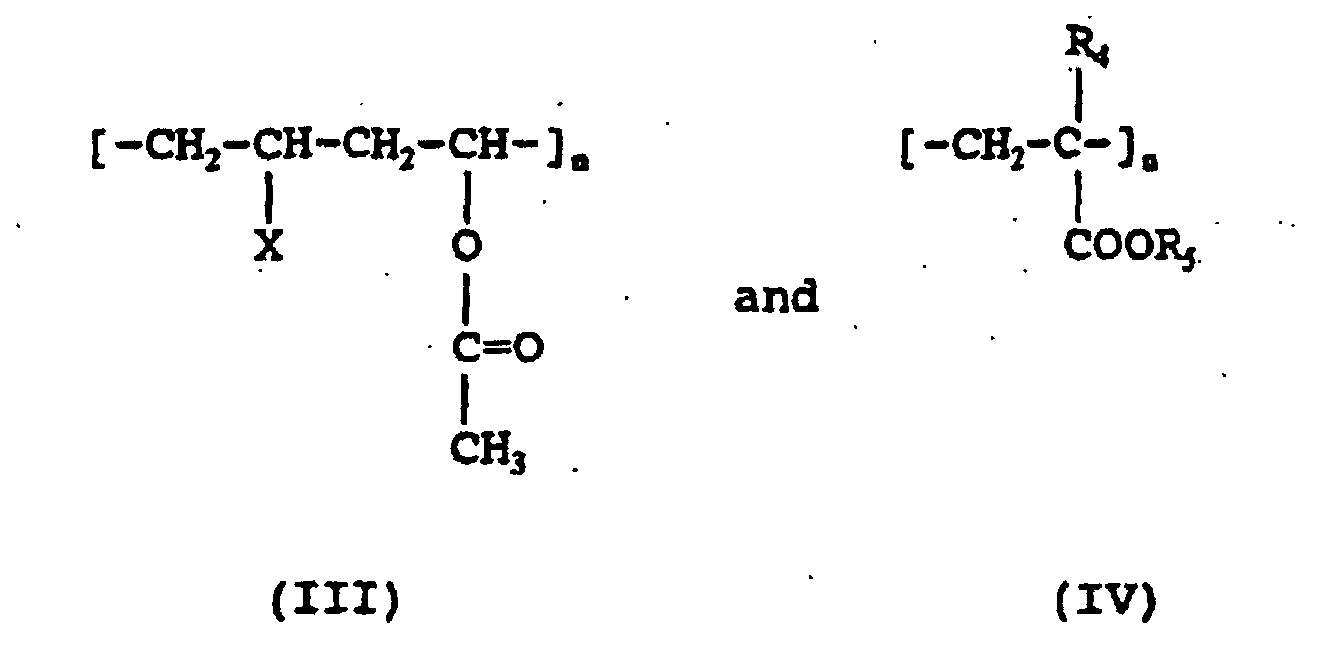
- In certain preferred embodiments, the polymers with pendant ester groups may be polyvinyl acetate, ethylene vinyl acetate copolymers, vinyl chloride-vinyl acetate copolymers, described in Formula III; or methacrylate copolymers, described in Formula IV.
- The ester-containing polymers (II), (III), and/or (IV) are present in the composition in an amount of about 5 to 35 wt. %. In a preferred embodiment, the ester-containing polymer content will be about 10 to 25 wt. %.
- Generally, the ester-containing polymers used in practicing this invention are commercially available or may be synthesized according to conventional methods known to those skilled in the art.
- The compositions prepared according to the invention may also contain up to about 30 wt. % of a plasticizer, preferably about 5 to 20 wt. %. Suitable plasticizers include liquid esters of dibasic aliphatic acids having a molecular weight of less than about 4000 and having between 2 to 12 carbon atoms, or polyesters represented by Formula II above, and are predominantly liquids or wax-like materials with molecular weights of less than 2000, or the acetate esters of glycerine.
- In a preferred embodiment, the plasticizer is selected from the group including triacetate ester (triacetin), poly(propane sebacate), poly(hexamethylene succinate), poly(hexamethylene fumarate), poly(dodecane sebacate), and poly(tetramethylene azelate). In a more preferred embodiment; the plasticizer is triacetate ester (triacetin). Generally, the plasticizers are commercially available or may be synthesized according to conventional methods known to those skilled in the art.
- To accelerate degradation and reduce the cost of the compositions, an unmodified starch in the amount of about 20 to 40 wt. % of the composition is added to the compositions to control the compositions' melt viscosity. In the context of this invention, "unmodified starch" means starch that has not been melt processed, and, thus, its crystalline structure has not been disrupted. The starch has a water content of less than 2%, preferably no more than about- 0.1%. It is also preferred that the starch have a particle size of less than about 15 microns, and preferably less than about 5 microns.
- Starches suitable for fillers include natural or vegetable starches such as those extracted from corn, maize, potatoes, rye, oats, or wheat.
- The thermoplastic compositions prepared according to the method of the invention are useful for producing injection-molded, thin-walled articles which have the advantage of being biodegradable. Thus, the compositions prepared according to the method of this invention are particularly useful for preparing flushable, disposable products such as tampon applicators. Shaped articles such as films, fibers, and molded parts can be made from the compositions prepared according to the method of this invention not only by injection molding processes but also by melt-processes such as melt-extrusion, and compression molding.
- PHBV (15% hydroxyvalerate), obtained from ICI, England and the ester containing polymers were melted and blended with plasticizer and fillers using a Brabender Plasti-Corder mixer. The ester-containing polymers, plasticizer, and amounts of the components are set forth in Table 2. The mixing was carried out at 160°C and 50 rpm. The uniform blends were removed from the bowl and pressed into 254-508µm (10 - 20 mil) thick films (34.5 MPa (5000 psi), 160°C) for characterization and biodegradation testing.
-
- G-30 - Paraplex G-30, a low molecular weight liquid aliphatic polyester (C.P. Hall).
- PEG - 4000 molecular weight polyethylene glycol (Carbowax 3600 Union Carbide.
- Triacetin (triacetate ester of glycerol) - technical grade (Celanese).
- EVA - Ethylene-vinylacetate copolymer, 28 % acetate (UE-634, USI).
- PCL - Polycaprolactone (Tone 700 Union Carbide).
- PHBV - Polyhydroxybutyrate-polyhydroxyvalerate copolymer (ICI).
- Starch - 5 to 10 microns powder (ADM).
- CaCO3 - Calcium carbonate.
-
- The compositions prepared and studied are described in Table 2 along with test results.
- In the context of this invention " tensile strength," means the maximum stress a material subjected to a stretching load can withstand without breaking. The term "elongation" refers to the fractional increasing a material's length due to stress in tension; also referred to as elasticity. The tensile strength/elongation of the compositions was determined using an Instron at 27.4 cm (10 inch)/minute with crosshead speed and a 1 inch gap. "Flex modulus" describes the polymer's stiffness. It was measured using an Instron at 5.08 cm (2 inch)/minute. The term "melt index," as used in the context of this invention, means the number of grams of thermoplastic resin that can be forced through a specified opening under a certain pressure; this is a very important property for thermoplastic compositions. The melt index was determined at 34.5 mPa (5000 psi) and at 160°C.
Biodegradable Compositions Based On PHBV Sample Tensile Strength (PSI) MPa Elong. % Rex Modu (Kpsi) MPa Molt Index 160°C % Weight loss 30 days Composition A/B/C/D
A=PHBV D=STARCHB=PCL
C =Triacetin1 (814) 5.62 41 (118) 814 6 - 46/23/10/20 2 (504) 3.48 46 (98) 676 7 79.5 38/17/15/30 3 (674) 4.65 7 (134) 925 11 85.3 27/13/20/40 4 (489) 3.37 172 (122) 842 9 - 43/22/15/20 5 (342) 2.36 23 (138) 952 5 83 30/15/15/40 6 (654) 4.51 11 (83) 573 13 71.8 40/20/20/20 7 (504) 3.48 47 (165) 1138 4.2 100 50/0/25/25 8 (581) 4.01 18 (222) 1532 2.8 100 45/0/20/35 9 (1570) 10.83 15 (331) 2284 39 100 70/30/0/0 10 (849) 5.86 114 (131) 904 12 51.7 35/35/10/20 11 (325) 2.24 70 (110) 759 13 69 27.5/27.5/5/15/30 12 (400) 2.76 15 (85) 586 20 76.8 20/20/20/40 14 (347) 2.39 20 (108) 745 11 74.1 22.5/22.5/15/40 15 (452) 3.12 71 (102) 704 28 69.3 30/30/20/20 16 (597) 4.12 57 (107) 738 22 72.2 25/25/20/30 17 (514) 3.55 36 (133) 918 9 64.2 30/30/10/30 18 (1057) 7.29 9 (185) 1276 7 71.5 25/25/10/40 19 (1154) 7.96 115 (150) 1035 21 24.9 23/47/10/20 20 (933) 6.44 23 (99) 683 25 46.1 17/38/15/30 21 (341) 2.35 19 (97) 669 30 68.6 13/27/20/40 22 (1086) 7.49 126 (99) 683 28 36.1 22/43/15/20 23 (615) 4.24 11 (134) 925 18 65.6 15/30/15/40 24 (881) 6.08 65 (128) 883 42 45.9 20/40/20/20 25 (583) 4.02 32 (96) 662 37 60 16/34/20/30 26 (755) 5.21 41 (127) 876 16 44 20/40/10/30 27 (695) 4.80 16 (111) 766 13 59.4 16/34/10/40 B=EVA C=TRIACETIN 28 (512) 3.53 49 (64) 442 5 75 46/23/10/20 29 (386) 2.66 78 (66) 455 4.6 100 38/17/15/30 30 (304) 2.10 12 (51) 352 10 87 27/13/20/40 41 (270) 1.86 270 (12.5) 86.2 9.9 26 23/46/10/20 42 (158) 1.09 277 (14.7) 101.4 19.1 60 16/34/10/40 43 70 13/27/20/40 B=TONE 700 C=G-30 44 (1077) 7.43 83 (218) 1504 7 58.8 46/23/10/20 45 (926) 6.39 13 (182) 1256 8 65(70) 38/17/15/30 46 (596) 4.11 8 (156) 1076 16 67.6 27/13/20/40 47 (736) 5.08 7 (138) 952 7 73.4 30/15/15/40 48 (1022) 7.05 38 (150) 1035 15 63.9 40/20/20/20 B=EVA
C=PEG49 (506) 3.49 18 (95.6) 659.6 3.4 75 46/23/10/20 50 (682) 4.70 2.7 (153) 1056 4.2 100 38/17/15/30 B=EVA
C = Triacetin D=CaCo351 (1096) 7.56 (111.4) 768.7 12.4 100 50/10/20/20 52 (837) 5.78 (66.7) 460.2 8 100 40/10/25/25 53 (882) 6.09 (74.5) 5.14 9 85 40/20/20/20 - As can be seen in Table 2, a fairly wide range of mechanical and processing properties can be obtained from the ranges discussed in the preferred embodiments.
- The type and concentration of the plasticizer (C) has a great impact on the melt flow index of the blend (i.e., processability) and on the flexibility and degradation rate. See Table 2.
- In certain preferred embodiments, the ratio of the PHBV to the ester containing polymer (i.e., PCL, EVA) may range from 2:1 to 1:2. The rate of degradation is dependent on this ratio and the PHBV rich compositions degrade faster. For rapid degradation, the ester containing polymer should preferably not be present in levels greater than about 20 wt. % where the PHBV content is less than about 50 wt. %. For example, compare the percent weight loss of samples 2, 3, 5, and 6 with samples 19, 20, 22, 24, 26, and 41 as reported in Table 2.
- The biodegradation of the compositions described in Table 2 was tested in simulated water treatment plant conditions. The samples were exposed to municipal sludge microflora kept at 35°C. These conditions provide a representative anaerobic environment for the degradation of flushed disposable materials. The degradation was followed by monitoring gas evolution and weight loss for thirty days.
- The following composition was first compounded in a 30 mm corotating Werner & Pfleiderer twin screw extruder:
% weight PHBV (7% valerate) 38 Tone 700 16 Triacetin 15 Starch 20 Calcium carbonate 10 Boron Nitride 1 -
- Triacetin (triacetate ester of glycerol) - technical grade (Celanese).
- PHBV - Polyhydroxybutyrate-polyhydroxyvalerate copolymer-(ICI).
- Starch - 5 to 10 microns powder (ADM).
- CaCO3 - Calcium carbonate.
- Tone 700 - Polycaprolactone (PCL) (Union Carbide).
-
- The PHBV powder was preblended with the polycaprolactone (Tone 700) pellets and the starch powder. In a cement mixture the solid blend was sprayed with the liquid triacetin and tumbled for 15 minutes to obtain a uniform mixture. The blend was then fed into the back of the twin screw extruder using a volumetric feeder. Screw speed of 300 rpm was used and the temperature profile was gradually increased from 91°C at the back to 135°C at the front. The actual melt temperature was 140°C. The strands were cooled and chopped into 5mm size pellets.
- Tampon applicators were molded from the above pellets using an 80 ton Engle machine with 5.2 oz. barrel capacity. The molding cycle time was 14 seconds and the mold temperature was 33°C. The temperature profile in the barrel was from 141°C in the feed zone up to 160°C at the nozzle.
Claims (16)
- A method of preparing a composition of matter, the method comprising blending ofa. 10 to 70 wt.% of one or more thermoplastic polymers or copolymers comprising more than one repeating unit of the general formula:wherein R is independently alkyl having from about 1 to 9 carbon atoms;
 b. 5 to 35 wt.% of one or more ester containing polymers, the one or more ester containing polymers having a molecular weight greater than 10,000 and selected from the group consisting of:i. polymers with ester linkages in the backbone, the polymers comprising one or more monomeric units of the formula:wherein R1 may be alkylene or alkenylene having about 2 to 12 carbon atoms; and R2 is alkylene alkenylene or arylene having up to about 12 carbon atoms;
 ii. polymers with pendant ester groups, the polymers comprising one or more monomeric units selected from the group consisting of the units:wherein X is independently H, Cl, alkyl having about 1 to 3 carbon atoms, aryl, acetate or hydroxyl group; R4 is H or alkyl having from 1 to 2 carbon atoms; R5 is alkyl having from about 1 to 4 carbon atoms; and
 iii. polycaprolactone;c. 0 to 30 wt.% of one or more plasticizers; andd. 20 to 40 wt.% of an unmodified starch having a water content of less than 2 wt.%, which means that the starch has not been melt processed and its crystalline structure has not been disrupted.
 - The method of claim 1 wherein the plasticizer is selected from the group consisting of liquid esters of dibasic aliphatic acids having a molecular weight of less than 4000 and having between 2 to 12 carbon atoms; polyesters; and acetate esters of glycerine.
- The method of anyone of claims 1 and 2 wherein the thermoplastic polymer is selected from the group consisting of poly(3-hydroxybutyrate) and poly(3-hydroxyvalerate).
- The method of anyone of claims 1 and 2 wherein the thermoplastic polymer is a copolymer of poly(3-hydroxybutyrate) and poly(3-hydroxyvalerate) where the valerate content is between 5 - 25 %.
- The method of anyone of claims 1 to 4 wherein the ester containing polymer is selected from the group consisting of polycaprolactone, polyethylene glycol adipate, polypropylene glycol sebacate, polyvinyl acetate, ethylene-vinyl acetate copolymers, vinyl chloride-vinyl acetate copolymers, and methacrylate copolymers.
- The method of anyone of claims 1 to 5, wherein said starch, as the inert filler, has a particle size between 5 and 15 microns.
- The method of anyone of claims 1 to 5, wherein said starch, as the inert filler, has a particle size less than 5 microns.
- The method of anyone of claims 1 to 7 wherein the plasticizer is selected from the group consisting of poly(ethylene adipate), poly(propane sebacate), poly(hexamethylene succinate), poly(hexamethylene fumarate), poly(dodecane sebacate), poly(tetramethylene azelate), or triacetate ester.
- The method of anyone of claims 1 to 8 wherein the thermoplastic polymer is present in an amount of 20 to 50 wt%.
- The method of anyone of claims 1 to 9, wherein the ester containing polymer is present in an amount of 10 to 25 wt. %.
- The method of anyone of claims 1 to 10 wherein the plasticizer is present in an amount of 5 to 20 wt.%.
- The method of claim 1 wherein the thermoplastic polymer is selected from the group consisting of poly(3-hydroxybutyrate) and poly(3-hydroxyvalerate) and the ester containing polymer is selected from the group consisting of polycaprolactone, polyethylene glycol adipate, polypropylene glycol sebacate, polyvinyl acetate, ethylene-vinyl acetate copolymers, vinyl chloride-vinyl acetate copolymers, or methyacrylate copolymers.
- The method of claim 1 wherein the thermoplastic polymer is selected from the group consisting of poly(3-hydroxybutyrate) and poly(3-hydroxyvalerate) and copolymers thereof, and the plasticizer is selected from the group consisting of poly(ethylene adipate), poly(propane sebacate), poly(hexamethylene succinate), poly(hexamethylene fumarate), poly(dodecane sebacate), poly(tetramethylene azelate), and triacetate.
- The method of claim 1 wherein the thermoplastic polymer is selected from the group consisting of poly(3-hydroxybutyrate) and poly(3-hydroxyvalerate) and copolymers thereof; the plasticizer is selected from the group consisting of poly(ethylene adipate), poly(propane sebacate), poly(hexamethylene succinate), poly(hexamethylene fumarate), poly(dodecane sebacate), poly(tetramethylene azelate), and triacetate ester; and the ester containing polymer is selected from the group consisting of polycaprolactone, polyethylene glycol adipate, polypropylene glycol sebacate, polyvinyl acetate, ethylene-vinyl acetate copolymers, vinyl chloride-vinyl acetate copolymers, and methacrylate copolymers.
- The method of claim 14 wherein the thermoplastic polymer is present in an amount 20 to 50 wt.%, the ester-containing polymer is present in an amount of 10 to 25 wt.%, the plasticizer is present in an amount of 5 to 20 wt.%, and the starch is present in an amount of 20 to 40 wt.%.
- A method of preparing a biodegradable composition according to claim 1 comprising:a. blending 10 to 70 wt.% of one or more thermoplastic polymers selected from the group consisting of poly(3-hydroxybutyrate) and poly(3-hydroxyvalerate) and copolymers thereof; with an amount of 0 to 30 wt.% of plasticizer selected from the group consisting of poly(ethylene adipate), poly(propane sebacate), poly(hexamethylene succinate), poly(hexamethylene fumarate), poly(dodecane sebacate), poly(tetramethylene azelate), and triacetate ester;b. blending the product of step (a) with an ester-containing polymer selected from the group consisting of polycaprolactone, polyethylene glycol adipate, polypropylene glycol sebacate, polyvinyl acetate, ethylene-vinyl acetate copolymers, vinyl chloride-vinyl acetate copolymers, and methacrylate copolymers;c. blending the product of step (b) with an amount of 20 to 40 wt.% of unmodified starch having a water content of less than 2 wt.% and a particle size of less than 15 microns.
Priority Applications (1)
| Application Number | Priority Date | Filing Date | Title |
|---|---|---|---|
| EP98114766A EP0882765B1 (en) | 1993-01-15 | 1994-01-14 | Melt processable biodegradable compositions and articles made therefrom |
Applications Claiming Priority (2)
| Application Number | Priority Date | Filing Date | Title |
|---|---|---|---|
| US08/006,013 US5910520A (en) | 1993-01-15 | 1993-01-15 | Melt processable biodegradable compositions and articles made therefrom |
| US6013 | 1993-01-15 |
Related Child Applications (1)
| Application Number | Title | Priority Date | Filing Date |
|---|---|---|---|
| EP98114766A Division EP0882765B1 (en) | 1993-01-15 | 1994-01-14 | Melt processable biodegradable compositions and articles made therefrom |
Publications (3)
| Publication Number | Publication Date |
|---|---|
| EP0606923A2 EP0606923A2 (en) | 1994-07-20 |
| EP0606923A3 EP0606923A3 (en) | 1996-06-05 |
| EP0606923B1 true EP0606923B1 (en) | 2003-04-02 |
Family
ID=21718856
Family Applications (2)
| Application Number | Title | Priority Date | Filing Date |
|---|---|---|---|
| EP98114766A Expired - Lifetime EP0882765B1 (en) | 1993-01-15 | 1994-01-14 | Melt processable biodegradable compositions and articles made therefrom |
| EP94100533A Expired - Lifetime EP0606923B1 (en) | 1993-01-15 | 1994-01-14 | Method for the preparation of melt processable biodegradable compositions |
Family Applications Before (1)
| Application Number | Title | Priority Date | Filing Date |
|---|---|---|---|
| EP98114766A Expired - Lifetime EP0882765B1 (en) | 1993-01-15 | 1994-01-14 | Melt processable biodegradable compositions and articles made therefrom |
Country Status (14)
| Country | Link |
|---|---|
| US (1) | US5910520A (en) |
| EP (2) | EP0882765B1 (en) |
| JP (1) | JP3923094B2 (en) |
| AT (2) | ATE252138T1 (en) |
| AU (2) | AU669025B2 (en) |
| BR (1) | BR9400106A (en) |
| CA (1) | CA2113521C (en) |
| DE (2) | DE69432378T2 (en) |
| DK (2) | DK0882765T3 (en) |
| ES (2) | ES2209012T3 (en) |
| GR (1) | GR1002560B (en) |
| NZ (2) | NZ250655A (en) |
| PT (2) | PT882765E (en) |
| SG (1) | SG54321A1 (en) |
Families Citing this family (51)
| Publication number | Priority date | Publication date | Assignee | Title |
|---|---|---|---|---|
| US5939467A (en) * | 1992-06-26 | 1999-08-17 | The Procter & Gamble Company | Biodegradable polymeric compositions and products thereof |
| GR1002912B (en) * | 1993-01-15 | 1998-05-25 | Mcneil-Ppc Inc. | Melt processable biodegradable compositions and articles made therefrom. |
| ZA95627B (en) * | 1994-01-28 | 1995-10-05 | Procter & Gamble | Biodegradable copolymers and plastic articles comprising biodegradable copolymers |
| SG49096A1 (en) * | 1994-01-28 | 1998-05-18 | Procter & Gamble | Biodegradable 3-polyhydtoxybuyrate/3- polyhydroxyhexanoate copolymer films |
| ID23491A (en) * | 1994-01-28 | 1995-09-07 | Procter & Gamble | COOPOLYMERS WHICH CAN BE DIODODEGRADED AND PLASTIC MATERIALS CONTAINED FROM CO-COLLIMERS WHICH CAN BE DIBIODEGRADED |
| RU2144047C1 (en) * | 1994-01-28 | 2000-01-10 | Дзе Проктер Энд Гэмбл Компани | Biodecomposable copolymers, plastic and impregnating products comprising biodecomposable copolymers |
| AU741001B2 (en) * | 1994-09-16 | 2001-11-22 | Procter & Gamble Company, The | Biodegradable polymeric compositions and products thereof |
| FR2735483B1 (en) * | 1995-06-13 | 1997-08-08 | Potency Sarl | TOTALLY BIODEGRADABLE COMPOSITE MATERIAL AND PROCESS FOR PRODUCING THE SAME |
| US6143947A (en) * | 1996-01-29 | 2000-11-07 | The Procter & Gamble Company | Fibers, nonwoven fabrics and absorbent articles comprising a biodegradable polyhydroxyalkanoate comprising 3-hydroxybutyrate and 3-hydroxyhexanoate |
| WO1997034953A1 (en) * | 1996-03-19 | 1997-09-25 | The Procter & Gamble Company | Biodegradable polymeric compositions and products thereof |
| US6019743A (en) | 1997-06-30 | 2000-02-01 | Mcneil-Ppc, Inc. | Flexible applicator for inserting an article into a mammalin body cavity |
| US6127512A (en) * | 1997-10-31 | 2000-10-03 | Monsanto Company | Plasticized polyhydroxyalkanoate compositions and methods for their use in the production of shaped polymeric articles |
| EP1027384B1 (en) * | 1997-10-31 | 2005-07-27 | Metabolix, Inc. | Polymer blends containing polyhydroxyalkanoates and compositions with good retention of elongation |
| DE19758376A1 (en) | 1997-12-24 | 1999-07-01 | Johnson & Johnson Gmbh | Tampon applicator |
| KR100503763B1 (en) * | 1998-01-23 | 2005-10-27 | 주식회사 새 한 | Biodecomposable resin composition |
| DE19938672C2 (en) * | 1999-08-06 | 2001-11-22 | Biop Biopolymer Gmbh | Process for the production of a thermoplastic polymer mixture based on starch by reactive extrusion |
| US6231970B1 (en) * | 2000-01-11 | 2001-05-15 | E. Khashoggi Industries, Llc | Thermoplastic starch compositions incorporating a particulate filler component |
| US6450986B1 (en) | 2000-06-19 | 2002-09-17 | Mcneil-Ppc, Inc. | Tampon applicator having outwardly flared rim |
| US6423025B1 (en) | 2000-06-30 | 2002-07-23 | Herve Buzot | Catamenial applicator having a fingergrip |
| US6582389B2 (en) | 2000-12-20 | 2003-06-24 | Mcneil-Ppc, Inc. | Applicator for delivering bulky devices |
| DE10065058A1 (en) * | 2000-12-27 | 2002-07-11 | Sasol Germany Gmbh | Composition, useful for the production of film and articles, comprises a polyvinylacetate homo- or mixed polymer and an alkoxylated alcohol |
| US6773422B2 (en) * | 2001-03-22 | 2004-08-10 | Mcneil-Ppc, Inc. | Folded compact tampon applicator |
| US6673032B2 (en) | 2001-03-30 | 2004-01-06 | Mcneil-Ppc, Inc. | Applicator having improved gripper end |
| CN1164661C (en) * | 2001-12-17 | 2004-09-01 | 武汉华丽环保科技有限公司 | Starch-based biodegradable material and its preparation method |
| WO2003066733A1 (en) * | 2002-02-05 | 2003-08-14 | Mitsui Chemicals, Inc. | Biodegradable resin composition and molded object thereof |
| DE10313939A1 (en) * | 2003-03-27 | 2004-10-14 | Wacker Polymer Systems Gmbh & Co. Kg | Use of polymers for starch modification |
| US6706942B1 (en) * | 2003-05-08 | 2004-03-16 | The Procter & Gamble Company | Molded or extruded articles comprising polyhydroxyalkanoate copolymer compositions having short annealing cycle times |
| US7098292B2 (en) * | 2003-05-08 | 2006-08-29 | The Procter & Gamble Company | Molded or extruded articles comprising polyhydroxyalkanoate copolymer and an environmentally degradable thermoplastic polymer |
| JP4622259B2 (en) * | 2004-02-17 | 2011-02-02 | 東ソー株式会社 | Resin composition |
| KR20070084032A (en) * | 2004-10-05 | 2007-08-24 | 플랜틱 테크놀로지스 리미티드 | Moldable Biodegradable Polymers |
| WO2006105518A1 (en) * | 2005-03-31 | 2006-10-05 | Johnson & Johnson Consumer Companies, Inc. | Lubricated tampon applicator |
| US20080154175A1 (en) * | 2005-03-31 | 2008-06-26 | Chase David J | Novel Tampon Applicator |
| JP2006316172A (en) * | 2005-05-12 | 2006-11-24 | Toyota Motor Corp | Resin composition |
| US7989524B2 (en) * | 2005-07-19 | 2011-08-02 | The United States Of America, As Represented By The Secretary Of Agriculture | Fiber-reinforced starch-based compositions and methods of manufacture and use |
| BRPI0600683A (en) * | 2006-02-24 | 2007-11-20 | Phb Ind Sa | environmentally degradable polymer composition and its process of obtaining |
| BRPI0600681A (en) * | 2006-02-24 | 2007-11-20 | Phb Ind Sa | environmentally degradable polymeric blend and its process of obtaining |
| US8308675B2 (en) * | 2006-03-31 | 2012-11-13 | Mcneil-Ppc, Inc. | Applicator device |
| US20100209726A1 (en) * | 2007-10-26 | 2010-08-19 | Kelly Coover | Biodegradable material and methods related thereto |
| US20090218729A1 (en) | 2008-02-29 | 2009-09-03 | Pelley Kenneth A | Method and apparatus to form a spherical end of an elongated cylindrical tube |
| US8029456B2 (en) | 2008-03-31 | 2011-10-04 | Mcneil-Ppc, Inc. | Compact intravaginal device applicator |
| DE102008027261A1 (en) * | 2008-06-06 | 2009-12-10 | Martin-Luther-Universität Halle-Wittenberg | Process for improving the physico-chemical properties of biodegradable materials |
| EP2710072A1 (en) * | 2011-05-20 | 2014-03-26 | The Procter and Gamble Company | Molded articles of starch-polymer-wax-oil compositions |
| WO2013169174A1 (en) * | 2012-05-07 | 2013-11-14 | Aktec Dev. Ltd | Biodegradable plastics, method for production thereof and use thereof |
| DE202012103789U1 (en) | 2012-07-09 | 2012-11-15 | Galmedics Biotech Ltd. | Harvester-like menses collection device |
| US9644082B2 (en) * | 2012-10-15 | 2017-05-09 | Kaneka Corporation | Polyester resin composition and molded article containing this resin composition |
| US9320656B2 (en) | 2013-11-27 | 2016-04-26 | Kimberly-Clark Worldwide, Inc. | Water-dispersible thermoplastic injection molded composition |
| US9456931B2 (en) | 2013-11-27 | 2016-10-04 | Kimberly-Clark Worldwide, Inc. | Thermoplastic and water-dispersible injection moldable materials and articles |
| US9339580B2 (en) | 2013-11-27 | 2016-05-17 | Kimberly-Clark Worldwide, Inc. | Flushable tampon applicator |
| US11278456B2 (en) | 2020-07-21 | 2022-03-22 | Lacey Janell Lund | Tampon insertion device |
| KR102431676B1 (en) * | 2021-07-30 | 2022-08-11 | 씨제이제일제당(주) | Biodegradable resin composition, biodegradable film, mulching film using same, and preperation method thereof |
| EP4410885A4 (en) * | 2021-09-30 | 2025-09-24 | Zeon Corp | VINYLCHLORIDE RESIN COMPOSITION, VINYLCHLORIDE RESIN MOLDED BODIES AND LAYERED PRODUCT |
Citations (3)
| Publication number | Priority date | Publication date | Assignee | Title |
|---|---|---|---|---|
| JPH0327109A (en) * | 1989-06-24 | 1991-02-05 | Hagiwara Kogyo Kk | Production of bio-degradable flat yarn |
| WO1991002025A1 (en) * | 1989-08-07 | 1991-02-21 | Butterfly S.R.L. | A polymer composition including destructured starch and an ethylene copolymer |
| US5087650A (en) * | 1990-12-05 | 1992-02-11 | Fully Compounded Plastics, Inc. | Biodegradable plastics |
Family Cites Families (32)
| Publication number | Priority date | Publication date | Assignee | Title |
|---|---|---|---|---|
| EP0052460B1 (en) * | 1980-11-18 | 1985-02-06 | Imperial Chemical Industries Plc | Polymer blends |
| EP0057415B1 (en) * | 1981-01-30 | 1987-04-29 | Teijin Limited | Polyester resin composition |
| DE3238232A1 (en) * | 1981-04-18 | 1984-04-19 | Eberhard Faber Gmbh, 8430 Neumarkt | Air-drying modelling or moulding composition |
| GB2124637A (en) * | 1982-08-03 | 1984-02-22 | Bip Chemicals Ltd | Polyethylene terephthalate moulding compositions |
| US4673438A (en) * | 1984-02-13 | 1987-06-16 | Warner-Lambert Company | Polymer composition for injection molding |
| JPS634653A (en) * | 1986-06-25 | 1988-01-09 | Hitachi Ltd | Wiring substrate and manufacture thereof |
| GB2208651B (en) * | 1987-08-18 | 1991-05-08 | Warner Lambert Co | Shaped articles made from pre-processed starch |
| GB2214516B (en) * | 1988-01-25 | 1992-10-07 | Warner Lambert Co | Method of producing destructurised starch |
| GB2214918B (en) * | 1988-02-03 | 1992-10-07 | Warner Lambert Co | Polymeric materials made from starch and at least one synthetic thermoplastic polymeric material |
| US4938763B1 (en) * | 1988-10-03 | 1995-07-04 | Atrix Lab Inc | Biodegradable in-situ forming implants and method of producing the same |
| US5035930A (en) * | 1988-12-30 | 1991-07-30 | National Starch And Chemical Investment Holding Corporation | Biodegradable shaped products and the method of preparation thereof |
| IL93620A0 (en) * | 1989-03-09 | 1990-12-23 | Butterfly Srl | Biodegradable articles based on starch and process for producing them |
| IT1233599B (en) * | 1989-05-30 | 1992-04-06 | Butterfly Srl | POLYMERIC COMPOSITIONS FOR THE PRODUCTION OF BIODEGRADABLE PLASTIC ITEMS AND PROCEDURES FOR THEIR PREPARATION |
| IT1234783B (en) * | 1989-05-30 | 1992-05-27 | Butterfly Srl | PROCEDURE FOR THE PRODUCTION OF DESTRUCTURED STARCH-BASED COMPOSITIONS AND COMPOSITIONS SO OBTAINED |
| IL94587A (en) * | 1989-06-19 | 1997-04-15 | Novon International | Polymer base blend compositions containing destructurized starch |
| IL94589A0 (en) * | 1989-06-22 | 1991-04-15 | Warner Lambert Co | Polymer base blend compositions containing destructurized starch |
| IL94588A0 (en) * | 1989-06-22 | 1991-04-15 | Warner Lambert Co | Polymer base blend compositions containing destructurized starch |
| YU128990A (en) * | 1989-07-11 | 1993-05-28 | Warner-Lambert Co. | PREPARATIONS OF POLYMER MIXTURES CONTAINING DESTRUCTURED STARCH |
| NZ234496A (en) * | 1989-07-20 | 1991-08-27 | Warner Lambert Co | A composition comprising destructurised starch and a polymer containing carboxylic acid groups as the only functional groups |
| IT1232894B (en) * | 1989-08-03 | 1992-03-05 | Butterfly Srl | EXPANDED BIODEGRADABLE PLASTIC ITEMS AND PROCEDURE FOR THEIR PREPARATION |
| IT1232910B (en) * | 1989-08-07 | 1992-03-05 | Butterfly Srl | POLYMERIC COMPOSITIONS FOR THE PRODUCTION OF BIODEGRADABLE PLASTIC ITEMS AND PROCEDURES FOR THEIR PREPARATION |
| JPH0623260B2 (en) * | 1989-11-08 | 1994-03-30 | 工業技術院長 | Microbial degradable thermoplastic resin molding and method for producing the same |
| JPH0662839B2 (en) * | 1989-11-14 | 1994-08-17 | 工業技術院長 | Microbial degradable plastic molding and method for producing the same |
| US5206087A (en) * | 1990-02-28 | 1993-04-27 | Director-General Of Agency Of Industrial Science And Technology | Biodecomposable or biodisintegrable moldable material |
| GB9016345D0 (en) * | 1990-07-25 | 1990-09-12 | Ici Plc | Polymer blends |
| IT1240503B (en) * | 1990-07-25 | 1993-12-17 | Butterfly Srl | STARCH POLYMERIC MIXTURE PARTICULARLY FOR THE PRODUCTION OF FILMS AND SIMILAR AND PROCEDURE FOR ITS PRODUCTION. |
| IT1245408B (en) * | 1991-02-20 | 1994-09-20 | Butterfly Srl | BIODEGRADABLE POLYMERIC COMPOSITIONS BASED ON STARCH AND THERMOPLASTIC POLYMER |
| ATE155161T1 (en) * | 1991-05-03 | 1997-07-15 | Novamont Spa | BIODEGRADABLE POLYMERS BASED ON STARCH AND THERMOPLASTIC POLYMERS |
| DE4116404A1 (en) * | 1991-05-18 | 1992-11-19 | Tomka Ivan | POLYMERMISCHUNG FOR THE MANUFACTURE OF FOILS |
| SK147793A3 (en) * | 1991-06-26 | 1994-09-07 | Procter & Gamble | Disposable absorptive objects with biodegradable backlayers |
| US5217803A (en) * | 1991-06-26 | 1993-06-08 | Tredegar Industries, Inc. | Disposable absorbent articles with biodegradable backsheets |
| US5169889A (en) * | 1992-01-27 | 1992-12-08 | National Starch And Chemical Investment Holding Corporation | Poly hydroxybutyrate/hydroxyvalerate based hot melt adhesive |
-
1993
- 1993-01-15 US US08/006,013 patent/US5910520A/en not_active Expired - Fee Related
- 1993-12-22 GR GR930100526A patent/GR1002560B/en not_active IP Right Cessation
-
1994
- 1994-01-06 AU AU53054/94A patent/AU669025B2/en not_active Ceased
- 1994-01-10 NZ NZ250655A patent/NZ250655A/en not_active IP Right Cessation
- 1994-01-10 NZ NZ270251A patent/NZ270251A/en not_active IP Right Cessation
- 1994-01-14 ES ES98114766T patent/ES2209012T3/en not_active Expired - Lifetime
- 1994-01-14 AT AT98114766T patent/ATE252138T1/en not_active IP Right Cessation
- 1994-01-14 ES ES94100533T patent/ES2194851T3/en not_active Expired - Lifetime
- 1994-01-14 BR BR9400106A patent/BR9400106A/en not_active IP Right Cessation
- 1994-01-14 CA CA002113521A patent/CA2113521C/en not_active Expired - Fee Related
- 1994-01-14 EP EP98114766A patent/EP0882765B1/en not_active Expired - Lifetime
- 1994-01-14 EP EP94100533A patent/EP0606923B1/en not_active Expired - Lifetime
- 1994-01-14 PT PT98114766T patent/PT882765E/en unknown
- 1994-01-14 SG SG1996009015A patent/SG54321A1/en unknown
- 1994-01-14 DE DE69432378T patent/DE69432378T2/en not_active Expired - Lifetime
- 1994-01-14 DK DK98114766T patent/DK0882765T3/en active
- 1994-01-14 PT PT94100533T patent/PT606923E/en unknown
- 1994-01-14 DE DE69433252T patent/DE69433252T2/en not_active Expired - Lifetime
- 1994-01-14 DK DK94100533T patent/DK0606923T3/en active
- 1994-01-14 JP JP01495194A patent/JP3923094B2/en not_active Expired - Fee Related
- 1994-01-14 AT AT94100533T patent/ATE236220T1/en not_active IP Right Cessation
-
1996
- 1996-04-24 AU AU50864/96A patent/AU688673B2/en not_active Ceased
Patent Citations (3)
| Publication number | Priority date | Publication date | Assignee | Title |
|---|---|---|---|---|
| JPH0327109A (en) * | 1989-06-24 | 1991-02-05 | Hagiwara Kogyo Kk | Production of bio-degradable flat yarn |
| WO1991002025A1 (en) * | 1989-08-07 | 1991-02-21 | Butterfly S.R.L. | A polymer composition including destructured starch and an ethylene copolymer |
| US5087650A (en) * | 1990-12-05 | 1992-02-11 | Fully Compounded Plastics, Inc. | Biodegradable plastics |
Also Published As
| Publication number | Publication date |
|---|---|
| EP0882765A3 (en) | 1999-03-24 |
| EP0606923A2 (en) | 1994-07-20 |
| AU5086496A (en) | 1996-07-04 |
| EP0882765A2 (en) | 1998-12-09 |
| GR1002560B (en) | 1997-01-29 |
| ATE236220T1 (en) | 2003-04-15 |
| DE69433252D1 (en) | 2003-11-20 |
| JPH06322182A (en) | 1994-11-22 |
| EP0606923A3 (en) | 1996-06-05 |
| EP0882765B1 (en) | 2003-10-15 |
| AU5305494A (en) | 1994-07-21 |
| PT606923E (en) | 2003-07-31 |
| DE69433252T2 (en) | 2004-09-16 |
| ES2194851T3 (en) | 2003-12-01 |
| DE69432378T2 (en) | 2004-02-12 |
| JP3923094B2 (en) | 2007-05-30 |
| DE69432378D1 (en) | 2003-05-08 |
| US5910520A (en) | 1999-06-08 |
| NZ250655A (en) | 1995-12-21 |
| ATE252138T1 (en) | 2003-11-15 |
| PT882765E (en) | 2004-02-27 |
| ES2209012T3 (en) | 2004-06-16 |
| DK0882765T3 (en) | 2003-12-01 |
| BR9400106A (en) | 1994-08-02 |
| SG54321A1 (en) | 1998-11-16 |
| NZ270251A (en) | 1995-12-21 |
| CA2113521C (en) | 2006-08-29 |
| DK0606923T3 (en) | 2003-07-21 |
| CA2113521A1 (en) | 1994-07-16 |
| AU669025B2 (en) | 1996-05-23 |
| AU688673B2 (en) | 1998-03-12 |
Similar Documents
| Publication | Publication Date | Title |
|---|---|---|
| EP0606923B1 (en) | Method for the preparation of melt processable biodegradable compositions | |
| US6096809A (en) | Biologically degradable polymer mixture | |
| EP0559785B1 (en) | Blends of aliphatic-aromatic copolyesters with cellulose ester polymers | |
| KR101477049B1 (en) | Biodegradable polymer compositions useful for the production of biodegradable plastics and methods of making such compositions | |
| JPH0662839B2 (en) | Microbial degradable plastic molding and method for producing the same | |
| CA2153495A1 (en) | Biodegradable thermoplastic polymer blend compositions with accelerated biodegradation | |
| EP1698665B1 (en) | Method for making biodegradable polyhydroxyalkanoate copolymers having improved crystallization properties | |
| EP0540641B1 (en) | Biodegradable polymer blend containing 3-hydroxybutyrate/3-hydroxyvalerate copolymer | |
| WO1992004410A1 (en) | Films containing polyhydroxy acids and a compatibilizer | |
| JPH08502552A (en) | Biodegradable molding products and films comprising a blend of starch ester and polyester | |
| JPH0379645A (en) | Polymer-based blended compound containing altered starch | |
| JPH0725942B2 (en) | Polymer-based blend composition containing modified starch | |
| HUT57808A (en) | Polymer composition suitable for producing biologically decomposable plastic products and process for its production | |
| WO2005066272A1 (en) | Blends of aliphatic-aromatic copolyesters with ethylene-vinyl acetate copolymers | |
| AU2002249867B2 (en) | Biodegradable polyhydroxyalkanoate copolymers having improved crystallization properties | |
| JP4503215B2 (en) | Lactic acid-based resin composition, peroxide-modified lactic acid-based resin composition, and molded articles thereof | |
| JP3924006B2 (en) | Polymer composition | |
| KR19990074231A (en) | A method for preparing thermoplastic starch having excellent reactivity, a resin composition and a composite material containing the same. | |
| KR0156895B1 (en) | Biodegradable resin composition | |
| JPH05125266A (en) | Biodegradable polymer composition | |
| JPH0623302B2 (en) | Biodegradable plastic composition | |
| KR0146849B1 (en) | Biodegradable resin composition | |
| AU2015249059B2 (en) | A process for preparation of biodegradable biocompostable biodigestible peplene polymer | |
| WO1997031979A1 (en) | Biodegradable polyester compositions with natural polymers and articles thereof | |
| NZ239123A (en) | Biodegradeable polymer blend comprising a copolymer containing 3-hydroxy |
Legal Events
| Date | Code | Title | Description |
|---|---|---|---|
| PUAI | Public reference made under article 153(3) epc to a published international application that has entered the european phase |
Free format text: ORIGINAL CODE: 0009012 |
|
| AK | Designated contracting states |
Kind code of ref document: A2 Designated state(s): AT BE CH DE DK ES FR GB IE IT LI LU MC NL PT SE |
|
| PUAL | Search report despatched |
Free format text: ORIGINAL CODE: 0009013 |
|
| AK | Designated contracting states |
Kind code of ref document: A3 Designated state(s): AT BE CH DE DK ES FR GB IE IT LI LU MC NL PT SE |
|
| 17P | Request for examination filed |
Effective date: 19960830 |
|
| 17Q | First examination report despatched |
Effective date: 19971021 |
|
| RTI1 | Title (correction) |
Free format text: METHOD FOR THE PREPARATION OF MELT PROCESSABLE BIODEGRADABLE COMPOSITIONS |
|
| GRAH | Despatch of communication of intention to grant a patent |
Free format text: ORIGINAL CODE: EPIDOS IGRA |
|
| RTI1 | Title (correction) |
Free format text: METHOD FOR THE PREPARATION OF MELT PROCESSABLE BIODEGRADABLE COMPOSITIONS |
|
| GRAH | Despatch of communication of intention to grant a patent |
Free format text: ORIGINAL CODE: EPIDOS IGRA |
|
| GRAA | (expected) grant |
Free format text: ORIGINAL CODE: 0009210 |
|
| AK | Designated contracting states |
Designated state(s): AT BE CH DE DK ES FR GB IE IT LI LU MC NL PT SE |
|
| REG | Reference to a national code |
Ref country code: GB Ref legal event code: FG4D |
|
| REG | Reference to a national code |
Ref country code: CH Ref legal event code: NV Representative=s name: E. BLUM & CO. PATENTANWAELTE Ref country code: CH Ref legal event code: EP |
|
| REG | Reference to a national code |
Ref country code: IE Ref legal event code: FG4D |
|
| REF | Corresponds to: |
Ref document number: 69432378 Country of ref document: DE Date of ref document: 20030508 Kind code of ref document: P |
|
| REG | Reference to a national code |
Ref country code: DK Ref legal event code: T3 |
|
| REG | Reference to a national code |
Ref country code: SE Ref legal event code: TRGR |
|
| ET | Fr: translation filed | ||
| PG25 | Lapsed in a contracting state [announced via postgrant information from national office to epo] |
Ref country code: LU Free format text: LAPSE BECAUSE OF NON-PAYMENT OF DUE FEES Effective date: 20040114 Ref country code: IE Free format text: LAPSE BECAUSE OF NON-PAYMENT OF DUE FEES Effective date: 20040114 Ref country code: GB Free format text: LAPSE BECAUSE OF NON-PAYMENT OF DUE FEES Effective date: 20040114 |
|
| PG25 | Lapsed in a contracting state [announced via postgrant information from national office to epo] |
Ref country code: MC Free format text: LAPSE BECAUSE OF NON-PAYMENT OF DUE FEES Effective date: 20040131 |
|
| PLBE | No opposition filed within time limit |
Free format text: ORIGINAL CODE: 0009261 |
|
| STAA | Information on the status of an ep patent application or granted ep patent |
Free format text: STATUS: NO OPPOSITION FILED WITHIN TIME LIMIT |
|
| 26N | No opposition filed |
Effective date: 20040105 |
|
| GBPC | Gb: european patent ceased through non-payment of renewal fee |
Effective date: 20040114 |
|
| REG | Reference to a national code |
Ref country code: IE Ref legal event code: MM4A |
|
| PG25 | Lapsed in a contracting state [announced via postgrant information from national office to epo] |
Ref country code: IT Free format text: LAPSE BECAUSE OF NON-PAYMENT OF DUE FEES;WARNING: LAPSES OF ITALIAN PATENTS WITH EFFECTIVE DATE BEFORE 2007 MAY HAVE OCCURRED AT ANY TIME BEFORE 2007. THE CORRECT EFFECTIVE DATE MAY BE DIFFERENT FROM THE ONE RECORDED. Effective date: 20050114 |
|
| PGFP | Annual fee paid to national office [announced via postgrant information from national office to epo] |
Ref country code: NL Payment date: 20070103 Year of fee payment: 14 |
|
| PGFP | Annual fee paid to national office [announced via postgrant information from national office to epo] |
Ref country code: SE Payment date: 20070104 Year of fee payment: 14 |
|
| PGFP | Annual fee paid to national office [announced via postgrant information from national office to epo] |
Ref country code: AT Payment date: 20070111 Year of fee payment: 14 |
|
| PGFP | Annual fee paid to national office [announced via postgrant information from national office to epo] |
Ref country code: PT Payment date: 20070112 Year of fee payment: 14 |
|
| PGFP | Annual fee paid to national office [announced via postgrant information from national office to epo] |
Ref country code: DK Payment date: 20070115 Year of fee payment: 14 Ref country code: CH Payment date: 20070115 Year of fee payment: 14 |
|
| PGFP | Annual fee paid to national office [announced via postgrant information from national office to epo] |
Ref country code: ES Payment date: 20070220 Year of fee payment: 14 |
|
| PGFP | Annual fee paid to national office [announced via postgrant information from national office to epo] |
Ref country code: BE Payment date: 20070314 Year of fee payment: 14 |
|
| REG | Reference to a national code |
Ref country code: CH Ref legal event code: PFA Owner name: MCNEIL-PPC, INC. Free format text: MCNEIL-PPC, INC.#VAN LIEW AVENUE#MILLTOWN NEW JERSEY 08850 (US) -TRANSFER TO- MCNEIL-PPC, INC.#VAN LIEW AVENUE#MILLTOWN NEW JERSEY 08850 (US) |
|
| PGFP | Annual fee paid to national office [announced via postgrant information from national office to epo] |
Ref country code: IT Payment date: 20070608 Year of fee payment: 14 |
|
| PGRI | Patent reinstated in contracting state [announced from national office to epo] |
Ref country code: IT Effective date: 20080301 |
|
| REG | Reference to a national code |
Ref country code: PT Ref legal event code: MM4A Free format text: LAPSE DUE TO NON-PAYMENT OF FEES Effective date: 20080714 |
|
| BERE | Be: lapsed |
Owner name: *MCNEIL-PPC INC. Effective date: 20080131 |
|
| REG | Reference to a national code |
Ref country code: CH Ref legal event code: PL |
|
| REG | Reference to a national code |
Ref country code: DK Ref legal event code: EBP |
|
| EUG | Se: european patent has lapsed | ||
| NLV4 | Nl: lapsed or anulled due to non-payment of the annual fee |
Effective date: 20080801 |
|
| PG25 | Lapsed in a contracting state [announced via postgrant information from national office to epo] |
Ref country code: PT Free format text: LAPSE BECAUSE OF NON-PAYMENT OF DUE FEES Effective date: 20080714 Ref country code: NL Free format text: LAPSE BECAUSE OF NON-PAYMENT OF DUE FEES Effective date: 20080801 Ref country code: LI Free format text: LAPSE BECAUSE OF NON-PAYMENT OF DUE FEES Effective date: 20080131 Ref country code: CH Free format text: LAPSE BECAUSE OF NON-PAYMENT OF DUE FEES Effective date: 20080131 |
|
| PG25 | Lapsed in a contracting state [announced via postgrant information from national office to epo] |
Ref country code: AT Free format text: LAPSE BECAUSE OF NON-PAYMENT OF DUE FEES Effective date: 20080114 |
|
| PG25 | Lapsed in a contracting state [announced via postgrant information from national office to epo] |
Ref country code: SE Free format text: LAPSE BECAUSE OF NON-PAYMENT OF DUE FEES Effective date: 20080115 Ref country code: DK Free format text: LAPSE BECAUSE OF NON-PAYMENT OF DUE FEES Effective date: 20080131 |
|
| PG25 | Lapsed in a contracting state [announced via postgrant information from national office to epo] |
Ref country code: BE Free format text: LAPSE BECAUSE OF NON-PAYMENT OF DUE FEES Effective date: 20080131 |
|
| REG | Reference to a national code |
Ref country code: ES Ref legal event code: FD2A Effective date: 20080115 |
|
| PG25 | Lapsed in a contracting state [announced via postgrant information from national office to epo] |
Ref country code: ES Free format text: LAPSE BECAUSE OF NON-PAYMENT OF DUE FEES Effective date: 20080115 |
|
| PGRI | Patent reinstated in contracting state [announced from national office to epo] |
Ref country code: IT Effective date: 20080301 |
|
| PGFP | Annual fee paid to national office [announced via postgrant information from national office to epo] |
Ref country code: FR Payment date: 20100208 Year of fee payment: 17 |
|
| PGFP | Annual fee paid to national office [announced via postgrant information from national office to epo] |
Ref country code: DE Payment date: 20100107 Year of fee payment: 17 |
|
| REG | Reference to a national code |
Ref country code: FR Ref legal event code: ST Effective date: 20110930 |
|
| PG25 | Lapsed in a contracting state [announced via postgrant information from national office to epo] |
Ref country code: FR Free format text: LAPSE BECAUSE OF NON-PAYMENT OF DUE FEES Effective date: 20110131 |
|
| REG | Reference to a national code |
Ref country code: DE Ref legal event code: R119 Ref document number: 69432378 Country of ref document: DE Effective date: 20110802 |
|
| PG25 | Lapsed in a contracting state [announced via postgrant information from national office to epo] |
Ref country code: DE Free format text: LAPSE BECAUSE OF NON-PAYMENT OF DUE FEES Effective date: 20110802 |