EP0576743A1 - Nucleic acid probes for the detection of mycoplasma pneumoniae - Google Patents
Nucleic acid probes for the detection of mycoplasma pneumoniae Download PDFInfo
- Publication number
- EP0576743A1 EP0576743A1 EP92305126A EP92305126A EP0576743A1 EP 0576743 A1 EP0576743 A1 EP 0576743A1 EP 92305126 A EP92305126 A EP 92305126A EP 92305126 A EP92305126 A EP 92305126A EP 0576743 A1 EP0576743 A1 EP 0576743A1
- Authority
- EP
- European Patent Office
- Prior art keywords
- probe
- nucleic acid
- mycoplasma
- rrna
- probes
- Prior art date
- Legal status (The legal status is an assumption and is not a legal conclusion. Google has not performed a legal analysis and makes no representation as to the accuracy of the status listed.)
- Granted
Links
- 241000202934 Mycoplasma pneumoniae Species 0.000 title claims abstract description 56
- 108020004711 Nucleic Acid Probes Proteins 0.000 title abstract description 4
- 239000002853 nucleic acid probe Substances 0.000 title abstract description 4
- 238000001514 detection method Methods 0.000 title description 16
- 239000000523 sample Substances 0.000 claims abstract description 200
- 241000204051 Mycoplasma genitalium Species 0.000 claims abstract description 36
- 241000204031 Mycoplasma Species 0.000 claims abstract description 28
- 230000000295 complement effect Effects 0.000 claims abstract description 16
- 206010003757 Atypical pneumonia Diseases 0.000 claims abstract description 15
- 238000000034 method Methods 0.000 claims abstract description 15
- 208000001572 Mycoplasma Pneumonia Diseases 0.000 claims abstract description 11
- 241001430197 Mollicutes Species 0.000 claims abstract description 9
- 150000007523 nucleic acids Chemical class 0.000 claims description 73
- 108020004707 nucleic acids Proteins 0.000 claims description 72
- 102000039446 nucleic acids Human genes 0.000 claims description 72
- 238000009396 hybridization Methods 0.000 claims description 36
- 239000000203 mixture Substances 0.000 claims description 29
- 125000003729 nucleotide group Chemical group 0.000 claims description 19
- 239000002773 nucleotide Substances 0.000 claims description 18
- 108020004465 16S ribosomal RNA Proteins 0.000 claims description 16
- 230000001717 pathogenic effect Effects 0.000 claims description 9
- 241000894006 Bacteria Species 0.000 claims description 7
- 241000282412 Homo Species 0.000 claims description 5
- 230000001580 bacterial effect Effects 0.000 abstract description 5
- 239000003795 chemical substances by application Substances 0.000 abstract description 5
- 241001465754 Metazoa Species 0.000 abstract description 3
- 230000003321 amplification Effects 0.000 abstract description 3
- 238000003759 clinical diagnosis Methods 0.000 abstract description 3
- 238000003199 nucleic acid amplification method Methods 0.000 abstract description 3
- 229920002477 rna polymer Polymers 0.000 abstract description 3
- 238000012408 PCR amplification Methods 0.000 abstract description 2
- 239000001963 growth medium Substances 0.000 abstract description 2
- 239000012678 infectious agent Substances 0.000 abstract description 2
- 201000010099 disease Diseases 0.000 abstract 1
- 208000037265 diseases, disorders, signs and symptoms Diseases 0.000 abstract 1
- 241000894007 species Species 0.000 description 12
- 238000003556 assay Methods 0.000 description 10
- 108091032973 (ribonucleotides)n+m Proteins 0.000 description 8
- 241000204003 Mycoplasmatales Species 0.000 description 8
- 108091028043 Nucleic acid sequence Proteins 0.000 description 5
- 239000011324 bead Substances 0.000 description 5
- 238000003752 polymerase chain reaction Methods 0.000 description 5
- 108020004414 DNA Proteins 0.000 description 4
- FAPWRFPIFSIZLT-UHFFFAOYSA-M Sodium chloride Chemical compound [Na+].[Cl-] FAPWRFPIFSIZLT-UHFFFAOYSA-M 0.000 description 4
- 210000003705 ribosome Anatomy 0.000 description 4
- 241000202952 Mycoplasma fermentans Species 0.000 description 3
- 241000204022 Mycoplasma gallisepticum Species 0.000 description 3
- 108091034117 Oligonucleotide Proteins 0.000 description 3
- 206010036790 Productive cough Diseases 0.000 description 3
- 238000004458 analytical method Methods 0.000 description 3
- 238000006243 chemical reaction Methods 0.000 description 3
- 238000011161 development Methods 0.000 description 3
- 230000009977 dual effect Effects 0.000 description 3
- 229920001519 homopolymer Polymers 0.000 description 3
- 239000012528 membrane Substances 0.000 description 3
- 239000000047 product Substances 0.000 description 3
- 108020004418 ribosomal RNA Proteins 0.000 description 3
- 230000035945 sensitivity Effects 0.000 description 3
- 239000007787 solid Substances 0.000 description 3
- 238000011895 specific detection Methods 0.000 description 3
- 210000003802 sputum Anatomy 0.000 description 3
- 208000024794 sputum Diseases 0.000 description 3
- YBJHBAHKTGYVGT-ZKWXMUAHSA-N (+)-Biotin Chemical compound N1C(=O)N[C@@H]2[C@H](CCCCC(=O)O)SC[C@@H]21 YBJHBAHKTGYVGT-ZKWXMUAHSA-N 0.000 description 2
- 241000203024 Acholeplasma Species 0.000 description 2
- 241000204018 Anaeroplasma Species 0.000 description 2
- 241000203081 Asteroleplasma Species 0.000 description 2
- CURLTUGMZLYLDI-UHFFFAOYSA-N Carbon dioxide Chemical compound O=C=O CURLTUGMZLYLDI-UHFFFAOYSA-N 0.000 description 2
- KCXVZYZYPLLWCC-UHFFFAOYSA-N EDTA Chemical compound OC(=O)CN(CC(O)=O)CCN(CC(O)=O)CC(O)=O KCXVZYZYPLLWCC-UHFFFAOYSA-N 0.000 description 2
- 241000204048 Mycoplasma hominis Species 0.000 description 2
- 239000004677 Nylon Substances 0.000 description 2
- 241000202917 Spiroplasma Species 0.000 description 2
- 241000202921 Ureaplasma urealyticum Species 0.000 description 2
- 210000004027 cell Anatomy 0.000 description 2
- 210000002421 cell wall Anatomy 0.000 description 2
- 239000007795 chemical reaction product Substances 0.000 description 2
- 230000009260 cross reactivity Effects 0.000 description 2
- 230000002380 cytological effect Effects 0.000 description 2
- 238000013461 design Methods 0.000 description 2
- 239000006249 magnetic particle Substances 0.000 description 2
- 238000004519 manufacturing process Methods 0.000 description 2
- 238000012986 modification Methods 0.000 description 2
- 230000004048 modification Effects 0.000 description 2
- 229920001778 nylon Polymers 0.000 description 2
- 108090000623 proteins and genes Proteins 0.000 description 2
- 239000011780 sodium chloride Substances 0.000 description 2
- 239000001488 sodium phosphate Substances 0.000 description 2
- 229910000162 sodium phosphate Inorganic materials 0.000 description 2
- 230000009897 systematic effect Effects 0.000 description 2
- 210000001519 tissue Anatomy 0.000 description 2
- RYFMWSXOAZQYPI-UHFFFAOYSA-K trisodium phosphate Chemical compound [Na+].[Na+].[Na+].[O-]P([O-])([O-])=O RYFMWSXOAZQYPI-UHFFFAOYSA-K 0.000 description 2
- 108020005075 5S Ribosomal RNA Proteins 0.000 description 1
- 229920001817 Agar Polymers 0.000 description 1
- 108090001008 Avidin Proteins 0.000 description 1
- 208000035473 Communicable disease Diseases 0.000 description 1
- 102000053602 DNA Human genes 0.000 description 1
- 241000202953 Entomoplasma ellychniae Species 0.000 description 1
- 241000588724 Escherichia coli Species 0.000 description 1
- 241000233866 Fungi Species 0.000 description 1
- 241000202957 Mycoplasma agalactiae Species 0.000 description 1
- 241000204028 Mycoplasma arginini Species 0.000 description 1
- 241000202956 Mycoplasma arthritidis Species 0.000 description 1
- 241000202955 Mycoplasma bovigenitalium Species 0.000 description 1
- 241000202954 Mycoplasma californicum Species 0.000 description 1
- 241000204025 Mycoplasma capricolum Species 0.000 description 1
- 241000204045 Mycoplasma hyopneumoniae Species 0.000 description 1
- 241000202938 Mycoplasma hyorhinis Species 0.000 description 1
- 241000202967 Mycoplasma iowae Species 0.000 description 1
- 241000202966 Mycoplasma lipophilum Species 0.000 description 1
- 241000202964 Mycoplasma mobile Species 0.000 description 1
- 241000202962 Mycoplasma muris Species 0.000 description 1
- 241000202936 Mycoplasma mycoides Species 0.000 description 1
- 241000202896 Mycoplasma neurolyticum Species 0.000 description 1
- 241000202894 Mycoplasma orale Species 0.000 description 1
- 241000202892 Mycoplasma pirum Species 0.000 description 1
- 241000202946 Mycoplasma pulmonis Species 0.000 description 1
- 241000202890 Mycoplasma putrefaciens Species 0.000 description 1
- 241000202889 Mycoplasma salivarium Species 0.000 description 1
- 241000202887 Mycoplasma sualvi Species 0.000 description 1
- 239000000020 Nitrocellulose Substances 0.000 description 1
- 101710163270 Nuclease Proteins 0.000 description 1
- 108020005187 Oligonucleotide Probes Proteins 0.000 description 1
- 229930182555 Penicillin Natural products 0.000 description 1
- JGSARLDLIJGVTE-MBNYWOFBSA-N Penicillin G Chemical compound N([C@H]1[C@H]2SC([C@@H](N2C1=O)C(O)=O)(C)C)C(=O)CC1=CC=CC=C1 JGSARLDLIJGVTE-MBNYWOFBSA-N 0.000 description 1
- 239000001888 Peptone Substances 0.000 description 1
- 108010080698 Peptones Proteins 0.000 description 1
- ISWSIDIOOBJBQZ-UHFFFAOYSA-N Phenol Chemical compound OC1=CC=CC=C1 ISWSIDIOOBJBQZ-UHFFFAOYSA-N 0.000 description 1
- 206010057190 Respiratory tract infections Diseases 0.000 description 1
- 229930182558 Sterol Natural products 0.000 description 1
- 241000202898 Ureaplasma Species 0.000 description 1
- JLCPHMBAVCMARE-UHFFFAOYSA-N [3-[[3-[[3-[[3-[[3-[[3-[[3-[[3-[[3-[[3-[[3-[[5-(2-amino-6-oxo-1H-purin-9-yl)-3-[[3-[[3-[[3-[[3-[[3-[[5-(2-amino-6-oxo-1H-purin-9-yl)-3-[[5-(2-amino-6-oxo-1H-purin-9-yl)-3-hydroxyoxolan-2-yl]methoxy-hydroxyphosphoryl]oxyoxolan-2-yl]methoxy-hydroxyphosphoryl]oxy-5-(5-methyl-2,4-dioxopyrimidin-1-yl)oxolan-2-yl]methoxy-hydroxyphosphoryl]oxy-5-(6-aminopurin-9-yl)oxolan-2-yl]methoxy-hydroxyphosphoryl]oxy-5-(6-aminopurin-9-yl)oxolan-2-yl]methoxy-hydroxyphosphoryl]oxy-5-(6-aminopurin-9-yl)oxolan-2-yl]methoxy-hydroxyphosphoryl]oxy-5-(6-aminopurin-9-yl)oxolan-2-yl]methoxy-hydroxyphosphoryl]oxyoxolan-2-yl]methoxy-hydroxyphosphoryl]oxy-5-(5-methyl-2,4-dioxopyrimidin-1-yl)oxolan-2-yl]methoxy-hydroxyphosphoryl]oxy-5-(4-amino-2-oxopyrimidin-1-yl)oxolan-2-yl]methoxy-hydroxyphosphoryl]oxy-5-(5-methyl-2,4-dioxopyrimidin-1-yl)oxolan-2-yl]methoxy-hydroxyphosphoryl]oxy-5-(5-methyl-2,4-dioxopyrimidin-1-yl)oxolan-2-yl]methoxy-hydroxyphosphoryl]oxy-5-(6-aminopurin-9-yl)oxolan-2-yl]methoxy-hydroxyphosphoryl]oxy-5-(6-aminopurin-9-yl)oxolan-2-yl]methoxy-hydroxyphosphoryl]oxy-5-(4-amino-2-oxopyrimidin-1-yl)oxolan-2-yl]methoxy-hydroxyphosphoryl]oxy-5-(4-amino-2-oxopyrimidin-1-yl)oxolan-2-yl]methoxy-hydroxyphosphoryl]oxy-5-(4-amino-2-oxopyrimidin-1-yl)oxolan-2-yl]methoxy-hydroxyphosphoryl]oxy-5-(6-aminopurin-9-yl)oxolan-2-yl]methoxy-hydroxyphosphoryl]oxy-5-(4-amino-2-oxopyrimidin-1-yl)oxolan-2-yl]methyl [5-(6-aminopurin-9-yl)-2-(hydroxymethyl)oxolan-3-yl] hydrogen phosphate Polymers Cc1cn(C2CC(OP(O)(=O)OCC3OC(CC3OP(O)(=O)OCC3OC(CC3O)n3cnc4c3nc(N)[nH]c4=O)n3cnc4c3nc(N)[nH]c4=O)C(COP(O)(=O)OC3CC(OC3COP(O)(=O)OC3CC(OC3COP(O)(=O)OC3CC(OC3COP(O)(=O)OC3CC(OC3COP(O)(=O)OC3CC(OC3COP(O)(=O)OC3CC(OC3COP(O)(=O)OC3CC(OC3COP(O)(=O)OC3CC(OC3COP(O)(=O)OC3CC(OC3COP(O)(=O)OC3CC(OC3COP(O)(=O)OC3CC(OC3COP(O)(=O)OC3CC(OC3COP(O)(=O)OC3CC(OC3COP(O)(=O)OC3CC(OC3COP(O)(=O)OC3CC(OC3COP(O)(=O)OC3CC(OC3COP(O)(=O)OC3CC(OC3CO)n3cnc4c(N)ncnc34)n3ccc(N)nc3=O)n3cnc4c(N)ncnc34)n3ccc(N)nc3=O)n3ccc(N)nc3=O)n3ccc(N)nc3=O)n3cnc4c(N)ncnc34)n3cnc4c(N)ncnc34)n3cc(C)c(=O)[nH]c3=O)n3cc(C)c(=O)[nH]c3=O)n3ccc(N)nc3=O)n3cc(C)c(=O)[nH]c3=O)n3cnc4c3nc(N)[nH]c4=O)n3cnc4c(N)ncnc34)n3cnc4c(N)ncnc34)n3cnc4c(N)ncnc34)n3cnc4c(N)ncnc34)O2)c(=O)[nH]c1=O JLCPHMBAVCMARE-UHFFFAOYSA-N 0.000 description 1
- 239000008272 agar Substances 0.000 description 1
- 230000007815 allergy Effects 0.000 description 1
- 230000004075 alteration Effects 0.000 description 1
- 239000003242 anti bacterial agent Substances 0.000 description 1
- 230000002725 anti-mycoplasma Effects 0.000 description 1
- 229940088710 antibiotic agent Drugs 0.000 description 1
- 238000013459 approach Methods 0.000 description 1
- 238000000376 autoradiography Methods 0.000 description 1
- 244000052616 bacterial pathogen Species 0.000 description 1
- 230000001588 bifunctional effect Effects 0.000 description 1
- 230000003115 biocidal effect Effects 0.000 description 1
- 238000001574 biopsy Methods 0.000 description 1
- 229960002685 biotin Drugs 0.000 description 1
- 235000020958 biotin Nutrition 0.000 description 1
- 239000011616 biotin Substances 0.000 description 1
- 210000004369 blood Anatomy 0.000 description 1
- 239000008280 blood Substances 0.000 description 1
- 229940041514 candida albicans extract Drugs 0.000 description 1
- 239000001569 carbon dioxide Substances 0.000 description 1
- 229910002092 carbon dioxide Inorganic materials 0.000 description 1
- 230000015556 catabolic process Effects 0.000 description 1
- 230000003197 catalytic effect Effects 0.000 description 1
- 230000010261 cell growth Effects 0.000 description 1
- 230000001413 cellular effect Effects 0.000 description 1
- 238000005119 centrifugation Methods 0.000 description 1
- 210000001175 cerebrospinal fluid Anatomy 0.000 description 1
- RJYSYRSELCQCSO-UHFFFAOYSA-M cesium;2,2,2-trifluoroacetate Chemical compound [Cs+].[O-]C(=O)C(F)(F)F RJYSYRSELCQCSO-UHFFFAOYSA-M 0.000 description 1
- 230000003196 chaotropic effect Effects 0.000 description 1
- 238000012512 characterization method Methods 0.000 description 1
- 239000003153 chemical reaction reagent Substances 0.000 description 1
- 239000005081 chemiluminescent agent Substances 0.000 description 1
- 238000003501 co-culture Methods 0.000 description 1
- 230000000052 comparative effect Effects 0.000 description 1
- 238000012790 confirmation Methods 0.000 description 1
- 239000000470 constituent Substances 0.000 description 1
- 230000009089 cytolysis Effects 0.000 description 1
- 238000006731 degradation reaction Methods 0.000 description 1
- 238000004925 denaturation Methods 0.000 description 1
- 230000036425 denaturation Effects 0.000 description 1
- 238000003745 diagnosis Methods 0.000 description 1
- 230000003467 diminishing effect Effects 0.000 description 1
- 231100000676 disease causative agent Toxicity 0.000 description 1
- 230000000694 effects Effects 0.000 description 1
- 230000002255 enzymatic effect Effects 0.000 description 1
- 238000011156 evaluation Methods 0.000 description 1
- 238000000605 extraction Methods 0.000 description 1
- 230000002349 favourable effect Effects 0.000 description 1
- 239000012530 fluid Substances 0.000 description 1
- GNBHRKFJIUUOQI-UHFFFAOYSA-N fluorescein Chemical compound O1C(=O)C2=CC=CC=C2C21C1=CC=C(O)C=C1OC1=CC(O)=CC=C21 GNBHRKFJIUUOQI-UHFFFAOYSA-N 0.000 description 1
- 239000007850 fluorescent dye Substances 0.000 description 1
- 230000002068 genetic effect Effects 0.000 description 1
- 210000004392 genitalia Anatomy 0.000 description 1
- 239000011521 glass Substances 0.000 description 1
- 230000012010 growth Effects 0.000 description 1
- ZJYYHGLJYGJLLN-UHFFFAOYSA-N guanidinium thiocyanate Chemical compound SC#N.NC(N)=N ZJYYHGLJYGJLLN-UHFFFAOYSA-N 0.000 description 1
- 229910052739 hydrogen Inorganic materials 0.000 description 1
- 239000001257 hydrogen Substances 0.000 description 1
- 230000003100 immobilizing effect Effects 0.000 description 1
- 238000007901 in situ hybridization Methods 0.000 description 1
- 238000011065 in-situ storage Methods 0.000 description 1
- 208000015181 infectious disease Diseases 0.000 description 1
- 239000003999 initiator Substances 0.000 description 1
- 238000002955 isolation Methods 0.000 description 1
- 238000002372 labelling Methods 0.000 description 1
- 239000003446 ligand Substances 0.000 description 1
- 238000009630 liquid culture Methods 0.000 description 1
- 239000000463 material Substances 0.000 description 1
- 239000011159 matrix material Substances 0.000 description 1
- 229920001220 nitrocellulos Polymers 0.000 description 1
- 230000008518 non respiratory effect Effects 0.000 description 1
- 238000007899 nucleic acid hybridization Methods 0.000 description 1
- 239000002751 oligonucleotide probe Substances 0.000 description 1
- 238000004806 packaging method and process Methods 0.000 description 1
- 229940049954 penicillin Drugs 0.000 description 1
- 235000019319 peptone Nutrition 0.000 description 1
- 239000013600 plasmid vector Substances 0.000 description 1
- 108091033319 polynucleotide Proteins 0.000 description 1
- 102000040430 polynucleotide Human genes 0.000 description 1
- 239000002157 polynucleotide Substances 0.000 description 1
- 230000008569 process Effects 0.000 description 1
- 238000012545 processing Methods 0.000 description 1
- 102000004169 proteins and genes Human genes 0.000 description 1
- 108700022487 rRNA Genes Proteins 0.000 description 1
- 230000009467 reduction Effects 0.000 description 1
- 210000003296 saliva Anatomy 0.000 description 1
- 150000003839 salts Chemical class 0.000 description 1
- 238000004062 sedimentation Methods 0.000 description 1
- 238000012163 sequencing technique Methods 0.000 description 1
- 210000003491 skin Anatomy 0.000 description 1
- 239000012128 staining reagent Substances 0.000 description 1
- 238000010561 standard procedure Methods 0.000 description 1
- 150000003432 sterols Chemical class 0.000 description 1
- 235000003702 sterols Nutrition 0.000 description 1
- 210000001179 synovial fluid Anatomy 0.000 description 1
- 210000002700 urine Anatomy 0.000 description 1
- 238000005406 washing Methods 0.000 description 1
- 239000012138 yeast extract Substances 0.000 description 1
Images

Classifications
-
- C—CHEMISTRY; METALLURGY
- C12—BIOCHEMISTRY; BEER; SPIRITS; WINE; VINEGAR; MICROBIOLOGY; ENZYMOLOGY; MUTATION OR GENETIC ENGINEERING
- C12Q—MEASURING OR TESTING PROCESSES INVOLVING ENZYMES, NUCLEIC ACIDS OR MICROORGANISMS; COMPOSITIONS OR TEST PAPERS THEREFOR; PROCESSES OF PREPARING SUCH COMPOSITIONS; CONDITION-RESPONSIVE CONTROL IN MICROBIOLOGICAL OR ENZYMOLOGICAL PROCESSES
- C12Q1/00—Measuring or testing processes involving enzymes, nucleic acids or microorganisms; Compositions therefor; Processes of preparing such compositions
- C12Q1/68—Measuring or testing processes involving enzymes, nucleic acids or microorganisms; Compositions therefor; Processes of preparing such compositions involving nucleic acids
- C12Q1/6876—Nucleic acid products used in the analysis of nucleic acids, e.g. primers or probes
- C12Q1/6888—Nucleic acid products used in the analysis of nucleic acids, e.g. primers or probes for detection or identification of organisms
- C12Q1/689—Nucleic acid products used in the analysis of nucleic acids, e.g. primers or probes for detection or identification of organisms for bacteria
Definitions
- This invention relates to the detection of Mycoplasma pneumoniae , the causative agent of human primary atypical pneumonia. More specifically, it provides nucleic acid compositions and methods for their use for the specific detection of Mycoplasma pneumoniae in clinical and other samples.
- the nucleic acid compositions feature nucleotide sequences, from 10 to 250 nucleotides, which are capable of hybridizing preferentially to the rRNA and rDNA of Mycoplasma pneumoniae .
- Mycoplasmas are small wall-less bacteria, primarily isolated from animal sources including humans. There are over 70 members of the genus Mycoplasma , and several related genera which are also characterized by small wall-less bacteria; these are Spiroplasma , Acholeplasma , Ureaplasma , Anaeroplasma , and Asteroleplasma . Only a handful of the species within these genera have been found associated with humans--some presumed to be "normal flora", others suspected of being pathogenic, and only one species known to be an important cause of human morbidity, whenever it is isolated. Mycoplasma pneumoniae is an important cause of primary atypical pneumonia and several nonrespiratory complications. The indication of its presence always provides clinically relevant information.
- Other pathogenic mycoplasma organisms comprise Mycoplasma fermentans , Mycoplasma hominis , Ureaplasma urealyticum and Mycoplasma genitalium .
- Nucleic acid compositions and methods for the detection of these organisms are the subject of two concurrently filed applications USSN 07/673,661 and USSN 07/673,687 entitled "Nucleic Acid Probes For The Detection of Genital Mycoplasmas" and "Nucleic Acid Probes For The Detection Of Mycoplasma Fermentans Or The Aids-Associated Virus-Like Infectious Agent.” At least one inventor is common to both of these applications and the present application.
- the mycoplasmas such as Mycoplasma pneumoniae
- Mycoplasma pneumoniae are fastidious organisms, requiring complex culture media containing peptone, yeast extract, expensive animal sera, and sterol. Growth is relatively slow and reaches low cell densities compared to most bacteria.
- atmospheric conditions for cell growth requires the addition of carbon dioxide.
- mycoplasmas lack cell walls, antibiotics that target the bacterial cell wall, such as penicillin, have no anti-mycoplasma activity. Consequently, it is of importance for a physician to make a diagnosis of atypical pneumonia and prescribe the appropriate antibiotic.
- M . genitalium may possibly have a role in respiratory infection either in co-culture with M . pneumoniae or in the absence of M . pneumoniae (Tully, Clinical Micro. Newsletter, vol. 11, 1989). Mycoplasma genitalium may be responsible for some fraction of clinical atypical pneumonia.
- Pace and Campbell discuss the homology of ribosomal ribonucleic acids from diverse bacterial species and a hybridization method for quantitating such homology levels.
- Sogin, Sogin and Woese discuss the theoretical and practical aspects of using primary structural characterization of different ribosomal RNA molecules for evaluating phylogenetic relationships.
- Fox, Pechman and Woese International Journal of Systematic Bacteriology 27:44-57, 1977
- Hogan, et al. International Patent Application, Publication Number WO 88/039557 describe five putative M . pneumoniae specific probes, but they were not tested in a manner which allowed evaluation of M . genitalium cross-reactivity by rigorous criteria. Their mixture of four probes reacted 10 times more strongly with M . genitalium than with the related species, M . gallisepticum . None of their probes target the 23S rRNA molecule. Probes disclosed appear to be unable to distinguish a known homologous sequence from M . genitalium .
- Gobel, et al. discuss probes for Mycoplasmas including M . pneumoniae (Gobel, et.al., Israel Jnl. of Med. Sci. vol. 23, 1987) but fail to teach what the structure of these probes is. Further, in an EP patent application number, EP0250662A1, Gobel et al. suggest probes to M . pneumoniae ; however, such probes may lack the sensitivity or specificity for clinical applications and are not suitable for solution hybridization formats.
- Rogers, et al. discuss sequences of 5S rRNA of mycoplasmas (Rogers et al., Proc. Natl. Acad. Sci. USA, vol. 82, 1985). Rogers, et al. do not suggest any sequences which would be useful to facilitate detection of these organisms and do not discuss 16S or 23S rRNA sequences. Woese, et al. discuss 16S rRNA oligonucleotide catalogs of selected mycoplasma species, but do not discuss probes or Mycoplasma pneumoniae .
- Bernet, et al. discuss polymerase chain reaction detection of Mycoplasma pneumoniae (Bernet, et al., Jnl. Clin. Micro., vol. 27, 1989), but not directed toward rRNA or rDNA sequences.
- Hyman, et al. also discuss polymerase chain reaction detection of Mycoplasma pneumoniae and Mycoplasma genitalium (Hyman, et al., Jnl. Clin. Micro., vol. 25, 1987), but fail to discuss the utility of rRNA or rDNA sequences.
- Gobel, et al. discuss mycoplasma rRNA probes in a publication, (Gobel, et al., Jnl. Genl. Micro., vol 133, 1987). However, Gobel, et al. do not recognize the significance of discrimination of probes toward other mycoplasma species, particularly Mycoplasma genitalium .
- Ribosomes are of profound importance to all organisms because they serve as the only known means of translating genetic information into cellular proteins, the main structural and catalytic elements of life. A clear manifestation of this importance is the observation that all cells have ribosomes.
- RNA molecules which, at least in Escherichia coli , are referred to as 5S, 16S and 23S rRNAs.
- 5S, 16S and 23S rRNAs In eukaryotic organisms, there are four distinct rRNA species, generally referred to as 5S, 18S, 28S, and 5.8S. These names historically are related to the size of the RNA molecules, as determined by their sedimentation rate. In actuality, however, ribosomal RNA molecules vary substantially in size between organisms. Nonetheless, 5S, 16S, and 23S rRNA are commonly used as generic names for the homologous RNA molecules in any bacterium, including the mycoplasmas, and this convention will be continued herein.
- probe(s) refer to synthetic or biologically produced nucleic acids (DNA or RNA) which, by design or selection, contain specific nucleotide sequences that allow them to hybridize under hybridization conditions, preferentially to target nucleic acid sequences.
- the term "preferentially” is used in a relative sense; one hybridization reaction product is more stable than another under identical conditions.
- probes also may contain certain constituents that pertain to their proper or optimal functioning under particular assay conditions.
- probes may be modified to improve their resistance to nuclease degradation (e.g. by end capping), to carry detection ligands (e.g. fluorescein, biotin, and avidin), to facilitate direct or indirect detection (32P, and fluorescent and chemiluminescent agents) or to facilitate their capture onto a solid support (e.g., homopolymer "tails").
- detection ligands e.g. fluorescein, biotin, and avidin
- 32P direct or indirect detection
- fluorescent and chemiluminescent agents fluorescent and chemiluminescent agents
- capture onto a solid support e.g., homopolymer "tails”
- Hybridization traditionally is understood as the process by which two partially or completely complementary strands of nucleic acid are allowed to come together in an antiparallel fashion (one oriented 5' to 3', the other 3' to 5') to form a double-stranded nucleic acid with specific and stable hydrogen bonds, following explicit rules pertaining to which nucleic acid bases may pair with one another.
- the high specificity of probes relies on the low statistical probability of unique sequences occurring at random as dictated by the multiplicative product of their individual probabilities.
- Normal hybridization conditions for nucleic acid of approximately 10 to 250 nucleotides would include a temperature of approximately 60°C in the presence of 1.08 M sodium chloride, 60 mM sodium phosphate and 6 mM ethylenediamine tetraacetic acid (pH 7.4).
- Hybridization conditions are easily modified to suit nucleic acid of differing sequences.
- Factors which may influence the hybridization conditions for a particular nucleic acid composition are base composition of the probe/target duplex, as well as by the level and geometry of mispairing between the two nucleic acids.
- Reaction parameters which are commonly adjusted are the concentration and type of ionic species present in the hybridization solution, the types and concentrations of denaturing agents present, and the temperature of hybridization. Generally, as hybridization conditions become more stringent, or less favorable for hybridization, longer probes are required to form stable hybrids.
- the present invention features nucleic acid compositions and composition sets and methods for the specific detection or identification of pathogenic mycoplasma bacteria associated with human primary atypical pneumonia.
- One embodiment of the present invention features, as a composition of matter, a nucleic acid having approximately 10 to 250 nucleotides capable of hybridizing to rRNA or rDNA of pathogenic mycoplasma bacteria associated with human primary atypical pneumonia in preference to rRNA or rDNA of nonmycoplasma bacteria and humans.
- the nucleic acid composition is useful for detecting Mycoplasma pneumoniae , and Mycoplasma genitalium .
- Embodiments of the present invention feature nucleic acids capable of hybridizing to 16S rRNA or 16S rDNA of Mycoplasma pneumoniae and 23S rRNA or 23S rDNA of Mycoplasma pneumoniae .
- One embodiment of the present invention features a nucleic acid capable of hybridizing to 16S rRNA or 16S rDNA, or 23S rRNA or 23S rDNA of both Mycoplasma pneumoniae and Mycoplasma genitalium .
- the nucleic acid compositions are complementary to or homologous with a region of rRNA or rDNA selected from the group of regions consisting of positions 1110 to 1160 or 1220 to 1270 of the Mycoplasma pneumoniae 165 rRNA, positions 150 to 200, 260 to 340, 1590 to 1630, 2080 to 2190 or 2600 to 2660 of the Mycoplasma pneumoniae 23S rRNA, positions 50 to 100, 140 to 230, 440 to 500, 620 to 670, 810 to 860, 980 to 1030, or 1210 to 1270 of the Mycoplasma pneumoniae and Mycoplasma genitalium 16S rRNA, and positions 330 to 370 of the Mycoplasma pneumoniae and Mycoplasma genitalium 23S rRNA. All such numerical designations are nucleotide positions counted from the 5' end of the RNA molecule, a convention known to those skilled in the art.
- one embodiment of the present invention comprises an article of manufacture.
- the article of manufacture comprises a set of nucleic acids comprising at least two nucleic acids.
- Each nucleic acid has 10 to 250 nucleotides and each nucleic acid of different base sequence composition.
- At least one of the nucleic acids of the set is complementary to or homologous with at least 90% of a sequence comprising any ten consecutive nucleotides selected from the group of sequences defined by probes consisting of 2295, 2289, 2296, 2298, 2299, 2300, 2294, 2167, 2196, 2297, 2192, 2219, 2162, 2202, 2201, 2166, 2224, 2195, 2225, and 2230.
- At least two nucleic acid compositions are complementary or homologous with at least 90% of a sequence comprising ten consecutive nucleotides selected from the group of sequences defined by probes, and selected from the group of sets consisting of, Probe 2196 and Probe 2167; Probe 2162 and Probe 2202; Probe 2224 and Probe 2166; Probe 2162 and Probe 2230; Probe 2167 and Probe 2219; Probe 2192 and Probe 2202; Probe 2296 and Probe 2297; and, Probe 2299 and Probe 2300.
- a further embodiment of the present invention features a method for detecting the presence of one or more mycoplasmas which consist essentially of Mycoplasma pneumoniae and Mycoplasma genitalium in a sample.
- the method includes the steps of contacting a sample with at least one nucleic acid having approximately 10 to 250 nucleotides capable of hybridizing preferentially to mycoplasma rRNA and rDNA.
- the method includes imposing hybridization conditions on the sample which conditions allow the nucleic acid to bind preferentially to mycoplasma rRNA and rDNA to form nucleic acid complexes.
- the nucleic acid complexes are detected as an indication of the mycoplasma.
- the nucleic acid of the contacting step is complementary to or homologous with at least 90% of a sequence comprising any ten consecutive nucleotides selected from the group of sequences defined by probes 2295, 2289, 2296, 2298, 2299, 2300, 2294, 2167, 2196, 2297, 2192, 2219, 2162, 2202, 2201, 2166, 2224, 2195, 2225, and 2230.
- One embodiment of the present invention features a contacting step utilizing two nucleic acid compositions.
- Each nucleic acid has 10 to 250 base sequences capable of hybridizing preferentially to mycoplasma rRNA and rDNA and each having a different base composition.
- the nucleic acids are complementary to or homologous with at least 90% of a sequence comprising any 10 consecutive nucleotides selected from the group of sequences defined by probes and selected from the group of sets consisting of, Probe 2196 + Probe 2167, Probe 2162 + Probe 2202 Probe 2224 + Probe 2166, Probe 2162 + Probe 2230 Probe 2167 + Probe 2219, Probe 2192 + Probe 2202 Probe 2296 + Probe 2297, Probe 2299 + Probe 2300.
- a further embodiment of the present invention features a kit for detecting pathogenic mycoplasma bacterium associated with human primary atypical pneumonia.
- the kit has a nucleic acid composition having 10 to 250 base sequences, capable of hybridizing to rRNA or rDNA of pathogenic mycoplasma bacteria in preference to rRNA and rDNA of nonmycoplasma and humans.
- kits are comprised of reagents, compositions, instructions, disposable hardware and suitable packaging to allow marketing a convenient assembly.
- the nucleic acid compositions, kits, and methods of the present invention provide the basis for development of valuable nucleic acid hybridization assays for the specific detection of atypical pneumonia or its etiological agent.
- the type of samples which may be encountered include sputum, throat swabs, blood, urine, cerebrospinal fluid, skin, biopsy, saliva, synovial fluid, bronchial wash, bronchial lavage, or other tissue or fluid samples from human patients or veterinary subjects.
- Figure 1 is a schematic representation of a dual probe capture/detector assay.
- the first step taken in the development of nucleic acid compositions of the present invention involved identification of regions of the 16S rRNA which potentially could serve as target sites for specific probes with the desired sensitivity.
- this desired sensitivity included finding probe targets unique to Mycoplasma pneumoniae , and finding probe targets common to both M . pneumoniae and M . genitalium . This entailed finding sites which are:
- M . agalactiae M . arginini , M . arthritidis , M . bovigenitalium , M . californicum , M . capricolum , M . ellychniae , M . melaleucum , M . fermentans , M . gallisepticum , M . hominis , M . hyopneumoniae , M . hyorhinis , M . iowae , M . lipophilum , M . mobile , M .
- Probes which hybridize to both of the species have at least two benefits:
- the probe selection strategy yielded twenty probes useful for hybridization to the etiological agent of primary atypical pneumonia in samples.
- Table 1 displays the precise alignment of the probe regions for both Mycoplasma pneumoniae and Mycoplasma genitalium along with the probe sequences designed from the aligned targets.
- Table 2 summarizes specific preferred nucleic acid compositions including length and G+C content.
- nucleic acid compositions of the invention should not be construed as restricted to the specific nucleotides identified with the named probes.
- Optimal probe length will be a function of the stringency of the hybridization conditions chosen.
- the sequences identified with the named probes are capable of some alteration and modification. Indeed, individuals skilled in the art will readily make adjustments in probe length and modified nucleotides to serve their specific assay and detection needs. For example, the length of these particular oligonucleotides was optimized for use in the dot blot assay and sandwich formats. In considering sets comprised of more than one probe, it is desirable that all probes behave in a compatible manner. Thus, the exact length of a particular probe will to a certain extent reflect its specific intended use.
- nucleic acid compositions of the present invention comprise sequences which can be employed as oligonucleotide probes, or could be incorporated into larger polynucleotides of either ribonucleic acid or deoxyribonucleic acid. Sequences complementary to the probes described herein can be used as probes to rRNA genes. The preferred probes or their complements can be employed as chain elongation initiators for polymerase chain reaction, sequencing or other applications.
- Dot-blot analysis involves immobilizing a nucleic acid or a population of nucleic acids on a filter such as nitrocellulose, nylon, or other derivatized membranes which can readily be obtained commercially, specifically for this purpose. Either DNA or RNA can be easily immobilized on such a filter and subsequently can be probed or tested for hybridization under any of a variety of conditions i.e., stringencies) with nucleic acid compositions or probes of interest. Nucleic acids which have sequences with greater complementarity to a target will form hybridization reaction products which are more stable than probes containing less complementarity. Indeed, the added stability can be exploited to allow nucleic acids having sequences complementary to a target to bind preferentially to target without substantial hybridization to nontarget nucleic acids.
- Probes of the present invention were tested in a dot-blot format.
- Hybridization of probes occurred, at a temperature of 60°C in the presence of 1.08 M sodium chloride, 60 mM sodium phosphate, and 6 mM ethylenediamine tetraacetic acid, pH 7.4. Unhybridized probe was removed by washing at a salt concentration one-third of the hybridization condition. The filters were exposed to X-ray film and the intensity of hybridization signals was evaluated after three hours of exposure.
- the 10 representative strains of Mycoplasma pneumoniae and 3 strains of M . genitalium represent a selection from the National Institute of Allergy and Infectious Disease's Mycoplasma Section. Additional species of bacteria and a few fungi were added to the panel in order to represent the breadth of known bacterial taxa.
- Mycoplasma gallisepticum is critically important as a representative close relative of the M . pneumoniae / M . genitalium cluster.
- FIG. 1 a sandwich assay is depicted featuring a capture probe 12 and a detector probe 13.
- the capture probe 12 ideally would be a bifunctional nucleic acid manufactured by adding a homopolymeric 3' tail to a probe with high target specificity.
- the tail would, in turn, hybridize to the complementary homopolymer 11 on a solid surface 10, such as a glass bead or a filter disc.
- Hybridization of the capture probe 12 to its target 15, in this case mycoplasma rRNA, would complex the target 15 with the solid support 10.
- the detector probe 13 advantageously also with some degree of specificity, would be part of a detection scheme relying on radioactivity, fluorescence, chemiluminescence, color, and other detection means, detection moiety 14 which would report the presence of the entire hybridization complex.
- the detector probe could potentially be incorporated as an RNA sequence into an amplifiable Q-beta midivariant as described by Kramer and Lizardi (Nature, vol. 339, 1989).
- a clinical sample such as a swab, sputum, or tissue is processed so as to liberate the total nucleic acid content.
- the sample, containing disrupted mycoplasmas is incubated in the presence of capture probe, detector probe, and magnetic particle beads which have been derivatized with oligo-Thymidine--as in Example 2--in a chaotropic buffer such as guanidinium isothiocyanate.
- a Bead + Capture Probe + Target + Detector Probe hybridization complex is formed, as in Figure 1.
- the presence of a magnet near the bottom of the reaction tube will cause the magnetic particle + hybridization complex to adhere to the side of the tube enabling removal of the sample matrix, unbound probe, etc.
- Repeated rehydration and denaturation of the bead+probe+ target complex would enable significant background reduction (as described in USSN 922,155, Collins, 1986).
- final detection could entail spotting the beads on membrane and assaying by autoradiography.
- the detector probe could be an amplifiable midivariant probe.
- the following capture and detector probes are examples of preferred pairs: Probe 2196 + Probe 2167, Probe 2162 + Probe 2202 Probe 2224 + Probe 2166, Probe 2162 + Probe 2230 Probe 2167 + Probe 2219, Probe 2192 + Probe 2202 Probe 2296 + Probe 2297, Probe 2299 + Probe 2300
- Example 4 Clinical diagnosis of M . pneumoniae primary atypical pneumonia from human sample employing polymerase chain reaction amplification of mycoplasma rDNA
- Sample processing is designed so as to yield DNA.
- One of the probes described herein is used in conjunction with the antiparallel complement of one of the probes described herein to enzymatically amplify a segment of Mycoplasma pneumoniae or M . genitalium gene encoding mycoplasma rRNA in a polymerase chain reaction. Resultant material can then be assayed in a "sandwich" hybridization assay with any of the probes described herein.
- the polymerase chain reaction can, itself, be made either highly specific by employing probe/primers described herein, or the reaction can be made more general using less specific probes, and identifying the amplification product as M . pneumoniae with probes described herein which have great specificity.
- Example 5 In situ hybridization as a cytological stain
- the probes of the present invention can be employed as cytological staining reagents. For example, a sputum sample is applied to a microscope slide. After appropriate fixation and lysis, hybridization of probes is carried out in situ. In this example, Mycoplasma pneumoniae could be visualized in a specimen by fluorescently labelling Probe 2167 and examining the slide using a fluorescent microscope, looking for small fluorescent bodies.
Landscapes
- Chemical & Material Sciences (AREA)
- Life Sciences & Earth Sciences (AREA)
- Analytical Chemistry (AREA)
- Proteomics, Peptides & Aminoacids (AREA)
- Organic Chemistry (AREA)
- Zoology (AREA)
- Wood Science & Technology (AREA)
- Health & Medical Sciences (AREA)
- Engineering & Computer Science (AREA)
- Microbiology (AREA)
- Immunology (AREA)
- Molecular Biology (AREA)
- Biotechnology (AREA)
- Biophysics (AREA)
- Physics & Mathematics (AREA)
- Biochemistry (AREA)
- Bioinformatics & Cheminformatics (AREA)
- General Engineering & Computer Science (AREA)
- General Health & Medical Sciences (AREA)
- Genetics & Genomics (AREA)
- Measuring Or Testing Involving Enzymes Or Micro-Organisms (AREA)
Abstract
Description
- This invention relates to the detection of Mycoplasma pneumoniae, the causative agent of human primary atypical pneumonia. More specifically, it provides nucleic acid compositions and methods for their use for the specific detection of Mycoplasma pneumoniae in clinical and other samples. The nucleic acid compositions feature nucleotide sequences, from 10 to 250 nucleotides, which are capable of hybridizing preferentially to the rRNA and rDNA of Mycoplasma pneumoniae.
- Mycoplasmas are small wall-less bacteria, primarily isolated from animal sources including humans. There are over 70 members of the genus Mycoplasma, and several related genera which are also characterized by small wall-less bacteria; these are Spiroplasma, Acholeplasma, Ureaplasma, Anaeroplasma, and Asteroleplasma. Only a handful of the species within these genera have been found associated with humans--some presumed to be "normal flora", others suspected of being pathogenic, and only one species known to be an important cause of human morbidity, whenever it is isolated. Mycoplasma pneumoniae is an important cause of primary atypical pneumonia and several nonrespiratory complications. The indication of its presence always provides clinically relevant information.
- Other pathogenic mycoplasma organisms comprise Mycoplasma fermentans, Mycoplasma hominis, Ureaplasma urealyticum and Mycoplasma genitalium. Nucleic acid compositions and methods for the detection of these organisms are the subject of two concurrently filed applications USSN 07/673,661 and USSN 07/673,687 entitled "Nucleic Acid Probes For The Detection of Genital Mycoplasmas" and "Nucleic Acid Probes For The Detection Of Mycoplasma Fermentans Or The Aids-Associated Virus-Like Infectious Agent." At least one inventor is common to both of these applications and the present application.
- The mycoplasmas, such as Mycoplasma pneumoniae, are fastidious organisms, requiring complex culture media containing peptone, yeast extract, expensive animal sera, and sterol. Growth is relatively slow and reaches low cell densities compared to most bacteria. In addition, atmospheric conditions for cell growth requires the addition of carbon dioxide. For these reasons, many clinical laboratories are unable to perform culture isolation of M. pneumoniae, and consequently are left with no real ability to diagnose the presence of this important pathogenic bacterium. Given that mycoplasmas lack cell walls, antibiotics that target the bacterial cell wall, such as penicillin, have no anti-mycoplasma activity. Consequently, it is of importance for a physician to make a diagnosis of atypical pneumonia and prescribe the appropriate antibiotic.
- Several investigators have discussed the similarity of Mycoplasma pneumoniae to Mycoplasma genitalium both serologically (Lind, et al., J. Clinical Microbiol., vol. 20, 1984) and within DNA sequences including the rRNA operons (Yogev and Razin, Int. Jnl. System. Bacteriol., vol. 36, 1986). Weisburg, et al. discuss the various other evolutionary relatives of M. pneumoniae (Jnl. of Bacteriol., vol. 171, 1989).
- M. genitalium may possibly have a role in respiratory infection either in co-culture with M. pneumoniae or in the absence of M. pneumoniae (Tully, Clinical Micro. Newsletter, vol. 11, 1989). Mycoplasma genitalium may be responsible for some fraction of clinical atypical pneumonia.
- While Kohne et al. (Biophysical Journal 8:1104-1118, 1968) discuss one method for preparing probes to rRNA sequences, they do not provide the teaching necessary to make probes to detect Mycoplasma pneumoniae or M. pneumoniae in combination with M. genitalium.
- Pace and Campbell (Journal of Bacteriology 107:543-547, 1971) discuss the homology of ribosomal ribonucleic acids from diverse bacterial species and a hybridization method for quantitating such homology levels. Similarly, Sogin, Sogin and Woese (Journal of Molecular Evolution 1:173-184, 1972) discuss the theoretical and practical aspects of using primary structural characterization of different ribosomal RNA molecules for evaluating phylogenetic relationships. Fox, Pechman and Woese (International Journal of Systematic Bacteriology 27:44-57, 1977) discuss the comparative cataloging of 16S ribosomal RNAs as an approach to prokaryotic systematics.
- Hogan, et al. (International Patent Application, Publication Number WO 88/03957) describe five putative M. pneumoniae specific probes, but they were not tested in a manner which allowed evaluation of M. genitalium cross-reactivity by rigorous criteria. Their mixture of four probes reacted 10 times more strongly with M. genitalium than with the related species, M. gallisepticum. None of their probes target the 23S rRNA molecule. Probes disclosed appear to be unable to distinguish a known homologous sequence from M. genitalium.
- Zivin and Monahan, European Patent application publication number 0305145A2, describe several probes which were designed based on the determination of 307 bases of the 5' end of M. pneumoniae. They claim anecdotally to exclude M. genitalium with some of their probes.
- Gobel, et al. discuss probes for Mycoplasmas including M. pneumoniae (Gobel, et.al., Israel Jnl. of Med. Sci. vol. 23, 1987) but fail to teach what the structure of these probes is. Further, in an EP patent application number, EP0250662A1, Gobel et al. suggest probes to M. pneumoniae; however, such probes may lack the sensitivity or specificity for clinical applications and are not suitable for solution hybridization formats.
- Rogers, et al. discuss sequences of 5S rRNA of mycoplasmas (Rogers et al., Proc. Natl. Acad. Sci. USA, vol. 82, 1985). Rogers, et al. do not suggest any sequences which would be useful to facilitate detection of these organisms and do not discuss 16S or 23S rRNA sequences. Woese, et al. discuss 16S rRNA oligonucleotide catalogs of selected mycoplasma species, but do not discuss probes or Mycoplasma pneumoniae.
- Bernet, et al. discuss polymerase chain reaction detection of Mycoplasma pneumoniae (Bernet, et al., Jnl. Clin. Micro., vol. 27, 1989), but not directed toward rRNA or rDNA sequences. Hyman, et al. also discuss polymerase chain reaction detection of Mycoplasma pneumoniae and Mycoplasma genitalium (Hyman, et al., Jnl. Clin. Micro., vol. 25, 1987), but fail to discuss the utility of rRNA or rDNA sequences.
- Gobel, et al. discuss mycoplasma rRNA probes in a publication, (Gobel, et al., Jnl. Genl. Micro., vol 133, 1987). However, Gobel, et al. do not recognize the significance of discrimination of probes toward other mycoplasma species, particularly Mycoplasma genitalium.
- Ribosomes are of profound importance to all organisms because they serve as the only known means of translating genetic information into cellular proteins, the main structural and catalytic elements of life. A clear manifestation of this importance is the observation that all cells have ribosomes.
- Bacterial ribosomes contain three distinct RNA molecules which, at least in Escherichia coli, are referred to as 5S, 16S and 23S rRNAs. In eukaryotic organisms, there are four distinct rRNA species, generally referred to as 5S, 18S, 28S, and 5.8S. These names historically are related to the size of the RNA molecules, as determined by their sedimentation rate. In actuality, however, ribosomal RNA molecules vary substantially in size between organisms. Nonetheless, 5S, 16S, and 23S rRNA are commonly used as generic names for the homologous RNA molecules in any bacterium, including the mycoplasmas, and this convention will be continued herein.
- As used herein, probe(s) refer to synthetic or biologically produced nucleic acids (DNA or RNA) which, by design or selection, contain specific nucleotide sequences that allow them to hybridize under hybridization conditions, preferentially to target nucleic acid sequences. The term "preferentially" is used in a relative sense; one hybridization reaction product is more stable than another under identical conditions.
- In addition to their hybridization properties, probes also may contain certain constituents that pertain to their proper or optimal functioning under particular assay conditions. For example, probes may be modified to improve their resistance to nuclease degradation (e.g. by end capping), to carry detection ligands (e.g. fluorescein, biotin, and avidin), to facilitate direct or indirect detection (³²P, and fluorescent and chemiluminescent agents) or to facilitate their capture onto a solid support (e.g., homopolymer "tails"). Such modifications are elaborations on the basic probe function which is its ability to usefully discriminate between target and non-target organisms in a hybridization assay.
- Hybridization traditionally is understood as the process by which two partially or completely complementary strands of nucleic acid are allowed to come together in an antiparallel fashion (one oriented 5' to 3', the other 3' to 5') to form a double-stranded nucleic acid with specific and stable hydrogen bonds, following explicit rules pertaining to which nucleic acid bases may pair with one another. The high specificity of probes relies on the low statistical probability of unique sequences occurring at random as dictated by the multiplicative product of their individual probabilities. Normal hybridization conditions for nucleic acid of approximately 10 to 250 nucleotides would include a temperature of approximately 60°C in the presence of 1.08 M sodium chloride, 60 mM sodium phosphate and 6 mM ethylenediamine tetraacetic acid (pH 7.4).
- Hybridization conditions are easily modified to suit nucleic acid of differing sequences. Factors which may influence the hybridization conditions for a particular nucleic acid composition are base composition of the probe/target duplex, as well as by the level and geometry of mispairing between the two nucleic acids.
- Reaction parameters which are commonly adjusted are the concentration and type of ionic species present in the hybridization solution, the types and concentrations of denaturing agents present, and the temperature of hybridization. Generally, as hybridization conditions become more stringent, or less favorable for hybridization, longer probes are required to form stable hybrids.
- The present invention features nucleic acid compositions and composition sets and methods for the specific detection or identification of pathogenic mycoplasma bacteria associated with human primary atypical pneumonia. One embodiment of the present invention features, as a composition of matter, a nucleic acid having approximately 10 to 250 nucleotides capable of hybridizing to rRNA or rDNA of pathogenic mycoplasma bacteria associated with human primary atypical pneumonia in preference to rRNA or rDNA of nonmycoplasma bacteria and humans. The nucleic acid composition is useful for detecting Mycoplasma pneumoniae, and Mycoplasma genitalium.
- Embodiments of the present invention feature nucleic acids capable of hybridizing to 16S rRNA or 16S rDNA of Mycoplasma pneumoniae and 23S rRNA or 23S rDNA of Mycoplasma pneumoniae. One embodiment of the present invention features a nucleic acid capable of hybridizing to 16S rRNA or 16S rDNA, or 23S rRNA or 23S rDNA of both Mycoplasma pneumoniae and Mycoplasma genitalium. The nucleic acid compositions are complementary to or homologous with a region of rRNA or rDNA selected from the group of regions consisting of positions 1110 to 1160 or 1220 to 1270 of the Mycoplasma pneumoniae 165 rRNA, positions 150 to 200, 260 to 340, 1590 to 1630, 2080 to 2190 or 2600 to 2660 of the Mycoplasma pneumoniae 23S rRNA, positions 50 to 100, 140 to 230, 440 to 500, 620 to 670, 810 to 860, 980 to 1030, or 1210 to 1270 of the Mycoplasma pneumoniae and Mycoplasma genitalium 16S rRNA, and positions 330 to 370 of the Mycoplasma pneumoniae and Mycoplasma genitalium 23S rRNA. All such numerical designations are nucleotide positions counted from the 5' end of the RNA molecule, a convention known to those skilled in the art.
- Those nucleic acid compositions of the present invention that are capable of hybridizing to rRNA or rDNA of both Mycoplasma pneumoniae and Mycoplasma genitalium have utility in two-probe systems in which one of the two probes is capable of distinguishing between the two organisms. Thus, one embodiment of the present invention comprises an article of manufacture. The article of manufacture comprises a set of nucleic acids comprising at least two nucleic acids. Each nucleic acid has 10 to 250 nucleotides and each nucleic acid of different base sequence composition. At least one of the nucleic acids of the set is complementary to or homologous with at least 90% of a sequence comprising any ten consecutive nucleotides selected from the group of sequences defined by probes consisting of 2295, 2289, 2296, 2298, 2299, 2300, 2294, 2167, 2196, 2297, 2192, 2219, 2162, 2202, 2201, 2166, 2224, 2195, 2225, and 2230.
- Preferably, at least two nucleic acid compositions are complementary or homologous with at least 90% of a sequence comprising ten consecutive nucleotides selected from the group of sequences defined by probes, and selected from the group of sets consisting of,
Probe 2196 and Probe 2167; Probe 2162 and Probe 2202;
Probe 2224 and Probe 2166; Probe 2162 and Probe 2230;
Probe 2167 and Probe 2219; Probe 2192 and Probe 2202;
Probe 2296 and Probe 2297; and, Probe 2299 and Probe 2300. - A further embodiment of the present invention features a method for detecting the presence of one or more mycoplasmas which consist essentially of Mycoplasma pneumoniae and Mycoplasma genitalium in a sample. The method includes the steps of contacting a sample with at least one nucleic acid having approximately 10 to 250 nucleotides capable of hybridizing preferentially to mycoplasma rRNA and rDNA. The method includes imposing hybridization conditions on the sample which conditions allow the nucleic acid to bind preferentially to mycoplasma rRNA and rDNA to form nucleic acid complexes. The nucleic acid complexes are detected as an indication of the mycoplasma.
- Preferably, the nucleic acid of the contacting step is complementary to or homologous with at least 90% of a sequence comprising any ten consecutive nucleotides selected from the group of sequences defined by probes 2295, 2289, 2296, 2298, 2299, 2300, 2294, 2167, 2196, 2297, 2192, 2219, 2162, 2202, 2201, 2166, 2224, 2195, 2225, and 2230.
- One embodiment of the present invention features a contacting step utilizing two nucleic acid compositions. Each nucleic acid has 10 to 250 base sequences capable of hybridizing preferentially to mycoplasma rRNA and rDNA and each having a different base composition. The nucleic acids are complementary to or homologous with at least 90% of a sequence comprising any 10 consecutive nucleotides selected from the group of sequences defined by probes and selected from the group of sets consisting of,
Probe 2196 + Probe 2167, Probe 2162 + Probe 2202
Probe 2224 + Probe 2166, Probe 2162 + Probe 2230
Probe 2167 + Probe 2219, Probe 2192 + Probe 2202
Probe 2296 + Probe 2297, Probe 2299 + Probe 2300. - A further embodiment of the present invention features a kit for detecting pathogenic mycoplasma bacterium associated with human primary atypical pneumonia. The kit has a nucleic acid composition having 10 to 250 base sequences, capable of hybridizing to rRNA or rDNA of pathogenic mycoplasma bacteria in preference to rRNA and rDNA of nonmycoplasma and humans.
- Typically, kits are comprised of reagents, compositions, instructions, disposable hardware and suitable packaging to allow marketing a convenient assembly.
- The nucleic acid compositions, kits, and methods of the present invention provide the basis for development of valuable nucleic acid hybridization assays for the specific detection of atypical pneumonia or its etiological agent. The type of samples which may be encountered include sputum, throat swabs, blood, urine, cerebrospinal fluid, skin, biopsy, saliva, synovial fluid, bronchial wash, bronchial lavage, or other tissue or fluid samples from human patients or veterinary subjects.
- The discovery that probes could be generated with the extraordinary inclusivity and exclusivity characteristics of the present invention with respect to the detection of a panel of M. pneumoniae and M. genitalium isolates, without necessarily incurring cross-reactivity between these species, was unpredictable and unexpected.
- Further understanding of the principles and aspects of the present invention may be made by reference to the tables and figures:
- Tables 1 and 2 describe the structure of the target regions and display the physical structure of the probes.
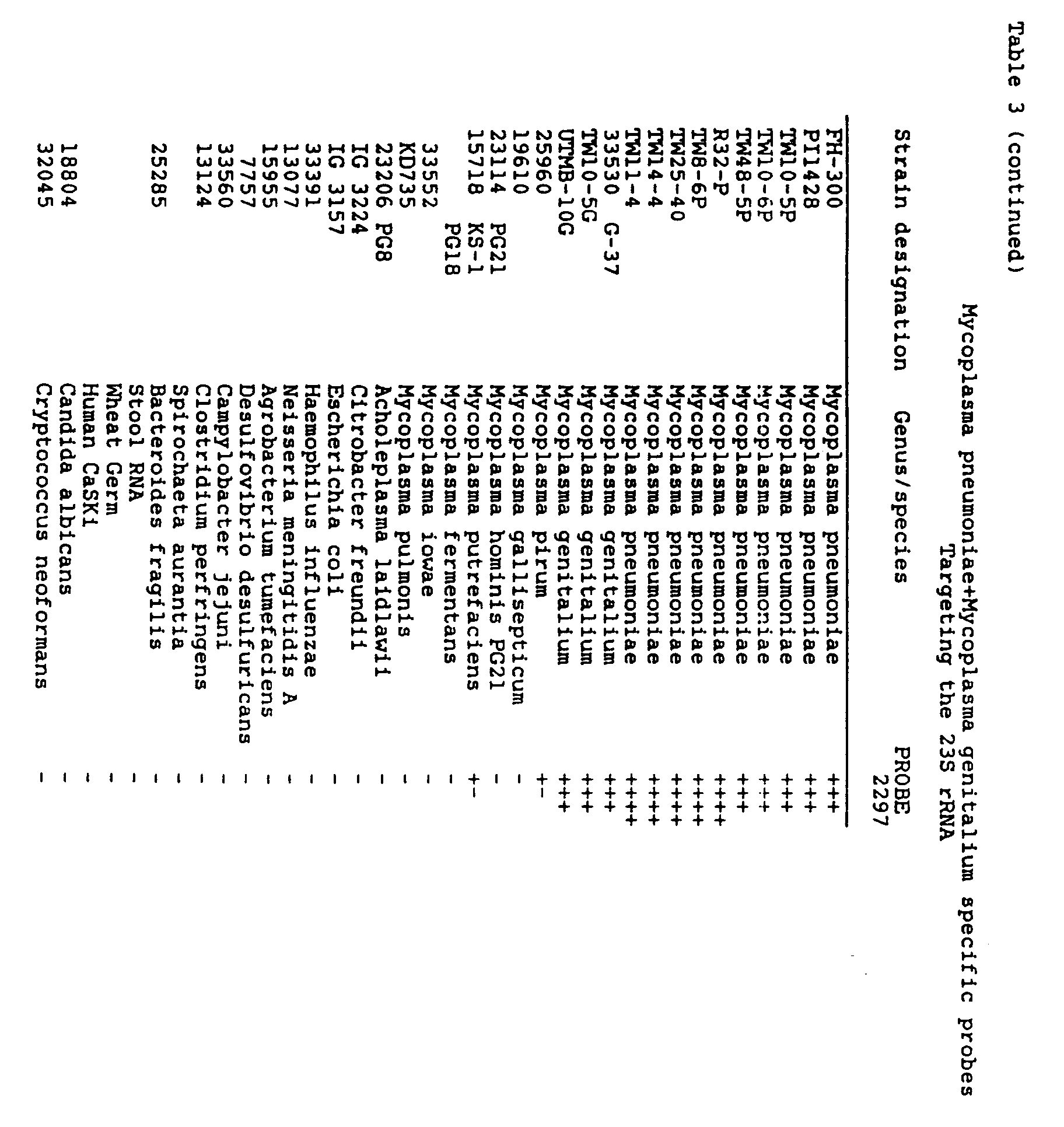
- Table 3 displays the hybridization behavior of the the probes toward a panel of clinically and environmentally representative mycoplasma species.
- Figure 1 is a schematic representation of a dual probe capture/detector assay.
- The first step taken in the development of nucleic acid compositions of the present invention involved identification of regions of the 16S rRNA which potentially could serve as target sites for specific probes with the desired sensitivity. As stated, this desired sensitivity included finding probe targets unique to Mycoplasma pneumoniae, and finding probe targets common to both M. pneumoniae and M. genitalium. This entailed finding sites which are:
- (1) different between M. pneumoniae and M. genitalium, and
- (2) substantially the same within the two species' sequences, but different within the next closest evolutionary neighbors' sequences.
- For this analysis, precise alignments of mycoplasma 16S and 23S rRNA sequences were developed. The essentially complete 16S rRNA and 23S rRNA sequences of both M. pneumoniae and M. genitalium were determined as part of this effort. Such nucleotide sequences were determined by standard laboratory protocols well known to those skilled in the art of probe design. The 16S and 23S rDNAs were cloned into plasmid vectors from products produced by enzymatic amplification. The Mycoplasma pneumoniae and M. genitalium sequences were aligned with homologous sequences of other mycoplasma and nonmycoplasma ribosomal RNA sequences. In addition to specifically addressing the close clinical and evolutionary relationship of M. pneumoniae to M. genitalium, the following additional 16S rRNA sequences were known and evaluated: M. agalactiae, M. arginini, M. arthritidis, M. bovigenitalium, M. californicum, M. capricolum, M. ellychniae, M. melaleucum, M. fermentans, M. gallisepticum, M. hominis, M. hyopneumoniae, M. hyorhinis, M. iowae, M. lipophilum, M. mobile, M. muris, M. mycoides, M. neurolyticum, M. orale, M. pirum, M. pneumoniae, M. pulmonis, M. putrefaciens, M. salivarium, M. sualvi, ten Spiroplasma species' sequences, four Acholeplasma species' sequences, four Anaeroplasma species' sequences, one Asteroleplasma sequence, and Ureaplasma urealyticum 16S rRNA sequence. (GenBank accession numbers shown in Weisburg et.al., Jnl. of Bacteriology, vol 171. 1989).
- Twenty probes--designed, synthesized, and tested--are described by sequences in Tables 1 and 2. Nine probes specifically discriminate between M. pneumoniae and M. genitalium, eleven probes are uniquely inclusive for the pair of species. Probes which hybridize to both of the species have at least two benefits:
- (1) as mentioned above, M. genitalium may be the cause of significant morbidity which is indistinguishable from that caused by M. pneumoniae, and
- (2) probes can be incorporated into dual probe assays in which only one of the probes requires the desired specificity.
- The probe selection strategy yielded twenty probes useful for hybridization to the etiological agent of primary atypical pneumonia in samples.
- Table 1 displays the precise alignment of the probe regions for both Mycoplasma pneumoniae and Mycoplasma genitalium along with the probe sequences designed from the aligned targets. Table 2 summarizes specific preferred nucleic acid compositions including length and G+C content.
- The nucleic acid compositions of the invention should not be construed as restricted to the specific nucleotides identified with the named probes. Optimal probe length will be a function of the stringency of the hybridization conditions chosen. The sequences identified with the named probes are capable of some alteration and modification. Indeed, individuals skilled in the art will readily make adjustments in probe length and modified nucleotides to serve their specific assay and detection needs. For example, the length of these particular oligonucleotides was optimized for use in the dot blot assay and sandwich formats. In considering sets comprised of more than one probe, it is desirable that all probes behave in a compatible manner. Thus, the exact length of a particular probe will to a certain extent reflect its specific intended use.
- The nucleic acid compositions of the present invention comprise sequences which can be employed as oligonucleotide probes, or could be incorporated into larger polynucleotides of either ribonucleic acid or deoxyribonucleic acid. Sequences complementary to the probes described herein can be used as probes to rRNA genes. The preferred probes or their complements can be employed as chain elongation initiators for polymerase chain reaction, sequencing or other applications.
- Dot-blot analysis, involves immobilizing a nucleic acid or a population of nucleic acids on a filter such as nitrocellulose, nylon, or other derivatized membranes which can readily be obtained commercially, specifically for this purpose. Either DNA or RNA can be easily immobilized on such a filter and subsequently can be probed or tested for hybridization under any of a variety of conditions i.e., stringencies) with nucleic acid compositions or probes of interest. Nucleic acids which have sequences with greater complementarity to a target will form hybridization reaction products which are more stable than probes containing less complementarity. Indeed, the added stability can be exploited to allow nucleic acids having sequences complementary to a target to bind preferentially to target without substantial hybridization to nontarget nucleic acids.
- Probes of the present invention were tested in a dot-blot format. One hundred nanograms of RNA, purified by phenol extraction and centrifugation through cesium trifluoroacetate gradients, was denatured and spotted on a nylon membrane. Probes were isotopically label led with the addition of a ³²Phosphorous moiety to the 5' end of the oligonucleotide. Hybridization of probes occurred, at a temperature of 60°C in the presence of 1.08 M sodium chloride, 60 mM sodium phosphate, and 6 mM ethylenediamine tetraacetic acid, pH 7.4. Unhybridized probe was removed by washing at a salt concentration one-third of the hybridization condition. The filters were exposed to X-ray film and the intensity of hybridization signals was evaluated after three hours of exposure.
- The experimental specificity of the preferred probes, as described in Example 1 is summarized in Tables 2 and 3.
- The 10 representative strains of Mycoplasma pneumoniae and 3 strains of M. genitalium represent a selection from the National Institute of Allergy and Infectious Disease's Mycoplasma Section. Additional species of bacteria and a few fungi were added to the panel in order to represent the breadth of known bacterial taxa. Mycoplasma gallisepticum is critically important as a representative close relative of the M. pneumoniae/M. genitalium cluster.
- All species on the panel are represented by 100 ng of purified, denatured RNA. Probes were synthesized (by standard methods and chemistries well known to those skilled in the art), ³²Phosphorous labelled, hybridized to panels under standard conditions, at the temperatures indicated, and autoradiographically evaluated. "++++" represents strongest hybridization signal after three hours exposure, with slightly lighter signal represented by "+++", diminishing to "++", then "+". "+-" is virtually absent, and "-" is indicative of no hybridization of probe to target. The specificity is empirical and in the case of several of the M. pneumoniae + M. genitalium probes represents a slight departure from the predicted specific behavior.
- In actual practice, many applications of these probes would employ a pair of probes being used simultaneously in a "sandwich" hybridization scheme. Turning now to Figure 1, a sandwich assay is depicted featuring a
capture probe 12 and adetector probe 13. Thecapture probe 12 ideally would be a bifunctional nucleic acid manufactured by adding a homopolymeric 3' tail to a probe with high target specificity. The tail would, in turn, hybridize to thecomplementary homopolymer 11 on asolid surface 10, such as a glass bead or a filter disc. Hybridization of thecapture probe 12 to itstarget 15, in this case mycoplasma rRNA, would complex thetarget 15 with thesolid support 10. Thedetector probe 13, advantageously also with some degree of specificity, would be part of a detection scheme relying on radioactivity, fluorescence, chemiluminescence, color, and other detection means,detection moiety 14 which would report the presence of the entire hybridization complex. The detector probe could potentially be incorporated as an RNA sequence into an amplifiable Q-beta midivariant as described by Kramer and Lizardi (Nature, vol. 339, 1989). - A clinical sample, such as a swab, sputum, or tissue is processed so as to liberate the total nucleic acid content. The sample, containing disrupted mycoplasmas is incubated in the presence of capture probe, detector probe, and magnetic particle beads which have been derivatized with oligo-Thymidine--as in Example 2--in a chaotropic buffer such as guanidinium isothiocyanate.
- If target molecules, Mycoplasma pneumoniae or M. genitalium 16S or 23S rRNA (depending on which probe sets are employed) are present, a Bead + Capture Probe + Target + Detector Probe hybridization complex is formed, as in Figure 1. The presence of a magnet near the bottom of the reaction tube will cause the magnetic particle + hybridization complex to adhere to the side of the tube enabling removal of the sample matrix, unbound probe, etc. Repeated rehydration and denaturation of the bead+probe+ target complex would enable significant background reduction (as described in USSN 922,155, Collins, 1986). In this example, final detection could entail spotting the beads on membrane and assaying by autoradiography. Alternatively, the detector probe could be an amplifiable midivariant probe.
- For this particular assay, the following capture and detector probes are examples of preferred pairs:
Probe 2196 + Probe 2167, Probe 2162 + Probe 2202
Probe 2224 + Probe 2166, Probe 2162 + Probe 2230
Probe 2167 + Probe 2219, Probe 2192 + Probe 2202
Probe 2296 + Probe 2297, Probe 2299 + Probe 2300 - Sample processing is designed so as to yield DNA. One of the probes described herein is used in conjunction with the antiparallel complement of one of the probes described herein to enzymatically amplify a segment of Mycoplasma pneumoniae or M. genitalium gene encoding mycoplasma rRNA in a polymerase chain reaction. Resultant material can then be assayed in a "sandwich" hybridization assay with any of the probes described herein. The polymerase chain reaction can, itself, be made either highly specific by employing probe/primers described herein, or the reaction can be made more general using less specific probes, and identifying the amplification product as M. pneumoniae with probes described herein which have great specificity.
- The probes of the present invention can be employed as cytological staining reagents. For example, a sputum sample is applied to a microscope slide. After appropriate fixation and lysis, hybridization of probes is carried out in situ. In this example, Mycoplasma pneumoniae could be visualized in a specimen by fluorescently labelling Probe 2167 and examining the slide using a fluorescent microscope, looking for small fluorescent bodies.
- Following a standard cultivation step for Mycoplasma pneumoniae or M. genitalium, for example on H-agar plates or SP-6 broth a colony or liquid culture is tested for the presence of M. pneumoniae by employing Probes 2167 and 2196.


Claims (12)
- A nucleic acid having approximately 10 to 250 nucleotides, capable of hybridizing to rRNA or rDNA of pathogenic mycoplasma bacterium associated with human primary atypical pneumonia in preference to rRNA or rDNA of nonmycoplasma bacteria and humans.
- The nucleic acid of claim 1 wherein said nucleic acid is capable of hybridizing to a region of the 16S rRNA or 16S rDNA of Mycoplasma pneumoniae selected from the group of positions consisting of 1110 to 1160, 1220 to 1270.
- The nucleic acid of claim 1 wherein said nucleic acid is capable of hybridizing to a region of the 23S rRNA or 23S rDNA of Mycoplasma pneumoniae selected from the group of positions consisting of 150 to 200, 260 to 340, 1590 to 1630, 2080 to 2190, 2600 to 2660.
- The nucleic acid of claim 1 wherein said nucleic acid is capable of hybridizing to a region of the 16S rRNA or 16S rDNA of both Mycoplasma pneumoniae and Mycoplasma genitalium selected from the group of positions consisting of 50 to 100, 140 to 230, 440 to 500, 620 to 670, 810 to 860, 980 to 1030, 1210 to 1270.
- The nucleic acid of claim 1 wherein said nucleic acid is capable of hybridizing to a region of the 23S rRNA or 23S rDNA of both Mycoplasma pneumoniae and Mycoplasma genitalium selected from the group of 16S rRNA and rDNA consisting of 330 to 370.
- The nucleic acid of claim 1, wherein said nucleic acid is complementary to or homologous to at least 90% of a sequence comprising any ten consecutive nucleotides within sequences selected from the group of sequences defined by probes consisting of 2295, 2289, 2296, 2298, 2299, 2300, 2294, 2167, 2196, 2297, 2192, 2219, 2162, 2202, 2201, 2166, 2224, 2195, 2225 and 2230.
- A set of nucleic acids comprising at least two nucleic acids, each nucleic acid having 10 to 250 base sequences capable of hybridizing preferentially to rRNA and rDNA of Mycoplasma pneumoniae, and each nucleic acid of different base sequence composition and complementary to or homologous with at least 90% of a sequence comprising any 10 consecutive nucleotides selected from the group of sequences defined by Probes 2295, 2289, 2296, 2298, 2299, 2300, 2294, 2167, 2196, 2297, 2192, 2219, 2162, 2202, 2201, 2166, 2224, 2195, 2225, and 2230.
- The set of nucleic acids of claim 7 wherein at least two nucleic acid compositions are complementary to or homologous with at least 90% of a sequence comprising any 10 consecutive nucleotides selected from the group of sequences defined by probes, and selected from the group of sets, consisting of,
Probe 2196 and Probe 2167; Probe 2162 and Probe 2202;
Probe 2224 and Probe 2166; Probe 2162 and Probe 2230;
Probe 2167 and Probe 2219; Probe 2192 and Probe 2202;
Probe 2296 and Probe 2297; and, Probe 2299 and Probe 2300. - A method for detecting the presence of one or more Mycoplasmas which consist essentially of Mycoplasma pneumoniae and M. genitalium, in a sample comprising:a) contacting said sample with at least one nucleic acid which nucleic acid having approximately 10 to 250 nucleotides capable of hybridizing preferentially to mycoplasma rRNA and rDNA;b) imposing hybridization conditions on the sample which conditions allow said nucleic acid to bind preferentially to mycoplasma rRNA and rDNA to form nucleic acid complexes; and,c) detecting said nucleic acid complexes as an indication of the presence of said mycoplasma.
- The method of claim 9 wherein said nucleic acid of said contacting step is complementary to or homologous with at least 90% of a sequence comprising any 10 consecutive nucleotides selected from the group of sequences defined by Probes 2295, 2289, 2296, 2298, 2299, 2300, 2294, 2167, 2196, 2297, 2192, 2219, 2162, 2202, 2201, 2166, 2224, 2195, 2225 and 2230.
- The method of claim 9 wherein said contacting step comprises at least two nucleic acid compositions, each nucleic acid having 10 to 250 base sequences capable of hybridizing preferentially to mycoplasma rRNA and rDNA, each of a different base composition and are complementary to or homologous with at least 90% of a sequence comprising any 10 consecutive nucleotide selected from the group of sequences defined by probes, and selected from the group of sets
consisting of, Probe 2196 + Probe 2167, Probe 2162 + Probe 2202
Probe 2224 + Probe 2166, Probe 2162 + Probe 2230
Probe 2167 + Probe 2219, Probe 2192 + Probe 2202
Probe 2296 + Probe 2297, Probe 2299 + Probe 2300 - A kit for detecting pathogenic mycoplasma bacterium associated with human primary atypical pneumonia, comprising a nucleic acid composition having 10 to 250 base sequences capable of hybridizing to rRNA or rDNA of pathogenic mycoplasma bacteria in preference to rRNA and rDNA of nonmycoplasma and humans.
Priority Applications (2)
| Application Number | Priority Date | Filing Date | Title |
|---|---|---|---|
| EP92305126A EP0576743B1 (en) | 1992-06-04 | 1992-06-04 | Nucleic acid probes for the detection of mycoplasma pneumoniae |
| DE69215863T DE69215863T2 (en) | 1992-06-04 | 1992-06-04 | Nucleic acid probes for the detection of Mycoplasma pneumoniae |
Applications Claiming Priority (1)
| Application Number | Priority Date | Filing Date | Title |
|---|---|---|---|
| EP92305126A EP0576743B1 (en) | 1992-06-04 | 1992-06-04 | Nucleic acid probes for the detection of mycoplasma pneumoniae |
Publications (2)
| Publication Number | Publication Date |
|---|---|
| EP0576743A1 true EP0576743A1 (en) | 1994-01-05 |
| EP0576743B1 EP0576743B1 (en) | 1996-12-11 |
Family
ID=8211390
Family Applications (1)
| Application Number | Title | Priority Date | Filing Date |
|---|---|---|---|
| EP92305126A Expired - Lifetime EP0576743B1 (en) | 1992-06-04 | 1992-06-04 | Nucleic acid probes for the detection of mycoplasma pneumoniae |
Country Status (2)
| Country | Link |
|---|---|
| EP (1) | EP0576743B1 (en) |
| DE (1) | DE69215863T2 (en) |
Cited By (10)
| Publication number | Priority date | Publication date | Assignee | Title |
|---|---|---|---|---|
| WO1996006949A3 (en) * | 1994-08-29 | 1996-05-09 | Gen Probe Inc | Nucleic acid hybridization assay probes targeted to mycoplasma pneumoniae nucleic acid |
| US5693467A (en) * | 1995-05-19 | 1997-12-02 | The American Type Culture Collection | Mycoplasma polymerase chain reaction testing system using a set of mixed and single sequence primers |
| WO1998000565A3 (en) * | 1996-06-28 | 1998-09-11 | Abbott Lab | NUCLEIC ACID PRIMERS AND PROBES FOR DETECTING $i(MYCOPLASMA PNEUMONIAE) |
| FR2775002A1 (en) * | 1998-02-19 | 1999-08-20 | France Etat | Simultaneous detection of at least two respiratory pathogens by multiplex polymerase chain reaction |
| WO2000017391A1 (en) * | 1998-09-24 | 2000-03-30 | Innogenetics N.V. | Identification of microorganisms causing acute respiratory tract infections (ari) |
| JP2000505305A (en) * | 1996-02-28 | 2000-05-09 | アクゾ・ノベル・エヌ・ベー | Primers and probes for amplification, detection and typing of Mycoplasma pneumoniae |
| GB2431469A (en) * | 2005-10-19 | 2007-04-25 | Ivan Petyaev | Pathogen diagnosis |
| WO2007033171A3 (en) * | 2005-09-12 | 2007-07-26 | Res & Diagnostic Systems Inc | Mycoplasma detection method and composition |
| AU2012201891B2 (en) * | 2001-11-02 | 2014-05-29 | Gen-Probe Incorporated | Compositions, methods and kits for determining the presence of Mycoplasma pneumoniae and/or Mycoplasma genitalium in a test sample |
| CN110904194A (en) * | 2019-12-19 | 2020-03-24 | 武汉中帜生物科技股份有限公司 | A combined detection kit for mycoplasma pneumoniae and chlamydia pneumoniae nucleic acid and its application |
Citations (3)
| Publication number | Priority date | Publication date | Assignee | Title |
|---|---|---|---|---|
| EP0250662A1 (en) * | 1986-06-25 | 1988-01-07 | The Regents Of The University Of California | Detection of mycoplasma by DNA hybridization |
| WO1988003957A1 (en) * | 1986-11-24 | 1988-06-02 | Gen-Probe Incorporated | Nucleic acid probes for detection and/or quantitation of non-viral organisms |
| EP0305145A2 (en) * | 1987-08-24 | 1989-03-01 | Ortho Diagnostic Systems Inc. | Methods and probes for detecting nucleic acids |
-
1992
- 1992-06-04 DE DE69215863T patent/DE69215863T2/en not_active Expired - Fee Related
- 1992-06-04 EP EP92305126A patent/EP0576743B1/en not_active Expired - Lifetime
Patent Citations (3)
| Publication number | Priority date | Publication date | Assignee | Title |
|---|---|---|---|---|
| EP0250662A1 (en) * | 1986-06-25 | 1988-01-07 | The Regents Of The University Of California | Detection of mycoplasma by DNA hybridization |
| WO1988003957A1 (en) * | 1986-11-24 | 1988-06-02 | Gen-Probe Incorporated | Nucleic acid probes for detection and/or quantitation of non-viral organisms |
| EP0305145A2 (en) * | 1987-08-24 | 1989-03-01 | Ortho Diagnostic Systems Inc. | Methods and probes for detecting nucleic acids |
Non-Patent Citations (2)
| Title |
|---|
| J. GEN. MICROBIOL. vol. 133, July 1987, COLCHESTER U.K. pages 1969 - 1974 U. B. G\BEL ET AL. 'Oligonucleotide probes complementary to variable regions of ribosomal RNA discriminate between Mycoplasma species' * |
| JOURNAL OF CLINICAL MICROBIOLOGY vol. 25, no. 4, April 1987, WASHINGTON US pages 726 - 728 H. C. HYMAN ET AL. 'DNA probes for detection and identification of M. pneumoniae and M. genitalium' * |
Cited By (17)
| Publication number | Priority date | Publication date | Assignee | Title |
|---|---|---|---|---|
| US5969122A (en) * | 1994-08-29 | 1999-10-19 | Gen-Probe Incorporated | Nucleic acid hybridization assay probes, helper probes and amplification oligonucleotides targeted to mycoplasma pneumoniae nucleic acid |
| EP0713920A3 (en) * | 1994-08-29 | 1996-07-31 | Gen Probe Inc | Hybridization probes for nucleic acid from mycoplasma pneumoniae |
| US5656427A (en) * | 1994-08-29 | 1997-08-12 | Gen-Probe Incorporated | Nucleic acid hybridization assay probes, helper probes and amplification oligonucleotides targeted to Mycoplasma pneumoniae nucleic acid |
| WO1996006949A3 (en) * | 1994-08-29 | 1996-05-09 | Gen Probe Inc | Nucleic acid hybridization assay probes targeted to mycoplasma pneumoniae nucleic acid |
| US5693467A (en) * | 1995-05-19 | 1997-12-02 | The American Type Culture Collection | Mycoplasma polymerase chain reaction testing system using a set of mixed and single sequence primers |
| JP2000505305A (en) * | 1996-02-28 | 2000-05-09 | アクゾ・ノベル・エヌ・ベー | Primers and probes for amplification, detection and typing of Mycoplasma pneumoniae |
| WO1998000565A3 (en) * | 1996-06-28 | 1998-09-11 | Abbott Lab | NUCLEIC ACID PRIMERS AND PROBES FOR DETECTING $i(MYCOPLASMA PNEUMONIAE) |
| US5817463A (en) * | 1996-06-28 | 1998-10-06 | Abbott Laboratories | Nucleic acid primers and probes for detecting Mycoplasma pneumoniae |
| EP0943691A1 (en) * | 1998-02-19 | 1999-09-22 | ETAT FRANCAIS Représenté par le délégué général pour l'armement | Method for diagnosing pathogenic respiratory agents by molecular biological means |
| FR2775002A1 (en) * | 1998-02-19 | 1999-08-20 | France Etat | Simultaneous detection of at least two respiratory pathogens by multiplex polymerase chain reaction |
| WO2000017391A1 (en) * | 1998-09-24 | 2000-03-30 | Innogenetics N.V. | Identification of microorganisms causing acute respiratory tract infections (ari) |
| AU2012201891B2 (en) * | 2001-11-02 | 2014-05-29 | Gen-Probe Incorporated | Compositions, methods and kits for determining the presence of Mycoplasma pneumoniae and/or Mycoplasma genitalium in a test sample |
| WO2007033171A3 (en) * | 2005-09-12 | 2007-07-26 | Res & Diagnostic Systems Inc | Mycoplasma detection method and composition |
| US7855051B2 (en) | 2005-09-12 | 2010-12-21 | Research & Diagnostic Systems, Inc. | Mycoplasma detection method and composition |
| GB2431469A (en) * | 2005-10-19 | 2007-04-25 | Ivan Petyaev | Pathogen diagnosis |
| CN110904194A (en) * | 2019-12-19 | 2020-03-24 | 武汉中帜生物科技股份有限公司 | A combined detection kit for mycoplasma pneumoniae and chlamydia pneumoniae nucleic acid and its application |
| CN110904194B (en) * | 2019-12-19 | 2023-06-02 | 武汉中帜生物科技股份有限公司 | Mycoplasma pneumoniae and Chlamydia pneumoniae nucleic acid combined detection kit and application thereof |
Also Published As
| Publication number | Publication date |
|---|---|
| DE69215863T2 (en) | 1997-06-26 |
| DE69215863D1 (en) | 1997-01-23 |
| EP0576743B1 (en) | 1996-12-11 |
Similar Documents
| Publication | Publication Date | Title |
|---|---|---|
| EP0431149B1 (en) | Universal eubacteria nucleic acid probes and methods | |
| EP0422872B1 (en) | Nucleic acid probes and methods for detecting fungi | |
| CA2689306C (en) | A novel method for simultaneous detection and discrimination of bacterial, fungal, parasitic and viral infections of eye and central nervous system | |
| DE69527154T2 (en) | SPECIFIC AND UNIVERSAL AMPLIFICATION PRIMER FOR RAPID DETERMINATION AND IDENTIFICATION OF COMMON BACTERIAL PATHOGENES AND ANTIBIOTIC RESISTANCE GENES IN CLINICAL SAMPLES FOR ROUTINE DIAGNOSIS IN MICROBIOLOGY LABORATORIES | |
| JP3833703B2 (en) | Simultaneous detection, isolation and differentiation of eubacterial taxa using hybridization assays | |
| JP3749540B2 (en) | Nucleic acid probe for detection of bacteria belonging to the genus PEDIOCOCCUS and LACTOBACILLUS, and method for detecting bacterial substances causing malt rot | |
| AU778230B2 (en) | Polynucleotide matrix-based method of identifying microorganisms | |
| US5552279A (en) | Nucleic acid probes for the detection of mycoplasma pneumoniae and mycoplasma genitalium | |
| EP0422869A2 (en) | Nucleic acid probes and methods for detecting pathogenic candida yeasts | |
| EP0421725B1 (en) | Nucleic acid probes for the detection of Lyme disease spirochetes | |
| US20050026206A1 (en) | Probe matrix-based device for identifying microorganisms | |
| US6482589B1 (en) | Nucleic acid probes for the detection of genital mycoplasmas | |
| EP0576743B1 (en) | Nucleic acid probes for the detection of mycoplasma pneumoniae | |
| EP0572735B1 (en) | Nucleic acid probes for the detection of Mycoplasma fermentans | |
| EP0426843B1 (en) | Nucleic acid probes for the detection of neisseria gonorrhoeae | |
| EP0422873B1 (en) | Nucleic acid probes and methods for detecting cryptococcus neoformans | |
| JPH09501566A (en) | Nucleic acid probe for ureaplasma | |
| KR101960016B1 (en) | Composition for detecting pathogens of respiratory disease, and using the same | |
| EP0576742B1 (en) | Nucleic acid probes for the detection of genital mycoplasmas | |
| WO2005083114A1 (en) | Method, kit and system for enhanced nested pcr | |
| EP0339783B1 (en) | Detection of yersinia enterocolitica using nucleic acid probes | |
| US6558909B2 (en) | Haemobartonella PCR methods and materials | |
| EP2361314B1 (en) | Assay for chlamydia trachomatis by amplification and detection of chlamydia trachomatis pmpa gene | |
| KR101960017B1 (en) | Composition for detecting pathogens of respiratory disease, and using the same | |
| JPH0630795A (en) | Nucleic acid probe for detecting mycoplasma pneumoniae |
Legal Events
| Date | Code | Title | Description |
|---|---|---|---|
| PUAI | Public reference made under article 153(3) epc to a published international application that has entered the european phase |
Free format text: ORIGINAL CODE: 0009012 |
|
| AK | Designated contracting states |
Kind code of ref document: A1 Designated state(s): DE FR GB IT |
|
| 17P | Request for examination filed |
Effective date: 19940207 |
|
| 17Q | First examination report despatched |
Effective date: 19940502 |
|
| GRAG | Despatch of communication of intention to grant |
Free format text: ORIGINAL CODE: EPIDOS AGRA |
|
| GRAH | Despatch of communication of intention to grant a patent |
Free format text: ORIGINAL CODE: EPIDOS IGRA |
|
| GRAH | Despatch of communication of intention to grant a patent |
Free format text: ORIGINAL CODE: EPIDOS IGRA |
|
| GRAA | (expected) grant |
Free format text: ORIGINAL CODE: 0009210 |
|
| AK | Designated contracting states |
Kind code of ref document: B1 Designated state(s): DE FR GB IT |
|
| ET | Fr: translation filed | ||
| REF | Corresponds to: |
Ref document number: 69215863 Country of ref document: DE Date of ref document: 19970123 |
|
| ITF | It: translation for a ep patent filed | ||
| PLBE | No opposition filed within time limit |
Free format text: ORIGINAL CODE: 0009261 |
|
| STAA | Information on the status of an ep patent application or granted ep patent |
Free format text: STATUS: NO OPPOSITION FILED WITHIN TIME LIMIT |
|
| 26N | No opposition filed | ||
| REG | Reference to a national code |
Ref country code: GB Ref legal event code: IF02 |
|
| PGFP | Annual fee paid to national office [announced via postgrant information from national office to epo] |
Ref country code: GB Payment date: 20040406 Year of fee payment: 13 |
|
| PGFP | Annual fee paid to national office [announced via postgrant information from national office to epo] |
Ref country code: FR Payment date: 20040503 Year of fee payment: 13 |
|
| PGFP | Annual fee paid to national office [announced via postgrant information from national office to epo] |
Ref country code: DE Payment date: 20040528 Year of fee payment: 13 |
|
| PG25 | Lapsed in a contracting state [announced via postgrant information from national office to epo] |
Ref country code: IT Free format text: LAPSE BECAUSE OF NON-PAYMENT OF DUE FEES;WARNING: LAPSES OF ITALIAN PATENTS WITH EFFECTIVE DATE BEFORE 2007 MAY HAVE OCCURRED AT ANY TIME BEFORE 2007. THE CORRECT EFFECTIVE DATE MAY BE DIFFERENT FROM THE ONE RECORDED. Effective date: 20050604 Ref country code: GB Free format text: LAPSE BECAUSE OF NON-PAYMENT OF DUE FEES Effective date: 20050604 |
|
| PG25 | Lapsed in a contracting state [announced via postgrant information from national office to epo] |
Ref country code: DE Free format text: LAPSE BECAUSE OF NON-PAYMENT OF DUE FEES Effective date: 20060103 |
|
| PG25 | Lapsed in a contracting state [announced via postgrant information from national office to epo] |
Ref country code: FR Free format text: LAPSE BECAUSE OF NON-PAYMENT OF DUE FEES Effective date: 20060228 |
|
| GBPC | Gb: european patent ceased through non-payment of renewal fee |
Effective date: 20050604 |
|
| REG | Reference to a national code |
Ref country code: FR Ref legal event code: ST Effective date: 20060228 |