EP0572269A1 - Fluorine containing aqueous composition having water repellent and oil repellent properties - Google Patents
Fluorine containing aqueous composition having water repellent and oil repellent properties Download PDFInfo
- Publication number
- EP0572269A1 EP0572269A1 EP19930304165 EP93304165A EP0572269A1 EP 0572269 A1 EP0572269 A1 EP 0572269A1 EP 19930304165 EP19930304165 EP 19930304165 EP 93304165 A EP93304165 A EP 93304165A EP 0572269 A1 EP0572269 A1 EP 0572269A1
- Authority
- EP
- European Patent Office
- Prior art keywords
- fluorine containing
- water
- composition
- aqueous composition
- monomer
- Prior art date
- Legal status (The legal status is an assumption and is not a legal conclusion. Google has not performed a legal analysis and makes no representation as to the accuracy of the status listed.)
- Granted
Links
- XLYOFNOQVPJJNP-UHFFFAOYSA-N water Substances O XLYOFNOQVPJJNP-UHFFFAOYSA-N 0.000 title claims abstract description 88
- 229910001868 water Inorganic materials 0.000 title claims abstract description 78
- 229910052731 fluorine Inorganic materials 0.000 title claims abstract description 73
- 239000011737 fluorine Substances 0.000 title claims abstract description 73
- YCKRFDGAMUMZLT-UHFFFAOYSA-N Fluorine atom Chemical compound [F] YCKRFDGAMUMZLT-UHFFFAOYSA-N 0.000 title claims abstract description 72
- 239000005871 repellent Substances 0.000 title claims abstract description 50
- 230000002940 repellent Effects 0.000 title claims abstract description 50
- 239000000203 mixture Substances 0.000 title claims description 56
- 239000000178 monomer Substances 0.000 claims abstract description 60
- 239000000839 emulsion Substances 0.000 claims abstract description 50
- 229920001577 copolymer Polymers 0.000 claims abstract description 16
- 125000002091 cationic group Chemical group 0.000 claims abstract description 14
- 229920000083 poly(allylamine) Polymers 0.000 claims abstract description 10
- 229920003169 water-soluble polymer Polymers 0.000 claims abstract description 9
- 125000003178 carboxy group Chemical group [H]OC(*)=O 0.000 claims abstract description 8
- 125000002887 hydroxy group Chemical group [H]O* 0.000 claims abstract description 8
- 150000003839 salts Chemical class 0.000 claims abstract description 6
- 238000010526 radical polymerization reaction Methods 0.000 claims abstract description 4
- 238000000034 method Methods 0.000 claims description 30
- 239000004753 textile Substances 0.000 claims description 27
- 150000001875 compounds Chemical class 0.000 claims description 19
- 229920006243 acrylic copolymer Polymers 0.000 claims description 14
- 239000002245 particle Substances 0.000 claims description 13
- -1 octyl ethyl Chemical group 0.000 claims description 10
- 150000001767 cationic compounds Chemical class 0.000 claims description 9
- 239000007788 liquid Substances 0.000 claims description 8
- 239000004094 surface-active agent Substances 0.000 claims description 8
- 125000000217 alkyl group Chemical group 0.000 claims description 7
- 125000004432 carbon atom Chemical group C* 0.000 claims description 7
- 239000007787 solid Substances 0.000 claims description 7
- CERQOIWHTDAKMF-UHFFFAOYSA-N Methacrylic acid Chemical compound CC(=C)C(O)=O CERQOIWHTDAKMF-UHFFFAOYSA-N 0.000 claims description 5
- 230000001804 emulsifying effect Effects 0.000 claims description 2
- 238000007670 refining Methods 0.000 claims description 2
- 239000000758 substrate Substances 0.000 claims 2
- NIXOWILDQLNWCW-UHFFFAOYSA-N acrylic acid group Chemical group C(C=C)(=O)O NIXOWILDQLNWCW-UHFFFAOYSA-N 0.000 description 22
- 239000000243 solution Substances 0.000 description 20
- 238000004519 manufacturing process Methods 0.000 description 12
- 239000008367 deionised water Substances 0.000 description 10
- 229910021641 deionized water Inorganic materials 0.000 description 10
- 239000003795 chemical substances by application Substances 0.000 description 9
- 230000000694 effects Effects 0.000 description 8
- 238000002360 preparation method Methods 0.000 description 8
- SOGAXMICEFXMKE-UHFFFAOYSA-N Butylmethacrylate Chemical compound CCCCOC(=O)C(C)=C SOGAXMICEFXMKE-UHFFFAOYSA-N 0.000 description 6
- 239000003054 catalyst Substances 0.000 description 6
- 239000003638 chemical reducing agent Substances 0.000 description 6
- 239000000835 fiber Substances 0.000 description 5
- 229920000642 polymer Polymers 0.000 description 5
- 238000009988 textile finishing Methods 0.000 description 5
- VZCYOOQTPOCHFL-OWOJBTEDSA-N Fumaric acid Chemical compound OC(=O)\C=C\C(O)=O VZCYOOQTPOCHFL-OWOJBTEDSA-N 0.000 description 4
- 229920002873 Polyethylenimine Polymers 0.000 description 4
- 229920006317 cationic polymer Polymers 0.000 description 4
- 238000004132 cross linking Methods 0.000 description 4
- 150000002148 esters Chemical class 0.000 description 4
- SNVLJLYUUXKWOJ-UHFFFAOYSA-N methylidenecarbene Chemical compound C=[C] SNVLJLYUUXKWOJ-UHFFFAOYSA-N 0.000 description 4
- 239000002904 solvent Substances 0.000 description 4
- 238000012360 testing method Methods 0.000 description 4
- VZCYOOQTPOCHFL-UHFFFAOYSA-N trans-butenedioic acid Natural products OC(=O)C=CC(O)=O VZCYOOQTPOCHFL-UHFFFAOYSA-N 0.000 description 4
- 238000009736 wetting Methods 0.000 description 4
- 229920000742 Cotton Polymers 0.000 description 3
- RTZKZFJDLAIYFH-UHFFFAOYSA-N Diethyl ether Chemical compound CCOCC RTZKZFJDLAIYFH-UHFFFAOYSA-N 0.000 description 3
- VEXZGXHMUGYJMC-UHFFFAOYSA-N Hydrochloric acid Chemical group Cl VEXZGXHMUGYJMC-UHFFFAOYSA-N 0.000 description 3
- IMNFDUFMRHMDMM-UHFFFAOYSA-N N-Heptane Chemical compound CCCCCCC IMNFDUFMRHMDMM-UHFFFAOYSA-N 0.000 description 3
- 229920003171 Poly (ethylene oxide) Polymers 0.000 description 3
- HEMHJVSKTPXQMS-UHFFFAOYSA-M Sodium hydroxide Chemical compound [OH-].[Na+] HEMHJVSKTPXQMS-UHFFFAOYSA-M 0.000 description 3
- 239000003093 cationic surfactant Substances 0.000 description 3
- 238000000576 coating method Methods 0.000 description 3
- 230000000052 comparative effect Effects 0.000 description 3
- 229920005989 resin Polymers 0.000 description 3
- 239000011347 resin Substances 0.000 description 3
- 125000000391 vinyl group Chemical group [H]C([*])=C([H])[H] 0.000 description 3
- MYRTYDVEIRVNKP-UHFFFAOYSA-N 1,2-Divinylbenzene Chemical compound C=CC1=CC=CC=C1C=C MYRTYDVEIRVNKP-UHFFFAOYSA-N 0.000 description 2
- 229940044192 2-hydroxyethyl methacrylate Drugs 0.000 description 2
- IJGRMHOSHXDMSA-UHFFFAOYSA-N Atomic nitrogen Chemical compound N#N IJGRMHOSHXDMSA-UHFFFAOYSA-N 0.000 description 2
- WOBHKFSMXKNTIM-UHFFFAOYSA-N Hydroxyethyl methacrylate Chemical compound CC(=C)C(=O)OCCO WOBHKFSMXKNTIM-UHFFFAOYSA-N 0.000 description 2
- BAPJBEWLBFYGME-UHFFFAOYSA-N Methyl acrylate Chemical compound COC(=O)C=C BAPJBEWLBFYGME-UHFFFAOYSA-N 0.000 description 2
- 239000004677 Nylon Substances 0.000 description 2
- 239000004372 Polyvinyl alcohol Substances 0.000 description 2
- OFOBLEOULBTSOW-UHFFFAOYSA-N Propanedioic acid Natural products OC(=O)CC(O)=O OFOBLEOULBTSOW-UHFFFAOYSA-N 0.000 description 2
- PPBRXRYQALVLMV-UHFFFAOYSA-N Styrene Chemical compound C=CC1=CC=CC=C1 PPBRXRYQALVLMV-UHFFFAOYSA-N 0.000 description 2
- 239000000654 additive Substances 0.000 description 2
- 238000004873 anchoring Methods 0.000 description 2
- 125000000129 anionic group Chemical group 0.000 description 2
- 238000006243 chemical reaction Methods 0.000 description 2
- 239000011248 coating agent Substances 0.000 description 2
- DIOQZVSQGTUSAI-UHFFFAOYSA-N decane Chemical compound CCCCCCCCCC DIOQZVSQGTUSAI-UHFFFAOYSA-N 0.000 description 2
- 229910001873 dinitrogen Inorganic materials 0.000 description 2
- 239000004744 fabric Substances 0.000 description 2
- 125000001153 fluoro group Chemical group F* 0.000 description 2
- 239000001530 fumaric acid Substances 0.000 description 2
- DCAYPVUWAIABOU-UHFFFAOYSA-N hexadecane Chemical compound CCCCCCCCCCCCCCCC DCAYPVUWAIABOU-UHFFFAOYSA-N 0.000 description 2
- 229940057995 liquid paraffin Drugs 0.000 description 2
- VZCYOOQTPOCHFL-UPHRSURJSA-N maleic acid Chemical compound OC(=O)\C=C/C(O)=O VZCYOOQTPOCHFL-UPHRSURJSA-N 0.000 description 2
- 239000011976 maleic acid Substances 0.000 description 2
- 229920001778 nylon Polymers 0.000 description 2
- TVMXDCGIABBOFY-UHFFFAOYSA-N octane Chemical compound CCCCCCCC TVMXDCGIABBOFY-UHFFFAOYSA-N 0.000 description 2
- 239000000123 paper Substances 0.000 description 2
- 230000000149 penetrating effect Effects 0.000 description 2
- 229920002451 polyvinyl alcohol Polymers 0.000 description 2
- 238000003860 storage Methods 0.000 description 2
- 239000000126 substance Substances 0.000 description 2
- BGHCVCJVXZWKCC-UHFFFAOYSA-N tetradecane Chemical compound CCCCCCCCCCCCCC BGHCVCJVXZWKCC-UHFFFAOYSA-N 0.000 description 2
- 231100000331 toxic Toxicity 0.000 description 2
- 230000002588 toxic effect Effects 0.000 description 2
- 229920001567 vinyl ester resin Polymers 0.000 description 2
- HHQAGBQXOWLTLL-UHFFFAOYSA-N (2-hydroxy-3-phenoxypropyl) prop-2-enoate Chemical compound C=CC(=O)OCC(O)COC1=CC=CC=C1 HHQAGBQXOWLTLL-UHFFFAOYSA-N 0.000 description 1
- LNAZSHAWQACDHT-XIYTZBAFSA-N (2r,3r,4s,5r,6s)-4,5-dimethoxy-2-(methoxymethyl)-3-[(2s,3r,4s,5r,6r)-3,4,5-trimethoxy-6-(methoxymethyl)oxan-2-yl]oxy-6-[(2r,3r,4s,5r,6r)-4,5,6-trimethoxy-2-(methoxymethyl)oxan-3-yl]oxyoxane Chemical compound CO[C@@H]1[C@@H](OC)[C@H](OC)[C@@H](COC)O[C@H]1O[C@H]1[C@H](OC)[C@@H](OC)[C@H](O[C@H]2[C@@H]([C@@H](OC)[C@H](OC)O[C@@H]2COC)OC)O[C@@H]1COC LNAZSHAWQACDHT-XIYTZBAFSA-N 0.000 description 1
- POTYORUTRLSAGZ-UHFFFAOYSA-N (3-chloro-2-hydroxypropyl) prop-2-enoate Chemical compound ClCC(O)COC(=O)C=C POTYORUTRLSAGZ-UHFFFAOYSA-N 0.000 description 1
- IXPNQXFRVYWDDI-UHFFFAOYSA-N 1-methyl-2,4-dioxo-1,3-diazinane-5-carboximidamide Chemical compound CN1CC(C(N)=N)C(=O)NC1=O IXPNQXFRVYWDDI-UHFFFAOYSA-N 0.000 description 1
- SMZOUWXMTYCWNB-UHFFFAOYSA-N 2-(2-methoxy-5-methylphenyl)ethanamine Chemical compound COC1=CC=C(C)C=C1CCN SMZOUWXMTYCWNB-UHFFFAOYSA-N 0.000 description 1
- IBDVWXAVKPRHCU-UHFFFAOYSA-N 2-(2-methylprop-2-enoyloxy)ethyl 3-oxobutanoate Chemical compound CC(=O)CC(=O)OCCOC(=O)C(C)=C IBDVWXAVKPRHCU-UHFFFAOYSA-N 0.000 description 1
- JAHNSTQSQJOJLO-UHFFFAOYSA-N 2-(3-fluorophenyl)-1h-imidazole Chemical compound FC1=CC=CC(C=2NC=CN=2)=C1 JAHNSTQSQJOJLO-UHFFFAOYSA-N 0.000 description 1
- GOXQRTZXKQZDDN-UHFFFAOYSA-N 2-Ethylhexyl acrylate Chemical compound CCCCC(CC)COC(=O)C=C GOXQRTZXKQZDDN-UHFFFAOYSA-N 0.000 description 1
- WDQMWEYDKDCEHT-UHFFFAOYSA-N 2-ethylhexyl 2-methylprop-2-enoate Chemical compound CCCCC(CC)COC(=O)C(C)=C WDQMWEYDKDCEHT-UHFFFAOYSA-N 0.000 description 1
- IEVADDDOVGMCSI-UHFFFAOYSA-N 2-hydroxybutyl 2-methylprop-2-enoate Chemical compound CCC(O)COC(=O)C(C)=C IEVADDDOVGMCSI-UHFFFAOYSA-N 0.000 description 1
- 229940095095 2-hydroxyethyl acrylate Drugs 0.000 description 1
- OMIGHNLMNHATMP-UHFFFAOYSA-N 2-hydroxyethyl prop-2-enoate Chemical compound OCCOC(=O)C=C OMIGHNLMNHATMP-UHFFFAOYSA-N 0.000 description 1
- XLLXMBCBJGATSP-UHFFFAOYSA-N 2-phenylethenol Chemical compound OC=CC1=CC=CC=C1 XLLXMBCBJGATSP-UHFFFAOYSA-N 0.000 description 1
- YHSYGCXKWUUKIK-UHFFFAOYSA-N 2-prop-2-enoyloxyethyl 3-oxobutanoate Chemical compound CC(=O)CC(=O)OCCOC(=O)C=C YHSYGCXKWUUKIK-UHFFFAOYSA-N 0.000 description 1
- GNSFRPWPOGYVLO-UHFFFAOYSA-N 3-hydroxypropyl 2-methylprop-2-enoate Chemical compound CC(=C)C(=O)OCCCO GNSFRPWPOGYVLO-UHFFFAOYSA-N 0.000 description 1
- QZPSOSOOLFHYRR-UHFFFAOYSA-N 3-hydroxypropyl prop-2-enoate Chemical compound OCCCOC(=O)C=C QZPSOSOOLFHYRR-UHFFFAOYSA-N 0.000 description 1
- QTBSBXVTEAMEQO-UHFFFAOYSA-M Acetate Chemical compound CC([O-])=O QTBSBXVTEAMEQO-UHFFFAOYSA-M 0.000 description 1
- HRPVXLWXLXDGHG-UHFFFAOYSA-N Acrylamide Chemical compound NC(=O)C=C HRPVXLWXLXDGHG-UHFFFAOYSA-N 0.000 description 1
- NLHHRLWOUZZQLW-UHFFFAOYSA-N Acrylonitrile Chemical compound C=CC#N NLHHRLWOUZZQLW-UHFFFAOYSA-N 0.000 description 1
- VVJKKWFAADXIJK-UHFFFAOYSA-N Allylamine Chemical class NCC=C VVJKKWFAADXIJK-UHFFFAOYSA-N 0.000 description 1
- NLXLAEXVIDQMFP-UHFFFAOYSA-N Ammonium chloride Substances [NH4+].[Cl-] NLXLAEXVIDQMFP-UHFFFAOYSA-N 0.000 description 1
- 239000004593 Epoxy Chemical class 0.000 description 1
- JIGUQPWFLRLWPJ-UHFFFAOYSA-N Ethyl acrylate Chemical compound CCOC(=O)C=C JIGUQPWFLRLWPJ-UHFFFAOYSA-N 0.000 description 1
- 239000004354 Hydroxyethyl cellulose Substances 0.000 description 1
- 229920000663 Hydroxyethyl cellulose Polymers 0.000 description 1
- DGAQECJNVWCQMB-PUAWFVPOSA-M Ilexoside XXIX Chemical compound C[C@@H]1CC[C@@]2(CC[C@@]3(C(=CC[C@H]4[C@]3(CC[C@@H]5[C@@]4(CC[C@@H](C5(C)C)OS(=O)(=O)[O-])C)C)[C@@H]2[C@]1(C)O)C)C(=O)O[C@H]6[C@@H]([C@H]([C@@H]([C@H](O6)CO)O)O)O.[Na+] DGAQECJNVWCQMB-PUAWFVPOSA-M 0.000 description 1
- 229920000877 Melamine resin Polymers 0.000 description 1
- CERQOIWHTDAKMF-UHFFFAOYSA-M Methacrylate Chemical compound CC(=C)C([O-])=O CERQOIWHTDAKMF-UHFFFAOYSA-M 0.000 description 1
- VVQNEPGJFQJSBK-UHFFFAOYSA-N Methyl methacrylate Chemical compound COC(=O)C(C)=C VVQNEPGJFQJSBK-UHFFFAOYSA-N 0.000 description 1
- CNCOEDDPFOAUMB-UHFFFAOYSA-N N-Methylolacrylamide Chemical compound OCNC(=O)C=C CNCOEDDPFOAUMB-UHFFFAOYSA-N 0.000 description 1
- 239000004952 Polyamide Substances 0.000 description 1
- 229920000297 Rayon Polymers 0.000 description 1
- QAOWNCQODCNURD-UHFFFAOYSA-L Sulfate Chemical compound [O-]S([O-])(=O)=O QAOWNCQODCNURD-UHFFFAOYSA-L 0.000 description 1
- XTXRWKRVRITETP-UHFFFAOYSA-N Vinyl acetate Chemical compound CC(=O)OC=C XTXRWKRVRITETP-UHFFFAOYSA-N 0.000 description 1
- 239000002253 acid Substances 0.000 description 1
- 150000001252 acrylic acid derivatives Chemical class 0.000 description 1
- 239000000853 adhesive Substances 0.000 description 1
- 230000001070 adhesive effect Effects 0.000 description 1
- 125000003158 alcohol group Chemical group 0.000 description 1
- 125000005037 alkyl phenyl group Chemical group 0.000 description 1
- 229960001040 ammonium chloride Drugs 0.000 description 1
- 239000007864 aqueous solution Substances 0.000 description 1
- 230000005587 bubbling Effects 0.000 description 1
- CQEYYJKEWSMYFG-UHFFFAOYSA-N butyl acrylate Chemical compound CCCCOC(=O)C=C CQEYYJKEWSMYFG-UHFFFAOYSA-N 0.000 description 1
- 150000001735 carboxylic acids Chemical class 0.000 description 1
- 239000001913 cellulose Substances 0.000 description 1
- 229920002678 cellulose Polymers 0.000 description 1
- 229920006026 co-polymeric resin Polymers 0.000 description 1
- 239000011247 coating layer Substances 0.000 description 1
- 238000007334 copolymerization reaction Methods 0.000 description 1
- 239000003431 cross linking reagent Substances 0.000 description 1
- LDHQCZJRKDOVOX-NSCUHMNNSA-N crotonic acid Chemical compound C\C=C\C(O)=O LDHQCZJRKDOVOX-NSCUHMNNSA-N 0.000 description 1
- 230000001419 dependent effect Effects 0.000 description 1
- JBSLOWBPDRZSMB-BQYQJAHWSA-N dibutyl (e)-but-2-enedioate Chemical compound CCCCOC(=O)\C=C\C(=O)OCCCC JBSLOWBPDRZSMB-BQYQJAHWSA-N 0.000 description 1
- JBSLOWBPDRZSMB-FPLPWBNLSA-N dibutyl (z)-but-2-enedioate Chemical compound CCCCOC(=O)\C=C/C(=O)OCCCC JBSLOWBPDRZSMB-FPLPWBNLSA-N 0.000 description 1
- 238000010790 dilution Methods 0.000 description 1
- 239000012895 dilution Substances 0.000 description 1
- 238000007598 dipping method Methods 0.000 description 1
- BNIILDVGGAEEIG-UHFFFAOYSA-L disodium hydrogen phosphate Chemical compound [Na+].[Na+].OP([O-])([O-])=O BNIILDVGGAEEIG-UHFFFAOYSA-L 0.000 description 1
- SNRUBQQJIBEYMU-UHFFFAOYSA-N dodecane Chemical compound CCCCCCCCCCCC SNRUBQQJIBEYMU-UHFFFAOYSA-N 0.000 description 1
- 238000004945 emulsification Methods 0.000 description 1
- 125000002587 enol group Chemical group 0.000 description 1
- MEGHWIAOTJPCHQ-UHFFFAOYSA-N ethenyl butanoate Chemical compound CCCC(=O)OC=C MEGHWIAOTJPCHQ-UHFFFAOYSA-N 0.000 description 1
- SUPCQIBBMFXVTL-UHFFFAOYSA-N ethyl 2-methylprop-2-enoate Chemical compound CCOC(=O)C(C)=C SUPCQIBBMFXVTL-UHFFFAOYSA-N 0.000 description 1
- 238000002474 experimental method Methods 0.000 description 1
- 239000010419 fine particle Substances 0.000 description 1
- 239000003063 flame retardant Substances 0.000 description 1
- 125000003709 fluoroalkyl group Chemical group 0.000 description 1
- 239000006260 foam Substances 0.000 description 1
- 239000007789 gas Substances 0.000 description 1
- 239000003365 glass fiber Substances 0.000 description 1
- 239000002241 glass-ceramic Substances 0.000 description 1
- VOZRXNHHFUQHIL-UHFFFAOYSA-N glycidyl methacrylate Chemical compound CC(=C)C(=O)OCC1CO1 VOZRXNHHFUQHIL-UHFFFAOYSA-N 0.000 description 1
- 238000010438 heat treatment Methods 0.000 description 1
- YCOZIPAWZNQLMR-UHFFFAOYSA-N heptane - octane Natural products CCCCCCCCCCCCCCC YCOZIPAWZNQLMR-UHFFFAOYSA-N 0.000 description 1
- 239000001257 hydrogen Substances 0.000 description 1
- 229910052739 hydrogen Inorganic materials 0.000 description 1
- 235000019447 hydroxyethyl cellulose Nutrition 0.000 description 1
- 239000012784 inorganic fiber Substances 0.000 description 1
- 239000002917 insecticide Substances 0.000 description 1
- 239000012948 isocyanate Substances 0.000 description 1
- 150000002513 isocyanates Chemical class 0.000 description 1
- 125000000468 ketone group Chemical group 0.000 description 1
- PBOSTUDLECTMNL-UHFFFAOYSA-N lauryl acrylate Chemical compound CCCCCCCCCCCCOC(=O)C=C PBOSTUDLECTMNL-UHFFFAOYSA-N 0.000 description 1
- 239000000463 material Substances 0.000 description 1
- 150000002734 metacrylic acid derivatives Chemical class 0.000 description 1
- 125000005395 methacrylic acid group Chemical group 0.000 description 1
- 229920000609 methyl cellulose Polymers 0.000 description 1
- 239000001923 methylcellulose Substances 0.000 description 1
- 235000010981 methylcellulose Nutrition 0.000 description 1
- LVHBHZANLOWSRM-UHFFFAOYSA-N methylenebutanedioic acid Natural products OC(=O)CC(=C)C(O)=O LVHBHZANLOWSRM-UHFFFAOYSA-N 0.000 description 1
- 238000002156 mixing Methods 0.000 description 1
- JESXATFQYMPTNL-UHFFFAOYSA-N mono-hydroxyphenyl-ethylene Natural products OC1=CC=CC=C1C=C JESXATFQYMPTNL-UHFFFAOYSA-N 0.000 description 1
- 229940094933 n-dodecane Drugs 0.000 description 1
- 238000006386 neutralization reaction Methods 0.000 description 1
- 230000003472 neutralizing effect Effects 0.000 description 1
- QIQXTHQIDYTFRH-UHFFFAOYSA-N octadecanoic acid Chemical class CCCCCCCCCCCCCCCCCC(O)=O QIQXTHQIDYTFRH-UHFFFAOYSA-N 0.000 description 1
- 239000003973 paint Substances 0.000 description 1
- PNJWIWWMYCMZRO-UHFFFAOYSA-N pent‐4‐en‐2‐one Natural products CC(=O)CC=C PNJWIWWMYCMZRO-UHFFFAOYSA-N 0.000 description 1
- 125000005010 perfluoroalkyl group Chemical group 0.000 description 1
- 229920001495 poly(sodium acrylate) polymer Polymers 0.000 description 1
- 229920002401 polyacrylamide Polymers 0.000 description 1
- 229920002647 polyamide Polymers 0.000 description 1
- 229920000728 polyester Polymers 0.000 description 1
- 229920000098 polyolefin Polymers 0.000 description 1
- 229920001296 polysiloxane Polymers 0.000 description 1
- 229920002635 polyurethane Polymers 0.000 description 1
- 239000004814 polyurethane Substances 0.000 description 1
- 229920000915 polyvinyl chloride Polymers 0.000 description 1
- 239000004800 polyvinyl chloride Substances 0.000 description 1
- 239000001267 polyvinylpyrrolidone Substances 0.000 description 1
- 235000013855 polyvinylpyrrolidone Nutrition 0.000 description 1
- 230000005855 radiation Effects 0.000 description 1
- 239000002964 rayon Substances 0.000 description 1
- 238000010992 reflux Methods 0.000 description 1
- XWGJFPHUCFXLBL-UHFFFAOYSA-M rongalite Chemical compound [Na+].OCS([O-])=O XWGJFPHUCFXLBL-UHFFFAOYSA-M 0.000 description 1
- 238000005070 sampling Methods 0.000 description 1
- 229910052708 sodium Inorganic materials 0.000 description 1
- 239000011734 sodium Substances 0.000 description 1
- 239000000661 sodium alginate Substances 0.000 description 1
- 235000010413 sodium alginate Nutrition 0.000 description 1
- 229940005550 sodium alginate Drugs 0.000 description 1
- NNMHYFLPFNGQFZ-UHFFFAOYSA-M sodium polyacrylate Chemical compound [Na+].[O-]C(=O)C=C NNMHYFLPFNGQFZ-UHFFFAOYSA-M 0.000 description 1
- 238000001179 sorption measurement Methods 0.000 description 1
- 239000007921 spray Substances 0.000 description 1
- 238000001694 spray drying Methods 0.000 description 1
- 238000005507 spraying Methods 0.000 description 1
- 238000003756 stirring Methods 0.000 description 1
- 238000006467 substitution reaction Methods 0.000 description 1
- 229920002994 synthetic fiber Polymers 0.000 description 1
- 239000012209 synthetic fiber Substances 0.000 description 1
- CIHOLLKRGTVIJN-UHFFFAOYSA-N tert‐butyl hydroperoxide Chemical compound CC(C)(C)OO CIHOLLKRGTVIJN-UHFFFAOYSA-N 0.000 description 1
- 231100000419 toxicity Toxicity 0.000 description 1
- 230000001988 toxicity Effects 0.000 description 1
- LDHQCZJRKDOVOX-UHFFFAOYSA-N trans-crotonic acid Natural products CC=CC(O)=O LDHQCZJRKDOVOX-UHFFFAOYSA-N 0.000 description 1
- KEROTHRUZYBWCY-UHFFFAOYSA-N tridecyl 2-methylprop-2-enoate Chemical compound CCCCCCCCCCCCCOC(=O)C(C)=C KEROTHRUZYBWCY-UHFFFAOYSA-N 0.000 description 1
- XOALFFJGWSCQEO-UHFFFAOYSA-N tridecyl prop-2-enoate Chemical compound CCCCCCCCCCCCCOC(=O)C=C XOALFFJGWSCQEO-UHFFFAOYSA-N 0.000 description 1
- 229920002554 vinyl polymer Polymers 0.000 description 1
- KAKZBPTYRLMSJV-UHFFFAOYSA-N vinyl-ethylene Natural products C=CC=C KAKZBPTYRLMSJV-UHFFFAOYSA-N 0.000 description 1
- 239000001993 wax Substances 0.000 description 1
- 210000002268 wool Anatomy 0.000 description 1
- 150000003755 zirconium compounds Chemical class 0.000 description 1
Classifications
-
- D—TEXTILES; PAPER
- D06—TREATMENT OF TEXTILES OR THE LIKE; LAUNDERING; FLEXIBLE MATERIALS NOT OTHERWISE PROVIDED FOR
- D06M—TREATMENT, NOT PROVIDED FOR ELSEWHERE IN CLASS D06, OF FIBRES, THREADS, YARNS, FABRICS, FEATHERS OR FIBROUS GOODS MADE FROM SUCH MATERIALS
- D06M15/00—Treating fibres, threads, yarns, fabrics, or fibrous goods made from such materials, with macromolecular compounds; Such treatment combined with mechanical treatment
- D06M15/19—Treating fibres, threads, yarns, fabrics, or fibrous goods made from such materials, with macromolecular compounds; Such treatment combined with mechanical treatment with synthetic macromolecular compounds
- D06M15/21—Macromolecular compounds obtained by reactions only involving carbon-to-carbon unsaturated bonds
- D06M15/356—Macromolecular compounds obtained by reactions only involving carbon-to-carbon unsaturated bonds of other unsaturated compounds containing nitrogen, sulfur, silicon or phosphorus atoms
- D06M15/3564—Macromolecular compounds obtained by reactions only involving carbon-to-carbon unsaturated bonds of other unsaturated compounds containing nitrogen, sulfur, silicon or phosphorus atoms containing phosphorus
-
- C—CHEMISTRY; METALLURGY
- C08—ORGANIC MACROMOLECULAR COMPOUNDS; THEIR PREPARATION OR CHEMICAL WORKING-UP; COMPOSITIONS BASED THEREON
- C08L—COMPOSITIONS OF MACROMOLECULAR COMPOUNDS
- C08L33/00—Compositions of homopolymers or copolymers of compounds having one or more unsaturated aliphatic radicals, each having only one carbon-to-carbon double bond, and only one being terminated by only one carboxyl radical, or of salts, anhydrides, esters, amides, imides or nitriles thereof; Compositions of derivatives of such polymers
- C08L33/04—Homopolymers or copolymers of esters
- C08L33/14—Homopolymers or copolymers of esters of esters containing halogen, nitrogen, sulfur, or oxygen atoms in addition to the carboxy oxygen
- C08L33/16—Homopolymers or copolymers of esters containing halogen atoms
-
- D—TEXTILES; PAPER
- D06—TREATMENT OF TEXTILES OR THE LIKE; LAUNDERING; FLEXIBLE MATERIALS NOT OTHERWISE PROVIDED FOR
- D06M—TREATMENT, NOT PROVIDED FOR ELSEWHERE IN CLASS D06, OF FIBRES, THREADS, YARNS, FABRICS, FEATHERS OR FIBROUS GOODS MADE FROM SUCH MATERIALS
- D06M15/00—Treating fibres, threads, yarns, fabrics, or fibrous goods made from such materials, with macromolecular compounds; Such treatment combined with mechanical treatment
- D06M15/19—Treating fibres, threads, yarns, fabrics, or fibrous goods made from such materials, with macromolecular compounds; Such treatment combined with mechanical treatment with synthetic macromolecular compounds
- D06M15/21—Macromolecular compounds obtained by reactions only involving carbon-to-carbon unsaturated bonds
- D06M15/227—Macromolecular compounds obtained by reactions only involving carbon-to-carbon unsaturated bonds of hydrocarbons, or reaction products thereof, e.g. afterhalogenated or sulfochlorinated
-
- D—TEXTILES; PAPER
- D06—TREATMENT OF TEXTILES OR THE LIKE; LAUNDERING; FLEXIBLE MATERIALS NOT OTHERWISE PROVIDED FOR
- D06M—TREATMENT, NOT PROVIDED FOR ELSEWHERE IN CLASS D06, OF FIBRES, THREADS, YARNS, FABRICS, FEATHERS OR FIBROUS GOODS MADE FROM SUCH MATERIALS
- D06M15/00—Treating fibres, threads, yarns, fabrics, or fibrous goods made from such materials, with macromolecular compounds; Such treatment combined with mechanical treatment
- D06M15/19—Treating fibres, threads, yarns, fabrics, or fibrous goods made from such materials, with macromolecular compounds; Such treatment combined with mechanical treatment with synthetic macromolecular compounds
- D06M15/21—Macromolecular compounds obtained by reactions only involving carbon-to-carbon unsaturated bonds
- D06M15/263—Macromolecular compounds obtained by reactions only involving carbon-to-carbon unsaturated bonds of unsaturated carboxylic acids; Salts or esters thereof
-
- D—TEXTILES; PAPER
- D06—TREATMENT OF TEXTILES OR THE LIKE; LAUNDERING; FLEXIBLE MATERIALS NOT OTHERWISE PROVIDED FOR
- D06M—TREATMENT, NOT PROVIDED FOR ELSEWHERE IN CLASS D06, OF FIBRES, THREADS, YARNS, FABRICS, FEATHERS OR FIBROUS GOODS MADE FROM SUCH MATERIALS
- D06M15/00—Treating fibres, threads, yarns, fabrics, or fibrous goods made from such materials, with macromolecular compounds; Such treatment combined with mechanical treatment
- D06M15/19—Treating fibres, threads, yarns, fabrics, or fibrous goods made from such materials, with macromolecular compounds; Such treatment combined with mechanical treatment with synthetic macromolecular compounds
- D06M15/21—Macromolecular compounds obtained by reactions only involving carbon-to-carbon unsaturated bonds
- D06M15/263—Macromolecular compounds obtained by reactions only involving carbon-to-carbon unsaturated bonds of unsaturated carboxylic acids; Salts or esters thereof
- D06M15/267—Macromolecular compounds obtained by reactions only involving carbon-to-carbon unsaturated bonds of unsaturated carboxylic acids; Salts or esters thereof of unsaturated carboxylic esters having amino or quaternary ammonium groups
-
- D—TEXTILES; PAPER
- D06—TREATMENT OF TEXTILES OR THE LIKE; LAUNDERING; FLEXIBLE MATERIALS NOT OTHERWISE PROVIDED FOR
- D06M—TREATMENT, NOT PROVIDED FOR ELSEWHERE IN CLASS D06, OF FIBRES, THREADS, YARNS, FABRICS, FEATHERS OR FIBROUS GOODS MADE FROM SUCH MATERIALS
- D06M15/00—Treating fibres, threads, yarns, fabrics, or fibrous goods made from such materials, with macromolecular compounds; Such treatment combined with mechanical treatment
- D06M15/19—Treating fibres, threads, yarns, fabrics, or fibrous goods made from such materials, with macromolecular compounds; Such treatment combined with mechanical treatment with synthetic macromolecular compounds
- D06M15/21—Macromolecular compounds obtained by reactions only involving carbon-to-carbon unsaturated bonds
- D06M15/263—Macromolecular compounds obtained by reactions only involving carbon-to-carbon unsaturated bonds of unsaturated carboxylic acids; Salts or esters thereof
- D06M15/277—Macromolecular compounds obtained by reactions only involving carbon-to-carbon unsaturated bonds of unsaturated carboxylic acids; Salts or esters thereof containing fluorine
-
- D—TEXTILES; PAPER
- D06—TREATMENT OF TEXTILES OR THE LIKE; LAUNDERING; FLEXIBLE MATERIALS NOT OTHERWISE PROVIDED FOR
- D06M—TREATMENT, NOT PROVIDED FOR ELSEWHERE IN CLASS D06, OF FIBRES, THREADS, YARNS, FABRICS, FEATHERS OR FIBROUS GOODS MADE FROM SUCH MATERIALS
- D06M15/00—Treating fibres, threads, yarns, fabrics, or fibrous goods made from such materials, with macromolecular compounds; Such treatment combined with mechanical treatment
- D06M15/19—Treating fibres, threads, yarns, fabrics, or fibrous goods made from such materials, with macromolecular compounds; Such treatment combined with mechanical treatment with synthetic macromolecular compounds
- D06M15/21—Macromolecular compounds obtained by reactions only involving carbon-to-carbon unsaturated bonds
- D06M15/356—Macromolecular compounds obtained by reactions only involving carbon-to-carbon unsaturated bonds of other unsaturated compounds containing nitrogen, sulfur, silicon or phosphorus atoms
- D06M15/3562—Macromolecular compounds obtained by reactions only involving carbon-to-carbon unsaturated bonds of other unsaturated compounds containing nitrogen, sulfur, silicon or phosphorus atoms containing nitrogen
-
- D—TEXTILES; PAPER
- D06—TREATMENT OF TEXTILES OR THE LIKE; LAUNDERING; FLEXIBLE MATERIALS NOT OTHERWISE PROVIDED FOR
- D06M—TREATMENT, NOT PROVIDED FOR ELSEWHERE IN CLASS D06, OF FIBRES, THREADS, YARNS, FABRICS, FEATHERS OR FIBROUS GOODS MADE FROM SUCH MATERIALS
- D06M2200/00—Functionality of the treatment composition and/or properties imparted to the textile material
- D06M2200/10—Repellency against liquids
- D06M2200/11—Oleophobic properties
-
- D—TEXTILES; PAPER
- D06—TREATMENT OF TEXTILES OR THE LIKE; LAUNDERING; FLEXIBLE MATERIALS NOT OTHERWISE PROVIDED FOR
- D06M—TREATMENT, NOT PROVIDED FOR ELSEWHERE IN CLASS D06, OF FIBRES, THREADS, YARNS, FABRICS, FEATHERS OR FIBROUS GOODS MADE FROM SUCH MATERIALS
- D06M2200/00—Functionality of the treatment composition and/or properties imparted to the textile material
- D06M2200/10—Repellency against liquids
- D06M2200/12—Hydrophobic properties
Definitions
- This invention relates to a fluorine containing composition with water repellent and oil repellent properties having excellent fixation to fabrics while retaining stability of the composition.
- the invention relates to a fluorine containing composition with water repellent and oil repellent properties comprising a copolymer aqueous emulsion with fine particle size of a fluorine containing acrylic monomer (hereinafter the term of "acrylic group” is used to mean a monomer having a methacrylic group or an acrylic group) and cationic water soluble polymer compound.
- Resins containing fluorine have been used for textile finishing agents, adhesives and paper finishing agent etc. because of their water and oil repellencies and good resistance against heat and chemicals.
- specially aqueous emulsion in which fluorine containing copolymers are dispersed in water are attracting attention because of easy handling and freedom from toxic solvents in textile finishing for the purpose of giving water and oil repellent features.
- fluorine containing acrylic group copolymer aqueous emulsion has provided good water and oil repellencies with its dried film when it was applied in paints or paper coating processes. However, the same water and oil repellencies could not be achieved when the said fluorine containing acrylic group copolymer aqueous emulsion was used in textile finishing process.
- Insufficient fixation of the emulsion to the fabrics is considered to be one of the causes of the lower achievement of water and oil repellencies when the said fluorine containing acrylic group copolymer aqueous emulsion had been applied to textile finishing, even though the emulsion shows excellent water and oil repellency properties if a coating layer is formed.
- a fluorine containing component with water repellent and oil repellent properties as an improved water and oil repellent agent is disclosed in the Japanese Kokai Patent No. 3-243685/1991. This is the fluorine containing composition with water repellent and oil repellent properties which is an aqueous emulsion of fluorine containing copolymer with Zeta potential of more than +50mV.
- the patent further discloses two methods of making the Zeta potential be more than + 50mV, namely: "by having the emulsion contain cationic low water soluble surfactant" and "by selecting a coplymerizable compound which results in the fluorine containing copolymer having cationic side chains.”
- the cationic surfactant is known to be highly toxic while the introduction of cationic side chains is known to lower the storage stability.
- the inventors have studied how to increase the fixing properties of the fluorine containing acrylic group copolymer aqueous emulsion which is disclosed in the Japanese Patent Application No. 3-264266/1991 in order to make the emulsion applicable to a textile finishing agent and to provide water and oil repellencies to the finished textile.
- the cationic surfactant is desirable when applied to the fluorine containing acrylic group copolymer aqueous emulsion of this invention.
- a feature of the present invention resides in a fluorine containing aqueous composition having water repellent and oil repellent properties comprising:
- a further feature of the present invention resides in the above described composition in the form of a mixture of the aqueous emulsion (A) and the cationic compound (B).
- a still further feature of the invention resides in the fluorine containing aqueous composition with water repellent and oil repellent properties wherein the aqueous compound is in the form of a two-liquid type component comprising the aqueous emulsion (A) and the cationic compound (B).
- the cationic compound (B) is polyallylamine salt.
- the solution of the cationic compound (B) is used at 0.5 to 10 parts by weight, based on solids, with 100 parts by weight, based on solids, of (A).
- the size of the dispersed particles is refined to under 0.3 microns by way of ultrasonic homogenizing or high pressure homogenizing process after the monomer composition is emulsified in water using surfactant.
- the perfluoro-alkyl-acrylate monomer with alkyl group having 6 to 12 carbon atoms (a) above is ⁇ , ⁇ -perfluro octyl ethyl methacrylate, and the ⁇ , ⁇ -ethylenically unsaturated monomer containing carboxyl group (b) above is a methacrylic acid.
- the particle size of the fluorine containing acrylic copolymer in the aqueous emulsion (A) above is 0.5 to 0.3 microns.
- polyallylamine As for the cationic water soluble polymer compound (B), there are several types of polymers that can be used, including polyallylamine, polyethyleneimine, polyvinylamine, polyaminoalkyl methacrylate, etc.
- polyallylamine salt is preferable.
- Polyallylamine salt is:
- a copolymer having the repeated structural unit corresponding to the formula above can be obtained by way of radical polymerization of allylamine salt.
- the fluorine containing aqueous composition having water and oil repellency of this invention is comprised of the above mentioned (A) component which is a fluorine containing acrylic copolymer emulsion and the above mentioned (B) component which is a cationic water soluble polymer compound.
- tautomeric isomers such as acetoacetoxy-ethylmethacrylate or acetoacetoxy-ethylacrylate may be used regardless whether it is in Enol form or in Keto form.
- the ⁇ , ⁇ -ethylenically unsaturated monomer having hydroxyl group is not an absolutely required substance, although the use of ⁇ , ⁇ -ethylenically unsaturated monomer having hydroxyl group is found to be effective in improving water repellency and, in particular, when used with a composition involving cross linking reactive compounds, the hydroxyl group becomes a reactive group for sufficient cross linking reactions.
- the quantity of ⁇ , ⁇ -ethylenically unsaturated monomer with hydroxyl group is 0 to 25 mol % with preferable range of 5 to 15 mol %. Excessive use of more than 25 mol % will result in reduced coating film strength after curing.
- vinyl esters including vinyl acetate, vinyl butyrate, vinyl proprionate and vinyl esters of ⁇ -branched carboxylic acids; acrylate esters including methyl acrylate, ethyl acrylate, butyl acrylate, 2-ethylhexyl acrylate, n-lauryl acrylate, tridecyl acrylate and n-stearyl acrylate; methacrylate esters including methyl methacrylate, ethyl methacrylate, butyl methacrylate, 2-ethylhexyl methacrylate, n-lauryl metacrylate, tridecyl methacrylate and n-stearyl methacrylate; unsaturated acid ester including dibutyl maleate, dibutyl fumarate; or
- monomers such as acrylamide, N-methylol acrylamide, glycidyl methacrylate, divinyl benzene, trialyl-isocyanurate, tetraalyl-oxyethane may be used.
- Fluorine containing divinyl compound such as 1,4-divinyl perfluoro n-butane or 1,6-divinyl perfluoro n-hexane may also be used as a crosslinking agent.
- the quantity of the ⁇ , ⁇ -ethylenically unsaturated monomers other than mentioned above which can be copolymerized with monomers (a), (b) and (c) is the balance of the total quantity of the monomer after deducting from the quantity of monomers (a), (b) and (c) and is within a range of 97.9 to 45 mol %.
- This invention has enabled production of an aqueous emulsion of fluorine containing acrylic group copolymers directly with water but without using any solvents.
- the quantity of cationic water soluble polymer compound is mainly dependent on the type of such compound used in the production process. In general, it may be 0.5 to 10 parts by weight in equivalent of solids with a preferable range of 1.5 to 5 parts by weight for every 100 parts by weight of fluorine containing acrylic copolymer aqueous emulsion (as solids). Less than 0.5 parts by weight will result in insufficient fixation to textiles and subsequently failure to achieve sufficient water and oil repellencies.
- the cationic polymer compound used as component (B) may be combined in advance with fluorine containing aqueous compositions to make a one-liquid component type product or may be made into a two-liquid component type wherein the two-liquid components are mixed at the time of application.
- the components may be separately applied to the textile without mixing to form two-liquid components.
- the fluorine containing water and oil repellent aqueous compositions of this invention have good stability and good fixation to textiles and therefore give excellent water and oil repellencies to the textile products.
- the inventors have through experiments confirmed that substitutions of the cationic high polymer compound by nonionic water soluble high polymer such as polyvinyl alcohol, polyethylene oxide, polyvinyl-pyrrolidone, methyl cellulose, hydroxyethyl cellulose etc, or by anionic water soluble high polymer such as sodium polyacrylate, carboxylmethl cellulose or sodium alginate could not achieve improvement of fixation to the textiles.
- cationic compounds such as cationic surfactants, including mono alkyltrimethyl-ammonium-chloride, dialkyl-dimethylammonium-chloride, trialkyl-monomethyl-ammonium-chloride or monoalkyl-dimethylamine could not achieve water and oil repellencies, apart from the previously mentioned toxicity, these did not show any effects although various adjustments were given in the quantities applied.
- the cationic polymer compound achieves excellent fixation with textile and fluorine containing acrylic group copolymer resin particles thus helping good fixating of the fluorine containing acrylic emulsion to the textile not only by an anchoring effect through neutralization of ionic charges in the molecule but also neutralizing ionic charges which belong to the textile and the resin particles of the fluorine containing acrylic emulsion and in addition by adsorption by van de Waals force as well as by hydrogen bonding.
- polyallylamine salts have excellent miscibility with fluorine containing acrylic aqueous emulsions and a good fixing effect; accordingly, excellent stability of fluorine containing water and oil repellent composition is achieved.
- textiles which have been treated with the fluorine containing aqueous water and oil repellent composition containing polyallyamine exhibit higher water and oil repellencies than textiles which have been treated with the fluorine containing aqueous water and oil repellent component containing other cationic high polymer compounds.
- the fluorine containing aqueous water and oil repellent compositions of this invention may be used with other additives including water repellent agents, such as wax, silicone, zirconium compounds or stearic acid salts, other oil repellent agents, surfactants, insecticides, flame retardants, anti-static additives, softeners, dye fixing agents, anti crease agents to the extent that would not affect fixation to the textile and stability of the composition.
- water repellent agents such as wax, silicone, zirconium compounds or stearic acid salts
- other oil repellent agents such as wax, silicone, zirconium compounds or stearic acid salts, other oil repellent agents, surfactants, insecticides, flame retardants, anti-static additives, softeners, dye fixing agents, anti crease agents to the extent that would not affect fixation to the textile and stability of the composition.
- the fluorine containing aqueous water and oil repellent compositions of this invention may be crosslinked by adding melamine resins, blocked isocyanates or epoxy compounds.
- the fluorine containing aqueous water and oil repellent compositions of this invention may be applied in various methods according to the subject to be treated, for instance by dipping or by spraying.
- the fluorine containing aqueous water and oil repellent compositions of this invention may be powdered by way of spray drying, etc. for reemulsion in water immediately before use.
- the fluorine containing aqueous water and oil repellent compositions of this invention are used in the form of treatment liquids with a resin content of 0.5 to 10 weight %.
- the subjects to be treated with the fluorine containing aqueous water and oil repellent compositions of this invention are not limited as long as the subjects are textile products. They include natural fibers such as cotton, linen, wool, silk, synthetic fibers such as polyamide group, polyester group, polyurethane group, polyolefine group, polyacrylic group, polyvinyl chloride group, polyvinyl alcohol group; semi synthetics fibers such as rayon or acetate, inorganic fibers such as glass fibers or ceramics fibers, or any combination of those fibers and woven products of these materials.
- natural fibers such as cotton, linen, wool, silk
- synthetic fibers such as polyamide group, polyester group, polyurethane group, polyolefine group, polyacrylic group, polyvinyl chloride group, polyvinyl alcohol group
- semi synthetics fibers such as rayon or acetate, inorganic fibers such as glass fibers or ceramics fibers, or any combination of those fibers and woven products of these materials.
- a solution of surfactant consisting of sodium polyoxyethylene alkylphenyl ether sulfate (2.5g), disodium hydrogenphosphate 12-H2O salt (0.5g) and deionized water (86g) was added and stirred with a magnetic stirrer to obtain a monomer pre-emulsion with a mean particle size of one micron.
- the monomer pre-emulsion was subjected to 40KHz ultrasonic wave using a ultrasonic generator (Honda Electronic Co., W-210R) for 60 minutes while bubbling nitrogen gas through the pre-emulsion.
- W-210R Ultrasonic generator
- Catalyst solution Perbutyl H69 1.5g (Nippon Oil and Fats Co.) Polyoxyethylene alkylphenyl ether 1.5g Deionized water 18.5g Reducer solution: Superlite C 1.0g (Mitsubishi Gas Chemical Co., Ltd) Deionized water 19.0g
- the fluorine containing acrylic copolymer aqueous emulsion obtained by the above process had 45 weight percent in density and the pH value of 2.5. Using 5% sodium hydroxide solution, the pH value was adjusted to 5.5. The density was also adjusted to 20 weight %.
- Production examples 2 and 3 were produced with the same process as the production example 1 except for the composition of the monomers was modified as shown in the Table 1 to obtain a containing acrylic copolymer aqueous emulsion.
- the fluorine containing acrylic water and oil repellent composition was then diluted to 400% with deionized water before it was applied to a textile for the water and oil repellent process.
- the fluorine containing acrylic copolymer aqueous emulsion with a solids content of 20 weight % obtained by the production example 1 was diluted to 400% with deionized water before it was applied onto textile samples in a water and oil repellent process.
- the fluorine containing acrylic copolymer aqueous emulsion was directly applied without being diluted onto textile samples in a water and oil repellent process.
- Samples were provided according to the following method. Cotton broadcloth pieces and nylon taffeta pieces were dipped into various water and oil repellent agents described in the above mentioned embodiments and comparison examples. The textile pieces were squeezed with a mangle in order to reach a wet pickup value of 80% for cotton and 40% for nylon, respectively. The pieces were then dried for 15 minutes at 80°C and were given a heat treatment of 150°C for three minutes.
- the Advantageous effect of the invention is that this invention has excellent water and oil repellency properties, and, furthermore, it has good stability and fixing properties to textiles.
Landscapes
- Chemical & Material Sciences (AREA)
- Chemical Kinetics & Catalysis (AREA)
- Engineering & Computer Science (AREA)
- Textile Engineering (AREA)
- Health & Medical Sciences (AREA)
- Medicinal Chemistry (AREA)
- Polymers & Plastics (AREA)
- Organic Chemistry (AREA)
- Treatments For Attaching Organic Compounds To Fibrous Goods (AREA)
- Materials Applied To Surfaces To Minimize Adherence Of Mist Or Water (AREA)
- Compositions Of Macromolecular Compounds (AREA)
- Paints Or Removers (AREA)
Abstract
- (A) a fluorine containing copolymer aqueous emulsion which can be obtained by way of radical polymerization of perfluoroalkyl-acrylate monomer, monomer having carboxyl group and monomer having hydroxyl gorup at a certain ratio; and
- (B) cationic water soluble polymer such as polyallylamine salt.
Description
- This invention relates to a fluorine containing composition with water repellent and oil repellent properties having excellent fixation to fabrics while retaining stability of the composition. In particular, the invention relates to a fluorine containing composition with water repellent and oil repellent properties comprising a copolymer aqueous emulsion with fine particle size of a fluorine containing acrylic monomer (hereinafter the term of "acrylic group" is used to mean a monomer having a methacrylic group or an acrylic group) and cationic water soluble polymer compound.
- Resins containing fluorine have been used for textile finishing agents, adhesives and paper finishing agent etc. because of their water and oil repellencies and good resistance against heat and chemicals. In particular, specially aqueous emulsion in which fluorine containing copolymers are dispersed in water are attracting attention because of easy handling and freedom from toxic solvents in textile finishing for the purpose of giving water and oil repellent features.
- Inventors have previously applied for a patent (Japanese Patent Application No. 3-264266/1991 entitled "Production Method and Composition of Fluorine Containing Acrylic Group Copolymer Aqueous Emulsion."
- The above "fluorine containing acrylic group copolymer aqueous emulsion" has provided good water and oil repellencies with its dried film when it was applied in paints or paper coating processes. However, the same water and oil repellencies could not be achieved when the said fluorine containing acrylic group copolymer aqueous emulsion was used in textile finishing process.
- Insufficient fixation of the emulsion to the fabrics is considered to be one of the causes of the lower achievement of water and oil repellencies when the said fluorine containing acrylic group copolymer aqueous emulsion had been applied to textile finishing, even though the emulsion shows excellent water and oil repellency properties if a coating layer is formed.
- A fluorine containing component with water repellent and oil repellent properties as an improved water and oil repellent agent is disclosed in the Japanese Kokai Patent No. 3-243685/1991. This is the fluorine containing composition with water repellent and oil repellent properties which is an aqueous emulsion of fluorine containing copolymer with Zeta potential of more than +50mV.
- The patent further discloses two methods of making the Zeta potential be more than + 50mV, namely:
"by having the emulsion contain cationic low water soluble surfactant" and
"by selecting a coplymerizable compound which results in the fluorine containing copolymer having cationic side chains." - However, it is worth noting that the cationic surfactant is known to be highly toxic while the introduction of cationic side chains is known to lower the storage stability.
- The inventors have studied how to increase the fixing properties of the fluorine containing acrylic group copolymer aqueous emulsion which is disclosed in the Japanese Patent Application No. 3-264266/1991 in order to make the emulsion applicable to a textile finishing agent and to provide water and oil repellencies to the finished textile.
- Further, it has been found that the cationic surfactant is desirable when applied to the fluorine containing acrylic group copolymer aqueous emulsion of this invention.
- Through a series of hard detailed study and research activities for a fluorine containing aqueous composition having water and oil repellencies, good fixing capability to textile fiber and good stability, the inventors have discovered that a combined use of a cationic water soluble polymer helps produce a composition which is stable and having remarkably improved fixation to textiles thereby imparting excellent water and oil repellencies.
- A feature of the present invention resides in a fluorine containing aqueous composition having water repellent and oil repellent properties comprising:
- (A) a fluorine containing copolymer aqueous emulsion which can be obtained by way of radical polymerization after refining the size of the dispersed particles to under 0.3 microns through an emulsifying process in water using a surfactant of a composition of monomers including:
- (a) 2 to 40 mol % of a perfluoro-alkyl-acrylate monomer with alkyl group having 6 to 12 carbon atoms;
- (b) 0.1 to 15 mol % of an α,β-ethylenically unsaturated monomer containing carboxyl group which can be copolymerized with monomer (a);
- (c) 0 to 25 mol % of an α,β-ethylenically unsaturated monomer containing hydroxyl groups which can be copolymerized with the monomers (a) and (b); and
- (d) 97.9 to 45 mol % of an α,β-ethylenically unsaturated monomer which can be copolymerized with the monomers described in (a), (b) and (c) and which are different than the monomers (a), (b) and (c); and
- (B) a cationic water soluble polymer compound.
- A further feature of the present invention resides in the above described composition in the form of a mixture of the aqueous emulsion (A) and the cationic compound (B).
- A still further feature of the invention resides in the fluorine containing aqueous composition with water repellent and oil repellent properties wherein the aqueous compound is in the form of a two-liquid type component comprising the aqueous emulsion (A) and the cationic compound (B).
- Preferably the cationic compound (B) is polyallylamine salt.
- In carrying out the invention, the solution of the cationic compound (B) is used at 0.5 to 10 parts by weight, based on solids, with 100 parts by weight, based on solids, of (A).
- The size of the dispersed particles is refined to under 0.3 microns by way of ultrasonic homogenizing or high pressure homogenizing process after the monomer composition is emulsified in water using surfactant.
- Advantageously the perfluoro-alkyl-acrylate monomer with alkyl group having 6 to 12 carbon atoms (a) above is α,β-perfluro octyl ethyl methacrylate, and the α,β-ethylenically unsaturated monomer containing carboxyl group (b) above is a methacrylic acid.
- Typically, the particle size of the fluorine containing acrylic copolymer in the aqueous emulsion (A) above is 0.5 to 0.3 microns.
- Methods for producing the resinous aqueous emulsion (A) containing fluoroalkyl groups, are disclosed in the Japanese Patent Application No. 3-264266/1991 entitled "Fluorine Containing Acrylic Group Copolymer Aqueous Emulsion" which, as an example is incorporated herein by reference.
- As for the cationic water soluble polymer compound (B), there are several types of polymers that can be used, including polyallylamine, polyethyleneimine, polyvinylamine, polyaminoalkyl methacrylate, etc. In particular, polyallylamine salt is preferable. Polyallylamine salt is:
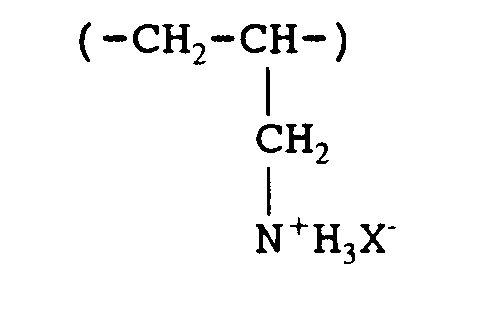
- A copolymer having the repeated structural unit corresponding to the formula above, can be obtained by way of radical polymerization of allylamine salt.
- The fluorine containing aqueous composition having water and oil repellency of this invention is comprised of the above mentioned (A) component which is a fluorine containing acrylic copolymer emulsion and the above mentioned (B) component which is a cationic water soluble polymer compound.
- (a) Examples of perfluoro-alkyl-acrylate monomer having alkyl groups of 6 to 12 carbon atoms suitable for the purposes of this invention include:
CH₂=CHCO₂C₂H₄C₆F₁₃;
CH₂=CHCO₂C₂H₄C₈F₁₇;
CH₂=C(CH₃)CO₂C₂H₄C₆F₁₃;
CH₂=C(CH₃)CO₂C₂H₄C₈F₁₇;
CH₂=CHCO₂C₂H₄C₁₀F₂₁ ;
CH₂=CHCO₂C₂H₄C₁₂F₂₅;
CH₂=C(CH₃)CO₃C₂H₄C₁₀F₂₁; and
CH₂=C(CH₃)CO₂C₂H₄C₁₂F₂₅.
In particular, CH₂=CHCO₂C₂H₄C₈F₁₇ (β-(perfluorooctyl) ethyl-acrylate) is preferable.
The quantity of the perfluoro-alkyl-acrylate monomer with alkyl group having 6 to 12 carbon atoms is 2 to 40 mol % while 5 to 20 mol % is preferable.
If the quantity is less than 2 mol %, sufficient effect of the perfluoroalkyl group cannot be expected to obtain water repellency.
If the quantity is more than 40 mol %, it becomes difficult to make a pre-emulsion with particles having fine size unless large amounts of fluoro type surfactant are used. Moreover, the emulsion produced therewith was found to have shortcomings including low water resistance as well as a tendency to foam. - (b) As for the α,β-ethylenically unsaturated monomer containing carboxyl group which can be copolymerized with the perfluro-alkyl-acrylate monomer having alkyl groups of 6 to 12 carbon atoms used in this invention, acrylic acid, methacrylic acid, crotonic acid, maleic acid, maleic acid half ester, fumaric acid, fumaric acid half ester, itaconic acid half ester, and the like can be used.
The use of α,β-ethylenically unsaturated monomer containing carboxyl group would not only stabilize the emulsification and copolymerization but also increase the effect of the perfluro-alkyl group resulting in better water repellency.
The quantity of α,β-ethylenic unsaturated monomer containing carboxyl group is in a range of 0.1 to 15 mol % with a preferable range of 2.5 to 10 mol %.
If the quantity is less than 0.1 mol %, the emulsion produced is not sufficient in stability and tends to cause undesirable paint-like reformation, or gellation during storage. Excessive amounts of more than 15 mol % would have accompanying shortcomings of lowering of water resistance of the coating film, and similar problems. - (c) As for the α,β-ethylenically unsaturated monomer with hydroxyl group which can copolymerized with the perfluoro-alkylacrylate monomer having alkyl groups of 6 to 12 carbon atoms mentioned in (a) above and the (α,β-ethylenically unsaturated monomer containing carboxyl groups mentioned in (b) above used in this invention, there can be used 2-hydroxyethyl-acrylate, 2-hydroxyethylmethacrylate, hydroxypropyl-acrylate, hydroxypropylmethacrylate, 2-hydroxy-3-chloropropyl-acrylate, β-hydroxyethyl-β'-acryloiloxy-ethyl-phthalate,1,4-butyleneglycol-monoacrylate, hydroxystyrene, 2-hydroxybutyl-methacrylate, 2-hydroxy-3-phenoxypropylacrylate and the like.
- As special monomers, tautomeric isomers such as acetoacetoxy-ethylmethacrylate or acetoacetoxy-ethylacrylate may be used regardless whether it is in Enol form or in Keto form.
- The α,β-ethylenically unsaturated monomer having hydroxyl group is not an absolutely required substance, although the use of α,β-ethylenically unsaturated monomer having hydroxyl group is found to be effective in improving water repellency and, in particular, when used with a composition involving cross linking reactive compounds, the hydroxyl group becomes a reactive group for sufficient cross linking reactions.
- The quantity of α,β-ethylenically unsaturated monomer with hydroxyl group is 0 to 25 mol % with preferable range of 5 to 15 mol %. Excessive use of more than 25 mol % will result in reduced coating film strength after curing.
- As for other α,β-ethylenically unsaturated monomers of this invention than those mentioned above which can be copolymerized with the monomers mentioned in (a), (b) and (c) above:
vinyl esters including vinyl acetate, vinyl butyrate, vinyl proprionate and vinyl esters of α-branched carboxylic acids;
acrylate esters including methyl acrylate, ethyl acrylate, butyl acrylate, 2-ethylhexyl acrylate, n-lauryl acrylate, tridecyl acrylate and n-stearyl acrylate;
methacrylate esters including methyl methacrylate, ethyl methacrylate, butyl methacrylate, 2-ethylhexyl methacrylate, n-lauryl metacrylate, tridecyl methacrylate and n-stearyl methacrylate;
unsaturated acid ester including dibutyl maleate, dibutyl fumarate; or
styrene or acrylonitrile may be used. - Further, it is also possible to use functional or crosslinking monomers in place of some of these monomers.
- As for the functional or crosslinking monomers, monomers such as acrylamide, N-methylol acrylamide, glycidyl methacrylate, divinyl benzene, trialyl-isocyanurate, tetraalyl-oxyethane may be used.
- Fluorine containing divinyl compound such as 1,4-divinyl perfluoro n-butane or 1,6-divinyl perfluoro n-hexane may also be used as a crosslinking agent.
- The quantity of the α, β-ethylenically unsaturated monomers other than mentioned above which can be copolymerized with monomers (a), (b) and (c) is the balance of the total quantity of the monomer after deducting from the quantity of monomers (a), (b) and (c) and is within a range of 97.9 to 45 mol %.
- This invention has enabled production of an aqueous emulsion of fluorine containing acrylic group copolymers directly with water but without using any solvents.
- The quantity of cationic water soluble polymer compound is mainly dependent on the type of such compound used in the production process. In general, it may be 0.5 to 10 parts by weight in equivalent of solids with a preferable range of 1.5 to 5 parts by weight for every 100 parts by weight of fluorine containing acrylic copolymer aqueous emulsion (as solids). Less than 0.5 parts by weight will result in insufficient fixation to textiles and subsequently failure to achieve sufficient water and oil repellencies.
- Excessive use of more than 10 parts by weight will lower the stability of water and oil repellent component and also drop the water and oil repellencies because of excess cationic polymer compounds. The cationic polymer compound used as component (B) may be combined in advance with fluorine containing aqueous compositions to make a one-liquid component type product or may be made into a two-liquid component type wherein the two-liquid components are mixed at the time of application.
- Furthermore, the components may be separately applied to the textile without mixing to form two-liquid components.
- The fluorine containing water and oil repellent aqueous compositions of this invention have good stability and good fixation to textiles and therefore give excellent water and oil repellencies to the textile products.
- The inventors consider the reason why the fluorine containing water and oil repellent aqueous compositions of this invention have better fixation to the textile is because of the anchoring effect produced by the cationic polymer compounds. In fact, the inventors have through experiments confirmed that substitutions of the cationic high polymer compound by nonionic water soluble high polymer such as polyvinyl alcohol, polyethylene oxide, polyvinyl-pyrrolidone, methyl cellulose, hydroxyethyl cellulose etc, or by anionic water soluble high polymer such as sodium polyacrylate, carboxylmethl cellulose or sodium alginate could not achieve improvement of fixation to the textiles.
- It was also found that, even some cationic compounds such as cationic surfactants, including mono alkyltrimethyl-ammonium-chloride, dialkyl-dimethylammonium-chloride, trialkyl-monomethyl-ammonium-chloride or monoalkyl-dimethylamine could not achieve water and oil repellencies, apart from the previously mentioned toxicity, these did not show any effects although various adjustments were given in the quantities applied.
- Further, it is also believed by the inventors that the cationic polymer compound achieves excellent fixation with textile and fluorine containing acrylic group copolymer resin particles thus helping good fixating of the fluorine containing acrylic emulsion to the textile not only by an anchoring effect through neutralization of ionic charges in the molecule but also neutralizing ionic charges which belong to the textile and the resin particles of the fluorine containing acrylic emulsion and in addition by adsorption by van de Waals force as well as by hydrogen bonding.
- In particular, polyallylamine salts have excellent miscibility with fluorine containing acrylic aqueous emulsions and a good fixing effect; accordingly, excellent stability of fluorine containing water and oil repellent composition is achieved. Furthermore, textiles which have been treated with the fluorine containing aqueous water and oil repellent composition containing polyallyamine exhibit higher water and oil repellencies than textiles which have been treated with the fluorine containing aqueous water and oil repellent component containing other cationic high polymer compounds.
- The fluorine containing aqueous water and oil repellent compositions of this invention may be used with other additives including water repellent agents, such as wax, silicone, zirconium compounds or stearic acid salts, other oil repellent agents, surfactants, insecticides, flame retardants, anti-static additives, softeners, dye fixing agents, anti crease agents to the extent that would not affect fixation to the textile and stability of the composition.
- Also, the fluorine containing aqueous water and oil repellent compositions of this invention may be crosslinked by adding melamine resins, blocked isocyanates or epoxy compounds.
- The fluorine containing aqueous water and oil repellent compositions of this invention may be applied in various methods according to the subject to be treated, for instance by dipping or by spraying.
- The fluorine containing aqueous water and oil repellent compositions of this invention may be powdered by way of spray drying, etc. for reemulsion in water immediately before use.
- The fluorine containing aqueous water and oil repellent compositions of this invention are used in the form of treatment liquids with a resin content of 0.5 to 10 weight %.
- The subjects to be treated with the fluorine containing aqueous water and oil repellent compositions of this invention are not limited as long as the subjects are textile products. They include natural fibers such as cotton, linen, wool, silk, synthetic fibers such as polyamide group, polyester group, polyurethane group, polyolefine group, polyacrylic group, polyvinyl chloride group, polyvinyl alcohol group; semi synthetics fibers such as rayon or acetate, inorganic fibers such as glass fibers or ceramics fibers, or any combination of those fibers and woven products of these materials.
- The present invention will be more specifically explained with the following examples.
- 55.2 g (25 mol %) of β-(perfluorooctyl) ethylacrylate (FLUOWET AE800, a trademark of Hoechst, A.G.), 39.4 g (65 mol %) of n-butyl methacrylate (n-BMA), 5 g (9 mol %) of 2-hydroxyethyl-methacrylate (2-HBMA), and 0.36 g (1 mol %) of methacrylic acid (MAA) were weighted out and put into a conical flask to make a homogenized monomer liquid. A solution of surfactant consisting of sodium polyoxyethylene alkylphenyl ether sulfate (2.5g), disodium hydrogenphosphate 12-H₂O salt (0.5g) and deionized water (86g) was added and stirred with a magnetic stirrer to obtain a monomer pre-emulsion with a mean particle size of one micron.
- Then the monomer pre-emulsion was subjected to 40KHz ultrasonic wave using a ultrasonic generator (Honda Electronic Co., W-210R) for 60 minutes while bubbling nitrogen gas through the pre-emulsion. The result was that the mean particle size was reduced to 0.2 microns.
- In separate containers, a catalyst solution and a reducer solution were formulated as below:
Catalyst solution: Perbutyl H69 1.5g (Nippon Oil and Fats Co.) Polyoxyethylene alkylphenyl ether 1.5g Deionized water 18.5g Reducer solution: Superlite C 1.0g (Mitsubishi Gas Chemical Co., Ltd) Deionized water 19.0g - After a reactor having a stirrer, a reflux condenser, a dropping funnel, a thermometer and a nitrogen gas pipe were warmed up to 55°C, 20% of the above mentioned monomer pre-emulsion which was subjected to ultrasonic wave radiation was poured into the reactor, and 10% each of the catalyst solution and the reducer solution were added. After 10 minutes, 10% each of the catalyst solution and the reducer solution were further added before the balance of the monomer pre-emulsion was continuously dropped into the reactor with the dropping funnel. Three hours were taken to complete the dropping process. During the above process, the temperature inside the reactor was maintained at 55 to 60°C and total 60% each of the catalyst solution and the reducer solution were added into the reactor at 15 minutes intervals. After completion of the dropping, the remaining catalyst solution and the reducer solution were added and stirred for one hour before the reaction process was completed.
- The fluorine containing acrylic copolymer aqueous emulsion obtained by the above process had 45 weight percent in density and the pH value of 2.5. Using 5% sodium hydroxide solution, the pH value was adjusted to 5.5. The density was also adjusted to 20 weight %.
- Production examples 2 and 3 were produced with the same process as the production example 1 except for the composition of the monomers was modified as shown in the Table 1 to obtain a containing acrylic copolymer aqueous emulsion.
- After monomer pre-emulsion having a composition shown in the Table 1 was obtained under the same method of the production example 1 by stirring with a magnet stirrer, high pressure homogenizing process was given once with the high pressure homogenizer (APV GAULIN, INC. MANTON-GAULIN LABORATORY HOMOGENIZER MODEL 15MR-8TA) applying 8000/psi pressure. By this process, the mean particle size of the monomer pre-emulsion became approximately 0.2 microns. After this process the production method followed to that of production example 1 to obtain a fluorine containing acrylic copolymer aqueous emulsion.

- Into 100 parts by weight of the fluorine containing acrylic copolymer aqueous emulsion of a density of 20 weight % which was obtained under the conditions shown in preparation example 1, 5 weight % solution of hydrochloric polyallylamine with a molecular weight of 80,000 was added at 10 parts by weight to produce a fluorine containing acrylic water and oil repellent composition.
- The fluorine containing acrylic water and oil repellent composition was then diluted to 400% with deionized water before it was applied to a textile for the water and oil repellent process.
- Into 100 parts by weight of the fluorine containing acrylic copolymer aqueous emulsion of a density of 20 weight % which was obtained under the conditions shown in preparation example 2, 5 weight % solution of hydrochloric polyallylamine with a molecular weight of 10,000 was added at 10 parts by weight to produce a fluorine containing acrylic water and oil repellent composition. The fluorine containing acrylic water and oil repellent composition was then diluted to 400% with deionized water before it was applied to a textile for the water and oil repellent process.
- Into 100 parts by weight of a 30 weight % solution of polyethylene imine having a molecular weight of 70,000, 50 parts by weight of hydrochloric acid of 35% density was added for cationization. The so cationized polyethylene imine solution was then diluted with deionized water to 5 weight %. Then into 100 parts by weight of the fluorine containing acrylic copolymer aqueous emulsion of density of 20% obtained by the method described in the preparation example 3, the above mentioned diluted cationized polyethylene imine was added at 8 parts by weight to make a fluorine containing acrylic ester and oil repellent composition. The composition was then diluted to 400% with deionized water, before water and oil repellency application was made on the textile.
- Into 100 parts by weight of the fluorine containing acrylic copolymer aqueous emulsion of a density of 20 weight % which was obtained under the conditions shown in preparation example 4, a 5 weight % aqueous solution of hydrochloric polyallylamine having a molecular weight of 80,000 was added at 10 parts by weight to produce a fluorine containing acrylic water and oil repellent composition. The fluorine containing acrylic water and oil repellent composition was then diluted to 400% with deionized water before it was applied to a textile for the water and oil repellent process.
- The fluorine containing acrylic copolymer aqueous emulsion with a solids content of 20 weight % obtained by the production example 1 was diluted to 400% with deionized water before it was applied onto textile samples in a water and oil repellent process.
- Into 100 parts by weight of the fluorine containing acrylic copolymer aqueous emulsion with a density of 20 weight % obtained by preparation example 1, 300% dilution of a 15 weight % solution of anionic polyacrylamide was added at 8 parts by weight to make an aqueous composition. Then it was further diluted to 400% with deionized water before it was applied onto textile samples in a water and oil repellent process.
- The fluorine containing acrylic copolymer aqueous emulsion was directly applied without being diluted onto textile samples in a water and oil repellent process.
- Samples were provided according to the following method. Cotton broadcloth pieces and nylon taffeta pieces were dipped into various water and oil repellent agents described in the above mentioned embodiments and comparison examples. The textile pieces were squeezed with a mangle in order to reach a wet pickup value of 80% for cotton and 40% for nylon, respectively. The pieces were then dried for 15 minutes at 80°C and were given a heat treatment of 150°C for three minutes.
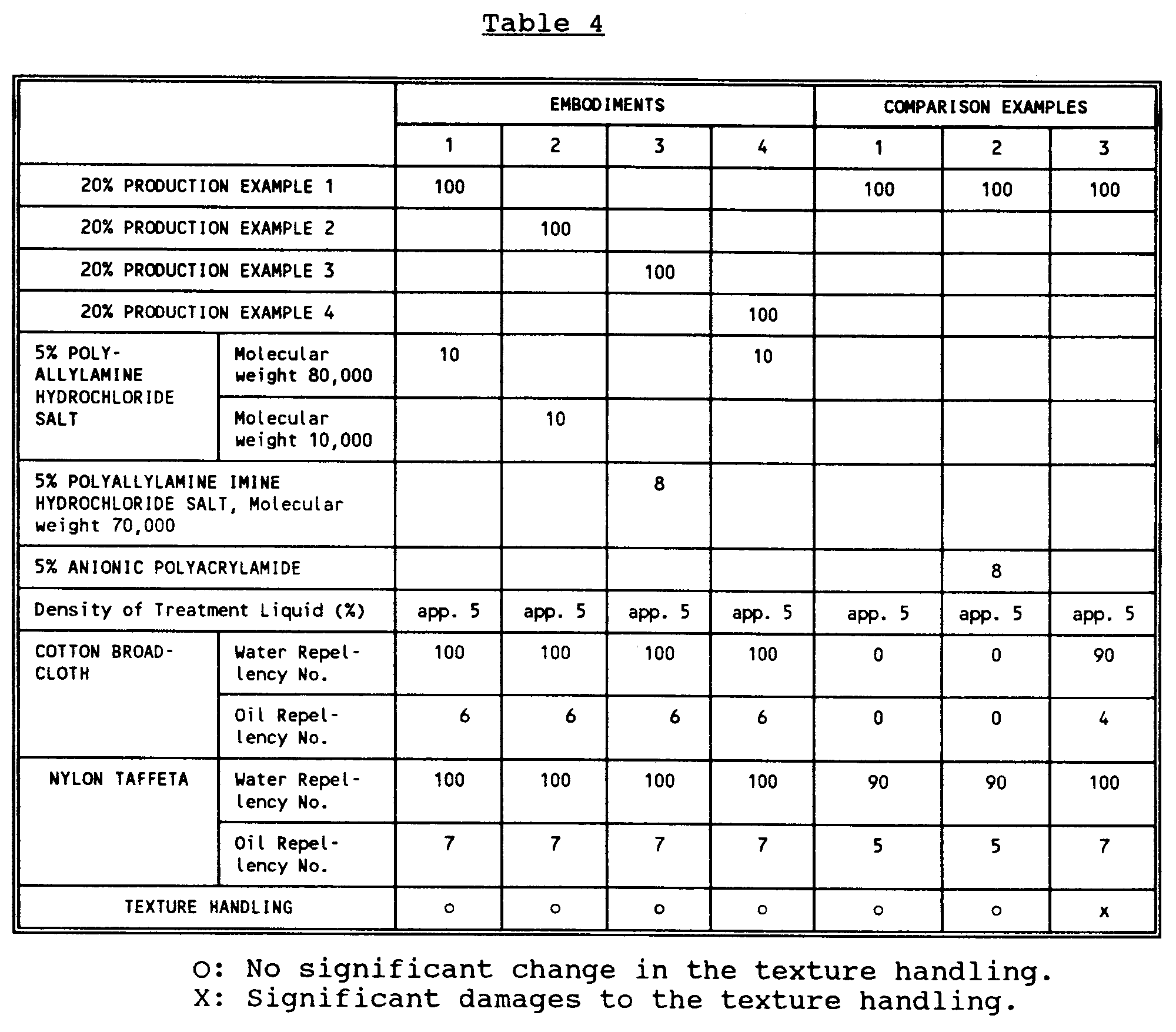
- The samples were tested and evaluated in accordance with the JIS L-1092 Spray method. The relations between the values of the water repellency and conditions are indicated on the Table 2.
Table 2 Value of Water Repellency Conditions 100 No water drop on the surface. 90 Small water drops on the surface without wetting. 80 Partial wetting in a particle shape on the surface. 70 Wetting on about a half of the surface with penetrating of small water drops to the back side. 50 Wetting on almost entire surface. 0 Penetrating of water to back side. - The samplings were tested and evaluated with the degree of permeation of the drops of various solvents indicated in the Table 3 in accordance with the method of AATCC-118-1966. The results are shown in the Table 4.
Table 3 Value of Oil Repellency Solvent 8 n-Heptane 7 n-Octane 6 n-Decane 5 n-Dodecane 4 n-Tetradecane 3 n-Hexadecane 2 Mixture of 35 parts of n-hxadecane and 65 parts of liquid paraffin 1 Liquid paraffin 0 Lower than 1 - The texture of the samples before application of the water and oil repellent process and after application were compared and observed.
- The results of the observation are shown in the Table 4.
- The Advantageous effect of the invention is that this invention has excellent water and oil repellency properties, and, furthermore, it has good stability and fixing properties to textiles.
Claims (11)
Applications Claiming Priority (2)
| Application Number | Priority Date | Filing Date | Title |
|---|---|---|---|
| JP4180249A JP2660312B2 (en) | 1992-05-29 | 1992-05-29 | Fluorine-containing water- and oil-repellent composition |
| JP180249/92 | 1992-05-29 |
Publications (2)
| Publication Number | Publication Date |
|---|---|
| EP0572269A1 true EP0572269A1 (en) | 1993-12-01 |
| EP0572269B1 EP0572269B1 (en) | 1998-01-21 |
Family
ID=16079974
Family Applications (1)
| Application Number | Title | Priority Date | Filing Date |
|---|---|---|---|
| EP93304165A Expired - Lifetime EP0572269B1 (en) | 1992-05-29 | 1993-05-28 | Fluorine containing aqueous composition for imparting water and oil repellent properties to textiles |
Country Status (5)
| Country | Link |
|---|---|
| US (1) | US5346949A (en) |
| EP (1) | EP0572269B1 (en) |
| JP (1) | JP2660312B2 (en) |
| CA (1) | CA2097238A1 (en) |
| DE (1) | DE69316443T2 (en) |
Cited By (13)
| Publication number | Priority date | Publication date | Assignee | Title |
|---|---|---|---|---|
| WO1995026881A1 (en) * | 1994-03-30 | 1995-10-12 | W.L. Gore & Associates, Inc. | Fabric laminates |
| EP0693476A1 (en) | 1994-05-26 | 1996-01-24 | Bayer Ag | Resins containing perfluoroalkyl groups and their use |
| EP0694551A1 (en) | 1994-05-26 | 1996-01-31 | Bayer Ag | Self-crosslinking aqueous compositions of resins containing perfluoroalkyl groups |
| WO1999043725A1 (en) * | 1998-02-27 | 1999-09-02 | E.I. Du Pont De Nemours And Company | Stabilization of fluorochemical copolymer emulsions |
| EP1004701A1 (en) * | 1998-11-24 | 2000-05-31 | Asahi Glass Company Ltd. | Composition for treating paper and paper treated therewith |
| US6114045A (en) * | 1997-07-08 | 2000-09-05 | Elf Atochem S.A. | Flexible coatings with low surface tack and surface tension |
| US6196708B1 (en) | 1998-05-14 | 2001-03-06 | Donaldson Company, Inc. | Oleophobic laminated articles, assemblies of use, and methods |
| WO2001018305A1 (en) * | 1999-09-10 | 2001-03-15 | Nano-Tex, Llc | Water-repellent and soil-resistant finish for textiles |
| FR2805288A1 (en) * | 2000-02-23 | 2001-08-24 | Atofina | Composition for imparting soil-, solvent- and oil-repellency to carpets, comprises an aqueous solution of a carboxy-functional polymer and a cationic emulsion of a fluorinated copolymer |
| US6894106B2 (en) | 2000-09-21 | 2005-05-17 | Daikin Industries, Ltd. | Aqueous dispersion of water- and oil-repellent and process for the production thereof |
| EP1368193A4 (en) * | 2001-01-30 | 2006-05-24 | Milliken & Co | Textile substrates for image printing |
| US7560506B2 (en) | 2004-04-20 | 2009-07-14 | Daikin Industries, Ltd. | Water- and oil-repellent composition and process for production thereof |
| CN103590249A (en) * | 2013-11-20 | 2014-02-19 | 上海天伟纺织质量技术服务有限公司 | Preparation method of water-repellent and oil-repellent antistatic finishing agent |
Families Citing this family (29)
| Publication number | Priority date | Publication date | Assignee | Title |
|---|---|---|---|---|
| CA1283362C (en) * | 1986-03-18 | 1991-04-23 | Norman P. Sweeny | Cosmetic colorant compositions |
| US5867197A (en) * | 1994-07-21 | 1999-02-02 | Canon Kabushiki Kaisha | Ink-jet printing cloth, ink-jet printing process and production process of print |
| JP3887879B2 (en) * | 1997-06-06 | 2007-02-28 | ソニーケミカル&インフォメーションデバイス株式会社 | Method for producing fluorine-containing (meth) acrylic polymer |
| US6238791B1 (en) * | 1997-12-18 | 2001-05-29 | Ppg Industries Ohio, Inc. | Coated glass fibers, composites and methods related thereto |
| CA2331755C (en) * | 1999-03-29 | 2009-06-09 | Asahi Glass Company, Limited | Water dispersion type water and oil repellent composition |
| JP4608783B2 (en) * | 2001-01-25 | 2011-01-12 | 旭硝子株式会社 | Water-dispersed fluorinated copolymer composition |
| GB0119728D0 (en) * | 2001-08-14 | 2001-10-03 | Avecia Bv | Aqueous crosslinkable coating compositions |
| CN1795242A (en) * | 2003-03-26 | 2006-06-28 | 登南乔夫罗曼有限公司 | Stain composition and coating composition |
| US7196133B2 (en) * | 2003-07-08 | 2007-03-27 | Kyoeisha Chemical Co., Ltd. | Surface tension control agent for coating material and coating material containing same |
| JP2005042271A (en) | 2003-07-25 | 2005-02-17 | Seiko Pmc Corp | Paper manufacturing method and paper |
| JP4466945B2 (en) * | 2003-10-03 | 2010-05-26 | 株式会社日本触媒 | Cationic polymer particles and method for producing the same |
| US20050175811A1 (en) * | 2004-02-06 | 2005-08-11 | Daikin Industries, Ltd. | Treatment comprising water-and oil-repellent agent |
| FR2870851B1 (en) * | 2004-05-27 | 2008-07-04 | Rhodia Chimie Sa | NOVEL WATER-REPRODUCING HYDROFUGEANT AGENT, ITS PREPARATION AND USE IN THE FIELD OF CONSTRUCTION AND PARTICULARLY IN MINERAL BINDER COMPOSITIONS |
| US20070261807A1 (en) * | 2006-05-12 | 2007-11-15 | Taggart Thomas E | Use of polyvinylamine to improve oil and water sizing in cellulosic products |
| US9945069B2 (en) | 2006-10-20 | 2018-04-17 | Daikin Industries, Ltd. | Treatment comprising water- and oil-repellent agent |
| CN100432112C (en) * | 2006-12-29 | 2008-11-12 | 陕西科技大学 | Preparation process of fluorine-containing emulsion under carboxy fluorocarbon furfactant composition action |
| US7964657B2 (en) | 2007-03-23 | 2011-06-21 | Peach State Labs, Inc. | Polymeric dispersions and applications thereof |
| US20110020591A1 (en) * | 2008-03-28 | 2011-01-27 | Daikin Indussries, Ltd. | Treatment comprising water- and oil-repellent agent |
| JP2010180293A (en) * | 2009-02-04 | 2010-08-19 | Toray Fine Chemicals Co Ltd | Acrylic emulsion composition |
| ES2378677B1 (en) | 2010-04-28 | 2013-02-28 | Repsol Lubricantes Y Especialidades, S.A. | EMULSIONS WITH DUAL BARRIER ACTION ANTIHUMEDAD AND ANTI-PAINTED. |
| US9508971B2 (en) | 2011-02-28 | 2016-11-29 | Nitto Denko Corporation | Gas-permeable filter provided with oil repellency |
| JP6037643B2 (en) * | 2012-04-06 | 2016-12-07 | 日東電工株式会社 | Breathable film with oil repellency |
| CN102660871B (en) * | 2012-04-13 | 2014-09-03 | 无锡市恒创嘉业纳米材料科技有限公司 | Fluorine containing water repellent oil repellent composition and its preparation method |
| CN103755879B (en) * | 2013-12-16 | 2016-04-06 | 齐鲁工业大学 | A kind of preparation method of fluorine-containing polyacrylate soap-free emulsion |
| JP6969540B2 (en) * | 2016-04-15 | 2021-11-24 | Agc株式会社 | Method for manufacturing a water-repellent composition and an article with a moisture-permeable waterproof film |
| CN117659796A (en) * | 2016-04-20 | 2024-03-08 | 大金工业株式会社 | Water-based coating compositions and coated articles |
| CN109247021B (en) * | 2016-04-27 | 2021-06-01 | Agc株式会社 | Liquid repellent composition, method for producing the same, and method for producing oil-resistant paper |
| CN110790858A (en) * | 2019-10-08 | 2020-02-14 | 武汉长弢新材料有限公司 | Environment-responsive coating and preparation method thereof |
| CN115058890B (en) * | 2022-06-29 | 2023-10-31 | 北京中纺化工股份有限公司 | Composite functional finishing agent for vamp material and preparation method and application thereof |
Citations (4)
| Publication number | Priority date | Publication date | Assignee | Title |
|---|---|---|---|---|
| FR2284619A1 (en) * | 1974-09-12 | 1976-04-09 | Du Pont | OIL AND WATER REPELLENT POLYMER |
| EP0294648A2 (en) * | 1987-05-25 | 1988-12-14 | Daikin Industries, Limited | Novel copolymer and water- and oil-repellent comprising the same |
| EP0345552A2 (en) * | 1988-06-08 | 1989-12-13 | Bayer Ag | Copolymers containing perfluoralkyl |
| EP0429983A2 (en) * | 1989-11-29 | 1991-06-05 | Bayer Ag | Water and oil repellant composition |
Family Cites Families (3)
| Publication number | Priority date | Publication date | Assignee | Title |
|---|---|---|---|---|
| JPS59163481A (en) * | 1983-03-04 | 1984-09-14 | 三菱レイヨン株式会社 | Method for producing acrylic fiber with water and oil repellency |
| JPS63145482A (en) * | 1986-12-05 | 1988-06-17 | 花王株式会社 | Finish composition for clothing |
| JPH0778154B2 (en) * | 1991-07-11 | 1995-08-23 | ヘキスト合成株式会社 | Method for producing aqueous fluorinated acrylic copolymer emulsion and composition thereof |
-
1992
- 1992-05-29 JP JP4180249A patent/JP2660312B2/en not_active Expired - Fee Related
-
1993
- 1993-05-25 US US08/066,664 patent/US5346949A/en not_active Expired - Fee Related
- 1993-05-28 EP EP93304165A patent/EP0572269B1/en not_active Expired - Lifetime
- 1993-05-28 DE DE69316443T patent/DE69316443T2/en not_active Expired - Fee Related
- 1993-05-28 CA CA002097238A patent/CA2097238A1/en not_active Abandoned
Patent Citations (4)
| Publication number | Priority date | Publication date | Assignee | Title |
|---|---|---|---|---|
| FR2284619A1 (en) * | 1974-09-12 | 1976-04-09 | Du Pont | OIL AND WATER REPELLENT POLYMER |
| EP0294648A2 (en) * | 1987-05-25 | 1988-12-14 | Daikin Industries, Limited | Novel copolymer and water- and oil-repellent comprising the same |
| EP0345552A2 (en) * | 1988-06-08 | 1989-12-13 | Bayer Ag | Copolymers containing perfluoralkyl |
| EP0429983A2 (en) * | 1989-11-29 | 1991-06-05 | Bayer Ag | Water and oil repellant composition |
Non-Patent Citations (2)
| Title |
|---|
| DATABASE WPI Week 8443, Derwent Publications Ltd., London, GB; AN 84-266842 & JP-A-59 163 481 (MITSUBISHI RAYON KK) 14 September 1984 * |
| DATABASE WPI Week 8830, Derwent Publications Ltd., London, GB; AN 88-209251 & JP-A-63 145 482 (KAO CORP.) 17 June 1988 * |
Cited By (22)
| Publication number | Priority date | Publication date | Assignee | Title |
|---|---|---|---|---|
| US5539072A (en) * | 1993-03-26 | 1996-07-23 | W. L. Gore & Associates, Inc. | Fabric laminates |
| GB2302061A (en) * | 1994-03-30 | 1997-01-08 | Gore & Ass | Fabric laminates |
| GB2302061B (en) * | 1994-03-30 | 1998-10-07 | Gore & Ass | Fabric laminates |
| WO1995026881A1 (en) * | 1994-03-30 | 1995-10-12 | W.L. Gore & Associates, Inc. | Fabric laminates |
| EP0693476A1 (en) | 1994-05-26 | 1996-01-24 | Bayer Ag | Resins containing perfluoroalkyl groups and their use |
| EP0694551A1 (en) | 1994-05-26 | 1996-01-31 | Bayer Ag | Self-crosslinking aqueous compositions of resins containing perfluoroalkyl groups |
| US6114045A (en) * | 1997-07-08 | 2000-09-05 | Elf Atochem S.A. | Flexible coatings with low surface tack and surface tension |
| US6180740B1 (en) | 1998-02-27 | 2001-01-30 | E. I. Du Pont De Nemours And Company | Stabilization of fluorochemical copolymer emulsions |
| WO1999043725A1 (en) * | 1998-02-27 | 1999-09-02 | E.I. Du Pont De Nemours And Company | Stabilization of fluorochemical copolymer emulsions |
| US6196708B1 (en) | 1998-05-14 | 2001-03-06 | Donaldson Company, Inc. | Oleophobic laminated articles, assemblies of use, and methods |
| US6582113B2 (en) | 1998-05-14 | 2003-06-24 | Donaldson Company, Inc. | Oleophobic laminated articles, assemblies of use, and methods |
| EP1004701A1 (en) * | 1998-11-24 | 2000-05-31 | Asahi Glass Company Ltd. | Composition for treating paper and paper treated therewith |
| US6306944B1 (en) | 1998-11-24 | 2001-10-23 | Asahi Glass Company Ltd. | Composition for treating paper and paper treated therewith |
| WO2001018305A1 (en) * | 1999-09-10 | 2001-03-15 | Nano-Tex, Llc | Water-repellent and soil-resistant finish for textiles |
| US6544594B2 (en) | 1999-09-10 | 2003-04-08 | Nano-Tex, Llc | Water-repellent and soil-resistant finish for textiles |
| US6855772B2 (en) | 1999-09-10 | 2005-02-15 | Nano-Tex, Llc | Water-repellent and soil-resistant finish for textiles |
| FR2805288A1 (en) * | 2000-02-23 | 2001-08-24 | Atofina | Composition for imparting soil-, solvent- and oil-repellency to carpets, comprises an aqueous solution of a carboxy-functional polymer and a cationic emulsion of a fluorinated copolymer |
| US6894106B2 (en) | 2000-09-21 | 2005-05-17 | Daikin Industries, Ltd. | Aqueous dispersion of water- and oil-repellent and process for the production thereof |
| EP1368193A4 (en) * | 2001-01-30 | 2006-05-24 | Milliken & Co | Textile substrates for image printing |
| US7560506B2 (en) | 2004-04-20 | 2009-07-14 | Daikin Industries, Ltd. | Water- and oil-repellent composition and process for production thereof |
| CN103590249A (en) * | 2013-11-20 | 2014-02-19 | 上海天伟纺织质量技术服务有限公司 | Preparation method of water-repellent and oil-repellent antistatic finishing agent |
| CN103590249B (en) * | 2013-11-20 | 2015-05-13 | 上海天伟纺织质量技术服务有限公司 | Preparation method of water-repellent and oil-repellent antistatic finishing agent |
Also Published As
| Publication number | Publication date |
|---|---|
| DE69316443D1 (en) | 1998-02-26 |
| DE69316443T2 (en) | 1998-05-07 |
| EP0572269B1 (en) | 1998-01-21 |
| US5346949A (en) | 1994-09-13 |
| JP2660312B2 (en) | 1997-10-08 |
| JPH0649319A (en) | 1994-02-22 |
| CA2097238A1 (en) | 1993-11-30 |
Similar Documents
| Publication | Publication Date | Title |
|---|---|---|
| US5346949A (en) | Fluorine containing aqueous composition having water repellent and oil repellent properties | |
| CN1110508C (en) | Stabilization of fluorochemical copolymer emulsions | |
| CN105764980B (en) | Surface conditioning agent | |
| US3944527A (en) | Fluoroaliphatic copolymers | |
| US7652112B2 (en) | Polymeric extenders for surface effects | |
| CA2028503C (en) | Dispersions of copolymers containing perfluoroalkyl groups | |
| JPS6215384A (en) | Fluoropolymer composition and its production and use | |
| EP2057201A1 (en) | Oil-, water- and soil-repellent perfluoroalkylethyl methacrylate copolymers | |
| CN106555336B (en) | A kind of fluorine-containing water-refusing oil-refusing finishing agent and preparation method thereof | |
| JPH05279541A (en) | Fluorine-containing copolymers | |
| CN106866872A (en) | Water-proofing treatment composition dispersion liquid | |
| CN106884327A (en) | Fabric waterproof composition for treating dispersion liquid | |
| CN103266482A (en) | A kind of wax-containing waterproof and oil-repellent agent and its preparation method, textile | |
| JPH0243210A (en) | Copolymer containing perfluoroalkyl group | |
| US5965656A (en) | Process for preparing aqueous emulsion | |
| JP3744035B2 (en) | Water-dispersed water / oil repellent composition with excellent stability | |
| JP2005054020A (en) | Water and oil repellant | |
| US6165545A (en) | After-treatment method for imparting oil-and water-repellency to fabric | |
| JPH03153716A (en) | Perfluoroalkyl acrylate or methacrylate copolymer or graft copolymer | |
| JP2010222382A (en) | Fluorine-containing fiber finishing agent with dirt release properties | |
| JP2005272557A (en) | Method for producing acrylic copolymer | |
| CN100393752C (en) | Process for preparing aqueous dispersions | |
| JP2002220539A (en) | Water-dispersed fluorine-based copolymer composition | |
| CN109575170A (en) | Fluorine silicon hybridization polyacrylate dispersion liquid | |
| JP3484708B2 (en) | Water / oil repellent composition |
Legal Events
| Date | Code | Title | Description |
|---|---|---|---|
| PUAI | Public reference made under article 153(3) epc to a published international application that has entered the european phase |
Free format text: ORIGINAL CODE: 0009012 |
|
| AK | Designated contracting states |
Kind code of ref document: A1 Designated state(s): DE FR GB |
|
| RIN1 | Information on inventor provided before grant (corrected) |
Inventor name: FUKAZAWA, YUJI, C/O HOECHST GOSEI K.K. |
|
| 17P | Request for examination filed |
Effective date: 19940428 |
|
| 17Q | First examination report despatched |
Effective date: 19951113 |
|
| GRAG | Despatch of communication of intention to grant |
Free format text: ORIGINAL CODE: EPIDOS AGRA |
|
| GRAH | Despatch of communication of intention to grant a patent |
Free format text: ORIGINAL CODE: EPIDOS IGRA |
|
| GRAH | Despatch of communication of intention to grant a patent |
Free format text: ORIGINAL CODE: EPIDOS IGRA |
|
| GRAA | (expected) grant |
Free format text: ORIGINAL CODE: 0009210 |
|
| AK | Designated contracting states |
Kind code of ref document: B1 Designated state(s): DE FR GB |
|
| REF | Corresponds to: |
Ref document number: 69316443 Country of ref document: DE Date of ref document: 19980226 |
|
| ET | Fr: translation filed | ||
| PLBE | No opposition filed within time limit |
Free format text: ORIGINAL CODE: 0009261 |
|
| STAA | Information on the status of an ep patent application or granted ep patent |
Free format text: STATUS: NO OPPOSITION FILED WITHIN TIME LIMIT |
|
| 26N | No opposition filed | ||
| PGFP | Annual fee paid to national office [announced via postgrant information from national office to epo] |
Ref country code: GB Payment date: 19990406 Year of fee payment: 7 |
|
| PGFP | Annual fee paid to national office [announced via postgrant information from national office to epo] |
Ref country code: FR Payment date: 19990504 Year of fee payment: 7 |
|
| PGFP | Annual fee paid to national office [announced via postgrant information from national office to epo] |
Ref country code: DE Payment date: 19990531 Year of fee payment: 7 |
|
| PG25 | Lapsed in a contracting state [announced via postgrant information from national office to epo] |
Ref country code: GB Free format text: LAPSE BECAUSE OF NON-PAYMENT OF DUE FEES Effective date: 20000528 |
|
| GBPC | Gb: european patent ceased through non-payment of renewal fee |
Effective date: 20000528 |
|
| PG25 | Lapsed in a contracting state [announced via postgrant information from national office to epo] |
Ref country code: FR Free format text: LAPSE BECAUSE OF NON-PAYMENT OF DUE FEES Effective date: 20010131 |
|
| PG25 | Lapsed in a contracting state [announced via postgrant information from national office to epo] |
Ref country code: DE Free format text: LAPSE BECAUSE OF NON-PAYMENT OF DUE FEES Effective date: 20010301 |
|
| REG | Reference to a national code |
Ref country code: FR Ref legal event code: ST |