EP0567090B1 - Benzoxazepine derivatives as cholinesterase inhibitors - Google Patents
Benzoxazepine derivatives as cholinesterase inhibitors Download PDFInfo
- Publication number
- EP0567090B1 EP0567090B1 EP93106448A EP93106448A EP0567090B1 EP 0567090 B1 EP0567090 B1 EP 0567090B1 EP 93106448 A EP93106448 A EP 93106448A EP 93106448 A EP93106448 A EP 93106448A EP 0567090 B1 EP0567090 B1 EP 0567090B1
- Authority
- EP
- European Patent Office
- Prior art keywords
- group
- compound
- formula
- ring
- salt
- Prior art date
- Legal status (The legal status is an assumption and is not a legal conclusion. Google has not performed a legal analysis and makes no representation as to the accuracy of the status listed.)
- Expired - Lifetime
Links
- 0 CC[C@]1C([C@@](C2)[C@@]2CC*C2)[C@@]2(C2)C2=CC1 Chemical compound CC[C@]1C([C@@](C2)[C@@]2CC*C2)[C@@]2(C2)C2=CC1 0.000 description 6
Classifications
-
- C—CHEMISTRY; METALLURGY
- C07—ORGANIC CHEMISTRY
- C07D—HETEROCYCLIC COMPOUNDS
- C07D263/00—Heterocyclic compounds containing 1,3-oxazole or hydrogenated 1,3-oxazole rings
- C07D263/52—Heterocyclic compounds containing 1,3-oxazole or hydrogenated 1,3-oxazole rings condensed with carbocyclic rings or ring systems
- C07D263/54—Benzoxazoles; Hydrogenated benzoxazoles
- C07D263/58—Benzoxazoles; Hydrogenated benzoxazoles with hetero atoms or with carbon atoms having three bonds to hetero atoms with at the most one bond to halogen, e.g. ester or nitrile radicals, directly attached in position 2
-
- C—CHEMISTRY; METALLURGY
- C07—ORGANIC CHEMISTRY
- C07D—HETEROCYCLIC COMPOUNDS
- C07D267/00—Heterocyclic compounds containing rings of more than six members having one nitrogen atom and one oxygen atom as the only ring hetero atoms
- C07D267/02—Seven-membered rings
- C07D267/08—Seven-membered rings having the hetero atoms in positions 1 and 4
- C07D267/12—Seven-membered rings having the hetero atoms in positions 1 and 4 condensed with carbocyclic rings or ring systems
- C07D267/14—Seven-membered rings having the hetero atoms in positions 1 and 4 condensed with carbocyclic rings or ring systems condensed with one six-membered ring
-
- C—CHEMISTRY; METALLURGY
- C07—ORGANIC CHEMISTRY
- C07D—HETEROCYCLIC COMPOUNDS
- C07D413/00—Heterocyclic compounds containing two or more hetero rings, at least one ring having nitrogen and oxygen atoms as the only ring hetero atoms
- C07D413/02—Heterocyclic compounds containing two or more hetero rings, at least one ring having nitrogen and oxygen atoms as the only ring hetero atoms containing two hetero rings
- C07D413/06—Heterocyclic compounds containing two or more hetero rings, at least one ring having nitrogen and oxygen atoms as the only ring hetero atoms containing two hetero rings linked by a carbon chain containing only aliphatic carbon atoms
Definitions
- This invention relates to novel heterocyclic compounds and salts thereof, and to pharmaceutical preparations. More particularly, the present invention relates to a cholinesterase inhibitor, especially to a therapeutic and/or prophylactic agent for senile dementia, Alzheimer and so on, novel heterocyclic compounds as active ingredients and salts thereof, to methods for preparing the same and to intermediate products thereof.
- EP-A-0,378,207 discloses a cyclic amino compound of the following formula or salts thereof:
- a practical embodiment thereof is the following compound.
- EP-A-0,468,187 discloses a cyclic amide compound of the formula: R 1 -(CH 2 ) n -Z
- USP 4,064,255 corresponding to JPA-52(1977)-72829 discloses a pharmaceutical composition used for treatment of pathological conditions caused by disturbances in serotonin systems, which comprises a compound of the formula or pharmaceutically acceptable salts thereof:
- WO91/03243 discloses a compound, which is used as a psychopharmaceutical, of the following general formula or pharmaceutically acceptable salts thereof:
- Chem. Abstr., 89 , 36594y(1978) discloses that the compound of the general formula has an antispasmic action, depressing action of arterial blood pressure and a local anesthetic action:
- EP-163,537 discloses that a compound of the general formula has a muscular relaxant action:
- Chem. Abstr., 91 ,211631y(1979) discloses that a compound of the following formula is synthesized as a derivative of cystisine, which is an alkaloid having an anticholinergic action:
- Helvetica Chimica Acta, 51 , 1616(1968) discloses compounds of the following formula (A) and (B): as an intermediate products for synthesizing alkanolamines of the following formula (C), which is an agent acting on the sympathetic nervous system:
- JPA-52(1977)-97952 discloses a compound of the formula:
- JPA-59(1984)-7185 there is disclosed that a 1,5-benzoxepine derivative of the following formula or acid adducts thereof has a depressing action of blood pressure:
- Chem. Abstr., 70 , 106531j (1969) corresponding to FR-M3,635 discloses, for example, a compound of the formula: as an intermediate product of 1,4-benzodioxane derivatives of the formula: which is an agent acting on the sympathetic nervous system.
- a still further object of the invention is to provide a cholinesterase inhibitor containing a heterocyclic compound having a cholinesterase inhibitory activity.
- a yet further object of the present invention is to provide a pharmaceutical composition for an agent for a disease caused by acetylcholinesterase activity.
- the present invention further discloses a method of treating a disease caused by acetylcholinesterase activity and use of the heterocyclic compound or a salt thereof as a cholinesterase inhibitor.
- the present invention was accomplished by investigating various aspects of heterocyclic compounds including novel compounds in biological activity and pharmacological action and by finding that the compounds having structural characteristics in bicyclic-heterocyclic group wherein the heterocyclic ring containing, the same or different, two or more hetero atoms, condensed on the benzene ring have unexpectedly excellent cholinesterase inhibitory activity and antidepressant activity, thus being useful as therapeutic and/or prophylactic agents for senile dementia. Based on these structural characteristics, these compounds show above-mentioned excellent actions.
- the present invention relates to a compound of the formula: wherein
- the present invention also provides (2) a compound of the formula:
- the present invention further provides (3) a method of producing the compound [I'], which comprises reacting (a) a compound of the formula:
- the present invention also provides (4) a cholinesterase inhibitor, which contains a compound of the formula [I'] or a pharmaceutically acceptable salt thereof.
- the present invention further provides (5) a pharmaceutical composition for an agent for a disease caused by acetylcholinesterase activity which contains an effective cholinesterase inhibiting amount of the compound [I'] or a pharmaceutically acceptable salt thereof and a pharmacologically acceptable carrier.
- a pharmaceutical composition for senile dementia and/or Alzheimer's disease containing the compound [I'] or a salt thereof is also provided.
- the present invention also relates to the use of the compound [I'] or a pharmaceutically acceptable salt thereof as a component in the preparation of a cholinesterase inhibitor.
- the compound [I'] or salts thereof of this invention are novel compounds having structural characteristics in that the above mentioned non-aromatic heterocyclic ring B' is condensed on the benzene ring A and a substitutent is bonded to the carbon atom of the benzene ring A, and these compounds show excellent therapeutic and/or prophylactic actions for senile dementia due to these characteristics.
- R 1 represents a hydrogen atom.
- the benzene ring represented by ring A is condensed on the ring B' and may have substituents besides the group of the formula:
- Such substituents include 1 to 3 substituents selected from a C 1-3 alkyl group such as methyl, a halogen atom such as fluorine and chlorine, hydroxy and a C 1-3 alkoxy group such as methoxy. Especially, halogen atoms such as fluorine, chlorine, etc. are preferable.
- Ring B' is a group of the formula
- Y is a 5- to 9-membered N-containing saturated heterocyclic group shown by the formula:
- the substituents on the ring constituting nitrogen atom are hydrogen atom, formyl group, a C 1-6 alkyl-carbonyl group (e.g., methylcarbonyl, ethylcarbonyl, propylcarbonyl, butylcarbonyl) or a C 7-10 aralkyl group (e.g. phenylmethyl, phenylethyl, phenylpropyl) which may be substituted with substituents such as a C 1-4 alkyl group (e.g. methyl, ethyl, propyl, n-butyl, i-butyl, tert-butyl), a halogen atom (e.g. fluorine, chlorine, bromine, iodine), a nitro group, a C 1-4 alkoxy group (e.g. methoxy, ethoxy), or a hydroxyl group.
- a C 1-6 alkyl-carbonyl group e.g.
- n denotes an integer of 2 to 10.
- the compounds of the formula [I'] having ring B' or salts thereof of the present invention are novel compounds and have more excellent cholinesterase inhibitory activity.
- Preferred examples of the benzene ring shown by ring A include an unsubstituted benzene ring.
- Y represents a 5- to 9-membered, more preferably a 5- to 7-membered N-containing saturated heterocyclic group represented by the ring Q 1 or the ring Q 2 which may have, other than carbon atoms and one nitrogen atom, one to two of hetero atoms selected from nitrogen, oxygen and sulfur atoms.
- These rings may be substituted, preferably on the ring-constituting nitrogen atom, with an optionally substituted acyl group such as formyl or a C 1-6 alkylcarbonyl, and an optionally substituted C 7-10 aralkyl group.
- Typical examples of the group shown by Y include a ring having the skeleton of pyrrolidine, piperidine, piperazine, morpholine, 1,2,3,4-tetrahydroquinoline, 1,2,3,4-tetrahydroisoquinoline, 2,3,4,5-tetrahydro-1H-1-benzazepine, 2,3,4,5-tetrahydro-1H-2-benzazepine, or 2,3,4,5-tetrahydro-1H-3-benzazepine, which may be substituted with an optionally substituted acyl group, an optionally substituted C 7-10 aralkyl group are preferable.
- the practically preferred is a ring having the skeleton of pyrrolidine, piperidine, piperazine or morpholine which may be substituted with an optionally substituted acyl group or an optionally substituted C 7-10 aralkyl group.
- substituents which these acyl group and C 7-10 aralkyl group may have, a halogen atom such as fluorine, chlorine, bromine, a C 1-4 alkyl group (e.g. methyl, ethyl, n-propyl, i-propyl, n-butyl, i-butyl, tert-butyl), a nitro group, a hydroxy group and a C 1-4 alkoxy group (for example, methoxy, ethoxy, propoxy, butoxy) are preferable.
- a halogen atom such as fluorine, chlorine, bromine
- a C 1-4 alkyl group e.g. methyl, ethyl, n-propyl, i-propyl, n-butyl, i-butyl, tert-butyl
- a halogen atom such as fluorine, chlorine, bromine
- a C 1-4 alkyl group e
- n denotes preferably an integer of 2 to 6, more preferably 2 to 4.
- physiologically acceptable acid addition salts are preferred.
- these salts include salts with inorganic acids (e.g. hydrochloric acid, phosphoric acid, hydrobromic acid, sulfuric acid) and salts with organic acids (e.g. acetic acid, formic acid, propionic acid, fumaric acid, maleic acid, succinic acid, tartaric acid, citric acid, malic acid, oxalic acid, benzoic acid, methanesulfonic acid, benzenesulfonic acid.
- inorganic acids e.g. hydrochloric acid, phosphoric acid, hydrobromic acid, sulfuric acid
- organic acids e.g. acetic acid, formic acid, propionic acid, fumaric acid, maleic acid, succinic acid, tartaric acid, citric acid, malic acid, oxalic acid, benzoic acid, methanesulfonic acid, benzenesulfonic acid.
- the compound of the formula [I'] of this invention may form a salt with an inorganic base (e.g. ammonia, an alkali metal such as sodium, potassium, or alkaline earth metal such as calcium, magnesium, or with an organic base (e.g. a tri-C 1-3 alkylamine such as trimethylamine, triethylamine) and these salts are involved in the subjects of the present invention.
- an inorganic base e.g. ammonia, an alkali metal such as sodium, potassium, or alkaline earth metal such as calcium, magnesium
- organic base e.g. a tri-C 1-3 alkylamine such as trimethylamine, triethylamine
- the compound of the formula [I'] may be produced by, for example, reacting a compound represented by the formula:
- a halogen atom e.g. chlorine, bromine, iodine
- a C 1-6 alkylsulfonyloxy group e.g. methanesulfonyloxy, ethanesulfonyloxy, propanesulfonyloxy
- a C 6-10 arylsulfonyloxy group e.g. benzenesulfonyloxy, and p-toluenesulfonyloxy.
- the preferred leaving group includes a halogen atom such as chlorine.
- the compound of the formula [II ] or salts thereof may be prepared in accordance with a conventional method or a method analogous thereto, for example, descriptions on Indian J. Chem., 2 , 211 (1964), Indian J. Chem., 12 , 247, (1974), Bull. Chem. Soc., Jpn., 43 , 1824 (1970), Chem. Pharm. Bull., 20 , 1328 (1972), Chem. Pharm. Bull., 27 , 1982 (1979), Helv. Chem. Acta, 46 , 1696 (1963), Synthesis, 541 (1979), USP 3,682,962, USP 3,911,126, Ger. Offen. 2,314,392 and Ger. Offen. 1,545,805.
- the compound of the formula [III] and salts thereof may be produced in accordance with a conventional method or a method analogous thereto.
- the same can be produced in accordance with descriptions on Chem. Pharm. Bull., 34 , 3747-3761 (1986) and EP-A-0,378,207.
- Examples of the salts of the compound of the formula [II ] and [III] include salts with inorganic acids (e.g. hydrochloric acid, phosphoric acid, hydrobromic acid, sulfuric acid, ) and salts with organic acids (e.g. acetic acid, formic acid, propionic acid, fumaric acid, maleic acid, succinic acid, tartaric acid, citric acid, malic acid, oxalic acid, benzoic acid, methanesulfonic acid and benzenesulfonic acid).
- inorganic acids e.g. hydrochloric acid, phosphoric acid, hydrobromic acid, sulfuric acid,
- organic acids e.g. acetic acid, formic acid, propionic acid, fumaric acid, maleic acid, succinic acid, tartaric acid, citric acid, malic acid, oxalic acid, benzoic acid, methanesulfonic acid and benzenesulfonic acid.
- the compound of the formula [II] and [III] may form a salt with an inorganic base (e.g. an alkali metal such as sodium, potassium, an alkaline earth metal such as calcium, magnesium, or ammonia) or with an organic base (e.g. tri-C 1-3 alkylamine such as trimethylamine and triethylamine).
- an inorganic base e.g. an alkali metal such as sodium, potassium, an alkaline earth metal such as calcium, magnesium, or ammonia
- an organic base e.g. tri-C 1-3 alkylamine such as trimethylamine and triethylamine
- reaction of the compound of the formula [III] or a salt thereof with the compound of the formula [II] or a salt thereof can be conducted by reacting the compound of the formula [III] or a salt thereof, with the compound of the formula [II ] or a salt thereof without using a solvent or, upon necessity, in a solvent.
- any one which is conventionally usable in chemical reactions, unless it disturbs proceeding of the reaction, can be employed, as exemplified by organic solvents including hydrocarbons (e.g. pentane, hexane, benzene, toluene, nitrobenzene ), halogenated hydrocarbons (e.g. dichloromethane, chloroform, 1,2-dichloroethane, carbon tetrachloride ), ethers (e.g. ethyl ether, tetrahydrofuran, dioxane, dimethoxyethane ), nitro alkanes (e.g. nitromethane, propionitrile ) and carbon disulfide.
- hydrocarbons e.g. pentane, hexane, benzene, toluene, nitrobenzene
- halogenated hydrocarbons e.g. dichloromethane, chloroform, 1,2-dichloroe
- the amount of the solvent ranges usually from 0.5 to 100 ml, preferably from 5 to 20 ml, relative to 1 mmol. of the compound of the formula [III] or a salt thereof.
- the reaction temperature is usually from -30°C to 150°C, preferably from 20°C to 100°C.
- the reaction time runs usually from 0.5 to 72 hours, preferably from 1 to 16 hours.
- the reaction may be carried out in the presence of a Lewis acid.
- a Lewis acid to be employed in this reaction, use is made of, for example, aluminum chloride, zinc chloride, titanium chloride, tin(IV) chloride, boron trifluoride, iron(II) chloride, iron(III) chloride, antimony(V) pentachloride, bismuth(III) chloride, silver(II) chloride, hydrogen fluoride sulfuric acid, polyphosphoric acid and so on.
- a Lewis acid to be employed in this reaction, use is made of, for example, aluminum chloride, zinc chloride, titanium chloride, tin(IV) chloride, boron trifluoride, iron(II) chloride, iron(III) chloride, antimony(V) pentachloride, bismuth(III) chloride, silver(II) chloride, hydrogen fluoride sulfuric acid, polyphosphoric acid and so on.
- Fiedel-Crafts catalysts such as aluminum chloride.
- the amount of the Lewis acid ranges usually from 1 to 10 mol., preferably from 2 to 10 mol., relative to 1 mol. of the compound of the formula [III] or a salt thereof.
- the amount to the compound of the formula [II ] or a salt thereof relative to 1 mol. of the compound of the formula [III] or a salt thereof is usually from 1 to 20 mol., preferably from 1 to 5 mol.
- the position where the group of the formula of the compound of the formula [III] or a salt thereof: is introduced into the compound of the formula [II ] or a salt thereof may be any of the positions on the ring A on which the substitution can take place.
- the skeleton of the compound of the formula [II ] or a salt thereof is 2,3,4,5-tetrahydro-1,4-benzoxazepine (provided that the ring A is unsubstituted)
- the group of the compound of the formula [III] or a salt thereof is introduced mainly into 7-position, while such compounds as having the group introduced at any other positions (6-position, 8-position or 9-position) can be produced and isolated as well.
- the compound of the formula [I'] or a salt thereof may be produced also by reacting a compound of the formula:
- a halogen atom e.g. chlorine, bromide, iodine
- a C 1-6 alkylsulfonyloxy group e.g. methanesulfonyloxy, ethanesulfonyloxy
- a C 6-10 arylsulfonyloxy group e.g. benzenesulfonyloxy, p-toluenesulfonyloxy.
- the preferred examples of the leaving group shown by Z 2 include a halogen atom such as chlorine and bromine.
- Z 3 As the leaving group shown by Z 3 , which can be left with Z 2 , there may be mentioned, for example, a hydrogen atom, a trialkylsilyl group (e.g. trimethylsilyl, triethylsilyl, t-butyldimethylsilyl ).
- a trialkylsilyl group e.g. trimethylsilyl, triethylsilyl, t-butyldimethylsilyl.
- the preferred includes a hydrogen atom.
- the salts of the compound of the formula [IV ] and [V] are exemplified as salts with inorganic acids (e.g. hydrochloric acid, phosphoric acid, hydrobromic acid, sulfuric acid ) and salts with organic acids (e.g. acetic acid, formic acid, propionic acid, fumaric acid, maleic acid, succinic acid, tartaric acid, citric acid, malic acid, oxalic acid, benzoic acid, methanesulfonic acid, and benzenesulfonic acid).
- inorganic acids e.g. hydrochloric acid, phosphoric acid, hydrobromic acid, sulfuric acid
- organic acids e.g. acetic acid, formic acid, propionic acid, fumaric acid, maleic acid, succinic acid, tartaric acid, citric acid, malic acid, oxalic acid, benzoic acid, methanesulfonic acid, and benzenesulfonic acid.
- the compound of the formula [IV ] and [V] of this invention may form a salt with an inorganic base (e.g. an alkali metal such as sodium, potassium, an alkaline earth metal such as calcium, magnesium, or ammonia) or with an organic base (e.g. tri-C 1-3 alkylamine such as trimethylamine and triethylamine).
- an inorganic base e.g. an alkali metal such as sodium, potassium, an alkaline earth metal such as calcium, magnesium, or ammonia
- an organic base e.g. tri-C 1-3 alkylamine such as trimethylamine and triethylamine
- the amount of the compound of the formula [V] or a salt thereof to be employed in this reaction is, usually, from 1.0 to 50.0 times as much mol., preferably 1.0 to 10.0 times as much mol. relative to one mol. of the compound of the formula [IV ] or a salt thereof.
- This reaction can be conducted under cooling or under heating (at temperatures ranging from 0°C to 120°C).
- the reaction is completed in, usually, from 10 minutes to 48 hours, preferably from 2 to 16 hours.
- the reaction can be conducted in the absence of solvent, or if necessary, in a solvent.
- solvent any one can be employed unless it disturbs the proceeding of the reaction.
- examples of such solvent include lower alcohols such as methanol, ethanol, propanol, isopropanol, n-butanol, t-butanol, ethers such as dioxane, ethyl ether, tetrahydrofuran, aromatic hydrocarbons such as benzene, toluene, xylene, etc., amides such as dimethylformamide, dimethylacetamide, hexamethylphosphonotniamide, esters such as ethyl acetate and butyl acetate.
- the amount of the solvent relative to 1mmol. of the compound of the formula [IV ] or a salt thereof is, usually, from 0.5 to 100 ml, preferably from 5 to 20 ml.
- the reaction can also be carried out in the presence of a base, if necessary.
- a base examples include inorganic bases such as sodium carbonate, potassium carbonate, lithium carbonate, sodium hydroxide, potassium hydroxide, sodium methoxide, sodium ethoxide, sodium hydride, and organic bases such as pyridine, 4-dimethylaminopyridine, and triethylamine.
- the amount of the base runs, usually, from equimol. to excess amount, preferably from 1.0 to 5.0 times as much mol. relative to the compound of the formula [V] or a salt thereof.
- an iodide e.g. sodium iodide, potassium iodide, lithium iodide
- the amount of the iodide relative to the compound of the formula [IV ] or a salt thereof is, usually, from 1 to 5, preferably 1.0 to 1.5 times as much mol.
- the starting compound of the formula [IV ] or a salt thereof may be prepared by reacting a compound represented by the formula:
- a halogen atom e.g. chlorine, bromine, iodine
- a C 1-6 alkylsulfonyloxy group e.g. methanesulfonyloxy, ethanesulfonyloxy, propanesulfonyl
- a C 6-10 arylsulfonyloxy group e.g. benzenesulfonyloxy and p-toluenesulfonyloxy.
- the preferred examples of the leaving group include a halogen atom such as chlorine.
- the compound of the formula [VIII] can be produced by a conventionally known method or a method analogous thereto.
- reaction of the compound of the formula [II ] or a salt thereof with the compound of the formula [VIII] can be conducted under the same conditions as in the reaction of the compound of the formula [II ] or a salt thereof with the compound of the formula [III] or a salt thereof.
- the position where the group of the compound of the formula [VIII] or a salt thereof: is introduced into the compound of the formula [II ] or a salt thereof may be any of the positions on the ring A on which the substitution can take place.
- the group of the compound of the formula [VIII] may be introduced mainly into 7-position, while such compounds as having the group introduced at any other positions (namely, 6-position, 8-position or 9-position) can also be produced and isolated.
- the compound of the formula [IV ] or salts thereof thus obtained can be isolated and purified by a conventional means such as concentration, phasic transfer, solvent transfer, solvent extraction, fractional distillation, distillation, crystallization, recrystallization and chromatography, while they may be fed to the subsequent process as the material in the state of mixture without isolation.
- the starting compound of the formula [V] or a salt thereof may be prepared by a conventionally known method or a method analogous thereto.
- R 4 and R 5 there may be mentioned an optionally substituted hydrocarbon group similar to those shown by R 1 .
- the example of the salts of the compound of the formula [IX] include those similar to the salts of the compound of the formula [I'].
- the salts of the compound [X] are exemplified as salts with inorganic acids (e.g. hydrochloric acid, phosphoric acid, hydrobromic acid, sulfuric acid) and salts with organic acids (e.g. acetic acid, formic acid, propionic acid, fumaric acid, maleic acid, succinic acid, tartaric acid, citric acid, malic acid, oxalic acid, benzoic acid, methanesulfonic acid, benzenesulfonic acid).
- the compound of the formula [X] has an acid group such as -COOH
- the compound of the formula [X] may form a salt with an inorganic base (e.g. an alkali metal such as sodium, potassium, an alkaline earth metal such as calcium, magnesium, or ammonia) or with an organic base (e.g. tri-C 1-3 alkylamine such as trimethylamine, and triethylamine).
- inorganic acids e.g. hydrochloric acid
- the reaction may be carried out in substantially the same manner as Mannich reaction described in Organic Reaction, Vol. 1, p 303 to 341. More practically, the reaction is conducted by allowing, for example, the compound of the formula [XI] and the compound of the formula [V] or a salt thereof to react with the compound of the formula [X] or a salt thereof in a ratio of usually 0.9 to 10, preferably 1.0 to 3.0 equivalents of the former relative to 1 equivalent of the latter.
- reaction may be carried out usually at temperatures from room temperature to under heating (10 to 150°C), it is conducted preferably at temperatures from 80 to 120°C.
- the reaction may be completed in, usually, from 1 to 48 hours, preferably from 2 to 24 hours.
- the reaction may usually be carried out in the absence or presence of solvent.
- solvent any one generally used for Mannich reaction can be applied, unless it inhibits the proceeding of the reaction.
- alcohols such as ethanol are frequently utilized.
- the amount of the solvent is, usually from 0.5 to 200 ml, preferably from 5 to 40 ml, relative to 1 mmol. of the compound of the formula [X] or a salt thereof.
- the reaction can be conducted, if desired, in the presence of an inorganic acid such as hydrochloric acid.
- the proportion of the acid relative to the compound [X] or a salt thereof is a catalytic amount such as 0.001 to 0.05 equivalent relative to 1 equivalent of the compound of the formula [X].
- the compound of the formula [V] or [X] to be employed for the reaction is not in the form of salt, however, it is preferable to use the acid in an excess amount sufficient for allowing these compounds to form salts.
- the compound of the formula [X] or salts thereof may be obtained by allowing the compound of the formula [II ] or a salt thereof to react with a compound represented by the formula: Z 5 -CO-CH 2 -R 4
- reaction may be carried out under the conditions similar to those in the reaction of the compound of the formula [II ] or a salt thereof with the compound of the formula [VIII].
- the compound of the formula [XI) or salts thereof may be prepared by a conventionally known method or a method analogous thereto.
- the protecting groups of amino group there may be mentioned formyl, an optionally substituted C 1-6 alkyl-carbonyl group (e.g. acetyl, ethylcarbonyl ), a benzoyl group, a C 1-6 alkoxycarbonyl group (e.g. methoxycarbonyl, ethoxycarbonyl), a phenyloxycarbonyl group, a C 7-15 aralkyloxycarbonyl (e.g. benzyloxy carbonyl, fluorenyloxycarbonyl), a trityl group, a phthaloyl group and so on.
- the examples of the substituents which these protecting group may have include a halogen atom (e.g.
- the protecting group of carboxyl group include, for example, an optionally substituted C 1-6 alkyl group (e.g. methyl, ethyl, n-propyl, i-propyl, n-butyl, tert-butyl), , a phenyl group, a trityl group, and a silyl group.
- a halogen atom e.g. fluorine, chlorine, bromine, iodine
- formyl e.g. fluorine, chlorine, bromine, iodine
- C 1-6 alkyl-carbonyl group e.g. ethylcarbonyl, butylcarbonyl
- a nitro group e.g. a nitro group.
- the number of these substituents is from 1 to about 3.
- the examples of the protecting group of hydroxyl group include an optionally substituted C 1-6 alkyl group (e.g. methyl, ethyl, n-propyl, i-propyl, n-butyl, tert-butyl ), phenyl group, a C 7-10 aralkyl group (e.g. benzyl ), formyl, a C 1-6 alkyl-carbonyl group (e.g. acetyl, ethylcarbonyl), a phenyloxycarbonyl group, a C 7-10 aralkyl-carbonyl group (e.g.
- C 1-6 alkyl group e.g. methyl, ethyl, n-propyl, i-propyl, n-butyl, tert-butyl
- phenyl group e.g. methyl, ethyl, n-propyl, i-propyl, n-
- benzyloxycarbonyl a pyranyl group, a furanyl group, and a silyl group.
- substituents which these protecting group may have there may be mentioned a halogen atom (e.g. fluorine, chlorine, bromine, iodine), a C 1-6 alkyl group, a phenyl group, a C 7-10 aralkyl group, and a nitro group.
- the compound having an unsubstituted amino group or a mono-substituted amino group or a salt thereof may be produced by conducting a deacylation reaction.
- the compound of the formula [I'], or [IX] having an optionally substituted acylamino group or salts thereof used as the starting compound includes those isolated and purified by a conventional means such as concentration, phasic transfer, solvent transfer, solvent extraction, fractional distillation, distillation, crystallization, recrystallization, and chromatography, while they may be fed to the subsequent process as the material in the state of mixture without isolation.
- the compound of the formula [I'], or [IX] having an optionally substituted acylamino group or a salt thereof is to be maintained at temperature from 10 to 150°C, preferably 50 to 100°C, in an aqueous solution of an acid such as inorganic acid (e.g. nitric acid, hydrochloric acid, hydrobromic acid, iodic acid, sulfuric acid ) or of a base such as alkali metal hydroxide (e.g. sodium hydroxide, potassium hydroxide, lithium hydroxide).
- an acid such as inorganic acid (e.g. nitric acid, hydrochloric acid, hydrobromic acid, iodic acid, sulfuric acid ) or of a base such as alkali metal hydroxide (e.g. sodium hydroxide, potassium hydroxide, lithium hydroxide).
- the amount of said acid or base relative to 1 mmol. of the compound of the formula [XII] or a salt thereof varies, usually, from 1 to 100 equivalents, preferably, from 1 to 40 equivalents.
- the normality of the acid or base is, usually, from about 0.1 to 10 N, preferably from about 2 to 10 N.
- the reaction time runs, while it also depends on the reaction temperature, usually from 1 to 24 hours, preferably from 2 to 10 hours.
- the compound of the formula [I'], or [IX] having a unsubstituted amino group or a mono-substituted amino group or salts thereof, used as the starting compound includes those isolated and purified by a conventional means such as concentration, phasic transfer, solvent transfer, solvent extraction, fractional distillation, distillation, crystallization, recrystallization, chromatography and the like, while they may be fed to the subsequent process as the material in the state of mixture without isolation.
- the compound of the formula [I'], or [IX] or salts thereof, whose amino groups are substituted with optionally substituted hydrocarbon groups, may be prepared also by reacting the compound of the formula [I'], or [IX] or salts thereof with a compound of the formula: R 7 -Z 3
- the group shown by R 7 may be introduced into the ring B, the ring B' and/or the group shown by Y by means of reaction with the compound of the formula [XIII].
- the ring B' and/or the group shown by Y of the compound of the formula [I'] or salts thereof has a nitrogen atom of an unsubstituted amino group or a mono-substituted amino group as their ring-constituting atom, such optionally substituted hydrocarbon group may be introduced on the ring as a substituent.
- the optionally substituted hydrocarbon group represented by R 7 include, for example, those similar to optionally substituted hydrocarbon groups as mentioned in R 2 , R 3 and R 6 .
- a halogen atom e.g. chlorine, bromine, iodine
- a C 1-6 alkylsulfonyloxy group e.g. methanesulfonyloxy, ethanesulfonyloxy
- a C 6-10 arylsulfonyloxy group e.g. benzenesulfonyloxy, and p-toluenesulfonyloxy.
- the preferred examples of these leaving groups include a halogen atom such as chlorine.
- the reaction may be carried out in the absence or presence of solvent or, upon necessity, in the presence of base.
- base examples include inorganic bases such as sodium carbonate, potassium carbonate, lithium carbonate, sodium hydroxide, potassium hydroxide, sodium methoxide, sodium ethoxide, sodium hydride, and organic bases such as pyridine, 4-dimethylaminopyridine and triethylamine.
- solvent there may be mentioned, for example, lower alcohols such as methanol, ethanol, propanol, isopropanol, n-butanol, t-butanol, ethers such as dioxane, ethyl ether, tetrahydrofuran, aromatic hydrocarbons such as benzene, toluene, xylene, amides such as dimethylformamide, dimethylacetamide, hexamethylphosphonotriamide, esters such as ethyl acetate, butyl acetate.
- lower alcohols such as methanol, ethanol, propanol, isopropanol, n-butanol, t-butanol
- ethers such as dioxane, ethyl ether, tetrahydrofuran
- aromatic hydrocarbons such as benzene, toluene, x
- the reaction may be carried out under cooling such as at the temperature from 0°C to 10°C, at the room temperature such as at the temperature from 10°C to 40°C or under heating such as at the temperature from 40°C to 120°C, and the reaction time varies, usually, from 10 minutes to 48 hours, preferably from 2 to 16 hours.
- the amount of the compound of the formula [XIII] is, preferably, from 0.3 to 5.0 times as much mol. relative to the compound of the formula [I'], or [IX] having an unsubstituted amino group or a monosubstituted amino group or a salt thereof.
- the amount of the base to be used relative to the compound of the formula [I'], or [IX] having an unsubstituted amino group or a mono-substituted amino group or a salt thereof varies, usually, from equimol. to excess amount, preferably from 1.1 to 5.0 times as much mol.
- an iodide e.g. sodium iodide, potassium iodide, lithium iodide
- the amount of the iodide to be employed is, usually, from 1 to 5, preferably 1.1 to 1.5 times as much mol. relative to the compound of the formula [XI].
- the compound of the formula [XIII] may be prepared by a conventionally known method or a method analogous thereto.
- the resulting compound of the formula [I'] thus obtained above is in the free form, they may be led to salts thereof by conventional means or those analogous thereto. Conversely, when the compound is obtained in the form of salt, it may be led to the free compound or any other salt by conventional means or those analogous thereto.
- the resulting compound of the formula [I'] or a salt thereof may be isolated and refined by conventional separating means as mentioned above.
- the compound of the formula [I'] or salts thereof include their stereoisomers due to the presence of asymmetric carbon atoms. These isomers may be isolated and purified by conventional means as mentioned above or by means such as fractional recrystallization, chromatography using optical active column and so on.
- the compound of the formula [I'] or salts thereof of the present invention act on the central nervous system of mammals, have strong cholinesterase inhibitory activity, and exhibit excellent antiamnestic effects on various amnesia-inducing actions in man and animals such as mice and so on.
- the compound of the formula [I'] or salts thereof of the present invention are remarkably excellent in separation of effects on central nervous system from those on peripheral nervous system, as compared with physostigmine and, at the antiamnestic dose level, do not cause peripheral nervous system effects such as spasm, salivation, diarrhea, etc. or, if they do, only slightly. Moreover, they are characterized by a long duration of effects and low toxicity, ensuring a remarkably high efficacy when administered orally.
- the acute toxicity (LD 50 ) of the compound of the formula [I'] or salts thereof of the present invention is not less than 100 mg/kg. Therefore, the compounds of this invention are useful as a safely administrable agent for improving the cerebral function of mammalian animals such as human beings.
- Examples of diseases on which the compounds of this invention are effective include senile dementia, Alzheimer's diseases, Huntington's chorea, hyperkinesia and mania.
- the compounds of this invention may be used for the prophylaxis or therapy of these diseases.
- the compounds of this invention are usually formulated with pharmaceutically acceptable carriers or excipients, which may be administered orally or non-orally to man and other mammalian animals.
- Such pharmaceutical preparations include those for oral administration (e.g. solid pharmaceutical preparations such as powders, tablets, granules and capsules, liquid pharmaceutical solutions such as solutions, suspensions and emulsions) and for non-oral administration (e.g. suppositories, injections such as solutions and suspensions ). These pharmaceutical preparations may be prepared by conventionally known methods.
- examples of the carriers include various excipients such as lactose, powder sugar, mannitol, corn starch, talc, crystalline cellulose (Avicel ), magnesium stearate, light silicic anhydride, magnesium carbonate, calcium carbonate, L-cysteine; binders such as starch, alpha-starch, cane sugar, gelatin, powdered gum arabic, methylcellulose, carboxymethylcellulose, carboxymethylcellulose sodium, hydroxypropylcellulose, hydroxypropylmethylcellulose, polyvinylpyrrolidone, pullulan, dextrin ; disintegrators such as carboxymethylcellulose calcium, low-substituted hydroxypropylcellulose, croscarmellose sodium, croscarmellose calcium, etc.; surfactants including anionic surfactants such as sodium alkylsulfates, and nonionic surfactants such as polyoxyethylene-sorbitan fatty acid esters, polyoxyethylene-
- the resulting solution and suspension are preferably sterilized, and are isotonic with respect to the blood.
- diluents such as water, ethyl alcohol can be used.
- Sodium chloride, glucose or glycerol may be incorporated into a pharmaceutical preparation, in an amount sufficient to prepare isotonic solutions.
- the pharmaceutical preparation may further contain ordinary dissolving aids, buffers, and optionally coloring agents, perfumes, flavors, sweeteners, preservatives, and other drugs.
- the dosage in oral administration to general adult humans varies from 0.01 mg to 50 mg, preferably from 0.1 to 30 mg, more preferably from 0.5 to 10 mg per day.
- the cholinesterase inhibitors of the present invention contain, usually, 0.01 to 70% by weight, preferably 1 to 50% by weight of the compound of the formula [I'] based on the total weight of the preparation. It is advantageous that the compound of the formula [I'] of the present invention is contained in a single unit dose form, usually, in an amount of 10 to 1000 mg while it depends on the type and symptom of diseases to be treated.
- ambient temperature or "room temperature” generally means temperatures ranging from about 5°C to 40°C, and the term “atmospheric pressure” means the neighborhood of one atmospheric pressure.
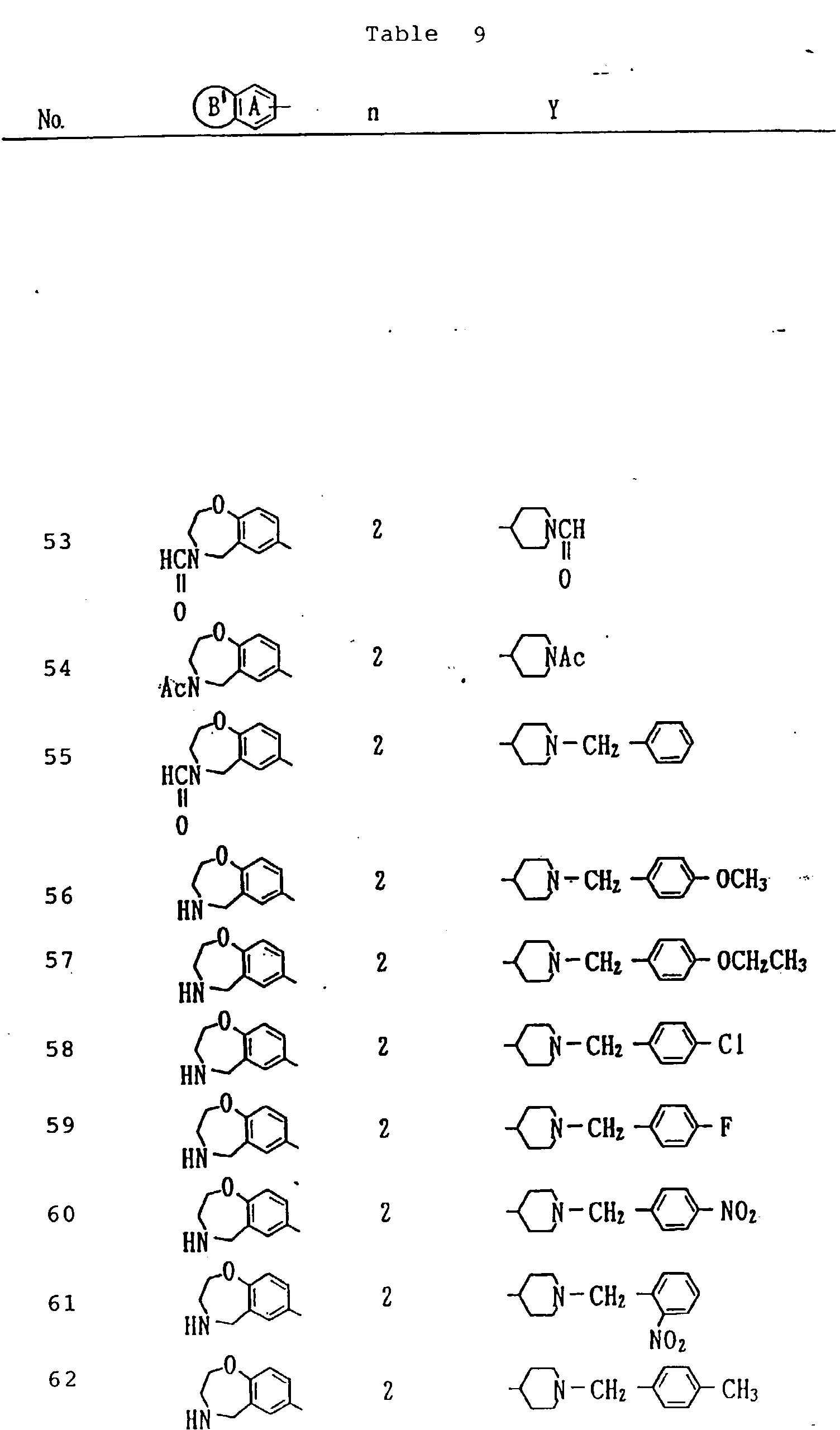
- Compounds shown in Table 20 were obtained by using the compound A (free base form) obtained in Example 3 or the compound obtained in Example 7 and conducting substantially the same procedure as in Example 4 (method A) or in Example 5 (method B).
- the above components (1), (2) and (3) were blended in an amount of 1 g of the component (1), 197 g of the component (2) and 20 g of the component (3), and the mixture was granulated with a paste prepared from 15 g of the component (3) and 25 ml of water. To this granular product were added 15 g of the component (3) and 2 g of the component (4), and the resulting composition was compression-molded to provide 2000 tablets each measuring 3 mm in diameter and containing 0.5 mg of the component (1).
- the above components (1), (2) and (3) were blended in an amount of 2 g of the component (1), 197 g of the component (2) and 20 g of the component (3), and the mixture was granulated with a paste prepared from 15 g of the component (3) and 25 ml of water. To this granular product were added 15 g of the component (3) and 2 g of the component (4), and the resulting composition was compression-molded to provide 2000 tablets each measuring 3 mm in diameter and containing 1.0 mg of the component (1).
- the cholinesterase inhibitory activity of the compound of this invention was assayed with (acetyl-[ 3 H])-acetylcholine. More specifically, (acetyl[ 3 H])-acetylcholine as the substrate and the compound of this invention as the test sample were added to the S 1 fraction of a homogenate of male Wistar rat cerebral cortex as the cholinesterase source. The mixture was incubated for 30 minutes, after completion of the reaction, to the reaction mixture was added a toluene-based scintillator, and the mixture was shaken. The reaction product [ 3 H]-acetic acid was transferred to the toluene layer, which was subjected to determination of cholinesterase inhibitory activity by counting with a liquid scintillation counter.
- the cholinesterase inhibitory activity of the test compound was expressed in 50% inhibitory concentration (IC 50 ).
- the cholinesterase inhibitory activity of physostigmine was also determined by the same procedure. The results are shown in Table 22.
- Table 22 The results shown in Table 22 indicate that the compounds of the present invention have superior cholinesterase inhibitory activity to physostigmine. Thus the compounds of the present invention have an excellent cholinesterase inhibitory activity and are useful as therapeutic/prophylactic medicament of senile dementia.
- the antidepressant activity of the compound of the present invention was assayed by means of tail suspension test using ICR male mice (five weeks of age, weighing 23.5 to 37.6 g) as test animals.
- Test compound was dissolved in saline solution or suspended in 5% arabic gum solution and administered orally to the test mice in a dose of 30 mg/kg. Thirty minutes later, the mice were suspended on tails for 10 minutes and immobility thereof (% control) was measured.
- the antidepressant activity of the test compound was shown as in percent control of immobility.
- desipramine which is known to have an antidepressant activity, was employed and the immobility thereof was measured in the same manner as described above. The results are shown in Table 23.
- Compound No. (Example No.) n Immobility (%) (% control) Saline 17 49.45 ⁇ 2.47 3-B 13 34.37 ⁇ 4.49 desipramine 16 37.25 ⁇ 3.32
- the compound of the present invention has an excellent antidepressant activity relative to the reference compound, that is, desipramine.
Landscapes
- Chemical & Material Sciences (AREA)
- Organic Chemistry (AREA)
- Pharmaceuticals Containing Other Organic And Inorganic Compounds (AREA)
- Heterocyclic Carbon Compounds Containing A Hetero Ring Having Nitrogen And Oxygen As The Only Ring Hetero Atoms (AREA)
Abstract
Description
- This invention relates to novel heterocyclic compounds and salts thereof, and to pharmaceutical preparations. More particularly, the present invention relates to a cholinesterase inhibitor, especially to a therapeutic and/or prophylactic agent for senile dementia, Alzheimer and so on, novel heterocyclic compounds as active ingredients and salts thereof, to methods for preparing the same and to intermediate products thereof.
- With an increasing number of elderly people, there have been proposed various compounds having therapeutic and/or prophylactic actions on senile dementia. Among these compounds, there has been found a therapeutic/prophylactic action in physostigmine, a naturally-occurring cholinesterase inhibitor (International Journal of Clinical Pharmacology, Therapy and Toxicology, Vol. 29, No.1, p.23-37(1991) etc.). Physostigmine has, however, such defects as a relatively short duration of the action and high toxicity.
- On the other hand, various heterocyclic compounds have been suggested as synthetic medicines. For example, EP-A-0,378,207, USP 4,849,431 corresponding to JPA-62(1987)-234065, USP 4,895,841 corresponding to JPA-64(1989)-79151, JPA-2(1990)-169569 and EP-A-0,468,187 disclose cholinesterase inhibitors having nitrogen-containing heterocyclic ring (hereinafter referred to as N-containing heterocyclic ring). USP 4,064,255 corresponding to JPA-52(1977)-72829 and USP 4,208,417 corresponding to JPA-55(1980)-9070 respectively disclose heterocyclic compounds used as an antidepressant or antianxiety drugs.
- More particularly, EP-A-0,378,207 discloses a cyclic amino compound of the following formula or salts thereof:

- wherein B stands for an optionally substituted saturated or unsaturated 5- to 7-membered azaheterocyclic group; A represents a bond, an alkylene group or an alkenylene group which may be substituted with a hydrocarbon residue, an oxo group or hydroxyl group;
- represents a single bond or double bond (provided that A represents a bond,

-
- Practically it discloses a compound of the following formula among others:

- In USP 4,849,431 corresponding to JPA-62(1987)-234065, there are disclosed piperidine derivatives of the following formula or pharmaceutically acceptable salts thereof:
- wherein R1 represents a monovalent group derived from a member selected from optionally substituted benzene, pyridine, pyrazine, indole, anthraquinone, quinoline, optionally substituted phthalimide, homophtalimide, pyridine carboxylimide, pyridine-N-oxide, pyrazine carboxylimide, naphthalenedicarboxylimide, optionally substituted quinazolinedione, 1,8-naphthalimide, bicyclo[2.2.2]oct-5-ene-2,3-dicarboxylimide and pyromellylimide;
- X represents a group of the formula -(CH2)m- (wherein m denotes an integer of 0 to 7); a group of the formula -O(CH2)n-; a group of the formula -S(CH2)n-; a group of the formula -NH(CH2)n-; a group of the formula -SO2NH(CH2)n-; a group of the formula -NH-CO-(CH2)n-; a group of the formula -NH(CH2)n-CO-; a group of the formula -COO(CH2)n-; a group of the formula -CH2NH(CH2)n-; a group of the formula -CO-NR3-(CH2)n-(in the definition of X, in all formula, n each denotes an integer of 0 to 7; and R3 represents a lower alkyl group or benzyl group); a group of the formula -O-CH2CH2CH(CH3)-; a group of the formula -O-CH(CH3)CH2CH2-; a group of the formula -O-CH2CH2CH=; or a group of the formula -O-CH2CH(OH)CH2-;
- Ring A represents a group of the formula
a group of the formula
 a group of the formula
 or a group of the formula:

- R2 represents a hydrogen atom, a lower alkyl group, an
optionally substituted benzyl group, optionally substituted
benzoyl group, pyridyl group, 2-hydroxyethyl
group, pyridylmethyl group or group of the formula:
(wherein Z represents a halogen atom).

-
- Practically, there is disclosed a compounds of the following formula among them:

- USP 4,895,841 corresponding to JPA-64(1989)-79151, and JPA-2(1990)-169569 disclose a cyclic amine derivative of the following general formula or pharmaceutically acceptable salts thereof:

- wherein J represents (a) optionally substituted groups shown as follows; (1) a phenyl group, (2) a pyridyl group, (3) a pyrazyl group, (4) a quinolyl group, (5) a cyclohexyl group, (6) a quinoxalyl group or (7) a furyl group,
- (b) a mono- or di-valent group selected from the following
groups which may be substituted on the phenyl
group; (1) an indanyl group, (2) an indanonyl group,
(3) an indenyl group, (4) an indenonyl group, (5) an
indandionyl group, (6) a tetranonyl group, (7) a
benzsperonyl group, (8) an indanolyl group or (9) a
group of the formula:

- (c) a monovalent group derived from a cyclic amide compound,
- (d) a lower alkyl group or
- (e) a group of the formula R1-CH=CH- (wherein R1 represents a hydrogen atom or a lower alkoxycarbonyl group);
- B represents a group of the formula -(C(R2)H)n-; a group of the formula -CO-(C(R2)H)n-; a group of the formula -NR2-(C(R2)H)n- (wherein R2 represents a hydrogen atom, a lower alkyl group, an acyl group, a lower alkylsulfonyl group, an optionally substituted phenyl group or benzyl group); a group of the formula -CO-NR4-C(R2)H)n- (wherein R4 represents a hydrogen atom, a lower alkyl group or a phenyl group), a group of the formula -CH=CH-(C(R2)H)n-; a group of the formula -O-COO-(C(R2)H)n-; a group of the formula -O-CO-NH-(C(R2)H)n-; a group of the formula -NH-CO-(C(R2)H)n-; a group of the formula -CH2-CO-NH-(C(R2)H)n-; a group of the formula -CO-NH-(C(R2)H)n-; a group of the formula -C(OH)H-(C(R2)H)n- (in the above formulae, n denotes 0 or an integer of 1 to 10, R2 represents a hydrogen atom or a methyl group in the form of an alkylene group of the formula -(C(R2)H)n- which is unsubstituted or having one or more than one methyl group); a group of the formula =(CH-CH=CH)b- (wherein b denotes an integer of 1 to 3); a group of the formula =CH-(CH2)c-(wherein c denotes 0 or an integer of 1 to 9); a group of the formula =(CH-CH)d= (wherein d denotes 0 or an integer of 1 to 5); a group of the formula =CO-CH=CH-CH2-; a group of the formula -CO-CH2-C(OH)H-CH2-; a group of the formula -C(CH3)H-CO-NH-CH2-; a group of the formula -CH=CH-CO-NH-(CH2)2-; a group of the formula -NH-; a group of the formula -O-; a group of the formula -S-; a dialkylaminoalkylcarbonyl group or a lower alkoxycarbonyl group;
- T represents a nitrogen atom or a carbon atom;
- Q represents a nitrogen atom, a carbon atom or a group
of the formula
- K represents a hydrogen atom, an optionally substituted phenyl group, an arylalkyl group optionally substituted with a phenyl group, a cinnamyl group optionally substituted with phenyl group, a lower alkyl group, a pyridylmethyl group, a cycloalkylalkyl group, an adamantanemethyl group, a furylmethyl group, a cycloalkyl group, a lower alkoxycarbonyl group or an acyl group;
- q denotes an integer of 1 to 3 and
-
- A practical embodiment thereof is the following compound.

- EP-A-0,468,187 discloses a cyclic amide compound of the formula:
- wherein R1 represents a group derived from an
optionally substituted cyclic amide compound; n denotes
an integer of 0 to 10; and Z represents a formula:

- wherein R2 represents an aryl group, a substituted aryl group, a cycloalkyl group or a heterocyclic group; m denotes an integer of 1 to 6; R3 represents a hydrogen atom or a lower alkyl group; R4 represents an aryl group, a substituted aryl group, a cycloalky group or a heterocyclic group; p denotes an integer of 1 to 6, provided that when the cyclic amide compound is quinazolinone or quinazolinedione derivative, R2 and R4 are neither an aryl group nor a substituted aryl group.
-
- Practically, it discloses a compound of the following formula among them:

- USP 4,064,255 corresponding to JPA-52(1977)-72829 discloses a pharmaceutical composition used for treatment of pathological conditions caused by disturbances in serotonin systems, which comprises a compound of the formula or pharmaceutically acceptable salts thereof:
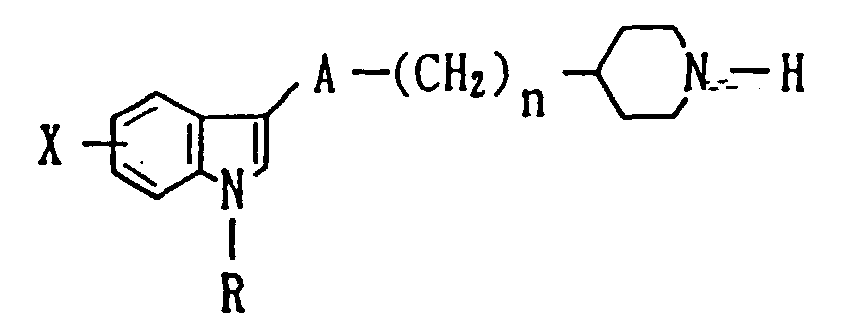
- wherein R represents a hydrogen atom, a C1-4 alkyl group or a aralkyl group having 1 or 2 carbon atom(s) in the alkyl moiety thereof; X represents a hydrogen atom or a halogen atom, an alkyl, an alkoxy or an alkylthio group each optionally having 1 to 4 carbon atoms, trifluoromethyl, nitro, hydroxy-or unsubstituted amino group, or an amino group substituted with one or two alkyl, acyl or alkylsulfonyl group; A represents a group -CO-, or a group -CH2-; and n represents 0, 1 or 2.
-
- USP 4,208,417 corresponding to JPA-55(1980)-9070 discloses medicinally active compounds having an affinity for the binding site of 3H-diazepam which are indole derivatives having the general formula:

- wherein R is a hydrogen atom, a C1-4 alkyl group or an aralkyl group whose alkyl moiety has 1 or 2 carbon atoms; X is a hydrogen atom, a halogen atom, an alkyl group, an alkoxy group or an alkylthio group whose alkyl moiety has 1 to 4 carbon atoms; A sands for -CO- or -CH2-; and n denotes 1 or 2.
-
- Further, WO91/03243 discloses a compound, which is used as a psychopharmaceutical, of the following general formula or pharmaceutically acceptable salts thereof:

- wherein m denotes 0 to 3; n denotes 0 to 3; m and n are not 0 simultaneously; p denotes 0 to 3; X represents O, S, SO, SO2, NR6, CR7R8, CO or CHOH; R1, R3 and R7 each represents a hydrogen atom, a C1-5 alkyl group, a halogen atom, a group of the formula NR10R11, OH, COOH, a C2-6 alkoxycarbonyl group, CN, Ar, a C1-5 alkoxy group or a C1-5 alkylthio group; R2, R4 and R8 each represents a hydrogen atom, a C1-5 alkyl group, a C2-6 alkoxycarbonyl, CN, a C1-5 alkoxy group or Ar1; when X is O, S, SO, SO2 or NR6, R1, R2, R3 and R4 are not a C1-5 alkoxy, a C1-5 alkylthio, the group NR10R11 or OH; R5 represents a hydrogen atom, an alkyl group, a halogen atom, OH or an alkenyl group; R6 represents a hydrogen atom, a C1-5 alkyl group or Ar1; Ar and Ar1 each represents a naphthyl group, a pyridyl group, a pyrimidyl group, an indolyl group, a quinolinyl group, an isoquinolinyl group or a phenyl group, and these groups being optionally substituted with a C1-3 alkyl group, a C1-3 alkoxy group, a C1-3 haloalkyl group having 1 to 7 halogen atoms, SH, a S(O)t-C1-3 alkyl group (wherein t denotes 1, 2 or 3), a C2-6 dialkylamino group, a halogen atom, a C1-3 alkylamino group, NH2, CN, NO2, SO3H, a tetrazole group, COOH, a C2-6 alkoxycarbonyl, CONH2, SO2NO2, COR9, CONR12R13, SO2NR12R13, Ar2, OAr2 or SAr2; Ar2 represents a naphthyl or a phenyl group, and these groups optionally substituted with a C1-3 alkyl group, a C1-3 haloalkyl group having 1 to 7 halogen atoms, a C1-3 alkoxy group, a halogen atom or a C1-3 alkylthio group; R9, R10, R11, R12, and R13 each represents a halogen atom, a C1-5 alkyl group or a phenyl group, R10 and R11 may, taken together, form a C3-6 alkylene chain and R12 and R13 may, taken together, form a C3-6 alkylene chain; a or b represents a single bond or double bond, both are not simultaneously a double bond.
-
- Furthermore, various condensed heterocyclic derivatives containing a hetero atom such as a nitrogen, an oxygen, a sulfur atom and the like have been suggested and their biological activity and pharmacological actions have been reported. Cholinesterase inhibitory action and actions as therapeutic/prophylactic agents of senile dementia, however, have not been disclosed therein.
- More definitely, Chem. Abstr., 107, 190332h(1987) discloses that a compound of the following general formula has an anti-inflammatory action:

- wherein R is Ac, COEt, COPr, COCHMe2, CO(CH2)2Cl, CO(CH2)3Cl, COCH2NMe2, CO(CH2)2NMe2, CO(CH2)3NMe2, and salts thereof or R is COCH=CHPh; X is CH2, or O; and n is 1, 2 or 3 (wherein Ac represents an acetyl group;
- Et, Pr and Me represent a ethyl group, a propyl group, a methyl group respectively; and Ph represents a phenyl group).
-
- Chem. Abstr., 89, 36594y(1978) discloses that the compound of the general formula has an antispasmic action, depressing action of arterial blood pressure and a local anesthetic action:

- wherein R1 is H or Me; n is 2 or 3.
-
- Journal of Pharmacology, 97, 540(1977) discloses that a compound of the following general formula has an antidepressant action:
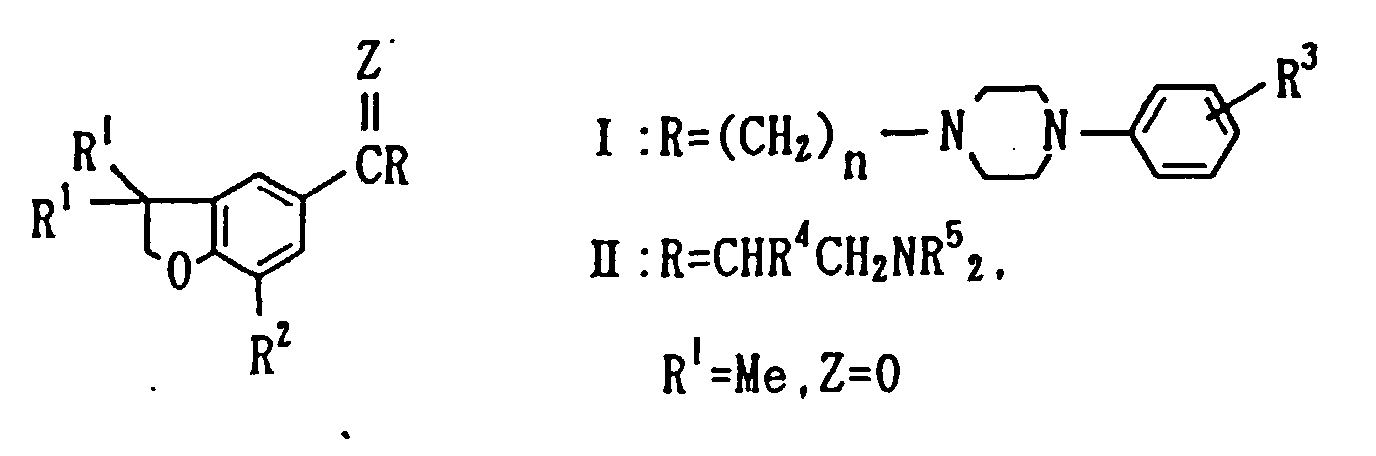
- wherein R1 is H or Me; R2 is H, Cl or Me; R3 is H, F, Me, OMe or Cl; n is 1, 2 or 3; Z is O, OH or H (for compound I) or R2 is H or Cl; R4 is H or Me; NR5 2 is NMe2, morpholino or piperidino (for compound II).
-
- EP-163,537 discloses that a compound of the general formula has a muscular relaxant action:

- wherein R is a 4-cycloalkylphenyl group, 3,4-methylenedioxyphenyl group, 2,3-dihydro-5-benzofuranyl group; R1 is an alkyl group, a cycloalkyl group or a cyclopentylmethyl group; R2 is an optionally substituted pyrrolidino, piperidino, hexahydro-1H-azepine-1-yl or octahydro-1-azocinyl group.
-
- Chem. Abstr., 91,211631y(1979) discloses that a compound of the following formula is synthesized as a derivative of cystisine, which is an alkaloid having an anticholinergic action:

- wherein R is H or Me.
-
- Helvetica Chimica Acta, 51, 1616(1968) discloses compounds of the following formula (A) and (B):as an intermediate products for synthesizing alkanolamines of the following formula (C), which is an agent acting on the sympathetic nervous system:


- JPA-52(1977)-97952 discloses a compound of the formula:

- wherein R1 is an alkyl group or a phenyl group; R2
is a C1-3 alkyl group; R3 is an alkenyl group, an alkynyl
group, a cycloalkyl group or an alkyl group; R4 is
H or an alkyl group; NR3R4 is a morpholino group, a
pyrrolidino group or a piperidino group; R5 is H or a
C1-3 alkyl group; R6 is H or an acyl group; n is 1 to 3;
X is S, O or NH; and Y is CH2 or S, as an intermediate
product of aminoalchol derivatives of the following
formula, which has a depressing action, an antispasmodic
action, a vasodilating action and a calmative action:

- wherein each symbol has the same meaning as defined above.
-
- In JPA-59(1984)-7185 there is disclosed that a 1,5-benzoxepine derivative of the following formula or acid adducts thereof has a depressing action of blood pressure:

- wherein R1 represents a hydrogen atom or an alkyl group having 1 to 3 carbon atom(s); R2 shows a C1-3 alkyl group;
- X represents
or
 Ar is
Ar is

- wherein Y represents a hydrogen atom, -OCH3, a
halogen atom or

- n denotes an integer of 1 to 5.
-
- Chem. Abstr., 70, 106531j (1969) corresponding to FR-M3,635 discloses, for example, a compound of the formula:as an intermediate product of 1,4-benzodioxane derivatives of the formula:
 which is an agent acting on the sympathetic nervous system.
- Further, Chem. Abstr., 67, 54087k (1967), 68, 105121x (1968), 75, 88548s (1971), 76, 153682t (1972) disclose methods for preparing 1,4-benzoxane derivatives of the formula:

- wherein
represents an optionally substituted amino group or a cyclic amino group; and p denotes 1 or 2.

-
- However, in these literatures, there is no disclosure of biological activity, pharmacological action and the like.
- In the present situation that patients of senile dementia have become increased, the development excellent therapeutic and/or prophylactic agent, having stronger action and longer action and less toxicity than the compounds already known to have therapeutic and/or prophylactic efficacy on senile dementia, has been desired.
- Accordingly, it is an object of the present invention to provide novel heterocyclic compounds or salts thereof which are useful as a cholinesterase inhibitor, especially as an agent of preventing senile dementia.
- It is another object of the present invention to provide heterocyclic compounds and salts thereof having a stronger and longer cholinesterase inhibitory action and a less toxicity than compounds already known to have a therapeutic and/or prophylactic efficacy on senile dementia.
- It is yet another object of the invention to provide methods of producing the heterocyclic compounds or salts thereof useful as a cholinesterase inhibitor.
- It is a further object of the present invention to provide intermediate products useful for producing the heterocyclic compounds a salts thereof.
- A still further object of the invention is to provide a cholinesterase inhibitor containing a heterocyclic compound having a cholinesterase inhibitory activity.
- A yet further object of the present invention is to provide a pharmaceutical composition for an agent for a disease caused by acetylcholinesterase activity.
- The present invention further discloses a method of treating a disease caused by acetylcholinesterase activity and use of the heterocyclic compound or a salt thereof as a cholinesterase inhibitor.
- The present invention was accomplished by investigating various aspects of heterocyclic compounds including novel compounds in biological activity and pharmacological action and by finding that the compounds having structural characteristics in bicyclic-heterocyclic group wherein the heterocyclic ring containing, the same or different, two or more hetero atoms, condensed on the benzene ring have unexpectedly excellent cholinesterase inhibitory activity and antidepressant activity, thus being useful as therapeutic and/or prophylactic agents for senile dementia. Based on these structural characteristics, these compounds show above-mentioned excellent actions.
- More specifically, the present invention relates to a compound of the formula:wherein

- Ring A
- is a benzene ring which may be substituted with 1 to
3 substituents selected from the group consisting of
- (i) C1-3 alkyl,
- (ii) halogen,
- (iii) hydroxy or
- (iv) C1-3 alkoxy;
- Ring B'
- is a group of the formula:
wherein R6 is

- (1) a hydrogen atom,
- (2) a C1-7 alkyl or C7-10 aralkyl group which may be substituted with a C1-4 alkyl, halogen, nitro, C1-4 alkoxy or hydroxy,
- (3) a formyl group or
- (4) a C1-6 alkyl-carbonyl group;
- R1
- is a hydrogen atom;
- Y
- is a 5- to 9-membered N-containing saturated
heterocyclic group shown by the formula:
wherein ring Q1 and ring Q2 are respectively a 5- to 9-membered N-containing heterocyclic group which may have, other than carbon atoms and one nitrogen atom, 1 to 2 of hetero atoms selected from nitrogen, oxygen and sulfur atoms, wherein said heterocylcic group may be substituted on said ring-constituting nitrogen atom with a hydrogen atom, formyl group, a C1-6 alkyl-carbonyl group or a C7-10 aralkyl group which may be substituted with a C1-4 alkyl group, a halogen atom, a nitro group, a C1-4 alkoxy group or a hydroxyl group; and

- n
- is an integer of 2 to 10
or a salt thereof. - The present invention also provides (2) a compound of the formula:
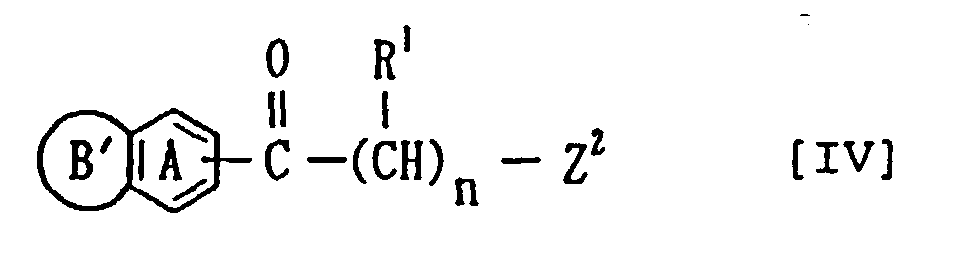
- wherein ring A, ring B' R1 and n have the same meanings, as defined above; and Z2 represents a leaving group, or a salt thereof.
-
- The present invention further provides (3) a method of producing the compound [I'], which comprises reacting (a) a compound of the formula:
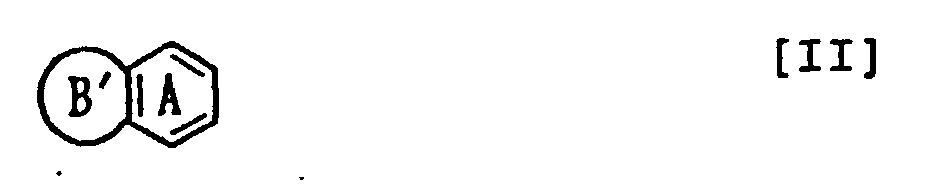
- wherein ring A and ring B' are as defined above,
or a salt thereof, with a compound of the formula:

- wherein Z1 is a leaving group; R1, Y and n are as defined above, or a salt thereof, or
- (b) a compound of the formula:

- wherein Z2 is a leaving group; ring A, ring B', R1
and n are as defined above, or a salt thereof, with a
compound of the formula:
- wherein Z3 is a leaving group which can be left with Z2; or a salt thereof.
-
- The present invention also provides (4) a cholinesterase inhibitor, which contains a compound of the formula [I']or a pharmaceutically acceptable salt thereof.

- The present invention further provides (5) a pharmaceutical composition for an agent for a disease caused by acetylcholinesterase activity which contains an effective cholinesterase inhibiting amount of the compound [I'] or a pharmaceutically acceptable salt thereof and a pharmacologically acceptable carrier.
- According to the present invention, (6) a pharmaceutical composition for senile dementia and/or Alzheimer's disease containing the compound [I'] or a salt thereof is also provided.
- The present invention also relates to the use of the compound [I'] or a pharmaceutically acceptable salt thereof as a component in the preparation of a cholinesterase inhibitor.
- The compound [I'] or salts thereof of this invention are novel compounds having structural characteristics in that the above mentioned non-aromatic heterocyclic ring B' is condensed on the benzene ring A and a substitutentis bonded to the carbon atom of the benzene ring A, and these compounds show excellent therapeutic and/or prophylactic actions for senile dementia due to these characteristics.

- The groups given in terms of symbols in the above general formulae are respectively described in more detail in the following.
- In the above-identified formulae, R1 represents a hydrogen atom.
- The benzene ring represented by ring A is condensed on the ring B' and may have substituents besides the group of the formula:

- Such substituents include 1 to 3 substituents selected from a C1-3 alkyl group such as methyl, a halogen atom such as fluorine and chlorine, hydroxy and a C1-3 alkoxy group such as methoxy. Especially, halogen atoms such as fluorine, chlorine, etc. are preferable.
- Ring B' is a group of the formula

- wherein R6 represents a hydrogen atom, a C1-7 alkyl group (e.g. methyl, ethyl, n-propyl, i-propyl, n-butyl, i-butyl, tert-butyl, n-pentyl, n-hexyl, n-heptyl) or a C7-10 aralkyl group (e.g. phenylmethyl, phenylethyl, phenylpropyl, phenylbutyl) which may be substituted with substituents selected from a C1-4 alkyl group (e.g. methyl, ethyl, n-propyl, i-propyl, n-butyl, i-butyl, tert-butyl), a halogen atom (e.g. fluorine, chlorine, bromine, iodine), a nitro group, a C1-4 alkoxy group (e.g. methoxy, ethoxy, propyloxy, butyloxy, isopropyloxy) and a hydroxyl group, a formyl group or a C1-6 alkylcarbonyl group (e.g. acetyl, propionyl, butylyl). Among these groups, C7-10 aralkyl group which may be substituted with a C1-4 alkyl group, a halogen atom, a nitro group or a C1-4 alkoxy group is frequently utilized.
-
- Y is a 5- to 9-membered N-containing saturated heterocyclic group shown by the formula:

- wherein ring Q1 represents a 5- to 9-membered N-containing saturated heterocyclic group which may have, other than carbon atoms and one nitrogen atom, 1 to 2 hetero atoms selected from nitrogen, oxygen, and sulfur atoms.
-
- Practical examples of these rings are shown as follows:or of the formula:


- wherein ring Q2 represents a 5- to 9-membered N-containing
saturated heterocyclic group which may have,
other than carbon atoms and one nitrogen atom, 1 or 2
of nitrogen, oxygen, sulfur atoms as hetero
atoms. As typical examples of these rings, there may
be mentioned:

-
- The substituents on the ring constituting nitrogen atom are hydrogen atom, formyl group, a C1-6 alkyl-carbonyl group (e.g., methylcarbonyl, ethylcarbonyl, propylcarbonyl, butylcarbonyl) or a C7-10 aralkyl group (e.g. phenylmethyl, phenylethyl, phenylpropyl) which may be substituted with substituents such as a C1-4 alkyl group (e.g. methyl, ethyl, propyl, n-butyl, i-butyl, tert-butyl), a halogen atom (e.g. fluorine, chlorine, bromine, iodine), a nitro group, a C1-4 alkoxy group (e.g. methoxy, ethoxy), or a hydroxyl group.
- n denotes an integer of 2 to 10.
- The compounds of the formula [I'] having ring B' or salts thereof of the present invention are novel compounds and have more excellent cholinesterase inhibitory activity.
- Preferred examples of the benzene ring shown by ring A include an unsubstituted benzene ring.
- Y represents a 5- to 9-membered, more preferably a 5- to 7-membered N-containing saturated heterocyclic group represented by the ring Q1 or the ring Q2 which may have, other than carbon atoms and one nitrogen atom, one to two of hetero atoms selected from nitrogen, oxygen and sulfur atoms. These rings may be substituted, preferably on the ring-constituting nitrogen atom, with an optionally substituted acyl group such as formyl or a C1-6 alkylcarbonyl, and an optionally substituted C7-10 aralkyl group.
- Typical examples of the group shown by Y, include a ring having the skeleton of pyrrolidine, piperidine, piperazine, morpholine, 1,2,3,4-tetrahydroquinoline, 1,2,3,4-tetrahydroisoquinoline, 2,3,4,5-tetrahydro-1H-1-benzazepine, 2,3,4,5-tetrahydro-1H-2-benzazepine, or 2,3,4,5-tetrahydro-1H-3-benzazepine, which may be substituted with an optionally substituted acyl group, an optionally substituted C7-10 aralkyl group are preferable. The practically preferred is a ring having the skeleton of pyrrolidine, piperidine, piperazine or morpholine which may be substituted with an optionally substituted acyl group or an optionally substituted C7-10 aralkyl group.
- As substituents which these acyl group and C7-10 aralkyl group may have, a halogen atom such as fluorine, chlorine, bromine, a C1-4 alkyl group (e.g. methyl, ethyl, n-propyl, i-propyl, n-butyl, i-butyl, tert-butyl), a nitro group, a hydroxy group and a C1-4 alkoxy group (for example, methoxy, ethoxy, propoxy, butoxy) are preferable.
- n denotes preferably an integer of 2 to 6, more preferably 2 to 4.
- The preferred compounds involved in compound of the formula [I'] or salts thereof are shown by as follows:




- wherein Ac represents an acetyl group; Et represents an ethyl group; and Ph represents a phenyl group.
-
- As salts of the compound of the formula [I'] of this invention, physiologically acceptable acid addition salts are preferred. Examples of these salts include salts with inorganic acids (e.g. hydrochloric acid, phosphoric acid, hydrobromic acid, sulfuric acid) and salts with organic acids (e.g. acetic acid, formic acid, propionic acid, fumaric acid, maleic acid, succinic acid, tartaric acid, citric acid, malic acid, oxalic acid, benzoic acid, methanesulfonic acid, benzenesulfonic acid.
- Further, where the compound of the formula [I'] of this invention has an acid group such as -COOH, the compound of the formula [I'] may form a salt with an inorganic base (e.g. ammonia, an alkali metal such as sodium, potassium, or alkaline earth metal such as calcium, magnesium, or with an organic base (e.g. a tri-C1-3 alkylamine such as trimethylamine, triethylamine) and these salts are involved in the subjects of the present invention.
- In the following, the method of producing the compound of the formula [I'] or its salts of the present invention is described.
- It should be understood that the following description applies not only to the production of the compound of the formula [I'] per se but also to the production of its salts, and these compounds are simply referred to as the compound of the formula [I'] inclusively in the description.
- The compound of the formula [I'] may be produced by, for example, reacting a compound represented by the formula:

- wherein each symbol is of the same meaning as
defined above, or a salt thereof, with a compound
represented by the formula:

- wherein Z1 represents a leaving group and other symbols have the same meanings as defined above, or a salt thereof.
-
- As examples of the leaving group shown by Z1 there may be mentioned a halogen atom (e.g. chlorine, bromine, iodine), a C1-6 alkylsulfonyloxy group (e.g. methanesulfonyloxy, ethanesulfonyloxy, propanesulfonyloxy), a C6-10 arylsulfonyloxy group (e.g. benzenesulfonyloxy, and p-toluenesulfonyloxy.
- The preferred leaving group includes a halogen atom such as chlorine.
- The compound of the formula [II ] or salts thereof may be prepared in accordance with a conventional method or a method analogous thereto, for example, descriptions on Indian J. Chem., 2, 211 (1964), Indian J. Chem., 12, 247, (1974), Bull. Chem. Soc., Jpn., 43, 1824 (1970), Chem. Pharm. Bull., 20, 1328 (1972), Chem. Pharm. Bull., 27, 1982 (1979), Helv. Chem. Acta, 46, 1696 (1963), Synthesis, 541 (1979), USP 3,682,962, USP 3,911,126, Ger. Offen. 2,314,392 and Ger. Offen. 1,545,805.
- The compound of the formula [III] and salts thereof may be produced in accordance with a conventional method or a method analogous thereto. For example, the same can be produced in accordance with descriptions on Chem. Pharm. Bull., 34, 3747-3761 (1986) and EP-A-0,378,207.
- Examples of the salts of the compound of the formula [II ] and [III] include salts with inorganic acids (e.g. hydrochloric acid, phosphoric acid, hydrobromic acid, sulfuric acid, ) and salts with organic acids (e.g. acetic acid, formic acid, propionic acid, fumaric acid, maleic acid, succinic acid, tartaric acid, citric acid, malic acid, oxalic acid, benzoic acid, methanesulfonic acid and benzenesulfonic acid).
- Further, where the compound of the formula [II] and [III] has an acid group such as -COOH, the compound of the formula [II ] and [III] may form a salt with an inorganic base (e.g. an alkali metal such as sodium, potassium, an alkaline earth metal such as calcium, magnesium, or ammonia) or with an organic base (e.g. tri-C1-3 alkylamine such as trimethylamine and triethylamine).
- The reaction of the compound of the formula [III] or a salt thereof with the compound of the formula [II] or a salt thereof can be conducted by reacting the compound of the formula [III] or a salt thereof, with the compound of the formula [II ] or a salt thereof without using a solvent or, upon necessity, in a solvent.
- As the solvent, any one which is conventionally usable in chemical reactions, unless it disturbs proceeding of the reaction, can be employed, as exemplified by organic solvents including hydrocarbons (e.g. pentane, hexane, benzene, toluene, nitrobenzene ), halogenated hydrocarbons (e.g. dichloromethane, chloroform, 1,2-dichloroethane, carbon tetrachloride ), ethers (e.g. ethyl ether, tetrahydrofuran, dioxane, dimethoxyethane ), nitro alkanes (e.g. nitromethane, propionitrile ) and carbon disulfide. The preferred examples of such solvent include dichloromethane, 1,2-dichloroethane, nitrobenzene and carbon disulfide.
- The amount of the solvent ranges usually from 0.5 to 100 ml, preferably from 5 to 20 ml, relative to 1 mmol. of the compound of the formula [III] or a salt thereof. The reaction temperature is usually from -30°C to 150°C, preferably from 20°C to 100°C. The reaction time runs usually from 0.5 to 72 hours, preferably from 1 to 16 hours.
- The reaction may be carried out in the presence of a Lewis acid. As the Lewis acid to be employed in this reaction, use is made of, for example, aluminum chloride, zinc chloride, titanium chloride, tin(IV) chloride, boron trifluoride, iron(II) chloride, iron(III) chloride, antimony(V) pentachloride, bismuth(III) chloride, silver(II) chloride, hydrogen fluoride sulfuric acid, polyphosphoric acid and so on. As the preferred examples, there may be mentioned Fiedel-Crafts catalysts such as aluminum chloride.
- The amount of the Lewis acid ranges usually from 1 to 10 mol., preferably from 2 to 10 mol., relative to 1 mol. of the compound of the formula [III] or a salt thereof. The amount to the compound of the formula [II ] or a salt thereof relative to 1 mol. of the compound of the formula [III] or a salt thereof is usually from 1 to 20 mol., preferably from 1 to 5 mol.
- In the above reaction, the position where the group of the formula of the compound of the formula [III] or a salt thereof:is introduced into the compound of the formula [II ] or a salt thereof may be any of the positions on the ring A on which the substitution can take place. For example, when the skeleton of the compound of the formula [II ] or a salt thereof is 2,3,4,5-tetrahydro-1,4-benzoxazepine (provided that the ring A is unsubstituted), the group of the compound of the formula [III] or a salt thereof is introduced mainly into 7-position, while such compounds as having the group introduced at any other positions (6-position, 8-position or 9-position) can be produced and isolated as well.

- The compound of the formula [I'] or a salt thereof, may be produced also by reacting a compound of the formula:

- wherein each symbol has the same meaning as defined
above, or a salt thereof, with a compound of the
formula:
- wherein each symbol has the same meaning as defined above, or a salt thereof.
-
- As examples of the leaving group shown by Z2, there may be mentioned, a halogen atom (e.g. chlorine, bromide, iodine), a C1-6 alkylsulfonyloxy group (e.g. methanesulfonyloxy, ethanesulfonyloxy ), a C6-10 arylsulfonyloxy group (e.g. benzenesulfonyloxy, p-toluenesulfonyloxy). The preferred examples of the leaving group shown by Z2 include a halogen atom such as chlorine and bromine.
- As the leaving group shown by Z3, which can be left with Z2, there may be mentioned, for example, a hydrogen atom, a trialkylsilyl group (e.g. trimethylsilyl, triethylsilyl, t-butyldimethylsilyl ). The preferred includes a hydrogen atom.
- The salts of the compound of the formula [IV ] and [V] are exemplified as salts with inorganic acids (e.g. hydrochloric acid, phosphoric acid, hydrobromic acid, sulfuric acid ) and salts with organic acids (e.g. acetic acid, formic acid, propionic acid, fumaric acid, maleic acid, succinic acid, tartaric acid, citric acid, malic acid, oxalic acid, benzoic acid, methanesulfonic acid, and benzenesulfonic acid). Further, in the case where the compound of the formula [IV ] and [V] of this invention has an acid group such as -COOH, the compound of the formula [IV ] and [V] may form a salt with an inorganic base (e.g. an alkali metal such as sodium, potassium, an alkaline earth metal such as calcium, magnesium, or ammonia) or with an organic base (e.g. tri-C1-3 alkylamine such as trimethylamine and triethylamine).
- The amount of the compound of the formula [V] or a salt thereof to be employed in this reaction is, usually, from 1.0 to 50.0 times as much mol., preferably 1.0 to 10.0 times as much mol. relative to one mol. of the compound of the formula [IV ] or a salt thereof. This reaction can be conducted under cooling or under heating (at temperatures ranging from 0°C to 120°C). The reaction is completed in, usually, from 10 minutes to 48 hours, preferably from 2 to 16 hours.
- The reaction can be conducted in the absence of solvent, or if necessary, in a solvent. As the solvent, any one can be employed unless it disturbs the proceeding of the reaction. Examples of such solvent include lower alcohols such as methanol, ethanol, propanol, isopropanol, n-butanol, t-butanol, ethers such as dioxane, ethyl ether, tetrahydrofuran, aromatic hydrocarbons such as benzene, toluene, xylene, etc., amides such as dimethylformamide, dimethylacetamide, hexamethylphosphonotniamide, esters such as ethyl acetate and butyl acetate.
- The amount of the solvent relative to 1mmol. of the compound of the formula [IV ] or a salt thereof is, usually, from 0.5 to 100 ml, preferably from 5 to 20 ml.
- The reaction can also be carried out in the presence of a base, if necessary. Examples of the base to be used include inorganic bases such as sodium carbonate, potassium carbonate, lithium carbonate, sodium hydroxide, potassium hydroxide, sodium methoxide, sodium ethoxide, sodium hydride, and organic bases such as pyridine, 4-dimethylaminopyridine, and triethylamine. The amount of the base runs, usually, from equimol. to excess amount, preferably from 1.0 to 5.0 times as much mol. relative to the compound of the formula [V] or a salt thereof.
- It is also possible to promote the reaction by allowing an iodide (e.g. sodium iodide, potassium iodide, lithium iodide) to be present in the reaction system. The amount of the iodide relative to the compound of the formula [IV ] or a salt thereof is, usually, from 1 to 5, preferably 1.0 to 1.5 times as much mol.
- The starting compound of the formula [IV ] or a salt thereof may be prepared by reacting a compound represented by the formula:

- wherein each symbol has the same meaning as defined
above, or a salt thereof, with a compound represented
by the formula:

- wherein Z4 represents a leaving group, and other symbols have the same meanings as defined above.
-
- As examples of the leaving group shown by Z4, there may be mentioned a halogen atom (e.g. chlorine, bromine, iodine), a C1-6 alkylsulfonyloxy group (e.g. methanesulfonyloxy, ethanesulfonyloxy, propanesulfonyl ), a C6-10 arylsulfonyloxy group (e.g. benzenesulfonyloxy and p-toluenesulfonyloxy.
- The preferred examples of the leaving group include a halogen atom such as chlorine.
- The compound of the formula [VIII] can be produced by a conventionally known method or a method analogous thereto.
- The reaction of the compound of the formula [II ] or a salt thereof with the compound of the formula [VIII] can be conducted under the same conditions as in the reaction of the compound of the formula [II ] or a salt thereof with the compound of the formula [III] or a salt thereof.
- In the above reaction, the position where the group of the compound of the formula [VIII] or a salt thereof:is introduced into the compound of the formula [II ] or a salt thereof may be any of the positions on the ring A on which the substitution can take place. For example, where the skeleton of the compound of the formula [II ] or a salt thereof is 2,3,4,5-tetrahydro-1,4-benzoxazepine (provided that the ring A is unsubstituted), the group of the compound of the formula [VIII] may be introduced mainly into 7-position, while such compounds as having the group introduced at any other positions (namely, 6-position, 8-position or 9-position) can also be produced and isolated.

- The compound of the formula [IV ] or salts thereof thus obtained can be isolated and purified by a conventional means such as concentration, phasic transfer, solvent transfer, solvent extraction, fractional distillation, distillation, crystallization, recrystallization and chromatography, while they may be fed to the subsequent process as the material in the state of mixture without isolation.
- The starting compound of the formula [V] or a salt thereof may be prepared by a conventionally known method or a method analogous thereto.
- Among the compounds [I'], a compound in which n is 2, namely, the compound of the formula:

- wherein R4 and R5 each represents a hydrogen atom
or an optionally substituted hydrocarbon group, and
other symbols have the same meanings as defined above,
or a salt thereof, can be produced also by reacting,
for example, a compound of the formula:

- wherein each symbol has the same meaning as defined
above, or a salt thereof, with a compound represented
by the formula:
- wherein R5 represents the same meaning as defined
above and a compound represented by the formula:
- wherein each symbol has the same meaning as defined above, or a salt thereof.
-
- As examples of the optionally substituted hydrocarbon group shown by R4 and R5, there may be mentioned an optionally substituted hydrocarbon group similar to those shown by R1.
- The example of the salts of the compound of the formula [IX] include those similar to the salts of the compound of the formula [I'].
- The salts of the compound [X] are exemplified as salts with inorganic acids (e.g. hydrochloric acid, phosphoric acid, hydrobromic acid, sulfuric acid) and salts with organic acids (e.g. acetic acid, formic acid, propionic acid, fumaric acid, maleic acid, succinic acid, tartaric acid, citric acid, malic acid, oxalic acid, benzoic acid, methanesulfonic acid, benzenesulfonic acid). Further, when the compound of the formula [X] has an acid group such as -COOH, the compound of the formula [X] may form a salt with an inorganic base (e.g. an alkali metal such as sodium, potassium, an alkaline earth metal such as calcium, magnesium, or ammonia) or with an organic base (e.g. tri-C1-3 alkylamine such as trimethylamine, and triethylamine).
- The reaction may be carried out in substantially the same manner as Mannich reaction described in Organic Reaction, Vol. 1, p 303 to 341. More practically, the reaction is conducted by allowing, for example, the compound of the formula [XI] and the compound of the formula [V] or a salt thereof to react with the compound of the formula [X] or a salt thereof in a ratio of usually 0.9 to 10, preferably 1.0 to 3.0 equivalents of the former relative to 1 equivalent of the latter.
- While the reaction may be carried out usually at temperatures from room temperature to under heating (10 to 150°C), it is conducted preferably at temperatures from 80 to 120°C. The reaction may be completed in, usually, from 1 to 48 hours, preferably from 2 to 24 hours.
- The reaction may usually be carried out in the absence or presence of solvent. As the solvent, any one generally used for Mannich reaction can be applied, unless it inhibits the proceeding of the reaction. For example, alcohols such as ethanol are frequently utilized. The amount of the solvent is, usually from 0.5 to 200 ml, preferably from 5 to 40 ml, relative to 1 mmol. of the compound of the formula [X] or a salt thereof.
- Further, the reaction can be conducted, if desired, in the presence of an inorganic acid such as hydrochloric acid. The proportion of the acid relative to the compound [X] or a salt thereof is a catalytic amount such as 0.001 to 0.05 equivalent relative to 1 equivalent of the compound of the formula [X]. Where the compound of the formula [V] or [X] to be employed for the reaction is not in the form of salt, however, it is preferable to use the acid in an excess amount sufficient for allowing these compounds to form salts.
- The compound of the formula [X] or salts thereof may be obtained by allowing the compound of the formula [II ] or a salt thereof to react with a compound represented by the formula:
- wherein Z5 represents a leaving group, and other symbols have the same meanings as described above.
-
- The reaction may be carried out under the conditions similar to those in the reaction of the compound of the formula [II ] or a salt thereof with the compound of the formula [VIII].
- The compound of the formula [XI) or salts thereof may be prepared by a conventionally known method or a method analogous thereto.
- In each reactions mentioned above, where the starting compound has, as substituents, amino group, carboxyl group, hydroxyl group, etc., these groups may be protected with such protecting groups as generally used in peptide chemistry, and the object compound may be obtained by, if necessary, removing these protecting groups after the reaction.
- As examples of the protecting groups of amino group, there may be mentioned formyl, an optionally substituted C1-6 alkyl-carbonyl group (e.g. acetyl, ethylcarbonyl ), a benzoyl group, a C1-6 alkoxycarbonyl group (e.g. methoxycarbonyl, ethoxycarbonyl), a phenyloxycarbonyl group, a C7-15 aralkyloxycarbonyl (e.g. benzyloxy carbonyl, fluorenyloxycarbonyl), a trityl group, a phthaloyl group and so on. The examples of the substituents which these protecting group may have include a halogen atom (e.g. fluorine, chlorine, bromine, iodine), a C1-6 alkylcarbonyl group (e.g. methylcarbonyl, ethylcarbonyl, butylcarbonyl), and a nitro group. The number of these substituents is from 1 to about 3.
- The protecting group of carboxyl group include, for example, an optionally substituted C1-6 alkyl group (e.g. methyl, ethyl, n-propyl, i-propyl, n-butyl, tert-butyl), , a phenyl group, a trityl group, and a silyl group. As examples of the substituents which these protecting group may have, there may be mentioned a halogen atom (e.g. fluorine, chlorine, bromine, iodine), formyl, a C1-6 alkyl-carbonyl group (e.g. ethylcarbonyl, butylcarbonyl ) and a nitro group.
- The number of these substituents is from 1 to about 3.
- The examples of the protecting group of hydroxyl group include an optionally substituted C1-6 alkyl group (e.g. methyl, ethyl, n-propyl, i-propyl, n-butyl, tert-butyl ), phenyl group, a C7-10 aralkyl group (e.g. benzyl ), formyl, a C1-6 alkyl-carbonyl group (e.g. acetyl, ethylcarbonyl), a phenyloxycarbonyl group, a C7-10 aralkyl-carbonyl group (e.g. benzyloxycarbonyl), a pyranyl group, a furanyl group, and a silyl group. As examples of the substituents which these protecting group may have, there may be mentioned a halogen atom (e.g. fluorine, chlorine, bromine, iodine), a C1-6 alkyl group, a phenyl group, a C7-10 aralkyl group, and a nitro group.
- The number of these substituents varies from 1 to about 4.
- As the means of removing these protecting group, conventionally known means or those analogous thereto are employed. Examples of such means include those which comprise processing with an acid, a base, reduction, ultraviolet-ray radiation, hydrazine, phenyl hydrazine, sodium N-methyldithiocarbamate, tetrabutylammonium fluoride and palladium acetate,
- When the compound of the formula [I'], or [IX] or salts thereof has optionally substituted acylamino group, the compound having an unsubstituted amino group or a mono-substituted amino group or a salt thereof may be produced by conducting a deacylation reaction. The compound of the formula [I'], or [IX] having an optionally substituted acylamino group or salts thereof used as the starting compound includes those isolated and purified by a conventional means such as concentration, phasic transfer, solvent transfer, solvent extraction, fractional distillation, distillation, crystallization, recrystallization, and chromatography, while they may be fed to the subsequent process as the material in the state of mixture without isolation.
- In the deacylation reaction, the compound of the formula [I'], or [IX] having an optionally substituted acylamino group or a salt thereof is to be maintained at temperature from 10 to 150°C, preferably 50 to 100°C, in an aqueous solution of an acid such as inorganic acid (e.g. nitric acid, hydrochloric acid, hydrobromic acid, iodic acid, sulfuric acid ) or of a base such as alkali metal hydroxide (e.g. sodium hydroxide, potassium hydroxide, lithium hydroxide).
- The amount of said acid or base relative to 1 mmol. of the compound of the formula [XII] or a salt thereof varies, usually, from 1 to 100 equivalents, preferably, from 1 to 40 equivalents. The normality of the acid or base is, usually, from about 0.1 to 10 N, preferably from about 2 to 10 N. The reaction time runs, while it also depends on the reaction temperature, usually from 1 to 24 hours, preferably from 2 to 10 hours.
- Introducing optionally substituted hydrocarbon groups into the unsubstituted amino group or mono-substituted amino group of the compound of the formula [I'], or [IX] thus obtained above or salts thereof gives the compound of the formula [I'], or [IX] or salts thereof, whose amino groups are substituted with optionally substituted hydrocarbon groups. The compound of the formula [I'], or [IX] having a unsubstituted amino group or a mono-substituted amino group or salts thereof, used as the starting compound, includes those isolated and purified by a conventional means such as concentration, phasic transfer, solvent transfer, solvent extraction, fractional distillation, distillation, crystallization, recrystallization, chromatography and the like, while they may be fed to the subsequent process as the material in the state of mixture without isolation.
- The compound of the formula [I'], or [IX] or salts thereof, whose amino groups are substituted with optionally substituted hydrocarbon groups, may be prepared also by reacting the compound of the formula [I'], or [IX] or salts thereof with a compound of the formula:
- wherein R7 represents an optionally substituted hydrocarbon group; and Z3 represents a leaving group.
-
- For example, when the ring B' and/or the group shown by Y of the compound of the formula [I'] or salts thereof has a unsubstituted amino group or a mono-substituted amino group, the group shown by R7 may be introduced into the ring B, the ring B' and/or the group shown by Y by means of reaction with the compound of the formula [XIII]. Further, when the ring B' and/or the group shown by Y of the compound of the formula [I'] or salts thereof has a nitrogen atom of an unsubstituted amino group or a mono-substituted amino group as their ring-constituting atom, such optionally substituted hydrocarbon group may be introduced on the ring as a substituent.
- The optionally substituted hydrocarbon group represented by R7 include, for example, those similar to optionally substituted hydrocarbon groups as mentioned in R2, R3 and R6.
- As the leaving group shown by Z3, there may be mentioned, for example, a halogen atom (e.g. chlorine, bromine, iodine), a C1-6 alkylsulfonyloxy group (e.g. methanesulfonyloxy, ethanesulfonyloxy ), a C6-10 arylsulfonyloxy group (e.g. benzenesulfonyloxy, and p-toluenesulfonyloxy. The preferred examples of these leaving groups include a halogen atom such as chlorine.
- The reaction may be carried out in the absence or presence of solvent or, upon necessity, in the presence of base. Examples of the base to be employed include inorganic bases such as sodium carbonate, potassium carbonate, lithium carbonate, sodium hydroxide, potassium hydroxide, sodium methoxide, sodium ethoxide, sodium hydride, and organic bases such as pyridine, 4-dimethylaminopyridine and triethylamine.
- As the solvent, any one can be employed unless it inhibits the proceeding of the reaction. As such solvent, there may be mentioned, for example, lower alcohols such as methanol, ethanol, propanol, isopropanol, n-butanol, t-butanol, ethers such as dioxane, ethyl ether, tetrahydrofuran, aromatic hydrocarbons such as benzene, toluene, xylene, amides such as dimethylformamide, dimethylacetamide, hexamethylphosphonotriamide, esters such as ethyl acetate, butyl acetate. The reaction may be carried out under cooling such as at the temperature from 0°C to 10°C, at the room temperature such as at the temperature from 10°C to 40°C or under heating such as at the temperature from 40°C to 120°C, and the reaction time varies, usually, from 10 minutes to 48 hours, preferably from 2 to 16 hours.
- The amount of the compound of the formula [XIII] is, preferably, from 0.3 to 5.0 times as much mol. relative to the compound of the formula [I'], or [IX] having an unsubstituted amino group or a monosubstituted amino group or a salt thereof. The amount of the base to be used relative to the compound of the formula [I'], or [IX] having an unsubstituted amino group or a mono-substituted amino group or a salt thereof varies, usually, from equimol. to excess amount, preferably from 1.1 to 5.0 times as much mol.
- It is also possible to promote the reaction by allowing an iodide (e.g. sodium iodide, potassium iodide, lithium iodide ) to be present in the reaction system. The amount of the iodide to be employed is, usually, from 1 to 5, preferably 1.1 to 1.5 times as much mol. relative to the compound of the formula [XI].
- The compound of the formula [XIII] may be prepared by a conventionally known method or a method analogous thereto.
- Where the resulting compound of the formula [I'] thus obtained above is in the free form, they may be led to salts thereof by conventional means or those analogous thereto. Conversely, when the compound is obtained in the form of salt, it may be led to the free compound or any other salt by conventional means or those analogous thereto. The resulting compound of the formula [I'] or a salt thereof may be isolated and refined by conventional separating means as mentioned above.
- The compound of the formula [I'] or salts thereof include their stereoisomers due to the presence of asymmetric carbon atoms. These isomers may be isolated and purified by conventional means as mentioned above or by means such as fractional recrystallization, chromatography using optical active column and so on.
- The compound of the formula [I'] or salts thereof of the present invention act on the central nervous system of mammals, have strong cholinesterase inhibitory activity, and exhibit excellent antiamnestic effects on various amnesia-inducing actions in man and animals such as mice and so on.
- The compound of the formula [I'] or salts thereof of the present invention are remarkably excellent in separation of effects on central nervous system from those on peripheral nervous system, as compared with physostigmine and, at the antiamnestic dose level, do not cause peripheral nervous system effects such as spasm, salivation, diarrhea, etc. or, if they do, only slightly. Moreover, they are characterized by a long duration of effects and low toxicity, ensuring a remarkably high efficacy when administered orally. The acute toxicity (LD50) of the compound of the formula [I'] or salts thereof of the present invention is not less than 100 mg/kg. Therefore, the compounds of this invention are useful as a safely administrable agent for improving the cerebral function of mammalian animals such as human beings.
- Examples of diseases on which the compounds of this invention are effective include senile dementia, Alzheimer's diseases, Huntington's chorea, hyperkinesia and mania. The compounds of this invention may be used for the prophylaxis or therapy of these diseases.
- The compounds of this invention are usually formulated with pharmaceutically acceptable carriers or excipients, which may be administered orally or non-orally to man and other mammalian animals.
- Such pharmaceutical preparations include those for oral administration (e.g. solid pharmaceutical preparations such as powders, tablets, granules and capsules, liquid pharmaceutical solutions such as solutions, suspensions and emulsions) and for non-oral administration (e.g. suppositories, injections such as solutions and suspensions ). These pharmaceutical preparations may be prepared by conventionally known methods.
- When the pharmaceutical composition is formulated into a solid pharmaceutical preparation, examples of the carriers include various excipients such as lactose, powder sugar, mannitol, corn starch, talc, crystalline cellulose (Avicel ), magnesium stearate, light silicic anhydride, magnesium carbonate, calcium carbonate, L-cysteine; binders such as starch, alpha-starch, cane sugar, gelatin, powdered gum arabic, methylcellulose, carboxymethylcellulose, carboxymethylcellulose sodium, hydroxypropylcellulose, hydroxypropylmethylcellulose, polyvinylpyrrolidone, pullulan, dextrin ; disintegrators such as carboxymethylcellulose calcium, low-substituted hydroxypropylcellulose, croscarmellose sodium, croscarmellose calcium, etc.; surfactants including anionic surfactants such as sodium alkylsulfates, and nonionic surfactants such as polyoxyethylene-sorbitan fatty acid esters, polyoxyethylene-fatty acid esters and polyoxyethylene-castor oil derivatives; colorants; corrigents. adsorbents; preservatives; wetting agents; antistatic agents; and disintegration retarders; The solid pharmaceutical preparation may be a coated preparation which is prepared by coating powders, tablets granules with a coating composition.
- When the pharmaceutical preparation is formulated into an injection, the resulting solution and suspension are preferably sterilized, and are isotonic with respect to the blood. In formulating the pharmaceutical preparation into the form of a solution or suspension, diluents such as water, ethyl alcohol can be used. Sodium chloride, glucose or glycerol may be incorporated into a pharmaceutical preparation, in an amount sufficient to prepare isotonic solutions. The pharmaceutical preparation may further contain ordinary dissolving aids, buffers, and optionally coloring agents, perfumes, flavors, sweeteners, preservatives, and other drugs.
- While depending on the type and symptom of diseases to be treated, the dosage in oral administration to general adult humans (70 kg body weight) varies from 0.01 mg to 50 mg, preferably from 0.1 to 30 mg, more preferably from 0.5 to 10 mg per day.
- The cholinesterase inhibitors of the present invention contain, usually, 0.01 to 70% by weight, preferably 1 to 50% by weight of the compound of the formula [I'] based on the total weight of the preparation. It is advantageous that the compound of the formula [I'] of the present invention is contained in a single unit dose form, usually, in an amount of 10 to 1000 mg while it depends on the type and symptom of diseases to be treated.
- By the following examples, reference examples, formulation examples and experimental examples, the present invention will be illustrated in more concrete manner, but they should by no means be construed as defining the metes and bounds of this invention.
- In the experimental examples and reference examples, elution in the procedure of column chromatography was carried out under observation by means of TLC (Thin Layer Chromatography) unless otherwise specified. In the TLC observation, 60F254 manufactured by Merck as the TLC plate, the solvent, as the developer, used as elution solvent tor the column chromatography were utilized, and a UV detector was employed for detection. As an adjunctive detection procedure, the spot on the TLC plate was sprayed with 48% HBr, heated to hydrolyze, sprayed with a ninhydrin reagent and heated again, then the change to a red - reddish purple was regarded as positive reaction. The fractions containing the object compound were pooled. Unless otherwise specified, Merck Kieselgel 60 (70 to 230 mesh) was applied as the silica gel for the column.
- The term "ambient temperature" or "room temperature" generally means temperatures ranging from about 5°C to 40°C, and the term "atmospheric pressure" means the neighborhood of one atmospheric pressure.
- Unless otherwise specified, "%" denotes percentage by weight.
-

- (1) To a solution of 1.5 g of 2,3,4,5-tetrahydro-1,4-benzoxazepin-5-one in 20 ml of tetrahydrofuran, was added 0.5 g of lithium aluminium hydride by portion, and the mixture was heated and refluxed for 2 hours. The reaction mixture was cooled to the room temperature. To the reaction mixture were added dropwise 1 ml of water and 0.8 ml of 10% aqueous solution of sodium hydroxide, and the mixture was stirred for 6 hours at room temperature. After the resultant solid mater was removed by filtration, the filtrate was concentrated under reduced pressure, and 20 ml of dichloromethane was added to the residue. The solution was dried over anhydrous sodium sulfate, then to the solution was added 0.94 ml of acetic anhydride, the mixture was stirred for 15 minutes at room temperature. The solvent was distilled off under reduced pressure, and the resulting oily residue was purified by means of column chromatography (developing solvent: dichloromethane-ethyl acetate = 5:1 (V/V)) to give 1.8 g of 4-acetyl-2,3,4,5-tetrahydro-1,4-benzoxazepine as a colorless oily substance. The compound was used in the following steps without further purification.
- (2) To a solution of 1.15 g of the oily substance thus obtained in the step (1) and 1.28 g of 3-(1-acetylpiperidin-4-yl)propionyl chloride in 50 ml of 1,2-dichloroethane was added 2.50 g of aluminium chloride by portions and the mixture was heated for 2 hours under reflux. The reaction mixture was poured into ice-water and was subjected to extraction with dichloromethane. The extract was dried over anhydrous sodium sulfate and the solvent was distilled off. The residue was purified by means of chromatography (developing solvent: ethyl acetate-methanol = 20:1 (V/V)) to give 1.6 g of the title compound as a viscous oily substance.
-
-

- 3-(1-Acetylpiperidin-4-yl)-1-(4-acetyl-2,3,4,5-tetrahydro-1,4-benzoxazepin-7-yl)-1-propanone (1.5 g) obtained in Example 1 was dissolved in 30 ml of conc. hydrochloric acid, and the mixture was stirred for 16 hours under reflux. Excess volume of the conc. hydrochloric acid was distilled off under reduced pressure and ethanol was added to the residue. The resultant crystals were collected by filtration, and washed with ethanol. The crystals were dried under reduced pressure to give 1.4 g of the title compound as colorless scaly crystals, m.p. >300°C.
Elemental Analysis for C17H24N2O2·2HCl: Calcd.: C, 56.51; H, 7.25; N, 7.75 Found : C, 56.29; H, 7.33; N, 7.79 -

- To a solution of 1.1 g of the compound obtained in Example 2 in 10 ml of water was added an 10 % aqueous solution of sodium hydroxide to adjust basic and the mixture was subjected to extraction with dichloromethane. The extract was dried over anhydrous sodium sulfate and the solvent was distilled off under reduced pressure to give 0.80 g of the free base form of 3-(piperidin-4-yl)-1-(2,3,4,5-tetrahydro-1,4-benzoxazepin-7-yl)-1-propanone as a colorless oily substance.
- A solution of 0.45 g of benzyl bromide in 5 ml of ethanol was added dropwise to a suspension of the 0.80 g of the oily substance thus obtained and 0.50 g of potassium carbonate in 30 ml of ethanol under ice-cooling and the mixture was stirred for 2 hours under ice-cooling. The solvent was distilled off under reduced pressure, and water was added to the residue and the mixture was subjected to extraction with dichloroethane. The extract was dried over anhydrous sodium sulfate, and the solvent was distilled off under reduced pressure. The residue was purified by means of silica gel column chromatography (developing solvent: ethyl acetate-methanol = 50:1 to 5:1 (V/V)) to give 0.35 g of free base form of the title compound (B) as a colorless oily substance in the first eluted fraction and to give 0.42 g of free base form of the title compound (A) as colorless crystals in the second eluted fraction, m.p. 108-109°C.
- To the oily substance thus obtained above (free base form of the compound (B)) was added 2 equivalents of methanolic hydrochloric acid. The excess amount of methanol was distilled off to give 0.32 g of the title compound (B) as colorless crystals, m.p. 201-205°C.
Elemental Analysis for C31H36N2O2·2HCl: Calcd.: C, 68.75; H, 7.07; N, 5.17 Found : C, 68.66; H, 7.21; N, 5.14 - To the colorless crystals thus obtained above (free base form of the compound (A)) was added 2 equivalents of methanolic hydrochloric acid, and the excess amount of methanol was distilled off and the residue was crystallized from ether to give 0.41 g of the title compound (A) as colorless crystalline powder, m.p. 236-239°C.
Elemental Analysis for C24H30N2O2·2HCl: Calcd.: C, 63.86; H, 7.14; N, 6.21 Found : C, 63.69; H, 7.20; N, 6.09 -

- In 5 ml of dichloromethane, 0.2 g of free base form of the compound (A), that is, 3-[1-(phenylmethyl) piperidin-4-yl]-1-(2,3,4,5-tetrahydro-1,4-benzoxazepin-7-yl)-1-propanone obtained in Example 3 was dissolved. To the solution was added 60 mg of acetic anhydride, and the mixture was stirred for 30 minutes under reflux. Water was added to the reaction solution, and the mixture was subjected to extraction with dichloromethane. The extract was washed successively with 5 % aqueous solution of sodium hydroxide, and water, and was dried over anhydrous sodium sulfate. The solvent was distilled off under reduced pressure, and the residue was purified by silica gel column chromatography (developing solvent: ethyl acetate-methanol = 20:1 (V/V)) to give 0.21 g of free base form of the title compound as a colorless oily substance. To the oily substance was added 1 equivalent of methanolic hydrochloric acid, and methanol was distilled off to give 0.19 g of the title compound as colorless amorphous powder.
Elemental Analysis for C26H32N2O3·HCl: Calcd.: C, 68.33; H, 7.28; N, 6.13 Found : C, 68.06; H, 7.27; N, 6.11 -

- A suspension of 0.2 g of free base form of the compound (A) obtained in Example 3, namely, 3-[1-(phenylmethyl)piperidin-4-yl]-1-(2,3,4,5-tetrahydro-1,4-benzoxazepin-7-yl)-1-propanone, 90 mg of 4-methoxybenzylchloride, 0.1 g of potassium carbonate and 0.11 g of potassium iodide in 8 ml of ethanol was stirred for 4 hours under reflux. After the solvent was distilled off under reduced pressure, water was added to the residue, and the mixture was extracted with dichloromethane. The extract was dried over anhydrous sodium sulfate, and the solvent was distilled off. The residue was purified by means of silica gel column chromatography (developing solvent: ethyl acetate-methanol = 20:1(V/V)) to give 0.22 g of free base form of the title compound as a colorless oily substance. To the oily substance was added 2 equivalents of methanolic hydrochloric acid, and methanol was distilled off to give 0.21 g of the title compound as colorless powder, m.p. 208-211°C.
Elemental Analysis for C32H38N2O3·2HCl: Calcd.: C, 67.24; H, 7.05; N, 4.90 Found : C, 67.03; H, 7.09; N, 4.91 -

- A solution of 1.9 g of 3-chloro-1-(4-formyl-2,3,4,5-tetrahydro-1,4-benzoxazepin-7-yl)-1-propanone obtained in Reference Example 1, 1.25 g of 1-(phenylmethyl)piperazine and 1.28 g of sodium carbonate in 20 ml of ethanol was stirred for 2 hours at room temperature, then the solvent was distilled off. To the residue was added water, and the mixture was subjected to extraction with dichloromethane. The extract was washed with water, then dried over anhydrous sodium sulfate. After the solvent was distilled off under reduced pressure, the residue was purified by means of silica gel column chromatography (developing solvent: ethyl acetate-methanol = 10:1 (V/V)) to give 2.55 g of free base form of the title compound as a colorless oily substance. To 0.3 g of the oily substance was added 2 equivalents of methanolic hydrochloric acid, and methanol was distilled off. The residue was crystallized from ether to give 0.31 g of the title compound as colorless powder, m.p. 181-185°C.
Elemental Analysis for C24H29N3O3·2HCl: Calcd.: C, 60.00; H, 6.50; N, 8.75 Found : C, 59.79; H, 6.48; N, 8.71 -

- Free base form of 1-(4-formyl-2,3,4,5-tetrahydro-1,4-benzoxazepin-7-yl)-3-[4-(phenylmethyl)piperazin-1-yl]-1-propanone (1.3 g) obtained in Example 6 was dissolved in a mixed solution of methanol (24ml) and 6N hydrochloric acid (24ml). The mixture was stirred for 2 hours under reflux, and methanol was distilled off under reduced pressure. The aqueous solution was adjusted to weak basicity (pH=approximately 8) with a 10% aqueous solution of sodium hydroxide, and was subjected to extraction with dichloromethane. The extract was washed with water, then dried over anhydrous sodium sulfate. The solvent was distilled off under reduced pressure to give 1.1 g of free base form of the title compound as colorless crystals, m.p. 88-90°C. To 0.3 g of the free form of the compound was added 3 equivalents of methanolic hydrochloric acid, and methanol was distilled off to give 0.35 g of the title compound as colorless crystals, m.p. 196-201°C.
Elemental Analysis for C23H29N3O2·3HCl: Calcd.: C, 56.51; H, 6.60; N, 8.60 Found : C, 56.22; H, 6.65; N, 8.53 - Compounds shown in Table 20 were obtained by using the compound A (free base form) obtained in Example 3 or the compound obtained in Example 7 and conducting substantially the same procedure as in Example 4 (method A) or in Example 5 (method B).

- Compounds shown in Table 21 were obtained by using the compound (free base form) obtained in Example 2 and conducting substantially the same procedure as in Example 5.

-

- (1) To 15 ml of formic acid was added dropwise 5 ml of acetic anhydride, and the mixture was stirred for 20 minutes at room temperature. To the mixture was added dropwise a solution of 2.2 g of 2,3,4,5-tetrahydro-1,4-benzoxazepine in 10 ml of dichloromethane, and the mixture was stirred for 30 minutes at room temperature. The reaction mixture was poured into ice-water, then the mixture was subjected to extraction with dichloromethane. The extract was washed successively with a saturated aqueous solution of sodium bicarbonate, and water. The mixture was dried over anhydrous sodium sulfate, and the solvent was distilled off under reduced pressure to give 2.6 g of 4-formyl-2,3,4,5-tetrahydro-1,4-benzoxazepine as an oily anhydrous substance.
- (2) To a solution of 1.7 g of 4-formyl-2,3,4,5-tetrahydro-1,4-benzoxazepine and 1.28 g of 3-chloropropionyl chloride in 20 ml of 1,2-dichloroethane was added 3.0 g of aluminum chloride by portions. The mixture was stirred for 6 hours under reflux. The reaction mixture was poured into ice-water, and the resultant was subjected to extraction with dichloromethane. The extract was washed with water, dried over anhydrous sodium sulfate, and the solvent was distilled off under reduced pressure. The residue was purified by means of silica gel column chromatography (developing solvent: ethyl acetate) to give 1.95 g of the title compound as a colorless oily substance.
-
-
(1) 3-[1-(Phenylmethyl)piperidin-4-yl]-1-(2,3,4,5-tetrahydro-1,4-benzoxazepin-7-yl)-1-propanone dihydrochloride (the compound A in Example 3) 1 g (2) Lactose 197 g (3) Corn starch 50 g (4) Magnesium stearate 2 g - The above components (1), (2) and (3) were blended in an amount of 1 g of the component (1), 197 g of the component (2) and 20 g of the component (3), and the mixture was granulated with a paste prepared from 15 g of the component (3) and 25 ml of water. To this granular product were added 15 g of the component (3) and 2 g of the component (4), and the resulting composition was compression-molded to provide 2000 tablets each measuring 3 mm in diameter and containing 0.5 mg of the component (1).
-
(1) 3-[1-(Phenylmethyl)piperidin-4-yl]-1-(2,3,4,5-tetrahydro-1,4-benzoxazepin-7-yl)-1-propanone dihydrochloride (the compound A in Example 3) 2 g (2) Lactose 197 g (3) Corn starch 50 g (4) Magnesium stearate 2 g - The above components (1), (2) and (3) were blended in an amount of 2 g of the component (1), 197 g of the component (2) and 20 g of the component (3), and the mixture was granulated with a paste prepared from 15 g of the component (3) and 25 ml of water. To this granular product were added 15 g of the component (3) and 2 g of the component (4), and the resulting composition was compression-molded to provide 2000 tablets each measuring 3 mm in diameter and containing 1.0 mg of the component (1).
- The cholinesterase inhibitory activity of the compound of this invention was assayed with (acetyl-[3H])-acetylcholine. More specifically, (acetyl[3H])-acetylcholine as the substrate and the compound of this invention as the test sample were added to the S1 fraction of a homogenate of male Wistar rat cerebral cortex as the cholinesterase source. The mixture was incubated for 30 minutes, after completion of the reaction, to the reaction mixture was added a toluene-based scintillator, and the mixture was shaken. The reaction product [3H]-acetic acid was transferred to the toluene layer, which was subjected to determination of cholinesterase inhibitory activity by counting with a liquid scintillation counter.
- The cholinesterase inhibitory activity of the test compound was expressed in 50% inhibitory concentration (IC50). The cholinesterase inhibitory activity of physostigmine was also determined by the same procedure. The results are shown in Table 22.
Compound No. (Example No.) Acetylcholinesterase inhibitory activity IC50 (µM) 3-A 0.0175 3-B 0.119 4 0.0545 5 0.0696 6 0.107 8-5 0.0127 physostigmine 0.220 - The results shown in Table 22 indicate that the compounds of the present invention have superior cholinesterase inhibitory activity to physostigmine. Thus the compounds of the present invention have an excellent cholinesterase inhibitory activity and are useful as therapeutic/prophylactic medicament of senile dementia.
- The antidepressant activity of the compound of the present invention was assayed by means of tail suspension test using ICR male mice (five weeks of age, weighing 23.5 to 37.6 g) as test animals. Test compound was dissolved in saline solution or suspended in 5% arabic gum solution and administered orally to the test mice in a dose of 30 mg/kg. Thirty minutes later, the mice were suspended on tails for 10 minutes and immobility thereof (% control) was measured. The antidepressant activity of the test compound was shown as in percent control of immobility. As a comparative compound, desipramine, which is known to have an antidepressant activity, was employed and the immobility thereof was measured in the same manner as described above. The results are shown in Table 23.
Compound No. (Example No.) n Immobility (%) (% control) Saline 17 49.45±2.47 3-B 13 34.37±4.49 desipramine 16 37.25±3.32 - As clearly shown in Table 23, the compound of the present invention has an excellent antidepressant activity relative to the reference compound, that is, desipramine.
| Elemental Analysis for C21H28N2O4: | |||
| Calcd.: | C, 67.72; | H, 7.58; | N, 7.52 |
| Found : | C, 67.68; | H, 7.61; | N, 7.53 |
| Elemental Analysis for C13H14ClNO3: | |||
| Calcd.: | C, 58.32; | H, 5.27; | N, 5.23 |
| Found : | C, 58.41; | H, 5.28; | N, 5.18 |
Claims (14)
- A compound of the formula:wherein

- Ring A
- is a benzene ring which may be substituted with 1 to
3 substituents selected from the group consisting of
- (i) C1-3 alkyl,
- (ii) halogen,
- (iii) hydroxy or
- (iv) C1-3 alkoxy;
- Ring B'
- is a group of the formula:
wherein R6 is
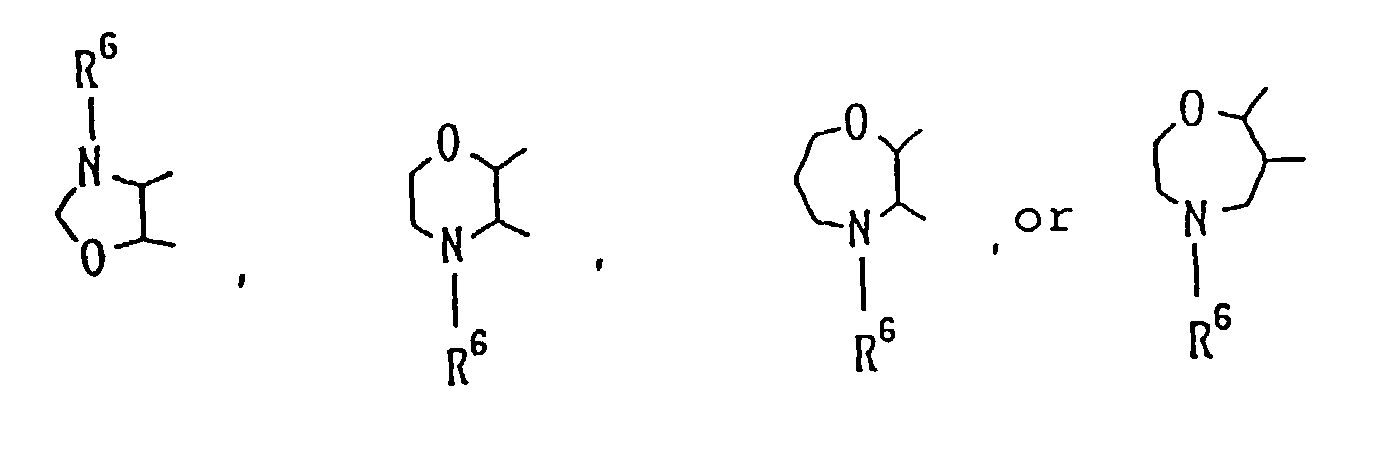
- (1) a hydrogen atom,
- (2) a C1-7 alkyl or C7-10 aralkyl group which may be substituted with a C1-4 alkyl, halogen, nitro, C1-4 alkoxy or hydroxy,
- (3) a formyl group or
- (4) a C1-6 alkyl-carbonyl group;
- R1
- is a hydrogen atom;
- Y
- is a 5- to 9-membered N-containing saturated
heterocyclic group shown by the formula:
wherein ring Q1 and ring Q2 are respectively a 5- to 9-membered N-containing heterocyclic group which may have, other than carbon atoms and one nitrogen atom, 1 to 2 of hetero atoms selected from nitrogen, oxygen and sulfur atoms, wherein said heterocylcic group may be substituted on said ring-constituting nitrogen atom with a hydrogen atom, formyl group, a C1-6 alkyl-carbonyl group or a C7-10 aralkyl group which may be substituted with a C1-4 alkyl group, a halogen atom, a nitro group, a C1-4 alkoxy group or a hydroxyl group; and

- n
- is an integer of 2 to 10
or a salt thereof.
- A compound as claimed in claim 1, wherein ring B' is a group of the formula:wherein R6 is as defined in claim 1.
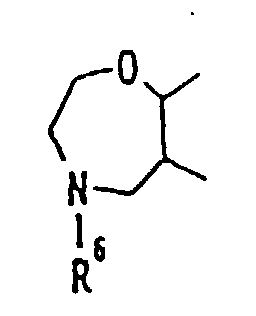
- A compound as claimed in claim 1, wherein ring A is an unsubstituted benzene ring.
- A compound as claimed in claim 1, wherein n is an integer of 2 to 6.
- A compound as claimed in claim 1, wherein said N-containing heterocyclic group is a 5- to 7-membered heterocyclic group.
- A compound as claimed in claim 1, wherein said heterocyclic group has one nitrogen atom constituting the ring except at the bonding position.
- A compound as claimed in claim 1, which is selected from the group consisting of(1) 3-[1-(phenylmethyl)piperidin-4-yl]-1-(2,3,4,5-tetrahydro-1,4-benzoxazepin-7-yl)-1-propanone or a salt thereof,(2) 1-[4-(phenylmethyl)-2,3,4,5-tetrahydro-1,4-benzoxazepin-7-yl]-3-[1-(phenylmethyl)piperidin-4-yl]-1-propanone or a salt thereof,(3) 1-(4-acetyl-2,3,4,5-tetrahydro-1,4-benzoxazepin-7-yl)-3-[1-(phenylmethyl)piperidin-4-yl]-1-propanone or a salt thereof.(4) 1-[4-(4-methoxyphenylmethyl)-2,3,4,5-tetrahydro-1,4-benzoxazepin-7-yl]-3-[1-(phenylmethyl)piperidin-4-yl]-1-propanone or a salt thereof,(5) 1-(4-formyl-2,3,4,5-tetrahydro-1,4-benzoxazepin-7-yl)-3-[4-(phenylmethyl)piperazin-1-yl]-1-propanone or a salt thereof, and(6) 1-[4-(4-nitrophenylmethyl)-2,3,4,5-tetrahydro-1,4-benzoxazepin-7-yl]-3-[1-(phenylmethyl)piperidin-4-yl]-1-propanone or a salt thereof.
- A compound of the formula:wherein
 ring A, ring B', R1 and n are as defined in claim 1; andZ2 is a leaving group,
or a salt thereof. - A method of producing a compound of the formulawherein all symbols are as defined in claim 1, or a salt thereof, which comprises reacting
 (a) a compound of the formulawherein the ring A and the ring B' have the same meanings as defined above, or a salt thereof, with a compound of the formula:
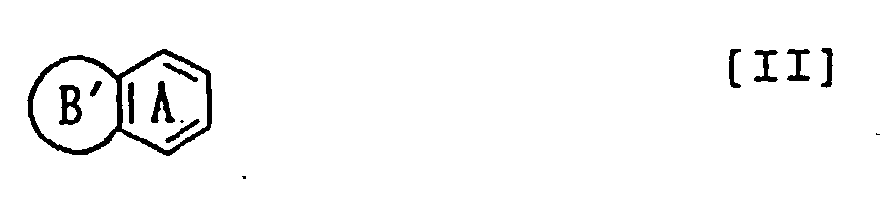 wherein
 Z1 is a leaving group; andR1, Y and n have the same meanings as defined above,
or a salt thereof; or(b) a compound of the formulawherein the ring A, the ring B', R1 and n are as defined above; andZ2 represents a leaving group, or a salt thereof, with a compound of the formula:Z3 is a leaving group which can be left with Z2;
or a salt thereof. - A cholinesterase inhibitor, which contains a compound of claim 1, or a pharmaceutically acceptable salt thereof.
- A pharmaceutical composition for an agent for a disease caused by acetylcholinesterase activity which contains a compound of claim 1, or a pharmaceutically acceptable salt thereof, and a pharmacologically acceptable carrier.
- A pharmaceutical composition as claimed in claim 11, wherein the pharmaceutical composition is an agent for senile dementia and/or Alzheimer's disease.
- Use of a compound of claim 1 or a pharmaceutically acceptable salt thereof, as a component in the preparation of a cholinesterase inhibitor.
- A compound as claimed in claim 1, whereinY is a ring having the skeleton of pyrrolidine, piperidine, piperazine or morpholine, which may be substituted with a formyl, C1-6 alkyl-carbonyl, or C7-10 aralkyl group, each of which may be substituted with the substituents consisting of halogen, nitro, hydroxy and C1-4 alkoxy.
Applications Claiming Priority (9)
| Application Number | Priority Date | Filing Date | Title |
|---|---|---|---|
| JP106789/92 | 1992-04-24 | ||
| JP10678992 | 1992-04-24 | ||
| JP10678992 | 1992-04-24 | ||
| JP20565092 | 1992-07-31 | ||
| JP20565092 | 1992-07-31 | ||
| JP205650/92 | 1992-07-31 | ||
| JP309872/92 | 1992-11-19 | ||
| JP30987292 | 1992-11-19 | ||
| JP30987292 | 1992-11-19 |
Publications (3)
| Publication Number | Publication Date |
|---|---|
| EP0567090A2 EP0567090A2 (en) | 1993-10-27 |
| EP0567090A3 EP0567090A3 (en) | 1994-03-30 |
| EP0567090B1 true EP0567090B1 (en) | 2000-07-26 |
Family
ID=27310829
Family Applications (1)
| Application Number | Title | Priority Date | Filing Date |
|---|---|---|---|
| EP93106448A Expired - Lifetime EP0567090B1 (en) | 1992-04-24 | 1993-04-21 | Benzoxazepine derivatives as cholinesterase inhibitors |
Country Status (5)
| Country | Link |
|---|---|
| US (1) | US6319916B1 (en) |
| EP (1) | EP0567090B1 (en) |
| AT (1) | ATE194982T1 (en) |
| CA (1) | CA2094767A1 (en) |
| DE (1) | DE69329084T2 (en) |
Families Citing this family (13)
| Publication number | Priority date | Publication date | Assignee | Title |
|---|---|---|---|---|
| CA2144013A1 (en) * | 1994-03-09 | 1995-09-10 | Yuzo Yagi | Hexahydropyrano [3, 2-b][1,4]benzothiazine derivative |
| US5705501A (en) | 1994-11-17 | 1998-01-06 | Molecular Geriatrics Corporation | Certain substituted 1-aryl-3-morpholinopropanones to treat Alzheimer's Disease |
| US5658909A (en) * | 1994-11-17 | 1997-08-19 | Molecular Geriatrics Corporation | Certain substituted 1-aryl-3-piperazin-1'-yl propanones to treat Alzheimer's Disease |
| AU6852898A (en) | 1997-04-17 | 1998-11-11 | Takeda Chemical Industries Ltd. | Thermogenic composition and benzazepine thermogenics |
| KR100648869B1 (en) | 1998-09-30 | 2007-02-28 | 다케다 야쿠힌 고교 가부시키가이샤 | Bladder Discharge Improvers |
| KR100614862B1 (en) | 2001-12-28 | 2006-08-22 | 다케다 야쿠힌 고교 가부시키가이샤 | Urination Disorder Prevention / Treatment |
| EP1472237A4 (en) * | 2002-02-06 | 2006-01-11 | Yissum Res Dev Co | Catechol bioisosteres |
| US20050143350A1 (en) * | 2003-11-19 | 2005-06-30 | Seed John C. | Combination drug therapy to treat obesity |
| PE20070702A1 (en) * | 2005-11-02 | 2007-07-20 | Takeda Pharmaceutical | (TRIFLUOROMETOXY-PHENYL) -ETHYLAMINE DERIVED COMPOUNDS AS ACETYLCHOLINESTERASE INHIBITORS AND ADRENALINE alpha1 RECEPTOR ANTAGONISTS |
| US8247403B2 (en) | 2007-03-07 | 2012-08-21 | Takeda Pharmaceutical Company Limited | Benzoxazepine derivatives and use thereof |
| DE102007047737A1 (en) | 2007-10-05 | 2009-04-30 | Merck Patent Gmbh | Piperidine and piperazine derivatives |
| WO2022231927A1 (en) * | 2021-04-27 | 2022-11-03 | Merck Sharp & Dohme Llc | Phenyl azepines as ripk1 inhibitors and methods of use thereof |
| CN113387955B (en) * | 2021-06-01 | 2023-03-10 | 兰州大学 | 1,2,3, 4-tetrahydrocinnoline skeleton compound and synthesis method thereof |
Family Cites Families (12)
| Publication number | Priority date | Publication date | Assignee | Title |
|---|---|---|---|---|
| FR2035749A1 (en) * | 1969-02-06 | 1970-12-24 | Bellon Labor Sa Roger | |
| DE2429253A1 (en) * | 1974-06-19 | 1976-01-15 | Boehringer Sohn Ingelheim | PHENYLAL CANOLAMINE |
| FR2332010A1 (en) | 1975-11-18 | 1977-06-17 | Continental Pharma | HETEROCYCLIC AMINO-ALCOHOL, ITS SALT AND ITS PREPARATION PROCESS |
| FR2491066A1 (en) * | 1980-09-29 | 1982-04-02 | Cerm Cent Europ Rech Mauvernay | BENZOXAZOLINONES SUBSTITUTED IN 6 BY AN AMINOALCOHOL OR AMINOCETONE CHAIN, THEIR PREPARATION AND THEIR THERAPEUTIC USE |
| JPS597185A (en) | 1982-07-02 | 1984-01-14 | Mitsubishi Chem Ind Ltd | 1,5-benzodioxepin derivative and its acid addition salt |
| US4613598A (en) * | 1984-03-13 | 1986-09-23 | Mitsubishi Chemical Industries Limited | Piperazine derivatives and their acid addition salts |
| DK623586A (en) * | 1985-12-27 | 1987-06-28 | Eisai Co Ltd | PIPERIDE INGREDIENTS OR SALTS THEREOF AND PHARMACEUTICAL COMPOSITIONS CONTAINING THE COMPOUNDS |
| FI95572C (en) | 1987-06-22 | 1996-02-26 | Eisai Co Ltd | Process for the preparation of a medicament useful as a piperidine derivative or its pharmaceutical salt |
| FR2637286A1 (en) * | 1988-10-04 | 1990-04-06 | Adir | NOVEL BENZOXAZOLINON DERIVATIVES, PROCESSES FOR THEIR PREPARATION AND PHARMACEUTICAL COMPOSITIONS CONTAINING THEM |
| JP2969359B2 (en) * | 1989-01-13 | 1999-11-02 | 武田薬品工業株式会社 | Cyclic amine compounds |
| JP2807577B2 (en) * | 1990-06-15 | 1998-10-08 | エーザイ株式会社 | Cyclic amide derivative |
| TW197435B (en) | 1990-11-22 | 1993-01-01 | Takeda Pharm Industry Co Ltd |
-
1993
- 1993-04-21 EP EP93106448A patent/EP0567090B1/en not_active Expired - Lifetime
- 1993-04-21 DE DE69329084T patent/DE69329084T2/en not_active Expired - Fee Related
- 1993-04-21 AT AT93106448T patent/ATE194982T1/en not_active IP Right Cessation
- 1993-04-23 CA CA002094767A patent/CA2094767A1/en not_active Abandoned
- 1993-04-23 US US08/051,831 patent/US6319916B1/en not_active Expired - Fee Related
Also Published As
| Publication number | Publication date |
|---|---|
| US6319916B1 (en) | 2001-11-20 |
| DE69329084T2 (en) | 2000-12-21 |
| CA2094767A1 (en) | 1993-10-25 |
| EP0567090A3 (en) | 1994-03-30 |
| EP0567090A2 (en) | 1993-10-27 |
| ATE194982T1 (en) | 2000-08-15 |
| DE69329084D1 (en) | 2000-08-31 |
Similar Documents
| Publication | Publication Date | Title |
|---|---|---|
| JP2650537B2 (en) | Fused heterocyclic derivatives | |
| EP0607864B1 (en) | Tricyclic condensed heterocyclic compounds for the treatment of senile dementic | |
| EP0560235B1 (en) | Condensed heterocyclic ketone derivatives, their production and use | |
| EP0567090B1 (en) | Benzoxazepine derivatives as cholinesterase inhibitors | |
| EP0397040A2 (en) | N-heteroaryl-4-quinolinamines, a process for their preparation and their use as medicaments | |
| US4742171A (en) | Method of synthesizing 1,4-dihydro-benzo[c]-1,5-naphthyridin-2(3H)-ones | |
| CZ284591B6 (en) | /(arylalkylpiperidin-4-yl)methyl/-2a,3,4,5-tetrahydro-1-(2h)- acetnaphthylen-1-ones and derivatives thereof, process of their preparation, pharmaceutical composition containing thereof and use | |
| JPH0747574B2 (en) | Pyridine derivative and psychotropic agent containing the same | |
| US5212181A (en) | 1-(3,4-dihydro-2-oxo-1H-quinolin-6-yl)-2-[4-(2-phenylethyl)piperidin-1-yl]et[4-(2-phenylethyl)piperidin-1-yl]ethanone, to their preparation and to their therapeutic application | |
| HUT61301A (en) | Process for producing condensed diazepinone derivatives and pharmaceutical compositions comprising same as active ingredient | |
| JP3286056B2 (en) | Tricyclic fused heterocyclic derivatives, their production and use | |
| EP0370449B1 (en) | Fused heterocyclic derivatives of 1,2,3,4-tetrahydroacridine, a process for their preparation and their use as medicaments | |
| US4652567A (en) | Benzo(c)-1,5-naphthyridines useful for treating a patient having drug induced memory impairment in need of memory enhancement | |
| JP3462234B2 (en) | Heterocyclic compounds, their production methods, applications and synthetic intermediates | |
| JP3523887B2 (en) | Condensed heterocyclic ketone derivative, production method thereof, intermediate and agent | |
| US5192789A (en) | Substituted 1,2,3,4-tetrahydrocyclopent[b]indoles, 1,2,3,3a,4,8a-hexahydrocyclopent[b]indoles and related compounds | |
| JPH0357903B2 (en) | ||
| JP3819759B2 (en) | Tricyclic fused heterocyclic derivatives, their production and use | |
| JP3113447B2 (en) | Aminocarboxylic acid derivatives, their production and use | |
| Kaur et al. | Synthesis of N-substituted piperazinyl carbamoyl and acetyl derivatives of tetrahydropapaverine: potent antispasmodic agents | |
| KR890001195B1 (en) | Fused Aromatic Thiazinone and Its Brass Family | |
| JPH04210970A (en) | Benzamide derivatives and intermediates thereof |
Legal Events
| Date | Code | Title | Description |
|---|---|---|---|
| PUAI | Public reference made under article 153(3) epc to a published international application that has entered the european phase |
Free format text: ORIGINAL CODE: 0009012 |
|
| AK | Designated contracting states |
Kind code of ref document: A2 Designated state(s): AT BE CH DE DK ES FR GB GR IE IT LI LU NL PT SE |
|
| PUAL | Search report despatched |
Free format text: ORIGINAL CODE: 0009013 |
|
| AK | Designated contracting states |
Kind code of ref document: A3 Designated state(s): AT BE CH DE DK ES FR GB GR IE IT LI LU NL PT SE |
|
| 17P | Request for examination filed |
Effective date: 19940910 |
|
| 17Q | First examination report despatched |
Effective date: 19970620 |
|
| GRAG | Despatch of communication of intention to grant |
Free format text: ORIGINAL CODE: EPIDOS AGRA |
|
| GRAG | Despatch of communication of intention to grant |
Free format text: ORIGINAL CODE: EPIDOS AGRA |
|
| GRAG | Despatch of communication of intention to grant |
Free format text: ORIGINAL CODE: EPIDOS AGRA |
|
| GRAH | Despatch of communication of intention to grant a patent |
Free format text: ORIGINAL CODE: EPIDOS IGRA |
|
| GRAH | Despatch of communication of intention to grant a patent |
Free format text: ORIGINAL CODE: EPIDOS IGRA |
|
| GRAA | (expected) grant |
Free format text: ORIGINAL CODE: 0009210 |
|
| AK | Designated contracting states |
Kind code of ref document: B1 Designated state(s): AT BE CH DE DK ES FR GB GR IE IT LI LU NL PT SE |
|
| PG25 | Lapsed in a contracting state [announced via postgrant information from national office to epo] |
Ref country code: NL Free format text: LAPSE BECAUSE OF FAILURE TO SUBMIT A TRANSLATION OF THE DESCRIPTION OR TO PAY THE FEE WITHIN THE PRESCRIBED TIME-LIMIT Effective date: 20000726 Ref country code: IT Free format text: LAPSE BECAUSE OF FAILURE TO SUBMIT A TRANSLATION OF THE DESCRIPTION OR TO PAY THE FEE WITHIN THE PRESCRIBED TIME-LIMIT;WARNING: LAPSES OF ITALIAN PATENTS WITH EFFECTIVE DATE BEFORE 2007 MAY HAVE OCCURRED AT ANY TIME BEFORE 2007. THE CORRECT EFFECTIVE DATE MAY BE DIFFERENT FROM THE ONE RECORDED. Effective date: 20000726 Ref country code: GR Free format text: LAPSE BECAUSE OF NON-PAYMENT OF DUE FEES Effective date: 20000726 Ref country code: ES Free format text: THE PATENT HAS BEEN ANNULLED BY A DECISION OF A NATIONAL AUTHORITY Effective date: 20000726 Ref country code: BE Free format text: LAPSE BECAUSE OF FAILURE TO SUBMIT A TRANSLATION OF THE DESCRIPTION OR TO PAY THE FEE WITHIN THE PRESCRIBED TIME-LIMIT Effective date: 20000726 Ref country code: AT Free format text: LAPSE BECAUSE OF FAILURE TO SUBMIT A TRANSLATION OF THE DESCRIPTION OR TO PAY THE FEE WITHIN THE PRESCRIBED TIME-LIMIT Effective date: 20000726 |
|
| REF | Corresponds to: |
Ref document number: 194982 Country of ref document: AT Date of ref document: 20000815 Kind code of ref document: T |
|
| REG | Reference to a national code |
Ref country code: CH Ref legal event code: NV Representative=s name: A. BRAUN, BRAUN, HERITIER, ESCHMANN AG PATENTANWAE Ref country code: CH Ref legal event code: EP |
|
| REG | Reference to a national code |
Ref country code: IE Ref legal event code: FG4D |
|
| ET | Fr: translation filed | ||
| REF | Corresponds to: |
Ref document number: 69329084 Country of ref document: DE Date of ref document: 20000831 |
|
| PG25 | Lapsed in a contracting state [announced via postgrant information from national office to epo] |
Ref country code: SE Free format text: LAPSE BECAUSE OF FAILURE TO SUBMIT A TRANSLATION OF THE DESCRIPTION OR TO PAY THE FEE WITHIN THE PRESCRIBED TIME-LIMIT Effective date: 20001026 Ref country code: PT Free format text: LAPSE BECAUSE OF FAILURE TO SUBMIT A TRANSLATION OF THE DESCRIPTION OR TO PAY THE FEE WITHIN THE PRESCRIBED TIME-LIMIT Effective date: 20001026 Ref country code: DK Free format text: LAPSE BECAUSE OF FAILURE TO SUBMIT A TRANSLATION OF THE DESCRIPTION OR TO PAY THE FEE WITHIN THE PRESCRIBED TIME-LIMIT Effective date: 20001026 |
|
| NLV1 | Nl: lapsed or annulled due to failure to fulfill the requirements of art. 29p and 29m of the patents act | ||
| PG25 | Lapsed in a contracting state [announced via postgrant information from national office to epo] |
Ref country code: LU Free format text: LAPSE BECAUSE OF NON-PAYMENT OF DUE FEES Effective date: 20010421 |
|
| PG25 | Lapsed in a contracting state [announced via postgrant information from national office to epo] |
Ref country code: IE Free format text: LAPSE BECAUSE OF NON-PAYMENT OF DUE FEES Effective date: 20010423 |
|
| PLBE | No opposition filed within time limit |
Free format text: ORIGINAL CODE: 0009261 |
|
| 26N | No opposition filed | ||
| REG | Reference to a national code |
Ref country code: GB Ref legal event code: IF02 |
|
| REG | Reference to a national code |
Ref country code: IE Ref legal event code: MM4A |
|
| REG | Reference to a national code |
Ref country code: CH Ref legal event code: PFA Owner name: TAKEDA PHARMACEUTICAL COMPANY LIMITED Free format text: TAKEDA CHEMICAL INDUSTRIES, LTD.#1-1, DOSHOMACHI 4-CHOME#CHUO-KU, OSAKA 541 (JP) -TRANSFER TO- TAKEDA PHARMACEUTICAL COMPANY LIMITED#1-1, DOSHOMACHI 4-CHOME CHUO-KU#OSAKA (JP) |
|
| REG | Reference to a national code |
Ref country code: FR Ref legal event code: CD |
|
| PGFP | Annual fee paid to national office [announced via postgrant information from national office to epo] |
Ref country code: FR Payment date: 20060410 Year of fee payment: 14 |
|
| PGFP | Annual fee paid to national office [announced via postgrant information from national office to epo] |
Ref country code: DE Payment date: 20060413 Year of fee payment: 14 |
|
| PGFP | Annual fee paid to national office [announced via postgrant information from national office to epo] |
Ref country code: GB Payment date: 20060419 Year of fee payment: 14 |
|
| PGFP | Annual fee paid to national office [announced via postgrant information from national office to epo] |
Ref country code: CH Payment date: 20060427 Year of fee payment: 14 |
|
| REG | Reference to a national code |
Ref country code: CH Ref legal event code: PL |
|
| GBPC | Gb: european patent ceased through non-payment of renewal fee |
Effective date: 20070421 |
|
| PG25 | Lapsed in a contracting state [announced via postgrant information from national office to epo] |
Ref country code: DE Free format text: LAPSE BECAUSE OF NON-PAYMENT OF DUE FEES Effective date: 20071101 |
|
| PG25 | Lapsed in a contracting state [announced via postgrant information from national office to epo] |
Ref country code: CH Free format text: LAPSE BECAUSE OF NON-PAYMENT OF DUE FEES Effective date: 20070430 Ref country code: LI Free format text: LAPSE BECAUSE OF NON-PAYMENT OF DUE FEES Effective date: 20070430 |
|
| PG25 | Lapsed in a contracting state [announced via postgrant information from national office to epo] |
Ref country code: GB Free format text: LAPSE BECAUSE OF NON-PAYMENT OF DUE FEES Effective date: 20070421 |
|
| PG25 | Lapsed in a contracting state [announced via postgrant information from national office to epo] |
Ref country code: FR Free format text: LAPSE BECAUSE OF NON-PAYMENT OF DUE FEES Effective date: 20070430 |