EP0560730A2 - New derivatives of beta-amino acids with anti-thrombotic activity - Google Patents
New derivatives of beta-amino acids with anti-thrombotic activity Download PDFInfo
- Publication number
- EP0560730A2 EP0560730A2 EP93810172A EP93810172A EP0560730A2 EP 0560730 A2 EP0560730 A2 EP 0560730A2 EP 93810172 A EP93810172 A EP 93810172A EP 93810172 A EP93810172 A EP 93810172A EP 0560730 A2 EP0560730 A2 EP 0560730A2
- Authority
- EP
- European Patent Office
- Prior art keywords
- amino
- denotes
- formula
- group
- acid
- Prior art date
- Legal status (The legal status is an assumption and is not a legal conclusion. Google has not performed a legal analysis and makes no representation as to the accuracy of the status listed.)
- Granted
Links
- 0 *CC(***)NS Chemical compound *CC(***)NS 0.000 description 2
- TXXGNKPMKOCSRT-IAQLTGFHSA-N CC(CC(N[C@@H](C[C@@H](CNC(CC(C=C1)=CCC1C(N)=N)=O)O1)CC1=O)=O)C/N=C(\c1ccc(CC(NC[C@H](C[C@@H](C2)NC(CCC(CC3)CC=C3OC)=O)OC2=O)=O)cc1)/N Chemical compound CC(CC(N[C@@H](C[C@@H](CNC(CC(C=C1)=CCC1C(N)=N)=O)O1)CC1=O)=O)C/N=C(\c1ccc(CC(NC[C@H](C[C@@H](C2)NC(CCC(CC3)CC=C3OC)=O)OC2=O)=O)cc1)/N TXXGNKPMKOCSRT-IAQLTGFHSA-N 0.000 description 1
Classifications
-
- C—CHEMISTRY; METALLURGY
- C07—ORGANIC CHEMISTRY
- C07C—ACYCLIC OR CARBOCYCLIC COMPOUNDS
- C07C311/00—Amides of sulfonic acids, i.e. compounds having singly-bound oxygen atoms of sulfo groups replaced by nitrogen atoms, not being part of nitro or nitroso groups
- C07C311/15—Sulfonamides having sulfur atoms of sulfonamide groups bound to carbon atoms of six-membered aromatic rings
- C07C311/16—Sulfonamides having sulfur atoms of sulfonamide groups bound to carbon atoms of six-membered aromatic rings having the nitrogen atom of at least one of the sulfonamide groups bound to hydrogen atoms or to an acyclic carbon atom
- C07C311/19—Sulfonamides having sulfur atoms of sulfonamide groups bound to carbon atoms of six-membered aromatic rings having the nitrogen atom of at least one of the sulfonamide groups bound to hydrogen atoms or to an acyclic carbon atom to an acyclic carbon atom of a hydrocarbon radical substituted by carboxyl groups
-
- A—HUMAN NECESSITIES
- A61—MEDICAL OR VETERINARY SCIENCE; HYGIENE
- A61P—SPECIFIC THERAPEUTIC ACTIVITY OF CHEMICAL COMPOUNDS OR MEDICINAL PREPARATIONS
- A61P7/00—Drugs for disorders of the blood or the extracellular fluid
- A61P7/02—Antithrombotic agents; Anticoagulants; Platelet aggregation inhibitors
-
- C—CHEMISTRY; METALLURGY
- C07—ORGANIC CHEMISTRY
- C07C—ACYCLIC OR CARBOCYCLIC COMPOUNDS
- C07C257/00—Compounds containing carboxyl groups, the doubly-bound oxygen atom of a carboxyl group being replaced by a doubly-bound nitrogen atom, this nitrogen atom not being further bound to an oxygen atom, e.g. imino-ethers, amidines
- C07C257/10—Compounds containing carboxyl groups, the doubly-bound oxygen atom of a carboxyl group being replaced by a doubly-bound nitrogen atom, this nitrogen atom not being further bound to an oxygen atom, e.g. imino-ethers, amidines with replacement of the other oxygen atom of the carboxyl group by nitrogen atoms, e.g. amidines
- C07C257/18—Compounds containing carboxyl groups, the doubly-bound oxygen atom of a carboxyl group being replaced by a doubly-bound nitrogen atom, this nitrogen atom not being further bound to an oxygen atom, e.g. imino-ethers, amidines with replacement of the other oxygen atom of the carboxyl group by nitrogen atoms, e.g. amidines having carbon atoms of amidino groups bound to carbon atoms of six-membered aromatic rings
-
- C—CHEMISTRY; METALLURGY
- C07—ORGANIC CHEMISTRY
- C07D—HETEROCYCLIC COMPOUNDS
- C07D309/00—Heterocyclic compounds containing six-membered rings having one oxygen atom as the only ring hetero atom, not condensed with other rings
- C07D309/16—Heterocyclic compounds containing six-membered rings having one oxygen atom as the only ring hetero atom, not condensed with other rings having one double bond between ring members or between a ring member and a non-ring member
- C07D309/28—Heterocyclic compounds containing six-membered rings having one oxygen atom as the only ring hetero atom, not condensed with other rings having one double bond between ring members or between a ring member and a non-ring member with hetero atoms or with carbon atoms having three bonds to hetero atoms with at the most one bond to halogen, e.g. ester or nitrile radicals, directly attached to ring carbon atoms
- C07D309/30—Oxygen atoms, e.g. delta-lactones
-
- C—CHEMISTRY; METALLURGY
- C07—ORGANIC CHEMISTRY
- C07C—ACYCLIC OR CARBOCYCLIC COMPOUNDS
- C07C2603/00—Systems containing at least three condensed rings
- C07C2603/56—Ring systems containing bridged rings
- C07C2603/58—Ring systems containing bridged rings containing three rings
- C07C2603/70—Ring systems containing bridged rings containing three rings containing only six-membered rings
- C07C2603/74—Adamantanes
Definitions
- the invention relates to derivatives of ⁇ -amino acids which are isosteres of the dipeptide unit Gly-Asp.
- the compounds of the invention are pseudopeptides having anti-thrombotic activity.
- the compounds are notable for the fact that they inhibit the binding of fibrinogen to the fibrinogen receptor on blood platelets (glycoprotein GP IIb/IIIa).
- a decisive step in thrombus formation is the crosslinking of blood platelets by fibrinogen molecules.
- a requirement for this is activation of the platelets by agonists such as thrombin or adenosin diphosphate (ADP). This activation effects restructuring of the cell membrane, the consequence of which is that GPllb/llla is exposed in active form.
- GPllb/llla belongs to the family of adhesion receptors known as integrins. Further ligands for GPllb/llla, apart from fibrinogen, are fibronectin, vitronectin and the von Willebrand factor. These ligands play an important role in haemostatic processes, in that they bring about the adhesion and aggregation of platelets. Specific therapeutic inhibition of these interactions, may influence a decisive step in thrombus formation. The binding of fibrinogen, and of other ligands, is brought about by the peptide sequence Arg-Gly-Asp (RGD) (Ruoslahti E., Pierschbacher M., Cell 1986, 44, 517-18).
- RGD peptide sequence Arg-Gly-Asp
- Fibrinogen possesses a further peptide sequence (His-His-Leu-Gly-Gly-Ala-Lys-Gln-Ala-Gly-Asp-Val) on the C-terminus of the gamma chain with affinity for the fibrinogen receptor.
- Small synthetic peptides which contain these sequences, may inhibit the binding of fibrinogen, fibronectin, vitronectin and the von Willebrand factor to GPllb/llla, and may thus inhibit platelet aggregation (Plow et al. Proc. Natl. Acad. Sci. USA 1985, 82, 8057-61; Ruggeri et al. Proc. Natl. Acad. Sci. USA 1986, 5708-12; Ginsberg et al. J. Biol. Chem. 1985, 260, 3931-36; Gartner et al. J. Biol. Chem. 1987, 260, 11, 891-94).
- the present invention provides pseudopeptidic Arg-Gly-Asp analogues, in which the Gly-Asp unit is replaced by derivatives of ⁇ -amino acids, and in which Arg is replaced in most cases by a benzamidine-carboxylic acid.
- the new pseudopeptides inhibit platelet aggregation and thrombus formation.
- Each asymmetrical c-atom indicated by an asterisk (*) in the formulae may be of either R or S configuration.
- (C 1 -C 4 )alkyl is preferably methyl, and (C 1 -C 4 )alkoxy is preferably methoxy.
- the protecting group Z is preferably a benzyloxycarbonyl or tert.-butyloxycarbonyl group.
- D and/or B denote an a-amino acid, this may be a naturally occurring a-amino acid, or an unnatural a-amino acid.
- Preferred compounds are those of formula I' formula I' wherein
- [v] m - is the group [CH 2]m
- m, A, B, X, Y and R 1 are as defined above.
- [v] m is [CH 2]m
- m, A, B, X, Y and R 1 are as defined above.
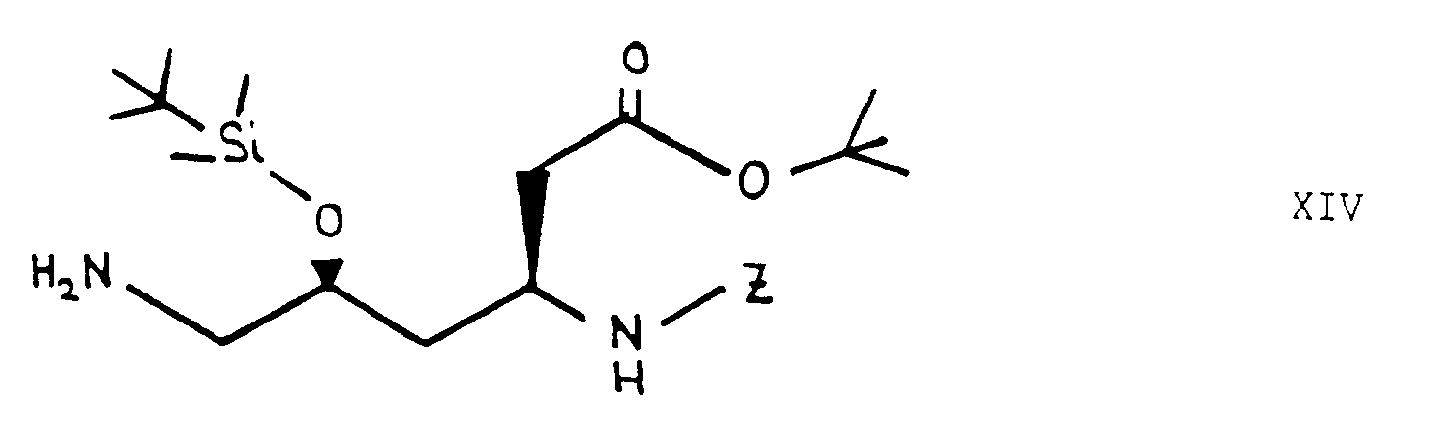
- compounds of formula I wherein m is 1, X and R 1 together form a HC*-O-CO- group and Y is a CH 2 - group, may be produced from compound XIV by coupling with an appropriate radical A (analogously to synthesis scheme 1), removing the protecting group under reducing conditions with H 2 /Pd-C, followed by coupling with an appropriate radical B (analogously to synthesis scheme 1) and subsequently removing the protecting groups with trifluoroacetic acid at room temperature.
- Compound XIV is obtained from compound XIII by converting the carboxylic acid into a Z-protected amine with diphenylphosphoryl- azide and triethylamine in the presence of benzyl alcohol, and reducing the azido group with triphenylphosphine in tetrahydrofuran.
- the carboxylic acid XIII is obtained from compound XII by means of enantio-selective introduction of the acid side chain in 3 stages: a) coupling with the Evans oxazolidinone to introduce a chiral auxiliary group (J. Am. Chem. Soc.
- the azido-carboxylic acid XII is obtained from the lactone XI, by mesylation of the alcohol with methanesulphonyl chloride, azidation with sodium azide, opening the lactone with caustic soda solution in ethanol and reacting with tert.-butyldimethylsilyl chloride in the presence of imidazole to introduce the alcohol protecting group.
- the compounds of formula I inhibit the binding of fibrinogen to the fibrinogen receptor blood platelets (glycoprotein GP IIb/IIIa).
- the compounds prevent the aggregation of human blood platelets and the formation of clots, and may accordingly be used to prevent and treat thrombosis, apoplexy, cardiac infarction, inflammation, arterial sclerosis and tumours.
- Further therapeutic fields of use are: osteoporosis, acute reocclusion following PTCAand addition during thrombolysis.
- the abbreviations used in the description and in the following examples have the following significances.
- the product obtained is mixed at 0°C with 10 ml of methylene chloride and 10 ml of trifluoroacetic acid, stirred for 1 hour at room temperature, the solvent is removed by vacuum distillation, and the residue is dried for 24 hours in a high vacuum.
- the (S)-3-amino-6-[N-(benzyloxycarbonyl)amino]-hexanoic acid methylester trifluoroacetate product is obtained as a colourless solid.
- stage B The product obtained according to stage B) is dissolved in 20 ml of methanol and hydrogenated in the presence of 0.3 g of Pd/C (10%) and 1.34 ml of 1N hydrochloric acid.
- the catalyst is removed by filtration, the methanol is evaporated off and the residue is dried under high vacuum.
- 500 mg of (S)-3-(N-tosylamino)-6-aminohexanoic acid methylester hydrochloride is obtained as a colourless foam.
- the ethyl acetate phase is washed with water, dried over sodium sulphate, concentrated by evaporation, and the residue chromatographed on silica gel (ethyl acetate).
- the product obtained is mixed with a solution of 0.2 ml of anisole in 5 ml of TFA, stirred for 2 hours at room temperature and added dropwise to 300 ml of ether.
- the precipitated solid is filtered off, dissolved in a mixture of 2 ml of methanol and 1 ml of water, and mixed with 57 mg of LiOH-H 2 0. After 5 hours at room temperature, the methanol is evaporated off and the aqueous solution is neutralized with 0.13 ml of TFA.
- 440 mg of the methylester from stage B) of example 3 is hydrogenated analogously to stage C) of example 1, and the hydrochloride obtained is reacted and worked up with 164 mg of N-Boc-p-amidinophenylacetic acid, 0.13 ml of triethylamine, 164 mg of HOBT and 200 mg of DCC, as described in stage C) of example 1.
- the product is deprotected with TFA and LiOH-H 2 0 analogously to stage C) of example 1, and the crude product is recrystallized from methanol/water.
- 225 mg of the tert.-butylester from stage B) of example 4 is dissolved in 20 ml of ethanol, and hydrogenated in the presence of 0.1 g of Pd/C (10%) and 0.028 ml of acetic acid, as described in stage C) of example 1.
- the crude product obtained is dissolved in 5 ml of DMF, and reacted with 119 mg of N-Boc-p-amidinophenylacetic acid, 0.061 ml of triethylamine, 73 mg of HOBT and 90 mg of DCC, analogously to stage C) of example 1.
- the crude product obtained after the work up is chromatographed on silica gel (ethyl acetate) and the pure product is mixed with a solution of 5 ml of TFA in 0.2 ml of anisole.
- the free compound is produced from the trifluoroacetate in known manner.
- (S)-3-[N-(3-adamant-1-ylpropionyl)amino]-6-N-Z-amino-hexanoic acid methylester is obtained by reacting 0.85 g of the trifluoroacetate of stage A) of example 1, with 423 mg of 3-adamant-ylpropionic acid, 0.28 ml of triethylamine, 337 mg of HOBT and 418 mg of DCC, followed by purification by chromatography (silica gel, ethyl acetate), analogously to stage A) of example 2; MS: 485 (M+H)+.
- the methylester is dissolved in 15 ml of methylene chloride and mixed with 15 ml of TFA. After 1 hour, the TFAand the solvent are removed under vacuum and the residue is dried under high vacuum, to yield the (S)-3-amino-6-N-Z-aminoheptanoic acid methylester trifluoroacetate product.
- stage B) of example 4 3.25 g of methylesterfrom stage B) of example 6 are saponified with 1.36 g of LiOH-H 2 0 and reacted with 4.04 g of tert.-butyl-2,2,2-trichloroacetimidate and 0.42 ml of boron trifluoroetherate, to yield the (S)-3-[N-(3-methylbutyryl)amino]-7-N-Z-aminoheptanoic acid tert.- butylester product; MS: 435 (M+H)+.
- the free compound is produced from the trifluoroacetate in known manner.
- (4S)-4-hydroxy-5-azido-valeric acid-y-lactone (12.28 g, 87.01 mmol) from stage B) of example 7 is dissolved in 435 ml of ethanol, and then 43.5 ml of 2 N aqueous NaOH are added whilst stirring at room temperature. Afterstanding for 1 / 2 hour at room temperature, the solution is concentrated on a rotary evaporator and dried in a high vacuum. The residue obtained (16.94 g) is mixed with 174 ml of DMF, imidazole (29.63 g, 435.05 mmol) and TBDMS-CI (48.3 g, 313.24 mmol), and stirred for 19 hours at room temperature.
- the suspension obtained is added to ice/1 N aqueous NaHS0 4 solution, and extracted several times with ether.
- the combined organic phases are dried over Na 2 S0 4 and concentrated in a vacuum.
- the residue is dissolved in 435 ml of methanol, and mixed with 18.44 g of Na 2 CO 3 (in 87.0 ml H 2 0) whilst stirring at room temperature, then agitated for 1 / 2 hour at room temperature.
- the suspension obtained is mixed with 435 ml of H 2 0 and extracted twice with hexane.
- the combined hexane phases are washed with methanol/H 2 0 (1:1), and the combined aqueous phases are acidified with NaHS0 4 .
- optically active pentanoic acid derivative from stage C) of example 7 (19.79 g, 72.37 mmols) is dissolved in 405 ml of dry THF, cooled to -78°C, mixed with 13.5 ml of triethylamine (97 mmol) and then with 10.4 ml (84.7 mmol) of pivaloyl chloride. After 5 minutes at -78°C, the mixture is warmed over the course of 1 hour to 0°C, and cooled again to -78°C.
- (4R)-4-phenylmethyl-2-oxazolidonone (15.65 g, 88.3 mmol) is dissolved in 405 ml of anhydrous THF, cooled to -78°C, mixed with n-butyllithium (56.1 ml of 1.6 M solution), and agitated for 0.25 hours at -78°C.
- the azaenolate thus produced is mixed at -78°C using a pressure needle with the mixed acid anhydride which is previously prepared in situ. The cooling bath is removed and stirring is effected for 1 hour.
- the reaction mixture is added to ice/NaHS0 4 solution, extracted with EtOAc, the organic phases are washed with saturated aqueous NaHC0 3 solution and saturated aqueous NaCl solution, and subsequently dried over Na 2 S0 4 and concentrated in a vacuum.
- the crude material obtained is chromatographed over silica gel (hexane/EtOAc, 3:1). The title compound obtained is obtained as a white solid; MS: 433 (M+H)+.
- reaction solution is cooled to room temperature, mixed with additional toluene, washed with saturated aqueous NaHC0 3 solution, 10% tartaric acid solution and saturated aqueous NaCl solution, dried over Na 2 S0 4 and concentrated under vacuum.
- the crude product is chromatographed on silica gel (hexane/EtOAc, 6:1), and the title compound is obtained in pure form; MS: 493 (M+H)+.
- the filtrate is concentrated under vacuum, and the resultant amine is isolated as an oil, which is further reacted immediately.
- the amine is dissolved in 8 ml of DMF, togetherwith 4-(tert.-butyloxycarbonyl)amidino-phenylacetic acid (733 mg, 2.64 mmol) and HOBT (4.89 mg, 3.19 mmol), and is reacted at room temperature with DCC (494 mg, 2.4 mmol). After 16 hours at room temperature, the suspension obtained is cooled to 0°C and the precipitated dicyclohexylurea is filtered off. The filtrate is diluted with EtOAc and washed with saturated aqueous NaHC0 3 solution and saturated aqueous NaCl solution.
- the free compound is obtained from the trifluoroacetate in known manner.
- stage B) of example 4 0.7 g of the methylester obtained in stage A) of example 9 is hydrolyzed with 0.21 g of LiOH/H 2 0, and the product of hydrolyzation is reacted with 0.82 g of tert.-butyl-2,2,2-trichloroacetimidate in the presence of 0.1 ml of boron trifluoroetherate, and worked up analogously. Following chromatography on silica gel (ethyl acetate/hexane 1:1), the title compound is obtained as a colourless oil;
- 0.55 g of the compound obtained according to stage B) of example 9 is hydrogenated using the process described in stage C) of example 4, and the amine thus obtained is reacted with 0.28 g of N-Boc-p-amidinobenzoic acid, 0.18 g of HOBT, 0.15 ml of triethylamine and 0.22 g of DCC, using the process described in stage C) of example 4.
- the crude product obtained is purified by chromatography (silica gel, ethyl acetate) and deprotected with 5 ml of TFA/anisole (95/5). After precipitating with ether, the trifluoroacetate of the title compound is obtained in the form of a white powder.
- the free compound is produced from the trifluoroacetate in known manner.
- the resultant reaction mixture is taken up as a suspension in EtOAc and extracted once with a 10% aqueous solution of acetic acid, once with aqueous NaHC0 3 solution and once with aqueous NaCi solution.
- the combined aqueous phases are further extracted once with EtOAc.
- the combined organic phases are then dried and evaporated to dryness using a Rotary evaporator. This yields 1.10 g of crude product, corresponding to a yield of about 92.70 %.
- the compounds offormula I effect an inhibition of the fibrinogen GP IIb/IIIa binding in a range of IC 50 (concentration of compounds of formula I which reduce the binding of fibrinogen to the receptor by 50%) of between 0.5 and 20 nM.
- the inhibition of the ADP-induced platelet aggregation is brought about by compounds of formula I in a range of IC 50 (concentration of compounds of formula I at which 50% of platelet aggregation is inhibited) of between 20 and 100 nM.
- Examples 1 to 8 are tested to determine their IC 50 values in the inhibition of the fibrinogen GPIIb/IIIa binding (FB) and inhibition of the ADP-induced platelet aggregation (PA) test procedures described above. The results obtained are given below.
- the compounds of formula I may be used for the prophylactic and acute treatment of thrombosis.
- Favourable results are obtained with doses of 0.1 to 20 mg/kg, preferably 0.1 to 3 mg/kg, per day for adults.
- the compounds of formula may similarly be employed in the form of salts, which are obtained by reacting them with pharmacologically acceptable acids such as acetic acid, trifluoroacetic acid, hydrochloric acid, etc.
- Compounds of formula I, their solvates or salts may be administered enterally, e.g. orally (as tablets, capsules, etc.) or rectally or as a spray. Parenteral administration in the form of injection solutions and infusion solutions is also conceivable.
Landscapes
- Chemical & Material Sciences (AREA)
- Organic Chemistry (AREA)
- Health & Medical Sciences (AREA)
- Life Sciences & Earth Sciences (AREA)
- General Health & Medical Sciences (AREA)
- Diabetes (AREA)
- Hematology (AREA)
- Chemical Kinetics & Catalysis (AREA)
- General Chemical & Material Sciences (AREA)
- Medicinal Chemistry (AREA)
- Nuclear Medicine, Radiotherapy & Molecular Imaging (AREA)
- Pharmacology & Pharmacy (AREA)
- Engineering & Computer Science (AREA)
- Animal Behavior & Ethology (AREA)
- Bioinformatics & Cheminformatics (AREA)
- Public Health (AREA)
- Veterinary Medicine (AREA)
- Organic Low-Molecular-Weight Compounds And Preparation Thereof (AREA)
- Medicines That Contain Protein Lipid Enzymes And Other Medicines (AREA)
- Peptides Or Proteins (AREA)
- Pharmaceuticals Containing Other Organic And Inorganic Compounds (AREA)
- Acyclic And Carbocyclic Compounds In Medicinal Compositions (AREA)
- Pyrane Compounds (AREA)
- Preparation Of Compounds By Using Micro-Organisms (AREA)
- Pyridine Compounds (AREA)
- Nitrogen Condensed Heterocyclic Rings (AREA)
- Materials For Medical Uses (AREA)
Abstract
Description
- The invention relates to derivatives of β-amino acids which are isosteres of the dipeptide unit Gly-Asp. The compounds of the invention are pseudopeptides having anti-thrombotic activity. In particular the compounds are notable for the fact that they inhibit the binding of fibrinogen to the fibrinogen receptor on blood platelets (glycoprotein GP IIb/IIIa).
- A decisive step in thrombus formation is the crosslinking of blood platelets by fibrinogen molecules. A requirement for this is activation of the platelets by agonists such as thrombin or adenosin diphosphate (ADP). This activation effects restructuring of the cell membrane, the consequence of which is that GPllb/llla is exposed in active form.
- GPllb/llla belongs to the family of adhesion receptors known as integrins. Further ligands for GPllb/llla, apart from fibrinogen, are fibronectin, vitronectin and the von Willebrand factor. These ligands play an important role in haemostatic processes, in that they bring about the adhesion and aggregation of platelets. Specific therapeutic inhibition of these interactions, may influence a decisive step in thrombus formation. The binding of fibrinogen, and of other ligands, is brought about by the peptide sequence Arg-Gly-Asp (RGD) (Ruoslahti E., Pierschbacher M., Cell 1986, 44, 517-18).
- Fibrinogen possesses a further peptide sequence (His-His-Leu-Gly-Gly-Ala-Lys-Gln-Ala-Gly-Asp-Val) on the C-terminus of the gamma chain with affinity for the fibrinogen receptor. Small synthetic peptides, which contain these sequences, may inhibit the binding of fibrinogen, fibronectin, vitronectin and the von Willebrand factor to GPllb/llla, and may thus inhibit platelet aggregation (Plow et al. Proc. Natl. Acad. Sci. USA 1985, 82, 8057-61; Ruggeri et al. Proc. Natl. Acad. Sci. USA 1986, 5708-12; Ginsberg et al. J. Biol. Chem. 1985, 260, 3931-36; Gartner et al. J. Biol. Chem. 1987, 260, 11, 891-94).
- The present invention provides pseudopeptidic Arg-Gly-Asp analogues, in which the Gly-Asp unit is replaced by derivatives of β-amino acids, and in which Arg is replaced in most cases by a benzamidine-carboxylic acid. The new pseudopeptides inhibit platelet aggregation and thrombus formation.
- Accordingly the present invention relates to pseudopeptides of formula I in free or in salt form

- R1 is a group of formula -COOH, -COOM or -COO(C1-C4)alkyl, preferably COOH wherein
- M is an alkali or alkaline earth metal atom, preferably Li
- X is -CH2-, -CH=, -CO-, -C*HOH- or -C*HO((C1-C4)alkyl)-, preferably -CH2-,
- or preferably also X and R1 together are a
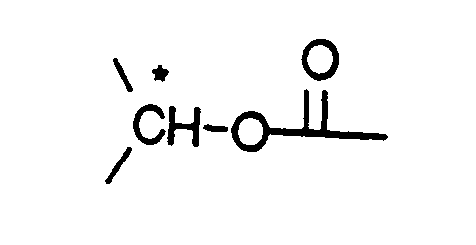
- Y is -(CH2)m-, =CH- or -NH-, preferably -(CH2)m-and
- m is 1 or 2, preferably 2
- A is either a group of formula
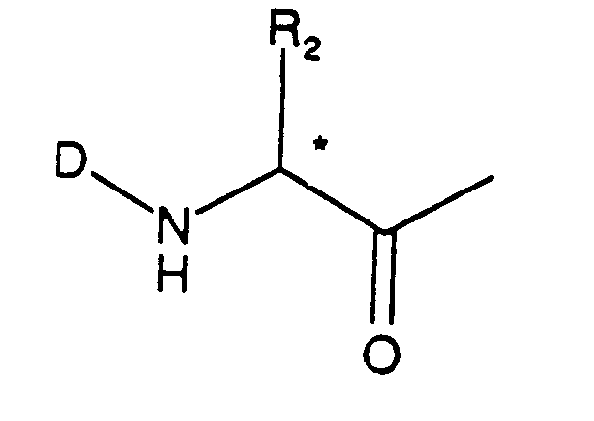
- D is hydrogen, a protecting group Z or an a-amino acid which is bonded via its carbonyl group,
- R2 is a group of formula
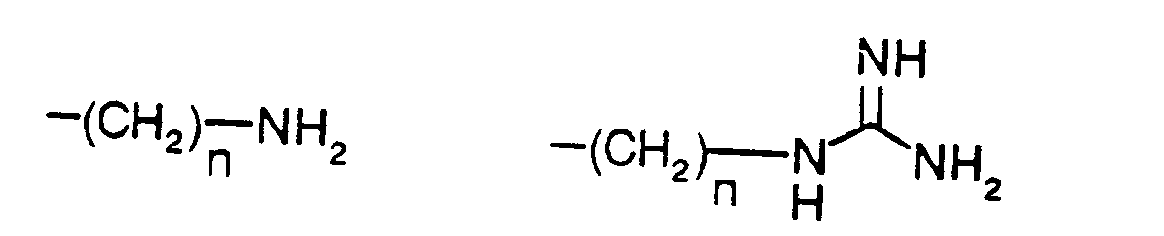
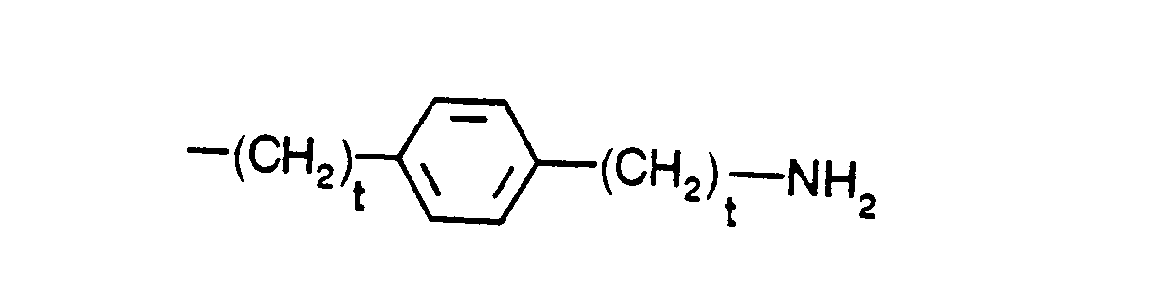


- n is 3 or 4 and
- t is 0 or 1 or
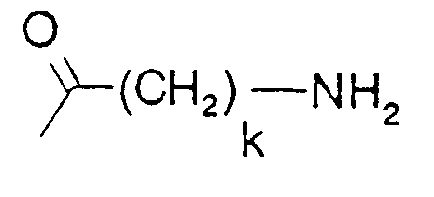
- A is a group of formula
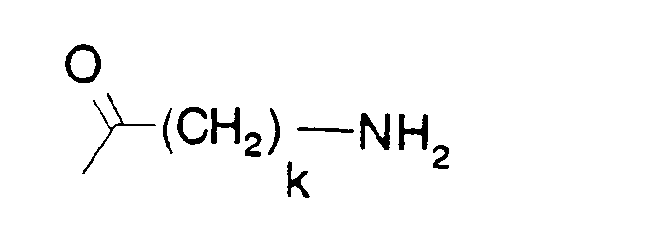


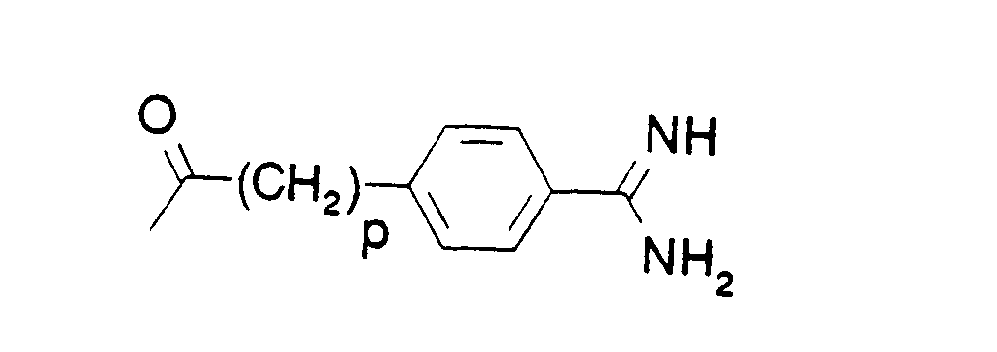
- k is 3, 4, 5 or 6,
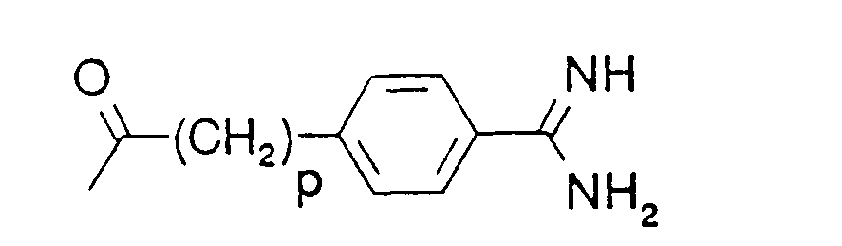
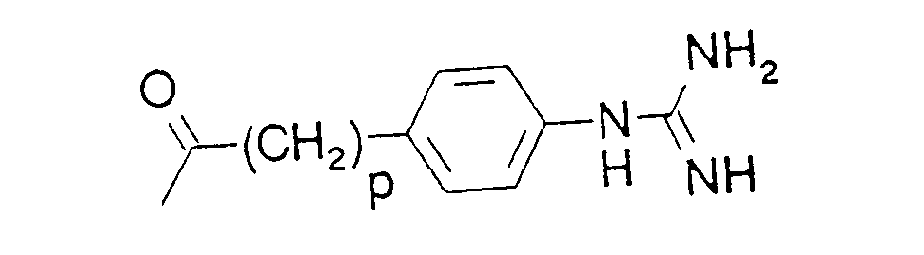
- o is 3, 4 or 5, and
- p is 0, 1 or 2, preferably 1
- B is either a group of formula
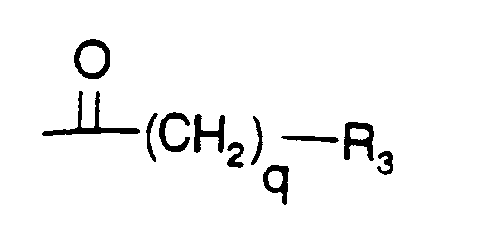
- q is 1 or 2, preferbly 1 and
- R3 is (C1-C4)alkyl, (CH3)2CH-, tert.-butyl, 1-adamantyl, trimethylsilyl, 1-naphthyl, phenyl, 3-indolyl or (C1-C4)-alkoxyphenyl, preferably (CH3)2CH, (C,-C4)-alkoxyphenyl (e.g. p methoxyphenyl), or 1-adamantyl, epecially (CH3)2CH, or
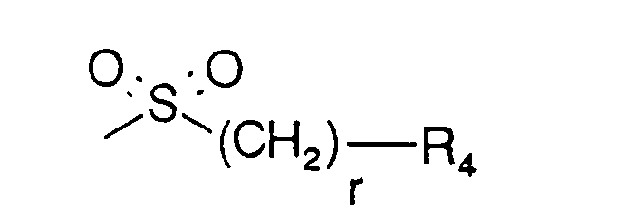
- B is a group of formula
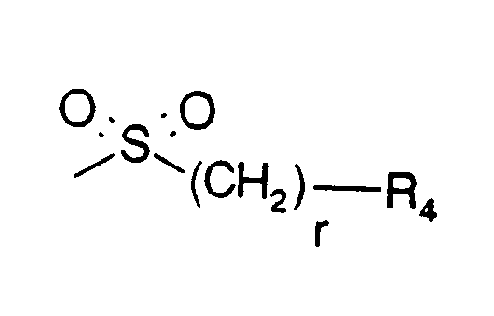
- r is 0, 1 or 2, preferably 0 and
- R4 is (C1-C4)alkyl, 2-propyl, tert.-butyl, phenyl, p-(C1-C4)alkoxyphenyl, 1-naphthyl, tolyl, mesyl ortrisyl, preferably mesyl or
- B is a group of formula

- D is hydrogen or a protecting group Z and
- R5 is phenyl-(CH2)t-,
- indol-3-yl-(CH2)t-, naphth-1-yl-(CH2)t-,
- adamant-1-yl-(CH2)t-,
- prop-2-yl-(CH2)t-,
- trimethylsilyl-(CH2)t- or
- tert.-butyl-(CH2)t-, wherein t is defined as above,
- Each asymmetrical c-atom indicated by an asterisk (*) in the formulae may be of either R or S configuration.
- In the formulae, (C1-C4)alkyl is preferably methyl, and (C1-C4)alkoxy is preferably methoxy. The protecting group Z is preferably a benzyloxycarbonyl or tert.-butyloxycarbonyl group. Where D and/or B denote an a-amino acid, this may be a naturally occurring a-amino acid, or an unnatural a-amino acid.
- In the present description unless otherwise indicated terms such as "compounds of formula I" embrace the compounds in salt form as well as in free form.
- Preferred compounds are those of formula I'

- R1 and m are defined as above, s is 0 and 1, R6 = H, OH or O(C1-C4)alkyl, or
- R1 and R6 together form a -O-CO- group
- B' is either a group of formula

- wherein R3 and q are defined as above,
- or B' is a group of formula
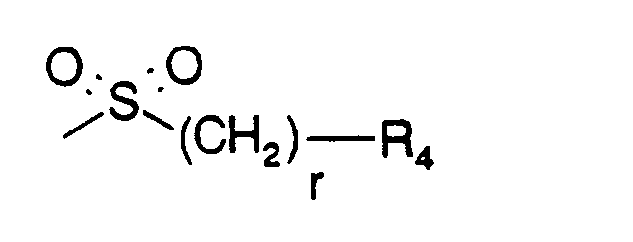
- wherein R4 and r are defined as above,
- or B' is a group of formula
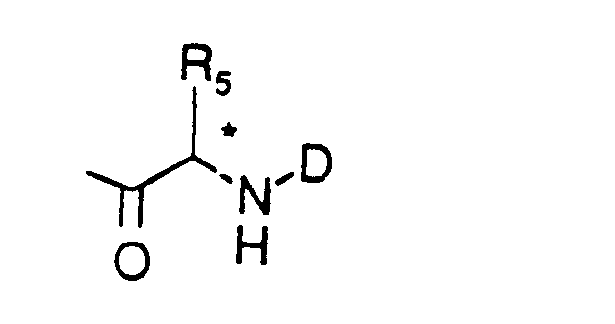
- wherein R5 and D are defined as above.
- Especially preferred compounds are those having formula I"

- wherein R1, R6, m and s are defined as above, or
- R1 and R6 together form a -O-CO- group
- and B" is a group of formula

- wherein q and R3 are defined as above.
- The most preferred compounds of formula I are those of the following formulae II, III, IV, V, VI, VII:


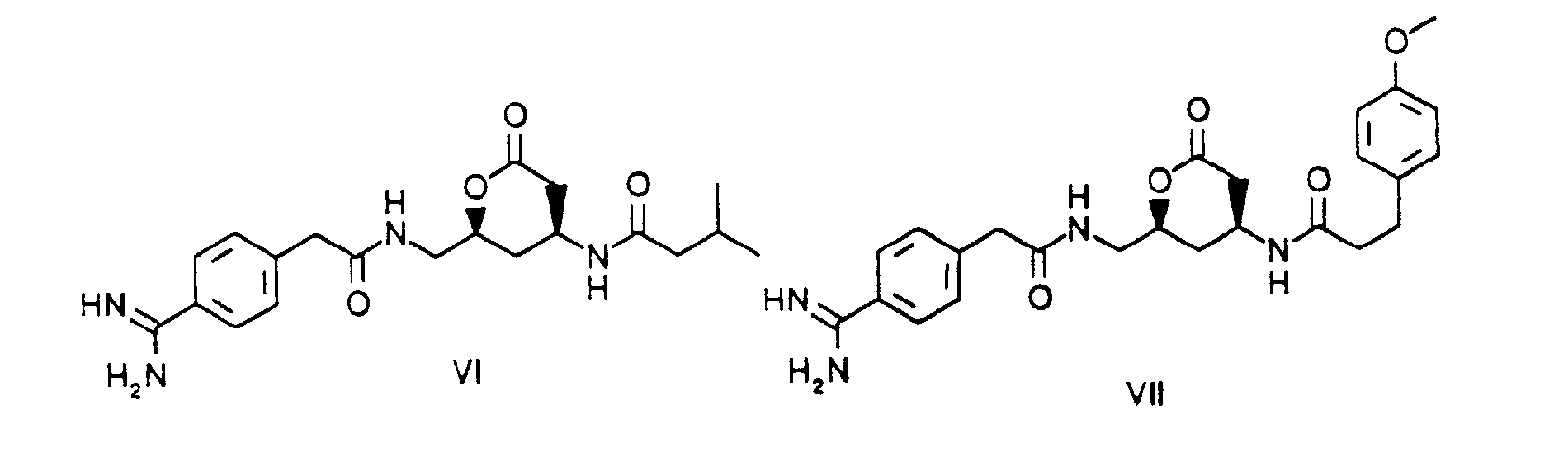
- These are the compounds of examples 2, 3, 6, 9, 8 and 7 respectively. The compounds of formula I of the type which includes the compounds of formulae II to V above may be synthesized using procedures analogous to the following synthesis scheme 1.
-
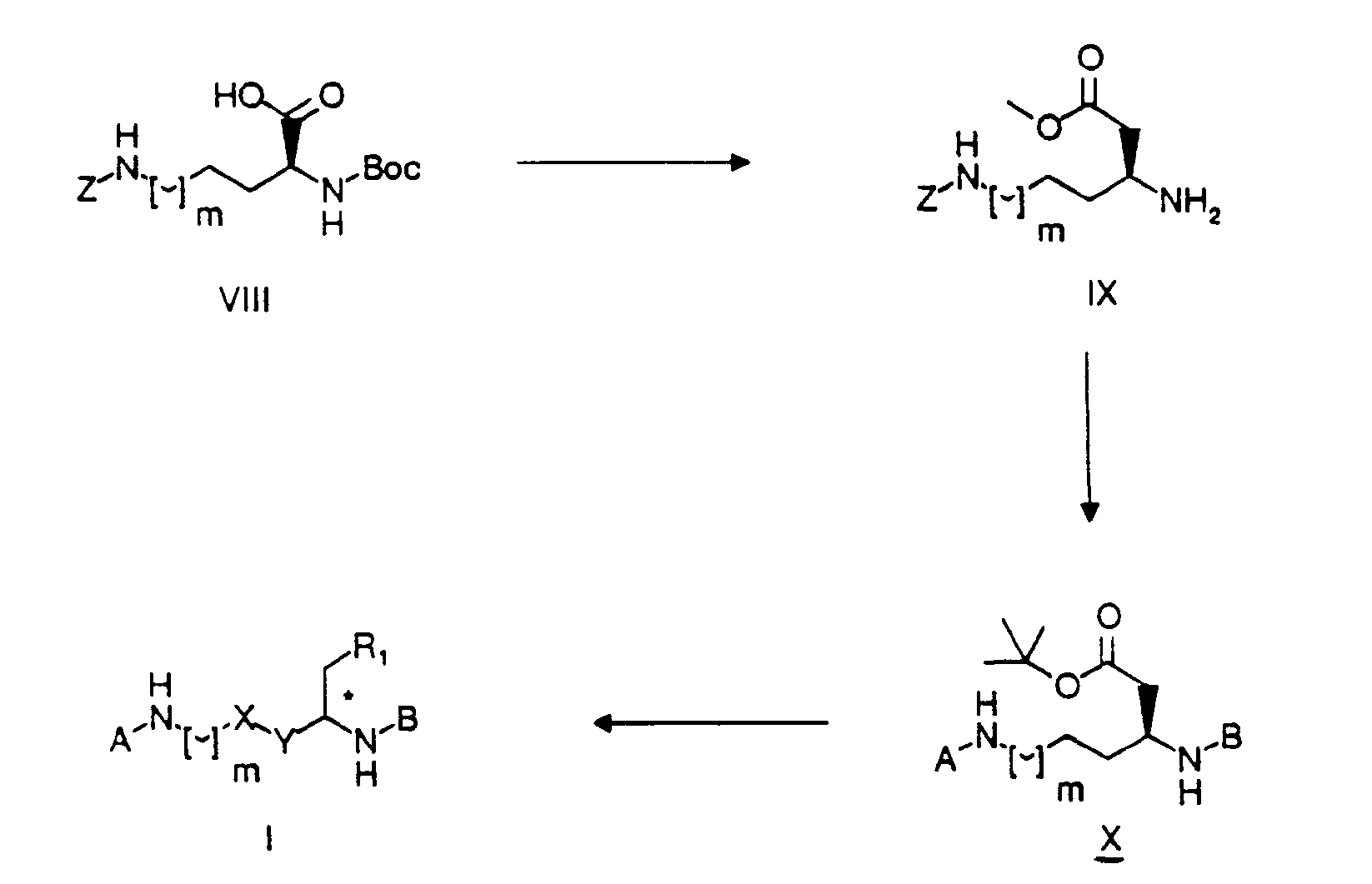
- In the above formulae, [v]m- is the group [CH2]m, and m, A, B, X, Y and R1 are as defined above.
- In accordance with synthesis scheme 1, compounds of formula I with X = Y = CH2, R1 = COOH and m = 1 or 2, are produced from compound X by treatment with trifluoroacetic acid at room temperature. Compound X is obtained from the Z protected ester IX, by coupling the amino group with iso-valeric acid or p-methoxyphenylpropanoic acid (depending on radical B) whilst adding DCC and HOBT, then hydrolyzing the methylester with LiOH, converting the acid into the tert.-butylester by means of tert.-butyl-2,2,2-trichloroacetimidate, removing the protecting group Z under reducing conditions with H2/Pd-C, followed by coupling with an appropriate radical A [e.g. Asignifies (p-amidinophenyl)-(CH2)s-COOH wherein s is as defined above] again adding DCC and HOBT. The methylester IX is obtained from the Z = Boc protected amino acid VIII by chain lengthening of the carboxylic acid using the diazomethane/Ag20 method (Helv. Chim. Act. 58, 969 (1975)) and removing the Boc group with trifluoroacetic acid at room temperature.
- Furthermore, compounds of formula I of the type which includes the compounds of formulae VI and VII above may be produced using procedures analogous to the following synthesis scheme 2.
-
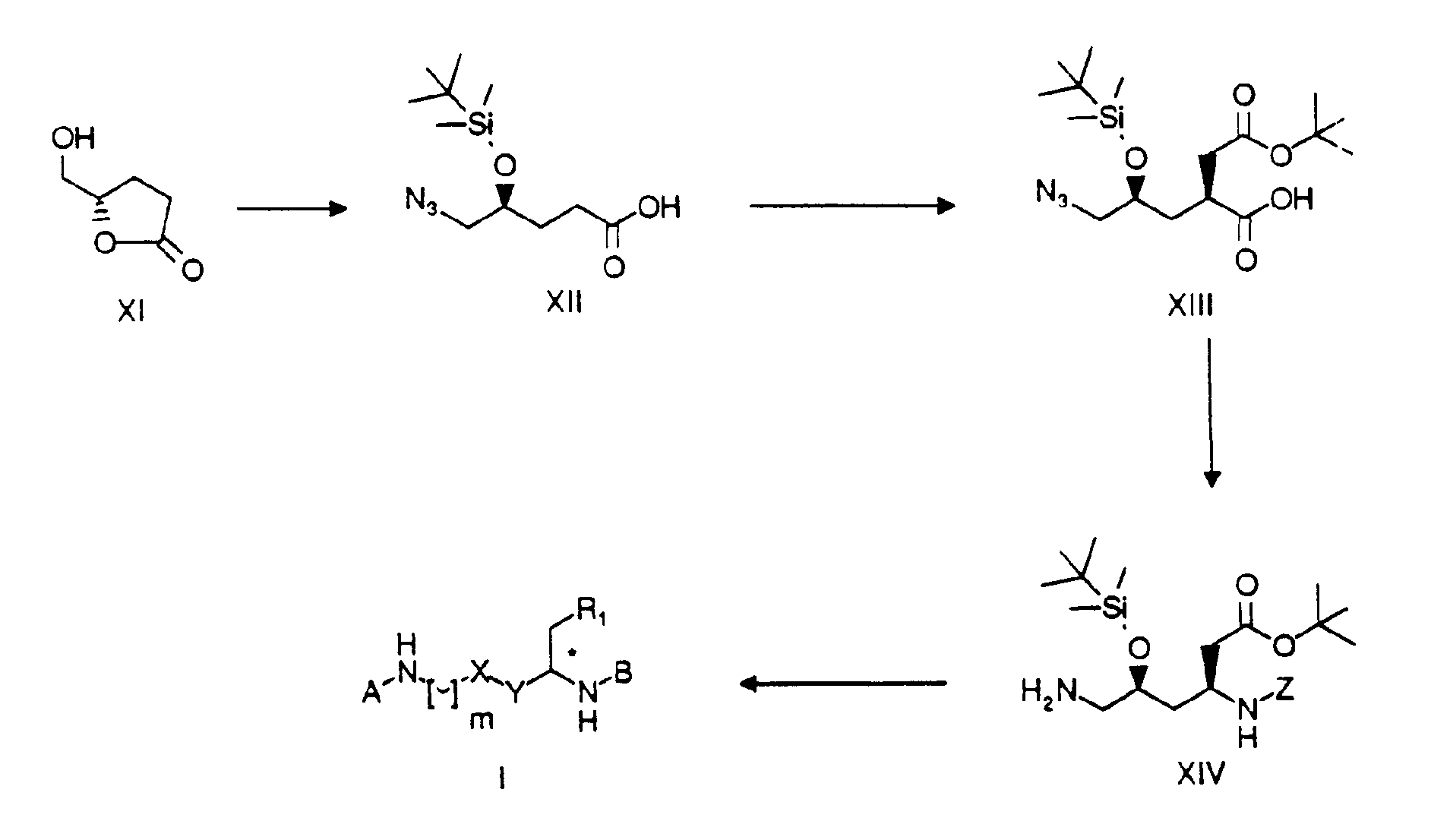
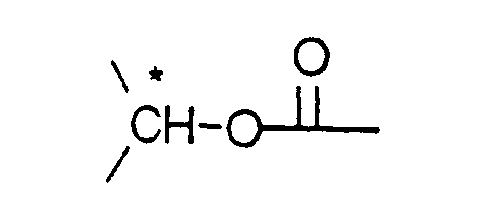
- In accordance with synthesis scheme 2, compounds of formula I, wherein m is 1, X and R1 together form a HC*-O-CO- group and Y is a CH2- group, may be produced from compound XIV by coupling with an appropriate radical A (analogously to synthesis scheme 1), removing the protecting group under reducing conditions with H2/Pd-C, followed by coupling with an appropriate radical B (analogously to synthesis scheme 1) and subsequently removing the protecting groups with trifluoroacetic acid at room temperature. Compound XIV is obtained from compound XIII by converting the carboxylic acid into a Z-protected amine with diphenylphosphoryl- azide and triethylamine in the presence of benzyl alcohol, and reducing the azido group with triphenylphosphine in tetrahydrofuran. The carboxylic acid XIII is obtained from compound XII by means of enantio-selective introduction of the acid side chain in 3 stages: a) coupling with the Evans oxazolidinone to introduce a chiral auxiliary group (J. Am. Chem. Soc. 1990, 112, 4011); b) formation of the amide-enolate with Li-hexamethyl- disilazide and reaction with bromoacetic acid tert.-butylester; c) removal of the chiral auxiliary group with Li- perhydroxide. The azido-carboxylic acid XII is obtained from the lactone XI, by mesylation of the alcohol with methanesulphonyl chloride, azidation with sodium azide, opening the lactone with caustic soda solution in ethanol and reacting with tert.-butyldimethylsilyl chloride in the presence of imidazole to introduce the alcohol protecting group.
- The compounds of formula I inhibit the binding of fibrinogen to the fibrinogen receptor blood platelets (glycoprotein GP IIb/IIIa). As a result of this property, the compounds prevent the aggregation of human blood platelets and the formation of clots, and may accordingly be used to prevent and treat thrombosis, apoplexy, cardiac infarction, inflammation, arterial sclerosis and tumours. Further therapeutic fields of use are: osteoporosis, acute reocclusion following PTCAand addition during thrombolysis. The abbreviations used in the description and in the following examples have the following significances.
- Z = benzoyloxycarbonyl
- BOC = tert.-butyloxycarbonyl
- DCC = dicyclohexylcarbodiimide
- HOBT = hydroxybenzotriazole
- DMF = dimethylformamide
- THF = tetrahydrofuran
- TFA = trifluoroacetic acid
- EtOAc = ethyl acetate
- RP = reversed phase
- Pd/C (10%) = palladium-charcoal catalyst containing 10% palladium
- LiOH = lithium hydroxide
- PTCA = percutanions luminal coronary angioplasty
- TBDMS = tert.-butyl-dimethylsilyl-chlorosilane
- MeOH = methanol
- LiHMDS = lithium hexamethyl disilazide
- DPPA = diphenylphosphoryl azide
- EtOH = ethanol
- NMM = N-methylmorpholin
- 0.69 ml of chloroformic acid isobutyl ester are added in dropwise to a solution of 1.95 g of Boc-Orn(Z)-OH and 0.74 ml of NEt3 in 12 ml of THF at -15°C. After 30 minutes at-15°C, the precipitated hydrochloride is filtered off and the filtrate is mixed at-15°C with 40 ml (8 mmol) of an ethereal solution of diazomethane. The reaction mixture is stirred for 4 hours at 0°C, and left to stand for a further 16 hours at 4°C. Water is added, and the solution is extracted with ether. The ether phase is washed with saturated aqueous bicarbonate solution, dried over sodium sulphate and concentrated by evaporation. The residue obtained is taken up in 15 ml of methanol, mixed with 246 mg of silver(l) oxide and heated under reflux for 12 hours. The solid material is removed by filtration, the methanol evaporated off and the residue chromatographed on silica gel (ethyl acetate/hexane 1:1). The product thus isolated is (S)-3-N-Boc-amino-6-N-Z-aminohexanoic acid methylester. MS: 395 (M+H)+.
- The product obtained is mixed at 0°C with 10 ml of methylene chloride and 10 ml of trifluoroacetic acid, stirred for 1 hour at room temperature, the solvent is removed by vacuum distillation, and the residue is dried for 24 hours in a high vacuum. The (S)-3-amino-6-[N-(benzyloxycarbonyl)amino]-hexanoic acid methylester trifluoroacetate product is obtained as a colourless solid.
- 1.3 g of the trifluoroacetate from stage A is dissolved in 5 ml of DMF together with 0.75 ml of triethylamine, and then 468 mg of tosyl chloride is added. After 2 hours, water is added and extraction with ether carried out. The ether phase is washed with water, dried over sodium sulphate, the ether is evaporated off and the residue chromatographed on silica gel (ethyl acetate/hexane 1:1). The thus isolated product is (S)-3-N-tosylamino-6-N-Z-aminohexanoic acid methylester; MS: 449 (M+H)+.
- The product obtained according to stage B) is dissolved in 20 ml of methanol and hydrogenated in the presence of 0.3 g of Pd/C (10%) and 1.34 ml of 1N hydrochloric acid. When the reaction has ended, the catalyst is removed by filtration, the methanol is evaporated off and the residue is dried under high vacuum. 500 mg of (S)-3-(N-tosylamino)-6-aminohexanoic acid methylester hydrochloride is obtained as a colourless foam. 0.5 g of the hydrochloride, 373 mg of N-Boc-p-amidinophenylacetic acid (produced by the Bocylation of p-amidinophenylacetic acid (Pharmazie 29, 256-262)), 0.19 ml of triethylamine and 199 mg of HOBT are dissolved in 10 ml of DMF and mixed with 276 mg of DCC. After 16 hours at room temperature, the precipitated solid is removed by filtration, the DMF is evaporated off and the residue is taken up in ethyl acetate. The ethyl acetate phase is washed with water, dried over sodium sulphate, concentrated by evaporation, and the residue chromatographed on silica gel (ethyl acetate). The product obtained is mixed with a solution of 0.2 ml of anisole in 5 ml of TFA, stirred for 2 hours at room temperature and added dropwise to 300 ml of ether. The precipitated solid is filtered off, dissolved in a mixture of 2 ml of methanol and 1 ml of water, and mixed with 57 mg of LiOH-H20. After 5 hours at room temperature, the methanol is evaporated off and the aqueous solution is neutralized with 0.13 ml of TFA. The precipitated solid is filtered off, dried and recrystallized from methanol/ether. The (S)-3-(N-tosylamino)-6-[N-(p-amidinophenylacetyl)amino] hexanioc acid trifluoroacetate product is obtained as a white solid, MS: 461 (M+H)+. The free compound is obtained from the trifluoroacetate in known manner.
- 1.3 g of the trifluoroacetate from stage A of example 1, 250 mg of isovaleric acid, 0.34 ml of triethylamine and 363 mg of HOBT are dissolved in 5 ml of DMF and mixed with 505 mg of DCC. After 16 hours, the precipitated deposit is removed by filtration, the DMF is evaporated off and the residue is dissolved in ethyl acetate. The ethyl acetate phase is washed with saturated aqueous bicarbonate solution and water, dried over sodium sulphate, and the solvent is removed under vacuum. The residue is purified by recrystallization from ethyl acetate/ether, and the (S)-3-[N-3-methylbutyryl)amino]-6-N-Z-aminohexanoic acid methylester product is obtained as colourless crystals. MS: 379 (M+H)+.
- 560 mg of the product of stage A) of example 2 is dissolved in 20 ml of methanol and hydrogenated in the presence of 0.3 g of Pd/C (10%) and 1.41 ml of 1 N hydrochloric acid. After working up as described in stage C) of example 1, (S)-3-[N-(3-methylbutyryl)amino]-6-aminohexanoic acid methylester hydrochloride is obtained in the form of a colourless oil. 400 mg of the hydrochloride and 392 mg of N-Boc-p-amidinophenylacetic acid, together with 0.2 ml of triethylamine, 259 mg of HOBT and 290 mg of DCC, are reacted and worked up as described in stage C) of example 1. After cleavage of the Boc group with TFA and hydrolysis of the methylester with LiOH-H20 analogously to stage C) of example 1, the crude product obtained is recrystallized from methanol. The (S)-3-[N-(3-methylbutyryl)amino]-6-[N-(p-amidinophenylacetyl)amino]hexanoic acid trifluoroacetate product is isolated as a white powder; MS: 391 (M+H)+. The free compound is obtained from the trifluoroacetate in known manner.
- 0.7 g of the trifluoroacetate from stage A) of example 1 and 256 mg of 3-(p-methoxy)propionic acid, together with 0.21 ml of triethylamine, 256 mg of HOBT and 313 mg of DCC, are reacted and worked up as described in stage A) of example 2. The crude product is recrystallized from ether. The (S)-3-N-[3-(p-methoxyphenyl)propionyl]amino-6-N- Z-amino-hexanoic acid methylester product is obtained in the form of white crystals; MS: 457 (M+H)+.
- 440 mg of the methylester from stage B) of example 3 is hydrogenated analogously to stage C) of example 1, and the hydrochloride obtained is reacted and worked up with 164 mg of N-Boc-p-amidinophenylacetic acid, 0.13 ml of triethylamine, 164 mg of HOBT and 200 mg of DCC, as described in stage C) of example 1. The product is deprotected with TFA and LiOH-H20 analogously to stage C) of example 1, and the crude product is recrystallized from methanol/water. The (S)-3-N-[3-(p-methoxyphenyl)propionyl]amino-6-[N-(p-amidino-phenylacetyl)-amino]hexanoic acid trifluoroacetate product is obtained as a white powder. MS: 583 (M+H)+. The free compound is produced from the trifluoroacetate in known manner.
- 0.7 g of the trifluoroacetate from stage A) of example 1 is reacted and worked up with 246 mg of adamant-1-ylacetic acid, 0.21 ml of triethylamine, 246 mg of HOBT and 331 mg of DCC, as described in stage Aof example 2. The crude product is chromatographed on silica gel (ethyl acetate), and the (S)-3-[N-(adamant-1-ylacetyl)amino]-6-N-Z-aminohexanoic acid methylester product is isolated as a colourless oil; MS: 471 (M+H)+.
- 460 mg of the methylester from stage A) of example 4 is dissolved in 4 ml of MeOH and 2 ml of water, and mixed with 84 mg of LiOH-H20. After 4 hours at room temperature, the mixture is neutralized with IN hydrochloric acid and extracted with ethyl acetate. The ethyl acetate phase is dried over sodium sulphate, and the solvent removed under vacuum. 400 mg of crude product are obtained, which is dissolved in 2 ml of THF and mixed with a solution of 479 mg of tert.-butyl-2,2,2-trichloroacetimidate in 2.5 ml of cyclo-hexane. After adding 0.069 ml of boron trifluoroetherate, the mixture is stirred for 3 hours at room temperature. The reaction mixture is mixed with 5% aqueous bicarbonate solution, extracted with ethyl acetate, the ethyl acetate phase is washed with saturated aqueous sodium chloride solution, dried over sodium sulphate and the solvent concentrated by evaporation. The residue is taken up in methylene chloride/hexane 1/1, the insoluble trichloroacetamide filtered off and the solvent evaporated off. The crude oil obtained is chromatographed on silica gel (ethyl acetate/hexane 1/1), to give the (S)-3-[N-(adamant-1-ylacetyl)amino]-6-N-Z-aminohexanoic acid tert.butylester product as a colourless oil. MS: 513 (M+H)+.
- 225 mg of the tert.-butylester from stage B) of example 4 is dissolved in 20 ml of ethanol, and hydrogenated in the presence of 0.1 g of Pd/C (10%) and 0.028 ml of acetic acid, as described in stage C) of example 1. The crude product obtained is dissolved in 5 ml of DMF, and reacted with 119 mg of N-Boc-p-amidinophenylacetic acid, 0.061 ml of triethylamine, 73 mg of HOBT and 90 mg of DCC, analogously to stage C) of example 1. The crude product obtained after the work up is chromatographed on silica gel (ethyl acetate) and the pure product is mixed with a solution of 5 ml of TFA in 0.2 ml of anisole.
- After 3 hours at room temperature, the reaction mixture is added dropwise to 300 ml of ether, and the precipitated solid is filtered off. After drying in a high vacuum, the (S)-3-[N-(adamant-1-ylacetyl)amino]-6-[N-(p-amidinophenylacetyl)-amino]hexanoic acid trifluoroacetate product is obtained as a white powder; MS: 505 (M+H)+.
- The free compound is produced from the trifluoroacetate in known manner.
- (S)-3-[N-(3-adamant-1-ylpropionyl)amino]-6-N-Z-amino-hexanoic acid methylester is obtained by reacting 0.85 g of the trifluoroacetate of stage A) of example 1, with 423 mg of 3-adamant-ylpropionic acid, 0.28 ml of triethylamine, 337 mg of HOBT and 418 mg of DCC, followed by purification by chromatography (silica gel, ethyl acetate), analogously to stage A) of example 2; MS: 485 (M+H)+.
- The 500 mg of methylesterfrom stage A) of example 5 is hydrolyzed as described in stage B of example 4 with 173 mg of LiOH-H20, and reacted with 575 mg of tert.-butyl-2,2,2-trichloroacetimidate and 0.06 ml of boron trifluoroetherate. After working up as described in stage B of example 1, the (S)-3-[N-(3-adamant-1-ylpropionyl)amino]-6-N-Z-aminohexanoic acid tert.-butylester product is isolated; MS: 527 (M+H)+.
- 510 mg of the product from stage B) of example 5 is hydrogenated analogously to stage C) of example 4, coupled with 430 mg of N-Boc-p-amidinophenylacetic acid, and after purification by chromatography (silica gel/ethyl acetate) the product obtained is deprotected with 5 ml of TFA/anisole (95/5). Following precipitation from ether, (S)-3-[N-(3-adamant-1-ylpropionyl)amino]-6-[N-(p-amidinophenylacetyl)-amino]hexanoic acid trifluoroacetate is obtained as a white powder, analogously to stage C) of example 5; MS 497 (M+H)+. The free compound is produced from the trifluoroacetate in known manner.
- 4.04 g of Boc-Lys(Z)-OH, 1.38 ml of chloroformic acid isobutylester, 1.44 ml of triethylamine and 80 ml (16 mmol) of ethereal diazomethane solution are reacted together, then further reacted with 490 mg of silver(l) oxide and worked up, analogously to stage A) of example 1, then the crude product is purified by chromatography (silica gel, ethyl acetate/hexane 1/1) to produce (S)-3-N-Boc-amino-6-N-Z-aminoheptanoic acid methylester. MS: 409 (M+H)+. The methylester is dissolved in 15 ml of methylene chloride and mixed with 15 ml of TFA. After 1 hour, the TFAand the solvent are removed under vacuum and the residue is dried under high vacuum, to yield the (S)-3-amino-6-N-Z-aminoheptanoic acid methylester trifluoroacetate product.
- 4.1 g of the trifluoroacetate from stage A) of example 6 is reacted with 1.0 g of isovaleric acid, 1.36 ml of triethylamine, 1.65 g of HOBT and 2.02 g of DCC as described in stage A) of example 2, and worked up analogously. The crude product obtained is recrystallized from ether, to yield the (S)-3-[N-(3-methylbutyryl)amino]-7-N-Z-aminoheptanoic acid methylester product; MS: 393 (M+H)+.
- As described in stage B) of example 4, 3.25 g of methylesterfrom stage B) of example 6 are saponified with 1.36 g of LiOH-H20 and reacted with 4.04 g of tert.-butyl-2,2,2-trichloroacetimidate and 0.42 ml of boron trifluoroetherate, to yield the (S)-3-[N-(3-methylbutyryl)amino]-7-N-Z-aminoheptanoic acid tert.- butylester product; MS: 435 (M+H)+.
- After hydrogenation of 2.2 g of the product from stage C) of example 6 analogously to stage C) of example 4, the product is further reacted with 1.34 g of N-Boc-p-amidinobenzoic acid (preparation analogously to N-Boc-p-amidinophenylacetic acid), 0.7 ml of triethylamine, 0.852 g of HOBT and 1.04 g of DCC, as in stage C) of example 4, and subsequently deprotected with 25 ml of TFA/anisole (95/5), and worked up, to produce the (S)-3-[N-(3-methylbutyryl)amino]-7-[N-(p-amidinobenzoyl)amino]heptanoic acid trifluoroacetate product in the form of a white powder; MS: 391 (M+H)+.
- The free compound is produced from the trifluoroacetate in known manner.
- (4S)-4,5-dihydroxy-valeric acid-y-lactone (16.3 g, 140 mmol) and triethylamine (21.52 ml, 154 mmol) are dissolved in methylene chloride and the solution cooled to -30°C. Methanesulphonyl chloride (12.0 ml, 154 mmol) is then added dropwise whilst stirring. The solution is then stirred for 15 minutes at -30°C and heated to 18°C over the course of 1½ hours. The suspension obtained is added to 0.5 N HCI and extracted several times with ether. The combined organic phases are washed with saturated aqueous NaH-C03 solution and saturated aqueous NaCl solution. After drying over Na2S04 and concentrating on a rotary evaporator, the (4S)-4-hydroxy-5-0-mesyl-valeric acid-y-lactone product is obtained as an oil, which is used immediately in the next reaction step.
- The mesylate from stage A) of example 7 (25.0 g, 128.7 mmol) is dissolved in DMSO, the solution mixed at room temperature with sodium azide (16.74 g, 257.4 mmol), and stirred for 1½ hours at 100°C. The brown suspension is cooled and the DMSO is distilled off under vacuum. The residue is taken up in EtOAc, filtered over Hyflo and concentrated under vacuum. Vacuum distillation (0.16 mbar) yields the title compound as a colourless oil,
- αD = + 79.9° (c = 2.2 in CHCl3).
- (4S)-4-hydroxy-5-azido-valeric acid-y-lactone (12.28 g, 87.01 mmol) from stage B) of example 7 is dissolved in 435 ml of ethanol, and then 43.5 ml of 2 N aqueous NaOH are added whilst stirring at room temperature. Afterstanding for 1/2 hour at room temperature, the solution is concentrated on a rotary evaporator and dried in a high vacuum. The residue obtained (16.94 g) is mixed with 174 ml of DMF, imidazole (29.63 g, 435.05 mmol) and TBDMS-CI (48.3 g, 313.24 mmol), and stirred for 19 hours at room temperature. The suspension obtained is added to ice/1 N aqueous NaHS04 solution, and extracted several times with ether. The combined organic phases are dried over Na2S04 and concentrated in a vacuum. The residue is dissolved in 435 ml of methanol, and mixed with 18.44 g of Na2CO3 (in 87.0 ml H20) whilst stirring at room temperature, then agitated for 1/2 hour at room temperature. The suspension obtained is mixed with 435 ml of H20 and extracted twice with hexane. The combined hexane phases are washed with methanol/H20 (1:1), and the combined aqueous phases are acidified with NaHS04. After extraction with hexane and washing with saturated aqueous NaCl solution, the organic phase is dried over Na2S04 and concentrated on a rotary evaporator. After thin-layer chromatography and 'H-NMR, the crude (4S)-5-azido-4-[((1,1-dimethylethyl)-dimethylsilyl)oxy]-pentanoic acid product obtained is practically pure and is further employed without further purification.
- MS: 274 (M+H)+.
- The optically active pentanoic acid derivative from stage C) of example 7 (19.79 g, 72.37 mmols) is dissolved in 405 ml of dry THF, cooled to -78°C, mixed with 13.5 ml of triethylamine (97 mmol) and then with 10.4 ml (84.7 mmol) of pivaloyl chloride. After 5 minutes at -78°C, the mixture is warmed over the course of 1 hour to 0°C, and cooled again to -78°C. In a second reaction container, (4R)-4-phenylmethyl-2-oxazolidonone (15.65 g, 88.3 mmol) is dissolved in 405 ml of anhydrous THF, cooled to -78°C, mixed with n-butyllithium (56.1 ml of 1.6 M solution), and agitated for 0.25 hours at -78°C. The azaenolate thus produced is mixed at -78°C using a pressure needle with the mixed acid anhydride which is previously prepared in situ. The cooling bath is removed and stirring is effected for 1 hour. The reaction mixture is added to ice/NaHS04 solution, extracted with EtOAc, the organic phases are washed with saturated aqueous NaHC03 solution and saturated aqueous NaCl solution, and subsequently dried over Na2S04 and concentrated in a vacuum. The crude material obtained is chromatographed over silica gel (hexane/EtOAc, 3:1). The title compound obtained is obtained as a white solid; MS: 433 (M+H)+.
- The optically pure imide from stage D) of example 7 (19.05 g, 44 mmol) is dissolved in 44 mmol of THF, and added to a solution, cooled to -78°C, of LiHMDS (48.4 ml of 1.0 M solution) in 66 ml of THF. After ½ hour at -78°C, bromoacetic acid-tert.-butylester (9.7 ml, 66 mmol) is added dropwise over the course of 20 minutes to the enolate which is cooled to -78°C. After standing for 1 hour at -78°C, the mixture is heated to 0°C and then saturated aqueous NH4CI solution is added to the reaction mixture. After extraction with ether, the combined organic phases are washed with saturated aqueous NaHC03 solution and saturated aqueous NaCl solution, dried over Na2S04 and concentrated in a vacuum. According to'H-NMR, the product exists as a diastereoisomeric mixture (90:10) of (3(2S,4S),4R):(3(2R,4S)4R). After chromatography over silica gel (hexane/EtOAc, 6:1), the title compound is obtained in pure diastereoisomeric form as a colourless oil; MS: 521 (M-N2+3H)+
- The title compound from stage E) of example 7 (21.5 g, 39.4 mmol) is dissolved in 500 ml of THF, mixed in succession with 180 ml of H20, 16.7 ml of H202 (30% solution) and LiOH (3.3 g, 78.8 mmol), and agitated for 1½ hours at 0°C. Then, Na2SO3 (17.1 g, 136 mmol) in 120 ml of H20 is added, and stirring is effected for 5 minutes at 0°C. The reaction mixture is acidified with 1 N aqueous NaHS04 solution, and extracted several times with ether. The combined organic phases are washed with saturated aqueous NaCl solution, dried over Na2S04 and concentrated under vacuum. The crude product obtained is taken up in hexane. The resulting (4R)-4-phenylmethyl-2-oxazolidinone is filtered off and the hexanoic acid tert.-butylester derivative is obtained in pure form by concentrating the filtrate and drying it under high vacuum. MS: 410 (M+H)+ from the Na salt.
- The title compound from stage F) of example 7 (1.55 g, 4.0 mmol) is dissolved in 20 ml of anhydrous toluene, and mixed in succession with DPPA(956 µl (95%),4.2 mmol) and triethylamine (613 µl, 4.4 mmol), and stirred under reflux for 1/2 hour. After cooling to ca. 40°C, benzyl alcohol (4.14 ml, 40 mmol) is added and the mixture stirred under reflux for a further 60 minutes. The reaction solution is cooled to room temperature, mixed with additional toluene, washed with saturated aqueous NaHC03 solution, 10% tartaric acid solution and saturated aqueous NaCl solution, dried over Na2S04 and concentrated under vacuum. The crude product is chromatographed on silica gel (hexane/EtOAc, 6:1), and the title compound is obtained in pure form; MS: 493 (M+H)+.
- The title compound from stage G) of example 7 (1.18 g, 2.4 mmol) is dissolved in THF (12.0 ml) and is reacted with triphenylphosphine (0.66 g, 2.52 mmol) analogously to a procedure described in the literature (Tetrahedron Lett. 24, 763 (1983) initially at room temperature (17 hours) and then under reflux. After refluxing for 1 hour, 3.6 mol equivalents of H20 are added, and the mixture is stirred for a further 4 hours under reflux. The reaction solution is cooled, concentrated under vacuum, the residue taken up in hexane and the insoluble triphenylphosphine oxide filtered off. The filtrate is concentrated under vacuum, and the resultant amine is isolated as an oil, which is further reacted immediately. The amine is dissolved in 8 ml of DMF, togetherwith 4-(tert.-butyloxycarbonyl)amidino-phenylacetic acid (733 mg, 2.64 mmol) and HOBT (4.89 mg, 3.19 mmol), and is reacted at room temperature with DCC (494 mg, 2.4 mmol). After 16 hours at room temperature, the suspension obtained is cooled to 0°C and the precipitated dicyclohexylurea is filtered off. The filtrate is diluted with EtOAc and washed with saturated aqueous NaHC03 solution and saturated aqueous NaCl solution. After drying over Na2S04, the product is concentrated under vacuum. The crude material obtained is chromatographed oversilica gel (hexane/EtOAc, 30:70). The title compound is obtained as a white solid; MS: 727 (M+H)+.
- The coupling product from stage H) of example 7 (1.23 g, 1.69 mmol) is dissolved in 8.5 ml of ethanol and hydrogenated over 10% Pd/C. After 2 hours at room temperature, the catalyst is removed by filtration, and the filtrate is concentrated under vacuum. The free amine obtained is dissolved in 5.6 ml of DMF, to- get her with 4-methoxyphenylpropionic acid (335 mg, 1.86 mmol) and HOBT (345 mg, 2.25 mmol), and then mixed with DCC (349 mg, 1.69 mmol). After standing at room temperature for 63 hours, the suspension is cooled to 0°C, and worked up analogously to the process described in stage H) of example 7.
- The crude product obtained is chromatographed over silica gel (hexane/EtOAc). The title compound is isolated as a white foam; MS: 755 (M+H)+.
- The coupling product from stage 1) of example 7 (639 mg, 0.846 mmol) is mixed with 0.21 ml of ethanedithiol, 0.21 ml of anisole and 4.23 ml of TFA/H20 (95:5) at 0°C. After 3 hours at room temperature, the mixture is cooled again to 0°C, ether is added, and the precipitated solid is filtered off. The solid obtained is washed with ether and subsequently recrystallized. The trifluoroacetate of the title compound is obtained as a white crystalline substance. M.p. 216-218°C; [α]D = +13.5° (c = 0.48, MeOH), MS: 467 (M+H)+. The free compound is obtained from the trifluoroacetate in known manner.
- The coupling product from stage H) of example 7 (0.6 g, 0.82 mmol) is dissolved in 5 ml of ethanol and hydrogenated over 10% Pd/C. After 2 hours at room temperature, the catalyst is removed by filtration and the filtrate concentrated under vacuum. The free amine obtained is dissolved in 3 ml of DMF, together with isovaleric acid (110 µl, 0.9 mmol) and HOBT (172.5 mg, 1.13 mmol), and mixed with DCC (175 mg, 0.82 mmol). After 16 hours at room temperature, the reaction mixture is worked up analogously to the process described in stage of example 7. The crude product obtained is chromatographed over silica gel (hexane/EtOAc). The title compound is obtained as a white foam. MS: 677 (M+H)+.
- The product from stage A) of example 8 (320 mg, 0.473 mmol) is treated with TFAanalogously to stage J) of example 7, and the protecting group then removed. Following a precipitation reaction with ether and subsequent recrystallization, the trifluoroacetate of the title compound is obtained as a white crystallizate. M.p.: 236.7-237.7°c; [α]D = + 15.0° (c = 0.5 MeOH); MS: 389 (M+H)+.
- The free compound is obtained from the trifluoroacetate in known manner.
- 1.18 g of the trifluoroacetate obtained according to stage A of example 6 is reacted with 0.43 g of 3-p-methoxyphenylpropionic acid, 0.4 g of HOBT, 0.33 ml of triethylamine and 0.46 g of DCC and worked up, using the process described in stage B of example 6. The crude material obtained is recrystallized from ether, and the title compound is obtained in the form of white crystals; MS: 471 (M+H)+.
- Using the process according to stage B) of example 4, 0.7 g of the methylester obtained in stage A) of example 9 is hydrolyzed with 0.21 g of LiOH/H20, and the product of hydrolyzation is reacted with 0.82 g of tert.-butyl-2,2,2-trichloroacetimidate in the presence of 0.1 ml of boron trifluoroetherate, and worked up analogously. Following chromatography on silica gel (ethyl acetate/hexane 1:1), the title compound is obtained as a colourless oil;
- MS: 513 (M+H)+.
- 0.55 g of the compound obtained according to stage B) of example 9 is hydrogenated using the process described in stage C) of example 4, and the amine thus obtained is reacted with 0.28 g of N-Boc-p-amidinobenzoic acid, 0.18 g of HOBT, 0.15 ml of triethylamine and 0.22 g of DCC, using the process described in stage C) of example 4. The crude product obtained is purified by chromatography (silica gel, ethyl acetate) and deprotected with 5 ml of TFA/anisole (95/5). After precipitating with ether, the trifluoroacetate of the title compound is obtained in the form of a white powder. MS 469 (M+H)+.
- The free compound is produced from the trifluoroacetate in known manner.
- 1.09 g (1.50 mmol) of the title product of step H) of example 7 is mixed with 75.0 mg of Pt02 in 7.50 ml of EtOH and hydrogenation is carried out by first heating under reflux for 3/4 of an hour, after which 75 mg of Pd/C 10% is added and the mixture refluxed for a further 3/4 of an hour. The catalyst is removed by filtration, 150 mg of Pd/C 10% is added to the filtrate which is refluxed for a further 1/2 an hour, after which a further 75 mg of Pd/C is added and refluxing continued for a further 1 hour. The catalyst is again removed by filtration, a further 150 mg of Pd/C 10% is added and refluxing continued for a further 1 1/2 hours. The title product is then recovered by removal of the catalyst by filtration and evaporation to dryness. The crude product (890 mg) is approximately 100% pure, as judged by TLC, and is used for further synthesis without any additional purification.
- 890 mg (1.50 mmol) of the title compound of part A) of example 10 above and 99 µl of NMM (0.6 mol. equiv.) in 7.5 ml of THF is vigorously mixed with 193.5 mg (0.55 mol.equiv.) of 2-(p-methoxyphenyl)ethanesulphonyl chloride, under an atmosphere of nitrogen at room temperature for 21/2 hours. Afurther 193.5 mg of the sulphonyl chloride and 99 µl of NMM are added and the mixture stirred as before at room temperature for 1 hour after which the mixture is left to stand for 18 hours at room temperature. The resultant reaction mixture is taken up as a suspension in EtOAc and extracted once with a 10% aqueous solution of acetic acid, once with aqueous NaHC03 solution and once with aqueous NaCi solution. The combined aqueous phases are further extracted once with EtOAc. The combined organic phases are then dried and evaporated to dryness using a Rotary evaporator. This yields 1.10 g of crude product, corresponding to a yield of about 92.70 %. This crude product is purified on a 102.5 ml chromatographic column (silicagel 25-40 µm; eluent hexane/EtOAc 3:7; flowrate 10 mi/min; 10 ml fractions, Absorbance 0.02/200 mv). Fractions 11 to 20 are pooled and the title product (257 mg) is recovered after evaporation of the solvent. MA+ 791; [MA-BOC]+ 691; [MA-(BOC + C4H8)]+ 635.
- The title product (257 mg) of part B) of Example 10 is mixed with Anisol (100 µl) and ethanedithiol (100µl) in 2 ml of 95% aqueous tifluoroaceticacid and left to stand at room temperature for 1 1/3 hours. The resultant suspension is mixed vigorously whilst cooling in an ice bath with 20 ml of diethylether. The crystallised product is filtered off, washed with diethylether and dried underwater pump vacuum at 40°C. The resultant crude product is dissolved in warm EtOH, the solution cooled and the product recrystallised to give the title product (158 mg) in purified form. The final product is analysed and has the following characterstics:
- F : Ab 160°C
- [α]D RT = +12.80 c = 0.25 in MeOH
- 221 - 896 Hf MA+503
- Lithium (3S,5S)-6-(4-amidinophenylacteylamino)-3-(4-methoxyphenylpropionylamino)-hexanoate.
- 153 mg (264 µmol) of the title compound of Example 7 dissolved in 528 µl of water is converted into the acetate form by anion exchange chromatography, using Bio-Rad ACr 1 -X2100-200 mesh anion exchange resin in acetate form. 2M acetic acid in water/acetonitrile (1:1) is used as eluent, the product containing fractions are evaporated, the residue dissolved in the minimum quantity of ethyl acetate and the product precipitated by addition of diethylether. The amorphous product residue is dissolved in water and mixed with 264 µl of 2N LiOH (2.00 mol. equ.) and left to stand at room temperature for 15 hours. The title product (87 mg, approximately 67 % yield) is obtained from the resultant solution by evaporation and crystallisation from EtOH. On analysis the product is found to have the following characterstics:
- Melting point = 227°-230°C
- [α]D RT = 11.6° (c = 0.31 in H20)
- [M+Li]+ of the Lithium salt 497
- - COOLi 491 MH+
- - COOH 485
- The favourable properties of the compounds of formula I in inhibiting the binding of fibrinogen to isolated and immobilized GP IIb/IIIa and in inhibiting the ADP-induced aggregation of human blood platelets in the presence of fibrinogen are shown in the following tests:
- a) Inhibition of binding of fibrinogen to isolated and immobilized GP IIb/IIIa: GP IIb/IIIa is isolated from membranes of human blood platelets by triton X-100 extraction and purified by chromatography on ion exchangers and by gel filtration. The receptor protein thus obtained is bonded to microtitre plates. The inhibition of the binding of biotin-labelled fibrinogen to the receptor in the presence of inhibitor is quantified.
- b) Inhibition of the ADP-induced aggregation of human blood platelets in the presence of fibrinogen: Blood platelets are isolated from fresh whole-blood by centrifugation, and washed. The washed platelets are resuspended in the presence of PG12 and apyrase and stimulated with ADP (10 mM) in the presence of fibrinogen. The ability of the platelets to aggregate in the presence or absence of inhibitors is quantified using an aggregometer.
- The compounds offormula I effect an inhibition of the fibrinogen GP IIb/IIIa binding in a range of IC50 (concentration of compounds of formula I which reduce the binding of fibrinogen to the receptor by 50%) of between 0.5 and 20 nM.
- The inhibition of the ADP-induced platelet aggregation is brought about by compounds of formula I in a range of IC50 (concentration of compounds of formula I at which 50% of platelet aggregation is inhibited) of between 20 and 100 nM.
- The compounds of Examples 1 to 8 are tested to determine their IC50 values in the inhibition of the fibrinogen GPIIb/IIIa binding (FB) and inhibition of the ADP-induced platelet aggregation (PA) test procedures described above. The results obtained are given below.

- As a result of the activities shown in these tests, the compounds of formula I may be used for the prophylactic and acute treatment of thrombosis. Favourable results are obtained with doses of 0.1 to 20 mg/kg, preferably 0.1 to 3 mg/kg, per day for adults.
- The compounds of formula may similarly be employed in the form of salts, which are obtained by reacting them with pharmacologically acceptable acids such as acetic acid, trifluoroacetic acid, hydrochloric acid, etc.
- Compounds of formula I, their solvates or salts may be administered enterally, e.g. orally (as tablets, capsules, etc.) or rectally or as a spray. Parenteral administration in the form of injection solutions and infusion solutions is also conceivable.
The free compound is produced from the trifluoroacetate in known manner.
The compounds of formula I are notable for their valuable therapeutic properties. In particular, the compounds of formula I possess the ability to inhibit the binding of fibrinogen to GP IIb/IIIa, and thus to prevent platelet aggregation.
Claims (10)










Applications Claiming Priority (2)
| Application Number | Priority Date | Filing Date | Title |
|---|---|---|---|
| DE4207544 | 1992-03-10 | ||
| DE4207544 | 1992-03-10 |
Publications (3)
| Publication Number | Publication Date |
|---|---|
| EP0560730A2 true EP0560730A2 (en) | 1993-09-15 |
| EP0560730A3 EP0560730A3 (en) | 1993-12-01 |
| EP0560730B1 EP0560730B1 (en) | 1996-09-11 |
Family
ID=6453662
Family Applications (1)
| Application Number | Title | Priority Date | Filing Date |
|---|---|---|---|
| EP93810172A Expired - Lifetime EP0560730B1 (en) | 1992-03-10 | 1993-03-08 | New derivatives of beta-amino acids with anti-thrombotic activity |
Country Status (26)
| Country | Link |
|---|---|
| US (1) | US5561112A (en) |
| EP (1) | EP0560730B1 (en) |
| JP (1) | JP2860222B2 (en) |
| KR (1) | KR930019690A (en) |
| CN (1) | CN1076200A (en) |
| AT (1) | ATE142618T1 (en) |
| AU (1) | AU659281B2 (en) |
| CA (1) | CA2091292A1 (en) |
| CZ (1) | CZ36193A3 (en) |
| DE (1) | DE69304573T2 (en) |
| DK (1) | DK0560730T3 (en) |
| ES (1) | ES2090934T3 (en) |
| FI (1) | FI931023L (en) |
| GR (1) | GR3021030T3 (en) |
| HU (2) | HUT63609A (en) |
| IL (1) | IL104972A (en) |
| MX (1) | MX9301298A (en) |
| MY (1) | MY109060A (en) |
| NO (1) | NO300778B1 (en) |
| NZ (1) | NZ247084A (en) |
| PH (1) | PH30893A (en) |
| RU (1) | RU2106356C1 (en) |
| SG (1) | SG47059A1 (en) |
| SK (1) | SK17093A3 (en) |
| TW (1) | TW256828B (en) |
| ZA (1) | ZA931724B (en) |
Cited By (12)
| Publication number | Priority date | Publication date | Assignee | Title |
|---|---|---|---|---|
| US5494922A (en) * | 1993-06-28 | 1996-02-27 | Zeneca Limited | Allophanic acid derivatives |
| US5556977A (en) * | 1993-03-29 | 1996-09-17 | Zeneca Limited | Heterocyclic derivatives |
| US5563141A (en) * | 1993-03-29 | 1996-10-08 | Zeneca Limited | Heterocyclic compounds |
| US5576334A (en) * | 1993-06-28 | 1996-11-19 | Zeneca Limited | Acylurea derivatives |
| US5612373A (en) * | 1993-06-28 | 1997-03-18 | Zeneca Limited | Certain diacyl hydrazine derivatives |
| US5652242A (en) * | 1993-03-29 | 1997-07-29 | Zeneca Limited | Heterocyclic derivatives |
| WO1997030971A1 (en) * | 1996-02-22 | 1997-08-28 | The Du Pont Merck Pharmaceutical Company | M-AMIDINO PHENYL ANALOGS AS FACTOR Xa INHIBITORS |
| US5750754A (en) * | 1993-03-29 | 1998-05-12 | Zeneca Limited | Heterocyclic compounds |
| US5753659A (en) * | 1993-03-29 | 1998-05-19 | Zeneca Limited | Heterocyclic compouds |
| US5942544A (en) * | 1996-02-22 | 1999-08-24 | Dupont Pharmaceuticals Company | α-branched anilines, toluenes, and analogs thereof as factor Xa inhibitors |
| RU2142939C1 (en) * | 1996-10-28 | 1999-12-20 | Эл Джи Кемикал Лтд. | Thrombin inhibitors of selective action and pharmaceutical composition based on said |
| WO2003063910A3 (en) * | 2002-01-28 | 2004-09-02 | Novartis Ag | β-HOMOLYSINE CONJUGATES AND THEIR USE AS TRANSPORT ENHANCER |
Families Citing this family (2)
| Publication number | Priority date | Publication date | Assignee | Title |
|---|---|---|---|---|
| DE4310643A1 (en) * | 1993-04-01 | 1994-10-06 | Merck Patent Gmbh | Cyclic adhesion inhibitors |
| US5811398A (en) * | 1995-04-11 | 1998-09-22 | G. D. Searle & Co. | Platelet aggregation inhibitors containing C-terminal aminergic side chain amino acid residues |
Family Cites Families (9)
| Publication number | Priority date | Publication date | Assignee | Title |
|---|---|---|---|---|
| US4578079A (en) * | 1982-08-04 | 1986-03-25 | La Jolla Cancer Research Foundation | Tetrapeptide |
| KR960002182B1 (en) * | 1987-04-08 | 1996-02-13 | 닛본 신야쿠 가부시기가이샤 | Nootropic |
| IT1222437B (en) * | 1987-08-04 | 1990-09-05 | Ellem Ind Farmaceutica | TRIPEPTIDES USEFUL AS IMMUNOSTIMULANTS AND IN THE PREVENTION OF METASTASES AND RELATED PREPARATION PROCEDURE |
| US4879313A (en) * | 1988-07-20 | 1989-11-07 | Mosanto Company | Novel platelet-aggregation inhibitors |
| US5037808A (en) * | 1988-07-20 | 1991-08-06 | Monsanto Co. | Indolyl platelet-aggregation inhibitors |
| US5039805A (en) * | 1988-12-08 | 1991-08-13 | Hoffmann-La Roche Inc. | Novel benzoic and phenylacetic acid derivatives |
| CA2037153A1 (en) * | 1990-03-09 | 1991-09-10 | Leo Alig | Acetic acid derivatives |
| US5273982A (en) * | 1990-03-09 | 1993-12-28 | Hoffmann-La Roche Inc. | Acetic acid derivatives |
| US5354738A (en) * | 1992-09-04 | 1994-10-11 | G. D. Searle & Co. | Platelet aggregation inhibitors |
-
1993
- 1993-02-24 HU HU9300501A patent/HUT63609A/en unknown
- 1993-03-08 NZ NZ247084A patent/NZ247084A/en unknown
- 1993-03-08 IL IL104972A patent/IL104972A/en not_active IP Right Cessation
- 1993-03-08 AT AT93810172T patent/ATE142618T1/en not_active IP Right Cessation
- 1993-03-08 DE DE69304573T patent/DE69304573T2/en not_active Expired - Fee Related
- 1993-03-08 PH PH45820A patent/PH30893A/en unknown
- 1993-03-08 SK SK17093A patent/SK17093A3/en unknown
- 1993-03-08 FI FI931023A patent/FI931023L/en not_active Application Discontinuation
- 1993-03-08 SG SG1996004849A patent/SG47059A1/en unknown
- 1993-03-08 ES ES93810172T patent/ES2090934T3/en not_active Expired - Lifetime
- 1993-03-08 EP EP93810172A patent/EP0560730B1/en not_active Expired - Lifetime
- 1993-03-08 DK DK93810172.2T patent/DK0560730T3/en active
- 1993-03-08 MY MYPI93000412A patent/MY109060A/en unknown
- 1993-03-08 CZ CZ93361A patent/CZ36193A3/en unknown
- 1993-03-08 NO NO930830A patent/NO300778B1/en unknown
- 1993-03-09 RU RU93004781A patent/RU2106356C1/en active
- 1993-03-09 JP JP5047780A patent/JP2860222B2/en not_active Expired - Lifetime
- 1993-03-09 CA CA002091292A patent/CA2091292A1/en not_active Abandoned
- 1993-03-09 KR KR1019930003492A patent/KR930019690A/en not_active Ceased
- 1993-03-09 AU AU34069/93A patent/AU659281B2/en not_active Ceased
- 1993-03-09 CN CN93102483A patent/CN1076200A/en active Pending
- 1993-03-09 MX MX9301298A patent/MX9301298A/en not_active IP Right Cessation
- 1993-03-10 ZA ZA931724A patent/ZA931724B/en unknown
- 1993-03-11 TW TW082101802A patent/TW256828B/zh active
-
1994
- 1994-03-01 US US08/204,836 patent/US5561112A/en not_active Expired - Fee Related
-
1995
- 1995-05-30 HU HU95P/P00143P patent/HU210878A9/en unknown
-
1996
- 1996-09-12 GR GR960402384T patent/GR3021030T3/en unknown
Cited By (15)
| Publication number | Priority date | Publication date | Assignee | Title |
|---|---|---|---|---|
| US5728701A (en) * | 1993-03-29 | 1998-03-17 | Zeneca Limited | Heterocyclic derivatives |
| US5556977A (en) * | 1993-03-29 | 1996-09-17 | Zeneca Limited | Heterocyclic derivatives |
| US5563141A (en) * | 1993-03-29 | 1996-10-08 | Zeneca Limited | Heterocyclic compounds |
| US5753659A (en) * | 1993-03-29 | 1998-05-19 | Zeneca Limited | Heterocyclic compouds |
| US5750754A (en) * | 1993-03-29 | 1998-05-12 | Zeneca Limited | Heterocyclic compounds |
| US5652242A (en) * | 1993-03-29 | 1997-07-29 | Zeneca Limited | Heterocyclic derivatives |
| US5576334A (en) * | 1993-06-28 | 1996-11-19 | Zeneca Limited | Acylurea derivatives |
| US5612373A (en) * | 1993-06-28 | 1997-03-18 | Zeneca Limited | Certain diacyl hydrazine derivatives |
| US5494922A (en) * | 1993-06-28 | 1996-02-27 | Zeneca Limited | Allophanic acid derivatives |
| US5760057A (en) * | 1993-06-28 | 1998-06-02 | Zeneca Limited | Certain (piperidin-4-yl-alkanoyl)carbazoyl!-carboxy-phenoxy derivatives |
| US5981531A (en) * | 1993-06-28 | 1999-11-09 | Zeneca Limited | Acid derivatives |
| WO1997030971A1 (en) * | 1996-02-22 | 1997-08-28 | The Du Pont Merck Pharmaceutical Company | M-AMIDINO PHENYL ANALOGS AS FACTOR Xa INHIBITORS |
| US5942544A (en) * | 1996-02-22 | 1999-08-24 | Dupont Pharmaceuticals Company | α-branched anilines, toluenes, and analogs thereof as factor Xa inhibitors |
| RU2142939C1 (en) * | 1996-10-28 | 1999-12-20 | Эл Джи Кемикал Лтд. | Thrombin inhibitors of selective action and pharmaceutical composition based on said |
| WO2003063910A3 (en) * | 2002-01-28 | 2004-09-02 | Novartis Ag | β-HOMOLYSINE CONJUGATES AND THEIR USE AS TRANSPORT ENHANCER |
Also Published As
Similar Documents
| Publication | Publication Date | Title |
|---|---|---|
| JP3205558B2 (en) | New peptide derivatives | |
| RU2024549C1 (en) | Glycine derivatives or their physiologically acceptable salts showing capability to inhibit fibrinogen binding in fibrinogen platelet receptor | |
| US5858979A (en) | Inhibitors and substrates of thrombin | |
| US5561112A (en) | Pseudopeptide isosteres of gly-asp and their use as antithrombic agents | |
| JPH0610179B2 (en) | N-benzoyl-B-alanine derivative and pharmaceutical preparation | |
| CZ129694A3 (en) | Novel peptide derivatives | |
| US5780631A (en) | Starting materials in the synthesis of thrombin and kininogenase inhibitors | |
| CA2022692A1 (en) | Renin inhibitors | |
| KR19980702113A (en) | Electronic money transfer system and method for paying money remitted using automatic teller machine | |
| KR19980702112A (en) | Thrombin inhibitor | |
| US4985407A (en) | Dipeptide compounds, processes for their preparation and compositions containing them | |
| US5272162A (en) | Platelet aggregation inhibitors | |
| JPH0146507B2 (en) | ||
| HK1047289A1 (en) | Factor viia inhibitors | |
| AU691292B2 (en) | Derivatives of aminosulfonic acids, utilization of the same in the synthesis of pseudopeptides and process for their preparation | |
| US5886208A (en) | Substituted B-amino acid derivatives useful as platelet aggregation inhibitors | |
| US6387881B1 (en) | Inhibitors and substrates of thrombin | |
| AU684086C (en) | New peptide derivatives | |
| KR840002357B1 (en) | Manufacturing method of S- (acyl amido acyl) mercapto acyl proline | |
| HK1033139A (en) | New peptide derivatives | |
| EP1215215A1 (en) | Platelet aggregation inhibitors containing c-terminal aminergic side chain amino acid residues |
Legal Events
| Date | Code | Title | Description |
|---|---|---|---|
| PUAI | Public reference made under article 153(3) epc to a published international application that has entered the european phase |
Free format text: ORIGINAL CODE: 0009012 |
|
| AK | Designated contracting states |
Kind code of ref document: A2 Designated state(s): AT BE CH DE DK ES FR GB GR IE IT LI LU NL PT SE |
|
| PUAL | Search report despatched |
Free format text: ORIGINAL CODE: 0009013 |
|
| AK | Designated contracting states |
Kind code of ref document: A3 Designated state(s): AT BE CH DE DK ES FR GB GR IE IT LI LU NL PT SE |
|
| 17P | Request for examination filed |
Effective date: 19940325 |
|
| 17Q | First examination report despatched |
Effective date: 19950707 |
|
| GRAG | Despatch of communication of intention to grant |
Free format text: ORIGINAL CODE: EPIDOS AGRA |
|
| GRAH | Despatch of communication of intention to grant a patent |
Free format text: ORIGINAL CODE: EPIDOS IGRA |
|
| GRAH | Despatch of communication of intention to grant a patent |
Free format text: ORIGINAL CODE: EPIDOS IGRA |
|
| GRAA | (expected) grant |
Free format text: ORIGINAL CODE: 0009210 |
|
| AK | Designated contracting states |
Kind code of ref document: B1 Designated state(s): AT BE CH DE DK ES FR GB GR IE IT LI LU NL PT SE |
|
| REF | Corresponds to: |
Ref document number: 142618 Country of ref document: AT Date of ref document: 19960915 Kind code of ref document: T |
|
| REG | Reference to a national code |
Ref country code: ES Ref legal event code: FG2A Ref document number: 2090934 Country of ref document: ES Kind code of ref document: T3 |
|
| REF | Corresponds to: |
Ref document number: 69304573 Country of ref document: DE Date of ref document: 19961017 |
|
| REG | Reference to a national code |
Ref country code: DK Ref legal event code: T3 |
|
| REG | Reference to a national code |
Ref country code: IE Ref legal event code: FG4D Free format text: 69773 |
|
| ITF | It: translation for a ep patent filed | ||
| REG | Reference to a national code |
Ref country code: ES Ref legal event code: FG2A Ref document number: 2090934 Country of ref document: ES Kind code of ref document: T3 |
|
| REG | Reference to a national code |
Ref country code: GR Ref legal event code: FG4A Free format text: 3021030 |
|
| ET | Fr: translation filed | ||
| SC4A | Pt: translation is available |
Free format text: 960920 AVAILABILITY OF NATIONAL TRANSLATION |
|
| REG | Reference to a national code |
Ref country code: CH Ref legal event code: PFA Free format text: SANDOZ LTD. TRANSFER- NOVARTIS AG |
|
| REG | Reference to a national code |
Ref country code: GB Ref legal event code: 732E |
|
| PLBE | No opposition filed within time limit |
Free format text: ORIGINAL CODE: 0009261 |
|
| STAA | Information on the status of an ep patent application or granted ep patent |
Free format text: STATUS: NO OPPOSITION FILED WITHIN TIME LIMIT |
|
| 26N | No opposition filed | ||
| NLS | Nl: assignments of ep-patents |
Owner name: NOVARTIS AG |
|
| REG | Reference to a national code |
Ref country code: FR Ref legal event code: TP |
|
| REG | Reference to a national code |
Ref country code: ES Ref legal event code: PC2A |
|
| PGFP | Annual fee paid to national office [announced via postgrant information from national office to epo] |
Ref country code: BE Payment date: 19980126 Year of fee payment: 6 |
|
| PGFP | Annual fee paid to national office [announced via postgrant information from national office to epo] |
Ref country code: NL Payment date: 19980127 Year of fee payment: 6 |
|
| PGFP | Annual fee paid to national office [announced via postgrant information from national office to epo] |
Ref country code: SE Payment date: 19980211 Year of fee payment: 6 Ref country code: PT Payment date: 19980211 Year of fee payment: 6 |
|
| PGFP | Annual fee paid to national office [announced via postgrant information from national office to epo] |
Ref country code: GR Payment date: 19980212 Year of fee payment: 6 Ref country code: AT Payment date: 19980212 Year of fee payment: 6 |
|
| PGFP | Annual fee paid to national office [announced via postgrant information from national office to epo] |
Ref country code: IE Payment date: 19980216 Year of fee payment: 6 |
|
| PGFP | Annual fee paid to national office [announced via postgrant information from national office to epo] |
Ref country code: DK Payment date: 19980225 Year of fee payment: 6 |
|
| PGFP | Annual fee paid to national office [announced via postgrant information from national office to epo] |
Ref country code: LU Payment date: 19980309 Year of fee payment: 6 |
|
| PGFP | Annual fee paid to national office [announced via postgrant information from national office to epo] |
Ref country code: ES Payment date: 19980310 Year of fee payment: 6 |
|
| PGFP | Annual fee paid to national office [announced via postgrant information from national office to epo] |
Ref country code: CH Payment date: 19980326 Year of fee payment: 6 |
|
| REG | Reference to a national code |
Ref country code: PT Ref legal event code: PC4A Free format text: NOVARTIS AG CH Effective date: 19980209 |
|
| PGFP | Annual fee paid to national office [announced via postgrant information from national office to epo] |
Ref country code: FR Payment date: 19990208 Year of fee payment: 7 |
|
| PGFP | Annual fee paid to national office [announced via postgrant information from national office to epo] |
Ref country code: GB Payment date: 19990216 Year of fee payment: 7 |
|
| PG25 | Lapsed in a contracting state [announced via postgrant information from national office to epo] |
Ref country code: LU Free format text: LAPSE BECAUSE OF NON-PAYMENT OF DUE FEES Effective date: 19990308 Ref country code: IE Free format text: LAPSE BECAUSE OF NON-PAYMENT OF DUE FEES Effective date: 19990308 Ref country code: AT Free format text: LAPSE BECAUSE OF NON-PAYMENT OF DUE FEES Effective date: 19990308 |
|
| PGFP | Annual fee paid to national office [announced via postgrant information from national office to epo] |
Ref country code: DE Payment date: 19990308 Year of fee payment: 7 |
|
| PG25 | Lapsed in a contracting state [announced via postgrant information from national office to epo] |
Ref country code: SE Free format text: LAPSE BECAUSE OF NON-PAYMENT OF DUE FEES Effective date: 19990309 Ref country code: ES Free format text: LAPSE BECAUSE OF EXPIRATION OF PROTECTION Effective date: 19990309 |
|
| PG25 | Lapsed in a contracting state [announced via postgrant information from national office to epo] |
Ref country code: LI Free format text: LAPSE BECAUSE OF NON-PAYMENT OF DUE FEES Effective date: 19990331 Ref country code: GR Free format text: LAPSE BECAUSE OF NON-PAYMENT OF DUE FEES Effective date: 19990331 Ref country code: DK Free format text: LAPSE BECAUSE OF NON-PAYMENT OF DUE FEES Effective date: 19990331 Ref country code: CH Free format text: LAPSE BECAUSE OF NON-PAYMENT OF DUE FEES Effective date: 19990331 Ref country code: BE Free format text: LAPSE BECAUSE OF NON-PAYMENT OF DUE FEES Effective date: 19990331 |
|
| BERE | Be: lapsed |
Owner name: NOVARTIS A.G. Effective date: 19990331 |
|
| PG25 | Lapsed in a contracting state [announced via postgrant information from national office to epo] |
Ref country code: PT Free format text: LAPSE BECAUSE OF NON-PAYMENT OF DUE FEES Effective date: 19990930 |
|
| PG25 | Lapsed in a contracting state [announced via postgrant information from national office to epo] |
Ref country code: NL Free format text: LAPSE BECAUSE OF NON-PAYMENT OF DUE FEES Effective date: 19991001 |
|
| EUG | Se: european patent has lapsed |
Ref document number: 93810172.2 |
|
| REG | Reference to a national code |
Ref country code: CH Ref legal event code: PL |
|
| NLV4 | Nl: lapsed or anulled due to non-payment of the annual fee |
Effective date: 19991001 |
|
| EUG | Se: european patent has lapsed |
Ref document number: 93810172.2 |
|
| REG | Reference to a national code |
Ref country code: PT Ref legal event code: MM4A Free format text: LAPSE DUE TO NON-PAYMENT OF FEES Effective date: 19990930 |
|
| REG | Reference to a national code |
Ref country code: DK Ref legal event code: EBP |
|
| PG25 | Lapsed in a contracting state [announced via postgrant information from national office to epo] |
Ref country code: GB Free format text: LAPSE BECAUSE OF NON-PAYMENT OF DUE FEES Effective date: 20000308 |
|
| GBPC | Gb: european patent ceased through non-payment of renewal fee |
Effective date: 20000308 |
|
| PG25 | Lapsed in a contracting state [announced via postgrant information from national office to epo] |
Ref country code: FR Free format text: LAPSE BECAUSE OF NON-PAYMENT OF DUE FEES Effective date: 20001130 |
|
| REG | Reference to a national code |
Ref country code: FR Ref legal event code: ST |
|
| PG25 | Lapsed in a contracting state [announced via postgrant information from national office to epo] |
Ref country code: DE Free format text: LAPSE BECAUSE OF NON-PAYMENT OF DUE FEES Effective date: 20010103 |
|
| REG | Reference to a national code |
Ref country code: ES Ref legal event code: FD2A Effective date: 20010601 |
|
| PG25 | Lapsed in a contracting state [announced via postgrant information from national office to epo] |
Ref country code: IT Free format text: LAPSE BECAUSE OF NON-PAYMENT OF DUE FEES;WARNING: LAPSES OF ITALIAN PATENTS WITH EFFECTIVE DATE BEFORE 2007 MAY HAVE OCCURRED AT ANY TIME BEFORE 2007. THE CORRECT EFFECTIVE DATE MAY BE DIFFERENT FROM THE ONE RECORDED. Effective date: 20050308 |