EP0533388A1 - Refrigerator liner structures - Google Patents
Refrigerator liner structures Download PDFInfo
- Publication number
- EP0533388A1 EP0533388A1 EP92308187A EP92308187A EP0533388A1 EP 0533388 A1 EP0533388 A1 EP 0533388A1 EP 92308187 A EP92308187 A EP 92308187A EP 92308187 A EP92308187 A EP 92308187A EP 0533388 A1 EP0533388 A1 EP 0533388A1
- Authority
- EP
- European Patent Office
- Prior art keywords
- weight percent
- layer
- liner according
- styrene
- cabinet liner
- Prior art date
- Legal status (The legal status is an assumption and is not a legal conclusion. Google has not performed a legal analysis and makes no representation as to the accuracy of the status listed.)
- Withdrawn
Links
Images


Classifications
-
- B—PERFORMING OPERATIONS; TRANSPORTING
- B32—LAYERED PRODUCTS
- B32B—LAYERED PRODUCTS, i.e. PRODUCTS BUILT-UP OF STRATA OF FLAT OR NON-FLAT, e.g. CELLULAR OR HONEYCOMB, FORM
- B32B27/00—Layered products comprising a layer of synthetic resin
- B32B27/06—Layered products comprising a layer of synthetic resin as the main or only constituent of a layer, which is next to another layer of the same or of a different material
- B32B27/08—Layered products comprising a layer of synthetic resin as the main or only constituent of a layer, which is next to another layer of the same or of a different material of synthetic resin
-
- B—PERFORMING OPERATIONS; TRANSPORTING
- B29—WORKING OF PLASTICS; WORKING OF SUBSTANCES IN A PLASTIC STATE IN GENERAL
- B29C—SHAPING OR JOINING OF PLASTICS; SHAPING OF MATERIAL IN A PLASTIC STATE, NOT OTHERWISE PROVIDED FOR; AFTER-TREATMENT OF THE SHAPED PRODUCTS, e.g. REPAIRING
- B29C44/00—Shaping by internal pressure generated in the material, e.g. swelling or foaming ; Producing porous or cellular expanded plastics articles
- B29C44/02—Shaping by internal pressure generated in the material, e.g. swelling or foaming ; Producing porous or cellular expanded plastics articles for articles of definite length, i.e. discrete articles
- B29C44/04—Shaping by internal pressure generated in the material, e.g. swelling or foaming ; Producing porous or cellular expanded plastics articles for articles of definite length, i.e. discrete articles consisting of at least two parts of chemically or physically different materials, e.g. having different densities
- B29C44/06—Making multilayered articles
- B29C44/065—Making multilayered articles comprising at least one barrier layer
-
- B—PERFORMING OPERATIONS; TRANSPORTING
- B32—LAYERED PRODUCTS
- B32B—LAYERED PRODUCTS, i.e. PRODUCTS BUILT-UP OF STRATA OF FLAT OR NON-FLAT, e.g. CELLULAR OR HONEYCOMB, FORM
- B32B25/00—Layered products comprising a layer of natural or synthetic rubber
- B32B25/04—Layered products comprising a layer of natural or synthetic rubber comprising rubber as the main or only constituent of a layer, which is next to another layer of the same or of a different material
- B32B25/042—Layered products comprising a layer of natural or synthetic rubber comprising rubber as the main or only constituent of a layer, which is next to another layer of the same or of a different material of natural rubber or synthetic rubber
-
- B—PERFORMING OPERATIONS; TRANSPORTING
- B32—LAYERED PRODUCTS
- B32B—LAYERED PRODUCTS, i.e. PRODUCTS BUILT-UP OF STRATA OF FLAT OR NON-FLAT, e.g. CELLULAR OR HONEYCOMB, FORM
- B32B25/00—Layered products comprising a layer of natural or synthetic rubber
- B32B25/04—Layered products comprising a layer of natural or synthetic rubber comprising rubber as the main or only constituent of a layer, which is next to another layer of the same or of a different material
- B32B25/045—Layered products comprising a layer of natural or synthetic rubber comprising rubber as the main or only constituent of a layer, which is next to another layer of the same or of a different material of foam
-
- B—PERFORMING OPERATIONS; TRANSPORTING
- B32—LAYERED PRODUCTS
- B32B—LAYERED PRODUCTS, i.e. PRODUCTS BUILT-UP OF STRATA OF FLAT OR NON-FLAT, e.g. CELLULAR OR HONEYCOMB, FORM
- B32B25/00—Layered products comprising a layer of natural or synthetic rubber
- B32B25/04—Layered products comprising a layer of natural or synthetic rubber comprising rubber as the main or only constituent of a layer, which is next to another layer of the same or of a different material
- B32B25/08—Layered products comprising a layer of natural or synthetic rubber comprising rubber as the main or only constituent of a layer, which is next to another layer of the same or of a different material of synthetic resin
-
- B—PERFORMING OPERATIONS; TRANSPORTING
- B32—LAYERED PRODUCTS
- B32B—LAYERED PRODUCTS, i.e. PRODUCTS BUILT-UP OF STRATA OF FLAT OR NON-FLAT, e.g. CELLULAR OR HONEYCOMB, FORM
- B32B25/00—Layered products comprising a layer of natural or synthetic rubber
- B32B25/14—Layered products comprising a layer of natural or synthetic rubber comprising synthetic rubber copolymers
-
- B—PERFORMING OPERATIONS; TRANSPORTING
- B32—LAYERED PRODUCTS
- B32B—LAYERED PRODUCTS, i.e. PRODUCTS BUILT-UP OF STRATA OF FLAT OR NON-FLAT, e.g. CELLULAR OR HONEYCOMB, FORM
- B32B27/00—Layered products comprising a layer of synthetic resin
- B32B27/06—Layered products comprising a layer of synthetic resin as the main or only constituent of a layer, which is next to another layer of the same or of a different material
- B32B27/065—Layered products comprising a layer of synthetic resin as the main or only constituent of a layer, which is next to another layer of the same or of a different material of foam
-
- B—PERFORMING OPERATIONS; TRANSPORTING
- B32—LAYERED PRODUCTS
- B32B—LAYERED PRODUCTS, i.e. PRODUCTS BUILT-UP OF STRATA OF FLAT OR NON-FLAT, e.g. CELLULAR OR HONEYCOMB, FORM
- B32B27/00—Layered products comprising a layer of synthetic resin
- B32B27/30—Layered products comprising a layer of synthetic resin comprising vinyl (co)polymers; comprising acrylic (co)polymers
- B32B27/302—Layered products comprising a layer of synthetic resin comprising vinyl (co)polymers; comprising acrylic (co)polymers comprising aromatic vinyl (co)polymers, e.g. styrenic (co)polymers
-
- B—PERFORMING OPERATIONS; TRANSPORTING
- B32—LAYERED PRODUCTS
- B32B—LAYERED PRODUCTS, i.e. PRODUCTS BUILT-UP OF STRATA OF FLAT OR NON-FLAT, e.g. CELLULAR OR HONEYCOMB, FORM
- B32B27/00—Layered products comprising a layer of synthetic resin
- B32B27/32—Layered products comprising a layer of synthetic resin comprising polyolefins
-
- B—PERFORMING OPERATIONS; TRANSPORTING
- B32—LAYERED PRODUCTS
- B32B—LAYERED PRODUCTS, i.e. PRODUCTS BUILT-UP OF STRATA OF FLAT OR NON-FLAT, e.g. CELLULAR OR HONEYCOMB, FORM
- B32B5/00—Layered products characterised by the non- homogeneity or physical structure, i.e. comprising a fibrous, filamentary, particulate or foam layer; Layered products characterised by having a layer differing constitutionally or physically in different parts
- B32B5/18—Layered products characterised by the non- homogeneity or physical structure, i.e. comprising a fibrous, filamentary, particulate or foam layer; Layered products characterised by having a layer differing constitutionally or physically in different parts characterised by features of a layer of foamed material
-
- F—MECHANICAL ENGINEERING; LIGHTING; HEATING; WEAPONS; BLASTING
- F25—REFRIGERATION OR COOLING; COMBINED HEATING AND REFRIGERATION SYSTEMS; HEAT PUMP SYSTEMS; MANUFACTURE OR STORAGE OF ICE; LIQUEFACTION SOLIDIFICATION OF GASES
- F25D—REFRIGERATORS; COLD ROOMS; ICE-BOXES; COOLING OR FREEZING APPARATUS NOT OTHERWISE PROVIDED FOR
- F25D23/00—General constructional features
- F25D23/06—Walls
- F25D23/065—Details
- F25D23/066—Liners
-
- B—PERFORMING OPERATIONS; TRANSPORTING
- B29—WORKING OF PLASTICS; WORKING OF SUBSTANCES IN A PLASTIC STATE IN GENERAL
- B29K—INDEXING SCHEME ASSOCIATED WITH SUBCLASSES B29B, B29C OR B29D, RELATING TO MOULDING MATERIALS OR TO MATERIALS FOR MOULDS, REINFORCEMENTS, FILLERS OR PREFORMED PARTS, e.g. INSERTS
- B29K2009/00—Use of rubber derived from conjugated dienes, as moulding material
- B29K2009/06—SB polymers, i.e. butadiene-styrene polymers
-
- B—PERFORMING OPERATIONS; TRANSPORTING
- B29—WORKING OF PLASTICS; WORKING OF SUBSTANCES IN A PLASTIC STATE IN GENERAL
- B29K—INDEXING SCHEME ASSOCIATED WITH SUBCLASSES B29B, B29C OR B29D, RELATING TO MOULDING MATERIALS OR TO MATERIALS FOR MOULDS, REINFORCEMENTS, FILLERS OR PREFORMED PARTS, e.g. INSERTS
- B29K2023/00—Use of polyalkenes or derivatives thereof as moulding material
-
- B—PERFORMING OPERATIONS; TRANSPORTING
- B29—WORKING OF PLASTICS; WORKING OF SUBSTANCES IN A PLASTIC STATE IN GENERAL
- B29K—INDEXING SCHEME ASSOCIATED WITH SUBCLASSES B29B, B29C OR B29D, RELATING TO MOULDING MATERIALS OR TO MATERIALS FOR MOULDS, REINFORCEMENTS, FILLERS OR PREFORMED PARTS, e.g. INSERTS
- B29K2023/00—Use of polyalkenes or derivatives thereof as moulding material
- B29K2023/04—Polymers of ethylene
- B29K2023/08—Copolymers of ethylene
- B29K2023/083—EVA, i.e. ethylene vinyl acetate copolymer
-
- B—PERFORMING OPERATIONS; TRANSPORTING
- B29—WORKING OF PLASTICS; WORKING OF SUBSTANCES IN A PLASTIC STATE IN GENERAL
- B29K—INDEXING SCHEME ASSOCIATED WITH SUBCLASSES B29B, B29C OR B29D, RELATING TO MOULDING MATERIALS OR TO MATERIALS FOR MOULDS, REINFORCEMENTS, FILLERS OR PREFORMED PARTS, e.g. INSERTS
- B29K2023/00—Use of polyalkenes or derivatives thereof as moulding material
- B29K2023/04—Polymers of ethylene
- B29K2023/08—Copolymers of ethylene
- B29K2023/086—EVOH, i.e. ethylene vinyl alcohol copolymer
-
- B—PERFORMING OPERATIONS; TRANSPORTING
- B29—WORKING OF PLASTICS; WORKING OF SUBSTANCES IN A PLASTIC STATE IN GENERAL
- B29K—INDEXING SCHEME ASSOCIATED WITH SUBCLASSES B29B, B29C OR B29D, RELATING TO MOULDING MATERIALS OR TO MATERIALS FOR MOULDS, REINFORCEMENTS, FILLERS OR PREFORMED PARTS, e.g. INSERTS
- B29K2995/00—Properties of moulding materials, reinforcements, fillers, preformed parts or moulds
- B29K2995/0037—Other properties
- B29K2995/0068—Permeability to liquids; Adsorption
- B29K2995/0069—Permeability to liquids; Adsorption non-permeable
-
- B—PERFORMING OPERATIONS; TRANSPORTING
- B29—WORKING OF PLASTICS; WORKING OF SUBSTANCES IN A PLASTIC STATE IN GENERAL
- B29L—INDEXING SCHEME ASSOCIATED WITH SUBCLASS B29C, RELATING TO PARTICULAR ARTICLES
- B29L2031/00—Other particular articles
- B29L2031/762—Household appliances
- B29L2031/7622—Refrigerators
-
- B—PERFORMING OPERATIONS; TRANSPORTING
- B32—LAYERED PRODUCTS
- B32B—LAYERED PRODUCTS, i.e. PRODUCTS BUILT-UP OF STRATA OF FLAT OR NON-FLAT, e.g. CELLULAR OR HONEYCOMB, FORM
- B32B2307/00—Properties of the layers or laminate
- B32B2307/70—Other properties
- B32B2307/718—Weight, e.g. weight per square meter
-
- B—PERFORMING OPERATIONS; TRANSPORTING
- B32—LAYERED PRODUCTS
- B32B—LAYERED PRODUCTS, i.e. PRODUCTS BUILT-UP OF STRATA OF FLAT OR NON-FLAT, e.g. CELLULAR OR HONEYCOMB, FORM
- B32B2323/00—Polyalkenes
- B32B2323/04—Polyethylene
- B32B2323/043—HDPE, i.e. high density polyethylene
-
- B—PERFORMING OPERATIONS; TRANSPORTING
- B32—LAYERED PRODUCTS
- B32B—LAYERED PRODUCTS, i.e. PRODUCTS BUILT-UP OF STRATA OF FLAT OR NON-FLAT, e.g. CELLULAR OR HONEYCOMB, FORM
- B32B2323/00—Polyalkenes
- B32B2323/04—Polyethylene
- B32B2323/046—LDPE, i.e. low density polyethylene
-
- B—PERFORMING OPERATIONS; TRANSPORTING
- B32—LAYERED PRODUCTS
- B32B—LAYERED PRODUCTS, i.e. PRODUCTS BUILT-UP OF STRATA OF FLAT OR NON-FLAT, e.g. CELLULAR OR HONEYCOMB, FORM
- B32B2509/00—Household appliances
- B32B2509/10—Refrigerators or refrigerating equipment
-
- Y—GENERAL TAGGING OF NEW TECHNOLOGICAL DEVELOPMENTS; GENERAL TAGGING OF CROSS-SECTIONAL TECHNOLOGIES SPANNING OVER SEVERAL SECTIONS OF THE IPC; TECHNICAL SUBJECTS COVERED BY FORMER USPC CROSS-REFERENCE ART COLLECTIONS [XRACs] AND DIGESTS
- Y10—TECHNICAL SUBJECTS COVERED BY FORMER USPC
- Y10S—TECHNICAL SUBJECTS COVERED BY FORMER USPC CROSS-REFERENCE ART COLLECTIONS [XRACs] AND DIGESTS
- Y10S220/00—Receptacles
- Y10S220/18—Refrigerator linings
-
- Y—GENERAL TAGGING OF NEW TECHNOLOGICAL DEVELOPMENTS; GENERAL TAGGING OF CROSS-SECTIONAL TECHNOLOGIES SPANNING OVER SEVERAL SECTIONS OF THE IPC; TECHNICAL SUBJECTS COVERED BY FORMER USPC CROSS-REFERENCE ART COLLECTIONS [XRACs] AND DIGESTS
- Y10—TECHNICAL SUBJECTS COVERED BY FORMER USPC
- Y10T—TECHNICAL SUBJECTS COVERED BY FORMER US CLASSIFICATION
- Y10T428/00—Stock material or miscellaneous articles
- Y10T428/249921—Web or sheet containing structurally defined element or component
- Y10T428/249953—Composite having voids in a component [e.g., porous, cellular, etc.]
- Y10T428/249976—Voids specified as closed
-
- Y—GENERAL TAGGING OF NEW TECHNOLOGICAL DEVELOPMENTS; GENERAL TAGGING OF CROSS-SECTIONAL TECHNOLOGIES SPANNING OVER SEVERAL SECTIONS OF THE IPC; TECHNICAL SUBJECTS COVERED BY FORMER USPC CROSS-REFERENCE ART COLLECTIONS [XRACs] AND DIGESTS
- Y10—TECHNICAL SUBJECTS COVERED BY FORMER USPC
- Y10T—TECHNICAL SUBJECTS COVERED BY FORMER US CLASSIFICATION
- Y10T428/00—Stock material or miscellaneous articles
- Y10T428/249921—Web or sheet containing structurally defined element or component
- Y10T428/249953—Composite having voids in a component [e.g., porous, cellular, etc.]
- Y10T428/249976—Voids specified as closed
- Y10T428/249977—Specified thickness of void-containing component [absolute or relative], numerical cell dimension or density
-
- Y—GENERAL TAGGING OF NEW TECHNOLOGICAL DEVELOPMENTS; GENERAL TAGGING OF CROSS-SECTIONAL TECHNOLOGIES SPANNING OVER SEVERAL SECTIONS OF THE IPC; TECHNICAL SUBJECTS COVERED BY FORMER USPC CROSS-REFERENCE ART COLLECTIONS [XRACs] AND DIGESTS
- Y10—TECHNICAL SUBJECTS COVERED BY FORMER USPC
- Y10T—TECHNICAL SUBJECTS COVERED BY FORMER US CLASSIFICATION
- Y10T428/00—Stock material or miscellaneous articles
- Y10T428/249921—Web or sheet containing structurally defined element or component
- Y10T428/249953—Composite having voids in a component [e.g., porous, cellular, etc.]
- Y10T428/249987—With nonvoid component of specified composition
- Y10T428/249991—Synthetic resin or natural rubbers
- Y10T428/249992—Linear or thermoplastic
-
- Y—GENERAL TAGGING OF NEW TECHNOLOGICAL DEVELOPMENTS; GENERAL TAGGING OF CROSS-SECTIONAL TECHNOLOGIES SPANNING OVER SEVERAL SECTIONS OF THE IPC; TECHNICAL SUBJECTS COVERED BY FORMER USPC CROSS-REFERENCE ART COLLECTIONS [XRACs] AND DIGESTS
- Y10—TECHNICAL SUBJECTS COVERED BY FORMER USPC
- Y10T—TECHNICAL SUBJECTS COVERED BY FORMER US CLASSIFICATION
- Y10T428/00—Stock material or miscellaneous articles
- Y10T428/31504—Composite [nonstructural laminate]
- Y10T428/31855—Of addition polymer from unsaturated monomers
- Y10T428/31909—Next to second addition polymer from unsaturated monomers
-
- Y—GENERAL TAGGING OF NEW TECHNOLOGICAL DEVELOPMENTS; GENERAL TAGGING OF CROSS-SECTIONAL TECHNOLOGIES SPANNING OVER SEVERAL SECTIONS OF THE IPC; TECHNICAL SUBJECTS COVERED BY FORMER USPC CROSS-REFERENCE ART COLLECTIONS [XRACs] AND DIGESTS
- Y10—TECHNICAL SUBJECTS COVERED BY FORMER USPC
- Y10T—TECHNICAL SUBJECTS COVERED BY FORMER US CLASSIFICATION
- Y10T428/00—Stock material or miscellaneous articles
- Y10T428/31504—Composite [nonstructural laminate]
- Y10T428/31855—Of addition polymer from unsaturated monomers
- Y10T428/31909—Next to second addition polymer from unsaturated monomers
- Y10T428/31913—Monoolefin polymer
- Y10T428/31917—Next to polyene polymer
-
- Y—GENERAL TAGGING OF NEW TECHNOLOGICAL DEVELOPMENTS; GENERAL TAGGING OF CROSS-SECTIONAL TECHNOLOGIES SPANNING OVER SEVERAL SECTIONS OF THE IPC; TECHNICAL SUBJECTS COVERED BY FORMER USPC CROSS-REFERENCE ART COLLECTIONS [XRACs] AND DIGESTS
- Y10—TECHNICAL SUBJECTS COVERED BY FORMER USPC
- Y10T—TECHNICAL SUBJECTS COVERED BY FORMER US CLASSIFICATION
- Y10T428/00—Stock material or miscellaneous articles
- Y10T428/31504—Composite [nonstructural laminate]
- Y10T428/31855—Of addition polymer from unsaturated monomers
- Y10T428/31909—Next to second addition polymer from unsaturated monomers
- Y10T428/31924—Including polyene monomers
Definitions
- the invention relates to a refrigerator cabinet appliance, the liner wall of which is resistant to attack by Freon and Freon substitutes.
- Typical refrigerator appliance cabinets consist of an outer metal cabinet, an inner plastic liner, typically ABS (acrylonitrile-butadiene styrene) or HIPS (high impact polystyrene), and an insulating foam core, typically polyurethane foam. Blowing agents for the polyurethane foam are locked into the foam.
- Freon a completely halogenated methane, fluorotrichloro methane, is presently employed commercially as the blowing agent.
- substitutes for Freon must be found.
- Proposed substitutes for Freon are halogenated hydrocarbons which contain at least one hydrogen atom.
- Polyurethane blowing agents such as Freon (CFC-11) and Freon substitutes, such as 2-fluoro-2,2 dichloroethane and 2,2-dichloro-1, 1,1-trifluoroethane, (HCFC 141b and HCFC 123, respectively), can cause liner blistering, catastrophic cracks, tiny cracks (crazing) and loss of impact properties (embrittlement), as well as stress whitening and/or dissolution.
- the blowing agents HCFC 141b and HCFC 123 appear to be more chemically aggressive than Freon (CFC-11) in attacking the liner. It is the common belief that blowing agent attack of the liner occurs on condensation of the blowing agent to liquid, which occurs on cooling.
- Cooling and condensation of the blowing agent does occur during shipping and storage. Shipping conditions are simulated during fabrication by cycling the appliance cabinet from hot to cold to cause evaporation and condensation of the blowing agent(s).
- a liner made from a plastic sheet containing a layer of a special multi-functional blend that exhibits excellent chemical resistance to Freon or potential Freon substitutes may additionally function as an adhesive layer between optional layers of HIPS (or ABS) and polyolefin, and finally acts as a compatibilizing agent when regrind plastic sheet scrap is recycled to virgin plastics resin being extruded into the core sheet layer.
- a refrigerator appliance is provided with a plastic liner which is substantially chemically inert to Freon and Freon substitutes.
- a conventional refrigerator appliance cabinet includes an outer metal cabinet, an inner plastic liner comprising ABS (acrylonitrile-butadiene styrene) or HIPS (high impact polystyrene), and an insulating foam core, typically polyurethane foam. Blowing agent for the polyurethane foam is locked into the foam.
- the plastic liner serves as the inner plastic wall of the refrigerator.
- the plastic wall is of variable thickness, as a result of thermoforming during fabrication. However, it is formed of a composite of relatively uniform thickness.
- the plastic liner comprises a barrier layer, which is substantially chemically inert to completely halogenated and partially halogenated hydrocarbons, e.g., chlorinated and/or fluorinated hydrocarbons used as blowing agents for polyurethane foam formation.
- a glossy patina on the barrier layer or the core layer may be present in an amount typically less than 10 weight percent of the composite either due to the inherent properties of the core layer or by providing an independent layer of material which provides high gloss.
- Figure 1 is a schematic drawing of a refrigerator cabinet.
- Figure 2 is a schematic drawing of the plastic liner serving as the inner plastic wall of the refrigerator.
- Figure 3 is a fragmentary cross section of the composite forming the plastic liner.
- the refrigerator appliance includes a cabinet and is defined by an outer cabinet metal wall 1, and inner liner wall 2, and a body of foamed-in-place insulation 3 there between.
- the cabinet may define a freezer space 4 and an above-freezing refrigeration space 5.
- Inner liner wall 2 is thermoformed into the desired configuration, as shown in Figure 2.
- Inner liner wall 2 is a thermoformed product of liner sheet 6, one embodiment of which is illustrated in Figure 3 as a multi lamina composite. After being thermoformed into the desired configuration, the inner liner wall 2 is disposed into the outer cabinet wall 1 in a nested, spaced relationship for introduction of the foamed insulation by a conventional foaming in place operation. Usually the outer cabinent wall 1 and the inner liner wall 2 are joined physically by mating of joints.
- the barrier layer of the invention is substantially chemically inert to halogenated hydrocarbon(s) used as blowing agents in polyurethane foam production. If a core layer is employed, it is disposed on a surface of the core layer. During polyurethane in situ foam production, in one embodiment of the invention, it is the surface of the barrier layer of the composite which is contiguous to and bonds with the foam. However, it is not essential that the barrier layer of the invention be contiguous to the foam. In Figure 3 the barrier layer is illustrated as numeral 8.
- the barrier layer comprises 4 to 50% by weight of a composite which includes a core layer and comprises polymers or copolymers of ethylene or propylene which are selected from the group consisting of polypropylene, low density polyethylene, linear low density polyethylene, high density polyethylene (melt index of 1 to 10 and density of .935 to .960), high molecular weight high density polyethylene (melt index of 0.05 to 1.0), ethylene vinyl alcohol, certain high impact polystyrenes, nylon 66, and PVC.
- the barrier layer may comprise one or more lamina of the same or different a polymer or copolymer.
- the barrier layer may, and preferably does, contain 4 to 30 weight percent of synthetic block copolymer rubber.
- the synthetic block copolymer rubber can be selected from styrene-butadiene diblock; styrene-ethylene/butylene-styrene triblock; styrene-ethylene/butylene-styrene triblock functionalized with maleic anhydride, maleic acid or admixtures thereof, or combinations or any of the above.
- the liner sheet may be formed of ABS (acrylonitrile-butadiene-styrene) or HIPS (high impact polystyrene) core layer which constitutes the major proportion of the composite.
- the core layer comprises at least 30, suitably from 50 to 96, and preferably at least 55, weight percent of the composite.
- Those core materials are chemically degradable by the completely or partially halogenated hydrocarbon blowing agent, used in the polyurethane foam production. Both of these core materials are commercially available.
- the core layer, chemically degradable by the fluorinated hydrocarbon is designated as 7.
- the core layer which is (1) high impact polystyrene or (2) acrylonitrile-butadiene-styrene copolymer, contains 5 to 35, preferably 5 to 20, and usually 5 to 15 weight percent rubber in the form of particles.
- the rubber is usually polybutadiene and can be a styrene-butadiene copolymer.
- the rubber particles can have average diameters of at least 5 microns, and generally of at least 6 microns average diameters and up to 10 microns. When the rubber particles are 1 micron or less, as described in U.S. Patent 4,513,120 high gloss polystyrene (medium impact) is produced.
- U.S. Patent 4,513,120 is incorporated by reference herein.
- the core material may be subjected to corona discharge treatment, or to ultraviolet light exposure, and by methods known in the art.
- maximizing the adhesion of the the barrier layer to the foam and optionally to a core layer appears to be achieved chemically.
- the material of the barrier layer contains maleic anhydride, maleic acid, and/ or derivatives of maleic acid in an amount ranging from 0.1 to 10 weight percent of the barrier material.
- the composite is formed with a barrier layer disposed on one surface of the core layer with a third layer of medium impact high gloss polystyrene on the exposed surface of the core layer.
- the third layer of medium impact high gloss polystyrene comprises 0.5 to 8 weight percent of the composite.
- the third layer is depicted in Figure 3 as element 9.
- the composite is formed by the coextrusion of the materials of the laminae described above.
- the composite sheet can then be cut into suitable lengths for thermoforming into any desired configuration, one of which is illustrated by Figure 2.
- the resulting liner wall 2 is then assembled with the outer cabinet wall 1 and in situ foaming of the insulation material is performed.
- the resulting structure exhibits impact strength, and substantial elimination of thermal cracking and of blistering.
- In situ foaming involves admixing an isocyanate with a masterbatch.
- the masterbatch comprises 60 to 70 percent of a polyol; 0.3 to 1.5 percent of a surfactant; 0.5 to 3.0 percent of a catalyst 0.4 to 2.5 percent of water and 12 to 30 percent of the blowing agent.
- the isocyanates used in applicances include TDI and PMDI.
- TDI comprises an 80:20 mixture of 2,4 and 2,6 isomers of products produced by dinitration of toluene, catalytic hydrogenation to the diamines, and phosgenation.
- PMDI is the reaction product formed by nitration of benzene and reduction to produce aniline; reacting aniline with formaldehyde in the presence of hydrochloric acid to produce a mixture of oligomeric amines, whch are phosgenated to yield PMDI.
- the blowing agent can be Freon or Freon substitutes which are partially halogenated lower hydrocarbon of 1 to 5 carbon atoms, usually of 2 to 4 carbon atoms; halogenated includes fluorinated and/or chlorinated.
- partially halogenated is meant that the Freon substitutes of the invention preferably contain least one hydrogen atom.
- Illustrative of the partially halogenated lower hydrocarbon are 1,1-dichloro-1-fluoroethane and 2,2-dichloro-1, 1,1-trifluoroethane, chlorodifluoromethane (HCFC 22); 1,1,1,2-tetrafluoro-2-chloro-ethane (HCFC 124); 1,1,1,2-tetrafluoroethane (HFC 134a) and pentafluoroethane (HFC 125).
- the foams produced contain in their cellular structure residual amounts of the blowing agent.
- the foam is formed in situ by foaming in a high pressure mixhead equipped to a nozzle for introducing the foam and foaming components into the cavity formed by the nesting of outer metal cabinet 1 and the plastic liner.
- Plastic sheets of composition described in the Table 1 were fabricated into test plaques (15 ⁇ x 15 ⁇ x 0.050 ⁇ ) and Brett-type test panels (78 3/4 ⁇ x 7 7/8 ⁇ x 0.050 ⁇ ). These test sheets were then positioned as pairs into closed foaming jigs with a 2 ⁇ space between the the sheets. Polyurethane foam chemicals were then introduced into the jigs to fill the space between the plastic sheets, to produce plastic/foam/plastic composite structures. These composite structures were thermally cycled several times between -20°F and 140°F, to cause condensation and vaporization of liquid blowing agent along the exposed plastic sheet surfaces.
- CFC-11 is trichlorofluoromethane (CCl3F):
- HCFC-123 is 2,2dichloro-1,1,1,-trifluoroethane,
- HCFC-141b is 1,1-dichloro-1-fluroethane (CHCl2CF3);
- thermally cycled composite structures were then tested, as summarized in Table 1, and inspected for signs of chemical attack.
- Sheets of several different compositions described in Table 2 invention were exposed to the liquid blowing agents by sealing a glass ball joint to the sheet samples and adding the specific liquid blowing agent being evaluated (CFC-11, HCFC-123, and HCFC-141b).
- the invention is illustrated by use in a top mount (freezer on top) refrigerator of 15 ft3 capacity, with HCFC-123 as the polyurethane blowing agent at an estimated 18% level weight.
- the barrier layer material was compounded in a Werner & Pfleiderer ZSK30 30 mm twin screw extruder, at a temperature profile which ranged from 225 to 400°F.
- the composite was formed from a two-layer system including the core layer (ES7100) and the barrier layer, which were coextruded.
- the gloss layer of medium impact polystyrene (Mobil ES7800) was laminated thereto.
- the temperature profile for coextrusion is set forth below:
- thermoformed product assembled in a metal cabinet with subsequent in situ insulation formation was subjected to 12 temperature cycles ranging from -40°F to +150°F.
- Polyurethane foam adhesion to the barrier layer was good and better than the adhesion of barrier layer to the core material.
- the liner wall exhibited satisfactory impact strength, no signs of cracking during thermal blistering and de minimis blistering.
- the glue/compatabilizer layer materials were compounded in a Werner Pfleiderer 30 mm twin screw extruder at a temperature profile ranging from 225°F to 450°F.
- the ES7800 gloss layer was laminated to the remaining laminate which were coextruded in a Welex Coextrusion System.
- the unit(s) were subjected 12 times to a temperature cycles of -40 to 150°F.
- the unit exhibited satisfactory impact strength, and de minimis blistering.
Landscapes
- Engineering & Computer Science (AREA)
- Chemical & Material Sciences (AREA)
- Combustion & Propulsion (AREA)
- Physics & Mathematics (AREA)
- Mechanical Engineering (AREA)
- Thermal Sciences (AREA)
- General Engineering & Computer Science (AREA)
- Laminated Bodies (AREA)
- Refrigerator Housings (AREA)
Abstract
In accordance with the invention, a refrigerator cabinet is provided with a plastic liner, the inside wall of the refrigerator, which is resistant to chemical degradation by fluorocarbons. Freon and Freon substitutes used as blowing agents for foaming the insulation, contained between an outer cabinet and an the inside wall of the refrigerator can cause blistering, cracking, and sometimes dissolution of materials used to form the plastic liner which is the inside wall of the refrigerator. The invention relates to providing such a plastic liner which is resistant to those blowing agents and particularly to those blowing agents which are partially halogenated and tend to be more aggressive than Freon.
The plastic liner wall maintains impact strength and toughness after exposure to fluorohydrocarbones conventionally employed in refrigerator units for in situ polyurethane foam production.
Description
- The invention relates to a refrigerator cabinet appliance, the liner wall of which is resistant to attack by Freon and Freon substitutes.
- Typical refrigerator appliance cabinets consist of an outer metal cabinet, an inner plastic liner, typically ABS (acrylonitrile-butadiene styrene) or HIPS (high impact polystyrene), and an insulating foam core, typically polyurethane foam. Blowing agents for the polyurethane foam are locked into the foam. Freon, a completely halogenated methane, fluorotrichloro methane, is presently employed commercially as the blowing agent. For environmental reasons, implemented by regulations, substitutes for Freon must be found. Proposed substitutes for Freon are halogenated hydrocarbons which contain at least one hydrogen atom.
- Polyurethane blowing agents, such as Freon (CFC-11) and Freon substitutes, such as 2-fluoro-2,2 dichloroethane and 2,2-dichloro-1, 1,1-trifluoroethane, (HCFC 141b and HCFC 123, respectively), can cause liner blistering, catastrophic cracks, tiny cracks (crazing) and loss of impact properties (embrittlement), as well as stress whitening and/or dissolution. The blowing agents HCFC 141b and HCFC 123 appear to be more chemically aggressive than Freon (CFC-11) in attacking the liner. It is the common belief that blowing agent attack of the liner occurs on condensation of the blowing agent to liquid, which occurs on cooling.
- Cooling and condensation of the blowing agent does occur during shipping and storage. Shipping conditions are simulated during fabrication by cycling the appliance cabinet from hot to cold to cause evaporation and condensation of the blowing agent(s).
- It is proposed to provide a plastic sheet structure to be thermoformed into a refrigeration liner that is resistant to chemical attack.
- It is an object of the invention to provide a refrigeration appliance liner to be fabricated from a thermoformable, plastic sheet material exhibiting resistance to chemical attack (blistering, cracking, crazing, as mentioned above, by polyurethane foam blown with Freon (CFC-11) or potential Freon substitutes including HCFC-123 and HCFC-141b, which are mentioned above.
- It is an object of the invention to provide a refrigeration appliance liner to be fabricated from a thermoformable, plastic sheet material which retains a high level of toughness (impact properties) and strength (tensile properties), even at low temperatures (at 5°F or less).
- It is another object of the invention to provide a liner made from a plastic sheet material that maintains processability similar to HIPS or ABS, including favorable extrusion conditions and similar thermoforming behavior.
- It is another object of the invention to provide a liner made from a plastic sheet containing a layer of a special multi-functional blend that exhibits excellent chemical resistance to Freon or potential Freon substitutes, may additionally function as an adhesive layer between optional layers of HIPS (or ABS) and polyolefin, and finally acts as a compatibilizing agent when regrind plastic sheet scrap is recycled to virgin plastics resin being extruded into the core sheet layer.
- In accordance with the invention, a refrigerator appliance is provided with a plastic liner which is substantially chemically inert to Freon and Freon substitutes. A conventional refrigerator appliance cabinet includes an outer metal cabinet, an inner plastic liner comprising ABS (acrylonitrile-butadiene styrene) or HIPS (high impact polystyrene), and an insulating foam core, typically polyurethane foam. Blowing agent for the polyurethane foam is locked into the foam.
- The plastic liner serves as the inner plastic wall of the refrigerator. The plastic wall is of variable thickness, as a result of thermoforming during fabrication. However, it is formed of a composite of relatively uniform thickness.
- In accordance with the invention, the plastic liner comprises a barrier layer, which is substantially chemically inert to completely halogenated and partially halogenated hydrocarbons, e.g., chlorinated and/or fluorinated hydrocarbons used as blowing agents for polyurethane foam formation. In one embodiment of the invention, a core layer of ABS (acrylonitrile-butadiene-styrene) or HIPS (high impact polystyrene), for example by coextrusion or lamination, is affixed to the barrier layer. For visual attractiveness, a glossy patina on the barrier layer or the core layer may be present in an amount typically less than 10 weight percent of the composite either due to the inherent properties of the core layer or by providing an independent layer of material which provides high gloss.
- In the drawings:
- Figure 1 is a schematic drawing of a refrigerator cabinet.
- Figure 2 is a schematic drawing of the plastic liner serving as the inner plastic wall of the refrigerator.
- Figure 3 is a fragmentary cross section of the composite forming the plastic liner.
- The refrigerator appliance, of Figure 1, includes a cabinet and is defined by an outer cabinet metal wall 1, and inner liner wall 2, and a body of foamed-in-place insulation 3 there between. In one popular design, the cabinet may define a
freezer space 4 and an above-freezing refrigeration space 5. - Inner liner wall 2 is thermoformed into the desired configuration, as shown in Figure 2. Inner liner wall 2 is a thermoformed product of
liner sheet 6, one embodiment of which is illustrated in Figure 3 as a multi lamina composite. After being thermoformed into the desired configuration, the inner liner wall 2 is disposed into the outer cabinet wall 1 in a nested, spaced relationship for introduction of the foamed insulation by a conventional foaming in place operation. Usually the outer cabinent wall 1 and the inner liner wall 2 are joined physically by mating of joints. - The barrier layer of the invention is substantially chemically inert to halogenated hydrocarbon(s) used as blowing agents in polyurethane foam production. If a core layer is employed, it is disposed on a surface of the core layer. During polyurethane in situ foam production, in one embodiment of the invention, it is the surface of the barrier layer of the composite which is contiguous to and bonds with the foam. However, it is not essential that the barrier layer of the invention be contiguous to the foam. In Figure 3 the barrier layer is illustrated as
numeral 8. - The barrier layer comprises 4 to 50% by weight of a composite which includes a core layer and comprises polymers or copolymers of ethylene or propylene which are selected from the group consisting of polypropylene, low density polyethylene, linear low density polyethylene, high density polyethylene (melt index of 1 to 10 and density of .935 to .960), high molecular weight high density polyethylene (melt index of 0.05 to 1.0), ethylene vinyl alcohol, certain high impact polystyrenes, nylon 66, and PVC. The barrier layer may comprise one or more lamina of the same or different a polymer or copolymer.
- The barrier layer may, and preferably does, contain 4 to 30 weight percent of synthetic block copolymer rubber. The synthetic block copolymer rubber can be selected from styrene-butadiene diblock; styrene-ethylene/butylene-styrene triblock; styrene-ethylene/butylene-styrene triblock functionalized with maleic anhydride, maleic acid or admixtures thereof, or combinations or any of the above.
- The liner sheet may be formed of ABS (acrylonitrile-butadiene-styrene) or HIPS (high impact polystyrene) core layer which constitutes the major proportion of the composite. The core layer comprises at least 30, suitably from 50 to 96, and preferably at least 55, weight percent of the composite. Those core materials are chemically degradable by the completely or partially halogenated hydrocarbon blowing agent, used in the polyurethane foam production. Both of these core materials are commercially available. In Figure 3 the core layer, chemically degradable by the fluorinated hydrocarbon, is designated as 7.
- The core layer which is (1) high impact polystyrene or (2) acrylonitrile-butadiene-styrene copolymer, contains 5 to 35, preferably 5 to 20, and usually 5 to 15 weight percent rubber in the form of particles. The rubber is usually polybutadiene and can be a styrene-butadiene copolymer. The rubber particles can have average diameters of at least 5 microns, and generally of at least 6 microns average diameters and up to 10 microns. When the rubber particles are 1 micron or less, as described in U.S. Patent 4,513,120 high gloss polystyrene (medium impact) is produced. U.S. Patent 4,513,120 is incorporated by reference herein.
- Various alternatives are available for maximizing the adhesion of the core material to the barrier layer. Moreover, these alternatives can improve adhesion of the foam insulation to the barrier material. The core layer may be subjected to corona discharge treatment, or to ultraviolet light exposure, and by methods known in the art. In accordance with one embodiment of the invention, maximizing the adhesion of the the barrier layer to the foam and optionally to a core layer appears to be achieved chemically. In a preferred embodiment the material of the barrier layer contains maleic anhydride, maleic acid, and/ or derivatives of maleic acid in an amount ranging from 0.1 to 10 weight percent of the barrier material. Conveniently, this can be achieved by inclusion of styrene-ethylene/butylene-styrene triblock functionalized with maleic anhydride, maleic acid or admixtures thereof; the triblock material is available from Shell Chemical Company as Kraton FG-1901X.
- In one embodiment of the invention, the composite is formed with a barrier layer disposed on one surface of the core layer with a third layer of medium impact high gloss polystyrene on the exposed surface of the core layer. The third layer of medium impact high gloss polystyrene comprises 0.5 to 8 weight percent of the composite. The third layer is depicted in Figure 3 as element 9.
- The composite is formed by the coextrusion of the materials of the laminae described above. The composite sheet can then be cut into suitable lengths for thermoforming into any desired configuration, one of which is illustrated by Figure 2. The resulting liner wall 2 is then assembled with the outer cabinet wall 1 and in situ foaming of the insulation material is performed. The resulting structure exhibits impact strength, and substantial elimination of thermal cracking and of blistering.
- In situ foaming involves admixing an isocyanate with a masterbatch. The masterbatch comprises 60 to 70 percent of a polyol; 0.3 to 1.5 percent of a surfactant; 0.5 to 3.0 percent of a catalyst 0.4 to 2.5 percent of water and 12 to 30 percent of the blowing agent. The isocyanates used in applicances include TDI and PMDI. TDI comprises an 80:20 mixture of 2,4 and 2,6 isomers of products produced by dinitration of toluene, catalytic hydrogenation to the diamines, and phosgenation. Cf. Kirk Othmer, ENCYCLOPEDIA OF CHEMICAL TECHNOLOGY, Vol. 23, page 581 (Third Edition).
- PMDI is the reaction product formed by nitration of benzene and reduction to produce aniline; reacting aniline with formaldehyde in the presence of hydrochloric acid to produce a mixture of oligomeric amines, whch are phosgenated to yield PMDI. Cf. Kirk Othmer, ENCYCLOPEDIA OF CHEMICAL TECHNOLOGY, Vol. 23, page 581 (Third Edition). The blowing agent can be Freon or Freon substitutes which are partially halogenated lower hydrocarbon of 1 to 5 carbon atoms, usually of 2 to 4 carbon atoms; halogenated includes fluorinated and/or chlorinated. By "partially halogenated" is meant that the Freon substitutes of the invention preferably contain least one hydrogen atom. Illustrative of the partially halogenated lower hydrocarbon are 1,1-dichloro-1-fluoroethane and 2,2-dichloro-1, 1,1-trifluoroethane, chlorodifluoromethane (HCFC 22); 1,1,1,2-tetrafluoro-2-chloro-ethane (HCFC 124); 1,1,1,2-tetrafluoroethane (HFC 134a) and pentafluoroethane (HFC 125). The foams produced contain in their cellular structure residual amounts of the blowing agent. The foam is formed in situ by foaming in a high pressure mixhead equipped to a nozzle for introducing the foam and foaming components into the cavity formed by the nesting of outer metal cabinet 1 and the plastic liner.
- Plastic sheets of composition described in the Table 1 were fabricated into test plaques (15˝ x 15˝ x 0.050˝) and Brett-type test panels (78 3/4˝ x 7 7/8˝ x 0.050˝). These test sheets were then positioned as pairs into closed foaming jigs with a 2˝ space between the the sheets. Polyurethane foam chemicals were then introduced into the jigs to fill the space between the plastic sheets, to produce plastic/foam/plastic composite structures. These composite structures were thermally cycled several times between -20°F and 140°F, to cause condensation and vaporization of liquid blowing agent along the exposed plastic sheet surfaces.
- Several blowing agents (CFC-11, and HCFC-123,) at several levels (9-15%) were evaluated in separate tests. CFC-11 is trichlorofluoromethane (CCl₃F): HCFC-123 is 2,2dichloro-1,1,1,-trifluoroethane, HCFC-141b is 1,1-dichloro-1-fluroethane (CHCl₂CF₃);
- The thermally cycled composite structures were then tested, as summarized in Table 1, and inspected for signs of chemical attack.


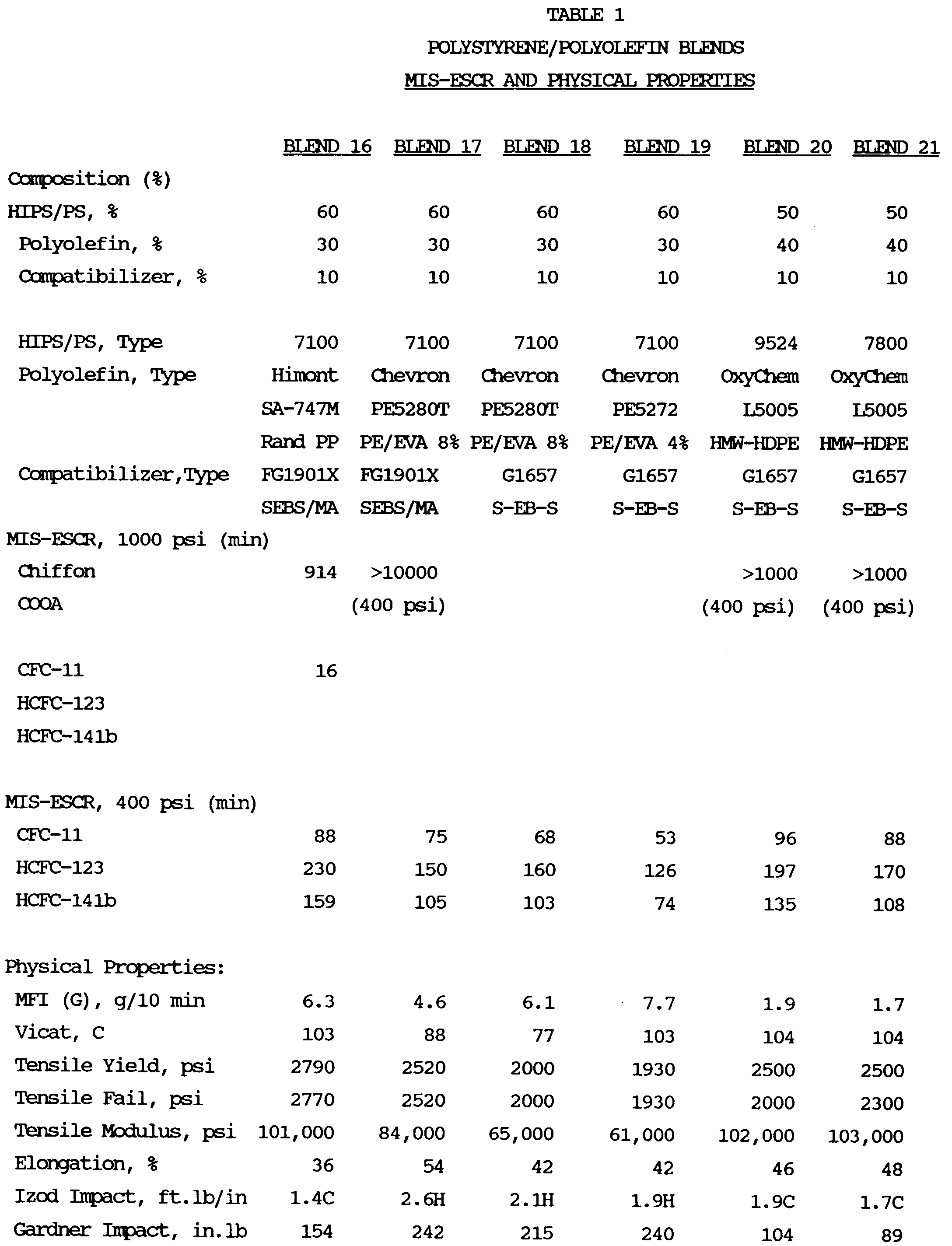

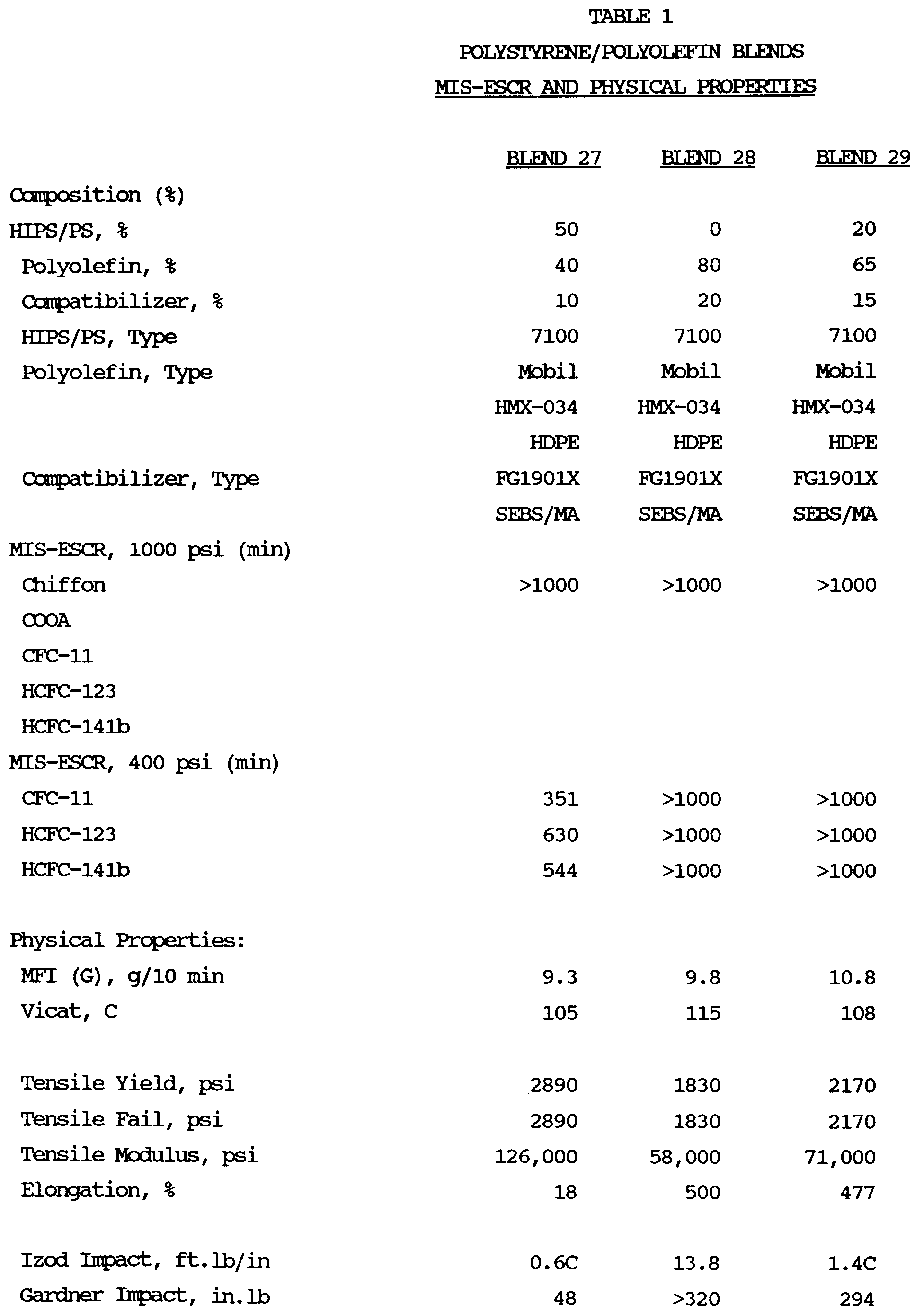
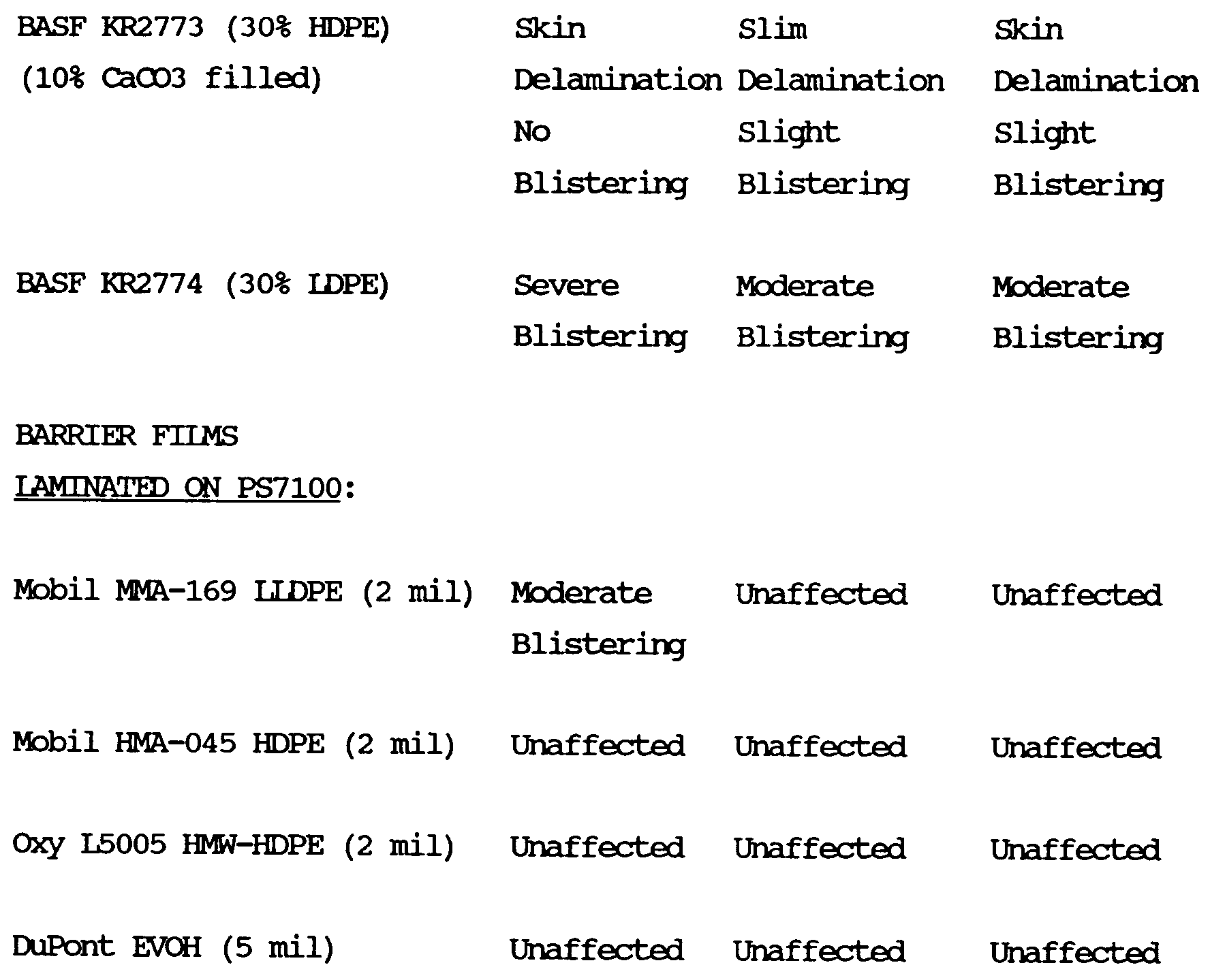
- Sheets of several different compositions described in Table 2 invention were exposed to the liquid blowing agents by sealing a glass ball joint to the sheet samples and adding the specific liquid blowing agent being evaluated (CFC-11, HCFC-123, and HCFC-141b).
- The samples were exposed to the blowing agents for thirty minutes each, then exposed to heat (60°C for 30 minutes) to drive off the blowing agents, and finally inspected for chemical attack. Several sheet samples displayed no signs of chemical attack at all, and most samples showed at least some reduction in chemical attack when compared to sheets of HIPS or ABS. The results are set forth in Table 2.

- The invention is illustrated by use in a top mount (freezer on top) refrigerator of 15 ft³ capacity, with HCFC-123 as the polyurethane blowing agent at an estimated 18% level weight.
- The layers of the composite are described below.
-
Sheet Total Thickness 202 mil (0.202˝) Barrier Layer Thickness 10 mil (0.010˝) Core Layer Thickness 190 mil (0.190˝) Gloss Layer Thickness 2 mil (0.002˝) Barrier Layer % of Total sheet 5% 
- The barrier layer material was compounded in a Werner & Pfleiderer ZSK30 30 mm twin screw extruder, at a temperature profile which ranged from 225 to 400°F.
- The composite was formed from a two-layer system including the core layer (ES7100) and the barrier layer, which were coextruded. The gloss layer of medium impact polystyrene (Mobil ES7800) was laminated thereto. The temperature profile for coextrusion is set forth below:
-
ES 7100 Extruder Profile (345-380-350-300-390-400)°F Die 415°F Melt Temp 440°F Barrier Material Profile (275-300-325-330)°F Extruder Die 415°F Melt Temp 340°F - The thermoformed product assembled in a metal cabinet with subsequent in situ insulation formation was subjected to 12 temperature cycles ranging from -40°F to +150°F. Polyurethane foam adhesion to the barrier layer was good and better than the adhesion of barrier layer to the core material. The liner wall exhibited satisfactory impact strength, no signs of cracking during thermal blistering and de minimis blistering.
- A 22 ft³ refrigerator, a side-by-side model (configuration of refrigerator and freezer compartments) was fitted with a liner and then insulated with polyurethane foam produced by CFC-11 blowing agent at an estimated 16 weight % level.
- The composition, and dimensions, of the preformed sheet components are described below.
Sheet Total Thickness 198 mil (0.198˝) Barrier Layer Thickness 6 mil (0.006˝) Glue/Compat. Layer Thickness 2 mil (0.002˝) Core Layer Thickness 188 mil (0.188˝) Gloss Layer Thickness 2 mil (0.002˝) Glue+Barrier Layers % of sheet 5% 
- The glue/compatabilizer layer materials were compounded in a Werner Pfleiderer 30 mm twin screw extruder at a temperature profile ranging from 225°F to 450°F. The ES7800 gloss layer was laminated to the remaining laminate which were coextruded in a Welex Coextrusion System.
- The unit(s) were subjected 12 times to a temperature cycles of -40 to 150°F. The unit exhibited satisfactory impact strength, and de minimis blistering.
Claims (11)
- A plastics cabinet liner, for example for a refrigerator appliance, molded from a thermoformable composite and comprising:(a) core layer which comprises (1) high impact polystyrene and/or (2) acryolnitrile-butadiene-styrene copolymer, which core layer contains from 5 to 35 weight percent rubber in the form of particles having an average diameter of at least 5 microns and comprises at least 30 weight percent of the composite;(b) a gloss patina on a first, or exterior surface of the core layer; and(c) a barrier layer on the second, or interior, surface of the core layer which barrier layer comprises a homo- or copolymer of ethylene or propylene containing from 0 to 40 weight percent of a block copolymer rubber, and comprises from 4 to 50 weight percent of the composite.
- A plastics cabinet liner according to Claim 1, wherein, in (c), the homo- or copolymer of ethylene or propylene comprises polypropylene; low density polyethylene; linear low density polyethylene; high density polyethylene; high molecular weight high density polyethylene or a mixture thereof.
- A plastics cabinet liner according to Claim 1 or 2, wherein, in (c), the block copolymer rubber comprises styrene-butadiene diblock; styrene-ethylene/butylene-styrene triblock; styrene-ethylene/butylene-styrene triblock functionalized with maleic anhydride and/or maleic, acid, or a mixture thereof.
- A plastics cabinet liner according to any preceding claim wherein the barrier layer contains maleic anhydride, maleic acid, and/or derivatives of maleic acid in an amount from 0.5 to 10 weight percent of the barrier material.
- A plastics cabinet liner according to any preceding claim wherein the barrier layer comprises high density polyethylene.
- A plastics cabinet liner according to claim 5 wherein the barrier layer further includes at least 5 weight percent of block copolymer rubber.
- A plastics cabinet liner according to claim 6 wherein the rubber is functionalized with maleic anhydride, maleic acid and/or derivatives of maleic acid.
- A plastics cabinet liner according to any preceding claim wherein the gloss patina (b) is provided by a layer of medium impact, high gloss polystyrene, and wherein the high gloss layer comprises from 0.5 to 8 weight percent of the composite.
- A plastics cabinet liner according to any preceding claim and further comprising, adjacent the interior layer, a polymeric foam thermal insulator comprising, as blowing agent, a halogenated hydrocarbon.
- A plastics cabinet liner according to claim 9 wherein the halogenated hydrocarbon comprises a partially halogenated hydrocarbon containing from 1 to 5 carbon atoms.
- Use of a barrier layer comprising a homo- or copolymer of ethylene or propylene containing from 0 to 40 weight percent of a block copolymer rubber interposed between a polymeric foam thermal insulator comprising, as blowing agent, a halogenated hydrocarbon and a layer of high impact polystyrene and/or acrylonitrile-butadiene-styrene copolymer containing from 5 to 35 weight percent rubber in the form of particles having an average diameter of at least 5 microns to prevent depredation of the high impact layer by the blowing agent.
Applications Claiming Priority (2)
| Application Number | Priority Date | Filing Date | Title |
|---|---|---|---|
| US758641 | 1991-09-12 | ||
| US07/758,641 US5221136A (en) | 1991-09-12 | 1991-09-12 | Refrigerator liner structures |
Publications (1)
| Publication Number | Publication Date |
|---|---|
| EP0533388A1 true EP0533388A1 (en) | 1993-03-24 |
Family
ID=25052519
Family Applications (1)
| Application Number | Title | Priority Date | Filing Date |
|---|---|---|---|
| EP92308187A Withdrawn EP0533388A1 (en) | 1991-09-12 | 1992-09-09 | Refrigerator liner structures |
Country Status (3)
| Country | Link |
|---|---|
| US (2) | US5221136A (en) |
| EP (1) | EP0533388A1 (en) |
| JP (1) | JPH05203338A (en) |
Cited By (9)
| Publication number | Priority date | Publication date | Assignee | Title |
|---|---|---|---|---|
| WO2000051813A1 (en) * | 1999-02-27 | 2000-09-08 | Basf Aktiengesellschaft | Composite layered sheet or film |
| EP1050403A3 (en) * | 1999-05-06 | 2002-03-20 | Basf Aktiengesellschaft | Composite layer plate or film for refrigerators |
| WO2007138065A3 (en) * | 2006-05-31 | 2008-02-28 | Arcelik As | A refrigerator |
| WO2011003711A2 (en) | 2009-07-07 | 2011-01-13 | Arcelik Anonim Sirketi | A refrigerator comprising plastic inner liner |
| ITMI20102368A1 (en) * | 2010-12-22 | 2012-06-23 | Indesit Co Spa | METHOD OF PREPARATION OF A THERMOPLASTIC ITEM AND ITEM PREPARED WITH THIS METHOD |
| EP3139075A4 (en) * | 2014-04-25 | 2018-01-17 | The Yokohama Rubber Co., Ltd. | Marine hose manufacturing method and marine hose |
| WO2018202365A1 (en) * | 2017-05-03 | 2018-11-08 | Arcelik Anonim Sirketi | Refrigerator comprising a plastic inner lining |
| EP2936020B1 (en) * | 2012-12-18 | 2019-04-24 | BSH Hausgeräte GmbH | Wall for a household refrigeration appliance with a top layer comprising high-gloss polystyrene and/or silver particles and household appliance comprising said type of wall |
| CN109696022A (en) * | 2018-04-24 | 2019-04-30 | 青岛海尔股份有限公司 | For the material feeding accessory part of cabinet insulation layer foaming and equipped with the refrigerator of the component |
Families Citing this family (57)
| Publication number | Priority date | Publication date | Assignee | Title |
|---|---|---|---|---|
| DE3921677A1 (en) * | 1989-07-01 | 1991-01-10 | Basf Ag | SEALABLE PLASTIC FILM |
| US5221136A (en) * | 1991-09-12 | 1993-06-22 | Basf Corporation | Refrigerator liner structures |
| US5364178A (en) * | 1992-04-23 | 1994-11-15 | Westinghouse Electric Corporation | File cabinet having a corregated inner framework construction |
| US5378057A (en) * | 1992-05-29 | 1995-01-03 | Westinghouse Electric Corporation | Metal case |
| US5834126A (en) * | 1994-12-30 | 1998-11-10 | Basf Corporation | Barrier layer for use in refrigerator cabinets |
| IT236949Y1 (en) * | 1995-06-08 | 2000-08-31 | Devi Spa | CONTAINER COMPARTMENT PERFECTED IN PARTICULAR FOR REFRIGERATED APPLIANCES |
| US5797514A (en) * | 1996-09-25 | 1998-08-25 | Follett Corporation | Ice bin liner with sanitary joint |
| US5795043A (en) * | 1996-11-01 | 1998-08-18 | The Protectoseal Company | Corrosion-resistant storage cabinet |
| US6460955B1 (en) * | 1998-09-09 | 2002-10-08 | Fisher & Paykel Limited | Cabinet, parts thereof and associated methods |
| GB2415766B (en) * | 2004-07-02 | 2007-04-11 | Cambridge Consultants | Vacuum storage compartment construction in a cooling apparatus body |
| US20060194892A1 (en) * | 2005-02-28 | 2006-08-31 | Sealed Air Corporation (Us) | Blended foam having improved flexibility at sub-freezing temperatures |
| US20090246501A1 (en) * | 2008-03-26 | 2009-10-01 | Fina Technology, Inc. | Reduced Weight Multilayer Polymeric Articles and Methods of Making and Using Same |
| EP2230260A1 (en) | 2009-03-10 | 2010-09-22 | Total Petrochemicals Research Feluy | Rubber modified monovinylaromatic polymer composition |
| CN101670695B (en) * | 2009-06-19 | 2011-12-07 | 常州博双塑料有限公司 | HIPS composite board and preparation method thereof |
| US20110218292A1 (en) * | 2010-03-08 | 2011-09-08 | Ineos Nova Llc | Monovinyl aromatic polymer compositions with a novel combination of stiffness and stress crack resistance |
| CN102173159A (en) * | 2011-01-04 | 2011-09-07 | 合肥美的荣事达电冰箱有限公司 | Acrylonitrile butadiene styrene (ABS) laminated composite plate and refrigeration equipment liner |
| US20120187019A1 (en) * | 2011-01-22 | 2012-07-26 | Fina Technology, Inc. | Methods to Produce Semi-Durable Foamed Articles |
| US9021828B2 (en) * | 2011-06-28 | 2015-05-05 | General Electric Company | Ice box housing assembly and related refrigeration appliance |
| US9182158B2 (en) | 2013-03-15 | 2015-11-10 | Whirlpool Corporation | Dual cooling systems to minimize off-cycle migration loss in refrigerators with a vacuum insulated structure |
| US9221210B2 (en) | 2012-04-11 | 2015-12-29 | Whirlpool Corporation | Method to create vacuum insulated cabinets for refrigerators |
| US8986483B2 (en) | 2012-04-02 | 2015-03-24 | Whirlpool Corporation | Method of making a folded vacuum insulated structure |
| CN102658698A (en) * | 2012-05-11 | 2012-09-12 | 合肥美的荣事达电冰箱有限公司 | HIPS (high impact polystyrene) three-layer composite board for inner container of refrigerating device and preparation method thereof |
| CN102658697A (en) * | 2012-05-11 | 2012-09-12 | 合肥美的荣事达电冰箱有限公司 | HIPS (High Impact Polystyrene) double-layer composite board for liner of refrigerating device and preparation method of HIPS double-layer composite board |
| US9599392B2 (en) | 2014-02-24 | 2017-03-21 | Whirlpool Corporation | Folding approach to create a 3D vacuum insulated door from 2D flat vacuum insulation panels |
| US9689604B2 (en) | 2014-02-24 | 2017-06-27 | Whirlpool Corporation | Multi-section core vacuum insulation panels with hybrid barrier film envelope |
| US10052819B2 (en) | 2014-02-24 | 2018-08-21 | Whirlpool Corporation | Vacuum packaged 3D vacuum insulated door structure and method therefor using a tooling fixture |
| US9476633B2 (en) | 2015-03-02 | 2016-10-25 | Whirlpool Corporation | 3D vacuum panel and a folding approach to create the 3D vacuum panel from a 2D vacuum panel of non-uniform thickness |
| US10161669B2 (en) | 2015-03-05 | 2018-12-25 | Whirlpool Corporation | Attachment arrangement for vacuum insulated door |
| US9897370B2 (en) | 2015-03-11 | 2018-02-20 | Whirlpool Corporation | Self-contained pantry box system for insertion into an appliance |
| US10034560B2 (en) | 2015-03-25 | 2018-07-31 | Hill Phoenix, Inc. | Storage tank for refrigerated display case |
| US9441779B1 (en) | 2015-07-01 | 2016-09-13 | Whirlpool Corporation | Split hybrid insulation structure for an appliance |
| US10041724B2 (en) | 2015-12-08 | 2018-08-07 | Whirlpool Corporation | Methods for dispensing and compacting insulation materials into a vacuum sealed structure |
| US12508751B2 (en) | 2015-12-08 | 2025-12-30 | Whirlpool Corporation | Insulation compaction device and method for forming an insulated structure for an appliance |
| US10422573B2 (en) | 2015-12-08 | 2019-09-24 | Whirlpool Corporation | Insulation structure for an appliance having a uniformly mixed multi-component insulation material, and a method for even distribution of material combinations therein |
| US11052579B2 (en) | 2015-12-08 | 2021-07-06 | Whirlpool Corporation | Method for preparing a densified insulation material for use in appliance insulated structure |
| US10429125B2 (en) | 2015-12-08 | 2019-10-01 | Whirlpool Corporation | Insulation structure for an appliance having a uniformly mixed multi-component insulation material, and a method for even distribution of material combinations therein |
| US10222116B2 (en) | 2015-12-08 | 2019-03-05 | Whirlpool Corporation | Method and apparatus for forming a vacuum insulated structure for an appliance having a pressing mechanism incorporated within an insulation delivery system |
| US20170167782A1 (en) * | 2015-12-09 | 2017-06-15 | Whirlpool Corporation | Insulating material with renewable resource component |
| US10422569B2 (en) | 2015-12-21 | 2019-09-24 | Whirlpool Corporation | Vacuum insulated door construction |
| US9840042B2 (en) | 2015-12-22 | 2017-12-12 | Whirlpool Corporation | Adhesively secured vacuum insulated panels for refrigerators |
| US9752818B2 (en) | 2015-12-22 | 2017-09-05 | Whirlpool Corporation | Umbilical for pass through in vacuum insulated refrigerator structures |
| US10018406B2 (en) | 2015-12-28 | 2018-07-10 | Whirlpool Corporation | Multi-layer gas barrier materials for vacuum insulated structure |
| US10610985B2 (en) | 2015-12-28 | 2020-04-07 | Whirlpool Corporation | Multilayer barrier materials with PVD or plasma coating for vacuum insulated structure |
| US10807298B2 (en) | 2015-12-29 | 2020-10-20 | Whirlpool Corporation | Molded gas barrier parts for vacuum insulated structure |
| US10030905B2 (en) | 2015-12-29 | 2018-07-24 | Whirlpool Corporation | Method of fabricating a vacuum insulated appliance structure |
| US11247369B2 (en) | 2015-12-30 | 2022-02-15 | Whirlpool Corporation | Method of fabricating 3D vacuum insulated refrigerator structure having core material |
| WO2017180147A1 (en) | 2016-04-15 | 2017-10-19 | Whirlpool Corporation | Vacuum insulated refrigerator cabinet |
| WO2017180145A1 (en) | 2016-04-15 | 2017-10-19 | Whirlpool Corporation | Vacuum insulated refrigerator structure with three dimensional characteristics |
| WO2018022007A1 (en) | 2016-07-26 | 2018-02-01 | Whirlpool Corporation | Vacuum insulated structure trim breaker |
| EP3500804B1 (en) | 2016-08-18 | 2022-06-22 | Whirlpool Corporation | Refrigerator cabinet |
| CN106626667A (en) * | 2016-09-19 | 2017-05-10 | 吴中心 | Micro-foaming material with three-layered structure |
| US10598424B2 (en) | 2016-12-02 | 2020-03-24 | Whirlpool Corporation | Hinge support assembly |
| US10352613B2 (en) | 2016-12-05 | 2019-07-16 | Whirlpool Corporation | Pigmented monolayer liner for appliances and methods of making the same |
| US10907888B2 (en) | 2018-06-25 | 2021-02-02 | Whirlpool Corporation | Hybrid pigmented hot stitched color liner system |
| EP3868538A1 (en) | 2020-02-19 | 2021-08-25 | Electrolux Appliances Aktiebolag | Component for a water bearing appliance and method for producing such component |
| EP4147871A1 (en) * | 2021-09-14 | 2023-03-15 | Trinseo Europe GmbH | Monovinylidene aromatic multilayer sheet containing impact modifiers |
| CN116535721B (en) * | 2023-06-20 | 2024-08-23 | 湖北卓熙氟化股份有限公司 | High-barrier fluorinated plastic ice box and preparation method thereof |
Citations (6)
| Publication number | Priority date | Publication date | Assignee | Title |
|---|---|---|---|---|
| DE2343870A1 (en) * | 1973-08-31 | 1975-03-13 | Basf Ag | Laminate of thermoplastics bonded to incompatible material - with layer contg. styrene-diene block and statistical co-polymers |
| US4005919A (en) * | 1974-12-23 | 1977-02-01 | Monsanto Company | Refrigerator construction |
| EP0214747A2 (en) * | 1985-07-30 | 1987-03-18 | Mitsubishi Petrochemical Co., Ltd. | Composite heat-insulating material containing a cellular urethane |
| US4707401A (en) * | 1986-12-12 | 1987-11-17 | Whirlpool Corporation | Refrigerator cabinet construction |
| DE3702037A1 (en) * | 1987-01-24 | 1988-08-04 | Basf Ag | IMPACT RESISTANT THERMOPLASTIC MOLDS AND THEIR USE |
| EP0413912A1 (en) * | 1989-08-23 | 1991-02-27 | Alkor Gmbh Kunststoffe | Mono- or multilayer plastic sheet, method of preparation and use thereof |
Family Cites Families (7)
| Publication number | Priority date | Publication date | Assignee | Title |
|---|---|---|---|---|
| US3960631A (en) * | 1974-08-30 | 1976-06-01 | Whirlpool Corporation | Method of making a liner construction |
| US4196950A (en) * | 1978-07-19 | 1980-04-08 | Monsanto Company | Refrigerator construction |
| US5227245A (en) * | 1990-04-04 | 1993-07-13 | The Dow Chemical Company | Barrier films for preventing solvent attack on plastic resins |
| US5009952A (en) * | 1990-08-23 | 1991-04-23 | Senoplast Klepsch & Co. | Insulating wall for refrigerator devices |
| US5219665A (en) * | 1991-01-30 | 1993-06-15 | E. I. Du Pont De Nemours And Company | Fabricated articles with improved resistance to hydrohalocarbons |
| US5118174A (en) * | 1991-05-17 | 1992-06-02 | Whirlpool Corporation | Method to prevent chemical (HCFC) attack of plastic foodliner from foam insulation chemicals |
| US5221136A (en) * | 1991-09-12 | 1993-06-22 | Basf Corporation | Refrigerator liner structures |
-
1991
- 1991-09-12 US US07/758,641 patent/US5221136A/en not_active Expired - Lifetime
-
1992
- 1992-09-09 EP EP92308187A patent/EP0533388A1/en not_active Withdrawn
- 1992-09-14 JP JP4245137A patent/JPH05203338A/en active Pending
-
1993
- 1993-06-16 US US08/077,309 patent/US5340208A/en not_active Expired - Lifetime
Patent Citations (6)
| Publication number | Priority date | Publication date | Assignee | Title |
|---|---|---|---|---|
| DE2343870A1 (en) * | 1973-08-31 | 1975-03-13 | Basf Ag | Laminate of thermoplastics bonded to incompatible material - with layer contg. styrene-diene block and statistical co-polymers |
| US4005919A (en) * | 1974-12-23 | 1977-02-01 | Monsanto Company | Refrigerator construction |
| EP0214747A2 (en) * | 1985-07-30 | 1987-03-18 | Mitsubishi Petrochemical Co., Ltd. | Composite heat-insulating material containing a cellular urethane |
| US4707401A (en) * | 1986-12-12 | 1987-11-17 | Whirlpool Corporation | Refrigerator cabinet construction |
| DE3702037A1 (en) * | 1987-01-24 | 1988-08-04 | Basf Ag | IMPACT RESISTANT THERMOPLASTIC MOLDS AND THEIR USE |
| EP0413912A1 (en) * | 1989-08-23 | 1991-02-27 | Alkor Gmbh Kunststoffe | Mono- or multilayer plastic sheet, method of preparation and use thereof |
Cited By (15)
| Publication number | Priority date | Publication date | Assignee | Title |
|---|---|---|---|---|
| WO2000051813A1 (en) * | 1999-02-27 | 2000-09-08 | Basf Aktiengesellschaft | Composite layered sheet or film |
| EP1050403A3 (en) * | 1999-05-06 | 2002-03-20 | Basf Aktiengesellschaft | Composite layer plate or film for refrigerators |
| US6589646B1 (en) | 1999-05-06 | 2003-07-08 | Basf Aktiengesellschaft | Composite layered sheet of film for refrigerators |
| WO2007138065A3 (en) * | 2006-05-31 | 2008-02-28 | Arcelik As | A refrigerator |
| CN101454627B (en) * | 2006-05-31 | 2010-09-29 | 阿塞里克股份有限公司 | refrigerator |
| US9074811B2 (en) | 2006-05-31 | 2015-07-07 | Arcelik Anonim Sirketi | Refrigerator |
| CN102472559A (en) * | 2009-07-07 | 2012-05-23 | 阿塞里克股份有限公司 | Refrigerators with plastic liners |
| CN102472559B (en) * | 2009-07-07 | 2014-07-30 | 阿塞里克股份有限公司 | A refrigerator comprising plastic inner liner |
| WO2011003711A2 (en) | 2009-07-07 | 2011-01-13 | Arcelik Anonim Sirketi | A refrigerator comprising plastic inner liner |
| ITMI20102368A1 (en) * | 2010-12-22 | 2012-06-23 | Indesit Co Spa | METHOD OF PREPARATION OF A THERMOPLASTIC ITEM AND ITEM PREPARED WITH THIS METHOD |
| WO2012085878A1 (en) * | 2010-12-22 | 2012-06-28 | Indesit Company S.P.A. | Method for preparing a thermoplastic item and an item prepared with said method |
| EP2936020B1 (en) * | 2012-12-18 | 2019-04-24 | BSH Hausgeräte GmbH | Wall for a household refrigeration appliance with a top layer comprising high-gloss polystyrene and/or silver particles and household appliance comprising said type of wall |
| EP3139075A4 (en) * | 2014-04-25 | 2018-01-17 | The Yokohama Rubber Co., Ltd. | Marine hose manufacturing method and marine hose |
| WO2018202365A1 (en) * | 2017-05-03 | 2018-11-08 | Arcelik Anonim Sirketi | Refrigerator comprising a plastic inner lining |
| CN109696022A (en) * | 2018-04-24 | 2019-04-30 | 青岛海尔股份有限公司 | For the material feeding accessory part of cabinet insulation layer foaming and equipped with the refrigerator of the component |
Also Published As
| Publication number | Publication date |
|---|---|
| US5340208A (en) | 1994-08-23 |
| JPH05203338A (en) | 1993-08-10 |
| US5221136A (en) | 1993-06-22 |
Similar Documents
| Publication | Publication Date | Title |
|---|---|---|
| EP0533388A1 (en) | Refrigerator liner structures | |
| US5834126A (en) | Barrier layer for use in refrigerator cabinets | |
| AU643270B2 (en) | Barrier films for preventing solvent attack on plastic resins | |
| US5219665A (en) | Fabricated articles with improved resistance to hydrohalocarbons | |
| KR20190022490A (en) | A polymer foam insulation structure having an outer layer of a polylactide resin | |
| US5338601A (en) | Polyolefin barrier films for preventing solvent attack on plastic resins | |
| JP2008274031A (en) | Antistatic resin composition and thermoplastic resin multilayer sheet | |
| GB2294900A (en) | Multi-layer sheets for an internal box of a refrigerator | |
| CA2172923A1 (en) | Protective compositions for reducing chemical attacks on plastics | |
| JP2905345B2 (en) | Insulation box | |
| KR0149249B1 (en) | Refrigerator Inner Sheet with Multi-layer Structure | |
| JPH0542588A (en) | Vacuum formed product for trimming of refrigerator superior in chemical resistance | |
| MXPA97004623A (en) | Barrier layer for use of derefrigera cabinets | |
| JPH1019453A (en) | Heat-insulating box | |
| JPH0493581A (en) | Heat-insulated box | |
| JPH08258231A (en) | Thermoplastic composite | |
| JPH0443279A (en) | Heat insulating box body | |
| JPH08258200A (en) | Thermoplastic composite |
Legal Events
| Date | Code | Title | Description |
|---|---|---|---|
| PUAI | Public reference made under article 153(3) epc to a published international application that has entered the european phase |
Free format text: ORIGINAL CODE: 0009012 |
|
| AK | Designated contracting states |
Kind code of ref document: A1 Designated state(s): BE DE FR GB IT NL |
|
| K1C3 | Correction of patent application (complete document) published |
Effective date: 19930324 |
|
| 18D | Application deemed to be withdrawn |
Effective date: 19930925 |