EP0529908B1 - Catalyst useful for the polymerization of olefin - Google Patents
Catalyst useful for the polymerization of olefin Download PDFInfo
- Publication number
- EP0529908B1 EP0529908B1 EP92307523A EP92307523A EP0529908B1 EP 0529908 B1 EP0529908 B1 EP 0529908B1 EP 92307523 A EP92307523 A EP 92307523A EP 92307523 A EP92307523 A EP 92307523A EP 0529908 B1 EP0529908 B1 EP 0529908B1
- Authority
- EP
- European Patent Office
- Prior art keywords
- group
- carbon atoms
- hydrocarbyl group
- catalyst according
- substituent
- Prior art date
- Legal status (The legal status is an assumption and is not a legal conclusion. Google has not performed a legal analysis and makes no representation as to the accuracy of the status listed.)
- Expired - Lifetime
Links
- 239000003054 catalyst Substances 0.000 title claims description 31
- 238000006116 polymerization reaction Methods 0.000 title claims description 25
- 150000001336 alkenes Chemical class 0.000 title claims description 14
- JRZJOMJEPLMPRA-UHFFFAOYSA-N olefin Natural products CCCCCCCC=C JRZJOMJEPLMPRA-UHFFFAOYSA-N 0.000 title claims description 6
- 125000001183 hydrocarbyl group Chemical group 0.000 claims description 41
- 125000004432 carbon atom Chemical group C* 0.000 claims description 36
- 238000000034 method Methods 0.000 claims description 21
- 125000001424 substituent group Chemical group 0.000 claims description 18
- XUIMIQQOPSSXEZ-UHFFFAOYSA-N Silicon Chemical compound [Si] XUIMIQQOPSSXEZ-UHFFFAOYSA-N 0.000 claims description 13
- 239000003446 ligand Substances 0.000 claims description 13
- 239000010703 silicon Substances 0.000 claims description 13
- 229910052710 silicon Inorganic materials 0.000 claims description 13
- 125000000217 alkyl group Chemical group 0.000 claims description 12
- 125000004122 cyclic group Chemical group 0.000 claims description 11
- -1 silylene group Chemical group 0.000 claims description 11
- AQZWEFBJYQSQEH-UHFFFAOYSA-N 2-methyloxaluminane Chemical compound C[Al]1CCCCO1 AQZWEFBJYQSQEH-UHFFFAOYSA-N 0.000 claims description 9
- IJGRMHOSHXDMSA-UHFFFAOYSA-N Atomic nitrogen Chemical compound N#N IJGRMHOSHXDMSA-UHFFFAOYSA-N 0.000 claims description 8
- QCWXUUIWCKQGHC-UHFFFAOYSA-N Zirconium Chemical compound [Zr] QCWXUUIWCKQGHC-UHFFFAOYSA-N 0.000 claims description 8
- QQONPFPTGQHPMA-UHFFFAOYSA-N propylene Natural products CC=C QQONPFPTGQHPMA-UHFFFAOYSA-N 0.000 claims description 8
- 125000004805 propylene group Chemical group [H]C([H])([H])C([H])([*:1])C([H])([H])[*:2] 0.000 claims description 8
- 229910052726 zirconium Inorganic materials 0.000 claims description 8
- 239000001257 hydrogen Substances 0.000 claims description 6
- 229910052739 hydrogen Inorganic materials 0.000 claims description 6
- 229920000098 polyolefin Polymers 0.000 claims description 6
- 229920006395 saturated elastomer Polymers 0.000 claims description 6
- KGCRXHYTNRMHCF-UHFFFAOYSA-N 6-methyl-2-(2-methylpropyl)oxaluminane Chemical compound CC(C)C[Al]1CCCC(C)O1 KGCRXHYTNRMHCF-UHFFFAOYSA-N 0.000 claims description 5
- QVGXLLKOCUKJST-UHFFFAOYSA-N atomic oxygen Chemical compound [O] QVGXLLKOCUKJST-UHFFFAOYSA-N 0.000 claims description 5
- 229910052801 chlorine Inorganic materials 0.000 claims description 5
- 229910052732 germanium Inorganic materials 0.000 claims description 5
- GNPVGFCGXDBREM-UHFFFAOYSA-N germanium atom Chemical compound [Ge] GNPVGFCGXDBREM-UHFFFAOYSA-N 0.000 claims description 5
- 239000001301 oxygen Substances 0.000 claims description 5
- 229910052760 oxygen Inorganic materials 0.000 claims description 5
- 150000003624 transition metals Chemical class 0.000 claims description 5
- 125000003342 alkenyl group Chemical group 0.000 claims description 4
- 125000000058 cyclopentadienyl group Chemical group C1(=CC=CC1)* 0.000 claims description 4
- 229910052735 hafnium Inorganic materials 0.000 claims description 4
- VBJZVLUMGGDVMO-UHFFFAOYSA-N hafnium atom Chemical compound [Hf] VBJZVLUMGGDVMO-UHFFFAOYSA-N 0.000 claims description 4
- 229910052736 halogen Inorganic materials 0.000 claims description 4
- 150000002367 halogens Chemical class 0.000 claims description 4
- 229910052757 nitrogen Inorganic materials 0.000 claims description 4
- 229910052723 transition metal Inorganic materials 0.000 claims description 4
- RTAQQCXQSZGOHL-UHFFFAOYSA-N Titanium Chemical compound [Ti] RTAQQCXQSZGOHL-UHFFFAOYSA-N 0.000 claims description 3
- 125000002877 alkyl aryl group Chemical group 0.000 claims description 3
- 125000005018 aryl alkenyl group Chemical group 0.000 claims description 3
- 125000003710 aryl alkyl group Chemical group 0.000 claims description 3
- 125000003118 aryl group Chemical group 0.000 claims description 3
- 125000000816 ethylene group Chemical group [H]C([H])([*:1])C([H])([H])[*:2] 0.000 claims description 3
- 125000003808 silyl group Chemical class [H][Si]([H])([H])[*] 0.000 claims description 3
- 229910052719 titanium Inorganic materials 0.000 claims description 3
- 239000010936 titanium Substances 0.000 claims description 3
- 125000004178 (C1-C4) alkyl group Chemical group 0.000 claims 3
- 125000001309 chloro group Chemical group Cl* 0.000 claims 2
- 125000004435 hydrogen atom Chemical class [H]* 0.000 claims 1
- 125000001570 methylene group Chemical group [H]C([H])([*:1])[*:2] 0.000 claims 1
- 150000003623 transition metal compounds Chemical class 0.000 claims 1
- YXFVVABEGXRONW-UHFFFAOYSA-N Toluene Chemical compound CC1=CC=CC=C1 YXFVVABEGXRONW-UHFFFAOYSA-N 0.000 description 42
- 229920000642 polymer Polymers 0.000 description 27
- 239000000203 mixture Substances 0.000 description 25
- 238000006243 chemical reaction Methods 0.000 description 18
- 150000001875 compounds Chemical class 0.000 description 17
- XLYOFNOQVPJJNP-UHFFFAOYSA-N water Substances O XLYOFNOQVPJJNP-UHFFFAOYSA-N 0.000 description 16
- VLKZOEOYAKHREP-UHFFFAOYSA-N n-Hexane Chemical compound CCCCCC VLKZOEOYAKHREP-UHFFFAOYSA-N 0.000 description 15
- UHOVQNZJYSORNB-UHFFFAOYSA-N Benzene Chemical compound C1=CC=CC=C1 UHOVQNZJYSORNB-UHFFFAOYSA-N 0.000 description 12
- WYURNTSHIVDZCO-UHFFFAOYSA-N Tetrahydrofuran Chemical compound C1CCOC1 WYURNTSHIVDZCO-UHFFFAOYSA-N 0.000 description 12
- 239000000243 solution Substances 0.000 description 12
- VPGLGRNSAYHXPY-UHFFFAOYSA-L zirconium(2+);dichloride Chemical compound Cl[Zr]Cl VPGLGRNSAYHXPY-UHFFFAOYSA-L 0.000 description 12
- MZRVEZGGRBJDDB-UHFFFAOYSA-N N-Butyllithium Chemical compound [Li]CCCC MZRVEZGGRBJDDB-UHFFFAOYSA-N 0.000 description 8
- 239000002904 solvent Substances 0.000 description 8
- JLTRXTDYQLMHGR-UHFFFAOYSA-N trimethylaluminium Chemical compound C[Al](C)C JLTRXTDYQLMHGR-UHFFFAOYSA-N 0.000 description 8
- 239000004711 α-olefin Substances 0.000 description 7
- RTZKZFJDLAIYFH-UHFFFAOYSA-N Diethyl ether Chemical compound CCOCC RTZKZFJDLAIYFH-UHFFFAOYSA-N 0.000 description 6
- 238000009826 distribution Methods 0.000 description 6
- YLQBMQCUIZJEEH-UHFFFAOYSA-N tetrahydrofuran Natural products C=1C=COC=1 YLQBMQCUIZJEEH-UHFFFAOYSA-N 0.000 description 6
- LIKMAJRDDDTEIG-UHFFFAOYSA-N 1-hexene Chemical compound CCCCC=C LIKMAJRDDDTEIG-UHFFFAOYSA-N 0.000 description 5
- 230000015572 biosynthetic process Effects 0.000 description 5
- 230000003197 catalytic effect Effects 0.000 description 5
- 230000037048 polymerization activity Effects 0.000 description 5
- 238000003756 stirring Methods 0.000 description 5
- 238000003786 synthesis reaction Methods 0.000 description 5
- 230000007704 transition Effects 0.000 description 5
- MCULRUJILOGHCJ-UHFFFAOYSA-N triisobutylaluminium Chemical compound CC(C)C[Al](CC(C)C)CC(C)C MCULRUJILOGHCJ-UHFFFAOYSA-N 0.000 description 5
- IMNFDUFMRHMDMM-UHFFFAOYSA-N N-Heptane Chemical compound CCCCCCC IMNFDUFMRHMDMM-UHFFFAOYSA-N 0.000 description 4
- 239000000460 chlorine Substances 0.000 description 4
- 238000001816 cooling Methods 0.000 description 4
- 229910000765 intermetallic Inorganic materials 0.000 description 4
- 238000002844 melting Methods 0.000 description 4
- 230000008018 melting Effects 0.000 description 4
- 125000002496 methyl group Chemical group [H]C([H])([H])* 0.000 description 4
- ZAMOUSCENKQFHK-UHFFFAOYSA-N Chlorine atom Chemical compound [Cl] ZAMOUSCENKQFHK-UHFFFAOYSA-N 0.000 description 3
- YMWUJEATGCHHMB-UHFFFAOYSA-N Dichloromethane Chemical compound ClCCl YMWUJEATGCHHMB-UHFFFAOYSA-N 0.000 description 3
- OKKJLVBELUTLKV-UHFFFAOYSA-N Methanol Chemical compound OC OKKJLVBELUTLKV-UHFFFAOYSA-N 0.000 description 3
- 125000005103 alkyl silyl group Chemical group 0.000 description 3
- 125000000732 arylene group Chemical group 0.000 description 3
- 229910000365 copper sulfate Inorganic materials 0.000 description 3
- ARUVKPQLZAKDPS-UHFFFAOYSA-L copper(II) sulfate Chemical compound [Cu+2].[O-][S+2]([O-])([O-])[O-] ARUVKPQLZAKDPS-UHFFFAOYSA-L 0.000 description 3
- 238000002425 crystallisation Methods 0.000 description 3
- 230000008025 crystallization Effects 0.000 description 3
- 150000002431 hydrogen Chemical class 0.000 description 3
- 125000000959 isobutyl group Chemical group [H]C([H])([H])C([H])(C([H])([H])[H])C([H])([H])* 0.000 description 3
- 238000004519 manufacturing process Methods 0.000 description 3
- 239000012074 organic phase Substances 0.000 description 3
- 150000003839 salts Chemical class 0.000 description 3
- 239000002002 slurry Substances 0.000 description 3
- 239000007787 solid Substances 0.000 description 3
- VXNZUUAINFGPBY-UHFFFAOYSA-N 1-Butene Chemical compound CCC=C VXNZUUAINFGPBY-UHFFFAOYSA-N 0.000 description 2
- AFFLGGQVNFXPEV-UHFFFAOYSA-N 1-decene Chemical compound CCCCCCCCC=C AFFLGGQVNFXPEV-UHFFFAOYSA-N 0.000 description 2
- CRSBERNSMYQZNG-UHFFFAOYSA-N 1-dodecene Chemical compound CCCCCCCCCCC=C CRSBERNSMYQZNG-UHFFFAOYSA-N 0.000 description 2
- GQEZCXVZFLOKMC-UHFFFAOYSA-N 1-hexadecene Chemical compound CCCCCCCCCCCCCCC=C GQEZCXVZFLOKMC-UHFFFAOYSA-N 0.000 description 2
- KWKAKUADMBZCLK-UHFFFAOYSA-N 1-octene Chemical compound CCCCCCC=C KWKAKUADMBZCLK-UHFFFAOYSA-N 0.000 description 2
- HFDVRLIODXPAHB-UHFFFAOYSA-N 1-tetradecene Chemical compound CCCCCCCCCCCCC=C HFDVRLIODXPAHB-UHFFFAOYSA-N 0.000 description 2
- 238000005160 1H NMR spectroscopy Methods 0.000 description 2
- NMXLXQGHBSPIDR-UHFFFAOYSA-N 2-(2-methylpropyl)oxaluminane Chemical compound CC(C)C[Al]1CCCCO1 NMXLXQGHBSPIDR-UHFFFAOYSA-N 0.000 description 2
- JCUMTFDGOWBKKE-UHFFFAOYSA-N 2-methyl-1-[1-(2-methyl-1h-inden-1-yl)ethyl]-1h-indene Chemical compound CC1=CC2=CC=CC=C2C1C(C)C1C2=CC=CC=C2C=C1C JCUMTFDGOWBKKE-UHFFFAOYSA-N 0.000 description 2
- YSAXEHWHSLANOM-UHFFFAOYSA-N 2-methyl-1h-indene Chemical compound C1=CC=C2CC(C)=CC2=C1 YSAXEHWHSLANOM-UHFFFAOYSA-N 0.000 description 2
- WSSSPWUEQFSQQG-UHFFFAOYSA-N 4-methyl-1-pentene Chemical compound CC(C)CC=C WSSSPWUEQFSQQG-UHFFFAOYSA-N 0.000 description 2
- KAKZBPTYRLMSJV-UHFFFAOYSA-N Butadiene Chemical compound C=CC=C KAKZBPTYRLMSJV-UHFFFAOYSA-N 0.000 description 2
- LFQSCWFLJHTTHZ-UHFFFAOYSA-N Ethanol Chemical compound CCO LFQSCWFLJHTTHZ-UHFFFAOYSA-N 0.000 description 2
- VEXZGXHMUGYJMC-UHFFFAOYSA-N Hydrochloric acid Chemical compound Cl VEXZGXHMUGYJMC-UHFFFAOYSA-N 0.000 description 2
- UFHFLCQGNIYNRP-UHFFFAOYSA-N Hydrogen Chemical compound [H][H] UFHFLCQGNIYNRP-UHFFFAOYSA-N 0.000 description 2
- OFBQJSOFQDEBGM-UHFFFAOYSA-N Pentane Chemical compound CCCCC OFBQJSOFQDEBGM-UHFFFAOYSA-N 0.000 description 2
- VYPSYNLAJGMNEJ-UHFFFAOYSA-N Silicium dioxide Chemical compound O=[Si]=O VYPSYNLAJGMNEJ-UHFFFAOYSA-N 0.000 description 2
- 229910007926 ZrCl Inorganic materials 0.000 description 2
- PNRJUCXJBYLCRR-UHFFFAOYSA-L [Cl-].[Cl-].CC1=Cc2cccc(C)c2C1[Zr++](C1C(C)=Cc2cccc(C)c12)=[Si](C)C Chemical compound [Cl-].[Cl-].CC1=Cc2cccc(C)c2C1[Zr++](C1C(C)=Cc2cccc(C)c12)=[Si](C)C PNRJUCXJBYLCRR-UHFFFAOYSA-L 0.000 description 2
- CGELJBSWQTYCIY-UHFFFAOYSA-L [Cl-].[Cl-].CC1=Cc2ccccc2[C@H]1[Zr++]([C@@H]1C(C)=Cc2ccccc12)=[Si](C)C Chemical compound [Cl-].[Cl-].CC1=Cc2ccccc2[C@H]1[Zr++]([C@@H]1C(C)=Cc2ccccc12)=[Si](C)C CGELJBSWQTYCIY-UHFFFAOYSA-L 0.000 description 2
- 125000002947 alkylene group Chemical group 0.000 description 2
- 229910052782 aluminium Inorganic materials 0.000 description 2
- DIZPMCHEQGEION-UHFFFAOYSA-H aluminium sulfate (anhydrous) Chemical compound [Al+3].[Al+3].[O-]S([O-])(=O)=O.[O-]S([O-])(=O)=O.[O-]S([O-])(=O)=O DIZPMCHEQGEION-UHFFFAOYSA-H 0.000 description 2
- 150000004945 aromatic hydrocarbons Chemical class 0.000 description 2
- 229910052799 carbon Inorganic materials 0.000 description 2
- 125000002993 cycloalkylene group Chemical group 0.000 description 2
- HGCIXCUEYOPUTN-UHFFFAOYSA-N cyclohexene Chemical compound C1CCC=CC1 HGCIXCUEYOPUTN-UHFFFAOYSA-N 0.000 description 2
- XXHUSANMBSHRKP-UHFFFAOYSA-N dimethyl-bis(2-methyl-1h-inden-1-yl)silane Chemical compound CC1=CC2=CC=CC=C2C1[Si](C)(C)C1C2=CC=CC=C2C=C1C XXHUSANMBSHRKP-UHFFFAOYSA-N 0.000 description 2
- 125000001495 ethyl group Chemical group [H]C([H])([H])C([H])([H])* 0.000 description 2
- 239000007789 gas Substances 0.000 description 2
- 239000011521 glass Substances 0.000 description 2
- 238000010438 heat treatment Methods 0.000 description 2
- 229910000041 hydrogen chloride Inorganic materials 0.000 description 2
- IXCSERBJSXMMFS-UHFFFAOYSA-N hydrogen chloride Substances Cl.Cl IXCSERBJSXMMFS-UHFFFAOYSA-N 0.000 description 2
- 125000001449 isopropyl group Chemical group [H]C([H])([H])C([H])(*)C([H])([H])[H] 0.000 description 2
- 125000000325 methylidene group Chemical group [H]C([H])=* 0.000 description 2
- 239000000178 monomer Substances 0.000 description 2
- VAMFXQBUQXONLZ-UHFFFAOYSA-N n-alpha-eicosene Natural products CCCCCCCCCCCCCCCCCCC=C VAMFXQBUQXONLZ-UHFFFAOYSA-N 0.000 description 2
- 125000004108 n-butyl group Chemical group [H]C([H])([H])C([H])([H])C([H])([H])C([H])([H])* 0.000 description 2
- 125000004123 n-propyl group Chemical group [H]C([H])([H])C([H])([H])C([H])([H])* 0.000 description 2
- VJHGSLHHMIELQD-UHFFFAOYSA-N nona-1,8-diene Chemical compound C=CCCCCCC=C VJHGSLHHMIELQD-UHFFFAOYSA-N 0.000 description 2
- CCCMONHAUSKTEQ-UHFFFAOYSA-N octadec-1-ene Chemical compound CCCCCCCCCCCCCCCCC=C CCCMONHAUSKTEQ-UHFFFAOYSA-N 0.000 description 2
- 239000003960 organic solvent Substances 0.000 description 2
- 230000000379 polymerizing effect Effects 0.000 description 2
- 239000000843 powder Substances 0.000 description 2
- 239000000741 silica gel Substances 0.000 description 2
- 229910002027 silica gel Inorganic materials 0.000 description 2
- 239000000126 substance Substances 0.000 description 2
- 125000000999 tert-butyl group Chemical group [H]C([H])([H])C(*)(C([H])([H])[H])C([H])([H])[H] 0.000 description 2
- 229930195735 unsaturated hydrocarbon Natural products 0.000 description 2
- DUNKXUFBGCUVQW-UHFFFAOYSA-J zirconium tetrachloride Chemical compound Cl[Zr](Cl)(Cl)Cl DUNKXUFBGCUVQW-UHFFFAOYSA-J 0.000 description 2
- PRBHEGAFLDMLAL-GQCTYLIASA-N (4e)-hexa-1,4-diene Chemical compound C\C=C\CC=C PRBHEGAFLDMLAL-GQCTYLIASA-N 0.000 description 1
- PAAZPARNPHGIKF-UHFFFAOYSA-N 1,2-dibromoethane Chemical compound BrCCBr PAAZPARNPHGIKF-UHFFFAOYSA-N 0.000 description 1
- 229940106006 1-eicosene Drugs 0.000 description 1
- FIKTURVKRGQNQD-UHFFFAOYSA-N 1-eicosene Natural products CCCCCCCCCCCCCCCCCC=CC(O)=O FIKTURVKRGQNQD-UHFFFAOYSA-N 0.000 description 1
- 238000001644 13C nuclear magnetic resonance spectroscopy Methods 0.000 description 1
- HECLRDQVFMWTQS-RGOKHQFPSA-N 1755-01-7 Chemical compound C1[C@H]2[C@@H]3CC=C[C@@H]3[C@@H]1C=C2 HECLRDQVFMWTQS-RGOKHQFPSA-N 0.000 description 1
- YBYIRNPNPLQARY-UHFFFAOYSA-N 1H-indene Natural products C1=CC=C2CC=CC2=C1 YBYIRNPNPLQARY-UHFFFAOYSA-N 0.000 description 1
- QSQDPXVQZUTFHN-UHFFFAOYSA-N 2-butyl-6-methyloxaluminane Chemical compound CCCC[Al]1CCCC(C)O1 QSQDPXVQZUTFHN-UHFFFAOYSA-N 0.000 description 1
- WXZYUEVSKZXZMY-UHFFFAOYSA-N 2-butyloxaluminane Chemical compound CCCC[Al]1CCCCO1 WXZYUEVSKZXZMY-UHFFFAOYSA-N 0.000 description 1
- NVTJIMORDIYUNQ-UHFFFAOYSA-N 2-ethyl-6-methyloxaluminane Chemical compound CC[Al]1CCCC(C)O1 NVTJIMORDIYUNQ-UHFFFAOYSA-N 0.000 description 1
- YVSMQHYREUQGRX-UHFFFAOYSA-N 2-ethyloxaluminane Chemical compound CC[Al]1CCCCO1 YVSMQHYREUQGRX-UHFFFAOYSA-N 0.000 description 1
- 125000003903 2-propenyl group Chemical group [H]C([*])([H])C([H])=C([H])[H] 0.000 description 1
- JRDUFZORBQWDKG-UHFFFAOYSA-N 2-propyloxaluminane Chemical compound CCC[Al]1CCCCO1 JRDUFZORBQWDKG-UHFFFAOYSA-N 0.000 description 1
- 238000004910 27Al NMR spectroscopy Methods 0.000 description 1
- WKBOTKDWSSQWDR-UHFFFAOYSA-N Bromine atom Chemical compound [Br] WKBOTKDWSSQWDR-UHFFFAOYSA-N 0.000 description 1
- XDTMQSROBMDMFD-UHFFFAOYSA-N Cyclohexane Chemical compound C1CCCCC1 XDTMQSROBMDMFD-UHFFFAOYSA-N 0.000 description 1
- VGGSQFUCUMXWEO-UHFFFAOYSA-N Ethene Chemical compound C=C VGGSQFUCUMXWEO-UHFFFAOYSA-N 0.000 description 1
- 239000005977 Ethylene Substances 0.000 description 1
- PXGOKWXKJXAPGV-UHFFFAOYSA-N Fluorine Chemical compound FF PXGOKWXKJXAPGV-UHFFFAOYSA-N 0.000 description 1
- BOTDANWDWHJENH-UHFFFAOYSA-N Tetraethyl orthosilicate Chemical compound CCO[Si](OCC)(OCC)OCC BOTDANWDWHJENH-UHFFFAOYSA-N 0.000 description 1
- UVVHOKMKYKTWHC-UHFFFAOYSA-L [Cl-].[Cl-].CC1=Cc2c([C@H]1[Zr++]([C@@H]1C(C)=Cc3c1c(C)ccc3C)=[Si](C)C)c(C)ccc2C Chemical compound [Cl-].[Cl-].CC1=Cc2c([C@H]1[Zr++]([C@@H]1C(C)=Cc3c1c(C)ccc3C)=[Si](C)C)c(C)ccc2C UVVHOKMKYKTWHC-UHFFFAOYSA-L 0.000 description 1
- XQKPHPPVBZCSJL-UHFFFAOYSA-L [Cl-].[Cl-].CC1=Cc2cc(C)ccc2C1[Zr++](C1C(C)=Cc2cc(C)ccc12)=[Si](C)C Chemical compound [Cl-].[Cl-].CC1=Cc2cc(C)ccc2C1[Zr++](C1C(C)=Cc2cc(C)ccc12)=[Si](C)C XQKPHPPVBZCSJL-UHFFFAOYSA-L 0.000 description 1
- 150000001338 aliphatic hydrocarbons Chemical class 0.000 description 1
- 125000003545 alkoxy group Chemical group 0.000 description 1
- XAGFODPZIPBFFR-UHFFFAOYSA-N aluminium Chemical compound [Al] XAGFODPZIPBFFR-UHFFFAOYSA-N 0.000 description 1
- 150000001412 amines Chemical class 0.000 description 1
- 125000004429 atom Chemical group 0.000 description 1
- GDTBXPJZTBHREO-UHFFFAOYSA-N bromine Substances BrBr GDTBXPJZTBHREO-UHFFFAOYSA-N 0.000 description 1
- 229910052794 bromium Inorganic materials 0.000 description 1
- 238000006555 catalytic reaction Methods 0.000 description 1
- 229910052927 chalcanthite Inorganic materials 0.000 description 1
- 238000007334 copolymerization reaction Methods 0.000 description 1
- 229910000366 copper(II) sulfate Inorganic materials 0.000 description 1
- 125000000753 cycloalkyl group Chemical group 0.000 description 1
- CFBGXYDUODCMNS-UHFFFAOYSA-N cyclobutene Chemical compound C1CC=C1 CFBGXYDUODCMNS-UHFFFAOYSA-N 0.000 description 1
- OOXWYYGXTJLWHA-UHFFFAOYSA-N cyclopropene Chemical compound C1C=C1 OOXWYYGXTJLWHA-UHFFFAOYSA-N 0.000 description 1
- 125000001559 cyclopropyl group Chemical group [H]C1([H])C([H])([H])C1([H])* 0.000 description 1
- NLDGJRWPPOSWLC-UHFFFAOYSA-N deca-1,9-diene Chemical compound C=CCCCCCCC=C NLDGJRWPPOSWLC-UHFFFAOYSA-N 0.000 description 1
- 150000001993 dienes Chemical class 0.000 description 1
- 238000001938 differential scanning calorimetry curve Methods 0.000 description 1
- AHUXYBVKTIBBJW-UHFFFAOYSA-N dimethoxy(diphenyl)silane Chemical compound C=1C=CC=CC=1[Si](OC)(OC)C1=CC=CC=C1 AHUXYBVKTIBBJW-UHFFFAOYSA-N 0.000 description 1
- JGHYBJVUQGTEEB-UHFFFAOYSA-M dimethylalumanylium;chloride Chemical compound C[Al](C)Cl JGHYBJVUQGTEEB-UHFFFAOYSA-M 0.000 description 1
- LIKFHECYJZWXFJ-UHFFFAOYSA-N dimethyldichlorosilane Chemical compound C[Si](C)(Cl)Cl LIKFHECYJZWXFJ-UHFFFAOYSA-N 0.000 description 1
- 229940069096 dodecene Drugs 0.000 description 1
- 238000001035 drying Methods 0.000 description 1
- 230000000694 effects Effects 0.000 description 1
- 150000002148 esters Chemical class 0.000 description 1
- 238000001125 extrusion Methods 0.000 description 1
- 238000001914 filtration Methods 0.000 description 1
- 229910052731 fluorine Inorganic materials 0.000 description 1
- 239000011737 fluorine Substances 0.000 description 1
- 238000010528 free radical solution polymerization reaction Methods 0.000 description 1
- 238000012685 gas phase polymerization Methods 0.000 description 1
- 150000002363 hafnium compounds Chemical class 0.000 description 1
- 229920006158 high molecular weight polymer Polymers 0.000 description 1
- 239000002815 homogeneous catalyst Substances 0.000 description 1
- 239000011261 inert gas Substances 0.000 description 1
- 238000001746 injection moulding Methods 0.000 description 1
- PNDPGZBMCMUPRI-UHFFFAOYSA-N iodine Chemical compound II PNDPGZBMCMUPRI-UHFFFAOYSA-N 0.000 description 1
- 239000011980 kaminsky catalyst Substances 0.000 description 1
- BQBCXNQILNPAPX-UHFFFAOYSA-N methoxy(dimethyl)alumane Chemical compound [O-]C.C[Al+]C BQBCXNQILNPAPX-UHFFFAOYSA-N 0.000 description 1
- TVMXDCGIABBOFY-UHFFFAOYSA-N n-Octanol Natural products CCCCCCCC TVMXDCGIABBOFY-UHFFFAOYSA-N 0.000 description 1
- 125000001280 n-hexyl group Chemical group C(CCCCC)* 0.000 description 1
- JFNLZVQOOSMTJK-KNVOCYPGSA-N norbornene Chemical compound C1[C@@H]2CC[C@H]1C=C2 JFNLZVQOOSMTJK-KNVOCYPGSA-N 0.000 description 1
- CMPQUABWPXYYSH-UHFFFAOYSA-N phenyl phosphate Chemical compound OP(O)(=O)OC1=CC=CC=C1 CMPQUABWPXYYSH-UHFFFAOYSA-N 0.000 description 1
- 229920001155 polypropylene Polymers 0.000 description 1
- 238000002360 preparation method Methods 0.000 description 1
- 239000011541 reaction mixture Substances 0.000 description 1
- 238000010992 reflux Methods 0.000 description 1
- 229930195734 saturated hydrocarbon Natural products 0.000 description 1
- 238000001228 spectrum Methods 0.000 description 1
- VOITXYVAKOUIBA-UHFFFAOYSA-N triethylaluminium Chemical compound CC[Al](CC)CC VOITXYVAKOUIBA-UHFFFAOYSA-N 0.000 description 1
- 125000000026 trimethylsilyl group Chemical group [H]C([H])([H])[Si]([*])(C([H])([H])[H])C([H])([H])[H] 0.000 description 1
- MDCWDBMBZLORER-UHFFFAOYSA-N triphenyl borate Chemical compound C=1C=CC=CC=1OB(OC=1C=CC=CC=1)OC1=CC=CC=C1 MDCWDBMBZLORER-UHFFFAOYSA-N 0.000 description 1
Classifications
-
- C—CHEMISTRY; METALLURGY
- C08—ORGANIC MACROMOLECULAR COMPOUNDS; THEIR PREPARATION OR CHEMICAL WORKING-UP; COMPOSITIONS BASED THEREON
- C08F—MACROMOLECULAR COMPOUNDS OBTAINED BY REACTIONS ONLY INVOLVING CARBON-TO-CARBON UNSATURATED BONDS
- C08F10/00—Homopolymers and copolymers of unsaturated aliphatic hydrocarbons having only one carbon-to-carbon double bond
-
- C—CHEMISTRY; METALLURGY
- C07—ORGANIC CHEMISTRY
- C07F—ACYCLIC, CARBOCYCLIC OR HETEROCYCLIC COMPOUNDS CONTAINING ELEMENTS OTHER THAN CARBON, HYDROGEN, HALOGEN, OXYGEN, NITROGEN, SULFUR, SELENIUM OR TELLURIUM
- C07F17/00—Metallocenes
-
- C—CHEMISTRY; METALLURGY
- C08—ORGANIC MACROMOLECULAR COMPOUNDS; THEIR PREPARATION OR CHEMICAL WORKING-UP; COMPOSITIONS BASED THEREON
- C08F—MACROMOLECULAR COMPOUNDS OBTAINED BY REACTIONS ONLY INVOLVING CARBON-TO-CARBON UNSATURATED BONDS
- C08F110/00—Homopolymers of unsaturated aliphatic hydrocarbons having only one carbon-to-carbon double bond
- C08F110/04—Monomers containing three or four carbon atoms
- C08F110/06—Propene
-
- C—CHEMISTRY; METALLURGY
- C08—ORGANIC MACROMOLECULAR COMPOUNDS; THEIR PREPARATION OR CHEMICAL WORKING-UP; COMPOSITIONS BASED THEREON
- C08F—MACROMOLECULAR COMPOUNDS OBTAINED BY REACTIONS ONLY INVOLVING CARBON-TO-CARBON UNSATURATED BONDS
- C08F210/00—Copolymers of unsaturated aliphatic hydrocarbons having only one carbon-to-carbon double bond
- C08F210/04—Monomers containing three or four carbon atoms
- C08F210/06—Propene
-
- C—CHEMISTRY; METALLURGY
- C08—ORGANIC MACROMOLECULAR COMPOUNDS; THEIR PREPARATION OR CHEMICAL WORKING-UP; COMPOSITIONS BASED THEREON
- C08F—MACROMOLECULAR COMPOUNDS OBTAINED BY REACTIONS ONLY INVOLVING CARBON-TO-CARBON UNSATURATED BONDS
- C08F4/00—Polymerisation catalysts
- C08F4/42—Metals; Metal hydrides; Metallo-organic compounds; Use thereof as catalyst precursors
- C08F4/44—Metals; Metal hydrides; Metallo-organic compounds; Use thereof as catalyst precursors selected from light metals, zinc, cadmium, mercury, copper, silver, gold, boron, gallium, indium, thallium, rare earths or actinides
- C08F4/60—Metals; Metal hydrides; Metallo-organic compounds; Use thereof as catalyst precursors selected from light metals, zinc, cadmium, mercury, copper, silver, gold, boron, gallium, indium, thallium, rare earths or actinides together with refractory metals, iron group metals, platinum group metals, manganese, rhenium technetium or compounds thereof
- C08F4/62—Refractory metals or compounds thereof
- C08F4/64—Titanium, zirconium, hafnium or compounds thereof
- C08F4/659—Component covered by group C08F4/64 containing a transition metal-carbon bond
- C08F4/65912—Component covered by group C08F4/64 containing a transition metal-carbon bond in combination with an organoaluminium compound
-
- C—CHEMISTRY; METALLURGY
- C08—ORGANIC MACROMOLECULAR COMPOUNDS; THEIR PREPARATION OR CHEMICAL WORKING-UP; COMPOSITIONS BASED THEREON
- C08F—MACROMOLECULAR COMPOUNDS OBTAINED BY REACTIONS ONLY INVOLVING CARBON-TO-CARBON UNSATURATED BONDS
- C08F4/00—Polymerisation catalysts
- C08F4/42—Metals; Metal hydrides; Metallo-organic compounds; Use thereof as catalyst precursors
- C08F4/44—Metals; Metal hydrides; Metallo-organic compounds; Use thereof as catalyst precursors selected from light metals, zinc, cadmium, mercury, copper, silver, gold, boron, gallium, indium, thallium, rare earths or actinides
- C08F4/60—Metals; Metal hydrides; Metallo-organic compounds; Use thereof as catalyst precursors selected from light metals, zinc, cadmium, mercury, copper, silver, gold, boron, gallium, indium, thallium, rare earths or actinides together with refractory metals, iron group metals, platinum group metals, manganese, rhenium technetium or compounds thereof
- C08F4/62—Refractory metals or compounds thereof
- C08F4/64—Titanium, zirconium, hafnium or compounds thereof
- C08F4/659—Component covered by group C08F4/64 containing a transition metal-carbon bond
- C08F4/6592—Component covered by group C08F4/64 containing a transition metal-carbon bond containing at least one cyclopentadienyl ring, condensed or not, e.g. an indenyl or a fluorenyl ring
- C08F4/65922—Component covered by group C08F4/64 containing a transition metal-carbon bond containing at least one cyclopentadienyl ring, condensed or not, e.g. an indenyl or a fluorenyl ring containing at least two cyclopentadienyl rings, fused or not
- C08F4/65927—Component covered by group C08F4/64 containing a transition metal-carbon bond containing at least one cyclopentadienyl ring, condensed or not, e.g. an indenyl or a fluorenyl ring containing at least two cyclopentadienyl rings, fused or not two cyclopentadienyl rings being mutually bridged
-
- Y—GENERAL TAGGING OF NEW TECHNOLOGICAL DEVELOPMENTS; GENERAL TAGGING OF CROSS-SECTIONAL TECHNOLOGIES SPANNING OVER SEVERAL SECTIONS OF THE IPC; TECHNICAL SUBJECTS COVERED BY FORMER USPC CROSS-REFERENCE ART COLLECTIONS [XRACs] AND DIGESTS
- Y10—TECHNICAL SUBJECTS COVERED BY FORMER USPC
- Y10S—TECHNICAL SUBJECTS COVERED BY FORMER USPC CROSS-REFERENCE ART COLLECTIONS [XRACs] AND DIGESTS
- Y10S526/00—Synthetic resins or natural rubbers -- part of the class 520 series
- Y10S526/943—Polymerization with metallocene catalysts
Definitions
- the present invention relates to a catalyst for use in the production of stereoregular polyolefins. More specifically, the present invention relates to a catalyst which is useful for the polymerization of olefins and comprises a specific metallocene compound which is a novel asymmetric transition metallic compound having bis-substituted-cyclopentadienyl-bridge-type bidentate ligands of bridge structure, and alumoxane.
- Kaminsky catalyst comprising a metallocene compound and alumoxane has been well known as a homogeneous catalyst useful for the polymerization of olefins.
- This catalyst is characterized in that it brings about extremely high polymerization activity, and that it can produce a polymer with a narrow molecular weight distribution.
- Ethylenebis(indenyl)zirconium dichloride and ethylenebis(4,5,6,7-tetrahydroindenyl)zirconium dichloride have been known as transition metallic compounds useful for the production of isotactic polyolefins. They are, however, disadvantageous in that they produce polyolefins having low molecular weights, and that they can produce polyolefins having high molecular weights if the production is conducted at a low temperature, but, in this case, the polymerization activity is low.
- An object of the present invention is to provide a polymerization method by which a propylene polymer having a high molecular weight (number-average molecular weight: 70,000 or more), capable of being subjected to both extrusion molding and injection molding, can be obtained in high yield.
- the catalyst useful for the polymerization of olefins according to the present invention comprises the following component (A) and component (B):
- Component (A) A transition metallic compound having the following formula [I]: wherein:
- a stereoregular polyolefin having a high molecular weight can be produced in high yield.
- the present invention relates to a catalyst useful for the polymerization of olefins, comprising component (A) and component (B) as shown below.
- component (A) and component (B) as shown below.
- the expression "comprising component (A) and component (B)” herein means that it is possible to use a third component other than components (A) and (B) as long as it does not impair the effects of the present invention.
- Component (A) which is used as one component of the catalyst of the present invention is a transition metallic compound represented by the following formula [I]: wherein
- the distinctive feature of the metallocene compound having the formula [I] for use in the present invention is that the two five-membered cyclic ligands contained in the compound, each having the substituents R 1 and R 2 are asymmetric about a plane containing M when viewed from their relative position in terms of the group R 3 .
- the state of asymmetry can be roughly divided into two types. One of them is such that the relationship between the two substituted five-membered cyclic ligands with respect to a plane containing M, X and Y is not equivalent to that between an object and its mirror image in terms of the positions of R 1 and R 2 . In this case, even if R 1 s and R 2 s contained in the two substituted five-membered cyclic ligands are respectively the same, the relationship between the two substituted ligands is not equivalent to that between an object and its mirror image.
- Another type of asymmetry is such that although the relationship between the two substituted ligands is equivalent to that between an object and its mirror image in terms of the respective positions of the substituents R 1 and R 2 , at least either R 1 s or R 2 s are not the same between the two five-membered cyclic ligands. For instance, even when the positional relationship between the two R 1 s is equivalent to the relationship between an object and its mirror image, the relationship between the two five-membered cyclic ligands is not equivalent to the relationship between an object and its mirror image because the types of R 1 s are different from each other. In the present invention, only the former type of state is referred to as the state of asymmetry.
- R 1 is a monovalent hydrocarbyl group having 1 to 6 carbon atoms, or a monovalent hydrocarbyl group having 1 to 6 carbon atoms, containing silicon. More specifically, R 1 is a saturated hydrocarbon group such as alkyl or cycloalkyl, an unsaturated hydrocarbon group such as alkenyl, or a hydrocarbon group containing silicon such as alkylsilyl.
- R 1 examples include methyl, ethyl, n-propyl, i-propyl, n-butyl, i-butyl, t-butyl, n-amyl, i-amyl, n-hexyl, cyclopropyl, allyl, trimethylsilyl and dimethylethylsilyl groups.
- lower alkyl groups such as methyl, ethyl, n-propyl, i-propyl, n-butyl, i-butyl and t-butyl are preferred.
- R 2 is, more specifically, an unsaturated hydrocarbon group such as alkadienylene or arylene, which forms an unsaturated 6-membered ring together with the cyclopentadienyl group to which R 2 is bonded.
- R 2 include 1,3-butadienylene, methyl-1,3-butadienylene, phenylbutylene and phenyl-1,3-butadienylene.
- alkadienylene groups such as 1,3-butadienylene and methyl-1,3-butadienylene, in particular, 1,3-butadienylene group are preferred.
- R 3 is, more specifically, a saturated hydrocarbyl group such as lower alkylene or cycloalkylene, which can be substituted by a hydrocarbyl group, provided that the total number of carbon atom is 1 to 30; an unsaturated hydrocarbyl group such as arylene; or a hydrocarbyl group containing silicon or germanium such as lower alkyl- or arylsilylene, or lower alkyl- or arylgermylene, which may be substituted by a hydrocarbyl group, provided that the total number of carbon atom is 1 to 30.
- R 3 is a methylene or ethylene group which can be substituted by a lower alkyl or lower alkylsilyl group, or a silylene group which may be substituted by a lower alkyl group.
- X and Y independently represent, more specifically, hydrogen, a halogen (for example, fluorine, chlorine, bromine and iodine, preferably chlorine), a monovalent hydrocarbyl group having 1 to 20 carbon atoms or a monovalent hydrocarbyl group having 1 to 20 carbon atoms, containing silicon or germanium (preferably any of the hydrocarbyl groups enumerated previously as examples of R 1 , and, in particular, methyl). More preferably, X and Y independently represent a lower alkyl group or a lower alkyl-substituted silyl group.
- a metallocene compound preferably used in the present invention is the one in which at least one of R 1 , R 2 , R 3 , M, X and Y fulfills the following conditions:
- HR a represents: H 2 R a + n-C 4 H 9 Li ⁇ HR a Li + n-C 4 H 9 2HR a Li + R 3 Cl 2 ⁇ R 3 (HR a ) 2 + 2LiCl R 3 (HR a ) 2 + 2 ⁇ n-C 4 H 9 Li ⁇ R 3 (R a Li) 2 + 2 ⁇ n-C 4 H 9 R 3 (R a Li) 2 + ZrCl 4 ⁇ R 3 (R a ) 2 ZrCl 2 + 2LiCl
- Nonlimitative examples of the above-described transition metallic compound are as follows. It is noted that although the compounds listed below are described simply by their chemical names, they are, as a matter of course, asymmetric in stereostructure as defined previously.
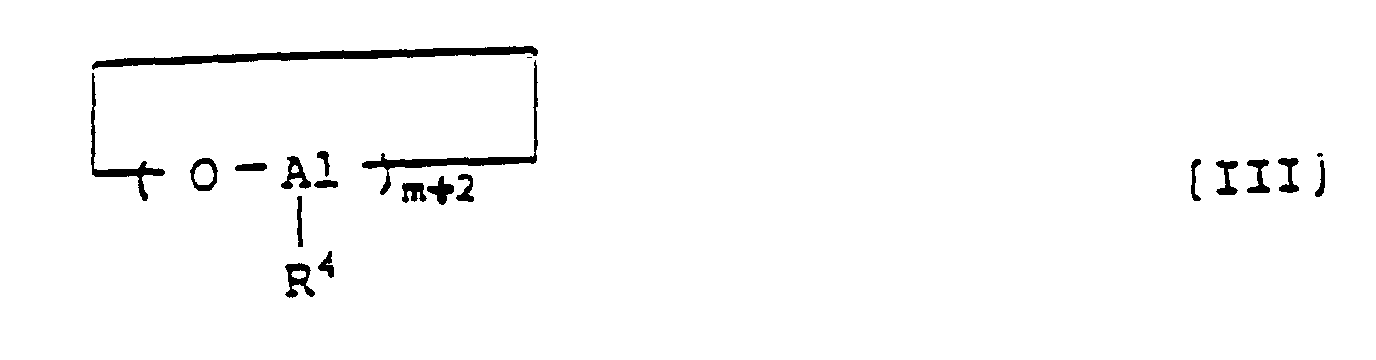
- the other component (component (B)) for use in the present invention is alumoxane represented by the following formula [II] or [III]: wherein m is a number of 4 to 30, preferably 10 to 25, and R 4 is a hydrocarbyl group, preferably a hydrocarbyl group having 1 to 10 carbon atoms, more preferably 1 to 4 carbon atoms.
- the above component (B) is a product obtained from one type of trialkylaluminum or by a reaction between two or more types of trialkylaluminum and water.
- Specific examples of the component (B) include (a) methylalumoxane, ethylalumoxane, propylalumoxane, butylalumoxane and isobutylalumoxane which are obtainable from one type of trialkylaluminum; and (b) methylethylalumoxane, methylbutylalumoxane and methylisobutylalumoxane which can be obtained by a reaction between two types of trialkylaluminum and water.
- methylalumoxane and methylisobutylalumoxane are particularly preferred.
- alumoxanes which are selected from one of the above groups or from both of the groups.
- the above alumoxanes can be used in combination with other alkylaluminum compound such as trimethylaluminum, triethylaluminum, triisobutylaluminum or dimethylaluminum chloride.
- alumoxanes can be prepared under the various known conditions. Specifically, the following methods can be mentioned:
- the catalyst according to the present invention can be prepared by bringing the above-described component (A) and component (B) into contact with each other in the presence or absence of monomers to be polymerized, inside or outside an autoclave.
- the preferable range of the amount of the component (A) used is from 10 -7 to 10 2 mmol/lit. when calculated on the basis of the transition metal atom. It is preferable that the molar ratio of Al/transition metal be 100 or more, more preferably 500 or more, up to 100,000, most preferably 1000 or more, up to 50,000.
- the catalyst of the present invention can contain some other components in addition to the components (A) and (B).
- a third component (optional component) which can be added to the components (A) and (B) include compounds containing active hydrogen such as H 2 O, methanol, ethanol and buthanol, electron-donor-type compounds such as ether, ester and amine, and compounds containing alkoxyl such as phenyl borate, dimethylmethoxyaluminum, phenyl phosphate, tetraethoxysilane and diphenyldimethoxysilane.
- active hydrogen such as H 2 O, methanol, ethanol and buthanol
- electron-donor-type compounds such as ether, ester and amine
- alkoxyl such as phenyl borate, dimethylmethoxyaluminum, phenyl phosphate, tetraethoxysilane and diphenyldimethoxysilane.
- the components (A) and (B) may be introduced into a reaction vessel either separately or after being brought into contact with each other.
- the catalyst of the present invention is applicable not only to slurry polymerization using a solvent but also to polymerizations using substantially no solvent such as liquid-phase-non-solvent polymerization, gas-phase polymerization and solution polymerization. Moreover, the catalyst of the invention can also be applied to continuous polymerization and batch polymerization.
- saturated aliphatic and aromatic hydrocarbons such as hexane, heptane, pentane, cyclohexane, benzene and toluene are used as a solvent either singly or in combination of two or more.
- the approximate range of the polymerization temperature is from -78 to 200°C, preferably from -20 to 100°C.
- the olefin pressure of the reaction system There is no limitation on the olefin pressure of the reaction system. However, the preferable range of the pressure is from atmospheric pressure to 50 kg/cm 2 G.
- the molecular weight of the finally obtainable polymer can be controlled by any known method, for instance, by properly selecting the temperature or pressure for the polymerization, or by the introduction of hydrogen.
- Olefins which can be polymerized by the catalyst of the present invention that is, olefins which are used for the polymerization reaction in the method of the present invention are ⁇ -olefins having 2 to 20, preferably 2 to 10 carbon atoms.
- ⁇ -olefins include propylene, 1-butene, 4-methyl-1-pentene, 1-hexene, 1-octene, 1-decene, 1-dodecene, 1-tetradecene, 1-hexadecene, 1-octadecene and 1-eicosene.
- propylene is particularly preferred.
- a mixture of two or more of the above ⁇ -olefins can also be used for the polymerization.
- the above ⁇ -olefins can also be copolymerized with ethylene.
- the catalyst of the invention is also useful for the copolymerization of the above ⁇ -olefins and other monomers which can be copolymerized with the ⁇ -olefins, for example, conjugate and non-conjugate dienes such as butadiene, 1,4-hexadiene, 1,8-nonadiene and 1,9-decadiene, and cyclic olefins such as cyclopropene, cyclobutene, cyclohexene, norbornene and dicyclopentadiene.
- the compound thus obtained was identified to be ethylenebis-(2-methylindenyl)zirconium dichloride, and it was also confirmed that the two 2-methylindenyl groups contained in the compound were asymmetric, that is, the relationship between the two groups with respect to a plane containing zirconium atom was not equivalent to that between an object and its mirror image.
- a 1.5-liter agitation-type autoclave was thoroughly purged with propylene.
- 500 ml of toluene which had been thoroughly dehydrated and degassed to remove dissolved oxygen was introduced into the autoclave.
- To the toluene were added 10 mmol (calculated in terms of Al atom) of the above-obtained methylalumoxane and 1.0 ⁇ mol, of the above-prepared ethylenebis-(2-methylindenyl)zirconium dichloride. Thereafter, propylene was introduced into the mixture, and polymerized at a temperature of 20°C for 15 minutes.
- Propylene was further introduced into the system, and the polymerization was continued for 2 hours at a temperature of 40°C under an inner pressure of 7 kg/cm 2 G. After the reaction was completed, the polymer slurry obtained was collected by filtration and dried to give 56.2 g of a polymer.
- the catalytic activity was 308 kg/polymer/g ⁇ Zr ⁇ hr.
- the solution of the aluminum mixture and the toluene containing saturated water were fed, by dropping an equimolar amount of Al and H 2 O, to the reaction system over a period of 3 hours.
- the temperature of the mixture was raised to 50°C, and a reaction was carried out at the temperature for two hours.
- the solvent was evaporated under reduced pressure, thereby obtaining 1.9 g of a white solid.
- the white solid thus obtained was dissolved in toluene, and subjected to 13 C-NMR.
- the ratio (methyl group) : (isobutyl group) was found to be 1.16 : 1.
- a spectrum showing a peak with a half band width of 6196 Hz having a chemical shift of 179 ppm was obtained by 27 Al-NMR.
- the catalytic activity was 524 kg-polymer/g ⁇ Zr ⁇ hr.
- the number-average molecular weight of the polymer was 19.0 ⁇ 10 4 ; the molecular weight distribution index (Q value) was 2.04; and the melting point of the polymer was 149.4°C.
Landscapes
- Chemical & Material Sciences (AREA)
- Organic Chemistry (AREA)
- Health & Medical Sciences (AREA)
- Chemical Kinetics & Catalysis (AREA)
- Medicinal Chemistry (AREA)
- Polymers & Plastics (AREA)
- Transition And Organic Metals Composition Catalysts For Addition Polymerization (AREA)
Description
- The present invention relates to a catalyst for use in the production of stereoregular polyolefins. More specifically, the present invention relates to a catalyst which is useful for the polymerization of olefins and comprises a specific metallocene compound which is a novel asymmetric transition metallic compound having bis-substituted-cyclopentadienyl-bridge-type bidentate ligands of bridge structure, and alumoxane.
- A so-called Kaminsky catalyst comprising a metallocene compound and alumoxane has been well known as a homogeneous catalyst useful for the polymerization of olefins. This catalyst is characterized in that it brings about extremely high polymerization activity, and that it can produce a polymer with a narrow molecular weight distribution.
- Ethylenebis(indenyl)zirconium dichloride and ethylenebis(4,5,6,7-tetrahydroindenyl)zirconium dichloride (Japanese Patent Application Laid-Open Publication No. 130314/1986) have been known as transition metallic compounds useful for the production of isotactic polyolefins. They are, however, disadvantageous in that they produce polyolefins having low molecular weights, and that they can produce polyolefins having high molecular weights if the production is conducted at a low temperature, but, in this case, the polymerization activity is low.
- Further, it has been known that a polymer having a high molecular weight can be produced when a hafnium compound is used instead of zirconium (Journal of Molecular Catalysis, 56 (1989) p. 237-247). However, this method has a shortcoming in that the polymerization activity is low.
- Furthermore, dimethylsilylbis-substituted cyclopentadienylzirconium dichloride and the like are described in Japanese Patent Application Laid-Open Publication No. 301704/1989, Polymer Preprints, Japan Vol. 39, No. 6, p. 1614-1616 (1990), Japanese Patent Application Laid-Open Publication No. 12406/1991 and the like. However, there is no report concerning a catalyst which can bring about high polymerization activity and, at the same time, can give a polymer having a high molecular weight.
- An object of the present invention is to provide a polymerization method by which a propylene polymer having a high molecular weight (number-average molecular weight: 70,000 or more), capable of being subjected to both extrusion molding and injection molding, can be obtained in high yield.
- The present invention has been accomplished as a result of the studies which were made to solve the above-described problems. More specifically, the catalyst useful for the polymerization of olefins according to the present invention comprises the following component (A) and component (B):
- Component (A): A transition metallic compound having the following formula [I]:
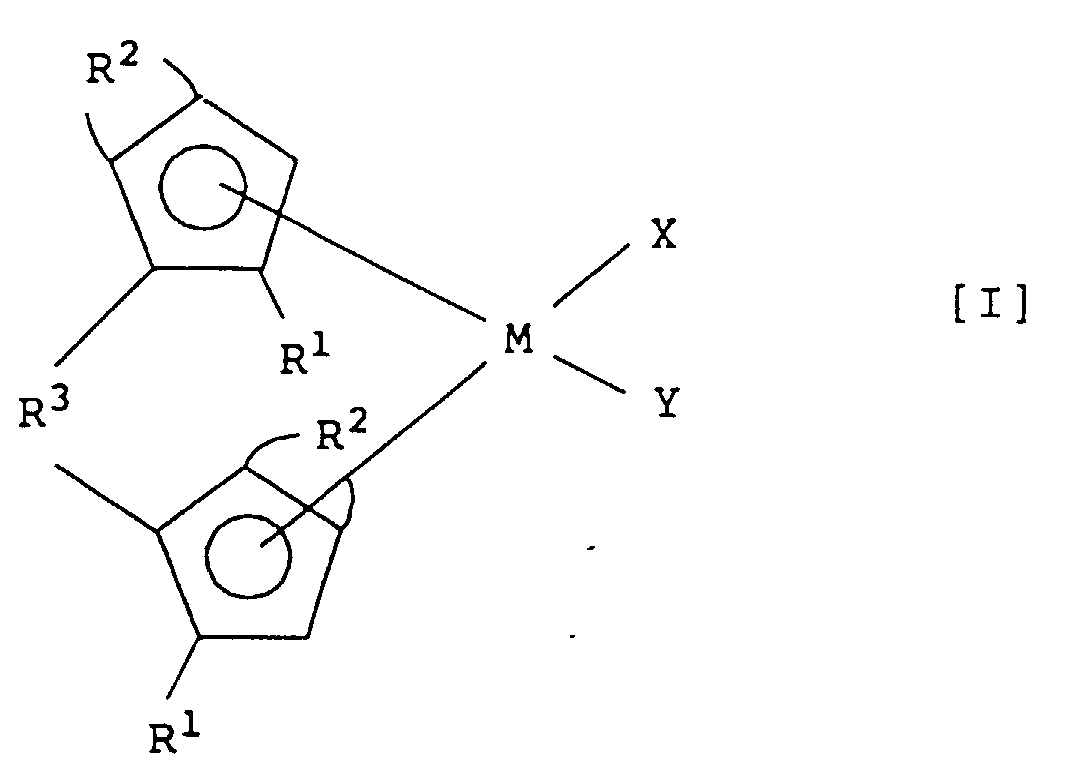
- M represents a transition metal selected from the group consisting of titanium, zirconium and hafnium;
- two R1s may be the same or different, and represent a monovalent hydrocarbyl group having 1 to 6 carbon atoms, or a monovalent hydrocarbyl group having 1 to 6 carbon atoms and containing silicon;
- two R2 substituents may be the same or different, and each represents a divalent hydrocarbyl group having 4 to 20 carbon atoms which forms an 6-membered ring together with the cyclopentadienyl group to which R2 is bonded through the two adjacent carbon atoms of the five-membered cyclic ligand with the proviso that R2 does not form a saturated ring unsubstituted or substituted by an alkyl, aryl, arylalkyl, alkylaryl, alkenyl or arylalkenyl group and that the two R2 substituents are not simultaneously 1,3-butadienylene;
- R3 represents a divalent hydrocarbyl group having 1 to 3-30 carbon atoms in total, or a divalent hydrocarbyl group having 1 to 30 carbon atoms in total and containing silicon or germanium; and
- X and Y independently represent hydrogen, halogen, a monovalent hydrocarbyl group having 1 to 20 carbon atoms, or a monovalent hydrocarbyl group having 1 to 20 carbon atoms and containing nitrogen, oxygen or silicon,
- provided that the two five-membered cyclic ligands each having the substituents R1 and R2 are asymmetric about a plane containing M when viewed from their relative position in terms of the group R3.
- Component (B): Alumoxane having the following formula [II] or [III]:


- By using the catalyst according to the present invention, a stereoregular polyolefin having a high molecular weight can be produced in high yield.
- It is due to the characteristic features of the present invention such as the use of the asymmetric metallocene compound that the objects sought, that is, to make the polymerization activity high and to produce high-molecular-weight polymers, which are fundamentally incompatible with each other, can be successfully attained at the same time. This is considered to be an unexpected finding.
- The present invention relates to a catalyst useful for the polymerization of olefins, comprising component (A) and component (B) as shown below. The expression "comprising component (A) and component (B)" herein means that it is possible to use a third component other than components (A) and (B) as long as it does not impair the effects of the present invention.
- Component (A) which is used as one component of the catalyst of the present invention is a transition metallic compound represented by the following formula [I]:
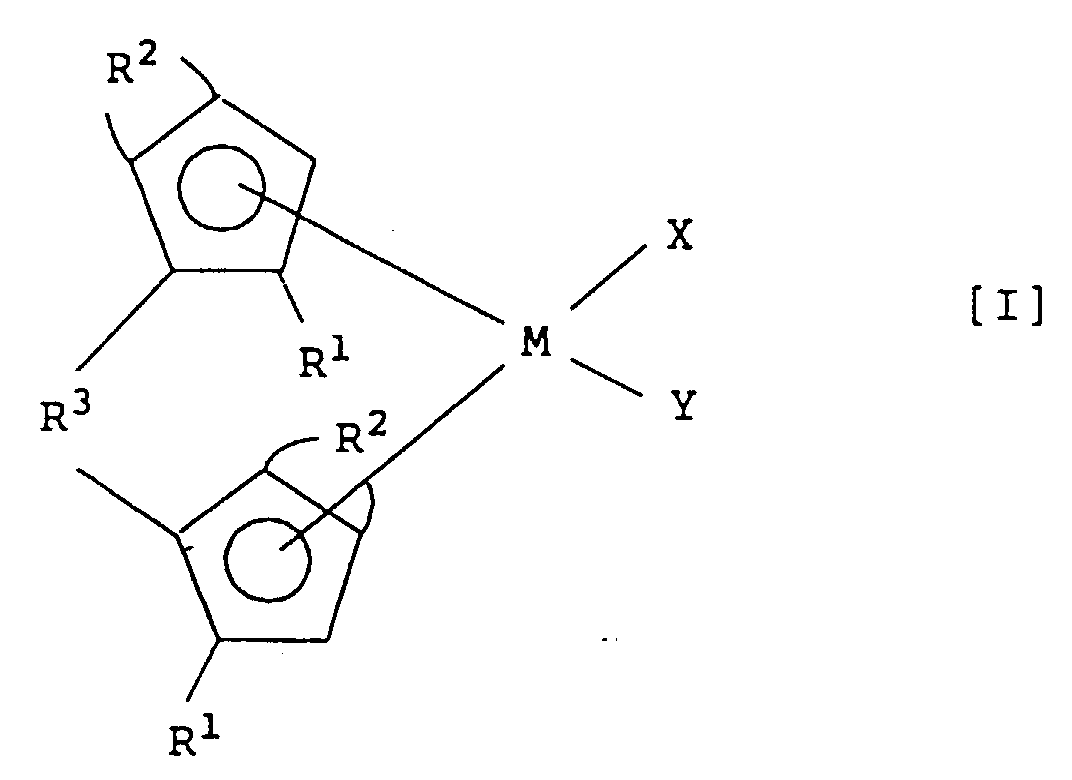
- M represents a transition metal selected from the group consisting of titanium, zirconium and hafnium;
- two R1s may be the same or different, and represent a monovalent hydrocarbyl group having 1 to 6, preferably 1 to 4 carbon atoms, or a monovalent hydrocarbyl group having 1 to 6, preferably 1 to 4 carbon atoms, and containing silicon;
- two R2 substituents may be the same or different, and each represents a divalent hydrocarbyl group having 4 to 20 carbon atoms which forms an 6-membered ring together with the cyclopentadienyl group to which R2 is bonded through the two adjacent carbon atoms of the five-membered cyclic ligand with the proviso that R2 does not form a saturated ring unsubstituted or substituted by an alkyl, aryl, arylalkyl, alkylaryl, alkenyl or arylalkenyl group and that the two R2 substituents are not simultaneously 1,3-butadienylene;
- R3 represents a divalent hydrocarbyl group having 1 to 30, preferably 2 to 20 carbon atoms in total, or a divalent hydrocarbyl group having 1 to 30, preferably 2 to 20 carbon atoms in total, containing silicon or germanium; and
- X and Y independently represent hydrogen, halogen, a monovalent hydrocarbyl group having 1 to 20, preferably 1 to 7 carbon atoms, or a monovalent hydrocarbyl group having 1 to 20, preferably 1 to 7 carbon atoms, containing nitrogen, oxygen or silicon.
- The distinctive feature of the metallocene compound having the formula [I] for use in the present invention is that the two five-membered cyclic ligands contained in the compound, each having the substituents R1 and R2 are asymmetric about a plane containing M when viewed from their relative position in terms of the group R3.
- The expression "asymmetric about a plane containing M when viewed from their relative position in terms of the group R3" means that the relationship between the two substituted five-membered rings which are facing each other with M (more precisely, X - M - Y) therebetween is not equivalent to the relationship between an object and its mirror image.
- In the above case, the state of asymmetry can be roughly divided into two types. One of them is such that the relationship between the two substituted five-membered cyclic ligands with respect to a plane containing M, X and Y is not equivalent to that between an object and its mirror image in terms of the positions of R1 and R2. In this case, even if R1s and R2s contained in the two substituted five-membered cyclic ligands are respectively the same, the relationship between the two substituted ligands is not equivalent to that between an object and its mirror image.
- Another type of asymmetry is such that although the relationship between the two substituted ligands is equivalent to that between an object and its mirror image in terms of the respective positions of the substituents R1 and R2, at least either R1s or R2s are not the same between the two five-membered cyclic ligands. For instance, even when the positional relationship between the two R1s is equivalent to the relationship between an object and its mirror image, the relationship between the two five-membered cyclic ligands is not equivalent to the relationship between an object and its mirror image because the types of R1s are different from each other. In the present invention, only the former type of state is referred to as the state of asymmetry.
- As described above, R1 is a monovalent hydrocarbyl group having 1 to 6 carbon atoms, or a monovalent hydrocarbyl group having 1 to 6 carbon atoms, containing silicon. More specifically, R1 is a saturated hydrocarbon group such as alkyl or cycloalkyl, an unsaturated hydrocarbon group such as alkenyl, or a hydrocarbon group containing silicon such as alkylsilyl. Specific examples of R1 include methyl, ethyl, n-propyl, i-propyl, n-butyl, i-butyl, t-butyl, n-amyl, i-amyl, n-hexyl, cyclopropyl, allyl, trimethylsilyl and dimethylethylsilyl groups. Of these groups, lower alkyl groups such as methyl, ethyl, n-propyl, i-propyl, n-butyl, i-butyl and t-butyl are preferred.
- R2 is, more specifically, an unsaturated hydrocarbon group such as alkadienylene or arylene, which forms an unsaturated 6-membered ring together with the cyclopentadienyl group to which R2 is bonded. Specific examples of R2 include 1,3-butadienylene, methyl-1,3-butadienylene, phenylbutylene and phenyl-1,3-butadienylene. Of these groups, alkadienylene groups such as 1,3-butadienylene and methyl-1,3-butadienylene, in particular, 1,3-butadienylene group are preferred.
- R3 is, more specifically, a saturated hydrocarbyl group such as lower alkylene or cycloalkylene, which can be substituted by a hydrocarbyl group, provided that the total number of carbon atom is 1 to 30; an unsaturated hydrocarbyl group such as arylene; or a hydrocarbyl group containing silicon or germanium such as lower alkyl- or arylsilylene, or lower alkyl- or arylgermylene, which may be substituted by a hydrocarbyl group, provided that the total number of carbon atom is 1 to 30. Of these groups, lower alkylene, cycloalkylene, arylene and lower alkylsilylene are preferred. More preferably, R3 is a methylene or ethylene group which can be substituted by a lower alkyl or lower alkylsilyl group, or a silylene group which may be substituted by a lower alkyl group.
- X and Y independently represent, more specifically, hydrogen, a halogen (for example, fluorine, chlorine, bromine and iodine, preferably chlorine), a monovalent hydrocarbyl group having 1 to 20 carbon atoms or a monovalent hydrocarbyl group having 1 to 20 carbon atoms, containing silicon or germanium (preferably any of the hydrocarbyl groups enumerated previously as examples of R1, and, in particular, methyl). More preferably, X and Y independently represent a lower alkyl group or a lower alkyl-substituted silyl group.
- A metallocene compound preferably used in the present invention is the one in which at least one of R1, R2, R3, M, X and Y fulfills the following conditions:
- R1:
- a lower alkyl group;
- R2:
- a 1,3-butadienylene group;
- R3:
- a methylene or ethylene group which may be substituted with a lower alkyl or lower alkylsilyl group, or a silylene group which may be substituted with a lower alkyl group;
- M:
- zirconium;
- X and Y:
- independently chlorine, a lower alkyl group or a lower alkyl-substituted silyl group.
- The typical synthesis route of the compound [I] of the present invention is as follows. In the following scheme, HRa represents:
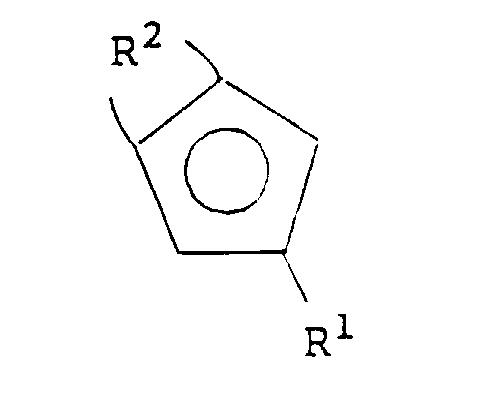


- Nonlimitative examples of the above-described transition metallic compound are as follows. It is noted that although the compounds listed below are described simply by their chemical names, they are, as a matter of course, asymmetric in stereostructure as defined previously.
- (1) ethylenebis-(2-methyl-4-methylindenyl)hafnium dichloride
- (2) ethylenebis-(2-methyl-5-methylindenyl)zirconium dichloride
- (3) ethylenebis-(2,6-dimethylindenyl)zirconium dichloride
- (4) ethylenebis-(2,7-dimethylindenyl)zirconium dichloride
- (5) dimethylsilylenebis-(2,4-dimethylindenyl)zirconium dichloride
- (6) dimethylsilylenebis-(2,5-dimethylindenyl)zirconium dichloride
- (7) dimethyisilylenebis-(2,6-dimethylindenyl)zirconium dichloride
- (8) dimethylsilylenebis-(2,7-dimethylindenyl)zirconium dichloride
- (9) dimethylsilylenebis-(2,4,7-trimethylindenyl)zirconium dichloride
- The other component (component (B)) for use in the present invention is alumoxane represented by the following formula [II] or [III]:

- The above component (B) is a product obtained from one type of trialkylaluminum or by a reaction between two or more types of trialkylaluminum and water. Specific examples of the component (B) include (a) methylalumoxane, ethylalumoxane, propylalumoxane, butylalumoxane and isobutylalumoxane which are obtainable from one type of trialkylaluminum; and (b) methylethylalumoxane, methylbutylalumoxane and methylisobutylalumoxane which can be obtained by a reaction between two types of trialkylaluminum and water. Of these compounds, methylalumoxane and methylisobutylalumoxane are particularly preferred.
- It is also possible to use a plurality of the alumoxanes which are selected from one of the above groups or from both of the groups. Moreover, the above alumoxanes can be used in combination with other alkylaluminum compound such as trimethylaluminum, triethylaluminum, triisobutylaluminum or dimethylaluminum chloride.
- The above alumoxanes can be prepared under the various known conditions. Specifically, the following methods can be mentioned:
- (a) the method in which trialkylaluminum is directly reacted with water by using a proper organic solvent such as toluene, benzene or ether;
- (b) the method in which trialkylaluminum is reacted with a salt hydrate containing water of crystallization, such as a hydrate of copper sulfate or of aluminum sulfate;
- (c) the method in which trialkylaluminum is reacted with water impregnated in silica gel or the like;
- (d) the method in which trimethylaluminum and triisobutylaluminum are mixed, and the mixture is directly reacted with water by using a proper organic solvent such as toluene, benzene or ether;
- (e) the method in which trimethylaluminum and triisobutylaluminum are mixed, and the mixture is reacted, while heating, with a salt hydrate containing water of crystallization, such as a hydrate of copper sulfate or of aluminum sulfate;
- (f) the method in which silica gel or the like that has been impregnated with water in advance is treated with triisobutylaluminum, and then subjected to an additional treatment with trimethylaluminum;
- (g) the method in which methylalumoxane and isobutylalumoxane are synthesized separately by the known methods, mixed in the predetermined amounts, and reacted with each other while heating; and
- (h) the method in which a salt containing water of crystallization such as CuSO4·5H2O is added to an aromatic hydrocarbon solvent such as benzene or toluene, and reacted with trimethylaluminum at a temperature of approximately -40 to 40°C. In this method, the amount of water used is, in general, from 0.5 to 1.5 when expressed by the molar ratio to the trimethylaluminum. The methylalumoxane thus obtained is a linear or cyclic organoaluminum polymer.
- The catalyst according to the present invention can be prepared by bringing the above-described component (A) and component (B) into contact with each other in the presence or absence of monomers to be polymerized, inside or outside an autoclave.
- No particular limitation is imposed on the amounts of the components (A) and (B) for use in the present invention. For instance, in the case of solvent polymerization, the preferable range of the amount of the component (A) used is from 10-7 to 102 mmol/lit. when calculated on the basis of the transition metal atom. It is preferable that the molar ratio of Al/transition metal be 100 or more, more preferably 500 or more, up to 100,000, most preferably 1000 or more, up to 50,000.
- As mentioned previously, the catalyst of the present invention can contain some other components in addition to the components (A) and (B). Examples of a third component (optional component) which can be added to the components (A) and (B) include compounds containing active hydrogen such as H2O, methanol, ethanol and buthanol, electron-donor-type compounds such as ether, ester and amine, and compounds containing alkoxyl such as phenyl borate, dimethylmethoxyaluminum, phenyl phosphate, tetraethoxysilane and diphenyldimethoxysilane.
- When the above catalyst system is used for the polymerization of an olefin, the components (A) and (B) may be introduced into a reaction vessel either separately or after being brought into contact with each other.
- The catalyst of the present invention is applicable not only to slurry polymerization using a solvent but also to polymerizations using substantially no solvent such as liquid-phase-non-solvent polymerization, gas-phase polymerization and solution polymerization. Moreover, the catalyst of the invention can also be applied to continuous polymerization and batch polymerization.
- In the case of slurry polymerization, saturated aliphatic and aromatic hydrocarbons such as hexane, heptane, pentane, cyclohexane, benzene and toluene are used as a solvent either singly or in combination of two or more.
- The approximate range of the polymerization temperature is from -78 to 200°C, preferably from -20 to 100°C. There is no limitation on the olefin pressure of the reaction system. However, the preferable range of the pressure is from atmospheric pressure to 50 kg/cm2G.
- The molecular weight of the finally obtainable polymer can be controlled by any known method, for instance, by properly selecting the temperature or pressure for the polymerization, or by the introduction of hydrogen.
- Olefins which can be polymerized by the catalyst of the present invention, that is, olefins which are used for the polymerization reaction in the method of the present invention are α-olefins having 2 to 20, preferably 2 to 10 carbon atoms. Specific examples of such α-olefins include propylene, 1-butene, 4-methyl-1-pentene, 1-hexene, 1-octene, 1-decene, 1-dodecene, 1-tetradecene, 1-hexadecene, 1-octadecene and 1-eicosene. Of these α-olefins, propylene is particularly preferred. A mixture of two or more of the above α-olefins can also be used for the polymerization.
- By using the catalyst of the present invention, the above α-olefins can also be copolymerized with ethylene. Moreover, the catalyst of the invention is also useful for the copolymerization of the above α-olefins and other monomers which can be copolymerized with the α-olefins, for example, conjugate and non-conjugate dienes such as butadiene, 1,4-hexadiene, 1,8-nonadiene and 1,9-decadiene, and cyclic olefins such as cyclopropene, cyclobutene, cyclohexene, norbornene and dicyclopentadiene.
- The present invention will now be illustrated by reference Examples that are not recording to this invention.
- All of the following reactions were carried out under an inert gas atmosphere. Solvents dried in advance were used for the reactions.
- In a 500-ml glass reaction vessel, 4.3 g (33 mmol) of 2-methylindene was dissolved in 80 ml of tetrahydrofuran. 21 ml of a 1.6 M hexane solution of n-butyllithium was slowly added dropwise to the reaction vessel while cooling. The mixture was stirred at room temperature for one hour, and then cooled again. To this mixture, 3.1 g of 1,2-dibromoethane was slowly added dropwise, and the resulting mixture was stirred at room temperature for 12 hours. 50 ml of water was added to the mixture, and the organic phase was fractionated. After drying, the organic phase was washed several times with heptane, and dried to give 2.9 g of bis-(2-methylindenyl)ethane.
- 2.1 g (7.3 mmol) of the above-obtained bis-(2-methylindenyl)ethane was dissolved in 70 ml of tetrahydrofuran. To this solution, 9.2 ml of a 1.6 M hexane solution of n-butyllithium was slowly added dropwise while cooling. After stirring at room temperature for 3 hours, the mixture was slowly added dropwise to a solution consisting of 1.6 g (7.0 mmol) of zirconium tetrachloride and 60 ml of tetrahydrofuran. After stirring the mixture for 5 hours, hydrogen chloride gas was blown into the mixture, and the mixture was then dried. Subsequently, toluene was added to the mixture, and the soluble matter was fractionated and crystallized at a low temperature to give 0.95 g of a yellow powder.
- By 1H-NMR, the compound thus obtained was identified to be ethylenebis-(2-methylindenyl)zirconium dichloride, and it was also confirmed that the two 2-methylindenyl groups contained in the compound were asymmetric, that is, the relationship between the two groups with respect to a plane containing zirconium atom was not equivalent to that between an object and its mirror image.
- 50 g of CuSO4-5H2O was added, 5 g at a time at 5-minutes intervals, to 565 ml of toluene solution containing 48.2 g of trimethylaluminum placed in a reaction vessel at a temperature of 0°C while stirring. After the addition was completed, the temperature of the mixture was gradually raised to 25°C, and a reaction was carried out at the temperature for 2 hours. The temperature of the reaction mixture was then raised to 35°C, and the reaction was continued at the temperature for 2 days. The remaining solid of the copper sulfate was filtered off, thereby obtaining a toluene solution of alumoxane. The density of the methylalumoxane obtained was found to be 27.3 mg/ml (2.7 w/v%).
- A 1.5-liter agitation-type autoclave was thoroughly purged with propylene. 500 ml of toluene which had been thoroughly dehydrated and degassed to remove dissolved oxygen was introduced into the autoclave. To the toluene were added 10 mmol (calculated in terms of Al atom) of the above-obtained methylalumoxane and 1.0 µmol, of the above-prepared ethylenebis-(2-methylindenyl)zirconium dichloride. Thereafter, propylene was introduced into the mixture, and polymerized at a temperature of 20°C for 15 minutes. Propylene was further introduced into the system, and the polymerization was continued for 2 hours at a temperature of 40°C under an inner pressure of 7 kg/cm2G. After the reaction was completed, the polymer slurry obtained was collected by filtration and dried to give 56.2 g of a polymer. The catalytic activity was 308 kg/polymer/g·Zr·hr.
- The number-average molecular weight of the polymer was 9.60 × 10⁴, the molecular weight distribution index "Q value (= Mw/Mn)" was 2.02, and the melting point of the polymer (the peak temperature of the DSC curve) was approximately 134.3°C.
- The procedure of Reference Example 1 was repeated except that 5 ml of 1-hexene was added before introducing the ethylenebis-(2-methylindenyl)zirconium )zirconium dichloride, whereby 51.2 g of a polymer was obtained. The catalytic activity was 281 kg-polymer/g·Zr·hr. The number-average molecular weight of the polymer was 7.89 × 10⁴, the molecular weight distribution index (Q value) was 1.90, the hexene content of the polymer was 0.59 mol%, and the melting point of the polymer was 131.4°C.
- In a 500-ml glass reaction vessel, 4.3 g (33 mmol) of 2-methylindene was dissolved in 80 ml of tetrahydrofuran. 21 ml of a 1.6 M hexane solution of n-butyllithium was slowly added dropwise to the reaction vessel while cooling. The mixture was stirred at room temperature for one hour, and then cooled again. To this mixture, 2.1 g of dimethyldichlorosilane was slowly added dropwise, and the resulting mixture was stirred at room temperature for 12 hours. 50 ml of water was added to the mixture, and the organic phase was fractionated and dried to give 3.5 g of dimethylbis-(2-methylindenyl)silane. 3.5 g of the above-obtained dimethylbis-(2-methylindenyl)silane was dissolved in 70 ml of tetrahydrofuran. To this solution, 13.9 ml of a 1.6 M hexane solution of n-butyllithium was slowly added dropwise while cooling. After stirring at room temperature for 3 hours, the mixture was slowly added dropwise to a solution consisting of 2.6 g (11 mmol) of zirconium tetrachloride and 60 ml of tetrahydrofuran. After stirring the mixture for 5 hours, hydrogen chloride gas was blown into the mixture, and the mixture was then dried. Subsequently, methylene chloride was added to the mixture, and the soluble matter was fractionated and crystallized at a low temperature to give 0.45 g of an orange powder.
- By 1H-NMR, the compound thus obtained was identified to be dimethylsilylenebis-(2-methylindenyl)zirconium dichloride, and it was also confirmed that the two 2-methylindenyl groups contained in the compound were asymmetric.
- To a 1,000-ml flask equipped with a stirrer and a reflux condenser and thoroughly purged with nitrogen, 100 ml of toluene which had been thoroughly dehydrated and degassed to remove dissolved oxygen was introduced. Subsequently, a solution of 0.72 g (10 mmol) of trimethylaluminum and 1.96 g (10 mmol) of triisobutylaluminum in 50 ml of toluene was introduced into one of two dropping funnels, and toluene containing saturated water was introduced into the other dropping funnel. While keeping the reaction system at 30°C, the solution of the aluminum mixture and the toluene containing saturated water were fed, by dropping an equimolar amount of Al and H2O, to the reaction system over a period of 3 hours. After the feeding was completed, the temperature of the mixture was raised to 50°C, and a reaction was carried out at the temperature for two hours. After the reaction was completed, the solvent was evaporated under reduced pressure, thereby obtaining 1.9 g of a white solid. the white solid thus obtained was dissolved in toluene, and subjected to 13C-NMR. As a result, the ratio (methyl group) : (isobutyl group) was found to be 1.16 : 1. Further, a spectrum showing a peak with a half band width of 6196 Hz having a chemical shift of 179 ppm was obtained by 27Al-NMR.
- The procedure of Reference Example 1 was repeated except that the ethylenebis-(2-methylindenyl)zirconium dichloride used in Reference Example 1 was replaced by the above-obtained dimethylsilylenebis-(2-methylindenyl)zirconium dichloride, and the methylalumoxane used in Example 1 was replaced by the above-synthesized methylisobutylalumoxane, thereby polymerizing propylene.
- As a result, 95.4 g of a polymer was obtained. The catalytic activity was 524 kg-polymer/g·Zr·hr. The number-average molecular weight of the polymer was 19.0 × 10⁴; the molecular weight distribution index (Q value) was 2.04; and the melting point of the polymer was 149.4°C.
- The procedure of Reference Example 3 was repeated except that the polymerization was carried out at a temperature of 70°C, whereby 113.4 g of a polymer was obtained. The catalytic activity was 621 kg-polymer/g·Zr·hr. The number-average molecular weight of the polymer was 7.50 × 10⁴; the molecular weight distribution index (Q value) was 1.98; and the melting point of the polymer was 139.2°C.
- The procedure of Reference Example 3 was repeated except that the methylisobutylalumoxane used in Reference Example 3 was replaced by the methylalumoxane synthesized in Reference Example 1, thereby polymerizing propylene. As a result, 45.1 g of a polymer was obtained. The catalytic activity was 248 kg-polymer/g·Zr·hr. The number-average molecular weight of the polymer was 14.3 × 10⁴, and the molecular weight distribution index (Q value) was 2.11.
Claims (12)
- A catalyst useful for the polymerization of olefins into stereoregular polyolefins comprising the following Component (A) and Component (B):
Component (A): A transition metal compound having the following formula [I]: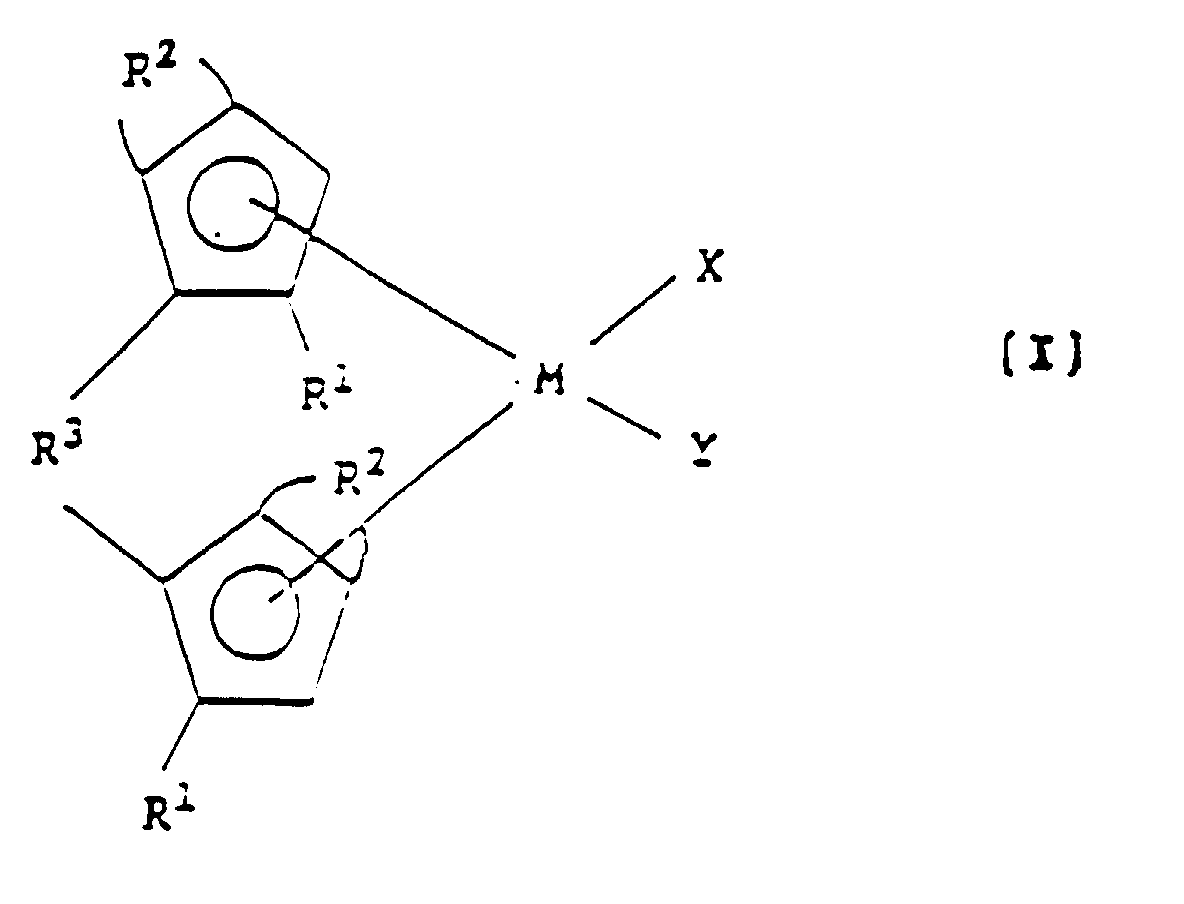 M represents a transition metal selected from titanium, zirconium and hafnium;two R1 substituents may be the same or different, and each represents a monovalent hydrocarbyl group having 1 to 6 carbon atoms, or a monovalent hydrocarbyl group having 1 to 6 carbon atoms and containing silicon;two R2 substituents may be the same or different, and each represents a divalent hydrocarbyl group having 4 to 20 carbon atoms which forms an 6-membered ring together with the cyclopentadienyl group to which R2 is bonded through the two adjacent carbon atoms of the five-membered cyclic ligand with the proviso that R2 does not form a saturated ring unsubstituted or substituted by an alkyl, aryl, arylalkyl, alkylaryl, alkenyl or arylalkenyl group and that the two R2 substituents are not simultaneously 1,3-butadienylene;R3 represents a divalent hydrocarbyl group having 1 to 30 carbon atoms in total, or a divalent hydrocarbyl group having 1 to 30 carbon atoms in total and containing silicon or germanium; andX and Y independently represent hydrogen, halogen, a monovalent hydrocarbyl group having 1 to 20 carbon atoms, or a monovalent hydrocarbyl group having 1 to 20 carbon atoms and containing nitrogen, oxygen or silicon,provided that the two five-membered cyclic ligands each having the substituents R1 and R2 are asymmetric about a plane containing M when viewed from their relative position in terms of the group R3;Component (B): Alumoxane having the following formula [II] or [III]:
- A catalyst according to Claim 1, wherein M in the formula [I] is zirconium.
- A catalyst according to Claim 1 or 2, wherein at least one substituent R1 in the formula [I] is a C1-C4 alkyl group.
- A catalyst according to any of Claims 1 to 3, wherein the component (B) is selected from methylalumoxane and methylisobutylalumoxane.
- A catalyst according to Claim 1, wherein at least one substituent R1 is a monovalent hydrocarbyl group having 1 to 4 carbon atoms and each R2 substituent has 4 to 8 carbon atoms.
- A catalyst according to Claim 5, wherein each R2 substituent represents an alkadienylene group.
- A catalyst according to claim 1, wherein, in the formula (I), each R1 substituent represents a hydrocarbyl group having 1 to 4 carbon atoms and each R2 substituent represents a methyl-1,3-butadienylene group.
- A catalyst according to Claim 6 or 7, wherein X and Y independently represent a chlorine atom, a C1-C4 alkyl group or a C1-C4 alkyl-substituted silyl group.
- A catalyst according to claim 8, wherein X and Y each represents a chlorine atom.
- A catalyst according to Claim 8, wherein R3 is a methylene group, an ethylene group or a silylene group which may or may not have a substituent of a C1-C4 alkyl group.
- A process for the polymerization of olefins characterised in that an olefin is contacted with a catalyst according to any of claims 1 to 10, thereby to polymerize the olefin.
- A process according to claim 11 wherein propylene is polymerized.
Priority Applications (1)
| Application Number | Priority Date | Filing Date | Title |
|---|---|---|---|
| EP96202600A EP0748822B1 (en) | 1991-08-20 | 1992-08-18 | Catalyst component useful for the polymerization of olefins |
Applications Claiming Priority (3)
| Application Number | Priority Date | Filing Date | Title |
|---|---|---|---|
| JP20821391 | 1991-08-20 | ||
| JP208213/91 | 1991-08-20 | ||
| JP20821391A JP3402473B2 (en) | 1991-08-20 | 1991-08-20 | Olefin polymerization catalyst |
Related Child Applications (2)
| Application Number | Title | Priority Date | Filing Date |
|---|---|---|---|
| EP96202600A Division EP0748822B1 (en) | 1991-08-20 | 1992-08-18 | Catalyst component useful for the polymerization of olefins |
| EP96202600.1 Division-Into | 1996-09-18 |
Publications (3)
| Publication Number | Publication Date |
|---|---|
| EP0529908A1 EP0529908A1 (en) | 1993-03-03 |
| EP0529908B1 true EP0529908B1 (en) | 1997-05-14 |
| EP0529908B2 EP0529908B2 (en) | 2002-11-06 |
Family
ID=16552552
Family Applications (2)
| Application Number | Title | Priority Date | Filing Date |
|---|---|---|---|
| EP96202600A Expired - Lifetime EP0748822B1 (en) | 1991-08-20 | 1992-08-18 | Catalyst component useful for the polymerization of olefins |
| EP92307523A Expired - Lifetime EP0529908B2 (en) | 1991-08-20 | 1992-08-18 | Catalyst useful for the polymerization of olefin |
Family Applications Before (1)
| Application Number | Title | Priority Date | Filing Date |
|---|---|---|---|
| EP96202600A Expired - Lifetime EP0748822B1 (en) | 1991-08-20 | 1992-08-18 | Catalyst component useful for the polymerization of olefins |
Country Status (5)
| Country | Link |
|---|---|
| US (2) | US5561093A (en) |
| EP (2) | EP0748822B1 (en) |
| JP (1) | JP3402473B2 (en) |
| DE (2) | DE69232193T2 (en) |
| FI (1) | FI105193B (en) |
Cited By (1)
| Publication number | Priority date | Publication date | Assignee | Title |
|---|---|---|---|---|
| US6307087B1 (en) | 1998-07-10 | 2001-10-23 | Massachusetts Institute Of Technology | Ligands for metals and improved metal-catalyzed processes based thereon |
Families Citing this family (44)
| Publication number | Priority date | Publication date | Assignee | Title |
|---|---|---|---|---|
| DE3751694T2 (en) | 1987-04-03 | 1996-08-01 | Fina Technology | Metallocene catalyst systems for the polymerization of olefins, with a silicon-hydrocarbyl bridge. |
| ES2090209T3 (en) | 1990-11-12 | 1996-10-16 | Hoechst Ag | METALLOCENES WITH LIGANDS BASED ON SUBSTITUTED INDENYL DERIVATIVES IN POSITION 2, PROCEDURE FOR THEIR PREPARATION AND USE AS CATALYSTS. |
| USRE39561E1 (en) | 1990-11-12 | 2007-04-10 | Basell Polyoefine Gmbh | Metallocenes containing ligands of 2-substituted indenyl derivatives, process for their preparation, and their use as catalysts |
| TW300901B (en) * | 1991-08-26 | 1997-03-21 | Hoechst Ag | |
| DE59210001D1 (en) * | 1991-10-15 | 2005-02-17 | Basell Polyolefine Gmbh | Process for the preparation of an olefin polymer using metallocenes with specifically substituted indenyl ligands |
| TW309523B (en) * | 1991-11-30 | 1997-07-01 | Hoechst Ag | |
| DE59206948D1 (en) * | 1991-11-30 | 1996-09-26 | Hoechst Ag | Metallocenes with benzo-fused indenyl derivatives as ligands, processes for their preparation and their use as catalysts |
| US5932669A (en) * | 1991-11-30 | 1999-08-03 | Targor Gmbh | Metallocenes having benzo-fused indenyl derivatives as ligands, processes for their preparation and their use as catalysts |
| US5830821A (en) * | 1991-11-30 | 1998-11-03 | Targor Gmbh | Process for olefin preparation using metallocenes having benzo-fused indenyl derivatives as ligands |
| TW294669B (en) | 1992-06-27 | 1997-01-01 | Hoechst Ag | |
| ATE165832T1 (en) * | 1992-08-03 | 1998-05-15 | Targor Gmbh | METHOD FOR PRODUCING AN OLEFIN POLYMER USING METALLOCENES WITH SPECIFICALLY SUBSTITUTED INDENYL LIGANDS |
| USRE39156E1 (en) | 1992-08-15 | 2006-07-04 | Basell Polyolefine Gmbh | Process for the preparation of polyolefins |
| JP3293927B2 (en) * | 1993-02-19 | 2002-06-17 | 三菱化学株式会社 | Catalyst component for .ALPHA.-olefin polymerization and method for producing .ALPHA.-olefin polymer using the same |
| JP3307704B2 (en) * | 1993-02-19 | 2002-07-24 | 三菱化学株式会社 | Production method of .ALPHA.-olefin polymer |
| US5594081A (en) | 1994-07-22 | 1997-01-14 | Mitsubishi Chemical Corporation | Catalyst component for the polymerization of α-olefins and a process for preparing α-olefin polymers with use of same |
| JP3338190B2 (en) * | 1994-08-17 | 2002-10-28 | 三菱化学株式会社 | Catalyst component for .ALPHA.-olefin polymerization and method for producing .ALPHA.-olefin polymer using the same |
| DE19544828A1 (en) * | 1995-12-01 | 1997-06-05 | Hoechst Ag | High molecular copolymers |
| US6787618B1 (en) | 1995-12-01 | 2004-09-07 | Basell Polypropylen Gmbh | Metallocene compound and high molecular weight copolymers of propylene and olefins having two or four to thirty-two carbon atoms |
| JP4195095B2 (en) * | 1996-09-04 | 2008-12-10 | エクソンモービル・ケミカル・パテンツ・インク | Improved propylene polymer for drawn films. |
| US6576306B2 (en) | 1996-09-04 | 2003-06-10 | Exxonmobil Chemical Patents Inc. | Propylene polymers for films |
| US6583227B2 (en) | 1996-09-04 | 2003-06-24 | Exxonmobil Chemical Patents Inc. | Propylene polymers for films |
| FI970349A7 (en) | 1997-01-28 | 1998-07-29 | Borealis As | New activator systems for metallocene compounds |
| FI972230A7 (en) | 1997-01-28 | 1998-07-29 | Borealis As | New homogeneous olefin polymerization catalyst composition |
| US6063358A (en) * | 1997-04-04 | 2000-05-16 | Board Of Trustees Of The University Of Arkansas | High surface area alumina and other aluminum products method of preparing by Schiff base mediated hydrolysis products made thereof |
| KR100274973B1 (en) * | 1997-11-24 | 2000-12-15 | 성재갑 | Polymerization Catalyst of Olefin Monomer |
| US6395916B1 (en) | 1998-07-10 | 2002-05-28 | Massachusetts Institute Of Technology | Ligands for metals and improved metal-catalyzed processes based thereon |
| US6228951B1 (en) * | 1998-08-24 | 2001-05-08 | Japan Polychem Corporation | Polypropylene molding material |
| US6806327B2 (en) | 2000-06-30 | 2004-10-19 | Dow Global Technologies Inc. | Substituted polycyclic, fused ring compounds, metal complexes and polymerization process |
| ATE431353T1 (en) * | 2000-06-30 | 2009-05-15 | Dow Global Technologies Inc | POLYCYCLIC CONDENSED RING JOINTS, METAL COMPLEXES AND POLYMERIZATION PROCESS |
| US7235618B2 (en) * | 2000-08-22 | 2007-06-26 | Exxonmobil Chemical Patents Inc. | Polypropylene polymers |
| US7098277B2 (en) * | 2000-08-22 | 2006-08-29 | Exxonmobil Chemical Patents Inc. | Polypropylene films |
| EP1298148A1 (en) * | 2001-09-27 | 2003-04-02 | Atofina Research S.A. | Catalyst component comprising a metallocene with two tetrahydroindenyl ligands for producing a polyolefin |
| US7176158B2 (en) * | 2002-10-25 | 2007-02-13 | Exxonmobil Chemical Patents Inc. | Polymerization catalyst composition |
| JP2006523753A (en) * | 2003-04-15 | 2006-10-19 | エクソンモービル・ケミカル・パテンツ・インク | Catalyst for propylene copolymer |
| US7026494B1 (en) | 2005-01-10 | 2006-04-11 | Chevron Phillips Chemical Company, Lp | Polymerization catalysts for producing high melt index polymers without the use of hydrogen |
| EP1847555A1 (en) | 2006-04-18 | 2007-10-24 | Borealis Technology Oy | Multi-branched Polypropylene |
| JP5863157B2 (en) | 2006-12-18 | 2016-02-16 | 日東電工株式会社 | Adhesive sheet |
| JP5525847B2 (en) | 2009-03-17 | 2014-06-18 | 日本ポリプロ株式会社 | Propylene-based multilayer sheet and packaging bag for pressure treatment using the same |
| KR102115865B1 (en) | 2010-11-16 | 2020-05-27 | 가부시키가이샤 아데카 | Method for stabilizing polymer for long term, method for producing nonwoven fabric, and method for producing elastomer composition |
| EP2682410B1 (en) | 2011-03-02 | 2015-10-07 | Adeka Corporation | Processes of producing laminate film and resin composition for coating members |
| JP2013199551A (en) | 2012-03-23 | 2013-10-03 | Adeka Corp | Method for producing olefin resin composition for home electronic material and automobile interior material |
| US20160251497A1 (en) | 2013-10-21 | 2016-09-01 | Adeka Corporation | Method for producing stabilized polymer |
| WO2021246338A1 (en) | 2020-06-02 | 2021-12-09 | 日本ポリプロ株式会社 | Polypropylene-based resin composition, laminate, and methods for producing these |
| JP7729097B2 (en) * | 2021-07-28 | 2025-08-26 | 日本ポリプロ株式会社 | Polypropylene resin composition, thermoplastic resin composition, wood-resin bonded body using the same, and method for producing the same |
Family Cites Families (10)
| Publication number | Priority date | Publication date | Assignee | Title |
|---|---|---|---|---|
| IL89525A0 (en) * | 1988-03-21 | 1989-09-10 | Exxon Chemical Patents Inc | Silicon-bridged transition metal compounds |
| US5120867A (en) * | 1988-03-21 | 1992-06-09 | Welborn Jr Howard C | Silicon-bridged transition metal compounds |
| US4871705A (en) * | 1988-06-16 | 1989-10-03 | Exxon Chemical Patents Inc. | Process for production of a high molecular weight ethylene a-olefin elastomer with a metallocene alumoxane catalyst |
| JP2835729B2 (en) * | 1988-10-24 | 1998-12-14 | チッソ株式会社 | Method for producing olefin polymer |
| DE68928696T2 (en) * | 1988-12-26 | 1998-12-03 | Mitsui Chemicals, Inc., Tokio/Tokyo | OLEFIN COPOLYMERS AND PRODUCTION METHOD |
| ES2162953T3 (en) * | 1990-11-12 | 2002-01-16 | Basell Polyolefine Gmbh | PROCEDURE FOR OBTAINING AN OLEFINE POLYMER. |
| EP0485822B1 (en) * | 1990-11-12 | 1996-07-03 | Hoechst Aktiengesellschaft | Process for preparing high molecular weight polyolefines |
| DE59104869D1 (en) * | 1990-11-12 | 1995-04-13 | Hoechst Ag | 2-Substituted bisindenyl metallocenes, process for their preparation and their use as catalysts in olefin polymerization. |
| TW300901B (en) | 1991-08-26 | 1997-03-21 | Hoechst Ag | |
| TW318184B (en) * | 1991-11-30 | 1997-10-21 | Hoechst Ag |
-
1991
- 1991-08-20 JP JP20821391A patent/JP3402473B2/en not_active Expired - Lifetime
-
1992
- 1992-08-18 EP EP96202600A patent/EP0748822B1/en not_active Expired - Lifetime
- 1992-08-18 DE DE69232193T patent/DE69232193T2/en not_active Expired - Lifetime
- 1992-08-18 DE DE69219699T patent/DE69219699T3/en not_active Expired - Lifetime
- 1992-08-18 FI FI923698A patent/FI105193B/en not_active IP Right Cessation
- 1992-08-18 EP EP92307523A patent/EP0529908B2/en not_active Expired - Lifetime
-
1995
- 1995-05-22 US US08/445,556 patent/US5561093A/en not_active Expired - Lifetime
-
1996
- 1996-07-11 US US08/678,686 patent/US6143911A/en not_active Expired - Lifetime
Cited By (3)
| Publication number | Priority date | Publication date | Assignee | Title |
|---|---|---|---|---|
| US6307087B1 (en) | 1998-07-10 | 2001-10-23 | Massachusetts Institute Of Technology | Ligands for metals and improved metal-catalyzed processes based thereon |
| US6946560B2 (en) | 1998-07-10 | 2005-09-20 | Massachusetts Institute Of Technology | Ligands for metals and improved metal-catalyzed processes based thereon |
| US7026498B2 (en) | 1998-07-10 | 2006-04-11 | Massachusetts Institute Of Technology | Ligands for metals and improved metal-catalyzed processes based thereon |
Also Published As
| Publication number | Publication date |
|---|---|
| DE69219699T2 (en) | 1997-09-11 |
| JPH0543616A (en) | 1993-02-23 |
| US6143911A (en) | 2000-11-07 |
| EP0529908B2 (en) | 2002-11-06 |
| EP0529908A1 (en) | 1993-03-03 |
| US5561093A (en) | 1996-10-01 |
| EP0748822B1 (en) | 2001-11-07 |
| DE69232193T2 (en) | 2002-06-06 |
| EP0748822A2 (en) | 1996-12-18 |
| FI923698A7 (en) | 1993-02-21 |
| FI105193B (en) | 2000-06-30 |
| EP0748822A3 (en) | 1997-04-16 |
| DE69219699D1 (en) | 1997-06-19 |
| FI923698A0 (en) | 1992-08-18 |
| DE69219699T3 (en) | 2003-04-10 |
| DE69232193D1 (en) | 2001-12-13 |
| JP3402473B2 (en) | 2003-05-06 |
Similar Documents
| Publication | Publication Date | Title |
|---|---|---|
| EP0529908B1 (en) | Catalyst useful for the polymerization of olefin | |
| EP0611772B1 (en) | Catalyst component for use in the polymerization of alpha-olefins and process for producing alpha-olefin polymers using the same | |
| US5489659A (en) | Catalyst component for use in the polymerization of α-olefins and process for producing α-olefin polymers using the same | |
| US5648440A (en) | Catalyst components for polymerization of olefins and use thereof | |
| US5859158A (en) | Olefin polymerization catalyst and process for olefin polymerization | |
| EP0528041B1 (en) | Novel transition metal compound and process for polymerizing olefin by using the same | |
| EP0498675B1 (en) | Production of alpha-olefin polymers | |
| US6207774B1 (en) | Process for producing ethylene/α-olefin copolymer | |
| KR19990082158A (en) | Heteroatom-substituted metallocene compounds for olefin polymerization catalyst systems and process for their preparation | |
| EP0963996A2 (en) | Novel transition metal compound, catalyst component for olefin polymerization and process for the preparation of alpha-olefin polymer | |
| EP0697418B1 (en) | Catalyst component for polymerization of alpha-olefins and process for producing alpha-olefin polymers using the same | |
| JPWO2003014166A1 (en) | Method for producing polymer | |
| EP0574258B1 (en) | Process for producing alpha-olefin polymers | |
| JP3323347B2 (en) | Polymerization of .ALPHA.-olefin | |
| JP3537234B2 (en) | Catalyst component for producing polyolefin, catalyst for producing polyolefin containing the component, and method for producing polyolefin | |
| EP0709405B1 (en) | Process for the production of olefin polymers | |
| JP3858372B2 (en) | Olefin polymerization catalyst and method for producing polyolefin using the same | |
| JP3887905B2 (en) | Olefin polymerization catalyst and method for producing polyolefin using the same | |
| JP3308062B2 (en) | Olefin polymerization catalyst and method for producing polyolefin | |
| JP3201802B2 (en) | Olefin polymerization method | |
| JP4035860B2 (en) | Organic transition metal compound, catalyst for olefin polymerization using the same, and method for producing polyolefin using the same | |
| JP3092974B2 (en) | Catalyst for producing syndiotactic poly-α-olefin and method for producing syndiotactic poly-α-olefin | |
| JP3441443B2 (en) | Method for producing polypropylene-based polymer | |
| JPH04275293A (en) | New transition metal compound and production of alpha-olefin using the same | |
| JP3441442B2 (en) | Olefin polymerization catalyst component |
Legal Events
| Date | Code | Title | Description |
|---|---|---|---|
| PUAI | Public reference made under article 153(3) epc to a published international application that has entered the european phase |
Free format text: ORIGINAL CODE: 0009012 |
|
| AK | Designated contracting states |
Kind code of ref document: A1 Designated state(s): BE DE FR GB IT NL |
|
| 17P | Request for examination filed |
Effective date: 19930831 |
|
| 17Q | First examination report despatched |
Effective date: 19940221 |
|
| RAP1 | Party data changed (applicant data changed or rights of an application transferred) |
Owner name: MITSUBISHI CHEMICAL CORPORATION |
|
| GRAG | Despatch of communication of intention to grant |
Free format text: ORIGINAL CODE: EPIDOS AGRA |
|
| GRAH | Despatch of communication of intention to grant a patent |
Free format text: ORIGINAL CODE: EPIDOS IGRA |
|
| GRAH | Despatch of communication of intention to grant a patent |
Free format text: ORIGINAL CODE: EPIDOS IGRA |
|
| GRAA | (expected) grant |
Free format text: ORIGINAL CODE: 0009210 |
|
| AK | Designated contracting states |
Kind code of ref document: B1 Designated state(s): BE DE FR GB IT NL |
|
| DX | Miscellaneous (deleted) | ||
| REF | Corresponds to: |
Ref document number: 69219699 Country of ref document: DE Date of ref document: 19970619 |
|
| ET | Fr: translation filed | ||
| PLBQ | Unpublished change to opponent data |
Free format text: ORIGINAL CODE: EPIDOS OPPO |
|
| PLBI | Opposition filed |
Free format text: ORIGINAL CODE: 0009260 |
|
| PLBF | Reply of patent proprietor to notice(s) of opposition |
Free format text: ORIGINAL CODE: EPIDOS OBSO |
|
| 26 | Opposition filed |
Opponent name: TARGOR GMBH Effective date: 19980213 Opponent name: EXXON CHEMICAL PATENTS INC. Effective date: 19980212 |
|
| NLR1 | Nl: opposition has been filed with the epo |
Opponent name: TARGOR GMBH Opponent name: EXXON CHEMICAL PATENTS INC. |
|
| PLBF | Reply of patent proprietor to notice(s) of opposition |
Free format text: ORIGINAL CODE: EPIDOS OBSO |
|
| PLBF | Reply of patent proprietor to notice(s) of opposition |
Free format text: ORIGINAL CODE: EPIDOS OBSO |
|
| PLAB | Opposition data, opponent's data or that of the opponent's representative modified |
Free format text: ORIGINAL CODE: 0009299OPPO |
|
| REG | Reference to a national code |
Ref country code: GB Ref legal event code: IF02 |
|
| R26 | Opposition filed (corrected) |
Opponent name: BASELL POLYPROPYLEN GMBH Effective date: 19980213 |
|
| PLAW | Interlocutory decision in opposition |
Free format text: ORIGINAL CODE: EPIDOS IDOP |
|
| NLR1 | Nl: opposition has been filed with the epo |
Opponent name: BASELL POLYPROPYLEN GMBH |
|
| PLAW | Interlocutory decision in opposition |
Free format text: ORIGINAL CODE: EPIDOS IDOP |
|
| PUAH | Patent maintained in amended form |
Free format text: ORIGINAL CODE: 0009272 |
|
| STAA | Information on the status of an ep patent application or granted ep patent |
Free format text: STATUS: PATENT MAINTAINED AS AMENDED |
|
| 27A | Patent maintained in amended form |
Effective date: 20021106 |
|
| AK | Designated contracting states |
Kind code of ref document: B2 Designated state(s): BE DE FR GB IT NL |
|
| NLR2 | Nl: decision of opposition | ||
| NLR3 | Nl: receipt of modified translations in the netherlands language after an opposition procedure | ||
| ET3 | Fr: translation filed ** decision concerning opposition | ||
| PGFP | Annual fee paid to national office [announced via postgrant information from national office to epo] |
Ref country code: GB Payment date: 20110817 Year of fee payment: 20 Ref country code: DE Payment date: 20110810 Year of fee payment: 20 Ref country code: FR Payment date: 20110818 Year of fee payment: 20 |
|
| PGFP | Annual fee paid to national office [announced via postgrant information from national office to epo] |
Ref country code: NL Payment date: 20110823 Year of fee payment: 20 Ref country code: IT Payment date: 20110812 Year of fee payment: 20 Ref country code: BE Payment date: 20110812 Year of fee payment: 20 |
|
| REG | Reference to a national code |
Ref country code: DE Ref legal event code: R071 Ref document number: 69219699 Country of ref document: DE |
|
| REG | Reference to a national code |
Ref country code: DE Ref legal event code: R071 Ref document number: 69219699 Country of ref document: DE |
|
| REG | Reference to a national code |
Ref country code: NL Ref legal event code: V4 Effective date: 20120818 |
|
| BE20 | Be: patent expired |
Owner name: *MITSUBISHI CHEMICAL CORP. Effective date: 20120818 |
|
| REG | Reference to a national code |
Ref country code: GB Ref legal event code: PE20 Expiry date: 20120817 |
|
| PG25 | Lapsed in a contracting state [announced via postgrant information from national office to epo] |
Ref country code: DE Free format text: LAPSE BECAUSE OF EXPIRATION OF PROTECTION Effective date: 20120821 Ref country code: GB Free format text: LAPSE BECAUSE OF EXPIRATION OF PROTECTION Effective date: 20120817 |