EP0506611A2 - Imino functional polyethers and their use - Google Patents
Imino functional polyethers and their use Download PDFInfo
- Publication number
- EP0506611A2 EP0506611A2 EP92810187A EP92810187A EP0506611A2 EP 0506611 A2 EP0506611 A2 EP 0506611A2 EP 92810187 A EP92810187 A EP 92810187A EP 92810187 A EP92810187 A EP 92810187A EP 0506611 A2 EP0506611 A2 EP 0506611A2
- Authority
- EP
- European Patent Office
- Prior art keywords
- formula
- integer
- oxy
- phenylene
- phenylenesulphonyl
- Prior art date
- Legal status (The legal status is an assumption and is not a legal conclusion. Google has not performed a legal analysis and makes no representation as to the accuracy of the status listed.)
- Withdrawn
Links
- 0 CC(*)(*)c(cc1Oc(cc2)ccc2S(c(cc2)ccc2OC(C)(*)*)(=O)=O)ccc1N Chemical compound CC(*)(*)c(cc1Oc(cc2)ccc2S(c(cc2)ccc2OC(C)(*)*)(=O)=O)ccc1N 0.000 description 1
- OJVNUAVVPVEJHA-UHFFFAOYSA-N C[N]1(C)O[N]1(C)C Chemical compound C[N]1(C)O[N]1(C)C OJVNUAVVPVEJHA-UHFFFAOYSA-N 0.000 description 1
Classifications
-
- C—CHEMISTRY; METALLURGY
- C08—ORGANIC MACROMOLECULAR COMPOUNDS; THEIR PREPARATION OR CHEMICAL WORKING-UP; COMPOSITIONS BASED THEREON
- C08L—COMPOSITIONS OF MACROMOLECULAR COMPOUNDS
- C08L79/00—Compositions of macromolecular compounds obtained by reactions forming in the main chain of the macromolecule a linkage containing nitrogen with or without oxygen or carbon only, not provided for in groups C08L61/00 - C08L77/00
- C08L79/04—Polycondensates having nitrogen-containing heterocyclic rings in the main chain; Polyhydrazides; Polyamide acids or similar polyimide precursors
- C08L79/08—Polyimides; Polyester-imides; Polyamide-imides; Polyamide acids or similar polyimide precursors
- C08L79/085—Unsaturated polyimide precursors
-
- C—CHEMISTRY; METALLURGY
- C08—ORGANIC MACROMOLECULAR COMPOUNDS; THEIR PREPARATION OR CHEMICAL WORKING-UP; COMPOSITIONS BASED THEREON
- C08G—MACROMOLECULAR COMPOUNDS OBTAINED OTHERWISE THAN BY REACTIONS ONLY INVOLVING UNSATURATED CARBON-TO-CARBON BONDS
- C08G65/00—Macromolecular compounds obtained by reactions forming an ether link in the main chain of the macromolecule
- C08G65/34—Macromolecular compounds obtained by reactions forming an ether link in the main chain of the macromolecule from hydroxy compounds or their metallic derivatives
- C08G65/38—Macromolecular compounds obtained by reactions forming an ether link in the main chain of the macromolecule from hydroxy compounds or their metallic derivatives derived from phenols
- C08G65/40—Macromolecular compounds obtained by reactions forming an ether link in the main chain of the macromolecule from hydroxy compounds or their metallic derivatives derived from phenols from phenols (I) and other compounds (II), e.g. OH-Ar-OH + X-Ar-X, where X is halogen atom, i.e. leaving group
- C08G65/4006—(I) or (II) containing elements other than carbon, oxygen, hydrogen or halogen as leaving group (X)
-
- C—CHEMISTRY; METALLURGY
- C08—ORGANIC MACROMOLECULAR COMPOUNDS; THEIR PREPARATION OR CHEMICAL WORKING-UP; COMPOSITIONS BASED THEREON
- C08G—MACROMOLECULAR COMPOUNDS OBTAINED OTHERWISE THAN BY REACTIONS ONLY INVOLVING UNSATURATED CARBON-TO-CARBON BONDS
- C08G65/00—Macromolecular compounds obtained by reactions forming an ether link in the main chain of the macromolecule
- C08G65/34—Macromolecular compounds obtained by reactions forming an ether link in the main chain of the macromolecule from hydroxy compounds or their metallic derivatives
- C08G65/48—Polymers modified by chemical after-treatment
-
- C—CHEMISTRY; METALLURGY
- C08—ORGANIC MACROMOLECULAR COMPOUNDS; THEIR PREPARATION OR CHEMICAL WORKING-UP; COMPOSITIONS BASED THEREON
- C08G—MACROMOLECULAR COMPOUNDS OBTAINED OTHERWISE THAN BY REACTIONS ONLY INVOLVING UNSATURATED CARBON-TO-CARBON BONDS
- C08G65/00—Macromolecular compounds obtained by reactions forming an ether link in the main chain of the macromolecule
- C08G65/34—Macromolecular compounds obtained by reactions forming an ether link in the main chain of the macromolecule from hydroxy compounds or their metallic derivatives
- C08G65/48—Polymers modified by chemical after-treatment
- C08G65/485—Polyphenylene oxides
-
- C—CHEMISTRY; METALLURGY
- C08—ORGANIC MACROMOLECULAR COMPOUNDS; THEIR PREPARATION OR CHEMICAL WORKING-UP; COMPOSITIONS BASED THEREON
- C08G—MACROMOLECULAR COMPOUNDS OBTAINED OTHERWISE THAN BY REACTIONS ONLY INVOLVING UNSATURATED CARBON-TO-CARBON BONDS
- C08G73/00—Macromolecular compounds obtained by reactions forming a linkage containing nitrogen with or without oxygen or carbon in the main chain of the macromolecule, not provided for in groups C08G12/00 - C08G71/00
- C08G73/06—Polycondensates having nitrogen-containing heterocyclic rings in the main chain of the macromolecule
- C08G73/10—Polyimides; Polyester-imides; Polyamide-imides; Polyamide acids or similar polyimide precursors
- C08G73/12—Unsaturated polyimide precursors
- C08G73/125—Unsaturated polyimide precursors the unsaturated precursors containing atoms other than carbon, hydrogen, oxygen or nitrogen in the main chain
-
- C—CHEMISTRY; METALLURGY
- C08—ORGANIC MACROMOLECULAR COMPOUNDS; THEIR PREPARATION OR CHEMICAL WORKING-UP; COMPOSITIONS BASED THEREON
- C08G—MACROMOLECULAR COMPOUNDS OBTAINED OTHERWISE THAN BY REACTIONS ONLY INVOLVING UNSATURATED CARBON-TO-CARBON BONDS
- C08G73/00—Macromolecular compounds obtained by reactions forming a linkage containing nitrogen with or without oxygen or carbon in the main chain of the macromolecule, not provided for in groups C08G12/00 - C08G71/00
- C08G73/06—Polycondensates having nitrogen-containing heterocyclic rings in the main chain of the macromolecule
- C08G73/10—Polyimides; Polyester-imides; Polyamide-imides; Polyamide acids or similar polyimide precursors
- C08G73/12—Unsaturated polyimide precursors
- C08G73/126—Unsaturated polyimide precursors the unsaturated precursors being wholly aromatic
- C08G73/127—Unsaturated polyimide precursors the unsaturated precursors being wholly aromatic containing oxygen in the form of ether bonds in the main chain
-
- C—CHEMISTRY; METALLURGY
- C08—ORGANIC MACROMOLECULAR COMPOUNDS; THEIR PREPARATION OR CHEMICAL WORKING-UP; COMPOSITIONS BASED THEREON
- C08G—MACROMOLECULAR COMPOUNDS OBTAINED OTHERWISE THAN BY REACTIONS ONLY INVOLVING UNSATURATED CARBON-TO-CARBON BONDS
- C08G75/00—Macromolecular compounds obtained by reactions forming a linkage containing sulfur with or without nitrogen, oxygen, or carbon in the main chain of the macromolecule
- C08G75/20—Polysulfones
- C08G75/23—Polyethersulfones
-
- C—CHEMISTRY; METALLURGY
- C08—ORGANIC MACROMOLECULAR COMPOUNDS; THEIR PREPARATION OR CHEMICAL WORKING-UP; COMPOSITIONS BASED THEREON
- C08L—COMPOSITIONS OF MACROMOLECULAR COMPOUNDS
- C08L63/00—Compositions of epoxy resins; Compositions of derivatives of epoxy resins
-
- C—CHEMISTRY; METALLURGY
- C08—ORGANIC MACROMOLECULAR COMPOUNDS; THEIR PREPARATION OR CHEMICAL WORKING-UP; COMPOSITIONS BASED THEREON
- C08L—COMPOSITIONS OF MACROMOLECULAR COMPOUNDS
- C08L79/00—Compositions of macromolecular compounds obtained by reactions forming in the main chain of the macromolecule a linkage containing nitrogen with or without oxygen or carbon only, not provided for in groups C08L61/00 - C08L77/00
- C08L79/04—Polycondensates having nitrogen-containing heterocyclic rings in the main chain; Polyhydrazides; Polyamide acids or similar polyimide precursors
- C08L79/08—Polyimides; Polyester-imides; Polyamide-imides; Polyamide acids or similar polyimide precursors
Definitions
- the present invention relates to novel imino functional polyethers and their use.
- Epoxy, bismaleimide and polyimide resin systems are used in different technical fields, for example, as adhesives, coatings or raw materials for stabilization. For certain applications, it is required that these materials exhibit a high degree of toughness with reduced viscosity and impart greater hardness. Accordingly, various tougheners have been used to improve the properties of such materials.
- a large variety of tougheners of different chemical types are known in the art, e. g. polyether sulphones and thermoplastic polyimides. There is a strong need to provide new tougheners which increase the flexural strength of epoxy, bismaleimide and polyimide resin systems.
- the present invention provides imido functional polyethers, resin mixtures containing these polyethers, and as well as a method for toughening resin systems, especially epoxy, bismaleimide and polyimide resin systems.
- the polymers according to the invention prove to have excellent toughening properties and greatly increase the flexural strength of such resin systems.
- the present invention relates to imido functional polyethers having recurring units of the formula having a molecular weight of from about 5000 to about 50000, in which m is an integer of from 1 to 3, X is -O-, -SO-, or -SO2-, R is a radical of the formula in which Y is -CH2-, -CH(R2)-, C(R2)2-, or -CH2-CH2-, and R2 is lower alkyl, R1 independently of another is lower alkyl, lower alkenyl, lower alkoxy, cyano, phenyl, or phenoxy, and n is an integer of from 0 to 2.
- Lower alkyl denotes, for example, C1-C7alkyl and is, for example, methyl, ethyl, propyl, isopropyl, n-butyl, isobutyl, sec-butyl, tert-butyl and furthermore embraces appropriate pentyl, hexyl and heptyl radicals.
- C1-C4Alkyl is preferred, primarily methyl.
- Lower alkenyl denotes, for example, C3-C7alkenyl and is, for example, 2-propenyl or 1-, 2- or 3-butenyl.
- C3-C5Alkenyl is preferred, primarily 2-propenyl and 2-butenyl.
- Lower alkoxy denotes, for example, C1-C7alkoxy and is, for example, methoxy, ethoxy, propoxy, isopropoxy, n-butoxy, isobutoxy and tert-butoxy.
- C1-C4Alkoxy is preferred, primarily methoxy.
- a preferred molecular weight range is from about 15,000 to about 25,000.
- the invention especially relates to a polyether having recurring units of the formula in which m is an integer of from 1 to 3, X is -O- or especially -SO2-, R is a radical of the formula in which Y especially is -CH2-, furthermore -CH(R2)-, C(R2)2-, or -CH2-CH2-, and R2 is C1-C7alkyl, R1 independently of another is C1-C4alkyl, especially methyl, C3-C4alkenyl, especially allyl or methallyl, C1-C4alkoxy, especially methoxy, cyano, phenyl, or phenoxy, and n is an integer of from 0 to 2.
- a further embodiment of the invention are polyethers having recurring units of the formula (I) or (IA) in which m is an integer of from 1 to 3, X is -SO2-, R is a radical of the formula in which Y especially is -CH2-, furthermore -CH(R2)-, and R2 is C1-C4alkyl, especially methyl, R1 independently of another is C1-C4alkyl, especially methyl, or C3-C4alkenyl, especially allyl or methallyl, and n is the integer 1.
- polyethers having recurring units of the formula (I) or (IA)
- the present invention also relates to mixtures containing (a) a polyether having recurring units of the formula (I) or (IA), respectively, and (b) epoxy, bismaleimide and polyimide resins, as well as to a method for toughening or increasing the flexural strength of epoxy, bismaleimide and polyimide resin systems by the incorporation of said polyethers.
- Epoxy resin systems :
- the epoxy resins applicable to the instant invention are those possessing on average more than one vic-epoxy group per molecule, i.e., more than one group; which group may be a terminal group, i.e., or may be in an internal position.
- the polyepoxides may be saturated or unsaturated aliphatic, cycloaliphatic, aromatic or heterocyclic and may be substituted with substituents, such as chlorine, hydroxyl, ether radicals and the like. In general, they may be based on polyhydric phenols such as those based on bisphenol A, F and S, epoxidation products of cresol novolacs or phenol novolacs, hydantoin epoxide resins, polyglycidyl esters, glycidylated aromatic amines, glycidylated aminophenols, and cycloaliphatic epoxy resins.
- examples of such polyepoxides include, among others, 1,4-bis(2,3-epoxypropoxy)benzene, 1,3-bis(2,3-epoxypropoxy)benzene; 4,4′-bis(2,3-epoxypropoxy)diphenyl ether; 1,8-bis(2,3-epoxypropoxy)octane; 1,4-bis(2,3-epoxypropoxy)cyclohexane; 2,2,-[4,4′-bis(2-hydroxy-3,4-epoxybutoxy)diphenyl]-propane; 1,3-bis(4,5-epoxypentoxy-5-chlorobenzene; 1,4-bis-(3,4-epoxybutoxy)-2-chlorocyclohexane; 1,3-bis-(2-hydroxy-3,4-epoxybutoxy)benzene; 1,4-bis(2-hydroxy-4,5-epoxypentoxy)-benzene.
- polyhydric phenols that can be used for this purpose include, among others, resorcinol, catechol, hydroquinone, methyl resorcinol or polynuclear phenols, such as 2,2-bis-(4-hydroxyphenol)propane (bisphenol A), 2,2-bis(4-hydroxyphenol)butane, 4,4′-dihydroxybenzophenone, bis-(4-hydroxyphenyl)ethane, 2,2-bis(4-hydroxyphenyl)pentane and 1,5-dihydroxynaphthalene.
- bisphenol A 2,2-bis-(4-hydroxyphenol)propane
- 2,2-bis(4-hydroxyphenol)butane 2,2-bis(4-hydroxyphenol)butane
- 4,4′-dihydroxybenzophenone bis-(4-hydroxyphenyl)ethane
- 2,2-bis(4-hydroxyphenyl)pentane 2,2-bis(4-hydroxyphenyl)pentane and 1,5-dihydroxynaphthalene.
- the halogen containing epoxides may be further exemplified by 3-chloro-2,3-chloro-1,2-epoxybutane, 3-bromo-1,2-epoxyhexane, 3-chloro-1,2-epoxyoctane, and the like.
- 3-chloro-2,3-chloro-1,2-epoxybutane 3-bromo-1,2-epoxyhexane
- 3-chloro-1,2-epoxyoctane 3-chloro-1,2-epoxyoctane, and the like.
- a preferred group of the above described epoxy polyethers of polyhydric phenols are glycidyl polyethers of the dihydric phenols. These may be prepared by reacting the required proportions of the dihydric phenol and epichlorohydrin in an alkaline medium. The desired alkalinity is obtained by adding basic substances such as sodium or potassium hydroxide, preferably in stoichiometric excess to the epichlorohydrin. The reaction is preferably accomplished at temperatures within the range of 50°C to 150°C. The heating is continued for several hours to effect the reaction and the product is then washed free of salt and base.
- the preparation of four suitable glycidyl polyethers of dihydric phenols is illustrated in U.S. 2,633,458 as Polyethers A, B, C and D.
- polyepoxides comprises the polyepoxy polyethers obtained by reacting, preferably in the presence of an acid-acting compound, such as Lewis acids or quaternary halides, or of the aforedescribed halogen-containing epoxides such as epichlorohydrin, with a polyhydric alcohol, and subsequently treating the resulting product with an alkaline component.
- an acid-acting compound such as Lewis acids or quaternary halides
- halogen-containing epoxides such as epichlorohydrin
- Polyhydric alcohols that may be used for this purpose may be exemplified by glycerol, ethylene glycol, propylene glycol, diethylene glycol, butylene glycol, hexanetriol, sorbitol, mannitol, pentaerythritol, polyallyl alcohol, polyvinyl alcohol, mesitol, trimethylolpropane, 2,2-[bis(4-hydroxycyclohexyl)]propane and the like.
- suitable polyepoxide polyethers is illustrated in U.S. 2,633,458 as Polyether F.
- Particularly preferred members of this group comprise the glycidyl polyethers of aliphatic polyhydric alcohols containing from 2 to 10 carbon atoms and having from 2 to 6 hydroxyl groups and more preferably the alkane polyols containing from 2 to 8 carbon atoms and having from 2 to 6 hydroxyl groups.
- Such products preferably have an epoxy functionality greater than 1.0, and still more preferably between 1.1 and 4 and a molecular weight between 300 and 1000.
- polyepoxides include the epoxy esters of polybasic acids, such as diglycidyl phthalate and diglycidyl adipate, diglycidyl tetrahydrophthalate, diglycidyl maleate, epoxidized dimethylallyl phthalate and epoxidized dicrotyl phthalate.
- polyepoxides having internal epoxy groups include, among others, the epoxidized esters of polyethylenically unsaturated monocarboxylic acids, such as epoxidized linseed, soybean, perilla, oiticica, tung, walnut and dehydrated castor oil, methyl linoleate, butyl linoleate, ethyl 9,12-octadecadienoate, butyl 9,12,15-octadecatrienoate, ethyl eleostearate, monoglycerides of tung oil fatty acids, monoglycerides of soybean oil, sunflower, tapeseed, hempseed, sardine, cottonseed oil and the like.
- polyepoxidized esters of polyethylenically unsaturated monocarboxylic acids such as epoxidized linseed, soybean, perilla, oiticica, tung, walnut and dehydrated castor oil, methyl lin
- epoxy-containing materials having internal epoxy groups include the epoxidized esters of unsaturated alcohols having the ethylenic group in an internal position and polycarboxylic acids such, for example, as di-(2,3-epoxybutyl) adipate, di(2,3-epoxybutyl) oxalate, di(2,3-epoxyhexyl) succinate, di(2,3-epoxyoctyl) tetrahydrophthalate, di(4,5-epoxydodecyl) maleate, di(2,3-epoxybutyl) terephthalate, di(2,3-epoxypentyl) thiopropionate, di(2,3-epoxyhexyl) succinate, di(2,3-epoxyoctyl) tetrahydrophthalate, di(4,5-epoxydodecyl) maleate, di(2,3-epoxybutyl) terephthalate, di
- Another group of materials having internal epoxy groups include epoxidized esters of unsaturated alcohols and unsaturated carboxylic acids, such as 2,3-epoxybutyl 3,4-epoxy pentanoate, 3,4-epoxycyclohexyl 3,4-epoxypentanoate, 3,4-epoxycyclohexyl 3,4-cyclohexanone, 2,3-epoxycyclohexylmethyl 2,3-epoxycyclohexanoate, and 3,4-epoxycyclohexyl 4,5-epoxyoctanoate, and the like.
- epoxidized esters of unsaturated alcohols and unsaturated carboxylic acids such as 2,3-epoxybutyl 3,4-epoxy pentanoate, 3,4-epoxycyclohexyl 3,4-epoxypentanoate, 3,4-epoxycyclohexyl 3,4-cyclohexanone, 2,3-ep
- Another group of materials having internal epoxy groups includes epoxidized esters of unsaturated monocarboxylic acids and polyhydric alcohols, such as ethylene glycol di(2,3-epoxycyclohexanoate), glycerol tri(2,3-epoxycyclohexanoate) and pentanediol di(2,3-epoxyoctanonate).
- epoxidized esters of unsaturated monocarboxylic acids and polyhydric alcohols such as ethylene glycol di(2,3-epoxycyclohexanoate), glycerol tri(2,3-epoxycyclohexanoate) and pentanediol di(2,3-epoxyoctanonate).
- Still another group of the epoxy compounds having internal epoxy groups includes epoxidized derivatives of polyethylenically unsaturated polycarboxylic acids, such as, for example, dimethyl 8,9,11,13-diepoxyeicosanedioate, dibutyl 7,8,11,12-diepoxyoctadecanedioate, dioctyl 10,11-diethyl-8,9,12,13-diepoxyeicosanedioate, dicyclohexyl 3,4,5,6-diepoxycyclohexanedicarboxylate, dibenzyl 1,2,4,5-diepoxycyclohexane- 1,2-di-carboxylate and diethyl 5,6, 10, 11 -diepoxyoctadecylsuccinate.
- polyethylenically unsaturated polycarboxylic acids such as, for example, dimethyl 8,9,11,13-diepoxyeicosanedioate, dibutyl
- aromatic epoxy resins such as novolak epoxy resins, diglycidyl ethers of bisphenols or tetra glcycidyl compounds of aromatic diamines, preferably N,N,N′,N′-tetraglycidyl-4,4′-diaminophenylmethane.
- the bismaleimides useful in the formulations of this invention may be any of the bismaleimides derived from aromatic and aliphatic diamines, including any of the well-known and widely available phenylene diamines and the various diamino-substituted polynuclear aromatic compounds such as diaminodiphenyl sulfone, diaminobenzophenone, diaminodiphenylether, diaminodiphenylmethane, and the like, as well as the various aryl compounds having a plurality of aminophenylalkylidene or aminophenoxy substituents.
- bismaleimides based on C4-C20aliphatic diamines such as the various isomeric alkanes having diamino substituents.
- the bismaleimides may be employed singly or in mixtures comprising two or more bismaleimides, which may include both aromatic and aliphatic bismaleimides.
- a great variety of bismaleimides suitable for use as matrix resins are well-known in the art, such as are recited for example in U.S. Patent Nos. 4,644,039, 4,100,140 and 4,654,407.
- Preferred bismaleimides include:
- N,N′-methylene-bis-maleimide N,N′-ethylene-bis-maleimide, N,N′-hexamethylene-bis-maleimide, N,N′-m-phenylene-bis-maleimide, N,N′-p-phenylene-bis-maleimide, N,N′-4,4′-diphenylene-bis-maleimide,N,N′-4,4′,3,3′dichloro-diphenylene-bis-maleimide, N,N′-diphenylethan-bis-maleimide, N,N′-4,4′-diphenylsulfone-bis-maleimide, N,N′-p-xylylene-bis-maleimide, N,N′-m-xylylene-bis-maleimide, N,N′-4,4′,2,2′-diphenyl-propane-bis-maleimide, the N,N′-bis-maleimide of the 4,4′-diamino-triphen
- the polyimides are prepared by reacting a polyfunctional diamine with a polyfunctional dianhydride or an ester thereof in an organic reaction medium which is a solvent for at least one of the reactants, preferably under anhydrous conditions under 100°C.
- the resulting product is a polyamic acid which is then converted to the desired polyimide by one of several methods: heating the polyamic acid solution until imidization is substantially complete; or by combining the polyarnic acid solution and a dehydrating agent, with or without catalyst, and optionally heating the resulting mixture until imidization is substantially complete.
- Any polyimide can be used according to the present invention.
- the polyimides are derived from diamines and/or dianhydrides and are characterized by a repeating unit have the following structural formula wherein the four carbonyl groups are attached directly to separate carbon atoms, the carbonyl groups being ortho or peri to each other so that five or six membered imide rings are formed respectively, wherein Z is a tetravalent radical containing at least one aromatic ring, and wherein Z′ is a divalent organic radical selected from aromatic, aliphatic, alkyl aromatic, cycloaliphatic and heterocyclic radicals, combinations of these, and radicals with heteroatom-containing bridging groups where the heteroatom in the bridge is oxygen, sulfur, nitrogen, silicon or phosphorus.
- Typical polyimides contain repeating units wherein Z is a phenylindane radical of the formula wherein R3 is hydrogen or an alkyl group of from 1 to 5 carbon atoms, and Z′is a phenylindane radical of the formula wherein R3 is hydrogen or an alkyl group of from 1 to 5 carbon atoms, and R4, R5, R6 and R7 are independently hydrogen, halogen or (lower) alkyl having 1 to 4 carbon atoms.
- the phenylindane diamine component of the polyimide can consist of any combination of the isomeric or substituted isomeric diamino compounds represented by formula IV above.
- the phenylindane diamine component can comprise from 0 to 100 percent of 5-amino-1-(4′-aminophenyl)-1,3,3-trimethylindane in combination with from 100 to 0 percent of 6-amino-1-(4′-aminophenyl)-1,3,3-trimethylindane.
- either or both of these isomers can be substituted over the entire range from 0 to 100 percent by any of the substituted diamino isomers represented by formula IV.
- Examples of such substituted diamino isomers are represented by formula IV, specifically 5-amino-6-methyl-1-(3′-amino-4′-methylphenyl)-1,3,3-trimethylindane; 5-amino-1-(4′-amino-Ar′,Ar′-dichlorophenyl)-Ar,Ar-dichloro-1,3,3-trimethylindane; 6-amino-1 -(4′-amino-Ar′,Ar′-dichlorophenyl)-Ar,Ar-dichloro-1,3,3-trimethylindane; 4-amino-6-methyl-1-(3′-amino-4′-methyl-phenyl)-1,3,3-trimethylindane and Ar-amino-1-(Ar′-amino-2′,4-dimethylphenyl)-1,3,3,4,6-pentamethylindane.
- the prefixes Ar and Ar′ in the above formulas indicate
- Preferred polyfunctional diamines e.g. include aliphatic acid aromatic diamines containing at least one benzene ring and preferably two benzene rings.
- the aliphatic amines may have 5 to 22 carbon atoms per molecule as illustrated below: 2,5-dimethylhexamethylene diamine; 2,5-dimethylheptamethylene diamine; 5-methylnonamethylene diamine; 2,17-diamino-eicosadecane; 1,4-diamino-cyclohexane; 1,10-diamino-1,10-dimethyldecane; 1,12-diamino-octadecane; para-phenylenediamine; metaphenylenediamine; 4,4′-diamino-diphenylpropane; 4,4′-diamino-diphenylmethane; benzidine; 4,4′-diamino-diphenyl sulfide; 4,4′-
- triamines such as 1,3,5-triaminobenzene; 2,4,6-triamino-s-triazine; 1,2,3-triaminopropane; 4,4′,4 ⁇ -triaminotriphenylmethane; 4,4′,4 ⁇ -triaminotriphenylcarbinol.
- C6-C10arylene diamines such as p-phenylenediamine, m-phenylenediamine and m-xylylenediamine, bis(p-aminophenyl) methane, N,N,N′,N′-tetramethyl-4,4′-diaminodiphenylmethane, and the like.
- the polyfunctional anhydrides and esters thereof correspond to the formulae wherein Z is a tetravalent aryl radical, and R8 is hydrogen orC1-C6alkyl, with at least two R8 groups being alkyl.
- the aryl radical may, for example, be substituted or unsubstituted phenyl, naphthyl or biphenyl rings or two phenyl rings linked by O, S, SO2, carbonyl, carboxy or alkylene, or aryl rings containing heterocyclic atoms such as pyrazine or thiophene.
- tetracarboxylic acid dianhydrides suitable for practicing the invention: 2,3,9,10-perylene tetracarboxylic acid dianhydride; 1,4,5,9-naphthalene tetracarboxylic acid dianhydride; 2,6-dichloronaphthalene-1,4,5,8-tetracarboxylic acid dianhydride; 2,7-dichloronaphthalene-1,4,5,8-tetracarboxylic acid dianhydride; 2,3,6,7-tetrachloronaphthalene-1,4,5,8-tetracarboxylic acid dianhydride; phenanthrene-1,8,9,10-tetracarboxylic acid dianhydride; 2,3,3′,4′-benzophenonetetracarboxylic acid dianhydride; 3,3′,4,4′-benzophenonetetracarboxylic acid dianhydride; 2,2′,3,3′-benzophenonetetracarboxylic
- the imido functional polyethers according to the present invention can be prepared by reacting an amine of the formula with a dicarboxylic acid of the formula respectively, or a reactive derivative thereof, such as an anhydride or an activated ester thereof.
- the reaction is conducted in the presence of a base at elevated temperatures, e.g. ranging from 100 to 250°C.
- the starting material of the formula (Va) can be manufactured , for example, by reacting a compound of the formula with a compound of the formula in which Z1 is reactive esterified hydroxyl and one of the variables Z2 and Z3 is hydroxyl and the other is reactive esterified hydroxyl.
- the nitro group is reduced to amino using conventional reduction methods, for example, by catalytic hydrogenation.
- Reactive esterified hydroxyl is, in particular, hydroxyl which is esterified with a strong inorganic acid or organic sulfonic acid, for example halogen such as chlorine, bromine or iodine, sulfonyloxy such as methane- or trifluoromethanesulfonyloxy, p-bromobenzene- or p-toluenesulfonyloxy.
- halogeno especially chlorine.
- Suitable bases are, for example, alkali metal hydroxides, hydrides, amides, alkanolates, or carbonates. Examples which may be mentioned are sodium hydroxide, sodium hydride, sodium amide, sodium (m)ethoxide, potassium tert-butoxide, and potassium carbonate.
- Z1 and Z2 each represent halogeno, especially chlorine, and Z3 is hydroxyl.
- the starting materials corresponding to the formulae (Vd) and (Ve) are known or can be manufatured in a mannner known per se , respectively.
- Epoxy, bismaleimide and polyimide resin systems such as those described above, exhibiting a high degree of toughness and an increased flexural strength, can be used in different technical fields, for example, in composites, printed circuit boards, castings, molding compounds, especially adhesives, coatings or raw materials for stabilization.
- the application of greatest interest is in high performance composite applications, pertinent, for example, to the aerospace industry, where a high degree of toughness with reduced viscosity and greater hardness is required.
- the modified resins according to the present invention are utilized to pre-impregnate various fibers for eventual use as honeycomb skins and structural parts. Techniques for preparing prepregs are well known to those skilled in the art.
- Example 2 Preparation of Poly[oxy-1,5-(4-aminophenylene)oxy-1,4-phenylenesulphonyl-1,4-phenyleneoxy-1,4-phenylenesulphonyl-1,4-phenyleneoxy-1,4-phenylenesulphonyl-1,4-phenyleneoxy-1,4-phenylenesulphonyl-1,4-phenylene]
- a small aliquot of the solution of the polymer described in Example 1, is analyzed by NMR and reanalyzed after a D2O shake. This information is used to calculate the amount of amine group present in the polymer. Coupled with the weight/ml data, the amount of amine/ml of solution is calculated.
- Example 4 Preparation of Poly[oxy-1,5- ⁇ 4-(1,3,3a,4,7,7a-hexahydro-1,3-dioxo-4,7-methano-2H-isoindol-2-yl)phenylene ⁇ oxy-1,4-phenylenesulphonyl-1,4-phenylene]
- Example 6 Preparabon of Poly[oxy-1,5- ⁇ 4-(1,3,3a,4,7,7a-hexahydro-1,3-dioxo-4,7-methano-5(6)-(prop-2-ene)-2H-isoindo-2-yl)phenylene ⁇ oxy-1,4-phenylenesulphonyl-1,4-phenylene]
- Example 7 Preparation of Poly[oxy-1,5- ⁇ 4-(1,3,3a,4,7,7a-hexahydro-1,3-dioxo-4,7-methano-2H-isoindl-2-yl)phenylene ⁇ oxy-1,4-phenylenesulphonyl-1,4-phenyleneoxy-1,4-phenylenesulphonyl-1,4- phenyleneoxy-1,4-phenylenesulphonyl-1,4-phenylene]
- the imido functional polymers described in Examples 3 to 7 have been evaluated as tougheners for bismaleimide and polyimide matrix systems. A typical evaluation experiment is shown below.
- the bismaleide sold by CIBA-GEIGY under the tradename XU292B (200.3 g) is mixed with the polymer cited in Example 3 (24.6 g) and heated at 140°C for 1 hour. After cooling to 120°C, the diphenol (267 g) is added. The mixture is stirred for 10 mins and then cooled to 100°C. Hardener HY932 (5.1 g) and PS802 (2.5 g) are added and the mixture stirred thoroughly.
- the resin is coated onto carbon fibre (G815, 8 plies) giving a prepreg with 46% wet resin content (by weight).
- the prepreg is cured in an autoclave (4 hours at 175°C) and post-cured in an oven for 8 hours at 245°C.
Landscapes
- Chemical & Material Sciences (AREA)
- Health & Medical Sciences (AREA)
- Chemical Kinetics & Catalysis (AREA)
- Medicinal Chemistry (AREA)
- Polymers & Plastics (AREA)
- Organic Chemistry (AREA)
- General Chemical & Material Sciences (AREA)
- Macromolecular Compounds Obtained By Forming Nitrogen-Containing Linkages In General (AREA)
- Compositions Of Macromolecular Compounds (AREA)
- Polyethers (AREA)
- Epoxy Resins (AREA)
Abstract
The present invention relates to imido functional polyethers having recurring units of the formula

having a molecular weight of from about 5000 to about 50000 , in which m is an integer of from 1 to 3, X is -O-, -SO- or -SO₂-, R is a radical of the formula 
in which Y is -CH₂-, -CH(R₂)-, C(R₂)₂-, or -CH₂-CH₂-, and R₂ is lower alkyl, R₁ independently of another is lower alkyl, lower alkenyl, lower alkoxy, cyano, phenyl, or phenoxy, and n is an integer of from 0 to 2.
These polyethers can be used as tougheners for epoxy, bismaleimide and polyimide resin systems.
having a molecular weight of from about 5000 to about 50000 , in which m is an integer of from 1 to 3, X is -O-, -SO- or -SO₂-, R is a radical of the formula
in which Y is -CH₂-, -CH(R₂)-, C(R₂)₂-, or -CH₂-CH₂-, and R₂ is lower alkyl, R₁ independently of another is lower alkyl, lower alkenyl, lower alkoxy, cyano, phenyl, or phenoxy, and n is an integer of from 0 to 2.
These polyethers can be used as tougheners for epoxy, bismaleimide and polyimide resin systems.
Description
- The present invention relates to novel imino functional polyethers and their use.
- Epoxy, bismaleimide and polyimide resin systems are used in different technical fields, for example, as adhesives, coatings or raw materials for stabilization. For certain applications, it is required that these materials exhibit a high degree of toughness with reduced viscosity and impart greater hardness. Accordingly, various tougheners have been used to improve the properties of such materials. A large variety of tougheners of different chemical types are known in the art, e. g. polyether sulphones and thermoplastic polyimides. There is a strong need to provide new tougheners which increase the flexural strength of epoxy, bismaleimide and polyimide resin systems.
- The present invention provides imido functional polyethers, resin mixtures containing these polyethers, and as well as a method for toughening resin systems, especially epoxy, bismaleimide and polyimide resin systems. The polymers according to the invention prove to have excellent toughening properties and greatly increase the flexural strength of such resin systems.
- The present invention relates to imido functional polyethers having recurring units of the formula

having a molecular weight of from about 5000 to about 50000, in which
m is an integer of from 1 to 3,
X is -O-, -SO-, or -SO₂-,
R is a radical of the formula
in which
Y is -CH₂-, -CH(R₂)-, C(R₂)₂-, or -CH₂-CH₂-, and
R₂ is lower alkyl,
R₁ independently of another is lower alkyl, lower alkenyl, lower alkoxy, cyano, phenyl, or phenoxy, and
n is an integer of from 0 to 2. - Lower alkyl denotes, for example, C₁-C₇alkyl and is, for example, methyl, ethyl, propyl, isopropyl, n-butyl, isobutyl, sec-butyl, tert-butyl and furthermore embraces appropriate pentyl, hexyl and heptyl radicals. C₁-C₄Alkyl is preferred, primarily methyl.
- Lower alkenyl denotes, for example, C₃-C₇alkenyl and is, for example, 2-propenyl or 1-, 2- or 3-butenyl. C₃-C₅Alkenyl is preferred, primarily 2-propenyl and 2-butenyl.
- Lower alkoxy denotes, for example, C₁-C₇alkoxy and is, for example, methoxy, ethoxy, propoxy, isopropoxy, n-butoxy, isobutoxy and tert-butoxy. C₁-C₄Alkoxy is preferred, primarily methoxy.
- A preferred molecular weight range is from about 15,000 to about 25,000.
- The invention especially relates to a polyether having recurring units of the formula
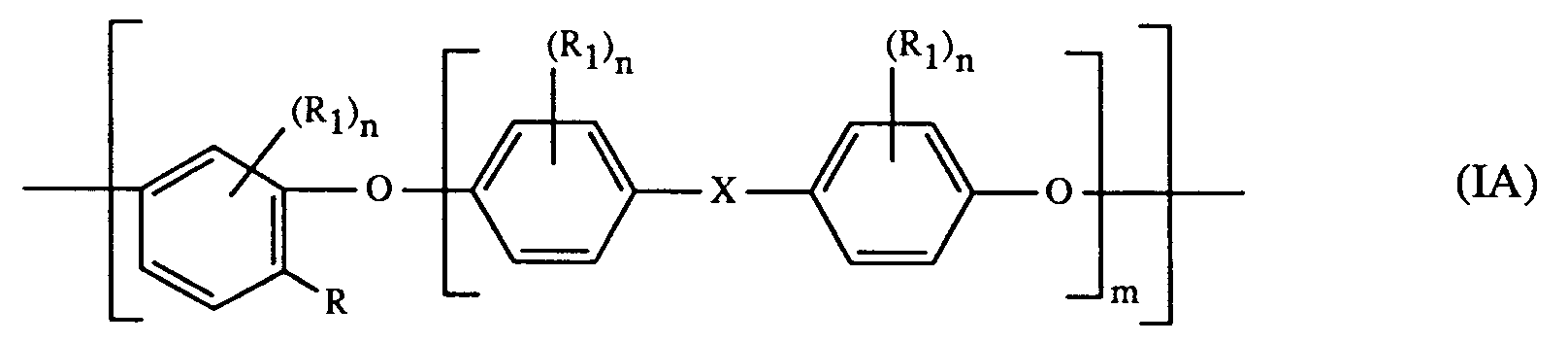
in which m is an integer of from 1 to 3, X is -O- or especially -SO₂-, R is a radical of the formula
in which Y especially is -CH₂-, furthermore -CH(R₂)-, C(R₂)₂-, or -CH₂-CH₂-, and R₂ is C₁-C₇alkyl, R₁ independently of another is C₁-C₄alkyl, especially methyl, C₃-C₄alkenyl, especially allyl or methallyl, C₁-C₄alkoxy, especially methoxy, cyano, phenyl, or phenoxy, and n is an integer of from 0 to 2. - A further embodiment of the invention are polyethers having recurring units of the formula (I) or (IA) in which m is an integer of from 1 to 3, X is -SO₂-, R is a radical of the formula

in which Y especially is -CH₂-, furthermore -CH(R₂)-, and R₂ is C₁-C₄alkyl, especially methyl, R₁ independently of another is C₁-C₄alkyl, especially methyl, or C₃-C₄alkenyl, especially allyl or methallyl, and n is the integer 1. - Especially preferred are polyethers having recurring units of the formula (I) or (IA)
- A) in which m is the integer 1 or 3, X is -SO₂-, R is a radical of the formula

and - B) in which m is the integer 1 or 3, X is -SO₂-, R is a radical of the formula

- The present invention also relates to mixtures containing (a) a polyether having recurring units of the formula (I) or (IA), respectively, and (b) epoxy, bismaleimide and polyimide resins, as well as to a method for toughening or increasing the flexural strength of epoxy, bismaleimide and polyimide resin systems by the incorporation of said polyethers.
- The following are examples of applicable epoxy, bismaleimide and polyimide resin systems:
- The epoxy resins applicable to the instant invention are those possessing on average more than one vic-epoxy group per molecule, i.e., more than one

group; which group may be a terminal group, i.e.,
or may be in an internal position. - The polyepoxides may be saturated or unsaturated aliphatic, cycloaliphatic, aromatic or heterocyclic and may be substituted with substituents, such as chlorine, hydroxyl, ether radicals and the like. In general, they may be based on polyhydric phenols such as those based on bisphenol A, F and S, epoxidation products of cresol novolacs or phenol novolacs, hydantoin epoxide resins, polyglycidyl esters, glycidylated aromatic amines, glycidylated aminophenols, and cycloaliphatic epoxy resins.
- More specifically, examples of such polyepoxides include, among others, 1,4-bis(2,3-epoxypropoxy)benzene, 1,3-bis(2,3-epoxypropoxy)benzene; 4,4′-bis(2,3-epoxypropoxy)diphenyl ether; 1,8-bis(2,3-epoxypropoxy)octane; 1,4-bis(2,3-epoxypropoxy)cyclohexane; 2,2,-[4,4′-bis(2-hydroxy-3,4-epoxybutoxy)diphenyl]-propane; 1,3-bis(4,5-epoxypentoxy-5-chlorobenzene; 1,4-bis-(3,4-epoxybutoxy)-2-chlorocyclohexane; 1,3-bis-(2-hydroxy-3,4-epoxybutoxy)benzene; 1,4-bis(2-hydroxy-4,5-epoxypentoxy)-benzene.
- Other examples include the epoxy polyethers of polyhydric phenols prepared from halogen-containing epoxides or dihalohydrins in the presence of an alkaline medium. Polyhydric phenols that can be used for this purpose include, among others, resorcinol, catechol, hydroquinone, methyl resorcinol or polynuclear phenols, such as 2,2-bis-(4-hydroxyphenol)propane (bisphenol A), 2,2-bis(4-hydroxyphenol)butane, 4,4′-dihydroxybenzophenone, bis-(4-hydroxyphenyl)ethane, 2,2-bis(4-hydroxyphenyl)pentane and 1,5-dihydroxynaphthalene. The halogen containing epoxides may be further exemplified by 3-chloro-2,3-chloro-1,2-epoxybutane, 3-bromo-1,2-epoxyhexane, 3-chloro-1,2-epoxyoctane, and the like. By varying the ratio of the phenol and epichlorohydrin, one obtains different molecular weight products as shown in U.S. 2,633,458.
- A preferred group of the above described epoxy polyethers of polyhydric phenols are glycidyl polyethers of the dihydric phenols. These may be prepared by reacting the required proportions of the dihydric phenol and epichlorohydrin in an alkaline medium. The desired alkalinity is obtained by adding basic substances such as sodium or potassium hydroxide, preferably in stoichiometric excess to the epichlorohydrin. The reaction is preferably accomplished at temperatures within the range of 50°C to 150°C. The heating is continued for several hours to effect the reaction and the product is then washed free of salt and base. The preparation of four suitable glycidyl polyethers of dihydric phenols is illustrated in U.S. 2,633,458 as Polyethers A, B, C and D.
- Another group of polyepoxides comprises the polyepoxy polyethers obtained by reacting, preferably in the presence of an acid-acting compound, such as Lewis acids or quaternary halides, or of the aforedescribed halogen-containing epoxides such as epichlorohydrin, with a polyhydric alcohol, and subsequently treating the resulting product with an alkaline component. As used herein the expression "polyhydric alcohol" is meant to include those compounds having at least two free alcoholic OH groups and includes the polyhydric alcohols and their ethers and esters, hydroxy-aldehydes, hydroxy-ketones, halogenated polyhydric alcohols and the like. Polyhydric alcohols that may be used for this purpose may be exemplified by glycerol, ethylene glycol, propylene glycol, diethylene glycol, butylene glycol, hexanetriol, sorbitol, mannitol, pentaerythritol, polyallyl alcohol, polyvinyl alcohol, mesitol, trimethylolpropane, 2,2-[bis(4-hydroxycyclohexyl)]propane and the like. The preparation of suitable polyepoxide polyethers is illustrated in U.S. 2,633,458 as Polyether F.
- Particularly preferred members of this group comprise the glycidyl polyethers of aliphatic polyhydric alcohols containing from 2 to 10 carbon atoms and having from 2 to 6 hydroxyl groups and more preferably the alkane polyols containing from 2 to 8 carbon atoms and having from 2 to 6 hydroxyl groups. Such products preferably have an epoxy functionality greater than 1.0, and still more preferably between 1.1 and 4 and a molecular weight between 300 and 1000.
- Another group of polyepoxides include the epoxy esters of polybasic acids, such as diglycidyl phthalate and diglycidyl adipate, diglycidyl tetrahydrophthalate, diglycidyl maleate, epoxidized dimethylallyl phthalate and epoxidized dicrotyl phthalate.
- Examples of polyepoxides having internal epoxy groups include, among others, the epoxidized esters of polyethylenically unsaturated monocarboxylic acids, such as epoxidized linseed, soybean, perilla, oiticica, tung, walnut and dehydrated castor oil, methyl linoleate, butyl linoleate, ethyl 9,12-octadecadienoate, butyl 9,12,15-octadecatrienoate, ethyl eleostearate, monoglycerides of tung oil fatty acids, monoglycerides of soybean oil, sunflower, tapeseed, hempseed, sardine, cottonseed oil and the like.
- Another group of the epoxy-containing materials having internal epoxy groups include the epoxidized esters of unsaturated alcohols having the ethylenic group in an internal position and polycarboxylic acids such, for example, as di-(2,3-epoxybutyl) adipate, di(2,3-epoxybutyl) oxalate, di(2,3-epoxyhexyl) succinate, di(2,3-epoxyoctyl) tetrahydrophthalate, di(4,5-epoxydodecyl) maleate, di(2,3-epoxybutyl) terephthalate, di(2,3-epoxypentyl) thiopropionate, di(2,3-epoxyhexyl) succinate, di(2,3-epoxyoctyl) tetrahydrophthalate, di(4,5-epoxydodecyl) maleate, di(2,3-epoxybutyl) terephthalate, di(2,3-epoxypentyl) thiopropionate, di(2,3-epoxybutyl) citrate and di(4,5-epoxyoctadecyl) malonate, as well as the esters of epoxycyclohexanol and epoxycyclohexylalkanols such, for example, as di(2,3-epoxycyclohexylmethyl) adipate and di(2,3-epoxycyclohexylmethyl) phthalate.
- Another group of materials having internal epoxy groups include epoxidized esters of unsaturated alcohols and unsaturated carboxylic acids, such as 2,3-epoxybutyl 3,4-epoxy pentanoate, 3,4-epoxycyclohexyl 3,4-epoxypentanoate, 3,4-epoxycyclohexyl 3,4-cyclohexanone, 2,3-epoxycyclohexylmethyl 2,3-epoxycyclohexanoate, and 3,4-epoxycyclohexyl 4,5-epoxyoctanoate, and the like.
- Another group of materials having internal epoxy groups includes epoxidized esters of unsaturated monocarboxylic acids and polyhydric alcohols, such as ethylene glycol di(2,3-epoxycyclohexanoate), glycerol tri(2,3-epoxycyclohexanoate) and pentanediol di(2,3-epoxyoctanonate).
- Still another group of the epoxy compounds having internal epoxy groups includes epoxidized derivatives of polyethylenically unsaturated polycarboxylic acids, such as, for example, dimethyl 8,9,11,13-diepoxyeicosanedioate, dibutyl 7,8,11,12-diepoxyoctadecanedioate, dioctyl 10,11-diethyl-8,9,12,13-diepoxyeicosanedioate, dicyclohexyl 3,4,5,6-diepoxycyclohexanedicarboxylate, dibenzyl 1,2,4,5-diepoxycyclohexane- 1,2-di-carboxylate and diethyl 5,6, 10, 11 -diepoxyoctadecylsuccinate.
- Especially preferred are aromatic epoxy resins, such as novolak epoxy resins, diglycidyl ethers of bisphenols or tetra glcycidyl compounds of aromatic diamines, preferably N,N,N′,N′-tetraglycidyl-4,4′-diaminophenylmethane.
- The bismaleimides useful in the formulations of this invention may be any of the bismaleimides derived from aromatic and aliphatic diamines, including any of the well-known and widely available phenylene diamines and the various diamino-substituted polynuclear aromatic compounds such as diaminodiphenyl sulfone, diaminobenzophenone, diaminodiphenylether, diaminodiphenylmethane, and the like, as well as the various aryl compounds having a plurality of aminophenylalkylidene or aminophenoxy substituents. Also useful are bismaleimides based on C₄-C₂₀aliphatic diamines such as the various isomeric alkanes having diamino substituents. The bismaleimides may be employed singly or in mixtures comprising two or more bismaleimides, which may include both aromatic and aliphatic bismaleimides. A great variety of bismaleimides suitable for use as matrix resins are well-known in the art, such as are recited for example in U.S. Patent Nos. 4,644,039, 4,100,140 and 4,654,407.
- N,N′-methylene-bis-maleimide, N,N′-ethylene-bis-maleimide, N,N′-hexamethylene-bis-maleimide, N,N′-m-phenylene-bis-maleimide, N,N′-p-phenylene-bis-maleimide, N,N′-4,4′-diphenylene-bis-maleimide,N,N′-4,4′,3,3′dichloro-diphenylene-bis-maleimide, N,N′-diphenylethan-bis-maleimide, N,N′-4,4′-diphenylsulfone-bis-maleimide, N,N′-p-xylylene-bis-maleimide, N,N′-m-xylylene-bis-maleimide, N,N′-4,4′,2,2′-diphenyl-propane-bis-maleimide, the N,N′-bis-maleimide of the 4,4′-diamino-triphenyl-phosphate, and the N,N′-bis-maleimide of the 4,4′diamino-triphenylthiophosphate.
- Especially preferred is the bismaleimide sold by CIBA-GEIGY under the tradename XU292 B.
- The polyimides are prepared by reacting a polyfunctional diamine with a polyfunctional dianhydride or an ester thereof in an organic reaction medium which is a solvent for at least one of the reactants, preferably under anhydrous conditions under 100°C. The resulting product is a polyamic acid which is then converted to the desired polyimide by one of several methods: heating the polyamic acid solution until imidization is substantially complete; or by combining the polyarnic acid solution and a dehydrating agent, with or without catalyst, and optionally heating the resulting mixture until imidization is substantially complete.
- Any polyimide can be used according to the present invention.
- The polyimides are derived from diamines and/or dianhydrides and are characterized by a repeating unit have the following structural formula

wherein the four carbonyl groups are attached directly to separate carbon atoms, the carbonyl groups being ortho or peri to each other so that five or six membered imide rings are formed respectively, wherein Z is a tetravalent radical containing at least one aromatic ring, and wherein Z′ is a divalent organic radical selected from aromatic, aliphatic, alkyl aromatic, cycloaliphatic and heterocyclic radicals, combinations of these, and radicals with heteroatom-containing bridging groups where the heteroatom in the bridge is oxygen, sulfur, nitrogen, silicon or phosphorus. - Typical polyimides contain repeating units wherein Z is a phenylindane radical of the formula

wherein R₃ is hydrogen or an alkyl group of from 1 to 5 carbon atoms, and Z′is a phenylindane radical of the formula
wherein R₃ is hydrogen or an alkyl group of from 1 to 5 carbon atoms, and R₄, R₅, R₆ and R₇ are independently hydrogen, halogen or (lower) alkyl having 1 to 4 carbon atoms. - The phenylindane diamine component of the polyimide can consist of any combination of the isomeric or substituted isomeric diamino compounds represented by formula IV above. For example, the phenylindane diamine component can comprise from 0 to 100 percent of 5-amino-1-(4′-aminophenyl)-1,3,3-trimethylindane in combination with from 100 to 0 percent of 6-amino-1-(4′-aminophenyl)-1,3,3-trimethylindane. Further, either or both of these isomers can be substituted over the entire range from 0 to 100 percent by any of the substituted diamino isomers represented by formula IV. Examples of such substituted diamino isomers are represented by formula IV, specifically 5-amino-6-methyl-1-(3′-amino-4′-methylphenyl)-1,3,3-trimethylindane; 5-amino-1-(4′-amino-Ar′,Ar′-dichlorophenyl)-Ar,Ar-dichloro-1,3,3-trimethylindane; 6-amino-1 -(4′-amino-Ar′,Ar′-dichlorophenyl)-Ar,Ar-dichloro-1,3,3-trimethylindane; 4-amino-6-methyl-1-(3′-amino-4′-methyl-phenyl)-1,3,3-trimethylindane and Ar-amino-1-(Ar′-amino-2′,4-dimethylphenyl)-1,3,3,4,6-pentamethylindane. The prefixes Ar and Ar′ in the above formulas indicate indefinite positions for the given substituents in the phenyl rings.
- Preferred polyfunctional diamines e.g. include aliphatic acid aromatic diamines containing at least one benzene ring and preferably two benzene rings. The aliphatic amines may have 5 to 22 carbon atoms per molecule as illustrated below:
2,5-dimethylhexamethylene diamine; 2,5-dimethylheptamethylene diamine; 5-methylnonamethylene diamine; 2,17-diamino-eicosadecane; 1,4-diamino-cyclohexane; 1,10-diamino-1,10-dimethyldecane; 1,12-diamino-octadecane; para-phenylenediamine; metaphenylenediamine; 4,4′-diamino-diphenylpropane; 4,4′-diamino-diphenylmethane; benzidine; 4,4′-diamino-diphenyl sulfide; 4,4′-diamino-diphenyl sulfone; 3,3′-diaminodiphenyl sulfone; 4,4′-diamino-diphenyl ether, 1,5-diamino-naphthalene; 3,3′-dimethoxy benzidine; 2,4-bis(beta-amino-t-butyl)toluene; bis-(para-beta-amino-t-butylphenyl)ether, bis-(para-beta-methyl-delta-amino-pentyl)benzene; bis-(para-1,1-dimethyl-5-aminopentyl)benzene; 1-isopropyl-2,4-metaphenylene diamine; m-xylylene diamine; hexamethylene diamine; heptamethylene diamine; octamethylene diamine; nonamethylene diamine; decamethylene diamine; diamino-propyl tetramethylene diamine; 3-methylheptamethylene diamine; 4,4′-dimethylheptamethylene diamine; 2,11 -diamino-dodecane; 1,2-bis(3-aminopropoxy)-ethane; 2,2-dimethyl propylene diamine; 3-methoxy-hexamethylylene diamine; 3,3′-dimethyl benzidine etc. and triamines such as 1,3,5-triaminobenzene; 2,4,6-triamino-s-triazine; 1,2,3-triaminopropane; 4,4′,4˝-triaminotriphenylmethane; 4,4′,4˝-triaminotriphenylcarbinol. - As the preferred aromatic diamines, there may be mentioned C₆-C₁₀arylene diamines such as p-phenylenediamine, m-phenylenediamine and m-xylylenediamine, bis(p-aminophenyl) methane, N,N,N′,N′-tetramethyl-4,4′-diaminodiphenylmethane, and the like.
- The polyfunctional anhydrides and esters thereof correspond to the formulae

wherein Z is a tetravalent aryl radical, and R₈ is hydrogen orC₁-C₆alkyl, with at least two R₈ groups being alkyl. - The aryl radical may, for example, be substituted or unsubstituted phenyl, naphthyl or biphenyl rings or two phenyl rings linked by O, S, SO₂, carbonyl, carboxy or alkylene, or aryl rings containing heterocyclic atoms such as pyrazine or thiophene.
- The following species are typical of tetracarboxylic acid dianhydrides suitable for practicing the invention:
2,3,9,10-perylene tetracarboxylic acid dianhydride; 1,4,5,9-naphthalene tetracarboxylic acid dianhydride; 2,6-dichloronaphthalene-1,4,5,8-tetracarboxylic acid dianhydride; 2,7-dichloronaphthalene-1,4,5,8-tetracarboxylic acid dianhydride; 2,3,6,7-tetrachloronaphthalene-1,4,5,8-tetracarboxylic acid dianhydride; phenanthrene-1,8,9,10-tetracarboxylic acid dianhydride; 2,3,3′,4′-benzophenonetetracarboxylic acid dianhydride; 3,3′,4,4′-benzophenonetetracarboxylic acid dianhydride; 2,2′,3,3′-benzophenonetetracarboxylic acid dianhydride; 3,3′,4,4′-biphenyltetracarboxylic acid dianhydride; 2,2′,3,3′-biphenyltetracarboxylic acid dianhydride; 4,4′-isopropylidenediphthalic anhydride; 3,3′-isopropylidenediphthalic anhydride; 4,4′-oxydiphthalic anydride; 4,4′-sulfonyldiphthalic anhydride; 3,3′-oxydiphthalic anhydride; 4,4′-methylenediphthalic anhydride; 4,4′-thiodiphthalic anhydride; 4,4′-ethylidenediphthalic anhydride; 2,3,6,7-naphthalenetetracarboxylic acid dianhydride; 1,2,4,5-naphthalenetetracarboxylic acid dianhydride; 1,2,5,6-naphthalenetetracarboxylic acid dianhydride; benzene-1,2,3,4-tetracarboxylic acid dianhydride; pyrazine-2,3,5,6-tetracarboxylic acid dianhydride; thiophene-2,3,4,5-tetracarboxylic acid dianhydride, and the indicated esters thereof. - Such anhydrides and esters and methods for their preparation are disclosed in U.S. 3,745,149 and U.S. 3,856,752, such teachings being fully incorporated herein.
- The imido functional polyethers according to the present invention can be prepared by reacting an amine of the formula

with a dicarboxylic acid of the formula
respectively, or a reactive derivative thereof, such as an anhydride or an activated ester thereof. The reaction is conducted in the presence of a base at elevated temperatures, e.g. ranging from 100 to 250°C. - Especially preferred are cyclic anhydrides of compounds of the formulae (Vb) or (Vc), respectively.
- The starting material of the formula (Va) can be manufactured , for example, by reacting a compound of the formula
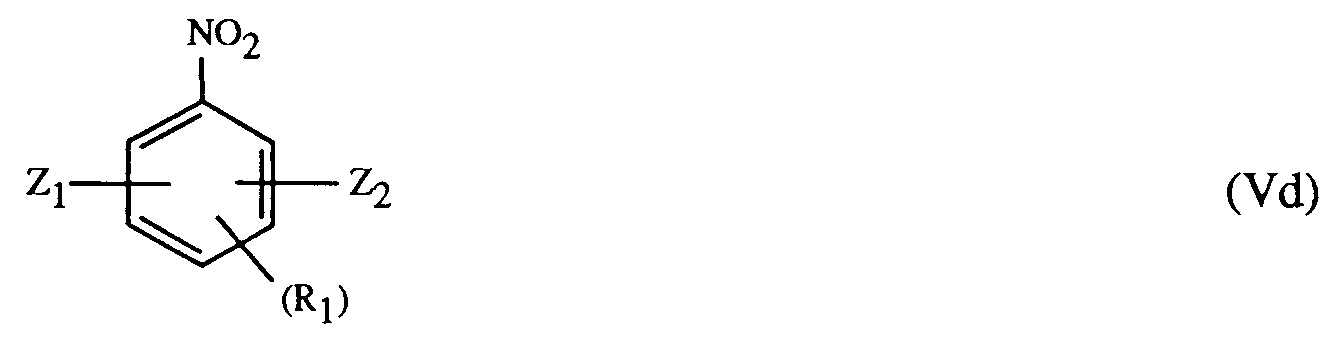
with a compound of the formula
in which Z₁ is reactive esterified hydroxyl and one of the variables Z₂ and Z₃ is hydroxyl and the other is reactive esterified hydroxyl. In the next reaction step, the nitro group is reduced to amino using conventional reduction methods, for example, by catalytic hydrogenation. - Reactive esterified hydroxyl, is, in particular, hydroxyl which is esterified with a strong inorganic acid or organic sulfonic acid, for example halogen such as chlorine, bromine or iodine, sulfonyloxy such as methane- or trifluoromethanesulfonyloxy, p-bromobenzene- or p-toluenesulfonyloxy. Preferred is halogeno, especially chlorine.
- Suitable bases are, for example, alkali metal hydroxides, hydrides, amides, alkanolates, or carbonates. Examples which may be mentioned are sodium hydroxide, sodium hydride, sodium amide, sodium (m)ethoxide, potassium tert-butoxide, and potassium carbonate.
- Preferably, Z₁ and Z₂ each represent halogeno, especially chlorine, and Z₃ is hydroxyl.
- The starting materials corresponding to the formulae (Vd) and (Ve) are known or can be manufatured in a mannner known per se, respectively.
- Epoxy, bismaleimide and polyimide resin systems such as those described above, exhibiting a high degree of toughness and an increased flexural strength, can be used in different technical fields, for example, in composites, printed circuit boards, castings, molding compounds, especially adhesives, coatings or raw materials for stabilization. In view of the improved performance characteristics, the application of greatest interest is in high performance composite applications, pertinent, for example, to the aerospace industry, where a high degree of toughness with reduced viscosity and greater hardness is required. Thus, the modified resins according to the present invention are utilized to pre-impregnate various fibers for eventual use as honeycomb skins and structural parts. Techniques for preparing prepregs are well known to those skilled in the art. In terms of honeycomb skins and structural parts, graphite, glass, Kevlar reinforced skins and parts as well as others, can be readily prepared from the instant system. Correspondingly, techniques for preparing laminates are well known. Such laminates may be prepared by compression or autoclave molding and may comprise a broad range of thicknesses.
- The following examples further illustrate the embodiments of the invention.
- To 4,4-dihydroxydiphenylsulphone (200 g, 0.8 M) is added 2,4-dichloronitrobenzene (153.4 g, 0.8 M), anhydrous potassium carbonate (112 g, 0.8 M), toluene (800 ml) and 1-methyl-2-pyrrolidinone (1600 ml). The mixture is heated to 145°C and water is removed using a Dean and Stark apparatus. The temperature is then raised to 190°C and the toluene is removed; the mixture being stirred at this temperature for 5 hours. After cooling to 100°C the product is filtered. The filtrate is catalytically hydrogenated using palladium on carbon (5%, 20 g) and filtered to give a solution of the title polymer in 1-methyl-2-pyrrolidinone. A small aliquot (5.00 ml) is precipitated onto methanol (50 ml), filtered and dried in a vacuum oven at 100°C. Gel permeation chromatography shows a peak with identical retention time to commercial polyethersulphone (ICI Victrex) which is known to have a molecular weight of approximately 20,000 {dilution, 1%; eluent, DMF; R.I. 280 nm}. IR (KBr disc): 3340 cm⁻¹ (OH/NH₂); 1670-1620 cm⁻¹ (O=S=O). NMR (DMSO-d6): 7.1-8.3 (m-ArH); having following recurring unit:

- To bis(4-chlorophenyl)sulphone (114.8 g, 0.4 M) is added 4,4′-sulphonyldiphenol (200 g, 0.8 M), anhydrous potassium carbonate (111 g, 0.804 M), 1-methyl-2-pyrrolidinone (1600 ml) and toluene (800 ml). The mixture is stirred and heated to 135°C. Water is removed using a Dean and Stark apparatus. The solution is cooled to 100°C and 2,4-dichloronitrobenzene (76.8 g, 0.4 M) is added. Additional water is then removed. The reaction is heated at 190°C for 5 hours, whereupon the solution is catalytically hydrogenated using palladium on carbon (20 g, 5%). A small aliquot (5.00 ml) is precipitated onto stirring methanol, filtered and dried in a vacuum oven at 100°C overnight. IR (KBr disc): 3400 cm⁻¹ (small OH/NH₂): 1670 cm⁻¹ (O=S=O). NMR (DMSO-d6): 3.4 (s-2H); 6.9-8.0 (m-27) having following recurring unit:

- A small aliquot of the solution of the polymer described in Example 1, is analyzed by NMR and reanalyzed after a D₂O shake. This information is used to calculate the amount of amine group present in the polymer. Coupled with the weight/ml data, the amount of amine/ml of solution is calculated.
- To the solution of the polymer from Example 1 is added the required amount of maleic anhydride (1 mole/mole of amine) and molecular sieves (3Å, 200 g). The mixture is stirred at 150°C for 24 hours. The solution is precipitated into stirring methanol, filtered and dried in a vacuum oven at 100°C overnight. The powder is ground to a particle size of 20 microns. IR (KBr disc): 3400 cm⁻¹ (small OH); 1710 and 1720 cm⁻¹ (C=O imide); 1650 cm⁻¹ (O=S=O). NMR: 1.8-2.3 (m-6H); 6.5-8.0 (m-13H) having following recurring unit:

- To the solution of the polymer from Example 1 is added the required amount of bicyclo-[2.2.1]hept-5-ene-2,3-dicarboxylic anhydride (1 mol/mole of amine) and molecular sieves (3Å, 200 g). The mixture is stirred and heared at 150°C for 3 hours. After cooling and filtration the solution is precipitated slowly onto stirring methanol, dried in a vacuum oven at 100°C overnight and ground to a particle size of 20 microns. IR (KBr disc); 3400 cm⁻¹ (small OH); 1710 and 1780 cm⁻¹ (C=O imide); 1650 cm⁻¹ (O=S=O). NMR: 1.8-2.3 (m-6H); 6.5-8.0 (m-13H); having following recurring unit:

- To the solution of the polymer from Example 1 is added the required amount of bicyclo-[2.2.1]hept-5-ene-5 (6)-methyl-2,3-dicarboxylic anhydride (1 mole/mole of amine) and molecular sieves (3Å, 200 g), with the mixture being stirred and heated at 150°C for three hours. After cooling and filtration, the solution is precipitated slowly onto stirring methanol. The product is filtered, washed with methanol, dried in a vacuum oven at 100°C overnight and ground to a particle size of 20 microns. IR (KBr disc): 3400 cm⁻¹ (small OH); 1710 and 1780 cm-1 (C=O imide); 1660 cm⁻¹ (O=S=O). NMR: 1.8-2.2 (m-4H); 2.65 (s-3H); 3.3 (s-2H); 7.0-8.0 (m-11H).
- To the solution of the polymer from Example 1 is added the required amount of bicyclo[2.2. 1]hept-5-ene-5(6)-(prop-2-ene)-2,3-dicarboxylic anhydride (1 mole/mole amine) and molecular sieves (3Å, 200 g). The mixture is stirred and heated at 150°C for 3 hows. After cooling and filtration the solution is precipitated slowly onto stirring methanol, dried in a vacuum oven at 100°C overnight and ground to a particle size of 20 microns. IR (KBr disc): 3400 cm⁻¹ (small OH); 1710 and 1780 cm⁻¹ (C=O imide); 1660 cm⁻¹ (O=S=O). NMR: 1.8-2.2 (m-4H); 2.8 (s-2H); 3.2 (s-2H); 5.0 (s-1H); 5.8 (s-2H); 6.8 (s-1H); 6.8-8.2 (m-11H).
- A small aliquot of the solution of the polymer, described in Example 2, is analysed by NMR and reanalysed after a D₂O shake. This information is used to calculate the amount of amine group present in the polymer. Coupled with the weight/ml data, the amount of amine/ml of solution is calculated.
- To the solution of the polymer from Example 2 is added the required amount of bicyclo-[2.2.1]hept-5-ene-2,3-dicarboxylic anhydride (1 mole/mole of amine) and molecular sieves (3Å, 200 g). The mixture is stirred and heated at 150°C for 3 hours. After cooling and filtration the solution is precipitated slowly onto stirring methanol, dried in a vacuum oven at 100°C overnight and ground to a particle size of 20 microns. IR (KBr disc): 3400 cm⁻¹ (small OH); 1710 and 1780 cm⁻¹ (C=O imide); 1670 cm⁻¹ (O=S=O). NMR (DMSO-d6): 1.8-2.3 (m-6H); 6.6-8.0 (m-29H); having following recurring unit:

- The imido functional polymers described in Examples 3 to 7 have been evaluated as tougheners for bismaleimide and polyimide matrix systems. A typical evaluation experiment is shown below.
- The bismaleide sold by CIBA-GEIGY under the tradename XU292B (200.3 g) is mixed with the polymer cited in Example 3 (24.6 g) and heated at 140°C for 1 hour. After cooling to 120°C, the diphenol (267 g) is added. The mixture is stirred for 10 mins and then cooled to 100°C. Hardener HY932 (5.1 g) and PS802 (2.5 g) are added and the mixture stirred thoroughly. The resin is coated onto carbon fibre (G815, 8 plies) giving a prepreg with 46% wet resin content (by weight). The prepreg is cured in an autoclave (4 hours at 175°C) and post-cured in an oven for 8 hours at 245°C. The laminate shows the following properties:
Tg (glass transition temperature) by Dynamic Mechanic Thermal Analysis
(DMTA) = 247°C
G1c = 3.95 in/lb in² [ASTM: E 813 used as standard test method]
End-notched Flexural Strength = 5.32 in/lb in². [ASTM: D 747 used as standard test method].
Claims (14)
- An imido functional polyether having recurring units of the formula

m is an integer of from 1 to 3,
X is -O-, -SO-, or -SO₂-,
R is a radical of the formula
Y is -CH₂-, -CH(R₂)-, C(R₂)₂-, or -CH₂-CH₂-, and
R₂ is lower alkyl,
R₁ independently of another is lower alkyl, lower alkenyl, lower alkoxy, cyano, phenyl, or phenoxy, and
n is an integer of from 0 to 2. - A polyether according to claim 1 having recurring units of the formula


- A polyether according to claim 1 having recurring units of the formula (I) or (IA) in which m is an integer of from 1 to 3, X is -SO₂-, R is a radical of the formula

- A polyether according to claim 1 having recurring units of the formula (I) or (IA) in which m is the integer 1 or 3, X is -SO₂-, R is a radical of the formula

- A polyether according to claim 1 having recurring units of the formula (I) or (IA) in which m is the integer 1 or 3, X is -SO₂-, R is a radical of the formula
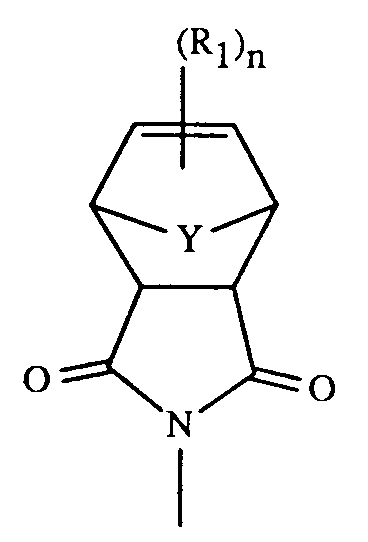
- A polyether according to claim 1 in which the molecular weight range is from about 15,000 to about 25,000.
- Poly[oxy-1,5-(4-maleimidophenylene)oxy-1,4-phenylenesulphonyl-1,4-phenylene] according to claim 1.
- Poly[oxy-1,5-{4-(1,3,3a,4,7,7a-hexahydro-1,3-dioxo-4,7-methano-2H-isoindol-2-yl)-phenylene}oxy-1,4-phenylenesulphonyl-1,4-phenylene] according to claim 1.
- Poly[oxy-1,5-{4-(1,3,3a,4,7,7a-hexahydro-1,3-dioxo-4,7-methano-5(6)-methyl-2H-isoindo-2-yl)phenylene}oxy-1,4-phenylenesulphonyl-1,4-phenylene] according to claim 1.
- Poly[oxy-1,5-{4-(1,3,3a,4,7,7a-hexahydro-1,3-dioxo-4,7-methano-5(6)-(prop-2-ene)-2H-isoindo-2-yl)phenylene}oxy-1;4-phenylenesulphonyl-1,4-phenylene] according to claim 1.
- Poly[oxy-1,5-{4-(1,3,3a,4,7,7a-hexahydro-1,3-dioxo-4,7-methano-2H-isoindo-2-yl)-phenylene}oxy-1,4-phenylenesulphonyl-1,4-phenyleneoxy-1,4-phenylenesulphonyl-1,4-phenyleneoxy-1,4- phenylenesulphonyl-1,4-phenylene] according to claim 1.
- A mixture comprising(a) an effective toughening amount of an imido functional polyether according to claim 1 and(b) an epoxy, bismaleimide or polyimide resin system.
- A method for toughening epoxy, bismaleimide or polyimide resin systems comprising incorporating an effective toughening amount of an imido functional polyether according to claim 1 into said resin systems.
- A method for increasing the flexural strength of epoxy, bismaleimide or polyimide resin systems comprising incorporating an effective flexural strength increasing amount of an imido functional polyether according to claim 1 into said resin systems.
Applications Claiming Priority (2)
| Application Number | Priority Date | Filing Date | Title |
|---|---|---|---|
| US67463191A | 1991-03-25 | 1991-03-25 | |
| US674631 | 1991-03-25 |
Publications (2)
| Publication Number | Publication Date |
|---|---|
| EP0506611A2 true EP0506611A2 (en) | 1992-09-30 |
| EP0506611A3 EP0506611A3 (en) | 1993-04-21 |
Family
ID=24707351
Family Applications (1)
| Application Number | Title | Priority Date | Filing Date |
|---|---|---|---|
| EP19920810187 Withdrawn EP0506611A3 (en) | 1991-03-25 | 1992-03-16 | Imino functional polyethers and their use |
Country Status (3)
| Country | Link |
|---|---|
| EP (1) | EP0506611A3 (en) |
| JP (1) | JPH05156003A (en) |
| CA (1) | CA2063779A1 (en) |
Cited By (7)
| Publication number | Priority date | Publication date | Assignee | Title |
|---|---|---|---|---|
| WO1999048932A3 (en) * | 1998-03-27 | 1999-12-02 | Univ Stuttgart Inst Fuer Chemi | Modified polymer and modified polymer membrane |
| WO2000009588A1 (en) * | 1998-08-12 | 2000-02-24 | Universität Stuttgart | Modification of engineering-polymers with basic n groups and ion-exchange groups in the side chain |
| WO2003042298A1 (en) * | 2001-11-12 | 2003-05-22 | Basf Aktiengesellschaft | Modified epoxy resins |
| WO2008073536A1 (en) * | 2006-12-15 | 2008-06-19 | General Electric Company | Functional polyarylethers |
| US7669720B2 (en) | 2006-12-15 | 2010-03-02 | General Electric Company | Functional polyarylethers |
| US7977451B2 (en) | 2006-12-15 | 2011-07-12 | General Electric Company | Polyarylether membranes |
| US9828466B2 (en) | 2014-04-04 | 2017-11-28 | Hitachi Chemical Company, Ltd | Polyphenylene ether derivative having N-substituted maleimide group, and heat curable resin composition, resin varnish, prepreg, metal-clad laminate, and multilayer printed wiring board using same |
Families Citing this family (2)
| Publication number | Priority date | Publication date | Assignee | Title |
|---|---|---|---|---|
| CN103987770B (en) * | 2011-12-22 | 2016-01-20 | 塞特工业公司 | Maleimide resin |
| JP2017071689A (en) * | 2015-10-07 | 2017-04-13 | 日立化成株式会社 | Resin composition, prepreg, laminate, multilayer printed board and method for manufacturing multilayer printed board |
Family Cites Families (5)
| Publication number | Priority date | Publication date | Assignee | Title |
|---|---|---|---|---|
| ZA703534B (en) * | 1969-07-01 | 1971-01-27 | Gen Electric | Method for making imido-substituted aromatic polymers |
| IL64967A0 (en) * | 1981-03-17 | 1982-04-30 | Aligena Ag | Semipermeable membranes containing modified polysulfones,their manufacture and their use |
| US4414269A (en) * | 1981-06-16 | 1983-11-08 | Trw, Inc. | Solvent resistant polysulfone and polyethersulfone compositions |
| GB8801225D0 (en) * | 1988-01-20 | 1988-02-17 | Ici Plc | Aromatic polymers |
| DE59010515D1 (en) * | 1989-03-17 | 1996-10-31 | Sumitomo Chemical Co | New polyarylene ethers |
-
1992
- 1992-03-16 EP EP19920810187 patent/EP0506611A3/en not_active Withdrawn
- 1992-03-23 JP JP4095839A patent/JPH05156003A/en active Pending
- 1992-03-23 CA CA002063779A patent/CA2063779A1/en not_active Abandoned
Cited By (13)
| Publication number | Priority date | Publication date | Assignee | Title |
|---|---|---|---|---|
| US6509441B1 (en) | 1998-03-27 | 2003-01-21 | Universitat Stuttgart | Modified polymer and modified polymer membranes |
| WO1999048932A3 (en) * | 1998-03-27 | 1999-12-02 | Univ Stuttgart Inst Fuer Chemi | Modified polymer and modified polymer membrane |
| CN1293123C (en) * | 1998-08-12 | 2007-01-03 | 斯图加特大学 | Modification of engineering-polymers with basic N groups and ion-exchange groups in the side chain |
| WO2000009588A1 (en) * | 1998-08-12 | 2000-02-24 | Universität Stuttgart | Modification of engineering-polymers with basic n groups and ion-exchange groups in the side chain |
| US6590067B2 (en) | 1998-08-12 | 2003-07-08 | Universitaet Stuttgart | Modification of polymers with basic N-groups and ion exchange groups in the lateral chain |
| AU771230B2 (en) * | 1998-08-12 | 2004-03-18 | Thomas Haring | Modification of engineering-polymers with basic N groups and ion-exchange groups in the side chain |
| WO2003042298A1 (en) * | 2001-11-12 | 2003-05-22 | Basf Aktiengesellschaft | Modified epoxy resins |
| US7329711B2 (en) | 2001-11-12 | 2008-02-12 | Basf Aktiengesellschaft | Modified epoxy resins |
| WO2008073536A1 (en) * | 2006-12-15 | 2008-06-19 | General Electric Company | Functional polyarylethers |
| US7669720B2 (en) | 2006-12-15 | 2010-03-02 | General Electric Company | Functional polyarylethers |
| US7681741B2 (en) | 2006-12-15 | 2010-03-23 | General Electric Company | Functional polyarylethers |
| US7977451B2 (en) | 2006-12-15 | 2011-07-12 | General Electric Company | Polyarylether membranes |
| US9828466B2 (en) | 2014-04-04 | 2017-11-28 | Hitachi Chemical Company, Ltd | Polyphenylene ether derivative having N-substituted maleimide group, and heat curable resin composition, resin varnish, prepreg, metal-clad laminate, and multilayer printed wiring board using same |
Also Published As
| Publication number | Publication date |
|---|---|
| JPH05156003A (en) | 1993-06-22 |
| EP0506611A3 (en) | 1993-04-21 |
| CA2063779A1 (en) | 1992-09-26 |
Similar Documents
| Publication | Publication Date | Title |
|---|---|---|
| US3920768A (en) | Arylimide-epoxy resin composites | |
| US4277583A (en) | Oxirane polyimide copolymers | |
| US5006611A (en) | Curable epoxy resin compositions of matter containing a thermoplastic which has phenolic end groups | |
| US4340715A (en) | Epoxy resin compositions cured with imide-amines | |
| US4593056A (en) | Epoxy/aromatic amine resin systems containing aromatic trihydroxy compounds as cure accelerators | |
| US5208318A (en) | Phosphazene-containing amine as curing agent for phthalonitrile-base polymer | |
| US5686551A (en) | Hydroxy ether polymers as thermoplastic barrier resins | |
| US4786668A (en) | Resin materials | |
| US5210213A (en) | Dimensional, crosslinkable oligomers | |
| US4410664A (en) | Polyimide-epoxy thermoset resins | |
| US5434226A (en) | Epoxy resin toughened with a polyether sulfone and polyarylsulfidesulfone | |
| US3245950A (en) | Epoxy resin compositions and cured products obtained therefrom | |
| JPS6354434A (en) | Polyimide oligomer containing carbinol having epoxy reactive end group and epoxide adduct | |
| EP0228277A2 (en) | Moisture resistant, wet winding epoxy resin system containing aromatic diamines | |
| US5229485A (en) | Soluable polyimides | |
| EP0506611A2 (en) | Imino functional polyethers and their use | |
| US4713428A (en) | Branched polyesters | |
| US2934521A (en) | Epoxide resin compositions | |
| EP0475042B1 (en) | Thermosetting compound and its production method | |
| US3600362A (en) | Epoxy resin cured with liquid resinous amine curing agents | |
| US3369055A (en) | Nitrogenous copolymers | |
| US3886119A (en) | Epoxy end-capped aromatic polyimides | |
| US6979721B1 (en) | Substituted cyclohexene endcaps for polymers with thermal-oxidative stability | |
| US4366302A (en) | Imide-anhydrides and epoxy resin systems containing such compounds | |
| US5614606A (en) | Polyamic acids and polyimides |
Legal Events
| Date | Code | Title | Description |
|---|---|---|---|
| PUAI | Public reference made under article 153(3) epc to a published international application that has entered the european phase |
Free format text: ORIGINAL CODE: 0009012 |
|
| AK | Designated contracting states |
Kind code of ref document: A2 Designated state(s): BE DE ES FR GB IT NL SE |
|
| PUAL | Search report despatched |
Free format text: ORIGINAL CODE: 0009013 |
|
| AK | Designated contracting states |
Kind code of ref document: A3 Designated state(s): BE DE ES FR GB IT NL SE |
|
| 17P | Request for examination filed |
Effective date: 19931002 |
|
| 18D | Application deemed to be withdrawn |
Effective date: 19951003 |