EP0501370B1 - Process for preparing cyclo-olefinic(co)polymers with a narrow molecular weigth distribution - Google Patents
Process for preparing cyclo-olefinic(co)polymers with a narrow molecular weigth distribution Download PDFInfo
- Publication number
- EP0501370B1 EP0501370B1 EP92103051A EP92103051A EP0501370B1 EP 0501370 B1 EP0501370 B1 EP 0501370B1 EP 92103051 A EP92103051 A EP 92103051A EP 92103051 A EP92103051 A EP 92103051A EP 0501370 B1 EP0501370 B1 EP 0501370B1
- Authority
- EP
- European Patent Office
- Prior art keywords
- group
- different
- polymerization
- molecular weight
- formula
- Prior art date
- Legal status (The legal status is an assumption and is not a legal conclusion. Google has not performed a legal analysis and makes no representation as to the accuracy of the status listed.)
- Expired - Lifetime
Links
- 238000009826 distribution Methods 0.000 title claims abstract description 23
- 229920001577 copolymer Polymers 0.000 title claims abstract description 16
- 238000004519 manufacturing process Methods 0.000 title description 8
- 150000001925 cycloalkenes Chemical class 0.000 claims abstract description 15
- 239000003054 catalyst Substances 0.000 claims abstract description 14
- 238000006116 polymerization reaction Methods 0.000 claims description 25
- VGGSQFUCUMXWEO-UHFFFAOYSA-N Ethene Chemical compound C=C VGGSQFUCUMXWEO-UHFFFAOYSA-N 0.000 claims description 14
- 239000005977 Ethylene Substances 0.000 claims description 14
- 238000000034 method Methods 0.000 claims description 13
- 239000000178 monomer Substances 0.000 claims description 13
- 125000004435 hydrogen atom Chemical group [H]* 0.000 claims description 9
- 125000005843 halogen group Chemical group 0.000 claims description 8
- 125000004429 atom Chemical group 0.000 claims description 6
- 229930195733 hydrocarbon Natural products 0.000 claims description 6
- 125000000027 (C1-C10) alkoxy group Chemical group 0.000 claims description 5
- 125000000008 (C1-C10) alkyl group Chemical group 0.000 claims description 5
- 125000000041 C6-C10 aryl group Chemical group 0.000 claims description 5
- 239000004215 Carbon black (E152) Substances 0.000 claims description 5
- XUIMIQQOPSSXEZ-UHFFFAOYSA-N Silicon Chemical compound [Si] XUIMIQQOPSSXEZ-UHFFFAOYSA-N 0.000 claims description 5
- 125000004122 cyclic group Chemical group 0.000 claims description 5
- 229910052732 germanium Inorganic materials 0.000 claims description 5
- GNPVGFCGXDBREM-UHFFFAOYSA-N germanium atom Chemical compound [Ge] GNPVGFCGXDBREM-UHFFFAOYSA-N 0.000 claims description 5
- 229910052735 hafnium Inorganic materials 0.000 claims description 5
- VBJZVLUMGGDVMO-UHFFFAOYSA-N hafnium atom Chemical compound [Hf] VBJZVLUMGGDVMO-UHFFFAOYSA-N 0.000 claims description 5
- 229910052710 silicon Inorganic materials 0.000 claims description 5
- 125000004169 (C1-C6) alkyl group Chemical group 0.000 claims description 4
- 125000006374 C2-C10 alkenyl group Chemical group 0.000 claims description 4
- ATJFFYVFTNAWJD-UHFFFAOYSA-N Tin Chemical compound [Sn] ATJFFYVFTNAWJD-UHFFFAOYSA-N 0.000 claims description 4
- RTAQQCXQSZGOHL-UHFFFAOYSA-N Titanium Chemical compound [Ti] RTAQQCXQSZGOHL-UHFFFAOYSA-N 0.000 claims description 4
- QCWXUUIWCKQGHC-UHFFFAOYSA-N Zirconium Chemical compound [Zr] QCWXUUIWCKQGHC-UHFFFAOYSA-N 0.000 claims description 4
- GUCVJGMIXFAOAE-UHFFFAOYSA-N niobium atom Chemical compound [Nb] GUCVJGMIXFAOAE-UHFFFAOYSA-N 0.000 claims description 4
- 239000010703 silicon Substances 0.000 claims description 4
- GUVRBAGPIYLISA-UHFFFAOYSA-N tantalum atom Chemical compound [Ta] GUVRBAGPIYLISA-UHFFFAOYSA-N 0.000 claims description 4
- 229910052718 tin Inorganic materials 0.000 claims description 4
- 229910052720 vanadium Inorganic materials 0.000 claims description 4
- 229910052726 zirconium Inorganic materials 0.000 claims description 4
- 125000001797 benzyl group Chemical group [H]C1=C([H])C([H])=C(C([H])=C1[H])C([H])([H])* 0.000 claims description 3
- 229910052758 niobium Inorganic materials 0.000 claims description 3
- 239000010955 niobium Substances 0.000 claims description 3
- 125000001997 phenyl group Chemical group [H]C1=C([H])C([H])=C(*)C([H])=C1[H] 0.000 claims description 3
- 229910052715 tantalum Inorganic materials 0.000 claims description 3
- 229910052719 titanium Inorganic materials 0.000 claims description 3
- 239000010936 titanium Substances 0.000 claims description 3
- 229920000089 Cyclic olefin copolymer Polymers 0.000 claims description 2
- 238000002360 preparation method Methods 0.000 claims description 2
- LEONUFNNVUYDNQ-UHFFFAOYSA-N vanadium atom Chemical compound [V] LEONUFNNVUYDNQ-UHFFFAOYSA-N 0.000 claims 1
- -1 polycyclic olefins Chemical class 0.000 abstract description 31
- 229920000642 polymer Polymers 0.000 abstract description 23
- 238000006243 chemical reaction Methods 0.000 abstract description 10
- 150000001875 compounds Chemical class 0.000 abstract description 4
- JFNLZVQOOSMTJK-KNVOCYPGSA-N norbornene Chemical compound C1[C@@H]2CC[C@H]1C=C2 JFNLZVQOOSMTJK-KNVOCYPGSA-N 0.000 abstract description 4
- 238000007142 ring opening reaction Methods 0.000 abstract description 3
- XBFJAVXCNXDMBH-UHFFFAOYSA-N tetracyclo[6.2.1.1(3,6).0(2,7)]dodec-4-ene Chemical compound C1C(C23)C=CC1C3C1CC2CC1 XBFJAVXCNXDMBH-UHFFFAOYSA-N 0.000 abstract description 2
- YXFVVABEGXRONW-UHFFFAOYSA-N Toluene Chemical compound CC1=CC=CC=C1 YXFVVABEGXRONW-UHFFFAOYSA-N 0.000 description 24
- 239000000243 solution Substances 0.000 description 17
- 150000001336 alkenes Chemical class 0.000 description 14
- JRZJOMJEPLMPRA-UHFFFAOYSA-N olefin Natural products CCCCCCCC=C JRZJOMJEPLMPRA-UHFFFAOYSA-N 0.000 description 13
- 239000011521 glass Substances 0.000 description 8
- 239000000463 material Substances 0.000 description 8
- FJMJPZLXUXRLLD-UHFFFAOYSA-L [Cl-].[Cl-].C1=CC2=CC=CC=C2C1[Zr+2]([SiH](C)C)C1C2=CC=CC=C2C=C1 Chemical compound [Cl-].[Cl-].C1=CC2=CC=CC=C2C1[Zr+2]([SiH](C)C)C1C2=CC=CC=C2C=C1 FJMJPZLXUXRLLD-UHFFFAOYSA-L 0.000 description 6
- 239000000956 alloy Substances 0.000 description 6
- 229910045601 alloy Inorganic materials 0.000 description 6
- 239000000203 mixture Substances 0.000 description 6
- 230000035484 reaction time Effects 0.000 description 6
- 125000000217 alkyl group Chemical group 0.000 description 5
- 150000003254 radicals Chemical class 0.000 description 5
- CSCPPACGZOOCGX-UHFFFAOYSA-N Acetone Chemical compound CC(C)=O CSCPPACGZOOCGX-UHFFFAOYSA-N 0.000 description 4
- IJGRMHOSHXDMSA-UHFFFAOYSA-N Atomic nitrogen Chemical compound N#N IJGRMHOSHXDMSA-UHFFFAOYSA-N 0.000 description 4
- SVHPGKHHBXQFLQ-UHFFFAOYSA-L Cl[Zr](Cl)(C1C=CC=C1)(C1c2ccccc2-c2ccccc12)=C(c1ccccc1)c1ccccc1 Chemical compound Cl[Zr](Cl)(C1C=CC=C1)(C1c2ccccc2-c2ccccc12)=C(c1ccccc1)c1ccccc1 SVHPGKHHBXQFLQ-UHFFFAOYSA-L 0.000 description 4
- XVMVAJPMNDQYLF-UHFFFAOYSA-L [Cl-].[Cl-].C1=CC2=CC=CC=C2C1[Zr+2](C1C2=CC=CC=C2C=C1)[SiH2]C=CC1=CC=CC=C1 Chemical compound [Cl-].[Cl-].C1=CC2=CC=CC=C2C1[Zr+2](C1C2=CC=CC=C2C=C1)[SiH2]C=CC1=CC=CC=C1 XVMVAJPMNDQYLF-UHFFFAOYSA-L 0.000 description 4
- IIYQHRJOJALMSW-UHFFFAOYSA-L [Cl-].[Cl-].C1=CC2=CC=CC=C2C1[Zr+2](C1C2=CC=CC=C2C=C1)[SiH2]CC1=CC=CC=C1 Chemical compound [Cl-].[Cl-].C1=CC2=CC=CC=C2C1[Zr+2](C1C2=CC=CC=C2C=C1)[SiH2]CC1=CC=CC=C1 IIYQHRJOJALMSW-UHFFFAOYSA-L 0.000 description 4
- DHOIFLAXQKMNNF-UHFFFAOYSA-L [Cl-].[Cl-].C1=CC2=CC=CC=C2C1[Zr+2](C1C2=CC=CC=C2C=C1)[SiH](C=1C=CC=CC=1)C1=CC=CC=C1 Chemical compound [Cl-].[Cl-].C1=CC2=CC=CC=C2C1[Zr+2](C1C2=CC=CC=C2C=C1)[SiH](C=1C=CC=CC=1)C1=CC=CC=C1 DHOIFLAXQKMNNF-UHFFFAOYSA-L 0.000 description 4
- 229910052782 aluminium Inorganic materials 0.000 description 4
- 125000003118 aryl group Chemical group 0.000 description 4
- 238000000113 differential scanning calorimetry Methods 0.000 description 4
- 238000001746 injection moulding Methods 0.000 description 4
- 238000005259 measurement Methods 0.000 description 4
- CPOFMOWDMVWCLF-UHFFFAOYSA-N methyl(oxo)alumane Chemical compound C[Al]=O CPOFMOWDMVWCLF-UHFFFAOYSA-N 0.000 description 4
- XLYOFNOQVPJJNP-UHFFFAOYSA-N water Substances O XLYOFNOQVPJJNP-UHFFFAOYSA-N 0.000 description 4
- XDTMQSROBMDMFD-UHFFFAOYSA-N Cyclohexane Chemical compound C1CCCCC1 XDTMQSROBMDMFD-UHFFFAOYSA-N 0.000 description 3
- XEEYBQQBJWHFJM-UHFFFAOYSA-N Iron Chemical compound [Fe] XEEYBQQBJWHFJM-UHFFFAOYSA-N 0.000 description 3
- 125000002877 alkyl aryl group Chemical group 0.000 description 3
- XAGFODPZIPBFFR-UHFFFAOYSA-N aluminium Chemical compound [Al] XAGFODPZIPBFFR-UHFFFAOYSA-N 0.000 description 3
- 125000005018 aryl alkenyl group Chemical group 0.000 description 3
- 125000003710 aryl alkyl group Chemical group 0.000 description 3
- 239000007795 chemical reaction product Substances 0.000 description 3
- 239000011888 foil Substances 0.000 description 3
- 238000010438 heat treatment Methods 0.000 description 3
- 150000002430 hydrocarbons Chemical class 0.000 description 3
- 238000010348 incorporation Methods 0.000 description 3
- 238000009434 installation Methods 0.000 description 3
- 239000000047 product Substances 0.000 description 3
- 239000007787 solid Substances 0.000 description 3
- 229910052723 transition metal Inorganic materials 0.000 description 3
- 150000003624 transition metals Chemical class 0.000 description 3
- CYRMSUTZVYGINF-UHFFFAOYSA-N trichlorofluoromethane Chemical compound FC(Cl)(Cl)Cl CYRMSUTZVYGINF-UHFFFAOYSA-N 0.000 description 3
- GPPXJZIENCGNKB-UHFFFAOYSA-N vanadium Chemical compound [V]#[V] GPPXJZIENCGNKB-UHFFFAOYSA-N 0.000 description 3
- XKRFYHLGVUSROY-UHFFFAOYSA-N Argon Chemical compound [Ar] XKRFYHLGVUSROY-UHFFFAOYSA-N 0.000 description 2
- LFQSCWFLJHTTHZ-UHFFFAOYSA-N Ethanol Chemical compound CCO LFQSCWFLJHTTHZ-UHFFFAOYSA-N 0.000 description 2
- VEXZGXHMUGYJMC-UHFFFAOYSA-N Hydrochloric acid Chemical compound Cl VEXZGXHMUGYJMC-UHFFFAOYSA-N 0.000 description 2
- KFZMGEQAYNKOFK-UHFFFAOYSA-N Isopropanol Chemical compound CC(C)O KFZMGEQAYNKOFK-UHFFFAOYSA-N 0.000 description 2
- VYPSYNLAJGMNEJ-UHFFFAOYSA-N Silicium dioxide Chemical compound O=[Si]=O VYPSYNLAJGMNEJ-UHFFFAOYSA-N 0.000 description 2
- PPBRXRYQALVLMV-UHFFFAOYSA-N Styrene Chemical compound C=CC1=CC=CC=C1 PPBRXRYQALVLMV-UHFFFAOYSA-N 0.000 description 2
- LBKBUQUIRJQWLH-UHFFFAOYSA-L [Cl-].[Cl-].C1(=CC=CC=C1)CC=[Zr+2](C1C=CC=C1)C1C2=CC=CC=C2C=2C=CC=CC1=2 Chemical compound [Cl-].[Cl-].C1(=CC=CC=C1)CC=[Zr+2](C1C=CC=C1)C1C2=CC=CC=C2C=2C=CC=CC1=2 LBKBUQUIRJQWLH-UHFFFAOYSA-L 0.000 description 2
- YCIQPHTUFUTPAN-UHFFFAOYSA-L [Cl-].[Cl-].C1=CC2=CC=CC=C2C1[Hf+2](C1C2=CC=CC=C2C=C1)[SiH2]CC1=CC=CC=C1 Chemical compound [Cl-].[Cl-].C1=CC2=CC=CC=C2C1[Hf+2](C1C2=CC=CC=C2C=C1)[SiH2]CC1=CC=CC=C1 YCIQPHTUFUTPAN-UHFFFAOYSA-L 0.000 description 2
- BWUKAWLFMALYIV-UHFFFAOYSA-L [Cl-].[Cl-].C1=CC2=CC=CC=C2C1[Hf+2](C1C2=CC=CC=C2C=C1)[SiH](C=1C=CC=CC=1)C1=CC=CC=C1 Chemical compound [Cl-].[Cl-].C1=CC2=CC=CC=C2C1[Hf+2](C1C2=CC=CC=C2C=C1)[SiH](C=1C=CC=CC=1)C1=CC=CC=C1 BWUKAWLFMALYIV-UHFFFAOYSA-L 0.000 description 2
- DPXFROCZZRXAGW-UHFFFAOYSA-L [Cl-].[Cl-].C1=CC2=CC=CC=C2C1[Zr+2]([GeH](C)C)C1C2=CC=CC=C2C=C1 Chemical compound [Cl-].[Cl-].C1=CC2=CC=CC=C2C1[Zr+2]([GeH](C)C)C1C2=CC=CC=C2C=C1 DPXFROCZZRXAGW-UHFFFAOYSA-L 0.000 description 2
- DIDTVPPGXZOJGG-UHFFFAOYSA-L [Cl-].[Cl-].C1C[SiH](C1)[Zr++](C1C=Cc2ccccc12)C1C=Cc2ccccc12 Chemical compound [Cl-].[Cl-].C1C[SiH](C1)[Zr++](C1C=Cc2ccccc12)C1C=Cc2ccccc12 DIDTVPPGXZOJGG-UHFFFAOYSA-L 0.000 description 2
- 125000004104 aryloxy group Chemical group 0.000 description 2
- 239000012876 carrier material Substances 0.000 description 2
- LPIQUOYDBNQMRZ-UHFFFAOYSA-N cyclopentene Chemical compound C1CC=CC1 LPIQUOYDBNQMRZ-UHFFFAOYSA-N 0.000 description 2
- NNBZCPXTIHJBJL-UHFFFAOYSA-N decalin Chemical compound C1CCCC2CCCCC21 NNBZCPXTIHJBJL-UHFFFAOYSA-N 0.000 description 2
- 238000001125 extrusion Methods 0.000 description 2
- 239000000835 fiber Substances 0.000 description 2
- 125000003709 fluoroalkyl group Chemical group 0.000 description 2
- 238000005227 gel permeation chromatography Methods 0.000 description 2
- 230000009477 glass transition Effects 0.000 description 2
- 239000012442 inert solvent Substances 0.000 description 2
- 238000002347 injection Methods 0.000 description 2
- 239000007924 injection Substances 0.000 description 2
- 239000007788 liquid Substances 0.000 description 2
- 239000000155 melt Substances 0.000 description 2
- 239000012968 metallocene catalyst Substances 0.000 description 2
- 125000002496 methyl group Chemical group [H]C([H])([H])* 0.000 description 2
- 229910052757 nitrogen Inorganic materials 0.000 description 2
- 230000003287 optical effect Effects 0.000 description 2
- 229920003050 poly-cycloolefin Polymers 0.000 description 2
- 239000012429 reaction media Substances 0.000 description 2
- 239000011541 reaction mixture Substances 0.000 description 2
- 238000005070 sampling Methods 0.000 description 2
- 239000002904 solvent Substances 0.000 description 2
- 238000003756 stirring Methods 0.000 description 2
- 125000006273 (C1-C3) alkyl group Chemical group 0.000 description 1
- 125000006656 (C2-C4) alkenyl group Chemical group 0.000 description 1
- MUZDXNQOSGWMJJ-UHFFFAOYSA-N 2-methylprop-2-enoic acid;prop-2-enoic acid Chemical compound OC(=O)C=C.CC(=C)C(O)=O MUZDXNQOSGWMJJ-UHFFFAOYSA-N 0.000 description 1
- PNEYBMLMFCGWSK-UHFFFAOYSA-N Alumina Chemical class [O-2].[O-2].[O-2].[Al+3].[Al+3] PNEYBMLMFCGWSK-UHFFFAOYSA-N 0.000 description 1
- ZAMOUSCENKQFHK-UHFFFAOYSA-N Chlorine atom Chemical compound [Cl] ZAMOUSCENKQFHK-UHFFFAOYSA-N 0.000 description 1
- 244000043261 Hevea brasiliensis Species 0.000 description 1
- UFHFLCQGNIYNRP-UHFFFAOYSA-N Hydrogen Chemical compound [H][H] UFHFLCQGNIYNRP-UHFFFAOYSA-N 0.000 description 1
- 229920002292 Nylon 6 Polymers 0.000 description 1
- 229920002302 Nylon 6,6 Polymers 0.000 description 1
- 239000002033 PVDF binder Substances 0.000 description 1
- 229930040373 Paraformaldehyde Natural products 0.000 description 1
- 229920003171 Poly (ethylene oxide) Polymers 0.000 description 1
- 239000004952 Polyamide Substances 0.000 description 1
- 239000004698 Polyethylene Substances 0.000 description 1
- 229920002367 Polyisobutene Polymers 0.000 description 1
- 239000004743 Polypropylene Substances 0.000 description 1
- 239000004793 Polystyrene Substances 0.000 description 1
- 125000001931 aliphatic group Chemical group 0.000 description 1
- 150000001338 aliphatic hydrocarbons Chemical class 0.000 description 1
- 125000003342 alkenyl group Chemical group 0.000 description 1
- 238000010539 anionic addition polymerization reaction Methods 0.000 description 1
- 229910052786 argon Inorganic materials 0.000 description 1
- 150000004945 aromatic hydrocarbons Chemical class 0.000 description 1
- 229920003235 aromatic polyamide Polymers 0.000 description 1
- 150000005840 aryl radicals Chemical class 0.000 description 1
- 230000005540 biological transmission Effects 0.000 description 1
- 229920000402 bisphenol A polycarbonate polymer Polymers 0.000 description 1
- 125000000484 butyl group Chemical group [H]C([*])([H])C([H])([H])C([H])([H])C([H])([H])[H] 0.000 description 1
- 150000004649 carbonic acid derivatives Chemical class 0.000 description 1
- 239000000969 carrier Substances 0.000 description 1
- 230000015556 catabolic process Effects 0.000 description 1
- 239000003153 chemical reaction reagent Substances 0.000 description 1
- 239000000460 chlorine Substances 0.000 description 1
- 229910052801 chlorine Inorganic materials 0.000 description 1
- 238000010924 continuous production Methods 0.000 description 1
- 238000002425 crystallisation Methods 0.000 description 1
- 230000008025 crystallization Effects 0.000 description 1
- 125000000058 cyclopentadienyl group Chemical group C1(=CC=CC1)* 0.000 description 1
- 238000013500 data storage Methods 0.000 description 1
- 238000006731 degradation reaction Methods 0.000 description 1
- 238000011161 development Methods 0.000 description 1
- 238000010586 diagram Methods 0.000 description 1
- 239000002283 diesel fuel Substances 0.000 description 1
- 238000001035 drying Methods 0.000 description 1
- 230000000694 effects Effects 0.000 description 1
- ZSWFCLXCOIISFI-UHFFFAOYSA-N endo-cyclopentadiene Natural products C1C=CC=C1 ZSWFCLXCOIISFI-UHFFFAOYSA-N 0.000 description 1
- HQQADJVZYDDRJT-UHFFFAOYSA-N ethene;prop-1-ene Chemical group C=C.CC=C HQQADJVZYDDRJT-UHFFFAOYSA-N 0.000 description 1
- 125000001495 ethyl group Chemical group [H]C([H])([H])C([H])([H])* 0.000 description 1
- 230000002349 favourable effect Effects 0.000 description 1
- 125000003983 fluorenyl group Chemical group C1(=CC=CC=2C3=CC=CC=C3CC12)* 0.000 description 1
- 125000004407 fluoroaryl group Chemical group 0.000 description 1
- 239000000499 gel Substances 0.000 description 1
- 229920001519 homopolymer Polymers 0.000 description 1
- 239000001257 hydrogen Substances 0.000 description 1
- 229910052739 hydrogen Inorganic materials 0.000 description 1
- 239000011261 inert gas Substances 0.000 description 1
- 125000000959 isobutyl group Chemical group [H]C([H])([H])C([H])(C([H])([H])[H])C([H])([H])* 0.000 description 1
- 239000003446 ligand Substances 0.000 description 1
- 238000010550 living polymerization reaction Methods 0.000 description 1
- 238000002844 melting Methods 0.000 description 1
- 230000008018 melting Effects 0.000 description 1
- 229910052751 metal Inorganic materials 0.000 description 1
- 239000002184 metal Substances 0.000 description 1
- 229920003052 natural elastomer Polymers 0.000 description 1
- 229920001194 natural rubber Polymers 0.000 description 1
- 125000001971 neopentyl group Chemical group [H]C([*])([H])C(C([H])([H])[H])(C([H])([H])[H])C([H])([H])[H] 0.000 description 1
- 230000007935 neutral effect Effects 0.000 description 1
- 239000013307 optical fiber Substances 0.000 description 1
- 125000002524 organometallic group Chemical group 0.000 description 1
- RGSFGYAAUTVSQA-UHFFFAOYSA-N pentamethylene Natural products C1CCCC1 RGSFGYAAUTVSQA-UHFFFAOYSA-N 0.000 description 1
- 229920001643 poly(ether ketone) Polymers 0.000 description 1
- 229920003229 poly(methyl methacrylate) Polymers 0.000 description 1
- 229920002285 poly(styrene-co-acrylonitrile) Polymers 0.000 description 1
- 229920002492 poly(sulfone) Polymers 0.000 description 1
- 229920000058 polyacrylate Polymers 0.000 description 1
- 229920002647 polyamide Polymers 0.000 description 1
- 229920001230 polyarylate Polymers 0.000 description 1
- 229920001748 polybutylene Polymers 0.000 description 1
- 229920001707 polybutylene terephthalate Polymers 0.000 description 1
- 229920000515 polycarbonate Polymers 0.000 description 1
- 239000004417 polycarbonate Substances 0.000 description 1
- 125000003367 polycyclic group Chemical group 0.000 description 1
- 229920000728 polyester Polymers 0.000 description 1
- 229920006393 polyether sulfone Polymers 0.000 description 1
- 229920000573 polyethylene Polymers 0.000 description 1
- 229920000139 polyethylene terephthalate Polymers 0.000 description 1
- 239000005020 polyethylene terephthalate Substances 0.000 description 1
- 229920001195 polyisoprene Polymers 0.000 description 1
- 229920005594 polymer fiber Polymers 0.000 description 1
- 230000037048 polymerization activity Effects 0.000 description 1
- 229920000193 polymethacrylate Polymers 0.000 description 1
- 239000004926 polymethyl methacrylate Substances 0.000 description 1
- 229920000306 polymethylpentene Polymers 0.000 description 1
- 239000011116 polymethylpentene Substances 0.000 description 1
- 229920000098 polyolefin Polymers 0.000 description 1
- 229920006324 polyoxymethylene Polymers 0.000 description 1
- 229920001155 polypropylene Polymers 0.000 description 1
- 229920002223 polystyrene Polymers 0.000 description 1
- 229920002635 polyurethane Polymers 0.000 description 1
- 239000004814 polyurethane Substances 0.000 description 1
- 229920002981 polyvinylidene fluoride Polymers 0.000 description 1
- 239000000843 powder Substances 0.000 description 1
- 238000003825 pressing Methods 0.000 description 1
- 238000012545 processing Methods 0.000 description 1
- 238000010526 radical polymerization reaction Methods 0.000 description 1
- 238000007151 ring opening polymerisation reaction Methods 0.000 description 1
- 239000000377 silicon dioxide Substances 0.000 description 1
- 239000007858 starting material Substances 0.000 description 1
- 239000000725 suspension Substances 0.000 description 1
- 238000012360 testing method Methods 0.000 description 1
- 150000003623 transition metal compounds Chemical class 0.000 description 1
- 229910052845 zircon Inorganic materials 0.000 description 1
- GFQYVLUOOAAOGM-UHFFFAOYSA-N zirconium(iv) silicate Chemical compound [Zr+4].[O-][Si]([O-])([O-])[O-] GFQYVLUOOAAOGM-UHFFFAOYSA-N 0.000 description 1
Images


Classifications
-
- C—CHEMISTRY; METALLURGY
- C08—ORGANIC MACROMOLECULAR COMPOUNDS; THEIR PREPARATION OR CHEMICAL WORKING-UP; COMPOSITIONS BASED THEREON
- C08F—MACROMOLECULAR COMPOUNDS OBTAINED BY REACTIONS ONLY INVOLVING CARBON-TO-CARBON UNSATURATED BONDS
- C08F32/00—Homopolymers and copolymers of cyclic compounds having no unsaturated aliphatic radicals in a side chain, and having one or more carbon-to-carbon double bonds in a carbocyclic ring system
- C08F32/08—Homopolymers and copolymers of cyclic compounds having no unsaturated aliphatic radicals in a side chain, and having one or more carbon-to-carbon double bonds in a carbocyclic ring system having two condensed rings
-
- C—CHEMISTRY; METALLURGY
- C08—ORGANIC MACROMOLECULAR COMPOUNDS; THEIR PREPARATION OR CHEMICAL WORKING-UP; COMPOSITIONS BASED THEREON
- C08F—MACROMOLECULAR COMPOUNDS OBTAINED BY REACTIONS ONLY INVOLVING CARBON-TO-CARBON UNSATURATED BONDS
- C08F10/00—Homopolymers and copolymers of unsaturated aliphatic hydrocarbons having only one carbon-to-carbon double bond
Definitions
- polycyclic olefins using various Ziegler catalysts can be polymerized.
- the polymerization proceeds in Dependence on the catalyst via ring opening (cf. US 4 178 424) or opening the double bond (cf. EP-A 156 464, EP-A 283 164, EP-A-0 304 671 and EP-A-0 407 870)
- the disadvantage of ring-opening polymerization is that the resultant Polymer contains double bonds that can lead to chain cross-links and thus the processability of the material by extrusion or injection molding limit significantly.
- the polymerization with the opening of the double bond shows in cyclic olefins a relatively low rate of polymerization (conversion rate).
- the task was therefore to distribute polycycloolefins and To produce cycloolefin copolymers using the simplest possible process.
- the monocyclic olefin VII can also be substituted for the purposes of the invention be (e.g. by alkyl or aryl radicals).
- At least one polycyclic olefin of the formulas I, II, III, IV, V or VI preferably a cycloolefin of the formulas I or III, in which R 1 , R 2 , R 3 , R 4 , R 5 , R 6 , R 7 and R 8 are identical or different and denote a hydrogen atom or a C 1 -C 8 -alkyl radical, where the same radicals in the different formulas can have different meanings.
- copolymers of polycyclic olefins preferably the Formulas I and III, made with ethylene.
- cycloolefins are norbornene and tetracyclododecene, where these can be substituted by (C 1 -C 6 ) alkyl. They are preferably copolymerized with ethylene; ethylene / norbornene copolymers are of particular importance.
- the polycyclic olefin (I to VI) is in an amount of 0.1 to 100 wt .-% and the monocyclic olefin (VII) in an amount of 0 to 99.9% by weight, each based on the total amount of monomers used.
- the concentration of the open chain olefin, i.e. Ethylene results from the solubility of open chain olefin in the reaction medium at given pressure and given temperature.
- polycyclic olefins Also known as polycyclic olefins, monocyclic olefins and open chain olefins To understand mixtures of two or more olefins of the respective type.
- the means, in addition to polycyclic homopolymers and bicopolymers Ter and multicopolymers produced by the inventive method will.
- Copolymers of cycloolefins VII with ethylene can advantageously be obtained by the method described.
- Cycloolefins VII is preferred cyclopentene, which may be substituted.
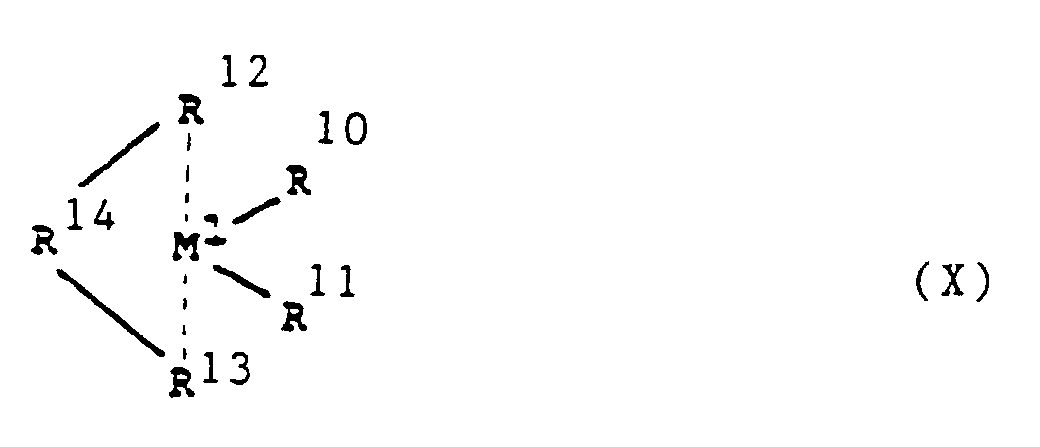
- the catalyst to be used for the process according to the invention consists of an aluminoxane and at least one metallocene (transition metal component) of the formula X.
- M 1 is a metal from the group titanium, zirconium, hafnium, vanadium, niobium and tantalum, preferably zirconium and hafnium. Zircon is particularly preferably used.
- R 10 and R 11 are identical or different and represent a hydrogen atom, a C 1 -C 10 -, preferably C 1 -C 3 -alkyl group, a C 1 -C 10 -, preferably C 1 -C 3 -alkoxy group, a C.
- R 12 and R 13 are the same or different and mean a mono- or polynuclear hydrocarbon radical which can form a sandwich structure with the central atom M 1 .
- R 12 are fluorenyl and R 13 cyclopentadienyl.
- M 2 is silicon, germanium or tin, preferably silicon or germanium.
- the bridged metallocenes can be prepared according to the following known reaction scheme:
- the cocatalyst is an aluminoxane of formula VIII for the linear type and / or of formula IX for the cyclic type.
- the R 9 radicals can be identical or different and represent a C 1 -C 6 alkyl group, preferably methyl, ethyl or isobutyl, butyl or neopentyl, or phenyl or benzyl. Methyl is particularly preferred.
- n is an integer from 0 to 50, preferably 5 to 40.
- the aluminoxane can be prepared in various ways by known methods.
- One of the methods is, for example, that an aluminum hydrocarbon compound and / or a hydridoaluminum hydrocarbon compound is reacted with water (gaseous, solid, liquid or bound - for example as water of crystallization) in an inert solvent (such as toluene).
- an inert solvent such as toluene
- AlR 3 + AlR ' 3 two different aluminum trialkyls (AlR 3 + AlR ' 3 ) are reacted with water according to the desired composition (see S. Pasynkiewicz, Polyhedron 9 (1990) 429 and EP-A 302 424).
- the transition metal compound is preactivated in solution.
- the metallocene is preferably in a solution of the aluminoxane in one inert hydrocarbon dissolved.
- a suitable hydrocarbon is inert aliphatic or aromatic hydrocarbon. Toluene or Cyclohexane used.
- the concentration of the aluminoxane in the solution is in the range from about 1% by weight to the saturation limit, preferably from 5 to 30% by weight, based in each case on the total solution.
- the metallocene can be used in the same concentration, but preferably it is used in an amount of 10 -4 - 1 mol per mol of aluminoxane.
- the preactivation time is 5 minutes to 60 hours, preferably 5 to 60 minutes. One works at a temperature of -78 ° C to 100 ° C, preferably 0 to 70 ° C.
- the metallocene can also be prepolymerized or applied to a support will.
- prepolymerization preference is given to (or one of the) in the Polymerization used olefin (s) used.
- Suitable carriers are, for example, silica gels, aluminum oxides, solid aluminoxane or other inorganic carrier materials.
- a suitable carrier material is also a polyolefin powder in finely divided form.
- solvents such as e.g. aliphatic or cycloaliphatic hydrocarbons (e.g. cyclohexane), gasoline or hydrogenated Diesel oil fractions or toluene.
- the polymerization takes place in dilute solution ( ⁇ 80 vol .-% cycloolefin) concentrated solution (> 80 vol .-% cycloolefin) or directly in the liquid undiluted cycloolefin monomer instead.
- the desired molecular weight and the Desired molecular weight distribution must have temperature and reaction time be coordinated accordingly. Also the concentration of the monomers like the type of solvent must also be taken into account, especially as this Parameters essentially determine the relative installation rates of the monomers and therefore crucial for glass temperature or thermal dimensional stability of the Are polymers.
- the Reaction time can also be set to the desired molecular weight.
- pure open chain olefin i.e. Ethylene that is being pressed Pressures between 0.01 and 64 bar used, preferably 2 to 40 bar and particularly preferably 4 to 20 bar.
- the total pressure is in Reaction vessel at 4 to 64 bar, preferably at 4 to 40 bar and particularly preferably at 4 to 25 bar. If the cycloolefinic component is undiluted is present, a high cycloolefin incorporation rate is achieved even at high pressures.
- Continuous and multi-stage are particularly advantageous Polymerization process because it is a rational use of the cycloolefin enable.
- the polycyclic olefin which can be obtained as a residual monomer together with the polymer, recover and return to the reaction mixture.
- the metallocene compound is used in a concentration, based on the transition metal, of 10 -3 to 10 -8 , preferably 10 -4 to 10 -6 mol, transition metal per dm 3 reactor volume.
- the aluminoxane is used in a concentration of 10 -4 to 10 -1 , preferably 10 -4 to 2 x 10 -2 mol per dm 3 reactor volume, based on the aluminum content. In principle, however, higher concentrations are also possible.
- bridged metallocenes are basically also Metallocenes with the same or similar, unbridged ligands can be used. At These metallocenes must be clear under comparable reaction conditions shorter reaction times than with the bridged metallocenes can be selected.
- the variation of the molar ratios can of the polycyclic olefin to the (preferred) open-chain olefin used in a wide range.
- Molar ratios of 3: 1 to are preferred 100: 1 cycloolefin used to open-chain olefin.
- the described process can be used to produce amorphous copolymers.
- the Copolymers are transparent. For example, they are in decahydronaphthalene 135 ° C and soluble in toluene at room temperature.
- the polymers can be processed thermoplastically. Both when extruding and when No remarkable degradation or viscosity build was found in injection molding.
- the materials produced are suitable for the production of Molded articles, especially for the production of extrusion parts such as foils, Hoses, pipes, rods and fibers and for the production of injection molded articles any shape and size.
- An important property of the In addition to the good flowability of the melt, materials is their transparency. This particularly comes to the optical applications of extruded or injection molded parts made of these materials are of great importance.
- the one with an Abbe refractometer and mixed light refractive index determined in the The reaction products described in the following examples are in the range between 1.520 and 1.555.
- the products according to the invention can be used as a glass replacement find various applications such as lenses, prisms, Carrier plates and foils for optical data storage, for video discs, for compact Disks, as cover and focusing disks for solar cells, as cover and Diffusers for power optics, as optical fibers in the form of fibers or foils.
- the polymers are also used for the production of Polymer alloys can be used.
- the alloys can be in the melt or in Solution.
- the alloys each have one for certain Applications favorable combination of properties of the components.
- Alloys with the polymers are the following polymers applicable:
- the glass transition temperatures (Tg) given in the following examples were using DSC (Differential Scanning Calorimetry) at a heating rate of 20 ° C / min certainly.
- the viscosity numbers given were determined in accordance with DIN 53 728.
- the molecular weight distribution (Mw / Mn) and the molecular weight (Mw) of the Reaction products were determined by gel permeation chromatography.
- the reactor was then kept at a temperature of 70 ° C. with stirring and 6 bar ethylene (excess pressure).
- toluene methylaluminoxane solution (MAO solution) (10.1% by weight of methylaluminoxane with a molecular weight of 1300 g / mol after cryoscopic determination) were metered into the reactor and the mixture was stirred at 70 ° C. for 15 minutes, with metering in the ethylene pressure was kept at 6 bar.
- 60 mg of rac-dimethylsilyl-bis- (1-indenyl) -zirconium dichloride) -zirconium dichloride were dissolved in 10 cm 3 of toluene methylaluminoxane solution (concentration and quality see above) and preactivated by standing for 15 minutes. Then the solution of the complex was metered into the reactor. The mixture was then polymerized at 70 ° C. with stirring (750 rpm), the ethylene pressure being kept at 6 bar by further metering.
- the filtered polymer was then placed in 2 dm 3 of a mixture of two parts of 3 normal hydrochloric acid and one part of ethanol and this suspension was stirred for 2 hours. The polymer was then filtered off again, washed neutral with water and dried at 80 ° C. and 0.2 bar for 15 hours.
- the polymerization was carried out analogously to Example 1. 40 cm 3 of MAO solution with 500 mg of rac-dimethylsilyl-bis- (1-indenyl) zirconium dichloride were used as the catalyst solution. The polymerization was carried out for 30 minutes at 6 ° C. and 4 bar ethylene pressure. 3.8 g of product could be obtained. The glass temperature was 122 ° C. According to GPC (analogous to Example 1 + 2), a molecular weight Mw of 2540 g / mol and a molecular weight distribution Mw / Mn of 1.15 were found.
- Round materials with a diameter of 25 mm were produced from the materials according to Examples 3, 6 and 7 by pressing for 15 minutes at 225 ° C. All press plates were colorless and transparent. To evaluate and compare the processability of these materials, the press plates thus obtained were used to determine the viscosity ETA. The device used for this was a "Rheometrics Dynamic Spectrometer RDS 2". The measurements were carried out in the "plate-plate” geometry at 270 ° C. and at two frequencies. The measurement results are summarized in Table 3. Sample designation according to example no.
- Viscosity ETA (Pa ⁇ s) Frequency 1 1 rad / s Frequency 2 10 rad / s 3rd 6.41 • 10 3 2.63 • 10 3 6 2.47 • 10 3 1.09 • 10 3 7 2.67 • 10 3 1.15 • 10 3
Landscapes
- Chemical & Material Sciences (AREA)
- Health & Medical Sciences (AREA)
- Chemical Kinetics & Catalysis (AREA)
- Medicinal Chemistry (AREA)
- Polymers & Plastics (AREA)
- Organic Chemistry (AREA)
- Transition And Organic Metals Composition Catalysts For Addition Polymerization (AREA)
- Addition Polymer Or Copolymer, Post-Treatments, Or Chemical Modifications (AREA)
- Polyoxymethylene Polymers And Polymers With Carbon-To-Carbon Bonds (AREA)
Abstract
Description
Die Erfindung bezieht sich in erster Linie auf ein Verfahren zur Herstellung von Homo- und Copolymeren von polycyclischen Olefinen mit sehr enger Molekulargewichtsverteilung, bei denen keine Ringöffnung erfolgt.The invention relates primarily to a method for producing Homo- and copolymers of polycyclic olefins with very narrow Molecular weight distribution with no ring opening.
Es ist bekannt, daß polycyclische Olefine mittels verschiedener Ziegler-Katalysatoren polymerisiert werden können. Die Polymerisation verläuft in Abhängigkeit vom Katalysator über Ringöffnung (vgl. US 4 178 424) oder Öffnung der Doppelbindung (vgl. EP-A 156 464, EP-A 283 164, EP-A-0 304 671 und EP-A-0 407 870)It is known that polycyclic olefins using various Ziegler catalysts can be polymerized. The polymerization proceeds in Dependence on the catalyst via ring opening (cf. US 4 178 424) or opening the double bond (cf. EP-A 156 464, EP-A 283 164, EP-A-0 304 671 and EP-A-0 407 870)
Der Nachteil einer ringöffnenden Polymerisation besteht darin, daß das erhaltene Polymerisat Doppelbindungen enthält, die zu Kettenvernetzungen führen können und damit die Verarbeitbarkeit des Materials durch Extrudieren oder Spritzgießen erheblich einschränken.The disadvantage of ring-opening polymerization is that the resultant Polymer contains double bonds that can lead to chain cross-links and thus the processability of the material by extrusion or injection molding limit significantly.
Die Polymerisation unter Öffnung der Doppelbindung weist bei cyclischen Olefinen eine relativ niedrige Polymerisationsgeschwindigkeit (Umsatzrate) auf.The polymerization with the opening of the double bond shows in cyclic olefins a relatively low rate of polymerization (conversion rate).
Bei der Verarbeitung von Polymeren mittels Spritzgießen oder bei der Verstreckung von Polymerfasern ist eine möglichst enge Molekulargewichtsverteilung der Polymeren von großem Vorteil.When processing polymers using injection molding or stretching The narrowest possible molecular weight distribution of polymer fibers is Polymers of great advantage.
Es ist bekannt, daß man bei radikalischen Polymerisationen aber auch bei der klassischen Ziegler-Polymerisation Molekulargewichtsverteilungen erreicht, die breit sind, d.h., daß Mw/Mn deutlich größer als 2 ist. Bei der mittels MetallocenKatalysatoren durchgeführten Polymerisation von Olefinen ist eine Molekulargewichtsverteilung Mw/Mn = 2 realisierbar. Für spezielle Anwendungen (z.B. Präzisionsspritzguß) wären jedoch noch engere Molekulargewichtsverteilungen wünschenswert.It is known that in radical polymerizations but also in classic Ziegler polymerization molecular weight distributions achieved that wide , i.e. that Mw / Mn is significantly greater than 2. In the case of using metallocene catalysts polymerization of olefins is one Molecular weight distribution Mw / Mn = 2 realizable. For special applications (e.g. precision injection molding) would be even narrower molecular weight distributions desirable.
Somit bestand die Aufgabe, möglichst eng verteilte Polycycloolefine und Cycloolefincopolymere mit Hilfe eines möglichst einfachen Verfahrens herzustellen.The task was therefore to distribute polycycloolefins and To produce cycloolefin copolymers using the simplest possible process.
Es wurde überraschend gefunden, daß durch die Verwendung spezieller Metallocenkatalysatoren in Kombination mit bestimmten Polymerisationsbedingungen, wie Konzentration und Temperatur, sowie insbesondere durch die Wahl bestimmter Polymerisationszeiten Polycycloolefine und Cycloolefincopolymere mit Molekulargewichtsverteilungen Mw/Mn ≤ 1,7 zugänglich sind.It has surprisingly been found that by using special Metallocene catalysts in combination with certain Polymerization conditions such as concentration and temperature, as well especially through the choice of certain polymerization times polycycloolefins and cycloolefin copolymers with molecular weight distributions Mw / Mn ≤ 1.7 are accessible.
Dieser Befund ist außergewöhnlich überraschend, weil alle bisher bekannten theoretischen Abhandlungen über die Ziegler-Polymerisation eine Verteilung von minimal Mw/Mn = 2 zulassen. Engere Verteilungen, wie sie erfindungsgemäß gefunden wurden, weisen darauf hin, daß der Großteil der Polymerketten während der gesamten Polymerisationsdauer aufgebaut wird, d.h., die Polymerisation kann unter bestimmten Bedingungen sehr ähnlich einer lebenden Polymerisation verlaufen, wie sie z.B. von der anionischen Polymerisation von Styrol bekannt ist.This finding is extraordinarily surprising, because all known so far theoretical papers on Ziegler polymerization a distribution of allow minimum Mw / Mn = 2. Narrower distributions, such as those according to the invention were found to indicate that the majority of the polymer chains during the entire duration of the polymerization is built up, i.e. the polymerization can very similar to living polymerization under certain conditions run as e.g. is known from the anionic polymerization of styrene.
Die Erfindung betrifft somit ein Verfahren zur Herstellung eines Cycloolefinpolymers
oder -copolymers mit enger Molekulargewichtsverteilung (Mw/Mn) ≤ 1,7 durch
Polymerisation von 0,1 bis 100 Gew.-%, bezogen auf die Gesamtmenge der
Monomeren, mindestens eines Monomers der Formeln I, II, III, IV, V oder VI


0 bis 99,9 Gew.-%, bezogen auf die Gesamtmenge der Monomeren, Ethylen
bei Temperaturen von -78 bis 40°C und
einem Druck von 0,01 bis 64 bar, in Gegenwart eines Katalysators, welcher aus
einem Aluminoxan der Formel VIII


- M1
- Titan, Zirkon, Hafnium, Vanadium, Niob oder Tantal ist,
- R10 und R11
- gleich oder verschieden sind und ein Wasserstoffatom, ein Halogenatom, eine C1-C10-Alkylgruppe, eine C1-C10-Alkoxygruppe, eine C6-C10-Arylgruppe, eine C6-C10-Aryloxygruppe, eine C2-C10-Alkenylgruppe, eine C7-C40-Arylalkylgruppe, eine C7-C40-Alkylarylgruppe oder eine C8-C40-Arylalkenylgruppe bedeuten,
- R12 und R13
- einen ein- oder mehrkernigen Kohlenwasserstoffrest, welcher mit dem Zentralatom M' eine Sandwichstruktur bilden kann, bedeuten,
- R18
- = BR15, = AlR15, -Ge-, -Sn-, -O-, -S-, = SO, SO2, = NR15, = CO, = PR15, oder = P(O)R15 ist, wobei R15, R16 und R17 gleich oder verschieden sind und ein Wasserstoffatom, ein Halogenatom, eine C1-C10-Alkylgruppe, eine C1-C10-Fluoralkylgruppe, eine C6-C10-Fluorarylgruppe, eine C6-C10-Arylgruppe, eine C1-C10-Alkoxygruppe, eine C2-C10-Alkenylgruppe, eine C7-C40-Alrylalkylgruppe, eine C8-C40-Arylalkenylgruppe oder eine C7-C40-Alkylarylgruppe bedeuten oder R15 und R16 oder R15 und R17 jeweils mit den sie verbindenden Atomen einen Ring bilden, und

- M2
- Silizium, Germanium oder Zinn ist, wobei man die Polymerisation zu einem Zeitpunkt abbricht, an dem Mw/Mn ≤ 1.7 ist.
0 to 99.9% by weight, based on the total amount of monomers, of ethylene at temperatures from -78 to 40 ° C. and a pressure of 0.01 to 64 bar, in the presence of a catalyst which consists of an aluminoxane of the formula VIII
- M 1
- Is titanium, zirconium, hafnium, vanadium, niobium or tantalum,
- R 10 and R 11
- are identical or different and are a hydrogen atom, a halogen atom, a C 1 -C 10 alkyl group, a C 1 -C 10 alkoxy group, a C 6 -C 10 aryl group, a C 6 -C 10 aryloxy group, a C 2 Are -C 10 alkenyl group, a C 7 -C 40 arylalkyl group, a C 7 -C 40 alkylaryl group or a C 8 -C 40 arylalkenyl group,
- R 12 and R 13
- is a mono- or polynuclear hydrocarbon radical which can form a sandwich structure with the central atom M ',
- R 18
- = BR 15 , = AlR 15 , -Ge-, -Sn-, -O-, -S-, = SO, SO 2 , = NR 15 , = CO, = PR 15 , or = P (O) R 15 , wherein R 15 , R 16 and R 17 are the same or different and represent a hydrogen atom, a halogen atom, a C 1 -C 10 alkyl group, a C 1 -C 10 fluoroalkyl group, a C 6 -C 10 fluoroaryl group, a C 6 -C 10 aryl group, a C 1 -C 10 alkoxy group, a C 2 -C 10 alkenyl group, a C 7 -C 40 arylalkyl group, a C 8 -C 40 arylalkenyl group or a C 7 -C 40 - Are alkylaryl group or R 15 and R 16 or R 15 and R 17 each form a ring with the atoms connecting them, and
- M 2
- Is silicon, germanium or tin, the polymerization being stopped at a time when Mw / Mn ≤ 1.7.
Dabei steht Alkyl für geradkettiges oder verzweigtes Alkyl.Alkyl stands for straight-chain or branched alkyl.
Das monocyclische Olefin VII kann für die Zwecke der Erfindung auch substituiert sein (z.B. durch Alkyl- oder Arylreste).The monocyclic olefin VII can also be substituted for the purposes of the invention be (e.g. by alkyl or aryl radicals).
Im erfindungsgemäßen Verfahren wird mindestens ein polycyclisches Olefin der Formeln I, II, III, IV, V oder VI, vorzugsweise ein Cycloolefin der Formeln I oder III, worin R1, R2, R3, R4, R5, R6, R7 und R8 gleich oder verschieden sind und ein Wasserstoffatom oder einen C1-C8-Alkylrest bedeuten, wobei gleiche Reste in den verschiedenen Formeln eine unterschiedliche Bedeutung haben können, polymerisiert.In the process according to the invention, at least one polycyclic olefin of the formulas I, II, III, IV, V or VI, preferably a cycloolefin of the formulas I or III, in which R 1 , R 2 , R 3 , R 4 , R 5 , R 6 , R 7 and R 8 are identical or different and denote a hydrogen atom or a C 1 -C 8 -alkyl radical, where the same radicals in the different formulas can have different meanings.
Insbesondere werden Copolymere von polycyclischen Olefinen, vorzugsweise der Formeln I und III, mit Ethylen hergestellt.In particular, copolymers of polycyclic olefins, preferably the Formulas I and III, made with ethylene.
Besonders bevorzugte Cycloolefine sind Norbornen und Tetracyclododecen, wobei diese durch (C1-C6)-Alkyl substituiert sein können. Sie werden vorzugsweise mit Ethylen copolymerisiert; besondere Bedeutung besitzen Ethylen/Norbornen-Copolymere. Particularly preferred cycloolefins are norbornene and tetracyclododecene, where these can be substituted by (C 1 -C 6 ) alkyl. They are preferably copolymerized with ethylene; ethylene / norbornene copolymers are of particular importance.
Das polycyclische Olefin (I bis VI) wird in einer Menge von 0,1 bis 100 Gew.-% und das monocyclische Olefin (VII) in einer Menge von 0 bis 99,9 Gew.-%, jeweils bezogen auf die Gesamtmenge der Monomeren, eingesetzt.The polycyclic olefin (I to VI) is in an amount of 0.1 to 100 wt .-% and the monocyclic olefin (VII) in an amount of 0 to 99.9% by weight, each based on the total amount of monomers used.
Die Konzentration des offenkettigen Olefins, d.h. Ethylen, ergibt sich aus der Löslichkeit des offenkettigen Olefins in dem Reaktionsmedium bei gegebenem Druck und gegebener Temperatur.The concentration of the open chain olefin, i.e. Ethylene results from the solubility of open chain olefin in the reaction medium at given pressure and given temperature.
Als polycyclische Olefine, monocyclische Olefine und offenkettige Olefine sind auch Gemische zweier oder mehrerer Olefine des jeweiligen Typs zu verstehen. Das heißt, es können neben polycyclischen Homopolymeren und Bicopolymeren auch Ter- und Multicopolymere nach dem erfindungsgemäßen Verfahren hergestellt werden. Auch Copolymere der Cycloolefine VII mit Ethylen lassen sich vorteilhaft nach dem beschriebenen Verfahren erhalten. Von den Cycloolefinen VII ist Cyclopenten, das substituiert sein kann, bevorzugt.Also known as polycyclic olefins, monocyclic olefins and open chain olefins To understand mixtures of two or more olefins of the respective type. The means, in addition to polycyclic homopolymers and bicopolymers Ter and multicopolymers produced by the inventive method will. Copolymers of cycloolefins VII with ethylene can advantageously be obtained by the method described. Of the Cycloolefins VII is preferred cyclopentene, which may be substituted.
Der für das erfindungsgemäße Verfahren zu verwendende Katalysator besteht aus
einem Aluminoxan und mindestens einem Metallocen
(Übergangsmetallkomponente) der Formel X

In Formel XI ist M1 ein Metall aus der Gruppe Titan, Zirkon, Hafnium, Vanadium, Niob und Tantal, vorzugsweise Zirkon und Hafnium. Besonders bevorzugt wird Zirkon verwendet.In formula XI, M 1 is a metal from the group titanium, zirconium, hafnium, vanadium, niobium and tantalum, preferably zirconium and hafnium. Zircon is particularly preferably used.
R10 und R11 sind gleich oder verschieden und bedeuten ein Wasserstoffatom, eine C1-C10-, vorzugsweise C1-C3-Alkylgruppe, eine C1-C10-, vorzugsweise C1-C3-Alkoxygruppe, eine C6-C10-, vorzugsweise C6-C8-Arylgruppe, eine C6-C10-, vorzugsweise C6-C8-Aryloxygruppe, eine C2-C10-, vorzugsweise C2-C4-Alkenylgruppe, eine C7-C40-, vorzugsweise C7-C10-Arylalkylgruppe, eine C7-C40-, vorzugsweise C7-C12-Alkylarylgruppe, eine C8-C40-, vorzugsweise C8-C12-Arylalkenylgruppe oder ein Halogenatom, vorzugsweise Chlor.R 10 and R 11 are identical or different and represent a hydrogen atom, a C 1 -C 10 -, preferably C 1 -C 3 -alkyl group, a C 1 -C 10 -, preferably C 1 -C 3 -alkoxy group, a C. 6 -C 10 -, preferably C 6 -C 8 aryl group, a C 6 -C 10 -, preferably C 6 -C 8 aryloxy group, a C 2 -C 10 -, preferably C 2 -C 4 alkenyl group, a C 7 -C 40 -, preferably C 7 -C 10 -arylalkyl group, a C 7 -C 40 -, preferably C 7 -C 12 -alkylaryl group, a C 8 -C 40 -, preferably C 8 -C 12 -arylalkenyl group or a halogen atom, preferably chlorine.
R12 und R13 sind gleich oder verschieden und bedeuten einen ein- oder mehrkernigen Kohlenwasserstoffrest, welcher mit dem Zentralatom M1 eine Sandwichstruktur bilden kann. Bevorzugt sind R12 Fluorenyl und R13 Cyclopentadienyl.R 12 and R 13 are the same or different and mean a mono- or polynuclear hydrocarbon radical which can form a sandwich structure with the central atom M 1 . R 12 are fluorenyl and R 13 cyclopentadienyl.
R14 ist eine ein- oder mehrgliedrige Brücke, welche die Reste R12 und R13 verknüpft
und bedeutet vorzugsweise

gleich oder verschieden sind und ein Wasserstoffatom, ein Halogenatom, eine
C1-C10-Alkylgruppe, C1-C10-Fluoralkylgruppe, eine C6-C10-Arylgruppe, eine C1-C10-Alkoxygruppe,
eine C2-C10-Alkenylgruppe, eine C7-C40-Arylalkylgruppe, eine C8-C40-Arylalkenylgruppe
oder eine C7-C40-Alkylarylgruppe bedeuten, oder R15 und R16 oder
R15 und R17 bilden jeweils zusammen mit den sie verbindenden Atomen einen Ring.R 14 is a one- or multi-membered bridge which links the radicals R 12 and R 13 and preferably means
are identical or different and are a hydrogen atom, a halogen atom, a C 1 -C 10 alkyl group, C 1 -C 10 fluoroalkyl group, a C 6 -C 10 aryl group, a C 1 -C 10 alkoxy group, a C 2 - C 10 alkenyl group, a C 7 -C 40 arylalkyl group, a C 8 -C 40 arylalkenyl group or a C 7 -C 40 alkylaryl group, or R 15 and R 16 or R 15 and R 17 each form together with the they connect atoms to a ring.
M2 ist Silizium, Germanium oder Zinn, bevorzugt Silizium oder Germanium.M 2 is silicon, germanium or tin, preferably silicon or germanium.
Die verbrückten Metallocene können nach folgendem bekannten Reaktionsschema
hergestellt werden:


Das obige Reaktionsschema gilt auch für die Fälle R15 = R16 und/oder R10 = R11 (vgl. Journal of Organometallic Chem. 288 (1985) 63-67 und EP-A 320 762).The above reaction scheme also applies to the cases R 15 = R 16 and / or R 10 = R 11 (cf. Journal of Organometallic Chem. 288 (1985) 63-67 and EP-A 320 762).
Bevorzugt eingesetzte Metallocene sind:
Besonders bevorzugt sind dabei:
Der Cokatalysator ist ein Aluminoxan der Formel VIII für den linearen Typ und/oder der Formel IX für den cyclischen Typ. In diesen Formeln können die Reste R9 gleich oder verschieden sein und bedeuten eine C1-C6-Alkylgruppe, vorzugsweise Methyl, Ethyl oder Isobutyl, Butyl oder Neopentyl, oder Phenyl oder Benzyl. Besonders bevorzugt ist Methyl. n ist eine ganze Zahl von 0 bis 50, bevorzugt 5 bis 40.The cocatalyst is an aluminoxane of formula VIII for the linear type and / or of formula IX for the cyclic type. In these formulas, the R 9 radicals can be identical or different and represent a C 1 -C 6 alkyl group, preferably methyl, ethyl or isobutyl, butyl or neopentyl, or phenyl or benzyl. Methyl is particularly preferred. n is an integer from 0 to 50, preferably 5 to 40.
Das Aluminoxan kann auf verschiedene Arten nach bekannten Verfahren hergestellt werden. Eine der Methoden ist beispielsweise, daß eine Aluminiumkohlenwasserstoffverbindung und/oder eine Hydridoaluminiumkohlenwasserstoffverbindung mit Wasser (gasförmig, fest, flüssig oder gebunden - beispielsweise als Kristallwasser) in einem inerten Lösungsmittel (wie z.B. Toluol) umgesetzt wird. Zur Herstellung eines Aluminoxans mit verschiedenen Alkylgruppen R9 werden entsprechend der gewünschten Zusammensetzung zwei verschiedene Aluminiumtrialkyle (AlR3 + AlR'3) mit Wasser umgesetzt (vgl. S. Pasynkiewicz, Polyhedron 9 (1990) 429 und EP-A 302 424).The aluminoxane can be prepared in various ways by known methods. One of the methods is, for example, that an aluminum hydrocarbon compound and / or a hydridoaluminum hydrocarbon compound is reacted with water (gaseous, solid, liquid or bound - for example as water of crystallization) in an inert solvent (such as toluene). To produce an aluminoxane with different alkyl groups R 9 , two different aluminum trialkyls (AlR 3 + AlR ' 3 ) are reacted with water according to the desired composition (see S. Pasynkiewicz, Polyhedron 9 (1990) 429 and EP-A 302 424).
Die genaue Struktur der Aluminoxane ist nicht bekannt.The exact structure of the aluminoxanes is not known.
Unabhängig von der Art der Herstellung ist allen Aluminoxanlösungen ein wechselnder Gehalt an nicht umgesetzter Aluminiumausgangsverbindung, die in freier Form oder als Addukt vorliegt, gemeinsam.Regardless of the type of manufacture, all aluminoxane solutions are one changing content of unreacted aluminum starting compound, which in free form or as an adduct, together.
Es ist möglich, das Metallocen vor dem Einsatz in der Polymerisationsreaktion mit einem Aluminoxan der Formel (VIII) und/oder (IX) vorzuaktivieren. Dadurch wird die Polymerisationsaktivität deutlich erhöht.It is possible to include the metallocene in the polymerization reaction before use preactivate an aluminoxane of the formula (VIII) and / or (IX). This will make the Polymerization activity increased significantly.
Die Voraktivierung der Übergangsmetallverbindung wird in Lösung vorgenommen. Bevorzugt wird dabei das Metallocen in einer Lösung des Aluminoxans in einem inerten Kohlenwasserstoff aufgelöst. Als inerter Kohlenwasserstoff eignet sich ein aliphatischer oder aromatischer Kohlenwasserstoff. Bevorzugt werden Toluol oder Cyclohexan verwendet.The transition metal compound is preactivated in solution. The metallocene is preferably in a solution of the aluminoxane in one inert hydrocarbon dissolved. A suitable hydrocarbon is inert aliphatic or aromatic hydrocarbon. Toluene or Cyclohexane used.
Die Konzentration des Aluminoxans in der Lösung liegt im Bereich von ca. 1 Gew.-% bis zur Sättigungsgrenze, vorzugsweise von 5 bis 30 Gew.-%, jeweils bezogen auf die Gesamtlösung. Das Metallocen kann in der gleichen Konzentration eingesetzt werden, vorzugsweise wird es jedoch in einer Menge von 10-4 - 1 mol pro mol Aluminoxan eingesetzt. Die Voraktivierungszeit beträgt 5 Minuten bis 60 Stunden, vorzugsweise 5 bis 60 Minuten. Man arbeitet bei einer Temperatur von -78°C bis 100°C, vorzugsweise 0 bis 70°C. The concentration of the aluminoxane in the solution is in the range from about 1% by weight to the saturation limit, preferably from 5 to 30% by weight, based in each case on the total solution. The metallocene can be used in the same concentration, but preferably it is used in an amount of 10 -4 - 1 mol per mol of aluminoxane. The preactivation time is 5 minutes to 60 hours, preferably 5 to 60 minutes. One works at a temperature of -78 ° C to 100 ° C, preferably 0 to 70 ° C.
Das Metallocen kann auch vorpolymerisiert oder auf einen Träger aufgebracht werden. Zur Vorpolymerisation wird bevorzugt das (oder eines der) in der Polymerisation eingesetzte(n) Olefin(e) verwendet.The metallocene can also be prepolymerized or applied to a support will. For prepolymerization, preference is given to (or one of the) in the Polymerization used olefin (s) used.
Geeignete Träger sind beispielsweise Silikagele, Aluminiumoxide, festes Aluminoxan oder andere anorganische Trägermaterialien. Ein geeignetes Trägermaterial ist auch ein Polyolefinpulver in feinverteilter Form.Suitable carriers are, for example, silica gels, aluminum oxides, solid aluminoxane or other inorganic carrier materials. A suitable carrier material is also a polyolefin powder in finely divided form.
Eine weitere mögliche Ausgestaltung des erfindungsgemäßen Verfahrens besteht darin, daß man an Stelle oder neben eines Aluminoxans eine salzartige Verbindung der Formel RxNH4-xBR'4 oder der Formel R3PHBR'4 als Cokatalysator verwendet. Dabei sind x = 1, 2 oder 3, R = Alkyl oder Aryl, gleich oder verschieden, und R' = Aryl, das auch fluoriert oder teilfluoriert sein kann. In diesem Fall besteht der Katalysator aus dem Reaktionsprodukt eines Metallocens mit einer der genannten Verbindungen (vgl. EP-A 277 004).A further possible embodiment of the process according to the invention consists in using a salt-like compound of the formula R x NH 4 -x BR ' 4 or the formula R 3 PHBR' 4 as a cocatalyst instead of or in addition to an aluminoxane. X = 1, 2 or 3, R = alkyl or aryl, the same or different, and R '= aryl, which can also be fluorinated or partially fluorinated. In this case, the catalyst consists of the reaction product of a metallocene with one of the compounds mentioned (cf. EP-A 277 004).
Falls dem Reaktionsgemisch eine geringere Menge an Lösemittel zugesetzt wird, dann handelt es sich um gebräuchliche inerte Lösemittel wie z.B. aliphatische oder cycloaliphatische Kohlenwasserstoffe (z.B. Cyclohexan), Benzin- bzw. hydrierte Dieselölfraktionen oder Toluol.If a smaller amount of solvent is added to the reaction mixture, then it is common inert solvents such as e.g. aliphatic or cycloaliphatic hydrocarbons (e.g. cyclohexane), gasoline or hydrogenated Diesel oil fractions or toluene.
Die Polymerisation findet in verdünnter Lösung (< 80 Vol.-% Cycloolefin), in konzentrierter Lösung (> 80 Vol.-% Cycloolefin) oder direkt im flüssigen unverdünnten Cycloolefinmonomer statt.The polymerization takes place in dilute solution (<80 vol .-% cycloolefin) concentrated solution (> 80 vol .-% cycloolefin) or directly in the liquid undiluted cycloolefin monomer instead.
Je nach der Aktivität des Katalysators, dem gewünschten Molekulargewicht und der gewünschten Molekulargewichtsverteilung müssen Temperatur und Reaktionszeit entsprechend abgestimmt werden. Auch die Konzentration der Monomeren wie auch Art des Lösungsmittels müssen dabei berücksichtigt werden, zumal diese Parameter wesentlich die relativen Einbauraten der Monomeren bestimmen und somit entscheidend für Glastemperatur bzw. thermische Formbeständigkeit der Polymere sind. Depending on the activity of the catalyst, the desired molecular weight and the Desired molecular weight distribution must have temperature and reaction time be coordinated accordingly. Also the concentration of the monomers like the type of solvent must also be taken into account, especially as this Parameters essentially determine the relative installation rates of the monomers and therefore crucial for glass temperature or thermal dimensional stability of the Are polymers.
Je tiefer die Temperatur innerhalb des Bereichs von -78 bis 40°C gewählt wird, um so länger kann die Polymerisationsdauer bei gleicher Breite der Molekulargewichtsverteilung Mw/Mn sein (vgl. Tab. 2). Bevorzugt sind Molekulargewichtsverteilungen Mw/Mn ≤ 1,4.The lower the temperature is selected within the range of -78 to 40 ° C, the longer the polymerisation time with the same width of the Molecular weight distribution Mw / Mn (see Tab. 2). Are preferred Molecular weight distributions Mw / Mn ≤ 1.4.
Möchte man auch ein bestimmtes Molekulargewicht ansteuern, so muß die Reaktionsdauer auch auf das gewünschte Molekulargewicht eingestellt werden.If you also want to control a certain molecular weight, then the Reaction time can also be set to the desired molecular weight.
Die Bestimmung der erforderlichen Reaktionszeit bis zum Abbruch der Reaktion, die in Abhängigkeit von den genannten Reaktionsparametern und der Cycloolefineinbaurate variiert, erfolgt durch einfache Probennahme wie in den Ausführungsbeispielen beschrieben. Aus Versuchsreihen können Diagramme erstellt werden aus denen dann die erforderlichen Zeiten entnommen (vorbestimmt) werden können (vgl. Fig. 1).The determination of the required reaction time until the reaction is stopped, which depending on the reaction parameters mentioned and the Cycloolefin incorporation rate varies, is done by simple sampling as in the Described embodiments. Diagrams can be made from test series from which the required times are then taken (predetermined) can be (see Fig. 1).
Um die engen Molekulargewichtsverteilungen zu erreichen, ist auf Übertragungsreagenzien, wie z.B. Wasserstoff, weitgehend zu verzichten. Eine Steuerung des Molekulargewichts über die Reaktionszeit ist möglich.To achieve the narrow molecular weight distributions, is on Transmission reagents such as Hydrogen to be largely avoided. A Control of the molecular weight via the reaction time is possible.
Wenn reines offenkettiges Olefin, d.h. Ethylen, aufgedrückt wird, werden Drucke zwischen 0,01 und 64 bar eingesetzt, bevorzugt 2 bis 40 bar und besonders bevorzugt 4 bis 20 bar. Wird neben dem offenkettigen Olefin auch ein inertes Gas z.B. Stickstoff oder Argon aufgedrückt, so liegt der Gesamtdruck im Reaktionsgefäß bei 4 bis 64 bar, bevorzugt bei 4 bis 40 bar und besonders bevorzugt bei 4 bis 25 bar. Falls die cycloolefinische Komponente unverdünnt vorliegt, wird auch bei hohen Drucken eine hohe Cycloolefineinbaurate erreicht.If pure open chain olefin, i.e. Ethylene that is being pressed Pressures between 0.01 and 64 bar used, preferably 2 to 40 bar and particularly preferably 4 to 20 bar. In addition to the open-chain olefin, is also a inert gas e.g. Pressed nitrogen or argon, the total pressure is in Reaction vessel at 4 to 64 bar, preferably at 4 to 40 bar and particularly preferably at 4 to 25 bar. If the cycloolefinic component is undiluted is present, a high cycloolefin incorporation rate is achieved even at high pressures.
Besonders vorteilhaft sind kontinuierliche sowie mehrstufige Polymerisationsverfahren, weil sie einen rationalen Einsatz des Cycloolefins ermöglichen. Auch läßt sich bei kontinuierlichen Verfahren das polycyclische Olefin, welches als Restmonomer zusammen mit dem Polymeren anfallen kann, zurückgewinnen und wieder dem Reaktionsgemisch zuführen.Continuous and multi-stage are particularly advantageous Polymerization process because it is a rational use of the cycloolefin enable. In the case of continuous processes, the polycyclic olefin, which can be obtained as a residual monomer together with the polymer, recover and return to the reaction mixture.
Die Metallocenverbindung wird in einer Konzentration, bezogen auf das Übergangsmetall, von 10-3 bis 10-8, vorzugsweise 10-4 bis 10-6 mol Übergangsmetall pro dm3 Reaktorvolumen angewendet. Das Aluminoxan wird in einer Konzentration von 10-4 bis 10-1, vorzugsweise 10-4 bis 2 x 10⁻² mol pro dm3 Reaktorvolumen verwendet, bezogen auf den Gehalt an Aluminium. Prinzipiell sind aber auch höhere Konzentrationen möglich.The metallocene compound is used in a concentration, based on the transition metal, of 10 -3 to 10 -8 , preferably 10 -4 to 10 -6 mol, transition metal per dm 3 reactor volume. The aluminoxane is used in a concentration of 10 -4 to 10 -1 , preferably 10 -4 to 2 x 10 -2 mol per dm 3 reactor volume, based on the aluminum content. In principle, however, higher concentrations are also possible.
Außer den genannten, verbrückten Metallocenen sind grundsätzlich auch Metallocene mit gleichen bzw. ähnlichen, unverbrückten Liganden einsetzbar. Bei diesen Metallocenen müssen unter vergleichbaren Reaktionsbedingungen deutlich kürzere Reaktionszeiten als bei den verbrückten Metallocenen gewählt werden.In addition to the mentioned, bridged metallocenes are basically also Metallocenes with the same or similar, unbridged ligands can be used. At These metallocenes must be clear under comparable reaction conditions shorter reaction times than with the bridged metallocenes can be selected.
Bei der Herstellung von Copolymerisaten kann die Variation der Molverhältnisse des polycyclischen Olefins zum (bevorzugt) eingesetzten offenkettigen Olefin in einem weiten Bereich erfolgen. Bevorzugt werden molare Verhältnisse von 3:1 bis 100:1 Cycloolefin zu offenkettigem Olefin eingesetzt. Durch die Wahl der Polymerisationstemperatur, durch die Konzentration der Katalysatorkomponenten und das eingesetzte Molverhältnis bzw. den Druck des gasförmigen, offenkettigen Olefins läßt sich die Einbaurate an Comonomer beinahe beliebig steuern. Bevorzugt werden Einbauraten zwischen 20 und 75 Mol-% der cyclischen Komponenten und besonders bevorzugt werden Einbauraten zwischen 35 und 65 Mol-% der cyclischen Komponenten.In the production of copolymers, the variation of the molar ratios can of the polycyclic olefin to the (preferred) open-chain olefin used in a wide range. Molar ratios of 3: 1 to are preferred 100: 1 cycloolefin used to open-chain olefin. By choosing the Polymerization temperature, through the concentration of the catalyst components and the molar ratio used or the pressure of the gaseous, open-chain Olefins can control the rate of incorporation of comonomers almost as desired. Prefers installation rates between 20 and 75 mol% of the cyclic components and Installation rates between 35 and 65 mol% of the cyclic components.
Mit dem beschriebenen Verfahren lassen sich amorphe Copolymere herstellen. Die Copolymere sind transparent. Sie sind beispielsweise in Dekahydronaphthalin bei 135°C und in Toluol bei Raumtemperatur löslich. Die Polymere sind thermoplastisch verarbeitbar. Sowohl beim Extrudieren als auch beim Spritzgießen wurde kein bemerkenswerter Abbau oder Viskositätsaufbau gefunden.The described process can be used to produce amorphous copolymers. The Copolymers are transparent. For example, they are in decahydronaphthalene 135 ° C and soluble in toluene at room temperature. The polymers can be processed thermoplastically. Both when extruding and when No remarkable degradation or viscosity build was found in injection molding.
Die hergestellten Materialien eignen sich zur Herstellung von Formkörpern, besonders zur Herstellung von Extrusionsteilen wie Folien, Schläuchen, Rohren, Stangen und Fasern und zur Herstellung von Spritzgußartikeln beliebiger Form und Größe. Eine wichtige Eigenschaft der Materialien ist neben der guten Fließfähigkeit der Schmelze ihre Transparenz. Dadurch kommen besonders den optischen Anwendungen der extrudierten oder spritzgegossenen Teile aus diesen Materialien eine große Bedeutung zu. Der mit einem Abbe-Refraktometer und Mischlicht bestimmte Brechungsindex der in den nachfolgenden Beispielen beschriebenen Reaktionsprodukte liegt im Bereich zwischen 1,520 und 1,555. Nachdem der Brechungsindex sehr nahe an dem von Kronglas (n = 1,51) liegt, können die erfindungsgemäßen Produkte als Glasersatz verschiedene Anwendungen finden wie beispielsweise Linsen, Prismen, Trägerplatten und -folien für optische Datenspeicher, für Videoplatten, für Compact Disks, als Deck- und Fokussierscheiben für Solarzellen, als Deck- und Streuscheiben für Leistungsoptiken, als Lichtwellenleiter in der Form von Fasern oder Folien.The materials produced are suitable for the production of Molded articles, especially for the production of extrusion parts such as foils, Hoses, pipes, rods and fibers and for the production of injection molded articles any shape and size. An important property of the In addition to the good flowability of the melt, materials is their transparency. This particularly comes to the optical applications of extruded or injection molded parts made of these materials are of great importance. The one with an Abbe refractometer and mixed light refractive index determined in the The reaction products described in the following examples are in the range between 1.520 and 1.555. After the refractive index is very close to that of Kronglas (n = 1.51), the products according to the invention can be used as a glass replacement find various applications such as lenses, prisms, Carrier plates and foils for optical data storage, for video discs, for compact Disks, as cover and focusing disks for solar cells, as cover and Diffusers for power optics, as optical fibers in the form of fibers or foils.
Die Polymere sind auch für die Herstellung von Polymerlegierungen einsetzbar. Die Legierungen können in der Schmelze oder in Lösung hergestellt werden. Die Legierungen weisen jeweils eine für bestimmte Anwendungen günstige Eigenschaftskombination der Komponenten auf. Für Legierungen mit den Polymeren sind folgende Polymere einsetzbar:The polymers are also used for the production of Polymer alloys can be used. The alloys can be in the melt or in Solution. The alloys each have one for certain Applications favorable combination of properties of the components. For Alloys with the polymers are the following polymers applicable:
Polyethylen, Polypropylen, (Ethylen-Propylen)-Copolymere, Polybutylen, Poly-(4-methyl-1-penten), Polyisopren, Polyisobutylen, Naturkautschuk, Poly-(methylmethacrylat), weitere Polymethacrylate, Polyacrylate, (Acrylat-Methacrylat)-Copolymere, Polystyrol, (Styrol-Acrylnitril)-Copolymere, Bisphenol-A-Polycarbonat, weitere Polycarbonate, aromatische Polyestercarbonate, Polyethylenterephthalat, Polybutylenterephthalat, amorphe Polyarylate, Nylon-6, Nylon-66, weitere Polyamide, Polyaramide, Polyetherketone, Polyoxymethylen, Polyoxyethylen, Polyurethane, Polysulfone, Polyethersulfone, Polyvinylidenfluorid sowie Cycloolefin(co)polymere mit einer Molekulargewichtsverteilung Mw/Mn ≥ 2. Polyethylene, polypropylene, (ethylene-propylene) copolymers, polybutylene, poly- (4-methyl-1-pentene), Polyisoprene, polyisobutylene, natural rubber, poly (methyl methacrylate), further polymethacrylates, polyacrylates, (acrylate methacrylate) copolymers, Polystyrene, (styrene-acrylonitrile) copolymers, bisphenol-A polycarbonate, other polycarbonates, aromatic polyester carbonates, polyethylene terephthalate, Polybutylene terephthalate, amorphous polyarylates, nylon-6, nylon-66, others Polyamides, polyaramides, polyether ketones, polyoxymethylene, polyoxyethylene, Polyurethanes, polysulfones, polyether sulfones, polyvinylidene fluoride and Cycloolefin (co) polymers with a molecular weight distribution Mw / Mn ≥ 2.
Um besondere Schmelzeigenschaften zu erreichen, können auch mehrere Polymere miteinander legiert werden.To achieve special melting properties, several can Polymers are alloyed together.
Die in den folgenden Beispielen angegebenen Glastemperaturen (Tg) wurden mittels DSC (Differential Scanning Calorimetry) bei einer Aufheizrate von 20°C/min bestimmt. Die angegebenen Viskositätszahlen wurden gemäß DIN 53 728 ermittelt. Die Molekulargewichtsverteilung (Mw/Mn) und das Molekulargewicht (Mw) der Reaktionsprodukte wurden durch Gelpermeationschromatographie bestimmt. The glass transition temperatures (Tg) given in the following examples were using DSC (Differential Scanning Calorimetry) at a heating rate of 20 ° C / min certainly. The viscosity numbers given were determined in accordance with DIN 53 728. The molecular weight distribution (Mw / Mn) and the molecular weight (Mw) of the Reaction products were determined by gel permeation chromatography.
Ein sauberer und trockener 1,5-dm3-Polymerisationsreaktor mit Rührer wurde mit Stickstoff und dann mit Ethylen gespült und mit 576 ml einer 85 volumenprozentigen toluolischen Norbornenlösung gefüllt.A clean and dry 1.5 dm 3 polymerization reactor with stirrer was purged with nitrogen and then with ethylene and filled with 576 ml of an 85 volume percent toluene norbornene solution.
Unter Rühren wurde dann der Reaktor auf einer Temperatur von 70°C gehalten und 6 bar Ethylen (Überdruck) aufgedrückt.The reactor was then kept at a temperature of 70 ° C. with stirring and 6 bar ethylene (excess pressure).
Danach wurden 20 cm3 toluolische Methylaluminoxanlösung (MAO-Lsg.) (10,1 Gew.-% Methylaluminoxan mit Molmasse 1300 g/mol nach kryoskopischer Bestimmung) in den Reaktor dosiert und die Mischung 15 min bei 70°C gerührt, wobei durch Nachdosieren der Ethylendruck bei 6 bar gehalten wurde. Parallel dazu wurden 60 mg rac-Dimethylsilyl-bis-(1-indenyl)-zirkondichlorid )-zirkondichlorid in 10 cm3 toluolischer Methylaluminoxanlösung (Konzentration und Qualität siehe oben) gelöst und durch 15 minütiges Stehenlassen voraktiviert. Dann wurde die Lösung des Komplexes in den Reaktor dosiert. Unter Rühren (750 UPM) wurde dann bei 70°C polymerisiert, wobei der Ethylendruck durch Nachdosieren bei 6 bar gehalten wurde.Then 20 cm 3 of toluene methylaluminoxane solution (MAO solution) (10.1% by weight of methylaluminoxane with a molecular weight of 1300 g / mol after cryoscopic determination) were metered into the reactor and the mixture was stirred at 70 ° C. for 15 minutes, with metering in the ethylene pressure was kept at 6 bar. In parallel, 60 mg of rac-dimethylsilyl-bis- (1-indenyl) -zirconium dichloride) -zirconium dichloride were dissolved in 10 cm 3 of toluene methylaluminoxane solution (concentration and quality see above) and preactivated by standing for 15 minutes. Then the solution of the complex was metered into the reactor. The mixture was then polymerized at 70 ° C. with stirring (750 rpm), the ethylene pressure being kept at 6 bar by further metering.
Im Abstand von 15 Min nach der Katalysatorzugabe wurden 50 ml Proben aus dem Reaktionsmedium über eine Schleuse entnommen.At a distance of 15 minutes after the addition of catalyst, 50 ml samples from the Reaction medium removed via a lock.
Die Proben wurden schnell in ein Rührgefäß abgelassen, in dem 100 cm3 Isopropanol (Stopper; Reaktionsabbruch) vorgelegt waren. Die Mischung wurde in 2 dm3 Aceton eingetropft, 10 min gerührt und dann der suspendierte polymere Feststoff abfiltriert.The samples were quickly discharged into a stirred vessel in which 100 cm 3 of isopropanol (stopper; reaction termination) were placed. The mixture was added dropwise in 2 dm 3 of acetone, stirred for 10 min and then the suspended polymeric solid was filtered off.
Das abfiltrierte Polymer wurde dann in 2 dm3 einer Mischung aus zwei Teilen 3-normaler Salzsäure und einem Teil Ethanol gegeben und diese Suspension 2 Stunden gerührt. Das Polymer wurde dann erneut abfiltriert, mit Wasser neutral gewaschen und bei 80°C und 0,2 bar 15 Stunden getrocknet. The filtered polymer was then placed in 2 dm 3 of a mixture of two parts of 3 normal hydrochloric acid and one part of ethanol and this suspension was stirred for 2 hours. The polymer was then filtered off again, washed neutral with water and dried at 80 ° C. and 0.2 bar for 15 hours.
Die Eigenschaften der Proben sind in Tabelle 1 und den Fig. 1 bis 4
wiedergegeben. Dabei zeigen die Fig. 1 (Probe A) - 4 (Probe D) deutlich die
Entwicklung des Molekulargewichts Mw (Erhöhung) und der
Molekulargewichtsverteilung (Verbreiterung) mit fortschreitender Reaktionszeit.
Es wurde analog Beispiel 1 verfahren, wobei folgende Parameter geändert wurden:
Die Eigenschaften der Proben sind in Tabelle 2 wiedergegeben.
Analog Beispiel 1 wurden 54 g eines Polymer hergestellt, wobei abweichend von Beispiel 1 folgende Polymerisationsbedingungen gewählt wurden:
- Konzentration der eingesetzten Norbornenlösung: 27 %;
- Ethylendruck: 3 bar;
- Katalysator: Fluorenyl-cyclopentadienyl-diphenyl-carbyl-zirkoniumdichlorid;
- Menge Katalysator: 10 mg;
- Menge Methylaluminoxanlösung: 20 ml;
- Reaktionsdauer: 30 Min.
- Concentration of the norbornene solution used: 27%;
- Ethylene pressure: 3 bar;
- Catalyst: fluorenyl-cyclopentadienyl-diphenyl-carbyl-zirconium dichloride;
- Amount of catalyst: 10 mg;
- Amount of methylaluminoxane solution: 20 ml;
- Response time: 30 min.
Das erhaltene Polymer hat eine Glastemperatur von 141°C, ein Mw = 1,63 • 105 und eine Molekulargewichtsverteilung Mw/Mn = 2,0.The polymer obtained has a glass transition temperature of 141 ° C., an Mw = 1.63 • 10 5 and a molecular weight distribution Mw / Mn = 2.0.
Die Polymerisation erfolgte analog Beispiel 1. Als Katalysatorlösung wurden 40 cm3 MAO-Lsg mit 500 mg rac-Dimethylsilyl-bis-(1-indenyl)zirkondichlorid eingesetzt. Es wurde 30 min bei 6°C und 4 bar Ethylenüberdruck polymerisiert. Es konnten 3,8 g Produkt erhalten werden. Die Glastemperatur betrug 122°C. Nach GPC (analog Beispiel 1 + 2) wurde ein Molekulargewicht Mw von 2540 g/mol und eine Molekulargewichtsverteilung Mw/Mn von 1,15 gefunden.The polymerization was carried out analogously to Example 1. 40 cm 3 of MAO solution with 500 mg of rac-dimethylsilyl-bis- (1-indenyl) zirconium dichloride were used as the catalyst solution. The polymerization was carried out for 30 minutes at 6 ° C. and 4 bar ethylene pressure. 3.8 g of product could be obtained. The glass temperature was 122 ° C. According to GPC (analogous to Example 1 + 2), a molecular weight Mw of 2540 g / mol and a molecular weight distribution Mw / Mn of 1.15 were found.
Die Polymerisation erfolgte analog Beispiel 4. Es wurde 10 min bei 20°C und 6 bar Ethylenüberdruck polymerisiert. Isoliert wurden 10,4 g Produkt. Die Glastemperatur betrug 142°C. Das Molekulargewicht Mw betrug 7240 g/mol und die Molekulargewichtsverteilung Mw/Mn betrug 1,10.The polymerization was carried out analogously to Example 4. It was 10 min at 20 ° C and 6 bar Polymerized ethylene overpressure. 10.4 g of product were isolated. The glass temperature was 142 ° C. The molecular weight Mw was 7240 g / mol and the Molecular weight distribution Mw / Mn was 1.10.
Es wurden 2,4 g eines Polymers gemäß Beispiel 3 und 0,6 g eines Polymers gemäß Beispiel 4 in 147 g Toluol gelöst und anschließend durch langsames Eintropfen in Aceton gefällt. Das ausgefällte Material wurde dann bei 80°C einen Tag im Trockenschrank getrocknet. Die so erhaltene Polymerlegierung zeigte bei der DSC-Messung mit einer Aufheizrate von 20°C/Minute eine Glastemperatur von 138°C. There were 2.4 g of a polymer according to Example 3 and 0.6 g of a polymer dissolved in 147 g of toluene according to Example 4 and then by slow Drop in acetone. The precipitated material then became one at 80 ° C Dried day in the drying cabinet. The polymer alloy thus obtained showed the DSC measurement with a heating rate of 20 ° C / minute a glass temperature of 138 ° C.
Es wurden 48 g eines Polymers gemäß Beispiel 3 und 12 g eines Polymers gemäß Beispiel 5 gemischt und in einem "Rheomix-600-Meßkneter" der Firma Haake 15 Minuten, mit einer Drehzahl von 60 Umdrehungen/Minute, bei 225°C geknetet. Die dabei erhaltene Legierung war transparent und zeigte bei der DSC-Messung mit einer Aufheizrate von 20°C/Minute eine Glastemperatur von 141°C.48 g of a polymer according to Example 3 and 12 g of a polymer according to Example 5 mixed and in a "Rheomix 600 measuring kneader" from Haake 15 Minutes, at a speed of 60 revolutions / minute, kneaded at 225 ° C. The the alloy obtained was transparent and showed the DSC measurement a heating rate of 20 ° C / minute a glass temperature of 141 ° C.
Aus den Materialien gemäß den Beispielen 3, 6 und 7 wurden durch 15 Minuten
Pressen bei 225°C runde Pressplatten mit einem Durchmesser von 25 mm
hergestellt. Alle Pressplatten waren farblos und transparent. Zur Bewertung und
zum Vergleich der Verarbeitbarkeit dieser Materialien wurden die so erhaltenen
Pressplatten zur Bestimmung der Viskosität ETA verwendet. Das dazu benutzte
Gerät war ein "Rheometrics Dynamic Spektrometer RDS 2". Die Messungen wurden
in der Geometrie "Platte-Platte" bei 270°C und bei zwei Frequenzen durchgeführt.
Die Messergebnisse sind in Tabelle 3 zusammengefaßt.
Claims (2)
- A process for the preparation of a cycloolefin polymer or copolymer with a molecular weight distribution (Mw/Mn) ≤ 1.7 by polymerization of 0.1 to 100% by weight, based on the total amount of the monomers, of at least one monomer of the formulae I, II, III, IV, V or VI


 in which R1, R2, R3, R4, R5, R6, R7 and R8 are identical or different and are a hydrogen atom or a C1-C8-alkyl radical, it being possible for identical radicals in the different formulae to have a different meaning,
0 to 99.9% by weight, based on the total amount of the monomers, of a cycloolefin of the formula VIIin which n is a number from 2 to 10, and
0 to 99.9% by weight, based on the total amount of the monomers, of ethylene at temperatures from -78 to 40°C and under a pressure of from 0.01 to 64 bar, in the presence of a catalyst which is composed of an aluminoxane of the formula VIIIfor the linear type and/or of the formula IX for the cyclic type, where the radicals R9 in the formulae VIII and IX are identical or different and are a C1-C6-alkyl group or phenyl or benzyl, and n is an integer from 0 to 50, and of a metallocene of the formula X
 in which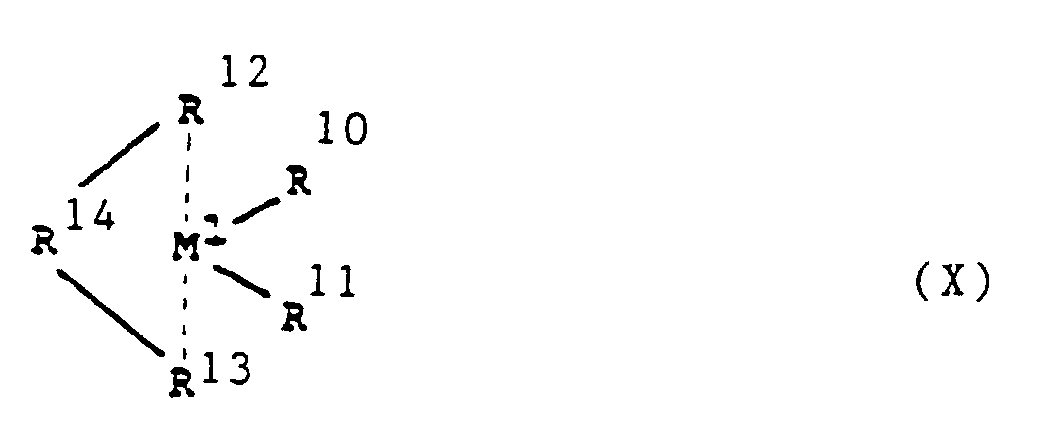
- M1
- is titanium, zirconium, hafnium, vanadium, niobium or tantalum,
- R10 and R11
- are identical or different and are a hydrogen atom, a halogen atom, a C1-C10-alkyl group, a C1-C10-alkoxy group, a C6-C10-aryl group, a C6-C10-aryloxy group, a C2-C10-alkenyl group, a C7-C40-arylalkyl group, a C7-C40-alkylaryl group or a C8-C40-arylalkenyl group,
- R12 and R13
- are a mono- or polynuclear hydrocarbon radical which with the central atom M1 can form a sandwich structure,
- R14
- is
=BR15, =AIR15, -Ge-, -Sn-, -O- , -S-, =SO, =SO2, =NR15, =CO, =PR15 or =P(O)R15, where R15, R16 and R17 are identical or different and are a hydrogen atom, a halogen atom, a C1-C10-alkyl group, a C1-C10-fluoralkyl group, a C6-C10-fluoraryl group, a C6-C10-aryl group, a C1-C10-alkoxy group, a C2-C10-alkenyl group, a C7-C40-arylalkyl group, a C8-C40-arylalkenyl group or a C7-C40-alkylaryl group, or R15 and R16 or R15 and R17 each form a ring with the atoms joining them, and

- M2
- is silicon, germanium or tin, where the polymerization is stopped at a time when Mw/Mn is ≤ 1.7.
- The process as claimed in claim 1, wherein the polymerization is stopped at a time when Mw/Mn is ≤ 1.4.
Applications Claiming Priority (2)
| Application Number | Priority Date | Filing Date | Title |
|---|---|---|---|
| DE4106107 | 1991-02-27 | ||
| DE4106107 | 1991-02-27 |
Publications (2)
| Publication Number | Publication Date |
|---|---|
| EP0501370A1 EP0501370A1 (en) | 1992-09-02 |
| EP0501370B1 true EP0501370B1 (en) | 1998-11-25 |
Family
ID=6425982
Family Applications (1)
| Application Number | Title | Priority Date | Filing Date |
|---|---|---|---|
| EP92103051A Expired - Lifetime EP0501370B1 (en) | 1991-02-27 | 1992-02-24 | Process for preparing cyclo-olefinic(co)polymers with a narrow molecular weigth distribution |
Country Status (10)
| Country | Link |
|---|---|
| US (1) | US5422409A (en) |
| EP (1) | EP0501370B1 (en) |
| JP (1) | JPH059223A (en) |
| KR (1) | KR920016477A (en) |
| AT (1) | ATE173746T1 (en) |
| AU (1) | AU649520B2 (en) |
| CA (1) | CA2061869A1 (en) |
| DE (1) | DE59209568D1 (en) |
| ES (1) | ES2127199T3 (en) |
| ZA (1) | ZA921404B (en) |
Cited By (1)
| Publication number | Priority date | Publication date | Assignee | Title |
|---|---|---|---|---|
| US6713582B2 (en) | 2001-12-14 | 2004-03-30 | Uniroyal Chemical Company, Inc. | Process for the oligomerization of α-olefins having low unsaturation, the resulting polymers, and lubricants containing same |
Families Citing this family (67)
| Publication number | Priority date | Publication date | Assignee | Title |
|---|---|---|---|---|
| US5744664A (en) * | 1990-07-05 | 1998-04-28 | Hoechst Aktiengesellschaft | Cycloolefin copolymers (COCS) as substrate material for liquid-crystal displays |
| US5710224A (en) * | 1991-07-23 | 1998-01-20 | Phillips Petroleum Company | Method for producing polymer of ethylene |
| DE59210001D1 (en) * | 1991-10-15 | 2005-02-17 | Basell Polyolefine Gmbh | Process for the preparation of an olefin polymer using metallocenes with specifically substituted indenyl ligands |
| DE4233851A1 (en) * | 1992-10-08 | 1994-04-14 | Hoechst Ag | Substrate of at least one cycloolefin copolymer for recording media and process for its production |
| EP0594147A1 (en) * | 1992-10-24 | 1994-04-27 | Hoechst Aktiengesellschaft | Cyclo-olefin copolymers as substrate material for liquid crystal displays |
| US5635573A (en) * | 1992-12-01 | 1997-06-03 | Exxon Chemical Patents Inc. | Method for preparing alpha-olefin/cycloolefin copolymers |
| US5837787A (en) * | 1993-01-19 | 1998-11-17 | Exxon Chemical Patents, Inc. | Process for producing elastic thermoplastic α-olefin/cyclic olefin copolymers |
| DE4304309A1 (en) * | 1993-02-12 | 1994-08-18 | Hoechst Ag | Flexible cycloolefin copolymer film |
| DE4304291A1 (en) * | 1993-02-12 | 1994-08-18 | Hoechst Ag | Cycloolefin copolymers with low melt viscosity and low optical attenuation |
| DE4304308A1 (en) * | 1993-02-12 | 1994-08-18 | Hoechst Ag | Rigid cycloolefin copolymer film |
| US5792824A (en) * | 1993-05-21 | 1998-08-11 | Asahi Kasei Kogyo Kabushiki Kaisha | Cyclic conjugated diene polymer and method of producing same |
| CA2157897A1 (en) * | 1993-06-16 | 1994-12-22 | Itaru Natori | Novel polymer containing a saturated cyclic molecular unit |
| US5795945A (en) * | 1993-06-16 | 1998-08-18 | Asahi Kasei Kogyo Kabushiki Kaisha | Polymer containing a cyclic olefin monomer unit |
| IT1271406B (en) * | 1993-09-13 | 1997-05-28 | Spherilene Srl | PROCEDURE FOR THE PREPARATION OF ETHYLENE POLYMERS AND OBTAINED PRODUCTS |
| US6964798B2 (en) | 1993-11-16 | 2005-11-15 | Baxter International Inc. | Multi-layered polymer based thin film structure for medical grade products |
| CA2178609C (en) * | 1994-02-01 | 2000-08-08 | Kimio Imaizumi | Novel polymer containing a modified cyclic monomer unit |
| IT1273420B (en) | 1994-04-06 | 1997-07-08 | Spherilene Srl | METALLOCENIC COMPOUNDS, PROCEDURE FOR THE PREPARATION AND THEIR USE IN CATALYSTS FOR THE POLYMERIZATION OF OLEFINS |
| TW312696B (en) * | 1994-04-22 | 1997-08-11 | Mitsui Petroleum Chemicals Ind | |
| DE4422157A1 (en) * | 1994-06-24 | 1996-01-04 | Hoechst Ag | Process for the preparation of cycloolefin copolymers |
| IT1273661B (en) * | 1994-07-20 | 1997-07-09 | Spherilene Srl | CATALYSTS FOR THE POLYMERIZATION OF OLEFINS |
| US5552489A (en) * | 1994-07-22 | 1996-09-03 | Exxon Chemical Patents Inc. | Tackifiers and a process to obtain tackifiers |
| CN1176960C (en) * | 1995-12-07 | 2004-11-24 | 埃克森美孚化学专利公司 | Viscosity increaser and preparing process thereof |
| EP0930326A4 (en) * | 1996-09-30 | 1999-12-15 | Nippon Zeon Co | Norbornene polymer and process for preparing the same |
| JP3588213B2 (en) * | 1996-12-26 | 2004-11-10 | ティコナ・ゲゼルシャフト・ミット・ベシュレンクテル・ハフツング | Toner for developing electrostatic images containing polyolefin resin having cyclic structure |
| US6111019A (en) * | 1997-03-31 | 2000-08-29 | Exxon Chemical Patents, Inc. | LLDPE blends with an ethylene-norbornene copolymer for resins of improved toughness and processibility for film production |
| US5889128A (en) * | 1997-04-11 | 1999-03-30 | Massachusetts Institute Of Technology | Living olefin polymerization processes |
| DE69826633T2 (en) | 1997-10-29 | 2005-02-03 | Basell Polyolefine Gmbh | CATALYSTS FOR THE POLYMERIZATION OF OLEFINES AND METHOD FOR THE PRODUCTION THEREOF |
| US6559252B1 (en) | 1997-10-29 | 2003-05-06 | Basell Technology Company Bv | Catalysts and processes for the polymerization of olefins |
| US5942587A (en) * | 1997-11-21 | 1999-08-24 | Exxon Chemical Patents Inc. | Ethylene polymers with a norbornene comonomer for LLDPE like resins of improved toughness and processibility for film production |
| JP3434218B2 (en) * | 1998-11-02 | 2003-08-04 | ティコナ・ゲゼルシャフト・ミット・ベシュレンクテル・ハフツング | Toner for developing electrostatic images |
| JP3449935B2 (en) * | 1999-01-11 | 2003-09-22 | 株式会社巴川製紙所 | Dry toner for electrophotography |
| US6613187B1 (en) | 1999-09-09 | 2003-09-02 | Baxter International Inc | Solvent bonding method for polyolefin materials |
| US6632318B1 (en) | 1999-09-09 | 2003-10-14 | Baxter International Inc. | Method for solvent bonding polyolefins |
| US6590033B2 (en) | 1999-09-09 | 2003-07-08 | Baxter International Inc. | Cycloolefin blends and method for solvent bonding polyolefins |
| US6297322B1 (en) | 1999-09-09 | 2001-10-02 | Baxter International Inc. | Cycloolefin blends and method for solvent bonding polyolefins |
| US6255396B1 (en) | 1999-09-09 | 2001-07-03 | Baxter International Inc. | Cycloolefin blends and method for solvent bonding polyolefins |
| BR0014616A (en) | 1999-09-22 | 2002-06-18 | Basell Technology Co Bv | Catalytic system and process for polymerization of olefins |
| US6838540B2 (en) * | 2000-01-26 | 2005-01-04 | Mitsui Chemicals, Inc. | Olefin polymer and production processes thereof |
| US6497676B1 (en) | 2000-02-10 | 2002-12-24 | Baxter International | Method and apparatus for monitoring and controlling peritoneal dialysis therapy |
| US6875719B2 (en) * | 2000-04-27 | 2005-04-05 | Industrial Technology Research Institute | Catalyst composition for preparing olefin polymers |
| TW534913B (en) | 2000-07-28 | 2003-06-01 | Goodrich Corp | Polymers for forming optical waveguides; optical waveguides formed therefrom; and methods for making same |
| US6372848B1 (en) | 2000-10-10 | 2002-04-16 | Baxter International Inc. | Blend of ethylene and α-olefin copolymers obtained using a metallocene catalyst for fabricating medical films and tubings |
| US6423780B1 (en) * | 2001-02-07 | 2002-07-23 | Loctite | Heterobifunctional monomers and uses therefor |
| US6946523B2 (en) * | 2001-02-07 | 2005-09-20 | Henkel Corporation | Heterobifunctional monomers and uses therefor |
| US20020172615A1 (en) * | 2001-03-08 | 2002-11-21 | Archie Woodworth | Apparatus for and method of manufacturing a prefilled sterile container |
| WO2002100532A1 (en) | 2001-06-13 | 2002-12-19 | Energy & Environmental International, L.C. | Bulk polymerization reactors and methods for polymerization |
| DE60229330D1 (en) | 2001-07-23 | 2008-11-27 | Ricoh Kk | Oil-free toner |
| JP3863744B2 (en) | 2001-08-31 | 2006-12-27 | 株式会社巴川製紙所 | Toner for recycling system and toner recycling developing method using the same |
| JP3880359B2 (en) | 2001-10-05 | 2007-02-14 | 株式会社巴川製紙所 | Full color toner for oilless fixing |
| US20030125662A1 (en) | 2002-01-03 | 2003-07-03 | Tuan Bui | Method and apparatus for providing medical treatment therapy based on calculated demand |
| JP3863054B2 (en) | 2002-04-15 | 2006-12-27 | 株式会社巴川製紙所 | Toner for electrostatic image development |
| US7238164B2 (en) | 2002-07-19 | 2007-07-03 | Baxter International Inc. | Systems, methods and apparatuses for pumping cassette-based therapies |
| JP3942520B2 (en) | 2002-09-30 | 2007-07-11 | 株式会社巴川製紙所 | Toner for electrophotography and image forming method using the same |
| US7101654B2 (en) * | 2004-01-14 | 2006-09-05 | Promerus Llc | Norbornene-type monomers and polymers containing pendent lactone or sultone groups |
| US20050186373A1 (en) * | 2004-02-20 | 2005-08-25 | Honeywell International Inc. | Multilayer sheets and films composed of polypropylene and cyclic olefin copolymer |
| KR20070015178A (en) | 2004-04-27 | 2007-02-01 | 백스터 인터내셔널 인코포레이티드 | Stirring-Tank Reactor System |
| KR100619352B1 (en) * | 2005-04-29 | 2006-09-06 | 삼성전기주식회사 | Fiber fabric reinforcement using modified cyclic olefin copolymer, and resin substrate for printed circuit board |
| JP4570585B2 (en) | 2006-05-02 | 2010-10-27 | シャープ株式会社 | Electrophotographic capsule toner |
| US7998115B2 (en) * | 2007-02-15 | 2011-08-16 | Baxter International Inc. | Dialysis system having optical flowrate detection |
| US8558964B2 (en) | 2007-02-15 | 2013-10-15 | Baxter International Inc. | Dialysis system having display with electromagnetic compliance (“EMC”) seal |
| US8361023B2 (en) | 2007-02-15 | 2013-01-29 | Baxter International Inc. | Dialysis system with efficient battery back-up |
| US7731689B2 (en) | 2007-02-15 | 2010-06-08 | Baxter International Inc. | Dialysis system having inductive heating |
| US8870812B2 (en) | 2007-02-15 | 2014-10-28 | Baxter International Inc. | Dialysis system having video display with ambient light adjustment |
| US20090208685A1 (en) * | 2008-02-20 | 2009-08-20 | Sealed Air Corporation (Us) | Packaging film and method of decreasing scalping of polar cyclic compounds |
| US9594320B2 (en) | 2014-06-25 | 2017-03-14 | Canon Kabushiki Kaisha | Toner and method of producing the toner |
| CA3061891A1 (en) | 2017-04-12 | 2018-10-18 | Urigen Pharmaceuticals, Inc. | Article of manufacture comprising local anesthetic, buffer, and glycosaminoglycan in syringe with improved stability |
| US11179516B2 (en) | 2017-06-22 | 2021-11-23 | Baxter International Inc. | Systems and methods for incorporating patient pressure into medical fluid delivery |
Citations (1)
| Publication number | Priority date | Publication date | Assignee | Title |
|---|---|---|---|---|
| EP0485893A1 (en) * | 1990-11-14 | 1992-05-20 | Hoechst Aktiengesellschaft | Bulk polymerisation with metallocene catalyst for the preparation of cycloolefin polymers |
Family Cites Families (7)
| Publication number | Priority date | Publication date | Assignee | Title |
|---|---|---|---|---|
| US4178424A (en) * | 1977-12-05 | 1979-12-11 | The Bf Goodrich Company | Cycloolefin copolymers |
| US4614778A (en) * | 1984-02-03 | 1986-09-30 | Hirokazu Kajiura | Random copolymer |
| US5003019A (en) * | 1987-03-02 | 1991-03-26 | Mitsui Petrochemical Industries, Ltd. | Cyclo-olefinic random copolymer, olefinic random copolymer, and process for producing cyclo-olefinic random copolymers |
| DE3726325A1 (en) * | 1987-08-07 | 1989-02-16 | Hoechst Ag | METHOD FOR PRODUCING AN OLEFIN POLYMER |
| WO1989003413A1 (en) * | 1987-10-08 | 1989-04-20 | Mitsui Petrochemical Industries, Ltd. | Random cycloolefin copolymer composition |
| DE3922546A1 (en) * | 1989-07-08 | 1991-01-17 | Hoechst Ag | METHOD FOR THE PRODUCTION OF CYCLOOLEFINPOLYMERS |
| EP0413294A3 (en) * | 1989-08-18 | 1991-11-21 | The Dow Chemical Company | Narrow molecular weight distribution block polymers and process therefor |
-
1992
- 1992-02-24 ES ES92103051T patent/ES2127199T3/en not_active Expired - Lifetime
- 1992-02-24 EP EP92103051A patent/EP0501370B1/en not_active Expired - Lifetime
- 1992-02-24 AT AT92103051T patent/ATE173746T1/en not_active IP Right Cessation
- 1992-02-24 DE DE59209568T patent/DE59209568D1/en not_active Expired - Fee Related
- 1992-02-25 KR KR1019920002890A patent/KR920016477A/en not_active Withdrawn
- 1992-02-26 AU AU11216/92A patent/AU649520B2/en not_active Ceased
- 1992-02-26 ZA ZA921404A patent/ZA921404B/en unknown
- 1992-02-26 CA CA002061869A patent/CA2061869A1/en not_active Abandoned
- 1992-02-27 JP JP4040980A patent/JPH059223A/en active Pending
-
1993
- 1993-11-22 US US08/156,929 patent/US5422409A/en not_active Expired - Fee Related
Patent Citations (1)
| Publication number | Priority date | Publication date | Assignee | Title |
|---|---|---|---|---|
| EP0485893A1 (en) * | 1990-11-14 | 1992-05-20 | Hoechst Aktiengesellschaft | Bulk polymerisation with metallocene catalyst for the preparation of cycloolefin polymers |
Cited By (2)
| Publication number | Priority date | Publication date | Assignee | Title |
|---|---|---|---|---|
| US6713582B2 (en) | 2001-12-14 | 2004-03-30 | Uniroyal Chemical Company, Inc. | Process for the oligomerization of α-olefins having low unsaturation, the resulting polymers, and lubricants containing same |
| US7037974B2 (en) | 2001-12-14 | 2006-05-02 | Uniroyal Chemical Company, Inc. | Process for the oligomerization of α-olefins having low unsaturation, the resulting polymers, and lubricants containing same |
Also Published As
| Publication number | Publication date |
|---|---|
| US5422409A (en) | 1995-06-06 |
| ES2127199T3 (en) | 1999-04-16 |
| DE59209568D1 (en) | 1999-01-07 |
| ATE173746T1 (en) | 1998-12-15 |
| AU1121692A (en) | 1992-09-03 |
| EP0501370A1 (en) | 1992-09-02 |
| AU649520B2 (en) | 1994-05-26 |
| KR920016477A (en) | 1992-09-24 |
| ZA921404B (en) | 1992-11-25 |
| JPH059223A (en) | 1993-01-19 |
| CA2061869A1 (en) | 1992-08-28 |
Similar Documents
| Publication | Publication Date | Title |
|---|---|---|
| EP0501370B1 (en) | Process for preparing cyclo-olefinic(co)polymers with a narrow molecular weigth distribution | |
| EP0690078B1 (en) | Cycloolefin polymers | |
| EP0610851B1 (en) | Process for preparing cyclo-olefin copolymers | |
| EP0485893B1 (en) | Bulk polymerisation with metallocene catalyst for the preparation of cycloolefin polymers | |
| EP0503422B1 (en) | Process for the preparation of chemically homogenous cycloolefinic copolymers | |
| EP0610843B1 (en) | Process for preparing cyclo-olefin polymers | |
| EP0688801B1 (en) | Process for preparing cycloolefin copolymers | |
| EP0946618B1 (en) | Cycloolefin polymers, their use and moulding prepared therefrom | |
| EP0683797B1 (en) | Process for producing cyclo-olefin copolymers with low melt viscosity and low optical attenuation | |
| EP0779306B1 (en) | Process for preparation of cycloolefin copolymers | |
| EP0516019B1 (en) | Process for preparing syndiotactic polyolefins with large molecular weight distribution | |
| EP0560090B1 (en) | Cyclo-olefin block copolymers and process for preparing same | |
| EP0946616B1 (en) | Method for producing a cycloolefin copolymer | |
| EP0610850A1 (en) | Process for preparing cyclo-olefin polymers | |
| EP0683798B1 (en) | Process for producing cyclo-olefin copolymers with high tenacity and low optical attenuation | |
| EP0749988A2 (en) | Process for the preparation of cycloolefin copolymers | |
| DE4344631A1 (en) | Stereo-rigid metallocenes useful in catalyst for cyclo-olefin copolymer prodn. |
Legal Events
| Date | Code | Title | Description |
|---|---|---|---|
| PUAI | Public reference made under article 153(3) epc to a published international application that has entered the european phase |
Free format text: ORIGINAL CODE: 0009012 |
|
| AK | Designated contracting states |
Kind code of ref document: A1 Designated state(s): AT BE CH DE ES FR GB IT LI NL SE |
|
| 17P | Request for examination filed |
Effective date: 19921104 |
|
| 17Q | First examination report despatched |
Effective date: 19941201 |
|
| GRAG | Despatch of communication of intention to grant |
Free format text: ORIGINAL CODE: EPIDOS AGRA |
|
| RAP1 | Party data changed (applicant data changed or rights of an application transferred) |
Owner name: TICONA GMBH |
|
| GRAG | Despatch of communication of intention to grant |
Free format text: ORIGINAL CODE: EPIDOS AGRA |
|
| GRAH | Despatch of communication of intention to grant a patent |
Free format text: ORIGINAL CODE: EPIDOS IGRA |
|
| GRAH | Despatch of communication of intention to grant a patent |
Free format text: ORIGINAL CODE: EPIDOS IGRA |
|
| GRAA | (expected) grant |
Free format text: ORIGINAL CODE: 0009210 |
|
| RAP1 | Party data changed (applicant data changed or rights of an application transferred) |
Owner name: TICONA GMBH |
|
| AK | Designated contracting states |
Kind code of ref document: B1 Designated state(s): AT BE CH DE ES FR GB IT LI NL SE |
|
| REF | Corresponds to: |
Ref document number: 173746 Country of ref document: AT Date of ref document: 19981215 Kind code of ref document: T |
|
| REG | Reference to a national code |
Ref country code: CH Ref legal event code: EP |
|
| REF | Corresponds to: |
Ref document number: 59209568 Country of ref document: DE Date of ref document: 19990107 |
|
| PGFP | Annual fee paid to national office [announced via postgrant information from national office to epo] |
Ref country code: NL Payment date: 19990119 Year of fee payment: 8 |
|
| GBT | Gb: translation of ep patent filed (gb section 77(6)(a)/1977) |
Effective date: 19981223 |
|
| PGFP | Annual fee paid to national office [announced via postgrant information from national office to epo] |
Ref country code: SE Payment date: 19990125 Year of fee payment: 8 |
|
| PGFP | Annual fee paid to national office [announced via postgrant information from national office to epo] |
Ref country code: AT Payment date: 19990126 Year of fee payment: 8 |
|
| PGFP | Annual fee paid to national office [announced via postgrant information from national office to epo] |
Ref country code: CH Payment date: 19990201 Year of fee payment: 8 Ref country code: BE Payment date: 19990201 Year of fee payment: 8 |
|
| ITF | It: translation for a ep patent filed | ||
| PGFP | Annual fee paid to national office [announced via postgrant information from national office to epo] |
Ref country code: ES Payment date: 19990218 Year of fee payment: 8 |
|
| ET | Fr: translation filed | ||
| REG | Reference to a national code |
Ref country code: ES Ref legal event code: FG2A Ref document number: 2127199 Country of ref document: ES Kind code of ref document: T3 |
|
| PLBE | No opposition filed within time limit |
Free format text: ORIGINAL CODE: 0009261 |
|
| STAA | Information on the status of an ep patent application or granted ep patent |
Free format text: STATUS: NO OPPOSITION FILED WITHIN TIME LIMIT |
|
| 26N | No opposition filed | ||
| PGFP | Annual fee paid to national office [announced via postgrant information from national office to epo] |
Ref country code: GB Payment date: 20000114 Year of fee payment: 9 |
|
| PGFP | Annual fee paid to national office [announced via postgrant information from national office to epo] |
Ref country code: FR Payment date: 20000124 Year of fee payment: 9 |
|
| PG25 | Lapsed in a contracting state [announced via postgrant information from national office to epo] |
Ref country code: AT Free format text: LAPSE BECAUSE OF NON-PAYMENT OF DUE FEES Effective date: 20000224 |
|
| PG25 | Lapsed in a contracting state [announced via postgrant information from national office to epo] |
Ref country code: SE Free format text: LAPSE BECAUSE OF NON-PAYMENT OF DUE FEES Effective date: 20000225 Ref country code: ES Free format text: LAPSE BECAUSE OF NON-PAYMENT OF DUE FEES Effective date: 20000225 |
|
| PG25 | Lapsed in a contracting state [announced via postgrant information from national office to epo] |
Ref country code: BE Free format text: LAPSE BECAUSE OF NON-PAYMENT OF DUE FEES Effective date: 20000228 |
|
| PG25 | Lapsed in a contracting state [announced via postgrant information from national office to epo] |
Ref country code: LI Free format text: LAPSE BECAUSE OF NON-PAYMENT OF DUE FEES Effective date: 20000229 Ref country code: CH Free format text: LAPSE BECAUSE OF NON-PAYMENT OF DUE FEES Effective date: 20000229 |
|
| PGFP | Annual fee paid to national office [announced via postgrant information from national office to epo] |
Ref country code: DE Payment date: 20000502 Year of fee payment: 9 |
|
| BERE | Be: lapsed |
Owner name: TICONA G.M.B.H. Effective date: 20000228 |
|
| PG25 | Lapsed in a contracting state [announced via postgrant information from national office to epo] |
Ref country code: NL Free format text: LAPSE BECAUSE OF NON-PAYMENT OF DUE FEES Effective date: 20000901 |
|
| EUG | Se: european patent has lapsed |
Ref document number: 92103051.6 |
|
| REG | Reference to a national code |
Ref country code: CH Ref legal event code: PL |
|
| NLV4 | Nl: lapsed or anulled due to non-payment of the annual fee |
Effective date: 20000901 |
|
| PG25 | Lapsed in a contracting state [announced via postgrant information from national office to epo] |
Ref country code: GB Free format text: LAPSE BECAUSE OF NON-PAYMENT OF DUE FEES Effective date: 20010224 |
|
| GBPC | Gb: european patent ceased through non-payment of renewal fee |
Effective date: 20010224 |
|
| PG25 | Lapsed in a contracting state [announced via postgrant information from national office to epo] |
Ref country code: FR Free format text: LAPSE BECAUSE OF NON-PAYMENT OF DUE FEES Effective date: 20011031 |
|
| REG | Reference to a national code |
Ref country code: FR Ref legal event code: ST |
|
| PG25 | Lapsed in a contracting state [announced via postgrant information from national office to epo] |
Ref country code: DE Free format text: LAPSE BECAUSE OF NON-PAYMENT OF DUE FEES Effective date: 20011201 |
|
| REG | Reference to a national code |
Ref country code: ES Ref legal event code: FD2A Effective date: 20011010 |
|
| PG25 | Lapsed in a contracting state [announced via postgrant information from national office to epo] |
Ref country code: IT Free format text: LAPSE BECAUSE OF NON-PAYMENT OF DUE FEES;WARNING: LAPSES OF ITALIAN PATENTS WITH EFFECTIVE DATE BEFORE 2007 MAY HAVE OCCURRED AT ANY TIME BEFORE 2007. THE CORRECT EFFECTIVE DATE MAY BE DIFFERENT FROM THE ONE RECORDED. Effective date: 20050224 |