EP0481396A2 - Tannin extract of sweet chestnut wood, a process for the preparation thereof and its use - Google Patents
Tannin extract of sweet chestnut wood, a process for the preparation thereof and its use Download PDFInfo
- Publication number
- EP0481396A2 EP0481396A2 EP91117472A EP91117472A EP0481396A2 EP 0481396 A2 EP0481396 A2 EP 0481396A2 EP 91117472 A EP91117472 A EP 91117472A EP 91117472 A EP91117472 A EP 91117472A EP 0481396 A2 EP0481396 A2 EP 0481396A2
- Authority
- EP
- European Patent Office
- Prior art keywords
- wood
- extract
- animals
- sugar
- diarrhoea
- Prior art date
- Legal status (The legal status is an assumption and is not a legal conclusion. Google has not performed a legal analysis and makes no representation as to the accuracy of the status listed.)
- Granted
Links
- 239000002023 wood Substances 0.000 title claims abstract description 30
- 239000000284 extract Substances 0.000 title claims abstract description 23
- 235000014037 Castanea sativa Nutrition 0.000 title claims abstract description 18
- 240000007857 Castanea sativa Species 0.000 title claims abstract description 18
- 229920001864 tannin Polymers 0.000 title claims abstract description 16
- 239000001648 tannin Substances 0.000 title claims abstract description 16
- 235000018553 tannin Nutrition 0.000 title claims abstract description 16
- 238000002360 preparation method Methods 0.000 title claims description 14
- 238000000034 method Methods 0.000 title claims description 10
- 230000008569 process Effects 0.000 title claims description 10
- 241001465754 Metazoa Species 0.000 claims abstract description 25
- 206010012735 Diarrhoea Diseases 0.000 claims abstract description 13
- 239000000126 substance Substances 0.000 claims abstract description 9
- 230000002265 prevention Effects 0.000 claims abstract description 8
- 238000000605 extraction Methods 0.000 claims abstract description 7
- 239000006286 aqueous extract Substances 0.000 claims abstract description 3
- XLYOFNOQVPJJNP-UHFFFAOYSA-N water Substances O XLYOFNOQVPJJNP-UHFFFAOYSA-N 0.000 claims description 13
- 208000001848 dysentery Diseases 0.000 claims description 12
- 239000007788 liquid Substances 0.000 claims description 5
- 208000018522 Gastrointestinal disease Diseases 0.000 claims description 4
- 239000002245 particle Substances 0.000 claims description 4
- 244000144977 poultry Species 0.000 claims description 3
- 241000124008 Mammalia Species 0.000 claims description 2
- 239000002671 adjuvant Substances 0.000 claims description 2
- 238000004519 manufacturing process Methods 0.000 claims description 2
- 238000002560 therapeutic procedure Methods 0.000 claims description 2
- 239000012050 conventional carrier Substances 0.000 claims 1
- 239000003795 chemical substances by application Substances 0.000 abstract description 4
- 239000000047 product Substances 0.000 description 22
- 238000012360 testing method Methods 0.000 description 22
- 241000282887 Suidae Species 0.000 description 10
- 230000037396 body weight Effects 0.000 description 8
- 230000000694 effects Effects 0.000 description 8
- 235000013305 food Nutrition 0.000 description 8
- 241000700159 Rattus Species 0.000 description 5
- 241000283690 Bos taurus Species 0.000 description 4
- 241000699670 Mus sp. Species 0.000 description 4
- 239000000654 additive Substances 0.000 description 4
- 239000003242 anti bacterial agent Substances 0.000 description 4
- 229940088710 antibiotic agent Drugs 0.000 description 4
- 235000013372 meat Nutrition 0.000 description 4
- 230000008719 thickening Effects 0.000 description 4
- 230000000996 additive effect Effects 0.000 description 3
- 244000309466 calf Species 0.000 description 3
- 238000003307 slaughter Methods 0.000 description 3
- 229920002258 tannic acid Polymers 0.000 description 3
- TUSDEZXZIZRFGC-UHFFFAOYSA-N 1-O-galloyl-3,6-(R)-HHDP-beta-D-glucose Natural products OC1C(O2)COC(=O)C3=CC(O)=C(O)C(O)=C3C3=C(O)C(O)=C(O)C=C3C(=O)OC1C(O)C2OC(=O)C1=CC(O)=C(O)C(O)=C1 TUSDEZXZIZRFGC-UHFFFAOYSA-N 0.000 description 2
- 239000001263 FEMA 3042 Substances 0.000 description 2
- 241000699666 Mus <mouse, genus> Species 0.000 description 2
- LRBQNJMCXXYXIU-PPKXGCFTSA-N Penta-digallate-beta-D-glucose Natural products OC1=C(O)C(O)=CC(C(=O)OC=2C(=C(O)C=C(C=2)C(=O)OC[C@@H]2[C@H]([C@H](OC(=O)C=3C=C(OC(=O)C=4C=C(O)C(O)=C(O)C=4)C(O)=C(O)C=3)[C@@H](OC(=O)C=3C=C(OC(=O)C=4C=C(O)C(O)=C(O)C=4)C(O)=C(O)C=3)[C@H](OC(=O)C=3C=C(OC(=O)C=4C=C(O)C(O)=C(O)C=4)C(O)=C(O)C=3)O2)OC(=O)C=2C=C(OC(=O)C=3C=C(O)C(O)=C(O)C=3)C(O)=C(O)C=2)O)=C1 LRBQNJMCXXYXIU-PPKXGCFTSA-N 0.000 description 2
- 230000009471 action Effects 0.000 description 2
- 238000003975 animal breeding Methods 0.000 description 2
- 201000010099 disease Diseases 0.000 description 2
- 208000037265 diseases, disorders, signs and symptoms Diseases 0.000 description 2
- 210000003743 erythrocyte Anatomy 0.000 description 2
- 239000012467 final product Substances 0.000 description 2
- 230000002489 hematologic effect Effects 0.000 description 2
- 239000000463 material Substances 0.000 description 2
- 230000000144 pharmacologic effect Effects 0.000 description 2
- 238000001694 spray drying Methods 0.000 description 2
- LRBQNJMCXXYXIU-NRMVVENXSA-N tannic acid Chemical compound OC1=C(O)C(O)=CC(C(=O)OC=2C(=C(O)C=C(C=2)C(=O)OC[C@@H]2[C@H]([C@H](OC(=O)C=3C=C(OC(=O)C=4C=C(O)C(O)=C(O)C=4)C(O)=C(O)C=3)[C@@H](OC(=O)C=3C=C(OC(=O)C=4C=C(O)C(O)=C(O)C=4)C(O)=C(O)C=3)[C@@H](OC(=O)C=3C=C(OC(=O)C=4C=C(O)C(O)=C(O)C=4)C(O)=C(O)C=3)O2)OC(=O)C=2C=C(OC(=O)C=3C=C(O)C(O)=C(O)C=3)C(O)=C(O)C=2)O)=C1 LRBQNJMCXXYXIU-NRMVVENXSA-N 0.000 description 2
- 229940033123 tannic acid Drugs 0.000 description 2
- 235000015523 tannic acid Nutrition 0.000 description 2
- 230000003612 virological effect Effects 0.000 description 2
- 102000004506 Blood Proteins Human genes 0.000 description 1
- 108010017384 Blood Proteins Proteins 0.000 description 1
- 241000282472 Canis lupus familiaris Species 0.000 description 1
- 241000282326 Felis catus Species 0.000 description 1
- 208000005577 Gastroenteritis Diseases 0.000 description 1
- 208000032843 Hemorrhage Diseases 0.000 description 1
- 206010020751 Hypersensitivity Diseases 0.000 description 1
- 241000283973 Oryctolagus cuniculus Species 0.000 description 1
- CZMRCDWAGMRECN-UGDNZRGBSA-N Sucrose Chemical compound O[C@H]1[C@H](O)[C@@H](CO)O[C@@]1(CO)O[C@@H]1[C@H](O)[C@@H](O)[C@H](O)[C@@H](CO)O1 CZMRCDWAGMRECN-UGDNZRGBSA-N 0.000 description 1
- 229930006000 Sucrose Natural products 0.000 description 1
- 239000013543 active substance Substances 0.000 description 1
- 230000007059 acute toxicity Effects 0.000 description 1
- 231100000403 acute toxicity Toxicity 0.000 description 1
- 208000034158 bleeding Diseases 0.000 description 1
- 231100000319 bleeding Toxicity 0.000 description 1
- 230000000740 bleeding effect Effects 0.000 description 1
- 210000004369 blood Anatomy 0.000 description 1
- 239000008280 blood Substances 0.000 description 1
- 239000000969 carrier Substances 0.000 description 1
- 238000009109 curative therapy Methods 0.000 description 1
- 210000003608 fece Anatomy 0.000 description 1
- 230000004907 flux Effects 0.000 description 1
- 230000036541 health Effects 0.000 description 1
- 238000010438 heat treatment Methods 0.000 description 1
- 238000005534 hematocrit Methods 0.000 description 1
- 238000011866 long-term treatment Methods 0.000 description 1
- 231100000053 low toxicity Toxicity 0.000 description 1
- 235000013336 milk Nutrition 0.000 description 1
- 239000008267 milk Substances 0.000 description 1
- 210000004080 milk Anatomy 0.000 description 1
- 239000000203 mixture Substances 0.000 description 1
- 210000003097 mucus Anatomy 0.000 description 1
- 231100000252 nontoxic Toxicity 0.000 description 1
- 230000003000 nontoxic effect Effects 0.000 description 1
- 239000004033 plastic Substances 0.000 description 1
- 230000003449 preventive effect Effects 0.000 description 1
- 102000004169 proteins and genes Human genes 0.000 description 1
- 108090000623 proteins and genes Proteins 0.000 description 1
- 238000010298 pulverizing process Methods 0.000 description 1
- 239000002994 raw material Substances 0.000 description 1
- 239000000523 sample Substances 0.000 description 1
- 230000028327 secretion Effects 0.000 description 1
- 239000002904 solvent Substances 0.000 description 1
- 239000007921 spray Substances 0.000 description 1
- 238000003756 stirring Methods 0.000 description 1
- 238000003860 storage Methods 0.000 description 1
- 231100000456 subacute toxicity Toxicity 0.000 description 1
- 239000005720 sucrose Substances 0.000 description 1
- 231100000331 toxic Toxicity 0.000 description 1
- 230000002588 toxic effect Effects 0.000 description 1
- 230000032258 transport Effects 0.000 description 1
Images


Classifications
-
- C—CHEMISTRY; METALLURGY
- C08—ORGANIC MACROMOLECULAR COMPOUNDS; THEIR PREPARATION OR CHEMICAL WORKING-UP; COMPOSITIONS BASED THEREON
- C08H—DERIVATIVES OF NATURAL MACROMOLECULAR COMPOUNDS
- C08H99/00—Subject matter not provided for in other groups of this subclass, e.g. flours, kernels
-
- A—HUMAN NECESSITIES
- A61—MEDICAL OR VETERINARY SCIENCE; HYGIENE
- A61K—PREPARATIONS FOR MEDICAL, DENTAL OR TOILETRY PURPOSES
- A61K36/00—Medicinal preparations of undetermined constitution containing material from algae, lichens, fungi or plants, or derivatives thereof, e.g. traditional herbal medicines
- A61K36/18—Magnoliophyta (angiosperms)
- A61K36/185—Magnoliopsida (dicotyledons)
- A61K36/49—Fagaceae (Beech family), e.g. oak or chestnut
-
- Y—GENERAL TAGGING OF NEW TECHNOLOGICAL DEVELOPMENTS; GENERAL TAGGING OF CROSS-SECTIONAL TECHNOLOGIES SPANNING OVER SEVERAL SECTIONS OF THE IPC; TECHNICAL SUBJECTS COVERED BY FORMER USPC CROSS-REFERENCE ART COLLECTIONS [XRACs] AND DIGESTS
- Y02—TECHNOLOGIES OR APPLICATIONS FOR MITIGATION OR ADAPTATION AGAINST CLIMATE CHANGE
- Y02A—TECHNOLOGIES FOR ADAPTATION TO CLIMATE CHANGE
- Y02A50/00—TECHNOLOGIES FOR ADAPTATION TO CLIMATE CHANGE in human health protection, e.g. against extreme weather
- Y02A50/30—Against vector-borne diseases, e.g. mosquito-borne, fly-borne, tick-borne or waterborne diseases whose impact is exacerbated by climate change
Definitions
- the present invention belongs to the field of chemistry and relates to a tannin extract of sweet chestnut wood as a novel, i.e. hitherto not manufactured product having novel characteristics, especially as a natural agent for the prevention of diarrhoea in animals, as well as to a process for the preparation thereof and to its use.
- antibiotics and chemotherapeutica are widely used as agents against diarrhoeas in animals.
- the use of antibiotics and chemotherapeutica represents, however, a big problem due to various side effects, such as residues in meat, resistance, waiting period before slaughter, toxic effects in long-term treatment and allergic reactions.
- tannin for tanning i.e. technical tannin
- wood particle size is not very important, and process parameters for the known and novel processes differ, which is understandable since pharmaceutical criteria need not be considered in known process.
- the inventive tannin extract of sweet chestnut wood comprises a pulverized solution of a) a thickened aqueous extract of sweet chestnut wood ( Castanea Sativa Mill .) without bark and sap-wood, said wood having an age from 40 to 50 years, and b) microbiologically acceptable sugar, the ratio dry substance of extract a)/sugar being from 1:2 to 1:6.
- the age of wood is very important because the content and the quality of tannin as the active substance of the extract depend upon said age.
- sucrose As sugar the common sugar, i.e. sucrose, is used, which must, however, correspond to pharmacopoeia regulations.
- the pulverization is carried out e.g. by spray drying.
- a process for preparing tannin extract of sweet chestnut wood for veterinary use is carried out in such a way that sound wood of sweet chestnut, of an age of 40 to 50 years, without bark and sap-wood, in the form of logs, which is ground into particles having a length of 6 to 10mm, a thickness of 0.6 to 1.2 mm and a width of 4 to 8 mm, is extracted with water, the extraction solution is thickened to the dry substance content of about 50%, to the liquid extract a solution of microbiologically acceptable sugar is added in order to achieve a ratio dry substance of extract/sugar 1:2 to 1:6, it is stirred to complete homogeneity and pulverized.
- Sweet chestnut wood is used, which must be absolutely sound, neither friable nor cancerous.
- the wood should be ground since only in this way it is made available for the solvent in the extraction phase.
- the equipment for the technological process should be made of a material which is inert for substances to be treated (e.g. thickening vats made of Cr/Ni). Said equipment should be adequately purified before use since a veterinary grade cannot be achieved otherwise.
- the novel product obtained according to the invention is used either in the form of an appropriate veterinary preparation or as a fodder additive for the prevention of diarrhoeas in animals. It is obtained from natural materials and does not necessitate any waiting period before slaughter, i.e. animal meat and milk are suitable for human use without reservations.
- the product acts as adstringent - it forms a thin layer of unsoluble proteins on the surface of the mucus and thus prevents water transfer. It coagulates blood proteins and thus reduces bleedings.
- the antibiotics and chemotherapeutica have a deep action and hence affect the meat quality, whereas the novel product of the invention only exhibits a surface action.
- the product of the invention has a reduced activity due to the content of natural sugar, which results in a better compatibility and easier secretion under the same effect being made possible.
- Ready-to-use preparation contains, in addition to the extract of the invention, conventional veterinarily acceptable additives (carriers, adjuvants).
- novel product is used in combination with chemotherapeutica or antibiotics.
- Animals to be treated are mammals, such as pigs, adult cattle, calves, dogs, cats, rabbits, and also poultry (hens).
- the preparation is used especially for the therapy of alimentary dysentery in weaned piglets and calves, of dysentery in fattening pigs before transport, of winter dysenteries in cattle and of other gastrointestinal disorders accompanied by diarrhoea.
- the art of dosage depends upon the animal kind, body weight, age of the subject to be treated, its state of health etc.
- the preparation is administered as a preventive measure as well as in curative treatment in admixture with food or dissolved in water, always p.o.
- the general optimum daily dose is about 0.2 g/kg of body weight of the animal.
- E.g. pigs are administered from 3 to 5 kg/t of food daily for 7 to 21 days; adult cattle daily from 2 to 8 big spoons of a solution containing a daily dose dissolved in 2 to 3 l water for 3 to 4 days; calves daily from 1 to 2 big spoons of the same solution for 3 to 4 days; poultry daily from 0.02 to 0.1 g for 5 days or 50-70 g/100 l water.
- the invention is illustrated by the following Examples and pharmacological tests.
- the sugar solution was obtained by dissolving 2500 kg of microbiologically acceptable sugar in 2500 l of water heated to 50 °C, in a Cr-Ni vat, previously cleaned and steamed.
- Spray-drying took place in a spray drier under the following conditions:
- the final product obtained according to Example 1 is directly suitable to be used as a fodder additive.
- a daily dose (about 0.2 g/kg of body weight) of the product of the invention prepared according to Example 1 was dissolved in 2 to 3 l of water.
- LD 1 for the product of the invention when administered p.o. to rats was 3000 mg/kg of body weight
- LD 50 for the 76-78% tannin extract when administered p.o. to rats was 1333 mg/kg of body weight
- LD 100 for tannic acid when administered p.o. to mice was 6000 mg/kg of body weight.
- mice in a control group without application of the product of the invention
- a test group (10 animals in each group), which animals were administered p.o. 120 mg/kg/day of the product of the invention for 20 days.
- Body weight of mice at the end of the test was 25.7 g/mouse in the test group and 25.8 g/mouse in the control group.
- the haematological picture of mice is evident from the Table 1 below:
- the second test was carried out in rats in a control group (without application of the product of the invention) and in a test group (6 animals in each group), which animals were administered p.o. a 1% solution of the product of the invention for 21 days.
- the weight increase in rats is shown graphically in Fig. 1, where the full line represents the test group and the dotted line represents the control.
Landscapes
- Health & Medical Sciences (AREA)
- Chemical & Material Sciences (AREA)
- Natural Medicines & Medicinal Plants (AREA)
- Life Sciences & Earth Sciences (AREA)
- Medicinal Chemistry (AREA)
- Engineering & Computer Science (AREA)
- Biotechnology (AREA)
- Microbiology (AREA)
- Polymers & Plastics (AREA)
- Organic Chemistry (AREA)
- Materials Engineering (AREA)
- Alternative & Traditional Medicine (AREA)
- Biochemistry (AREA)
- Botany (AREA)
- Medical Informatics (AREA)
- Chemical Kinetics & Catalysis (AREA)
- Mycology (AREA)
- Pharmacology & Pharmacy (AREA)
- Epidemiology (AREA)
- Animal Behavior & Ethology (AREA)
- General Health & Medical Sciences (AREA)
- Public Health (AREA)
- Veterinary Medicine (AREA)
- Medicines Containing Plant Substances (AREA)
- Fodder In General (AREA)
Abstract
Description
- The present invention belongs to the field of chemistry and relates to a tannin extract of sweet chestnut wood as a novel, i.e. hitherto not manufactured product having novel characteristics, especially as a natural agent for the prevention of diarrhoea in animals, as well as to a process for the preparation thereof and to its use.
- In animal husbandry, especially in intensive animal breeding, there are several gastrointestinal diseases causing many losses in young animals.
- Current medical and economic problems in intensive animal breeding should be solved by means of agents, which protect from a disease in a safe and natural way.
- There existed the need for a natural preparation for preventing diarrhoea in animals, which preparation should be organoleptically acceptable and would not affect the meat quality of said animals.
- As agents against diarrhoeas in animals, antibiotics and chemotherapeutica are widely used. The use of antibiotics and chemotherapeutica represents, however, a big problem due to various side effects, such as residues in meat, resistance, waiting period before slaughter, toxic effects in long-term treatment and allergic reactions.
- A similar known process is the preparation of tannin for tanning, i.e. technical tannin, which process takes place in the same device as the inventive process. For preparing tannin for tanning, however, various kinds of wood may be used, also with bark, wood particle size is not very important, and process parameters for the known and novel processes differ, which is understandable since pharmaceutical criteria need not be considered in known process.
- The inventive tannin extract of sweet chestnut wood comprises a pulverized solution of a) a thickened aqueous extract of sweet chestnut wood (Castanea Sativa Mill.) without bark and sap-wood, said wood having an age from 40 to 50 years, and b) microbiologically acceptable sugar, the ratio dry substance of extract a)/sugar being from 1:2 to 1:6.
- The age of wood is very important because the content and the quality of tannin as the active substance of the extract depend upon said age.
- As sugar the common sugar, i.e. sucrose, is used, which must, however, correspond to pharmacopoeia regulations.
- The pulverization is carried out e.g. by spray drying.
- A process for preparing tannin extract of sweet chestnut wood for veterinary use is carried out in such a way that sound wood of sweet chestnut, of an age of 40 to 50 years, without bark and sap-wood, in the form of logs, which is ground into particles having a length of 6 to 10mm, a thickness of 0.6 to 1.2 mm and a width of 4 to 8 mm, is extracted with water, the extraction solution is thickened to the dry substance content of about 50%, to the liquid extract a solution of microbiologically acceptable sugar is added in order to achieve a ratio dry substance of extract/sugar 1:2 to 1:6, it is stirred to complete homogeneity and pulverized.
- Sweet chestnut wood is used, which must be absolutely sound, neither friable nor cancerous.
- The wood should be ground since only in this way it is made available for the solvent in the extraction phase.
- The addition of the sugar solution is the most essential feature since on the basis of this solution novel products with novel characteristics and novel use range are obtained.
- Due to technological reasons - removal of water and stirring - an about 50% sugar solution is the most convenient one.
- It should be understood that the equipment for the technological process should be made of a material which is inert for substances to be treated (e.g. thickening vats made of Cr/Ni). Said equipment should be adequately purified before use since a veterinary grade cannot be achieved otherwise.
- The novel product obtained according to the invention is used either in the form of an appropriate veterinary preparation or as a fodder additive for the prevention of diarrhoeas in animals. It is obtained from natural materials and does not necessitate any waiting period before slaughter, i.e. animal meat and milk are suitable for human use without reservations. The product acts as adstringent - it forms a thin layer of unsoluble proteins on the surface of the mucus and thus prevents water transfer. It coagulates blood proteins and thus reduces bleedings. As mentioned before, the antibiotics and chemotherapeutica have a deep action and hence affect the meat quality, whereas the novel product of the invention only exhibits a surface action.
- In comparison with pure tannin (Acidum tannicum), the product of the invention has a reduced activity due to the content of natural sugar, which results in a better compatibility and easier secretion under the same effect being made possible.
- Ready-to-use preparation contains, in addition to the extract of the invention, conventional veterinarily acceptable additives (carriers, adjuvants).
- In more serious cases the novel product is used in combination with chemotherapeutica or antibiotics.
- Animals to be treated are mammals, such as pigs, adult cattle, calves, dogs, cats, rabbits, and also poultry (hens).
- The preparation is used especially for the therapy of alimentary dysentery in weaned piglets and calves, of dysentery in fattening pigs before transport, of winter dysenteries in cattle and of other gastrointestinal disorders accompanied by diarrhoea.
- The art of dosage depends upon the animal kind, body weight, age of the subject to be treated, its state of health etc. The preparation is administered as a preventive measure as well as in curative treatment in admixture with food or dissolved in water, always p.o. The general optimum daily dose is about 0.2 g/kg of body weight of the animal. E.g. pigs are administered from 3 to 5 kg/t of food daily for 7 to 21 days; adult cattle daily from 2 to 8 big spoons of a solution containing a daily dose dissolved in 2 to 3 l water for 3 to 4 days; calves daily from 1 to 2 big spoons of the same solution for 3 to 4 days; poultry daily from 0.02 to 0.1 g for 5 days or 50-70 g/100 l water.
- The invention is illustrated by the following Examples and pharmacological tests.
- Absolutely sound sweet chestnut wood, of an age of 40 to 50 years, in the form of logs without bark and sap-wood, was ground into particles having the following dimensions:
- length of 6 to 10 mm
- thickness of 0.6 to 1.2 mm
- width of 4 to 8 mm
- Thickening conditions:
- 1st body: 96 °C, underpressure 0.1 bar
- 2nd body: 85 °C, underpressure 0.4 bar
- 3rd body: 56 °C, underpressure 0.9 bar
- The sugar solution was obtained by dissolving 2500 kg of microbiologically acceptable sugar in 2500 l of water heated to 50 °C, in a Cr-Ni vat, previously cleaned and steamed.
- Spray-drying took place in a spray drier under the following conditions:
- the temperature of the liquid extract 47 ° to 48 °C
- the temperature of the input air 185 °C
- the temperature of the output air 75 ° to 76 °C
- The final product obtained according to Example 1 is directly suitable to be used as a fodder additive.
- A daily dose (about 0.2 g/kg of body weight) of the product of the invention prepared according to Example 1 was dissolved in 2 to 3 l of water.
- The test results showed very low toxicities of tannic acid and tannin extracts, resp. It was found that LD 1 for the product of the invention when administered p.o. to rats was 3000 mg/kg of body weight,
LD 50 for the 76-78% tannin extract when administered p.o. to rats was 1333 mg/kg of body weight andLD 100 for tannic acid when administered p.o. to mice was 6000 mg/kg of body weight. - A test was carried out in mice in a control group (without application of the product of the invention) and in a test group (10 animals in each group), which animals were administered p.o. 120 mg/kg/day of the product of the invention for 20 days. Body weight of mice at the end of the test was 25.7 g/mouse in the test group and 25.8 g/mouse in the control group. The haematological picture of mice is evident from the Table 1 below:
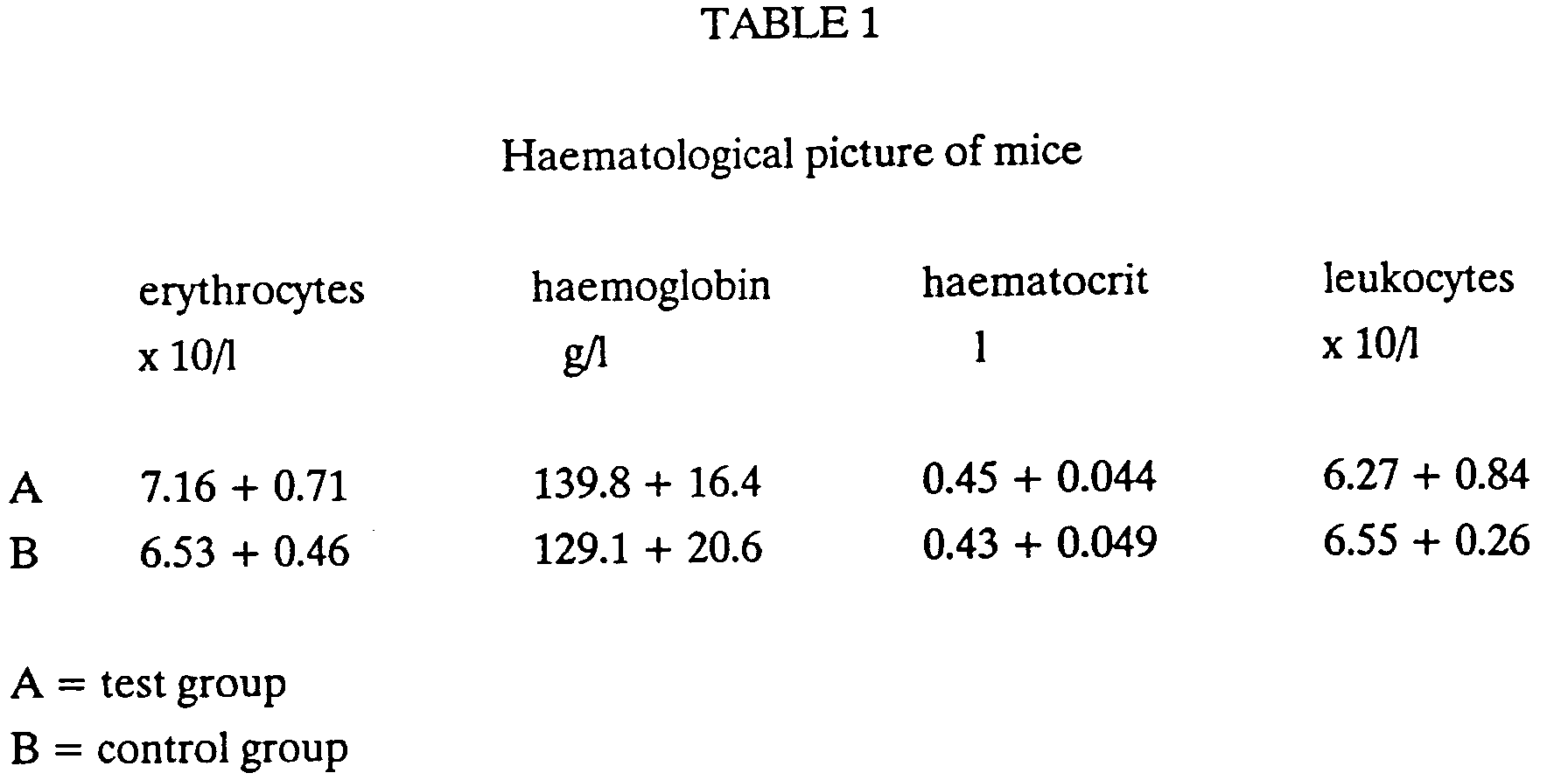
- The results show that the values of erythrocytes, haemoglobin and haematocrit are a little higher in the test group than in the control group.
- The second test was carried out in rats in a control group (without application of the product of the invention) and in a test group (6 animals in each group), which animals were administered p.o. a 1% solution of the product of the invention for 21 days. The weight increase in rats is shown graphically in Fig. 1, where the full line represents the test group and the dotted line represents the control.
- The haematological picture of rats is evident from the Table 2 below:
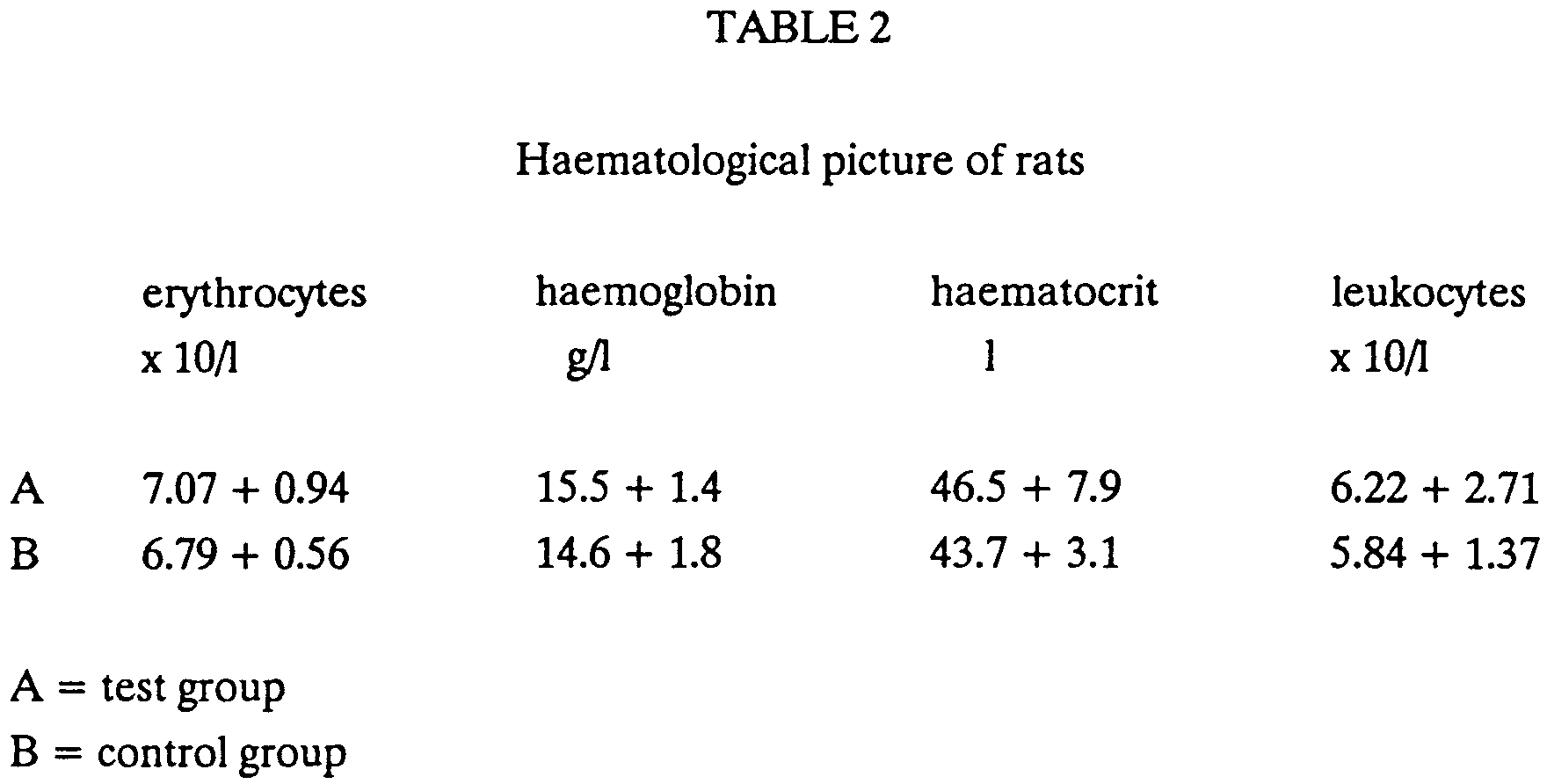
- The results show that the values of erythrocytes, haemoglobin and haemocrit are a little higher in the test group than in the control group, which means that the blood picture in the test group has improved a little.
- On the basis of the above results it can be stated that the product of the invention is practically non-toxic in the doses used.
-
- a) Activity in prevention of gastroenteritis in weaned piglets
927 animals of about a month were used in the test. They were divided into 3 groups, namely a test group, where the product of the invention was administered for 14 days together with food beginning from the day of weaning, in a dose of 3 kg/t of food; a control group I, where piglets for 14 days did not get any preparation in the food; and a control group II, where piglets were administered a chemotherapeuticum in the prescribed dose for the same time period. Results are evident from Fig. 2, 3 and 4. Fig. 2 shows the percentage of sickened piglets with signs of diarrhoea, Fig. 3 shows the percentage of dead piglets with signs of diarrhoea and Fig. 4 shows daily weight increase. - b) Activity in prevention of dysentery (bloody flux) in pigs
The test was carried out on a farm, where dysentery in clinical form appeared infattening pigs 10 to 15 days before slaughter. 400 fattening pigs, weight about 100 kg, divided into two groups - the test group and the control group (200 animals in each group) - were tested. The test group was administered the product of the invention in a dose of 3 kg/t of food for 10 days and the control group was administered a chemotherapeuticum in the prescribed dose in the same time period. In the test group identical results of prevention as in the control group were achieved. In neither group clinical dysentery was observed in the last 20 days of fattening, though the disease appeared on the farm regularly in previous months. - c) Activity of the product of the invention if dysentery in pigs has already appeared
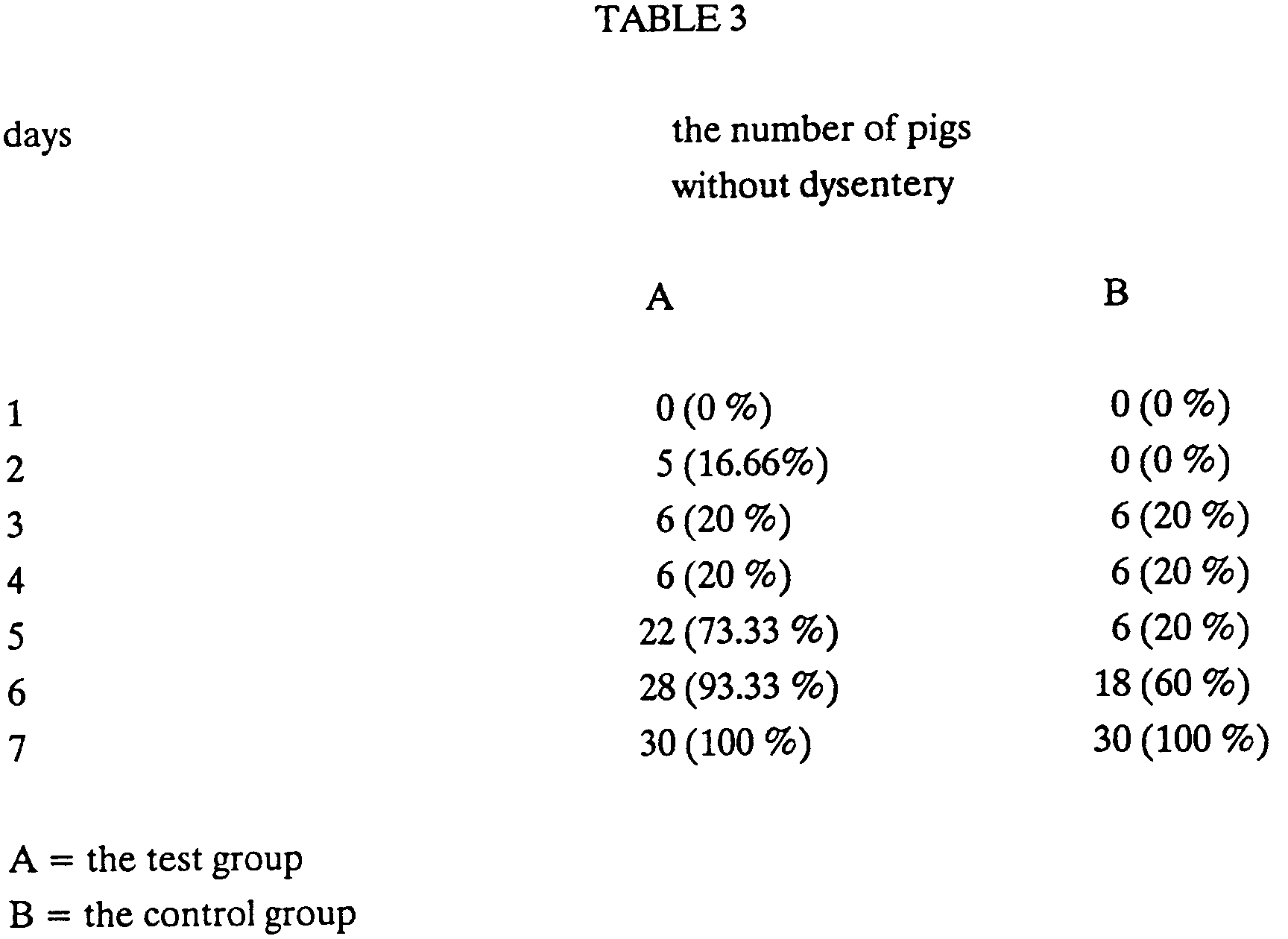
60 fattening pigs,weight 90 to 100 kg each, having clinical signs of dysentery were tested. They were divided into two groups - the test group and the control group. 30 fattening pigs, which were administered the product of the invention in the food (5 kg/t of food) for 7 days, were in the test group. 30 fattening pigs, which were administered a chemotherapeuticum in the prescribed dose in the same time period, were in the control group. The results are evident from the Table 3. - 69 adult animals in which winter viral dysentery had been established, were tested. The test lasted for 2 months. The product of the invention was administered individually as 2 x 4 big spoons of the solution (0.2 g of the product/kg body weight, dissolved in 2 to 3 l water, administered with a probe directly into the pre-gorge or by bottle) daily for 3 to 4 days. The faeces of the most animals treated became thicker and thicker on administration. At the end it was like a thick pulp or partly formed.
Claims (6)
- Tannin extract of sweet chestnut wood comprising a pulverized solution of a) thickened aqueous extract of sweet chestnut wood (Castanea Sativa Mill.) without bark and sap-wood, said wood having an age from 40 to 50 years, and b) microbiologically acceptable sugar, the ratio dry substance of extract a)/sugar being from 1:2 to 1:6.
- Process for preparing tannin extract of sweet chestnut wood for veterinary use, characterized in that sound wood of sweet chestnut, of an age of 40 to 50 years, without bark and sap-wood, in the form of logs,which is ground into particles having a length of 6 to 10 mm, a thickness of 0.6 to 1.2 mm and a width of 4 to 8 mm, is extracted with water, the extraction solution is thickened to the dry substance content of about 50%, to the liquid extract a solution of microbiologically acceptable sugar is added in order to achieve a ratio dry substance of extract/sugar 1:2 to 1:6, it is stirred to a complete homogeneity and pulverized.
- Veterinary preparation active in the treatment of diarrhoea in animals, characterized in that it contains the tannin extract of claim 1 and, optionally, conventional carriers and adjuvants.
- Veterinary preparation according to claim 3, characterized in that it is added to animal fodder or used as such.
- Use of the veterinary preparation according to claim 3 in prevention and curing of diarrhoea, dysentery and other gastrointestinal disorders accompanied with diarrhoea in animals such as mammals and poultry.
- Process for therapy and prevention of diarrhoea, dysentery and other gastrointestinal disorders accompanied with diarrhoea in animals, characterized in that animals needing such treatment are administered p.o. the appropriate amount of the veterinary preparation according to claim 3.
Applications Claiming Priority (2)
| Application Number | Priority Date | Filing Date | Title |
|---|---|---|---|
| YU1933/90 | 1990-10-15 | ||
| YU193390 | 1990-10-15 |
Publications (3)
| Publication Number | Publication Date |
|---|---|
| EP0481396A2 true EP0481396A2 (en) | 1992-04-22 |
| EP0481396A3 EP0481396A3 (en) | 1992-12-09 |
| EP0481396B1 EP0481396B1 (en) | 1995-01-11 |
Family
ID=25556170
Family Applications (1)
| Application Number | Title | Priority Date | Filing Date |
|---|---|---|---|
| EP91117472A Expired - Lifetime EP0481396B1 (en) | 1990-10-15 | 1991-10-14 | Tannin extract of sweet chestnut wood, a process for the preparation thereof and its use |
Country Status (3)
| Country | Link |
|---|---|
| EP (1) | EP0481396B1 (en) |
| DE (1) | DE69106656T2 (en) |
| SI (1) | SI9011933A (en) |
Cited By (20)
| Publication number | Priority date | Publication date | Assignee | Title |
|---|---|---|---|---|
| WO1999049129A1 (en) * | 1998-03-26 | 1999-09-30 | Luykx, Theresia | A method and plant for the continuous extraction, from a woody material, of a tannic substance contained therein and for the production of a usable lignocellulosic material |
| ES2156718A1 (en) * | 1999-03-23 | 2001-07-01 | Agq S L | Farm animal meat and fat quality enhancer consists of an aqueous concentrate of olive, wine, sawdust and paper making by products |
| EP1323354A3 (en) * | 2001-12-28 | 2004-01-14 | Nor-Feed A/S | Natural, intestinally active feed additive |
| FR2850273A1 (en) * | 2003-01-27 | 2004-07-30 | Gattefosse Ets Sa | New extracts of Castanea sativa buds, are stimulants of extracellular matrix component synthesis by dermal cells and cytoprotectants for the skin, useful in cosmetic compositions |
| WO2007130882A2 (en) | 2006-05-01 | 2007-11-15 | Napo Pharmaceuticals, Inc. | Method for treatment of diarrhea-predominant irritable bowel syndrome |
| US7323195B2 (en) | 1996-10-16 | 2008-01-29 | Napo Pharmaceuticals, Inc. | Enteric formulations of proanthocyanidin polymer antidiarrheal compositions |
| US7556831B2 (en) | 2006-05-01 | 2009-07-07 | Napo Pharmaceuticals, Inc. | Method for treatment of constipation-predominant irritable bowel syndrome |
| US20110311634A1 (en) * | 2008-12-09 | 2011-12-22 | Sanluc International Nv | Formulations for animal feed comprising butyrate salt |
| ITCR20100025A1 (en) * | 2010-08-05 | 2012-02-06 | Lombarda Trading Srl | NATURAL MEDICINAL COMPOUND |
| EP2687221A1 (en) * | 2012-07-17 | 2014-01-22 | Obione | Nekka-Rich composition for the prevention of intestinal diseases |
| CN103893720A (en) * | 2014-02-26 | 2014-07-02 | 高雄英 | Patch for children with acute diarrhea and preparation method thereof |
| US8852649B2 (en) | 2006-05-01 | 2014-10-07 | Napo Pharmaceuticals, Inc. | Compositions and methods for treating or preventing inflammatory bowel disease, familial adenomatous polyposis and colon cancer |
| CN104173428A (en) * | 2013-05-23 | 2014-12-03 | 潘祖贤 | Medicine treating red-white dysentery |
| WO2018222921A1 (en) | 2017-05-31 | 2018-12-06 | Napo Pharmaceuticals, Inc. | Methods and compositions for treating bile acid diarrhea, diarrhea associated with small intestine resection or gallbladder removal, and short bowel syndrome |
| WO2018222919A1 (en) | 2017-05-31 | 2018-12-06 | Napo Pharmaceuticals, Inc. | Methods and compositions for treating congenital diarrhea disorder |
| CN111032743A (en) * | 2017-09-12 | 2020-04-17 | 南方森林所有者经济协会 | Method for producing at least one tannin product and bark product with improved fuel value |
| CN111548377A (en) * | 2020-06-10 | 2020-08-18 | 贵阳单宁科技有限公司 | Novel method for purifying tannic acid |
| US20210321650A1 (en) * | 2018-12-20 | 2021-10-21 | Sanluc International Nv | Coloring additive |
| IT202000028331A1 (en) | 2020-11-25 | 2022-05-25 | Silvateam S P A | COMPOSITIONS INCLUDING PLANT EXTRACTS RICH IN TANNINS AS FOOD SUPPLEMENTATION IN PATIENTS SUFFERING FROM SEVERE ACUTE RESPIRATORY SYNDROME, SUCH AS COVID-19 |
| FR3124947A1 (en) * | 2021-07-12 | 2023-01-13 | Societe D'exploitation De Produits Pour Les Industries Chimiques Seppic | Ingestible composition (Ci) for use in the treatment of a skin disorder induced by an intestinal disorder |
Family Cites Families (1)
| Publication number | Priority date | Publication date | Assignee | Title |
|---|---|---|---|---|
| FR1379648A (en) * | 1963-06-14 | 1964-11-27 | Prod Chim & Celluloses Rey | Process and products to promote the development of farm animals |
-
1990
- 1990-10-15 SI SI9011933A patent/SI9011933A/en unknown
-
1991
- 1991-10-14 EP EP91117472A patent/EP0481396B1/en not_active Expired - Lifetime
- 1991-10-14 DE DE69106656T patent/DE69106656T2/en not_active Expired - Fee Related
Cited By (31)
| Publication number | Priority date | Publication date | Assignee | Title |
|---|---|---|---|---|
| US8574634B2 (en) | 1996-10-16 | 2013-11-05 | Napo Pharmaceutcials, Inc. | Compositions and methods of treatment with proanthocyanidin polymer antidiarrheal compositions |
| US7323195B2 (en) | 1996-10-16 | 2008-01-29 | Napo Pharmaceuticals, Inc. | Enteric formulations of proanthocyanidin polymer antidiarrheal compositions |
| US7341744B1 (en) | 1996-10-16 | 2008-03-11 | Napo Pharmaceuticals, Inc. | Method of treating secretory diarrhea with enteric formulations of proanthocyanidin polymer |
| EP2060183A2 (en) | 1996-10-16 | 2009-05-20 | Napo Pharmaceuticals, Inc. | Enteric formulations of proanthocyanidin polymer antidiarrheal compositions |
| WO1999049129A1 (en) * | 1998-03-26 | 1999-09-30 | Luykx, Theresia | A method and plant for the continuous extraction, from a woody material, of a tannic substance contained therein and for the production of a usable lignocellulosic material |
| ES2156718A1 (en) * | 1999-03-23 | 2001-07-01 | Agq S L | Farm animal meat and fat quality enhancer consists of an aqueous concentrate of olive, wine, sawdust and paper making by products |
| EP1323354A3 (en) * | 2001-12-28 | 2004-01-14 | Nor-Feed A/S | Natural, intestinally active feed additive |
| FR2850273A1 (en) * | 2003-01-27 | 2004-07-30 | Gattefosse Ets Sa | New extracts of Castanea sativa buds, are stimulants of extracellular matrix component synthesis by dermal cells and cytoprotectants for the skin, useful in cosmetic compositions |
| WO2004075873A1 (en) * | 2003-01-27 | 2004-09-10 | Gattefosse S.A. | A composition comprising an extract of the buds of castanea sativa and cosmetic uses thereof |
| US9987250B2 (en) | 2006-05-01 | 2018-06-05 | Napo Pharmaceuticals, Inc. | Compositions and methods for treating or preventing inflammatory bowel disease, familial adenomatous polyposis and colon cancer |
| US7556831B2 (en) | 2006-05-01 | 2009-07-07 | Napo Pharmaceuticals, Inc. | Method for treatment of constipation-predominant irritable bowel syndrome |
| US8067041B2 (en) | 2006-05-01 | 2011-11-29 | Napo Pharmaceuaticals, Inc. | Method for treatment of constipation-predominant irritable bowel syndrome |
| US8852649B2 (en) | 2006-05-01 | 2014-10-07 | Napo Pharmaceuticals, Inc. | Compositions and methods for treating or preventing inflammatory bowel disease, familial adenomatous polyposis and colon cancer |
| WO2007130882A2 (en) | 2006-05-01 | 2007-11-15 | Napo Pharmaceuticals, Inc. | Method for treatment of diarrhea-predominant irritable bowel syndrome |
| US9980938B2 (en) | 2006-05-01 | 2018-05-29 | Napo Pharmaceuticals, Inc. | Method for treatment of diarrhea-predominant irritable bowel syndrome |
| US20110311634A1 (en) * | 2008-12-09 | 2011-12-22 | Sanluc International Nv | Formulations for animal feed comprising butyrate salt |
| RU2593339C2 (en) * | 2010-08-05 | 2016-08-10 | Ломбардатрэйдинг С.Р.Л. | Natural drug composition |
| ITCR20100025A1 (en) * | 2010-08-05 | 2012-02-06 | Lombarda Trading Srl | NATURAL MEDICINAL COMPOUND |
| WO2012017471A1 (en) * | 2010-08-05 | 2012-02-09 | Lombardatrading S.R.L. | Natural medicinal compound |
| FR2993459A1 (en) * | 2012-07-17 | 2014-01-24 | Obione | COMPOSITION BASED ON NEKKA-RICH FOR THE PREVENTION OF INTESTINAL PATHOLOGIES |
| EP2687221A1 (en) * | 2012-07-17 | 2014-01-22 | Obione | Nekka-Rich composition for the prevention of intestinal diseases |
| CN104173428A (en) * | 2013-05-23 | 2014-12-03 | 潘祖贤 | Medicine treating red-white dysentery |
| CN103893720A (en) * | 2014-02-26 | 2014-07-02 | 高雄英 | Patch for children with acute diarrhea and preparation method thereof |
| WO2018222921A1 (en) | 2017-05-31 | 2018-12-06 | Napo Pharmaceuticals, Inc. | Methods and compositions for treating bile acid diarrhea, diarrhea associated with small intestine resection or gallbladder removal, and short bowel syndrome |
| WO2018222919A1 (en) | 2017-05-31 | 2018-12-06 | Napo Pharmaceuticals, Inc. | Methods and compositions for treating congenital diarrhea disorder |
| CN111032743A (en) * | 2017-09-12 | 2020-04-17 | 南方森林所有者经济协会 | Method for producing at least one tannin product and bark product with improved fuel value |
| CN111032743B (en) * | 2017-09-12 | 2022-05-27 | 南方森林所有者经济协会 | Method for producing at least one tannin product and bark product with improved fuel value |
| US20210321650A1 (en) * | 2018-12-20 | 2021-10-21 | Sanluc International Nv | Coloring additive |
| CN111548377A (en) * | 2020-06-10 | 2020-08-18 | 贵阳单宁科技有限公司 | Novel method for purifying tannic acid |
| IT202000028331A1 (en) | 2020-11-25 | 2022-05-25 | Silvateam S P A | COMPOSITIONS INCLUDING PLANT EXTRACTS RICH IN TANNINS AS FOOD SUPPLEMENTATION IN PATIENTS SUFFERING FROM SEVERE ACUTE RESPIRATORY SYNDROME, SUCH AS COVID-19 |
| FR3124947A1 (en) * | 2021-07-12 | 2023-01-13 | Societe D'exploitation De Produits Pour Les Industries Chimiques Seppic | Ingestible composition (Ci) for use in the treatment of a skin disorder induced by an intestinal disorder |
Also Published As
| Publication number | Publication date |
|---|---|
| SI9011933A (en) | 1998-06-30 |
| EP0481396B1 (en) | 1995-01-11 |
| DE69106656D1 (en) | 1995-02-23 |
| DE69106656T2 (en) | 1995-08-17 |
| EP0481396A3 (en) | 1992-12-09 |
Similar Documents
| Publication | Publication Date | Title |
|---|---|---|
| EP0481396B1 (en) | Tannin extract of sweet chestnut wood, a process for the preparation thereof and its use | |
| US20250041375A1 (en) | Sugar cane extracts for use in animal feeds | |
| KR950011734B1 (en) | Feed and feed additives for livestock, poultry and fish that increase resistance to diseases such as pseudorabies | |
| JPS6212A (en) | Bait product containing methylsulfonylmethane and use | |
| JP2005151928A (en) | Additive for feed | |
| US4914135A (en) | Use of Methylsulfonylmethane to treat parasitic infections | |
| RS55145B1 (en) | USE OF EDTA AND ITS SALTS FOR THE PREVENTION AND TREATMENT OF BACTERIAL INTESTINAL DISEASE IN PIGS | |
| PL191391B1 (en) | Orally administered product for preventing and treating gastrointestinal infections with swine and method of producing antibodies against pathogenes of such infections | |
| KR950011733B1 (en) | Disease resistance ration and feed additive for cattles and swines | |
| JPH0713022B2 (en) | Veterinary medicine | |
| KR20080088641A (en) | Morinda citrifolia fortified products for animal administration | |
| CN115334897A (en) | Use of ionic polymers in biomass processing for the preparation of animal feed additives | |
| JP3534792B2 (en) | Disease resistant feed | |
| CN101370391A (en) | Morinda citrifolia enhanced products for administration to animal | |
| WO1995001104A1 (en) | Feed additive of tea origin and animal feed containing the same | |
| JP2813471B2 (en) | Crude drug-containing feed | |
| DK172775B1 (en) | Animal feed additives containing a flavanoid-containing mimosa extract and animal feed containing the same and method t | |
| JP2000032924A (en) | Maintenance and improvement of physical condition of horse | |
| Julien et al. | Feed intake in Hereford calves infused intraperitoneally with toxic fescue extract | |
| RU2831360C1 (en) | Method of feeding newborn calves | |
| JPS60172259A (en) | Growth promoting feed additive and use thereof in growing domestic animal | |
| CN113244220A (en) | Application of potassium dehydroandrographolide succinate in preparation of veterinary drug for treating cow mastitis and potassium dehydroandrographolide succinate veterinary drug | |
| RU2077332C1 (en) | Plant species for gastroenteric disease treatment | |
| RU2746146C1 (en) | Method for increasing the growth rate of newborn calves | |
| RU2825895C1 (en) | Phytoextract rhaponticum carthamoides for increasing milk production of cows |
Legal Events
| Date | Code | Title | Description |
|---|---|---|---|
| PUAI | Public reference made under article 153(3) epc to a published international application that has entered the european phase |
Free format text: ORIGINAL CODE: 0009012 |
|
| AK | Designated contracting states |
Kind code of ref document: A2 Designated state(s): CH DE FR IT LI |
|
| PUAL | Search report despatched |
Free format text: ORIGINAL CODE: 0009013 |
|
| AK | Designated contracting states |
Kind code of ref document: A3 Designated state(s): CH DE FR IT LI |
|
| 17P | Request for examination filed |
Effective date: 19930525 |
|
| 17Q | First examination report despatched |
Effective date: 19930726 |
|
| RAP3 | Party data changed (applicant data changed or rights of an application transferred) |
Owner name: TANIN SEVNICA KEMICNA INDUSTRIJA P.O. |
|
| ITF | It: translation for a ep patent filed | ||
| GRAA | (expected) grant |
Free format text: ORIGINAL CODE: 0009210 |
|
| AK | Designated contracting states |
Kind code of ref document: B1 Designated state(s): CH DE FR IT LI |
|
| REF | Corresponds to: |
Ref document number: 69106656 Country of ref document: DE Date of ref document: 19950223 |
|
| ET | Fr: translation filed | ||
| PLBE | No opposition filed within time limit |
Free format text: ORIGINAL CODE: 0009261 |
|
| STAA | Information on the status of an ep patent application or granted ep patent |
Free format text: STATUS: NO OPPOSITION FILED WITHIN TIME LIMIT |
|
| 26N | No opposition filed | ||
| PGFP | Annual fee paid to national office [announced via postgrant information from national office to epo] |
Ref country code: FR Payment date: 19990923 Year of fee payment: 9 |
|
| PGFP | Annual fee paid to national office [announced via postgrant information from national office to epo] |
Ref country code: DE Payment date: 19990928 Year of fee payment: 9 |
|
| PGFP | Annual fee paid to national office [announced via postgrant information from national office to epo] |
Ref country code: CH Payment date: 20000124 Year of fee payment: 9 |
|
| PG25 | Lapsed in a contracting state [announced via postgrant information from national office to epo] |
Ref country code: LI Free format text: LAPSE BECAUSE OF NON-PAYMENT OF DUE FEES Effective date: 20001031 Ref country code: CH Free format text: LAPSE BECAUSE OF NON-PAYMENT OF DUE FEES Effective date: 20001031 |
|
| REG | Reference to a national code |
Ref country code: CH Ref legal event code: PL |
|
| PG25 | Lapsed in a contracting state [announced via postgrant information from national office to epo] |
Ref country code: FR Free format text: LAPSE BECAUSE OF NON-PAYMENT OF DUE FEES Effective date: 20010629 |
|
| PG25 | Lapsed in a contracting state [announced via postgrant information from national office to epo] |
Ref country code: DE Free format text: LAPSE BECAUSE OF NON-PAYMENT OF DUE FEES Effective date: 20010703 |
|
| REG | Reference to a national code |
Ref country code: FR Ref legal event code: ST |
|
| PG25 | Lapsed in a contracting state [announced via postgrant information from national office to epo] |
Ref country code: IT Free format text: LAPSE BECAUSE OF NON-PAYMENT OF DUE FEES Effective date: 20051014 |