EP0477616A2 - Method for estimation of motion in a captured image - Google Patents
Method for estimation of motion in a captured image Download PDFInfo
- Publication number
- EP0477616A2 EP0477616A2 EP91114982A EP91114982A EP0477616A2 EP 0477616 A2 EP0477616 A2 EP 0477616A2 EP 91114982 A EP91114982 A EP 91114982A EP 91114982 A EP91114982 A EP 91114982A EP 0477616 A2 EP0477616 A2 EP 0477616A2
- Authority
- EP
- European Patent Office
- Prior art keywords
- vectors
- vector
- motion
- block
- motion vectors
- Prior art date
- Legal status (The legal status is an assumption and is not a legal conclusion. Google has not performed a legal analysis and makes no representation as to the accuracy of the status listed.)
- Granted
Links
Images


Classifications
-
- H—ELECTRICITY
- H04—ELECTRIC COMMUNICATION TECHNIQUE
- H04N—PICTORIAL COMMUNICATION, e.g. TELEVISION
- H04N19/00—Methods or arrangements for coding, decoding, compressing or decompressing digital video signals
- H04N19/50—Methods or arrangements for coding, decoding, compressing or decompressing digital video signals using predictive coding
- H04N19/503—Methods or arrangements for coding, decoding, compressing or decompressing digital video signals using predictive coding involving temporal prediction
- H04N19/51—Motion estimation or motion compensation
- H04N19/533—Motion estimation using multistep search, e.g. 2D-log search or one-at-a-time search [OTS]
-
- G—PHYSICS
- G06—COMPUTING OR CALCULATING; COUNTING
- G06T—IMAGE DATA PROCESSING OR GENERATION, IN GENERAL
- G06T7/00—Image analysis
- G06T7/20—Analysis of motion
- G06T7/223—Analysis of motion using block-matching
- G06T7/238—Analysis of motion using block-matching using non-full search, e.g. three-step search
-
- H—ELECTRICITY
- H04—ELECTRIC COMMUNICATION TECHNIQUE
- H04N—PICTORIAL COMMUNICATION, e.g. TELEVISION
- H04N19/00—Methods or arrangements for coding, decoding, compressing or decompressing digital video signals
- H04N19/50—Methods or arrangements for coding, decoding, compressing or decompressing digital video signals using predictive coding
- H04N19/503—Methods or arrangements for coding, decoding, compressing or decompressing digital video signals using predictive coding involving temporal prediction
- H04N19/51—Motion estimation or motion compensation
-
- G—PHYSICS
- G06—COMPUTING OR CALCULATING; COUNTING
- G06T—IMAGE DATA PROCESSING OR GENERATION, IN GENERAL
- G06T2207/00—Indexing scheme for image analysis or image enhancement
- G06T2207/10—Image acquisition modality
- G06T2207/10016—Video; Image sequence
Definitions
- the invention is based on a method according to the preamble of the main claim.
- the signals of the picture elements of a block are combined with signals of the picture elements of the corresponding block of a previous picture Consideration of shifts caused by movements in the image compared. A sum of the deviations is formed in each case, the sign of the deviations being ignored by absolute value formation or squaring. The shift for which the smallest sum has been formed is assumed to be the motion vector.
- Such a method and an arrangement for carrying out the method are described for example in the applicant's patent application P 38 34 477.7.
- the sum of the deviations becomes zero if the signals of the picture elements of the block to be evaluated are of the same size, that is if the picture has a homogeneous surface.
- a minimum can be determined in the case of a “wrong” shift due to noise that is superimposed on the useful signal. Since small blocks have fewer places with a striking brightness curve than large blocks, the reliability of the motion vectors also decreases with decreasing block size.
- the object of the present invention is to provide a method for estimating movement, in which, while avoiding the above-mentioned errors, motion vectors are determined which largely correspond to the physical movement present in the image. Furthermore, the movement vectors determined should be coded as cheaply as possible.
- the method with the characterizing features of the main claim has the advantage that the motion vectors are determined more precisely. The most common correlation of physical movement in neighboring blocks is cleverly exploited.
- a particularly favorable data-reducing coding is achieved according to a development of the invention in that, for coding the block-oriented motion vector field, the vector field is divided into areas that contain only the zero vector and those that contain non-zero vectors, that the contour of the areas that the zero vector is not encoded, and that in areas containing vectors other than zero, the difference between the determined motion vector and one predicted from the already encoded motion vectors of the spatial neighborhood is transmitted.
- a hierarchical motion estimation is first carried out at 1 using a known method.
- Method step 1 is carried out for a block of, for example, 16 x 16 picture elements.
- the result is a vector field of, for example, 22 x 18 vectors.
- a second method step 2 the motion vectors of this vector field are corrected taking into account a correlation between movements in adjacent blocks.
- a quality criterion to be explained later in detail is calculated for several values of the motion vector of a block in each case and the value for a subsequent pass in which the quality criterion best applies is stored.
- the corrected motion vectors are output as a corrected vector field and one in a third method step 3 data-reducing coding supplied.
- the coding is carried out according to a predictive method such that the contours of those areas in which the motion vectors are not equal to 0 are coded using a contour tracking method, as described, for example, in U. Franke: "Region-Oriented Image Description - Algorithms and Possibilities" VDI Progress Reports, Series 10 , No. 101, Chapter 3.
- the motion vectors are transmitted as the difference between the motion vector determined and a motion vector (predictor) predicted from the already encoded motion vectors of the spatial neighborhood.
- Zero vectors are not taken into account, but are replaced by the mean of the other vectors. If a, b, c and d are simultaneously zero vectors, the vector of the vector field preceding in time is used as the prediction vector, regardless of whether it is also a zero vector.
- the invention is not limited to the advantageous number of four adjacent vectors. If the relevant conditions are met, the predictor can also be derived differently.
- the video signals already in digital form are fed to a subtraction circuit 6 via an input 4 and an image memory 5.
- the output of the subtraction circuit 6 is connected via a quantizer 7 to a coder 8, of which Output the coded data to a transmission channel 9 are supplied.
- the quantized signals are fed via an adder circuit 10 to a prediction memory 11, the output of which is connected to the subtraction circuit 6 and the adder circuit 10.
- the amount of data to be transmitted is smaller, the better the image stored in the prediction memory 11 corresponds to the image to be transmitted. In this sense, consideration must be given to the movements present in the image when reading out the data from the prediction memory 11.
- the digital video signals fed to the input 4 are fed to a motion estimator 12, which determines a motion vector for part of the image (block).
- the motion vectors are fed to the prediction memory 11 and transmitted together with the coded image data via the transmission channel 9 in order to be taken into account in the decoding.
- Figures 3a) and 3b) show the determination of a motion vector for a block according to a known method.
- the smaller rectangle in FIG. 3a) represents a block B to be coded in each case in the kth picture.
- the block B consists of M x N picture elements. In a practical example, M and N are each 16.
- the image memory 5 (FIG. 2) becomes a search field SF read out, which is larger in both directions by a number dm picture elements than a block. This number results from the largest movement between two successive images, which is still to be captured.
- the search field SF accordingly has dimensions of N + 2dm and M + 2dm.
- the block with the Comparison block VB of the previous image compared.
- the coordinates i, j represent deviations from this position.
- the mean of the absolute image difference is used as a measure of the deviation between two blocks to be compared or between the block of the current image and a corresponding part of the search field. This follows the equation which is shown in Fig. 3b).
- m and n are the coordinates of the picture elements within a block B, s means the signal belonging to the picture element, the high number k indicating the kth picture and the high number k-1 indicating the previous picture.
- the value for MAD is formed for different positions of the block within the search field SF. From a minimum of this value it is concluded that block B of the k-th image in the (k-1) -th image was at the corresponding position in the search field, that is to say from this point to the position of the block in the k-th image was moved.
- a four-step method - is shown schematically in FIG. 3c.
- the value MAD is calculated for the center point P0, which would not correspond to any movement, and for the points P1 to P8 lying on a rectangle around the point P0.
- the position of the block identified by point P3 gives the lowest value MAD compared to points P0 to P2 and P4 to P8. Therefore, starting from point P3, further values for MAD are determined for points which are horizontal, vertical and in both directions by a distance of three pixels from P3.
- This step gives a minimum of MAD at point P9, from which the third step is a determination of MAD for dots that are two pixels apart.
- P0P11 represents the determined or estimated motion vector v.
- Equation (4) shown in FIG. 4 thus applies to images consisting of N pixels, where d (i, v (i)) is the amplitude of the i-pixel of the residual error image if the displacement vector v (i) applies to this pixel .
- the variance ⁇ 2 can be seen as the sum of the power of the camera noise P K and the noise due to imperfect movement compensation of the sequence and can then be used with an estimator limited to P K Equation (5) can be estimated according to FIG. 4. This results in equation (6) for small noise powers P K.
- Equation (6) states that the probability density for A, B to merge through V can be maximized by minimizing the DFD. However, the reverse conclusion that given A, B the most probable vector field V can also be found by minimizing the DFD is not readily permissible.
- contour costs are approximated by the expression (11) according to FIG. 4, where k is a constant factor.
- v i denotes the eight next neighboring vectors of the vector v in question and bin (v, v i ) receives the value 0 if v and v i are equally zero vectors or not zero vectors and the value 1 if only exactly one of the two vectors is a zero vector if there is a contour between the two vectors.
- g i denotes a weight, which is set for four neighbors from v to 1 and for diagonal neighbors to 1/2 1 ⁇ 2 .
- a single motion vector changes up to five prediction error vectors.
- the prediction costs of a vector are therefore the sum of the costs K (v i ) (code length in bits) of these five vectors according to equation (12).
- the resulting motion estimator structure is outlined in FIG. 1.
- the four vectors differing from the estimated vector of the last search by only 1 ⁇ 2 pixel require an estimate with sub-pixel resolution, i.e. H.
- sub-pixel resolution i.e. H.
- another picture element is first interpolated (horizontally and vertically), so that the picture is present with four times the number of picture elements. Then it is possible to shift the block under consideration by half picture elements (more precisely: half the distance between two picture elements of the original resolution).
- the vectors deviating by 1 ⁇ 2 picture element are (0.5, 2.5), (1.5, 2.5), (1.0, 2.0) and (1.0, 3.0).
- the four vectors that the following predictor would predict if he would start in one of the four corners of the picture are explained using the following example:
- the vectors of a 3 x 3 vector block are labeled line by line with a, b ... i, where e is the middle one Vector to be predicted.
- a predictor e in the upper left corner of the picture becomes (a + 2b + c + 4d) / 8 predict.
- a predictor beginning in the lower left corner of the picture would become e (g + 2h + i + 4d) / 8 predict, etc.
- the 18 vector candidates represent an inexpensive selection that can be seen as a compromise between the required computing power and the quality of the vector field. Adding more candidates would increase the computational effort but also the quality of the vector field. Removing individual candidates would correspondingly reduce the computational effort and the quality of the vector field. Depending on However, the person skilled in the art can provide more or fewer vector candidates.
- the vector field can be significantly improved in three to four rounds. Since requirement (15) shows poor convergence for large d, the iteration is started with small d and continued with increasing d. In one or more runs, c or k can be set to zero.
- parameters of the coding are controlled as a function of the data flow that occurs in each case.
- a control can influence the constant d and thus control the data flow division between motion estimation and update.
- FIG. 5 shows a flow diagram to illustrate the optimization according to function block 2 (FIG. 1).
- program part 12 a first block with the coordinates x, y is defined.
- the constants c and d are set to the values specified for the first pass.
- a counter for the candidates to be used for each vector in equation (15) is set to 1 and Q min to the largest possible value (“infinite”).
- the next vector candidate or the first vector candidate is determined in program part 14.
- the value Q is calculated using equation (15).
- the program then branches at 19 depending on whether z is still less than 18, namely the number of vector candidates. If z is still less than 18, z is incremented at 20 and the calculation of Q is carried out with the following vector candidate. Depending on whether Q is still less than Q Min , Q Min and V OPT are replaced by new values or not.
- a further branch 21 determines whether all blocks have already been processed. If this is not the case, the next block is determined at 22 (by an appropriate incrementation of x or y) and the program for the new block is run through. However, if all blocks have been processed after branching 21, a question is asked at 23 whether j ⁇ j is Max . If this is not the case, j is incremented at 24, so that, starting with the first block, a new run of the optimization takes place. If the intended number j Max of passes has been reached at branch 23, the program is continued at 25 with the contour / content coding.
Landscapes
- Engineering & Computer Science (AREA)
- Multimedia (AREA)
- Signal Processing (AREA)
- Computer Vision & Pattern Recognition (AREA)
- Physics & Mathematics (AREA)
- General Physics & Mathematics (AREA)
- Theoretical Computer Science (AREA)
- Compression Or Coding Systems Of Tv Signals (AREA)
- Image Analysis (AREA)
- Color Television Systems (AREA)
- Magnetic Resonance Imaging Apparatus (AREA)
- Apparatus For Radiation Diagnosis (AREA)
Abstract
Bei einem Verfahren zur Schätzung von Bewegung in einem aufgenommenen Bild, wobei jeweils für einen Block des aufgenommenen Bildes ein Bewegungsvektor ermittelt wird, der die Bewegung innerhalb des Blocks von einem zu einem folgenden Bild darstellt, werden zunächst erste Bewegungsvektoren für jeweils einen Block unabhängig voneinander ermittelt werden. Die ermittelten ersten Bewegungsvektoren werden unter Berücksichtigung einer Korrelation mit Bewegungsvektoren benachbarter Blöcke korrigiert.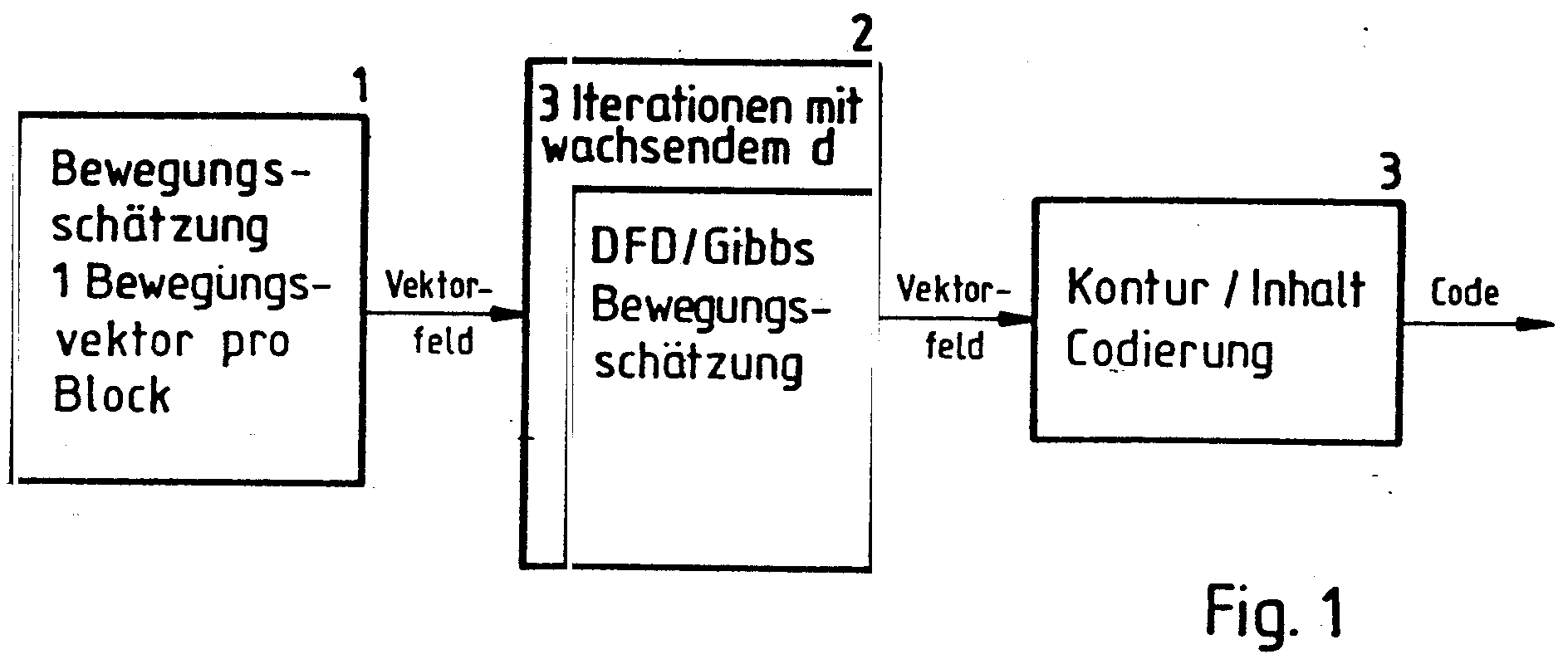
Description
Die Erfindung geht aus von einem verfahren nach der Gattung des Hauptanspruchs.The invention is based on a method according to the preamble of the main claim.
Zur Übertragung von bewegten Bildern, beispielsweise beim Schmalband-Bildtelefon, sind verschiedene datenreduzierende Codierverfahren bekanntgeworden. Eine wesentliche Datenreduzierung wird durch eine DPCM in der Zeitebene erzielt. Zu einer ausreichenden Wirksamkeit dieser DPCM ist es erforderlich, daß beim Auslesen der Daten aus dem für die DPCM erforderlichen Prädiktionsspeicher eine im Bild stattgefundene Bewegung berücksichtigt wird. Dabei wird für jeweils eine Gruppe von Bildelementen (Block) ein Bewegungsvektor ermittelt, welcher der Größe und Richtung der Bewegung dieses Blocks im Verhältnis zu einem vergleichbaren Block des vorangegangenen Bildes im wesentlichen entspricht.Various data-reducing coding methods have become known for the transmission of moving images, for example in the case of narrowband video telephones. A significant data reduction is achieved by a DPCM in the time level. For this DPCM to be effective, it is necessary that when the data is read from the prediction memory required for the DPCM, a movement that has taken place in the image is taken into account. A motion vector is determined for each group of picture elements (block), which essentially corresponds to the size and direction of the movement of this block in relation to a comparable block of the previous picture.
Zur Ermittlung des Bewegungsvektors werden die Signale der Bildelemente eines Blocks mit Signalen der Bildelemente des entsprechenden Blocks eines vorangegangenen Bildes unter Berücksichtigung von Verschiebungen, die durch Bewegungen im Bild verursacht sind, verglichen. Dabei wird jeweils eine Summe der Abweichungen gebildet, wobei das Vorzeichen der Abweichungen durch Absolutwertbildung oder Quadrierung unberücksichtigt bleibt. Diejenige Verschiebung, für welche die kleinste Summe gebildet wurde, wird als Bewegungsvektor angenommen. Ein derartiges Verfahren und eine Anordnung zur Durchführung des Verfahrens sind beispielsweise in der Patentanmeldung P 38 34 477.7 der Anmelderin beschrieben.To determine the motion vector, the signals of the picture elements of a block are combined with signals of the picture elements of the corresponding block of a previous picture Consideration of shifts caused by movements in the image compared. A sum of the deviations is formed in each case, the sign of the deviations being ignored by absolute value formation or squaring. The shift for which the smallest sum has been formed is assumed to be the motion vector. Such a method and an arrangement for carrying out the method are described for example in the applicant's patent application P 38 34 477.7.
Bei diesen bekannten Verfahren ergeben sich jedoch verschiedene Fehlermöglichkeiten. So wird beispielsweise die Summe der Abweichungen zu null, wenn die Signale der Bildelemente des auszuwertenden Blocks gleich groß sind, wenn also im Bild eine homogene Fläche vorliegt. Außerdem kann ein Minimum bei einer "falschen" Verschiebung durch Rauschen ermittelt werden, das dem Nutzsignal überlagert ist. Da kleine Blöcke seltener Stellen mit markantem Helligkeitsverlauf aufweisen als große Blöcke, nimmt ferner die Zuverlässigkeit der Bewegungsvektoren mit abnehmender Blockgröße ebenfalls ab.With these known methods, however, there are various possible errors. For example, the sum of the deviations becomes zero if the signals of the picture elements of the block to be evaluated are of the same size, that is if the picture has a homogeneous surface. In addition, a minimum can be determined in the case of a “wrong” shift due to noise that is superimposed on the useful signal. Since small blocks have fewer places with a striking brightness curve than large blocks, the reliability of the motion vectors also decreases with decreasing block size.
Bei den bekannten Verfahren werden zur Minimierung des Rechenaufwandes nicht die Summen der Abweichungen für alle möglichen Verschiebungen eines Blocks ermittelt und danach das Minimum gebildet, sondern es wird nach einer Suchstrategie verfahren. Dazu wird zunächst die Summe der Abweichungen für größere Verschiebungen in verschiedenen Richtungen ermittelt. Nach diesem ersten Suchschritt wird von derjenigen Verschiebung mit der kleinsten Abweichung ausgehend ein weiterer Suchschritt durchgeführt. In der Literatur wurden dazu Strategien mit drei oder vier Suchschritten vorgeschlagen. Durch die damit verbundene nicht vollständige Prüfung aller Verschiebungen ergeben sich weitere Unsicherheiten bei der Bestimmung des Bewegungsvektors.In the known methods, in order to minimize the computational effort, the sum of the deviations for all possible displacements of a block is not determined and the minimum is then formed, but a search strategy is used. First, the sum of the deviations for larger displacements in different directions is determined. After this first search step, a further search step is carried out starting from the shift with the smallest deviation. Strategies with three or four search steps have been proposed in the literature. The associated incomplete checking of all displacements results in further uncertainties in the determination of the motion vector.
Aufgabe der vorliegenden Erfindung ist es, ein Verfahren zur Schätzung von Bewegung anzugeben, bei welchem unter Vermeidung der obengenannten Fehler Bewegungsvektoren ermittelt werden, die weitgehend der im Bild jeweils vorliegenden physikalischen Bewegung entsprechen. Ferner soll eine möglichst günstige Codierung der ermittelten Bewegungsvektoren erfolgen.The object of the present invention is to provide a method for estimating movement, in which, while avoiding the above-mentioned errors, motion vectors are determined which largely correspond to the physical movement present in the image. Furthermore, the movement vectors determined should be coded as cheaply as possible.
Das Verfahren mit den kennzeichnenden Merkmalen des Hauptanspruchs hat den Vorteil, daß die Bewegungsvektoren genauer ermittelt werden. Dabei wird in geschickter Weise die meist vorliegende Korrelation der physikalischen Bewegung in benachbarten Blöcken ausgenutzt.The method with the characterizing features of the main claim has the advantage that the motion vectors are determined more precisely. The most common correlation of physical movement in neighboring blocks is cleverly exploited.
Eine besonders günstige datenreduzierende Codierung wird gemäß einer Weiterbildung der Erfindung dadurch erreicht, daß zur Codierung des blockorientierten Bewegungsvektorfeldes das Vektorfeld in Bereiche, die ausschließlich den Nullvektor enthalten und solche, die von Null verschiedene Vektoren enthalten, unterteilt wird, daß die Kontur der Bereiche, die den Nullvektor nicht enthalten, codiert wird und daß in Bereichen, die von Null verschiedene Vektoren enthalten, die Differenz zwischen dem ermittelten und einem aus den bereits codierten Bewegungsvektoren der räumlichen Nachbarschaft prädiziertem Bewegungsvektor übertragen wird.A particularly favorable data-reducing coding is achieved according to a development of the invention in that, for coding the block-oriented motion vector field, the vector field is divided into areas that contain only the zero vector and those that contain non-zero vectors, that the contour of the areas that the zero vector is not encoded, and that in areas containing vectors other than zero, the difference between the determined motion vector and one predicted from the already encoded motion vectors of the spatial neighborhood is transmitted.
Durch die in weiteren Unteransprüchen aufgeführten Maßnahmen sind weitere vorteilhafte Weiterbildungen und Verbesserungen der im Hauptanspruch angegebenen Erfindung möglich.The measures listed in the further subclaims enable further advantageous developments and improvements of the invention specified in the main claim.
Ausführungsbeispiele der Erfindung sind in der Zeichnung anhand mehrerer Figuren dargestellt und in der nachfolgenden Beschreibung näher erläutert. Es zeigt:
- Fig. 1
- ein stark vereinfachtes Blockdiagramm des erfindungsgemäßen Verfahrens,
- Fig. 2
- ein Blockschaltbild eines bekannten DPCM-Coders,
- Fig. 3
- eine schematische Darstellung zur Erläuterung einer an sich bekannten Suchstrategie zur Ermittlung eines Bewegungsvektors,
- Fig. 4
- nicht in der Beschreibung dargestellte Gleichungen zur Erläuterung des erfindungsgemäßen Verfahrens und
- Fig. 5
- ein Flußdiagramm für ein Programm eines Signalprozessors, der zur Durchführung des erfindungsgemäßen Verfahrens verwendet wird.
- Fig. 1
- a greatly simplified block diagram of the method according to the invention,
- Fig. 2
- 2 shows a block diagram of a known DPCM encoder,
- Fig. 3
- 1 shows a schematic illustration to explain a known search strategy for determining a motion vector,
- Fig. 4
- Equations not shown in the description to explain the method according to the invention and
- Fig. 5
- a flowchart for a program of a signal processor, which is used for performing the method according to the invention.
Bei dem in Fig. 1 dargestellten Verfahren erfolgt bei 1 zunächst eine hierarchische Bewegungsschätzung nach einem bekannten Verfahren. Eines dieser bekannten Verfahren wird im Zusammenhang mit Fig. 3 später genauer erläutert. Der Verfahrensschritt 1 wird jeweils für einen Block von beispielsweise 16 x 16 Bildelementen durchgeführt. Als Ergebnis entsteht ein Vektorfeld von beispielsweise 22 x 18 Vektoren.In the method shown in FIG. 1, a hierarchical motion estimation is first carried out at 1 using a known method. One of these known methods will be explained in more detail later in connection with FIG. 3.
In einem zweiten Verfahrensschritt 2 werden die Bewegungsvektoren dieses Vektorfeldes unter Berücksichtigung einer Korrelation zwischen Bewegungen in benachbarten Blöcken korrigiert. Dabei wird ein später noch genau zu erläuterndes Gütekriterium für mehrere Werte des Bewegungsvektors jeweils eines Blocks berechnet und derjenige Wert für einen folgenden Durchgang gespeichert, bei welchem das Gütekriterium am besten zutrifft. Nach beispielsweise drei Durchgängen werden die korrigierten Bewegungsvektoren als korrigiertes Vektorfeld ausgegeben und in einem dritten Verfahrensschritt 3 einer datenreduzierenden Codierung zugeführt.In a
Die Codierung erfolgt nach einem prädiktiven Verfahren derart, daß die Konturen derjenigen Bereiche, in welchem die Bewegungsvektoren ungleich 0 sind, mit einem Konturverfolgungsverfahren codiert werden, wie es beispielsweise in U. Franke: "Regionenorientierte Bildbeschreibung - Algorithmen und Möglichkeiten" VDI Fortschrittberichte, Reihe 10, Nr. 101, Kapitel 3 beschrieben ist. Die Übertragung der Bewegungsvektoren erfolgt als Differenz zwischen dem ermittelten Bewegungsvektor und einem aus den bereits codierten Bewegungsvektoren der räumlichen Nachbarschaft prädizierten Bewegungsvektor (Prädiktor).The coding is carried out according to a predictive method such that the contours of those areas in which the motion vectors are not equal to 0 are coded using a contour tracking method, as described, for example, in U. Franke: "Region-Oriented Image Description - Algorithms and Possibilities" VDI Progress Reports,
Der hierfür verwendete örtliche Prädiktor prädiziert einen Vektor v aus seinem linken Nachbar a, links/oberen Nachbar b, oberen Nachbar c und rechts/oberen Nachbar d zu 
Zur Erleichterung des Verständnisses der Erfindung wird im folgenden anhand von Fig. 2 ein Beispiel eines einfachen DPCM-Coders erläutert. Die bereits in digitaler Form vorliegenden Videosignale werden über einen Eingang 4 und einen Bildspeicher 5 einer Subtraktionsschaltung 6 zugeführt. Der Ausgang der Subtraktionsschaltung 6 ist über einen Quantisierer 7 mit einem Coder 8 verbunden, von dessen Ausgang die codierten Daten einem Übertragungskanal 9 zugeführt werden. Die quantisierten Signale werden über eine Addierschaltung 10 einem Prädiktionsspeicher 11 zugeführt, dessen Ausgang mit der Subtraktionsschaltung 6 und der Addierschaltung 10 verbunden ist.To facilitate understanding of the invention, an example of a simple DPCM encoder is explained below with reference to FIG. 2. The video signals already in digital form are fed to a
Die Menge der zur Übertragung kommenden Daten ist umso kleiner, je besser das im Prädiktionsspeicher 11 gespeicherte Bild dem jeweils zu übertragenden Bild entspricht. In diesem Sinne ist eine Berücksichtigung von im Bild vorliegenden Bewegungen beim Auslesen der Daten aus dem Prädiktionsspeicher 11 erforderlich. Dazu werden die dem Eingang 4 zugeführten digitalen Videosignale einem Bewegungsschätzer 12 zugeführt, der jeweils für einen Teil des Bildes (Block) einen Bewegungsvektor ermittelt. Die Bewegungsvektoren werden dem Prädiktionsspeicher 11 zugeführt und gemeinsam mit den codierten Bilddaten über den Übertragungskanal 9 übertragen, um bei der Decodierung berücksichtigt zu werden.The amount of data to be transmitted is smaller, the better the image stored in the
Die Figuren 3a) und 3b) zeigen die Ermittlung eines Bewegungsvektors für einen Block nach einem bekannten Verfahren. Das kleinere Rechteck in Fig. 3a) stellt einen jeweils zu codierenden Block B im k-ten Bild dar. Der Block B besteht aus M x N Bildelementen. Bei einem praktisch ausgeführten Beispiel sind M und N jeweils 16. Zum Vergleich der Position dieses Blocks mit einem vergleichbaren Block (Vergleichsblock VB) des vorangegangenen, (k-1 )-ten Bildes wird aus dem Bildspeicher 5 (Fig. 2) -ein Suchfeld SF ausgelesen, das in beiden Richtungen um eine Anzahl dm Bildelemente größer ist als ein Block. Diese Anzahl ergibt sich aus der größten Bewegung zwischen zwei aufeinanderfolgenden Bildern, welche noch erfaßt werden soll. Das Suchfeld SF weist demnach Abmessungen von N+2dm und M+2dm auf. Bei der in Fig. 3a) dargestellten mittleren Lage des Blocks B im Suchfeld SF wird der Block mit dem Vergleichsblock VB des vorangegangenen Bildes verglichen. Die Koordinaten i, j stellen Abweichungen von dieser Position dar.Figures 3a) and 3b) show the determination of a motion vector for a block according to a known method. The smaller rectangle in FIG. 3a) represents a block B to be coded in each case in the kth picture. The block B consists of M x N picture elements. In a practical example, M and N are each 16. In order to compare the position of this block with a comparable block (comparison block VB) of the previous (k-1) th image, the image memory 5 (FIG. 2) becomes a search field SF read out, which is larger in both directions by a number dm picture elements than a block. This number results from the largest movement between two successive images, which is still to be captured. The search field SF accordingly has dimensions of N + 2dm and M + 2dm. In the middle position of the block B in the search field SF shown in FIG. 3a), the block with the Comparison block VB of the previous image compared. The coordinates i, j represent deviations from this position.
Als Maß für die Abweichung zwischen zwei zu vergleichenden Blöcken bzw. zwischen dem Block des aktuellen Bildes und einem entsprechenden Teil des Suchfeldes wird der Mittelwert der absoluten Bilddifferenz (MAD) verwendet. Dieser folgt der Gleichung, welche in Fig. 3b) dargestellt ist. m und n sind jeweils die Koordinaten der Bildelemente innerhalb eines Blocks B, s bedeutet das zu dem Bildelement gehörende Signal, wobei die Hochzahl k auf das k-te Bild und die Hochzahl k-1 auf das vorangegangene Bild hinweist.The mean of the absolute image difference (MAD) is used as a measure of the deviation between two blocks to be compared or between the block of the current image and a corresponding part of the search field. This follows the equation which is shown in Fig. 3b). m and n are the coordinates of the picture elements within a block B, s means the signal belonging to the picture element, the high number k indicating the kth picture and the high number k-1 indicating the previous picture.
Der Wert für MAD wird jeweils für verschiedene Positionen des Blocks innerhalb des Suchfeldes SF gebildet. Aus einem Minimum dieses Wertes wird geschlossen, daß sich der Block B des k-ten Bildes im (k-1)-ten Bild an der entsprechenden Stelle des Suchfeldes befunden hat, also von dieser Stelle zu der Position des Blocks im k-ten Bild bewegt wurde.The value for MAD is formed for different positions of the block within the search field SF. From a minimum of this value it is concluded that block B of the k-th image in the (k-1) -th image was at the corresponding position in the search field, that is to say from this point to the position of the block in the k-th image was moved.
Zur Ermittlung dieses Minimums sind verschiedene schrittweise Suchmethoden möglich, wovon eine - nämlich eine Vier-Schritt-Methode - in Fig. 3c) schematisch dargestellt ist. In einem ersten Schritt wird der Wert MAD für den Mittelpunkt P0, was keiner Bewegung entsprechen würde, und für die auf einem Rechteck um den Punkt P0 liegenden Punkte P1 bis P8 errechnet. Bei dem in Fig. 3c) dargestellten Beispiel ergibt die durch den Punkt P3 gekennzeichnete Position des Blocks den geringsten Wert MAD gegenüber den Punkten P0 bis P2 und P4 bis P8. Deshalb werden, ausgehend von Punkt P3, weitere Werte für MAD bei Punkten ermittelt, welche horizontal, vertikal und in beiden Richtungen um einen Abstand von drei Bildpunkten von P3 entfernt sind. Dieser Schritt ergibt ein Minimum von MAD beim Punkt P9, von welchem ausgehend der dritte Schritt eine Ermittlung von MAD bei Punkten beinhaltet, die jeweils um zwei Bildpunkte entfernt sind.Various step-by-step search methods are possible to determine this minimum, one of which - namely a four-step method - is shown schematically in FIG. 3c). In a first step, the value MAD is calculated for the center point P0, which would not correspond to any movement, and for the points P1 to P8 lying on a rectangle around the point P0. In the example shown in FIG. 3c), the position of the block identified by point P3 gives the lowest value MAD compared to points P0 to P2 and P4 to P8. Therefore, starting from point P3, further values for MAD are determined for points which are horizontal, vertical and in both directions by a distance of three pixels from P3. This step gives a minimum of MAD at point P9, from which the third step is a determination of MAD for dots that are two pixels apart.
Bei Punkt P10 ergibt sich wiederum ein Minimum, worauf die benachbarten Punkte zur weiteren Suche verwendet werden. Wird dann beispielsweise bei P11 ein Minimum gefunden, so stellt P0P11 den ermittelten bzw. geschätzten Bewegungsvektor v dar.At point P10 there is again a minimum, whereupon the neighboring points are used for the further search. If, for example, a minimum is then found at P11, P0P11 represents the determined or estimated motion vector v.
Anstelle des Mittelwertes der absoluten Differenzen (MAD) können auch andere Kriterien verwendet werden. So kann beispielsweise ein Bewegungsvektor durch Berechnung des Minimums der Summe der quadratischen Fehler (DFD, displaced frame difference) ermittelt werden. Dabei gilt: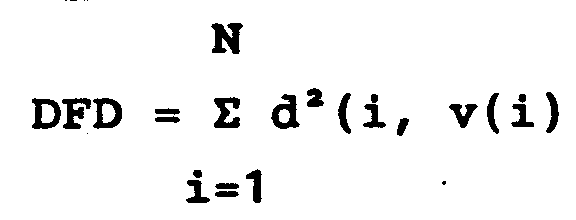
mit
- N =
- Anzahl der Bildelemente eines Blocks,
- i =
- das i-te Bildelement und
- v(i) =
- der Verschiebungsvektor des i-ten Bildelementes.
With
- N =
- Number of picture elements of a block,
- i =
- the i-th picture element and
- v (i) =
- the displacement vector of the i-th picture element.
Auf die bei den bekannten Verfahren vorhandenen Fehlermöglichkeiten wurde bereits hingewiesen. Bei dem erfindungsgemäßen Verfahren wird davon ausgegangen, daß benachbarte Bewegungsvektoren häufig zum selben Objekt gehören und daher korreliert sind. Dieses wird sowohl bei der Korrektur der zunächst ermittelten Bewegungsvektoren als auch bei der Codierung des Bewegungsvektorfeldes ausgenutzt. Als Gütekriterium für die Bewegungsvektoren wird dementsprechend nicht mehr die MAD bzw. DFD minimiert, sondern die Wahrscheinlichkeit dafür maximiert, daß der untersuchte Vektor die physikalische Bewegung beschreibt.Attention has already been drawn to the possible errors in the known methods. In the method according to the invention, it is assumed that adjacent motion vectors often belong to the same object and are therefore correlated. This is used both in the correction of the initially determined motion vectors and in the coding of the motion vector field. Accordingly, as a quality criterion for the motion vectors, the MAD or DFD is no longer minimized, but the probability is maximized that the examined vector describes the physical movement.
Um die Wahrscheinlichkeit formelmäßig zu erfassen, werden ein Verschiebungsmodell, welches die Einflüsse der Verschiebung modelliert, und ein Vektorfeldmodell, welches die Wechselwirkung zwischen Vektoren im selben Vektorfeld modelliert, eingeführt. Mit Hilfe der beiden Modelle wird die bedingte Wahrscheinlichkeitsdichte

des Vektorfeldes V bei gegebenen Bildern A und B maximiert. Nach dem Satz von Bayes gilt dann:

womit bei festen Bildern A und B die Forderung (1) äquivalent zu

wird.In order to determine the probability in terms of a formula, a displacement model that models the influences of the displacement and a vector field model that models the interaction between vectors in the same vector field are introduced. With the help of the two models, the conditional probability density
of the vector field V is maximized for given images A and B. According to Bayes' theorem:
with which, for fixed images A and B, the requirement (1) is equivalent to
becomes.
Die Wahrscheinlichkeitsdichte p(A,B|V), daß die Bilder A und B bei gegebenem Verschiebungsvektorfeld V auftreten, wird wie folgt modelliert:
- p(A,B|V) ist nur von den Amplituden des Prädiktionsfehlerbildes abhängig,
- die Amplituden des Prädiktionsfehlerbildes sind frequenzunabhängig mittelwertfrei Gauß-verteilt.
- p (A, B | V) only depends on the amplitudes of the prediction error pattern,
- the amplitudes of the prediction error pattern are Gaussian-independent, independent of frequency.
Damit gilt die in Fig. 4 wiedergegebene Gleichung (4) für aus N Bildpunkten bestehende Bilder, wobei d(i,v(i)) die Amplitude des i-Bildelementes des Restfehlerbildes ist, wenn für diesen Bildpunkt der Verschiebungsvektor v(i) gilt. Die Varianz σ² kann als Summe der Leistung des Kamerarauschens PK und des Rauschens durch nicht perfekte Bewegungskompensierbarkeit der Sequenz angesehen werden und kann dann mit einem auf PK begrenzten Schätzer entsprechend Gleichung (5) gemäß Fig. 4 geschätzt werden. Damit ergibt sich für kleine Rauschleistungen PK Gleichung (6).The equation (4) shown in FIG. 4 thus applies to images consisting of N pixels, where d (i, v (i)) is the amplitude of the i-pixel of the residual error image if the displacement vector v (i) applies to this pixel . The variance σ² can be seen as the sum of the power of the camera noise P K and the noise due to imperfect movement compensation of the sequence and can then be used with an estimator limited to P K Equation (5) can be estimated according to FIG. 4. This results in equation (6) for small noise powers P K.
Gleichung (6) besagt, daß die Wahrscheinlichkeitsdichte dafür, daß A, B durch V ineinander übergehen, durch Minimierung der DFD maximiert werden kann. Der Umkehrschluß, daß bei gegebenen A, B das wahrscheinlichste Vektorfeld V ebenfalls durch Minimierung der DFD gefunden werden kann, ist jedoch nicht ohne weiteres zulässig.Equation (6) states that the probability density for A, B to merge through V can be maximized by minimizing the DFD. However, the reverse conclusion that given A, B the most probable vector field V can also be found by minimizing the DFD is not readily permissible.
Für das Bewegungsvektorfeld werden zwei verschiedene Modelle verwendet, die beide in das Matchkriterium einfließen. Zunächst wird die aus der Wechselwirkungstheorie stammende und in der Bildsegmentierung bereits erfolgreich eingesetzte Gibbs-Verteilung verwendet. Da ein Verschiebungsvektorfeld als aus verschiedenen quasistationären Verschiebungsfeldregionen zusammengesetzt aufgefaßt werden kann, ist ein in der segmentierung erprobtes Modell anwendbar. Nach H. Derin und W. S. Cohle: "Segmentation of textured images using Gibbs random fields", Computer Vision, Graphics and Image Processing 35, pp. 72-98, 1986 wird die Gibbs-Verteilung durch Gleichung (7) beschrieben, wobei M die Anzahl der Cliquen und Ci das i-te Cliquen-Potential bezeichnet. Wählt man ein Achternachbarschaftssystem, so können die Potentiale der Zweier-Cliquen mit den Vektoren v₁ und v₂ zu

für horizontale/vertikale Nachbarn und zu

für diagonale Nachbarn mit einem reellen positiven Parameter c in Anlehnung an die Wechselwirkungstheorie beschrieben werden. Alle anderen Cliquen erhalten ein konstantes Potential, welches zur Maximierung der Wahrscheinlichkeitsdichte gemäß Gleichung (3) nicht von Interesse ist. Durch die so bestimmte Gibbs-Verteilung werden glatte Vektorfelder bevorzugt, ohne Bewegungskanten zu verschleifen.Two different models are used for the motion vector field, both of which are included in the match criterion. First, the Gibbs distribution originating from the interaction theory and already successfully used in image segmentation is used. Since a displacement vector field can be understood as being composed of different quasi-stationary displacement field regions, a model that has been tried and tested in segmentation can be used. According to H. Derin and WS Cohle: "Segmentation of textured images using Gibbs random fields", Computer Vision, Graphics and Image Processing 35, pp. 72-98, 1986 the Gibbs distribution is described by equation (7), where M denotes the number of cliques and C i the i th clique potential. If you choose a neighborhood neighborhood system, the potentials of the clique of two with the vectors v₁ and v₂ can
for horizontal / vertical neighbors and too
for diagonal neighbors with a real positive parameter c based on the interaction theory. All other cliques get a constant Potential which is of no interest for maximizing the probability density according to equation (3). Due to the Gibbs distribution determined in this way, smooth vector fields are preferred without smoothing motion edges.
Als zweites Vektorfeldmodell wird die Codelänge L eines Entrophie-Codes

herangezogen. Auf diesem Wege ergibt sich eine Gibbs-Verteilung, wie sie oben vorausgesetzt wurde. Der Vergleich von Gleichung (10) mit Gleichung (7) läßt den Schluß zu, die Gibbs-Cliquen-Potentiale durch die Codelänge L zu modellieren. Entsprechend der Vektorfeldcodierung getrennt nach Kontur und Prädiktionsfehler, lassen sich die Kosten eines einzelnen Bewegungsvektors aus seiner Nachbarschaft lokal approximieren.The code length L of an entrophy code is used as the second vector field model
used. In this way, a Gibbs distribution results, as was assumed above. The comparison of equation (10) with equation (7) leads to the conclusion that the Gibbs clique potentials are modeled by the code length L. According to the vector field coding, separated according to contour and prediction error, the costs of an individual motion vector can be approximated locally from its neighborhood.
Dabei werden die Konturkosten durch den Ausdruck (11) gemäß Fig. 4 approximiert, wobei k ein konstanter Faktor ist. vi bezeichnet die acht nächsten Nachbarvektoren des betrachteten Vektors v und bin(v, vi) erhält den Wert 0, falls v und vi gleichermaßen Nullvektoren bzw. keine Nullvektoren sind und den Wert 1, falls nur genau einer der beiden Vektoren ein Nullvektor ist, also falls zwischen beiden Vektoren eine Kontur verläuft. gi bezeichnet ein Gewicht, welches fur Vierernachbarn von v zu 1 und für diagonale Nachbarn zu 1/2½ gesetzt wird.The contour costs are approximated by the expression (11) according to FIG. 4, where k is a constant factor. v i denotes the eight next neighboring vectors of the vector v in question and bin (v, v i ) receives the value 0 if v and v i are equally zero vectors or not zero vectors and the
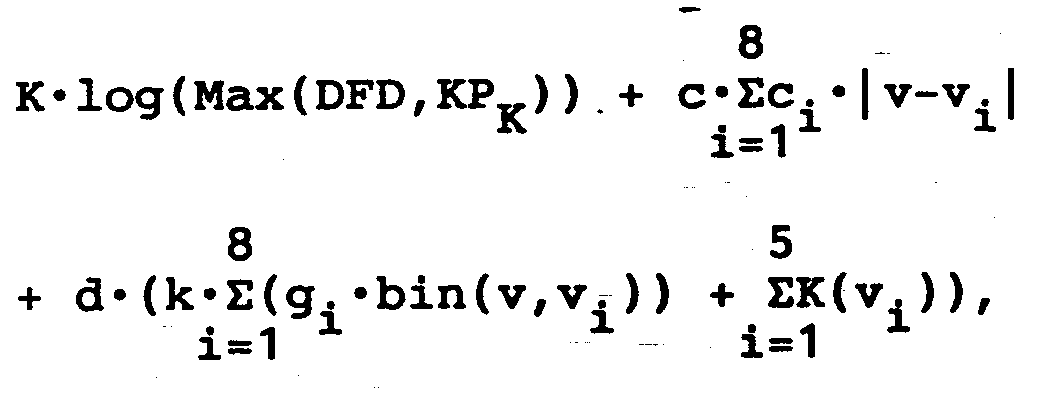
Durch einen einzelnen Bewegungsvektor werden bis zu fünf Prädiktionsfehlervektoren geändert. Die Prädiktionskosten eines Vektors sind demnach die Summe der Kosten K(vi) (Codelänge in Bit) dieser fünf Vektoren gemäß Gleichung (12). Die Gesamtkosten ergeben sich damit zu

in der Einheit [Bit].A single motion vector changes up to five prediction error vectors. The prediction costs of a vector are therefore the sum of the costs K (v i ) (code length in bits) of these five vectors according to equation (12). The total costs thus result
in the unit [bit].
Das resultierende Vektorgütekriterium ergibt sich nach Einsetzen der Ausdrücke (6), (7) und (13) in (3) und Umformen als zu Gleichung (1) äquivalente Forderung (14), wobei k, a und b positive Konstanten bezeichnen und die mit b gewichtete Summe über alle Vektoren des Vektorfeldes läuft.The resulting vector quality criterion results from inserting the expressions (6), (7) and (13) in (3) and transforming them as a requirement (14) equivalent to equation (1), where k, a and b denote positive constants and those with b weighted sum runs over all vectors of the vector field.
Die resultierende Bewegungsschätzerstruktur ist in Fig. 1 skizziert. Zunächst wird durch eine schnelle Suche, beispielsweise ein Dreischrittverfahren, eine grobe Schätzung des Vektorfeldes erstellt. Da das Vektorfeld nur eine begrenzte Anzahl von Vektoren, beispielsweise 22 x 18 Vektoren, enthält, ist eine blockweise Minimierung vorteilhaft. Damit vereinfacht sich die Forderung (14) für einen Block mit K Bildelementen zu Forderung (15). Mit ci = konst. für vi ist Vierernachbar von v und ci = konst./2½ für diagonale Nachbarn von v. c und d sind Konstanten.The resulting motion estimator structure is outlined in FIG. 1. First of all, a quick search, for example a three-step process, creates a rough estimate of the vector field. Since the vector field contains only a limited number of vectors, for example 22 x 18 vectors, minimization in blocks is advantageous. This simplifies requirement (14) for a block with K picture elements to requirement (15). With c i = const. For v i is four-neighbors of v and c i = const ./2 ½ for diagonal neighbors of v. c and d are constants.
Um den Rechenaufwand gering zu halten, wird die Forderung (15) bei dem Ausführungsbeispiel nicht für alle möglichen Vektoren, sondern nur jeweils für folgende 18 "Vektorkandidaten" getestet:
- den geschätzten Vektor des letzten Suchdurchgangs,
- die vier davon nur um ½ Bildelement abweichenden Vektoren,
- die Vektoren der acht benachbarten Blöcke,
- die vier Vektoren, die nachfolgender Prädiktor zur Codierung der Vektoren prädizieren würde, wenn er in einer der vier Bildecken beginnen würde,
- den Mittelwert der Vektoren der acht benachbarten Blöcke, wobei die Vektoren der diagonal
benachbarten Blöcke mit 1/2½ bewertet werden.
- the estimated vector of the last search,
- the four vectors deviating only by ½ picture element,
- the vectors of the eight neighboring blocks,
- the four vectors that the subsequent predictor for coding the vectors would predict if it started in one of the four image corners,
- the mean of the vectors of the eight adjacent blocks, the vectors of the diagonally adjacent blocks with 1/2 ½ can be rated.
Die vier vom geschätzten Vektor des letzten Suchdurchgangs nur um ½ Bildelement abweichenden Vektoren setzen eine Schätzung mit Sub-Bildelement-Auflösung voraus, d. h. zwischen je zwei Bildelementen des zeitlich früheren Bildes wird zunächst ein weiteres Bildelement interpoliert (horizontal und vertikal), so daß das Bild mit vier-facher Anzahl von Bildelementen vorliegt. Danach ist es möglich, den betrachteten Block um halbe Bildelemente (genauer: den halben Abstand zweier Bildelemente der ursprünglichen Auflösung) zu verschieben.The four vectors differing from the estimated vector of the last search by only ½ pixel require an estimate with sub-pixel resolution, i.e. H. Between every two picture elements of the earlier picture, another picture element is first interpolated (horizontally and vertically), so that the picture is present with four times the number of picture elements. Then it is possible to shift the block under consideration by half picture elements (more precisely: half the distance between two picture elements of the original resolution).
Ist beispielsweise der Vektor des letzten Suchdurchgangs v = (1.0, 2.5), betragen die davon um ½ Bildelement abweichenden Vektoren (0.5, 2.5), (1.5, 2.5), (1.0, 2.0) und (1.0, 3.0).For example, if the vector of the last search is v = (1.0, 2.5), the vectors deviating by ½ picture element are (0.5, 2.5), (1.5, 2.5), (1.0, 2.0) and (1.0, 3.0).
Die vier Vektoren, die der nachfolgende Prädiktor prädizieren würde, wenn er in einer der vier Bildecken beginnen würde, werden am folgenden Beispiel erläutert: Die Vektoren eines 3 x 3 vektorblocks seien zeilenweise mit a, b ... i bezeichnet, wobei e den mittleren Vektor, der prädiziert werden soll, darstellt. Dann wird ein in der oberen linken Bildecke beginnender Prädiktor e zu 

Die 18 Vektorkandidaten stellen eine günstige Auswahl dar, die als Kompromiß zwischen erforderlicher Rechenleistung und Qualität des Vektorfeldes anzusehen ist. Das Hinzufügen weiterer Kandidaten würde den Rechenaufwand aber auch die Qualität des Vektorfeldes erhöhen. Das Wegnehmen einzelner Kandidaten würde entsprechend den Rechenaufwand und die Qualität des Vektorfeldes vermindern. Je nach Voraussetzungen im einzelnen kann der Fachmann jedoch mehr oder weniger Vektorkandidaten vorsehen.The 18 vector candidates represent an inexpensive selection that can be seen as a compromise between the required computing power and the quality of the vector field. Adding more candidates would increase the computational effort but also the quality of the vector field. Removing individual candidates would correspondingly reduce the computational effort and the quality of the vector field. Depending on However, the person skilled in the art can provide more or fewer vector candidates.
Je nach Voraussetzungen im einzelnen kann in drei bis vier Durchgängen eine wesentliche Verbesserung des Vektorfeldes durchgeführt werden. Da die Forderung (15) eine schlechte Konvergenz für große d aufweist, wird die Iteration mit kleinem d begonnen und mit wachsendem d fortgesetzt. In einem oder mehreren Durchgängen können c oder k zu Null gesetzt werden.Depending on the individual requirements, the vector field can be significantly improved in three to four rounds. Since requirement (15) shows poor convergence for large d, the iteration is started with small d and continued with increasing d. In one or more runs, c or k can be set to zero.
Bei verschiedenen bekannten datenreduzierenden Codern werden Parameter der Codierung in Abhängigkeit des jeweils anfallenden Datenflusses gesteuert. Eine derartige Steuerung kann bei dem erfindungsgemäßen Verfahren die Konstante d beeinflussen und damit die Datenflußaufteilung zwischen Bewegungsschätzung und Up-date steuern.In various known data-reducing coders, parameters of the coding are controlled as a function of the data flow that occurs in each case. In the method according to the invention, such a control can influence the constant d and thus control the data flow division between motion estimation and update.
Fig. 5 zeigt ein Flußdiagramm zur Darstellung der Optimierung gemäß Funktionsblock 2 (Fig. 1). Zunächst wird bei 11 ein Zähler j = 1 für die Anzahl der Durchläufe gesetzt. Im Programmteil 12 wird ein erster Block mit den Koordinaten x, y definiert. Ferner werden die Konstanten c und d auf die für den ersten Durchlauf vorgegebenen Werte gesetzt. Daraufhin wird bei 13 ein Zähler für die jeweils für einen Vektor in die Gleichung (15) einzusetzenden Kandidaten auf 1 und QMin auf den größten möglichen Wert ("unendlich") gesetzt.FIG. 5 shows a flow diagram to illustrate the optimization according to function block 2 (FIG. 1). First, a counter j = 1 is set at 11 for the number of runs. In
Im Programmteil 14 wird der nächste Vektorkandidat bzw. beim ersten Durchlauf der erste Vektorkandidat ermittelt. In den Programmteilen 15 und 16 wird durch Anwendung von Gleichung (15) der Wert Q berechnet. Danach verzweigt sich das Programm bei 17 in Abhängigkeit davon, ob Q kleiner als QMin ist. Ist dieses der Fall, wird QMin = Q und VOPT = V gesetzt. Letzteres bedeutet, daß derjenige Vektorkandidat, mit welchem soeben Q berechnet wurde, bis auf weiteres als optimaler Vektor angesehen wird.The next vector candidate or the first vector candidate is determined in
Danach verzweigt sich bei 19 das Programm in Abhängigkeit davon, ob z noch kleiner als 18 ist, nämlich der Anzahl der Vektorkandidaten. Ist z noch kleiner als 18, so wird z bei 20 inkrementiert und die Berechnung von Q mit dem folgenden Vektorkandidaten durchgeführt. Je nachdem, ob Q noch kleiner als QMin ist, werden QMin und VOPT durch neue Werte ersetzt oder nicht.The program then branches at 19 depending on whether z is still less than 18, namely the number of vector candidates. If z is still less than 18, z is incremented at 20 and the calculation of Q is carried out with the following vector candidate. Depending on whether Q is still less than Q Min , Q Min and V OPT are replaced by new values or not.
Ist schließlich Q für alle Vektorkandidaten berechnet worden, so wird in einer weiteren Verzweigung 21 festgestellt, ob bereits alle Blöcke verarbeitet sind. Ist dieses nicht der Fall, wird bei 22 der nächste Block festgestellt (durch eine entsprechende Inkrementierung von x bzw. y) und das Programm für den neuen Block durchlaufen. Sind jedoch nach der Verzweigung 21 alle Blöcke bearbeitet, wird bei 23 gefragt, ob j ≧ jMax ist. Ist dieses nicht der Fall, wird j bei 24 inkrementiert, so daß, beginnend mit dem ersten Block, ein neuer Durchlauf der Optimierung erfolgt. Ist bei der Verzweigung 23 die vorgesehene Anzahl jMax von Durchläufen erreicht, wird das Programm bei 25 mit der Kontur/Inhaltcodierung fortgesetzt.Finally, if Q has been calculated for all vector candidates, a
Claims (12)
Applications Claiming Priority (2)
| Application Number | Priority Date | Filing Date | Title |
|---|---|---|---|
| DE4030703A DE4030703A1 (en) | 1990-09-28 | 1990-09-28 | METHOD FOR ESTIMATING MOTION IN A TAKEN IMAGE |
| DE4030703 | 1990-09-28 |
Publications (3)
| Publication Number | Publication Date |
|---|---|
| EP0477616A2 true EP0477616A2 (en) | 1992-04-01 |
| EP0477616A3 EP0477616A3 (en) | 1993-02-24 |
| EP0477616B1 EP0477616B1 (en) | 1997-04-23 |
Family
ID=6415168
Family Applications (1)
| Application Number | Title | Priority Date | Filing Date |
|---|---|---|---|
| EP91114982A Expired - Lifetime EP0477616B1 (en) | 1990-09-28 | 1991-09-05 | Method for estimation of motion in a captured image |
Country Status (4)
| Country | Link |
|---|---|
| EP (1) | EP0477616B1 (en) |
| JP (1) | JP3390024B2 (en) |
| AT (1) | ATE152312T1 (en) |
| DE (2) | DE4030703A1 (en) |
Cited By (5)
| Publication number | Priority date | Publication date | Assignee | Title |
|---|---|---|---|---|
| EP0615386A3 (en) * | 1993-03-12 | 1995-02-22 | Thomson Consumer Electronics | A motion vector processor for compressing video signal. |
| US8064644B2 (en) | 2005-01-06 | 2011-11-22 | Google Inc. | Method for estimating motion and occlusion |
| US10397600B1 (en) | 2016-01-29 | 2019-08-27 | Google Llc | Dynamic reference motion vector coding mode |
| US10462457B2 (en) | 2016-01-29 | 2019-10-29 | Google Llc | Dynamic reference motion vector coding mode |
| US10554965B2 (en) | 2014-08-18 | 2020-02-04 | Google Llc | Motion-compensated partitioning |
Families Citing this family (5)
| Publication number | Priority date | Publication date | Assignee | Title |
|---|---|---|---|---|
| JPH0923425A (en) * | 1995-07-04 | 1997-01-21 | Sony Corp | Picture compression device for picture stamp |
| JP2007288810A (en) * | 2007-07-03 | 2007-11-01 | Nippon Telegr & Teleph Corp <Ntt> | Image encoding method, image decoding method, image encoding device, image decoding device, image encoding program, image decoding program, and computer-readable recording medium |
| WO2019124191A1 (en) | 2017-12-18 | 2019-06-27 | パナソニック インテレクチュアル プロパティ コーポレーション オブ アメリカ | Encoding device, decoding device, encoding method, and decoding method |
| WO2019124193A1 (en) * | 2017-12-18 | 2019-06-27 | パナソニック インテレクチュアル プロパティ コーポレーション オブ アメリカ | Encoding device, decoding device, encoding method, and decoding method |
| JP7782038B2 (en) * | 2022-06-13 | 2025-12-08 | 株式会社ソニー・インタラクティブエンタテインメント | Information processing device, system, information processing method, information processing program, and computer system |
Family Cites Families (1)
| Publication number | Priority date | Publication date | Assignee | Title |
|---|---|---|---|---|
| GB2231751B (en) * | 1989-04-27 | 1993-09-22 | Sony Corp | Motion dependent video signal processing |
-
1990
- 1990-09-28 DE DE4030703A patent/DE4030703A1/en not_active Withdrawn
-
1991
- 1991-09-05 AT AT91114982T patent/ATE152312T1/en not_active IP Right Cessation
- 1991-09-05 DE DE59108675T patent/DE59108675D1/en not_active Expired - Lifetime
- 1991-09-05 EP EP91114982A patent/EP0477616B1/en not_active Expired - Lifetime
- 1991-09-26 JP JP24724091A patent/JP3390024B2/en not_active Expired - Lifetime
Cited By (9)
| Publication number | Priority date | Publication date | Assignee | Title |
|---|---|---|---|---|
| EP0615386A3 (en) * | 1993-03-12 | 1995-02-22 | Thomson Consumer Electronics | A motion vector processor for compressing video signal. |
| US5508744A (en) * | 1993-03-12 | 1996-04-16 | Thomson Consumer Electronics, Inc. | Video signal compression with removal of non-correlated motion vectors |
| CN1054248C (en) * | 1993-03-12 | 2000-07-05 | 汤姆森消费电子有限公司 | A motion vector processor for compressing video signal |
| US8064644B2 (en) | 2005-01-06 | 2011-11-22 | Google Inc. | Method for estimating motion and occlusion |
| US8229174B2 (en) | 2005-01-06 | 2012-07-24 | Google Inc. | Technique for estimating motion and occlusion |
| US10554965B2 (en) | 2014-08-18 | 2020-02-04 | Google Llc | Motion-compensated partitioning |
| US10397600B1 (en) | 2016-01-29 | 2019-08-27 | Google Llc | Dynamic reference motion vector coding mode |
| US10462457B2 (en) | 2016-01-29 | 2019-10-29 | Google Llc | Dynamic reference motion vector coding mode |
| US10484707B1 (en) | 2016-01-29 | 2019-11-19 | Google Llc | Dynamic reference motion vector coding mode |
Also Published As
| Publication number | Publication date |
|---|---|
| ATE152312T1 (en) | 1997-05-15 |
| JPH04248789A (en) | 1992-09-04 |
| DE59108675D1 (en) | 1997-05-28 |
| DE4030703A1 (en) | 1992-04-02 |
| JP3390024B2 (en) | 2003-03-24 |
| EP0477616B1 (en) | 1997-04-23 |
| EP0477616A3 (en) | 1993-02-24 |
Similar Documents
| Publication | Publication Date | Title |
|---|---|---|
| DE69413148T2 (en) | Method for determining motion vectors in small picture segments in television pictures | |
| EP0368139B1 (en) | Method for coding residual error pictures | |
| EP0259562B1 (en) | Method for interframe prediction coding with movement compensation | |
| DE69022461T2 (en) | Image motion vector detector. | |
| EP0293644B1 (en) | Method for determining movement vector fields from digital image sequences | |
| DE69416717T2 (en) | Moving picture encoders and decoders | |
| DE3587448T2 (en) | Device for an effective coding of television signals. | |
| DE69324735T2 (en) | METHOD AND DEVICE FOR ESTIMATING MOTION | |
| DE69524235T2 (en) | METHOD AND DEVICE FOR GLOBAL-TO-LOCAL BLOCK MOVEMENT ESTIMATION | |
| DE3222648C2 (en) | Adaptive inter-frame predictor for television signals | |
| EP0309669B1 (en) | Method for scenery model aided image data reduction for digital television signals | |
| DE69031055T2 (en) | Motion-dependent video signal processing | |
| DE69534399T2 (en) | Method and device for determining feature points | |
| DE69427801T2 (en) | Method and device for determining motion vector fields by suppressing local deviations | |
| DE3885695T2 (en) | Motion estimation. | |
| EP0645037A1 (en) | Process for detecting changes in moving images | |
| DE19618984B4 (en) | Method for motion evaluation in image data and apparatus for carrying out this method | |
| DE19737805A1 (en) | Method and device for coding a motion vector | |
| DE68921949T2 (en) | System for coding an image signal. | |
| EP2067359A2 (en) | Method for the compression of data in a video sequence | |
| EP0477616B1 (en) | Method for estimation of motion in a captured image | |
| DE69231187T2 (en) | METHOD FOR ESTIMATING AND HIERARCHICALLY CODING MOTION IN IMAGE SEQUENCES | |
| DE69031322T2 (en) | Motion-dependent video signal processing | |
| DE69821298T2 (en) | Method and device for detecting motion vectors and device for image coding | |
| DE69130302T2 (en) | Method and device for processing scalar data |
Legal Events
| Date | Code | Title | Description |
|---|---|---|---|
| PUAI | Public reference made under article 153(3) epc to a published international application that has entered the european phase |
Free format text: ORIGINAL CODE: 0009012 |
|
| AK | Designated contracting states |
Kind code of ref document: A2 Designated state(s): AT DE FR GB IT SE |
|
| PUAL | Search report despatched |
Free format text: ORIGINAL CODE: 0009013 |
|
| AK | Designated contracting states |
Kind code of ref document: A3 Designated state(s): AT DE FR GB IT SE |
|
| 17P | Request for examination filed |
Effective date: 19930729 |
|
| 17Q | First examination report despatched |
Effective date: 19950724 |
|
| GRAG | Despatch of communication of intention to grant |
Free format text: ORIGINAL CODE: EPIDOS AGRA |
|
| GRAH | Despatch of communication of intention to grant a patent |
Free format text: ORIGINAL CODE: EPIDOS IGRA |
|
| GRAH | Despatch of communication of intention to grant a patent |
Free format text: ORIGINAL CODE: EPIDOS IGRA |
|
| GRAA | (expected) grant |
Free format text: ORIGINAL CODE: 0009210 |
|
| AK | Designated contracting states |
Kind code of ref document: B1 Designated state(s): AT DE FR GB IT SE |
|
| REF | Corresponds to: |
Ref document number: 152312 Country of ref document: AT Date of ref document: 19970515 Kind code of ref document: T |
|
| REF | Corresponds to: |
Ref document number: 59108675 Country of ref document: DE Date of ref document: 19970528 |
|
| ET | Fr: translation filed | ||
| GBT | Gb: translation of ep patent filed (gb section 77(6)(a)/1977) |
Effective date: 19970627 |
|
| PLBE | No opposition filed within time limit |
Free format text: ORIGINAL CODE: 0009261 |
|
| STAA | Information on the status of an ep patent application or granted ep patent |
Free format text: STATUS: NO OPPOSITION FILED WITHIN TIME LIMIT |
|
| 26N | No opposition filed | ||
| REG | Reference to a national code |
Ref country code: GB Ref legal event code: IF02 |
|
| PGFP | Annual fee paid to national office [announced via postgrant information from national office to epo] |
Ref country code: FR Payment date: 20100930 Year of fee payment: 20 Ref country code: IT Payment date: 20100925 Year of fee payment: 20 Ref country code: SE Payment date: 20100921 Year of fee payment: 20 Ref country code: AT Payment date: 20100920 Year of fee payment: 20 |
|
| PGFP | Annual fee paid to national office [announced via postgrant information from national office to epo] |
Ref country code: GB Payment date: 20100924 Year of fee payment: 20 |
|
| PGFP | Annual fee paid to national office [announced via postgrant information from national office to epo] |
Ref country code: DE Payment date: 20101126 Year of fee payment: 20 |
|
| REG | Reference to a national code |
Ref country code: DE Ref legal event code: R071 Ref document number: 59108675 Country of ref document: DE |
|
| REG | Reference to a national code |
Ref country code: DE Ref legal event code: R071 Ref document number: 59108675 Country of ref document: DE |
|
| REG | Reference to a national code |
Ref country code: GB Ref legal event code: PE20 Expiry date: 20110904 |
|
| REG | Reference to a national code |
Ref country code: SE Ref legal event code: EUG |
|
| PG25 | Lapsed in a contracting state [announced via postgrant information from national office to epo] |
Ref country code: GB Free format text: LAPSE BECAUSE OF EXPIRATION OF PROTECTION Effective date: 20110904 |
|
| PG25 | Lapsed in a contracting state [announced via postgrant information from national office to epo] |
Ref country code: DE Free format text: LAPSE BECAUSE OF EXPIRATION OF PROTECTION Effective date: 20110906 |