EP0470686B1 - (Benzhydryloxyethylpiperidyl)aliphatic acid derivatives and their use in the treatment of allergies and asthma - Google Patents
(Benzhydryloxyethylpiperidyl)aliphatic acid derivatives and their use in the treatment of allergies and asthma Download PDFInfo
- Publication number
- EP0470686B1 EP0470686B1 EP91302141A EP91302141A EP0470686B1 EP 0470686 B1 EP0470686 B1 EP 0470686B1 EP 91302141 A EP91302141 A EP 91302141A EP 91302141 A EP91302141 A EP 91302141A EP 0470686 B1 EP0470686 B1 EP 0470686B1
- Authority
- EP
- European Patent Office
- Prior art keywords
- group
- carbon atoms
- piperidyl
- compound according
- ethyl
- Prior art date
- Legal status (The legal status is an assumption and is not a legal conclusion. Google has not performed a legal analysis and makes no representation as to the accuracy of the status listed.)
- Expired - Lifetime
Links
- 125000001931 aliphatic group Chemical group 0.000 title claims abstract description 15
- -1 Benzhydryloxyethylpiperidyl Chemical group 0.000 title claims description 189
- 238000011282 treatment Methods 0.000 title claims description 8
- 239000002253 acid Substances 0.000 title description 17
- 206010020751 Hypersensitivity Diseases 0.000 title description 4
- 230000007815 allergy Effects 0.000 title description 4
- 208000006673 asthma Diseases 0.000 title description 4
- 150000001875 compounds Chemical class 0.000 claims abstract description 168
- 125000004432 carbon atom Chemical group C* 0.000 claims abstract description 81
- 125000000217 alkyl group Chemical group 0.000 claims abstract description 36
- 150000002148 esters Chemical class 0.000 claims abstract description 31
- 238000000034 method Methods 0.000 claims abstract description 26
- 125000003545 alkoxy group Chemical group 0.000 claims abstract description 25
- 150000003839 salts Chemical class 0.000 claims abstract description 24
- 230000001387 anti-histamine Effects 0.000 claims abstract description 9
- 125000003178 carboxy group Chemical group [H]OC(*)=O 0.000 claims abstract description 9
- 125000002023 trifluoromethyl group Chemical group FC(F)(F)* 0.000 claims abstract description 9
- 239000000739 antihistaminic agent Substances 0.000 claims abstract description 8
- 125000000449 nitro group Chemical group [O-][N+](*)=O 0.000 claims abstract description 8
- 125000003386 piperidinyl group Chemical group 0.000 claims abstract description 8
- GUGOEEXESWIERI-UHFFFAOYSA-N Terfenadine Chemical compound C1=CC(C(C)(C)C)=CC=C1C(O)CCCN1CCC(C(O)(C=2C=CC=CC=2)C=2C=CC=CC=2)CC1 GUGOEEXESWIERI-UHFFFAOYSA-N 0.000 claims abstract description 6
- 239000000203 mixture Substances 0.000 claims description 54
- 125000001309 chloro group Chemical group Cl* 0.000 claims description 27
- 125000005843 halogen group Chemical group 0.000 claims description 24
- 125000002947 alkylene group Chemical group 0.000 claims description 16
- 125000004185 ester group Chemical group 0.000 claims description 14
- 125000004435 hydrogen atom Chemical group [H]* 0.000 claims description 14
- NTYJJOPFIAHURM-UHFFFAOYSA-N Histamine Chemical compound NCCC1=CN=CN1 NTYJJOPFIAHURM-UHFFFAOYSA-N 0.000 claims description 12
- 239000011203 carbon fibre reinforced carbon Substances 0.000 claims description 10
- 229910052731 fluorine Inorganic materials 0.000 claims description 10
- 125000004450 alkenylene group Chemical group 0.000 claims description 9
- 229910052801 chlorine Inorganic materials 0.000 claims description 9
- 229920006395 saturated elastomer Polymers 0.000 claims description 9
- 125000002252 acyl group Chemical group 0.000 claims description 8
- PXGOKWXKJXAPGV-UHFFFAOYSA-N Fluorine Chemical compound FF PXGOKWXKJXAPGV-UHFFFAOYSA-N 0.000 claims description 7
- 239000011737 fluorine Substances 0.000 claims description 7
- 125000005907 alkyl ester group Chemical group 0.000 claims description 6
- 229960001340 histamine Drugs 0.000 claims description 6
- 238000011321 prophylaxis Methods 0.000 claims description 6
- 125000001424 substituent group Chemical group 0.000 claims description 6
- 125000003118 aryl group Chemical group 0.000 claims description 5
- WAZIKHZZPODGEM-UHFFFAOYSA-N ethyl 3-[1-[2-[bis(4-fluorophenyl)methoxy]ethyl]piperidin-4-yl]prop-2-enoate Chemical compound C1CC(C=CC(=O)OCC)CCN1CCOC(C=1C=CC(F)=CC=1)C1=CC=C(F)C=C1 WAZIKHZZPODGEM-UHFFFAOYSA-N 0.000 claims description 5
- VOVDXXVIECKLMS-UHFFFAOYSA-N ethyl 4-[1-[2-[bis(4-fluorophenyl)methoxy]ethyl]piperidin-4-yl]butanoate Chemical compound C1CC(CCCC(=O)OCC)CCN1CCOC(C=1C=CC(F)=CC=1)C1=CC=C(F)C=C1 VOVDXXVIECKLMS-UHFFFAOYSA-N 0.000 claims description 5
- 125000001153 fluoro group Chemical group F* 0.000 claims description 5
- 238000001727 in vivo Methods 0.000 claims description 5
- 125000005678 ethenylene group Chemical group [H]C([*:1])=C([H])[*:2] 0.000 claims description 4
- 238000004519 manufacturing process Methods 0.000 claims description 4
- 125000001443 terpenyl group Chemical group 0.000 claims description 4
- 241000124008 Mammalia Species 0.000 claims description 3
- 125000003710 aryl alkyl group Chemical group 0.000 claims description 3
- YUXYQELLODGKAZ-UHFFFAOYSA-N butyl 4-[1-[2-[bis(4-fluorophenyl)methoxy]ethyl]piperidin-4-yl]butanoate Chemical compound C1CC(CCCC(=O)OCCCC)CCN1CCOC(C=1C=CC(F)=CC=1)C1=CC=C(F)C=C1 YUXYQELLODGKAZ-UHFFFAOYSA-N 0.000 claims description 3
- 125000004122 cyclic group Chemical group 0.000 claims description 3
- 239000003814 drug Substances 0.000 claims description 3
- FARBYYXXSFJOQI-UHFFFAOYSA-N ethyl 3-[1-[2-[bis(4-fluorophenyl)methoxy]ethyl]piperidin-4-yl]-2-methylpropanoate Chemical compound C1CC(CC(C)C(=O)OCC)CCN1CCOC(C=1C=CC(F)=CC=1)C1=CC=C(F)C=C1 FARBYYXXSFJOQI-UHFFFAOYSA-N 0.000 claims description 3
- DFPZGAQVLBCAEF-UHFFFAOYSA-N ethyl 6-[1-[2-[bis(4-fluorophenyl)methoxy]ethyl]piperidin-4-yl]-2-methylhexanoate Chemical compound C1CC(CCCCC(C)C(=O)OCC)CCN1CCOC(C=1C=CC(F)=CC=1)C1=CC=C(F)C=C1 DFPZGAQVLBCAEF-UHFFFAOYSA-N 0.000 claims description 3
- PQUBFHOWAICBRK-UHFFFAOYSA-N ethyl 6-[1-[2-[bis(4-fluorophenyl)methoxy]ethyl]piperidin-4-yl]hex-2-enoate Chemical compound C1CC(CCCC=CC(=O)OCC)CCN1CCOC(C=1C=CC(F)=CC=1)C1=CC=C(F)C=C1 PQUBFHOWAICBRK-UHFFFAOYSA-N 0.000 claims description 3
- JKFZGQMRSJYYSP-UHFFFAOYSA-N ethyl 6-[1-[2-[bis(4-fluorophenyl)methoxy]ethyl]piperidin-4-yl]hexanoate Chemical compound C1CC(CCCCCC(=O)OCC)CCN1CCOC(C=1C=CC(F)=CC=1)C1=CC=C(F)C=C1 JKFZGQMRSJYYSP-UHFFFAOYSA-N 0.000 claims description 3
- FDEAJXPXIUFZKT-UHFFFAOYSA-N ethyl 8-[1-[2-[bis(4-fluorophenyl)methoxy]ethyl]piperidin-4-yl]octanoate Chemical compound C1CC(CCCCCCCC(=O)OCC)CCN1CCOC(C=1C=CC(F)=CC=1)C1=CC=C(F)C=C1 FDEAJXPXIUFZKT-UHFFFAOYSA-N 0.000 claims description 3
- 125000005633 phthalidyl group Chemical group 0.000 claims description 3
- 238000002560 therapeutic procedure Methods 0.000 claims description 3
- 125000003837 (C1-C20) alkyl group Chemical group 0.000 claims description 2
- 125000002015 acyclic group Chemical group 0.000 claims description 2
- 125000005041 acyloxyalkyl group Chemical group 0.000 claims description 2
- 125000005042 acyloxymethyl group Chemical group 0.000 claims description 2
- 125000003342 alkenyl group Chemical group 0.000 claims description 2
- 125000005079 alkoxycarbonylmethyl group Chemical group 0.000 claims description 2
- 125000005205 alkoxycarbonyloxyalkyl group Chemical group 0.000 claims description 2
- 125000004849 alkoxymethyl group Chemical group 0.000 claims description 2
- 125000000304 alkynyl group Chemical group 0.000 claims description 2
- CREMABGTGYGIQB-UHFFFAOYSA-N carbon carbon Chemical compound C.C CREMABGTGYGIQB-UHFFFAOYSA-N 0.000 claims description 2
- 125000000753 cycloalkyl group Chemical group 0.000 claims description 2
- 239000003085 diluting agent Substances 0.000 claims description 2
- 239000003937 drug carrier Substances 0.000 claims description 2
- OLRBJRVOQXXZQO-UHFFFAOYSA-N ethyl 4-[1-[2-[(2-fluorophenyl)-(4-fluorophenyl)methoxy]ethyl]piperidin-4-yl]butanoate Chemical compound C1CC(CCCC(=O)OCC)CCN1CCOC(C=1C(=CC=CC=1)F)C1=CC=C(F)C=C1 OLRBJRVOQXXZQO-UHFFFAOYSA-N 0.000 claims description 2
- SGCZXEDZYNHXAH-UHFFFAOYSA-N ethyl 6-[1-[2-[(2-fluorophenyl)-(4-fluorophenyl)methoxy]ethyl]piperidin-4-yl]hexanoate Chemical compound C1CC(CCCCCC(=O)OCC)CCN1CCOC(C=1C(=CC=CC=1)F)C1=CC=C(F)C=C1 SGCZXEDZYNHXAH-UHFFFAOYSA-N 0.000 claims description 2
- 125000003392 indanyl group Chemical group C1(CCC2=CC=CC=C12)* 0.000 claims description 2
- HPCMBJOVAUFKOZ-UHFFFAOYSA-N methyl 3-[1-[2-[bis(4-fluorophenyl)methoxy]ethyl]piperidin-4-yl]-2-methylpropanoate Chemical compound C1CC(CC(C)C(=O)OC)CCN1CCOC(C=1C=CC(F)=CC=1)C1=CC=C(F)C=C1 HPCMBJOVAUFKOZ-UHFFFAOYSA-N 0.000 claims description 2
- USCSUWRNWCTFEP-UHFFFAOYSA-N methyl 3-[1-[2-[bis(4-fluorophenyl)methoxy]ethyl]piperidin-4-yl]prop-2-enoate Chemical compound C1CC(C=CC(=O)OC)CCN1CCOC(C=1C=CC(F)=CC=1)C1=CC=C(F)C=C1 USCSUWRNWCTFEP-UHFFFAOYSA-N 0.000 claims description 2
- JPVAWYUHBDSJOZ-UHFFFAOYSA-N methyl 4-[1-[2-[bis(4-fluorophenyl)methoxy]ethyl]piperidin-4-yl]butanoate Chemical compound C1CC(CCCC(=O)OC)CCN1CCOC(C=1C=CC(F)=CC=1)C1=CC=C(F)C=C1 JPVAWYUHBDSJOZ-UHFFFAOYSA-N 0.000 claims description 2
- OTCQRIAZKNRDBL-UHFFFAOYSA-N methyl 6-[1-[2-[bis(4-fluorophenyl)methoxy]ethyl]piperidin-4-yl]hexanoate Chemical compound C1CC(CCCCCC(=O)OC)CCN1CCOC(C=1C=CC(F)=CC=1)C1=CC=C(F)C=C1 OTCQRIAZKNRDBL-UHFFFAOYSA-N 0.000 claims description 2
- KYBDRDUMAJYZTO-UHFFFAOYSA-N propyl 4-[1-[2-[bis(4-fluorophenyl)methoxy]ethyl]piperidin-4-yl]butanoate Chemical compound C1CC(CCCC(=O)OCCC)CCN1CCOC(C=1C=CC(F)=CC=1)C1=CC=C(F)C=C1 KYBDRDUMAJYZTO-UHFFFAOYSA-N 0.000 claims description 2
- 230000000694 effects Effects 0.000 abstract description 15
- 229940125715 antihistaminic agent Drugs 0.000 abstract description 2
- 229910052736 halogen Inorganic materials 0.000 abstract 1
- 150000002367 halogens Chemical class 0.000 abstract 1
- HEDRZPFGACZZDS-UHFFFAOYSA-N Chloroform Chemical compound ClC(Cl)Cl HEDRZPFGACZZDS-UHFFFAOYSA-N 0.000 description 102
- 238000006243 chemical reaction Methods 0.000 description 53
- 238000000862 absorption spectrum Methods 0.000 description 51
- XEKOWRVHYACXOJ-UHFFFAOYSA-N Ethyl acetate Chemical compound CCOC(C)=O XEKOWRVHYACXOJ-UHFFFAOYSA-N 0.000 description 48
- MUBZPKHOEPUJKR-UHFFFAOYSA-N Oxalic acid Chemical compound OC(=O)C(O)=O MUBZPKHOEPUJKR-UHFFFAOYSA-N 0.000 description 45
- 238000002360 preparation method Methods 0.000 description 45
- LFQSCWFLJHTTHZ-UHFFFAOYSA-N Ethanol Chemical compound CCO LFQSCWFLJHTTHZ-UHFFFAOYSA-N 0.000 description 31
- YMWUJEATGCHHMB-UHFFFAOYSA-N Dichloromethane Chemical compound ClCCl YMWUJEATGCHHMB-UHFFFAOYSA-N 0.000 description 30
- WYURNTSHIVDZCO-UHFFFAOYSA-N Tetrahydrofuran Chemical compound C1CCOC1 WYURNTSHIVDZCO-UHFFFAOYSA-N 0.000 description 30
- 238000002844 melting Methods 0.000 description 29
- 230000008018 melting Effects 0.000 description 29
- 239000000243 solution Substances 0.000 description 26
- OKKJLVBELUTLKV-UHFFFAOYSA-N Methanol Chemical compound OC OKKJLVBELUTLKV-UHFFFAOYSA-N 0.000 description 24
- 239000002904 solvent Substances 0.000 description 22
- VLKZOEOYAKHREP-UHFFFAOYSA-N n-Hexane Chemical compound CCCCCC VLKZOEOYAKHREP-UHFFFAOYSA-N 0.000 description 21
- UHOVQNZJYSORNB-UHFFFAOYSA-N Benzene Chemical compound C1=CC=CC=C1 UHOVQNZJYSORNB-UHFFFAOYSA-N 0.000 description 18
- HEDRZPFGACZZDS-MICDWDOJSA-N Trichloro(2H)methane Chemical compound [2H]C(Cl)(Cl)Cl HEDRZPFGACZZDS-MICDWDOJSA-N 0.000 description 18
- YLQBMQCUIZJEEH-UHFFFAOYSA-N tetrahydrofuran Natural products C=1C=COC=1 YLQBMQCUIZJEEH-UHFFFAOYSA-N 0.000 description 15
- VZCYOOQTPOCHFL-UHFFFAOYSA-N trans-butenedioic acid Natural products OC(=O)C=CC(O)=O VZCYOOQTPOCHFL-UHFFFAOYSA-N 0.000 description 15
- VZCYOOQTPOCHFL-OWOJBTEDSA-N Fumaric acid Chemical compound OC(=O)\C=C\C(O)=O VZCYOOQTPOCHFL-OWOJBTEDSA-N 0.000 description 14
- CDBYLPFSWZWCQE-UHFFFAOYSA-L Sodium Carbonate Chemical compound [Na+].[Na+].[O-]C([O-])=O CDBYLPFSWZWCQE-UHFFFAOYSA-L 0.000 description 12
- HEMHJVSKTPXQMS-UHFFFAOYSA-M Sodium hydroxide Chemical compound [OH-].[Na+] HEMHJVSKTPXQMS-UHFFFAOYSA-M 0.000 description 12
- YXFVVABEGXRONW-UHFFFAOYSA-N Toluene Chemical compound CC1=CC=CC=C1 YXFVVABEGXRONW-UHFFFAOYSA-N 0.000 description 12
- 239000011541 reaction mixture Substances 0.000 description 12
- FVAUCKIRQBBSSJ-UHFFFAOYSA-M sodium iodide Chemical compound [Na+].[I-] FVAUCKIRQBBSSJ-UHFFFAOYSA-M 0.000 description 12
- VEXZGXHMUGYJMC-UHFFFAOYSA-N Hydrochloric acid Chemical compound Cl VEXZGXHMUGYJMC-UHFFFAOYSA-N 0.000 description 11
- 239000003153 chemical reaction reagent Substances 0.000 description 11
- 238000004821 distillation Methods 0.000 description 11
- IJGRMHOSHXDMSA-UHFFFAOYSA-N Atomic nitrogen Chemical compound N#N IJGRMHOSHXDMSA-UHFFFAOYSA-N 0.000 description 10
- 239000002585 base Substances 0.000 description 10
- XLYOFNOQVPJJNP-UHFFFAOYSA-N water Substances O XLYOFNOQVPJJNP-UHFFFAOYSA-N 0.000 description 10
- ZMANZCXQSJIPKH-UHFFFAOYSA-N Triethylamine Chemical compound CCN(CC)CC ZMANZCXQSJIPKH-UHFFFAOYSA-N 0.000 description 9
- 125000004429 atom Chemical group 0.000 description 9
- 238000010828 elution Methods 0.000 description 9
- 239000000284 extract Substances 0.000 description 9
- 238000000655 nuclear magnetic resonance spectrum Methods 0.000 description 9
- 238000010898 silica gel chromatography Methods 0.000 description 9
- 241001465754 Metazoa Species 0.000 description 8
- 239000003921 oil Substances 0.000 description 8
- 239000000126 substance Substances 0.000 description 8
- RTZKZFJDLAIYFH-UHFFFAOYSA-N Diethyl ether Chemical compound CCOCC RTZKZFJDLAIYFH-UHFFFAOYSA-N 0.000 description 7
- 239000013078 crystal Substances 0.000 description 7
- 125000001495 ethyl group Chemical group [H]C([H])([H])C([H])([H])* 0.000 description 7
- 230000002401 inhibitory effect Effects 0.000 description 7
- 125000001997 phenyl group Chemical group [H]C1=C([H])C([H])=C(*)C([H])=C1[H] 0.000 description 7
- 239000000047 product Substances 0.000 description 7
- 239000007858 starting material Substances 0.000 description 7
- ZMXDDKWLCZADIW-UHFFFAOYSA-N N,N-Dimethylformamide Chemical compound CN(C)C=O ZMXDDKWLCZADIW-UHFFFAOYSA-N 0.000 description 6
- 241000700159 Rattus Species 0.000 description 6
- 102100025342 Voltage-dependent N-type calcium channel subunit alpha-1B Human genes 0.000 description 6
- 101710088658 Voltage-dependent N-type calcium channel subunit alpha-1B Proteins 0.000 description 6
- 239000007864 aqueous solution Substances 0.000 description 6
- GDTBXPJZTBHREO-UHFFFAOYSA-N bromine Chemical compound BrBr GDTBXPJZTBHREO-UHFFFAOYSA-N 0.000 description 6
- 150000001732 carboxylic acid derivatives Chemical class 0.000 description 6
- 239000003054 catalyst Substances 0.000 description 6
- 208000037265 diseases, disorders, signs and symptoms Diseases 0.000 description 6
- 208000035475 disorder Diseases 0.000 description 6
- ZCSHNCUQKCANBX-UHFFFAOYSA-N lithium diisopropylamide Chemical compound [Li+].CC(C)[N-]C(C)C ZCSHNCUQKCANBX-UHFFFAOYSA-N 0.000 description 6
- 108010058846 Ovalbumin Proteins 0.000 description 5
- 239000012442 inert solvent Substances 0.000 description 5
- 239000007924 injection Substances 0.000 description 5
- 238000002347 injection Methods 0.000 description 5
- 125000002496 methyl group Chemical group [H]C([H])([H])* 0.000 description 5
- 229910052757 nitrogen Inorganic materials 0.000 description 5
- 231100000989 no adverse effect Toxicity 0.000 description 5
- 229910000029 sodium carbonate Inorganic materials 0.000 description 5
- FFEFFMLVFNFYPA-UHFFFAOYSA-N 1-[2-chloroethoxy-(4-fluorophenyl)methyl]-4-fluorobenzene Chemical compound C1=CC(F)=CC=C1C(OCCCl)C1=CC=C(F)C=C1 FFEFFMLVFNFYPA-UHFFFAOYSA-N 0.000 description 4
- NLXLAEXVIDQMFP-UHFFFAOYSA-N Ammonia chloride Chemical compound [NH4+].[Cl-] NLXLAEXVIDQMFP-UHFFFAOYSA-N 0.000 description 4
- UFHFLCQGNIYNRP-UHFFFAOYSA-N Hydrogen Chemical compound [H][H] UFHFLCQGNIYNRP-UHFFFAOYSA-N 0.000 description 4
- NTIZESTWPVYFNL-UHFFFAOYSA-N Methyl isobutyl ketone Chemical compound CC(C)CC(C)=O NTIZESTWPVYFNL-UHFFFAOYSA-N 0.000 description 4
- UIHCLUNTQKBZGK-UHFFFAOYSA-N Methyl isobutyl ketone Natural products CCC(C)C(C)=O UIHCLUNTQKBZGK-UHFFFAOYSA-N 0.000 description 4
- MZRVEZGGRBJDDB-UHFFFAOYSA-N N-Butyllithium Chemical compound [Li]CCCC MZRVEZGGRBJDDB-UHFFFAOYSA-N 0.000 description 4
- KDLHZDBZIXYQEI-UHFFFAOYSA-N Palladium Chemical compound [Pd] KDLHZDBZIXYQEI-UHFFFAOYSA-N 0.000 description 4
- KEAYESYHFKHZAL-UHFFFAOYSA-N Sodium Chemical compound [Na] KEAYESYHFKHZAL-UHFFFAOYSA-N 0.000 description 4
- 150000001298 alcohols Chemical class 0.000 description 4
- 238000004440 column chromatography Methods 0.000 description 4
- 238000001704 evaporation Methods 0.000 description 4
- 230000008020 evaporation Effects 0.000 description 4
- 238000001914 filtration Methods 0.000 description 4
- 239000001257 hydrogen Substances 0.000 description 4
- 229910052739 hydrogen Inorganic materials 0.000 description 4
- 238000006460 hydrolysis reaction Methods 0.000 description 4
- 239000005457 ice water Substances 0.000 description 4
- 229910052500 inorganic mineral Inorganic materials 0.000 description 4
- 125000001449 isopropyl group Chemical group [H]C([H])([H])C([H])(*)C([H])([H])[H] 0.000 description 4
- 235000010755 mineral Nutrition 0.000 description 4
- 239000011707 mineral Substances 0.000 description 4
- CTSLXHKWHWQRSH-UHFFFAOYSA-N oxalyl chloride Chemical compound ClC(=O)C(Cl)=O CTSLXHKWHWQRSH-UHFFFAOYSA-N 0.000 description 4
- BWHMMNNQKKPAPP-UHFFFAOYSA-L potassium carbonate Chemical compound [K+].[K+].[O-]C([O-])=O BWHMMNNQKKPAPP-UHFFFAOYSA-L 0.000 description 4
- 238000010992 reflux Methods 0.000 description 4
- 239000012312 sodium hydride Substances 0.000 description 4
- 229910000104 sodium hydride Inorganic materials 0.000 description 4
- 235000009518 sodium iodide Nutrition 0.000 description 4
- RYHBNJHYFVUHQT-UHFFFAOYSA-N 1,4-Dioxane Chemical compound C1COCCO1 RYHBNJHYFVUHQT-UHFFFAOYSA-N 0.000 description 3
- ABBCDSFUQJILPM-UHFFFAOYSA-N 1-[2-[bis(4-fluorophenyl)methoxy]ethyl]piperidin-4-one Chemical compound C1=CC(F)=CC=C1C(C=1C=CC(F)=CC=1)OCCN1CCC(=O)CC1 ABBCDSFUQJILPM-UHFFFAOYSA-N 0.000 description 3
- ZWEHNKRNPOVVGH-UHFFFAOYSA-N 2-Butanone Chemical compound CCC(C)=O ZWEHNKRNPOVVGH-UHFFFAOYSA-N 0.000 description 3
- ZCYVEMRRCGMTRW-UHFFFAOYSA-N 7553-56-2 Chemical group [I] ZCYVEMRRCGMTRW-UHFFFAOYSA-N 0.000 description 3
- CSCPPACGZOOCGX-UHFFFAOYSA-N Acetone Chemical compound CC(C)=O CSCPPACGZOOCGX-UHFFFAOYSA-N 0.000 description 3
- 241000700198 Cavia Species 0.000 description 3
- KZBUYRJDOAKODT-UHFFFAOYSA-N Chlorine Chemical compound ClCl KZBUYRJDOAKODT-UHFFFAOYSA-N 0.000 description 3
- WHXSMMKQMYFTQS-UHFFFAOYSA-N Lithium Chemical group [Li] WHXSMMKQMYFTQS-UHFFFAOYSA-N 0.000 description 3
- SJRJJKPEHAURKC-UHFFFAOYSA-N N-Methylmorpholine Chemical compound CN1CCOCC1 SJRJJKPEHAURKC-UHFFFAOYSA-N 0.000 description 3
- KWYUFKZDYYNOTN-UHFFFAOYSA-M Potassium hydroxide Chemical compound [OH-].[K+] KWYUFKZDYYNOTN-UHFFFAOYSA-M 0.000 description 3
- VYPSYNLAJGMNEJ-UHFFFAOYSA-N Silicium dioxide Chemical compound O=[Si]=O VYPSYNLAJGMNEJ-UHFFFAOYSA-N 0.000 description 3
- 229910052783 alkali metal Inorganic materials 0.000 description 3
- 229910000288 alkali metal carbonate Inorganic materials 0.000 description 3
- 150000008041 alkali metal carbonates Chemical class 0.000 description 3
- 235000001014 amino acid Nutrition 0.000 description 3
- 150000001413 amino acids Chemical class 0.000 description 3
- 239000012298 atmosphere Substances 0.000 description 3
- 125000001797 benzyl group Chemical group [H]C1=C([H])C([H])=C(C([H])=C1[H])C([H])([H])* 0.000 description 3
- AZWXAPCAJCYGIA-UHFFFAOYSA-N bis(2-methylpropyl)alumane Chemical compound CC(C)C[AlH]CC(C)C AZWXAPCAJCYGIA-UHFFFAOYSA-N 0.000 description 3
- 229910052794 bromium Inorganic materials 0.000 description 3
- 125000000484 butyl group Chemical group [H]C([*])([H])C([H])([H])C([H])([H])C([H])([H])[H] 0.000 description 3
- 239000000460 chlorine Substances 0.000 description 3
- KRKNYBCHXYNGOX-UHFFFAOYSA-N citric acid Chemical compound OC(=O)CC(O)(C(O)=O)CC(O)=O KRKNYBCHXYNGOX-UHFFFAOYSA-N 0.000 description 3
- SIPUZPBQZHNSDW-UHFFFAOYSA-N diisobutylaluminium hydride Substances CC(C)C[Al]CC(C)C SIPUZPBQZHNSDW-UHFFFAOYSA-N 0.000 description 3
- UAOMVDZJSHZZME-UHFFFAOYSA-N diisopropylamine Chemical compound CC(C)NC(C)C UAOMVDZJSHZZME-UHFFFAOYSA-N 0.000 description 3
- 239000006185 dispersion Substances 0.000 description 3
- 239000003480 eluent Substances 0.000 description 3
- 238000005886 esterification reaction Methods 0.000 description 3
- 150000002170 ethers Chemical class 0.000 description 3
- XGABTHFOTUYVMO-UHFFFAOYSA-N ethyl 4-piperidin-4-ylbutanoate Chemical compound CCOC(=O)CCCC1CCNCC1 XGABTHFOTUYVMO-UHFFFAOYSA-N 0.000 description 3
- 230000007062 hydrolysis Effects 0.000 description 3
- 229910052740 iodine Inorganic materials 0.000 description 3
- 239000002480 mineral oil Substances 0.000 description 3
- 235000010446 mineral oil Nutrition 0.000 description 3
- NLKNQRATVPKPDG-UHFFFAOYSA-M potassium iodide Chemical compound [K+].[I-] NLKNQRATVPKPDG-UHFFFAOYSA-M 0.000 description 3
- 125000001436 propyl group Chemical group [H]C([*])([H])C([H])([H])C([H])([H])[H] 0.000 description 3
- 239000000741 silica gel Substances 0.000 description 3
- 229910002027 silica gel Inorganic materials 0.000 description 3
- CQZYAHYNUUKKRB-UHFFFAOYSA-N 1-[2-[bis(4-fluorophenyl)methoxy]ethyl]-4-(methoxymethylidene)piperidine Chemical compound C1CC(=COC)CCN1CCOC(C=1C=CC(F)=CC=1)C1=CC=C(F)C=C1 CQZYAHYNUUKKRB-UHFFFAOYSA-N 0.000 description 2
- KDJDCMAZQZVXFC-UHFFFAOYSA-N 1-[2-[bis(4-fluorophenyl)methoxy]ethyl]piperidin-4-ol Chemical compound C1CC(O)CCN1CCOC(C=1C=CC(F)=CC=1)C1=CC=C(F)C=C1 KDJDCMAZQZVXFC-UHFFFAOYSA-N 0.000 description 2
- OKOGNMYBCGGRHA-UHFFFAOYSA-N 1-[2-[bis(4-fluorophenyl)methoxy]ethyl]piperidine-4-carbaldehyde Chemical compound C1=CC(F)=CC=C1C(C=1C=CC(F)=CC=1)OCCN1CCC(C=O)CC1 OKOGNMYBCGGRHA-UHFFFAOYSA-N 0.000 description 2
- ZYMVWKUWIYDTKI-UHFFFAOYSA-N 1-[2-[bis(4-fluorophenyl)methoxy]ethyl]piperidine-4-carbonitrile Chemical compound C1=CC(F)=CC=C1C(C=1C=CC(F)=CC=1)OCCN1CCC(C#N)CC1 ZYMVWKUWIYDTKI-UHFFFAOYSA-N 0.000 description 2
- 125000006411 1-propenylene group Chemical group [H]\C(*)=C(\[H])C([H])([H])[H] 0.000 description 2
- GQHTUMJGOHRCHB-UHFFFAOYSA-N 2,3,4,6,7,8,9,10-octahydropyrimido[1,2-a]azepine Chemical compound C1CCCCN2CCCN=C21 GQHTUMJGOHRCHB-UHFFFAOYSA-N 0.000 description 2
- HZAXFHJVJLSVMW-UHFFFAOYSA-N 2-Aminoethan-1-ol Chemical compound NCCO HZAXFHJVJLSVMW-UHFFFAOYSA-N 0.000 description 2
- 125000000094 2-phenylethyl group Chemical group [H]C1=C([H])C([H])=C(C([H])=C1[H])C([H])([H])C([H])([H])* 0.000 description 2
- VHYFNPMBLIVWCW-UHFFFAOYSA-N 4-Dimethylaminopyridine Chemical compound CN(C)C1=CC=NC=C1 VHYFNPMBLIVWCW-UHFFFAOYSA-N 0.000 description 2
- VRJHQPZVIGNGMX-UHFFFAOYSA-N 4-piperidinone Chemical compound O=C1CCNCC1 VRJHQPZVIGNGMX-UHFFFAOYSA-N 0.000 description 2
- ZBPQFMCDOIAVLE-UHFFFAOYSA-N C1CNC(=CC=CC(=O)OCC)CC1CCOC(C=1C=CC(F)=CC=1)C1=CC=C(F)C=C1 Chemical compound C1CNC(=CC=CC(=O)OCC)CC1CCOC(C=1C=CC(F)=CC=1)C1=CC=C(F)C=C1 ZBPQFMCDOIAVLE-UHFFFAOYSA-N 0.000 description 2
- 241001239379 Calophysus macropterus Species 0.000 description 2
- CURLTUGMZLYLDI-UHFFFAOYSA-N Carbon dioxide Chemical compound O=C=O CURLTUGMZLYLDI-UHFFFAOYSA-N 0.000 description 2
- 229940126062 Compound A Drugs 0.000 description 2
- 206010010904 Convulsion Diseases 0.000 description 2
- IAZDPXIOMUYVGZ-UHFFFAOYSA-N Dimethylsulphoxide Chemical compound CS(C)=O IAZDPXIOMUYVGZ-UHFFFAOYSA-N 0.000 description 2
- KRHYYFGTRYWZRS-UHFFFAOYSA-N Fluorane Chemical compound F KRHYYFGTRYWZRS-UHFFFAOYSA-N 0.000 description 2
- NLDMNSXOCDLTTB-UHFFFAOYSA-N Heterophylliin A Natural products O1C2COC(=O)C3=CC(O)=C(O)C(O)=C3C3=C(O)C(O)=C(O)C=C3C(=O)OC2C(OC(=O)C=2C=C(O)C(O)=C(O)C=2)C(O)C1OC(=O)C1=CC(O)=C(O)C(O)=C1 NLDMNSXOCDLTTB-UHFFFAOYSA-N 0.000 description 2
- XEEYBQQBJWHFJM-UHFFFAOYSA-N Iron Chemical compound [Fe] XEEYBQQBJWHFJM-UHFFFAOYSA-N 0.000 description 2
- LRHPLDYGYMQRHN-UHFFFAOYSA-N N-Butanol Chemical compound CCCCO LRHPLDYGYMQRHN-UHFFFAOYSA-N 0.000 description 2
- NBIIXXVUZAFLBC-UHFFFAOYSA-N Phosphoric acid Chemical compound OP(O)(O)=O NBIIXXVUZAFLBC-UHFFFAOYSA-N 0.000 description 2
- JUJWROOIHBZHMG-UHFFFAOYSA-N Pyridine Chemical compound C1=CC=NC=C1 JUJWROOIHBZHMG-UHFFFAOYSA-N 0.000 description 2
- PMZURENOXWZQFD-UHFFFAOYSA-L Sodium Sulfate Chemical compound [Na+].[Na+].[O-]S([O-])(=O)=O PMZURENOXWZQFD-UHFFFAOYSA-L 0.000 description 2
- UIIMBOGNXHQVGW-UHFFFAOYSA-M Sodium bicarbonate Chemical compound [Na+].OC([O-])=O UIIMBOGNXHQVGW-UHFFFAOYSA-M 0.000 description 2
- FAPWRFPIFSIZLT-UHFFFAOYSA-M Sodium chloride Chemical compound [Na+].[Cl-] FAPWRFPIFSIZLT-UHFFFAOYSA-M 0.000 description 2
- 238000010521 absorption reaction Methods 0.000 description 2
- 238000009825 accumulation Methods 0.000 description 2
- 150000001242 acetic acid derivatives Chemical class 0.000 description 2
- 125000000218 acetic acid group Chemical group C(C)(=O)* 0.000 description 2
- 229910000102 alkali metal hydride Inorganic materials 0.000 description 2
- 150000008046 alkali metal hydrides Chemical class 0.000 description 2
- AZDRQVAHHNSJOQ-UHFFFAOYSA-N alumane Chemical group [AlH3] AZDRQVAHHNSJOQ-UHFFFAOYSA-N 0.000 description 2
- 150000001408 amides Chemical class 0.000 description 2
- 235000019270 ammonium chloride Nutrition 0.000 description 2
- 230000003266 anti-allergic effect Effects 0.000 description 2
- 230000001088 anti-asthma Effects 0.000 description 2
- 150000004945 aromatic hydrocarbons Chemical class 0.000 description 2
- 230000004071 biological effect Effects 0.000 description 2
- 230000037396 body weight Effects 0.000 description 2
- 150000001768 cations Chemical class 0.000 description 2
- 230000036461 convulsion Effects 0.000 description 2
- 229960001760 dimethyl sulfoxide Drugs 0.000 description 2
- 230000032050 esterification Effects 0.000 description 2
- HWYGETGOZRCWMD-UHFFFAOYSA-N ethyl 1-[2-[bis(4-fluorophenyl)methoxy]ethyl]piperidine-4-carboxylate Chemical compound C1CC(C(=O)OCC)CCN1CCOC(C=1C=CC(F)=CC=1)C1=CC=C(F)C=C1 HWYGETGOZRCWMD-UHFFFAOYSA-N 0.000 description 2
- 239000000706 filtrate Substances 0.000 description 2
- 239000012530 fluid Substances 0.000 description 2
- 125000000959 isobutyl group Chemical group [H]C([H])([H])C([H])(C([H])([H])[H])C([H])([H])* 0.000 description 2
- 125000004491 isohexyl group Chemical group C(CCC(C)C)* 0.000 description 2
- 150000002576 ketones Chemical class 0.000 description 2
- VZCYOOQTPOCHFL-UPHRSURJSA-N maleic acid Chemical compound OC(=O)\C=C/C(O)=O VZCYOOQTPOCHFL-UPHRSURJSA-N 0.000 description 2
- 229910052751 metal Inorganic materials 0.000 description 2
- 239000002184 metal Substances 0.000 description 2
- VLTRZXGMWDSKGL-UHFFFAOYSA-N perchloric acid Chemical compound OCl(=O)(=O)=O VLTRZXGMWDSKGL-UHFFFAOYSA-N 0.000 description 2
- 239000000825 pharmaceutical preparation Substances 0.000 description 2
- 239000002504 physiological saline solution Substances 0.000 description 2
- 229910000027 potassium carbonate Inorganic materials 0.000 description 2
- 235000011181 potassium carbonates Nutrition 0.000 description 2
- 238000006722 reduction reaction Methods 0.000 description 2
- 239000007921 spray Substances 0.000 description 2
- GETQZCLCWQTVFV-UHFFFAOYSA-N trimethylamine Chemical compound CN(C)C GETQZCLCWQTVFV-UHFFFAOYSA-N 0.000 description 2
- 230000003442 weekly effect Effects 0.000 description 2
- DTGKSKDOIYIVQL-WEDXCCLWSA-N (+)-borneol Chemical group C1C[C@@]2(C)[C@@H](O)C[C@@H]1C2(C)C DTGKSKDOIYIVQL-WEDXCCLWSA-N 0.000 description 1
- LDDMACCNBZAMSG-BDVNFPICSA-N (2r,3r,4s,5r)-3,4,5,6-tetrahydroxy-2-(methylamino)hexanal Chemical compound CN[C@@H](C=O)[C@@H](O)[C@H](O)[C@H](O)CO LDDMACCNBZAMSG-BDVNFPICSA-N 0.000 description 1
- 125000004178 (C1-C4) alkyl group Chemical group 0.000 description 1
- 125000004169 (C1-C6) alkyl group Chemical group 0.000 description 1
- 125000005918 1,2-dimethylbutyl group Chemical group 0.000 description 1
- CHDLEKWEAONXIL-UHFFFAOYSA-N 1-(2-benzhydryloxyethyl)piperidine-4-carbaldehyde Chemical compound C1CC(C=O)CCN1CCOC(C=1C=CC=CC=1)C1=CC=CC=C1 CHDLEKWEAONXIL-UHFFFAOYSA-N 0.000 description 1
- 125000005848 1-(alkoxycarbonyloxy)ethyl group Chemical group 0.000 description 1
- NBEMWQKBYJMDNH-UHFFFAOYSA-N 1-[2-[(4-chlorophenyl)-phenylmethoxy]ethyl]piperidine-4-carbaldehyde Chemical compound C1=CC(Cl)=CC=C1C(C=1C=CC=CC=1)OCCN1CCC(C=O)CC1 NBEMWQKBYJMDNH-UHFFFAOYSA-N 0.000 description 1
- SJZKULRDWHPHGG-UHFFFAOYSA-N 1-benzylpiperidin-4-one Chemical compound C1CC(=O)CCN1CC1=CC=CC=C1 SJZKULRDWHPHGG-UHFFFAOYSA-N 0.000 description 1
- MOACHUYFVYEKBB-UHFFFAOYSA-N 1-chloro-4-[2-chloroethoxy-(4-chlorophenyl)methyl]benzene Chemical compound C=1C=C(Cl)C=CC=1C(OCCCl)C1=CC=C(Cl)C=C1 MOACHUYFVYEKBB-UHFFFAOYSA-N 0.000 description 1
- 125000004343 1-phenylethyl group Chemical group [H]C1=C([H])C([H])=C(C([H])=C1[H])C([H])(*)C([H])([H])[H] 0.000 description 1
- YQTCQNIPQMJNTI-UHFFFAOYSA-N 2,2-dimethylpropan-1-one Chemical group CC(C)(C)[C]=O YQTCQNIPQMJNTI-UHFFFAOYSA-N 0.000 description 1
- 125000003163 2-(2-naphthyl)ethyl group Chemical group [H]C1=C([H])C([H])=C2C([H])=C(C([H])=C([H])C2=C1[H])C([H])([H])C([H])([H])* 0.000 description 1
- MIXGOAIDROFZRH-UHFFFAOYSA-N 2-[1-(2-benzhydryloxyethyl)piperidin-4-yl]acetaldehyde Chemical compound C1CC(CC=O)CCN1CCOC(C=1C=CC=CC=1)C1=CC=CC=C1 MIXGOAIDROFZRH-UHFFFAOYSA-N 0.000 description 1
- QZPOHJZKZKATHO-UHFFFAOYSA-N 2-[1-[2-[(4-chlorophenyl)-phenylmethoxy]ethyl]piperidin-4-yl]acetaldehyde Chemical compound C1=CC(Cl)=CC=C1C(C=1C=CC=CC=1)OCCN1CCC(CC=O)CC1 QZPOHJZKZKATHO-UHFFFAOYSA-N 0.000 description 1
- RTNZICKVEPQUSV-UHFFFAOYSA-N 2-[1-[2-[(4-fluorophenyl)-phenylmethoxy]ethyl]piperidin-4-yl]acetaldehyde Chemical compound C1=CC(F)=CC=C1C(C=1C=CC=CC=1)OCCN1CCC(CC=O)CC1 RTNZICKVEPQUSV-UHFFFAOYSA-N 0.000 description 1
- MLMPOPJKXXWFSH-UHFFFAOYSA-N 2-[1-[2-[(4-methylphenyl)-phenylmethoxy]ethyl]piperidin-4-yl]acetaldehyde Chemical compound C1=CC(C)=CC=C1C(C=1C=CC=CC=1)OCCN1CCC(CC=O)CC1 MLMPOPJKXXWFSH-UHFFFAOYSA-N 0.000 description 1
- VZXLEXDUMKWUJP-UHFFFAOYSA-N 2-[1-[2-[bis(4-fluorophenyl)methoxy]ethyl]piperidin-4-yl]acetaldehyde Chemical compound C1=CC(F)=CC=C1C(C=1C=CC(F)=CC=1)OCCN1CCC(CC=O)CC1 VZXLEXDUMKWUJP-UHFFFAOYSA-N 0.000 description 1
- 125000000069 2-butynyl group Chemical group [H]C([H])([H])C#CC([H])([H])* 0.000 description 1
- 125000004493 2-methylbut-1-yl group Chemical group CC(C*)CC 0.000 description 1
- 125000004807 2-methylethylene group Chemical group [H]C([H])([H])C([H])([*:2])C([H])([H])[*:1] 0.000 description 1
- 125000003229 2-methylhexyl group Chemical group [H]C([H])([H])C([H])([H])C([H])([H])C([H])([H])C([H])(C([H])([H])[H])C([H])([H])* 0.000 description 1
- 125000005916 2-methylpentyl group Chemical group 0.000 description 1
- VRDBIJCCXDEZJN-UHFFFAOYSA-N 2-piperidin-1-ylacetic acid Chemical class OC(=O)CN1CCCCC1 VRDBIJCCXDEZJN-UHFFFAOYSA-N 0.000 description 1
- 125000003903 2-propenyl group Chemical group [H]C([*])([H])C([H])=C([H])[H] 0.000 description 1
- 125000001494 2-propynyl group Chemical group [H]C#CC([H])([H])* 0.000 description 1
- WGTASENVNYJZBK-UHFFFAOYSA-N 3,4,5-trimethoxyamphetamine Chemical compound COC1=CC(CC(C)N)=CC(OC)=C1OC WGTASENVNYJZBK-UHFFFAOYSA-N 0.000 description 1
- BAMDXPVUABXQMT-UHFFFAOYSA-N 3-[1-[2-[bis(4-fluorophenyl)methoxy]ethyl]piperidin-4-yl]propanal Chemical compound C1=CC(F)=CC=C1C(C=1C=CC(F)=CC=1)OCCN1CCC(CCC=O)CC1 BAMDXPVUABXQMT-UHFFFAOYSA-N 0.000 description 1
- BMYNFMYTOJXKLE-UHFFFAOYSA-N 3-azaniumyl-2-hydroxypropanoate Chemical compound NCC(O)C(O)=O BMYNFMYTOJXKLE-UHFFFAOYSA-N 0.000 description 1
- 125000004337 3-ethylpentyl group Chemical group [H]C([H])([H])C([H])([H])C([H])(C([H])([H])C([H])([H])[H])C([H])([H])C([H])([H])* 0.000 description 1
- 125000005917 3-methylpentyl group Chemical group 0.000 description 1
- 125000006201 3-phenylpropyl group Chemical group [H]C1=C([H])C([H])=C(C([H])=C1[H])C([H])([H])C([H])([H])C([H])([H])* 0.000 description 1
- IPSNBJVXVJJCNC-UHFFFAOYSA-N 4-[1-[2-[bis(4-fluorophenyl)methoxy]ethyl]piperidin-4-yl]butanal Chemical compound C1=CC(F)=CC=C1C(C=1C=CC(F)=CC=1)OCCN1CCC(CCCC=O)CC1 IPSNBJVXVJJCNC-UHFFFAOYSA-N 0.000 description 1
- DEGWCLBGNNQBCX-UHFFFAOYSA-N 4-[1-[2-[bis(4-fluorophenyl)methoxy]ethyl]piperidin-4-yl]butanoic acid Chemical compound C1CC(CCCC(=O)O)CCN1CCOC(C=1C=CC(F)=CC=1)C1=CC=C(F)C=C1 DEGWCLBGNNQBCX-UHFFFAOYSA-N 0.000 description 1
- 125000006281 4-bromobenzyl group Chemical group [H]C1=C([H])C(=C([H])C([H])=C1Br)C([H])([H])* 0.000 description 1
- 125000004217 4-methoxybenzyl group Chemical group [H]C1=C([H])C(=C([H])C([H])=C1OC([H])([H])[H])C([H])([H])* 0.000 description 1
- BAMOKNQPXDKMFI-UHFFFAOYSA-N 5-[1-[2-[bis(4-fluorophenyl)methoxy]ethyl]piperidin-4-yl]pentanal Chemical compound C1=CC(F)=CC=C1C(C=1C=CC(F)=CC=1)OCCN1CCC(CCCCC=O)CC1 BAMOKNQPXDKMFI-UHFFFAOYSA-N 0.000 description 1
- 206010002198 Anaphylactic reaction Diseases 0.000 description 1
- 239000004475 Arginine Substances 0.000 description 1
- 241000416162 Astragalus gummifer Species 0.000 description 1
- 206010006482 Bronchospasm Diseases 0.000 description 1
- OYPRJOBELJOOCE-UHFFFAOYSA-N Calcium Chemical compound [Ca] OYPRJOBELJOOCE-UHFFFAOYSA-N 0.000 description 1
- FEWJPZIEWOKRBE-JCYAYHJZSA-N Dextrotartaric acid Chemical compound OC(=O)[C@H](O)[C@@H](O)C(O)=O FEWJPZIEWOKRBE-JCYAYHJZSA-N 0.000 description 1
- BWLUMTFWVZZZND-UHFFFAOYSA-N Dibenzylamine Chemical compound C=1C=CC=CC=1CNCC1=CC=CC=C1 BWLUMTFWVZZZND-UHFFFAOYSA-N 0.000 description 1
- SNRUBQQJIBEYMU-UHFFFAOYSA-N Dodecane Natural products CCCCCCCCCCCC SNRUBQQJIBEYMU-UHFFFAOYSA-N 0.000 description 1
- WHUUTDBJXJRKMK-UHFFFAOYSA-N Glutamic acid Natural products OC(=O)C(N)CCC(O)=O WHUUTDBJXJRKMK-UHFFFAOYSA-N 0.000 description 1
- DGAQECJNVWCQMB-PUAWFVPOSA-M Ilexoside XXIX Chemical compound C[C@@H]1CC[C@@]2(CC[C@@]3(C(=CC[C@H]4[C@]3(CC[C@@H]5[C@@]4(CC[C@@H](C5(C)C)OS(=O)(=O)[O-])C)C)[C@@H]2[C@]1(C)O)C)C(=O)O[C@H]6[C@@H]([C@H]([C@@H]([C@H](O6)CO)O)O)O.[Na+] DGAQECJNVWCQMB-PUAWFVPOSA-M 0.000 description 1
- AHLPHDHHMVZTML-BYPYZUCNSA-N L-Ornithine Chemical compound NCCC[C@H](N)C(O)=O AHLPHDHHMVZTML-BYPYZUCNSA-N 0.000 description 1
- ODKSFYDXXFIFQN-BYPYZUCNSA-P L-argininium(2+) Chemical compound NC(=[NH2+])NCCC[C@H]([NH3+])C(O)=O ODKSFYDXXFIFQN-BYPYZUCNSA-P 0.000 description 1
- CKLJMWTZIZZHCS-REOHCLBHSA-N L-aspartic acid Chemical compound OC(=O)[C@@H](N)CC(O)=O CKLJMWTZIZZHCS-REOHCLBHSA-N 0.000 description 1
- WHUUTDBJXJRKMK-VKHMYHEASA-N L-glutamic acid Chemical compound OC(=O)[C@@H](N)CCC(O)=O WHUUTDBJXJRKMK-VKHMYHEASA-N 0.000 description 1
- HNDVDQJCIGZPNO-YFKPBYRVSA-N L-histidine Chemical compound OC(=O)[C@@H](N)CC1=CN=CN1 HNDVDQJCIGZPNO-YFKPBYRVSA-N 0.000 description 1
- KDXKERNSBIXSRK-YFKPBYRVSA-N L-lysine Chemical compound NCCCC[C@H](N)C(O)=O KDXKERNSBIXSRK-YFKPBYRVSA-N 0.000 description 1
- KDXKERNSBIXSRK-UHFFFAOYSA-N Lysine Natural products NCCCCC(N)C(O)=O KDXKERNSBIXSRK-UHFFFAOYSA-N 0.000 description 1
- 239000004472 Lysine Substances 0.000 description 1
- FYYHWMGAXLPEAU-UHFFFAOYSA-N Magnesium Chemical compound [Mg] FYYHWMGAXLPEAU-UHFFFAOYSA-N 0.000 description 1
- AFVFQIVMOAPDHO-UHFFFAOYSA-N Methanesulfonic acid Chemical compound CS(O)(=O)=O AFVFQIVMOAPDHO-UHFFFAOYSA-N 0.000 description 1
- FXHOOIRPVKKKFG-UHFFFAOYSA-N N,N-Dimethylacetamide Chemical compound CN(C)C(C)=O FXHOOIRPVKKKFG-UHFFFAOYSA-N 0.000 description 1
- GRYLNZFGIOXLOG-UHFFFAOYSA-N Nitric acid Chemical compound O[N+]([O-])=O GRYLNZFGIOXLOG-UHFFFAOYSA-N 0.000 description 1
- CTQNGGLPUBDAKN-UHFFFAOYSA-N O-Xylene Chemical compound CC1=CC=CC=C1C CTQNGGLPUBDAKN-UHFFFAOYSA-N 0.000 description 1
- AHLPHDHHMVZTML-UHFFFAOYSA-N Orn-delta-NH2 Natural products NCCCC(N)C(O)=O AHLPHDHHMVZTML-UHFFFAOYSA-N 0.000 description 1
- UTJLXEIPEHZYQJ-UHFFFAOYSA-N Ornithine Natural products OC(=O)C(C)CCCN UTJLXEIPEHZYQJ-UHFFFAOYSA-N 0.000 description 1
- ABLZXFCXXLZCGV-UHFFFAOYSA-N Phosphorous acid Chemical class OP(O)=O ABLZXFCXXLZCGV-UHFFFAOYSA-N 0.000 description 1
- ZLMJMSJWJFRBEC-UHFFFAOYSA-N Potassium Chemical compound [K] ZLMJMSJWJFRBEC-UHFFFAOYSA-N 0.000 description 1
- OFOBLEOULBTSOW-UHFFFAOYSA-N Propanedioic acid Natural products OC(=O)CC(O)=O OFOBLEOULBTSOW-UHFFFAOYSA-N 0.000 description 1
- 206010038687 Respiratory distress Diseases 0.000 description 1
- 206010041349 Somnolence Diseases 0.000 description 1
- KDYFGRWQOYBRFD-UHFFFAOYSA-N Succinic acid Natural products OC(=O)CCC(O)=O KDYFGRWQOYBRFD-UHFFFAOYSA-N 0.000 description 1
- QAOWNCQODCNURD-UHFFFAOYSA-N Sulfuric acid Chemical compound OS(O)(=O)=O QAOWNCQODCNURD-UHFFFAOYSA-N 0.000 description 1
- FEWJPZIEWOKRBE-UHFFFAOYSA-N Tartaric acid Natural products [H+].[H+].[O-]C(=O)C(O)C(O)C([O-])=O FEWJPZIEWOKRBE-UHFFFAOYSA-N 0.000 description 1
- 229920001615 Tragacanth Polymers 0.000 description 1
- 206010052568 Urticaria chronic Diseases 0.000 description 1
- ZNVASENTCOLNJT-UHFFFAOYSA-N [2-chloroethoxy(phenyl)methyl]benzene Chemical compound C=1C=CC=CC=1C(OCCCl)C1=CC=CC=C1 ZNVASENTCOLNJT-UHFFFAOYSA-N 0.000 description 1
- IUHFWCGCSVTMPG-UHFFFAOYSA-N [C].[C] Chemical class [C].[C] IUHFWCGCSVTMPG-UHFFFAOYSA-N 0.000 description 1
- QQIRAVWVGBTHMJ-UHFFFAOYSA-N [dimethyl-(trimethylsilylamino)silyl]methane;lithium Chemical compound [Li].C[Si](C)(C)N[Si](C)(C)C QQIRAVWVGBTHMJ-UHFFFAOYSA-N 0.000 description 1
- QKNDAUTYSODFJV-UHFFFAOYSA-N [dimethyl-(trimethylsilylamino)silyl]methane;sodium Chemical compound [Na].C[Si](C)(C)N[Si](C)(C)C QKNDAUTYSODFJV-UHFFFAOYSA-N 0.000 description 1
- 230000002378 acidificating effect Effects 0.000 description 1
- 239000013543 active substance Substances 0.000 description 1
- 239000000853 adhesive Substances 0.000 description 1
- 230000001070 adhesive effect Effects 0.000 description 1
- 239000002671 adjuvant Substances 0.000 description 1
- 239000000443 aerosol Substances 0.000 description 1
- 150000001299 aldehydes Chemical class 0.000 description 1
- 150000008044 alkali metal hydroxides Chemical class 0.000 description 1
- 150000001340 alkali metals Chemical group 0.000 description 1
- 150000001342 alkaline earth metals Chemical group 0.000 description 1
- 125000005078 alkoxycarbonylalkyl group Chemical group 0.000 description 1
- 208000026935 allergic disease Diseases 0.000 description 1
- 229910000091 aluminium hydride Inorganic materials 0.000 description 1
- 229910000147 aluminium phosphate Inorganic materials 0.000 description 1
- 150000001412 amines Chemical class 0.000 description 1
- 125000004103 aminoalkyl group Chemical group 0.000 description 1
- QGZKDVFQNNGYKY-UHFFFAOYSA-O ammonium group Chemical group [NH4+] QGZKDVFQNNGYKY-UHFFFAOYSA-O 0.000 description 1
- 230000036783 anaphylactic response Effects 0.000 description 1
- 208000003455 anaphylaxis Diseases 0.000 description 1
- 239000000924 antiasthmatic agent Substances 0.000 description 1
- 239000000427 antigen Substances 0.000 description 1
- 102000036639 antigens Human genes 0.000 description 1
- 108091007433 antigens Proteins 0.000 description 1
- 125000001204 arachidyl group Chemical group [H]C([*])([H])C([H])([H])C([H])([H])C([H])([H])C([H])([H])C([H])([H])C([H])([H])C([H])([H])C([H])([H])C([H])([H])C([H])([H])C([H])([H])C([H])([H])C([H])([H])C([H])([H])C([H])([H])C([H])([H])C([H])([H])C([H])([H])C([H])([H])[H] 0.000 description 1
- ODKSFYDXXFIFQN-UHFFFAOYSA-N arginine Natural products OC(=O)C(N)CCCNC(N)=N ODKSFYDXXFIFQN-UHFFFAOYSA-N 0.000 description 1
- 235000003704 aspartic acid Nutrition 0.000 description 1
- DSAJWYNOEDNPEQ-UHFFFAOYSA-N barium atom Chemical group [Ba] DSAJWYNOEDNPEQ-UHFFFAOYSA-N 0.000 description 1
- UPABQMWFWCMOFV-UHFFFAOYSA-N benethamine Chemical compound C=1C=CC=CC=1CNCCC1=CC=CC=C1 UPABQMWFWCMOFV-UHFFFAOYSA-N 0.000 description 1
- SRSXLGNVWSONIS-UHFFFAOYSA-N benzenesulfonic acid Chemical compound OS(=O)(=O)C1=CC=CC=C1 SRSXLGNVWSONIS-UHFFFAOYSA-N 0.000 description 1
- OQFSQFPPLPISGP-UHFFFAOYSA-N beta-carboxyaspartic acid Natural products OC(=O)C(N)C(C(O)=O)C(O)=O OQFSQFPPLPISGP-UHFFFAOYSA-N 0.000 description 1
- 239000011230 binding agent Substances 0.000 description 1
- 230000015572 biosynthetic process Effects 0.000 description 1
- 238000009835 boiling Methods 0.000 description 1
- 230000007885 bronchoconstriction Effects 0.000 description 1
- KDYFGRWQOYBRFD-NUQCWPJISA-N butanedioic acid Chemical compound O[14C](=O)CC[14C](O)=O KDYFGRWQOYBRFD-NUQCWPJISA-N 0.000 description 1
- 229910052791 calcium Inorganic materials 0.000 description 1
- 239000011575 calcium Substances 0.000 description 1
- 239000002775 capsule Substances 0.000 description 1
- 150000001721 carbon Chemical group 0.000 description 1
- 229910052799 carbon Inorganic materials 0.000 description 1
- 239000001569 carbon dioxide Substances 0.000 description 1
- 229910002092 carbon dioxide Inorganic materials 0.000 description 1
- BVKZGUZCCUSVTD-UHFFFAOYSA-N carbonic acid Chemical compound OC(O)=O BVKZGUZCCUSVTD-UHFFFAOYSA-N 0.000 description 1
- 150000001735 carboxylic acids Chemical class 0.000 description 1
- 238000009903 catalytic hydrogenation reaction Methods 0.000 description 1
- 238000010531 catalytic reduction reaction Methods 0.000 description 1
- 239000003638 chemical reducing agent Substances 0.000 description 1
- 238000004587 chromatography analysis Methods 0.000 description 1
- 208000023819 chronic asthma Diseases 0.000 description 1
- 208000024376 chronic urticaria Diseases 0.000 description 1
- 238000006482 condensation reaction Methods 0.000 description 1
- 238000001816 cooling Methods 0.000 description 1
- 125000001995 cyclobutyl group Chemical group [H]C1([H])C([H])([H])C([H])(*)C1([H])[H] 0.000 description 1
- 125000000582 cycloheptyl group Chemical group [H]C1([H])C([H])([H])C([H])([H])C([H])([H])C([H])(*)C([H])([H])C1([H])[H] 0.000 description 1
- 125000000113 cyclohexyl group Chemical group [H]C1([H])C([H])([H])C([H])([H])C([H])(*)C([H])([H])C1([H])[H] 0.000 description 1
- 125000001511 cyclopentyl group Chemical group [H]C1([H])C([H])([H])C([H])([H])C([H])(*)C1([H])[H] 0.000 description 1
- 125000001559 cyclopropyl group Chemical group [H]C1([H])C([H])([H])C1([H])* 0.000 description 1
- 238000000354 decomposition reaction Methods 0.000 description 1
- 125000002704 decyl group Chemical group [H]C([H])([H])C([H])([H])C([H])([H])C([H])([H])C([H])([H])C([H])([H])C([H])([H])C([H])([H])C([H])([H])C([H])([H])* 0.000 description 1
- 238000006704 dehydrohalogenation reaction Methods 0.000 description 1
- 235000014113 dietary fatty acids Nutrition 0.000 description 1
- ZBCBWPMODOFKDW-UHFFFAOYSA-N diethanolamine Chemical compound OCCNCCO ZBCBWPMODOFKDW-UHFFFAOYSA-N 0.000 description 1
- 229940043279 diisopropylamine Drugs 0.000 description 1
- HSUGRBWQSSZJOP-RTWAWAEBSA-N diltiazem Chemical compound C1=CC(OC)=CC=C1[C@H]1[C@@H](OC(C)=O)C(=O)N(CCN(C)C)C2=CC=CC=C2S1 HSUGRBWQSSZJOP-RTWAWAEBSA-N 0.000 description 1
- ZZVUWRFHKOJYTH-UHFFFAOYSA-N diphenhydramine Chemical group C=1C=CC=CC=1C(OCCN(C)C)C1=CC=CC=C1 ZZVUWRFHKOJYTH-UHFFFAOYSA-N 0.000 description 1
- 125000005982 diphenylmethyl group Chemical group [H]C1=C([H])C([H])=C(C([H])=C1[H])C([H])(*)C1=C([H])C([H])=C([H])C([H])=C1[H] 0.000 description 1
- 125000003438 dodecyl group Chemical group [H]C([H])([H])C([H])([H])C([H])([H])C([H])([H])C([H])([H])C([H])([H])C([H])([H])C([H])([H])C([H])([H])C([H])([H])C([H])([H])C([H])([H])* 0.000 description 1
- CCIVGXIOQKPBKL-UHFFFAOYSA-N ethanesulfonic acid Chemical compound CCS(O)(=O)=O CCIVGXIOQKPBKL-UHFFFAOYSA-N 0.000 description 1
- 125000003754 ethoxycarbonyl group Chemical group C(=O)(OCC)* 0.000 description 1
- 125000005745 ethoxymethyl group Chemical group [H]C([H])([H])C([H])([H])OC([H])([H])* 0.000 description 1
- LXLODBXSCRTXFG-BQYQJAHWSA-N ethyl (e)-4-diethoxyphosphorylbut-2-enoate Chemical compound CCOC(=O)\C=C\CP(=O)(OCC)OCC LXLODBXSCRTXFG-BQYQJAHWSA-N 0.000 description 1
- LKGVVQTVNFFWAT-UITAMQMPSA-N ethyl (z)-2-diethoxyphosphorylbut-2-enoate Chemical compound CCOC(=O)C(=C\C)\P(=O)(OCC)OCC LKGVVQTVNFFWAT-UITAMQMPSA-N 0.000 description 1
- LRPAEWGHKZNZQS-UHFFFAOYSA-N ethyl 2-[1-(2-benzhydryloxyethyl)piperidin-4-yl]acetate Chemical compound C1CC(CC(=O)OCC)CCN1CCOC(C=1C=CC=CC=1)C1=CC=CC=C1 LRPAEWGHKZNZQS-UHFFFAOYSA-N 0.000 description 1
- WZMRNAUFTGAKRR-UHFFFAOYSA-N ethyl 2-[1-[2-[(4-fluorophenyl)-phenylmethoxy]ethyl]piperidin-4-yl]acetate Chemical compound C1CC(CC(=O)OCC)CCN1CCOC(C=1C=CC(F)=CC=1)C1=CC=CC=C1 WZMRNAUFTGAKRR-UHFFFAOYSA-N 0.000 description 1
- QJZMZKUXRKDUCD-UHFFFAOYSA-N ethyl 2-[1-[2-[bis(4-fluorophenyl)methoxy]ethyl]piperidin-4-yl]acetate Chemical compound C1CC(CC(=O)OCC)CCN1CCOC(C=1C=CC(F)=CC=1)C1=CC=C(F)C=C1 QJZMZKUXRKDUCD-UHFFFAOYSA-N 0.000 description 1
- VXCQXDQQEMEZKU-UHFFFAOYSA-N ethyl 2-[[1-[2-[bis(4-fluorophenyl)methoxy]ethyl]piperidin-4-yl]methyl]pentanoate Chemical compound C1CC(CC(CCC)C(=O)OCC)CCN1CCOC(C=1C=CC(F)=CC=1)C1=CC=C(F)C=C1 VXCQXDQQEMEZKU-UHFFFAOYSA-N 0.000 description 1
- VONSEVGFHKJASF-UHFFFAOYSA-N ethyl 2-[[1-[2-[bis(4-fluorophenyl)methoxy]ethyl]piperidin-4-yl]methylidene]pent-4-ynoate Chemical compound C1CC(C=C(CC#C)C(=O)OCC)CCN1CCOC(C=1C=CC(F)=CC=1)C1=CC=C(F)C=C1 VONSEVGFHKJASF-UHFFFAOYSA-N 0.000 description 1
- FCZCIXQGZOUIDN-UHFFFAOYSA-N ethyl 2-diethoxyphosphinothioyloxyacetate Chemical compound CCOC(=O)COP(=S)(OCC)OCC FCZCIXQGZOUIDN-UHFFFAOYSA-N 0.000 description 1
- LXZHLNWWDDNIOJ-UHFFFAOYSA-N ethyl 2-piperidin-1-ylacetate Chemical class CCOC(=O)CN1CCCCC1 LXZHLNWWDDNIOJ-UHFFFAOYSA-N 0.000 description 1
- RIHQQUGAYJHGBO-UHFFFAOYSA-N ethyl 3-[1-(2-benzhydryloxyethyl)piperidin-4-yl]prop-2-enoate;oxalic acid Chemical compound OC(=O)C(O)=O.C1CC(C=CC(=O)OCC)CCN1CCOC(C=1C=CC=CC=1)C1=CC=CC=C1 RIHQQUGAYJHGBO-UHFFFAOYSA-N 0.000 description 1
- KZOCMKJTTPCODB-UHFFFAOYSA-N ethyl 3-[1-[2-[(4-chlorophenyl)-phenylmethoxy]ethyl]piperidin-4-yl]prop-2-enoate;oxalic acid Chemical compound OC(=O)C(O)=O.C1CC(C=CC(=O)OCC)CCN1CCOC(C=1C=CC(Cl)=CC=1)C1=CC=CC=C1 KZOCMKJTTPCODB-UHFFFAOYSA-N 0.000 description 1
- FECNFIZBLCPLPV-UHFFFAOYSA-N ethyl 3-[1-[2-[bis(4-fluorophenyl)methoxy]ethyl]piperidin-4-yl]-2-methylprop-2-enoate Chemical compound C1CC(C=C(C)C(=O)OCC)CCN1CCOC(C=1C=CC(F)=CC=1)C1=CC=C(F)C=C1 FECNFIZBLCPLPV-UHFFFAOYSA-N 0.000 description 1
- PVMPBZRWBXYRLY-UHFFFAOYSA-N ethyl 3-[1-[2-[bis(4-fluorophenyl)methoxy]ethyl]piperidin-4-yl]propanoate Chemical compound C1CC(CCC(=O)OCC)CCN1CCOC(C=1C=CC(F)=CC=1)C1=CC=C(F)C=C1 PVMPBZRWBXYRLY-UHFFFAOYSA-N 0.000 description 1
- NXBBSCVUTLCZPK-UHFFFAOYSA-N ethyl 4-(1-benzylpiperidin-4-ylidene)but-2-enoate Chemical compound C1CC(=CC=CC(=O)OCC)CCN1CC1=CC=CC=C1 NXBBSCVUTLCZPK-UHFFFAOYSA-N 0.000 description 1
- NCDYERKJGQAYJZ-UHFFFAOYSA-N ethyl 4-[1-(2-benzhydryloxyethyl)piperidin-4-yl]butanoate Chemical compound C1CC(CCCC(=O)OCC)CCN1CCOC(C=1C=CC=CC=1)C1=CC=CC=C1 NCDYERKJGQAYJZ-UHFFFAOYSA-N 0.000 description 1
- NZSLIRYADOCEPT-UHFFFAOYSA-N ethyl 4-[1-[2-[(4-chlorophenyl)-phenylmethoxy]ethyl]piperidin-4-yl]but-2-enoate Chemical compound C1CC(CC=CC(=O)OCC)CCN1CCOC(C=1C=CC(Cl)=CC=1)C1=CC=CC=C1 NZSLIRYADOCEPT-UHFFFAOYSA-N 0.000 description 1
- DCISVJXWRVGASH-UHFFFAOYSA-N ethyl 4-[1-[2-[(4-chlorophenyl)-phenylmethoxy]ethyl]piperidin-4-yl]butanoate Chemical compound C1CC(CCCC(=O)OCC)CCN1CCOC(C=1C=CC(Cl)=CC=1)C1=CC=CC=C1 DCISVJXWRVGASH-UHFFFAOYSA-N 0.000 description 1
- BWPODCQXFYDVNA-UHFFFAOYSA-N ethyl 4-[1-[2-[(4-fluorophenyl)-phenylmethoxy]ethyl]piperidin-4-yl]but-2-enoate Chemical compound C1CC(CC=CC(=O)OCC)CCN1CCOC(C=1C=CC(F)=CC=1)C1=CC=CC=C1 BWPODCQXFYDVNA-UHFFFAOYSA-N 0.000 description 1
- YXCXCXUQLBZHBC-UHFFFAOYSA-N ethyl 4-[1-[2-[(4-fluorophenyl)-phenylmethoxy]ethyl]piperidin-4-yl]butanoate Chemical compound C1CC(CCCC(=O)OCC)CCN1CCOC(C=1C=CC(F)=CC=1)C1=CC=CC=C1 YXCXCXUQLBZHBC-UHFFFAOYSA-N 0.000 description 1
- NTUURSXGUYCNFJ-UHFFFAOYSA-N ethyl 4-[1-[2-[(4-methylphenyl)-phenylmethoxy]ethyl]piperidin-4-yl]but-2-enoate Chemical compound C1CC(CC=CC(=O)OCC)CCN1CCOC(C=1C=CC(C)=CC=1)C1=CC=CC=C1 NTUURSXGUYCNFJ-UHFFFAOYSA-N 0.000 description 1
- ZDVCSBBTEMVNQD-UHFFFAOYSA-N ethyl 4-[1-[2-[(4-methylphenyl)-phenylmethoxy]ethyl]piperidin-4-yl]butanoate Chemical compound C1CC(CCCC(=O)OCC)CCN1CCOC(C=1C=CC(C)=CC=1)C1=CC=CC=C1 ZDVCSBBTEMVNQD-UHFFFAOYSA-N 0.000 description 1
- IMQAAVHAMNNZIE-UHFFFAOYSA-N ethyl 4-[1-[2-[bis(4-chlorophenyl)methoxy]ethyl]piperidin-4-yl]butanoate Chemical compound C1CC(CCCC(=O)OCC)CCN1CCOC(C=1C=CC(Cl)=CC=1)C1=CC=C(Cl)C=C1 IMQAAVHAMNNZIE-UHFFFAOYSA-N 0.000 description 1
- SJTLAUJNRFNUPO-UHFFFAOYSA-N ethyl 4-[1-[2-[bis(4-fluorophenyl)methoxy]ethyl]piperidin-4-yl]but-2-enoate Chemical compound C1CC(CC=CC(=O)OCC)CCN1CCOC(C=1C=CC(F)=CC=1)C1=CC=C(F)C=C1 SJTLAUJNRFNUPO-UHFFFAOYSA-N 0.000 description 1
- IRPAUCQVZMDQTF-UHFFFAOYSA-N ethyl 5-[1-[2-[bis(4-fluorophenyl)methoxy]ethyl]piperidin-4-yl]-2-methylpent-2-enoate Chemical compound C1CC(CCC=C(C)C(=O)OCC)CCN1CCOC(C=1C=CC(F)=CC=1)C1=CC=C(F)C=C1 IRPAUCQVZMDQTF-UHFFFAOYSA-N 0.000 description 1
- AKHNWPVMYWXZGK-UHFFFAOYSA-N ethyl 5-[1-[2-[bis(4-fluorophenyl)methoxy]ethyl]piperidin-4-yl]-2-methylpentanoate Chemical compound C1CC(CCCC(C)C(=O)OCC)CCN1CCOC(C=1C=CC(F)=CC=1)C1=CC=C(F)C=C1 AKHNWPVMYWXZGK-UHFFFAOYSA-N 0.000 description 1
- KQMSIEIJKJBPKX-UHFFFAOYSA-N ethyl 5-[1-[2-[bis(4-fluorophenyl)methoxy]ethyl]piperidin-4-yl]pent-2-enoate Chemical compound C1CC(CCC=CC(=O)OCC)CCN1CCOC(C=1C=CC(F)=CC=1)C1=CC=C(F)C=C1 KQMSIEIJKJBPKX-UHFFFAOYSA-N 0.000 description 1
- RWMAHJPGGHLVNG-UHFFFAOYSA-N ethyl 5-[1-[2-[bis(4-fluorophenyl)methoxy]ethyl]piperidin-4-yl]penta-2,4-dienoate Chemical compound FC1=CC=C(C=C1)C(OCCN1CCC(CC1)C=CC=CC(=O)OCC)C1=CC=C(C=C1)F RWMAHJPGGHLVNG-UHFFFAOYSA-N 0.000 description 1
- CSWDTCRSRYTHQK-UHFFFAOYSA-N ethyl 5-[1-[2-[bis(4-fluorophenyl)methoxy]ethyl]piperidin-4-yl]pentanoate Chemical compound C1CC(CCCCC(=O)OCC)CCN1CCOC(C=1C=CC(F)=CC=1)C1=CC=C(F)C=C1 CSWDTCRSRYTHQK-UHFFFAOYSA-N 0.000 description 1
- IMURNRNMMYHQOS-UHFFFAOYSA-N ethyl 7-[1-[2-[bis(4-fluorophenyl)methoxy]ethyl]piperidin-4-yl]hept-2-enoate Chemical compound C1CC(CCCCC=CC(=O)OCC)CCN1CCOC(C=1C=CC(F)=CC=1)C1=CC=C(F)C=C1 IMURNRNMMYHQOS-UHFFFAOYSA-N 0.000 description 1
- MJKKZZBADUKRMS-UHFFFAOYSA-N ethyl 7-[1-[2-[bis(4-fluorophenyl)methoxy]ethyl]piperidin-4-yl]heptanoate Chemical compound C1CC(CCCCCCC(=O)OCC)CCN1CCOC(C=1C=CC(F)=CC=1)C1=CC=C(F)C=C1 MJKKZZBADUKRMS-UHFFFAOYSA-N 0.000 description 1
- MALUDGFNPLNPHN-UHFFFAOYSA-N ethyl 8-[1-[2-[bis(4-fluorophenyl)methoxy]ethyl]piperidin-4-yl]octa-2,4-dienoate Chemical compound C1CC(CCCC=CC=CC(=O)OCC)CCN1CCOC(C=1C=CC(F)=CC=1)C1=CC=C(F)C=C1 MALUDGFNPLNPHN-UHFFFAOYSA-N 0.000 description 1
- RUJPPJYDHHAEEK-UHFFFAOYSA-N ethyl piperidine-4-carboxylate Chemical compound CCOC(=O)C1CCNCC1 RUJPPJYDHHAEEK-UHFFFAOYSA-N 0.000 description 1
- 230000001747 exhibiting effect Effects 0.000 description 1
- 239000003889 eye drop Substances 0.000 description 1
- 229940012356 eye drops Drugs 0.000 description 1
- 229930195729 fatty acid Natural products 0.000 description 1
- 239000000194 fatty acid Substances 0.000 description 1
- 150000004665 fatty acids Chemical class 0.000 description 1
- 239000001530 fumaric acid Substances 0.000 description 1
- 125000002350 geranyl group Chemical group [H]C([*])([H])/C([H])=C(C([H])([H])[H])/C([H])([H])C([H])([H])C([H])=C(C([H])([H])[H])C([H])([H])[H] 0.000 description 1
- 235000013922 glutamic acid Nutrition 0.000 description 1
- 239000004220 glutamic acid Substances 0.000 description 1
- 239000008187 granular material Substances 0.000 description 1
- 150000002366 halogen compounds Chemical class 0.000 description 1
- 238000010438 heat treatment Methods 0.000 description 1
- 125000003187 heptyl group Chemical group [H]C([*])([H])C([H])([H])C([H])([H])C([H])([H])C([H])([H])C([H])([H])C([H])([H])[H] 0.000 description 1
- 125000004051 hexyl group Chemical group [H]C([H])([H])C([H])([H])C([H])([H])C([H])([H])C([H])([H])C([H])([H])* 0.000 description 1
- HNDVDQJCIGZPNO-UHFFFAOYSA-N histidine Natural products OC(=O)C(N)CC1=CN=CN1 HNDVDQJCIGZPNO-UHFFFAOYSA-N 0.000 description 1
- 229930195733 hydrocarbon Natural products 0.000 description 1
- 150000002430 hydrocarbons Chemical class 0.000 description 1
- XMBWDFGMSWQBCA-UHFFFAOYSA-N hydrogen iodide Chemical compound I XMBWDFGMSWQBCA-UHFFFAOYSA-N 0.000 description 1
- 229940071870 hydroiodic acid Drugs 0.000 description 1
- 238000002329 infrared spectrum Methods 0.000 description 1
- 239000002198 insoluble material Substances 0.000 description 1
- 229910052742 iron Inorganic materials 0.000 description 1
- 125000002510 isobutoxy group Chemical group [H]C([H])([H])C([H])(C([H])([H])[H])C([H])([H])O* 0.000 description 1
- 125000001972 isopentyl group Chemical group [H]C([H])([H])C([H])(C([H])([H])[H])C([H])([H])C([H])([H])* 0.000 description 1
- 229910052744 lithium Inorganic materials 0.000 description 1
- 229910000103 lithium hydride Inorganic materials 0.000 description 1
- 231100000053 low toxicity Toxicity 0.000 description 1
- 239000000314 lubricant Substances 0.000 description 1
- 229910052749 magnesium Inorganic materials 0.000 description 1
- 239000011777 magnesium Substances 0.000 description 1
- 239000011976 maleic acid Substances 0.000 description 1
- 125000002960 margaryl group Chemical group [H]C([*])([H])C([H])([H])C([H])([H])C([H])([H])C([H])([H])C([H])([H])C([H])([H])C([H])([H])C([H])([H])C([H])([H])C([H])([H])C([H])([H])C([H])([H])C([H])([H])C([H])([H])C([H])([H])C([H])([H])[H] 0.000 description 1
- 230000004060 metabolic process Effects 0.000 description 1
- 125000005394 methallyl group Chemical group 0.000 description 1
- RPNNPZHFJPXFQS-UHFFFAOYSA-N methane;rhodium Chemical compound C.[Rh] RPNNPZHFJPXFQS-UHFFFAOYSA-N 0.000 description 1
- 125000000956 methoxy group Chemical group [H]C([H])([H])O* 0.000 description 1
- 125000004184 methoxymethyl group Chemical group [H]C([H])([H])OC([H])([H])* 0.000 description 1
- SJFNDMHZXCUXSA-UHFFFAOYSA-M methoxymethyl(triphenyl)phosphanium;chloride Chemical compound [Cl-].C=1C=CC=CC=1[P+](C=1C=CC=CC=1)(COC)C1=CC=CC=C1 SJFNDMHZXCUXSA-UHFFFAOYSA-M 0.000 description 1
- 239000001847 methyl (E)-hex-2-enoate Substances 0.000 description 1
- ZXFVFQBBQCSEMI-UHFFFAOYSA-N methyl 3-[1-(2-benzhydryloxyethyl)piperidin-4-yl]prop-2-enoate;oxalic acid Chemical compound OC(=O)C(O)=O.C1CC(C=CC(=O)OC)CCN1CCOC(C=1C=CC=CC=1)C1=CC=CC=C1 ZXFVFQBBQCSEMI-UHFFFAOYSA-N 0.000 description 1
- GMPXKVBRCOJDDQ-UHFFFAOYSA-N methyl 3-[1-[2-[(4-chlorophenyl)-phenylmethoxy]ethyl]piperidin-4-yl]prop-2-enoate;oxalic acid Chemical compound OC(=O)C(O)=O.C1CC(C=CC(=O)OC)CCN1CCOC(C=1C=CC(Cl)=CC=1)C1=CC=CC=C1 GMPXKVBRCOJDDQ-UHFFFAOYSA-N 0.000 description 1
- BNUKVZCDHZGSPL-UHFFFAOYSA-N methyl 3-[1-[2-[bis(4-fluorophenyl)methoxy]ethyl]piperidin-4-yl]prop-2-enoate;oxalic acid Chemical compound OC(=O)C(O)=O.C1CC(C=CC(=O)OC)CCN1CCOC(C=1C=CC(F)=CC=1)C1=CC=C(F)C=C1 BNUKVZCDHZGSPL-UHFFFAOYSA-N 0.000 description 1
- 125000001570 methylene group Chemical group [H]C([H])([*:1])[*:2] 0.000 description 1
- DVSDBMFJEQPWNO-UHFFFAOYSA-N methyllithium Chemical compound C[Li] DVSDBMFJEQPWNO-UHFFFAOYSA-N 0.000 description 1
- 210000002200 mouth mucosa Anatomy 0.000 description 1
- 125000001421 myristyl group Chemical group [H]C([*])([H])C([H])([H])C([H])([H])C([H])([H])C([H])([H])C([H])([H])C([H])([H])C([H])([H])C([H])([H])C([H])([H])C([H])([H])C([H])([H])C([H])([H])C([H])([H])[H] 0.000 description 1
- SYSQUGFVNFXIIT-UHFFFAOYSA-N n-[4-(1,3-benzoxazol-2-yl)phenyl]-4-nitrobenzenesulfonamide Chemical class C1=CC([N+](=O)[O-])=CC=C1S(=O)(=O)NC1=CC=C(C=2OC3=CC=CC=C3N=2)C=C1 SYSQUGFVNFXIIT-UHFFFAOYSA-N 0.000 description 1
- 125000001624 naphthyl group Chemical group 0.000 description 1
- 125000001971 neopentyl group Chemical group [H]C([*])([H])C(C([H])([H])[H])(C([H])([H])[H])C([H])([H])[H] 0.000 description 1
- 229910017604 nitric acid Inorganic materials 0.000 description 1
- 125000002560 nitrile group Chemical group 0.000 description 1
- 125000001196 nonadecyl group Chemical group [H]C([*])([H])C([H])([H])C([H])([H])C([H])([H])C([H])([H])C([H])([H])C([H])([H])C([H])([H])C([H])([H])C([H])([H])C([H])([H])C([H])([H])C([H])([H])C([H])([H])C([H])([H])C([H])([H])C([H])([H])C([H])([H])C([H])([H])[H] 0.000 description 1
- 125000001400 nonyl group Chemical group [H]C([*])([H])C([H])([H])C([H])([H])C([H])([H])C([H])([H])C([H])([H])C([H])([H])C([H])([H])C([H])([H])[H] 0.000 description 1
- 125000003518 norbornenyl group Chemical group C12(C=CC(CC1)C2)* 0.000 description 1
- 125000002868 norbornyl group Chemical group C12(CCC(CC1)C2)* 0.000 description 1
- 125000002347 octyl group Chemical group [H]C([*])([H])C([H])([H])C([H])([H])C([H])([H])C([H])([H])C([H])([H])C([H])([H])C([H])([H])[H] 0.000 description 1
- 230000003287 optical effect Effects 0.000 description 1
- 150000007530 organic bases Chemical class 0.000 description 1
- 229960003104 ornithine Drugs 0.000 description 1
- 235000006408 oxalic acid Nutrition 0.000 description 1
- 239000007800 oxidant agent Substances 0.000 description 1
- 125000006503 p-nitrobenzyl group Chemical group [H]C1=C([H])C(=C([H])C([H])=C1[N+]([O-])=O)C([H])([H])* 0.000 description 1
- 125000000913 palmityl group Chemical group [H]C([*])([H])C([H])([H])C([H])([H])C([H])([H])C([H])([H])C([H])([H])C([H])([H])C([H])([H])C([H])([H])C([H])([H])C([H])([H])C([H])([H])C([H])([H])C([H])([H])C([H])([H])C([H])([H])[H] 0.000 description 1
- MDROPVLMRLHTDK-UHFFFAOYSA-N penta-1,4-diyne Chemical group C#CCC#C MDROPVLMRLHTDK-UHFFFAOYSA-N 0.000 description 1
- 125000002958 pentadecyl group Chemical group [H]C([*])([H])C([H])([H])C([H])([H])C([H])([H])C([H])([H])C([H])([H])C([H])([H])C([H])([H])C([H])([H])C([H])([H])C([H])([H])C([H])([H])C([H])([H])C([H])([H])C([H])([H])[H] 0.000 description 1
- 125000001147 pentyl group Chemical group C(CCCC)* 0.000 description 1
- 150000003008 phosphonic acid esters Chemical class 0.000 description 1
- 125000001189 phytyl group Chemical group [H]C([*])([H])/C([H])=C(C([H])([H])[H])/C([H])([H])C([H])([H])C([H])([H])[C@@](C([H])([H])[H])([H])C([H])([H])C([H])([H])C([H])([H])[C@@](C([H])([H])[H])([H])C([H])([H])C([H])([H])C([H])([H])C(C([H])([H])[H])([H])C([H])([H])[H] 0.000 description 1
- GJQNVZVOTKFLIU-UHFFFAOYSA-N piperidin-1-ium-4-one;chloride Chemical compound Cl.O=C1CCNCC1 GJQNVZVOTKFLIU-UHFFFAOYSA-N 0.000 description 1
- HDOWRFHMPULYOA-UHFFFAOYSA-N piperidin-4-ol Chemical compound OC1CCNCC1 HDOWRFHMPULYOA-UHFFFAOYSA-N 0.000 description 1
- FSDNTQSJGHSJBG-UHFFFAOYSA-N piperidine-4-carbonitrile Chemical compound N#CC1CCNCC1 FSDNTQSJGHSJBG-UHFFFAOYSA-N 0.000 description 1
- 125000004591 piperonyl group Chemical group C(C1=CC=2OCOC2C=C1)* 0.000 description 1
- BASFCYQUMIYNBI-UHFFFAOYSA-N platinum Chemical compound [Pt] BASFCYQUMIYNBI-UHFFFAOYSA-N 0.000 description 1
- 229910052700 potassium Inorganic materials 0.000 description 1
- 239000011591 potassium Substances 0.000 description 1
- 229960003975 potassium Drugs 0.000 description 1
- 229910000028 potassium bicarbonate Inorganic materials 0.000 description 1
- 235000015497 potassium bicarbonate Nutrition 0.000 description 1
- 239000011736 potassium bicarbonate Substances 0.000 description 1
- TYJJADVDDVDEDZ-UHFFFAOYSA-M potassium hydrogencarbonate Chemical compound [K+].OC([O-])=O TYJJADVDDVDEDZ-UHFFFAOYSA-M 0.000 description 1
- 229940086066 potassium hydrogencarbonate Drugs 0.000 description 1
- 230000003389 potentiating effect Effects 0.000 description 1
- 239000000843 powder Substances 0.000 description 1
- 238000012746 preparative thin layer chromatography Methods 0.000 description 1
- MFDFERRIHVXMIY-UHFFFAOYSA-N procaine Chemical compound CCN(CC)CCOC(=O)C1=CC=C(N)C=C1 MFDFERRIHVXMIY-UHFFFAOYSA-N 0.000 description 1
- 229960004919 procaine Drugs 0.000 description 1
- BDERNNFJNOPAEC-UHFFFAOYSA-N propan-1-ol Chemical compound CCCO BDERNNFJNOPAEC-UHFFFAOYSA-N 0.000 description 1
- 125000005767 propoxymethyl group Chemical group [H]C([H])([H])C([H])([H])C([H])([H])[#8]C([H])([H])* 0.000 description 1
- MWWATHDPGQKSAR-UHFFFAOYSA-N propyne Chemical group CC#C MWWATHDPGQKSAR-UHFFFAOYSA-N 0.000 description 1
- UMJSCPRVCHMLSP-UHFFFAOYSA-N pyridine Natural products COC1=CC=CN=C1 UMJSCPRVCHMLSP-UHFFFAOYSA-N 0.000 description 1
- 238000011084 recovery Methods 0.000 description 1
- 238000001953 recrystallisation Methods 0.000 description 1
- 206010039083 rhinitis Diseases 0.000 description 1
- 125000002914 sec-butyl group Chemical group [H]C([H])([H])C([H])([H])C([H])(*)C([H])([H])[H] 0.000 description 1
- 230000001624 sedative effect Effects 0.000 description 1
- 229910052708 sodium Inorganic materials 0.000 description 1
- 239000011734 sodium Substances 0.000 description 1
- 229910000030 sodium bicarbonate Inorganic materials 0.000 description 1
- 235000017557 sodium bicarbonate Nutrition 0.000 description 1
- 239000011780 sodium chloride Substances 0.000 description 1
- 229910052938 sodium sulfate Inorganic materials 0.000 description 1
- 235000011152 sodium sulphate Nutrition 0.000 description 1
- 239000003381 stabilizer Substances 0.000 description 1
- 125000004079 stearyl group Chemical group [H]C([*])([H])C([H])([H])C([H])([H])C([H])([H])C([H])([H])C([H])([H])C([H])([H])C([H])([H])C([H])([H])C([H])([H])C([H])([H])C([H])([H])C([H])([H])C([H])([H])C([H])([H])C([H])([H])C([H])([H])C([H])([H])[H] 0.000 description 1
- 230000000707 stereoselective effect Effects 0.000 description 1
- BDHFUVZGWQCTTF-UHFFFAOYSA-N sulfonic acid Chemical compound OS(=O)=O BDHFUVZGWQCTTF-UHFFFAOYSA-N 0.000 description 1
- 239000001117 sulphuric acid Substances 0.000 description 1
- 235000011149 sulphuric acid Nutrition 0.000 description 1
- 239000000829 suppository Substances 0.000 description 1
- 239000000725 suspension Substances 0.000 description 1
- 238000003786 synthesis reaction Methods 0.000 description 1
- 239000006188 syrup Substances 0.000 description 1
- 235000020357 syrup Nutrition 0.000 description 1
- 239000003826 tablet Substances 0.000 description 1
- 239000011975 tartaric acid Substances 0.000 description 1
- 235000002906 tartaric acid Nutrition 0.000 description 1
- 125000000999 tert-butyl group Chemical group [H]C([H])([H])C(*)(C([H])([H])[H])C([H])([H])[H] 0.000 description 1
- 125000001973 tert-pentyl group Chemical group [H]C([H])([H])C([H])([H])C(*)(C([H])([H])[H])C([H])([H])[H] 0.000 description 1
- NQRYJNQNLNOLGT-UHFFFAOYSA-N tetrahydropyridine hydrochloride Natural products C1CCNCC1 NQRYJNQNLNOLGT-UHFFFAOYSA-N 0.000 description 1
- 229940124597 therapeutic agent Drugs 0.000 description 1
- 230000001225 therapeutic effect Effects 0.000 description 1
- JOXIMZWYDAKGHI-UHFFFAOYSA-N toluene-4-sulfonic acid Chemical compound CC1=CC=C(S(O)(=O)=O)C=C1 JOXIMZWYDAKGHI-UHFFFAOYSA-N 0.000 description 1
- 125000003944 tolyl group Chemical group 0.000 description 1
- 231100000419 toxicity Toxicity 0.000 description 1
- 230000001988 toxicity Effects 0.000 description 1
- 239000000196 tragacanth Substances 0.000 description 1
- 229940116362 tragacanth Drugs 0.000 description 1
- 235000010487 tragacanth Nutrition 0.000 description 1
- 125000005270 trialkylamine group Chemical group 0.000 description 1
- 125000002889 tridecyl group Chemical group [H]C([*])([H])C([H])([H])C([H])([H])C([H])([H])C([H])([H])C([H])([H])C([H])([H])C([H])([H])C([H])([H])C([H])([H])C([H])([H])C([H])([H])C([H])([H])[H] 0.000 description 1
- GGUBFICZYGKNTD-UHFFFAOYSA-N triethyl phosphonoacetate Chemical compound CCOC(=O)CP(=O)(OCC)OCC GGUBFICZYGKNTD-UHFFFAOYSA-N 0.000 description 1
- ITMCEJHCFYSIIV-UHFFFAOYSA-N triflic acid Chemical compound OS(=O)(=O)C(F)(F)F ITMCEJHCFYSIIV-UHFFFAOYSA-N 0.000 description 1
- 125000002221 trityl group Chemical group [H]C1=C([H])C([H])=C([H])C([H])=C1C([*])(C1=C(C(=C(C(=C1[H])[H])[H])[H])[H])C1=C([H])C([H])=C([H])C([H])=C1[H] 0.000 description 1
- 125000002948 undecyl group Chemical group [H]C([*])([H])C([H])([H])C([H])([H])C([H])([H])C([H])([H])C([H])([H])C([H])([H])C([H])([H])C([H])([H])C([H])([H])C([H])([H])[H] 0.000 description 1
- 239000003981 vehicle Substances 0.000 description 1
- 210000003462 vein Anatomy 0.000 description 1
- 238000005303 weighing Methods 0.000 description 1
- 239000008096 xylene Substances 0.000 description 1
Classifications
-
- C—CHEMISTRY; METALLURGY
- C07—ORGANIC CHEMISTRY
- C07D—HETEROCYCLIC COMPOUNDS
- C07D211/00—Heterocyclic compounds containing hydrogenated pyridine rings, not condensed with other rings
- C07D211/04—Heterocyclic compounds containing hydrogenated pyridine rings, not condensed with other rings with only hydrogen or carbon atoms directly attached to the ring nitrogen atom
- C07D211/06—Heterocyclic compounds containing hydrogenated pyridine rings, not condensed with other rings with only hydrogen or carbon atoms directly attached to the ring nitrogen atom having no double bonds between ring members or between ring members and non-ring members
- C07D211/08—Heterocyclic compounds containing hydrogenated pyridine rings, not condensed with other rings with only hydrogen or carbon atoms directly attached to the ring nitrogen atom having no double bonds between ring members or between ring members and non-ring members with hydrocarbon or substituted hydrocarbon radicals directly attached to ring carbon atoms
- C07D211/18—Heterocyclic compounds containing hydrogenated pyridine rings, not condensed with other rings with only hydrogen or carbon atoms directly attached to the ring nitrogen atom having no double bonds between ring members or between ring members and non-ring members with hydrocarbon or substituted hydrocarbon radicals directly attached to ring carbon atoms with substituted hydrocarbon radicals attached to ring carbon atoms
- C07D211/34—Heterocyclic compounds containing hydrogenated pyridine rings, not condensed with other rings with only hydrogen or carbon atoms directly attached to the ring nitrogen atom having no double bonds between ring members or between ring members and non-ring members with hydrocarbon or substituted hydrocarbon radicals directly attached to ring carbon atoms with substituted hydrocarbon radicals attached to ring carbon atoms with hydrocarbon radicals, substituted by carbon atoms having three bonds to hetero atoms with at the most one bond to halogen, e.g. ester or nitrile radicals
-
- A—HUMAN NECESSITIES
- A61—MEDICAL OR VETERINARY SCIENCE; HYGIENE
- A61P—SPECIFIC THERAPEUTIC ACTIVITY OF CHEMICAL COMPOUNDS OR MEDICINAL PREPARATIONS
- A61P11/00—Drugs for disorders of the respiratory system
-
- A—HUMAN NECESSITIES
- A61—MEDICAL OR VETERINARY SCIENCE; HYGIENE
- A61P—SPECIFIC THERAPEUTIC ACTIVITY OF CHEMICAL COMPOUNDS OR MEDICINAL PREPARATIONS
- A61P11/00—Drugs for disorders of the respiratory system
- A61P11/08—Bronchodilators
-
- A—HUMAN NECESSITIES
- A61—MEDICAL OR VETERINARY SCIENCE; HYGIENE
- A61P—SPECIFIC THERAPEUTIC ACTIVITY OF CHEMICAL COMPOUNDS OR MEDICINAL PREPARATIONS
- A61P37/00—Drugs for immunological or allergic disorders
- A61P37/08—Antiallergic agents
-
- A—HUMAN NECESSITIES
- A61—MEDICAL OR VETERINARY SCIENCE; HYGIENE
- A61P—SPECIFIC THERAPEUTIC ACTIVITY OF CHEMICAL COMPOUNDS OR MEDICINAL PREPARATIONS
- A61P43/00—Drugs for specific purposes, not provided for in groups A61P1/00-A61P41/00
Definitions
- the present invention relates to a series of new 1-[(2-benzhydryloxyethyl)-4-piperidyl]aliphatic acid derivatives which have excellent anti-histamine, anti-allergic and anti-asthma activities without exhibiting the side effects so common with compounds having this type of activity.
- the invention also provides methods and compositions using these compounds as well as processes for their preparation.
- Certain 1-[(2-benzhydryloxyethyl)-4-piperidyl]acetic acid derivatives having an activity similar to that of the compounds of the present invention are disclosed in Japanese Patent Application Kokai No. Sho. 63-68564 (equivalent to European Patent Publication No. 259 227), but the activities of the compounds of the present invention are substantially better than those of the compounds of this prior art; the compounds of the present invention also have a potent inhibitory effect on the accumulation of eosinophile in the bronchoalveolar lavage fluid and do not have the side effects common to most anti-histamines, notably sedative effects (commonly drowsiness), dryness of the oral mucosa etc.
- the compounds of the present invention differ from these prior art compounds in that they possess other aliphatic acid groups than the acetic acid group of the prior art compounds.
- European Patent Publication No. 254627 discloses certain 1-[(2-benzhydryloxyethyl)-4-piperidyl] aminoalkyl derivatives having an activity similar to that of the compounds of the present invention.
- European Patent Publication No. 335586 discloses compounds similar to those of the present invention but which lack the oxyethyl bridge. Again, the compounds of this prior art document show an activity similar to that of the compounds of the present invention.
- Japanese Patent Application Kokai No. Hei. 2-212472 which was published after the priority dates hereof, but before the filing date, discloses certain 1-[(2-benzhydryloxyethyl)-4-piperidyl]acetic acid derivatives which have an activity similar to that of the compounds of the present invention, but which are different in that the compounds of the present invention possess other aliphatic acid groups than the acetic acid group of the prior art compounds.
- R1 and R are the same or different and each represents an alkyl group having from 1 to 6 carbon atoms, an alkoxy group having from 1 to 6 carbon atoms, a trifluoromethyl group, a nitro group or a halogen atom;
- A represents a straight or branched chain aliphatic hydrocarbon group having from 2 to 8 carbon atoms whose chain contains at least 2 carbon atoms in a linear chain between the piperidine group and -COOH, said group being saturated or including at least one double or triple carbon-carbon bond;
- the invention also provides a composition for the treatment or prophylaxis of histamine-related disorders, such as allergies or asthma, in a mammal, e.g. a human being, which comprises an effective amount of an anti-histamine in admixture with a pharmaceutically acceptable carrier or diluent, wherein the anti-histamine is at least one compound of formula (I) or a pharmaceutically acceptable salt or ester thereof.
- the invention further provides the use of compounds of formula (I) and pharmaceutically acceptable salts and esters thereof in therapy.
- the invention still further provides the use of compounds of formula (I) and pharmaceutically acceptable salts and esters thereof for the manufacture of a medicament for the treatment or prophylaxis of histamine-related disorders, such as allergies or asthma, in a mammal, e.g. a human being.
- the invention also provides novel processes for the preparation of the compounds of the present invention, which processes are described in more detail hereafter.
- R1 or R represents an alkyl group
- this may be a straight or branched chain alkyl group having from 1 to 6 carbon atoms.
- examples of such groups include the methyl, ethyl, propyl, isopropyl, butyl, isobutyl, sec-butyl, t-butyl, pentyl, isopentyl, t-pentyl, neopentyl, hexyl, isohexyl, 2-methylbutyl, 4-methylpentyl, 3-methylpentyl, 2-methylpentyl, 3,3-dimethylbutyl, 2,2-dimethylbutyl, 1,1-dimethylbutyl, 1,2-dimethylbutyl, 1,3-dimethylbutyl and 2,3-dimethylbutyl groups, of which we prefer those alkyl groups containing from 1 to 4 carbon atoms, particularly the methyl, ethyl, propyl, is
- R1 or R represents an alkoxy group
- this may be a straight or branched chain alkoxy group having from 1 to 6 carbon atoms.
- examples of such groups include the methoxy, ethoxy, propoxy, isopropoxy, butoxy, isobutoxy, sec-butoxy, t-butoxy, pentyloxy, isopentyloxy, t-pentyloxy, neopentyloxy, hexyloxy, isohexyloxy, 2-methylbutoxy, 4-methylpentyloxy, 3-methylpentyloxy, 2-methylpentyloxy, 3,3-dimethylbutoxy, 2,2-dimethylbutoxy, 1,1-dimethylbutoxy, 1,2-dimethylbutoxy, 1,3-dimethylbutoxy and 2,3-dimethylbutoxy groups, of which we prefer those alkoxy groups containing from 1 to 4 carbon atoms, particularly the methoxy, ethoxy, propoxy, isopropoxy, butoxy and isobut
- R1 or R represents a halogen atom, it may be a fluorine, chlorine, bromine or iodine atom and is preferably a fluorine or chlorine atom.
- R1 there are two or three groups or atoms represented by R1
- these may be the same or different; and, similarly, where there are two or three groups or atoms represented by R, these may be the same or different.
- m and n which may be the same or different, are each 0 or 1.
- R1 and/or R on a phenyl group of the benzhydryl moiety this can be at any of the o -, m - or p - positions, but it is preferably at the o - or p - position and more preferably at the p -position.
- R1 and R are alkyl groups containing from 1 to 4 carbon atoms, alkoxy groups containing from 1 to 4 carbon atoms or halogen atoms, more preferably halogen atoms, and most preferably fluorine atoms.
- A represents a straight or branched chain aliphatic hydrocarbon group having from 2 to 8 carbon atoms. This chain contains at least 2 carbon atoms in a linear chain between the piperidine group and the carboxy group, -COOH, although, provided that the limit of 8 carbon atoms in total is observed, that chain may have alkyl side chains.
- the group represented by A may be saturated or it may include at least one double or triple carbon-carbon bond. Where the group is unsaturated, it preferably has 1 or 2 unsaturated carbon-carbon double or triple bonds, and more preferably it has 1 or 2 double bonds, 1 triple bond or 1 double bond and 1 triple bond.
- saturated groups which may be represented by A include the ethylene, trimethylene, propylene (1- or 2- methylethylene), tetramethylene, 1-methyltrimethylene, 2-methyltrimethylene, 3-methyltrimethylene, pentamethylene, 1-methyltetramethylene, 1-propylethylene, hexamethylene, 1-methylpentamethylene, 1-propyltrimethylene, heptamethylene, 1-propyltetramethylene, octamethylene and 1-propylpentamethylene groups.
- alkylene groups having from 2 to 7 carbon atoms and those alkenylene groups having 2 or 3 carbon atoms such as the vinylene, trimethylene, pentamethylene, heptamethylene, 1-methylethylene, 1-methyltrimethylene, 1-methyltetramethylene and 1-propenylene groups, and we more prefer the alkylene groups having 3 or 5 carbon atoms.
- the compounds of formula (I) are carboxylic acids and can, therefore, form esters with suitable alcohols.
- the ester there is no particular restriction on the nature of the ester, provided that, where it is to be used in therapy, it is pharmaceutically acceptable, i.e. its activity is not reduced (or unacceptably reduced) and its toxicity is not increased (or unacceptably increased) as compared with the free acid. Since it is believed that the active agent in the compounds of the present invention is probably the carboxylic acid, the nature of the ester group will not have a fundamental effect on activity, and any apparent difference in activity between two different esters of the same carboxylic acid is thought to be a function of different rates of absorption by the mammalian metabolism. Hence, for therapeutic use, the ester group should be chosen to optimise absorption, as is well known in the art.
- esters of the present invention may be represented by the formula (Ia): in which: R1, R, m , n and A are as defined above and R3 is an ester group.
- ester groups which may be represented by R3 in the compounds of the present invention include:
- alkyl groups having from 1 to 4 carbon atoms and those groups which can be removed easily in vivo we especially prefer the alkyl groups having from 1 to 4 carbon atoms and those groups which can be removed easily in vivo , and more preferably the pivaloyloxymethyl, methoxycarbonylmethyl, ethoxycarbonylmethyl, 1-methoxycarbonyloxyethyl, 1-ethoxycarbonyloxyethyl, (5-methyl-2-oxo-1,3-dioxolen-4-yl)methyl, (5-phenyl-2-oxo-1,3-dioxolen-4-yl)methyl and phthalidyl groups, and most preferably the alkyl groups having from 1 to 4 carbon atoms.
- the compounds of the present invention can also form salts with a cation, for example:
- Those compounds of the present invention which contain a double bond may form cis and trans isomers. Additionally, the compounds may contain one or more asymmetric carbon atoms in their molecules and may thus form optical isomers. Although these are all represented herein by a single molecular formula, the present invention includes both the individual, isolated isomers and mixtures, including racemates thereof. Where stereospecific synthesis techniques are employed, individual isomers may be prepared directly; on the other hand, if a mixture of isomers is prepared, the individual isomers may be obtained by conventional resolution techniques.
- a preferred class of compounds of the present invention are those compounds of formula (I'): in which R4, R5, R6 and R7 are the same or different and each represents a hydrogen atom, an alkyl group having from 1 to 6 carbon atoms, an alkoxy group having from 1 to 6 carbon atoms, a trifluoromethyl group, a halogen atom or a nitro group; and pharmaceutically acceptable salts and esters thereof.
- R4 examples of the groups and atoms which may be represented by R4, R5, R6 and R7 are as given by way of example for R1 and R.
- a further preferred class of compounds of the present invention are those compounds of formula (I''): in which: A, m and n are as defined above, except that A is not a vinylene group; and R8 and R9 are the same or different and each represents an alkyl group having from 1 to 4 carbon atoms, an alkoxy group having from 1 to 4 carbon atoms or a halogen atom; and pharmaceutically acceptable salts and esters thereof.
- R8 and R9 examples of the groups and atoms which may be represented by R8 and R9 are as given by way of example for R1 and R.
- the other preferred classes of compounds of the present invention are those compounds of formulae (I), (I') and (I'') and salts and esters thereof in which:
- R1 and R are as defined in (a)
- A is as defined in (b)
- m and n are as defined in (c)
- Still more preferred compounds of the present invention are those compounds of formula (I) and salts and esters thereof in which:
- R1 and R are as defined in (e)
- A is as defined in (f)
- m and n are as defined in (c)
- salts thereof and esters thereof as defined in (g) are especially preferred.
- the compounds of the present invention can be prepared by a variety of processes well known in the art for the preparation of compounds of this type. For example, in general terms, they may be prepared by reacting a compound of formula (II): with a compound of formula (III): Z-COOR11 (III) in which:
- the halogen atom represented by Z1 is preferably a chlorine, bromine or iodine atom.
- any carbon-carbon double and triple bonds in the side chain attached to the piperidine group may then be hydrogenated, and/or, if desired, where R11 represents a hydrogen atom, the compound may be esterified, and/or, if desired, where R11 represents an ester group, the compound may be hydrolised and/or the compound may be salified.
- the compound of formula (I) is prepared by reacting a halogen compound of formula (AI). with a piperidine compound of formula (AII) in the presence of a base in an inert solvent.
- bases which may be employed include: alkali metal carbonates, such as sodium carbonate and potassium carbonate; alkali metal hydrogencarbonates, such as sodium hydrogencarbonate and potassium hydrogencarbonate; and organic amines, such as triethylamine, pyridine, 4-dimethylaminopyridine, N -methylmorpholine and DBU (1,8-diazabicyclo[5,4,0]-undec-7-ene).
- alkali metal carbonates such as sodium carbonate and potassium carbonate
- alkali metal hydrogencarbonates such as sodium hydrogencarbonate and potassium hydrogencarbonate
- organic amines such as triethylamine, pyridine, 4-dimethylaminopyridine, N -methylmorpholine and DBU (1,8-diazabicyclo[5,4,0]-undec-7-ene.
- alkali metal carbonates and alkali metal bicarbonates we prefer the alkali metal carbonates and alkali metal bicarbonates.
- solvents include: aromatic hydrocarbons, such as benzene, toluene or xylene; alcohols, such as methanol, ethanol or propanol; ketones, such as acetone, methyl ethyl ketone or methyl isobutyl ketone; and amides, especially fatty acid amides, such as dimethylformanide or dimethylacetamide.
- aromatic hydrocarbons such as benzene, toluene or xylene
- alcohols such as methanol, ethanol or propanol
- ketones such as acetone, methyl ethyl ketone or methyl isobutyl ketone
- amides especially fatty acid amides, such as dimethylformanide or dimethylacetamide.
- the reaction can take place over a wide range of temperatures, and the precise reaction temperature is not critical to the invention. In general, we find it convenient to carry out the reaction at a temperature of from room temperature to 150°C (preferably from 80°C to 120°C).
- the time required for the reaction may also vary widely, depending on many factors, notably the reaction temperature and the nature of the reagents. However, provided that the reaction is effected under the preferred conditions outlined above, a period of from 1 to 30 hours (preferably from 3 to 16 hours) will usually suffice.
- those compounds of formula (I'a) wherein R11 represents a hydrogen atom can be prepared by hydrolysis of the corresponding compound in which R11 represents an ester group.
- the hydrolysis reaction may be carried out by conventional means, for example, by reacting the ester compound with a base (e.g. an alkali metal hydroxide, such as sodium hydroxide or potassium hydroxide, or an alkali metal carbonate, such as sodium carbonate or potassium carbonate) in an inert solvent (e.g. an aqueous alcohol, such as aqueous methanol or aqueous ethanol, or an aqueous ether, such as aqueous tetrahydrofuran or aqueous dioxane) at a suitable temperature, e.g. from room temperature to 100°C (preferably from room temperature to 80°C), normally for a period of from 10 minutes to 24 hours (preferably from 20 minutes to 3 hours).
- a base e.g. an alkali metal hydroxide, such as sodium hydroxide or potassium hydroxide, or an alkali metal carbonate, such as sodium carbonate or potassium carbonate
- an inert solvent e.g. an aque
- hose compounds of formula (I'a) wherein R11 represents an ester group can be prepared by esterification of the corresponding compound in which R11 represents a hydrogen atom with a compound of formula R3-X (in which R3 and X are as defined above).
- the esterification reaction may be carried out in a similar manner to the reaction of Step A1, using similar reaction conditions, bases and solvents.
- the compounds of formula (AI) used as starting materials in this step are well known or can easily be prepared by well known methods [for example, the method described in J. Med. Chem., 23 , 149 (1980)].
- Step B1 of Method B a compound of formula (BIII) is prepared by treating a phosphonate compound of formula (BII) with a base to give a carbanion and then reacting the resulting carbanion with the aldehyde compound of formula (BI).
- bases examples include: alkali metal hydrides, such as lithium hydride or sodium hydride; alkyllithium compounds, such as methyllithium or butyllithium; lithium alkylamides, such as lithium diisopropylamide or lithium dicyclohexylamide; and alkali metal silyl compounds, such as sodium 1,1,1,3,3,3-hexamethyldisilazane or lithium 1,1,1,3,3,3-hexamethyldisilazane. Of these, the alkali metal hydrides are preferred.
- solvents such as diethyl ether, tetrahydrofuran or dioxane
- hydrocarbons preferably aromatic hydrocarbons, such as benzene or toluene.
- the ethers are preferred.
- the reaction can take place over a wide range of temperatures, and the precise reaction temperature is not critical to the invention. In general, we find it convenient to carry out the reaction for the production of a carbanion at a temperature of from -70°C to 50°C (preferably from -20°C to 10°C) and that for reacting the carbanion with the compound of formula (BI) at a temperature of from -100°C to 50°C (preferably from 0°C to about room temperature). The time required for the reaction may also vary widely, depending on many factors, notably the reaction temperature and the nature of the reagents.
- the time required for the reaction producing a carbanion is usually from 30 minutes to 3 hours and that for the reaction of the carbanion with the compound of formula (BI) is usually from 30 minutes to 6 hours (preferably from 1 to 3 hours).
- the compound of formula (BI) used as the starting material in this step can be prepared by reacting an ester or nitrile compound of formula (IX): [in which Ar', Ar" and p are as defined above and R15 represents a group of formula -COOR16 (in which R16 represents an ester group as in the definition of R11) or a nitrile group] with a reducing agent (e.g. an aluminium hydride, such as diisobutylaluminium hydride) in an inert solvent (e.g. an ether, such as tetrahydrofuran) at a suitable temperature, e.g. from -78°C to room temperature, usually for a period of from 30 minutes to 5 hours.
- a reducing agent e.g. an aluminium hydride, such as diisobutylaluminium hydride
- an inert solvent e.g. an ether, such as tetrahydrofuran
- the compound of formula (IX) can be prepared by reacting the compound of formula (Al) (see Reaction Scheme A) with a compound of formula (IX'): (in which p and R15 are as defined above) in a similar manner to that described in Step A1 (Reaction Scheme A).
- a compound of formula (BI) wherein p is 0 can also be prepared by reacting a compound (CI) (see Reaction Scheme C) with a phosphonate compound of formula (X): (wherein R1 is as defined above) and reacting the resulting compound with an acid (e.g. a mineral acid, such as hydrochloric acid) in the presence of water at a suitable temperature, e.g. about room temperature, usually for a period of from 30 minutes to 5 hours.
- an acid e.g. a mineral acid, such as hydrochloric acid
- Step B2 of Reaction Scheme B a compound of formula (Ib) is prepared by catalytic reduction of the compound of formula (BIII).
- the reaction can be carried out in an atmosphere of hydrogen and in the presence of a catalyst and of inert solvent.
- Any catalyst commonly employed for catalytic hydrogenation may equally be used in this Step, and examples include palladium-on-charcoal, platinum black and rhodium-on-charcoal, of which palladium-on-charcoal is preferred.
- the hydrogen pressure employed in the reaction is preferably from 1 to 10 times atmospheric pressure (more preferably from 1 to 4 times atmospheric pressure).
- solvents there is no particular restriction on the nature of the solvent to be employed, provided that it has no adverse effect on the reaction or on the reagents involved and that it can dissolve the reagents, at least to some extent.
- suitable solvents include: alcohols, such as methanol or ethanol; and ethers, such as dioxane or tetrahydrofuran. Of these, the alcohols are preferred.
- the reaction can take place over a wide range of temperatures, and the precise reaction temperature is not critical to the invention. In general, we find it convenient to carry out the reaction at a temperature of from 0°C to 100°C (preferably 10°C to 30°C).
- the time required for the reaction may also vary widely, depending on many factors, notably the reaction temperature and the nature of the reagents. However, provided that the reaction is effected under the preferred conditions outlined above, a period of from 10 minutes to 10 hours (more preferably from 10 minutes to 3 hours) will usually suffice.
- a compound of formula (Ib) wherein R11 represents a hydrogen atom can be prepared by hydrolysis of the corresponding compound wherein R11 represents an ester group, and a compound of formula (Ib) wherein R11 represents an ester group can be prepared by esterification of the corresponding compound in which R11 represents a hydrogen atom with a compound of formula R3-X (in which R3 and X are as defined above), each in a similar manner to that described as an optional step in Reaction Scheme A.
- a compound of formula (I) wherein A represents a group A" (which is as defined above), that is to say a compound (Ic), can be prepared following Steps C1 and C2, which are essentially the same as Steps B1 and B2 of Reaction Scheme B and which may be carried out using the same reaction conditions and reagents.
- the compound of formula (CI) employed as the starting material in this Reaction Scheme can be prepared by reacting a compound of formula (XI): (in which Ar' and Ar" are as defined above) with an oxidizing agent (e.g. a mixture of dimethyl sulphoxide and oxalyl chloride) in an inert solvent (e.g. methylene chloride) at a temperature of from -70°C to -50°C for a period of from 10 minutes to 1 hour.
- an oxidizing agent e.g. a mixture of dimethyl sulphoxide and oxalyl chloride
- an inert solvent e.g. methylene chloride
- the desired product of each step can be recovered from the reaction mixture by conventional means.
- one suitable recovery technique comprises filtering off insoluble materials, if any (such as a catalyst), from the reaction mixture; and then distilling off the solvent.
- the solvent may be removed by distillation, after which water is added, and the mixture is extracted with a water-immiscible solvent and the solvent is removed by distillation.
- the desired product is a carboxylic acid derivative or other water-soluble compound, it may be recovered by adding water to the reaction mixture, extracting the mixture with a water-immiscible solvent, acidifying the aqueous layer, e.g.
- the desired product can, if necessary, be further purified by such conventional means as recrystallization and/or the various chromatography techniques, notably column chromatography or preparative thin layer chromatography.
- the piperidyl-aliphatic acid derivatives of the present invention have, as shown in the following biological activity data, exhibited excellent anti-histamic, anti-allergic and anti-asthmatic activities and an excellent inhibitory activity against the accumulation of eosinophile in the bronchoalveolar lavage fluid. Accordingly, the compounds are useful as therapeutic agents for the treatment or prophylaxis of various histamine-related disorders, especially allergic diseases, such as rhinitis or chronic urticaria, or asthma.
- the compounds of the present invention may, therefore, be used in the treatment of such disorders, and, for this purpose, may be formulated as conventional pharmaceutical preparations, as is well known in the art.
- the compounds may be administered orally, e.g. in the form of tablets, capsules, granules, powders, syrups, sprays, inhalation or other such well known forms, or parenterally, e.g. by injections, sprays, inhlations, eyedrops, adhesive plasters or suppositories, etc.
- These pharmaceutical preparations can be prepared by conventional means and may contain known adjuvants of a type commonly used in this field, for example vehicles, binders, disintegrators, lubricants, stabilizers, corrigents, etc. depending upon the intended use and form of the preparation.
- the dose will depend upon the condition, age, and body weight of the patient as well as upon the nature and severity of the disorder to be treated, but, in the case of oral administration to an adult human patient, we would normally suggest a total daily dose of from 0.01 mg to 50 mg, which may be administered in a single dose or in divided doses, e.g. from one to three times a day.
- the preparation of the compounds of the present invention is further illustrated by the following Examples, and the preparation of certain of the compounds used as starting materials in some of these Examples is illustrated in the subsequent Preparations.
- the biological activity of certain of the compounds of the present invention is illustrated in the following Test Examples.
- the oxalate and fumarate of the title compound were prepared by dissolving the title compound in ethanol, adding a molar equivalent of the corresponding acid, and collecting the precipitated crystals by filtration, the oxalate melting at 142 - 143°C,and the fumarate melting at 154 - 156°C.
- Example 1(2) The following compounds were prepared by a procedure similar to that described in Example 1(1), but using the corresponding aldehydes and the corresponding phosphonic acid esters, and then, in some cases, converting the product to the oxalate or fumarate, as described in Example 1(2).
- Example 21 The following compounds were prepared by using the reduction reaction described in Example 21 from the corresponding unsaturated starting materials (which themselves were prepared as in the corresponding ones of Examples 2 to 20), and, in some cases, this was followed by salification, as described in Example 1(2).
- This Preparation describes three methods of making the same title compound.
- This Preparation provides two methods of preparing the same title compound.
- antiserum 256 times the PCA titer
- rat against egg albumin was prepared and diluted four times with physiological saline.
- Male SD rats (5 weeks old) were used as the test animals in groups, each containing 4 animals.
- the rats were sensitized by intradermal injection of 0.05 ml of the diluted antiserum solution in the dorsal position.
- test groups which were treated with a test compound were evaluated to determine the inhibitory rate by comparison with the average amount of exuded dye in a control group, which was not given the test compound.
- Inhibitory rate (%) (1-B/A) x 100
- test animals used were male guinea pigs of the Hartley strain (weighing about 400 to 500 g). These animals were sensitized according to Morris' method [H. R. Morris; Br. J. Pharmac., 67 , 179 - 184 (1979)].
- the guinea pigs were subcutaneously and intraperitoneally injected twice, each time with 25 mg of egg albumin (grade 5, Sigma) at weekly intervals. 7 days after the second of these weekly injections, the animals were fasted for one day and then exposed to an aerosol of egg albumin (10 mg/ml). All of the animals so exposed responded with convulsions, indicating respiratory distress due to airway constriction, within 6 minutes.
Landscapes
- Chemical & Material Sciences (AREA)
- Organic Chemistry (AREA)
- Health & Medical Sciences (AREA)
- Life Sciences & Earth Sciences (AREA)
- Engineering & Computer Science (AREA)
- Bioinformatics & Cheminformatics (AREA)
- Chemical Kinetics & Catalysis (AREA)
- General Chemical & Material Sciences (AREA)
- Medicinal Chemistry (AREA)
- Nuclear Medicine, Radiotherapy & Molecular Imaging (AREA)
- Veterinary Medicine (AREA)
- Pharmacology & Pharmacy (AREA)
- Public Health (AREA)
- Animal Behavior & Ethology (AREA)
- General Health & Medical Sciences (AREA)
- Pulmonology (AREA)
- Immunology (AREA)
- Pharmaceuticals Containing Other Organic And Inorganic Compounds (AREA)
- Hydrogenated Pyridines (AREA)
Abstract
Description
- The present invention relates to a series of new 1-[(2-benzhydryloxyethyl)-4-piperidyl]aliphatic acid derivatives which have excellent anti-histamine, anti-allergic and anti-asthma activities without exhibiting the side effects so common with compounds having this type of activity. The invention also provides methods and compositions using these compounds as well as processes for their preparation.
- Certain 1-[(2-benzhydryloxyethyl)-4-piperidyl]acetic acid derivatives having an activity similar to that of the compounds of the present invention are disclosed in Japanese Patent Application Kokai No. Sho. 63-68564 (equivalent to European Patent Publication No. 259 227), but the activities of the compounds of the present invention are substantially better than those of the compounds of this prior art; the compounds of the present invention also have a potent inhibitory effect on the accumulation of eosinophile in the bronchoalveolar lavage fluid and do not have the side effects common to most anti-histamines, notably sedative effects (commonly drowsiness), dryness of the oral mucosa etc. They also have a low toxicity and are therefore expected to find widespread applications in the treatment and prophylaxis of histamine-related disorders, particularly asthma and allergies. The compounds of the present invention differ from these prior art compounds in that they possess other aliphatic acid groups than the acetic acid group of the prior art compounds.
- European Patent Publication No. 254627 discloses certain 1-[(2-benzhydryloxyethyl)-4-piperidyl] aminoalkyl derivatives having an activity similar to that of the compounds of the present invention. European Patent Publication No. 335586 discloses compounds similar to those of the present invention but which lack the oxyethyl bridge. Again, the compounds of this prior art document show an activity similar to that of the compounds of the present invention.
- In addition to the prior art referred to above, Japanese Patent Application Kokai No. Hei. 2-212472, which was published after the priority dates hereof, but before the filing date, discloses certain 1-[(2-benzhydryloxyethyl)-4-piperidyl]acetic acid derivatives which have an activity similar to that of the compounds of the present invention, but which are different in that the compounds of the present invention possess other aliphatic acid groups than the acetic acid group of the prior art compounds.
- In accordance with the present invention, there are provided new 1-[(2-benzhydryloxyethyl)-4-piperidyl]aliphatic acid compounds which may be represented by the formula (I):

R¹ and R are the same or different and each represents an alkyl group having from 1 to 6 carbon atoms, an alkoxy group having from 1 to 6 carbon atoms, a trifluoromethyl group, a nitro group or a halogen atom; - A represents a straight or branched chain aliphatic hydrocarbon group having from 2 to 8 carbon atoms whose chain contains at least 2 carbon atoms in a linear chain between the piperidine group and -COOH, said group being saturated or including at least one double or triple carbon-carbon bond; and
- m and n are the same or different and each is 0, 1, 2 or 3;
- and pharmaceutically acceptable salts and esters thereof.
- The invention also provides a composition for the treatment or prophylaxis of histamine-related disorders, such as allergies or asthma, in a mammal, e.g. a human being, which comprises an effective amount of an anti-histamine in admixture with a pharmaceutically acceptable carrier or diluent, wherein the anti-histamine is at least one compound of formula (I) or a pharmaceutically acceptable salt or ester thereof.
- The invention further provides the use of compounds of formula (I) and pharmaceutically acceptable salts and esters thereof in therapy.
- The invention still further provides the use of compounds of formula (I) and pharmaceutically acceptable salts and esters thereof for the manufacture of a medicament for the treatment or prophylaxis of histamine-related disorders, such as allergies or asthma, in a mammal, e.g. a human being.
- The invention also provides novel processes for the preparation of the compounds of the present invention, which processes are described in more detail hereafter.
- In the compounds of the present invention, where R¹ or R represents an alkyl group, this may be a straight or branched chain alkyl group having from 1 to 6 carbon atoms. Examples of such groups include the methyl, ethyl, propyl, isopropyl, butyl, isobutyl, sec-butyl, t-butyl, pentyl, isopentyl, t-pentyl, neopentyl, hexyl, isohexyl, 2-methylbutyl, 4-methylpentyl, 3-methylpentyl, 2-methylpentyl, 3,3-dimethylbutyl, 2,2-dimethylbutyl, 1,1-dimethylbutyl, 1,2-dimethylbutyl, 1,3-dimethylbutyl and 2,3-dimethylbutyl groups, of which we prefer those alkyl groups containing from 1 to 4 carbon atoms, particularly the methyl, ethyl, propyl, isopropyl, butyl and isobutyl groups. Of these, the methyl group is the more preferred.
- Where R¹ or R represents an alkoxy group, this may be a straight or branched chain alkoxy group having from 1 to 6 carbon atoms. Examples of such groups include the methoxy, ethoxy, propoxy, isopropoxy, butoxy, isobutoxy, sec-butoxy, t-butoxy, pentyloxy, isopentyloxy, t-pentyloxy, neopentyloxy, hexyloxy, isohexyloxy, 2-methylbutoxy, 4-methylpentyloxy, 3-methylpentyloxy, 2-methylpentyloxy, 3,3-dimethylbutoxy, 2,2-dimethylbutoxy, 1,1-dimethylbutoxy, 1,2-dimethylbutoxy, 1,3-dimethylbutoxy and 2,3-dimethylbutoxy groups, of which we prefer those alkoxy groups containing from 1 to 4 carbon atoms, particularly the methoxy, ethoxy, propoxy, isopropoxy, butoxy and isobutoxy groups. Of these, the methoxy group is the more preferred.
- Where R¹ or R represents a halogen atom, it may be a fluorine, chlorine, bromine or iodine atom and is preferably a fluorine or chlorine atom.
- Where there are two or three groups or atoms represented by R¹, these may be the same or different; and, similarly, where there are two or three groups or atoms represented by R, these may be the same or different. In general, however, we prefer those compounds in which m and n, which may be the same or different, are each 0 or 1. Where there is just one substituent R¹ and/or R on a phenyl group of the benzhydryl moiety, this can be at any of the o-, m- or p- positions, but it is preferably at the o- or p- position and more preferably at the p-position. We prefer those compounds in which one of m and n is 1 and the other is 0 or 1, and more preferably both m and n are 1. Preferably R¹ and R are alkyl groups containing from 1 to 4 carbon atoms, alkoxy groups containing from 1 to 4 carbon atoms or halogen atoms, more preferably halogen atoms, and most preferably fluorine atoms.
- A represents a straight or branched chain aliphatic hydrocarbon group having from 2 to 8 carbon atoms. This chain contains at least 2 carbon atoms in a linear chain between the piperidine group and the carboxy group, -COOH, although, provided that the limit of 8 carbon atoms in total is observed, that chain may have alkyl side chains. The group represented by A may be saturated or it may include at least one double or triple carbon-carbon bond. Where the group is unsaturated, it preferably has 1 or 2 unsaturated carbon-carbon double or triple bonds, and more preferably it has 1 or 2 double bonds, 1 triple bond or 1 double bond and 1 triple bond.
- Examples of saturated groups which may be represented by A include the ethylene, trimethylene, propylene (1- or 2- methylethylene), tetramethylene, 1-methyltrimethylene, 2-methyltrimethylene, 3-methyltrimethylene, pentamethylene, 1-methyltetramethylene, 1-propylethylene, hexamethylene, 1-methylpentamethylene, 1-propyltrimethylene, heptamethylene, 1-propyltetramethylene, octamethylene and 1-propylpentamethylene groups. Examples of unsaturated groups include the vinylene (-CH=CH-), 1-methylvinylene [-CH=C(CH₃)-], 1-propenylene (-CH₂-CH=CH-), 2-propenylene (-CH=CH-CH₂-), 1-butenylene (-CH₂CH₂-CH=CH-), 3-butenylene (-CH=CH-CH₂CH₂-), 1,3-butadienylene (-CH=CH-CH=CH-), 1-methyl-1-butenylene [-CH₂CH₂-CH=C(CH₃)-], 1-pentenylene [-(CH₂)₃-CH=CH-], 4-pentenylene [-CH=CH-(CH₂)₃-], 1-propargylvinylene [-CH=C(CH₂C=CH)-], 1-methyl-1-pentenylene [-(CH₂)₃-CH=C(CH₃)-], 1-hexenylene [-(CH₂)₄-CH=CH-], 5-hexenylene [-CH=CH-(CH₂)₄-], 1-heptenylene [-(CH₂)₅-CH=CH-], 1,3-heptadienylene [-(CH₂)₃-CH=CH-CH=CH-] and 1-octenylene [-(CH₂)₆-CH=CH-] groups. Of these, we prefer those alkylene groups having from 2 to 7 carbon atoms and those alkenylene groups having 2 or 3 carbon atoms, such as the vinylene, trimethylene, pentamethylene, heptamethylene, 1-methylethylene, 1-methyltrimethylene, 1-methyltetramethylene and 1-propenylene groups, and we more prefer the alkylene groups having 3 or 5 carbon atoms.
- For the avoidance of doubt, in the preceding paragraph, the groups are numbered with the carbon atom adjacent the carboxy, -COOH, group in formula (I) as the 1-position.
- The compounds of formula (I) are carboxylic acids and can, therefore, form esters with suitable alcohols. There is no particular restriction on the nature of the ester, provided that, where it is to be used in therapy, it is pharmaceutically acceptable, i.e. its activity is not reduced (or unacceptably reduced) and its toxicity is not increased (or unacceptably increased) as compared with the free acid. Since it is believed that the active agent in the compounds of the present invention is probably the carboxylic acid, the nature of the ester group will not have a fundamental effect on activity, and any apparent difference in activity between two different esters of the same carboxylic acid is thought to be a function of different rates of absorption by the mammalian metabolism. Hence, for therapeutic use, the ester group should be chosen to optimise absorption, as is well known in the art.
- The esters of the present invention may be represented by the formula (Ia):

- Examples of ester groups which may be represented by R³ in the compounds of the present invention include:
- C₁ - C₂₀ alkyl groups, more preferably
- C₁ - C₆ alkyl groups, such as those exemplified in relation to R¹ and R, and higher alkyl groups as are well known in the art, such as the heptyl, 1-methylhexyl, 2-methylhexyl, 5-methylhexyl, 3-ethylpentyl, octyl, 2-methylheptyl, 5-methylheptyl, 2-ethylhexyl, 2-ethyl-3-methylpentyl, 3-ethyl-2-methylpentyl, nonyl, 2-methyloctyl, 7-methyloctyl, 4-ethylheptyl, 3-ethyl-2-methylhexyl, 2-ethyl-1-methylhexyl, decyl, 2-methylnonyl, 8-methylnonyl, 5-ethyloctyl, 3-ethyl-2-methylheptyl, 3,3-diethylhexyl, undecyl, 2-methyldecyl, 9-methyldecyl, 4-ethylnonyl, 3,5-dimethylnonyl, 3-propyloctyl, 5-ethyl-4-methyloctyl, dodecyl, 1-methylundecyl, 10-methylundecyl, 3-ethyldecyl, 5-propylnonyl, 3,5-diethyloctyl, tridecyl, 11-methyldodecyl, 7-ethylundecyl, 4-propyldecyl, 5-ethyl-3-methyldecyl, 3-pentyloctyl, tetradecyl, 12-methyltridecyl, 8-ethyldodecyl, 6-propylundecyl, 4-butyldecyl, 2-pentylnonyl, pentadecyl, 13-methyltetradecyl, 10-ethyltridecyl, 7-propyldodecyl, 5-ethyl-3-methyldodecyl, 4-pentyldecyl, hexadecyl, 14-methylpentadecyl, 6-ethyltetradecyl, 4-propyltridecyl, 2-butyldodecyl, heptadecyl, 15-methylhexadecyl, 7-ethylpentadecyl, 3-propyltetradecyl, 5-pentyldodecyl, octadecyl, 16-methylheptadecyl, 5-propylpentadecyl, nonadecyl, 17-methyloctadecyl, 4-ethylheptadecyl, icosyl, 18-methylnonadecyl and 3-ethyloctadecyl groups, but still more preferably the C₁ - C₄ alkyl groups and most preferably the methyl and ethyl groups;
- C₃ - C₇ cycloalkyl groups, for example the cyclopropyl, cyclobutyl, cyclopentyl, cyclohexyl or cycloheptyl group;
aralkyl groups in which the aromatic group is C₆ - C₁₄, which may be substituted, preferably on its aryl moiety, or unsubstituted, and, if substituted, may have at least one substituent selected from the groups and atoms which may be represented by R¹ and R; examples of such aralkyl groups include the benzyl, phenethyl, 1-phenylethyl, 3-phenylpropyl, 2-phenylpropyl, 1-naphthylmethyl, 2-naphthylmethyl, 2-(1-naphthyl)ethyl, 2-(2-naphthyl)ethyl, benzhydryl (i.e. diphenylmethyl), triphenylmethyl, bis(o-nitrophenyl)methyl, 9-anthrylmethyl, 2,4,6-trimethylbenzyl, 4-bromobenzyl, 2-nitrobenzyl, 4-nitrobenzyl, 2-nitrobenzyl, 4-methoxybenzyl and piperonyl groups, and preferred groups include the benzyl and phenethyl groups; - alkenyl groups having from 2 to 6 carbon atoms; preferred groups include the allyl and 2-methylallyl groups;
- aryl groups having from 6 to 10 carbon atoms, especially phenyl or naphthyl groups, and preferably phenyl groups, in which the phenyl group is unsubstituted or substituted, preferably with at least one C₁ - C₄ alkyl or C₁ - C₄ alkoxy group or halogen atom, for example the phenyl, tolyl and methoxyphenyl groups;
- phenacyl groups, which may be unsubstituted or have at least one substituent selected from the groups and atoms which may be represented by R¹ and R, for example the phenacyl group itself or the p-bromophenacyl group;
- cyclic and acyclic terpenyl groups, for example the geranyl, neryl, linalyl, phytyl, menthyl (especially m- and p- menthyl), thujyl, caryl, pinanyl, bornyl, norcaryl, norpinanyl, norbornyl, menthenyl, camphenyl and norbornenyl groups;
- terpenylcarbonyloxyalkyl and terpenyloxycarbonyloxyalkyl-groups, in which the terpenyl group is as exemplified above, and is preferably a cyclic terpenyl group, for example the 1-(menthyloxycarbonyloxy)ethyl, 1-(menthylcarbonyloxy)ethyl, menthyloxycarbonyloxymethyl, menthylcarbonyloxymethyl, 1-(3-pinanyloxycarbonyloxy)ethyl, 1-(3-pinanylcarbonyloxy)ethyl, 3-pinanyloxycarbonyloxymethyl and 3-pinanylcarbonyloxymethyl groups;
- alkoxymethyl groups, in which the alkoxy part is C₁ - C₆, preferably C₁ - C₄, and may itself be substituted by a single unsubstituted alkoxy group, such as the methoxymethyl, ethoxymethyl, propoxymethyl, isopropoxymethyl, butoxymethyl and methoxyethoxymethyl groups;
- alkoxycarbonylmethyl groups in which the alkoxy part has from 1 to 6 carbon atoms, preferably from 1 to 4 carbon atoms, such as the methoxycarbonylmethyl, ethoxycarbonylmethyl, propoxycarbonylmethyl, isopropoxycarbonylmethyl and butoxycarbonylmethyl groups; and preferred groups include the methoxycarbonylmethyl and ethoxycarbonylmethyl groups;
- aliphatic acyloxymethyl groups, in which the acyl group is preferably an alkanoyl group and is more preferably a C₂ - C₆ alkanoyl group, such as the acetoxymethyl, propionyloxymethyl, butyryloxymethyl, isobutyryloxymethyl and pivaloyloxymethyl groups; and preferred groups include the pivaloyloxymethyl group;
- higher aliphatic acyloxyalkyl groups in which the acyl group is preferably an alkanoyl group and is more preferably a C₂ - C₆ alkanoyl group, and the alkyl part is C₂ - C₆, and preferably C₂ - C₄, such as the 1-pivaloyloxyethyl, 1-acetoxyethyl, 1-isobutyryloxyethyl, 1-pivaloyloxypropyl, 2-methyl-1-pivaloyloxypropyl, 2-pivaloyloxypropyl, 1-isobutyryloxyethyl, 1-isobutyryloxypropyl, 1-acetoxypropyl, 1-acetoxy-2-methylpropyl, 1-propionyloxyethyl, 1-propionyloxypropyl, 2-acetoxypropyl and 1-butyryloxyethyl groups;
- alkoxycarbonyloxyalkyl groups, especially 1-(alkoxycarbonyloxy)ethyl groups, in which the alkoxy part is C₁ - C₁₀, preferably C₁ - C₆, and more preferably C₁ - C₄, and the alkyl part is C₁ - C₆, preferably C₁ - C₄, such as the 1-methoxycarbonyloxyethyl, 1-ethoxycarbonyloxyethyl, 1-propoxycarbonyloxyethyl, 1-isopropoxycarbonyloxyethyl, 1-butoxycarbonyloxyethyl, 1-isobutoxycarbonyloxyethyl, 1-sec-butoxycarbonyloxyethyl, 1-t-butoxycarbonyloxyethyl, 1-(1-ethylpropoxycarbonyloxy)ethyl and 1-(1,1-dipropylbutoxycarbonyloxy)ethyl groups, and other alkoxycarbonylalkyl groups, in which both the alkoxy and alkyl groups are C₁ - C₆, preferably C₁ - C₄, such as the 2-methyl-1-(isopropoxycarbonyloxy)propyl, 2-(isopropoxycarbonyloxy)propyl, isopropoxycarbonyloxymethyl, t-butoxycarbonyloxymethyl, methoxycarbonyloxymethyl and ethoxycarbonyloxymethyl groups; and preferred groups include the 1-methoxycarbonyloxyethyl and 1-ethoxycarbonyloxyethyl groups;
- (5-alkyl- or 5-phenyl- 2-oxo-1,3-dioxolen-4-yl)alkyl groups in which the or each alkyl group (which may be the same or different) is C₁ - C₆, preferably C₁ - C₄, and the phenyl group may be unsubstituted or substituted by at least one of the groups and atoms represented by R¹ and R, for example the (5-alkyl- or 5-phenyl- 2-oxo-1,3-dioxolen-4-yl)methyl groups, especially the (5-methyl-2-oxo-1,3-dioxolen-4-yl)methyl, (5-phenyl-2-oxo-1,3-dioxolen-4-yl)methyl, (5-isopropyl-2-oxo-1,3-dioxolen-4-yl)methyl, (5-t-butyl-2-oxo-1,3-dioxolen-4-yl)methyl and 1-(5-methyl-2-oxo-1,3-dioxolen-4-yl)ethyl groups; and preferred groups include the (5-methyl-2-oxo-1,3-dioxolen-4-yl)methyl and (5-phenyl-2-oxo-1,3-dioxolen-4-yl)methyl groups; and
- other groups, especially groups which are easily removed in vivo, such as the phthalidyl, indanyl and 2-oxo-4,5,6,7-tetrahydro-1,3-benzodioxolen-4-yl groups.
- Of the above groups, we especially prefer the alkyl groups having from 1 to 4 carbon atoms and those groups which can be removed easily in vivo, and more preferably the pivaloyloxymethyl, methoxycarbonylmethyl, ethoxycarbonylmethyl, 1-methoxycarbonyloxyethyl, 1-ethoxycarbonyloxyethyl, (5-methyl-2-oxo-1,3-dioxolen-4-yl)methyl, (5-phenyl-2-oxo-1,3-dioxolen-4-yl)methyl and phthalidyl groups, and most preferably the alkyl groups having from 1 to 4 carbon atoms.
- The compounds of the present invention can also form salts with a cation, for example:
- metal atoms, especially: alkali metal atoms, such as the sodium, potassium and lithium atoms; alkaline earth metal atoms, such as the calcium and barium atoms; and other atoms, such as the iron, magnesium and aluminium atoms;
- the ammonium group;
- cations derived from a trialkylamine, such as triethylamine or trimethylamine, or from another organic base, such as procaine, dibenzylamine, phenethylamine, 2-phenylethylbenzylamine, ethanolamine, diethanolamine, a polyhydroxyalkylamine or N-methylglucosamine; and
- basic amino acids, such as lysine, arginine, ornithine or histidine.
- Of the above, we prefer salts of an alkaline metal or of a basic amino acid.
- In addition, where the compounds are in the form of an ester of formula (Ia), they may form salts with an acid, for example:
- with a mineral acid, especially a hydrohalic acid, such as hydrochloric acid, hydrofluoric acid, hydrobromic acid or hydroiodic acid, or another mineral acid, such as sulphuric acid, nitric acid, perchloric acid, carbonic acid or phosphoric acid;
- with an organic carboxylic acid, such as oxalic acid, maleic acid, succinic acid, fumaric acid, tartaric acid or citric acid;
- with a sulphonic acid, e.g. an alkanesulphonic or haloalkanesulphonic acid, such as methanesulphonic acid, trifluoromethanesulphonic acid or ethanesulphonic acid, or with an arylsulphonic acid, such as benzenesulphonic acid or p-toluenesulphonic acid; and
- with an acidic amino acid, such as glutamic acid or aspartic acid.
- Of the above, we prefer salts of a mineral acid or of an organic carboxylic acid.
- Those compounds of the present invention which contain a double bond may form cis and trans isomers. Additionally, the compounds may contain one or more asymmetric carbon atoms in their molecules and may thus form optical isomers. Although these are all represented herein by a single molecular formula, the present invention includes both the individual, isolated isomers and mixtures, including racemates thereof. Where stereospecific synthesis techniques are employed, individual isomers may be prepared directly; on the other hand, if a mixture of isomers is prepared, the individual isomers may be obtained by conventional resolution techniques.
- A preferred class of compounds of the present invention are those compounds of formula (I'):

- Examples of the groups and atoms which may be represented by R⁴, R⁵, R⁶ and R⁷ are as given by way of example for R¹ and R.
- A further preferred class of compounds of the present invention are those compounds of formula (I''):

and pharmaceutically acceptable salts and esters thereof. - Examples of the groups and atoms which may be represented by R⁸ and R⁹ are as given by way of example for R¹ and R.
- The other preferred classes of compounds of the present invention are those compounds of formulae (I), (I') and (I'') and salts and esters thereof in which:
- (a) R¹ and R are the same or different and each represents a halogen atom;
- (b) A represents an alkylene group having from 2 to 7 carbon atoms or an alkenylene group having 2 or 3 carbon atoms;
- (c) m and n are the same or different and each is 0 or 1; and
- (d) in the case of the esters, alkyl esters having from 1 to 4 carbon atoms in the alkyl moiety or esters which can easily be removed in vivo.
- Of the above, especially preferred are those in which R¹ and R are as defined in (a), A is as defined in (b) and m and n are as defined in (c), salts thereof and esters thereof as defined in (d).
- Still more preferred compounds of the present invention are those compounds of formula (I) and salts and esters thereof in which:
- (e) R¹ and R are the same or different and each represents a fluorine or chlorine atom;
- (f) A represents an alkylene group having 3 or 5 carbon atoms; and
- (g) in the case of the esters, alkyl esters having from 1 to 4 carbon atoms in the alkyl moiety.
- Of the above, especially preferred are those in which R¹ and R are as defined in (e), A is as defined in (f) and m and n are as defined in (c), salts thereof and esters thereof as defined in (g).
- Specific examples of compounds of the present invention are shown by the following formulae (I-1) and (I-2), in which the substituent groups are as defined by the corresponding one of Tables 1 and 2, i.e. formula (I-1) relates to Table 1 and formula (I-2) relates to Table 2. In the Tables, the following abbreviations are used:
Bu butyl iBu isobutyl Bz benzyl Dox (5-methyl-2-oxo-1,3-dioxolen-4-yl)methyl Et ethyl Etc ethoxycarbonyl Me methyl Pdox (5-phenyl-2-oxo-1,3-dioxolen-4-yl)methyl Ph phenyl Piv pivaloyl Pr propyl iPr isopropyl 

Table 1 Compound No. R⁴ R⁵ R⁷ R¹⁰ 1-1 4-F H 4-F H 1-2 4-Cl H 4-Cl H 1-3 H H H Me 1-4 H H H Et 1-5 4-F H H Me 1-6 4-F H H Et 1-7 4-Cl H H Me 1-8 4-Cl H H Et 1-9 4-Cl H H Ph 1-10 4-Me H H Et 1-11 4-MeO H H Et 1-12 4-CF₃ H H iPr 1-13 4-CF₃ H H iBu 1-14 4-NO₂ H H Bz 1-15 4-F H 4-F Me 1-16 4-F H 4-F Et 1-17 4-Cl H 4-Cl Me 1-18 4-Cl H 4-Cl Et 1-19 2-F H 4-F Me 1-20 2-F H 4-F Et 1-21 2-Cl H 4-F Me 1-22 2-Cl H 4-F Et 1-23 2-Cl H 4-Cl Et 1-24 3-Cl H 4-Cl Me 1-25 2-Cl 4-Cl H Me 1-26 3-Cl 4-Cl H Et 1-27 3-Cl 4-Cl H iPr 
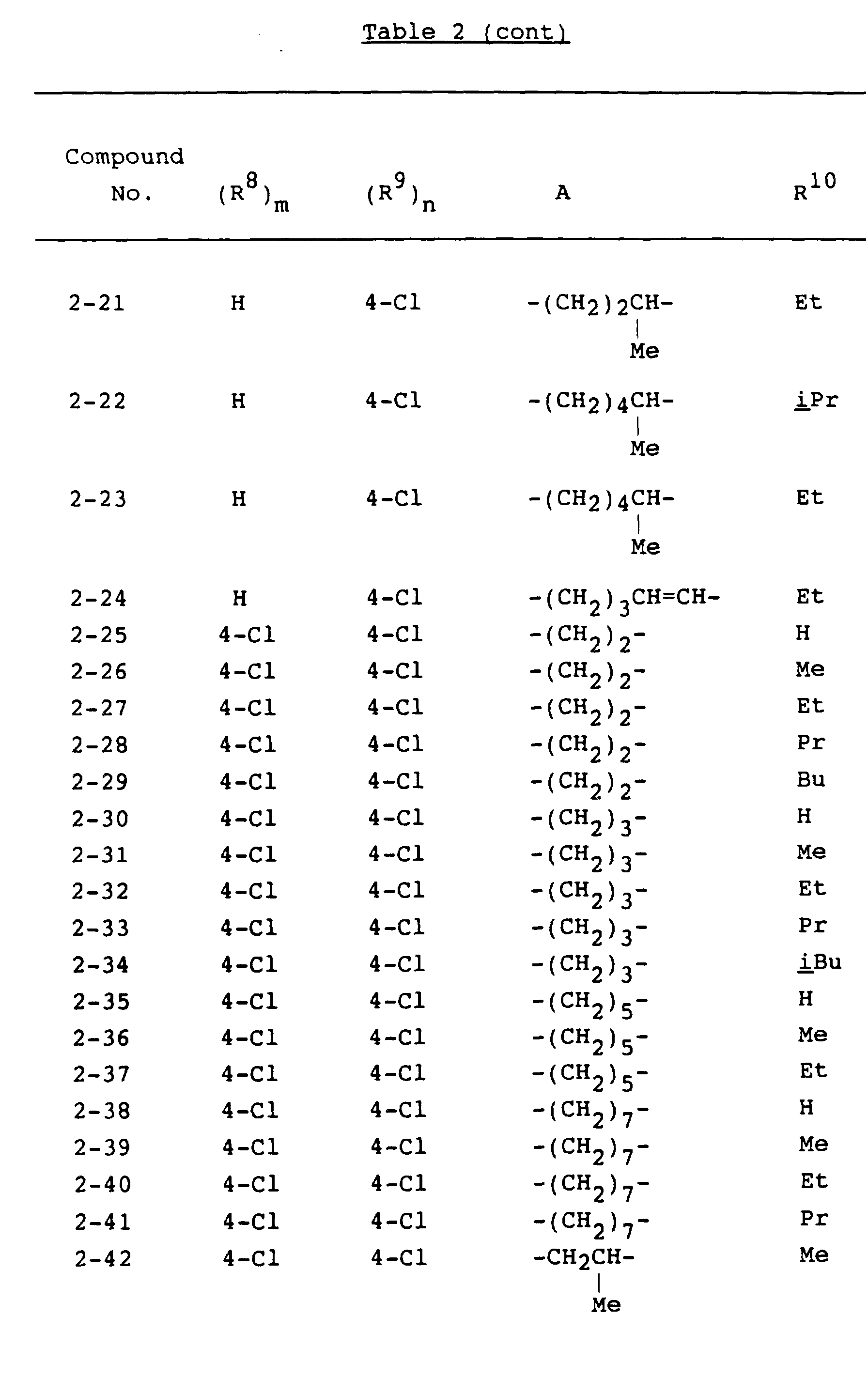


- Of the compounds listed above, the following compounds are preferred, that is to say Compounds No. 1-3, 1-4, 1-7, 1-8, 1-15, 1-16, 1-19, 1-20, 2-1, 2-2, 2-3, 2-14, 2-15, 2-32, 2-49, 2-50, 2-51, 2-53, 2-54, 2-67, 2-68, 2-70, 2-71, 2-72, 2-73, 2-74, 2-76, 2-77, 2-81, 2-84, 2-85, 2-88, 2-90, 2-91, 2-92, 2-93, 2-94, 2-95, 2-96, 2-97, 2-98, 2-99, 2-102, 2-104, 2-108, 2-109, 2-142, 2-143, 2-144, 2-145, 2-146, 2-149, 2-150, 2-151, 2-152, 2-153, 2-154, 2-155, 2-156, 2-165, 2-166, 2-179, 2-180, 2-181, 2-182, 2-183, 2-184 and 2-185, and the following are more preferred, that is to say Compounds No.:
- 1-15. Methyl 3-{1-[2-bis(4-fluorophenyl)methoxyethyl]-4-piperidyl}acrylate;
- 1-16. Ethyl 3-{1-[2-bis(4-fluorophenyl)methoxyethyl]-4-piperidyl}acrylate;
- 2-71. Methyl 4-{1-[2-bis(4-fluorophenyl)methoxyethyl]-4-piperidyl}butyrate;
- 2-72. Ethyl 4-{1-[2-bis(4-fluorophenyl)methoxyethyl]-4-piperidyl}butyrate;
- 2-76. Methyl 6-(1-[2-bis(4-fluorophenyl)methoxyethyl]-4-piperidyl}hexanoate;
- 2-77. Ethyl 6-(1-[2-bis(4-fluorophenyl)methoxyethyl]-4-piperidyl}hexanoate;
- 2-81. Ethyl 8-{1-[2-bis(4-fluorophenyl)methoxyethyl]-4-piperidyl}octanoate;
- 2-84. Methyl 3-{1-[2-bis(4-fluorophenyl)methoxyethyl]-4-piperidyl}-2-methylpropionate;
- 2-85. Ethyl 3-{1-[2-bis(4-fluorophenyl)methoxyethyl]-4-piperidyl}-2-methylpropionate;
- 2-90. Ethyl 6-{1-[2-bis(4-fluorophenyl)methoxyethyl]-4-piperidyl}-2-methylhexanoate;
- 2-91. Ethyl 6-{1-[2-bis(4-fluorophenyl)methoxyethyl]-4-piperidyl}-2-hexenoate;
- 2-153. Ethyl 4-{1-[2-(2,4'-difluorobenzhydryloxy)ethyl]-4-piperidyl}butyrate;
- 2-154. Ethyl 6-{1-[2-(2,4'-difluorobenzhydryloxy)ethyl]-4-piperidyl}hexanoate;
- 2-179. Propyl 4-{1-[2-bis(4-fluorophenyl)methoxyethyl]-4-piperidyl}butyrate;
- 2-180. Butyl 4-{1-[2-bis(4-fluorophenyl)methoxyethyl]-4-piperidyl}butyrate;
and salts thereof. - The compounds of the present invention can be prepared by a variety of processes well known in the art for the preparation of compounds of this type. For example, in general terms, they may be prepared by reacting a compound of formula (II):

Z-COOR¹¹ (III)
in which: - R¹, R m and n are as defined above;
- R¹¹ represents a hydrogen atom or an ester group, such as those represented by R³; and
- (i) Z¹ represents a halogen atom and Z represents a group of formula (IV):

- (ii) Z¹ represents a group of formula (V):

(R¹O)₂-P(=O)-CH(R¹³)-B- (VI)
OR - (iii) Z¹ represents a group of formula (VII):

(R¹O)₂-P(=O)-CH(R¹³)-D- (VIII)
in which:
- (i) Z¹ represents a halogen atom and Z represents a group of formula (IV):
- R¹ represents an alkyl group having from 1 to 4 carbon atoms;
- R¹³ represents a hydrogen atom, an alkyl group having from 1 to 4 carbon atoms or an alkynyl group having 3 or 4 carbon atoms (e.g. a propargyl group or a 2-butynyl group);
- B represents a direct carbon-carbon bond, an alkylene group having from 1 to 4 carbon atoms or an alkenylene group having from 2 to 4 carbon atoms;
- D represents an alkylene group having from 1 to 7 carbon atoms or an alkenylene group having from 2 to 7 carbon atoms; and
- p is 0 or an integer of from 1 to 4.
- The halogen atom represented by Z¹ is preferably a chlorine, bromine or iodine atom.
- If desired, any carbon-carbon double and triple bonds in the side chain attached to the piperidine group may then be hydrogenated, and/or, if desired, where R¹¹ represents a hydrogen atom, the compound may be esterified, and/or, if desired, where R¹¹ represents an ester group, the compound may be hydrolised and/or the compound may be salified.
- In more detail, the compounds may be prepared as illustrated in the following Reaction Schemes A, B and C:
-


-


-


- In the formulae in the above Reaction Schemes:
- R¹, R, m, n, p, A, B, D, R¹¹, R¹ and R¹³ are as defined above;
- X represents a halogen atom, preferably a chlorine, bromine or iodine atom;
- Ar' represents a group of formula

- Ar" represents a group of formula

- A' represents a group of formula:

- A" represents a group of formula:

- In the definition of B and D, each of the C₁ - C₄ and C₁ - C₇ alkylene groups may be a methylene group or a higher alkylene group or an alkenylene group containing the corresponding number of carbon atoms to form the group represented by A, and these are preferably a trimethylene, pentamethylene and heptamethylene group or a group of formula -CH₂CH=CH-, -(CH₂)₃CH=CH- or -(CH₂)₅-CH=CH-.
- In Reaction Scheme A, the compound of formula (I) is prepared by reacting a halogen compound of formula (AI). with a piperidine compound of formula (AII) in the presence of a base in an inert solvent.
- There is no particular restriction on the nature of the base to be employed in this reaction, provided that it has no adverse effect on any part of the molecules of the reagents, and any base commonly used in dehydrohalogenation condensation reactions can equally be used here. Examples of bases which may be employed include: alkali metal carbonates, such as sodium carbonate and potassium carbonate; alkali metal hydrogencarbonates, such as sodium hydrogencarbonate and potassium hydrogencarbonate; and organic amines, such as triethylamine, pyridine, 4-dimethylaminopyridine, N-methylmorpholine and DBU (1,8-diazabicyclo[5,4,0]-undec-7-ene). Of these, we prefer the alkali metal carbonates and alkali metal bicarbonates.
- There is no particular restriction on the nature of the solvent to be employed, provided that it has no adverse effect on the reaction or on the reagents involved and that it can dissolve the reagents, at least to some extent. Examples of suitable solvents include: aromatic hydrocarbons, such as benzene, toluene or xylene; alcohols, such as methanol, ethanol or propanol; ketones, such as acetone, methyl ethyl ketone or methyl isobutyl ketone; and amides, especially fatty acid amides, such as dimethylformanide or dimethylacetamide. Of these, we prefer the ketones and amides.
- The reaction can take place over a wide range of temperatures, and the precise reaction temperature is not critical to the invention. In general, we find it convenient to carry out the reaction at a temperature of from room temperature to 150°C (preferably from 80°C to 120°C). The time required for the reaction may also vary widely, depending on many factors, notably the reaction temperature and the nature of the reagents. However, provided that the reaction is effected under the preferred conditions outlined above, a period of from 1 to 30 hours (preferably from 3 to 16 hours) will usually suffice.
- If desired, those compounds of formula (I'a) wherein R¹¹ represents a hydrogen atom, can be prepared by hydrolysis of the corresponding compound in which R¹¹ represents an ester group.
- The hydrolysis reaction may be carried out by conventional means, for example, by reacting the ester compound with a base (e.g. an alkali metal hydroxide, such as sodium hydroxide or potassium hydroxide, or an alkali metal carbonate, such as sodium carbonate or potassium carbonate) in an inert solvent (e.g. an aqueous alcohol, such as aqueous methanol or aqueous ethanol, or an aqueous ether, such as aqueous tetrahydrofuran or aqueous dioxane) at a suitable temperature, e.g. from room temperature to 100°C (preferably from room temperature to 80°C), normally for a period of from 10 minutes to 24 hours (preferably from 20 minutes to 3 hours).
- If desired;those compounds of formula (I'a) wherein R¹¹ represents an ester group, can be prepared by esterification of the corresponding compound in which R¹¹ represents a hydrogen atom with a compound of formula R³-X (in which R³ and X are as defined above). The esterification reaction may be carried out in a similar manner to the reaction of Step A1, using similar reaction conditions, bases and solvents.
- The compounds of formula (AI) used as starting materials in this step are well known or can easily be prepared by well known methods [for example, the method described in J. Med. Chem., 23, 149 (1980)].
- The reactions of Reaction Scheme B prepare compounds of formula (I) in which A represents either a group of formula

- In Step B1 of Method B, a compound of formula (BIII) is prepared by treating a phosphonate compound of formula (BII) with a base to give a carbanion and then reacting the resulting carbanion with the aldehyde compound of formula (BI).
- There is no particular restriction on the nature of the base to be employed in the reaction to produce the carbanion, provided that it has no adverse effect on any part of the molecule of the compound of formula (BI), (BII) or (BIII), and any base capable of generating a carbanion from phosphonate compounds of this type can equally be used here. Examples of bases which may be employed include: alkali metal hydrides, such as lithium hydride or sodium hydride; alkyllithium compounds, such as methyllithium or butyllithium; lithium alkylamides, such as lithium diisopropylamide or lithium dicyclohexylamide; and alkali metal silyl compounds, such as sodium 1,1,1,3,3,3-hexamethyldisilazane or lithium 1,1,1,3,3,3-hexamethyldisilazane. Of these, the alkali metal hydrides are preferred.
- There is no particular restriction on the nature of the solvent to be employed, provided that it has no adverse effect on the reaction or on the reagents involved and that it can dissolve the reagents, at least to some extent. Examples of suitable solvents include: ethers, such as diethyl ether, tetrahydrofuran or dioxane; and hydrocarbons, preferably aromatic hydrocarbons, such as benzene or toluene. Of these, the ethers are preferred.
- The reaction can take place over a wide range of temperatures, and the precise reaction temperature is not critical to the invention. In general, we find it convenient to carry out the reaction for the production of a carbanion at a temperature of from -70°C to 50°C (preferably from -20°C to 10°C) and that for reacting the carbanion with the compound of formula (BI) at a temperature of from -100°C to 50°C (preferably from 0°C to about room temperature). The time required for the reaction may also vary widely, depending on many factors, notably the reaction temperature and the nature of the reagents. However, provided that the reaction is effected under the preferred conditions outlined above, the time required for the reaction producing a carbanion is usually from 30 minutes to 3 hours and that for the reaction of the carbanion with the compound of formula (BI) is usually from 30 minutes to 6 hours (preferably from 1 to 3 hours).
- In the compound of formula (BIII), where R¹¹ represents an ester group, the corresponding carboxylic acid derivative of formula (BIII) in which R¹¹ represents a hydrogen atom can be prepared by hydrolysis in a similar manner to that described as an optional step at the end of Reaction Scheme A.
- The compound of formula (BI) used as the starting material in this step can be prepared by reacting an ester or nitrile compound of formula (IX):

- The compound of formula (IX) can be prepared by reacting the compound of formula (Al) (see Reaction Scheme A) with a compound of formula (IX'):

- A compound of formula (BI) wherein p is 0 can also be prepared by reacting a compound (CI) (see Reaction Scheme C) with a phosphonate compound of formula (X):

- In Step B2 of Reaction Scheme B, a compound of formula (Ib) is prepared by catalytic reduction of the compound of formula (BIII). The reaction can be carried out in an atmosphere of hydrogen and in the presence of a catalyst and of inert solvent.
- Any catalyst commonly employed for catalytic hydrogenation may equally be used in this Step, and examples include palladium-on-charcoal, platinum black and rhodium-on-charcoal, of which palladium-on-charcoal is preferred. The hydrogen pressure employed in the reaction is preferably from 1 to 10 times atmospheric pressure (more preferably from 1 to 4 times atmospheric pressure).
- There is no particular restriction on the nature of the solvent to be employed, provided that it has no adverse effect on the reaction or on the reagents involved and that it can dissolve the reagents, at least to some extent. Examples of suitable solvents include: alcohols, such as methanol or ethanol; and ethers, such as dioxane or tetrahydrofuran. Of these, the alcohols are preferred.
- The reaction can take place over a wide range of temperatures, and the precise reaction temperature is not critical to the invention. In general, we find it convenient to carry out the reaction at a temperature of from 0°C to 100°C (preferably 10°C to 30°C). The time required for the reaction may also vary widely, depending on many factors, notably the reaction temperature and the nature of the reagents. However, provided that the reaction is effected under the preferred conditions outlined above, a period of from 10 minutes to 10 hours (more preferably from 10 minutes to 3 hours) will usually suffice.
- A compound of formula (Ib) wherein R¹¹ represents a hydrogen atom can be prepared by hydrolysis of the corresponding compound wherein R¹¹ represents an ester group, and a compound of formula (Ib) wherein R¹¹ represents an ester group can be prepared by esterification of the corresponding compound in which R¹¹ represents a hydrogen atom with a compound of formula R³-X (in which R³ and X are as defined above), each in a similar manner to that described as an optional step in Reaction Scheme A.
- In Reaction Scheme C, a compound of formula (I) wherein A represents a group A" (which is as defined above), that is to say a compound (Ic), can be prepared following Steps C1 and C2, which are essentially the same as Steps B1 and B2 of Reaction Scheme B and which may be carried out using the same reaction conditions and reagents.
- The compound of formula (CI) employed as the starting material in this Reaction Scheme can be prepared by reacting a compound of formula (XI):

- After completion of any of the above reactions, the desired product of each step can be recovered from the reaction mixture by conventional means. For example, one suitable recovery technique comprises filtering off insoluble materials, if any (such as a catalyst), from the reaction mixture; and then distilling off the solvent. Alternatively, the solvent may be removed by distillation, after which water is added, and the mixture is extracted with a water-immiscible solvent and the solvent is removed by distillation. Where the desired product is a carboxylic acid derivative or other water-soluble compound, it may be recovered by adding water to the reaction mixture, extracting the mixture with a water-immiscible solvent, acidifying the aqueous layer, e.g. with dilute hydrochloric acid, extracting the mixture with a water-immiscible solvent and finally distilling off the solvent. The desired product can, if necessary, be further purified by such conventional means as recrystallization and/or the various chromatography techniques, notably column chromatography or preparative thin layer chromatography.
- The piperidyl-aliphatic acid derivatives of the present invention have, as shown in the following biological activity data, exhibited excellent anti-histamic, anti-allergic and anti-asthmatic activities and an excellent inhibitory activity against the accumulation of eosinophile in the bronchoalveolar lavage fluid. Accordingly, the compounds are useful as therapeutic agents for the treatment or prophylaxis of various histamine-related disorders, especially allergic diseases, such as rhinitis or chronic urticaria, or asthma.
- The compounds of the present invention may, therefore, be used in the treatment of such disorders, and, for this purpose, may be formulated as conventional pharmaceutical preparations, as is well known in the art. Thus, the compounds may be administered orally, e.g. in the form of tablets, capsules, granules, powders, syrups, sprays, inhalation or other such well known forms, or parenterally, e.g. by injections, sprays, inhlations, eyedrops, adhesive plasters or suppositories, etc.
- These pharmaceutical preparations can be prepared by conventional means and may contain known adjuvants of a type commonly used in this field, for example vehicles, binders, disintegrators, lubricants, stabilizers, corrigents, etc. depending upon the intended use and form of the preparation. The dose will depend upon the condition, age, and body weight of the patient as well as upon the nature and severity of the disorder to be treated, but, in the case of oral administration to an adult human patient, we would normally suggest a total daily dose of from 0.01 mg to 50 mg, which may be administered in a single dose or in divided doses, e.g. from one to three times a day.
- The preparation of the compounds of the present invention is further illustrated by the following Examples, and the preparation of certain of the compounds used as starting materials in some of these Examples is illustrated in the subsequent Preparations. The biological activity of certain of the compounds of the present invention is illustrated in the following Test Examples.
- 0.87 g of sodium hydride (as a 50% w/w dispersion in mineral oil) was added under a stream of nitrogen to 90 ml of anhydrous tetrahydrofuran. 20 ml of an anhydrous tetrahydrofuran solution containing 4.01 g of ethyl diethylphosphonoacetate were then added dropwise to the mixture at 0°C, and the resulting mixture was stirred for 30 minutes at room temperature. 50 ml of an anhydrous tetrahydrofuran solution containing 5.85 g of 1-[2-bis(4-fluorophenyl)methoxyethyl]-4-piperidine-carbaldehyde (prepared as described in Preparation 1) were then added dropwise to the reaction mixture at 0°C, and the mixture was stirred for 1 hour at room temperature. At the end of this time, the solvent was removed by distillation under reduced pressure. Ice water was added to the residue, and the mixture was extracted with ethyl acetate. The extract was concentrated by distillation under reduced pressure and purified by silica gel column chromatography. Elution with 5% by volume methanol in methylene chloride afforded 6.34 g (yield: 91%) of the title compound as a yellow oil.
- Nuclear Magnetic Resonance Spectrum (CDCℓ₃) δ ppm:
- 1.27 (3H, triplet);
- 1.46 - 2.33 (7H, multiplet);
- 2.63 (2H, triplet);
- 2.78 - 3.07 (2H, multiplet);
- 3.55 (2H, triplet);
- 4.18 (2H, quartet);
- 5.34 (1H, broad singlet);
- 5.79 (1H, doublet);
- 6.79 - 7.45 (9H, multiplet).
- Infrared Absorption Spectrum (CHCℓ₃), νmax cm⁻¹:
2920, 1705, 1650, 1600, 1500. - The oxalate and fumarate of the title compound were prepared by dissolving the title compound in ethanol, adding a molar equivalent of the corresponding acid, and collecting the precipitated crystals by filtration, the oxalate melting at 142 - 143°C,and the fumarate melting at 154 - 156°C.
- The following compounds were prepared by a procedure similar to that described in Example 1(1), but using the corresponding aldehydes and the corresponding phosphonic acid esters, and then, in some cases, converting the product to the oxalate or fumarate, as described in Example 1(2).
- This was obtained in a yield of 62%, as crystals melting at 135 - 136°C.
- This was obtained in a yield of 42%, as crystals melting at 134 - 136°C.
- This was obtained in a yield of 48%, as crystals melting at 145 - 147°C.
- This was obtained in a yield of 100%, as crystals melting at 158 - 160°C.
- This was obtained in a yield of 100%, as crystals melting at 148 - 150°C.
- This was obtained in a quantitative yield.
Infrared Absorption Spectrum (CHCℓ₃), νmax cm⁻¹:
2910, 1695, 1600, 1500. - The fumarate, melting at 108 - 110°C, was then prepared.
- This was obtained in a yield of 54%.
Infrared Absorption Spectrum (CHCℓ₃), νmax cm⁻¹:
2910, 1940, 1705, 1600, 1500. - The fumarate, melting at 81 - 83°C, was then prepared.
- This was obtained in a yield of 81%.
Infrared Absorption Spectrum (CHCℓ₃), νmax cm⁻¹:
2950, 1705, 1645, 1610, 1510. - The oxalate, melting at 137 - 140°C, was then prepared.
- This was obtained in a yield of 84%.
Infrared Absorption Spectrum (CHCℓ₃), νmax cm⁻¹:
2925, 1705, 1650, 1605, 1505. - The oxalate, melting at 136 - 138°C, was then prepared.
- This was obtained in a yield of 98%.
Infrared Absorption Spectrum (CHCℓ₃), νmax cm⁻¹:
2925, 1700, 1605, 1510. - The oxalate, melting at 152 - 153°C, was then prepared.
- This was obtained in a yield of 72%.
Infrared Absorption Spectrum (CHCℓ₃), νmax cm⁻¹:
2900, 1705, 1650, 1600. - The fumarate, melting at 132 - 133°C, was then prepared.
- This was obtained in a yield of 88%.
Infrared Absorption Spectrum (CHCℓ₃), νmax cm⁻¹:
2910, 1695, 1645, 1600, 1505. - This was obtained in a yield of 84%.
Infrared Absorption Spectrum (CHCℓ₃), νmax cm⁻¹:
2900, 1695, 1635, 1600, 1500. - This was obtained in a yield of 34%.
Infrared Absorption Spectrum (CHCℓ₃), νmax cm⁻¹:
2950, 1715, 1655, 1610, 1510. - This was obtained in a yield of 71%.
Infrared Absorption Spectrum (CHCℓ₃), νmax cm⁻¹:
2925, 1710, 1645, 1600, 1510. - This was obtained in a yield of 95%.
Infrared Absorption Spectrum (CHCℓ₃), νmax cm⁻¹:
2930, 1710, 1655, 1600, 1490. - This was obtained in a yield of 71%.
Infrared Absorption Spectrum (CHCℓ₃), νmax cm⁻¹:
2930, 1710, 1645, 1605, 1510. - This was obtained in a yield of 95%.
Infrared Absorption Spectrum (CHCℓ₃), νmax cm⁻¹:
2925, 1710, 1645, 1605, 1510. - This was obtained in a yield of 91%.
Infrared Absorption Spectrum (CHCℓ₃), νmax cm⁻¹:
2930, 1710, 1655, 1605, 1510. - 0.14 g of 10% w/w palladium-on-charcoal and 1.569 g of ethyl 3-{1-[2-bis(4-fluorophenyl)methoxyethyl]-4-piperidyl}acrylate (prepared as described in Example 1) were added to 30 ml of ethanol, and the mixture was stirred in an atmosphere of hydrogen at room temperature for 30 minutes. At the end of this time, the catalyst was removed by filtration, and the filtrate was freed from the solvent by distillation under reduced pressure, to afford 1.46 g (93% yield) of the title compound as a yellow oil.
Infrared Absorption Spectrum (CHCℓ₃), νmax cm⁻¹:
2920, 1725, 1600, 1505. - The following compounds were prepared by using the reduction reaction described in Example 21 from the corresponding unsaturated starting materials (which themselves were prepared as in the corresponding ones of Examples 2 to 20), and, in some cases, this was followed by salification, as described in Example 1(2).
- This was obtained in a yield of 92%.
Infrared Absorption Spectrum (CHCℓ₃), νmax cm⁻¹:
2900, 1720,1600, 1500. - The oxalate, melting at 130 - 131°C (with decomposition), was then prepared.
- This was obtained in a yield of 67%.
Infrared Absorption Spectrum (CHCℓ₃), νmax cm⁻¹:
2950, 1725, 1610, 1510. - The oxalate, melting at 134 - 137°C, was then prepared.
- This was obtained in a yield of 85%.
Infrared Absorption Spectrum (CHCℓ₃), νmax
cm⁻¹:
2925, 1725, 1605, 1505. - The oxalate, melting at 134 - 135°C, was then prepared.
- This was obtained in a yield of 81%.
Infrared Absorption Spectrum (CHCℓ₃), νmax cm⁻¹:
2940, 1730, 1605, 1510. - The oxalate, melting at 130 - 131°C, was then prepared.
- This was obtained in a yield of 77%.
Infrared Absorption Spectrum (CHCℓ₃), νmax cm⁻¹:
2950, 2875, 1725, 1610, 1510. - The oxalate, melting at 137 - 138°C, was then prepared.
- This was obtained in a yield of 79%.
Infrared Absorption Spectrum (CHCℓ₃), νmax cm⁻¹:
2940, 2875, 1730, 1605, 1510. - The oxalate, melting at 119 - 120°C, was then prepared.
- This was obtained in a yield of 42%.
Infrared Absorption Spectrum (CHCℓ₃), νmax cm⁻¹:
2950, 2875, 1730, 1610, 1510. - The oxalate, melting at 120 - 121°C, was then prepared.
- This was obtained in a yield of 81%.
Infrared Absorption Spectrum (CHCℓ₃), νmax cm⁻¹:
2940, 1725, 1605, 1505. - The same compound, having the same Infrared Spectrum, was also prepared using the reduction reaction described in Example 21 from ethyl 4-(4-[2-bis(4-fluorophenyl)methoxyethyl]piperidylidene}butenoate (prepared as described in Preparation 19) in a yield of 90%.
- The oxalate, melting at 138 - 140°C, was then prepared.
- This was obtained in a quantitative yield.
Infrared Absorption Spectrum (CHCℓ₃), νmax cm⁻¹:
2925, 1725, 1600, 1495. - The oxalate, melting at 103 - 104°C, was then prepared.
- This was obtained in a yield of 96%.
Infrared Absorption Spectrum (CHCℓ₃), νmax cm⁻¹:
2975, 1730, 1605, 1455. - The oxalate, melting at 117 - 119°C, was then prepared.
- This was obtained in a quantitative yield.
Infrared Absorption Spectrum (CHCℓ₃), νmax cm⁻¹:
2930, 1725, 1605, 1510. - The oxalate, melting at 119 - 120°C, was then prepared.
- This was obtained in a quantitative yield.
Infrared Absorption Spectrum (CHCℓ₃), νmax cm⁻¹:
2930, 1730, 1600, 1505. - The oxalate, melting at 114 - 115°C, was then prepared.
- This was obtained in a yield of 87%.
Infrared Absorption Spectrum (CHCℓ₃), νmax cm⁻¹:
2940, 1730, 1610, 1510. - The oxalate, melting at 143 - 145°C, was then prepared.
- 0.68 g of 1-bis(4-chlorophenyl)methoxy-2-chloroethane, 0.43 g of ethyl 4-(4-piperidyl)butyrate (prepared as described in Preparation 20), 1.8 g of sodium carbonate and 0.05 g of sodium iodide were added to 60 ml of methyl isobutyl ketone, and the mixture was heated under reflux for 16 hours. At the end of this time, the mixture was filtered, and the filtrate was concentrated by distillation under reduced pressure. The resulting residue was subjected to column chromatography through silica gel using ethyl acetate as the eluent, to afford 1.0 g (97% yield) of the title compound as a pale yellow oil.
Infrared Absorption Spectrum (CHCℓ₃), νmax cm⁻¹:
2925, 1730, 1600, 1495. - Following the procedure described in Example 1(2), the oxalate of the title compound, melting at 131 - 132°C, was prepared.
- 1.64 g of ethyl 4-{1-[2-bis(4-fluorophenyl)methoxyethyl]-4-piperidyl}butyrate (prepared as described in Example 34) were added to 15 ml of ethanol, and then 10 ml of a 10% w/v aqueous solution of sodium hydroxide were added, and the mixture was stirred at room temperature for 2 hours. The reaction mixture was then concentrated by evaporation under reduced pressure, and the resulting residue was diluted with water. The pH was then adjusted to a value of 4 by the addition of aqueous hydrochloric acid, and then the mixture was extracted with ethyl acetate. The crystals obtained from the extract were recrystallized from ethanol to afford 1.46 g (95% yield) of the title compound, melting at 145 - 147°C.
Infrared Absorption Spectrum (KBr), νmax cm⁻¹:
2938, 2873, 2700, 1720, 1603, 1507, 1223. - 2 ml of butanol and 0.10 g of sodium hydride (as a 55% w/w dispersion in mineral oil) were added to a solution of 0.80 g of ethyl 4-{1-[2-bis(4-fluorophenyl)methoxyethyl]-4-piperidyl}butyrate (prepared as described in Example 34) in 20 ml of toluene at room temperature, and the mixture was stirred whilst heating under reflux for 5 hours. At the end of this time, the mixture was cooled to room temperature, and then ice-water was poured into the mixture and the mixture was extracted with ethyl acetate. The extracts were washed with water and dried over anhydrous sodium sulphate. The solvent was then removed by evaporation under reduced pressure. The resulting residue was purified by column chromatography through silica gel, using ethyl acetate as the eluent, to give 0.38 g of the title compound as a yellow oil.
Infrared Absorption Spectrum (CHCℓ₃), νmax cm⁻¹:
2930, 1725, 1605, 1508. - Following the procedure described in Example 1(2), the oxalate of the title compound, melting at 128 - 130°C, was prepared.
- This Preparation describes three methods of making the same title compound.
- 75 ml of a 1M hexane solution containing diisobutylaluminium hydride were added to 400 ml of tetrahydrofuran under a stream of nitrogen, and the mixture was cooled at -78°C. Whilst the mixture's internal temperature was -15°C, 20.25 g of 1-[2-bis(4-fluorophenyl)methoxyethyl]-4-piperidinecarbonitrile (prepared as described in Preparation 4) were added to the mixture over a period of 40 minutes, and the resulting mixture was stirred for 30 minutes at -15°C. The mixture was then allowed to stand overnight at room temperature. At the end of this of methanol, followed by 100 ml of a saturated aqueous solution of ammonium chloride, were added. The reaction mixture was then extracted with ethyl acetate. The extract was purified by silica gel column chromatography. Elution with 3% by volume methanol in methylene chloride afforded 14.67 g (yield 72%) of the title compound as an oily substance.
Infrared Absorption Spectrum (CHCℓ₃), νmax cm⁻¹:
2930, 2820, 1895, 1725, 1605, 1505. - Nuclear Magnetic Resonance Spectrum (CDCℓ₃), δ ppm:
- 1.40 - 3.07 (9H, multiplet);
- 2.63 (2H, triplet);
- 3.53 (2H, triplet);
- 5.32 (1H, singlet);
- 6.82 - 7.50 (8H, multiplet);
- 9.70 (1H, singlet).
- 420 mg of 1-[2-bis(4-fluorophenyl)methoxyethyl]-4-methoxymethylidenepiperidine (prepared as described in Preparation 5) were added to a mixture of 1.5 ml of 10% w/v aqueous hydrochloric acid and 3 ml of tetrahydrofuran, and the resulting mixture was then stirred for 2 hours at room temperature. At the end of this time, water was added to the reaction mixture, and it was neutralized by the addition of a 5% w/v aqueous solution of sodium hydroxide and extracted with ethyl acetate. The extract was purified by silica gel column chromatography. Elution with 3% by volume methanol in methylene chloride afforded 434 mg (a quantitative yield) of the title compound as an oil, whose properties were the same as those of the product of step (a).
- 3.03 g of ethyl 1-[2-bis(4-fluorophenyl)methoxyethyl]-4-piperidinecarboxylate (prepared as described in Preparation 8) were dissolved in 30 ml of toluene, under a stream of nitrogen, and the resulting solution was cooled at -68°C. 8.2 ml of a 1M solution of diisobutylaluminium hydride in hexane was then added dropwise to the cooled mixture over a period of 10 minutes, and the mixture was stirred for 1 hour at -68°C. At the end of this time, 2 ml of methanol and 3 ml of a saturated aqueous solution of ammonium chloride were added to the reaction solution. The mixture was then extracted with ethyl acetate, to give 2.47 g (yield 91%) of the title compound as an oil, whose properties were the same as those of the product of step (a).
- A procedure similar to that described in Preparation 1 was repeated, except that the appropriate starting materials were used, to give the compounds shown below.
- This was obtained in a yield of 51%.
Nuclear Magnetic Resonance Spectrum (CDCℓ₃), δ ppm: - 2.67 (2H, triplet);
- 3.59 (2H, triplet);
- 5.37 (1H, singlet);
- 9.64 (1H, singlet).
- This was obtained in a yield of 49%.
Nuclear Magnetic Resonance Spectrum (CDCℓ₃), δ ppm: - 2.66 (2H, triplet);
- 3.57 (2H, triplet);
- 5.34 (1H, singlet);
- 9.64 (1H, singlet).
- 2.13 g of 1-bis(4-fluorophenyl)methoxy-2-chloroethane and 0.95 g of 4-cyanopiperidine were dissolved in 15 ml of dimethylformamide. After this, 4.00 g of anhydrous sodium carbonate and 0.08 g of sodium iodide were added to the resulting solution, and the mixture was stirred for 4 hours at 130°C. At the end of this time, the mixture was poured into ice water and extracted with ethyl acetate. The oily extract obtained was purified by silica gel chromatography. Elution with a 2 : 1 by volume mixture of ethyl acetate and hexane afforded 2.36 g (yield 88%) of the title compound.
Infrared Absorption Spectrum (CHCℓ₃), νmax cm⁻¹:
2950, 2240, 1670, 1605, 1510.
Nuclear Magnetic Resonance Spectrum (CDCℓ₃), δ ppm: - 1.73 - 2.08 (4H, multiplet);
- 2.24 - 2.97 (5H, multiplet);
- 2.66 (2H, triplet);
- 3.54 (2H, triplet);
- 5.33 (1H, singlet);
- 6.89 - 7.45 (8H, multiplet).
- Under a stream of nitrogen, 2.7 ml of a 1.6M hexane solution of butyllithium were dropped into 440 ml of diisopropylamine in solution in 10 ml of tetrahydrofuran at -78°C to prepare a solution of lithium diisopropylamide.
- Meanwhile, 1.066 g of methoxymethyltriphenylphosphonium chloride was added to 7 ml of tetrahydrofuran, and the mixture was cooled at -10°C. The lithium diisopropylamide solution previously prepared was then added to this mixture, which was then stirred for 30 minutes at -10°C. At the end of this time, 5 ml of a tetrahydrofuran solution containing 1.01 g of 1-[2-bis(4-fluorophenyl)methoxyethyl]-4-piperidone (prepared as described in Preparation 6) were dropped into the reaction mixture, at -10°C. The mixture was stirred for 30 minutes, allowed to stand overnight at room temperature, and then condensed by evaporation under reduced pressure. Water was added to the residue, which was then extracted with ethyl acetate. The oily substance obtained was purified by silica gel column chromatography. Elution with a 2 : 1 by volume mixture of ethyl acetate and hexane afforded 718 mg (yield 66%) of a yellow oily substance.
Infrared Absorption Spectrum (CHCℓ₃), νmax cm⁻¹:
2940, 1710, 1690, 1605, 1505.
Nuclear Magnetic Resonance Spectrum (CDCℓ₃), δ ppm: - 1.93 - 2.87 (10H, multiplet);
- 3.14 - 3.70 (2H, multiplet);
- 3.54 (3H, singlet);
- 5.35 (1H, singlet);
- 5.79 (1H, broad singlet);
- 6.89 - 7.44 (8H, multiplet).
- This Preparation provides two methods of preparing the same title compound.
- 13.33 g of 1-bis(4-fluorophenyl)methoxy-2-chloroethane and 9.22 g of 4-piperidone hydrochloride were dissolved in 270 ml of dimethylformamide, and 14.5 g of anhydrous sodium carbonate and 0.5 g of sodium iodide were added to the resulting solution, which was then stirred for 20 hours at 95°C. At the end of this time, the reaction mixture was poured in ice water and extracted with benzene. The benzene solution was extracted with 5% w/v aqueous hydrochloric acid. Sufficient of a 10% w/v aqueous solution of sodium hydroxide was added to the aqueous layer to make it alkaline, and the mixture was extracted with benzene. The oily substance obtained from the benzene extract was purified by silica gel column chromatography. Elution with a 2% by volume mixture of ethanol and chloroform afforded 6.86 g (yield 42%) of the title compound as a pale yellow oily substance.
Nuclear Magnetic Resonance Spectrum (CDCℓ₃), δ ppm: - 2.43 (4H, triplet);
- 2.80 (6H, multiplet);
- 3.60 (2H, triplet);
- 5.35 (1H, singlet);
- 7.02 (4H, triplet);
- 7.28 (4H, doublet of doublets).
- 6.63 ml of oxalyl chloride were dissolved in 160 ml of methylene chloride, and the solution was cooled at -60°C. Whilst the solution was at this temperature, 36 ml of a methylene chloride solution containing 11.3 ml of dimethyl sulphoxide were added to it. 160 ml of a methylene chloride solution containing 11.5 g of 1-[2-bis(4-fluorophenyl)methoxyethyl]-4-piperidinol (prepared as described in Preparation 7) were then added to the solution at -60°C, and the resulting mixture was stirred for 15 minutes. At the end of this time, 46 ml of triethylamine were added to the reaction solution. The reaction mixture was then allowed to warm to room temperature, and water was added to it. The aqueous layer was extracted with methylene chloride, and the organic extract was washed with a saturated aqueous solution of sodium chloride. The solvent was then removed by distillation under reduced pressure. The resulting residue was purified by silica gel column chromatography. Elution with a 10 : 1 by volume mixture of ethyl acetate and methylene chloride afforded 10.23 g (yield 91%) of the title compound as a pale yellow oily substance, whose properties were the same as those of the product of step (a) above.
- 14.1 g of 1-bis(4-fluorophenyl)methoxy-2-chloroethane, 10.1 g of 4-hydroxypiperidine, 12 g of sodium carbonate and 0.2 g of sodium iodide were added to 200 ml of methyl isobutyl ketone, and the mixture was heated under reflux for 4 hours. At the end of this time, it was filtered, and the solvent was removed by distillation under reduced pressure. The resulting residue was purified by silica gel column chromatography. Elution with a 10 : 1 by volume mixture of ethanol and methylene chloride afforded 11.5 g (yield 66%) of the title compound as a pale yellow oily substance.
Infrared Absorption Spectrum (CHCℓ₃), νmax cm⁻¹:
2920, 1600, 1505.
Nuclear Magnetic Resonance Spectrum (CDCℓ₃), δ ppm: - 1.73 (4H, multiplet);
- 2.25 (2H, triplet of doublets);
- 2.65 (2H, triplet);
- 2.88 (2H, triplet);
- 3.58 (2H, triplet);
- 3.69 (1H, multiplet);
- 5.36 (1H, singlet);
- 7.01 (4H, triplet);
- 7.30 (4H, doublet of doublets).
- 1.43 g of 1-bis(4-fluorophenyl)methoxy-2-chloroethane and 1.00 g of ethyl isonipecotate were added to 10 ml of methyl isobutyl ketone, and the reaction mixture was then heated under reflux for 5 hours together with 2.0 g of sodium carbonate and 10 mg of potassium iodide. At the end of this time, the mixture was filtered and the solvent was removed by distillation under reduced pressure. The resulting residue was purified by silica gel column chromatography. Elution with a 3 : 1 by volume mixture of hexane and ethyl acetate afforded 1.45 g (yield 71%) of the title compound as an oily substance.
Infrared Absorption Spectrum (CHCℓ₃), νmax cm⁻¹:
2940, 1725, 1600, 1500.
Nuclear Magnetic Resonance Spectrum (CDCℓ₃), δ ppm: - 1.25 (3H, triplet);
- 1.7 - 2.5 (7H, multiplet);
- 2.62 (2H, triplet);
- 2.88 (2H, multiplet);
- 3.57 (2H, triplet);
- 4.13 (2H, quartet);
- 5.36 (1H, singlet);
- 7.00 (4H, triplet);
- 7.28 (4H, doublet of doublets).
- A procedure similar to that described in Preparation 1(c) was repeated, except that the starting materials used were the esters described in Examples 21, 34 and 24.
- This was obtained in a yield of 80%.
Infrared Absorption Spectrum (CHCℓ₃), νmax cm⁻¹:
2940, 1725, 1605, 1510. - This was obtained in a yield of 74%.
Infrared Absorption Spectrum (CHCℓ₃), νmax cm⁻¹:
2900, 1715, 1600, 1500. - This was obtained in a yield of 76%.
Infrared Absorption Spectrum (CHCℓ₃), νmax cm⁻¹:
2925, 1720, 1605, 1505. - A procedure similar to that described in Preparation 1(c) was repeated, except that the corresponding piperidyl-acetic acid derivative was used, to prepare the following compounds.
- This was obtained in a yield of 55%.
Infrared Absorption Spectrum (CHCℓ₃), νmax cm⁻¹:
2930, 2830, 1725, 1605, 1490. - This was obtained in a yield of 79%.
Infrared Absorption Spectrum (CHCℓ₃), νmax cm⁻¹:
2930, 2830, 1725, 1605, 1495. - This was obtained in a yield of 87%.
Infrared Absorption Spectrum (CHCℓ₃), νmax cm⁻¹:
2920, 2830, 1725, 1605, 1510. - This was obtained in a yield of 73%.
Infrared Absorption Spectrum (CHCℓ₃), νmax cm⁻¹:
2930, 1830, 1725, 1605, 1515. - This was obtained in a yield of 32%.
Infrared Absorption Spectrum (CHCℓ₃), νmax cm⁻¹:
2920, 2820, 1725, 1605, 1510. - Following a procedure similar to that described in Preparation 8, the following compounds were prepared by reacting the corresponding 1-(diphenylmethoxy)-2-chloroethane and ethyl piperidinylacetate compounds.
- This was obtained in a yield of 52%.
Infrared Absorption Spectrum (CHCℓ₃), νmax cm⁻¹:
2925, 2800, 1725, 1605, 1500. - This was obtained in a yield of 65%.
Infrared Absorption Spectrum (CHCℓ₃), νmax cm⁻¹:
2925, 2800, 1730, 1605, 1510. - Following the procedure described in Example 1(1), but using 1-[2-bis(4-fluorophenyl)methoxyethyl]-4-piperidone (prepared as described in Preparation 6) and ethyl diethylphosphonocrotonate, the title compound was obtained in a yield of 90%.
Infrared Absorption Spectrum (CHCℓ₃), νmax cm⁻¹:
2940, 2800, 1700, 1635, 1605, 1500. - Under an atmosphere of nitrogen, 0.583 g of sodium hydride (as a 50% w/w dispersion in mineral oil) were added to 4 ml of tetrahydrofuran and the mixture was cooled with water. A solution of 3.04 g of ethyl 4-(diethylphosphono)crotonate in 5 ml of tetrahydrofuran was added dropwise to the cooled mixture, which was then stirred for 30 minutes. At the end of this time, a solution of 1.84 g of 1-benzyl-4-piperidone in 2 ml of tetrahydrofuran was added to the mixture over a period of 30 minutes, whilst the mixture was kept at 0°C by ice-cooling, and the mixture was stirred at 0°C for 1 hour. The reaction mixture was then stirred at room temperature for 2 hours, after which it was concentrated by evaporation under reduced pressure. The residue was extracted with ethyl acetate, and the extract was washed with water. The solvent was then removed by distillation under reduced pressure. The red brown residue was subjected to column chromatography through silica gel, using a 5 : 1 by volume mixture of hexane and ethyl acetate as the eluent, to afford 0.81 g (29% yield) of the title compound as a pale yellow oil.
- Infrared Absorption Spectrum (CHCℓ₃), νmax cm-¹:
2950, 2800, 1700, 1640, 1610. - A solution of 1.60 g of ethyl 4-(1-benzyl-4-piperidylidene)-2-butyrate [prepared as described in step (a) above] in 30 ml of ethanol was stirred at room temperature in the presence of 0.8 g of a 10% w/w palladium-on-charcoal catalyst under 4 atmospheres pressure of hydrogen for 2 hours. At the end of this time, the catalyst was removed from the mixture by filtration, and the solvent was removed by distillation under reduced pressure, to afford 0.7 g (63% yield) of the title compound as a colourless oil boiling at 140°C/6 mmHg.
Infrared Absorption Spectrum (CHCℓ₃), vmax cm⁻¹:
2920, 1725. - According to Mota's method [I. Mota, Immunology, 7, 681 - 699 (1964)], antiserum (256 times the PCA titer) of rat against egg albumin was prepared and diluted four times with physiological saline. Male SD rats (5 weeks old) were used as the test animals in groups, each containing 4 animals. The rats were sensitized by intradermal injection of 0.05 ml of the diluted antiserum solution in the dorsal position. 48 hours after this injection, a suspension of the test compound in an aqueous 0.5% w/v tragacanth solution was orally administered to the rats, fasted for one day, and 60 minutes later they were injected in the caudal vein with 5 ml/kg body weight of physiological saline containing 0.4% w/v egg albumin and 1.0% w/v Evans Blue. 30 minutes after this last injection, the rats were sacrificed with carbon dioxide and the Evans Blue exuded in the dorsal intradermal portion was determined according to Harada's method (Harada et al., J. Pharm. Pharmac., 23, 218 - 219 (1971)].
- The results achieved from the test groups which were treated with a test compound were evaluated to determine the inhibitory rate by comparison with the average amount of exuded dye in a control group, which was not given the test compound.
- The inhibitory rate was calculated by the following equation.

- A: amount of exuded dye in the control group
- B: amount of exuded dye in the test group.
- The results are shown in Table 3.
Table 3 Compound of Example Salt Dose rate (p.o., mg/kg) Inhibitory rate (%) 1 Oxalate 3.2 52 12 Fumarate 12.5 62 3.2 46 22 Oxalate 3.2 51 25 Oxalate 3.2 63 0.8 43 26 Oxalate 3.2 61 0.8 49 27 Oxalate 3.2 71 0.8 41 34 Oxalate 3.2 76 0.8 60 Prior art Compound A 12.5 48 Prior art compound A: Maleate of ethyl 2-[1-(2-diphenylmethoxyethyl)-4-piperidyl]acetate - The test animals used were male guinea pigs of the Hartley strain (weighing about 400 to 500 g). These animals were sensitized according to Morris' method [H. R. Morris; Br. J. Pharmac., 67, 179 - 184 (1979)]. The guinea pigs were subcutaneously and intraperitoneally injected twice, each time with 25 mg of egg albumin (grade 5, Sigma) at weekly intervals. 7 days after the second of these weekly injections, the animals were fasted for one day and then exposed to an aerosol of egg albumin (10 mg/ml). All of the animals so exposed responded with convulsions, indicating respiratory distress due to airway constriction, within 6 minutes.
- 60 minutes before the egg albumin challenge, one of the test compounds shown in the following Table 4 was administered orally to each of the animals. The compound was regarded as effective if the animal did not respond with convulsions during the 6 minutes inhalation. The results are shown in Table 4.
Table 4 Compound of Example Salt Dose rate (p.o., mg/kg) Effective rate (%) 26 Oxalate 0.1 60 34 0.4 80 0.1 60
2960, 2800, 1710, 1605, 1505.
Claims (30)
- A compound of formula (I):
 R¹ and R are the same or different and each represents an alkyl group having from 1 to 6 carbon atoms, an alkoxy group having from 1 to 6 carbon atoms, a trifluoromethyl group, a nitro group or a halogen atom;A represents a straight or branched chain aliphatic hydrocarbon group having from 2 to 8 carbon atoms whose chain contains at least 2 carbon atoms in a linear chain between the piperidine group and -COOH, said group being saturated or including at least one double or triple carbon-carbon bond; andm and n are the same or different and each is 0, 1, 2 or 3;and pharmaceutically acceptable salts and esters thereof.
 - A compound according to Claim 1, in which R¹ and R are the same or different and each represents an alkyl group having from 1 to 4 carbon atoms, an alkoxy group having from 1 to 4 carbon atoms or a halogen atom;
- A compound according to Claim 1 or Claim 2, in which A represents a vinylene group or a straight or branched chain aliphatic hydrocarbon group having from 3 to 7 carbon atoms and whose chain contains at least 2 carbon atoms in a linear chain between the piperidine group and -COOH, said group being saturated or including at least one double or triple carbon-carbon bond.
- A compound according to any one of Claims 1 to 3, in which m and n are the same or different and each is 0 or 1.
- A compound according to any one of Claims 1 to 4, in which said ester has the formula (Ia):

- A compound according to Claim 1, which has the formula (I'):

and pharmaceutically acceptable salts and esters thereof. - A compound according to Claim 1, which has the formula (I''):

and pharmaceutically acceptable salts and esters thereof. - A compound according to Claim 7, in which A represents a straight or branched chain aliphatic hydrocarbon group having from 3 to 7 carbon atoms and whose chain contains at least 2 carbon atoms in a linear chain between the piperidine group and -COOH, said group being saturated or including at least one double or triple carbon-carbon bond.
- A compound according to Claim 7, in which m and n are the same or different and each is 0 or 1.
- A compound according to Claim 1, in which R¹ and R are the same or different and each represents a halogen atom.
- A compound according to Claim 10, in which R¹ and R each represents a fluorine atom.
- A compound according to Claim 6, in which at least one of R⁴ and R⁵ and at least one of R⁶ and R⁷ represents a halogen atom.
- A compound according to Claim 12, in which said halogen atom is a fluorine atom.
- A compound according to Claim 7, in which R⁸ and R⁹ are the same or different and each represents a halogen atom.
- A compound according to Claim 14, in which R⁸ and R⁹ each represents a fluorine atom.
- A compound according to any one of Claims 1 to 5 and 7, in which A represents an alkylene group having from 2 to 7 carbon atoms or an alkenylene group having 2 or 3 carbon atoms.
- A compound according to any one of the preceding Claims, in which said ester is an alkyl ester having from 1 to 4 carbon atoms in the alkyl moiety or an ester which can easily be hydrolised in vivo.
- A compound according to Claim 1 or Claim 7, in which:R¹ and R are the same or different and each represents a halogen atom;A represents an alkylene group having from 2 to 7 carbon atoms or an alkenylene group having 2 or 3 carbon atoms; andm and n are the same or different and each is 0 or 1;and C₁ - C₄ alkyl esters and in vivo hydrolisable esters thereof.
- A compound according to Claim 18, in which R¹ and R each represent fluorine atoms.
- A compound according to any one of Claims 1 to 4, in which R¹ and R are the same or different and each represents a fluorine or chlorine atom.
- A compound according to Claim 6, in which one of R⁴ and R⁵ and one of R⁶ and R⁷ are the same or different and each represents a fluorine or chlorine atom.
- A compound according to Claim 7, in which R⁸ and R⁹ are the same or different and each represents a fluorine or chlorine atom.
- A compound according to any one of Claims 1 to 4, in which A represents an alkylene group having 3 or 5 carbon atoms.
- A compound according to any one of the preceding Claims, in which said ester is an alkyl ester having from 1 to 4 carbon atoms in the alkyl moiety.
- A compound according to Claim 1 or Claim 7, in which:R¹ and R are the same or different and each represents a fluorine or chlorine atom;A represents an alkylene group having 3 or 5 carbon atoms;m and n are the same or different and each is 0 or 1;and C₁ - C₄ alkyl esters thereof.
- The following compounds according to Claim 1:methyl 3-{1-[2-bis(4-fluorophenyl)methoxyethyl]-4-piperidyl}acrylate;ethyl 3-{1-[2-bis(4-fluorophenyl)methoxyethyl]-4-piperidyl}acrylate;methyl 4-{1-[2-bis(4-fluorophenyl)methoxyethyl]-4-piperidyl}butyrate;ethyl 4-{1-[2-bis(4-fluorophenyl)methoxyethyl]-4-piperidyl}butyrate;methyl 6-{1-[2-bis(4-fluorophenyl)methoxyethyl]-4-piperidyl}hexanoate;ethyl 6-{1-[2-bis(4-fluorophenyl)methoxyethyl]-4-piperidyl}hexanoate;ethyl 8-{1-[2-bis(4-fluorophenyl)methoxyethyl]-4-piperidyl}octanoate;methyl 3-{1-[2-bis(4-fluorophenyl)methoxyethyl]-4-piperidyl}-2-methylpropionate;ethyl 3-{1-[2-bis(4-fluorophenyl)methoxyethyl]-4-piperidyl}-2-methylpropionate;ethyl 6-{1-[2-bis(4-fluorophenyl)methoxyethyl]-4-piperidyl}-2-methylhexanoate;ethyl 6-{1-[2-bis(4-fluorophenyl)methoxyethyl]-4-piperidyl}-2-hexenoate;ethyl 4-{1-[2-(2,4'-difluorobenzhydryloxy)ethyl]-4-piperidyl}butyrate;ethyl 6-{1-[2-(2,4'-difluorobenzhydryloxy)ethyl]-4-piperidyl}hexanoate;propyl 4-{1-[2-bis(4-fluorophenyl)methoxyethyl]-4-piperidyl}butyrate;butyl 4-{1-[2-bis(4-fluorophenyl)methoxyethyl]-4-piperidyl}butyrate;and pharmaceutically acceptable salts thereof.
- A composition for the treatment or prophylaxis of histamine-related disorders in a mammal which comprises an effective amount of an anti-histamine in admixture with a pharmaceutically acceptable carrier or diluent, in which the anti-histamine is at least one compound according to any one of Claims 1 to 26.
- Compounds of formula (I) and pharmaceutically acceptable salts and esters thereof according to any one of Claims 1 to 26 for use in therapy.
- The use of compounds of formula (I) and pharmaceutically acceptable salts and esters thereof according to any one of Claims 1 to 26 for the manufacture of a medicament for the treatment or prophylaxis of histamine-related disorders.
- A process for preparing a compound according to any one of Claims 1 to 26, which process comprises:(a) reacting a compound of formula (II):

Z-COOR¹¹ (III)
in which:R¹, R, m and n are as defined in Claim 1;R¹¹ represents a hydrogen atom or an ester group; and(i) Z¹ represents a halogen atom and Z represents a group of formula (IV): (ii) Z¹ represents a group of formula (V):
(R¹O)₂-P(=O)-CH(R¹³)-B- (VI)
OR(iii) Z¹ represents a group of formula (VII):
(R¹O)₂-P(=O)-CH(R¹³)-D- (VIII)
in which:R¹ represents an alkyl group having from 1 to 4 carbon atoms;R¹³ represents a hydrogen atom, an alkyl group having from 1 to 4 carbon atoms or an alkynyl group having 3 or 4 carbon atoms;B represents a direct carbon-carbon bond, an alkylene group having from 1 to 4 carbon atoms or an alkenylene group having from 2 to 4 carbon atoms;D represents an alkylene group having from 1 to 7 carbon atoms or an alkenylene group having from 2 to 7 carbon atoms; andp is 0 or an integer of from 1 to 4;(b) if desired, hydrogenating any carbon-carbon double and triple bonds in the side chain attached to the piperidine group;(c) if desired, where R¹¹ represents a hydrogen atom, esterifying the compound;(d) if desired, where R¹¹ represents an ester group, hydrolising the compound;(e) if desired, salifying the compound.
Applications Claiming Priority (2)
| Application Number | Priority Date | Filing Date | Title |
|---|---|---|---|
| JP21275290 | 1990-08-09 | ||
| JP212752/90 | 1990-08-09 |
Publications (3)
| Publication Number | Publication Date |
|---|---|
| EP0470686A2 EP0470686A2 (en) | 1992-02-12 |
| EP0470686A3 EP0470686A3 (en) | 1992-06-24 |
| EP0470686B1 true EP0470686B1 (en) | 1996-05-15 |
Family
ID=16627830
Family Applications (1)
| Application Number | Title | Priority Date | Filing Date |
|---|---|---|---|
| EP91302141A Expired - Lifetime EP0470686B1 (en) | 1990-08-09 | 1991-03-13 | (Benzhydryloxyethylpiperidyl)aliphatic acid derivatives and their use in the treatment of allergies and asthma |
Country Status (19)
| Country | Link |
|---|---|
| US (1) | US5294623A (en) |
| EP (1) | EP0470686B1 (en) |
| JP (1) | JPH04364165A (en) |
| KR (1) | KR920004348A (en) |
| CN (1) | CN1034501C (en) |
| AT (1) | ATE138058T1 (en) |
| CA (1) | CA2038066A1 (en) |
| CZ (1) | CZ279786B6 (en) |
| DE (1) | DE69119509T2 (en) |
| DK (1) | DK0470686T3 (en) |
| ES (1) | ES2090238T3 (en) |
| GR (1) | GR3020271T3 (en) |
| HU (1) | HUT58291A (en) |
| IE (1) | IE910818A1 (en) |
| NO (1) | NO178025C (en) |
| PT (1) | PT97032B (en) |
| RU (1) | RU2055834C1 (en) |
| TW (1) | TW230771B (en) |
| ZA (1) | ZA911813B (en) |
Families Citing this family (11)
| Publication number | Priority date | Publication date | Assignee | Title |
|---|---|---|---|---|
| US5631375A (en) * | 1992-04-10 | 1997-05-20 | Merrell Pharmaceuticals, Inc. | Process for piperidine derivatives |
| US5654433A (en) * | 1993-01-26 | 1997-08-05 | Merrell Pharmaceuticals Inc. | Process for piperidine derivatives |
| FR2717803B1 (en) * | 1994-03-25 | 1996-06-21 | Meram Lab | Substituted derivatives of nitrogen heterocycles and their isomers, active on the central nervous system, process for obtaining them and pharmaceutical compositions containing them. |
| SE9901573D0 (en) * | 1999-05-03 | 1999-05-03 | Astra Ab | New compounds |
| GB0017174D0 (en) * | 2000-07-12 | 2000-08-30 | Novartis Ag | Organic compounds |
| FR2815031A1 (en) * | 2000-10-11 | 2002-04-12 | Gilles Fillion | Heterocyclic and carbocyclic compounds have serotoninergic transmission modifying properties for the treatment of central and peripheral nervous disorders |
| WO2002036122A1 (en) * | 2000-10-30 | 2002-05-10 | Sankyo Company,Limited | Preventive or therapeutic medicines for hepatitis and/or hepatopathy |
| US8877168B1 (en) | 2002-07-31 | 2014-11-04 | Senju Pharmaceuticals Co., Ltd. | Aqueous liquid preparations and light-stabilized aqueous liquid preparations |
| JP3631748B2 (en) | 2002-07-31 | 2005-03-23 | 千寿製薬株式会社 | Aqueous solutions and light-stabilized aqueous solutions |
| RU2290178C1 (en) * | 2005-06-29 | 2006-12-27 | ГУН НИИ онкологии им. проф. Н.Н. Петрова Росздрава | Agent for cancer prophylaxis |
| WO2023047107A1 (en) * | 2021-09-22 | 2023-03-30 | The University Of Durham | Aryl or heteroaryl derived compounds for the treatments of microbial infections |
Family Cites Families (6)
| Publication number | Priority date | Publication date | Assignee | Title |
|---|---|---|---|---|
| US2567351A (en) * | 1946-01-29 | 1951-09-11 | Parke Davis & Co | Process for the manufacture of benzhydryl ethers |
| FR2601366B1 (en) * | 1986-07-10 | 1988-11-25 | Andre Buzas | BENZHYDRYLOXYETHYL-PIPERAZINE DERIVATIVES, PROCESSES FOR OBTAINING SAME AND PHARMACEUTICAL COMPOSITIONS CONTAINING THE SAME. |
| FR2603583B1 (en) * | 1986-09-05 | 1988-12-09 | Andre Buzas | BENZHYDRYLOXYETHYL-PIPERIDINE DERIVATIVES, PROCESS FOR OBTAINING SAME AND PHARMACEUTICAL COMPOSITIONS CONTAINING THEM |
| US4929618A (en) * | 1988-03-25 | 1990-05-29 | Ube Industries, Ltd. | Piperdine and piperazine derivatives, and antihistaminic pharmaceutical compositions containing the same |
| FR2636946B1 (en) * | 1988-09-23 | 1990-11-02 | Lipha | ((DIARYLMETHOXY) ALCOYL) -1 PYRROLIDINES AND PIPERIDINES, METHODS OF PREPARATION AND MEDICAMENTS CONTAINING THEM |
| JPH02212472A (en) * | 1989-02-10 | 1990-08-23 | Sankyo Co Ltd | Diphenylmethoxyethylpiperidine derivative |
-
1991
- 1991-03-12 TW TW080101954A patent/TW230771B/zh active
- 1991-03-12 ZA ZA911813A patent/ZA911813B/en unknown
- 1991-03-12 IE IE081891A patent/IE910818A1/en unknown
- 1991-03-12 CA CA002038066A patent/CA2038066A1/en not_active Abandoned
- 1991-03-13 AT AT91302141T patent/ATE138058T1/en not_active IP Right Cessation
- 1991-03-13 PT PT97032A patent/PT97032B/en not_active IP Right Cessation
- 1991-03-13 CN CN91102690A patent/CN1034501C/en not_active Expired - Fee Related
- 1991-03-13 DK DK91302141.6T patent/DK0470686T3/en active
- 1991-03-13 EP EP91302141A patent/EP0470686B1/en not_active Expired - Lifetime
- 1991-03-13 HU HU91821A patent/HUT58291A/en unknown
- 1991-03-13 KR KR1019910004008A patent/KR920004348A/en not_active Ceased
- 1991-03-13 CZ CS91654A patent/CZ279786B6/en unknown
- 1991-03-13 DE DE69119509T patent/DE69119509T2/en not_active Expired - Fee Related
- 1991-03-13 NO NO911004A patent/NO178025C/en unknown
- 1991-03-13 ES ES91302141T patent/ES2090238T3/en not_active Expired - Lifetime
- 1991-08-07 JP JP3197606A patent/JPH04364165A/en active Pending
-
1992
- 1992-04-10 RU SU925011390A patent/RU2055834C1/en active
- 1992-12-22 US US07/995,547 patent/US5294623A/en not_active Expired - Fee Related
-
1996
- 1996-06-19 GR GR960401650T patent/GR3020271T3/en unknown
Also Published As
| Publication number | Publication date |
|---|---|
| US5294623A (en) | 1994-03-15 |
| CZ279786B6 (en) | 1995-06-14 |
| ATE138058T1 (en) | 1996-06-15 |
| PT97032A (en) | 1992-02-28 |
| EP0470686A2 (en) | 1992-02-12 |
| CN1034501C (en) | 1997-04-09 |
| HU910821D0 (en) | 1991-09-30 |
| RU2055834C1 (en) | 1996-03-10 |
| DK0470686T3 (en) | 1996-08-26 |
| NO911004D0 (en) | 1991-03-13 |
| PT97032B (en) | 1998-07-31 |
| CA2038066A1 (en) | 1992-02-10 |
| IE910818A1 (en) | 1992-02-12 |
| EP0470686A3 (en) | 1992-06-24 |
| JPH04364165A (en) | 1992-12-16 |
| CN1058773A (en) | 1992-02-19 |
| NO178025C (en) | 1996-01-10 |
| ZA911813B (en) | 1991-12-24 |
| KR920004348A (en) | 1992-03-27 |
| TW230771B (en) | 1994-09-21 |
| CS65491A3 (en) | 1992-04-15 |
| DE69119509T2 (en) | 1997-01-09 |
| NO911004L (en) | 1992-02-10 |
| GR3020271T3 (en) | 1996-09-30 |
| HUT58291A (en) | 1992-02-28 |
| NO178025B (en) | 1995-10-02 |
| DE69119509D1 (en) | 1996-06-20 |
| ES2090238T3 (en) | 1996-10-16 |
Similar Documents
| Publication | Publication Date | Title |
|---|---|---|
| EP0277836B1 (en) | Thiazolidinone derivatives, their preparation and their use | |
| DE69624262T2 (en) | SULPHONAMIDE INHIBITORS FROM MATRIX METALLOPROTEINASEN | |
| HK1005593B (en) | Thiazolidinone derivatives, their preparation and their use | |
| CH634052A5 (en) | METHOD FOR PRODUCING NEW 1,4-dihydropyridine derivatives. | |
| DE4338770A1 (en) | Indole-2-alkanoic acids and their derivatives as inhibitors of phospholipase A¶2¶ | |
| EP0470686B1 (en) | (Benzhydryloxyethylpiperidyl)aliphatic acid derivatives and their use in the treatment of allergies and asthma | |
| WO1996033973A1 (en) | 1,4-disubstituted piperidine derivatives | |
| CA2369238A1 (en) | Cell adhesion-inhibiting antiinflammatory and immune-suppressive compounds | |
| DE4219158A1 (en) | Biphenyl derivatives, pharmaceutical compositions containing them and processes for their preparation | |
| RU2160731C2 (en) | Intermediate products for preparation of 1-benzyl-4-[(5,6-dimethoxy-1-indanone 2-yl)methylpiperidine, method of preparation thereof and method of preparing 1- benzyl-4-[(5,6-dimethoxy-1-indanone)-2-yl)methylpiperidine and use thereof | |
| KR100238562B1 (en) | Piperidine Derivative Compound | |
| US5654302A (en) | Prodrug esters of phenolic 2-piperidino-1-alkanols | |
| WO2003000653A1 (en) | Substituted n-acyl aniline derivatives, production and use thereof as medicaments | |
| EP0360685B1 (en) | 1-[(Diaryl methoxy)alkyl] pyrrolidines and piperidines, process for their preparation and pharmaceutical compounds containing them | |
| DE69734764T2 (en) | SULFUR-CONTAINING SULFUR COMPOUNDS, METHOD FOR THE PRODUCTION THEREOF, THEIR USE IN MEDICAMENT AND PHARMACEUTICAL PREPARATIONS CONTAINING THEM | |
| HU186650B (en) | Process for producing phenol-esters | |
| HU183394B (en) | Process for producing substituted 2-square bracket-alpha-bracket-amino-carbonyl-bracket closed-benzyl-square bracket closed-3,4-dihydro-isoquinolines | |
| EP0354568A2 (en) | Novel catechol derivatives | |
| DE3687945T2 (en) | ((((3-PYRIDINYL) METHYLENE) AMINO) OXY) ALKANIC ACIDS AND ESTERS. | |
| HU198476B (en) | Process for producing piperidine derivatives and pharmaceutical compositions comprising such compounds | |
| EP1497273B1 (en) | Hydroxamic acid derivatives | |
| DE69713354T2 (en) | Hydroxamic acid derivatives | |
| US4757078A (en) | Cyclic aryl hydroxamic acids, derivatives thereof and method of use as anti-allergy agents | |
| US4518713A (en) | Analgesic substituted-1-aminoalkylamino-4-aryloxypiperidines | |
| US4250184A (en) | Treatment of pain, fever, and inflammation with compositions containing piperidinobutan-and 3-buten-2-ones |
Legal Events
| Date | Code | Title | Description |
|---|---|---|---|
| PUAI | Public reference made under article 153(3) epc to a published international application that has entered the european phase |
Free format text: ORIGINAL CODE: 0009012 |
|
| AK | Designated contracting states |
Kind code of ref document: A2 Designated state(s): AT BE CH DE DK ES FR GB GR IT LI LU NL SE |
|
| PUAL | Search report despatched |
Free format text: ORIGINAL CODE: 0009013 |
|
| AK | Designated contracting states |
Kind code of ref document: A3 Designated state(s): AT BE CH DE DK ES FR GB GR IT LI LU NL SE |
|
| 17P | Request for examination filed |
Effective date: 19921214 |
|
| 17Q | First examination report despatched |
Effective date: 19941121 |
|
| GRAA | (expected) grant |
Free format text: ORIGINAL CODE: 0009210 |
|
| AK | Designated contracting states |
Kind code of ref document: B1 Designated state(s): AT BE CH DE DK ES FR GB GR IT LI LU NL SE |
|
| REF | Corresponds to: |
Ref document number: 138058 Country of ref document: AT Date of ref document: 19960615 Kind code of ref document: T |
|
| REF | Corresponds to: |
Ref document number: 69119509 Country of ref document: DE Date of ref document: 19960620 |
|
| ET | Fr: translation filed | ||
| ITF | It: translation for a ep patent filed | ||
| REG | Reference to a national code |
Ref country code: GR Ref legal event code: FG4A Free format text: 3020271 |
|
| REG | Reference to a national code |
Ref country code: DK Ref legal event code: T3 |
|
| REG | Reference to a national code |
Ref country code: ES Ref legal event code: FG2A Ref document number: 2090238 Country of ref document: ES Kind code of ref document: T3 |
|
| REG | Reference to a national code |
Ref country code: ES Ref legal event code: FG2A Ref document number: 2090238 Country of ref document: ES Kind code of ref document: T3 |
|
| PGFP | Annual fee paid to national office [announced via postgrant information from national office to epo] |
Ref country code: GB Payment date: 19970304 Year of fee payment: 7 |
|
| PGFP | Annual fee paid to national office [announced via postgrant information from national office to epo] |
Ref country code: DK Payment date: 19970312 Year of fee payment: 7 |
|
| PGFP | Annual fee paid to national office [announced via postgrant information from national office to epo] |
Ref country code: FR Payment date: 19970313 Year of fee payment: 7 Ref country code: AT Payment date: 19970313 Year of fee payment: 7 |
|
| PGFP | Annual fee paid to national office [announced via postgrant information from national office to epo] |
Ref country code: SE Payment date: 19970319 Year of fee payment: 7 |
|
| PGFP | Annual fee paid to national office [announced via postgrant information from national office to epo] |
Ref country code: CH Payment date: 19970320 Year of fee payment: 7 |
|
| PGFP | Annual fee paid to national office [announced via postgrant information from national office to epo] |
Ref country code: GR Payment date: 19970321 Year of fee payment: 7 Ref country code: DE Payment date: 19970321 Year of fee payment: 7 |
|
| PLBE | No opposition filed within time limit |
Free format text: ORIGINAL CODE: 0009261 |
|
| STAA | Information on the status of an ep patent application or granted ep patent |
Free format text: STATUS: NO OPPOSITION FILED WITHIN TIME LIMIT |
|
| PGFP | Annual fee paid to national office [announced via postgrant information from national office to epo] |
Ref country code: ES Payment date: 19970324 Year of fee payment: 7 |
|
| PGFP | Annual fee paid to national office [announced via postgrant information from national office to epo] |
Ref country code: NL Payment date: 19970327 Year of fee payment: 7 |
|
| PGFP | Annual fee paid to national office [announced via postgrant information from national office to epo] |
Ref country code: LU Payment date: 19970407 Year of fee payment: 7 |
|
| 26N | No opposition filed | ||
| PGFP | Annual fee paid to national office [announced via postgrant information from national office to epo] |
Ref country code: BE Payment date: 19970521 Year of fee payment: 7 |
|
| PG25 | Lapsed in a contracting state [announced via postgrant information from national office to epo] |
Ref country code: LU Free format text: LAPSE BECAUSE OF NON-PAYMENT OF DUE FEES Effective date: 19980313 Ref country code: GB Free format text: LAPSE BECAUSE OF NON-PAYMENT OF DUE FEES Effective date: 19980313 Ref country code: AT Free format text: LAPSE BECAUSE OF NON-PAYMENT OF DUE FEES Effective date: 19980313 |
|
| PG25 | Lapsed in a contracting state [announced via postgrant information from national office to epo] |
Ref country code: SE Free format text: LAPSE BECAUSE OF NON-PAYMENT OF DUE FEES Effective date: 19980314 Ref country code: ES Free format text: LAPSE BECAUSE OF EXPIRATION OF PROTECTION Effective date: 19980314 |
|
| PG25 | Lapsed in a contracting state [announced via postgrant information from national office to epo] |
Ref country code: LI Free format text: LAPSE BECAUSE OF NON-PAYMENT OF DUE FEES Effective date: 19980331 Ref country code: GR Free format text: LAPSE BECAUSE OF NON-PAYMENT OF DUE FEES Effective date: 19980331 Ref country code: FR Free format text: THE PATENT HAS BEEN ANNULLED BY A DECISION OF A NATIONAL AUTHORITY Effective date: 19980331 Ref country code: DK Free format text: LAPSE BECAUSE OF NON-PAYMENT OF DUE FEES Effective date: 19980331 Ref country code: CH Free format text: LAPSE BECAUSE OF NON-PAYMENT OF DUE FEES Effective date: 19980331 Ref country code: BE Free format text: LAPSE BECAUSE OF NON-PAYMENT OF DUE FEES Effective date: 19980331 |
|
| BERE | Be: lapsed |
Owner name: SANKYO CY LTD Effective date: 19980331 |
|
| PG25 | Lapsed in a contracting state [announced via postgrant information from national office to epo] |
Ref country code: NL Free format text: LAPSE BECAUSE OF NON-PAYMENT OF DUE FEES Effective date: 19981001 |
|
| GBPC | Gb: european patent ceased through non-payment of renewal fee |
Effective date: 19980313 |
|
| REG | Reference to a national code |
Ref country code: CH Ref legal event code: PL |
|
| NLV4 | Nl: lapsed or anulled due to non-payment of the annual fee |
Effective date: 19981001 |
|
| PG25 | Lapsed in a contracting state [announced via postgrant information from national office to epo] |
Ref country code: DE Free format text: LAPSE BECAUSE OF NON-PAYMENT OF DUE FEES Effective date: 19981201 |
|
| EUG | Se: european patent has lapsed |
Ref document number: 91302141.6 |
|
| REG | Reference to a national code |
Ref country code: FR Ref legal event code: ST |
|
| REG | Reference to a national code |
Ref country code: DK Ref legal event code: EBP |
|
| REG | Reference to a national code |
Ref country code: ES Ref legal event code: FD2A Effective date: 20000601 |
|
| PG25 | Lapsed in a contracting state [announced via postgrant information from national office to epo] |
Ref country code: IT Free format text: LAPSE BECAUSE OF NON-PAYMENT OF DUE FEES Effective date: 20050313 |