EP0427390B1 - Azabicyclic compounds, process and intermediates for their preparation and pharmaceutical compositions containing them - Google Patents
Azabicyclic compounds, process and intermediates for their preparation and pharmaceutical compositions containing them Download PDFInfo
- Publication number
- EP0427390B1 EP0427390B1 EP90310632A EP90310632A EP0427390B1 EP 0427390 B1 EP0427390 B1 EP 0427390B1 EP 90310632 A EP90310632 A EP 90310632A EP 90310632 A EP90310632 A EP 90310632A EP 0427390 B1 EP0427390 B1 EP 0427390B1
- Authority
- EP
- European Patent Office
- Prior art keywords
- azabicyclo
- octane
- triazol
- exo
- heptane
- Prior art date
- Legal status (The legal status is an assumption and is not a legal conclusion. Google has not performed a legal analysis and makes no representation as to the accuracy of the status listed.)
- Expired - Lifetime
Links
- 150000001875 compounds Chemical class 0.000 title claims abstract description 163
- 238000000034 method Methods 0.000 title claims description 38
- 238000002360 preparation method Methods 0.000 title claims description 12
- 239000008194 pharmaceutical composition Substances 0.000 title claims description 3
- 239000000543 intermediate Substances 0.000 title description 11
- 229910052739 hydrogen Inorganic materials 0.000 claims abstract description 43
- 239000001257 hydrogen Substances 0.000 claims abstract description 43
- 150000003839 salts Chemical class 0.000 claims abstract description 38
- 125000004435 hydrogen atom Chemical group [H]* 0.000 claims abstract description 18
- 125000000717 hydrazino group Chemical group [H]N([*])N([H])[H] 0.000 claims abstract description 17
- UFHFLCQGNIYNRP-UHFFFAOYSA-N Hydrogen Chemical compound [H][H] UFHFLCQGNIYNRP-UHFFFAOYSA-N 0.000 claims abstract description 15
- 150000002431 hydrogen Chemical group 0.000 claims abstract description 10
- 125000000217 alkyl group Chemical group 0.000 claims abstract description 9
- 125000005843 halogen group Chemical group 0.000 claims abstract description 8
- 229910052705 radium Inorganic materials 0.000 claims abstract description 7
- 229910052701 rubidium Inorganic materials 0.000 claims abstract description 7
- 125000001559 cyclopropyl group Chemical group [H]C1([H])C([H])([H])C1([H])* 0.000 claims abstract description 5
- 229910052736 halogen Inorganic materials 0.000 claims abstract description 5
- 150000002367 halogens Chemical class 0.000 claims abstract description 5
- 125000004433 nitrogen atom Chemical group N* 0.000 claims abstract description 5
- 125000003118 aryl group Chemical group 0.000 claims abstract description 4
- 125000006656 (C2-C4) alkenyl group Chemical group 0.000 claims abstract description 3
- 125000006650 (C2-C4) alkynyl group Chemical group 0.000 claims abstract description 3
- 101150047265 COR2 gene Proteins 0.000 claims abstract description 3
- 101100294102 Caenorhabditis elegans nhr-2 gene Proteins 0.000 claims abstract description 3
- 101100295738 Gallus gallus COR3 gene Proteins 0.000 claims abstract description 3
- 101100467189 Saccharomyces cerevisiae (strain ATCC 204508 / S288c) QCR2 gene Proteins 0.000 claims abstract description 3
- -1 1,2,3-triazol-2-yl Chemical group 0.000 claims description 34
- 238000011282 treatment Methods 0.000 claims description 29
- 125000002496 methyl group Chemical group [H]C([H])([H])* 0.000 claims description 21
- 125000004093 cyano group Chemical group *C#N 0.000 claims description 11
- 125000006575 electron-withdrawing group Chemical group 0.000 claims description 10
- XSCLQTZVSRCJDL-UHFFFAOYSA-N 1-azabicyclo[2.2.2]octan-3-ylhydrazine Chemical compound C1CC2C(NN)CN1CC2 XSCLQTZVSRCJDL-UHFFFAOYSA-N 0.000 claims description 9
- 125000002915 carbonyl group Chemical group [*:2]C([*:1])=O 0.000 claims description 9
- 125000001246 bromo group Chemical group Br* 0.000 claims description 8
- 125000001309 chloro group Chemical group Cl* 0.000 claims description 8
- WPGQIIMXSMYGMJ-UHFFFAOYSA-N 1-(1-azabicyclo[2.2.2]octan-3-yl)-1,2,4-triazol-3-amine Chemical compound N1=C(N)N=CN1C1C(CC2)CCN2C1 WPGQIIMXSMYGMJ-UHFFFAOYSA-N 0.000 claims description 7
- HXXLTZIDUOBALI-UHFFFAOYSA-N 1-azabicyclo[2.2.2]octan-3-ylhydrazine;dihydrochloride Chemical compound Cl.Cl.C1CC2C(NN)CN1CC2 HXXLTZIDUOBALI-UHFFFAOYSA-N 0.000 claims description 7
- 206010012289 Dementia Diseases 0.000 claims description 7
- 238000011321 prophylaxis Methods 0.000 claims description 7
- 125000003626 1,2,4-triazol-1-yl group Chemical group [*]N1N=C([H])N=C1[H] 0.000 claims description 6
- IBKPPYICZJUGOT-UHFFFAOYSA-N 1-azabicyclo[3.2.1]octan-5-ylhydrazine Chemical compound C1N2CCC1(NN)CCC2 IBKPPYICZJUGOT-UHFFFAOYSA-N 0.000 claims description 6
- 125000000852 azido group Chemical group *N=[N+]=[N-] 0.000 claims description 6
- AMJXIOSRIOJUEM-UHFFFAOYSA-N 3-(tetrazol-2-yl)-1-azabicyclo[2.2.2]octane Chemical compound C1CN(C2)CCC1C2N1N=CN=N1 AMJXIOSRIOJUEM-UHFFFAOYSA-N 0.000 claims description 5
- 229910052721 tungsten Inorganic materials 0.000 claims description 5
- ZOPJOOXQVFJLBK-UHFFFAOYSA-N 1-(1-azabicyclo[3.2.1]octan-5-yl)tetrazol-5-amine Chemical compound NC1=NN=NN1C1(CCC2)CN2CC1 ZOPJOOXQVFJLBK-UHFFFAOYSA-N 0.000 claims description 4
- MKXSPPKYXDIYSP-UHFFFAOYSA-N 2-(1-azabicyclo[2.2.2]octan-3-yl)tetrazol-5-amine Chemical compound N1=C(N)N=NN1C1C(CC2)CCN2C1 MKXSPPKYXDIYSP-UHFFFAOYSA-N 0.000 claims description 4
- KYFUTYWOYMZYPY-UHFFFAOYSA-N 3-(5-iodotetrazol-2-yl)-1-azabicyclo[2.2.2]octane Chemical compound N1=C(I)N=NN1C1C(CC2)CCN2C1 KYFUTYWOYMZYPY-UHFFFAOYSA-N 0.000 claims description 4
- ISVFZDQZIBAICP-UHFFFAOYSA-N 3-(triazol-1-yl)-1-azabicyclo[2.2.2]octane Chemical compound C1CN(C2)CCC1C2N1C=CN=N1 ISVFZDQZIBAICP-UHFFFAOYSA-N 0.000 claims description 4
- NNNLCYLIDNSJSS-UHFFFAOYSA-N 5-(5-bromotetrazol-2-yl)-1-azabicyclo[3.2.1]octane Chemical compound N1=C(Br)N=NN1C1(CCC2)CN2CC1 NNNLCYLIDNSJSS-UHFFFAOYSA-N 0.000 claims description 4
- WVCJVAUSWPPQLF-UHFFFAOYSA-N 5-(tetrazol-2-yl)-1-azabicyclo[3.2.1]octane Chemical compound C1N(CCC2)CCC21N1N=CN=N1 WVCJVAUSWPPQLF-UHFFFAOYSA-N 0.000 claims description 4
- 125000004523 tetrazol-1-yl group Chemical group N1(N=NN=C1)* 0.000 claims description 4
- ULDBJTDCACOZPK-UHFFFAOYSA-N 1-(1-azabicyclo[2.2.2]octan-3-yl)pyrazol-3-amine Chemical compound N1=C(N)C=CN1C1C(CC2)CCN2C1 ULDBJTDCACOZPK-UHFFFAOYSA-N 0.000 claims description 3
- MZDCNXCUWWWNGN-UHFFFAOYSA-N 2-(1-azabicyclo[2.2.2]octan-3-yl)pyrazol-3-amine Chemical compound NC1=CC=NN1C1C(CC2)CCN2C1 MZDCNXCUWWWNGN-UHFFFAOYSA-N 0.000 claims description 3
- VZIYRUDSVYDCLZ-UHFFFAOYSA-N 2-(1-azabicyclo[3.2.1]octan-5-yl)-1,2,4-triazol-3-amine Chemical compound NC1=NC=NN1C1(CCC2)CN2CC1 VZIYRUDSVYDCLZ-UHFFFAOYSA-N 0.000 claims description 3
- MJWAFBSSRVQGRA-UHFFFAOYSA-N 3-(4-methyltriazol-1-yl)-1-azabicyclo[2.2.2]octane Chemical compound N1=NC(C)=CN1C1C(CC2)CCN2C1 MJWAFBSSRVQGRA-UHFFFAOYSA-N 0.000 claims description 3
- GXVLYCXUVJALAM-UHFFFAOYSA-N 3-(5-methyltriazol-1-yl)-1-azabicyclo[2.2.2]octane Chemical compound CC1=CN=NN1C1C(CC2)CCN2C1 GXVLYCXUVJALAM-UHFFFAOYSA-N 0.000 claims description 3
- 239000003814 drug Substances 0.000 claims description 3
- 125000001495 ethyl group Chemical group [H]C([H])([H])C([H])([H])* 0.000 claims description 3
- 125000002346 iodo group Chemical group I* 0.000 claims description 3
- 125000002462 isocyano group Chemical group *[N+]#[C-] 0.000 claims description 3
- 125000000449 nitro group Chemical group [O-][N+](*)=O 0.000 claims description 3
- 229910052700 potassium Inorganic materials 0.000 claims description 3
- 125000002924 primary amino group Chemical group [H]N([H])* 0.000 claims description 3
- 239000000126 substance Substances 0.000 claims description 3
- 150000001450 anions Chemical class 0.000 claims description 2
- 230000000911 decarboxylating effect Effects 0.000 claims description 2
- 239000003937 drug carrier Substances 0.000 claims description 2
- 125000005597 hydrazone group Chemical group 0.000 claims description 2
- 230000003301 hydrolyzing effect Effects 0.000 claims description 2
- 125000006239 protecting group Chemical group 0.000 claims description 2
- 230000001225 therapeutic effect Effects 0.000 claims description 2
- FWCOTSXBFYUCMQ-UHFFFAOYSA-N 5-(1,2,4-triazol-1-yl)-1-azabicyclo[3.2.1]octane Chemical compound C1N(CCC2)CCC21N1C=NC=N1 FWCOTSXBFYUCMQ-UHFFFAOYSA-N 0.000 claims 2
- CLWFPRVOBCWLCZ-UHFFFAOYSA-N 5-(3-methyl-1,2,4-triazol-1-yl)-1-azabicyclo[3.2.1]octane Chemical compound N1=C(C)N=CN1C1(CCC2)CN2CC1 CLWFPRVOBCWLCZ-UHFFFAOYSA-N 0.000 claims 2
- CJCKHAQCLJUKPP-UHFFFAOYSA-N 5-(5-methyltetrazol-1-yl)-1-azabicyclo[3.2.1]octane Chemical compound CC1=NN=NN1C1(CCC2)CN2CC1 CJCKHAQCLJUKPP-UHFFFAOYSA-N 0.000 claims 2
- CNYPMMIFPKZDGI-UHFFFAOYSA-N 5-(5-methyltetrazol-2-yl)-1-azabicyclo[3.2.1]octane Chemical compound N1=C(C)N=NN1C1(CCC2)CN2CC1 CNYPMMIFPKZDGI-UHFFFAOYSA-N 0.000 claims 2
- QXYSFPTYRWAWCO-UHFFFAOYSA-N 5-(tetrazol-1-yl)-1-azabicyclo[3.2.1]octane Chemical compound C1N(CCC2)CCC21N1C=NN=N1 QXYSFPTYRWAWCO-UHFFFAOYSA-N 0.000 claims 2
- ZQQJVGLFLOXHSB-UHFFFAOYSA-N 1-(1-azabicyclo[3.2.1]octan-5-yl)-1,2,4-triazol-3-amine Chemical compound N1=C(N)N=CN1C1(CCC2)CN2CC1 ZQQJVGLFLOXHSB-UHFFFAOYSA-N 0.000 claims 1
- FFJVWIDKXRVVRM-UHFFFAOYSA-N 1-azabicyclo[2.2.1]heptan-3-ylhydrazine Chemical compound C1CC2C(NN)CN1C2 FFJVWIDKXRVVRM-UHFFFAOYSA-N 0.000 claims 1
- QOJOJAXRAHUTFB-UHFFFAOYSA-N 2-(1-azabicyclo[2.2.2]octan-3-yl)-1,2,4-triazol-3-amine Chemical compound NC1=NC=NN1C1C(CC2)CCN2C1 QOJOJAXRAHUTFB-UHFFFAOYSA-N 0.000 claims 1
- VLPPHGXXUMIIDG-UHFFFAOYSA-N 2-(1-azabicyclo[2.2.2]octan-3-yl)tetrazole-5-carbonitrile Chemical compound N1=C(C#N)N=NN1C1C(CC2)CCN2C1 VLPPHGXXUMIIDG-UHFFFAOYSA-N 0.000 claims 1
- IMCUJSPDNCKTDF-UHFFFAOYSA-N 2-(1-azabicyclo[3.2.1]octan-5-yl)tetrazol-5-amine Chemical compound N1=C(N)N=NN1C1(CCC2)CN2CC1 IMCUJSPDNCKTDF-UHFFFAOYSA-N 0.000 claims 1
- SJBAFKCLBDHRQN-UHFFFAOYSA-N 3-(1,2,4-triazol-1-yl)-1-azabicyclo[2.2.2]octane Chemical compound C1CN(C2)CCC1C2N1C=NC=N1 SJBAFKCLBDHRQN-UHFFFAOYSA-N 0.000 claims 1
- RISNKUHOGIGNGR-UHFFFAOYSA-N 3-(3-bromo-1,2,4-triazol-1-yl)-1-azabicyclo[2.2.2]octane Chemical compound N1=C(Br)N=CN1C1C(CC2)CCN2C1 RISNKUHOGIGNGR-UHFFFAOYSA-N 0.000 claims 1
- RKOVVJVTHBQUAW-UHFFFAOYSA-N 3-(3-chloro-1,2,4-triazol-1-yl)-1-azabicyclo[2.2.2]octane Chemical compound N1=C(Cl)N=CN1C1C(CC2)CCN2C1 RKOVVJVTHBQUAW-UHFFFAOYSA-N 0.000 claims 1
- YEVDYLGBHKQARZ-UHFFFAOYSA-N 3-(3-methyl-1,2,4-triazol-1-yl)-1-azabicyclo[2.2.2]oct-2-ene Chemical compound N1=C(C)N=CN1C1=CN2CCC1CC2 YEVDYLGBHKQARZ-UHFFFAOYSA-N 0.000 claims 1
- KRCHFWVMXGGVKG-UHFFFAOYSA-N 3-(3-methyl-1,2,4-triazol-1-yl)-1-azabicyclo[2.2.2]octane Chemical compound N1=C(C)N=CN1C1C(CC2)CCN2C1 KRCHFWVMXGGVKG-UHFFFAOYSA-N 0.000 claims 1
- NRXUAOUUIRCIQY-UHFFFAOYSA-N 3-(3-methylpyrazol-1-yl)-1-azabicyclo[2.2.2]octane Chemical compound N1=C(C)C=CN1C1C(CC2)CCN2C1 NRXUAOUUIRCIQY-UHFFFAOYSA-N 0.000 claims 1
- POGMRMZDHMEDPO-UHFFFAOYSA-N 3-(4-methyltriazol-2-yl)-1-azabicyclo[2.2.2]octane Chemical compound N1=C(C)C=NN1C1C(CC2)CCN2C1 POGMRMZDHMEDPO-UHFFFAOYSA-N 0.000 claims 1
- MRRUXFOWBQSSET-UHFFFAOYSA-N 3-(5-bromotetrazol-2-yl)-1-azabicyclo[2.2.2]octane Chemical compound N1=C(Br)N=NN1C1C(CC2)CCN2C1 MRRUXFOWBQSSET-UHFFFAOYSA-N 0.000 claims 1
- VPPCYMOGGLAYBU-UHFFFAOYSA-N 3-(5-methyltetrazol-2-yl)-1-azabicyclo[2.2.2]octane Chemical compound N1=C(C)N=NN1C1C(CC2)CCN2C1 VPPCYMOGGLAYBU-UHFFFAOYSA-N 0.000 claims 1
- WHVQRGDBXLRBJP-UHFFFAOYSA-N 3-(tetrazol-1-yl)-1-azabicyclo[2.2.2]octane Chemical compound C1CN(C2)CCC1C2N1C=NN=N1 WHVQRGDBXLRBJP-UHFFFAOYSA-N 0.000 claims 1
- GLWQAKJENGVGOU-UHFFFAOYSA-N 3-azido-1-azabicyclo[2.2.2]octane Chemical compound C1CC2C(N=[N+]=[N-])CN1CC2 GLWQAKJENGVGOU-UHFFFAOYSA-N 0.000 claims 1
- UCTQMIJKBDTZKV-UHFFFAOYSA-N 3-pyrazol-1-yl-1-azabicyclo[2.2.2]octane Chemical compound C1CN(C2)CCC1C2N1C=CC=N1 UCTQMIJKBDTZKV-UHFFFAOYSA-N 0.000 claims 1
- UONNMWYXLBXLFK-UHFFFAOYSA-N 4-(1,2,4-triazol-1-yl)-1-azabicyclo[2.2.1]heptane Chemical compound C1CN(C2)CCC21N1C=NC=N1 UONNMWYXLBXLFK-UHFFFAOYSA-N 0.000 claims 1
- BVMUUGOTLNZAHH-UHFFFAOYSA-N 4-(3-methyl-1,2,4-triazol-1-yl)-1-azabicyclo[2.2.1]heptane Chemical compound N1=C(C)N=CN1C1(C2)CCN2CC1 BVMUUGOTLNZAHH-UHFFFAOYSA-N 0.000 claims 1
- IYZLGYYQGSTAMQ-UHFFFAOYSA-N 5-(5-chlorotetrazol-2-yl)-1-azabicyclo[3.2.1]octane Chemical compound N1=C(Cl)N=NN1C1(CCC2)CN2CC1 IYZLGYYQGSTAMQ-UHFFFAOYSA-N 0.000 claims 1
- OKKJLVBELUTLKV-UHFFFAOYSA-N Methanol Chemical compound OC OKKJLVBELUTLKV-UHFFFAOYSA-N 0.000 description 258
- IAZDPXIOMUYVGZ-UHFFFAOYSA-N Dimethylsulphoxide Chemical compound CS(C)=O IAZDPXIOMUYVGZ-UHFFFAOYSA-N 0.000 description 157
- RTZKZFJDLAIYFH-UHFFFAOYSA-N Diethyl ether Chemical compound CCOCC RTZKZFJDLAIYFH-UHFFFAOYSA-N 0.000 description 128
- XEKOWRVHYACXOJ-UHFFFAOYSA-N Ethyl acetate Chemical compound CCOC(C)=O XEKOWRVHYACXOJ-UHFFFAOYSA-N 0.000 description 108
- 239000000243 solution Substances 0.000 description 85
- HEDRZPFGACZZDS-MICDWDOJSA-N Trichloro(2H)methane Chemical compound [2H]C(Cl)(Cl)Cl HEDRZPFGACZZDS-MICDWDOJSA-N 0.000 description 82
- HEDRZPFGACZZDS-UHFFFAOYSA-N Chloroform Chemical compound ClC(Cl)Cl HEDRZPFGACZZDS-UHFFFAOYSA-N 0.000 description 80
- 238000005160 1H NMR spectroscopy Methods 0.000 description 71
- LFQSCWFLJHTTHZ-UHFFFAOYSA-N Ethanol Chemical compound CCO LFQSCWFLJHTTHZ-UHFFFAOYSA-N 0.000 description 53
- 238000001644 13C nuclear magnetic resonance spectroscopy Methods 0.000 description 51
- CSCPPACGZOOCGX-UHFFFAOYSA-N Acetone Chemical compound CC(C)=O CSCPPACGZOOCGX-UHFFFAOYSA-N 0.000 description 51
- 239000007787 solid Substances 0.000 description 51
- 239000003921 oil Substances 0.000 description 50
- 235000019198 oils Nutrition 0.000 description 50
- ZMXDDKWLCZADIW-UHFFFAOYSA-N N,N-Dimethylformamide Chemical compound CN(C)C=O ZMXDDKWLCZADIW-UHFFFAOYSA-N 0.000 description 49
- BWHMMNNQKKPAPP-UHFFFAOYSA-L potassium carbonate Chemical compound [K+].[K+].[O-]C([O-])=O BWHMMNNQKKPAPP-UHFFFAOYSA-L 0.000 description 48
- 235000019439 ethyl acetate Nutrition 0.000 description 45
- IJGRMHOSHXDMSA-UHFFFAOYSA-N Atomic nitrogen Chemical compound N#N IJGRMHOSHXDMSA-UHFFFAOYSA-N 0.000 description 43
- 239000000203 mixture Substances 0.000 description 43
- PMZURENOXWZQFD-UHFFFAOYSA-L Sodium Sulfate Chemical compound [Na+].[Na+].[O-]S([O-])(=O)=O PMZURENOXWZQFD-UHFFFAOYSA-L 0.000 description 39
- ZMANZCXQSJIPKH-UHFFFAOYSA-N Triethylamine Chemical compound CCN(CC)CC ZMANZCXQSJIPKH-UHFFFAOYSA-N 0.000 description 36
- 229910052938 sodium sulfate Inorganic materials 0.000 description 36
- 235000011152 sodium sulphate Nutrition 0.000 description 36
- 238000004440 column chromatography Methods 0.000 description 35
- OKKJLVBELUTLKV-MZCSYVLQSA-N Deuterated methanol Chemical compound [2H]OC([2H])([2H])[2H] OKKJLVBELUTLKV-MZCSYVLQSA-N 0.000 description 34
- 238000006243 chemical reaction Methods 0.000 description 34
- 239000007832 Na2SO4 Substances 0.000 description 33
- PNEYBMLMFCGWSK-UHFFFAOYSA-N aluminium oxide Inorganic materials [O-2].[O-2].[O-2].[Al+3].[Al+3] PNEYBMLMFCGWSK-UHFFFAOYSA-N 0.000 description 33
- 238000010992 reflux Methods 0.000 description 33
- 238000004458 analytical method Methods 0.000 description 29
- VEXZGXHMUGYJMC-UHFFFAOYSA-N Hydrochloric acid Chemical compound Cl VEXZGXHMUGYJMC-UHFFFAOYSA-N 0.000 description 27
- VYPSYNLAJGMNEJ-UHFFFAOYSA-N Silicium dioxide Chemical compound O=[Si]=O VYPSYNLAJGMNEJ-UHFFFAOYSA-N 0.000 description 27
- YXFVVABEGXRONW-UHFFFAOYSA-N Toluene Chemical compound CC1=CC=CC=C1 YXFVVABEGXRONW-UHFFFAOYSA-N 0.000 description 27
- 239000000284 extract Substances 0.000 description 27
- WYURNTSHIVDZCO-UHFFFAOYSA-N Tetrahydrofuran Chemical compound C1CCOC1 WYURNTSHIVDZCO-UHFFFAOYSA-N 0.000 description 26
- 229910000027 potassium carbonate Inorganic materials 0.000 description 24
- 229920006395 saturated elastomer Polymers 0.000 description 24
- KAESVJOAVNADME-UHFFFAOYSA-N 1H-pyrrole Natural products C=1C=CNC=1 KAESVJOAVNADME-UHFFFAOYSA-N 0.000 description 23
- KLSJWNVTNUYHDU-UHFFFAOYSA-N Amitrole Chemical compound NC1=NC=NN1 KLSJWNVTNUYHDU-UHFFFAOYSA-N 0.000 description 23
- JUJWROOIHBZHMG-UHFFFAOYSA-N Pyridine Chemical compound C1=CC=NC=C1 JUJWROOIHBZHMG-UHFFFAOYSA-N 0.000 description 23
- 229910052757 nitrogen Inorganic materials 0.000 description 23
- XLYOFNOQVPJJNP-UHFFFAOYSA-N water Substances O XLYOFNOQVPJJNP-UHFFFAOYSA-N 0.000 description 23
- OFBQJSOFQDEBGM-UHFFFAOYSA-N Pentane Chemical compound CCCCC OFBQJSOFQDEBGM-UHFFFAOYSA-N 0.000 description 22
- MUBZPKHOEPUJKR-UHFFFAOYSA-N Oxalic acid Chemical compound OC(=O)C(O)=O MUBZPKHOEPUJKR-UHFFFAOYSA-N 0.000 description 21
- 150000003891 oxalate salts Chemical class 0.000 description 21
- OAKJQQAXSVQMHS-UHFFFAOYSA-N Hydrazine Chemical compound NN OAKJQQAXSVQMHS-UHFFFAOYSA-N 0.000 description 20
- 235000011181 potassium carbonates Nutrition 0.000 description 20
- 239000012458 free base Substances 0.000 description 19
- 159000000000 sodium salts Chemical class 0.000 description 19
- VLKZOEOYAKHREP-UHFFFAOYSA-N n-Hexane Chemical compound CCCCCC VLKZOEOYAKHREP-UHFFFAOYSA-N 0.000 description 18
- TYJJADVDDVDEDZ-UHFFFAOYSA-M potassium hydrogencarbonate Chemical compound [K+].OC([O-])=O TYJJADVDDVDEDZ-UHFFFAOYSA-M 0.000 description 18
- 239000000047 product Substances 0.000 description 18
- QCQCHGYLTSGIGX-GHXANHINSA-N 4-[[(3ar,5ar,5br,7ar,9s,11ar,11br,13as)-5a,5b,8,8,11a-pentamethyl-3a-[(5-methylpyridine-3-carbonyl)amino]-2-oxo-1-propan-2-yl-4,5,6,7,7a,9,10,11,11b,12,13,13a-dodecahydro-3h-cyclopenta[a]chrysen-9-yl]oxy]-2,2-dimethyl-4-oxobutanoic acid Chemical compound N([C@@]12CC[C@@]3(C)[C@]4(C)CC[C@H]5C(C)(C)[C@@H](OC(=O)CC(C)(C)C(O)=O)CC[C@]5(C)[C@H]4CC[C@@H]3C1=C(C(C2)=O)C(C)C)C(=O)C1=CN=CC(C)=C1 QCQCHGYLTSGIGX-GHXANHINSA-N 0.000 description 17
- QTBSBXVTEAMEQO-UHFFFAOYSA-N Acetic acid Chemical compound CC(O)=O QTBSBXVTEAMEQO-UHFFFAOYSA-N 0.000 description 17
- PUAQLLVFLMYYJJ-UHFFFAOYSA-N 2-aminopropiophenone Chemical compound CC(N)C(=O)C1=CC=CC=C1 PUAQLLVFLMYYJJ-UHFFFAOYSA-N 0.000 description 16
- WFDIJRYMOXRFFG-UHFFFAOYSA-N Acetic anhydride Chemical compound CC(=O)OC(C)=O WFDIJRYMOXRFFG-UHFFFAOYSA-N 0.000 description 15
- YMWUJEATGCHHMB-UHFFFAOYSA-N Dichloromethane Chemical compound ClCCl YMWUJEATGCHHMB-UHFFFAOYSA-N 0.000 description 15
- 239000000725 suspension Substances 0.000 description 14
- QVEMSVFKCNTWFF-UHFFFAOYSA-N 1-azabicyclo[2.2.2]octan-3-yl methanesulfonate Chemical compound C1CC2C(OS(=O)(=O)C)CN1CC2 QVEMSVFKCNTWFF-UHFFFAOYSA-N 0.000 description 13
- 125000004453 alkoxycarbonyl group Chemical group 0.000 description 12
- LPXPTNMVRIOKMN-UHFFFAOYSA-M sodium nitrite Chemical compound [Na+].[O-]N=O LPXPTNMVRIOKMN-UHFFFAOYSA-M 0.000 description 12
- 125000002887 hydroxy group Chemical group [H]O* 0.000 description 11
- UMJSCPRVCHMLSP-UHFFFAOYSA-N pyridine Natural products COC1=CC=CN=C1 UMJSCPRVCHMLSP-UHFFFAOYSA-N 0.000 description 11
- 239000011541 reaction mixture Substances 0.000 description 11
- KJUGUADJHNHALS-UHFFFAOYSA-N 1H-tetrazole Substances C=1N=NNN=1 KJUGUADJHNHALS-UHFFFAOYSA-N 0.000 description 10
- ULRPISSMEBPJLN-UHFFFAOYSA-N 2h-tetrazol-5-amine Chemical compound NC1=NN=NN1 ULRPISSMEBPJLN-UHFFFAOYSA-N 0.000 description 10
- 235000019502 Orange oil Nutrition 0.000 description 10
- PXIPVTKHYLBLMZ-UHFFFAOYSA-N Sodium azide Chemical compound [Na+].[N-]=[N+]=[N-] PXIPVTKHYLBLMZ-UHFFFAOYSA-N 0.000 description 10
- 235000019441 ethanol Nutrition 0.000 description 10
- 239000010502 orange oil Substances 0.000 description 10
- XZGLNCKSNVGDNX-UHFFFAOYSA-N 5-methyl-2h-tetrazole Chemical compound CC=1N=NNN=1 XZGLNCKSNVGDNX-UHFFFAOYSA-N 0.000 description 9
- WEVYAHXRMPXWCK-UHFFFAOYSA-N Acetonitrile Chemical compound CC#N WEVYAHXRMPXWCK-UHFFFAOYSA-N 0.000 description 9
- WSFSSNUMVMOOMR-UHFFFAOYSA-N Formaldehyde Chemical compound O=C WSFSSNUMVMOOMR-UHFFFAOYSA-N 0.000 description 9
- KDLHZDBZIXYQEI-UHFFFAOYSA-N Palladium Chemical compound [Pd] KDLHZDBZIXYQEI-UHFFFAOYSA-N 0.000 description 9
- WTKZEGDFNFYCGP-UHFFFAOYSA-N Pyrazole Chemical compound C=1C=NNC=1 WTKZEGDFNFYCGP-UHFFFAOYSA-N 0.000 description 9
- HEMHJVSKTPXQMS-UHFFFAOYSA-M Sodium hydroxide Chemical compound [OH-].[Na+] HEMHJVSKTPXQMS-UHFFFAOYSA-M 0.000 description 9
- 125000003277 amino group Chemical group 0.000 description 9
- 238000010828 elution Methods 0.000 description 9
- WOANBIRQXTYRAV-UHFFFAOYSA-N 5-bromo-1-azabicyclo[3.2.1]octane Chemical compound C1N2CCC1(Br)CCC2 WOANBIRQXTYRAV-UHFFFAOYSA-N 0.000 description 8
- 229960000583 acetic acid Drugs 0.000 description 8
- ZCSHNCUQKCANBX-UHFFFAOYSA-N lithium diisopropylamide Chemical compound [Li+].CC(C)[N-]C(C)C ZCSHNCUQKCANBX-UHFFFAOYSA-N 0.000 description 8
- 239000000377 silicon dioxide Substances 0.000 description 8
- DEIBXAPEZDJDRC-UHFFFAOYSA-M (dimethylaminomethylideneamino)methylidene-dimethylazanium;chloride Chemical compound [Cl-].CN(C)C=NC=[N+](C)C DEIBXAPEZDJDRC-UHFFFAOYSA-M 0.000 description 7
- 0 CC[C@](C(C=C)C=*C(*)=C)C1(C2)CC*2C1 Chemical compound CC[C@](C(C=C)C=*C(*)=C)C1(C2)CC*2C1 0.000 description 7
- 125000003178 carboxy group Chemical group [H]OC(*)=O 0.000 description 7
- 239000012362 glacial acetic acid Substances 0.000 description 7
- 239000010410 layer Substances 0.000 description 7
- 238000003756 stirring Methods 0.000 description 7
- CBQDVLSLWIQBOC-UHFFFAOYSA-N 1-azabicyclo[2.2.1]heptan-3-ylhydrazine;dihydrochloride Chemical compound Cl.Cl.C1CC2C(NN)CN1C2 CBQDVLSLWIQBOC-UHFFFAOYSA-N 0.000 description 6
- GVSNQMFKEPBIOY-UHFFFAOYSA-N 4-methyl-2h-triazole Chemical compound CC=1C=NNN=1 GVSNQMFKEPBIOY-UHFFFAOYSA-N 0.000 description 6
- KYRMPMCAOPMOIR-UHFFFAOYSA-N 5-ethyl-2h-tetrazole Chemical compound CCC=1N=NNN=1 KYRMPMCAOPMOIR-UHFFFAOYSA-N 0.000 description 6
- WKBOTKDWSSQWDR-UHFFFAOYSA-N Bromine atom Chemical compound [Br] WKBOTKDWSSQWDR-UHFFFAOYSA-N 0.000 description 6
- WTDHULULXKLSOZ-UHFFFAOYSA-N Hydroxylamine hydrochloride Chemical compound Cl.ON WTDHULULXKLSOZ-UHFFFAOYSA-N 0.000 description 6
- DTQVDTLACAAQTR-UHFFFAOYSA-N Trifluoroacetic acid Chemical compound OC(=O)C(F)(F)F DTQVDTLACAAQTR-UHFFFAOYSA-N 0.000 description 6
- 239000002253 acid Substances 0.000 description 6
- 239000002585 base Substances 0.000 description 6
- 125000001797 benzyl group Chemical group [H]C1=C([H])C([H])=C(C([H])=C1[H])C([H])([H])* 0.000 description 6
- GDTBXPJZTBHREO-UHFFFAOYSA-N bromine Substances BrBr GDTBXPJZTBHREO-UHFFFAOYSA-N 0.000 description 6
- 229910052794 bromium Inorganic materials 0.000 description 6
- 229910052799 carbon Inorganic materials 0.000 description 6
- 229910052593 corundum Inorganic materials 0.000 description 6
- 239000012954 diazonium Substances 0.000 description 6
- UAOMVDZJSHZZME-UHFFFAOYSA-N diisopropylamine Chemical compound CC(C)NC(C)C UAOMVDZJSHZZME-UHFFFAOYSA-N 0.000 description 6
- 238000006073 displacement reaction Methods 0.000 description 6
- 239000000706 filtrate Substances 0.000 description 6
- UBJFKNSINUCEAL-UHFFFAOYSA-N lithium;2-methylpropane Chemical compound [Li+].C[C-](C)C UBJFKNSINUCEAL-UHFFFAOYSA-N 0.000 description 6
- 235000010288 sodium nitrite Nutrition 0.000 description 6
- YLQBMQCUIZJEEH-UHFFFAOYSA-N tetrahydrofuran Natural products C=1C=COC=1 YLQBMQCUIZJEEH-UHFFFAOYSA-N 0.000 description 6
- FYSNRJHAOHDILO-UHFFFAOYSA-N thionyl chloride Chemical compound ClS(Cl)=O FYSNRJHAOHDILO-UHFFFAOYSA-N 0.000 description 6
- GKASDNZWUGIAMG-UHFFFAOYSA-N triethyl orthoformate Chemical compound CCOC(OCC)OCC GKASDNZWUGIAMG-UHFFFAOYSA-N 0.000 description 6
- 239000003981 vehicle Substances 0.000 description 6
- 229910001845 yogo sapphire Inorganic materials 0.000 description 6
- WHYJXXISOUGFLJ-UHFFFAOYSA-N 1-methoxyethylideneazanium;chloride Chemical compound [Cl-].COC(C)=[NH2+] WHYJXXISOUGFLJ-UHFFFAOYSA-N 0.000 description 5
- SKHNWRGNWDLSNS-UHFFFAOYSA-N 3-azido-1-azabicyclo[2.2.2]octane;oxalic acid Chemical compound OC(=O)C(O)=O.C1CC2C(N=[N+]=[N-])CN1CC2 SKHNWRGNWDLSNS-UHFFFAOYSA-N 0.000 description 5
- YYROPELSRYBVMQ-UHFFFAOYSA-N 4-toluenesulfonyl chloride Chemical compound CC1=CC=C(S(Cl)(=O)=O)C=C1 YYROPELSRYBVMQ-UHFFFAOYSA-N 0.000 description 5
- ZCYVEMRRCGMTRW-UHFFFAOYSA-N 7553-56-2 Chemical compound [I] ZCYVEMRRCGMTRW-UHFFFAOYSA-N 0.000 description 5
- OKTJSMMVPCPJKN-UHFFFAOYSA-N Carbon Chemical compound [C] OKTJSMMVPCPJKN-UHFFFAOYSA-N 0.000 description 5
- MLNYNKCPMKXKGZ-UHFFFAOYSA-N [1-benzyl-4-(3-methyl-1,2,4-triazol-1-yl)piperidin-4-yl]methanol Chemical compound N1=C(C)N=CN1C1(CO)CCN(CC=2C=CC=CC=2)CC1 MLNYNKCPMKXKGZ-UHFFFAOYSA-N 0.000 description 5
- YKIOKAURTKXMSB-UHFFFAOYSA-N adams's catalyst Chemical compound O=[Pt]=O YKIOKAURTKXMSB-UHFFFAOYSA-N 0.000 description 5
- 239000007864 aqueous solution Substances 0.000 description 5
- FMONFTPLJAAMIX-UHFFFAOYSA-N butyl n-(1-azabicyclo[2.2.2]octan-3-ylamino)carbamate Chemical compound C1CC2C(NNC(=O)OCCCC)CN1CC2 FMONFTPLJAAMIX-UHFFFAOYSA-N 0.000 description 5
- HBBRVEMMVUOSTL-UHFFFAOYSA-N butyl n-aminocarbamate Chemical compound CCCCOC(=O)NN HBBRVEMMVUOSTL-UHFFFAOYSA-N 0.000 description 5
- WQPRYGPFZSHPJZ-UHFFFAOYSA-N ethyl 1-benzyl-4-(3-methyl-1,2,4-triazol-1-yl)piperidine-4-carboxylate Chemical compound C1CC(C(=O)OCC)(N2N=C(C)N=C2)CCN1CC1=CC=CC=C1 WQPRYGPFZSHPJZ-UHFFFAOYSA-N 0.000 description 5
- ADYZFRBYLVLQAH-UHFFFAOYSA-N ethyl 1-benzyl-4-hydrazinylpiperidine-4-carboxylate;dihydrochloride Chemical compound Cl.Cl.C1CC(C(=O)OCC)(NN)CCN1CC1=CC=CC=C1 ADYZFRBYLVLQAH-UHFFFAOYSA-N 0.000 description 5
- 125000002485 formyl group Chemical group [H]C(*)=O 0.000 description 5
- 238000010438 heat treatment Methods 0.000 description 5
- 150000007857 hydrazones Chemical class 0.000 description 5
- 238000005984 hydrogenation reaction Methods 0.000 description 5
- 229910052740 iodine Inorganic materials 0.000 description 5
- 239000011630 iodine Substances 0.000 description 5
- 239000012280 lithium aluminium hydride Substances 0.000 description 5
- QARBMVPHQWIHKH-UHFFFAOYSA-N methanesulfonyl chloride Chemical compound CS(Cl)(=O)=O QARBMVPHQWIHKH-UHFFFAOYSA-N 0.000 description 5
- 230000007935 neutral effect Effects 0.000 description 5
- 239000000741 silica gel Substances 0.000 description 5
- 229910002027 silica gel Inorganic materials 0.000 description 5
- 239000006188 syrup Substances 0.000 description 5
- 235000020357 syrup Nutrition 0.000 description 5
- FZENGILVLUJGJX-NSCUHMNNSA-N (E)-acetaldehyde oxime Chemical compound C\C=N\O FZENGILVLUJGJX-NSCUHMNNSA-N 0.000 description 4
- RHUYHJGZWVXEHW-UHFFFAOYSA-N 1,1-Dimethyhydrazine Chemical compound CN(C)N RHUYHJGZWVXEHW-UHFFFAOYSA-N 0.000 description 4
- CPELXLSAUQHCOX-UHFFFAOYSA-N Hydrogen bromide Chemical compound Br CPELXLSAUQHCOX-UHFFFAOYSA-N 0.000 description 4
- MZRVEZGGRBJDDB-UHFFFAOYSA-N N-Butyllithium Chemical compound [Li]CCCC MZRVEZGGRBJDDB-UHFFFAOYSA-N 0.000 description 4
- DYKHBBZVFYKXMO-UHFFFAOYSA-N [1-benzyl-4-(1,2,4-triazol-1-yl)piperidin-4-yl]methanol Chemical compound C1CC(CO)(N2N=CN=C2)CCN1CC1=CC=CC=C1 DYKHBBZVFYKXMO-UHFFFAOYSA-N 0.000 description 4
- 230000027455 binding Effects 0.000 description 4
- 238000004587 chromatography analysis Methods 0.000 description 4
- OPKLESQBRAFULG-UHFFFAOYSA-N ethyl 1-benzyl-4-(1,2,4-triazol-1-yl)piperidine-4-carboxylate Chemical compound C1CC(C(=O)OCC)(N2N=CN=C2)CCN1CC1=CC=CC=C1 OPKLESQBRAFULG-UHFFFAOYSA-N 0.000 description 4
- JEOJMTJEYJJIOX-UHFFFAOYSA-N ethyl 1-benzyl-4-[(2-methylpropan-2-yl)oxycarbonyl-[(2-methylpropan-2-yl)oxycarbonylamino]amino]piperidine-4-carboxylate Chemical compound C1CC(C(=O)OCC)(N(NC(=O)OC(C)(C)C)C(=O)OC(C)(C)C)CCN1CC1=CC=CC=C1 JEOJMTJEYJJIOX-UHFFFAOYSA-N 0.000 description 4
- 239000012442 inert solvent Substances 0.000 description 4
- 239000000463 material Substances 0.000 description 4
- BDAGIHXWWSANSR-UHFFFAOYSA-N methanoic acid Natural products OC=O BDAGIHXWWSANSR-UHFFFAOYSA-N 0.000 description 4
- 125000004170 methylsulfonyl group Chemical group [H]C([H])([H])S(*)(=O)=O 0.000 description 4
- 239000012044 organic layer Substances 0.000 description 4
- 239000012074 organic phase Substances 0.000 description 4
- 235000015320 potassium carbonate Nutrition 0.000 description 4
- 239000002244 precipitate Substances 0.000 description 4
- 239000002904 solvent Substances 0.000 description 4
- 238000012360 testing method Methods 0.000 description 4
- VZGDMQKNWNREIO-UHFFFAOYSA-N tetrachloromethane Chemical compound ClC(Cl)(Cl)Cl VZGDMQKNWNREIO-UHFFFAOYSA-N 0.000 description 4
- 150000003852 triazoles Chemical class 0.000 description 4
- YJKZDISZGLAVJC-UHFFFAOYSA-N 2-(1-azabicyclo[2.2.2]octan-3-yl)tetrazole-5-carbonitrile;oxalic acid Chemical compound OC(=O)C(O)=O.N1=C(C#N)N=NN1C1C(CC2)CCN2C1 YJKZDISZGLAVJC-UHFFFAOYSA-N 0.000 description 3
- PDEBSFJDEAJINE-UHFFFAOYSA-N 3-(4-methyltriazol-2-yl)-1-azabicyclo[2.2.2]octane;hydrochloride Chemical compound Cl.N1=C(C)C=NN1C1C(CC2)CCN2C1 PDEBSFJDEAJINE-UHFFFAOYSA-N 0.000 description 3
- AEFCNAVEAVIBNQ-UHFFFAOYSA-N 3-(5-bromotetrazol-2-yl)-1-azabicyclo[2.2.2]octane;oxalic acid Chemical compound OC(=O)C(O)=O.N1=C(Br)N=NN1C1C(CC2)CCN2C1 AEFCNAVEAVIBNQ-UHFFFAOYSA-N 0.000 description 3
- NXYBZAXEVYCYGV-UHFFFAOYSA-N 3-(5-chlorotetrazol-2-yl)-1-azabicyclo[2.2.2]octane;oxalic acid Chemical compound OC(=O)C(O)=O.N1=C(Cl)N=NN1C1C(CC2)CCN2C1 NXYBZAXEVYCYGV-UHFFFAOYSA-N 0.000 description 3
- PJTWJVGHWPUXNT-UHFFFAOYSA-N 3-(tetrazol-1-yl)-1-azabicyclo[2.2.2]octane;hydrochloride Chemical compound Cl.C1CN(C2)CCC1C2N1C=NN=N1 PJTWJVGHWPUXNT-UHFFFAOYSA-N 0.000 description 3
- RGBBFJKYHPONHT-UHFFFAOYSA-N 5-(1,2,4-triazol-1-yl)-1-azabicyclo[3.2.1]octane;dihydrochloride Chemical compound Cl.Cl.C1N(CCC2)CCC21N1C=NC=N1 RGBBFJKYHPONHT-UHFFFAOYSA-N 0.000 description 3
- OJRIEGYJGZNFND-UHFFFAOYSA-N 5-(3-methyl-1,2,4-triazol-1-yl)-1-azabicyclo[3.2.1]octane;dihydrochloride Chemical compound Cl.Cl.N1=C(C)N=CN1C1(CCC2)CN2CC1 OJRIEGYJGZNFND-UHFFFAOYSA-N 0.000 description 3
- DIVMEOQNGSJGAQ-UHFFFAOYSA-N 5-(5-chlorotetrazol-2-yl)-1-azabicyclo[3.2.1]octane;oxalic acid Chemical compound OC(=O)C(O)=O.N1=C(Cl)N=NN1C1(CCC2)CN2CC1 DIVMEOQNGSJGAQ-UHFFFAOYSA-N 0.000 description 3
- TWVFAFKDWIHDKM-UHFFFAOYSA-N 5-(5-methyltetrazol-1-yl)-1-azabicyclo[3.2.1]octane;oxalic acid Chemical class OC(=O)C(O)=O.CC1=NN=NN1C1(CCC2)CN2CC1 TWVFAFKDWIHDKM-UHFFFAOYSA-N 0.000 description 3
- AKTHZWMYNACDDW-UHFFFAOYSA-N 5-chloro-2h-tetrazole Chemical compound ClC1=NN=NN1 AKTHZWMYNACDDW-UHFFFAOYSA-N 0.000 description 3
- IVRMZWNICZWHMI-UHFFFAOYSA-N Azide Chemical compound [N-]=[N+]=[N-] IVRMZWNICZWHMI-UHFFFAOYSA-N 0.000 description 3
- ZAMOUSCENKQFHK-UHFFFAOYSA-N Chlorine atom Chemical compound [Cl] ZAMOUSCENKQFHK-UHFFFAOYSA-N 0.000 description 3
- FBPFZTCFMRRESA-FSIIMWSLSA-N D-Glucitol Natural products OC[C@H](O)[C@H](O)[C@@H](O)[C@H](O)CO FBPFZTCFMRRESA-FSIIMWSLSA-N 0.000 description 3
- DGAQECJNVWCQMB-PUAWFVPOSA-M Ilexoside XXIX Chemical compound C[C@@H]1CC[C@@]2(CC[C@@]3(C(=CC[C@H]4[C@]3(CC[C@@H]5[C@@]4(CC[C@@H](C5(C)C)OS(=O)(=O)[O-])C)C)[C@@H]2[C@]1(C)O)C)C(=O)O[C@H]6[C@@H]([C@H]([C@@H]([C@H](O6)CO)O)O)O.[Na+] DGAQECJNVWCQMB-PUAWFVPOSA-M 0.000 description 3
- DNIAPMSPPWPWGF-UHFFFAOYSA-N Propylene glycol Chemical compound CC(O)CO DNIAPMSPPWPWGF-UHFFFAOYSA-N 0.000 description 3
- KEAYESYHFKHZAL-UHFFFAOYSA-N Sodium Chemical compound [Na] KEAYESYHFKHZAL-UHFFFAOYSA-N 0.000 description 3
- QAOWNCQODCNURD-UHFFFAOYSA-N Sulfuric acid Chemical compound OS(O)(=O)=O QAOWNCQODCNURD-UHFFFAOYSA-N 0.000 description 3
- 238000005903 acid hydrolysis reaction Methods 0.000 description 3
- 230000015572 biosynthetic process Effects 0.000 description 3
- 239000000872 buffer Substances 0.000 description 3
- 239000003054 catalyst Substances 0.000 description 3
- 230000003197 catalytic effect Effects 0.000 description 3
- 239000000460 chlorine Substances 0.000 description 3
- 229910052801 chlorine Inorganic materials 0.000 description 3
- 239000013078 crystal Substances 0.000 description 3
- 230000000994 depressogenic effect Effects 0.000 description 3
- 150000002148 esters Chemical group 0.000 description 3
- 238000011049 filling Methods 0.000 description 3
- 238000001914 filtration Methods 0.000 description 3
- 125000000623 heterocyclic group Chemical group 0.000 description 3
- 150000003840 hydrochlorides Chemical class 0.000 description 3
- 230000007062 hydrolysis Effects 0.000 description 3
- 238000006460 hydrolysis reaction Methods 0.000 description 3
- 239000007788 liquid Substances 0.000 description 3
- 238000002844 melting Methods 0.000 description 3
- WUKLXKBMAFRNKC-UHFFFAOYSA-N n-(1,2,4-triazol-4-yl)cycloheptanimine Chemical compound C1CCCCCC1=NN1C=NN=C1 WUKLXKBMAFRNKC-UHFFFAOYSA-N 0.000 description 3
- QVHUNNIESBZKTO-UHFFFAOYSA-N n-(cyclohexylideneamino)-2h-tetrazol-5-amine Chemical compound C1CCCCC1=NNC1=NNN=N1 QVHUNNIESBZKTO-UHFFFAOYSA-N 0.000 description 3
- ZHVULPDNOFUIML-UHFFFAOYSA-N octane;hydrochloride Chemical class Cl.CCCCCCCC ZHVULPDNOFUIML-UHFFFAOYSA-N 0.000 description 3
- ZWZJLUGUIRZSNU-UHFFFAOYSA-N oxalic acid;4-(1,2,4-triazol-1-yl)-1-azabicyclo[2.2.1]heptane Chemical compound OC(=O)C(O)=O.C1CN(C2)CCC21N1C=NC=N1 ZWZJLUGUIRZSNU-UHFFFAOYSA-N 0.000 description 3
- ZPWGRVNFMGKTML-UHFFFAOYSA-N oxalic acid;5-(tetrazol-1-yl)-1-azabicyclo[3.2.1]octane Chemical class OC(=O)C(O)=O.C1N(CCC2)CCC21N1C=NN=N1 ZPWGRVNFMGKTML-UHFFFAOYSA-N 0.000 description 3
- 239000002798 polar solvent Substances 0.000 description 3
- LPNYRYFBWFDTMA-UHFFFAOYSA-N potassium tert-butoxide Chemical compound [K+].CC(C)(C)[O-] LPNYRYFBWFDTMA-UHFFFAOYSA-N 0.000 description 3
- 238000010791 quenching Methods 0.000 description 3
- 239000011734 sodium Substances 0.000 description 3
- 229910052708 sodium Inorganic materials 0.000 description 3
- 239000000600 sorbitol Substances 0.000 description 3
- 235000010356 sorbitol Nutrition 0.000 description 3
- 239000007858 starting material Substances 0.000 description 3
- 239000001117 sulphuric acid Substances 0.000 description 3
- 235000011149 sulphuric acid Nutrition 0.000 description 3
- 238000003786 synthesis reaction Methods 0.000 description 3
- 239000003826 tablet Substances 0.000 description 3
- 125000004178 (C1-C4) alkyl group Chemical group 0.000 description 2
- 125000001607 1,2,3-triazol-1-yl group Chemical group [*]N1N=NC([H])=C1[H] 0.000 description 2
- 150000000178 1,2,4-triazoles Chemical class 0.000 description 2
- ZKMZPXWMMSBLNO-UHFFFAOYSA-N 1-azabicyclo[2.2.2]octan-3-one Chemical compound C1CC2C(=O)CN1CC2 ZKMZPXWMMSBLNO-UHFFFAOYSA-N 0.000 description 2
- MULNCXLCQBBVSV-UHFFFAOYSA-N 1-chlorotriazole Chemical compound ClN1C=CN=N1 MULNCXLCQBBVSV-UHFFFAOYSA-N 0.000 description 2
- OUXRTBCXTRSPDD-UHFFFAOYSA-N 1h-pyrrole;sodium Chemical compound [Na].C=1C=CNC=1 OUXRTBCXTRSPDD-UHFFFAOYSA-N 0.000 description 2
- UOFOMPHDISSJHQ-UHFFFAOYSA-N 2-(1-azabicyclo[2.2.2]octan-3-yl)-1,2,4-triazol-3-amine;dihydrochloride Chemical compound Cl.Cl.NC1=NC=NN1C1C(CC2)CCN2C1 UOFOMPHDISSJHQ-UHFFFAOYSA-N 0.000 description 2
- CUSNPMCDQADZTD-UHFFFAOYSA-N 2-(4,6-dimethylpyrimidin-2-yl)guanidine Chemical compound CC1=CC(C)=NC(N=C(N)N)=N1 CUSNPMCDQADZTD-UHFFFAOYSA-N 0.000 description 2
- OYUNTGBISCIYPW-UHFFFAOYSA-N 2-chloroprop-2-enenitrile Chemical compound ClC(=C)C#N OYUNTGBISCIYPW-UHFFFAOYSA-N 0.000 description 2
- JSIAIROWMJGMQZ-UHFFFAOYSA-N 2h-triazol-4-amine Chemical compound NC1=CNN=N1 JSIAIROWMJGMQZ-UHFFFAOYSA-N 0.000 description 2
- NPXKJIYLPJKMCB-UHFFFAOYSA-N 3-(1,2,4-triazol-1-yl)-1-azabicyclo[2.2.2]octane;dihydrochloride Chemical compound Cl.Cl.C1CN(C2)CCC1C2N1C=NC=N1 NPXKJIYLPJKMCB-UHFFFAOYSA-N 0.000 description 2
- ILYXFOMKTMVPIZ-UHFFFAOYSA-N 3-(3-chloro-1,2,4-triazol-1-yl)-1-azabicyclo[2.2.2]octane;oxalic acid Chemical compound OC(=O)C(O)=O.N1=C(Cl)N=CN1C1C(CC2)CCN2C1 ILYXFOMKTMVPIZ-UHFFFAOYSA-N 0.000 description 2
- OHAUERGXNPRYIO-UHFFFAOYSA-N 3-(3-methyl-1,2,4-triazol-1-yl)-1-azabicyclo[2.2.2]oct-2-ene;dihydrochloride Chemical compound Cl.Cl.N1=C(C)N=CN1C1=CN2CCC1CC2 OHAUERGXNPRYIO-UHFFFAOYSA-N 0.000 description 2
- HLJFOBKGYGFNAJ-UHFFFAOYSA-N 3-(3-methyl-1,2,4-triazol-1-yl)-1-azabicyclo[2.2.2]octane;dihydrochloride Chemical compound Cl.Cl.N1=C(C)N=CN1C1C(CC2)CCN2C1 HLJFOBKGYGFNAJ-UHFFFAOYSA-N 0.000 description 2
- MCSWFHRDRHJAOI-UHFFFAOYSA-N 3-(3-methylpyrazol-1-yl)-1-azabicyclo[2.2.2]octane;oxalic acid Chemical compound OC(=O)C(O)=O.N1=C(C)C=CN1C1C(CC2)CCN2C1 MCSWFHRDRHJAOI-UHFFFAOYSA-N 0.000 description 2
- SDEIEYVWEJCIEG-UHFFFAOYSA-N 3-(tetrazol-2-yl)-1-azabicyclo[2.2.2]octane;hydrochloride Chemical compound Cl.C1CN(C2)CCC1C2N1N=CN=N1 SDEIEYVWEJCIEG-UHFFFAOYSA-N 0.000 description 2
- BMYNFMYTOJXKLE-UHFFFAOYSA-N 3-azaniumyl-2-hydroxypropanoate Chemical compound NCC(O)C(O)=O BMYNFMYTOJXKLE-UHFFFAOYSA-N 0.000 description 2
- HILBLZFBFHFDDU-UHFFFAOYSA-N 3-pyrazol-1-yl-1-azabicyclo[2.2.2]octane;dihydrochloride Chemical compound Cl.Cl.C1CN(C2)CCC1C2N1C=CC=N1 HILBLZFBFHFDDU-UHFFFAOYSA-N 0.000 description 2
- OSWFIVFLDKOXQC-UHFFFAOYSA-N 4-(3-methoxyphenyl)aniline Chemical compound COC1=CC=CC(C=2C=CC(N)=CC=2)=C1 OSWFIVFLDKOXQC-UHFFFAOYSA-N 0.000 description 2
- KVLSIZGVJMXSNV-UHFFFAOYSA-N 4-(3-methyl-1,2,4-triazol-1-yl)-1-azabicyclo[2.2.1]heptane;oxalic acid Chemical compound OC(=O)C(O)=O.N1=C(C)N=CN1C1(C2)CCN2CC1 KVLSIZGVJMXSNV-UHFFFAOYSA-N 0.000 description 2
- YEJRWHAVMIAJKC-UHFFFAOYSA-N 4-Butyrolactone Chemical compound O=C1CCCO1 YEJRWHAVMIAJKC-UHFFFAOYSA-N 0.000 description 2
- VHYFNPMBLIVWCW-UHFFFAOYSA-N 4-Dimethylaminopyridine Chemical compound CN(C)C1=CC=NC=C1 VHYFNPMBLIVWCW-UHFFFAOYSA-N 0.000 description 2
- CURLTUGMZLYLDI-UHFFFAOYSA-N Carbon dioxide Chemical compound O=C=O CURLTUGMZLYLDI-UHFFFAOYSA-N 0.000 description 2
- KZBUYRJDOAKODT-UHFFFAOYSA-N Chlorine Chemical compound ClCl KZBUYRJDOAKODT-UHFFFAOYSA-N 0.000 description 2
- XFXPMWWXUTWYJX-UHFFFAOYSA-N Cyanide Chemical group N#[C-] XFXPMWWXUTWYJX-UHFFFAOYSA-N 0.000 description 2
- IAYPIBMASNFSPL-UHFFFAOYSA-N Ethylene oxide Chemical compound C1CO1 IAYPIBMASNFSPL-UHFFFAOYSA-N 0.000 description 2
- ZHNUHDYFZUAESO-UHFFFAOYSA-N Formamide Chemical compound NC=O ZHNUHDYFZUAESO-UHFFFAOYSA-N 0.000 description 2
- 108010010803 Gelatin Proteins 0.000 description 2
- PEDCQBHIVMGVHV-UHFFFAOYSA-N Glycerine Chemical compound OCC(O)CO PEDCQBHIVMGVHV-UHFFFAOYSA-N 0.000 description 2
- 238000006736 Huisgen cycloaddition reaction Methods 0.000 description 2
- KFZMGEQAYNKOFK-UHFFFAOYSA-N Isopropanol Chemical compound CC(C)O KFZMGEQAYNKOFK-UHFFFAOYSA-N 0.000 description 2
- 235000010643 Leucaena leucocephala Nutrition 0.000 description 2
- 240000007472 Leucaena leucocephala Species 0.000 description 2
- TWRXJAOTZQYOKJ-UHFFFAOYSA-L Magnesium chloride Chemical compound [Mg+2].[Cl-].[Cl-] TWRXJAOTZQYOKJ-UHFFFAOYSA-L 0.000 description 2
- 241000124008 Mammalia Species 0.000 description 2
- 102000014415 Muscarinic acetylcholine receptor Human genes 0.000 description 2
- 108050003473 Muscarinic acetylcholine receptor Proteins 0.000 description 2
- CTQNGGLPUBDAKN-UHFFFAOYSA-N O-Xylene Chemical compound CC1=CC=CC=C1C CTQNGGLPUBDAKN-UHFFFAOYSA-N 0.000 description 2
- 229910019020 PtO2 Inorganic materials 0.000 description 2
- DHKHKXVYLBGOIT-UHFFFAOYSA-N acetaldehyde Diethyl Acetal Natural products CCOC(C)OCC DHKHKXVYLBGOIT-UHFFFAOYSA-N 0.000 description 2
- 150000001241 acetals Chemical class 0.000 description 2
- OIPILFWXSMYKGL-UHFFFAOYSA-N acetylcholine Chemical group CC(=O)OCC[N+](C)(C)C OIPILFWXSMYKGL-UHFFFAOYSA-N 0.000 description 2
- 150000007513 acids Chemical class 0.000 description 2
- 239000000556 agonist Substances 0.000 description 2
- 125000003342 alkenyl group Chemical group 0.000 description 2
- 125000000304 alkynyl group Chemical group 0.000 description 2
- WGQKYBSKWIADBV-UHFFFAOYSA-N benzylamine Chemical compound NCC1=CC=CC=C1 WGQKYBSKWIADBV-UHFFFAOYSA-N 0.000 description 2
- 125000001584 benzyloxycarbonyl group Chemical group C(=O)(OCC1=CC=CC=C1)* 0.000 description 2
- 238000009835 boiling Methods 0.000 description 2
- XNNQFQFUQLJSQT-UHFFFAOYSA-N bromo(trichloro)methane Chemical compound ClC(Cl)(Cl)Br XNNQFQFUQLJSQT-UHFFFAOYSA-N 0.000 description 2
- DKPFZGUDAPQIHT-UHFFFAOYSA-N butyl acetate Chemical compound CCCCOC(C)=O DKPFZGUDAPQIHT-UHFFFAOYSA-N 0.000 description 2
- YTIVTFGABIZHHX-UHFFFAOYSA-N butynedioic acid Chemical compound OC(=O)C#CC(O)=O YTIVTFGABIZHHX-UHFFFAOYSA-N 0.000 description 2
- 239000002775 capsule Substances 0.000 description 2
- 210000003169 central nervous system Anatomy 0.000 description 2
- 238000001816 cooling Methods 0.000 description 2
- NKNDPYCGAZPOFS-UHFFFAOYSA-M copper(i) bromide Chemical compound Br[Cu] NKNDPYCGAZPOFS-UHFFFAOYSA-M 0.000 description 2
- 239000006071 cream Substances 0.000 description 2
- 239000010779 crude oil Substances 0.000 description 2
- IJGRMHOSHXDMSA-UHFFFAOYSA-O diazynium Chemical compound [NH+]#N IJGRMHOSHXDMSA-UHFFFAOYSA-O 0.000 description 2
- 229940043279 diisopropylamine Drugs 0.000 description 2
- 208000037265 diseases, disorders, signs and symptoms Diseases 0.000 description 2
- 238000004821 distillation Methods 0.000 description 2
- 125000004185 ester group Chemical group 0.000 description 2
- 238000002474 experimental method Methods 0.000 description 2
- 239000000945 filler Substances 0.000 description 2
- 235000019253 formic acid Nutrition 0.000 description 2
- 239000008273 gelatin Substances 0.000 description 2
- 229920000159 gelatin Polymers 0.000 description 2
- 235000019322 gelatine Nutrition 0.000 description 2
- 235000011852 gelatine desserts Nutrition 0.000 description 2
- 229910000042 hydrogen bromide Inorganic materials 0.000 description 2
- 238000011534 incubation Methods 0.000 description 2
- PHTQWCKDNZKARW-UHFFFAOYSA-N isoamylol Chemical compound CC(C)CCO PHTQWCKDNZKARW-UHFFFAOYSA-N 0.000 description 2
- HQKMJHAJHXVSDF-UHFFFAOYSA-L magnesium stearate Chemical compound [Mg+2].CCCCCCCCCCCCCCCCCC([O-])=O.CCCCCCCCCCCCCCCCCC([O-])=O HQKMJHAJHXVSDF-UHFFFAOYSA-L 0.000 description 2
- 239000012528 membrane Substances 0.000 description 2
- 125000005905 mesyloxy group Chemical group 0.000 description 2
- 238000002156 mixing Methods 0.000 description 2
- JIKUXBYRTXDNIY-UHFFFAOYSA-N n-methyl-n-phenylformamide Chemical compound O=CN(C)C1=CC=CC=C1 JIKUXBYRTXDNIY-UHFFFAOYSA-N 0.000 description 2
- 230000009871 nonspecific binding Effects 0.000 description 2
- 239000003208 petroleum Substances 0.000 description 2
- UYWQUFXKFGHYNT-UHFFFAOYSA-N phenylmethyl ester of formic acid Natural products O=COCC1=CC=CC=C1 UYWQUFXKFGHYNT-UHFFFAOYSA-N 0.000 description 2
- 235000013855 polyvinylpyrrolidone Nutrition 0.000 description 2
- 239000001267 polyvinylpyrrolidone Substances 0.000 description 2
- 229920000036 polyvinylpyrrolidone Polymers 0.000 description 2
- 239000000843 powder Substances 0.000 description 2
- 239000003755 preservative agent Substances 0.000 description 2
- 238000000746 purification Methods 0.000 description 2
- JHJLBTNAGRQEKS-UHFFFAOYSA-M sodium bromide Chemical compound [Na+].[Br-] JHJLBTNAGRQEKS-UHFFFAOYSA-M 0.000 description 2
- 229910000104 sodium hydride Inorganic materials 0.000 description 2
- 239000012312 sodium hydride Substances 0.000 description 2
- 230000000707 stereoselective effect Effects 0.000 description 2
- DKACXUFSLUYRFU-UHFFFAOYSA-N tert-butyl n-aminocarbamate Chemical compound CC(C)(C)OC(=O)NN DKACXUFSLUYRFU-UHFFFAOYSA-N 0.000 description 2
- 239000000080 wetting agent Substances 0.000 description 2
- 239000008096 xylene Substances 0.000 description 2
- XHTYQFMRBQUCPX-UHFFFAOYSA-N 1,1,3,3-tetramethoxypropane Chemical compound COC(OC)CC(OC)OC XHTYQFMRBQUCPX-UHFFFAOYSA-N 0.000 description 1
- ZORQXIQZAOLNGE-UHFFFAOYSA-N 1,1-difluorocyclohexane Chemical compound FC1(F)CCCCC1 ZORQXIQZAOLNGE-UHFFFAOYSA-N 0.000 description 1
- VZPRMKOCTSUHCR-UHFFFAOYSA-N 1-azabicyclo[2.2.1]heptan-3-one Chemical compound C1CC2C(=O)CN1C2 VZPRMKOCTSUHCR-UHFFFAOYSA-N 0.000 description 1
- KNHZVHKPTBBLRA-UHFFFAOYSA-N 1-azabicyclo[3.2.1]octan-3-one Chemical compound C1C(=O)CC2CCN1C2 KNHZVHKPTBBLRA-UHFFFAOYSA-N 0.000 description 1
- DLNPJWYSCKUGHI-UHFFFAOYSA-N 1-hydroxypyridine-2-thione;sodium Chemical compound [Na].ON1C=CC=CC1=S DLNPJWYSCKUGHI-UHFFFAOYSA-N 0.000 description 1
- IIZPXYDJLKNOIY-JXPKJXOSSA-N 1-palmitoyl-2-arachidonoyl-sn-glycero-3-phosphocholine Chemical compound CCCCCCCCCCCCCCCC(=O)OC[C@H](COP([O-])(=O)OCC[N+](C)(C)C)OC(=O)CCC\C=C/C\C=C/C\C=C/C\C=C/CCCCC IIZPXYDJLKNOIY-JXPKJXOSSA-N 0.000 description 1
- QBDAFARLDLCWAT-UHFFFAOYSA-N 2,3-dihydropyran-6-one Chemical compound O=C1OCCC=C1 QBDAFARLDLCWAT-UHFFFAOYSA-N 0.000 description 1
- HIXDQWDOVZUNNA-UHFFFAOYSA-N 2-(3,4-dimethoxyphenyl)-5-hydroxy-7-methoxychromen-4-one Chemical compound C=1C(OC)=CC(O)=C(C(C=2)=O)C=1OC=2C1=CC=C(OC)C(OC)=C1 HIXDQWDOVZUNNA-UHFFFAOYSA-N 0.000 description 1
- NGNBDVOYPDDBFK-UHFFFAOYSA-N 2-[2,4-di(pentan-2-yl)phenoxy]acetyl chloride Chemical compound CCCC(C)C1=CC=C(OCC(Cl)=O)C(C(C)CCC)=C1 NGNBDVOYPDDBFK-UHFFFAOYSA-N 0.000 description 1
- IVLICPVPXWEGCA-UHFFFAOYSA-N 3-quinuclidinol Chemical compound C1C[C@@H]2C(O)C[N@]1CC2 IVLICPVPXWEGCA-UHFFFAOYSA-N 0.000 description 1
- PJCCSZUMZMCWSX-UHFFFAOYSA-N 4,4-Dimethoxy-2-butanone Chemical compound COC(OC)CC(C)=O PJCCSZUMZMCWSX-UHFFFAOYSA-N 0.000 description 1
- NSPMIYGKQJPBQR-UHFFFAOYSA-N 4H-1,2,4-triazole Chemical compound C=1N=CNN=1 NSPMIYGKQJPBQR-UHFFFAOYSA-N 0.000 description 1
- HFULRRXNTBESRB-UHFFFAOYSA-N 5-bromo-2h-tetrazole Chemical compound BrC=1N=NNN=1 HFULRRXNTBESRB-UHFFFAOYSA-N 0.000 description 1
- ZTLJPKSDOIYBHM-UHFFFAOYSA-N 5-iodo-2h-tetrazole Chemical compound IC=1N=NNN=1 ZTLJPKSDOIYBHM-UHFFFAOYSA-N 0.000 description 1
- KOELFJWVJGYBFW-UHFFFAOYSA-N 7-tert-butyl-5-methyl-[1,2,4]triazolo[1,5-a]pyrimidine Chemical compound N1=C(C)C=C(C(C)(C)C)N2N=CN=C21 KOELFJWVJGYBFW-UHFFFAOYSA-N 0.000 description 1
- HBAQYPYDRFILMT-UHFFFAOYSA-N 8-[3-(1-cyclopropylpyrazol-4-yl)-1H-pyrazolo[4,3-d]pyrimidin-5-yl]-3-methyl-3,8-diazabicyclo[3.2.1]octan-2-one Chemical class C1(CC1)N1N=CC(=C1)C1=NNC2=C1N=C(N=C2)N1C2C(N(CC1CC2)C)=O HBAQYPYDRFILMT-UHFFFAOYSA-N 0.000 description 1
- 235000019489 Almond oil Nutrition 0.000 description 1
- 241000416162 Astragalus gummifer Species 0.000 description 1
- 229930003347 Atropine Natural products 0.000 description 1
- MEJLLLJICFPXBN-UHFFFAOYSA-N CC(N(CCC1C(CC2)CCCN2C1)C1C2)=NC=[N]12=C Chemical compound CC(N(CCC1C(CC2)CCCN2C1)C1C2)=NC=[N]12=C MEJLLLJICFPXBN-UHFFFAOYSA-N 0.000 description 1
- KXDHJXZQYSOELW-UHFFFAOYSA-N Carbamic acid Chemical compound NC(O)=O KXDHJXZQYSOELW-UHFFFAOYSA-N 0.000 description 1
- 229920002134 Carboxymethyl cellulose Polymers 0.000 description 1
- 229910021589 Copper(I) bromide Inorganic materials 0.000 description 1
- 229910021591 Copper(I) chloride Inorganic materials 0.000 description 1
- 229920002261 Corn starch Polymers 0.000 description 1
- FBPFZTCFMRRESA-JGWLITMVSA-N D-glucitol Chemical compound OC[C@H](O)[C@@H](O)[C@H](O)[C@H](O)CO FBPFZTCFMRRESA-JGWLITMVSA-N 0.000 description 1
- QOSSAOTZNIDXMA-UHFFFAOYSA-N Dicylcohexylcarbodiimide Chemical compound C1CCCCC1N=C=NC1CCCCC1 QOSSAOTZNIDXMA-UHFFFAOYSA-N 0.000 description 1
- 238000006228 Dieckmann condensation reaction Methods 0.000 description 1
- 239000004150 EU approved colour Substances 0.000 description 1
- 235000004694 Eucalyptus leucoxylon Nutrition 0.000 description 1
- 244000166102 Eucalyptus leucoxylon Species 0.000 description 1
- DHMQDGOQFOQNFH-UHFFFAOYSA-N Glycine Chemical compound NCC(O)=O DHMQDGOQFOQNFH-UHFFFAOYSA-N 0.000 description 1
- 239000004354 Hydroxyethyl cellulose Substances 0.000 description 1
- 229920000663 Hydroxyethyl cellulose Polymers 0.000 description 1
- RKUNBYITZUJHSG-UHFFFAOYSA-N Hyosciamin-hydrochlorid Natural products CN1C(C2)CCC1CC2OC(=O)C(CO)C1=CC=CC=C1 RKUNBYITZUJHSG-UHFFFAOYSA-N 0.000 description 1
- GUBGYTABKSRVRQ-QKKXKWKRSA-N Lactose Natural products OC[C@H]1O[C@@H](O[C@H]2[C@H](O)[C@@H](O)C(O)O[C@@H]2CO)[C@H](O)[C@@H](O)[C@H]1O GUBGYTABKSRVRQ-QKKXKWKRSA-N 0.000 description 1
- 229910010084 LiAlH4 Inorganic materials 0.000 description 1
- 235000019759 Maize starch Nutrition 0.000 description 1
- 239000012359 Methanesulfonyl chloride Substances 0.000 description 1
- 229920000168 Microcrystalline cellulose Polymers 0.000 description 1
- 229940121948 Muscarinic receptor antagonist Drugs 0.000 description 1
- IOVCWXUNBOPUCH-UHFFFAOYSA-M Nitrite anion Chemical compound [O-]N=O IOVCWXUNBOPUCH-UHFFFAOYSA-M 0.000 description 1
- IOVCWXUNBOPUCH-UHFFFAOYSA-N Nitrous acid Chemical compound ON=O IOVCWXUNBOPUCH-UHFFFAOYSA-N 0.000 description 1
- RSDOPYMFZBJHRL-UHFFFAOYSA-N Oxotremorine Chemical compound O=C1CCCN1CC#CCN1CCCC1 RSDOPYMFZBJHRL-UHFFFAOYSA-N 0.000 description 1
- YGYAWVDWMABLBF-UHFFFAOYSA-N Phosgene Chemical compound ClC(Cl)=O YGYAWVDWMABLBF-UHFFFAOYSA-N 0.000 description 1
- 229920002873 Polyethylenimine Polymers 0.000 description 1
- XBDQKXXYIPTUBI-UHFFFAOYSA-M Propionate Chemical compound CCC([O-])=O XBDQKXXYIPTUBI-UHFFFAOYSA-M 0.000 description 1
- RWRDLPDLKQPQOW-UHFFFAOYSA-N Pyrrolidine Chemical group C1CCNC1 RWRDLPDLKQPQOW-UHFFFAOYSA-N 0.000 description 1
- 241000700159 Rattus Species 0.000 description 1
- DBMJMQXJHONAFJ-UHFFFAOYSA-M Sodium laurylsulphate Chemical compound [Na+].CCCCCCCCCCCCOS([O-])(=O)=O DBMJMQXJHONAFJ-UHFFFAOYSA-M 0.000 description 1
- 239000004141 Sodium laurylsulphate Substances 0.000 description 1
- 229920002472 Starch Polymers 0.000 description 1
- 238000005707 Thorpe reaction Methods 0.000 description 1
- 229920001615 Tragacanth Polymers 0.000 description 1
- 239000007983 Tris buffer Substances 0.000 description 1
- JPKKQJKQTPNWTR-KQAYXBCTSA-N [(1r,5s)-8-methyl-8-azabicyclo[3.2.1]octan-3-yl] (2r)-3-hydroxy-2-phenylpropanoate;sulfuric acid;hydrate Chemical compound O.OS(O)(=O)=O.C1([C@H](CO)C(=O)OC2C[C@H]3CC[C@@H](C2)N3C)=CC=CC=C1.C1([C@H](CO)C(=O)OC2C[C@H]3CC[C@@H](C2)N3C)=CC=CC=C1 JPKKQJKQTPNWTR-KQAYXBCTSA-N 0.000 description 1
- 230000002378 acidificating effect Effects 0.000 description 1
- 239000011149 active material Substances 0.000 description 1
- 239000013543 active substance Substances 0.000 description 1
- 239000000654 additive Substances 0.000 description 1
- 239000002671 adjuvant Substances 0.000 description 1
- 239000008168 almond oil Substances 0.000 description 1
- CEGOLXSVJUTHNZ-UHFFFAOYSA-K aluminium tristearate Chemical compound [Al+3].CCCCCCCCCCCCCCCCCC([O-])=O.CCCCCCCCCCCCCCCCCC([O-])=O.CCCCCCCCCCCCCCCCCC([O-])=O CEGOLXSVJUTHNZ-UHFFFAOYSA-K 0.000 description 1
- 150000001411 amidrazones Chemical class 0.000 description 1
- 239000003708 ampul Substances 0.000 description 1
- 230000003444 anaesthetic effect Effects 0.000 description 1
- 239000005557 antagonist Substances 0.000 description 1
- 239000011260 aqueous acid Substances 0.000 description 1
- 239000008346 aqueous phase Substances 0.000 description 1
- 238000011914 asymmetric synthesis Methods 0.000 description 1
- 239000012298 atmosphere Substances 0.000 description 1
- 125000004429 atom Chemical group 0.000 description 1
- RKUNBYITZUJHSG-SPUOUPEWSA-N atropine Chemical compound O([C@H]1C[C@H]2CC[C@@H](C1)N2C)C(=O)C(CO)C1=CC=CC=C1 RKUNBYITZUJHSG-SPUOUPEWSA-N 0.000 description 1
- 229960000396 atropine Drugs 0.000 description 1
- UAZDIGCOBKKMPU-UHFFFAOYSA-O azanium;azide Chemical compound [NH4+].[N-]=[N+]=[N-] UAZDIGCOBKKMPU-UHFFFAOYSA-O 0.000 description 1
- 150000001540 azides Chemical class 0.000 description 1
- 150000003851 azoles Chemical class 0.000 description 1
- AGEZXYOZHKGVCM-UHFFFAOYSA-N benzyl bromide Chemical compound BrCC1=CC=CC=C1 AGEZXYOZHKGVCM-UHFFFAOYSA-N 0.000 description 1
- 238000005574 benzylation reaction Methods 0.000 description 1
- 239000011230 binding agent Substances 0.000 description 1
- 230000004071 biological effect Effects 0.000 description 1
- 239000006172 buffering agent Substances 0.000 description 1
- 239000001506 calcium phosphate Substances 0.000 description 1
- 229910000389 calcium phosphate Inorganic materials 0.000 description 1
- 235000011010 calcium phosphates Nutrition 0.000 description 1
- 150000001721 carbon Chemical group 0.000 description 1
- 239000001569 carbon dioxide Substances 0.000 description 1
- 229910002092 carbon dioxide Inorganic materials 0.000 description 1
- 239000001768 carboxy methyl cellulose Substances 0.000 description 1
- 235000010948 carboxy methyl cellulose Nutrition 0.000 description 1
- 239000008112 carboxymethyl-cellulose Substances 0.000 description 1
- 230000015556 catabolic process Effects 0.000 description 1
- 238000009903 catalytic hydrogenation reaction Methods 0.000 description 1
- 238000005119 centrifugation Methods 0.000 description 1
- 210000003710 cerebral cortex Anatomy 0.000 description 1
- NVRSPIKUPKOSIY-UHFFFAOYSA-N chembl1743348 Chemical compound CC=1N=NOC=1O NVRSPIKUPKOSIY-UHFFFAOYSA-N 0.000 description 1
- 239000003153 chemical reaction reagent Substances 0.000 description 1
- 239000003638 chemical reducing agent Substances 0.000 description 1
- ZGNIYAPHJAPRMA-UHFFFAOYSA-N chlorine azide Chemical compound ClN=[N+]=[N-] ZGNIYAPHJAPRMA-UHFFFAOYSA-N 0.000 description 1
- 239000002026 chloroform extract Substances 0.000 description 1
- OOCUOKHIVGWCTJ-UHFFFAOYSA-N chloromethyl(trimethyl)silane Chemical compound C[Si](C)(C)CCl OOCUOKHIVGWCTJ-UHFFFAOYSA-N 0.000 description 1
- KRVSOGSZCMJSLX-UHFFFAOYSA-L chromic acid Substances O[Cr](O)(=O)=O KRVSOGSZCMJSLX-UHFFFAOYSA-L 0.000 description 1
- 238000010549 co-Evaporation Methods 0.000 description 1
- 239000003240 coconut oil Substances 0.000 description 1
- 235000019864 coconut oil Nutrition 0.000 description 1
- 238000007796 conventional method Methods 0.000 description 1
- OXBLHERUFWYNTN-UHFFFAOYSA-M copper(I) chloride Chemical compound [Cu]Cl OXBLHERUFWYNTN-UHFFFAOYSA-M 0.000 description 1
- 239000012043 crude product Substances 0.000 description 1
- 229940045803 cuprous chloride Drugs 0.000 description 1
- WZHCOOQXZCIUNC-UHFFFAOYSA-N cyclandelate Chemical compound C1C(C)(C)CC(C)CC1OC(=O)C(O)C1=CC=CC=C1 WZHCOOQXZCIUNC-UHFFFAOYSA-N 0.000 description 1
- 125000004122 cyclic group Chemical group 0.000 description 1
- 238000006352 cycloaddition reaction Methods 0.000 description 1
- 238000006114 decarboxylation reaction Methods 0.000 description 1
- 238000007257 deesterification reaction Methods 0.000 description 1
- 238000006731 degradation reaction Methods 0.000 description 1
- 239000012024 dehydrating agents Substances 0.000 description 1
- 238000010511 deprotection reaction Methods 0.000 description 1
- 238000006193 diazotization reaction Methods 0.000 description 1
- 229960001760 dimethyl sulfoxide Drugs 0.000 description 1
- IQDGSYLLQPDQDV-UHFFFAOYSA-N dimethylazanium;chloride Chemical compound Cl.CNC IQDGSYLLQPDQDV-UHFFFAOYSA-N 0.000 description 1
- 229910001873 dinitrogen Inorganic materials 0.000 description 1
- 239000007884 disintegrant Substances 0.000 description 1
- 238000004090 dissolution Methods 0.000 description 1
- 239000002552 dosage form Substances 0.000 description 1
- 239000008157 edible vegetable oil Substances 0.000 description 1
- 230000000694 effects Effects 0.000 description 1
- 239000003995 emulsifying agent Substances 0.000 description 1
- 239000000839 emulsion Substances 0.000 description 1
- 239000002702 enteric coating Substances 0.000 description 1
- 238000009505 enteric coating Methods 0.000 description 1
- 230000032050 esterification Effects 0.000 description 1
- 238000005886 esterification reaction Methods 0.000 description 1
- BEFDCLMNVWHSGT-UHFFFAOYSA-N ethenylcyclopentane Chemical compound C=CC1CCCC1 BEFDCLMNVWHSGT-UHFFFAOYSA-N 0.000 description 1
- GGMVZFHWAZRGSF-UHFFFAOYSA-N ethyl 1-azabicyclo[3.2.1]octane-5-carboxylate Chemical compound C1N2CCC1(C(=O)OCC)CCC2 GGMVZFHWAZRGSF-UHFFFAOYSA-N 0.000 description 1
- ASQCOPJFYLJCGD-UHFFFAOYSA-N ethyl 1-benzylpiperidine-4-carboxylate Chemical compound C1CC(C(=O)OCC)CCN1CC1=CC=CC=C1 ASQCOPJFYLJCGD-UHFFFAOYSA-N 0.000 description 1
- CEIPQQODRKXDSB-UHFFFAOYSA-N ethyl 3-(6-hydroxynaphthalen-2-yl)-1H-indazole-5-carboximidate dihydrochloride Chemical compound Cl.Cl.C1=C(O)C=CC2=CC(C3=NNC4=CC=C(C=C43)C(=N)OCC)=CC=C21 CEIPQQODRKXDSB-UHFFFAOYSA-N 0.000 description 1
- 239000003925 fat Substances 0.000 description 1
- 235000019197 fats Nutrition 0.000 description 1
- 239000000796 flavoring agent Substances 0.000 description 1
- 239000012530 fluid Substances 0.000 description 1
- 125000001153 fluoro group Chemical group F* 0.000 description 1
- WBJINCZRORDGAQ-UHFFFAOYSA-N formic acid ethyl ester Natural products CCOC=O WBJINCZRORDGAQ-UHFFFAOYSA-N 0.000 description 1
- AWJWCTOOIBYHON-UHFFFAOYSA-N furo[3,4-b]pyrazine-5,7-dione Chemical compound C1=CN=C2C(=O)OC(=O)C2=N1 AWJWCTOOIBYHON-UHFFFAOYSA-N 0.000 description 1
- 239000000499 gel Substances 0.000 description 1
- 238000007429 general method Methods 0.000 description 1
- 235000011187 glycerol Nutrition 0.000 description 1
- 239000008187 granular material Substances 0.000 description 1
- 150000004820 halides Chemical class 0.000 description 1
- 239000008241 heterogeneous mixture Substances 0.000 description 1
- DKAGJZJALZXOOV-UHFFFAOYSA-N hydrate;hydrochloride Chemical compound O.Cl DKAGJZJALZXOOV-UHFFFAOYSA-N 0.000 description 1
- 235000019447 hydroxyethyl cellulose Nutrition 0.000 description 1
- 239000012535 impurity Substances 0.000 description 1
- 238000011065 in-situ storage Methods 0.000 description 1
- 150000002576 ketones Chemical class 0.000 description 1
- 239000008101 lactose Substances 0.000 description 1
- 235000010445 lecithin Nutrition 0.000 description 1
- 239000000787 lecithin Substances 0.000 description 1
- 229940067606 lecithin Drugs 0.000 description 1
- 239000003446 ligand Substances 0.000 description 1
- 239000007937 lozenge Substances 0.000 description 1
- 229910001629 magnesium chloride Inorganic materials 0.000 description 1
- 235000019359 magnesium stearate Nutrition 0.000 description 1
- 230000008018 melting Effects 0.000 description 1
- NBTOZLQBSIZIKS-UHFFFAOYSA-N methoxide Chemical compound [O-]C NBTOZLQBSIZIKS-UHFFFAOYSA-N 0.000 description 1
- 229920000609 methyl cellulose Polymers 0.000 description 1
- 239000004292 methyl p-hydroxybenzoate Substances 0.000 description 1
- 235000010270 methyl p-hydroxybenzoate Nutrition 0.000 description 1
- 239000001923 methylcellulose Substances 0.000 description 1
- 235000010981 methylcellulose Nutrition 0.000 description 1
- 229940016286 microcrystalline cellulose Drugs 0.000 description 1
- 235000019813 microcrystalline cellulose Nutrition 0.000 description 1
- 239000008108 microcrystalline cellulose Substances 0.000 description 1
- 239000000472 muscarinic agonist Substances 0.000 description 1
- 239000003149 muscarinic antagonist Substances 0.000 description 1
- 230000003551 muscarinic effect Effects 0.000 description 1
- PSHKMPUSSFXUIA-UHFFFAOYSA-N n,n-dimethylpyridin-2-amine Chemical compound CN(C)C1=CC=CC=N1 PSHKMPUSSFXUIA-UHFFFAOYSA-N 0.000 description 1
- 150000002825 nitriles Chemical class 0.000 description 1
- 229940005654 nitrite ion Drugs 0.000 description 1
- 239000002687 nonaqueous vehicle Substances 0.000 description 1
- 239000012038 nucleophile Substances 0.000 description 1
- 238000010534 nucleophilic substitution reaction Methods 0.000 description 1
- TVMXDCGIABBOFY-UHFFFAOYSA-N octane Chemical compound CCCCCCCC TVMXDCGIABBOFY-UHFFFAOYSA-N 0.000 description 1
- 229940006093 opthalmologic coloring agent diagnostic Drugs 0.000 description 1
- 238000006053 organic reaction Methods 0.000 description 1
- 150000002923 oximes Chemical class 0.000 description 1
- 125000004043 oxo group Chemical group O=* 0.000 description 1
- MUMZUERVLWJKNR-UHFFFAOYSA-N oxoplatinum Chemical compound [Pt]=O MUMZUERVLWJKNR-UHFFFAOYSA-N 0.000 description 1
- 229910052760 oxygen Inorganic materials 0.000 description 1
- 238000007911 parenteral administration Methods 0.000 description 1
- 239000003182 parenteral nutrition solution Substances 0.000 description 1
- 239000008188 pellet Substances 0.000 description 1
- 239000000546 pharmaceutical excipient Substances 0.000 description 1
- BASFCYQUMIYNBI-UHFFFAOYSA-N platinum Chemical compound [Pt] BASFCYQUMIYNBI-UHFFFAOYSA-N 0.000 description 1
- 229910003446 platinum oxide Inorganic materials 0.000 description 1
- NNFCIKHAZHQZJG-UHFFFAOYSA-N potassium cyanide Chemical compound [K+].N#[C-] NNFCIKHAZHQZJG-UHFFFAOYSA-N 0.000 description 1
- 230000002335 preservative effect Effects 0.000 description 1
- 150000003141 primary amines Chemical class 0.000 description 1
- 230000002035 prolonged effect Effects 0.000 description 1
- FVSKHRXBFJPNKK-UHFFFAOYSA-N propionitrile Chemical compound CCC#N FVSKHRXBFJPNKK-UHFFFAOYSA-N 0.000 description 1
- 239000004405 propyl p-hydroxybenzoate Substances 0.000 description 1
- 235000010232 propyl p-hydroxybenzoate Nutrition 0.000 description 1
- 235000013772 propylene glycol Nutrition 0.000 description 1
- QELSKZZBTMNZEB-UHFFFAOYSA-N propylparaben Chemical compound CCCOC(=O)C1=CC=C(O)C=C1 QELSKZZBTMNZEB-UHFFFAOYSA-N 0.000 description 1
- YBBJKCMMCRQZMA-UHFFFAOYSA-N pyrithione Chemical compound ON1C=CC=CC1=S YBBJKCMMCRQZMA-UHFFFAOYSA-N 0.000 description 1
- 238000000197 pyrolysis Methods 0.000 description 1
- 230000000171 quenching effect Effects 0.000 description 1
- 239000002287 radioligand Substances 0.000 description 1
- 238000006462 rearrangement reaction Methods 0.000 description 1
- 238000007789 sealing Methods 0.000 description 1
- 239000002002 slurry Substances 0.000 description 1
- 239000012279 sodium borohydride Substances 0.000 description 1
- 229910000033 sodium borohydride Inorganic materials 0.000 description 1
- HRZFUMHJMZEROT-UHFFFAOYSA-L sodium disulfite Chemical compound [Na+].[Na+].[O-]S(=O)S([O-])(=O)=O HRZFUMHJMZEROT-UHFFFAOYSA-L 0.000 description 1
- 235000019333 sodium laurylsulphate Nutrition 0.000 description 1
- 239000004296 sodium metabisulphite Substances 0.000 description 1
- 235000010262 sodium metabisulphite Nutrition 0.000 description 1
- 229940080313 sodium starch Drugs 0.000 description 1
- GDAJWIGENTZMJE-UHFFFAOYSA-N sodium;2h-tetrazole Chemical compound [Na].C=1N=NNN=1 GDAJWIGENTZMJE-UHFFFAOYSA-N 0.000 description 1
- 239000004334 sorbic acid Substances 0.000 description 1
- 235000010199 sorbic acid Nutrition 0.000 description 1
- 229940075582 sorbic acid Drugs 0.000 description 1
- 239000001593 sorbitan monooleate Substances 0.000 description 1
- 235000011069 sorbitan monooleate Nutrition 0.000 description 1
- 229940035049 sorbitan monooleate Drugs 0.000 description 1
- 238000010561 standard procedure Methods 0.000 description 1
- 239000008107 starch Substances 0.000 description 1
- 229940032147 starch Drugs 0.000 description 1
- 235000019698 starch Nutrition 0.000 description 1
- 230000001954 sterilising effect Effects 0.000 description 1
- 238000004659 sterilization and disinfection Methods 0.000 description 1
- 125000001424 substituent group Chemical group 0.000 description 1
- 235000000346 sugar Nutrition 0.000 description 1
- 239000000829 suppository Substances 0.000 description 1
- 239000004094 surface-active agent Substances 0.000 description 1
- 239000000375 suspending agent Substances 0.000 description 1
- 239000002278 tabletting lubricant Substances 0.000 description 1
- QKSQWQOAUQFORH-UHFFFAOYSA-N tert-butyl n-[(2-methylpropan-2-yl)oxycarbonylimino]carbamate Chemical compound CC(C)(C)OC(=O)N=NC(=O)OC(C)(C)C QKSQWQOAUQFORH-UHFFFAOYSA-N 0.000 description 1
- NYBWUHOMYZZKOR-UHFFFAOYSA-N tes-adt Chemical class C1=C2C(C#C[Si](CC)(CC)CC)=C(C=C3C(SC=C3)=C3)C3=C(C#C[Si](CC)(CC)CC)C2=CC2=C1SC=C2 NYBWUHOMYZZKOR-UHFFFAOYSA-N 0.000 description 1
- 150000003536 tetrazoles Chemical class 0.000 description 1
- 238000002560 therapeutic procedure Methods 0.000 description 1
- 125000005490 tosylate group Chemical group 0.000 description 1
- 125000005424 tosyloxy group Chemical group S(=O)(=O)(C1=CC=C(C)C=C1)O* 0.000 description 1
- 230000002110 toxicologic effect Effects 0.000 description 1
- 231100000759 toxicological effect Toxicity 0.000 description 1
- 239000000196 tragacanth Substances 0.000 description 1
- 235000010487 tragacanth Nutrition 0.000 description 1
- 229940116362 tragacanth Drugs 0.000 description 1
- QORWJWZARLRLPR-UHFFFAOYSA-H tricalcium bis(phosphate) Chemical compound [Ca+2].[Ca+2].[Ca+2].[O-]P([O-])([O-])=O.[O-]P([O-])([O-])=O QORWJWZARLRLPR-UHFFFAOYSA-H 0.000 description 1
- LENZDBCJOHFCAS-UHFFFAOYSA-N tris Chemical compound OCC(N)(CO)CO LENZDBCJOHFCAS-UHFFFAOYSA-N 0.000 description 1
- 238000001665 trituration Methods 0.000 description 1
- 238000009827 uniform distribution Methods 0.000 description 1
- 239000008215 water for injection Substances 0.000 description 1
Classifications
-
- C—CHEMISTRY; METALLURGY
- C07—ORGANIC CHEMISTRY
- C07D—HETEROCYCLIC COMPOUNDS
- C07D471/00—Heterocyclic compounds containing nitrogen atoms as the only ring hetero atoms in the condensed system, at least one ring being a six-membered ring with one nitrogen atom, not provided for by groups C07D451/00 - C07D463/00
- C07D471/02—Heterocyclic compounds containing nitrogen atoms as the only ring hetero atoms in the condensed system, at least one ring being a six-membered ring with one nitrogen atom, not provided for by groups C07D451/00 - C07D463/00 in which the condensed system contains two hetero rings
- C07D471/08—Bridged systems
-
- A—HUMAN NECESSITIES
- A61—MEDICAL OR VETERINARY SCIENCE; HYGIENE
- A61P—SPECIFIC THERAPEUTIC ACTIVITY OF CHEMICAL COMPOUNDS OR MEDICINAL PREPARATIONS
- A61P25/00—Drugs for disorders of the nervous system
- A61P25/28—Drugs for disorders of the nervous system for treating neurodegenerative disorders of the central nervous system, e.g. nootropic agents, cognition enhancers, drugs for treating Alzheimer's disease or other forms of dementia
-
- C—CHEMISTRY; METALLURGY
- C07—ORGANIC CHEMISTRY
- C07D—HETEROCYCLIC COMPOUNDS
- C07D453/00—Heterocyclic compounds containing quinuclidine or iso-quinuclidine ring systems, e.g. quinine alkaloids
- C07D453/02—Heterocyclic compounds containing quinuclidine or iso-quinuclidine ring systems, e.g. quinine alkaloids containing not further condensed quinuclidine ring systems
Definitions
- This invention relates to compounds having pharmaceutical activity, to a process for their preparation and their use as pharmaceuticals.
- EP-A-0261763, EP-A-0323864, EP-A-0307140 and EP-A-0287356 disclose certain non-aromatic 1-azabicyclic ring systems substituted by certain 5-membered aromatic heterocycles.
- a novel group of compounds has now been discovered which enhance acetylcholine function via an action at muscarinic receptors within the central nervous system and are therefore of potential use in the treatment and/or prophylaxis of dementia in mammals.
- a compound of formula (I) or a pharmaceutically acceptable salt thereof in which one of X and Y represents hydrogen and the other represents Z, where Z is a group in which Q represents a 3-membered divalent residue completing a 5-membered aromatic ring and comprises zero, one or two nitrogen atoms, Q being optionally C-substituted by a group R1 selected from halogen, CN, OR2, SR2, N(R2)2, NHCOR2, NHCOOCH3, NHCOOC2H5, NHOR2, N3, NHNH2, NO2, COR2, COR3, C2 ⁇ 4 alkenyl, C2 ⁇ 4 alkynyl, cyclopropyl or C1 ⁇ 2 alkyl optionally substituted with OR2, N(R2)2, SR2, CO2R2, CON(R2)2 or one, two or three halogen atoms, in which each R2 is independently hydrogen or C1 ⁇ 2 alkyl and R3 is OR2, NH2 or NHR2;
- Certain compounds of formula (I) are capable of existing in a number of stereoisomeric forms including enantiomers.
- the invention extends to each of these stereoisomeric forms, and to mixtures thereof (including racemates).
- the different stereoisomeric forms may be separated one from the other by the usual methods, or any given isomer may be obtained by stereospecific or asymmetric synthesis.
- the compounds of formula (I) can form acid addition salts with acids, such as the conventional pharmaceutically acceptable acids, for example hydrochloric, hydrobromic, phosphoric, acetic, fumaric, salicylic, citric, lactic, mandelic, tartaric, oxalic and methanesulphonic.
- acids such as the conventional pharmaceutically acceptable acids, for example hydrochloric, hydrobromic, phosphoric, acetic, fumaric, salicylic, citric, lactic, mandelic, tartaric, oxalic and methanesulphonic.
- Preferred combinations of (r, s, t) include (2,2,0), (3,1,0), (2,1,0), (2,1,1) and (3,1,1).
- Examples of combinations of (r, s, t) include (2,2,0), (3,1,0) and (2,1,0).
- Halogen in R1 includes fluoro, chloro, bromo and iodo.
- the substituent R1 on Z is preferably ⁇ to the position of the azabicyclic ring.
- R1 examples include hydrogen, methyl, ethyl, amino, nitro, azido, cyano, chloro, bromo and iodo, preferably hydrogen, methyl and amino.
- variable Z 5-Membered aromatic heterocycles within the definition of variable Z include 1,2-pyrazol-1-yl, 1,2,4-triazol-1-yl, 1,2,3-triazol-1-yl, 1,2,3-triazol-2-yl, tetrazol-1-yl and tetrazol-2-yl.
- Preferred heterocycles for Z are 1,2-pyrasol-1-yl, 1,2,4-triazol-1-yl, 1,2,3-triazol-2-yl, tetrazol-1-yl and tetrazol-2-yl, most preferably 1,2,4-triazol-1-yl and tetrazol-2-yl.
- R a and R b are preferably both hydrogen.
- the invention also provides a process for the preparation of a compound of formula (I), or a pharmaceutically acceptable salt thereof, which process comprises:
- process variant (a) is a compound of formula (I) in which variable Y is hydrogen and that the product of process variant (b) or (c) is a compound of formula (I) in which variable X is hydrogen.
- examples of the leaving groups L1 and L2 include halo such as chloro or bromo, tosyloxy and mesyloxy.
- R5 when an N-protecting group examples include benzyl and substituted benzyl.
- Examples of A and A′ when other than Z include hydroxy, alkoxycarbonyl, benzyloxycarbonyl and cyano.
- the cyclisation reaction is a nucleophilic substitution which may be carried out under conventional conditions appropriate to the groups A and B.
- B is (CH2) j Br and A is C1 ⁇ 4 alkoxycarbonyl
- the cyclisation is carried out in an inert solvent such as toluene or ether at elevated temperature.
- B is (CH2) j OTos or (CH2) j O-Mes
- it is preferably obtained by treatment of a (CH2) j OH group with a suitable reagent such as tosylchloride or mesyl chloride, in a base such as pyridine, whereupon the cyclisation may proceed at ambient temperature, or at elevated temperature in an inert solvent such as toluene.
- A is hydroxy or Z and R5 is preferably an N-protecting group and is the preferred route to compounds of formula (I) where X is Z and (r,s,t) is (2,1,0).
- the cyclisation may be carried out in a lower alkanol such as ethanol in the presence of acid such as hydrogen bromide.
- A′ will be an alkoxycarbonyl group corresponding to the lower alkanol used for the cyclisation.
- R5 is an N-protecting group such as benzyl
- this may be removed by conventional hydrogenation, preferably catalytically over a suitable catalyst such as Pd/C.
- A′ or K is benzyloxycarbonyl, deesterification and deprotection may be effected simultaneously by conventional hydrogenation.
- K and A when an electron withdrawing group include C1 ⁇ 4 alkoxycarbonyl and cyano.
- A is an electron withdrawing group such as C1 ⁇ 4 alkoxycarbonyl
- B is hydrogen and R5 is -(CH2) j L2 where L2 is, for example, chloro
- the cyclisation may be effected by treatment of the compound of formula (II) with lithium diisopropylamide.
- examples of leaving groups L3 include halo such as chloro and hydroxy.
- examples of A′ include hydroxy and cyano.
- examples of groups convertible to -(CH2) t -CR a A′-CHR b - include -(CH2) t -COCH2- and -(CH2) t -CHA′-CH2-.
- examples of L4 include those given for L3.
- Examples of electron withdrawing groups K and W include C1 ⁇ 4 alkoxycarbonyl and cyano.
- examples of A′ include hydroxy, cyano and formyl.
- E is -(CH2) t -CO-CH2-
- the cyclisation may be carried out under basic conditions where R5 is benzyl (F.I. Carrol, A.M. Ferguson, and J.B. Lewis, J. Org. Chem. 31 , 2957, 1966).
- the cyclisation is a rearrangement reaction which can be carried out under acid conditions in a polar solvent, such as hydrogen bromide in ethanol, at ambient temperature, to yield a compound where A′ is a carboxy ester group. It is preferred to protect the nitrogen atom with an R5 N-protecting group such as benzyl, which may be subsequently removed by hydrogenation over a suitable catalyst such as Pd/C.
- the resulting ⁇ -keto ester is hydrolysed and decarboxylated under conventional conditions such as heating at reflux in dilute hydrochloric acid.
- the resulting ⁇ -keto nitrile is hydrolysed and decarboxylated under conventional conditions such as heating at reflux in dilute hydrochloric acid.
- Y3 is -(CH2) v L4
- the cyclisation may be carried out as described in EP-0094742 under basic conditions such as sodium hydride and potassium t-butoxide, in an inert polar solvent such as dimethylformamide.
- Conversions of the carbonyl group from process variants (b) and (c) and of groups A′ and K, and interconversions of Z, may be carried out conventionally, see for example standard text books on heterocyclic chemistry such as 'Comprehensive Heterocyclic Chemistry', A.R. Katritzky and C.W. Rees, Pergamon, 1984.
- the A′ or K group is first converted, as necessary, to a suitable starting group Z′ for the chosen conversion reaction to give the required group Z.
- An A′ hydroxy group may be oxidised to a carbonyl group by treatment with chromic acid or using dimethyl sulphoxide and dicyclohexylcarbodiimide.
- the carbonyl group may be converted to CHZ′ where Z′ is hydrazino by treatment with t-butyl carbazate followed by reduction to the t-butyloxycarbonyl hydrazine by catalytic hydrogenation and removal of the ester function by acid hydrolysis.
- a carbonyl group may be reacted with hydroxylamine hydrochloride to give an oxime which can then be reduced with either lithium aluminium hydride in tetrahydrofuran at elevated temperature or sodium in isoamyl alcohol, depending on the stereochemistry required, to give a Z′ amino group.
- the carbonyl group may be reduced to a Z′ hydroxy group with a suitable reducing agent such as sodium borohydride in ethanol at ambient temperature, or sodium in ethanol at elevated temperature, such as the boiling point of the solvent, under an inert atmosphere such as nitrogen, depending on the stereochemistry reguired.
- a suitable reducing agent such as sodium borohydride in ethanol at ambient temperature, or sodium in ethanol at elevated temperature, such as the boiling point of the solvent, under an inert atmosphere such as nitrogen, depending on the stereochemistry reguired.
- Hydrogenation in the presence of Adam's catalyst, PtO2 provides a stereospecific, endo product.
- a Z′ hydroxy group may be converted to azido by first converting it to a good leaving group such as mesyloxy or tosyloxy and then displacing it with azide ion.
- a Z′ azido group may be reduced to a Z′ amino group by reduction with hydrogen catalysed by palladium on carbon.
- a Z′ alkoxycarbonyl group may be obtained by conventional acid hydrolysis of a Z′ cyano group, followed by esterification.
- a Z′ bromo group may be obtained from a Z'alkoxycarbonyl group by conversion of the latter to chlorocarbonyl by hydrolysis and treatment with thionyl chloride.
- the chlorocarbonyl group is reacted with N-hydroxypyridine-2-thione sodium salt, dimethylaminopyridine and triethylamine in bromotrichloromethane.
- a Z′ alkoxycarbonyl group may be converted to a Z′ amino group by hydrolysis with aqueous acid to a carboxyl group followed by treatment with sodium azide in concentrated sulphuric acid to give an amino group via a Schmidt degradation (ref. Organic Reactions Volume 3 Chapter 8 p307-333, 1946, Publ. John Wiley and Son).
- a Z′ isocyanide group may be obtained from a Z′ amino group by formylating with a mixture of formic acid and acetic anhydride and then dehydrating the resulting formamide with phosgene in dichloromethane.
- a Z′ isocyanide group may be obtained from a hydrazino group by diazotization to form an azide and then reduction to an amino group and continue as above.
- a Z′ hydrazino group may be obtained from a Z′amino group by treatment with formaldehyde and potassium cyanide to form a cyanomethylamino group which is then hydrolysed with aqueous hydrochloric acid to afford the amino carboxylic acid.
- Diazotisation with sodium nitrite in aqueous hydrochloric acid affords the N-nitroso group which can be cyclised to the sydnone with acetic anhydride.
- the hydrazine can be obtained from this by hydrolysis with aqueous hydrochloric acid (ref. H.U. Daeniker, Helv. Chem. Acta 1967, 50 , 2008).
- a Z′ hydrazino group may be obtained from a Z′ hydroxy group by treatment with tosyl chloride in pyridine at ambient temperature to afford a tosylate group. This can be converted to a hydrazino group by treatment with anhydrous hydrazine at elevated temperature, for example at reflux for a number of hours.
- a Z′ hydrazino group may be obtained from a Z′ bromo group by treatment with anhydrous hydrazine, again at reflux for a number of hours.
- a Z′ hydrazino group may be treated with the acetal or bis acetal of R1COCH2CHO, where R1 is hydrogen or an alkyl, alkenyl, alkynyl or cyclopropyl group, under acidic conditions at elevated temperature.
- a Z 3- or 5-amino-1,2-pyrazol-1-yl group may be obtained by treatment of a Z′ hydrazino group with 2-chloroacrylonitrile under basic conditions at low temperature.
- the product is a compound of formula (I) in which R a and R b together represent a bond.
- a Z′ isocyano group may be treated with ammonium azide in methanol for a prolonged period of time.
- a Z tetrazol-2-yl group may be obtained by conversion of a hydrazine via literature procedures ref J.A. Bladin, Chem. Ber. 1885, 1544.
- a Z 1,2,3-triazol-1-yl group may be obtained by treating a Z′ azide group with acetylene dicarboxylic acid followed by heating which causes decarboxylation.
- Z is introduced by displacing a Z′ leaving group such as methanesulphonyloxy or bromo with a Z ⁇ anion generated by preparing the sodium salt of the azole ZH by treatment with sodium in ethanol.
- the displacement reaction is carried out at elevated temperature in an inert, polar solvent such as dimethylformamide. The displacement results in a reversal of the stereochemistry at the assymetric carbon.
- Interconversion of carbon substituents R1 within a group Z may be carried out conventionally.
- an amino group may be converted to halo such as chloro, azide or -NHNH2, via a diazonium intermediate.
- the diazonium intermediate may be obtained by treatment of the amino group with nitrous acid.
- a halo group may be obtained by displacement of the diazonium ion with cuprous halide at elevated temperature.
- An azide group may be obtained by displacement of the diazonium ion with sodium azide.
- a hydrazine may be obtained by reduction of the diazonium ion.
- a nitro group may be obtained by displacement of the diazonium ion with nitrite ion at elevated temperature.
- Halo substitutents such as bromine, chlorine or iodine may be introduced into the 5 position of 1,2,4-triazoles and into 2-yl tetrasoles by treatment of the unsubstituted azole with base such as t-butyllithium in pentane followed by reaction with halogen source such as bromine, chlorine in carbon tetrachloride or iodine.
- a chloro substituent may be converted by reaction with a nucleophile such as methoxide; and alkoxycarbonyl groups may be converted, via carboxy, to an amino substituent.
- a cyano group may be introduced into 2-yl tetrazoles by conversion of hydrogen to formyl by treatment with t-butyl lithium followed by N-methyl formanilide.
- the formyl group is converted to an aldoxime by treatment with hydroxylamine hydrochloride.
- the aldoxime may then be dehydrated with a suitable dehydrating agent such as acetic anhydride to afford the required cyano group.
- an endo isomer may be obtained by epimerisation of a corresponding exo isomer, the epimerisation reaction being effected by standard procedures at any convenient stage in the process but preferably before the introduction of the group Y.
- the invention provides a process for the preparation of a compound of formula (I), or a pharmaceutically acceptable salt thereof, which process comprises reacting a compound of formula (IVa): in which R a , R b , r,s and t are as defined in formula (I), one of X′ and Y′ represents hydrogen and the other represents Z′ wherein Z′ is a group convertible to Z as defined in formula (I), to convert Z′ to Z and thereafter optionally forming a pharmaceutically acceptable salt.
- the compound of formula (II) may be prepared by treating a compound of formula (V): where R6 is C1 ⁇ 4 alkyl and the remaining variables are as previously defined, with lithium diisopropylamide, prepared in situ from diisopropylamine and n-butyllithium followed by reaction with a compound L5(CH2) j L1 where L5 is a leaving group, in an inert solvent such as ether at depressed to elevated temperature. Both L1 and L5 are suitably bromo.
- A is Z such as optionally substituted 1,2,4-triazol-1-yl
- B is CH2L1
- k and 1 are each 2
- R5 is an N-protecting group
- the compound of formula (II) may be prepared by treating a compound of formula (V) defined above with lithium diisopropylamide prepared as aforesaid followed by reaction with di-t-butylazadicarboxylate at depressed to ambient temperature.
- the resulting protected 4-hydrazino group is deprotected conventionally by acid hydrolysis and the free hydrazino group converted to an optionally substituted 1,2,4-triazol-1-yl group as described earlier.
- Other Z groups may be obtained analogously.
- the R6OOC- group also in the 4 position is then converted to -CH2OH by reduction with lithium aluminium hydride and the OH converted to other L1 as described earlier.
- the compound of formula (II) may be prepared by reacting the compound of formula (V), treated with lithium diisopropylamide as before, with ethylene oxide in an inert solvent such as ether at depressed to elevated temperature.
- the compound of formula (II) where A and L1 together represent -COO, j is 2, k is 2 and l is 1 may be prepared by a 1,3-dipolar cycloaddition reaction which involves reacting a compound of formula (VI): with a compound of formula (VII): where R7 is an N-protecting group, in the presence of a catalytic amount of trifluoroacetic acid.
- A is an electron withdrawing group such as C1 ⁇ 4 alkoxycarbonyl
- B is hydrogen and R5 is (CH2) j L2
- the compound of formula (II) may be prepared by reacting the compound of formula (V) where R5 is hydrogen with a compound L5(CH2) j L2 where L5 is as previously defined, in a solvent such as acetone in the presence of a base such as potassium carbonate.
- the leaving group L5 is preferably bromo and L2 is preferably chloro.
- Compounds of formulae (V) are known compounds or may be prepared by analogous methods to those for preparing known compounds.
- the compound of formula (V) where k is 2, l is 1 and R5 is benzyl may be prepared by the cyclisation of di-C1 ⁇ 4 alkyl itaconate in the appropriate alkanol with benzylamine at elevated temperature, followed by reduction of the resulting oxo group at the 2-position of the pyrrolidine ring with BH3 in tetrahydrofuran, at ambient to elevated temperature.
- a compound of formula (VI) may be obtained by the reaction of ⁇ -butyrolactone with ethyl formate in the presence of base such as sodium hydride followed by reaction of the resulting formyl derivative (as the enol salt) with formaldehyde.
- a compound of formula (VII) may be obtained by the reaction of the primary amine R7NH2 successively with chloromethyltrimethylsilane and formaldehyde followed by methanol and anhydrous potassium carbonate.
- compositions of formula (I) may be formed conventionally by reaction with the appropriate acid such as described above under formula (I).
- the compounds of the present invention enhance acetylcholine function via an action at muscarinic receptors within the central nervous system and are therefore of potential use in the treatment and/or prophylaxis of dementia.
- the present invention also provides a pharmaceutical composition, which comprises a compound of formula (I) or pharmaceutically acceptable salt thereof, and a pharmaceutically acceptable carrier.
- compositions may be in the form of tablets, capsules, powders, granules, lozenges, suppositories, reconstitutable powders, or liquid preparations such as oral or sterile parenteral solutions or suspensions.
- composition of the invention is in the form of a unit dose.
- Unit dose presentation forms for oral administration may be tablets and capsules and may contain conventional excipients such as binding agents, for example syrup, acacia, gelatin, sorbitol, tragacanth, or polyvinylpyrrolidone; fillers, for example lactose, sugar, maize-starch, calcium phosphate, sorbitol or glycine; tabletting lubricants, for example magnesium stearate; disintegrants, for example starch, polyvinylpyrrolidone, sodium starch glycollate or microcrystalline cellulose; or pharmaceutically acceptable wetting agents such as sodium lauryl sulphate.
- binding agents for example syrup, acacia, gelatin, sorbitol, tragacanth, or polyvinylpyrrolidone
- fillers for example lactose, sugar, maize-starch, calcium phosphate, sorbitol or glycine
- tabletting lubricants for example magnesium stearate
- disintegrants for example star
- the solid oral compositions may be prepared by conventional methods of blending, filling, tabletting or the like. Repeated blending operations may be used to distribute the active agent throughout those compositions employing large quantities of fillers. Such operations are of course conventional in the art.
- the tablets may be coated according to methods well known in normal pharmaceutical practice, in particular with an enteric coating.
- Oral liquid preparations may be in the form of, for example, emulsions, syrups, or elixirs, or may be presented as a dry product for reconstitution with water or other suitable vehicle before use.
- Such liquid preparations may contain conventional additives such as suspending agents, for example sorbitol, syrup, methyl cellulose, gelatin, hydroxyethylcellulose, carboxymethylcellulose, aluminium stearate gel, hydrogenated edible fats; emulsifying agents, for example lecithin, sorbitan monooleate, or acacia; non-aqueous vehicles (which may include edible oils), for example almond oil, fractionated coconut oil, oily esters such as esters of glycerine, propylene glycol, or ethyl alcohol; preservatives, for example methyl or propyl p-hydroxybenzoate or sorbic acid; and if desired conventional flavouring or colouring agents.
- suspending agents for example sorbitol, syrup, methyl cellulose,
- fluid unit dosage forms are prepared utilizing the compound and a sterile vehicle, and, depending on the concentration used, can be either suspended or dissolved in the vehicle.
- the compound can be dissolved in water for injection and filter sterilized before filling into a suitable vial or ampoule and sealing.
- compositions can be frozen after filling into the vial and the water removed under vacuum.
- Parenteral suspensions are prepared in substantially the same manner, except that the compound is suspended in the vehicle instead of being dissolved, and sterilization cannot be accomplished by filtration.
- the compound can be sterilized by exposure to ethylene oxide before suspending in the sterile vehicle.
- a surfactant or wetting agent is included in the composition to facilitate uniform distribution of the compound.
- compositions may contain from 0.1% to 99% by weight, preferably from 10-60% by weight, of the active material, depending on the method of administration.
- the invention also provides a method of treatment and/or prophylaxis of dementia in mammals including humans, which comprises administering to the sufferer an effective amount of a compound of formula (I) or a pharmaceutically acceptable salt thereof.
- suitable unit doses may be 0.05 to 100 mg. for example 0.2 to 50mg; and such unit doses may be administered more than once a day, for example two or three times a day, so that the total daily dosage is in the range of about 0.01 to 5 mg/kg; and such therapy may extend for a number of weeks or months.
- the invention provides a compound of formula (I) or a pharmaceutically acceptable salt thereof for use as an active therapeutic substance.
- the invention further provides a compound of formula (I) or a pharmaceutically acceptable salt thereof, for use in the treatment and/or prophylaxis of dementia.
- the invention provides the use of a compound of formula (I) or a pharmaceutically acceptable salt thereof for the preparation of a medicament for the treatment and/or prophylaxis of dementia.
- exo -1-Azabicyclo[2.2.1]heptan-3-ol* 400mg, 3.54mmol was dissolved in dry dichloromethane (50ml), the solution cooled on ice to 0 o C, and methanesulphonyl chloride (0.27ml, 1.2 equiv) with dry triethylamine (0.592ml, 1.2 equiv) were added. The mixture was allowed to warm to room temperature and stirred for 2h. The organic solution was washed with an equal volume of saturated aqueous potassium carbonate solution, and the aqueous layer extracted with EtOAc (2 x 100ml).
- the title compound (D31) was prepared from ethyl 1-benzyl-4-(3-methyl-1,2,4-triazol-1-yl)piperidin-4-ylcarboxylate (D30) using the method given in Description 29 as a yellow oil (100%). It was used without purification.
- 3-Quinuclidyl-hydrazine dihydrochloride salt (D5) 200mg, 1.0mmol
- Gold's reagent [3-(dimethylamino)-2-azaprop-2-en-1-ylidene]-dimethylammonium chloride) (153mg, 1.0mmol) were dissolved in dry CHCl3 (20ml) under N2 and dry Et3N (0.28ml, 2.0mmol) was added. The solution was heated at reflux under nitrogen for 2.5h. The solution was cooled, saturated aqueous potassium carbonate was added and the organic layer separated.
- the aqueous layer was extracted with CHCl3 (2 x 100ml), the organic extracts were dried (Na2SO4), filtered and were evaporated to dryness under reduced pressure.
- the resulting orange/yellow oil was purified by column chromatography (basic alumina eluting with 2% MeOH/EtOAc).
- the resulting clear oil was recrystallised as the dihydrochloride salt from methanol/acetone/diethyl ether (45mg, 0.18mmol, 18%), m.p. 187-190 o C.
- C7H10N5Cl requires 199.0624 found 199.0631 Analysis: C7H10N5Cl.C2H2O4 requires C, 37.36; H, 4.18; N, 24.22% found C, 37.26; H, 4.22; N, 24.03%
- the toluene solution was decanted off and the orange gum remaining was dissolved in ethanol (40ml) together with glacial acetic acid (1ml) and hydrogenated over 10% palladium/charcoal (200mg) at atmospheric pressure and 40 o C until reduction was complete (1h).
- the catalyst was removed by filtration through Kieselguhr and the filtrate concentrated in vacuo .
- the residue was basified with saturated potassium carbonate solution and extracted with chloroform (3 x 30ml).
- the combined extracts were dried (Na2SO4) and concentrated in vacuo to leave a yellow oil, which was filtered through a plug of basic alumina eluting with ethyl acetate to give a colourless oil, which crystallised on standing.
- the organic phase was separated, dried (Na2SO4) and concentrated in vacuo to a gum.
- the gum was then chromatographed on alumina in a gradient of 2-5% methanol in ethyl acetate. The first fraction which eluted in 3% methanol in ethyl acetate was concentrated in vacuo to afford a gum (70mg).
- the oxalate salt crystallised from acetone as cubes (E17) (49mg, 0.000166 moles, 23%), m.p. 148-150 o C.
- Cerebral cortex from Hooded Lister rats (Olac, UK) is homogenised in 2.5 vols ice-cold 50mM tris buffer pH 7.7 (at 25 o C). After centrifugation at 25,000 x g at 4 o C for 15 min the pellet is resuspended in 2.5 vols buffer and the wash repeated 3 times more. The final resuspension is in 2.5 volumes and the homogenates are stored in 1ml aliquots at -20 o C.
- Incubations are prepared using the above buffer with the addition of 2mM magnesium chloride in the 3H-Oxotremorine-M (3H-OXO-M) experiments.
- 3H-Quinuclidinyl Benzilate 3H-QNB
- 1ml of stored membranes is diluted to 30ml and 0.1ml mixed with test compound and 0.27nM (c. 25,000 cpm) 3H-QNB (Amersham International).
- 3H-OXO-M 1ml of membranes is diluted to 6ml and 0.1ml mixed with test compound and 2nM (c. 250,000 cpm) 3H-OXO-M (New England Nuclear).
- Non-specific binding of 3H-QNB is defined using 1 ⁇ M Atropine sulphate (2 ⁇ m Atropine) and of 3H-OXO-M using 10 ⁇ M Oxotremorine. Non-specific binding values typically are 5% and 25% of total binding, respectively. Incubations are carried out at 37 o C for 30 min and the samples filtered using Whatman GF/B filters. (In the 3H-OXO-M experiments the filters are presoaked for 30 min in 0.05% polyethylenimine in water). Filters are washed with 3 x 4ml ice-cold buffer. Radioactivity is assessed using a Packard BPLD scintillation counter, 3ml Pico-Fluor 30 (Packard) as scintillant.
- Packard Packard BPLD scintillation counter
- 3ml Pico-Fluor 30 Packard
- This test provides an indication of the muscarinic binding activity of the test compound.
- the results are obtained as IC50 values (i.e. the concentration which inhibits binding of the ligand by 50%) for the displacement of the muscarinic agonist 3H-OXO-M and the muscarinic antagonist 3H-QNB.
- IC50(3H-QNB)/IC50(3H-OXO-M) gives an indication of the agonist character of the compound. Agonists typically exhibit a large ratio; antagonists typically exhibit a ratio near to unity.
Landscapes
- Chemical & Material Sciences (AREA)
- Organic Chemistry (AREA)
- Health & Medical Sciences (AREA)
- Engineering & Computer Science (AREA)
- Bioinformatics & Cheminformatics (AREA)
- Biomedical Technology (AREA)
- Neurology (AREA)
- Neurosurgery (AREA)
- General Chemical & Material Sciences (AREA)
- Life Sciences & Earth Sciences (AREA)
- Psychiatry (AREA)
- Medicinal Chemistry (AREA)
- Nuclear Medicine, Radiotherapy & Molecular Imaging (AREA)
- Hospice & Palliative Care (AREA)
- Pharmacology & Pharmacy (AREA)
- Chemical Kinetics & Catalysis (AREA)
- Animal Behavior & Ethology (AREA)
- General Health & Medical Sciences (AREA)
- Public Health (AREA)
- Veterinary Medicine (AREA)
- Pharmaceuticals Containing Other Organic And Inorganic Compounds (AREA)
- Nitrogen Condensed Heterocyclic Rings (AREA)
Abstract
Description
- This invention relates to compounds having pharmaceutical activity, to a process for their preparation and their use as pharmaceuticals.
- EP-A-0261763, EP-A-0323864, EP-A-0307140 and EP-A-0287356 disclose certain non-aromatic 1-azabicyclic ring systems substituted by certain 5-membered aromatic heterocycles.
- A novel group of compounds has now been discovered which enhance acetylcholine function via an action at muscarinic receptors within the central nervous system and are therefore of potential use in the treatment and/or prophylaxis of dementia in mammals.
- According to the present invention, there is provided a compound of formula (I) or a pharmaceutically acceptable salt thereof:
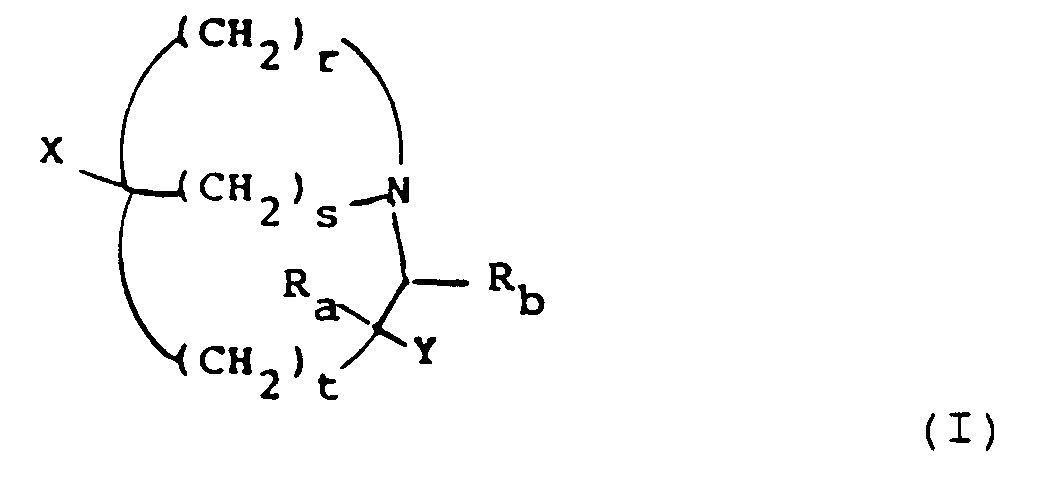
in which one of X and Y represents hydrogen and the other represents Z, where Z is a group
in which Q represents a 3-membered divalent residue completing a 5-membered aromatic ring and comprises zero, one or two nitrogen atoms, Q being optionally C-substituted by a group R₁ selected from halogen, CN, OR₂, SR₂, N(R₂)₂, NHCOR₂, NHCOOCH₃, NHCOOC₂H₅, NHOR₂, N₃, NHNH₂, NO₂, COR₂, COR₃, C₂₋₄ alkenyl, C₂₋₄ alkynyl, cyclopropyl or C₁₋₂ alkyl optionally substituted with OR₂, N(R₂)₂, SR₂, CO₂R₂, CON(R₂)₂ or one, two or three halogen atoms, in which each R₂ is independently hydrogen or C₁₋₂ alkyl and R₃ is OR₂, NH₂ or NHR₂; r represents an integer of 2 or 3, s represents an integer of 1 or 2 and t represents 0 or 1; Ra and Rb each represent hydrogen or, when X is hydrogen, optionally together represent a bond; with the proviso that when Y is hydrogen s is 1. - Certain compounds of formula (I) are capable of existing in a number of stereoisomeric forms including enantiomers. The invention extends to each of these stereoisomeric forms, and to mixtures thereof (including racemates). The different stereoisomeric forms may be separated one from the other by the usual methods, or any given isomer may be obtained by stereospecific or asymmetric synthesis.
- In compounds of formula (I) having two assymmetric centres where Y is other than hydrogen and Ra and Rb each represent hydrogen, the stereo-chemical configuration in which the group Y and the (CH₂)s bridge are on the same side of the plane of the molecule which contains both bridgehead atoms and the ring carbon atom bonded to the group Y will herein be referred to as the exo configuration. Similarly, the configuration of compounds in which the group Y and the bridge (CH₂)s are on opposite sides of the above-mentioned plane of the molecule will herein be referred to as the endo configuration. Preferably compounds of formula (1) have the exo configuration.
- The compounds of formula (I) can form acid addition salts with acids, such as the conventional pharmaceutically acceptable acids, for example hydrochloric, hydrobromic, phosphoric, acetic, fumaric, salicylic, citric, lactic, mandelic, tartaric, oxalic and methanesulphonic.
- Preferred combinations of (r, s, t) include (2,2,0), (3,1,0), (2,1,0), (2,1,1) and (3,1,1). Examples of combinations of (r, s, t) include (2,2,0), (3,1,0) and (2,1,0).
- Halogen in R₁ includes fluoro, chloro, bromo and iodo.
- The substituent R₁ on Z is preferably γ to the position of the azabicyclic ring.
- Examples of R₁ include hydrogen, methyl, ethyl, amino, nitro, azido, cyano, chloro, bromo and iodo, preferably hydrogen, methyl and amino.
- 5-Membered aromatic heterocycles within the definition of variable Z include 1,2-pyrazol-1-yl, 1,2,4-triazol-1-yl, 1,2,3-triazol-1-yl, 1,2,3-triazol-2-yl, tetrazol-1-yl and tetrazol-2-yl.
- Preferred heterocycles for Z are 1,2-pyrasol-1-yl, 1,2,4-triazol-1-yl, 1,2,3-triazol-2-yl, tetrazol-1-yl and tetrazol-2-yl, most preferably 1,2,4-triazol-1-yl and tetrazol-2-yl.
- Ra and Rb are preferably both hydrogen.
- The invention also provides a process for the preparation of a compound of formula (I), or a pharmaceutically acceptable salt thereof, which process comprises:
- (a) cyclising a compound of formula (II):

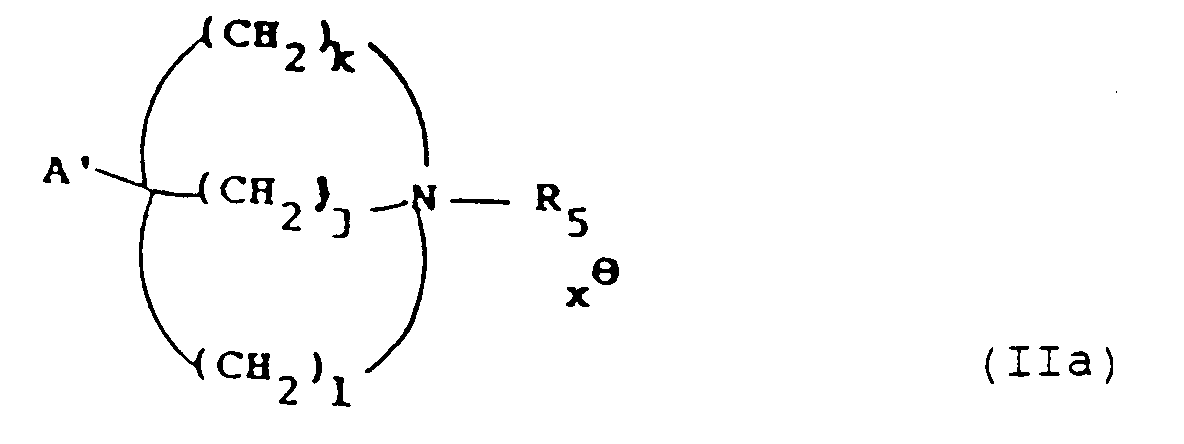
or (ii) A represents an electron withdrawing group, B represents hydrogen and R₅ represents -(CH₂)j L₂ where L₂ is a leaving group; one of k and l is 1 and the other and j independently represent an integer of 2 or 3; to give a compound of formula (IIb):
- (b) cyclising a compound of formula (III):
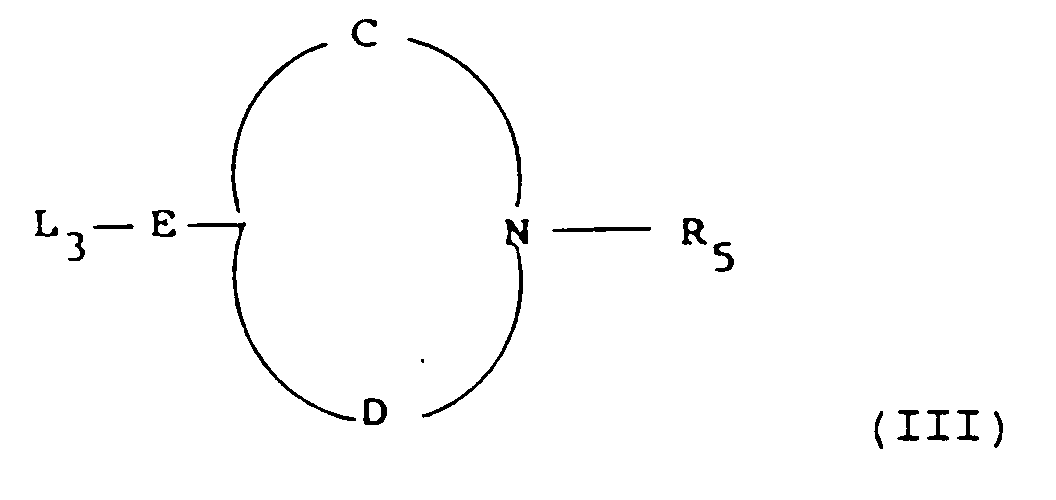
- (c) cyclising a compound of formula (IV):

- It will be appreciated that the product of process variant (a) is a compound of formula (I) in which variable Y is hydrogen and that the product of process variant (b) or (c) is a compound of formula (I) in which variable X is hydrogen.
- In process variant (a), examples of the leaving groups L₁ and L₂ include halo such as chloro or bromo, tosyloxy and mesyloxy.
- Examples of R₅ when an N-protecting group include benzyl and substituted benzyl.
- Examples of A and A′ when other than Z include hydroxy, alkoxycarbonyl, benzyloxycarbonyl and cyano.
- The cyclisation reaction is a nucleophilic substitution which may be carried out under conventional conditions appropriate to the groups A and B. Thus, when B is (CH₂)jBr and A is C₁₋₄ alkoxycarbonyl, the cyclisation is carried out in an inert solvent such as toluene or ether at elevated temperature. When B is (CH₂)jOTos or (CH₂)jO-Mes, it is preferably obtained by treatment of a (CH₂)jOH group with a suitable reagent such as tosylchloride or mesyl chloride, in a base such as pyridine, whereupon the cyclisation may proceed at ambient temperature, or at elevated temperature in an inert solvent such as toluene. This route is suitable where A is hydroxy or Z and R₅ is preferably an N-protecting group and is the preferred route to compounds of formula (I) where X is Z and (r,s,t) is (2,1,0). When A and L₁ together represent -COO-, the cyclisation may be carried out in a lower alkanol such as ethanol in the presence of acid such as hydrogen bromide. In the resulting compound of formula (IIa), A′ will be an alkoxycarbonyl group corresponding to the lower alkanol used for the cyclisation.
- Where R₅ is an N-protecting group such as benzyl, this may be removed by conventional hydrogenation, preferably catalytically over a suitable catalyst such as Pd/C. Where A′ or K is benzyloxycarbonyl, deesterification and deprotection may be effected simultaneously by conventional hydrogenation.
- Examples of K and A when an electron withdrawing group include C₁₋₄ alkoxycarbonyl and cyano.
- When A is an electron withdrawing group such as C₁₋₄ alkoxycarbonyl, B is hydrogen and R₅ is -(CH₂)jL₂ where L₂ is, for example, chloro, the cyclisation may be effected by treatment of the compound of formula (II) with lithium diisopropylamide.
- In process variant (b), examples of leaving groups L₃ include halo such as chloro and hydroxy. In the group -(CH₂)t-CHRaA′-CHRb-, examples of A′ include hydroxy and cyano. Examples of groups convertible to -(CH₂)t-CRaA′-CHRb- include -(CH₂)t-COCH₂- and -(CH₂)t-CHA′-CH₂-. In process variant (c), examples of L₄ include those given for L₃. Examples of electron withdrawing groups K and W include C₁₋₄ alkoxycarbonyl and cyano. In the group -(CH₂)t-CHA′-CH₂-, examples of A′ include hydroxy, cyano and formyl.
- In process variant (b), where L₃ is hydroxy and D is -(CH₂)t-CHOH-CH₂-, the cyclisation of compounds of formula (III) may be carried out by pyrolysis, by the method of D.O. Spry and H.S. Aaron, J. Org. Chem., 1969, 34, 3674, to yield a compound where A′ is hydroxy.
- Where E is -(CH₂)t-CO-CH₂-, the cyclisation may be carried out under basic conditions where R₅ is benzyl (F.I. Carrol, A.M. Ferguson, and J.B. Lewis, J. Org. Chem. 31, 2957, 1966).
- Where L₃ and A′ together represent -COO-, the cyclisation is a rearrangement reaction which can be carried out under acid conditions in a polar solvent, such as hydrogen bromide in ethanol, at ambient temperature, to yield a compound where A′ is a carboxy ester group. It is preferred to protect the nitrogen atom with an R₅ N-protecting group such as benzyl, which may be subsequently removed by hydrogenation over a suitable catalyst such as Pd/C.
- In process variant (c), where Y³ and Y⁴ both contain carboxy ester groups the cyclisation of compounds of formula (IV) is a Dieckmann reaction which is catalysed by a base such as potassium t-butoxide at elevated temperature in a solvent such as toluene.
- The resulting β-keto ester is hydrolysed and decarboxylated under conventional conditions such as heating at reflux in dilute hydrochloric acid.
- In process variant (c) where Y³ and Y⁴ both contain cyano groups the cyclisation is a Thorpe reaction which is catalysed by a base such as potassium t-butoxide at elevated temperature in a solvent such as toluene.
- The resulting β-keto nitrile is hydrolysed and decarboxylated under conventional conditions such as heating at reflux in dilute hydrochloric acid.
- Where Y³ is -(CH₂)vL₄, the cyclisation may be carried out as described in EP-0094742 under basic conditions such as sodium hydride and potassium t-butoxide, in an inert polar solvent such as dimethylformamide.
- Conversions of the carbonyl group from process variants (b) and (c) and of groups A′ and K, and interconversions of Z, may be carried out conventionally, see for example standard text books on heterocyclic chemistry such as 'Comprehensive Heterocyclic Chemistry', A.R. Katritzky and C.W. Rees, Pergamon, 1984.
- The A′ or K group is first converted, as necessary, to a suitable starting group Z′ for the chosen conversion reaction to give the required group Z. The carbonyl group from process variants (b) and (c) is converted to a group CRaZ′ or C=N-NH₂.
- An A′ hydroxy group may be oxidised to a carbonyl group by treatment with chromic acid or using dimethyl sulphoxide and dicyclohexylcarbodiimide.
- A carbonyl group may be converted to a C=N-NH₂ hydrazone group by successive treatment with N,N-dimethylhydrazine and hydrazine. Reduction of the hydrazone with lithium aluminium hydride affords the hydrazine, a CHZ′ group where Z′ is hydrazino.
- Alternatively, the carbonyl group may be converted to CHZ′ where Z′ is hydrazino by treatment with t-butyl carbazate followed by reduction to the t-butyloxycarbonyl hydrazine by catalytic hydrogenation and removal of the ester function by acid hydrolysis.
- A carbonyl group may be reacted with hydroxylamine hydrochloride to give an oxime which can then be reduced with either lithium aluminium hydride in tetrahydrofuran at elevated temperature or sodium in isoamyl alcohol, depending on the stereochemistry required, to give a Z′ amino group.
- Alternatively, the carbonyl group may be reduced to a Z′ hydroxy group with a suitable reducing agent such as sodium borohydride in ethanol at ambient temperature, or sodium in ethanol at elevated temperature, such as the boiling point of the solvent, under an inert atmosphere such as nitrogen, depending on the stereochemistry reguired. Hydrogenation in the presence of Adam's catalyst, PtO₂, provides a stereospecific, endo product.
- A Z′ hydroxy group may be converted to azido by first converting it to a good leaving group such as mesyloxy or tosyloxy and then displacing it with azide ion. A Z′ azido group may be reduced to a Z′ amino group by reduction with hydrogen catalysed by palladium on carbon.
- A Z′ alkoxycarbonyl group may be obtained by conventional acid hydrolysis of a Z′ cyano group, followed by esterification.
- A Z′ bromo group may be obtained from a Z'alkoxycarbonyl group by conversion of the latter to chlorocarbonyl by hydrolysis and treatment with thionyl chloride. The chlorocarbonyl group is reacted with N-hydroxypyridine-2-thione sodium salt, dimethylaminopyridine and triethylamine in bromotrichloromethane.
- A Z′ alkoxycarbonyl group may be converted to a Z′ amino group by hydrolysis with aqueous acid to a carboxyl group followed by treatment with sodium azide in concentrated sulphuric acid to give an amino group via a Schmidt degradation (ref. Organic Reactions Volume 3 Chapter 8 p307-333, 1946, Publ. John Wiley and Son).
- A Z′ isocyanide group may be obtained from a Z′ amino group by formylating with a mixture of formic acid and acetic anhydride and then dehydrating the resulting formamide with phosgene in dichloromethane. Alternatively a Z′ isocyanide group may be obtained from a hydrazino group by diazotization to form an azide and then reduction to an amino group and continue as above.
- A Z′ hydrazino group may be obtained from a Z′amino group by treatment with formaldehyde and potassium cyanide to form a cyanomethylamino group which is then hydrolysed with aqueous hydrochloric acid to afford the amino carboxylic acid. Diazotisation with sodium nitrite in aqueous hydrochloric acid affords the N-nitroso group which can be cyclised to the sydnone with acetic anhydride. The hydrazine can be obtained from this by hydrolysis with aqueous hydrochloric acid (ref. H.U. Daeniker, Helv. Chem. Acta 1967, 50, 2008).
- Alternatively, a Z′ hydrazino group may be obtained from a Z′ hydroxy group by treatment with tosyl chloride in pyridine at ambient temperature to afford a tosylate group. This can be converted to a hydrazino group by treatment with anhydrous hydrazine at elevated temperature, for example at reflux for a number of hours.
- Alternatively, a Z′ hydrazino group may be obtained from a Z′ bromo group by treatment with anhydrous hydrazine, again at reflux for a number of hours.
- When Z represents a 3-substituted-1,2-pyrazol-1-yl group, a Z′ hydrazino group may be treated with the acetal or bis acetal of R₁COCH₂CHO, where R₁ is hydrogen or an alkyl, alkenyl, alkynyl or cyclopropyl group, under acidic conditions at elevated temperature.
- A Z 3- or 5-amino-1,2-pyrazol-1-yl group may be obtained by treatment of a Z′ hydrazino group with 2-chloroacrylonitrile under basic conditions at low temperature.
- When Z represents a 3-substituted-1,2,4-triazol-1-yl group, a Z′ hydrazino group may be treated with the appropriate imidate of the form ROC(=NH)-R₁ where R₁ is hydrogen or an alkyl, alkenyl, alkynyl or cyclopropyl group and R is a lower alkyl group, under basic conditions followed by treatment of the resulting amidrazone with anhydrous formic acid or triethyl orthoformate. Where R₁ is hydrogen the hydrazino group may alternatively be treated with Gold's reagent, (CH₃)₂N-CH=N-CH=N⁺(CH₃)₂Cl⁻.
- Where the hydrazone is used in place of the hydrazine, the product is a compound of formula (I) in which Ra and Rb together represent a bond.
- When Z represents an unsubstituted tetrazol-1-yl group a Z′ isocyano group may be treated with ammonium azide in methanol for a prolonged period of time.
- A Z tetrazol-2-yl group may be obtained by conversion of a hydrazine via literature procedures ref J.A. Bladin, Chem. Ber. 1885, 1544.
- A Z 1,2,3-triazol-1-yl group may be obtained by treating a Z′ azide group with acetylene dicarboxylic acid followed by heating which causes decarboxylation.
- In an alternative strategy, Z is introduced by displacing a Z′ leaving group such as methanesulphonyloxy or bromo with a Z⁻ anion generated by preparing the sodium salt of the azole ZH by treatment with sodium in ethanol. The displacement reaction is carried out at elevated temperature in an inert, polar solvent such as dimethylformamide. The displacement results in a reversal of the stereochemistry at the assymetric carbon.
- Interconversion of carbon substituents R₁ within a group Z may be carried out conventionally. Thus, for 1,2,4-triazoles, an amino group may be converted to halo such as chloro, azide or -NHNH₂, via a diazonium intermediate. The diazonium intermediate may be obtained by treatment of the amino group with nitrous acid. A halo group may be obtained by displacement of the diazonium ion with cuprous halide at elevated temperature. An azide group may be obtained by displacement of the diazonium ion with sodium azide. A hydrazine may be obtained by reduction of the diazonium ion. A nitro group may be obtained by displacement of the diazonium ion with nitrite ion at elevated temperature.
- Halo substitutents such as bromine, chlorine or iodine may be introduced into the 5 position of 1,2,4-triazoles and into 2-yl tetrasoles by treatment of the unsubstituted azole with base such as t-butyllithium in pentane followed by reaction with halogen source such as bromine, chlorine in carbon tetrachloride or iodine. A chloro substituent may be converted by reaction with a nucleophile such as methoxide; and alkoxycarbonyl groups may be converted, via carboxy, to an amino substituent.
- A cyano group may be introduced into 2-yl tetrazoles by conversion of hydrogen to formyl by treatment with t-butyl lithium followed by N-methyl formanilide. The formyl group is converted to an aldoxime by treatment with hydroxylamine hydrochloride. The aldoxime may then be dehydrated with a suitable dehydrating agent such as acetic anhydride to afford the required cyano group.
- Where applicable, an endo isomer may be obtained by epimerisation of a corresponding exo isomer, the epimerisation reaction being effected by standard procedures at any convenient stage in the process but preferably before the introduction of the group Y.
- In a further aspect the invention provides a process for the preparation of a compound of formula (I), or a pharmaceutically acceptable salt thereof, which process comprises reacting a compound of formula (IVa):

in which Ra, Rb, r,s and t are as defined in formula (I), one of X′ and Y′ represents hydrogen and the other represents Z′ wherein Z′ is a group convertible to Z as defined in formula (I), to convert Z′ to Z and thereafter optionally forming a pharmaceutically acceptable salt. - Intermediates of formula (IVb) and salts thereof:

in which Ra, Rb r,s, and t are as defined in claim 1, one of X˝ and Y˝ represents hydrogen and the other represents Z˝ where Z˝ is hydrazino, azido or isocyano or Ra and Z˝ together are a hydrazone group are novel and form part of the invention. - Compounds of formula (II) may be prepared conventionally, for example as described in EP-0287356.
- Where A is C₁₋₄ alkoxycarbonyl, B is (CH₂)jL₁ and R₅ is hydrogen or an N-protecting group, the compound of formula (II) may be prepared by treating a compound of formula (V):

where R₆ is C₁₋₄ alkyl and the remaining variables are as previously defined, with lithium diisopropylamide, prepared in situ from diisopropylamine and n-butyllithium followed by reaction with a compound L₅(CH₂)jL₁ where L₅ is a leaving group, in an inert solvent such as ether at depressed to elevated temperature. Both L₁ and L₅ are suitably bromo. - Where A is Z such as optionally substituted 1,2,4-triazol-1-yl, B is CH₂L₁, k and 1 are each 2 and R₅ is an N-protecting group, the compound of formula (II) may be prepared by treating a compound of formula (V) defined above with lithium diisopropylamide prepared as aforesaid followed by reaction with di-t-butylazadicarboxylate at depressed to ambient temperature. The resulting protected 4-hydrazino group is deprotected conventionally by acid hydrolysis and the free hydrazino group converted to an optionally substituted 1,2,4-triazol-1-yl group as described earlier. Other Z groups may be obtained analogously. The R₆OOC- group also in the 4 position is then converted to -CH₂OH by reduction with lithium aluminium hydride and the OH converted to other L₁ as described earlier.
- Where A and L₁ together represent -COO- and j is 2, the compound of formula (II) may be prepared by reacting the compound of formula (V), treated with lithium diisopropylamide as before, with ethylene oxide in an inert solvent such as ether at depressed to elevated temperature.
- Alternatively, the compound of formula (II) where A and L₁ together represent -COO, j is 2, k is 2 and l is 1 may be prepared by a 1,3-dipolar cycloaddition reaction which involves reacting a compound of formula (VI):
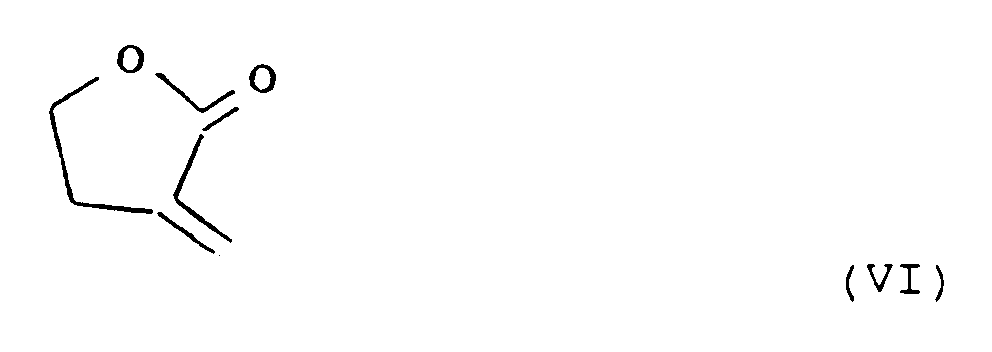
with a compound of formula (VII):
where R₇ is an N-protecting group,
in the presence of a catalytic amount of trifluoroacetic acid. - Where A is an electron withdrawing group such as C₁₋₄ alkoxycarbonyl, B is hydrogen and R₅ is (CH₂)jL₂, the compound of formula (II) may be prepared by reacting the compound of formula (V) where R₅ is hydrogen with a compound L₅(CH₂)jL₂ where L₅ is as previously defined, in a solvent such as acetone in the presence of a base such as potassium carbonate. The leaving group L₅ is preferably bromo and L₂ is preferably chloro.
- Compounds of formulae (V) are known compounds or may be prepared by analogous methods to those for preparing known compounds. The compound of formula (V) where k is 2, l is 1 and R₅ is benzyl may be prepared by the cyclisation of di-C₁₋₄ alkyl itaconate in the appropriate alkanol with benzylamine at elevated temperature, followed by reduction of the resulting oxo group at the 2-position of the pyrrolidine ring with BH₃ in tetrahydrofuran, at ambient to elevated temperature.
- Alternatively, and preferably, a dipolar cycloaddition of a C₁₋₄ alkyl acrylate with a compound of formula (VII) in the presence of a catalytic amount of trifluoroacetic acid yields a compound of formula (V) directly.
- Intermediates of formulae (III) and (IV) are known compounds (e.g. as described in EP-A-0094742 or EP-A-0261763) or may be prepared analogously.
- Intermediates of formula (III) where A′ and L₃ together represent -COO- are described in, for example, Kuthan et al., Coll. Czechoslov. Chem. Comm., 1977, 42, 283 or may be prepared therefrom by conventional hydrogenation of the pyridine ring over 5% Pt/C, and benzylation of the nitrogen atom by treatment with benzyl bromide and potassium carbonate in dry acetone.
- The compound of formula (III) where A′ and L₃ together represent -COO-, t = O, C is -CH₂- and E is -(CH₂)₂₋ may be prepared by a 1,3-dipolar cycloaddition reaction of a compound of formula (VII) with 5,6-dihydro-2H-pyran-2-one in the presence of a catalytic amount of trifluoroacetic acid.
- Intermediates of formula (III) where L₃ is a leaving group are described in, for example, Spry et al., J. Org. Chem., 1969, 34, 3674 and Hasse et al., Chem. Ber., 1960, 93, 1686.
- Intermediates of formula (IV) are described in or may be prepared from intermediates of formula (V) as described in, for example, Martell et al., J. Pharm. Sci., 1963, 52(4), 331, Sternbach et al., J.A.C.S., 1952, 74, 2215, Thill et al., J. Org. Chem., 1968, 33, 4376 and EP-0 094 742.
- Compounds of formulae (VI) and (VII) may be prepared conventionally. Thus, a compound of formula (VI) may be obtained by the reaction of γ-butyrolactone with ethyl formate in the presence of base such as sodium hydride followed by reaction of the resulting formyl derivative (as the enol salt) with formaldehyde. A compound of formula (VII) may be obtained by the reaction of the primary amine R₇NH₂ successively with chloromethyltrimethylsilane and formaldehyde followed by methanol and anhydrous potassium carbonate.
- Pharmaceutically acceptable salts of the compounds of formula (I) may be formed conventionally by reaction with the appropriate acid such as described above under formula (I).
- The compounds of the present invention enhance acetylcholine function via an action at muscarinic receptors within the central nervous system and are therefore of potential use in the treatment and/or prophylaxis of dementia.
- The present invention also provides a pharmaceutical composition, which comprises a compound of formula (I) or pharmaceutically acceptable salt thereof, and a pharmaceutically acceptable carrier.
- The compositions may be in the form of tablets, capsules, powders, granules, lozenges, suppositories, reconstitutable powders, or liquid preparations such as oral or sterile parenteral solutions or suspensions.
- In order to obtain consistency of administration it is preferred that a composition of the invention is in the form of a unit dose.
- Unit dose presentation forms for oral administration may be tablets and capsules and may contain conventional excipients such as binding agents, for example syrup, acacia, gelatin, sorbitol, tragacanth, or polyvinylpyrrolidone; fillers, for example lactose, sugar, maize-starch, calcium phosphate, sorbitol or glycine; tabletting lubricants, for example magnesium stearate; disintegrants, for example starch, polyvinylpyrrolidone, sodium starch glycollate or microcrystalline cellulose; or pharmaceutically acceptable wetting agents such as sodium lauryl sulphate.
- The solid oral compositions may be prepared by conventional methods of blending, filling, tabletting or the like. Repeated blending operations may be used to distribute the active agent throughout those compositions employing large quantities of fillers. Such operations are of course conventional in the art. The tablets may be coated according to methods well known in normal pharmaceutical practice, in particular with an enteric coating.
- Oral liquid preparations may be in the form of, for example, emulsions, syrups, or elixirs, or may be presented as a dry product for reconstitution with water or other suitable vehicle before use. Such liquid preparations may contain conventional additives such as suspending agents, for example sorbitol, syrup, methyl cellulose, gelatin, hydroxyethylcellulose, carboxymethylcellulose, aluminium stearate gel, hydrogenated edible fats; emulsifying agents, for example lecithin, sorbitan monooleate, or acacia; non-aqueous vehicles (which may include edible oils), for example almond oil, fractionated coconut oil, oily esters such as esters of glycerine, propylene glycol, or ethyl alcohol; preservatives, for example methyl or propyl p-hydroxybenzoate or sorbic acid; and if desired conventional flavouring or colouring agents.
- For parenteral administration, fluid unit dosage forms are prepared utilizing the compound and a sterile vehicle, and, depending on the concentration used, can be either suspended or dissolved in the vehicle. In preparing solutions the compound can be dissolved in water for injection and filter sterilized before filling into a suitable vial or ampoule and sealing.
- Advantageously adjuvants such as a local anaesthetic, a preservative and buffering agents can be dissolved in the vehicle. To enhance the stability, the composition can be frozen after filling into the vial and the water removed under vacuum. Parenteral suspensions are prepared in substantially the same manner, except that the compound is suspended in the vehicle instead of being dissolved, and sterilization cannot be accomplished by filtration. The compound can be sterilized by exposure to ethylene oxide before suspending in the sterile vehicle. Advantageously, a surfactant or wetting agent is included in the composition to facilitate uniform distribution of the compound.
- The compositions may contain from 0.1% to 99% by weight, preferably from 10-60% by weight, of the active material, depending on the method of administration.
- The invention also provides a method of treatment and/or prophylaxis of dementia in mammals including humans, which comprises administering to the sufferer an effective amount of a compound of formula (I) or a pharmaceutically acceptable salt thereof.
- The dose of the compound used in the treatment of such disorders will vary in the usual way with the seriousness of the disorders, the weight of the sufferer, and the relative efficacy of the compound. However, as a general guide suitable unit doses may be 0.05 to 100 mg. for example 0.2 to 50mg; and such unit doses may be administered more than once a day, for example two or three times a day, so that the total daily dosage is in the range of about 0.01 to 5 mg/kg; and such therapy may extend for a number of weeks or months.
- Within the above indicated dosage ranges no toxicological effects are indicated for the compounds of the invention.
- In a further aspect the invention provides a compound of formula (I) or a pharmaceutically acceptable salt thereof for use as an active therapeutic substance.
- The invention further provides a compound of formula (I) or a pharmaceutically acceptable salt thereof, for use in the treatment and/or prophylaxis of dementia.
- In another aspect the invention provides the use of a compound of formula (I) or a pharmaceutically acceptable salt thereof for the preparation of a medicament for the treatment and/or prophylaxis of dementia.
- The following examples illustrate the invention and the following descriptions illustrate the preparation of intermediates thereto.
- 3-Quinuclidinone (10g, 0.08mol) was dissolved in dry EtOH (20ml) and N,N-dimethylhydrazine (16ml, 0.21 mol) was added. The yellow solution was heated at reflux overnight, and then evaporated to dryness under reduced pressure. The yellow syrup (12. 34g, 92%) crystallised on standing to afford N-(3-quinuclidinyl)-N′N′-dimethyl hydrazone. This compound (0.62g, 3.7mmol) was then dissolved in dry EtOH and anhydrous hydrazine (0.8ml, 25mmol) added. The solution was heated at reflux for 4.5h, and then evaporated to dryness under reduced pressure. The resulting white solid was purified by Kugelröhr distillation (b.p. 170oC, 0.2mmHg) to afford the title compound as a white crystalline solid (0.48g, 93%). m.p. 93-95oC.
¹H nmr (CDCl₃, 270 MHz)
1.80 (4H, m), 2.40 (1H, pentet), 2.88 (4H, m), 3.48 (2H, s), 4.78 (2H, bs, NH₂). - MS: C₇H₁₃N₃: M⁺ 139
- 3-Quinuclidinyl-hydrazone (D1) (1.09g, 7.84 mmol) was dissolved in dry THF (20ml) and the solution added dropwise to an iced suspension of LiAlH₄ (600mg, 15.8 mmol) in THF (5ml) under N₂, and the solution allowed to warm to room temperature. This was then heated at reflux under N₂ for 24h. The reaction was quenched with water (0.6ml), 10% NaOH (1.8ml) and water (0.6ml), and the white precipitate filtered off and washed with dry ether. The filtrate was evaporated to dryness under reduced pressure to yield a clear colourless oil (1.0g, 90%), which was used directly in the next stage.
¹H nmr (CDCl₃, 270 MHz)
1.54 (2H, bm), 1.80 (2H, bm), 2.36 (1H, m), 2.53 (1H, m), 2.80 (4H, bm), 3.18 (2H, m). - 3-Quinuclidinone (1.25g, 10mmol) was dissolved in 60-80 petroleum ether (50ml) and tbutyl carbazate (2.0g, 15mmol) was added. The solution was heated at reflux for 24h, allowed to cool overnight, and the resulting crystals filtered to yield the title compound as a white crystalline solid (2.301g, 96%), m.p. 170-172oC.
¹H nmr (CDCl₃, 250 MHz)
1.51 (9H, s, tBu), 1.86 (4H, m), 2.83 (5H, complex m), 3.45 (1.65H, s) with 3.55 (0.35H, s).
¹³C nmr (CDCl₃, 67 MHz)
26.5 (CH₂), 28.2 (tButyl), 31.0 (CH), 47.3 (CH₂), 52.7 (CH₂), 81.1 (tBu-C), 152.9 (C=N), 159.9 (C=O).
MS: C₁₂H₂₁N₃O₂ requires 239.1632
observed 239.1634Analysis: C₁₂H₂₁N₃O₂ % required: C, 60.23; H, 8.85; N, 17.56 % found: C, 59.83; H, 8.77; N, 17.46 - 1-tButyloxycarbonyl-2-(3-quinuclidinyl)-hydrazone (D3) (1.0g, 4.18 mmol) was dissolved in ethanol (100ml) and a solution of anhydrous oxalic acid (0.370g, 4.0 mmol) in ethanol (20ml) was added. Palladium on charcoal (10% 0.3g) was added under nitrogen and the solution hydrogenated at atmospheric pressure and 35oC for 24h. The mixture was filtered through celite under nitrogen, the filtrate evaporated to dryness under reduced pressure, and the residue dissolved in saturated aqueous potassium carbonate. The aqueous solution was extracted with ethyl acetate (2 x 250ml), the organic solutions dried (Na₂SO₄), filtered and evaporated to dryness under reduced pressure to yield the title compound (D4) as a clear colourless oil (1.01g, 100%) which crystallised on standing.
¹H nmr (CDCl₃, 270 MHz)
1.47 (9H, s, tBu), 1.64 (1H, m), 1.86 (2H, m), 2.42 (1H, dm), 2.78 (5H, complex m), 3.66 (3H, m).
¹³C nmr (CDCl₃, 67 MHz)
20.0 (CH₂), 24.1 (CH), 25.4 (CH₂), 28.4 (tBu-Me), 47.0 (CH₂), 47.5 (CH₂), 53.4 (CH₂), 56.1 (CH), 80.5 (tBu-C), 156.9 (C=O).
MS: C₁₂H₂₃N₃O₂ requires 241.1784
observed 241.1792 - 1-tButyloxycarbonyl-2-(3-quinuclidinyl)-hydrazine (D4) (1.0g, 4.2mmol) was dissolved in 10% HCl/MeOH (40ml) and heated at reflux for 30 min. The solution was evaporated to dryness under reduced pressure, and recrystallised from MeOH and diethyl ether, to afford the title compound as a white crystalline solid (0.78g, 87%), m.p. 245-250oC, decomp.
¹H nmr (d₆ DMSO, 270 MHz)
1.87 (2H, m), 2.05 (1H, m), 2.28 (1H, m), 2.50 (1H, m), 3.09 (1H, d), 3.31 (4H, bm), 3.62 (2H, m).
¹³C nmr (d₆ DMSO, 67 MHz)
16.5 (CH₂), 21.0 (CH₂), 21.9 (CH), 44.7 (CH₂), 45.5 (CH₂), 49.9 (CH₂), 52.2 (CH).
MS: C₇H₁₅N₃ requires 141.1272
observed 141.1265 - 3-Oxo-1-azabicyclo[2.2.1]heptane¹ (4.2g, 0.038 mol) was dissolved in petroleum ether (60-80o) (250ml) and diethyl ether (10ml). tButyl carbazate (10g, 0.0758 mol) was added and the solution heated at reflux for 24h, allowed to cool overnight, and then evaporated to dryness under reduced pressure to yield a yellow oil, containing both syn and anti isomers of the product (D6) and excess tbutyl carbazate. The oil was used directly in the next step.
¹H NMR (CDCl₃, 270 MHz)
1.68 (1H, m), 1.92 (1H, m), 2.58 (1H, dt), 2.73 (1H, bq), 2.99-3.50 (4H, complex m).
¹³C NMR (CDCl₃, 67 MHz)
27.4 and 28.3 (tBu-Me), 38.5, 44.3, 52.9 and 53.3, 57.0, 60.7 and 61.2, 81.3 (tBu-quat-C), 152.9 (C=N), 162.9 (C=O).
MS: C₁₁H₁₉N₃O₂ requires 225.1487
observed 225.1474
1 D.O. Spry and H.S. Aaron, J. Org. Chem., 1969, 34, 3674. - The mixture of 1-tbutyloxycarbonyl-2-[3-(1-azabicyclo[2.2.1]heptanyl)]hydrazone (D6) and unreacted tbutylcarbazate was dissolved in ethanol (300ml) and excess anhydrous oxalic acid (4g) added. Palladium on charcoal (10% 0.5g) was added under N₂ and the mixture was hydrogenated at atmospheric pressure and 45oC for 6h. The solution was then filtered through celite, evaporated to dryness under reduced pressure, dissolved in saturated aqueous K₂CO₃ and extracted with EtOAc (4 x 500ml). The organic extracts were dried (Na₂SO₄), filtered and evaporated to dryness to yield a yellow oil which was purified by column chromatography (basic alumina, eluting with EtOAc/2% MeOH) to yield the saturated tbutyloxycarbonyl hydrazine as a mixture of exo and endo isomers [7.10g, 83% based on the starting ketone in Description 6]. This compound (6.77g, 0.030 mol) was dissolved in MeOH/HCl (250ml) and heated at reflux for 20 min. The mixture was evaporated to dryness under reduced pressure and recrystallised from methanol/diethyl ether to yield the title compound as a white crystalline solid (4.34g, 72%), m.p. 245-246oC (decomp.).
¹H NMR (d₆ DMSO, 270 MHz)
1.46 and 1.79 together (1H, m), 2.01 (1H, complex M), 2.75-3.85 (8H, complex bm).
¹³C NMR (d₆ DMSO, 67 MHz)
19.8 (CH₂), 23.6 (CH₂), 50.9 and 51.7 (CH₂), 55.4 and 55.6 (CH₂), 56.1 and 56.4 (CH), 57.9 and 58.9 (CH). - Quinuclidin-3-ol (10.0g, 0.0787 mol) was dissolved under N₂ in dry dichloromethane (200ml) and cooled in an ice bath to 0oC. Methanesulphonyl chloride (7.3ml, 10.8g, 0.094 mol, 1.2eq) and dry pyridine (7.64ml, 7.46g, 0.094 mol, 1.2eq) were added and the mixture stirred at 0oC for 20 min. The solution was then warmed to r.t. and stirred under N₂ for 1h. Saturated aqueous potassium carbonate solution (150ml) was added, and the organic layer extracted and collected. The aqueous layer was re-extracted with EtOAc (3 x 200ml), the organic solutions dried (Na₂SO₄), filtered, and evaporated to dryness under reduced pressure to yield a pale yellow oil which was pumped under high vacuum to remove any last traces of pyridine to yield the title compound (D8) (15.8g, 98%).
¹H NMR (CDCl₃, 270MHz)
1.67 (4H, m), 2.18 (1H, pentet), 2.85 (5H, bm), 3.03 (3H, s, SO₂Me), 3.38 (1H, q), 4.82 (1H, m, CHOMs). - 1-Azabicyclo[2.2.1]heptan-3-one* (6.2g, 0.056 mol) was dissolved in EtOH (50ml). PtO₂ (Adam's catalyst) (1g) was added under nitrogen and the mixture hydrogenated at atmospheric pressure and 45oC for 6h. The suspension was filtered under nitrogen through celite, the solid washed with EtOH, and the filtrate evaporated to dryness under reduced pressure and pumped dry under high vacuum to yield the title compound (D9) as a beige solid (6.2g, quantitative)
¹H NMR (CDCl₃, 270MHz)
1.43 (1H, m), 2.05 (2H, m), 2.42 (1H, dd), 2.63 (3H, bm), 2.90 (1H, m), 3.05 (1H, m), 4.38 (1H, m, CHOH).
*D.O. Spry and H.S. Aaron, J. Org. Chem., 1969, 34, 3674. - endo-1-Azabicyclo[2.2.1]heptan-3-ol (D9) (0.58g, 5.13 mmol) was dissolved in dry dichloromethane (25ml), the solution cooled on ice to 0oC, and methanesulphonyl chloride (0.48ml, 1.2eq) with dry triethylamine (0.86ml, 1.2eq) were added. The mixture was allowed to warm to room temperature and stirred for 2h. The solution was washed with an equal volume of saturated aqeuous potassium carbonate solution, and the aqueous layer was extracted with EtOAc (3 x 100ml). The organic solutions were dried (Na₂SO₄), filtered and evaporated to dryness under reduced pressure to yield an orange oil. This was purified by column chromatography (basic alumina, eluting with EtOAc/1-3% MeOH) to yield the title compound (D10) as a pale yellow oil (0.70g, 71%).
¹H NMR (CDCl₃, 270MHz)
1.57 (1H, m), 1.92 (1H, m), 2.47 (2H, complex m), 2.67 (2H, m), 2.92 (2H, m), 3.02 (3H, s, SO₂Me), 3.20 (1H, m), 5.08 (1H, m, CHOMs). - 1-Azabicyclo[3.2.1]octan-3-one* (6.0g, 0.048mol) was dissolved in EtOH (100ml) and platinum oxide (Adam's catalyst) (1.0g) added under nitrogen. The suspension was hydrogenated at atmospheric pressure and 40oC for 7h, and then filtered under nitrogen through celite. The solid was washed with EtOH, and the filtrate was evaporated to dryness under reduced pressure to yield the title compound (D11) as a white solid (6.0g, quantitative).
¹H NMR (CDCl₃, 270MHz)
1.70 (2H, m), 1.93 (1H, dm), 2.14 (2H, m), 2.53 (2H, m), 2.91 (3H, complex m), 3.32 (1H, m), 3.68 (1H, m), 3.79 (1H, bs, OH).
*D.P. Thill and H.S. Aaron, J. Org. Chem., 1968, 33, 4376. - endo-1-Azabicyclo[3.2.1]octan-3-ol (D11) (2.0g, 0.0158mol) was dissolved in dichloromethane (50ml) and the solution cooled on ice to 0oC. Methanesulphonyl chloride (1.46ml, 1.2eq) and pyridine (1.57ml, 1.2eq) were added with stirring, the mixture allowed to warm to room temperature and stirred for 1.5h. The organic solution was then washed with an equal volume of aqueous saturated potassium carbonate solution and the aqueous layer extracted with EtOAc (3 x 100ml). The organic extracts were dried (Na₂SO₄), filtered and evaporated to dryness under reduced pressure to yield a yellow oil. This was purified by column chromatography, using basic alumina and eluting with EtOAc/MeOH 1-5%, to yield the title compound (D12) as a colourless oil (1.20g, 37%).
¹H NMR (CDCl₃, 270MHz)
1.74 (1H, m), 2.08 (3H, m), 2.21 (1H, m), 2.58 (1H, d), 2.70 (1H, dt), 2.87 (1H, m), 2.94 (3H, s, SO₂Me), 3.21 (3H, m), 4.63 (1H, m). - Acetonitrile (4.1g, 5.22ml, 0.10mol), sodium azide (7.48g, 0.115mol), acetic acid (6.59ml, 0.115mol) and isopropanol (20ml) were mixed and heated in a PTFE-lined autoclave at 130oC for 5 days, with stirring. The reaction was allowed to cool, transferred to a round-bottomed flask with EtOH, and evaporated to dryness under reduced pressure. The solid was extracted repeatedly with boiling n-butyl acetate, until no further solid dissolved. The organic extracts were evaporated to a small volume under reduced pressure and the solid allowed to crystallise out, to give the title compound (D13) as a pale cream solid (3.25g, 39%).
¹H NMR (CDCl₃, 270MHz)
1.85 (3H, s, Me), 4.12 (1H, bs, NH)
M.S. found 84.0436
C₂H₄N₄ requires 84.0436. - As for Description 13 using propionitrile (7.13ml, 0.10mol) instead of acetonitrile, at 140oC for 5 days, giving the product (D14) as a pale cream solid (800mg, 8%)
¹H NMR (d₆ DMSO, 270MHz)
1.27 (3H, t, CH₃), 2.67 (2H, q, CH₂), 4.62 (1H, bs, NH) - Sodium metal (0.01mol) was dissolved in EtOH (50ml) under nitrogen at 5oC, the solution warmed to room temperature and the azole (0.01 mol) added. The suspension was stirred until dissolution occurred, and the solution was then evaporated to dryness under reduced pressure and the white solid dried in a vacuum oven, at 50oC under high vacuum. The salt was then used directly in the next stage.
- Salts made thus:
- (D15) 5-Aminotetrazole**
- (D16) 1N-Tetrazole**
- (D17) 5-Methyltetrazole (from D13)
- (D18) 5-Ethyltetrazole (from D14)
- (D19) 1,2,4-triazole**
- (D20) 3-Amino-1,2,4-triazole**
- (D21) 4-Methyl-1,2,3-triazole*
- exo-1-Azabicyclo[2.2.1]heptan-3-ol* (400mg, 3.54mmol) was dissolved in dry dichloromethane (50ml), the solution cooled on ice to 0oC, and methanesulphonyl chloride (0.27ml, 1.2 equiv) with dry triethylamine (0.592ml, 1.2 equiv) were added. The mixture was allowed to warm to room temperature and stirred for 2h. The organic solution was washed with an equal volume of saturated aqueous potassium carbonate solution, and the aqueous layer extracted with EtOAc (2 x 100ml). The organic solutions were dried (Na₂SO₄), filtered and evaporated to dryness under reduced pressure to yield a yellow oil which was purified by column chromatography (basic alumina, 1-2% MeOH/EtOAc) to afford the title compound as a clear oil (540mg, 80%).
¹H NMR (CDCl₃)
1.11 (1H, m), 1.73 (1H, m), 2.43 (3H, m), 2.77 (2H, dm), 2.87 (1H, d), 2.94 (1H, dm), 3.03 (3H, s, SO₂Me), 4.53 (1H, m, CH-OMs)
*Douglas O. Spry and Herbert S. Aaron, J. Org. Chem., 1969, 34, 3674. - (±) Ethyl-1-azabicyclo[3.2.1]oct-5-ylcarboxylate (EP 0287356, Example 7, 18.97g, 0.104 mole) in hydrochloric acid (8N, 200ml) was heated under reflux for 3h. The solution was then concentrated in vacuo to a hygroscopic solid which was dissolved in thionyl chloride (150ml) and heated under reflux for 0.5h. The mixture was then concentrated in vacuo to give the acid chloride hydrochloride salt as a solid, which was freed from excess thionyl chloride by co-evaporation with toluene. This solid was added in portions to a mixture of the sodium salt of 1-hydroxypyridine-2-thione (17.35g, 0.116 mole), triethylamine (29ml, 0.208 mole) and 4-dimethylaminopyridine (0.5g, 0.004 mole) in dry acetonitrile (300ml) at -20oC. The mixture was allowed to warm slowly to room temperature then refluxed for 2h and evaporated in vacuo. Bromotrichloromethane (250ml) was then added to the residue and the resulting solution was refluxed for 3h. After cooling the reaction mixture was poured into saturated aqueous potassium carbonate solution (150ml) and the mixture was extracted with chloroform (4 x 200ml). The combined organic extracts were dried (Na₂SO₄) and evaporated to give an oil which was subjected to column chromatography on silica using 3-7% methanol/chloroform as eluant to give the crude product which was distilled in vacuo to afford the title compound (D23) as a colourless oil (9.18g, 47%) b.p. 140oC at 1.5mmHg.
¹H NMR (CDCl₃) δ:
1.57 (1H, m), 1.88 (1H, m), 2.16-2.37 (4H, m), 2.71-2.92 (3H, m), 3.07 (2H, s), 3.18 (1H, m).
¹³C NMR (CDCl₃) δ:
23.83, 40.73, 42.99, 52.01, 53.86, 62.45, 68.43 - (±) 5-Bromo-1-azabicyclo[3.2.1]octane (D23, 1g, 5.3mmol) in anhydrous hydrazine (10ml) was heated at reflux for 0.5h. The mixture was then cooled and evaporated in vacuo. The residue was taken up in methanol and an aqueous solution of sodium hydroxide (2.63ml of a 2M solution, 5.3 mmol) was added. The resulting solution was evaporated to dryness then taken up in dry methanol (30ml) and evaporated to dryness once more. This procedure was repeated once more to remove the last traces of water to give a gum (1.34g) which was essentially the title compound (D24) and sodium bromide and was used without further purification.
¹³C NMR (d₆DMSO) δ:
17.56, 29.30, 32.47, 49.64, 51.97, 58.41, 63.59 - 3-Methanesulphonyloxy-1-azabicyclo[2.2.2]octane (D8) (16g) in dry dimethyl formamide (100ml) was treated with sodium azide (10.4g) (0.16 mole, 2eq) at reflux for 5h. The reaction was then cooled and concentrated in vacuo. The residue was then partitioned between saturated aqueous potassium carbonate solution and ether. The organic phase was separated and concentrated to a gum. This was chromatographed on alumina in a gradient of 5-10% methanol in ethyl acetate. The main fraction which eluted first was concentrated to a gum which was Kugelröhr distilled to afford a colourless oil (B.P. 90-100oC at 0.1mm). The oxalate salt of this oil crystallised from acetone/ether to give the title compound (D25) (4.2g, 0.0173 mole 22%) m.p. 100-102oC.
¹H NMR (CDCl₃, 250MHz) δ:
1.8-2.23 (4H, m), 2.28-2.38 (1H, m), 3.05-3.15 (1H, m), 3.15-3.38 (4H, m), 3.55-3.70 (1H, m), 4.20-4.30 (1H, m). - A solution of diisopropylamine (8.8ml, 0.063mol) in ether (400ml) at -70oC under nitrogen was treated with 1.6M n-butyllithium in hexane (37.5ml, 0.060mol) and stirred for 10 minutes. A solution of ethyl 1-benzylpiperidin-4-ylcarboxylate (13.6g, 0.055mol) in ether (70ml) was added over 5 minutes and the resulting mixture then stirred at -70oC for 40 minutes, before adding a solution of di-tert-butylazodicarboxylate (13.5g, 0.058mol) in ether (80ml). The reaction mixture was allowed to warm to room temperature over 0.5h, then stirred for a further 2h before adding dilute potassium carbonate solution (150ml). The ether layer was separated, dried (Na₂SO₄) and concentrated in vacuo to leave an orange oil. This was chromatographed on silica gel eluting initially with 20% ether/60-80 petrol, then with neat ether to afford the title compound (D26) (14.2g, 54%) as a yellow oil.
¹H NMR (CDCl₃, 250MHz) δ:
1.24 (3H, t, J=7Hz), 1.38-1.62 (18H, m), 1.85-1.97 (1H, m), 2.02-2.15 (1H, m), 2.34-2.55 (4H, m), 2.61-2.75 (2H, m), 3.50 (2H, s), 4.07-4.25 (2H, m), 6.02 and 6.30 (together 1H, each br.s), 7.20-7.35 (5H, m). - A solution of ethyl 1-benzyl-4-(N,N′-di-tert-butyloxycarbonylhydrazino)piperidin-4-yl-carboxylate (D26, 14.2g, 0.030 mol) in methanol (50ml) was treated with 10% HCl/methanol (100ml) and heated under reflux for 2h. The solution was concentrated in vacuo and the residue treated with dry toluene (80ml) and again concentrated in vacuo to remove any traces of moisture. The residue was trituated with ether and the material filtered off and immediately placed in a vacuum dessicator to give the title compound (D27) (9.48g, 90%) as a very hygroscopic orange solid.
¹H NMR (CD₃OD, 250MHz) δ:
1.31 (3H, t, J=7Hz), 2.05-2.20 (2H, m), 2.38-2.58 (2H, m), 3.25-3.60 (4H, m), 4.29 (2H, q, J=7Hz), 4.35-4.45 (2H, m), 7.43-7.66 (5H, m). - A stirred suspension of ethyl 1-benzyl-4-hydrazinopiperdin-4-ylcarboxylate dihydrochloride salt (D27, 2.0g, 0.0057 mol) in absolute chloroform (200ml) was treated with Gold's reagent ([3-(dimethylamino)-2-azaprop-2-en-1-ylidene]-dimethylammonium chloride) (930mg, 0.0057 mol) and triethylamine (1.6ml, 0.0114 mol) and the mixture heated at reflux under nitrogen for 2.5h. The solution was allowed to cool, treated with concentrated potassium carbonate solution and the organic layer separated, dried (Na₂SO₄) and concentrated in vacuo to leave an orange oil. This was chromatographed on silica gel eluting first with ethyl acetate to obtain the title compound (D28), then with methanol to obtain a high polar intermediate, which on heating under reflux in toluene for 20 minutes gave a further batch of the triazole product. These two batches were combined to give the title compound (D28) (770mg, 43%) as an orange oil.
¹H NMR (CDCl₃, 250MHz) δ:
1.20 (3H, t, J=7Hz), 2.20-2.75 (8H, m), 3.46 (2H, s), 4.17 (2H, q, J=7Hz), 7.22-7.38 (5H, m), 7.99 (1H, s), 8.26 (1H, s). - A solution of ethyl 1-benzyl-4-(1,2,4-triazol-1-yl)piperidin-4-ylcarboxylate (D28, 460mg, 0.00147mol) in ether (15ml) was added dropwise to a stirred suspension of lithium aluminium hydride (67mg, 0.00175 mol) in ether (25ml) and dry THF (8ml) at 0oC under nitrogen. The reaction mixture was allowed to warm to 15oC over 20 minutes, then treated with water (0.06ml), followed by 10% sodium hydroxide solution (0.18ml) and then water (0.06ml). The grey precipitate was removed by filtration through a pad of Kieselguhr and the filtrate dried (Na₂SO₄) and concentrated in vacuo to leave a yellow oil. This was purified by passage through a short silica gel column eluting with 10% methanol/ethyl acetate to give the title compound (D29) (320mg, 80%) as a pale yellow oil.
¹H NMR (CDCl₃, 250 MHz) δ:
1.97-2.28 (4H, m), 2.33-2.50 (2H, m), 2.60-2.75 (2H, m), 3.44 (2H, s), 3.70 (2H, s), 4.45 (1H, br.s, OH), 7.22-7.40 (5H, m), 7.77 (1H, s), 8.10 (1H, s). - A solution of ethyl 1-benzyl-4-hydrazino-piperidin-4-ylcarboxylate dihydrochloride salt (D27, 3.0g, 0.0086 mol) in methanol (100ml) under nitrogen was treated with methyl acetimidate hydrochloride (940mg, 0.0086 mol) and triethylamine (3.7ml; 0.026 mol) and stirred at room temperature for 3h. The solution was concentrated in vacuo at below 30oC and the residue treated with triethylorthoformate (50ml) and pyridine (5ml) and the heterogenous mixture stirred for 18h at room temperature, followed by heating under reflux for 1.5h. The mixture was concentrated in vacuo and the residue treated with potassium carbonate solution (30ml) and extracted with ethyl acetate (2 x 40ml). The combined extracts were dried (Na₂SO₄) and concentrated in vacuo to leave a dark red oil, which was chromatographed on silica gel eluting initially with ether, then with 1:1 ethyl acetate/ether to afford the title compound (D30) as a yellow oil (430mg, 15%).
¹H NMR (CDCl₃, 250MHz) δ:
1.18 (3H, t, J=7Hz), 2.25-2.70 (8H, m), 2.40 (3H, s), 3.45 (2H, s), 4.15 (2H, q, J=7Hz), 7.20-7.40 (5H, m), 8.12 (1H, s). - The title compound (D31) was prepared from ethyl 1-benzyl-4-(3-methyl-1,2,4-triazol-1-yl)piperidin-4-ylcarboxylate (D30) using the method given in Description 29 as a yellow oil (100%). It was used without purification.
¹H NMR (CDCl₃, 250MHz) δ:
1.96-2.12 (2H, m), 2.15-2.43 (4H, m), 2.31 (3H, s), 2.58-2.70 (2H, m), 3.47 (2H, s), 3.70 (2H, s), 4.17 1H, br.s), 7.20-7.40 (5H, m), 7.97 (1H, s). -

3-Quinuclidinyl-hydrazine (D2) (1.0g, 7.1mmol) was dissolved in EtOH (4ml) and glacial acetic acid (4ml) added followed by acetylacetaldehyde dimethyl acetal (4ml). The mixture was heated with stirring at reflux for 2h and evaporated to dryness under reduced pressure. Saturated aqueous potassium carbonate (40ml) was added and the solution extracted with diethyl ether (3 x 250ml). The organic extracts were dried (Na₂SO₄), filtered and evaporated to dryness under reduced pressure to yield a brown oil, which was purified by column chromatography (basic alumina, eluting with 10% Et₂O/EtOAc) to afford a yellow oil (400mg, 27%). This was crystallised as the oxalate salt and recrystallised from methanol/ether, m.p. 106-109oC.
¹H nmr oxalate salt (d₆ DMSO, 270 MHz)
1.72 (2H, m), 1.95 (2H, m), 2.21 (3H, s, pyrazole-Me), 2.30 (1H, m), 3.26 (3H, m), 3.42 (1H, m), 3.82 (2H, bm), 4.78 (1H, m), 6.13 (1H, d, pyrazole-CH), 7.79 (1H, d, pyrazole-CH)
¹³C nmr (d₆ DMSO, 67 MHz)
13.5, 17.5, 21.4, 26.8, 45.2, 45.7, 49.1, 54.3, 105.4 (pyrazole-CH), 130.6 (pyrazole-CH), 147.2 (oxalate), 163.5 (pyrazole-quat C).
MS: C₁₁H₁₇N₃: M⁺ 191Analysis: C₁₁H₁₇N₃. 1.5 C₂H₂O₄ % required C, 51.53; H, 6.13; N, 12.88 % found: C, 51.41; H, 6.10; N, 12.74 -
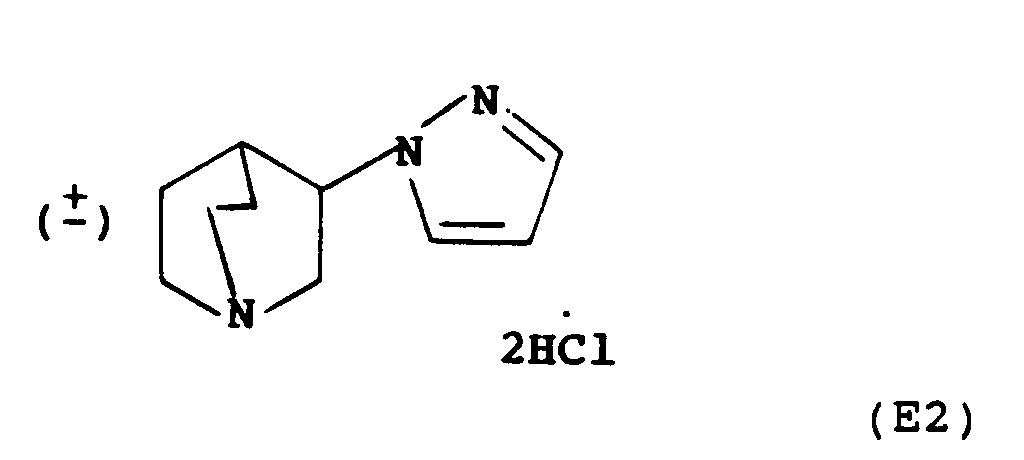
3-Quinuclidinyl-hydrazine (D2) (1.0g, 7.1mmol) was dissolved in EtOH (4ml) and glacial acetic acid (4ml) added, followed by malonaldehyde bis(dimethylacetal) (4ml). The solution was heated at reflux for 2h and then evaporated to dryness under reduced pressure. The residue was dissolved in saturated aqueous K₂CO₃ and extracted with diethyl ether (3 x 250ml). The organic extracts were dried (Na₂SO₄), filtered and evaporated to dryness under reduced pressure to yield a brown oil which was purified by column chromatography (basic alumina eluting with ether to EtOAc). The resulting oil was crystallised as the dihydrochloride salt from ether and recrystallised from methanol/ether to yield a white crystalline solid (84mg), m.p. 192-194oC (hygroscopic).
¹H nmr (d₆ DMSO, 270 MHz)
1.85 (2H, bm), 2.04 (3H, bm), 2.25 (1H, m), 2.41 (1H, m), 3.40 (2H, bm), 3.94 (2H, m), 5.02 (1H, m), 6.47 (1H, t, pyrazole-CH), 7.6 (1H, d, pyrazole-CH), 8.08 (1H, d, pyrazole-CH).
¹³C nmr (d₆ DMSO, 67 MHz)
17.4 (CH₂), 20.2 (CH₂), 21.3 (CH₂), 27.0 (CH), 45.5 (CH₂), 48.9 (CH₂), 54.6 (CH), 106.0 (CH, pyrazole), 130.1 (CH, pyrazole), 138.8 (CH, pyrazole).
MS: C₁₀H₁₅N₃. M⁺: 177Analysis: C₁₀H₁₅N₃. HCl.H₂O.MeOH % required: C, 48.73; H, 6.77; N, 14.21 % found: C, 48.43; H, 6.86; N, 14.44 -

3-Quinuclidinyl-hydrazine (D2) (5.0g, 35.5mmol) was added to a solution of K₂CO₃ (4.90g, 35.5mmol) in water (13ml) and the ice-cooled solution was stirred vigorously while 2-chloroacrylonitrile (3.10g, 2.83ml, 35.5mmol) was added dropwise over 1 minute. The solution was then stirred at room temperature overnight. The mixture was diluted with MeOH, evaporated to a slurry under reduced pressure, suspended in saturated aqueous potassium carbonate and extracted with EtOAc (3 x 100ml), followed by CHCl₃ (4 x 250ml). The organic extracts were dried (Na₂SO₄), filtered and evaporated to dryness under reduced pressure to yield a brown oil, which was purified by column chromatography (neutral alumina eluting with chloroform), to yield a faster running fraction (E3) (44mg) and a slower running fraction (E4) (32mg). Both were crystallised separately by trituration with diethyl ether, to yield white crystalline solids.
(E3) m.p. 141-145oC
¹H nmr (d₆ DMSO, 270 MHz)
1.25 (1H, m), 1.72 (3H, m), 1.97 (1H, m), 2.82 (3H, m), 3.15 (2H, m), 3.72 (1H, dd), 4.26 (1H, m), 5.42 (1H, d, pyrazole-CH), 7.15 (1H, d, pyrazole-CH).
¹³C nmr (d₆ DMSO, 67 MHz)
19.54 (CH₂), 25.45 (CH₂), 26.34 (CH), 46.55 (CH₂), 46.83 (CH₂), 50.68 (CH₂), 52.06 (CH), 89.40 (CH, pyrazole), 136.60 (CH, pyrazole), 145.55 (quat C, pyrazole).
MS: C₁₀H₁₆N₄ requires 192.1365
observed 192.1377
(E4) m.p. 112-115oC
¹H nmr (d₆ DMSO, 270 MHz) 1.26 (1H, m), 1.60 (3H, m), 1.98 (1H, m), 2.68 (3H, m), 2.88 (1H, m), 3.19 (2H, m), 4.08 (1H, m), 5.42 (1H, d, pyrazole-CH), 7.43 (1H, d, pyrazole-CH).
¹³C nmr (d₆ DMSO, 67 MHz)
20.18 (CH₂), 25.75 (CH₂), 27.65 (CH), 46.48 (CH₂), 46.85 (CH₂), 51.81 (CH₂), 57.06 (CH), 91.67 (CH, pyrazole), 129.10 (CH, pyrazole), 154.84 (quat C, pyrazole).Analysis: C₁₀H₁₆N₄.1/3 H₂O % required: C, 60.61; H, 8.42; N, 28.28 % found: C, 60.90; H, 8.12; N, 28.48
observed 192.1375 -

3-Quinuclidinyl-hydrazone (D1) (0.20g, 1.44mmol) was dissolved in dry MeOH (10ml) and methyl acetimidate hydrochloride (0.158g, 1.45mmol) added, followed by triethylamine (0.2ml, 1 eq). The clear solution was stirred for 3h under N₂, evaporated to dryness under reduced pressure, and anhydrous pyridine (2ml) and anhydrous triethylorthoformate (20ml) added. The suspension was stirred under N₂ overnight at room temperature and then heated at reflux for 1h. The resulting yellow suspension was evaporated to dryness under reduced pressure, dissolved in saturated, aqueous potassium carbonate and extracted with EtOAc (3 x 70ml). The organic extracts were dried (Na₂SO₄), filtered and evaporated to dryness under reduced pressure. The resulting orange semi-solid was purified by Kugelröhr distillation (b.p. 180oC at 0.08mmHg) to yield a clear colourless oil (171mg, 63%) which was purified as the dihydrochloride salt, m.p. 212-214oC (decomp.).
¹H nmr (d₆ DMSO, 270 MHz)
2.00 (2H, bm), 2.18 (2H, bm), 2.49 (3H, triazole-Me), 3.20 (2H, m), 3.71 (2H, m), 4.02 (1H, m), 7.19 (1H, s, olefinic-CH), 9.28 (1H, s, triazole-CH).
¹³C nmr (d₆ DMSO, 67 MHz)
13.7 (CH₃-triazole), 23.0 (CH₂), 26.8 (CH), 50.0 (CH₂), 114.5 (olefinic CH), 142.0 (quat-C), 144.8 (triazole-CH) 161.8 (quat-C).
MS: C₁₀H₁₄N₄ M⁺: 190Analysis: C₁₀H₁₄N₄.2HCl % requires: C, 45.62; H, 6.08; N, 21.29 % found: C, 45.41; 6.12; N, 21.27 -
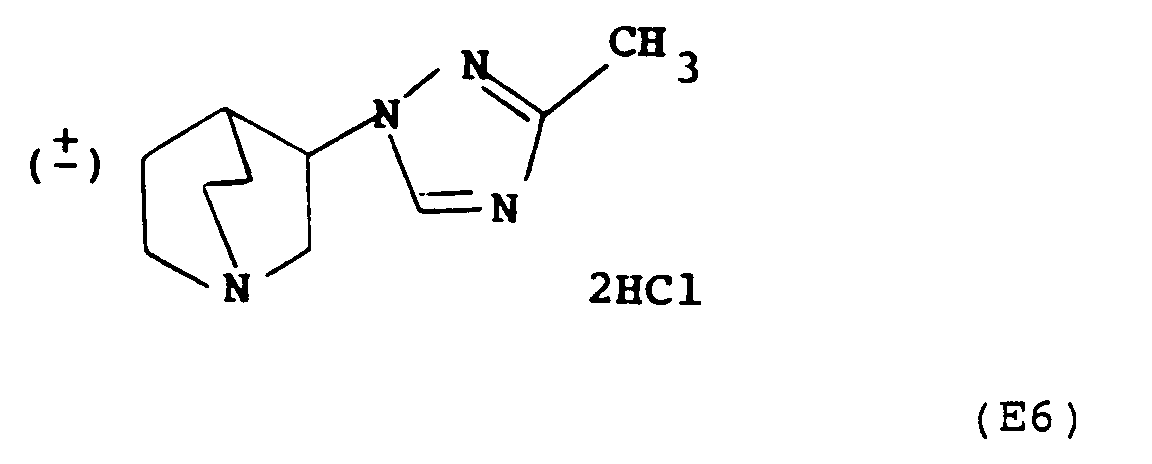
3-Quinuclidinyl-hydrazine dihydrochloride (D5) (0.78g, 3.6mmol) was suspended in dry methanol (30ml) and methyl acetimidate hydrochloride (0.40g, 3.65mmol) added, followed by triethylamine (1.52ml, 3eq). The solution was stirred for 3h at room temperature under N₂, and then evaporated to dryness under reduced pressure at a temperature not exceeding 30oC. Anhydrous triethylorthoformate (40ml) and anhydrous pyridine (4ml) were added, and the suspension was stirred overnight at room temperature under N₂ and then refluxed under N₂ for 1.5h. The mixture was cooled, evaporated to dryness under reduced pressure and the residue was dissolved in saturated aqueous potassium carbonate solution (40ml). The solution was extracted with ethyl acetate (2 x 300ml), the organic extracts dried (Na₂SO₄), filtered and evaporated to dryness under reduced pressure. The resulting oil was purified by column chromatography using neutral alumina and with gradient elution using ethyl acetate to 2% methanol in ethyl acetate. The resulting clear oil was crystallised as the dihydrochloride salt using diethyl ether/methanol solution and recrystallised in acetone/ether to afford the title compound as white crystals (110mg, 13%), m.p. >250oC.
¹H nmr (d₆ DMSO, 270 MHz)
1.85 (2H, bm), 2.04 (2H, bm), 2.42 (3H, s, Me), 2.50 (1H, m), 3.40 (4H, bm), 3.80 (2H, bm), 5.07 (1H, m), 9.05 (1H, s, triazole CH).
¹³C nmr (d₆ DMSO, 67 MHz)
13.1 (CH₃), 17.2 (CH₂), 21.3 (CH₂), 21.3 (CH₂), 26.0 (CH), 45.0 (CH₂), 45.5 (CH₂), 48.9 (CH₂), 53.4 (CH), 143.9 (triazole-CH), 157.0 (triazole quat C).
MS: C₁₀H₁₆N₄ requires 192.1374
observed 192.1375Analysis: C₁₀H₁₈N₄.Cl₂ % required: C, 45.29; H, 6.84; N, 21.13 % found: C, 44.99; H, 6.93; N, 20.82 -
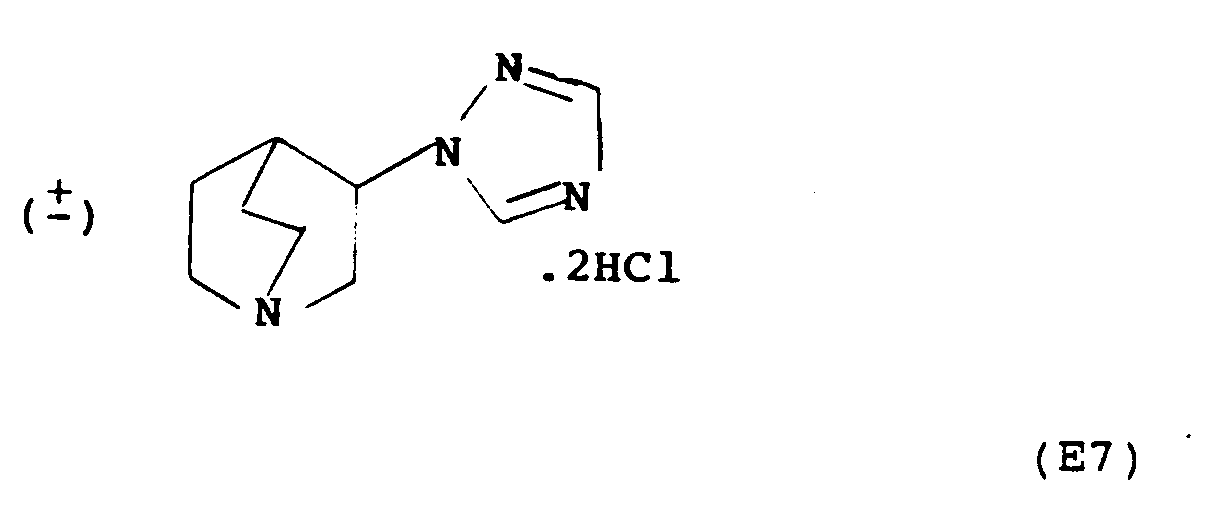
3-Quinuclidyl-hydrazine dihydrochloride salt (D5) (200mg, 1.0mmol) and Gold's reagent ([3-(dimethylamino)-2-azaprop-2-en-1-ylidene]-dimethylammonium chloride) (153mg, 1.0mmol) were dissolved in dry CHCl₃ (20ml) under N₂ and dry Et₃N (0.28ml, 2.0mmol) was added. The solution was heated at reflux under nitrogen for 2.5h. The solution was cooled, saturated aqueous potassium carbonate was added and the organic layer separated. The aqueous layer was extracted with CHCl₃ (2 x 100ml), the organic extracts were dried (Na₂SO₄), filtered and were evaporated to dryness under reduced pressure. The resulting orange/yellow oil was purified by column chromatography (basic alumina eluting with 2% MeOH/EtOAc). The resulting clear oil was recrystallised as the dihydrochloride salt from methanol/acetone/diethyl ether (45mg, 0.18mmol, 18%), m.p. 187-190oC.
¹H NMR (d₆ DMSO, 270 MHz)
1.83 (2H, m), 1.99 (2H, m), 2.42 (1H, m), 3.29 (4H, bm), 3.86 (2H, bm), 5.08 (1H, m), 8.28 (1H, s, triazole-CH), 9.02 (1H, s, triazole-CH).
¹³C NMR (d₆ DMSO, 67·MHz)
17.1 (CH₂), 21.2 (CH₂), 26.5 (CH), 44.8 (CH₂), 45.2 (CH₂), 49.0 (CH₂), 53.3 (CH), 144.0 (triazole-CH), 150.2 (triazole-CH)
MS: C₉H₁₄N₄ requires 178.1206
M⁺ observed 178.1221Analysis: C₉H₁₄N₄.2HCl % requires C, 43.0; H, 6.4; N, 22.3 found C, 42.97; H, 6.48; N, 22.23 -

(±) exo and endo (1-Azabicyclo[2.2.1] heptan-3-yl)-hydrazine dihydrochloride (D7) (0.5g, 2.5mmol) was dissolved in dry methanol (30ml) and methyl acetimidate hydrochloride (0.274g, 2.5mmol) was added, followed by dry triethylamine (1.05ml, 3eq). The solution was stirred for 3h at 25oC under N₂, and then evaporated to dryness under reduced pressure at a temperature not exceeding 30oC. Anhydrous triethylorthoformate (20ml) and anhydrous pyridine (2ml) were added, and the suspension was stirred overnight at room temperature and then heated at reflux under N₂ for 1.5h. The mixture was cooled, evaporated to dryness under reduced pressure, and the residue dissolved in saturated aqueous K₂CO₃. The aqueous solution was extracted with ethyl acetate (3 x 250ml) and the organic extracts were dried, filtered and evaporated to dryness under reduced pressure to yield a yellow oil which was purified by column chromatography (basic alumina, eluting with EtOAc/MeOH 3-6%). The compound thus isolated was crystallised from ether as the dihydrochloride salt and was recrystallised from methanol/diethyl ether to afford the title compound (E8) as a white crystalline solid (30mg, 0.12mmol, 5%) m.p. 236-240oC (decomp).
¹H NMR (d₆ DMSO, 270 MHz)
1.75 (1H, m), 2.08 (1H, m), 2.31 (3H, s, triazole-CH₃), 3.14 (1H, d), 3.28 (3H, complex m), 3.63 (2H, m), 3.82 (1H, m), 4.92 (1H, m), 8.90 (1H, s, triazole-CH)
¹³C (d₆ DMSO, 67 MHz)
13.1 (CH₃-triazole), 24.3 (CH₂), 41.7 (CH), 51.0 (CH₂), 56.8 (CH₂), 57.3 (CH₂), 58.4 (CH), 143.9 (CH, triazole-CH), 158.7 (quat-C) -

(±) exo and endo(1-Azabicyclo[2.2.1]heptan-3-yl)hydrazine dihydrochloride (D7) (500mg, 2.5mmol) and Gold's reagent ([3-(dimethylamino)-2-azaprop-2-en-1-ylidine]dimethylammonium chloride) (409mg, 2.5mmol) were dissolved in dry CHCl₃ (40ml) under N₂ and dry triethylamine (0.70ml, 2eq) added. The solution was heated at reflux under N₂ for 2.5h. The solution was cooled, saturated aqueous potassium carbonate was added and the organic layer separated. The aqueous layer was extracted with CHCl₃ (2 x 100ml) and the organic solutions were dried (Na₂SO₄), filtered and evaporated to dryness under reduced pressure to yield a yellow oil (0.5g). This was purified by column chromatography (basic alumina, eluting with EtOAc/MeOH 2%) to yield a clear colourless oil which was crystallised as the dihydrochloride salt and recrystallised from methanol/ diethyl ether to afford the title compound (E9) as pale yellow crystals, m.p. 215-219oC (decomp).
¹H NMR (d₆ DMSO, 270 MHz)
1.86 (1H, m), 2.16 (1H, m), 3.20-4.03 (7H, complex m), 5.12 (1H, m), 8.42 (1H, bs, triazole-CH), 9.21 (1H, bs, triazole-CH).
¹³C NMR (d₆ DMSO, 67 MHz)
24.3 (CH₂), 41.8 (CH), 50.9 (CH₂), 56.7 (CH₂), 57.3 (CH₂), 58.6 (CH), 150.0 (2C-triazole-2CH) -
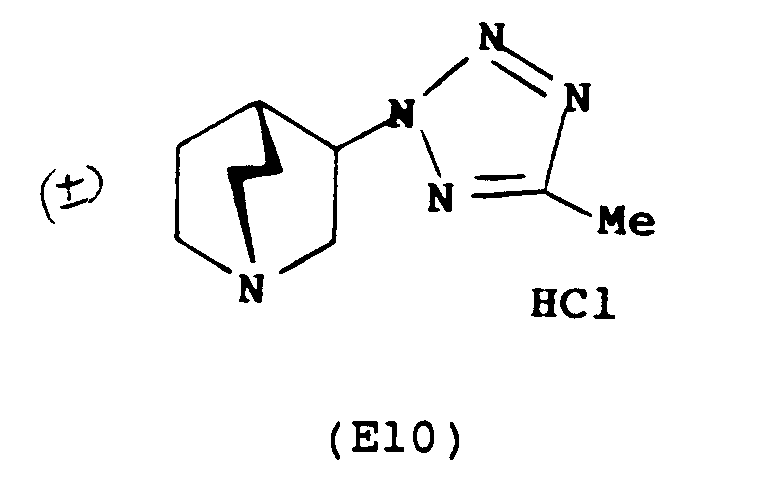
3-Methanesulphonyloxy-1-azabicyclo[2.2.2]octane (D8) (1.0g, 4.9mmol) was dissolved in dry DMF (50ml) and the sodium salt of 5-methyltetrazole (D17) (1.26g, 2.5eq) was added, and the solution was refluxed for 1h under nitrogen. The solution was evaporated to dryness under reduced pressure, and the resulting syrup dissolved in aqueous saturated potassium carbonate solution (50ml). The aqueous solution was extracted with EtOAc (3 x 100ml), the organic extracts dried (Na₂SO₄), filtered and evaporated to dryness under reduced pressure to yield an oil. This was purified by column chromatography using basic alumina and eluting with EtOAc/MeOH 1-5%, to yield the free base of the title compound (E10) (90mg, 10%), which was crystallised using 1.0M HCl in ether solution as the hydrochloride salt, m.p. 196-198oC.
¹H NMR (d₆ DMSO, 270MHz)
1.63 (1H, m), 1.79 (1H, m), 2.05 (2H, m), 2.50 (3H, s, azole-CH₃), 3.32 (5H, m), 3.92 (2H, m), 5.44 (1H, m, CH-azole)
¹³C NMR
10.6 (CH₃), 17.1 (CH₂), 20.9 CH₂), 25.6 (CH), 45.1 (CH₂), 45.5 (CH₂), 49.0 (CH₂), 57.1 (CH), 162.4 (azole quat-C)
MS: found 199.1328
C₉H₁₅N₅ requires 199.1328Analysis C₉H₁₅N₅.HCl ¼H₂O found C: 46.53; H: 6.96; N: 29.45% requires C: 46.15; H: 7.05; N: 29.91% -
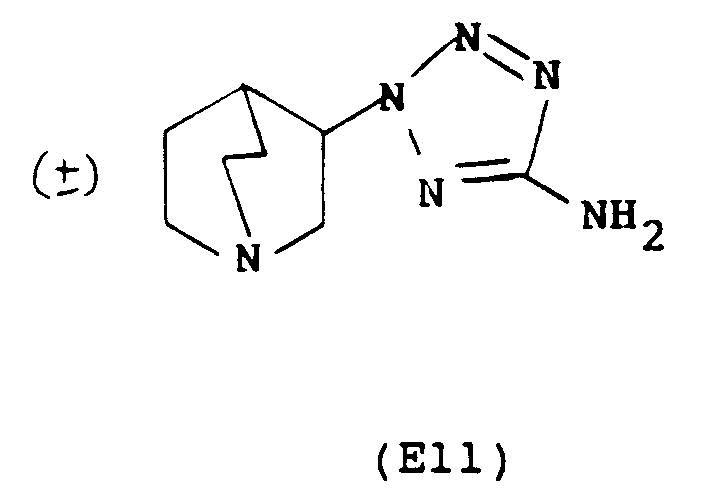
3-Methanesulphonyloxy-1-azabicylo[2.2.2]octane (D8) (2.0g, 9.7mmol) and the sodium salt of 5-aminotetrazole (D15) (2.5g, 2.0eq) were dissolved in dry DMF (50ml) and the reaction carried out as for Example 10. The product (E11) isolated from column chromatography was a white crystalline solid (124mg, 6.6%), which was recrystallised from ether, m.p. 132-134oC.
¹H NMR (CDCl₃, 270MHz)
1.42 (1H, m), 1.68 (3H, complex m), 2.35 (1H, m), 2.87 (1H, m), 3.11 (1H, m), 3.39 (1H, dm), 3.71 (1H, dt), 4.38 (2H, bs, NH₂), 4.70 (1H, m, CH-azole).
¹³C NMR
20.4 (CH₂), 26.0 (CH₂), 27.6 (CH), 47.2 (CH₂), 47.5 (CH₂), 52.1 (CH₂), 61.3 (CH), 166.1 (azole quat C).
MS found 194.1282
C₈H₁₄N₆ requires 194.1280Analysis C₈H₁₄N₆.¼H₂O Found: C: 47.76; H; 6.82; N: 40.79% Required: C: 47.23; H: 7.38; N: 41.33% -

3-Methanesulphonyloxy-1-azabicyclo[2.2.2]octane (D8) (5.0g, 24.4 mmol) and the sodium salt of 4-methyl-1,2,3-triazole (D21) (5.0g, 2 equivs) were dissolved in dry DMF (150ml) and the reaction carried out as in Example 10. The compound first eluted by column chromatography was the free base of the title compound (E12), (1.1g, 23.5%), which was crystallised as a hydrochloride salt to give the title compound (E12) (m.p. 181-182oC).
¹H NMR (d₆DMSO, 270MHz)
1.50 (1H, m), 1.70 (1H, m), 1.98 (2H, m), 2.27 (3H, s, azole-Me), 3.24 (4H, bm), 3.38 (1H, m), 3.87 (2H, m), 5.08 (1H, m), 7.68 (1H, s, azole-H).
¹³C NMR (d₆ DMSO)
10.4 (CH₃), 17.3 (CH₂), 20.9 (CH₂), 26.0 (CH), 45.1 (CH₂), 45.4 (CH₂), 48.9 (CH₂), 57.5 (CH), 133.8 (CH-azole), 143.8 (azole quat C).
MS: Found 192.1373
C₁₀H₁₆N₄ requires 192.1375Analysis: C₁₀H₁₆N₄.HCl ¼H₂O Found: C: 51.38; H: 7.34; N: 24.02% Required: C: 51.50; H: 7.51; N: 24.00%
(E13) ¹H NMR (CDCl₃, 270MHz)
1.75 (2H, tm), 2.08 (2H, bm), 2.36 (1H, m), 2.41 (3H, s, azole-Me), 3.33 (3H, m), 3.52 (1H, m), 3.81 (1H, tm), 5.05 (1H, m, CH-azole), 7.68 (1H, s, azole-H).
¹³C NMR (CDCl₃)
7.8 (CH₃), 17.5 (CH₂), 22.1 (CH₂), 25.7 (CH), 45.5 (CH₂), 45.8 (CH₂), 49.6 (CH₂), 52.0 (CH), 132.9 (C-H-azole), 133.8 (azole quat C).
MS: found 192.1377
C₁₀H₁₆N₄ requires 192.1375
(E14) ¹H NMR (d₆ DMSO, 270MHz)
1.66 (1H, m), 1.82 (1H, m), 2.10 (2H, m), 2.35 (3H, s, azole-Me), 2.50 (1H, m), 3.40 (4H, m), 3.94 (1H, m), 4.07 (1H, m), 5.20 (1H, m, CH-azole), 8.18 (1H, s, azole-H).
¹³C NMR (d₆ DMSO)
10.5 (CH₃), 17.2 (CH₂), 21.3 (CH₂), 26.5 (CH), 45.2 (CH₂), 45.4 (CH₂), 48.8 (CH₂), 54.1 (CH), 122.5 (CH-azole), 142.5 (azole quat-C)
MS Found 192.1377
C₁₀H₁₆N₄ requires 192.1375 -
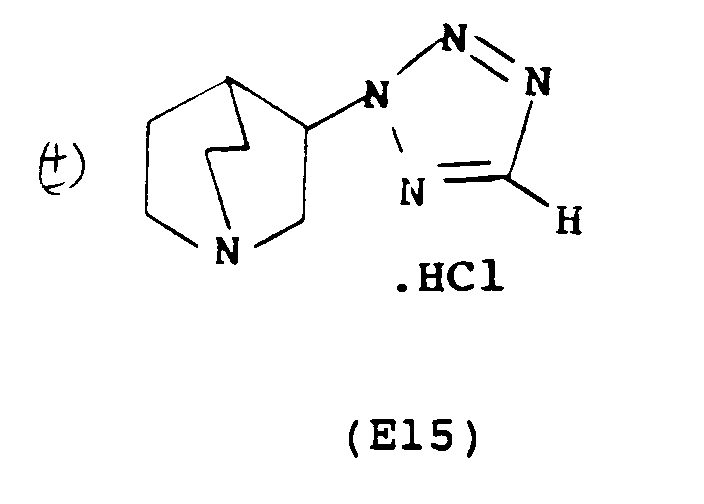
-
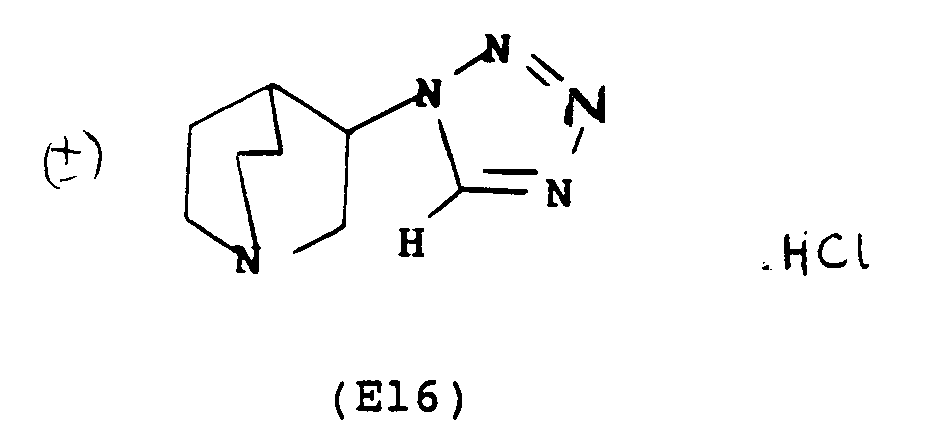
3-Methanesulphonyloxy-1-azabicyclo[2.2.2]octane (D8) (1.0g, 4.9mmol) was dissolved in dry DMF (50ml) and the sodium salt of 1H-tetrazole (D16) (1.5g, 3.4eq) was added. The reaction was carried out as in Example 10 to yield two separate compounds by column chromatography, the faster running compound being the free base of E15 (80mg, 9%) and the slower running compound being the free base of E16 (60mg, 7%). Both compounds were crystallised as the hydrochloride salts,E15 m.p. 177-180oC and E16 m.p. 229-230oC.
(E15) ¹H NMR (d₆ DMSO, 270MHz)
1.68 (1H, m), 1.91 (1H, m), 2.19 (2H, m), 2.75 (1H, m), 3.42 (4H, m), 4.06 (2H, m), 5.66 (1H, m, CH-azole), 9.21 (1H, s, azole-H).
¹³C NMR (d₆ DMSO)
17.1 (CH₂), 20.9 (CH₂), 25.7 (CH), 45.1 (CH₂), 45.4 (CH₂), 49.0 (CH₂), 57.4 (CH), 153.4 (azole C-H).
MS found 179.1173
C₈H₁₃N₅ requires 179.1171Analysis: C₈H₁₃N₅.HCl Found: C: 44.10; H: 6.43; N: 32.00% Required: C: 44.5; H: 6.5; N: 32.5%
2.00 (2H, m), 2.52 (2H, m), 3.12 (1H, m), 3.43 (6H, complex m), 5.35 (1H, m, CH-azole), 9.08 (1H, s, azole-H).
¹³C NMR (d₆ DMSO)
21.8 (CH₂), 22.8 (CH₂), 38.6 (CH), 49.6 (CH₂), 50.1 (CH₂), 56.2 (CH₂), 60.2 (CH), 153.1 (azole quat C).
MS found 179.1171
C₈H₁₃N₅ requires 179.1171Analysis C₈H₁₃N₅.HCl 1/3 H₂O Found: C: 43.86; H: 6.38; N: 31.18% Required: C: 43.34; H: 6.62; N: 31.60% -
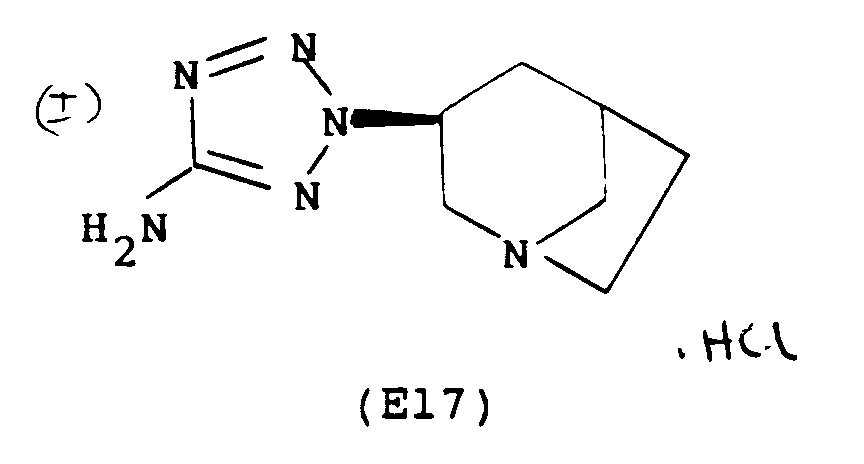
endo-3-Methanesulphonyloxy-1-azabicyclo [3.2.1]octane (D12) (600mg, 2.94mmol) and the sodium salt of 5-aminotetrazole (D15) (405mg, 1.5 equiv) were dissolved in dry DMF (30ml) and the reaction carried out as for Example 10. The fraction eluted first from column chromatography (basic alumina, EtOAc/MeOH 1-2%) was the free base of the title compound which was purified as the hydrochloride salt (205mg, 30%) m.p. 262-264oC (decomp).
¹H NMR (d₆DMSO)
2.19 (3H, m), 2.34 (1H, m), 2.88 (1H, s), 3.50 (5H, complex m), 3.85 (1H, m), 5.35 (1H, m, CH-azole).
¹³C NMR (d₆DMSO)
26.4 (CH₂), 32.6 (CH), 34.1 (CH₂), 50.3 (CH₂), 52.6 (CH), 53.2 (CH₂), 57.3 (CH₂), 167.0 (azole quat carbon)
MS: found 194.1280
C₈H₁₄N₆ requires 194.1280Analysis: C₈H₁₄N₆.HCl 1/8 H₂O Found: C: 41.52; H: 6.63; N: 35.86% Required: C: 41.25; H: 6.55; N: 36.09% -

endo-3-Methanesulphonyloxy-1-azabicyclo[2.2.1]heptane (D10) (0.7g, 3.66mmol) and the sodium salt of 5-aminotetrazole (D15) (1.0g, 2.6 equiv) were dissolved in dry DMF (50ml) and the reaction carried out as in Example 10. The product isolated from column chromatography was a white crystalline solid (70mg, 10.6%), which was recrystallised from ether to give the title compound (E18) (m.p. 132-134oC).
¹H NMR (CDCl₃, 270MHz)
1.29 (1H, m), 1.77 (1H, m), 2.50 (2H, m), 2.88 (1H, tm), 3.06 (3H, complex m), 3.32 (1H, dm), 4.36 (2H, bs, NH₂), 4.44 (1H, m, CH-azole).
¹³C NMR (CDCl₃)
27.9 (CH₂), 43.4 (CH), 53.7 (CH₂), 58.3 (CH₂), 61.6 (CH₂), 65.8 (CH), 165.9 (azole quat C)
MS found 180.1121
C₇H₁₂N₆ requires 180.1123Analysis C₇H₁₂N₆ Found C: 46.43; H, 6.71; N: 46.17% Required C: 46.65; H: 6.71; N: 46.63% -

endo-3-Methanesulphonyloxy-1-azabicyclo[2.2.1]heptane (D10) (0.70g, 3.66mmol) and the sodium salt of 1H-tetrazole (D16) (1.0g, 3 equiv) were dissolved in dry DMF (50ml) and the reaction carried out as in Example 10. The resulting product eluted first from column chromatography was a pale yellow oil (70mg, 12%), which was crystallised to give the title compound (E19) as the hydrochloride salt (m.p. 241-245oC)
¹H NMR (d₆DMSO, 270MHz)
1.92 (1H, m), 2.12 (1H, m), 3.32 (4H, complex), 3.50 (1H, d), 3.84 (1H, dm), 4.00 (1H, dm), 5.51 (1H, m), 9.11 (1H, s, azole-H).
¹³C NMR (d₆DMSO)
23.9 (CH₂), 41.6 (CH), 51.2 (CH₂), 56.8 (CH₂), 57.5 (CH₂), 62.1 (CH), 153.4 (azole-CH).
MS: Found 165.1010
C₇H₁₁N₅ requires 165.1006Analysis C₇H₁₁N₅.HCl Found: C: 41.54; H: 6.04; N: 34.43% Required: C: 41.69; H: 6.00; N: 34.73% -
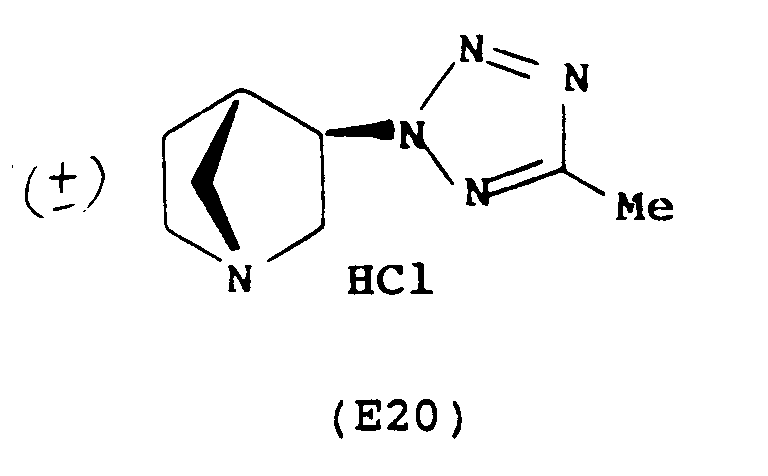
-

endo-3-Methylsulphonyloxy-1-azabicyclo[2.2.1] heptane (D10) (0.7g, 3.66mmol) and the sodium salt of 5-methyltetrazole (D17) (0.8g, 2eq) were dissolved in dry DMF (50ml), and the reaction carried out as in Example 10. The compound first eluted by column chromatography was the free base of E20 (90mg, 14%) and was crystallised as the HCl salt (E20) (m.p. 238-239oC). The compound subsequently eluted was the free base of E21 (50mg, 7.6%), which was crystallised as the hydrochloride salt (E21) (m.p. 246-248oC).
(E20)
¹H NMR (d₆DMSO, 270MHz)
1.93 (1H, m), 2.14 (1H, m), 2.50 (3H, s, azole-Me), 3.38 (5H, complex m), 3.81 (1H, dt), 4.00 (1H, m), 5.43 (1H, m, CH-azole)
¹³C NMR (d₆DMSO)
10.5 (CH₃), 23.9 (CH₂), 41.6 (CH), 51.1 (CH₂), 56.8 (CH₂), 57.4 (CH₂), 61.9 (CH), 162.5 (quat azole-C).
MS found 179.1173
C₈H₁₃N₅ requires 179.1171Analysis C₈H₁₃N₅.HCl ¼H₂O Found: C: 43.84; H: 6.43; N: 31.72% Required: C: 43.64; H: 6.59; N: 31.82%
¹H NMR (d₆DMSO, 270MHz)
1.97 (1H, m), 2.19 (1H, m), 2.65 (3H, s, azole-Me), 3.44 (4H, complex m), 3.70 (1H, d), 3.82 (1H, dt), 3.98 (1H, m), 5.10 (1H, m, CH-azole).
¹³C NMR (d₆DMSO)
8.6 (CH₃), 24.3 (CH₂), 41.5 (CH), 51.2 (CH₂), 56.4 (CH), 57.0 (CH₂), 58.1 (CH₂), 152.6 (quat azole-C).
MS found 179.1171
C₈H₁₃N₅ requires 179.1171Analysis C₈H₁₃N₅.HCl Found: C: 44.68; H: 6.56; N: 32.48% Required: C: 44.55; H: 6.54; N: 32.47% -
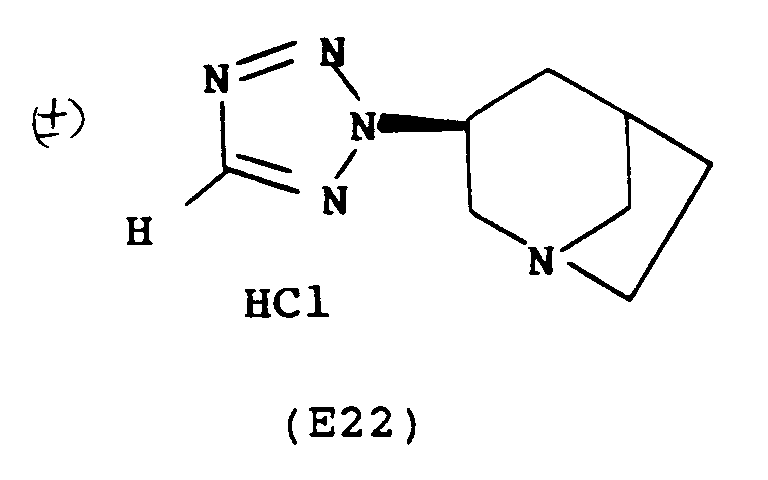
endo-3-Methanesulphonyloxy-1-azabicyclo[3.2.1] octane (D12) (600mg, 2.94 mmol) and the sodium salt of 1H-tetrazole (D16) (405mg, 1.5 equiv) were dissolved in dry DMF (30ml) and the reaction carried out as for Example 10. The fraction eluted first by column chromatography (basic alumina, EtOAc/MeOH 1-2%) was the free base of the title compound which was purified as the hydrochloride salt (170mg, 27%) m.p. 232-234oC.
¹H NMR (d₆DMSO)
2.28 (3H, m), 2.50 (1H, m), 2.97 (1H, s), 3.31 (1H, m), 3.53 (2H, m), 3.80 (2H, m), 4.02 (1H, m), 5.72 (1H, m, CH-azole), 9.22 (1H, s, azole-H).
¹³C NMR (d₆DMSO)
26.6 (CH₂), 32.9 (CH), 34.5 (CH₂), 50.7 (CH₂), 53.4 (CH₂), 53.7 (CH), 57.6 (CH₂), 153.6 (azole quat carbon).
MS: found 179.1168
C₈H₁₃N₅ requires 179.1171Analysis: C₈H₁₃N₅.HCl Found: C: 44.51; H: 6.59; N: 32.31% Required: C: 44.55; H: 6.54; N: 32.47% -
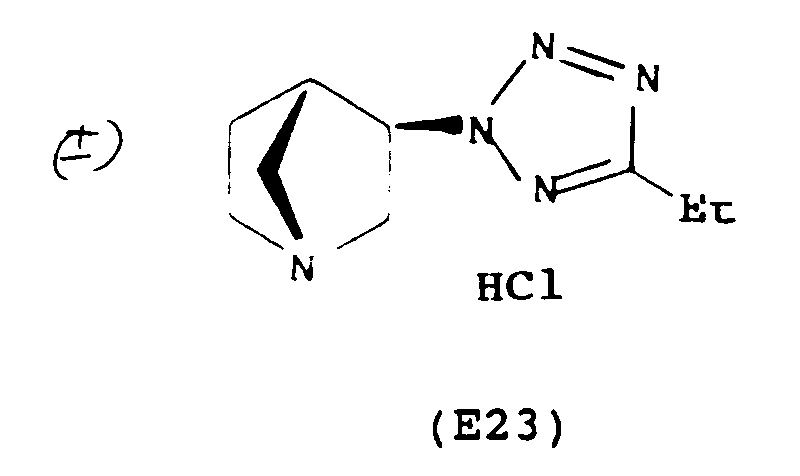
endo-3-Methanesulphonyloxy-1-azabicyclo[2.2.1]heptane (D10) (0.82g, 4.29 mmol) and the sodium salt of 5-ethyltetrazole (D18) (0.60g, 1.2 equiv) were dissolved in dry DMF (25ml) and the reaction carried out as in Example 10. The first product eluted from the column was the free base of the title compound (80mg, 9.7%), which was crystallised as the hydrochloride salt (E23) (m.p. 142-145oC).
¹H NMR (d₆DMSO, 270MHz)
1.28 (3H, t, Et-CH₃), 1.89 (1H, m), 2.11 (1H, m), 2.86 (2H, q, Et-CH₂), 3.31 (4H, complex m), 3.49 (1H, d), 3.82 (1H, dm), 3.94 (1H, m), 5.39 (1H, m, CH-azole)
¹³C NMR (d₆DMSO)
12.1 (CH₃-ethyl), 18.4 (CH₂), 23.9 (CH₂), 41.5 (CH), 51.3 (CH₂), 56.9 (CH₂), 57.6 (CH₂) 61.9 (CH), 167.2 (azole quat C)Analysis C₉H₁₅N₅.1½HCl Found: C: 43.73; H: 6.50; N: 28.15% Requires: C: 43.60; H: 6.66; N: 28.25% - Also isolated by column chromatography was (±) exo-3-(5-ethyltetrazol-1-yl)-1-azabicyclo[2.2.1]heptane (E24) (80mg, 9.7%), which was crystallised as the hydrochloride salt (m.p. 268-270oC).
¹H NMR (d₆DMSO, 270MHz)
1.28 (3H, t, ethyl-CH₃), 1.90 (1H, m), 2.08 (1H, m), 2.91 (2H, dq, ethyl CH₂), 3.31 (4H, complex m), 3.62 (1H, d), 3.72 (1H, dm), 3.88 (1H, dm), 5.00 (1H, m, CH-azole).
¹³C NMR (d₆DMSO)
10.9 (CH₃), 16.1 (CH₂), 24.3 (CH₂), 41.6 (CH), 51.3 (CH₂), 56.2 (CH), 57.1 (CH₂), 58.3 (CH₂), 156.5 (azole quat C) -
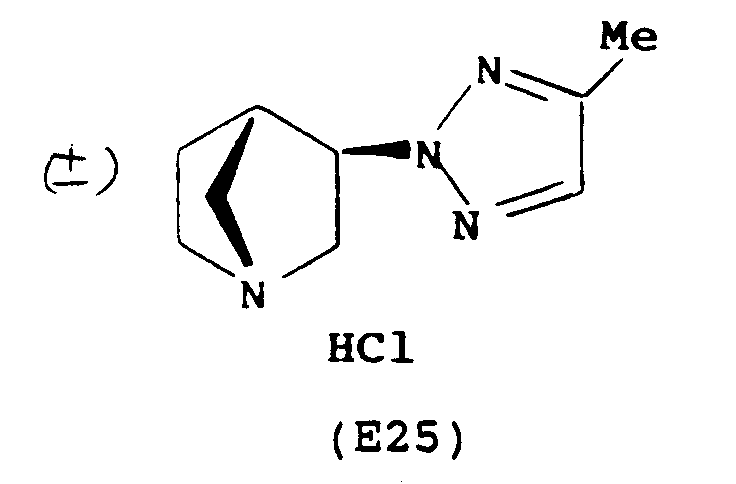
endo-3-Methanesulphonyloxy-1-azabicyclo[2.2.1]heptane (D10) (1.0g, 5.24mmol) and the sodium salt of 4-methyl-1,2,3-triazole (D21) (1.13g, 10mmol) were dissolved in dry DMF (50ml) and the reaction carried out as for Example 10. The free base of the product was isolated as a clear colourless oil from column chromatography (basic alumina, eluting with EtOAc/MeOH 1-3%), and was crystallised as the hydrochloride salt (250mg, 22%), m.p. 160-162oC.
¹H NMR (d₆DMSO)
1.84 (1H, m), 2.06 (1H, m), 2.25 (3H, m, CH₃), 3.29 (5H, complex m), 3.82 (2H, m), 5.03 (1H, m, CH-azole), 7.67 (1H, s, azole-H)
¹³C NMR (d₆DMSO)
10.3 (CH₃), 23.9 (CH₂), 41.7 (CH), 51.2 (CH₂), 56.7 (CH₂), 57.3 (CH₂), 62.7 (CH), 134.0 (CH), 144.0 (azole quat carbon).
MS: found 178.1219
C₉H₁₄N₄ requires 178.1218Analysis: C₉H₁₄N₄.HCl Found: C: 50.26; H: 7.08; 26.10% Required C: 50.35; H: 7.04; N: 25.87% -

exo-3-Methanesulphonyloxy-1-azabicyclo[2.2.1]heptane (D22) (400mg, 2.1mmol) and the sodium salt of 5-aminotetrazole (D15) (600mg, 5.61mmol) were dissolved in dry DMF (40ml) and the reaction carried out as in Example 10. The product isolated from column chromatography was a white crystalline solid (60mg, 16%) which was recrystallised as the hydrochloride salt (E26) containing 18% of the hydrochloride salt of theexo isomer (E18) m.p. 216-218oC (decomp).
¹H NMR (d₆DMSO)
1.39 (1H, m), 2.01 (1H, m), 3.48 (4H, complex m), 3.94 (3H, complex m), 5.53 (1H, m, CH-azole).
¹³C NMR (d₆DMSO)
20.8 (CH₂), 40.9 (CH), 51.7 (CH₂), 53.5 (CH₂), 58.1 (CH₂), 60.0 (CH), 167.3 (quat-C).
MS found 180.1125
C₇H₁₂N₆ requires 180.1123 -

(±) 1-Azabicyclo[3.2.1]oct-5-ylhydrazine (D24, 1.34g, assumed 5.3mmol) and Gold's reagent (0.86g, 5.3mmol) were heated at reflux in absolute chloroform (75ml) for 2h. The reaction mixture was cooled and then partitioned between saturated aqueous potassium carbonate solution (75ml) and chloroform (4 x 75ml). The combined organic extracts were dried (Na₂SO₄) and evaporated to yield a gum which was chromatographed on alumina using a graded eluant of 0-2% methanol/chloroform to give the triazole as a low-melting solid (0.50g, 53%). A portion of this material was taken-up in methanol and converted to the dihydrochloride which was recrystallised from methanol/acetone to give the title compound (E27) as a white crystalline solid m.p. 198-200oC.
¹H NMR (d₆ DMSO) δ:
1.9-2.3 (4H, m), 2.52 (2H, m), 3.30 (2H, m), 3.53 (1H, m), 3.60-3.84 (3H, m), 5.0 (1H, br), 8.30 (1H, s), 9.08 (1H, s), 11.90 (1H, br).
¹³C NMR (d₆ DMSO) δ:
16.89, 32.01, 34.24, 48.95, 50.96, 58.28, 64.05, 142.50, 150.07.
Analysis: C₉H₁₄N₄.2HCl requires C: 43.02; H: 6.42; N: 22.31; found C: 42.77; H: 6.35; N: 21.86 -

(±) 1-Azabicyclo[3.2.1]oct-5-ylhydrazine (D24, 2.61g, assumed 10.5 mmol) was treated with methyl acetimidate hydrochloride (1.15g, 10.5mmol) and triethylamine (1.5ml, 10.8mmol) in dry methanol (75ml) at room temperature for 3h. The reaction mixture was then concentrated in vacuo and anhydrous triethylorthoformate (150ml) and anhydrous pyridine (15ml) were added. The reaction mixture was stirred at room temperature overnight and then refluxed for 3h. The resulting mixture was cooled, evaporated to dryness under reduced pressure, and the residue was partitioned between saturated aqueous potassium carbonate solution (100ml) and chloroform (4 x 100ml). The combined organic extracts were dried (Na₂SO₄) and evaporated to a gum which was chromatographed on silica using 8% methanol/chloroform as eluant to give the methyltriazole as an oil (0.104g, 5%). A portion of this material was taken up in methanol, converted to the dihydrochloride salt, and recrystallised from methanol/acetone to give the title compound (E28) as a white crystalline solid m.p. 165-167oC.
¹H NMR (d₆DMSO) δ:
1.91-2.24 (4H, m), 2.21 (3H, s), 2.47 (2H, m), 3.28 (2H, m), 3.48 (1H, m), 3.57-3.80 (3H, m), 8.90 (1H, br.s), 11.65 (1H, br.s).
MS Calculated mass for C₁₀N₁₆N₄ = 192.1375
Observed mass 192.1375 -
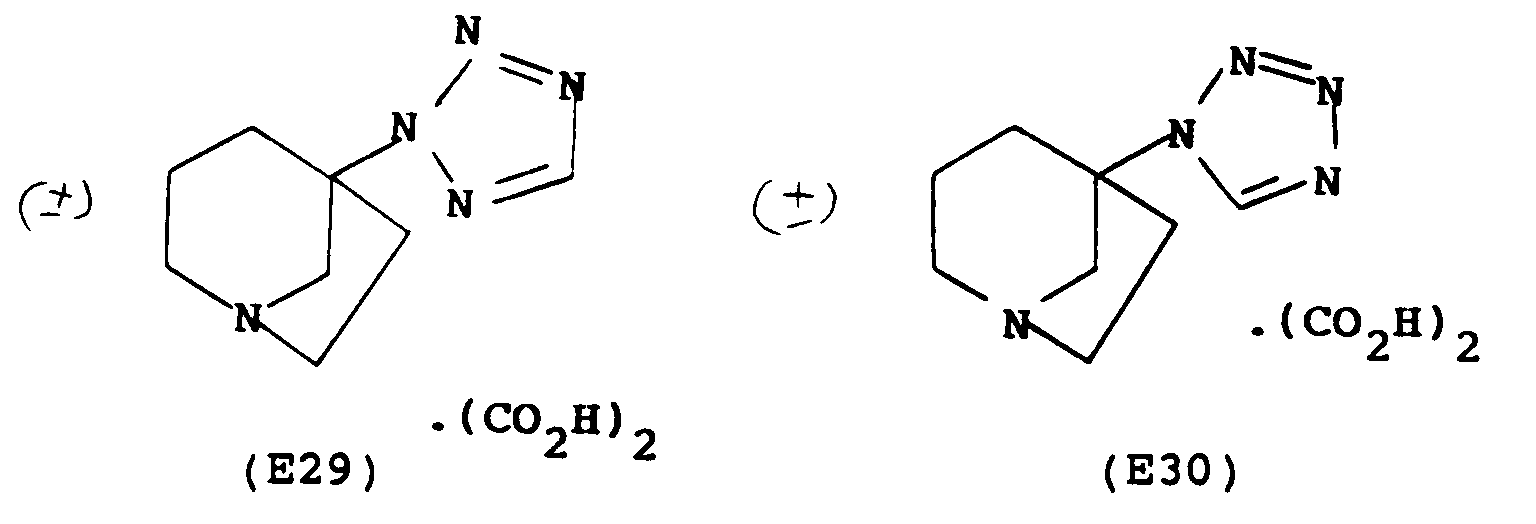
(±) 5-Bromo-1-azabicyclo[3.2.1]octane (D23, 1.1g, 5.8mmol) was treated with sodium tetrazole (D16, 1.85g, 20.1mmol) in dry DMF (50ml) at reflux for 5h. The reaction mixture was concentrated in vacuo and the residue partitioned between saturated aqueous potassium carbonate solution (50ml) and chloroform (4 x 75ml). The combined organic extracts were dried and evaporated to give an oil which was chromatographed on silica using 10% methanol/chloroform as eluant to give, in order of elution, the 2-substituted tetrazole as a low-melting solid (0.59g) and the 1-substituted tetrazole as a white solid (0.11g) m.p. 112-114oC. The 2-substituted tetrazole was converted to the oxalate salt and recrystallised from water/methanol/acetone to give the title compound (E29) as a white solid (0.88g, 57%) m.p. 205-207oC. The 1-substituted tetrazole was likewise converted to the oxalate salt and recrystallised from methanol to give the title compound (E30) as a white solid (0.15g, 10%) m.p. 184-186oC (decomp.)
(E29)
¹H NMR (d₆DMSO) δ:
1.96 (1H, m), 2.18-2.33 (3H, m), 2.60 (2H, m), 3.24 (2H, m), 3.44 (1H, m), 3.57-3.94 (3H, m), 9.08 (1H, s).
¹³C NMR (d₆DMSO) δ:
17.32, 32.37, 34.83, 49.18, 51.27, 58.75, 67.71, 153.30
Analysis: C₈H₁₃N₅.C₂H₂O₄ requires C: 44.61; H: 5.62; N: 26.01; found C: 44.37; H: 5.60; N: 25.95
(E30)
¹H NMR (d₆DMSO) δ:
1.96 (1H, m), 2.05-2.28 (3H, m), 2.45-2.67 (2H, m), 3.23 (2H, m), 3.44 (1H, m), 3.55-3.83 (3H, m), 9.67 (1H, s).
¹³C NMR (d₆DMSO) δ:
17.24, 32.63, 34.92, 49.07, 51.28, 58.79, 63.79, 142.68
Analysis; C₈H₁₃N₅.C₂H₂O₄ requires C: 44.61; H: 5.62; N: 26.01; found C: 44.43; H: 5.63; N: 25.78 -

(±) 5-Bromo-1-azabicyclo[3.2.1]octane (D23, 0.5g, 2.63 mmol) was treated with the sodium salt of 5-methyltetrazole (D17, 1.27g, 11.98 mmol) in dry DMF (25ml) at reflux for 2.75h. The reaction was worked-up as in the method of Example 29 and 30 and chromatographed on silica using 9% methanol/chloroform as eluant to give, in order of elution, the 2-substituted methyltetrazole as an oil (0.24g, 47%) and the 1-substituted methyltetrazole as a white solid (0.20g, 39%) m.p. 97-100oC. The 2-substituted methyltetrazole was converted to the oxalate salt and recrystallised from methanol/acetone to give the title compound (E31) as a white crystalline solid m.p. 145-147oC. The 1-substituted methyltetrazole was similarly converted to the oxalate salt and recrystallised from methanol/acetone to give the title compound (E32) as a white solid m.p. 205-208oC (decomp.).
(E31)
¹H NMR (d₆DMSO) δ:
1.97 (1H, m), 2.10-2.28 (3H, m), 2.48 (3H, s), 2.48-2.68 (2H, m), 3.26 (2H, m), 3.44 (1H, m), 3.66 (1H, m), 3.73 and 3.85 (2H, ABq, J=11Hz).
¹³C NMR (d₆DMSO) δ:
10.46, 17.25, 32.29, 34.67, 49.10, 51.21, 58.65, 67.40, 162.39.
Analysis: C₉H₁₅N₅.C₂H₂O₄ requires C: 46.64; H: 5.62; N: 24.72; found C: 46.50; H: 6.04; N: 24.40.
(E32)
¹H NMR (d₆DMSO) δ:
1.84-2.20 (4H, m), 2.50 (1H, m), 2.61 (3H, s), 2.77 (1H, m), 3.25 (2H, m), 3.43 (1H, m), 3.58 (1H, m), 3.87 (2H, m).
¹³C NMR (d₆DMSO) δ:
9.70, 17.41, 31.39, 34.60, 49.20, 51.04, 58.81, 64.02, 151.71.
Analysis: C₉H₁₅N₅.C₂H₂O₄ requires C: 46.64; H: 5.62; N: 24.72; found C: 46.39; H: 6.06; N: 24.39. -

(±) 5-Bromo-1-azabicyclo[3.2.1]octane (D23, 0.5g, 2.63mmol) was treated with the sodium salt of 5-aminotetrazole (D15, 0.56g, 5.23mmol) in dry DMF (15ml) at reflux for 1h. The reaction was worked-up as in the method of Example 29 and 30 and chromatographed on silica using a graded eluant of 12-20% methanol/chloroform. This gave, in order of elution, the 2-substituted aminotetrazole (E33), which was recrystallised from methanol/ether to give a white solid (0.13g, 24%) m.p. 173-175oC, and the 1-substituted aminotetrazole (E34) (0.07g, 14%). m.p. 220-223oC (decomp.).
(E33)
¹H NMR (CO₃OD) δ:
1.77 (1H, m), 1.94-2.26 (1H, m), 2.22 (2H, m), 2.41 (2H, t, J=9Hz), 2.86 (2H, m), 3.06 (1H, m), 3.18-3.36 (3H, m), 4.90 (2H, br).
¹³C NMR (CD₃OD) δ:
21.33, 36.66, 37.88, 52.03, 55.04, 63.78, 70.28, 168.80.
λmax 247nm (ε3570, EtOH)
M.S. Calculated mass for C₈H₁₄N₆ = 194.1280
Observed mass = 194.1278
(E34)
¹H NMR (CD₃OD) δ:
1.71 (1H, m), 1.96 (2H, m), 2.07-2.22 (2H, m), 2.70 (1H, m), 2.89 (2H, m), 3.06 (1H, m), 3.18-3.37 (2H, m), 3.46 (1H, m), 4.80 (2H, br).
¹³C NMR (CD₃OD) δ:
20.80, 34.45, 35.71, 51.73, 54.39, 63.21, 64.77, 156.50
λmax 219nm (ε3530, EtOH)
M.S. Calculated mass for C₈H₁₄N₆ : 194.1280
Observed mass = 194.1282 -

(±) 3-Azido-1-azabicyclo[2.2.2]octane oxalate salt (D25) (200mg, 0.0083 mole) in acetone (20ml) was treated with acetylene dicarboxylic acid (500mg, 0.0044 mole) and concentrated in vacuo to produce a homogenous gum. Xylene (20ml) was added and the solution heated to reflux for 10 min when the suspension rapidly darkened and evolved carbon dioxide. The xylene was then removed in vacuo and the residue partitioned between chloroform and saturated aqueous potassium carbonate solution. The organic phase was separated, dried over sodium sulphate and concentrated in vacuo to a gum. Chromatography on alumina in a gradient of 5-30% methanol in ethyl acetate afforded the title compound (E35) which crystallised from 40-60o petrol as needles m.p. 62-65oC (60mg, 0.0034moles, 40%).
¹H NMR (270MHz, CDCl₃) δ:
1.3-1.48 (1H, m), 1.48-1.63 (1H, m), 1.63-1.82 (2H, m), 2.1-2.25 (1H, m), 2.75-2.95 (3H, m), 2.95-3.15 (1H, m), 3.33-3.48 (1H, m), 3.53-3.68 (1H, m), 4.5-4.65 (1H, m), 7.55 (1H, s), 7.68 (1H, s).
¹³C NMR (CDCl₃, 68 MHz) δ:
19.9 and 25.9 (C-5,7), 28.1 (C-4), 46.9, 47.2 and 52.7 (C-2,6,8), 58.1 (C-3), 122.7 and 133.7 (C-4′ and C-5′) -
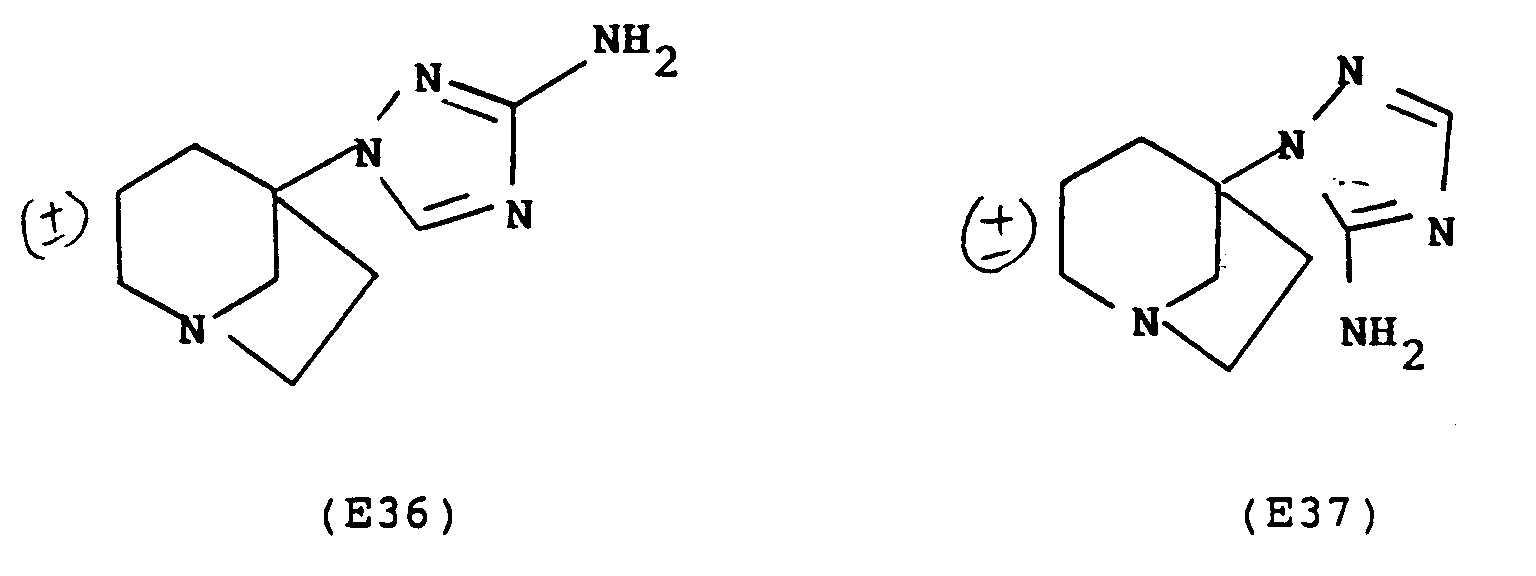
(±) 5-Bromo-1-azabicyclo[3.2.1]octane (D23, 2g, 10.5 mmol) was treated with the sodium salt of 3-amino-1,2,4-triazole (D20, 2.23g, 21.0 mmol) in dry DMF for 1h. The reaction was worked-up as in the method of Example 29 and 30 and chromatographed on basic alumina using a graded eluant of 0-2% methanol/chloroform to give, in order of elution, the 3-aminotriazole (E36), which was recrystallised from methanol/ether to give a white solid (0.29g, 14%) m.p. 172-174oC, and the 5-aminotriazole (E37) as a white solid (0.28g, 14%) m.p. 190-194oC.
E36
¹H NMR (CDCl₃) δ: 1.72 (1H,m), 1.90 (1H,m), 2.09 (2H,m), 2.22 (2H,m), 2.74-3.05 (4H,m), 3.27-3.36 (2H,m), 4.20 (2H,br.s), 7.68 (1H,s)
¹³C NMR (CDCl₃) δ:20.40, 35.82, 37.04, 51.25, 54.19, 63.50, 64.53, 139.69, 163.19.
E37
1H NMR (CDCl₃/DMSO) δ:
1.64 (1H,m), 1.87 (2H,m), 2.10 (2H,m), 2.51 (1H,m), 2.75-3.20 (4H,m), 3.18-3.36 (2H,m), 5.27 (2H,br.s), 7.32 (1H,m).
¹³C NMR (CDCl₃/DMSO) δ:
19.51, 33.98, 34.34, 50.61, 53.03, 62.64, 77.24, 146.85, 153.38. -
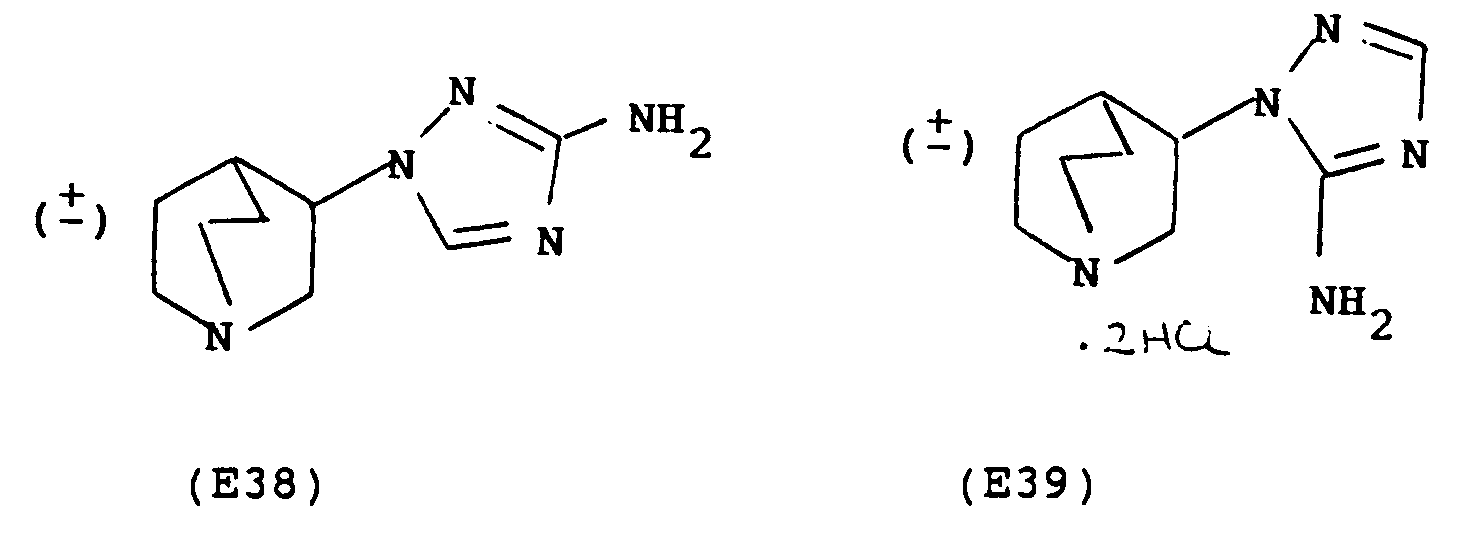
(±) 3-Methanesulphonyloxy-1-azabicyclo[2.2.2]octane (D8) (5.0g, 0.024 mol) and the sodium salt of 3-amino-1,2,4-triazole (D20) (7.0g, 0.066 mol) in dry DMF was heated at reflux for 1.5h, and the reaction carried out as in Example 10. The mixture was purified by column chromatography using basic alumina eluting with chloroform/methanol (0-2%), to give, in order of elution, E38 which was recrystallised from EtOAc/40-60 petrol to give a white solid (150 mg, 3.2%) m.p. 144-146oC and E39 which was crystallised from methanol/ether as the dihydrochloride salt (110 mg, 1.7%) m.p. 257-259oC.
E38
¹H NMR (CDCl₃) δ: 1.43 (1H,m), 1.78 (1H, complex m), 2.05 (2H,m), 2.18 (1H,m), 2.89 (3H,m), 3.05 (1H,m), 4.08 (2H,m,NH₂), 4.2 (1H,m,CH-azole), 7.73 (1H,s,azole-H).
¹³C NMR (CDCl₃) 20.2 (CH₂), 26.8 (CH₂), 27.5 (CH), 46.9 (CH₂), 47.42 (CH₂), 52.4 (CH₂), 56.8 (CH), 141.9 (azole-CH), 163.1 (quat-C).
MS C₉H₁₅N₅ requires 193.1327 found: 193.1331.
E39
¹H NMR (d₆DMSO): 1.89 (4H,m), 2.31 (1H,s), 3.25 (4H,m), 3.55 (1H,dd), 3.73 (1H,dt), 5.03 (1H,m), 8.40 (1H,s, azole-H)
¹³C NMR (d₆DMSO): 17.0 (CH₂), 20.8 (CH₂), 24.5 (CH), 44.8 (CH₂), 45.5 (CH₂), 48.1 (CH₂), 50.6 (CH), 138.8 (CH-azole), 149.5 (quat C azole).
MS C₉H₁₅N₅ requires 193.1327, found 193.1327. -
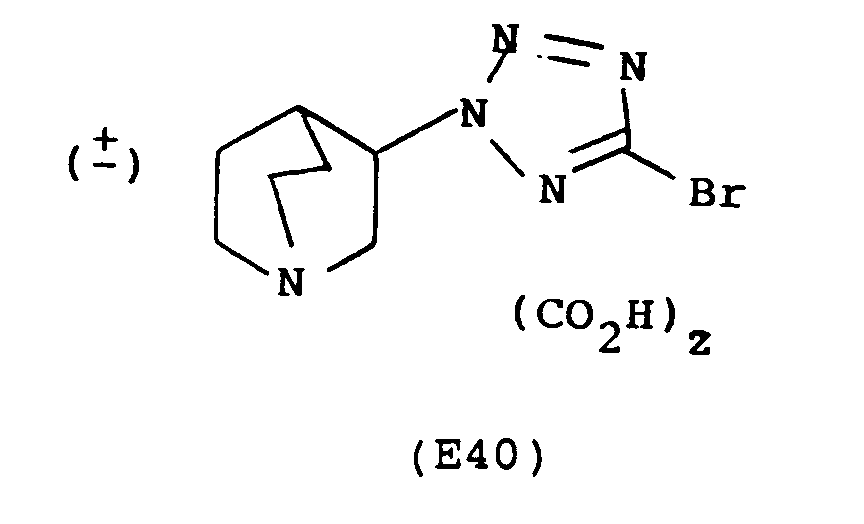
Tertiary butyllithium in pentane (7ml of a 1.7 molar solution, 0.0104 mole) in dry pentane (25ml) at -65oC under nitrogen was treated with 3-(tetrazol-2-yl)-1-azabicyclo[2.2.2]octane (the free base of E15) (1.0g; 5.2 mmole) in a dry pentane (50ml)/dry THF (10ml) mixture, maintaining an internal temperature of -65oC. Stirring was continued for 10 minutes. Bromine (2eq, 1.66g, 10.4 mmole) in dry pentane (5ml) was then added dropwise. The mixture was then immediately quenched with glacial acetic acid (2eq, 0.62ml, 10.4 mmole), then partitoned between aqueous potassium carbonate (20ml) and chloroform (5 x 20ml). The combined organic extracts were dried (Na₂SO₄) and concentrated in vacuo, to afford an oil which was chromatographed on neutral alumina eluting with ethyl acetate, to afford in order of elution the title compound (free base) (220mg as an oil) and unreacted starting material. The free base was converted to the oxalate salt and recrystallised from acetone/ether to give the title compound (E40) as a white crystalline solid (0.113g, 0.00032 mole, 6%) m.p. 165oC (decomp.).
¹H NMR (DMSO) δ:
1.58-1.78 (2H, m), 1.90-2.03 (2H, m), 2.52-2.61 (1H, m), 3.12-3.25 (4H, m), 3.78-3.84 (2H, d, J=5.5Hz), 5.39-5.50 (1H, m).
¹³C NMR (DMSO) δ:
18.4 and 22.4 (C-5, 8), 27.4 (C-4), 47.3, 47.6 and 50.8 (C-2,6,7), 60.3 (C-3), 144.1 (C-5′), 166.7 ((CO₂H)₂) -
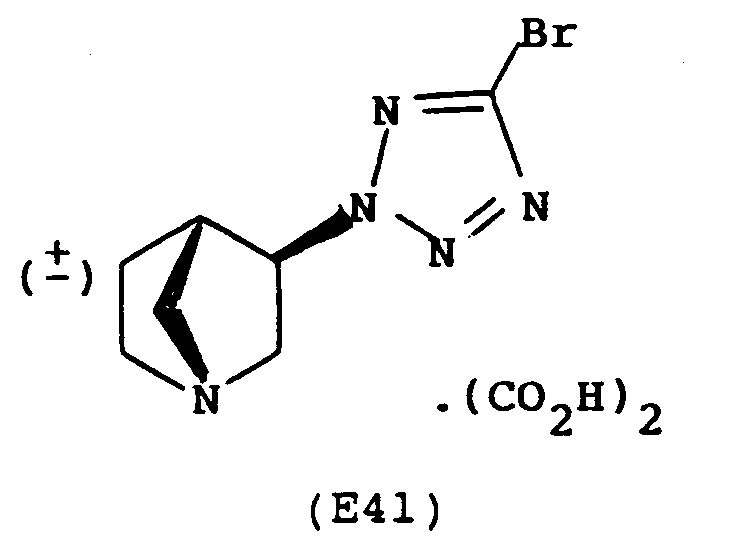
(±) exo-3-(Tetrazol-2-yl)-1-azabicyclo[2.2.1]heptane (the free base of E19) (0.38g, 2.3mmol) in dry THF (20ml) was added dropwise under nitrogen to a stirred solution of tertiary butyllithium (2.55ml of a 1.7M solution in pentane, 4.3mmol, 2 eqs) in dry pentane (10ml) at -65oC under nitrogen maintaining the temperature below -40oC throughout the addition. The yellow precipitate was stirred at -65oC for 5 minutes. Bromine (0.22ml, 4.3mmol, 2 eq) in pentane (10ml)/THF (10ml) was added dropwise, immediately followed by quenching with glacial acetic acid (0.26ml, 2 eq) and the mixture allowed to warm to 0oC. Saturated aqueous potassium carbonate (30ml) was added, the solution extracted with CHCl₃, the organic extracts dried (Na₂SO₄), filtered and evaporated to dryness under reduced pressure to yield a yellow oil. This was purified by column chromatography (b Al₂O₃, EtOAc/1-5% MeOH) to yield the required compound (0.37g, 67%) which was crystallised from methanol/diethyl ether as oxalate salt to afford the title compound (E41) m.p. 144-146oC.
¹H NMR (d₆ DMSO)
1.83 (1H, m), 2.00 (1H, m), 3.04 (2H, d), 3.23 (3H, complex m), 3.67 (2H, m), 5.30 (1H, m)
¹³C NMR (d₆ DMSO)
24.7 (CH₂), 41.9 (CH), 51.7 (CH₂), 57.1 (CH₂), 58.2 (CH₂), 64.1 (CH), 142.3 (azole C-Br), 163.6 (oxalate).Analysis: C₇H₁₀N₅Br.C₂H₂O₄ requires: C 32.35; H 3.62; N 20.96% found: C 32.36; H 3.63; N 20.65% -

This synthesis was carried out as for Example 41 but using a solution of chlorine gas (2 eqs) in CCl₄ instead of bromine to quench the tetrazole anion. The resulting crude oil was purified by column chromatography (b.Al₂O₃. EtOAc/1-5% MeOH) to yield the chlorotetrazole (0.30g, 65%) which was crystallised from methanol/diethyl ether as an oxalate salt to afford the title compound (E42), m.p. 125-128oC.
¹H NMR (d₆ DMSO)
1.73 (1H, m), 2.00 (1H, m), 3.05 (2H, m), 3.21 (1H, m), 3.31 (2H, t), 3.71 (2H, complex m), 5.28 (1H, m).
¹³C NMR (d₆ DMSO)
24.7 (CH₂), 41.6 (CH), 51.6 (CH₂), 57.0 (CH₂), 58.3 (CH₂), 64.3 (CH), 154.3 (azole C-Cl), 163.7 (oxalate).
M.S. C₇H₁₀N₅Cl requires 199.0624
found 199.0631Analysis: C₇H₁₀N₅Cl.C₂H₂O₄ requires C, 37.36; H, 4.18; N, 24.22% found C, 37.26; H, 4.22; N, 24.03% -

This synthesis was carried out as for Example 41 but using iodine (0.93g, 2 eq) in THF (20ml) instead of bromine to quench the tetrazole anion. The resulting crude oil was purified by column chromatography (b.Al₂O₃, EtOAc/MeOH 1-5%) to yield the iodotetrazole (0.281g, 42%) which was crystallised from methanol/diethyl ether as an oxalate salt to afford the title compound (E43), m.p. 158-161oC
¹H NMR (d₆ DMSO)
1.83 (1H, m), 2.08 (1H, m), 3.13 (2H, d), 3.33 (3H, complex m), 3.78 (2H, m), 5.38 (1H, m).
¹³C NMR (d₆ DMSO)
24.8 (CH₂), 41.9 (CH), 51.7 (CH₂), 57.1 (CH₂), 58.6 (CH₂), 63.6 (CH) 115.5 (azole C-I), 163. 7 (oxalate). -

Tertiary butyllithium (a solution of 1.7 molar in pentane) (7ml; 10.4mmole, 2eq) in dry hexane (25ml) at -65oC under nitrogen was treated with 3-(tetrazol-2-yl)-1-azabicyclo[2.2.2]octane (the free base of E15) (1g; 5.2mmole) in dry tetrahydrofuran (25ml) maintaining an internal temperature of less than -50oC throughout the addition. The resulting yellow solution was stirred at -60oC for 10 minutes before treatment with chlorine (2eq; 0.74g; 10.4mmole) in dry hexane (20ml) at -60oC over a period of 5 minutes. After complete addition the reaction mixture was quenched with glacial acetic acid (2 eq), then partitioned between aqueous potassium carbonate and chloroform. The organic extracts were dried over sodium sulphate, then concentrated under reduced pressure to afford an orange oil. Column chromatography on silica in a gradient of 2-10% methanol in chloroform, afforded the title compound and a slower running impurity. Further chromatography on neutral alumina in neat ethyl acetate afforded the pure title compound as an orange oil which was crystallised from methanol/diethyl ether as an oxalate salt (E44) (0.139g; 10%), m.p. (dec) 127-129oC.
¹H NMR (CD₃OD) δ:
1.80-2.04 (2H, m), 2.18-2.28 (2H, m, 5-C, 7-C), 2.70-2.78 (H, m, 4-C) 3.39-3.61 (4H, m, 6-C, 8-C), 3.95-4.28 (2H, m, 2-C), 5.52-5.62 (H, m, 3-C).
¹³C NMR (CD₃OD) δ:
17.32, 21.43 (both CH₂, 5, 7), 25.44 (CH, 4), 45.28 (CH₂, 6), 45.62 (CH₂, 8), 49.78 (CH₂, 2), 59.16 (CH, 3), 154.34 (azole C-Cl), 163.87 (oxalate). -

Tertiary buthyllithium (1.7 molar solution in pentane) (2 eq; 8.6ml; 12.8 mmole) in dry hexane (25ml) under nitrogen at -65oC was treated with 3-(tetrazol-2-yl)-1-azabicyclo[2.2.2]octane (the free base of E15) (1.254g; 6.4mmole) in dry tetrahydrofuran (50ml) maintaining an internal temperature of -60 to -65oC thoughout the addition. The resulting yellow solution was stirred at -60oC for 10 minutes before treatment with iodine (2eq; 3.25g; 12.8mmole) in dry hexane (10ml) over 5 minutes at -60oC. The reaction mixture was immediately quenched with glacial acetic acid (2 eq), then partitioned between aqueous potassium carbonate and chloroform. The combined chloroform extracts were dried over sodium sulphate, and washed with sodium metabisulphite to remove the free iodine. The solution was concentrated under reduced pressure to afford a crude yellow gum which was purified by column chromatography on silica gel in a gradient of 2-7% methanol in chloroform. Elution with 6% methanol in chloroform gave the major fraction as a gum which was triturated with ether in methanol to afford the title compound (E45) (0.028g, 1.5%), m.p. 160-165oC (Dec).
¹H NMR (CD₃OD) δ:
1.63-1.85 (2H, m), 2.05-2.12 (2H, m, 5-C and 7-C), 2.58-2.62 (H, m, 4C), 3.20-3.39 (4H, m, 6-C and 8-C), 3.78-3.86 (1H, m, 2-C), 3.95-4.02 (1H, m, 2-C), 5.39-5.45 (1H, m, 3-C).
¹³C NMR (CD₃OD) δ:
19.2, 23.8 (both CH₂, 7-C and 5-C), 27.9 (CH₂, 4-C), 47.5, 47.9, 51.5 (all CH₂, 2-C, 6-C, 8-C), 61.0 (CH, 3-C), 114.4 (azole C-I) -

A 1.7 molar solution of t-butyllithium in pentane (1.2 eq; 4.54ml; 6.7mmol) was diluted with dry hexane (10ml) under nitrogen and cooled to -65oC. The cold solution was treated with 3-(tetrazol-2-yl)-1-azabicyclo[2.2.2] octane (free base of E15) (1g, 5.6mm) in dry tetrahydrofuran (20ml) dropwise, maintaining an internal temperature below -50oC. The resulting yellow precipitate was then treated with N-methylformanilide (1.2eq; 0.9g, 6.7mmol) in dry tetrahydrofuran (10ml), dropwise maintaining an internal temperature of below -50oC. Stirring at this temperature was continued for 30 minutes. The cold reaction mixture was then poured into dilute hydrochloric acid (25ml) and stirred for 10 minutes. The reaction mixture was basified with aqueous potassium carbonate and extracted into chloroform. The combined organic extracts were (Na₂SO₄) and evaporated to dryness under reduced pressure. The resulting crude aldehyde was dissolved in methanol (10ml) and treated with hydroxylamine hydrochloride (1.1eq; 0.43g, 6.14mmol) at room temperature. Stirring was continued for 5 hours. The mixture was concentrated in vacuo to a gum which was treated with saturated aqueous potassium carbonate, and the aldoxime extracted into chloroform.
The combined organic extracts were dried (Na₂SO₄) and evaporated to dryness under reduced pressure to a gum. The resulting crude aldoxime was dissolved in acetic anhydride (20ml) and heated at 80oC for 1 hour. After cooling acetic anhydride was removed in vacuo and the resulting viscous oil was treated with aqueous potassium carbonate and extracted with chloroform. Combined organic extracts were dried (Na₂SO₄) and evaporated to dryness under reduced pressure to a gum. Column chromatography (neutral alumina, eluting with 1% methanol in ethyl acetate) afforded a yellow oil which was crystallised as an oxalate salt from acetone/ether, to afford the title compound (E46) (0.088g, 5.4%) as colourless needles. m.p. 175oC (Dec).
¹H NMR (CD₃OD) δ:
1.66-1.93 and 2.08-2.20 each (2H, m, 5-CH₂ and 7-CH₂), 2.64-2.72 (1H, m, 4-H), 3.22-3.45 (4H, m, 6-CH₂ and 8-CH₂), 3.85-4.09 (2H, m, 2-CH₂), 5.55-5.64 (1H, m, 3-CH).
¹³C NMR (CD₃OD) δ:
18.86, 23.35 (C5 and C7), 27.74 (C4), 47.25 (C6), 47.63 (C8), 51.35 (C2), 61.76 (C3), 110.19 (nitrile C), 143.56 (C5′), 167.74 (oxalate). -

(±) 3-(3-Amino-1,2,4-triazol-1-yl)-1-azabicyclo[2.2.2]octane (E38) (100mg, 0.52 mmol) in 30% hydrobromic acid (25ml) was cooled to below 0oC on a MeOH/ice bath, and stirred while a solution of sodium nitrite (40mg, 0.58 mmol) in water (2ml) was slowly added and the mixture stirred for 5 minutes. The cold orange solution was added dropwise to a cold solution of cuprous bromide (81mg, 0.58 mmol) and allowed to stand for 5 min. The dark blue/black solution was heated to 80oC until nitrogen evolution ceased and then allowed to cool. Saturated aqueous potassium carbonate solution was added and the aqueous phase extracted several times with ethyl acetate. The organic extracts were dried (Na₂SO₄), filtered and evaporated to dryness under reduced pressure to yield an orange oil which was purified by column chromatography (basic Al₂O₃, EtOAc/MeOH 1-5%), to yield a colourless oil (40mg, 29%) which was crystallised as an oxalate salt from methanol/diethyl ether to give a white crystalline solid. m.p. 128-130oC.
¹H NMR (d₆ DMSO) δ:
1.74 (2H, m), 1.93 (2H, m), 2.40 (1H, m), 3.19 (3H, m), 3.31 (1H, m), 3.64 (1H, dd), 3.75 (1H, t), 4.96 (1H, m), 8.76 (1H, s, azole-H)
¹³C NMR (d₆ DMSO) δ:
17.4 (CH₂), 21.9 (CH₂), 26.1 (CH), 45.2 (CH₂), 45.8 (CH₂), 49.4 (CH₂), 54.2 (CH), 138.5 (quat-C, azole), 146.2 (CH-azole), 164.2 (oxalate).
MS: 256.0326
C₉H₁₃N₄Br requires 256.0323 -

(±) 3-(3-Amino-1,2,4-triazol-1-yl)-1-azabicyclo[2.2.2]octane (E38) (239mg, 1.24 mmol) was converted to the 3-chlorotriazole according to the method of Example 47, using concentrated hydrochloric acid (30ml), sodium nitrite (184mg, 2.6mmol) and cuprous chloride (264mg, 2.6mmol). The resulting oil was purified by column chromatography (basic Al₂O₃, EtOAc/MeOH (1-5%)) and the product (110mg, 41%) crystallised from methanol/diethyl ether as an oxalate salt. m.p. 119-121oC.
¹H NMR (d₆ DMSO) δ:
¹³C NMR (d₆ DMSO) δ:
MS: Found 212.0829
C₉H₁₃N₄Cl requires 212.0828Analysis:- C₉H₁₃N₄Cl.C₂H₂O₄ found: C: 43.48; H: 4.78; N: 18.21% required: C: 43.64; H: 5.00; N: 18.51% -

5-(Tetrazol-2-yl)-1-azabicyclo[3.2.1]octane (the free base of E29) (0.25g, 1.40 mmol) was converted to the 5-chlorotetrazole according to the method of Example 42. Chromatography on silica using 3% methanol/chloroform afforded the 5-chlorotetrazole as an off-white solid (0.15g, 50%) m.p. 72-74oC. This material was converted to an oxalate salt and recrystallised from methanol/acetone to afford the title compound (E49) as a white crystalline solid, m.p. 189oC (decomp.).
¹H NMR (d₆ DMSO, 270 MHz) δ:
1.87-2.34 (4H, m), 2.60 (2H, m), 3.23 (2H, m), 3.53 (1H, m), 3.52-3.74 (2H, m), 3.81 (1H, m)
¹³C NMR (d₆ DMSO, 270MHz) δ:
17.40, 32.20, 34.48, 49.20, 51.31, 58.74, 69.10, 154.30
MS Calculated mass for C₈H₁₂N₅Cl = 213.0781
Observed mass = 213.0782 -

5-(Tetrazol-2-yl)-1-azabicyclo[3.2.1]octane (the free base of E29) (0.2g, 1.12mmol) was converted to the 5-bromotetrazole according to the method of Example 40. Chromatography on silica using 4% methanol/chloroform afforded the title compound (E50) as a white crystalline solid (0.16g, 56%) m.p. 108-110oC.
¹H NMR (CDCl₃, 270MHz) δ:
1.72-2.05 (2H, m), 2.28 (2H, m), 2.46 (2H, m), 2.80-3.08 (3H, m), 3.22-3.41 (3H, m).
¹³C NMR (CDCl₃) δ:
20.74, 36.28, 37.10, 51.53, 54.30, 63.92, 70.81, 142.68
M.S. Calculated mass for C₈H₁₂N₅Br = 257.0275, 259.0255
Observed mass 257.0280, 259.0256Analysis: C₈H₁₂N₅Br requires C: 37.23, H: 4.69, N: 27.13% found C: 37.69, H: 4.57, N: 27.06% -

A stirred solution of 1-benzyl-4-hydroxymethyl-4-(1,2,4-triazol-1-yl)piperidine (D29, 320mg, 0.0018mol) in dry pyridine (5ml) at 0oC was treated with 4-toluenesulphonyl chloride (225mg, 0.00118 mol) and the resulting red solution kept at 5oC for 20h, followed by room temperature for 3 days. The solution was concentrated in vacuo and the residue treated with saturated potassium carbonate solution and extracted with chloroform (3 x 30ml). The combined extracts were dried (Na₂SO₄) and concentrated in vacuo to leave an orange oil, which was treated with toluene (30ml) and heated under reflux for 2h. The toluene solution was decanted off and the orange gum remaining was dissolved in ethanol (40ml) together with glacial acetic acid (1ml) and hydrogenated over 10% palladium/charcoal (200mg) at atmospheric pressure and 40oC until reduction was complete (1h). The catalyst was removed by filtration through Kieselguhr and the filtrate concentrated in vacuo. The residue was basified with saturated potassium carbonate solution and extracted with chloroform (3 x 30ml). The combined extracts were dried (Na₂SO₄) and concentrated in vacuo to leave a yellow oil, which was filtered through a plug of basic alumina eluting with ethyl acetate to give a colourless oil, which crystallised on standing. This was converted to an oxalate salt and crystallised from methanol/ether to afford the title compound (E51) as a white solid (42mg, 14%) m.p. 142-144oC.
¹H NMR (d₆ DMSO, 250 MHz) δ:
2.20-2.50 (4H, m), 3.33-3.46 (2H, m), 3.48-3.65 (4H, m), 8.11 (1H, s), 8.77 (1H, s).
¹³C NMR (d₆ DMSO, 67.8MHz) δ:
32.33, 52.67, 59.43, 66.39, 143.61, 151.77, 164.05 (COOH)₂.Required C: 47.24 H: 5.51 N: 22.05 Found C: 47.03 H: 5.57 N: 22.01 -
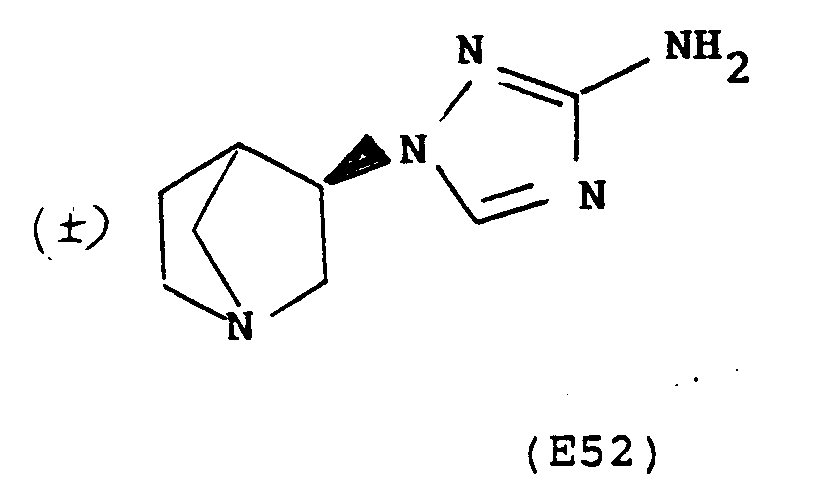
endo-3-(Methanesulphonyloxy)-1-azabicyclo[2.2.1]heptane (D10) (4.21g; 0.035 mole) was dissolved in dry dimethylformamide (100ml), and treated with the sodium salt of 3-amino-1,2,4-triazole (D20) (1.5eq; 5.3g; 0.05 mole). The mixture was heated at reflux for 1 hour, then allowed to cool to room temperature. Dimethylformamide was removed in vacuo and the resulting residue treated with aqueous potassium carbonate and extracted exhaustively into chloroform. Combined organic extracts were dried (Na₂SO₄), then concentrated in vacuo to leave a crude orange oil. This was purified by column chromatography (basic alumina, 10-20% methanol/chloroform) to yield separately the less polar title compound (E52) (0.633g) and the more polar compound (E55) (0.604g). Both were crystallised from acetone to give white crystalline solids (total yield 1.237g, 20%).
E52 m.p. 150-152oC
¹H NMR (270MHz, CDCl₃) δ:
1.21 (1H, m), 1.74 (1H, m), 2.47 (2H, m), 2.87 (2H, complex m), 3.08 (3H, complex m), 3.92 (1H, m), 4.3 (2H, bs, NH₂), 7.72 (1H, s, azole-H).
E55 m.p. 171oC (decomp).
¹H NMR (270MHz, CD₃OD) δ:
1.49 (1H, m), 1.75 (1H, m), 2.42 (1H, d), 2.55 (1H, m), 2.69 (1H, d), 2.82 (1H, m), 3.04 (1H, complex m), 3.20 (2H, d), 4.02 (1H, m), 7.39 (1H, s, azole-H). -

(±)exo-3-(3-Amino-1,2,4-triazol-1-yl)-1-azabicyclo[2.2.1]heptane (E52) (150mg, 0.84 mmol) was converted to the 3-chlorotriazole according to the method of Example 48. The resulting oil was purified by column chromatography (basic Al₂O₃, 1-5% MeOH/EtOAc) and the product (73mg, 44%) was crystallised from methanol/diethyl ether as the hydrochloride salt.
¹H NMR (270MHz, DMSO) δ:
1.66-1.8 (1H, m, 5H), 2.0-2.16 (1H, m, 5H), 3.13-3.9 (7H, m), 4.87-5.0 (1H, m, 3H), 8.78 (1H, s, 5′H).
¹³C NMR (67MHz, DMSO) δ:
24.3 (C-5), 41.5 (C-4), 51.0, 56.7 and 57.4 (C2, 6 and 7), 59.0 (C-3), 146.2 (C-5′), 151.0 (C-3′). -

A mixture of of (±) exo-3-(3-amino-1,2,4-triazol-1-yl)-1-azabicyclo[2.2.1]heptane (E52) and (±) exo-3-(5-amino-1,2,4-triazol-1-yl)-1-azabicyclo[2.2.1]heptane (0.15g; 0.84 mmole) (E55) was dissolved in 49% hydrobromic acid (6ml) at 0oC. This cold solution was treated with sodium nitrite (1.2eq; 0.07g; 1.0mmole) in water (3ml). After stirring for 5 minutes this mixture was added dropwise to a cold suspension of copper (1) bromide (1.2eq; 0.29g; 1.0mmole) in water (10ml) and the mixture stirred for a further 5 minutes. The resulting blue solution was gently heated to 80oC, and this temperature was maintained until nitrogen gas ceased to evolve. The resulting brown solution was allowed to cool to room temperature, treated carefully with anhydrous potassium carbonate, and the resulting blue solution was extracted using chloroform. Combined organic extracts were dried (Na₂SO₄) then concentrated in vacuo to give an orange oil which crystallised on standing (60mg, 29%).
¹H NMR (CDCl₃, 270MHz) δ:
1.2-1.33 (1H, m, 5-H), 1.7-1.85 (1H, m, 5-H), 2.42-2.58 (2H, m), 2.82-2.98 (2H, m), 2.98-3.22 (3H, m), 4.05-4.13 (1H, m, 3-H), 8.0 (1H, s, 5′H).
¹³C NMR (CDCl₃, 67MHz) δ:
28.2 (C-5), 43.4 (C-4), 58.3, 62.0, 63.2 (C-2,6,7), 139.8 (C-3′) and 143.3 (C-5′). - The product was crystallised from methanol/diethyl ether as an oxalate salt to give the title compound (E54) as a low melting crystalline solid.
¹H NMR (CD₃OD, 400MHz) (oxalate) δ:
1.71-1.85 (1H, m, 5-H), 2.08-2.20 (1H, m, 5-H), 3.09 (1H, d), 3.35-3.45 (1H, m), 3.8-3.9 (1H, m), 4.85-4.9 (1H, m, 3-H), 8.4 (1H, s, 5-H).
¹³C NMR (CD₃OD, 100.6MHz) (oxalate) δ:
21.8 (C-5), 43.9 (C-4), 53.4, 58.9 and 59.7 (C-2, 6 and 7), 60.6 (C-3), 140.94 (C-3′) and 147.5 (C-5′) -

The title compound (E16) was prepared from 1-benzyl-4-hydroxymethyl-4-(3-methyl-1,2,4-triazol-1-yl)piperidine (D31) using the method given in Example 51, as a hydroscopic white solid (6%).
¹H NMR (CD₃OD, 250MHz) δ:
2.35 (3H, s), 2.38-2.70 (4H, m), 3.50-3.70 (2H, m), 3.70-3.94 (4H, m), 8.57 (1H, s) -
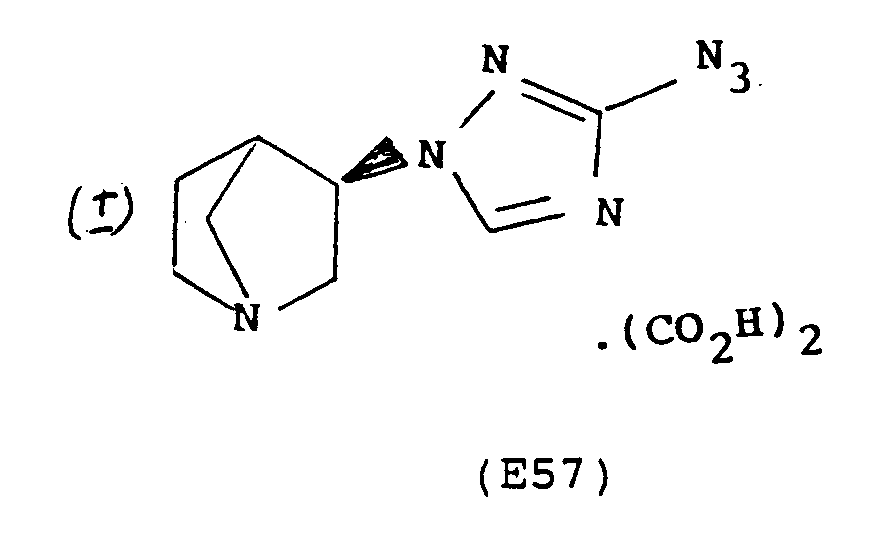
(±) exo-3-(3-Amino-1,2,4-triazol-1-yl)-1-azabicyclo[2.2.1]heptane (E52) (126mg, 0.0007 moles) in 1N sulphuric acid (5ml) was cooled to 0oC and treated with sodium nitrite (53mg, 0.00077 moles) in water (1ml). The solution was allowed to stand at 0oC for 10 min and then treated with sodium azide (91mg, 0.0014 moles) at 0oC. The solution was allowed to warm to 25oC over a period of 1h. The solution was then adjusted to pH 11 with solid potassium carbonate and the aqueous solution extracted with chloroform. The organic phase was separated, dried (Na₂SO₄) and concentrated in vacuo to a gum. The gum was then chromatographed on alumina in a gradient of 2-5% methanol in ethyl acetate. The first fraction which eluted in 3% methanol in ethyl acetate was concentrated in vacuo to afford a gum (70mg). The oxalate salt crystallised from acetone as cubes (E17) (49mg, 0.000166 moles, 23%), m.p. 148-150oC.
¹H NMR (270MHz, CD₃OD) δ:
1.8-2.0 (1H, m, 5-H), 2.13-2.33 (1H, m, 5H), 3.15 (1H, d, J=3Hz), 3.25-3.4 (3H, m), 3.4-3.6 (1H, m), 3.75-3.9 (2H, m), 3.9-4.02 (1H, d, J=8Hz), 8.43 (1H, s, 5′-H).
¹³C NMR (67.8MHz, CD₃OD) δ:
25.9 (C-5), 43.9 (C-4), 53.3, 58.9 and 59.5 (C-2,6,7), 60.4 (C-3), 146.5 (C-5′), 159.9 (C-3′) and 166.6 (CO₂H)₂. -
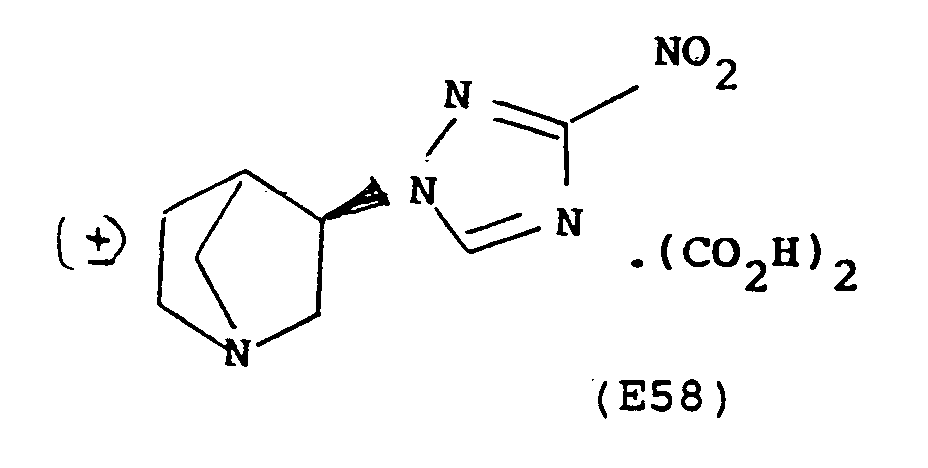
(±) exo-3-(3-Amino-1,2,4-triazol-1-yl)-1-azabicyclo[2.2.1]heptane (E52) (500mg, 2.79 mmol) was dissolved in 2N sulphuric acid (10ml) at 0oC, and this solution was added to aqueous 2N sodium nitrite (5ml) at 0oC. The mixture was then warmed to 45oC for 30 min, basified using saturated aqueous potassium carbonate to pH 11, and extracted with chloroform. The organic phases were dried (Na₂SO₄), evaporated to dryness under reduced pressure and purified by elution through a plug of alumina in ether. The oxalate salt was crystallised from acetone to afford the title compound (E58) (0.43g, 1.44 mmoles, 51%) m.p. 151-153oC.
¹H NMR (CD₃OD, 250MHz) δ:
1.9-2.05 (1H, m, 5-H), 2.2-2.4 (1H, m, 5-H), 3.27-3.63 (4H, m), 3.9-4.0 (3H, m), 5.13-5.24 (1H, m, 3H), 8.8 (1H, s, 5′H). - Cerebral cortex from Hooded Lister rats (Olac, UK) is homogenised in 2.5 vols ice-cold 50mM tris buffer pH 7.7 (at 25oC). After centrifugation at 25,000 x g at 4oC for 15 min the pellet is resuspended in 2.5 vols buffer and the wash repeated 3 times more. The final resuspension is in 2.5 volumes and the homogenates are stored in 1ml aliquots at -20oC.
- Incubations (total volume 2ml) are prepared using the above buffer with the addition of 2mM magnesium chloride in the 3H-Oxotremorine-M (3H-OXO-M) experiments. For 3H-Quinuclidinyl Benzilate (3H-QNB), 1ml of stored membranes is diluted to 30ml and 0.1ml mixed with test compound and 0.27nM (c. 25,000 cpm) 3H-QNB (Amersham International). For 3H-OXO-M, 1ml of membranes is diluted to 6ml and 0.1ml mixed with test compound and 2nM (c. 250,000 cpm) 3H-OXO-M (New England Nuclear).
- Non-specific binding of 3H-QNB is defined using 1 µM Atropine sulphate (2µm Atropine) and of 3H-OXO-M using 10µM Oxotremorine. Non-specific binding values typically are 5% and 25% of total binding, respectively. Incubations are carried out at 37oC for 30 min and the samples filtered using Whatman GF/B filters. (In the 3H-OXO-M experiments the filters are presoaked for 30 min in 0.05% polyethylenimine in water). Filters are washed with 3 x 4ml ice-cold buffer. Radioactivity is assessed using a Packard BPLD scintillation counter, 3ml Pico-Fluor 30 (Packard) as scintillant.
- This test provides an indication of the muscarinic binding activity of the test compound. The results are obtained as IC₅₀ values (i.e. the concentration which inhibits binding of the ligand by 50%) for the displacement of the muscarinic agonist 3H-OXO-M and the muscarinic antagonist 3H-QNB. The ratio IC₅₀(3H-QNB)/IC₅₀(3H-OXO-M) gives an indication of the agonist character of the compound. Agonists typically exhibit a large ratio; antagonists typically exhibit a ratio near to unity.
- The results are shown in Table 1:
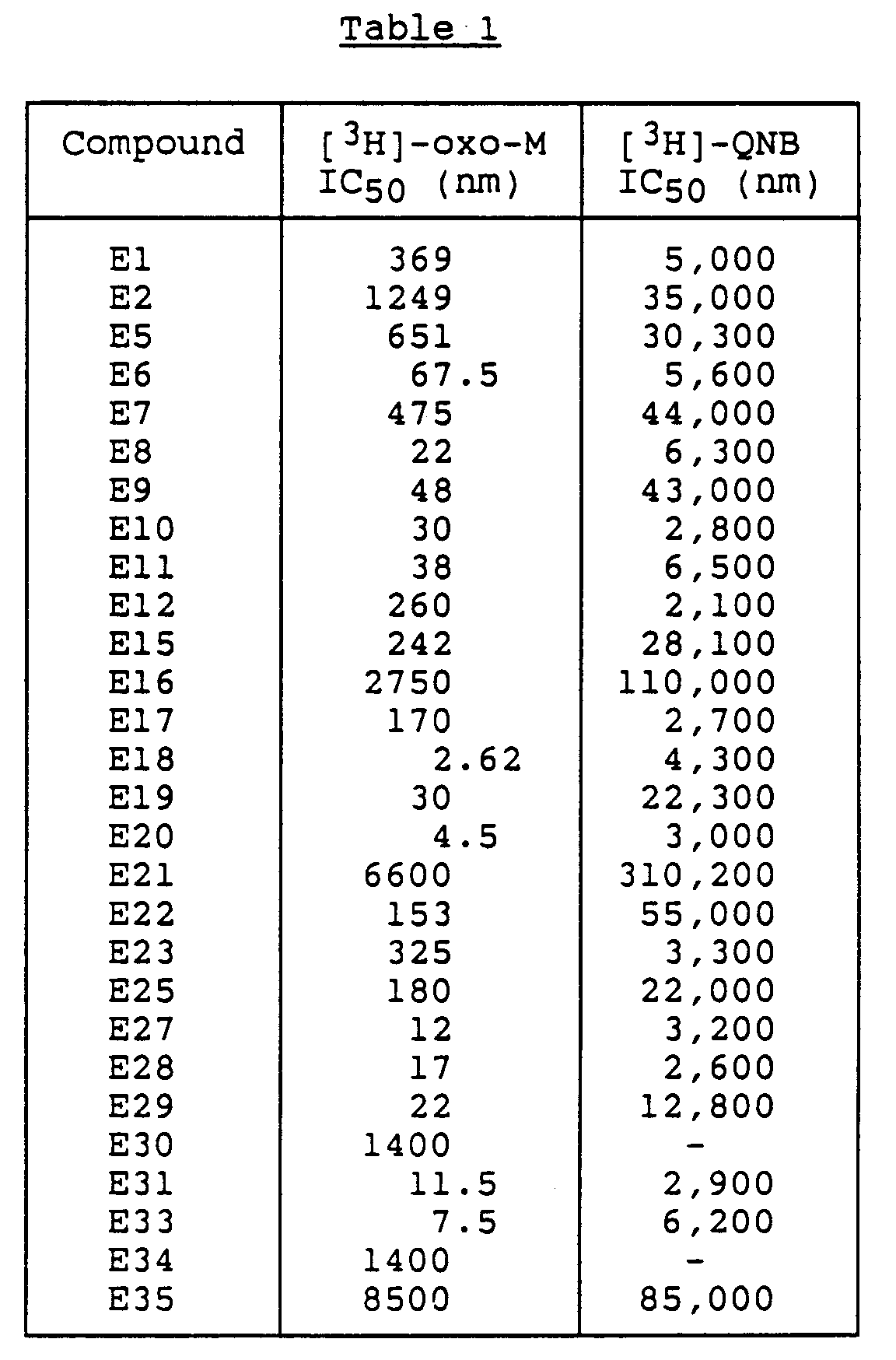
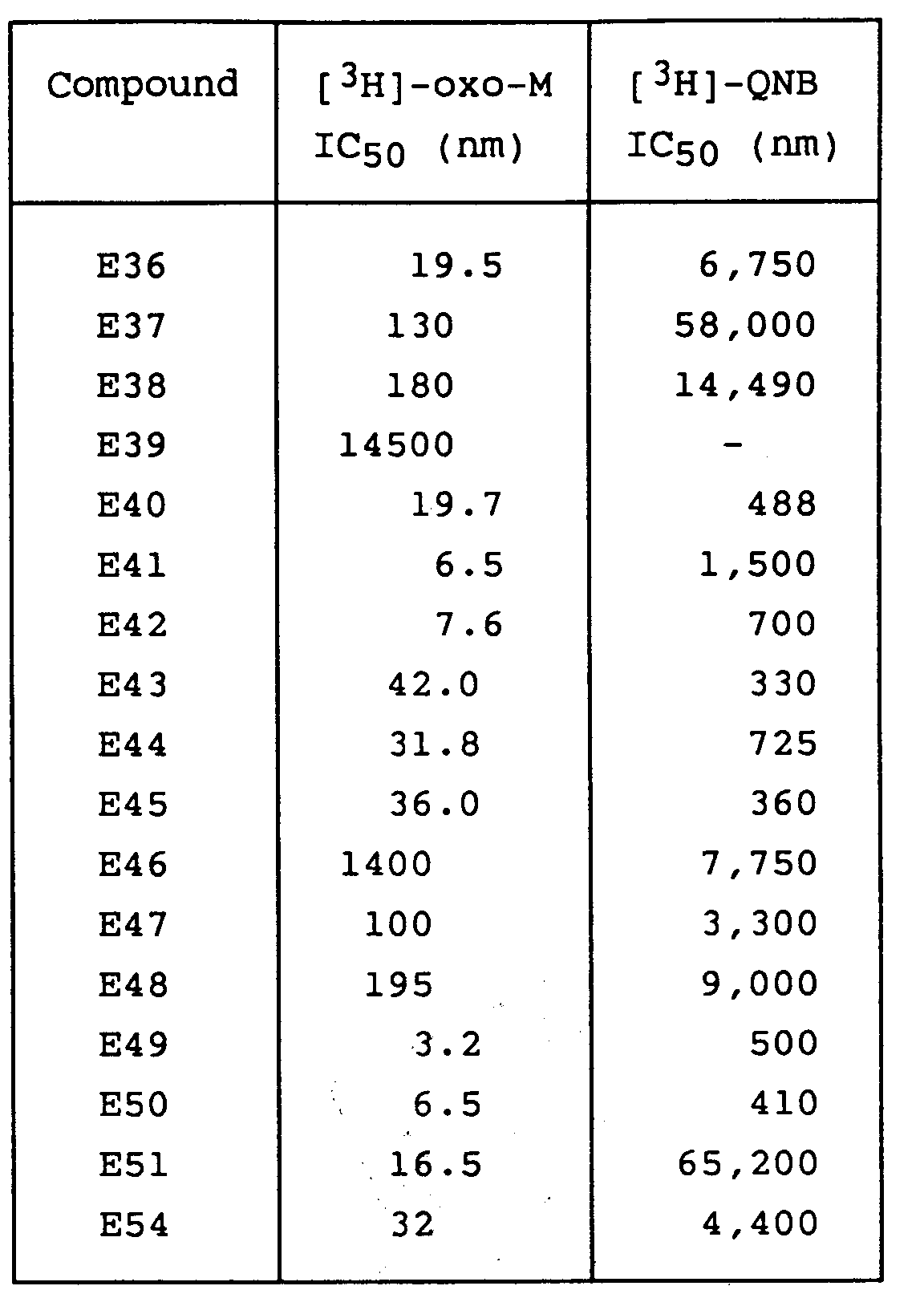
** Starting material commercially available
*Starting material - M. Begtrup, J. Chem. Soc. Perkin II, 1976, 736
Claims (15)
- A compound of formula (I) or a pharmaceutically acceptable salt thereof:


- A compound according to claim 1 wherein (r,s,t) is (2,2,0), (3,1,0), (2,1,0), (2,1,1) or (3,1,1).
- A compound according to claim 1 or 2 wherein Z represents 1,2-pyrazol-1-yl, 1,2,4-triazol-1-yl, 1,2,3-triazol-2-yl, tetrazol-1-yl or tetrazol-2-yl optionally C-substituted by R₁.
- A compound according to any preceding claim wherein R₁ is hydrogen, methyl, ethyl, amino, cyano, nitro, azido, chloro, bromo or iodo.
- A compound according to any preceding claim wherein R₁ is γ to the position of the azabicyclic ring on Z.
- A compound according to any preceding claim wherein Ra and Rb are both hydrogen.
- (±) 3-(3-Methylpyrazol-1-yl)-1-azabicyclo[2.2.2]octane,
(±) 3-(pyrazol-1-yl)-1-azabicyclo[2.2.2]octane,
(±) 3-(3-aminopyrazol-1-yl)-1-azabicyclo-[2.2.2]octane,
(±) 3-(5-aminopyrazol-1-yl)-1-azabicyclo-[2.2.2]octane,
3-(3-methyl-1,2,4-triazol-1-yl)-1-azabicyclo[2.2.2]oct-2-ene,
(±) 3-(3-methyl-1,2,4-triazol-1-yl)-1-azabicyclo[2.2.2]octane,
(±) 3-(1,2,4-triazol-1-yl)-1-azabicyclo[2.2.2]octane,
(±) exo-3-(3-methyl-1,2,4-triazol-1-yl)-1-azabicyclo[2.2.1]heptane,
(±) exo-3-(1,2,4-triazol-1-yl)-1-azabicyclo[2.2.1]heptane,
(±) 3-(5-methyltetrazol-2-yl)-1-azabicyclo[2.2.2]octane,
(±) 3-(5-aminotetrazol-2-yl)-1-azabicyclo[2.2.2]octane,
(±) 3-(4-methyl-1,2,3-triazol-2-yl)-1-azabicyclo[2.2.2]octane,
(±) 3-(4-methyl-1,2,3-triazol-3-yl)-1-azabicyclo[2.2.2]octane,
(±) 3-(4-methyl-1,2,3-triazol-1-yl)-1-azabicyclo[2.2.2]octane,
(±) 3-(tetrazol-2-yl)-1-azabicyclo[2.2.2]octane,
(±) 3-(tetrazol-1-yl)-1-azabicyclo[2.2.2]octane,
(±) exo-3-(5-aminotetrazol-2-yl)-1-azabicyclo[3.2.1]octane,
(±) exo-3-(5-aminotetrazol-2-yl)-1-azabicyclo[2.2.1]heptane,
(±) exo-3-(tetrazol-2-yl)-1-azabicyclo[2.2.1]heptane,
(±) exo-3-(5-methyltetrazol-2-yl)-1-azabicyclo[2.2.1]heptane,
(±) exo-3-(5-methyltetrazol-1-yl)-1-azabicyclo[2.2.1]heptane,
(±) exo-3-(tetrazol-2-yl)-1-azabicyclo[3.2.1]octane,
(±) exo-3-(5-ethyltetrazol-2-yl)-1-azabicyclo[2.2.1]heptane,
(±) exo-3-(5-ethyltetrazol-1-yl)-1-azabicyclo[2.2.1]heptane,
(±) exo-3-(4-methyl-1,2,3-triazol-2-yl)-1-azabicyclo[2.2.1]heptane,
(±) endo-3-(5-aminotetrazol-2-yl)-1-azabicyclo[2.2.1]heptane,
(±) 5-(1,2,4-triazol-1-yl)-1-azabicyclo[3.2.1]octane,
(±) 5-(3-methyl-1,2,4-triazol-1-yl)-1-azabicyclo[3.2.1]octane,
(±) 5-(tetrazol-2-yl)-1-azabicyclo[3.2.1]octane,
(±) 5-(tetrazol-1-yl)-azabicyclo[3.2.1]octane,
(±) 5-(5-methyltetrazol-2-yl)-1-azabicyclo[3.2.1]octane,
(±) 5-(5-methyltetrazol-1-yl)-1-azabicyclo[3.2.1]octane,
(±) exo-3-(5-methyltetrazol-2-yl)-1-azabicyclo[2.2.1]heptane,
(±) exo-3-(5-methyltetrazol-1-yl)-1-azabicyclo[2.2.1]heptane,
(±) exo-3-(tetrazol-2-yl)-1-azabicyclo[3.2.1]octane,
(±) exo-3-(5-ethyltetrazol-2-yl)-1-azabicyclo[2.2.1]heptane,
(±) exo-3-(5-ethyltetrazol-1-yl)-1-azabicyclo[2.2.1]heptane,
(±) exo-3-(4-methyl-1,2,3-triazol-2-yl)-1-azabicyclo[2.2.1]heptane,
(±) endo-3-(5-aminotetrazol-2-yl)-1-azabicyclo[2.2.1]heptane,
(±) 5-(1,2,4-triazol-1-yl)-1-azabicyclo[3.2.1]octane,
(±) 5-(3-methyl-1,2,4-triazol-1-yl)-1-azabicyclo[3.2.1]octane,
(±) 5-(tetrazol-2-yl)-1-azabicyclo[3.2.1]octane,
(±) 5-(tetrazol-1-yl)-1-azabicyclo[3.2.1]octane,
(±) 5-(5-methyltetrazol-2-yl)-1-azabicyclo[3.2.1]octane,
(±) 5-(5-methyltetrazol-1-yl)-1-azabicyclo[3.2.1]octane,
(±) 5-(5-aminotetrazol-2-yl)-1-azabicyclo[3.2.1]octane,
(±) 5-(5-aminotetrazol-1-yl)-1-azabicyclo[3.2.1]octane,
(±) 3-(1,2,3-triazol-1-yl)-1-azabicyclo[2.2.2]octane,
(±) 5-(3-amino-1,2,4-triazol-1-yl)-1-azabicyclo[3.2.1]octane,
(±) 5-(5-amino-1,2,4-triazol-1-yl)-1-azabicyclo[3.2.1]octane,
(±) 3-(3-amino-1,2,4-triazol-1-yl)-1-azabicyclo[2.2.2]octane,
(±) 3-(5-amino-1,2,4-triazol-1-yl)-1-azabicyclo[2.2.2]octane,
(±) 3-[5-bromotetrazol-2-yl]-1-azabicyclo[2.2.2]octane,
(±) exo-3-(5-bromotetrazol-2-yl)-1-azabicyclo[2.2.1]heptane,
(±) exo-3-(5-chlorotetrazol-2-yl)-1-azabicyclo[2.2.1]heptane,
(±) exo-3-(5-iodotetrazol-2-yl)-1-azabicyclo[2.2.1]heptane,
(±) 3-(5-chlocotetrazol-2-yl)-1-azabicyclo[2.2.2]octane,
(±) 3-(5-iodotetrazol-2-yl)-1-azabicyclo[2.2.2]octane,
(±) 3-(5-cyanotetrazol-2-yl)-1-azabicyclo[2.2.2]octane,
(±) 3-(3-bromo-1,2,4-triazol-1-yl)-1-azabicyclo[2.2.2]octane,
(±) 3-(3-chloro-1,2,4-triazol-1-yl)-1-azabicyclo[2.2.2]octane,
(±) 5-(5-chlorotetrazol-2-yl)-1-azabicyclo[3.2.1]octane,
(±) 5-(5-bromotetrazol-2-yl)-1-azabicyclo[3.2.1]octane,
4-(1,2,4-triazol-1-yl)-1-azabicyclo[2.2.1]heptane,
(±) exo-3-(3-amino-1,2,4-triazol-1-yl)-1-azabicyclo[2.2.1]heptane,
(±) exo-3-(3-chloro-1,2,4-triazol-1-yl)-1-azabicyclo[2.2.1]heptane,
(±) exo-3-(3-bromo-1,2,4-triazol-1-yl)-1-azabicyclo[2.2.1]heptane,
(±) exo-3-(5-amino-1,2,4-triazol-1-yl)-1-azabicyclo[2.2.1]heptane,
4-(3-methyl-1,2,4-triazol-1-yl)-1-azabicyclo[2.2.1]heptane,
(±) exo-3-(3-azido-1,2,4-triazol-1-yl)-1-azabicyclo[2.2.1]heptane or
(±) exo-3-(3-nitro-1,2,4-triazol-1-yl)-1-azabicyclo[2.2.1]heptane
or a pharmaceutically acceptable salt of any of the foregoing compounds. - A process for the preparation of a compound of formula (I) as defined in claim 1 or a pharmaceutically acceptable salt thereof, which process comprises:(a) cyclising a compound of formula (II):
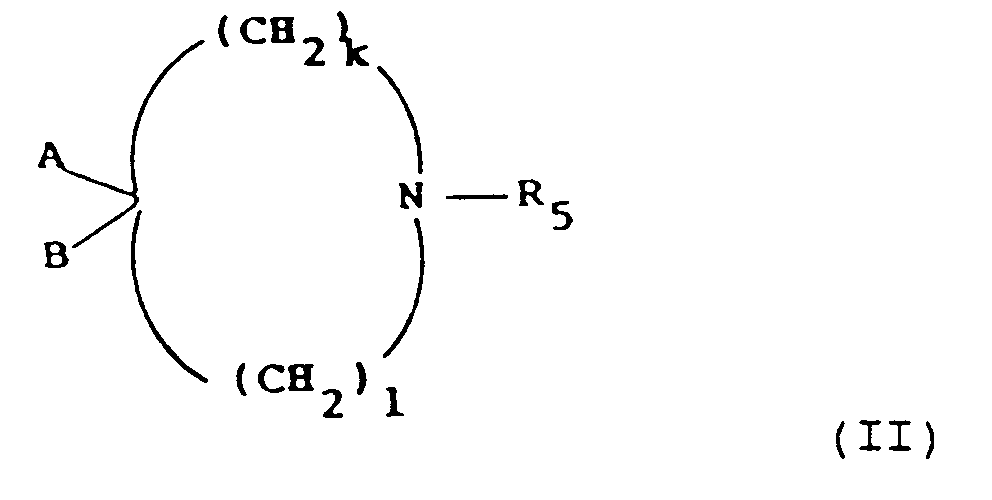

or (ii) A represents an electron withdrawing group, B represents hydrogen and R₅ represents -(CH₂)j L₂ where L₂ is a leaving group; one of k and l is 1 and the other and j independently represent an integer of 2 or 3; to give a compound of formula (IIb):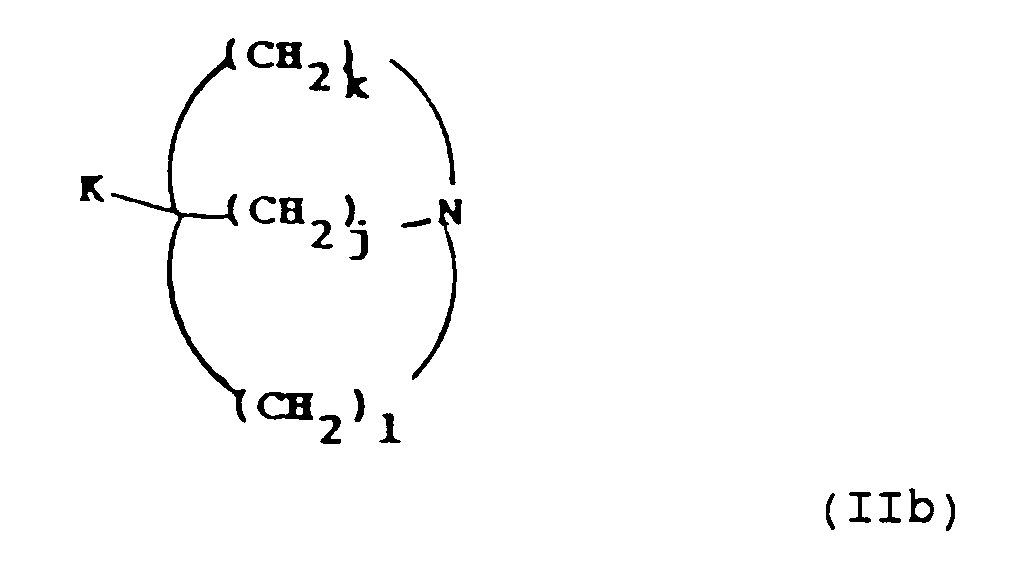 (b) cyclising a compound of formula (III):
 (c) cyclising a compound of formula (IV):
- A process for the preparation of a compound of formula (I) as defined in claim 1 or a pharmaceutically acceptable salt thereof, which process comprises reacting a compound of formula (IVa):
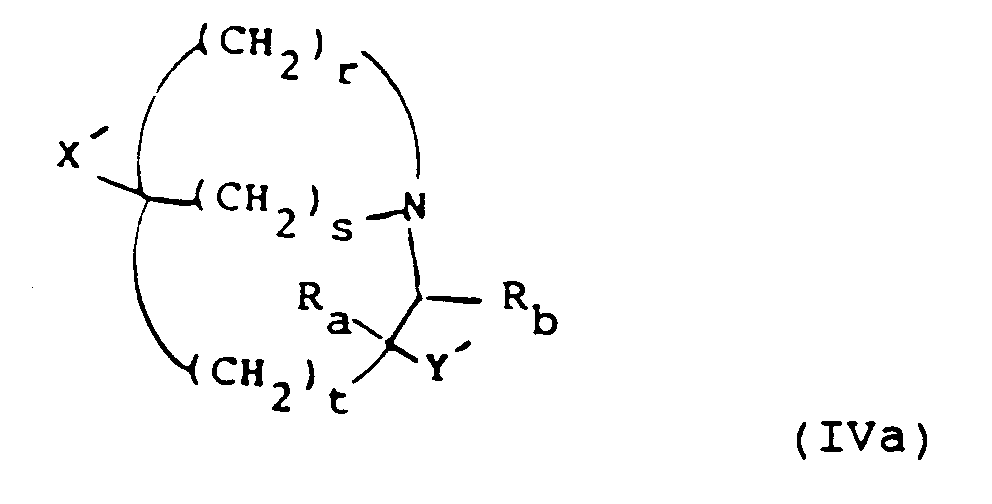
- A compound of formula (IVb) or a salt thereof:

- 3-Quinuclidinyl-hydrazone,
(±) 3-quinuclidinyl-hydrazine
(±) exo and endo (1-azabicyclo[2.2.1]heptan-3-yl)hydrazine,
(±) 1-azabicyclo[3.2.1]oct-5-ylhydrazine or
(±) 3-azido-1-azabicyclo[2.2.2]octane. - A pharmaceutical composition which comprises a compound according to claim 1 and a pharmaceutically acceptable carrier.
- A compound according to claim 1 for use as an active therapeutic substance.
- A compound according to claim 1 for use in the treatment and/or prophylaxis of dementia.
- Use of a compound according to claim 1 for the preparation of a medicament for the treatment and/or prophylaxis of dementia.
Applications Claiming Priority (4)
| Application Number | Priority Date | Filing Date | Title |
|---|---|---|---|
| GB8922620 | 1989-10-07 | ||
| GB898922620A GB8922620D0 (en) | 1989-10-07 | 1989-10-07 | Novel compounds |
| GB909016069A GB9016069D0 (en) | 1990-07-21 | 1990-07-21 | Novel compounds |
| GB9016069 | 1990-07-21 |
Publications (3)
| Publication Number | Publication Date |
|---|---|
| EP0427390A2 EP0427390A2 (en) | 1991-05-15 |
| EP0427390A3 EP0427390A3 (en) | 1992-02-12 |
| EP0427390B1 true EP0427390B1 (en) | 1996-03-27 |
Family
ID=26296014
Family Applications (1)
| Application Number | Title | Priority Date | Filing Date |
|---|---|---|---|
| EP90310632A Expired - Lifetime EP0427390B1 (en) | 1989-10-07 | 1990-09-28 | Azabicyclic compounds, process and intermediates for their preparation and pharmaceutical compositions containing them |
Country Status (10)
| Country | Link |
|---|---|
| US (1) | US5981545A (en) |
| EP (1) | EP0427390B1 (en) |
| JP (1) | JPH03145491A (en) |
| KR (1) | KR910007929A (en) |
| AT (1) | ATE136031T1 (en) |
| AU (1) | AU639493B2 (en) |
| CA (1) | CA2027093A1 (en) |
| DE (1) | DE69026197T2 (en) |
| IE (1) | IE903576A1 (en) |
| PT (1) | PT95520A (en) |
Families Citing this family (10)
| Publication number | Priority date | Publication date | Assignee | Title |
|---|---|---|---|---|
| IE922270A1 (en) * | 1991-07-26 | 1993-01-27 | Akzo Nv | Pyrazole derivatives |
| SE9201478D0 (en) * | 1992-05-11 | 1992-05-11 | Kabi Pharmacia Ab | HETEROAROMATIC QUINUCLIDINENES, THEIR USE AND PREPARATION |
| US5393767A (en) * | 1993-08-26 | 1995-02-28 | Dowelanco | Insect control with substituted triazole and tetrazole compounds |
| US5733912A (en) * | 1997-02-19 | 1998-03-31 | Abbott Laboratories | 7A-heterocycle substituted hexahydro-1H-pyrrolizine compounds useful in controlling chemical synaptic transmission |
| FR2862647B1 (en) | 2003-11-25 | 2008-07-04 | Aventis Pharma Sa | PYRAZOLYL DERIVATIVES, PREPARATION METHOD AND INTERMEDIATES THEREOF AS MEDICAMENTS AND PHARMACEUTICAL COMPOSITIONS COMPRISING THE SAME |
| EP2258359A3 (en) | 2005-08-26 | 2011-04-06 | Braincells, Inc. | Neurogenesis by muscarinic receptor modulation with sabcomelin |
| EP2275096A3 (en) | 2005-08-26 | 2011-07-13 | Braincells, Inc. | Neurogenesis via modulation of the muscarinic receptors |
| KR20090064418A (en) * | 2006-09-08 | 2009-06-18 | 브레인셀즈 인코퍼레이션 | Combination with 4-acylaminopyridine derivatives |
| WO2011082245A2 (en) * | 2009-12-31 | 2011-07-07 | Viamet Pharmaceuticals, Inc. | Metalloenzyme inhibitor compounds |
| WO2012054366A2 (en) * | 2010-10-21 | 2012-04-26 | Merck Sharp & Dohme Corp. | Substituted amino-triazolyl pde10 inhibitors |
Family Cites Families (19)
| Publication number | Priority date | Publication date | Assignee | Title |
|---|---|---|---|---|
| US3813384A (en) * | 1972-01-17 | 1974-05-28 | Asta Werke Ag Chem Fab | Basically substituted benzyl phthalazone derivatives,acid salts thereof and process for the production thereof |
| FR2414044A1 (en) * | 1978-01-10 | 1979-08-03 | Pharmindustrie | NEW DERIVATIVES OF AZA-1 BICYCLO (2,2,2) OCTANE, USABLE AS MEDICINAL PRODUCTS |
| NZ219646A (en) * | 1986-03-27 | 1990-10-26 | Merck Sharp & Dohme | Oxadiazole derivatives of azacyclics for treating cns disorders |
| DE3789039T2 (en) * | 1986-06-27 | 1994-06-09 | Beecham Group Plc | Bridged bicyclic N-heterocyclic compounds. |
| ATE133415T1 (en) * | 1987-04-15 | 1996-02-15 | Beecham Group Plc | AZABICYCLE DERIVATIVES SUBSTITUTED ON THE BRIDGEHEAD |
| GB8714789D0 (en) * | 1987-06-24 | 1987-07-29 | Lundbeck & Co As H | Heterocyclic compounds |
| GB8717446D0 (en) * | 1987-07-23 | 1987-08-26 | Merck Sharp & Dohme | Chemical compounds |
| NZ225999A (en) * | 1987-09-10 | 1992-04-28 | Merck Sharp & Dohme | Azacyclic- or azabicyclic-substituted thiadiazole derivatives and pharmaceutical compositions |
| ES2053748T3 (en) * | 1987-09-10 | 1994-08-01 | Merck Sharp & Dohme | OXAZOLES AND TIAZOLES FOR THE TREATMENT OF SENILE DEMENTIA. |
| NZ226000A (en) * | 1987-09-10 | 1991-06-25 | Merck Sharp & Dohme | Oxadiazolyl-azabicycloheptanes and pharmaceutical compositions |
| IE63906B1 (en) * | 1987-11-13 | 1995-06-14 | Novo Nordisk As | Azabicyclic compounds and their preparation and use |
| EP0322182A3 (en) * | 1987-12-22 | 1992-01-02 | Beecham Group Plc | Azabicyclic compounds, process for their preparation and pharmaceutical compositions containing them |
| IL88846A0 (en) * | 1988-01-08 | 1989-07-31 | Merck Sharp & Dohme | Lipophilic oxadiazoles,their preparation and pharmaceutical compositions containing them |
| GB8808926D0 (en) * | 1988-04-15 | 1988-05-18 | Beecham Group Plc | Novel compounds |
| EP0363085A3 (en) * | 1988-10-03 | 1991-03-27 | Beecham Group Plc | Novel compounds |
| CA2000041A1 (en) * | 1988-10-13 | 1990-04-13 | Barry S. Orlek | Compounds |
| GB8830226D0 (en) * | 1988-12-23 | 1989-02-22 | Beecham Group Plc | Novel compounds |
| EP0402056A3 (en) * | 1989-06-06 | 1991-09-04 | Beecham Group p.l.c. | Azabicyclic compounds, process for their preparation and pharmaceutical compositions containing them |
| US5200419A (en) * | 1990-05-21 | 1993-04-06 | Warner-Lambert Company | Substituted tetrazoles and derivatives thereof acting at muscarinic receptors |
-
1990
- 1990-09-28 EP EP90310632A patent/EP0427390B1/en not_active Expired - Lifetime
- 1990-09-28 AT AT90310632T patent/ATE136031T1/en not_active IP Right Cessation
- 1990-09-28 DE DE69026197T patent/DE69026197T2/en not_active Expired - Fee Related
- 1990-10-04 US US07/594,034 patent/US5981545A/en not_active Expired - Fee Related
- 1990-10-04 PT PT95520A patent/PT95520A/en not_active Application Discontinuation
- 1990-10-05 CA CA002027093A patent/CA2027093A1/en not_active Abandoned
- 1990-10-05 IE IE357690A patent/IE903576A1/en unknown
- 1990-10-05 AU AU63823/90A patent/AU639493B2/en not_active Ceased
- 1990-10-06 KR KR1019900015906A patent/KR910007929A/en not_active Withdrawn
- 1990-10-08 JP JP2268562A patent/JPH03145491A/en active Pending
Also Published As
| Publication number | Publication date |
|---|---|
| AU6382390A (en) | 1991-04-11 |
| DE69026197T2 (en) | 1997-01-09 |
| JPH03145491A (en) | 1991-06-20 |
| IE903576A1 (en) | 1991-04-10 |
| EP0427390A2 (en) | 1991-05-15 |
| US5981545A (en) | 1999-11-09 |
| ATE136031T1 (en) | 1996-04-15 |
| AU639493B2 (en) | 1993-07-29 |
| EP0427390A3 (en) | 1992-02-12 |
| CA2027093A1 (en) | 1991-04-08 |
| KR910007929A (en) | 1991-05-30 |
| DE69026197D1 (en) | 1996-05-02 |
| PT95520A (en) | 1991-08-14 |
Similar Documents
| Publication | Publication Date | Title |
|---|---|---|
| JP2913466B2 (en) | Azabicyclo compounds and pharmaceutical compositions containing them | |
| US4968691A (en) | Heterocyclo-substituted azabicyclo muscannic agonists | |
| US5217975A (en) | Azabicyclic compounds for treating dementia | |
| US4695578A (en) | 1,2,3,9-tetrahydro-3-imidazol-1-ylmethyl-4H-carbazol-4-ones, composition containing them, and method of using them to treat neuronal 5HT function disturbances | |
| US6812236B2 (en) | Compounds useful in therapy | |
| US5541194A (en) | Certain 1-azabicyclo[2.2.1]heptanes and 1-azabicyclo[2.2.2]octanes | |
| JPS6317879A (en) | Oxadiazoles useful in treating senile dementia | |
| US5091397A (en) | 1-aza-bicyclico(2.2.1)heptanes | |
| EP0427390B1 (en) | Azabicyclic compounds, process and intermediates for their preparation and pharmaceutical compositions containing them | |
| US5278170A (en) | Azabicylo oxime compounds | |
| EP0307140B1 (en) | Oxadiazolyl-azabicycloheptanes for the treatment of senile dementia | |
| JP2917224B2 (en) | Novel compound, production method thereof and pharmaceutical composition containing the same | |
| US5324724A (en) | Compounds for the treatment of senile dementia | |
| US4988706A (en) | Certain pharmaceutically useful oxadiazoles | |
| US5362739A (en) | Azabicyclic compounds and pharmaceutical compositions containing them | |
| US5043342A (en) | Oxadiazolyl bicycloheptanes for dementia treatment | |
| JP2719063B2 (en) | Substituted 3-aminoquinuclidine P substance antagonist | |
| US5998416A (en) | Piperazine, piperidine and tetrahydropyridine derivatives as 5-HT receptor agonists | |
| HK1012365B (en) | Novel compounds |
Legal Events
| Date | Code | Title | Description |
|---|---|---|---|
| PUAI | Public reference made under article 153(3) epc to a published international application that has entered the european phase |
Free format text: ORIGINAL CODE: 0009012 |
|
| AK | Designated contracting states |
Kind code of ref document: A2 Designated state(s): AT BE CH DE DK ES FR GB GR IT LI LU NL SE |
|
| PUAL | Search report despatched |
Free format text: ORIGINAL CODE: 0009013 |
|
| AK | Designated contracting states |
Kind code of ref document: A3 Designated state(s): AT BE CH DE DK ES FR GB GR IT LI LU NL SE |
|
| 17P | Request for examination filed |
Effective date: 19920314 |
|
| 17Q | First examination report despatched |
Effective date: 19941006 |
|
| RAP1 | Party data changed (applicant data changed or rights of an application transferred) |
Owner name: BEECHAM GROUP PLC |
|
| GRAH | Despatch of communication of intention to grant a patent |
Free format text: ORIGINAL CODE: EPIDOS IGRA |
|
| GRAA | (expected) grant |
Free format text: ORIGINAL CODE: 0009210 |
|
| AK | Designated contracting states |
Kind code of ref document: B1 Designated state(s): AT BE CH DE DK FR GB GR IT LI LU NL SE |
|
| PG25 | Lapsed in a contracting state [announced via postgrant information from national office to epo] |
Ref country code: GR Free format text: LAPSE BECAUSE OF FAILURE TO SUBMIT A TRANSLATION OF THE DESCRIPTION OR TO PAY THE FEE WITHIN THE PRESCRIBED TIME-LIMIT Effective date: 19960327 Ref country code: DK Effective date: 19960327 Ref country code: AT Effective date: 19960327 |
|
| REF | Corresponds to: |
Ref document number: 136031 Country of ref document: AT Date of ref document: 19960415 Kind code of ref document: T |
|
| ITF | It: translation for a ep patent filed | ||
| REF | Corresponds to: |
Ref document number: 69026197 Country of ref document: DE Date of ref document: 19960502 |
|
| ET | Fr: translation filed | ||
| PG25 | Lapsed in a contracting state [announced via postgrant information from national office to epo] |
Ref country code: SE Effective date: 19960627 |
|
| PG25 | Lapsed in a contracting state [announced via postgrant information from national office to epo] |
Ref country code: LU Free format text: LAPSE BECAUSE OF NON-PAYMENT OF DUE FEES Effective date: 19960930 |
|
| PLBE | No opposition filed within time limit |
Free format text: ORIGINAL CODE: 0009261 |
|
| STAA | Information on the status of an ep patent application or granted ep patent |
Free format text: STATUS: NO OPPOSITION FILED WITHIN TIME LIMIT |
|
| 26N | No opposition filed | ||
| PGFP | Annual fee paid to national office [announced via postgrant information from national office to epo] |
Ref country code: NL Payment date: 19990630 Year of fee payment: 10 |
|
| PGFP | Annual fee paid to national office [announced via postgrant information from national office to epo] |
Ref country code: GB Payment date: 19990806 Year of fee payment: 10 |
|
| PGFP | Annual fee paid to national office [announced via postgrant information from national office to epo] |
Ref country code: FR Payment date: 19990901 Year of fee payment: 10 |
|
| PGFP | Annual fee paid to national office [announced via postgrant information from national office to epo] |
Ref country code: DE Payment date: 19990927 Year of fee payment: 10 |
|
| PGFP | Annual fee paid to national office [announced via postgrant information from national office to epo] |
Ref country code: BE Payment date: 19991015 Year of fee payment: 10 |
|
| PGFP | Annual fee paid to national office [announced via postgrant information from national office to epo] |
Ref country code: CH Payment date: 19991021 Year of fee payment: 10 |
|
| PG25 | Lapsed in a contracting state [announced via postgrant information from national office to epo] |
Ref country code: GB Free format text: LAPSE BECAUSE OF NON-PAYMENT OF DUE FEES Effective date: 20000928 |
|
| PG25 | Lapsed in a contracting state [announced via postgrant information from national office to epo] |
Ref country code: LI Free format text: LAPSE BECAUSE OF NON-PAYMENT OF DUE FEES Effective date: 20000930 Ref country code: CH Free format text: LAPSE BECAUSE OF NON-PAYMENT OF DUE FEES Effective date: 20000930 Ref country code: BE Free format text: LAPSE BECAUSE OF NON-PAYMENT OF DUE FEES Effective date: 20000930 |
|
| BERE | Be: lapsed |
Owner name: BEECHAM GROUP P.L.C. Effective date: 20000930 |
|
| PG25 | Lapsed in a contracting state [announced via postgrant information from national office to epo] |
Ref country code: NL Free format text: LAPSE BECAUSE OF NON-PAYMENT OF DUE FEES Effective date: 20010401 |
|
| REG | Reference to a national code |
Ref country code: CH Ref legal event code: PL |
|
| GBPC | Gb: european patent ceased through non-payment of renewal fee |
Effective date: 20000928 |
|
| PG25 | Lapsed in a contracting state [announced via postgrant information from national office to epo] |
Ref country code: FR Free format text: LAPSE BECAUSE OF NON-PAYMENT OF DUE FEES Effective date: 20010531 |
|
| NLV4 | Nl: lapsed or anulled due to non-payment of the annual fee |
Effective date: 20010401 |
|
| PG25 | Lapsed in a contracting state [announced via postgrant information from national office to epo] |
Ref country code: DE Free format text: LAPSE BECAUSE OF NON-PAYMENT OF DUE FEES Effective date: 20010601 |
|
| REG | Reference to a national code |
Ref country code: FR Ref legal event code: ST |
|
| PG25 | Lapsed in a contracting state [announced via postgrant information from national office to epo] |
Ref country code: IT Free format text: LAPSE BECAUSE OF NON-PAYMENT OF DUE FEES;WARNING: LAPSES OF ITALIAN PATENTS WITH EFFECTIVE DATE BEFORE 2007 MAY HAVE OCCURRED AT ANY TIME BEFORE 2007. THE CORRECT EFFECTIVE DATE MAY BE DIFFERENT FROM THE ONE RECORDED. Effective date: 20050928 |