EP0422988B1 - Method and device for transferring a fluid sample between two chambers, and their application to gas chromatography - Google Patents
Method and device for transferring a fluid sample between two chambers, and their application to gas chromatography Download PDFInfo
- Publication number
- EP0422988B1 EP0422988B1 EP90402732A EP90402732A EP0422988B1 EP 0422988 B1 EP0422988 B1 EP 0422988B1 EP 90402732 A EP90402732 A EP 90402732A EP 90402732 A EP90402732 A EP 90402732A EP 0422988 B1 EP0422988 B1 EP 0422988B1
- Authority
- EP
- European Patent Office
- Prior art keywords
- chamber
- rods
- chambers
- cavity
- line
- Prior art date
- Legal status (The legal status is an assumption and is not a legal conclusion. Google has not performed a legal analysis and makes no representation as to the accuracy of the status listed.)
- Expired - Lifetime
Links
- 239000012530 fluid Substances 0.000 title claims description 30
- 238000000034 method Methods 0.000 title claims description 13
- 238000004817 gas chromatography Methods 0.000 title claims description 4
- 238000007789 sealing Methods 0.000 claims description 41
- 238000005070 sampling Methods 0.000 claims description 13
- 238000012546 transfer Methods 0.000 claims description 13
- 238000006073 displacement reaction Methods 0.000 claims description 9
- 238000004804 winding Methods 0.000 claims description 8
- 230000000694 effects Effects 0.000 claims description 7
- 238000013519 translation Methods 0.000 claims description 6
- 238000005259 measurement Methods 0.000 claims description 4
- 239000004642 Polyimide Substances 0.000 claims description 3
- 238000004458 analytical method Methods 0.000 claims description 3
- 239000000919 ceramic Substances 0.000 claims description 3
- 239000000615 nonconductor Substances 0.000 claims description 3
- 229920001721 polyimide Polymers 0.000 claims description 3
- 230000005611 electricity Effects 0.000 claims description 2
- 239000002861 polymer material Substances 0.000 claims 1
- 239000007791 liquid phase Substances 0.000 description 12
- 239000000203 mixture Substances 0.000 description 10
- 239000007789 gas Substances 0.000 description 8
- 238000010438 heat treatment Methods 0.000 description 7
- 238000012360 testing method Methods 0.000 description 7
- 238000004891 communication Methods 0.000 description 4
- 239000000463 material Substances 0.000 description 4
- 239000012071 phase Substances 0.000 description 4
- 239000004033 plastic Substances 0.000 description 4
- 239000000470 constituent Substances 0.000 description 3
- 150000002430 hydrocarbons Chemical class 0.000 description 3
- 238000009834 vaporization Methods 0.000 description 3
- 230000008016 vaporization Effects 0.000 description 3
- 239000004215 Carbon black (E152) Substances 0.000 description 2
- MCMNRKCIXSYSNV-UHFFFAOYSA-N Zirconium dioxide Chemical compound O=[Zr]=O MCMNRKCIXSYSNV-UHFFFAOYSA-N 0.000 description 2
- 238000004587 chromatography analysis Methods 0.000 description 2
- 150000001875 compounds Chemical class 0.000 description 2
- 238000009833 condensation Methods 0.000 description 2
- 230000005494 condensation Effects 0.000 description 2
- 238000005336 cracking Methods 0.000 description 2
- 239000001307 helium Substances 0.000 description 2
- 229910052734 helium Inorganic materials 0.000 description 2
- SWQJXJOGLNCZEY-UHFFFAOYSA-N helium atom Chemical compound [He] SWQJXJOGLNCZEY-UHFFFAOYSA-N 0.000 description 2
- 229930195733 hydrocarbon Natural products 0.000 description 2
- 238000011144 upstream manufacturing Methods 0.000 description 2
- 239000012808 vapor phase Substances 0.000 description 2
- 239000012159 carrier gas Substances 0.000 description 1
- 238000001816 cooling Methods 0.000 description 1
- 238000010586 diagram Methods 0.000 description 1
- 210000004907 gland Anatomy 0.000 description 1
- 239000011521 glass Substances 0.000 description 1
- 238000007654 immersion Methods 0.000 description 1
- 238000002347 injection Methods 0.000 description 1
- 239000007924 injection Substances 0.000 description 1
- 239000007788 liquid Substances 0.000 description 1
- 229920003223 poly(pyromellitimide-1,4-diphenyl ether) Polymers 0.000 description 1
- 229920000642 polymer Polymers 0.000 description 1
- 125000006850 spacer group Chemical group 0.000 description 1
- 229910001220 stainless steel Inorganic materials 0.000 description 1
- 239000010935 stainless steel Substances 0.000 description 1
- 239000003351 stiffener Substances 0.000 description 1
- 239000006228 supernatant Substances 0.000 description 1
Images


Classifications
-
- G—PHYSICS
- G01—MEASURING; TESTING
- G01N—INVESTIGATING OR ANALYSING MATERIALS BY DETERMINING THEIR CHEMICAL OR PHYSICAL PROPERTIES
- G01N30/00—Investigating or analysing materials by separation into components using adsorption, absorption or similar phenomena or using ion-exchange, e.g. chromatography or field flow fractionation
- G01N30/02—Column chromatography
- G01N30/04—Preparation or injection of sample to be analysed
- G01N30/16—Injection
- G01N30/20—Injection using a sampling valve
-
- G—PHYSICS
- G01—MEASURING; TESTING
- G01N—INVESTIGATING OR ANALYSING MATERIALS BY DETERMINING THEIR CHEMICAL OR PHYSICAL PROPERTIES
- G01N1/00—Sampling; Preparing specimens for investigation
- G01N1/02—Devices for withdrawing samples
- G01N1/22—Devices for withdrawing samples in the gaseous state
-
- G—PHYSICS
- G01—MEASURING; TESTING
- G01N—INVESTIGATING OR ANALYSING MATERIALS BY DETERMINING THEIR CHEMICAL OR PHYSICAL PROPERTIES
- G01N30/00—Investigating or analysing materials by separation into components using adsorption, absorption or similar phenomena or using ion-exchange, e.g. chromatography or field flow fractionation
- G01N30/02—Column chromatography
- G01N30/04—Preparation or injection of sample to be analysed
- G01N30/16—Injection
- G01N30/20—Injection using a sampling valve
- G01N2030/204—Linearly moving valves, e.g. sliding valves
-
- Y—GENERAL TAGGING OF NEW TECHNOLOGICAL DEVELOPMENTS; GENERAL TAGGING OF CROSS-SECTIONAL TECHNOLOGIES SPANNING OVER SEVERAL SECTIONS OF THE IPC; TECHNICAL SUBJECTS COVERED BY FORMER USPC CROSS-REFERENCE ART COLLECTIONS [XRACs] AND DIGESTS
- Y10—TECHNICAL SUBJECTS COVERED BY FORMER USPC
- Y10T—TECHNICAL SUBJECTS COVERED BY FORMER US CLASSIFICATION
- Y10T436/00—Chemistry: analytical and immunological testing
- Y10T436/25—Chemistry: analytical and immunological testing including sample preparation
-
- Y—GENERAL TAGGING OF NEW TECHNOLOGICAL DEVELOPMENTS; GENERAL TAGGING OF CROSS-SECTIONAL TECHNOLOGIES SPANNING OVER SEVERAL SECTIONS OF THE IPC; TECHNICAL SUBJECTS COVERED BY FORMER USPC CROSS-REFERENCE ART COLLECTIONS [XRACs] AND DIGESTS
- Y10—TECHNICAL SUBJECTS COVERED BY FORMER USPC
- Y10T—TECHNICAL SUBJECTS COVERED BY FORMER US CLASSIFICATION
- Y10T436/00—Chemistry: analytical and immunological testing
- Y10T436/25—Chemistry: analytical and immunological testing including sample preparation
- Y10T436/25625—Dilution
-
- Y—GENERAL TAGGING OF NEW TECHNOLOGICAL DEVELOPMENTS; GENERAL TAGGING OF CROSS-SECTIONAL TECHNOLOGIES SPANNING OVER SEVERAL SECTIONS OF THE IPC; TECHNICAL SUBJECTS COVERED BY FORMER USPC CROSS-REFERENCE ART COLLECTIONS [XRACs] AND DIGESTS
- Y10—TECHNICAL SUBJECTS COVERED BY FORMER USPC
- Y10T—TECHNICAL SUBJECTS COVERED BY FORMER US CLASSIFICATION
- Y10T436/00—Chemistry: analytical and immunological testing
- Y10T436/25—Chemistry: analytical and immunological testing including sample preparation
- Y10T436/2575—Volumetric liquid transfer
Definitions
- the present invention relates to a method and a device for transferring a fluid sample from a first chamber to a second chamber.
- the invention applies in particular to the taking of a micro-volume sample in thermodynamic equilibrium in a chamber and to the transfer of this sample in a pipe.
- the invention applies to the sampling of a fluid circulating in a pipe at very low temperature (- 20 ° C to - 100 ° C) and high pressure (approximately 100 bar), and to the transfer of the sample to a high temperature line (250 ° C for example) and low pressure, such as a gas chromatography line.
- the invention makes it possible to determine the composition of a fluid circulating in an apparatus without appreciably modifying the volume of the fluid sampled.
- Document DE-A-2600622 discloses a method and a device for transferring a fluid sample from a first chamber to a second chamber separate from the first chamber, according to the preamble of claim 1.
- the first rod may have one end having a cavity, the cavity then being open, the end being adapted to cooperate with one end of the second rod to form said cavity, the first and second rods each comprising a external cylindrical wall having the same dimensions, the cylindrical wall of the first rod and the cylindrical wall of the second rod being adapted to cooperate with a central circumferential sealing element ensuring the sealing between the first and the second chambers, at the level of said stems.
- the first and second rods can pass right through the first and second chambers respectively and cooperate with a first or a second lateral sealing element respectively, ensuring, at the level of the first or second of the rods respectively, the confinement of the first or second bedroom respectively.
- the second chamber can communicate with an analysis device.
- the second chamber may be located on a sampling line in which a carrier fluid circulates.
- said chamber When one of said chambers has to be heated relative to another of said chambers, said chamber may be located on an electrically conductive line and be traversed by a fluid, the device may include electrical means adapted to circulate a current in said line to produce, by Joule effect, a heating of said line and the central sealing element and one of said rods located in said chamber will be electrically resistant.
- this chamber may be located on a line in which a fluid circulates, the line may include a winding around this chamber so that the circulation of fluid respectively cools or heats said chamber.
- Said line may include at least one said chambers heat exchange means external to said line and adapted to the transfer of thermal energy between said line and a medium external to said line.
- Said line may include a winding around the chamber to be heated or cooled, and the heat exchange means may be arranged on said line, outside said winding.
- At least one of said sealing elements may comprise a polymeric material of the polyimide type.
- the first and second rods may pass right through the first and second chambers respectively, and cooperate with first and second lateral sealing elements respectively ensuring, at the level of the first and second rods, the confinement of the first and second chambers respectively, the device comprising an axis integral with said first and second chambers, with the central sealing element, with the first and second lateral sealing elements, a first and a second stop integral with the first and second rods, said axis moving relative to said rods between said stops so as to place the ends of the first and second rods on the one hand in the first chamber when the axis is in contact with the first stop and d elsewhere in the second chamber when the axis is in contact with the second stop, and the means ens opening of said cavity may include elastic elements allowing on the one hand the displacement of the stops under the action of a determined force produced by said axis, so as to produce the opening of said cavity and allowing other share the replacement of the stops when said determined force is removed, so as to produce a closure of said cavity, the ends of the first
- the first or second rods may be ceramic.
- the device or method can be applied to taking a sample in a first chamber having a temperature of less than minus 50 ° C and preferably less than minus 100 ° C.
- the device or method can be used for measurement by gas chromatography.
- FIG. 1 represents the device according to the invention which makes it possible to transfer from a first chamber 1, in communication with an experimentation apparatus shown in FIG. 2, a sample of fluid to a second chamber 2 in communication with a chromatograph for gas phase analysis.
- the first chamber 1 is separated from the second chamber 2 by a central sealing element 3 which has an axial passage allowing the sealing and the crossing of a first rod 5 and a second rod 6 having the same axis and adapted to move along this axis.
- the first rod 5 which passes through the first chamber 1 right through cooperates with the first lateral sealing element 7 to ensure the confinement of the first chamber 1 on the side of the first chamber 1 opposite the second chamber 2.
- the central sealing element 3 cooperates successively with the first rod 5 and the second rod 6 to seal between the first chamber 1 and the second chamber 2.
- the first rod 5 has at its end a depression-shaped zone which can be closed with the end of the second rod 6 when the latter is in contact with the end of the first rod 5.
- This vacuum allows the taking of a fluid sample in the first chamber.
- the volume of the cavity formed by the depression and closed by the end of the second rod is 2 microliters.
- the two chambers 1 and 2, the sealing elements 3, 7 and 8, are mounted on a frame 9 which moves in translation relative to the rods 5 and 6.
- the central sealing element 3 and the first lateral sealing element 7, which are both conical, are mounted in such a way that the flared parts of the cones are in contact with the wall of the first chamber 1 and the parts the narrowest of these cones directed towards the outside of the walls of the first chamber 1.
- the central sealing element 3 is embedded in the frame 9, while the first lateral sealing element is embedded in a conical sleeve 10 externally threaded and which cooperates with a plate 11 integral with the chassis 9 to ensure the tightening both of the central sealing element 3 and of the first lateral sealing element 7 on the external walls of the first chamber 1 and on the outer walls of the first 5 and of the second 6 rods, at the level of the central sealing element 3 and of the first lateral sealing element 7.
- the plate 11 is positio born in relation to the chassis 9 by means of two pins 12 and secured to the chassis 9 by means of a set of screws and spacers 13.
- the second lateral sealing element 8 which is conical, is embedded in a conical seat 14 in which this element 8 is compressed on its flared part by a gland plate 15 screwed to the seat 14 by screws 16, so as to sealing between the second rod 6 and the second sealing element 8.
- the narrow part of the central sealing element 3 and the narrow part of the lateral sealing element 8 are positioned relative to each other by means of the pins 17 and pressed against the outer walls of the second chamber 2 by means of screws 18.
- the sealing elements 3, 7, 8 are made with a polymer of the polyimide type, such as Vespel or Kinel which are respectively trademarks registered by Du Pont and Rhône Poulenc.
- the cylindrical rods 5 and 6 which are coaxial and of circular section are each identically held by a support clamp 19 and 20 respectively, each comprising a conical and elastic external part, a threaded external part and a tapped internal part.
- the conical part of the support clamps 19 and 20 are each embedded in a conical recess of a plate 21 or 22 respectively.
- a nut cooperating with the plate 21 or 22, and the threaded external part of the support clamp 19 or 20 ensures the tightening of the rods 5 and 6 in their respective support clamp.
- the axial position of the rods 5 or 6 relative to their support clamp 19 or 20 is adjusted by a screw 23 cooperating with the internal threaded portion of the support clamp which provides a stop at the end of the rod, the screw being immobilized on the support clamp by a lock nut.
- the plates 21 and 22 are guided in translation on the one hand by pins 30, and on the other hand by bores 25 made in flanges 26 and 27 of a frame referenced 28 as a whole which cooperates with the outer surface of four yokes 29.
- the flanges 26 and 27 of the frame are stiffened by the stiffeners 31 and fixed to a sole (not shown) parallel to the plane of the figure, on which is also fixed a motor 32.
- the plates 21 and 22 are each brought closer to each other by expandable springs 33 which bear on the plates 21 and 22 and the flanges 26 and 27 so as to ensure contact with the ends of the rods 5 and 6, in the absence of an action.
- the plates are stopped relative to the flanges 26 and 27 by shoulders 34 of the yokes 29 in a direction of translation.
- the output shaft of the motor 32 comprises a screw 36 which cooperates with a nut 37 which is immobile in rotation and secured to the movable axes 30 to ensure the displacement of the axes 30 in one direction or the opposite direction when the engine rotates in one direction or the opposite.
- the displacement of the axes 30, of which the chassis 9 is integral, between the stops 39 and 40 of the yokes 29 makes it possible, on the one hand, to position the ends of the rods 5 and 6, which are in contact, at the level of the first chamber 1 or the second chamber 2, and, on the other hand, by producing a determined force on one or the other 39 or 40 of the stops, to move one 22 or 21 of the plates respectively, and to open the cavity (or space the ends of the rods) in the first 1 or second 2 chambers respectively.
- a sample of fluid can be transferred from the first chamber 1, in communication with the experimental apparatus, to the second chamber 2 in communication with a chromatograph.
- the sampling device makes it possible to have a first chamber 1 at very low temperature - 100 ° C and high pressure 100 bar, for example, and the second chamber at high temperature 150 ° C and pressurized at 2 bar and thus to take a cold sample and to vaporize it effectively in the second chamber 2.
- This vaporization is sufficient to avoid condensation linked to the immersion of the apparatus in a refrigerated enclosure (- 100 ° C. for example), and insufficient to avoid cracking of the fluid compounds, such as hydrocarbon compounds.
- FIG. 2 represents the apparatus allowing thermodynamic measurements at low temperature of a multiphase mixture of fluids, such as a mixture of hydrocarbon gases comprising condensable gases.
- the gas phase of the mixture supernatant the liquid phase of the mixture in the test cell 50 circulates in a closed loop comprising a tee with a sampling valve 51, a tee 52 with a pressure gauge, a positive displacement pump 53 maintaining the constant pressure gas and liquid phases, a magnetic axial circulator 54 with a linear motor, an exchanger 55, a tee connected on the one hand to a glass cane 56 for injection into the liquid phase and on the other hand a sprayer 57 located in the gas phase of the test cell 50.
- the fluid mixture is introduced into the test cell through the pipeline 58.
- the liquid phase of the mixture is taken from the cell 50 through a lower orifice 60, flows through the sampling valve 61 described above and illustrated in FIG. 1, a transfer cell 62 comprising a piston driven by a motor 63, and returns to the test cell 50 through a lower orifice 64.
- the liquid phase is stirred in the enclosure by a magnetic stirrer 65.
- the pressure in the test cell is measured by the pressure gauge 66.
- the cell 50, the exchanger 55, the cane 56, the sprayer 57, the liquid phase sampling circuit comprising the sampling valve 61, as well as the transfer cell 62 are placed in a cooled enclosure.
- the gas phase sampling valve mounted on the tee 51 is a common type valve.
- the transfer cell 62 makes it possible to transfer the liquid phase of the mixture from the test cell 50 through the sampling valve 61.
- the liquid phase is transferred while maintaining the thermodynamic equilibrium by means of the pressure compensation provided by the positive displacement pump 53.
- the liquid phase sampling valve 61 is located at the same altitude as the bottom of the cell 50 so as not to disturb the thermodynamic conditions. Indeed, a higher altitude of the valve 61 relative to the bottom of the cell 50 would produce a vacuum (piezometric) and a selective vaporization of constituents of the liquid phase at the pressure of the bubble point (equilibrium with liquid and vapor phase) and incorrect sampling of the liquid phase.
- the bottom of the transfer cell 62 is located at the altitude of the bottom of the test cell 50.
- FIG. 3 represents, seen in section and in a plane perpendicular to the plane of FIG. 1, an advantageous arrangement of the line of the chromatograph which crosses the second chamber 2 of the valve sample or transfer device shown in Figure 1.
- Line 70a, 70b of small internal diameter, 0.5 mm for example, comprises an upstream part 70a through which helium arrives and a downstream part 70b supplying a chromatography column.
- the upstream part 70a feeds the second chamber 2 by surrounding the second chamber 2 by a winding 71.
- the part 70b is supplied by the second chamber 2.
- the line 70a, 70b of the chromatograph includes heat exchange means, such as a sheath 72 of plastic material of the heat-shrinkable type ensuring the cooling of the line 70a, 70b which conveys helium to approximately 150 ° C and which is heated over its entire length by the Joule effect by means of an alternating current generated by means not shown.
- heat exchange means such as a sheath 72 of plastic material of the heat-shrinkable type ensuring the cooling of the line 70a, 70b which conveys helium to approximately 150 ° C and which is heated over its entire length by the Joule effect by means of an alternating current generated by means not shown.
- the heat-shrinkable plastic material used of an electrical type does not thermally insulate the pipe, but increases its heat exchanges.
- the accentuated heat exchange effect is sensitive up to a thickness of 2.5 mm of sheath.
- Excessive heating can cause cracking of certain constituents of the fluid, such as hydrocarbon constituents.
- the second ceramic rod of the Zirconia type has been produced which is an electrical insulator and the sliding of which is satisfactory with the lateral 8 and central elements 3 sealing.
- the end of the first rod 5 which has a diameter of and which was made of stainless steel, forms a depression in the shape of a cone at 90 °, open on the side of the end of the rod, the base of which has a diameter of
- the annular space between the base of the cone and the diameter of the first rod 5 is a flat surface perpendicular to the axis of the first rod 5.
- the end of the second rod 6 and which also has an outside diameter of is a flat surface and perpendicular to the axis of the second rod.
- the angle between the planar annular surface of the first rod, or the plane surface of the end of the second rod and the cylindrical outer wall of the first or second rod is a right angle (not broken).
Landscapes
- Physics & Mathematics (AREA)
- Health & Medical Sciences (AREA)
- Life Sciences & Earth Sciences (AREA)
- Chemical & Material Sciences (AREA)
- Analytical Chemistry (AREA)
- Biochemistry (AREA)
- General Health & Medical Sciences (AREA)
- General Physics & Mathematics (AREA)
- Immunology (AREA)
- Pathology (AREA)
- Sampling And Sample Adjustment (AREA)
Description
La présente invention concerne un procédé et un dispositif pour transférer un échantillon fluide d'une première chambre à une deuxième chambre. L'invention s'applique notamment à la prise d'un échantillon micro-volumique en équilibre thermodynamique dans une chambre et au transfert de cet échantillon dans une conduite.The present invention relates to a method and a device for transferring a fluid sample from a first chamber to a second chamber. The invention applies in particular to the taking of a micro-volume sample in thermodynamic equilibrium in a chamber and to the transfer of this sample in a pipe.
Plus particulièrement, l'invention s'applique à l'échantillonnage d'un fluide circulant dans une conduite à très basse température (- 20°C à - 100°C) et haute pression (100 bar environ), et au transfert de l'échantillon vers une ligne à haute température (250°C par exemple) et faible pression, telle qu'une ligne de chromatographie en phase gazeuse.More particularly, the invention applies to the sampling of a fluid circulating in a pipe at very low temperature (- 20 ° C to - 100 ° C) and high pressure (approximately 100 bar), and to the transfer of the sample to a high temperature line (250 ° C for example) and low pressure, such as a gas chromatography line.
L'invention permet de déterminer la composition d'un fluide en circulation dans un appareillage sans modifier sensiblement le volume du fluide échantillonné.The invention makes it possible to determine the composition of a fluid circulating in an apparatus without appreciably modifying the volume of the fluid sampled.
En effet, la difficulté de l'échantillonnage en ligne d'un liquide en équilibre avec une phase vapeur, et donc à son point de bulle, réside dans le fait que l'échantillon doit être piégé dans les strictes conditions de l'équilibre thermodynamique, puis entièrement vaporisé par chauffage et/ou détente dans le gaz vecteur du chromatographe.Indeed, the difficulty of online sampling of a liquid in equilibrium with a vapor phase, and therefore at its bubble point, lies in the fact that the sample must be trapped under the strict conditions of thermodynamic equilibrium , then entirely vaporized by heating and / or expansion in the carrier gas of the chromatograph.
Le document DE-A-2600622 divulgue un procédé et un dispositif pour transférer un échantillon fluide d'une première chambre à une deuxième chambre séparée de la première chambre, selon le préambule de la revendication 1.Document DE-A-2600622 discloses a method and a device for transferring a fluid sample from a first chamber to a second chamber separate from the first chamber, according to the preamble of
Conformément à la présente invention la première tige peut comporter une extrémité ayant une cavité, la cavité étant alors ouverte, l'extrémité étant adaptée à coopérer avec une extrémité de la deuxième tige pour former ladite cavité, la première et la deuxième tiges comportant chacune une paroi cylindrique extérieure ayant les mêmes dimensions, la paroi cylindrique de la première tige et la paroi cylindrique de la deuxième tige étant adaptées à coopérer avec un élément central d'étanchéité circonférentiel assurant l'étanchéité entre la première et la deuxième chambres, au niveau desdites tiges.According to the present invention, the first rod may have one end having a cavity, the cavity then being open, the end being adapted to cooperate with one end of the second rod to form said cavity, the first and second rods each comprising a external cylindrical wall having the same dimensions, the cylindrical wall of the first rod and the cylindrical wall of the second rod being adapted to cooperate with a central circumferential sealing element ensuring the sealing between the first and the second chambers, at the level of said stems.
La première et la deuxième tiges pourront traverser de part en part respectivement la première et la deuxième chambres et coopérer avec un premier ou un deuxième élément latéral d'étanchéité respectivement, assurant, au niveau de la première ou la deuxième des tiges respectivement, le confinement de la première ou la deuxième chambre respectivement.The first and second rods can pass right through the first and second chambers respectively and cooperate with a first or a second lateral sealing element respectively, ensuring, at the level of the first or second of the rods respectively, the confinement of the first or second bedroom respectively.
La deuxième chambre pourra communiquer avec un dispositif d'analyse.The second chamber can communicate with an analysis device.
La deuxième chambre pourra être située sur une ligne d'échantillonnage dans laquelle circule un fluide vecteur.The second chamber may be located on a sampling line in which a carrier fluid circulates.
Lorsque l'une desdites chambres doit être réchauffée par rapport à une autre desdites chambres, ladite chambre pourra être située sur une ligne conductrice de l'électricité et être parcourue par un fluide, le dispositif pourra comporter des moyens électriques adaptés à faire circuler un courant dans ladite ligne pour produire, par effet Joule, un échauffement de ladite ligne et l'élément central d'étanchéité et l'une desdites tiges située dans ladite chambre seront électriquement résistants.When one of said chambers has to be heated relative to another of said chambers, said chamber may be located on an electrically conductive line and be traversed by a fluid, the device may include electrical means adapted to circulate a current in said line to produce, by Joule effect, a heating of said line and the central sealing element and one of said rods located in said chamber will be electrically resistant.
Lorsque l'une au moins desdites chambres doit être refroidie ou réchauffée et maintenue à une température déterminée, cette chambre pourra être située sur une ligne dans laquelle circule un fluide, la ligne pourra comporter un enroulement autour de cette chambre de manière à ce que la circulation de fluide refroidisse ou réchauffe respectivement ladite chambre.When at least one of said chambers must be cooled or heated and maintained at a determined temperature, this chamber may be located on a line in which a fluid circulates, the line may include a winding around this chamber so that the circulation of fluid respectively cools or heats said chamber.
Ladite ligne pourra comporter au moins en dehors de l'une desdites chambres des moyens d'échange thermique extérieurs à ladite ligne et adaptés au transfert d'énergie thermique entre ladite ligne et un milieu extérieur à ladite ligne.Said line may include at least one said chambers heat exchange means external to said line and adapted to the transfer of thermal energy between said line and a medium external to said line.
Ladite ligne pourra comporter un enroulement autour de la chambre à réchauffer ou à refroidir, et les moyens d'échange thermique pourront être disposés sur ladite ligne, en dehors dudit enroulement.Said line may include a winding around the chamber to be heated or cooled, and the heat exchange means may be arranged on said line, outside said winding.
L'un au moins desdits éléments d'étanchéité pourra comporter un matériau polymérique du type polyimide.At least one of said sealing elements may comprise a polymeric material of the polyimide type.
La première et la deuxième tiges pourront traverser de part en part respectivement la première et la deuxième chambres, et coopérer avec un premier et un deuxième éléments latéraux d'étanchéité respectivement assurant, au niveau de la première et de la deuxième tiges respectivement, le confinement de la première et de la deuxième chambres respectivement, le dispositif comportant un axe solidaire desdites première et deuxième chambres, de l'élément central d'étanchéité, des premier et deuxième éléments latéraux d'étanchéité, une première et une deuxième butées solidaires de la première et la deuxième tiges, ledit axe se déplaçant relativement auxdites tiges entre lesdites butées de manière à placer les extrémités de la première et la deuxième tiges d'une part dans la première chambre lorsque l'axe est en contact avec la première butée et d'autre part dans la deuxième chambre lorsque l'axe est en contact avec la deuxième butée, et les moyens d'ouverture de ladite cavité pourront comporter des éléments élastiques permettant d'une part le déplacement des butées sous l'action d'un effort déterminé produit par ledit axe, de manière à produire l'ouverture de ladite cavité et permettant d'autre part le replacement des butées lorsque ledit effort déterminé est supprimé, de manière à produire une fermeture de ladite cavité, les extrémités des première et deuxièmes tiges étant en contact.The first and second rods may pass right through the first and second chambers respectively, and cooperate with first and second lateral sealing elements respectively ensuring, at the level of the first and second rods, the confinement of the first and second chambers respectively, the device comprising an axis integral with said first and second chambers, with the central sealing element, with the first and second lateral sealing elements, a first and a second stop integral with the first and second rods, said axis moving relative to said rods between said stops so as to place the ends of the first and second rods on the one hand in the first chamber when the axis is in contact with the first stop and d elsewhere in the second chamber when the axis is in contact with the second stop, and the means ens opening of said cavity may include elastic elements allowing on the one hand the displacement of the stops under the action of a determined force produced by said axis, so as to produce the opening of said cavity and allowing other share the replacement of the stops when said determined force is removed, so as to produce a closure of said cavity, the ends of the first and second rods being in contact.
La première ou la deuxième tiges pourra être en céramique.The first or second rods may be ceramic.
L'invention propose aussi un procédé pour transférer un échantillon de fluide d'une première chambre à une deuxième chambre séparée de la première chambre un élément central d'étanchéité assurant l'étanchéité entre les deux chambres. Ce procédé est notamment caractérisé en ce que l'on effectue les étapes successives suivantes :
- on ouvre une cavité définie par les extrémités de deux tiges coaxiales cylindriques, ayant des parois cylindriques de même dimensions,
- on ferme ladite cavité dans ladite première chambre, on transfère ladite cavité de ladite première chambre a ladite deuxième chambre par une translation axiale desdites tiges relativement auxdites chambres,
- on ouvre ladite cavité dans ladite deuxième chambre, et on chauffe l'une au moins desdites chambres par effet Joule en plaçant ladite chambre sur une ligne conductrice (70a, 70b) de l'électricité qui est parcourue par un fluide, des moyens électriques étant adaptés à faire circuler un courant dans ladite ligne (70a, 70b) pour produire un échauffement de cette ligne, l'élément central d'étanchéité (3) et l'une des tiges située dans ladite chambre étant des isolants électriques.
- a cavity defined by the ends of two cylindrical coaxial rods, having cylindrical walls of the same dimensions, is opened,
- said cavity is closed in said first chamber, said cavity is transferred from said first chamber to said second chamber by an axial translation of said rods relative to said chambers,
- opening said cavity in said second chamber, and heating at least one of said chambers by Joule effect by placing said chamber on a conductive line (70a, 70b) of electricity which is traversed by a fluid, electrical means being adapted to circulate a current in said line (70a, 70b) to produce a heating of this line, the central sealing element (3) and one of the rods located in said chamber being electrical insulators.
Pour ouvrir ladite cavité sous l'action d'un effort déterminé contre l'action de moyens de rappel, lorsque l'on déplace la première et la deuxième chambre entre deux positions définies par le contact des chambres avec une première et une deuxième butées respectivement solidaires de la deuxième tige et de la première tige, lesdites tiges étant en contact l'une de l'autre, on pourra produire le déplacement de l'une ou de l'autre des butées, lesdites chambres étant en contact avec l'une ou l'autre des butées de manière à séparer les extrémités des tiges et ainsi ouvrir ladite cavité.To open said cavity under the action of a determined force against the action of return means, when the first and second chambers are moved between two positions defined by the contact of the chambers with first and second stops respectively integral with the second rod and the first rod, said rods being in contact with one another, it is possible to produce the displacement of one or other of the stops, said chambers being in contact with one or the other of the stops so as to separate the ends of the rods and thus open said cavity.
Le dispositif ou le procédé peuvent s'appliquer à la prise d'échantillon dans une première chambre ayant une température inférieure à moins 50°C et de préférence inférieure à moins 100°C.The device or method can be applied to taking a sample in a first chamber having a temperature of less than minus 50 ° C and preferably less than minus 100 ° C.
Le dispositif ou le procédé peuvent s'utiliser à la mesure par chromatographie gazeuse.The device or method can be used for measurement by gas chromatography.
L'invention sera bien comprise et ses avantages apparaîtront clairement à la lecture de la description suivante d'un exemple de réalisation illustré par les figures annexées parmi lesquelles :
- la figure 1 représente le dispositif selon l'invention,
- la figure 2 schématise l'appareillage permettant des mesures thermodynamiques d'un mélange polyphasique de fluides, et
- la figure 3 est une vue de détail, au niveau de la deuxième chambre, d'une ligne de chromatographie équipant le dispositif selon l'invention.
- FIG. 1 represents the device according to the invention,
- FIG. 2 diagrams the apparatus allowing thermodynamic measurements of a multiphase mixture of fluids, and
- Figure 3 is a detail view, at the second chamber, of a chromatography line fitted to the device according to the invention.
La figure 1 représente le dispositif selon l'invention qui permet de transférer d'une première chambre 1, en communication avec un appareillage d'expérimentation représenté à la figure 2, un échantillon de fluide vers une deuxième chambre 2 en communication avec un chromatographe pour l'analyse en phase gazeuse.FIG. 1 represents the device according to the invention which makes it possible to transfer from a
La première chambre 1 est séparée de la deuxième chambre 2 par un élément central d'étanchéité 3 qui comporte un passage axial permettant l'étanchéité et la traversée d'une première tige 5 et d'une deuxième tige 6 ayant le même axe et adaptées à se déplacer suivant cet axe. La première tige 5 qui traverse la première chambre 1 de part en part coopère avec le premier élément latéral d'étanchéité 7 pour assurer le confinement de la première chambre 1 du côté de la première chambre 1 opposée à la deuxième chambre 2.The
La deuxième tige 6, qui traverse la deuxième chambre 2 de part en part, coopère avec le deuxième élément latéral d'étanchéité 8 pour assurer le confinement de la deuxième chambre 2 du côté de la deuxième chambre 2 opposée à la première chambre 1.The second rod 6, which passes through the
Selon les positions de la première et deuxième tiges relativement auxdites chambres, l'élément central 3 d'étanchéité coopère successivement avec la première tige 5 et la deuxième tige 6 pour assurer l'étanchéité entre la première chambre 1 et la deuxième chambre 2.According to the positions of the first and second rods relative to said chambers, the
La première tige 5 comporte à son extrémité une zone en forme de dépression qui peut être fermée avec l'extrémité de la deuxième tige 6 lorsque cette dernière est en contact avec l'extrémité de la première tige 5.The first rod 5 has at its end a depression-shaped zone which can be closed with the end of the second rod 6 when the latter is in contact with the end of the first rod 5.
Cette dépression permet la prise d'un échantillon de fluide dans la première chambre. Le volume de la cavité formée par la dépression et obturée par l'extrémité de la deuxième tige est de 2 microlitres.This vacuum allows the taking of a fluid sample in the first chamber. The volume of the cavity formed by the depression and closed by the end of the second rod is 2 microliters.
Les deux chambres 1 et 2, les éléments d'étanchéité 3, 7 et 8, sont montés sur un châssis 9 qui se déplace en translation relativement aux tiges 5 et 6.The two
L'élément central d'étanchéité 3 et le premier élément latéral d'étanchéité 7, qui sont tous les deux coniques, sont montés de telle manière que les parties évasées des cônes sont en contact avec la paroi de la première chambre 1 et les parties les plus étroites de ces cônes dirigés vers l'extérieur des parois de la première chambre 1. L'élément central d'étanchéité 3 est encastré dans le châssis 9, tandis que le premier élément latéral d'étanchéité est encastré dans une douille conique 10 filetée extérieurement et qui coopère avec une plaque 11 solidaire du châssis 9 pour assurer le serrage à la fois de l'élément central 3 d'étanchéité et du premier élément latéral d'étanchéité 7 sur les parois extérieures de la première chambre 1 et sur les parois extérieures de la première 5 et de la deuxième 6 tiges, au niveau de l'élément central d'étanchéité 3 et du premier élément latéral d'étanchéité 7. La plaque 11 est positionnée relativement au châssis 9 au moyen de deux pions 12 et solidarisée au châssis 9 au moyen d'un ensemble de vis et d'entretoises 13.The
Le deuxième élément latéral d'étanchéité 8, qui est conique, est encastré dans un siège conique 14 dans lequel cet élément 8 est comprimé sur sa partie évasée par une plaque presse-étoupe 15 vissée au siège 14 par des vis 16, de manière à réaliser l'étanchéité entre la deuxième tige 6 et le deuxième élément d'étanchéité 8.The second
La partie étroite de l'élément central d'étanchéité 3 et la partie étroite de l'élément latéral d'étanchéité 8 sont positionnées l'une par rapport à l'autre au moyen des pions 17 et pressées contre les parois extérieures de la deuxième chambre 2 au moyen de vis 18.The narrow part of the
Les éléments d'étanchéité 3, 7, 8 sont réalisés avec un polymère du type polyimide, tel que le Vespel ou du Kinel qui sont respectivement des marques déposées par Du Pont et Rhône Poulenc.The
Les tiges cylindriques 5 et 6 qui sont coaxiales et de section circulaire sont maintenues identiquement chacune par une pince-support respectivement 19 et 20, comportant chacune une partie extérieure conique et élastique, une partie extérieure filetée et une partie intérieure taraudée.The cylindrical rods 5 and 6 which are coaxial and of circular section are each identically held by a
La partie conique des pinces-supports 19 et 20 sont chacune encastrées dans un évidement conique d'une platine 21 ou 22 respectivement.The conical part of the
Un écrou coopérant avec la platine 21 ou 22, et la partie extérieure filetée de la pince-support 19 ou 20 assure le serrage des tiges 5 et 6 dans leur pince-support respective.A nut cooperating with the
La position axiale des tiges 5 ou 6 relativement à leur pince-support 19 ou 20 est réglée par une vis 23 coopérant avec la partie intérieure taraudée de la pince-support qui assure une butée en bout de la tige, la vis étant immobilisée sur la pince-support par un contre-écrou.The axial position of the rods 5 or 6 relative to their
Les platines 21 et 22 sont guidées en translation d'une part par des axes 30, et d'autre part par des alésages 25 réalisés dans des flasques 26 et 27 d'un bâti référencé 28 dans son ensemble qui coopère avec la surface extérieure de quatre chapes 29.The
Les flasques 26 et 27 du bâti sont rigidifiés par les raidisseurs 31 et fixés à une semelle (non représentée) parallèle au plan de la figure, sur laquelle est aussi fixé un moteur 32.The
Les platines 21 et 22 sont chacune rapprochées l'une de l'autre par des ressorts 33 expansibles qui s'appuient sur les platines 21 et 22 et les flasques 26 et 27 de manière à assurer le contact des extrémités des tiges 5 et 6, en l'absence d'une action. Les platines sont arrêtées par rapport aux flasques 26 et 27 par des épaulements 34 des chapes 29 suivant un sens de translation.The
L'arbre de sortie du moteur 32 comporte une vis 36 qui coopère avec une noix 37 immobile en rotation et solidarisée des axes 30 mobiles pour assurer le déplacement des axes 30 suivant un sens ou le sens opposé lorsque le moteur tourne dans un sens ou le sens opposé.The output shaft of the
Le déplacement des axes 30, dont est solidaire le châssis 9, entre les butées 39 et 40 des chapes 29 permet, d'une part, de positionner les extrémités des tiges 5 et 6, qui sont en contact, au niveau de la première chambre 1 ou de la deuxième chambre 2, et, d'autre part, en produisant un effort déterminé sur l'une ou l'autre 39 ou 40 des butées, de déplacer l'une 22 ou 21 des platines respectivement, et d'ouvrir la cavité (ou d'espacer les extrémités des tiges) dans la première 1 ou la deuxième 2 chambres respectivement. Ainsi, au moyen des déplacements des axes 30, on peut transférer un échantillon de fluide de la preière chambre 1, en communication avec l'appareillage d'expérimentation, à la deuxième chambre 2 en communication avec un chromatographe.The displacement of the
Le dispositif d'échantillonnage permet d'avoir une première chambre 1 à très basse température - 100°C et haute pression 100 bar, par exemple, et la deuxième chambre à haute température 150°C et pressurisée à 2 bar et ainsi de prélever un échantillon froid et de le vaporiser efficacement dans la deuxième chambre 2. Cette vaporisation est suffisante pour éviter des condensations liées à l'immersion de l'appareillage dans une enceinte réfrigérée (- 100°C par exemple), et insuffisante pour éviter le craquage des composés du fluide, tels des composés hydrocarbonés.The sampling device makes it possible to have a
La figure 2 représente l'appareillage permettant des mesures thermodynamiques à basse température d'un mélange polyphasique de fluides, tel qu'un mélange de gaz hydrocarbonés comportant des gaz condensables.FIG. 2 represents the apparatus allowing thermodynamic measurements at low temperature of a multiphase mixture of fluids, such as a mixture of hydrocarbon gases comprising condensable gases.
La phase gazeuse du mélange surnageant la phase liquide du mélange dans la cellule d'essai 50, circule dans une boucle fermée comportant un té avec une vanne d'échantillonnage 51, un té 52 avec un manomètre, une pompe volumétrique 53 maintenant la pression constante des phases gazeuse et liquide, un circulateur axial magnétique 54 à moteur linéaire, un échangeur 55, un té relié d'une part à une canne en verre 56 d'injection dans la phase liquide et d'autre part un pulvérisateur 57 situé dans la phase gazeuse de la cellule d'essai 50. Le mélange de fluide est introduit dans la cellule d'essai par la canalisation 58.The gas phase of the mixture supernatant the liquid phase of the mixture in the
La phase liquide du mélange est prélevée dans la cellule 50 par un orifice inférieur 60, circule à travers la vanne d'échantillonnage 61 décrite précédemment et illustrée à la figure 1, une cellule de transfert 62 comportant un piston mu par un moteur 63, et retourne à la cellule d'essai 50 par un orifice inférieur 64. La phase liquide est brassée dans l'enceinte par un agitateur magnétique 65. La pression dans la cellule d'essai est mesurée par le manomètre 66.The liquid phase of the mixture is taken from the
La cellule 50, l'échangeur 55, la canne 56, le pulvérisateur 57, le circuit d'échantillonnage de la phase liquide comportant la vanne d'échantillonnage 61, ainsi que la cellule de transfert 62 sont placés dans une enceinte refroidie. La vanne d'échantillonnage de la phase gazeuse montée sur le té 51 est une vanne de type courant. La cellule de transfert 62 permet de transférer la phase liquide du mélange de la cellule d'essai 50 à travers la vanne d'échantillonnage 61.The
Le transfert de la phase liquide s'effectue en conservant l'équilibre thermodynamique au moyen de la compensation de pression assurée par la pompe volumétrique 53. La vanne d'échantillonnage 61 de la phase liquide est située à la même altitude que le fond de lacellule 50 de manière à ne pas perturber les conditions thermodynamiques. En effet, une altitude supérieure de la vanne 61 par rapport au fond de la cellule 50 produirait une dépression (piézométrique) et une vaporisation sélective de constituants de la phase liquide à la pression du point de bulle (équilibre avec des phase liquide et vapeur) et un échantillonnage incorrect de la phase liquide.The liquid phase is transferred while maintaining the thermodynamic equilibrium by means of the pressure compensation provided by the positive displacement pump 53. The liquid
D'une manière similaire, pour l'efficacité du transfert de fluide, le fond de la cellule de transfert 62 est situé à l'altitude du fond de la cellule d'essai 50.Similarly, for the efficiency of fluid transfer, the bottom of the
La figure 3, représente, vue en coupe et dans un plan perpendiculaire au plan de la figure 1, un agencement avantageux de la ligne du chromatographe qui traverse la deuxième chambre 2 de la vanne d'échantillonnage ou dispositif de transfert représenté à la figure 1.FIG. 3 represents, seen in section and in a plane perpendicular to the plane of FIG. 1, an advantageous arrangement of the line of the chromatograph which crosses the
La ligne 70a, 70b de petit diamètre intérieur, 0,5 mm par exemple, comporte une partie amont 70a par laquelle arrive de l'hélium et une partie aval 70b alimentant une colonne de chromatographie. La partie amont 70a alimente la deuxième chambre 2 en entourant par un enroulement 71 la deuxième chambre 2. La partie 70b est alimentée par la deuxième chambre 2.
En dehors de la deuxième chambre 2 et de l'enroulement 71 disposé autour et le plus près possible de celle-ci, la ligne 70a, 70b du chromatographe comporte des moyens d'échange thermique, tel une gaine 72 en matière plastique du type thermorétractable assurant le refroidissement de la ligne 70a, 70b qui véhicule de l'hélium à 150°C environ et qui est réchauffé sur toute sa longueur par effet Joule au moyen d'un courant alternatif généré par des moyens non représentés.Outside the
Contrairement à l'évidence, la matière plastique thermorétractable utilisé d'un type électrique n'isole pas thermiquement la conduite, mais accroît ses échanges thermiques.Contrary to the evidence, the heat-shrinkable plastic material used of an electrical type does not thermally insulate the pipe, but increases its heat exchanges.
La gaine plastique 72 utilisée à une épaisseur de 0,4 mm et un coefficient de transfert thermique λ = 4W/m.K. Pour ce matériau, l'effet d'échange thermique accentué est sensible jusqu'à une épaisseur de 2,5 mm de gaine.The
Par cette disposition de la ligne 70a, 70b et de la chambre 2, d'une part on obtient un réchauffement local et notable de la chambre 2 et du gaz au voisinage de la chambre qui permet une vaporisation correcte de l'échantillon de fluide prélevé, d'autre part, on évite dans la partie 70b de la ligne à la fois l'échauffement excessif et la condensation des composés de l'échantillon prélevé.By this arrangement of the
On pourrait aussi accroître la température du fluide circulant dans la ligne 70a ou diminuer sa température à l'entrée de cette ligne 70a en ne la recouvrant pas de matière plastique thermorétractable.One could also increase the temperature of the fluid flowing in the
L'echauffement excessif peut produire le craquage de certains constituants du fluide, tels que des constituants hydrocarbonés.Excessive heating can cause cracking of certain constituents of the fluid, such as hydrocarbon constituents.
De manière à réchauffer, par les moyens électriques uniquement, la deuxième chambre du dispositif selon l'invention, on a réalisé la deuxième tige en céramique du type Zircone qui est un isolant électrique et dont le glissement est satisfaisant avec les éléments latéral 8 et central 3 d'étanchéité.So as to heat, by electrical means only, the second chamber of the device according to the invention, the second ceramic rod of the Zirconia type has been produced which is an electrical insulator and the sliding of which is satisfactory with the
L'extrémité de la première tige 5 qui a un diamètre de
et qui a été réalisé en acier inoxydable, forme une dépression en forme de cône à 90°, ouvert du côté de l'extrémité de la tige, dont la base a un diamètre de
and which was made of stainless steel, forms a depression in the shape of a cone at 90 °, open on the side of the end of the rod, the base of which has a diameter of
L'espace annulaire compris entre la base du cône et le diamètre de la première tige 5, est une surface plane perpendiculaire à l'axe de la première tige 5.The annular space between the base of the cone and the diameter of the first rod 5 is a flat surface perpendicular to the axis of the first rod 5.
L'extrémité de la deuxième tige 6 et qui a aussi un diamètre extérieur de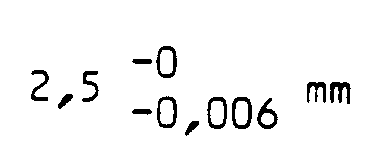
est une surface plane et perpendiculaire à l'axe de la deuxième tige.The end of the second rod 6 and which also has an outside diameter of
is a flat surface and perpendicular to the axis of the second rod.
L'angle entre la surface annulaire plane de la première tige, ou la surface plane de l'extrémité de la deuxième tige et la paroi extérieure cylindrique de la première ou de la deuxième tige est un angle droit (non cassé).The angle between the planar annular surface of the first rod, or the plane surface of the end of the second rod and the cylindrical outer wall of the first or second rod is a right angle (not broken).
On aurait très bien pu aussi réaliser la dépression en forme de cône dans la deuxième tige, ou encore réaliser la cavité située aux extrémités des tiges en générant une forme à chacune des extrémités des tiges.We could also very well have produced the cone-shaped depression in the second rod, or even make the cavity located at the ends of the rods by generating a shape at each of the ends of the rods.
Claims (14)
- A device for transferring a fluid sample from a first chamber (1) to a second chamber (2) separated from the first chamber, comprising an assembly of a (5) first and a second (6) rod each having a longitudinal axis, the longitudinal axis of each of these rods merging, the cylindrical wall of the first rod and the cylindrical wall of the second rod being designed to cooperate with a circumferential central sealing element (3) providing a seal between the first (1) and the second (2) chamber at the level of the rods (5, 6), means for displacing (9, 30, 32, 36, 37) the rods along their axes relative to the chambers, these displacement means being designed to move a cavity between the first (1) and the second (2) chamber, the device having opening and closing means, the opening means (9, 30, 32, 33, 36, 37, 39) enabling the cavity to be opened inside the first (1) and the second (2) chambers, and the closing means enabling the cavity to be closed when the sample is transferred from the first (1) chamber to the second (2) chamber, characterised in that at least the first rod (5) has one end with a cavity, the cavity being thus open, this end being designed to co-operate with one end of the second rod (6) to close this cavity, the first (5) and second (6) rods each having an outer cylindrical wall of the same dimensions, and in that one of these chambers may be heated relative to the other, this chamber (2) being located on an electrical conducting line (70a, 70b) through which a fluid circulates, and in that the device has electrical means designed to circulate current in the line (70a, 70b) to heat this line by the Joule effect, and in that the central sealing element (3) and one (6) of the rods located in this chamber (2) is an electrical insulator.
- A device in accordance with claim 1, characterised in that the first (5) and the second (6) rods cross from one side of the respective first (1) and the second (2) chambers to the other and co-operate with a first (7) and a second (8) lateral sealing element respectively, confining at the level of the first (5) and second (6) rods respectively the first (1) or the second (2) chamber respectively.
- A device in accordance with one of claims 1 or 2, characterised in that the second (2) chamber is connected to analysis apparatus.
- A device in accordance with claim 3, characterised in that the second (2) chamber is located on a sampling line in which a vector fluid is circulating.
- A device in accordance with one of claims 1 to 4, in which one (2) at least of the chambers must be cooled or heated and maintained at a given temperature (Fig. 3), characterised in that this chamber (2) is located on a line (70a, 70b) in which a fluid is circulating, and in that the line (70a, 70b) has a section winding (71) around the chamber (2) so that the circulating fluid can respectively cool or heat the chamber.
- A device in accordance with claim 1, characterised in that the line (70a, 70b) has outside one (2) of the chambers heat exchange means (72) outside the line (70a, 70b) designed to transfer thermal energy between the line and a medium outside the line.
- A device in accordance with claim 6, characterised in that the line has a section winding (71) around the chamber (2) to heat or cool it, and in that the heat exchange means (72) are arranged on the line outside the winding section (71).
- A device in accordance with one of claims 1 or 2, characterised in that at least one of the sealing elements (3, 7, 8) comprises a polymer material of the polyimide type.
- A device in accordance with claim 1, characterised in that the first (5) and the second (6) rods cross from one side of the respective first (1) and the second (2) chambers to the other and co-operate with a first (7) and a second (8) lateral sealing element respectively, confining at the level of the first (5) and second (6) rods respectively the first (1) and the second (2) chambers respectively, and in that the device comprises an axle (30) integral with the first (1) and second (2) chambers, the central sealing element (3), the first (7) and second (8) lateral sealing elements, a first (39) and a second (40) stop joined to the first (5) and the second (6) rods, this axle (30) being movable relative to the rods between these stops (39, 40) so as to position the ends of the first (5) and the second (6) rods in the first chamber (1) when the axle is in contact with the first stop (39) on the one hand and in the second chamber (2) when the axle is in contact with the second stop (40) on the other, and in that the opening means (9, 30, 32, 36, 37) of the cavity comprise elastic elements (33) allowing displacement of the stops (39, 40) under a given force produced by the axle (30) to open the cavity on the one hand and allowing the stops (39, 40) to be repositioned when the given force is suppressed to close the cavity when the ends of the first (5) and second (6) rods are in contact on the other.
- A device in accordance with one of claims 1 to 9, characterised in that the first (5) or the second (6) rod is made from ceramic.
- A method for transferring a fluid sample from a first chamber (1) to a second chamber (2) separated from the first chamber (1) wherein a central sealing element (3) provides a seal between the two chambers, characterised in that the following steps are carried out in succession:- a cavity defined by the ends of two coaxial cylindrical rods (5, 7) having cylindrical walls of the same dimensions, is opened,- this cavity is closed in the first chamber (1), the cavity is transferred from the first chamber (1) to the second chamber (2) by axial translation of the rods (5, 6) relative to the chambers,- the cavity is opened in the second chamber (2), and- at least one (2) of the chambers is heated by the Joule effect by placing the chamber on an electricity conducting line (70a, 70b) through which a fluid passes, electric means being included to circulate current through the line (70a, 70b) to heat this line, the central sealing element (3) and one of the rods located in the chamber being electrically insulated.
- A method in accordance with claim 11, whereby the first (1) and second (2) chambers are displaced between two positions defined by contact of a chassis (9) joined to the chambers with a first (39) and a second (40) stop joined respectively to the second (6) and the first (5) rods, the rods then being in contact with each other, characterised in that to open this cavity under the effect of a given force and against the action of return means (33), one or other of the stops (39, 40) is displaced, the chassis (9) being in contact with one or other of the stops (39, 40) so as to separate the ends of the rods (5, 6), thereby opening the cavity.
- Application of the device in accordance with one of claims 1 to 10 and the method in accordance with claims 11 or 12 to the process of taking a sample in a first chamber (1) with a temperature of less than minus 50°C and preferably lower than minus 100°C.
- Application of the device in accordance with one of claims 1 to 10 or of the method in accordance with claims 11 or 12 to the process of measurement by gas chromatography.
Applications Claiming Priority (2)
| Application Number | Priority Date | Filing Date | Title |
|---|---|---|---|
| FR8913262A FR2652897B1 (en) | 1989-10-10 | 1989-10-10 | DEVICE AND METHOD FOR TRANSFERRING A SAMPLE OF FLUID BETWEEN TWO CHAMBERS AND APPLICATION IN PARTICULAR TO GAS CHROMATOGRAPHY. |
| FR8913262 | 1989-10-10 |
Publications (2)
| Publication Number | Publication Date |
|---|---|
| EP0422988A1 EP0422988A1 (en) | 1991-04-17 |
| EP0422988B1 true EP0422988B1 (en) | 1995-01-11 |
Family
ID=9386274
Family Applications (1)
| Application Number | Title | Priority Date | Filing Date |
|---|---|---|---|
| EP90402732A Expired - Lifetime EP0422988B1 (en) | 1989-10-10 | 1990-10-03 | Method and device for transferring a fluid sample between two chambers, and their application to gas chromatography |
Country Status (5)
| Country | Link |
|---|---|
| US (1) | US5213763A (en) |
| EP (1) | EP0422988B1 (en) |
| JP (1) | JPH03152438A (en) |
| DE (1) | DE69015954T2 (en) |
| FR (1) | FR2652897B1 (en) |
Families Citing this family (6)
| Publication number | Priority date | Publication date | Assignee | Title |
|---|---|---|---|---|
| US5277073A (en) * | 1992-01-27 | 1994-01-11 | The Dow Chemical Company | Constant pressure-loaded shaft seal |
| IT1256356B (en) * | 1992-08-31 | 1995-12-01 | DEVICE FOR FEEDING SAMPLES TO ELEMENTARY ANALYSIS EQUIPMENT | |
| FR2706612B1 (en) * | 1993-06-11 | 1995-09-01 | Inst Francais Du Petrole | System for transferring samples under pressure. |
| CN101477088B (en) * | 2008-12-29 | 2011-06-29 | 北京京鲁伟业科技发展有限公司滕州分公司 | Driving device for gas sampling switching valve |
| CA2809612A1 (en) | 2010-08-26 | 2012-03-01 | Schlumberger Canada Limited | Apparatus and method for phase equilibrium with in-situ sensing |
| CN107179207B (en) * | 2017-05-16 | 2018-07-24 | 北京探矿工程研究所 | Rotary pressure-maintaining transfer device for marine geological exploration samples and control method |
Family Cites Families (18)
| Publication number | Priority date | Publication date | Assignee | Title |
|---|---|---|---|---|
| FR1439078A (en) * | 1965-03-09 | 1966-05-20 | Aquitaine Petrole | Apparatus for introducing a liquid sample into a gasification chamber |
| US3401565A (en) * | 1966-02-28 | 1968-09-17 | Armour & Co | Liquid sampling apparatus for gas chromatography |
| US3483754A (en) * | 1967-11-08 | 1969-12-16 | Sinclair Research Inc | Sampling valve apparatus |
| US3681998A (en) * | 1969-06-02 | 1972-08-08 | Foxboro Co | Sample valve for chromatographic apparatus |
| DE2416820A1 (en) * | 1974-04-06 | 1975-10-09 | Bayer Ag | SAMPLE INLET VALVE FOR LIQUID CHROMATOGRAPHY |
| US3990853A (en) * | 1975-05-30 | 1976-11-09 | Coulter Electronics, Inc. | Liquid transfer valve structure |
| US3991055A (en) * | 1975-05-30 | 1976-11-09 | Coulter Electronics, Inc. | Liquid transfer valve |
| DE2600622A1 (en) * | 1976-01-09 | 1977-07-21 | Hewlett Packard Gmbh | DOSING DEVICE FOR LIQUID CHROMATOGRAPHS |
| US4152391A (en) * | 1977-12-16 | 1979-05-01 | Coulter Electronics, Inc. | Liquid transfer valve |
| US4234543A (en) * | 1978-10-30 | 1980-11-18 | Thagard Technology Company | Fluid-wall reactor for high temperature chemical reaction processes |
| US4289029A (en) * | 1979-11-02 | 1981-09-15 | Uop Inc. | High temperature injection and vaporization system for gas chromatography |
| DE3130245A1 (en) * | 1981-07-31 | 1983-02-17 | Bodenseewerk Perkin-Elmer & Co GmbH, 7770 Überlingen | SAMPLER FOR GAS SAMPLING IN GAS CHROMATOGRAPHY |
| US4534941A (en) * | 1981-12-04 | 1985-08-13 | Beckman Instruments, Inc. | Analytical instrument thermoelectric temperature regulator |
| JPS6053842A (en) * | 1983-09-05 | 1985-03-27 | Hitachi Ltd | Flow-through electrolysis cell |
| US4641541A (en) * | 1986-02-11 | 1987-02-10 | Daryl Sharp | Internal mass spectrometer interface to a gas chromatograph |
| FR2599148B1 (en) * | 1986-05-22 | 1988-09-16 | Centre Nat Rech Scient | DEVICE FOR MAINTAINING THE STERILITY OF AN ENCLOSED CULTURE MEDIUM DURING SAMPLING |
| FR2600166B1 (en) * | 1986-06-17 | 1988-10-07 | Rhone Poulenc Rech | PROCESS AND DEVICE FOR AUTOMATICALLY SUPPORTING AND ANALYZING SAMPLES OF PRODUCTS RANDOMIZED |
| US4933146A (en) * | 1986-07-11 | 1990-06-12 | Beckman Instruments, Inc. | Temperature control apparatus for automated clinical analyzer |
-
1989
- 1989-10-10 FR FR8913262A patent/FR2652897B1/en not_active Expired - Fee Related
-
1990
- 1990-10-03 DE DE69015954T patent/DE69015954T2/en not_active Expired - Fee Related
- 1990-10-03 EP EP90402732A patent/EP0422988B1/en not_active Expired - Lifetime
- 1990-10-10 US US07/594,978 patent/US5213763A/en not_active Expired - Fee Related
- 1990-10-11 JP JP2275108A patent/JPH03152438A/en active Pending
Also Published As
| Publication number | Publication date |
|---|---|
| FR2652897B1 (en) | 1994-01-07 |
| US5213763A (en) | 1993-05-25 |
| JPH03152438A (en) | 1991-06-28 |
| EP0422988A1 (en) | 1991-04-17 |
| FR2652897A1 (en) | 1991-04-12 |
| DE69015954T2 (en) | 1995-05-11 |
| DE69015954D1 (en) | 1995-02-23 |
Similar Documents
| Publication | Publication Date | Title |
|---|---|---|
| EP0422988B1 (en) | Method and device for transferring a fluid sample between two chambers, and their application to gas chromatography | |
| EP2105695B1 (en) | Heat-exchanger device and NMR installation comprising such a device | |
| CA2875235A1 (en) | Quick heating and cooling mould | |
| FR2527302A1 (en) | PIPES FOR TRANSPORTING VACUUM-INSULATED FLUIDS | |
| FR2591023A1 (en) | SUPERCONDUCTING COIL APPARATUS | |
| JPH10221324A (en) | Low-power consuming gas chromatograph system | |
| EP0688421A1 (en) | Heat exchanger device and method for cooling the inner chamber therof | |
| CN102628842B (en) | For the column assembly of gas chromatography | |
| FR2883427A1 (en) | ELECTRICAL TRAVERSEE FOR SUPERCONDUCTING ELEMENT | |
| US20050268693A1 (en) | Thermal modulation for gas chromatography | |
| EP0231747B1 (en) | Stator with superconductive three-phase windings | |
| EP1335465B1 (en) | Method for making a device for the transmission of electric power | |
| FR2572843A1 (en) | SUPERCONDUCTING MAGNET | |
| CH700106A2 (en) | Method and valves cooling device inside a disconnector amperage. | |
| FR2469667A1 (en) | Water heater energy source conversion system - uses interspace(s) between condenser tube and sheath tube filled with thermal conductive material | |
| EP2255124A1 (en) | Gas electric heating system | |
| EP0254637B1 (en) | Apparatus for measuring the corrosiveness of smoke | |
| GB2584930A (en) | Integrated sampling probe, valve and vaporiser | |
| FR2754598A1 (en) | Measuring coefficient of thermal expansion to high accuracy | |
| WO2013139722A1 (en) | Device for optimized pressure sensing for heating channels | |
| FR2623043A1 (en) | Heating device with insulated electrical resistor | |
| FR2634091A1 (en) | DEVICE FOR HEATING A LIQUID IN CIRCULATION BY MICROWAVES | |
| FR2500565A1 (en) | High pressure ball valve for radiative environment - has electrically heated actuating rod to force ball off seat | |
| FR2863705A1 (en) | Temperature sensor for heat engine of motor vehicle, has thin stainless steel casing with mouth integrated to body, and two bases having cap containing thermistor that provides temperature signal | |
| EP4528247A1 (en) | System for determining the content of at least one impurity in a cryogenic liquid |
Legal Events
| Date | Code | Title | Description |
|---|---|---|---|
| PUAI | Public reference made under article 153(3) epc to a published international application that has entered the european phase |
Free format text: ORIGINAL CODE: 0009012 |
|
| 17P | Request for examination filed |
Effective date: 19901013 |
|
| AK | Designated contracting states |
Kind code of ref document: A1 Designated state(s): BE CH DE GB LI |
|
| 17Q | First examination report despatched |
Effective date: 19930729 |
|
| GRAA | (expected) grant |
Free format text: ORIGINAL CODE: 0009210 |
|
| AK | Designated contracting states |
Kind code of ref document: B1 Designated state(s): BE CH DE GB LI |
|
| GBT | Gb: translation of ep patent filed (gb section 77(6)(a)/1977) |
Effective date: 19950119 |
|
| REF | Corresponds to: |
Ref document number: 69015954 Country of ref document: DE Date of ref document: 19950223 |
|
| PLBE | No opposition filed within time limit |
Free format text: ORIGINAL CODE: 0009261 |
|
| STAA | Information on the status of an ep patent application or granted ep patent |
Free format text: STATUS: NO OPPOSITION FILED WITHIN TIME LIMIT |
|
| 26N | No opposition filed | ||
| PGFP | Annual fee paid to national office [announced via postgrant information from national office to epo] |
Ref country code: GB Payment date: 19990921 Year of fee payment: 10 |
|
| PGFP | Annual fee paid to national office [announced via postgrant information from national office to epo] |
Ref country code: BE Payment date: 19991022 Year of fee payment: 10 |
|
| PGFP | Annual fee paid to national office [announced via postgrant information from national office to epo] |
Ref country code: CH Payment date: 19991101 Year of fee payment: 10 |
|
| PGFP | Annual fee paid to national office [announced via postgrant information from national office to epo] |
Ref country code: DE Payment date: 19991116 Year of fee payment: 10 |
|
| PG25 | Lapsed in a contracting state [announced via postgrant information from national office to epo] |
Ref country code: GB Free format text: LAPSE BECAUSE OF NON-PAYMENT OF DUE FEES Effective date: 20001003 |
|
| PG25 | Lapsed in a contracting state [announced via postgrant information from national office to epo] |
Ref country code: LI Free format text: LAPSE BECAUSE OF NON-PAYMENT OF DUE FEES Effective date: 20001031 Ref country code: CH Free format text: LAPSE BECAUSE OF NON-PAYMENT OF DUE FEES Effective date: 20001031 Ref country code: BE Free format text: LAPSE BECAUSE OF NON-PAYMENT OF DUE FEES Effective date: 20001031 |
|
| BERE | Be: lapsed |
Owner name: INSTITUT FRANCAIS DU PETROLE Effective date: 20001031 |
|
| GBPC | Gb: european patent ceased through non-payment of renewal fee |
Effective date: 20001003 |
|
| REG | Reference to a national code |
Ref country code: CH Ref legal event code: PL |
|
| PG25 | Lapsed in a contracting state [announced via postgrant information from national office to epo] |
Ref country code: DE Free format text: LAPSE BECAUSE OF NON-PAYMENT OF DUE FEES Effective date: 20010703 |