EP0416250A2 - N-acylurea and O-acylisourea derivatives of hyaluronic acid - Google Patents
N-acylurea and O-acylisourea derivatives of hyaluronic acid Download PDFInfo
- Publication number
- EP0416250A2 EP0416250A2 EP90113594A EP90113594A EP0416250A2 EP 0416250 A2 EP0416250 A2 EP 0416250A2 EP 90113594 A EP90113594 A EP 90113594A EP 90113594 A EP90113594 A EP 90113594A EP 0416250 A2 EP0416250 A2 EP 0416250A2
- Authority
- EP
- European Patent Office
- Prior art keywords
- carbodiimide
- compound
- hyaluronic acid
- acylurea
- ethyl
- Prior art date
- Legal status (The legal status is an assumption and is not a legal conclusion. Google has not performed a legal analysis and makes no representation as to the accuracy of the status listed.)
- Withdrawn
Links
- -1 O-acylisourea derivatives of hyaluronic acid Chemical class 0.000 title claims description 22
- 238000006243 chemical reaction Methods 0.000 claims abstract description 36
- 150000001718 carbodiimides Chemical class 0.000 claims abstract description 33
- KIUKXJAPPMFGSW-DNGZLQJQSA-N (2S,3S,4S,5R,6R)-6-[(2S,3R,4R,5S,6R)-3-Acetamido-2-[(2S,3S,4R,5R,6R)-6-[(2R,3R,4R,5S,6R)-3-acetamido-2,5-dihydroxy-6-(hydroxymethyl)oxan-4-yl]oxy-2-carboxy-4,5-dihydroxyoxan-3-yl]oxy-5-hydroxy-6-(hydroxymethyl)oxan-4-yl]oxy-3,4,5-trihydroxyoxane-2-carboxylic acid Chemical compound CC(=O)N[C@H]1[C@H](O)O[C@H](CO)[C@@H](O)[C@@H]1O[C@H]1[C@H](O)[C@@H](O)[C@H](O[C@H]2[C@@H]([C@@H](O[C@H]3[C@@H]([C@@H](O)[C@H](O)[C@H](O3)C(O)=O)O)[C@H](O)[C@@H](CO)O2)NC(C)=O)[C@@H](C(O)=O)O1 KIUKXJAPPMFGSW-DNGZLQJQSA-N 0.000 claims abstract description 32
- 229920002674 hyaluronan Polymers 0.000 claims abstract description 30
- 229960003160 hyaluronic acid Drugs 0.000 claims abstract description 30
- 150000007930 O-acyl isoureas Chemical class 0.000 claims abstract description 22
- 150000001875 compounds Chemical class 0.000 claims description 23
- 150000003839 salts Chemical class 0.000 claims description 15
- 125000001183 hydrocarbyl group Chemical group 0.000 claims description 8
- 102000008186 Collagen Human genes 0.000 claims description 5
- 108010035532 Collagen Proteins 0.000 claims description 5
- 229920001436 collagen Polymers 0.000 claims description 5
- 125000004435 hydrogen atom Chemical class [H]* 0.000 claims description 5
- 239000002253 acid Substances 0.000 claims description 4
- 125000003545 alkoxy group Chemical group 0.000 claims description 4
- BEEFEKCZXATQHB-UHFFFAOYSA-N benzyl n-[6-(ethyliminomethylideneamino)hexyl]carbamate Chemical group CCN=C=NCCCCCCNC(=O)OCC1=CC=CC=C1 BEEFEKCZXATQHB-UHFFFAOYSA-N 0.000 claims description 4
- 230000000670 limiting effect Effects 0.000 claims description 4
- OIZDKDOWVLYHOF-UHFFFAOYSA-N n-ethyl-n'-tridecylmethanediimine Chemical compound CCCCCCCCCCCCCN=C=NCC OIZDKDOWVLYHOF-UHFFFAOYSA-N 0.000 claims description 4
- 125000005248 alkyl aryloxy group Chemical group 0.000 claims description 3
- 125000004104 aryloxy group Chemical group 0.000 claims description 3
- 229910052739 hydrogen Inorganic materials 0.000 claims description 3
- 239000001257 hydrogen Substances 0.000 claims description 3
- NZWJHYDMLNPYLU-UHFFFAOYSA-N n-ethyl-n'-octylmethanediimine Chemical compound CCCCCCCCN=C=NCC NZWJHYDMLNPYLU-UHFFFAOYSA-N 0.000 claims description 3
- GJKFLUKPNKCNSP-UHFFFAOYSA-N 6-[3-(dimethylamino)propyliminomethylideneamino]hexylcarbamoyl benzoate Chemical group CN(C)CCCN=C=NCCCCCCNC(=O)OC(=O)C1=CC=CC=C1 GJKFLUKPNKCNSP-UHFFFAOYSA-N 0.000 claims description 2
- 238000004364 calculation method Methods 0.000 claims description 2
- 239000007795 chemical reaction product Substances 0.000 claims 2
- 230000029663 wound healing Effects 0.000 abstract description 2
- 229920000642 polymer Polymers 0.000 description 23
- 239000000047 product Substances 0.000 description 23
- 239000003814 drug Substances 0.000 description 19
- 239000000203 mixture Substances 0.000 description 19
- 229940079593 drug Drugs 0.000 description 18
- 238000000034 method Methods 0.000 description 17
- 229920002385 Sodium hyaluronate Polymers 0.000 description 16
- 229940010747 sodium hyaluronate Drugs 0.000 description 16
- YWIVKILSMZOHHF-QJZPQSOGSA-N sodium;(2s,3s,4s,5r,6r)-6-[(2s,3r,4r,5s,6r)-3-acetamido-2-[(2s,3s,4r,5r,6r)-6-[(2r,3r,4r,5s,6r)-3-acetamido-2,5-dihydroxy-6-(hydroxymethyl)oxan-4-yl]oxy-2-carboxy-4,5-dihydroxyoxan-3-yl]oxy-5-hydroxy-6-(hydroxymethyl)oxan-4-yl]oxy-3,4,5-trihydroxyoxane-2- Chemical compound [Na+].CC(=O)N[C@H]1[C@H](O)O[C@H](CO)[C@@H](O)[C@@H]1O[C@H]1[C@H](O)[C@@H](O)[C@H](O[C@H]2[C@@H]([C@@H](O[C@H]3[C@@H]([C@@H](O)[C@H](O)[C@H](O3)C(O)=O)O)[C@H](O)[C@@H](CO)O2)NC(C)=O)[C@@H](C(O)=O)O1 YWIVKILSMZOHHF-QJZPQSOGSA-N 0.000 description 16
- 229940126585 therapeutic drug Drugs 0.000 description 13
- 238000002360 preparation method Methods 0.000 description 12
- 230000002209 hydrophobic effect Effects 0.000 description 10
- 238000004132 cross linking Methods 0.000 description 9
- WCDDVEOXEIYWFB-VXORFPGASA-N (2s,3s,4r,5r,6r)-3-[(2s,3r,5s,6r)-3-acetamido-5-hydroxy-6-(hydroxymethyl)oxan-2-yl]oxy-4,5,6-trihydroxyoxane-2-carboxylic acid Chemical compound CC(=O)N[C@@H]1C[C@H](O)[C@@H](CO)O[C@H]1O[C@@H]1[C@@H](C(O)=O)O[C@@H](O)[C@H](O)[C@H]1O WCDDVEOXEIYWFB-VXORFPGASA-N 0.000 description 8
- 125000004432 carbon atom Chemical group C* 0.000 description 8
- 229940014041 hyaluronate Drugs 0.000 description 8
- XLYOFNOQVPJJNP-UHFFFAOYSA-N water Substances O XLYOFNOQVPJJNP-UHFFFAOYSA-N 0.000 description 8
- 239000000243 solution Substances 0.000 description 7
- CSCPPACGZOOCGX-UHFFFAOYSA-N Acetone Chemical compound CC(C)=O CSCPPACGZOOCGX-UHFFFAOYSA-N 0.000 description 6
- VEXZGXHMUGYJMC-UHFFFAOYSA-N Hydrochloric acid Chemical compound Cl VEXZGXHMUGYJMC-UHFFFAOYSA-N 0.000 description 6
- 239000011541 reaction mixture Substances 0.000 description 6
- 150000001412 amines Chemical class 0.000 description 5
- NAQMVNRVTILPCV-UHFFFAOYSA-N hexane-1,6-diamine Chemical compound NCCCCCCN NAQMVNRVTILPCV-UHFFFAOYSA-N 0.000 description 5
- CSNNHWWHGAXBCP-UHFFFAOYSA-L Magnesium sulfate Chemical compound [Mg+2].[O-][S+2]([O-])([O-])[O-] CSNNHWWHGAXBCP-UHFFFAOYSA-L 0.000 description 4
- 241000124008 Mammalia Species 0.000 description 4
- 230000002411 adverse Effects 0.000 description 4
- 125000000217 alkyl group Chemical group 0.000 description 4
- 238000013270 controlled release Methods 0.000 description 4
- 230000003628 erosive effect Effects 0.000 description 4
- UKWHYYKOEPRTIC-UHFFFAOYSA-N mercury(ii) oxide Chemical compound [Hg]=O UKWHYYKOEPRTIC-UHFFFAOYSA-N 0.000 description 4
- 238000012986 modification Methods 0.000 description 4
- 230000004048 modification Effects 0.000 description 4
- LMDZBCPBFSXMTL-UHFFFAOYSA-N 1-ethyl-3-(3-dimethylaminopropyl)carbodiimide Chemical compound CCN=C=NCCCN(C)C LMDZBCPBFSXMTL-UHFFFAOYSA-N 0.000 description 3
- ZMXDDKWLCZADIW-UHFFFAOYSA-N N,N-Dimethylformamide Chemical compound CN(C)C=O ZMXDDKWLCZADIW-UHFFFAOYSA-N 0.000 description 3
- ZMANZCXQSJIPKH-UHFFFAOYSA-N Triethylamine Chemical compound CCN(CC)CC ZMANZCXQSJIPKH-UHFFFAOYSA-N 0.000 description 3
- 125000003277 amino group Chemical group 0.000 description 3
- 125000003118 aryl group Chemical group 0.000 description 3
- 239000002585 base Substances 0.000 description 3
- 150000001768 cations Chemical class 0.000 description 3
- 238000005859 coupling reaction Methods 0.000 description 3
- 239000007857 degradation product Substances 0.000 description 3
- 125000000600 disaccharide group Chemical group 0.000 description 3
- QUPDWYMUPZLYJZ-UHFFFAOYSA-N ethyl Chemical compound C[CH2] QUPDWYMUPZLYJZ-UHFFFAOYSA-N 0.000 description 3
- 230000003993 interaction Effects 0.000 description 3
- 239000000543 intermediate Substances 0.000 description 3
- 229910052757 nitrogen Inorganic materials 0.000 description 3
- 231100000252 nontoxic Toxicity 0.000 description 3
- 230000003000 nontoxic effect Effects 0.000 description 3
- 238000001556 precipitation Methods 0.000 description 3
- 230000008569 process Effects 0.000 description 3
- UMGDCJDMYOKAJW-UHFFFAOYSA-N thiourea Chemical compound NC(N)=S UMGDCJDMYOKAJW-UHFFFAOYSA-N 0.000 description 3
- 231100000331 toxic Toxicity 0.000 description 3
- 230000002588 toxic effect Effects 0.000 description 3
- 238000011282 treatment Methods 0.000 description 3
- QGZKDVFQNNGYKY-UHFFFAOYSA-O Ammonium Chemical compound [NH4+] QGZKDVFQNNGYKY-UHFFFAOYSA-O 0.000 description 2
- HEDRZPFGACZZDS-UHFFFAOYSA-N Chloroform Chemical compound ClC(Cl)Cl HEDRZPFGACZZDS-UHFFFAOYSA-N 0.000 description 2
- IAZDPXIOMUYVGZ-UHFFFAOYSA-N Dimethylsulphoxide Chemical compound CS(C)=O IAZDPXIOMUYVGZ-UHFFFAOYSA-N 0.000 description 2
- LFQSCWFLJHTTHZ-UHFFFAOYSA-N Ethanol Chemical compound CCO LFQSCWFLJHTTHZ-UHFFFAOYSA-N 0.000 description 2
- QUSNBJAOOMFDIB-UHFFFAOYSA-N Ethylamine Chemical compound CCN QUSNBJAOOMFDIB-UHFFFAOYSA-N 0.000 description 2
- AEMRFAOFKBGASW-UHFFFAOYSA-N Glycolic acid Chemical compound OCC(O)=O AEMRFAOFKBGASW-UHFFFAOYSA-N 0.000 description 2
- KFZMGEQAYNKOFK-UHFFFAOYSA-N Isopropanol Chemical compound CC(C)O KFZMGEQAYNKOFK-UHFFFAOYSA-N 0.000 description 2
- JVTAAEKCZFNVCJ-UHFFFAOYSA-N Lactic Acid Natural products CC(O)C(O)=O JVTAAEKCZFNVCJ-UHFFFAOYSA-N 0.000 description 2
- BAVYZALUXZFZLV-UHFFFAOYSA-N Methylamine Chemical compound NC BAVYZALUXZFZLV-UHFFFAOYSA-N 0.000 description 2
- 150000007945 N-acyl ureas Chemical class 0.000 description 2
- VYPSYNLAJGMNEJ-UHFFFAOYSA-N Silicium dioxide Chemical compound O=[Si]=O VYPSYNLAJGMNEJ-UHFFFAOYSA-N 0.000 description 2
- FAPWRFPIFSIZLT-UHFFFAOYSA-M Sodium chloride Chemical compound [Na+].[Cl-] FAPWRFPIFSIZLT-UHFFFAOYSA-M 0.000 description 2
- 230000002009 allergenic effect Effects 0.000 description 2
- 150000001408 amides Chemical class 0.000 description 2
- 230000027455 binding Effects 0.000 description 2
- 239000012620 biological material Substances 0.000 description 2
- 230000015572 biosynthetic process Effects 0.000 description 2
- 125000003178 carboxy group Chemical group [H]OC(*)=O 0.000 description 2
- 239000000969 carrier Substances 0.000 description 2
- 230000015556 catabolic process Effects 0.000 description 2
- 125000002091 cationic group Chemical group 0.000 description 2
- 230000008878 coupling Effects 0.000 description 2
- 238000010168 coupling process Methods 0.000 description 2
- 125000000753 cycloalkyl group Chemical group 0.000 description 2
- 238000006731 degradation reaction Methods 0.000 description 2
- 238000009792 diffusion process Methods 0.000 description 2
- ZUOUZKKEUPVFJK-UHFFFAOYSA-N diphenyl Chemical compound C1=CC=CC=C1C1=CC=CC=C1 ZUOUZKKEUPVFJK-UHFFFAOYSA-N 0.000 description 2
- 239000003937 drug carrier Substances 0.000 description 2
- 238000012377 drug delivery Methods 0.000 description 2
- 230000002255 enzymatic effect Effects 0.000 description 2
- 150000002148 esters Chemical class 0.000 description 2
- 238000009472 formulation Methods 0.000 description 2
- 239000000017 hydrogel Substances 0.000 description 2
- 230000007062 hydrolysis Effects 0.000 description 2
- 238000006460 hydrolysis reaction Methods 0.000 description 2
- NOESYZHRGYRDHS-UHFFFAOYSA-N insulin Chemical compound N1C(=O)C(NC(=O)C(CCC(N)=O)NC(=O)C(CCC(O)=O)NC(=O)C(C(C)C)NC(=O)C(NC(=O)CN)C(C)CC)CSSCC(C(NC(CO)C(=O)NC(CC(C)C)C(=O)NC(CC=2C=CC(O)=CC=2)C(=O)NC(CCC(N)=O)C(=O)NC(CC(C)C)C(=O)NC(CCC(O)=O)C(=O)NC(CC(N)=O)C(=O)NC(CC=2C=CC(O)=CC=2)C(=O)NC(CSSCC(NC(=O)C(C(C)C)NC(=O)C(CC(C)C)NC(=O)C(CC=2C=CC(O)=CC=2)NC(=O)C(CC(C)C)NC(=O)C(C)NC(=O)C(CCC(O)=O)NC(=O)C(C(C)C)NC(=O)C(CC(C)C)NC(=O)C(CC=2NC=NC=2)NC(=O)C(CO)NC(=O)CNC2=O)C(=O)NCC(=O)NC(CCC(O)=O)C(=O)NC(CCCNC(N)=N)C(=O)NCC(=O)NC(CC=3C=CC=CC=3)C(=O)NC(CC=3C=CC=CC=3)C(=O)NC(CC=3C=CC(O)=CC=3)C(=O)NC(C(C)O)C(=O)N3C(CCC3)C(=O)NC(CCCCN)C(=O)NC(C)C(O)=O)C(=O)NC(CC(N)=O)C(O)=O)=O)NC(=O)C(C(C)CC)NC(=O)C(CO)NC(=O)C(C(C)O)NC(=O)C1CSSCC2NC(=O)C(CC(C)C)NC(=O)C(NC(=O)C(CCC(N)=O)NC(=O)C(CC(N)=O)NC(=O)C(NC(=O)C(N)CC=1C=CC=CC=1)C(C)C)CC1=CN=CN1 NOESYZHRGYRDHS-UHFFFAOYSA-N 0.000 description 2
- 229910052943 magnesium sulfate Inorganic materials 0.000 description 2
- 235000019341 magnesium sulphate Nutrition 0.000 description 2
- 239000011159 matrix material Substances 0.000 description 2
- 229940101209 mercuric oxide Drugs 0.000 description 2
- 238000013508 migration Methods 0.000 description 2
- 230000005012 migration Effects 0.000 description 2
- FWQBQIPETMKPHV-UHFFFAOYSA-N n-[[3-(5-chloropyrimidin-2-yl)oxy-4-ethylphenyl]carbamoyl]-2-nitrobenzamide Chemical compound C1=C(OC=2N=CC(Cl)=CN=2)C(CC)=CC=C1NC(=O)NC(=O)C1=CC=CC=C1[N+]([O-])=O FWQBQIPETMKPHV-UHFFFAOYSA-N 0.000 description 2
- 229940090008 naprosyn Drugs 0.000 description 2
- CMWTZPSULFXXJA-VIFPVBQESA-N naproxen Chemical compound C1=C([C@H](C)C(O)=O)C=CC2=CC(OC)=CC=C21 CMWTZPSULFXXJA-VIFPVBQESA-N 0.000 description 2
- 230000000704 physical effect Effects 0.000 description 2
- 239000002244 precipitate Substances 0.000 description 2
- 239000000376 reactant Substances 0.000 description 2
- 238000010992 reflux Methods 0.000 description 2
- 230000000717 retained effect Effects 0.000 description 2
- 239000002904 solvent Substances 0.000 description 2
- 238000007920 subcutaneous administration Methods 0.000 description 2
- 239000000126 substance Substances 0.000 description 2
- 230000001225 therapeutic effect Effects 0.000 description 2
- 239000003981 vehicle Substances 0.000 description 2
- 125000000094 2-phenylethyl group Chemical group [H]C1=C([H])C([H])=C(C([H])=C1[H])C([H])([H])C([H])([H])* 0.000 description 1
- 125000003903 2-propenyl group Chemical group [H]C([*])([H])C([H])=C([H])[H] 0.000 description 1
- QTBSBXVTEAMEQO-UHFFFAOYSA-M Acetate Chemical compound CC([O-])=O QTBSBXVTEAMEQO-UHFFFAOYSA-M 0.000 description 1
- 229920000936 Agarose Polymers 0.000 description 1
- IPYXGJLKLDINET-UHFFFAOYSA-N C(C)C(CC(CCC)NC(C(F)(F)F)=O)N=C=N Chemical compound C(C)C(CC(CCC)NC(C(F)(F)F)=O)N=C=N IPYXGJLKLDINET-UHFFFAOYSA-N 0.000 description 1
- GDLPZQDLTOBNKB-UHFFFAOYSA-N CCN=C=NCCCCCCNC(=O)OCC1=CC=CC=C1.CN(C)CCCN=C=NCCCCCCNC(=O)C1=CC=CC=C1 Chemical compound CCN=C=NCCCCCCNC(=O)OCC1=CC=CC=C1.CN(C)CCCN=C=NCCCCCCNC(=O)C1=CC=CC=C1 GDLPZQDLTOBNKB-UHFFFAOYSA-N 0.000 description 1
- KXDHJXZQYSOELW-UHFFFAOYSA-N Carbamic acid Chemical group NC(O)=O KXDHJXZQYSOELW-UHFFFAOYSA-N 0.000 description 1
- 239000004215 Carbon black (E152) Substances 0.000 description 1
- SNRUBQQJIBEYMU-UHFFFAOYSA-N Dodecane Natural products CCCCCCCCCCCC SNRUBQQJIBEYMU-UHFFFAOYSA-N 0.000 description 1
- IAJILQKETJEXLJ-UHFFFAOYSA-N Galacturonsaeure Natural products O=CC(O)C(O)C(O)C(O)C(O)=O IAJILQKETJEXLJ-UHFFFAOYSA-N 0.000 description 1
- OAKJQQAXSVQMHS-UHFFFAOYSA-N Hydrazine Chemical compound NN OAKJQQAXSVQMHS-UHFFFAOYSA-N 0.000 description 1
- 102000004877 Insulin Human genes 0.000 description 1
- 108090001061 Insulin Proteins 0.000 description 1
- 229910019142 PO4 Inorganic materials 0.000 description 1
- OAICVXFJPJFONN-UHFFFAOYSA-N Phosphorus Chemical group [P] OAICVXFJPJFONN-UHFFFAOYSA-N 0.000 description 1
- 239000004952 Polyamide Substances 0.000 description 1
- FKNQFGJONOIPTF-UHFFFAOYSA-N Sodium cation Chemical compound [Na+] FKNQFGJONOIPTF-UHFFFAOYSA-N 0.000 description 1
- HEMHJVSKTPXQMS-DYCDLGHISA-M Sodium hydroxide-d Chemical compound [Na+].[2H][O-] HEMHJVSKTPXQMS-DYCDLGHISA-M 0.000 description 1
- 241001558496 Talpa caeca Species 0.000 description 1
- XSQUKJJJFZCRTK-UHFFFAOYSA-N Urea Natural products NC(N)=O XSQUKJJJFZCRTK-UHFFFAOYSA-N 0.000 description 1
- 150000007513 acids Chemical class 0.000 description 1
- 125000002252 acyl group Chemical group 0.000 description 1
- 238000001042 affinity chromatography Methods 0.000 description 1
- IAJILQKETJEXLJ-QTBDOELSSA-N aldehydo-D-glucuronic acid Chemical group O=C[C@H](O)[C@@H](O)[C@H](O)[C@H](O)C(O)=O IAJILQKETJEXLJ-QTBDOELSSA-N 0.000 description 1
- 229910052783 alkali metal Inorganic materials 0.000 description 1
- 125000003342 alkenyl group Chemical group 0.000 description 1
- 150000001413 amino acids Chemical class 0.000 description 1
- 125000000129 anionic group Chemical group 0.000 description 1
- 150000001450 anions Chemical class 0.000 description 1
- 125000001204 arachidyl group Chemical group [H]C([*])([H])C([H])([H])C([H])([H])C([H])([H])C([H])([H])C([H])([H])C([H])([H])C([H])([H])C([H])([H])C([H])([H])C([H])([H])C([H])([H])C([H])([H])C([H])([H])C([H])([H])C([H])([H])C([H])([H])C([H])([H])C([H])([H])C([H])([H])[H] 0.000 description 1
- 125000003710 aryl alkyl group Chemical group 0.000 description 1
- 125000002511 behenyl group Chemical group [H]C([*])([H])C([H])([H])C([H])([H])C([H])([H])C([H])([H])C([H])([H])C([H])([H])C([H])([H])C([H])([H])C([H])([H])C([H])([H])C([H])([H])C([H])([H])C([H])([H])C([H])([H])C([H])([H])C([H])([H])C([H])([H])C([H])([H])C([H])([H])C([H])([H])C([H])([H])[H] 0.000 description 1
- FKBADFNYGUZLBC-UHFFFAOYSA-N benzyl 2-amino-7-[3-(dimethylamino)propyliminomethylideneamino]heptanoate Chemical compound CN(C)CCCN=C=NCCCCCC(N)C(=O)OCC1=CC=CC=C1 FKBADFNYGUZLBC-UHFFFAOYSA-N 0.000 description 1
- 125000001797 benzyl group Chemical group [H]C1=C([H])C([H])=C(C([H])=C1[H])C([H])([H])* 0.000 description 1
- NDPDENKBZUDFCA-UHFFFAOYSA-N benzyl n-[6-(ethylcarbamothioylamino)hexyl]carbamate Chemical compound CCNC(=S)NCCCCCCNC(=O)OCC1=CC=CC=C1 NDPDENKBZUDFCA-UHFFFAOYSA-N 0.000 description 1
- 229920002988 biodegradable polymer Polymers 0.000 description 1
- 239000004621 biodegradable polymer Substances 0.000 description 1
- 229920013641 bioerodible polymer Polymers 0.000 description 1
- 239000013060 biological fluid Substances 0.000 description 1
- 235000010290 biphenyl Nutrition 0.000 description 1
- 239000004305 biphenyl Substances 0.000 description 1
- 239000008280 blood Substances 0.000 description 1
- 210000004369 blood Anatomy 0.000 description 1
- 210000001124 body fluid Anatomy 0.000 description 1
- 239000010839 body fluid Substances 0.000 description 1
- 125000004369 butenyl group Chemical group C(=CCC)* 0.000 description 1
- 125000000484 butyl group Chemical group [H]C([*])([H])C([H])([H])C([H])([H])C([H])([H])[H] 0.000 description 1
- VPKDCDLSJZCGKE-UHFFFAOYSA-N carbodiimide group Chemical group N=C=N VPKDCDLSJZCGKE-UHFFFAOYSA-N 0.000 description 1
- 229910052799 carbon Inorganic materials 0.000 description 1
- 150000001721 carbon Chemical group 0.000 description 1
- 150000007942 carboxylates Chemical class 0.000 description 1
- 150000001732 carboxylic acid derivatives Chemical class 0.000 description 1
- 125000003636 chemical group Chemical group 0.000 description 1
- 238000001311 chemical methods and process Methods 0.000 description 1
- 238000007385 chemical modification Methods 0.000 description 1
- 239000003795 chemical substances by application Substances 0.000 description 1
- 239000002131 composite material Substances 0.000 description 1
- 238000007796 conventional method Methods 0.000 description 1
- 239000007822 coupling agent Substances 0.000 description 1
- 239000011243 crosslinked material Substances 0.000 description 1
- 239000012043 crude product Substances 0.000 description 1
- ATDGTVJJHBUTRL-UHFFFAOYSA-N cyanogen bromide Chemical compound BrC#N ATDGTVJJHBUTRL-UHFFFAOYSA-N 0.000 description 1
- 125000001995 cyclobutyl group Chemical group [H]C1([H])C([H])([H])C([H])(*)C1([H])[H] 0.000 description 1
- 125000000582 cycloheptyl group Chemical group [H]C1([H])C([H])([H])C([H])([H])C([H])([H])C([H])(*)C([H])([H])C1([H])[H] 0.000 description 1
- 125000000113 cyclohexyl group Chemical group [H]C1([H])C([H])([H])C([H])([H])C([H])(*)C([H])([H])C1([H])[H] 0.000 description 1
- 125000000640 cyclooctyl group Chemical group [H]C1([H])C([H])([H])C([H])([H])C([H])([H])C([H])(*)C([H])([H])C([H])([H])C1([H])[H] 0.000 description 1
- 125000001511 cyclopentyl group Chemical group [H]C1([H])C([H])([H])C([H])([H])C([H])(*)C1([H])[H] 0.000 description 1
- 125000001559 cyclopropyl group Chemical group [H]C1([H])C([H])([H])C1([H])* 0.000 description 1
- 125000003493 decenyl group Chemical group [H]C([*])=C([H])C([H])([H])C([H])([H])C([H])([H])C([H])([H])C([H])([H])C([H])([H])C([H])([H])C([H])([H])[H] 0.000 description 1
- 125000002704 decyl group Chemical group [H]C([H])([H])C([H])([H])C([H])([H])C([H])([H])C([H])([H])C([H])([H])C([H])([H])C([H])([H])C([H])([H])C([H])([H])* 0.000 description 1
- 230000001419 dependent effect Effects 0.000 description 1
- 150000004985 diamines Chemical class 0.000 description 1
- 238000010790 dilution Methods 0.000 description 1
- 239000012895 dilution Substances 0.000 description 1
- 239000006185 dispersion Substances 0.000 description 1
- 238000004090 dissolution Methods 0.000 description 1
- 125000005066 dodecenyl group Chemical group C(=CCCCCCCCCCC)* 0.000 description 1
- 125000003438 dodecyl group Chemical group [H]C([H])([H])C([H])([H])C([H])([H])C([H])([H])C([H])([H])C([H])([H])C([H])([H])C([H])([H])C([H])([H])C([H])([H])C([H])([H])C([H])([H])* 0.000 description 1
- 230000000694 effects Effects 0.000 description 1
- 238000005516 engineering process Methods 0.000 description 1
- 230000007515 enzymatic degradation Effects 0.000 description 1
- 125000001495 ethyl group Chemical group [H]C([H])([H])C([H])([H])* 0.000 description 1
- 230000002349 favourable effect Effects 0.000 description 1
- 239000007850 fluorescent dye Substances 0.000 description 1
- 238000001215 fluorescent labelling Methods 0.000 description 1
- 125000000524 functional group Chemical group 0.000 description 1
- 229940083124 ganglion-blocking antiadrenergic secondary and tertiary amines Drugs 0.000 description 1
- 210000001035 gastrointestinal tract Anatomy 0.000 description 1
- 239000000499 gel Substances 0.000 description 1
- 238000001879 gelation Methods 0.000 description 1
- 229940097043 glucuronic acid Drugs 0.000 description 1
- 150000004676 glycans Chemical class 0.000 description 1
- 125000001475 halogen functional group Chemical group 0.000 description 1
- 125000000755 henicosyl group Chemical group [H]C([*])([H])C([H])([H])C([H])([H])C([H])([H])C([H])([H])C([H])([H])C([H])([H])C([H])([H])C([H])([H])C([H])([H])C([H])([H])C([H])([H])C([H])([H])C([H])([H])C([H])([H])C([H])([H])C([H])([H])C([H])([H])C([H])([H])C([H])([H])C([H])([H])[H] 0.000 description 1
- 125000003187 heptyl group Chemical group [H]C([*])([H])C([H])([H])C([H])([H])C([H])([H])C([H])([H])C([H])([H])C([H])([H])[H] 0.000 description 1
- 125000006038 hexenyl group Chemical group 0.000 description 1
- 125000004051 hexyl group Chemical group [H]C([H])([H])C([H])([H])C([H])([H])C([H])([H])C([H])([H])C([H])([H])* 0.000 description 1
- 229930195733 hydrocarbon Natural products 0.000 description 1
- 150000002430 hydrocarbons Chemical class 0.000 description 1
- 230000003301 hydrolyzing effect Effects 0.000 description 1
- 229920001600 hydrophobic polymer Polymers 0.000 description 1
- 125000002887 hydroxy group Chemical group [H]O* 0.000 description 1
- 238000002513 implantation Methods 0.000 description 1
- 238000001727 in vivo Methods 0.000 description 1
- 238000011065 in-situ storage Methods 0.000 description 1
- 239000012442 inert solvent Substances 0.000 description 1
- 229910052500 inorganic mineral Inorganic materials 0.000 description 1
- 238000003780 insertion Methods 0.000 description 1
- 230000037431 insertion Effects 0.000 description 1
- 229940125396 insulin Drugs 0.000 description 1
- 125000002463 lignoceryl group Chemical group [H]C([*])([H])C([H])([H])C([H])([H])C([H])([H])C([H])([H])C([H])([H])C([H])([H])C([H])([H])C([H])([H])C([H])([H])C([H])([H])C([H])([H])C([H])([H])C([H])([H])C([H])([H])C([H])([H])C([H])([H])C([H])([H])C([H])([H])C([H])([H])C([H])([H])C([H])([H])C([H])([H])C([H])([H])[H] 0.000 description 1
- 230000007246 mechanism Effects 0.000 description 1
- LGZXYFMMLRYXLK-UHFFFAOYSA-N mercury(2+);sulfide Chemical compound [S-2].[Hg+2] LGZXYFMMLRYXLK-UHFFFAOYSA-N 0.000 description 1
- 239000002207 metabolite Substances 0.000 description 1
- 125000002496 methyl group Chemical group [H]C([H])([H])* 0.000 description 1
- 235000010755 mineral Nutrition 0.000 description 1
- 239000011707 mineral Substances 0.000 description 1
- 239000000178 monomer Substances 0.000 description 1
- JKRHDMPWBFBQDZ-UHFFFAOYSA-N n'-hexylmethanediimine Chemical compound CCCCCCN=C=N JKRHDMPWBFBQDZ-UHFFFAOYSA-N 0.000 description 1
- JEQPWXGHMRFTRF-UHFFFAOYSA-N n,n'-bis(2-methylpropyl)methanediimine Chemical compound CC(C)CN=C=NCC(C)C JEQPWXGHMRFTRF-UHFFFAOYSA-N 0.000 description 1
- FYYUWWZCTFSECH-UHFFFAOYSA-N n-but-2-enyl-n'-cyclohexylmethanediimine Chemical compound CC=CCN=C=NC1CCCCC1 FYYUWWZCTFSECH-UHFFFAOYSA-N 0.000 description 1
- 239000002547 new drug Substances 0.000 description 1
- 125000000449 nitro group Chemical group [O-][N+](*)=O 0.000 description 1
- IJGRMHOSHXDMSA-UHFFFAOYSA-N nitrogen Substances N#N IJGRMHOSHXDMSA-UHFFFAOYSA-N 0.000 description 1
- 125000004433 nitrogen atom Chemical group N* 0.000 description 1
- QJGQUHMNIGDVPM-UHFFFAOYSA-N nitrogen group Chemical group [N] QJGQUHMNIGDVPM-UHFFFAOYSA-N 0.000 description 1
- 125000005187 nonenyl group Chemical group C(=CCCCCCCC)* 0.000 description 1
- 125000001400 nonyl group Chemical group [H]C([*])([H])C([H])([H])C([H])([H])C([H])([H])C([H])([H])C([H])([H])C([H])([H])C([H])([H])C([H])([H])[H] 0.000 description 1
- 125000005064 octadecenyl group Chemical group C(=CCCCCCCCCCCCCCCCC)* 0.000 description 1
- 125000004365 octenyl group Chemical group C(=CCCCCCC)* 0.000 description 1
- 125000002347 octyl group Chemical group [H]C([*])([H])C([H])([H])C([H])([H])C([H])([H])C([H])([H])C([H])([H])C([H])([H])C([H])([H])[H] 0.000 description 1
- 229920001542 oligosaccharide Polymers 0.000 description 1
- 150000002482 oligosaccharides Chemical class 0.000 description 1
- 125000004430 oxygen atom Chemical group O* 0.000 description 1
- 238000001139 pH measurement Methods 0.000 description 1
- 230000036961 partial effect Effects 0.000 description 1
- 125000002460 pentacosyl group Chemical group [H]C([*])([H])C([H])([H])C([H])([H])C([H])([H])C([H])([H])C([H])([H])C([H])([H])C([H])([H])C([H])([H])C([H])([H])C([H])([H])C([H])([H])C([H])([H])C([H])([H])C([H])([H])C([H])([H])C([H])([H])C([H])([H])C([H])([H])C([H])([H])C([H])([H])C([H])([H])C([H])([H])C([H])([H])C([H])([H])[H] 0.000 description 1
- 125000002255 pentenyl group Chemical group C(=CCCC)* 0.000 description 1
- 125000001147 pentyl group Chemical group C(CCCC)* 0.000 description 1
- 125000001997 phenyl group Chemical group [H]C1=C([H])C([H])=C(*)C([H])=C1[H] 0.000 description 1
- NBIIXXVUZAFLBC-UHFFFAOYSA-K phosphate Chemical compound [O-]P([O-])([O-])=O NBIIXXVUZAFLBC-UHFFFAOYSA-K 0.000 description 1
- 239000010452 phosphate Substances 0.000 description 1
- XYFCBTPGUUZFHI-UHFFFAOYSA-O phosphonium Chemical compound [PH4+] XYFCBTPGUUZFHI-UHFFFAOYSA-O 0.000 description 1
- OJMIONKXNSYLSR-UHFFFAOYSA-N phosphorous acid Chemical compound OP(O)O OJMIONKXNSYLSR-UHFFFAOYSA-N 0.000 description 1
- 229910052698 phosphorus Inorganic materials 0.000 description 1
- 239000011574 phosphorus Substances 0.000 description 1
- 229920002647 polyamide Polymers 0.000 description 1
- 229920000728 polyester Polymers 0.000 description 1
- 229920001282 polysaccharide Polymers 0.000 description 1
- 239000005017 polysaccharide Substances 0.000 description 1
- 150000003141 primary amines Chemical class 0.000 description 1
- 125000001436 propyl group Chemical group [H]C([*])([H])C([H])([H])C([H])([H])[H] 0.000 description 1
- 238000000425 proton nuclear magnetic resonance spectrum Methods 0.000 description 1
- 230000005588 protonation Effects 0.000 description 1
- 238000000163 radioactive labelling Methods 0.000 description 1
- 238000001226 reprecipitation Methods 0.000 description 1
- 238000011160 research Methods 0.000 description 1
- 239000000741 silica gel Substances 0.000 description 1
- 229910002027 silica gel Inorganic materials 0.000 description 1
- 239000011780 sodium chloride Substances 0.000 description 1
- 229910001415 sodium ion Inorganic materials 0.000 description 1
- 159000000000 sodium salts Chemical class 0.000 description 1
- 125000004079 stearyl group Chemical group [H]C([*])([H])C([H])([H])C([H])([H])C([H])([H])C([H])([H])C([H])([H])C([H])([H])C([H])([H])C([H])([H])C([H])([H])C([H])([H])C([H])([H])C([H])([H])C([H])([H])C([H])([H])C([H])([H])C([H])([H])C([H])([H])[H] 0.000 description 1
- 210000002784 stomach Anatomy 0.000 description 1
- PXQLVRUNWNTZOS-UHFFFAOYSA-N sulfanyl Chemical class [SH] PXQLVRUNWNTZOS-UHFFFAOYSA-N 0.000 description 1
- 150000003457 sulfones Chemical class 0.000 description 1
- 150000003462 sulfoxides Chemical class 0.000 description 1
- 230000009885 systemic effect Effects 0.000 description 1
- 238000012360 testing method Methods 0.000 description 1
- 229940124597 therapeutic agent Drugs 0.000 description 1
- 125000003944 tolyl group Chemical group 0.000 description 1
- 231100000419 toxicity Toxicity 0.000 description 1
- 230000001988 toxicity Effects 0.000 description 1
- 125000002469 tricosyl group Chemical group [H]C([*])([H])C([H])([H])C([H])([H])C([H])([H])C([H])([H])C([H])([H])C([H])([H])C([H])([H])C([H])([H])C([H])([H])C([H])([H])C([H])([H])C([H])([H])C([H])([H])C([H])([H])C([H])([H])C([H])([H])C([H])([H])C([H])([H])C([H])([H])C([H])([H])C([H])([H])C([H])([H])[H] 0.000 description 1
- 125000005040 tridecenyl group Chemical group C(=CCCCCCCCCCCC)* 0.000 description 1
- 229940086542 triethylamine Drugs 0.000 description 1
- 125000004044 trifluoroacetyl group Chemical group FC(C(=O)*)(F)F 0.000 description 1
- 125000002948 undecyl group Chemical group [H]C([*])([H])C([H])([H])C([H])([H])C([H])([H])C([H])([H])C([H])([H])C([H])([H])C([H])([H])C([H])([H])C([H])([H])C([H])([H])[H] 0.000 description 1
- 125000000391 vinyl group Chemical group [H]C([*])=C([H])[H] 0.000 description 1
- 229920002554 vinyl polymer Polymers 0.000 description 1
- 238000005406 washing Methods 0.000 description 1
- 239000002023 wood Substances 0.000 description 1
- 125000005023 xylyl group Chemical group 0.000 description 1
Classifications
-
- C—CHEMISTRY; METALLURGY
- C08—ORGANIC MACROMOLECULAR COMPOUNDS; THEIR PREPARATION OR CHEMICAL WORKING-UP; COMPOSITIONS BASED THEREON
- C08B—POLYSACCHARIDES; DERIVATIVES THEREOF
- C08B37/00—Preparation of polysaccharides not provided for in groups C08B1/00 - C08B35/00; Derivatives thereof
- C08B37/006—Heteroglycans, i.e. polysaccharides having more than one sugar residue in the main chain in either alternating or less regular sequence; Gellans; Succinoglycans; Arabinogalactans; Tragacanth or gum tragacanth or traganth from Astragalus; Gum Karaya from Sterculia urens; Gum Ghatti from Anogeissus latifolia; Derivatives thereof
- C08B37/0063—Glycosaminoglycans or mucopolysaccharides, e.g. keratan sulfate; Derivatives thereof, e.g. fucoidan
- C08B37/0072—Hyaluronic acid, i.e. HA or hyaluronan; Derivatives thereof, e.g. crosslinked hyaluronic acid (hylan) or hyaluronates
-
- A—HUMAN NECESSITIES
- A61—MEDICAL OR VETERINARY SCIENCE; HYGIENE
- A61K—PREPARATIONS FOR MEDICAL, DENTAL OR TOILETRY PURPOSES
- A61K47/00—Medicinal preparations characterised by the non-active ingredients used, e.g. carriers or inert additives; Targeting or modifying agents chemically bound to the active ingredient
- A61K47/30—Macromolecular organic or inorganic compounds, e.g. inorganic polyphosphates
- A61K47/36—Polysaccharides; Derivatives thereof, e.g. gums, starch, alginate, dextrin, hyaluronic acid, chitosan, inulin, agar or pectin
-
- A—HUMAN NECESSITIES
- A61—MEDICAL OR VETERINARY SCIENCE; HYGIENE
- A61K—PREPARATIONS FOR MEDICAL, DENTAL OR TOILETRY PURPOSES
- A61K47/00—Medicinal preparations characterised by the non-active ingredients used, e.g. carriers or inert additives; Targeting or modifying agents chemically bound to the active ingredient
- A61K47/50—Medicinal preparations characterised by the non-active ingredients used, e.g. carriers or inert additives; Targeting or modifying agents chemically bound to the active ingredient the non-active ingredient being chemically bound to the active ingredient, e.g. polymer-drug conjugates
- A61K47/51—Medicinal preparations characterised by the non-active ingredients used, e.g. carriers or inert additives; Targeting or modifying agents chemically bound to the active ingredient the non-active ingredient being chemically bound to the active ingredient, e.g. polymer-drug conjugates the non-active ingredient being a modifying agent
- A61K47/56—Medicinal preparations characterised by the non-active ingredients used, e.g. carriers or inert additives; Targeting or modifying agents chemically bound to the active ingredient the non-active ingredient being chemically bound to the active ingredient, e.g. polymer-drug conjugates the non-active ingredient being a modifying agent the modifying agent being an organic macromolecular compound, e.g. an oligomeric, polymeric or dendrimeric molecule
- A61K47/61—Medicinal preparations characterised by the non-active ingredients used, e.g. carriers or inert additives; Targeting or modifying agents chemically bound to the active ingredient the non-active ingredient being chemically bound to the active ingredient, e.g. polymer-drug conjugates the non-active ingredient being a modifying agent the modifying agent being an organic macromolecular compound, e.g. an oligomeric, polymeric or dendrimeric molecule the organic macromolecular compound being a polysaccharide or a derivative thereof
-
- A—HUMAN NECESSITIES
- A61—MEDICAL OR VETERINARY SCIENCE; HYGIENE
- A61L—METHODS OR APPARATUS FOR STERILISING MATERIALS OR OBJECTS IN GENERAL; DISINFECTION, STERILISATION OR DEODORISATION OF AIR; CHEMICAL ASPECTS OF BANDAGES, DRESSINGS, ABSORBENT PADS OR SURGICAL ARTICLES; MATERIALS FOR BANDAGES, DRESSINGS, ABSORBENT PADS OR SURGICAL ARTICLES
- A61L27/00—Materials for grafts or prostheses or for coating grafts or prostheses
- A61L27/14—Macromolecular materials
- A61L27/20—Polysaccharides
-
- A—HUMAN NECESSITIES
- A61—MEDICAL OR VETERINARY SCIENCE; HYGIENE
- A61L—METHODS OR APPARATUS FOR STERILISING MATERIALS OR OBJECTS IN GENERAL; DISINFECTION, STERILISATION OR DEODORISATION OF AIR; CHEMICAL ASPECTS OF BANDAGES, DRESSINGS, ABSORBENT PADS OR SURGICAL ARTICLES; MATERIALS FOR BANDAGES, DRESSINGS, ABSORBENT PADS OR SURGICAL ARTICLES
- A61L31/00—Materials for other surgical articles, e.g. stents, stent-grafts, shunts, surgical drapes, guide wires, materials for adhesion prevention, occluding devices, surgical gloves, tissue fixation devices
- A61L31/04—Macromolecular materials
- A61L31/042—Polysaccharides
Definitions
- the invention relates to N-acylurea and O-acylisourea derivatives of hyaluronic acid or a salt thereof.
- N-acylureas and O-acylisoureas are known classes of compounds, which may be prepared by the reaction of a carboxylic acid with a carbodiimide; see for example Tetrahedron Report R101, Tetrahedron vol 37, pgs. 248-282 (Pergamon Press Ltd., 1981).
- N-acylureas and the O-acylisoureas of the present invention are useful intermediates in the preparation of pharmaceutically active drug compositions or compositions which will release pharmaceutically active drugs in a controlled manner.
- Therapeutic pharmaceutical drugs are almost exclusively administered to mammals in admixture with an appropriate, pharmaceutically acceptable carrier, for release in the intestinal tract, sub-cutaneous, intra-articular and/or bloodstream of the mammal undergoing therapeutic treatment.
- Scheduled doses are administered in accordance with a time table designed to maintain a minimum blood or tissue concentration of the drug.
- concentration levels of the drug are high following initial administration and low at some time after initial administration. It results in a so-called "peaks and valleys" profile of drug concentrations. This is often undesirable, for example in the sub-cutaneous administration of insulin.
- Another problem related to the above-described mode of drug adminstration is the systemic dispersion of the drug throughout the mammal's tissues.
- the drug is targeted to a specific site where it is needed, for example to an intra-articular site, without tissue concentrations appearing systemically, for example in the stomach linings.
- a polymer carrier of a drug must be selected with regard to its pharmaceutical acceptability, i.e.; it must be non-toxic in the quantities employed, compatible with the therapeutic drug it is to carry and it may be bioerodible or catabolically removable.
- Bioerodible carriers or polymers generally rely on the release of the therapeutic drug as the polymer carrier is eroded away by the in-situ environment through physical processes such as dissolution or by chemical processes such as hydrolysis of the polymer backbone or crosslinks, or by enzymatic degradation.
- the release kinetics are generally only improved if the polymer carrier is hydrophobic enough to erode heterogeneously, that is by surface erosion rather than bulk degradation [J. Heller, in "Medical Applications Of Controlled Release” (R. S. Langer and D. L. Wise, eds.) C.R.C. Press, Boca Raton, Florida, 1985].
- hydrophobic polymeric compositions which degrade by surface erosion and provide the desired release kinetics without themselves being allergenic or toxic or which degrade into allergenic or toxic degradation products.
- Such hydrophobic polymers have remained a sought after goal.
- N-acylurea and O-acylisourea compounds and compositions of the present invention represent a modification of the hydrophilic, water-soluble hyaluronic acid molecule.
- the modification comprises the insertion of hydrophobic regions on the hyaluronic acid molecule, without converting the whole of the molecule to a hydrophobic, water-insoluble entity. In this way, water-solubility is retained but the advantages of hydrophobicity described above are obtained.
- the low hydrolytic stability of the hyaluronic acid is increased by the addition of hydrophobic regions to the polymer chain.
- the hydrophobic modified regions bind lipophilic drugs through weak non-bonded interactions, thereby slowing the diffusion of the drug from the site of administration of a water-soluble, modified hyaluronic acid-drug combination.
- the modified hyaluronic acid remains at the site of administration and is slowly removed by diffusion and degradation by normal enzymatic processes, safely and without generating toxic or undesirable residues.
- adjacent molecules of hyaluronic acid are cross-linked, to lower the water-solubility of the product.
- the lower solubility compositions are particularly useful, because they tend to "erode" heterogeneously as will be discussed more fully hereinafter. This characteristic is at least a partial solution to the uncontrolled and unpredictable release of therapeutic agents discussed above in relation to the prior art vehicles for drug delivery.
- the different modifications of the hyaluronic acid molecule can provide a means of covalently linking the molecule to a therapeutic drug, or can enhance a non-covalent binding or interaction between this water-soluble molecule and an anionic, cationic or hydrophobic drug agent.
- the invention comprises the N-acylurea and O-acylisourea derivatives of hyaluronic acid or a salt thereof and their use as intermediate compositions in the preparation of therapeutic drug compounds and compositions.
- compositions of the invention are useful as biomaterials, i.e.; as vitreous replacements, joint treatments, adjuncts in wound healing and like devices.
- Other embodiment compositions may be useful in areas of biomedical research, such as radio- and fluorescent-labelling of hyaluronic acid.
- Hyaluronic acid is a well known and naturally occurring, water-soluble polysaccharide composed of repeating disaccharide units of glucuronic acid and N-acatylglucosamine.
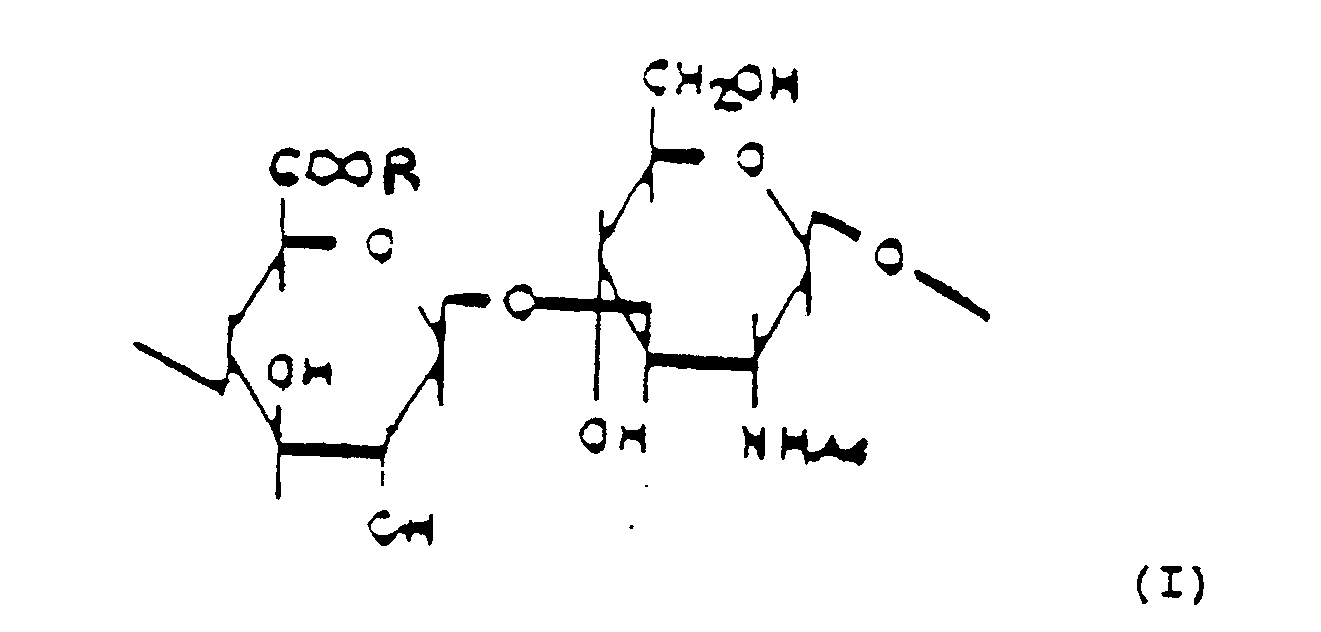
- the disaccharide unit of hyaluronic acid or a salt thereof may be represented by the schematic formula: - wherein Ac represents acetate and R represents hydrogen (in the case of the acid) or the cation of a salt (in the case of a salt).
- the cation is an alkali metal cation, most preferably sodium ion.
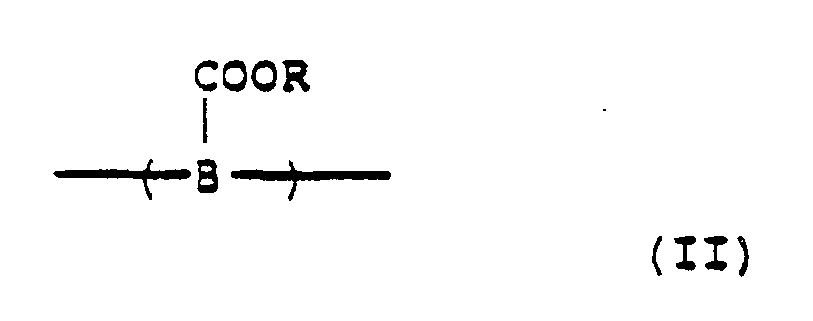
- R is as defined above and "B" has the obvious meaning ascribed to it.
- the polymer is hydrophilic.
- any of the known hyaluronic acid compositions, or salts thereof, as well as oligosaccharides or products obtained by physical, chemical or enzymatic treatment of the hyaluronic acid may be employed.
- These starting polymers will generally have "n" number of the units of formula (I) such that the polymer will have a weight average molecular weight (M w ) of from about 100,000 to about 12,000,000 Daltons (determined by calculation from the limiting viscosity number using the equation of Laurent et al., Biochimica et Biophysics Acta., 42: 476-485 [1960]).
- the N-acylurea and O-acylisourea compounds of the invention may be prepared by reaction of hyaluronic acid or a salt thereof with a carbodiimide or a biscarbodiimide, in the presence of an available proton.
- the reaction conditions are well known (see Tetrahedron Report R101, supra.) and comprise protonation of the carbodiimide or biscarbodiimide in a first step.
- the acid anion attaches to the carbon atom of the cation formed, resulting in the formation of an O-acylisourea intermediate.
- the acyl group in the latter migrates from the oxygen atom to a nitrogen atom to give the N-acylurea derivative of the hyaluronic acid or salt.
- the O --- N migration is incomplete, resulting in a product reaction mixture of both the N-acylurea and the O-acylisourea.
- the mixed products may be used separately or together to prepare the pharmaceutically active drug compositions
- reaction may be schematically represented by the very simple formulae: wherein R and B have the same meanings previously ascribed to them; the compound (III) is representative of a carbodiimide compound and R1 and R2 are each independently selected from the group consisting of hydrogen, hydrocarbyl, substituted- hydrocarbyl, alkoxy, aryloxy, alkaryloxy and the like.
- hydrocarbyl as used herein means the monovalent moiety obtained upon removal of a hydrogen atom from a parent hydrocarbon.
- Representative of hydrocarbyl are alkyl of 1 to 25 carbon atoms, inclusive, such as methyl, ethyl, propyl, butyl, pentyl, hexyl, heptyl, octyl, nonyl, undecyl, decyl, dodecyl, octadecyl, nonodecyl, eicosyl, heneicosyl, docosyl, tricosyl, tetracosyl, pentacosyl and the isomeric forms thereof; aryl of 6 to 25 carbon atoms, inclusive, such as phenyl, tolyl, xylyl, napthyl, biphenyl, tetraphenyl and the like; aralkyl of 7 to 25 carbon atoms, inclusive, such as benzyl, phene
- substituted hydrocarbyl as used herein means the hydrocarbyl moiety as previously defined wherein one or more hydrogen atoms have been replaced with a chemical group which does not adversely affect the desired preparation of the product derivative.
- substituent groups are amino- phosphino-, quaternary nitrogen (ammonium), quaternary phosphorus (phosphonium), hydroxyl, amide, alkoxy, mercapto, nitro, alkyl, halo, sulfone, sulfoxide, phosphate, phosphite, carboxylate, carbamate groups and the like.
- Preferred substitute groups are amino, amide, ester and ammonium groups.
- Preferred N-acylureas and O-acylisoureas of the invention are those in which R1 and/or R2 are hydrocarbyl substituted with an amino group.
- alkoxy as used herein means a monovalent group of the formula: -O-alkyl wherein the alkyl preferably has 4 to 12 carbon atoms, inclusive.
- aryloxy as used herein means the monovalent group of the formula:- -O-aryl wherein the aryl preferably has 6 to 10 carbon atoms, inclusive and may be substituted as described above.
- alkaryloxy as used herein means the monovalent group of formula:- -O-alkylenearyl such as oxybenzyl and the like.
- the carbodiimides and biscarbodiimides used to prepare the N-acylurea and O-acylisourea compositions of the invention are well known compounds, as represented by the formula (III) given above.
- Carbodiimides having the formula (III) are preferred where R1 and/or R2 represent more specifically alkyl, cycloalkyl, aryl or substituted forms thereof.
- a preferred class of monofunctional carbodiimides of formula (III) are N-methyl-N′-tert-butylcarbodiimide N,N′-diisopropylcarbodiimide N,N′-dicyclohexylcarbodiimide N,N′-ditert-butylcarbodiimide N-cyclohexyl-N′-tert-butylcarbodiimide N,N′-dibutylcarbodiimide N,N′-diisobutylcarbodiimide N-allyl-N′-propylcarbodiimide N,N′-diallylcarbodiimide N,allyl-N′-cyclohexylcarbodiimide N-crotyl-N′-cyclohexylcarbodiimide N-ally;-N′-(B-hydroxyethyl)carbodiimide N-methyl-N′-propylcarbodiimide N-propyl
- the physical properties of the N-acylurea and O-acylisourea compounds of the invention may be tailored for advantageous use in particular applications.
- hydrophobic and/or cationic "side-arms" may be attached to the hyaluronic polymer, to prepare useful polymer carriers for therapeutic drugs by selecting monofunctional carbodiimides.
- lipophilic side-arms may be attached to the hyaluronic acid polymer, by selection of the R1 and R2 moieties.
- carbodiimide originated side-arms are covalently attached to the hyaluronic acid polymer chain as N-acylurea or O-acylisourea side-arms.
- Free functional groups in the side-arm amine, amide, ester
- a sufficient proportion of the carbodiimide is reacted with the hyaluronic acid or salt thereof to obtain a polymer chain having recurring polymer chain units of the formula (I) given above, interrupted by at least one disaccharide unit per hyaluronic acid molecule having a pendant N-acylurea or O-acylisourea side-arm, for example a chain unit of the formula (IV), (V), (VI) or (VII) given above.
- compositions of the invention from about 0.5 to about 30 percent of the original chain units of the formula (I) are converted to chain units like those of the formula (IV), (V), (VI) or (VII). Generally an excess of the stoichometric proportion of carbodiimide is advantageous to promote the desired reaction.
- the biscarbodiimide cross-linked hyaluronic acid is found to be a hydrogel.
- hydrogel is defined herein to mean a cross-linked macromolecular network swollen in water or biological fluids. The degree of gelation is of course dependent on the degree of cross-linking achieved.
- the reaction conditions for hyaluronic acid cross-linking with a biscarbodiimide are similar to those used for hyaluronic acid-monocarbodiimide coupling reactions.
- the cross-linking reactions are carried out with (1) an increase of the hyaluronic acid concentration in the reaction mixture, and (2) a decrease of the biscarbodiimide concentration in the addition solution. This creates a condition favorable to intermolecular cross-linking versus intramolecular cross-linking.
- N-acylurea derivatives i.e.; compounds of formula (VI) or (VII) by increasing the pH with aqueous base or by the addition of amine bases in varying amounts.
- Representative of amine bases are primary, secondary and tertiary amines and diamines such as for example methylamine, ethylamine, 1,6-diaminohexane and the like.
- Amine promoted O ⁇ N migration is described by Mikolajczyk et al., Tetrahedron, 37, pg. 251 (1981).
- the preparative reaction may be carried out in the presence of an inert solvent, i.e., a solvent which does not enter into or otherwise adversely affect the desired course of the reaction.
- solvents are water, alkanols, dimethylformamide, dimethylsulfoxide and the like.
- Sources of protons to carry out the preparative reaction may include dilute mineral acids such as, for example, hydrochloric acid.
- the reaction proceeds satisfactorily over a wide range of temperatures, for example from -20°C. to 80°C., preferably at room temperatures.
- the intrinsic viscosity was measured using a Cannon-Ubbelohde semi-micro dilution viscometer, size 75, at 37°C. and is reported in milliliters/gram (ml/g).
- the dynamic viscosity is determined by Brookfield digital viscometer, Model RVTOCP (with spindle No. 52), and is reported in centipoise (Cps) at a concentration of 10 mg/ml, shear rate of 1.0 sec.
- the weight average molecular weights (M w ) were calculated from the limiting viscosity number using the equation of Laurent et al., supra.
- the product represents sodium hyaluronate where 16.98 percent of the polymer chain units of formula (I) given above have been converted to the formula (II) where R is the reaction residue of the carbodiimide.
- the product exhibited an IV of 2534 ml/g.
- the ratio of N-acylurea to O-acylisourea is about 1:2.3.
- the degree of crosslinking was calculated from the percentage ratio of the added carbodiimide group over the hyaluronate's carboxyl group, to be 18 percent.
- the IV of the 10% crosslinked hyaluronic acid was 3073 ml/g as compared with the control IV of 2354 ml/g.
- the 18% crosslinked product was not soluble in water, but swelled into a gel which was stable in water at room temperature.
- Example 6 Repeating the procedure of Example 6 , supra., but replacing the p-phenylenebis(ethyl)carbodiimide as used (therein with 11 mg (0.05 m. mole) of 1,6-hexylenebis(ethyl)carbodiimide, and using 416 mg (1.09m equivalent) of hyaluronate there was obtained 400 mg of the N-acylurea product of formula: wherein B is as defined above. The product had an IV of 2554 ml/g. The degree of cross-linking was calculated to be 10 percent. Placement in water produced a viscous solution. No O-acylisourea was detected.
- N-acylurea of formula: and O-acylisourea of formula: wherein B has the meaning previously given to it.
- the ratio of N-acylurea to O-acylisourea is about 85:15.
- the trifluoroacetyl group Upon basic hydrolysis, the trifluoroacetyl group will be removed and the free amine group produced for reaction with a therapeutic drug, preferably by covalently bonding.
- the amine group can form a covalent bond with the carboxyl group associated with the therapeutic drug naprosyn.
- Naprosyn and other drugs will also bind to the N-acylureas and O-acylisoureas of the invention which have hydrophobic regions by a second mechanism, i.e.; hydrophobic interaction.
Landscapes
- Health & Medical Sciences (AREA)
- Chemical & Material Sciences (AREA)
- Life Sciences & Earth Sciences (AREA)
- General Health & Medical Sciences (AREA)
- Medicinal Chemistry (AREA)
- Animal Behavior & Ethology (AREA)
- Public Health (AREA)
- Veterinary Medicine (AREA)
- Epidemiology (AREA)
- Pharmacology & Pharmacy (AREA)
- Engineering & Computer Science (AREA)
- Surgery (AREA)
- Chemical Kinetics & Catalysis (AREA)
- Inorganic Chemistry (AREA)
- Molecular Biology (AREA)
- Vascular Medicine (AREA)
- Biochemistry (AREA)
- Materials Engineering (AREA)
- Heart & Thoracic Surgery (AREA)
- Polymers & Plastics (AREA)
- Organic Chemistry (AREA)
- Bioinformatics & Cheminformatics (AREA)
- Dermatology (AREA)
- Oral & Maxillofacial Surgery (AREA)
- Transplantation (AREA)
- Polysaccharides And Polysaccharide Derivatives (AREA)
- Organic Low-Molecular-Weight Compounds And Preparation Thereof (AREA)
Abstract
Description
- The invention relates to N-acylurea and O-acylisourea derivatives of hyaluronic acid or a salt thereof.
- N-acylureas and O-acylisoureas are known classes of compounds, which may be prepared by the reaction of a carboxylic acid with a carbodiimide; see for example Tetrahedron Report R101, Tetrahedron vol 37, pgs. 248-282 (Pergamon Press Ltd., 1981).
- Tengblad in Biochimica et. Biophysica Acta, 578, pgs. 281-289 (1979) reported coupling a partially digested sodium hyaluronate (Mw of 52,000) to a cyanogen bromide activated agarose using a carbodiimide to effect the coupling of the previously mixed reactants. The immobilized hyaluronate was used as an affinity chromatography surface.
- Silver et al. in U.S. Patent 4,703,108 describe cross-linking soluble or insoluble collagen with a carbodiimide in the presence of a "hyaluronate", which is not described further. The product is described as a collagen matrix "impregnated" with a compound (the hyaluronate). From the disclosure, it does not appear to suggest a reaction of hyaluronate with the carbodiimide since the hyaluronate remains free for release from the collagen matrix. However, in the U.S. Patent 4,280,954 to Yannas et al, carbodiimides are suggested as coupling agents to cross-link collagen to hyaluronic acid in particular. The resulting insoluble composites are said to be useful as prosthetic devices for implantation in mammals. No examples are given and one is left to speculate about the products and their mode of preparation.
- The N-acylureas and the O-acylisoureas of the present invention are useful intermediates in the preparation of pharmaceutically active drug compositions or compositions which will release pharmaceutically active drugs in a controlled manner.
- Therapeutic pharmaceutical drugs are almost exclusively administered to mammals in admixture with an appropriate, pharmaceutically acceptable carrier, for release in the intestinal tract, sub-cutaneous, intra-articular and/or bloodstream of the mammal undergoing therapeutic treatment. Scheduled doses are administered in accordance with a time table designed to maintain a minimum blood or tissue concentration of the drug. The disadvantage of this protocol of administration is that concentration levels of the drug are high following initial administration and low at some time after initial administration. It results in a so-called "peaks and valleys" profile of drug concentrations. This is often undesirable, for example in the sub-cutaneous administration of insulin.
- Another problem related to the above-described mode of drug adminstration is the systemic dispersion of the drug throughout the mammal's tissues. Ideally, the drug is targeted to a specific site where it is needed, for example to an intra-articular site, without tissue concentrations appearing systemically, for example in the stomach linings.
- To obviate the above-described disadvantages associated with the usual administration of therapeutic drugs, alternative methods of introducing and controlling the release of therapeutic drugs have been sought. Effort has focused on the use of polymeric formulations for the controlled release of drugs using a variety of methods, compositions, and areas of application; see for example "Controlled Release Polymeric Formulations", D. R. Paul and F. W. Harris editors, American Chemical Society, Washington, D.C. 1976.
- It will be appreciated that a polymer carrier of a drug must be selected with regard to its pharmaceutical acceptability, i.e.; it must be non-toxic in the quantities employed, compatible with the therapeutic drug it is to carry and it may be bioerodible or catabolically removable. Bioerodible carriers or polymers generally rely on the release of the therapeutic drug as the polymer carrier is eroded away by the in-situ environment through physical processes such as dissolution or by chemical processes such as hydrolysis of the polymer backbone or crosslinks, or by enzymatic degradation. When such polymers are used for delivery of pharmacologically active drugs within medical applications, it is essential that the polymers themselves be nontoxic and that they degrade into non-toxic degradation products as the polymer is eroded by the body fluids. However, many synthetic, biodegradable polymers upon erosion in-vivo yield oligomers and monomers which often adversely interact with the surrounding tissue [D. F. Williams, J. Mater. Sci. 17:1233 (1982)]. In order to minimize the toxicity of the intact polymer carrier and its degradation products, polymers have been designed based upon naturally occurring metabolites. Probably the most extensively studied examples of such polymers are the polyesters derived from lactic or glycolic acid [H. Laufman et al., Surg. Gynecol. Obstet. 145:597(1977); D. L. Wise et al., in "Drug Carriers In Biology And Medicine" (G. Gregoriadis ed.), Academic Press, London, 1979, pages 237-270] and polyamides derived from amino acids [D. A. Wood, Int. J. Pharm. 7:1(1980); S. Yolles et al., in "Controlled Release Technologies: Methods, Theory, And Applications"; A. F. Kydonies, ed. C.R.C. Press, Boca Raton, Florida, 1980, pages 1-6]. Unfortunately, many of these bioerodible polymers erode homogeneously (bulk erosion) which results in uncontrolled and unpredictable release of therapeutic drugs by unfavorable release kinetics. The release kinetics are generally only improved if the polymer carrier is hydrophobic enough to erode heterogeneously, that is by surface erosion rather than bulk degradation [J. Heller, in "Medical Applications Of Controlled Release" (R. S. Langer and D. L. Wise, eds.) C.R.C. Press, Boca Raton, Florida, 1985]. Unfortunately, it is difficult to produce hydrophobic polymeric compositions which degrade by surface erosion and provide the desired release kinetics without themselves being allergenic or toxic or which degrade into allergenic or toxic degradation products. Such hydrophobic polymers have remained a sought after goal.
- Certain embodiments of the N-acylurea and O-acylisourea compounds and compositions of the present invention represent a modification of the hydrophilic, water-soluble hyaluronic acid molecule. The modification comprises the insertion of hydrophobic regions on the hyaluronic acid molecule, without converting the whole of the molecule to a hydrophobic, water-insoluble entity. In this way, water-solubility is retained but the advantages of hydrophobicity described above are obtained. The low hydrolytic stability of the hyaluronic acid is increased by the addition of hydrophobic regions to the polymer chain. In use, the hydrophobic modified regions bind lipophilic drugs through weak non-bonded interactions, thereby slowing the diffusion of the drug from the site of administration of a water-soluble, modified hyaluronic acid-drug combination. The modified hyaluronic acid remains at the site of administration and is slowly removed by diffusion and degradation by normal enzymatic processes, safely and without generating toxic or undesirable residues.
- In other embodiment compounds and compositions of the invention, adjacent molecules of hyaluronic acid are cross-linked, to lower the water-solubility of the product. The lower solubility compositions are particularly useful, because they tend to "erode" heterogeneously as will be discussed more fully hereinafter. This characteristic is at least a partial solution to the uncontrolled and unpredictable release of therapeutic agents discussed above in relation to the prior art vehicles for drug delivery.
- The different modifications of the hyaluronic acid molecule can provide a means of covalently linking the molecule to a therapeutic drug, or can enhance a non-covalent binding or interaction between this water-soluble molecule and an anionic, cationic or hydrophobic drug agent.
- The invention comprises the N-acylurea and O-acylisourea derivatives of hyaluronic acid or a salt thereof and their use as intermediate compositions in the preparation of therapeutic drug compounds and compositions.
- Certain embodiment compositions of the invention are useful as biomaterials, i.e.; as vitreous replacements, joint treatments, adjuncts in wound healing and like devices. Other embodiment compositions may be useful in areas of biomedical research, such as radio- and fluorescent-labelling of hyaluronic acid.
- Hyaluronic acid is a well known and naturally occurring, water-soluble polysaccharide composed of repeating disaccharide units of glucuronic acid and N-acatylglucosamine. The disaccharide unit of hyaluronic acid or a salt thereof may be represented by the schematic formula: -
- Methods of preparing commercially available hyaluronic acid and salts thereof (particularly the physiologically acceptable salts such as the sodium salt) are well known.
- For use in preparing the N-acylurea and O-acylisourea compounds of the invention, any of the known hyaluronic acid compositions, or salts thereof, as well as oligosaccharides or products obtained by physical, chemical or enzymatic treatment of the hyaluronic acid may be employed. These starting polymers will generally have "n" number of the units of formula (I) such that the polymer will have a weight average molecular weight (Mw) of from about 100,000 to about 12,000,000 Daltons (determined by calculation from the limiting viscosity number using the equation of Laurent et al., Biochimica et Biophysics Acta., 42: 476-485 [1960]).
- The N-acylurea and O-acylisourea compounds of the invention may be prepared by reaction of hyaluronic acid or a salt thereof with a carbodiimide or a biscarbodiimide, in the presence of an available proton. The reaction conditions are well known (see Tetrahedron Report R101, supra.) and comprise protonation of the carbodiimide or biscarbodiimide in a first step. The acid anion attaches to the carbon atom of the cation formed, resulting in the formation of an O-acylisourea intermediate. The acyl group in the latter migrates from the oxygen atom to a nitrogen atom to give the N-acylurea derivative of the hyaluronic acid or salt. Generally the O --- N migration is incomplete, resulting in a product reaction mixture of both the N-acylurea and the O-acylisourea. The mixed products may be used separately or together to prepare the pharmaceutically active drug compositions of the invention.
- The reaction may be schematically represented by the very simple formulae:

- The term "hydrocarbyl" as used herein means the monovalent moiety obtained upon removal of a hydrogen atom from a parent hydrocarbon. Representative of hydrocarbyl are alkyl of 1 to 25 carbon atoms, inclusive, such as methyl, ethyl, propyl, butyl, pentyl, hexyl, heptyl, octyl, nonyl, undecyl, decyl, dodecyl, octadecyl, nonodecyl, eicosyl, heneicosyl, docosyl, tricosyl, tetracosyl, pentacosyl and the isomeric forms thereof; aryl of 6 to 25 carbon atoms, inclusive, such as phenyl, tolyl, xylyl, napthyl, biphenyl, tetraphenyl and the like; aralkyl of 7 to 25 carbon atoms, inclusive, such as benzyl, phenethyl, phenpropyl, phenbutyl, phenhexyl, napthoctyl and the like; cycloalkyl of 3 to 8 carbon atoms, inclusive, such as cyclopropyl, cyclobutyl, cyclopentyl, cyclohexyl, cycloheptyl, cyclooctyl and the like; alkenyl of 2 to 25 carbon atoms, inclusive, such as vinyl, allyl, butenyl, pentenyl, hexenyl, octenyl, nonenyl, decenyl, undececyl, dodecenyl, tridecenyl, pentadecenyl, octadecenyl, pentacosynyl and isomeric forms thereof. Preferably, hydrocarbyl has 6 to 14 carbon atoms, inclusive.
- The term "substituted hydrocarbyl" as used herein means the hydrocarbyl moiety as previously defined wherein one or more hydrogen atoms have been replaced with a chemical group which does not adversely affect the desired preparation of the product derivative. Representative of such groups are amino- phosphino-, quaternary nitrogen (ammonium), quaternary phosphorus (phosphonium), hydroxyl, amide, alkoxy, mercapto, nitro, alkyl, halo, sulfone, sulfoxide, phosphate, phosphite, carboxylate, carbamate groups and the like. Preferred substitute groups are amino, amide, ester and ammonium groups.
- Preferred N-acylureas and O-acylisoureas of the invention are those in which R¹ and/or R² are hydrocarbyl substituted with an amino group.
- The term "alkoxy" as used herein means a monovalent group of the formula:
-O-alkyl
wherein the alkyl preferably has 4 to 12 carbon atoms, inclusive. - The term "aryloxy" as used herein means the monovalent group of the formula:-
-O-aryl
wherein the aryl preferably has 6 to 10 carbon atoms, inclusive and may be substituted as described above. - The term "alkaryloxy" as used herein means the monovalent group of formula:-
-O-alkylenearyl
such as oxybenzyl and the like. - The schematic formulae given above to represent the preparation of the N-acylureas and O-acylisoureas of the invention does not illustrate the reaction or products where a biscarbodiimide is used in place of the compound of formula (III), but that reaction scheme will suggest itself to the skilled artisan.
- The carbodiimides and biscarbodiimides used to prepare the N-acylurea and O-acylisourea compositions of the invention are well known compounds, as represented by the formula (III) given above. Carbodiimides having the formula (III) are preferred where R¹ and/or R² represent more specifically alkyl, cycloalkyl, aryl or substituted forms thereof. Representative of a preferred class of monofunctional carbodiimides of formula (III) are
N-methyl-N′-tert-butylcarbodiimide
N,N′-diisopropylcarbodiimide
N,N′-dicyclohexylcarbodiimide
N,N′-ditert-butylcarbodiimide
N-cyclohexyl-N′-tert-butylcarbodiimide
N,N′-dibutylcarbodiimide
N,N′-diisobutylcarbodiimide
N-allyl-N′-propylcarbodiimide
N,N′-diallylcarbodiimide
N,allyl-N′-cyclohexylcarbodiimide
N-crotyl-N′-cyclohexylcarbodiimide
N-ally;-N′-(B-hydroxyethyl)carbodiimide
N-methyl-N′-propylcarbodiimide
N-propyl-N′tert-butylcarbodiimide
N-isopropyl-N′-tert-butylcarbodiimide
N-(α-dimethylaminopropyl)-N′tert-butylcarbodiimide
N-(β-bromoallyl)-N′-propylcarbodiimide
N-(β-bromoallyl)-N′-isopropylcarbodiimide
N-(β-bromoallyl)-N′-tert-butylcarbodiimide
N-(α-dimethylaminopropyl)-N′-(β-bromoallyl)carbodiimide
1-ethyl-3-(6-benzyloxylcarbonylaminohexyl)carbodiimide
1-(3-dimethylaminopropyl)-3-(6-benzoylaminohexyl)-carbodiimide
and the like. - The biscarbodiimides may be represented by those difunctional compounds of formula:-
R¹-N=C=N-R²-N=C=N-R³ (VIII)
wherein R¹ and R² have the same meanings given to them above and R³ may have the same meaning as R¹. - Methods of preparing carbodiimides of the formula (III) and biscarbodiimides of the formula (VIII) are well known and need not be recited herein in detail; see for example the methods described in the U.S. Patents 2,946,819; 3,231,610; 3,502,722; 3,644,456; 3,972,933; 4,014,935; 4,066,629: 4,085,140: 4,096,334: and 4,137,386, all of which are incorporated herein by reference thereto.
- By appropriate selection of a particular carbodiimide or biscarbodiimide or a class of such compounds, the physical properties of the N-acylurea and O-acylisourea compounds of the invention may be tailored for advantageous use in particular applications. For example, hydrophobic and/or cationic "side-arms" may be attached to the hyaluronic polymer, to prepare useful polymer carriers for therapeutic drugs by selecting monofunctional carbodiimides. So also, lipophilic side-arms may be attached to the hyaluronic acid polymer, by selection of the R¹ and R² moieties.
- More importantly, carbodiimide originated side-arms are covalently attached to the hyaluronic acid polymer chain as N-acylurea or O-acylisourea side-arms. Free functional groups in the side-arm (amine, amide, ester) can be further reacted to bond with reactive therapeutic drug molecules, to obtain vehicles for delivery of therapeutic drugs, under conventional and known reaction conditions.
- In carrying out the preparation of the N-acylurea and O-acylisourea compounds of the invention, a sufficient proportion of the carbodiimide is reacted with the hyaluronic acid or salt thereof to obtain a polymer chain having recurring polymer chain units of the formula (I) given above, interrupted by at least one disaccharide unit per hyaluronic acid molecule having a pendant N-acylurea or O-acylisourea side-arm, for example a chain unit of the formula (IV), (V), (VI) or (VII) given above. In preferred compositions of the invention, from about 0.5 to about 30 percent of the original chain units of the formula (I) are converted to chain units like those of the formula (IV), (V), (VI) or (VII). Generally an excess of the stoichometric proportion of carbodiimide is advantageous to promote the desired reaction.
- Use of a biscarbodiimide reactant to prepare N-acylureas and O-acylisoureas of the invention results in a cross-linking between adjacent hyaluronic acid molecules, since the biscarbodiimide is difunctional. In this case, the "pendant side-arm" referred to above is shared by two molecules of hyaluronic acid. These cross-linked materials are particularly useful as biomaterials and as relatively insoluble matrices for drug delivery since the biscarbodiimide cross-linked hyaluronic acid possesses new drug binding regions on the cross-link, which does not interfere with biocompatibility.
- The biscarbodiimide cross-linked hyaluronic acid is found to be a hydrogel. The term "hydrogel" is defined herein to mean a cross-linked macromolecular network swollen in water or biological fluids. The degree of gelation is of course dependent on the degree of cross-linking achieved.
- The reaction conditions for hyaluronic acid cross-linking with a biscarbodiimide are similar to those used for hyaluronic acid-monocarbodiimide coupling reactions. Advantageously, the cross-linking reactions are carried out with (1) an increase of the hyaluronic acid concentration in the reaction mixture, and (2) a decrease of the biscarbodiimide concentration in the addition solution. This creates a condition favorable to intermolecular cross-linking versus intramolecular cross-linking.
- The reactions described above may be directed to favor the formation of the N-acylurea derivatives; i.e.; compounds of formula (VI) or (VII) by increasing the pH with aqueous base or by the addition of amine bases in varying amounts. Representative of amine bases are primary, secondary and tertiary amines and diamines such as for example methylamine, ethylamine, 1,6-diaminohexane and the like. Amine promoted O → N migration is described by Mikolajczyk et al., Tetrahedron, 37, pg. 251 (1981).
- The preparative reaction may be carried out in the presence of an inert solvent, i.e., a solvent which does not enter into or otherwise adversely affect the desired course of the reaction. Representative of such solvents are water, alkanols, dimethylformamide, dimethylsulfoxide and the like. Sources of protons to carry out the preparative reaction may include dilute mineral acids such as, for example, hydrochloric acid.
- The reaction proceeds satisfactorily over a wide range of temperatures, for example from -20°C. to 80°C., preferably at room temperatures.
- Progress of the reaction described above may be followed by measurement of pH. When the pH is stabilized, the reaction is substantially complete. At the conclusion of the reaction, the desired N-acylurea and O-acylisourea derivative may be separated from the reaction mixture by conventional methods, for example by precipitation, washing and re-precipitation. The completeness of the reaction, the nature of the products and the extent of chemical modification can be determined by proton NMR on solutions of the modified hyaluronic acid solubilized in dilute NaOD to reduce viscosity.
- The following examples and preparations describe the manner and process of making and using the invention and set forth the best mode contemplated by the inventors of carrying out the invention but are not to be construed as limiting the invention. Where reported, the following tests were carried out.
- The intrinsic viscosity was measured using a Cannon-Ubbelohde semi-micro dilution viscometer, size 75, at 37°C. and is reported in milliliters/gram (ml/g).
- The dynamic viscosity is determined by Brookfield digital viscometer, Model RVTOCP (with spindle No. 52), and is reported in centipoise (Cps) at a concentration of 10 mg/ml, shear rate of 1.0 sec.
- The weight average molecular weights (Mw) were calculated from the limiting viscosity number using the equation of Laurent et al., supra.
- Mercuric oxide (100 mg) was suspended in 15 ml dry acetone, to which 1-ethyl-3-(6-benzyloxylcarbonylaminohexyl)2-thiourea (77 mg) dissolved in 5 ml of dry acetone was added. The reaction mixture was refluxed and the oil bath was kept at 80°C. After 20 minutes, the reaction mixture turned black and the reflux continued for three hours. The formed black mercuric sulfide stuck to the reaction flask and the solution was clear. The solution was then filtered through Celite, dried with magnesium sulfate and evaporated to give 60 mg of 1-ethyl-3-(6-benzyloxycarbonylaminohexyl) carbodiimide with a purity of 93% (GC).
-
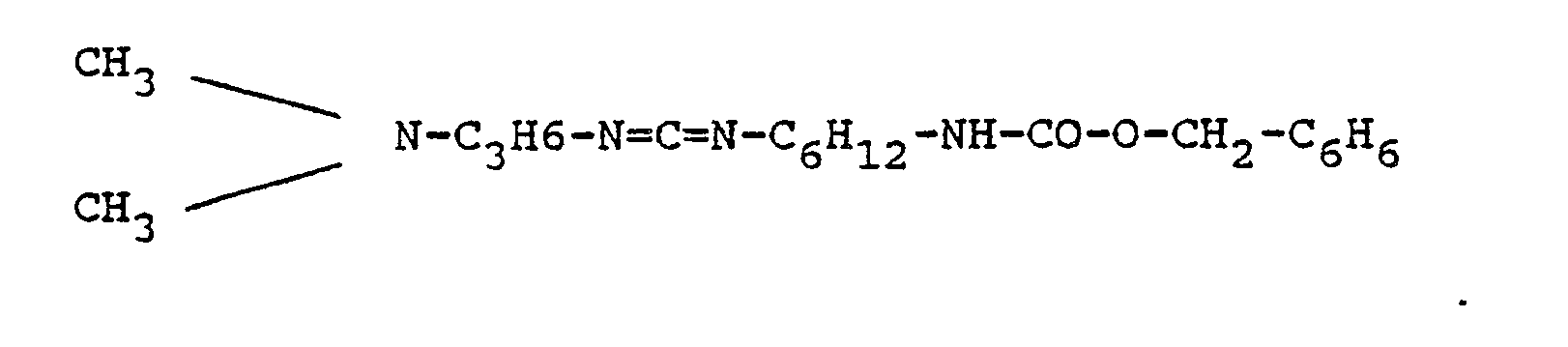
- The same procedure of Preparation 1, supra., but refluxing 1-(3-dimethylaminopropyl),3-(6-benzyloxylcarbonylaminohexyl)2-thiourea in acetone in the presence of mercuric oxide was followed, except the crude product was dried with magnesium sulfate and chromatographed on silica gel (chloroform, triethylamine). Thus 77 mg of the thiourea gave 15 mg of 1-(3-dimethylaminopropyl)-3(6-benzyloxylcarbonyl-aminohexyl) carbodiimide.
- Sodium hyaluronate (246 mg, 0.615 m mole equivalents) with 17.82 mg (0.307 m mole equivalent) of 1,6-diaminohexane dissolved in water (pH adjusted to 4.75) was mixed with 1-(3-dimethylaminopropyl)-3-ethylcarbodiimide (11.78 mg, 0.062 m mole) dissolved in water. The pH of the mixture was adjusted to 4.75 with 0.1N hydrochloric acid and maintained at that pH during the course of the reaction, with 0.1N hydrochloric acid. The mixture is stirred at room temperature for two hours. At the end of the period of time, sodium chloride was added to make a concentration of 5 percent (w/v). Ethanol equal to three volumes of the reaction mixture was then added, and a white stringy precipitate formed. The precipitate was separated, dried and redissolved in water which was then diluted for a second precipitation. The precipitation and redissolution sequence was repeated three times. The final solution of the N-acylurea product was clear and viscous. No O-acylisourea product was detected.
- Repeating the general procedure of Example 1, supra. but without the presence of 1,6-diaminohexane and reacting 90.6 mg (0.225 m equivalent) of sodium hyaluronate with 18 mg (0.048 m mole) of 1-ethyl-3-(6-benzyloxylcarbonylaminohexyl-carbodiimide (Preparation 1. supra.) There was obtained a product N-acylurea (105 mg of lyophilized product). Compared to the starting sodium hyaluronate, the product was characterized in part by the following physical properties:
Product N-Acylurea Starting Sodium Hyaluronate Intrinsic Viscosity (ml/g) 2734 2354 Dynamic Viscosity (cps) 24332 23199 - The product represents sodium hyaluronate where 16.98 percent of the polymer chain units of formula (I) given above have been converted to the formula (II) where R is the reaction residue of the carbodiimide.
- Repeating the general procedure of Example 1, supra. but leaving out the 1,6-diaminohexane and replacing the 1-(3-dimethylaminopropyl)-3-ethylcarbodiimide as used therein with an equal proportion of 1-(3-dimethylaminopropyl)-3-(6-benzyoloxylcarbonylaminohexyl)carbodiimide prepared in accordance with Preparation 2, supra. there is obtained the corresponding N-acylurea having chain units of the formula (II) given above, wherein R is the reaction residue of the carbodiimide.
- The general procedure of Example 3, supra., was repeated, except that 401 mg (1.0 m equivalent) of sodium hyaluronate was reacted with 25.2 mg (0.10 m mole) of 1-ethyl-3-tridecyl-carbodiimide to obtain 386 mg of the lyophilized acylurea (IV = 2591) having chain units of formula (II) given above wherein R is the reaction residue of the carbodiimide.
- Repeating the procedure of Example 3 supra., but replacing the 1-ethyl-3-tridecylcarbodiimide as used therein with 45.6 mg (0.238 m moles) of 1-ethyl-3-octylcarbodiimide and using 477 mg (1.119 m equivalent) of hyaluronate there was obtained 465 mg of the lyophilized acylurea product having chain units of formula (II) given above wherein R is the reaction residue of the carbodiimide.
- The product exhibited an IV of 2534 ml/g.
- Following the general procedure of Example 1. supra., but without the added presence of the 1,6-diaminohexane, 404 mg (1.01 m equivalent) of sodium hyaluronate was reacted with 10.7 mg (0.05 m mole) of p-phenylenebis(ethyl)-carbodiimide to obtain 393 mg of the N-acylurea lyophilized product of formula:-
B-CO-NC₂H₅ - CO - HN - C₆H₆ - NH - CO - NC₂H₅ -CO- B and the O-acylisourea lyophylized product of formula:
- The degree of crosslinking was calculated from the percentage ratio of the added carbodiimide group over the hyaluronate's carboxyl group, to be 18 percent. The IV of the 10% crosslinked hyaluronic acid was 3073 ml/g as compared with the control IV of 2354 ml/g. The 18% crosslinked product was not soluble in water, but swelled into a gel which was stable in water at room temperature.
- Repeating the procedure of Example 6, supra., but replacing the p-phenylenebis(ethyl)carbodiimide as used (therein with 11 mg (0.05 m. mole) of 1,6-hexylenebis(ethyl)carbodiimide, and using 416 mg (1.09m equivalent) of hyaluronate there was obtained 400 mg of the N-acylurea product of formula:

- Following the general procedure of Example 6, supra., 400 mg (1.0 m equivalent) of sodium hyaluronate and 60 mg. (0.22 m equivalent) of 1-ethyl-3-(tri-fluoroacetamido) hexyl-carbodiimide dissolved in 5 ml of isopropanol was reacted to obtain 392 mg (85.2% of theory) of N-acylurea of formula:

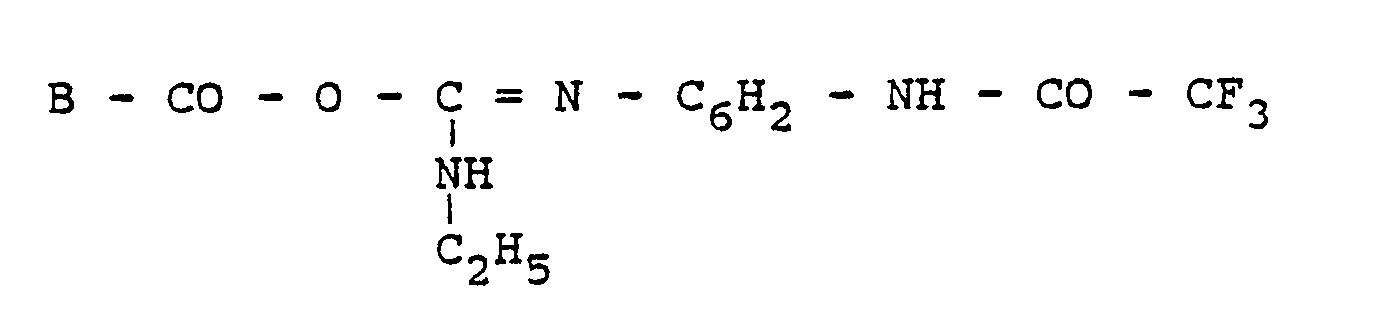
- From the examples given above it will be appreciated that the modification of the hyaluronic acid by reaction with a carbodiimide or biscarbodiimide does not adversely degrade the polymer. The properties of viscoelasticity are retained. Unexpectedly, the intrinsic viscosity is increased in the derivative compound. This may be advantageous in some cases where a high viscosity is desired for implanting a therapeutic drug.
Claims (17)
R¹-N=C=N-R²
wherein R¹ and R² are each independently selected from the group consisting of hydrogen, hydrocarbyl, substituted-hydrocarbyl, alkoxy, aryloxy and alkaryloxy.
R¹ - N = C = N - R² - N = C = N - R³
wherein R¹ amd R² have the same meanings ascribed to them in claim 4 and R³ has the meaning given R¹.
Applications Claiming Priority (2)
| Application Number | Priority Date | Filing Date | Title |
|---|---|---|---|
| US38857889A | 1989-08-01 | 1989-08-01 | |
| US388578 | 1989-08-01 |
Publications (2)
| Publication Number | Publication Date |
|---|---|
| EP0416250A2 true EP0416250A2 (en) | 1991-03-13 |
| EP0416250A3 EP0416250A3 (en) | 1991-08-28 |
Family
ID=23534683
Family Applications (1)
| Application Number | Title | Priority Date | Filing Date |
|---|---|---|---|
| EP19900113594 Withdrawn EP0416250A3 (en) | 1989-08-01 | 1990-07-16 | N-acylurea and o-acylisourea derivatives of hyaluronic acid |
Country Status (3)
| Country | Link |
|---|---|
| EP (1) | EP0416250A3 (en) |
| JP (1) | JPH0388802A (en) |
| CA (1) | CA2022091A1 (en) |
Cited By (45)
| Publication number | Priority date | Publication date | Assignee | Title |
|---|---|---|---|---|
| EP0506976A4 (en) * | 1990-10-18 | 1993-03-24 | Shiseido Company Limited | Combination of hyaluronic acid with medicinal ingredient and production thereof |
| EP0537292A4 (en) * | 1990-06-25 | 1993-07-28 | Genzyme Corporation | Water insoluble derivatives of hyaluronic acid |
| WO1994002517A1 (en) * | 1992-07-28 | 1994-02-03 | Anika Research, Inc. | Water-insoluble derivatives of hyaluronic acid and their methods of preparation and use |
| EP0587715A4 (en) * | 1991-05-20 | 1995-08-09 | Genzyme Corp | Water insoluble derivatives of polyanionic polysaccharides. |
| EP0686395A2 (en) | 1994-06-07 | 1995-12-13 | Genzyme Corporation | Use of hyaluronic acid for the manufacture of a medicament for the inhibition of platelet aggregation |
| US5527893A (en) * | 1987-09-18 | 1996-06-18 | Genzyme Corporation | Water insoluble derivatives of polyanionic polysaccharides |
| US5610148A (en) * | 1991-01-18 | 1997-03-11 | University College London | Macroscopically oriented cell adhesion protein for wound treatment |
| US5629287A (en) * | 1991-01-18 | 1997-05-13 | University College London | Depot formulations |
| US5733891A (en) * | 1990-10-18 | 1998-03-31 | Shiseido Co., Ltd. | Compound for medicinal ingredient and hyaluronic acid and process for producing the same |
| US5791352A (en) * | 1996-06-19 | 1998-08-11 | Fusion Medical Technologies, Inc. | Methods and compositions for inhibiting tissue adhesion |
| US5931165A (en) * | 1994-09-06 | 1999-08-03 | Fusion Medical Technologies, Inc. | Films having improved characteristics and methods for their preparation and use |
| WO1998028010A3 (en) * | 1996-12-24 | 1999-08-19 | Hyal Pharma Corp | Use of moieties for binding to hyaluronan and icam-1 |
| US6030958A (en) * | 1987-09-18 | 2000-02-29 | Genzyme Corporation | Water insoluble derivatives of hyaluronic acid |
| US6235726B1 (en) * | 1987-09-18 | 2001-05-22 | Genzyme Corporation | Water insoluble derivatives of polyanionic polysaccharides |
| US6294202B1 (en) | 1994-10-06 | 2001-09-25 | Genzyme Corporation | Compositions containing polyanionic polysaccharides and hydrophobic bioabsorbable polymers |
| US6610669B1 (en) | 1987-09-18 | 2003-08-26 | Genzyme Corporation | Water insoluble derivatives of polyanionic polysaccharides |
| US6884788B2 (en) | 2001-02-22 | 2005-04-26 | Anika Therapeutics, Inc. | Thiol-modified hyaluronan |
| WO2005067994A1 (en) * | 2003-12-22 | 2005-07-28 | Anika Therapeutics, Inc. | Crosslinked hyaluronic acid compositions for tissue augmentation |
| WO2007070617A1 (en) * | 2005-12-14 | 2007-06-21 | Anika Therapeutics, Inc. | Bioabsorbable implant of hyaluronic acid derivative for treatment of osteochondral and chondral defects |
| WO2007070547A3 (en) * | 2005-12-14 | 2007-08-16 | Anika Therapeutics Inc | Treatment of arthritis and other musculoskeletal disorders with crosslinked hyaluronic acid |
| WO2007070546A3 (en) * | 2005-12-14 | 2007-08-16 | Anika Therapeutics Inc | Meniscal implant of hyaluronic acid derivatives for treatment of meniscal defects |
| US7863256B2 (en) | 2005-03-02 | 2011-01-04 | Fidia Farmaceutici S.P.A. | Amide derivatives of hyaluronic acid in osteoarthrosis |
| US7884087B1 (en) | 1998-07-06 | 2011-02-08 | Fidia Farmaceutici S.P.A. | Amides of hyaluronic acid the derivatives thereof and a process for their preparation |
| US8338388B2 (en) | 2003-04-10 | 2012-12-25 | Allergan, Inc. | Cross-linking of low-molecular weight and high-molecular weight polysaccharides, preparation of injectable monophase hydrogels, polysaccharides and hydrogels obtained |
| US8357795B2 (en) | 2008-08-04 | 2013-01-22 | Allergan, Inc. | Hyaluronic acid-based gels including lidocaine |
| EP2497785A3 (en) * | 2004-01-07 | 2013-04-03 | Seikagaku Corporation | Hyaluronic acid derivative and drug containing the same |
| US8658148B2 (en) | 2007-06-22 | 2014-02-25 | Genzyme Corporation | Chemically modified dendrimers |
| US8900118B2 (en) | 2008-10-22 | 2014-12-02 | Apollo Endosurgery, Inc. | Dome and screw valves for remotely adjustable gastric banding systems |
| US9012517B2 (en) | 2010-03-22 | 2015-04-21 | Allergan, Inc. | Polysaccharide and protein-polysaccharide cross-linked hydrogels for soft tissue augmentation |
| US9028394B2 (en) | 2010-04-29 | 2015-05-12 | Apollo Endosurgery, Inc. | Self-adjusting mechanical gastric band |
| US9044298B2 (en) | 2010-04-29 | 2015-06-02 | Apollo Endosurgery, Inc. | Self-adjusting gastric band |
| US9050165B2 (en) | 2010-09-07 | 2015-06-09 | Apollo Endosurgery, Inc. | Remotely adjustable gastric banding system |
| WO2016113192A1 (en) * | 2015-01-13 | 2016-07-21 | Sigea S.R.L. | Process in water for the preparation of butyric esters of hyaluronic acid sodium salt |
| US9655991B2 (en) | 2010-01-13 | 2017-05-23 | Allergan Industrie, S.A.S. | Stable hydrogel compositions including additives |
| US9737633B2 (en) | 2011-06-03 | 2017-08-22 | Allergan, Inc. | Dermal filler compositions including antioxidants |
| US9795711B2 (en) | 2011-09-06 | 2017-10-24 | Allergan, Inc. | Hyaluronic acid-collagen matrices for dermal filling and volumizing applications |
| US9855367B2 (en) | 2010-01-13 | 2018-01-02 | Allergan Industrie, Sas | Heat stable hyaluronic acid compositions for dermatological use |
| US9861570B2 (en) | 2008-09-02 | 2018-01-09 | Allergan Holdings France S.A.S. | Threads of hyaluronic acid and/or derivatives thereof, methods of making thereof and uses thereof |
| US9950092B2 (en) | 2011-06-03 | 2018-04-24 | Allergan, Inc. | Dermal filler compositions for fine line treatment |
| US9962464B2 (en) | 2011-06-03 | 2018-05-08 | Allergan, Inc. | Dermal filler compositions including antioxidants |
| US10722444B2 (en) | 2014-09-30 | 2020-07-28 | Allergan Industrie, Sas | Stable hydrogel compositions including additives |
| US11083684B2 (en) | 2011-06-03 | 2021-08-10 | Allergan Industrie, Sas | Dermal filler compositions |
| US11260015B2 (en) | 2015-02-09 | 2022-03-01 | Allergan Industrie, Sas | Compositions and methods for improving skin appearance |
| US11564971B2 (en) | 2012-09-05 | 2023-01-31 | Chugai Seiyaku Kabushiki Kaisha | Hyaluronic acid derivative having amino acid and steryl group introduced thereinto |
| US12324868B2 (en) | 2015-02-13 | 2025-06-10 | Allergan Industrie, Sas | Implants for sculpting, augmenting or correcting facial features such as the chin |
Families Citing this family (29)
| Publication number | Priority date | Publication date | Assignee | Title |
|---|---|---|---|---|
| US7338433B2 (en) | 2002-08-13 | 2008-03-04 | Allergan, Inc. | Remotely adjustable gastric banding method |
| ES2339009T3 (en) | 2002-08-28 | 2010-05-14 | Allergan, Inc. | FATIGUE RESISTANT GASTRIC BAND DEVICE. |
| NZ548535A (en) | 2004-01-23 | 2010-01-29 | Allergan Sales Llc | Realeasably-securable one-piece adjustable gastric band |
| AU2005221413B2 (en) | 2004-03-08 | 2010-09-23 | Endoart S.A. | Closure system for tubular organs |
| ES2368149T3 (en) | 2004-03-18 | 2011-11-14 | Allergan, Inc. | APPARATUS FOR ADJUSTMENT OF THE VOLUME OF INTRAGASTRIC BALLOONS. |
| US8251888B2 (en) | 2005-04-13 | 2012-08-28 | Mitchell Steven Roslin | Artificial gastric valve |
| US8043206B2 (en) | 2006-01-04 | 2011-10-25 | Allergan, Inc. | Self-regulating gastric band with pressure data processing |
| US7798954B2 (en) | 2006-01-04 | 2010-09-21 | Allergan, Inc. | Hydraulic gastric band with collapsible reservoir |
| AU2008256819A1 (en) | 2007-05-23 | 2008-12-04 | Allergan, Inc. | Cross-linked collagen and uses thereof |
| US8318695B2 (en) | 2007-07-30 | 2012-11-27 | Allergan, Inc. | Tunably crosslinked polysaccharide compositions |
| US8697044B2 (en) | 2007-10-09 | 2014-04-15 | Allergan, Inc. | Crossed-linked hyaluronic acid and collagen and uses thereof |
| MX2010005331A (en) | 2007-11-16 | 2010-08-11 | Vicept Therapeutics Inc | Compositions and methods for treating purpura. |
| US8394784B2 (en) | 2007-11-30 | 2013-03-12 | Allergan, Inc. | Polysaccharide gel formulation having multi-stage bioactive agent delivery |
| US8394782B2 (en) | 2007-11-30 | 2013-03-12 | Allergan, Inc. | Polysaccharide gel formulation having increased longevity |
| US8317677B2 (en) | 2008-10-06 | 2012-11-27 | Allergan, Inc. | Mechanical gastric band with cushions |
| US8758221B2 (en) | 2010-02-24 | 2014-06-24 | Apollo Endosurgery, Inc. | Source reservoir with potential energy for remotely adjustable gastric banding system |
| US8840541B2 (en) | 2010-02-25 | 2014-09-23 | Apollo Endosurgery, Inc. | Pressure sensing gastric banding system |
| AU2010348090B2 (en) | 2010-03-12 | 2015-09-03 | Allergan Industrie Sas | A fluid composition comprising a hyaluronan polymer and mannitol for improving skin condition |
| US20110270024A1 (en) | 2010-04-29 | 2011-11-03 | Allergan, Inc. | Self-adjusting gastric band having various compliant components |
| US20110270025A1 (en) | 2010-04-30 | 2011-11-03 | Allergan, Inc. | Remotely powered remotely adjustable gastric band system |
| US8517915B2 (en) | 2010-06-10 | 2013-08-27 | Allergan, Inc. | Remotely adjustable gastric banding system |
| US8883139B2 (en) | 2010-08-19 | 2014-11-11 | Allergan Inc. | Compositions and soft tissue replacement methods |
| US8889123B2 (en) | 2010-08-19 | 2014-11-18 | Allergan, Inc. | Compositions and soft tissue replacement methods |
| US9005605B2 (en) | 2010-08-19 | 2015-04-14 | Allergan, Inc. | Compositions and soft tissue replacement methods |
| US8697057B2 (en) | 2010-08-19 | 2014-04-15 | Allergan, Inc. | Compositions and soft tissue replacement methods |
| US8961393B2 (en) | 2010-11-15 | 2015-02-24 | Apollo Endosurgery, Inc. | Gastric band devices and drive systems |
| US9662422B2 (en) | 2011-09-06 | 2017-05-30 | Allergan, Inc. | Crosslinked hyaluronic acid-collagen gels for improving tissue graft viability and soft tissue augmentation |
| US8876694B2 (en) | 2011-12-07 | 2014-11-04 | Apollo Endosurgery, Inc. | Tube connector with a guiding tip |
| US8961394B2 (en) | 2011-12-20 | 2015-02-24 | Apollo Endosurgery, Inc. | Self-sealing fluid joint for use with a gastric band |
Family Cites Families (1)
| Publication number | Priority date | Publication date | Assignee | Title |
|---|---|---|---|---|
| US4937270A (en) * | 1987-09-18 | 1990-06-26 | Genzyme Corporation | Water insoluble derivatives of hyaluronic acid |
-
1990
- 1990-07-16 EP EP19900113594 patent/EP0416250A3/en not_active Withdrawn
- 1990-07-27 CA CA002022091A patent/CA2022091A1/en not_active Abandoned
- 1990-07-31 JP JP2201568A patent/JPH0388802A/en active Pending
Cited By (94)
| Publication number | Priority date | Publication date | Assignee | Title |
|---|---|---|---|---|
| US6943154B2 (en) | 1987-09-18 | 2005-09-13 | Genzyme Corporation | Water insoluble derivatives of polyanionic polysaccharides |
| US5760200A (en) * | 1987-09-18 | 1998-06-02 | Genzyme Corporation | Water insoluble derivatives of polyanionic polysaccharides |
| US6610669B1 (en) | 1987-09-18 | 2003-08-26 | Genzyme Corporation | Water insoluble derivatives of polyanionic polysaccharides |
| US6235726B1 (en) * | 1987-09-18 | 2001-05-22 | Genzyme Corporation | Water insoluble derivatives of polyanionic polysaccharides |
| US6174999B1 (en) | 1987-09-18 | 2001-01-16 | Genzyme Corporation | Water insoluble derivatives of polyanionic polysaccharides |
| US5527893A (en) * | 1987-09-18 | 1996-06-18 | Genzyme Corporation | Water insoluble derivatives of polyanionic polysaccharides |
| US6030958A (en) * | 1987-09-18 | 2000-02-29 | Genzyme Corporation | Water insoluble derivatives of hyaluronic acid |
| US6013679A (en) * | 1989-08-01 | 2000-01-11 | Anika Research, Inc. | Water-insoluble derivatives of hyaluronic acid and their methods of preparation and use |
| US6096727A (en) * | 1989-08-01 | 2000-08-01 | Anika Therapeutics, Inc. | Method for treating wounds using modified hyaluronic acid crosslinked with biscarbodiimide |
| US6537979B1 (en) | 1989-08-01 | 2003-03-25 | Research Foundation Of State University Of New York | Water-insoluble derivatives of hyaluronic acid crosslinked with a biscarbodiimide |
| EP0537292A4 (en) * | 1990-06-25 | 1993-07-28 | Genzyme Corporation | Water insoluble derivatives of hyaluronic acid |
| EP0506976A4 (en) * | 1990-10-18 | 1993-03-24 | Shiseido Company Limited | Combination of hyaluronic acid with medicinal ingredient and production thereof |
| US5733891A (en) * | 1990-10-18 | 1998-03-31 | Shiseido Co., Ltd. | Compound for medicinal ingredient and hyaluronic acid and process for producing the same |
| US5629287A (en) * | 1991-01-18 | 1997-05-13 | University College London | Depot formulations |
| US5610148A (en) * | 1991-01-18 | 1997-03-11 | University College London | Macroscopically oriented cell adhesion protein for wound treatment |
| EP1229050A3 (en) * | 1991-05-20 | 2003-05-07 | Genzyme Corporation | Water insoluble derivatives of polyanionic polysaccharides |
| EP0587715A4 (en) * | 1991-05-20 | 1995-08-09 | Genzyme Corp | Water insoluble derivatives of polyanionic polysaccharides. |
| WO1994002517A1 (en) * | 1992-07-28 | 1994-02-03 | Anika Research, Inc. | Water-insoluble derivatives of hyaluronic acid and their methods of preparation and use |
| EP0686395A2 (en) | 1994-06-07 | 1995-12-13 | Genzyme Corporation | Use of hyaluronic acid for the manufacture of a medicament for the inhibition of platelet aggregation |
| US5931165A (en) * | 1994-09-06 | 1999-08-03 | Fusion Medical Technologies, Inc. | Films having improved characteristics and methods for their preparation and use |
| US6294202B1 (en) | 1994-10-06 | 2001-09-25 | Genzyme Corporation | Compositions containing polyanionic polysaccharides and hydrophobic bioabsorbable polymers |
| US6703041B2 (en) | 1994-10-06 | 2004-03-09 | Genzyme Corporation | Compositions containing polyanionic polysaccharides and hydrophobic bioabsorbable polymers |
| US5791352A (en) * | 1996-06-19 | 1998-08-11 | Fusion Medical Technologies, Inc. | Methods and compositions for inhibiting tissue adhesion |
| WO1998028010A3 (en) * | 1996-12-24 | 1999-08-19 | Hyal Pharma Corp | Use of moieties for binding to hyaluronan and icam-1 |
| US7884087B1 (en) | 1998-07-06 | 2011-02-08 | Fidia Farmaceutici S.P.A. | Amides of hyaluronic acid the derivatives thereof and a process for their preparation |
| US8575129B2 (en) | 1998-07-06 | 2013-11-05 | Fidia Farmaceutici S.P.A. | Amides of hyaluronic acid and the derivatives thereof and a process for their preparation |
| US6884788B2 (en) | 2001-02-22 | 2005-04-26 | Anika Therapeutics, Inc. | Thiol-modified hyaluronan |
| EP1368309B2 (en) † | 2001-02-22 | 2014-10-01 | Anika Therapeutics Inc. | Thiol-modified hyaluronan |
| US8338388B2 (en) | 2003-04-10 | 2012-12-25 | Allergan, Inc. | Cross-linking of low-molecular weight and high-molecular weight polysaccharides, preparation of injectable monophase hydrogels, polysaccharides and hydrogels obtained |
| US9062130B2 (en) | 2003-04-10 | 2015-06-23 | Allergan Industrie Sas | Cross-linking of low-molecular weight and high-molecular weight polysaccharides, preparation of injectable monophase hydrogels, polysaccharides and hydrogels obtained |
| US10080767B2 (en) | 2003-04-10 | 2018-09-25 | Allergan Industrie Sas | Injectable monophase hydrogels |
| US10653716B2 (en) | 2003-04-10 | 2020-05-19 | Allergan Industrie, Sas | Injectable monophase hydrogels |
| US11045490B2 (en) | 2003-04-10 | 2021-06-29 | Allergan Industrie, Sas | Injectable monophase hydrogels |
| EP2656833A1 (en) * | 2003-12-22 | 2013-10-30 | Anika Therapeutics Inc. | Crosslinked Hyaluronic Acid Compositions For Tissue Augmentation |
| AU2003300392B2 (en) * | 2003-12-22 | 2009-03-26 | Anika Therapeutics, Inc. | Crosslinked hyaluronic acid compositions for tissue augmentation |
| US8124120B2 (en) | 2003-12-22 | 2012-02-28 | Anika Therapeutics, Inc. | Crosslinked hyaluronic acid compositions for tissue augmentation |
| AU2003300392C1 (en) * | 2003-12-22 | 2017-01-19 | Anika Therapeutics, Inc. | Crosslinked hyaluronic acid compositions for tissue augmentation |
| CN100441241C (en) * | 2003-12-22 | 2008-12-10 | 安尼卡医疗有限公司 | Cross-linked hyaluronic acid for tissue filling, its preparation method and application |
| WO2005067994A1 (en) * | 2003-12-22 | 2005-07-28 | Anika Therapeutics, Inc. | Crosslinked hyaluronic acid compositions for tissue augmentation |
| EP2497785A3 (en) * | 2004-01-07 | 2013-04-03 | Seikagaku Corporation | Hyaluronic acid derivative and drug containing the same |
| EP3363463A3 (en) * | 2004-01-07 | 2018-10-31 | Seikagaku Corporation | Hyaluronic acid derivative and drug containing the same |
| US7863256B2 (en) | 2005-03-02 | 2011-01-04 | Fidia Farmaceutici S.P.A. | Amide derivatives of hyaluronic acid in osteoarthrosis |
| US8323617B2 (en) | 2005-12-14 | 2012-12-04 | Anika Therapeutics, Inc. | Treatment of arthritis and other musculoskeletal disorders with crosslinked hyaluronic acid |
| WO2007070547A3 (en) * | 2005-12-14 | 2007-08-16 | Anika Therapeutics Inc | Treatment of arthritis and other musculoskeletal disorders with crosslinked hyaluronic acid |
| WO2007070617A1 (en) * | 2005-12-14 | 2007-06-21 | Anika Therapeutics, Inc. | Bioabsorbable implant of hyaluronic acid derivative for treatment of osteochondral and chondral defects |
| WO2007070546A3 (en) * | 2005-12-14 | 2007-08-16 | Anika Therapeutics Inc | Meniscal implant of hyaluronic acid derivatives for treatment of meniscal defects |
| US11541075B2 (en) | 2005-12-14 | 2023-01-03 | Anika Therapeutics, Inc. | Treatment of arthritis and other musculoskeletal disorders with crosslinked hyaluronic acid |
| EP3028677A1 (en) * | 2005-12-14 | 2016-06-08 | Anika Therapeutics Inc. | Treatment of arthritis and other musculoskeletal disorders with crosslinked hyaluronic acid |
| US8658148B2 (en) | 2007-06-22 | 2014-02-25 | Genzyme Corporation | Chemically modified dendrimers |
| US9283247B2 (en) | 2007-06-22 | 2016-03-15 | Genzyme Corporation | Chemically modified dendrimers |
| US9611357B2 (en) | 2007-06-22 | 2017-04-04 | Genzyme Corporation | Chemically modified dendrimers |
| US10328180B2 (en) | 2008-08-04 | 2019-06-25 | Allergan Industrie, S.A.S. | Hyaluronic acid-based gels including lidocaine |
| US11020512B2 (en) | 2008-08-04 | 2021-06-01 | Allergan Industrie, Sas | Hyaluronic acid-based gels including lidocaine |
| US9089518B2 (en) | 2008-08-04 | 2015-07-28 | Allergan Industrie Sas | Hyaluronic acid-based gels including lidocaine |
| US8357795B2 (en) | 2008-08-04 | 2013-01-22 | Allergan, Inc. | Hyaluronic acid-based gels including lidocaine |
| US10485896B2 (en) | 2008-08-04 | 2019-11-26 | Allergan Industrie Sas | Hyaluronic acid-based gels including lidocaine |
| US9089517B2 (en) | 2008-08-04 | 2015-07-28 | Allergan Industrie Sas | Hyaluronic acid-based gels including lidocaine |
| US10391202B2 (en) | 2008-08-04 | 2019-08-27 | Allergan Industrie Sas | Hyaluronic acid-based gels including lidocaine |
| US11173232B2 (en) | 2008-08-04 | 2021-11-16 | Allergan Industrie, Sas | Hyaluronic acid-based gels including lidocaine |
| US8450475B2 (en) | 2008-08-04 | 2013-05-28 | Allergan, Inc. | Hyaluronic acid-based gels including lidocaine |
| US9089519B2 (en) | 2008-08-04 | 2015-07-28 | Allergan Industrie Sas | Hyaluronic acid-based gels including lidocaine |
| US11154484B2 (en) | 2008-09-02 | 2021-10-26 | Allergan Holdings France S.A.S. | Threads of hyaluronic acid and/or derivatives thereof, methods of making thereof and uses thereof |
| US9861570B2 (en) | 2008-09-02 | 2018-01-09 | Allergan Holdings France S.A.S. | Threads of hyaluronic acid and/or derivatives thereof, methods of making thereof and uses thereof |
| US8900118B2 (en) | 2008-10-22 | 2014-12-02 | Apollo Endosurgery, Inc. | Dome and screw valves for remotely adjustable gastric banding systems |
| US9655991B2 (en) | 2010-01-13 | 2017-05-23 | Allergan Industrie, S.A.S. | Stable hydrogel compositions including additives |
| US9855367B2 (en) | 2010-01-13 | 2018-01-02 | Allergan Industrie, Sas | Heat stable hyaluronic acid compositions for dermatological use |
| US10220113B2 (en) | 2010-01-13 | 2019-03-05 | Allergan Industrie, Sas | Heat stable hyaluronic acid compositions for dermatological use |
| US10449268B2 (en) | 2010-01-13 | 2019-10-22 | Allergan Industrie, S.A.S. | Stable hydrogel compositions including additives |
| US10806821B2 (en) | 2010-01-13 | 2020-10-20 | Allergan Industrie, Sas | Heat stable hyaluronic acid compositions for dermatological use |
| US10111984B2 (en) | 2010-03-22 | 2018-10-30 | Allergan, Inc. | Polysaccharide and protein-polysaccharide cross-linked hydrogels for soft tissue augmentation |
| US9012517B2 (en) | 2010-03-22 | 2015-04-21 | Allergan, Inc. | Polysaccharide and protein-polysaccharide cross-linked hydrogels for soft tissue augmentation |
| US10905797B2 (en) | 2010-03-22 | 2021-02-02 | Allergan, Inc. | Polysaccharide and protein-polysaccharide cross-linked hydrogels for soft tissue augmentation |
| US9480775B2 (en) | 2010-03-22 | 2016-11-01 | Allergan, Inc. | Polysaccharide and protein-polysaccharide cross-linked hydrogels for soft tissue augmentation |
| US9044298B2 (en) | 2010-04-29 | 2015-06-02 | Apollo Endosurgery, Inc. | Self-adjusting gastric band |
| US9028394B2 (en) | 2010-04-29 | 2015-05-12 | Apollo Endosurgery, Inc. | Self-adjusting mechanical gastric band |
| US9050165B2 (en) | 2010-09-07 | 2015-06-09 | Apollo Endosurgery, Inc. | Remotely adjustable gastric banding system |
| US11000626B2 (en) | 2011-06-03 | 2021-05-11 | Allergan Industrie, Sas | Dermal filler compositions including antioxidants |
| US11083684B2 (en) | 2011-06-03 | 2021-08-10 | Allergan Industrie, Sas | Dermal filler compositions |
| US9737633B2 (en) | 2011-06-03 | 2017-08-22 | Allergan, Inc. | Dermal filler compositions including antioxidants |
| US10624988B2 (en) | 2011-06-03 | 2020-04-21 | Allergan Industrie, Sas | Dermal filler compositions including antioxidants |
| US9950092B2 (en) | 2011-06-03 | 2018-04-24 | Allergan, Inc. | Dermal filler compositions for fine line treatment |
| US10994049B2 (en) | 2011-06-03 | 2021-05-04 | Allergan Industrie, Sas | Dermal filler compositions for fine line treatment |
| US9962464B2 (en) | 2011-06-03 | 2018-05-08 | Allergan, Inc. | Dermal filler compositions including antioxidants |
| US10434214B2 (en) | 2011-09-06 | 2019-10-08 | Allergan, Inc. | Hyaluronic acid-collagen matrices for dermal filling and volumizing applications |
| US9821086B2 (en) | 2011-09-06 | 2017-11-21 | Allergan, Inc. | Hyaluronic acid-collagen matrices for dermal filling and volumizing applications |
| US9795711B2 (en) | 2011-09-06 | 2017-10-24 | Allergan, Inc. | Hyaluronic acid-collagen matrices for dermal filling and volumizing applications |
| US11833269B2 (en) | 2011-09-06 | 2023-12-05 | Allergan, Inc. | Hyaluronic acid-collagen matrices for dermal filling and volumizing applications |
| US11564971B2 (en) | 2012-09-05 | 2023-01-31 | Chugai Seiyaku Kabushiki Kaisha | Hyaluronic acid derivative having amino acid and steryl group introduced thereinto |
| US10722444B2 (en) | 2014-09-30 | 2020-07-28 | Allergan Industrie, Sas | Stable hydrogel compositions including additives |
| US10618982B2 (en) | 2015-01-13 | 2020-04-14 | Bmg Pharma S.P.A. | Process in water for the preparation of butyric esters of hyaluronic acid sodium salt |
| WO2016113192A1 (en) * | 2015-01-13 | 2016-07-21 | Sigea S.R.L. | Process in water for the preparation of butyric esters of hyaluronic acid sodium salt |
| US11260015B2 (en) | 2015-02-09 | 2022-03-01 | Allergan Industrie, Sas | Compositions and methods for improving skin appearance |
| US12011500B2 (en) | 2015-02-09 | 2024-06-18 | Allergan Industrie, Sas | Compositions and methods for improving skin appearance |
| US12324868B2 (en) | 2015-02-13 | 2025-06-10 | Allergan Industrie, Sas | Implants for sculpting, augmenting or correcting facial features such as the chin |
Also Published As
| Publication number | Publication date |
|---|---|
| EP0416250A3 (en) | 1991-08-28 |
| JPH0388802A (en) | 1991-04-15 |
| CA2022091A1 (en) | 1991-02-02 |
Similar Documents
| Publication | Publication Date | Title |
|---|---|---|
| EP0416250A2 (en) | N-acylurea and O-acylisourea derivatives of hyaluronic acid | |
| US6537979B1 (en) | Water-insoluble derivatives of hyaluronic acid crosslinked with a biscarbodiimide | |
| US8512752B2 (en) | Hyaluronic acid derivatives obtained via “click chemistry” crosslinking | |
| Bulpitt et al. | New strategy for chemical modification of hyaluronic acid: preparation of functionalized derivatives and their use in the formation of novel biocompatible hydrogels | |
| JP4162265B2 (en) | Crosslinked copolymer based on polycarboxylic acid polymer | |
| EP2643029B1 (en) | Preparation and/or formulation of proteins cross-linked with polysaccharides | |
| US20120301441A1 (en) | Dextran-hyaluronic acid based hydrogels | |
| US7816316B2 (en) | Sustained release drug carrier | |
| US6229009B1 (en) | Polycarboxylic based cross-linked copolymers | |
| KR20060132581A (en) | Crosslinked Polysaccharide Fine Particles and Manufacturing Method Thereof | |
| EP2529226B1 (en) | Silylated biomolecules | |
| CA2400205A1 (en) | Modification of biopolymers for improved drug delivery | |
| JPH0832781B2 (en) | Biodegradable polymers for depot formulations and process for their preparation | |
| EP0439846B1 (en) | Biodegradable polymers, a process for their preparation, and the use thereof for depot formulations with controlled delivery of active ingredient | |
| EP2042538A1 (en) | Amphiphilic copolymers and compositions containing such polymers | |
| US20050131200A1 (en) | Biodegradable polyphosphates for controlled release of bioactive substances | |
| JPWO2004050712A1 (en) | Drug sustained-release carrier | |
| US20050222081A1 (en) | Cross-linked hyaluronate compounds | |
| JPH0616702A (en) | Modified hyaluronic acid, its production and sustained release pharmaceutical preparation using the same | |
| US20240352158A1 (en) | Crosslinked hyaluronic acid precipitates |
Legal Events
| Date | Code | Title | Description |
|---|---|---|---|
| PUAI | Public reference made under article 153(3) epc to a published international application that has entered the european phase |
Free format text: ORIGINAL CODE: 0009012 |
|
| AK | Designated contracting states |
Kind code of ref document: A2 Designated state(s): AT BE DE FR GB IT LU NL SE |
|
| PUAL | Search report despatched |
Free format text: ORIGINAL CODE: 0009013 |
|
| AK | Designated contracting states |
Kind code of ref document: A3 Designated state(s): AT BE DE FR GB IT LU NL SE |
|
| 17P | Request for examination filed |
Effective date: 19910906 |
|
| 17Q | First examination report despatched |
Effective date: 19930208 |
|
| STAA | Information on the status of an ep patent application or granted ep patent |
Free format text: STATUS: THE APPLICATION IS DEEMED TO BE WITHDRAWN |
|
| 18D | Application deemed to be withdrawn |
Effective date: 19930819 |