EP0380578B1 - A process for the preparation of 1,4-disubstituted 2-butenes - Google Patents
A process for the preparation of 1,4-disubstituted 2-butenes Download PDFInfo
- Publication number
- EP0380578B1 EP0380578B1 EP88909250A EP88909250A EP0380578B1 EP 0380578 B1 EP0380578 B1 EP 0380578B1 EP 88909250 A EP88909250 A EP 88909250A EP 88909250 A EP88909250 A EP 88909250A EP 0380578 B1 EP0380578 B1 EP 0380578B1
- Authority
- EP
- European Patent Office
- Prior art keywords
- accordance
- substituted
- butene
- acid
- alcohol
- Prior art date
- Legal status (The legal status is an assumption and is not a legal conclusion. Google has not performed a legal analysis and makes no representation as to the accuracy of the status listed.)
- Expired - Lifetime
Links
- 238000000034 method Methods 0.000 title claims abstract description 27
- 238000002360 preparation method Methods 0.000 title claims abstract description 7
- -1 1,4-disubstituted 2-butenes Chemical class 0.000 title claims description 26
- 239000012038 nucleophile Substances 0.000 claims abstract description 26
- GXBYFVGCMPJVJX-UHFFFAOYSA-N Epoxybutene Chemical compound C=CC1CO1 GXBYFVGCMPJVJX-UHFFFAOYSA-N 0.000 claims abstract description 25
- 239000003054 catalyst Substances 0.000 claims abstract description 24
- QVGXLLKOCUKJST-UHFFFAOYSA-N atomic oxygen Chemical compound [O] QVGXLLKOCUKJST-UHFFFAOYSA-N 0.000 claims abstract description 20
- 229910052760 oxygen Inorganic materials 0.000 claims abstract description 20
- 239000001301 oxygen Substances 0.000 claims abstract description 20
- LFQSCWFLJHTTHZ-UHFFFAOYSA-N Ethanol Chemical compound CCO LFQSCWFLJHTTHZ-UHFFFAOYSA-N 0.000 claims description 24
- 238000006243 chemical reaction Methods 0.000 claims description 24
- XYFCBTPGUUZFHI-UHFFFAOYSA-N Phosphine Chemical compound P XYFCBTPGUUZFHI-UHFFFAOYSA-N 0.000 claims description 18
- 125000003118 aryl group Chemical group 0.000 claims description 17
- 125000004432 carbon atom Chemical group C* 0.000 claims description 15
- ISWSIDIOOBJBQZ-UHFFFAOYSA-N phenol group Chemical group C1(=CC=CC=C1)O ISWSIDIOOBJBQZ-UHFFFAOYSA-N 0.000 claims description 15
- 239000002253 acid Substances 0.000 claims description 14
- 150000008064 anhydrides Chemical class 0.000 claims description 13
- QTBSBXVTEAMEQO-UHFFFAOYSA-N Acetic acid Chemical compound CC(O)=O QTBSBXVTEAMEQO-UHFFFAOYSA-N 0.000 claims description 12
- WFDIJRYMOXRFFG-UHFFFAOYSA-N Acetic anhydride Chemical group CC(=O)OC(C)=O WFDIJRYMOXRFFG-UHFFFAOYSA-N 0.000 claims description 12
- 150000001735 carboxylic acids Chemical class 0.000 claims description 12
- 239000003446 ligand Substances 0.000 claims description 12
- 125000001434 methanylylidene group Chemical group [H]C#[*] 0.000 claims description 12
- 125000000325 methylidene group Chemical group [H]C([H])=* 0.000 claims description 12
- IAQRGUVFOMOMEM-UHFFFAOYSA-N but-2-ene Chemical class CC=CC IAQRGUVFOMOMEM-UHFFFAOYSA-N 0.000 claims description 10
- 150000001875 compounds Chemical class 0.000 claims description 10
- 150000001298 alcohols Chemical class 0.000 claims description 9
- 125000004356 hydroxy functional group Chemical group O* 0.000 claims description 9
- 229910000073 phosphorus hydride Inorganic materials 0.000 claims description 9
- 125000003178 carboxy group Chemical group [H]OC(*)=O 0.000 claims description 8
- 150000001732 carboxylic acid derivatives Chemical class 0.000 claims description 8
- 150000002430 hydrocarbons Chemical group 0.000 claims description 8
- KKEYFWRCBNTPAC-UHFFFAOYSA-N Terephthalic acid Chemical compound OC(=O)C1=CC=C(C(O)=O)C=C1 KKEYFWRCBNTPAC-UHFFFAOYSA-N 0.000 claims description 7
- 125000002915 carbonyl group Chemical group [*:2]C([*:1])=O 0.000 claims description 6
- 125000006575 electron-withdrawing group Chemical group 0.000 claims description 5
- 150000002825 nitriles Chemical class 0.000 claims description 5
- 125000000449 nitro group Chemical group [O-][N+](*)=O 0.000 claims description 5
- 125000000472 sulfonyl group Chemical group *S(*)(=O)=O 0.000 claims description 5
- XNMQEEKYCVKGBD-UHFFFAOYSA-N dimethylacetylene Natural products CC#CC XNMQEEKYCVKGBD-UHFFFAOYSA-N 0.000 claims description 4
- UFHFLCQGNIYNRP-UHFFFAOYSA-N Hydrogen Chemical compound [H][H] UFHFLCQGNIYNRP-UHFFFAOYSA-N 0.000 claims description 3
- OFOBLEOULBTSOW-UHFFFAOYSA-N Malonic acid Chemical compound OC(=O)CC(O)=O OFOBLEOULBTSOW-UHFFFAOYSA-N 0.000 claims description 3
- 229910052739 hydrogen Inorganic materials 0.000 claims description 3
- 239000001257 hydrogen Substances 0.000 claims description 3
- XNGIFLGASWRNHJ-UHFFFAOYSA-N phthalic acid Chemical compound OC(=O)C1=CC=CC=C1C(O)=O XNGIFLGASWRNHJ-UHFFFAOYSA-N 0.000 claims description 3
- 125000003837 (C1-C20) alkyl group Chemical group 0.000 claims description 2
- LGRFSURHDFAFJT-UHFFFAOYSA-N Phthalic anhydride Natural products C1=CC=C2C(=O)OC(=O)C2=C1 LGRFSURHDFAFJT-UHFFFAOYSA-N 0.000 claims description 2
- JHIWVOJDXOSYLW-UHFFFAOYSA-N butyl 2,2-difluorocyclopropane-1-carboxylate Chemical compound CCCCOC(=O)C1CC1(F)F JHIWVOJDXOSYLW-UHFFFAOYSA-N 0.000 claims description 2
- 125000000547 substituted alkyl group Chemical group 0.000 claims description 2
- KDLHZDBZIXYQEI-UHFFFAOYSA-N Palladium Chemical compound [Pd] KDLHZDBZIXYQEI-UHFFFAOYSA-N 0.000 description 44
- UCAOGXRUJFKQAP-UHFFFAOYSA-N n,n-dimethyl-5-nitropyridin-2-amine Chemical compound CN(C)C1=CC=C([N+]([O-])=O)C=N1 UCAOGXRUJFKQAP-UHFFFAOYSA-N 0.000 description 17
- NFHFRUOZVGFOOS-UHFFFAOYSA-N Pd(PPh3)4 Substances [Pd].C1=CC=CC=C1P(C=1C=CC=CC=1)C1=CC=CC=C1.C1=CC=CC=C1P(C=1C=CC=CC=1)C1=CC=CC=C1.C1=CC=CC=C1P(C=1C=CC=CC=1)C1=CC=CC=C1.C1=CC=CC=C1P(C=1C=CC=CC=1)C1=CC=CC=C1 NFHFRUOZVGFOOS-UHFFFAOYSA-N 0.000 description 15
- 229910052763 palladium Inorganic materials 0.000 description 15
- HEDRZPFGACZZDS-MICDWDOJSA-N Trichloro(2H)methane Chemical compound [2H]C(Cl)(Cl)Cl HEDRZPFGACZZDS-MICDWDOJSA-N 0.000 description 12
- OKKJLVBELUTLKV-UHFFFAOYSA-N Methanol Chemical compound OC OKKJLVBELUTLKV-UHFFFAOYSA-N 0.000 description 9
- 150000002148 esters Chemical class 0.000 description 9
- 239000002904 solvent Substances 0.000 description 9
- 150000007513 acids Chemical class 0.000 description 8
- 239000000203 mixture Substances 0.000 description 8
- 239000000047 product Substances 0.000 description 8
- 125000001424 substituent group Chemical group 0.000 description 8
- 238000005160 1H NMR spectroscopy Methods 0.000 description 7
- LRHPLDYGYMQRHN-UHFFFAOYSA-N N-Butanol Chemical compound CCCCO LRHPLDYGYMQRHN-UHFFFAOYSA-N 0.000 description 7
- 239000000376 reactant Substances 0.000 description 7
- ZMXDDKWLCZADIW-UHFFFAOYSA-N N,N-Dimethylformamide Chemical compound CN(C)C=O ZMXDDKWLCZADIW-UHFFFAOYSA-N 0.000 description 6
- WYURNTSHIVDZCO-UHFFFAOYSA-N Tetrahydrofuran Chemical compound C1CCOC1 WYURNTSHIVDZCO-UHFFFAOYSA-N 0.000 description 6
- 238000006555 catalytic reaction Methods 0.000 description 6
- 125000001997 phenyl group Chemical group [H]C1=C([H])C([H])=C(*)C([H])=C1[H] 0.000 description 6
- 229910052736 halogen Inorganic materials 0.000 description 5
- 229960003742 phenol Drugs 0.000 description 5
- 229920000642 polymer Polymers 0.000 description 5
- LLVWLCAZSOLOTF-UHFFFAOYSA-N 1-methyl-4-[1,4,4-tris(4-methylphenyl)buta-1,3-dienyl]benzene Chemical compound C1=CC(C)=CC=C1C(C=1C=CC(C)=CC=1)=CC=C(C=1C=CC(C)=CC=1)C1=CC=C(C)C=C1 LLVWLCAZSOLOTF-UHFFFAOYSA-N 0.000 description 4
- CURLTUGMZLYLDI-UHFFFAOYSA-N Carbon dioxide Chemical compound O=C=O CURLTUGMZLYLDI-UHFFFAOYSA-N 0.000 description 4
- LYCAIKOWRPUZTN-UHFFFAOYSA-N Ethylene glycol Chemical compound OCCO LYCAIKOWRPUZTN-UHFFFAOYSA-N 0.000 description 4
- PEDCQBHIVMGVHV-UHFFFAOYSA-N Glycerine Chemical compound OCC(O)CO PEDCQBHIVMGVHV-UHFFFAOYSA-N 0.000 description 4
- QIGBRXMKCJKVMJ-UHFFFAOYSA-N Hydroquinone Chemical compound OC1=CC=C(O)C=C1 QIGBRXMKCJKVMJ-UHFFFAOYSA-N 0.000 description 4
- 238000007792 addition Methods 0.000 description 4
- 230000015572 biosynthetic process Effects 0.000 description 4
- YCIMNLLNPGFGHC-UHFFFAOYSA-N catechol Chemical compound OC1=CC=CC=C1O YCIMNLLNPGFGHC-UHFFFAOYSA-N 0.000 description 4
- 150000002367 halogens Chemical class 0.000 description 4
- 238000010438 heat treatment Methods 0.000 description 4
- 229930195733 hydrocarbon Natural products 0.000 description 4
- XMBWDFGMSWQBCA-UHFFFAOYSA-N hydrogen iodide Chemical compound I XMBWDFGMSWQBCA-UHFFFAOYSA-N 0.000 description 4
- 125000001624 naphthyl group Chemical group 0.000 description 4
- 239000012429 reaction media Substances 0.000 description 4
- 239000011541 reaction mixture Substances 0.000 description 4
- GHMLBKRAJCXXBS-UHFFFAOYSA-N resorcinol Chemical compound OC1=CC=CC(O)=C1 GHMLBKRAJCXXBS-UHFFFAOYSA-N 0.000 description 4
- 239000000243 solution Substances 0.000 description 4
- YCCILVSKPBXVIP-UHFFFAOYSA-N 2-(4-hydroxyphenyl)ethanol Chemical compound OCCC1=CC=C(O)C=C1 YCCILVSKPBXVIP-UHFFFAOYSA-N 0.000 description 3
- CSCPPACGZOOCGX-UHFFFAOYSA-N Acetone Chemical compound CC(C)=O CSCPPACGZOOCGX-UHFFFAOYSA-N 0.000 description 3
- WEVYAHXRMPXWCK-UHFFFAOYSA-N Acetonitrile Chemical compound CC#N WEVYAHXRMPXWCK-UHFFFAOYSA-N 0.000 description 3
- UHOVQNZJYSORNB-UHFFFAOYSA-N Benzene Chemical compound C1=CC=CC=C1 UHOVQNZJYSORNB-UHFFFAOYSA-N 0.000 description 3
- 239000004215 Carbon black (E152) Substances 0.000 description 3
- YMWUJEATGCHHMB-UHFFFAOYSA-N Dichloromethane Chemical compound ClCCl YMWUJEATGCHHMB-UHFFFAOYSA-N 0.000 description 3
- XEKOWRVHYACXOJ-UHFFFAOYSA-N Ethyl acetate Chemical compound CCOC(C)=O XEKOWRVHYACXOJ-UHFFFAOYSA-N 0.000 description 3
- KFZMGEQAYNKOFK-UHFFFAOYSA-N Isopropanol Chemical compound CC(C)O KFZMGEQAYNKOFK-UHFFFAOYSA-N 0.000 description 3
- RWRDLPDLKQPQOW-UHFFFAOYSA-N Pyrrolidine Chemical compound C1CCNC1 RWRDLPDLKQPQOW-UHFFFAOYSA-N 0.000 description 3
- YXFVVABEGXRONW-UHFFFAOYSA-N Toluene Chemical compound CC1=CC=CC=C1 YXFVVABEGXRONW-UHFFFAOYSA-N 0.000 description 3
- 230000029936 alkylation Effects 0.000 description 3
- 238000005804 alkylation reaction Methods 0.000 description 3
- BTANRVKWQNVYAZ-UHFFFAOYSA-N butan-2-ol Chemical compound CCC(C)O BTANRVKWQNVYAZ-UHFFFAOYSA-N 0.000 description 3
- 239000007795 chemical reaction product Substances 0.000 description 3
- VLKZOEOYAKHREP-UHFFFAOYSA-N n-Hexane Chemical compound CCCCCC VLKZOEOYAKHREP-UHFFFAOYSA-N 0.000 description 3
- 229920000307 polymer substrate Polymers 0.000 description 3
- NLKNQRATVPKPDG-UHFFFAOYSA-M potassium iodide Chemical compound [K+].[I-] NLKNQRATVPKPDG-UHFFFAOYSA-M 0.000 description 3
- BDERNNFJNOPAEC-UHFFFAOYSA-N propan-1-ol Chemical compound CCCO BDERNNFJNOPAEC-UHFFFAOYSA-N 0.000 description 3
- 239000007858 starting material Substances 0.000 description 3
- KKEYFWRCBNTPAC-UHFFFAOYSA-L terephthalate(2-) Chemical compound [O-]C(=O)C1=CC=C(C([O-])=O)C=C1 KKEYFWRCBNTPAC-UHFFFAOYSA-L 0.000 description 3
- OOCCDEMITAIZTP-QPJJXVBHSA-N (E)-cinnamyl alcohol Chemical compound OC\C=C\C1=CC=CC=C1 OOCCDEMITAIZTP-QPJJXVBHSA-N 0.000 description 2
- KLDFRVRYYGEMFX-UHFFFAOYSA-N 1-hydroxybut-3-en-2-yl acetate Chemical compound CC(=O)OC(CO)C=C KLDFRVRYYGEMFX-UHFFFAOYSA-N 0.000 description 2
- KJCVRFUGPWSIIH-UHFFFAOYSA-N 1-naphthol Chemical compound C1=CC=C2C(O)=CC=CC2=C1 KJCVRFUGPWSIIH-UHFFFAOYSA-N 0.000 description 2
- MWWXARALRVYLAE-UHFFFAOYSA-N 2-acetyloxybut-3-enyl acetate Chemical compound CC(=O)OCC(C=C)OC(C)=O MWWXARALRVYLAE-UHFFFAOYSA-N 0.000 description 2
- CWSWWBPJNKCKBO-UHFFFAOYSA-N 2-methoxybut-3-en-1-ol Chemical compound COC(CO)C=C CWSWWBPJNKCKBO-UHFFFAOYSA-N 0.000 description 2
- JWAZRIHNYRIHIV-UHFFFAOYSA-N 2-naphthol Chemical compound C1=CC=CC2=CC(O)=CC=C21 JWAZRIHNYRIHIV-UHFFFAOYSA-N 0.000 description 2
- RXRIAWQABPUNLX-UHFFFAOYSA-N 2-phenoxybut-3-en-1-ol Chemical compound OCC(C=C)OC1=CC=CC=C1 RXRIAWQABPUNLX-UHFFFAOYSA-N 0.000 description 2
- WRMNZCZEMHIOCP-UHFFFAOYSA-N 2-phenylethanol Chemical compound OCCC1=CC=CC=C1 WRMNZCZEMHIOCP-UHFFFAOYSA-N 0.000 description 2
- VZUAUHWZIKOMFC-UHFFFAOYSA-N 4-acetyloxybut-2-enyl acetate Chemical compound CC(=O)OCC=CCOC(C)=O VZUAUHWZIKOMFC-UHFFFAOYSA-N 0.000 description 2
- GVSHQHKVTMIMCE-UHFFFAOYSA-N 4-butoxybut-2-en-1-ol Chemical compound CCCCOCC=CCO GVSHQHKVTMIMCE-UHFFFAOYSA-N 0.000 description 2
- MIKNOVPHRJOEBB-UHFFFAOYSA-N 4-hydroxybut-2-enyl acetate Chemical compound CC(=O)OCC=CCO MIKNOVPHRJOEBB-UHFFFAOYSA-N 0.000 description 2
- JWAVFTBBSAZCCU-UHFFFAOYSA-N 4-methoxybut-2-en-1-ol Chemical compound COCC=CCO JWAVFTBBSAZCCU-UHFFFAOYSA-N 0.000 description 2
- NOPRRISUNPIANP-UHFFFAOYSA-N 4-phenoxybut-2-en-1-ol Chemical compound OCC=CCOC1=CC=CC=C1 NOPRRISUNPIANP-UHFFFAOYSA-N 0.000 description 2
- HEDRZPFGACZZDS-UHFFFAOYSA-N Chloroform Chemical compound ClC(Cl)Cl HEDRZPFGACZZDS-UHFFFAOYSA-N 0.000 description 2
- RTZKZFJDLAIYFH-UHFFFAOYSA-N Diethyl ether Chemical compound CCOCC RTZKZFJDLAIYFH-UHFFFAOYSA-N 0.000 description 2
- IAZDPXIOMUYVGZ-UHFFFAOYSA-N Dimethylsulphoxide Chemical compound CS(C)=O IAZDPXIOMUYVGZ-UHFFFAOYSA-N 0.000 description 2
- OAKJQQAXSVQMHS-UHFFFAOYSA-N Hydrazine Chemical compound NN OAKJQQAXSVQMHS-UHFFFAOYSA-N 0.000 description 2
- XEEYBQQBJWHFJM-UHFFFAOYSA-N Iron Chemical compound [Fe] XEEYBQQBJWHFJM-UHFFFAOYSA-N 0.000 description 2
- AMQJEAYHLZJPGS-UHFFFAOYSA-N N-Pentanol Chemical compound CCCCCO AMQJEAYHLZJPGS-UHFFFAOYSA-N 0.000 description 2
- PXHVJJICTQNCMI-UHFFFAOYSA-N Nickel Chemical compound [Ni] PXHVJJICTQNCMI-UHFFFAOYSA-N 0.000 description 2
- JPYHHZQJCSQRJY-UHFFFAOYSA-N Phloroglucinol Natural products CCC=CCC=CCC=CCC=CCCCCC(=O)C1=C(O)C=C(O)C=C1O JPYHHZQJCSQRJY-UHFFFAOYSA-N 0.000 description 2
- 125000001931 aliphatic group Chemical group 0.000 description 2
- 125000000217 alkyl group Chemical group 0.000 description 2
- 125000002947 alkylene group Chemical group 0.000 description 2
- 238000004458 analytical method Methods 0.000 description 2
- 239000012267 brine Substances 0.000 description 2
- 125000001246 bromo group Chemical group Br* 0.000 description 2
- 125000002837 carbocyclic group Chemical group 0.000 description 2
- 150000001721 carbon Chemical group 0.000 description 2
- 229910052799 carbon Inorganic materials 0.000 description 2
- 239000001569 carbon dioxide Substances 0.000 description 2
- 229910002092 carbon dioxide Inorganic materials 0.000 description 2
- 150000007942 carboxylates Chemical class 0.000 description 2
- 125000001309 chloro group Chemical group Cl* 0.000 description 2
- 125000001183 hydrocarbyl group Chemical group 0.000 description 2
- 229960004337 hydroquinone Drugs 0.000 description 2
- 238000005805 hydroxylation reaction Methods 0.000 description 2
- PHTQWCKDNZKARW-UHFFFAOYSA-N isoamylol Chemical compound CC(C)CCO PHTQWCKDNZKARW-UHFFFAOYSA-N 0.000 description 2
- 239000007788 liquid Substances 0.000 description 2
- NUJOXMJBOLGQSY-UHFFFAOYSA-N manganese dioxide Chemical compound O=[Mn]=O NUJOXMJBOLGQSY-UHFFFAOYSA-N 0.000 description 2
- 239000000463 material Substances 0.000 description 2
- 230000001404 mediated effect Effects 0.000 description 2
- WXZMFSXDPGVJKK-UHFFFAOYSA-N pentaerythritol Chemical compound OCC(CO)(CO)CO WXZMFSXDPGVJKK-UHFFFAOYSA-N 0.000 description 2
- JYVLIDXNZAXMDK-UHFFFAOYSA-N pentan-2-ol Chemical compound CCCC(C)O JYVLIDXNZAXMDK-UHFFFAOYSA-N 0.000 description 2
- AQIXEPGDORPWBJ-UHFFFAOYSA-N pentan-3-ol Chemical compound CCC(O)CC AQIXEPGDORPWBJ-UHFFFAOYSA-N 0.000 description 2
- QCDYQQDYXPDABM-UHFFFAOYSA-N phloroglucinol Chemical compound OC1=CC(O)=CC(O)=C1 QCDYQQDYXPDABM-UHFFFAOYSA-N 0.000 description 2
- 229960001553 phloroglucinol Drugs 0.000 description 2
- BASFCYQUMIYNBI-UHFFFAOYSA-N platinum Chemical compound [Pt] BASFCYQUMIYNBI-UHFFFAOYSA-N 0.000 description 2
- WQGWDDDVZFFDIG-UHFFFAOYSA-N pyrogallol Chemical compound OC1=CC=CC(O)=C1O WQGWDDDVZFFDIG-UHFFFAOYSA-N 0.000 description 2
- HPALAKNZSZLMCH-UHFFFAOYSA-M sodium;chloride;hydrate Chemical compound O.[Na+].[Cl-] HPALAKNZSZLMCH-UHFFFAOYSA-M 0.000 description 2
- 238000006467 substitution reaction Methods 0.000 description 2
- 150000003623 transition metal compounds Chemical class 0.000 description 2
- RIOQSEWOXXDEQQ-UHFFFAOYSA-N triphenylphosphine Chemical compound C1=CC=CC=C1P(C=1C=CC=CC=1)C1=CC=CC=C1 RIOQSEWOXXDEQQ-UHFFFAOYSA-N 0.000 description 2
- 125000004169 (C1-C6) alkyl group Chemical group 0.000 description 1
- YDZGIHHZMNNFMM-NWUITSLLSA-N (e)-3-[(2s,3r,4r,5r)-3,4-dihydroxy-2,4,5-trimethyloxolan-2-yl]-2-methylprop-2-enal Chemical compound C[C@H]1O[C@@](C)(\C=C(/C)C=O)[C@H](O)[C@@]1(C)O YDZGIHHZMNNFMM-NWUITSLLSA-N 0.000 description 1
- ORTVZLZNOYNASJ-UPHRSURJSA-N (z)-but-2-ene-1,4-diol Chemical compound OC\C=C/CO ORTVZLZNOYNASJ-UPHRSURJSA-N 0.000 description 1
- 238000011925 1,2-addition Methods 0.000 description 1
- LNETULKMXZVUST-UHFFFAOYSA-N 1-naphthoic acid Chemical compound C1=CC=C2C(C(=O)O)=CC=CC2=C1 LNETULKMXZVUST-UHFFFAOYSA-N 0.000 description 1
- BAMWHOZFHWSTNA-UHFFFAOYSA-N 2-butoxybut-2-en-1-ol Chemical compound CCCCOC(CO)=CC BAMWHOZFHWSTNA-UHFFFAOYSA-N 0.000 description 1
- QDHSRSQZYZLBKM-UHFFFAOYSA-N 2-ethoxybut-3-en-1-ol Chemical compound CCOC(CO)C=C QDHSRSQZYZLBKM-UHFFFAOYSA-N 0.000 description 1
- HXDLWJWIAHWIKI-UHFFFAOYSA-N 2-hydroxyethyl acetate Chemical compound CC(=O)OCCO HXDLWJWIAHWIKI-UHFFFAOYSA-N 0.000 description 1
- UENGLRKGTGZHOO-UHFFFAOYSA-N 2-iodobut-3-en-1-ol Chemical compound OCC(I)C=C UENGLRKGTGZHOO-UHFFFAOYSA-N 0.000 description 1
- HFHZCESKBNQESK-UHFFFAOYSA-N 2-methyl-3-oxopentanal Chemical compound CCC(=O)C(C)C=O HFHZCESKBNQESK-UHFFFAOYSA-N 0.000 description 1
- KNKXKITYRFJDNF-UHFFFAOYSA-N 2-methylphenol Chemical compound CC1=CC=CC=C1O.CC1=CC=CC=C1O KNKXKITYRFJDNF-UHFFFAOYSA-N 0.000 description 1
- UOBYKYZJUGYBDK-UHFFFAOYSA-N 2-naphthoic acid Chemical compound C1=CC=CC2=CC(C(=O)O)=CC=C21 UOBYKYZJUGYBDK-UHFFFAOYSA-N 0.000 description 1
- FEUWIOKZZIUKKQ-UHFFFAOYSA-N 4-ethoxybut-2-en-1-ol Chemical compound CCOCC=CCO FEUWIOKZZIUKKQ-UHFFFAOYSA-N 0.000 description 1
- ASZFCDOTGITCJI-UHFFFAOYSA-N 6-oxabicyclo[3.1.0]hex-2-ene Chemical compound C1C=CC2OC12 ASZFCDOTGITCJI-UHFFFAOYSA-N 0.000 description 1
- WVDDGKGOMKODPV-UHFFFAOYSA-N Benzyl alcohol Chemical compound OCC1=CC=CC=C1 WVDDGKGOMKODPV-UHFFFAOYSA-N 0.000 description 1
- 229910001369 Brass Inorganic materials 0.000 description 1
- IJEIERMRGSTHFL-UHFFFAOYSA-N CCOCCC=CO Chemical compound CCOCCC=CO IJEIERMRGSTHFL-UHFFFAOYSA-N 0.000 description 1
- OKTJSMMVPCPJKN-UHFFFAOYSA-N Carbon Chemical compound [C] OKTJSMMVPCPJKN-UHFFFAOYSA-N 0.000 description 1
- UGFAIRIUMAVXCW-UHFFFAOYSA-N Carbon monoxide Chemical compound [O+]#[C-] UGFAIRIUMAVXCW-UHFFFAOYSA-N 0.000 description 1
- YDZGIHHZMNNFMM-UHFFFAOYSA-N Citreoviral Natural products CC1OC(C)(C=C(C)C=O)C(O)C1(C)O YDZGIHHZMNNFMM-UHFFFAOYSA-N 0.000 description 1
- RYGMFSIKBFXOCR-UHFFFAOYSA-N Copper Chemical compound [Cu] RYGMFSIKBFXOCR-UHFFFAOYSA-N 0.000 description 1
- 241000790917 Dioxys <bee> Species 0.000 description 1
- UNXHWFMMPAWVPI-UHFFFAOYSA-N Erythritol Natural products OCC(O)C(O)CO UNXHWFMMPAWVPI-UHFFFAOYSA-N 0.000 description 1
- UXDDRFCJKNROTO-UHFFFAOYSA-N Glycerol 1,2-diacetate Chemical compound CC(=O)OCC(CO)OC(C)=O UXDDRFCJKNROTO-UHFFFAOYSA-N 0.000 description 1
- DBLDQZASZZMNSL-QMMMGPOBSA-N L-tyrosinol Natural products OC[C@@H](N)CC1=CC=C(O)C=C1 DBLDQZASZZMNSL-QMMMGPOBSA-N 0.000 description 1
- JVTAAEKCZFNVCJ-UHFFFAOYSA-M Lactate Chemical compound CC(O)C([O-])=O JVTAAEKCZFNVCJ-UHFFFAOYSA-M 0.000 description 1
- ZOKXTWBITQBERF-UHFFFAOYSA-N Molybdenum Chemical compound [Mo] ZOKXTWBITQBERF-UHFFFAOYSA-N 0.000 description 1
- KJTLSVCANCCWHF-UHFFFAOYSA-N Ruthenium Chemical compound [Ru] KJTLSVCANCCWHF-UHFFFAOYSA-N 0.000 description 1
- VYPSYNLAJGMNEJ-UHFFFAOYSA-N Silicium dioxide Chemical compound O=[Si]=O VYPSYNLAJGMNEJ-UHFFFAOYSA-N 0.000 description 1
- BQCADISMDOOEFD-UHFFFAOYSA-N Silver Chemical compound [Ag] BQCADISMDOOEFD-UHFFFAOYSA-N 0.000 description 1
- PMZURENOXWZQFD-UHFFFAOYSA-L Sodium Sulfate Chemical compound [Na+].[Na+].[O-]S([O-])(=O)=O PMZURENOXWZQFD-UHFFFAOYSA-L 0.000 description 1
- 229910000831 Steel Inorganic materials 0.000 description 1
- DKGAVHZHDRPRBM-UHFFFAOYSA-N Tert-Butanol Chemical compound CC(C)(C)O DKGAVHZHDRPRBM-UHFFFAOYSA-N 0.000 description 1
- RTAQQCXQSZGOHL-UHFFFAOYSA-N Titanium Chemical compound [Ti] RTAQQCXQSZGOHL-UHFFFAOYSA-N 0.000 description 1
- 238000006579 Tsuji-Trost allylation reaction Methods 0.000 description 1
- QCWXUUIWCKQGHC-UHFFFAOYSA-N Zirconium Chemical compound [Zr] QCWXUUIWCKQGHC-UHFFFAOYSA-N 0.000 description 1
- WDJHALXBUFZDSR-UHFFFAOYSA-M acetoacetate Chemical compound CC(=O)CC([O-])=O WDJHALXBUFZDSR-UHFFFAOYSA-M 0.000 description 1
- NIXOWILDQLNWCW-UHFFFAOYSA-N acrylic acid group Chemical group C(C=C)(=O)O NIXOWILDQLNWCW-UHFFFAOYSA-N 0.000 description 1
- 150000001338 aliphatic hydrocarbons Chemical group 0.000 description 1
- 229910001516 alkali metal iodide Chemical class 0.000 description 1
- 150000001336 alkenes Chemical class 0.000 description 1
- 150000004703 alkoxides Chemical class 0.000 description 1
- 125000003545 alkoxy group Chemical group 0.000 description 1
- 125000002877 alkyl aryl group Chemical group 0.000 description 1
- OOCCDEMITAIZTP-UHFFFAOYSA-N allylic benzylic alcohol Natural products OCC=CC1=CC=CC=C1 OOCCDEMITAIZTP-UHFFFAOYSA-N 0.000 description 1
- 229910052782 aluminium Inorganic materials 0.000 description 1
- 150000001412 amines Chemical class 0.000 description 1
- 150000004945 aromatic hydrocarbons Chemical group 0.000 description 1
- 125000003710 aryl alkyl group Chemical group 0.000 description 1
- WPYMKLBDIGXBTP-UHFFFAOYSA-N benzoic acid group Chemical group C(C1=CC=CC=C1)(=O)O WPYMKLBDIGXBTP-UHFFFAOYSA-N 0.000 description 1
- 150000004718 beta keto acids Chemical class 0.000 description 1
- 229950011260 betanaphthol Drugs 0.000 description 1
- ZVAJQKOBULJJEX-UHFFFAOYSA-N bis(2-hydroxyethyl) butanedioate Chemical compound OCCOC(=O)CCC(=O)OCCO ZVAJQKOBULJJEX-UHFFFAOYSA-N 0.000 description 1
- ZZMUWHGXJZTWHM-UHFFFAOYSA-N bis(6-hydroxyhexyl) benzene-1,4-dicarboxylate Chemical compound OCCCCCCOC(=O)C1=CC=C(C(=O)OCCCCCCO)C=C1 ZZMUWHGXJZTWHM-UHFFFAOYSA-N 0.000 description 1
- 239000010951 brass Substances 0.000 description 1
- 229910002091 carbon monoxide Inorganic materials 0.000 description 1
- 238000006473 carboxylation reaction Methods 0.000 description 1
- 230000003197 catalytic effect Effects 0.000 description 1
- 238000007036 catalytic synthesis reaction Methods 0.000 description 1
- 238000003776 cleavage reaction Methods 0.000 description 1
- 229910017052 cobalt Inorganic materials 0.000 description 1
- 239000010941 cobalt Substances 0.000 description 1
- GUTLYIVDDKVIGB-UHFFFAOYSA-N cobalt atom Chemical compound [Co] GUTLYIVDDKVIGB-UHFFFAOYSA-N 0.000 description 1
- 239000012230 colorless oil Substances 0.000 description 1
- 239000012141 concentrate Substances 0.000 description 1
- 238000009833 condensation Methods 0.000 description 1
- 230000005494 condensation Effects 0.000 description 1
- 239000000470 constituent Substances 0.000 description 1
- 229910052802 copper Inorganic materials 0.000 description 1
- 239000010949 copper Substances 0.000 description 1
- 238000005260 corrosion Methods 0.000 description 1
- 230000007797 corrosion Effects 0.000 description 1
- 230000001186 cumulative effect Effects 0.000 description 1
- 125000004122 cyclic group Chemical group 0.000 description 1
- YNHIGQDRGKUECZ-UHFFFAOYSA-N dichloropalladium;triphenylphosphanium Chemical compound Cl[Pd]Cl.C1=CC=CC=C1[PH+](C=1C=CC=CC=1)C1=CC=CC=C1.C1=CC=CC=C1[PH+](C=1C=CC=CC=1)C1=CC=CC=C1 YNHIGQDRGKUECZ-UHFFFAOYSA-N 0.000 description 1
- 150000001993 dienes Chemical class 0.000 description 1
- 238000010790 dilution Methods 0.000 description 1
- 239000012895 dilution Substances 0.000 description 1
- BEPAFCGSDWSTEL-UHFFFAOYSA-N dimethyl malonate Chemical compound COC(=O)CC(=O)OC BEPAFCGSDWSTEL-UHFFFAOYSA-N 0.000 description 1
- QILSFLSDHQAZET-UHFFFAOYSA-N diphenylmethanol Chemical compound C=1C=CC=CC=1C(O)C1=CC=CC=C1 QILSFLSDHQAZET-UHFFFAOYSA-N 0.000 description 1
- 238000006073 displacement reaction Methods 0.000 description 1
- 238000004821 distillation Methods 0.000 description 1
- 230000000694 effects Effects 0.000 description 1
- 229920001971 elastomer Polymers 0.000 description 1
- UNXHWFMMPAWVPI-ZXZARUISSA-N erythritol Chemical compound OC[C@H](O)[C@H](O)CO UNXHWFMMPAWVPI-ZXZARUISSA-N 0.000 description 1
- 230000032050 esterification Effects 0.000 description 1
- 238000005886 esterification reaction Methods 0.000 description 1
- 239000000706 filtrate Substances 0.000 description 1
- 238000001914 filtration Methods 0.000 description 1
- 238000004508 fractional distillation Methods 0.000 description 1
- 239000011521 glass Substances 0.000 description 1
- PCHJSUWPFVWCPO-UHFFFAOYSA-N gold Chemical compound [Au] PCHJSUWPFVWCPO-UHFFFAOYSA-N 0.000 description 1
- 229910052737 gold Inorganic materials 0.000 description 1
- 239000010931 gold Substances 0.000 description 1
- 125000005843 halogen group Chemical group 0.000 description 1
- 125000004435 hydrogen atom Chemical group [H]* 0.000 description 1
- 125000002887 hydroxy group Chemical group [H]O* 0.000 description 1
- 230000033444 hydroxylation Effects 0.000 description 1
- 238000010952 in-situ formation Methods 0.000 description 1
- 238000011065 in-situ storage Methods 0.000 description 1
- 230000002452 interceptive effect Effects 0.000 description 1
- 150000004694 iodide salts Chemical class 0.000 description 1
- 125000002346 iodo group Chemical group I* 0.000 description 1
- 229910052741 iridium Inorganic materials 0.000 description 1
- GKOZUEZYRPOHIO-UHFFFAOYSA-N iridium atom Chemical compound [Ir] GKOZUEZYRPOHIO-UHFFFAOYSA-N 0.000 description 1
- 229910052742 iron Inorganic materials 0.000 description 1
- 238000006317 isomerization reaction Methods 0.000 description 1
- QQVIHTHCMHWDBS-UHFFFAOYSA-N isophthalic acid Chemical compound OC(=O)C1=CC=CC(C(O)=O)=C1 QQVIHTHCMHWDBS-UHFFFAOYSA-N 0.000 description 1
- 229910052747 lanthanoid Inorganic materials 0.000 description 1
- 150000002602 lanthanoids Chemical class 0.000 description 1
- 125000005647 linker group Chemical group 0.000 description 1
- 230000014759 maintenance of location Effects 0.000 description 1
- WPBNNNQJVZRUHP-UHFFFAOYSA-L manganese(2+);methyl n-[[2-(methoxycarbonylcarbamothioylamino)phenyl]carbamothioyl]carbamate;n-[2-(sulfidocarbothioylamino)ethyl]carbamodithioate Chemical compound [Mn+2].[S-]C(=S)NCCNC([S-])=S.COC(=O)NC(=S)NC1=CC=CC=C1NC(=S)NC(=O)OC WPBNNNQJVZRUHP-UHFFFAOYSA-L 0.000 description 1
- 238000004519 manufacturing process Methods 0.000 description 1
- YDSWCNNOKPMOTP-UHFFFAOYSA-N mellitic acid Chemical compound OC(=O)C1=C(C(O)=O)C(C(O)=O)=C(C(O)=O)C(C(O)=O)=C1C(O)=O YDSWCNNOKPMOTP-UHFFFAOYSA-N 0.000 description 1
- 229910052751 metal Inorganic materials 0.000 description 1
- 239000002184 metal Substances 0.000 description 1
- 125000005395 methacrylic acid group Chemical group 0.000 description 1
- 125000002496 methyl group Chemical group [H]C([H])([H])* 0.000 description 1
- 238000002156 mixing Methods 0.000 description 1
- 229910052750 molybdenum Inorganic materials 0.000 description 1
- 239000011733 molybdenum Substances 0.000 description 1
- 230000007935 neutral effect Effects 0.000 description 1
- 229910052759 nickel Inorganic materials 0.000 description 1
- 239000003921 oil Substances 0.000 description 1
- 239000012044 organic layer Substances 0.000 description 1
- 229910052762 osmium Inorganic materials 0.000 description 1
- SYQBFIAQOQZEGI-UHFFFAOYSA-N osmium atom Chemical compound [Os] SYQBFIAQOQZEGI-UHFFFAOYSA-N 0.000 description 1
- 230000003647 oxidation Effects 0.000 description 1
- 238000007254 oxidation reaction Methods 0.000 description 1
- 150000002940 palladium Chemical class 0.000 description 1
- 150000002941 palladium compounds Chemical class 0.000 description 1
- NQPDZGIKBAWPEJ-UHFFFAOYSA-N pentanoic acid group Chemical group C(CCCC)(=O)O NQPDZGIKBAWPEJ-UHFFFAOYSA-N 0.000 description 1
- 230000000737 periodic effect Effects 0.000 description 1
- WVDDGKGOMKODPV-ZQBYOMGUSA-N phenyl(114C)methanol Chemical compound O[14CH2]C1=CC=CC=C1 WVDDGKGOMKODPV-ZQBYOMGUSA-N 0.000 description 1
- FVZVCSNXTFCBQU-UHFFFAOYSA-N phosphanyl Chemical group [PH2] FVZVCSNXTFCBQU-UHFFFAOYSA-N 0.000 description 1
- AQSJGOWTSHOLKH-UHFFFAOYSA-N phosphite(3-) Chemical class [O-]P([O-])[O-] AQSJGOWTSHOLKH-UHFFFAOYSA-N 0.000 description 1
- 125000004437 phosphorous atom Chemical group 0.000 description 1
- 229910052698 phosphorus Inorganic materials 0.000 description 1
- 150000003022 phthalic acids Chemical class 0.000 description 1
- 239000004033 plastic Substances 0.000 description 1
- 229920003023 plastic Polymers 0.000 description 1
- 229910052697 platinum Inorganic materials 0.000 description 1
- 150000004291 polyenes Chemical class 0.000 description 1
- 239000010970 precious metal Substances 0.000 description 1
- 150000003138 primary alcohols Chemical class 0.000 description 1
- NARVIWMVBMUEOG-UHFFFAOYSA-N prop-1-en-2-ol Chemical compound CC(O)=C NARVIWMVBMUEOG-UHFFFAOYSA-N 0.000 description 1
- 229940079877 pyrogallol Drugs 0.000 description 1
- 238000010992 reflux Methods 0.000 description 1
- 229910052702 rhenium Inorganic materials 0.000 description 1
- WUAPFZMCVAUBPE-UHFFFAOYSA-N rhenium atom Chemical compound [Re] WUAPFZMCVAUBPE-UHFFFAOYSA-N 0.000 description 1
- 229910052703 rhodium Inorganic materials 0.000 description 1
- 239000010948 rhodium Substances 0.000 description 1
- MHOVAHRLVXNVSD-UHFFFAOYSA-N rhodium atom Chemical compound [Rh] MHOVAHRLVXNVSD-UHFFFAOYSA-N 0.000 description 1
- 125000006413 ring segment Chemical group 0.000 description 1
- 239000005060 rubber Substances 0.000 description 1
- 229910052707 ruthenium Inorganic materials 0.000 description 1
- 230000007017 scission Effects 0.000 description 1
- 150000003333 secondary alcohols Chemical class 0.000 description 1
- 239000000741 silica gel Substances 0.000 description 1
- 229910002027 silica gel Inorganic materials 0.000 description 1
- 229910052709 silver Inorganic materials 0.000 description 1
- 239000004332 silver Substances 0.000 description 1
- 239000007787 solid Substances 0.000 description 1
- 239000010959 steel Substances 0.000 description 1
- 239000000725 suspension Substances 0.000 description 1
- 238000003786 synthesis reaction Methods 0.000 description 1
- 150000003509 tertiary alcohols Chemical class 0.000 description 1
- YLQBMQCUIZJEEH-UHFFFAOYSA-N tetrahydrofuran Natural products C=1C=COC=1 YLQBMQCUIZJEEH-UHFFFAOYSA-N 0.000 description 1
- 229910052719 titanium Inorganic materials 0.000 description 1
- 239000010936 titanium Substances 0.000 description 1
- LZTRCELOJRDYMQ-UHFFFAOYSA-N triphenylmethanol Chemical compound C=1C=CC=CC=1C(C=1C=CC=CC=1)(O)C1=CC=CC=C1 LZTRCELOJRDYMQ-UHFFFAOYSA-N 0.000 description 1
- WFKWXMTUELFFGS-UHFFFAOYSA-N tungsten Chemical compound [W] WFKWXMTUELFFGS-UHFFFAOYSA-N 0.000 description 1
- 229910052721 tungsten Inorganic materials 0.000 description 1
- 239000010937 tungsten Substances 0.000 description 1
- 235000004330 tyrosol Nutrition 0.000 description 1
- 229910052720 vanadium Inorganic materials 0.000 description 1
- GPPXJZIENCGNKB-UHFFFAOYSA-N vanadium Chemical compound [V]#[V] GPPXJZIENCGNKB-UHFFFAOYSA-N 0.000 description 1
- 229920002554 vinyl polymer Polymers 0.000 description 1
- XLYOFNOQVPJJNP-UHFFFAOYSA-N water Substances O XLYOFNOQVPJJNP-UHFFFAOYSA-N 0.000 description 1
- 229910052727 yttrium Inorganic materials 0.000 description 1
- VWQVUPCCIRVNHF-UHFFFAOYSA-N yttrium atom Chemical compound [Y] VWQVUPCCIRVNHF-UHFFFAOYSA-N 0.000 description 1
- 229910052726 zirconium Inorganic materials 0.000 description 1
Classifications
-
- C—CHEMISTRY; METALLURGY
- C07—ORGANIC CHEMISTRY
- C07C—ACYCLIC OR CARBOCYCLIC COMPOUNDS
- C07C41/00—Preparation of ethers; Preparation of compounds having groups, groups or groups
- C07C41/01—Preparation of ethers
- C07C41/02—Preparation of ethers from oxiranes
-
- C—CHEMISTRY; METALLURGY
- C07—ORGANIC CHEMISTRY
- C07C—ACYCLIC OR CARBOCYCLIC COMPOUNDS
- C07C67/00—Preparation of carboxylic acid esters
- C07C67/24—Preparation of carboxylic acid esters by reacting carboxylic acids or derivatives thereof with a carbon-to-oxygen ether bond, e.g. acetal, tetrahydrofuran
- C07C67/26—Preparation of carboxylic acid esters by reacting carboxylic acids or derivatives thereof with a carbon-to-oxygen ether bond, e.g. acetal, tetrahydrofuran with an oxirane ring
Definitions
- the invention relates to a process of catalytically converting 3,4-epoxy-1-butene to dioxy substituted 2-butenes. In one aspect, this invention relates to the selective preparation of 1,4-disubstituted 2-butenes.
- Japanese Kokai SMO 54[1979]-79214 discloses a process for the catalytic synthesis of 2-butene-1,4-diol from a starting material of 3,4-epoxy-1-butene. If the reaction is carried out using only hydriodic acid as a catalyst, the desired reaction product is disclosed to be obtained with selectivity up to about 57%, but with yields in the range of only about 15%-25%. It is suggested that if a transition metal compound is employed in combination with hydriodic acid as a catalyst, the selectivity of the reaction is improved.
- transition metal compound is defined as encompassing compounds consisting of group IIIA, IVA, VA, VIA, VIIA, VIII, and IB elements of the fourth, fifth, and sixth period of elements in the periodic table of elements. More specifically, compounds containing yttrium, lanthanoid elements, titanium, zirconium, vanadium, molybdenum, tungsten, manganese, rhenium, iron, ruthenium, osmium, cobalt, rhodium, iridium, nickel, palladium, platinum, copper, silver, and gold can be employed. The highest yield reported is 57% employing a combination of hydriodic acid and manganese dioxide. All other reported yields are below 50%.
- Japanese Kokai SHO 50[1975]-84514 discloses a non-catalytic process for the preparation of a 4-alkylcarbonyloxy 2-buten-1-ol by first reacting 3,4-epoxy-1-butene with potassium iodide to produce 4-hydroxy-3-iodo-1-butene, followed by reaction with acetic acid
- the present invention makes available for the first time a high yield process for the preparation of 1,4-disubstituted 2-butenes employing 3,4-epoxy-1-butene as a starting material.
- the invention process employs a catalyst that exhibits no significant attack on the materials, such as glass, steel, brass, rubber, and structural plastics, conventionally used to interface with reaction media in large scale synthetic environments. Further, the process of the present invention does not require heating of the reaction medium, which both reduces the cost and simplifies the equipment required for performing the synthetic process of the invention.
- this invention is directed to a process comprised of reacting 3,4-epoxy-1-butene with an oxygen-nucleophile, e.g. an alcohol, carboxylic acid, anhydride or substituted hydroxy, carboxy or anhydride containing compound in the presence of a catalyst to produce a 1,4-dioxy substituted 2-butene, where at least one oxy substituent is the oxy residue of the oxygen nucleophile.
- an oxygen-nucleophile e.g. an alcohol, carboxylic acid, anhydride or substituted hydroxy, carboxy or anhydride containing compound
- a catalyst is a Pd(O) complex having two up to four phosphine ligands
- the oxygen nucleophile contains no activated methylene or methine groups.
- activated methylene or methine group refers to a methylene or methine (monosubstituted methylene) group interposed between two strongly electron withdrawing, groups: where R′′′ can be hydrogen or any hydrocarbon group, including substituted hydrocarbon groups, and W is a strongly electron withdrawing group, such as carbonyl, sulfonyl, nitrile, or nitro.
- Substituted derivatives contemplated include halogens, carbonyl, sulfonyl, nitrile, and nitro moieties. These are contemplated where their placement in the molecule does not produce an activated methylene or methine group.
- the invention process is accomplished by reacting the 3,4-epoxy-1-butene starting material with an oxygen nucleophile in the presence of a catalyst comprising a Pd(0) complex having two up to four phosphine ligands.
- oxygen nucleophiles contemplated for use in the practice of the invention are alcohols, carboxylic acids, anhydrides, and substituted hydroxy, carboxy, or anhydride containing compounds.
- oxygen nucleophile refers to an optionally substituted hydrocarbyl radical having at least one hydroxy moiety, e.g., alcohols, carboxylate moiety, e.g., carboxylic acids, or compounds capable of the in situ formation of carboxylate anions, e.g., anhydrides.
- alcohol indicates an optionally substituted hydrocarbon having one or more hydroxy substituents.
- Primary, secondary, and tertiary alcohols are contemplated, such as mono-alcohols as well as polyhydroxy variants-e.g., alkandiols, alkantriols, alkantetrols.
- alcohols having up to about 20 carbon atoms are contemplated to be useful in the practice of the present invention.
- Preferred alkanols are those containing from about 1 up to 12 carbon atoms, with alkanols having 1 up to 6 carbon atoms being most preferred.
- Exemplary of preferred aliphatic alcohols are methanol, ethanol, 1-propanol, 2-propanol, 1-propen-2-ol, 1-butanol, 2-butanol, 2-methyl-2-propanol, 1-pentanol, 2-pentanol, 3-pentanol, 3-methyl-1-butanol, 1,2-ethandiol (ethylene glycol), 1,2,3-propantriol (glycerol), i -1,2,3,4-butantetrol ( i -erythritol), and 2,2-dihydroxymethyl-1,3-propandiol (pentaerythritol).
- Aromatic alcohols contemplated to be useful in the practice of the present invention include those containing one or more aromatic rings having one or more hydroxy substituents or hydroxy-substituted hydrocarbyl substituents.
- Preferred aromatic alcohols are those containing one or more hydroxy substituted C1-C6 alkyl moieties as substituents of an aromatic nucleus containing from 6 to 10 carbon atoms -e.g., a phenyl or naphthyl nucleus.
- exemplary aromatic alcohols can be variants of the aliphatic alcohols mentioned above, differing merely by the inclusion of one or more aromatic rings containing from 6 to 10 carbon atoms (e.g., phenyl or naphthyl rings) as substituents.
- aromatic alcohols are benzyl alcohol, 2-phenylethanol, cinnamyl alcohol, benzohydrol, and triphenylcarbinol.
- Phenolic alcohols are also contemplated for use in the practice of this invention.
- the term "phenolic alcohol” refers to a hydroxy substituted carbocyclic aromatic ring.
- the carbocyclic aromatic ring preferably contains from 6 to 10 carbon atoms (e.g., phenyl or naphthyl).
- Exemplary of preferred phenolic alcohols are hydroxybenzene (phenol), 1,2-benzenediol (pyrocatechol), 1,3-benzenediol (resorcinol), 1,4-benzenediol (hydroquinone), 1,2,3,-benzenetriol (pyrogallol), 1,3,5-benzenetriol (phloroglucinol), 2-hydroxytoluene ( o -cresol), 1-naphthol, and 2-naphthol.
- alcohols contemplated for use in the practice of the present invention which fit within more than one of the above categories, such as 1-hydroxy-2-(4-hydroxyphenyl)ethane (tyrosol), which is both an aromatic alcohol and a phenolic alcohol.
- tyrosol 1-hydroxy-2-(4-hydroxyphenyl)ethane
- carboxylic acid indicates a hydrocarbon or substituted hydrocarbon which contains a carboxyl [-C(O)OH] group as a carbon atom substituent.
- Simple aliphatic monobasic carboxylic acids such as alkanoic acids of from 1 to 20 carbon atoms are contemplated-e.g., methanoic (formic), ethanoic (acetic), propanoic (propionic), butanoic (butyric), and pentanoic (valeric) acids.
- Saturated aliphatic dibasic carboxylic acids such as alkanedioic acids of up to 20 carbon atoms are also contemplated-e.g., ethanedioic (oxalic), butanedioic (succinic), pentanedioic (glutaric), and hexanedioic (adipic) acids.
- Unsaturated mono and dibasic carboxylic acids containing up to 20 carbon atoms are also contemplated-e.g., propenoic (acrylic), 2-methylpropenoic (methacrylic), trans -2-butenoic (crotonic), cis -2-butenoic (isocrotonic), and 3-butenoic (vinylacetic) acids.
- Aromatic carboxylic acids are also contemplated, such as those containing a 6 to 10 carbon atom (e.g., phenyl or naphthyl) aromatic nucleus substituted with at least one carboxylic acid moiety containing from 1 to about 10 carbon atoms.
- aromatic carboxylic acids are benzoic, phenylethanoic ( ⁇ -toluic), 3-phenylpropanoic (hydrocinammic), trans -3-phenylpropenoic (cinnamic), benzenehexacarboxylic (mellitic), 2-methylbenzoic ( o -toluic), 3-methylbenzoic ( m -toluic), 4-methylbenzoic ( p -toluic), 1-naphthalenecarboxylic ( ⁇ -naphthoic), and 2-naphthalenecarboxylic ( ⁇ -naphthoic) acids.
- dibasic aromatic carboxylic acids are the phthalic acids 1,2-benzenedicarboxylic (phthalic), 1,3-benzenedicarboxylic (isophthalic), and 1,4-benzenedicarboxylic (terephthalic) acid.
- Anhydrides contemplated for use in the practice of the present invention include symmetrical and unsymmetrical anhydrides of the structure wherein each of R and R′ can independently have 1 to 20 carbon atoms and be alkyl, aromatic or heteroatom-substituted aromatic moieties, aralkyl and alkaryl.
- Exemplary anhydrides include acetic anhydride and phthalic anhydride.
- Both the alcohols, carboxylic acids, and anhydrides contemplated in the practice of the present invention can contain other substituents that do not interfere with the described reaction, such as, for example, halogens, carbonyl, sulfonyl, nitrile, and nitro moieties are contemplated where their placement in the molecule does not produce an activated methylene or methine group.
- substituents such as, for example, halogens, carbonyl, sulfonyl, nitrile, and nitro moieties are contemplated where their placement in the molecule does not produce an activated methylene or methine group.
- additional hydroxy, alkoxy, and aryloxy substituents can be present, if desired.
- acids examples include ⁇ -hydroxyacetic (glycolic), citric, o -hydroxybenzoic (salicylic), m -hydroxybenzoic, p -hydroxybenzoic, p -methoxybenzoic (anisic), 3,4,5-trihydroxybenzoic (gallic), and 4-hydroxy-3,5-dimethoxybenzoic (syringic) acids.
- esters of these alcohols and carboxylic acids having at least one free hydroxy or carboxy [-C(O)OH] moiety or substituent are also contemplated for use in the practice of the present invention.
- Such esters can be viewed as the partial esters of any of the alcohols or carboxylic acids useful in the practice of this invention as described above, containing two or more hydroxy or carboxy groups.
- Partial esters of any alcohol satisfying the requirements of this invention with any dibasic carboxylic acid satisfying the requirements of this invention are particularly contemplated.
- partial esters of any of the carboxylic acids satisfying the requirements of this invention with any dihydroxy alcohol satisfying the requirements of this invention are particularly contemplated.
- an ester can be created which contains either free carboxy groups or free hydroxy groups, merely by varying the ratio of acid to alcohol present during esterification.
- hydroxy and/or carboxy substituted esters are useful in the practice of this invention.
- the following are exemplary of contemplated hydroxy or carboxy substituted esters: methyl glycolate, 2-hydroxyethyl acetate, glycerol diacetate, methyl hemioxalate, di(2-hydroxyethyl) succinate, and di(6-hydroxyhexyl) terephthalate.
- nucleophiles identified above can, if desired, be further substituted with any one or combination of groups that do not interfere with the formation of 1,4-disubstituted-2-butenes.
- halogen i.e., fluro, chloro, bromo, and iodo
- substituents are specifically contemplated.
- one or all of the hydrogen atoms of the oxygen nucleophiles contemplated by the present invention can be replaced by halogens.
- Halogen substituted, particularly chloro and bromo substituted, aromatic hydrocarbon moieties are contemplated.
- Carbonyl, sulfonyl, nitrile, and nitro moieties are also contemplated so long as their placement in the molecule does not produce-an activated methine methylene moiety. Still other non-interfering substituents will be apparent to those skilled in the art having access to the teachings of this invention.
- the catalyst employed for the invention reaction is a Pd(0) complex having two up to four phosphine ligands. It is important to note that in such a complex the palladium is in its zero oxidation state.
- Pd(0) can be generated in a variety of ways, such as for example, by treatment of a bis(phosphino) palladium salt with hydrazine, carbon monoxide, a metal alkoxide, an aluminum alkyl, an alcohol or an amine.
- Pd(0) complexes are to generate them in situ by subjecting a palladium compound to the appropriate reaction conditions, e.g., reduction of (Ph3P)2PdCl2 by one of the components of the reaction system, such as an alcohol or an olefinically unsaturated moiety.
- a palladium compound e.g., reduction of (Ph3P)2PdCl2 by one of the components of the reaction system, such as an alcohol or an olefinically unsaturated moiety.
- the presently preferred source of Pd(0) complex is a complex of palladium with four phosphine ligands.
- Each phosphine ligand provides a trisubstituted phosphorus atom coordinated with the palladium atom.
- at least two of the three substituents are phenyl moieties.
- the remaining substituent can be chosen from among a wide variety of hydrocarbons.
- the preferred palladium (0) complex can be represented by the formula: Pd(PPh2R ⁇ )4 where each R ⁇ is independently a hydrocarbyl moiety, and can optionally be a substituted hydrocarbyl moiety, preferably with no more than one containing more than 6 carbon atoms because of the ready availability of such materials.
- each R ⁇ is phenyl
- each R can be aliphatic hydrocarbons, such as alkyl or alkylene of from 1 to 6 carbon atoms.
- two phosphine ligands are joined through a linking moiety to produce a bidentate ligand, for example, by employing the alkylene moiety as represented by Formula II: where n is an integer of from 1 to 6.
- Pd(0) complexes can also be stabilized by other ligands, such as, for example olefins, phosphites and the like.
- the palladium (0) complex is supported on a polymer substrate. That is, the palladium complex forms a pendant group of repeating units of a polymer. In this form, one substituent of at least one of the phosphine ligands is a repeating unit of a polymer. Coordination of the palladium complex to a polymer substrate offers the advantage of protecting the catalyst against loss in use.
- An example of a commercially available palladium complex supported on a polymer substrate is polymer supported tetrakistriphenylphosphinepalladium (0), Catalog #24815-0, available from Aldrich Chemical Co. Inc.
- oxygen nucleophile reactant When the oxygen nucleophile reactant is a liquid, it can be employed as a solvent for the 3,4-epoxy-1-butene reactant. In this instance only the catalyst and the two reactants are required.
- a separate solvent for the reactants can be employed.
- Any of a wide variety of common polar, aprotic liquid solvents can be selected, such as tetrahydrofuran, benzene, toluene, dimethylformamide, dimethylsulfoxide, chloroform, dichloromethane, acetonitrile, and acetone. Since water will itself react with 3,4-epoxy-1-butene in the presence of the palladium catalyst, it is preferred that the solvent employed for the reaction be relatively water-free.
- oxygen nucleophile can be incorporated in a solvent up to its solubility limit, it is generally most convenient to work with concentrations of from about 0.1 to 5 molar, preferably from about 0.5 to 2 molar. Since no separate solvent is required where the oxygen nucleophile is itself capable of acting as a solvent, it is apparent that higher concentrations are possible. Lower concentrations are also useful, but are normally avoided absent some specific advantage resulting from further dilution. It has been found that, in general, high concentrations of oxygen-nucleophile lead to enhanced selectivity to 1,4-addition products, while low concentrations of oxygen-nucleophile lead to exhanced selectivity to 1,2-addition products.
- the proportions of the reactants and the catalyst can be varied widely while obtaining the desired reaction products in high yield. Since the catalyst contains a precious metal, it is generally preferred to employ the catalyst in low concentrations. Catalyst concentrations as low as 0.01 mole percent, based on 3,4-epoxy-1-butene, are contemplated, with catalyst concentrations preferably being at least 0.05 mole percent, optimally at least 0.1 mole, based on 3,4-epoxy-1-butene, being preferred. The catalyst concentration is normally less than 5 mole percent, preferably less than 2 mole percent, based on 3,4-epoxy-1-butene.
- the mole ratio of the oxygen nucleophile to 3,4-epoxy-1-butene can be varied over wide ranges. Mole ratios of from 1:10 to 10:1, preferably 1:5 to 5:1, are contemplated. When it is desired to maximize the conversion of the 3,4-epoxy-1-butene, a stoichiometric excess of the remaining reactant or reactants should be present. Thus, an optimum ratio range is considered to be from 3:1 to 4:1 of the oxygen nucleophile to 3,4-epoxy-1-butene.
- the conversion of 3,4-epoxy-1-butene can be achieved at or below room temperature. It is, in fact, preferred to chill the oxygen nucleophile to a temperature in the range of -30 up to 20°C with a temperature in the range of -10 up to 0°C being most preferred prior to addition thereto of the 3,4-epoxy-1-butene to control heating during mixing. Mild heating to accelerate reactions can be undertaken.
- Tetrakis(triphenylphosphine)palladium (0.5 g, 0.43 mmol) and 3.45 mL (3.0 g, 0.043 mol) of butadiene monoxide were dissolved in 20 mL of methanol.
- the reaction mixture was stirred 18 hours at room temperature, and then concentrated at reduced pressure.
- the concentrate was distilled at 40-55°C, 1 mm pressure, yielding 4.2 g (96%) of a colorless oil which consisted of a 3:1 ratio 1-hydroxy-4-methoxybut-2-ene (mixture of E and Z isomers) and 4-hydroxy-3 -methoxy-but-1-ene.
- Tetrakis(tripbenylphosphine)palladium (0.4 g, 0.35 mmol) was dissolved in 20 mL of n-butanol and the solution was cooled to 0°C.
- Butadiene monoxide (2.3 mL, 2.0 g, 0.028 mol) was then added dropwise and the solution was allowed to warm to room temperature.
- the reaction mixture was stirred at room temperature 18 hours, then fractionally distilled at reduced pressure yielding 4.0 g (90%) of a 4:1 mixture of 1-hydroxy-4-butoxy-but-2-ene:4-hydroxy-3-butoxy-but-1-ene (bp 75-120°C, 1 mm).
- Tetrakis(triphenylphosphine)palladium (1.0g, 0.86 mmol) was dissolved in 1L of ethanol and the reaction mixture was cooled to 0°C. Butadiene monoxide (160g, 2.28 mol) was then added dropwise. The solution was allowed to warm to room temperature, and was stirred 18 hours. Fractional distillation at reduced pressure yielded a 3:1 ratio of 1-hydroxy-4-ethoxy-but-1 [2]-ene:4-hydroxy-3-ethoxy-but-1-ene (161 g, 61%, bp 45-70°C; 1 mm).
- Acetic acid (0.82 mL, 14.3 mmol) was added to a suspension of 0.4 g polymer tetrakis(tripbenylphosphine)palladium (0) (Aldrich Catalog #24815-0) in 20 mL of THF, followed by 1.15 mL (1.0 g, 14.3 mmol) butadiene monoxide. The mixture was stirred 36 hours at room temperature. The polymer bound catalyst was then removed by filtration and the filtrate was concentrated at reduced pressure. GLC analysis of the products indicated at 1:1 ratio of 1-acetoxy-4-hydroxy-but-2-ene: 3-acetoxy-4-hydroxy-but-1-ene. Distillation at reduced pressure gave 1.7g (91%) of this product mixture.
- Tetrakis(triphenylphosphine)palladium (0.4g, 0.35 mmol) and phenol were dissolved in 70 mL THF and the solution was cooled to 0°C.
- Butadiene monoxide (5.5 mL, 50 mmol) was then added, and the reaction was allowed to warm to room temperature. After 2 hours at room temperature, GLC analysis indicated that phenol was no longer present, and that two products were obtained in a 1:4 ratio (1-hydroxy-4-phenoxy-but-2-ene: 4-hydroxy-3-phenoxy-but-1-ene).
- the solvent and excess butadiene monoxide were removed at reduced pressure, and the residue was chromatographed on silica gel (ether:hexane; 1:1 eluant) giving pure samples of each product in a combined yield of 91%.
- Tetrakis(triphenylphosphine) palladium (1.8 g, 0.5 mmol) was dissolved in 50 mL TMF, followed by acetic anhydride (4.05 mL, 14.3 mmol) and butadiene monoepoxide (3.45 mL, 14.3 mmol).
- the butadiene epoxide was converted to a mixture of 1,4-diacetoxy-but-2-ene and 3,4-diacetoxy-but-1-ene in quantitative yield in 2h at rt.
- the products were found to equilibrate under the reaction conditions, eventually yielding a 75:25 ratio, favoring the 1,4-isomer (determined by glc).
- the solvent was removed under reduced pressure and the resulting oil was distilled at -0.8 mm Hg pressure providing 7.0 g (95%) of a mixture of diacetoxybutenes.
Landscapes
- Chemical & Material Sciences (AREA)
- Organic Chemistry (AREA)
- Organic Low-Molecular-Weight Compounds And Preparation Thereof (AREA)
- Low-Molecular Organic Synthesis Reactions Using Catalysts (AREA)
- Catalysts (AREA)
Abstract
Description
- This application is a continuation-in-part of copending application Serial Number 101,885, filed September 28, 1987, hereby incorporated by reference in its entirety.
- The invention relates to a process of catalytically converting 3,4-epoxy-1-butene to dioxy substituted 2-butenes. In one aspect, this invention relates to the selective preparation of 1,4-disubstituted 2-butenes.
- Japanese Kokai SMO 54[1979]-79214 discloses a process for the catalytic synthesis of 2-butene-1,4-diol from a starting material of 3,4-epoxy-1-butene. If the reaction is carried out using only hydriodic acid as a catalyst, the desired reaction product is disclosed to be obtained with selectivity up to about 57%, but with yields in the range of only about 15%-25%. It is suggested that if a transition metal compound is employed in combination with hydriodic acid as a catalyst, the selectivity of the reaction is improved. The term "transition metal compound" is defined as encompassing compounds consisting of group IIIA, IVA, VA, VIA, VIIA, VIII, and IB elements of the fourth, fifth, and sixth period of elements in the periodic table of elements. More specifically, compounds containing yttrium, lanthanoid elements, titanium, zirconium, vanadium, molybdenum, tungsten, manganese, rhenium, iron, ruthenium, osmium, cobalt, rhodium, iridium, nickel, palladium, platinum, copper, silver, and gold can be employed. The highest yield reported is 57% employing a combination of hydriodic acid and manganese dioxide. All other reported yields are below 50%.
- Japanese Kokai SHO 50[1975]-84514 discloses a non-catalytic process for the preparation of a 4-alkylcarbonyloxy 2-buten-1-ol by first reacting 3,4-epoxy-1-butene with potassium iodide to produce 4-hydroxy-3-iodo-1-butene, followed by reaction with acetic acid
- Tsuji, Kataoka, and Kobayashi, "Regio-selective 1,4-Addition of Nucleophiles to 1,3-Diene Mono-epoxides Catalyzed by Palladium Complex", Tetrahedron Letters, Vol. 22, No. 27, pp. 2575-2578, 1981, discloses the reaction of 1,3-diene monoepoxides in the presence of Pd(PPh₃)₄ with compounds such as dimethylmalonate, acetoacetate, pyrrolidine, 2-methyl-1,3-pentanedione, and allylsulfonyltoluene. In no instances is the formation of a 1,4-dioxy substituted 2-butene taught.
- Tsuda, Tokai, Ishida, and Saegusa, "Palladium-Catalyzed Reaction of 1,3-Diene Monoxides with β-Keto Acids, Allylic Alkylation and Isomerization of 1,3-Diene Monoepoxides", Journal of Organic Chemistry, 1986, Vol. 51, pp. 5216-5221, is, to the extent pertinent, essentially cumulative in its teachings.
- Trost, Urch, and Hung, "Regiochemical Directing Effects in Palladium Catalyzed Alkylations with Polyene Electrophilic Partners", Tetrahedron Letters, Vol. 27, No. 41, pp. 4949-4952, discloses the alkylation of complex diene monoxides with carbon nucleophiles in the presence of Pd(PPh₃)₄.
- Fujinami, Suzuki, Kamiya, Fukuzawa, and Sakai, "Palladium Catalyzed Reaction of Butadiene Monoxide with Carbon Dioxide", Chemistry Letters, pp. 199-200, 1985,
- Fujinami, Suzuki, Kamiya, Fukuzawa-, and Sakai, "Palladium Catalyzed Reaction of Butadiene Monoxide With Carbon Dioxide", Chemistry Letters, pp. 199-200, 1985, discloses the conversion of butadiene monoxide to a 3,4-carbonato-1-butene employing Pd(PPh₃)₄ as a catalyst.
- Palladium catalyzed reactions involving cyclic and acyclic diene monoxides are also reported by the following:
Trost, Lynch, and Angle, "Asymmetric cis-Hydroxylation via Epoxidation-Carboxylation: A Formal Synthesis of (+)-Citreoviral", Tetrahedron Letters, Vol. 28, No. 4, pp. 375-378. - Trost and Angle, "Palladium-Mediated Vicinal Cleavage of Allyl Epoxides with Retention of Stereochemistry: A Cis Hydroxylation Equivalent", J. Am. Chem. Soc., 1985, Vol. 107, 6123-6124, discloses that carboxylic acids used as partners for Pd. mediated condensation with vinyl epoxides result in cis-1,4 diols (path b, eq 8).
- Trost and Molander, "Neutral Alkylations via Palladium(0) Catalysis", J. Am. Chem. Soc., 1981, Vol. 103, pp. 5969-5972.
- Deardorff, Myles and MacFerrin, "A Palladium-Catalyzed Route to Mono- and Diprotected cis-2-Cyclopentene-1,4-diols", Tetrahedron Letters, Vol. 26, No. 46, pp. 5615-5618 (1985).
- Deardorff, Shambayati, Linde and Dunn, "Palladium-Catalyzed Syn 1,4-Additions of Silyl-Derived Carboxylates and Phenoxides to Cyclopentadiene Monoepoxide. A Stereo- and Regiocontrolled Route to Differentially Protected cis-2-Cyclopentene-1,4-diols", J. Org. Chem., 1988, Vol. 53, pp. 189-191.
- As the above-described prior art makes clear, the preparation of 1,4-dioxy substituted 2-butene compounds from 3,4-epoxy-1-butene by catalytic reactions has been generally known prior to the present invention. However, conventional processes have exhibited a variety of disadvantages. For example, many processes, though producing the desired 1,4-dioxy substitution pattern also produce large amounts of undesired 1,2-dioxy isomers.
- The highest levels of selectivity in achieving the desired 1,4-dioxy substitution pattern (<60%) have been achieved employing hydriodic acid or alkali metal iodide salts. In either case, a highly corrosive acid reaction medium is created. Refluxing or otherwise heating the reaction medium exacerbates problems of equipment corrosion.
- The present invention makes available for the first time a high yield process for the preparation of 1,4-disubstituted 2-butenes employing 3,4-epoxy-1-butene as a starting material. The invention process employs a catalyst that exhibits no significant attack on the materials, such as glass, steel, brass, rubber, and structural plastics, conventionally used to interface with reaction media in large scale synthetic environments. Further, the process of the present invention does not require heating of the reaction medium, which both reduces the cost and simplifies the equipment required for performing the synthetic process of the invention.
- In one aspect this invention is directed to a process comprised of reacting 3,4-epoxy-1-butene with an oxygen-nucleophile, e.g. an alcohol, carboxylic acid, anhydride or substituted hydroxy, carboxy or anhydride containing compound in the presence of a catalyst to produce a 1,4-dioxy substituted 2-butene, where at least one oxy substituent is the oxy residue of the oxygen nucleophile. The process is particularly characterized in that the catalyst is a Pd(O) complex having two up to four phosphine ligands, and the oxygen nucleophile contains no activated methylene or methine groups.
- The process of the present invention is concerned with the production of 1,4-disubstituted derivatives of 3,4-epoxy-1-butene having the following structural formula:
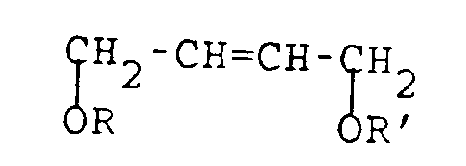
wherein R is C₁-C₂₀ alkyl or substituted alkyl, C₄-C₁₀ aromatic and heteroatom-substituted aromatic moieties, C₁-C₂₀ acyl, or
wherein Ar is a C₄-C₁₀ aromatic or heteroatom-substituted aromatic moiety; and R′ = R or H;
with the provision that neither R nor R′ contain any activated methylene or methine groups. As herein employed the term "activated methylene or methine group" refers to a methylene or methine (monosubstituted methylene) group interposed between two strongly electron withdrawing, groups:
where
R‴ can be hydrogen or any hydrocarbon group, including substituted hydrocarbon groups, and
W is a strongly electron withdrawing group, such as carbonyl, sulfonyl, nitrile, or nitro. If a dicarboxylic acid or carboxy substituted ester containing an active methylene or methine group is reacted with 3,4-epoxy-1-butene in the presence of a catalyst such as a complex of palladium within the range of two-four phosphine ligands, formation of the desired 1,4-dioxy substituted 2-butene reaction product is inhibited. Instead, reaction occurs by displacement of hydrogen from the methylene or methine group linking the strong electron withdrawing groups. This is illustrated by the teachings of the art cited above for the case in which the strongly electron withdrawing groups are carbonyl groups. Thus, propandioic (malonic) acid is specifically excluded from the contemplation of the invention. - Substituted derivatives contemplated include halogens, carbonyl, sulfonyl, nitrile, and nitro moieties. These are contemplated where their placement in the molecule does not produce an activated methylene or methine group.
- The invention process is accomplished by reacting the 3,4-epoxy-1-butene starting material with an oxygen nucleophile in the presence of a catalyst comprising a Pd(0) complex having two up to four phosphine ligands.
- The oxygen nucleophiles contemplated for use in the practice of the invention are alcohols, carboxylic acids, anhydrides, and substituted hydroxy, carboxy, or anhydride containing compounds.
- As employed herein the term oxygen nucleophile refers to an optionally substituted hydrocarbyl radical having at least one hydroxy moiety, e.g., alcohols, carboxylate moiety, e.g., carboxylic acids, or compounds capable of the in situ formation of carboxylate anions, e.g., anhydrides.
- The term "alcohol" indicates an optionally substituted hydrocarbon having one or more hydroxy substituents. Primary, secondary, and tertiary alcohols are contemplated, such as mono-alcohols as well as polyhydroxy variants-e.g., alkandiols, alkantriols, alkantetrols. Broadly, alcohols having up to about 20 carbon atoms are contemplated to be useful in the practice of the present invention. Preferred alkanols are those containing from about 1 up to 12 carbon atoms, with alkanols having 1 up to 6 carbon atoms being most preferred.
- Exemplary of preferred aliphatic alcohols are methanol, ethanol, 1-propanol, 2-propanol, 1-propen-2-ol, 1-butanol, 2-butanol, 2-methyl-2-propanol, 1-pentanol, 2-pentanol, 3-pentanol, 3-methyl-1-butanol, 1,2-ethandiol (ethylene glycol), 1,2,3-propantriol (glycerol), i-1,2,3,4-butantetrol (i-erythritol), and 2,2-dihydroxymethyl-1,3-propandiol (pentaerythritol).
- Aromatic alcohols contemplated to be useful in the practice of the present invention include those containing one or more aromatic rings having one or more hydroxy substituents or hydroxy-substituted hydrocarbyl substituents. Preferred aromatic alcohols are those containing one or more hydroxy substituted C₁-C₆ alkyl moieties as substituents of an aromatic nucleus containing from 6 to 10 carbon atoms -e.g., a phenyl or naphthyl nucleus. Viewed another way, exemplary aromatic alcohols can be variants of the aliphatic alcohols mentioned above, differing merely by the inclusion of one or more aromatic rings containing from 6 to 10 carbon atoms (e.g., phenyl or naphthyl rings) as substituents. Exemplary of aromatic alcohols are benzyl alcohol, 2-phenylethanol, cinnamyl alcohol, benzohydrol, and triphenylcarbinol.
- Phenolic alcohols are also contemplated for use in the practice of this invention. As herein defined the term "phenolic alcohol" refers to a hydroxy substituted carbocyclic aromatic ring. The carbocyclic aromatic ring preferably contains from 6 to 10 carbon atoms (e.g., phenyl or naphthyl). Exemplary of preferred phenolic alcohols are hydroxybenzene (phenol), 1,2-benzenediol (pyrocatechol), 1,3-benzenediol (resorcinol), 1,4-benzenediol (hydroquinone), 1,2,3,-benzenetriol (pyrogallol), 1,3,5-benzenetriol (phloroglucinol), 2-hydroxytoluene (o-cresol), 1-naphthol, and 2-naphthol.
- There are additional alcohols contemplated for use in the practice of the present invention which fit within more than one of the above categories, such as 1-hydroxy-2-(4-hydroxyphenyl)ethane (tyrosol), which is both an aromatic alcohol and a phenolic alcohol.
- The term "carboxylic acid" as herein employed indicates a hydrocarbon or substituted hydrocarbon which contains a carboxyl [-C(O)OH] group as a carbon atom substituent. Simple aliphatic monobasic carboxylic acids, such as alkanoic acids of from 1 to 20 carbon atoms are contemplated-e.g., methanoic (formic), ethanoic (acetic), propanoic (propionic), butanoic (butyric), and pentanoic (valeric) acids. Saturated aliphatic dibasic carboxylic acids, such as alkanedioic acids of up to 20 carbon atoms are also contemplated-e.g., ethanedioic (oxalic), butanedioic (succinic), pentanedioic (glutaric), and hexanedioic (adipic) acids. Unsaturated mono and dibasic carboxylic acids containing up to 20 carbon atoms are also contemplated-e.g., propenoic (acrylic), 2-methylpropenoic (methacrylic), trans-2-butenoic (crotonic), cis-2-butenoic (isocrotonic), and 3-butenoic (vinylacetic) acids.
- Aromatic carboxylic acids are also contemplated, such as those containing a 6 to 10 carbon atom (e.g., phenyl or naphthyl) aromatic nucleus substituted with at least one carboxylic acid moiety containing from 1 to about 10 carbon atoms. Exemplary of such aromatic carboxylic acids are benzoic, phenylethanoic (α-toluic), 3-phenylpropanoic (hydrocinammic), trans-3-phenylpropenoic (cinnamic), benzenehexacarboxylic (mellitic), 2-methylbenzoic (o-toluic), 3-methylbenzoic (m-toluic), 4-methylbenzoic (p-toluic), 1-naphthalenecarboxylic (α-naphthoic), and 2-naphthalenecarboxylic (β-naphthoic) acids. Specifically contemplated dibasic aromatic carboxylic acids are the phthalic acids 1,2-benzenedicarboxylic (phthalic), 1,3-benzenedicarboxylic (isophthalic), and 1,4-benzenedicarboxylic (terephthalic) acid.
- Anhydrides contemplated for use in the practice of the present invention include symmetrical and unsymmetrical anhydrides of the structure
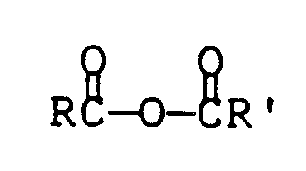
wherein each of R and R′ can independently have 1 to 20 carbon atoms and be alkyl, aromatic or heteroatom-substituted aromatic moieties, aralkyl and alkaryl. Exemplary anhydrides include acetic anhydride and phthalic anhydride. - Both the alcohols, carboxylic acids, and anhydrides contemplated in the practice of the present invention can contain other substituents that do not interfere with the described reaction, such as, for example, halogens, carbonyl, sulfonyl, nitrile, and nitro moieties are contemplated where their placement in the molecule does not produce an activated methylene or methine group. In addition, additional hydroxy, alkoxy, and aryloxy substituents can be present, if desired. Examples of such acids are β-hydroxyacetic (glycolic), citric, o-hydroxybenzoic (salicylic), m-hydroxybenzoic, p-hydroxybenzoic, p-methoxybenzoic (anisic), 3,4,5-trihydroxybenzoic (gallic), and 4-hydroxy-3,5-dimethoxybenzoic (syringic) acids.
- In addition to the substituted variations of carboxylic acids and alcohols described above, esters of these alcohols and carboxylic acids having at least one free hydroxy or carboxy [-C(O)OH] moiety or substituent are also contemplated for use in the practice of the present invention. Such esters can be viewed as the partial esters of any of the alcohols or carboxylic acids useful in the practice of this invention as described above, containing two or more hydroxy or carboxy groups. Partial esters of any alcohol satisfying the requirements of this invention with any dibasic carboxylic acid satisfying the requirements of this invention are particularly contemplated. Similarly, partial esters of any of the carboxylic acids satisfying the requirements of this invention with any dihydroxy alcohol satisfying the requirements of this invention are particularly contemplated. When a dihydroxy alcohol is esterified with a dibasic carboxylic acid, an ester can be created which contains either free carboxy groups or free hydroxy groups, merely by varying the ratio of acid to alcohol present during esterification.
- A wide range of hydroxy and/or carboxy substituted esters are useful in the practice of this invention. The following are exemplary of contemplated hydroxy or carboxy substituted esters: methyl glycolate, 2-hydroxyethyl acetate, glycerol diacetate, methyl hemioxalate, di(2-hydroxyethyl) succinate, and di(6-hydroxyhexyl) terephthalate.
- It is appreciated that the nucleophiles identified above can, if desired, be further substituted with any one or combination of groups that do not interfere with the formation of 1,4-disubstituted-2-butenes. For example, halogen (i.e., fluro, chloro, bromo, and iodo) substituents are specifically contemplated. In the extreme case one or all of the hydrogen atoms of the oxygen nucleophiles contemplated by the present invention can be replaced by halogens. Halogen substituted, particularly chloro and bromo substituted, aromatic hydrocarbon moieties are contemplated. Carbonyl, sulfonyl, nitrile, and nitro moieties are also contemplated so long as their placement in the molecule does not produce-an activated methine methylene moiety. Still other non-interfering substituents will be apparent to those skilled in the art having access to the teachings of this invention.
- The catalyst employed for the invention reaction is a Pd(0) complex having two up to four phosphine ligands. It is important to note that in such a complex the palladium is in its zero oxidation state. Those of skill in the art recognize that Pd(0) can be generated in a variety of ways, such as for example, by treatment of a bis(phosphino) palladium salt with hydrazine, carbon monoxide, a metal alkoxide, an aluminum alkyl, an alcohol or an amine. A particularly convenient way to prepare Pd(0) complexes is to generate them in situ by subjecting a palladium compound to the appropriate reaction conditions, e.g., reduction of (Ph₃P)₂PdCl₂ by one of the components of the reaction system, such as an alcohol or an olefinically unsaturated moiety.
- The presently preferred source of Pd(0) complex is a complex of palladium with four phosphine ligands. Each phosphine ligand provides a trisubstituted phosphorus atom coordinated with the palladium atom. preferably, at least two of the three substituents are phenyl moieties. The remaining substituent can be chosen from among a wide variety of hydrocarbons. Thus, in its most general form the preferred palladium (0) complex can be represented by the formula:
Pd(PPh₂R˝)₄
where each R˝ is independently a hydrocarbyl moiety, and can optionally be a substituted hydrocarbyl moiety, preferably with no more than one containing more than 6 carbon atoms because of the ready availability of such materials. - In a specifically preferred form, each R˝ is phenyl.
- In another preferred form, each R can be aliphatic hydrocarbons, such as alkyl or alkylene of from 1 to 6 carbon atoms. In one preferred form of the catalyst two phosphine ligands are joined through a linking moiety to produce a bidentate ligand, for example, by employing the alkylene moiety as represented by Formula II:

where
n is an integer of from 1 to 6. - In another preferred embodiment of the present invention, bidentate ligands of the general formulae
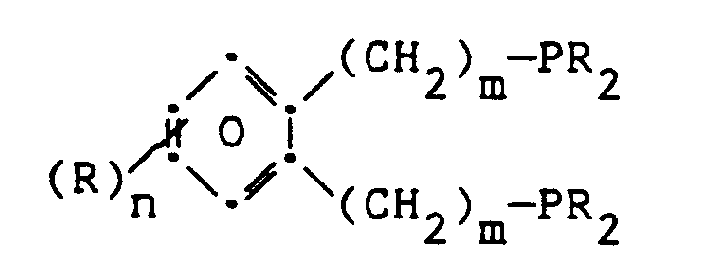
wherein n can vary from 0-4, and each m can vary from 1-3; and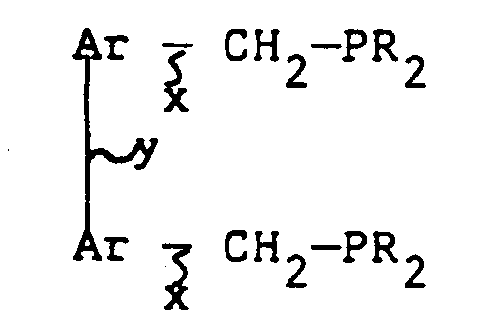
wherein the x bonds and the y bonds are on adjacent ring atoms of the aromatic moieties. - Those of skill in the art recognize that Pd(0) complexes can also be stabilized by other ligands, such as, for example olefins, phosphites and the like.
- In another preferred form, the palladium (0) complex is supported on a polymer substrate. That is, the palladium complex forms a pendant group of repeating units of a polymer. In this form, one substituent of at least one of the phosphine ligands is a repeating unit of a polymer. Coordination of the palladium complex to a polymer substrate offers the advantage of protecting the catalyst against loss in use. An example of a commercially available palladium complex supported on a polymer substrate is polymer supported tetrakistriphenylphosphinepalladium (0), Catalog #24815-0, available from Aldrich Chemical Co. Inc.
- When the oxygen nucleophile reactant is a liquid, it can be employed as a solvent for the 3,4-epoxy-1-butene reactant. In this instance only the catalyst and the two reactants are required.
- If desired, a separate solvent for the reactants can be employed. Any of a wide variety of common polar, aprotic liquid solvents can be selected, such as tetrahydrofuran, benzene, toluene, dimethylformamide, dimethylsulfoxide, chloroform, dichloromethane, acetonitrile, and acetone. Since water will itself react with 3,4-epoxy-1-butene in the presence of the palladium catalyst, it is preferred that the solvent employed for the reaction be relatively water-free.
- While the oxygen nucleophile can be incorporated in a solvent up to its solubility limit, it is generally most convenient to work with concentrations of from about 0.1 to 5 molar, preferably from about 0.5 to 2 molar. Since no separate solvent is required where the oxygen nucleophile is itself capable of acting as a solvent, it is apparent that higher concentrations are possible. Lower concentrations are also useful, but are normally avoided absent some specific advantage resulting from further dilution. It has been found that, in general, high concentrations of oxygen-nucleophile lead to enhanced selectivity to 1,4-addition products, while low concentrations of oxygen-nucleophile lead to exhanced selectivity to 1,2-addition products.
- The proportions of the reactants and the catalyst can be varied widely while obtaining the desired reaction products in high yield. Since the catalyst contains a precious metal, it is generally preferred to employ the catalyst in low concentrations. Catalyst concentrations as low as 0.01 mole percent, based on 3,4-epoxy-1-butene, are contemplated, with catalyst concentrations preferably being at least 0.05 mole percent, optimally at least 0.1 mole, based on 3,4-epoxy-1-butene, being preferred. The catalyst concentration is normally less than 5 mole percent, preferably less than 2 mole percent, based on 3,4-epoxy-1-butene.
- The mole ratio of the oxygen nucleophile to 3,4-epoxy-1-butene can be varied over wide ranges. Mole ratios of from 1:10 to 10:1, preferably 1:5 to 5:1, are contemplated. When it is desired to maximize the conversion of the 3,4-epoxy-1-butene, a stoichiometric excess of the remaining reactant or reactants should be present. Thus, an optimum ratio range is considered to be from 3:1 to 4:1 of the oxygen nucleophile to 3,4-epoxy-1-butene.
- The conversion of 3,4-epoxy-1-butene can be achieved at or below room temperature. It is, in fact, preferred to chill the oxygen nucleophile to a temperature in the range of -30 up to 20°C with a temperature in the range of -10 up to 0°C being most preferred prior to addition thereto of the 3,4-epoxy-1-butene to control heating during mixing. Mild heating to accelerate reactions can be undertaken.
- The following examples further illustrate the practice of the invention.
- Tetrakis(triphenylphosphine)palladium (0.5 g, 0.43 mmol) and 3.45 mL (3.0 g, 0.043 mol) of butadiene monoxide were dissolved in 20 mL of methanol. The reaction mixture was stirred 18 hours at room temperature, and then concentrated at reduced pressure. The concentrate was distilled at 40-55°C, 1 mm pressure, yielding 4.2 g (96%) of a colorless oil which consisted of a 3:1 ratio 1-hydroxy-4-methoxybut-2-ene (mixture of E and Z isomers) and 4-hydroxy-3 -methoxy-but-1-ene.
- ¹H NMR (CDCl₃) 4-hydroxy-3-methoxy-but-1-ene: 5.6 (m, 1H); 5.22 (m, 2H); 3.7 (m, 1H); 3.5 (m, 2H); 3.3 (s, 3H); 2.2 (br s, 1H); 1-hydroxy-4-methoxy-but-2-ene: 5.8 (m, 2H); 4.2 (m, 2H); 3.9 (d, J = 6 Hz, 2H); 3.3 (s, 3H); 2.2 (br s, 1H).
- Tetrakis(tripbenylphosphine)palladium (0.4 g, 0.35 mmol) was dissolved in 20 mL of n-butanol and the solution was cooled to 0°C. Butadiene monoxide (2.3 mL, 2.0 g, 0.028 mol) was then added dropwise and the solution was allowed to warm to room temperature. The reaction mixture was stirred at room temperature 18 hours, then fractionally distilled at reduced pressure yielding 4.0 g (90%) of a 4:1 mixture of 1-hydroxy-4-butoxy-but-2-ene:4-hydroxy-3-butoxy-but-1-ene (bp 75-120°C, 1 mm).
- 1H NMR (CDCl₃) 4-hydroxy-3-butoxy-but-2-ene: 5.65 (m, 1H); 5.25 (m, 2H); 3.8 (m, 2H); 3.5 (m, 3H); 3.3 (m, 1H); 2.3 (br s, 1H); 1.55 (m, 2H); 1.4 (m, 2H); 0.9 (t, J = 6Hz, 3H), 1-hydroxy-4-butoxy-but-2-ene: 5.85 (m, 2H); 4.2 (d, J = 8Hz, 2H); 4.0 (d, J = 8Hz, 2H); 3.45 (m, 2H); 2.2 (br s, 1H); 1.55 (m, 2H); 1.4 (m, 2H); 0.9 (t, J = 6Hz, 3H).
- Tetrakis(triphenylphosphine)palladium (1.0g, 0.86 mmol) was dissolved in 1L of ethanol and the reaction mixture was cooled to 0°C. Butadiene monoxide (160g, 2.28 mol) was then added dropwise. The solution was allowed to warm to room temperature, and was stirred 18 hours. Fractional distillation at reduced pressure yielded a 3:1 ratio of 1-hydroxy-4-ethoxy-but-1 [2]-ene:4-hydroxy-3-ethoxy-but-1-ene (161 g, 61%, bp 45-70°C; 1 mm).
- ¹H NMR (CDCl₃) 1-hydroxy-4-ethoxy-but-2-ene: 5.8 (m, 2H); 4.1 (d, J = 6Hz, 2H); 3.95 (d, J = 6Hz, 2H); 3.45 (q, J = 8Hz, 2H); 2.5 (br s, 1H); 1.2 (t, J = 8Hz, 3H), 4-hydroxy-3-ethoxy-but-1-ene: 5.7 (m, 1H; 5.2 (m, 2H); 3.65-3.3 (m, 5H); 2.5 (br s, 1H); 1.2 (t, J = 8Hz, 3H).
- Acetic acid (0.82 mL, 14.3 mmol) was added to a suspension of 0.4 g polymer tetrakis(tripbenylphosphine)palladium (0) (Aldrich Catalog #24815-0) in 20 mL of THF, followed by 1.15 mL (1.0 g, 14.3 mmol) butadiene monoxide. The mixture was stirred 36 hours at room temperature. The polymer bound catalyst was then removed by filtration and the filtrate was concentrated at reduced pressure. GLC analysis of the products indicated at 1:1 ratio of 1-acetoxy-4-hydroxy-but-2-ene: 3-acetoxy-4-hydroxy-but-1-ene. Distillation at reduced pressure gave 1.7g (91%) of this product mixture.
- 1H NMR (CDCl₃) 1-acetoxy-4-hydroxy-but-2-ene: 5.82 (m, 2H); 4.7 (d, J = 8Hz, 2H); 4.25 (d, J = 8Hz, 2H); 2.8 (br s, 1H); 2.05 (s, 3H), 3-acetoxy-4-hydroxy-but-1-ene: 5.82 (m, 1H); 5.35 (m, 3H); 3.75 (m, 2H); 2.4 (br s, 1H); 2.05 (s, 3H).
- Tetrakis(triphenylphosphine)palladium (0.4g, 0.35 mmol) and phenol were dissolved in 70 mL THF and the solution was cooled to 0°C. Butadiene monoxide (5.5 mL, 50 mmol) was then added, and the reaction was allowed to warm to room temperature. After 2 hours at room temperature, GLC analysis indicated that phenol was no longer present, and that two products were obtained in a 1:4 ratio (1-hydroxy-4-phenoxy-but-2-ene: 4-hydroxy-3-phenoxy-but-1-ene). The solvent and excess butadiene monoxide were removed at reduced pressure, and the residue was chromatographed on silica gel (ether:hexane; 1:1 eluant) giving pure samples of each product in a combined yield of 91%.
- ¹H NMR (CDCl₃ 4-hydroxy-3-phenoxy-but-1-ene: 7.6 (m, 2H; 7.2 (m, 3H); 6.1 (m, 1H); 5.6 (m, 2H); 5.0 (m, 1H); 4.05 (m, 2H); 2.6 (br s, 1H), 1-hydroxy-4-phenoxy-but-2-ene: 7.6 (m, 2H); 7.2 (m, 3H); 6.1 (m, 1H); 4.6 (m, 2H); 4.25 (m, 2H); 2.15 (br s, 1H).
- Terephthalic acid (2.4 g, 14.3 mmol) was suspended in 20 mL dimethylformamide, followed by Pd(PPh₃)₄ (0.4 g, 0.35 mmol) and butadiene monoxide (2.3 mL, 2.0 g, 28.6 mmol). The reaction mixture was stirred 48 hours at room temperature and then partitioned between 200 mL of aqueous brine and 200 mL of ethyl acetate. The organic layer was separated and washed three times with aqueous brine, then dried over anhydrous sodium sulfate and concentrated at reduced pressure.
¹H NMR of the resulting solid indicated that the major constituent of the product mixture was the desired di-[1-(4-hydroxy-2-butenyl)] terephthalate with lesser amounts of di-[2-(1-hydroxy-4-butenyl)] terephthalate and 1-(4-hydroxy-2-butenyl), 2-(1-hydroxy-4-butenyl) terephthalate. - Tetrakis(triphenylphosphine) palladium (1.8 g, 0.5 mmol) was dissolved in 50 mL TMF, followed by acetic anhydride (4.05 mL, 14.3 mmol) and butadiene monoepoxide (3.45 mL, 14.3 mmol). The butadiene epoxide was converted to a mixture of 1,4-diacetoxy-but-2-ene and 3,4-diacetoxy-but-1-ene in quantitative yield in 2h at rt. The products were found to equilibrate under the reaction conditions, eventually yielding a 75:25 ratio, favoring the 1,4-isomer (determined by glc). The solvent was removed under reduced pressure and the resulting oil was distilled at -0.8 mm Hg pressure providing 7.0 g (95%) of a mixture of diacetoxybutenes.
- ¹H NMR (CDCl₃) 1,4-Diacetoxy-but-2-ene, 4:1 mixture of E:Z isomers, E: 5.9(t,J=8Hz,2H); 4.6(d,J=8Hz,2H); 2.05(s,3H); Z: 5.78(t,J=8Hz,2H); 4.7(d,J=8Hz,2H); 2.05(s,3H). 3,4-Diacetoxy-but-1-ene: 5.8(m,1H); 5.5(m,1H); 5.3(m,2H); 4.08(m,2H); 2.04(s,3H); 2.02(s,3H).
Claims (12)
- A process for the preparation of compounds of the structure:
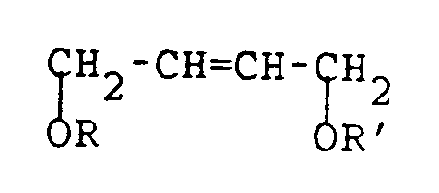
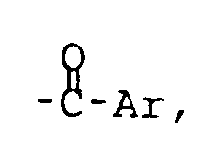
with the proviso that neither R nor R′ contain any activated methylene or methine groups; wherein the term "activated methylene or methine group" refers to a methylene or methine (monosubstituted methylene) group interposed between two strongly electron withdrawing groups: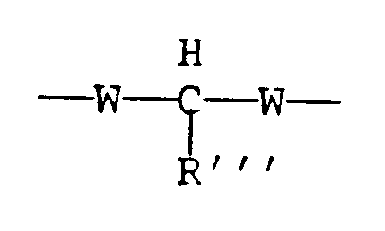
R‴ can be hydrogen or any hydrocarbon group, including substituted hydrocarbon groups, and
W is a strongly electron withdrawing group, such as carbonyl, sulfonyl, nitrile, or nitro,
characterised by reacting 3,4-epoxy-1-butene with an oxygen nucleophile in the presence of a catalyst to produce a 1,4-dioxy substituted 2-butene, where one or both of the oxy substituents is an oxy residue of the oxygen nucleophile; wherein said oxygen nucleophile lacks an activated methylene or methine group and is selected from alcohols, carboxylic acids, anhydrides, substituted hydroxy-containing compounds, substituted carboxy-containing compounds or substituted anhydride-containing compounds; wherein said catalyst comprises a Pd(O) complex having two up to four phosphine ligands; wherein said reaction is carried out at a temperature in the range of -30 up to 20°C; wherein the catalyst concentration falls in the range of 0.01 up to less than 5 mole percent, based on 3,4-epoxy-1-butene; and wherein the mole ratio of oxygen nucleophile to 3,4-epoxy-1-butene falls within the range of 1:10 up to 10:1. - A process in accordance with Claim 1 wherein said oxygen nucleophile is an alcohol.
- A process in accordance with Claim 2 wherein said alcohol is an alkanol containing from 1 to 20 carbon atoms.
- A process in accordance with Claim 2 wherein said alcohol is a phenolic alcohol.
- A process in accordance with Claim 4 wherein said alcohol is phenol.
- A process in accordance with Claim 1 wherein said oxygen nucleophile is a carboxylic acid.
- A process in accordance with Claim 6 wherein said carboxylic acid is an alkanoic acid containing from 1 to 20 carbon atoms.
- A process in accordance with Claim 7 wherein said alkanoic acid is acetic acid.
- A process in accordance with Claim 6 wherein said carboxylic acid is a dicarboxylic acid.
- A process in accordance with Claim 9 wherein said dicarboxylic acid is phthalic acid or'terephthalic acid.
- A process in accordance with Claim 1 wherein said oxygen nucleophile is an anhydride.
- A process in accordance with Claim 11 wherein said anhydride is acetic anhydride or phthalic anhydride.
Priority Applications (1)
| Application Number | Priority Date | Filing Date | Title |
|---|---|---|---|
| AT88909250T ATE86962T1 (en) | 1987-09-28 | 1988-09-22 | PROCESS FOR THE PREPARATION OF 1,4-DISUBSTITUTED-2-BUTENES. |
Applications Claiming Priority (4)
| Application Number | Priority Date | Filing Date | Title |
|---|---|---|---|
| US10188587A | 1987-09-28 | 1987-09-28 | |
| US101885 | 1987-09-28 | ||
| US23988488A | 1988-09-02 | 1988-09-02 | |
| US239884 | 1988-09-02 |
Publications (2)
| Publication Number | Publication Date |
|---|---|
| EP0380578A1 EP0380578A1 (en) | 1990-08-08 |
| EP0380578B1 true EP0380578B1 (en) | 1993-03-17 |
Family
ID=26798755
Family Applications (1)
| Application Number | Title | Priority Date | Filing Date |
|---|---|---|---|
| EP88909250A Expired - Lifetime EP0380578B1 (en) | 1987-09-28 | 1988-09-22 | A process for the preparation of 1,4-disubstituted 2-butenes |
Country Status (5)
| Country | Link |
|---|---|
| EP (1) | EP0380578B1 (en) |
| JP (1) | JP2774122B2 (en) |
| AT (1) | ATE86962T1 (en) |
| DE (1) | DE3879502T2 (en) |
| WO (1) | WO1989002883A1 (en) |
Families Citing this family (4)
| Publication number | Priority date | Publication date | Assignee | Title |
|---|---|---|---|---|
| US5393867A (en) * | 1994-01-18 | 1995-02-28 | Eastman Chemical Company | Polyether polymers derived from 3,4-epxoy-1-butene |
| IT1283232B1 (en) * | 1996-03-12 | 1998-04-16 | Enichem Spa | PROCEDURE FOR THE SYNTHESIS OF 2-BUTEN-1, 4-DIESTERI |
| EP1044955A1 (en) * | 1998-10-23 | 2000-10-18 | DAICEL CHEMICAL INDUSTRIES, Ltd. | Processes for the preparation of organic diesters |
| US6541657B2 (en) | 2000-03-24 | 2003-04-01 | Nippon Shokubai Co., Ltd | Unsaturated carboxylate and its production process and use |
Family Cites Families (4)
| Publication number | Priority date | Publication date | Assignee | Title |
|---|---|---|---|---|
| JPS5479214A (en) * | 1977-12-05 | 1979-06-25 | Asahi Chem Ind Co Ltd | Preparation of derivative of 2-butene-1,4-diol |
| JPS5711931A (en) * | 1980-06-25 | 1982-01-21 | Sumitomo Chem Co Ltd | Production of allyl alcohol |
| DE3137804A1 (en) * | 1981-09-23 | 1983-03-31 | Basf Ag, 6700 Ludwigshafen | METHOD FOR PRODUCING 3-ALKYL-3-ACYLOXY-4-HYDROXY-1-BUTENEN |
| DE3573598D1 (en) * | 1984-11-21 | 1989-11-16 | Hoffmann La Roche | Process for the preparation of hydrochinone derivatives |
-
1988
- 1988-09-22 EP EP88909250A patent/EP0380578B1/en not_active Expired - Lifetime
- 1988-09-22 AT AT88909250T patent/ATE86962T1/en not_active IP Right Cessation
- 1988-09-22 DE DE88909250T patent/DE3879502T2/en not_active Expired - Fee Related
- 1988-09-22 JP JP63508498A patent/JP2774122B2/en not_active Expired - Lifetime
- 1988-09-22 WO PCT/US1988/003265 patent/WO1989002883A1/en not_active Ceased
Non-Patent Citations (1)
| Title |
|---|
| CHEMICAL ABSTRACTS, vol. 83, no. 21, 24 November 1975, Columbus, Ohio, US, page 512, abstract 178359a, & JP-A-7584514 * |
Also Published As
| Publication number | Publication date |
|---|---|
| ATE86962T1 (en) | 1993-04-15 |
| EP0380578A1 (en) | 1990-08-08 |
| DE3879502T2 (en) | 1993-10-07 |
| DE3879502D1 (en) | 1993-04-22 |
| WO1989002883A1 (en) | 1989-04-06 |
| JP2774122B2 (en) | 1998-07-09 |
| JPH03500292A (en) | 1991-01-24 |
Similar Documents
| Publication | Publication Date | Title |
|---|---|---|
| JP7642325B2 (en) | Method for producing carboxylic acid or its salt from hydrocarbon | |
| EP0028422B1 (en) | Process for preparing alcohols from carboxylic acids and process for preparing carboxylic acids | |
| Sato et al. | Hydrogen peroxide oxidation of benzylic alcohols to benzaldehydes and benzoic acids under halide-free conditions | |
| US3769329A (en) | Production of carboxylic acids and esters | |
| JP2614442B2 (en) | Method for carbonylation of olefinically unsaturated compounds with palladium catalyst | |
| US5625094A (en) | Rhodium/iridium catalyzed synthesis of carboxylic acids or esters thereof | |
| WO2009077719A1 (en) | Process for the conversion of hydrocarbons to ethanol | |
| CA2759662A1 (en) | Vinyl ester production from acetylene and carboxylic utilizing homogeneous catalyst | |
| US4060547A (en) | Production of dicarboxylic acids | |
| US5189199A (en) | Process for the preparation of 1,4-disubstituted 2-butenes | |
| US4067900A (en) | Hydrogenolysis of alcohols, ketones, aldehydes, esters and ethers | |
| EP0380578B1 (en) | A process for the preparation of 1,4-disubstituted 2-butenes | |
| EP0433424B1 (en) | Improved asymmetric catalytic hydrogenation of alpha-arylpropenoic acids | |
| CN104781224A (en) | Novel alicyclic-type diol compound, and method for producing same | |
| JPH09502459A (en) | Method for producing (+)-(1R) -cis-3-oxo-2-pentyl-1-cyclopentaneacetic acid | |
| JP2640362B2 (en) | Preparation of carboxylic acid esters | |
| US4533773A (en) | Process for hydroxylating olefins in the presence of an osmium oxide catalyst and carboxylate salt co-catalyst | |
| JPH0627094B2 (en) | Method for producing carboxylic acid diester or carboxylic acid | |
| Cavinato et al. | Levulinic acid synthesis via regiospecific carbonylation of methyl vinyl ketone ob of its reaction products with hydrochloric ach) or an alkanol or of a mixture of acetone with a formaldehyde precursor catalyzed by a highly active Pd-HCl system | |
| EP0098701A1 (en) | Process for hydroxylating olefins in the presence of an osmium oxide catalyst and carboxylate salt co-catalyst | |
| KR100403417B1 (en) | Process for Preparing Malonate Derivatives or β-ketoester | |
| JPH0213654B2 (en) | ||
| JP3235980B2 (en) | Polymerization prevention method for producing unsaturated carboxylic acid ester | |
| US6380426B1 (en) | Process for the preparation of a carboxylic acid | |
| JP2013006774A (en) | Method for producing aromatic polyhydric alcohol |
Legal Events
| Date | Code | Title | Description |
|---|---|---|---|
| PUAI | Public reference made under article 153(3) epc to a published international application that has entered the european phase |
Free format text: ORIGINAL CODE: 0009012 |
|
| 17P | Request for examination filed |
Effective date: 19900225 |
|
| AK | Designated contracting states |
Kind code of ref document: A1 Designated state(s): AT BE CH DE FR GB IT LI LU NL SE |
|
| 17Q | First examination report despatched |
Effective date: 19920219 |
|
| GRAA | (expected) grant |
Free format text: ORIGINAL CODE: 0009210 |
|
| AK | Designated contracting states |
Kind code of ref document: B1 Designated state(s): AT BE CH DE FR GB IT LI LU NL SE |
|
| REF | Corresponds to: |
Ref document number: 86962 Country of ref document: AT Date of ref document: 19930415 Kind code of ref document: T |
|
| REF | Corresponds to: |
Ref document number: 3879502 Country of ref document: DE Date of ref document: 19930422 |
|
| ITF | It: translation for a ep patent filed | ||
| ET | Fr: translation filed | ||
| PGFP | Annual fee paid to national office [announced via postgrant information from national office to epo] |
Ref country code: AT Payment date: 19930915 Year of fee payment: 6 |
|
| PGFP | Annual fee paid to national office [announced via postgrant information from national office to epo] |
Ref country code: LU Payment date: 19930922 Year of fee payment: 6 |
|
| PGFP | Annual fee paid to national office [announced via postgrant information from national office to epo] |
Ref country code: BE Payment date: 19930928 Year of fee payment: 6 |
|
| PGFP | Annual fee paid to national office [announced via postgrant information from national office to epo] |
Ref country code: CH Payment date: 19930929 Year of fee payment: 6 |
|
| PGFP | Annual fee paid to national office [announced via postgrant information from national office to epo] |
Ref country code: FR Payment date: 19931012 Year of fee payment: 6 |
|
| EPTA | Lu: last paid annual fee | ||
| PLBE | No opposition filed within time limit |
Free format text: ORIGINAL CODE: 0009261 |
|
| STAA | Information on the status of an ep patent application or granted ep patent |
Free format text: STATUS: NO OPPOSITION FILED WITHIN TIME LIMIT |
|
| 26N | No opposition filed | ||
| PG25 | Lapsed in a contracting state [announced via postgrant information from national office to epo] |
Ref country code: LU Free format text: LAPSE BECAUSE OF NON-PAYMENT OF DUE FEES Effective date: 19940922 Ref country code: AT Effective date: 19940922 |
|
| PG25 | Lapsed in a contracting state [announced via postgrant information from national office to epo] |
Ref country code: LI Effective date: 19940930 Ref country code: CH Effective date: 19940930 Ref country code: BE Effective date: 19940930 |
|
| REG | Reference to a national code |
Ref country code: CH Ref legal event code: PUE Owner name: EASTMAN CHEMICAL COMPANY |
|
| EAL | Se: european patent in force in sweden |
Ref document number: 88909250.8 |
|
| REG | Reference to a national code |
Ref country code: FR Ref legal event code: TP |
|
| BERE | Be: lapsed |
Owner name: EASTMAN CHEMICAL CY Effective date: 19940930 |
|
| PG25 | Lapsed in a contracting state [announced via postgrant information from national office to epo] |
Ref country code: FR Effective date: 19950531 |
|
| REG | Reference to a national code |
Ref country code: CH Ref legal event code: PL |
|
| NLS | Nl: assignments of ep-patents |
Owner name: EASTMAN CHEMICAL COMPANY TE KINGSPORT, TENNESSEE, |
|
| REG | Reference to a national code |
Ref country code: FR Ref legal event code: ST |
|
| PGFP | Annual fee paid to national office [announced via postgrant information from national office to epo] |
Ref country code: SE Payment date: 19950808 Year of fee payment: 8 |
|
| REG | Reference to a national code |
Ref country code: GB Ref legal event code: 732E |
|
| PG25 | Lapsed in a contracting state [announced via postgrant information from national office to epo] |
Ref country code: SE Effective date: 19960923 |
|
| EUG | Se: european patent has lapsed |
Ref document number: 88909250.8 |
|
| PGFP | Annual fee paid to national office [announced via postgrant information from national office to epo] |
Ref country code: NL Payment date: 19980623 Year of fee payment: 11 |
|
| PG25 | Lapsed in a contracting state [announced via postgrant information from national office to epo] |
Ref country code: NL Free format text: LAPSE BECAUSE OF NON-PAYMENT OF DUE FEES Effective date: 20000401 |
|
| NLV4 | Nl: lapsed or anulled due to non-payment of the annual fee |
Effective date: 20000401 |
|
| PGFP | Annual fee paid to national office [announced via postgrant information from national office to epo] |
Ref country code: GB Payment date: 20010807 Year of fee payment: 14 |
|
| PGFP | Annual fee paid to national office [announced via postgrant information from national office to epo] |
Ref country code: DE Payment date: 20010927 Year of fee payment: 14 |
|
| REG | Reference to a national code |
Ref country code: GB Ref legal event code: IF02 |
|
| PG25 | Lapsed in a contracting state [announced via postgrant information from national office to epo] |
Ref country code: GB Free format text: LAPSE BECAUSE OF NON-PAYMENT OF DUE FEES Effective date: 20020922 |
|
| PG25 | Lapsed in a contracting state [announced via postgrant information from national office to epo] |
Ref country code: DE Free format text: LAPSE BECAUSE OF NON-PAYMENT OF DUE FEES Effective date: 20030401 |
|
| GBPC | Gb: european patent ceased through non-payment of renewal fee |
Effective date: 20020922 |
|
| PG25 | Lapsed in a contracting state [announced via postgrant information from national office to epo] |
Ref country code: IT Free format text: LAPSE BECAUSE OF NON-PAYMENT OF DUE FEES;WARNING: LAPSES OF ITALIAN PATENTS WITH EFFECTIVE DATE BEFORE 2007 MAY HAVE OCCURRED AT ANY TIME BEFORE 2007. THE CORRECT EFFECTIVE DATE MAY BE DIFFERENT FROM THE ONE RECORDED. Effective date: 20050922 |