EP0365947A1 - Novel dosage form - Google Patents
Novel dosage form Download PDFInfo
- Publication number
- EP0365947A1 EP0365947A1 EP89119102A EP89119102A EP0365947A1 EP 0365947 A1 EP0365947 A1 EP 0365947A1 EP 89119102 A EP89119102 A EP 89119102A EP 89119102 A EP89119102 A EP 89119102A EP 0365947 A1 EP0365947 A1 EP 0365947A1
- Authority
- EP
- European Patent Office
- Prior art keywords
- polymer
- weight
- coating
- cores
- pore
- Prior art date
- Legal status (The legal status is an assumption and is not a legal conclusion. Google has not performed a legal analysis and makes no representation as to the accuracy of the status listed.)
- Granted
Links
- 239000002552 dosage form Substances 0.000 title description 6
- 238000000576 coating method Methods 0.000 claims abstract description 64
- 239000011248 coating agent Substances 0.000 claims abstract description 55
- 239000000203 mixture Substances 0.000 claims abstract description 40
- 239000013543 active substance Substances 0.000 claims abstract description 32
- 238000009472 formulation Methods 0.000 claims abstract description 32
- 229920000642 polymer Polymers 0.000 claims abstract description 28
- 239000000126 substance Substances 0.000 claims abstract description 21
- 238000013270 controlled release Methods 0.000 claims abstract description 20
- 238000009792 diffusion process Methods 0.000 claims abstract description 17
- 238000000034 method Methods 0.000 claims abstract description 15
- 239000012530 fluid Substances 0.000 claims abstract description 14
- XLYOFNOQVPJJNP-UHFFFAOYSA-N water Substances O XLYOFNOQVPJJNP-UHFFFAOYSA-N 0.000 claims abstract description 13
- 230000002496 gastric effect Effects 0.000 claims abstract description 7
- 239000000725 suspension Substances 0.000 claims description 14
- 229920001688 coating polymer Polymers 0.000 claims description 10
- IMROMDMJAWUWLK-UHFFFAOYSA-N Ethenol Chemical compound OC=C IMROMDMJAWUWLK-UHFFFAOYSA-N 0.000 claims description 9
- XTXRWKRVRITETP-UHFFFAOYSA-N Vinyl acetate Chemical compound CC(=O)OC=C XTXRWKRVRITETP-UHFFFAOYSA-N 0.000 claims description 9
- BZHJMEDXRYGGRV-UHFFFAOYSA-N Vinyl chloride Chemical compound ClC=C BZHJMEDXRYGGRV-UHFFFAOYSA-N 0.000 claims description 9
- 239000008188 pellet Substances 0.000 claims description 9
- 239000002904 solvent Substances 0.000 claims description 9
- 239000013078 crystal Substances 0.000 claims description 7
- 150000003839 salts Chemical class 0.000 claims description 5
- 229920001897 terpolymer Polymers 0.000 claims description 5
- 235000000346 sugar Nutrition 0.000 claims description 4
- 239000001913 cellulose Substances 0.000 claims description 3
- 229920002678 cellulose Polymers 0.000 claims description 3
- 230000000144 pharmacologic effect Effects 0.000 claims description 3
- 150000008163 sugars Chemical class 0.000 claims description 3
- 229920002554 vinyl polymer Polymers 0.000 claims description 3
- NIXOWILDQLNWCW-UHFFFAOYSA-N acrylic acid group Chemical group C(C=C)(=O)O NIXOWILDQLNWCW-UHFFFAOYSA-N 0.000 claims description 2
- 238000001035 drying Methods 0.000 claims description 2
- 230000002209 hydrophobic effect Effects 0.000 claims description 2
- 238000002156 mixing Methods 0.000 claims description 2
- 229920000058 polyacrylate Polymers 0.000 claims 1
- 230000000063 preceeding effect Effects 0.000 claims 1
- ZFXYFBGIUFBOJW-UHFFFAOYSA-N theophylline Chemical compound O=C1N(C)C(=O)N(C)C2=C1NC=N2 ZFXYFBGIUFBOJW-UHFFFAOYSA-N 0.000 description 18
- 239000002245 particle Substances 0.000 description 14
- 238000004090 dissolution Methods 0.000 description 13
- CSCPPACGZOOCGX-UHFFFAOYSA-N Acetone Chemical compound CC(C)=O CSCPPACGZOOCGX-UHFFFAOYSA-N 0.000 description 12
- YMWUJEATGCHHMB-UHFFFAOYSA-N Dichloromethane Chemical compound ClCCl YMWUJEATGCHHMB-UHFFFAOYSA-N 0.000 description 10
- UIIMBOGNXHQVGW-UHFFFAOYSA-M Sodium bicarbonate Chemical compound [Na+].OC([O-])=O UIIMBOGNXHQVGW-UHFFFAOYSA-M 0.000 description 10
- 229960000278 theophylline Drugs 0.000 description 9
- 239000000463 material Substances 0.000 description 8
- ZWEHNKRNPOVVGH-UHFFFAOYSA-N 2-Butanone Chemical compound CCC(C)=O ZWEHNKRNPOVVGH-UHFFFAOYSA-N 0.000 description 6
- 230000001419 dependent effect Effects 0.000 description 6
- 235000017557 sodium bicarbonate Nutrition 0.000 description 5
- 229910000030 sodium bicarbonate Inorganic materials 0.000 description 5
- 229940117958 vinyl acetate Drugs 0.000 description 5
- FEDJGPQLLNQAIY-UHFFFAOYSA-N 2-[(6-oxo-1h-pyridazin-3-yl)oxy]acetic acid Chemical compound OC(=O)COC=1C=CC(=O)NN=1 FEDJGPQLLNQAIY-UHFFFAOYSA-N 0.000 description 4
- QZCLKYGREBVARF-UHFFFAOYSA-N Acetyl tributyl citrate Chemical compound CCCCOC(=O)CC(C(=O)OCCCC)(OC(C)=O)CC(=O)OCCCC QZCLKYGREBVARF-UHFFFAOYSA-N 0.000 description 4
- LFQSCWFLJHTTHZ-UHFFFAOYSA-N Ethanol Chemical compound CCO LFQSCWFLJHTTHZ-UHFFFAOYSA-N 0.000 description 4
- 239000004359 castor oil Substances 0.000 description 4
- 235000019438 castor oil Nutrition 0.000 description 4
- 229960005316 diltiazem hydrochloride Drugs 0.000 description 4
- 230000037406 food intake Effects 0.000 description 4
- ZEMPKEQAKRGZGQ-XOQCFJPHSA-N glycerol triricinoleate Natural products CCCCCC[C@@H](O)CC=CCCCCCCCC(=O)OC[C@@H](COC(=O)CCCCCCCC=CC[C@@H](O)CCCCCC)OC(=O)CCCCCCCC=CC[C@H](O)CCCCCC ZEMPKEQAKRGZGQ-XOQCFJPHSA-N 0.000 description 4
- 239000012528 membrane Substances 0.000 description 4
- 230000036470 plasma concentration Effects 0.000 description 4
- 229920000136 polysorbate Polymers 0.000 description 4
- 229930006000 Sucrose Natural products 0.000 description 3
- CZMRCDWAGMRECN-UGDNZRGBSA-N Sucrose Chemical compound O[C@H]1[C@H](O)[C@@H](CO)O[C@@]1(CO)O[C@@H]1[C@H](O)[C@@H](O)[C@H](O)[C@@H](CO)O1 CZMRCDWAGMRECN-UGDNZRGBSA-N 0.000 description 3
- -1 antiarrythmics Substances 0.000 description 3
- KRKNYBCHXYNGOX-UHFFFAOYSA-N citric acid Chemical compound OC(=O)CC(O)(C(O)=O)CC(O)=O KRKNYBCHXYNGOX-UHFFFAOYSA-N 0.000 description 3
- 238000004040 coloring Methods 0.000 description 3
- 235000013681 dietary sucrose Nutrition 0.000 description 3
- 229940079593 drug Drugs 0.000 description 3
- 239000003814 drug Substances 0.000 description 3
- 230000003628 erosive effect Effects 0.000 description 3
- RLANKEDHRWMNRO-UHFFFAOYSA-M oxtriphylline Chemical compound C[N+](C)(C)CCO.O=C1N(C)C(=O)N(C)C2=C1[N-]C=N2 RLANKEDHRWMNRO-UHFFFAOYSA-M 0.000 description 3
- 239000004014 plasticizer Substances 0.000 description 3
- 238000005507 spraying Methods 0.000 description 3
- 210000002784 stomach Anatomy 0.000 description 3
- 229960004793 sucrose Drugs 0.000 description 3
- 108091006146 Channels Proteins 0.000 description 2
- 102000004190 Enzymes Human genes 0.000 description 2
- 108090000790 Enzymes Proteins 0.000 description 2
- WCUXLLCKKVVCTQ-UHFFFAOYSA-M Potassium chloride Chemical compound [Cl-].[K+] WCUXLLCKKVVCTQ-UHFFFAOYSA-M 0.000 description 2
- FAPWRFPIFSIZLT-UHFFFAOYSA-M Sodium chloride Chemical compound [Na+].[Cl-] FAPWRFPIFSIZLT-UHFFFAOYSA-M 0.000 description 2
- GWEVSGVZZGPLCZ-UHFFFAOYSA-N Titan oxide Chemical compound O=[Ti]=O GWEVSGVZZGPLCZ-UHFFFAOYSA-N 0.000 description 2
- 239000002253 acid Substances 0.000 description 2
- 230000001070 adhesive effect Effects 0.000 description 2
- 150000003863 ammonium salts Chemical class 0.000 description 2
- 229960003821 choline theophyllinate Drugs 0.000 description 2
- 238000009506 drug dissolution testing Methods 0.000 description 2
- 210000001035 gastrointestinal tract Anatomy 0.000 description 2
- 239000007903 gelatin capsule Substances 0.000 description 2
- CGIGDMFJXJATDK-UHFFFAOYSA-N indomethacin Chemical compound CC1=C(CC(O)=O)C2=CC(OC)=CC=C2N1C(=O)C1=CC=C(Cl)C=C1 CGIGDMFJXJATDK-UHFFFAOYSA-N 0.000 description 2
- 238000004519 manufacturing process Methods 0.000 description 2
- BQJCRHHNABKAKU-KBQPJGBKSA-N morphine Chemical compound O([C@H]1[C@H](C=C[C@H]23)O)C4=C5[C@@]12CCN(C)[C@@H]3CC5=CC=C4O BQJCRHHNABKAKU-KBQPJGBKSA-N 0.000 description 2
- 230000003204 osmotic effect Effects 0.000 description 2
- 239000011148 porous material Substances 0.000 description 2
- AQHHHDLHHXJYJD-UHFFFAOYSA-N propranolol Chemical compound C1=CC=C2C(OCC(O)CNC(C)C)=CC=CC2=C1 AQHHHDLHHXJYJD-UHFFFAOYSA-N 0.000 description 2
- 239000000243 solution Substances 0.000 description 2
- KDYFGRWQOYBRFD-UHFFFAOYSA-N succinic acid Chemical compound OC(=O)CCC(O)=O KDYFGRWQOYBRFD-UHFFFAOYSA-N 0.000 description 2
- 230000008961 swelling Effects 0.000 description 2
- URAYPUMNDPQOKB-UHFFFAOYSA-N triacetin Chemical compound CC(=O)OCC(OC(C)=O)COC(C)=O URAYPUMNDPQOKB-UHFFFAOYSA-N 0.000 description 2
- XWTYSIMOBUGWOL-UHFFFAOYSA-N (+-)-Terbutaline Chemical compound CC(C)(C)NCC(O)C1=CC(O)=CC(O)=C1 XWTYSIMOBUGWOL-UHFFFAOYSA-N 0.000 description 1
- AKNNEGZIBPJZJG-MSOLQXFVSA-N (-)-noscapine Chemical compound CN1CCC2=CC=3OCOC=3C(OC)=C2[C@@H]1[C@@H]1C2=CC=C(OC)C(OC)=C2C(=O)O1 AKNNEGZIBPJZJG-MSOLQXFVSA-N 0.000 description 1
- SGTNSNPWRIOYBX-UHFFFAOYSA-N 2-(3,4-dimethoxyphenyl)-5-{[2-(3,4-dimethoxyphenyl)ethyl](methyl)amino}-2-(propan-2-yl)pentanenitrile Chemical compound C1=C(OC)C(OC)=CC=C1CCN(C)CCCC(C#N)(C(C)C)C1=CC=C(OC)C(OC)=C1 SGTNSNPWRIOYBX-UHFFFAOYSA-N 0.000 description 1
- RZVAJINKPMORJF-UHFFFAOYSA-N Acetaminophen Chemical compound CC(=O)NC1=CC=C(O)C=C1 RZVAJINKPMORJF-UHFFFAOYSA-N 0.000 description 1
- 239000004381 Choline salt Substances 0.000 description 1
- GJSURZIOUXUGAL-UHFFFAOYSA-N Clonidine Chemical compound ClC1=CC=CC(Cl)=C1NC1=NCCN1 GJSURZIOUXUGAL-UHFFFAOYSA-N 0.000 description 1
- FEWJPZIEWOKRBE-JCYAYHJZSA-N Dextrotartaric acid Chemical compound OC(=O)[C@H](O)[C@@H](O)C(O)=O FEWJPZIEWOKRBE-JCYAYHJZSA-N 0.000 description 1
- LTMHDMANZUZIPE-AMTYYWEZSA-N Digoxin Natural products O([C@H]1[C@H](C)O[C@H](O[C@@H]2C[C@@H]3[C@@](C)([C@@H]4[C@H]([C@]5(O)[C@](C)([C@H](O)C4)[C@H](C4=CC(=O)OC4)CC5)CC3)CC2)C[C@@H]1O)[C@H]1O[C@H](C)[C@@H](O[C@H]2O[C@@H](C)[C@H](O)[C@@H](O)C2)[C@@H](O)C1 LTMHDMANZUZIPE-AMTYYWEZSA-N 0.000 description 1
- 229940123907 Disease modifying antirheumatic drug Drugs 0.000 description 1
- XIQVNETUBQGFHX-UHFFFAOYSA-N Ditropan Chemical compound C=1C=CC=CC=1C(O)(C(=O)OCC#CCN(CC)CC)C1CCCCC1 XIQVNETUBQGFHX-UHFFFAOYSA-N 0.000 description 1
- 229920002683 Glycosaminoglycan Polymers 0.000 description 1
- HEFNNWSXXWATRW-UHFFFAOYSA-N Ibuprofen Chemical compound CC(C)CC1=CC=C(C(C)C(O)=O)C=C1 HEFNNWSXXWATRW-UHFFFAOYSA-N 0.000 description 1
- MKXZASYAUGDDCJ-SZMVWBNQSA-N LSM-2525 Chemical compound C1CCC[C@H]2[C@@]3([H])N(C)CC[C@]21C1=CC(OC)=CC=C1C3 MKXZASYAUGDDCJ-SZMVWBNQSA-N 0.000 description 1
- NNJVILVZKWQKPM-UHFFFAOYSA-N Lidocaine Chemical compound CCN(CC)CC(=O)NC1=C(C)C=CC=C1C NNJVILVZKWQKPM-UHFFFAOYSA-N 0.000 description 1
- 241001465754 Metazoa Species 0.000 description 1
- SNIOPGDIGTZGOP-UHFFFAOYSA-N Nitroglycerin Chemical compound [O-][N+](=O)OCC(O[N+]([O-])=O)CO[N+]([O-])=O SNIOPGDIGTZGOP-UHFFFAOYSA-N 0.000 description 1
- 239000002202 Polyethylene glycol Substances 0.000 description 1
- UIIMBOGNXHQVGW-DEQYMQKBSA-M Sodium bicarbonate-14C Chemical compound [Na+].O[14C]([O-])=O UIIMBOGNXHQVGW-DEQYMQKBSA-M 0.000 description 1
- FEWJPZIEWOKRBE-UHFFFAOYSA-N Tartaric acid Natural products [H+].[H+].[O-]C(=O)C(O)C(O)C([O-])=O FEWJPZIEWOKRBE-UHFFFAOYSA-N 0.000 description 1
- 239000007983 Tris buffer Substances 0.000 description 1
- 125000000218 acetic acid group Chemical group C(C)(=O)* 0.000 description 1
- NDAUXUAQIAJITI-UHFFFAOYSA-N albuterol Chemical compound CC(C)(C)NCC(O)C1=CC=C(O)C(CO)=C1 NDAUXUAQIAJITI-UHFFFAOYSA-N 0.000 description 1
- 239000003513 alkali Substances 0.000 description 1
- AKNNEGZIBPJZJG-UHFFFAOYSA-N alpha-noscapine Natural products CN1CCC2=CC=3OCOC=3C(OC)=C2C1C1C2=CC=C(OC)C(OC)=C2C(=O)O1 AKNNEGZIBPJZJG-UHFFFAOYSA-N 0.000 description 1
- 230000000202 analgesic effect Effects 0.000 description 1
- 229940035676 analgesics Drugs 0.000 description 1
- 239000000730 antalgic agent Substances 0.000 description 1
- 230000003288 anthiarrhythmic effect Effects 0.000 description 1
- 239000003242 anti bacterial agent Substances 0.000 description 1
- 229940124599 anti-inflammatory drug Drugs 0.000 description 1
- 230000003356 anti-rheumatic effect Effects 0.000 description 1
- 229940088710 antibiotic agent Drugs 0.000 description 1
- 239000001961 anticonvulsive agent Substances 0.000 description 1
- 239000000935 antidepressant agent Substances 0.000 description 1
- 229940005513 antidepressants Drugs 0.000 description 1
- 229960003965 antiepileptics Drugs 0.000 description 1
- 229940030600 antihypertensive agent Drugs 0.000 description 1
- 239000002220 antihypertensive agent Substances 0.000 description 1
- 239000004599 antimicrobial Substances 0.000 description 1
- 239000003435 antirheumatic agent Substances 0.000 description 1
- 239000002876 beta blocker Substances 0.000 description 1
- 229940097320 beta blocking agent Drugs 0.000 description 1
- 229940124630 bronchodilator Drugs 0.000 description 1
- 239000000168 bronchodilator agent Substances 0.000 description 1
- 239000006172 buffering agent Substances 0.000 description 1
- FAKRSMQSSFJEIM-RQJHMYQMSA-N captopril Chemical compound SC[C@@H](C)C(=O)N1CCC[C@H]1C(O)=O FAKRSMQSSFJEIM-RQJHMYQMSA-N 0.000 description 1
- 229960000830 captopril Drugs 0.000 description 1
- 235000019417 choline salt Nutrition 0.000 description 1
- 235000015165 citric acid Nutrition 0.000 description 1
- 229960002896 clonidine Drugs 0.000 description 1
- 229940000425 combination drug Drugs 0.000 description 1
- 230000002301 combined effect Effects 0.000 description 1
- 238000013267 controlled drug release Methods 0.000 description 1
- XUJNEKJLAYXESH-UHFFFAOYSA-N cysteine Natural products SCC(N)C(O)=O XUJNEKJLAYXESH-UHFFFAOYSA-N 0.000 description 1
- 230000007547 defect Effects 0.000 description 1
- 229960001985 dextromethorphan Drugs 0.000 description 1
- 229960004193 dextropropoxyphene Drugs 0.000 description 1
- XLMALTXPSGQGBX-GCJKJVERSA-N dextropropoxyphene Chemical compound C([C@](OC(=O)CC)([C@H](C)CN(C)C)C=1C=CC=CC=1)C1=CC=CC=C1 XLMALTXPSGQGBX-GCJKJVERSA-N 0.000 description 1
- 229960005156 digoxin Drugs 0.000 description 1
- LTMHDMANZUZIPE-PUGKRICDSA-N digoxin Chemical compound C1[C@H](O)[C@H](O)[C@@H](C)O[C@H]1O[C@@H]1[C@@H](C)O[C@@H](O[C@@H]2[C@H](O[C@@H](O[C@@H]3C[C@@H]4[C@]([C@@H]5[C@H]([C@]6(CC[C@@H]([C@@]6(C)[C@H](O)C5)C=5COC(=O)C=5)O)CC4)(C)CC3)C[C@@H]2O)C)C[C@@H]1O LTMHDMANZUZIPE-PUGKRICDSA-N 0.000 description 1
- LTMHDMANZUZIPE-UHFFFAOYSA-N digoxine Natural products C1C(O)C(O)C(C)OC1OC1C(C)OC(OC2C(OC(OC3CC4C(C5C(C6(CCC(C6(C)C(O)C5)C=5COC(=O)C=5)O)CC4)(C)CC3)CC2O)C)CC1O LTMHDMANZUZIPE-UHFFFAOYSA-N 0.000 description 1
- 229960004166 diltiazem Drugs 0.000 description 1
- HSUGRBWQSSZJOP-RTWAWAEBSA-N diltiazem Chemical compound C1=CC(OC)=CC=C1[C@H]1[C@@H](OC(C)=O)C(=O)N(CCN(C)C)C2=CC=CC=C2S1 HSUGRBWQSSZJOP-RTWAWAEBSA-N 0.000 description 1
- 229960001066 disopyramide Drugs 0.000 description 1
- UVTNFZQICZKOEM-UHFFFAOYSA-N disopyramide Chemical compound C=1C=CC=NC=1C(C(N)=O)(CCN(C(C)C)C(C)C)C1=CC=CC=C1 UVTNFZQICZKOEM-UHFFFAOYSA-N 0.000 description 1
- 239000002934 diuretic Substances 0.000 description 1
- 229940030606 diuretics Drugs 0.000 description 1
- DLNKOYKMWOXYQA-UHFFFAOYSA-N dl-pseudophenylpropanolamine Natural products CC(N)C(O)C1=CC=CC=C1 DLNKOYKMWOXYQA-UHFFFAOYSA-N 0.000 description 1
- 238000005553 drilling Methods 0.000 description 1
- 238000009837 dry grinding Methods 0.000 description 1
- 230000000694 effects Effects 0.000 description 1
- 238000009505 enteric coating Methods 0.000 description 1
- 239000002702 enteric coating Substances 0.000 description 1
- 238000001125 extrusion Methods 0.000 description 1
- 238000009501 film coating Methods 0.000 description 1
- 239000007888 film coating Substances 0.000 description 1
- 229960003883 furosemide Drugs 0.000 description 1
- ZZUFCTLCJUWOSV-UHFFFAOYSA-N furosemide Chemical compound C1=C(Cl)C(S(=O)(=O)N)=CC(C(O)=O)=C1NCC1=CC=CO1 ZZUFCTLCJUWOSV-UHFFFAOYSA-N 0.000 description 1
- 210000005095 gastrointestinal system Anatomy 0.000 description 1
- 239000001087 glyceryl triacetate Substances 0.000 description 1
- 235000013773 glyceryl triacetate Nutrition 0.000 description 1
- 229960003711 glyceryl trinitrate Drugs 0.000 description 1
- 229940088597 hormone Drugs 0.000 description 1
- 239000005556 hormone Substances 0.000 description 1
- 229960001680 ibuprofen Drugs 0.000 description 1
- 238000001727 in vivo Methods 0.000 description 1
- 238000010348 incorporation Methods 0.000 description 1
- 229960000905 indomethacin Drugs 0.000 description 1
- 229960004194 lidocaine Drugs 0.000 description 1
- 239000007788 liquid Substances 0.000 description 1
- XGZVUEUWXADBQD-UHFFFAOYSA-L lithium carbonate Chemical compound [Li+].[Li+].[O-]C([O-])=O XGZVUEUWXADBQD-UHFFFAOYSA-L 0.000 description 1
- 229910052808 lithium carbonate Inorganic materials 0.000 description 1
- 230000000873 masking effect Effects 0.000 description 1
- YECBIJXISLIIDS-UHFFFAOYSA-N mepyramine Chemical compound C1=CC(OC)=CC=C1CN(CCN(C)C)C1=CC=CC=N1 YECBIJXISLIIDS-UHFFFAOYSA-N 0.000 description 1
- 229960000582 mepyramine Drugs 0.000 description 1
- 229960005181 morphine Drugs 0.000 description 1
- PLPRGLOFPNJOTN-UHFFFAOYSA-N narcotine Natural products COc1ccc2C(OC(=O)c2c1OC)C3Cc4c(CN3C)cc5OCOc5c4OC PLPRGLOFPNJOTN-UHFFFAOYSA-N 0.000 description 1
- HYIMSNHJOBLJNT-UHFFFAOYSA-N nifedipine Chemical compound COC(=O)C1=C(C)NC(C)=C(C(=O)OC)C1C1=CC=CC=C1[N+]([O-])=O HYIMSNHJOBLJNT-UHFFFAOYSA-N 0.000 description 1
- 229960001597 nifedipine Drugs 0.000 description 1
- 229960004708 noscapine Drugs 0.000 description 1
- 229940127017 oral antidiabetic Drugs 0.000 description 1
- 239000003960 organic solvent Substances 0.000 description 1
- 229960005434 oxybutynin Drugs 0.000 description 1
- 229960005489 paracetamol Drugs 0.000 description 1
- 239000008194 pharmaceutical composition Substances 0.000 description 1
- 239000000546 pharmaceutical excipient Substances 0.000 description 1
- DLNKOYKMWOXYQA-APPZFPTMSA-N phenylpropanolamine Chemical compound C[C@@H](N)[C@H](O)C1=CC=CC=C1 DLNKOYKMWOXYQA-APPZFPTMSA-N 0.000 description 1
- 229960000395 phenylpropanolamine Drugs 0.000 description 1
- 239000008363 phosphate buffer Substances 0.000 description 1
- 229920001223 polyethylene glycol Polymers 0.000 description 1
- 229920001184 polypeptide Polymers 0.000 description 1
- 239000001103 potassium chloride Substances 0.000 description 1
- 235000011164 potassium chloride Nutrition 0.000 description 1
- 229960002816 potassium chloride Drugs 0.000 description 1
- IENZQIKPVFGBNW-UHFFFAOYSA-N prazosin Chemical compound N=1C(N)=C2C=C(OC)C(OC)=CC2=NC=1N(CC1)CCN1C(=O)C1=CC=CO1 IENZQIKPVFGBNW-UHFFFAOYSA-N 0.000 description 1
- 238000002360 preparation method Methods 0.000 description 1
- 102000004196 processed proteins & peptides Human genes 0.000 description 1
- 108090000765 processed proteins & peptides Proteins 0.000 description 1
- 229960003712 propranolol Drugs 0.000 description 1
- LOUPRKONTZGTKE-LHHVKLHASA-N quinidine Chemical class C([C@H]([C@H](C1)C=C)C2)C[N@@]1[C@H]2[C@@H](O)C1=CC=NC2=CC=C(OC)C=C21 LOUPRKONTZGTKE-LHHVKLHASA-N 0.000 description 1
- 150000003248 quinolines Chemical class 0.000 description 1
- 229960002052 salbutamol Drugs 0.000 description 1
- 229940125723 sedative agent Drugs 0.000 description 1
- 239000000932 sedative agent Substances 0.000 description 1
- 239000011780 sodium chloride Substances 0.000 description 1
- 238000000935 solvent evaporation Methods 0.000 description 1
- 239000012798 spherical particle Substances 0.000 description 1
- 239000003381 stabilizer Substances 0.000 description 1
- 238000003860 storage Methods 0.000 description 1
- 239000001384 succinic acid Substances 0.000 description 1
- 235000011044 succinic acid Nutrition 0.000 description 1
- 238000009495 sugar coating Methods 0.000 description 1
- 239000011975 tartaric acid Substances 0.000 description 1
- 235000002906 tartaric acid Nutrition 0.000 description 1
- 229960000195 terbutaline Drugs 0.000 description 1
- 230000001225 therapeutic effect Effects 0.000 description 1
- 239000004408 titanium dioxide Substances 0.000 description 1
- 229960002622 triacetin Drugs 0.000 description 1
- LENZDBCJOHFCAS-UHFFFAOYSA-N tris Chemical compound OCC(N)(CO)CO LENZDBCJOHFCAS-UHFFFAOYSA-N 0.000 description 1
- 229940124549 vasodilator Drugs 0.000 description 1
- 239000003071 vasodilator agent Substances 0.000 description 1
- 229960001722 verapamil Drugs 0.000 description 1
- 229940088594 vitamin Drugs 0.000 description 1
- 239000011782 vitamin Substances 0.000 description 1
- 229930003231 vitamin Natural products 0.000 description 1
- 235000013343 vitamin Nutrition 0.000 description 1
- 238000005550 wet granulation Methods 0.000 description 1
- 238000001238 wet grinding Methods 0.000 description 1
Classifications
-
- A—HUMAN NECESSITIES
- A61—MEDICAL OR VETERINARY SCIENCE; HYGIENE
- A61K—PREPARATIONS FOR MEDICAL, DENTAL OR TOILETRY PURPOSES
- A61K9/00—Medicinal preparations characterised by special physical form
- A61K9/48—Preparations in capsules, e.g. of gelatin, of chocolate
- A61K9/50—Microcapsules having a gas, liquid or semi-solid filling; Solid microparticles or pellets surrounded by a distinct coating layer, e.g. coated microspheres, coated drug crystals
- A61K9/5005—Wall or coating material
- A61K9/5021—Organic macromolecular compounds
- A61K9/5026—Organic macromolecular compounds obtained by reactions only involving carbon-to-carbon unsaturated bonds, e.g. polyvinyl pyrrolidone, poly(meth)acrylates
-
- A—HUMAN NECESSITIES
- A61—MEDICAL OR VETERINARY SCIENCE; HYGIENE
- A61K—PREPARATIONS FOR MEDICAL, DENTAL OR TOILETRY PURPOSES
- A61K9/00—Medicinal preparations characterised by special physical form
- A61K9/48—Preparations in capsules, e.g. of gelatin, of chocolate
- A61K9/50—Microcapsules having a gas, liquid or semi-solid filling; Solid microparticles or pellets surrounded by a distinct coating layer, e.g. coated microspheres, coated drug crystals
- A61K9/5005—Wall or coating material
- A61K9/501—Inorganic compounds
-
- A—HUMAN NECESSITIES
- A61—MEDICAL OR VETERINARY SCIENCE; HYGIENE
- A61K—PREPARATIONS FOR MEDICAL, DENTAL OR TOILETRY PURPOSES
- A61K9/00—Medicinal preparations characterised by special physical form
- A61K9/48—Preparations in capsules, e.g. of gelatin, of chocolate
- A61K9/50—Microcapsules having a gas, liquid or semi-solid filling; Solid microparticles or pellets surrounded by a distinct coating layer, e.g. coated microspheres, coated drug crystals
- A61K9/5005—Wall or coating material
- A61K9/5015—Organic compounds, e.g. fats, sugars
-
- A—HUMAN NECESSITIES
- A61—MEDICAL OR VETERINARY SCIENCE; HYGIENE
- A61K—PREPARATIONS FOR MEDICAL, DENTAL OR TOILETRY PURPOSES
- A61K9/00—Medicinal preparations characterised by special physical form
- A61K9/48—Preparations in capsules, e.g. of gelatin, of chocolate
- A61K9/50—Microcapsules having a gas, liquid or semi-solid filling; Solid microparticles or pellets surrounded by a distinct coating layer, e.g. coated microspheres, coated drug crystals
- A61K9/5073—Microcapsules having a gas, liquid or semi-solid filling; Solid microparticles or pellets surrounded by a distinct coating layer, e.g. coated microspheres, coated drug crystals having two or more different coatings optionally including drug-containing subcoatings
- A61K9/5078—Microcapsules having a gas, liquid or semi-solid filling; Solid microparticles or pellets surrounded by a distinct coating layer, e.g. coated microspheres, coated drug crystals having two or more different coatings optionally including drug-containing subcoatings with drug-free core
Definitions
- the present invention relates to an oral pharmaceutical controlled release multiple units dosage form in which individual units containing an active substance are surrounded by a coating which releases the active substance through diffusion.
- controlled release multiple units formulation indicates a pharmaceutical formulation comprising a multiplicity (typically at least 100) of individual coated (or "microencapsulated") units contained in the formulation in such a form that the individual units will be made available from the formulation upon disintegration of the formulation in the stomach of animals, including humans, who have ingested the formulation.
- the multiple units formulation may be a gelatin capsule or a tablet which disintegrates in the stomach to make available a multiplicity of coated units.
- Controlled release multiple units formulations aim at a controlled release of active substance in a predetermined pattern to reduce and delay the peak plasma concentration without affecting the extent of drug availability. Due to a lower peak plasma concentration, the frequency of undesirable side-effects may be reduced, and due to the delay in the time it takes to obtain the peak plasma concentration and the prolongation of the time above the therapeutically active plasma concentration, the dosage frequency may be reduced to a dosage taken only twice or once a day, in order to improve patient compliance.
- a further advantage of the controlled release multiple units dosage form is that high local concentration of the active substance in the gastrointestinal system is avoided, due to the units being distributed freely throughout the gastrointestinal tract.
- Drug release from a controlled release dosage form is generally controlled by a coating outside an active core.
- the release can be acchieved
- the present invention deals with multiple units dosage forms controlled by diffusion membranes. Contrary to previously known diffusion membranes used for multiple unit dosages the membrane according to the invention is non-swellable in water and gastrointestinal fluids. Furthermore the polymer used must be insoluble in and impermeable to water and pores are formed in the membrane after ingestion by a pH independent erosion process. The pores will give the coating a sponge-like apperance and will be filled with stagnant liquid where the active substance can diffuse out from the core.
- a number of coatings employed in connection with pharmaceutical controlled release multiple units formulations have been observed to suffer from the disadvantage that they change their release characteristics in the course of time. This means that it is not possible to maintain a reproducible release rate of an active substance contained in the multiple units formulation as a variable release rate has been observed for such coatings.
- Osmotic controlled multiple units are dependent on both the ability of the substances in the core to draw water into it, which may lead to lowered release rate at the end of the release period if the osmotic active and drug active substances are not the same, and the coating quality, which, if it has any weak spots or cracks in it, increases the release area.
- Such defects give varying dissolution rates for diffe rent units, i.e. zero order release will not be achieved for the multiplicity of the units contained in a dose.
- Another advantage of the present invention is the possibility of adjusting the release rate by changing the film thickness. In currently commercially used multiple unit systems this possibility seems to exist in a rather unpredictable manner and only up to a certain film thickness. In the present system, on the contrary, an essentially linear correlation exists between the release rate and the film thickness. This means that for a given type of film the release rate decreases when the film thickness increases in a proportional manner in accordance with Fick's first law of diffusion.
- one aspect of the invention relates to an oral pharmaceutical controlled release multiple units formulation characterized by individual units containing an active substance, which units are provided with an outer coating consisting essentially of a polymer that is insoluble in, impermeable to and non-swellable in water and gastrointestinal fluids, and a watersoluble pore-eating substance which is randomly distributed in the polymer.
- Another aspect of the invention is a formulation in which units of the type described above are combined with uncoated units which comprise the same or another active substance for instant release thereof, and/or with non-diffusion coated units which have been provided with a coating selected from hydrophilic coatings, hydrophobic coatings, waterbased coatings and organic coatings imparting desired properties to the unit such as acid or alkali resistance, storage stability, taste masking, light stability, colouring, improved processability, etc.
- the ratio between diffusion coated and uncoated or non-diffusion coated units in the composition may be adjusted according to, for instance, the desired release characteristics of the composition, but is preferably in the range of about 10:90 to 90:10 of diffusion coated units to uncoated or non-diffusion coated units.
- the oral pharmaceutical controlled release multiple units formulation according to the invention will typically be a gelatin capsule containing a multiplicity of the units, typically more than 100, a sachet containing a multiplicity of the units, typically more than 500, or a tablet made from a multiplicity of the units, typically more than 100, in such a manner that the tablet will after ingestion disintegrate in the stomach into a multiplicity of individual units.
- the units will be freely distributed througout the gastrointestinal tract shortly after ingestion.
- the coating polymer should have good filmforming and adhesive properties, and should be readily soluble in organic solvents such as acetone, methylene chlorid, methylethyl ketone or mixtures of acetone and ethanol or methylene chloride. Suitable polymers are non swelling cellulose derivates, acrylic polymers and vinyl polymers.
- the coating polymer is a polymer containing 80-95% weight by weight vinyl chloride, 1-19% weight by weight vinyl acetate and 0-10% weight by weight vinyl alcohol.
- plasticizers also are present in the coating.
- the amount may vary between 1 to 50% weight by weight of the coating polymer, preferably between 10 and 40%.
- suitable plasticizers are acetyltributylcitrate, polyethylene glycol, blown castor oil and glyceryl triacetate.
- the coating may include sodium bicarbonate as stabilizing agent in amounts between 1 and 20% weight by weight of the coating polymer, preferably 5 to 15% weight by weight of the coating polymer.
- the pore-creating substance used according to the present invention should be highly water-soluble, insoluble in the solvent used for coating, pharmacocologically acceptable and essentially free from own pharmacological effects in the amounts used.
- sugars such as saccharose and lactos, and salts such as sodium chloride.
- the particle size of the pore-creating substance may vary between 0.1 and 100, preferably between 0.5 and 50 ⁇ m.
- the ratio between the amount of pore-creating substance and coating polymer depends on the desired dissolution rate. Generally the ratio should be between 0.05 and 5, preferably between 0.1 and 2.
- the coating thickness is also dependent on the desired dissolution rate. It may vary between 5 and 300 ⁇ m, preferably 10 and 150 ⁇ m.
- the individual units of the multiple units formulations according to the invention are coated cores consisting of crystals or pellets.
- the crystal units are substantially monolitic crystals.
- the pellets are constituted by a combination of active substance and excipients.
- One major type of pellets consists of an excipient seed-particle with active substance applied to its surface. Typical pellets of this type are the so-called "non-pareil" pellets where the seeds are in the form of spherical particles of saccharose. In another pellet formulation principle of this type the seeds are in the form of chrystalline saccharose.
- Another major type of pellets consists of cross-sectionally substantially homogenous particles prepared e.g. wet-granulation or extrusion.
- the diameter of the cores is normally about 0.1-1.5 mm, preferably about 0.4-1.2 mm, preferably with a range of about 0.4 mm within a specific formulation.
- the active substance in the formulations according to the invention may be any active substance which is advantageously administered in a controlled release multiple units formulations.
- suitable active substances are found among almost all therapeutic groups, including diuretics, antiepileptics, sedatives, antiarrythmics, antirheumatics, ⁇ -blockers, vasodilators, analgesics, bronchodilators, hormones, vitamins, oral antidiabetics, antibiotics, antihypertensives, antiinflammatory drugs, antimicrobial agents and antidepressants, polypeptides, enzymes and mucopolysaccharides.
- active substances may be mentioned phenylpropanolamine, potassium chloride, quinidine salts, lithium carbonate, acetyl cystein, depyridamol, theophylline, choline theophyllinate, dextropropoxyphene, dextromethorphan, salbutamol, terbutaline, digoxin, furosemide, propranolol, ibuprofen, lidocaine, mepyramine, morphine, nitroglycerine, clonidine, disopyramide, verapamil, captopril, prazocin, nifedipine, diltiazem, paracetamol, indomethacin, ticlopedine, oxybutynin and noscapine.
- Active substances having a pH-dependent solubility are preferably incorporated in cores in combination with buffering substances such as sodium bicarbonate, citric acid, succinic acid or tartaric acid, in order to obtain a dissolution of active substance which is substantially independent of the gastrointestinal pH variations through which the units will pass.
- the method of producing the coated multiple unit preparation according to the invention comprises the steps of dissolving the polymer in a solvent, preparing a suspension of the pore-creating substance, mixing the suspension of pore-creating substance and the solvent solution of the polymer to form a coating fluid, prepare multiple unit cores containing an active substance in the form of crystals or pellets, applying the coating fluid to the core units, and drying the units in order to evaporate the solvent and provide polymer-coated multiple units having the water-soluble pore-creating substance randomly distributed within the coating.
- the solvent for the polymer can be selected from, e.g. acetone, methylene chloride, methylethyl ketone or mixtures of acetone and ethanol or methylene chloride.
- the pore-creating particles are micronized either by dry milling or by wet-milling to a defined particle size, preferably between 0.5 ⁇ m and 50 ⁇ m.
- the particles are dispersed in solvents such as those previously mentioned, and mixed with the terpolymer solution.
- the coating fluid may, as previously stated, include a plasticizer and sodium bicarbonate.
- Coloring matter can also be incorporated in the coating fluid, and insoluble coloring materials are preferred.
- the coating fluid in the form of a suspension, is then applied on drug-containing cores.
- a special advantageous feature is that the coating process can be performed in ordinary coating equipment, i.e. in different types of standard equipment normally available in a pharmaceutical industry. This is due to the good filmforming and adhesive properties of the coating material, and the easiness of solvent evaporation from the system. Examples of such coating equipments are pan coating in sugar-coating pans or perforated film-coating pans, Würster coating, and other fluid-bed coating procedures. From this follows that the manufacturing process is comparatively easy and cheap.
- the cores used in this example contain 60% theophylline on non-parils and have a particle size of 0.8 - 1.0 mm. These cores (1.0 kg) are coated with a coating suspension of the following composition: Terpolymer containing 92% vinylchloride, 4% vinylacetate and 4% vinylalcohol weight by weight 390 g Micronized succrose (particle size 1-10 ⁇ m) 930 g Acetyl tributyl citrate 89 g Blown castor oil 68 g Sodium bicarbonate 34 g Aceton ad 10.000 g
- the coating suspension is applied on the cores with an airless spray-coating device in a coating pan. Samples are taken after the application of 1.0,2.0 and 3.0 kg of the suspension.
- Table 1 shows the dissolution rate of a dose corresponding to 90 mg theophylline.
- the dissolution testing is performed according to the USP XXI basket method (100 rpm). There is a linear correlation between the release rate and the coating thickness, and the release rate is essentially independent of the pH. A uniform zero order release rate is observed during the major part of the release time.
- Choline theophylline is a salt of theophylline readily soluble in water.
- the cores used in this example contain 30% choline theophyllinate on sugar crystals and have a particle size of 0.7 - 1.0 mm. These cores (1.0 kg) are coated with a suspension of the following compositions: Terpolymer containing 92% vinylchloride, 4% vinylacetate and 4% vinylalcohol weight by weight 295 g Micronized succrose (particle size 1-10 ⁇ m) 930 g Acetyl tributyl citrate 30 g Blown castor oil 23 g Sodium bicarbonate 34 g Titanium dioxide 59 g Aceton ad 10.000 g
- the coating suspension is applied on the cores with an airless spray-coating device in a coating pan. Samples are taken after the application of 2.0,2.5, 3.0 kg of the suspension.
- Table 2 shows the dissolution rate of a dose corresponding to 90 mg theophylline.
- the dissolution rate testing according to the USP XXI basket method 100 rpm.
- the dissolution rate is considerably higher than in Example 1 due to the much higher solubility of the choline salt of theophylline than of pure theophylline.
- the higher dissolution rate there is still a linear correlation between the release rate and the coating thickness.
- Diltiazem hydrochloride is an ammonium salt readily soluble in water.
- the cores used in this example contain 44% diltiazem hydrochloride or non-pareils and have a particle size of 0.7 - 1.1 mm. These cores (0.9 kg) are coated with a coating suspension of the following composition: Terpolymer containing 92% vinylchloride, 4% vinylacetate and 4% vinylalcohol weight by weight 409 g Micronized succrose (particle size 1-10 ⁇ m) 930 g Acetyl tributyl citrate 70 g Blown castor oil 52 g Sodium bicarbonate 34 g Aceton ad 10.000 g
- the coating suspension is applied on the cores with an airless spray-coating device in a coating pan. Samples are taken after the application of 1.6,2.3 and 3.0 kg of the suspension.
- Table 3 shows the dissolution rate of a doze corresponding to 120 mg diltiazem hydrochloride.
- the dissolution testing is performed according to the USP XXI basket method (100 rpm).
- the solubility of this ammonium salt is similar to that of the salt in Example 2.
- the dissolution rate is therefore also similar. Also here is the linear correlation between the release rate and the coating thickness obvious.
Landscapes
- Health & Medical Sciences (AREA)
- Engineering & Computer Science (AREA)
- Bioinformatics & Cheminformatics (AREA)
- Chemical & Material Sciences (AREA)
- Pharmacology & Pharmacy (AREA)
- Medicinal Chemistry (AREA)
- Epidemiology (AREA)
- Life Sciences & Earth Sciences (AREA)
- Animal Behavior & Ethology (AREA)
- General Health & Medical Sciences (AREA)
- Public Health (AREA)
- Veterinary Medicine (AREA)
- Inorganic Chemistry (AREA)
- Medicinal Preparation (AREA)
- Pharmaceuticals Containing Other Organic And Inorganic Compounds (AREA)
Abstract
Description
- The present invention relates to an oral pharmaceutical controlled release multiple units dosage form in which individual units containing an active substance are surrounded by a coating which releases the active substance through diffusion.
- The term "controlled release multiple units formulation" (Bechgaard & Hegermann Nielsen, 1978) indicates a pharmaceutical formulation comprising a multiplicity (typically at least 100) of individual coated (or "microencapsulated") units contained in the formulation in such a form that the individual units will be made available from the formulation upon disintegration of the formulation in the stomach of animals, including humans, who have ingested the formulation. Typically, the multiple units formulation may be a gelatin capsule or a tablet which disintegrates in the stomach to make available a multiplicity of coated units.
- Controlled release multiple units formulations aim at a controlled release of active substance in a predetermined pattern to reduce and delay the peak plasma concentration without affecting the extent of drug availability. Due to a lower peak plasma concentration, the frequency of undesirable side-effects may be reduced, and due to the delay in the time it takes to obtain the peak plasma concentration and the prolongation of the time above the therapeutically active plasma concentration, the dosage frequency may be reduced to a dosage taken only twice or once a day, in order to improve patient compliance.
- A further advantage of the controlled release multiple units dosage form is that high local concentration of the active substance in the gastrointestinal system is avoided, due to the units being distributed freely throughout the gastrointestinal tract.
- Drug release from a controlled release dosage form is generally controlled by a coating outside an active core. The release can be acchieved
- a) by diffusion: the coating swells in aqueous environment so that the active substance can diffuse through the stagnant liquide phase contained in the coating polymer, or
- b) by osmosis: the coating is semipermeable, i.e. only water can penetrate the coating polymer and dissolve the active substance, this will lead to a pressure buildup inside the coating, in order to allow the active to be released from the unit a hole or channel with a well defined area must be formed in the coating, this can be acchieved either by laser drilling (SE patent 435 897 - US patent 4256108 to Alza) or by incorporation of a substance which will form the channels by erosion after ingestion (US patent 468 7660 and European Patent Application 0171 457 to Wellcome), should the coating have any weak spots or cracks in it these will increase the release area and as a result give varying dissolution rates for different units, i.e. zero order release will not be achieved for the hole dose, or
- c) by erosion: the coating will disintegrate by a process dependent on, e.g. enzymes or pH and leave the active core exposed to rapid dissolution. The importance of a pH independent diffusion with respect to obtaining a reproducible rate of availability and to minimizing intra- and intersubject variations is known (GB Patent No. 1,468,172 and Bechgaard & Baggesen, 1980). It is also known that controlled drug release in vivo can be achieved through an erodable process by enteric coating of a multiple units dosage form (Green, 1966; McDonald et al., 1977; Bogentoft et al., 1978).
- The present invention deals with multiple units dosage forms controlled by diffusion membranes. Contrary to previously known diffusion membranes used for multiple unit dosages the membrane according to the invention is non-swellable in water and gastrointestinal fluids. Furthermore the polymer used must be insoluble in and impermeable to water and pores are formed in the membrane after ingestion by a pH independent erosion process. The pores will give the coating a sponge-like apperance and will be filled with stagnant liquid where the active substance can diffuse out from the core.
- A number of coatings employed in connection with pharmaceutical controlled release multiple units formulations have been observed to suffer from the disadvantage that they change their release characteristics in the course of time. This means that it is not possible to maintain a reproducible release rate of an active substance contained in the multiple units formulation as a variable release rate has been observed for such coatings. In accordance with the present invention, it has unexpectedly been found that by selecting a special type of controlled release system which has not previously been used or disclosed for multiple units formulations many problems connected to multiple units formulations can be avoided.
- In macro scale, i.e. for tablets, controlled release systems based on coatings containing pore-creating substances has been disclosed in, e.g. the GB Patent No. 1,186,990, the US Patent No. 3,538,214 and in the US Patent No. 4,557,925. The present release system is based on the principle of coating a core including an active substance with a film essentially consisting of a polymer that is insoluble in and impermeable to water and gastrointestinal fluids, and in which a watersoluble pore-creating substance is randomly distributed. It is also required that the polymer is non-swellable in water and gastrointestinal fluids. When applying this controlled release system to multiple units formulations it was unexpectedly found that important advantages could be obtained.
- It was thus found that it is possible to coat different types of particles, including crystals, in ordinary coating equipment, i.e. in different types of standard equipment normally available in a pharmaceutical industry. From this follows that the manufacturing process is comparatively easy and cheap. Additionally it was found that a uniform essentially zero order controlled release rate could be obtained also when relatively non-uniform particles were used as cores. This is usually not the case in conventional multiple units controlled release formulations. For example diffusion controlled release from multiple units where the polymer swells are dependent on the thickness of the diffusion layer which will differ with time since the polymer will release the active substance while the swelling continues. This will lead to different release rates at the beginning and end of the release period which will result in a release more similar to first order release than zero order. Osmotic controlled multiple units on the other hand are dependent on both the ability of the substances in the core to draw water into it, which may lead to lowered release rate at the end of the release period if the osmotic active and drug active substances are not the same, and the coating quality, which, if it has any weak spots or cracks in it, increases the release area. Such defects give varying dissolution rates for diffe rent units, i.e. zero order release will not be achieved for the multiplicity of the units contained in a dose.
- Another advantage of the present invention is the possibility of adjusting the release rate by changing the film thickness. In currently commercially used multiple unit systems this possibility seems to exist in a rather unpredictable manner and only up to a certain film thickness. In the present system, on the contrary, an essentially linear correlation exists between the release rate and the film thickness. This means that for a given type of film the release rate decreases when the film thickness increases in a proportional manner in accordance with Fick's first law of diffusion.
- It is also possible to change the release rate by changing the ratio between the pore-creating substance and the coating polymer. This gives the present system a unique possibility to utilize active substances with very different solubilities, which is a great advantage over the existing multiple units controlled release systems.
- Thus, one aspect of the invention relates to an oral pharmaceutical controlled release multiple units formulation characterized by individual units containing an active substance, which units are provided with an outer coating consisting essentially of a polymer that is insoluble in, impermeable to and non-swellable in water and gastrointestinal fluids, and a watersoluble pore-eating substance which is randomly distributed in the polymer. Another aspect of the invention is a formulation in which units of the type described above are combined with uncoated units which comprise the same or another active substance for instant release thereof, and/or with non-diffusion coated units which have been provided with a coating selected from hydrophilic coatings, hydrophobic coatings, waterbased coatings and organic coatings imparting desired properties to the unit such as acid or alkali resistance, storage stability, taste masking, light stability, colouring, improved processability, etc. The ratio between diffusion coated and uncoated or non-diffusion coated units in the composition may be adjusted according to, for instance, the desired release characteristics of the composition, but is preferably in the range of about 10:90 to 90:10 of diffusion coated units to uncoated or non-diffusion coated units.
- The oral pharmaceutical controlled release multiple units formulation according to the invention will typically be a gelatin capsule containing a multiplicity of the units, typically more than 100, a sachet containing a multiplicity of the units, typically more than 500, or a tablet made from a multiplicity of the units, typically more than 100, in such a manner that the tablet will after ingestion disintegrate in the stomach into a multiplicity of individual units. In each of the three above mentioned formulations the units will be freely distributed througout the gastrointestinal tract shortly after ingestion.
- The coating polymer should have good filmforming and adhesive properties, and should be readily soluble in organic solvents such as acetone, methylene chlorid, methylethyl ketone or mixtures of acetone and ethanol or methylene chloride. Suitable polymers are non swelling cellulose derivates, acrylic polymers and vinyl polymers. Preferably the coating polymer is a polymer containing 80-95% weight by weight vinyl chloride, 1-19% weight by weight vinyl acetate and 0-10% weight by weight vinyl alcohol. Preferably containing 88-94% weight by weight vinyl chloride, 2-5% weight by weight vinyl acetate and 3-5% weight by weight vinyl alcohol.
- Preferably plasticizers also are present in the coating. The amount may vary between 1 to 50% weight by weight of the coating polymer, preferably between 10 and 40%. Examples of suitable plasticizers are acetyltributylcitrate, polyethylene glycol, blown castor oil and glyceryl triacetate. Futhermore, the coating may include sodium bicarbonate as stabilizing agent in amounts between 1 and 20% weight by weight of the coating polymer, preferably 5 to 15% weight by weight of the coating polymer.
- The pore-creating substance used according to the present invention should be highly water-soluble, insoluble in the solvent used for coating, pharmacocologically acceptable and essentially free from own pharmacological effects in the amounts used. Especially preferred are sugars such as saccharose and lactos, and salts such as sodium chloride.
- The particle size of the pore-creating substance may vary between 0.1 and 100, preferably between 0.5 and 50 µm. The ratio between the amount of pore-creating substance and coating polymer depends on the desired dissolution rate. Generally the ratio should be between 0.05 and 5, preferably between 0.1 and 2.
- The coating thickness is also dependent on the desired dissolution rate. It may vary between 5 and 300 µm, preferably 10 and 150 µm.
- The individual units of the multiple units formulations according to the invention are coated cores consisting of crystals or pellets. The crystal units are substantially monolitic crystals. The pellets are constituted by a combination of active substance and excipients. One major type of pellets consists of an excipient seed-particle with active substance applied to its surface. Typical pellets of this type are the so-called "non-pareil" pellets where the seeds are in the form of spherical particles of saccharose. In another pellet formulation principle of this type the seeds are in the form of chrystalline saccharose. Another major type of pellets consists of cross-sectionally substantially homogenous particles prepared e.g. wet-granulation or extrusion.
- The diameter of the cores is normally about 0.1-1.5 mm, preferably about 0.4-1.2 mm, preferably with a range of about 0.4 mm within a specific formulation.
- The active substance in the formulations according to the invention may be any active substance which is advantageously administered in a controlled release multiple units formulations. Examples of suitable active substances are found among almost all therapeutic groups, including diuretics, antiepileptics, sedatives, antiarrythmics, antirheumatics, β-blockers, vasodilators, analgesics, bronchodilators, hormones, vitamins, oral antidiabetics, antibiotics, antihypertensives, antiinflammatory drugs, antimicrobial agents and antidepressants, polypeptides, enzymes and mucopolysaccharides.
- As examples of active substances may be mentioned phenylpropanolamine, potassium chloride, quinidine salts, lithium carbonate, acetyl cystein, depyridamol, theophylline, choline theophyllinate, dextropropoxyphene, dextromethorphan, salbutamol, terbutaline, digoxin, furosemide, propranolol, ibuprofen, lidocaine, mepyramine, morphine, nitroglycerine, clonidine, disopyramide, verapamil, captopril, prazocin, nifedipine, diltiazem, paracetamol, indomethacin, ticlopedine, oxybutynin and noscapine.
- Among these substances, some are characterized as having a pH-independent solubility, others as having a pH-dependent solubility. Active substances having a pH-dependent solubility are preferably incorporated in cores in combination with buffering substances such as sodium bicarbonate, citric acid, succinic acid or tartaric acid, in order to obtain a dissolution of active substance which is substantially independent of the gastrointestinal pH variations through which the units will pass.
- Generally the method of producing the coated multiple unit preparation according to the invention comprises the steps of dissolving the polymer in a solvent, preparing a suspension of the pore-creating substance, mixing the suspension of pore-creating substance and the solvent solution of the polymer to form a coating fluid, prepare multiple unit cores containing an active substance in the form of crystals or pellets, applying the coating fluid to the core units, and drying the units in order to evaporate the solvent and provide polymer-coated multiple units having the water-soluble pore-creating substance randomly distributed within the coating.
- The solvent for the polymer can be selected from, e.g. acetone, methylene chloride, methylethyl ketone or mixtures of acetone and ethanol or methylene chloride.
- The pore-creating particles are micronized either by dry milling or by wet-milling to a defined particle size, preferably between 0.5 µm and 50 µm. The particles are dispersed in solvents such as those previously mentioned, and mixed with the terpolymer solution.
- The coating fluid may, as previously stated, include a plasticizer and sodium bicarbonate.
- Coloring matter can also be incorporated in the coating fluid, and insoluble coloring materials are preferred.
- The coating fluid, in the form of a suspension, is then applied on drug-containing cores. A special advantageous feature is that the coating process can be performed in ordinary coating equipment, i.e. in different types of standard equipment normally available in a pharmaceutical industry. This is due to the good filmforming and adhesive properties of the coating material, and the easiness of solvent evaporation from the system. Examples of such coating equipments are pan coating in sugar-coating pans or perforated film-coating pans, Würster coating, and other fluid-bed coating procedures. From this follows that the manufacturing process is comparatively easy and cheap.
- The following examples further illustrate the invention but should not be construed as limiting to the invention.
- Theophylline is a weak acid (pKa = 8.7) which is poorly soluble in water. The cores used in this example contain 60% theophylline on non-parils and have a particle size of 0.8 - 1.0 mm. These cores (1.0 kg) are coated with a coating suspension of the following composition:
Terpolymer containing 92% vinylchloride, 4% vinylacetate and 4% vinylalcohol weight by weight 390 g Micronized succrose (particle size 1-10 µm) 930 g Acetyl tributyl citrate 89 g Blown castor oil 68 g Sodium bicarbonate 34 g Aceton ad 10.000 g - The coating suspension is applied on the cores with an airless spray-coating device in a coating pan. Samples are taken after the application of 1.0,2.0 and 3.0 kg of the suspension.
- Table 1 shows the dissolution rate of a dose corresponding to 90 mg theophylline. The dissolution testing is performed according to the USP XXI basket method (100 rpm). There is a linear correlation between the release rate and the coating thickness, and the release rate is essentially independent of the pH. A uniform zero order release rate is observed during the major part of the release time.
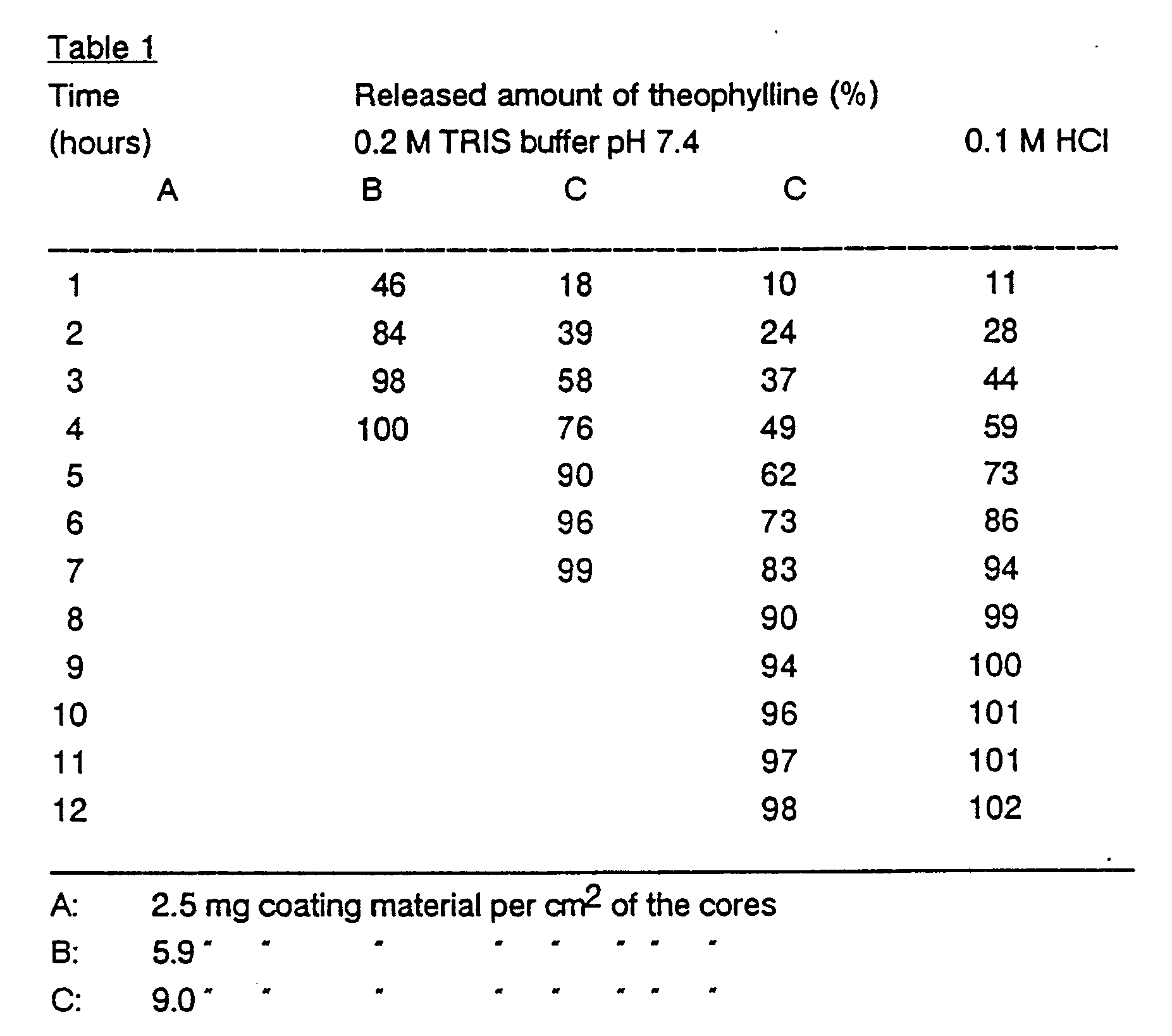
- Choline theophylline is a salt of theophylline readily soluble in water. The cores used in this example contain 30% choline theophyllinate on sugar crystals and have a particle size of 0.7 - 1.0 mm. These cores (1.0 kg) are coated with a suspension of the following compositions:
Terpolymer containing 92% vinylchloride, 4% vinylacetate and 4% vinylalcohol weight by weight 295 g Micronized succrose (particle size 1-10 µm) 930 g Acetyl tributyl citrate 30 g Blown castor oil 23 g Sodium bicarbonate 34 g Titanium dioxide 59 g Aceton ad 10.000 g - The coating suspension is applied on the cores with an airless spray-coating device in a coating pan. Samples are taken after the application of 2.0,2.5, 3.0 kg of the suspension.
- Table 2 shows the dissolution rate of a dose corresponding to 90 mg theophylline. The dissolution rate testing according to the USP XXI basket method (100 rpm). The dissolution rate is considerably higher than in Example 1 due to the much higher solubility of the choline salt of theophylline than of pure theophylline. Despite the higher dissolution rate there is still a linear correlation between the release rate and the coating thickness.
Table 2 Time (hours) Released amount of theophylline (%) 0.2 M TRIS buffer pH 7.4 A B C 0.33 96 86 76 0.67 100 99 98 1.00 100 100 A: 3.7 mg coating material per cm² of the cores B: 4.6 mg coating material per cm² of the cores C: 5.5 mg coating material per cm² of the cores - Diltiazem hydrochloride is an ammonium salt readily soluble in water. The cores used in this example contain 44% diltiazem hydrochloride or non-pareils and have a particle size of 0.7 - 1.1 mm. These cores (0.9 kg) are coated with a coating suspension of the following composition:
Terpolymer containing 92% vinylchloride, 4% vinylacetate and 4% vinylalcohol weight by weight 409 g Micronized succrose (particle size 1-10 µm) 930 g Acetyl tributyl citrate 70 g Blown castor oil 52 g Sodium bicarbonate 34 g Aceton ad 10.000 g - The coating suspension is applied on the cores with an airless spray-coating device in a coating pan. Samples are taken after the application of 1.6,2.3 and 3.0 kg of the suspension.
- Table 3 shows the dissolution rate of a doze corresponding to 120 mg diltiazem hydrochloride. The dissolution testing is performed according to the USP XXI basket method (100 rpm). The solubility of this ammonium salt is similar to that of the salt in Example 2. The dissolution rate is therefore also similar. Also here is the linear correlation between the release rate and the coating thickness obvious.
Table 3 Time (hours) Released amount of diltiazem hydrochloride (%) 0.05 M phosphate buffer pH 7.4 A B C 0.25 48 34 27 0.50 79 67 56 0.75 91 85 80 1.00 96 91 85 1.25 98 94 91 1.50 99 97 94 1.75 100 98 96 2.00 101 99 97 A: 6.8 mg coating material per cm² of the cores B: 9.8 mg coating material per cm² of the cores C: 12.4 mg coating material per cm² of the cores
Claims (11)
Priority Applications (1)
| Application Number | Priority Date | Filing Date | Title |
|---|---|---|---|
| AT89119102T ATE90556T1 (en) | 1988-10-26 | 1989-10-14 | DOSAGE FORM. |
Applications Claiming Priority (3)
| Application Number | Priority Date | Filing Date | Title |
|---|---|---|---|
| SE8803822 | 1988-10-26 | ||
| SE19888803822A SE8803822D0 (en) | 1988-10-26 | 1988-10-26 | NOVEL DOSAGE FORM |
| SG123894A SG123894G (en) | 1988-10-26 | 1994-08-25 | Novel dosage form |
Publications (2)
| Publication Number | Publication Date |
|---|---|
| EP0365947A1 true EP0365947A1 (en) | 1990-05-02 |
| EP0365947B1 EP0365947B1 (en) | 1993-06-16 |
Family
ID=26660328
Family Applications (1)
| Application Number | Title | Priority Date | Filing Date |
|---|---|---|---|
| EP89119102A Expired - Lifetime EP0365947B1 (en) | 1988-10-26 | 1989-10-14 | Novel dosage form |
Country Status (9)
| Country | Link |
|---|---|
| EP (1) | EP0365947B1 (en) |
| JP (1) | JPH082783B2 (en) |
| AU (1) | AU612525B2 (en) |
| CA (1) | CA2000932C (en) |
| DE (1) | DE68907177T2 (en) |
| ES (1) | ES2055775T3 (en) |
| HK (1) | HK123394A (en) |
| SE (1) | SE8803822D0 (en) |
| SG (1) | SG123894G (en) |
Cited By (15)
| Publication number | Priority date | Publication date | Assignee | Title |
|---|---|---|---|---|
| WO1994003161A1 (en) * | 1992-07-29 | 1994-02-17 | Gacell Laboratories Ab | Controlled release morphine preparation |
| WO1996001623A1 (en) * | 1994-07-08 | 1996-01-25 | Astra Aktiebolag | Multiple unit tableted dosage form i |
| WO1996001624A1 (en) * | 1994-07-08 | 1996-01-25 | Astra Aktiebolag | Multiple unit pharmaceutical preparation containing proton pump inhibitor |
| WO1996024338A1 (en) * | 1995-02-09 | 1996-08-15 | Astra Aktiebolag | New pharmaceutical formulation and process |
| WO1996024375A1 (en) * | 1995-02-06 | 1996-08-15 | Astra Aktiebolag | New oral pharmaceutical dosage form |
| WO1997025066A1 (en) * | 1996-01-08 | 1997-07-17 | Astra Aktiebolag | Oral pharmaceutical dosage forms comprising a proton pump inhibitor and an antacid agent or alginate |
| WO1997025064A1 (en) * | 1996-01-08 | 1997-07-17 | Astra Aktiebolag | Oral pharmaceutical dosage forms comprising a proton pump inhibitor and a nsaid |
| WO1997025065A1 (en) * | 1996-01-08 | 1997-07-17 | Astra Aktiebolag | Oral pharmaceutical dosage forms comprising a proton pump inhibitor and a prokinetic agent |
| WO1998015265A1 (en) * | 1996-10-04 | 1998-04-16 | Danbiosyst Uk Limited | Colonic delivery of weak acid drugs |
| US6066339A (en) * | 1997-10-17 | 2000-05-23 | Elan Corporation, Plc | Oral morphine multiparticulate formulation |
| WO2000044353A1 (en) * | 1999-01-29 | 2000-08-03 | Losan Pharma Gmbh | Pharmaceutical compositions |
| US6875872B1 (en) | 1993-05-28 | 2005-04-05 | Astrazeneca | Compounds |
| WO2007123883A3 (en) * | 2006-04-17 | 2008-03-27 | Actavis Group Ptc Hf | Oral dosage formulations and methods of preparing the same |
| US7771748B2 (en) | 2001-11-30 | 2010-08-10 | Pfizer Inc | Pharmaceutical compositions of 5,7,14-triazatetracyclo[10.3.1.02,11.04,9]-hexadeca-2(11),3,5,7,9-pentaene |
| US7943176B2 (en) | 2001-10-09 | 2011-05-17 | Apogepha Arzneimittel Gmbh | Oral dosage form for propiverine or its pharmaceutically acceptable salts with an extended release of the active ingredient |
Families Citing this family (2)
| Publication number | Priority date | Publication date | Assignee | Title |
|---|---|---|---|---|
| SE0001151D0 (en) * | 2000-03-31 | 2000-03-31 | Amarin Dev Ab | Method of producing a controlled-release composition |
| JP2005104914A (en) * | 2003-09-30 | 2005-04-21 | Kyowa Yakuhin Kogyo Kk | Basic agent-containing pharmaceutical preparation |
Citations (6)
| Publication number | Priority date | Publication date | Assignee | Title |
|---|---|---|---|---|
| SE435897B (en) * | 1977-04-07 | 1984-10-29 | Alza Corp | PROCEDURE FOR MANUFACTURING AN OSMOTIC DRIVE DELIVERY DEVICE |
| EP0153104A2 (en) * | 1984-02-10 | 1985-08-28 | Benzon Pharma A/S | Diffusion coated multiple-units dosage form |
| US4557925A (en) * | 1982-07-08 | 1985-12-10 | Ab Ferrosan | Membrane-coated sustained-release tablets and method |
| EP0171457A1 (en) * | 1984-08-17 | 1986-02-19 | The Wellcome Foundation Limited | Composition for the controlled discharge of an active ingredient, and its preparation |
| EP0202051A2 (en) * | 1985-05-06 | 1986-11-20 | American Home Products Corporation | Therapeutic compositions for oral administration |
| US4687660A (en) * | 1983-08-16 | 1987-08-18 | Burroughs Wellcome Co. | Pharmaceutical delivery system |
Family Cites Families (3)
| Publication number | Priority date | Publication date | Assignee | Title |
|---|---|---|---|---|
| JPH075457B2 (en) * | 1983-08-16 | 1995-01-25 | ザ ウエルカム フアウンデ−シヨン リミテツド | Pharmaceutical composition allowing the release of the active ingredient in a controlled manner |
| SE8404467D0 (en) * | 1984-09-06 | 1984-09-06 | Ferrosan Ab | CONTROLLED-RELEASE MEDICAL PREPARATIONS |
| US4666704A (en) * | 1985-05-24 | 1987-05-19 | International Minerals & Chemical Corp. | Controlled release delivery system for macromolecules |
-
1988
- 1988-10-26 SE SE19888803822A patent/SE8803822D0/en unknown
-
1989
- 1989-10-14 DE DE89119102T patent/DE68907177T2/en not_active Expired - Fee Related
- 1989-10-14 EP EP89119102A patent/EP0365947B1/en not_active Expired - Lifetime
- 1989-10-14 ES ES89119102T patent/ES2055775T3/en not_active Expired - Lifetime
- 1989-10-18 CA CA002000932A patent/CA2000932C/en not_active Expired - Fee Related
- 1989-10-24 AU AU43650/89A patent/AU612525B2/en not_active Ceased
- 1989-10-25 JP JP1276203A patent/JPH082783B2/en not_active Expired - Lifetime
-
1994
- 1994-08-25 SG SG123894A patent/SG123894G/en unknown
- 1994-11-10 HK HK123394A patent/HK123394A/en not_active IP Right Cessation
Patent Citations (6)
| Publication number | Priority date | Publication date | Assignee | Title |
|---|---|---|---|---|
| SE435897B (en) * | 1977-04-07 | 1984-10-29 | Alza Corp | PROCEDURE FOR MANUFACTURING AN OSMOTIC DRIVE DELIVERY DEVICE |
| US4557925A (en) * | 1982-07-08 | 1985-12-10 | Ab Ferrosan | Membrane-coated sustained-release tablets and method |
| US4687660A (en) * | 1983-08-16 | 1987-08-18 | Burroughs Wellcome Co. | Pharmaceutical delivery system |
| EP0153104A2 (en) * | 1984-02-10 | 1985-08-28 | Benzon Pharma A/S | Diffusion coated multiple-units dosage form |
| EP0171457A1 (en) * | 1984-08-17 | 1986-02-19 | The Wellcome Foundation Limited | Composition for the controlled discharge of an active ingredient, and its preparation |
| EP0202051A2 (en) * | 1985-05-06 | 1986-11-20 | American Home Products Corporation | Therapeutic compositions for oral administration |
Cited By (36)
| Publication number | Priority date | Publication date | Assignee | Title |
|---|---|---|---|---|
| US5520931A (en) * | 1992-07-29 | 1996-05-28 | Gacell Laboratories Ab | Controlled release morphine preparation |
| AU662239B2 (en) * | 1992-07-29 | 1995-08-24 | Gacell Laboratories Ab | Controlled release morphine preparation |
| WO1994003161A1 (en) * | 1992-07-29 | 1994-02-17 | Gacell Laboratories Ab | Controlled release morphine preparation |
| CN1053339C (en) * | 1992-07-29 | 2000-06-14 | 伽塞尔实验室公司 | Controlled release morphine preparation |
| US6875872B1 (en) | 1993-05-28 | 2005-04-05 | Astrazeneca | Compounds |
| EP1452172A3 (en) * | 1994-07-08 | 2004-11-03 | AstraZeneca AB | Multiple unit pharmaceutical preparation |
| WO1996001624A1 (en) * | 1994-07-08 | 1996-01-25 | Astra Aktiebolag | Multiple unit pharmaceutical preparation containing proton pump inhibitor |
| WO1996001623A1 (en) * | 1994-07-08 | 1996-01-25 | Astra Aktiebolag | Multiple unit tableted dosage form i |
| WO1996001625A1 (en) * | 1994-07-08 | 1996-01-25 | Astra Aktiebolag | Multiple unit tableted dosage form containing proton pump inhibitor |
| US5817338A (en) * | 1994-07-08 | 1998-10-06 | Astra Aktiebolag | Multiple unit tableted dosage form of omeprazole |
| AU695971B2 (en) * | 1994-07-08 | 1998-08-27 | Astrazeneca Ab | Multiple unit pharmaceutical preparation containing proton pump inhibitor |
| US5753265A (en) * | 1994-07-08 | 1998-05-19 | Astra Aktiebolag | Multiple unit pharmaceutical preparation |
| WO1996024375A1 (en) * | 1995-02-06 | 1996-08-15 | Astra Aktiebolag | New oral pharmaceutical dosage form |
| US6136344A (en) * | 1995-02-06 | 2000-10-24 | Astra Aktiebolag | Oral pharmaceutical dosage form |
| US6013281A (en) * | 1995-02-09 | 2000-01-11 | Astra Aktiebolag | Method of making a pharmaceutical dosage form comprising a proton pump inhibitor |
| WO1996024338A1 (en) * | 1995-02-09 | 1996-08-15 | Astra Aktiebolag | New pharmaceutical formulation and process |
| US6365184B1 (en) | 1996-01-08 | 2002-04-02 | Astrazeneca Ab | Oral pharmaceutical dosage forms comprising a proton pump inhibitor and a NSAID |
| WO1997025064A1 (en) * | 1996-01-08 | 1997-07-17 | Astra Aktiebolag | Oral pharmaceutical dosage forms comprising a proton pump inhibitor and a nsaid |
| WO1997025066A1 (en) * | 1996-01-08 | 1997-07-17 | Astra Aktiebolag | Oral pharmaceutical dosage forms comprising a proton pump inhibitor and an antacid agent or alginate |
| US8114435B2 (en) | 1996-01-08 | 2012-02-14 | Astrazeneca Ab | Oral pharmaceutical dosage forms comprising a proton pump inhibitor and a NSAID |
| US6132771A (en) * | 1996-01-08 | 2000-10-17 | Astrazeneca Ab | Oral pharmaceutical dosage forms comprising a proton pump inhibitor and a prokinetic agent |
| EP2275139A1 (en) * | 1996-01-08 | 2011-01-19 | AstraZeneca AB | Oral pharmaceutical dosage forms comprising a proton pump inhibitor and a NSAID |
| US7488497B2 (en) | 1996-01-08 | 2009-02-10 | Astrazeneca Ab | Oral pharmaceutical dosage forms comprising a proton pump inhibitor and a NSAID |
| US6183776B1 (en) | 1996-01-08 | 2001-02-06 | Astra Aktiebolag | Oral pharmaceutical dosage forms comprising a proton pump inhibitor and an antacid agent or alginate |
| WO1997025065A1 (en) * | 1996-01-08 | 1997-07-17 | Astra Aktiebolag | Oral pharmaceutical dosage forms comprising a proton pump inhibitor and a prokinetic agent |
| US6613354B2 (en) | 1996-01-08 | 2003-09-02 | Astrazeneca Ab | Oral pharmaceutical dosage forms comprising a proton pump inhibitor and a NSAID |
| EP1352660A1 (en) * | 1996-01-08 | 2003-10-15 | AstraZeneca AB | Oral pharmaceutical dosage forms comprising a proton pump inhibitor and a nsaid |
| GB2333042B (en) * | 1996-10-04 | 2000-10-18 | Danbiosyst Uk | Colonic delivery of weak acid drugs |
| WO1998015265A1 (en) * | 1996-10-04 | 1998-04-16 | Danbiosyst Uk Limited | Colonic delivery of weak acid drugs |
| GB2333042A (en) * | 1996-10-04 | 1999-07-14 | Danbiosyst Uk | Colonic delivery of weak acid drugs |
| US6066339A (en) * | 1997-10-17 | 2000-05-23 | Elan Corporation, Plc | Oral morphine multiparticulate formulation |
| US6962717B1 (en) | 1999-01-29 | 2005-11-08 | Disphar International B.V. | Pharmaceutical compositions |
| WO2000044353A1 (en) * | 1999-01-29 | 2000-08-03 | Losan Pharma Gmbh | Pharmaceutical compositions |
| US7943176B2 (en) | 2001-10-09 | 2011-05-17 | Apogepha Arzneimittel Gmbh | Oral dosage form for propiverine or its pharmaceutically acceptable salts with an extended release of the active ingredient |
| US7771748B2 (en) | 2001-11-30 | 2010-08-10 | Pfizer Inc | Pharmaceutical compositions of 5,7,14-triazatetracyclo[10.3.1.02,11.04,9]-hexadeca-2(11),3,5,7,9-pentaene |
| WO2007123883A3 (en) * | 2006-04-17 | 2008-03-27 | Actavis Group Ptc Hf | Oral dosage formulations and methods of preparing the same |
Also Published As
| Publication number | Publication date |
|---|---|
| JPH02164821A (en) | 1990-06-25 |
| AU4365089A (en) | 1990-05-03 |
| DE68907177T2 (en) | 1994-01-13 |
| ES2055775T3 (en) | 1994-09-01 |
| HK123394A (en) | 1994-11-18 |
| CA2000932C (en) | 1999-12-28 |
| EP0365947B1 (en) | 1993-06-16 |
| AU612525B2 (en) | 1991-07-11 |
| SE8803822D0 (en) | 1988-10-26 |
| DE68907177D1 (en) | 1993-07-22 |
| SG123894G (en) | 1995-03-17 |
| CA2000932A1 (en) | 1990-04-26 |
| JPH082783B2 (en) | 1996-01-17 |
Similar Documents
| Publication | Publication Date | Title |
|---|---|---|
| US5178868A (en) | Dosage form | |
| EP0263083B1 (en) | Coating membrane and compositions prepared therefrom | |
| EP0357369B1 (en) | The use of asymetric membranes in delivery devices | |
| EP0365947B1 (en) | Novel dosage form | |
| KR930003114B1 (en) | Process for preparing controlled release pharmaceutical preparation | |
| DE68907762T2 (en) | Medicament preparation with controlled release of active substance and process for its production. | |
| FI115824B (en) | A process for preparing an oral insoluble therapeutically active agent formulation | |
| US4927640A (en) | Controlled release beads having glass or silicon dioxide core | |
| US5698220A (en) | Asymmetric membranes in delivery devices | |
| FI113743B (en) | Process for Preparation of a Controlled Solvent Preparation | |
| CA2473200C (en) | Extended release compositions comprising as active compound venlafaxine hydrochloride | |
| US4915952A (en) | Composition comprising drug, HPC, HPMC and PEO | |
| US4810502A (en) | Pseudoephedrine brompheniramine therapy | |
| IE61223B1 (en) | Osmotic continuous dispensing oral delivery system containing a pharmaceutically acceptable active agent having improved core membrane adhesion properties | |
| EP0811374A1 (en) | Combination dosage form comprising cetirizine and pseudoephedrine | |
| JPH07138189A (en) | Release control preparation coated with ethyl cellulose aqueous dispersion | |
| EP0211991B1 (en) | Substained release tablets and method for preparation thereof | |
| CA1336069C (en) | Chewable medicament tablet containing means for taste masking | |
| KR100527335B1 (en) | Sustained release drug delivery system | |
| US5023076A (en) | Lamina comprising carboxyvinyl polymer | |
| PH26653A (en) | Novel dosage form |
Legal Events
| Date | Code | Title | Description |
|---|---|---|---|
| PUAI | Public reference made under article 153(3) epc to a published international application that has entered the european phase |
Free format text: ORIGINAL CODE: 0009012 |
|
| AK | Designated contracting states |
Kind code of ref document: A1 Designated state(s): AT BE CH DE ES FR GB GR IT LI LU NL SE |
|
| 17P | Request for examination filed |
Effective date: 19901023 |
|
| 17Q | First examination report despatched |
Effective date: 19911002 |
|
| RAP1 | Party data changed (applicant data changed or rights of an application transferred) |
Owner name: KABI PHARMACIA AB |
|
| RAP1 | Party data changed (applicant data changed or rights of an application transferred) |
Owner name: DIB LIMITED |
|
| GRAA | (expected) grant |
Free format text: ORIGINAL CODE: 0009210 |
|
| AK | Designated contracting states |
Kind code of ref document: B1 Designated state(s): AT BE CH DE ES FR GB GR IT LI LU NL SE |
|
| REF | Corresponds to: |
Ref document number: 90556 Country of ref document: AT Date of ref document: 19930715 Kind code of ref document: T |
|
| ITF | It: translation for a ep patent filed | ||
| REF | Corresponds to: |
Ref document number: 68907177 Country of ref document: DE Date of ref document: 19930722 |
|
| ET | Fr: translation filed | ||
| REG | Reference to a national code |
Ref country code: GR Ref legal event code: FG4A Free format text: 3008571 |
|
| EPTA | Lu: last paid annual fee | ||
| PLBE | No opposition filed within time limit |
Free format text: ORIGINAL CODE: 0009261 |
|
| STAA | Information on the status of an ep patent application or granted ep patent |
Free format text: STATUS: NO OPPOSITION FILED WITHIN TIME LIMIT |
|
| 26N | No opposition filed | ||
| EAL | Se: european patent in force in sweden |
Ref document number: 89119102.5 |
|
| REG | Reference to a national code |
Ref country code: CH Ref legal event code: PUE Owner name: GACELL LABORATORIES AB |
|
| REG | Reference to a national code |
Ref country code: FR Ref legal event code: TP |
|
| REG | Reference to a national code |
Ref country code: GB Ref legal event code: 732E |
|
| NLS | Nl: assignments of ep-patents |
Owner name: GACELL LABORATORIES A.B. |
|
| REG | Reference to a national code |
Ref country code: ES Ref legal event code: PC2A Owner name: GACELL LABORATORIES AB |
|
| REG | Reference to a national code |
Ref country code: GB Ref legal event code: IF02 |
|
| PGFP | Annual fee paid to national office [announced via postgrant information from national office to epo] |
Ref country code: AT Payment date: 20060920 Year of fee payment: 18 |
|
| PGFP | Annual fee paid to national office [announced via postgrant information from national office to epo] |
Ref country code: NL Payment date: 20061024 Year of fee payment: 18 |
|
| PGFP | Annual fee paid to national office [announced via postgrant information from national office to epo] |
Ref country code: GB Payment date: 20061025 Year of fee payment: 18 |
|
| PGFP | Annual fee paid to national office [announced via postgrant information from national office to epo] |
Ref country code: ES Payment date: 20061026 Year of fee payment: 18 |
|
| PGFP | Annual fee paid to national office [announced via postgrant information from national office to epo] |
Ref country code: CH Payment date: 20061027 Year of fee payment: 18 Ref country code: SE Payment date: 20061027 Year of fee payment: 18 |
|
| PGFP | Annual fee paid to national office [announced via postgrant information from national office to epo] |
Ref country code: GR Payment date: 20061030 Year of fee payment: 18 |
|
| PGFP | Annual fee paid to national office [announced via postgrant information from national office to epo] |
Ref country code: IT Payment date: 20061031 Year of fee payment: 18 |
|
| PGFP | Annual fee paid to national office [announced via postgrant information from national office to epo] |
Ref country code: LU Payment date: 20061107 Year of fee payment: 18 |
|
| PGFP | Annual fee paid to national office [announced via postgrant information from national office to epo] |
Ref country code: BE Payment date: 20061124 Year of fee payment: 18 |
|
| PGFP | Annual fee paid to national office [announced via postgrant information from national office to epo] |
Ref country code: DE Payment date: 20061130 Year of fee payment: 18 |
|
| REG | Reference to a national code |
Ref country code: CH Ref legal event code: PFA Owner name: GACELL LABORATORIES AB Free format text: GACELL LABORATORIES AB#LUNDAVAEGEN 151#MALMOE (SE) -TRANSFER TO- GACELL LABORATORIES AB#LUNDAVAEGEN 151#MALMOE (SE) |
|
| BERE | Be: lapsed |
Owner name: *GACELL LABORATORIES A.B. Effective date: 20071031 |
|
| EUG | Se: european patent has lapsed | ||
| GBPC | Gb: european patent ceased through non-payment of renewal fee |
Effective date: 20071014 |
|
| REG | Reference to a national code |
Ref country code: CH Ref legal event code: PL |
|
| NLV4 | Nl: lapsed or anulled due to non-payment of the annual fee |
Effective date: 20080501 |
|
| PG25 | Lapsed in a contracting state [announced via postgrant information from national office to epo] |
Ref country code: LI Free format text: LAPSE BECAUSE OF NON-PAYMENT OF DUE FEES Effective date: 20071031 Ref country code: DE Free format text: LAPSE BECAUSE OF NON-PAYMENT OF DUE FEES Effective date: 20080501 Ref country code: CH Free format text: LAPSE BECAUSE OF NON-PAYMENT OF DUE FEES Effective date: 20071031 |
|
| PG25 | Lapsed in a contracting state [announced via postgrant information from national office to epo] |
Ref country code: AT Free format text: LAPSE BECAUSE OF NON-PAYMENT OF DUE FEES Effective date: 20071014 |
|
| PG25 | Lapsed in a contracting state [announced via postgrant information from national office to epo] |
Ref country code: BE Free format text: LAPSE BECAUSE OF NON-PAYMENT OF DUE FEES Effective date: 20071031 |
|
| REG | Reference to a national code |
Ref country code: FR Ref legal event code: ST Effective date: 20080630 |
|
| PG25 | Lapsed in a contracting state [announced via postgrant information from national office to epo] |
Ref country code: SE Free format text: LAPSE BECAUSE OF NON-PAYMENT OF DUE FEES Effective date: 20071015 Ref country code: NL Free format text: LAPSE BECAUSE OF NON-PAYMENT OF DUE FEES Effective date: 20080501 |
|
| PGFP | Annual fee paid to national office [announced via postgrant information from national office to epo] |
Ref country code: FR Payment date: 20061017 Year of fee payment: 18 |
|
| PG25 | Lapsed in a contracting state [announced via postgrant information from national office to epo] |
Ref country code: GB Free format text: LAPSE BECAUSE OF NON-PAYMENT OF DUE FEES Effective date: 20071014 |
|
| REG | Reference to a national code |
Ref country code: ES Ref legal event code: FD2A Effective date: 20071015 |
|
| PG25 | Lapsed in a contracting state [announced via postgrant information from national office to epo] |
Ref country code: FR Free format text: LAPSE BECAUSE OF NON-PAYMENT OF DUE FEES Effective date: 20071031 Ref country code: ES Free format text: LAPSE BECAUSE OF NON-PAYMENT OF DUE FEES Effective date: 20071015 |
|
| PG25 | Lapsed in a contracting state [announced via postgrant information from national office to epo] |
Ref country code: GR Free format text: LAPSE BECAUSE OF NON-PAYMENT OF DUE FEES Effective date: 20080505 |
|
| PG25 | Lapsed in a contracting state [announced via postgrant information from national office to epo] |
Ref country code: LU Free format text: LAPSE BECAUSE OF NON-PAYMENT OF DUE FEES Effective date: 20071014 Ref country code: IT Free format text: LAPSE BECAUSE OF NON-PAYMENT OF DUE FEES Effective date: 20071014 |