EP0327398B1 - Laser-machining polymers - Google Patents
Laser-machining polymers Download PDFInfo
- Publication number
- EP0327398B1 EP0327398B1 EP89301105A EP89301105A EP0327398B1 EP 0327398 B1 EP0327398 B1 EP 0327398B1 EP 89301105 A EP89301105 A EP 89301105A EP 89301105 A EP89301105 A EP 89301105A EP 0327398 B1 EP0327398 B1 EP 0327398B1
- Authority
- EP
- European Patent Office
- Prior art keywords
- article
- laser
- polymeric material
- backbone
- aliphatic chains
- Prior art date
- Legal status (The legal status is an assumption and is not a legal conclusion. Google has not performed a legal analysis and makes no representation as to the accuracy of the status listed.)
- Expired - Lifetime
Links
Classifications
-
- H—ELECTRICITY
- H05—ELECTRIC TECHNIQUES NOT OTHERWISE PROVIDED FOR
- H05K—PRINTED CIRCUITS; CASINGS OR CONSTRUCTIONAL DETAILS OF ELECTRIC APPARATUS; MANUFACTURE OF ASSEMBLAGES OF ELECTRICAL COMPONENTS
- H05K3/00—Apparatus or processes for manufacturing printed circuits
- H05K3/0011—Working of insulating substrates or insulating layers
- H05K3/0017—Etching of the substrate by chemical or physical means
- H05K3/0026—Etching of the substrate by chemical or physical means by laser ablation
- H05K3/0032—Etching of the substrate by chemical or physical means by laser ablation of organic insulating material
-
- H10W70/69—
-
- B—PERFORMING OPERATIONS; TRANSPORTING
- B23—MACHINE TOOLS; METAL-WORKING NOT OTHERWISE PROVIDED FOR
- B23K—SOLDERING OR UNSOLDERING; WELDING; CLADDING OR PLATING BY SOLDERING OR WELDING; CUTTING BY APPLYING HEAT LOCALLY, e.g. FLAME CUTTING; WORKING BY LASER BEAM
- B23K1/00—Soldering, e.g. brazing, or unsoldering
- B23K1/0008—Soldering, e.g. brazing, or unsoldering specially adapted for particular articles or work
- B23K1/0016—Brazing of electronic components
-
- B—PERFORMING OPERATIONS; TRANSPORTING
- B23—MACHINE TOOLS; METAL-WORKING NOT OTHERWISE PROVIDED FOR
- B23K—SOLDERING OR UNSOLDERING; WELDING; CLADDING OR PLATING BY SOLDERING OR WELDING; CUTTING BY APPLYING HEAT LOCALLY, e.g. FLAME CUTTING; WORKING BY LASER BEAM
- B23K20/00—Non-electric welding by applying impact or other pressure, with or without the application of heat, e.g. cladding or plating
- B23K20/02—Non-electric welding by applying impact or other pressure, with or without the application of heat, e.g. cladding or plating by means of a press ; Diffusion bonding
- B23K20/023—Thermo-compression bonding
-
- B—PERFORMING OPERATIONS; TRANSPORTING
- B23—MACHINE TOOLS; METAL-WORKING NOT OTHERWISE PROVIDED FOR
- B23K—SOLDERING OR UNSOLDERING; WELDING; CLADDING OR PLATING BY SOLDERING OR WELDING; CUTTING BY APPLYING HEAT LOCALLY, e.g. FLAME CUTTING; WORKING BY LASER BEAM
- B23K26/00—Working by laser beam, e.g. welding, cutting or boring
- B23K26/36—Removing material
- B23K26/40—Removing material taking account of the properties of the material involved
-
- B—PERFORMING OPERATIONS; TRANSPORTING
- B23—MACHINE TOOLS; METAL-WORKING NOT OTHERWISE PROVIDED FOR
- B23K—SOLDERING OR UNSOLDERING; WELDING; CLADDING OR PLATING BY SOLDERING OR WELDING; CUTTING BY APPLYING HEAT LOCALLY, e.g. FLAME CUTTING; WORKING BY LASER BEAM
- B23K31/00—Processes relevant to this subclass, specially adapted for particular articles or purposes, but not covered by only one of the preceding main groups
- B23K31/02—Processes relevant to this subclass, specially adapted for particular articles or purposes, but not covered by only one of the preceding main groups relating to soldering or welding
-
- G—PHYSICS
- G03—PHOTOGRAPHY; CINEMATOGRAPHY; ANALOGOUS TECHNIQUES USING WAVES OTHER THAN OPTICAL WAVES; ELECTROGRAPHY; HOLOGRAPHY
- G03F—PHOTOMECHANICAL PRODUCTION OF TEXTURED OR PATTERNED SURFACES, e.g. FOR PRINTING, FOR PROCESSING OF SEMICONDUCTOR DEVICES; MATERIALS THEREFOR; ORIGINALS THEREFOR; APPARATUS SPECIALLY ADAPTED THEREFOR
- G03F7/00—Photomechanical, e.g. photolithographic, production of textured or patterned surfaces, e.g. printing surfaces; Materials therefor, e.g. comprising photoresists; Apparatus specially adapted therefor
- G03F7/20—Exposure; Apparatus therefor
- G03F7/2051—Exposure without an original mask, e.g. using a programmed deflection of a point source, by scanning, by drawing with a light beam, using an addressed light or corpuscular source
- G03F7/2053—Exposure without an original mask, e.g. using a programmed deflection of a point source, by scanning, by drawing with a light beam, using an addressed light or corpuscular source using a laser
-
- H10W40/257—
-
- H10W70/095—
-
- H10W70/635—
-
- H10W70/688—
-
- H10W70/695—
-
- H10W99/00—
-
- B—PERFORMING OPERATIONS; TRANSPORTING
- B23—MACHINE TOOLS; METAL-WORKING NOT OTHERWISE PROVIDED FOR
- B23K—SOLDERING OR UNSOLDERING; WELDING; CLADDING OR PLATING BY SOLDERING OR WELDING; CUTTING BY APPLYING HEAT LOCALLY, e.g. FLAME CUTTING; WORKING BY LASER BEAM
- B23K2101/00—Articles made by soldering, welding or cutting
- B23K2101/36—Electric or electronic devices
- B23K2101/40—Semiconductor devices
-
- B—PERFORMING OPERATIONS; TRANSPORTING
- B23—MACHINE TOOLS; METAL-WORKING NOT OTHERWISE PROVIDED FOR
- B23K—SOLDERING OR UNSOLDERING; WELDING; CLADDING OR PLATING BY SOLDERING OR WELDING; CUTTING BY APPLYING HEAT LOCALLY, e.g. FLAME CUTTING; WORKING BY LASER BEAM
- B23K2103/00—Materials to be soldered, welded or cut
- B23K2103/30—Organic material
- B23K2103/42—Plastics
-
- B—PERFORMING OPERATIONS; TRANSPORTING
- B23—MACHINE TOOLS; METAL-WORKING NOT OTHERWISE PROVIDED FOR
- B23K—SOLDERING OR UNSOLDERING; WELDING; CLADDING OR PLATING BY SOLDERING OR WELDING; CUTTING BY APPLYING HEAT LOCALLY, e.g. FLAME CUTTING; WORKING BY LASER BEAM
- B23K2103/00—Materials to be soldered, welded or cut
- B23K2103/50—Inorganic material, e.g. metals, not provided for in B23K2103/02 – B23K2103/26
-
- H—ELECTRICITY
- H05—ELECTRIC TECHNIQUES NOT OTHERWISE PROVIDED FOR
- H05K—PRINTED CIRCUITS; CASINGS OR CONSTRUCTIONAL DETAILS OF ELECTRIC APPARATUS; MANUFACTURE OF ASSEMBLAGES OF ELECTRICAL COMPONENTS
- H05K1/00—Printed circuits
- H05K1/02—Details
- H05K1/03—Use of materials for the substrate
- H05K1/0313—Organic insulating material
- H05K1/032—Organic insulating material consisting of one material
- H05K1/0326—Organic insulating material consisting of one material containing O
-
- H—ELECTRICITY
- H05—ELECTRIC TECHNIQUES NOT OTHERWISE PROVIDED FOR
- H05K—PRINTED CIRCUITS; CASINGS OR CONSTRUCTIONAL DETAILS OF ELECTRIC APPARATUS; MANUFACTURE OF ASSEMBLAGES OF ELECTRICAL COMPONENTS
- H05K1/00—Printed circuits
- H05K1/02—Details
- H05K1/03—Use of materials for the substrate
- H05K1/0313—Organic insulating material
- H05K1/032—Organic insulating material consisting of one material
- H05K1/0333—Organic insulating material consisting of one material containing S
-
- H—ELECTRICITY
- H05—ELECTRIC TECHNIQUES NOT OTHERWISE PROVIDED FOR
- H05K—PRINTED CIRCUITS; CASINGS OR CONSTRUCTIONAL DETAILS OF ELECTRIC APPARATUS; MANUFACTURE OF ASSEMBLAGES OF ELECTRICAL COMPONENTS
- H05K1/00—Printed circuits
- H05K1/02—Details
- H05K1/03—Use of materials for the substrate
- H05K1/0313—Organic insulating material
- H05K1/032—Organic insulating material consisting of one material
- H05K1/0346—Organic insulating material consisting of one material containing N
-
- H—ELECTRICITY
- H05—ELECTRIC TECHNIQUES NOT OTHERWISE PROVIDED FOR
- H05K—PRINTED CIRCUITS; CASINGS OR CONSTRUCTIONAL DETAILS OF ELECTRIC APPARATUS; MANUFACTURE OF ASSEMBLAGES OF ELECTRICAL COMPONENTS
- H05K1/00—Printed circuits
- H05K1/02—Details
- H05K1/03—Use of materials for the substrate
- H05K1/0313—Organic insulating material
- H05K1/0353—Organic insulating material consisting of two or more materials, e.g. two or more polymers, polymer + filler, + reinforcement
- H05K1/036—Multilayers with layers of different types
-
- H—ELECTRICITY
- H05—ELECTRIC TECHNIQUES NOT OTHERWISE PROVIDED FOR
- H05K—PRINTED CIRCUITS; CASINGS OR CONSTRUCTIONAL DETAILS OF ELECTRIC APPARATUS; MANUFACTURE OF ASSEMBLAGES OF ELECTRICAL COMPONENTS
- H05K2201/00—Indexing scheme relating to printed circuits covered by H05K1/00
- H05K2201/01—Dielectrics
- H05K2201/0104—Properties and characteristics in general
- H05K2201/0116—Porous, e.g. foam
-
- H—ELECTRICITY
- H05—ELECTRIC TECHNIQUES NOT OTHERWISE PROVIDED FOR
- H05K—PRINTED CIRCUITS; CASINGS OR CONSTRUCTIONAL DETAILS OF ELECTRIC APPARATUS; MANUFACTURE OF ASSEMBLAGES OF ELECTRICAL COMPONENTS
- H05K2201/00—Indexing scheme relating to printed circuits covered by H05K1/00
- H05K2201/01—Dielectrics
- H05K2201/0137—Materials
- H05K2201/0154—Polyimide
-
- H—ELECTRICITY
- H05—ELECTRIC TECHNIQUES NOT OTHERWISE PROVIDED FOR
- H05K—PRINTED CIRCUITS; CASINGS OR CONSTRUCTIONAL DETAILS OF ELECTRIC APPARATUS; MANUFACTURE OF ASSEMBLAGES OF ELECTRICAL COMPONENTS
- H05K2201/00—Indexing scheme relating to printed circuits covered by H05K1/00
- H05K2201/10—Details of components or other objects attached to or integrated in a printed circuit board
- H05K2201/10227—Other objects, e.g. metallic pieces
- H05K2201/10378—Interposers
-
- H—ELECTRICITY
- H05—ELECTRIC TECHNIQUES NOT OTHERWISE PROVIDED FOR
- H05K—PRINTED CIRCUITS; CASINGS OR CONSTRUCTIONAL DETAILS OF ELECTRIC APPARATUS; MANUFACTURE OF ASSEMBLAGES OF ELECTRICAL COMPONENTS
- H05K2203/00—Indexing scheme relating to apparatus or processes for manufacturing printed circuits covered by H05K3/00
- H05K2203/10—Using electric, magnetic and electromagnetic fields; Using laser light
- H05K2203/107—Using laser light
Definitions
- This invention relates to laser-machining of polymeric materials and to laser-machined articles so produced.
- the present invention relates to classes of polymers possessing superior laser-machining characteristics, optionally together with advantageous equipment and/or wave-lengths, to produce laser-machined articles with reduced (preferably without) charring of the polymer. Absence of charring is advantageous since char tends to contaminate the surrounding polymer surface, making clean processing very difficult, e.g. for electronic microcircuits.
- a first aspect of the invention accordingly provides a laser-ablation-machined article in which the laser ablated material is composed of (a) aromatic and/or amorphous polyamide material, or (b)polymeric material having in its polymer chain backbone repeat units including backbone aromatic rings and backbone aliphatic chains (with the proviso that the aliphatic chains have at least 4 carbon atoms when the material is a polyester).
- the polymeric materials used in the articles or methods according to this invention have aromatic rings in the polymer backbone chain, which gives the present polymers characteristics different from those of the class of polymers with merely pendant aromatic rings described in the aforementioned U.S patent.
- the present polymers are well suited to laser-ablation-machining or processing, by which term is meant any process of forming, shaping, cutting, perforating, etching, marking, patterning or otherwise altering any physical dimensions of a body of polymeric material by applying laser radiation thereto so as to cause ablative photodecomposition of the polymeric material, the radiation being either in a narrow beam or spread over a wider area.
- the laser radiation may be of any wavelength capable of producing the desired ablation machining effect, and references hereinafter to the laser radiation as "light” are not intended to indicate any specific range of radiation wavelengths.
- Ultraviolet laser light is preferred, especially at wavelengths below 400 nanometres. Wavelengths of particular interest include those produced by excimer lasers, for example 351, 337, 308, 249, 222, 193 and 157 nanometres, the choice depending to some extent on the application. For example, 193 nm allows resolution of very fine details, while wavelengths of 248 nm or more, preferably of 308 nm, permit wider choice of optical media and need not be transmitted in vacuo , since they are not significantly absorbed by air.
- Light of 308 nanometres wavelength preferably from an XeCl excimer laser, is especially useful, the gases in such a laser having a much longer working life than most other known gas systems.
- KrF excimer laser light at 249 nm is also useful, e.g. for finer lithographic features or to avoid the need to add chromophores to some polymers.
- the polymers specified for the articles and methods of the present invention are the aforesaid polyamides and/or have in their backbone aromatic rings and aliphatic chains, by which term is meant (subject to the aforesaid proviso for polyesters) chains of at least 2, preferably at least 4, and often more than 6, 8, or 10, carbon atoms forming part of the polymer backbone, excluding any carbonyl carbon atoms and any pendant aliphatic groups which may be attached. Cyclic aliphatic chains are included in the term. When pendant aliphatic groups are included, the backbone chain plus the pendant groups will comprise at least 3, preferably at least 5, and often at least 7, 9 or 11 carbon atoms in total.
- the specified polymers having this combination of aromatic rings and aliphatic chains in their backbone have been found to be laser-ablation-machinable with little or no charring.
- the specified polymers may for example be selected from polyetheresters, the aforesaid polyamides, and polyimides.
- the polymers may be doped with appropriately chromophoric materials which enhance the laser-machining effect, for example aromatic carbonyl compounds, one example of which is benzophenone.
- the articles and methods use a class of the specified polymers which tend not to require doping, these being the polyetheresters, especially polyetherester block copolymers, preferably having the specified aromatic rings in the backbone of the ester blocks.
- the preferred copolymers also have aliphatic chains in the backbone of the ester blocks.
- the preferred copolymers may have aliphatic chains and no aromatic rings in the backbone of the ether blocks.
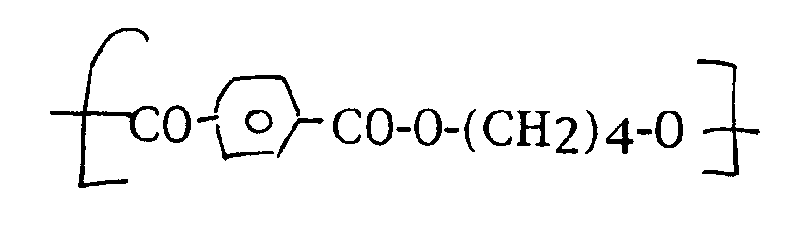
- the aliphatic chains in the preferred copolymers preferably contain 4 carbon atoms, more preferably 4 methylene groups, and an especially preferred copolymer is a polyetherester comprising polyester blocks of repeat unit formula and polyether blocks of repeat unit formula
- each R and R′ can independently be an alkylene radical having broadly about one to about 30 carbon atoms, preferably about two to about 20 carbon atoms and most preferably about two to about 10 carbon atoms, or a cycloalkylene or arylene radical having broadly about 3 to about 30 carbon atoms, preferably about two to about 20 carbon atoms, and most preferably about two to about 10 carbon atoms, or a mixed alkyl-cycloalkyl radical having broadly from about 4 to about 30 carbon atoms, preferably about four to about 20 carbon atoms more preferably about four to about 10 carbon atoms, or R can also be represented by structure (II) Each R2 and R3 in the above formula independently represents hydrogen or an alkyl radical having broadly from one to about 15 carbon atoms, preferably about one to about five carbon atoms,
- suitable polyamides may include amorphous polyamide derived from a 50:50 ratio of hexamethylene diamine and an equal mixture of terephthalic acid and isophthalic acid; amorphous polyamide derived from isophthalic acid/bis(4-amino-3-methylcyclohexyl) methane/lauryl lactam; and amorphous polyamide derived from dimethylterephthalate and a 50:50 mixture of 2,2,4- and 2,4,4,-trimethylhexamethylene diamine, all of which have less than about 2% crystallinity, i.e., greater than 98% amorphous character, and the like and mixtures of any two or more thereof.
- the polymeric material comprises a polyimide having in its backbone aromatic rings derived from pyromellitimide. It may also be preferred that the polymeric material comprises a polyimide having in its backbone aliphatic chains of at least 10 carbon atoms, especially those wherein the polyimide is derived from 1,12-dodecamethylene pyromellitimide or 1,13-tridecamethylene pyromellitimide.
- aromatic/aliphatic polymers which may be useful include polyesters, e.g. polyalkylene terephthalate and especially polytetramethylene terephthalate, and cycloaliphatic diol/terephthalic acid copolymers e.g. copolymers of terephthalate and isophthalate units with 1,4-cyclohexanedimethyloxy units, polysulphides, polyethers e.g. polybutylene ether copolymers, and especially polyether esters such as those having polytetramethylene ether and polytetramethylene terephthalate blocks.
- polyesters e.g. polyalkylene terephthalate and especially polytetramethylene terephthalate
- cycloaliphatic diol/terephthalic acid copolymers e.g. copolymers of terephthalate and isophthalate units with 1,4-cyclohexanedimethyloxy units
- polysulphides e.g
- the polyamide sequence is formed from alpha,omega-aminocarboxylic acids, lactams or diamine/dicarboxylic acid combinations having C4 to C14 carbon chains
- the polyoxyalkylene sequence is based on ethylene glycol, propylene glycol and/or tetramethylene glycol, and the polyoxyalkylene sequence constitutes from 5 to 85%, especially from 10 to 50% of the total block copolymer by weight.
- the polymer preferably has a C:H ratio of not more than 0.9, more preferably not more than 0.75, most preferably not more than 0.65 and especially not more than 0.55.
- the articles and methods of the present invention are applicable to making commercially valuable uniaxially electrically conductive articles of the kinds described in Published EP-A-0213774 or in copending British Patent Applications 8802567, 8802565, 8802566, 8815447.1, 8819895.7, and 8823053.7, the disclosures of all of which are incorporated herein by reference.
- the laser-machined polymeric material comprises a laminar sheet having at least one layer of polyimide material and at least one layer of polyamide material, preferably a polyamide as hereinbefore described to avoid surface contamination as aforesaid.
- a preferred polyimide is one which is capable of retaining at least 50%, preferably at least 75%, more preferably at least 85%, of its original elongation after immersion in water of pH10 at 100°C for 4 days according to ASTM D882.
- a sufficiently fully cyclised polyimide having less than 15%, preferably less than 10%, more preferably less than 5%, and if possible substantially no open imide rings or uncyclised amic acid groups may be better able to survive hot alkaline metal plating baths than incompletely cyclised polyimides such as Kapton (TM).
- the polyimide whether fully cyclised or not is derived from polymerisation of 4,4′-biphenyl dianhydride and (4,4′-diaminobiphenyl, or 4,4′-diaminobiphenylether, or phenylenediamine), any charring of the polyimide being less significant in these laminates since the polyimide need not be on the surface of the laminate exposed to the drilling laser.
- UPILEX polyimide
- Ube/ICI Ube/ICI
- UPILEX R is believed to be a relatively completely cyclised polymer having a repeat unit derived from biphenyl dianhydride and diaminodiphenylether, viz.
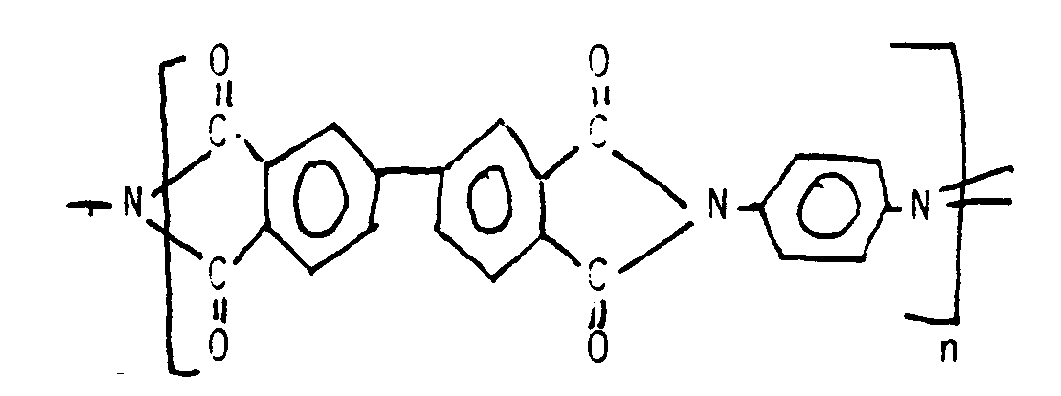
- UPILEX S which is believed to have a repeat unit derived from the same anhydride and phenylene diamine, viz.
- Some of the polymers unexpectedly have the additional advantage of being cross-linkable by U.V. light when applied at power densities below those needed for laser-machining. This may be especially useful in forming photoresists, whether or not also laser-machined.
- the invention is further illustrated by the following specific examples, in which the indicated polymers were laser-machined at room temperature in air at the indicated wavelengths, "NC" indicating absence of observable charring, S indicating slight or barely discernable charring, C indicating charring, and H indicating heavy charring.
- the Examples identified by C* after the Example Number are for comparison with the other Examples according to the invention.
- the commercially available aromatic polyetheramide of Example 16 comprises a polyamide sequence formed from alpha, omega-aminocarboxylic acids, lactams or diamine/dicarboxylic acid comibinations having C4 to C14 carbon chains, and a polyoxylalkylene sequence based on ethylene glycol, propylene glycol and/or tetramethylene glycol, and the polyoxyalkylene sequence constitutes from 5 to 85%, especially from 10 to 50% of the total block copolymer by weight.
Landscapes
- Engineering & Computer Science (AREA)
- Mechanical Engineering (AREA)
- Physics & Mathematics (AREA)
- Optics & Photonics (AREA)
- Manufacturing & Machinery (AREA)
- Plasma & Fusion (AREA)
- General Physics & Mathematics (AREA)
- Microelectronics & Electronic Packaging (AREA)
- Treatments Of Macromolecular Shaped Articles (AREA)
- Compositions Of Macromolecular Compounds (AREA)
- Liquid Crystal (AREA)
- Multicomponent Fibers (AREA)
- Chemically Coating (AREA)
- Polyamides (AREA)
- Laminated Bodies (AREA)
Abstract
Description
- This invention relates to laser-machining of polymeric materials and to laser-machined articles so produced.
- U.S Patent 4617085 describes a method for removing organic material from an organic film by ablative photodecomposition using ultraviolet light of wavelength 193 nanometres from an ArF excimer laser. The rate of removal is said to be substantially enhanced by the use of polymer blends or copolymers in which the aliphatic organic polymer units such as acrylates or methyacrylates, are present together with aromatic organic monomers and organic polymers having aliphatic unit such methacrylates and aromatic units such as styrenes having pendant aromatic rings.
- The present invention relates to classes of polymers possessing superior laser-machining characteristics, optionally together with advantageous equipment and/or wave-lengths, to produce laser-machined articles with reduced (preferably without) charring of the polymer. Absence of charring is advantageous since char tends to contaminate the surrounding polymer surface, making clean processing very difficult, e.g. for electronic microcircuits.
- A first aspect of the invention accordingly provides a laser-ablation-machined article in which the laser ablated material is composed of (a) aromatic and/or amorphous polyamide material, or (b)polymeric material having in its polymer chain backbone repeat units including backbone aromatic rings and backbone aliphatic chains (with the proviso that the aliphatic chains have at least 4 carbon atoms when the material is a polyester).
- A second aspect of the invention provides a method of making an article of polymeric material comprising laser-ablation-machining a body of polymeric material at a laser wavelength, power density, and energy fluence sufficient to remove portions of the said body, the said body being at least partly composed of (a) aromatic and/or amorphous polyamide material, or (b) polymeric material having in its polymer chain backbone repeat units including backbone aromatic rings and backbone aliphatic chains (with the proviso that the aliphatic chains have at least 4 carbon atoms when the material is a polyester). Polyesters will preferably have in the backbone an aliphatic chain of at least 4 carbon atoms between each aromatic nucleus in the backbone and the next aromatic nucleus in the backbone.
- It will be understood that many of the polymeric materials used in the articles or methods according to this invention have aromatic rings in the polymer backbone chain, which gives the present polymers characteristics different from those of the class of polymers with merely pendant aromatic rings described in the aforementioned U.S patent. The present polymers are well suited to laser-ablation-machining or processing, by which term is meant any process of forming, shaping, cutting, perforating, etching, marking, patterning or otherwise altering any physical dimensions of a body of polymeric material by applying laser radiation thereto so as to cause ablative photodecomposition of the polymeric material, the radiation being either in a narrow beam or spread over a wider area.
- The laser radiation may be of any wavelength capable of producing the desired ablation machining effect, and references hereinafter to the laser radiation as "light" are not intended to indicate any specific range of radiation wavelengths. Ultraviolet laser light is preferred, especially at wavelengths below 400 nanometres. Wavelengths of particular interest include those produced by excimer lasers, for example 351, 337, 308, 249, 222, 193 and 157 nanometres, the choice depending to some extent on the application. For example, 193 nm allows resolution of very fine details, while wavelengths of 248 nm or more, preferably of 308 nm, permit wider choice of optical media and need not be transmitted in vacuo, since they are not significantly absorbed by air. Light of 308 nanometres wavelength, preferably from an XeCl excimer laser, is especially useful, the gases in such a laser having a much longer working life than most other known gas systems. KrF excimer laser light at 249 nm is also useful, e.g. for finer lithographic features or to avoid the need to add chromophores to some polymers.
- The polymers specified for the articles and methods of the present invention are the aforesaid polyamides and/or have in their backbone aromatic rings and aliphatic chains, by which term is meant (subject to the aforesaid proviso for polyesters) chains of at least 2, preferably at least 4, and often more than 6, 8, or 10, carbon atoms forming part of the polymer backbone, excluding any carbonyl carbon atoms and any pendant aliphatic groups which may be attached. Cyclic aliphatic chains are included in the term. When pendant aliphatic groups are included, the backbone chain plus the pendant groups will comprise at least 3, preferably at least 5, and often at least 7, 9 or 11 carbon atoms in total.
- The specified polymers having this combination of aromatic rings and aliphatic chains in their backbone, have been found to be laser-ablation-machinable with little or no charring.
- The specified polymers may for example be selected from polyetheresters, the aforesaid polyamides, and polyimides. The polymers may be doped with appropriately chromophoric materials which enhance the laser-machining effect, for example aromatic carbonyl compounds, one example of which is benzophenone.
- In one form of the invention, the articles and methods use a class of the specified polymers which tend not to require doping, these being the polyetheresters, especially polyetherester block copolymers, preferably having the specified aromatic rings in the backbone of the ester blocks. The preferred copolymers also have aliphatic chains in the backbone of the ester blocks. The preferred copolymers may have aliphatic chains and no aromatic rings in the backbone of the ether blocks. The aliphatic chains in the preferred copolymers preferably contain 4 carbon atoms, more preferably 4 methylene groups, and an especially preferred copolymer is a polyetherester comprising polyester blocks of repeat unit formula

and polyether blocks of repeat unit formula
- In another form of the invention, the articles and methods use polyamides, which may be aromatic polyamides having in the polymer backbone aromatic rings, preferably derived from a phthalic acid, and/or may be amorphous polyamides, preferably having in its backbone aromatic rings and aliphatic chains. Specifically preferred polyamides include
- (A) polyamides based on the condensation of terephthalic acid with trimethylhexamethylene diamine (preferably containing a mixture of 2,2,4- and 2,4,4-trimethylhexamethylene diamine isomers), or
- (B) polyamides formed from the condensation of one or more bisaminomethylnorbornane isomers with one or more aliphatic, cycloaliphatic or aromatic dicarboxylic acids e.g. terephthalic acid and optionally including one or more amino acid or lactam e.g. epsiloncaprolactam comonomers, or
- (C) polyamides based on units derived from laurinlactam, isophthalic acid and bis-(4-amino-3-methylcyclohexyl) methane, or
- (D) polyamides based on the condensation of 2,2-bis-(p-aminocyclohexyl) propane with adipic and azeleic acids, and polyamides based on the condensation of trans cyclohexane-1,4-dicarboxylic acid with the trimethylhexamethylene diamine isomers mentioned in (A) above, or
- (E) polyamides based on units derived from m-xylylenediamine and adipic acid,
- Other examples include but are not limited to, amorphous polyamides defined by one of the following generic formulas

Provided that some R or R′ groups are aromatic rings and some are aliphatic chains, each R and R′ can independently be an alkylene radical having broadly about one to about 30 carbon atoms, preferably about two to about 20 carbon atoms and most preferably about two to about 10 carbon atoms, or a cycloalkylene or arylene radical having broadly about 3 to about 30 carbon atoms, preferably about two to about 20 carbon atoms, and most preferably about two to about 10 carbon atoms, or a mixed alkyl-cycloalkyl radical having broadly from about 4 to about 30 carbon atoms, preferably about four to about 20 carbon atoms more preferably about four to about 10 carbon atoms, or R can also be represented by structure (II)
Each R² and R³ in the above formula independently represents hydrogen or an alkyl radical having broadly from one to about 15 carbon atoms, preferably about one to about five carbon atoms, a cycloalkyl radical having from about 3 to about 16 carbon atoms, preferably about five to about 10 carbon atoms, a mixed alkylcycloalkyl radical having from about 6 to about 20 carbon atoms, preferably about 6 to about 10 carbon atoms. In a preferred embodiment, each R² is methyl and each R³ is hydrogen. Each n is a whole number and, preferably falls within the range of about 10 to about 500,000. - Examples of suitable polyamides may include amorphous polyamide derived from a 50:50 ratio of hexamethylene diamine and an equal mixture of terephthalic acid and isophthalic acid; amorphous polyamide derived from isophthalic acid/bis(4-amino-3-methylcyclohexyl) methane/lauryl lactam; and amorphous polyamide derived from dimethylterephthalate and a 50:50 mixture of 2,2,4- and 2,4,4,-trimethylhexamethylene diamine, all of which have less than about 2% crystallinity, i.e., greater than 98% amorphous character, and the like and mixtures of any two or more thereof.
- In those aspects of the invention where the machined surface comprises polyimides, it is preferred that the polymeric material comprises a polyimide having in its backbone aromatic rings derived from pyromellitimide. It may also be preferred that the polymeric material comprises a polyimide having in its backbone aliphatic chains of at least 10 carbon atoms, especially those wherein the polyimide is derived from 1,12-dodecamethylene pyromellitimide or 1,13-tridecamethylene pyromellitimide.
- Other aromatic/aliphatic polymers which may be useful include polyesters, e.g. polyalkylene terephthalate and especially polytetramethylene terephthalate, and cycloaliphatic diol/terephthalic acid copolymers e.g. copolymers of terephthalate and isophthalate units with 1,4-cyclohexanedimethyloxy units, polysulphides, polyethers e.g. polybutylene ether copolymers, and especially polyether esters such as those having polytetramethylene ether and polytetramethylene terephthalate blocks.
- Preferred copolyesters are the polyether ester polymers derived from terephthalic acid, polytetramethylene ether glycol and 1,4-butane diol. These are random block copolymers having crystalline hard blocks with the repeating unit:

and amorphous, elastomeric polytetramethylene ether terephthalate soft blocks of repeating unit
having a molecular weight of about 600 to 3000, i.e. n = 6 to 40. - Other preferred polymers include those based on polyether and polyamide blocks, especially the so called a "polyether-ester amide block copolymers" of repeating unit:

wherein A represents a polyamide sequence of average molecular weight in the range of from 300 to 15,000, preferably from 800 to 5000; and B represents a linear or branched polyoxyalkylene sequence of average molecular weight in the range of from 200 to 6000, preferably from 400 to 3000. - Preferably the polyamide sequence is formed from alpha,omega-aminocarboxylic acids, lactams or diamine/dicarboxylic acid combinations having C₄ to C₁₄ carbon chains, and the polyoxyalkylene sequence is based on ethylene glycol, propylene glycol and/or tetramethylene glycol, and the polyoxyalkylene sequence constitutes from 5 to 85%, especially from 10 to 50% of the total block copolymer by weight. These polymers and their preparation are described in UK Patent Specifications Nos. 1,473,972, 1,532,930, 1,555,644, 2,005,283A and 2,011,450A.
- The polymer preferably has a C:H ratio of not more than 0.9, more preferably not more than 0.75, most preferably not more than 0.65 and especially not more than 0.55.
- When the polymeric material is in the form of a sheet and through-holes are laser-machined through the sheet, the articles and methods of the present invention are applicable to making commercially valuable uniaxially electrically conductive articles of the kinds described in Published EP-A-0213774 or in copending British Patent Applications 8802567, 8802565, 8802566, 8815447.1, 8819895.7, and 8823053.7, the disclosures of all of which are incorporated herein by reference. For these purposes, especially useful embodiments of the articles and methods according to the invention are those wherein the laser-machined polymeric material comprises a laminar sheet having at least one layer of polyimide material and at least one layer of polyamide material, preferably a polyamide as hereinbefore described to avoid surface contamination as aforesaid.
- Such laminar sheets may be useful for making uniaxially electrically conductive articles as described in published European Patent Application EP-A-0123774, or in aforesaid copending British Patent Applications. For such purposes, a preferred polyimide is one which is capable of retaining at least 50%, preferably at least 75%, more preferably at least 85%, of its original elongation after immersion in water of pH10 at 100°C for 4 days according to ASTM D882. It will be readily understood that a sufficiently fully cyclised polyimide having less than 15%, preferably less than 10%, more preferably less than 5%, and if possible substantially no open imide rings or uncyclised amic acid groups may be better able to survive hot alkaline metal plating baths than incompletely cyclised polyimides such as Kapton (TM). Preferably, the polyimide whether fully cyclised or not is derived from polymerisation of 4,4′-biphenyl dianhydride and (4,4′-diaminobiphenyl, or 4,4′-diaminobiphenylether, or phenylenediamine), any charring of the polyimide being less significant in these laminates since the polyimide need not be on the surface of the laminate exposed to the drilling laser.
- The currently more preferred commercially available polyimides are those available under the Trade Mark "UPILEX" from Ube/ICI. One of these, "UPILEX R", is believed to be a relatively completely cyclised polymer having a repeat unit derived from biphenyl dianhydride and diaminodiphenylether, viz.

- Most preferred, however, is "UPILEX S", which is believed to have a repeat unit derived from the same anhydride and phenylene diamine, viz.
- The invention may also be especially useful in forming photo-resists (e.g. for producing microcircuits or flexible circuit boards) comprising a laser-machined article as herein described in the form of a layer, using the laser-machining methods herein described. For this purpose, the solvent-castable or spin-coatable amorphous polymeric materials are especially advantageous.
- Some of the polymers unexpectedly have the additional advantage of being cross-linkable by U.V. light when applied at power densities below those needed for laser-machining. This may be especially useful in forming photoresists, whether or not also laser-machined.
- The invention is further illustrated by the following specific examples, in which the indicated polymers were laser-machined at room temperature in air at the indicated wavelengths, "NC" indicating absence of observable charring, S indicating slight or barely discernable charring, C indicating charring, and H indicating heavy charring. The Examples identified by C* after the Example Number are for comparison with the other Examples according to the invention.


- The commercially available aromatic polyetheramide of Example 16 comprises a polyamide sequence formed from alpha, omega-aminocarboxylic acids, lactams or diamine/dicarboxylic acid comibinations having C₄ to C₁₄ carbon chains, and a polyoxylalkylene sequence based on ethylene glycol, propylene glycol and/or tetramethylene glycol, and the polyoxyalkylene sequence constitutes from 5 to 85%, especially from 10 to 50% of the total block copolymer by weight.
and especially those wherein the polyamide is amorphous.
Claims (29)
- A laser-ablation-machined article in which the laser ablated material is at least part composed of (a) aromatic and/or amorphous polyamide material, or (b) polymeric material having in its polymer chain backbone repeat units including backbone aromatic rings and backbone aliphatic chains, with the proviso that the aliphatic chains have at least 4 carbon atoms when the material is a polyester.
- A method of making an article of polymeric material comprising laser-ablation-machining a body of polymeric material at a laser wavelength, power density, and energy fluence sufficient to remove portions of the said body, the said body being at least partly composed of (a) aromatic and/or amorphous polyamide material, or (b) polymeric material having in its polymer chain backbone repeat units including backbone aromatic rings and backbone aliphatic chains, with the proviso that the aliphatic chains have at least 4 carbon atoms when the material is a polyester.
- An article or method according to claim 1 or 2, wherein the polymeric material is selected from polyetheresters, and polyimides having aromatic rings and aliphatic chains in the polymer backbone.
- An article or method according to claim 3, wherein the polymeric material comprises a polyetherester block copolymer having aromatic rings in the backbone of the ester blocks.
- An article or method according to claim 4, also having aliphatic chains in the backbone of the ester blocks.
- An article or method according to claim 3, 4 or 5, having aliphatic chains and no aromatic rings in the backbone of the ether blocks.
- An article or method according to any preceding claims wherein at least some of the said aliphatic chains contain at least four carbon atoms.
- An article or method according to claim 4, wherein the copolymer comprises polyester blocks of repeat unit formula

- An article or method according to any one of claims 1 to 8, wherein the polyamide has in its backbone aromatic rings derived from a phthalic acid.
- An article or method according to any one of claims 1-9, wherein the polymeric material comprises a polyamide(A) based on the condensation of terephthalic acid with trimethylhexamethylene diamine (preferably containing a mixture of 2,2,4- and 2,4,4-trimethylhexamethylene diamine isomers), or(B) formed from the condensation of one or more bisaminomethylnorbornane isomers with one or more aliphatic, cycloaliphatic or aromatic dicarboxylic acids e.g. terephthalic acid and optionally including one or more amino acid or lactam e.g.gamma-caprolactam comonomers, or(C) based on units derived from laurinlactam, isophthalic acid and bis-(4-amino-3-methylcyclohexyl) methane, or(D) based on the condensation of 2,2-bis-(p-aminocyclohexyl) propane with adipic and azelaic acids, and polyamides based on the condensation of trans cyclohexane-1,4-dicarboxylic acid with the trimethylhexamethylene diamine isomers mentioned in (A) above, or(E) based on units derived from m-xylylenediamine and adipic acid.
- An article or method according to claim 3, wherein the polymeric material comprises a polyimide having in its backbone aromatic rings derived from pyromellitimide.
- An article or method according to claims 3 or 11, wherein the polymeric material comprises a polyimide having in its backbone aliphatic chains of at least 10 carbon atoms.
- An article or method according to claim 11, wherein the polyimide is derived from 1,12-dodecamethylene pyromellitimide or 1,13-tridecamethylene pyromellitimide.
- An article or method according to any preceding claim wherein the laser machined polymeric material amorphous.
- A method according to any of claims 2-14, in which the laser machining is at a UV wavelength, preferably greater than 248 nanometres.
- A method according to claim 15 in which the laser machining is by means of an XeCl or KrF excimer laser.
- An article or method according to any of the preceding claims, wherein the polymeric material is doped with an aromatic carbonyl compound to enhance the laser machining.
- An article or method according to any of the preceding claims, wherein the laser-machined polymeric material comprises a laminar sheet having at least one layer of polyamide material and at least one layer of polyimide material.
- An article or method according to claim 18, wherein the polyamide layer(s) comprise(s) a polyamide as specified in claim 10.
- An article or method according to claim 18 or 19, wherein the polyimide layer(s) comprise(s) a polyimide a specified in any of claims 11 to 13.
- An article or method according to claim 18 or 19, wherein the polyimide is derived from polymerisation of 4,4′-biphenyl dianhydride and (4,4′-diaminobiphenyl, or 4,4′-diaminobiphenylether, or phenylenediamine), preferably p-phenylenediamine.
- An article or method according to any of claims 18 to 21, wherein the polyimide material is capable of retaining at least 50%, preferably at least 75%, more preferably at least 85%, of its original elongation after immersion in water of pH10 at 100°C for 4 days according to ASTM D882.
- An article or method according to any of the preceding claims, wherein the polymeric material is in the form of a sheet and through-holes are laser-machined through the sheet.
- A method according to any of claims 2-23, wherein the polymeric material is spin-coated on a supporting substrate.
- An article or method according to any of the preceding claims, wherein at least part of the polymeric material is cross-linked by exposure to laser light of lower power than that used for the laser-machining.
- An article according to any of claims 1, 3 to 14 and 17 to 24 wherein the article is in the form of a photoresist layer on a substrate.
- A method according to any of claims 2 to 24, wherein the article made is a polymeric photoresist layer.
- An article or method according to claim 1 or 2 wherein the polymeric material comprises a polyester.
- An article or method according to any preceding claim wherein the polymeric material has a C:H ratio of not more than 0.9, preferably not more than 0.65.
Applications Claiming Priority (4)
| Application Number | Priority Date | Filing Date | Title |
|---|---|---|---|
| GB888802568A GB8802568D0 (en) | 1988-02-05 | 1988-02-05 | Laser-machining polymers |
| GB8802568 | 1988-02-05 | ||
| GB8828245 | 1988-12-02 | ||
| GB888828245A GB8828245D0 (en) | 1988-12-02 | 1988-12-02 | Anisotropically electrically conductive articles |
Publications (2)
| Publication Number | Publication Date |
|---|---|
| EP0327398A1 EP0327398A1 (en) | 1989-08-09 |
| EP0327398B1 true EP0327398B1 (en) | 1994-09-21 |
Family
ID=26293429
Family Applications (2)
| Application Number | Title | Priority Date | Filing Date |
|---|---|---|---|
| EP89301105A Expired - Lifetime EP0327398B1 (en) | 1988-02-05 | 1989-02-03 | Laser-machining polymers |
| EP89903186A Pending EP0400070A1 (en) | 1988-02-05 | 1989-02-03 | Laser-machining polymers |
Family Applications After (1)
| Application Number | Title | Priority Date | Filing Date |
|---|---|---|---|
| EP89903186A Pending EP0400070A1 (en) | 1988-02-05 | 1989-02-03 | Laser-machining polymers |
Country Status (7)
| Country | Link |
|---|---|
| US (1) | US5487852A (en) |
| EP (2) | EP0327398B1 (en) |
| JP (1) | JP2840098B2 (en) |
| KR (1) | KR900701040A (en) |
| AT (1) | ATE112098T1 (en) |
| DE (1) | DE68918300T2 (en) |
| WO (1) | WO1989007337A1 (en) |
Families Citing this family (26)
| Publication number | Priority date | Publication date | Assignee | Title |
|---|---|---|---|---|
| US5073814A (en) * | 1990-07-02 | 1991-12-17 | General Electric Company | Multi-sublayer dielectric layers |
| JP2850518B2 (en) * | 1990-10-17 | 1999-01-27 | 日本電気株式会社 | Organic resin multilayer wiring board and method of manufacturing organic resin multilayer wiring board |
| US5308180A (en) * | 1991-12-09 | 1994-05-03 | Minnesota Mining And Manufacturing Company | Liquid applicator with metering insert |
| EP0560072A3 (en) * | 1992-03-13 | 1993-10-06 | Nitto Denko Corporation | Anisotropic electrically conductive adhesive film and connection structure using the same |
| ES2102857T3 (en) * | 1993-06-11 | 1997-08-01 | Minnesota Mining & Mfg | REPRODUCTION TOOL MACHINED BY LASER. |
| DE19540074A1 (en) * | 1995-10-27 | 1997-04-30 | Bayer Ag | Process for the microstructuring of polymers |
| DE69605658T2 (en) * | 1996-07-05 | 2000-04-20 | Hewlett-Packard Co. | Manufacturing process for bumps |
| US5776408A (en) * | 1996-08-23 | 1998-07-07 | Eastman Kodak Company | Method of engraving green ceramic articles |
| EP0824989A3 (en) * | 1996-08-23 | 2000-03-08 | Eastman Kodak Company | Method of forming a mask useful for engraving ceramic articles |
| US5955022A (en) * | 1997-02-10 | 1999-09-21 | Compaq Computer Corp. | Process of making an orifice plate for a page-wide ink jet printhead |
| US6303488B1 (en) | 1997-02-12 | 2001-10-16 | Micron Technology, Inc. | Semiconductor processing methods of forming openings to devices and substrates, exposing material from which photoresist cannot be substantially selectively removed |
| US5997985A (en) * | 1998-09-10 | 1999-12-07 | Northrop Grumman Corporation | Method of forming acoustic attenuation chambers using laser processing of multi-layered polymer films |
| US6592943B2 (en) | 1998-12-01 | 2003-07-15 | Fujitsu Limited | Stencil and method for depositing solder |
| US6495468B2 (en) | 1998-12-22 | 2002-12-17 | Micron Technology, Inc. | Laser ablative removal of photoresist |
| US6277319B2 (en) | 1999-02-19 | 2001-08-21 | Green Tokai Co., Ltd. | Method for trimming shaped plastic workpieces |
| GB0009719D0 (en) * | 2000-04-19 | 2000-06-07 | Scient Generics Ltd | A method of fabricating coded particles |
| SG98017A1 (en) * | 2000-12-19 | 2003-08-20 | Inst Materials Research & Eng | Method of forming selective electronics plating on polymer surfaces |
| WO2002074480A1 (en) | 2001-03-16 | 2002-09-26 | Laser Machining, Inc. | Laser ablation technique |
| GB2433460A (en) * | 2005-12-20 | 2007-06-27 | Arisawa Seisakusho Kk | Laser ablation apparatus,processing method and mask therefor |
| US20070235902A1 (en) * | 2006-03-31 | 2007-10-11 | 3M Innovative Properties Company | Microstructured tool and method of making same using laser ablation |
| US20070231541A1 (en) * | 2006-03-31 | 2007-10-04 | 3M Innovative Properties Company | Microstructured tool and method of making same using laser ablation |
| EP2122691A4 (en) | 2007-02-16 | 2011-02-16 | Nanogram Corp | SOLAR CELL STRUCTURES, PHOTOVOLTAIC MODULES, AND CORRESPONDING METHODS |
| US20090000888A1 (en) * | 2007-06-29 | 2009-01-01 | Mcandrews Michael | Bicycle damper |
| US20100294352A1 (en) * | 2009-05-20 | 2010-11-25 | Uma Srinivasan | Metal patterning for electrically conductive structures based on alloy formation |
| US20100294349A1 (en) * | 2009-05-20 | 2010-11-25 | Uma Srinivasan | Back contact solar cells with effective and efficient designs and corresponding patterning processes |
| US8912083B2 (en) | 2011-01-31 | 2014-12-16 | Nanogram Corporation | Silicon substrates with doped surface contacts formed from doped silicon inks and corresponding processes |
Family Cites Families (24)
| Publication number | Priority date | Publication date | Assignee | Title |
|---|---|---|---|---|
| US3790744A (en) * | 1971-07-19 | 1974-02-05 | American Can Co | Method of forming a line of weakness in a multilayer laminate |
| ATE22518T1 (en) * | 1980-09-15 | 1986-10-15 | Ciba Geigy Ag | USING FLEXIBLE BASE MATERIAL TO MANUFACTURE PRINTED CIRCUITS. |
| JPS58206005A (en) * | 1982-05-24 | 1983-12-01 | インタ−ナシヨナル ビジネス マシ−ンズ コ−ポレ−シヨン | Electronic circuit |
| US4417948A (en) * | 1982-07-09 | 1983-11-29 | International Business Machines Corporation | Self developing, photoetching of polyesters by far UV radiation |
| US4414059A (en) * | 1982-12-09 | 1983-11-08 | International Business Machines Corporation | Far UV patterning of resist materials |
| GB8412674D0 (en) * | 1984-05-18 | 1984-06-27 | British Telecomm | Integrated circuit chip carrier |
| JPS60245643A (en) * | 1984-05-21 | 1985-12-05 | Shin Etsu Chem Co Ltd | Surface modified synthetic resin molded products |
| EP0174494B1 (en) * | 1984-08-10 | 1989-06-07 | Siemens Aktiengesellschaft | Thermostable polymer system, cross-linkable by irradiation, for microelectronic use |
| JPH0719936B2 (en) * | 1985-04-24 | 1995-03-06 | 株式会社日立製作所 | Wiring board |
| CA1284523C (en) * | 1985-08-05 | 1991-05-28 | Leo G. Svendsen | Uniaxially electrically conductive articles with porous insulating substrate |
| DE3675321D1 (en) * | 1985-08-16 | 1990-12-06 | Dai Ichi Seiko Co Ltd | SEMICONDUCTOR ARRANGEMENT WITH PACK OF PIN PLUG TYPE. |
| US4617085A (en) * | 1985-09-03 | 1986-10-14 | General Electric Company | Process for removing organic material in a patterned manner from an organic film |
| DE3767890D1 (en) * | 1986-02-14 | 1991-03-14 | Amoco Corp | TREATMENT OF SHAPED SURFACES WITH ULTRAVIOLET LASER. |
| JPS63105042A (en) * | 1986-10-21 | 1988-05-10 | Toyoda Gosei Co Ltd | Molded polymer article |
| JP2819555B2 (en) * | 1987-03-16 | 1998-10-30 | ミネソタ マイニング アンド マニュファクチュアリング カンパニー | Method for modifying surface of semicrystalline polymer and semicrystalline polymer article having the modified surface |
| JP2656517B2 (en) * | 1987-12-11 | 1997-09-24 | 帝人株式会社 | Optical processing of polymers |
| US5175043A (en) * | 1987-12-11 | 1992-12-29 | Teijin Ltd. | Aromatic polymer molded article with modified surface condition and process for producing the same |
| JPH0798870B2 (en) * | 1987-12-11 | 1995-10-25 | 帝人株式会社 | Polymer optical processing method |
| US4780177A (en) * | 1988-02-05 | 1988-10-25 | General Electric Company | Excimer laser patterning of a novel resist |
| US4877644A (en) * | 1988-04-12 | 1989-10-31 | Amp Incorporated | Selective plating by laser ablation |
| US4857382A (en) * | 1988-04-26 | 1989-08-15 | General Electric Company | Apparatus and method for photoetching of polyimides, polycarbonates and polyetherimides |
| US4915981A (en) * | 1988-08-12 | 1990-04-10 | Rogers Corporation | Method of laser drilling fluoropolymer materials |
| EP0413664B1 (en) * | 1989-08-18 | 1995-03-22 | Ciba-Geigy Ag | Laser-marking of plastic objects in any form by means of special effects |
| DE4041884A1 (en) * | 1990-12-27 | 1992-07-02 | Abb Patent Gmbh | METHOD FOR TREATING SURFACES |
-
1989
- 1989-02-03 EP EP89301105A patent/EP0327398B1/en not_active Expired - Lifetime
- 1989-02-03 EP EP89903186A patent/EP0400070A1/en active Pending
- 1989-02-03 WO PCT/GB1989/000109 patent/WO1989007337A1/en not_active Ceased
- 1989-02-03 DE DE68918300T patent/DE68918300T2/en not_active Expired - Fee Related
- 1989-02-03 KR KR1019890701831A patent/KR900701040A/en not_active Withdrawn
- 1989-02-03 AT AT89301105T patent/ATE112098T1/en not_active IP Right Cessation
- 1989-02-03 US US07/548,962 patent/US5487852A/en not_active Expired - Lifetime
- 1989-02-03 JP JP1502992A patent/JP2840098B2/en not_active Expired - Fee Related
Also Published As
| Publication number | Publication date |
|---|---|
| DE68918300T2 (en) | 1995-05-18 |
| JP2840098B2 (en) | 1998-12-24 |
| JPH03502587A (en) | 1991-06-13 |
| ATE112098T1 (en) | 1994-10-15 |
| EP0327398A1 (en) | 1989-08-09 |
| DE68918300D1 (en) | 1994-10-27 |
| EP0400070A1 (en) | 1990-12-05 |
| US5487852A (en) | 1996-01-30 |
| WO1989007337A1 (en) | 1989-08-10 |
| KR900701040A (en) | 1990-08-17 |
Similar Documents
| Publication | Publication Date | Title |
|---|---|---|
| EP0327398B1 (en) | Laser-machining polymers | |
| EP0328325B1 (en) | Laminar polymeric sheet | |
| KR100879668B1 (en) | Photosensitive resin composition and the photosensitive dry film resist and the photosensitive coverlay film using the same | |
| JP2828129B2 (en) | Drilling method for printed wiring boards | |
| CA2126316C (en) | Multi-ply battery separator and process of forming | |
| EP0346485B1 (en) | Aromatic polymer moldings having modified surface condition and process for their production | |
| CA1110198A (en) | Process for preparing a cured copolyetherester elastomeric composition | |
| WO2008063730A2 (en) | Biaxially oriented film, laminates made therefrom, and method | |
| EP0604319B1 (en) | Polyimide solution compositions and process for preparing same | |
| ATE33189T1 (en) | PROCESS FOR THE PRODUCTION OF POLYIMIDE AND POLYISOINDOLOCHINAZOLINDIONE RELIEF STRUCTURES. | |
| US5578696A (en) | Heat resistant adhesive film, an adhesion structure, and method of adhesion | |
| AU668704B2 (en) | Multi-ply battery separator and process of forming | |
| KR930001007A (en) | Photosensitive composition | |
| Yang et al. | Photoablation characteristics of novel polyimides synthesized for high-aspect-ratio excimer laser LIGA process | |
| KR102912176B1 (en) | Organic solvent, mixed solution and method for producing polyimide film | |
| Hsieh et al. | Preparation of organic soluble polyimides and their applications in KrF excimer laser LIGA process | |
| JPH01154143A (en) | Organic polymer having surface liable to degenerate and discolor with ultra violet rays | |
| JPH02164532A (en) | Flexible circuit board | |
| JP2005306929A (en) | Low linear expansion coefficient polyimide film with excellent adhesion to metal coating | |
| JPH09136968A (en) | Method for forming fine structure in polymer | |
| Gu et al. | Nd: YAG laser cleaning of ablation debris from excimer-laser-ablated polyimide | |
| CA2218920A1 (en) | Base film for photographic films | |
| TH21863B (en) | Production of poly (ethylene terephthalate) | |
| JPH08244372A (en) | Film for paperless thermal stencil printing base sheet | |
| JPH03281286A (en) | Laser marking method and resin composition for laser marking |
Legal Events
| Date | Code | Title | Description |
|---|---|---|---|
| PUAI | Public reference made under article 153(3) epc to a published international application that has entered the european phase |
Free format text: ORIGINAL CODE: 0009012 |
|
| 17P | Request for examination filed |
Effective date: 19890210 |
|
| AK | Designated contracting states |
Kind code of ref document: A1 Designated state(s): ES |
|
| RBV | Designated contracting states (corrected) |
Designated state(s): AT BE CH DE ES FR GB IT LI NL SE |
|
| XX | Miscellaneous (additional remarks) |
Free format text: VERBUNDEN MIT 89903186.8/0400070 (EUROPAEISCHE ANMELDENUMMER/VEROEFFENTLICHUNGSNUMMER) DURCH ENTSCHEIDUNG VOM 04.05.92. |
|
| 17Q | First examination report despatched |
Effective date: 19920605 |
|
| GRAA | (expected) grant |
Free format text: ORIGINAL CODE: 0009210 |
|
| AK | Designated contracting states |
Kind code of ref document: B1 Designated state(s): AT BE CH DE ES FR GB IT LI NL SE |
|
| PG25 | Lapsed in a contracting state [announced via postgrant information from national office to epo] |
Ref country code: LI Effective date: 19940921 Ref country code: IT Free format text: LAPSE BECAUSE OF FAILURE TO SUBMIT A TRANSLATION OF THE DESCRIPTION OR TO PAY THE FEE WITHIN THE PRESCRIBED TIME-LIMIT;WARNING: LAPSES OF ITALIAN PATENTS WITH EFFECTIVE DATE BEFORE 2007 MAY HAVE OCCURRED AT ANY TIME BEFORE 2007. THE CORRECT EFFECTIVE DATE MAY BE DIFFERENT FROM THE ONE RECORDED. Effective date: 19940921 Ref country code: CH Effective date: 19940921 Ref country code: BE Effective date: 19940921 Ref country code: NL Effective date: 19940921 Ref country code: AT Effective date: 19940921 Ref country code: ES Free format text: THE PATENT HAS BEEN ANNULLED BY A DECISION OF A NATIONAL AUTHORITY Effective date: 19940921 |
|
| REF | Corresponds to: |
Ref document number: 112098 Country of ref document: AT Date of ref document: 19941015 Kind code of ref document: T |
|
| XX | Miscellaneous (additional remarks) |
Free format text: VERBUNDEN MIT 89903186.8/0400070 (EUROPAEISCHE ANMELDENUMMER/VEROEFFENTLICHUNGSNUMMER) DURCH ENTSCHEIDUNG VOM 04.05.92. |
|
| REF | Corresponds to: |
Ref document number: 68918300 Country of ref document: DE Date of ref document: 19941027 |
|
| ET | Fr: translation filed | ||
| PG25 | Lapsed in a contracting state [announced via postgrant information from national office to epo] |
Ref country code: SE Effective date: 19941221 |
|
| REG | Reference to a national code |
Ref country code: CH Ref legal event code: PL |
|
| NLV1 | Nl: lapsed or annulled due to failure to fulfill the requirements of art. 29p and 29m of the patents act | ||
| PLBE | No opposition filed within time limit |
Free format text: ORIGINAL CODE: 0009261 |
|
| STAA | Information on the status of an ep patent application or granted ep patent |
Free format text: STATUS: NO OPPOSITION FILED WITHIN TIME LIMIT |
|
| 26N | No opposition filed | ||
| REG | Reference to a national code |
Ref country code: GB Ref legal event code: IF02 |
|
| PGFP | Annual fee paid to national office [announced via postgrant information from national office to epo] |
Ref country code: FR Payment date: 20060217 Year of fee payment: 18 |
|
| PGFP | Annual fee paid to national office [announced via postgrant information from national office to epo] |
Ref country code: GB Payment date: 20060223 Year of fee payment: 18 |
|
| PGFP | Annual fee paid to national office [announced via postgrant information from national office to epo] |
Ref country code: DE Payment date: 20060331 Year of fee payment: 18 |
|
| GBPC | Gb: european patent ceased through non-payment of renewal fee |
Effective date: 20070203 |
|
| REG | Reference to a national code |
Ref country code: FR Ref legal event code: ST Effective date: 20071030 |
|
| PG25 | Lapsed in a contracting state [announced via postgrant information from national office to epo] |
Ref country code: DE Free format text: LAPSE BECAUSE OF NON-PAYMENT OF DUE FEES Effective date: 20070901 |
|
| PG25 | Lapsed in a contracting state [announced via postgrant information from national office to epo] |
Ref country code: GB Free format text: LAPSE BECAUSE OF NON-PAYMENT OF DUE FEES Effective date: 20070203 Ref country code: FR Free format text: LAPSE BECAUSE OF NON-PAYMENT OF DUE FEES Effective date: 20070228 |