EP0313873A1 - Targeted forms of methyltrithio antitumor agents - Google Patents
Targeted forms of methyltrithio antitumor agents Download PDFInfo
- Publication number
- EP0313873A1 EP0313873A1 EP88116338A EP88116338A EP0313873A1 EP 0313873 A1 EP0313873 A1 EP 0313873A1 EP 88116338 A EP88116338 A EP 88116338A EP 88116338 A EP88116338 A EP 88116338A EP 0313873 A1 EP0313873 A1 EP 0313873A1
- Authority
- EP
- European Patent Office
- Prior art keywords
- formula
- compound
- hereinbefore defined
- divalent
- radical
- Prior art date
- Legal status (The legal status is an assumption and is not a legal conclusion. Google has not performed a legal analysis and makes no representation as to the accuracy of the status listed.)
- Granted
Links
- -1 methyltrithio Chemical group 0.000 title claims abstract description 38
- 239000002246 antineoplastic agent Substances 0.000 title abstract description 7
- 229940079593 drug Drugs 0.000 claims abstract description 16
- 239000003814 drug Substances 0.000 claims abstract description 16
- 238000000034 method Methods 0.000 claims abstract description 15
- WEVYAHXRMPXWCK-UHFFFAOYSA-N Acetonitrile Chemical compound CC#N WEVYAHXRMPXWCK-UHFFFAOYSA-N 0.000 claims description 54
- 150000001875 compounds Chemical class 0.000 claims description 53
- 238000006243 chemical reaction Methods 0.000 claims description 27
- ZMANZCXQSJIPKH-UHFFFAOYSA-N Triethylamine Chemical compound CCN(CC)CC ZMANZCXQSJIPKH-UHFFFAOYSA-N 0.000 claims description 18
- 239000000562 conjugate Substances 0.000 claims description 15
- 108090000623 proteins and genes Proteins 0.000 claims description 14
- 102000004169 proteins and genes Human genes 0.000 claims description 14
- 125000003178 carboxy group Chemical group [H]OC(*)=O 0.000 claims description 13
- QTBSBXVTEAMEQO-UHFFFAOYSA-N Acetic acid Chemical compound CC(O)=O QTBSBXVTEAMEQO-UHFFFAOYSA-N 0.000 claims description 12
- 150000001299 aldehydes Chemical class 0.000 claims description 12
- 206010028980 Neoplasm Diseases 0.000 claims description 11
- 239000003972 antineoplastic antibiotic Substances 0.000 claims description 10
- 239000012634 fragment Substances 0.000 claims description 10
- 230000009467 reduction Effects 0.000 claims description 9
- 125000000837 carbohydrate group Chemical group 0.000 claims description 8
- 125000003710 aryl alkyl group Chemical group 0.000 claims description 7
- 230000003647 oxidation Effects 0.000 claims description 7
- 238000007254 oxidation reaction Methods 0.000 claims description 7
- 125000002924 primary amino group Chemical group [H]N([H])* 0.000 claims description 7
- 125000003396 thiol group Chemical group [H]S* 0.000 claims description 7
- 125000004446 heteroarylalkyl group Chemical group 0.000 claims description 6
- 238000004519 manufacturing process Methods 0.000 claims description 6
- 150000003573 thiols Chemical class 0.000 claims description 6
- 229940086542 triethylamine Drugs 0.000 claims description 6
- MBVFRSJFKMJRHA-UHFFFAOYSA-N 4-fluoro-1-benzofuran-7-carbaldehyde Chemical compound FC1=CC=C(C=O)C2=C1C=CO2 MBVFRSJFKMJRHA-UHFFFAOYSA-N 0.000 claims description 5
- OAKJQQAXSVQMHS-UHFFFAOYSA-N Hydrazine Chemical compound NN OAKJQQAXSVQMHS-UHFFFAOYSA-N 0.000 claims description 5
- 125000003282 alkyl amino group Chemical group 0.000 claims description 5
- 239000003102 growth factor Substances 0.000 claims description 5
- 229910052736 halogen Inorganic materials 0.000 claims description 5
- 150000002367 halogens Chemical class 0.000 claims description 5
- 230000009257 reactivity Effects 0.000 claims description 5
- 150000003431 steroids Chemical class 0.000 claims description 5
- 125000003277 amino group Chemical group 0.000 claims description 4
- 239000000427 antigen Substances 0.000 claims description 4
- 102000036639 antigens Human genes 0.000 claims description 4
- 108091007433 antigens Proteins 0.000 claims description 4
- 125000003118 aryl group Chemical group 0.000 claims description 4
- 125000001316 cycloalkyl alkyl group Chemical group 0.000 claims description 4
- 125000000753 cycloalkyl group Chemical group 0.000 claims description 4
- XBDQKXXYIPTUBI-UHFFFAOYSA-N dimethylselenoniopropionate Natural products CCC(O)=O XBDQKXXYIPTUBI-UHFFFAOYSA-N 0.000 claims description 4
- VHJLVAABSRFDPM-QWWZWVQMSA-N dithiothreitol Chemical compound SC[C@@H](O)[C@H](O)CS VHJLVAABSRFDPM-QWWZWVQMSA-N 0.000 claims description 4
- 125000005885 heterocycloalkylalkyl group Chemical group 0.000 claims description 4
- 238000002329 infrared spectrum Methods 0.000 claims description 4
- 238000001228 spectrum Methods 0.000 claims description 4
- 238000002211 ultraviolet spectrum Methods 0.000 claims description 4
- BTJIUGUIPKRLHP-UHFFFAOYSA-N 4-nitrophenol Chemical compound OC1=CC=C([N+]([O-])=O)C=C1 BTJIUGUIPKRLHP-UHFFFAOYSA-N 0.000 claims description 3
- OFLXLNCGODUUOT-UHFFFAOYSA-N acetohydrazide Chemical compound C\C(O)=N\N OFLXLNCGODUUOT-UHFFFAOYSA-N 0.000 claims description 3
- 150000001412 amines Chemical class 0.000 claims description 3
- 239000003153 chemical reaction reagent Substances 0.000 claims description 3
- 238000001727 in vivo Methods 0.000 claims description 3
- 239000001990 protein-drug conjugate Substances 0.000 claims description 3
- BEOOHQFXGBMRKU-UHFFFAOYSA-N sodium cyanoborohydride Chemical compound [Na+].[B-]C#N BEOOHQFXGBMRKU-UHFFFAOYSA-N 0.000 claims description 3
- NQTADLQHYWFPDB-UHFFFAOYSA-N N-Hydroxysuccinimide Chemical compound ON1C(=O)CCC1=O NQTADLQHYWFPDB-UHFFFAOYSA-N 0.000 claims description 2
- 239000008366 buffered solution Substances 0.000 claims description 2
- 150000001718 carbodiimides Chemical class 0.000 claims description 2
- 239000003795 chemical substances by application Substances 0.000 claims description 2
- KHIWWQKSHDUIBK-UHFFFAOYSA-N periodic acid Chemical compound OI(=O)(=O)=O KHIWWQKSHDUIBK-UHFFFAOYSA-N 0.000 claims description 2
- 235000019260 propionic acid Nutrition 0.000 claims description 2
- 239000012279 sodium borohydride Substances 0.000 claims description 2
- 229910000033 sodium borohydride Inorganic materials 0.000 claims description 2
- CNHYKKNIIGEXAY-UHFFFAOYSA-N thiolan-2-imine Chemical compound N=C1CCCS1 CNHYKKNIIGEXAY-UHFFFAOYSA-N 0.000 claims description 2
- 230000004614 tumor growth Effects 0.000 claims description 2
- 235000013350 formula milk Nutrition 0.000 claims 43
- 125000002887 hydroxy group Chemical group [H]O* 0.000 claims 5
- 239000012062 aqueous buffer Substances 0.000 claims 4
- 241000124008 Mammalia Species 0.000 claims 3
- 150000008064 anhydrides Chemical class 0.000 claims 3
- 230000000174 oncolytic effect Effects 0.000 claims 2
- XBNGYFFABRKICK-UHFFFAOYSA-N 2,3,4,5,6-pentafluorophenol Chemical compound OC1=C(F)C(F)=C(F)C(F)=C1F XBNGYFFABRKICK-UHFFFAOYSA-N 0.000 claims 1
- PBYIIRLNRCVTMQ-UHFFFAOYSA-N 2,3,5,6-tetrafluorophenol Chemical compound OC1=C(F)C(F)=CC(F)=C1F PBYIIRLNRCVTMQ-UHFFFAOYSA-N 0.000 claims 1
- FPQQSJJWHUJYPU-UHFFFAOYSA-N 3-(dimethylamino)propyliminomethylidene-ethylazanium;chloride Chemical compound Cl.CCN=C=NCCCN(C)C FPQQSJJWHUJYPU-UHFFFAOYSA-N 0.000 claims 1
- OUYCCCASQSFEME-QMMMGPOBSA-N L-tyrosine Chemical compound OC(=O)[C@@H](N)CC1=CC=C(O)C=C1 OUYCCCASQSFEME-QMMMGPOBSA-N 0.000 claims 1
- IOVCWXUNBOPUCH-UHFFFAOYSA-N Nitrous acid Chemical compound ON=O IOVCWXUNBOPUCH-UHFFFAOYSA-N 0.000 claims 1
- 230000000890 antigenic effect Effects 0.000 claims 1
- 239000012304 carboxyl activating agent Substances 0.000 claims 1
- 150000001735 carboxylic acids Chemical group 0.000 claims 1
- 230000002401 inhibitory effect Effects 0.000 claims 1
- IZUPBVBPLAPZRR-UHFFFAOYSA-N pentachloro-phenol Natural products OC1=C(Cl)C(Cl)=C(Cl)C(Cl)=C1Cl IZUPBVBPLAPZRR-UHFFFAOYSA-N 0.000 claims 1
- 229920000136 polysorbate Polymers 0.000 claims 1
- OUYCCCASQSFEME-UHFFFAOYSA-N tyrosine Natural products OC(=O)C(N)CC1=CC=C(O)C=C1 OUYCCCASQSFEME-UHFFFAOYSA-N 0.000 claims 1
- 239000003242 anti bacterial agent Substances 0.000 abstract description 12
- 230000000844 anti-bacterial effect Effects 0.000 abstract description 2
- ZMXDDKWLCZADIW-UHFFFAOYSA-N N,N-Dimethylformamide Chemical compound CN(C)C=O ZMXDDKWLCZADIW-UHFFFAOYSA-N 0.000 description 30
- YMWUJEATGCHHMB-UHFFFAOYSA-N Dichloromethane Chemical compound ClCCl YMWUJEATGCHHMB-UHFFFAOYSA-N 0.000 description 27
- 210000004027 cell Anatomy 0.000 description 27
- OKKJLVBELUTLKV-UHFFFAOYSA-N Methanol Chemical compound OC OKKJLVBELUTLKV-UHFFFAOYSA-N 0.000 description 24
- XEKOWRVHYACXOJ-UHFFFAOYSA-N Ethyl acetate Chemical compound CCOC(C)=O XEKOWRVHYACXOJ-UHFFFAOYSA-N 0.000 description 21
- HEDRZPFGACZZDS-UHFFFAOYSA-N Chloroform Chemical compound ClC(Cl)Cl HEDRZPFGACZZDS-UHFFFAOYSA-N 0.000 description 20
- 239000000047 product Substances 0.000 description 19
- WYURNTSHIVDZCO-UHFFFAOYSA-N Tetrahydrofuran Chemical compound C1CCOC1 WYURNTSHIVDZCO-UHFFFAOYSA-N 0.000 description 18
- RTZKZFJDLAIYFH-UHFFFAOYSA-N Diethyl ether Chemical compound CCOCC RTZKZFJDLAIYFH-UHFFFAOYSA-N 0.000 description 17
- 239000000243 solution Substances 0.000 description 17
- VLKZOEOYAKHREP-UHFFFAOYSA-N n-Hexane Chemical compound CCCCCC VLKZOEOYAKHREP-UHFFFAOYSA-N 0.000 description 16
- 108091003079 Bovine Serum Albumin Proteins 0.000 description 13
- 239000012894 fetal calf serum Substances 0.000 description 13
- 239000000523 sample Substances 0.000 description 13
- NLXLAEXVIDQMFP-UHFFFAOYSA-N Ammonia chloride Chemical compound [NH4+].[Cl-] NLXLAEXVIDQMFP-UHFFFAOYSA-N 0.000 description 10
- 235000018102 proteins Nutrition 0.000 description 10
- 238000012360 testing method Methods 0.000 description 10
- DKIDEFUBRARXTE-UHFFFAOYSA-N 3-mercaptopropanoic acid Chemical class OC(=O)CCS DKIDEFUBRARXTE-UHFFFAOYSA-N 0.000 description 9
- 229940088710 antibiotic agent Drugs 0.000 description 9
- 229940127121 immunoconjugate Drugs 0.000 description 9
- 238000003756 stirring Methods 0.000 description 9
- YLQBMQCUIZJEEH-UHFFFAOYSA-N tetrahydrofuran Natural products C=1C=COC=1 YLQBMQCUIZJEEH-UHFFFAOYSA-N 0.000 description 9
- VEXZGXHMUGYJMC-UHFFFAOYSA-N Hydrochloric acid Chemical compound Cl VEXZGXHMUGYJMC-UHFFFAOYSA-N 0.000 description 8
- CSNNHWWHGAXBCP-UHFFFAOYSA-L Magnesium sulfate Chemical compound [Mg+2].[O-][S+2]([O-])([O-])[O-] CSNNHWWHGAXBCP-UHFFFAOYSA-L 0.000 description 8
- VYPSYNLAJGMNEJ-UHFFFAOYSA-N Silicium dioxide Chemical compound O=[Si]=O VYPSYNLAJGMNEJ-UHFFFAOYSA-N 0.000 description 8
- 238000004128 high performance liquid chromatography Methods 0.000 description 8
- 230000014759 maintenance of location Effects 0.000 description 8
- 239000000741 silica gel Substances 0.000 description 8
- 229910002027 silica gel Inorganic materials 0.000 description 8
- 238000003556 assay Methods 0.000 description 7
- 229940093499 ethyl acetate Drugs 0.000 description 7
- 235000019439 ethyl acetate Nutrition 0.000 description 7
- 239000002904 solvent Substances 0.000 description 7
- XKRFYHLGVUSROY-UHFFFAOYSA-N Argon Chemical compound [Ar] XKRFYHLGVUSROY-UHFFFAOYSA-N 0.000 description 6
- LFQSCWFLJHTTHZ-UHFFFAOYSA-N Ethanol Chemical compound CCO LFQSCWFLJHTTHZ-UHFFFAOYSA-N 0.000 description 6
- HEMHJVSKTPXQMS-UHFFFAOYSA-M Sodium hydroxide Chemical compound [OH-].[Na+] HEMHJVSKTPXQMS-UHFFFAOYSA-M 0.000 description 6
- 230000000259 anti-tumor effect Effects 0.000 description 6
- 230000027455 binding Effects 0.000 description 6
- 239000000203 mixture Substances 0.000 description 6
- 230000008685 targeting Effects 0.000 description 6
- 239000012591 Dulbecco’s Phosphate Buffered Saline Substances 0.000 description 5
- 239000004793 Polystyrene Substances 0.000 description 5
- 229960001040 ammonium chloride Drugs 0.000 description 5
- 235000019270 ammonium chloride Nutrition 0.000 description 5
- 239000000872 buffer Substances 0.000 description 5
- 230000005764 inhibitory process Effects 0.000 description 5
- 125000003588 lysine group Chemical group [H]N([H])C([H])([H])C([H])([H])C([H])([H])C([H])([H])C([H])(N([H])[H])C(*)=O 0.000 description 5
- 229920002223 polystyrene Polymers 0.000 description 5
- 241000699670 Mus sp. Species 0.000 description 4
- CDBYLPFSWZWCQE-UHFFFAOYSA-L Sodium Carbonate Chemical compound [Na+].[Na+].[O-]C([O-])=O CDBYLPFSWZWCQE-UHFFFAOYSA-L 0.000 description 4
- FAPWRFPIFSIZLT-UHFFFAOYSA-M Sodium chloride Chemical compound [Na+].[Cl-] FAPWRFPIFSIZLT-UHFFFAOYSA-M 0.000 description 4
- DTQVDTLACAAQTR-UHFFFAOYSA-N Trifluoroacetic acid Chemical compound OC(=O)C(F)(F)F DTQVDTLACAAQTR-UHFFFAOYSA-N 0.000 description 4
- 150000002019 disulfides Chemical class 0.000 description 4
- 230000000694 effects Effects 0.000 description 4
- 238000001914 filtration Methods 0.000 description 4
- 230000002441 reversible effect Effects 0.000 description 4
- 238000005160 1H NMR spectroscopy Methods 0.000 description 3
- CSCPPACGZOOCGX-UHFFFAOYSA-N Acetone Chemical compound CC(C)=O CSCPPACGZOOCGX-UHFFFAOYSA-N 0.000 description 3
- 208000026310 Breast neoplasm Diseases 0.000 description 3
- UEEYUKBCSWYSIQ-NSHDSACASA-N CC1=CC(OC2=CC(=CC=C12)NCC(=O)N(N)C([C@@H](N)CS)=O)=O Chemical compound CC1=CC(OC2=CC(=CC=C12)NCC(=O)N(N)C([C@@H](N)CS)=O)=O UEEYUKBCSWYSIQ-NSHDSACASA-N 0.000 description 3
- 229930189413 Esperamicin Natural products 0.000 description 3
- 108010010803 Gelatin Proteins 0.000 description 3
- YXFVVABEGXRONW-UHFFFAOYSA-N Toluene Chemical compound CC1=CC=CC=C1 YXFVVABEGXRONW-UHFFFAOYSA-N 0.000 description 3
- 229910052786 argon Inorganic materials 0.000 description 3
- 230000003115 biocidal effect Effects 0.000 description 3
- 239000012267 brine Substances 0.000 description 3
- 230000021615 conjugation Effects 0.000 description 3
- 239000012043 crude product Substances 0.000 description 3
- ZBCBWPMODOFKDW-UHFFFAOYSA-N diethanolamine Chemical compound OCCNCCO ZBCBWPMODOFKDW-UHFFFAOYSA-N 0.000 description 3
- 239000000706 filtrate Substances 0.000 description 3
- 239000008273 gelatin Substances 0.000 description 3
- 229920000159 gelatin Polymers 0.000 description 3
- 235000019322 gelatine Nutrition 0.000 description 3
- 235000011852 gelatine desserts Nutrition 0.000 description 3
- 238000000338 in vitro Methods 0.000 description 3
- 239000000543 intermediate Substances 0.000 description 3
- 239000007788 liquid Substances 0.000 description 3
- 229960003390 magnesium sulfate Drugs 0.000 description 3
- 229910052943 magnesium sulfate Inorganic materials 0.000 description 3
- 235000019341 magnesium sulphate Nutrition 0.000 description 3
- 239000000463 material Substances 0.000 description 3
- 239000002953 phosphate buffered saline Substances 0.000 description 3
- 239000013641 positive control Substances 0.000 description 3
- 230000002829 reductive effect Effects 0.000 description 3
- 238000010992 reflux Methods 0.000 description 3
- 238000013207 serial dilution Methods 0.000 description 3
- FVAUCKIRQBBSSJ-UHFFFAOYSA-M sodium iodide Chemical compound [Na+].[I-] FVAUCKIRQBBSSJ-UHFFFAOYSA-M 0.000 description 3
- HPALAKNZSZLMCH-UHFFFAOYSA-M sodium;chloride;hydrate Chemical compound O.[Na+].[Cl-] HPALAKNZSZLMCH-UHFFFAOYSA-M 0.000 description 3
- 210000001519 tissue Anatomy 0.000 description 3
- XCBQVDUZOQKDCX-UHFFFAOYSA-N (4-nitrophenyl) 2-tert-butylsulfanylpropanoate Chemical compound CC(C)(C)SC(C)C(=O)OC1=CC=C([N+]([O-])=O)C=C1 XCBQVDUZOQKDCX-UHFFFAOYSA-N 0.000 description 2
- GJCVIQQPJSJYSY-UHFFFAOYSA-N 2-tert-butylsulfanylpropanoic acid Chemical compound OC(=O)C(C)SC(C)(C)C GJCVIQQPJSJYSY-UHFFFAOYSA-N 0.000 description 2
- XZKIHKMTEMTJQX-UHFFFAOYSA-N 4-Nitrophenyl Phosphate Chemical compound OP(O)(=O)OC1=CC=C([N+]([O-])=O)C=C1 XZKIHKMTEMTJQX-UHFFFAOYSA-N 0.000 description 2
- KMVPXBDOWDXXEN-UHFFFAOYSA-N 4-nitrophenylhydrazine Chemical compound NNC1=CC=C([N+]([O-])=O)C=C1 KMVPXBDOWDXXEN-UHFFFAOYSA-N 0.000 description 2
- QOSSAOTZNIDXMA-UHFFFAOYSA-N Dicylcohexylcarbodiimide Chemical compound C1CCCCC1N=C=NC1CCCCC1 QOSSAOTZNIDXMA-UHFFFAOYSA-N 0.000 description 2
- 238000002965 ELISA Methods 0.000 description 2
- TWRXJAOTZQYOKJ-UHFFFAOYSA-L Magnesium chloride Chemical compound [Mg+2].[Cl-].[Cl-] TWRXJAOTZQYOKJ-UHFFFAOYSA-L 0.000 description 2
- 206010033128 Ovarian cancer Diseases 0.000 description 2
- PXIPVTKHYLBLMZ-UHFFFAOYSA-N Sodium azide Chemical compound [Na+].[N-]=[N+]=[N-] PXIPVTKHYLBLMZ-UHFFFAOYSA-N 0.000 description 2
- UIIMBOGNXHQVGW-UHFFFAOYSA-M Sodium bicarbonate Chemical compound [Na+].OC([O-])=O UIIMBOGNXHQVGW-UHFFFAOYSA-M 0.000 description 2
- IQFYYKKMVGJFEH-XLPZGREQSA-N Thymidine Chemical compound O=C1NC(=O)C(C)=CN1[C@@H]1O[C@H](CO)[C@@H](O)C1 IQFYYKKMVGJFEH-XLPZGREQSA-N 0.000 description 2
- 238000002835 absorbance Methods 0.000 description 2
- 230000001093 anti-cancer Effects 0.000 description 2
- 239000007864 aqueous solution Substances 0.000 description 2
- 210000000481 breast Anatomy 0.000 description 2
- 239000003054 catalyst Substances 0.000 description 2
- 238000004132 cross linking Methods 0.000 description 2
- LEVWYRKDKASIDU-IMJSIDKUSA-N cystine group Chemical group C([C@@H](C(=O)O)N)SSC[C@@H](C(=O)O)N LEVWYRKDKASIDU-IMJSIDKUSA-N 0.000 description 2
- 231100000135 cytotoxicity Toxicity 0.000 description 2
- 230000003013 cytotoxicity Effects 0.000 description 2
- 238000002784 cytotoxicity assay Methods 0.000 description 2
- 231100000263 cytotoxicity test Toxicity 0.000 description 2
- 238000006073 displacement reaction Methods 0.000 description 2
- 150000002148 esters Chemical class 0.000 description 2
- WYVSLWNGZYMTPN-ZDUSSCGKSA-N ethyl (2r)-2-[[2-[(4-methyl-2-oxochromen-7-yl)amino]acetyl]amino]-3-sulfanylpropanoate Chemical compound CC1=CC(=O)OC2=CC(NCC(=O)N[C@@H](CS)C(=O)OCC)=CC=C21 WYVSLWNGZYMTPN-ZDUSSCGKSA-N 0.000 description 2
- 238000001704 evaporation Methods 0.000 description 2
- 238000004992 fast atom bombardment mass spectroscopy Methods 0.000 description 2
- 125000000524 functional group Chemical group 0.000 description 2
- 238000002523 gelfiltration Methods 0.000 description 2
- 238000002513 implantation Methods 0.000 description 2
- 238000011534 incubation Methods 0.000 description 2
- 238000011068 loading method Methods 0.000 description 2
- 230000007935 neutral effect Effects 0.000 description 2
- 239000008363 phosphate buffer Substances 0.000 description 2
- 238000002360 preparation method Methods 0.000 description 2
- 238000001953 recrystallisation Methods 0.000 description 2
- 238000011160 research Methods 0.000 description 2
- 230000000717 retained effect Effects 0.000 description 2
- 238000004007 reversed phase HPLC Methods 0.000 description 2
- 229910000029 sodium carbonate Inorganic materials 0.000 description 2
- 239000011780 sodium chloride Substances 0.000 description 2
- 239000007787 solid Substances 0.000 description 2
- 230000003595 spectral effect Effects 0.000 description 2
- 239000007858 starting material Substances 0.000 description 2
- UCSJYZPVAKXKNQ-HZYVHMACSA-N streptomycin Chemical compound CN[C@H]1[C@H](O)[C@@H](O)[C@H](CO)O[C@H]1O[C@@H]1[C@](C=O)(O)[C@H](C)O[C@H]1O[C@@H]1[C@@H](NC(N)=N)[C@H](O)[C@@H](NC(N)=N)[C@H](O)[C@H]1O UCSJYZPVAKXKNQ-HZYVHMACSA-N 0.000 description 2
- 239000000758 substrate Substances 0.000 description 2
- 239000006228 supernatant Substances 0.000 description 2
- 239000000725 suspension Substances 0.000 description 2
- 238000005406 washing Methods 0.000 description 2
- XLYOFNOQVPJJNP-UHFFFAOYSA-N water Substances O XLYOFNOQVPJJNP-UHFFFAOYSA-N 0.000 description 2
- CZDYFANOONBAPE-UHFFFAOYSA-N (2,4-dicyclohexylimidazol-1-yl)-imidazol-1-ylmethanone Chemical compound C1(CCCCC1)C=1N=C(N(C(=O)N2C=NC=C2)C=1)C1CCCCC1 CZDYFANOONBAPE-UHFFFAOYSA-N 0.000 description 1
- NWZSZGALRFJKBT-KNIFDHDWSA-N (2s)-2,6-diaminohexanoic acid;(2s)-2-hydroxybutanedioic acid Chemical compound OC(=O)[C@@H](O)CC(O)=O.NCCCC[C@H](N)C(O)=O NWZSZGALRFJKBT-KNIFDHDWSA-N 0.000 description 1
- MWIXENPCUPDSOS-QMMMGPOBSA-N (2s)-2-amino-3-(4-hydroxyphenyl)propanehydrazide Chemical compound NNC(=O)[C@@H](N)CC1=CC=C(O)C=C1 MWIXENPCUPDSOS-QMMMGPOBSA-N 0.000 description 1
- ADFXKUOMJKEIND-UHFFFAOYSA-N 1,3-dicyclohexylurea Chemical compound C1CCCCC1NC(=O)NC1CCCCC1 ADFXKUOMJKEIND-UHFFFAOYSA-N 0.000 description 1
- RYHBNJHYFVUHQT-UHFFFAOYSA-N 1,4-Dioxane Chemical compound C1COCCO1 RYHBNJHYFVUHQT-UHFFFAOYSA-N 0.000 description 1
- JDXQWYKOKYUQDN-UHFFFAOYSA-N 3-hydroxypyrrolidine-2,5-dione Chemical group OC1CC(=O)NC1=O JDXQWYKOKYUQDN-UHFFFAOYSA-N 0.000 description 1
- QTBSBXVTEAMEQO-UHFFFAOYSA-M Acetate Chemical compound CC([O-])=O QTBSBXVTEAMEQO-UHFFFAOYSA-M 0.000 description 1
- 102000002260 Alkaline Phosphatase Human genes 0.000 description 1
- 108020004774 Alkaline Phosphatase Proteins 0.000 description 1
- USFZMSVCRYTOJT-UHFFFAOYSA-N Ammonium acetate Chemical compound N.CC(O)=O USFZMSVCRYTOJT-UHFFFAOYSA-N 0.000 description 1
- 239000005695 Ammonium acetate Substances 0.000 description 1
- DWRXFEITVBNRMK-UHFFFAOYSA-N Beta-D-1-Arabinofuranosylthymine Natural products O=C1NC(=O)C(C)=CN1C1C(O)C(O)C(CO)O1 DWRXFEITVBNRMK-UHFFFAOYSA-N 0.000 description 1
- 206010006187 Breast cancer Diseases 0.000 description 1
- 208000011691 Burkitt lymphomas Diseases 0.000 description 1
- 241000283707 Capra Species 0.000 description 1
- 201000009030 Carcinoma Diseases 0.000 description 1
- IWDCLRJOBJJRNH-UHFFFAOYSA-N Cc(cc1)ccc1O Chemical compound Cc(cc1)ccc1O IWDCLRJOBJJRNH-UHFFFAOYSA-N 0.000 description 1
- 206010009944 Colon cancer Diseases 0.000 description 1
- BWGNESOTFCXPMA-UHFFFAOYSA-N Dihydrogen disulfide Chemical compound SS BWGNESOTFCXPMA-UHFFFAOYSA-N 0.000 description 1
- RWSOTUBLDIXVET-UHFFFAOYSA-N Dihydrogen sulfide Chemical compound S RWSOTUBLDIXVET-UHFFFAOYSA-N 0.000 description 1
- CEAZRRDELHUEMR-URQXQFDESA-N Gentamicin Chemical compound O1[C@H](C(C)NC)CC[C@@H](N)[C@H]1O[C@H]1[C@H](O)[C@@H](O[C@@H]2[C@@H]([C@@H](NC)[C@@](C)(O)CO2)O)[C@H](N)C[C@@H]1N CEAZRRDELHUEMR-URQXQFDESA-N 0.000 description 1
- 229930182566 Gentamicin Natural products 0.000 description 1
- UFHFLCQGNIYNRP-UHFFFAOYSA-N Hydrogen Chemical compound [H][H] UFHFLCQGNIYNRP-UHFFFAOYSA-N 0.000 description 1
- 108060003951 Immunoglobulin Proteins 0.000 description 1
- VQTUBCCKSQIDNK-UHFFFAOYSA-N Isobutene Chemical group CC(C)=C VQTUBCCKSQIDNK-UHFFFAOYSA-N 0.000 description 1
- ZDXPYRJPNDTMRX-VKHMYHEASA-N L-glutamine Chemical compound OC(=O)[C@@H](N)CCC(N)=O ZDXPYRJPNDTMRX-VKHMYHEASA-N 0.000 description 1
- 206010058467 Lung neoplasm malignant Diseases 0.000 description 1
- 206010025323 Lymphomas Diseases 0.000 description 1
- 241001465754 Metazoa Species 0.000 description 1
- LSDPWZHWYPCBBB-UHFFFAOYSA-N Methanethiol Chemical compound SC LSDPWZHWYPCBBB-UHFFFAOYSA-N 0.000 description 1
- 241000187722 Micromonospora echinospora Species 0.000 description 1
- 241000699666 Mus <mouse, genus> Species 0.000 description 1
- 238000005481 NMR spectroscopy Methods 0.000 description 1
- 241001494479 Pecora Species 0.000 description 1
- 229930182555 Penicillin Natural products 0.000 description 1
- JGSARLDLIJGVTE-MBNYWOFBSA-N Penicillin G Chemical compound N([C@H]1[C@H]2SC([C@@H](N2C1=O)C(O)=O)(C)C)C(=O)CC1=CC=CC=C1 JGSARLDLIJGVTE-MBNYWOFBSA-N 0.000 description 1
- 206010035226 Plasma cell myeloma Diseases 0.000 description 1
- 229920001213 Polysorbate 20 Polymers 0.000 description 1
- 239000012980 RPMI-1640 medium Substances 0.000 description 1
- 229920005654 Sephadex Polymers 0.000 description 1
- 239000012507 Sephadex™ Substances 0.000 description 1
- VMHLLURERBWHNL-UHFFFAOYSA-M Sodium acetate Chemical compound [Na+].CC([O-])=O VMHLLURERBWHNL-UHFFFAOYSA-M 0.000 description 1
- 241000187180 Streptomyces sp. Species 0.000 description 1
- QAOWNCQODCNURD-UHFFFAOYSA-L Sulfate Chemical compound [O-]S([O-])(=O)=O QAOWNCQODCNURD-UHFFFAOYSA-L 0.000 description 1
- 241000473945 Theria <moth genus> Species 0.000 description 1
- 229940022663 acetate Drugs 0.000 description 1
- 239000002253 acid Substances 0.000 description 1
- 230000002378 acidificating effect Effects 0.000 description 1
- 230000003213 activating effect Effects 0.000 description 1
- 238000010564 aerobic fermentation Methods 0.000 description 1
- 239000012615 aggregate Substances 0.000 description 1
- 238000004220 aggregation Methods 0.000 description 1
- 230000002776 aggregation Effects 0.000 description 1
- 125000003172 aldehyde group Chemical group 0.000 description 1
- 125000000539 amino acid group Chemical group 0.000 description 1
- 235000019257 ammonium acetate Nutrition 0.000 description 1
- 229940043376 ammonium acetate Drugs 0.000 description 1
- IQFYYKKMVGJFEH-UHFFFAOYSA-N beta-L-thymidine Natural products O=C1NC(=O)C(C)=CN1C1OC(CO)C(O)C1 IQFYYKKMVGJFEH-UHFFFAOYSA-N 0.000 description 1
- 230000008033 biological extinction Effects 0.000 description 1
- 230000015572 biosynthetic process Effects 0.000 description 1
- 239000002981 blocking agent Substances 0.000 description 1
- 201000008275 breast carcinoma Diseases 0.000 description 1
- 239000006227 byproduct Substances 0.000 description 1
- 238000004364 calculation method Methods 0.000 description 1
- 201000011510 cancer Diseases 0.000 description 1
- 230000003197 catalytic effect Effects 0.000 description 1
- 108091006044 chimera Proteins 0.000 description 1
- 238000004587 chromatography analysis Methods 0.000 description 1
- 238000003776 cleavage reaction Methods 0.000 description 1
- 210000001072 colon Anatomy 0.000 description 1
- 230000000332 continued effect Effects 0.000 description 1
- 239000013068 control sample Substances 0.000 description 1
- GLNDAGDHSLMOKX-UHFFFAOYSA-N coumarin 120 Chemical compound C1=C(N)C=CC2=C1OC(=O)C=C2C GLNDAGDHSLMOKX-UHFFFAOYSA-N 0.000 description 1
- 239000013078 crystal Substances 0.000 description 1
- 230000001419 dependent effect Effects 0.000 description 1
- 238000000502 dialysis Methods 0.000 description 1
- 238000010790 dilution Methods 0.000 description 1
- 239000012895 dilution Substances 0.000 description 1
- MAHNFPMIPQKPPI-UHFFFAOYSA-N disulfur Chemical compound S=S MAHNFPMIPQKPPI-UHFFFAOYSA-N 0.000 description 1
- 229940000406 drug candidate Drugs 0.000 description 1
- 238000001035 drying Methods 0.000 description 1
- 238000005516 engineering process Methods 0.000 description 1
- 230000006862 enzymatic digestion Effects 0.000 description 1
- LJQQFQHBKUKHIS-WJHRIEJJSA-N esperamicin Chemical compound O1CC(NC(C)C)C(OC)CC1OC1C(O)C(NOC2OC(C)C(SC)C(O)C2)C(C)OC1OC1C(\C2=C/CSSSC)=C(NC(=O)OC)C(=O)C(OC3OC(C)C(O)C(OC(=O)C=4C(=CC(OC)=C(OC)C=4)NC(=O)C(=C)OC)C3)C2(O)C#C\C=C/C#C1 LJQQFQHBKUKHIS-WJHRIEJJSA-N 0.000 description 1
- 238000010931 ester hydrolysis Methods 0.000 description 1
- YVKSGVDJQXLXDV-BYPYZUCNSA-N ethyl (2r)-2-amino-3-sulfanylpropanoate Chemical compound CCOC(=O)[C@@H](N)CS YVKSGVDJQXLXDV-BYPYZUCNSA-N 0.000 description 1
- PQJJJMRNHATNKG-UHFFFAOYSA-N ethyl bromoacetate Chemical compound CCOC(=O)CBr PQJJJMRNHATNKG-UHFFFAOYSA-N 0.000 description 1
- 125000001495 ethyl group Chemical group [H]C([H])([H])C([H])([H])* 0.000 description 1
- 230000008020 evaporation Effects 0.000 description 1
- 208000021045 exocrine pancreatic carcinoma Diseases 0.000 description 1
- 239000012737 fresh medium Substances 0.000 description 1
- 239000007789 gas Substances 0.000 description 1
- 238000007429 general method Methods 0.000 description 1
- ZDXPYRJPNDTMRX-UHFFFAOYSA-N glutamine Natural products OC(=O)C(N)CCC(N)=O ZDXPYRJPNDTMRX-UHFFFAOYSA-N 0.000 description 1
- 235000004554 glutamine Nutrition 0.000 description 1
- 229960002743 glutamine Drugs 0.000 description 1
- 230000009036 growth inhibition Effects 0.000 description 1
- 210000004408 hybridoma Anatomy 0.000 description 1
- 229940042795 hydrazides for tuberculosis treatment Drugs 0.000 description 1
- IKDUDTNKRLTJSI-UHFFFAOYSA-N hydrazine monohydrate Substances O.NN IKDUDTNKRLTJSI-UHFFFAOYSA-N 0.000 description 1
- BRWIZMBXBAOCCF-UHFFFAOYSA-N hydrazinecarbothioamide Chemical compound NNC(N)=S BRWIZMBXBAOCCF-UHFFFAOYSA-N 0.000 description 1
- 150000007857 hydrazones Chemical class 0.000 description 1
- 239000001257 hydrogen Substances 0.000 description 1
- 229910052739 hydrogen Inorganic materials 0.000 description 1
- 229910000037 hydrogen sulfide Inorganic materials 0.000 description 1
- 125000004356 hydroxy functional group Chemical group O* 0.000 description 1
- 102000018358 immunoglobulin Human genes 0.000 description 1
- 229940072221 immunoglobulins Drugs 0.000 description 1
- 238000000099 in vitro assay Methods 0.000 description 1
- 239000007924 injection Substances 0.000 description 1
- 238000002347 injection Methods 0.000 description 1
- 150000002500 ions Chemical class 0.000 description 1
- 230000000670 limiting effect Effects 0.000 description 1
- 201000005296 lung carcinoma Diseases 0.000 description 1
- 235000018977 lysine Nutrition 0.000 description 1
- 229910001629 magnesium chloride Inorganic materials 0.000 description 1
- 210000003519 mature b lymphocyte Anatomy 0.000 description 1
- 238000005259 measurement Methods 0.000 description 1
- BRMYZIKAHFEUFJ-UHFFFAOYSA-L mercury diacetate Chemical compound CC(=O)O[Hg]OC(C)=O BRMYZIKAHFEUFJ-UHFFFAOYSA-L 0.000 description 1
- LGZXYFMMLRYXLK-UHFFFAOYSA-N mercury(2+);sulfide Chemical compound [S-2].[Hg+2] LGZXYFMMLRYXLK-UHFFFAOYSA-N 0.000 description 1
- LDTLDBDUBGAEDT-UHFFFAOYSA-N methyl 3-sulfanylpropanoate Chemical compound COC(=O)CCS LDTLDBDUBGAEDT-UHFFFAOYSA-N 0.000 description 1
- 238000012986 modification Methods 0.000 description 1
- 230000004048 modification Effects 0.000 description 1
- 201000000050 myeloid neoplasm Diseases 0.000 description 1
- 230000009871 nonspecific binding Effects 0.000 description 1
- 239000003960 organic solvent Substances 0.000 description 1
- 230000002611 ovarian Effects 0.000 description 1
- 208000008443 pancreatic carcinoma Diseases 0.000 description 1
- 230000036961 partial effect Effects 0.000 description 1
- 229940049954 penicillin Drugs 0.000 description 1
- 239000000256 polyoxyethylene sorbitan monolaurate Substances 0.000 description 1
- 235000010486 polyoxyethylene sorbitan monolaurate Nutrition 0.000 description 1
- 230000003389 potentiating effect Effects 0.000 description 1
- 239000000843 powder Substances 0.000 description 1
- 239000002244 precipitate Substances 0.000 description 1
- 238000001556 precipitation Methods 0.000 description 1
- 230000008569 process Effects 0.000 description 1
- 230000000644 propagated effect Effects 0.000 description 1
- 150000005599 propionic acid derivatives Chemical class 0.000 description 1
- 229940070376 protein Drugs 0.000 description 1
- 238000000746 purification Methods 0.000 description 1
- 230000036647 reaction Effects 0.000 description 1
- 239000012898 sample dilution Substances 0.000 description 1
- 230000007017 scission Effects 0.000 description 1
- DUIOPKIIICUYRZ-UHFFFAOYSA-N semicarbazide Chemical compound NNC(N)=O DUIOPKIIICUYRZ-UHFFFAOYSA-N 0.000 description 1
- 150000003384 small molecules Chemical class 0.000 description 1
- 239000001632 sodium acetate Substances 0.000 description 1
- 235000017281 sodium acetate Nutrition 0.000 description 1
- 239000007974 sodium acetate buffer Substances 0.000 description 1
- 235000017557 sodium bicarbonate Nutrition 0.000 description 1
- 229910000030 sodium bicarbonate Inorganic materials 0.000 description 1
- 235000009518 sodium iodide Nutrition 0.000 description 1
- 239000012265 solid product Substances 0.000 description 1
- 238000000527 sonication Methods 0.000 description 1
- 125000006850 spacer group Chemical group 0.000 description 1
- 238000003860 storage Methods 0.000 description 1
- 229960005322 streptomycin Drugs 0.000 description 1
- 230000002311 subsequent effect Effects 0.000 description 1
- 239000000126 substance Substances 0.000 description 1
- QAOWNCQODCNURD-UHFFFAOYSA-N sulfuric acid Substances OS(O)(=O)=O QAOWNCQODCNURD-UHFFFAOYSA-N 0.000 description 1
- 125000000999 tert-butyl group Chemical group [H]C([H])([H])C(*)(C([H])([H])[H])C([H])([H])[H] 0.000 description 1
- 229940104230 thymidine Drugs 0.000 description 1
Images


Classifications
-
- A—HUMAN NECESSITIES
- A61—MEDICAL OR VETERINARY SCIENCE; HYGIENE
- A61K—PREPARATIONS FOR MEDICAL, DENTAL OR TOILETRY PURPOSES
- A61K31/00—Medicinal preparations containing organic active ingredients
- A61K31/70—Carbohydrates; Sugars; Derivatives thereof
-
- C—CHEMISTRY; METALLURGY
- C07—ORGANIC CHEMISTRY
- C07H—SUGARS; DERIVATIVES THEREOF; NUCLEOSIDES; NUCLEOTIDES; NUCLEIC ACIDS
- C07H15/00—Compounds containing hydrocarbon or substituted hydrocarbon radicals directly attached to hetero atoms of saccharide radicals
- C07H15/20—Carbocyclic rings
- C07H15/203—Monocyclic carbocyclic rings other than cyclohexane rings; Bicyclic carbocyclic ring systems
-
- A—HUMAN NECESSITIES
- A61—MEDICAL OR VETERINARY SCIENCE; HYGIENE
- A61K—PREPARATIONS FOR MEDICAL, DENTAL OR TOILETRY PURPOSES
- A61K47/00—Medicinal preparations characterised by the non-active ingredients used, e.g. carriers or inert additives; Targeting or modifying agents chemically bound to the active ingredient
- A61K47/50—Medicinal preparations characterised by the non-active ingredients used, e.g. carriers or inert additives; Targeting or modifying agents chemically bound to the active ingredient the non-active ingredient being chemically bound to the active ingredient, e.g. polymer-drug conjugates
- A61K47/51—Medicinal preparations characterised by the non-active ingredients used, e.g. carriers or inert additives; Targeting or modifying agents chemically bound to the active ingredient the non-active ingredient being chemically bound to the active ingredient, e.g. polymer-drug conjugates the non-active ingredient being a modifying agent
- A61K47/68—Medicinal preparations characterised by the non-active ingredients used, e.g. carriers or inert additives; Targeting or modifying agents chemically bound to the active ingredient the non-active ingredient being chemically bound to the active ingredient, e.g. polymer-drug conjugates the non-active ingredient being a modifying agent the modifying agent being an antibody, an immunoglobulin or a fragment thereof, e.g. an Fc-fragment
- A61K47/6801—Drug-antibody or immunoglobulin conjugates defined by the pharmacologically or therapeutically active agent
- A61K47/6803—Drugs conjugated to an antibody or immunoglobulin, e.g. cisplatin-antibody conjugates
- A61K47/6807—Drugs conjugated to an antibody or immunoglobulin, e.g. cisplatin-antibody conjugates the drug or compound being a sugar, nucleoside, nucleotide, nucleic acid, e.g. RNA antisense
- A61K47/6809—Antibiotics, e.g. antitumor antibiotics anthracyclins, adriamycin, doxorubicin or daunomycin
-
- A—HUMAN NECESSITIES
- A61—MEDICAL OR VETERINARY SCIENCE; HYGIENE
- A61P—SPECIFIC THERAPEUTIC ACTIVITY OF CHEMICAL COMPOUNDS OR MEDICINAL PREPARATIONS
- A61P31/00—Antiinfectives, i.e. antibiotics, antiseptics, chemotherapeutics
- A61P31/04—Antibacterial agents
-
- A—HUMAN NECESSITIES
- A61—MEDICAL OR VETERINARY SCIENCE; HYGIENE
- A61P—SPECIFIC THERAPEUTIC ACTIVITY OF CHEMICAL COMPOUNDS OR MEDICINAL PREPARATIONS
- A61P35/00—Antineoplastic agents
-
- A—HUMAN NECESSITIES
- A61—MEDICAL OR VETERINARY SCIENCE; HYGIENE
- A61P—SPECIFIC THERAPEUTIC ACTIVITY OF CHEMICAL COMPOUNDS OR MEDICINAL PREPARATIONS
- A61P43/00—Drugs for specific purposes, not provided for in groups A61P1/00-A61P41/00
-
- C—CHEMISTRY; METALLURGY
- C07—ORGANIC CHEMISTRY
- C07H—SUGARS; DERIVATIVES THEREOF; NUCLEOSIDES; NUCLEOTIDES; NUCLEIC ACIDS
- C07H15/00—Compounds containing hydrocarbon or substituted hydrocarbon radicals directly attached to hetero atoms of saccharide radicals
- C07H15/20—Carbocyclic rings
Definitions
- the invention describes carrier-drug conjugates of the disulfide analogs of the ⁇ 1, ⁇ 2, ⁇ 3, ⁇ 4, ⁇ 1, ⁇ 2, ⁇ 1 and ⁇ components of the LL-E33288 complex as well as the disulfide analogs of BBM-1675, FR-900405, FR-900406, PD 114759, PD 115028, CL-1577A, CL-1577B, CL-1577D, CL-1577E and CL-1724 antitumor antibiotics.
- the carrier portion of the conjugate is a mono- or polyclonal antibody, their fragments, chemically or genetically manipulated counterparts, growth factors or steroids.
- the invention includes the method of using the carrier-drug conjugates as well as their process of manufacture.
- the Serial No. 009,321 application describes the LL-E33288 complex, the components thereof, namely, LL-E33288 ⁇ 1 Br , LL-E33288 ⁇ 1 I , LL-E33288 ⁇ 2 Br , LL-E33288 ⁇ 2 I , LL-E33288 ⁇ 3 Br , LL-E33288 ⁇ 3 I , LL-E33288 ⁇ 4 Br , LL-E33288 ⁇ 1 Br , LL-E33288 ⁇ 1 I , LL-E33288 ⁇ 2 Br , LL-E33288 ⁇ 2 I , LL-E33288 ⁇ 1 Br , LL-E33288 ⁇ 1 I and LL-E33288 ⁇ 1 I , and methods for their production by aerobic fermentation utilizing a new strain of Micromonospora echinospora ssp calichensis or natural or derived mutants thereof.
- the ⁇ 1, ⁇ 2, ⁇ 3, ⁇ 4, ⁇ 1, ⁇ 2, ⁇ 1 and ⁇ components of the LL-E33288 complex each contain a methyltrithio group in their structure.
- the methyltrithio moiety of the above-named antibiotics is subject to displacement by a variety of thiol-containing organic molecules resulting in the formation of a new class of anticancer and antibacterial agents.
- Sp is a straight or branched-chain divalent (C1-C18) radical, divalent aryl or heteroaryl radicals, divalent (C3-C18) cycloalkyl or heterocycloalkyl radicals, divalent aryl- or heteroaryl-alkyl (C1-C18) radicals, divalent cycloalkyl- or heterocycloalkyl-alkyl (C1-C18) radicals, or divalent (C2-C18) unsaturated alkyl radicals;
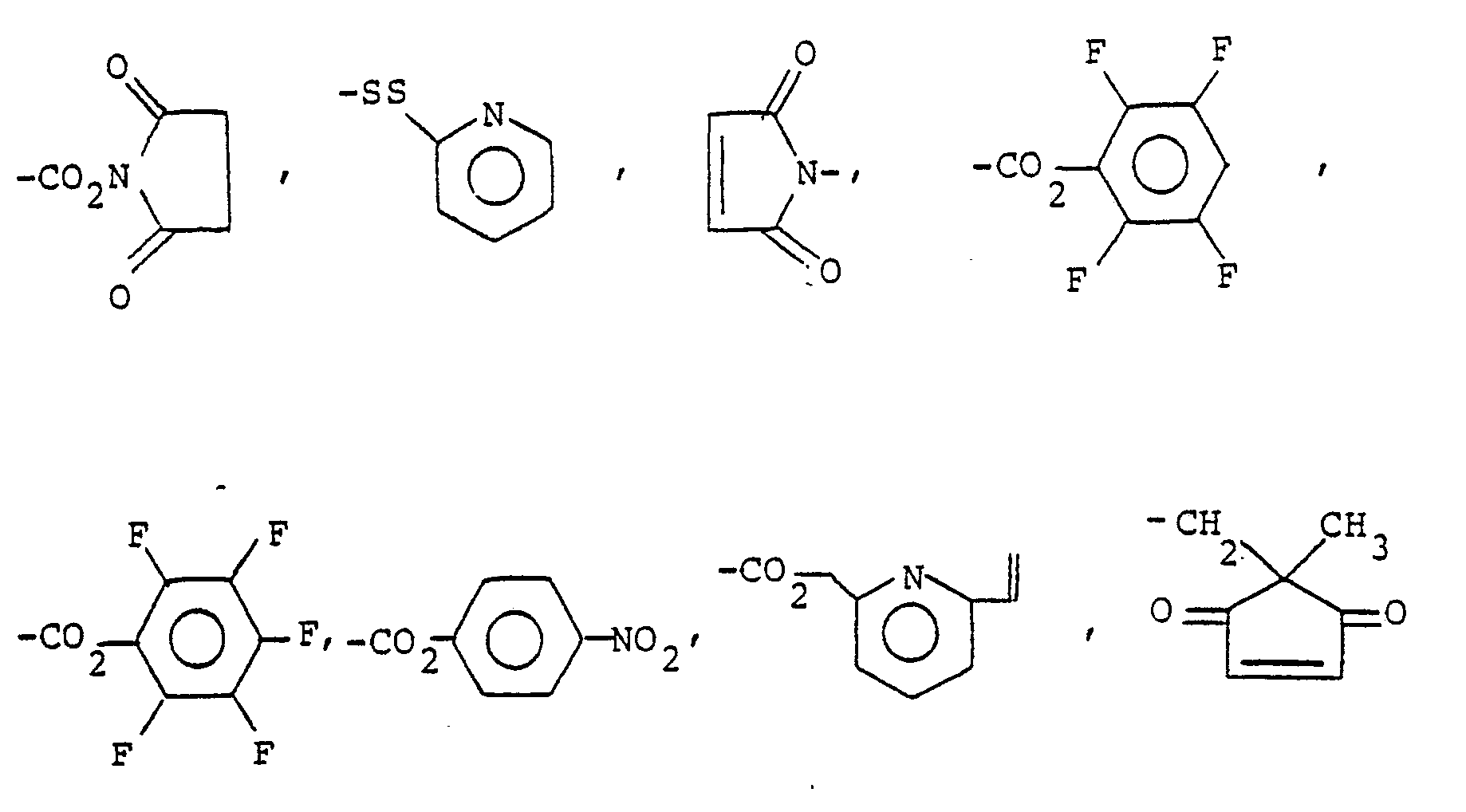
- Q is, or can be subsequently converted to, halogen, amino, alkylamino, carboxyl, carboxaldehyde, hydroxy, thiol, ⁇ -haloacetyloxy, lower alkyldicarboxyl, -CONHNH2, -NHCONHNH2, -NHCSNHNH2, -ONH2, -CON3, and W is as shown in Table 1, above.
- Tu is a mono- or polyclonal antibody, its fragments, its chemically or genetically manipulated counterparts, growth factors, or steroids
- Y is a side-chain amino, carboxy, or thiol group of a protein, an aldehyde derived from carbohydrate residues, or an amidoalkylthio group
- n is an integer of from 1 to 100
- the same randomly-substituted immunoconjugates can also be prepared from the 3-mercaptopropionic acid derivative using other carboxyl group activating agents such as a variety of carbodiimides, or the corresponding acyl azide.
- Such functional groups are preferably, though not limited to, those which react with aldehydes under acidic aqueous conditions.
- the reactivity of protein lysines under basic conditions is sufficiently great such that their amines compete with the products of Scheme II for available aldehydes of the monoclonal antibody.
- Alternative aldehyde-reactive groups are, for example, the semicarbazide, the thiosemicarbazide, and the O-substituted hydroxylamine functionalities.
- the targeting unit (Tu) can be first modified to contain a thiol group, which is then reacted with the compounds of Table 1, in accordance with Scheme III below: wherein Tu, Y, Q, Sp, W, n, and m are as hereinbefore defined, and P is hydrogen or 2-(pyridylthio), with the proviso that when Y is a thiol derived from a backbone amino acid residue of Tu, Z-Sp taken together is a covalent bond.
- sulfhydryl groups inherent within the structure of monoclonal antibodies in dimeric form as cystine residues can be used to participate in the reaction of Scheme III directly.
- MoAb's monoclonal antibodies
- Lym 1 and Lym 2 recognize different antigens on mature B-lymphocytes and their product lymphomas. The production and characteristics of these MoAb's are described by A.L. Epstein, et. al., "Cancer Research” 47 , 830 (1987).
- MoAb B72.3 targets primarily to carcinomas of the breast and colon, through reactivity with pancreatic, ovarian, and lung carcinomas has also been noted. The antibody has been described by T.L. Klug, et. al., "Int. J. Cancer” 38 , 661 (1986).
- MoAb CT-M-01 which recognizes primarily breast tumors is described in EPO application 86 401482.4 filed July 3, 1986 and MAC-68 is produced by a sub-clone of the hybridoma which produces CT-M-01, and recognizes both breast and colon carcinomas.
- All target cells were maintained in RPMI 1640 media supplemented with 5% Fetal Calf Serum (FCS), ITS (Collaborative Research, Cat# 40351), streptomycin (50 ⁇ g/ml), penicillin (50 units/ml), gentamycin sulfate (50 ⁇ g/ml) and glutamine (.03%).
- FCS Fetal Calf Serum
- ITS Cold-Fi Protectetamine
- streptomycin 50 ⁇ g/ml
- penicillin 50 units/ml
- gentamycin sulfate 50 ⁇ g/ml
- glutamine glutamine
- DPBS Dulbecco's Phosphate Buffered Saline
- MoAb monoclonal antibody
- 0.1 ml of cells was aliquoted in each well of a sterile tissue culture polystyrene 96-well plate. The plates were centrifuged for 5 minutes at 1,000 RPM's and the supernatant was flicked off. Plates were air-dried overnight and may be stored at 4°C for up to 3 months.
- Non-specific binding sites were blocked by adding 200 ⁇ l of 1% gelatin in DPBS per well and incubating the plate for 1 hour at 37°C in a humid incubator. (All subsequent incubations are done under similar conditions).
- the plates were washed once with 250 ⁇ l of 0.05% TWEEN-20 in DPBS (washing solution) using the automated ELISA washing system from Dynatech (Ultrawash II). Samples to be tested were diluted to make a final concentration of 3 ⁇ g/ml MoAb equivalents in 0.1% gelatin-DPBS. Six additional threefold serial dilutions were prepared from each 3 ⁇ g/ml sample and 100 ⁇ l was added to appropriate wells in triplicate.
- the bottom row of wells only received 100 ⁇ l of 0.1% gelatin as background. Plates were incubated for 45 minutes and then washed three times. Alkaline phosphatase conjugated affinity purified goat anti-mouse immunoglobulins (Cappel Cat# 8611-0231) was diluted 1:125 in 0.1% gelatin and 100 ⁇ l was added to each well. Plates were incubated for 45 minutes and then washed three times. 200 ⁇ l of p -nitrophenyl phosphate substrate solution (see below) was added to each well. After 45 minutes at room temperature the reaction was stopped by the addition of 50 ⁇ l of 3M NaOH. The absorbance of the contents of each well was read at 405 nm in the automated spectrophotometer from Dynatech (EIA Autoreader # EL-310).
- the reagents were dissolved by continuous stirring and 1M HCl was added until the pH was 9.8. The total volume was made up to 1 liter with water and filter sterilized with a 0.2 ⁇ filter. The buffer was stored in the dark at 4°C. Immediately before use, p -nitrophenyl phosphate (Sigma, Cat# 104-40) was dissolved in the 10% diethanolamine buffer (must be at room temperature) to give a final concentration of 1 mg/ml.
- the % binding was plotted on the non-log scale of a semi-log graph and the MoAb concentration was plotted on the log scale.
- the BD50 i.e. dose of antibody needed to give 50% binding
- the amount of retention of immunoreactivity was calculated by the following equation:
- Appropriate amounts of target cells in 0.2 ml of 10% FCS media were aliquoted into 4 ml polystyrene tubes. Samples to be tested were diluted to a concentration of 2 ⁇ g/ml MoAb equivalents in 10% FCS media. Five three-fold serial dilutions were prepared from each 2 ⁇ g/ml sample and 0.2 ml was added to each tube in duplicate. Background samples received only cells and media. Cells were incubated at 4°C for 1 hour, then washed 2 times (all RIA washes were done with a 3 ml volume) with 2% FCS media.
- Appropriate amounts of target cells in 1 ml of 10% FCS media were aliquoted into 4 ml polystyrene test tubes, centrifuged and supernatant was discarded. Samples to be tested were diluted to make a concentration of 200 ⁇ g/ml MoAb equivalents in 10% FCS media. Five additional five-fold serial dilutions were prepared from each 200 ⁇ g/ml sample and 0.05 ml was added to each tube in duplicate. 0.05 ml of 125I-MoAb was added to each tube (optimal amount is indivi dually determined for each MoAb and batch). Positive control samples contained cells, media and 125I-MoAb. Background samples contained non-specific cells, media and 125I-MoAb. Cells were incubated for 1 hour at 4°C, washed once with 2% FCS media, twice with PBS, transferred and counted as previously mentioned.
- the monoclonal antibody conjugates of this invention are active as anticancer agents.
- the assay described below for assessing in vitro cytotoxicity shows the dramatic preference of the constructs for target cell lines as opposed to non-target cells, and provides a measure of utility of targeted forms of the compounds compared to their non-targeted counterparts.
- Samples to be tested were diluted to a concentration of 0.2 or 0.02 ⁇ g/ml of LL-E33288 ⁇ 1 I equivalents (starting concentration is dependent on cell line to be tested). Three additional five-fold dilutions were prepared from each original sample dilution and 0.2 ml was added to sterile 15 ml polystyrene tubes. At least one similar conjugate consisting of LL-E33288 ⁇ 1 I and an irrelevant MoAb was included in each assay to determine specificity of the relevant conjugate. 105 appropriate target cells in 0.2 ml of 10% FCS media were aliquoted into the tubes and vortexed. In addition, an identical test was performed utilizing irrelevant cells as targets to further confirm specificity of relevant conjugate. MoAb controls received only equivalent amounts of MoAb and positive control samples received only 10% FCS media.
- the % growth inhibition was calculated as follows:
- the % inhibition was plotted on the non-log scale of a semi-log graph and the LL-E33288 ⁇ 1 I concentration was plotted on the log scale.
- the IC50 concentration of LL-E33288 ⁇ 1 I needed to give 50% inhibition
- the following assay system was used to measure the in vivo activity of the conjugates of this invention.
- Burkitt lymphoma (Raji) and myeloma (HS Sultan) cells were harvested from culture flasks and inoculated subcutaneously ( ⁇ 80 x 106 Raji cells or 40 x 106 HS Sultan cells) into test mice.
- Solid tumors, ovarian carcinomas (CA73, Ovcar-3) and breast carcinoma (MX-1) were propagated in athymic mice, removed, cut into 2 mm3 fragments and implanted subcutaneously into test mice (5-8 fragments per mouse).
- Drugs, monoclonal antibodies and drug-monoclonal antibody conjugates were administered intraperitoneally once each 3 days for 3 or 5 total injections starting on day 2, 3, 4, 6, 7 or 8 days after tumor implantation.
- Tumor measurements (the length and width of the tumor) were made by means of a Fowler ultra CAL II electronic caliper each 7 days for 4 or 5 weeks post tumor implantation.
- Tumor mass in mg was estimated from the formula:
- Tumor growth inhibition was calculated for each test group on a percent of control [mean mg of treated (T) divided by mean mg of control (C) x 100].
- T/C value ⁇ 42% in groups with ⁇ 65% surviving animals is considered necessary to demonstrate activity.
- This compound was converted to the p -nitrophenyl ester by treatment with equimolar amounts of p -nitrophenol and dicyclohexylcarbodiimide in tetrahydrofuran for 4 hours.
- the dicyclohexyl urea by-product was removed by filtration and the filtrate was evaporated to an oil which was purified by passage over neutral silica gel using the solvent system hexane:methylene chloride (50:50).
- the pure p -nitrophenyl ester derivative was a faintly yellow, mobile oil.
- the free mercaptan was unmasked by the following procedure.
- the S- t -butylmercaptopropionic acid p -nitrophenyl ester was dissolved in trifluoroacetic acid and a slight molar excess (10%) of mercuric acetate was added. The mixture was stirred for 30 minutes, then the trifluoroacetic acid was evaporated and the residue taken up in dimethylformamide. This solution was treated with hydrogen sulfide gas for 15 minutes, then the black mercuric sulfide was filtered off and the filtrate evaporated under reduced pressure to eliminate up to 99% of the dimethylformamide.
- the resultant slightly brownish mobile liquid was purified over neutral silica gel using hexane:methylene chloride (50:50).
- the major component was shown by 1H NMR to contain a small amount of the t -butyl mercapto derivative.
- the hydroxysuccinimide ester described in Example 3 was covalently attached to antibodies under slightly alkaline conditions.
- the following is a general procedure used to make the antibody conjugates listed in Table 5.
- Antibody at a concentration of 3-5 mg/ml in phosphate buffer containing 0.1M sodium chloride, pH 7.5 was reacted with a 5-20-fold molar excess of the product from Example 3 with stirring, at room temperature for from 1-4 hours.
- the conjugated protein was desalted chromatographically and aggregated protein was separated from monomeric material by gel filtration HPLC. Monomeric fractions were pooled and concentrated.
- Conjugates were analyzed for the presence of aggregates by gel filtration HPLC and for free drug by reverse phase HPLC. Drug loading was determined spectroscopically using the extinction coefficients of both the antibody and the drug to estimate molar concentrations of drug in conjugates.
Landscapes
- Health & Medical Sciences (AREA)
- Chemical & Material Sciences (AREA)
- Life Sciences & Earth Sciences (AREA)
- Organic Chemistry (AREA)
- General Health & Medical Sciences (AREA)
- Engineering & Computer Science (AREA)
- Medicinal Chemistry (AREA)
- Veterinary Medicine (AREA)
- Public Health (AREA)
- Pharmacology & Pharmacy (AREA)
- Animal Behavior & Ethology (AREA)
- Bioinformatics & Cheminformatics (AREA)
- Molecular Biology (AREA)
- General Chemical & Material Sciences (AREA)
- Nuclear Medicine, Radiotherapy & Molecular Imaging (AREA)
- Biochemistry (AREA)
- Chemical Kinetics & Catalysis (AREA)
- Genetics & Genomics (AREA)
- Epidemiology (AREA)
- Biotechnology (AREA)
- Oncology (AREA)
- Communicable Diseases (AREA)
- Immunology (AREA)
- Pharmaceuticals Containing Other Organic And Inorganic Compounds (AREA)
- Peptides Or Proteins (AREA)
- Preparation Of Compounds By Using Micro-Organisms (AREA)
- Medicines That Contain Protein Lipid Enzymes And Other Medicines (AREA)
- Saccharide Compounds (AREA)
- Medicines Containing Antibodies Or Antigens For Use As Internal Diagnostic Agents (AREA)
- Steroid Compounds (AREA)
- Medicinal Preparation (AREA)
- Agricultural Chemicals And Associated Chemicals (AREA)
- Organic Low-Molecular-Weight Compounds And Preparation Thereof (AREA)
- Acyclic And Carbocyclic Compounds In Medicinal Compositions (AREA)
Abstract
Description
- This application is a continuation-in-part of copending application Serial No. 07/114,940, filed October 30, 1987.
- The invention describes carrier-drug conjugates of the disulfide analogs of the α₁, α₂, α₃, α₄, β₁, β₂, γ₁ and δ components of the LL-E33288 complex as well as the disulfide analogs of BBM-1675, FR-900405, FR-900406, PD 114759, PD 115028, CL-1577A, CL-1577B, CL-1577D, CL-1577E and CL-1724 antitumor antibiotics. The carrier portion of the conjugate is a mono- or polyclonal antibody, their fragments, chemically or genetically manipulated counterparts, growth factors or steroids. The invention includes the method of using the carrier-drug conjugates as well as their process of manufacture.
-
- Figure I: The ultraviolet spectrum of the antitumor antibiotic designated as LL-E33288γ₁I.
- Figure II: The proton magnetic resonance spectrum of the antitumor antibiotic designated as LL-E33288γ₁I.
- Figure III: The infrared spectrum of the antitumor antibiotic designated as LL-E33288γ₁I.
- The family of antibacterial and antitumor agents, known collectively as the LL-E33288 complex are described and claimed in copending U.S. patent application, Serial No. 009,321, filed January 30,1987 and are used to prepare the disulfur antitumor agents which are starting materials for targeted forms of the antitumor agents of our invention.
- The Serial No. 009,321 application describes the LL-E33288 complex, the components thereof, namely, LL-E33288α₁Br, LL-E33288α₁I, LL-E33288α₂Br, LL-E33288α₂I, LL-E33288α₃Br, LL-E33288α₃I, LL-E33288α₄Br, LL-E33288β₁Br, LL-E33288β₁I, LL-E33288β₂Br, LL-E33288β₂I, LL-E33288γ₁Br, LL-E33288γ₁I and LL-E33288δ₁I, and methods for their production by aerobic fermentation utilizing a new strain of Micromonospora echinospora ssp calichensis or natural or derived mutants thereof. Serial No. 009,321 also discloses proposed structures for some of the above named components. These proposed structures are reproduced in Table 1.

- Certain other antibiotics are useful in our invention, namely:
- 1) Esperamicin BBM-1675, a novel class of potent antitumor antibiotics. I. Physico-chemical data and partial structure. M. Konishi, et. al., J. Antibiotics, 38, 1605 (1985). A new antitumor antibiotic complex, M. Konishi, et. al., U.K. Patent Application GB 2,141,425A, May 15, 1984.
- 2) New antitumor antibiotics, FR-900405 and FR-900406.I. Taxonomy of the producing strain. M. Iwami, et. al., J. Antibiotics 38, 835 (1985). New antitumor antibiotics FR-900405 and FR-900406.II. Production, isolation, characterization and antitumor activity. S. Kiyoto, et. al., J. Antibiotics, 38, 340 (1985).
- 3) PD 114759 and PD 115028, novel antitumor antibiotics with phenomenal potency. I. Isolation and characterization. R.H. Bunge, et. al., J. Antibiotics, 37, 1566 (1984). Biological and biochemical activities of the novel antitumor antibiotic PD 114759 and related derivatives. D.W. Fry et. al., Investigational New Drugs, 4, 3 (1986).
- 4) New antibiotic complex CL-1577A, CL-1577B produced by Streptomyces sp. ATCC 39363. European Patent Application 0,132,082, A2.
- 5) CL-1577D and CL-1577E Antibiotic antitumor compounds, their production and use. U.S. Patent 4,539,203.
- 6) CL-1724 Antibiotic compounds, their production and use. U.S. Patent 4,554,162.
- All of the information regarding BBM-1675, FR-900405, FR-900406, PD 114759, PD 115028, CL-1577A, CL-1577B, CL-1577D, CL-1577E and CL-1724 contained in the above citations is incorporated herein by reference. The complete structures of esperamicins A₁, A₂, and A1b (the BBM-1675 complex) have been reported, and these are included in Table 1. The physical characteristics of the above-named antitumor antibiotics indicate that they all are identical or very similar in structure to the esperamicins, and all contain a methyltrithio functional group.
- As can be seen from the structures disclosed above, the α₁, α₂, α₃, α₄, β₁, β₂, γ₁ and δ components of the LL-E33288 complex, as well as the BBM-1675, FR-900405, FR-900406, PD 114759, PD 115028, CL-1577A, CL-1577B, CL-1577D, CL-1577E and CL-1724 antibiotics each contain a methyltrithio group in their structure. The methyltrithio moiety of the above-named antibiotics is subject to displacement by a variety of thiol-containing organic molecules resulting in the formation of a new class of anticancer and antibacterial agents.
- It has now been discovered that the displacement of the methyltrithio unit of the compounds listed in Table l and as depicted in Scheme I can be used to introduce a spacer (Sp), the judicious choice of which enable the introduction of targeting units into the compounds of the above-named patents and applications.

- As long as the product from Scheme I contains at least one functional group which can be converted to, or is directly reactive with a targeting unit (Tu), targeted forms of the antitumor antibiotics of the above-named patents and applications can be generated, as shown in Scheme II below:


- As an example, and with reference to Scheme II, above, the 3-mercaptopropionic acid derivative of E-33288γ₁I (Q=CO₂H, Sp=-CH₂CH₂-), when converted to its activated hydroxysuccinimide form (Q=CO₂Su, Sp=-CH₂-CH₂-) can be used to react with some of the ε-amino groups of lysine residues (e.g., Tu=monoclonal antibody, Y=-NH₂ wherein n=50-100 from available lysine residues), at a pH between 7.0 and 9.5 in aqueous buffered solutions at temperatures between 4°C to 40°C to produce targeted forms of the antibiotics attached at random sites along the protein backbone (Tu=monoclonal antibody, Z=-NHCO-, Sp=-CH₂CH₂-, m=1-10). Only a fraction of the available lysine residues are substituted in this manner, since high loading is generally not considered compatible with preserving the antibody immunoreactivity. The same randomly-substituted immunoconjugates can also be prepared from the 3-mercaptopropionic acid derivative using other carboxyl group activating agents such as a variety of carbodiimides, or the corresponding acyl azide. Alternatively, a 3-mercaptopropionyl hydrazide derivative of E-33288γ₁I (Q-H₂NNHCO-, Sp=-CH₂CH₂-), when reacted with a periodate-oxidized antibody (Tu=monoclonal antibody, Y=-CHO, n=1-15) as described in U.S. Patent No. 4,671,958 at a pH between 4 and 7, in a buffered aqueous solution at a temperature of between 4°C and 40°C, reacts only at the aldehyde functionality (derived from cleavage of vic-diols of carbohydrate residues situated on the Fc portion of the antibodies) to generate monoclonal antibody conjugates containing the drug substituted at specific sites along the backbone of the protein (Tu=monoclonal antibody, Z=-CH=NNHCO-, Sp=-CH₂CH₂-, m=0.5-10). In order to block unreacted aldehyde groups on the antibody and thus avoid crosslinking, as well as stabilize the hydrolytically labile Schiff's base linkages, it is preferable (though not essential) to react the latter conjugate first with a compound such as acetyl hydrazide or tyrosine hydrazide, then reduce with sodium cyanoborohydride or sodium borohydride to produce the stabilized constructs of this invention (Tu=monoclonal antibody, Z=-CH₂NHNHCO-, Sp=-CH₂CH₂-, m=0.5-10). Other aldehyde-reactive groups as part of the drug construct are within our invention to generate the products of Scheme II. Such functional groups are preferably, though not limited to, those which react with aldehydes under acidic aqueous conditions. The reactivity of protein lysines under basic conditions is sufficiently great such that their amines compete with the products of Scheme II for available aldehydes of the monoclonal antibody. Alternative aldehyde-reactive groups are, for example, the semicarbazide, the thiosemicarbazide, and the O-substituted hydroxylamine functionalities.
- Assembly of targeted forms of the compounds listed in Table 1 is not restricted to the sequence outlined in Scheme II. The targeting unit (Tu) can be first modified to contain a thiol group, which is then reacted with the compounds of Table 1, in accordance with Scheme III below:

- As an example, and with references to Scheme III, above, a monoclonal antibody can be reacted with 3-(2-dithiopyridyl)propionic acid hydroxysuccinimide ester to modify the protein through lysine residues (Tu=monoclonal antibody, Y=NH₂, n=50-100, Q=-CO₂Su, Sp=-CH₂-CH₂-, P=2-pyridylthio). Following reduction with, for example, dithiothreitol, an intermediate is generated (Tu=monoclonal antibody, Z=-NHCO-, Sp=-CH₂CH₂-, m=1 to 15) which can be reacted with the compounds of Table 1 to generate the subject immunoconjugates. Similarly, 2-iminothiolane can be reacted with a monoclonal antibody to introduce thiol groups onto the surface of the protein directly, without requiring a reduction step (Tu=monoclonal antibody, Z=-NHCO-, Sp=-(CH₂)₃-, m=1 to 15), and this intermediate can be reacted with the compounds of Table 1 as before. Alternatively, sulfhydryl groups inherent within the structure of monoclonal antibodies in dimeric form as cystine residues can be used to participate in the reaction of Scheme III directly. Such sulfhydryls are traditionally exposed by a combination of enzymatic digestion and reduction of native monoclonal antibodies (Tu=Fab′ fragment, Z-Sp=bond, Y=SH), but the use of genetically-altered constructs of monoclonal antibodies containing unpaired cystine residues is likewise contemplated.
- A preferred embodiment of this invention is a protein-drug conjugate of the formula:
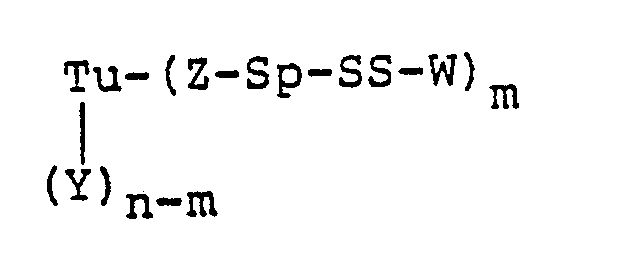
- prepared from the antitumor antibiotic designated LL-E33288γ₁I (CH₃SSS-W) having
- a) ultraviolet spectrum as shown in Figure I;
- b) a proton magnetic resonance spectrum as shown in Figure II;
- c) an infrared spectrum as shown in Figure III;
- A number of different monoclonal antibodies (MoAb's) are used to exemplify targeting of the methyltrithio anticancer compounds. MoAb's Lym 1 and
Lym 2 recognize different antigens on mature B-lymphocytes and their product lymphomas. The production and characteristics of these MoAb's are described by A.L. Epstein, et. al., "Cancer Research" 47, 830 (1987). MoAb B72.3 targets primarily to carcinomas of the breast and colon, through reactivity with pancreatic, ovarian, and lung carcinomas has also been noted. The antibody has been described by T.L. Klug, et. al., "Int. J. Cancer" 38, 661 (1986). MoAb CT-M-01, which recognizes primarily breast tumors is described in EPO application 86 401482.4 filed July 3, 1986 and MAC-68 is produced by a sub-clone of the hybridoma which produces CT-M-01, and recognizes both breast and colon carcinomas. Intermediates of the subject compounds useful for, and conjugates with these antibodies, are described in the experimental section. It should not, however, be construed that this patent is limited to or restricted by the aforementioned antibodies. Instead, the methodology is sufficiently general that it can be applied to all antibodies regardless of their class or isotype, their enzymatically-derived fragments, their chemically manipulated and stabilized fragments, as well as their respective chimeric and humanized counterparts. Nor are the targeting units restricted only to monoclonal antibodies. Other proteins, as well as small molecules for which receptors exist on target tissues, are within the purview of our discovery as targeting entities. - The methods of this invention used to produce monoclonal antibody conjugates from the compounds of Table 1 yield constructs which retain good immunoreactivity with target cell lines, as determined by the following in vitro assays:
- All target cells were maintained in RPMI 1640 media supplemented with 5% Fetal Calf Serum (FCS), ITS (Collaborative Research, Cat# 40351), streptomycin (50 µg/ml), penicillin (50 units/ml), gentamycin sulfate (50 µg/ml) and glutamine (.03%). The cells were maintained in a humidified 5% CO₂ incubator at 37°C.
- Appropriate target cells were harvested, counted and suspended in Dulbecco's Phosphate Buffered Saline (DPBS) at an optimal concentration for monoclonal antibody (MoAb) being tested. 0.1 ml of cells was aliquoted in each well of a sterile tissue culture polystyrene 96-well plate. The plates were centrifuged for 5 minutes at 1,000 RPM's and the supernatant was flicked off. Plates were air-dried overnight and may be stored at 4°C for up to 3 months.
- Non-specific binding sites were blocked by adding 200 µl of 1% gelatin in DPBS per well and incubating the plate for 1 hour at 37°C in a humid incubator. (All subsequent incubations are done under similar conditions). The plates were washed once with 250 µl of 0.05% TWEEN-20 in DPBS (washing solution) using the automated ELISA washing system from Dynatech (Ultrawash II). Samples to be tested were diluted to make a final concentration of 3 µg/ml MoAb equivalents in 0.1% gelatin-DPBS. Six additional threefold serial dilutions were prepared from each 3 µg/ml sample and 100 µl was added to appropriate wells in triplicate. The bottom row of wells only received 100 µl of 0.1% gelatin as background. Plates were incubated for 45 minutes and then washed three times. Alkaline phosphatase conjugated affinity purified goat anti-mouse immunoglobulins (Cappel Cat# 8611-0231) was diluted 1:125 in 0.1% gelatin and 100 µl was added to each well. Plates were incubated for 45 minutes and then washed three times. 200 µl of p-nitrophenyl phosphate substrate solution (see below) was added to each well. After 45 minutes at room temperature the reaction was stopped by the addition of 50 µl of 3M NaOH. The absorbance of the contents of each well was read at 405 nm in the automated spectrophotometer from Dynatech (EIA Autoreader # EL-310).
- 97 ml diethanolamine
800 ml water
0.2 grams NaN₃
100 mg MgCl₂·6H₂O
- The reagents were dissolved by continuous stirring and 1M HCl was added until the pH was 9.8. The total volume was made up to 1 liter with water and filter sterilized with a 0.2 µ filter. The buffer was stored in the dark at 4°C. Immediately before use, p-nitrophenyl phosphate (Sigma, Cat# 104-40) was dissolved in the 10% diethanolamine buffer (must be at room temperature) to give a final concentration of 1 mg/ml.
- The percentage binding of each sample was calculated by the following equation:
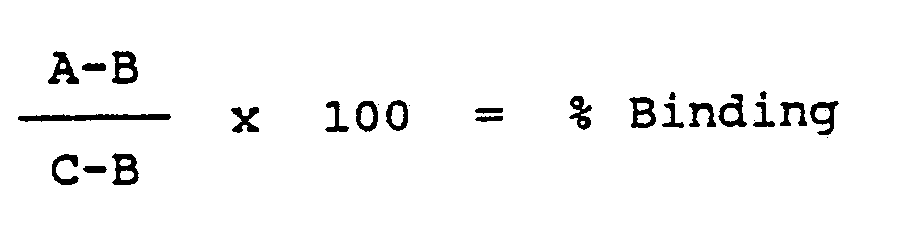
B = Average O.D. of background
C = Average O.D. of 3 µg/ml unmanipulated MoAb control - The % binding was plotted on the non-log scale of a semi-log graph and the MoAb concentration was plotted on the log scale. The BD₅₀ (i.e. dose of antibody needed to give 50% binding) of each test sample was derived from the graph and the amount of retention of immunoreactivity was calculated by the following equation:

- Appropriate amounts of target cells in 0.2 ml of 10% FCS media were aliquoted into 4 ml polystyrene tubes. Samples to be tested were diluted to a concentration of 2 µg/ml MoAb equivalents in 10% FCS media. Five three-fold serial dilutions were prepared from each 2 µg/ml sample and 0.2 ml was added to each tube in duplicate. Background samples received only cells and media. Cells were incubated at 4°C for 1 hour, then washed 2 times (all RIA washes were done with a 3 ml volume) with 2% FCS media. 0.05 ml of sheep F(ab′)₂ anti-mouse IgG [¹²⁵I] (Dupont, Cat# NEX 162-0142) containing approximately 500,000 CPM's was added to each tube; cells were incubated an additional hour at 4°C, washed once with 2% FCS and twice with PBS. 0.5 ml of PBS was added to each tube, cells were vortexed, transferred to clean tubes and counted for 1 minute in a
Packard Gamma 500. - The % binding of each value was determined and graphed like the preceding ELISA equation, except CPM's were substituted for O.D. units and C = Average CPM's of 1 µg/ml unmanipulated MoAb control. The % immunoreactivity retained of each sample was calculated as previously discussed.
- Appropriate amounts of target cells in 1 ml of 10% FCS media were aliquoted into 4 ml polystyrene test tubes, centrifuged and supernatant was discarded. Samples to be tested were diluted to make a concentration of 200 µg/ml MoAb equivalents in 10% FCS media. Five additional five-fold serial dilutions were prepared from each 200 µg/ml sample and 0.05 ml was added to each tube in duplicate. 0.05 ml of ¹²⁵I-MoAb was added to each tube (optimal amount is indivi dually determined for each MoAb and batch). Positive control samples contained cells, media and ¹²⁵I-MoAb. Background samples contained non-specific cells, media and ¹²⁵I-MoAb. Cells were incubated for 1 hour at 4°C, washed once with 2% FCS media, twice with PBS, transferred and counted as previously mentioned.
- The % ¹²⁵I-MoAb binding inhibition of each sample was calculated by the following formula:

B = Average CPM's of background
C = Average CPM's of positive control - The plot and % immunoreactivity retained by each sample was calculated as previously discussed except the BD₅₀ is actually BID₅₀ (Dose of MoAb needed to give 50% inhibition of the binding of ¹²⁵I-MoAb).
-
- 1) Tubes were always vigorously vortexed immediately after the addition of every reagent in the RIA's.
- 2) An internal control sample equalling 50% of the unmanipulated MoAb control was included in each set of assays to confirm whether each procedure was quantitative in predicting the conjugates' retention of immunoreactivity.
- The results from these assays are tabulated below in Table 2.


- The monoclonal antibody conjugates of this invention are active as anticancer agents. The assay described below for assessing in vitro cytotoxicity shows the dramatic preference of the constructs for target cell lines as opposed to non-target cells, and provides a measure of utility of targeted forms of the compounds compared to their non-targeted counterparts.
- Samples to be tested were diluted to a concentration of 0.2 or 0.02 µg/ml of LL-E33288γ₁I equivalents (starting concentration is dependent on cell line to be tested). Three additional five-fold dilutions were prepared from each original sample dilution and 0.2 ml was added to sterile 15 ml polystyrene tubes. At least one similar conjugate consisting of LL-E33288γ₁I and an irrelevant MoAb was included in each assay to determine specificity of the relevant conjugate. 10⁵ appropriate target cells in 0.2 ml of 10% FCS media were aliquoted into the tubes and vortexed. In addition, an identical test was performed utilizing irrelevant cells as targets to further confirm specificity of relevant conjugate. MoAb controls received only equivalent amounts of MoAb and positive control samples received only 10% FCS media.
- Cells were incubated at 37°C for 7 minutes then washed 4 times with 8 ml of 2% FCS media. 0.1 ml of 10% FCS was added to each tube, cells were vortexed and 0.2 ml was aliquoted to each well of a sterile 96-well polystyrene tissue culture plate.
- Plates were incubated for 2 days in a humidified 37°C incubator with 5% CO₂. One half of the media was removed and replaced with fresh media containing 2 µCi/ml ³H thymidine (DuPont, NEN, Cat# NET-027). Incubation was continued for 24 hours, cells were frozen, thawed and harvested by a PHD cell harvester (Cambridge Technology, Inc.). Each sample was counted for 1 minute in a Beckman LS 5800 scintillation counter on Channel 1.
- The % growth inhibition was calculated as follows:

- The % inhibition was plotted on the non-log scale of a semi-log graph and the LL-E33288γ₁I concentration was plotted on the log scale. The IC₅₀ (concentration of LL-E33288γ₁I needed to give 50% inhibition) of each test sample was derived from the graph and the amount of retention of cytotoxicity was calculated by the following equation:

- The results from the in vitro cytotoxicity assay are tabulated below in Table 3.


- The following assay system was used to measure the in vivo activity of the conjugates of this invention.
- In vivo tests for antitumor activity on drug-monoclonal antibody conjugates were done using human tumor xenographs in athymic (nude) mice.
- Burkitt lymphoma (Raji) and myeloma (HS Sultan) cells were harvested from culture flasks and inoculated subcutaneously (≧ 80 x 10⁶ Raji cells or 40 x 10⁶ HS Sultan cells) into test mice. Solid tumors, ovarian carcinomas (CA73, Ovcar-3) and breast carcinoma (MX-1) were propagated in athymic mice, removed, cut into 2 mm³ fragments and implanted subcutaneously into test mice (5-8 fragments per mouse).
- Drugs, monoclonal antibodies and drug-monoclonal antibody conjugates were administered intraperitoneally once each 3 days for 3 or 5 total injections starting on
day 
- Tumor growth inhibition was calculated for each test group on a percent of control [mean mg of treated (T) divided by mean mg of control (C) x 100]. A T/C value ≦ 42% in groups with ≧ 65% surviving animals is considered necessary to demonstrate activity.
- The results from this assay appear in Table 4.


- The invention will be further described in conjunction with the following non-limiting examples.
- To a solution of 90 mg of LL-E33288γ₁I in 90 ml of acetonitrile was added 10.6 mg of 3-mercaptopropionic acid in 1 ml of acetonitrile. The solution was vortexed and then stored at -20°C for 6 days. The solvent was removed in vacuo and the residue chromatographed over 10 ml of silica gel in methylene chloride. The column was developed with 50 ml of methylene chloride, 50 ml of 4% methanol in methylene chloride and finally 100 ml of 8% methanol in methylene chloride. Evaporation of this last fraction gave a residue which was taken up in ethyl acetate with the aid of a little acetone and added dropwise to an excess of hexane. The precipitate was collected and dried, giving 39 mg of the desired product (FABMS, M+H 1394). Retention time on C₁₈ reverse phase HPLC: 18 minutes with 50% acetonitrile/0.1 M aqueous ammonium chloride. (LL-E33288γ₁I: 8.0 minutes, ester hydrolysis product: 1.5 minutes)
- Commercial 3-mercaptopropionic acid in methylene chloride containing a catalytic amount of concentrated sulfuric acid was treated with isobutylene for 20 minutes. The solution was then extracted with 1N sodium bicarbonate solution after which the methylene chloride solution was dried using anhydrous magnesium sulfate. The solution was then evaporated to a colorless mobile liquid which NMR and mass spectral data indicated was the S-t-butylmercaptopropionic acid, t-butyl ester.
- An aliquot of this ester was refluxed with 6N hydrochloric acid in dioxane for 2.5 hours. The solvent was evaporated, ethyl acetate was added and this solution was extracted with sodium carbonate. The sodium carbonate extract was treated with 6N hydrochloric acid until the pH of the suspension was 2.0. The suspension was then extracted with ethyl acetate, the extract dried over anhydrous magnesium sulfate and the solvent evaporated to a colorless liquid which ¹H NMR and mass spectral data indicated was S-t-butylmercaptopropionic acid.
- This compound was converted to the p-nitrophenyl ester by treatment with equimolar amounts of p-nitrophenol and dicyclohexylcarbodiimide in tetrahydrofuran for 4 hours. The dicyclohexyl urea by-product was removed by filtration and the filtrate was evaporated to an oil which was purified by passage over neutral silica gel using the solvent system hexane:methylene chloride (50:50). The pure p-nitrophenyl ester derivative was a faintly yellow, mobile oil.
- The free mercaptan was unmasked by the following procedure. The S-t-butylmercaptopropionic acid p-nitrophenyl ester was dissolved in trifluoroacetic acid and a slight molar excess (10%) of mercuric acetate was added. The mixture was stirred for 30 minutes, then the trifluoroacetic acid was evaporated and the residue taken up in dimethylformamide. This solution was treated with hydrogen sulfide gas for 15 minutes, then the black mercuric sulfide was filtered off and the filtrate evaporated under reduced pressure to eliminate up to 99% of the dimethylformamide. The resultant slightly brownish mobile liquid was purified over neutral silica gel using hexane:methylene chloride (50:50). The major component was shown by ¹H NMR to contain a small amount of the t-butyl mercapto derivative. Analytical HPLC over two Perkin-Elmer Pecosphere C₁₈ columns in tandem [4.6 x 33 mm and 4.6 x 83 mm] using a gradient system of 37.5/62.5 to 47.5/52.5 of acetonitrile and 0.1M ammonium acetate buffer at pH 6.5 (acetic acid) over a 12 minute span indicated that the product was 88% of the p-nitrophenyl ester of 3-mercaptopropionic acid and 10% of the less polar S-t-butylmercaptopropionic acid p-nitrophenyl ester. There was also a small amount of free p-nitrophenol present.
- A 100 mg portion of LL-E33288γ₁I was dissolved in 50 ml of acetonitrile. To this was added a solution of 25.7 mg of p-nitrophenyl ester of 3-mercaptopropionic acid in 1 ml of acetonitrile. The reaction was left at -20°C for 48 hours. HPLC indicated the reaction was complete. The solution was evaporated to dryness and the residue taken up in 4-5 ml of ethyl acetate using sonication to effect solution. The mixture was filtered and the filtrate dripped into 45 ml of stirred hexane. The resultant faintly yellow solid was collected and dried under reduced pressure, giving 93 mg of the p-nitrophenyl ester of propionic acid derivative of LL-E33288γ₁I as established by ¹H NMR. By FABMS the [M+H] ion appeared at M/Z=1515.
- To a solution of 5 mg of the 3-mercaptopropionic acid disulfide analog of LL-E33288γ₁I from Example 1 in 0.5 ml of tetrahydrofuran was added 0.45 mg of N-hydroxysuccinimide in 0.1 ml of tetrahydrofuran and then 1.8 mg of dicyclohexylcarbodiimide in 0.2 ml of tetrahydrofuran. The reaction was allowed to stir at room temperature for 4 hours and was then quenched with a large excess of hexanes. The solid was isolated by filtration and dissolved in ethyl acetate. The resulting solution was washed three times with brine, dried with magnesium sulfate, and evaporated to 5 mg of the desired product as a tan powder which was used without further purification. Retention time on reverse phase C₁₈ HPLC: 15 minutes with 40% acetonitrile/0.1 M aqueous ammonium chloride (starting material: 6.0 minutes).
- To 5.4 ml (3 eq) of anhydrous hydrazine in 100 ml of refluxing tetrahydrofuran under argon was added dropwise 9.2 ml (83 mmol) of methyl 3-mercaptopropionate in 50 ml tetrahydrofuran over 2 hours. The solution was refluxed an additional two hours, evaporated, and then diluted and evaporated twice from 300 ml of toluene. The product was applied to a plug of silica gel with 5% ethyl acetate/chloroform and eluted from the plug with 20% methanol/chloroform. The resultant 3-mercaptopropionyl hydrazide was a faintly pink oil which solidified when cooled but melted at room temperature.
- To 50 mg of LL-E33288γ₁I in 50 ml of acetonitrile at -15°C was added 6.6 mg of 3-mercaptopropionyl hydrazide in 1 ml tetrahydrofuran. One equivalent of triethylamine and/or one equivalent of acetic acid was added as catalyst. The reaction was allowed to stir at 0°C for one hour and the solvent was then evaporated. The residue was chromatographed on silica gel with a 10-15% methanol in chloroform gradient to yield 26 mg of the desired product. Retention time on reverse phase C₁₈ HPLC: 5.0 minutes in 41% acetonitrile/0.1 M aqueous ammonium chloride.
- A mixture of 1.0 g (5.7 mmol) of 4-methyl-7-amino-coumarin, 3.0 ml of ethyl bromoacetate (5 eq), 90 mg (0.1 eq) of sodium iodide, and 30 ml dimethylformamide was heated under argon at 80°C for 5 hours. The mixture was cooled, diluted with ethyl ether, washed three times with 50% brine, dried with magnesium sulfate, and evaporated to dryness. The crude product was dissolved in chloroform containing 1% ethyl acetate and filtered through a plug of silica gel. Recrystallization from diethyl ether containing a trace of chloroform yielded pure ethyl N-[(4-methyl-coumarin-7-yl)amino]acetate.
- To 1.96 g (7.5 mmol) of the above ester in 15 ml of methanol and 15 ml of tetrahydrofuran was added 10 ml of 1N aqueous sodium hydroxide. After 30 minutes, 4 ml of 10% aqueous hydrochloric acid was added. The organic solvents were evaporated and the resultant crystalline product was filtered and washed with cold ethanol and then ether. This material was dissolved in 20 ml of tetrahydrofuran and 4 ml of dimethylformamide. Dicyclohexylcarbonyldiimidazole (1.3 g, 2.2 eq) was added and the reaction allowed to stir for 15 minutes. Cysteine ethyl ester hydrochloride (1.6 g, 2.5 eq) and triethylamine (1.2 ml) were then added. After a further three hours, the reaction was diluted with ethyl ether containing 5% methylene chloride and washed once with 10% aqueous hydrochloric acid and twice with brine. After drying with magnesium sulfate and evaporating the solvents, the crude product was crystallized by dissolving in chloroform containing a minimal amount of ethanol and then adding an excess of ether. The crystals were filtered and dried to give pure N-[[(4-methyl-coumarin-7-yl)amino]acetyl]cysteine ethyl ester.
- A mixture of 5 ml of chloroform, 20 ml of methanol, and 0.4 ml of hydrazine hydrate were heated to reflux under argon. To this was added 550 mg of N-[[(4-methyl-coumarin-7-yl)amino]acetyl]cysteine ethyl ester. After refluxing for 9 hours the mixture was cooled and the solid product was filtered and washed with chloroform and then ethyl ether. The crude product (which contained thiol and disulfide) was dissolved in dimethylformamide containing dithiothreitol and triethyl amine. After 30 minutes the product was precipitated with excess ethyl ether and collected by filtration. This material was purified further by recrystallization from degassed acetonitrile containing dithiothreitol and a trace of triethyl amine to give pure N-[[(4-methyl-coumarin-7-yl)amino]acetyl]cysteine hydrazide.
- To 12 mg of 70% pure LL-E33288γ₁I in 12 ml acetonitrile at 0°C was added 4 mg of N-[[(4-methyl-coumarin-7-yl)amino]acetyl]cysteine hydrazide in 1.2 ml dimethylformamide. After stirring overnight another 2 mg of N-[[(4- methyl-coumarin-7-yl)amino]acetyl]cysteine hydrazide in 0.6 ml dimethylformamide was added. The reaction was stirred for 3 days at 0°C and filtered. The acetonitrile was evaporated and the resultant dimethylformamide solution was diluted with an excess of 1:1 hexanes/ether. The product was isolated by filtration and further purified by chromatography on silica gel with a 15-20% gradient of methanol in chloroform to yield 3 mg of the desired product. Retention time on reverse phase C₁₈ HPLC: 3.5 minutes using 45% acetonitrile/0.1 M aqueous ammonium chloride.
- To 10 mg of LL-E33288α₃I in 9 ml of acetonitrile at -15°C was added 6.6 mg of 3-mercaptopropionyl hydrazide in 1 ml acetonitrile. One equivalent of triethylamine and/or one equivalent of acetic acid were added as a catalyst. The reaction was allowed to stir at 0°C for one hour and the solvent was then evaporated. The residue was chromatographed on silica gel with a 10-15% methanol in chloroform gradient to give the desired product. Retention time on reverse phase C₁₈ HPLC: 3.5 minutes in the system 45% acetonitrile/0.1 M aqueous ammonium chloride.
- The hydroxysuccinimide ester described in Example 3 was covalently attached to antibodies under slightly alkaline conditions. The following is a general procedure used to make the antibody conjugates listed in Table 5. Antibody at a concentration of 3-5 mg/ml in phosphate buffer containing 0.1M sodium chloride, pH 7.5 was reacted with a 5-20-fold molar excess of the product from Example 3 with stirring, at room temperature for from 1-4 hours. The conjugated protein was desalted chromatographically and aggregated protein was separated from monomeric material by gel filtration HPLC. Monomeric fractions were pooled and concentrated.

- The general method for attaching hydrazide derivatives of drugs to oxidized antibodies is described in T. J. McKearn, et al., in U.S. Patent No. 4,671,958. The procedure has been applied to preparing antibody conjugates from the products of Examples 4 and 5 with specific modifications as described below. The products from these reactions and their characteristics are summarized in Table 6.
- (A) Antibody Oxidation Antibody at a concentration of 5 to 10 mg/ml was dialyzed overnight against a 200 fold volume of 50mM sodium acetate buffer, pH 5.5 containing 0.1M sodium chloride (Buffer A). After dialysis, the MoAb was oxidized with 15mM to 200mM periodic acid in 0.2M sodium acetate. The oxidation was allowed to proceed in the dark, with stirring, at 4°C for 45 minutes after which time the oxidized MoAb was desalted on a ≧5 bed volume Sephadex G-25 column. The degree of oxidation of the antibody was assessed by reaction with p-nitrophenylhydrazine and comparing absorbance of the protein at 280mm vs. p-nitrophenylhydrazine at 395mm.
- (B) Drug Hydrazide Conjugation The oxidized MoAb was reacted with 25 to 200-fold molar excess of drug hydrazide. The hydrazides were dissolved into dimethylformamide and added to the aqueous solution of MoAb. To avoid precipitation of MoAb, the final volume of dimethylformamide added did not exceed 10% of the total reaction volume. Reaction was allowed to proceed for 3 hours at room temperature, with stirring. To prevent crosslinking of unreacted aldehydes and subsequent aggregation, a blocking agent, acetyl hydrazide was added in 100-fold molar excess three hours after addition of the drug hydrazide. To stabilize the Schiff's base linkage between aldehyde and drug hydrazide (a hydrazone), the product generally was reduced to an alkyl hydrazine by the addition of 10mM sodium cyanoborohydride, allowing the reaction to proceed for one more hour (total conjugation time - 4 hours). The conjugate was chromatographically desalted and exhaustively dialyzed (minimum time 48 hours) into pH 6.5 phosphate buffer for storage and testing.
- Conjugates were analyzed for the presence of aggregates by gel filtration HPLC and for free drug by reverse phase HPLC. Drug loading was determined spectroscopically using the extinction coefficients of both the antibody and the drug to estimate molar concentrations of drug in conjugates.


reacting Q-Sp-SS-W with a molecule of the formula Tu-(Y)n wherein Tu is a monoclonal antibody which exhibits preferential reactivity with a human tumor-associated antigen, Y is a side-chain amino group on the antibody, or an aldehyde generated by oxidation of the carbohydrate groups of the antibody, and n is an integer of from 1 to 100, to produce a compound of the formula:
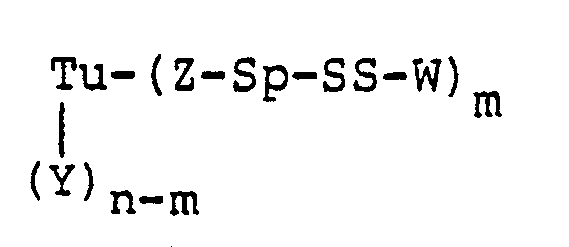
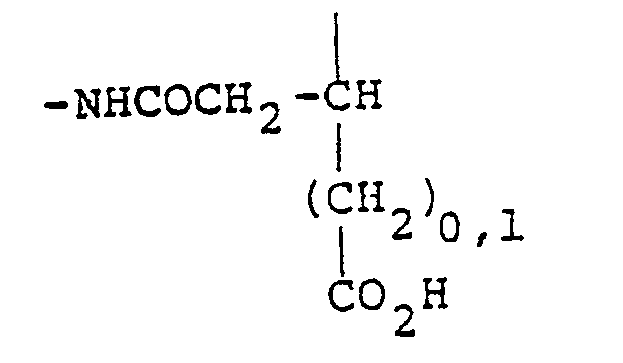
Claims (10)

reacting CH₃SSS-W with a compound of general formula Q-Sp-SH, wherein Sp is a straight or branched-chain divalent (C₁-C₁₈) radical, divalent aryl or heteroaryl radical, divalent (C₃-C₁₈) cycloalkyl or heterocycloalkyl radical, divalent aryl- or heteroaryl-alkyl (C₁-C₁₈) radicals, divalent cycloalkyl- or heterocycloalkyl-alkyl (C₁-C₁₈) radical or divalent (C₂-C₁₈) unsaturated alkyl radical, and Q is, or can be subsequently converted to, halogen, amino, alkylamino, carboxyl, carboxaldehyde, hydroxy, thiol, α-haloacetyloxy, lower alkyldicarboxyl, -CONHNH₂, -NHCONHNH₂, -NHCSNHNH₂, -ONH₂, -CON₃,

reacting Q-Sp-SS-W with a molecule of the formula Tu-(Y)n wherein Tu is defined as a mono- or polyclonal antibody, its fragments, its chemically or genetically manipulated counterparts, growth factors, or steroids; Y is a side-chain amino, carboxy, or thiol group of a protein, an aldehyde derived from carbohydrate residues, or an amidoalkylthio group; and n is an integer of from l to 100, to produce a compound of the formula:


a) ultraviolet spectrum as shown in Figure I;
b) a proton magnetic resonance spectrum as shown in Figure II;
and
c) an infrared spectrum as shown in Figure III;
comprising:
displacing the dithiomethyl moiety with a compound of formula Q-Sp-SH, wherein Sp is straight or branched-chain divalent (C₂-C₅) radicals or divalent aryl- or heteroarylalkyl (C₂-C₅) radicals, and Q is, or can be subsequently converted to, carboxyl, lower alkyldicarboxylanhydride, -CONHNH₂, or

reacting Q-Sp-SS-W with a molecule of the formula Tu-(Y)n wherein Tu is a monoclonal antibody which exhibits preferential reactivity with a human tumor-associated antigen, Y is a side-chain amino group on the antibody, or an aldehyde generated by oxidation of the carbohydrate groups of the antibody, and n is an integer of from 1 to 100, to produce a compound of the formula:


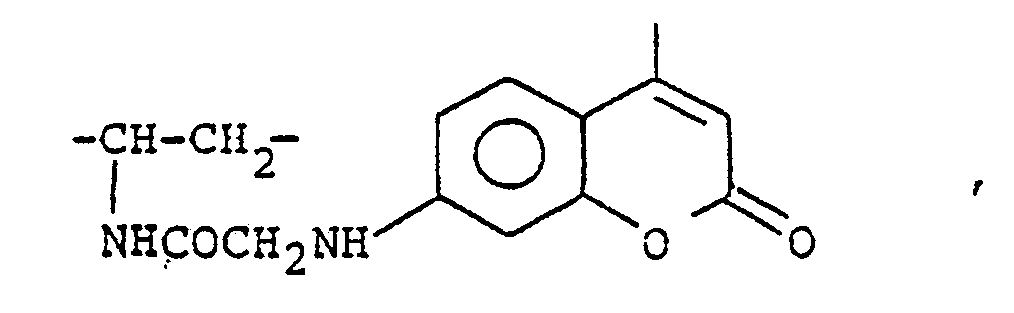
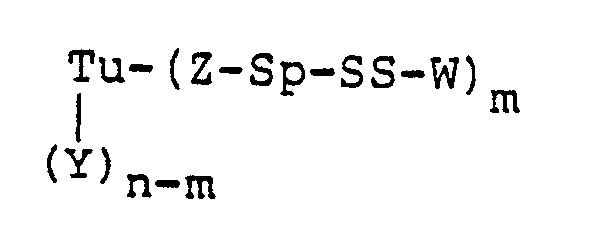
reacting CH₃SSS-W with a compound of formula Q-Sp-SH, wherein Sp is a straight or branched-chain divalent (C₁-C₁₈) radical, divalent aryl or heteroaryl radical, divalent (C₃-C₁₈) cycloalkyl or heterocycloalkyl radical, divalent aryl- or heteroaryl-alkyl (C₁-C₁₈) radicals, divalent cycloalkyl- or heterocycloalkyl-alkyl (C₁-C₁₈) radical or divalent (C₂-C₁₈) unsaturated alkyl radical, and Q is halogen, amino, alkylamino, carboxyl, carboxaldehyde, hydroxy, lower alkyldicarboxyl anhydride, -CONHNH₂, -NHCONHNH₂, -NHCSNHNH₂, -ONH₂, or

isolating the intermediate of formula Q-Sp-SS-W, wherein Q, Sp, and W are as hereinbefore defined, then
reacting the compound of formula Q-Sp-SS-W, wherein Sp and W are as hereinbefore defined and Q is halogen, amino, alkylamino, carboxyl, carboxaldehyde, hydroxy, or lower alkyldicarboxylic anhydride with a molecule of the formula Tu-(Y)n wherein Tu is a mono- or polyclonal antibody, its fragments, its chemically or genetically manipulated counterparts, growth factors, or steroids; Y is a side-chain amino or carboxy functionality; n is 1-100, in aqueous buffer at a pH of between 6.5 and 9, at 4° to 40°C either directly or in the presence of a water-soluble carbodiimide, to generate the compound


or
reacting the compound of formula Q-Sp-SS-W, wherein Sp and W are as hereinbefore defined and Q is a carboxylic acid, with N-hydroxysuccinimide, 2,3,5,6-tetrafluorophenol, pentafluorophenol, or 4-nitrophenol in the presence of a carboxyl activating agent such as a carbodiimide to generate a compound of formula Q-Sp-SS-W wherein Sp and W are as hereinbefore defined and Q is

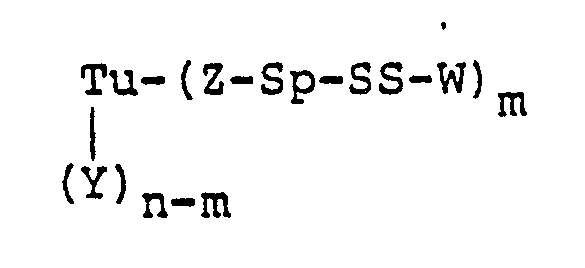
or
reacting a compound of formula Q-Sp-SS-W, wherein Sp and W are as hereinbefore defined and Q is -CONHNH₂ with nitrous acid in aqueous acetonitrile to generate a compound of formula Q-Sp-SS-W, wherein Sp and W are as hereinbefore defined and Q is -CON₃ with a compound of formula Tu-(Y)n, wherein Tu, Y, and n are as hereinabove defined to produce a compound of the formula

or
reacting a compound of formula Q-Sp-SS-W wherein Sp and W are as hereinbefore defined and Q is hydroxy, with an alpha-haloacetic anhydride to produce a compound wherein Q is α-haloacetyloxy, and reacting the α-haloacetyloxy-Sp-SS-W or a compound of formula Q-Sp-SS-W, wherein Sp and W are as hereinbefore defined and Q is


or
reacting a compound of the formula Q-Sp-SS-W wherein Sp and W are as hereinbefore defined and Q is -NH₂, CONHNH₂, -NHCONHNH₂, -NHCSNHNH₂, or -ONH₂ with a molecule of formula Tu-(Y)n wherein Tu is as hereinbefore defined, Y is an aldehyde generated from carbohydrate residues on Tu by oxidation in the presence of an alkaline earth periodate, in an aqueous buffer at a pH between 4.0 and 6.5, at 4° to 40°C, inclusive, and n is 1 to 20 to generate a compound of formula:


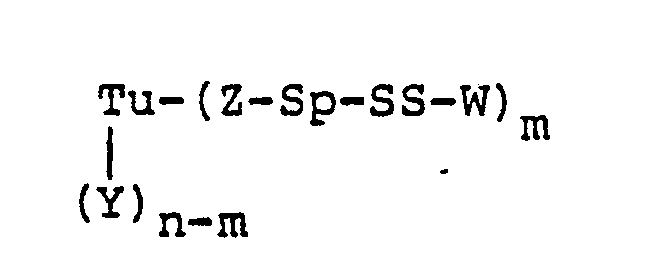

reacting this compound with sodium cyanoborohydride or sodium borohydride, in an aqueous buffer at a pH of 4.0 to 6.5, at a temperature of 4° to 40°C, inclusive, to generate a compound of formula:
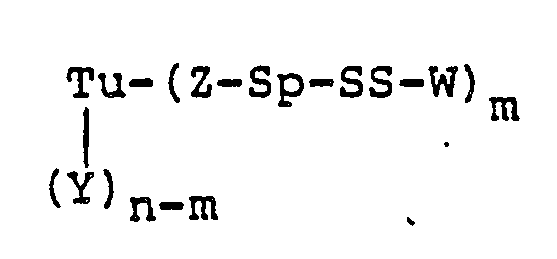


reacting CH₃SSS-W with a compound of general formula Q-Sp-SH, wherein Sp is a straight or branched-chain divalent (C₁-C₁₈) radical, divalent aryl or heteroaryl radical, divalent (C₃-C₁₈) cycloalkyl or heterocycloalkyl radical, divalent aryl- or heteroaryl-alkyl (C₁-C₁₈) radical divalent cycloalkyl- or heterocycloalkyl-alkyl (C₁-C₁₈) radical or divalent (C₂-C₁₈) unsaturated alkyl radical, and Q is, or can be subsequently converted to, halogen, amino, alkylamino, carboxyl, carboxaldehyde, hydroxy, thiol, α-haloacetyloxy, lower alkyldicarboxyl, -CONHNH₂, -NHCONHNH₂, -NHCSNHNH₂, -ONH₂, -CON₃,
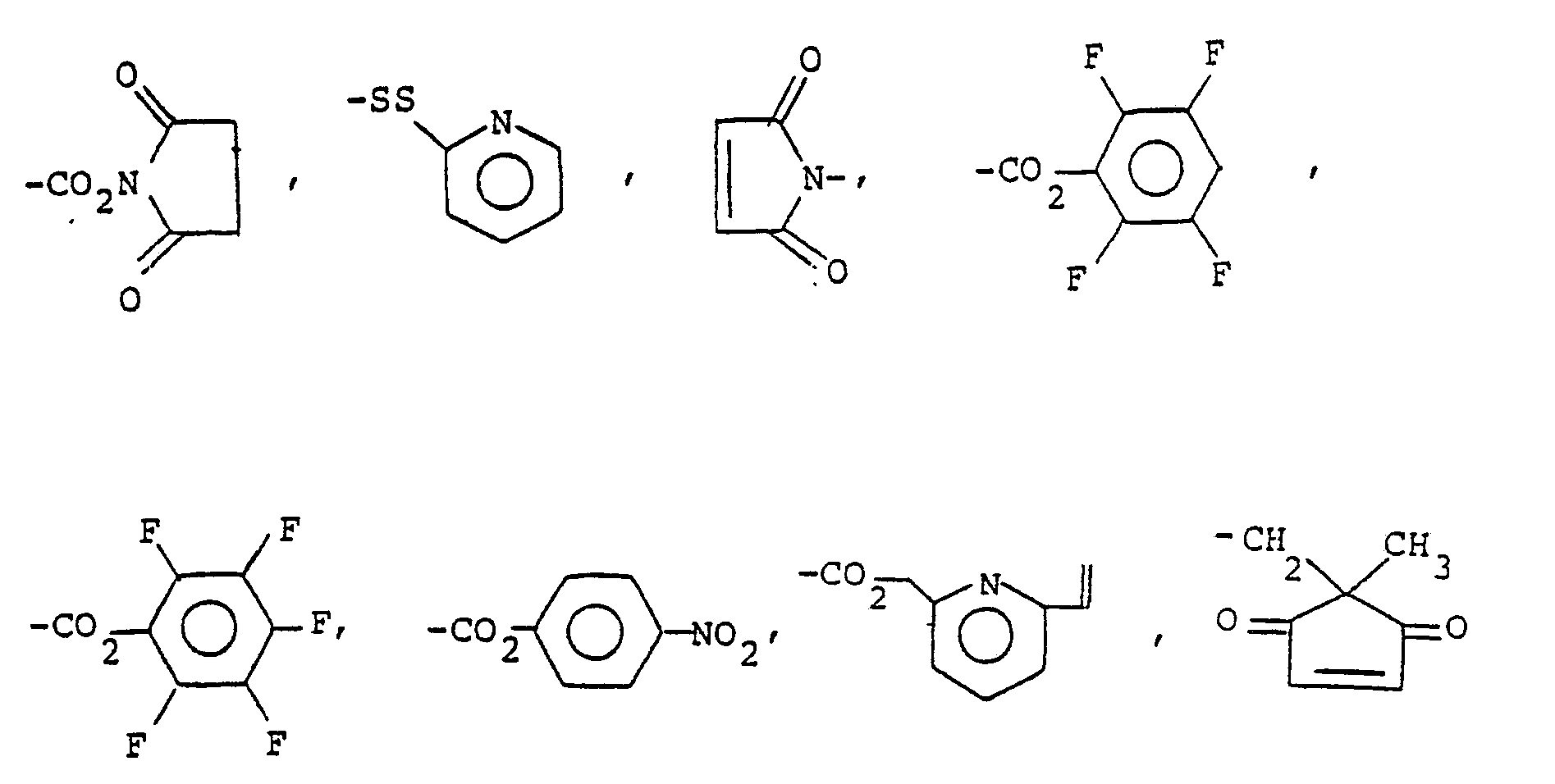
reacting Q-Sp-SS-W with a molecule of the formula Tu-(Y)n wherein Tu is defined as a mono- or polyclonal antibody, its fragments, its chemically or genetically manipulated counterparts, growth factors, or steroids; Y is a side-chain amino, carboxy, or thiol group of a protein, an aldehyde derived from carbohydrate residues, or an amidoalkylthio group; and n is an integer of from 1 to 100, to produce a compound of the formula:


a) ultraviolet spectrum as shown in Figure I;
b) a proton magnetic resonance spectrum as shown in Figure II;
and
c) an infrared spectrum as shown in Figure III; comprising:
displacing the dithiomethyl moiety with a compound of formula Q-Sp-SH, wherein Sp is straight or branched-chain divalent (C₂-C₅) radicals or divalent aryl- or heteroarylalkyl (C₂-C₅) radicals, and Q is, or can be subsequently converted to, carboxyl, lower alkyldicarboxylanhydride, -CONHNH₂, or

reacting Q-Sp-SS-W with a molecule of the formula Tu-(Y)n wherein Tu is a monoclonal antibody which exhibits preferential reactivity with a human tumor-associated antigen, Y is a side-chain amino group on the antibody, or an aldehyde generated by oxidation of the carbohydrate groups of the antibody, and n is an integer of from 1 to 100, to produce a compound of the formula:
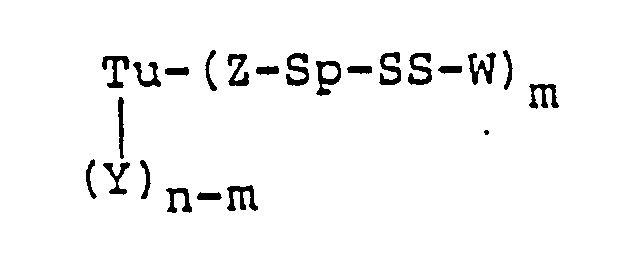

Applications Claiming Priority (2)
| Application Number | Priority Date | Filing Date | Title |
|---|---|---|---|
| US11494087A | 1987-10-30 | 1987-10-30 | |
| US114940 | 1987-10-30 |
Publications (2)
| Publication Number | Publication Date |
|---|---|
| EP0313873A1 true EP0313873A1 (en) | 1989-05-03 |
| EP0313873B1 EP0313873B1 (en) | 1994-09-28 |
Family
ID=22358378
Family Applications (2)
| Application Number | Title | Priority Date | Filing Date |
|---|---|---|---|
| EP88116339A Expired - Lifetime EP0313874B1 (en) | 1987-10-30 | 1988-10-03 | Disulfur analogs of LL-E33288 antitumor agents |
| EP88116338A Expired - Lifetime EP0313873B1 (en) | 1987-10-30 | 1988-10-03 | Targeted forms of methyltrithio antitumor agents |
Family Applications Before (1)
| Application Number | Title | Priority Date | Filing Date |
|---|---|---|---|
| EP88116339A Expired - Lifetime EP0313874B1 (en) | 1987-10-30 | 1988-10-03 | Disulfur analogs of LL-E33288 antitumor agents |
Country Status (19)
| Country | Link |
|---|---|
| EP (2) | EP0313874B1 (en) |
| JP (2) | JP2720933B2 (en) |
| KR (2) | KR970011385B1 (en) |
| AR (1) | AR246083A1 (en) |
| AT (2) | ATE104309T1 (en) |
| AU (2) | AU612714B2 (en) |
| BR (1) | BR1100939A (en) |
| CA (1) | CA1321582C (en) |
| DE (2) | DE3889063T2 (en) |
| DK (2) | DK174739B1 (en) |
| ES (2) | ES2059464T3 (en) |
| FI (2) | FI91262C (en) |
| HK (2) | HK131897A (en) |
| IE (2) | IE65989B1 (en) |
| IL (2) | IL87947A (en) |
| NO (2) | NO176480C (en) |
| NZ (2) | NZ226726A (en) |
| PT (2) | PT88882B (en) |
| ZA (2) | ZA888123B (en) |
Cited By (10)
| Publication number | Priority date | Publication date | Assignee | Title |
|---|---|---|---|---|
| WO1991015242A1 (en) * | 1990-04-02 | 1991-10-17 | Schacht Etienne Honore | Conjugate compounds of polymers with other organic molecular entities |
| EP0392384A3 (en) * | 1989-04-14 | 1991-11-06 | American Cyanamid Company | Targeted forms of methyltrithio antitumor agents |
| WO1996040261A1 (en) * | 1995-06-07 | 1996-12-19 | American Cyanamid Company | Methods for the preparation of monomeric calicheamicin derivative/carrier conjugates |
| US5714586A (en) * | 1995-06-07 | 1998-02-03 | American Cyanamid Company | Methods for the preparation of monomeric calicheamicin derivative/carrier conjugates |
| US5770710A (en) * | 1987-10-30 | 1998-06-23 | American Cyanamid Company | Antitumor and antibacterial substituted disulfide derivatives prepared from compounds possessing a methlytrithio group |
| WO2002092631A1 (en) * | 2001-05-14 | 2002-11-21 | The Horticulture And Food Research Institute Of New Zealand Limited | Kinetic assay |
| CN108047287A (en) * | 2013-11-04 | 2018-05-18 | 辉瑞大药厂 | For synthesizing the intermediate of Calicheamicin derivative and method |
| WO2018138591A1 (en) * | 2017-01-24 | 2018-08-02 | Pfizer Inc. | Calicheamicin derivatives and antibody drug conjugates thereof |
| WO2020168298A3 (en) * | 2019-02-15 | 2020-10-15 | University Of Southern California | Lym-1 and lym-2 antibody compositions and improved car constructs |
| EP4234537A4 (en) * | 2020-10-22 | 2024-05-29 | FUJIFILM Corporation | Reagent for measuring skin sensitization, compound, and method for measuring skin sensitization |
Families Citing this family (6)
| Publication number | Priority date | Publication date | Assignee | Title |
|---|---|---|---|---|
| US5079233A (en) * | 1987-01-30 | 1992-01-07 | American Cyanamid Company | N-acyl derivatives of the LL-E33288 antitumor antibiotics, composition and methods for using the same |
| ES2639020T3 (en) | 1998-11-27 | 2017-10-25 | Ucb Pharma S.A. | Compositions and methods to increase bone substance mineralization |
| US20040009535A1 (en) | 1998-11-27 | 2004-01-15 | Celltech R&D, Inc. | Compositions and methods for increasing bone mineralization |
| WO2005014650A2 (en) | 2003-06-16 | 2005-02-17 | Celltech R & D, Inc. | Antibodies specific for sclerostin and methods for increasing bone mineralization |
| WO2008028050A2 (en) * | 2006-08-30 | 2008-03-06 | Wisconsin Alumni Research Foundation | Reversible natural product glycosyltransferase-catalyzed reactions, compounds and related methods |
| KR100979928B1 (en) * | 2008-07-16 | 2010-09-03 | 한주학 | Vertical axis buoyancy windmill |
Citations (4)
| Publication number | Priority date | Publication date | Assignee | Title |
|---|---|---|---|---|
| FR2430943A1 (en) * | 1978-07-13 | 1980-02-08 | Toyo Jozo Kk | NEW DISULFIDE DERIVATIVES |
| EP0040506A2 (en) * | 1980-05-21 | 1981-11-25 | Teijin Limited | Reactive polymer and process for the preparation thereof |
| EP0132082A2 (en) * | 1983-07-08 | 1985-01-23 | Warner-Lambert Company | Antibiotic/antitumor compounds and their production |
| EP0162781A1 (en) * | 1984-05-23 | 1985-11-27 | Sanofi | Conjugates associated with a covalent bond to a monovalent carboxylic ionophore and a macromolecule, their use as potentializers of immunotoxines and the activated intermediate ionophores |
Family Cites Families (3)
| Publication number | Priority date | Publication date | Assignee | Title |
|---|---|---|---|---|
| EP0182152B1 (en) * | 1984-11-16 | 1999-05-26 | American Cyanamid Company | Antitumor antibiotics (LL-E33288 Complex) |
| EP0330874A3 (en) * | 1988-02-29 | 1989-10-18 | American Cyanamid Company | Antibacterial and antitumor agents LL-E33288 epsilon-I and LL-E33288-epsilonBr, with processes and intermediates for producing said agents |
| EP0342341A3 (en) * | 1988-05-17 | 1991-07-24 | American Cyanamid Company | Process for producing antitumor antibiotic ll-e33288gamma2 |
-
1988
- 1988-10-03 AT AT88116339T patent/ATE104309T1/en not_active IP Right Cessation
- 1988-10-03 EP EP88116339A patent/EP0313874B1/en not_active Expired - Lifetime
- 1988-10-03 AT AT88116338T patent/ATE112172T1/en not_active IP Right Cessation
- 1988-10-03 DE DE3889063T patent/DE3889063T2/en not_active Expired - Lifetime
- 1988-10-03 EP EP88116338A patent/EP0313873B1/en not_active Expired - Lifetime
- 1988-10-03 ES ES88116338T patent/ES2059464T3/en not_active Expired - Lifetime
- 1988-10-03 ES ES88116339T patent/ES2061586T3/en not_active Expired - Lifetime
- 1988-10-03 DE DE3851682T patent/DE3851682T2/en not_active Expired - Lifetime
- 1988-10-06 IL IL8794788A patent/IL87947A/en active Protection Beyond IP Right Term
- 1988-10-06 IL IL8794688A patent/IL87946A/en active Protection Beyond IP Right Term
- 1988-10-26 NZ NZ226726A patent/NZ226726A/en unknown
- 1988-10-26 NZ NZ226727A patent/NZ226727A/en unknown
- 1988-10-27 AR AR88312321A patent/AR246083A1/en active
- 1988-10-28 PT PT88882A patent/PT88882B/en not_active IP Right Cessation
- 1988-10-28 DK DK198806025A patent/DK174739B1/en not_active IP Right Cessation
- 1988-10-28 IE IE326288A patent/IE65989B1/en not_active IP Right Cessation
- 1988-10-28 AU AU24494/88A patent/AU612714B2/en not_active Expired
- 1988-10-28 AU AU24489/88A patent/AU618763B2/en not_active Expired
- 1988-10-28 FI FI884983A patent/FI91262C/en not_active IP Right Cessation
- 1988-10-28 DK DK602488A patent/DK602488A/en not_active Application Discontinuation
- 1988-10-28 IE IE326188A patent/IE65053B1/en not_active IP Right Cessation
- 1988-10-28 FI FI884984A patent/FI95204C/en not_active IP Right Cessation
- 1988-10-28 PT PT88881A patent/PT88881B/en not_active IP Right Cessation
- 1988-10-28 ZA ZA888123A patent/ZA888123B/en unknown
- 1988-10-28 CA CA000581590A patent/CA1321582C/en not_active Expired - Lifetime
- 1988-10-28 NO NO884833A patent/NO176480C/en not_active IP Right Cessation
- 1988-10-28 NO NO884834A patent/NO173506C/en not_active IP Right Cessation
- 1988-10-28 ZA ZA888127A patent/ZA888127B/en unknown
- 1988-10-29 JP JP63272006A patent/JP2720933B2/en not_active Expired - Lifetime
- 1988-10-29 JP JP63272007A patent/JP2820256B2/en not_active Expired - Lifetime
- 1988-10-30 KR KR1019880014245A patent/KR970011385B1/en not_active Expired - Fee Related
- 1988-10-30 KR KR1019880014246A patent/KR0133130B1/en not_active Expired - Fee Related
-
1997
- 1997-05-14 BR BR1100939-0A patent/BR1100939A/en active IP Right Grant
- 1997-06-26 HK HK131897A patent/HK131897A/en not_active IP Right Cessation
- 1997-06-26 HK HK131997A patent/HK131997A/en not_active IP Right Cessation
Patent Citations (4)
| Publication number | Priority date | Publication date | Assignee | Title |
|---|---|---|---|---|
| FR2430943A1 (en) * | 1978-07-13 | 1980-02-08 | Toyo Jozo Kk | NEW DISULFIDE DERIVATIVES |
| EP0040506A2 (en) * | 1980-05-21 | 1981-11-25 | Teijin Limited | Reactive polymer and process for the preparation thereof |
| EP0132082A2 (en) * | 1983-07-08 | 1985-01-23 | Warner-Lambert Company | Antibiotic/antitumor compounds and their production |
| EP0162781A1 (en) * | 1984-05-23 | 1985-11-27 | Sanofi | Conjugates associated with a covalent bond to a monovalent carboxylic ionophore and a macromolecule, their use as potentializers of immunotoxines and the activated intermediate ionophores |
Non-Patent Citations (1)
| Title |
|---|
| JOURNAL OF THE AMERICAN CHEMICAL SOCIETY, vol. 110, no. 14, 6th July 1988, pages 4866-4868, American Chemical Society; K.C.NICOLAOU et al.: "Cyclic conjugated enediynes related to calicheamicins and esperamicins: calculations, synthesis, and properties" * |
Cited By (20)
| Publication number | Priority date | Publication date | Assignee | Title |
|---|---|---|---|---|
| US5770710A (en) * | 1987-10-30 | 1998-06-23 | American Cyanamid Company | Antitumor and antibacterial substituted disulfide derivatives prepared from compounds possessing a methlytrithio group |
| EP0392384A3 (en) * | 1989-04-14 | 1991-11-06 | American Cyanamid Company | Targeted forms of methyltrithio antitumor agents |
| WO1991015242A1 (en) * | 1990-04-02 | 1991-10-17 | Schacht Etienne Honore | Conjugate compounds of polymers with other organic molecular entities |
| WO1996040261A1 (en) * | 1995-06-07 | 1996-12-19 | American Cyanamid Company | Methods for the preparation of monomeric calicheamicin derivative/carrier conjugates |
| US5712374A (en) * | 1995-06-07 | 1998-01-27 | American Cyanamid Company | Method for the preparation of substantiallly monomeric calicheamicin derivative/carrier conjugates |
| US5714586A (en) * | 1995-06-07 | 1998-02-03 | American Cyanamid Company | Methods for the preparation of monomeric calicheamicin derivative/carrier conjugates |
| AU703862B2 (en) * | 1995-06-07 | 1999-04-01 | Wyeth Holdings Corporation | Methods for the preparation of monomeric calicheamicin derivative/carrier conjugates |
| CZ298024B6 (en) * | 1995-06-07 | 2007-05-30 | Wyeth Holdings Corporation | Processes for preparing monomeric conjugates of calicheamicin carrier and derivative |
| JP2009073832A (en) * | 1995-06-07 | 2009-04-09 | Wyeth Holdings Corp | Method for producing monomeric calicheamicin derivative/carrier conjugate |
| WO2002092631A1 (en) * | 2001-05-14 | 2002-11-21 | The Horticulture And Food Research Institute Of New Zealand Limited | Kinetic assay |
| CN108047287A (en) * | 2013-11-04 | 2018-05-18 | 辉瑞大药厂 | For synthesizing the intermediate of Calicheamicin derivative and method |
| CN108047287B (en) * | 2013-11-04 | 2021-04-27 | 辉瑞大药厂 | Intermediates and methods for the synthesis of calicheamicin derivatives |
| WO2018138591A1 (en) * | 2017-01-24 | 2018-08-02 | Pfizer Inc. | Calicheamicin derivatives and antibody drug conjugates thereof |
| CN110461860A (en) * | 2017-01-24 | 2019-11-15 | 辉瑞公司 | Calcinomycin derivatives and their antibody drug conjugates |
| RU2732568C1 (en) * | 2017-01-24 | 2020-09-21 | Пфайзер Инк. | Calicheamicin derivatives and their antibody-drug conjugates |
| US11993625B2 (en) | 2017-01-24 | 2024-05-28 | Pfizer, Inc. | Calicheamicin derivatives and antibody drug conjugates thereof |
| WO2020168298A3 (en) * | 2019-02-15 | 2020-10-15 | University Of Southern California | Lym-1 and lym-2 antibody compositions and improved car constructs |
| CN113710703A (en) * | 2019-02-15 | 2021-11-26 | 南加利福尼亚大学 | LYM-1 and LYM-2 antibody compositions and improved CAR constructs |
| US11667715B2 (en) | 2019-02-15 | 2023-06-06 | University Of Southern California | Lym-1 and Lym-2 antibody compositions and improved car constructs |
| EP4234537A4 (en) * | 2020-10-22 | 2024-05-29 | FUJIFILM Corporation | Reagent for measuring skin sensitization, compound, and method for measuring skin sensitization |
Also Published As
Similar Documents
| Publication | Publication Date | Title |
|---|---|---|
| US5053394A (en) | Targeted forms of methyltrithio antitumor agents | |
| US5770701A (en) | Process for preparing targeted forms of methyltrithio antitumor agents | |
| EP0313873A1 (en) | Targeted forms of methyltrithio antitumor agents | |
| JP3234980B2 (en) | Preparation of conjugates containing novel bifunctional compounds | |
| EP0428534B1 (en) | Coupling agents and sterically hindered disulfide linked conjugates prepared therefrom | |
| US4980457A (en) | Cytotoxic conjugates which can be used in therapy and process for their preparation | |
| PL172824B1 (en) | New thioether conjugates PL PL PL PL PL | |
| CZ393997A3 (en) | Process for preparing monomeric conjugates of calicheamicin carrier and derivative | |
| EP0317957A2 (en) | Drug-monoclonal antibody conjugates | |
| EP0392384B1 (en) | Targeted forms of methyltrithio antitumor agents | |
| US4670563A (en) | Imidazolides as intermediates for the synthesis of cytotoxic conjugates | |
| CA1341315C (en) | Targeted forms of methyltrithio antitumor agents | |
| CA1314245C (en) | Process for the preparation of conjugates in which a monovalent carboxylic ionophore is associated by means of a covalent bond with a macromolecule, which are useful as immunotoxin potentiators | |
| KR0159767B1 (en) | Substituted disulfide which is an anti-tumor antimicrobial substance prepared from a compound having a methyl-trithio group, a desired form thereof and a method of preparing the same | |
| CA2014459C (en) | Targeted forms of methyltrithio antitumor agents |
Legal Events
| Date | Code | Title | Description |
|---|---|---|---|
| PUAI | Public reference made under article 153(3) epc to a published international application that has entered the european phase |
Free format text: ORIGINAL CODE: 0009012 |
|
| AK | Designated contracting states |
Kind code of ref document: A1 Designated state(s): AT BE CH DE ES FR GB GR IT LI NL SE |
|
| 17P | Request for examination filed |
Effective date: 19891020 |
|
| 17Q | First examination report despatched |
Effective date: 19921113 |
|
| RAP1 | Party data changed (applicant data changed or rights of an application transferred) |
Owner name: AMERICAN CYANAMID COMPANY |
|
| GRAA | (expected) grant |
Free format text: ORIGINAL CODE: 0009210 |
|
| AK | Designated contracting states |
Kind code of ref document: B1 Designated state(s): AT BE CH DE ES FR GB GR IT LI NL SE |
|
| REF | Corresponds to: |
Ref document number: 112172 Country of ref document: AT Date of ref document: 19941015 Kind code of ref document: T |
|
| REF | Corresponds to: |
Ref document number: 3851682 Country of ref document: DE Date of ref document: 19941103 |
|
| REG | Reference to a national code |
Ref country code: ES Ref legal event code: FG2A Ref document number: 2059464 Country of ref document: ES Kind code of ref document: T3 |
|
| ET | Fr: translation filed | ||
| REG | Reference to a national code |
Ref country code: GR Ref legal event code: FG4A Free format text: 3013448 |
|
| ITF | It: translation for a ep patent filed | ||
| EAL | Se: european patent in force in sweden |
Ref document number: 88116338.0 |
|
| K2C2 | Correction of patent specification (partial reprint) published |
Effective date: 19940928 |
|
| PLBE | No opposition filed within time limit |
Free format text: ORIGINAL CODE: 0009261 |
|
| STAA | Information on the status of an ep patent application or granted ep patent |
Free format text: STATUS: NO OPPOSITION FILED WITHIN TIME LIMIT |
|
| 26N | No opposition filed | ||
| REG | Reference to a national code |
Ref country code: GB Ref legal event code: IF02 |
|
| REG | Reference to a national code |
Ref country code: CH Ref legal event code: PFA Owner name: WYETH HOLDINGS CORPORATION Free format text: AMERICAN CYANAMID COMPANY#ONE CYANAMID PLAZA#WAYNE/NJ (US) -TRANSFER TO- WYETH HOLDINGS CORPORATION#FIVE GIRALDA FARMS#MADISON, NJ 07940 (US) |
|
| NLT1 | Nl: modifications of names registered in virtue of documents presented to the patent office pursuant to art. 16 a, paragraph 1 |
Owner name: WYETH HOLDINGS CORPORATION |
|
| REG | Reference to a national code |
Ref country code: FR Ref legal event code: CA Ref country code: FR Ref legal event code: CD |
|
| PGFP | Annual fee paid to national office [announced via postgrant information from national office to epo] |
Ref country code: GB Payment date: 20070918 Year of fee payment: 20 |
|
| PGFP | Annual fee paid to national office [announced via postgrant information from national office to epo] |
Ref country code: DE Payment date: 20071031 Year of fee payment: 20 Ref country code: NL Payment date: 20070920 Year of fee payment: 20 Ref country code: ES Payment date: 20071024 Year of fee payment: 20 |
|
| PGFP | Annual fee paid to national office [announced via postgrant information from national office to epo] |
Ref country code: AT Payment date: 20070918 Year of fee payment: 20 Ref country code: CH Payment date: 20071009 Year of fee payment: 20 Ref country code: IT Payment date: 20071012 Year of fee payment: 20 |
|
| PGFP | Annual fee paid to national office [announced via postgrant information from national office to epo] |
Ref country code: BE Payment date: 20071102 Year of fee payment: 20 Ref country code: SE Payment date: 20071005 Year of fee payment: 20 |
|
| PGFP | Annual fee paid to national office [announced via postgrant information from national office to epo] |
Ref country code: FR Payment date: 20071004 Year of fee payment: 20 |
|
| PGFP | Annual fee paid to national office [announced via postgrant information from national office to epo] |
Ref country code: GR Payment date: 20071025 Year of fee payment: 20 |
|
| REG | Reference to a national code |
Ref country code: CH Ref legal event code: PFA Owner name: WYETH HOLDINGS CORPORATION Free format text: WYETH HOLDINGS CORPORATION#FIVE GIRALDA FARMS#MADISON, NJ 07940 (US) -TRANSFER TO- WYETH HOLDINGS CORPORATION#FIVE GIRALDA FARMS#MADISON, NJ 07940 (US) |
|
| REG | Reference to a national code |
Ref country code: CH Ref legal event code: PL |
|
| REG | Reference to a national code |
Ref country code: GB Ref legal event code: PE20 Expiry date: 20081002 |
|
| BE20 | Be: patent expired |
Owner name: *WYETH HOLDINGS CORP. Effective date: 20081003 |
|
| PG25 | Lapsed in a contracting state [announced via postgrant information from national office to epo] |
Ref country code: NL Free format text: LAPSE BECAUSE OF EXPIRATION OF PROTECTION Effective date: 20081003 |
|
| NLV7 | Nl: ceased due to reaching the maximum lifetime of a patent |
Effective date: 20081003 |
|
| EUG | Se: european patent has lapsed | ||
| REG | Reference to a national code |
Ref country code: ES Ref legal event code: FD2A Effective date: 20081004 |
|
| PG25 | Lapsed in a contracting state [announced via postgrant information from national office to epo] |
Ref country code: ES Free format text: LAPSE BECAUSE OF EXPIRATION OF PROTECTION Effective date: 20081004 |
|
| PG25 | Lapsed in a contracting state [announced via postgrant information from national office to epo] |
Ref country code: GB Free format text: LAPSE BECAUSE OF EXPIRATION OF PROTECTION Effective date: 20081002 |