EP0311313B1 - Heterocyclic spiro compounds and their preparation - Google Patents
Heterocyclic spiro compounds and their preparation Download PDFInfo
- Publication number
- EP0311313B1 EP0311313B1 EP88309095A EP88309095A EP0311313B1 EP 0311313 B1 EP0311313 B1 EP 0311313B1 EP 88309095 A EP88309095 A EP 88309095A EP 88309095 A EP88309095 A EP 88309095A EP 0311313 B1 EP0311313 B1 EP 0311313B1
- Authority
- EP
- European Patent Office
- Prior art keywords
- group
- formula
- alkyl
- atom
- hydrogen atom
- Prior art date
- Legal status (The legal status is an assumption and is not a legal conclusion. Google has not performed a legal analysis and makes no representation as to the accuracy of the status listed.)
- Expired - Lifetime
Links
- 0 CCC(CC(*)(*)C1(C)C)CC1(*)S Chemical compound CCC(CC(*)(*)C1(C)C)CC1(*)S 0.000 description 11
- CWHCTKAJYQOXMG-UHFFFAOYSA-N CC1(C)CCN(C)CC1 Chemical compound CC1(C)CCN(C)CC1 CWHCTKAJYQOXMG-UHFFFAOYSA-N 0.000 description 2
- YVQBZCXNZDSFPB-UHFFFAOYSA-N CC(N1CCCCC1)P Chemical compound CC(N1CCCCC1)P YVQBZCXNZDSFPB-UHFFFAOYSA-N 0.000 description 1
- XTQOMQKEDNUVJY-UHFFFAOYSA-N CCC(CC1)CCC1(C1)OC(C)C1=O Chemical compound CCC(CC1)CCC1(C1)OC(C)C1=O XTQOMQKEDNUVJY-UHFFFAOYSA-N 0.000 description 1
- IBAYGPDLLLJLBC-UHFFFAOYSA-N CCC1OC(C)(C)CC1=C Chemical compound CCC1OC(C)(C)CC1=C IBAYGPDLLLJLBC-UHFFFAOYSA-N 0.000 description 1
Classifications
-
- C—CHEMISTRY; METALLURGY
- C07—ORGANIC CHEMISTRY
- C07D—HETEROCYCLIC COMPOUNDS
- C07D491/00—Heterocyclic compounds containing in the condensed ring system both one or more rings having oxygen atoms as the only ring hetero atoms and one or more rings having nitrogen atoms as the only ring hetero atoms, not provided for by groups C07D451/00 - C07D459/00, C07D463/00, C07D477/00 or C07D489/00
- C07D491/02—Heterocyclic compounds containing in the condensed ring system both one or more rings having oxygen atoms as the only ring hetero atoms and one or more rings having nitrogen atoms as the only ring hetero atoms, not provided for by groups C07D451/00 - C07D459/00, C07D463/00, C07D477/00 or C07D489/00 in which the condensed system contains two hetero rings
- C07D491/04—Ortho-condensed systems
- C07D491/044—Ortho-condensed systems with only one oxygen atom as ring hetero atom in the oxygen-containing ring
- C07D491/048—Ortho-condensed systems with only one oxygen atom as ring hetero atom in the oxygen-containing ring the oxygen-containing ring being five-membered
-
- C—CHEMISTRY; METALLURGY
- C07—ORGANIC CHEMISTRY
- C07D—HETEROCYCLIC COMPOUNDS
- C07D471/00—Heterocyclic compounds containing nitrogen atoms as the only ring hetero atoms in the condensed system, at least one ring being a six-membered ring with one nitrogen atom, not provided for by groups C07D451/00 - C07D463/00
- C07D471/02—Heterocyclic compounds containing nitrogen atoms as the only ring hetero atoms in the condensed system, at least one ring being a six-membered ring with one nitrogen atom, not provided for by groups C07D451/00 - C07D463/00 in which the condensed system contains two hetero rings
- C07D471/10—Spiro-condensed systems
-
- A—HUMAN NECESSITIES
- A61—MEDICAL OR VETERINARY SCIENCE; HYGIENE
- A61P—SPECIFIC THERAPEUTIC ACTIVITY OF CHEMICAL COMPOUNDS OR MEDICINAL PREPARATIONS
- A61P25/00—Drugs for disorders of the nervous system
- A61P25/02—Drugs for disorders of the nervous system for peripheral neuropathies
-
- A—HUMAN NECESSITIES
- A61—MEDICAL OR VETERINARY SCIENCE; HYGIENE
- A61P—SPECIFIC THERAPEUTIC ACTIVITY OF CHEMICAL COMPOUNDS OR MEDICINAL PREPARATIONS
- A61P25/00—Drugs for disorders of the nervous system
- A61P25/28—Drugs for disorders of the nervous system for treating neurodegenerative disorders of the central nervous system, e.g. nootropic agents, cognition enhancers, drugs for treating Alzheimer's disease or other forms of dementia
-
- C—CHEMISTRY; METALLURGY
- C07—ORGANIC CHEMISTRY
- C07D—HETEROCYCLIC COMPOUNDS
- C07D211/00—Heterocyclic compounds containing hydrogenated pyridine rings, not condensed with other rings
- C07D211/04—Heterocyclic compounds containing hydrogenated pyridine rings, not condensed with other rings with only hydrogen or carbon atoms directly attached to the ring nitrogen atom
- C07D211/06—Heterocyclic compounds containing hydrogenated pyridine rings, not condensed with other rings with only hydrogen or carbon atoms directly attached to the ring nitrogen atom having no double bonds between ring members or between ring members and non-ring members
- C07D211/36—Heterocyclic compounds containing hydrogenated pyridine rings, not condensed with other rings with only hydrogen or carbon atoms directly attached to the ring nitrogen atom having no double bonds between ring members or between ring members and non-ring members with hetero atoms or with carbon atoms having three bonds to hetero atoms with at the most one bond to halogen, e.g. ester or nitrile radicals, directly attached to ring carbon atoms
- C07D211/40—Oxygen atoms
- C07D211/44—Oxygen atoms attached in position 4
- C07D211/48—Oxygen atoms attached in position 4 having an acyclic carbon atom attached in position 4
-
- C—CHEMISTRY; METALLURGY
- C07—ORGANIC CHEMISTRY
- C07D—HETEROCYCLIC COMPOUNDS
- C07D491/00—Heterocyclic compounds containing in the condensed ring system both one or more rings having oxygen atoms as the only ring hetero atoms and one or more rings having nitrogen atoms as the only ring hetero atoms, not provided for by groups C07D451/00 - C07D459/00, C07D463/00, C07D477/00 or C07D489/00
- C07D491/02—Heterocyclic compounds containing in the condensed ring system both one or more rings having oxygen atoms as the only ring hetero atoms and one or more rings having nitrogen atoms as the only ring hetero atoms, not provided for by groups C07D451/00 - C07D459/00, C07D463/00, C07D477/00 or C07D489/00 in which the condensed system contains two hetero rings
- C07D491/10—Spiro-condensed systems
-
- C—CHEMISTRY; METALLURGY
- C07—ORGANIC CHEMISTRY
- C07D—HETEROCYCLIC COMPOUNDS
- C07D495/00—Heterocyclic compounds containing in the condensed system at least one hetero ring having sulfur atoms as the only ring hetero atoms
- C07D495/02—Heterocyclic compounds containing in the condensed system at least one hetero ring having sulfur atoms as the only ring hetero atoms in which the condensed system contains two hetero rings
- C07D495/10—Spiro-condensed systems
Definitions
- This invention relates to novel heterocyclic spiro compounds and salts thereof which are useful as drugs for the prevention and treatment of diseases, particularly those caused by nervous degeneration.
- Acetylcholine is a neurotransmitter playing an important role in cognition and mental functions in the central nervous system. Lowering of the cholin function is suggested to cause neurological and psychotic symptoms in Alzheimer's diseases, senile dementia of Alzheimer type, Huntington's chorea, Pick's disease and senile dyskinesia. Particularly, intellectual deficits (concerning memory and cognition) are considered to result from lowered functions of acetylcholine-related central nervous system.
- Acetylcholinesterase inhibitor such as physostigmine, precursors of acetylcholine such as choline and lecithin, and acetylcholine receptor agonist such as arecoline have been used in clinical trials with these diseases [refer, for example, to S. Hirai; Clinical Neurology, 1 , 200 (1983)].
- these drugs have no therapeutic benefit, have severe side effects and a narrow range of effective dose. Under the circumstances, there has been a demand for a new drug capable of selectively activating the central cholinergic nervous system and effective for the treatment of above-mentioned diseases with little side effect.
- the compounds of this invention represented by formula (I) below are piperidine (or piperidine with specified bridge)-tetrahydrofurane (or tetrahydrothiophene) type spiro compounds.
- the 1-oxa-8-azaspiro]4,5]decane structure per se is known as described in, for example, Chem. Abstr. 50 13899i.
- Chem. Abstr. 50 13899i a compound of this invention.
- Actual known similar compounds are, for example, (Chem. Abstr.
- This invention provides compounds of formula (I) and salts thereof: wherein represents a piperidine ring of which the nitrogen atom may have substituent(s) selected from lower alkyl, lower alkanoyl and lower alkoxycarbonyl and/or may be connected to a ring carbon (other than the common carbon atom of the spiro structure) via a lower alkylene bridging group;
- X represents an oxygen or sulfur atom;
- Y represents a carbonyl group a thiocarbonyl group a group of the formula ⁇ CH-R5, a group of the formula or a group of the formula wherein Alk is a lower alkylene group and Z1 and Z2 are the same or different and selected from oxygen and sulfur atoms;
- R1, R2 and R3 are the same or different and selected from a hydrogen atom and lower alkyl groups;
- R4 represents a hydrogen atom or a lower alkyl, carboxy, lower alkoxycarbonyl, or lower alkanoyl group
- lower means, unless otherwise specified, a linear or branched carbon chain of 1 to 6 carbon atoms.
- lower alkyl groups there may be mentioned methyl, ethyl, propyl, isopropyl, butyl, isobutyl, sec-butyl, tert-butyl, pentyl, isopentyl, neopentyl, tert-pentyl, 1-methylbutyl, 2-methylbutyl, 1,2-dimethylpropyl, hexyl, isohexyl, 1-methylpentyl, 2-methylpentyl, 3-methylpentyl, 1,1-dimethylbutyl, 1,2-dimethylbutyl, 2,2-dimethylbutyl, 1,3-diemtylbutyl, 2,3-dimethylbutyl, 3,3-dimethylbutyl, 1-ethylbutyl, 2-ethylbutyl, 1,1,2-trimethylpropyl, 1,2,2-trimethypropyl, 1-ethyl-1-methylpropyl and
- lower alkoxy groups may be mentioned methoxy, ethoxy, propoxy, isopropoxy, butoxy, isobutoxy, sec-butoxy, tert-butoxy, pentyloxy ( amyloxy ), isopentyloxy, tert-pentyloxy, neopentyloxy, 2-methylbutoxy, 1,2-dimethylpropoxy, 1-ethylpropoxy and hexyloxy.
- “Lower alkylthio groups” correspond to above lower alkoxy groups in which oxygen is replaced by sulfur.
- Illustrative examples include methylthio, ethylthio, propylthio, isopropylthio, butylthio, sec-butylthio, tert-butylthio, pentylthio, neopentylthio, 2-methylbutylthio, 1,2-dimethylpropylthio and 1-ethylpropylthio.
- “Lower” alkoxycarbonyl groups” are derivable by carboxyl group esterification with a linear or branched alcohol of 1 to 6 carbon atoms - e.g. methoxycarbonyl, ethoxycarbonyl, propoxycarbonyl, isopropoxycarbonyl, butoxycarbonyl, isobutoxycarbonyl, sec-butoxycarbonyl, tert-butoxycarbonyl, pentyloxycarbonyl, isopentyloxycarbonyl, tert-pentyloxycarbonyl, neopentyloxycarbonyl and hexyloxycarbonyl.
- “Lower alkanoyl groups” include e.g. formyl, acetyl, propionyl, butyryl, isobutyryl, valeryl, isovaleryl, pivaloyl and hexanoyl.
- lower alkanoyloxy groups include formyloxy, acetyloxy, propionyloxy, butyryloxy, isobutyryloxy, valeryloxy, isovaleryloxy, pivaloyloxy and hexanoyloxy.
- “Lower alkanoylthio groups” correspond to above lower alkanoyloxy groups in which the oxygen of the oxy radical is replaced by sulfur.
- Illustrative examples include formylthio, acetylthio, propionylthio, butyrylthio, isobutyrylthio, valerylthio, isovalerythio, pivaloylthio and hexanoylthio.
- the "lower alkylene group" represented by Alk and forming a ring with the radical is a bivalent radical, preferably of 2 or 3 carbon atoms, in which at least one of the carbon atoms may optionally be substituted by a lower alkyl group as defined above.
- Illustrative examples include ethylene, trimethylene, 1 - or 2-methylethylene, 1 - or 2-ethylethylene, 1 - or 2-propylethylene, 1 - or 2-isopropylethylene, 1 - or 2-butylethylene, 1,2-dimethylethylene, 1,2-diethylethylene, 1-ethyl-2-methylethylene, 2-ethyl-1-methylethylene, 1-, 2-, or 3-methyltrimethylene, 1 -, 2- or 3-ethyltrimethylene, 1-, 2- or 3-propyltrimethylene, 1-, 2- or 3-isopropyltrimethylene, 1,2-, 1,3- or 2,3-dimethyltrimethylene, 1,2-, 1,3- or 2,3-diethyltrimethylene, 1,2,3-trimethyltrimethylene and 1,2,3-triethyltrimethylene.
- Halogen atom may be any one of flourine, chlorine, bromine and iodine.
- the optional lower alkylene bridging group in the A-ring is as defined for "Alk"; examples of such saturated bicyclo A-rings are 1-azabicyclo[2,2,1] heptane 1-azabicyclo[2,2,2]octane 1-azabicyclo[3,2,2]nonane 1-azabicyclo[3,1,1] heptane 1-azabicyclo[3,2,1]octane 1-azabicylco[3,3,1]nonane and 7,7-dimethyl-1-azabicyclo[2,2,1]heptane rings.
- the compounds of formula (I) are capable of forming salts, and these salts are also included in this invention.
- Illustrative examples include addition salts with mineral acids such as hydrochloric, hydrobromic, hydroiodic, sulfuric, nitric and phosphoric acids, and with organic acids such as formic, acetic, propionic, oxalic, malonic, succinic, fumaric, maleic, malic, tartaric, methanesulfonic and ethanesulfonic acids; and salts with acidic amino acids, such as aspartic and glutamic acids.
- mineral acids such as hydrochloric, hydrobromic, hydroiodic, sulfuric, nitric and phosphoric acids
- organic acids such as formic, acetic, propionic, oxalic, malonic, succinic, fumaric, maleic, malic, tartaric, methanesulfonic and ethanesulfonic acids
- acidic amino acids such as aspart
- Some of the compounds of this invention contain asymmetric carbon or double bond ( depending on the type of substituent groups involved ) and hence exist as a plurality of optical and geometric isomers. This invention includes all of these isomers, individually and in any mixture of two or more thereof.
- This invention also includes preparative methods for compounds (I). These are spiro compounds constructed of a nitrogen-containing hetero ring and an oxolane ring having various substituent groups thereon, and hence can be prepared through various synthetic routes adapted for the individual chemical structures.
- ring A, R1, R2, R3, R4, R5, R6, R7, X, Y, Z1, Z2 and Alk are as defined above;
- ring A1 is a piperidine ring in which the nitrogen atom may be substituted by lower alkyl, lower alkanoyl, lower alkoxycarbonyl or a protective group for amines and/or may be connected to a ring carbon (other than the common carbon atom of the spiro structure) via a lower alkylene bridging group;
- a piperidine ring in which the nitrogen atom may be substituted by lower alkanoyl lower alkoxycarbonyl or a protective group for amines and/or may be connected to a ring carbon (other than the common
- compound (II) and alkali metal salt of compound (III) are allowed to react, or compound (II) and compound (III) are allowed to react in the presence of base; the two reactants are used in equimolar amounts or with one reactant in slight excess.
- the reaction is preferably carried out in an inert organic solvent under cooling or at room temperature.
- Suitable solvents are aprotic compounds, such as dimethyl sulfoxide, benzene, toluene, xylene, dichloromethane, tetrahydrofuran, N,N-dimethylformamide, dichloroethane, chloroform and carbon tetrachlorides.
- the alkali metal salt of compound (III) can be obtained by reaction of compound (III) with base, such as sodium hydride, preferably under anhydrous conditions.
- base such as sodium hydride
- the same type of base may be used in the reaction of compound (II) and compound (III) in free form.
- any types of protective group commonly employed for amino groups may be used in this invention. These include groups of urethane type (e.g., t-butoxycarbonyl ), of acyl type (e.g., formyl, acetyl and propionyl ), and of benzyl type (e.g., benzyl, benzhydryl and trityl ). Removal of these protective groups may be effected by usual methods; in the presence of acid or base for those of urethane type, in the presence of base for those of acyl type, and by catalytic reduction for those of benzyl type. Hydrochloric acid, trifluoroacetic acid and hydrobromic acid/acetic acid may be mentioned as acid catalysts, and sodium hydroxide and potassium hydroxide as the base catalysts.
- urethane type e.g., t-butoxycarbonyl
- acyl type e.g., formyl, acetyl and propionyl
- Compounds (II), as described in Reference Example 3, can be obtained by reaction of oxo-heterocyclic compound carrying protective group, lower alkyl, lower alkanoyl and lower alkoxycarbonyl with lower alkyl dialkylprosphonoacetate in an inert solvent (e.g., dimethoxyethane, dioxane and tetrahydrofuran ) in the presence of base under cooling or at room temperature, or by the normal Wittig reaction, followed by removal of any protective group.
- an inert solvent e.g., dimethoxyethane, dioxane and tetrahydrofuran
- Spiro compounds of 3-iodo-heterocyclic type represented by formula (Ib) can be prepared by iodination of alkenyl-substituted, heterocyclic alcohol (IV), followed by removal of any protective group as required.
- the reaction is preferably carried out by dissolving compound (IV) in an inert organic solvent, adding an aqueous alkaline solution of iodine in a more than stoichiometric amount, and holding the resulting mixture under cooling or at room temperature.
- Suitable organic solvents are aprotic compounds, such as dichloromethane, dichloroethane, chloroform, carbon tetrachloride, benzene, toluene, xylene and dimethyl sulfoxide, and sodium carbonate, potassium carbonate, sodium bicarbonate, sodium hydroxide and potassium hydroxide may be mentioned as examples of the alkali.
- Compounds (IV) ( starting material ) are novel compounds, which can be easily obtained, as shown in the reaction formula given below, by the action of Grignard reagent, prepared from alkenyl halide and magnesium by usual method, upon oxo-heterocyclic compound. (wherein ring A2, R1, R2, R3 and R10 are as defined above and B is a halogen atom ).
- This cyclization is effected by the action of Lewis acid (such as tin tetrachloride, titanium tetrachloride and boron trifluoride/diethyl ether complex ) upon compound (V) dissolved in an inert organic solvent, followed by addition of base.
- Lewis acid such as tin tetrachloride, titanium tetrachloride and boron trifluoride/diethyl ether complex
- Suitable organic solvents are aprotic compounds, such as dichloromethane, dichloroethane, chloroform, carbon tetrachloride, benzene, toluene, xylene and dimethyl sulfoxide.
- the base may be any compound that can trap the hydrochloric acid and metal salt formed, illustrative examples being organic bases, such as triethylamine, trimethylamine, pyridine, picoline, lutidine and dimethylaniline; and inorganic bases, such as sodium hydroxide, potassium hydroxide, sodium carbonate and potassium carbonate.
- the reaction is preferably carried out under cooling or at room temperature.
- the decarboxylation reaction is effected by heating ( preferably under reflux ) in the presence of acid.
- the substituent group is a lower alkoxycarbonyl
- a process may be adopted in which the starting material (Id) may be dissolved in inert organic solvent (e.g., diemthylformamide and dimethyl sulfoxide ) and this solution heated in the presence of an equimolar or excess amount of sodium chloride.
- inert organic solvent e.g., diemthylformamide and dimethyl sulfoxide
- Compounds of this invention can be prepared by reduction, and various reduction procesess may be adopted depending on the type of radical to be reduced.
- Method 5 is a process for obtaining compounds (If) carrying hydroxyl as substituent at 3-position by reduction of corresponding compound in which the 3-position is carbonyl.
- the reaction is preferably carried out in an inert solvent (for example, alcohols, such as methanol, ethanol and isopropanol, tetrahydrofuran, and dioxanes ) at room temperature or at elevated temperature using reducing agent that can selectively reduced the carbonyl at 3-position (e.g.a boron hydride compound, such as sodium borohydride and sodium cyanoborohydride ).
- an inert solvent for example, alcohols, such as methanol, ethanol and isopropanol, tetrahydrofuran, and dioxanes
- reducing agent that can selectively reduced the carbonyl at 3-position
- boron hydride compound such as sodium borohydride and sodium cyanoborohydride
- N-lower-alkyl compounds of formula (Ih) can also be synthesized by reduction of starting material (Ig) carrying a lower alkanoyl as the substituent group at N-position.
- the reaction is preferably carried out in an organic solvent (e.g., ether, tetrahydrofuran or dioxane ) using, as reducing agent, an aluminum hydride compound (such as lithium aluminum hydride ) at room temperature or at an elevated temperature.
- organic solvent e.g., ether, tetrahydrofuran or dioxane
- aluminum hydride compound such as lithium aluminum hydride
- N-methyl compounds of this invention of formula (Ii) can be synthesized by reduction of compound (III) carrying a urethane-type substituent at the N-position.
- the reduction is preferably effected in an organic solvent (e.g., tetrahydrofuran, ether or dioxane ) using, as reducing agent, aluminum hydride ( prepared from lithium aluminum hydride and sulfuric acid ) at room temperature or at elevated temperature, or under cooling.
- organic solvent e.g., tetrahydrofuran, ether or dioxane
- aluminum hydride prepared from lithium aluminum hydride and sulfuric acid
- Cyclic ketals of formula (Ik) can be synthesized by methods commonly employed for the preparation of cyclic ketals. For example, corresponding carbonyl compound (Ij) is allowed to react with compound (VIII), such as a glycol, a hydroxyalkanethiol or an alkanedithiol, or with epoxy compound (IX), to form compound (Ik).
- compound (VIII) such as a glycol, a hydroxyalkanethiol or an alkanedithiol
- epoxy compound (IX) epoxy compound (IX)
- the reaction is carried out by dissolving compound (Ij) and an equimolar or excess amount of compound (III) in an inert organic solvent (preferably a solvent adapted for azeotropic dehydration, such as benzene, toluene or xylene ) and heating the solution under reflux in the presence of acid catalyst to effect dehydration ( preferably using a Dean-Stark azeotropic dehydration apparatus ).
- an inert organic solvent preferably a solvent adapted for azeotropic dehydration, such as benzene, toluene or xylene
- the acid catalyst may be adipic acid, oxalic acid or pyridine hydrochloride, but p-toluenesulfonic acid is the most preferred.
- reaction is carried out in an inert solvent, such as dichloromethane, dichloroethane, chloroform, carbon tetrachloride, ether, dioxane or tetrahydrofuran, in the presence of Lewis acid (e.g., boron trifluoride/diethyl ether or tin tetrachloride ), the desired product can be obtained without dehydration or heating.
- an inert solvent such as dichloromethane, dichloroethane, chloroform, carbon tetrachloride, ether, dioxane or tetrahydrofuran
- epoxy compound (IX) is used as starting material
- reaction is carried out in an inert solvent (e.g., dichloromethane, dichloroethane, chlorform or carbon tetrachloride ) in the presence of stannous chloride or boron trifluoride/ether complex at room temperature or at elevated temperature, or in the presence of tetraethylammonium bromide at 80 to 150°C in an autoclave.
- an inert solvent e.g., dichloromethane, dichloroethane, chlorform or carbon tetrachloride
- This reaction is preferably carried out in an inert, aprotic organic solvent (such as dimethyl sulfoxide, dimethylformamide, tetrahydrofuran, ether, dioxane, benzene, toluene or xylene ) under cooling or at elevated temperature using an equimolar or excess amount of compound (X).
- aprotic organic solvent such as dimethyl sulfoxide, dimethylformamide, tetrahydrofuran, ether, dioxane, benzene, toluene or xylene
- the compound (X) can be prepared by reaction of corresponding alkyltriphenylphosphonium halide with an equimolar or excess amount of base in the same solvent as above under cooling or heating.
- the base used is preferably sodium hydride or n-butyllithium.
- esters can be synthesized by reaction of corresponding carboxylic acid or reactive derivative thereof with lower alcohol or reactive derivative thereof (e.g., lower alkyl halide ) in the presence of condensation agent or base as required, or by other commonly used esterification techniques.
- compounds of this invention having free carboxyl group can be derived from corresponding esters by hydrolysis.
- Thiocarboxylic acids and esters thereof can be similarly prepared.
- Compounds carrying a lower alkyl as substituent group at the N-position can be derived from corresponding free-nitrogen compounds by the usual N-alkylation methods using lower alkyl halide or by the action of lower alkylaldehyde in the presence of reducing agent, such as sodium borohydride or sodium cyanoborohydride.
- Compounds carrying a lower alkanoyl as substituent group at the N-position can be derived from corresponding free-nitrogen compound by the usual amidation methods using lower alkanoic acid or reactive derivative thereof in the presence of base as required.
- Compounds of this invention carrying mercapto substituent group at the 3-position can be synthesized by sulfonating corresponding compounds carrying hydroxy substituent group at the 3-position (which may optionally have a protective group ), followed by the action of thiocarboxylic acid (such as thioacetic acid, CH3CO-SH ), hydrolysis and removal of the protective group as required; or by forming corresponding N-alkyl compound according to Method 6 or Method 7.
- thiocarboxylic acid such as thioacetic acid, CH3CO-SH
- Compounds carrying a thioether substituent group at the 3-position can be derived from the mercapto compounds obtained above or alkali metal salt thereof by the action of lower alkyl halide or lower alkyl sulfonate ( preferably p-toluenesulfonate ) in the presence of base as required.
- Compounds carrying an ether substituent group at the 3-position can be derived from corresponding 3-hydroxy compounds by the action of lower alkyl halide (e.g., lower alkyl iodide ) in the presence of base, followed by removal of the protective group as required; or by forming corresponding N-alkyl compound according to Method 6 or Method 7.
- lower alkyl halide e.g., lower alkyl iodide
- the compounds of this invention (I) thus prepared are isolated and purified in the free form or as salts (obtainable by common salt-forming reactions ).
- Isolation and purification can be effected by common chemical operations, such as liquid/liquid separation, extraction, concentration, crystallization, filtration, recrystallization, and various types of chromatography.
- the compounds of this invention may be obtained in different isomeric forms (such as geometric isomers, racemic compound, optical isomers and diastereomers ), either alone or as a mixture thereof.
- Geometric isomers can be separated by appropriately selecting the starting material or by utilizing difference in physicochemical properties among the isomers.
- Optical isomers and diastereomers can be separated by appropriately selecting the starting material, by the general racemic separation techniques (for example, forming diastereomer salts with optically active acid, such as tartaric acid, followed by optical resolution ), or by techniques commonly used for diastereomer separation (for example, fractional crystallization and chromatography ).
- reaction steps described with no reference to protective groups may also be carried out with protective groups present.
- the compounds of this invention act directly upon muscarinic acetylcholine receptor and thus have ability to activate cholinergic function in the central nervous system.
- ATD Alzheimer-type dementia patients
- Muscarinic receptors are classified into two subtypes, M1 and M2 [Trends Pharmacol. Scei. Suppl. (1984)].
- the M1-subtype exists mainly in the cereal cortex, hippocampus, corpus striatum and in ganglions of the sympathetic nervous system.
- the M2-subtype exists mainly in the cerebellum and some peripheral tissues such as smooth muscle, cardiac muscle, and gland [Vickroy, T.W. et al., Fed. Proc., 43 , 2785 (1984)]. From the results of animal experiments, it is suggested that the M1-subtype has relation to learning and memory function [cf. Caufield, M.P. et al., J. Pharm. Pharmacol.
- M2-subtype has relation to heart inhibition, and tremor, [cf. Mutschler, E., Lambrecht, G., Trends Pharmacol. Sci. Suppl., 39 (1983), Palacios, J.M. et al., Eur. J. Pharmacol. 125 , 43 (1986)].
- muscarinic agonist having M1-receptor-selectivity may improve intellectual defects such as loss of memory, loss of orientation, in the case of senile dementia.
- the compounds of this invention have selective affinity to M1-receptors, and thus are useful for treating diseases caused by central nervous system degeneration (in particular, diseases caused by decrease of acetylcholine function) such as ATD, ATD-type senile dementia, Huntington's chorea, and Pick's disease.
- Induction of tremor in mice The compounds were administered subcutaneously to mice. Minimum effective dose for causing tremor was determined.
- Affinity for muscarinic receptors Tests were substantially in accordance with the method described in "Watson, M. et. al., Life Science 31 , 2019 (1982)" on the affinity of [3H]pirenzepine to M1-receptor of rat cerebral cortex, and a further test was done in accordance with the method of "Yamamura, H. I., Snyder, S. H., Proc. Natul. Acad. Sci., U. S. A., 71(5), 1725 (1974)” on the affinity of [3H]quinuclidinyl benzylate (QNB) to M2-receptor of rat cerebellum.
- the compounds of this invention may be formulated into ordinary dosage forms such as, for example, tablets, capsules, pills, and solutions, and these medicaments can be prepared by conventional methods using usual medical excipients. That is, medical agents containing the comopounds of this invention may be prepared by conventional methods using conventional carriers or excipients. They may for example be administered orally as tablets, powder, troche, pills, capsules, granules; parenterally by intravenous or intramuscular or subcutaneous injection; as suppositories; or other suitable forms for administration in liquid, fluid, or solid state, for example ointment, adhesive tape, and plaster.
- the appropriate dose of the present compounds is determined in each case considering factors such as the kind of compound; the symptoms, age, sex, and body weight or the patient; and administration route.
- about 0.001 - 10 mg (preferably 0.01 - 0.1 mg) per single dose is suitable for injection administration; and for oral administration, about 0.05 - 500 mg (preferably, 0.1 - 10 mg) per single dose is suitable; the medicaments may be administered in one to 3 divided doses per day.
- Ethyl 2,8-dimethyl-3-oyo-1-oxa-8-azaspiro[4,5]decane-4-carboxylate ( 3.08 g ) was dissolved in 50 ml of 1N-HCl, and the solution was heated under reflux for eight hours. The reaction mixture was allowed to cool to room temperature, then cooled in an ice-water bath, and basified by addition of 20% aqueous solution of caustic soda. This alkaline solution was extracted thrice with about 80 ml of chloroform, and the combined extract was washed with saturated aqueous solution of sodium chloride and dried over anhydrous magnesium sulfate.
- Ethyl 5'-methyl-4'-oxospiro[1-azabicyclo[2,2,2]octane-3,2'-oxolan]-3'-carboxylate was prepared as in Example 1, except that ethyl 3-quinuclidylideneacetae was used in place of 1-methyl-4-piperidylideneacetate.
- the ether was distilled off under reduced pressure, 40 ml dimethyl sulfoxide was added to the residue, the resulting solution was cooled to about 15°C, and 9.15 g ethyl 1-methyl-4-piperidylideneacetate was added. After stirring at room temperature for about 15 hours, the reaction mixture was poured into 100 ml ice water, concentrated hydrochloric acid was added until the pH fell to about 2, and 4 ml of concentrated hdyrochloric acid was further added. The resulting mixture was heated under reflux for about six hours, and 20% aqueous caustic soda was then added under ice cooling to make the solution alkaline.
- This alkaline solution was extracted once with 150 ml chloroform and then twice with 100 ml chloroform, and the combined extract was washed with an aqueous solution of sodium chloride and dried over anhydrous magnesium sulfate. Distilling off the chloroform under reduced pressure from the dried solution left 4.96 g of a reddish-brown oily substance. It was purified by silica gel column chromatography using, as eluent, a mixed solvent of chloroform/methanol ( 30:1 by volume ), giving 1.38 g of 2-ethyl-8-methyl-1-oxa-8-azaspiro[4,5]decan-3-one as oil. It was dissolved in ether,and after adding HCl-EtOH, its HCl salt, was obtained.
- 2,8-Dimethyl-3-methylene-1-thia-8-azaspiro[4,5]decane was prepared from 2,8-dimethyl-1-thia-8-azaspiro[4,5]decan-3-one as in Example 5, and was converted to hydrochloride by treating its ethanolic solution with ethanolic hydrogen chloride.
- 3-Ethylidene-2,8-dimethyl-1-oxa-8-azaspiro[4,5]decane was prepared in the same manner as in Example 5 by using ethyltriphenylphosphonium bromide. It was converted to hydrochloride by treating its ethereal solution with ethanolic hydrogen chloride.
- Ethyl 5'-methyl-4'-oxospiro[1-azabicyclo-[2,2,2]octane-3,2' ⁇ thiolan ]-3'-carboxylate was prepared as in Example 6, except that ethyl 3-quinuclidylideneacetate was used in place of ethyl 1-methyl-4-piperidylideneacetate.
- 10,14-Dimethyl-1,13-dioxa-4-thia-10-azadispiro[4,1,5,2]tetradecane was prepared as in Example 4, except that 2-mercaptoethanol was used in place of ethylene glycol. It was then converted to maleate by addition of an equimolar amount of maleic acid to its solution in isopropanol.
- the dried solution was concentrated under reduced pressure, and the residue was subjected to silica gel column chromatography using, as eluent, a mixed solvent of chloroform/methanol/conc. ammonia ( 20:1:0.1 by volume ), giving 0.46 g of 10,14-dimethyl-13-oxa-1,4-dithia-10-azadispiro[4,1,5,2]tetradecane. It was dissolved in methanol and converted to maleate by addition of an equimolar amount of maleic acid dissolved in the same solvent.
- 10,14-Dimethyl-1,4,13-trithia-10-azadispiro[4,1,5,2]tetradecane was prepared as in Example 21 by using 2,8-dimethyl-1-thia-8-azaspiro[4,5]decan-3-one. It was then dissolved in isopropanol and converted to maleate by addition of an equimolar amount of maleic acid dissolved in the same solvent.
- 5'-Methyl-4'-methylenespiro[1-azabicyclo[2,2,2]-octane-3,2'-thiolane] was prepared in much the same manner as in Example 5 by using 5'-methylspiro[1-azabicyclo[2,2,2]-octane-3,2'-thiolan]-4'-one. It was dissolved in ethanol, and then converted to hydrochloride by addition of ethanolic hydrogen chloride. Melting point: 164-168°C Elemental analysis ( C12H20NSCl ⁇ 0.1H2O ): C(%) H(%) N(%) S(%) Calcd.
- 10,14-Dimethyl-1,4-dioxa-13-thia-10-azadispiro[4,1,5,2]tetradecane was prepared and converted to maleate by treatment with maleic acid in isopropanol as in Example 4. Melting point: 143-145°C Elemental analysis ( C16H25NO6S ): C(%) H(%) N(%) S(%) Calcd.
- 10,14-Dimethyl-1-oxa-4,13-dithia-10-azadispiro[4,1,5, 2]tetradecane was prepared and converted to fumarate by treatment with fumaric acid in methanol in the same manner as in Example 29. Melting point: 153-156°C Elemental analysis ( C16H25NO5S2 ): C(%) H(%) N(%) Calcd.
- a mixture of 0.5 part by weight of the compound of Example 5 and 4.5 parts by weight of lactose is pulverized, and mixed uniformly with 47.1 parts by weight lactose, 22.5 parts by weight crystalline cellulose and 0.4 part by weight magnesium stearate.
- the resultant mixture is compacted to form tablets of 75mg/tablet.
- a mixture of 0.5 part by weight of the compound of Example 15 and 4.5 parts by weight of lactose is pulvorized, and mixed uniformly with 14.3 parts by weight of lactose, 60 parts by weight of corn starch and 2.0 parts by weight of magnesium stearate.
- the resultant mixture is filled into gelatin hard capsules to provide a capsuled preparation of 210mg/capsule.
Landscapes
- Organic Chemistry (AREA)
- Chemical & Material Sciences (AREA)
- Health & Medical Sciences (AREA)
- Engineering & Computer Science (AREA)
- Bioinformatics & Cheminformatics (AREA)
- Biomedical Technology (AREA)
- Neurology (AREA)
- Neurosurgery (AREA)
- Animal Behavior & Ethology (AREA)
- Veterinary Medicine (AREA)
- Nuclear Medicine, Radiotherapy & Molecular Imaging (AREA)
- General Chemical & Material Sciences (AREA)
- Pharmacology & Pharmacy (AREA)
- Life Sciences & Earth Sciences (AREA)
- Chemical Kinetics & Catalysis (AREA)
- General Health & Medical Sciences (AREA)
- Public Health (AREA)
- Medicinal Chemistry (AREA)
- Hospice & Palliative Care (AREA)
- Psychiatry (AREA)
- Pharmaceuticals Containing Other Organic And Inorganic Compounds (AREA)
- Nitrogen Condensed Heterocyclic Rings (AREA)
- Nitrogen And Oxygen Or Sulfur-Condensed Heterocyclic Ring Systems (AREA)
- Heterocyclic Carbon Compounds Containing A Hetero Ring Having Oxygen Or Sulfur (AREA)
- Preparation Of Compounds By Using Micro-Organisms (AREA)
- Hydrogenated Pyridines (AREA)
- Plural Heterocyclic Compounds (AREA)
- Other In-Based Heterocyclic Compounds (AREA)
Abstract
Description
- This invention relates to novel heterocyclic spiro compounds and salts thereof which are useful as drugs for the prevention and treatment of diseases, particularly those caused by nervous degeneration.
- Acetylcholine is a neurotransmitter playing an important role in cognition and mental functions in the central nervous system. Lowering of the cholin function is suggested to cause neurological and psychotic symptoms in Alzheimer's diseases, senile dementia of Alzheimer type, Huntington's chorea, Pick's disease and senile dyskinesia. Particularly, intellectual deficits (concerning memory and cognition) are considered to result from lowered functions of acetylcholine-related central nervous system. Acetylcholinesterase inhibitor such as physostigmine, precursors of acetylcholine such as choline and lecithin, and acetylcholine receptor agonist such as arecoline have been used in clinical trials with these diseases [refer, for example, to S. Hirai; Clinical Neurology, 1, 200 (1983)]. However, these drugs have no therapeutic benefit, have severe side effects and a narrow range of effective dose. Under the circumstances, there has been a demand for a new drug capable of selectively activating the central cholinergic nervous system and effective for the treatment of above-mentioned diseases with little side effect.
- The compounds of this invention represented by formula (I) below are piperidine (or piperidine with specified bridge)-tetrahydrofurane (or tetrahydrothiophene) type spiro compounds. The 1-oxa-8-azaspiro]4,5]decane structure

per se is known as described in, for example, Chem. Abstr. 50 13899i. However, in the compounds of this invention, there are included those of which spiro-structure portions per se are novel. Actual known similar compounds are, for example,
(Chem. Abstr. 70 96659r), and 6,8,9-trimethyl-4-oxo-1-oxa-8-aza-spiro[4.5]decane,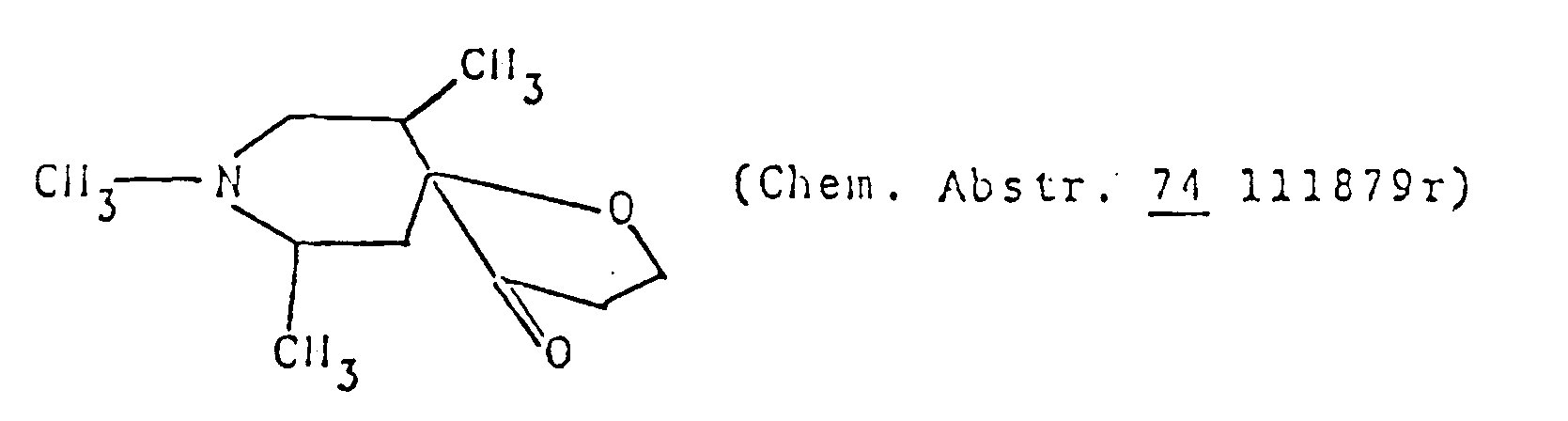
and further, 6,8,9-trimethyl-2-oxo-1-oxa-8-aza-spiro[4.5]decane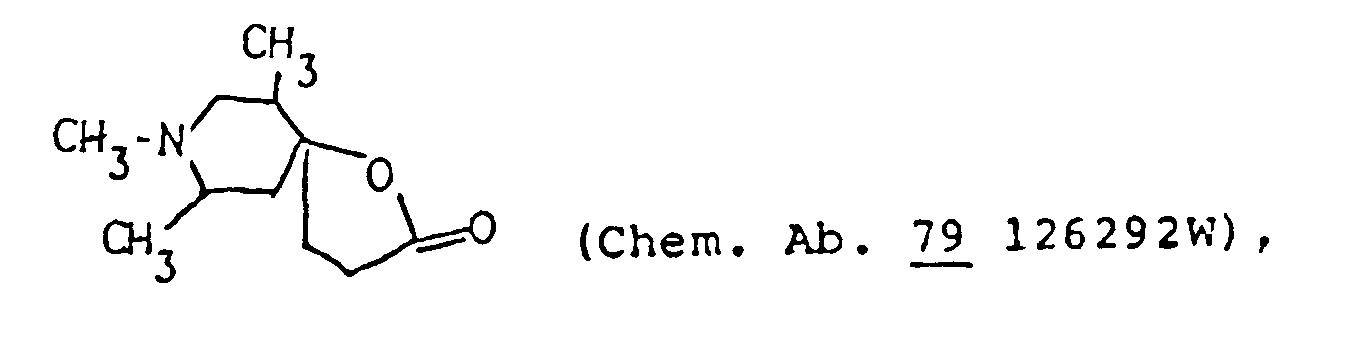
Also, compounds of general formula
are shown in U.S. Pat. 3,305,556. However, the above disclosures never suggest any use for preventing and/or treating diseases caused by the above nervous system degeneration. - This invention provides compounds of formula (I) and salts thereof:
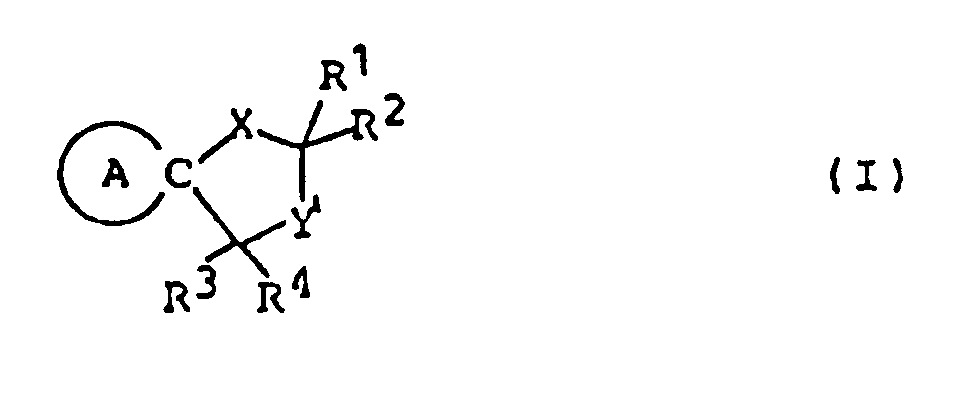
wherein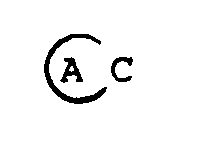
represents a piperidine ring of which the nitrogen atom may have substituent(s) selected from lower alkyl, lower alkanoyl and lower alkoxycarbonyl and/or may be connected to a ring carbon (other than the common carbon atom of the spiro structure) via a lower alkylene bridging group; X represents an oxygen or sulfur atom; Y represents a carbonyl group
a thiocarbonyl group
a group of the formula 〉CH-R⁵, a group of the formula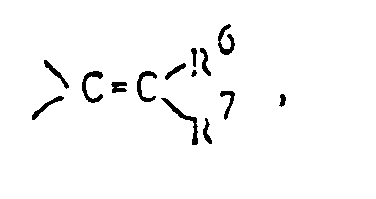
or a group of the formula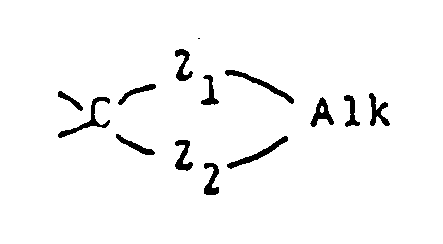
wherein Alk is a lower alkylene group and Z¹ and Z² are the same or different and selected from oxygen and sulfur atoms;
R¹, R² and R³ are the same or different and selected from a hydrogen atom and lower alkyl groups;
R⁴ represents a hydrogen atom or a lower alkyl, carboxy, lower alkoxycarbonyl, or lower alkanoyl group;
R⁵ represents a halogen atom or a hydroxyl, mercapto, lower alkoxy, lower alkylthio, lower alkanoyloxy, or lower alkanoylthio group; and
R⁶ and R⁷ are the same or different and selected from a hydrogen atom and lower alkyl groups. - In this specification, the term "lower" means, unless otherwise specified, a linear or branched carbon chain of 1 to 6 carbon atoms.
- As illustrative examples of "lower alkyl groups", there may be mentioned methyl, ethyl, propyl, isopropyl, butyl, isobutyl, sec-butyl, tert-butyl, pentyl, isopentyl, neopentyl, tert-pentyl, 1-methylbutyl, 2-methylbutyl, 1,2-dimethylpropyl, hexyl, isohexyl, 1-methylpentyl, 2-methylpentyl, 3-methylpentyl, 1,1-dimethylbutyl, 1,2-dimethylbutyl, 2,2-dimethylbutyl, 1,3-diemtylbutyl, 2,3-dimethylbutyl, 3,3-dimethylbutyl, 1-ethylbutyl, 2-ethylbutyl, 1,1,2-trimethylpropyl, 1,2,2-trimethypropyl, 1-ethyl-1-methylpropyl and 1-ethyl-2-methylpropyl.
- As "lower alkoxy groups", may be mentioned methoxy, ethoxy, propoxy, isopropoxy, butoxy, isobutoxy, sec-butoxy, tert-butoxy, pentyloxy ( amyloxy ), isopentyloxy, tert-pentyloxy, neopentyloxy, 2-methylbutoxy, 1,2-dimethylpropoxy, 1-ethylpropoxy and hexyloxy.
- "Lower alkylthio groups" correspond to above lower alkoxy groups in which oxygen is replaced by sulfur.
- Illustrative examples include methylthio, ethylthio, propylthio, isopropylthio, butylthio, sec-butylthio, tert-butylthio, pentylthio, neopentylthio, 2-methylbutylthio, 1,2-dimethylpropylthio and 1-ethylpropylthio.
- "Lower" alkoxycarbonyl groups" are derivable by carboxyl group esterification with a linear or branched alcohol of 1 to 6 carbon atoms - e.g. methoxycarbonyl, ethoxycarbonyl, propoxycarbonyl, isopropoxycarbonyl, butoxycarbonyl, isobutoxycarbonyl, sec-butoxycarbonyl, tert-butoxycarbonyl, pentyloxycarbonyl, isopentyloxycarbonyl, tert-pentyloxycarbonyl, neopentyloxycarbonyl and hexyloxycarbonyl.
- "Lower alkanoyl groups" include e.g. formyl, acetyl, propionyl, butyryl, isobutyryl, valeryl, isovaleryl, pivaloyl and hexanoyl.
- Illustrative examples of "lower alkanoyloxy groups" include formyloxy, acetyloxy, propionyloxy, butyryloxy, isobutyryloxy, valeryloxy, isovaleryloxy, pivaloyloxy and hexanoyloxy.
- "Lower alkanoylthio groups" correspond to above lower alkanoyloxy groups in which the oxygen of the oxy radical is replaced by sulfur. Illustrative examples include formylthio, acetylthio, propionylthio, butyrylthio, isobutyrylthio, valerylthio, isovalerythio, pivaloylthio and hexanoylthio.
- The "lower alkylene group" represented by Alk and forming a ring with the radical
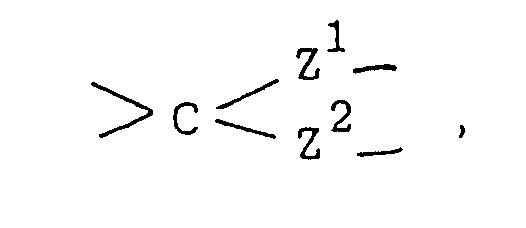
is a bivalent radical, preferably of 2 or 3 carbon atoms, in which at least one of the carbon atoms may optionally be substituted by a lower alkyl group as defined above. Illustrative examples include ethylene, trimethylene, 1 - or 2-methylethylene, 1 - or 2-ethylethylene, 1 - or 2-propylethylene, 1 - or 2-isopropylethylene, 1 - or 2-butylethylene, 1,2-dimethylethylene, 1,2-diethylethylene, 1-ethyl-2-methylethylene, 2-ethyl-1-methylethylene, 1-, 2-, or 3-methyltrimethylene, 1 -, 2- or 3-ethyltrimethylene, 1-, 2- or 3-propyltrimethylene, 1-, 2- or 3-isopropyltrimethylene, 1,2-, 1,3- or 2,3-dimethyltrimethylene, 1,2-, 1,3- or 2,3-diethyltrimethylene, 1,2,3-trimethyltrimethylene and 1,2,3-triethyltrimethylene. - "Halogen atom" may be any one of flourine, chlorine, bromine and iodine.
- The optional lower alkylene bridging group in the A-ring is as defined for "Alk"; examples of such saturated bicyclo A-rings are 1-azabicyclo[2,2,1] heptane
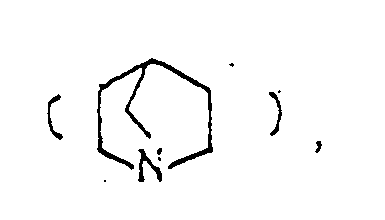
1-azabicyclo[2,2,2]octane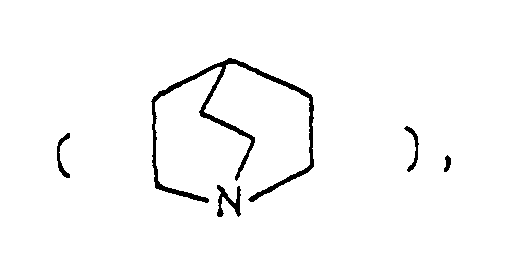
1-azabicyclo[3,2,2]nonane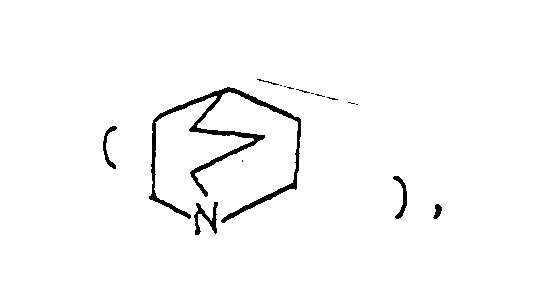
1-azabicyclo[3,1,1] heptane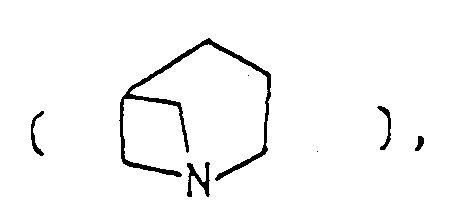
1-azabicyclo[3,2,1]octane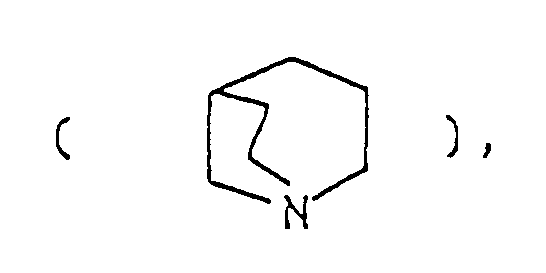
1-azabicylco[3,3,1]nonane
and 7,7-dimethyl-1-azabicyclo[2,2,1]heptane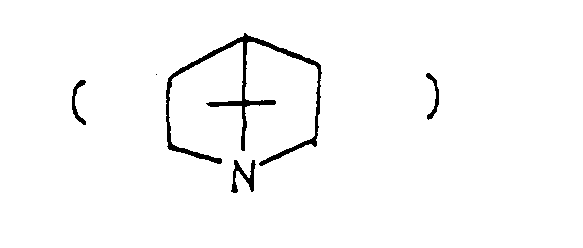
rings. - The compounds of formula (I) are capable of forming salts, and these salts are also included in this invention. Illustrative examples include addition salts with mineral acids such as hydrochloric, hydrobromic, hydroiodic, sulfuric, nitric and phosphoric acids, and with organic acids such as formic, acetic, propionic, oxalic, malonic, succinic, fumaric, maleic, malic, tartaric, methanesulfonic and ethanesulfonic acids; and salts with acidic amino acids, such as aspartic and glutamic acids.
- Some of the compounds of this invention contain asymmetric carbon or double bond ( depending on the type of substituent groups involved ) and hence exist as a plurality of optical and geometric isomers. This invention includes all of these isomers, individually and in any mixture of two or more thereof.
- This invention also includes preparative methods for compounds (I). These are spiro compounds constructed of a nitrogen-containing hetero ring and an oxolane ring having various substituent groups thereon, and hence can be prepared through various synthetic routes adapted for the individual chemical structures.
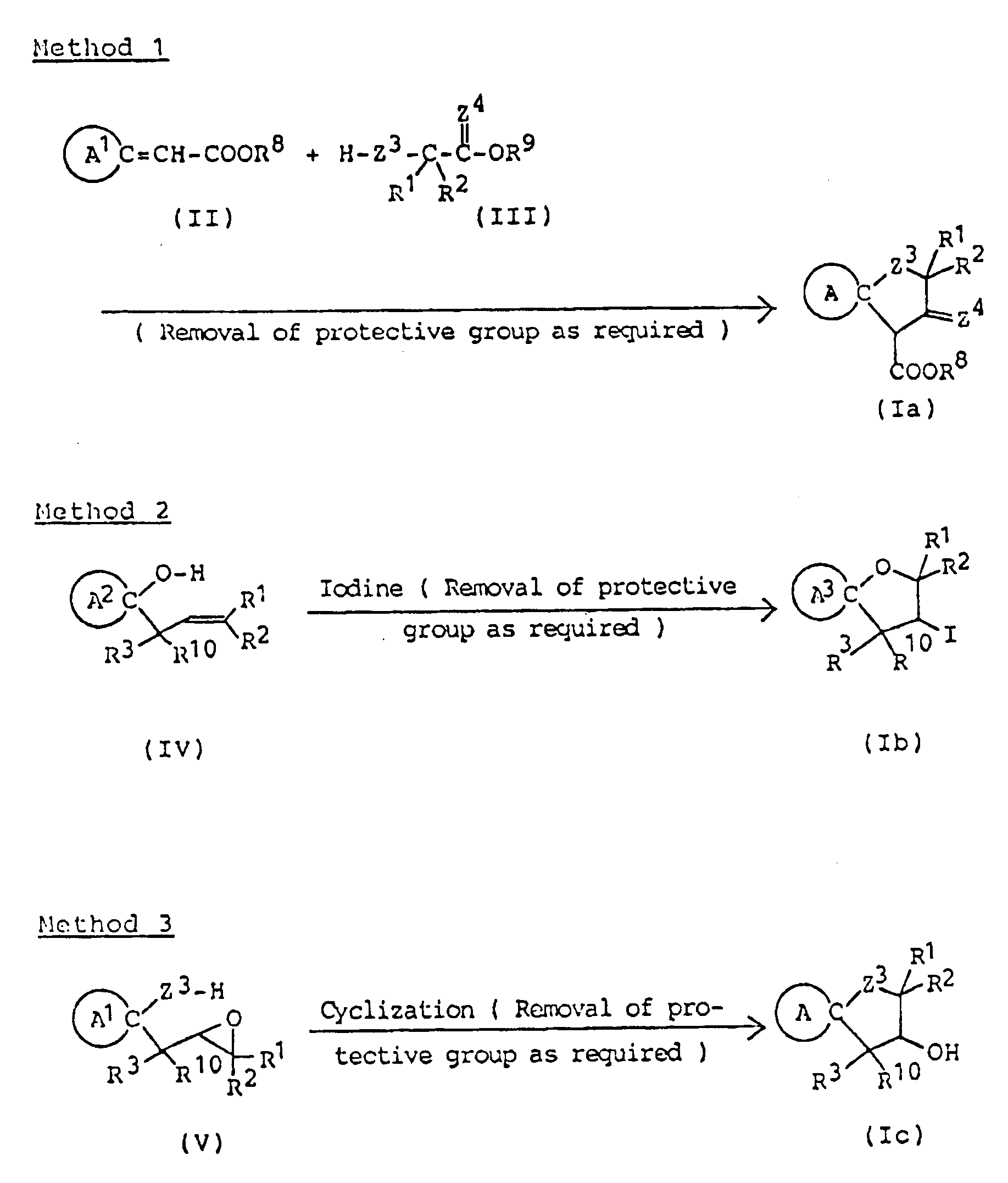
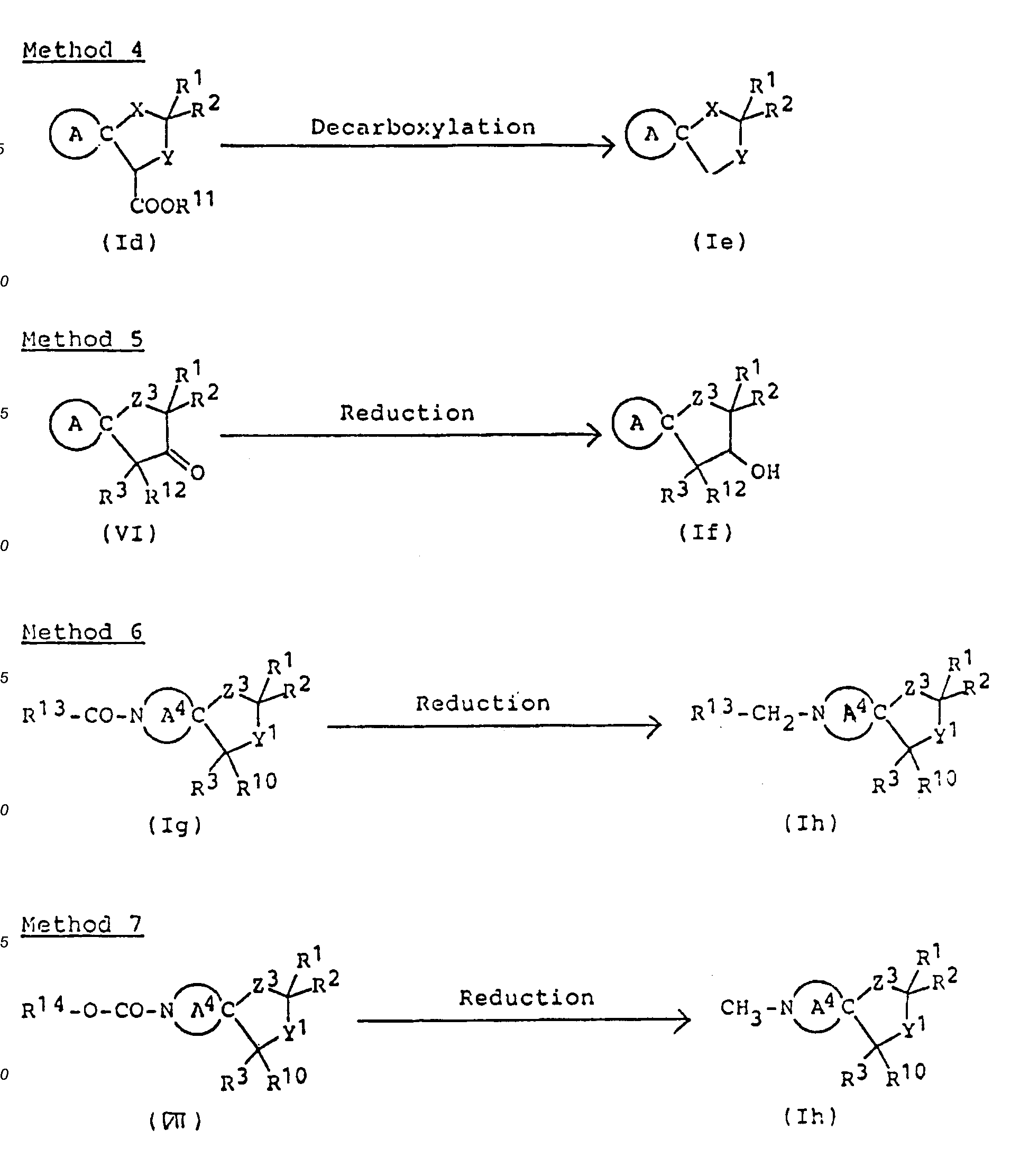
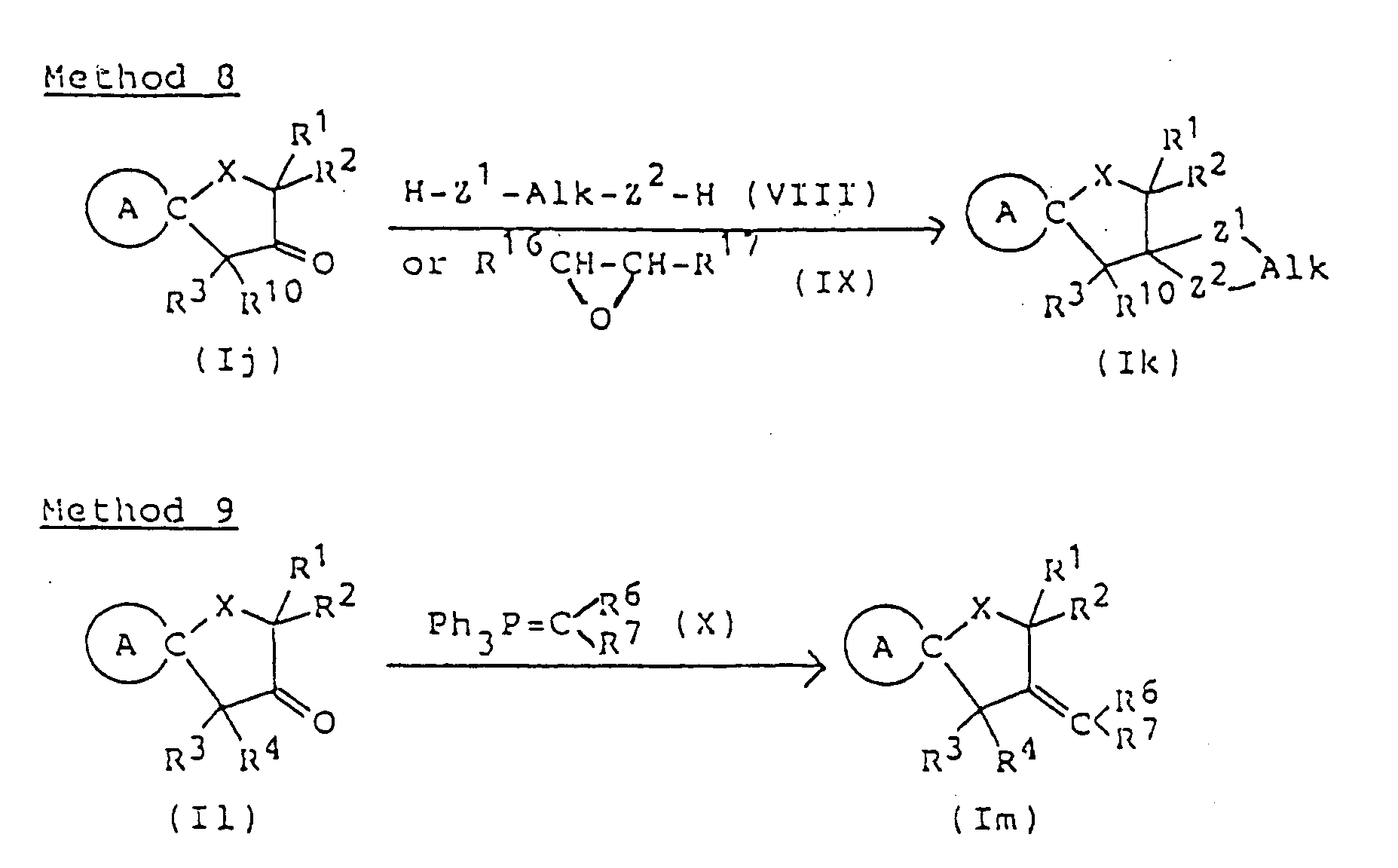
( wherein ring A, R¹, R², R³, R⁴, R⁵, R⁶, R⁷, X, Y, Z¹, Z² and Alk are as defined above; ring A¹ is a piperidine ring in which the nitrogen atom may be substituted by lower alkyl, lower alkanoyl, lower alkoxycarbonyl or a protective group for amines and/or may be connected to a ring carbon (other than the common carbon atom of the spiro structure) via a lower alkylene bridging group;
a piperidine ring in which the nitrogen atom may be substituted by lower alkanoyl lower alkoxycarbonyl or a protective group for amines and/or may be connected to a ring carbon (other than the common structure atom of the spiro structure) via a lower alkylene bridging group;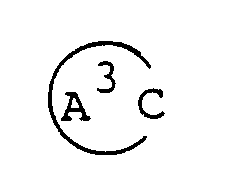
a piperidine ring in which the nitrogen atom may be substituted by lower alkanoyl or lower alkoxycarbonyl and/or may be connected to a ring carbon (other than the common carbon atom of the spiro structure) via a lower alkylene bridging group;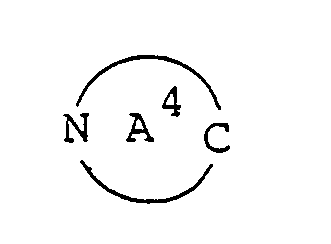
is a piperidine ring structure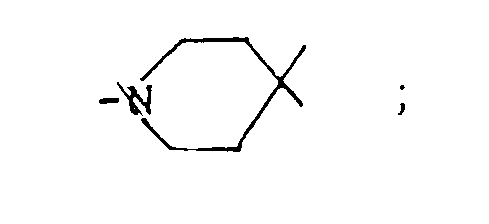
Y¹ is a radical represented by 〉CH-R¹⁵,
Z³ and Z⁴ are the same or different and selected from oxygen and sulfur atoms; R⁸ and R⁹ are the same or different lower alkyls; R¹⁰ is a hydrogen atom or lower alkyl; R¹¹ is a hydrogen atom or lower alkyl; R¹² is a hydrogen atom or lower alkyl, carboxyl or lower alkoxycarbonyl; R¹³ is a hydrogen atom or an alkyl group of 1 to 5 carbon atoms; R¹⁴ is lower alkyl; R¹⁵ is hydroxyl, mercapto, lower alkoxy or lower alkylthio; Ph is phenyl; and R¹⁶ and R¹⁷ are the same or different and selected from a hydrogen atom and lower alkyls . - There are many cyclization processes for preparing the compounds of this invention. Compounds represented by the general formula (Ia) can be advantageously synthesized by cyclic condensation between, ester of cycloalkylideneacetic acid (II) and ester of hydroxy(or mercapto)alkyl-(thio)carboxylic acid (III), followed by removal of the protective group as required.
- In this method, compound (II) and alkali metal salt of compound (III) are allowed to react, or compound (II) and compound (III) are allowed to react in the presence of base; the two reactants are used in equimolar amounts or with one reactant in slight excess. The reaction is preferably carried out in an inert organic solvent under cooling or at room temperature. Suitable solvents are aprotic compounds, such as dimethyl sulfoxide, benzene, toluene, xylene, dichloromethane, tetrahydrofuran, N,N-dimethylformamide, dichloroethane, chloroform and carbon tetrachlorides. Of these, dimethyl sulfoxide or tetrahydrofuran is the most preferred. The alkali metal salt of compound (III) can be obtained by reaction of compound (III) with base, such as sodium hydride, preferably under anhydrous conditions. The same type of base may be used in the reaction of compound (II) and compound (III) in free form.
- Any types of protective group commonly employed for amino groups may be used in this invention. These include groups of urethane type ( e.g., t-butoxycarbonyl ), of acyl type ( e.g., formyl, acetyl and propionyl ), and of benzyl type (e.g., benzyl, benzhydryl and trityl ). Removal of these protective groups may be effected by usual methods; in the presence of acid or base for those of urethane type, in the presence of base for those of acyl type, and by catalytic reduction for those of benzyl type. Hydrochloric acid, trifluoroacetic acid and hydrobromic acid/acetic acid may be mentioned as acid catalysts, and sodium hydroxide and potassium hydroxide as the base catalysts.
- Compounds (II), as described in Reference Example 3, can be obtained by reaction of oxo-heterocyclic compound carrying protective group, lower alkyl, lower alkanoyl and lower alkoxycarbonyl with lower alkyl dialkylprosphonoacetate in an inert solvent ( e.g., dimethoxyethane, dioxane and tetrahydrofuran ) in the presence of base under cooling or at room temperature, or by the normal Wittig reaction, followed by removal of any protective group.
- Spiro compounds of 3-iodo-heterocyclic type represented by formula (Ib) can be prepared by iodination of alkenyl-substituted, heterocyclic alcohol (IV), followed by removal of any protective group as required.
- The reaction is preferably carried out by dissolving compound (IV) in an inert organic solvent, adding an aqueous alkaline solution of iodine in a more than stoichiometric amount, and holding the resulting mixture under cooling or at room temperature.
- Suitable organic solvents are aprotic compounds, such as dichloromethane, dichloroethane, chloroform, carbon tetrachloride, benzene, toluene, xylene and dimethyl sulfoxide, and sodium carbonate, potassium carbonate, sodium bicarbonate, sodium hydroxide and potassium hydroxide may be mentioned as examples of the alkali.
- The types of protective group and methods for removing them are as in Method 1.
- Compounds (IV) ( starting material ) are novel compounds, which can be easily obtained, as shown in the reaction formula given below, by the action of Grignard reagent, prepared from alkenyl halide and magnesium by usual method, upon oxo-heterocyclic compound.

( wherein ring A², R¹, R², R³ and R¹⁰ are as defined above and B is a halogen atom ). - Compounds of this invention of formula (Ic) can be synthesized by subjecting epoxy compound (V) to cyclization, followed by removal of the protective group as required.
- This cyclization is effected by the action of Lewis acid ( such as tin tetrachloride, titanium tetrachloride and boron trifluoride/diethyl ether complex ) upon compound (V) dissolved in an inert organic solvent, followed by addition of base.
- Suitable organic solvents are aprotic compounds, such as dichloromethane, dichloroethane, chloroform, carbon tetrachloride, benzene, toluene, xylene and dimethyl sulfoxide. The base may be any compound that can trap the hydrochloric acid and metal salt formed, illustrative examples being organic bases, such as triethylamine, trimethylamine, pyridine, picoline, lutidine and dimethylaniline; and inorganic bases, such as sodium hydroxide, potassium hydroxide, sodium carbonate and potassium carbonate.
- The reaction is preferably carried out under cooling or at room temperature.
- The types of protective group and methods of removing them are as in Method 1.
- Compounds of this invention of formula (Ie) can be synthesized by decarboxylation of corresponding compound (Id) carrying carboxyl or lower alkoxycarbonyl as the substituent group at 4-position.
- The decarboxylation reaction is effected by heating ( preferably under reflux ) in the presence of acid. When the substituent group is a lower alkoxycarbonyl, a process may be adopted in which the starting material (Id) may be dissolved in inert organic solvent ( e.g., diemthylformamide and dimethyl sulfoxide ) and this solution heated in the presence of an equimolar or excess amount of sodium chloride. When Method 1 is followed by this method, the Method 1 reaction product need not be isolated, but may be heated in the form of an acidic aqueous solution for direct conversion to compound (Ie).
- Compounds of this invention can be prepared by reduction, and various reduction procesess may be adopted depending on the type of radical to be reduced.
- Method 5 is a process for obtaining compounds (If) carrying hydroxyl as substituent at 3-position by reduction of corresponding compound in which the 3-position is carbonyl.
- The reaction is preferably carried out in an inert solvent ( for example, alcohols, such as methanol, ethanol and isopropanol, tetrahydrofuran, and dioxanes ) at room temperature or at elevated temperature using reducing agent that can selectively reduced the carbonyl at 3-position (e.g.a boron hydride compound, such as sodium borohydride and sodium cyanoborohydride ).
- N-lower-alkyl compounds of formula (Ih) can also be synthesized by reduction of starting material (Ig) carrying a lower alkanoyl as the substituent group at N-position.
- The reaction is preferably carried out in an organic solvent ( e.g., ether, tetrahydrofuran or dioxane ) using, as reducing agent, an aluminum hydride compound ( such as lithium aluminum hydride ) at room temperature or at an elevated temperature.
- N-methyl compounds of this invention of formula (Ii) can be synthesized by reduction of compound (III) carrying a urethane-type substituent at the N-position.
- The reduction is preferably effected in an organic solvent ( e.g., tetrahydrofuran, ether or dioxane ) using, as reducing agent, aluminum hydride ( prepared from lithium aluminum hydride and sulfuric acid ) at room temperature or at elevated temperature, or under cooling.
- Cyclic ketals of formula (Ik) can be synthesized by methods commonly employed for the preparation of cyclic ketals. For example, corresponding carbonyl compound (Ij) is allowed to react with compound (VIII), such as a glycol, a hydroxyalkanethiol or an alkanedithiol, or with epoxy compound (IX), to form compound (Ik).
- The reaction is carried out by dissolving compound (Ij) and an equimolar or excess amount of compound (III) in an inert organic solvent ( preferably a solvent adapted for azeotropic dehydration, such as benzene, toluene or xylene ) and heating the solution under reflux in the presence of acid catalyst to effect dehydration ( preferably using a Dean-Stark azeotropic dehydration apparatus ). The acid catalyst may be adipic acid, oxalic acid or pyridine hydrochloride, but p-toluenesulfonic acid is the most preferred. If the reaction is carried out in an inert solvent, such as dichloromethane, dichloroethane, chloroform, carbon tetrachloride, ether, dioxane or tetrahydrofuran, in the presence of Lewis acid ( e.g., boron trifluoride/diethyl ether or tin tetrachloride ), the desired product can be obtained without dehydration or heating. When epoxy compound (IX) is used as starting material, the reaction is carried out in an inert solvent ( e.g., dichloromethane, dichloroethane, chlorform or carbon tetrachloride ) in the presence of stannous chloride or boron trifluoride/ether complex at room temperature or at elevated temperature, or in the presence of tetraethylammonium bromide at 80 to 150°C in an autoclave.
- Compounds of formula (Im) having an alkylidene group at the 3-position can be synthesized by reaction of corresponding compound (Il) in which the 3-position is carbonyl with alkyltriphenylphospholane (X).
- This reaction is preferably carried out in an inert, aprotic organic solvent ( such as dimethyl sulfoxide, dimethylformamide, tetrahydrofuran, ether, dioxane, benzene, toluene or xylene ) under cooling or at elevated temperature using an equimolar or excess amount of compound (X). The compound (X) can be prepared by reaction of corresponding alkyltriphenylphosphonium halide with an equimolar or excess amount of base in the same solvent as above under cooling or heating. The base used is preferably sodium hydride or n-butyllithium.
- Many other methods may be applied to the preparation of the compounds of this invention.
- For example, esters can be synthesized by reaction of corresponding carboxylic acid or reactive derivative thereof with lower alcohol or reactive derivative thereof ( e.g., lower alkyl halide ) in the presence of condensation agent or base as required, or by other commonly used esterification techniques. Conversely compounds of this invention having free carboxyl group can be derived from corresponding esters by hydrolysis. Thiocarboxylic acids and esters thereof can be similarly prepared.
- Compounds in which the 3-position is thiocarbonyl can also be synthesized ( other than by Method 1 ) by the action of phosphorous pentasulfide or Lawelsson's reagent ( preferably used when no amide or ester bond is present ) upon a compound in which the 3-position is carbonyl.
- Compounds carrying a lower alkyl as substituent group at the N-position can be derived from corresponding free-nitrogen compounds by the usual N-alkylation methods using lower alkyl halide or by the action of lower alkylaldehyde in the presence of reducing agent, such as sodium borohydride or sodium cyanoborohydride. Compounds carrying a lower alkanoyl as substituent group at the N-position can be derived from corresponding free-nitrogen compound by the usual amidation methods using lower alkanoic acid or reactive derivative thereof in the presence of base as required.
- Compounds of this invention carrying mercapto substituent group at the 3-position can be synthesized by sulfonating corresponding compounds carrying hydroxy substituent group at the 3-position ( which may optionally have a protective group ), followed by the action of thiocarboxylic acid ( such as thioacetic acid, CH₃CO-SH ), hydrolysis and removal of the protective group as required; or by forming corresponding N-alkyl compound according to Method 6 or Method 7.
- Compounds carrying a thioether substituent group at the 3-position can be derived from the mercapto compounds obtained above or alkali metal salt thereof by the action of lower alkyl halide or lower alkyl sulfonate ( preferably p-toluenesulfonate ) in the presence of base as required.
- Compounds carrying an ether substituent group at the 3-position can be derived from corresponding 3-hydroxy compounds by the action of lower alkyl halide ( e.g., lower alkyl iodide ) in the presence of base, followed by removal of the protective group as required; or by forming corresponding N-alkyl compound according to Method 6 or Method 7.
- The compounds of this invention (I) thus prepared are isolated and purified in the free form or as salts (obtainable by common salt-forming reactions ).
- Isolation and purification can be effected by common chemical operations, such as liquid/liquid separation, extraction, concentration, crystallization, filtration, recrystallization, and various types of chromatography.
- As stated above, the compounds of this invention may be obtained in different isomeric forms ( such as geometric isomers, racemic compound, optical isomers and diastereomers ), either alone or as a mixture thereof. Geometric isomers can be separated by appropriately selecting the starting material or by utilizing difference in physicochemical properties among the isomers. Optical isomers and diastereomers can be separated by appropriately selecting the starting material, by the general racemic separation techniques ( for example, forming diastereomer salts with optically active acid, such as tartaric acid, followed by optical resolution ), or by techniques commonly used for diastereomer separation ( for example, fractional crystallization and chromatography ).
- When some of the above preparative methods are to be used in succession, reaction steps described with no reference to protective groups may also be carried out with protective groups present.
- The compounds of this invention act directly upon muscarinic acetylcholine receptor and thus have ability to activate cholinergic function in the central nervous system.
- Activities of choline acetyltransferase and acetylcholine esterase in Alzheimer-type dementia patients (hereinafter, referred to as "ATD") are significantly reduced in some brain regions such as hippocampus, amygdala, cerebral cortex [cf. Davies, P., Maloney, A.J.F., Lancet, ii, 1043 (1976)]; however, there is no significant change of activities of glutaminic acid decarboxylase, tyrosine hydroxylase, dopamine-beta-hydroxylase, monoamine oxydase, etc. These findings suggest that functional decrease of cholinergic nervous system occured in the gloval brain region [cf. Davies, P.; Brain Res. 171, 319 (1979)]. Further, it is suggested that deficits of memory and orientation in the case of ATD or senile dementia have close relation to functional decrease or loss of acetylcholinergic nerve [cf. Whitehouse, P.J. et al, Science 215, 1237, (1982); Perry, E.K. et al., Brit, Med, J. 2, 1457 (1978)].
- Muscarinic receptors are classified into two subtypes, M₁ and M₂ [Trends Pharmacol. Scei. Suppl. (1984)]. The M₁-subtype exists mainly in the cereal cortex, hippocampus, corpus striatum and in ganglions of the sympathetic nervous system. The M₂-subtype exists mainly in the cerebellum and some peripheral tissues such as smooth muscle, cardiac muscle, and gland [Vickroy, T.W. et al., Fed. Proc., 43, 2785 (1984)]. From the results of animal experiments, it is suggested that the M₁-subtype has relation to learning and memory function [cf. Caufield, M.P. et al., J. Pharm. Pharmacol. 35, 131 (1983)] and the M₂-subtype has relation to heart inhibition, and tremor, [cf. Mutschler, E., Lambrecht, G., Trends Pharmacol. Sci. Suppl., 39 (1983), Palacios, J.M. et al., Eur. J. Pharmacol. 125, 43 (1986)].
- Thus, it is believed that muscarinic agonist having M₁-receptor-selectivity may improve intellectual defects such as loss of memory, loss of orientation, in the case of senile dementia.
- The compounds of this invention have selective affinity to M₁-receptors, and thus are useful for treating diseases caused by central nervous system degeneration (in particular, diseases caused by decrease of acetylcholine function) such as ATD, ATD-type senile dementia, Huntington's chorea, and Pick's disease.
- The effects of the present compounds were determined by improvement of amnesia, induction of tremor and inhibition of ³H-ligand binding to membranes of rat brain. Oxotremorine and Arecoline (typical muscarine receptor agonists) were used as comparison compounds, and the results are shown in Table 1.
- Improvement of amnesia caused by scopolamine in rats:
Improving effects of the compounds on amnesia caused by intraperitoneal administration ( 1 mg/1g) of scopolamine hydrobromide were determined in accordance with the method described in "Jarvik, M. E. et al., Psychol. Resp. 21, 221 (1967)". The test compounds were administered subcutaneously at the same time as the administration of scopolamine hydrobromide. - Induction of tremor in mice:
The compounds were administered subcutaneously to mice. Minimum effective dose for causing tremor was determined. - Affinity for muscarinic receptors:
Tests were substantially in accordance with the method described in "Watson, M. et. al., Life Science 31, 2019 (1982)" on the affinity of [3H]pirenzepine to M₁-receptor of rat cerebral cortex, and a further test was done in accordance with the method of "Yamamura, H. I., Snyder, S. H., Proc. Natul. Acad. Sci., U. S. A., 71(5), 1725 (1974)" on the affinity of [3H]quinuclidinyl benzylate (QNB) to M₂-receptor of rat cerebellum.Table 1 Compound Dose (mg/kg, sc) Receptor-affinity IC₅₀ (»M) Effect in Test 1 Effect in Test 2 Pirenzepine -binding QNB-binding Example 5 0.5 > 30 3.32 25.1 15 0.03 > 30 0.37 2.14 22 0.03 > 30 0.039 0.71 29 0.03 > 30 0.049 0.64 33 0.03 > 30 0.017 0.31 36 0.3 > 30 1.26 8.96 Oxotremorine 0.2 0.2 0.068 0.0049 Arecoline 2.5 5 0.85 0.73 - From Table I, it is apparent that compounds of this invention have excellent pharmacological effects.
- The compounds of this invention may be formulated into ordinary dosage forms such as, for example, tablets, capsules, pills, and solutions, and these medicaments can be prepared by conventional methods using usual medical excipients. That is, medical agents containing the comopounds of this invention may be prepared by conventional methods using conventional carriers or excipients. They may for example be administered orally as tablets, powder, troche, pills, capsules, granules; parenterally by intravenous or intramuscular or subcutaneous injection; as suppositories; or other suitable forms for administration in liquid, fluid, or solid state, for example ointment, adhesive tape, and plaster.
- The appropriate dose of the present compounds is determined in each case considering factors such as the kind of compound; the symptoms, age, sex, and body weight or the patient; and administration route. For an adult about 0.001 - 10 mg (preferably 0.01 - 0.1 mg) per single dose is suitable for injection administration; and for oral administration, about 0.05 - 500 mg (preferably, 0.1 - 10 mg) per single dose is suitable; the medicaments may be administered in one to 3 divided doses per day.
- The following Examples further illustrate the invention. Some of the starting materials used for the synthesis of the compounds of this invention are novel compounds. Preparative methods for these novel compounds are described in Reference Examples.
-

To a three-necked flask fitted with a thermometer, a dropping funnel and a calcium chloride tube, was added 4 g. of 60% oily sodium hydride, and the oil component was washed off by treatment with n-hexane. Anhydrous ether ( 150 ml ) was added to the residue, the mixture was stirred well, and 50 ml of an ethereal solution containing 11.8 g ethyl lactate was then added at 5 to 10°C. Evolution of hydrogen gas ceased after stirring at room temperature for about three hours. The ether was distilled off under reduced pressure, 80 ml dimethyl sulfoxide was added to the residue, the resulting solution was cooled to about 15°C, and 18.3 g ethyl 1-methyl-4-piperidylideneacetate was added. After stirring at room temperature for about 20 hours, the reaction mixture was poured into 200 ml ice water, concentrated hydrochloric acid was added dropwise until the pH fell to about 4, and sodium bicarbonate was then added to make the solution weakly alkaline. To this aqueous solution was added sodium chloride until saturation, the saturated solution thus obtained was extracted thrice with 300 ml chloroform, and the combined extract was washed with saturated aqueous sodium chloride and dried over anhydrous magnesium sulfate. Distilling off the chloroform under reduced pressure from the dried solution left 16 g of an oily mixture containing much dimethyl sulfoxide. It was purified by silica gel column chromatography using, as eluent, a mixed solvent of chloroform/methanol/conc. ammonia ( 10:1:0.1 by volume ), giving 2.9 g of ethyl 2,8-dimethyl-3-oxo-1-oxo-8-azaspiro[4,5]decane-4-carboxylate as solid. - Mass spectrum (m/z): 255, 181, 136
IR absorption spectrum (KBr) cm⁻¹: 3500(broad), 1672, 1552
NMR spectrum ( CDCl₃; internal standard: TMS ), δ ppm: 1.16-1.48 ( m, 6H, -OCH₂CH₂CH₃, C-CH₃ ), 1.7-2.0 ( m, 4H,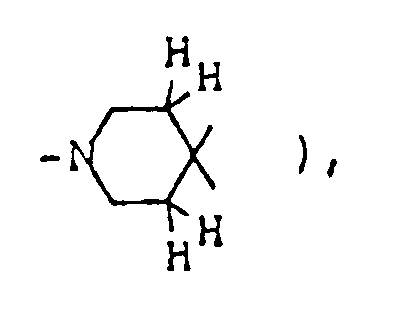
2.32 [ s, 3H, CH₃N〈 ), 2.3-2.8 ( m, 4H,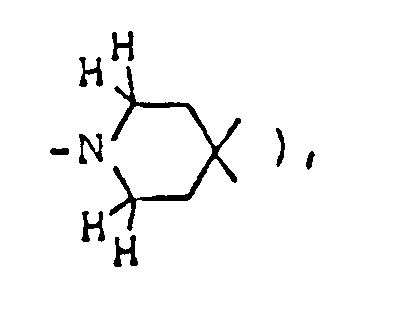
4.0-4.2 ( m, 3H, -OCH₂CH₃,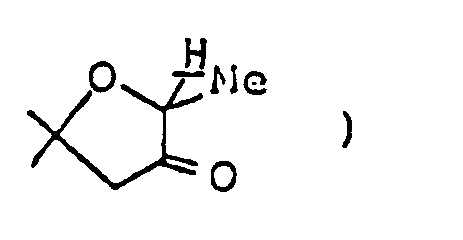
-
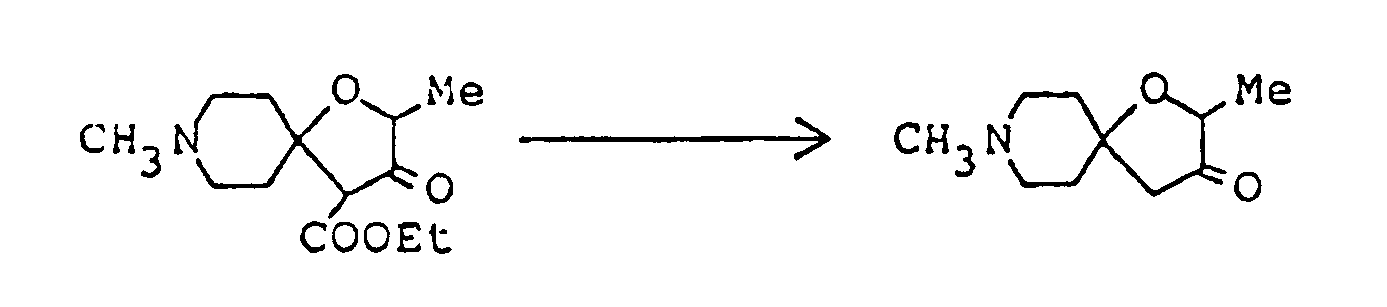
Ethyl 2,8-dimethyl-3-oyo-1-oxa-8-azaspiro[4,5]decane-4-carboxylate ( 3.08 g ) was dissolved in 50 ml of 1N-HCl, and the solution was heated under reflux for eight hours. The reaction mixture was allowed to cool to room temperature, then cooled in an ice-water bath, and basified by addition of 20% aqueous solution of caustic soda. This alkaline solution was extracted thrice with about 80 ml of chloroform, and the combined extract was washed with saturated aqueous solution of sodium chloride and dried over anhydrous magnesium sulfate. Distilling off the solvent under reduced pressure from the dried solution left 2 g of yellow residue, which was purified by silica gel column chromatography using, as eluent, a mixed solvent of chloroform/methanol ( 20:1 by volume ), giving 1.8 g of 2,8-dimethyl-1-oxa-8-azaspiro[4,5]decan-3-one as oil. It was dissolved in ether, and ethanolic hydrogen chloride was added, thus giving its hydrochloride as crystals. - Melting point: 179-181°C ( dec. )
Elemental analysis ( C₁₀H₁₈NO₂Cl ): C(%) H(%) N(%) Cl(%) Calcd. 54.67 8.26 6.38 16.14 Found 54.40 8.27 6.31 16.35
Mass spectrum (m/z): 183, 110
IR absorption spectrum (KBr) cm⁻¹: 3500 (broad), 2400-2700, 1754
NMR spectrum ( CDCl₃; internal standard: TMS ), δ ppm: 1.30 ( d, 3H, J=7.2Hz, C-CH₃ ), 1.8-2.5 ( m, 4H,
2.48 ( s, 2H,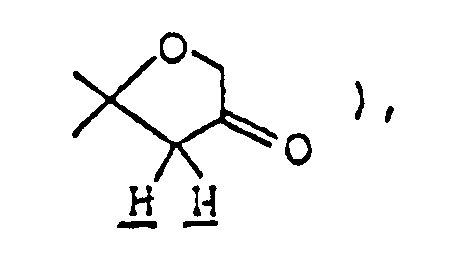
2.80 ( d, 3H, J=5.4Hz, CH₃-⁺NH〈 ), 3.0-3.5 ( m, 4H,
3.98 ( q, 1H, J=7.2Hz, 〉CH-CH₃ ) -

To a solution of 2,8-dimethyl-1-oxa-8-azaspiro[4,5]decan-3-one ( 200 mg ) in 7 ml ethanol, was added 25 mg sodium borohydride at room temperature, and the mixture was stirred at room temperature for two hours. The reaction mixture was cooled in an ice-water bath, acidified by addition of 6N-HCl ( to about pH 4 ), and stirred for about 20 minutes with the ice-water bath removed. Ethanol was distilled off under reduced pressure, and the residue was purified by silica gel column chromatography using, as eluent, a mixed solvent of chloroform/methanol/conc. ammonia ( 5:1:0.1 by volume ), giving 200 mg of 3-hydroxy-2,8-dimethyl-1-oxa-8-azaspiro[4,5]decane as oil. It was dissolved in ether, and ethanolic hydrogen chloride was added to this solution, thus giving its hydrochloride as white crystals. - Melting point: 174-178°C
Elemental analysis ( C₁₀H₂₀NO₂Cl ): C(%) H(%) N(%) Cl(%) Calcd. 54.17 9.09 6.32 15.99 Found 53.90 9.22 6.27 16.05
Mass spectrum (m/z) : 185, 168, 110
NMR spectrum ( CDCl₃; internal standard: TMS ), δ ppm: 1.25 ( m, 3H, C-CH₃ ), 1.6-2.6 ( m, 6H,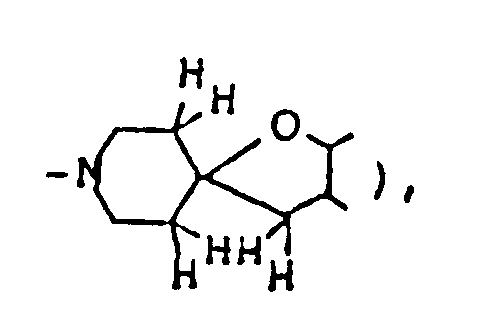
3.74 ( d, 3H, J=4.5Hz, HN⁺-CH₃ ), 3.0-3.4 ( m, 4H,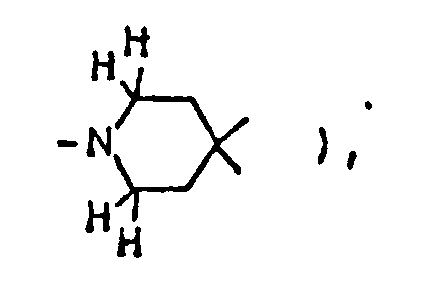
3.8-4.3 ( m, 2H,
-

A mixture of 730 mg 2,8-dimethyl-1-oxa-8-azaspiro[4,5]decan-3-one, 2.25 ml ethylene glycol, 836 mg p-toluenesulfonic acid monohydrate and 30 ml toluene was heated under reflux for 3 hours with a Dean-Strak azeotropic dehydration apparatus, and the reaction mixture was poured into 30 ml of an aqueous solution containing 1.26 g sodium bicarbonate, The resulting mixture was extracted with chloroform. The extract was dried over anhdyrous magnesium sulfate, and concentrated under reduced pressure. The residue was purified by silica gel column chromatography on silica gel eluted with a mixed solvent of chloroform/methanol/conc. ammonia (20:1:0.1 by volume) to give 640 mg of 10,14-dimethyl-1,4,-13-trioxa-10-azasprio[4.1.5.2]tetradecane as oil. It was dissolved in isopropanol, and a solution of maleic acid in isopropanol was added to convert it to the corresponding maleate, which was recrystallized from dichloromethane/ether. - Melting point: 106-108°C
Elemental analysis ( C₁₆H₂₅NO₇ ): C(%) H(%) N(%) Calcd. 55.97 7.34 4.08 Found 55.81 7.14 4.04
Mass spectrum (m/z): 227, 182, 110
IR absorption spectrum (KBr) cm⁻¹: 3500, 2960, 2710, 1590
NMR spectrum ( CDCl₃; internal standard: TMS ), δ ppm: 1.15 ( d, 3H, J=6.3Hz, C-CH₃ ), 1.9-2.1 ( m, 6H,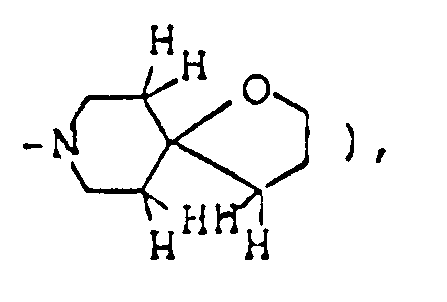
2.78 ( s, 3H, CH₃N〈 ), 3.0-3.5 ( m, 4H,
3.8-4.1 ( m, 5H,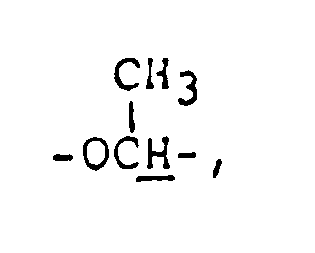
-O-CH₂- x 2 ), 6.28 ( s, 2H,
-
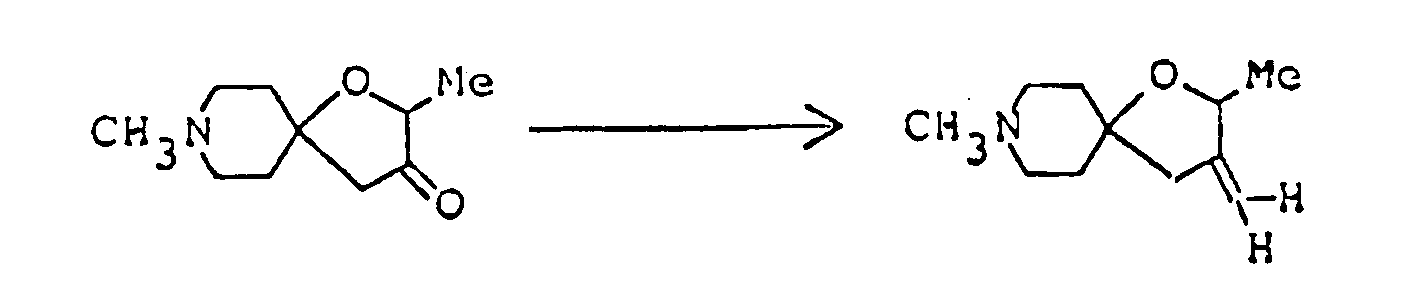
60% oily sodium hydride ( 272 mg ), placed in a flask, was treated with n-hexane in an argon gas atmosphere to wash off the oil component, and the remaining hexane was distilled off under reduced presure. Dimethyl sulfoxide ( 8 ml ) was added to the residue, the mixture was heated at 60 to 70°C for about one hour, the faint-green solution thus obtained was ice-cooled, and 2.43 g methyltriphenylphosphonium bromide was added. Heating the mixture at about 40°C put the solid into solution, giving a yellowish-red solution. It was cooled to about 30°C, 590 mg 2,8-dimethyl-1-oxa-8-azaspiro[4,5]decan-3-one was added, and the mixture was stirred at room temperature for about two hours. It was then poured into 50 ml ice water, the resulting mixture was extracted with chloroform, and the extract was washed with saturated aqueous sodium chloride and dried over anhydrous magnesium sulfate. After distilling off the solvent under reduced pressure from the dried solution, the residue was purified by silica gel column chromatography using, as eluent, a mixed solvent of chloroform/methanol ( 10:1 by volume ), giving 320 mg of 2,8-dimethyl-3-methylene-1-oxa-8-azaspiro[4,5]decane as oil. It was dissolved in ether, and ethanolic hydrogen chloride was added to the solution, giving the corresponding hydrochloride as crystals. - Melting point: 190-191°C
Elemental analysis ( C₁₁H₂₀NOCl·0.3H₂O ): C(%) H(%) N(%) Calcd. 59.21 9.31 6.27 Found 59.10 9.07 6.29
Mass spectrum (m/z): 181, 166, 96
NMR spectrum ( CDCl₃; internal standard: TMS ), δ ppm:
1.30 ( d, 3H, J=5.4Hz, C-CH₃ ), 1.6-2.4 ( m, 4H,
2.56 ( m, 2H,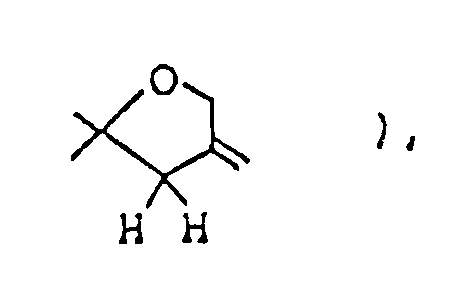
2.9-3.5 ( m, 4H, 2.76 (s, 3H, CH₃-N〈 )
4.45 ( m, 1H,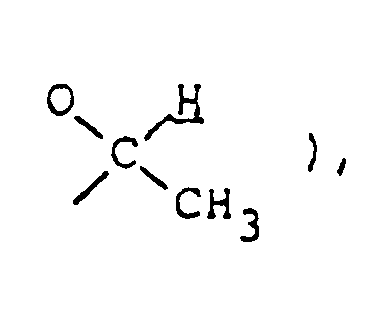
4.89 ( m, 1H, one H in
5.02 ( m, 1H, one H in
In similar way, fumarate (mp. 104-106°C) was obtained. -

To a three-necked flask fitted with a thermometer, a dropping funnel and a calcium chloride tube, was added 1.04 g of 60% oily sodium hydride, and the oil component was washed off by treatment with n-hexane. Anhydrous ether ( 35 ml ) was added to the residue, the mixture was stirred well, and 15 ml of an ethereal solution containing 3.2 g ethyl thiolactate was then added at 5 to 10°C. Methanol ( 20 ml ) was further added at 5 to 10°C, and the mixture was stirred at room temperature for about 30 minutes. The solvents were distilled off under reduced pressure, 20 ml dimethyl sulfoxide was added to the residue, the resulting solution was cooled to about 15°C, and 4.76 g ethyl 1-methyl-4-piperidylideneacetate was added. After stirring at room temperature for about 20 hours, the reaction mixture was poured into 100 ml ice water, concentrated hydrochloric acid was added until the pH fell to about 4, and sodium bicarbonate was then added to make the solution weakly alkaline ( pH: about 8 ). This aqueous solution was extracted thrice with 150 ml chloroform, and the combined extract was washed with saturated aqueous sodium chloride and dried over anhydrous magnesium sulfate. Distilling off the chloroform under reduced pressure from the dried solution left 7.84 g of orange-red oil, which was purified by silica gel column chromatography using, as eluent, a mixed solvent of chloroform/methanol/conc. ammonia ( 30:1:0.1 by volume ), giving 1.89 g of ethyl 2,8-dimethyl-3-oxo-1-thia-8-azaspiro[4,5]decane-4-carboxylate as solid. It was dissolved in ether, and ethanolic hydrogen chloride was added to the solution, thus giving its hydrochloride. - Melting point: 161-164°C
Elemental analysis ( C₁₃H₂₂NO₃SCl·0.8H₂O ): C(%) H(%) N(%) Calcd. 48.45 7.38 4.35 Found 48.50 7.01 4.32
Mass spectrum (m/z): 271, 238, 225, 197
IR absorption spectrum (KBr) cm⁻¹: 3540, 3470, 1660, 1620
NMR spectrum ( CDCl₃; internal standard: TMS ), δ ppm: 1.50 ( t, 3H, J=7.2Hz, -OCH₂CH₃ ), 1.54 ( d, 3H, J=7.2Hz, 〉CH-CH₃ ), 1.7-2.0 ( m, 4H,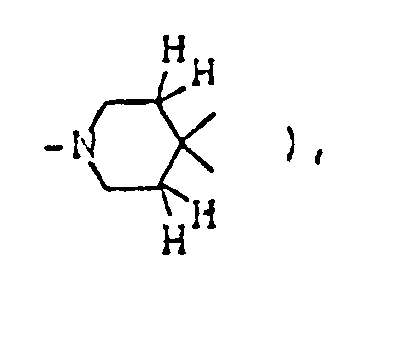
2.78 ( s, 3H, CH₃N〈 ), 2.9-3.6 ( m, 4H,
4.19 ( q, 1H, J=7.2Hz,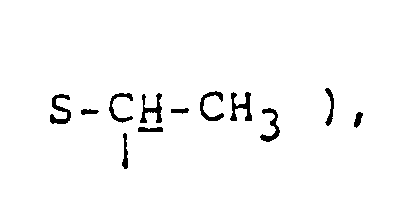
4.44 ( q, 2H, J=7.2Hz, -OCH₂CH₃ ) -

2,8-Dimethyl-1-thia-8-azaspiro[4,5]decan-3-one was prepared ( oil ) and then converted to its hydrochloride in the same way as in Example 2. - Melting point: 210-213°C
Elemental analysis ( C₁₀H₁₈NOSCl·0.5H₂O ): C(%) H(%) N(%) Calcd. 49.07 7.82 5.72 Found 49.15 7.63 5.77
Mass spectrum (m/z): 199, 166, 110
IR absorption spectrum (KBr) cm⁻¹: 3500, 2950, 2700, 17536
NMR spectrum ( CDCl₃; internal standard: TMS ), δ ppm: 1.44 ( d, 3H, J=7.2Hz, C-CH₃ ), 1.9-2.8 ( m, 4H,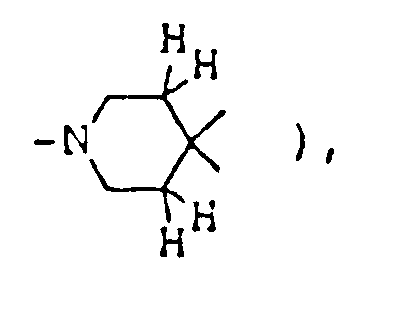
2.74 ( s, 2H,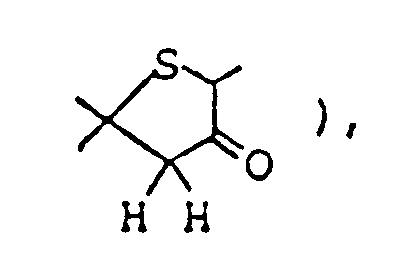
2.80 ( s, 3H, CH₃-N〈 ), 2.9-3.5 ( m, 4H,
3.66 ( q, 1H, J=7.2Hz, s-CH-CH₃ ) -

3-Hydroxy-2,8-dimethyl-1-thia-8-azaspiro[4,5]decane was prepared ( oil ) and then converted to its hydrochloride in the same way as in Example 3. - Melting point: 225-229°C
Mass spectrum (m/z): 201, 168, 110
IR absorption spectrum (KBr) cm⁻¹: 3400, 2970 2930, 2700
NMR spectrum ( CDCl₃; internal standard: TMS ), δ ppm: 1.32 ( d, 3H, J=7.2Hz, C-CH₃ ), 1.8-2.7 ( m, 6H,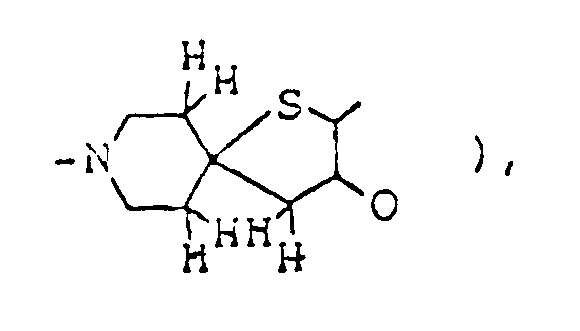
2.77 ( d, 3H, CH₃-⁺NH〈 ), 2.9-4.2 ( m, 5H,
4.38 ( m, 1H,
-
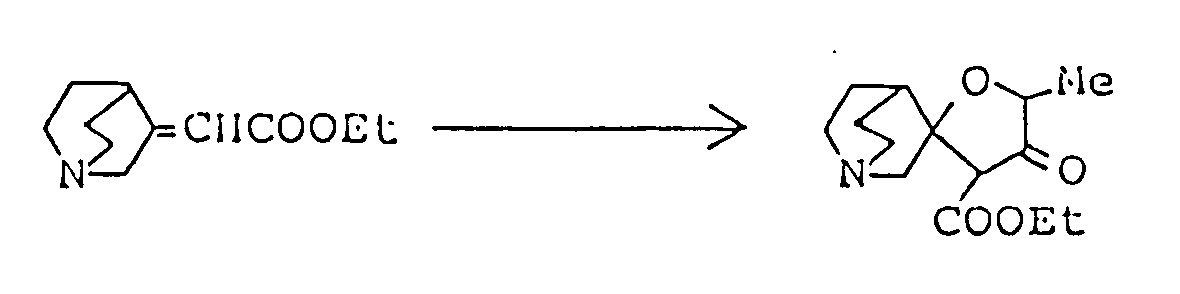
Ethyl 5'-methyl-4'-oxospiro[1-azabicyclo[2,2,2]octane-3,2'-oxolan]-3'-carboxylate was prepared as in Example 1, except that ethyl 3-quinuclidylideneacetae was used in place of 1-methyl-4-piperidylideneacetate. - Mass spectrum (m/z): 268, 267, 221, 194, 166
IR absorption spectrum (KBr) cm⁻¹: 3480, 2990-2890, 1745, 1675
NMR spectrum ( CDCl₃; internal standard: TMS ), δ ppm: 1.30 ( t, 3H, J=7.2Hz, -OCH₂CH₃ ), 1.43 ( d, 3H, J=6.3Hz,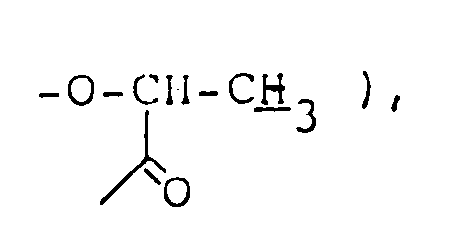
1.5-2.2 ( m, 5H,
2.6-3.05 ( m, 6H, 〉N-CH₂- x 3 ), 4.04-4.32 ( m, 3H, -O-CH₂-CH₃,
-
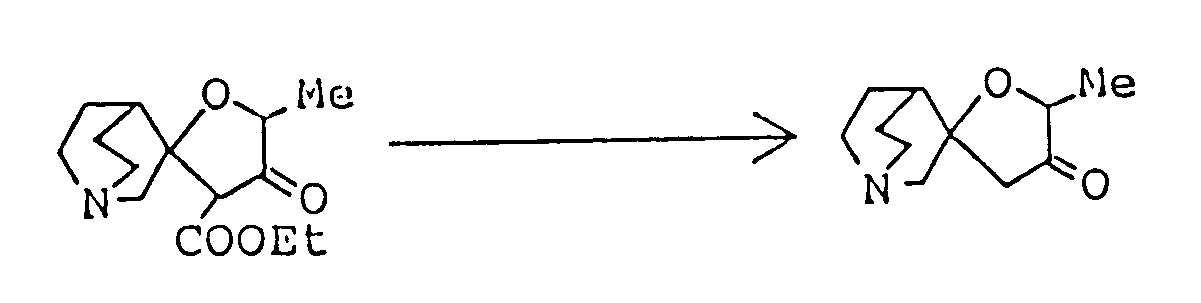
5'-methyl-spiro[1-azabicyclo[2,2,2]octane-3,2'―oxolan]-4'-one was prepared and then converted to its hydrochloride as in Example 2. - Melting point: 188-190°C ( dec. )
Elemental analysis ( C₁₁H₁₈NO₂Cl ): C(%) H(%) N(%) Cl(%) Calcd. 57.02 7.83 6.04 15.30 Found 56.72 7.76 5.95 15.28
Mass spectrum (m/z): 195, 138, 96
NMR spectrum ( CDCl₃; internal standard: TMS ), δ ppm: 1.33 ( m, 3H, C-CH₃ ), 1.65-2.60 ( m, 5H,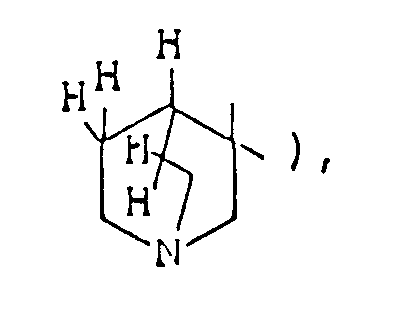
2.48-3.0 ( m, 2H, -CH₂-CO- ), 3.2-3.7 ( m, 6H, N-CH₂ x 3 ), 3.85-4.25 ( m, 1H O-CH-CH₃ ) -

4'-Hydroxy-5'-methyl spiro[1-azabicyclo[2,2,2]octane-3,2'-oxolane] was prepared and then converted to its hydrochloride as in Example 3. - Melting point: 162-166°C
Elemental analysis ( C₁₁H₂₀NO₂Cl·0.2H₂O ): C(%) H(%) N(%) Calcd. 55.66 8.62 5.90 Found 55.77 8.58 5.93
Mass spectrum (m/z): 197, 180, 139
NMR spectrum ( CDCl₃; internal standard: TMS ), δ ppm: 1.1-1.3 ( m, 3H, C-CH₃ ), 1.5-2.6 ( m, 7H,
3.5-3.6 ( m, 6H, 〉N-CH₂- x 3 ), 3.8-4.35 ( m, 2H,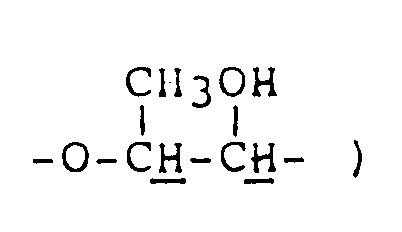
-

To a solution of 1.94 g 1-acetyl-4-piperidone in a mixture of ether ( 80 ml ) and tetrahydrofuran ( 40 ml ), was added dropwise at 10°C or lower 275 ml of a 0.5M Grignard reagent prepared in the usual way from crotyl chloride and magnesium, and the resulting mixture was stirred overnight at room temperature. To the ice-cooled reaction mixture was slowly added 100 ml of saturated aqueous sodium chloride, and the layers were separated. The aqueous layer was extracted with chloroform, the two organic solutions were each concentrated, and the combined concentrate was subjected to silica gel column chromatography using, as eluent, a mixed solvent of ethyl acetate/n-hexane ( 1:1 by volume ) containing 3% methanol, giving 16.9 g of 1-acetyl-4-hydroxy-4-(1-methyl-2-propenyl)piperidine as oil.
NMR spectrum ( CDCl₃; internal standard: TMS ), δ ppm: 1.04 ( d, 3H, 〉CH-CH₃ ), 2.10 ( s, 3H, CH₃CO- ), 2.0-2.3 ( m, 1H,
5.0-5.24 ( m, 2H,
5.6-6.0 ( m, 1H,
IR absorption spectrum (neat) cm⁻¹: 3436, 2988, 1622, 1278, 1250
Mass spectrum (m/z): 197 (M⁺), 180, 154, 142 -

A solution of 1.78 g 1-acetyl-4-hydroxy-4-(1-methyl-2-propenyl)piperidine in 60 ml dichloromethane was cooled in ice, 24 ml water was added, 1.51 g sodium bicarbonate and 3.45 g iodine were then added with stirring, and the mixture was stirred under ice cooling for four hours. The organic layer was collected, the aqueous layer was extracted thrice with chloroform, and all the organic solutions were combined and dried. After distilling off the solvent from the dried solution, the residue was subjected to silica gel column chromatography using, as eluent, a mixed solvent of ethyl acetate/n-hexane ( 1:1 by volume ) containing 3% methanol, giving a diastereoisomeric mixture of 8-acetyl-3-iodo-4 methyl-1-oxa-8-azaspiro[4,5]decane ( 1.55 g ).
Melting point: 135-137°CElemental analysis ( C₁₁H₁₈NO₂I ): C(%) H(%) N(%) I(%) Calcd. 40.88 5.61 4.34 39.27 Found 40.79 5.50 4.22 39.46
NMR spectrum ( CDCl₃; internal standard: TMS ), δ ppm: 1.06 ( d, 3H, J=5.4Hz, CH-CH₃ ), 1.3-2.0 ( m, 5H,
2.10 ( s, 3H, -COCH₃ ), 2.6-3.1 ( m, 1H,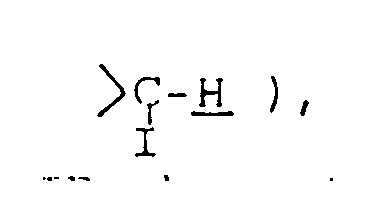
3.2-4.7 ( m, 6H, 〉N-CH₂- x 2, -O-CH₂- )
IR absorption spectrum (KBr) cm⁻¹: 1642, 1456, 1428, 1028
Mass spectrum (m/z): FAB-MS 324 -

To a solution of 4.76 g 1-acetyl-4-hydroxy-4-(1-methyl-2-propenyl)piperidine in 50 ml dichloromethane, was added 60 g m-chloro-perbenzoic acid, and the mixture wad stirred at room temperature for three days. The insoluble matters were filtered off, the filtrate was washed five times with saturated aqueous sodium bicarbonate, and the aqueous washings were combined and extracted with chloroform. All the organic solutions were combined and dried, and the solvent was distilled off from the dried solution. The residue was subjected to column chromatography on silica gel ( 300 ml ) using pure chloroform and chloroform containing 2% methanol as eluents to separate two types of diastereomer of the product compound. There were isolated 1.62 g of diastereomer (A) ( isomer of lower polarity as measured by TLC ), 1.66 g of diastereomer (B) ( isomer of higher polarity ) and 0.14 g of a mixtureof both isomers (each as amorphous powder). - NMR spectrum ( CDCl₃; internal standard: TMS ), δ ppm: 1.0 ( d, 3H, CH-CH₃ ), 1.24 ( m, 1H,

1.7 ( m, 4H,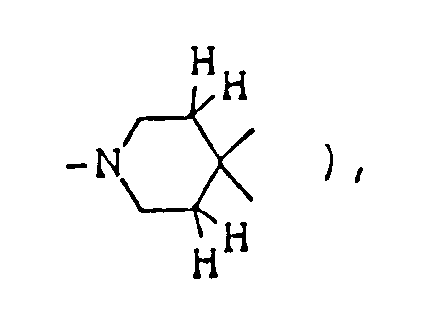
2.1 ( s, 3H, CH₃CO ), 2,48 ( m, 1H,
2.8 ( m, 2H,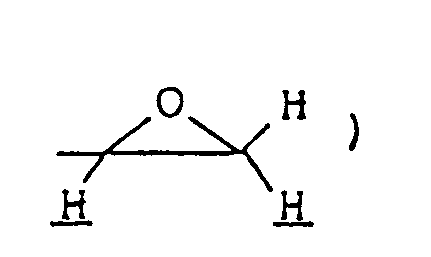
Mass spectrum (m/z): 213 (M⁺), 195, 170, 142, 124 - NMR spectrum ( CDCl₃; internal standard: TMS ), δ ppm: 1.02 ( d, 3H, CH-CH₃ ), 1.3 ( m, 1H, CH₃C-H ), 1.66 ( m, 4H,
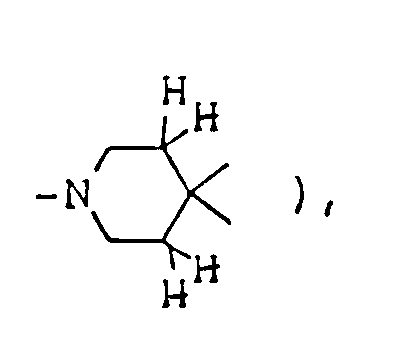
2.08 ( s, 3H, CH₃CO ), 2.3-3.2 ( m, 5H,
Mass spectrum (m/z): 213 (M⁺) , 170, 142, 124 -

A solution of 1.2 g 1-acetyl-4-hydroxy-4-[1-(2-oxyranyl)ethyl]piperidine (B) in 80 ml dichloromethane was cooled to -40°C, 1.77 g tin tetrachloride was added, and the mixture was stirred at room temperature for two days. The reaction mixture was cooled in ice, 2 ml triethylamine was added, the mixture was concentrated under reduced pressure, and the residue was subjected to silica gel column chromatography using, as eluent, chloroform containing 1 to 5% methanol, giving 0.83 g of 8-acetyl-3-hydroxy-4-methyl-1-oxa-8-azaspiro[4,5]decane (B) as amorphous powder. NMR spectrum ( CDCl₃; internal standard: TMS ), δ ppm: 1.0 ( d, 3H, CH-CH₃ ), 1.3-2.0 ( 5H,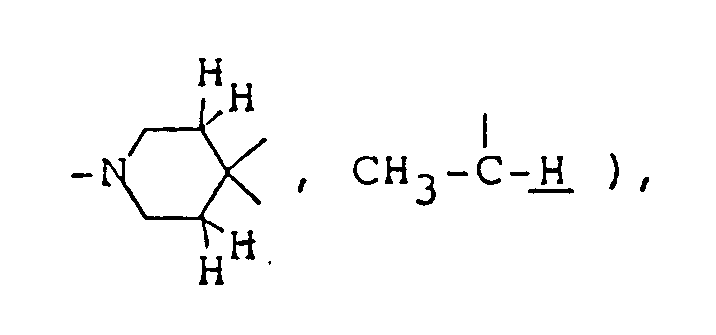
2.08 ( s, 3H, CH₃CO )
Mass spectrum (m/z): 213 (M⁺), 195, 182, 170, 124
Diastereomer (A) obtained in Reference Example 2 was also treated in much the same maner as above, affording 8-acetyl-3-hydroxy-4-methyl-1-oxa-8-azaspiro[4,5]decane (A).
NMR spectrum ( CDCl₃; internal standard: TMS ), δ ppm: 1.02 ( d, 3H, CH-CH₃ ), 1.3-2.1 ( m, 5H,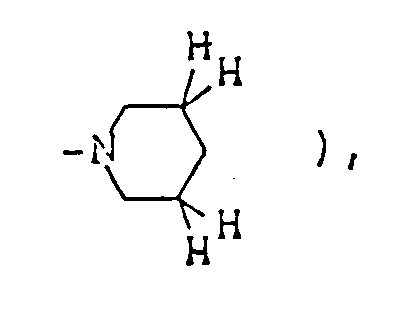
CH₃-C-H ), 2.20 ( s, 3H, CH₃CO )
Mass spectrum (m/z): 213 (M⁺), 195, 182, 170, 124 -

A solution of 0.83 g 8-acetyl-3-hydroxy-4-methyl-1-oxa-8-azaspiro[4,5]decane (B) in 20 ml anhydrous tetrahydrofuran was added dropwise to a mixture of 1.01 g lithium aluminum hydride and 25 ml tetrahydrofuran, and the resulting mixture was heated and under reflux for three hours and then cooled in ice. Water ( 1.1 ml ) and 10% caustic soda solution ( 1.1 ml ) were slowly added in that order, the reaction mixture was filtered through Celite, and the insoluble matters were thoroughly washed with tetrahydrofuran and ethyl acetate. The washings were added to the filtrate, the combined solution was concentrated, and the residue was subjected to silica gel column chromatography using, as eluent, a mixed solvent of chloroform/methanol/conc. ammonia ( 40:10:1 ), giving 8-ethyl-3-hydroxy-4-methyl-1-oxa-8-azaspiro[4,5]decane (B) as oil. It was converted to its hydrochloride by treatment with methanolic hydrogen chloride. Yield: 0.4 g, m.p.: 150-155°C.
NMR spectrum ( CDCl₃; internal standard: TMS ), δ ppm: 1.02 ( d, 3H
, ( m, 4H, -NCH₂CH₃,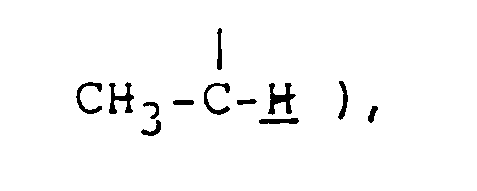
1.8-2.6 ( m, 4H,
Mass spectrum (m/z): 200 (M+1), 184, 170, 138, 110, 84
IR absorption spectrum (KBr) cm⁻¹: 3388, 2948, 2688 1418, 1034, 908
Diastereomer (A) obtained in Example 13 was also treated as above, affording 8-ethyl-3-hydroxy-4-methyl-1-oxa-8-azaspiro[4,5]decane (A). The physicochemical properties of its hydrochloride are as follows:
Melting point: 200-204°CElemental analysis ( C₁₁H₂₂NO₂Cl ): C(%) H(%) N(%) Calcd. 56.04 9.41 5.94 Found 55.75 9.28 5.89
NMR spectrum ( CDCl₃; internal standard: TMS ), δ ppm: 1.16 ( d, 3H, -CH-CH₃ ), 1.3-1.7 ( t & m, 4H, -NCH₂CH₃,
1.7-2.7 ( m, 4H,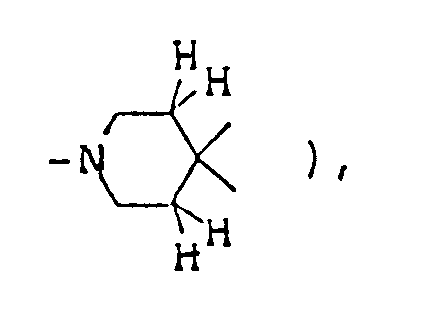
2.8-3.6 ( m, 7H,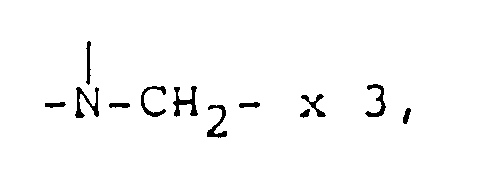
OH ), 3.7-4.1 ( m, 2H, -O-CH₂- )
Mass spectrum (m/z): 199 (M⁺), 184, 172, 138, 124, 110, 84
IR abso tion spectrum (KBr) cm⁻¹: 3364, 2948, 2672, 1428, 1062, 1050 -

To a three-necked flask fitted with a thermometer, a dropping funnel and a calcium chloride tube, was added 2 g of 60% oily sodium hydride, and the oil component was washed off by treatment with n-hexane. Anhydrous ether ( 75 ml ) was added to the residue, the mixture was stirred well, and 25 ml of an ethereal solution containing 6.6 g ethyl α-hydroxy-n-butyrate was then added at 5 to 10°C. Evolution of hydrogen gas ceased after stirring at room temperature for about three hours. The ether was distilled off under reduced pressure, 40 ml dimethyl sulfoxide was added to the residue, the resulting solution was cooled to about 15°C, and 9.15 g ethyl 1-methyl-4-piperidylideneacetate was added. After stirring at room temperature for about 15 hours, the reaction mixture was poured into 100 ml ice water, concentrated hydrochloric acid was added until the pH fell to about 2, and 4 ml of concentrated hdyrochloric acid was further added. The resulting mixture was heated under reflux for about six hours, and 20% aqueous caustic soda was then added under ice cooling to make the solution alkaline. This alkaline solution was extracted once with 150 ml chloroform and then twice with 100 ml chloroform, and the combined extract was washed with an aqueous solution of sodium chloride and dried over anhydrous magnesium sulfate. Distilling off the chloroform under reduced pressure from the dried solution left 4.96 g of a reddish-brown oily substance. It was purified by silica gel column chromatography using, as eluent, a mixed solvent of chloroform/methanol ( 30:1 by volume ), giving 1.38 g of 2-ethyl-8-methyl-1-oxa-8-azaspiro[4,5]decan-3-one as oil. It was dissolved in ether,and after adding HCl-EtOH, its HCl salt, was obtained. - Mass spectrum (m/z): 197, 168, 110
IR absorption spectrum (KBr) cm⁻¹: 3476 (broad), 2980, 2728, 1756
NMR spectrum ( CDCl₃; internal standard: TMS ), δ ppm: 0.96 ( t, 3H, J=7.2Hz, -OCH₂CH₃ ), 2.45 ( m, 2H, -CH₂-CO- ), 2.83 ( s, 3H,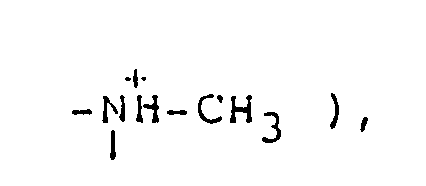
1.5-2.8 ( m, 6H,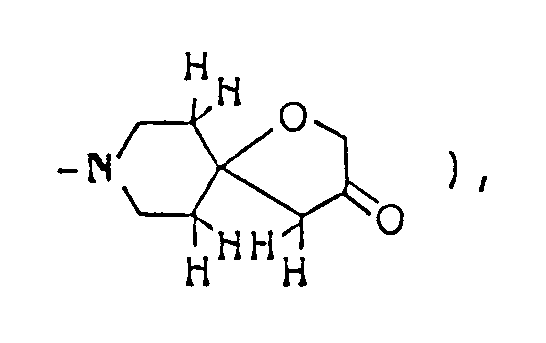
3.0-3.6 ( m, 4H,
3.90 ( m, 1H,
In similar way, fumarate (mp. 77-90°C), maleate (mp. 126-8°C) and oxalate (mp. 160-2°C) were obtained. -

2,8-Dimethyl-3-methylene-1-thia-8-azaspiro[4,5]decane was prepared from 2,8-dimethyl-1-thia-8-azaspiro[4,5]decan-3-one as in Example 5, and was converted to hydrochloride by treating its ethanolic solution with ethanolic hydrogen chloride.
Melting point: 197-200°C
Mass spectrum (m/z): 197, 164, 96
IR absorption spectrum (KBr) cm⁻¹: 3480 (broad), 2948, 2484, 1660, 1482
NMR spectrum ( CDCl₃; internal standard: TMS ), δ ppm: 1.42 ( d, 3H, J=7Hz, 〉CH-CH₃ ), 1.8-2.0 ( m, 2H,
2.40-3.16 ( m, 2H,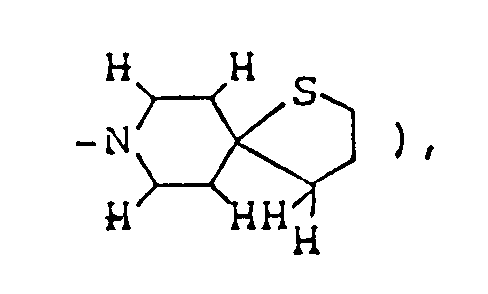
2.76 ( d, 3H, J=6Hz, CH₃-⁺NH〈 ), 3.4-3.6 ( m, 2H,
4.0 ( m, 1H, 〉CH-CH₃ ), 4.94 ( m, 1H, one H in
5.0 ( m, 1H, one H in
-
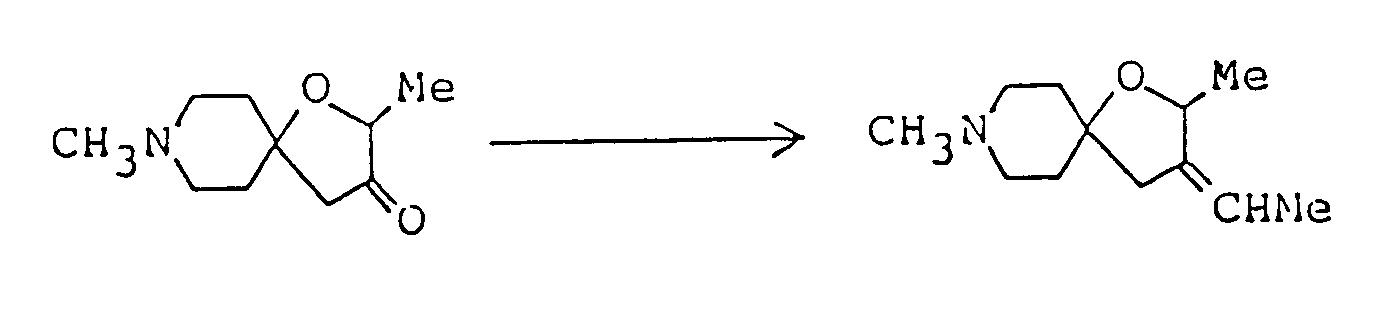
3-Ethylidene-2,8-dimethyl-1-oxa-8-azaspiro[4,5]decane was prepared in the same manner as in Example 5 by using ethyltriphenylphosphonium bromide. It was converted to hydrochloride by treating its ethereal solution with ethanolic hydrogen chloride.
Mass spectrum (m/z): 195, 110
IR absorption spectrum (neat) cm⁻¹: 2980, 1660, 1078
NMR spectrum ( DMSO-d₆; internal standard: TMS ), δ ppm: 1.26 ( d, 3H, J=5.9Hz, 〉CH-CH₃ ), 1.48-1.90 ( m, 7H,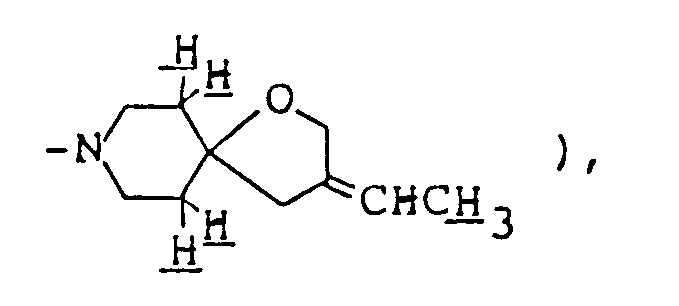
2.70 ( s, 3H,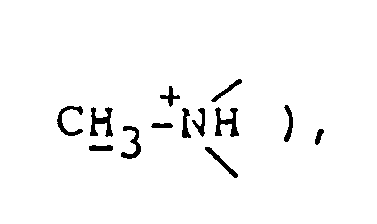
2.21-2.64 ( m, 6H,
4.26-4.78 ( m, 1H, 〉CH-CH₃ ), 5.06-5.52 ( m, 1H,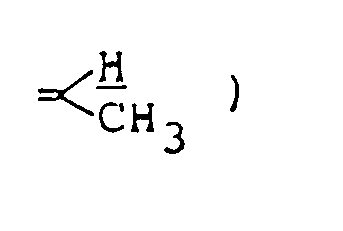
-

Ethyl 5'-methyl-4'-oxospiro[1-azabicyclo-[2,2,2]octane-3,2'―thiolan ]-3'-carboxylate was prepared as in Example 6, except that ethyl 3-quinuclidylideneacetate was used in place of ethyl 1-methyl-4-piperidylideneacetate.
Mass spectrum (m/z): 283, 237, 210
IR absorption spectrum (neat) cm⁻¹: 2948, 1748, 1728
NMR spectrum ( CDCl₃; internal standard: TMS ), δ ppm: 1.20-1.56 ( m, 6H, -COOCH₂CH₃, 〉CHCH₃ ), 1.5-2.2 ( m, 5H,
2.7-3.1 ( m, 6H, 〉N-CH₂- x 3 ) 4.0-4.2 ( m, 3H, 〉CHCH₃, -COO-CH₂-CH₃ ) -
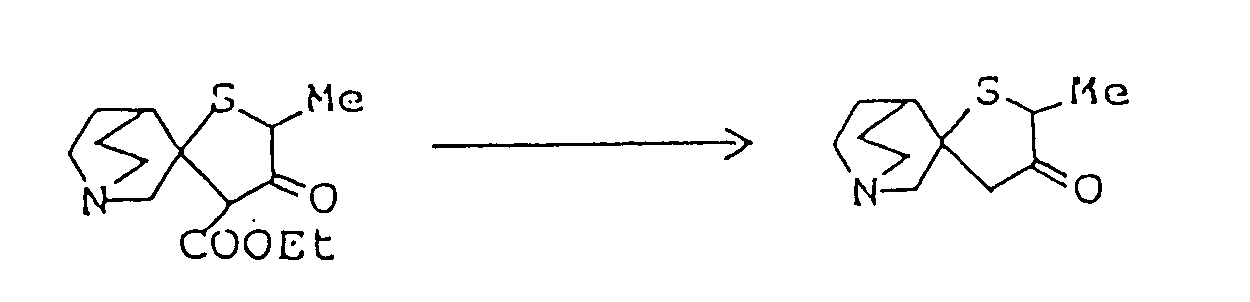
5'-methylspiro(1-azabicyclo(2,2,2]octane-3,2'―thiolan ]-4'-one was prepared as in Example 2, and converted to its hydrochloride by treating its ethereal solution with ethanolic hydrochloride.
Melting point: 207-210°C ( dec. )
Mass spectrum (m/z): 211, 141, 122, 96
IR absorption spectrum (KBr) cm⁻¹: 3464 (broad), 2950, 2480, 1736
NMR spectrum ( CDCl₃; internal standard: TMS ), δ ppm: 1.42, 1.45 ( d x 2, 3H, J=6.3Hz, 〉CHCH₃ ), 1.8-2.6 ( m, 5H,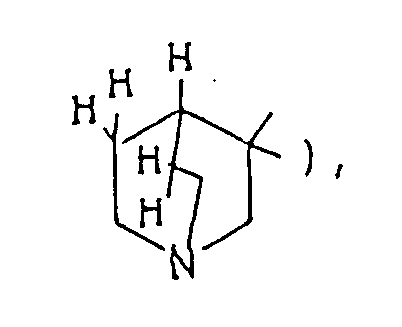
2.68-3.21 ( m, 2H, -CH₂-CO- ), 3.2-3.9 ( 7H, 〉N⁺H-CH₂- x 3, 〉CHCH₃ ) -

10,14-Dimethyl-1,13-dioxa-4-thia-10-azadispiro[4,1,5,2]tetradecane was prepared as in Example 4, except that 2-mercaptoethanol was used in place of ethylene glycol. It was then converted to maleate by addition of an equimolar amount of maleic acid to its solution in isopropanol.
Mass spectrum (m/z): 243, 182, 156
IR absorption spectrum (neat) cm⁻¹: 2950, 1088, 1058
NMR spectrum ( CDCl₃; internal standard: TMS ), δ ppm: 1.22, 1.24 ( d x 2, 3H, J=5.9Hz, 〉C-CH₃ ), 1.78-2.40 ( m, 6H,
2.76 ( s, 3H, CH₃N⁺H〈 ), 2.68-3.52 ( m, 6H, 〉NH-CH₂- x 2,
3.84-4.36 ( m, 3H, 〉CH-CH₃,
6.28 ( s, 2H,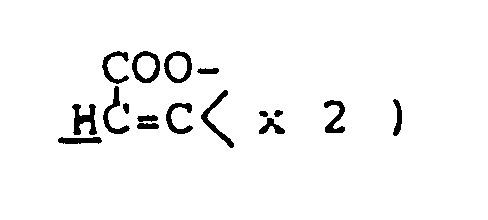
-

A solution of 0.5 g 2,8-dimethyl-1-oxa-8-azaspiro[4,5]decan-3-one in 10 ml dichloromethane was cooled in ice, 0.45 ml 1,2-ethanedithiol was added, and 2 ml boron trifluoride/ether complex was then added dropwise while maintaining the temperature below 10°C. After stirring at that temperature for one hour, the reaction mixture was poured into 30 ml of 20% aqueous caustic soda solution. The insoluble matters were filtered off, the filtrate was extracted with ethyl acetate, and the organic layer was washed with saturated aqueous sodium chloride and dried over anhydrous magnesium sulfate. The dried solution was concentrated under reduced pressure, and the residue was subjected to silica gel column chromatography using, as eluent, a mixed solvent of chloroform/methanol/conc. ammonia ( 20:1:0.1 by volume ), giving 0.46 g of 10,14-dimethyl-13-oxa-1,4-dithia-10-azadispiro[4,1,5,2]tetradecane. It was dissolved in methanol and converted to maleate by addition of an equimolar amount of maleic acid dissolved in the same solvent.
Melting point: 114-115°CElemental analysis ( C₁₆H₂₅NO₅S₂ ):
Mass spectrum (m/z): 259, 231, 187
IR absorption spectrum (KBr) cm⁻¹: 2940, 1584, 1092, 1066
NMR spectrum ( DMSO-d₆; internal standard: TMS ), δ ppm: 1.23 ( d, 3H, J=5.9Hz, 〉C-CH₃ ), 1.60-2.04 ( m, 4H,
2.49 ( s, 2H,
2.76 ( s, 3H, CH₃-⁺NH〈), 3.00-3.42 ( m, 8H, 〉N⁺H-CH₂- x 2, -S-CH₂- x 2 ), 4.06 ( q, 1H, J=5.9Hz, 〉CH-CH₃ ), 6.03 ( s, 2H,
-

10,14-Dimethyl-1,4,13-trithia-10-azadispiro[4,1,5,2]tetradecane was prepared as in Example 21 by using 2,8-dimethyl-1-thia-8-azaspiro[4,5]decan-3-one. It was then dissolved in isopropanol and converted to maleate by addition of an equimolar amount of maleic acid dissolved in the same solvent.
Mass spectrum (m/z): 275, 242, 110
IR absorption spectrum (KBr) cm⁻¹: 3460(broad),2950, 1582, 1472
NMR spectrum ( CDCl₃; internal standard: TMS ), δ ppm: 1.40 ( d, 3H, J=6.5Hz, 〉C-CH₃ ), 2.4-2.8 ( m, 2H,
2.80 ( s, 3H, CH₃-⁺NH〈 ), 3.30 ( s, 4H, -S-CH₂- x 2 ), 3.69 ( q, 1H, J=6.5Hz, 〉CH-CH₃ ), 1.9-3.5 ( 8H other than the above ), 6.28 ( s, 2H,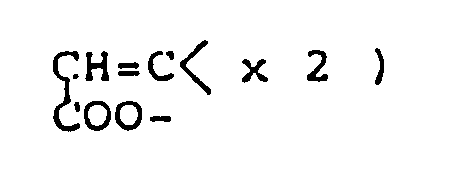
-

5'-Methyl-4'-methylenespiro[1-azabicyclo[2,2,2]-octane-3,2'-thiolane] was prepared in much the same manner as in Example 5 by using 5'-methylspiro[1-azabicyclo[2,2,2]-octane-3,2'-thiolan]-4'-one. It was dissolved in ethanol, and then converted to hydrochloride by addition of ethanolic hydrogen chloride.
Melting point: 164-168°CElemental analysis ( C₁₂H₂₀NSCl·0.1H₂O ): C(%) H(%) N(%) S(%) Calcd. 58.21 8.22 5.66 12.94 Found 58.11 7.96 5.92 12.94
Mass spectrum (m/z): 209, 176, 139, 96
IR absorption spectrum (KBr) cm⁻¹: 3480(broad), 2930, 2580, 1655
NMR spectrum ( CDCl₃; internal standard: TMS ), δ ppm: 1.42, 1.44 ( d x 2, 3H, J=6.3Hz, 〉CHCH₃ ), 1.8-2.5 ( m, 5H,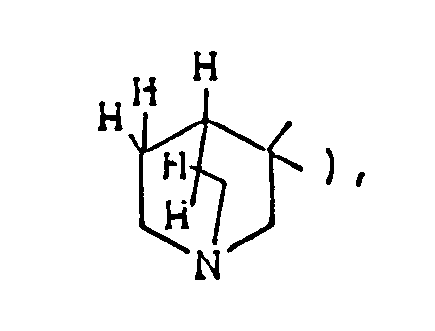
2.7-2.9 ( m, 2H,
3.18∼3.58 ( m, 6H, 〉N⁺H-CH₂- x 3 ), 4.02 ( m, 1H, 〉CH-CH₃ ), 4.88-5.10 ( m, 2H, 〉=CH₂ ) -

To a suspension of 4 g oily sodium hydride ( 60% ) in 200 ml of anhydrous 1,2-dimethoxyethane, was added dropwise 23.6 g ethyl diethylphosphonoacetate at about 20°C, and the mixture was stirred at that temperature for about one hour. To the solution thus obtained was added dropwise 17.1 g N-ethoxycarbonyl-4-piperidone at temperatures below 30°C, the mixture was stirred for an additional two hours, and the solvent was distilled off under reduced pressure. Ice water ( 100 ml ) and ethyl acetate ( 100 ml ) were added to the residue, the mixture was shaken, and the layers were separated. The aqueous layer was extracted twice with 100 ml ethyl acetate, and all the organic solutions were combined, washed with water and dried over anhydrous magnesium sulfate. Distilling off the solvent from the dried solution gave 25.7 g of ethyl M-ethoxycarbonyl-4-piperidylideneacetate as colorless solid.
Mass spectrum (m/z): 241, 212, 196, 168
IR absorption spectrum (KBr) cm⁻¹: 2990, 1718, 1686
NMR spectrum ( CDCl₃; internal standard: TMS ), δ ppm: 1.28 ( t x 2, 6H, J=7.2Hz, -OCH₂CH₃ x 2 ), 2.3 ( m, 2H,
2.95 ( m, 2H,
3.55 ( m, 4H,
4.16 ( q x 2, 4H, J=7.2Hz, -OCH₂CH₃ x 2 ), 5.72 ( m, 1H,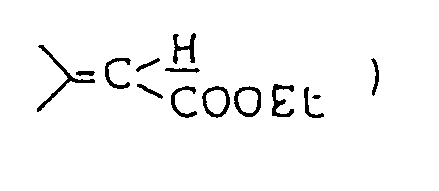
-

Ethyl 8-ethoxycarbonyl-2-methyl-3-oxo-1-oxa-8-azaspiro-[4,5]decane-4-carboxylate ( oil ) was prepared as in Example 1.
Mass spectrum (m/z): 313, 284, 268, 239
IR absorption spectrum (neat) cm⁻¹: 2990, 1776, 1738, 1704
NMR spectrum ( CDCl₃; internal standard: TMS ), δ ppm: 1.18-1.50 ( m, 9H, 〉CH-CH₃, -OCH₂CH₃ x 2 ), 1.5-2.1 ( m, 4H,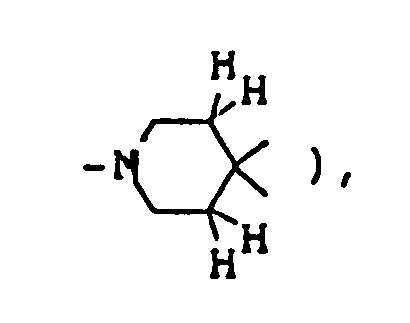
4.0-4.4 ( m, 5H, 〉CH-CH₃, -OCH₂CH₃ x 2 ), 3.1-4.1 ( m, 4H,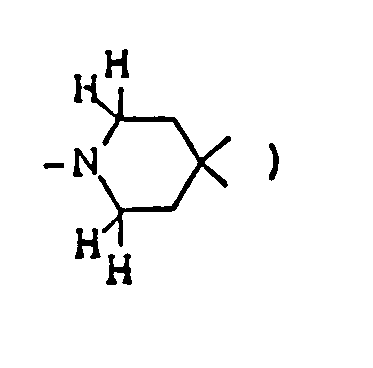
-
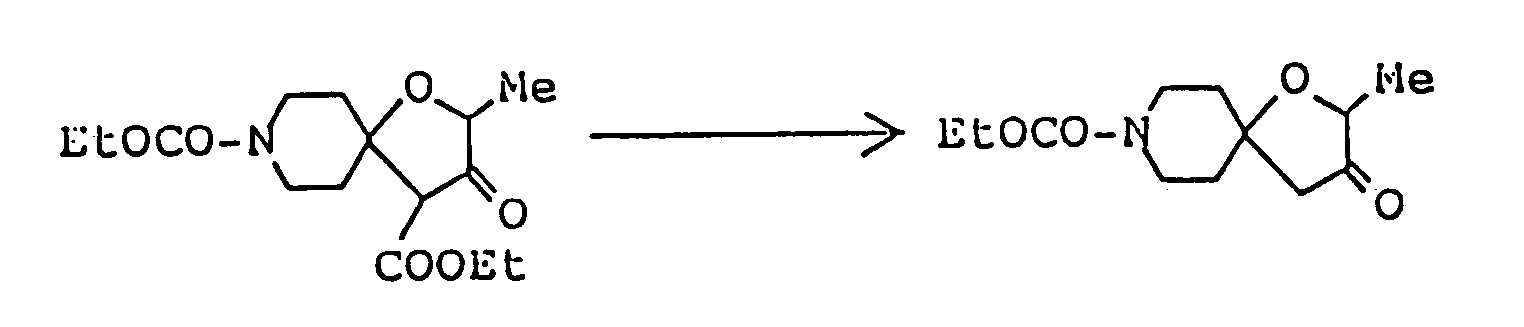
To a solution of 2.74 g ethyl 8-ethoxycarbonyl-2-methyl-3-oxo-1-oxa-8-azaspiro[4,5]decane-4-carboxylate in 10 ml N,N-dimethylformamide, were added 512 mg sodium chloride and 315 »l water, and the mixture was heated with stirring for two hours in an oil bath held at 140-150°C. The reaction mixture was poured into 30 ml ice water, the resulting mixture was extracted with chloroform, and the extract was washed with an aqueous solution of sodium chloride and dried over anhydrous magnesium sulfate. After distilling off the solvent from the dried solution, the residue was purified by silica gel column chromatography using, as eluent, a mixed solvent of n-hexane/ethyl acetate ( 1:1 by volume ), giving 1.54 g of 8-ethoxycarbonyl-2-methyl-1-oxa-8-azaspiro[4,5]decan-3-one as oil.
Mass spectrum (m/z): 241 , 212, 196, 140
IR absorption spectrum (neat) cm⁻¹: 2990, 2960, 1764, 1700
NMR spectrum ( CDCl₃; internal standard: TMS ), δ ppm: 1.28 ( t, 3H, J=7.2Hz, -OCH₂CH₃ ), 1.32 ( d, 3H, J=7.2Hz, 〉CHCH₃ ), 1.50-1.90 ( m, 4H,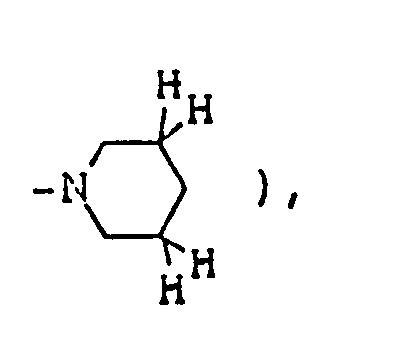
2.38 ( s, 2H, -CH₂-CO- ), 3.28-3.90 ( m, 4H,
4.03 ( q, 1H, J=7.2Hz, 〉CHCH₃ ), 4.15 ( q, 2H, J=7.2Hz, -OCH₂CH₃ ) -

8-Ethoxycarbonyl-3-hydroxy-2-methyi-1-oxa-8-azaspiro-[4,5]decane ( oil ) was prepared in much the same manner as in Example 3 and purified by silica gel column chromatography using, as eluent, a mixed solvent of ethyl acetate/n-hexane ( 1:1 by volume ).
Mass spectrum (m/z): 244(M+1), 225, 198
IR absorption spectrum (KBr) cm⁻¹: 3464(broad), 2948, 1682
NMR spectrum ( CDCl₃; internal standard: TMS ), δ ppm: 1.20-1.36 ( m, 6H, 〉CHCH₃, -OCH₂CH₃ ), 1.50-2.24 ( m, 6H,
3.28-3.80 ( m, 4H,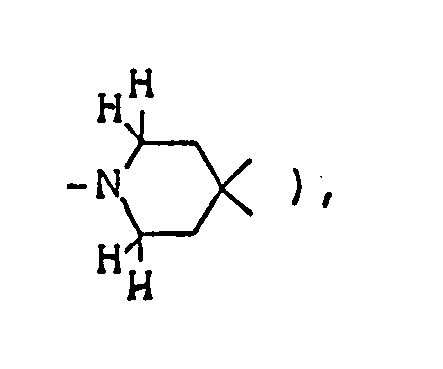
3.84-4.30 ( m, 4H, -OCH₂CH₃, 〉CHCH₃,
-

A solution of 93 mg 8-ethoxyycarbonyl-3-hydroxy-2-methyl-1-oxa-8-azaspiro[4,5]decane in 1 ml N,N-dimethylformamide was cooled in ice, 16.7 mg oily sodium hydride ( 60% ) was added, and the resulting mixture was stirred for 30 minutes under ice cooling. Methyl iodide ( 26.2 »l ) was then added, and the mixture was stirred at room temperature for about 24 hours and poured into 5 ml ice water. After extraction with chloroform, the extract was washed with an aqueous solution of sodium chloride and dried over anhydrous magnesium sulfate. The solvent was distilled off under reduced pressure from the dried solution, and the residue was purified by silica gel column chromatography using, as eluent, a mixed solvent of ethyl acetate/n-hexane ( 1:1 by volume ), giving 47 mg 8-ethoxycarbonyl-3-methoxy-2-methyl-1-oxa-8-azaspiro[4,5]decane as oil.
Mass spectrum (m/z): 257, 225, 180, 154
IR absorption spectrum (KBr) cm⁻¹: 2990, 2950, 1704, 1242
NMR spectrum ( CDCl₃; internal standard: TMS ), δ ppm: 1.24 ( t, 3H, J=6.8Hz, -O-CH₂CH₃ ), 1:24 ( d, 3H, J=6.3Hz, 〉CH-CH₃ ), 1.5-2.0 ( m, 6H,
3.30 ( s, 3H, -OCH₃ ), 3.20-3.85 ( m, 5H,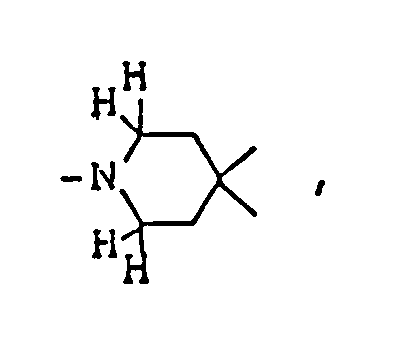
one H in
3.94-4.24 ( m, 3H, one H in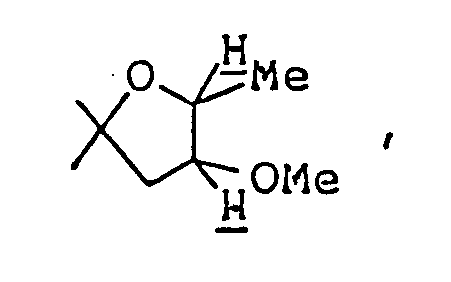
-OCH₂CH₃ ) -

A suspension of 1.05 g lithium aluminum hydride in 35 ml anhydrous tetrahydrofuran was cooled to 0°C, 0.92 ml of 100% sulfuric acid was added dropwise while maintaining the temperature in the range from 0 to 7°C, and the mixture was stirred for 30 minutes in the above temperature range. A tetrahydrofuran solution ( 7 ml ) containing 711 mg 8-ethoxycarbonyl-3-methoxy-2-methyl-1-oxa-8-azaspiro[4,5]-decane was then added, and stirring was continued at that temperature for one hour. Ether ( 35 ml ) was then added, sodium sulfate decahydrate ( 2.6 g ) was further added in small portions, and stirring was continued for an additional hour. The white suspension thus obtained was filtered using perlite as filter aid, and the filter cake was washed with a mixed solvent of ethanol/chloroform ( 1:5 ). The washings were added to the filtrate, the combined solution was concentrated under reduced pressure, and the residue was dissolved in chloroform. This solution was dried over anhydrous magnesium sulfate, chloroform was distilled off under reduced pressure, and the residue was purified by silica gel column chromatography using, as eluent, a mixed solvent of chloroform/methanol/conc. ammonia (10:1:0.1 by volume ), giving 400 mg 3-methoxy-2,8-dimethyl-1-oxa-8-azaspiro[4,5]decane as oil. It was converted to hydrochloride by addition of ethanolic hydrogen chloride to its ethereal solution.
Mass spectrum (m/z): 199, 184, 168, 110
IR absorption spectrum (KBr) cm⁻¹: 3480(broad), 2960, 2675, 1640, 1475, 1100
NMR spectrum ( DMSO-d₆; internal standard: TMS ), δ ppm: 1.15 ( a, 3H, 〉CHCH₃ ), 1.5-2.2 ( m, 6H,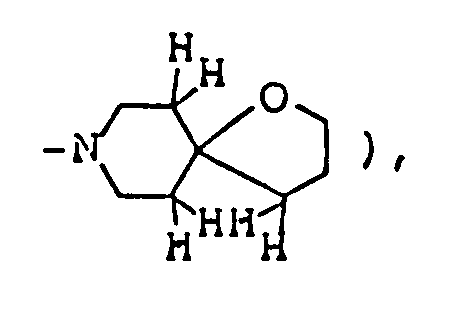
2.68 ( s, 3H, CH3-⁺NH〈 ), 3.22 ( s, 3H, -O-CH₃ ), 2.9-3.4 ( m, 4H,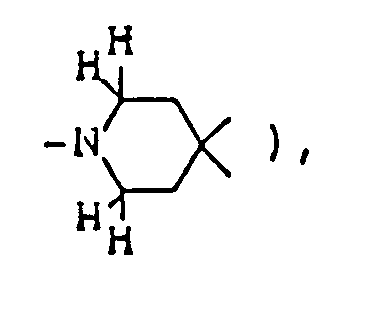
3.45-3.66 ( m, 1H, one H in
3.84-4.12 ( m, 1H, one H in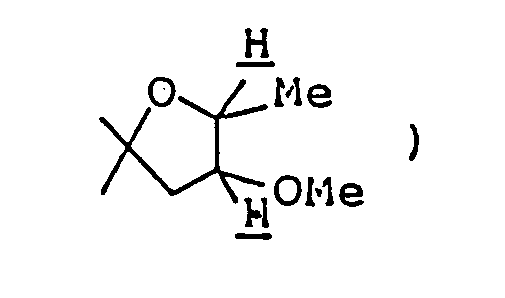
-
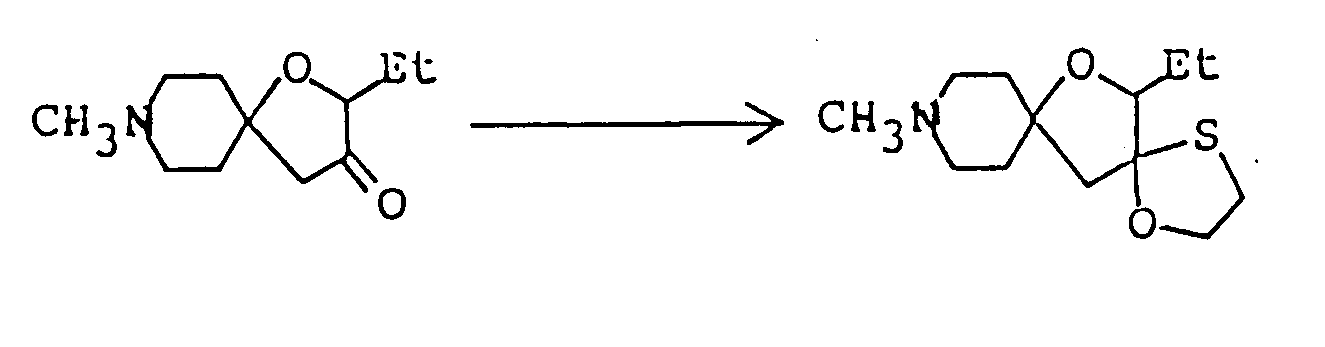
A solution ( 32 ml ) of 0.53 g 2-ethyl-8-methyl-1-oxa-8-azaspiro[4,5]decan-3-one in dichloromethane was cooled in ice, 384 »l 2-mercaptoethanol and 2.05 ml boron trifluoride/ether complex were added in that order in an argon atmosphere, and the mixture was stirred at room temperature for 16 hours. The reaction mixture was poured into 23 ml of 20% aqueous caustic soda, stirring was continued for about 15 minutes, and the two separate layers were collected. The aqueous layer was extracted with chloroform, the extract was added to the organic layer separated above, and the combined solution was washed with saturated aqueous sodium chloride and dried over anhydrous magnesium sulfate. The dried solution was concentrated under reduced pressure, and the residue was purified by silica gel column chromatography using, as eluent, a mixed solvent of chloroform/methanol/conc. ammonia ( 20:1:0.1 by volume ), giving 460 mg of 14-ethyl-10-methyl-1,13-dioxa-4-thia-10-azadispiro[4,1,5,2]tetradecane as oil. It was then converted to maleate by treatment with maleic acid in isopropanol.
Mass spectrum (m/z): 257, 196, 110
NMR spectrum ( CDCl₃; internal standard: TMS ), δ ppm: 0.9-1.2 ( m, 3H, 〉CH-CH₂-CH₃ ), 1.5-2.3 ( m, 8H,
2.78 ( s, 3H, CH₃⁺NH〈 ), 2.9-3.5 ( m, 6H,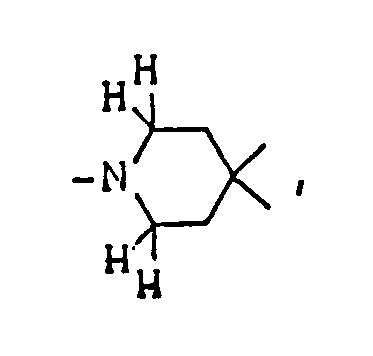
-S-CH₂- ), 3.68-4.40 ( m, 3H,
-O-CH₂- ), 6.28 ( s, 2H,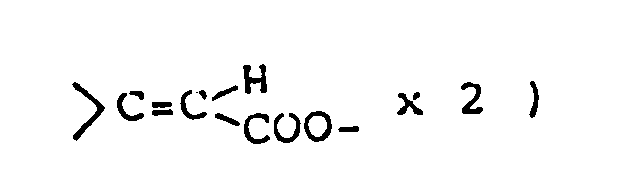
-

10,14-Dimethyl-1,4-dioxa-13-thia-10-azadispiro[4,1,5,2]tetradecane was prepared and converted to maleate by treatment with maleic acid in isopropanol as in Example 4.
Melting point: 143-145°CElemental analysis ( C₁₆H₂₅NO₆S ): C(%) H(%) N(%) S(%) Calcd. 53.46 7.01 3.90 8.92 Found 53.21 6.86 3.74 8.94
Mass spectrum (m/z): 243, 210
NMR spectrum ( CDCl₃; internal standard: TMS ), δ ppm: 1.24 ( d, 3H, J=7Hz, 〉C-CH₃ ), 2.08-2.30 ( m, 6H,
2.76 ( s, 3H, CH₃⁺NH〈 ), 2.70-3.10 ( m, 2H,
3.30-3.60 ( m, 3H,
4.0 ( s, 4H, -O-CH₂- x 2 ), 6.18 ( s, 2H,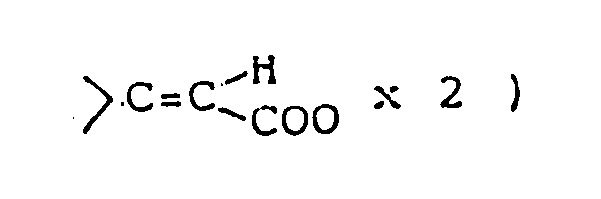
-
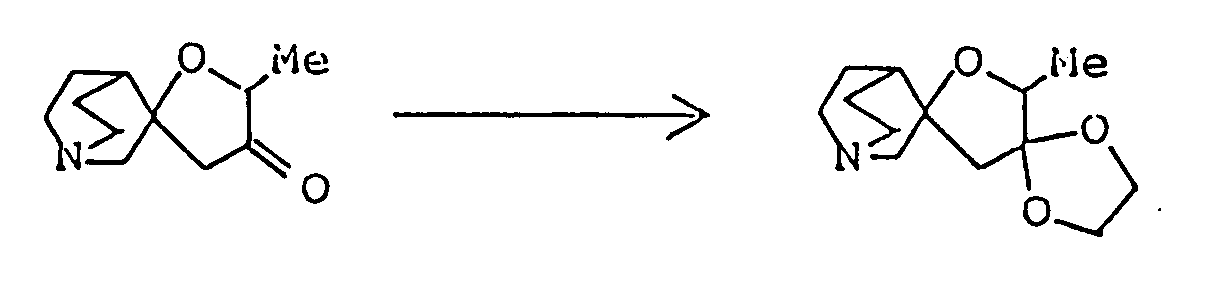
5'-Methyl-dispiro[1-azabicyclo[2,2,2]octane-3,2'-oxolane-4',2''-[1,3]dioxolane] was prepared and converted to fumarate by treatment with fumaric acid in methanol as in Example 4.
Melting point: 158-159°CElemental analysis ( C₁₇H₂₅NO₇ ): C(%) H(%) N(%) Calcd. 57.45 7.09 3.94 Found 57.43 7.14 3.89
Mass spectrum (m/z): 239, 196, 139
NMR spectrum ( DMSO-d₆; internal standard: TMS ), δ ppm: 1.08 ( d, 3H,
1.4-2.4 ( m, 7H,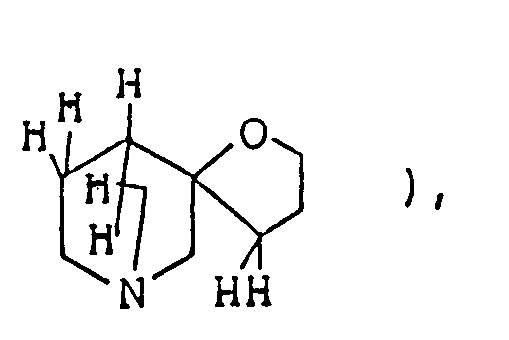
2.8-3.3 ( m, 6H, 〉N⁺H-CH₂- x 3 ), 3.75-4.05 ( m, 5H,
-O-CH₂- x 2 ), 6.48 ( s, 2H,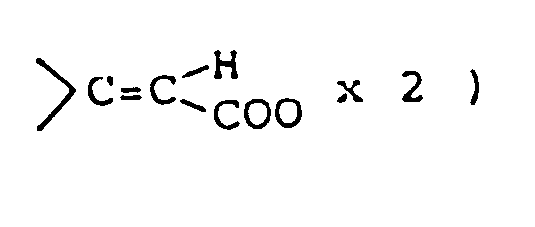
-

5'-Methyl-dispiro[1-azabicyclo[2,2,2]octane-3,2'-oxolane-4',2''-[1,3]oxathiolane] was prepared and converted to fumarate by treatment with fumaric acid in methanol as in Example 29.
Melting point: 134-136°CElemental analysis ( C₁₇H₂₅NO₆S ): C(%) H(%) N(%) S(%) Calcd. 54.97 6.78 3.77 8.63 Found 54.75 6.71 3.76 8.80
NMR spectrum ( DMSO-d₆; internal standard: TMS ), δ ppm: 1.15 ( d, 3H,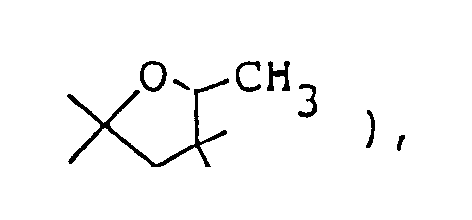
1.4-2.2 ( m, 5H,
2.2-2.7 ( m, 2H,
2.8-3.4 ( m, 8H, 〉NH⁺-CH₂- x 3, -S-CH₂- ), 3.85-4.40 ( m, 3H,
-O-CH₂- x 3 ), 6.48 ( s, 2H,
-
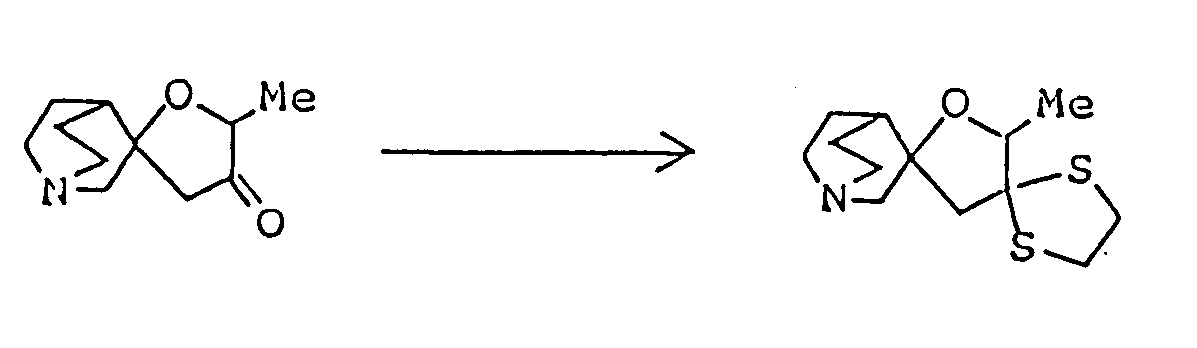
5'-Methyl-dispiro[1-azabicyclo[2,2,2]octane-3,2'-oxolane-4',2''-[1,3]dithiolane] was prepared in the same manner as in Example 29, and subjected to silica gel column chromatography using, as eluent, a mixed solvent of chloroform/methanol, thus giving isomer A ( fraction eluted earlier ) and isomer B ( fraction eluted later ). Each of these isomers was converted to fumarate by treatment with fumaric acid in methanol. - Melting point: 184-186°C
Elemental analysis ( C₁₇H₂₅NO₅S₂ ): C(%) H(%) N(%) S(%) Calcd. 52.69 6.50 3.61 16.55 Found 52.56 6.37 3.58 16.55
Mass spectrum (m/z): 271, 238, 210
NMR spectrum ( DMSO-d₆; internal standard: TMS ), δ ppm: 1.27 ( d, 3H, J=7Hz,
1.5-2.2 ( m, 5H,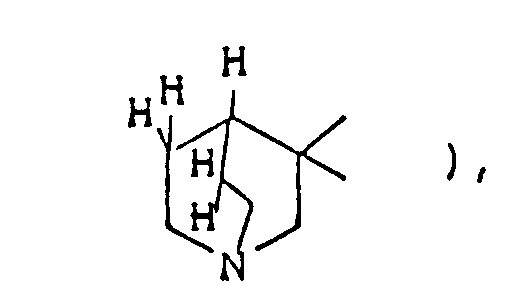
2.68 ( s, 2H,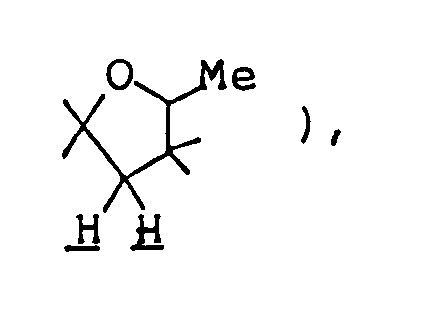
2.8-3.6 ( m, 6H, 〉N⁺H-CH₂- x 3 ), 3.3 ( s, 4H, -S-CH₂- x 2 ), 3.00 ( q, 1H, J=7Hz,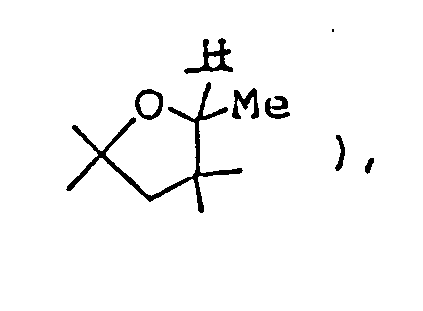
6.48 ( s, 2H,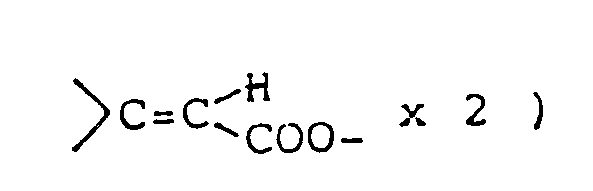
- Melting point: 196-197°C
Elemental analysis ( C₁₇H₂₅NO₅S₂ ): C(%) H(%) N(%) S(%) Calcd. 52.69 6.50 3.61 16.55 Found 52.47 6.42 3.52 16.59
Mass spectrum (m/z): 271, 238, 210
NMR spectrum ( DMSO-d₆; internal standard: TMS ), δ ppm: 1.24, ( d, 3H, J=7Hz,
1.5-2.2 ( m, 5H,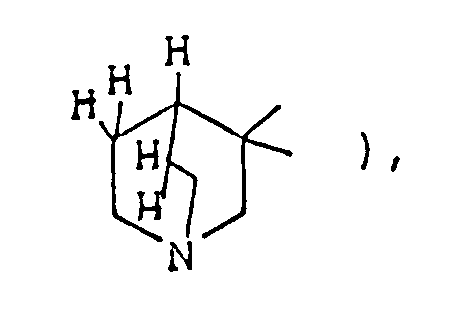
2.5-2.9 ( m, 2H,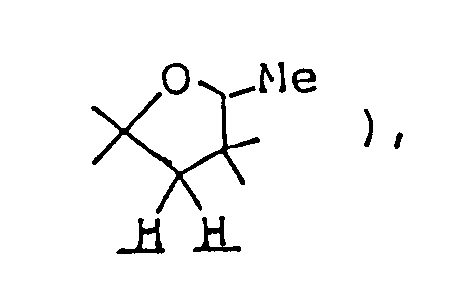
2.85-3.40 ( m, 6H, 〉N⁺H-CH₂- x 3 ), 3.25 ( s, 4H, -S-CH₂- x 2 ), 4.08 ( q, 1H, J=7Hz,
6.48 ( s, 2H,
-

5'-Methyl-4'-methylenespiro[1-azabicyclo[2,2,2]octane-3,2'-oxolane] was prepared as in Example 5 and converted to fumarate by treatment with fumaric acid in methanol.
Melting point: 172-173°CElemental analysis ( C₁₆H₂₃NO₅ ): C(%) H(%) N(%) Calcd. 62.12 7.49 4.53 Found 62.08 7.53 4.44
Mass spectrum (m/z): 193, 96
NMR spectrum ( DMSO-d₆; internal standard: TMS ), δ ppm: 1.24 ( d, 3H, J=7Hz,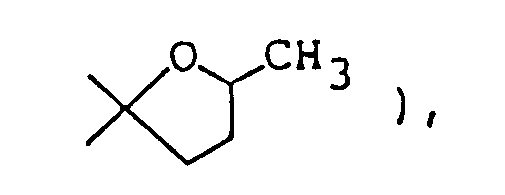
1.40-2.30 ( m, 5H,
2.35-3.00 ( m, 2H,
2.80-3.30 ( m, 6H, 〉N⁺H-CH₂- x 3 ), 4.20-4.60 ( m, 1H,
4.90 ( m, 1H, one H in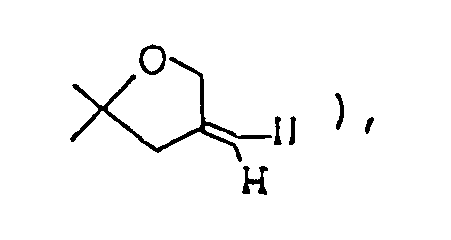
5.01 ( m, 1H, one H in
6.48 ( s, 2H,
-

10,14-Dimethyl-1-oxa-4,13-dithia-10-azadispiro[4,1,5, 2]tetradecane was prepared and converted to fumarate by treatment with fumaric acid in methanol in the same manner as in Example 29.
Melting point: 153-156°CElemental analysis ( C₁₆H₂₅NO₅S₂ ): C(%) H(%) N(%) Calcd. 51.18 6.71 3.73 Found 50.75 6.73 3.66
Mass spectrum (m/z): 259, 226, 198
NMR spectrum ( DMSO-d₆; internal standard: TMS ), δ ppm: 1.12-1.30 ( d x 2, 3H,
1.6-2.10 ( m, 4H,
2.0-2.5 ( m, 2H,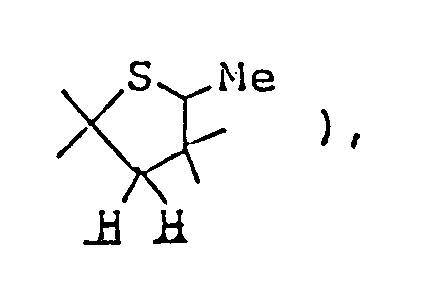
2.4-2.9 ( m, 7H,
〉N⁺H-CH₂- x 2), 2.9-3.1 ( m, 2H, -S-CH₂- ), 3.25-3.75 ( q x 2, 1H,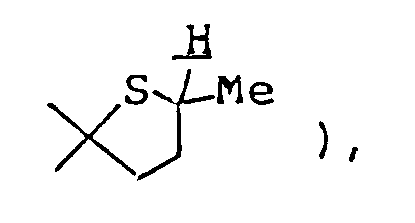
3.84-4.40 ( m, 2H, -OCH₂- ), 6.56 ( s, 2H,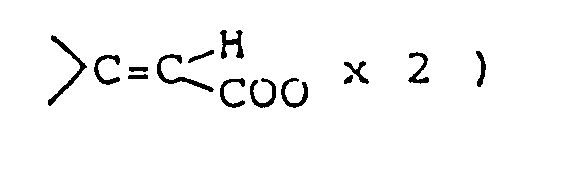
-

2-Ethyl-8-methyl-3-methylene-1-oxa-8-azaspiro[4,5]decane was prepared as as in Example 5 and converted to hydrochloride by addition of ethreal hydrochloride to its solution in ethyl acetate.
Melting point: 142°CElemental analysis ( C₁₂H₂₂NOCl ): C(%) H(%) N(%) Cl(%) Calcd. 62.19 9.57 6.04 15.30 Found 61.80 9.47 5.94 15.15
Mass spectrum (m/z): 195, 96
IR absorption spectrum (KBr) cm⁻¹: 1668
NMR spectrum ( DMSO-d₆; internal standard: TMS ), δ ppm: 0.90 ( t, 3H, J=7.2Hz,
1.16-2.28 ( m, 6H,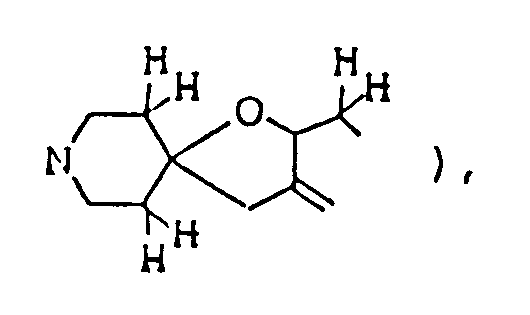
2.36-3.51 ( m, 6H,
2.72 ( s, 3H,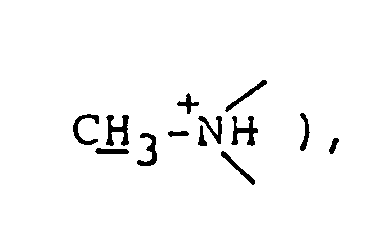
4.08-4.40 ( m, 1H,
4.88-4.96 ( m, 1H, one H in
4.98-5.07 ( m, 1H, one H in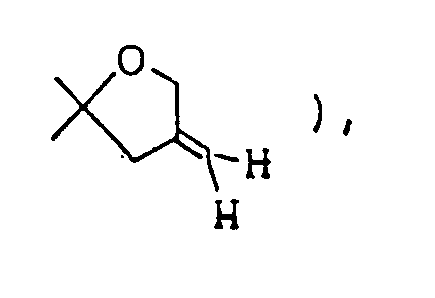
11.0 ( br, 1H, HCl ) - A mixture of 0.5 part by weight of the compound of Example 5 and 4.5 parts by weight of lactose is pulverized, and mixed uniformly with 47.1 parts by weight lactose, 22.5 parts by weight crystalline cellulose and 0.4 part by weight magnesium stearate. The resultant mixture is compacted to form tablets of 75mg/tablet.
- A mixture of 0.5 part by weight of the compound of Example 15 and 4.5 parts by weight of lactose is pulvorized, and mixed uniformly with 14.3 parts by weight of lactose, 60 parts by weight of corn starch and 2.0 parts by weight of magnesium stearate. The resultant mixture is filled into gelatin hard capsules to provide a capsuled preparation of 210mg/capsule.
Claims (11)
- A process for producing compound of the formula:


 represents a piperidine ring of which the nitrogen atom may have substituent(s) selected from C₁-C₆ alkyl, C₁-C₆ alkanoyl and (C₁-C₆ alkoxy)carbonyl and/or which may be connected to a ring carbon (other than the common carbon atom of the spiro structure) via a C₁-C₆ alkylene bridging group;
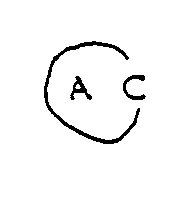 is
is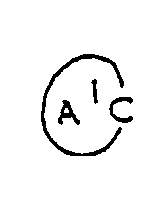 with the additional option of an amino-protecting group on the nitrogen atom; and R⁸ represents a C₁-C₆ alkyl group.
- A process for producing compound of formula:
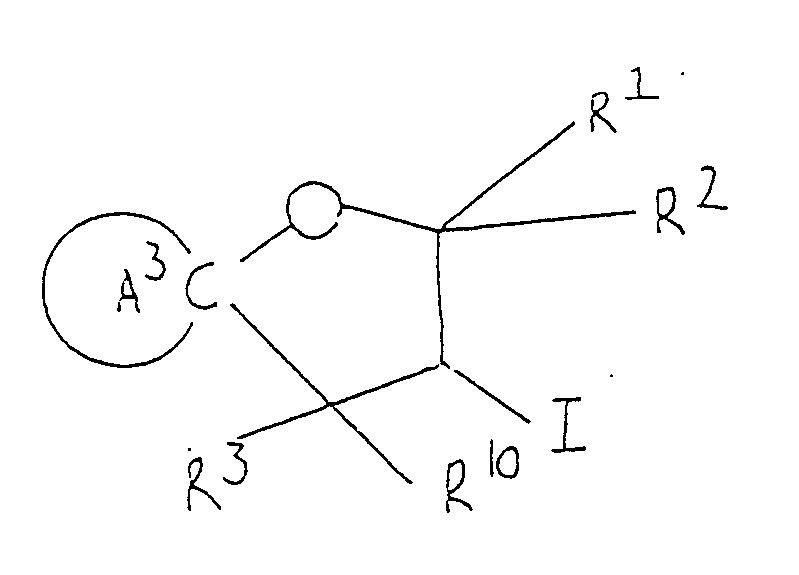
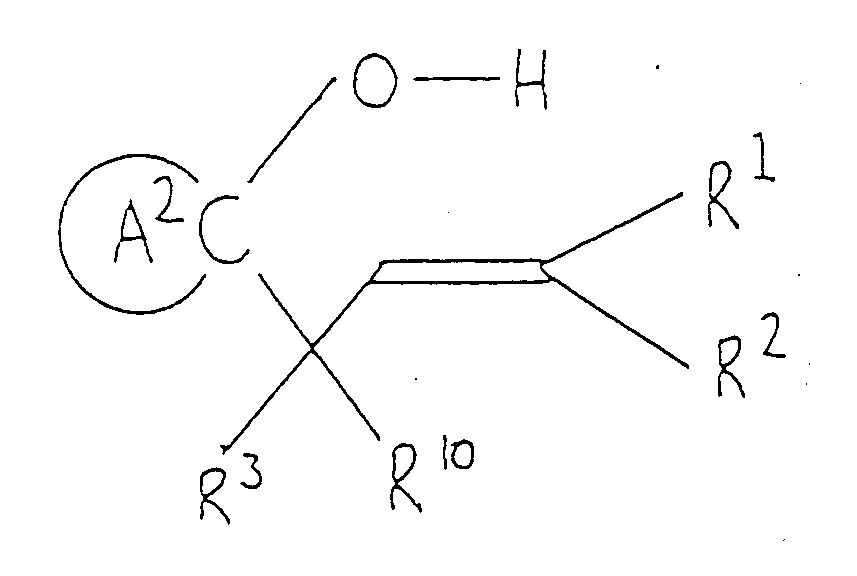 represents a piperidine ring of which the nitrogen atom may have substituents(s) selected from C₁-C₆ alkanoyl and (C₁-C₆ alkoxy)carbonyl and/or may be connected to a ring carbon (other than the common carbon atom of the spiro structure) via C₁-C₆ alkylene;
 is
is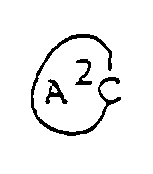 with the additional option of an amino-protecting group on the nitrogen atom; and R⁸ represents a C₁-C₆ alkyl group) with iodine and if necessary removing any protective group.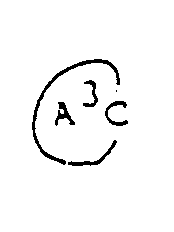
- A process for producing compound of formula:
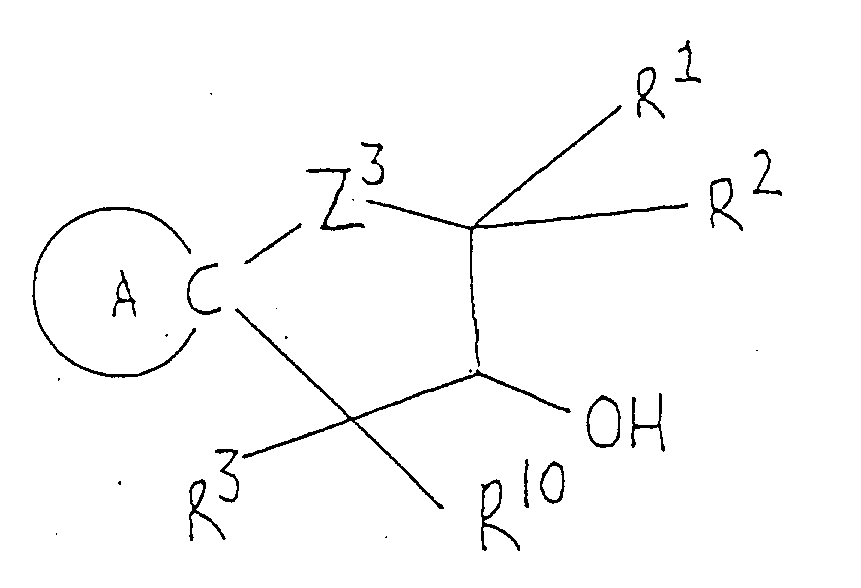
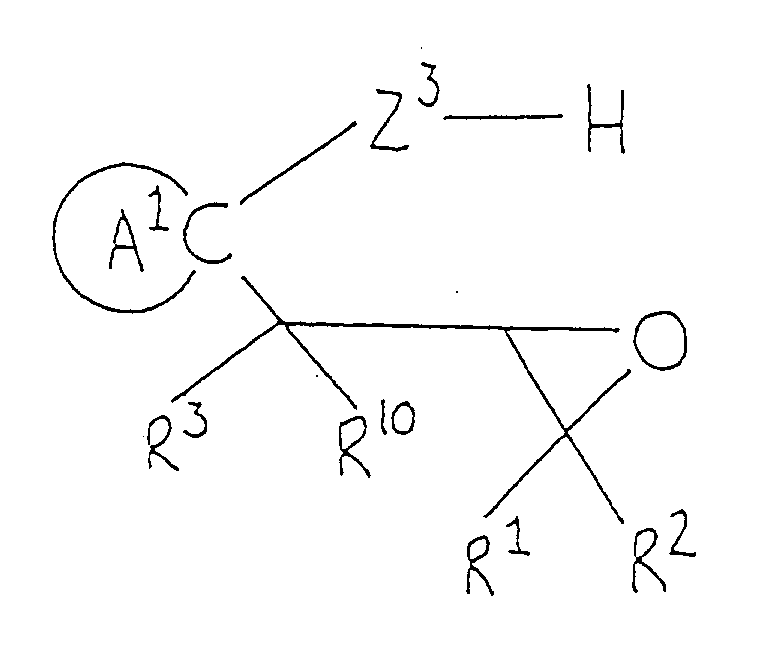 represents a piperidine ring of which the nitrogen atom may have substituent(s) selected from C₁-C₆ alkyl, C₁-C₆ alkanoyl and (C₁-C₆ alkoxy)carbonyl and/or may be connected to a ring carbon (other than the common carbon atom of the spiro structure) via C₁-C₆ alkylene; and
 is
is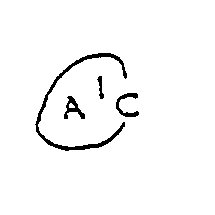 with the additional option of an amino-protecting group on the nitrogen atom; and R⁸ represents a C₁-C₆ alkyl group.
- A process for producing compound of formula (I), the process being selected from any of the following Methods 4 to 9:

 represents a piperidine ring of which the nitrogen atom may have substituent(s) selected from C₁-C₆ alkyl, C₁-C₆ alkanoyl and (C₁-c₆ alkoxy) carbonyl and/or may be connected to a ring carbon (other than the common carbon atom of the spiro structure) via a C₁-C₆ alkylene bridging group;
X represents an oxygen or sulfur atom;
Y represents a carbonyl group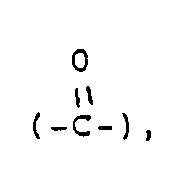

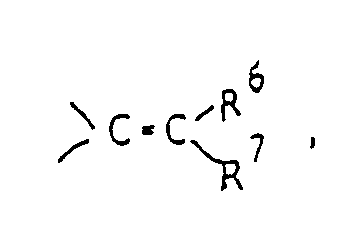

Z¹ and Z² are the same or different and selected from oxygen and sulfur atoms;
R¹, R² and R³ are the same or different and selected from a hydrogen atom and C₁-C₆ alkyl groups;
R⁴ represents a hydrogen atom or a C₁-C₆ alkyl, carboxy, (C₁-C₆ alkoxy)carbonyl, or C₁-C₆ alkanoyl group;
R⁵ represents a halogen atom or a hydroxyl, mercapto, C₁-C₆ alkoxy, C₁-C₆ alkylthio, C₁-c₆ alkanoyloxy or C₁-C₆ alkanoylthio group;
R⁶ and R⁷ are the same or different and selected from a hydrogen atom and C₁-C₆ alkyl groups;is a piperidine ring structure


R¹¹ is a hydrogen atom or lower alkyl; R¹² is a hydrogen atom or lower alkyl, carboxyl or lower alkoxycarbonyl; R¹³ is a hydrogen atom or an alkyl group of 1 to 5 carbon atoms; R¹⁴ is lower alkyl; R¹⁵ is hydroxyl, mercapto, lower alkoxy or lower alkylthio; Ph is phenyl;
R¹⁶ and R¹⁷ are the same or different and selected from a hydrogen atom and lower alkyls ; and the term "lower" means a linear or branched carbon chain of 1 to 6 carbon atoms. - A process according to any preceding claims which includes converting to or from salt form.
- A method of making a pharmaceutical composition which comprises combining with pharmaceutical carrier compound selected from those of formula (I) and salts thereof :
 represents a piperidine ring of which the nitrogen atom may have substituent(s) selected from C₁-C₆ alkyl, C₁-C₆ alkanoyl and (C₁-C₆ alkoxy) carbonyl and/or may be connected to a ring carbon (other than the common carbon atom of the spiro structure) via a C₁-C₆ alkylene bridging group;
X represents an oxygen or sulfur atom;
Y represents a carbonyl group

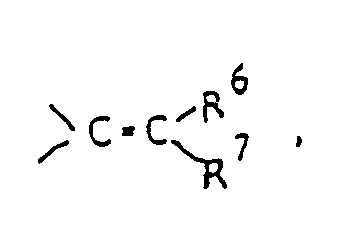
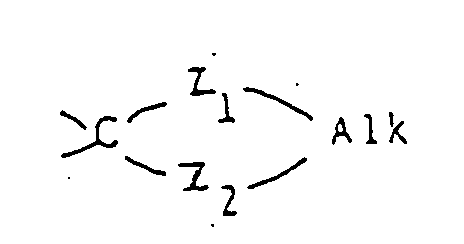
Z¹ and Z² are the same or different and selected from oxygen and sulfur atoms;
R¹, R² and R³ are the same or different and selected from a hydrogen atom and C₁-C₆ alkyl groups;
R⁴ represents a hydrogen atom or a C₁-C₆ alkyl, carboxy, (C₁-C₆ alkoxy)carbonyl, or C₁-C₆ alkanoyl group;
R⁵ represents a halogen atom or a hydroxyl, mercapto, C₁-C₆ alkoxy, C₁-C₆ alkylthio, C₁-C₆ alkanoyloxy, or C₁-C₆ alkanoylthio group; and
R⁶ and R⁷ are the same or different and selected from a hydrogen atom and C₁-C₆ alkyl groups. - A method of making a pharmaceutical composition which comprises combining with pharmaceutical carrier compound selected from 2,8-dimethyl-3-methylene-1-oxa-8-azaspriro[4,5]decane and hydrochloride, fumarate and other salts thereof; 2-ethyl-8-methyl-1-oxa-8-azaspiro[4,5]decane-3-one and hydrochloride, fumarate, maleate, oxalate and other salts thereof; 10,14-dimethyl-1,4,13-trithia-10-azadispiro[4,1,5,2]tetradecane and maleate and other salts thereof; 14-ethyl-10-methyl-1,13-dioxa-4-thia-10-azadispiro[4,1,5,2] tetradecane and maleate and other salts thereof; 5'-methyldispiro(1-azabicyclo[2,2,2]octane-3,2'-oxolane-4',2''-[1,3]dithiolane], its individual stereoisomers and mixtures thereof, and fumarate and other salts thereof; and 2-ethyl-3-methy-3-methylene-1-oxa-8-azaspiro[4,5]decane and hydrochloride and other salts thereof.
- The use, for preparation of medicament for the treatment of disease caused by central nervous system degeneration, of compound of formula I or salt thereof:
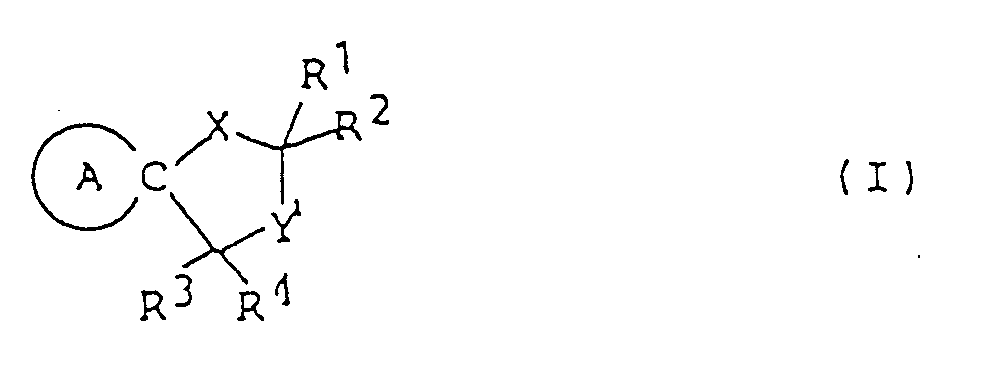 represents a piperidine ring of which the nitrogen atom may have substituent(s) selected from C₁-C₆ alkyl, C₁-C₆ alkanoyl and (C₁-C₆ alkoxy) carbonyl and/or may be connected to a ring carbon (other than the common carbon atom of the spiro structure) via a C₁-C₆ alkylene bridging group;
X represents an oxygen or sulfur atom;
Y represents a carbonyl group
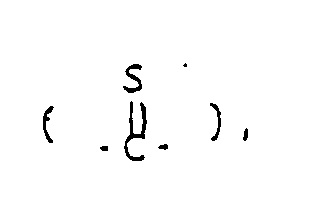
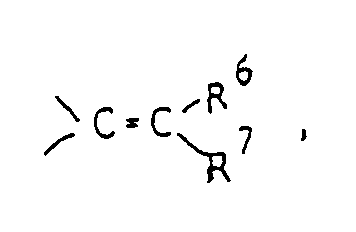

Z¹ and Z² are the same or different and selected from oxygen and sulfur atoms;
R¹, R² and R³ are the same or different and selected from a hydrogen atom and C₁-C₆ alkyl groups;
R⁴ represents a hydrogen atom or a C₁-C₆ alkyl, carboxy, (C₁-C₆ alkoxy)carbonyl, or C₁-C₆ alkanoyl group;
R⁵ represents a halogen atom or a hydroxyl, mercapto, C₁-C₆ alkoxy, C₁-C₆ alkylthio, C₁-C₆ alkanoyloxy, or C₁-C₆ alkanoylthio group; and
R⁶ and R⁷ are the same or different and selected from a hydrogen atom and C₁-C₆ alkyl groups. - The use, for the preparation of medicament for the treatment of disease caused by central nervous system degeneration, of compound selected from
2,8-dimethyl-3-methylene-1-oxa-8-azaspiro[4,5]decane and hydrochloride, fumarate and other salts thereof; 2-ethyl-8-methyl-1-oxa-8-azaspiro[4,5]decane-3-one and hydrochloride, fumarate, maleate, oxalate and other salts thereof; 10,14-dimethyl-1,4,13-trithia-10-azadispiro[4,1,5,2]tetradecane and maleate and other salts thereof; 14-ethyl-10-methyl-1,13-dioxa-4-thia-10-azadispiro[4,1,5,2] tetradecane and maleate and other salts thereof; 5'-methyldispiro[1-azabicyclo[2,2,2]ocatne-3,2'-oxolane-4',2''-[1,3]-dithiolane], its individual stereoisomers and mixtures thereof, and fumarate and other salts thereof; and 2-ethyl-3-methyl-3-methylene-1-oxa-8-azaspiro[4,5]decane and hydrochloride and other salts thereof.
Applications Claiming Priority (6)
| Application Number | Priority Date | Filing Date | Title |
|---|---|---|---|
| JP25210487 | 1987-10-05 | ||
| JP252104/87 | 1987-10-05 | ||
| JP286297/87 | 1987-11-12 | ||
| JP28629787 | 1987-11-12 | ||
| JP84327/88 | 1988-04-05 | ||
| JP8432788 | 1988-04-05 |
Publications (3)
| Publication Number | Publication Date |
|---|---|
| EP0311313A2 EP0311313A2 (en) | 1989-04-12 |
| EP0311313A3 EP0311313A3 (en) | 1990-12-05 |
| EP0311313B1 true EP0311313B1 (en) | 1995-05-10 |
Family
ID=27304516
Family Applications (1)
| Application Number | Title | Priority Date | Filing Date |
|---|---|---|---|
| EP88309095A Expired - Lifetime EP0311313B1 (en) | 1987-10-05 | 1988-09-30 | Heterocyclic spiro compounds and their preparation |
Country Status (14)
| Country | Link |
|---|---|
| US (4) | US4940795A (en) |
| EP (1) | EP0311313B1 (en) |
| JP (1) | JPH0236183A (en) |
| KR (1) | KR970007947B1 (en) |
| CN (1) | CN1036653C (en) |
| AT (1) | ATE122353T1 (en) |
| AU (1) | AU621559B2 (en) |
| CA (1) | CA1337817C (en) |
| DE (1) | DE3853758T2 (en) |
| DK (1) | DK554288A (en) |
| ES (1) | ES2074441T3 (en) |
| GR (1) | GR3016995T3 (en) |
| HU (1) | HU211687A9 (en) |
| NO (1) | NO171109C (en) |
Families Citing this family (46)
| Publication number | Priority date | Publication date | Assignee | Title |
|---|---|---|---|---|
| US5412096A (en) * | 1987-10-05 | 1995-05-02 | Yamanouchi Pharmaceutical Co., Ltd. | Hydrochloride salts of heterocyclic spiro compounds |
| EP0311313B1 (en) * | 1987-10-05 | 1995-05-10 | Yamanouchi Pharmaceutical Co. Ltd. | Heterocyclic spiro compounds and their preparation |
| US5594000A (en) * | 1989-06-21 | 1997-01-14 | Astra Ab | Spirofurane derivatives |
| US5075317A (en) * | 1989-06-21 | 1991-12-24 | Fisons Corporation | Spirofurane derivatives |
| US5407938A (en) * | 1990-04-10 | 1995-04-18 | Israel Institute For Biological Research | Certain 1-methyl-piperidine-4-spiro-4'-(1'-3'-oxazolines) and corresponding -(1',3' thiazolines) |
| US5534520A (en) * | 1990-04-10 | 1996-07-09 | Fisher; Abraham | Spiro compounds containing five-membered rings |
| US5852029A (en) * | 1990-04-10 | 1998-12-22 | Israel Institute For Biological Research | Aza spiro compounds acting on the cholinergic system with muscarinic agonist activity |
| US5073560A (en) * | 1990-07-20 | 1991-12-17 | Fisons Corporation | Spiro-isoxazolidine derivatives as cholinergic agents |
| IE914238A1 (en) * | 1990-12-19 | 1992-07-01 | Fisons Corp | Novel spirofurane derivatives |
| EP0590150B1 (en) * | 1991-05-15 | 1998-07-08 | Yamanouchi Pharmaceutical Co. Ltd. | (-)-(s)-2,8-dimethyl-3-methylene-1-oxa-8-azaspiro 4,5]decane l-tartrate |
| WO1994017045A1 (en) * | 1993-01-28 | 1994-08-04 | Merck & Co., Inc. | Spiro-substituted azacycles as tachykinin receptor antagonists |
| US5688806A (en) * | 1993-03-04 | 1997-11-18 | Pfizer Inc. | Spiroazacyclic derivatives as substance P antagonists |
| JP2983141B2 (en) * | 1993-10-06 | 1999-11-29 | 株式会社三和化学研究所 | Novel compound and brain function improving agent containing the compound as active ingredient |
| ZA984637B (en) | 1997-05-30 | 1998-12-21 | Neurosearch As | Spiro-quinuclidine derivatives their preparation and use |
| US6528529B1 (en) | 1998-03-31 | 2003-03-04 | Acadia Pharmaceuticals Inc. | Compounds with activity on muscarinic receptors |
| SE9900100D0 (en) * | 1999-01-15 | 1999-01-15 | Astra Ab | New compounds |
| BR0013085A (en) * | 1999-08-13 | 2002-04-23 | Aventis Cropscience Gmbh | Heterocyclic spiro compounds as pesticides |
| CA2404858A1 (en) * | 2000-04-12 | 2001-10-25 | Minerva Biotechnologies Corporation | Treatment of neurodegenerative disease |
| JP2003063964A (en) * | 2001-08-28 | 2003-03-05 | Senju Pharmaceut Co Ltd | Prophylactic and therapeutic agent for dry eye and disease with dry eye |
| CA2580329C (en) | 2004-09-13 | 2015-01-06 | Chrono Therapeutics Inc. | Biosynchronous transdermal drug delivery |
| JPWO2007013661A1 (en) * | 2005-07-26 | 2009-02-12 | 千寿製薬株式会社 | Ophthalmic transdermal preparation |
| EP2258359A3 (en) | 2005-08-26 | 2011-04-06 | Braincells, Inc. | Neurogenesis by muscarinic receptor modulation with sabcomelin |
| EP1928437A2 (en) * | 2005-08-26 | 2008-06-11 | Braincells, Inc. | Neurogenesis by muscarinic receptor modulation |
| JP2009512711A (en) | 2005-10-21 | 2009-03-26 | ブレインセルス,インコーポレイティド | Regulation of neurogenesis by PDE inhibition |
| WO2007053596A1 (en) | 2005-10-31 | 2007-05-10 | Braincells, Inc. | Gaba receptor mediated modulation of neurogenesis |
| US20100216734A1 (en) | 2006-03-08 | 2010-08-26 | Braincells, Inc. | Modulation of neurogenesis by nootropic agents |
| EP1991212A1 (en) * | 2006-03-08 | 2008-11-19 | Braincells, Inc. | Modulation of neurogenesis by nootropic agents |
| WO2007134136A2 (en) | 2006-05-09 | 2007-11-22 | Braincells, Inc. | Neurogenesis by modulating angiotensin |
| US20100009983A1 (en) * | 2006-05-09 | 2010-01-14 | Braincells, Inc. | 5 ht receptor mediated neurogenesis |
| EP2026813A2 (en) | 2006-05-09 | 2009-02-25 | Braincells, Inc. | 5 ht receptor mediated neurogenesis |
| ITMI20061279A1 (en) * | 2006-06-30 | 2008-01-01 | Consiglio Nazionale Ricerche | SELECTIVE NICOTINIC AGONISTS FOR THE ALFA7 RECEPTOR SUBTIPLE, PROCEDURE FOR THEIR PREPARATION AND RELATED PHARMACEUTICAL COMPOSITIONS |
| WO2008030651A1 (en) | 2006-09-08 | 2008-03-13 | Braincells, Inc. | Combinations containing a 4-acylaminopyridine derivative |
| US20080103165A1 (en) * | 2006-09-19 | 2008-05-01 | Braincells, Inc. | Ppar mediated modulation of neurogenesis |
| US20100184806A1 (en) | 2006-09-19 | 2010-07-22 | Braincells, Inc. | Modulation of neurogenesis by ppar agents |
| CA2664421A1 (en) * | 2006-09-22 | 2008-03-27 | Braincells, Inc. | Hmg coa reductase mediated modulation of neurogenesis |
| KR101122469B1 (en) | 2007-04-02 | 2012-07-12 | 파킨슨즈 인스티튜트 | Methods and compositions for reduction of side effects of therapeutic treatments |
| US9034891B2 (en) | 2009-01-26 | 2015-05-19 | Israel Institute For Biological Research | Bicyclic heterocyclic spiro compounds |
| US8673931B2 (en) * | 2009-01-26 | 2014-03-18 | Abraham Fisher | Bicyclic heterocyclic spiro compounds |
| WO2010099217A1 (en) | 2009-02-25 | 2010-09-02 | Braincells, Inc. | Modulation of neurogenesis using d-cycloserine combinations |
| ES2716049T3 (en) | 2012-07-13 | 2019-06-07 | Pain Therapeutics Inc | A method to inhibit tau phosphorylation |
| US9433604B2 (en) | 2013-10-08 | 2016-09-06 | Pain Therapeutics Inc. | Method for inhibiting growth of cancer cells |
| EP3250258A4 (en) | 2015-01-28 | 2018-09-05 | Chrono Therapeutics, Inc. | Drug delivery methods and systems |
| AU2018205529B2 (en) | 2017-01-06 | 2023-08-10 | Morningside Venture Investments Limited | Transdermal drug delivery devices and methods |
| US11596779B2 (en) | 2018-05-29 | 2023-03-07 | Morningside Venture Investments Limited | Drug delivery methods and systems |
| MA54245A (en) | 2018-11-16 | 2022-02-23 | Morningside Venture Investments Ltd | TRANSDERMAL TEMPERATURE-REGULATING DRUG DELIVERY SYSTEM |
| CN115124545B (en) * | 2022-08-31 | 2023-01-03 | 南京远淑医药科技有限公司 | Synthesis method of gonadotropin releasing hormone receptor antagonist intermediate |
Family Cites Families (16)
| Publication number | Priority date | Publication date | Assignee | Title |
|---|---|---|---|---|
| US3305556A (en) * | 1962-11-23 | 1967-02-21 | Pfizer & Co C | Novel hypoglycemic agents |
| NL124853C (en) * | 1963-07-19 | |||
| SU335944A1 (en) * | 1970-12-15 | 1976-01-25 | Научно-исследовательский институт химии Саратовского государственного университета им.Н.Г.Чернышевского | The method of obtaining compounds of the series 1-oxa-azaspiro (4,4) nonane |
| US3784551A (en) * | 1971-07-08 | 1974-01-08 | Yoshitomi Pharmaceutical | 2-oxo-1,4-dioxa-8-azaspiro (4.5) decanes and related compounds |
| GB1301254A (en) * | 1971-07-08 | 1972-12-29 | ||
| US3839273A (en) * | 1971-11-13 | 1974-10-01 | Sankyo Co | N-substituted piperidine derivatives, process for preparing the same and their use as stabilizers |
| SU434735A1 (en) * | 1972-03-01 | 1975-12-15 | Научно-исследовательский институт химии Саратовского государственного университета им.Н.Г.Чернышевского | The method of obtaining 7-methyl- (or 2,7 dimethyl) -2-methoxy-propionitrile 1-oxa-6-azaspiro (4,4) -nonane |
| SU465399A1 (en) * | 1973-07-19 | 1975-03-30 | Научно-исследовательский институт химии при Саратовском государственном университете им.Н.Г.Чернышевского | The method of obtaining the sodium salts of 2-methoxy-β-carboxyethyl-1-ox-6-azaspiro (4,4) -nonane |
| IL48452A (en) * | 1975-11-11 | 1979-07-25 | Purdue Frederick Co | Spiro (1,3-dioxolane-4,3') quinuclidines,their preparationand pharmaceutical compositions comprising them |
| US4321379A (en) * | 1981-01-28 | 1982-03-23 | American Cyanamid Company | 4-Aryl-1-oxa-8-azaspiro[4,5]dec-3-en-2-ones |
| SU1002294A1 (en) * | 1981-08-14 | 1983-03-07 | Ордена Трудового Красного Знамени Институт Тонкой Органической Химии Им.А.Л.Мнджояна | 2,2-dialkyl-3-tia-8-azaspiro-(5,5) undercanes |
| EP0189370A3 (en) * | 1985-01-16 | 1988-01-27 | Sandoz Ag | Spirodioxolanes, -dithiolanes and -oxothiolanes |
| US4855290A (en) * | 1985-05-10 | 1989-08-08 | State Of Israel, Represented By Prime Minister's Office, Israel Institute For Biological Research | Derivatives of quinuclidine |
| US4981858A (en) * | 1987-08-13 | 1991-01-01 | State Of Israel, Represented By The Prime Minister's Office, Israel Institute For Biological Research | Optical isomers |
| EP0311313B1 (en) * | 1987-10-05 | 1995-05-10 | Yamanouchi Pharmaceutical Co. Ltd. | Heterocyclic spiro compounds and their preparation |
| US5073560A (en) * | 1990-07-20 | 1991-12-17 | Fisons Corporation | Spiro-isoxazolidine derivatives as cholinergic agents |
-
1988
- 1988-09-30 EP EP88309095A patent/EP0311313B1/en not_active Expired - Lifetime
- 1988-09-30 ES ES88309095T patent/ES2074441T3/en not_active Expired - Lifetime
- 1988-09-30 AT AT88309095T patent/ATE122353T1/en not_active IP Right Cessation
- 1988-09-30 DE DE3853758T patent/DE3853758T2/en not_active Expired - Lifetime
- 1988-10-03 CA CA000579193A patent/CA1337817C/en not_active Expired - Fee Related
- 1988-10-04 JP JP63251489A patent/JPH0236183A/en active Granted
- 1988-10-04 DK DK554288A patent/DK554288A/en not_active Application Discontinuation
- 1988-10-04 NO NO884406A patent/NO171109C/en unknown
- 1988-10-05 CN CN88109138A patent/CN1036653C/en not_active Expired - Fee Related
- 1988-10-05 AU AU23449/88A patent/AU621559B2/en not_active Ceased
- 1988-10-05 US US07/254,375 patent/US4940795A/en not_active Ceased
- 1988-10-05 KR KR1019880012963A patent/KR970007947B1/en not_active Expired - Fee Related
-
1990
- 1990-01-25 US US07/470,093 patent/US5041549A/en not_active Expired - Fee Related
- 1990-01-25 US US07/470,091 patent/US4996210A/en not_active Expired - Fee Related
-
1992
- 1992-07-07 US US07/909,639 patent/USRE34653E/en not_active Expired - Lifetime
-
1995
- 1995-06-30 HU HU95P/P00638P patent/HU211687A9/en unknown
- 1995-08-02 GR GR950402111T patent/GR3016995T3/en unknown
Also Published As
| Publication number | Publication date |
|---|---|
| NO884406L (en) | 1989-04-06 |
| GR3016995T3 (en) | 1995-11-30 |
| KR970007947B1 (en) | 1997-05-19 |
| DE3853758D1 (en) | 1995-06-14 |
| AU2344988A (en) | 1989-04-06 |
| US4940795A (en) | 1990-07-10 |
| AU621559B2 (en) | 1992-03-19 |
| JPH0544948B2 (en) | 1993-07-07 |
| CN1033629A (en) | 1989-07-05 |
| USRE34653E (en) | 1994-07-05 |
| DE3853758T2 (en) | 1995-09-07 |
| JPH0236183A (en) | 1990-02-06 |
| KR890006649A (en) | 1989-06-15 |
| ATE122353T1 (en) | 1995-05-15 |
| CA1337817C (en) | 1995-12-26 |
| NO171109C (en) | 1993-01-27 |
| CN1036653C (en) | 1997-12-10 |
| EP0311313A2 (en) | 1989-04-12 |
| NO884406D0 (en) | 1988-10-04 |
| DK554288A (en) | 1989-05-26 |
| DK554288D0 (en) | 1988-10-04 |
| US4996210A (en) | 1991-02-26 |
| NO171109B (en) | 1992-10-19 |
| US5041549A (en) | 1991-08-20 |
| EP0311313A3 (en) | 1990-12-05 |
| HU211687A9 (en) | 1995-12-28 |
| ES2074441T3 (en) | 1995-09-16 |
Similar Documents
| Publication | Publication Date | Title |
|---|---|---|
| EP0311313B1 (en) | Heterocyclic spiro compounds and their preparation | |
| US5686463A (en) | Oxadiazoles useful in the treatment of senile dementia | |
| US4910207A (en) | Method of treating psychosis with N-quinuclidinyl-benzamides | |
| KR20230163575A (en) | Inhibitors of (alpha-v)(beta-6) integrin | |
| KR20050069977A (en) | Dihydropyrazolopyridine compounds | |
| IE904269A1 (en) | New tricyclic compounds | |
| EA013602B1 (en) | Histamine-3 receptor antagonists | |
| JPH01104070A (en) | Thiadiazole useful for senile dementia | |
| SK282476B6 (en) | The benzylpiperidine derivative, the process for its preparation, its use and the pharmaceutical composition containing it | |
| AU636076B2 (en) | 4-desoxy-4-epipodophyllotoxin derivative or pharmaceutically acceptable salt thereof | |
| US5041451A (en) | Tetrahydroisoquinoline and tetrahydrothieno derivatives | |
| US4210648A (en) | II-Aminoacyl-5,11-dihydro-6H-pyrido(2,3-B) (1,4)benzodiazepin-6-ones and salts thereof | |
| US4031222A (en) | Trifluoromethylthio (and sulfonyl) derivatives of cyproheptadine analogs | |
| US5412096A (en) | Hydrochloride salts of heterocyclic spiro compounds | |
| CA2076146A1 (en) | Piperidine derivatives | |
| NO173995B (en) | ANALOGY PROCEDURE FOR THE PREPARATION OF THERAPEUTICALLY ACTIVE PYRROLO (2,3B) INDOLD DERIVATIVES | |
| US4992436A (en) | Spiro-azabicyclic muscarinic agonists | |
| EP0362941B1 (en) | 4-Methyl and 4-ethyl substituted pyrrolidin-2-ones | |
| US4791108A (en) | Sulfonyl-decahydro-8H-isoquino[2,1-G][1,6]-naphthyridines and related compounds useful as α2 -blockers | |
| CS241138B2 (en) | Method of dibenzodiazepinone's new substituted derivatives preparation | |
| US5075317A (en) | Spirofurane derivatives | |
| CZ317290A3 (en) | Process for preparing novel thienopyran derivatives | |
| EP0501997B1 (en) | N-acyl-substituted azacyclic compounds, processes for their preparation, and their use as pharmaceuticals | |
| US20220411367A1 (en) | Arylmethylene heterocyclic compounds as kv1.3 potassium shaker channel blockers | |
| US4031223A (en) | Trifluoromethylthio derivatives of cyproheptadine |
Legal Events
| Date | Code | Title | Description |
|---|---|---|---|
| PUAI | Public reference made under article 153(3) epc to a published international application that has entered the european phase |
Free format text: ORIGINAL CODE: 0009012 |
|
| AK | Designated contracting states |
Kind code of ref document: A2 Designated state(s): AT BE CH DE ES FR GB GR IT LI LU NL SE |
|
| 17P | Request for examination filed |
Effective date: 19900105 |
|
| PUAL | Search report despatched |
Free format text: ORIGINAL CODE: 0009013 |
|
| AK | Designated contracting states |
Kind code of ref document: A3 Designated state(s): AT BE CH DE ES FR GB GR IT LI LU NL SE |
|
| 17Q | First examination report despatched |
Effective date: 19930312 |
|
| GRAA | (expected) grant |
Free format text: ORIGINAL CODE: 0009210 |
|
| AK | Designated contracting states |
Kind code of ref document: B1 Designated state(s): AT BE CH DE ES FR GB GR IT LI LU NL SE |
|
| REF | Corresponds to: |
Ref document number: 122353 Country of ref document: AT Date of ref document: 19950515 Kind code of ref document: T |
|
| ET | Fr: translation filed | ||
| REF | Corresponds to: |
Ref document number: 3853758 Country of ref document: DE Date of ref document: 19950614 |
|
| ITF | It: translation for a ep patent filed | ||
| REG | Reference to a national code |
Ref country code: ES Ref legal event code: FG2A Ref document number: 2074441 Country of ref document: ES Kind code of ref document: T3 |
|
| REG | Reference to a national code |
Ref country code: GR Ref legal event code: FG4A Free format text: 3016995 |
|
| PLBE | No opposition filed within time limit |
Free format text: ORIGINAL CODE: 0009261 |
|
| STAA | Information on the status of an ep patent application or granted ep patent |
Free format text: STATUS: NO OPPOSITION FILED WITHIN TIME LIMIT |
|
| 26N | No opposition filed | ||
| PGFP | Annual fee paid to national office [announced via postgrant information from national office to epo] |
Ref country code: SE Payment date: 20000302 Year of fee payment: 12 |
|
| PGFP | Annual fee paid to national office [announced via postgrant information from national office to epo] |
Ref country code: AT Payment date: 20000306 Year of fee payment: 12 |
|
| PGFP | Annual fee paid to national office [announced via postgrant information from national office to epo] |
Ref country code: LU Payment date: 20000307 Year of fee payment: 12 |
|
| PGFP | Annual fee paid to national office [announced via postgrant information from national office to epo] |
Ref country code: GR Payment date: 20000308 Year of fee payment: 12 |
|
| PGFP | Annual fee paid to national office [announced via postgrant information from national office to epo] |
Ref country code: CH Payment date: 20000312 Year of fee payment: 12 |
|
| PGFP | Annual fee paid to national office [announced via postgrant information from national office to epo] |
Ref country code: BE Payment date: 20000412 Year of fee payment: 12 |
|
| PG25 | Lapsed in a contracting state [announced via postgrant information from national office to epo] |
Ref country code: SE Free format text: THE PATENT HAS BEEN ANNULLED BY A DECISION OF A NATIONAL AUTHORITY Effective date: 20000929 |
|
| PG25 | Lapsed in a contracting state [announced via postgrant information from national office to epo] |
Ref country code: CH Free format text: LAPSE BECAUSE OF NON-PAYMENT OF DUE FEES Effective date: 20000930 Ref country code: LI Free format text: LAPSE BECAUSE OF NON-PAYMENT OF DUE FEES Effective date: 20000930 Ref country code: BE Free format text: LAPSE BECAUSE OF NON-PAYMENT OF DUE FEES Effective date: 20000930 Ref country code: AT Free format text: LAPSE BECAUSE OF NON-PAYMENT OF DUE FEES Effective date: 20000930 Ref country code: LU Free format text: LAPSE BECAUSE OF NON-PAYMENT OF DUE FEES Effective date: 20000930 Ref country code: GR Free format text: LAPSE BECAUSE OF NON-PAYMENT OF DUE FEES Effective date: 20000930 |
|
| BERE | Be: lapsed |
Owner name: YAMANOUCHI PHARMACEUTICAL CO. LTD Effective date: 20000930 |
|
| REG | Reference to a national code |
Ref country code: CH Ref legal event code: PL |
|
| EUG | Se: european patent has lapsed |
Ref document number: 88309095.3 |
|
| REG | Reference to a national code |
Ref country code: GB Ref legal event code: IF02 |
|
| NLT1 | Nl: modifications of names registered in virtue of documents presented to the patent office pursuant to art. 16 a, paragraph 1 |
Owner name: ASTELLAS PHARMA INC. |
|
| PGFP | Annual fee paid to national office [announced via postgrant information from national office to epo] |
Ref country code: DE Payment date: 20070927 Year of fee payment: 20 |
|
| PGFP | Annual fee paid to national office [announced via postgrant information from national office to epo] |
Ref country code: GB Payment date: 20070926 Year of fee payment: 20 |
|
| REG | Reference to a national code |
Ref country code: FR Ref legal event code: CD |
|
| PGFP | Annual fee paid to national office [announced via postgrant information from national office to epo] |
Ref country code: ES Payment date: 20071005 Year of fee payment: 20 Ref country code: NL Payment date: 20070916 Year of fee payment: 20 Ref country code: IT Payment date: 20070926 Year of fee payment: 20 |
|
| PGFP | Annual fee paid to national office [announced via postgrant information from national office to epo] |
Ref country code: FR Payment date: 20070914 Year of fee payment: 20 |
|
| REG | Reference to a national code |
Ref country code: GB Ref legal event code: PE20 Expiry date: 20080929 |
|
| PG25 | Lapsed in a contracting state [announced via postgrant information from national office to epo] |
Ref country code: NL Free format text: LAPSE BECAUSE OF EXPIRATION OF PROTECTION Effective date: 20080930 |
|
| NLV7 | Nl: ceased due to reaching the maximum lifetime of a patent |
Effective date: 20080930 |
|
| REG | Reference to a national code |
Ref country code: ES Ref legal event code: FD2A Effective date: 20081001 |
|
| PG25 | Lapsed in a contracting state [announced via postgrant information from national office to epo] |
Ref country code: GB Free format text: LAPSE BECAUSE OF EXPIRATION OF PROTECTION Effective date: 20080929 |
|
| PG25 | Lapsed in a contracting state [announced via postgrant information from national office to epo] |
Ref country code: ES Free format text: LAPSE BECAUSE OF EXPIRATION OF PROTECTION Effective date: 20081001 |