EP0302558A1 - Method of analysing fluid influxes in hydrocarbon wells - Google Patents
Method of analysing fluid influxes in hydrocarbon wells Download PDFInfo
- Publication number
- EP0302558A1 EP0302558A1 EP88201610A EP88201610A EP0302558A1 EP 0302558 A1 EP0302558 A1 EP 0302558A1 EP 88201610 A EP88201610 A EP 88201610A EP 88201610 A EP88201610 A EP 88201610A EP 0302558 A1 EP0302558 A1 EP 0302558A1
- Authority
- EP
- European Patent Office
- Prior art keywords
- well
- annulus
- mud
- pressure
- fluid
- Prior art date
- Legal status (The legal status is an assumption and is not a legal conclusion. Google has not performed a legal analysis and makes no representation as to the accuracy of the status listed.)
- Granted
Links
Images


Classifications
-
- E—FIXED CONSTRUCTIONS
- E21—EARTH OR ROCK DRILLING; MINING
- E21B—EARTH OR ROCK DRILLING; OBTAINING OIL, GAS, WATER, SOLUBLE OR MELTABLE MATERIALS OR A SLURRY OF MINERALS FROM WELLS
- E21B49/00—Testing the nature of borehole walls; Formation testing; Methods or apparatus for obtaining samples of soil or well fluids, specially adapted to earth drilling or wells
- E21B49/005—Testing the nature of borehole walls or the formation by using drilling mud or cutting data
-
- E—FIXED CONSTRUCTIONS
- E21—EARTH OR ROCK DRILLING; MINING
- E21B—EARTH OR ROCK DRILLING; OBTAINING OIL, GAS, WATER, SOLUBLE OR MELTABLE MATERIALS OR A SLURRY OF MINERALS FROM WELLS
- E21B21/00—Methods or apparatus for flushing boreholes, e.g. by use of exhaust air from motor
- E21B21/08—Controlling or monitoring pressure or flow of drilling fluid, e.g. automatic filling of boreholes, automatic control of bottom pressure
-
- E—FIXED CONSTRUCTIONS
- E21—EARTH OR ROCK DRILLING; MINING
- E21B—EARTH OR ROCK DRILLING; OBTAINING OIL, GAS, WATER, SOLUBLE OR MELTABLE MATERIALS OR A SLURRY OF MINERALS FROM WELLS
- E21B47/00—Survey of boreholes or wells
- E21B47/10—Locating fluid leaks, intrusions or movements
Definitions
- the invention relates to a method of dynamically analysing fluid influxes into a hydrocarbon well during drilling.
- a permeable formation is reached containing a liquid or gaseous fluid under pressure, this fluid tends to flow into the well if the column of drilling fluid, known as drilling mud, contained in the well is not able to balance the pressure of the fluid in the aforementioned formation.
- the fluid then pushes the mud upwards.
- Such a phenomenon is unstable: as the fluid from the formation replaces the mud in the well, the mean density of the counter- pressure column inside the well decreases and the unbalance becomes greater. If no steps are taken, the phenomenon runs away, leading to a blow-out.
- the well is under control.
- the well then requires to be blown of formation fluid, and the mud then weighted to enable drilling to continue without danger.
- the formation fluid that has entered the well is a liquid (brine or hydrocarbons, for example)
- the circulation of this fluid does not present any specific problems, since this fluid scarcely increases in volume during its rise to the surface and, therefore, the hydrostatic pressure exercised by the drilling mud at the bottom of the well remains more or less constant.
- the formation fluid is gaseous, it expands on rising and this creates a problem in that the hydrostatic pressure gradually decreases.
- the means of analysis and control available to the driller comprise the mud level in the mud tank, the mud injection pressure into the drill pipes, and the well annulus surface pressure.
- the influx density calculations thus often lead to the conclusion that the influx is a mixture of gas and liquid (oil or water) whereas it may in fact be a gas or a liquid only. It should also be noted that this calculation can not be made when the influx is in a horizontal part of the well.
- the present invention offers a method of analysing influxes into an oil well that is free from the above drawbacks.
- a system preferably automatic, of acquisition and processing of data supplied by sensors on a drilling rig is used to improve influx analysis.
- the proposal is to use the data supplied by the drill mud transient flow states in order to estimate the nature of the fluids in the well annulus.
- the proposed method may be applied whatever the deviation from the vertical of the well in question.
- the present invention relates to a method of analysing a fluid influx or influxes into a well from an underground formation, according to which measurements are made of the successive values of at least one first parameter relating to the flow rate Q i or pressure p i of injection of the drilling mud into the well and the successive values of at least one second parameter relating to the flow rate Q r or pressure p r of return of the drilling mud to the surface.
- the changing values of the first parameter are compared to the changing values of the second parameter and from this comparison a value is determined which is a function of the ccmpressibility X of the fluids in the well.
- Figure 1 shows the mud circuit of a well 1 during a formation fluid influx control operation.
- the bit 2 is attached to the end of a drill string 3.
- the mud circuit comprises a tank 4 containing drilling mud 5, a pump 6 sucking mud from the tank 4 through a pipe 7 and discharging it into the well 1, through a rigid pipe 8 and flexible hose 9 connected to the tubular drill string 3 via a swivel 17.
- the mud escapes from the drill string when it reaches the bit 2 and returns up the well through the annulus 10 between the drill string and the well wall.
- the drilling mud flows through a blow-out preventer 12 which is open.
- the mud flows into the mud tank 4 through a line 24 and through a vibratory screen not shown in the diagram to separate the cuttings from the mud.
- the valve 12 is closed. Having returned to the surface, the mud flows through a choke 13 and a degasser 14 which separates the gas from the liquid.
- the drilling mud then returns to the tank 4 through line 15.
- the mud inflow rate Q i is measured by means of a flow meter 16 and the mud density is measured by means of a sensor 21, both of these fitted in line 8.
- the injection pressure p i is measured by means of a sensor 18 on rigid line 8.
- the return pressure p r is measured by means of a sensor 19 fitted between the blow-out preventer 12 and the choke 13.
- the mud level n in the tank 4 is measured by means of a level sensor 20 fitted in the tank 4.
- the signals Q i , d m , p i , p r and n thus generated are applied to a processing device 22, where they are processed during the dynamic analysis of an influx as suggested within the scope of the present invention. It may, however, be noted that in order to exploit the present invention it is sufficient to measure p r or Q r on one hand and Q i or p i on the other.
- Figure 2 represents in simplified form the hydraulic circuit of a well when the operator is preparing to circulate the formation fluids that have entered the well. Immediately after detecting an influx, the pumps are shut down and the blow-out preventer 12 and choke 13 are closed. The well is thus isolated. The driller then measures the pressure p i in the pipes by means of the sensor 8 and the pressure p r in the annulus by means of sensor 19 between the wellhead and the control choke 13.
- the influx is a single-phase plug 40 of density d i . and height h encountered at the bottom of the well at depth L.
- the volume V i of this influx may be estimated by the increase in the level n of mud in the tank 4 associated with the entry of the formation fluid into the well.
- L be the total depth of the well, in other words the difference in elevation between the 19 and the bit 2.
- the influx is distributed through the mud over a distance h, as is shown in figure 2.
- the value of h is calculated as follows:
- the density d i of the influx is then calculated by the following formula: where d m is the density of the mud at the moment of detecting the influx, and f is the angle of deviation of the well from the vertical at the depth at which the influx is encountered. This calculation makes it possible to decide the type of fluid that has entered the well. However, as the estimate of V i obtained by observing the mud level in the tank 4 is marred by errors, it is difficult in practice to use this method to determine the nature of the influx.
- the annular pressure delay effect may be regarded as being largely due to the volume of mud in the annulus, and the pipe volume may be disregarded.
- the transients may then be described by the following equation: where V a is the total volume of the annulus, X a is the compressibility of the annulus and dp r is the variation in the return pressure p r occurring during time period dt.
- Q r is generally not measured directly in the system as described in figure 1. But the method described here could be applied all the more easily if such a measurement were made.
- p r k d Q r 2
- k d being a coefficient characterizing the choke when it has a given opening. If therefore the values of Q i and p r are recorded by the processing system 22 during a change of rate, it is possible to determine the values of the product of X a V a and the choke constant k d by means of the following differential equation obtained by combining equations (2) and (3):
- Equation (4) now contains only one unknown, X a V a , if the output rate Q r is measured.
- equation (4) may be written as follows: where the values of Q i and p r are measured as a function of time t.
- the delay in changes of pressure p r observed at the choke in relation to the variations in the pump rate is highly sensitive to the presence of gas in the annulus.
- the method therefore consists in circulating the mud slowly through choke 13, and simultaneously recording the pressure p r read by sensor 19 and the rate Q i read by sensor 16 during the transient period. These data are then interpreted and the values of X a V a and k d calculated.
- the volume V a of the annulus being known, this makes it possible to estimate a mean compressibility X a of the fluids contained in the annulus.
- the value obtained is high compared to a predetermined value, which may be the compressibility X m of the mud, if this value is known, or alternatively the value of X a previously determined by the same method but in the absence of gas (during a calibration operation, for instance), it may be concluded that the fluid arriving from the formation is a gas. Once the presence of gas has been confirmed, its volume may be estimated.
- a predetermined value which may be the compressibility X m of the mud, if this value is known, or alternatively the value of X a previously determined by the same method but in the absence of gas (during a calibration operation, for instance).
- Figure 3 illustrates the proposed method within the scope of the present invention.
- Data plotted in figure 3 were obtained from tests carried out under controlled conditions where a known quantity of gas was injected at the bottom of an experimental well.
- the pressure delay p r with a change of rate Q i may be noted on the recording in figure 3 made as a function of time t.
- This figure also shows variations in the output rate Q r and injection pressure p i . It will be noted that the values of Q r also change with some delay compared to the values of Q i or p i .
Landscapes
- Engineering & Computer Science (AREA)
- Geology (AREA)
- Life Sciences & Earth Sciences (AREA)
- Mining & Mineral Resources (AREA)
- Physics & Mathematics (AREA)
- Environmental & Geological Engineering (AREA)
- Fluid Mechanics (AREA)
- General Life Sciences & Earth Sciences (AREA)
- Geochemistry & Mineralogy (AREA)
- Geophysics (AREA)
- Mechanical Engineering (AREA)
- Earth Drilling (AREA)
- Investigating Or Analysing Materials By Optical Means (AREA)
- Excavating Of Shafts Or Tunnels (AREA)
Abstract
Description
- The invention relates to a method of dynamically analysing fluid influxes into a hydrocarbon well during drilling. When during the drilling of a well, after passing through an impermeable layer, a permeable formation is reached containing a liquid or gaseous fluid under pressure, this fluid tends to flow into the well if the column of drilling fluid, known as drilling mud, contained in the well is not able to balance the pressure of the fluid in the aforementioned formation. The fluid then pushes the mud upwards. There is said to be a fluid influx or "kick". Such a phenomenon is unstable: as the fluid from the formation replaces the mud in the well, the mean density of the counter- pressure column inside the well decreases and the unbalance becomes greater. If no steps are taken, the phenomenon runs away, leading to a blow-out.
- This influx of fluid is in most cases detected early enough to prevent the blow-out occurring, and the first emergency step taken is to close the well at the surface by means of a blow-out preventer.
- Once this valve is closed, the well is under control. The well then requires to be blown of formation fluid, and the mud then weighted to enable drilling to continue without danger. If the formation fluid that has entered the well is a liquid (brine or hydrocarbons, for example), the circulation of this fluid does not present any specific problems, since this fluid scarcely increases in volume during its rise to the surface and, therefore, the hydrostatic pressure exercised by the drilling mud at the bottom of the well remains more or less constant. If on the other hand the formation fluid is gaseous, it expands on rising and this creates a problem in that the hydrostatic pressure gradually decreases. To avoid fresh influxes of formation fluid being induced during "circulation" of the influx, in other words while the gas is rising to the surface, a pressure greater than the pressure of the formation has to be maintained at the bottom of the well. To do this, the annulus of the well, this being the space between the drill string and the well wall, must be kept at a pressure such that the bottom pressure is at the desired value. It is therefore very important for the driller to know as early as possible, during circulation of the influx, if a dangerous incident is on the point of occurring, such as a fresh influx of fluid or the commencement of mud loss due to the fracture of the formation.
- The means of analysis and control available to the driller comprise the mud level in the mud tank, the mud injection pressure into the drill pipes, and the well annulus surface pressure.
- These three data allow the driller to calculate the volume and nature of the influx, and also the formation pressure. It is on this information that he bases his influx circulation programme.
- Interpreting the data nevertheless poses some problems. Firstly, the assessment of the volume of the influx, which is important in order to determine the nature of that influx, is inaccurate. It is in fact made by comparing the mud level in the tank with a "normal" level, i.e. the level that would occur in the absence of the influx. But this reference is difficult to determine: on one hand the mud level changes constantly during drilling, because part of the mud is ejected with the well cuttings; on the other, the mud level in the pits rises when the well is closed, because the mud return lines empty. The estimate of the influx volume is therefore approximate. As a result, determining the nature of the influx is also uncertain. The influx density calculations thus often lead to the conclusion that the influx is a mixture of gas and liquid (oil or water) whereas it may in fact be a gas or a liquid only. It should also be noted that this calculation can not be made when the influx is in a horizontal part of the well.
- For all these reasons, influx analysis is not regarded as a reliable technique today.
- The present invention offers a method of analysing influxes into an oil well that is free from the above drawbacks. According to this method a system, preferably automatic, of acquisition and processing of data supplied by sensors on a drilling rig is used to improve influx analysis. Generally the proposal is to use the data supplied by the drill mud transient flow states in order to estimate the nature of the fluids in the well annulus. The proposed method may be applied whatever the deviation from the vertical of the well in question.
- More precisely, the present invention relates to a method of analysing a fluid influx or influxes into a well from an underground formation, according to which measurements are made of the successive values of at least one first parameter relating to the flow rate Qi or pressure pi of injection of the drilling mud into the well and the successive values of at least one second parameter relating to the flow rate Qr or pressure pr of return of the drilling mud to the surface. The changing values of the first parameter are compared to the changing values of the second parameter and from this comparison a value is determined which is a function of the ccmpressibility X of the fluids in the well.
- The characteristics and advantages of the invention will be seen more clearly from the description that follows, with reference to the attached drawings, of a non-limitative example of the method mentioned above.
- Figure 1 shows in diagram form the drilling mud circuit of a well during control of an influx.
- Figure 2 shows in diagram form the hydraulic circuit of a well during control of a gas influx.
- Figure 3 shows an example of pressure and flow rate curves as a function of time, as observed during tests in an experimental well.
- Figure 1 shows the mud circuit of a
well 1 during a formation fluid influx control operation. The bit 2 is attached to the end of adrill string 3. The mud circuit comprises atank 4 containingdrilling mud 5, apump 6 sucking mud from thetank 4 through apipe 7 and discharging it into thewell 1, through a rigid pipe 8 and flexible hose 9 connected to thetubular drill string 3 via a swivel 17. The mud escapes from the drill string when it reaches the bit 2 and returns up the well through theannulus 10 between the drill string and the well wall. In normal operation the drilling mud flows through a blow-out preventer 12 which is open. The mud flows into themud tank 4 through aline 24 and through a vibratory screen not shown in the diagram to separate the cuttings from the mud. When a fluid influx is detected, thevalve 12 is closed. Having returned to the surface, the mud flows through achoke 13 and adegasser 14 which separates the gas from the liquid. The drilling mud then returns to thetank 4 throughline 15. The mud inflow rate Qi is measured by means of aflow meter 16 and the mud density is measured by means of asensor 21, both of these fitted in line 8. The injection pressure pi is measured by means of asensor 18 on rigid line 8. The return pressure pr is measured by means of asensor 19 fitted between the blow-outpreventer 12 and thechoke 13. The mud level n in thetank 4 is measured by means of alevel sensor 20 fitted in thetank 4. - The signals Qi, dm, pi, pr and n thus generated are applied to a
processing device 22, where they are processed during the dynamic analysis of an influx as suggested within the scope of the present invention. It may, however, be noted that in order to exploit the present invention it is sufficient to measure pr or Qr on one hand and Qi or pi on the other. - Figure 2 represents in simplified form the hydraulic circuit of a well when the operator is preparing to circulate the formation fluids that have entered the well. Immediately after detecting an influx, the pumps are shut down and the blow-out
preventer 12 andchoke 13 are closed. The well is thus isolated. The driller then measures the pressure pi in the pipes by means of the sensor 8 and the pressure pr in the annulus by means ofsensor 19 between the wellhead and thecontrol choke 13. - For the sake of clarity in explaining the method it will be assumed here that the section of the annulus has a constant area A from the bottom to the top of the well. But the method may be used even if this section is not of constant area.
- In a first approximation it may be assumed that the influx is a single-phase plug 40 of density di. and height h encountered at the bottom of the well at depth L. The volume Vi of this influx may be estimated by the increase in the level n of mud in the
tank 4 associated with the entry of the formation fluid into the well. Let L be the total depth of the well, in other words the difference in elevation between the 19 and the bit 2. Let us assume the influx is distributed through the mud over a distance h, as is shown in figure 2. The value of h is calculated as follows:
- The density di of the influx is then calculated by the following formula:

tank 4 is marred by errors, it is difficult in practice to use this method to determine the nature of the influx. - It is therefore advantageous to obtain more information on the situation of the annulus. In the present invention it is proposed to use a dynamic method, in contrast to the method described above which may be described as static, in that it is based on data that are stable over time.
- If the
pump 6 is started up to circulate the influx, the annular surface pressure rises, because overpressure is generally applied at the bottom of the well to prevent any fresh influxes. Due to the ccmpressibility of the fluids contained in the drill pipes and in the annulus, there is a delay between the increase of the flow rate at the pumps and the increase of the pressure in the system. Part of the mud injected in fact compresses the well during the transient stage of pump start-up. During this period a transient state becomes established. The injection rate Qi and the return rate Qr are different, Qr increasing or decreasing more slowly, with some delay in relation to any variation in Qi. The same is true of variations in the return pressure pr in relation to variations in the injection pressure pi. On figure 2, Qi is the drilling mud rate measured bysensor 16 fitted on line 8 and Qr is the mud flow rate throughchoke 13. - In a steady state, the following obtains:
Qi = Qr (1)
- Due to the fact that the volume of mud contained in the annulus is considerably greater than that contained in the drill pipes, the annular pressure delay effect may be regarded as being largely due to the volume of mud in the annulus, and the pipe volume may be disregarded. The transients may then be described by the following equation:

- Qr is generally not measured directly in the system as described in figure 1. But the method described here could be applied all the more easily if such a measurement were made. Between Qr and pressure pr measured by
sensor 19 there is a relationship of the type:
pr = kdQr² (3)
kd being a coefficient characterizing the choke when it has a given opening. If therefore the values of Qi and pr are recorded by theprocessing system 22 during a change of rate, it is possible to determine the values of the product of XaVa and the choke constant kd by means of the following differential equation obtained by combining equations (2) and (3):
- The two unknowns XaVa and kd may be determined for example by applying the least error squares method or any other known smoothing method. One example of application is described below with reference to figure 3 and data table I. It will be noted that equation (4) now contains only one unknown, XaVa, if the output rate Qr is measured. By way of example, equation (4) may be written as follows:

- If the annulus is partly filled by a volume Vg of gas the compressiblility of which is Xg, and if the compressibility of the drilling mud is Xb, the following equation obtains:
XaVa = Xb(Va - Vg) + XgVg (7) - In normal drilling conditions, the compressibility of gas is very high compared to that of mud. Consequently, if a fraction of the annulus is filled with gas,
XaVa ≃ XgVg (8)
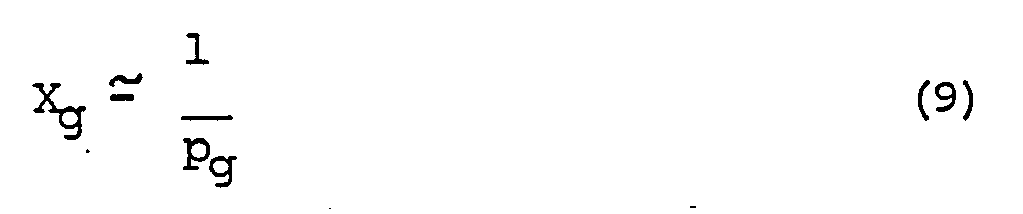
- The delay in changes of pressure pr observed at the choke in relation to the variations in the pump rate is highly sensitive to the presence of gas in the annulus. The compressibility of a gas is in a first approximation the inverse of the pressure of that gas:
tank 4. It may even prove indispensible if the well is horizontal, since it is then impossible to use differences in hydrostatic pressure to estimate the nature of the influx. - According to one embodiment, the method therefore consists in circulating the mud slowly through
choke 13, and simultaneously recording the pressure pr read bysensor 19 and the rate Qi read bysensor 16 during the transient period. These data are then interpreted and the values of XaVa and kd calculated. The volume Va of the annulus being known, this makes it possible to estimate a mean compressibility Xa of the fluids contained in the annulus. If the value obtained is high compared to a predetermined value, which may be the compressibility Xm of the mud, if this value is known, or alternatively the value of Xa previously determined by the same method but in the absence of gas (during a calibration operation, for instance), it may be concluded that the fluid arriving from the formation is a gas. Once the presence of gas has been confirmed, its volume may be estimated. - It should be noted that if it is difficult for operational reasons to circulate the mud through the
choke 13 in order to study the pressure transients at that choke, it is also possible, according to an alternative embodiment of the invention, to measure the pressure increase at thechoke 13 by means ofsensor 19 when a known volume is injected into the annulus, in other words when the well is pressurized by a few strokes of thepump 6. This increase in the volume of mud dV also allows XaVa to be calculated from the equation dV = XaVa dpr, dpr being the pressure variation at thechoke 13. - Figure 3 illustrates the proposed method within the scope of the present invention. Data plotted in figure 3 were obtained from tests carried out under controlled conditions where a known quantity of gas was injected at the bottom of an experimental well. The pressure delay pr with a change of rate Qi may be noted on the recording in figure 3 made as a function of time t. This figure also shows variations in the output rate Qr and injection pressure pi. It will be noted that the values of Qr also change with some delay compared to the values of Qi or pi. Table I gives the values of Qi (in cm³/s) and pr (in bar) measured and represented on figure 3 as a function of time t and the corresponding calculated values y and x of equation (6) with:

TABLE I t Qi pr x y 904. 8263.9 27.33 0 1.581 906. 8263.9 27.33 31.88 1.581 908. 8263.9 27.67 31.69 1.571 910. 8327.0 28.00 15.75 1.574 914. 8327.0 28.33 31.31 1.564 916. 8327.0 28.67 15.56 1.555 920. 8327.0 29.00 30.95 1.546 922. 8263.9 29.33 30.77 1.526 926. 8263.9 30.00 15.21 1.509 930. 8263.9 30.33 30.26 1.500 932. 8263.9 30.67 15.05 1.492 936. 8327.0 31.00 29.93 1.496 938. 8768.6 31.33 59.55 1.566 940. 8579.3 32.00 0 1.517 942. 8705.5 32.00 0 1.539 944. 8705.5 32.00 44.19 1.539 948. 9020.9 33.00 43.52 1.570 952. 9084.0 34.00 28.58 1.558 954. 9084.0 34.33 28.44 1.550 958. 9020.9 35.00 0 1.525 960. 9020.9 35.00 56.34 1.525 962. 8957.8 35.67 0 1.500 964. 8957.8 35.67 27.91 1.500 968. 9020.9 36.33 0 1.497 970. 9020.9 36.33 27.65 1.497 974. 9020.9 37.00 13.70 1.483 978. 9020.9 37.33 0 1.476 980. 9020.9 37.33 13.64 1.476 984. 8957.8 37.67 27.16 1.460 988. 9020.9 38.33 0 1.457 990. 9020.9 38.33 13.46 1.457 994. 9020.9 38.67 0 1.451 996. 9020.9 38.67 0 1.451 998. 9020.9 38.67 26.80 1.451 1000. 9020.9 39.00 8.896 1.445 1006. 9020.9 39.33 0 1.438 1010. 9020.9 39.33 26.57 1.438 1012. 9020.9 39.67 0 1.432 1016. 8957.8 39.67 26.46 1.422 1018. 8957.8 40.00 0 1.416 1022. 9020.9 40.00 13.18 1.426 1052. 8957.8 41.33 0 1.393 1072. 8957.8 41.67 0 1.388 1102. 8957.8 42.33 0 1.377 1122. 9084.0 42.67 0 1.391 1150. 9147.1 43.33 0 1.390
Claims (9)
Applications Claiming Priority (2)
| Application Number | Priority Date | Filing Date | Title |
|---|---|---|---|
| FR8711258A FR2619155B1 (en) | 1987-08-07 | 1987-08-07 | PROCESS OF DYNAMIC ANALYSIS OF THE VENUES OF FLUIDS IN THE WELLS OF HYDROCARBONS |
| FR8711258 | 1987-08-07 |
Publications (2)
| Publication Number | Publication Date |
|---|---|
| EP0302558A1 true EP0302558A1 (en) | 1989-02-08 |
| EP0302558B1 EP0302558B1 (en) | 1992-04-22 |
Family
ID=9354007
Family Applications (1)
| Application Number | Title | Priority Date | Filing Date |
|---|---|---|---|
| EP88201610A Expired - Lifetime EP0302558B1 (en) | 1987-08-07 | 1988-07-26 | Method of analysing fluid influxes in hydrocarbon wells |
Country Status (6)
| Country | Link |
|---|---|
| US (1) | US5070949A (en) |
| EP (1) | EP0302558B1 (en) |
| CA (1) | CA1325278C (en) |
| DE (1) | DE3870348D1 (en) |
| FR (1) | FR2619155B1 (en) |
| NO (1) | NO172907C (en) |
Cited By (3)
| Publication number | Priority date | Publication date | Assignee | Title |
|---|---|---|---|---|
| GB2239279A (en) * | 1989-12-20 | 1991-06-26 | Forex Neptune Sa | Controlling a fluid influx during the drilling of a borehole. |
| EP0458391A1 (en) * | 1990-05-23 | 1991-11-27 | Services Petroliers Schlumberger | Pipe rheometer |
| US7044237B2 (en) | 2000-12-18 | 2006-05-16 | Impact Solutions Group Limited | Drilling system and method |
Families Citing this family (24)
| Publication number | Priority date | Publication date | Assignee | Title |
|---|---|---|---|---|
| US6101871A (en) * | 1995-02-28 | 2000-08-15 | Sandra K. Myers | In-ground vapor monitoring device and method |
| US5730233A (en) * | 1996-07-22 | 1998-03-24 | Alberta Industrial Technologies Ltd. | Method for detecting changes in rate of discharge of fluid from a wellbore |
| RU2132945C1 (en) * | 1997-10-14 | 1999-07-10 | Предприятие "Астраханьгазпром" РАО "Газпром" | Method for investigation of absorbing beds |
| CA2256258C (en) * | 1998-12-16 | 2007-10-02 | Konstandinos S. Zamfes | Swab test for determining relative formation productivity |
| RU2165519C1 (en) * | 1999-10-22 | 2001-04-20 | ООО "Уренгойгазпром" ОАО "Газпром" | Method of survey of wells |
| US6374925B1 (en) | 2000-09-22 | 2002-04-23 | Varco Shaffer, Inc. | Well drilling method and system |
| US7026950B2 (en) * | 2003-03-12 | 2006-04-11 | Varco I/P, Inc. | Motor pulse controller |
| RU2244105C1 (en) * | 2003-08-11 | 2005-01-10 | ООО "Уренгойгазпром" | Method of examining wells |
| US7866399B2 (en) | 2005-10-20 | 2011-01-11 | Transocean Sedco Forex Ventures Limited | Apparatus and method for managed pressure drilling |
| EA014363B1 (en) * | 2006-10-23 | 2010-10-29 | Эм-Ай Эл. Эл. Си. | Method and apparatus for controlling bottom hole pressure in a subterranean formation during rig pump operation |
| US9435162B2 (en) | 2006-10-23 | 2016-09-06 | M-I L.L.C. | Method and apparatus for controlling bottom hole pressure in a subterranean formation during rig pump operation |
| US7950472B2 (en) * | 2008-02-19 | 2011-05-31 | Baker Hughes Incorporated | Downhole local mud weight measurement near bit |
| US8307913B2 (en) * | 2008-05-01 | 2012-11-13 | Schlumberger Technology Corporation | Drilling system with drill string valves |
| GB0819340D0 (en) * | 2008-10-22 | 2008-11-26 | Managed Pressure Operations Ll | Drill pipe |
| GB0905633D0 (en) | 2009-04-01 | 2009-05-13 | Managed Pressure Operations Ll | Apparatus for and method of drilling a subterranean borehole |
| GB2469119B (en) | 2009-04-03 | 2013-07-03 | Managed Pressure Operations | Drill pipe connector |
| MX2012001983A (en) * | 2009-09-15 | 2012-04-11 | Managed Pressure Operations | Method of drilling a subterranean borehole. |
| US8235143B2 (en) * | 2010-07-06 | 2012-08-07 | Simon Tseytlin | Methods and devices for determination of gas-kick parametrs and prevention of well explosion |
| US8684109B2 (en) | 2010-11-16 | 2014-04-01 | Managed Pressure Operations Pte Ltd | Drilling method for drilling a subterranean borehole |
| US9458696B2 (en) | 2010-12-24 | 2016-10-04 | Managed Pressure Operations Pte. Ltd. | Valve assembly |
| US8965703B2 (en) * | 2011-10-03 | 2015-02-24 | Schlumberger Technology Corporation | Applications based on fluid properties measured downhole |
| US9033048B2 (en) * | 2011-12-28 | 2015-05-19 | Hydril Usa Manufacturing Llc | Apparatuses and methods for determining wellbore influx condition using qualitative indications |
| WO2015160328A1 (en) * | 2014-04-15 | 2015-10-22 | Halliburton Energy Services, Inc. | Determination of downhole conditions using circulated non-formation gasses |
| RU2684924C1 (en) * | 2018-05-17 | 2019-04-16 | Федеральное государственное бюджетное образовательное учреждение высшего образования "Кубанский государственный технологический университет" (ФГБОУ ВО "КубГТУ") | Method of the cutting well research in the drilling process |
Citations (4)
| Publication number | Priority date | Publication date | Assignee | Title |
|---|---|---|---|---|
| DE1815725A1 (en) * | 1967-12-21 | 1969-07-17 | Dresser Ind | Procedure and arrangement for automatic control of the killing of oil and gas creatures |
| AT292328B (en) * | 1968-10-04 | 1971-08-25 | Manfred Dr Ing Lorbach | Device for measuring inflow and outflow in boreholes or probes |
| US3760891A (en) * | 1972-05-19 | 1973-09-25 | Offshore Co | Blowout and lost circulation detector |
| US4253530A (en) * | 1979-10-09 | 1981-03-03 | Dresser Industries, Inc. | Method and system for circulating a gas bubble from a well |
Family Cites Families (7)
| Publication number | Priority date | Publication date | Assignee | Title |
|---|---|---|---|---|
| US3968844A (en) * | 1974-09-19 | 1976-07-13 | Continental Oil Company | Determining the extent of entry of fluids into a borehole during drilling |
| US4733233A (en) * | 1983-06-23 | 1988-03-22 | Teleco Oilfield Services Inc. | Method and apparatus for borehole fluid influx detection |
| US4553429A (en) * | 1984-02-09 | 1985-11-19 | Exxon Production Research Co. | Method and apparatus for monitoring fluid flow between a borehole and the surrounding formations in the course of drilling operations |
| US4635735A (en) * | 1984-07-06 | 1987-01-13 | Schlumberger Technology Corporation | Method and apparatus for the continuous analysis of drilling mud |
| US4606415A (en) * | 1984-11-19 | 1986-08-19 | Texaco Inc. | Method and system for detecting and identifying abnormal drilling conditions |
| FR2619156B1 (en) * | 1987-08-07 | 1989-12-22 | Forex Neptune Sa | PROCESS FOR CONTROLLING VENUES OF FLUIDS IN HYDROCARBON WELLS |
| US5006845A (en) * | 1989-06-13 | 1991-04-09 | Honeywell Inc. | Gas kick detector |
-
1987
- 1987-08-07 FR FR8711258A patent/FR2619155B1/en not_active Expired
-
1988
- 1988-07-26 DE DE8888201610T patent/DE3870348D1/en not_active Expired - Lifetime
- 1988-07-26 EP EP88201610A patent/EP0302558B1/en not_active Expired - Lifetime
- 1988-08-02 CA CA000573547A patent/CA1325278C/en not_active Expired - Fee Related
- 1988-08-05 NO NO883505A patent/NO172907C/en unknown
-
1991
- 1991-05-10 US US07/701,352 patent/US5070949A/en not_active Expired - Fee Related
Patent Citations (4)
| Publication number | Priority date | Publication date | Assignee | Title |
|---|---|---|---|---|
| DE1815725A1 (en) * | 1967-12-21 | 1969-07-17 | Dresser Ind | Procedure and arrangement for automatic control of the killing of oil and gas creatures |
| AT292328B (en) * | 1968-10-04 | 1971-08-25 | Manfred Dr Ing Lorbach | Device for measuring inflow and outflow in boreholes or probes |
| US3760891A (en) * | 1972-05-19 | 1973-09-25 | Offshore Co | Blowout and lost circulation detector |
| US4253530A (en) * | 1979-10-09 | 1981-03-03 | Dresser Industries, Inc. | Method and system for circulating a gas bubble from a well |
Cited By (8)
| Publication number | Priority date | Publication date | Assignee | Title |
|---|---|---|---|---|
| GB2239279A (en) * | 1989-12-20 | 1991-06-26 | Forex Neptune Sa | Controlling a fluid influx during the drilling of a borehole. |
| EP0436242A1 (en) * | 1989-12-20 | 1991-07-10 | SERVICES PETROLIERS SCHLUMBERGER, (formerly Société de Prospection Electrique Schlumberger) | Method of analysing and controlling a fluid influx during the drilling of a borehole |
| US5080182A (en) * | 1989-12-20 | 1992-01-14 | Schlumberger Technology Corporation | Method of analyzing and controlling a fluid influx during the drilling of a borehole |
| GB2239279B (en) * | 1989-12-20 | 1993-06-16 | Forex Neptune Sa | Method of analysing and controlling a fluid influx during the drilling of a borehole |
| EP0458391A1 (en) * | 1990-05-23 | 1991-11-27 | Services Petroliers Schlumberger | Pipe rheometer |
| US7044237B2 (en) | 2000-12-18 | 2006-05-16 | Impact Solutions Group Limited | Drilling system and method |
| US7278496B2 (en) | 2000-12-18 | 2007-10-09 | Christian Leuchtenberg | Drilling system and method |
| US7367411B2 (en) | 2000-12-18 | 2008-05-06 | Secure Drilling International, L.P. | Drilling system and method |
Also Published As
| Publication number | Publication date |
|---|---|
| DE3870348D1 (en) | 1992-05-27 |
| US5070949A (en) | 1991-12-10 |
| EP0302558B1 (en) | 1992-04-22 |
| NO883505D0 (en) | 1988-08-05 |
| NO172907B (en) | 1993-06-14 |
| FR2619155A1 (en) | 1989-02-10 |
| FR2619155B1 (en) | 1989-12-22 |
| NO172907C (en) | 1993-09-22 |
| NO883505L (en) | 1989-02-08 |
| CA1325278C (en) | 1993-12-14 |
Similar Documents
| Publication | Publication Date | Title |
|---|---|---|
| EP0302558B1 (en) | Method of analysing fluid influxes in hydrocarbon wells | |
| CA1296707C (en) | Method of controlling fluid influxes in hydrocarbon wells | |
| US5080182A (en) | Method of analyzing and controlling a fluid influx during the drilling of a borehole | |
| US3955411A (en) | Method for measuring the vertical height and/or density of drilling fluid columns | |
| US10132129B2 (en) | Managed pressure drilling with rig heave compensation | |
| CA1057081A (en) | Method and apparatus for determining on-board a heaving vessel the flow rate of drilling fluid flowing out of a wellhole and into a telescoping marine riser connected between the wellhole and vessel | |
| US5006845A (en) | Gas kick detector | |
| US6427785B2 (en) | Subsurface measurement apparatus, system, and process for improved well drilling, control, and production | |
| US3910110A (en) | Motion compensated blowout and loss circulation detection | |
| US4961343A (en) | Method for determining permeability in hydrocarbon wells | |
| US20040065440A1 (en) | Dual-gradient drilling using nitrogen injection | |
| US11643891B2 (en) | Drilling system and method using calibrated pressure losses | |
| US20120228027A1 (en) | Method for characterizing subsurface formations using fluid pressure response during drilling operations | |
| CA2047587A1 (en) | Detecting outflow or inflow of fluid in a wellbore | |
| Maus et al. | Instrumentation requirements for kick detection in deep water | |
| US4485675A (en) | Pneumatic fluid densiometer | |
| US11643928B2 (en) | Siphon pump chimney for formation tester | |
| US3911740A (en) | Method of and apparatus for measuring properties of drilling mud in an underwater well | |
| WO2025006037A1 (en) | Drilling system and method using dynamically determined drilling window | |
| BR112021012437B1 (en) | SYSTEM, ASSEMBLY AND METHOD USABLE IN A WELLHOLDER ENVIRONMENT | |
| GB2084221A (en) | A method and apparatus for compensating well control instrumentation for the effects of vessel heave |
Legal Events
| Date | Code | Title | Description |
|---|---|---|---|
| PUAI | Public reference made under article 153(3) epc to a published international application that has entered the european phase |
Free format text: ORIGINAL CODE: 0009012 |
|
| AK | Designated contracting states |
Kind code of ref document: A1 Designated state(s): DE GB IT NL |
|
| 17P | Request for examination filed |
Effective date: 19890620 |
|
| 17Q | First examination report despatched |
Effective date: 19901024 |
|
| RAP1 | Party data changed (applicant data changed or rights of an application transferred) |
Owner name: SERVICES PETROLIERS SCHLUMBERGER |
|
| GRAA | (expected) grant |
Free format text: ORIGINAL CODE: 0009210 |
|
| ITF | It: translation for a ep patent filed | ||
| AK | Designated contracting states |
Kind code of ref document: B1 Designated state(s): DE GB IT NL |
|
| REF | Corresponds to: |
Ref document number: 3870348 Country of ref document: DE Date of ref document: 19920527 |
|
| PLBE | No opposition filed within time limit |
Free format text: ORIGINAL CODE: 0009261 |
|
| STAA | Information on the status of an ep patent application or granted ep patent |
Free format text: STATUS: NO OPPOSITION FILED WITHIN TIME LIMIT |
|
| 26N | No opposition filed | ||
| PGFP | Annual fee paid to national office [announced via postgrant information from national office to epo] |
Ref country code: GB Payment date: 19990611 Year of fee payment: 12 |
|
| PGFP | Annual fee paid to national office [announced via postgrant information from national office to epo] |
Ref country code: NL Payment date: 19990729 Year of fee payment: 12 |
|
| PGFP | Annual fee paid to national office [announced via postgrant information from national office to epo] |
Ref country code: DE Payment date: 19990922 Year of fee payment: 12 |
|
| PG25 | Lapsed in a contracting state [announced via postgrant information from national office to epo] |
Ref country code: GB Free format text: LAPSE BECAUSE OF NON-PAYMENT OF DUE FEES Effective date: 20000726 |
|
| PG25 | Lapsed in a contracting state [announced via postgrant information from national office to epo] |
Ref country code: NL Free format text: LAPSE BECAUSE OF NON-PAYMENT OF DUE FEES Effective date: 20010201 |
|
| GBPC | Gb: european patent ceased through non-payment of renewal fee |
Effective date: 20000726 |
|
| NLV4 | Nl: lapsed or anulled due to non-payment of the annual fee |
Effective date: 20010201 |
|
| PG25 | Lapsed in a contracting state [announced via postgrant information from national office to epo] |
Ref country code: DE Free format text: LAPSE BECAUSE OF NON-PAYMENT OF DUE FEES Effective date: 20010501 |
|
| PG25 | Lapsed in a contracting state [announced via postgrant information from national office to epo] |
Ref country code: IT Free format text: LAPSE BECAUSE OF NON-PAYMENT OF DUE FEES;WARNING: LAPSES OF ITALIAN PATENTS WITH EFFECTIVE DATE BEFORE 2007 MAY HAVE OCCURRED AT ANY TIME BEFORE 2007. THE CORRECT EFFECTIVE DATE MAY BE DIFFERENT FROM THE ONE RECORDED. Effective date: 20050726 |