EP0293406B1 - Solvent system for an ionizable pharmaceutical agent - Google Patents
Solvent system for an ionizable pharmaceutical agent Download PDFInfo
- Publication number
- EP0293406B1 EP0293406B1 EP87907194A EP87907194A EP0293406B1 EP 0293406 B1 EP0293406 B1 EP 0293406B1 EP 87907194 A EP87907194 A EP 87907194A EP 87907194 A EP87907194 A EP 87907194A EP 0293406 B1 EP0293406 B1 EP 0293406B1
- Authority
- EP
- European Patent Office
- Prior art keywords
- weight
- polyethylene glycol
- solution
- highly concentrated
- softgel
- Prior art date
- Legal status (The legal status is an assumption and is not a legal conclusion. Google has not performed a legal analysis and makes no representation as to the accuracy of the status listed.)
- Expired - Lifetime
Links
- 239000008177 pharmaceutical agent Substances 0.000 title claims abstract description 93
- 239000002904 solvent Substances 0.000 title claims abstract description 51
- 239000000243 solution Substances 0.000 claims abstract description 124
- 229920001223 polyethylene glycol Polymers 0.000 claims abstract description 77
- 239000002202 Polyethylene glycol Substances 0.000 claims abstract description 75
- 229920000036 polyvinylpyrrolidone Polymers 0.000 claims abstract description 41
- 235000013855 polyvinylpyrrolidone Nutrition 0.000 claims abstract description 41
- 239000001267 polyvinylpyrrolidone Substances 0.000 claims abstract description 39
- XLYOFNOQVPJJNP-UHFFFAOYSA-N water Substances O XLYOFNOQVPJJNP-UHFFFAOYSA-N 0.000 claims abstract description 37
- PEDCQBHIVMGVHV-UHFFFAOYSA-N Glycerine Chemical compound OCC(O)CO PEDCQBHIVMGVHV-UHFFFAOYSA-N 0.000 claims abstract description 36
- XLYOFNOQVPJJNP-UHFFFAOYSA-M hydroxide Chemical group [OH-] XLYOFNOQVPJJNP-UHFFFAOYSA-M 0.000 claims abstract description 36
- 238000005538 encapsulation Methods 0.000 claims abstract description 33
- 238000011049 filling Methods 0.000 claims abstract description 31
- 230000002708 enhancing effect Effects 0.000 claims abstract description 25
- 235000011187 glycerol Nutrition 0.000 claims abstract description 18
- 239000003795 chemical substances by application Substances 0.000 claims abstract description 15
- GPRLSGONYQIRFK-UHFFFAOYSA-N hydron Chemical group [H+] GPRLSGONYQIRFK-UHFFFAOYSA-N 0.000 claims abstract description 10
- 238000006243 chemical reaction Methods 0.000 claims abstract description 8
- 230000036961 partial effect Effects 0.000 claims abstract description 5
- RZVAJINKPMORJF-UHFFFAOYSA-N Acetaminophen Chemical compound CC(=O)NC1=CC=C(O)C=C1 RZVAJINKPMORJF-UHFFFAOYSA-N 0.000 claims description 54
- CGIGDMFJXJATDK-UHFFFAOYSA-N indomethacin Chemical compound CC1=C(CC(O)=O)C2=CC(OC)=CC=C2N1C(=O)C1=CC=C(Cl)C=C1 CGIGDMFJXJATDK-UHFFFAOYSA-N 0.000 claims description 54
- HEFNNWSXXWATRW-UHFFFAOYSA-N Ibuprofen Chemical compound CC(C)CC1=CC=C(C(C)C(O)=O)C=C1 HEFNNWSXXWATRW-UHFFFAOYSA-N 0.000 claims description 37
- 229960001680 ibuprofen Drugs 0.000 claims description 37
- KWYUFKZDYYNOTN-UHFFFAOYSA-M Potassium hydroxide Chemical compound [OH-].[K+] KWYUFKZDYYNOTN-UHFFFAOYSA-M 0.000 claims description 36
- CMWTZPSULFXXJA-UHFFFAOYSA-N Naproxen Natural products C1=C(C(C)C(O)=O)C=CC2=CC(OC)=CC=C21 CMWTZPSULFXXJA-UHFFFAOYSA-N 0.000 claims description 31
- 229960002009 naproxen Drugs 0.000 claims description 31
- CMWTZPSULFXXJA-VIFPVBQESA-N naproxen Chemical compound C1=C([C@H](C)C(O)=O)C=CC2=CC(OC)=CC=C21 CMWTZPSULFXXJA-VIFPVBQESA-N 0.000 claims description 31
- 229960000905 indomethacin Drugs 0.000 claims description 27
- 229960005489 paracetamol Drugs 0.000 claims description 27
- 239000002775 capsule Substances 0.000 claims description 25
- DNIAPMSPPWPWGF-UHFFFAOYSA-N Propylene glycol Chemical compound CC(O)CO DNIAPMSPPWPWGF-UHFFFAOYSA-N 0.000 claims description 24
- 230000015572 biosynthetic process Effects 0.000 claims description 12
- 239000007864 aqueous solution Substances 0.000 claims description 7
- YZCKVEUIGOORGS-IGMARMGPSA-N Protium Chemical compound [1H] YZCKVEUIGOORGS-IGMARMGPSA-N 0.000 claims 2
- 230000002378 acidificating effect Effects 0.000 abstract description 45
- 239000003814 drug Substances 0.000 abstract description 15
- 239000006104 solid solution Substances 0.000 abstract description 13
- 229940079593 drug Drugs 0.000 abstract description 10
- 238000002360 preparation method Methods 0.000 abstract description 9
- 230000009747 swallowing Effects 0.000 abstract description 5
- 239000004540 pour-on Substances 0.000 abstract description 2
- 230000000694 effects Effects 0.000 abstract 1
- 238000006386 neutralization reaction Methods 0.000 abstract 1
- HEMHJVSKTPXQMS-UHFFFAOYSA-M Sodium hydroxide Chemical compound [OH-].[Na+] HEMHJVSKTPXQMS-UHFFFAOYSA-M 0.000 description 60
- 239000000203 mixture Substances 0.000 description 34
- 239000007788 liquid Substances 0.000 description 27
- 238000009472 formulation Methods 0.000 description 26
- 239000007787 solid Substances 0.000 description 18
- 238000004090 dissolution Methods 0.000 description 8
- 108010010803 Gelatin Proteins 0.000 description 7
- 229920000159 gelatin Polymers 0.000 description 7
- 239000008273 gelatin Substances 0.000 description 7
- 235000019322 gelatine Nutrition 0.000 description 7
- 235000011852 gelatine desserts Nutrition 0.000 description 7
- 238000010521 absorption reaction Methods 0.000 description 6
- 239000002253 acid Substances 0.000 description 6
- 238000004519 manufacturing process Methods 0.000 description 6
- 239000004100 Oxytetracycline Substances 0.000 description 5
- 229960001380 cimetidine Drugs 0.000 description 5
- CCGSUNCLSOWKJO-UHFFFAOYSA-N cimetidine Chemical compound N#CNC(=N/C)\NCCSCC1=NC=N[C]1C CCGSUNCLSOWKJO-UHFFFAOYSA-N 0.000 description 5
- -1 hydroxyl ions Chemical class 0.000 description 5
- 239000000463 material Substances 0.000 description 5
- IWVCMVBTMGNXQD-PXOLEDIWSA-N oxytetracycline Chemical compound C1=CC=C2[C@](O)(C)[C@H]3[C@H](O)[C@H]4[C@H](N(C)C)C(O)=C(C(N)=O)C(=O)[C@@]4(O)C(O)=C3C(=O)C2=C1O IWVCMVBTMGNXQD-PXOLEDIWSA-N 0.000 description 5
- 229960000625 oxytetracycline Drugs 0.000 description 5
- 235000019366 oxytetracycline Nutrition 0.000 description 5
- 239000000725 suspension Substances 0.000 description 5
- IWVCMVBTMGNXQD-UHFFFAOYSA-N terramycin dehydrate Natural products C1=CC=C2C(O)(C)C3C(O)C4C(N(C)C)C(O)=C(C(N)=O)C(=O)C4(O)C(O)=C3C(=O)C2=C1O IWVCMVBTMGNXQD-UHFFFAOYSA-N 0.000 description 5
- 229920002565 Polyethylene Glycol 400 Polymers 0.000 description 4
- 150000001875 compounds Chemical class 0.000 description 4
- 239000007887 hard shell capsule Substances 0.000 description 4
- 238000012986 modification Methods 0.000 description 4
- 230000004048 modification Effects 0.000 description 4
- 238000001556 precipitation Methods 0.000 description 4
- 150000003839 salts Chemical class 0.000 description 4
- 238000007614 solvation Methods 0.000 description 4
- 239000003981 vehicle Substances 0.000 description 4
- UHOVQNZJYSORNB-UHFFFAOYSA-N Benzene Chemical compound C1=CC=CC=C1 UHOVQNZJYSORNB-UHFFFAOYSA-N 0.000 description 3
- WVDDGKGOMKODPV-UHFFFAOYSA-N Benzyl alcohol Chemical compound OCC1=CC=CC=C1 WVDDGKGOMKODPV-UHFFFAOYSA-N 0.000 description 3
- LFQSCWFLJHTTHZ-UHFFFAOYSA-N Ethanol Chemical compound CCO LFQSCWFLJHTTHZ-UHFFFAOYSA-N 0.000 description 3
- 239000012738 dissolution medium Substances 0.000 description 3
- 239000007903 gelatin capsule Substances 0.000 description 3
- 238000000034 method Methods 0.000 description 3
- 239000003921 oil Substances 0.000 description 3
- 235000019198 oils Nutrition 0.000 description 3
- 229910001414 potassium ion Inorganic materials 0.000 description 3
- 239000011782 vitamin Substances 0.000 description 3
- 229940088594 vitamin Drugs 0.000 description 3
- 229930003231 vitamin Natural products 0.000 description 3
- 235000013343 vitamin Nutrition 0.000 description 3
- QGZKDVFQNNGYKY-UHFFFAOYSA-N Ammonia Chemical compound N QGZKDVFQNNGYKY-UHFFFAOYSA-N 0.000 description 2
- 229920002582 Polyethylene Glycol 600 Polymers 0.000 description 2
- NPYPAHLBTDXSSS-UHFFFAOYSA-N Potassium ion Chemical compound [K+] NPYPAHLBTDXSSS-UHFFFAOYSA-N 0.000 description 2
- KLBQZWRITKRQQV-UHFFFAOYSA-N Thioridazine Chemical compound C12=CC(SC)=CC=C2SC2=CC=CC=C2N1CCC1CCCCN1C KLBQZWRITKRQQV-UHFFFAOYSA-N 0.000 description 2
- 150000007513 acids Chemical class 0.000 description 2
- 239000002671 adjuvant Substances 0.000 description 2
- 150000001298 alcohols Chemical class 0.000 description 2
- 238000013459 approach Methods 0.000 description 2
- 229960001193 diclofenac sodium Drugs 0.000 description 2
- 238000007922 dissolution test Methods 0.000 description 2
- 239000003937 drug carrier Substances 0.000 description 2
- 150000002148 esters Chemical class 0.000 description 2
- 150000002170 ethers Chemical class 0.000 description 2
- 230000002209 hydrophobic effect Effects 0.000 description 2
- HYIMSNHJOBLJNT-UHFFFAOYSA-N nifedipine Chemical compound COC(=O)C1=C(C)NC(C)=C(C(=O)OC)C1C1=CC=CC=C1[N+]([O-])=O HYIMSNHJOBLJNT-UHFFFAOYSA-N 0.000 description 2
- 229960001597 nifedipine Drugs 0.000 description 2
- 239000003755 preservative agent Substances 0.000 description 2
- 235000013772 propylene glycol Nutrition 0.000 description 2
- VMXUWOKSQNHOCA-LCYFTJDESA-N ranitidine Chemical compound [O-][N+](=O)/C=C(/NC)NCCSCC1=CC=C(CN(C)C)O1 VMXUWOKSQNHOCA-LCYFTJDESA-N 0.000 description 2
- 229960000620 ranitidine Drugs 0.000 description 2
- 229910001415 sodium ion Inorganic materials 0.000 description 2
- 159000000000 sodium salts Chemical class 0.000 description 2
- JGMJQSFLQWGYMQ-UHFFFAOYSA-M sodium;2,6-dichloro-n-phenylaniline;acetate Chemical compound [Na+].CC([O-])=O.ClC1=CC=CC(Cl)=C1NC1=CC=CC=C1 JGMJQSFLQWGYMQ-UHFFFAOYSA-M 0.000 description 2
- 239000000829 suppository Substances 0.000 description 2
- 229960002784 thioridazine Drugs 0.000 description 2
- 238000000870 ultraviolet spectroscopy Methods 0.000 description 2
- YKFCISHFRZHKHY-NGQGLHOPSA-N (2s)-2-amino-3-(3,4-dihydroxyphenyl)-2-methylpropanoic acid;trihydrate Chemical compound O.O.O.OC(=O)[C@](N)(C)CC1=CC=C(O)C(O)=C1.OC(=O)[C@](N)(C)CC1=CC=C(O)C(O)=C1 YKFCISHFRZHKHY-NGQGLHOPSA-N 0.000 description 1
- QGZKDVFQNNGYKY-UHFFFAOYSA-O Ammonium Chemical compound [NH4+] QGZKDVFQNNGYKY-UHFFFAOYSA-O 0.000 description 1
- LTMHDMANZUZIPE-AMTYYWEZSA-N Digoxin Natural products O([C@H]1[C@H](C)O[C@H](O[C@@H]2C[C@@H]3[C@@](C)([C@@H]4[C@H]([C@]5(O)[C@](C)([C@H](O)C4)[C@H](C4=CC(=O)OC4)CC5)CC3)CC2)C[C@@H]1O)[C@H]1O[C@H](C)[C@@H](O[C@H]2O[C@@H](C)[C@H](O)[C@@H](O)C2)[C@@H](O)C1 LTMHDMANZUZIPE-AMTYYWEZSA-N 0.000 description 1
- 108010061435 Enalapril Proteins 0.000 description 1
- OTMSDBZUPAUEDD-UHFFFAOYSA-N Ethane Chemical compound CC OTMSDBZUPAUEDD-UHFFFAOYSA-N 0.000 description 1
- UFHFLCQGNIYNRP-UHFFFAOYSA-N Hydrogen Chemical compound [H][H] UFHFLCQGNIYNRP-UHFFFAOYSA-N 0.000 description 1
- DGAQECJNVWCQMB-PUAWFVPOSA-M Ilexoside XXIX Chemical compound C[C@@H]1CC[C@@]2(CC[C@@]3(C(=CC[C@H]4[C@]3(CC[C@@H]5[C@@]4(CC[C@@H](C5(C)C)OS(=O)(=O)[O-])C)C)[C@@H]2[C@]1(C)O)C)C(=O)O[C@H]6[C@@H]([C@H]([C@@H]([C@H](O6)CO)O)O)O.[Na+] DGAQECJNVWCQMB-PUAWFVPOSA-M 0.000 description 1
- FYYHWMGAXLPEAU-UHFFFAOYSA-N Magnesium Chemical compound [Mg] FYYHWMGAXLPEAU-UHFFFAOYSA-N 0.000 description 1
- ZLMJMSJWJFRBEC-UHFFFAOYSA-N Potassium Chemical compound [K] ZLMJMSJWJFRBEC-UHFFFAOYSA-N 0.000 description 1
- FKNQFGJONOIPTF-UHFFFAOYSA-N Sodium cation Chemical compound [Na+] FKNQFGJONOIPTF-UHFFFAOYSA-N 0.000 description 1
- 239000001089 [(2R)-oxolan-2-yl]methanol Substances 0.000 description 1
- 239000000853 adhesive Substances 0.000 description 1
- 230000001070 adhesive effect Effects 0.000 description 1
- 150000001338 aliphatic hydrocarbons Chemical class 0.000 description 1
- 239000012670 alkaline solution Substances 0.000 description 1
- 150000001412 amines Chemical class 0.000 description 1
- 150000001413 amino acids Chemical class 0.000 description 1
- 229910021529 ammonia Inorganic materials 0.000 description 1
- 150000004945 aromatic hydrocarbons Chemical class 0.000 description 1
- 239000010692 aromatic oil Substances 0.000 description 1
- 235000019445 benzyl alcohol Nutrition 0.000 description 1
- 239000000969 carrier Substances 0.000 description 1
- 150000001768 cations Chemical class 0.000 description 1
- 229940083181 centrally acting adntiadrenergic agent methyldopa Drugs 0.000 description 1
- 239000013522 chelant Substances 0.000 description 1
- 150000008280 chlorinated hydrocarbons Chemical class 0.000 description 1
- 238000004040 coloring Methods 0.000 description 1
- 230000000295 complement effect Effects 0.000 description 1
- 229920001577 copolymer Polymers 0.000 description 1
- 230000001186 cumulative effect Effects 0.000 description 1
- 230000003247 decreasing effect Effects 0.000 description 1
- MTHSVFCYNBDYFN-UHFFFAOYSA-N diethylene glycol Chemical compound OCCOCCO MTHSVFCYNBDYFN-UHFFFAOYSA-N 0.000 description 1
- LTMHDMANZUZIPE-PUGKRICDSA-N digoxin Chemical compound C1[C@H](O)[C@H](O)[C@@H](C)O[C@H]1O[C@@H]1[C@@H](C)O[C@@H](O[C@@H]2[C@H](O[C@@H](O[C@@H]3C[C@@H]4[C@]([C@@H]5[C@H]([C@]6(CC[C@@H]([C@@]6(C)[C@H](O)C5)C=5COC(=O)C=5)O)CC4)(C)CC3)C[C@@H]2O)C)C[C@@H]1O LTMHDMANZUZIPE-PUGKRICDSA-N 0.000 description 1
- 229960005156 digoxin Drugs 0.000 description 1
- LTMHDMANZUZIPE-UHFFFAOYSA-N digoxine Natural products C1C(O)C(O)C(C)OC1OC1C(C)OC(OC2C(OC(OC3CC4C(C5C(C6(CCC(C6(C)C(O)C5)C=5COC(=O)C=5)O)CC4)(C)CC3)CC2O)C)CC1O LTMHDMANZUZIPE-UHFFFAOYSA-N 0.000 description 1
- 239000000539 dimer Substances 0.000 description 1
- 238000002651 drug therapy Methods 0.000 description 1
- 230000009977 dual effect Effects 0.000 description 1
- 239000000839 emulsion Substances 0.000 description 1
- GBXSMTUPTTWBMN-XIRDDKMYSA-N enalapril Chemical compound C([C@@H](C(=O)OCC)N[C@@H](C)C(=O)N1[C@@H](CCC1)C(O)=O)CC1=CC=CC=C1 GBXSMTUPTTWBMN-XIRDDKMYSA-N 0.000 description 1
- 229960000873 enalapril Drugs 0.000 description 1
- 238000002474 experimental method Methods 0.000 description 1
- 239000000706 filtrate Substances 0.000 description 1
- 229910052739 hydrogen Inorganic materials 0.000 description 1
- 239000001257 hydrogen Substances 0.000 description 1
- 229910052500 inorganic mineral Inorganic materials 0.000 description 1
- 238000010255 intramuscular injection Methods 0.000 description 1
- 238000010253 intravenous injection Methods 0.000 description 1
- 150000002576 ketones Chemical class 0.000 description 1
- 230000000670 limiting effect Effects 0.000 description 1
- 239000011777 magnesium Substances 0.000 description 1
- 229910052749 magnesium Inorganic materials 0.000 description 1
- 159000000003 magnesium salts Chemical class 0.000 description 1
- 238000005259 measurement Methods 0.000 description 1
- 238000002483 medication Methods 0.000 description 1
- 239000000155 melt Substances 0.000 description 1
- VNWKTOKETHGBQD-UHFFFAOYSA-N methane Chemical compound C VNWKTOKETHGBQD-UHFFFAOYSA-N 0.000 description 1
- 239000011707 mineral Substances 0.000 description 1
- 238000002156 mixing Methods 0.000 description 1
- 239000000178 monomer Substances 0.000 description 1
- 239000012457 nonaqueous media Substances 0.000 description 1
- 239000002736 nonionic surfactant Substances 0.000 description 1
- 150000007524 organic acids Chemical class 0.000 description 1
- 235000005985 organic acids Nutrition 0.000 description 1
- 239000002245 particle Substances 0.000 description 1
- 239000008194 pharmaceutical composition Substances 0.000 description 1
- 239000000825 pharmaceutical preparation Substances 0.000 description 1
- 229940068918 polyethylene glycol 400 Drugs 0.000 description 1
- 229940057838 polyethylene glycol 4000 Drugs 0.000 description 1
- 239000011591 potassium Substances 0.000 description 1
- 229910052700 potassium Inorganic materials 0.000 description 1
- 239000000955 prescription drug Substances 0.000 description 1
- 239000006215 rectal suppository Substances 0.000 description 1
- 229940100618 rectal suppository Drugs 0.000 description 1
- 230000002829 reductive effect Effects 0.000 description 1
- 230000002441 reversible effect Effects 0.000 description 1
- 239000011734 sodium Substances 0.000 description 1
- 239000007905 soft elastic gelatin capsule Substances 0.000 description 1
- 239000012453 solvate Substances 0.000 description 1
- 239000003381 stabilizer Substances 0.000 description 1
- 230000000087 stabilizing effect Effects 0.000 description 1
- 238000003756 stirring Methods 0.000 description 1
- 239000000126 substance Substances 0.000 description 1
- 150000003871 sulfonates Chemical class 0.000 description 1
- 239000006188 syrup Substances 0.000 description 1
- 235000020357 syrup Nutrition 0.000 description 1
- UWHCKJMYHZGTIT-UHFFFAOYSA-N tetraethylene glycol Chemical compound OCCOCCOCCOCCO UWHCKJMYHZGTIT-UHFFFAOYSA-N 0.000 description 1
- BSYVTEYKTMYBMK-UHFFFAOYSA-N tetrahydrofurfuryl alcohol Chemical compound OCC1CCCO1 BSYVTEYKTMYBMK-UHFFFAOYSA-N 0.000 description 1
- 239000013638 trimer Substances 0.000 description 1
- 239000006216 vaginal suppository Substances 0.000 description 1
- 229940120293 vaginal suppository Drugs 0.000 description 1
- 235000015112 vegetable and seed oil Nutrition 0.000 description 1
- 239000008158 vegetable oil Substances 0.000 description 1
- 239000000080 wetting agent Substances 0.000 description 1
Classifications
-
- A—HUMAN NECESSITIES
- A61—MEDICAL OR VETERINARY SCIENCE; HYGIENE
- A61K—PREPARATIONS FOR MEDICAL, DENTAL OR TOILETRY PURPOSES
- A61K9/00—Medicinal preparations characterised by special physical form
- A61K9/48—Preparations in capsules, e.g. of gelatin, of chocolate
-
- A—HUMAN NECESSITIES
- A61—MEDICAL OR VETERINARY SCIENCE; HYGIENE
- A61K—PREPARATIONS FOR MEDICAL, DENTAL OR TOILETRY PURPOSES
- A61K9/00—Medicinal preparations characterised by special physical form
- A61K9/20—Pills, tablets, discs, rods
- A61K9/2004—Excipients; Inactive ingredients
- A61K9/2009—Inorganic compounds
-
- A—HUMAN NECESSITIES
- A61—MEDICAL OR VETERINARY SCIENCE; HYGIENE
- A61K—PREPARATIONS FOR MEDICAL, DENTAL OR TOILETRY PURPOSES
- A61K9/00—Medicinal preparations characterised by special physical form
- A61K9/20—Pills, tablets, discs, rods
- A61K9/2004—Excipients; Inactive ingredients
- A61K9/2022—Organic macromolecular compounds
- A61K9/2031—Organic macromolecular compounds obtained otherwise than by reactions only involving carbon-to-carbon unsaturated bonds, e.g. polyethylene glycol, polyethylene oxide, poloxamers
-
- A—HUMAN NECESSITIES
- A61—MEDICAL OR VETERINARY SCIENCE; HYGIENE
- A61K—PREPARATIONS FOR MEDICAL, DENTAL OR TOILETRY PURPOSES
- A61K9/00—Medicinal preparations characterised by special physical form
- A61K9/48—Preparations in capsules, e.g. of gelatin, of chocolate
- A61K9/4841—Filling excipients; Inactive ingredients
- A61K9/485—Inorganic compounds
-
- A—HUMAN NECESSITIES
- A61—MEDICAL OR VETERINARY SCIENCE; HYGIENE
- A61K—PREPARATIONS FOR MEDICAL, DENTAL OR TOILETRY PURPOSES
- A61K9/00—Medicinal preparations characterised by special physical form
- A61K9/48—Preparations in capsules, e.g. of gelatin, of chocolate
- A61K9/4841—Filling excipients; Inactive ingredients
- A61K9/4858—Organic compounds
-
- A—HUMAN NECESSITIES
- A61—MEDICAL OR VETERINARY SCIENCE; HYGIENE
- A61K—PREPARATIONS FOR MEDICAL, DENTAL OR TOILETRY PURPOSES
- A61K9/00—Medicinal preparations characterised by special physical form
- A61K9/48—Preparations in capsules, e.g. of gelatin, of chocolate
- A61K9/4841—Filling excipients; Inactive ingredients
- A61K9/4866—Organic macromolecular compounds
Definitions
- This invention relates to a novel solvent system for enhancing the solubility of pharmaceutical agents by partial ionization to produce highly concentrated primarily non-aqueous water miscible solutions of those agents; which as liquids are suitable for encapsulation in both softgels (previously known as soft elastic gelatin capsules) and in two piece hard gelatin shells, which can be sealed to retain liquid; which as semi-solids are suitable for encapsulation in two-piece hardshell capsules; and which as solid solutions are suitable for conversion into tablets.
- the solvent system of the present invention is useful in that it provides for the encapsulation of a pharmaceutical agent in a volume of solution that is small enough to permit easy swallowing. It further provides for the preparation of highly concentrated solutions of a pharmaceutical agent having utility for pour on and spot on preparations in veterinary medicine.
- Filled one-piece softgels have been widely known and used for many years and for a variety of purposes. Because softgels have properties which are quite different from telescoping two-piece hardshell capsules, the softgels are capable of retaining a liquid fill material.
- the fill material may vary from industrial adhesives to bath oils. More commonly, the softgels are used to enclose or contain consumable materials such as vitamins and pharmaceuticals in a liquid vehicle or carrier.
- liquids are suitable as vehicles or carriers for enclosing softgels.
- water, propylene glycol, glycerin and low molecular alcohols, ketones, acids, amines and esters cannot be filled in softgels by themselves and can only be present in small amounts.
- concentrations of water greater than 20% will dissolve the gelatin shell.
- Liquids that are suitable for filling softgels vary from water immiscible liquids such as vegetable oils, aromatic oils, aromatic and aliphatic hydrocarbons, chlorinated hydrocarbons, ethers and esters, to water miscible nonvolatile liquids, such as polyethylene glycols and nonionic surfactants.
- the pH of the fill liquid should not be below 2.5 or above 7.5. At pH's below 2.5, the gelatin is hydrolyzed causing leaking, whereas at pH's greater than 7.5, the gelatin is tanned resulting in decreased solubility of the gelatin shell. Moreover, emulsions of oil/water or water/oil are not suitable for softgel encapsulation because they eventually break up releasing water which dissolves the gelatin shell.
- Vitamins and pharmaceuticals that naturally occur as liquids are ideally suited for softgels. These naturally occurring liquids are simply mixed with a miscible liquid carrier which is also suited as a softgel fill.
- Vitamins and pharmaceuticals that naturally occur as solids may be filled into softgels in liquid form under primarily one of two approaches -- either as a suspension of the solid in a liquid carrier or as a solution of the pharmaceutical agent in the appropriate solvent.
- Each approach has its attendant problems.
- the solids in the suspension, the solids must have a particle size no greater than 80 mesh.
- Coarser materials prevent the softgel filling equipment from functioning properly. They also prevent the achievement of a good "content uniformity" throughout the batch.
- a solution provides the best liquid form to obtain optimal "content uniformity" in a batch.
- a solution provides a faster and more uniform absorption of a pharmaceutical agent than does a suspension. Because of these distinct technical advantages, the solution is preferred over the suspension.
- a problem in the art is that an appropriate solution of the pharmaceutical agent cannot always be achieved.
- One constraint is size. Often times, it is not possible to dissolve the pharmaceutical agent in a volume of solvent small enough to produce a softgel that is appropriate from the standpoint of economics and patient acceptance.
- Another constraint is the solvent itself. The solvent must have sufficient solvating power to dissolve a large amount of the pharmaceutical agent to produce a highly concentrated solution, and yet not hydrolyze, dissolve, or tan the softgel.
- the two-piece telescoping hardshell capsules have also been used for many years and for a variety of purposes. Unlike the one-piece softgels, the two piece capsules are not a sealed system and hence are generally not suited for handling liquids. However, a two-piece capsule can handle a liquid without leaking provided that it is properly sealed or that the liquid is converted into a solution which is either solid or semi-solid at room temperature. If the solid or semi-solid solution contained within the two-piece capsule is a highly concentrated solution of a pharmaceutical agent, then the advantages possessed by a solution over a suspension are made available to both the user and the manufacturer. Specifically, the advantage of a faster and more uniform absorption of the pharmaceutical agent is available to the user of the two-piece capsule, while the advantage of uniformity of the batch is available to the capsule manufacturer.
- the highly concentrated solutions that are solid at room temperature have the additional utility of being suitable for conversion into tablets.
- Producing a highly concentrated solution of any acidic amphoteric or basic pharmaceutical agent is useful because it permits the encapsulation of a unit dose of the pharmaceutical agent in a softgel or two-piece capsule that is small enough to permit easy swallowing. Filling of a unit dose in a small softgel or 2-piece capsule to permit easy swallowing is useful because it increases patient acceptance of the medication. Patient acceptance is especially important in the case of prescription medications, because patient acceptance of the medication is a substantial step towards solving one of the major problems of prescription drug therapy -- patient noncompliance with the prescribed regimen.
- a further utility of the disclosed solvent system is enhancement of bioavailability of the dissolved pharmaceutical agent. Enhanced bioavailability occurs as a result of delivering the pharmaceutical agent already in solution at the site of absorption, permitting a faster and more uniform absorption to occur.
- Weber and Molenaar U.S. Patent No. 3,557,280 teaches the preparation of aqueous solutions of oxytetracycline suitable for intramuscular and intravenous injection or for administration as a syrup in pediatric cases.
- the Weber and Molenaar (Weber) invention consists of dissolving oxytetracycline in water, in which a given quantity of polyvinylpyrrolidone has been dissolved, to which has been added a suitable quantity of magnesium salt, the pH of which has been adjusted to between 8.0-9.5 using a base such as sodium hydroxide, ammonia, etc.
- Weber uses polyvinylpyrrolidone to enhance the solubility of oxytetracycline in an aqueous system
- Weber neither teaches nor suggests that polyvinylpyrrolidone would also be useful for enhancing solubility of other pharmaceutical agents in non-aqueous systems.
- the aqueous solutions taught by Weber are totally unsuited for either softgel or two-piece encapsulation, since such aqueous solutions would dissolve the gelatin shells.
- the present invention differs from Weber in a number of other respects as well. Whereas Weber teaches the formation of relatively dilute solutions (1-20%), the present invention teaches the preparation of more highly concentrated solutions (30-80%) requiring more skill than that disclosed in Weber.
- both Weber and the present invention use the base, sodium hydroxide, in the preparation of their pharmaceutical formulations, the role played by the sodium hydroxide in each invention differs.
- Weber uses the sodium hydroxide to adjust the pH to between 8.0-9.5 as to increase the shelf life of the oxytetracycline solution (see Merck Index, 9th edition at p. 904)
- the present invention uses the sodium hydroxide to enhance the solubility of an acidic pharmaceutical agent by forming as much of the ionized form of the acidic agent as is capable of being solvated by the system.
- Gardella et al U.S. Patent No. 4,002,718, teaches at column 3, line 47, the use of small amounts of polyvinylpyrrolidone or glycerin to hasten dissolution of micronized digoxin in a liquid vehicle, polyethylene glycol, to form a solution suitable for softgels.
- the present invention teaches the use of glycerin or polyvinylpyrrolidone to enhance or increase the amount of the pharmaceutical agent that is soluble in a given volume of liquid.
- Gardella only teaches the production of very dilute solutions (0.1%) for encapsulation, whereas the present invention teaches the production of highly concentrated solutions (30-80%). Because the solutions of the present invention are 300-800 times more concentrated than that taught by Gardella, the teachings of Gardella are not applicable to the present invention. Moreover, Gardella does not even suggest that glycerin, propylene glycol, or polyvinylpyrrolidone would be useful for enhancing solubilities of pharmaceutical agents as to produce 30-80% solutions of those agents.
- the present invention generally relates to a pharmaceutical carrier system ("solvent system”) for enhancing the solubility of any acidic, basic, or amphoteric pharmaceutical agent by partial ionization to produce a highly concentrated primarily non-aqueous solution suitable for filling softgels or for two piece encapsulation or for tablet formation, the solvent system comprising in its simplest form 10-80% by weight polyethylene glycol, a solubility enhancing amount of either hydroxide or hydrogen ion and 1-20% by weight of water.
- solvent system comprising in its simplest form 10-80% by weight polyethylene glycol, a solubility enhancing amount of either hydroxide or hydrogen ion and 1-20% by weight of water.
- the present invention relates to a solvent system for enhancing the solubility of an acidic pharmaceutical agent to produce a highly concentrated solution suitable for softgel filling comprising 10-80% polyethylene glycol, a solubility enhancing amount of hydroxide ion, preferably 0.2-1.0 mole equivalents of hydroxide ion per mole equivalent of acid in an acidic pharmaceutical agent, and 1-20% by weight of water.
- the present invention also relates to a simple modification of the disclosed solvent system wherein hydrogen ion is substituted for hydroxide ion, thereby enhancing the solubility of any basic pharmaceutical agent in polyethylene glycol so as to produce a highly concentrated solution of the basic pharmaceutical agent which is also suited for softgel filling, encapsulation or tablet formation.
- the polyethylene glycol used herein has an average molecular weight of between about 200-100,000 daltons (hereinafter, all molecular weights are expressed in daltons). Moreover, the weight of polyethylene glycol selected affects the type of solution produced. Polyethylene glycol having an average molecular weight from about 200-800, preferably from about 400-700, and most preferably about 600, produces a softgel fill solution that is a liquid. Polyethylene glycol having an average molecular weight from about 800-10,000, preferably from about 2,000-8,000, produces a softgel fill solution that is semi-solid, and polyethylene glycol having an average molecular weight between about 10,000-100,000, preferably about 15,000-60,000, produces a softgel fill solution that is solid.
- Contemplated equivalents of polyethylene glycol include analogs, such as the polyethylene glycol ethers of various alcohols including but not limited to tetraglycol -- the polyethylene glycol ether of tetrahydrofurfuryl alcohol, and copolymers of polyethylene glycol.
- polyethylene glycol Further enhancement of the solubility of the pharmaceutical agent in polyethylene glycol is accomplished by the addition of 4-12% by weight of glycerin or propylene glycol and/or by the further addition of 1-20% by weight of polyvinylpyrrolidone, said polyvinylpyrrolidone preferably having an average molecular weight between about 10,000-100,000.
- the concentration of liquids with hydroxyl ions such as glycerin, ethanol, propylene glycol be kept as low as possible.
- the concentration of water in the solvent system should be as high as possible.
- the present invention further relates to highly concentrated solutions of the acidic pharmaceutical agents ibuprofen, naproxen, indomethacin, and acetaminophen suitable for filling softgels or two piece capsules, or for tablet formation;
- the acidic pharmaceutical agents ibuprofen, naproxen, indomethacin, and acetaminophen suitable for filling softgels or two piece capsules, or for tablet formation;
- solubility of the above mentioned acidic pharmaceutical agents in said solutions is further enhanced 2-10% by the further addition of 3-10% by weight of glycerin, or propylene glycol or 1-20% by weight of polyvinylpyrrolidone; the higher percentages ( > 5%) of polyvinylpyrrolidone being more suited for use in suppositories, two piece capsules, and tablet formation.
- the present invention also relates to unit dose forms of ibuprofen, naproxen, indomethacin, and acetaminophen comprising either a softgel or two piece capsule or a tablet containing within a therapeutically effective amount of the appropriate highly concentrated solution of said pharmaceutical agent as disclosed above.
- said basic pharmaceutical agents include but are not limited to cimetidine, ranitidine, and nifedipine.
- the present invention relates to a solvent system for enhancing the solubility of amphoteric pharmaceutical agents wherein either hydrogen or hydroxide ions can be used to enhance the solubility of the amphoteric agent by partially ionizing it in the polyethylene glycol systems just described.
- This invention further relates to a modification of the disclosed system wherein the ionizable species of the pharmaceutical agent of interest is added directly to polyethylene glycol systems in the form of its pharmaceutically acceptable salt.
- the invention encompasses a solvent system for preparing highly concentrated solutions of pharmaceutical agents wherein the prepared solutions are particularly suitable for softgel filling.
- the pharmaceutical agents suitable for use with the solvent system of this invention are either acidic, basic or amphoteric compounds, i.e., compounds that are readily ionizable.
- the present solvent system uses polyethylene glycol (PEG) as its base, preferably having an average molecular weight between about 200-100,000, and most preferably having an average molecular weight between about 400-600 for liquid fills, between about 800-10,000 for semi-solid fills, and between 10,000-100,000 for solid fills.
- PEG polyethylene glycol
- Non-ionized acidic pharmaceutical agents have some solubility in polyethylene glycol, utilizing the solvents hydrophobic binding sites. However, this solubility alone is insufficient to produce a highly concentrated solution which would permit encapsulation of a unit dose in a softgel that would be small enough to permit easy swallowing.
- Table 1 lists solubilities of the acidic pharmaceutical agents, ibuprofen, naproxen, indomethacin and acetaminophen in polyethylene glycol and the corresponding minimum softgel capsule size required to encapsulate a unit dose as a clear solution.
- Table 1 further lists the enhanced solubilities of the same pharmaceutical agents in the disclosed solvent system and the corresponding reduced softgel size.
- the enhancement in solubility is presumably due in part to the further ability of the solvent, polyethylene glycol, to utilize separate hydrophilic binding sites to solvate the ionized (hydrophilic) species of the pharmaceutical agent.
- the present solvent system enhances the solubility of acidic pharmaceutical agents in polyethylene glycol by increasing the number of species of the acidic agent (ionized and unionized) that are available to go into solution and by providing adequate solvation for each species.
- the present solvent system accomplishes this increase in solubility by utilizing both the hydrophobic and hydrophilic binding sites in polyethylene glycol; and by further employing a combination of adjunctive devices which act complementary to one another producing an overall solubility that is greater than could be produced by the addition of any one alone.
- the adjunctive devices employed in the present invention include hydroxide ion, water, glycerin, and/or polyvinylpyrrolidone.
- the polyethylene glycol acts to dissolve the free form of the acidic agent in monomer, dimer, trimer, etc. form; the sodium hydroxide is present in sufficient quantity to only partially form the sodium salt of the acidic pharmaceutical agent; and the small amount of water present acts to form a solvation sphere around the acid salt permitting it to go into solution in the polyethylene glycol.
- Table 2 shows the cumulative effect of the addition of several of the adjunctive devices on the solubility of ibuprofen in PEG 600--polyethylene glycol having an average molecular weight of 600.
- Table 2 suggests, the combination of hydroxide ion and water in PEG 600 produces a 67% solution of ibuprofen versus a 23% solution for PEG 600 without adjuncts. This is a 44% overall enhancement in solubility produced by the present solvent system.
- potassium hydroxide is the preferred form of hydroxide ion not only because it enhances the solubility of an acidic pharmaceutical agent to a greater extent than sodium hydroxide but also because it is less likely to result in precipitation over a wide variety of concentration ranges even at low temperatures (4°C) as may occur during shipping.
- any hydroxide species, with a pharmaceutically acceptable cation as large or larger than potassium, such as ammonium and the like, should be equally or more suited to producing a highly concentrated solution of an acidic pharmaceutical agent.
- Glycerin is especially effective in enhancing the solubility of ibuprofen when present in a preferred concentration range of 3-12% by weight. The concentration range most preferred being 4-8% by weight.
- Polyvinylpyrrolidone enhances the solubility of acidic pharmaceutical agents when present in the disclosed system in a concentration range of 1-20%.
- the preferred average molecular weight for the polyvinylpyrrolidone is 10,000-100,000.
- the addition of polyvinylpyrrolidone to the present system can serve a dual function. Not only does the polyvinylpyrrolidone enhance solubility as to enable production of a highly concentrated solution suitable for filling softgels, but it is also useful for enabling production of a highly viscous as well as a highly concentrated solution suitable for filling a softgel where use is intended as a vaginal or rectal suppository.
- polyvinylpyrrolidones at the high molecular weight end of the range are preferred for use in the preparation of suppositories.
- any acidic pharmaceutical agent by enclosing a highly concentrated solution of the acidic pharmaceutical agent in a softgel or two piece capsule, wherein the fill solution (liquid or solid) contains a therapeutically effective amount of acidic pharmaceutical agent dissolved within.
- the dosages administered will vary depending upon the acidic pharmaceutical agent employed, the mode of administration, the treatment desired, the size, age, and weight of the patient being treated and the like.
- the highly concentrated solutions of this invention may also contain suitable preserving, stabilizing, or wetting agents, and coloring substances.
- suitable preserving, stabilizing, or wetting agents, and coloring substances include for example benzyl alcohol and the like.
- the disclosed solvent system is modified to enhance the solubility of basic pharmaceutical agents in polyethylene glycol so as to provide highly concentrated solutions of the basic pharmaceutical agents which are suited for filling softgels, encapsulation, or tablet formation.
- the basic drug, thioridazine was insoluble in PEG 400 at temperatures slightly below room temperature, whereas thioridazine in the presence of hydrogen ion was soluble in PEG 400 even when the temperature was dropped to -5°C (Table 4).
- basic pharmaceutical agents suited for forming the highly concentrated solutions of this invention include but are not limited to cimetidine, ranitidine, and nifedipine.
- Pharmaceutically acceptable sources of hydrogen ion include the mineral acids such as hydrochloric, hydrobromic, and sulfuric, and the organic acids such as fumaric, maleic, tartaric, (methane-, ethane-, and benzene) sulfonates, citric, and malic.
- amphoteric compounds compounds possessing the properties of an acid and a base.
- amphoteric pharmaceutical agent suitable for use with this invention are the amino acid, methyldopa (see Example VIII), and enalapril.
- Mixtures were prepared in 10 g quantities by dispersing the acidic pharmaceutical agent in polyethylene glycol or polyethylene glycol and glycerin or polyethylene glycol and polyvinylpyrrolidone or polyethylene glycol, glycerin, and polyvinylpyrrolidone. Aqueous solutions of hydroxide were then added. To facilitate mixing, the mixtures were warmed to 60°C. The mixtures were then permitted to cool to the required temperature, (room temperature or 4°C), and were occasionally mixed for the next 2-7 days. The resulting mixture was then visually inspected to determine whether the solubility of the acidic pharmaceutical agent in the formulation had been exceeded.
- the following formulation produces a highly concentrated (20% by weight) solution of diclofenac sodium suitable as a softgel fill and having a water content of 8.0% w/w.
- the following formulation produces a highly concentrated (34% by weight) semi-solid solution of ibuprofen which is suitable for encapsulation in a hard gelatin capsule.
- the polyethylene glycol 400 and 4000 were warmed to 60°C until a clear solution was obtained.
- the drug and powered potassium hydroxide were dispersed in the melt and stirred for about thirty minutes. This solution was then clarified and filled, at 60°C, into hardshell capsules.
- the following formulation produces a highly concentrated (43% by weight) semi-solid solution of naproxen which is suitable for encapsulation in a hard gelatin capsule.
- the capsules were prepared in a similar manner to the method disclosed in Example X.
- the following formulation produces a highly concentrated (40% by weight) solid solution of naproxen suitable for producing tablets.
- the polyethylene glycol 20,000 was heated to 80°C to produce 3 clear solution.
- the drug was then added and with gentle stirring, dispersed.
- the potassium hydroxide was added in aqueous solution and the mixture stirred until a clear solution was produced.
- the molten solution was then poured into 16 mm round PVC blisters and allowed to cool to form tablets.
- the following formulation produces a highly concentrated (40% by weight) solution of ibuprofen, without using strongly alkaline solutions, which is suitable as a softgel fill.
- Example X The dissolution profiles of the formulation described in Example X which had been filled into size 1 hard gelatin capsules was determined using the USP dissolution test (apparatus 1). The basket speed was set at 100 rpm and the dissolution medium used as pH 7 buffer. Release of drug was determined by UV-spectroscopy at the wavelength of maximum absorption. The times for 25, 50 and 70% release of drug are given in the table below.
- the dissolution profile of a tablet of the formulation described in Example XII was compared to a tablet made from the same formulation, but omitting the potassium hydroxide.
- the USP dissolution test (apparatus 2) was used with the paddle speed set at 100 rpm and a dissolution medium of pH 7 buffer. The tablets were fixed to allow only the top surface to be in contact with the dissolution medium to allow intrinsic dissolution measurements. UV- spectroscopy at the wavelength of maximum absorption was used to quantify drug release. The intrinsic dissolution rate constants were calculated from the slope of the release curve over the initial thirty minutes and are given in the table below.
Landscapes
- Health & Medical Sciences (AREA)
- Chemical & Material Sciences (AREA)
- Animal Behavior & Ethology (AREA)
- Pharmacology & Pharmacy (AREA)
- Epidemiology (AREA)
- Life Sciences & Earth Sciences (AREA)
- Medicinal Chemistry (AREA)
- General Health & Medical Sciences (AREA)
- Public Health (AREA)
- Veterinary Medicine (AREA)
- Inorganic Chemistry (AREA)
- Medicinal Preparation (AREA)
- Medicines That Contain Protein Lipid Enzymes And Other Medicines (AREA)
- Acyclic And Carbocyclic Compounds In Medicinal Compositions (AREA)
- Pharmaceuticals Containing Other Organic And Inorganic Compounds (AREA)
Abstract
Description
- This invention relates to a novel solvent system for enhancing the solubility of pharmaceutical agents by partial ionization to produce highly concentrated primarily non-aqueous water miscible solutions of those agents; which as liquids are suitable for encapsulation in both softgels (previously known as soft elastic gelatin capsules) and in two piece hard gelatin shells, which can be sealed to retain liquid; which as semi-solids are suitable for encapsulation in two-piece hardshell capsules; and which as solid solutions are suitable for conversion into tablets. The solvent system of the present invention is useful in that it provides for the encapsulation of a pharmaceutical agent in a volume of solution that is small enough to permit easy swallowing. It further provides for the preparation of highly concentrated solutions of a pharmaceutical agent having utility for pour on and spot on preparations in veterinary medicine.
- Filled one-piece softgels have been widely known and used for many years and for a variety of purposes. Because softgels have properties which are quite different from telescoping two-piece hardshell capsules, the softgels are capable of retaining a liquid fill material. The fill material may vary from industrial adhesives to bath oils. More commonly, the softgels are used to enclose or contain consumable materials such as vitamins and pharmaceuticals in a liquid vehicle or carrier.
- Generally, not all liquids are suitable as vehicles or carriers for enclosing softgels. For example, water, propylene glycol, glycerin and low molecular alcohols, ketones, acids, amines and esters cannot be filled in softgels by themselves and can only be present in small amounts. In particular, concentrations of water greater than 20% will dissolve the gelatin shell. Liquids that are suitable for filling softgels vary from water immiscible liquids such as vegetable oils, aromatic oils, aromatic and aliphatic hydrocarbons, chlorinated hydrocarbons, ethers and esters, to water miscible nonvolatile liquids, such as polyethylene glycols and nonionic surfactants.
- There are specified limitations to the use of certain liquids as fill vehicles for softgels. For example, the pH of the fill liquid should not be below 2.5 or above 7.5. At pH's below 2.5, the gelatin is hydrolyzed causing leaking, whereas at pH's greater than 7.5, the gelatin is tanned resulting in decreased solubility of the gelatin shell. Moreover, emulsions of oil/water or water/oil are not suitable for softgel encapsulation because they eventually break up releasing water which dissolves the gelatin shell.
- Vitamins and pharmaceuticals that naturally occur as liquids are ideally suited for softgels. These naturally occurring liquids are simply mixed with a miscible liquid carrier which is also suited as a softgel fill.
- Vitamins and pharmaceuticals that naturally occur as solids may be filled into softgels in liquid form under primarily one of two approaches -- either as a suspension of the solid in a liquid carrier or as a solution of the pharmaceutical agent in the appropriate solvent. Each approach has its attendant problems. For example, in the suspension, the solids must have a particle size no greater than 80 mesh. Coarser materials prevent the softgel filling equipment from functioning properly. They also prevent the achievement of a good "content uniformity" throughout the batch.
- By contrast, a solution provides the best liquid form to obtain optimal "content uniformity" in a batch. In addition, a solution provides a faster and more uniform absorption of a pharmaceutical agent than does a suspension. Because of these distinct technical advantages, the solution is preferred over the suspension.
- However, a problem in the art is that an appropriate solution of the pharmaceutical agent cannot always be achieved. One constraint is size. Often times, it is not possible to dissolve the pharmaceutical agent in a volume of solvent small enough to produce a softgel that is appropriate from the standpoint of economics and patient acceptance. Another constraint, is the solvent itself. The solvent must have sufficient solvating power to dissolve a large amount of the pharmaceutical agent to produce a highly concentrated solution, and yet not hydrolyze, dissolve, or tan the softgel.
- It is a primary object of the present invention to provide a solvent system which is capable of producing highly concentrated solutions of pharmaceutical agents and that these highly concentrated solutions be suitable for filling into softgels.
- Like the one-piece softgels, the two-piece telescoping hardshell capsules have also been used for many years and for a variety of purposes. Unlike the one-piece softgels, the two piece capsules are not a sealed system and hence are generally not suited for handling liquids. However, a two-piece capsule can handle a liquid without leaking provided that it is properly sealed or that the liquid is converted into a solution which is either solid or semi-solid at room temperature. If the solid or semi-solid solution contained within the two-piece capsule is a highly concentrated solution of a pharmaceutical agent, then the advantages possessed by a solution over a suspension are made available to both the user and the manufacturer. Specifically, the advantage of a faster and more uniform absorption of the pharmaceutical agent is available to the user of the two-piece capsule, while the advantage of uniformity of the batch is available to the capsule manufacturer.
- It is a further object of the present invention to provide a solvent system that is capable of producing highly concentrated solutions of pharmaceutical agents that are solid or semi-solid solutions at room temperature and that these solutions also be suitable for two-piece hardshell encapsulation. The highly concentrated solutions that are solid at room temperature have the additional utility of being suitable for conversion into tablets.
- Because most pharmaceutical agents are acidic, basic, or amphoteric in nature, it is a further object of this invention to provide a solvent system (pharmaceutical carrier system) which with minor modification could be equally useful for a pharmaceutical agent regardless of its basic, acidic, or amphoteric nature.
- Producing a highly concentrated solution of any acidic amphoteric or basic pharmaceutical agent is useful because it permits the encapsulation of a unit dose of the pharmaceutical agent in a softgel or two-piece capsule that is small enough to permit easy swallowing. Filling of a unit dose in a small softgel or 2-piece capsule to permit easy swallowing is useful because it increases patient acceptance of the medication. Patient acceptance is especially important in the case of prescription medications, because patient acceptance of the medication is a substantial step towards solving one of the major problems of prescription drug therapy -- patient noncompliance with the prescribed regimen. A further utility of the disclosed solvent system is enhancement of bioavailability of the dissolved pharmaceutical agent. Enhanced bioavailability occurs as a result of delivering the pharmaceutical agent already in solution at the site of absorption, permitting a faster and more uniform absorption to occur.
- Weber and Molenaar U.S. Patent No. 3,557,280, teaches the preparation of aqueous solutions of oxytetracycline suitable for intramuscular and intravenous injection or for administration as a syrup in pediatric cases. The Weber and Molenaar (Weber) invention consists of dissolving oxytetracycline in water, in which a given quantity of polyvinylpyrrolidone has been dissolved, to which has been added a suitable quantity of magnesium salt, the pH of which has been adjusted to between 8.0-9.5 using a base such as sodium hydroxide, ammonia, etc.
- Although Weber uses polyvinylpyrrolidone to enhance the solubility of oxytetracycline in an aqueous system, Weber neither teaches nor suggests that polyvinylpyrrolidone would also be useful for enhancing solubility of other pharmaceutical agents in non-aqueous systems. Moreover, the aqueous solutions taught by Weber are totally unsuited for either softgel or two-piece encapsulation, since such aqueous solutions would dissolve the gelatin shells.
- The present invention differs from Weber in a number of other respects as well. Whereas Weber teaches the formation of relatively dilute solutions (1-20%), the present invention teaches the preparation of more highly concentrated solutions (30-80%) requiring more skill than that disclosed in Weber.
- Whereas Weber teaches at column 3, line 25 that a salt suitable for chelating, such as magnesium, is "essential" to enhance the solubility of oxytetracycline, the present invention teaches the preparation of highly concentrated non-aqueous solutions of pharmaceutical agents without resorting to chelate formation to enhance solubility.
- Although both Weber and the present invention use the base, sodium hydroxide, in the preparation of their pharmaceutical formulations, the role played by the sodium hydroxide in each invention differs. Whereas Weber uses the sodium hydroxide to adjust the pH to between 8.0-9.5 as to increase the shelf life of the oxytetracycline solution (see Merck Index, 9th edition at p. 904), the present invention uses the sodium hydroxide to enhance the solubility of an acidic pharmaceutical agent by forming as much of the ionized form of the acidic agent as is capable of being solvated by the system.
- Gardella et al, U.S. Patent No. 4,002,718, teaches at column 3, line 47, the use of small amounts of polyvinylpyrrolidone or glycerin to hasten dissolution of micronized digoxin in a liquid vehicle, polyethylene glycol, to form a solution suitable for softgels. Unlike Gardella, which only teaches the use of polyvinylpyrrolidone or glycerin as a formulatory agent to hasten or speed up dissolution, the present invention teaches the use of glycerin or polyvinylpyrrolidone to enhance or increase the amount of the pharmaceutical agent that is soluble in a given volume of liquid.
- In further contrast, Gardella only teaches the production of very dilute solutions (0.1%) for encapsulation, whereas the present invention teaches the production of highly concentrated solutions (30-80%). Because the solutions of the present invention are 300-800 times more concentrated than that taught by Gardella, the teachings of Gardella are not applicable to the present invention. Moreover, Gardella does not even suggest that glycerin, propylene glycol, or polyvinylpyrrolidone would be useful for enhancing solubilities of pharmaceutical agents as to produce 30-80% solutions of those agents.
- Wagner, U.S. Patent No. 4,562,192, suggests the use of polyvinylpyrrolidone as a formulatory agent (adjuvant) for pharmaceutical preparations. However, Wagner neither teaches nor suggests that polyvinylpyrrolidone is useful for enhancing the solubility of a pharmaceutical agent in a given volume of liquid.
- The present invention generally relates to a pharmaceutical carrier system ("solvent system") for enhancing the solubility of any acidic, basic, or amphoteric pharmaceutical agent by partial ionization to produce a highly concentrated primarily non-aqueous solution suitable for filling softgels or for two piece encapsulation or for tablet formation, the solvent system comprising in its simplest form 10-80% by weight polyethylene glycol, a solubility enhancing amount of either hydroxide or hydrogen ion and 1-20% by weight of water.
- In particular, the present invention relates to a solvent system for enhancing the solubility of an acidic pharmaceutical agent to produce a highly concentrated solution suitable for softgel filling comprising 10-80% polyethylene glycol, a solubility enhancing amount of hydroxide ion, preferably 0.2-1.0 mole equivalents of hydroxide ion per mole equivalent of acid in an acidic pharmaceutical agent, and 1-20% by weight of water.
- In addition, the present invention also relates to a simple modification of the disclosed solvent system wherein hydrogen ion is substituted for hydroxide ion, thereby enhancing the solubility of any basic pharmaceutical agent in polyethylene glycol so as to produce a highly concentrated solution of the basic pharmaceutical agent which is also suited for softgel filling, encapsulation or tablet formation.
- The polyethylene glycol used herein has an average molecular weight of between about 200-100,000 daltons (hereinafter, all molecular weights are expressed in daltons). Moreover, the weight of polyethylene glycol selected affects the type of solution produced. Polyethylene glycol having an average molecular weight from about 200-800, preferably from about 400-700, and most preferably about 600, produces a softgel fill solution that is a liquid. Polyethylene glycol having an average molecular weight from about 800-10,000, preferably from about 2,000-8,000, produces a softgel fill solution that is semi-solid, and polyethylene glycol having an average molecular weight between about 10,000-100,000, preferably about 15,000-60,000, produces a softgel fill solution that is solid.
- Contemplated equivalents of polyethylene glycol include analogs, such as the polyethylene glycol ethers of various alcohols including but not limited to tetraglycol -- the polyethylene glycol ether of tetrahydrofurfuryl alcohol, and copolymers of polyethylene glycol.
- Further enhancement of the solubility of the pharmaceutical agent in polyethylene glycol is accomplished by the addition of 4-12% by weight of glycerin or propylene glycol and/or by the further addition of 1-20% by weight of polyvinylpyrrolidone, said polyvinylpyrrolidone preferably having an average molecular weight between about 10,000-100,000.
- For the acidic pharmaceutical agents, it is preferred that the concentration of liquids with hydroxyl ions, such as glycerin, ethanol, propylene glycol be kept as low as possible. In contrast, the concentration of water in the solvent system should be as high as possible.
- The present invention further relates to highly concentrated solutions of the acidic pharmaceutical agents ibuprofen, naproxen, indomethacin, and acetaminophen suitable for filling softgels or two piece capsules, or for tablet formation;
- said solution of ibuprofen comprising 40-80% by weight ibuprofen, 0.1-1.5 moles of hydroxide ion per mole of ibuprofen, 1-20% by weight water, and 4-12% by weight glycerin or propylene glycol in polyethylene glycol, wherein said hydroxide ion is more preferredly in the range of 0.2-0.5 moles of hydroxide ion per mole of ibuprofen;
- said solution of naproxen comprising 20-50% by weight naproxen, 0.2-0.9 moles of hydroxide ion per mole of naproxen and 1-20% by weight water in polyethylene glycol, wherein said hydroxide ion is more preferredly in the range of 0.4-0.6 moles of hydroxide ion per mole of naproxen;
- said solution of indomethacin comprising 30-60% by weight indomethacin, 0.5-1.0 moles of hydroxide ion per mole of indomethacin, and 1-20% by weight water in polyethylene glycol; and
- said solution of acetaminophen comprising 25-40% by weight acetaminophen, 0.4-1.0 moles of hydroxide ion per mole of acetaminophen, and 1-20% by weight water in polyethylene glycol.
- The solubility of the above mentioned acidic pharmaceutical agents in said solutions is further enhanced 2-10% by the further addition of 3-10% by weight of glycerin, or propylene glycol or 1-20% by weight of polyvinylpyrrolidone; the higher percentages ( > 5%) of polyvinylpyrrolidone being more suited for use in suppositories, two piece capsules, and tablet formation.
- The present invention also relates to unit dose forms of ibuprofen, naproxen, indomethacin, and acetaminophen comprising either a softgel or two piece capsule or a tablet containing within a therapeutically effective amount of the appropriate highly concentrated solution of said pharmaceutical agent as disclosed above.
- Exactly as was disclosed for the acidic pharmaceutical agents, selection of the polyethylene glycol solvent in the disclosed molecular weight ranges enables the production of liquid semi-solid and solid solutions of the basic pharmaceutical agents.
- By way of example, said basic pharmaceutical agents include but are not limited to cimetidine, ranitidine, and nifedipine.
- Finally, the present invention relates to a solvent system for enhancing the solubility of amphoteric pharmaceutical agents wherein either hydrogen or hydroxide ions can be used to enhance the solubility of the amphoteric agent by partially ionizing it in the polyethylene glycol systems just described.
- This invention further relates to a modification of the disclosed system wherein the ionizable species of the pharmaceutical agent of interest is added directly to polyethylene glycol systems in the form of its pharmaceutically acceptable salt. By selecting the proper ratio of the free pharmaceutical agent and its salt, the solubility of that agent can be maximized.
- The invention encompasses a solvent system for preparing highly concentrated solutions of pharmaceutical agents wherein the prepared solutions are particularly suitable for softgel filling. The pharmaceutical agents suitable for use with the solvent system of this invention are either acidic, basic or amphoteric compounds, i.e., compounds that are readily ionizable.
- Specific examples employing the disclosed solvent system are given for four acidic pharmaceutical agents, indomethacin, ibuprofen, naproxen and acetaminophen. By varying the acidic pharmaceutical agent and by employing the solvent system taught in this invention, one of ordinary skill in the art could produce a highly concentrated solution of any acidic pharmaceutical agent and said concentrated solution would be suitable for filling into softgels.
- The present solvent system uses polyethylene glycol (PEG) as its base, preferably having an average molecular weight between about 200-100,000, and most preferably having an average molecular weight between about 400-600 for liquid fills, between about 800-10,000 for semi-solid fills, and between 10,000-100,000 for solid fills. Non-ionized acidic pharmaceutical agents have some solubility in polyethylene glycol, utilizing the solvents hydrophobic binding sites. However, this solubility alone is insufficient to produce a highly concentrated solution which would permit encapsulation of a unit dose in a softgel that would be small enough to permit easy swallowing. For example, Table 1 lists solubilities of the acidic pharmaceutical agents, ibuprofen, naproxen, indomethacin and acetaminophen in polyethylene glycol and the corresponding minimum softgel capsule size required to encapsulate a unit dose as a clear solution. Table 1 further lists the enhanced solubilities of the same pharmaceutical agents in the disclosed solvent system and the corresponding reduced softgel size. In the disclosed solvent system, the enhancement in solubility is presumably due in part to the further ability of the solvent, polyethylene glycol, to utilize separate hydrophilic binding sites to solvate the ionized (hydrophilic) species of the pharmaceutical agent.

- Thus, the present solvent system enhances the solubility of acidic pharmaceutical agents in polyethylene glycol by increasing the number of species of the acidic agent (ionized and unionized) that are available to go into solution and by providing adequate solvation for each species. The present solvent system accomplishes this increase in solubility by utilizing both the hydrophobic and hydrophilic binding sites in polyethylene glycol; and by further employing a combination of adjunctive devices which act complementary to one another producing an overall solubility that is greater than could be produced by the addition of any one alone. The adjunctive devices employed in the present invention include hydroxide ion, water, glycerin, and/or polyvinylpyrrolidone.
- In the present solvent system in its simplest form comprising polyethylene glycol, sodium hydroxide, and water, the polyethylene glycol acts to dissolve the free form of the acidic agent in monomer, dimer, trimer, etc. form; the sodium hydroxide is present in sufficient quantity to only partially form the sodium salt of the acidic pharmaceutical agent; and the small amount of water present acts to form a solvation sphere around the acid salt permitting it to go into solution in the polyethylene glycol.
- Table 2 shows the cumulative effect of the addition of several of the adjunctive devices on the solubility of ibuprofen in PEG 600--polyethylene glycol having an average molecular weight of 600. As Table 2 suggests, the combination of hydroxide ion and water in PEG 600 produces a 67% solution of ibuprofen versus a 23% solution for PEG 600 without adjuncts. This is a 44% overall enhancement in solubility produced by the present solvent system.
- A similar result is found for the other three acidic pharmaceutical agents tested in this experiment and there is no reason to believe that the combination of hydroxide ion and water would not produce an analogous enhancement of solubility in PEG for other acidic pharmaceutical agents not tested in this invention.

- The addition of sodium hydroxide and water to ibuprofen (Table 3), or to naproxen, indomethacin, or acetaminophen in polyethylene glycol (PEG) increases the solubility of that pharmaceutical agent up to a certain point. The further addition of sodium hydroxide beyond this point has the reverse effect and causes the pharmaceutical agent to precipitate out of solution as the sodium salt. The optimal amount of sodium hydroxide -- the amount of sodium hydroxide producing maximum solubility of the acidic pharmaceutical agent in polyethylene glycol -- was in all cases tested less than 1 mole of sodium hydroxide for each mole of acid in the acidic drug, i.e., the NaOH concentration was always less than 1 mole equivalent. In the specific case of ibuprofen in PEG 400 (Table 3), the solubility was maximal (47%) when the sodium hydroxide was present at a mole equivalent of about 0.3 (0.3 moles of sodium hydroxide/mole of the monoacid compound ibuprofen).

- An unexpected result was obtained when potassium hydroxide was substituted for sodium hydroxide in the preceding discussion. At equimolar concentrations of hydroxide ion, the solubility of ibuprofen, naproxen, indomethacin and acetaminophen was greater in the presence of potassium hydroxide than in the presence of sodium hydroxide. Moreover, much greater concentrations of potassium hydroxide than sodium hydroxide could be utilized to prepare the highly concentrated solutions of the acidic pharmaceutical agents in polyethylene glycol without precipitation occurring. For example, in the case of ibuprofen in PEG 400, precipitation occurs in the presence of 0.5 or more mole equivalents of sodium hydroxide, whereas no precipitation occurs in the presence of 1.0 mole equivalents of potassium hydroxide even at 4°C (Table 4). Accordingly, potassium hydroxide is the preferred form of hydroxide ion not only because it enhances the solubility of an acidic pharmaceutical agent to a greater extent than sodium hydroxide but also because it is less likely to result in precipitation over a wide variety of concentration ranges even at low temperatures (4°C) as may occur during shipping.
- The above result is very likely explainable based upon the relative sizes of the sodium and potassium ions. The potassium ion is larger than the sodium ion. Hence, the charge on the potassium ion is dispensed over a larger area causing it to require less solvation thereby permitting more solvation for other species. Accordingly, any hydroxide species, with a pharmaceutically acceptable cation as large or larger than potassium, such as ammonium and the like, should be equally or more suited to producing a highly concentrated solution of an acidic pharmaceutical agent.
- If one wishes to further enhance solubility an additional 2-10% beyond that produced by the polyethylene glycol, hydroxide ion, and water system, it is necessary to either add glycerin and propylene glycol or polyvinylpyrrolidone or both to the disclosed system. Glycerin is especially effective in enhancing the solubility of ibuprofen when present in a preferred concentration range of 3-12% by weight. The concentration range most preferred being 4-8% by weight.
- Polyvinylpyrrolidone enhances the solubility of acidic pharmaceutical agents when present in the disclosed system in a concentration range of 1-20%. The preferred average molecular weight for the polyvinylpyrrolidone is 10,000-100,000. The addition of polyvinylpyrrolidone to the present system can serve a dual function. Not only does the polyvinylpyrrolidone enhance solubility as to enable production of a highly concentrated solution suitable for filling softgels, but it is also useful for enabling production of a highly viscous as well as a highly concentrated solution suitable for filling a softgel where use is intended as a vaginal or rectal suppository. Although solubility is enhanced by polyvinylpyrrolidone over the entire molecular weight range as disclosed, the polyvinylpyrrolidones at the high molecular weight end of the range are preferred for use in the preparation of suppositories.
- The use of either the higher molecular weight polyvinylpyrrolidones or the higher molecular weight polyethylene glycols at a concentration of 5-10% by weight permits the production of a highly concentrated solution of an acidic pharmaceutical agent that is a semi-solid or solid solution at room temperature and thereby is suitable for two-piece encapsulation without leaking. The solid solutions have an additional utility in that they can even be converted into tablets by processes known to those skilled in the art.
- Using the disclosed solvent system, it is possible to prepare a unit dose of any acidic pharmaceutical agent by enclosing a highly concentrated solution of the acidic pharmaceutical agent in a softgel or two piece capsule, wherein the fill solution (liquid or solid) contains a therapeutically effective amount of acidic pharmaceutical agent dissolved within. The dosages administered will vary depending upon the acidic pharmaceutical agent employed, the mode of administration, the treatment desired, the size, age, and weight of the patient being treated and the like.
- Aside from the solubility enhancing adjuvants already disclosed, the highly concentrated solutions of this invention may also contain suitable preserving, stabilizing, or wetting agents, and coloring substances. Pharmaceutically acceptable preservatives include for example benzyl alcohol and the like.
- By substituting hydrogen ion for hydroxide ion, the disclosed solvent system is modified to enhance the solubility of basic pharmaceutical agents in polyethylene glycol so as to provide highly concentrated solutions of the basic pharmaceutical agents which are suited for filling softgels, encapsulation, or tablet formation. As an example, the basic drug, thioridazine was insoluble in PEG 400 at temperatures slightly below room temperature, whereas thioridazine in the presence of hydrogen ion was soluble in PEG 400 even when the temperature was dropped to -5°C (Table 4).

- By way of further example, basic pharmaceutical agents suited for forming the highly concentrated solutions of this invention include but are not limited to cimetidine, ranitidine, and nifedipine. Pharmaceutically acceptable sources of hydrogen ion include the mineral acids such as hydrochloric, hydrobromic, and sulfuric, and the organic acids such as fumaric, maleic, tartaric, (methane-, ethane-, and benzene) sulfonates, citric, and malic.
- The contribution to enhanced solubility made by each component of the disclosed solvent system is apparent from Table 5, where the maximal solubility of the basic pharmaceutical agent, cimetidine, is reported in stepwise fashion from polyethylene glycol through the disclosed systems.

- The concepts disclosed herein for producing highly concentrated solutions of acidic and basic pharmaceutical agents are equally applicable to amphoteric compounds -- compounds possessing the properties of an acid and a base. Examples of an amphoteric pharmaceutical agent suitable for use with this invention are the amino acid, methyldopa (see Example VIII), and enalapril.
- The following examples are given by way of illustration only and in no way should be construed as limiting the invention in spirit or in scope, as many modifications in materials and methods will be apparent from this disclosure to those skilled in the art.
- Mixtures were prepared in 10 g quantities by dispersing the acidic pharmaceutical agent in polyethylene glycol or polyethylene glycol and glycerin or polyethylene glycol and polyvinylpyrrolidone or polyethylene glycol, glycerin, and polyvinylpyrrolidone. Aqueous solutions of hydroxide were then added. To facilitate mixing, the mixtures were warmed to 60°C. The mixtures were then permitted to cool to the required temperature, (room temperature or 4°C), and were occasionally mixed for the next 2-7 days.. The resulting mixture was then visually inspected to determine whether the solubility of the acidic pharmaceutical agent in the formulation had been exceeded.
- Mixtures were prepared as described in Example I except that an excess of the acidic pharmaceutical agent was present and the mixture was continuously agitated for at least 7 days. The mixture was then filtered through a Durapore 0.45 M filter and the filtrate analyzed.
- Once the saturation solubility of a particular acidic pharmaceutical agent has been determined, one can prepare highly concentrated solutions of that particular agent at or near the saturation point utilizing the protocol described in Example I. The highly concentrated solutions so prepared are then suitable for softgels, or for two piece encapsulation, or for conversion into tablets.
- The following formulation produces a highly concentrated solution of ibuprofen (67%) and is suitable as a softgel fill:

- The following general formulation produces a highly concentrated solution of naproxen (35.9%) and is suitable as a softgel fill:

- The following general formulation produces a highly concentrated solution (34.5%) of indomethacin suitable as a softgel fill:

- The following general formulation produces a highly concentrated solution (35.0%) of acetaminophen suitable as a softgel fill:

- The following formulation produces a highly concentrated solution (50% by weight) of cimetidine suitable as a softgel fill:
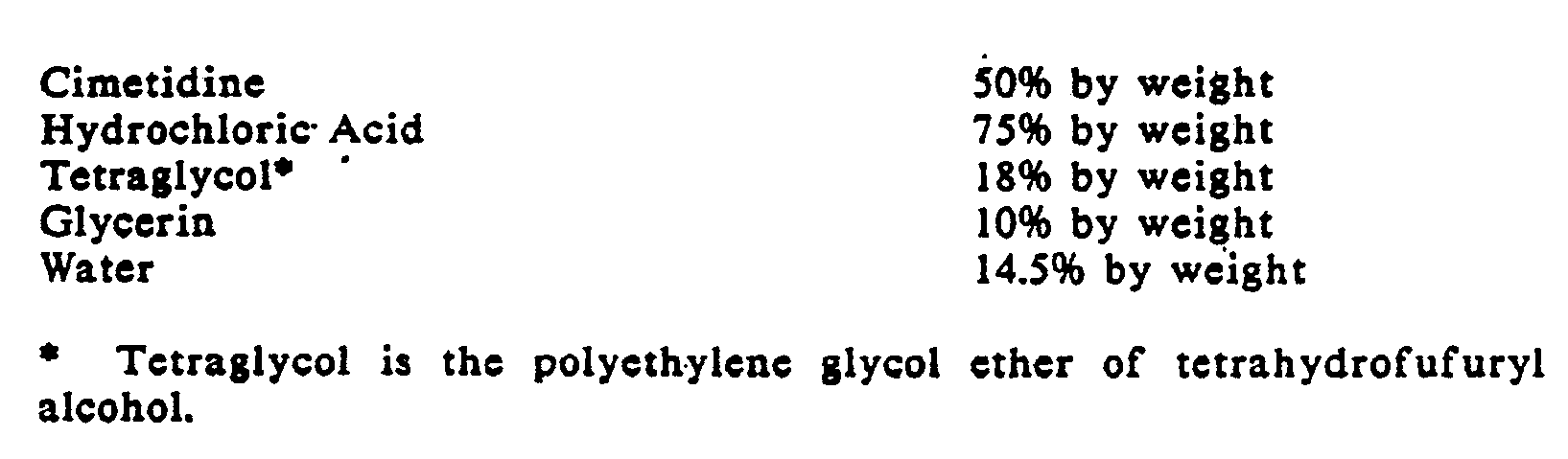
- The following formulation produces a highly concentrated (20% by weight) solution of diclofenac sodium suitable as a softgel fill and having a water content of 8.0% w/w.

- The following formulation produces a highly concentrated (34% by weight) semi-solid solution of ibuprofen which is suitable for encapsulation in a hard gelatin capsule.

- The polyethylene glycol 400 and 4000 were warmed to 60°C until a clear solution was obtained. The drug and powered potassium hydroxide were dispersed in the melt and stirred for about thirty minutes. This solution was then clarified and filled, at 60°C, into hardshell capsules.
- The following formulation produces a highly concentrated (43% by weight) semi-solid solution of naproxen which is suitable for encapsulation in a hard gelatin capsule.

- The capsules were prepared in a similar manner to the method disclosed in Example X.
- The following formulation produces a highly concentrated (40% by weight) solid solution of naproxen suitable for producing tablets.

- The polyethylene glycol 20,000 was heated to 80°C to produce 3 clear solution. The drug was then added and with gentle stirring, dispersed. The potassium hydroxide was added in aqueous solution and the mixture stirred until a clear solution was produced. The molten solution was then poured into 16 mm round PVC blisters and allowed to cool to form tablets.
- The following formulation produces a highly concentrated (40% by weight) solution of ibuprofen, without using strongly alkaline solutions, which is suitable as a softgel fill.

- The dissolution profiles of the formulation described in Example X which had been filled into size 1 hard gelatin capsules was determined using the USP dissolution test (apparatus 1). The basket speed was set at 100 rpm and the dissolution medium used as pH 7 buffer. Release of drug was determined by UV-spectroscopy at the wavelength of maximum absorption. The times for 25, 50 and 70% release of drug are given in the table below.
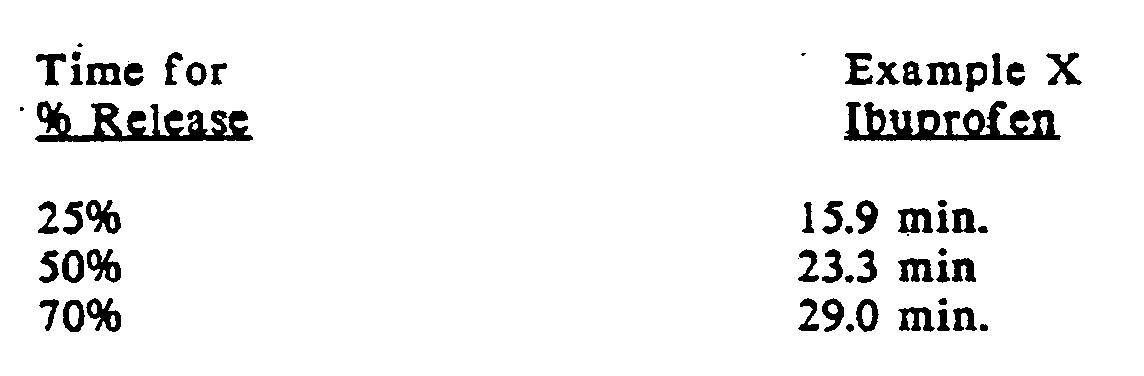
- The dissolution profile of a tablet of the formulation described in Example XII was compared to a tablet made from the same formulation, but omitting the potassium hydroxide. The USP dissolution test (apparatus 2) was used with the paddle speed set at 100 rpm and a dissolution medium of pH 7 buffer. The tablets were fixed to allow only the top surface to be in contact with the dissolution medium to allow intrinsic dissolution measurements. UV- spectroscopy at the wavelength of maximum absorption was used to quantify drug release. The intrinsic dissolution rate constants were calculated from the slope of the release curve over the initial thirty minutes and are given in the table below.

Claims (45)
Priority Applications (1)
| Application Number | Priority Date | Filing Date | Title |
|---|---|---|---|
| AT87907194T ATE66810T1 (en) | 1986-10-17 | 1987-10-15 | SOLVENT SYSTEM FOR DISSOCIABLE DRUGS. |
Applications Claiming Priority (4)
| Application Number | Priority Date | Filing Date | Title |
|---|---|---|---|
| US92057786A | 1986-10-17 | 1986-10-17 | |
| US920577 | 1986-10-17 | ||
| US07/104,911 US5071643A (en) | 1986-10-17 | 1987-10-09 | Solvent system enhancing the solubility of pharmaceuticals for encapsulation |
| US104911 | 1987-10-09 |
Publications (2)
| Publication Number | Publication Date |
|---|---|
| EP0293406A1 EP0293406A1 (en) | 1988-12-07 |
| EP0293406B1 true EP0293406B1 (en) | 1991-09-04 |
Family
ID=26802068
Family Applications (1)
| Application Number | Title | Priority Date | Filing Date |
|---|---|---|---|
| EP87907194A Expired - Lifetime EP0293406B1 (en) | 1986-10-17 | 1987-10-15 | Solvent system for an ionizable pharmaceutical agent |
Country Status (9)
| Country | Link |
|---|---|
| US (2) | US5071643A (en) |
| EP (1) | EP0293406B1 (en) |
| JP (3) | JPH07116021B2 (en) |
| KR (3) | KR940008030B1 (en) |
| AT (1) | ATE66810T1 (en) |
| AU (1) | AU606367B2 (en) |
| CA (1) | CA1316823C (en) |
| DE (1) | DE3772760D1 (en) |
| WO (1) | WO1988002625A1 (en) |
Cited By (1)
| Publication number | Priority date | Publication date | Assignee | Title |
|---|---|---|---|---|
| US11583552B2 (en) | 2021-02-17 | 2023-02-21 | Manoj Maniar | Pharmaceutical formulation of arsenic trioxide |
Families Citing this family (136)
| Publication number | Priority date | Publication date | Assignee | Title |
|---|---|---|---|---|
| JPH0714872B2 (en) * | 1990-02-06 | 1995-02-22 | 昭和薬品化工株式会社 | Syrup composition |
| CA2056032A1 (en) * | 1990-11-29 | 1992-05-30 | Minoru Aoki | Hard capsule preparation |
| US5141961A (en) * | 1991-06-27 | 1992-08-25 | Richrdson-Vicks Inc. | Process for solubilizing difficulty soluble pharmaceutical actives |
| JP3121080B2 (en) * | 1991-12-19 | 2000-12-25 | アール・ピー・シーラー コーポレイション | Encapsulation solution |
| US5281420A (en) * | 1992-05-19 | 1994-01-25 | The Procter & Gamble Company | Solid dispersion compositions of tebufelone |
| US5376688A (en) * | 1992-12-18 | 1994-12-27 | R. P. Scherer Corporation | Enhanced solubility pharmaceutical solutions |
| US5431916A (en) * | 1993-04-29 | 1995-07-11 | The Procter & Gamble Company | Pharmaceutical compositions and process of manufacture thereof |
| US5505961A (en) * | 1993-08-05 | 1996-04-09 | R. P. Scherer Corporation | Gelatin capsules containing a highly concentrated acetaminophen solution |
| US6726930B1 (en) | 1993-09-09 | 2004-04-27 | Penwest Pharmaceuticals Co. | Sustained release heterodisperse hydrogel systems for insoluble drugs |
| US5773025A (en) | 1993-09-09 | 1998-06-30 | Edward Mendell Co., Inc. | Sustained release heterodisperse hydrogel systems--amorphous drugs |
| GB9325445D0 (en) | 1993-12-13 | 1994-02-16 | Cortecs Ltd | Pharmaceutical formulations |
| US5510389A (en) * | 1994-03-02 | 1996-04-23 | The Procter & Gamble Company | Concentrated acetaminophen solution compositions |
| AU2517095A (en) * | 1994-05-19 | 1995-12-18 | R.P. Scherer International Corporation | Solutions of aryl or heteroaryl substituted alkanoic acids in lipophilic solvents and soft gelatin capsules containing such solutions |
| US5538737A (en) * | 1994-11-30 | 1996-07-23 | Applied Analytical Industries, Inc. | Oral compositions of H2 -antagonists |
| US5468502A (en) * | 1994-12-20 | 1995-11-21 | American Home Products Corporation | Ibuprofen enhancing solvent system |
| NZ280610A (en) * | 1994-12-29 | 1997-08-22 | Mcneil Ppc Inc | Soft gelatin-like pharmaceutical carrier: gelled polyethylene glycol and dispersed active agent |
| US5660859A (en) * | 1994-12-29 | 1997-08-26 | Mcneil-Ppc, Inc. | Gelling agent for polyethylene glycol |
| US5641512A (en) * | 1995-03-29 | 1997-06-24 | The Procter & Gamble Company | Soft gelatin capsule compositions |
| US5919481A (en) * | 1996-06-28 | 1999-07-06 | Ncneil-Ppc, Inc. | Fill material for soft gelatin pharmaceutical dosage form |
| US6024980A (en) * | 1996-06-28 | 2000-02-15 | Mcneil-Ppc, Inc. | Multiphase soft gelatin dosage form |
| US5908636A (en) * | 1996-06-28 | 1999-06-01 | Mcneil-Ppc, Inc. | Fill material for soft gelatin pharmaceutical dosage form containing an antiflatulent |
| IT1286778B1 (en) * | 1996-11-20 | 1998-07-17 | Alfa Wassermann Spa | CAPSULES CONTAINING DICLOFENAC OR ITS SALTS IN SOLUTION |
| US6160020A (en) * | 1996-12-20 | 2000-12-12 | Mcneill-Ppc, Inc. | Alkali metal and alkaline-earth metal salts of acetaminophen |
| US5871715A (en) * | 1997-02-28 | 1999-02-16 | Gillette Canada Inc. | Stannous fluoride gel with improved stand-up |
| US5760056A (en) * | 1997-03-03 | 1998-06-02 | Sanofi Pharmaceuticals, Inc. | Pharmaceutical formulation |
| US6197787B1 (en) * | 1997-03-03 | 2001-03-06 | Sanofi-Synthelabo | Pharmaceutical formulations containing poorly soluble drug substances |
| WO1998038987A1 (en) * | 1997-03-03 | 1998-09-11 | Sanofi-Synthelabo | Pharmaceutical formulations containing poorly soluble drug substances |
| US5837714A (en) * | 1997-03-03 | 1998-11-17 | Sanofi | Solid pharmaceutical dispersions |
| CA2294033C (en) | 1997-07-29 | 2007-01-09 | Pharmacia & Upjohn Company | Pharmaceutical composition for acidic lipophilic compounds in a form of a self-emulsifying formulation |
| US6056977A (en) | 1997-10-15 | 2000-05-02 | Edward Mendell Co., Inc. | Once-a-day controlled release sulfonylurea formulation |
| DE69940769D1 (en) * | 1998-01-20 | 2009-06-04 | Applied Analytical Ind Inc | ORAL LIQUID COMPOSITIONS |
| US6365180B1 (en) * | 1998-01-20 | 2002-04-02 | Glenn A. Meyer | Oral liquid compositions |
| US6221391B1 (en) * | 1998-11-23 | 2001-04-24 | Accucaps Industries Limited | Self-emulsifying ibuprofen solution and soft gelatin capsule for use therewith |
| US6267985B1 (en) * | 1999-06-30 | 2001-07-31 | Lipocine Inc. | Clear oil-containing pharmaceutical compositions |
| US6294192B1 (en) * | 1999-02-26 | 2001-09-25 | Lipocine, Inc. | Triglyceride-free compositions and methods for improved delivery of hydrophobic therapeutic agents |
| US6761903B2 (en) | 1999-06-30 | 2004-07-13 | Lipocine, Inc. | Clear oil-containing pharmaceutical compositions containing a therapeutic agent |
| US6383471B1 (en) | 1999-04-06 | 2002-05-07 | Lipocine, Inc. | Compositions and methods for improved delivery of ionizable hydrophobic therapeutic agents |
| US20050037065A1 (en) * | 1999-05-27 | 2005-02-17 | Drugtech Corporation | Nutritional formulations |
| US6383515B2 (en) | 1999-05-28 | 2002-05-07 | Sawyer Maryjean | Solvent system for enhancing solubility |
| US6458383B2 (en) | 1999-08-17 | 2002-10-01 | Lipocine, Inc. | Pharmaceutical dosage form for oral administration of hydrophilic drugs, particularly low molecular weight heparin |
| US6309663B1 (en) | 1999-08-17 | 2001-10-30 | Lipocine Inc. | Triglyceride-free compositions and methods for enhanced absorption of hydrophilic therapeutic agents |
| US6982281B1 (en) * | 2000-11-17 | 2006-01-03 | Lipocine Inc | Pharmaceutical compositions and dosage forms for administration of hydrophobic drugs |
| IT1313579B1 (en) * | 1999-07-30 | 2002-09-09 | Acraf | PARACETAMOL-BASED LIQUID PHARMACEUTICAL COMPOSITION. |
| US6251426B1 (en) * | 1999-09-02 | 2001-06-26 | Banner Pharmacaps, Inc. | Ibuprofen-containing softgels |
| US6497157B1 (en) * | 1999-11-29 | 2002-12-24 | Distek, Inc. | Intrinsic dissolution apparatus with stationary sample holder |
| US7732404B2 (en) | 1999-12-30 | 2010-06-08 | Dexcel Ltd | Pro-nanodispersion for the delivery of cyclosporin |
| ATE292461T1 (en) * | 2000-08-25 | 2005-04-15 | Kowa Co | IBUPROFEN SOLUTIONS AS CAPSULE FILLING AND CAPSULE PREPARATIONS |
| US6387400B1 (en) * | 2000-08-29 | 2002-05-14 | R.P. Scherer Technologies, Inc. | Process for preparing pharmaceutical compositions for use with soft gelatin formulations |
| US20020192299A1 (en) * | 2000-12-28 | 2002-12-19 | Rajneesh Taneja | Pharmaceutical compositions of a non-enteric coated proton pump inhibitor with a carbonate salt and bicarbonate salt combination |
| US7115565B2 (en) * | 2001-01-18 | 2006-10-03 | Pharmacia & Upjohn Company | Chemotherapeutic microemulsion compositions of paclitaxel with improved oral bioavailability |
| KR100449818B1 (en) * | 2001-03-02 | 2004-09-22 | 최영욱 | Soft capsule or injection formulation containg ibuprofen by smedds |
| JP2004519504A (en) * | 2001-03-27 | 2004-07-02 | アール.ピー. シェーラー テクノロジーズ インコーポレイテッド | Improved form of pharmaceutically active agent and method for its production |
| US20030034458A1 (en) * | 2001-03-30 | 2003-02-20 | Fuji Photo Film Co., Ltd. | Radiation image storage panel |
| US20030138483A1 (en) * | 2001-05-25 | 2003-07-24 | Sergio Petriconi | Soft elastic capsules and compositions thereof |
| EP1269994A3 (en) * | 2001-06-22 | 2003-02-12 | Pfizer Products Inc. | Pharmaceutical compositions comprising drug and concentration-enhancing polymers |
| WO2003013481A1 (en) * | 2001-08-03 | 2003-02-20 | Bakulesh Mafatlal Khamar | The process of manufacturing pharmaceutical composition with increased content of poorly soluble pharmaceutical ingredients |
| US20040013732A1 (en) * | 2001-09-25 | 2004-01-22 | Michael Farber | Starch-based delivery system for creatine |
| US7138133B2 (en) | 2001-10-10 | 2006-11-21 | The Procter & Gamble Company | Orally administered liquid compositions |
| US6551615B1 (en) | 2001-10-18 | 2003-04-22 | M/S. Strides Arcolab Limited | Dexibuprofen-containing soft gelatin capsules and process for preparing the same |
| KR100446153B1 (en) * | 2001-10-24 | 2004-08-30 | 한국유나이티드제약 주식회사 | Formulation of a soluble ibuprofen and its process |
| US6725490B2 (en) | 2001-11-06 | 2004-04-27 | The Procter & Gamble Company | Complex motion toothbrush |
| US7640614B2 (en) | 2001-11-06 | 2010-01-05 | The Procter & Gamble Company | Multi motion toothbrush |
| US7029698B2 (en) * | 2001-11-21 | 2006-04-18 | R.P. Scherer Technologies, Inc. | Acetaminophen compositions |
| US6828301B2 (en) * | 2002-02-07 | 2004-12-07 | Boehringer Ingelheim International Gmbh | Pharmaceutical compositions for hepatitis C viral protease inhibitors |
| US20030163882A1 (en) | 2002-03-04 | 2003-09-04 | The Procter & Gamble Company | Electric toothbrushes |
| EP1344523A1 (en) | 2002-03-11 | 2003-09-17 | Warner-Lambert Company | Ibuprofen solution for hard gelatin capsules |
| US7067150B2 (en) * | 2002-04-16 | 2006-06-27 | Scepter Holdings, Inc. | Delivery systems for functional ingredients |
| ATE387191T1 (en) | 2002-04-25 | 2008-03-15 | Banner Pharmacaps Inc | CHEWABLE SOFT CAPSULE |
| US20030232097A1 (en) * | 2002-06-17 | 2003-12-18 | Strides Inc. | Oily wax matrix suspension formulation comprising ibuprofen free acid and potassium salt of ibuprofen |
| MXPA05000232A (en) | 2002-06-21 | 2005-06-17 | Transform Pharmaceuticals Inc | Pharmaceutical compositions with improved dissolution. |
| US20040082618A1 (en) * | 2002-07-03 | 2004-04-29 | Rajneesh Taneja | Liquid dosage forms of acid labile drugs |
| US20070243251A1 (en) * | 2002-12-20 | 2007-10-18 | Rajneesh Taneja | Dosage Forms Containing A PPI, NSAID, and Buffer |
| US20040121004A1 (en) * | 2002-12-20 | 2004-06-24 | Rajneesh Taneja | Dosage forms containing a PPI, NSAID, and buffer |
| US7636976B2 (en) | 2002-12-30 | 2009-12-29 | The Procter & Gamble Company | Power toothbrush |
| US8183290B2 (en) | 2002-12-30 | 2012-05-22 | Mcneil-Ppc, Inc. | Pharmaceutically acceptable propylene glycol solvate of naproxen |
| JP2006514119A (en) * | 2003-02-12 | 2006-04-27 | アール アンド ピー コリア カンパニー リミテッド | Solvent system of poorly soluble drugs with improved dissolution rate |
| CA2529984C (en) | 2003-06-26 | 2012-09-25 | Isa Odidi | Oral multi-functional pharmaceutical capsule preparations of proton pump inhibitors |
| WO2005046727A2 (en) * | 2003-11-12 | 2005-05-26 | Ranbaxy Laboratories Limited | Ibuprofen-containing soft gelatin capsules |
| US20050137262A1 (en) * | 2003-12-22 | 2005-06-23 | Hu Patrick C. | Highly concentrated pourable aqueous solutions of potassium ibuprofen, their preparation and their uses |
| US20050142185A1 (en) * | 2003-12-29 | 2005-06-30 | Beleno Alfredo B. | Softgel formulations of bisphosphonates bone resorption inhibitors |
| CA2552611A1 (en) * | 2004-01-09 | 2005-08-04 | Wyeth | Microemulsions for pharmaceutical compositions |
| US7105555B2 (en) * | 2004-04-06 | 2006-09-12 | Isp Investments Inc. | Stable, neutral pH VOC-free biocidal compositions of 1,2-benzisothiazolin-3-one |
| US20050249802A1 (en) * | 2004-05-06 | 2005-11-10 | The Procter & Gamble Company | Softgel encapsulated pharmaceutical compositions comprising concentrated active ingredients |
| US20060286164A1 (en) * | 2004-06-07 | 2006-12-21 | Iyer Venkat S | Pharmaceutical composition containing a stable and clear solution of anti-inflammatory drug in soft gelatin capsule and process for producing the same |
| US8394409B2 (en) | 2004-07-01 | 2013-03-12 | Intellipharmaceutics Corp. | Controlled extended drug release technology |
| US10624858B2 (en) | 2004-08-23 | 2020-04-21 | Intellipharmaceutics Corp | Controlled release composition using transition coating, and method of preparing same |
| WO2006034147A2 (en) * | 2004-09-16 | 2006-03-30 | Abraxis Bioscience, Inc. | Compositions and methods for the preparation and administration of poorly water soluble drugs |
| US20060088590A1 (en) * | 2004-10-22 | 2006-04-27 | Banner Pharmacaps, Inc. | Non-blooming gelatin and non-gelatin formulations |
| US8231896B2 (en) | 2004-11-08 | 2012-07-31 | R.P. Scherer Technologies, Llc | Non-gelatin soft capsule system |
| GB2423710A (en) | 2005-03-01 | 2006-09-06 | Boots Healthcare Int Ltd | Lozenge production process |
| US20070053868A1 (en) | 2005-03-08 | 2007-03-08 | Banner Pharmacaps, Inc. | Solvent system for enhancing the solubility of pharmaceutical agents |
| JP2008534477A (en) * | 2005-03-22 | 2008-08-28 | ロザン ファルマ ゲゼルシャフトミットベシュレンクテルハフツンク | Solubilized ibuprofen |
| BRPI0617258A2 (en) * | 2005-09-19 | 2011-07-19 | Albemarle Corparation | highly concentrated aqueous solution of potassium ibuprofen, their preparations and their uses |
| US10064828B1 (en) | 2005-12-23 | 2018-09-04 | Intellipharmaceutics Corp. | Pulsed extended-pulsed and extended-pulsed pulsed drug delivery systems |
| US7582679B2 (en) * | 2006-02-03 | 2009-09-01 | Pharmaceutics International Incorporated | Compositions containing solid ibuprofen concentrates and methods of making solid ibuprofen concentrates |
| CA2648280C (en) | 2006-04-03 | 2014-03-11 | Isa Odidi | Controlled release delivery device comprising an organosol coat |
| US10960077B2 (en) | 2006-05-12 | 2021-03-30 | Intellipharmaceutics Corp. | Abuse and alcohol resistant drug composition |
| US9211251B2 (en) * | 2007-07-30 | 2015-12-15 | Troikaa Pharmaceuticals Limited | Injectable preparations of diclofenac and its pharmaceutically acceptable salts |
| EP2042165A1 (en) * | 2007-09-28 | 2009-04-01 | Swiss Caps Rechte und Lizenzen AG | Hot-melt filled soft capsules |
| WO2009113086A2 (en) * | 2008-01-07 | 2009-09-17 | Alkem Laboratories Ltd. | Ibuprofen liquid fill formulation, dosage form thereof and a process for its preparation |
| WO2009091622A1 (en) * | 2008-01-18 | 2009-07-23 | Dow Global Technologies Inc. | Method to enhance aqueous solubility of poorly soluble actives using methoxypolyethylene glycol |
| AU2009251743A1 (en) * | 2008-05-30 | 2009-12-03 | Fairfield Clinical Trials, Llc | Method and composition for skin inflammation and discoloration |
| BRPI0916344A2 (en) | 2008-07-21 | 2020-07-21 | Albemarle Corporation | granules with high sodium ibuprofen content, preparation and use for preparing solid non-effervescent dosage forms |
| US9629809B2 (en) | 2008-07-21 | 2017-04-25 | Si Group, Inc. | High content sodium ibuprofen granules, their preparation and their use in preparing non-effervescent solid dosage forms |
| WO2011001228A1 (en) * | 2008-08-14 | 2011-01-06 | Shasun Chemicals And Drugs Limited | Aryl alkyl carboxylic acid salts, process for preparation and dosage forms |
| CN102264358A (en) * | 2008-11-11 | 2011-11-30 | 博科药物化学有限公司 | Pharmaceutical composition comprising ibuprofen, pseudoephedrine and chlorpheniramine |
| US11304960B2 (en) | 2009-01-08 | 2022-04-19 | Chandrashekar Giliyar | Steroidal compositions |
| CA2690488C (en) * | 2010-01-19 | 2013-06-11 | Accucaps Industries Limited | Pharmaceutical formulations of naproxen for soft gel encapsulation and combinations thereof |
| US9358241B2 (en) | 2010-11-30 | 2016-06-07 | Lipocine Inc. | High-strength testosterone undecanoate compositions |
| US20180153904A1 (en) | 2010-11-30 | 2018-06-07 | Lipocine Inc. | High-strength testosterone undecanoate compositions |
| US9034858B2 (en) | 2010-11-30 | 2015-05-19 | Lipocine Inc. | High-strength testosterone undecanoate compositions |
| US20120148675A1 (en) | 2010-12-10 | 2012-06-14 | Basawaraj Chickmath | Testosterone undecanoate compositions |
| LT2658525T (en) | 2010-12-29 | 2017-12-11 | Medincell | Biodegradable drug delivery compositions |
| US8518438B2 (en) | 2011-01-14 | 2013-08-27 | Enspire Group, Llc | Highly concentrated liquid acetaminophen solutions |
| EP2572731A1 (en) * | 2011-09-26 | 2013-03-27 | Abbott GmbH & Co. KG | Formulations based on solid dispersions |
| US8969416B2 (en) | 2012-03-29 | 2015-03-03 | Enspire Group LLC | Polyvinylpyrrolidone-containing acetaminophen liquid formulations |
| EP3169315B1 (en) * | 2014-07-17 | 2020-06-24 | Pharmaceutical Manufacturing Research Services, Inc. | Immediate release abuse deterrent liquid fill dosage form |
| US20170246187A1 (en) | 2014-08-28 | 2017-08-31 | Lipocine Inc. | (17-ß)-3-OXOANDROST-4-EN-17-YL TRIDECANOATE COMPOSITIONS AND METHODS OF THEIR PREPARATION AND USE |
| US9498485B2 (en) | 2014-08-28 | 2016-11-22 | Lipocine Inc. | Bioavailable solid state (17-β)-hydroxy-4-androsten-3-one esters |
| US20160243044A1 (en) * | 2015-02-20 | 2016-08-25 | Enspire Group LLC | Soft gelatin capsules containing fexofenadine |
| WO2016205423A2 (en) | 2015-06-15 | 2016-12-22 | Lipocine Inc. | Composition and method for oral delivery of androgen prodrugs |
| US11510859B2 (en) * | 2015-07-16 | 2022-11-29 | Marinomed Biotech Ag | Method for improving aqueous solubility of water-insoluble or slightly water-soluble drugs |
| US10328087B2 (en) | 2015-07-23 | 2019-06-25 | Therapeuticsmd, Inc. | Formulations for solubilizing hormones |
| EP4374861A3 (en) | 2015-11-16 | 2024-08-07 | MedinCell S.A. | A method for morselizing and/or targeting pharmaceutically active principles to synovial tissue |
| WO2017173044A1 (en) | 2016-04-01 | 2017-10-05 | Therapeuticsmd Inc. | Steroid hormone compositions in medium chain oils |
| MX2018011705A (en) | 2016-04-01 | 2019-06-10 | Therapeuticsmd Inc | Steroid hormone pharmaceutical composition. |
| CA3078723A1 (en) | 2016-11-28 | 2018-05-31 | Nachiappan Chidambaram | Oral testosterone undecanoate therapy |
| CR20200552A (en) | 2018-05-16 | 2021-05-13 | Bayer Healthcare Llc | High concentration suspension formulation for cold and flu soft gel capsule medications |
| WO2019224832A1 (en) | 2018-05-25 | 2019-11-28 | Strides Shasun Limited | Process for preparing pharmaceutical compositions resulting in reduction in overall fill volume for use with soft gelatin formulations |
| US12150945B2 (en) | 2018-07-20 | 2024-11-26 | Lipocine Inc. | Liver disease |
| US20220202751A1 (en) * | 2019-04-26 | 2022-06-30 | R.P. Scherer Technologies, Llc | Mini softgel naproxen composition |
| GB2595300B (en) | 2020-05-21 | 2024-03-27 | Reckitt Benckiser Health Ltd | Novel Formulation |
| GB2595301B (en) | 2020-05-21 | 2025-01-08 | Reckitt Benckiser Health Ltd | Novel Formulation |
| GB2595453B (en) | 2020-05-21 | 2024-04-03 | Reckitt Benckiser Health Ltd | Novel Formulation |
| US20220233452A1 (en) * | 2021-01-25 | 2022-07-28 | R.P. Scherer Technologies, Llc | Mini softgel naproxen composition |
| CN117241790A (en) * | 2021-04-28 | 2023-12-15 | 葛兰素史克消费保健(美国)控股有限责任公司 | Alkali metal salt combinations of incompatible active pharmaceutical ingredients |
Family Cites Families (28)
| Publication number | Priority date | Publication date | Assignee | Title |
|---|---|---|---|---|
| NL6607516A (en) * | 1966-05-31 | 1967-12-01 | ||
| US3851051A (en) * | 1970-07-17 | 1974-11-26 | Scherer R Corp | Soft gelatin capsule containing high water content fill |
| ZA725808B (en) * | 1971-08-24 | 1973-05-30 | Bayer Ag | A coronary agent in special form and processes for its manufacture |
| BE789726A (en) * | 1971-10-06 | 1973-04-05 | Merck & Co Inc | SUPPOSITORIES TO INDOMETHACIN |
| US4198391A (en) * | 1973-07-20 | 1980-04-15 | R. P. Scherer Ltd. | Pharmaceutical compositions |
| US4002718A (en) * | 1974-10-16 | 1977-01-11 | Arnar-Stone Laboratories, Inc. | Gelatin-encapsulated digoxin solutions and method of preparing the same |
| US4067960A (en) * | 1975-06-20 | 1978-01-10 | R. P. Scherer Limited | Pharmaceutical compositions containing cardiac glycoside |
| US4087547A (en) * | 1976-02-17 | 1978-05-02 | Eli Lilly And Company | Hexahydro-dibenzo[b,d]pyran-9-ones in treatment of glaucoma |
| JPS52156913A (en) * | 1976-06-21 | 1977-12-27 | Toko Yakuhin Kogyo Kk | Production of injectionable medicine |
| US4145440A (en) * | 1977-08-18 | 1979-03-20 | The Upjohn Company | Liquid suspension of an aluminum salt of ibuprofen |
| US4213963A (en) * | 1978-12-14 | 1980-07-22 | Janssen Pharmaceutica N.V. | Fluspirilene-containing compositions |
| US4361580A (en) * | 1980-06-20 | 1982-11-30 | The Upjohn Manufacturing Company | Aluminum ibuprofen pharmaceutical suspensions |
| JPS57140711A (en) * | 1981-02-26 | 1982-08-31 | Teika Seiyaku Kk | Poultice for anti-inflammatory and analgesic use and its preparation |
| JPS57167911A (en) * | 1981-04-09 | 1982-10-16 | Kyoto Yakuhin Kogyo Kk | Liquid pharmaceutical of nifedipine |
| EP0070714B1 (en) * | 1981-07-20 | 1986-05-07 | The Upjohn Company | Use of ibuprofen or flurbiprofen for the manufacture of a medicament for treating respiratory disorders |
| GB2118040A (en) * | 1982-02-15 | 1983-10-26 | Hoechst Uk Ltd | Oral anti-diabetic preparation |
| US4486412A (en) * | 1983-03-15 | 1984-12-04 | Pharmacaps, Inc. | Encapsulated antacid dispersions |
| US4525348A (en) * | 1983-12-19 | 1985-06-25 | Yoshitomi Pharmaceutical Industries, Ltd. | Pranoprofen gelled ointment |
| US4562192A (en) * | 1984-02-03 | 1985-12-31 | G. D. Searle & Co. | 6-Substituted-5-phenyltetrazolo[1,5-a][1,2,4]triazole[1,5-c]pyrimidines, and pharmaceutical compositions containing them |
| NL8520012A (en) * | 1984-02-08 | 1986-01-02 | Scherer Corp R P | ACETAMINOPHENE GELATIN CAPSULE, DELIVERING FAST STARTING OF THERAPEUTIC ACTIVITY AFTER ORAL ADMINISTRATION. |
| AU573321B2 (en) * | 1984-03-14 | 1988-06-02 | Jerome Corbiere | Process for solubilizing active principles and pharmaceuticalcompositions thus obtained |
| US4713246A (en) * | 1984-03-19 | 1987-12-15 | Bristol-Myers Company | Etoposide oral dosage form |
| JPS60239418A (en) * | 1984-05-15 | 1985-11-28 | Nippon Kayaku Co Ltd | Soft capsule containing etoposide |
| DE3437599C2 (en) * | 1984-10-13 | 1987-04-16 | Dolorgiet GmbH & Co KG, 5205 St Augustin | Soft gelatin capsules containing ibuprofen |
| US4689233A (en) * | 1986-01-06 | 1987-08-25 | Siegfried Aktiengesellschaft | Coronary therapeutic agent in the form of soft gelatin capsules |
| US4708834A (en) * | 1986-05-01 | 1987-11-24 | Pharmacaps, Inc. | Preparation of gelatin-encapsulated controlled release composition |
| US4798725A (en) * | 1986-06-16 | 1989-01-17 | Norwich Eaton Pharmaceuticals, Inc. | Sustained release capsule |
| GB8701392D0 (en) * | 1987-01-22 | 1987-02-25 | Boots Co Plc | Therapeutic agents |
-
1987
- 1987-10-09 US US07/104,911 patent/US5071643A/en not_active Expired - Lifetime
- 1987-10-15 EP EP87907194A patent/EP0293406B1/en not_active Expired - Lifetime
- 1987-10-15 AT AT87907194T patent/ATE66810T1/en not_active IP Right Cessation
- 1987-10-15 JP JP62506602A patent/JPH07116021B2/en not_active Expired - Lifetime
- 1987-10-15 WO PCT/US1987/002629 patent/WO1988002625A1/en not_active Ceased
- 1987-10-15 KR KR1019940701685A patent/KR940008030B1/en not_active Expired - Fee Related
- 1987-10-15 KR KR1019940701686A patent/KR940008031B1/en not_active Expired - Fee Related
- 1987-10-15 KR KR1019880700693A patent/KR940006270B1/en not_active Expired - Fee Related
- 1987-10-15 AU AU81573/87A patent/AU606367B2/en not_active Expired
- 1987-10-15 DE DE8787907194T patent/DE3772760D1/en not_active Expired - Lifetime
- 1987-10-16 CA CA000549469A patent/CA1316823C/en not_active Expired - Lifetime
-
1992
- 1992-05-26 US US07/890,285 patent/US5360615A/en not_active Expired - Lifetime
-
1995
- 1995-06-02 JP JP7136276A patent/JP2564476B2/en not_active Expired - Lifetime
- 1995-06-02 JP JP7136277A patent/JP2564477B2/en not_active Expired - Lifetime
Cited By (1)
| Publication number | Priority date | Publication date | Assignee | Title |
|---|---|---|---|---|
| US11583552B2 (en) | 2021-02-17 | 2023-02-21 | Manoj Maniar | Pharmaceutical formulation of arsenic trioxide |
Also Published As
| Publication number | Publication date |
|---|---|
| EP0293406A1 (en) | 1988-12-07 |
| CA1316823C (en) | 1993-04-27 |
| JP2564477B2 (en) | 1996-12-18 |
| US5360615A (en) | 1994-11-01 |
| KR940006270B1 (en) | 1994-07-14 |
| AU8157387A (en) | 1988-05-06 |
| JP2564476B2 (en) | 1996-12-18 |
| KR880701544A (en) | 1988-11-03 |
| KR940008031B1 (en) | 1994-09-01 |
| DE3772760D1 (en) | 1991-10-10 |
| AU606367B2 (en) | 1991-02-07 |
| JPH08157354A (en) | 1996-06-18 |
| JPH07116021B2 (en) | 1995-12-13 |
| WO1988002625A1 (en) | 1988-04-21 |
| KR940008030B1 (en) | 1994-09-01 |
| ATE66810T1 (en) | 1991-09-15 |
| US5071643A (en) | 1991-12-10 |
| JPH08157355A (en) | 1996-06-18 |
| JPH01502185A (en) | 1989-08-03 |
Similar Documents
| Publication | Publication Date | Title |
|---|---|---|
| EP0293406B1 (en) | Solvent system for an ionizable pharmaceutical agent | |
| CA2168732C (en) | Gelatin capsules containing a highly concentrated acetaminophen solution | |
| US5916590A (en) | Soft gelatin pharmaceutical dosage form | |
| JP4990474B2 (en) | Process for the preparation of pharmaceutical compositions for use with soft gelatin formulations | |
| WO2009066146A2 (en) | Stable solutions of sparingly soluble actives | |
| CZ199297A3 (en) | Filling material for soft gelatinous pharmaceutical dosage form | |
| CZ205697A3 (en) | Multiphase soft gelatinous dosage form | |
| AU2011207061A1 (en) | Pharmaceutical formulations of naproxen for soft gel encapsulation and combinations thereof | |
| WO2000030619A1 (en) | Self-emulsifying ibuprofen solution and soft gelatin capsule for use therewith | |
| WO2003013481A1 (en) | The process of manufacturing pharmaceutical composition with increased content of poorly soluble pharmaceutical ingredients | |
| JPH0717498B2 (en) | Antitussive expectorant soft capsule | |
| KR102199667B1 (en) | Pharmaceutical composition comprising dutasteride | |
| JPH01226817A (en) | Pharmaceutical composition to 4-alloylimidazol- 2-ones | |
| US3140233A (en) | Tasteless pharmaceutical composition and process | |
| KR100354677B1 (en) | Method for preparing of liquid type animal use containing Amprolium hydrochloride and sulfaquinoxaline sodium | |
| KR20050075075A (en) | Transparent soft capsules containg highly concentrated acetaminophen | |
| HK1056326B (en) | Process for preparing pharmaceutical compositions for use with soft gelatin formulations |
Legal Events
| Date | Code | Title | Description |
|---|---|---|---|
| PUAI | Public reference made under article 153(3) epc to a published international application that has entered the european phase |
Free format text: ORIGINAL CODE: 0009012 |
|
| 17P | Request for examination filed |
Effective date: 19880916 |
|
| AK | Designated contracting states |
Kind code of ref document: A1 Designated state(s): AT BE CH DE FR GB IT LI LU NL SE |
|
| 17Q | First examination report despatched |
Effective date: 19900608 |
|
| GRAA | (expected) grant |
Free format text: ORIGINAL CODE: 0009210 |
|
| AK | Designated contracting states |
Kind code of ref document: B1 Designated state(s): AT BE CH DE FR GB IT LI LU NL SE |
|
| REF | Corresponds to: |
Ref document number: 66810 Country of ref document: AT Date of ref document: 19910915 Kind code of ref document: T |
|
| REF | Corresponds to: |
Ref document number: 3772760 Country of ref document: DE Date of ref document: 19911010 |
|
| ET | Fr: translation filed | ||
| ITF | It: translation for a ep patent filed | ||
| PLBE | No opposition filed within time limit |
Free format text: ORIGINAL CODE: 0009261 |
|
| STAA | Information on the status of an ep patent application or granted ep patent |
Free format text: STATUS: NO OPPOSITION FILED WITHIN TIME LIMIT |
|
| 26N | No opposition filed | ||
| PGFP | Annual fee paid to national office [announced via postgrant information from national office to epo] |
Ref country code: LU Payment date: 19921204 Year of fee payment: 6 |
|
| EPTA | Lu: last paid annual fee | ||
| PG25 | Lapsed in a contracting state [announced via postgrant information from national office to epo] |
Ref country code: LU Free format text: LAPSE BECAUSE OF NON-PAYMENT OF DUE FEES Effective date: 19931015 |
|
| PGFP | Annual fee paid to national office [announced via postgrant information from national office to epo] |
Ref country code: BE Payment date: 19941109 Year of fee payment: 8 |
|
| EAL | Se: european patent in force in sweden |
Ref document number: 87907194.2 |
|
| PGFP | Annual fee paid to national office [announced via postgrant information from national office to epo] |
Ref country code: AT Payment date: 19950918 Year of fee payment: 9 |
|
| PG25 | Lapsed in a contracting state [announced via postgrant information from national office to epo] |
Ref country code: BE Effective date: 19951031 |
|
| BERE | Be: lapsed |
Owner name: R.P. SCHERER CORP. Effective date: 19951031 |
|
| PG25 | Lapsed in a contracting state [announced via postgrant information from national office to epo] |
Ref country code: AT Effective date: 19961015 |
|
| REG | Reference to a national code |
Ref country code: GB Ref legal event code: IF02 |
|
| PGFP | Annual fee paid to national office [announced via postgrant information from national office to epo] |
Ref country code: NL Payment date: 20061024 Year of fee payment: 20 |
|
| PGFP | Annual fee paid to national office [announced via postgrant information from national office to epo] |
Ref country code: GB Payment date: 20061025 Year of fee payment: 20 |
|
| PGFP | Annual fee paid to national office [announced via postgrant information from national office to epo] |
Ref country code: CH Payment date: 20061027 Year of fee payment: 20 Ref country code: SE Payment date: 20061027 Year of fee payment: 20 |
|
| PGFP | Annual fee paid to national office [announced via postgrant information from national office to epo] |
Ref country code: IT Payment date: 20061031 Year of fee payment: 20 |
|
| PGFP | Annual fee paid to national office [announced via postgrant information from national office to epo] |
Ref country code: DE Payment date: 20061130 Year of fee payment: 20 |
|
| REG | Reference to a national code |
Ref country code: GB Ref legal event code: PE20 |
|
| REG | Reference to a national code |
Ref country code: CH Ref legal event code: PL |
|
| NLV7 | Nl: ceased due to reaching the maximum lifetime of a patent |
Effective date: 20071015 |
|
| PG25 | Lapsed in a contracting state [announced via postgrant information from national office to epo] |
Ref country code: NL Free format text: LAPSE BECAUSE OF EXPIRATION OF PROTECTION Effective date: 20071015 |
|
| PG25 | Lapsed in a contracting state [announced via postgrant information from national office to epo] |
Ref country code: GB Free format text: LAPSE BECAUSE OF EXPIRATION OF PROTECTION Effective date: 20071014 |
|
| PGFP | Annual fee paid to national office [announced via postgrant information from national office to epo] |
Ref country code: FR Payment date: 20061017 Year of fee payment: 20 |