EP0282018A2 - Process for isolating basal membrane proteins from human or animal tissues - Google Patents
Process for isolating basal membrane proteins from human or animal tissues Download PDFInfo
- Publication number
- EP0282018A2 EP0282018A2 EP88103668A EP88103668A EP0282018A2 EP 0282018 A2 EP0282018 A2 EP 0282018A2 EP 88103668 A EP88103668 A EP 88103668A EP 88103668 A EP88103668 A EP 88103668A EP 0282018 A2 EP0282018 A2 EP 0282018A2
- Authority
- EP
- European Patent Office
- Prior art keywords
- basement membrane
- membrane proteins
- proteins
- human
- extracted
- Prior art date
- Legal status (The legal status is an assumption and is not a legal conclusion. Google has not performed a legal analysis and makes no representation as to the accuracy of the status listed.)
- Granted
Links
Classifications
-
- C—CHEMISTRY; METALLURGY
- C07—ORGANIC CHEMISTRY
- C07K—PEPTIDES
- C07K14/00—Peptides having more than 20 amino acids; Gastrins; Somatostatins; Melanotropins; Derivatives thereof
- C07K14/435—Peptides having more than 20 amino acids; Gastrins; Somatostatins; Melanotropins; Derivatives thereof from animals; from humans
- C07K14/78—Connective tissue peptides, e.g. collagen, elastin, laminin, fibronectin, vitronectin or cold insoluble globulin [CIG]
-
- G—PHYSICS
- G01—MEASURING; TESTING
- G01N—INVESTIGATING OR ANALYSING MATERIALS BY DETERMINING THEIR CHEMICAL OR PHYSICAL PROPERTIES
- G01N33/00—Investigating or analysing materials by specific methods not covered by groups G01N1/00 - G01N31/00
- G01N33/48—Biological material, e.g. blood, urine; Haemocytometers
- G01N33/50—Chemical analysis of biological material, e.g. blood, urine; Testing involving biospecific ligand binding methods; Immunological testing
- G01N33/68—Chemical analysis of biological material, e.g. blood, urine; Testing involving biospecific ligand binding methods; Immunological testing involving proteins, peptides or amino acids
- G01N33/6887—Chemical analysis of biological material, e.g. blood, urine; Testing involving biospecific ligand binding methods; Immunological testing involving proteins, peptides or amino acids from muscle, cartilage or connective tissue
-
- Y—GENERAL TAGGING OF NEW TECHNOLOGICAL DEVELOPMENTS; GENERAL TAGGING OF CROSS-SECTIONAL TECHNOLOGIES SPANNING OVER SEVERAL SECTIONS OF THE IPC; TECHNICAL SUBJECTS COVERED BY FORMER USPC CROSS-REFERENCE ART COLLECTIONS [XRACs] AND DIGESTS
- Y10—TECHNICAL SUBJECTS COVERED BY FORMER USPC
- Y10S—TECHNICAL SUBJECTS COVERED BY FORMER USPC CROSS-REFERENCE ART COLLECTIONS [XRACs] AND DIGESTS
- Y10S261/00—Gas and liquid contact apparatus
- Y10S261/88—Aroma dispensers
-
- Y—GENERAL TAGGING OF NEW TECHNOLOGICAL DEVELOPMENTS; GENERAL TAGGING OF CROSS-SECTIONAL TECHNOLOGIES SPANNING OVER SEVERAL SECTIONS OF THE IPC; TECHNICAL SUBJECTS COVERED BY FORMER USPC CROSS-REFERENCE ART COLLECTIONS [XRACs] AND DIGESTS
- Y10—TECHNICAL SUBJECTS COVERED BY FORMER USPC
- Y10S—TECHNICAL SUBJECTS COVERED BY FORMER USPC CROSS-REFERENCE ART COLLECTIONS [XRACs] AND DIGESTS
- Y10S435/00—Chemistry: molecular biology and microbiology
- Y10S435/803—Physical recovery methods, e.g. chromatography, grinding
-
- Y—GENERAL TAGGING OF NEW TECHNOLOGICAL DEVELOPMENTS; GENERAL TAGGING OF CROSS-SECTIONAL TECHNOLOGIES SPANNING OVER SEVERAL SECTIONS OF THE IPC; TECHNICAL SUBJECTS COVERED BY FORMER USPC CROSS-REFERENCE ART COLLECTIONS [XRACs] AND DIGESTS
- Y10—TECHNICAL SUBJECTS COVERED BY FORMER USPC
- Y10S—TECHNICAL SUBJECTS COVERED BY FORMER USPC CROSS-REFERENCE ART COLLECTIONS [XRACs] AND DIGESTS
- Y10S435/00—Chemistry: molecular biology and microbiology
- Y10S435/82—Subcellular parts of microorganisms
-
- Y—GENERAL TAGGING OF NEW TECHNOLOGICAL DEVELOPMENTS; GENERAL TAGGING OF CROSS-SECTIONAL TECHNOLOGIES SPANNING OVER SEVERAL SECTIONS OF THE IPC; TECHNICAL SUBJECTS COVERED BY FORMER USPC CROSS-REFERENCE ART COLLECTIONS [XRACs] AND DIGESTS
- Y10—TECHNICAL SUBJECTS COVERED BY FORMER USPC
- Y10S—TECHNICAL SUBJECTS COVERED BY FORMER USPC CROSS-REFERENCE ART COLLECTIONS [XRACs] AND DIGESTS
- Y10S435/00—Chemistry: molecular biology and microbiology
- Y10S435/961—Chemistry: molecular biology and microbiology including a step of forming, releasing, or exposing the antigen or forming the hapten-immunogenic carrier complex or the antigen per se
-
- Y—GENERAL TAGGING OF NEW TECHNOLOGICAL DEVELOPMENTS; GENERAL TAGGING OF CROSS-SECTIONAL TECHNOLOGIES SPANNING OVER SEVERAL SECTIONS OF THE IPC; TECHNICAL SUBJECTS COVERED BY FORMER USPC CROSS-REFERENCE ART COLLECTIONS [XRACs] AND DIGESTS
- Y10—TECHNICAL SUBJECTS COVERED BY FORMER USPC
- Y10S—TECHNICAL SUBJECTS COVERED BY FORMER USPC CROSS-REFERENCE ART COLLECTIONS [XRACs] AND DIGESTS
- Y10S435/00—Chemistry: molecular biology and microbiology
- Y10S435/962—Prevention or removal of interfering materials or reactants or other treatment to enhance results, e.g. determining or preventing nonspecific binding
-
- Y—GENERAL TAGGING OF NEW TECHNOLOGICAL DEVELOPMENTS; GENERAL TAGGING OF CROSS-SECTIONAL TECHNOLOGIES SPANNING OVER SEVERAL SECTIONS OF THE IPC; TECHNICAL SUBJECTS COVERED BY FORMER USPC CROSS-REFERENCE ART COLLECTIONS [XRACs] AND DIGESTS
- Y10—TECHNICAL SUBJECTS COVERED BY FORMER USPC
- Y10S—TECHNICAL SUBJECTS COVERED BY FORMER USPC CROSS-REFERENCE ART COLLECTIONS [XRACs] AND DIGESTS
- Y10S436/00—Chemistry: analytical and immunological testing
- Y10S436/811—Test for named disease, body condition or organ function
-
- Y—GENERAL TAGGING OF NEW TECHNOLOGICAL DEVELOPMENTS; GENERAL TAGGING OF CROSS-SECTIONAL TECHNOLOGIES SPANNING OVER SEVERAL SECTIONS OF THE IPC; TECHNICAL SUBJECTS COVERED BY FORMER USPC CROSS-REFERENCE ART COLLECTIONS [XRACs] AND DIGESTS
- Y10—TECHNICAL SUBJECTS COVERED BY FORMER USPC
- Y10S—TECHNICAL SUBJECTS COVERED BY FORMER USPC CROSS-REFERENCE ART COLLECTIONS [XRACs] AND DIGESTS
- Y10S436/00—Chemistry: analytical and immunological testing
- Y10S436/825—Pretreatment for removal of interfering factors from sample
-
- Y—GENERAL TAGGING OF NEW TECHNOLOGICAL DEVELOPMENTS; GENERAL TAGGING OF CROSS-SECTIONAL TECHNOLOGIES SPANNING OVER SEVERAL SECTIONS OF THE IPC; TECHNICAL SUBJECTS COVERED BY FORMER USPC CROSS-REFERENCE ART COLLECTIONS [XRACs] AND DIGESTS
- Y10—TECHNICAL SUBJECTS COVERED BY FORMER USPC
- Y10T—TECHNICAL SUBJECTS COVERED BY FORMER US CLASSIFICATION
- Y10T436/00—Chemistry: analytical and immunological testing
- Y10T436/25—Chemistry: analytical and immunological testing including sample preparation
- Y10T436/25375—Liberation or purification of sample or separation of material from a sample [e.g., filtering, centrifuging, etc.]
Definitions
- Laminin, nidogen and BM40 are glycoproteins that are believed to play a key role in the organization of basement membranes and in the interaction of cells with basement membranes [Paulsson, M. et al. Eur. J. Biochem. 161, 455-464 (1986), R. Timpl, M. Dziadek, Int. Rev. Exp. Pathol. 29: 1-112 (1986)].
- laminin supports the outgrowth of neurites from the neurons of peripheral nerves [Edgar, D. et al., EMBO J. 3, 1463-1467 (1984)] and their regeneration in situ [Madison et al. Exp. Neurol. 88, 767-772 (1985)].
- the invention thus relates to a method for isolating basement membrane proteins from human or animal tissues, which is characterized in that said tissues are extracted in aqueous solution with the addition of a chelating agent.
- all human or animal tissue types in which there are basement membrane proteins such as, for example, human placenta, human or animal tumor tissue or the kidney, can be extracted.
- a pre-extraction can be carried out first.
- the tissue is homogenized and centrifuged in a buffer physiological for basement membrane proteins in the presence of protease inhibitors.
- This treatment preferably removes easily soluble proteins, such as serum proteins and cytoplasmic proteins from the tissue.
- the tissue residue is then taken up again in a physiological buffer and in Homogenized and extracted in the presence of protease inhibitors and chelating agents.
- Suitable chelating agents are organic polyacids, such as EDTA, EGTA or citrate.
- the extraction is carried out with the addition of 1-500 mmol / l of the chelating agent, preferably 10-50 mml / l, suitably with cooling at 0-15 ° C, preferably 4-10 ° C. Extraction is also possible at higher temperatures, but is then accompanied by disruptive degradation reactions.
- the extracts contain the desired basement membrane proteins.
- BM40, nidogen and laminin are particularly preferably isolated, in some cases as a non-covalent complex.
- the individual proteins are extracted from the extract by molecular sieve chromatography on suitable columns, e.g. Dextran, in particular allyl dextran crosslinked with N, N'-methylenebisacrylamide, or agarose, isolated.
- suitable columns e.g. Dextran, in particular allyl dextran crosslinked with N, N'-methylenebisacrylamide, or agarose, isolated.
- fine purification of the basement membrane proteins takes place on preferably weakly basic ion exchangers with subsequent molecular sieve chromatography or further purification on agarose or Sepharose columns.
- the separated, purified basement membrane proteins can then be used as antigens for the production of highly specific antisera or antibodies. This is done in the usual way by subcutaneous or intramuscular injection on experimental animals, preferably on rabbits. It is advisable to work in the presence of a complete Freund's adjuvant. The usual antigen doses can be used in these cases.
- the preferred rabbit dose is 0.5 to 1 mg per animal.
- the antiserum formed is then in the expert obtained in a known manner and can be used as such. It is also possible to purify the antibodies present in the serum beforehand. A preferred method is affinity chromatography.
- the highly specific antiserum produced with the help of the purified basement membrane proteins enables the determination of basement membrane proteins in body fluids, such as serum, urine etc. and tissue extracts, using the immunological detection methods known per se.
- the labeling of the antigen necessary for the immunological determination can take place in the methods known for protein labeling. It is preferably radioactive, enzyme or fluorescent labeled. In the case of radioactive labeling, iodine 125 is preferably used as the radionuclide.
- the labeling can then be carried out using the known chloramine T method (Int. Arch. Allergy 29, 185, 1966).
- the labeled basement membrane protein competes for the antibody in a known manner, so that the amount of labeled antigen in the formed antigen-antibody complex is smaller the more unlabeled antigens are contained in the sample to be determined.
- the labeling of the complex for example the radioactivity or the enzyme activity, or the labeling of the supernatant after separation of the antigen-antibody complex can be used to determine the known content by means of a calibration curve using samples Basement membrane protein was created to determine the amounts of antigen contained in the sample to be examined.
- the marking in the complex is preferably determined.
- a preferred embodiment of the method according to the invention consists in carrying out the separation of the antigen-antibody complex formed with the specific antiserum with the aid of a second antibody.
- an antibody directed against immunoglobulin G of the animal species used for obtaining the specific antiserum is preferably used.
- the antigen-antibody complex can be separated from the solution using customary methods such as precipitation, centrifugation or filtering. Alternatively, the antiserum or the second antibody is bound to a solid support. After the antigen-antibody complex has been separated off, the radioactivity or other labeling contained in the complex or remaining in the solution is then determined.
- the enzyme immunoassay variant for the determination of basement membrane protein can also be carried out in such a way that the antibody against immunoglobulin G of the animal species concerned, e.g. from rabbit, is enzyme labeled.
- the portion of the anti-basement membrane protein serum remaining after the formation of the antigen-antibody complex is determined by binding it to carrier-bound basement membrane protein and then reacting with enzyme-labeled antibodies against rabbit immunoglobulin G.
- the amount of bound enzyme-labeled antibody is then determined by measuring the enzyme reaction and is indirectly proportional to the unknown amount of the basement membrane protein in the sample.
- EHS tumor cells were injected subcutaneously into C57Bl mice [Orkin et al. J. Exp. Med. 145, 204 (1977)] After 10-14 days the tumor is harvested and the subsequently cleaned tissue material is stored at -20 ° C. 75 g of the frozen tumors were 1 min. Homogenized in 1.5 1 0.15 M NaCl, 0.05 M Tris-HCl (pH 7.4) (TBS) with 0.05 mM phenylmethanesulfonyl fluoride (PMSF) and N-ethylmaleimide (NEM). After centrifugation at 8000 rpm for 20 minutes.
- TSS Tris-HCl
- PMSF phenylmethanesulfonyl fluoride
- NEM N-ethylmaleimide
- the supernatant was discarded and the residue was again homogenized in 375 ml of the abovementioned buffer with the addition of 10 mM EDTA and stirred in the cold room for one hour.
- the extract was obtained by the centrifugation specified above and either used immediately or stored at -20 ° C. The yield and purity of the desired product could be further increased if the extraction steps were repeated.
- TBS-EDTA extract was passed over an agarose (8Bioge1 A5m) or a Sepharose CL-6B column (3 x 135 cm), which was dissolved in TBS with 2 mM EDTA, 0.5 mM PMSF and 0.5 mM NEM had been equilibrated. This resulted in a division into 3 to 4 fractionation areas.
- the material first eluted with the exclusion volume contains laminin-nidogen complex and free laminin, the subsequent fractions contain free nidogen in intact (MG 150 KD) and partially degraded form (MG 130, 100 KD). BM 40 is then eluted.
- the laminin is first cleaned on a weakly basic ion exchanger (DEAE cellulose) with 2 M urea in 0.05 M Tris / HCl (pH 8.6) with the addition of Protease inhibitors. It is eluted using a linear NaCl gradient (0 to 0.4 M). This step removes interfering contaminants from proteoglycan and nucleic acids. Laminin is finally freed of residual nidogen and smaller proteins by chromatography on Sepharose CL-4B in 2 M guanidine chloride (pH 7.4).
- Nidogen is first cleaned on DEAE cellulose and Sepharose CL-4B as described for laminin. Further purification steps, if necessary, include chromatography on CM cellulose with 2 M urea, 0.02 M Na acetate (pH 4.8) and cross-linked allyl dextran (Sephacryl S200) with 0.2 M NH 4 HC0 3 .
- BM40 is further purified on DEAE cellulose with 2 M urea, 0.05 M Tris (pH 8.6) by elution using a linear NaCl gradient (0-0.4 M NaCl). BM40 elutes at 0.2-0.25 M NaCl and is finally cleaned with 0.2 M NH 4 HC0 3 after concentration over Sephacryl S200.
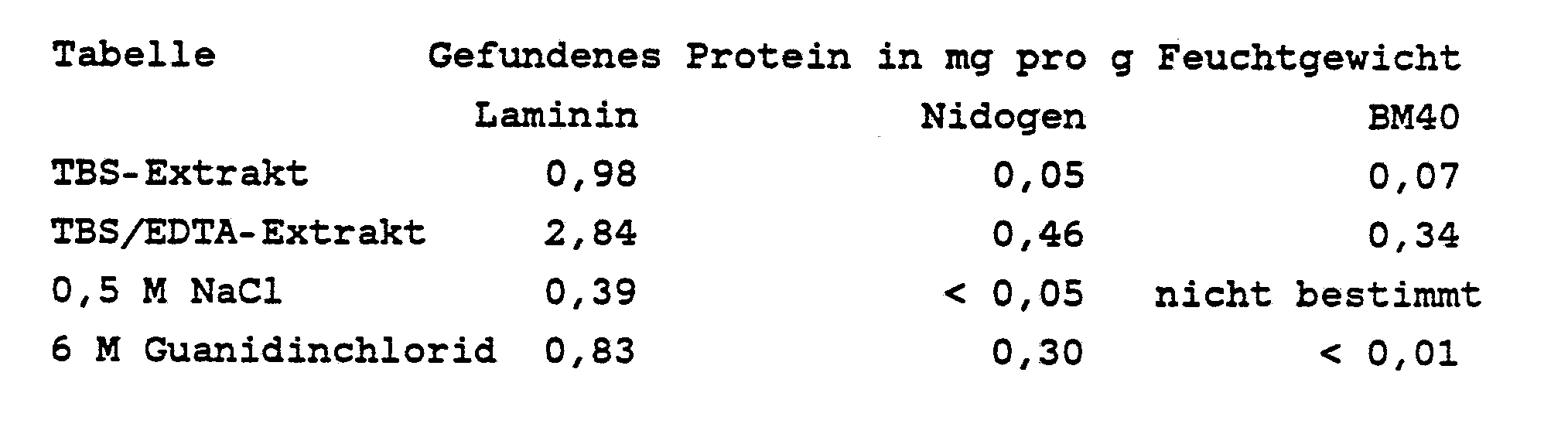
- the table shows, by way of example, that with gentle extraction, amounts of intact basement membrane proteins, e.g. B. EHS tumor extracted, which can not be achieved with conventional methods.
- 25 ⁇ g of the basement membrane protein isolated according to Example 1 are labeled with 0.5 mCi iodine 125 using the chloramine T method and unbound iodine is removed by dialysis or gel filtration on a polyacrylamide gel (for example 8Biogel P2, Pharmacia Fine Chemicals Inc.) .
- a polyacrylamide gel for example 8Biogel P2, Pharmacia Fine Chemicals Inc.
- Rabbits are immunized with 0.5 to 1 mg of the basement membrane protein isolated according to Example 1 per animal by injecting the antigen solution, mixed with equal volumes of complete Freund's adjuvant, subcutaneously or intramuscularly. 4 weeks after the first injection, an equal amount of antigen solution mixed with complete Freund's adjuvant is injected subcutaneously or intramuscularly. The blood is obtained 4 to 8 weeks after the second injection and the antiserum is obtained therefrom after clotting.
Landscapes
- Health & Medical Sciences (AREA)
- Life Sciences & Earth Sciences (AREA)
- Chemical & Material Sciences (AREA)
- Engineering & Computer Science (AREA)
- Biomedical Technology (AREA)
- Molecular Biology (AREA)
- Medicinal Chemistry (AREA)
- Proteomics, Peptides & Aminoacids (AREA)
- Organic Chemistry (AREA)
- General Health & Medical Sciences (AREA)
- Hematology (AREA)
- Immunology (AREA)
- Urology & Nephrology (AREA)
- Biochemistry (AREA)
- Microbiology (AREA)
- Genetics & Genomics (AREA)
- Analytical Chemistry (AREA)
- Food Science & Technology (AREA)
- Cell Biology (AREA)
- General Physics & Mathematics (AREA)
- Pathology (AREA)
- Toxicology (AREA)
- Zoology (AREA)
- Gastroenterology & Hepatology (AREA)
- Biophysics (AREA)
- Physics & Mathematics (AREA)
- Biotechnology (AREA)
- Peptides Or Proteins (AREA)
- Preparation Of Compounds By Using Micro-Organisms (AREA)
- Investigating Or Analysing Biological Materials (AREA)
- Manufacture Of Macromolecular Shaped Articles (AREA)
- Medicines Containing Antibodies Or Antigens For Use As Internal Diagnostic Agents (AREA)
- External Artificial Organs (AREA)
- Shaping By String And By Release Of Stress In Plastics And The Like (AREA)
- Tires In General (AREA)
- Medicines That Contain Protein Lipid Enzymes And Other Medicines (AREA)
Abstract
Basalmembranproteine werden aus menschlichen oder tierischen Geweben in wäßriger Lösung in Gegenwart eines Chelatbildners als funktionsfähige Proteine in relativ großen Mengen isoliert. Mit Hilfe dieser Proteine können hochspezifische Antikörper gewonnen werden, die zur immunologischen Bestimmung dieser Proteine eingesetzt werden.Basement membrane proteins are isolated from human or animal tissues in aqueous solution in the presence of a chelating agent as functional proteins in relatively large amounts. With the help of these proteins, highly specific antibodies can be obtained, which are used for the immunological determination of these proteins.
Description
Laminin, Nidogen und BM40 sind Glykoproteine, denen eine Schlüsselrolle in der Organisation von Basalmembranen und bei der Wechselwirkung von Zellen mit Basalmembranen zugeschrieben wird [Paulsson, M. et al. Eur. J. Biochem. 161, 455-464 (1986), R. Timpl, M. Dziadek, Int. Rev. Exp. Pathol. 29, 1-112 (1986)]. So unterstützt Laminin das Auswachsen von Neuriten aus den Neuronen peripherer Nerven [Edgar, D. et al., EMBO J. 3, 1463-1467 (1984)] und deren Regeneration in situ [Madison et al. Exp. Neurol. 88, 767-772 (1985)].Laminin, nidogen and BM40 are glycoproteins that are believed to play a key role in the organization of basement membranes and in the interaction of cells with basement membranes [Paulsson, M. et al. Eur. J. Biochem. 161, 455-464 (1986), R. Timpl, M. Dziadek, Int. Rev. Exp. Pathol. 29: 1-112 (1986)]. Thus, laminin supports the outgrowth of neurites from the neurons of peripheral nerves [Edgar, D. et al., EMBO J. 3, 1463-1467 (1984)] and their regeneration in situ [Madison et al. Exp. Neurol. 88, 767-772 (1985)].
Eine breitere Anwendung dieser Proteine wird bislang vor allem dadurch verhindert, daß keine geeigneten Verfahren zur Verfügung stehen, mit denen diese Proteine auf schonende Weise aus humanem Gewebe isoliert werden können. Das von Risteli und Timpl [Biochem. J. 193, 749-755 (1981)] beschriebene Verfahren behandelt die Isolierung des proteaseresistenten Laminin-Fragmentes Pl aus Humanplazenta. Dieses Fragment enthält nicht mehr die für die Wechselwirkung mit Nerven und Tumorzellen wichtige Domäne 8. Mit Hilfe des von Timpl et al. [J. Biol. Chem. 254, 9933-9937 (1979)] beschriebenen Verfahrens zur Isolierung von Laminin aus Tumorgewebe kann aus Humanplazenta kein Laminin solubilisiert werden und aus Tumorgewebe erhält man nach diesem Verfahren nur niedrige Ausbeuten.A widespread use of these proteins has hitherto been prevented, above all, by the fact that no suitable processes are available with which these proteins can be isolated from human tissue in a gentle manner. That of Risteli and Timpl [Biochem. J. 193, 749-755 (1981)] describes the isolation of the protease resistant laminin fragment PI from human placenta. This fragment no longer contains the domain 8 that is important for the interaction with nerves and tumor cells. With the help of the method described by Timpl et al. [J. Biol. Chem. 254, 9933-9937 (1979)] described method for isolating laminin from tumor tissue, no laminin can be solubilized from human placenta and only low yields are obtained from tumor tissue by this method.
Nachdem von Ohno et al. [Biochem. Biophys. Res. Com. 112, 1091-1098 (1983)] und Wewer et al. [J. Biol. Chem. 258, 12654-12660 (1983)] beschriebenen Verfahren benötigt man entweder denaturierende Bedingungen oder Proteolyse, um signifikante Mengen von Laminin oder Laminin Bruchstücke aus dem Gewebe zu extrahieren. Auch Nidogen oder BM40 können bisher nur unter denaturierenden Bedingungen isoliert werden [Dziadek et al., Eur. J. Biochem. 161, 455-464 (1985), Paulsson et al., Eur. J. Biochem. 156, 467-478, (1986)].After Ohno et al. [Biochem. Biophys. Res. Com. 112, 1091-1098 (1983)] and Wewer et al. [J. Biol. Chem. 258, 12654-12660 (1983)], one requires either denaturing conditions or proteolysis to break down significant amounts of laminin or laminin extract from the tissue. Nidogen or BM40 have so far only been isolated under denaturing conditions [Dziadek et al., Eur. J. Biochem. 161, 455-464 (1985), Paulsson et al., Eur. J. Biochem. 156, 467-478, (1986)].
Mit dem erfindungsgemäßen Verfahren ist es nun möglich, diese Nachteile zu überwinden und auf schonende Weise biologisch aktives Material zu isolieren. Überraschenderweise kann man aus wäßriger Lösung in Gegenwart eines Chelatbildners intakte Basalmembranproteine extrahieren und zwar in größeren Mengen als bisher möglich.With the method according to the invention it is now possible to overcome these disadvantages and to isolate biologically active material in a gentle manner. Surprisingly, intact basement membrane proteins can be extracted from aqueous solution in the presence of a chelating agent, and in larger quantities than previously possible.
Die Erfindung betrifft somit ein Verfahren zur Isolierung von Basalmembranproteinen aus menschlichen oder tierischen Geweben, das dadurch gekennzeichnet ist, daß die genannten Gewebe in wäßriger Lösung unter Zusatz eines Chelatbildners extrahiert werden.The invention thus relates to a method for isolating basement membrane proteins from human or animal tissues, which is characterized in that said tissues are extracted in aqueous solution with the addition of a chelating agent.
Im folgenden wird die Erfindung detailliert, insbesondere in den bevorzugten Ausführungsformen, erläutert. Ferner wird die Erfindung in den Patentansprüchen definiert.The invention is explained in detail below, in particular in the preferred embodiments. The invention is further defined in the claims.
Mit Hilfe des erfindungsgemäßen Verfahrens können alle menschlichen oder tierischen Gewebearten, in denen sich Basalmembranproteine befinden, wie z.B. Humanplazenta, menschliche oder tierische Tumorgewebe oder die Niere, extrahiert werden. Es kann zunächst eine Vorextraktion durchgeführt werden. Das Gewebe wird in einem für Basalmembranproteine physiologischen Puffer in Gegenwart von Proteaseinhibitoren homogenisiert und zentrifugiert. Bei dieser Behandlung werden bevorzugt leicht lösliche Proteine, wie Serumproteine und cytoplasmatische Proteine des Gewebes entfernt. Der Geweberückstand wird dann nochmals in einem physiologischen Puffer aufgenommen und in Gegenwart von Proteaseinhibitoren und chelatbildenden Agenzien homogenisiert und extrahiert. Geeignete Chelatbildner sind organische Polysäuren, wie z.B. EDTA, EGTA oder Citrat. Die Extraktion wird unter Zugabe von 1-500 mmol/l des Chelatbildners, bevorzugt 10-50 mml/l, zweckmäßig unter Kühlung bei 0-15°C, bevorzugt 4-10°C, durchgeführt. Bei höheren Temperaturen ist eine Extraktion auch noch möglich, sie wird jedoch dann von störenden Abbaureaktionen begleitet. Die Extrakte enthalten die gewünschten Basalmembranproteine. Besonders bevorzugt werden erfindungsgemäß BM40, Nidogen und Laminin, zum Teil als nicht kovalenter Komplex, isoliert.With the aid of the method according to the invention, all human or animal tissue types in which there are basement membrane proteins, such as, for example, human placenta, human or animal tumor tissue or the kidney, can be extracted. A pre-extraction can be carried out first. The tissue is homogenized and centrifuged in a buffer physiological for basement membrane proteins in the presence of protease inhibitors. This treatment preferably removes easily soluble proteins, such as serum proteins and cytoplasmic proteins from the tissue. The tissue residue is then taken up again in a physiological buffer and in Homogenized and extracted in the presence of protease inhibitors and chelating agents. Suitable chelating agents are organic polyacids, such as EDTA, EGTA or citrate. The extraction is carried out with the addition of 1-500 mmol / l of the chelating agent, preferably 10-50 mml / l, suitably with cooling at 0-15 ° C, preferably 4-10 ° C. Extraction is also possible at higher temperatures, but is then accompanied by disruptive degradation reactions. The extracts contain the desired basement membrane proteins. According to the invention, BM40, nidogen and laminin are particularly preferably isolated, in some cases as a non-covalent complex.
Die einzelnen Proteine werden aus dem Extrakt durch Molekularsiebchromatographie an geeigneten Säulen, wie z.B. Dextran, insbesondere Allyldextran vernetzt mit N,N'-Methylenbisacrylamid, oder Agarose, isoliert. Die Feinreinigung der Basalmembranproteine erfolgt je nach Protein an bevorzugt schwach basischen Ionenaustauschern mit anschließender Molekularsiebchromatographie bzw. weiterer Reinigung an Agarose oder Sepharose Säulen.The individual proteins are extracted from the extract by molecular sieve chromatography on suitable columns, e.g. Dextran, in particular allyl dextran crosslinked with N, N'-methylenebisacrylamide, or agarose, isolated. Depending on the protein, fine purification of the basement membrane proteins takes place on preferably weakly basic ion exchangers with subsequent molecular sieve chromatography or further purification on agarose or Sepharose columns.
Auf diese Weise können Mengen von intakten Basalmembranproteinen isoliert werden, die mit herkömmlichen Isolierungsverfahren nicht erreicht werden.In this way, amounts of intact basement membrane proteins can be isolated that cannot be achieved with conventional isolation methods.
Die aufgetrennten gereinigten Basalmembranproteine können dann jeweils als Antigen zur Herstellung hochspezifischer Antiseren bzw. Antikörper eingesetzt werden. Dies geschieht in üblicher Weise durch subcutane oder intramuskuläre Injektion an Versuchstieren, vorzugsweise an Kaninchen. Zweckmäßig wird dabei in Gegenwart von komplettem Freund'schen Adjuvans gearbeitet. Es können die in diesen Fällen üblichen Antigendosen angewendet werden. Die bevorzugte Dosis am Kaninchen ist 0,5 bis 1 mg pro Tier. Das gebildete Antiserum wird dann in der dem Fachmann bekannten Weise gewonnen und kann als solches verwendet werden. Es ist auch möglich, die im Serum vorhandenen Antikörper vorher noch zu reinigen. Eine bevorzugte Methode dabei ist die Affinitätschromatographie.The separated, purified basement membrane proteins can then be used as antigens for the production of highly specific antisera or antibodies. This is done in the usual way by subcutaneous or intramuscular injection on experimental animals, preferably on rabbits. It is advisable to work in the presence of a complete Freund's adjuvant. The usual antigen doses can be used in these cases. The preferred rabbit dose is 0.5 to 1 mg per animal. The antiserum formed is then in the expert obtained in a known manner and can be used as such. It is also possible to purify the antibodies present in the serum beforehand. A preferred method is affinity chromatography.
Das mit Hilfe der gereinigten Basalmembranproteine hergestellte hochspezifische Antiserum ermöglicht, die Bestimmung von Basalmembranproteinen in Körperflüssigkeiten, wie beispielsweise Serum, Urin etc. und Gewebeextrakten unter Anwendung der an sich bekannten immunologischen Nachweismethoden.The highly specific antiserum produced with the help of the purified basement membrane proteins enables the determination of basement membrane proteins in body fluids, such as serum, urine etc. and tissue extracts, using the immunological detection methods known per se.
Es können bei diesen Bestimmungen sowohl die bekannten Radio-Immun-Assay-(RIA)-Varianten als auch die Enzym-Immun-Assay-Varianten und analoge Verfahren angewendet werden.Both the known radio-immunoassay (RIA) variants as well as the enzyme-immunoassay variants and analogous methods can be used in these determinations.
Die für die immunologische Bestimmung notwendige Markierung des Antigens kann in den für Proteinmarkierung bekannten Methoden erfolgen. Es wird bevorzugt radioaktiv-, enzym-oder fluoreszensmarkiert. Im Falle der radioaktiven Markierung wird als Radionuklid bevorzugt Jod 125 verwendet. Die Markierung kann dann nach der bekannten Chloramin T Methode (Int. Arch. Allergy 29, 185, 1966) erfolgen.The labeling of the antigen necessary for the immunological determination can take place in the methods known for protein labeling. It is preferably radioactive, enzyme or fluorescent labeled. In the case of radioactive labeling, iodine 125 is preferably used as the radionuclide. The labeling can then be carried out using the known chloramine T method (Int. Arch. Allergy 29, 185, 1966).
Bei diesen Nachweisreaktionen konkurriert das markierte Basalmembranprotein in bekannter Weise um den Antikörper, so daß im gebildeten Antigen-Antikörper-Komplex die Menge markierten Antigens umso geringer ist, je mehr nicht markierte Antigene in der zu bestimmenden Probe enthalten sind. Es kann entweder die Markierung des Komplexes, beispielsweise die Radioaktivität oder die Enzymaktivität, oder die Markierung des Überstandes nach Abtrennung des Antigen-Antikörper-Komplexes verwendet werden, um anhand einer Eichkurve, die mittels Proben bekannten Gehalts an Basalmembranprotein erstellt wurde, die in der zu untersuchenden Probe enthaltenen Mengen Antigen festzustellen. Es wird bevorzugt die Markierung im Komplex bestimmt.In these detection reactions, the labeled basement membrane protein competes for the antibody in a known manner, so that the amount of labeled antigen in the formed antigen-antibody complex is smaller the more unlabeled antigens are contained in the sample to be determined. Either the labeling of the complex, for example the radioactivity or the enzyme activity, or the labeling of the supernatant after separation of the antigen-antibody complex can be used to determine the known content by means of a calibration curve using samples Basement membrane protein was created to determine the amounts of antigen contained in the sample to be examined. The marking in the complex is preferably determined.
Eine bevorzugte Ausführungsform der erfindungsgemäßen Methode besteht darin, die Abtrennung des mit dem spezifischen Antiserum gebildeten Antigen-Antikörper-Komplexes mit Hilfe eines zweiten Antikörpers durchzuführen. Bevorzugt wird dazu ein gegen Immunglobulin G der für die Gewinnung des spezifischen Antiserums verwendeten Tierart gerichteter Antikörper verwendet. Die Abtrennung des Antigen-Antikörper-Komplexes von der Lösung kann mit hierfür üblichen Methoden wie Fällung, Zentrifugation oder Abfiltrieren erfolgen. Alternativ hierzu wird das Antiserum bzw. der zweite Antikörper an einen festen Träger gebunden. Nach Abtrennung des Antigen-Antikörper-Komplexes wird dann die im Komplex enthaltene, bzw. die in der Lösung verbliebene Radioaktivität oder andere Markierung bestimmt.A preferred embodiment of the method according to the invention consists in carrying out the separation of the antigen-antibody complex formed with the specific antiserum with the aid of a second antibody. For this purpose, an antibody directed against immunoglobulin G of the animal species used for obtaining the specific antiserum is preferably used. The antigen-antibody complex can be separated from the solution using customary methods such as precipitation, centrifugation or filtering. Alternatively, the antiserum or the second antibody is bound to a solid support. After the antigen-antibody complex has been separated off, the radioactivity or other labeling contained in the complex or remaining in the solution is then determined.
Die Enzym-Immun-Assay-Variante zur Bestimmung von Basalmembranprotein kann auch dergestalt durchgeführt werden, daß der Antikörper gegen Immunglobulin G der betreffenden Tierart, z.B. vom Kaninchen, enzymmarkiert ist. Bei dieser Art des Enzym-Immun-Assay wird der nach Bildung des Antigen-Antikörper-Komplexes verbleibende Teil des Anti-Basalmembranprotein-Serum bestimmt, indem man diesen an trägergebundenes Basalmembranprotein bindet und anschließend mit enzymmarkierten Antikörperngegen Immunglobulin G des Kaninchens zur Reaktion bringt. Die Menge gebundenen enzymmarkierten Antikörpers wird anschließend durch Messung der Enzymreaktion bestimmt und ist der unbekannten Menge des Basalmembranproteins in der Probe indirekt proportional.The enzyme immunoassay variant for the determination of basement membrane protein can also be carried out in such a way that the antibody against immunoglobulin G of the animal species concerned, e.g. from rabbit, is enzyme labeled. In this type of enzyme immunoassay, the portion of the anti-basement membrane protein serum remaining after the formation of the antigen-antibody complex is determined by binding it to carrier-bound basement membrane protein and then reacting with enzyme-labeled antibodies against rabbit immunoglobulin G. The amount of bound enzyme-labeled antibody is then determined by measuring the enzyme reaction and is indirectly proportional to the unknown amount of the basement membrane protein in the sample.
In den folgenden Beispielen wird die Erfindung weitergehend erläutert.The invention is explained in more detail in the following examples.
Isolierung der Basalmembranproteine Laminin, Nidogen und BM40.Isolation of the basement membrane proteins laminin, nidogen and BM40.
EHS-Tumorzellen wurden subcutan in C57Bl-Mäuse injiziert [Orkin et al. J. Exp. Med. 145, 204 (1977)].Nach 10-14 Tagen wird der Tumor geerntet und das anschließend gereinigte Gewebematerial bei -20°C gelagert. 75 g der gefrorenen Tumore wurden 1 min. in 1,5 1 0,15 M NaCl, 0,05 M Tris-HCl (pH 7,4) (TBS) mit 0,05 mM Phenylmethansulfonylfluorid (PMSF) und N-Ethylmaleimid (NEM) homogenisiert. Nach der Zentrifugation bei 8000 rpm über einen Zeitraum von 20 min. wurde der Überstand verworfen und der Rückstand nochmals in 375 ml des obengenannten Puffers unter Zugabe von 10 mM EDTA homogenisiert und im Kühlraum eine Stunde gerührt. Der Extrakt wurde nach oben angegebener Zentrifugation gewonnen und entweder sofort weiterverwendet oder bei -20°C gelagert. Die Ausbeute und Reinheit des gewünschten Produkts konnten weiter erhöht werden, wenn die Extraktionsschritte wiederholt wurden.EHS tumor cells were injected subcutaneously into C57Bl mice [Orkin et al. J. Exp. Med. 145, 204 (1977)] After 10-14 days the tumor is harvested and the subsequently cleaned tissue material is stored at -20 ° C. 75 g of the frozen tumors were 1 min. Homogenized in 1.5 1 0.15 M NaCl, 0.05 M Tris-HCl (pH 7.4) (TBS) with 0.05 mM phenylmethanesulfonyl fluoride (PMSF) and N-ethylmaleimide (NEM). After centrifugation at 8000 rpm for 20 minutes. the supernatant was discarded and the residue was again homogenized in 375 ml of the abovementioned buffer with the addition of 10 mM EDTA and stirred in the cold room for one hour. The extract was obtained by the centrifugation specified above and either used immediately or stored at -20 ° C. The yield and purity of the desired product could be further increased if the extraction steps were repeated.
Eine aliquote Menge des TBS-EDTA Extrakts wurde über eine Agarose-(8Bioge1 A5m) oder eine Sepharose CL-6B-Säule (3 x 135 cm) gegeben, die in TBS mit 2 mM EDTA, 0,5 mM PMSF und 0,5 mM NEM äquilibriert worden war. Dabei kam es zur Aufspaltung in 3 bis 4 Fraktionierungsbereiche. Das zuerst mit dem Ausschlußvolumen eluierte Material enthält Laminin-Nidogen-Komplex und freies Laminin, die nachfolgenden Fraktionen enthalten freies Nidogen in intakter (MG 150 KD) und teilweise abgebauter Form (MG 130, 100 KD). Anschließende wird BM 40 eluiert.An aliquot of the TBS-EDTA extract was passed over an agarose (8Bioge1 A5m) or a Sepharose CL-6B column (3 x 135 cm), which was dissolved in TBS with 2 mM EDTA, 0.5 mM PMSF and 0.5 mM NEM had been equilibrated. This resulted in a division into 3 to 4 fractionation areas. The material first eluted with the exclusion volume contains laminin-nidogen complex and free laminin, the subsequent fractions contain free nidogen in intact (MG 150 KD) and partially degraded form (MG 130, 100 KD). BM 40 is then eluted.
Die Reinigung des Laminin erfolgt zunächst an einem schwach basischen Ionenaustauscher (DEAE Cellulose) mit 2 M Harnstoff in 0,05 M Tris/HCl (pH 8,6) unter Zugabe von Proteaseinhibitoren. Es wird mit Hilfe eines linearen NaCl-Gradienten (0, bis 0,4 M) eluiert. Bei diesem Schritt werden störende Verunreinigungen von Proteoglykan und Nukleinsäuren entfernt. Laminin wird schließlich durch Chromatographie an Sepharose CL-4B in 2 M Guanidinchlorid (pH 7,4) von restlichem Nidogen und kleineren Proteinen befreit.The laminin is first cleaned on a weakly basic ion exchanger (DEAE cellulose) with 2 M urea in 0.05 M Tris / HCl (pH 8.6) with the addition of Protease inhibitors. It is eluted using a linear NaCl gradient (0 to 0.4 M). This step removes interfering contaminants from proteoglycan and nucleic acids. Laminin is finally freed of residual nidogen and smaller proteins by chromatography on Sepharose CL-4B in 2 M guanidine chloride (pH 7.4).
Die Reinigung von Nidogen erfolgt zunächst an DEAE-Cellulose und Sepharose CL-4B wie bei Laminin beschrieben. Weitere Reinigungsschritte, wenn notwendig, beinhalten Chromatographie an CM-Cellulose mit 2 M Harnstoff, 0,02 M Na-Acetat (pH 4,8) und vernetztem Allyldextran (Sephacryl S200) mit 0.2 M NH4HC03.Nidogen is first cleaned on DEAE cellulose and Sepharose CL-4B as described for laminin. Further purification steps, if necessary, include chromatography on CM cellulose with 2 M urea, 0.02 M Na acetate (pH 4.8) and cross-linked allyl dextran (Sephacryl S200) with 0.2 M NH 4 HC0 3 .
Die weitere Reinigung von BM40 erfolgt ebenfalls an DEAE-Cellulose mit 2 M Harnstoff, 0,05 M Tris (pH 8.6) durch Elution mit Hilfe eines linearen NaCl-Gradienten (0-0,4 M NaCl). BM40 eluiert bei 0,2-0,25 M NaCl und wird nach Konzentrierung über Sephacryl S200 mit 0,2 M NH4HC03 endgültig gereinigt.BM40 is further purified on DEAE cellulose with 2 M urea, 0.05 M Tris (pH 8.6) by elution using a linear NaCl gradient (0-0.4 M NaCl). BM40 elutes at 0.2-0.25 M NaCl and is finally cleaned with 0.2 M NH 4 HC0 3 after concentration over Sephacryl S200.
Die Tabelle zeigt beispielhaft, daß mit der schonenden Extraktion Mengen aus intakten Basalmembranproteinen, z. B. EHS-Tumor, extrahiert werden, die mit herkömmlichen Verfahren nicht erreicht werden können.
Herstellung des markierten AntigensProduction of the labeled antigen
25 µg des nach Beispiel 1 isolierten Basalmembranproteins werden mit 0, 5 mCi Jod 125 nach der Chloramin T-Methode markiert und ungebundenes Jod durch Dialyse oder Gelfiltration an einem Polyacrylamid-Gel (z. B. 8Biogel P2, Pharmacia Fine Chemicals Inc.) entfernt.25 μg of the basement membrane protein isolated according to Example 1 are labeled with 0.5 mCi iodine 125 using the chloramine T method and unbound iodine is removed by dialysis or gel filtration on a polyacrylamide gel (for example 8Biogel P2, Pharmacia Fine Chemicals Inc.) .
Durchführung der immunologischen BestimmungCarrying out the immunological determination
Alle für die immunologische Bestimmung notwendigen Schritte werden in Gegenwart von 0,04% eines nichtionischen Detergens, wie z. B. Tween 20, ein polyethoxyliertes SorbitanMonolaurat, durchgeführt. Bindungskurven werden mit 1 ng markiertem, nach Beispiel 1 isolierten Basalmembranprotein bestimmt. Die Konzentration von Basalmembranprotein in einer unbekannten Probe von Serum oder anderen Körperflüssigkeiten wird in folgendem Inhibitionstest bestimmt:
- Eine bestimmte Menge des spezifischen Antikörpers oder Antiserums wird mit der unbekannten Probe 16 h bei 4°C vorinkubiert und nach Zugabe von 1 ng markierten Antigens weitere 8 Stunden bei 4°C inkubiert. Danach wird ein Überschuß von Antikörpern gegen Kaninchen-Immunoglobulin G zugesetzt und nach weiteren 16 h bei 4°C das im Immunkomplex gebundene Antigen durch Zentrifugation abgetrennt. Die Inhibitionsaktivität der unbekannten Probe wird mit der Aktivität einer Standard-Konzentration nicht-markierten Antigens verglichen.
- A certain amount of the specific antibody or antiserum is pre-incubated with the unknown sample for 16 h at 4 ° C and after the addition of 1 ng of labeled antigen is incubated for a further 8 hours at 4 ° C. Then an excess of antibodies against rabbit immunoglobulin G is added and, after a further 16 h at 4 ° C., the antigen bound in the immune complex is separated off by centrifugation. The inhibitory activity of the unknown sample is compared to the activity of a standard concentration of unlabeled antigen.
Herstellung des AntiserumsProduction of the antiserum
Kaninchen werden mit 0,5 bis 1 mg des nach Beispiel 1 isolierten Basalmembranproteins pro Tier immunisiert, indem die Antigenlösung, gemischt mit gleichen Volumen komplettem Freund'schen Adjuvans, subcutan oder intramuskulär injiziert wird. 4 Wochen nach der ersten Injektion wird eine gleiche Menge Antigenlösung, gemischt mit komplettem Freund'schem Adjuvans, subcutan oder intramuskulär injiziert. 4 bis 8 Wochen nach der 2. Injektion wird das Blut gewonnen und daraus nach Gerinnung das Antiserum erhalten.Rabbits are immunized with 0.5 to 1 mg of the basement membrane protein isolated according to Example 1 per animal by injecting the antigen solution, mixed with equal volumes of complete Freund's adjuvant, subcutaneously or intramuscularly. 4 weeks after the first injection, an equal amount of antigen solution mixed with complete Freund's adjuvant is injected subcutaneously or intramuscularly. The blood is obtained 4 to 8 weeks after the second injection and the antiserum is obtained therefrom after clotting.
Claims (6)
Applications Claiming Priority (2)
| Application Number | Priority Date | Filing Date | Title |
|---|---|---|---|
| DE19873708198 DE3708198A1 (en) | 1987-03-13 | 1987-03-13 | METHOD FOR ISOLATING BASAL MEMBRANE PROTEINS FROM HUMAN AND ANIMAL TISSUES |
| DE3708198 | 1987-03-13 |
Publications (3)
| Publication Number | Publication Date |
|---|---|
| EP0282018A2 true EP0282018A2 (en) | 1988-09-14 |
| EP0282018A3 EP0282018A3 (en) | 1990-01-24 |
| EP0282018B1 EP0282018B1 (en) | 1995-07-05 |
Family
ID=6323001
Family Applications (1)
| Application Number | Title | Priority Date | Filing Date |
|---|---|---|---|
| EP88103668A Expired - Lifetime EP0282018B1 (en) | 1987-03-13 | 1988-03-09 | Process for isolating basal membrane proteins from human or animal tissues |
Country Status (11)
| Country | Link |
|---|---|
| US (1) | US5147782A (en) |
| EP (1) | EP0282018B1 (en) |
| JP (1) | JP2532559B2 (en) |
| AT (1) | ATE124706T1 (en) |
| DE (2) | DE3708198A1 (en) |
| DK (1) | DK173677B1 (en) |
| ES (1) | ES2074983T3 (en) |
| FI (1) | FI99114C (en) |
| IE (1) | IE67563B1 (en) |
| NO (1) | NO173336C (en) |
| PT (1) | PT86944B (en) |
Cited By (1)
| Publication number | Priority date | Publication date | Assignee | Title |
|---|---|---|---|---|
| WO1992019970A1 (en) * | 1991-04-26 | 1992-11-12 | Emanuel Calenoff | Methods to detect and treat diseases caused by bacterial allergens |
Families Citing this family (7)
| Publication number | Priority date | Publication date | Assignee | Title |
|---|---|---|---|---|
| US5541076A (en) * | 1988-12-12 | 1996-07-30 | Bard Diagnostic Sciences, Inc. | Methods for determining the invasiveness of a bladder tumor |
| US5512657A (en) * | 1988-12-12 | 1996-04-30 | Bainbridge Sciences, Inc. | Detection of complexes which include basement membrane components as diagnostic of cancer and other diseases |
| NZ524868A (en) | 2003-03-21 | 2005-09-30 | Velvet Antler Res New Zealand | Process for purifying low molecular weight proteins from tissue in situ |
| NZ526157A (en) * | 2003-05-27 | 2006-01-27 | Velvet Antler Res New Zealand | Method for the extraction of deer antler and use of the extract therefrom |
| US20070190165A1 (en) * | 2005-10-21 | 2007-08-16 | Brey Eric M | Tissue-specific basement membrane gels |
| AU2013252785B2 (en) | 2012-04-27 | 2017-05-11 | The United States Of America, As Represented By The Secretary, Department Of Health And Human Services | Use of CpG oligonucleotides co-formulated with an antibiotic to accelarate wound healing |
| AR131080A1 (en) * | 2022-12-21 | 2025-02-12 | Cristalia Produtos Quim Farmaceuticos Ltda | EXTRACTION, PURIFICATION AND POLYMERIZATION PROCESSES OF LAMININ, USE, POLYLAMININ AND KIT |
Family Cites Families (4)
| Publication number | Priority date | Publication date | Assignee | Title |
|---|---|---|---|---|
| DE2923583A1 (en) * | 1979-06-11 | 1980-12-18 | Max Planck Gesellschaft | METHOD FOR THE IMMUNOLOGICAL DETERMINATION OF BASAL MEMBRANE MATERIAL AND NEW BASAL MEMBRANE FRAGMENTS SUITABLE FOR THIS |
| US4628027A (en) * | 1982-05-19 | 1986-12-09 | Molecular Engineering Associates, Ltd. | Vitro diagnostic methods using monoclonal antibodies against connective tissue proteins |
| DE3511199A1 (en) * | 1985-03-28 | 1986-10-02 | Hoechst Ag, 6230 Frankfurt | METHOD FOR THE IMMUNOLOGICAL DETERMINATION OF HEPARANESULFATE PROTEOGLYCANE, METHOD FOR THE PRODUCTION OR CLEANING OF SUITABLE HEPARANESULFATE PROTEOGLYCAN FROM TISSUE CONTAINING BASAL MEMBRANE |
| JPH01155757A (en) * | 1987-12-11 | 1989-06-19 | Nec Corp | Variable absence transfer release system |
-
1987
- 1987-03-13 DE DE19873708198 patent/DE3708198A1/en not_active Withdrawn
-
1988
- 1988-03-09 ES ES88103668T patent/ES2074983T3/en not_active Expired - Lifetime
- 1988-03-09 EP EP88103668A patent/EP0282018B1/en not_active Expired - Lifetime
- 1988-03-09 AT AT88103668T patent/ATE124706T1/en not_active IP Right Cessation
- 1988-03-09 DE DE3854096T patent/DE3854096D1/en not_active Expired - Lifetime
- 1988-03-10 PT PT86944A patent/PT86944B/en not_active IP Right Cessation
- 1988-03-10 FI FI881122A patent/FI99114C/en not_active IP Right Cessation
- 1988-03-11 US US07/167,177 patent/US5147782A/en not_active Expired - Lifetime
- 1988-03-11 IE IE72988A patent/IE67563B1/en not_active IP Right Cessation
- 1988-03-11 DK DK198801356A patent/DK173677B1/en not_active IP Right Cessation
- 1988-03-11 NO NO881111A patent/NO173336C/en not_active IP Right Cessation
- 1988-03-11 JP JP63056490A patent/JP2532559B2/en not_active Expired - Lifetime
Cited By (1)
| Publication number | Priority date | Publication date | Assignee | Title |
|---|---|---|---|---|
| WO1992019970A1 (en) * | 1991-04-26 | 1992-11-12 | Emanuel Calenoff | Methods to detect and treat diseases caused by bacterial allergens |
Also Published As
| Publication number | Publication date |
|---|---|
| FI99114C (en) | 1997-10-10 |
| EP0282018B1 (en) | 1995-07-05 |
| DK173677B1 (en) | 2001-06-11 |
| PT86944A (en) | 1988-04-01 |
| JP2532559B2 (en) | 1996-09-11 |
| NO173336C (en) | 1993-12-01 |
| US5147782A (en) | 1992-09-15 |
| DK135688A (en) | 1988-09-14 |
| NO881111L (en) | 1988-09-14 |
| FI99114B (en) | 1997-06-30 |
| FI881122L (en) | 1988-09-14 |
| FI881122A0 (en) | 1988-03-10 |
| ES2074983T3 (en) | 1995-10-01 |
| DE3708198A1 (en) | 1988-09-22 |
| IE67563B1 (en) | 1996-04-17 |
| PT86944B (en) | 1992-05-29 |
| NO881111D0 (en) | 1988-03-11 |
| EP0282018A3 (en) | 1990-01-24 |
| JPS63243098A (en) | 1988-10-07 |
| NO173336B (en) | 1993-08-23 |
| IE880729L (en) | 1988-09-13 |
| ATE124706T1 (en) | 1995-07-15 |
| DK135688D0 (en) | 1988-03-11 |
| DE3854096D1 (en) | 1995-08-10 |
Similar Documents
| Publication | Publication Date | Title |
|---|---|---|
| EP0021152B1 (en) | Process for the immunological determination of basement membrane material, specific basement membrane fragments therefor and process for preparing or winning them | |
| DE69420556T2 (en) | ASSAY FOR TROPONIN I FROM THE HEART MUSCLE | |
| DE3486423T3 (en) | New factor VIII polypeptide coagulants | |
| EP0060491B1 (en) | Protein pp16, process for concentrating and isolating it, and its use | |
| EP0282018B1 (en) | Process for isolating basal membrane proteins from human or animal tissues | |
| EP0100522B1 (en) | Protein pp17, process for concentrating and obtaining it and its use | |
| DE3879085T2 (en) | SNRNP-A-ANTIGEN AND FRAGMENTS THEREOF. | |
| EP0014756A1 (en) | Placenta-specific tissue protein PP10 and process for its enrichment | |
| EP0037963B1 (en) | Pp9 protein, method of its isolation and its utilisation | |
| DE2616984C3 (en) | Method for the isolation and purification of a placenta-specific glycoprotein | |
| EP0165476A2 (en) | Tissue protein PP18, process for obtaining it and its use | |
| EP0141326B1 (en) | Protein pp20, process for its recovery and its use | |
| DE3410694C2 (en) | ||
| EP0029191A1 (en) | Protein PP 11, process for its isolation and its use | |
| DE2353973C3 (en) | Steroid binding globulin and process for its manufacture | |
| EP0198259B1 (en) | Method for the immunological determination of heparan sulphate proteoglycan, and method for the extraction or purification of heparan sulphate proteoglycan suited therefor from or of tissues containing basal membranes | |
| DE3410049A1 (en) | METHOD FOR OBTAINING THE GLOBULAR DOMAIN OF BASAL MEMBRANE COLLAGEN AND IMMUNOLOGICAL DETERMINATION OF BASAL MEMBRANE MATERIAL AND AUTOANTICODE | |
| DE3855007T2 (en) | METHOD FOR PURIFYING RECOMBINANT T-PA FROM THEIR CORRESPONDING HOST CELL PROTEINS | |
| DE3404563A1 (en) | TISSUE PROTEIN PP (DOWN ARROW) 1 (DOWN ARROW) (DOWN ARROW) 9 (DOWN ARROW), METHOD FOR ITS DETERMINATION AND USE | |
| DE2533183C3 (en) | Process for producing purified immunoglobulins | |
| EP0121912A1 (en) | Radio immunoassay for the determination of thymosin-beta-4 | |
| EP0068291B1 (en) | Immuno assay and test kit for the determination of prostatic acid phosphatase | |
| DE2157610C3 (en) | Pregnancy-specific β, -glycoprotein, method for its isolation and its use for the production of antisera | |
| EP0155676A2 (en) | Process for obtaining the globular domains of basement membrane collagen, and immunological determination of basement membrane materials and auto-antibodies | |
| AT349649B (en) | EXTRACTION OF ANTISERAS |
Legal Events
| Date | Code | Title | Description |
|---|---|---|---|
| PUAI | Public reference made under article 153(3) epc to a published international application that has entered the european phase |
Free format text: ORIGINAL CODE: 0009012 |
|
| AK | Designated contracting states |
Kind code of ref document: A2 Designated state(s): AT BE CH DE ES FR GB GR IT LI LU NL SE |
|
| PUAL | Search report despatched |
Free format text: ORIGINAL CODE: 0009013 |
|
| RHK1 | Main classification (correction) |
Ipc: C07K 15/00 |
|
| AK | Designated contracting states |
Kind code of ref document: A3 Designated state(s): AT BE CH DE ES FR GB GR IT LI LU NL SE |
|
| 17P | Request for examination filed |
Effective date: 19900706 |
|
| 17Q | First examination report despatched |
Effective date: 19920110 |
|
| GRAA | (expected) grant |
Free format text: ORIGINAL CODE: 0009210 |
|
| AK | Designated contracting states |
Kind code of ref document: B1 Designated state(s): AT BE CH DE ES FR GB GR IT LI LU NL SE |
|
| REF | Corresponds to: |
Ref document number: 124706 Country of ref document: AT Date of ref document: 19950715 Kind code of ref document: T |
|
| REF | Corresponds to: |
Ref document number: 3854096 Country of ref document: DE Date of ref document: 19950810 |
|
| ET | Fr: translation filed | ||
| ITF | It: translation for a ep patent filed | ||
| REG | Reference to a national code |
Ref country code: GR Ref legal event code: FG4A Free format text: 3016948 |
|
| REG | Reference to a national code |
Ref country code: ES Ref legal event code: FG2A Ref document number: 2074983 Country of ref document: ES Kind code of ref document: T3 |
|
| GBT | Gb: translation of ep patent filed (gb section 77(6)(a)/1977) |
Effective date: 19950907 |
|
| PLBE | No opposition filed within time limit |
Free format text: ORIGINAL CODE: 0009261 |
|
| STAA | Information on the status of an ep patent application or granted ep patent |
Free format text: STATUS: NO OPPOSITION FILED WITHIN TIME LIMIT |
|
| 26N | No opposition filed | ||
| REG | Reference to a national code |
Ref country code: GB Ref legal event code: IF02 |
|
| PGFP | Annual fee paid to national office [announced via postgrant information from national office to epo] |
Ref country code: NL Payment date: 20020214 Year of fee payment: 15 Ref country code: AT Payment date: 20020214 Year of fee payment: 15 |
|
| PGFP | Annual fee paid to national office [announced via postgrant information from national office to epo] |
Ref country code: SE Payment date: 20020215 Year of fee payment: 15 |
|
| PGFP | Annual fee paid to national office [announced via postgrant information from national office to epo] |
Ref country code: CH Payment date: 20020218 Year of fee payment: 15 |
|
| PGFP | Annual fee paid to national office [announced via postgrant information from national office to epo] |
Ref country code: GR Payment date: 20020222 Year of fee payment: 15 |
|
| PGFP | Annual fee paid to national office [announced via postgrant information from national office to epo] |
Ref country code: BE Payment date: 20020312 Year of fee payment: 15 |
|
| PGFP | Annual fee paid to national office [announced via postgrant information from national office to epo] |
Ref country code: LU Payment date: 20020327 Year of fee payment: 15 |
|
| PG25 | Lapsed in a contracting state [announced via postgrant information from national office to epo] |
Ref country code: AT Free format text: LAPSE BECAUSE OF NON-PAYMENT OF DUE FEES Effective date: 20030309 Ref country code: LU Free format text: LAPSE BECAUSE OF NON-PAYMENT OF DUE FEES Effective date: 20030309 |
|
| PG25 | Lapsed in a contracting state [announced via postgrant information from national office to epo] |
Ref country code: SE Free format text: LAPSE BECAUSE OF NON-PAYMENT OF DUE FEES Effective date: 20030310 |
|
| PG25 | Lapsed in a contracting state [announced via postgrant information from national office to epo] |
Ref country code: LI Free format text: LAPSE BECAUSE OF NON-PAYMENT OF DUE FEES Effective date: 20030331 Ref country code: CH Free format text: LAPSE BECAUSE OF NON-PAYMENT OF DUE FEES Effective date: 20030331 Ref country code: BE Free format text: LAPSE BECAUSE OF NON-PAYMENT OF DUE FEES Effective date: 20030331 |
|
| BERE | Be: lapsed |
Owner name: *MAX-PLANCK-GESELLSCHAFT ZUR FORDERUNG DER WISSENS Effective date: 20030331 Owner name: *HOECHST A.G. Effective date: 20030331 |
|
| PG25 | Lapsed in a contracting state [announced via postgrant information from national office to epo] |
Ref country code: NL Free format text: LAPSE BECAUSE OF NON-PAYMENT OF DUE FEES Effective date: 20031001 |
|
| PG25 | Lapsed in a contracting state [announced via postgrant information from national office to epo] |
Ref country code: GR Free format text: LAPSE BECAUSE OF NON-PAYMENT OF DUE FEES Effective date: 20031002 |
|
| EUG | Se: european patent has lapsed | ||
| REG | Reference to a national code |
Ref country code: CH Ref legal event code: PL |
|
| NLV4 | Nl: lapsed or anulled due to non-payment of the annual fee |
Effective date: 20031001 |
|
| PGFP | Annual fee paid to national office [announced via postgrant information from national office to epo] |
Ref country code: GB Payment date: 20070307 Year of fee payment: 20 |
|
| PGFP | Annual fee paid to national office [announced via postgrant information from national office to epo] |
Ref country code: DE Payment date: 20070331 Year of fee payment: 20 |
|
| PGFP | Annual fee paid to national office [announced via postgrant information from national office to epo] |
Ref country code: ES Payment date: 20070417 Year of fee payment: 20 |
|
| PGFP | Annual fee paid to national office [announced via postgrant information from national office to epo] |
Ref country code: IT Payment date: 20070625 Year of fee payment: 20 |
|
| REG | Reference to a national code |
Ref country code: GB Ref legal event code: PE20 Expiry date: 20080308 |
|
| PGFP | Annual fee paid to national office [announced via postgrant information from national office to epo] |
Ref country code: FR Payment date: 20070308 Year of fee payment: 20 |
|
| PG25 | Lapsed in a contracting state [announced via postgrant information from national office to epo] |
Ref country code: GB Free format text: LAPSE BECAUSE OF EXPIRATION OF PROTECTION Effective date: 20080308 |
|
| REG | Reference to a national code |
Ref country code: ES Ref legal event code: FD2A Effective date: 20080310 |
|
| PG25 | Lapsed in a contracting state [announced via postgrant information from national office to epo] |
Ref country code: ES Free format text: LAPSE BECAUSE OF EXPIRATION OF PROTECTION Effective date: 20080310 |