EP0266910A2 - Cationic complexes of Tc-99m - Google Patents
Cationic complexes of Tc-99m Download PDFInfo
- Publication number
- EP0266910A2 EP0266910A2 EP87308858A EP87308858A EP0266910A2 EP 0266910 A2 EP0266910 A2 EP 0266910A2 EP 87308858 A EP87308858 A EP 87308858A EP 87308858 A EP87308858 A EP 87308858A EP 0266910 A2 EP0266910 A2 EP 0266910A2
- Authority
- EP
- European Patent Office
- Prior art keywords
- solution
- ligand
- complex
- complexes
- ethanol
- Prior art date
- Legal status (The legal status is an assumption and is not a legal conclusion. Google has not performed a legal analysis and makes no representation as to the accuracy of the status listed.)
- Withdrawn
Links
Classifications
-
- C—CHEMISTRY; METALLURGY
- C07—ORGANIC CHEMISTRY
- C07B—GENERAL METHODS OF ORGANIC CHEMISTRY; APPARATUS THEREFOR
- C07B59/00—Introduction of isotopes of elements into organic compounds ; Labelled organic compounds per se
-
- C—CHEMISTRY; METALLURGY
- C07—ORGANIC CHEMISTRY
- C07F—ACYCLIC, CARBOCYCLIC OR HETEROCYCLIC COMPOUNDS CONTAINING ELEMENTS OTHER THAN CARBON, HYDROGEN, HALOGEN, OXYGEN, NITROGEN, SULFUR, SELENIUM OR TELLURIUM
- C07F13/00—Compounds containing elements of Groups 7 or 17 of the Periodic Table
Definitions
- This invention relates to cationic complexes of technetium-99m (Tc-99m) with bidentate ligands which have a single C atom between the ligating atoms.
- the present invention provides a cationic complex of Tc-99m with a ligand of formula R1R2C(XY2)2, where X is in each case P or As, Y is in each case a hydrogen atom or an unsubstituted or substituted hydrocarbon or hyrocarbonoxy group, and R1R2C is an unsubstituted or substituted methylene group.
- the complex may be formed by standard chemical reactions, for example by mixing pertechnetate (TcO4 ⁇ ) with the ligand under alkaline conditions in a polar solvent at elevated temperature. In forming the complex it is likely that the valency state of the Tc-99m may be reduced from +7, perhaps to +1 or +3.
- an extraneous reducing agent such as for example a tetraalkylammonium borohydride or sodium dithionite or a stannous salt, to enable the reaction to go more quickly or under less stringent conditions.
- the pH of the solution is preferably at least 9 and typically more than 12.
- the solvent is preferably a hydrophilic solvent such alcohol, alcohol/water or water. The mixture is preferably maintained at the boiling point of the solvent until complex formation has taken place, although in the absence of an extraneous reducing agent heating under pressure may be required.
- the formula of the complex which may contain one or more than one Tc atom, is not presently known. It may perhaps be (TcL3)+ or (TcL2Z2)+ or less likely (TcL2O2)+, where L represents the ligand and Z represents a monovalent anion such as chloride or bromide.
- the ligating atoms X are preferably both the same.
- the group Y is preferably the same in all cases, and is preferably a C1 to C4 alkyl or alkoxy group, particularly methyl. Or there could be attached to each ligating atom one hydrogen atom and one lower alkyl or alkoxy group.
- the biodistribution properties of these complexes are expected to depend on how lipophilic they are, and this can be controlled by controlling the size of the groups Y.
- the group R1 may be H or a substituent group for example -R, -OR, -SR, -CH2OR, -CH2SR, -CO2R, -COR, -phenyl, -CF3, -CH2F, -CHF2, -F, -CONR2, -O-phenyl, where R is C1 to C4 alkyl preferably methyl.
- R2 is preferably H, or F or CH3.
- the Cationic complexes of this invention are suitable, with a physiologically acceptable anion, for administration to mammals such as humans. They are agents for imaging parts of the body, particularly the heart, or alternatively the blood pool or the hepatobiliary system.
- Ethanol (1.0ml) was added to an N2 purged, sealed reaction vessel, to which an ethanolic solution of tetrabutyl amonium bromide (0.2ml, 200mg/ml), L (0.02ml, 1.47x10 ⁇ 4 moles), sodium hydroxide solution (0.05ml), 10M, aqueous) and 0.5ml ethanolic ammonium pertechnetate (5GBq/ml) were also added.
- Final radioactive concentration was 1.56 GBq/ml in a volume of 1.5ml.
- the resulting solution was heated at 120°C for 1.75 hrs.
- the final product solution contains no colloid, no free pertechnetate, and indicates that the technetium-99m present in solution is complexed by the ligand in approximately 95% yield.
- Methylethylketone ITLC(eluate) suggests a mixture of 2 species with slightly variable R f values
- the ligand L has only one C atom between the two P atoms it is surprising that a cationic, and apparently monomeric, Tc-99m complex is formed. Significant features of the biodistribution are the high heart uptake and retention, together with low background from lungs, blood and liver. Based on this rats data, it may be anticipated that the complex will prove to be a valuable heart imaging agent in humans.
- the components were mixed in a sealed, N2 purged vial and heated at 120°C for 90 minutes.
- the reaction mixture was diluted with 3ml saline and pH of the solution was adjusted to ⁇ 7-8 with 1M HCl.
- the resulting solution was then submitted to chromatographic analysis and animal biodistribution study.
- the resulting preparation contains no free TcO4 ⁇ or reduced technetium colloid and indicates that the desired species is present in approximately 95% yield.
- the complex elutes as a broad single peak between 6.0 and 6.5 minutes. Slight contamination by 4.2 and 9.3 minutes species ( ⁇ 5% are frequently visible).
- the components were mixed in a sealed, N2 purged vial and heated at 120°C for 60 minutes; pH of the solution was adjusted to ⁇ 7-8 with 1M KHCO3. The resulting solution was then submitted to chromatographic analysis and animal biodistribution study.
- the resulting preparation contains no free TcO4 ⁇ or technetium colloid, and indicates that a mixture of species is present.
- the major complex elutes as a sharp peak at approximately 8.4 minutes with 20% minor components between 6.4 and 5.1 minutes.
- the components were mixed in a sealed, N2 purged vial and heated at 120° for 60 ⁇ .
- the reaction mixture was diluted with 3ml saline and pH was adjusted to ⁇ 7-8 with 1M KHCO3.
- the resulting solutin was then submitted to chromatographic analysis and animal biodistribution study.
- the resulting preparation contains no TcO4 ⁇ or reduced technetium colloid, and indicates that the desired species is present in approximately 80% purity.
- the complex elutes as a sharp peak at approximately 6.7 minutes with a ⁇ 20% 8.6 minutes component.
- Lidgand Me2PCH(Me)PMe2
- the resulting preparation contains no free TcO4 ⁇ or reduced technetium colloid, and indicates that the major species is obtained in approximately 90% yield.
- the major complex elutesas a sharp peak at approximately 8.9 minutes and a minor component elutes at 6.6 minutes.
- the resulting preparation contains no free TcO4 ⁇ or reduced technetium colloid, and indicates that the compound could be a mixture of complexes.
Landscapes
- Chemical & Material Sciences (AREA)
- Organic Chemistry (AREA)
- Medicines Containing Antibodies Or Antigens For Use As Internal Diagnostic Agents (AREA)
Abstract
Description
- This invention relates to cationic complexes of technetium-99m (Tc-99m) with bidentate ligands which have a single C atom between the ligating atoms.
- US Patent 4481184 describes complexes of the type (TC-99mL₃)⁺ where L is a bidentate ligand of formula R₂X(CH₂)mXR₂ where X may be phosphorus or arsenic and m is 1, 2 or 3. There is no specific description of any ligand or complex in which m is 1. Indeed, it would have been expected that complexes of the type described would not have been formed with ligands where m is 1, because:-
- (a) There are no known complexes of technetium involving bidentate neutral ligands having a single carbon atom between the ligating atoms.
- (b) In general, ligands of this class have a strong tendency to bridge metal atoms rather than act as chelating ligands.
- Other patents which describe cationic complexes of Tc-99m with bidentate ligands in which the ligating atoms are P or As includes US 4387087; US 4489054; US 4374821; US 4451450; US 4526776.
- The present invention provides a cationic complex of Tc-99m with a ligand of formula R¹R²C(XY₂)₂,
where X is in each case P or As,
Y is in each case a hydrogen atom or an unsubstituted or substituted hydrocarbon or hyrocarbonoxy group, and
R¹R²C is an unsubstituted or substituted methylene group. - The complex may be formed by standard chemical reactions, for example by mixing pertechnetate (TcO₄⁻) with the ligand under alkaline conditions in a polar solvent at elevated temperature. In forming the complex it is likely that the valency state of the Tc-99m may be reduced from +7, perhaps to +1 or +3. Although the ligand functions as a reducing agent, it may be advantageous to add an extraneous reducing agent, such as for example a tetraalkylammonium borohydride or sodium dithionite or a stannous salt, to enable the reaction to go more quickly or under less stringent conditions. The pH of the solution is preferably at least 9 and typically more than 12. The solvent is preferably a hydrophilic solvent such alcohol, alcohol/water or water. The mixture is preferably maintained at the boiling point of the solvent until complex formation has taken place, although in the absence of an extraneous reducing agent heating under pressure may be required.
- The formula of the complex, which may contain one or more than one Tc atom, is not presently known. It may perhaps be (TcL₃)⁺ or (TcL₂Z₂)⁺ or less likely (TcL₂O₂)⁺, where L represents the ligand and Z represents a monovalent anion such as chloride or bromide.
- In the ligand, the ligating atoms X are preferably both the same. The group Y is preferably the same in all cases, and is preferably a C1 to C4 alkyl or alkoxy group, particularly methyl. Or there could be attached to each ligating atom one hydrogen atom and one lower alkyl or alkoxy group. The biodistribution properties of these complexes are expected to depend on how lipophilic they are, and this can be controlled by controlling the size of the groups Y.
- The group R¹ may be H or a substituent group for example -R, -OR, -SR, -CH₂OR, -CH₂SR, -CO₂R, -COR, -phenyl, -CF₃, -CH₂F, -CHF₂, -F, -CONR₂, -O-phenyl, where R is C1 to C4 alkyl preferably methyl. R₂ is preferably H, or F or CH₃. Alternatively, R¹ and R² may together be the group =CHR.
- The Cationic complexes of this invention are suitable, with a physiologically acceptable anion, for administration to mammals such as humans. They are agents for imaging parts of the body, particularly the heart, or alternatively the blood pool or the hepatobiliary system.
- The following examples illustrate the invention.
- All operations were carried out under nitrogen except where specified. All organic solvents were dried appropriately with standard methods. Et₂PCH₂PEt₂(1), Me₂PCH(Me)PMe₂(2), Me₂PC(Me)₂PMe₂(2), and (NH₄)₂TcCl₆(3), were prepared according to published literature. Me₂PCH₂PMe₂ was obtained from Strem.
-
- 1) H H KARSCH, Z.Naturforsch.Anorg.Chem., 1983, 38(B), 1027.
- 2) H H KARSCH, A.Naturforsch.Anorg.Chem., 1984 39(B), 1518.
- 3) J. DALZIEL, N S GILL, R S NYHOLM AND R D PEACOCK, J.Chem.Soc. 1958, 4012.
- 4) M J ABRAMS, PhD Thesis 1983 with A Davison at Massachusetts Institute of Technology.
- 5) G J KUBAS, Inorganic Synthesis, Vol.19, 90.
- Bu₄N Br 0.2ml (200mg/ml in ethanol, stock solution)
EtOH 1.0ml
NH₄⁹⁹mTcO₄* 0.5ml (5GBq/ml)
* A stock sample of ⁹⁹mTc generator eluate in saline was boiled to dryness on a heating block. The resulting products were redissolved in ethanol, filtered and the radioactive concentration of the solution measured. This solution was used as a stock solution of ethanolic NH₄⁹⁹mTcO₄. - Ethanol (1.0ml) was added to an N₂ purged, sealed reaction vessel, to which an ethanolic solution of tetrabutyl amonium bromide (0.2ml, 200mg/ml), L (0.02ml, 1.47x10⁻⁴ moles), sodium hydroxide solution (0.05ml), 10M, aqueous) and 0.5ml ethanolic ammonium pertechnetate (5GBq/ml) were also added. Final radioactive concentration was 1.56 GBq/ml in a volume of 1.5ml. The resulting solution was heated at 120°C for 1.75 hrs.
- After cooling the pH of the reaction mixture was adjusted to pH6 by adding HCl (0.05ml, 6MHClaq), and nitrogen purged saline (3ml) was introduced. The resulting solution was filtered and the radioactive concentration measured (0.33 GBq/ml). The product was then submitted to various analytical techniques, the results of which are summarised below, along with the animal biodistribution data.
- The final product solution contains no colloid, no free pertechnetate, and indicates that the technetium-99m present in solution is complexed by the ligand in approximately 95% yield.
- Methylethylketone ITLC(eluate): suggests a mixture of 2 species with slightly variable Rf values
- 2 solvent, gradient HPLC system
a) 20mM phosphate buffer pH 7.4
b) Tetrahydrofuran (THF)
(Initially 100% (a) going to 100% (b) within 17 minutes)
Flow rate = 2ml/minute
Hamilton RPRP column (15 cm x 4.0mm)
Ambient Temperature - Result: broad single peak observed between 6.0 and 6.5 minutes (retention time slightly variable). Slight contamination by 4.2 and 9.3ʹ species (>5% often visible).
- Agarose gel, run at pH 7.4 in 50mM phosphate buffer indicates that the complex is cationic by observed movement towards the cathode.
GM = 8.2 (Gel Mobility = Rfx-10)
Rf = -0.82 indicating movement towards cathode
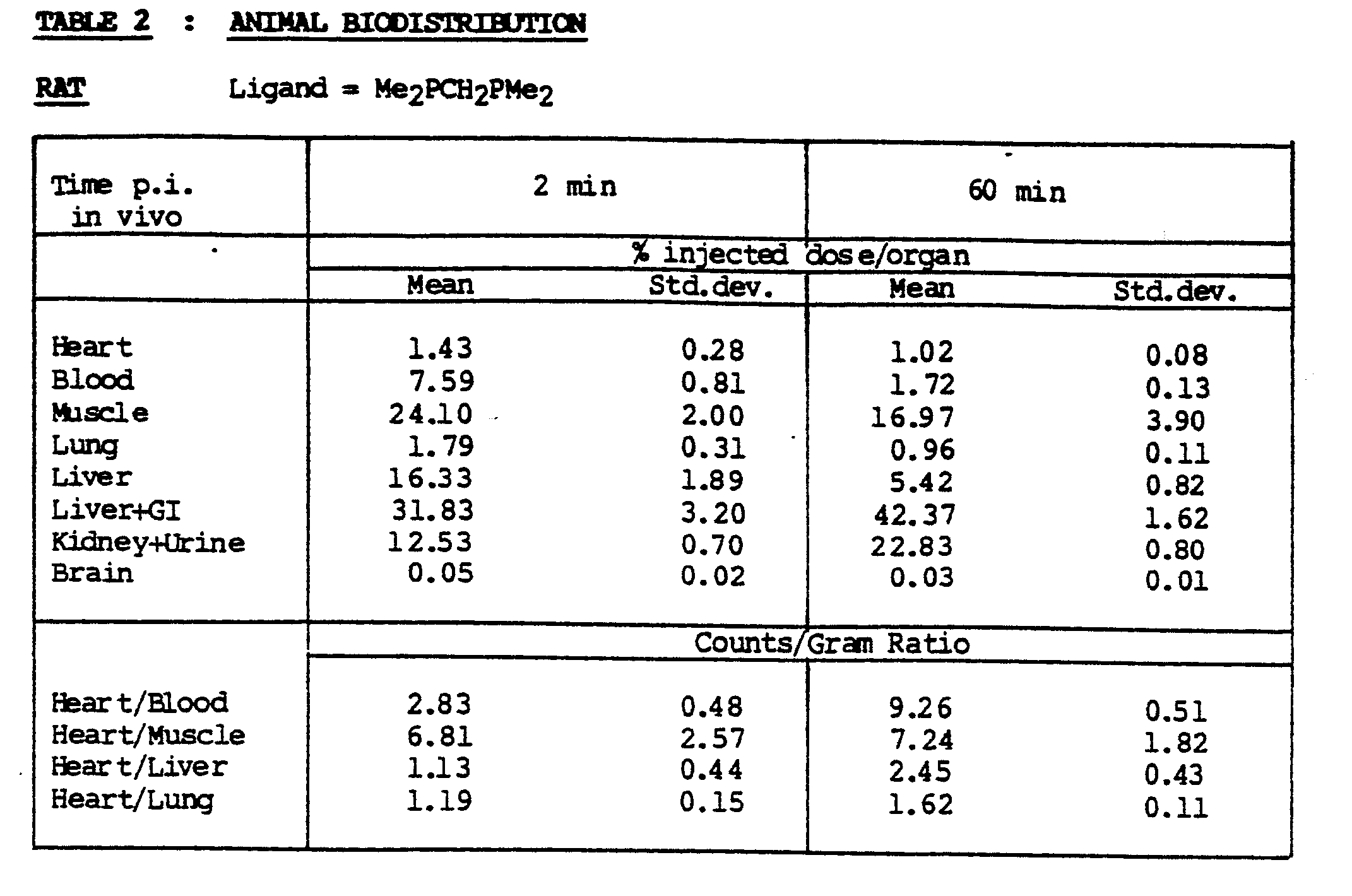
- Because the ligand L has only one C atom between the two P atoms it is surprising that a cationic, and apparently monomeric, Tc-99m complex is formed. Significant features of the biodistribution are the high heart uptake and retention, together with low background from lungs, blood and liver. Based on this rats data, it may be anticipated that the complex will prove to be a valuable heart imaging agent in humans.
- This experiment was performed using 99-Tc to demonstrate the formation of a catonic complex of the structure [TcL₃]⁺.
- All solvents were purged thoroughly with dinitrogen.
- To the suspension of (NH₄)₂TcCl₆(3) (0.5g, 1.43 mmol) in ethanol (15ml) was added a solution of dmpm (dimethylphosphinomethane) (1.7g, 12.5 mmol) in 1,4-dioxan (1ml) under dinitrogen. The reaction mixture was then heated to reflux for 2h. After cooling down to room temperature, toluene (125 ml) was added to dilute the reaction mixture. The reaction mixture was loaded onto an acidic alumina column (pH 4.5, 15cm long x 2cm diameter) which was prepared in toluene. The firm yellow band was washed down with ethanol, the ethanol solution was concentrated to ca. 20 ml, filtered and NaBPh₄ (0.5g, 1.46 mmol) in ethanol (5ml) was added to the filtrate. The solution was cooled to -10°C overnight. Pale yellow powder was collected, washed with cold ethanol (2x15ml) followed by diethyl ether (2x30ml) and dried under vacuum. Yield = 0.21g, 17.8%. Found (Required): C, 56.04 (56.7); H, 7.49 (7.51); P, 20.14 (22.52); Cl, >1.0 (0.0), for [Tc(dmpm)₃] BPh₄.
HPLC 8.5 minutes System as in Example 1. - Ligand = Me₂PCH₂PMe₂
- ⁹⁹mTcO₄Na* 0.5ml ethanol solution, 2.88GBq
NaOH 0.05ml, 10M aq.solution
Ligand 20µl
EtOH 1.5ml
*A stock sample of ⁹⁹mTc generator eluate in saline was boiled to dryness. The resulting products were redissolved in ethanol, filtered and the radioactive concentration of the solution measured. This solution was used as a stock solution of ethanolic ⁹⁹mTcO₄Na. (Same as in examples 5 ,6 and7 ). - The components were mixed in a sealed, N₂ purged vial and heated at 120°C for 90 minutes. The reaction mixture was diluted with 3ml saline and pH of the solution was adjusted to ∼7-8 with 1M HCl. The resulting solution was then submitted to chromatographic analysis and animal biodistribution study.
- The resulting preparation contains no free TcO₄⁻ or reduced technetium colloid and indicates that the desired species is present in approximately 95% yield.
Saline rf = 0.01
Methylethyl ketone rf = 0.02, 0.71
Acetonitrile:water (50:50) rf = 0.75 - The complex elutes as a broad single peak between 6.0 and 6.5 minutes. Slight contamination by 4.2 and 9.3 minutes species (<5% are frequently visible).
- See Table 1.

- Ligand = Me₂PCH₂PMe₂
- Tc⁹⁹mO₄ Na Generator Eluate 0.8ml, 2.586 GBq
Oxalic acid 7mg
Manatol 20g
Ethanol 1ml
Saline 0.2ml
Ligand 15µl - The components were mixed in a sealed, N₂ purged vial and heated at 120°C for 60 minutes; pH of the solution was adjusted to ∼7-8 with 1M KHCO₃. The resulting solution was then submitted to chromatographic analysis and animal biodistribution study.
- The resulting preparation contains no free TcO₄⁻ or technetium colloid, and indicates that a mixture of species is present.
Saline rf = 0.02
Methylethyl ketone rf = 0.04
Acetonitrile:water (50:50) rf = 1.00 - The major complex elutes as a sharp peak at approximately 8.4 minutes with 20% minor components between 6.4 and 5.1 minutes.
- See Table 2
- Ligand = Et₂PCH₂PEt₂
- ⁹⁹mTcO₄Na* 1ml ethanol solution, 2.0GBq
Oxalic acid 9mg
Mannitol 20mg
EtOH 1mg
Ligand 30µl in ethanol 10mg pure Ligand - The components were mixed in a sealed, N₂ purged vial and heated at 120° for 60ʹ. The reaction mixture was diluted with 3ml saline and pH was adjusted to ∼7-8 with 1M KHCO₃. The resulting solutin was then submitted to chromatographic analysis and animal biodistribution study.
- The resulting preparation contains no TcO₄⁻ or reduced technetium colloid, and indicates that the desired species is present in approximately 80% purity.
Saline rf = 0.08
Methylethylketone rf = 0.34, 0.38
Acetonitrile:water (50:50) rf = 0.57, 0.89 - The complex elutes as a sharp peak at approximately 6.7 minutes with a ∼20% 8.6 minutes component.
- The complex moves as a single band towards the cathode rf = -0.48 (- indicates movement towards the cathode).
- See Table 3.

- Lidgand = Me₂PCH(Me)PMe₂
- ⁹⁹mTcO₄Na* 1.0ml ethanol solution, 2.0 GBq
NaOH 0.05ml 10M aqueous solution
Ethanol 1ml
Ligand 30µl - As given in Example 3.
- The resulting preparation contains no free TcO₄⁻ or reduced technetium colloid, and indicates that the major species is obtained in approximately 90% yield.
Saline rf = 0.05
Methylethylketone rf = 0.02, 0.38
Acetonitrile:water (50:50) rf = 0.73, 0.97 - The major complex elutesas a sharp peak at approximately 8.9 minutes and a minor component elutes at 6.6 minutes.
- The complexes move as a single band towards the cathode rf = 0.45 (- indicates movement towards the cathode).
- See Table 4

- Ligand = Me₂PC(Me)₂PMe₂
- ⁹⁹mTcO₄Na* 1.0ml ethanol solution, 1.5 GBq.
NaOH 0.05ml 10M aqueous solution
Ethanol 1.0ml
ligand 20µl - As given in Example 3.
- The resulting preparation contains no free TcO₄⁻ or reduced technetium colloid, and indicates that the compound could be a mixture of complexes.
Saline rf = 0.09
Methylethylketone rf = 0.06, 0.17
Acetonitrile:Water (50:50) rf = 0.97 - These complexes elute as a broad band, with a retention time of approximately 9.6 minutes.
- The complexes move as a single band towards the cathode rf = -0.25 (- indicates movement towards the cathode).
- See Table 5.

Claims (4)
where X is in each case P or As,
Y is in each case a hydrogen atom or an unsubstituted or substituted hydrocarbon or hydrocarbonoxy group, and
R¹R²C is an unsubstituted or substituted methylene group.
Applications Claiming Priority (2)
| Application Number | Priority Date | Filing Date | Title |
|---|---|---|---|
| GB868624272A GB8624272D0 (en) | 1986-10-09 | 1986-10-09 | Cationic complexes of tc-99m |
| GB8624272 | 1986-10-09 |
Publications (2)
| Publication Number | Publication Date |
|---|---|
| EP0266910A2 true EP0266910A2 (en) | 1988-05-11 |
| EP0266910A3 EP0266910A3 (en) | 1988-06-08 |
Family
ID=10605506
Family Applications (1)
| Application Number | Title | Priority Date | Filing Date |
|---|---|---|---|
| EP87308858A Withdrawn EP0266910A3 (en) | 1986-10-09 | 1987-10-06 | Cationic complexes of tc-99m |
Country Status (3)
| Country | Link |
|---|---|
| EP (1) | EP0266910A3 (en) |
| JP (1) | JPS63126888A (en) |
| GB (1) | GB8624272D0 (en) |
Cited By (2)
| Publication number | Priority date | Publication date | Assignee | Title |
|---|---|---|---|---|
| US5744120A (en) * | 1993-03-30 | 1998-04-28 | The Dupont Merick Pharmaceutical Company | Ternary radiopharmaceutical complexes |
| US5750088A (en) * | 1993-03-30 | 1998-05-12 | The Dupont Merck Pharmaceutical Company | Stable hydrazones linked to a peptide moiety as reagents for the preparation of radiopharmaceuticals |
Family Cites Families (1)
| Publication number | Priority date | Publication date | Assignee | Title |
|---|---|---|---|---|
| US4481184A (en) * | 1983-02-14 | 1984-11-06 | E. R. Squibb & Sons, Inc. | Cationic technetium (I) complexes |
-
1986
- 1986-10-09 GB GB868624272A patent/GB8624272D0/en active Pending
-
1987
- 1987-10-06 EP EP87308858A patent/EP0266910A3/en not_active Withdrawn
- 1987-10-09 JP JP25611887A patent/JPS63126888A/en active Pending
Cited By (2)
| Publication number | Priority date | Publication date | Assignee | Title |
|---|---|---|---|---|
| US5744120A (en) * | 1993-03-30 | 1998-04-28 | The Dupont Merick Pharmaceutical Company | Ternary radiopharmaceutical complexes |
| US5750088A (en) * | 1993-03-30 | 1998-05-12 | The Dupont Merck Pharmaceutical Company | Stable hydrazones linked to a peptide moiety as reagents for the preparation of radiopharmaceuticals |
Also Published As
| Publication number | Publication date |
|---|---|
| GB8624272D0 (en) | 1986-11-12 |
| EP0266910A3 (en) | 1988-06-08 |
| JPS63126888A (en) | 1988-05-30 |
Similar Documents
| Publication | Publication Date | Title |
|---|---|---|
| US5225173A (en) | Methods and devices for the separation of radioactive rare earth metal isotopes from their alkaline earth metal precursors | |
| Hassner et al. | Synthesis of alkyl azides with a polymeric reagent | |
| Murdoch et al. | Cis-trans isomerization of [bis (L-methioninato) platinum]: metabolite of the anticancer drug cisplatin | |
| Brink et al. | Temperature-dependent acid dissociation constants (Ka,. DELTA. Ha,. DELTA. Sa) for some C-aryl hydroxamic acids: the influence of carbon and nitrogen substituents on hydroxamate anion solvation in aqueous solution | |
| Rabenstein et al. | Nuclear magnetic resonance studies of the solution chemistry of metal complexes. 20. Ligand-exchange kinetics of methylmercury (II)-thiol complexes | |
| Breque et al. | 4, 5-Dimethyl-2-(2-pyridyl) phosphorin as a chelating ligand. Synthesis and x-ray crystal structure analysis of (4, 5-dimethyl-2-(2-pyridyl) phosphorin) tetracarbonylchromium | |
| Marzilli et al. | The stereochemistry of some cobalt (III) triethylenetetramine complexes of glycine and sarcosine | |
| ES2594652T3 (en) | Novel phosphonic acids and their sulfur derivatives and methods for their preparation | |
| JP2690142B2 (en) | Ligand for producing cation complex of technetium-99m | |
| JP3221875B2 (en) | A new core of technetium radiopharmaceuticals | |
| Cooper et al. | Preparation and characterization of [Pt2Me2 (. mu.-Cl)(. mu.-dppm) 2]+: an A-frame methylplatinum complex cation | |
| Davies et al. | Transmetalation of tetranuclear copper complexes. 7. Spectral evidence for the substoichiometric transmetalation of (. mu. 4-O)[(DENC) Cu] 4X6 complexes (DENC= N, N-diethylnicotinamide; X= Cl or Br) by a bis (acetone S-methyl hydrazonecarbodithioato) nickel reagent | |
| HU209459B (en) | New process for preparing of metal-complex with fuctionalized isothiocyanato-group | |
| Galindo et al. | Protonation reactions of dinitrogen complexes of molybdenum and tungsten with PMe 3 as Co-ligand. X-Ray structure of the hydrazidium complex [WCl (NNH 3)(PMe 3) 4] Cl 2 | |
| EP0266910A2 (en) | Cationic complexes of Tc-99m | |
| English et al. | Stereochemical rigidity in ML5 complexes. 4. Preparations and nuclear magnetic resonance line-shape analyses of intramolecular exchange in neutral ML5 complexes of iron, ruthenium, and osmium | |
| Bencini et al. | Structural aspects of the protonation of small cages. Preparation of the new aza-cage 12, 17-dimethyl-1, 9, 12, 17-tetra-azabicyclo [7.5. 5] nonadecane (L). Thermodynamic studies on solution equilibria. Crystal structures of [H 2 L][CoCl 4] and [H 2 L1][CoCl 4] salts | |
| FI85859C (en) | FOERFARANDE FOER FRAMSTAELLNING AV RADIONUKLIDKOMPLEX AV METALL / ISONITRILADDUKTER. | |
| US4885100A (en) | Tris(isonitrile)copper(I) adducts for preparing radionuclide complexes | |
| Caudle et al. | Mechanistic studies on the dissociation of mono-and bimetallic 1: 1 ferric dihydroxamate complexes: probing structural effects in siderophore dissociation reactions | |
| US5420321A (en) | Tris(isonitrile)copper(i) sulfates for preparing radionuclide complexes | |
| Roberts et al. | Complexes of diphosphaferrocenes with Lewis acids and Cu (I), Ag (I) salts | |
| Pillai et al. | Technetium-99m complexes of polydentate amine-pyrrole and amine-thiophene ligands | |
| EP0291281B1 (en) | Preparation of tc-99m radiopharmaceuticals | |
| Salter et al. | The heteronuclear cluster chemistry of the group IB metals—18. Synthesis, structural characterization and dynamic behaviour of the bimetallic hexanuclear group IB metal cluster compounds [M2Ru4H2 (μ-dppf)(CO) 12][M= Cu, Ag or Au; dppf= Fe (η5-C5H5PPh2) 2]. X-ray crystal structure of [Cu2Ru4 (μ3-H) 2 (μ-dppf)(CO) 12] |
Legal Events
| Date | Code | Title | Description |
|---|---|---|---|
| PUAI | Public reference made under article 153(3) epc to a published international application that has entered the european phase |
Free format text: ORIGINAL CODE: 0009012 |
|
| PUAL | Search report despatched |
Free format text: ORIGINAL CODE: 0009013 |
|
| AK | Designated contracting states |
Kind code of ref document: A2 Designated state(s): AT BE CH DE ES FR GB IT LI NL SE |
|
| AK | Designated contracting states |
Kind code of ref document: A3 Designated state(s): AT BE CH DE ES FR GB IT LI NL SE |
|
| 17P | Request for examination filed |
Effective date: 19881129 |
|
| STAA | Information on the status of an ep patent application or granted ep patent |
Free format text: STATUS: THE APPLICATION HAS BEEN WITHDRAWN |
|
| 18W | Application withdrawn |
Withdrawal date: 19890124 |
|
| RIN1 | Information on inventor provided before grant (corrected) |
Inventor name: CHIU, KWOK WAI, DR. |