EP0233686A2 - Bis phenyl ethanol amines and bis phenyoxypropanolamines having a beta-agonist activity - Google Patents
Bis phenyl ethanol amines and bis phenyoxypropanolamines having a beta-agonist activity Download PDFInfo
- Publication number
- EP0233686A2 EP0233686A2 EP87300191A EP87300191A EP0233686A2 EP 0233686 A2 EP0233686 A2 EP 0233686A2 EP 87300191 A EP87300191 A EP 87300191A EP 87300191 A EP87300191 A EP 87300191A EP 0233686 A2 EP0233686 A2 EP 0233686A2
- Authority
- EP
- European Patent Office
- Prior art keywords
- formula
- bis
- compound
- ethanediyl
- methyl
- Prior art date
- Legal status (The legal status is an assumption and is not a legal conclusion. Google has not performed a legal analysis and makes no representation as to the accuracy of the status listed.)
- Withdrawn
Links
- 230000000694 effects Effects 0.000 title description 7
- 229940125388 beta agonist Drugs 0.000 title description 2
- WRMNZCZEMHIOCP-UHFFFAOYSA-N 2-phenylethanol Chemical compound OCCC1=CC=CC=C1 WRMNZCZEMHIOCP-UHFFFAOYSA-N 0.000 title 2
- 150000001875 compounds Chemical class 0.000 claims abstract description 258
- 150000003839 salts Chemical class 0.000 claims abstract description 63
- 150000002148 esters Chemical class 0.000 claims abstract description 62
- 150000001408 amides Chemical class 0.000 claims abstract description 50
- 125000004435 hydrogen atom Chemical group [H]* 0.000 claims abstract description 26
- 125000003118 aryl group Chemical group 0.000 claims abstract description 16
- 125000000499 benzofuranyl group Chemical group O1C(=CC2=C1C=CC=C2)* 0.000 claims abstract description 8
- -1 2-(3-chlorophenyl)-2-hydroxyethyl Chemical group 0.000 claims description 128
- ZSRDNPVYGSFUMD-UHFFFAOYSA-N (3-chlorophenyl)methanol Chemical compound OCC1=CC=CC(Cl)=C1 ZSRDNPVYGSFUMD-UHFFFAOYSA-N 0.000 claims description 79
- 238000000034 method Methods 0.000 claims description 79
- 125000002924 primary amino group Chemical group [H]N([H])* 0.000 claims description 66
- 229910052757 nitrogen Inorganic materials 0.000 claims description 59
- 239000000203 mixture Substances 0.000 claims description 55
- 125000001436 propyl group Chemical group [H]C([*])([H])C([H])([H])C([H])([H])[H] 0.000 claims description 38
- 125000001997 phenyl group Chemical group [H]C1=C([H])C([H])=C(*)C([H])=C1[H] 0.000 claims description 36
- 238000006243 chemical reaction Methods 0.000 claims description 33
- 125000005647 linker group Chemical group 0.000 claims description 32
- 229910052739 hydrogen Inorganic materials 0.000 claims description 31
- 230000000269 nucleophilic effect Effects 0.000 claims description 31
- 125000002947 alkylene group Chemical group 0.000 claims description 29
- 239000001257 hydrogen Substances 0.000 claims description 28
- 125000002887 hydroxy group Chemical group [H]O* 0.000 claims description 23
- 125000002496 methyl group Chemical group [H]C([H])([H])* 0.000 claims description 19
- 125000004450 alkenylene group Chemical group 0.000 claims description 16
- 125000000217 alkyl group Chemical group 0.000 claims description 16
- 125000004419 alkynylene group Chemical group 0.000 claims description 16
- 229910052760 oxygen Inorganic materials 0.000 claims description 16
- 239000002253 acid Substances 0.000 claims description 15
- 125000000951 phenoxy group Chemical group [H]C1=C([H])C([H])=C(O*)C([H])=C1[H] 0.000 claims description 15
- 125000006239 protecting group Chemical group 0.000 claims description 14
- QVGXLLKOCUKJST-UHFFFAOYSA-N atomic oxygen Chemical compound [O] QVGXLLKOCUKJST-UHFFFAOYSA-N 0.000 claims description 13
- IJGRMHOSHXDMSA-UHFFFAOYSA-N nitrogen Substances N#N IJGRMHOSHXDMSA-UHFFFAOYSA-N 0.000 claims description 13
- 239000001301 oxygen Substances 0.000 claims description 13
- DLFVBJFMPXGRIB-UHFFFAOYSA-N Acetamide Chemical compound CC(N)=O DLFVBJFMPXGRIB-UHFFFAOYSA-N 0.000 claims description 12
- 238000011282 treatment Methods 0.000 claims description 12
- 229960004217 benzyl alcohol Drugs 0.000 claims description 11
- 125000003277 amino group Chemical group 0.000 claims description 10
- 125000004429 atom Chemical group 0.000 claims description 10
- 125000000843 phenylene group Chemical group C1(=C(C=CC=C1)*)* 0.000 claims description 10
- 229910052736 halogen Inorganic materials 0.000 claims description 9
- 150000002367 halogens Chemical class 0.000 claims description 9
- 238000004519 manufacturing process Methods 0.000 claims description 9
- KGRVJHAUYBGFFP-UHFFFAOYSA-N 2,2'-Methylenebis(4-methyl-6-tert-butylphenol) Chemical compound CC(C)(C)C1=CC(C)=CC(CC=2C(=C(C=C(C)C=2)C(C)(C)C)O)=C1O KGRVJHAUYBGFFP-UHFFFAOYSA-N 0.000 claims description 8
- NINIDFKCEFEMDL-UHFFFAOYSA-N Sulfur Chemical compound [S] NINIDFKCEFEMDL-UHFFFAOYSA-N 0.000 claims description 8
- 125000003545 alkoxy group Chemical group 0.000 claims description 8
- 125000003178 carboxy group Chemical group [H]OC(*)=O 0.000 claims description 8
- 125000003707 hexyloxy group Chemical group [H]C([H])([H])C([H])([H])C([H])([H])C([H])([H])C([H])([H])C([H])([H])O* 0.000 claims description 8
- 125000001841 imino group Chemical group [H]N=* 0.000 claims description 8
- 244000144972 livestock Species 0.000 claims description 8
- 125000002023 trifluoromethyl group Chemical group FC(F)(F)* 0.000 claims description 8
- 239000004215 Carbon black (E152) Substances 0.000 claims description 7
- 241000282412 Homo Species 0.000 claims description 7
- 239000005864 Sulphur Substances 0.000 claims description 7
- WPYMKLBDIGXBTP-UHFFFAOYSA-N benzoic acid Chemical compound OC(=O)C1=CC=CC=C1 WPYMKLBDIGXBTP-UHFFFAOYSA-N 0.000 claims description 7
- 125000005842 heteroatom Chemical group 0.000 claims description 7
- 229930195733 hydrocarbon Natural products 0.000 claims description 7
- 150000002430 hydrocarbons Chemical class 0.000 claims description 7
- 208000008589 Obesity Diseases 0.000 claims description 6
- 230000003247 decreasing effect Effects 0.000 claims description 6
- 239000003814 drug Substances 0.000 claims description 6
- 125000000816 ethylene group Chemical group [H]C([H])([*:1])C([H])([H])[*:2] 0.000 claims description 6
- 125000002768 hydroxyalkyl group Chemical group 0.000 claims description 6
- 235000020824 obesity Nutrition 0.000 claims description 6
- 239000008194 pharmaceutical composition Substances 0.000 claims description 6
- 125000000286 phenylethyl group Chemical group [H]C1=C([H])C([H])=C(C([H])=C1[H])C([H])([H])C([H])([H])* 0.000 claims description 6
- 201000001320 Atherosclerosis Diseases 0.000 claims description 5
- 125000003342 alkenyl group Chemical group 0.000 claims description 5
- 125000000304 alkynyl group Chemical group 0.000 claims description 5
- 201000001421 hyperglycemia Diseases 0.000 claims description 5
- 150000002825 nitriles Chemical class 0.000 claims description 5
- 231100000252 nontoxic Toxicity 0.000 claims description 5
- 230000003000 nontoxic effect Effects 0.000 claims description 5
- 125000004957 naphthylene group Chemical group 0.000 claims description 4
- 125000000449 nitro group Chemical group [O-][N+](*)=O 0.000 claims description 4
- 150000002829 nitrogen Chemical class 0.000 claims description 4
- YCIMNLLNPGFGHC-UHFFFAOYSA-N o-dihydroxy-benzene Natural products OC1=CC=CC=C1O YCIMNLLNPGFGHC-UHFFFAOYSA-N 0.000 claims description 4
- GHMLBKRAJCXXBS-UHFFFAOYSA-N resorcinol Chemical compound OC1=CC=CC(O)=C1 GHMLBKRAJCXXBS-UHFFFAOYSA-N 0.000 claims description 4
- 229960001755 resorcinol Drugs 0.000 claims description 4
- 230000004083 survival effect Effects 0.000 claims description 4
- 125000003161 (C1-C6) alkylene group Chemical group 0.000 claims description 3
- 125000006681 (C2-C10) alkylene group Chemical group 0.000 claims description 3
- 125000006591 (C2-C6) alkynylene group Chemical group 0.000 claims description 3
- FKJXQRKGNNAVHT-UHFFFAOYSA-N 2-[4-[2-[(2-hydroxy-2-phenylethyl)amino]propyl]benzoyl]oxyethyl 4-[2-[(2-hydroxy-2-phenylethyl)amino]propyl]benzoate Chemical compound C=1C=CC=CC=1C(O)CNC(C)CC(C=C1)=CC=C1C(=O)OCCOC(=O)C(C=C1)=CC=C1CC(C)NCC(O)C1=CC=CC=C1 FKJXQRKGNNAVHT-UHFFFAOYSA-N 0.000 claims description 3
- 125000000033 alkoxyamino group Chemical group 0.000 claims description 3
- 239000003937 drug carrier Substances 0.000 claims description 3
- 238000009472 formulation Methods 0.000 claims description 3
- 229910052717 sulfur Inorganic materials 0.000 claims description 3
- 230000004584 weight gain Effects 0.000 claims description 3
- 235000019786 weight gain Nutrition 0.000 claims description 3
- 101150032584 oxy-4 gene Proteins 0.000 claims description 2
- OKKJLVBELUTLKV-UHFFFAOYSA-N Methanol Chemical compound OC OKKJLVBELUTLKV-UHFFFAOYSA-N 0.000 description 153
- HEDRZPFGACZZDS-MICDWDOJSA-N Trichloro(2H)methane Chemical compound [2H]C(Cl)(Cl)Cl HEDRZPFGACZZDS-MICDWDOJSA-N 0.000 description 78
- 239000000243 solution Substances 0.000 description 59
- IAZDPXIOMUYVGZ-WFGJKAKNSA-N Dimethyl sulfoxide Chemical compound [2H]C([2H])([2H])S(=O)C([2H])([2H])[2H] IAZDPXIOMUYVGZ-WFGJKAKNSA-N 0.000 description 48
- XEKOWRVHYACXOJ-UHFFFAOYSA-N Ethyl acetate Chemical compound CCOC(C)=O XEKOWRVHYACXOJ-UHFFFAOYSA-N 0.000 description 46
- VYPSYNLAJGMNEJ-UHFFFAOYSA-N Silicium dioxide Chemical compound O=[Si]=O VYPSYNLAJGMNEJ-UHFFFAOYSA-N 0.000 description 41
- LFQSCWFLJHTTHZ-UHFFFAOYSA-N Ethanol Chemical compound CCO LFQSCWFLJHTTHZ-UHFFFAOYSA-N 0.000 description 40
- IAZDPXIOMUYVGZ-UHFFFAOYSA-N Dimethylsulphoxide Chemical compound CS(C)=O IAZDPXIOMUYVGZ-UHFFFAOYSA-N 0.000 description 39
- VEXZGXHMUGYJMC-UHFFFAOYSA-N Hydrochloric acid Chemical compound Cl VEXZGXHMUGYJMC-UHFFFAOYSA-N 0.000 description 38
- WYURNTSHIVDZCO-UHFFFAOYSA-N Tetrahydrofuran Chemical compound C1CCOC1 WYURNTSHIVDZCO-UHFFFAOYSA-N 0.000 description 38
- ZMXDDKWLCZADIW-UHFFFAOYSA-N N,N-Dimethylformamide Chemical compound CN(C)C=O ZMXDDKWLCZADIW-UHFFFAOYSA-N 0.000 description 36
- YMWUJEATGCHHMB-UHFFFAOYSA-N Dichloromethane Chemical compound ClCCl YMWUJEATGCHHMB-UHFFFAOYSA-N 0.000 description 30
- HEDRZPFGACZZDS-UHFFFAOYSA-N Chloroform Chemical compound ClC(Cl)Cl HEDRZPFGACZZDS-UHFFFAOYSA-N 0.000 description 26
- 239000002904 solvent Substances 0.000 description 23
- XLYOFNOQVPJJNP-UHFFFAOYSA-N water Substances O XLYOFNOQVPJJNP-UHFFFAOYSA-N 0.000 description 21
- YLQBMQCUIZJEEH-UHFFFAOYSA-N tetrahydrofuran Natural products C=1C=COC=1 YLQBMQCUIZJEEH-UHFFFAOYSA-N 0.000 description 18
- RTZKZFJDLAIYFH-UHFFFAOYSA-N Diethyl ether Chemical compound CCOCC RTZKZFJDLAIYFH-UHFFFAOYSA-N 0.000 description 17
- 229910052799 carbon Inorganic materials 0.000 description 15
- 229940093499 ethyl acetate Drugs 0.000 description 15
- UFHFLCQGNIYNRP-UHFFFAOYSA-N Hydrogen Chemical compound [H][H] UFHFLCQGNIYNRP-UHFFFAOYSA-N 0.000 description 14
- ISWSIDIOOBJBQZ-UHFFFAOYSA-N Phenol Chemical compound OC1=CC=CC=C1 ISWSIDIOOBJBQZ-UHFFFAOYSA-N 0.000 description 14
- 239000000377 silicon dioxide Substances 0.000 description 14
- 0 C*(C)C1(CC1)N(C)C Chemical compound C*(C)C1(CC1)N(C)C 0.000 description 13
- 238000010992 reflux Methods 0.000 description 13
- SAMVPMGKGGLIPF-SSDOTTSWSA-N (2r)-2-(3-chlorophenyl)-2-hydroxyacetic acid Chemical compound OC(=O)[C@H](O)C1=CC=CC(Cl)=C1 SAMVPMGKGGLIPF-SSDOTTSWSA-N 0.000 description 12
- CSCPPACGZOOCGX-UHFFFAOYSA-N Acetone Chemical compound CC(C)=O CSCPPACGZOOCGX-UHFFFAOYSA-N 0.000 description 12
- QTBSBXVTEAMEQO-UHFFFAOYSA-N Acetic acid Chemical compound CC(O)=O QTBSBXVTEAMEQO-UHFFFAOYSA-N 0.000 description 11
- UIIMBOGNXHQVGW-UHFFFAOYSA-M Sodium bicarbonate Chemical compound [Na+].OC([O-])=O UIIMBOGNXHQVGW-UHFFFAOYSA-M 0.000 description 11
- 239000007787 solid Substances 0.000 description 11
- CSNNHWWHGAXBCP-UHFFFAOYSA-L Magnesium sulfate Chemical compound [Mg+2].[O-][S+2]([O-])([O-])[O-] CSNNHWWHGAXBCP-UHFFFAOYSA-L 0.000 description 10
- KDLHZDBZIXYQEI-UHFFFAOYSA-N Palladium Chemical compound [Pd] KDLHZDBZIXYQEI-UHFFFAOYSA-N 0.000 description 10
- 239000000741 silica gel Substances 0.000 description 10
- 229910002027 silica gel Inorganic materials 0.000 description 10
- AITHTNWKHRIYGY-UHFFFAOYSA-N 4-(2-aminopropyl)-3-fluoro-n,n-dimethylaniline;hydrochloride Chemical compound Cl.CC(N)CC1=CC=C(N(C)C)C=C1F AITHTNWKHRIYGY-UHFFFAOYSA-N 0.000 description 9
- HEMHJVSKTPXQMS-UHFFFAOYSA-M Sodium hydroxide Chemical compound [OH-].[Na+] HEMHJVSKTPXQMS-UHFFFAOYSA-M 0.000 description 9
- MCQRPQCQMGVWIQ-UHFFFAOYSA-N boron;methylsulfanylmethane Chemical compound [B].CSC MCQRPQCQMGVWIQ-UHFFFAOYSA-N 0.000 description 9
- 238000003756 stirring Methods 0.000 description 9
- 239000003638 chemical reducing agent Substances 0.000 description 8
- 238000004587 chromatography analysis Methods 0.000 description 8
- 238000010828 elution Methods 0.000 description 8
- IXCSERBJSXMMFS-UHFFFAOYSA-N hydrogen chloride Substances Cl.Cl IXCSERBJSXMMFS-UHFFFAOYSA-N 0.000 description 8
- 229910000041 hydrogen chloride Inorganic materials 0.000 description 8
- 239000012044 organic layer Substances 0.000 description 8
- 229960003742 phenol Drugs 0.000 description 8
- VGGSQFUCUMXWEO-UHFFFAOYSA-N Ethene Chemical compound C=C VGGSQFUCUMXWEO-UHFFFAOYSA-N 0.000 description 7
- QUSNBJAOOMFDIB-UHFFFAOYSA-N Ethylamine Chemical compound CCN QUSNBJAOOMFDIB-UHFFFAOYSA-N 0.000 description 7
- 239000005977 Ethylene Substances 0.000 description 7
- FYYHWMGAXLPEAU-UHFFFAOYSA-N Magnesium Chemical compound [Mg] FYYHWMGAXLPEAU-UHFFFAOYSA-N 0.000 description 7
- BHHGXPLMPWCGHP-UHFFFAOYSA-N Phenethylamine Chemical compound NCCC1=CC=CC=C1 BHHGXPLMPWCGHP-UHFFFAOYSA-N 0.000 description 7
- 150000001721 carbon Chemical group 0.000 description 7
- 125000004432 carbon atom Chemical group C* 0.000 description 7
- 239000003480 eluent Substances 0.000 description 7
- HPALAKNZSZLMCH-UHFFFAOYSA-M sodium;chloride;hydrate Chemical class O.[Na+].[Cl-] HPALAKNZSZLMCH-UHFFFAOYSA-M 0.000 description 7
- 125000001424 substituent group Chemical group 0.000 description 7
- 125000004169 (C1-C6) alkyl group Chemical group 0.000 description 6
- LSBDFXRDZJMBSC-UHFFFAOYSA-N 2-phenylacetamide Chemical compound NC(=O)CC1=CC=CC=C1 LSBDFXRDZJMBSC-UHFFFAOYSA-N 0.000 description 6
- QGZKDVFQNNGYKY-UHFFFAOYSA-N Ammonia Chemical compound N QGZKDVFQNNGYKY-UHFFFAOYSA-N 0.000 description 6
- OKTJSMMVPCPJKN-UHFFFAOYSA-N Carbon Chemical compound [C] OKTJSMMVPCPJKN-UHFFFAOYSA-N 0.000 description 6
- QOSSAOTZNIDXMA-UHFFFAOYSA-N Dicylcohexylcarbodiimide Chemical compound C1CCCCC1N=C=NC1CCCCC1 QOSSAOTZNIDXMA-UHFFFAOYSA-N 0.000 description 6
- 241000700159 Rattus Species 0.000 description 6
- YXFVVABEGXRONW-UHFFFAOYSA-N Toluene Chemical compound CC1=CC=CC=C1 YXFVVABEGXRONW-UHFFFAOYSA-N 0.000 description 6
- ZMANZCXQSJIPKH-UHFFFAOYSA-N Triethylamine Chemical compound CCN(CC)CC ZMANZCXQSJIPKH-UHFFFAOYSA-N 0.000 description 6
- 230000002378 acidificating effect Effects 0.000 description 6
- 210000004369 blood Anatomy 0.000 description 6
- 239000008280 blood Substances 0.000 description 6
- 239000003054 catalyst Substances 0.000 description 6
- 230000009467 reduction Effects 0.000 description 6
- WQZGKKKJIJFFOK-GASJEMHNSA-N Glucose Natural products OC[C@H]1OC(O)[C@H](O)[C@@H](O)[C@@H]1O WQZGKKKJIJFFOK-GASJEMHNSA-N 0.000 description 5
- 150000001450 anions Chemical class 0.000 description 5
- WPYMKLBDIGXBTP-UHFFFAOYSA-M benzoate Chemical compound [O-]C(=O)C1=CC=CC=C1 WPYMKLBDIGXBTP-UHFFFAOYSA-M 0.000 description 5
- UORVGPXVDQYIDP-UHFFFAOYSA-N borane Chemical compound B UORVGPXVDQYIDP-UHFFFAOYSA-N 0.000 description 5
- 239000003795 chemical substances by application Substances 0.000 description 5
- 125000001495 ethyl group Chemical group [H]C([H])([H])C([H])([H])* 0.000 description 5
- 239000000706 filtrate Substances 0.000 description 5
- 239000008103 glucose Substances 0.000 description 5
- 150000002431 hydrogen Chemical class 0.000 description 5
- 238000001727 in vivo Methods 0.000 description 5
- 229910052943 magnesium sulfate Inorganic materials 0.000 description 5
- 239000011541 reaction mixture Substances 0.000 description 5
- RQEUFEKYXDPUSK-SSDOTTSWSA-N (1R)-1-phenylethanamine Chemical compound C[C@@H](N)C1=CC=CC=C1 RQEUFEKYXDPUSK-SSDOTTSWSA-N 0.000 description 4
- 238000005160 1H NMR spectroscopy Methods 0.000 description 4
- 239000005711 Benzoic acid Substances 0.000 description 4
- WVDDGKGOMKODPV-UHFFFAOYSA-N Benzyl alcohol Chemical compound OCC1=CC=CC=C1 WVDDGKGOMKODPV-UHFFFAOYSA-N 0.000 description 4
- ZAMOUSCENKQFHK-UHFFFAOYSA-N Chlorine atom Chemical group [Cl] ZAMOUSCENKQFHK-UHFFFAOYSA-N 0.000 description 4
- 102000015779 HDL Lipoproteins Human genes 0.000 description 4
- 108010010234 HDL Lipoproteins Proteins 0.000 description 4
- 241000699670 Mus sp. Species 0.000 description 4
- JUJWROOIHBZHMG-UHFFFAOYSA-N Pyridine Chemical compound C1=CC=NC=C1 JUJWROOIHBZHMG-UHFFFAOYSA-N 0.000 description 4
- CDBYLPFSWZWCQE-UHFFFAOYSA-L Sodium Carbonate Chemical compound [Na+].[Na+].[O-]C([O-])=O CDBYLPFSWZWCQE-UHFFFAOYSA-L 0.000 description 4
- 229960000583 acetic acid Drugs 0.000 description 4
- 235000010233 benzoic acid Nutrition 0.000 description 4
- WXBLLCUINBKULX-UHFFFAOYSA-N benzoic acid Chemical compound OC(=O)C1=CC=CC=C1.OC(=O)C1=CC=CC=C1 WXBLLCUINBKULX-UHFFFAOYSA-N 0.000 description 4
- 125000001797 benzyl group Chemical group [H]C1=C([H])C([H])=C(C([H])=C1[H])C([H])([H])* 0.000 description 4
- 239000012267 brine Substances 0.000 description 4
- 239000003153 chemical reaction reagent Substances 0.000 description 4
- 239000000460 chlorine Chemical group 0.000 description 4
- 229910052801 chlorine Inorganic materials 0.000 description 4
- HVYWMOMLDIMFJA-DPAQBDIFSA-N cholesterol Chemical compound C1C=C2C[C@@H](O)CC[C@]2(C)[C@@H]2[C@@H]1[C@@H]1CC[C@H]([C@H](C)CCCC(C)C)[C@@]1(C)CC2 HVYWMOMLDIMFJA-DPAQBDIFSA-N 0.000 description 4
- 238000007796 conventional method Methods 0.000 description 4
- 239000012043 crude product Substances 0.000 description 4
- UREBWPXBXRYXRJ-UHFFFAOYSA-N ethyl acetate;methanol Chemical compound OC.CCOC(C)=O UREBWPXBXRYXRJ-UHFFFAOYSA-N 0.000 description 4
- 230000002349 favourable effect Effects 0.000 description 4
- 238000001914 filtration Methods 0.000 description 4
- 150000004795 grignard reagents Chemical class 0.000 description 4
- 239000012280 lithium aluminium hydride Substances 0.000 description 4
- TYJJADVDDVDEDZ-UHFFFAOYSA-M potassium hydrogencarbonate Chemical compound [K+].OC([O-])=O TYJJADVDDVDEDZ-UHFFFAOYSA-M 0.000 description 4
- 238000002360 preparation method Methods 0.000 description 4
- 229910000030 sodium bicarbonate Inorganic materials 0.000 description 4
- 235000017557 sodium bicarbonate Nutrition 0.000 description 4
- 239000000725 suspension Substances 0.000 description 4
- RYHBNJHYFVUHQT-UHFFFAOYSA-N 1,4-Dioxane Chemical compound C1COCCO1 RYHBNJHYFVUHQT-UHFFFAOYSA-N 0.000 description 3
- ZDDHRZLUBYDEDA-UHFFFAOYSA-N 1-(2-nitroprop-1-enyl)-4-[4-(2-nitroprop-1-enyl)phenyl]sulfanylbenzene Chemical compound C1=CC(C=C(C)[N+]([O-])=O)=CC=C1SC1=CC=C(C=C(C)[N+]([O-])=O)C=C1 ZDDHRZLUBYDEDA-UHFFFAOYSA-N 0.000 description 3
- GIKNHHRFLCDOEU-SSDOTTSWSA-N 4-[(2r)-2-aminopropyl]phenol Chemical compound C[C@@H](N)CC1=CC=C(O)C=C1 GIKNHHRFLCDOEU-SSDOTTSWSA-N 0.000 description 3
- HBAQYPYDRFILMT-UHFFFAOYSA-N 8-[3-(1-cyclopropylpyrazol-4-yl)-1H-pyrazolo[4,3-d]pyrimidin-5-yl]-3-methyl-3,8-diazabicyclo[3.2.1]octan-2-one Chemical class C1(CC1)N1N=CC(=C1)C1=NNC2=C1N=C(N=C2)N1C2C(N(CC1CC2)C)=O HBAQYPYDRFILMT-UHFFFAOYSA-N 0.000 description 3
- UHOVQNZJYSORNB-UHFFFAOYSA-N Benzene Chemical compound C1=CC=CC=C1 UHOVQNZJYSORNB-UHFFFAOYSA-N 0.000 description 3
- WKBOTKDWSSQWDR-UHFFFAOYSA-N Bromine atom Chemical compound [Br] WKBOTKDWSSQWDR-UHFFFAOYSA-N 0.000 description 3
- PIICEJLVQHRZGT-UHFFFAOYSA-N Ethylenediamine Chemical compound NCCN PIICEJLVQHRZGT-UHFFFAOYSA-N 0.000 description 3
- 239000007818 Grignard reagent Substances 0.000 description 3
- 235000011054 acetic acid Nutrition 0.000 description 3
- 239000004480 active ingredient Substances 0.000 description 3
- 229910021529 ammonia Inorganic materials 0.000 description 3
- 229910000085 borane Inorganic materials 0.000 description 3
- 239000000969 carrier Substances 0.000 description 3
- WORJEOGGNQDSOE-UHFFFAOYSA-N chloroform;methanol Chemical compound OC.ClC(Cl)Cl WORJEOGGNQDSOE-UHFFFAOYSA-N 0.000 description 3
- KRKNYBCHXYNGOX-UHFFFAOYSA-N citric acid Chemical compound OC(=O)CC(O)(C(O)=O)CC(O)=O KRKNYBCHXYNGOX-UHFFFAOYSA-N 0.000 description 3
- WGLUMOCWFMKWIL-UHFFFAOYSA-N dichloromethane;methanol Chemical compound OC.ClCCl WGLUMOCWFMKWIL-UHFFFAOYSA-N 0.000 description 3
- 229960004132 diethyl ether Drugs 0.000 description 3
- BCWICWWVZYGKRF-UHFFFAOYSA-N ethyl 2-hydroxy-2,2-bis[4-(2-oxopropyl)phenyl]acetate Chemical compound C=1C=C(CC(C)=O)C=CC=1C(O)(C(=O)OCC)C1=CC=C(CC(C)=O)C=C1 BCWICWWVZYGKRF-UHFFFAOYSA-N 0.000 description 3
- 238000001704 evaporation Methods 0.000 description 3
- 230000008020 evaporation Effects 0.000 description 3
- 125000005843 halogen group Chemical group 0.000 description 3
- 238000007327 hydrogenolysis reaction Methods 0.000 description 3
- 230000003345 hyperglycaemic effect Effects 0.000 description 3
- 229910052749 magnesium Inorganic materials 0.000 description 3
- 239000011777 magnesium Substances 0.000 description 3
- WSFSSNUMVMOOMR-BJUDXGSMSA-N methanone Chemical compound O=[11CH2] WSFSSNUMVMOOMR-BJUDXGSMSA-N 0.000 description 3
- 239000012299 nitrogen atmosphere Substances 0.000 description 3
- 239000007858 starting material Substances 0.000 description 3
- ULTHEAFYOOPTTB-UHFFFAOYSA-N 1,4-dibromobutane Chemical compound BrCCCCBr ULTHEAFYOOPTTB-UHFFFAOYSA-N 0.000 description 2
- HAMRIDKPPKVAHP-UHFFFAOYSA-N 1-(2-nitroprop-1-enyl)-4-[4-(2-nitroprop-1-enyl)phenoxy]benzene Chemical compound C1=CC(C=C(C)[N+]([O-])=O)=CC=C1OC1=CC=C(C=C(C)[N+]([O-])=O)C=C1 HAMRIDKPPKVAHP-UHFFFAOYSA-N 0.000 description 2
- ASOKPJOREAFHNY-UHFFFAOYSA-N 1-Hydroxybenzotriazole Chemical compound C1=CC=C2N(O)N=NC2=C1 ASOKPJOREAFHNY-UHFFFAOYSA-N 0.000 description 2
- RYHIVWBVRPEZJD-UHFFFAOYSA-N 1-[4-[2-[2-[4-(2-oxopropyl)phenoxy]ethoxy]ethoxy]phenyl]propan-2-one Chemical compound C1=CC(CC(=O)C)=CC=C1OCCOCCOC1=CC=C(CC(C)=O)C=C1 RYHIVWBVRPEZJD-UHFFFAOYSA-N 0.000 description 2
- ALDGNIBXHRTANU-UHFFFAOYSA-N 1-[4-[2-[4-(2-oxopropyl)phenyl]ethyl]phenyl]propan-2-one Chemical compound C1=CC(CC(=O)C)=CC=C1CCC1=CC=C(CC(C)=O)C=C1 ALDGNIBXHRTANU-UHFFFAOYSA-N 0.000 description 2
- KCLZJDXEMDPFOC-UHFFFAOYSA-N 1-[4-[4-(2-oxopropyl)phenoxy]phenyl]propan-2-one Chemical compound C1=CC(CC(=O)C)=CC=C1OC1=CC=C(CC(C)=O)C=C1 KCLZJDXEMDPFOC-UHFFFAOYSA-N 0.000 description 2
- WLUZLIGSXSTHFD-UHFFFAOYSA-N 1-[4-[6-[4-(2-oxopropyl)phenyl]hexyl]phenyl]propan-2-one Chemical compound C1=CC(CC(=O)C)=CC=C1CCCCCCC1=CC=C(CC(C)=O)C=C1 WLUZLIGSXSTHFD-UHFFFAOYSA-N 0.000 description 2
- PJUPKRYGDFTMTM-UHFFFAOYSA-N 1-hydroxybenzotriazole;hydrate Chemical compound O.C1=CC=C2N(O)N=NC2=C1 PJUPKRYGDFTMTM-UHFFFAOYSA-N 0.000 description 2
- XEZNGIUYQVAUSS-UHFFFAOYSA-N 18-crown-6 Chemical compound C1COCCOCCOCCOCCOCCO1 XEZNGIUYQVAUSS-UHFFFAOYSA-N 0.000 description 2
- GQHTUMJGOHRCHB-UHFFFAOYSA-N 2,3,4,6,7,8,9,10-octahydropyrimido[1,2-a]azepine Chemical compound C1CCCCN2CCCN=C21 GQHTUMJGOHRCHB-UHFFFAOYSA-N 0.000 description 2
- OWOILGOFGGNKFR-UHFFFAOYSA-N 2-[2-[1-[4-[4-[4-[2-[2-(2-amino-1-hydroxy-2-oxoethyl)-6-chlorophenyl]propyl]phenoxy]butoxy]phenyl]propan-2-yl]-3-chlorophenyl]-2-hydroxyacetamide Chemical compound C(CCCOC1=CC=C(C=C1)CC(C)C1=C(C=CC=C1Cl)C(C(=O)N)O)OC1=CC=C(C=C1)CC(C)C1=C(C=CC=C1Cl)C(C(=O)N)O OWOILGOFGGNKFR-UHFFFAOYSA-N 0.000 description 2
- IOPCMLOOAZMCJR-UHFFFAOYSA-N 2-[3,5-bis(phenylmethoxy)phenyl]-n-[1-[4-[6-[4-[2-[[2-[3,5-bis(phenylmethoxy)phenyl]-2-hydroxyacetyl]amino]propyl]phenoxy]hexoxy]phenyl]propan-2-yl]-2-hydroxyacetamide Chemical compound C=1C(OCC=2C=CC=CC=2)=CC(OCC=2C=CC=CC=2)=CC=1C(O)C(=O)NC(C)CC(C=C1)=CC=C1OCCCCCCOC(C=C1)=CC=C1CC(C)NC(=O)C(O)C(C=C(OCC=1C=CC=CC=1)C=1)=CC=1OCC1=CC=CC=C1 IOPCMLOOAZMCJR-UHFFFAOYSA-N 0.000 description 2
- NHQDETIJWKXCTC-UHFFFAOYSA-N 3-chloroperbenzoic acid Chemical compound OOC(=O)C1=CC=CC(Cl)=C1 NHQDETIJWKXCTC-UHFFFAOYSA-N 0.000 description 2
- 125000004179 3-chlorophenyl group Chemical group [H]C1=C([H])C(*)=C([H])C(Cl)=C1[H] 0.000 description 2
- GWTWOYXFOWVANH-UHFFFAOYSA-N 4-(4-formylphenyl)sulfanylbenzaldehyde Chemical compound C1=CC(C=O)=CC=C1SC1=CC=C(C=O)C=C1 GWTWOYXFOWVANH-UHFFFAOYSA-N 0.000 description 2
- QCQCHGYLTSGIGX-GHXANHINSA-N 4-[[(3ar,5ar,5br,7ar,9s,11ar,11br,13as)-5a,5b,8,8,11a-pentamethyl-3a-[(5-methylpyridine-3-carbonyl)amino]-2-oxo-1-propan-2-yl-4,5,6,7,7a,9,10,11,11b,12,13,13a-dodecahydro-3h-cyclopenta[a]chrysen-9-yl]oxy]-2,2-dimethyl-4-oxobutanoic acid Chemical compound N([C@@]12CC[C@@]3(C)[C@]4(C)CC[C@H]5C(C)(C)[C@@H](OC(=O)CC(C)(C)C(O)=O)CC[C@]5(C)[C@H]4CC[C@@H]3C1=C(C(C2)=O)C(C)C)C(=O)C1=CN=CC(C)=C1 QCQCHGYLTSGIGX-GHXANHINSA-N 0.000 description 2
- RGHHSNMVTDWUBI-UHFFFAOYSA-N 4-hydroxybenzaldehyde Chemical compound OC1=CC=C(C=O)C=C1 RGHHSNMVTDWUBI-UHFFFAOYSA-N 0.000 description 2
- NLXLAEXVIDQMFP-UHFFFAOYSA-N Ammonium chloride Substances [NH4+].[Cl-] NLXLAEXVIDQMFP-UHFFFAOYSA-N 0.000 description 2
- 101150041968 CDC13 gene Proteins 0.000 description 2
- 241000282472 Canis lupus familiaris Species 0.000 description 2
- OKKJLVBELUTLKV-MZCSYVLQSA-N Deuterated methanol Chemical compound [2H]OC([2H])([2H])[2H] OKKJLVBELUTLKV-MZCSYVLQSA-N 0.000 description 2
- VZCYOOQTPOCHFL-OWOJBTEDSA-N Fumaric acid Chemical compound OC(=O)\C=C\C(O)=O VZCYOOQTPOCHFL-OWOJBTEDSA-N 0.000 description 2
- DGAQECJNVWCQMB-PUAWFVPOSA-M Ilexoside XXIX Chemical compound C[C@@H]1CC[C@@]2(CC[C@@]3(C(=CC[C@H]4[C@]3(CC[C@@H]5[C@@]4(CC[C@@H](C5(C)C)OS(=O)(=O)[O-])C)C)[C@@H]2[C@]1(C)O)C)C(=O)O[C@H]6[C@@H]([C@H]([C@@H]([C@H](O6)CO)O)O)O.[Na+] DGAQECJNVWCQMB-PUAWFVPOSA-M 0.000 description 2
- 239000005909 Kieselgur Substances 0.000 description 2
- 241001465754 Metazoa Species 0.000 description 2
- 241000699666 Mus <mouse, genus> Species 0.000 description 2
- NBIIXXVUZAFLBC-UHFFFAOYSA-N Phosphoric acid Chemical compound OP(O)(O)=O NBIIXXVUZAFLBC-UHFFFAOYSA-N 0.000 description 2
- SMWDFEZZVXVKRB-UHFFFAOYSA-N Quinoline Chemical compound N1=CC=CC2=CC=CC=C21 SMWDFEZZVXVKRB-UHFFFAOYSA-N 0.000 description 2
- KEAYESYHFKHZAL-UHFFFAOYSA-N Sodium Chemical compound [Na] KEAYESYHFKHZAL-UHFFFAOYSA-N 0.000 description 2
- 229920002472 Starch Polymers 0.000 description 2
- 229910052783 alkali metal Inorganic materials 0.000 description 2
- 150000003973 alkyl amines Chemical class 0.000 description 2
- 150000001412 amines Chemical class 0.000 description 2
- 230000002058 anti-hyperglycaemic effect Effects 0.000 description 2
- 230000003579 anti-obesity Effects 0.000 description 2
- 239000012298 atmosphere Substances 0.000 description 2
- GDTBXPJZTBHREO-UHFFFAOYSA-N bromine Substances BrBr GDTBXPJZTBHREO-UHFFFAOYSA-N 0.000 description 2
- 229910052794 bromium Inorganic materials 0.000 description 2
- 230000003197 catalytic effect Effects 0.000 description 2
- 235000012000 cholesterol Nutrition 0.000 description 2
- 238000011097 chromatography purification Methods 0.000 description 2
- 229960001760 dimethyl sulfoxide Drugs 0.000 description 2
- XBDQKXXYIPTUBI-UHFFFAOYSA-N dimethylselenoniopropionate Natural products CCC(O)=O XBDQKXXYIPTUBI-UHFFFAOYSA-N 0.000 description 2
- 125000004185 ester group Chemical group 0.000 description 2
- WDCDAAMJNUHOIY-UHFFFAOYSA-N ethyl acetate;2-propan-2-yloxypropane Chemical compound CCOC(C)=O.CC(C)OC(C)C WDCDAAMJNUHOIY-UHFFFAOYSA-N 0.000 description 2
- OAYLNYINCPYISS-UHFFFAOYSA-N ethyl acetate;hexane Chemical compound CCCCCC.CCOC(C)=O OAYLNYINCPYISS-UHFFFAOYSA-N 0.000 description 2
- 239000006260 foam Substances 0.000 description 2
- 239000007789 gas Substances 0.000 description 2
- 238000005984 hydrogenation reaction Methods 0.000 description 2
- NPZTUJOABDZTLV-UHFFFAOYSA-N hydroxybenzotriazole Substances O=C1C=CC=C2NNN=C12 NPZTUJOABDZTLV-UHFFFAOYSA-N 0.000 description 2
- 238000002347 injection Methods 0.000 description 2
- 239000007924 injection Substances 0.000 description 2
- JVTAAEKCZFNVCJ-UHFFFAOYSA-N lactic acid Chemical compound CC(O)C(O)=O JVTAAEKCZFNVCJ-UHFFFAOYSA-N 0.000 description 2
- 239000010410 layer Substances 0.000 description 2
- HQKMJHAJHXVSDF-UHFFFAOYSA-L magnesium stearate Chemical compound [Mg+2].CCCCCCCCCCCCCCCCCC([O-])=O.CCCCCCCCCCCCCCCCCC([O-])=O HQKMJHAJHXVSDF-UHFFFAOYSA-L 0.000 description 2
- 235000019341 magnesium sulphate Nutrition 0.000 description 2
- 125000005905 mesyloxy group Chemical group 0.000 description 2
- 229910052751 metal Inorganic materials 0.000 description 2
- 239000002184 metal Substances 0.000 description 2
- 239000012074 organic phase Substances 0.000 description 2
- 239000003960 organic solvent Substances 0.000 description 2
- MUMZUERVLWJKNR-UHFFFAOYSA-N oxoplatinum Chemical compound [Pt]=O MUMZUERVLWJKNR-UHFFFAOYSA-N 0.000 description 2
- 229910003446 platinum oxide Inorganic materials 0.000 description 2
- BWHMMNNQKKPAPP-UHFFFAOYSA-L potassium carbonate Chemical compound [K+].[K+].[O-]C([O-])=O BWHMMNNQKKPAPP-UHFFFAOYSA-L 0.000 description 2
- LPNYRYFBWFDTMA-UHFFFAOYSA-N potassium tert-butoxide Chemical compound [K+].CC(C)(C)[O-] LPNYRYFBWFDTMA-UHFFFAOYSA-N 0.000 description 2
- 238000011321 prophylaxis Methods 0.000 description 2
- UMJSCPRVCHMLSP-UHFFFAOYSA-N pyridine Natural products COC1=CC=CN=C1 UMJSCPRVCHMLSP-UHFFFAOYSA-N 0.000 description 2
- YGSDEFSMJLZEOE-UHFFFAOYSA-N salicylic acid Chemical compound OC(=O)C1=CC=CC=C1O YGSDEFSMJLZEOE-UHFFFAOYSA-N 0.000 description 2
- 210000002966 serum Anatomy 0.000 description 2
- 229910052708 sodium Inorganic materials 0.000 description 2
- 239000011734 sodium Substances 0.000 description 2
- 229910000029 sodium carbonate Inorganic materials 0.000 description 2
- BEOOHQFXGBMRKU-UHFFFAOYSA-N sodium cyanoborohydride Chemical compound [Na+].[B-]C#N BEOOHQFXGBMRKU-UHFFFAOYSA-N 0.000 description 2
- 239000012312 sodium hydride Substances 0.000 description 2
- 229910000104 sodium hydride Inorganic materials 0.000 description 2
- 239000008107 starch Substances 0.000 description 2
- 229940032147 starch Drugs 0.000 description 2
- 235000019698 starch Nutrition 0.000 description 2
- 125000005424 tosyloxy group Chemical group S(=O)(=O)(C1=CC=C(C)C=C1)O* 0.000 description 2
- 238000005303 weighing Methods 0.000 description 2
- FSDOXDRCNLLFCE-OAQYLSRUSA-N (2r)-2-[3,5-bis(phenylmethoxy)phenyl]-2-hydroxyacetic acid Chemical compound C=1C(OCC=2C=CC=CC=2)=CC([C@H](C(O)=O)O)=CC=1OCC1=CC=CC=C1 FSDOXDRCNLLFCE-OAQYLSRUSA-N 0.000 description 1
- 125000004191 (C1-C6) alkoxy group Chemical group 0.000 description 1
- 125000006590 (C2-C6) alkenylene group Chemical group 0.000 description 1
- 125000006272 (C3-C7) cycloalkyl group Chemical group 0.000 description 1
- BJEPYKJPYRNKOW-REOHCLBHSA-N (S)-malic acid Chemical compound OC(=O)[C@@H](O)CC(O)=O BJEPYKJPYRNKOW-REOHCLBHSA-N 0.000 description 1
- SAWCWRKKWROPRB-UHFFFAOYSA-N 1,1-dibromohexane Chemical compound CCCCCC(Br)Br SAWCWRKKWROPRB-UHFFFAOYSA-N 0.000 description 1
- PAAZPARNPHGIKF-UHFFFAOYSA-N 1,2-dibromoethane Chemical compound BrCCBr PAAZPARNPHGIKF-UHFFFAOYSA-N 0.000 description 1
- YHRUOJUYPBUZOS-UHFFFAOYSA-N 1,3-dichloropropane Chemical compound ClCCCCl YHRUOJUYPBUZOS-UHFFFAOYSA-N 0.000 description 1
- ADFXKUOMJKEIND-UHFFFAOYSA-N 1,3-dicyclohexylurea Chemical compound C1CCCCC1NC(=O)NC1CCCCC1 ADFXKUOMJKEIND-UHFFFAOYSA-N 0.000 description 1
- CUJPFPXNDSIBPG-UHFFFAOYSA-N 1,3-propanediyl Chemical group [CH2]C[CH2] CUJPFPXNDSIBPG-UHFFFAOYSA-N 0.000 description 1
- OMIVCRYZSXDGAB-UHFFFAOYSA-N 1,4-butanediyl Chemical group [CH2]CC[CH2] OMIVCRYZSXDGAB-UHFFFAOYSA-N 0.000 description 1
- SGRHVVLXEBNBDV-UHFFFAOYSA-N 1,6-dibromohexane Chemical compound BrCCCCCCBr SGRHVVLXEBNBDV-UHFFFAOYSA-N 0.000 description 1
- LVWSZGCVEZRFBT-UHFFFAOYSA-N 1,7-dibromoheptane Chemical compound BrCCCCCCCBr LVWSZGCVEZRFBT-UHFFFAOYSA-N 0.000 description 1
- DKEGCUDAFWNSSO-UHFFFAOYSA-N 1,8-dibromooctane Chemical compound BrCCCCCCCCBr DKEGCUDAFWNSSO-UHFFFAOYSA-N 0.000 description 1
- WGAXVZXBFBHLMC-UHFFFAOYSA-N 1,9-dibromononane Chemical compound BrCCCCCCCCCBr WGAXVZXBFBHLMC-UHFFFAOYSA-N 0.000 description 1
- CFMMTXJMIJRUSH-UHFFFAOYSA-N 1-(4-bromophenyl)propan-2-one Chemical compound CC(=O)CC1=CC=C(Br)C=C1 CFMMTXJMIJRUSH-UHFFFAOYSA-N 0.000 description 1
- WEBSZJONWVZNKB-UHFFFAOYSA-N 1-(4-bromophenyl)propan-2-one;ethene Chemical group C=C.CC(=O)CC1=CC=C(Br)C=C1 WEBSZJONWVZNKB-UHFFFAOYSA-N 0.000 description 1
- NNFOTEQKNPUXGR-UHFFFAOYSA-N 1-(4-phenylmethoxyphenyl)propan-2-one Chemical compound C1=CC(CC(=O)C)=CC=C1OCC1=CC=CC=C1 NNFOTEQKNPUXGR-UHFFFAOYSA-N 0.000 description 1
- KFDCOUOJRJBDBE-UHFFFAOYSA-N 1-[2-[3-[2-(2-aminopropyl)phenoxy]propoxy]phenyl]propan-2-amine Chemical compound C(CCOC1=C(C=CC=C1)CC(N)C)OC1=C(C=CC=C1)CC(N)C KFDCOUOJRJBDBE-UHFFFAOYSA-N 0.000 description 1
- KSFAYZGSXSNXSI-UHFFFAOYSA-N 1-[4-[4-(2-oxopropyl)benzoyl]phenyl]propan-2-one Chemical compound C1=CC(CC(=O)C)=CC=C1C(=O)C1=CC=C(CC(C)=O)C=C1 KSFAYZGSXSNXSI-UHFFFAOYSA-N 0.000 description 1
- WEXVLSGVYWQVHZ-UHFFFAOYSA-N 1-[4-[4-(2-oxopropyl)phenyl]sulfanylphenyl]propan-2-one Chemical compound C1=CC(CC(=O)C)=CC=C1SC1=CC=C(CC(C)=O)C=C1 WEXVLSGVYWQVHZ-UHFFFAOYSA-N 0.000 description 1
- DVBHTMNNKSZJKO-UHFFFAOYSA-N 1-[4-[4-(2-oxopropyl)phenyl]sulfonylphenyl]propan-2-one Chemical compound C1=CC(CC(=O)C)=CC=C1S(=O)(=O)C1=CC=C(CC(C)=O)C=C1 DVBHTMNNKSZJKO-UHFFFAOYSA-N 0.000 description 1
- SHCFCJUJGBRSPO-UHFFFAOYSA-N 1-cyclohexylcyclohexan-1-amine Chemical compound C1CCCCC1C1(N)CCCCC1 SHCFCJUJGBRSPO-UHFFFAOYSA-N 0.000 description 1
- KWTSXDURSIMDCE-UHFFFAOYSA-N 1-phenylpropan-2-amine Chemical compound CC(N)CC1=CC=CC=C1 KWTSXDURSIMDCE-UHFFFAOYSA-N 0.000 description 1
- HZAXFHJVJLSVMW-UHFFFAOYSA-N 2-Aminoethan-1-ol Chemical compound NCCO HZAXFHJVJLSVMW-UHFFFAOYSA-N 0.000 description 1
- JXDXANRCLTZYDP-UHFFFAOYSA-N 2-[3-(1,4-diazepan-1-ylmethyl)-4-[2-(2,3-dihydro-1H-inden-2-ylamino)pyrimidin-5-yl]pyrazol-1-yl]-1-(2,4,6,7-tetrahydrotriazolo[4,5-c]pyridin-5-yl)ethanone Chemical compound N1(CCNCCC1)CC1=NN(C=C1C=1C=NC(=NC=1)NC1CC2=CC=CC=C2C1)CC(=O)N1CC2=C(CC1)NN=N2 JXDXANRCLTZYDP-UHFFFAOYSA-N 0.000 description 1
- BMYNFMYTOJXKLE-UHFFFAOYSA-N 3-azaniumyl-2-hydroxypropanoate Chemical compound NCC(O)C(O)=O BMYNFMYTOJXKLE-UHFFFAOYSA-N 0.000 description 1
- IYTJRMRETHPZAC-UHFFFAOYSA-N 4,4-dibenzylpiperidine Chemical compound C1CNCCC1(CC=1C=CC=CC=1)CC1=CC=CC=C1 IYTJRMRETHPZAC-UHFFFAOYSA-N 0.000 description 1
- JIKUPTWHPCPYIJ-UHFFFAOYSA-N 4-(2-oxopropyl)benzaldehyde Chemical compound CC(=O)CC1=CC=C(C=O)C=C1 JIKUPTWHPCPYIJ-UHFFFAOYSA-N 0.000 description 1
- MBPJGOUSBPAUNX-UHFFFAOYSA-N 4-(2-oxopropyl)benzonitrile Chemical compound CC(=O)CC1=CC=C(C#N)C=C1 MBPJGOUSBPAUNX-UHFFFAOYSA-N 0.000 description 1
- GXZZHLULZRMUQC-UHFFFAOYSA-N 4-(4-formylphenoxy)benzaldehyde Chemical compound C1=CC(C=O)=CC=C1OC1=CC=C(C=O)C=C1 GXZZHLULZRMUQC-UHFFFAOYSA-N 0.000 description 1
- UOQXIWFBQSVDPP-UHFFFAOYSA-N 4-fluorobenzaldehyde Chemical compound FC1=CC=C(C=O)C=C1 UOQXIWFBQSVDPP-UHFFFAOYSA-N 0.000 description 1
- 125000004203 4-hydroxyphenyl group Chemical group [H]OC1=C([H])C([H])=C(*)C([H])=C1[H] 0.000 description 1
- QTBSBXVTEAMEQO-UHFFFAOYSA-M Acetate Chemical compound CC([O-])=O QTBSBXVTEAMEQO-UHFFFAOYSA-M 0.000 description 1
- QGZKDVFQNNGYKY-UHFFFAOYSA-O Ammonium Chemical compound [NH4+] QGZKDVFQNNGYKY-UHFFFAOYSA-O 0.000 description 1
- VHUUQVKOLVNVRT-UHFFFAOYSA-N Ammonium hydroxide Chemical compound [NH4+].[OH-] VHUUQVKOLVNVRT-UHFFFAOYSA-N 0.000 description 1
- BSYNRYMUTXBXSQ-UHFFFAOYSA-N Aspirin Chemical compound CC(=O)OC1=CC=CC=C1C(O)=O BSYNRYMUTXBXSQ-UHFFFAOYSA-N 0.000 description 1
- 102220465933 Beta-1,3-glucuronyltransferase LARGE2_R15A_mutation Human genes 0.000 description 1
- ZNSMNVMLTJELDZ-UHFFFAOYSA-N Bis(2-chloroethyl)ether Chemical compound ClCCOCCCl ZNSMNVMLTJELDZ-UHFFFAOYSA-N 0.000 description 1
- 241000283690 Bos taurus Species 0.000 description 1
- CPELXLSAUQHCOX-UHFFFAOYSA-M Bromide Chemical compound [Br-] CPELXLSAUQHCOX-UHFFFAOYSA-M 0.000 description 1
- OYPRJOBELJOOCE-UHFFFAOYSA-N Calcium Chemical compound [Ca] OYPRJOBELJOOCE-UHFFFAOYSA-N 0.000 description 1
- 241000282326 Felis catus Species 0.000 description 1
- PXGOKWXKJXAPGV-UHFFFAOYSA-N Fluorine Chemical compound FF PXGOKWXKJXAPGV-UHFFFAOYSA-N 0.000 description 1
- 241000287828 Gallus gallus Species 0.000 description 1
- XEEYBQQBJWHFJM-UHFFFAOYSA-N Iron Chemical compound [Fe] XEEYBQQBJWHFJM-UHFFFAOYSA-N 0.000 description 1
- AFVFQIVMOAPDHO-UHFFFAOYSA-N Methanesulfonic acid Chemical compound CS(O)(=O)=O AFVFQIVMOAPDHO-UHFFFAOYSA-N 0.000 description 1
- 229920000168 Microcrystalline cellulose Polymers 0.000 description 1
- MBBZMMPHUWSWHV-BDVNFPICSA-N N-methylglucamine Chemical compound CNC[C@H](O)[C@@H](O)[C@H](O)[C@H](O)CO MBBZMMPHUWSWHV-BDVNFPICSA-N 0.000 description 1
- 241001494479 Pecora Species 0.000 description 1
- 241000286209 Phasianidae Species 0.000 description 1
- ZLMJMSJWJFRBEC-UHFFFAOYSA-N Potassium Chemical compound [K] ZLMJMSJWJFRBEC-UHFFFAOYSA-N 0.000 description 1
- 239000007868 Raney catalyst Substances 0.000 description 1
- NPXOKRUENSOPAO-UHFFFAOYSA-N Raney nickel Chemical compound [Al].[Ni] NPXOKRUENSOPAO-UHFFFAOYSA-N 0.000 description 1
- 229910000564 Raney nickel Inorganic materials 0.000 description 1
- PMZURENOXWZQFD-UHFFFAOYSA-L Sodium Sulfate Chemical class [Na+].[Na+].[O-]S([O-])(=O)=O PMZURENOXWZQFD-UHFFFAOYSA-L 0.000 description 1
- FKNQFGJONOIPTF-UHFFFAOYSA-N Sodium cation Chemical compound [Na+] FKNQFGJONOIPTF-UHFFFAOYSA-N 0.000 description 1
- DBMJMQXJHONAFJ-UHFFFAOYSA-M Sodium laurylsulphate Chemical compound [Na+].CCCCCCCCCCCCOS([O-])(=O)=O DBMJMQXJHONAFJ-UHFFFAOYSA-M 0.000 description 1
- 239000004141 Sodium laurylsulphate Substances 0.000 description 1
- KDYFGRWQOYBRFD-UHFFFAOYSA-N Succinic acid Natural products OC(=O)CCC(O)=O KDYFGRWQOYBRFD-UHFFFAOYSA-N 0.000 description 1
- 229930006000 Sucrose Natural products 0.000 description 1
- CZMRCDWAGMRECN-UGDNZRGBSA-N Sucrose Chemical compound O[C@H]1[C@H](O)[C@@H](CO)O[C@@]1(CO)O[C@@H]1[C@H](O)[C@@H](O)[C@H](O)[C@@H](CO)O1 CZMRCDWAGMRECN-UGDNZRGBSA-N 0.000 description 1
- 241000282887 Suidae Species 0.000 description 1
- QAOWNCQODCNURD-UHFFFAOYSA-N Sulfuric acid Chemical compound OS(O)(=O)=O QAOWNCQODCNURD-UHFFFAOYSA-N 0.000 description 1
- GSEJCLTVZPLZKY-UHFFFAOYSA-N Triethanolamine Chemical compound OCCN(CCO)CCO GSEJCLTVZPLZKY-UHFFFAOYSA-N 0.000 description 1
- JVVXZOOGOGPDRZ-SLFFLAALSA-N [(1R,4aS,10aR)-1,4a-dimethyl-7-propan-2-yl-2,3,4,9,10,10a-hexahydrophenanthren-1-yl]methanamine Chemical compound NC[C@]1(C)CCC[C@]2(C)C3=CC=C(C(C)C)C=C3CC[C@H]21 JVVXZOOGOGPDRZ-SLFFLAALSA-N 0.000 description 1
- ODFNVWHULHKZFY-UHFFFAOYSA-N [3-chloro-2-[[1-[4-[6-[4-[2-[[2-chloro-6-(hydroxymethyl)phenyl]methylamino]propyl]phenoxy]hexoxy]phenyl]propan-2-ylamino]methyl]phenyl]methanol Chemical compound C(CCCCCOC1=CC=C(C=C1)CC(C)NCC1=C(C=CC=C1Cl)CO)OC1=CC=C(C=C1)CC(C)NCC1=C(C=CC=C1Cl)CO ODFNVWHULHKZFY-UHFFFAOYSA-N 0.000 description 1
- 229960001138 acetylsalicylic acid Drugs 0.000 description 1
- 150000007513 acids Chemical class 0.000 description 1
- 239000002671 adjuvant Substances 0.000 description 1
- 239000000556 agonist Substances 0.000 description 1
- 229910052784 alkaline earth metal Inorganic materials 0.000 description 1
- 125000004453 alkoxycarbonyl group Chemical group 0.000 description 1
- 125000004448 alkyl carbonyl group Chemical group 0.000 description 1
- 125000005237 alkyleneamino group Chemical group 0.000 description 1
- BJEPYKJPYRNKOW-UHFFFAOYSA-N alpha-hydroxysuccinic acid Natural products OC(=O)C(O)CC(O)=O BJEPYKJPYRNKOW-UHFFFAOYSA-N 0.000 description 1
- 229910052782 aluminium Inorganic materials 0.000 description 1
- 239000004411 aluminium Substances 0.000 description 1
- XAGFODPZIPBFFR-UHFFFAOYSA-N aluminium Chemical compound [Al] XAGFODPZIPBFFR-UHFFFAOYSA-N 0.000 description 1
- 125000003368 amide group Chemical group 0.000 description 1
- 235000011114 ammonium hydroxide Nutrition 0.000 description 1
- 150000003863 ammonium salts Chemical class 0.000 description 1
- 238000004458 analytical method Methods 0.000 description 1
- HOPRXXXSABQWAV-UHFFFAOYSA-N anhydrous collidine Natural products CC1=CC=NC(C)=C1C HOPRXXXSABQWAV-UHFFFAOYSA-N 0.000 description 1
- 125000000129 anionic group Chemical group 0.000 description 1
- 239000007864 aqueous solution Substances 0.000 description 1
- 125000005129 aryl carbonyl group Chemical group 0.000 description 1
- 239000002585 base Substances 0.000 description 1
- UPABQMWFWCMOFV-UHFFFAOYSA-N benethamine Chemical compound C=1C=CC=CC=1CNCCC1=CC=CC=C1 UPABQMWFWCMOFV-UHFFFAOYSA-N 0.000 description 1
- 125000000051 benzyloxy group Chemical group [H]C1=C([H])C([H])=C(C([H])=C1[H])C([H])([H])O* 0.000 description 1
- 230000015572 biosynthetic process Effects 0.000 description 1
- 230000037396 body weight Effects 0.000 description 1
- 229940006460 bromide ion Drugs 0.000 description 1
- HQABUPZFAYXKJW-UHFFFAOYSA-N butan-1-amine Chemical compound CCCCN HQABUPZFAYXKJW-UHFFFAOYSA-N 0.000 description 1
- KDYFGRWQOYBRFD-NUQCWPJISA-N butanedioic acid Chemical compound O[14C](=O)CC[14C](O)=O KDYFGRWQOYBRFD-NUQCWPJISA-N 0.000 description 1
- 229910052791 calcium Inorganic materials 0.000 description 1
- 239000011575 calcium Substances 0.000 description 1
- 239000002775 capsule Substances 0.000 description 1
- 230000000747 cardiac effect Effects 0.000 description 1
- 150000001768 cations Chemical class 0.000 description 1
- 235000013330 chicken meat Nutrition 0.000 description 1
- QSKWJTXWJJOJFP-UHFFFAOYSA-N chloroform;ethoxyethane Chemical compound ClC(Cl)Cl.CCOCC QSKWJTXWJJOJFP-UHFFFAOYSA-N 0.000 description 1
- 229960004106 citric acid Drugs 0.000 description 1
- 235000015165 citric acid Nutrition 0.000 description 1
- UTBIMNXEDGNJFE-UHFFFAOYSA-N collidine Natural products CC1=CC=C(C)C(C)=N1 UTBIMNXEDGNJFE-UHFFFAOYSA-N 0.000 description 1
- 238000004440 column chromatography Methods 0.000 description 1
- 238000001816 cooling Methods 0.000 description 1
- 239000002537 cosmetic Substances 0.000 description 1
- 238000002425 crystallisation Methods 0.000 description 1
- 238000006264 debenzylation reaction Methods 0.000 description 1
- ZBCBWPMODOFKDW-UHFFFAOYSA-N diethanolamine Chemical compound OCCNCCO ZBCBWPMODOFKDW-UHFFFAOYSA-N 0.000 description 1
- WYACBZDAHNBPPB-UHFFFAOYSA-N diethyl oxalate Chemical compound CCOC(=O)C(=O)OCC WYACBZDAHNBPPB-UHFFFAOYSA-N 0.000 description 1
- MUTDDRYSEVISDK-UHFFFAOYSA-J dilithium;tetrabromocopper(2-) Chemical compound [Li+].[Li+].[Cu+2].[Br-].[Br-].[Br-].[Br-] MUTDDRYSEVISDK-UHFFFAOYSA-J 0.000 description 1
- 239000003085 diluting agent Substances 0.000 description 1
- 239000007884 disintegrant Substances 0.000 description 1
- 239000006185 dispersion Substances 0.000 description 1
- 239000002552 dosage form Substances 0.000 description 1
- 239000003651 drinking water Substances 0.000 description 1
- 235000020188 drinking water Nutrition 0.000 description 1
- 229940079593 drug Drugs 0.000 description 1
- 238000001035 drying Methods 0.000 description 1
- 238000010931 ester hydrolysis Methods 0.000 description 1
- LJQKCYFTNDAAPC-UHFFFAOYSA-N ethanol;ethyl acetate Chemical compound CCO.CCOC(C)=O LJQKCYFTNDAAPC-UHFFFAOYSA-N 0.000 description 1
- 150000002169 ethanolamines Chemical class 0.000 description 1
- 125000001033 ether group Chemical group 0.000 description 1
- 238000006266 etherification reaction Methods 0.000 description 1
- 125000001301 ethoxy group Chemical group [H]C([H])([H])C([H])([H])O* 0.000 description 1
- DQYBDCGIPTYXML-UHFFFAOYSA-N ethoxyethane;hydrate Chemical compound O.CCOCC DQYBDCGIPTYXML-UHFFFAOYSA-N 0.000 description 1
- 238000002474 experimental method Methods 0.000 description 1
- 239000000945 filler Substances 0.000 description 1
- 239000000796 flavoring agent Substances 0.000 description 1
- 229910052731 fluorine Inorganic materials 0.000 description 1
- 239000011737 fluorine Substances 0.000 description 1
- 235000013305 food Nutrition 0.000 description 1
- 238000001640 fractional crystallisation Methods 0.000 description 1
- 239000012458 free base Substances 0.000 description 1
- 239000001530 fumaric acid Substances 0.000 description 1
- 229960002598 fumaric acid Drugs 0.000 description 1
- 235000011087 fumaric acid Nutrition 0.000 description 1
- 239000012362 glacial acetic acid Substances 0.000 description 1
- 239000007952 growth promoter Substances 0.000 description 1
- 229940093915 gynecological organic acid Drugs 0.000 description 1
- 125000004997 halocarbonyl group Chemical group 0.000 description 1
- 238000010438 heat treatment Methods 0.000 description 1
- KDCIHNCMPUBDKT-UHFFFAOYSA-N hexane;propan-2-one Chemical compound CC(C)=O.CCCCCC KDCIHNCMPUBDKT-UHFFFAOYSA-N 0.000 description 1
- 150000004677 hydrates Chemical class 0.000 description 1
- 150000003840 hydrochlorides Chemical group 0.000 description 1
- 230000002218 hypoglycaemic effect Effects 0.000 description 1
- 238000002513 implantation Methods 0.000 description 1
- 238000011065 in-situ storage Methods 0.000 description 1
- 239000004615 ingredient Substances 0.000 description 1
- PNDPGZBMCMUPRI-UHFFFAOYSA-N iodine Chemical compound II PNDPGZBMCMUPRI-UHFFFAOYSA-N 0.000 description 1
- 239000004310 lactic acid Substances 0.000 description 1
- 235000014655 lactic acid Nutrition 0.000 description 1
- 229960000448 lactic acid Drugs 0.000 description 1
- 239000007788 liquid Substances 0.000 description 1
- 239000000314 lubricant Substances 0.000 description 1
- 235000019359 magnesium stearate Nutrition 0.000 description 1
- 239000001630 malic acid Substances 0.000 description 1
- 235000011090 malic acid Nutrition 0.000 description 1
- 229940099690 malic acid Drugs 0.000 description 1
- 239000000463 material Substances 0.000 description 1
- TZHCMFAQYCKKRJ-SECBINFHSA-N methyl 2-[4-[(2r)-2-aminopropyl]phenoxy]acetate Chemical compound COC(=O)COC1=CC=C(C[C@@H](C)N)C=C1 TZHCMFAQYCKKRJ-SECBINFHSA-N 0.000 description 1
- RHBGWZSBVYGMNY-MRVPVSSYSA-N methyl 4-[(2r)-2-aminopropyl]benzoate Chemical compound COC(=O)C1=CC=C(C[C@@H](C)N)C=C1 RHBGWZSBVYGMNY-MRVPVSSYSA-N 0.000 description 1
- 235000019813 microcrystalline cellulose Nutrition 0.000 description 1
- 239000008108 microcrystalline cellulose Substances 0.000 description 1
- 229940016286 microcrystalline cellulose Drugs 0.000 description 1
- 150000007522 mineralic acids Chemical class 0.000 description 1
- 125000001624 naphthyl group Chemical group 0.000 description 1
- MCSAJNNLRCFZED-UHFFFAOYSA-N nitroethane Chemical compound CC[N+]([O-])=O MCSAJNNLRCFZED-UHFFFAOYSA-N 0.000 description 1
- 125000004433 nitrogen atom Chemical group N* 0.000 description 1
- QJGQUHMNIGDVPM-UHFFFAOYSA-N nitrogen group Chemical group [N] QJGQUHMNIGDVPM-UHFFFAOYSA-N 0.000 description 1
- 150000007524 organic acids Chemical class 0.000 description 1
- 235000005985 organic acids Nutrition 0.000 description 1
- LMAZKPOSWVOFGY-FBAUPLQOSA-N orine Natural products CO[C@H]1C[C@H](O[C@H]2CC[C@]3(C)[C@H]4C[C@@H](OC(=O)C=Cc5ccccc5)[C@]6(C)[C@@](O)(CC[C@]6(O)[C@]4(O)CC=C3C2)[C@H](C)OC(=O)C=Cc7ccccc7)O[C@H](C)[C@H]1O LMAZKPOSWVOFGY-FBAUPLQOSA-N 0.000 description 1
- 125000004043 oxo group Chemical group O=* 0.000 description 1
- FJKROLUGYXJWQN-UHFFFAOYSA-N papa-hydroxy-benzoic acid Natural products OC(=O)C1=CC=C(O)C=C1 FJKROLUGYXJWQN-UHFFFAOYSA-N 0.000 description 1
- 230000000144 pharmacologic effect Effects 0.000 description 1
- 235000011007 phosphoric acid Nutrition 0.000 description 1
- 239000001253 polyvinylpolypyrrolidone Substances 0.000 description 1
- 235000013809 polyvinylpolypyrrolidone Nutrition 0.000 description 1
- 229920000523 polyvinylpolypyrrolidone Polymers 0.000 description 1
- 239000001267 polyvinylpyrrolidone Substances 0.000 description 1
- 229920000036 polyvinylpyrrolidone Polymers 0.000 description 1
- 235000013855 polyvinylpyrrolidone Nutrition 0.000 description 1
- 229910052700 potassium Inorganic materials 0.000 description 1
- 239000011591 potassium Substances 0.000 description 1
- 229910000027 potassium carbonate Inorganic materials 0.000 description 1
- 244000144977 poultry Species 0.000 description 1
- 235000013594 poultry meat Nutrition 0.000 description 1
- 239000000843 powder Substances 0.000 description 1
- MFDFERRIHVXMIY-UHFFFAOYSA-N procaine Chemical compound CCN(CC)CCOC(=O)C1=CC=C(N)C=C1 MFDFERRIHVXMIY-UHFFFAOYSA-N 0.000 description 1
- 229960004919 procaine Drugs 0.000 description 1
- 108090000765 processed proteins & peptides Proteins 0.000 description 1
- 230000001737 promoting effect Effects 0.000 description 1
- 235000019260 propionic acid Nutrition 0.000 description 1
- 229940095574 propionic acid Drugs 0.000 description 1
- 239000003586 protic polar solvent Substances 0.000 description 1
- IUVKMZGDUIUOCP-BTNSXGMBSA-N quinbolone Chemical compound O([C@H]1CC[C@H]2[C@H]3[C@@H]([C@]4(C=CC(=O)C=C4CC3)C)CC[C@@]21C)C1=CCCC1 IUVKMZGDUIUOCP-BTNSXGMBSA-N 0.000 description 1
- 229960004889 salicylic acid Drugs 0.000 description 1
- 229920006395 saturated elastomer Polymers 0.000 description 1
- 239000002002 slurry Substances 0.000 description 1
- 239000012279 sodium borohydride Substances 0.000 description 1
- 229910000033 sodium borohydride Inorganic materials 0.000 description 1
- HRZFUMHJMZEROT-UHFFFAOYSA-L sodium disulfite Chemical compound [Na+].[Na+].[O-]S(=O)S([O-])(=O)=O HRZFUMHJMZEROT-UHFFFAOYSA-L 0.000 description 1
- 229910001415 sodium ion Inorganic materials 0.000 description 1
- 235000019333 sodium laurylsulphate Nutrition 0.000 description 1
- 239000004296 sodium metabisulphite Substances 0.000 description 1
- 235000010262 sodium metabisulphite Nutrition 0.000 description 1
- 229940080313 sodium starch Drugs 0.000 description 1
- ZGHLCBJZQLNUAZ-UHFFFAOYSA-N sodium sulfide nonahydrate Chemical compound O.O.O.O.O.O.O.O.O.[Na+].[Na+].[S-2] ZGHLCBJZQLNUAZ-UHFFFAOYSA-N 0.000 description 1
- 239000012453 solvate Substances 0.000 description 1
- 238000013222 sprague-dawley male rat Methods 0.000 description 1
- 230000000707 stereoselective effect Effects 0.000 description 1
- 239000000126 substance Substances 0.000 description 1
- 239000005720 sucrose Substances 0.000 description 1
- 239000001117 sulphuric acid Substances 0.000 description 1
- 235000011149 sulphuric acid Nutrition 0.000 description 1
- GFYHSKONPJXCDE-UHFFFAOYSA-N sym-collidine Natural products CC1=CN=C(C)C(C)=C1 GFYHSKONPJXCDE-UHFFFAOYSA-N 0.000 description 1
- 238000003786 synthesis reaction Methods 0.000 description 1
- 230000001225 therapeutic effect Effects 0.000 description 1
- 230000002110 toxicologic effect Effects 0.000 description 1
- 231100000759 toxicological effect Toxicity 0.000 description 1
- VZCYOOQTPOCHFL-UHFFFAOYSA-N trans-butenedioic acid Natural products OC(=O)C=CC(O)=O VZCYOOQTPOCHFL-UHFFFAOYSA-N 0.000 description 1
- UFTFJSFQGQCHQW-UHFFFAOYSA-N triformin Chemical compound O=COCC(OC=O)COC=O UFTFJSFQGQCHQW-UHFFFAOYSA-N 0.000 description 1
- 239000000080 wetting agent Substances 0.000 description 1
Classifications
-
- C—CHEMISTRY; METALLURGY
- C07—ORGANIC CHEMISTRY
- C07C—ACYCLIC OR CARBOCYCLIC COMPOUNDS
- C07C229/00—Compounds containing amino and carboxyl groups bound to the same carbon skeleton
- C07C229/38—Compounds containing amino and carboxyl groups bound to the same carbon skeleton having amino groups bound to acyclic carbon atoms and carboxyl groups bound to carbon atoms of six-membered aromatic rings of the same carbon skeleton
Definitions
- This invention relates to certain ethanolamine derivatives having 0-agonist activity, to a process for preparing such compounds, to pharmaceutical compositions containing such compounds and to the use of such compounds and compositions in medicine and agriculture.
- HDL high-density-lipoprotein
- the present invention provides a compound of formula (I): or a pharmaceutically acceptable salt, ester or amide thereof, wherein R A represents a moiety of formula (a): and R B represents a moiety of formula (b): wherein
- Suitable aryl groups include phenyl, naphthyl, phenylene and naphthylene groups optionally substituted with up to five, preferably up to three, groups selected from halogen, substituted or unsubstituted alkyl, alkenyl, alkynyl or phenyl; hydroxy, alkoxy, amino, nitro, nitrile or carboxy.
- the aryl group R° or H° 1 is a substituted or unsubstituted phenyl group.
- Preferred optional substituents for the aryl group R° or R° 1 include up to three substituents selected from halogen, hydroxy, C 1-6 alkoxy, nydroxy-C 1-6 alkyl, amino, nitrile and trifluoromethyl.
- R° or K° 1 represents a benzofuranyl group it is preferably a oenzofuran-2-yl group.
- E or E 1 represents a substituted or unsubstituted phenylene or naphthylene group; preferably a substituted or unsubstituted phenylene group.
- Suitable substituents for any aryl group E or E l are those indicated in relation to the aryl groups R° or R° 1 .
- the oenzofuranyl group When the oenzofuranyl group is substituted, it is preferably suustituted in the phenylene ring; a suitable substituent for the phenylene ring being a C 1-6 alkyl group.
- a suitable substituent for the phenylene ring being a C 1-6 alkyl group.
- the phenylene ring in the benzofuranyl moiety is substituted in the 7-position, suitably with a C 1-6 , alkyl group such as for example methyl or ethyl.
- R° represents a benzofuranyl group X represents a bond; preferably, when R° 1 represents a benzofuranyl group X A represents a bond.
- X represents a bond.
- X A represents a bond.
- X and X A both represent a oond.
- R 1 represents a hydrogen atom.
- R 1A represents a hydrogen atom.
- R 1 and R 1A both represent hydrogen.
- R 2 represents a C 1-6 alkyl group, preferably a methyl group.
- R 2A represents a C 1-6 alkyl group, preferably a methyl group.
- R 2 and R 2A both represent methyl.
- R 3 represents a hydrogen atom.
- R 3 A represents a hydrogen atom.
- R 3 and R 3A both represent hydrogen.
- Z represents a bond.
- Z A represents a bond.
- Z and Z A both represent a bond.
- n represents the integer 1.
- m represents the integer 1.
- n and m both represent 1.
- R° and R° 1 each independently represent a moiety of formula (c): wnerein R 4 , R 5 and R 6 each independently represent hydrogen, halogen, alkyl, alkenyl, alkynyl, phenyl, alkoxy, trifluoromethyl, hydroxyalkyl, hydroxy, alkoxy amino, nitro, nitrile or carboxy.
- R 4 , R 5 , and R 6 each independently represent hydrogen, halogen, trifluoromethyl, amino or hydroxy.
- R 4 and R5 both represent hydrogen.
- R 4 and R 5 both represent hydrogen and R 6 represents hydrogen, chlorine or trifluoromethyl.
- the moiety (c) represents phenyl, 3-chlorophenyl, 3-(trifluoromethyl)phenyl, 4-hydroxyphenyl or 3,5-dihydroxyphenyl; especially 3-chlorophenyl.
- R° R° 1 .
- R A R B .
- the present invention provides a compound of formula (II): or a pharmaceutically acceptable salt, ester or amide thereof, wherein RA, E , E' and L are as defined in relation to formula (I).
- the present invention provides a compound ot tormula (IIA): or a pharmaceutically acceptable salt, ester or amide thereof, wherein R A and L are as defined in relation to formula (I).
- a suitable linking group L comprises a substituted or unsubstituted hydrocarbon; or a chain of at least two atoms in length comprising at least one hetero atom selected from oxygen or substituted or unsubstituted nitrogen or sulphur, or L represents oxygen, an amino group or SOz wherein z is zero or 1 or 2.
- a suitable amino group is a group)NR wherein R is hydrogen, alkyl, aryl, or alkylcarbonyl or aryl carbonyl.
- a suitable substituent for the nitrogen atom is a group R detined in relation to > NR above.
- a suitable substituent for the sulphur atom is an oxo group.
- a suitable linking group L comprises a substituted or unsubstituted hydrocarbon; or a chain ot at least two atoms in length comprising at least one hetero atom selected from oxygen or substituted or unsubstituted nitrogen or sulphur; or L represents oxygen or SO 2 wherein z is zero or 1 or 2.
- L represents a linking moiety attached to a carbon atom of a moiety E in the 3- or 4- position relative to RA.
- L represents a linking moiety attached to a carbon atom of a moiety E' in the 3- or 4- position relative to R b .
- E represents phenylene and L represents a linking moiety attached to a phenylene carbon atom in the 3- or 4- position, relative to R A .
- E represents phenylene and L represents a linking moiety attached to a phenyl carbon atom in the 3- or 4- position, relative to R B .
- L represents a linking moiety linking the carbon atom in the 3- or 4- position, relative to R A , to the carbon atom in the 3- or 4- position relative to R B.
- a suitable hydrocarbon linking moiety L is a substituted or unsubstituted alkylene, alkenylene or alkynylene group, preferably a substituted or unsubstituted alkylene group.
- a suitable linking moiety L is a chain of from 2 to 30 atoms in length comprising at least one hetero atom selected from oxygen, nitrogen or sulphur and a substituted or unsubstituted alkylene, alkenylene or alkynylene group, preferably an alkylene group.
- Favourable linking moieties L are these comprising -CON(R')- or -N(R')-, wherein R represents hydrogen, alkyl or hydroxyalkyl and R' represents hydrogen or alkyl, as part of the chain of from 2 to 30 atoms, especially as part of a chain also comprising a substituted or unsubstituted alkylene, alkenylene or alkynylene group.
- Favourable linking moieties L are -0-,
- linking moieties L are those of formula - X l- X 2- X 3- wherein X 1 and X 3 each independently represent a bond, -C(o)-, -CO.O-
- X 1 or X 3 may independently represent a bond, -0-, -CO.O-, -CO.N(R')-, -X 2A .CO.N(R')-, -O-X 2A .CO.N(R')-, -O-X 2A N(R')- or -X 2 N(R')- wherein X 2 , X 2A and R 1 are as defined above.
- X 1 or X 3 represent -O-.
- X 1 and X 3 both represent -O-.
- X 2 represents alkylene or a moiety X 4 -Z 1 -X 5 wherein X4 and X5 each independently represent C 1-6 alkylene and Z 1 represents -O-.
- X 2 represents alkylene
- X 2 represents -(CH 2 ) 6 -.
- a preferred linking group L is that represented by a moiety of the formula:
- x represents an integer 2, 3 or 4.
- y represents an integer 1,2,3,4,5,6,7, or 8.
- z represents the integer 2.
- a particularly preferred linking moiety L is O(CH 2 ) y CO NH(CH 2 ) x NH.CO.(CH 2 ) y O- wherein x and y are as defined above; especially when x is 2, 3 or 4 and y is an integer from i to 6.
- a particularly preferred linking moiety L is O(CH 2 ) x NH(CH 2 ) x NH(CH 2 ) x O- wherein x is as defined above; especially when x is 2, 3 or 4.
- a particularly preferred linking moiety L is (CH 2 ) y NH(CH 2 ) x NH(CH 2 ) y wherein x and y are as defined above; specially when x is 2,3 or 4 and y is an integer from 1 to 6.
- a particularly preferred linking moiety L is -O-(CH 2 ) y+1 -O- wherein y is as defined above; -especially when y is 1,2,3,4,5,6,7 or 8; and preferably when y is 5.
- a particularly preferred linking moiety L is -O-(CH 2 ) y+1 -O-(CH 2 ) y+1 -O- wherein y is as defined above; especially when y is 1,2,3,4,5,6,7 or 8.
- a particularly preferred linking moiety L is i -CO.O-(CH 2 ) y+1 O.OC- wherein y is as defined above; especially when y is an integer from 1 to 6.
- a particularly preferred linking moiety is L -(CH 2 )y-wherein y is as defined above; especially when y is an integer from 1 to 6.
- a particularly preferred linking moiety L is
- a particularly preferred linking moiety L is -0-.
- a particularly preferred linking moiety L is SO Z wherein z is as defined above; especially when z is 2.
- linking group L is O-(CH 2 ) y+1 -O as defined above; preferably -O-(CH 2 ) 6 -O-.
- the present invention provides a compound selected from the list consisting of:
- the compounds of the general formula (I) may have, depending on the meaning of R 1 , R 2 , R 3, R IA, R 2A and R 3A up to six asymmetric carbon atoms, marked 1 * to 6 * in the formula. These compounds may, therefore, exist in up to sixty four stereoisomeric forms.
- the present invention encompasses all stereoisomers of the compounds of the general formula (I) whether free from other isomers or admixed with other isomers in any proportion, and thus includes for instance, racemic mixtures of enantiomers.
- hydrocarbon' includes groups having up to 18 carbon atoms, suitably up to 10 carbon atoms, conveniently up to 6 carbon atoms.
- Suitable hydrocarbon groups include alkylene, alkenylene, alkynylene, C 3 - 7 cycloalkyl, C 3-7 cycloalkyl alkylene, aryl, and aryl alkylene; preferably alkylene, alkenylene and alkynylene.
- substituents for any hydrocarbon especially any alkylene, alkenylene or alkynylene group, include those indicated above in relation to suitable aryl groups.
- 'alkyl', 'alkenyl', 'alkynyl', 'alkylene', 'alkenylene', 'alkynylene' or 'alkoxy' relates to groups having straight or branched chains containing up to 10 carbon atoms, conveniently up to 6 carbon atoms.
- esters of compounds of formula (I) are esters of carboxy groups or hydroxy groups.
- Favoured pharmaceutically acceptable esters are in-vivo hydrolysable esters of carboxy groups or hydroxy groups.
- Suitable in-vivo hydrolysable esters of carboxy groups are those of formula -CO.OR wherein R represents a C 1 - 6 alkyl group.
- Suitable pharmaceutically acceptable amide groups are those of formula -CO.NR s R t wherein R S and R t each independently represent hydrogen or C 1-6 alkyl or R S and R t together with the nitrogen to which they are attached form a saturated 5- or 6- membered ring.
- halogen refers to fluorine, chlorine, bromine and iodine, preferably chlorine.
- the hydroxy group present in the moieties or any hydroxyl group present in tne compound of formula (I) may be derivatised as an ester, by for example, an aryl carboxylic acid, an arylalkyl carboxylic acid or a C 1-6 alkyl carboxylic acid.
- Suitable esters are in-vivo hydrolysable esters. Such esters and pharmaceutically acceptable salts of such esters form further aspects of the present invention.
- in-vivo hydrolysable ester relates to a pharmaceutically acceptable ester which readily breaks down in the human or non-human animal body to leave the free hydroxy group.
- Suitable in-vivo hydrolysable ester groups are those used conventionally in the art; they are preferably those provided by lower alkyl carboxylic acids.
- hydroxyl groups are present as free hydroxyl groups.
- the 1 * asymmetric carbon has the R-configuration.
- the 1 * asymmetric carbon has the S-configuration.
- the 3 * asymmetric carbon has the S-configuration.
- a preferred enantiomer of the compound of formula (I) is that wherein the asymmetric carbons 1 * 3 * 4 * have the following configurations:
- a preferred enantiomer of the compound of formula (I) is that wherein the asymmetric carbons 1 * 2 * 3 * 4 * have the following configurations:
- Suitable pharmaceutically acceptable salts of the compounds of formula (I) include metal salts, such as for example aluminium, alkali metal salts such as sodium or potassium, alkaline earth metal salts such as calcium or magnesium and ammonium or substituted ammonium salts, for example those witn lower alkylamines such as triethylamine, hydroxy-lower alkylamines such as 2-hydroxyethylamine, bis-(2-hydroxyethyl)-amine or tri-(2-hydroxyethyl)-amine, cycloalkylamines such as bicyclohexylamine, or with procaine, dibenzylpiperidine, N-benzyl- ⁇ -phenethylamine, dehydroabietylamine, N,N'-bisdehydroabietylamine, glucamine, N-methylglucamine or bases of the pyridine type such as pyridine, collidine or quinoline.
- metal salts such as for example aluminium, alkali metal salts such
- Pharmaceutically acceptable acid addition salts may be, for example, salts with inorganic acids such, for example, as hydrochloric acid, hydrobromic acid, orthophosphoric acid or sulphuric acid, or with organic acids such, for example as methanesulphonic acid, toluenesulophonic acid, acetic acid, propionic acid, lactic acid, citric acid, fumaric acid, malic acid, succinic acid, salicylic acid or acetylsalicylic acid.
- inorganic acids such, for example, as hydrochloric acid, hydrobromic acid, orthophosphoric acid or sulphuric acid
- organic acids such, for example as methanesulphonic acid, toluenesulophonic acid, acetic acid, propionic acid, lactic acid, citric acid, fumaric acid, malic acid, succinic acid, salicylic acid or acetylsalicylic acid.
- a preferred acid addition salt is a hydrochloride.
- Solvates, preferably hydrates, of the compound of formula (I) are also encompassed by the invention.
- the invention also provides a process for the preparation of a compound of the general formula (I), or a pharmaceutically acceptable salt, ester or amide thereof, which process comprises reacting a compound of formula (III): with a compound of formula (IV): wherein R A and R B are as defined in relation to formula (I) or may be protected forms thereot, E and t' are as defined in relation to formula (I); and
- R 8 represents a nucleophilic moiety and R 9 represents a moiety - L l - R X wherein R X represents a leaving moiety, L 1 representing a moiety such that -R8-Ll- represents the linking moiety L; or
- R 8 represents the above defined moiety L l - R X and R 9 represents a nucleophilic moiety and L 1 is a moiety such that -R9-Ll represents the linking group L; and thereafter if necessary carrying out one or more of the following steps:
- R 8 and R 9 will of course depend upon the nature of the linking moiety L although any nucleophilic moiety or moiety - L 1 - R x which in the conventional art would provide the linking moiety L is encompassed by tne above mentioned process.
- reaction between a compound of formula (III) and a compound of formula (IV) may be carried out under any suitable conditions appropriate to the nature of R 8 and R 9.
- R x is a halogen atom, such as bromine, or an alkoxy group.
- Suitable nucleophilic moieties R 8 or R 9 are nucleophilic groups comprising an anion such as O ⁇ , Se, CO 2 ⁇ , C ⁇ C ⁇ or ⁇ CH2; suitably the anions are provided in salted form, preferably with a metal cation such as sodium or as an appropriate Grignard Reagent.
- Suitable nucleophilic moieties also include those wherein R 8 and R 9 represent a negative charge on a carbon atom of E or E ' respectively; the said moiety suitably being provided as an appropriate Grignard Reagent.
- Grignard reagents are (R A- E- R 8 ) MgX and (R B- E-R 9 ) MgX wherein R A , R B , E and E' are as defined in relation to formula (I), R 8 and R 9 represent a negative charge on a carbon atom of E or E' repectively, and X represents a halide ion such as a bromide ion.
- nucleophilic moieties R 8 or R 9 are groups terminating in an amino group, preferably a primary amino group.
- the nucleophilic moiety is a group terminating in an amino group
- the moiety -L 1 -R x is a group terminating in a halocarbonyl or alkoxycarbonyl group, the halo atom, preferably chlorine, or the alkoxy group, preferably ethoxy, being the leaving group R X , thereby providing a moiety L comprising a -CO.NH- group.
- a favourable nucleophilic group terminating in an amino group is a group terminating in an alkyleneamino group.
- nucleophilic moieties may be prepared by any conventional method appropriate to the nature of the rest of the molecule. Similarly the moiety -L 1 -R x may be prepared by any convenient conventional method.
- a preferred nucleophilic group R 8 or R 9 comprising an anion is a moiety (X 1 ) ⁇ or (X 3 ) ⁇ wherein X 1 and X 3 are defined above; thus examples of preferred anionic nucleophilic groups are groups of formula O ⁇ , S ⁇ , CO 2 ⁇ , OX 2A CO 2 ⁇ , -OX 2B O ⁇ , or -N (R)X 2B O ⁇ wherein X 2 , X 2A, X 2B and R are as defined above.
- a further preferred nucleophilic group R8 or R9 comprising an anion is a group of formula -X 1- X 2 ⁇ or -X 3 -X 2 ⁇ . wherein X 1 , X 2 and X 3 are as defined above.
- a preferred nucleophilic moiety R 8 or R 9 terminating in an amino group is a group -Y 1 H wherein Y 1 is an appropriate moiety X 1 or X 3 such as -N(R')-, -x 2 N(R')-or - OX 2 B N ( R' )-.
- a further prererred nucleophilic moiety terminating in an amino group is a moiety -X l- X 2- NHR' or -X 3 -X 2 -NHR' wherein X 1 , X 2 , X 3 and R' are as defined above.
- Suitable values for the nucleophilic moiety and moiety - L l- R X in any reacting pair of compounds (III) and (IV) are: wherein Y 1 , X l, X 2 , X 3, R' and R X are as defined above and Y 2 is a moiety such that -Y 2 -CO.NR'- is a moiety X l or X 3 .
- nucleophilic group and moiety -L 1 -R x in any reacting pair of compounds (III) and (IV) are: wherein x, y, E and E 1 are as defined above.
- R A R B , thereby providing a process for preparing a compound of the hereinbefore defined formulae (II) and (IIA).
- the compounds of the general formula (III) may be prepared by either:
- Suitable protecting groups are those used conventionally in the art, ror example RP is preferably a benzyl group and examples of groups R 15 as protected forms of groups R 8 are -O-CH 2 C 6 H 5 (convertiole via conventional catalytic debenzylation to a salted hydroxyl group R 8 ) and -C0 2 R, wherein R is C 1-6 alkyl, (convertible via conventional ester hydrolysis to a salted carboxyl group R8).
- Converting a compound of formula (III) into a further compound of formula (III) includes for example:
- Suitable conversions of one group R 8 to another group R 8 include converting a group R 8 representing a nucleophilic moiety into a group R 8 representing a moiety L 1 -R x , or converting a group R 8 representing a moiety L l- R X into a nucleophilic moiety.
- R 8 in a compound of formula (III) represents a nucleophilic moiety -(X 1 ) ⁇ , -(X 3 ) ⁇ or -Y 1 H it may be converted into a moiety L 1 R x , wherein -L 1 is -X 1 -X 2 -, -X 3 -X 2 or -(xl or X3)-X2-CO- respectively, by treating the compound of formula (III) with a compound of formula (A): wherein X 2 is as defined above and R Z is R X when R 8 is - (X 1 ) ⁇ or -(X 3 ) ⁇ or R Z is -COR X when R 8 is -Y 1 H.
- R 8 in a compound of formula (III) represents a moiety -L 1- R x , such as the hereinbefore defined -Y 2 -CO-R x , it may be converted into a nucleophilic moiety -Y 2- CO.N(R')-X 2 -NHR' by treating the compound of formula (III) with a compound of formula (B): wherein X 2 and R' are as defined above.
- R8 is - (X1) ⁇ or -(X 3 ) ⁇ .
- R 8 is -CO 2 ⁇ , O ⁇ , or S ⁇ , suitably provided in salted form with for example an alkali metal cation such as a sodium ion, or R8 represents a negative charge on a carbon atom of E, suitably provided as an appropriate Grignard reagent; most preferably R 8 is O ⁇ .
- R 8 is -OX 2B N (R')H.
- R 8 is -Y 2 .CU.R x as defined above, preferably R 8 is - OX 2A. CO . R x.
- the molar ratio of (IIIA) to (A) or (B) is at least 2:1.
- X 2 is alkylene especially -(CH 2 ) 6 -.
- a compound of formula (IV) may be prepared by using methods analogous to those used for preparing a compound of formula (III).
- a compound of formula (IV) may be prepared by reacting a compound of formula (V), wherein T represents a moiety R° 1 -X A wherein R° 1 and X A are as defined in relation to formula (I); and Q is as defined above in relation to formula (V), with a compound of formula (VIA): wnerein T 1 represents a moiety -(CH2)m-ZA wherein m and Z A are as defined in relation to formula (I), and R 15A represents a group R 9 or preferably a protected form thereof; and Q 1 is as defined above in relation to formula (VI).
- R15A is a protected form of a group R 9 as described above for R 15 in relation to R 8 .
- the present invention further provides a process for the preparation of a compound of formula (I) from a compound of formula (IX): wherein L, E and E' are as defined in relation to formula (I), R A 1 represents R A , as defined in relation to formula (I), or a moiety convertible to a moiety R A , and R B 1 represents R B , as defined in relation to formula (I), or a moiety convertible to a group R B ; providing that R A 1 is not R A when R B 1 is R B which process comprises, where appropriate;
- Suitable compounds of, the general formula (IX) are those of formula (IXA), wherein E, E' and L are as defined above, R A 1 is a moiety convertible to R A and R B 1 is R B ; the compounds of formula (IXA) being convertible to a compound of formula (I) by process step (a) as defined above.
- Suitable compounds of the general formula (IX) are those of formula (IXB), wherein E, E' and L are as defined above, R A 1 is a moiety R A and R B 1 is a moiety convertible to R B ; the compounds of formula (IXB) being convertible to a compound of formula (I) by process step (b) as defined above.
- Suitable compounds of the general formula (IX) are those of formula (IXC), wherein E, E' and L are as defined above, R A 1 is a moiety convertible to R A and R B 1 is a moiety convertible to R B ; the compounds of formula (IX) being convertible to compounds of formula (I) either:
- the compound ot formula (I) or (1XB) is not isolated and is converted in-situ to a compound of formula (1).
- a compound of formula (I) is prepared by reacting a compound of formula (IX) with a compound of formula (V) as defined in (A) (ii) above, especially when Q represents a group of formula (g).
- R A 1 and R B 1 both represent -T 1 -Q 1 and the compound of formula (IX) is reacted with at least two molar equivalents of the compound of formula (V) thereby providing a compound of formula (II) or (IIA).
- the compounds of formula (IX) may be prepared by reacting a compound of tormula (X): wherein R A 2 is k A 1 as definea in relation to formula (IX) or, preferably, a protected form thereof, E is as defined in relation to formula (1) and R6 is as defined in relation to formula (111), with a compound of formula (XI): wherein R B 2 is R B 1 as aefined in relation to formula (IX) or, preferably, a protected form thereof, E'is as defined in relation to formula (1) and R 9 is as defined in relation to formula (IV); and thereafter, if required;
- R A 2 in the compound of formula (X) is a group -T 1 -Q 1 as defined in relation to formula (VI), or, preferably, a protected form thereof; for example R A 2 is a group -T 1 -Q 1 wherein Q 1 is a group (e) wherein RP is a protecting group such as benzyl or if RP is R l then Q 1 is an N-protected form of such a group (e), such as an N-benzylated form.
- R B 2 in the compound of formula (XI) is a group -T 1 -Q 1 as defined in relation to formula (VI), or, preferably, a protected form thereof; for example R A 2 is a group -T 1 -Q 1 wherein Q 1 is a group (e) wherein RP is a protecting group such as benzyl or if RP is R l then Q 1 is an N-protected form of such a group (e), such as an N-benzylated form.
- a group L may be converted to another group L using methods described above for the conversion of one group L to another group L in the compound of formula (I).
- reaction between the compounds of formula (X) and (XI) may be carried out under any suitable conditions appropriate to the nature of R 8 and R 9 ..
- any protecting groups used in the above reactions are those used conventionally in the art, the said protecting groups being prepared and removed by conventional procedures.
- R O or R O 1 represents a phenyl group substituted with a hydroxy group
- any conventional hydroxy protecting group may be used.
- the hydroxy group being protected by etherification; the ether group being converted into a free hydroxy group by methods known per se.
- an unsubstituted or substituted benzyloxy protecting group may be converted by hydrogenolysis into a free hydroxy group.
- the hydrogenolysis reaction may be carried out, for example in the presence of a palladium-on-carbon catalyst in a solvent, for example a mixture of ethyl acetate and methanol.
- a leaving group A X is any group that will, under the reaction conditions, cleave from the starting material, thus promoting reaction at a specified site.
- Suitaule examples of such groups are halogen atoms, mesyloxy groups, tosyloxy groups or an alkoxy moiety of an ester group.
- R X represents a mesyloxy or tosyloxy group or a bromine atom.
- Compounds of formulae (V), (VA), (VI), (VIA), (X) and (XI) are either known compounds or can be prepared from known compounds by known processes or processes analogous to known processes.
- reaction conditions for the reaction between the compounds of formulae (III) and (IV) or (X) and (XI) will depend largely upon the nature of the nucleophilic moiety and moiety -L 1 -R X (represented by the variables R 8 and R9).
- the reaction between the nucleophilic moiety comprising an anion and the appropriate -L 1 -R X may be carried out in any convenient solvent such as diethylether, tetrahydrofuran or dimethylformamide at a low to elevated temperature; preferred reaction conditions are those set out hereinafter in the appropriate Example.
- the reaction between the nucleophilic moiety terminating with an amino group and the appropriate -L 1 -R X may be carried out under conventional peptide forming conditions such as in a C 1-6 alkanol for example methanol or ethanol at a low to elevated temperature; preferred conditions are those set out hereinafter in the appropriate Example.
- reaction of compounds of the general formulae (V) and (VI) in which Q and Q l have formulae (c) and (e) respectively is advantageously carried out in a protic solvent, e.g. an alkanol, especially a lower alkanol having at least 2 carbon atoms, at reflux, preferably in ethanol.
- a protic solvent e.g. an alkanol, especially a lower alkanol having at least 2 carbon atoms, at reflux, preferably in ethanol.
- Reaction of compounds of the general formulae (V) and (VI) in which Q and Q 1 have formulae (d) and (e) or (h) and (j) respectively is advantageously carried out in dimethyl sulphoxide, for example at a temperature in the range of from 30 to 80°C, e.g. substantially 50°C, and advantageously for a period of time of 1 to 4 days, e.g. about 3 days.
- the reductions with sodium cyanoborohydride and sodium borohydride are preferably performed in a lower alkanol, e.g. methanol.
- the reductions with lithium aluminium hydride or a borane methyl sulphide complex are prererably carried out in diethylether or tetrohydrofuran.
- the salts of compounds of the general formula (1) may be produced by methods conventional in the art, for example, acid addition salts may be prepared by treating a compound of general formula (I) or an ester or amide with the appropriate acid . (It will be appreciated from the foregoing that in the case of acid addition salts, the relevant salt may be found from a compound of formula (I) or an ester and/or amide thereof. )
- enantiomers of the general formula (I) may be separated into diastereoisomeric pairs of enantiomers by, for exaniple, fractional crystallisation from a suitable solvent, for example methanol or ethyl acetate or a mixture thereof.
- a suitable solvent for example methanol or ethyl acetate or a mixture thereof.
- the enantiomers thus obtained may be separated into individual stereoisomers by conventional means, for example by the use of an optically active acid as a resolving agent.
- Suitable optically active acids which maybe usea as resolving agents are described in 'Topics in Stereochemistry', Vol. 6, Wiley Interscience, 1971, Allinger, N.L. and Eliel, W.L. Eds.
- any enantiomer of a compound of the general formula (I) or a pharmaceutically acceptaole salt, ester or amide thereof may be obtained by conventional stereospecific synthesis using optically pure starting materials of known configuration.
- esters and amides of the compounds of formula (I) may be prepared by conventional methods.
- esters may be prepared by treatment of the appropriate acid with an appropriate alcohol suitably in the presence of an acidic catalyst.
- An amide may be prepared by treating the appropriate acid or acid derivative with the appropriate amine.
- the compounds of the present invention have valuable pharmacological properties.
- the present invention also provides a compound of the general formula (I), or a pharmaceutically acceptable salt, ester or amides thereof, for use as an active therapeutic substance.
- the present invention provides a compound of the general formula (I), or a pharmaceutically acceptable salt, ester or amide thereof, for use in the treatment of obesity in numan or non-human animals.
- the aforementioned use also encompasses the treatment of obesity for cosmetic purposes where appropriate.
- the present invention further provides a compound of the general formula (I), or pharmaceutically acceptable salt, ester or amide thereof, tor use in the treatment of hyperglycaemia in human or non-human animals.
- the present invention further provides a compound of formula (I), or a pharmaceutically acceptable salt, ester or amide thereof, for use in the treatment and/or prophylaxis of atheroscleroris in humans.
- the present invention also encompasses the use ot a . compound of formula (I), or a pharmaceutically acceptable salt, ester or amide thereof, for the manufacture of a medicament for the treatment of obesity in human or non-human animals.
- the invention further provides the use of a compound of formula (I), or a pharmaceutically acceptable salt, ester or amide thereof for the manufacture of a medicament for the treatment of hyperglycaemia in humans or non-human animals.
- the invention further extends to the use of a compound of formula (I), or a pharmaceutically acceptable salt, ester or amide thereof, for the manufacture of a medicament for the treatment of atherosclerosis in humans.
- a compound of the general formula (I), or a pharmaceutically acceptable salt, esters or amides hereof, may be administered per se or, preferably, as a pharmaceutical composition also comprising a pharmaceutically acceptable carrier.
- Suitable non-human animals are non-human mammals, especially domestic animals such as dogs or cats.
- the present invention also provides a pharmaceutical composition
- a pharmaceutical composition comprising a compound ot the general formula (1), or a pharmaceutically acceptable salt, ester or amide thereof, and a pharmaceutically acceptable carrier therefor.
- the term ''pharmaceutically acceptable embraces compounds, compositions and ingredients for both human and veterinary use: tor example the term “ pharmaceutically acceptable salt " emDraces a veterinarily acceptable salt.
- composition may, if desirea, be in the form of a pack accompanied by written or printed instructions for use.
- compositions of the present invention will be adapted for oral administration, although compositions for administration by otner routes, such as by injection, are also envisaged.
- compositions for oral administration are unit dosage torms such as tablets and capsules.
- Other fixed unit dosage forms, such as powders presented in sachets, may also be used.
- the carrier may comprise a diluent, filler, disintegrant, wetting agent, lubricant, colourant, flavourant or other conventional adjuvant.
- Typical carriers include, for example, microcrystalline cellulose, starch, sodium starch glycollate, polyvinylpyrrolidone, polyvinylpolypyrrolidone, magnesium stearate, sodium lauryl sulphate or sucrose.
- the composition will oe formulated in unit dose form.
- Such unit dose will normally contain an amount of the active ingredient in the range of from 0.1 to 1000 mg, more usually 0.1 to 500 mg, and more especially 0.1 to 250 mg.
- the present invention further provides a method for creating obesity in a human or non-human animal, which comprises administering an effective, non-toxic, amount of a compound of the general formula (I), or a pharmaceutically acceptable salt, ester or amide thereof, to an obese human or non-human animal.
- the present invention further provides a method for treating hyperglycaemia in a human or non-human animal which comprises administering an effective, non-toxic, amount of a compound of the general formula (I), or a pharmaceutically acceptable salt, ester or amide thereof, to a hyperglycaemic human or non-human animal.
- the present invention further provides a method for treating atherosclerosis by increasing high-density lipoprotein (HDL) cholesterol concentration and/or decreasing triglyceriae concentration in human blood serum, which method comprises the administration of an effective non-toxic amount of a compound of formula (I) or a pharmaceutically acceptable salt, ester or amide thereof to a human in need thereof.
- HDL high-density lipoprotein
- the active ingredient may be administered as a pharmaceutical composition hereinbefore defined, and this forms a particular aspect of the present invention.
- the compound of the general formula (I), or a pharmaceutically acceptable salt, ester or amide thereof may be taken in doses, such as those described above, one to six times a day in a manner such that the total daily dose tor a 70 K y adult will generally be in the range of from 0.1 to 6000 mg, and more usually aoout 1 to 1500 mg.
- the active ingredient may be aaminstered by mouth, usually once or twice a day and in an amount in the range of from about 0.025 mg/kg to 25 mg/kg, for example 0.1 mg/kg to 2U mg/kg.
- the compouna of the general formula (I), or a pharmaceutically acceptable salt, ester or amide thereof may be taken in doses, sucn as those described above, one to six times a day in a manner such that the total daily dose for a 70 K g adult will generally be in the range of from 0.1 to 6000 mg, and more usually about 1 to 1500 mg.
- the present invention also provides a method for increasing weight gain and/or improving the feed utilisation efficiency and/or increasing lean body mass and/or decreasing birth mortality rate and increasing post-natal survival rate; of livestock, which metnod comprises the administration to livestock of an effective non-toxic amount of a compound ot formula (I) or a veterinarily acceptable salt, ester or amide thereof.
- the compounds ot formula (1) ana the veterinarily acceptable salts, esters or amides tnereof; may be administered to any livestock in the abovementioned method, they are particularly suitable for increasing weight gain and/or teud utilisation efficiency and/or lean body mass and/or decreasing birth mortality rate and increasing post-natal survival rate; in poultry, especially turkeys and chickens, cattle, pigs and sheep.
- the compounds of formula (1) or veterinarily acceptable salts, esters or amides thereof will normally be administered orally although non-oral modes of administration, for example injection or implantation, are also envisaged.
- the compounds are administered in the feed-stuff or drinking water provided for the livestock.
- these are administered in the feed-stuff at from 10- 3 ppm - 500ppm of total daily fed intake, more usually 0.01ppm to 250ppm, suitably less than 100ppm.
- the drugs are conveniently formulated as a premix in association witn a suitable carrier.
- the present invention also provides a veterinarily acceptable premix formulation comprising a compound of formula (I), or a veterinarily acceptable salt, ester or amide thereof and a veterinarily acceptable carrier therefore.
- Suitable carriers are inert conventional agents such as powdered starch. Other conventional feed-stuff premix carriers may also be employed.
- Dicyclohexylcarbodiimide (7.39g, 35.9 mmol) was added in portions to a stirred, ice cooled solution of (R)-3-chloromandelic acid (6.7g, 35.9 mmol), (R)-methyl 2-[4-[(2-amino)propyl]phenoxy]acetate (8g, 35.9 mmol) in dry dimethylformamide (100ml). The mixture was allowed to warm to ambient temperature overnight. The dicyclohexylurea was removed by filtration and the filtrate evaporated to leave a brown oil.
- 1,1'-Thiobis[4-(2-nitro-1-propenyl)benzene] was prepared from 4,4'-thiobis-[benzaldehyde] (26g) by an analogous procedure to that described in Example X9.
- 1,1'-[(Thiobis(4,1-phenylene)]bis[2-propanone] was prepared from 1,1'-Thiobis[4-(2-nitro-1-propenyl)-benzene] (32g) by an analogous procedure to that described in Example X10.
- [R,R,R,R,R]-Ethyl di[4-[2-[[2-(3-chlorophenyl)-2-hydroxy-1-oxoethyl] amino]propyl)phenyl]- ⁇ -hydroxyacetate was prepared from [R-(R*,R*)]-ethyl di[(4-(2-aminopropyl)phenyl]- ⁇ -hydroxyacetate (1.1g) and (R)-3-chloromandelic acid (l.lg) by an analogous procedure to that described in Example X4.
- [R, R, R, R]-4,4'-[1,3-Propanediylbis(oxy)]bis[ ⁇ -methyl-N-(a-methylbenzyl)benzeneethanamine] was prepared using [R-(R*,R*)]-4-[2-methyl-1-[(a-methylbenzyl)amino]-ethyl]phenol, hydrochloride (5.0g) and 1,3-dichloropropane (1.0g) in an analogous procedure to that described in Example X34.
- Dicyclohexylcarbodiimide (0.593g, 2.9mmol) was added portionwise to a solution of 1-hydroxybenzotriazole hydrate (0.427g, 3.2 mmol), ethylene diamine (0.077g, 1.5 mmol) and R-L(R * ,R * )]-4-[2-[[2-(3-chlorophenyl)-2-hydroxy-1-oxoethyl]amino]propyl]benzoic acid (0.91g, 2.9 mmol) in dimethylformamide (25ml) and the mixture stirred overnight.
- 1,4-dibromobutane (6.0g, 27.8 mmol) was added slowly to a suspension of magnesium turnings (1.47g, 61.3 mmol) in tetrahydrofuran (80ml) at such a rate as to maintain a gentle reflux. After completion of the addition the mixture was refluxed for an additional 3 h, cooled to °C and 4-(2-oxopropyl)benzaldehyde, ethylene ketal (11.41g, 55.4 mmol) added. The solution was stirred for 16 h and then saturated ammonium chloride solution (80ml) was added with stirring. The mixture was extracted with ether and the organic fractions dried (MgS0 4 ) and concentrated to an oil.
- N,N'-[1,6-Hexanediylbis[oxy-4,1-phenylene(1-methyl-2,1-ethanediyl)]]bis[3,5-dibenzyloxy- ⁇ -hydroxybenzeneacetamide] was prepared in an analogous manner to that described in example 4 using (R)-3,5-dibenzyloxymandelic acid in place of (R)-3-chloromandelic acid.
- mice Female CFLP mice, weighing approximately 25g, were fasted for 24 hours prior to the study. The compounds under study were administered orally as an aqueous solution to each of 6 mice. 30 minutes later a blood sample (20ul) was obtained from the tail for the analysis of blood glucose. Immediately after taking this blood sample, glucose (lg/kg body weight) was administered subcutaneously to each mouse. 6 mice were -given water as a control. Blood samples were then obtained from each mouse at 30 minute intervals for 120 minutes.
Landscapes
- Chemical & Material Sciences (AREA)
- Organic Chemistry (AREA)
- Organic Low-Molecular-Weight Compounds And Preparation Thereof (AREA)
- Pharmaceuticals Containing Other Organic And Inorganic Compounds (AREA)
Abstract
Description
- This invention relates to certain ethanolamine derivatives having 0-agonist activity, to a process for preparing such compounds, to pharmaceutical compositions containing such compounds and to the use of such compounds and compositions in medicine and agriculture.
- European Patent Application, Publication Number 0,196,849 discloses certain bridged bis(arylethanolamines) which are described as having activity as anti-obesity and/or anti-hyperglycaemic agents.
- It has now been discovered that a novel series of arylethanolamine derivatives have β-agonist activity and show good anti-obesity and anti-hyperglycaemic activity coupled with good selectivity from cardiac side effects. These compounds also show potential as growth promoters for livestock and for decreasing birth mortality rate and increasing the post-natal survival rate in livestock.
- These compounds may also be of use in increasing the high-density-lipoprotein (HDL) cholesterol concentration and decreasing the triglyceride concentration in human blood serum and are therefore of potential use in the treatment and/or prophylaxis of atherosclerosis.
- Accordingly the present invention provides a compound of formula (I):
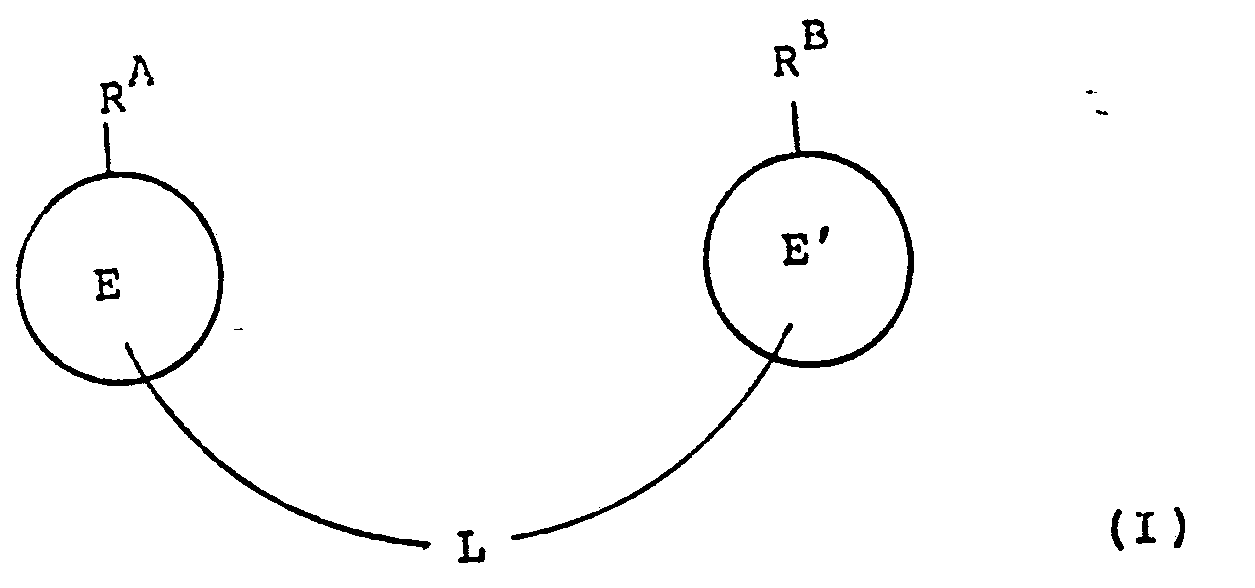
wherein RA represents a moiety of formula (a):

- ko and Ro 1 each independently represents a substituted or unsubstituted aryl group or a substituted or unsubstituted benzofuranyl group,
- X and XA each independently represents a bona or -O-CH2-
- Rl represents a hydrogen atom or a moiety:

- k1A represents a hydrogen atom or a moiety:

- R 2, R3, R2A and R3A each independently represent a hydrogen atom or an alkyl group,
- Z and ZA each independently represent a bond or a moiety -CH2-O-,
- n and m each independently represent an integer 1 or 2;
- E and E' each independently represent substitutea or unsubstituted aryl; and L represents a linking moiety.
- Preferably, R° and R°1 each independently represent a substituted or unsubstituted aryl group.
- Suitable aryl groups include phenyl, naphthyl, phenylene and naphthylene groups optionally substituted with up to five, preferably up to three, groups selected from halogen, substituted or unsubstituted alkyl, alkenyl, alkynyl or phenyl; hydroxy, alkoxy, amino, nitro, nitrile or carboxy.
- Preferably the aryl group R° or H°1 is a substituted or unsubstituted phenyl group.
- Preferred optional substituents for the aryl group R° or R°1 include up to three substituents selected from halogen, hydroxy, C1-6 alkoxy, nydroxy-C1-6alkyl, amino, nitrile and trifluoromethyl.
- When R° or K°1 represents a benzofuranyl group it is preferably a oenzofuran-2-yl group.
- Suitably E or E1 represents a substituted or unsubstituted phenylene or naphthylene group; preferably a substituted or unsubstituted phenylene group.
- Suitable substituents for any aryl group E or El are those indicated in relation to the aryl groups R° or R°1.
- When the oenzofuranyl group is substituted, it is preferably suustituted in the phenylene ring; a suitable substituent for the phenylene ring being a C1-6 alkyl group. Suitably, the phenylene ring in the benzofuranyl moiety is substituted in the 7-position, suitably with a C1-6, alkyl group such as for example methyl or ethyl.
- Preferably, when R° represents a benzofuranyl group X represents a bond; preferably, when R°1 represents a benzofuranyl group XA represents a bond.
- Suitably, X represents a bond. Suitably XA represents a bond.
- Preferably X and XA both represent a oond. Favourably, R1 represents a hydrogen atom. Favourauly R1A represents a hydrogen atom.
- Preferably, R1 and R1A both represent hydrogen.
- Suitably, R2 represents a C1-6 alkyl group, preferably a methyl group. Suitably, R2A represents a C1-6 alkyl group, preferably a methyl group.
- Preferably, R2 and R2A both represent methyl.
- Suitably, R3 represents a hydrogen atom. Suitably, R3A represents a hydrogen atom.
- Preferably, R3 and R3A both represent hydrogen.
- Preferably, Z represents a bond. Preferably, ZA represents a bond.
- Most preferably, Z and ZA both represent a bond.
- Preferably, n represents the integer 1. Preferably, m represents the integer 1.
- Most preferably, n and m both represent 1.
- Suitably, R° and R°1 each independently represent a moiety of formula (c):

- Preferably, R4, R5, and R6 each independently represent hydrogen, halogen, trifluoromethyl, amino or hydroxy.
- Preferably, R4 and R5 both represent hydrogen.
- In a particularly preferred aspect R4 and R5 both represent hydrogen and R6 represents hydrogen, chlorine or trifluoromethyl.
- Most preferably the moiety (c) represents phenyl, 3-chlorophenyl, 3-(trifluoromethyl)phenyl, 4-hydroxyphenyl or 3,5-dihydroxyphenyl; especially 3-chlorophenyl.
- Preferably, R° = R°1.
- Favourably RA= RB.
- In one preferred aspect the present invention provides a compound of formula (II):

- ln a particularly preferred aspect the present invention provides a compound ot tormula (IIA):
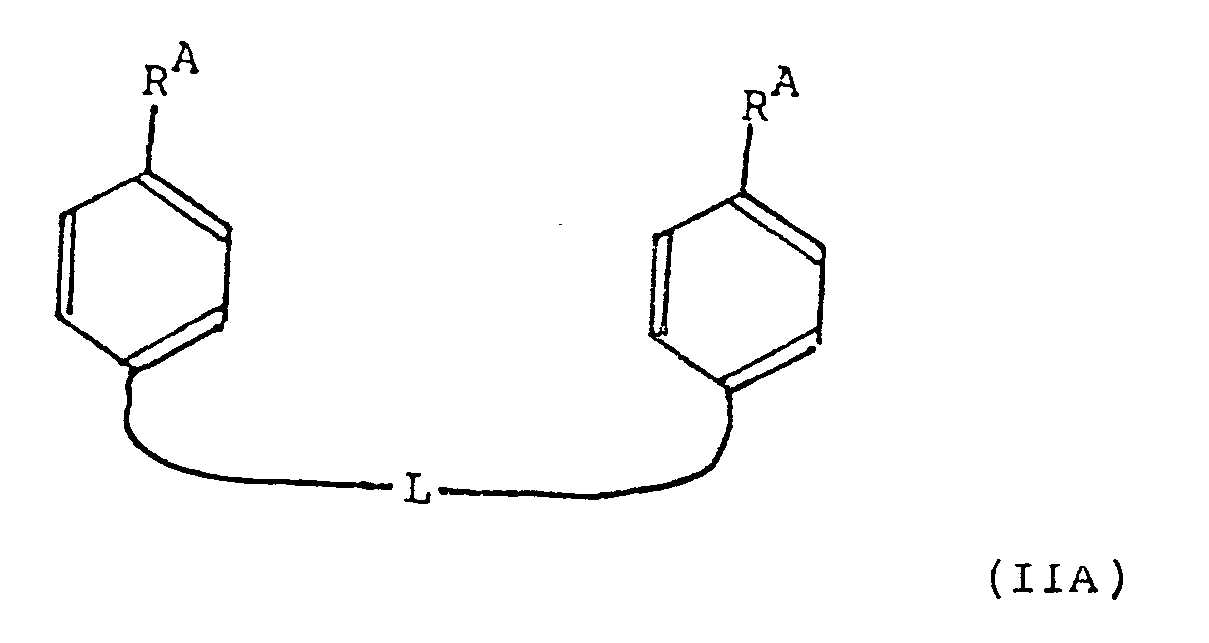
- A suitable linking group L comprises a substituted or unsubstituted hydrocarbon; or a chain of at least two atoms in length comprising at least one hetero atom selected from oxygen or substituted or unsubstituted nitrogen or sulphur, or L represents oxygen, an amino group or SOz wherein z is zero or 1 or 2.
- A suitable amino group is a group)NR wherein R is hydrogen, alkyl, aryl, or alkylcarbonyl or aryl carbonyl.
- A suitable substituent for the nitrogen atom is a group R detined in relation to > NR above.
- A suitable substituent for the sulphur atom is an oxo group.
- A suitable linking group L comprises a substituted or unsubstituted hydrocarbon; or a chain ot at least two atoms in length comprising at least one hetero atom selected from oxygen or substituted or unsubstituted nitrogen or sulphur; or L represents oxygen or SO2 wherein z is zero or 1 or 2.
- Suitably, L represents a linking moiety attached to a carbon atom of a moiety E in the 3- or 4- position relative to RA.
- r Suitably, L represents a linking moiety attached to a carbon atom of a moiety E' in the 3- or 4- position relative to Rb.
- Favourably, E represents phenylene and L represents a linking moiety attached to a phenylene carbon atom in the 3- or 4- position, relative to RA.
- Favourably , E represents phenylene and L represents a linking moiety attached to a phenyl carbon atom in the 3- or 4- position, relative to RB.
- More favourably, L represents a linking moiety linking the carbon atom in the 3- or 4- position, relative to RA, to the carbon atom in the 3- or 4- position relative to RB.
- A suitable hydrocarbon linking moiety L, is a substituted or unsubstituted alkylene, alkenylene or alkynylene group, preferably a substituted or unsubstituted alkylene group.
- A suitable linking moiety L is a chain of from 2 to 30 atoms in length comprising at least one hetero atom selected from oxygen, nitrogen or sulphur and a substituted or unsubstituted alkylene, alkenylene or alkynylene group, preferably an alkylene group.
- Favourable linking moieties L are these comprising

- Favourable linking moieties L are -0-,

- Particularly favourable linking moieties L are those of formula -X l- X 2- X3- wherein X1 and X3 each independently represent a bond, -C(o)-,

- -OX2ACO2-, -CO.N(R')-, -X2ACO.N(R')-, -OX2ACO.N(R')-, -OX2BO-, -X2N(R')-, -OX2AN(R')-, O, S,-S02, -N(R')-, RC(OH )X2A- or -N (R' )X2BO-; wherein R and R' are as defined above, X2A represents alkylene and X2B represents C2-10 alkylene; and X2 represents a substituted or unsubstituted alkylene, alkenylene, alkynylene or a moiety -X4-Z1-X5- wherein X 4 and X5 each independently represent a bond, Cl-6 alkylene, C2-6 alkenylene or C2-6 alkynylene, and wherein Z1 represents -0-,

- In particular X1 or X3 may independently represent a bond, -0-, -CO.O-, -CO.N(R')-, -X2A.CO.N(R')-, -O-X2A.CO.N(R')-, -O-X2AN(R')- or -X2N(R')- wherein X 2, X2A and R 1 are as defined above. Preferably, X1 or X3 represent -O-. Most preferably, X1 and X3 both represent -O-.
- In particular X2 represents alkylene or a moiety X4-Z1-X5 wherein X4 and X5 each independently represent C1-6 alkylene and Z1 represents -O-.
- Preterably, X2 represents alkylene.
- Most preferably X2 represents -(CH2)6-.
- A preferred linking group L, is that represented by a moiety of the formula:
- -O(CH2)yCONH-(CH2)x-NHCO(CH2)yO-,
- -O (CH2)yCONH-(CH2)x-NH (CH2)xO-,
- -O(CH2)xNH-(CH2)x-NH(CH2)xO-,
- -CONH(CH2)xNHCO-,
- -(CH2)yCONH-(CH2)x-NHCO(CH2)y-,
- -(CH2)yCONH-(CH2)x-NH(CH2)y-,
- -(CH2)yNH-(CH2)x-NH(CH2)y-,
- -O-(CH2)y+1-O-,
- -(CH2)y-O-(CH2)y-,
- -O(CH2)y+1-O-(CH2)y+1-O-.
- -CO.O-(CH2)y+1-O.OC-,
- -(CH2)y-,

- -0-, or
- SOz;
- x represents an integer from 2 to 6;
- y represents an integer from 1 to 10, and
- z represents zero or an integer 1 or 2.
- Preferably x represents an integer 2, 3 or 4.
- Preferably y represents an integer 1,2,3,4,5,6,7, or 8.
- Preterably z represents the integer 2.
- A particularly preferred linking moiety L is O(CH2)yCO NH(CH2 )x NH.CO.(CH2)yO- wherein x and y are as defined above; especially when x is 2, 3 or 4 and y is an integer from i to 6.
- A particularly preferred linking moiety L is O(CH2)xNH(CH2)xNH(CH2)xO- wherein x is as defined above; especially when x is 2, 3 or 4.
- A particularly preferred linking moiety L is (CH2)yNH(CH2)xNH(CH2)y wherein x and y are as defined above; specially when x is 2,3 or 4 and y is an integer from 1 to 6.
- A particularly preferred linking moiety L is -O-(CH2)y+1-O- wherein y is as defined above; -especially when y is 1,2,3,4,5,6,7 or 8; and preferably when y is 5.
- A particularly preferred linking moiety L is -O-(CH2)y+1-O-(CH2)y+1-O- wherein y is as defined above; especially when y is 1,2,3,4,5,6,7 or 8.
- A particularly preferred linking moiety L isi -CO.O-(CH2)y+1O.OC- wherein y is as defined above; especially when y is an integer from 1 to 6.
- A particularly preferred linking moiety is L -(CH2)y-wherein y is as defined above; especially when y is an integer from 1 to 6.
- A particularly preferred linking moiety L is

- A particularly preferred linking moiety L is -0-.
- A particularly preferred linking moiety L is SOZ wherein z is as defined above; especially when z is 2.
- In an especially preferred aspect the linking group L is O-(CH2)y+1-O as defined above; preferably -O-(CH2)6-O-.
- In a particularly preferred aspect the present invention provides a compound selected from the list consisting of:
- [R,R,R,R]-N,N'-(1,2-ethanediyl)bis[2-[4-[2-[(2-(3-chlorophenyl)-2-hydroxyethyl)amino]propyl]phenoxy] acetamide];
- [R,R,R,R]-α,α'[1,2-ethanediylbis(imino-2,1-ethanediyloxy-4,1-phenylene (1-methyl-2,1-ethanediyl) iminomethylene]]bis[3-chlorobenzenemethanol];
- [R,R.R,R]-α,α'[1,6-hexanediylbis[oxy-4,1-phenylene(1-methyl-2,1-ethanediyl)iminomethylene]]bis[3-chlorobenzenemethanol],
- [R,R,R,R]-α,α'-[oxybis[4,1-phenyiene(1-methyl-2,1-ethanediyl)iminomethylene]]bis[3-chlorobenzenemethanol];
- [R,R,R,R]-α,α'-[methylenebis[4,1-phenylene(1-methyl-2,1-ethanediyl)iminomethylenel]]bis[3-chlorobenzenemethanol],
- [R,R,R,R]-α,α'-[sulphonylbis[4,1-phenylene(1-methyl-2, 1-ethanediyl)iminomethylene]]bis[3-chlorobenzenemethanol];
- [R,R,R,R]-1,1-di[4-[2-[[2-(3-chlorophenyl)-2-hydroxyethyl]amino]propyl]phenyl]-1,2-ethanediol;
- [R,R,R,R]-α,α'-[1,8-octanediylbis[oxy-4,1-phenylene (1-methyl-2,1-ethanediyl)iminomethylene]]bis[3-chlorobenzenemethanol];
- 1,2-ethanediyl di[4-[2-[[2-hydroxy-2-(3-trifluoromethyl)phenylethyl]amino]propyl]benzoate],
- 1,2-etnanediyl di[4-[2-[[2-nydroxy-2-phenylethyl]amino] propyl] benzoate];
- [R,R,R,R,]-α,α'[1,4-butanediylbis[oxy-4,1-phenylene (1-methyl-2,1-etnanediyl)iminomethylene]]bis[3-chlorobenzenemethanol], dihydrochloride.
- 11,R,R,R,]-α,α'[1,3-propanediybis[oxy-4,1-phenylene (1-methyl-2,1-ethanediyl)iminomethylene]]bis[3-chlorobenzenemethanol];
- [R,R,R,R,]-α,α'[1,9-nonanediylbis[oxy-4,1-phenylene (1-methyl-2,1-ethanediyl)iminomethylene]]bis[3-chlorobenzenemethanol];
- [R,R,R,R,]-3-chloro-α-[[[[2-[4-[6-[4-[2-[2-(4-hydroxyphenyl)-2-hydroxyethyl]amino]propyl]p-henoxy] hexyloxy]phenyl]-1-methylethyl]amino]methyl]-benzenemethanol;
- [R,R,R,R,]-α,α'-[1,2-ethanediylbis[iminomethylene-4,1-phenylene(1-methyl-2,1-ethanediyl)iminornethylene]bis [3-chlorobenzenemethanol;
- [R,R,R,R,]-α,-α'-[1,4-butanediylbis[,iminomethylene-4,1-phenylene(1-methyl-2,1-ethanediyl)iminomethylene]]bis [3-chlorobenzenemethanol;
- [R,R,R,R]-α,α'-[1,6-hexanediylbis[iminomethylene-4,1-phenylene (1-methyl-2,1-ethanediyl)iminomethylene]] bis[3-chlorobenzenemethanol];
- [R,R,R,R]-α,α'-[1,2-ethanediylbis[4,1-phenylene (1-methyl-2,1-ethanediyl)iminomethylene]] bis[3-cnlorobenzenemethanol];
- [R,R,R,R]-α,α'-[1,6-hexanediylbis[4,1-phenylene (1-methyl-2,1-ethanediyl)iminomethylene]] bisL3-chlorobenzenemethanol];
- [R,R,R,R]-a,a'-[1,5-pentanediyl bis[oxy-4,1-phenylene (1-methyl-2,1-ethanediyl)iminomethylene]] bis[3-chlorobenzenemethanol];
- [R,R,R,R]-α,α'-[oxybis[2,1-ethanediyloxy-4,1-phenylene (1-methyl-2,1-ethanediyl)iminomethylene]] bis[3-chlorobenzenemethanol];
- [R,R,R,R]-5,5'-[1,6-hexanediylbis[oxy-4-1-phenylene (1-methyl-2,1-ethanediyl)imino(1-hydroxy-2,1-ethanediyl)]]bis[benzene-1,3-diol]; and
- [R,R,R,R]-α,α'[1,7-heptanediylbis[oxy-4,1-phenylene-(1-methyl-2,1-ethanediyl)iminomethylene]]bis[3-chloro- benzenemethanolJ, or a pharmaceutically acceptable acid addition salt thereof.
- The compounds of the general formula (I) may have, depending on the meaning of R1, R 2, R3, RIA, R2A and R3A up to six asymmetric carbon atoms, marked 1* to 6* in the formula. These compounds may, therefore, exist in up to sixty four stereoisomeric forms. The present invention encompasses all stereoisomers of the compounds of the general formula (I) whether free from other isomers or admixed with other isomers in any proportion, and thus includes for instance, racemic mixtures of enantiomers.
- The term 'hydrocarbon' includes groups having up to 18 carbon atoms, suitably up to 10 carbon atoms, conveniently up to 6 carbon atoms. Suitable hydrocarbon groups include alkylene, alkenylene, alkynylene, C3-7 cycloalkyl, C3-7 cycloalkyl alkylene, aryl, and aryl alkylene; preferably alkylene, alkenylene and alkynylene.
- Suitably substituents for any hydrocarbon, especially any alkylene, alkenylene or alkynylene group, include those indicated above in relation to suitable aryl groups.
- When used herein the term 'alkyl', 'alkenyl', 'alkynyl', 'alkylene', 'alkenylene', 'alkynylene' or 'alkoxy' relates to groups having straight or branched chains containing up to 10 carbon atoms, conveniently up to 6 carbon atoms.
- buitable pharmaceutically acceptable esters of compounds of formula (I) are esters of carboxy groups or hydroxy groups.
- Favoured pharmaceutically acceptable esters are in-vivo hydrolysable esters of carboxy groups or hydroxy groups.
- Suitable in-vivo hydrolysable esters of carboxy groups are those of formula -CO.OR wherein R represents a C1-6 alkyl group.
- Suitable pharmaceutically acceptable amide groups are those of formula -CO.NRsRt wherein RS and Rt each independently represent hydrogen or C1-6 alkyl or RS and Rt together with the nitrogen to which they are attached form a saturated 5- or 6- membered ring.
- When used herein the term " halogen " refers to fluorine, chlorine, bromine and iodine, preferably chlorine.
- Suitably the hydroxy group present in the moieties

- When used herein the term "in-vivo hydrolysable ester " relates to a pharmaceutically acceptable ester which readily breaks down in the human or non-human animal body to leave the free hydroxy group. Suitable in-vivo hydrolysable ester groups are those used conventionally in the art; they are preferably those provided by lower alkyl carboxylic acids.
- Preferably the above mentioned hydroxyl groups are present as free hydroxyl groups.
- The absolute configuration of any compound of the general formula (I) may be determined by conventional X-ray crystallographic techniques.
- Suitably, when k2≠R3 the 2* asymmetric carbon has the R-configuration.
- Suitably, when R2A≠R3A the 4* asymmetric carbon has the R-configuration.
- Suitably, when X represents a bond, the 1* asymmetric carbon has the R-configuration.
- Suitably, when X represents -O-CH2-, the 1* asymmetric carbon has the S-configuration.
- Suitably, when XA represents a bond, the 3* asymmetric carbon nas the R-configuration.
- Suitably, when XA represents -O-CH2, the 3* asymmetric carbon has the S-configuration.
- When R1 = R1A = H , R2 = R3 and H2A≠R3A, a preferred enantiomer of the compound of formula (I) is that wherein the asymmetric carbons 1*3*4* have the following configurations:
- RRR, SRR, RSR or SSR.
- When R1 = R1A = H, R2≠R3 and R2A≠R3A, a preferred enantiomer of the compound of formula (I) is that wherein the asymmetric carbons 1*2*3*4* have the following configurations:
- RRRR, SRRR, bRSR or RRSR.
- When R1≠H, R1A≠H, R2≠R3 and R2A≠R3A, a preferred enantiomer of the compound of formula (I) is that wherein:
- eitner 1* has the R-configuration when
- X represents a bond, or
- 1* has the S-configuration when
- X represents -O-CH2-, and
- either 3* has the R-configuration when
- XA represents a bond, or
- 3* has the S-configuration when
- XA represents -O-CH2.
- Suitable pharmaceutically acceptable salts of the compounds of formula (I) include metal salts, such as for example aluminium, alkali metal salts such as sodium or potassium, alkaline earth metal salts such as calcium or magnesium and ammonium or substituted ammonium salts, for example those witn lower alkylamines such as triethylamine, hydroxy-lower alkylamines such as 2-hydroxyethylamine, bis-(2-hydroxyethyl)-amine or tri-(2-hydroxyethyl)-amine, cycloalkylamines such as bicyclohexylamine, or with procaine, dibenzylpiperidine, N-benzyl-β-phenethylamine, dehydroabietylamine, N,N'-bisdehydroabietylamine, glucamine, N-methylglucamine or bases of the pyridine type such as pyridine, collidine or quinoline.
- Compounds of tne general formula (I) also rorm acid addition salts.
- Pharmaceutically acceptable acid addition salts may be, for example, salts with inorganic acids such, for example, as hydrochloric acid, hydrobromic acid, orthophosphoric acid or sulphuric acid, or with organic acids such, for example as methanesulphonic acid, toluenesulophonic acid, acetic acid, propionic acid, lactic acid, citric acid, fumaric acid, malic acid, succinic acid, salicylic acid or acetylsalicylic acid.
- A preferred acid addition salt is a hydrochloride.
- Solvates, preferably hydrates, of the compound of formula (I) are also encompassed by the invention.
- The invention also provides a process for the preparation of a compound of the general formula (I), or a pharmaceutically acceptable salt, ester or amide thereof, which process comprises reacting a compound of formula (III):

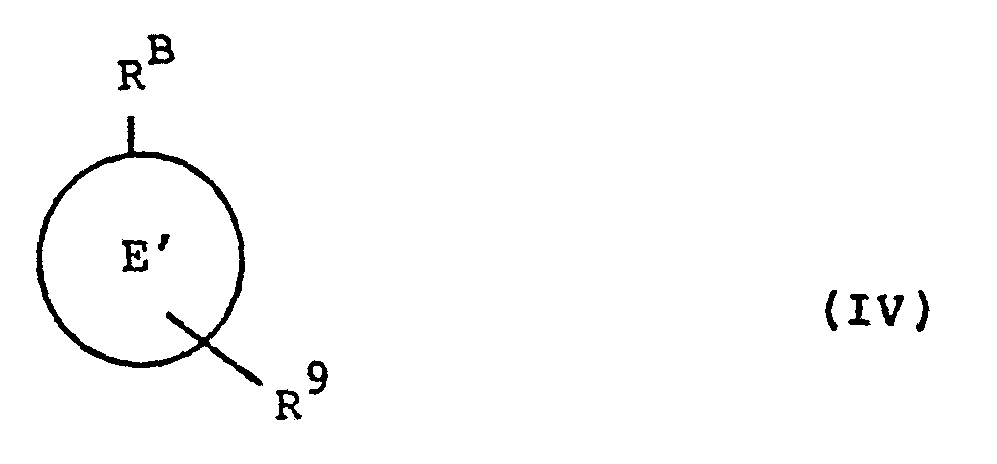
- either R8 represents a nucleophilic moiety and R9 represents a moiety - Ll - RX wherein RX represents a leaving moiety, L1 representing a moiety such that -R8-Ll- represents the linking moiety L; or
- R8 represents the above defined moiety Ll - RX and R9 represents a nucleophilic moiety and L1 is a moiety such that -R9-Ll represents the linking group L; and thereafter if necessary carrying out one or more of the following steps:
- (i) removing any protecting group;
- (ii) converting a compound of formula (I) into a further compound of formula (I);
- (iii) converting a salt oi formula (1) into a tree compound oi formula (1)
- (iv) preparing a pharmaceutically acceptable ester or amide of a compound of formula (I);
- (v) preparing a pharmaceutically acceptable salt of a compound ot formula (I) or an ester or amide thereof.
- The precise nature of R8 and R9 will of course depend upon the nature of the linking moiety L although any nucleophilic moiety or moiety - L1 - Rx which in the conventional art would provide the linking moiety L is encompassed by tne above mentioned process.
- The reaction between a compound of formula (III) and a compound of formula (IV) may be carried out under any suitable conditions appropriate to the nature of R8 and R9.
- Preferably Rx is a halogen atom, such as bromine, or an alkoxy group.
- Suitable nucleophilic moieties R8 or R9 are nucleophilic groups comprising an anion such as O⊖, Se, CO2 ⊖, C≡C⊖ or ⊖CH2; suitably the anions are provided in salted form, preferably with a metal cation such as sodium or as an appropriate Grignard Reagent.
- Suitable nucleophilic moieties also include those wherein R8 and R9 represent a negative charge on a carbon atom of E or E' respectively; the said moiety suitably being provided as an appropriate Grignard Reagent.
- Examples of suitable Grignard reagents are (RA-E-R 8) MgX and (RB-E-R9) MgX wherein R A, RB, E and E' are as defined in relation to formula (I), R8 and R 9 represent a negative charge on a carbon atom of E or E' repectively, and X represents a halide ion such as a bromide ion.
- Further suitable nucleophilic moieties R8 or R9 are groups terminating in an amino group, preferably a primary amino group. Preferably when the nucleophilic moiety is a group terminating in an amino group, the moiety -L1-Rx is a group terminating in a halocarbonyl or alkoxycarbonyl group, the halo atom, preferably chlorine, or the alkoxy group, preferably ethoxy, being the leaving group RX, thereby providing a moiety L comprising a -CO.NH- group.
- A favourable nucleophilic group terminating in an amino group is a group terminating in an alkyleneamino group.
- The nucleophilic moieties may be prepared by any conventional method appropriate to the nature of the rest of the molecule. Similarly the moiety -L1-Rx may be prepared by any convenient conventional method.
- A preferred nucleophilic group R8 or R9 comprising an anion, is a moiety (X1)⊖ or (X3)⊖ wherein X1 and X3 are defined above; thus examples of preferred anionic nucleophilic groups are groups of formula O⊖, S⊖, CO2 ⊖, OX2ACO2 ⊖, -OX2BO⊖, or -N (R)X2BO⊖ wherein X 2, X2A, X2B and R are as defined above.
- A further preferred nucleophilic group R8 or R9 comprising an anion is a group of formula -X1-X2⊖ or -X3-X2⊖. wherein X 1, X 2 and X3 are as defined above.
- A preferred nucleophilic moiety R8 or R9 terminating in an amino group is a group -Y1H wherein Y1 is an appropriate moiety X1 or X 3 such as -N(R')-, -x2N(R')-or -OX 2BN(R')-.
- A further prererred nucleophilic moiety terminating in an amino group is a moiety -Xl-X2-NHR' or -X3-X2-NHR' wherein X1, X2, X3 and R' are as defined above.
- When X1 or X3 represents a bond then the nucleophilic moiety R8 or R9 may be represented by a moiety (X2)⊖; for example by moieties of formula -(CH2)a-CH2 ⊖, (CH2)b-C=C⊖ wherein a is zero or an integer 1 to 11 and b is zero or an integer 1 to 10.
- When the moiety R8 or R9 represents Ll-Rx then the value of L1 depends upon the nature of the corresponding nucleophilic moiety in any reacting pair of compounds (III) and (IV).
- Suitable values for the nucleophilic moiety and moiety -L l- RX in any reacting pair of compounds (III) and (IV) are:
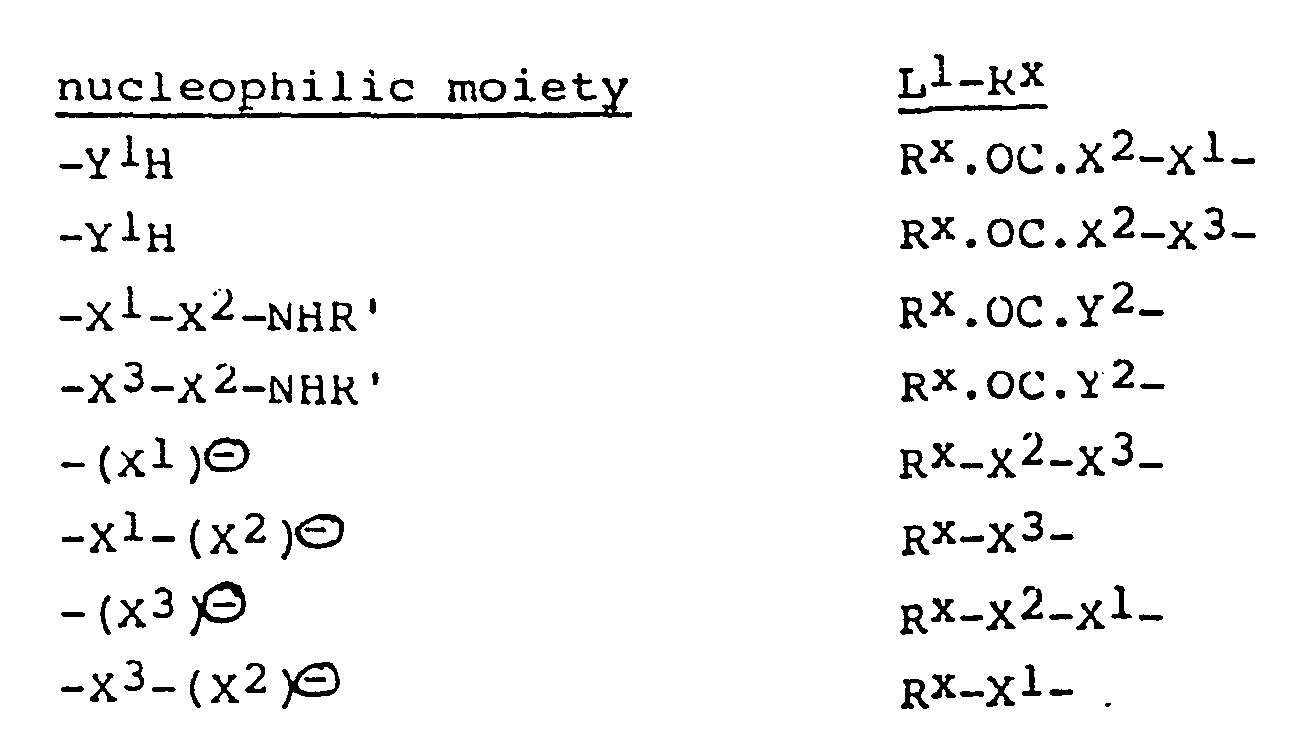
- Particularly preferred values for the nucleophilic group and moiety -L1-Rx in any reacting pair of compounds (III) and (IV) are:

- Suitably, in the abovementioned reaction between compounds of formula (III)-and (IV), R A = R B, thereby providing a process for preparing a compound of the hereinbefore defined formulae (II) and (IIA).
- The compounds of the general formula (III) may be prepared by either:
- (A) reacting a compound of the general formula (V)

- (i) wherein T represents a moiety of formula R°-X- wherein RO and X are as defined in relation to formula (I), and Q represents a group of formula (c) or (d):


- (ii) wherein T is as defined above and Q represents a group of formula (f):

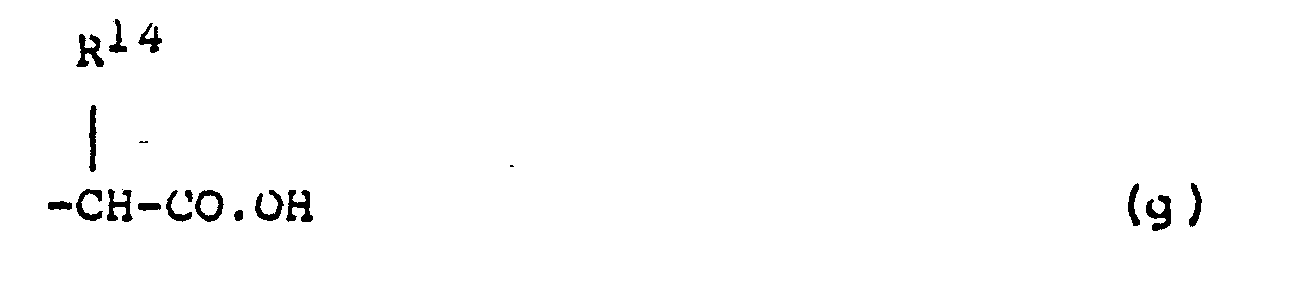
- (iii) wherein T is a defined above and Q represents a group of tne formula (h):


- (iv) wherein T is as defined above and Q represents a group of the formula (h) as defined above; with a compound of formula (VI) wherein Q1 represents a group of formula (K):
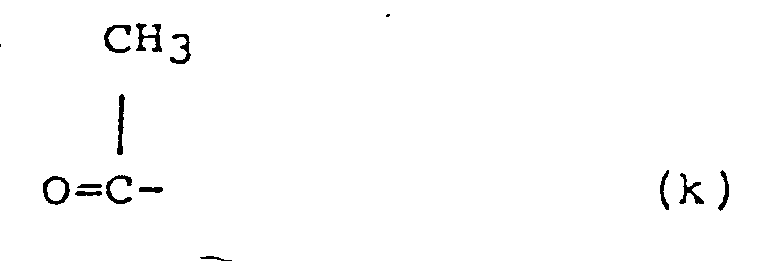
- (i) wherein T represents a moiety of formula R°-X- wherein RO and X are as defined in relation to formula (I), and Q represents a group of formula (c) or (d):
- (B) for compounds of formula (III) wherein R1 represents only the moiety

- (i) a compound of formula (VA):

- (ii) a compound of formula (VB):

and thereafter if necessary carrying out one or more of the following steps; - (i) a compound of formula (VA):
- i) removing any protecting group; or
- ii) converting a compound of formula (III) into a further compound of formula (III).
- Suitable protecting groups are those used conventionally in the art, ror example RP is preferably a benzyl group and examples of groups R15 as protected forms of groups R8 are -O-CH2C6H5 (convertiole via conventional catalytic debenzylation to a salted hydroxyl group R8) and -C02R, wherein R is C1-6 alkyl, (convertible via conventional ester hydrolysis to a salted carboxyl group R8).
- Converting a compound of formula (III) into a further compound of formula (III) includes for example:
- (i) converting R1 in the moiety of formula (a), as defined above, from hydrogen to a moiety

- (ii) converting one group R8 to another group R 8. Suitable methods of converting R1 from hydrogen to

- Suitable conversions of one group R 8 to another group R8 include converting a group R8 representing a nucleophilic moiety into a group R8 representing a moiety L1-Rx, or converting a group R8 representing a moiety Ll-RX into a nucleophilic moiety.
- Suitably, when R8 in a compound of formula (III) represents a nucleophilic moiety -(X1)⊖, -(X3)⊖ or -Y1H it may be converted into a moiety L1Rx, wherein -L1 is -X1-X2-, -X3-X2 or -(xl or X3)-X2-CO- respectively, by treating the compound of formula (III) with a compound of formula (A):

- Suitably when R8 in a compound of formula (III) represents a moiety -L1-Rx, such as the hereinbefore defined -Y2-CO-Rx, it may be converted into a nucleophilic moiety -Y2-CO.N(R')-X2-NHR' by treating the compound of formula (III) with a compound of formula (B):

- In one preferred form of the process of the invention for preparing compounds of formula (I), wherein L is -X1-X2-X3-, E = E' and RA = RB; a compouna of formula (IIIA):

- Suitably, when (A) is used and RZ is RX, then R8 is - (X1)⊖ or -(X3)⊖.
- Preferably, when (A) is used and RZ is Rx, R8 is -CO2 ⊖, O⊖, or S⊖, suitably provided in salted form with for example an alkali metal cation such as a sodium ion, or R8 represents a negative charge on a carbon atom of E, suitably provided as an appropriate Grignard reagent; most preferably R8 is O⊖.
- Suitably, when (A) is used and RZ is -CO.Rx then R8 is -Y1H.
- Preferably, when (A) is used and RZ is -CORx, R 8 is -OX2BN (R')H.
- Suitably, when (B) is used, R8 is -Y2.CU.Rx as defined above, preferably R8 is -OX2A.CO.Rx.
- Preferably the molar ratio of (IIIA) to (A) or (B) is at least 2:1.
- Preferably X2 is alkylene especially -(CH2)6-.
- A compound of formula (IV) may be prepared by using methods analogous to those used for preparing a compound of formula (III). Thus a compound of formula (IV) may be prepared by reacting a compound of formula (V), wherein T represents a moiety R°1-XA wherein R°1 and XA are as defined in relation to formula (I); and Q is as defined above in relation to formula (V), with a compound of formula (VIA):

- The reactions between the compounds of formula (V) and (VIA) may be carried out under the same conditions as the analogous reaction between compounds of formula (V) and (VI).
- Suitably, R15A is a protected form of a group R 9 as described above for R15 in relation to R8.
- The present invention further provides a process for the preparation of a compound of formula (I) from a compound of formula (IX):

which process comprises, where appropriate; - (a) converting any group RA 1, to RA; and/or
- (b) converting any group RB 1 to RB;
- (i) removing any protecting group;
- (ii) converting a compound of formula (I) into a further compound of formula (I);
- (iii) converting a salt of formula (I) into a free compound of formula (I);
- (iv) preparing a pharmaceutically acceptable ester or amide of a compound ot formula (I);
- (v) preparing a pharmaceutically acceptable salt of a compound of formula (I) or an ester or amide thereof.
- Suitable compounds of, the general formula (IX) are those of formula (IXA), wherein E, E' and L are as defined above, RA 1 is a moiety convertible to RA and RB 1 is RB; the compounds of formula (IXA) being convertible to a compound of formula (I) by process step (a) as defined above.
- Suitable compounds of the general formula (IX) are those of formula (IXB), wherein E, E' and L are as defined above, RA 1 is a moiety RA and RB 1 is a moiety convertible to RB; the compounds of formula (IXB) being convertible to a compound of formula (I) by process step (b) as defined above.
- Suitable compounds of the general formula (IX) are those of formula (IXC), wherein E, E' and L are as defined above, RA 1 is a moiety convertible to RA and RB 1 is a moiety convertible to RB; the compounds of formula (IX) being convertible to compounds of formula (I) either:
- (i) by carrying out process (a) (to prepare a compound (IXB)) and thereafter process (b) to prepare a compound of formula (I); or
- (ii) by carrying out process (b) (to prepare a compound of formula (IXA)) and thereafter process (a) to prepare a compound of formula (I).
- In a preferred aspect of the preparation of a compound ot formula (I) from a compound ot formula (1XC), the compound ot formula (IXA) or (1XB) is not isolated and is converted in-situ to a compound of formula (1).
- In a preferred aspect of the conversion of a compound of formula (1XC) to a compound of formula (I), the reaction steps (a) and (b) are carried out simultaneously using the same reagent; thus in a most preferred aspect of the process preferably when RA 1 = RB 1, a compound of formula (IXC) is converted to a compound of tne hereinbefore defined formulae (II) or (IIA).
- In a preferred form of the process of the invention there is provided a process for preparing a compound of formula (I), or a pharmaceutically acceptable salt, ester or amide thereof, which process comprises;
- (A) reacting a compound of formula (IX) with a compound of formula (V), wherein in the compound of formula (IX) L is as defined above, RA l is RA or -T1-Q1- and R B 1 is RB or T1-Q1-, providing that at least one of RA1 or RB 1 represents -Tl-Ql- and wherein, either:
- (i) in -T1-Q1, T1 is -(CH2)n-Z- and Ql is a moiety (e) as defined in relation to formula (VI) and in the compound of formula (V), T is R°-X and Q represents a group of formula (c) or (d); or
- (ii) in T1-Q1, T1 is (CH2)n-Z- and Q1 is a moiety (e) and in the compound of tormula (V), T is R°-X and Q represents a group of formula (f) or (g), and subsequently treating with a reducing agent; or
- (iii) in -T1-Q1, T1 is (CH2)n-Z and Q1 represents a group of formula (j) as definea in relation to formula (V1) and in the compound of formula (V), T is Ro-X ana Q represents a group of formula (h); or
- (iv) in -T1-Q1, T1 is (CH2)n-Z and Q1 represents a group ot formula (k) as defined in relation to formula (VI) and in the compound of formula (V). T is Ro-X and Q represents a group of formula (h) and subsequently treating with a reducing agent;
- (B) for compounds of formula (I) wherein R1 represents only the moiety

- (i) a compound of formula (VA):

- (ii) a compound of formula (VB):

and thereatter if necessary carrying out one or more of the following steps:- (i) removing any protecting group;
- (ii) converting a compound of formula (1) into a further compound of formula (I);
- (iii) converting a salt of formula (I) into a free compound of formula (I);
- (iv) preparing a pharmaceutically acceptable. ester or amide of a compound of formula (1);
- (v) preparing a pharmaceutically acceptaole salt of a compound of formula (I) or an ester or amide thereof.
- (i) a compound of formula (VA):
- It will be appreciated that the present process encompasses the preparation of compounds of formula (I) wherein RA and RB are the same or difterent.
- Preferably a compound of formula (I) is prepared by reacting a compound of formula (IX) with a compound of formula (V) as defined in (A) (ii) above, especially when Q represents a group of formula (g).
- Most preferably RA 1 and RB 1 both represent -T1-Q1 and the compound of formula (IX) is reacted with at least two molar equivalents of the compound of formula (V) thereby providing a compound of formula (II) or (IIA).
- The abovementioned reactions between the compounds of formulae (V) and (IX) are carried out under the same conditions as the analogous reactions between compounds of formulae (V) and (VI).
- The abovementioned reaction between a compound of formula (I) (wherein Rl = H) and (VA) or (VB) is carried out under the same conaitions as the analogous reaction between a compound of formula (III) (wherein R1 = H) and (VA) or (VB).
- The conversion of one compound of formula (I) to a turther compound of formula (I) includes for example:
- (i) converting R1 in a moiety of formula (a), as defined above, from hydrogen to the moiety
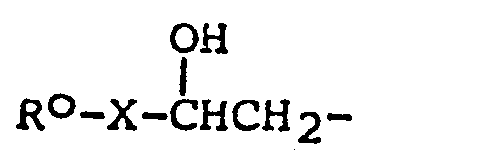
- (ii) converting one group L to a further group L. Suitable methods for converting R1 from hydrogen to

- Suitable methods for converting one group L to another group L are those wherein a group L comprising a reduceable moiety such as -C=C-, -C≡C-, -CO-, -C=N- or -CO-N(R')- is reduced, using the appropriate conventional conditions and reagents; or where a group L comprising an oxidisable moiety such as -S- is oxidised using the appropriate conventional conditions and reagents.
- Examples of preferred conversions are:

- (a) = borane-methylsulphide
- (b) = lithium aluminium hydride
- (c) = catalytic hydrogenolysis ;
- (d) = 3-chloroperbenzoic acid.
- The compounds of formula (IX) may be prepared by reacting a compound of tormula (X):
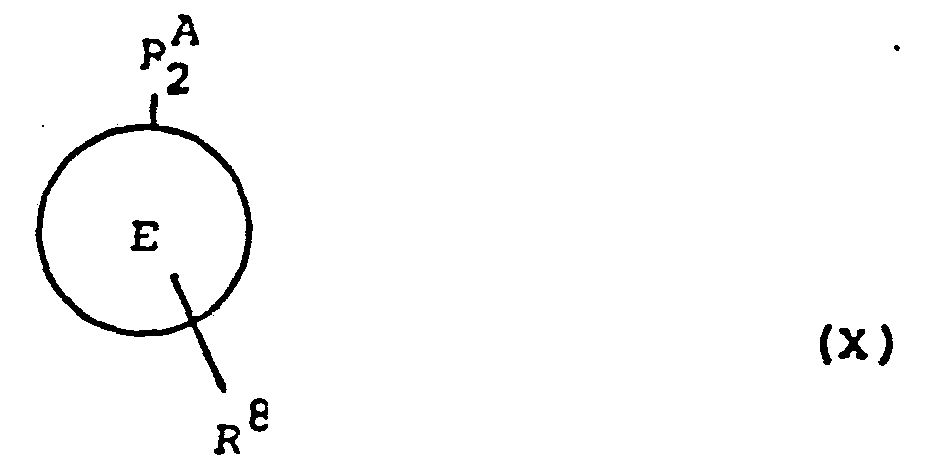

- (i) removing any protecting group;
- (ii) converting a group L to another group L.
- A preferred group RA 2 in the compound of formula (X) is a group -T1-Q1 as defined in relation to formula (VI), or, preferably, a protected form thereof; for example RA 2 is a group -T1-Q1 wherein Q1 is a group (e) wherein RP is a protecting group such as benzyl or if RP is Rl then Q1 is an N-protected form of such a group (e), such as an N-benzylated form. Similarly for RB 2 in the compound of formula (XI).
- A group L may be converted to another group L using methods described above for the conversion of one group L to another group L in the compound of formula (I).
- The reaction between the compounds of formula (X) and (XI) may be carried out under any suitable conditions appropriate to the nature of R8 and R 9..
- Any protecting groups used in the above reactions are those used conventionally in the art, the said protecting groups being prepared and removed by conventional procedures. For example when RO or RO 1 represents a phenyl group substituted with a hydroxy group, any conventional hydroxy protecting group may be used. Preferably the hydroxy group being protected by etherification; the ether group being converted into a free hydroxy group by methods known per se. For example, an unsubstituted or substituted benzyloxy protecting group, may be converted by hydrogenolysis into a free hydroxy group.
- The hydrogenolysis reaction may be carried out, for example in the presence of a palladium-on-carbon catalyst in a solvent, for example a mixture of ethyl acetate and methanol.
- A leaving group AX is any group that will, under the reaction conditions, cleave from the starting material, thus promoting reaction at a specified site. Suitaule examples of such groups are halogen atoms, mesyloxy groups, tosyloxy groups or an alkoxy moiety of an ester group. Preferably in formula (d) of compound (V) or in formula (j) of compound (VI) RX represents a mesyloxy or tosyloxy group or a bromine atom.
- Compounds of formulae (V), (VA), (VI), (VIA), (X) and (XI) are either known compounds or can be prepared from known compounds by known processes or processes analogous to known processes.
- As stated above the reaction conditions for the reaction between the compounds of formulae (III) and (IV) or (X) and (XI) will depend largely upon the nature of the nucleophilic moiety and moiety -L1-RX (represented by the variables R8 and R9).
- Suitably for reacting pairs of compounds (III) and (IV) or (X) and (XI) the reaction between the nucleophilic moiety comprising an anion and the appropriate -L1-RX may be carried out in any convenient solvent such as diethylether, tetrahydrofuran or dimethylformamide at a low to elevated temperature; preferred reaction conditions are those set out hereinafter in the appropriate Example.
- Suitably for reacting pairs of compounds of formulae (III) and (IV) or (X) and (XI) the reaction between the nucleophilic moiety terminating with an amino group and the appropriate -L1-RX may be carried out under conventional peptide forming conditions such as in a C1-6 alkanol for example methanol or ethanol at a low to elevated temperature; preferred conditions are those set out hereinafter in the appropriate Example.
- The reaction of compounds of the general formulae (V) and (VI) in which Q and Ql have formulae (c) and (e) respectively is advantageously carried out in a protic solvent, e.g. an alkanol, especially a lower alkanol having at least 2 carbon atoms, at reflux, preferably in ethanol. The reaction between the compounds of formula (III) (wherein Rl = H) and (VA) (wherein Q' = (c)) may be carried out under similar conditions.
- Reaction of compounds of the general formulae (V) and (VI) in which Q and Q1 have formulae (d) and (e) or (h) and (j) respectively is advantageously carried out in dimethyl sulphoxide, for example at a temperature in the range of from 30 to 80°C, e.g. substantially 50°C, and advantageously for a period of time of 1 to 4 days, e.g. about 3 days. The reaction between the compounds of formula (III) (wherein R1 = H) and (VA) (wherein Q' = (d)) may be carried out under similar conditions.
- The reaction between the compounds of formula (V) and (VI) in which Q and Q1 have formulae (f) and (e) respectively, or between (III) (wherein R1 = H) and (V) (wherein Q = (f)) is preferably carried out in methanol at ambient temperature, the subsequent reduction being carried out, for example, with sodium cyanoborohydride.
- The reaction between the compounds of formula (V) and (VI) in which Q and Q1 have formulae (g) or (e)' respectively, or between (III) (wherein R1 = H) and (V) (wherein Q = (g)) is preferably carried out in the presence of dicyclohexyl carbodimide or other suitable condensing agent in any suitable solvent such as dimethylformamide at ambient temperature; the subsequent reduction may be carried out with, tor example, lithium aluminium hydride or a borane reducing agent, for example borane methyl sulphide complex.
- The reductions with sodium cyanoborohydride and sodium borohydride are preferably performed in a lower alkanol, e.g. methanol. The reductions with lithium aluminium hydride or a borane methyl sulphide complex are prererably carried out in diethylether or tetrohydrofuran.
- The salts of compounds of the general formula (1) may be produced by methods conventional in the art, for example, acid addition salts may be prepared by treating a compound of general formula (I) or an ester or amide with the appropriate acid . (It will be appreciated from the foregoing that in the case of acid addition salts, the relevant salt may be found from a compound of formula (I) or an ester and/or amide thereof. )
- Compounds of the general formula (I) and pharmaceutically acceptable salts, esters or amides thereof, produced by the above processes, may be recovered by conventional methods.
- If required compounds of the general formula (I) may be separated into diastereoisomeric pairs of enantiomers by, for exaniple, fractional crystallisation from a suitable solvent, for example methanol or ethyl acetate or a mixture thereof. The enantiomers thus obtained may be separated into individual stereoisomers by conventional means, for example by the use of an optically active acid as a resolving agent. Suitable optically active acids which maybe usea as resolving agents are described in 'Topics in Stereochemistry', Vol. 6, Wiley Interscience, 1971, Allinger, N.L. and Eliel, W.L. Eds.
- Alternatively, any enantiomer of a compound of the general formula (I) or a pharmaceutically acceptaole salt, ester or amide thereof may be obtained by conventional stereospecific synthesis using optically pure starting materials of known configuration.
- The esters and amides of the compounds of formula (I) may be prepared by conventional methods. For example esters may be prepared by treatment of the appropriate acid with an appropriate alcohol suitably in the presence of an acidic catalyst. An amide may be prepared by treating the appropriate acid or acid derivative with the appropriate amine.
- As previously indicated, the compounds of the present invention have valuable pharmacological properties.
- The present invention also provides a compound of the general formula (I), or a pharmaceutically acceptable salt, ester or amides thereof, for use as an active therapeutic substance.
- In one aspect, the present invention provides a compound of the general formula (I), or a pharmaceutically acceptable salt, ester or amide thereof, for use in the treatment of obesity in numan or non-human animals. The aforementioned use also encompasses the treatment of obesity for cosmetic purposes where appropriate.
- The present invention further provides a compound of the general formula (I), or pharmaceutically acceptable salt, ester or amide thereof, tor use in the treatment of hyperglycaemia in human or non-human animals.
- The present invention further provides a compound of formula (I), or a pharmaceutically acceptable salt, ester or amide thereof, for use in the treatment and/or prophylaxis of atheroscleroris in humans.
- The present invention also encompasses the use ot a . compound of formula (I), or a pharmaceutically acceptable salt, ester or amide thereof, for the manufacture of a medicament for the treatment of obesity in human or non-human animals.
- The invention further provides the use of a compound of formula (I), or a pharmaceutically acceptable salt, ester or amide thereof for the manufacture of a medicament for the treatment of hyperglycaemia in humans or non-human animals.
- The invention further extends to the use of a compound of formula (I), or a pharmaceutically acceptable salt, ester or amide thereof, for the manufacture of a medicament for the treatment of atherosclerosis in humans.
- A compound of the general formula (I), or a pharmaceutically acceptable salt, esters or amides hereof, may be administered per se or, preferably, as a pharmaceutical composition also comprising a pharmaceutically acceptable carrier.
- Suitable non-human animals are non-human mammals, especially domestic animals such as dogs or cats.
- Accordingly, the present invention also provides a pharmaceutical composition comprising a compound ot the general formula (1), or a pharmaceutically acceptable salt, ester or amide thereof, and a pharmaceutically acceptable carrier therefor.
- As used herein the term ''pharmaceutically acceptable " embraces compounds, compositions and ingredients for both human and veterinary use: tor example the term " pharmaceutically acceptable salt " emDraces a veterinarily acceptable salt.
- The composition may, if desirea, be in the form of a pack accompanied by written or printed instructions for use.
- Usually the pharmaceutical compositions of the present invention will be adapted for oral administration, although compositions for administration by otner routes, such as by injection, are also envisaged.
- Particularly suitable compositions for oral administration are unit dosage torms such as tablets and capsules. Other fixed unit dosage forms, such as powders presented in sachets, may also be used.
- In accordance with conventional pharmaceutical practice the carrier may comprise a diluent, filler, disintegrant, wetting agent, lubricant, colourant, flavourant or other conventional adjuvant.
- Typical carriers include, for example, microcrystalline cellulose, starch, sodium starch glycollate, polyvinylpyrrolidone, polyvinylpolypyrrolidone, magnesium stearate, sodium lauryl sulphate or sucrose. Most suitably the composition will oe formulated in unit dose form. Such unit dose will normally contain an amount of the active ingredient in the range of from 0.1 to 1000 mg, more usually 0.1 to 500 mg, and more especially 0.1 to 250 mg.
- The present invention further provides a method for creating obesity in a human or non-human animal, which comprises administering an effective, non-toxic, amount of a compound of the general formula (I), or a pharmaceutically acceptable salt, ester or amide thereof, to an obese human or non-human animal.
- The present invention further provides a method for treating hyperglycaemia in a human or non-human animal which comprises administering an effective, non-toxic, amount of a compound of the general formula (I), or a pharmaceutically acceptable salt, ester or amide thereof, to a hyperglycaemic human or non-human animal.
- The present invention further provides a method for treating atherosclerosis by increasing high-density lipoprotein (HDL) cholesterol concentration and/or decreasing triglyceriae concentration in human blood serum, which method comprises the administration of an effective non-toxic amount of a compound of formula (I) or a pharmaceutically acceptable salt, ester or amide thereof to a human in need thereof.
- Conveniently, the active ingredient may be administered as a pharmaceutical composition hereinbefore defined, and this forms a particular aspect of the present invention.
- In treating hyperglycaemic or obese humans the compound of the general formula (I), or a pharmaceutically acceptable salt, ester or amide thereof, may be taken in doses, such as those described above, one to six times a day in a manner such that the total daily dose tor a 70 Ky adult will generally be in the range of from 0.1 to 6000 mg, and more usually aoout 1 to 1500 mg.
- In treating hyperglycaemic or obese non-human animals, especially dogs, the active ingredient may be aaminstered by mouth, usually once or twice a day and in an amount in the range of from about 0.025 mg/kg to 25 mg/kg, for example 0.1 mg/kg to 2U mg/kg.
- In treating atherosclerosis in humans the compouna of the general formula (I), or a pharmaceutically acceptable salt, ester or amide thereof, may be taken in doses, sucn as those described above, one to six times a day in a manner such that the total daily dose for a 70 Kg adult will generally be in the range of from 0.1 to 6000 mg, and more usually about 1 to 1500 mg.
- ln a further aspect the present invention also provides a method for increasing weight gain and/or improving the feed utilisation efficiency and/or increasing lean body mass and/or decreasing birth mortality rate and increasing post-natal survival rate; of livestock, which metnod comprises the administration to livestock of an effective non-toxic amount of a compound ot formula (I) or a veterinarily acceptable salt, ester or amide thereof.
- Whilst the compounds ot formula (1) ana the veterinarily acceptable salts, esters or amides tnereof; may be administered to any livestock in the abovementioned method, they are particularly suitable for increasing weight gain and/or teud utilisation efficiency and/or lean body mass and/or decreasing birth mortality rate and increasing post-natal survival rate; in poultry, especially turkeys and chickens, cattle, pigs and sheep.
- ln,the preceding method the compounds of formula (1) or veterinarily acceptable salts, esters or amides thereof will normally be administered orally although non-oral modes of administration, for example injection or implantation, are also envisaged. Suitably the compounds are administered in the feed-stuff or drinking water provided for the livestock. Conveniently these are administered in the feed-stuff at from 10-3 ppm - 500ppm of total daily fed intake, more usually 0.01ppm to 250ppm, suitably less than 100ppm.
- The particular formulations used will of course depend upon the mode of administration but will be those used conventionally in the mode of administration chosen.
- For administration in feed-stuff the drugs are conveniently formulated as a premix in association witn a suitable carrier.
- Accordingly, the present invention also provides a veterinarily acceptable premix formulation comprising a compound of formula (I), or a veterinarily acceptable salt, ester or amide thereof and a veterinarily acceptable carrier therefore.
- Suitable carriers are inert conventional agents such as powdered starch. Other conventional feed-stuff premix carriers may also be employed.
- No toxicological effects are indicated when a compound of formula (I) or a pharmaceutically acceptable salt, ester or amide thereof is administered in any of the abovementioned dosage ranges.
- The following Examples illustrate the invention but do not limit it in any way.
-

- 0.88 (6H,d), 1.65 (2H,broaa, exchanges with U20), 2.3 (2H,m), 2.7 (8H,m), 3.5 (4H,s), 4.4 (4H,s), 4.56 (2H,m), 5.31 (2H, broad, exchanges with D20), 6.83 (4H,d), 7.05 (4H,d), 7.25-7.32 (8d,m) 8.10 (2H, broad, exchanges slowly witn D20).
-

- 1.13 (6H,d), 2.63 (2H,dd), 3.0-3.5(18H,m), 4.28 (4H,m), 5.09 (2H,bd), 6.35 (2H,bs, replaceable with D20), 6.99 (4H,d), 7.19 (4H,d), 7.35-7.47 (8H,m), 8.83 (2H,bs, replaceable by D20), 9.41 (2H, bs, replaceable by D20), 9.75 (4H, bs, replaceable by D20).
-

- 1.1(6H,d), 1.46(4H,m), 1.72(4H,m), 2.6(2H,dd), 3.0-3.5(8H,m), 3.95(4H,m), 5.1(2H,dd), 6.3(2H,bs, disappears with D20), 6.87(4H,d), 7.37(4H,d), 7.39-7.51(8H,m), 8.7-9.7(4H,broad,disappears on D20).
-

- 1.14(6H,d), 2.68(2H,dd), 2.9-3.6 (8H,m), 5.12 (2H,bd), 6.37 (2H, bd, exchanges with D20), 6.95 (4H,d), 7.26 (4H,d), 7.3-7.6 (8H,m), 8.7-9.1 (2H, bs, exchanges with D20), 9.3-9.7 (2H, bs, exchanges with D20).
-

- 1.09 (6H,d); 2.62 2H,dd); 3.0-3.5 (8H,m); 3.89 (2H,s); 5.10 (2H,bd); 6.37 (2H,d, exchanges with D20); 7.17 (8H,d), 7.3-7.5 (8H,m) 8.7-9.0 (2H, bs exchanges with D20), 9.3-9.6 (2H, bs, exchanges with D20).
-

- 1.11 (6H,d); 2.83 (2H,dd); 3.0-3.3 (4H,m); 3.3-3.4 (4H,m); 5.15 (2H,d), 6.43 (2H, d, exchanges with D20); 7.3-7.6 (12H,m); 7.94 (4H,d); 8.9-9.2 (2H, os, exchanges with D20); 9.7-10.0 (2H, bs, exchanges with D20).
-

- 1.09 (6H,d); 2.61 (2H,dd); 3.0-3.3 (6H,m); 3.3-3.5 (2H,m); 3.92 (2H,bd); 4.0 (lH,m); 4.79 (1H,bs, exchanges with D20); 5.06 (2H,bd); 6.35 (2H,d); 7.15 (4H,d); 7.23 (4H,d); 7.3-7.5 (8H,m); 8.7-9.0 (2H,bs, exchanges with D20); 9.4-9.6 (2H, bs, exchanges with D20).
-

- 1.10 (6H,d); 1.39 (8H,m); 1.70 (4H,m); 2.59 (2H,m), 3.00-3.40 (8H,m); 3.93 (4H,m); 5.08 (2H,dd); 6.35 (2H, bs, disappears with D2O); 6.87 (4H,d); 7.14 (4H,d); 7.35-7.50 (8H,m); 8.85 and 9.30 (4H, broad, disappears with D20).
-
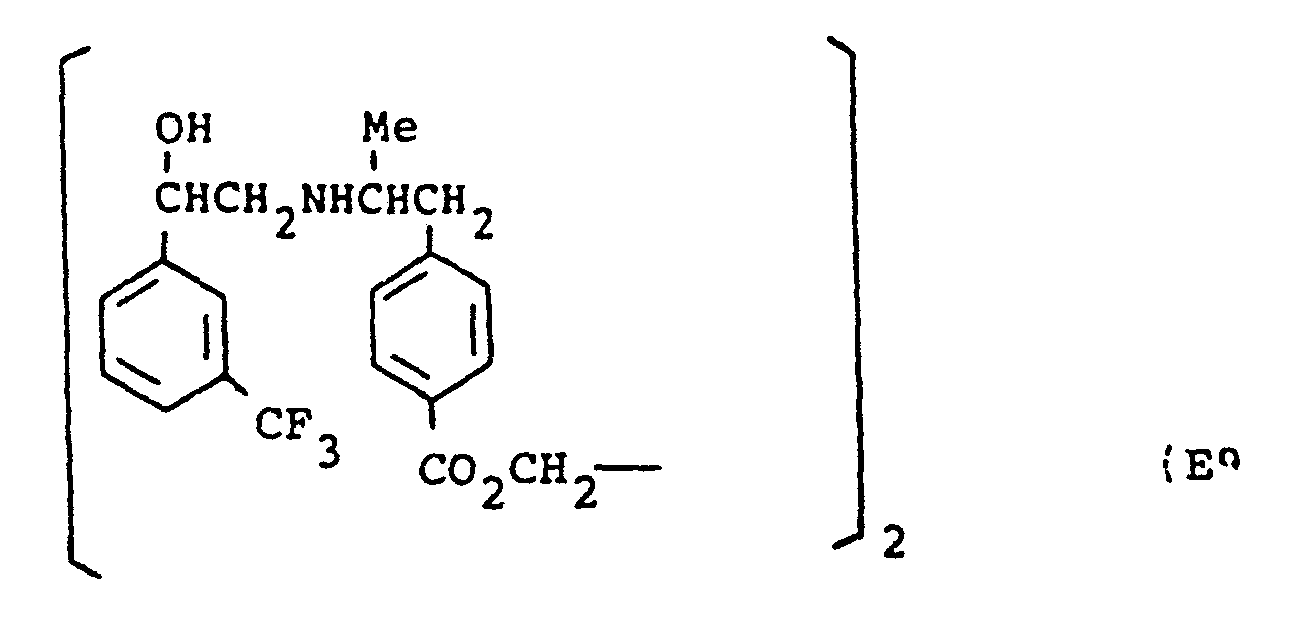
- 0.90 (6H,d); 2.49-2.56 (4H,m); 2.65-2.77 (4H,m); 2.81-2.88 (2H,m); 3.3 (2H, broad, disappears with D20); 4.61 (4H,s); 4.65 (2H,t); 5.4 (2H, broad, disappears with D20), 7.26 (4H,d); 7.45-7.64 (8H,m); 7.83 (4H,d).
-

- 0.91 (6H,d); 2.5-2.68 (4H,m); 2.71-2.78(4H,m): 2.82-2.89 (2H,m); 3.31 (2H, broad, disappears with D2O); 4.54 (2H,t); 4.61 (4H,s); 5.2 (2H, broad, disappears with D20); 7.18-7.29 (14H,m); 7.85 (4H,d).
-

- 1.1(6H,d); 1.8(4H,broad s); 2.6(2H,t); 3.0-3.5(8H,m), 4.0(4H,broad s); 5.1(2H,m); 6.4(2H,m-exch D2O); 6.9 (4H,d); 7.15(4H,d); 7.3-7.5(8H,m); 8.6-9.25(2H, very broad exch. D20); 9.25-10.0(2H, very broad exch. D20).
-

- 1.1(6H,d); 2.1(2H,m); 2.6(2H,t); 3.0-3.5(8H,m); 4.1(4H,m); 5.1(2H,m); 6.4(2H,m,exch D20); 6.9(4H,d); 7.2(4H,d); 7.3-7.6(8H,m); 8.5-9.25(2H, very broad exch. D20); 9.25-10.0(2H, very broad exch. D2O).
-

- 1.1(6H,d); 1.3-1.5(10H,m); 1.65-1.8(4H,m); 2.5-2.7(2H,m); 3.0-3.5(8H,m); 3.92(4H,t); 5.0(2H,dd) 6.32(2H,broad,disappears with D20); 6.88(4H,d); 7.12(4H,d); 7.3-7.5(8H,m), 8.5-9.4.(4H,broad, disappears with D20).
-

- 0.90(3H,d); 0.91(3H,d); 1.46(4H,m); 1.71(4H,m), 2.3-2.51(2H,m); 2.6-3.0(8H,m); 3.3(2H,broad, replaceable by D20), 3.92(4H,t), 4.51(lH,dd), 4.59(lH,dd), 5.0-5.6(2H,broad, replaceable by D2O); 6.65-7.5(16H,m); 9.25(lH,broad, replaceable by D2O).
-

- 1.1(6H,d); 2.7(2H,br t); 2.9-3.55(12H,m); 4.2(4H,s), 5.15(2H,d); 6.4(2H,br s); 7.2-7.6(16H,m); 8.6-10.2(8H,br m).
-

- [α]D 25: -26.50 (DMSO).
- 1.1(6H,d); 1.7 (4H,br,s); 2.4-3.5 (14H,m); 4.05 (4H,s); 5.05 (2H,br d); 6.3 (2H,br, s); 7.25-7.6 (16H,m); 8.5-9.6 (8H,br).
-

- 1.15(6H,d); 1.25(4H,br s); 1.7(4H,br s); 2.6-3.6(14H,m); 4.1(4H,s); 5.2(2H,d); 6.4(2H,d); 7.25-7.65(16H,m); 8.75-10.0(8H,br).
-

- 1.05(6H,d); 2.6(2H,m); 2.75(4H,s); 3.0-3.5(8H,m), 5.1(2H,m); 6.4(2H,d); 7.05-7.25(8H,m); 7.25-7.55(8H,m); 8.8(2H,br s); 9.6(2H,br s).
-

- 1.3(10H,m); 1.55 (4H,br s); 2.55(4H,t); 2.8(2H,m), 3.2(4H,m); 3.45(4H,m); 5.45(2H,d); 6.0(2H,d); 7.0-7.5(16H,m); 9.1(2H,br s); 10.0(2H,br s).
-

- 1.15(6H,d); 1.3-2.0(6H,m); 1.7(2H,br.d); 3.0-3.7(8H,m); 4.0(6H,br,t); 5.2(2H,m); 6.4(2H,br d); 6.85(4H,d); 7.15(4H,d); 7.35-7.6(8H,m); 8.6-10.0(4H,br).
-

- 1.25(6H,d); 2.65(2H,); 2.9-3.5(8H, complex); 3.6(4H, complex); 4.1(4H, complex); 5.0(2H, complex); 6.8(4H,d); 7.2(4H,d); 7.4(8H,complex).
-
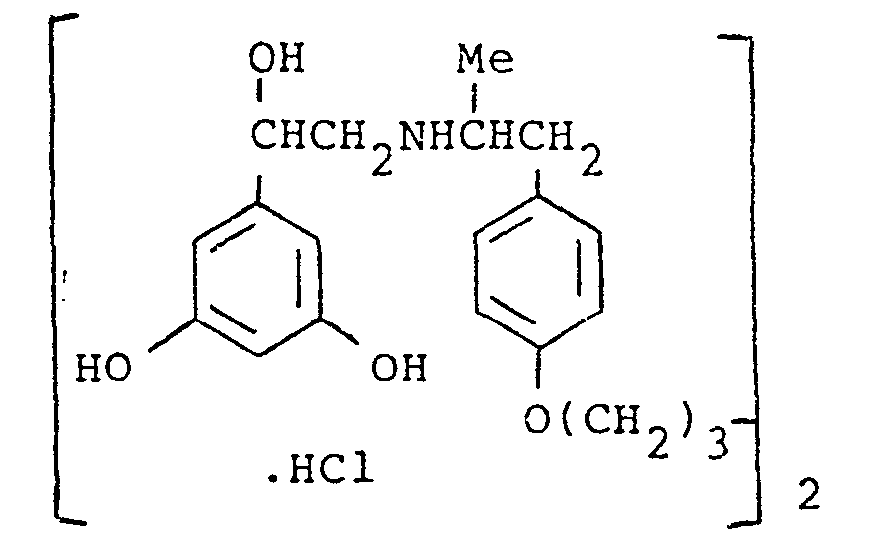
- 1.08 (6H, d); 1.4-1.55(4H,m); 1.65-1.80 (4H,m); 2.5-2.65 (2H,m); 2.85-3.6(8H,m); 3.94(4H,t); 4.60 (2H,dd); 6.10(2H,bs, replaceable by D20); 6.15-b.35(bH,m); 6.85(4H,d); 7.15(4H,d); 8.65(2H, broad, replaceable by D20); 9.31(6H,broad, replaceable by D20).
-

- 1.1(6H,d); 1.4(6H,m); 1.7(4H, m); 2.6(2H,t), 3.0-3.5(8H,m): 3.9(4H,t); 5.1-5.2(2H,broad d); 6.3(2H, broad d, exch D2O); 6.8(4H,d); 7.1(4H,d); 7.3-7.5(8H,m); 8.7-9.5(2H, very broad, exch D20); 9.5-9.8 (2H, very broad, exch D20).
-

- 1.1(6H,d); 2.7(4H,m); 3.45(4H,bs); 4.05(2H,m); 4.4 (4H, s); 4.9 (2H, s); 6.7-7.5(16H,m).
-
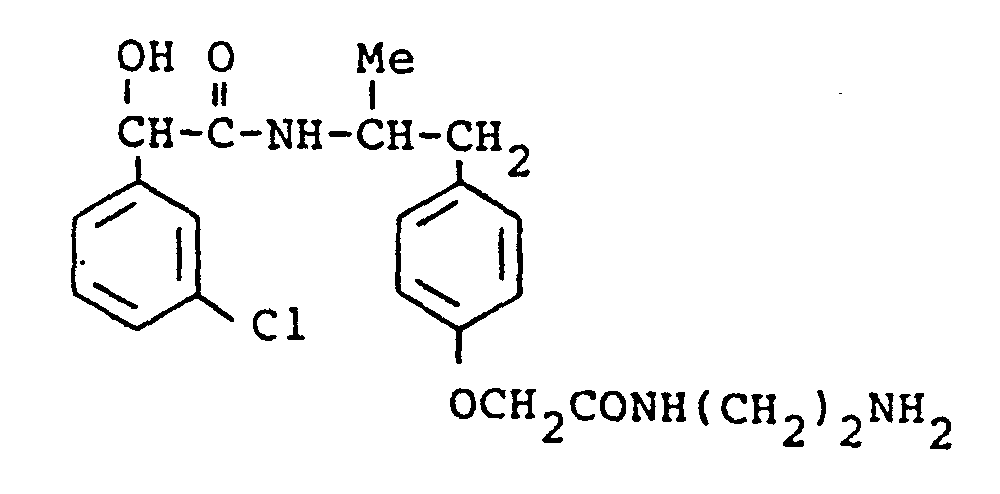
- 1.1(3H,s) ; 2.5-3.0(4H,m); 3.35(2H,t); 4.05(1H,m) ; 4.45(2H,s); 4.9(lH,s); 6.8-7.7(8H,m).
-

- 1.1 (3H, t); 3.65 (2H,m); 3.85 (3H, s); 4.1 (1H,m); 4.65(2H,s); 4.9(1H, s); 6.05(lH,bd), 6.6-7.0(4H,m), 7.2-7. 5 (4H,m).
-

- [α]D 25: -13.80 (MeOH)
- 1.01(6H,d); 1.47 (4H,m); 1.72(4H,m); 2.5-2.71 (4H,m); 3.91(6H,m); 4.86(2H,d-collapses to singlet with D2O); 6.1(2H,d, disappears with D20); 6.7(4H,d); 7.1(4H,d); 7.25-7.4(8H,m); 7.8(2H,d, disappears with D20).
-

- 1.1(6H,d), 1.25-1.95(8H,m), 2.5-3.6(6H,m), 3.95(4H,m), 6.9(4H,d), 7.25(4H,d), 7.85(6H, broad, disappears with D2O).
-
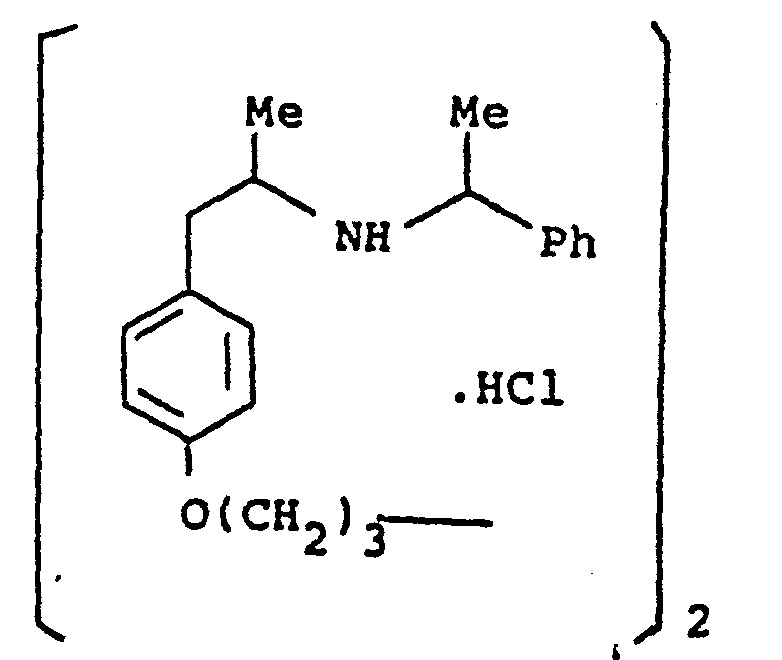
- 1.11(6H,d), 1.43(4H,m), 1.65(6H,d), 1.65(4H,m), 2.54(2H,m), 2.86(2H,m), 3.32(2H,m), 3.9(4H,m), 4.6(2H,m), 6.8(4H, d), 6.9 (4H, d), 7.3-7.55 (0.1m), 7.7-7.8(4H,m), 9.37 and 10.3 (4H, broad, disappears witn D2O).
-

- 1.1(3H,d), 1.65(3H,d), 2.3-3.45(3H,m), 4.6(1H,m), 6.4-6.9(4H,m), 7.3-7.9(5H,m), 9.4(lH,s, disappears with D2O), 9.4 and 10.15 (2H,broad, disappears with D2O).
-

- 1.1(3H,d), 1.65(3H,d), 2.5-3.6(3H,m), 4.55(lH,m), 5.0(2H,s), 6.90(4H,s), 7.2-7.95(10H,m), 9.5 and 10.3(2H, broad, disappears with D20).
-

- 2.38(6H,s); 7.20(4H,d); 7.72(4H,d); 8.14(2H,s).
-

-

- 1.12(6H,d); 1.65(6H,d); 2.7-3.5(6H,m); 4.6(2H,m, collapses to a quartet with D20); 6.87(4H,d); 7.05(4H,d); 7.4-7.6(6H,m); 7.7-7.9(4H,m); 9.4-9.7(2H,bs); 10.1-10.5(2H,bs).
-

- After 24h the mixture was filtered through diatomaceous earth and the solvent removed under vacuum. The crude product was partitioned between aqueous 10% sodium hydroxide and dichloromethane, the organic layer was separated, dried and evaporated to yield [R-(R*,R*)]-4, 4'-Oxybis[α-methylbenzeneethanamine] as a colourless oil.
- 1.16(6H,d); 2.7-3.6(6H,m); 7.02(4H,d); 7.33(4H,d), 8.2-8.5 (4H, bs, exchanges with D20).
-

- 1.15(6H,d); 2.72(4H,d); 4.0 (2H,m); 4.50(2H,d, exchanges with D20); 4.91(2H,d); 6.28(2H,d, exchanges with D20); 6.8-7.2(8H,m); 7.3-7.5(8H,m).
-
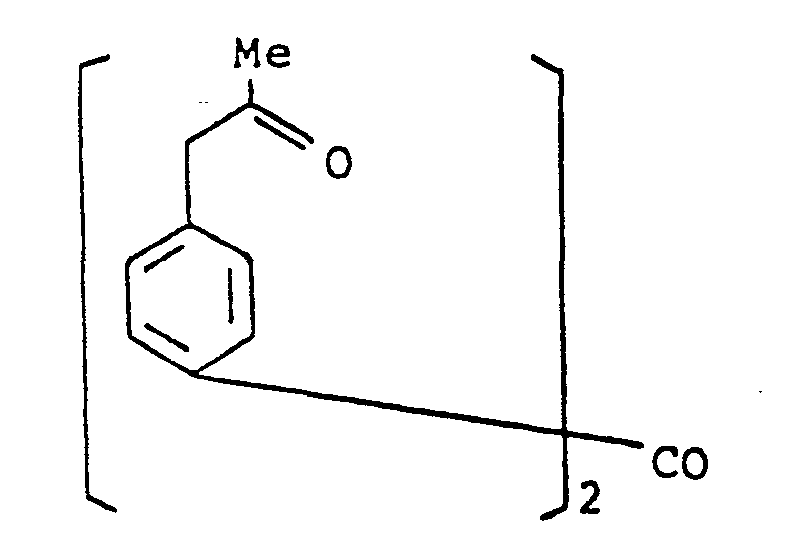
- 2.20(6H,s); 3.80(4H,s); 7.31(4H,d); 7.79(4H,d).
-

- 1.15(6H,d); 1.69(6H,d); 2.6-3.6(6H,m); 4.5-4.8(2H,m collapses to a q with D20); 7.1-8.0(18H,m); 9.5-9.8(2H,bs, exchanges with D20); 10.0-10.5(2H,bs, exchanges with D20).
-

- 1.12(6H,d); 2.3-3.5(6H,bm); 3.87(2H,bs); 7.0-7.5(8H,m), 8.1-8.6(6H,bs, exchange with D20).
-
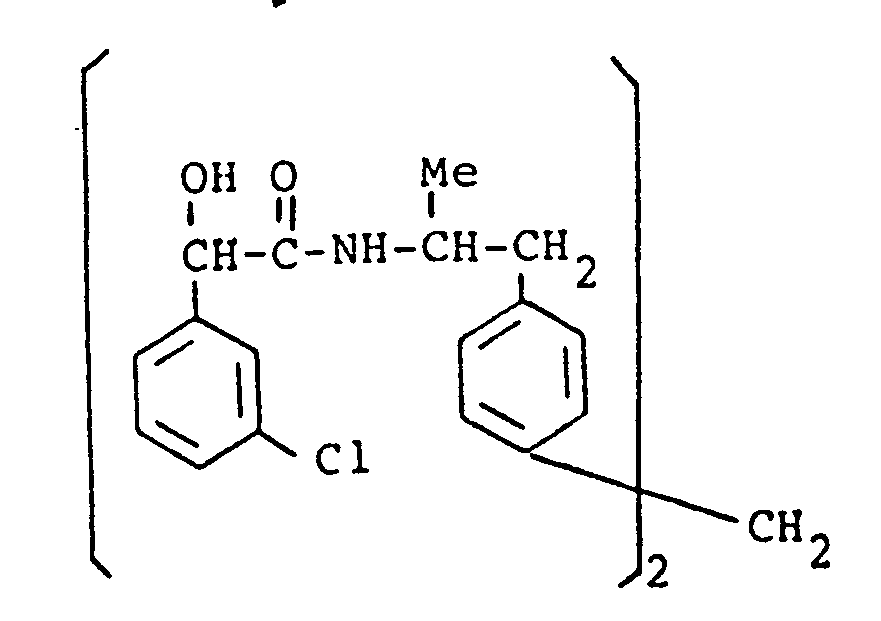
- 1.12(6H,d); 2.64(4H,d); 3.86(2H,s); 4.0-4.3(2H,m); 4.41 ( 2H, d, exchanges with D20); 4.77(2H,s); 5.85(2H,d, exchanges slowly with D2O); 6.8-7.5 (16H,m).
-
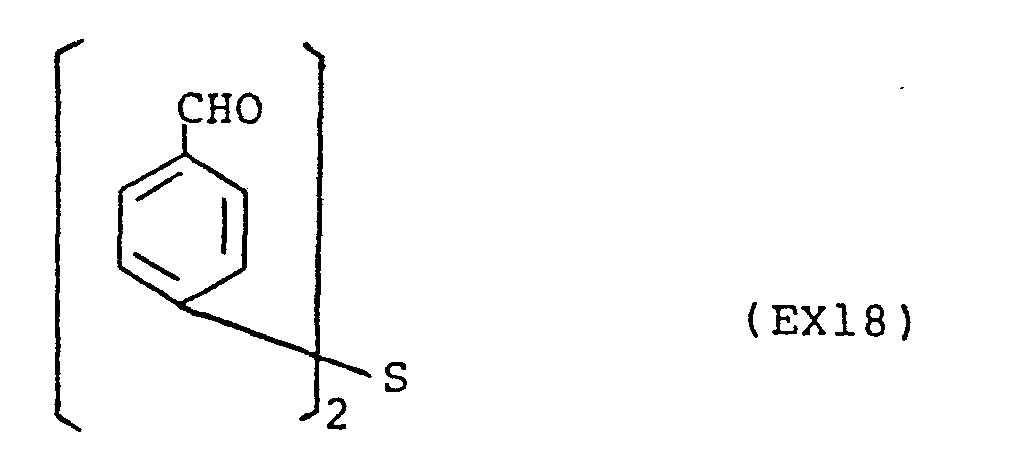
- 7.45(4H,d); 7.87(4H,d), 10.03(2H,s).
-

- 2.43(6H,s); 7.46(4H,d); 7.64(4H,d); 8.08(2H,s).
-

- 2.14 (6H,s); 3.66(4H,s); 7.10(4H,d); 7.33(4H,d).
-

- 2.18(6H,s); 3.78(4H,s); 7.33(4H,d); 7.9.1(4H,d).
-

- 1.11 (6H,d) ; 1.62(6H,d); 2.7-3.6(6H,m); 4.3-4.7(2H,bm, collapses to q with D20); 7.30(4H,d); 7.4-7.6(6H,m); 7.6-7.8(4H,m); 7.88(4H,d); 9.4-9.8(2H,bs, exchanges with D20); 10.2-10.5 (2H,bs, exchanges with D20).
-
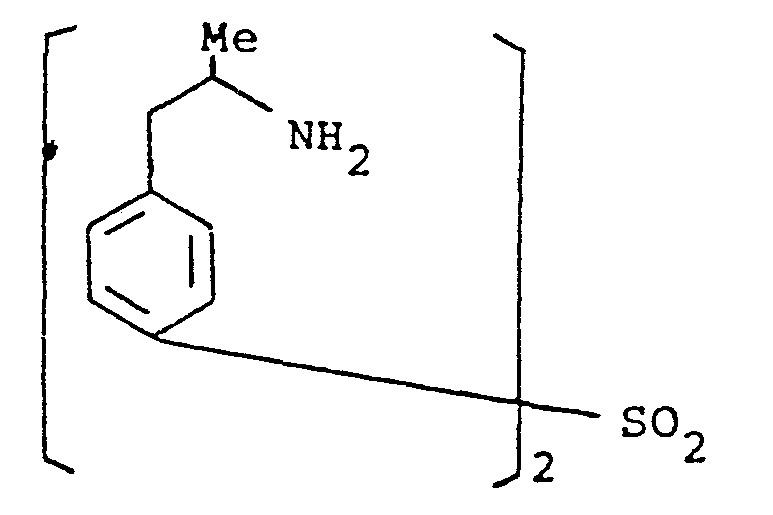
- 1.15(6H,d); 2.7-3.5(6H,m); 7.55(4H,d); 7.94(4H,d); 8.2-8.7(6H,bs exchanges with D20).
-
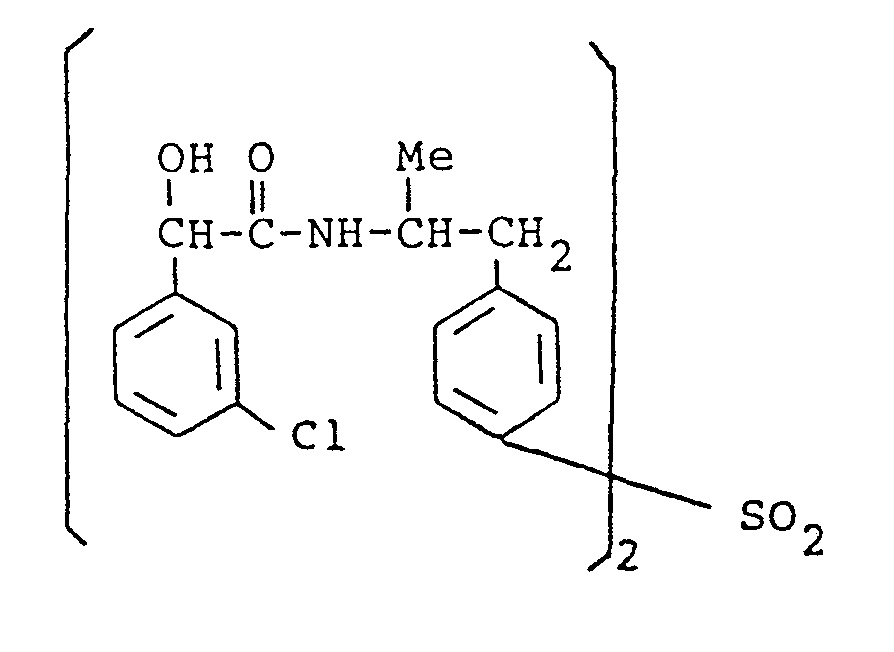
- 1.11(6H,d); 2.65(4H,d); 3.9-4.3(4H,m, 2H exchanges with D20); 4.76(2H,d); 6.65(2H,d, exchanges slowly with D20); 7.0-7.5(12H,m); 7.77(4H,d).
-

- The organic phase was separated, dried and evaporated to yield the crude product which was chromatographed on silica gel. Elution with ethyl acetate-hexane gave ethyl di[4-(2-oxopropyl)phenyl]-α-hydroxyacetate as an oil which crystallised on standing.
- 1.21(3H,t); 2.12(6H,s); 3.65(4H,s); 4.30(2H,q); 4.36(lH,s, exchanges with D20); 7.17(4H,d); 7.41(4H,d).
-

- 1.12(6H,d); 1.20(3H,t); 1.68(6H,d); 2.6-3.5(7H,m 1H exchanges with D20); 4.17 (2H, q); 4.4-4.7(2H,m collaspes to q with D20); 6.98(4H,d); 7.23(4H,d); 7.4-7.6(6H,m); 7.6-7.9(4H,m); 8.5-8.8(2H, os, exchanges with D2u), 9.4-9.7(2H, bs, exchanges with D2O).
-

- 1.13(6H,d); 1.20(3H,t); 2.6-3.5(7H,m, 1H exchanges with D20); 4.18(2H,q); 7.1-7.6(BH,m), 8.2-8.6(6H, bs, exchanges with D20).
-
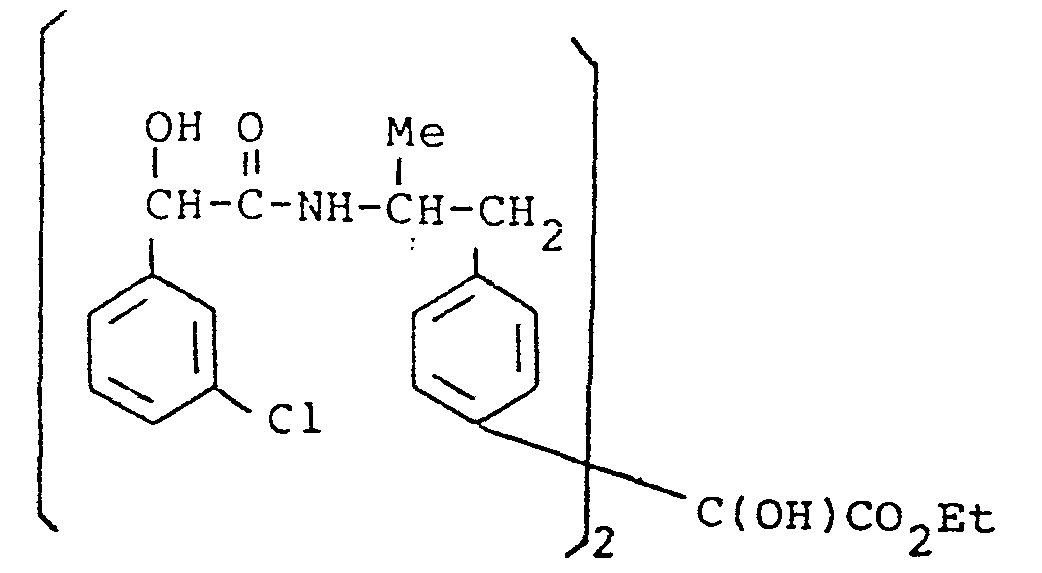
- 1.12(GH,d); 1.20 (3H,t); 2.77(4H,d); 4.34(2H,q); 4.1-4.7(5H,m); 3H exchanges with D20); 4.89(2H,d); 6.65(2H, d slowly exchanges with D20); 7.0-7.6(16H,m).
-

- 1.07(6H,d); 1.34(8H,m): 1.60(6H,d); 1.65(4H,m); 2.89(2H,m); 3.25(2H,m); 3.89(4H,m); 4.59(2H, m); 6.81(4H, d); 6.92(4H,d); 7.44(6H,m); 7.66(4H,m); 9.15 and 9.70(4H,broad, disappears with D2O)·
-
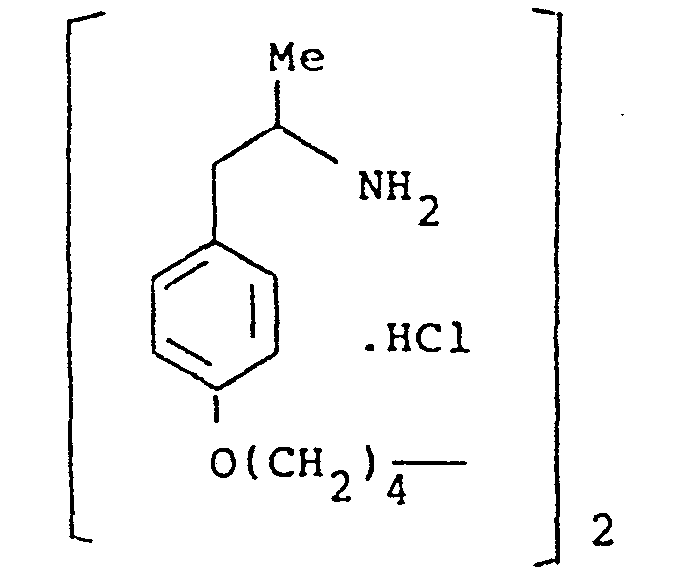
- 1.1 (6H, d); 1.25-1.95 (12H, m); 2.60-3.60 (6H, m); 3.92 (4H, m); 6.85 (4H, d); 7.20 (4H, d); 8.10 (6H, broad, disappears with D20).
-

- 1.0 (6H, d); 1.4-2.1 (6H, m); 2.4-2.9 (4H, m); 3.7-4.4 (6H, m); 4.8 (2H, s); 4.9-5.4 (2H, broad, s); 6.5-7.6 (16H, m).
-

- 1.02 (6H, d); 1.49 (8H, m); 1.75 (4H, m); 2.52-2.73 (4H, m); 3.93 (6H, m); 4.88 (2H, d, collapses to singlet with D2O); 6.13 (2H, d, disappears with D20); 6.72 (4H, d); 7.13 (4H, d); 7.26-7.42 (8H, m); 7.81 (2H, d, disappears with D20).
-
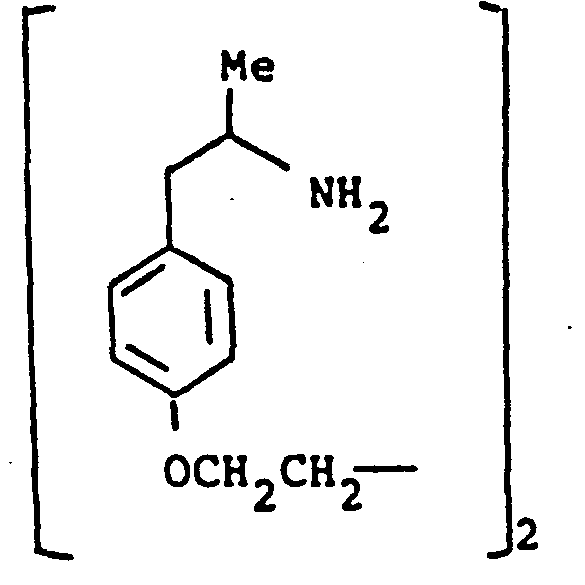
- 1.1 (6H, d); 1.9 (4H, m); 2.2-3.2 (6H, m); 3.2 (4H, s); 3.7-4.4 (4H, m); 6.6-7.4 (8H, m).
-

- 0.9(6H,d); 1.3(6H,d); 1.4(2H,m); 1.9(4H,m); 2.4-3.1 (6H,m); 3.7-4.3(6H,m); 6.7-7.2 (8H,m); 7.2-7.7(10H,m).
-

- 1.1 (6H,d); 1.2-2.4 (6H,m); 2.5-3.0 (3H, m); 3.7-4.3 (5H,m); 4.7-4.9 (2H,m); 4.9-5.3 (2H,m); b.5-7.5 (16H,m).
-

- 1.21 (6H, d); 1.6-2.3 (4H, m); 2.5-3.4(4H,m); 4.1 (4H, t); 6.8-7.4 (8H, m)
-

- 0.9(6H,d); 1.3 (6H,d) ; 1.7-3.0 (10H, m); 3.6-4.3(6H,m); 6.6-7.6(16H, m).
-

- 0.95 (6H,d); 1.1-2.1(22H, m); 2.3-3.1(bH,m); 3.7-4.3(6H,m); 6.7-7.2(8H,m); 7.3 (10H, s)
-
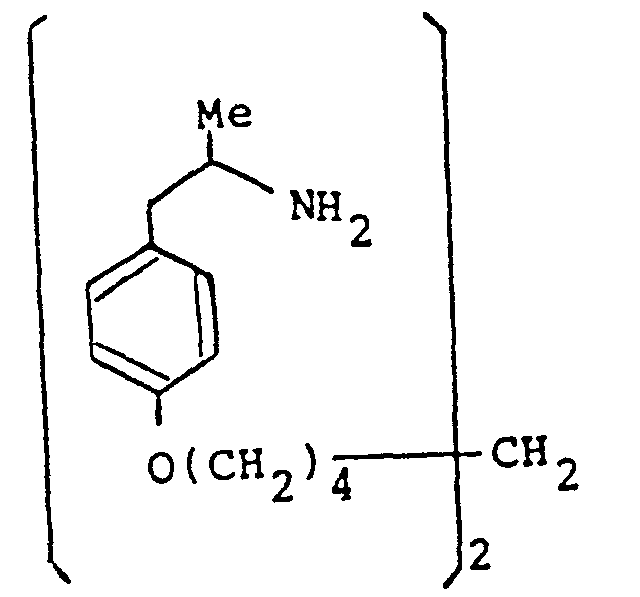
-

- 1.1 (6H,d); 1.1-2.1 (14H, m); 2.5-2.8(4H,m); 3.7-4.2(6H,m); 4.2-4.6(2H,broad); 4.8 (2H, s ); 6.3(2H,bd); 6.7-7.1(8H,m); 7.2-7.6(8H, m)
-

- 1.15 (3H, d), 2.65 (2H, d), 3.9-4.4 (1H, m), 4.9 (lH,s) 6.7-7.5 (8H, m).
-

- 1.10 (3H, d); 2.56 (lH, dd); 2.95 (lH, dd); 3.30 (1H, m) 6.72 (2H, d); 7.03 (2H, d); 8.17 (3H, bs, replaceable by D20) 9.40 (1H, s, replaceable by D20)
-
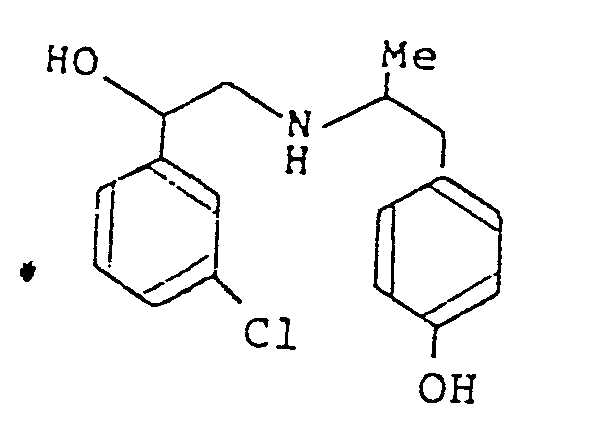
- [α]D 25 -44.1° methanol (C = 0.25).
- 1.08 (3H, d), 2.5-2.95 (5H, m), 4.26 (3H, broad, disappears with D20) 4.52 (1H, dd), 6.74 (2H, d), 6.95 (2H, d), 7.1-7.3 (4H, m).
-

- 1.2 (3H, d,), 2.65 (2H, bd), 3.9-4.4 (lH, m), 4.85 (1H, s), 5.1 (2H, s), 6.4-7.4 (llH, m), 7.6 (5H, s).
-

- [α]D25 : -36.80 (methanol).
- 0.9 (3H, d), 1.6 (1H, broad, disappears with D20), 2.25-2.4 (lH, m), 2.5-2.8 (4H, m), 4.5 (lH, dd), 5.08 (2H, s) 6.65 (2H, d), 6.85-7.0 (4H, m), 7.15-7.25 (2H, m) 7.3-7.5 (5H, m), 9.11 (2H, broad, disappears with D2O)
-

- 1.05 (3H, d), 1.3-2.1 (8H, m), 2.4-2.9 (5H, m), 3.0 (2H, bs, disappears on D20), 3.4 (2H, t), 3.95 (2H, t), 4.6 (1H, dd), 6.8-7.5 (8H, m).
-

- 1.1(6H,d); 1.25-2.1(8H,m); 2.35-3.1(10H,m), 3.95(4H,t); 4.5-4.80(2H,m); 5.15(2H,s); 6.65-7.6(21H,m).
-

- 1.05(6H,d); 2.75(4H,d.d.d.); 3.3(2H,s); 3.45(4H,bs); 4.0(2H,m); 4.6(2H,d); 6.2(2H,d); 7.1-7.9(18H,m); 8.5(2H,brs).
-

- [α]D 25: -10.20(MeOH)
- 1.2(3H,d); 2.6(2R,d.d.d.); 4.35(lH,m); 5.0(1H,s); 6.0(lH,d); 7.05(2H,d); 7.15-7.35(4H,m); 7.9(2H,d).
-

- [α]D 25: -11.80 (MeOH)
- 1.15(3H,d); 2.75(2H,d.d. ); 3.9(3H,s); 4.2(1H,m), 4.5(1H,brs); 4.3(1H,s); 6.4(lH,d); 7.05(2H,d); 7.1-7.3(4H,m); 7.85(2H,d)
-

- m.p. 220-222°C, [α]D 25: -7.0° (DMSO)
- 1.05(6H,d); 1.55(4H,brs); 2.75(4H,m); 3.3(4H,m), 4.0(2H,m); 4.8(2H,d); 6.2(2H,d); 7.15-7.5(12H,m); 7.70(4H,d); 7.9(2H,d); 8.4(2H,m).
-
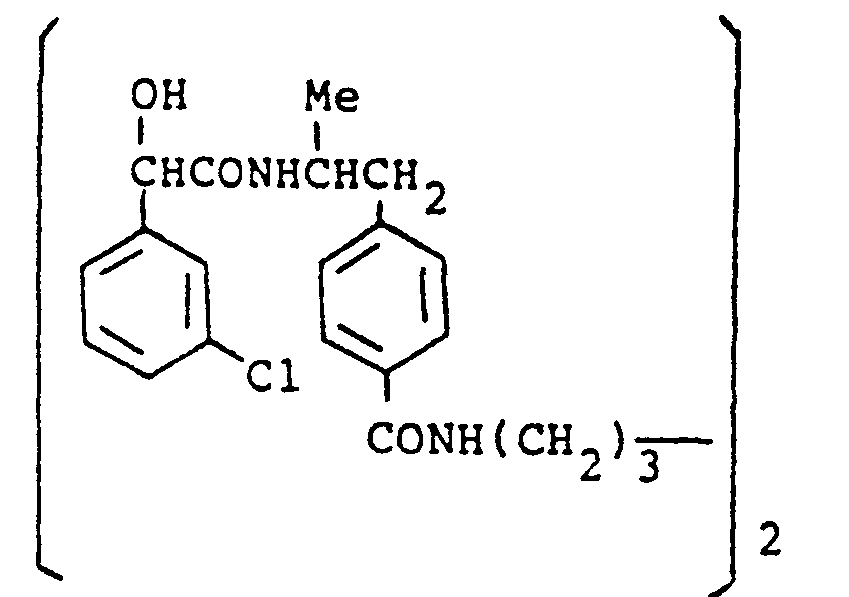
- 1.1 (6H, d); 1.3 (4H, br s); 1.55 (4H, br s); 2.75 (4H, m) 3.25 (4H, m); 4.0 (2H, m); 4.8 (2H, s); 6.2 (2d, br s) 7.0-7.5 (12H, m); 7.7 (4H, d); 7.85 (2H, d); 8.4 (2H, m).
-

- 1.1 (6H, d); 2.4-3.0 (8H, m); 4.55 (2H, m); 4.8 (2H, s) 6.3 (2H, br); 6.7-7.4 (18H, m).
-
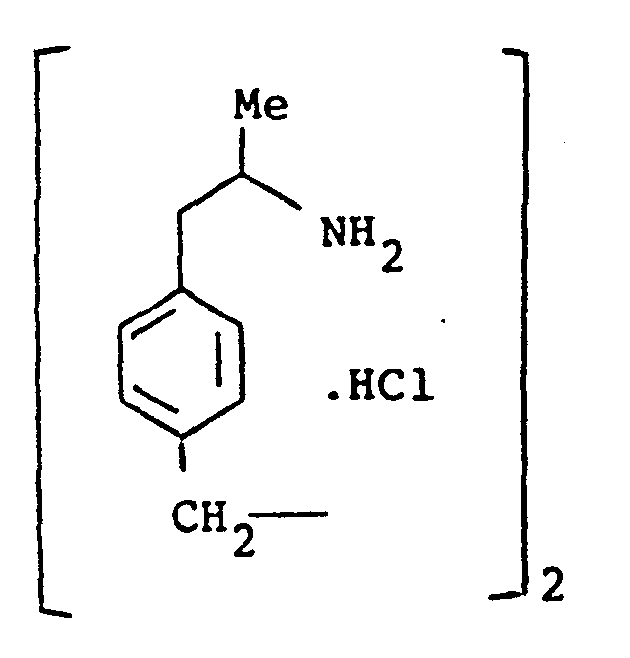
- 1.15 (6H, d); 2.7-3.1 (4H, m); 3.1-3.5 (6H, m); 7.05 (8H, s); 8.2 (6H, br).
-

- [α]D 25: +35.2 (DMSO)
- 1.1 (6H, d); 1.6 (6H, d); 2.5-3.0 (8H, m); 3.4 (2H, m) 4.55 (2H, m); 6.8 (4H, d); 7.05 (4H, d); 7.25-7.8 (10H, m) 9.25-10.1 (4H, br).
-

- 2.15 (6H, s); 2.55 (4H, m); 3.7 (4H, s); 7.15 (8H, s).
-

- 1.1 (6H, d); 1.25 (4H, br s); 1.55 (4H, br s); 2.45-3.1 (8H, m); 4.6 (2H, m); 4.8 (2H, s); 6.5 (2H, d); 6.8-7.4 (18H, m)
-

- 1.0 (6H, d); 1.0-1.7 (8H, m); 2.6-3.6 (10H, m) 7.0 (8H, s); 8.2 (6H, br).
-

- [α]D 25: +30.46° (DMSO).
- 1.05 (6H, d); 1.25 (4H, br s); 1.5 (4H, br s); 1.6 (6H, d); 2.45-2.6 (4H, m); 2.8 (2H, br s); 3.4 (4H, m) 4.6 (2H, m); 6.8 (4H, d); 7.05 (4H, d); 7.25-7.55 (6H, m); 7.7 (4H, d); 9.3 (2H, br); 10.2 (2H, br).
-

- 1.0-1.8 (8H, m); 2.25 (6H, s); 2.6 (4H, br t); 3.7 (4H, s); 7.15 (8H, s).
-

- 1.2 (6H, s); 1.2-2.05 (8H, m); 2.85 (4H, br s); 3.8 (10H, m); 4.6 (2H, m); 7.2 (8H, m).
-

- 1.1 (6H, d); 1.65 (2H, m); 1.8 (4H, m); 2.6 (4H, d); 3.95 (4H, t); 4.2 (2H, m); 4.8 (2H, s); 5.95 (2H, d); 6.7 (4H, d); 6.8 (4H, d); 7.2-7.45 (8H, m).
-
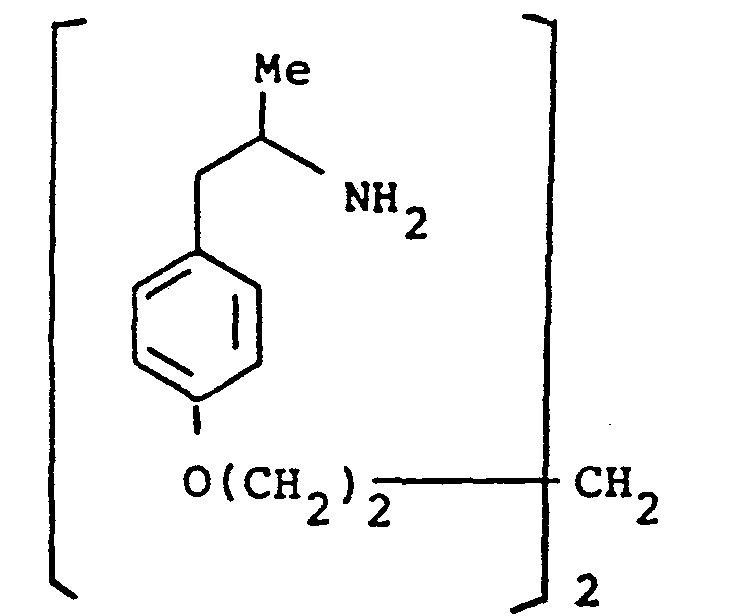
- 1.15 (6H, d); 1.65 (2H, m); 1.8 (8H, m); 2.5 (2H, dd) 2.7 (2H, dd); 3.15 (2H, m); 3.95 (4H, t); 6.8 (4H, d); 7.1 (4H, d).
-

- [a]D 25 : +23.3° (DMSO).
- 1.15 (6H, d); 1.35-1.95 (10H, m); 2.85 (2H, m); 3.35 (4H, m); 3.9 (4H, t); 4.6 (2H, m); 6.85 (8H, q); 7.5 (6H, m); 7.75 (4H, m); 9.5 (2H, m); 10.25 (2H, m).
-

- 1.1 (6H; d); 2.2-3.8 (10H, complex, 4H exchanges) 3.7-4.3 (8H, complex); 4.8 (2H,); 6.7 (4H, d); 6.9 (4H, d); 7.2 (8H, complex).
-

- [α]D 25 +15.2° (Ethanol)
- 1.15 (6H, d); 2.2-4 (6H, complex); 3.8 (4H, complex), 4.15 (4H, complex); 6.9 (4H, d); 7.1 (4H, d); 7.6-8.8 (6H, broad s, exchanges).
-
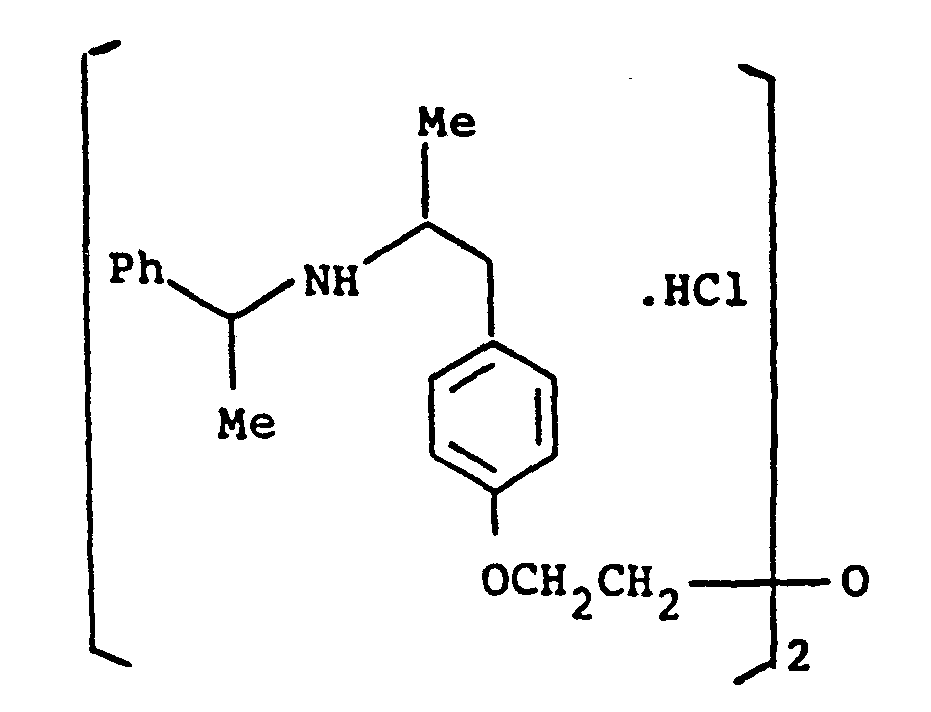
-

- 2.2 (6H, s); 3.6 (4H, s); 3.85 (4H, complex); 4.1 (4H, complex); 6.8 (4H, d); 7.1 (4H, d).
-
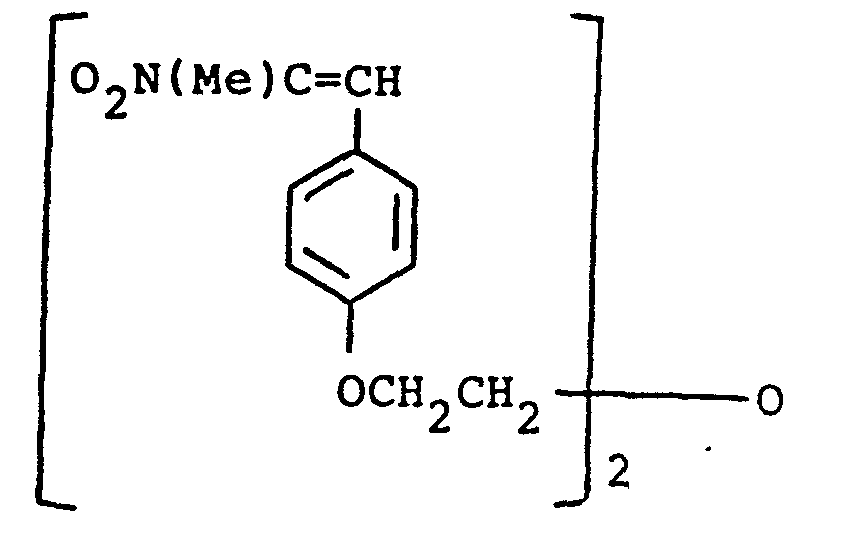
- 2.4 (6H, s); 3.85 (4H, complex); 4.2 (4H, complex); 7.1 (4H, d); 7.55 (4H, d); 8.05 (2H, s).
-

- 3.65 (4H, complex); 4.05 (4H, complex), 7.0 (4H, d); 7.8 (4H, d); 9.8 (2H, s).
-

- 1.10 (6H, d); 1.45 (4H, m); 1.71 (4H, m) 2.55-2.70 (2H, m); 2.95-3.5 (8H, m); 3.93 (4H, t); 5.04 (2H, dd), 5.09 (8H, s);6.25 (2H, broad, replaceable by D20); 6.60-6.75 (6H, m); 6.87 (4H, d): 7.14 (4H, d); 7.25-7.5 (20H, m); 8.83 (2H, broad, replaceable by D20); 9.48 (2H, broad, replaceable by D20).
-

- 1.05 (6H, d); 1.2-2.0 (8H, m); 2.55 (4H, d); 3.8, (4H, t), 4.0-4.3 (2H, m); 4.8 (2H, s) 4.95 (8H, s); 6.0 (2H, bd, replaceable by D2O),; 6.6-7.0 (16H, m includes 2H replaceable by D20); 7.35 (20H, s).
-

- 1.1 (6H, d); 1.3 (6H, m); 1.5-1.75 (10H, m); 2.5 (2H, t); 2.8 (2H, broad s); 3.3 (2H, m); 3.85 (4H, m); 4.6 (2H, broad s); 6.8 (4H, d); 6.9 (4H, d); 7.4 (6H, m); 7.7 (4H, m); 9.3 (2d broad s, exchanges D20); 10.1 (2H, broad s exch D2O)
-

- 1.2 (6H, d); 1.3-1.5 (6H, m); 1.7 (4H, m); 2.6 (2H, dd); 3.0 (2H, dd); 3.2-3.5 (2H, m); 3.9 (4H, t); 6.8 (4H, d); 7.15 (4H, d); 8.0-8.5 (6H, broad s, exchanges D2O)
-

- 1.1 (6H, d); 1.3-2.1 (10H, m); 2.6-2.9 (4H, m); 3.8-4.4 (6H, m); 4.5-4.7 (2H, m); 4.7-5.0 (2H, m) 6.3-6.5 (2H, d); 6.6-7.1 (8H, m); 7.1-7.5 (8H, m).
- The effect of the compounds on the energy expenditure of rats was demonstrated by means of the following procedure:
- Male Sprague-Dawley rats each weighing between 17u-200g were deprived of food for 16 hours before, and during the experiment. Water was provided ad lib at all times. The compounds were administered orally in water to 3 or 4 rats. A further 4 rats were dosed orally with water. The rats were placed in boxes througn which air was drawn and the oxygen content of the air leaving the boxes was measured. The energy expenditure of the rats was calculated for 3 hours and for 21 hours after dosing from the volume of air leaving the boxes and its oxygen content, following the principles described by J.B. de V. Weir, J. Physiol. (London) 109, 1-9 (1949). The results are expressed as a percentage of the rate of energy expenditure of the rats dosed with water. Results are given in Table 1.


- Female CFLP mice, weighing approximately 25g, were fasted for 24 hours prior to the study. The compounds under study were administered orally as an aqueous solution to each of 6 mice. 30 minutes later a blood sample (20ul) was obtained from the tail for the analysis of blood glucose. Immediately after taking this blood sample, glucose (lg/kg body weight) was administered subcutaneously to each mouse. 6 mice were -given water as a control. Blood samples were then obtained from each mouse at 30 minute intervals for 120 minutes.
- Compounds that produced a significant (p>0.05) reduction of blood glucose, compared with control mice given water, at any time interval were considered active. The area under the blood glucose curve over the 2 hour period after the administration of the glucose was calculated for each compound and compared with the value for control animals.

wherein
and thereafter if necessary carrying out one or more ot the following steps:
Claims (33)

characterized in that RA represents a moiety of formula (a):


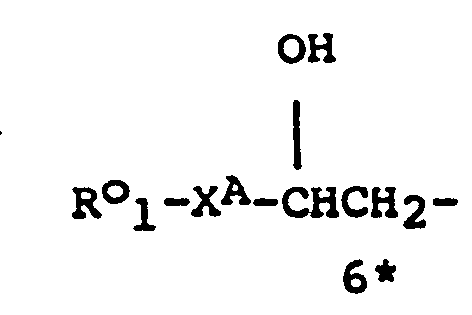
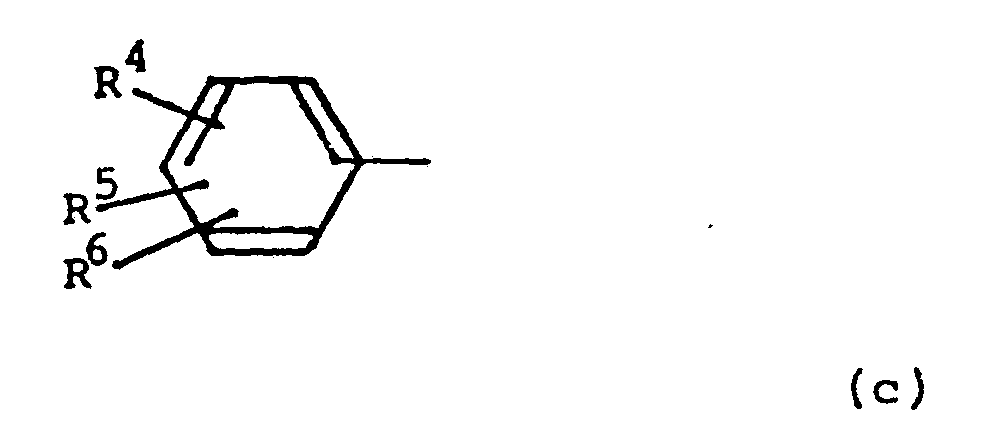


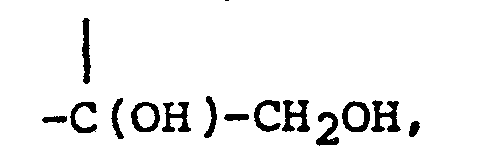
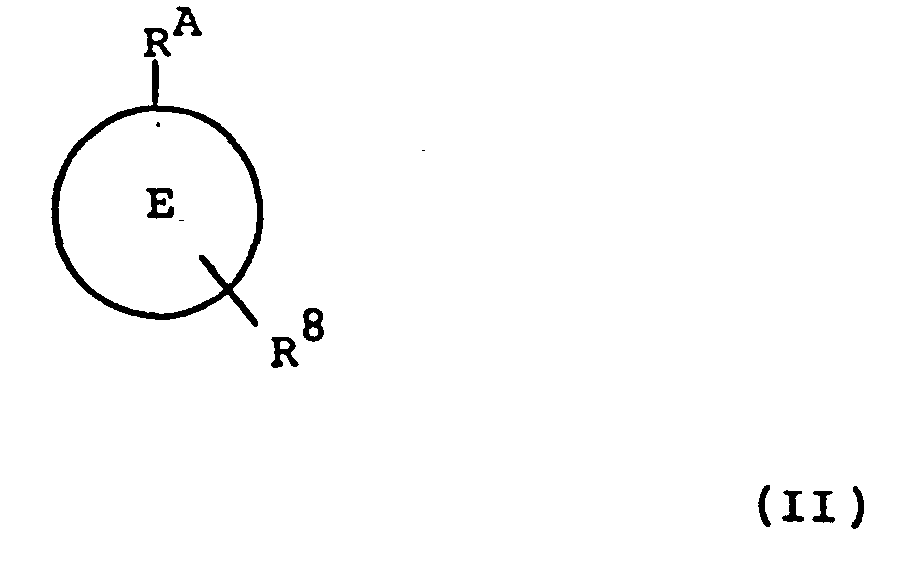


by, where appropriate;
and thereafter if necessary carrying out one or more of the following steps:

wherein RA represents a moiety of formula (a):


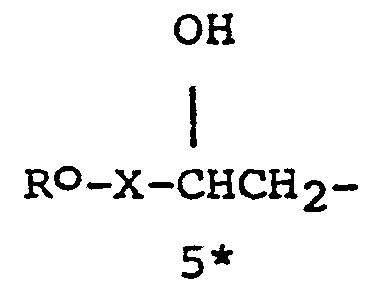


by, where appropriate;
and thereafter if necessary carrying out one or more of the following steps:


Applications Claiming Priority (4)
| Application Number | Priority Date | Filing Date | Title |
|---|---|---|---|
| GB8600644 | 1986-01-11 | ||
| GB868600644A GB8600644D0 (en) | 1986-01-11 | 1986-01-11 | Compounds |
| GB868611345A GB8611345D0 (en) | 1986-05-09 | 1986-05-09 | Compound |
| GB8611345 | 1986-05-09 |
Publications (2)
| Publication Number | Publication Date |
|---|---|
| EP0233686A2 true EP0233686A2 (en) | 1987-08-26 |
| EP0233686A3 EP0233686A3 (en) | 1989-05-03 |
Family
ID=26290207
Family Applications (1)
| Application Number | Title | Priority Date | Filing Date |
|---|---|---|---|
| EP87300191A Withdrawn EP0233686A3 (en) | 1986-01-11 | 1987-01-09 | Bis phenyl ethanol amines and bis phenyoxypropanolamines having a beta-agonist activity |
Country Status (4)
| Country | Link |
|---|---|
| EP (1) | EP0233686A3 (en) |
| AU (1) | AU6747387A (en) |
| DK (1) | DK9987A (en) |
| PT (1) | PT84093B (en) |
Cited By (16)
| Publication number | Priority date | Publication date | Assignee | Title |
|---|---|---|---|---|
| WO1990006299A1 (en) * | 1987-06-04 | 1990-06-14 | Boehringer Ingelheim Vetmedica Gmbh | New phenylethanolamines |
| EP0431763A3 (en) * | 1989-11-17 | 1992-01-22 | Imperial Chemical Industries Plc | Therapeutic agents for lowering triglyceride and/or cholesterol levels and/or increasing hdl levels |
| US5563171A (en) * | 1993-11-05 | 1996-10-08 | American Cyanamid Company | Treatment of glaucoma and ocular hypertension with β3-adrenergic agonists |
| US5578638A (en) * | 1993-11-05 | 1996-11-26 | American Cyanamid Company | Treatment of glaucoma and ocular hypertension with β3 -adrenergic agonists |
| EP1019075A4 (en) * | 1998-06-08 | 2000-12-13 | Advanced Medicine Inc | $g(b)2-ADRENERGIC RECEPTOR AGONISTS |
| US6576793B1 (en) | 1999-12-08 | 2003-06-10 | Theravance, Inc. | β2-adrenergic receptor agonists |
| US6593497B1 (en) | 1999-06-02 | 2003-07-15 | Theravance, Inc. | β2-adrenergic receptor agonists |
| US6653323B2 (en) | 2001-11-13 | 2003-11-25 | Theravance, Inc. | Aryl aniline β2 adrenergic receptor agonists |
| US6670376B1 (en) | 2001-11-13 | 2003-12-30 | Theravance, Inc. | Aryl aniline β2 adrenergic receptor agonists |
| US6683115B2 (en) | 1999-06-02 | 2004-01-27 | Theravance, Inc. | β2-adrenergic receptor agonists |
| US6713651B1 (en) | 1999-06-07 | 2004-03-30 | Theravance, Inc. | β2-adrenergic receptor agonists |
| US6747043B2 (en) | 2002-05-28 | 2004-06-08 | Theravance, Inc. | Alkoxy aryl β2 adrenergic receptor agonists |
| US7399863B2 (en) | 2003-09-22 | 2008-07-15 | Theravance, Inc. | Amino-substituted ethylamino β2 adrenergic receptor agonists |
| US7402673B2 (en) | 2004-06-03 | 2008-07-22 | Theravance, Inc. | Diamine β2 adrenergic receptor agonists |
| US7566785B2 (en) | 2004-09-10 | 2009-07-28 | Theravance, Inc. | Amidine substituted aryl aniline compounds |
| US7622467B2 (en) | 2004-01-12 | 2009-11-24 | Theravance, Inc. | Aryl aniline derivatives as β2 adrenergic receptor agonists |
Family Cites Families (3)
| Publication number | Priority date | Publication date | Assignee | Title |
|---|---|---|---|---|
| EP0021636B1 (en) * | 1979-06-16 | 1982-12-01 | Beecham Group Plc | Secondary amines, their preparation and use in pharmaceutical compositions |
| GB8415377D0 (en) * | 1984-06-15 | 1984-07-18 | Beecham Group Plc | Compounds |
| GB8507942D0 (en) * | 1985-03-27 | 1985-05-01 | Beecham Group Plc | Compounds |
-
1987
- 1987-01-09 EP EP87300191A patent/EP0233686A3/en not_active Withdrawn
- 1987-01-09 DK DK9987A patent/DK9987A/en not_active Application Discontinuation
- 1987-01-09 AU AU67473/87A patent/AU6747387A/en not_active Abandoned
- 1987-01-12 PT PT8409387A patent/PT84093B/en unknown
Cited By (25)
| Publication number | Priority date | Publication date | Assignee | Title |
|---|---|---|---|---|
| WO1990006299A1 (en) * | 1987-06-04 | 1990-06-14 | Boehringer Ingelheim Vetmedica Gmbh | New phenylethanolamines |
| EP0375791A1 (en) * | 1987-06-04 | 1990-07-04 | Boehringer Ingelheim Vetmedica Gmbh | Phenyl ethanol amines, their use as pharmaceutical compounds and as performance stimulants in animals, as well as processes for their preparation |
| EP0431763A3 (en) * | 1989-11-17 | 1992-01-22 | Imperial Chemical Industries Plc | Therapeutic agents for lowering triglyceride and/or cholesterol levels and/or increasing hdl levels |
| US5563171A (en) * | 1993-11-05 | 1996-10-08 | American Cyanamid Company | Treatment of glaucoma and ocular hypertension with β3-adrenergic agonists |
| US5578638A (en) * | 1993-11-05 | 1996-11-26 | American Cyanamid Company | Treatment of glaucoma and ocular hypertension with β3 -adrenergic agonists |
| EP1019075A4 (en) * | 1998-06-08 | 2000-12-13 | Advanced Medicine Inc | $g(b)2-ADRENERGIC RECEPTOR AGONISTS |
| US6362371B1 (en) | 1998-06-08 | 2002-03-26 | Advanced Medicine, Inc. | β2- adrenergic receptor agonists |
| US6541669B1 (en) | 1998-06-08 | 2003-04-01 | Theravance, Inc. | β2-adrenergic receptor agonists |
| US6919482B2 (en) | 1998-06-08 | 2005-07-19 | Theravance, Inc. | β2-adrenergic receptor agonists |
| US6683115B2 (en) | 1999-06-02 | 2004-01-27 | Theravance, Inc. | β2-adrenergic receptor agonists |
| US6916961B2 (en) | 1999-06-02 | 2005-07-12 | Theravance, Inc. | β2-adrenergic receptor agonists |
| US6593497B1 (en) | 1999-06-02 | 2003-07-15 | Theravance, Inc. | β2-adrenergic receptor agonists |
| US7211695B2 (en) | 1999-06-07 | 2007-05-01 | Theravance, Inc. | β2-adrenergic receptor agonists |
| US6713651B1 (en) | 1999-06-07 | 2004-03-30 | Theravance, Inc. | β2-adrenergic receptor agonists |
| US7105701B2 (en) | 1999-06-07 | 2006-09-12 | Theravance, Inc. | β2-adrenergic receptor agonists |
| US6576793B1 (en) | 1999-12-08 | 2003-06-10 | Theravance, Inc. | β2-adrenergic receptor agonists |
| US6653323B2 (en) | 2001-11-13 | 2003-11-25 | Theravance, Inc. | Aryl aniline β2 adrenergic receptor agonists |
| US6670376B1 (en) | 2001-11-13 | 2003-12-30 | Theravance, Inc. | Aryl aniline β2 adrenergic receptor agonists |
| US6747043B2 (en) | 2002-05-28 | 2004-06-08 | Theravance, Inc. | Alkoxy aryl β2 adrenergic receptor agonists |
| US7399863B2 (en) | 2003-09-22 | 2008-07-15 | Theravance, Inc. | Amino-substituted ethylamino β2 adrenergic receptor agonists |
| US7964730B2 (en) | 2003-09-22 | 2011-06-21 | Theravance, Inc. | Amino-substituted ethylamino β2 adrenergic receptor agonists |
| US7622467B2 (en) | 2004-01-12 | 2009-11-24 | Theravance, Inc. | Aryl aniline derivatives as β2 adrenergic receptor agonists |
| US7994165B2 (en) | 2004-01-12 | 2011-08-09 | Theravance, Inc. | Aryl aniline derivatives as β2 adrenergic receptor agonists |
| US7402673B2 (en) | 2004-06-03 | 2008-07-22 | Theravance, Inc. | Diamine β2 adrenergic receptor agonists |
| US7566785B2 (en) | 2004-09-10 | 2009-07-28 | Theravance, Inc. | Amidine substituted aryl aniline compounds |
Also Published As
| Publication number | Publication date |
|---|---|
| AU6747387A (en) | 1987-07-16 |
| EP0233686A3 (en) | 1989-05-03 |
| DK9987D0 (en) | 1987-01-09 |
| PT84093B (en) | 1989-01-30 |
| DK9987A (en) | 1987-07-12 |
| PT84093A (en) | 1987-02-01 |
Similar Documents
| Publication | Publication Date | Title |
|---|---|---|
| EP0233686A2 (en) | Bis phenyl ethanol amines and bis phenyoxypropanolamines having a beta-agonist activity | |
| DK168761B1 (en) | Phenyl ethers and pharmaceutically acceptable salts thereof, processes for their preparation and pharmaceutical agents containing them | |
| EP1242404B1 (en) | Phenoxypropanolamines, preparation and therapeutic use thereof | |
| CN1015707B (en) | Amide derivatives | |
| CN1181064A (en) | O-carbamoyl-phenylalaninol having a substituent on the benzene ring, its medicinal salt and its preparation method | |
| EP0196849A2 (en) | Aminohydroxyalkylbenzene anti-obesity and/or anti-hyperglycaemic agents | |
| CN1184475A (en) | Tetrahydronaphthalene compounds with MDR activity | |
| CZ291238B6 (en) | Vitamin D amide derivatives, their use and pharmaceutical preparations in which they are comprised | |
| EP1200395A1 (en) | Urea derivatives as inhibitors of ccr-3 receptor | |
| CN1068566A (en) | 2-(4-hydroxy piperidine subbase)-1-alkanol as antiischemic agents | |
| EP0099707A1 (en) | 2-Aminoethyl ether derivatives, processes for their preparation and pharmaceutical compositions containing them | |
| EP0140243A2 (en) | Phenoxypropanol amines | |
| JPH0474345B2 (en) | ||
| EP0089154A2 (en) | Ethanolamine derivatives, their preparation and use in pharmaceutical compositions | |
| EP0168505A1 (en) | Substituted 2-aminotetralins and processes for synthesis | |
| JP2722255B2 (en) | N-2,3-butadienyl tree and tetraaminoalkane derivatives | |
| EP0170121B1 (en) | 2-hydroxy-3-aryloxypropyl or 2-hydroxy-2-benzofuranyl ethyl tertiary amine having an anti-hyperglycaemic and/or anti-obesity activity | |
| CN1216526A (en) | 3,4-disubstituted phenylethanolamino 1,2,3,4,-tetrahydronaphthalene carboxamide derivatives | |
| EP0237366B1 (en) | Amino alcohols, process for their preparation and their applications, in particular for therepeutical use | |
| CH644582A5 (en) | POLYPRENYLCARBOXYLIC ACID AMIDES. | |
| EP0164700B1 (en) | Bis(beta-hydroxy phenethyl)amines | |
| US5308840A (en) | Substituted or unsubstituted benzhydryl heteroalkyl-substituted aminophenol compounds and pharmaceutical compositions thereof | |
| EP1196403B1 (en) | Antipsychotic cyclic n-aralkyl amines | |
| EP0142102B1 (en) | Tertiary amines | |
| EP0338937B1 (en) | 1-[3-(4-Hydroxy-phenyl)-1-hydoxy-1-propyl]-2-(amino-alkyleneoxy)-benzene derivatives, process for their preparation and their therapeutical use |
Legal Events
| Date | Code | Title | Description |
|---|---|---|---|
| PUAI | Public reference made under article 153(3) epc to a published international application that has entered the european phase |
Free format text: ORIGINAL CODE: 0009012 |
|
| AK | Designated contracting states |
Kind code of ref document: A2 Designated state(s): BE CH DE ES FR GB GR IT LI LU NL SE |
|
| 17P | Request for examination filed |
Effective date: 19880202 |
|
| PUAL | Search report despatched |
Free format text: ORIGINAL CODE: 0009013 |
|
| AK | Designated contracting states |
Kind code of ref document: A3 Designated state(s): BE CH DE ES FR GB GR IT LI LU NL SE |
|
| STAA | Information on the status of an ep patent application or granted ep patent |
Free format text: STATUS: THE APPLICATION IS DEEMED TO BE WITHDRAWN |
|
| 18D | Application deemed to be withdrawn |
Effective date: 19910801 |
|
| RIN1 | Information on inventor provided before grant (corrected) |
Inventor name: AINSWORTH, ANTHONY TREVOR Inventor name: SMITH, DAVID GLYNNBEECHAM PHARMACEUTICALS |