EP0230212B1 - A process for the preparation of plasto-elastomeric compounds from polyolefins and EPDM terpolymers and the plasto-elastomeric compounds thus obtained - Google Patents
A process for the preparation of plasto-elastomeric compounds from polyolefins and EPDM terpolymers and the plasto-elastomeric compounds thus obtained Download PDFInfo
- Publication number
- EP0230212B1 EP0230212B1 EP86830382A EP86830382A EP0230212B1 EP 0230212 B1 EP0230212 B1 EP 0230212B1 EP 86830382 A EP86830382 A EP 86830382A EP 86830382 A EP86830382 A EP 86830382A EP 0230212 B1 EP0230212 B1 EP 0230212B1
- Authority
- EP
- European Patent Office
- Prior art keywords
- plasto
- epdm
- elastomeric composition
- weight
- composition according
- Prior art date
- Legal status (The legal status is an assumption and is not a legal conclusion. Google has not performed a legal analysis and makes no representation as to the accuracy of the status listed.)
- Expired - Lifetime
Links
- 229920002943 EPDM rubber Polymers 0.000 title claims abstract description 36
- 238000000034 method Methods 0.000 title claims abstract description 32
- 229920000098 polyolefin Polymers 0.000 title claims description 8
- 229920001897 terpolymer Polymers 0.000 title claims description 8
- 150000001875 compounds Chemical class 0.000 title abstract description 17
- 238000002360 preparation method Methods 0.000 title description 6
- KXGFMDJXCMQABM-UHFFFAOYSA-N 2-methoxy-6-methylphenol Chemical class [CH]OC1=CC=CC([CH])=C1O KXGFMDJXCMQABM-UHFFFAOYSA-N 0.000 claims abstract description 20
- 238000004132 cross linking Methods 0.000 claims abstract description 15
- 239000000203 mixture Substances 0.000 claims description 41
- YGSDEFSMJLZEOE-UHFFFAOYSA-N salicylic acid Chemical compound OC(=O)C1=CC=CC=C1O YGSDEFSMJLZEOE-UHFFFAOYSA-N 0.000 claims description 26
- FJKROLUGYXJWQN-UHFFFAOYSA-N papa-hydroxy-benzoic acid Natural products OC(=O)C1=CC=C(O)C=C1 FJKROLUGYXJWQN-UHFFFAOYSA-N 0.000 claims description 13
- 229960004889 salicylic acid Drugs 0.000 claims description 13
- -1 ethylene, propylene Chemical group 0.000 claims description 11
- 239000000178 monomer Substances 0.000 claims description 10
- 229920001568 phenolic resin Polymers 0.000 claims description 10
- 150000001993 dienes Chemical class 0.000 claims description 9
- VXNZUUAINFGPBY-UHFFFAOYSA-N 1-Butene Chemical compound CCC=C VXNZUUAINFGPBY-UHFFFAOYSA-N 0.000 claims description 6
- VGGSQFUCUMXWEO-UHFFFAOYSA-N Ethene Chemical compound C=C VGGSQFUCUMXWEO-UHFFFAOYSA-N 0.000 claims description 6
- 239000005977 Ethylene Substances 0.000 claims description 6
- 238000010077 mastication Methods 0.000 claims description 6
- 230000018984 mastication Effects 0.000 claims description 6
- 239000005011 phenolic resin Substances 0.000 claims description 6
- 229920001169 thermoplastic Polymers 0.000 claims description 6
- 239000004416 thermosoftening plastic Substances 0.000 claims description 6
- 238000004519 manufacturing process Methods 0.000 claims description 5
- 238000002844 melting Methods 0.000 claims description 5
- 230000008018 melting Effects 0.000 claims description 5
- QQONPFPTGQHPMA-UHFFFAOYSA-N propylene Natural products CC=C QQONPFPTGQHPMA-UHFFFAOYSA-N 0.000 claims description 5
- 125000004805 propylene group Chemical group [H]C([H])([H])C([H])([*:1])C([H])([H])[*:2] 0.000 claims description 5
- WSSSPWUEQFSQQG-UHFFFAOYSA-N 4-methyl-1-pentene Chemical compound CC(C)CC=C WSSSPWUEQFSQQG-UHFFFAOYSA-N 0.000 claims description 4
- 125000003342 alkenyl group Chemical group 0.000 claims description 4
- 125000003118 aryl group Chemical group 0.000 claims description 4
- 125000004432 carbon atom Chemical group C* 0.000 claims description 4
- LIKMAJRDDDTEIG-UHFFFAOYSA-N 1-hexene Chemical compound CCCCC=C LIKMAJRDDDTEIG-UHFFFAOYSA-N 0.000 claims description 3
- YWAKXRMUMFPDSH-UHFFFAOYSA-N pentene Chemical compound CCCC=C YWAKXRMUMFPDSH-UHFFFAOYSA-N 0.000 claims description 3
- HOEFIGOFJSMARD-FUOWLQLWSA-N (1z,5z)-1-methylcycloocta-1,5-diene Chemical compound C\C1=C\CC\C=C/CC1 HOEFIGOFJSMARD-FUOWLQLWSA-N 0.000 claims description 2
- TVEFFNLPYIEDLS-VQHVLOKHSA-N (4e)-deca-1,4,9-triene Chemical compound C=CCCC\C=C\CC=C TVEFFNLPYIEDLS-VQHVLOKHSA-N 0.000 claims description 2
- PRBHEGAFLDMLAL-GQCTYLIASA-N (4e)-hexa-1,4-diene Chemical compound C\C=C\CC=C PRBHEGAFLDMLAL-GQCTYLIASA-N 0.000 claims description 2
- RCJMVGJKROQDCB-UHFFFAOYSA-N 1,3-dimethyl-1,3-butadiene Natural products CC=CC(C)=C RCJMVGJKROQDCB-UHFFFAOYSA-N 0.000 claims description 2
- VYXHVRARDIDEHS-UHFFFAOYSA-N 1,5-cyclooctadiene Chemical compound C1CC=CCCC=C1 VYXHVRARDIDEHS-UHFFFAOYSA-N 0.000 claims description 2
- 239000004912 1,5-cyclooctadiene Substances 0.000 claims description 2
- HECLRDQVFMWTQS-RGOKHQFPSA-N 1755-01-7 Chemical compound C1[C@H]2[C@@H]3CC=C[C@@H]3[C@@H]1C=C2 HECLRDQVFMWTQS-RGOKHQFPSA-N 0.000 claims description 2
- RAXXELZNTBOGNW-UHFFFAOYSA-N 1H-imidazole Chemical compound C1=CNC=N1 RAXXELZNTBOGNW-UHFFFAOYSA-N 0.000 claims description 2
- FXNDIJDIPNCZQJ-UHFFFAOYSA-N 2,4,4-trimethylpent-1-ene Chemical compound CC(=C)CC(C)(C)C FXNDIJDIPNCZQJ-UHFFFAOYSA-N 0.000 claims description 2
- DRWYRROCDFQZQF-UHFFFAOYSA-N 2-methylpenta-1,4-diene Chemical compound CC(=C)CC=C DRWYRROCDFQZQF-UHFFFAOYSA-N 0.000 claims description 2
- LDTAOIUHUHHCMU-UHFFFAOYSA-N 3-methylpent-1-ene Chemical compound CCC(C)C=C LDTAOIUHUHHCMU-UHFFFAOYSA-N 0.000 claims description 2
- 239000005062 Polybutadiene Substances 0.000 claims description 2
- 229920002857 polybutadiene Polymers 0.000 claims description 2
- 229920001083 polybutene Polymers 0.000 claims description 2
- 230000000063 preceeding effect Effects 0.000 claims 2
- PKXHXOTZMFCXSH-UHFFFAOYSA-N 3,3-dimethylbut-1-ene Chemical compound CC(C)(C)C=C PKXHXOTZMFCXSH-UHFFFAOYSA-N 0.000 claims 1
- RITONZMLZWYPHW-UHFFFAOYSA-N 3-methylhex-1-ene Chemical compound CCCC(C)C=C RITONZMLZWYPHW-UHFFFAOYSA-N 0.000 claims 1
- YKZUNWLMLRCVCW-UHFFFAOYSA-N 4-[2-(4-bicyclo[2.2.1]hept-2-enyl)ethyl]bicyclo[2.2.1]hept-2-ene Chemical group C1CC(C2)C=CC21CCC1(C=C2)CC2CC1 YKZUNWLMLRCVCW-UHFFFAOYSA-N 0.000 claims 1
- 229920001971 elastomer Polymers 0.000 abstract description 10
- 239000000806 elastomer Substances 0.000 abstract description 8
- WPYMKLBDIGXBTP-UHFFFAOYSA-N benzoic acid Chemical compound OC(=O)C1=CC=CC=C1 WPYMKLBDIGXBTP-UHFFFAOYSA-N 0.000 abstract description 3
- 229920005992 thermoplastic resin Polymers 0.000 abstract 1
- 229920000034 Plastomer Polymers 0.000 description 9
- 229920000642 polymer Polymers 0.000 description 7
- 239000003431 cross linking reagent Substances 0.000 description 6
- 229920005989 resin Polymers 0.000 description 6
- 239000011347 resin Substances 0.000 description 6
- OJOWICOBYCXEKR-KRXBUXKQSA-N (5e)-5-ethylidenebicyclo[2.2.1]hept-2-ene Chemical compound C1C2C(=C/C)/CC1C=C2 OJOWICOBYCXEKR-KRXBUXKQSA-N 0.000 description 5
- 239000004743 Polypropylene Substances 0.000 description 5
- 239000006185 dispersion Substances 0.000 description 5
- 239000000463 material Substances 0.000 description 5
- 229920001155 polypropylene Polymers 0.000 description 5
- 239000004711 α-olefin Substances 0.000 description 5
- 0 **(*c1)ccc1O Chemical compound **(*c1)ccc1O 0.000 description 3
- 239000000654 additive Substances 0.000 description 3
- 150000001336 alkenes Chemical class 0.000 description 3
- 239000003795 chemical substances by application Substances 0.000 description 3
- 239000003921 oil Substances 0.000 description 3
- JRZJOMJEPLMPRA-UHFFFAOYSA-N olefin Natural products CCCCCCCC=C JRZJOMJEPLMPRA-UHFFFAOYSA-N 0.000 description 3
- 239000004014 plasticizer Substances 0.000 description 3
- 229920003987 resole Polymers 0.000 description 3
- 239000000126 substance Substances 0.000 description 3
- ZRALSGWEFCBTJO-UHFFFAOYSA-N Guanidine Chemical compound NC(N)=N ZRALSGWEFCBTJO-UHFFFAOYSA-N 0.000 description 2
- VYPSYNLAJGMNEJ-UHFFFAOYSA-N Silicium dioxide Chemical compound O=[Si]=O VYPSYNLAJGMNEJ-UHFFFAOYSA-N 0.000 description 2
- YRKCREAYFQTBPV-UHFFFAOYSA-N acetylacetone Chemical compound CC(=O)CC(C)=O YRKCREAYFQTBPV-UHFFFAOYSA-N 0.000 description 2
- 150000004649 carbonic acid derivatives Chemical class 0.000 description 2
- 238000013329 compounding Methods 0.000 description 2
- 230000000694 effects Effects 0.000 description 2
- WSFSSNUMVMOOMR-UHFFFAOYSA-N formaldehyde Substances O=C WSFSSNUMVMOOMR-UHFFFAOYSA-N 0.000 description 2
- SLGWESQGEUXWJQ-UHFFFAOYSA-N formaldehyde;phenol Chemical compound O=C.OC1=CC=CC=C1 SLGWESQGEUXWJQ-UHFFFAOYSA-N 0.000 description 2
- 230000004927 fusion Effects 0.000 description 2
- 239000004615 ingredient Substances 0.000 description 2
- 238000002156 mixing Methods 0.000 description 2
- 239000012188 paraffin wax Substances 0.000 description 2
- 239000004033 plastic Substances 0.000 description 2
- 229920003023 plastic Polymers 0.000 description 2
- 239000005060 rubber Substances 0.000 description 2
- 238000010998 test method Methods 0.000 description 2
- 238000004073 vulcanization Methods 0.000 description 2
- LHUBKRIWIUGPNY-UHFFFAOYSA-N 3,3-dimethylbut-1-ene;3-methylhex-1-ene Chemical compound CC(C)(C)C=C.CCCC(C)C=C LHUBKRIWIUGPNY-UHFFFAOYSA-N 0.000 description 1
- 239000005995 Aluminium silicate Substances 0.000 description 1
- ZAMOUSCENKQFHK-UHFFFAOYSA-N Chlorine atom Chemical compound [Cl] ZAMOUSCENKQFHK-UHFFFAOYSA-N 0.000 description 1
- 229920000089 Cyclic olefin copolymer Polymers 0.000 description 1
- CHJJGSNFBQVOTG-UHFFFAOYSA-N N-methyl-guanidine Natural products CNC(N)=N CHJJGSNFBQVOTG-UHFFFAOYSA-N 0.000 description 1
- CBENFWSGALASAD-UHFFFAOYSA-N Ozone Chemical compound [O-][O+]=O CBENFWSGALASAD-UHFFFAOYSA-N 0.000 description 1
- 239000005662 Paraffin oil Substances 0.000 description 1
- 101100102805 Saccharomyces cerevisiae (strain ATCC 204508 / S288c) VPS36 gene Proteins 0.000 description 1
- NINIDFKCEFEMDL-UHFFFAOYSA-N Sulfur Chemical compound [S] NINIDFKCEFEMDL-UHFFFAOYSA-N 0.000 description 1
- 239000005864 Sulphur Substances 0.000 description 1
- XSQUKJJJFZCRTK-UHFFFAOYSA-N Urea Chemical compound NC(N)=O XSQUKJJJFZCRTK-UHFFFAOYSA-N 0.000 description 1
- 229910021552 Vanadium(IV) chloride Inorganic materials 0.000 description 1
- 239000002253 acid Substances 0.000 description 1
- 239000000853 adhesive Substances 0.000 description 1
- 230000001070 adhesive effect Effects 0.000 description 1
- 235000012211 aluminium silicate Nutrition 0.000 description 1
- 150000001412 amines Chemical class 0.000 description 1
- 229920006125 amorphous polymer Polymers 0.000 description 1
- 239000003146 anticoagulant agent Substances 0.000 description 1
- 229940127219 anticoagulant drug Drugs 0.000 description 1
- 239000003963 antioxidant agent Substances 0.000 description 1
- 239000010425 asbestos Substances 0.000 description 1
- 239000010426 asphalt Substances 0.000 description 1
- 150000001540 azides Chemical class 0.000 description 1
- 238000000071 blow moulding Methods 0.000 description 1
- 239000004202 carbamide Substances 0.000 description 1
- 239000006229 carbon black Substances 0.000 description 1
- 239000003054 catalyst Substances 0.000 description 1
- 239000001913 cellulose Substances 0.000 description 1
- 229920002678 cellulose Polymers 0.000 description 1
- 239000011083 cement mortar Substances 0.000 description 1
- 238000006243 chemical reaction Methods 0.000 description 1
- 239000000460 chlorine Substances 0.000 description 1
- 229910052801 chlorine Inorganic materials 0.000 description 1
- 239000004927 clay Substances 0.000 description 1
- 230000006835 compression Effects 0.000 description 1
- 238000000748 compression moulding Methods 0.000 description 1
- 238000009833 condensation Methods 0.000 description 1
- 230000005494 condensation Effects 0.000 description 1
- 239000000470 constituent Substances 0.000 description 1
- 229920001577 copolymer Polymers 0.000 description 1
- 238000007334 copolymerization reaction Methods 0.000 description 1
- SWSQBOPZIKWTGO-UHFFFAOYSA-N dimethylaminoamidine Natural products CN(C)C(N)=N SWSQBOPZIKWTGO-UHFFFAOYSA-N 0.000 description 1
- 229920001198 elastomeric copolymer Polymers 0.000 description 1
- 230000002708 enhancing effect Effects 0.000 description 1
- 230000007613 environmental effect Effects 0.000 description 1
- HQQADJVZYDDRJT-UHFFFAOYSA-N ethene;prop-1-ene Chemical group C=C.CC=C HQQADJVZYDDRJT-UHFFFAOYSA-N 0.000 description 1
- 239000004744 fabric Substances 0.000 description 1
- 239000000945 filler Substances 0.000 description 1
- 239000012530 fluid Substances 0.000 description 1
- 238000009472 formulation Methods 0.000 description 1
- 229910052736 halogen Inorganic materials 0.000 description 1
- 150000002367 halogens Chemical class 0.000 description 1
- 150000002460 imidazoles Chemical class 0.000 description 1
- 239000003112 inhibitor Substances 0.000 description 1
- 239000007924 injection Substances 0.000 description 1
- 238000001746 injection moulding Methods 0.000 description 1
- 239000001023 inorganic pigment Substances 0.000 description 1
- 125000000959 isobutyl group Chemical group [H]C([H])([H])C([H])(C([H])([H])[H])C([H])([H])* 0.000 description 1
- 239000012948 isocyanate Substances 0.000 description 1
- 150000002513 isocyanates Chemical class 0.000 description 1
- NLYAJNPCOHFWQQ-UHFFFAOYSA-N kaolin Chemical compound O.O.O=[Al]O[Si](=O)O[Si](=O)O[Al]=O NLYAJNPCOHFWQQ-UHFFFAOYSA-N 0.000 description 1
- 239000010687 lubricating oil Substances 0.000 description 1
- FPYJFEHAWHCUMM-UHFFFAOYSA-N maleic anhydride Chemical compound O=C1OC(=O)C=C1 FPYJFEHAWHCUMM-UHFFFAOYSA-N 0.000 description 1
- 239000002184 metal Substances 0.000 description 1
- 229910052751 metal Inorganic materials 0.000 description 1
- 229910044991 metal oxide Inorganic materials 0.000 description 1
- 150000004706 metal oxides Chemical class 0.000 description 1
- WSFSSNUMVMOOMR-NJFSPNSNSA-N methanone Chemical compound O=[14CH2] WSFSSNUMVMOOMR-NJFSPNSNSA-N 0.000 description 1
- 239000002480 mineral oil Substances 0.000 description 1
- 238000012986 modification Methods 0.000 description 1
- 230000004048 modification Effects 0.000 description 1
- 229920003052 natural elastomer Polymers 0.000 description 1
- 229920001194 natural rubber Polymers 0.000 description 1
- 150000002825 nitriles Chemical class 0.000 description 1
- 239000004745 nonwoven fabric Substances 0.000 description 1
- 150000001451 organic peroxides Chemical class 0.000 description 1
- 239000012860 organic pigment Substances 0.000 description 1
- 239000003960 organic solvent Substances 0.000 description 1
- 239000002245 particle Substances 0.000 description 1
- 229920000768 polyamine Polymers 0.000 description 1
- 229920000573 polyethylene Polymers 0.000 description 1
- 229920005672 polyolefin resin Polymers 0.000 description 1
- 150000004059 quinone derivatives Chemical class 0.000 description 1
- 229920005604 random copolymer Polymers 0.000 description 1
- 230000035484 reaction time Effects 0.000 description 1
- 229910052895 riebeckite Inorganic materials 0.000 description 1
- 150000004760 silicates Chemical class 0.000 description 1
- 239000000377 silicon dioxide Substances 0.000 description 1
- 229920003051 synthetic elastomer Polymers 0.000 description 1
- 229920002994 synthetic fiber Polymers 0.000 description 1
- 239000000454 talc Substances 0.000 description 1
- 229910052623 talc Inorganic materials 0.000 description 1
- 125000000383 tetramethylene group Chemical group [H]C([H])([*:1])C([H])([H])C([H])([H])C([H])([H])[*:2] 0.000 description 1
- 229920002397 thermoplastic olefin Polymers 0.000 description 1
- 238000001721 transfer moulding Methods 0.000 description 1
- 150000003852 triazoles Chemical class 0.000 description 1
- 150000003682 vanadium compounds Chemical class 0.000 description 1
- JTJFQBNJBPPZRI-UHFFFAOYSA-J vanadium tetrachloride Chemical compound Cl[V](Cl)(Cl)Cl JTJFQBNJBPPZRI-UHFFFAOYSA-J 0.000 description 1
- 239000001993 wax Substances 0.000 description 1
- 238000010626 work up procedure Methods 0.000 description 1
- 239000012991 xanthate Substances 0.000 description 1
Classifications
-
- C—CHEMISTRY; METALLURGY
- C08—ORGANIC MACROMOLECULAR COMPOUNDS; THEIR PREPARATION OR CHEMICAL WORKING-UP; COMPOSITIONS BASED THEREON
- C08K—Use of inorganic or non-macromolecular organic substances as compounding ingredients
- C08K5/00—Use of organic ingredients
- C08K5/04—Oxygen-containing compounds
- C08K5/09—Carboxylic acids; Metal salts thereof; Anhydrides thereof
-
- C—CHEMISTRY; METALLURGY
- C08—ORGANIC MACROMOLECULAR COMPOUNDS; THEIR PREPARATION OR CHEMICAL WORKING-UP; COMPOSITIONS BASED THEREON
- C08L—COMPOSITIONS OF MACROMOLECULAR COMPOUNDS
- C08L23/00—Compositions of homopolymers or copolymers of unsaturated aliphatic hydrocarbons having only one carbon-to-carbon double bond; Compositions of derivatives of such polymers
- C08L23/02—Compositions of homopolymers or copolymers of unsaturated aliphatic hydrocarbons having only one carbon-to-carbon double bond; Compositions of derivatives of such polymers not modified by chemical after-treatment
- C08L23/10—Homopolymers or copolymers of propene
-
- C—CHEMISTRY; METALLURGY
- C08—ORGANIC MACROMOLECULAR COMPOUNDS; THEIR PREPARATION OR CHEMICAL WORKING-UP; COMPOSITIONS BASED THEREON
- C08L—COMPOSITIONS OF MACROMOLECULAR COMPOUNDS
- C08L23/00—Compositions of homopolymers or copolymers of unsaturated aliphatic hydrocarbons having only one carbon-to-carbon double bond; Compositions of derivatives of such polymers
- C08L23/02—Compositions of homopolymers or copolymers of unsaturated aliphatic hydrocarbons having only one carbon-to-carbon double bond; Compositions of derivatives of such polymers not modified by chemical after-treatment
- C08L23/16—Ethene-propene or ethene-propene-diene copolymers
-
- C—CHEMISTRY; METALLURGY
- C08—ORGANIC MACROMOLECULAR COMPOUNDS; THEIR PREPARATION OR CHEMICAL WORKING-UP; COMPOSITIONS BASED THEREON
- C08L—COMPOSITIONS OF MACROMOLECULAR COMPOUNDS
- C08L61/00—Compositions of condensation polymers of aldehydes or ketones; Compositions of derivatives of such polymers
-
- C—CHEMISTRY; METALLURGY
- C08—ORGANIC MACROMOLECULAR COMPOUNDS; THEIR PREPARATION OR CHEMICAL WORKING-UP; COMPOSITIONS BASED THEREON
- C08L—COMPOSITIONS OF MACROMOLECULAR COMPOUNDS
- C08L91/00—Compositions of oils, fats or waxes; Compositions of derivatives thereof
-
- C—CHEMISTRY; METALLURGY
- C08—ORGANIC MACROMOLECULAR COMPOUNDS; THEIR PREPARATION OR CHEMICAL WORKING-UP; COMPOSITIONS BASED THEREON
- C08L—COMPOSITIONS OF MACROMOLECULAR COMPOUNDS
- C08L2312/00—Crosslinking
- C08L2312/04—Crosslinking with phenolic resin
-
- C—CHEMISTRY; METALLURGY
- C08—ORGANIC MACROMOLECULAR COMPOUNDS; THEIR PREPARATION OR CHEMICAL WORKING-UP; COMPOSITIONS BASED THEREON
- C08L—COMPOSITIONS OF MACROMOLECULAR COMPOUNDS
- C08L2666/00—Composition of polymers characterized by a further compound in the blend, being organic macromolecular compounds, natural resins, waxes or and bituminous materials, non-macromolecular organic substances, inorganic substances or characterized by their function in the composition
- C08L2666/02—Organic macromolecular compounds, natural resins, waxes or and bituminous materials
- C08L2666/14—Macromolecular compounds according to C08L59/00 - C08L87/00; Derivatives thereof
- C08L2666/16—Addition or condensation polymers of aldehydes or ketones according to C08L59/00 - C08L61/00; Derivatives thereof
Definitions
- the invention disclosed relates to a process for the preparation of a plasto-elastomeric composition from at least one thermoplastic olefin resin and at least one ethylene propylene terpolymer, and to a plasto-elastomeric composition obtained by implementation of such a process.
- the preparation of thermoplastics from ⁇ -olefin resins and EPDM terpolymeric elastomers has long constituted prior art in the field in question, e.g. as in FR 2 408 632 published 1978.
- the cross-linking agent employed is either a halogenated phenolic resin, or a non-halogenated phenolic resin associated with halogen donors.
- the prior art also embraces methods for the preparation of plasto-elastomeric composition wherein the elastomeric constituent is cross-linked thermodynamically employing conventional agents such as are used in the rubber industry, namely, sulphur or its donors, organic peroxides, quinone derivatives, guanidine, azides, sulphenazides, amines, xanthates, urea, triazoles, imidazoles, sulphenamides, cyanide compounds, isocyanates, and paraquinondioxin (as disclosed in GB 2 011 430, published 1978, also in US 3 806 558 and US 3 037 954, both published 1973, and US 3 758 643 and 3 862 106, both published 1974.
- conventional agents such as are used in the rubber industry, namely, sulphur or its donors, organic peroxides, quinone derivatives, guanidine, azides, sulphenazides, amines, xanthates, ure
- the object of the invention is that of setting forth a new process that improves on prior art methods, inasmuch as the plasto-elastomeric compound is more easily processed, and operating conditions are engineered in a way such as enhances feasibility of the process on industrial scale. More exactly, the object is one of developing a process that will be ensured free from the drawbacks mentioned above, especially in terms of avoiding environmental and personal risk stemming from the production of chlorine, and require considerably lower temperatures and less time for implementation than the processes employed hitherto.
- the stated object can be realized to surprisingly good effect, using a non-halogenated phenolic resin in conjunction with a given aromatic carboxylic acid to bring about thermodynamic cross-linking of the EPDM elastomeric content present in the plasto-elastomeric compound.
- a process for preparing a plasto-elastomeric composition comprising at least one EPDM elastomer and at least one polyolefin and having the elastomeric phase partially or fully crosslinked, wherein mixtures containing from 10% to 80% by weight of EPDM terpolimer are subjected to mastication at a temperature equal or higher than the melting point of the olefinic thermoplastic and for a sufficient period of time to ensure a thorough mix and a partial or full crosslinking of EPDM rubbery phase contained in the mixture itself in the presence of a crosslinking system consisting of 0.5-15 parts by weight, per 100 parts of EPDM, of a non-halogenated phenolic resin and salicylic acid.
- a plasto-elastomeric composition comprising at least one EPDM elastomer and at least one polyolefin and having the elastomeric phase partially or fully crosslinked, wherein crosslinking is achieved by means of salicylic acid and a non-halogenated phanolic resin of formula wherein M1 and M2, which may be the same or different, are -CH2- or -CH2-CO-CH2- radicals, Z is an alkenyl, aryl or alkyl radical having from 4 to 16 carbon atoms and n is an integer from 0 to 6.
- the cross-linking non-halogenated phenolic resin is an alkylphenol-formaldehyde resin having the general formula: where M1 and M2 are radicals -CH2- or which can be the same or different; Z is an alkenyl, aryl or alkyl radical having from 4 to 16 carbon atoms; n is an integer between 0 and 6.
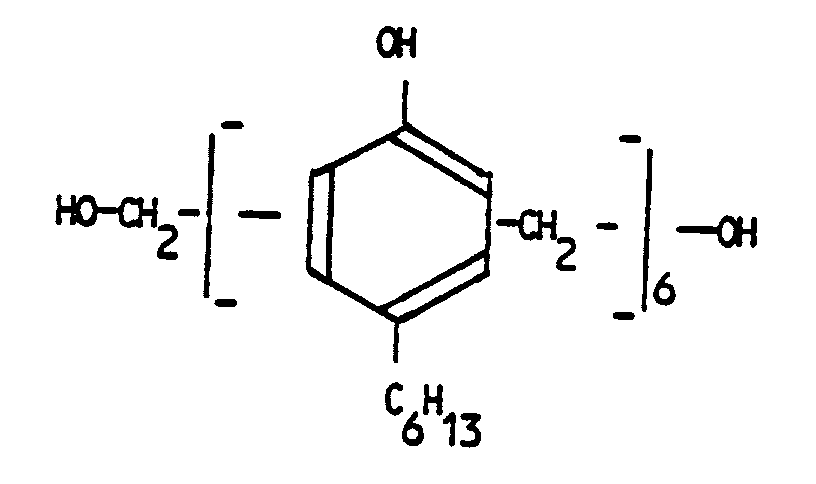
- the phenolic resin will be a phenol-formaldehyde type resol with the following written formula:
- the non-halogenated phenolic resin must be utilized together with an aromatic carboxylic acid, and according to the invention, salicylic acid has proved especially suitable to the purpose -viz, chemical formula: molecular weight: 138.12 melting point: 159 °C specific weight: 1.37 g/cc
- the vulcanizing method adopted according to the invention thus consists in the combination of an alkylphenol-formaldehyde resin, preferably phenolformaldehyde resol, with salicylic acid, wherein, preferably, 0.1 to 0.8 parts acid are admixed, by weight, to each part resin.
- the process for preparation of plastomer-elastomer compounds may be carried out using equipment of the conventional type employed in plastics and/or rubber manufacture, namely Banbury mixers, compounding augers, Buss mixers &c. to work up mixtures containing 10 to 80% by weight of EPDM terpolymer (at least two ⁇ -olefin monomers and at least one diene monomer), and a cross-linking agent consisting in 0.5 15 parts by weight per 100 parts EPDM of a non-halogenated phenolic resin to which salicylic acid is admixed at a rate of between 0.1 and 0.8 parts per 1 part resin, likewise by weight.
- the reaction occurs at a temperature equal to or higher (preferably higher) than that of the melting point of the olefin thermoplastic employed, and for a duration sufficient to ensure a thorough mix, and partial or total (preferably total) cross- linking of the rubbery EPDM.
- the operation can be effected in any single one of the compounding machines described above, or using a train of machines (e.g. Banbury mixer-+-extruder, dry turbo mixer-+-twin-auger extruder, or Banbury-+-Buss &c).
- a train of machines e.g. Banbury mixer-+-extruder, dry turbo mixer-+-twin-auger extruder, or Banbury-+-Buss &c.
- the ideal process temperature would be of an order of 160 to 240 °C, whereas the mastication time lapse will depend upon:
- thermodynamically cross-linked plasto-elastomeric mix according to the invention may include additives of the types used conventionally for such compounds -viz, strengtheners, whether organic (carbon black) or inorganic (silica and silicates), plasticizers (mineral oils, wax, paraffin), fillers (carbonates, kaolin, talc, calcined clay, heavy spar, asbestos and the like), antioxidants, ozone and ultra-violet inhibitors, peptizing agents and anticoagulants, organic and inorganic pigments, vulcanizing agents. All of the components employed in formulation of a given plasto-elastomeric composition according to the invention are either conventional substances, or substances which can be prepared using processes embraced by the prior art. The following definitions are given by way of example.
- EPDM terpolymers are prevalently amorphous polymers which consist of ethylene, with at least one ⁇ -olefin (propylene or 1-butene) and at least one diene that may be linked with the principal polymer chain or otherwise, and consists of the following monomers: ethylidene-norbornene, 1,4-hexadiene, dicyclopentadiene, 2-methyl-1,4-pentadiene, 1,4,9-decatriene, 1,5-cyclooctadiene, 1-methyl-1,5-cyclooctadiene, 1,4-cyclopentadiene, polybutene, polybutadiene, and their substitute derivatives.
- ⁇ -olefin propylene or 1-butene
- diene that may be linked with the principal polymer chain or otherwise, and consists of the following monomers: ethylidene-norbornene, 1,4-hexadiene, dicyclopentadiene, 2-methyl
- Such terpolymers have molecular weight of between 50,000 and 800,000, an ethylene content of between 20 and 80% mol., and bonded diene content of between 1 and 15 parts per 100 parts polymer, by weight; the remainder will consist of an ⁇ -olefin, which may be propylene or butylene.
- Olefin plastomers likewise within the scope of the invention, are olefin copolymers obtained by the interreaction of olefinic monomers such as ethylene, propylene, 1-butene, 1-pentene, 1-hexene, 4-methyl-1-pentene, 3-methyl-1-pentene, 3,3-dimethyl-1-butene 3-methyl-1-hexene and 2,4,4-trimethyl-1-pentene.
- the copolymerization of homogeneous or non-homogeneous monomers is brought about in the presence of metallic/organic catalyst compounds (e.g.
- Phenolic resins i.e. as represented by the general formula given above, are those which can be prepared by condensation of alkyl-phenols with formaldehyde, for example as described in volume 2 of Kunstoffe, pp19...21 (published 1962).
- Additives might be formulated for the purpose of enhancing the processability and/or properties of materials such as olefin plastomers, natural and synthetic elastomers, bitumen, asphalts, lubricating oils, adhesives, and polyamine polymers.
- Compounds according to the invention can also be utilized dissolved in organic solvents, in any given proportions by weight, for the treatment of natural and/or synthetic fibre fabrics, metal and timber surfaces, cellulose compositions, non-woven fabrics and cement mortar.
- Plasto-elastomeric compositions are prepared in a Banbury mixer of 6 litres fluid capacity (rotor speed 45 rpm), utilizing components of the type and in the proportions by weight indicated in table 1 (tests A, B, C, D and E).
- the EPDM elastomer is put in first and masticated for 30 seconds at an initial temperature of 160 °C, whereupon the polypropylene plastomer and paraffin oil plasticizer are added. Mastication is continued until the rubbery phase is brought about, with complete fusion of the polypropylene, hence its full and even dispersion. This operation requires some two minutes, during which time the temperature in the mixer will rise to 190 °C as a result of the shear strain and friction generated. Next follows admixture of the cross-linking agents, resol and salicylic acid. The components are now masticated further (5 minutes approx) until the EPDM has been fully cross-linked; temperature of the material as it emerges from the machine will be 200 °C approx.
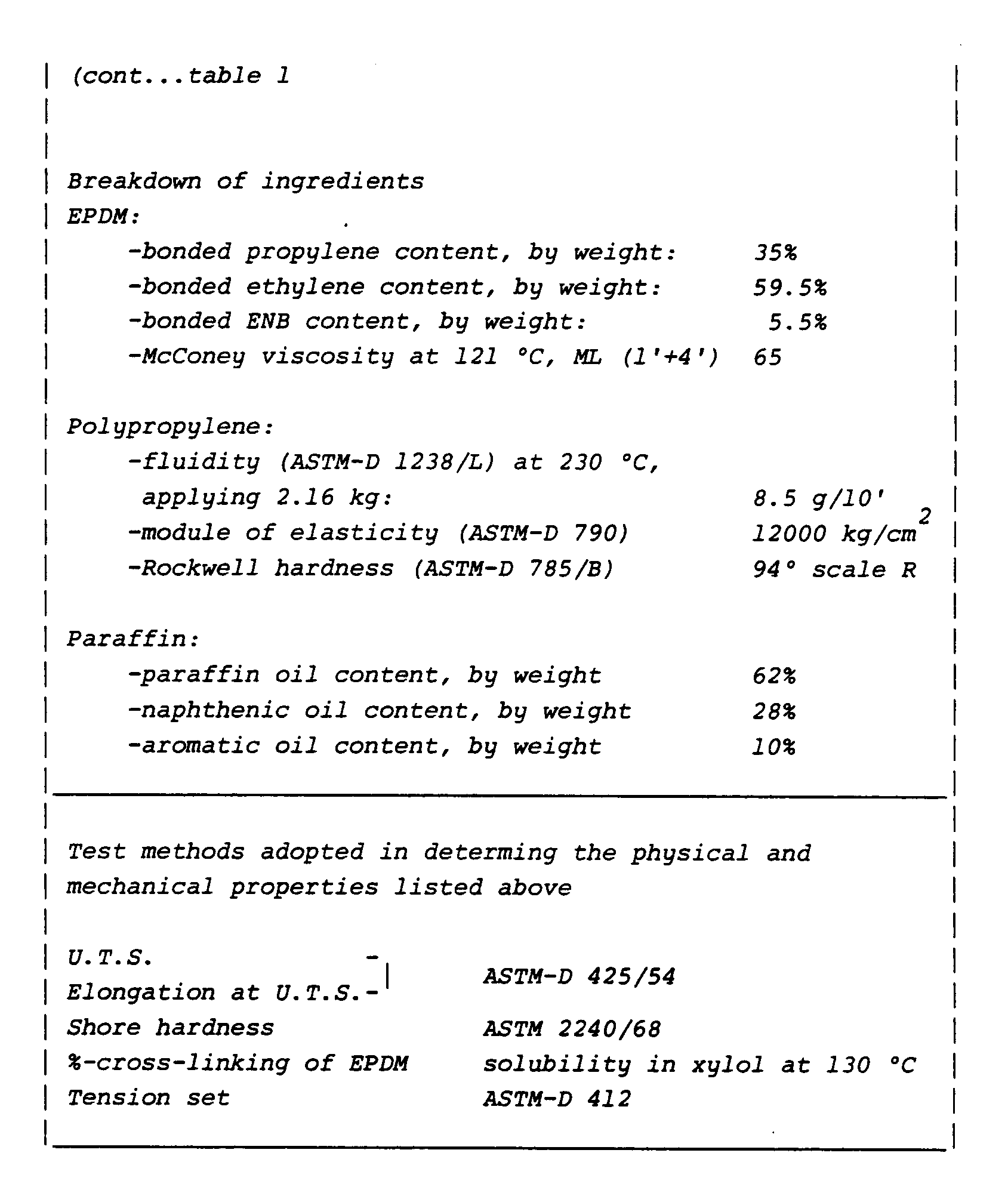
- table 1 shows physical and mechanical properties of the compounds produced, and the essential physical and structural composition of the plastomers, the elastomers and the plasticizers envisaged in this first example. Also listed are the ASTM methods adopted for tests on physical and mechanical properties.
- Table 2 illustrates the composition and the physical and mechanical properties of thermoplastic compounds from tests A, B, C, D, E as envisaged in example 2.
- Table 3 overleaf illustrates the composition and the physical and mechanical properties of thermoplastic compounds obtained from tests A, B, C, D and E as envisaged in example 3.
Landscapes
- Chemical & Material Sciences (AREA)
- Health & Medical Sciences (AREA)
- Chemical Kinetics & Catalysis (AREA)
- Medicinal Chemistry (AREA)
- Polymers & Plastics (AREA)
- Organic Chemistry (AREA)
- Oil, Petroleum & Natural Gas (AREA)
- Compositions Of Macromolecular Compounds (AREA)
- Processes Of Treating Macromolecular Substances (AREA)
- Addition Polymer Or Copolymer, Post-Treatments, Or Chemical Modifications (AREA)
Abstract
Description
- The invention disclosed relates to a process for the preparation of a plasto-elastomeric composition from at least one thermoplastic olefin resin and at least one ethylene propylene terpolymer, and to a plasto-elastomeric composition obtained by implementation of such a process. The preparation of thermoplastics from α-olefin resins and EPDM terpolymeric elastomers has long constituted prior art in the field in question, e.g. as in FR 2 408 632 published 1978. In the preparation methods disclosed by these two references, the cross-linking agent employed is either a halogenated phenolic resin, or a non-halogenated phenolic resin associated with halogen donors.
- US 4 477 631, published in 1984, discloses the association of a non-halogenated phenolic resin with metal oxides or carbonates; processability is thus enhanced in comparison to the two references first mentioned.
- Other elastomer vulcanizing techniques that fall within the general scope of preparing a plasto-elastomeric composition from α-olefin plastomers and EPDM elastomers, thermodynamically cross-linked, are described in DE 2 401 149, published 1974, also in US 3 884 882, published 1974, which disclose initial bonding of the elastomeric copolymers with maleic anhydride so as to ensure their being cross-linked and rendered more compatible with the plastomer materials contained in the compounds.
- Finally, the prior art also embraces methods for the preparation of plasto-elastomeric composition wherein the elastomeric constituent is cross-linked thermodynamically employing conventional agents such as are used in the rubber industry, namely, sulphur or its donors, organic peroxides, quinone derivatives, guanidine, azides, sulphenazides, amines, xanthates, urea, triazoles, imidazoles, sulphenamides, cyanide compounds, isocyanates, and paraquinondioxin (as disclosed in GB 2 011 430, published 1978, also in US 3 806 558 and US 3 037 954, both published 1973, and US 3 758 643 and 3 862 106, both published 1974. There are drawbacks common to all the thermodynamic vulcanization methods embraced by the prior art, the effect of which is to impose marked limitations on the use of the compound, and/or on the possibility of its being manufactured with ease. For example, cross-linking of the rubbery component (EPDM) is uneven by reason of the poor dispersion of cross-linking agents within the given plasto-elastomeric composition as a whole, once temperature levels equal to or higher than that of the plastomer's melting point are reached, as vulcanization of the elastomer content commences at temperatures of this order. Other processes protected by letters patent tend to disclose over-long reaction times and excessively high temperatures, which are not practicable at industrial level.
- Accordingly, the object of the invention is that of setting forth a new process that improves on prior art methods, inasmuch as the plasto-elastomeric compound is more easily processed, and operating conditions are engineered in a way such as enhances feasibility of the process on industrial scale. More exactly, the object is one of developing a process that will be ensured free from the drawbacks mentioned above, especially in terms of avoiding environmental and personal risk stemming from the production of chlorine, and require considerably lower temperatures and less time for implementation than the processes employed hitherto.
- The stated object can be realized to surprisingly good effect, using a non-halogenated phenolic resin in conjunction with a given aromatic carboxylic acid to bring about thermodynamic cross-linking of the EPDM elastomeric content present in the plasto-elastomeric compound.
- In one aspect of the present invention, there is provided a process for preparing a plasto-elastomeric composition comprising at least one EPDM elastomer and at least one polyolefin and having the elastomeric phase partially or fully crosslinked, wherein mixtures containing from 10% to 80% by weight of EPDM terpolimer are subjected to mastication at a temperature equal or higher than the melting point of the olefinic thermoplastic and for a sufficient period of time to ensure a thorough mix and a partial or full crosslinking of EPDM rubbery phase contained in the mixture itself in the presence of a crosslinking system consisting of 0.5-15 parts by weight, per 100 parts of EPDM, of a non-halogenated phenolic resin and salicylic acid.
- In another aspect of the present invention, there is provided a plasto-elastomeric composition comprising at least one EPDM elastomer and at least one polyolefin and having the elastomeric phase partially or fully crosslinked, wherein crosslinking is achieved by means of salicylic acid and a non-halogenated phanolic resin of formula

wherein
M1 and M2, which may be the same or different, are -CH2- or -CH2-CO-CH2- radicals,
Z is an alkenyl, aryl or alkyl radical having from 4 to 16 carbon atoms and
n is an integer from 0 to 6. - More exactly, the cross-linking non-halogenated phenolic resin is an alkylphenol-formaldehyde resin having the general formula:

where
M₁ and M₂ are radicals -CH₂- or
which can be the same or different;
Z is an alkenyl, aryl or alkyl radical having from 4 to 16 carbon atoms;
n is an integer between 0 and 6. - In a preferred version of the process, the phenolic resin will be a phenol-formaldehyde type resol with the following written formula:

To achieve cross-linking, the non-halogenated phenolic resin must be utilized together with an aromatic carboxylic acid, and according to the invention, salicylic acid has proved especially suitable to the purpose -viz,
chemical formula:
molecular weight: 138.12
melting point: 159 °C
specific weight: 1.37 g/cc
The vulcanizing method adopted according to the invention thus consists in the combination of an alkylphenol-formaldehyde resin, preferably phenolformaldehyde resol, with salicylic acid, wherein, preferably, 0.1 to 0.8 parts acid are admixed, by weight, to each part resin. - The process for preparation of plastomer-elastomer compounds may be carried out using equipment of the conventional type employed in plastics and/or rubber manufacture, namely Banbury mixers, compounding augers, Buss mixers &c. to work up mixtures containing 10 to 80% by weight of EPDM terpolymer (at least two α-olefin monomers and at least one diene monomer), and a cross-linking agent consisting in 0.5 15 parts by weight per 100 parts EPDM of a non-halogenated phenolic resin to which salicylic acid is admixed at a rate of between 0.1 and 0.8 parts per 1 part resin, likewise by weight. The reaction occurs at a temperature equal to or higher (preferably higher) than that of the melting point of the olefin thermoplastic employed, and for a duration sufficient to ensure a thorough mix, and partial or total (preferably total) cross- linking of the rubbery EPDM.
- The operation can be effected in any single one of the compounding machines described above, or using a train of machines (e.g. Banbury mixer-+-extruder, dry turbo mixer-+-twin-auger extruder, or Banbury-+-Buss &c...). Whatever the ultimate choice of plant, the process must be implemented dynamically, with duration, temperature and rotational speed of the machine such as will ensure the following sequence of steps:
- a) mastication of the EPDM elastomer and fusion of the polyolefin plastomer;
- b) thorough dispersion of the components;
- c) cross-linking of the elastomeric component;
- d) even dispersion of any other additives.
- Proceeding thus, it becomes possible to obtain a fine dispersion of the cross-linked EPDM elastomer (indiscrete phase), merged with the molten plastomer (discrete phase) and assuming the form of minute nodular particles measuring some 0.1 to 1.5 µm in diameter.
- The ideal process temperature would be of an order of 160 to 240 °C, whereas the mastication time lapse will depend upon:
- a) the degree of EPDM elastomer cross-linking it is wished to achieve;
- b) the proportion of diene, by weight, in the EPDM polymer chain;
- c) the proportion, by weight, of the cross-linking agents employed (phenolic resin + salicylic acid).
- The following observations must also be made with regard to the single components:
- 1) the EPDM should be linked at a rate of between 10 and 100% by weight of the total amount incorporated into the compound; the ideal proportion is 58 to 98%, by weight;
- 2) the proportion of diene in the EPDM, a parameter which is determined by the degree of unsaturation and generally expressed as parts diene per 100 parts elastomer (by weight), can vary between 1 and 15%; the process will be best implemented utilizing EPDM elastomers containing between 3 and 8% diene, by weight;
- 3) the quantities by weight of dynamic cross-linking agent to be admixed to the EPDM elastomer should be between 0.5 and 15 parts phenolic resin, and between 0.05 and 12 parts salicylic acid.
- A thermodynamically cross-linked plasto-elastomeric mix according to the invention may include additives of the types used conventionally for such compounds -viz, strengtheners, whether organic (carbon black) or inorganic (silica and silicates), plasticizers (mineral oils, wax, paraffin), fillers (carbonates, kaolin, talc, calcined clay, heavy spar, asbestos and the like), antioxidants, ozone and ultra-violet inhibitors, peptizing agents and anticoagulants, organic and inorganic pigments, vulcanizing agents. All of the components employed in formulation of a given plasto-elastomeric composition according to the invention are either conventional substances, or substances which can be prepared using processes embraced by the prior art. The following definitions are given by way of example.
- EPDM terpolymers, as envisaged in the terms of the invention, are prevalently amorphous polymers which consist of ethylene, with at least one α-olefin (propylene or 1-butene) and at least one diene that may be linked with the principal polymer chain or otherwise, and consists of the following monomers: ethylidene-norbornene, 1,4-hexadiene, dicyclopentadiene, 2-methyl-1,4-pentadiene, 1,4,9-decatriene, 1,5-cyclooctadiene, 1-methyl-1,5-cyclooctadiene, 1,4-cyclopentadiene, polybutene, polybutadiene, and their substitute derivatives.
- Such terpolymers have molecular weight of between 50,000 and 800,000, an ethylene content of between 20 and 80% mol., and bonded diene content of between 1 and 15 parts per 100 parts polymer, by weight; the remainder will consist of an α-olefin, which may be propylene or butylene.
- Olefin plastomers, likewise within the scope of the invention, are olefin copolymers obtained by the interreaction of olefinic monomers such as ethylene, propylene, 1-butene, 1-pentene, 1-hexene, 4-methyl-1-pentene, 3-methyl-1-pentene, 3,3-dimethyl-1-butene 3-methyl-1-hexene and 2,4,4-trimethyl-1-pentene. The copolymerization of homogeneous or non-homogeneous monomers ('random' copolymers) is brought about in the presence of metallic/organic catalyst compounds (e.g. - AlEt₃, AlEt₃Cl, Al is Bu₃) together with soluble vanadium compounds (e.g. VCl₄, VOCl₃, VAC₃), where Et = ethylene, AC = acetylacetone, and is Bu = isobutyl).
- Phenolic resins, i.e. as represented by the general formula given above, are those which can be prepared by condensation of alkyl-phenols with formaldehyde, for example as described in volume 2 of Kunstoffe, pp19...21 (published 1962).
- Plasto-elastomeric compositions obtainable by way of the process disclosed would be used in a number of industrial applications, for example:
- a) rigid plastic items manufactured using injection, transfer, compression and blow moulding techniques;
- b) extruded items, including sheaths for electrical wires and cable;
- c) laminated, or 'sheet' material turned out by two or more mill rolls and utilized generally for damp-and weatherproofing;
- d) modification of other materials by addition of appropriate percentage quantities of the compounds disclosed herein.
- Additives might be formulated for the purpose of enhancing the processability and/or properties of materials such as olefin plastomers, natural and synthetic elastomers, bitumen, asphalts, lubricating oils, adhesives, and polyamine polymers.
- Compounds according to the invention can also be utilized dissolved in organic solvents, in any given proportions by weight, for the treatment of natural and/or synthetic fibre fabrics, metal and timber surfaces, cellulose compositions, non-woven fabrics and cement mortar.
- The three examples listed below are illustrative of compounds obtainable by implementation of a process as disclosed, though it will be appreciated that no limitation of the basic concept is implied.
- Plasto-elastomeric compositions are prepared in a Banbury mixer of 6 litres fluid capacity (rotor speed 45 rpm), utilizing components of the type and in the proportions by weight indicated in table 1 (tests A, B, C, D and E).
- The EPDM elastomer is put in first and masticated for 30 seconds at an initial temperature of 160 °C, whereupon the polypropylene plastomer and paraffin oil plasticizer are added. Mastication is continued until the rubbery phase is brought about, with complete fusion of the polypropylene, hence its full and even dispersion. This operation requires some two minutes, during which time the temperature in the mixer will rise to 190 °C as a result of the shear strain and friction generated. Next follows admixture of the cross-linking agents, resol and salicylic acid. The components are now masticated further (5 minutes approx) until the EPDM has been fully cross-linked; temperature of the material as it emerges from the machine will be 200 °C approx. In addition to the mix proportions, table 1 shows physical and mechanical properties of the compounds produced, and the essential physical and structural composition of the plastomers, the elastomers and the plasticizers envisaged in this first example. Also listed are the ASTM methods adopted for tests on physical and mechanical properties.

- The mixing procedure is the same as that utilized in example 1, though employing plasto-elastomeric compositions with different physical and structural properties -viz,
- EPDM containing 45% by weight of bonded propylene, 51.5% by weight bonded ethylene, and 3.5% by weight bonded ENB (ethylidene-norbornene);
- polypropylene possessing fluidity of 0.75 g/10′ at 230 °C, applying 2.16 kg (ASTM-D 1238/L), modulus of elasticity of 13500 kg/cm² (ASTM-D 790), and scale R Rockwell hardness of 90° (ASTM-D 785/B).
- Other ingredients remain the same as in example 1, likewise the ASTM test methods by which physical and mechanical properties are determined.
- Table 2 illustrates the composition and the physical and mechanical properties of thermoplastic compounds from tests A, B, C, D, E as envisaged in example 2.

- The mixing procedure is the same as that utilized in example 1, though employing plasto-elastomeric compositions with different physical and structural properties to those of the first two examples: -viz,
- EPDM, an oil, mingled at a rate of 23% by weight with an oil of substantially paraffin composition and containing 32 parts bonded propylene per 100 parts of the pure polymer (without oil), 61 parts bonded ethylene per 100 of the pure polymer, and 7 parts bonded ENB (ethylidene-norbornene) per 100 of pure polymer;
- polypropylene, a random copolymer consisting of 98% polypropylene and 2% polyethene, by weight, which possesses fluidity of 6 g/10′ at 230 °C, applying 2.16 kg (ASTM-D 1298/L), modulus of elasticity of 850 kg/cm² (ASTM-D 790), and Rockwell hardness of 79°, scale R (ASTM-D 256).
- Other ingredients remain the same as in examples 1 and 2, likewise the ASTM test methods adopted. Table 3 overleaf illustrates the composition and the physical and mechanical properties of thermoplastic compounds obtained from tests A, B, C, D and E as envisaged in example 3.

Claims (15)
- Process for preparing a plasto-elastomeric composition comprising at least one EPDM elastomer and at least one polyolefin and having the elastomeric phase partially or fully crosslinked, characterized in that mixtures containing from 10% to 80% by weight of EPDM terpolymer are subjected to mastication at a temperature equal or higher than the melting point of the olefinic thermoplastic and for a sufficient period of time to ensure a thorough mix and a partial or full crosslinking of EPDM rubbery phase contained in the mixture itself in the presence of a crosslinking system consisting of 0.5-15 parts by weight, per 100 parts of EPDM, of a non-halogenated phenolic resin and salicylic acid.
- Process according to claim 1, characterized in that the mastication temperature ranges from 160 to 240°C
- Process according to claim 1 and claim 2, characterized in that the non-halogenated phenolic resin corresponds to the following general formula

M1 and M2, which may be the same or different, are -CH2- or -CH2-CO-CH2- radicals,
Z is an alkenyl, aryl or alkyl radical containing from 4 to 16 carbon atoms, and
n is an integer from 0 to 6. - Process according to any of the preceeding claims, characterized in that the phenolic resin is a phenolformaldehyde resin of formula

- Process according to any of the preceeding claims, characterized in that salicylic acid is present in the composition in an amount of from 0.05 to 12 parts by weight per 100 parts by weight of EPDM elastomer.
- A plasto-elastomeric composition comprising at least one EPDM elastomer and at least one polyolefin and having the elastomeric phase partially or fully crosslinked, characterized in that crosslinking is achieved by means of salicylic acid and a non-halogenated phenolic resin of formula

M1 and M2, which may be the same or different, are -CH2- or -CH2-CO-CH2- radicals,
Z is an alkenyl, aryl or alkyl radical having from 4 to 16 carbon atoms and
n is an integer from 0 to 6. - A plasto-elastomeric composition according to claim 6, characterized in that the phenolic resin is a phenol-formaldehyde resin of formula
- A plasto-elastomeric composition according to claim 6 and claim 7, characterized in that the olefinic monomer from which the polyolefin is obtained is selected from the group consisting of ethylene, propylene, butene-1, pentene-1, hexene-1, 4-methyl-1-pentene, 3-methyl-1-pentene, 3,3-dimethyl-1-butene, 3-methyl-1-hexene and 2,4,4-trimethyl-1-pentene.
- A plasto-elastomeric composition according to claim 6 to 8, characterized in that the EPDM terpolymer consists of at least two olefinic monomers and a diene monomer.
- A plasto-elastomeric composition according to claims 6-9, characterized in that the diene monomer is selected from the group consisting of ethylene-norbornene, 1,4-hexadiene, dicyclopentadiene, 2-methyl-1,4-pentadiene, 1,4,9-decatriene, 1,5-cyclooctadiene, 1-methyl-1,5-cyclooctadiene, 1,4-cyclopentadiene, polybutene, polybutadiene and their derivatives.
- A plasto-elastomeric composition according to claims 6-10, characterized in that salicylic acid is present in the composition in an amount of from 0.05 to 12 parts by weight per 100 parts by weight of EPDM elastomer.
- A plasto-elastomeric composition according to claim 6-11 characterized in that the salicylic acid:non-halogenated phenolic resin weight ratio is from 0.1:1 to 0.8:1.
- A plasto-elastomeric composition according to claims 6-12, characterized in that it contains from 10 to 90% of polyolefin and from 90 to 10% of EPDM terpolymer.
- A plasto-elastomeric composition according to claims 6-13, characterized in that the olefinic monomers are ethylene and/or propylene and/or 1-butene.
- A plasto-elastomeric composition according to claim 6-14, prepared according to the process of claim 1 to 5 and suitable for the manufacture of moulded, extruded and laminated articles.
Applications Claiming Priority (2)
| Application Number | Priority Date | Filing Date | Title |
|---|---|---|---|
| IT03656/85A IT1203607B (en) | 1985-12-20 | 1985-12-20 | PROCEDURE FOR PREPARING PLASTO-ELASTOMERIC COMPOSITIONS BASED ON POLYOLEFINS AND EPDM TERPOLYMERS AND PLASTIC-ELASTOMERIC COMPOSITIONS SO OBTAINED |
| IT365685 | 1985-12-20 |
Publications (3)
| Publication Number | Publication Date |
|---|---|
| EP0230212A2 EP0230212A2 (en) | 1987-07-29 |
| EP0230212A3 EP0230212A3 (en) | 1990-02-07 |
| EP0230212B1 true EP0230212B1 (en) | 1994-11-09 |
Family
ID=11111175
Family Applications (1)
| Application Number | Title | Priority Date | Filing Date |
|---|---|---|---|
| EP86830382A Expired - Lifetime EP0230212B1 (en) | 1985-12-20 | 1986-12-18 | A process for the preparation of plasto-elastomeric compounds from polyolefins and EPDM terpolymers and the plasto-elastomeric compounds thus obtained |
Country Status (7)
| Country | Link |
|---|---|
| US (1) | US4835204A (en) |
| EP (1) | EP0230212B1 (en) |
| AT (1) | ATE113974T1 (en) |
| DE (1) | DE3650140T2 (en) |
| ES (1) | ES2065879T3 (en) |
| GR (1) | GR3014963T3 (en) |
| IT (1) | IT1203607B (en) |
Families Citing this family (19)
| Publication number | Priority date | Publication date | Assignee | Title |
|---|---|---|---|---|
| IT1227341B (en) * | 1988-09-13 | 1991-04-08 | Ausimont Spa | PLASTO-ELASTOMERIC POLYOLEFINIC COMPOSITIONS AND PROCEDURE FOR THEIR PREPARATION WITH DYNAMIC VULCANIZATION METHODS |
| US5100947A (en) † | 1989-05-26 | 1992-03-31 | Advanced Elastomer Systems, L. P. | Dynamically vulcanized alloys having improved stiffness/impact balance |
| AU6140790A (en) * | 1989-09-07 | 1991-04-08 | Ocg Microelectronic Materials, Inc. | Selected block phenolic oligomers and their use in phenolic resin compositions and in radiation-sensitive resist compositions |
| US5232819A (en) * | 1989-09-07 | 1993-08-03 | Ocg Microelectronic Materials, Inc. | Selected block phenolic oligomers and their use in phenolic resin compositions and in radiation-sensitive resist compositions |
| US5234795A (en) * | 1989-09-07 | 1993-08-10 | Ocg Microelectronic Materials, Inc. | Process of developing an image-wise exposed resist-coated substrate |
| US5196289A (en) * | 1989-09-07 | 1993-03-23 | Ocg Microelectronic Materials, Inc. | Selected block phenolic oligomers and their use in radiation-sensitive resist compositions |
| US5188921A (en) * | 1989-09-07 | 1993-02-23 | Ocg Microelectronic Materials, Inc. | Selected block copolymer novolak binder resins in radiation-sensitive resist compositions |
| US5235022A (en) * | 1989-09-07 | 1993-08-10 | Ocg Microelectronic Materials, Inc. | Selected block copolymer novolak binder resins |
| IT1256734B (en) * | 1992-12-17 | 1995-12-15 | Paranova Articoli Tecnici | PROCEDURE FOR THE PREPARATION OF PLASTIC-ELASTOMERIC COMPOSITIONS OF A POLYOLEFINIC NATURE BY DYNAMIC VULCANIZATION WITH ALCYLPHENOL-FORMALDEHYDE AND SODIUM BISULPHITE RESIN. |
| US5869591A (en) * | 1994-09-02 | 1999-02-09 | The Dow Chemical Company | Thermoset interpolymers and foams |
| US5977271A (en) * | 1994-09-02 | 1999-11-02 | The Dow Chemical Company | Process for preparing thermoset interpolymers and foams |
| ZA976110B (en) | 1996-07-12 | 1999-01-11 | Dow Chemical Co | Elastomers processes for their manufacture and articles made from these elastomers |
| US5750625A (en) * | 1997-06-09 | 1998-05-12 | Advanced Elastomer Systems, L.P. | Phenolic resin curatives which form nonstaining thermoplastic elastomers |
| US6277916B1 (en) | 1999-02-25 | 2001-08-21 | The Dow Chemical Company | Process for preparing thermoplastic vulcanizates |
| EP1651713A1 (en) * | 2003-08-07 | 2006-05-03 | PolyOne Corporation | Catalyst systems for elastomeric compositions |
| ITVR20040074A1 (en) * | 2004-05-03 | 2004-08-03 | So F Ter S P A | PLASTO-ELASTOMERIC COMPOSITIONS BASED ON POLYOLEFINS AND EPDM TERPOLYMERS ADDED WITH MINERAL CHARGES. |
| US7803875B2 (en) | 2007-06-27 | 2010-09-28 | Exxonmobil Chemical Patents Inc. | Curing of rubbers and thermoplastic vulcanizates in the absence of halogen donors |
| EP2871212B2 (en) | 2013-11-06 | 2024-05-08 | Woco GmbH & Co. KG | Resin crosslinking of rubbers |
| JP2017506414A (en) * | 2014-02-07 | 2017-03-02 | ジェネラル・ケーブル・テクノロジーズ・コーポレーション | Method of forming a cable with an improved cover |
Family Cites Families (5)
| Publication number | Priority date | Publication date | Assignee | Title |
|---|---|---|---|---|
| LU46240A1 (en) * | 1964-06-03 | 1964-12-03 | ||
| US3752780A (en) * | 1971-04-26 | 1973-08-14 | Schenectady Chemical | Halogenated methylol phenols |
| US4010223A (en) * | 1973-01-10 | 1977-03-01 | E. I. Du Pont De Nemours And Company | Adducts containing succinic groups attached to elastomeric copolymers |
| US3878150A (en) * | 1973-04-16 | 1975-04-15 | Firestone Tire & Rubber Co | Stabilized polybutadiene resins |
| IT1193549B (en) * | 1980-08-19 | 1988-07-08 | Montedison Spa | PROCEDURE FOR THE PREPARATION OF POLYOLEFINIC PLASTIC-ELASTOMERIC COMPOSITIONS, BY DYNAMIC VULCANIZATION |
-
1985
- 1985-12-20 IT IT03656/85A patent/IT1203607B/en active
-
1986
- 1986-12-18 AT AT86830382T patent/ATE113974T1/en not_active IP Right Cessation
- 1986-12-18 ES ES86830382T patent/ES2065879T3/en not_active Expired - Lifetime
- 1986-12-18 EP EP86830382A patent/EP0230212B1/en not_active Expired - Lifetime
- 1986-12-18 DE DE3650140T patent/DE3650140T2/en not_active Expired - Lifetime
-
1988
- 1988-05-20 US US07/197,085 patent/US4835204A/en not_active Expired - Lifetime
-
1995
- 1995-02-06 GR GR950400217T patent/GR3014963T3/en unknown
Also Published As
| Publication number | Publication date |
|---|---|
| US4835204A (en) | 1989-05-30 |
| DE3650140T2 (en) | 1995-04-20 |
| ATE113974T1 (en) | 1994-11-15 |
| IT8503656A0 (en) | 1985-12-20 |
| DE3650140D1 (en) | 1994-12-15 |
| EP0230212A2 (en) | 1987-07-29 |
| GR3014963T3 (en) | 1995-05-31 |
| EP0230212A3 (en) | 1990-02-07 |
| ES2065879T3 (en) | 1995-03-01 |
| IT1203607B (en) | 1989-02-15 |
Similar Documents
| Publication | Publication Date | Title |
|---|---|---|
| EP0230212B1 (en) | A process for the preparation of plasto-elastomeric compounds from polyolefins and EPDM terpolymers and the plasto-elastomeric compounds thus obtained | |
| US5266626A (en) | Thermoplastic elastomer based on an ethylene/α-olefin copolymer and on polynorbornene | |
| US6251998B1 (en) | Hydrosilylation crosslinking of thermoplastic elastomer | |
| JP4199841B2 (en) | Preferred structure of phenolic resin curing agent for thermoplastic vulcanizates | |
| EP0320001B1 (en) | Elastoplastic compositions and process for preparing them | |
| US6759453B2 (en) | Asphalt compositions | |
| EP0046285B2 (en) | Process for the preparation of polyolefinic plasto-elastomeric compositions by means of dynamical vulcanization | |
| JPH115876A (en) | Thermoplastic cured rubber and its production | |
| US4624989A (en) | Thermoplastic elastomers containing cross-linked epihalohydrin rubbers | |
| EP0213285B1 (en) | Process for the preparation of polyolefinic plasto-elastomeric compositions by dynamical vulcanization | |
| JPS5914065B2 (en) | elastomeric thermoplastic | |
| FR2654433B1 (en) | THERMOPLASTIC COMPOSITIONS WITH ELASTIC MEMORY AND PREPARATION METHOD THEREOF. | |
| JPH0118104B2 (en) | ||
| JP2646240B2 (en) | Composition for waterproof sheet | |
| US3345315A (en) | Chlorinated polyethylene cross-linked with a polyamide | |
| JP2003528961A (en) | Thermoplastic elastomer with improved low temperature properties | |
| CA1183991A (en) | Olefin polymer modified with a substituted maleamic acid | |
| KR950003148B1 (en) | Thermoplastic elastomer composition with improved processability | |
| US20070072999A1 (en) | Plasto-elastomeric compositions | |
| EP0185913A2 (en) | Process for the preparation of plasto-elastomeric polyolefinic compositions by dynamic vulcanization | |
| JPH0134459B2 (en) | ||
| JPH0527657B2 (en) |
Legal Events
| Date | Code | Title | Description |
|---|---|---|---|
| PUAI | Public reference made under article 153(3) epc to a published international application that has entered the european phase |
Free format text: ORIGINAL CODE: 0009012 |
|
| AK | Designated contracting states |
Kind code of ref document: A2 Designated state(s): AT BE CH DE ES FR GB GR LI NL SE |
|
| PUAL | Search report despatched |
Free format text: ORIGINAL CODE: 0009013 |
|
| AK | Designated contracting states |
Kind code of ref document: A3 Designated state(s): AT BE CH DE ES FR GB GR LI NL SE |
|
| 17P | Request for examination filed |
Effective date: 19900521 |
|
| 17Q | First examination report despatched |
Effective date: 19910814 |
|
| RAP3 | Party data changed (applicant data changed or rights of an application transferred) |
Owner name: SO.F.TER S.P.A. |
|
| GRAA | (expected) grant |
Free format text: ORIGINAL CODE: 0009210 |
|
| AK | Designated contracting states |
Kind code of ref document: B1 Designated state(s): AT BE CH DE ES FR GB GR LI NL SE |
|
| REF | Corresponds to: |
Ref document number: 113974 Country of ref document: AT Date of ref document: 19941115 Kind code of ref document: T |
|
| REF | Corresponds to: |
Ref document number: 3650140 Country of ref document: DE Date of ref document: 19941215 |
|
| EAL | Se: european patent in force in sweden |
Ref document number: 86830382.7 |
|
| ET | Fr: translation filed | ||
| REG | Reference to a national code |
Ref country code: ES Ref legal event code: FG2A Ref document number: 2065879 Country of ref document: ES Kind code of ref document: T3 |
|
| REG | Reference to a national code |
Ref country code: GR Ref legal event code: FG4A Free format text: 3014963 |
|
| PLBE | No opposition filed within time limit |
Free format text: ORIGINAL CODE: 0009261 |
|
| STAA | Information on the status of an ep patent application or granted ep patent |
Free format text: STATUS: NO OPPOSITION FILED WITHIN TIME LIMIT |
|
| 26N | No opposition filed | ||
| REG | Reference to a national code |
Ref country code: GB Ref legal event code: IF02 |
|
| PGFP | Annual fee paid to national office [announced via postgrant information from national office to epo] |
Ref country code: ES Payment date: 20051214 Year of fee payment: 20 Ref country code: SE Payment date: 20051214 Year of fee payment: 20 Ref country code: GB Payment date: 20051214 Year of fee payment: 20 |
|
| PGFP | Annual fee paid to national office [announced via postgrant information from national office to epo] |
Ref country code: AT Payment date: 20051215 Year of fee payment: 20 Ref country code: DE Payment date: 20051215 Year of fee payment: 20 |
|
| PGFP | Annual fee paid to national office [announced via postgrant information from national office to epo] |
Ref country code: GR Payment date: 20051219 Year of fee payment: 20 Ref country code: FR Payment date: 20051219 Year of fee payment: 20 Ref country code: CH Payment date: 20051219 Year of fee payment: 20 |
|
| PGFP | Annual fee paid to national office [announced via postgrant information from national office to epo] |
Ref country code: NL Payment date: 20051231 Year of fee payment: 20 |
|
| PGFP | Annual fee paid to national office [announced via postgrant information from national office to epo] |
Ref country code: BE Payment date: 20060102 Year of fee payment: 20 |
|
| PG25 | Lapsed in a contracting state [announced via postgrant information from national office to epo] |
Ref country code: GB Free format text: LAPSE BECAUSE OF EXPIRATION OF PROTECTION Effective date: 20061217 |
|
| PG25 | Lapsed in a contracting state [announced via postgrant information from national office to epo] |
Ref country code: NL Free format text: LAPSE BECAUSE OF EXPIRATION OF PROTECTION Effective date: 20061218 |
|
| PG25 | Lapsed in a contracting state [announced via postgrant information from national office to epo] |
Ref country code: ES Free format text: LAPSE BECAUSE OF EXPIRATION OF PROTECTION Effective date: 20061219 |
|
| REG | Reference to a national code |
Ref country code: GB Ref legal event code: PE20 |
|
| NLV7 | Nl: ceased due to reaching the maximum lifetime of a patent |
Effective date: 20061218 |
|
| EUG | Se: european patent has lapsed | ||
| REG | Reference to a national code |
Ref country code: ES Ref legal event code: FD2A Effective date: 20061219 |
|
| BE20 | Be: patent expired |
Owner name: *SO.F.TER S.P.A. Effective date: 20061218 |